Virtual Reassembly Method for Cultural Relic Fragments Based on Multi-Feature Extraction
 , ,
, ,
Abstract
1. Introduction
- (1)
- A refined contour point extraction strategy based on a Cylinder Box model is proposed. Unlike conventional methods that rely solely on curvature thresholding or normal vector angle analysis and frequently fail to recover missing contour segments, the proposed strategy explicitly identifies gap endpoints via resultant force analysis and recovers missing contour points by constructing cylindrical bounding boxes along supplementary line segments, yielding accurate and topologically complete contour representations for fragments with complex fracture geometries.
- (2)
- A multi-feature description framework is constructed by jointly integrating fracture-surface geometric features (FPFH), manifold-based texture features (HKS), and a novel spatial cube-based contour shape descriptor. In contrast to prior work that typically employs a single descriptor type—either local geometric features or global shape signatures—the complementary combination proposed here simultaneously captures local fracture geometry, surface manifold structure, and global contour shape, substantially improving matching discriminability in the presence of surface texture ambiguity and irregular fracture patterns.
- (3)
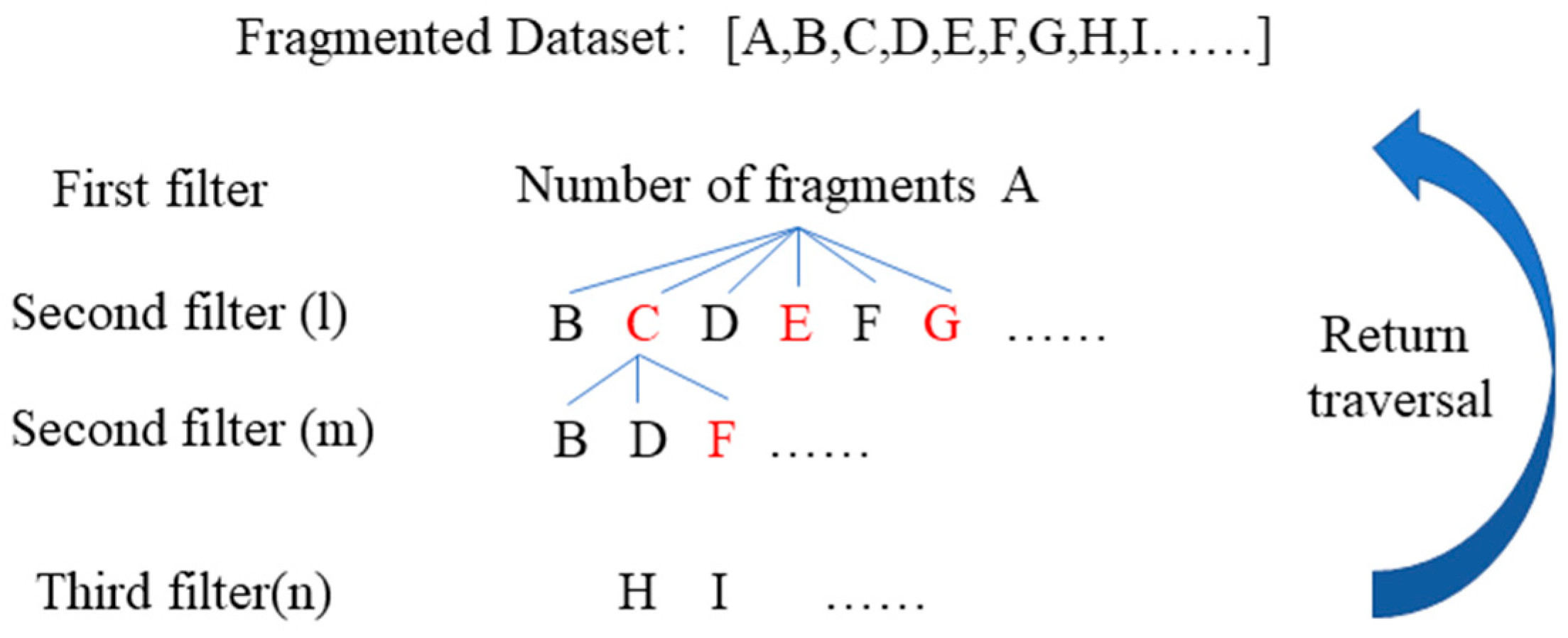
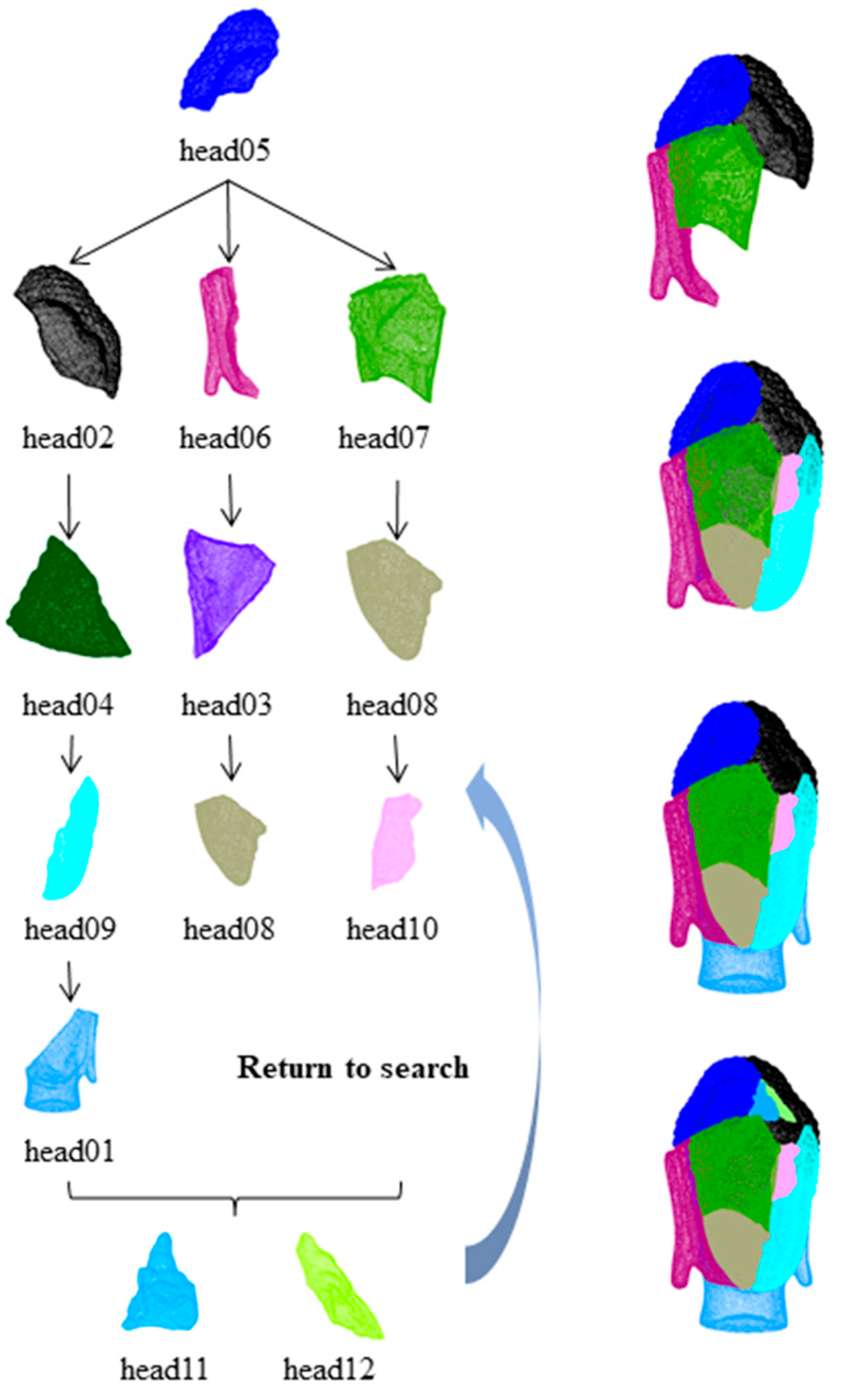
- A tree-based fragment retrieval strategy combined with a coarse-to-fine registration scheme is developed. Whereas exhaustive pairwise retrieval requires O(n2) computations and existing accelerated strategies such as AFSF reduce this only modestly, the proposed hierarchical tree structure dynamically narrows the candidate field at each retrieval tier, reducing the total number of matching computations to 27% of exhaustive retrieval (36 versus 132 computations for 12 fragments) while preserving reassembly accuracy.
- (4)
- A pseudo-ground-truth accuracy evaluation method is introduced, providing a quantitative means to assess cumulative reassembly errors in scenarios where reliable reference models are unavailable.
2. Experimental Data and Preprocessing
2.1. Overall Technical Framework
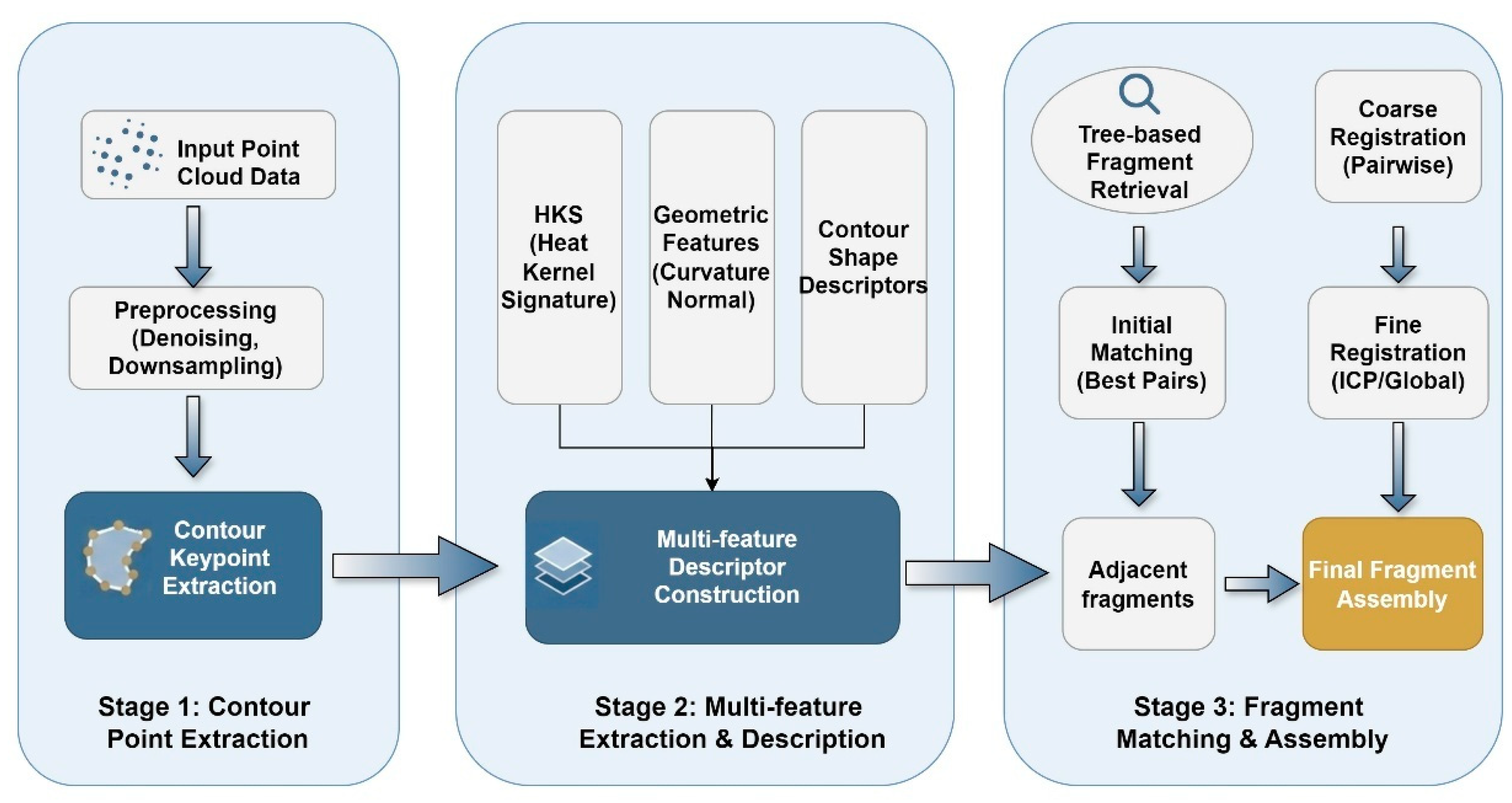
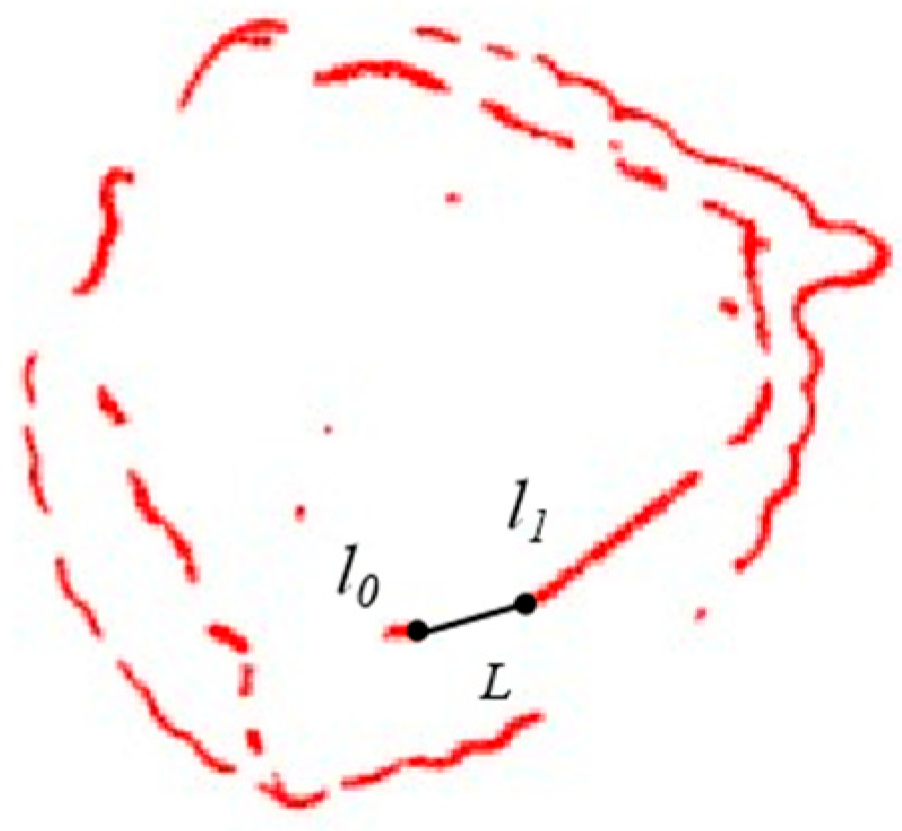
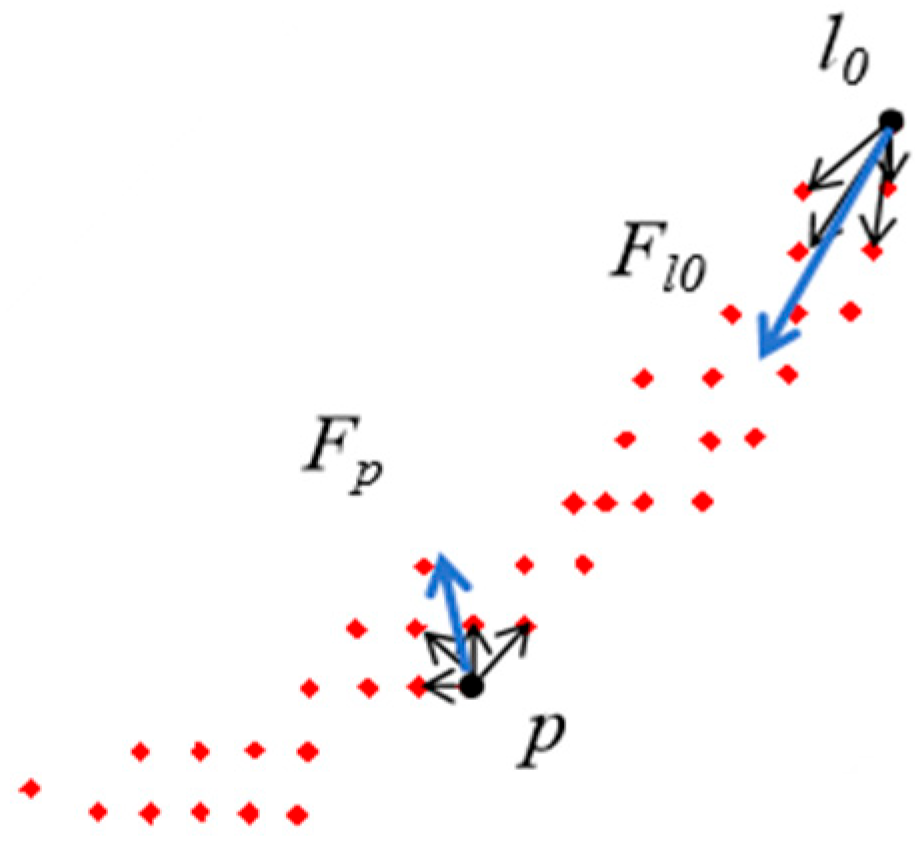
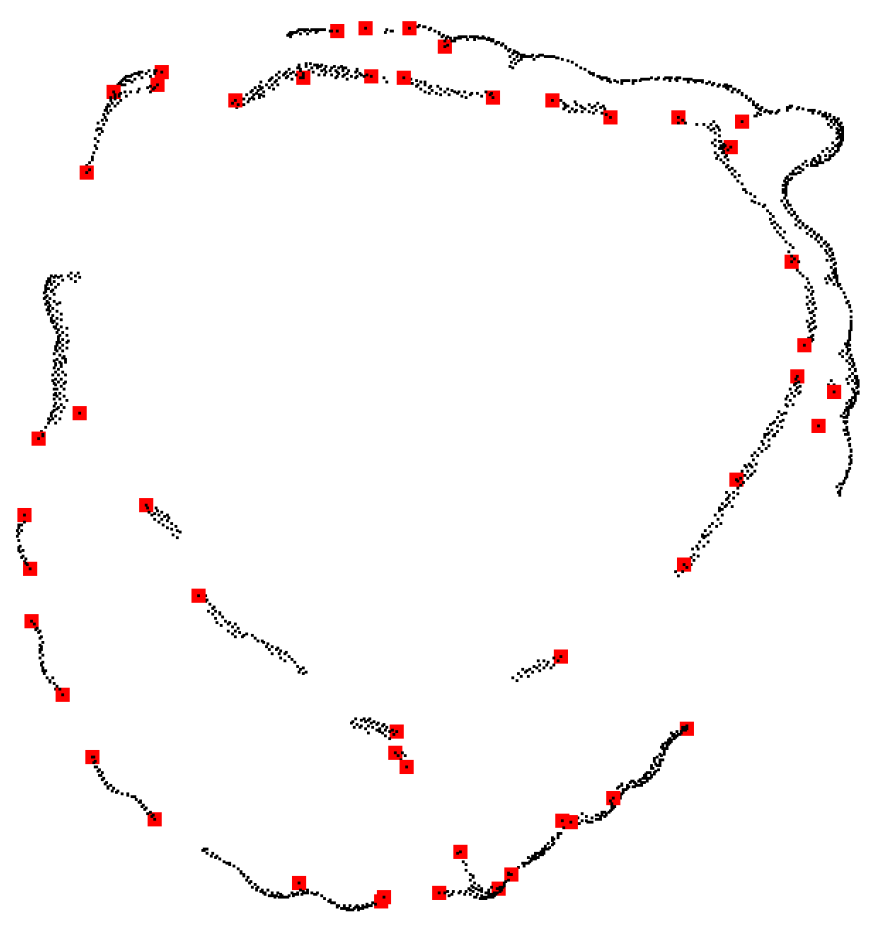
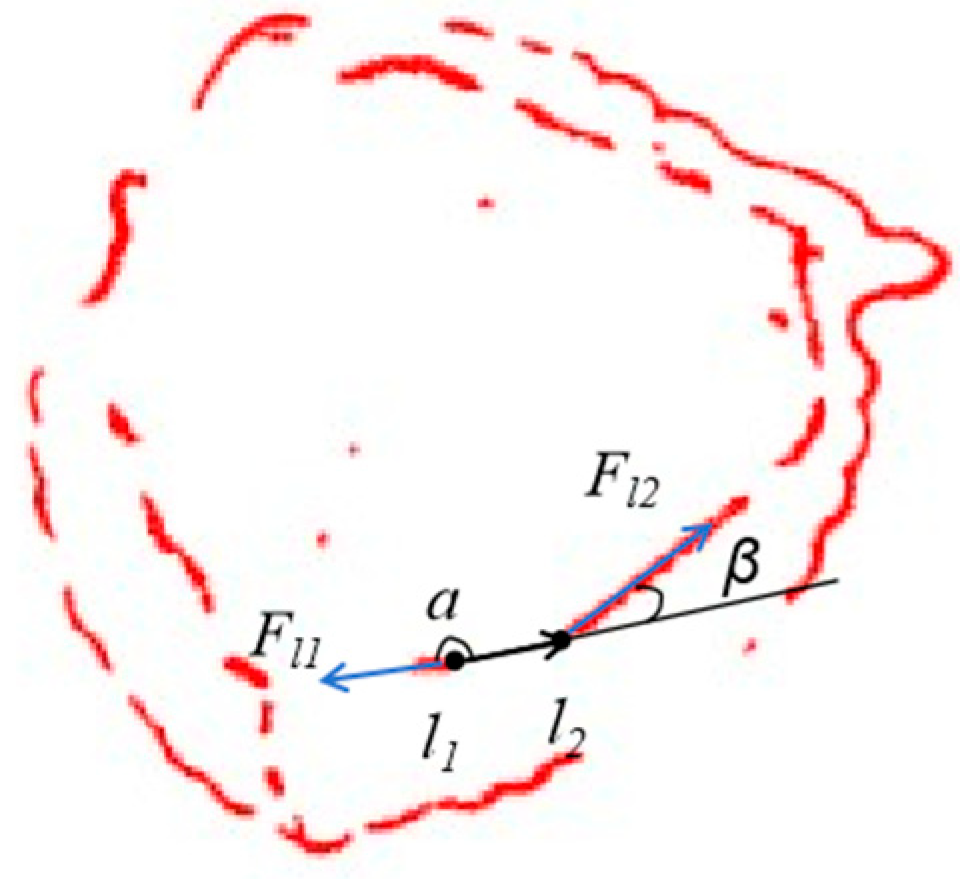
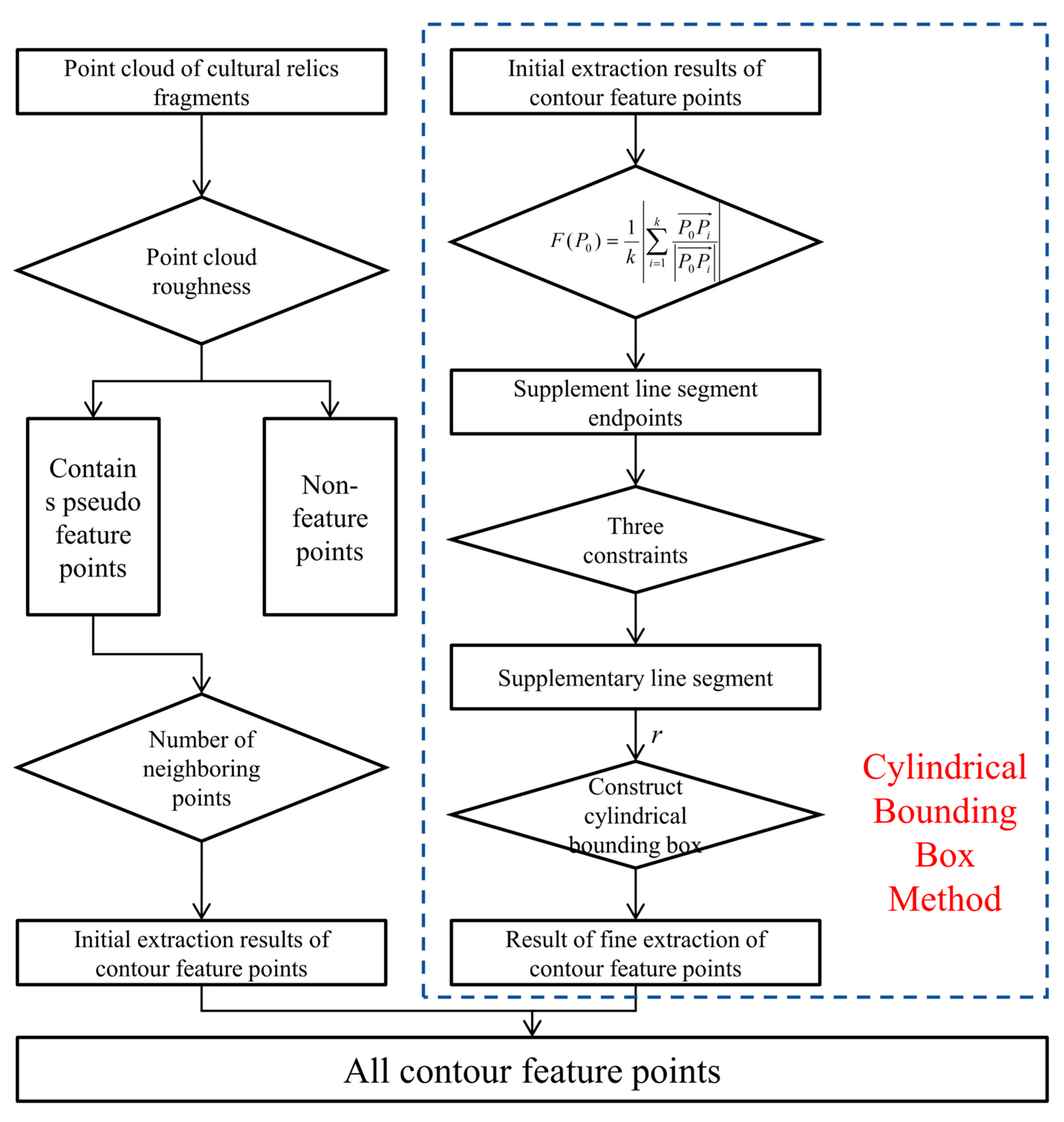
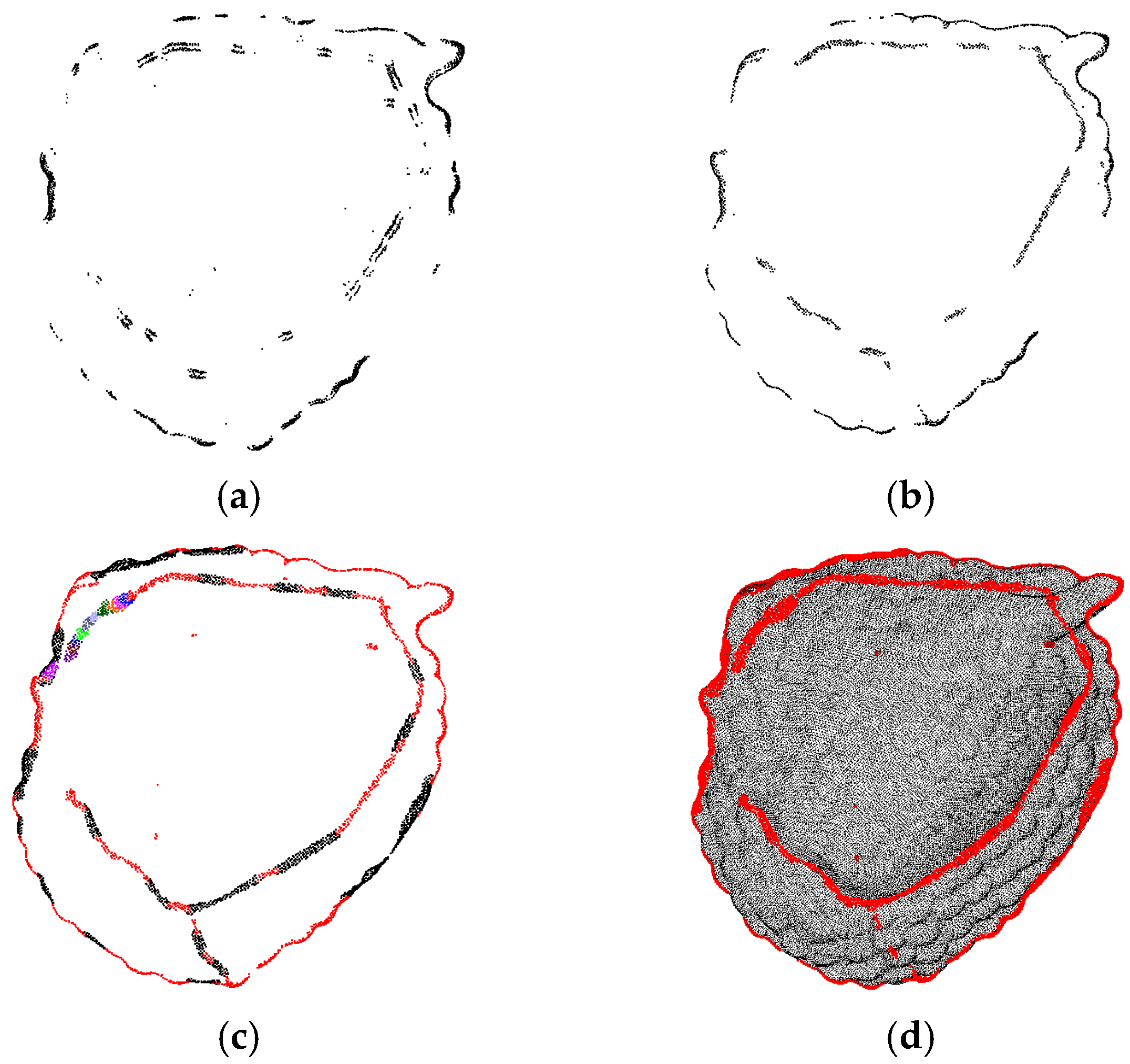
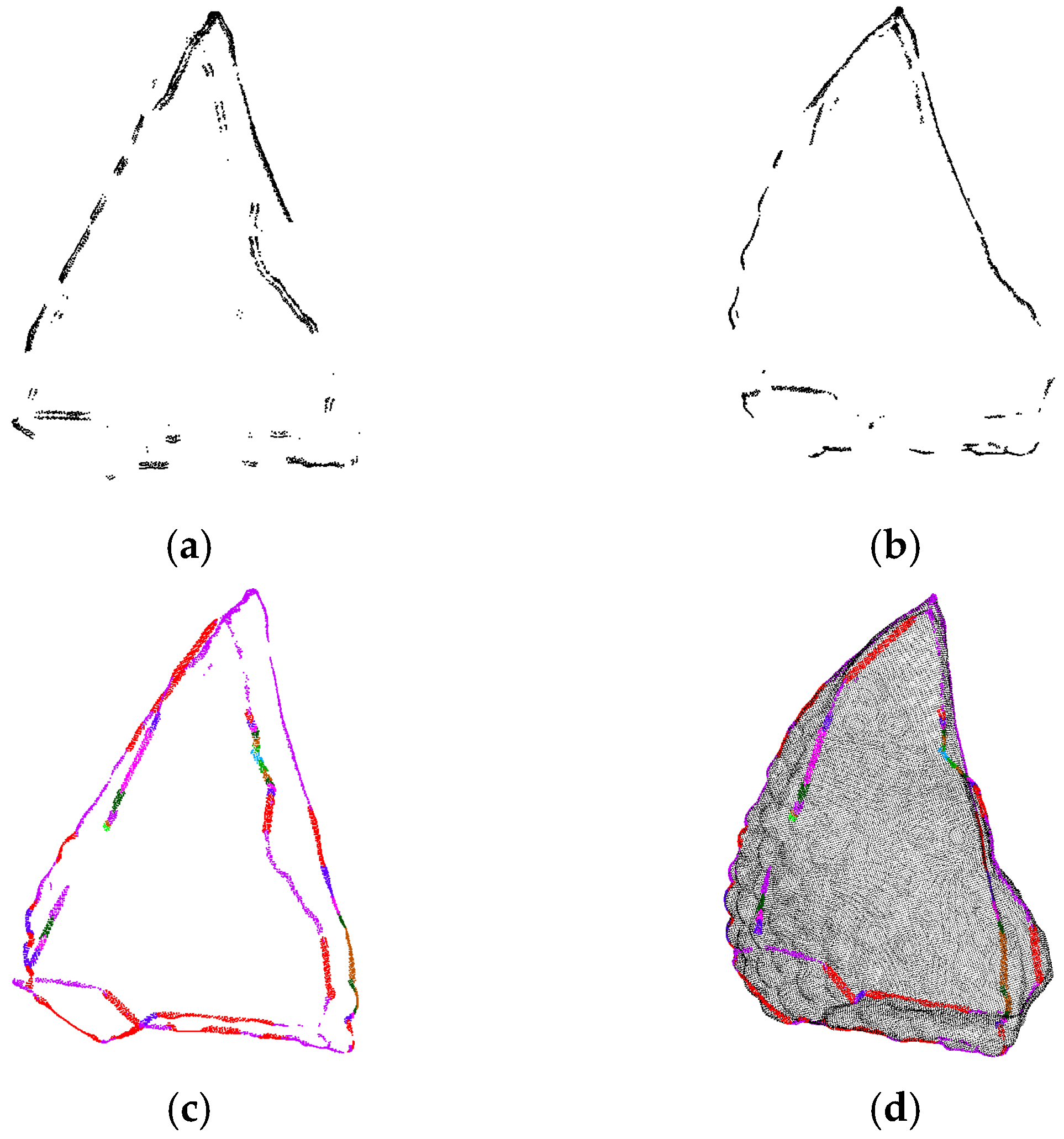
- Refined Extraction of Fragment Contour Points via Cylindrical Bounding Boxes: Initial extraction of fragment contour points is achieved based on roughness. Then, the endpoints of missing segments are determined according to the magnitude of the resultant force exerted by surrounding points on the sample points. Subsequently, a missing segment is selected under constraint conditions, and a cylinder with radius r is constructed using this segment as the axis. Using this cylinder as a bounding box, point clouds within the box are identified as contour points, while those outside are classified as non-contour points. During this process, to avoid erroneous extraction of feature points, the cylinder radius r should be kept as small as possible within a reasonable range.
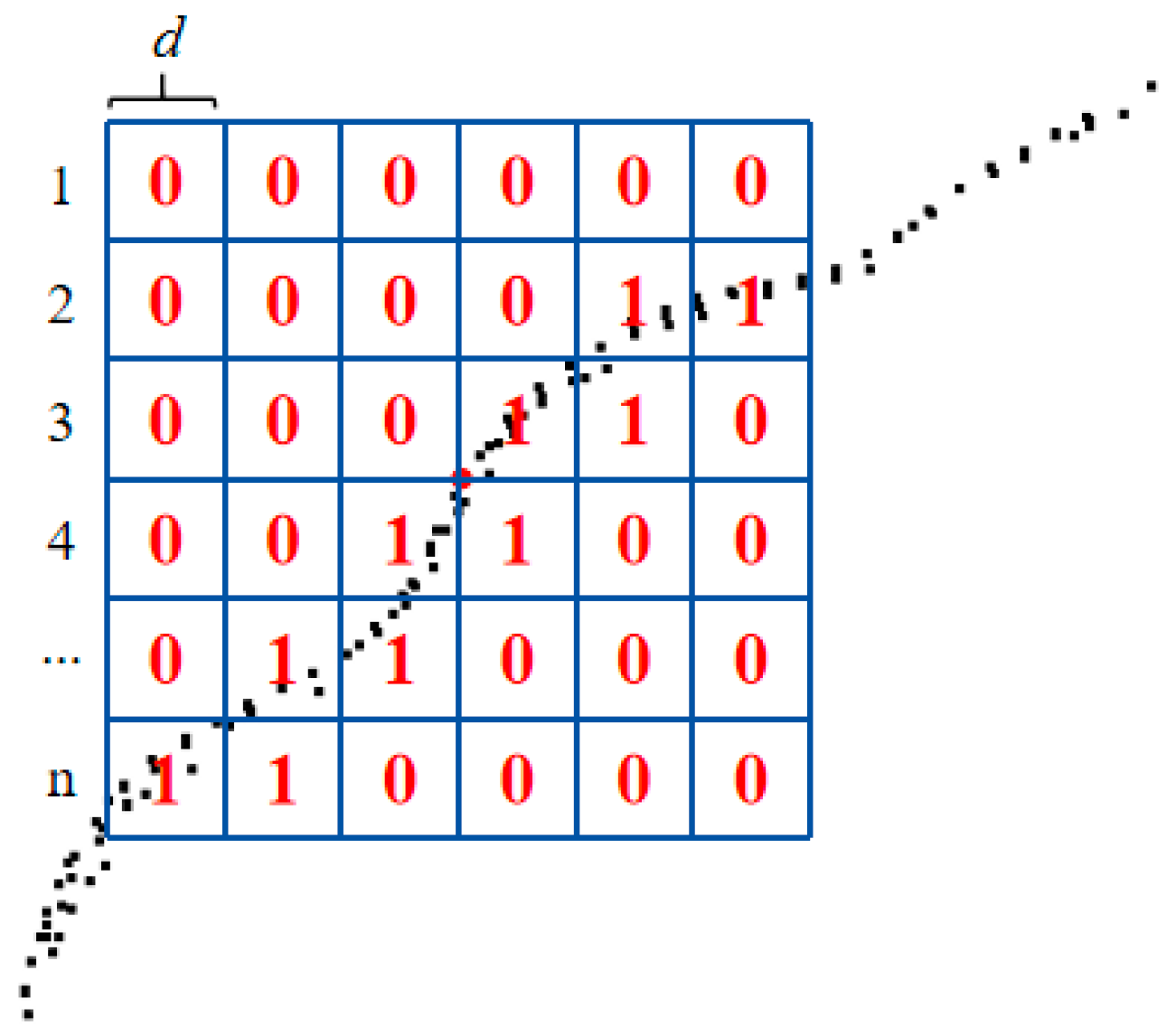
- Proposed Spatial Cube Contour Shape Description Method: A cube is constructed centered on a contour point. This cube consists of n3 small cubes, where each small cube constitutes a voxel. Different values are assigned based on whether point clouds exist within the voxels to represent the contour shape in the neighborhood of the contour point. This shape can be represented as a [1 * ×n3] dimensional vector.
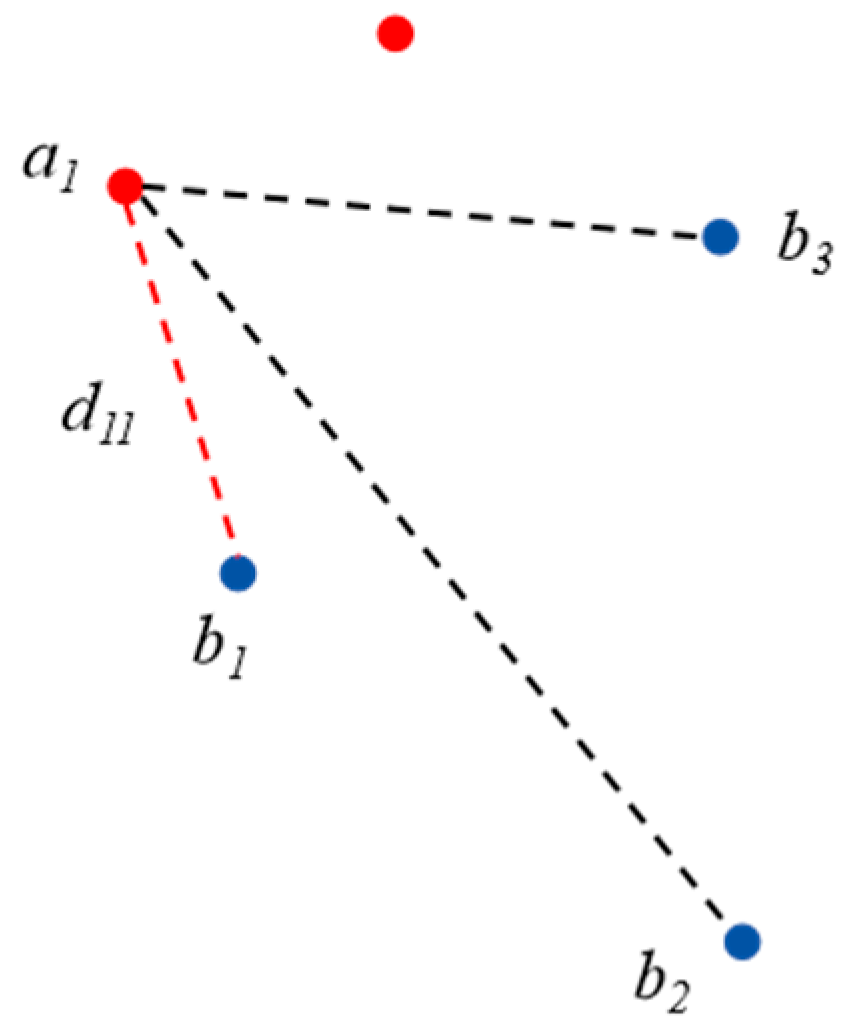
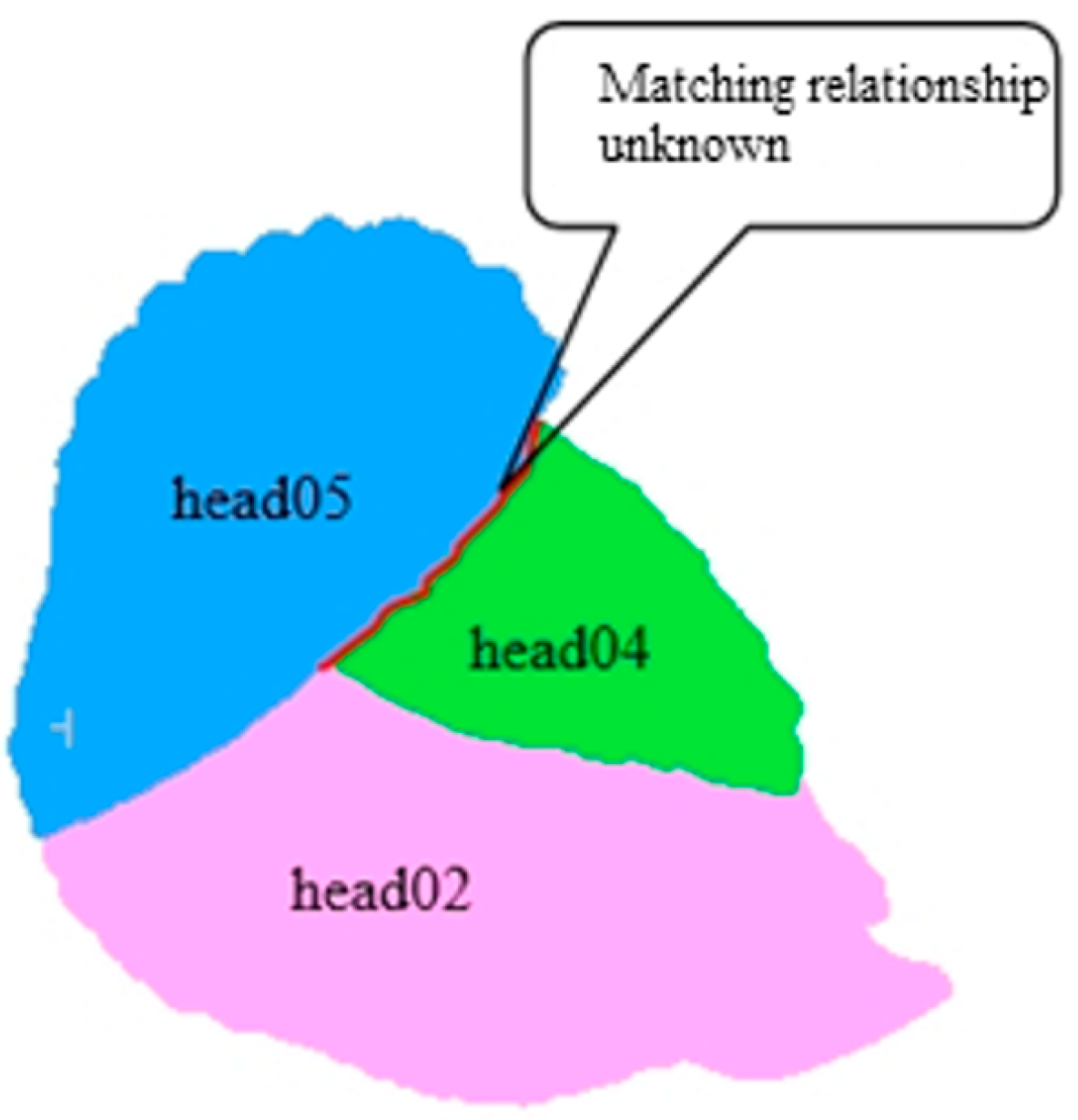
- Proposed Pseudo-Ground Truth Accuracy Verification Method: The reassembled cultural relics contain cumulative errors. This method utilizes the reassembly results of adjacent fragments to obtain the cumulative error, thereby calculating the pseudo-ground truth of the cultural relic fragments. Matching accuracy is obtained by comparing the reassembly error—before matching constraints are judged—with the pseudo-ground truth, thus verifying the effectiveness of the proposed algorithm.
2.2. Experimental Data
2.3. Data Preprocessing
3. Extraction of Cultural Relic Fragment Contour Points
3.1. Initial Extraction of Contour Points
3.2. Refined Extraction of Contour Points
4. Multi-Feature Description
4.1. Geometric Feature Description
4.2. Heat Kernel Feature Extraction
4.3. Construction of Contour Shape Descriptors
5. Cultural Relic Fragment Reassembly
5.1. Tree-Based Fragment Retrieval Method
5.2. Bidirectional Hausdorff Distance Determination Method
5.3. Cultural Relic Fragment Registration
5.4. Pseudo-Ground Truth Accuracy Verification Method
6. Experimental Results and Analysis
6.1. Contour Point Extraction Results
6.2. Fragment Reassembly Experimental Results
6.3. Comparative Experimental Results
6.4. Limitations and Future Work
7. Conclusions
Author Contributions
Funding
Institutional Review Board Statement
Informed Consent Statement
Data Availability Statement
Acknowledgments
Conflicts of Interest
References
- Elnaggar, A.; Said, M.; Kraševec, I.; Said, A.; Grau-Bove, J.; Moubarak, H. Risk Analysis for Preventive Conservation of Heritage Collections in Mediterranean Museums: Case Study of the Museum of Fine Arts in Alexandria (Egypt). Herit. Sci. 2024, 12, 59. [Google Scholar] [CrossRef]
- Isakhan, B.; Childs, E. UNESCO’s Institutional Drift and Normative Vacuum: Interpreting the Failure to Protect Palestinian Heritage in Gaza. Int. J. Herit. Stud. 2026, 1–19. [Google Scholar] [CrossRef]
- Dimabayao, J.J.; Lara, J.L.; Canoura, L.G.; Solheim, S. Integrating Climate Risk in Cultural Heritage: A Critical Review of Assessment Frameworks. Heritage 2025, 8, 312. [Google Scholar] [CrossRef]
- Comes, R.; Neamțu, C.G.D.; Grec, C.; Buna, Z.L.; Găzdac, C.; Mateescu-Suciu, L. Digital Reconstruction of Fragmented Cultural Heritage Assets: The Case Study of the Dacian Embossed Disk from Piatra Roșie. Appl. Sci. 2022, 12, 8131. [Google Scholar] [CrossRef]
- Wang, X.; Fu, S. Cultural Relics Fragment Assembly Based on Fracture Surface Contour Features. Appl. Opt. 2024, 63, 5278–5291. [Google Scholar] [CrossRef]
- Parisotto, S.; Leone, N.; Schonlieb, C.; Launaro, A. Unsupervised Clustering of Roman Potsherds via Variational Autoencoders. J. Archaeol. Sci. 2022, 142, 105598. [Google Scholar] [CrossRef]
- Ming, Y.; Me, R.C.; Chen, J.K.; Rahmat, R.W.O.K. A Systematic Review on Virtual Reality Technology for Ancient Ceramic Restoration. Appl. Sci. 2023, 13, 8991. [Google Scholar] [CrossRef]
- Liu, E.; Cheng, X.; Cheng, X.; Zhou, T.; Huang, Y. Application of Three-Dimensional Laser Scanning in the Protection of Multi-Dynasty Ceramic Fragments. IEEE Access 2020, 8, 139771–139780. [Google Scholar] [CrossRef]
- Yang, S.; Xu, S.; Huang, W. 3D Point Cloud for Cultural Heritage: A Scientometric Survey. Remote Sens. 2022, 14, 5542. [Google Scholar] [CrossRef]
- Cooper, D.B.; Willis, A.; Andrews, S.; Baker, J.; Cao, Y.; Han, D.; Kang, K.; Kong, W.; Leymarie, F.F.; Orriols, X.; et al. Assembling Virtual Pots from 3D Measurements of Their Fragments. In Proceedings of the 2001 Conference on Virtual Reality, Archeology, and Cultural Heritage; Association for Computing Machinery: New York, NY, USA, 2001; pp. 241–254. [Google Scholar]
- Huang, Q.-X.; Flöry, S.; Gelfand, N.; Hofer, M.; Pottmann, H. Reassembling Fractured Objects by Geometric Matching. ACM Trans. Graph. 2006, 25, 569–578. [Google Scholar] [CrossRef]
- Papaioannou, G.; Karabassi, E.-A. On the Automatic Assemblage of Arbitrary Broken Solid Artefacts. Image Vis. Comput. 2003, 21, 401–412. [Google Scholar] [CrossRef]
- Yu, W.; Li, M.; Li, X. Fragmented Skull Modeling Using Heat Kernels. Graph. Models 2012, 74, 140–151. [Google Scholar] [CrossRef]
- Gao, H.; Geng, G. Classification of 3D Terracotta Warrior Fragments Based on Deep Learning and Template Guidance. IEEE Access 2020, 8, 4086–4098. [Google Scholar] [CrossRef]
- Wang, Y.; Zhou, P.; Geng, G.; An, L.; Zhou, M. Enhancing Point Cloud Registration with Transformer: Cultural Heritage Protection of the Terracotta Warriors. Herit. Sci. 2024, 12, 314. [Google Scholar] [CrossRef]
- Pinho, M.F.C.; Mota, G.L.A.; da Costa, G.A.O.P. A Deep Learning Approach to Assist in Pottery Reconstruction from Its Sherds. Heritage 2025, 8, 167. [Google Scholar] [CrossRef]
- Yang, W.; Mingquan, Z.; Pengfei, Z.; Guohua, G. Matching Method of Cultural Relic Fragments Constrained by Thickness and Contour Feature. IEEE Access 2020, 8, 25892–25904. [Google Scholar] [CrossRef]
- Wang, Z.; Zu, Y.; Shen, Y.; Wang, X.; Yang, X.; Zhang, Z. A Method of Feature Lines Generation of Cultural Relics Based on Point Clouds. In Proceedings of the 2019 Nicograph International (NicoInt), Xianyang, China, 5–7, July 2019; p. 123. [Google Scholar]
- Zheng, Q.; Yang, H.; Yang, J.; Jiang, H.; Hu, W.; Liao, D. Ancient Ceramics Restoration Method Based on Image Processing Texture Stitching. Herit. Sci. 2024, 12, 423. [Google Scholar] [CrossRef]
- Yang, L.; Xu, S.; Yang, Z.; He, J.; Gong, L.; Wang, W.; Li, Y.; Wang, L.; Chen, Z. Fast Registration Algorithm for Laser Point Cloud Based on 3D-SIFT Features. Sensors 2025, 25, 628. [Google Scholar] [CrossRef]
- Yoo, S.J.; Liu, S.; Arshad, M.Z.; Kim, J.; Kim, Y.M.; Aloimonos, Y.; Fermuller, C.; Joo, K.; Kim, J.; Hong, J.H. Structure-from-Sherds++: Robust Incremental 3D Reassembly of Axially Symmetric Pots from Unordered and Mixed Fragment Collections. arXiv 2025, arXiv:2502.13986. [Google Scholar]
- Liu, C.; Wang, H.; Mao, L.; Liu, R.; Wang, Z.; Wang, T. Image Stitching Method of Bone Stick Fragment Based on Similarity Freeman Code Matching. IEEE Access 2023, 11, 23073–23084. [Google Scholar] [CrossRef]
- Zeng, W.; Su, G.; Su, Z.; Li, R.; Chen, J. Research on Point Cloud Registration and Stitching Fusion Algorithm Based on GCN-PRFNet. IEEE Access 2025, 13, 43384–43397. [Google Scholar] [CrossRef]
- Basu, A.; Paul, S.; Ghosh, S.; Das, S.; Chanda, B.; Bhagvati, C.; Snasel, V. Digital Restoration of Cultural Heritage with Data-Driven Computing: A Survey. IEEE Access 2023, 11, 53939–53977. [Google Scholar] [CrossRef]
- Diz-Mellado, E.; Perez-Fenoy, J.; Mudarra-Mata, M.; Rivera-Gómez, C.; Galan-Marin, C. Enhancing 3D-Printed Clay Models for Heritage Restoration through 3D Scanning. Appl. Sci. 2024, 14, 10898. [Google Scholar] [CrossRef]
- Museanu, E.; Vladescu, M.S. The Usage of 3D Laser Scanning and Direct Digital Manufacturing for Restoration and Replication of Cultural Heritage. J. Inf. Syst. Oper. Manag. 2024, 18, 158–171. [Google Scholar]
- Lyu, W.; Ke, W.; Sheng, H.; Ma, X.; Zhang, H. Dynamic Downsampling Algorithm for 3D Point Cloud Map Based on Voxel Filtering. Appl. Sci. 2024, 14, 3160. [Google Scholar] [CrossRef]
- Zeng, F.; Qian, J.; Zhou, Y.; Yuan, C.; Wu, C. Improved Three-Dimensional Model Feature of Non-Rigid Based on HKS. In Proceedings of the Smart Computing and Communication; Qiu, M., Ed.; Springer International Publishing: Cham, Switzerland, 2018; pp. 427–437. [Google Scholar]
- Guo, Y.; Bennamoun, M.; Sohel, F.; Lu, M.; Wan, J.; Kwok, N.M. A Comprehensive Performance Evaluation of 3D Local Feature Descriptors. Int. J. Comput. Vis. 2016, 116, 66–89. [Google Scholar] [CrossRef]
- Chu, F.; Xie, F.; Wei, L.; Sun, L. Research on Robust Point Cloud Registration Method for Industrial Scenes: Feature Fusion Based on Statistical Weighting and Dual-Constrained Graph Matching. Eng. Comput. 2026, 42, 55. [Google Scholar] [CrossRef]
- Yuan, H.; Li, G.; Wang, L.; Li, X. Research on the Improved ICP Algorithm for LiDAR Point Cloud Registration. Sensors 2025, 25, 4748. [Google Scholar] [CrossRef]
- Geng, G.; Yao, W.; Zhou, M.; Liu, J.; Xu, X.; Cao, X.; Liu, Y.; Li, K. Automatic reassembly for cultural relics fragments via adjusting the weight of contour curve. J. Northwest Univ. (Nat. Sci. Ed.) 2021, 51, 397–403. [Google Scholar] [CrossRef]
- Zhao, F.; Geng, G. Automatic Matching Algorithm of Cultural Relic Fragments Based on Feature Region Division. Acta Electron. Sin. 2022, 50, 1436–1443. [Google Scholar]
- Zheng, X.; Weng, Z. Design of an Enhanced Feature Point Matching Algorithm Utilizing 3D Laser Scanning Technology for Sculpture Design. PeerJ Comput. Sci. 2025, 11, e2628. [Google Scholar] [CrossRef] [PubMed]







| Parameter | Value |
|---|---|
| n | 50 |
| ω | 0.01 |
| a | 17.8 |
| θ | 0.9 |
| r | 0.02 |
| Serial Number | Matching Relationship Unknown Point Pairs | Average Distance Difference θ | Splicing Error ω/% (The Value of a Genuine Buddha Head h = 5.8296) |
|---|---|---|---|
| 1 | head01–head02 | 0.0011 | 0.0189 |
| 2 | head01–head03 | 0.0087 | 0.1492 |
| 3 | head01–head06 | 0.0026 | 0.0446 |
| 4 | head02–head12 | 0.0117 | 0.2007 |
| 5 | head03–head04 | 0.0150 | 0.2573 |
| 6 | head04–head05 | 0.0154 | 0.2642 |
| 7 | head05–head11 | 0.0123 | 0.2110 |
| 8 | head06–head07 | 0.0061 | 0.1046 |
| 9 | head07–head11 | 0.0023 | 0.0395 |
| 10 | head08–head09 | 0.0075 | 0.1287 |
| 11 | head09–head10 | 0.0073 | 0.1252 |
| Cumulative error | 0.09 | 1.54 | |
| Search Methods | Step by Step | AFSF | Tree-Structured Search |
|---|---|---|---|
| count | 132 | 66 | 36 |
| Percentage of searches for this article | 27% | 55% |
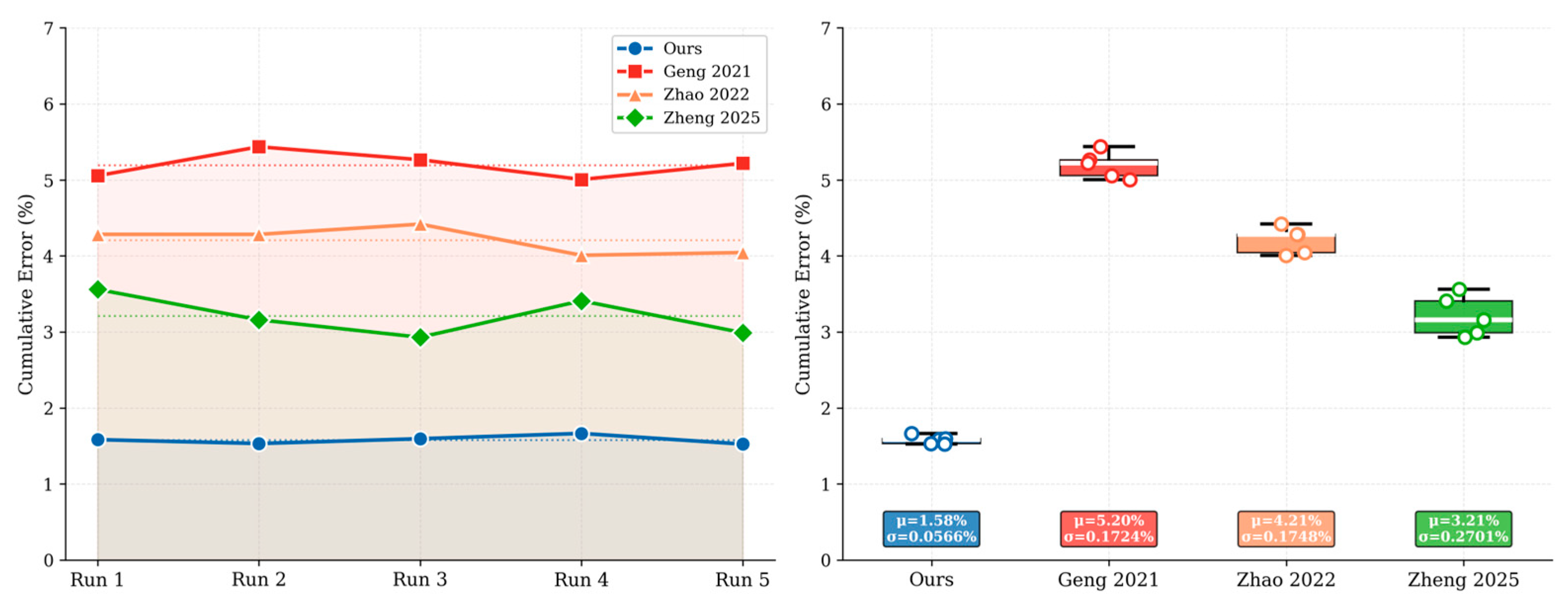
| Methods | Reference [32] | Reference [33] | Reference [34] | Ours |
|---|---|---|---|---|
| False true value | 6.1754 | 5.4893 | 5.7012 | 5.8296 |
| Cumulative difference | 0.3209 | 0.2310 | 0.1830 | 0.0921 |
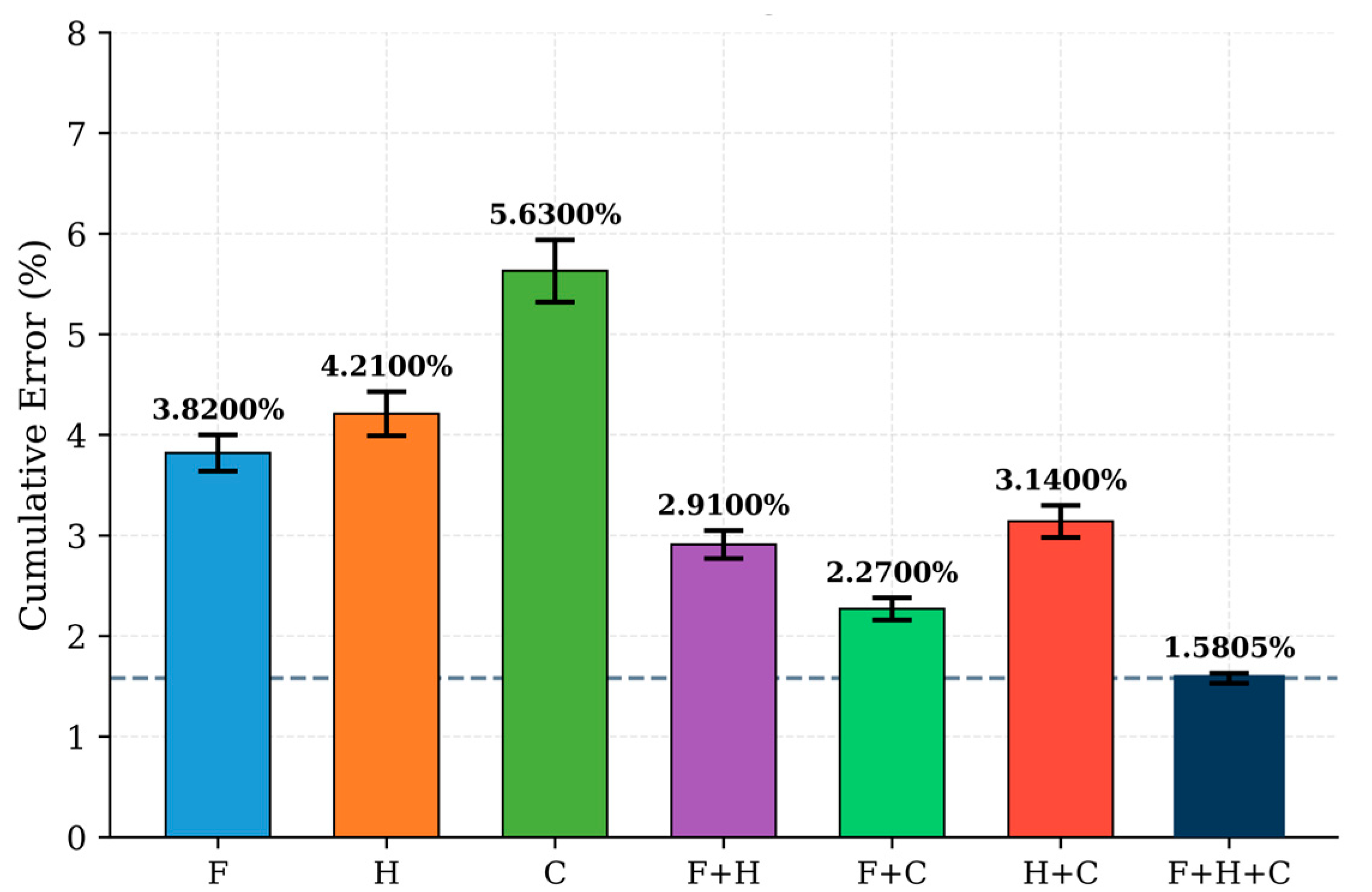
| Cumulative error | 5.19% | 4.21% | 3.21% | 1.58% |
| Compare | ↓ 3.61% | ↓ 2.63% | ↓ 1.63% | — |
Disclaimer/Publisher’s Note: The statements, opinions and data contained in all publications are solely those of the individual author(s) and contributor(s) and not of MDPI and/or the editor(s). MDPI and/or the editor(s) disclaim responsibility for any injury to people or property resulting from any ideas, methods, instructions or products referred to in the content. |
© 2026 by the authors. Licensee MDPI, Basel, Switzerland. This article is an open access article distributed under the terms and conditions of the Creative Commons Attribution (CC BY) license.
Share and Cite
Zhao, J.; Yang, J.; Cao, M.; Yin, L.; Liu, R.; Chang, X. Virtual Reassembly Method for Cultural Relic Fragments Based on Multi-Feature Extraction. Appl. Sci. 2026, 16, 2588. https://doi.org/10.3390/app16052588
Zhao J, Yang J, Cao M, Yin L, Liu R, Chang X. Virtual Reassembly Method for Cultural Relic Fragments Based on Multi-Feature Extraction. Applied Sciences. 2026; 16(5):2588. https://doi.org/10.3390/app16052588
Chicago/Turabian StyleZhao, Jianghong, Jia Yang, Mengtian Cao, Lisha Yin, Rui Liu, and Xinfeng Chang. 2026. "Virtual Reassembly Method for Cultural Relic Fragments Based on Multi-Feature Extraction" Applied Sciences 16, no. 5: 2588. https://doi.org/10.3390/app16052588
APA StyleZhao, J., Yang, J., Cao, M., Yin, L., Liu, R., & Chang, X. (2026). Virtual Reassembly Method for Cultural Relic Fragments Based on Multi-Feature Extraction. Applied Sciences, 16(5), 2588. https://doi.org/10.3390/app16052588