Article

AI-Generated Spatial Pattern Matching for Hospital Indoor Positioning

Division of Software, Hallym University, 1-Hallymdeahck-gil, Chuncheon 24252, Republic of Korea
*
Author to whom correspondence should be addressed.
These authors contributed equally to this work.
Appl. Sci. 2026, 16(5), 2552; https://doi.org/10.3390/app16052552
Submission received: 29 January 2026 / Revised: 2 March 2026 / Accepted: 4 March 2026 / Published: 6 March 2026

Featured Application

This work enables practical smartphone-based indoor positioning in complex hospital environments by integrating AI-driven pedestrian dead reckoning with BLE-based spatial pattern matching. The proposed framework can support smart healthcare services such as indoor navigation, emergency routing, and infrastructure monitoring without requiring expensive dedicated hardware.

Abstract

Indoor positioning in hospitals is challenging because global navigation satellite systems signals are unavailable and existing solutions struggle with complex indoor propagation and high maintenance requirements. Fingerprinting-based methods using Wi-Fi, Bluetooth Low Energy (BLE), or magnetic field depend on extensive site surveys, while time or angle-based systems such as ultra-wide band, angle of arrival, and Wi-Fi round trip time require additional infrastructure. Recent machine learning approaches improve performance but remain limited by Pedestrian Dead Reckoning (PDR) drift and unstable spatial representations. This study proposes an AI-generated spatial pattern matching framework that integrates an AI-based PDR model with BLE Received Signal Strength Indicator (RSSI) to construct a user RSSI surface. Spatial similarity between user-generated patterns and the pre-built radio map is evaluated using Surface Correlation (SC), and a bi-directional candidate generation strategy with SC-based heading correction is employed to mitigate inertial drift. Experiments in a real hospital setting show that the proposed method achieves robust and accurate localization even in complex indoor environments where conventional fingerprinting and PDR techniques often fail. The results indicate that combining AI-driven inertial modeling with SC-based spatial pattern matching offers a practical and infrastructure-friendly solution for hospital indoor positioning.

1. Introduction

Global navigation satellite systems provide reliable outdoor positioning but become ineffective in indoor environments due to severe signal attenuation, multipath propagation, and non-line of sight blockage [1]. As a result, large and structurally complex buildings—particularly hospitals—require dedicated indoor positioning solutions to ensure patient tracking, staff navigation, asset management, emergency response, and workflow optimization [2]. Hospital environments are especially challenging because of their dense room partitions, long corridors, metal-rich equipment, and dynamic human activity, all of which produce highly non-stationary radio and magnetic fields.
A wide range of indoor positioning technologies has been explored to address these challenges. Fingerprinting-based methods using Wi-Fi Received Signal Strength Indicator (RSSI) [3,4,5], Bluetooth Low Energy (BLE) beacons [6,7], or magnetic field fingerprints [8,9] have been widely adopted due to their compatibility with commodity smartphones. However, these approaches often suffer from labor-intensive site surveys, sensitivity to environmental changes, limited accuracy in multi-floor settings, and high maintenance overhead [10]. Time-based and angle-based technologies—such as ultra-wide band, angle of arrival [11], time differential of arrival [12], and Wi-Fi round trip time [13]—can achieve higher accuracy but typically require costly infrastructure upgrades, careful calibration, or specialized receivers that are impractical for many hospitals. Recent machine learning and deep learning approaches [14,15] attempt to enhance localization using radio maps, inertial sensing, or hybrid modalities, yet they remain constrained by drift accumulation, sparse ground truth, or the difficulty of learning robust spatial representations under complex indoor dynamics.
While recent advances such as deep learning-based fingerprinting and magnetic SLAM have demonstrated promising improvements, they still face several practical limitations in complex indoor environments. Deep learning fingerprinting methods often require large labeled datasets and remain sensitive to temporal variations in radio maps caused by environmental dynamics [16,17,18]. Magnetic SLAM approaches typically rely on loop-closure constraints or computationally intensive optimization procedures, which are difficult to satisfy in long and structurally repetitive hospital corridors [8,9]. Graph-based PDR correction methods can improve trajectory consistency by incorporating spatial constraints, but their performance fundamentally depends on the accuracy of the underlying motion model and therefore remains vulnerable to cumulative drift [19,20,21,22]. These limitations highlight the need for a localization framework that leverages accumulated spatial signal structures while maintaining low infrastructure dependency and robustness to inertial errors.
To overcome these limitations, spatial pattern analysis has emerged as a promising direction. In particular, Surface Correlation (SC) [23,24] offers a powerful way to compare two spatial signal distributions by evaluating the structural similarity between a user-generated signal surface and the corresponding spatial patterns in a pre-constructed radio map. SC is particularly suitable for indoor environments with rapid and irregular signal fluctuations, as it compares accumulated spatial signal patterns rather than relying on instantaneous measurements. However, in pedestrian localization, the user RSSI surface is constructed based on Pedestrian Dead Reckoning (PDR) estimated trajectories, and accumulated PDR errors can distort the generated surface itself, leading to unreliable pattern matching.
In this work, we propose a novel AI-based spatial pattern matching framework for hospital indoor positioning. The framework constructs user spatial patterns using an AI-based Pedestrian Dead Reckoning (PDR) model that directly estimates pedestrian trajectories from inertial sensor sequences, without relying on explicit step detection or manually tuned thresholds. By learning pedestrian motion patterns in a data-driven manner, the AI-PDR provides more stable trajectory estimates compared to conventional step-based approaches. These AI-generated trajectories are fused with BLE RSSI measurements to form a User RSSI Surface (URS), which captures both geometric motion information and accumulated spatial radio signal characteristics.
Unlike conventional indoor localization approaches that rely on instantaneous signal matching or geometry-based trajectory correction, the proposed framework operates on accumulated spatial signal patterns generated along the pedestrian trajectory. This paradigm shift enables robust localization under severe RSSI fluctuations and inertial drift conditions commonly observed in hospital environments. Furthermore, the proposed system integrates a data-driven inertial trajectory model with surface-level radio signal matching and iterative heading correction, forming a unified localization framework that differs fundamentally from existing fingerprinting, SLAM, and graph-based approaches.
The main contributions of this work are summarized as follows:
  • A spatial pattern-based localization framework that utilizes accumulated RSSI surfaces instead of point-wise signal matching.
  • An AI-based inertial trajectory generation model that stabilizes spatial pattern construction without explicit step detection.
  • A surface correlation-based heading correction mechanism that iteratively compensates trajectory drift during localization.
Finally, the remainder of this paper is organized as follows. Section 2 reviews existing indoor positioning approaches, their limitations and recent machine learning and deep learning-based localization techniques. Section 3 describes the proposed AI-generated spatial pattern matching system, including the overall workflow, the AI-PDR module, and the bi-directional candidate generation with SC-based heading correction. Section 4 presents the experimental setup, quantitative performance evaluation, and analysis conducted in a real hospital environment. Section 5 concludes the paper by summarizing the main contributions and discussing potential applications and future research directions for complex indoor facilities.

2. Related Works

Fingerprinting-based localization using Wi-Fi or BLE signals [25,26,27] is among the most widely adopted indoor positioning approaches due to its compatibility with existing wireless infrastructure and commodity mobile device. These methods typically consist of an offline phase, where radio signal characteristics such as RSSI are collected at known reference points to build a radio map, and an online phase, where real-time measurements are matched against the stored fingerprints. Wi-Fi fingerprinting can achieve reasonable accuracy in many indoor scenarios; however, its performance is sensitive to environmental dynamics, device heterogeneity, and signal fluctuations [28,29]. BLE-based fingerprinting has gained attention due to low power consumption and flexible deployment, yet BLE RSSI often exhibits stronger temporal and spatial variability, making stable localization difficult without frequent recalibration [30]. In addition, fingerprinting approaches require labor-intensive site surveys and suffer from scalability and maintenance issues in large or multi-floor environments [31].
Smartphone-based PDR [19,20,21,32] estimates user motion by integrating inertial measurements from built-in sensors such as accelerometers and gyroscopes and in some cases magnetometers to reconstruct relative trajectories. Because it does not require dedicated external infrastructure, smartphone PDR enables continuous positioning and is appealing for scalable indoor navigation. However, it is inherently prone to cumulative errors. Sensor noise, changes in how the phone is carried such as hand held versus pocket, and inaccuracies in heading estimation lead to drift that accumulates over time. Even small angular biases can cause substantial positional deviations along long trajectories. Although map constraints and sensor calibration can partially reduce drift, smartphone-only PDR remains unreliable for long term absolute localization.
With the advancement of machine learning and deep learning, data-driven approaches have been increasingly applied to indoor localization. Neural networks have been used to model nonlinear relationships between signal measurements and locations, replacing conventional distance-based or probabilistic fingerprint matching techniques [16,33]. Convolutional [17,34], recurrent [18], and attention-based architectures [35,36] have been explored to capture spatial and temporal correlations in radio signals, and learning-based fingerprinting methods often show improved robustness to noise and partial environmental changes. However, these models typically require large labeled datasets, and their generalization across different buildings or after environmental changes remains limited, often necessitating retraining or fine-tuning. Learning-based models can be used in inertial navigation to estimate motion more accurately over short time windows from sequences of sensor readings. However, if there are few or no external references such as radio anchors, maps, or landmarks, errors still accumulate and long term drift remains difficult to avoid.
In contrast to the aforementioned approaches, the proposed method does not rely on point-wise signal fingerprints, explicit geometric constraints, or loop-closure assumptions. Instead, it constructs trajectory-generated spatial RSSI patterns and performs localization through structural similarity evaluation. By integrating data-driven inertial trajectory modeling with surface-level radio signal matching, the proposed framework provides robustness against short-term signal fluctuations and inertial drift without requiring dense infrastructure or computationally expensive optimization. This positioning differentiates the proposed approach from existing fingerprinting, SLAM, and graph-based localization methods.

3. Proposed System

This section elaborates on the configuration and principles of the proposed indoor localization system, along with the detailed implementation methods of its core component, the AI-PDR model. Specifically, we focus on how AI-PDR utilizes IMU data to estimate pedestrian movement characteristics and how this is fused with the BLE signal-based SC technique to achieve final indoor localization.

3.1. Total System Description

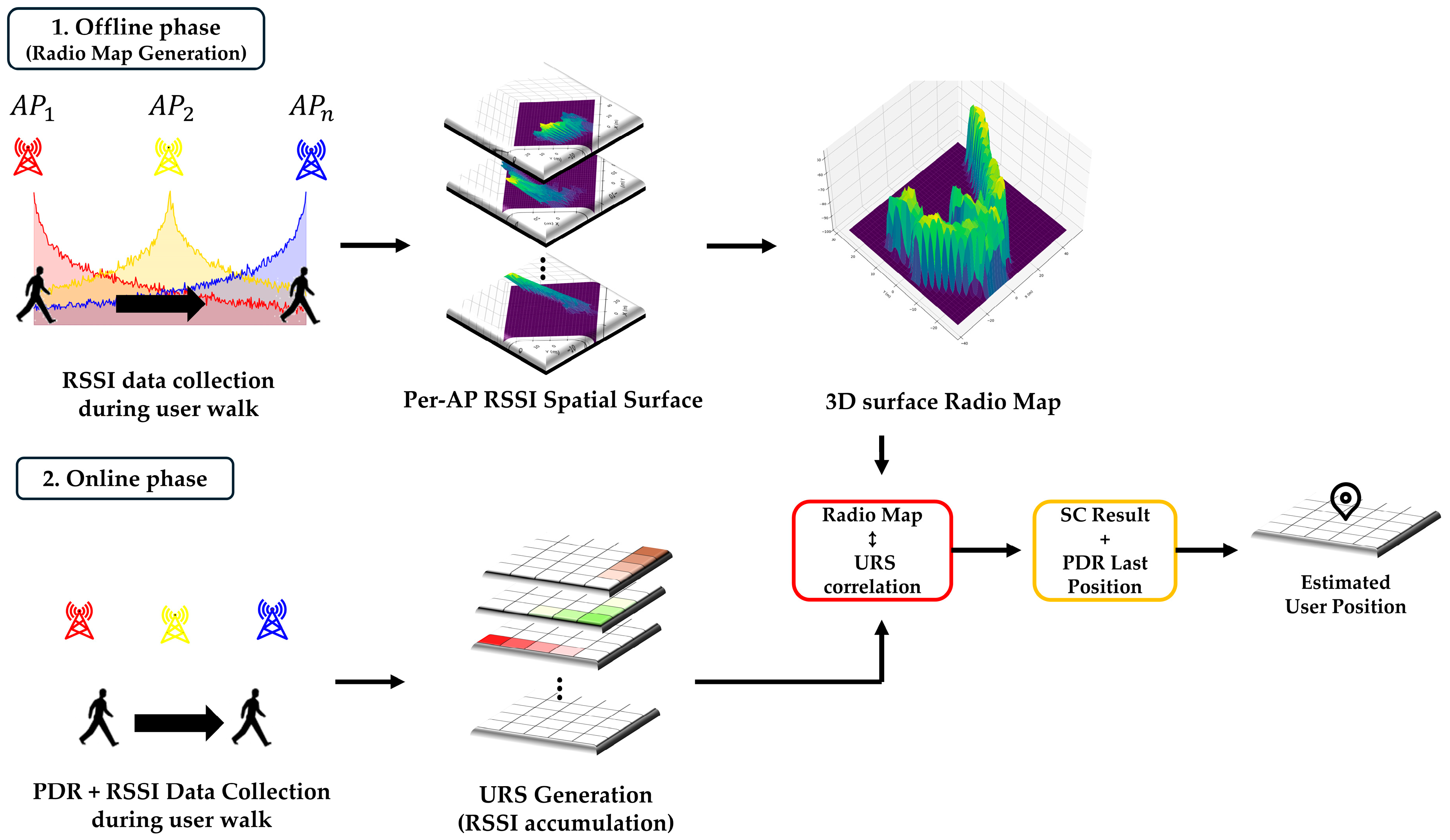
In this study, we propose an indoor localization system that integrates AI-PDR and SC for smartphone-based pedestrian positioning. The proposed system combines relative positioning using inertial sensors and absolute positioning using BLE signals in a complementary manner, thereby effectively mitigating accumulated errors even in complex indoor environments such as hospitals.
Figure 1 illustrates the overall architecture and processing flow of the proposed system. The system inputs consist of time-series data collected from the smartphone’s built-in IMU sensors and RSSI signals obtained through BLE scanning. The IMU data serve as the primary input for estimating pedestrian motion characteristics, while the BLE RSSI data are utilized for position correction. The collected IMU time-series data are fed into the AI-PDR model to estimate the traveled distance and heading change over a fixed time interval. These estimated motion parameters are cumulatively integrated over time to generate the pedestrian’s PDR trajectory. The generated PDR trajectory and the RSSI signals continuously collected along the user’s movement path are spatially accumulated to form a URS. The URS represents the RSSI distribution corresponding to the user’s actual movement path and is subsequently used for localization by comparison with a pre-constructed indoor radio map.

3.2. AI-Based Pedestrian Dead Reckoning (AI-PDR)

This section provides a detailed description of the AI-PDR method for estimating pedestrian speed and heading change using smartphone IMU data. The proposed approach takes inertial sensor time-series data over a fixed time interval as input and directly regresses the pedestrian’s motion characteristics within that interval. When integrated with the BLE signal-based SC technique in indoor environments, AI-PDR serves as a core component of the pedestrian localization system by effectively minimizing long-term accumulated errors.

3.2.1. Problem Formulation and System Overview

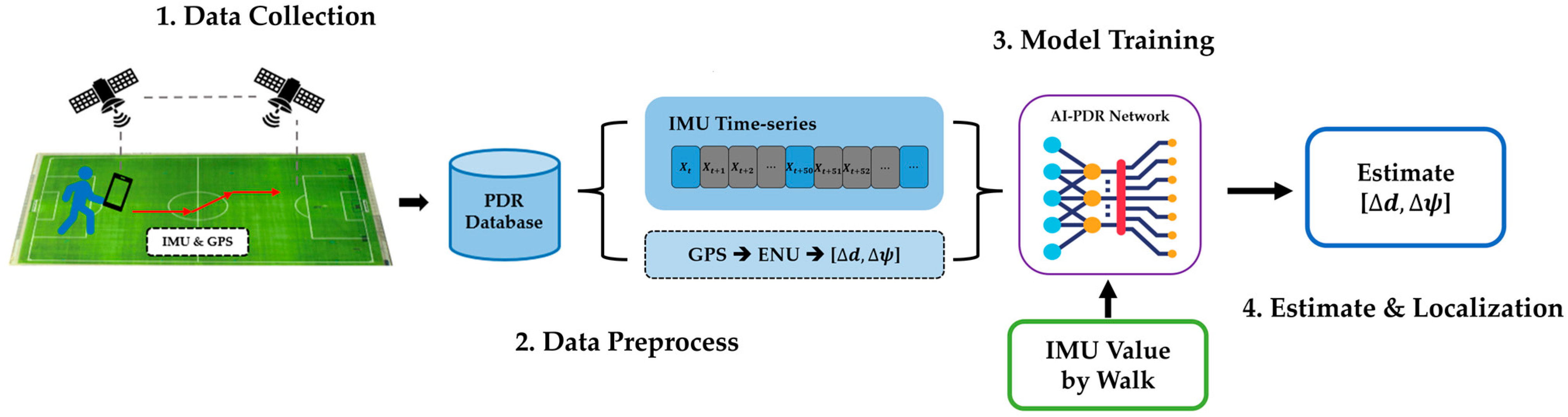
The proposed AI-PDR model is designed to take fixed-length IMU time-series data as input and simultaneously estimate the distance traveled and the heading change in a pedestrian over the corresponding time interval [19,32], as illustrated in Figure 2. The three-axis accelerometer and gyroscope data collected from the smartphone IMU are normalized and then used as inputs to the model, while the model outputs consist of the traveled distance and heading change for the same time interval. The AI-PDR task is formulated as a direct regression problem that maps fixed-length inertial sensor time-series inputs to pedestrian motion characteristics. Unlike conventional PDR approaches that rely on step detection or explicit gait event modeling, the proposed method learns motion information from raw sensor signals in an end-to-end manner.

3.2.2. Data Collection and Ground-Truth Generation

To train the AI-PDR model, data were collected in open-sky outdoor environments where GPS reception is stable. During data collection, the participant walked while holding a smartphone, and inertial sensor data and position data were simultaneously recorded using the smartphone’s built-in IMU sensors and GPS receiver. The IMU data consist of three-axis accelerometer and three-axis gyroscope signals sampled at 50 Hz. Smartphone inertial data were recorded in the device body frame using built-in sensors without additional manual calibration, while the GPS data were collected at 1 Hz for ground-truth (GT) generation. The collected GPS data were used as reference values for training the IMU-based estimation of traveled distance and heading change [37]. The GPS measurements (latitude and longitude) were converted to planar coordinates using the Universal Transverse Mercator (UTM) projection (Zone 52N, WGS-84 ellipsoid), which corresponds to the geographic region where the experiments were conducted (Republic of Korea). The first GPS position of each recording sequence was used as the local origin, and subsequent positions were represented as relative coordinates with respect to this origin. Let the converted position at time t be denoted as ( e t , n t ) . where the coordinates are expressed in a local planar frame after UTM projection. The definitions of traveled distance and movement direction used in this study follow standard navigation formulations in a local tangent coordinate system [38]. The traveled distance between two consecutive positions is defined as
d t = ( e t e t 1 ) 2 + ( n t n t 1 ) 2
and the movement direction is computed from the east and north components as
ψ t = a r c t a n (   e t e t 1 n t n t 1 )
where θ t represents the absolute heading angle at time t . The heading change occurring during each time interval is then calculated as the difference between consecutive headings:
Δ ψ t = ψ t ψ t 1
A sliding-window-based training strategy was employed to construct the learning dataset, where fixed-length IMU time-series inputs of length 200 were generated with a stride of 5, resulting in temporally overlapping input windows. When such temporal overlap is present, ground-truth values derived directly from 1 Hz GPS measurements are insufficient to provide accurate traveled distance and heading change labels for each input segment. To address this limitation, the distance and heading change sequences computed from GPS data were interpolated along the time axis, enabling the generation of training labels aligned with the overlapping IMU input sequences.
Accordingly, the output of the proposed AI-PDR model is defined as the traveled distance Δ d t and the heading change Δ ψ t corresponding to each input time-series segment. The displacement magnitude Δ d is adopted instead of directly using coordinate increments ( Δ e ,   Δ n ) because it provides a coordinate-independent representation that is more suitable for learning from IMU data. When motion is expressed in ENU components, the mapping from inertial measurements to coordinate increments becomes strongly dependent on the global heading orientation. Similar walking motions can produce nearly identical sensor patterns while resulting in different coordinate increments depending on the movement direction, which introduces ambiguity in regression. By separating motion into displacement magnitude Δ d   and heading change Δ ψ , the model can learn pedestrian dynamics independently of the global coordinate frame. The ENU trajectory is subsequently reconstructed by combining the estimated Δ d and Δ ψ through standard dead-reckoning equations. These quantities are computed from GPS-based position information using Equations (1) and (3) and represent the pedestrian’s motion characteristics occurring within each input interval.

3.2.3. Preprocessing and Feature Engineering

The IMU time-series data collected for training the AI-PDR model were processed through preprocessing and feature engineering steps to construct the model inputs. To prevent training instability caused by scale differences among sensor modalities and input features, normalization was applied to the IMU data. Considering the physical characteristics of the sensors, the three-axis accelerometer signals and the three-axis gyroscope signals were each grouped and standardized separately. Specifically, the three-axis accelerometer signals were normalized using a single scaler, while the three-axis gyroscope signals were normalized using a separate scaler. In addition, the magnitudes of the acceleration and angular velocity vectors were treated as independent features from the individual axis signals, and separate normalization procedures were applied to each. This design enables effective representation of the overall linear acceleration and rotational motion intensity occurring during pedestrian walking. The acceleration vector magnitude a n o r m , t and the angular velocity vector magnitude g n o r m , t are defined as:
a n o r m , t   =   a x , t 2   +   a y ,   t 2   +   a z , t 2
g n o r m , t = g x , t 2 + g y , t 2 + g z , t 2
The quantities defined in Equations (4) and (5) are used as input features for the AI-PDR model. These magnitude-based features are computed from IMU measurements and capture motion intensity in a coordinate-independent manner, thereby improving the robustness of the learning process.
The model input consists of fixed-length time-series windows of 200, corresponding to approximately 4 s of walking data. To effectively capture continuous walking behavior, a sliding-window approach was employed with a stride of 5. As a result, the input feature vector at each time step comprises three-axis accelerometer data, three-axis gyroscope data, the acceleration vector magnitude, and the angular velocity vector magnitude, yielding a total input dimensionality of eight.

3.2.4. Network Architecture

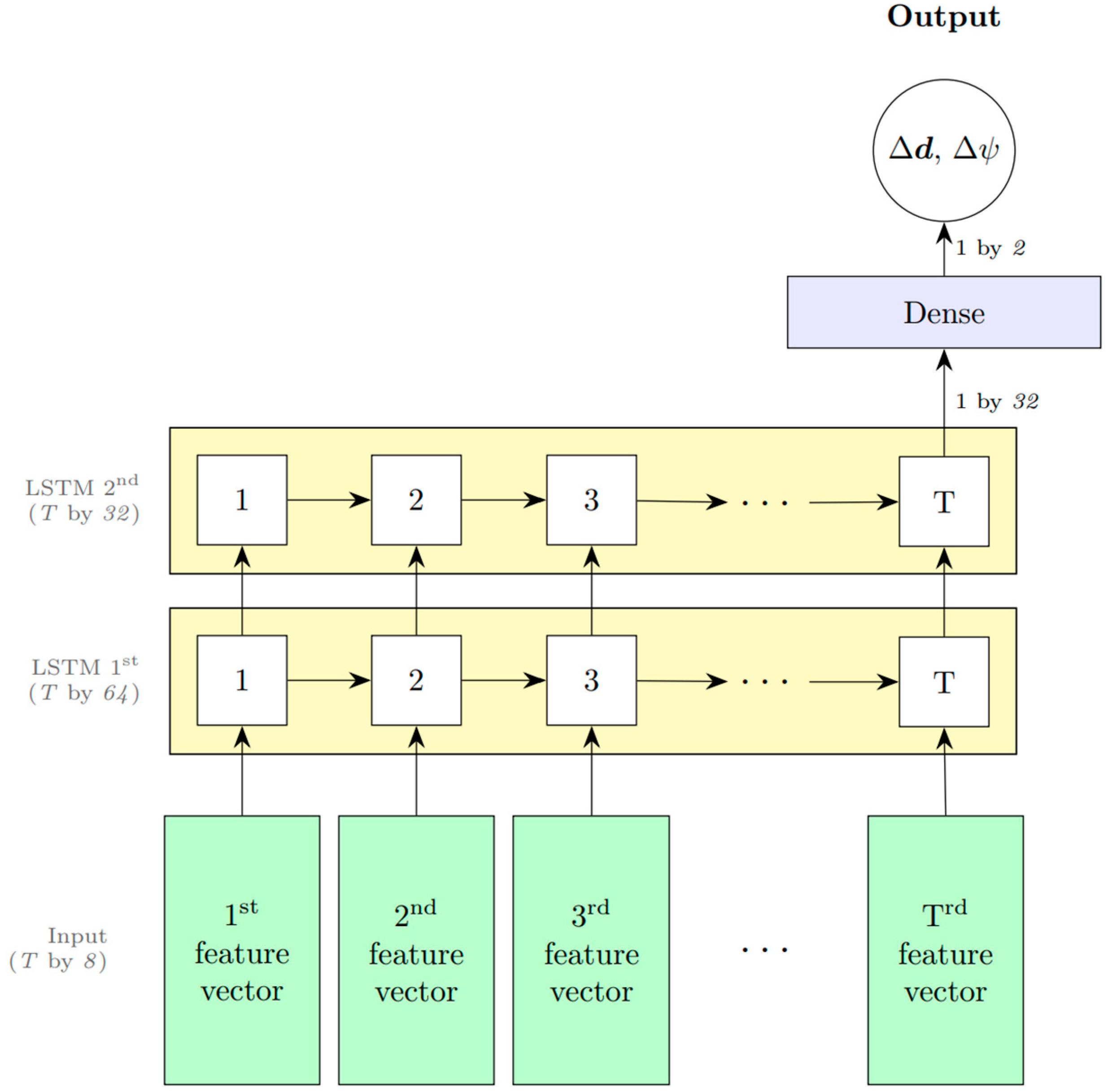
As illustrated in Figure 3, this study employs a Long Short-Term Memory (LSTM)-based neural network architecture to directly estimate the traveled distance and heading change in a pedestrian from IMU time-series data. LSTM networks are well suited for modeling sequential data, as they can effectively learn both short- and long-term temporal dependencies, making them appropriate for capturing continuous walking patterns [39].
The model input consists of IMU time-series data with a fixed length of 200 samples, where each time step is represented by an 8-dimensional feature vector. The input sequence is encoded into temporal features through the LSTM layers. The temporal features extracted by the LSTM layers are subsequently passed through fully connected dense layers to produce the final outputs. The model is designed to predict one traveled distance Δ d and one heading change Δ ψ for each input segment, resulting in an output dimensionality of two.

3.2.5. Training Strategy and Implementation Details

Table 1 summarizes the input feature configuration of the proposed AI-PDR model. The model input consists of IMU time-series data with a fixed length of 200 samples, where each time step is represented by an 8-dimensional feature vector comprising three-axis acceleration, three-axis angular velocity, the acceleration vector magnitude, and the angular velocity vector magnitude. The acceleration and angular velocity vector magnitudes are computed according to Equations (4) and (5), respectively.
The AI-PDR model was trained in a supervised learning manner. For each input time-series segment, the traveled distance and heading change computed from GPS-based ground truth were used as training labels. Accordingly, the model output is defined as the traveled distance and heading change corresponding to each input segment.
To prevent training imbalance caused by scale differences between the two output variables, output scaling was applied during model training. The scaled output values were used in the loss function computation, while during inference they were converted back to their original physical units for PDR trajectory generation. This output scaling strategy improves training stability and enables balanced learning of traveled distance and heading change.
The mean absolute error (MAE) was adopted as the loss function to jointly minimize the regression errors of the traveled distance and heading change. The model was trained using the Adam optimizer, and validation data were employed during training to monitor potential overfitting. The main hyperparameter settings used for model training are summarized in Table 2. After training, the AI-PDR model processes continuous IMU time-series data using a sliding-window approach and estimates the traveled distance and heading change for each input segment. The estimated motion parameters are then cumulatively integrated over time to generate the pedestrian’s movement trajectory. The generated PDR trajectory is subsequently combined with the BLE-based SC technique to produce the final indoor position estimate.

3.3. SC Leveraging Heading Correction

This section describes a localization method based on the comparison between the URS, generated along the user trajectory estimated by PDR, and a pre-constructed radio map [22,40]. First, a basic SC approach that does not consider heading errors is introduced. Then, to compensate for the degradation in SC performance caused by drift in the PDR trajectory, a heading correction-based SC method is proposed.

3.3.1. Surface Correlation-Based Localization

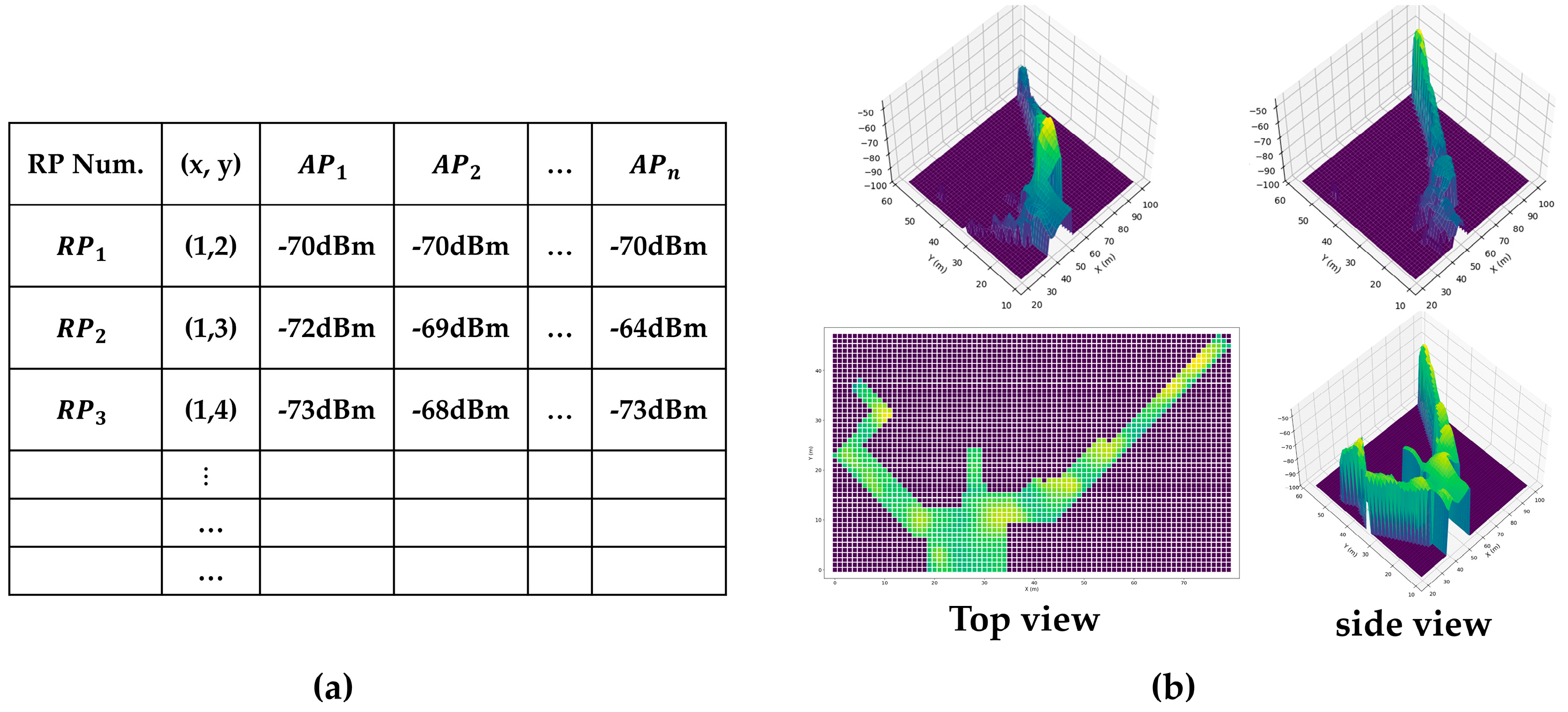
SC estimates the user’s location by comparing the URS, which represents accumulated RSSI information along the user’s movement trajectory in the form of a spatial pattern, with a pre-constructed Radio Map. The Radio Map is represented as a three-dimensional data structure that stores RSSI values corresponding to spatial coordinates for each AP. While conventional fingerprinting methods employ a table-based representation that stores RSSI vectors at discrete reference points, SC represents RSSI distributions in the form of index and estimates the user’s location by comparing spatial RSSI patterns between the URS and the Radio Map, as illustrated in Figure 4. This approach is distinguished from conventional methods in that it exploits spatial RSSI distributions formed over the movement process, rather than relying solely on RSSI values measured at a single location.
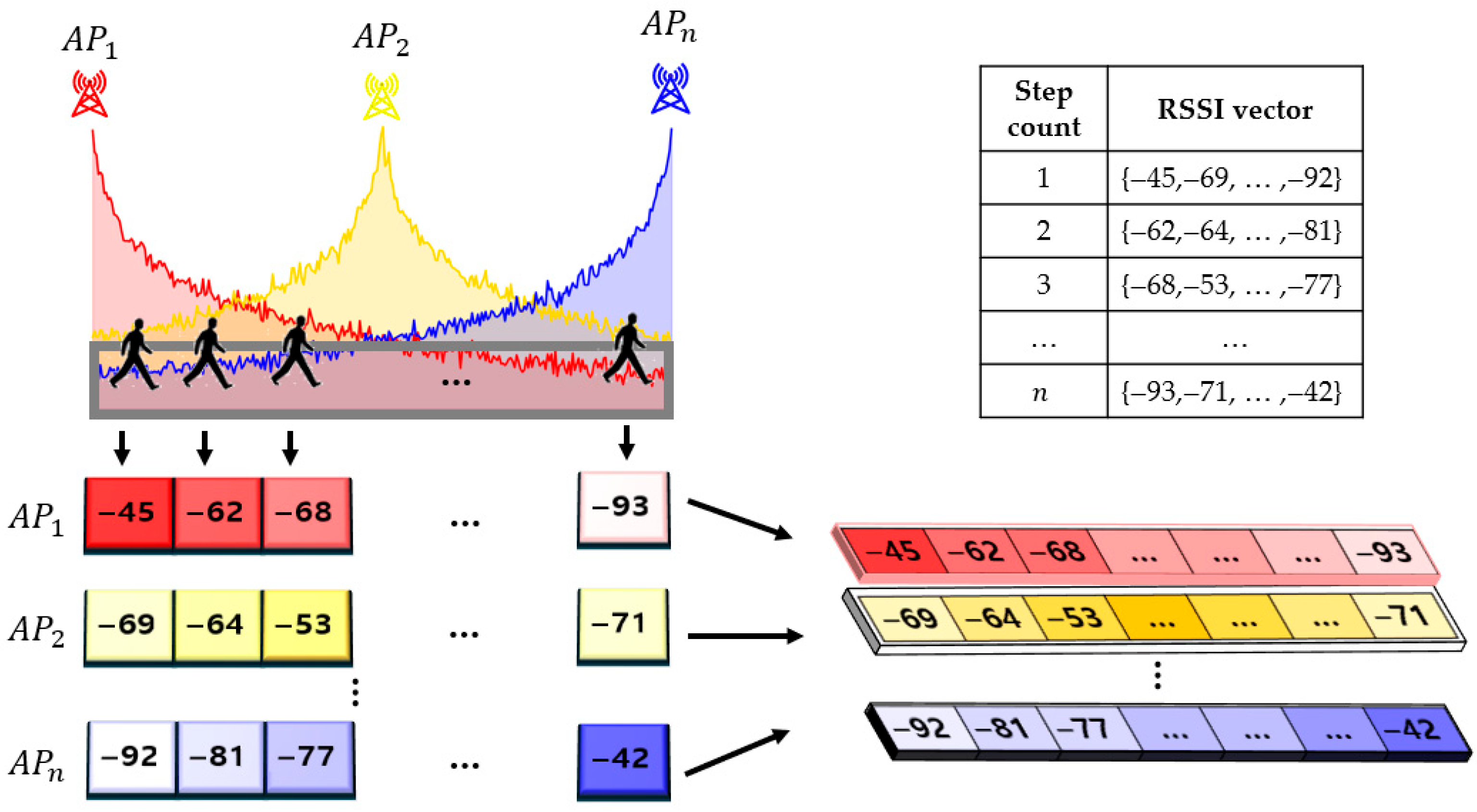
The URS is a spatial pattern constructed by accumulating RSSI values collected at each movement step along a PDR-based trajectory. By representing the RSSI distribution formed during the user’s movement as a two-dimensional surface, the URS effectively captures signal patterns over the entire movement trajectory, rather than relying on RSSI values measured at a single location. Due to this accumulation process, the URS exhibits relatively robust characteristics against measurement noise as RSSI samples are aggregated. The URS is not defined based on a fixed time duration or a fixed number of samples, but is instead formed according to the spatial coverage of the user’s movement trajectory. Figure 5 illustrates the URS generation process, in which step-wise RSSI vectors collected along the PDR trajectory are accumulated to form a spatial RSSI pattern [24].
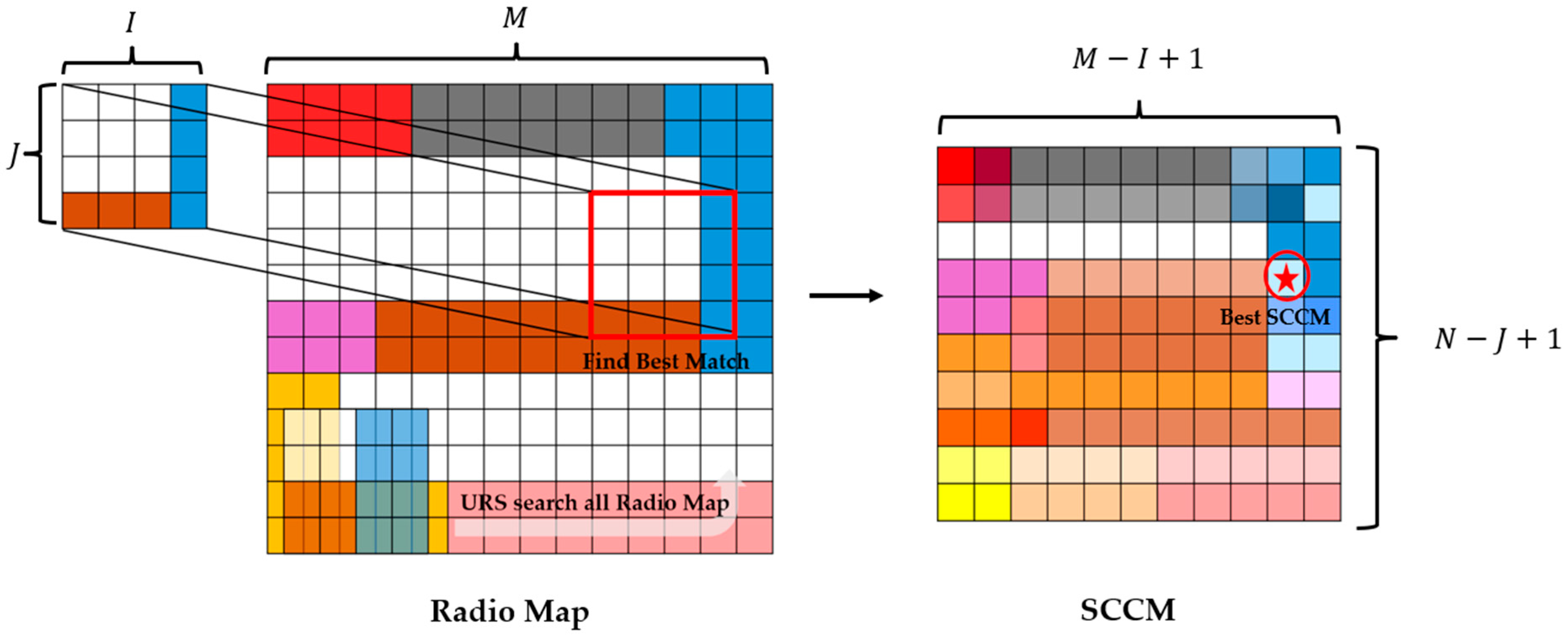
The comparison between the URS and the Radio Map is performed by sliding the URS over the entire Radio Map area and computing the differences between spatial RSSI patterns. The resulting output is represented as the Surface Correlation Coefficient Matrix (SCCM), which is constructed by evaluating the spatial RSSI pattern similarity between the URS and the Radio Map at each candidate location. Figure 6 illustrates the SC-based location search process.

3.3.2. Surface Correlation Considering Heading Error

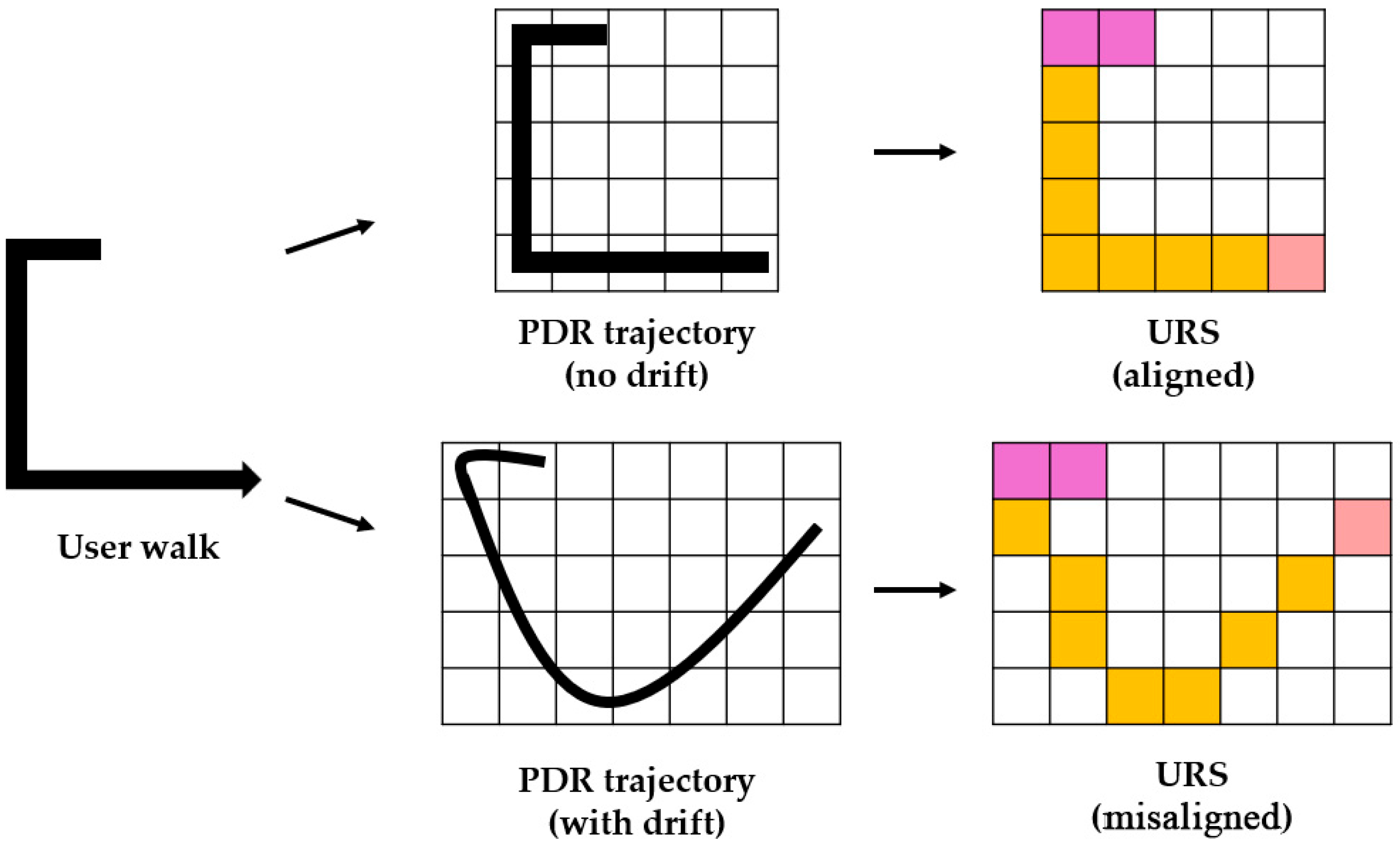
Since the URS is generated based on the PDR trajectory, heading errors caused by accumulated gyroscope errors may be introduced into the PDR path. Such heading errors distort the movement trajectory, and as the drift accumulates, the PDR-based trajectory gradually deviates from the true movement path. As a result, the spatial RSSI pattern of the URS generated along the distorted trajectory becomes inconsistent with the corresponding pattern in the Radio Map. This distortion of spatial RSSI patterns alters the distribution of SCCM values computed during the SC process, thereby increasing the likelihood that the minimum SCCM occurs at an incorrect location rather than the true position. Consequently, as the trajectory drift increases, the reliability of SC-based localization degrades. Therefore, to maintain stable SC performance, a compensation method that accounts for trajectory errors occurring during the URS generation process is required. Figure 7 illustrates the effects of heading drift on the PDR trajectory and the resulting changes in the spatial patterns of the URS and the SCCM.

3.3.3. Surface Correlation Leveraging Heading Correction

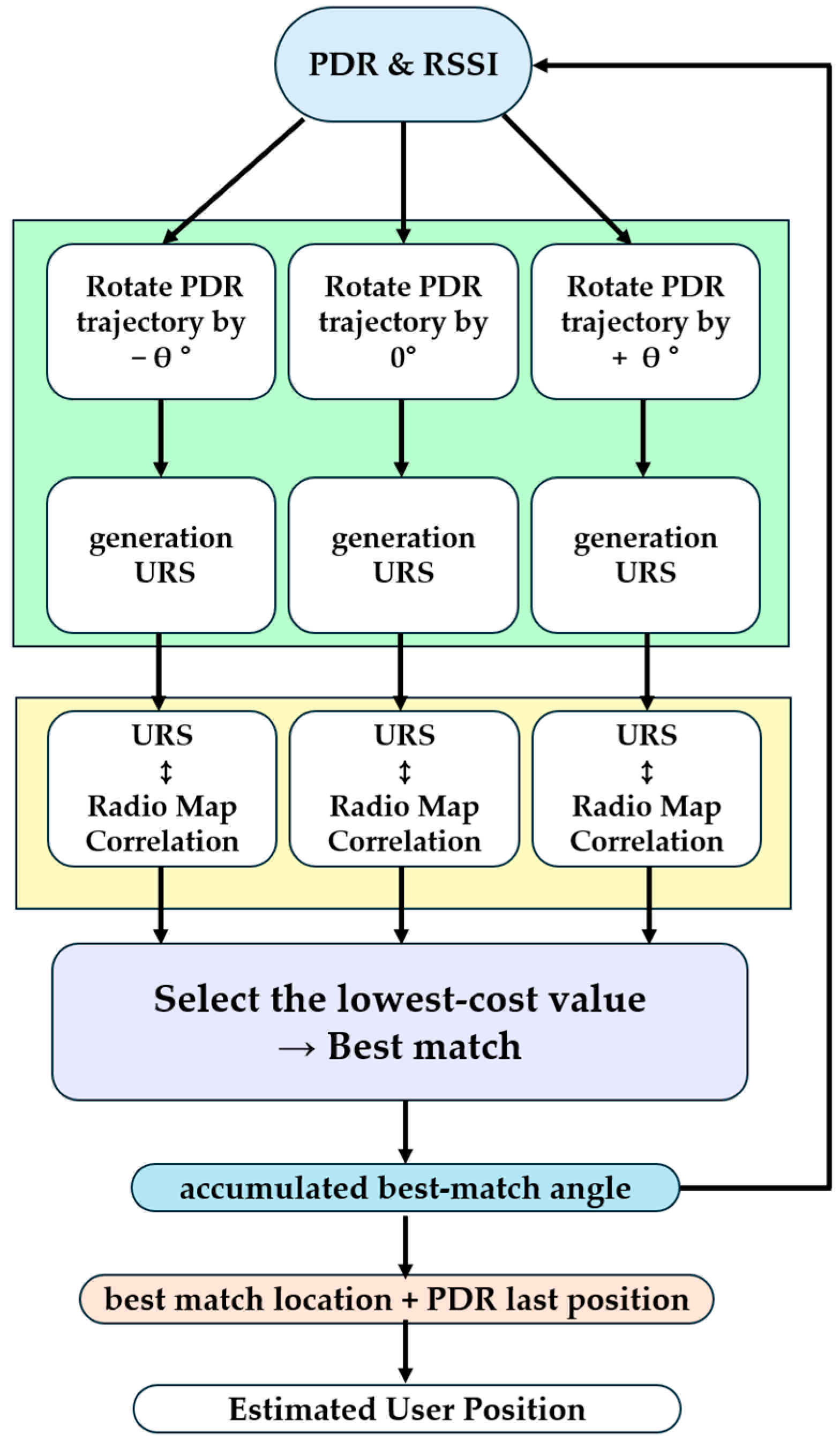
To address these issues, a method that performs SC by rotating the generated PDR trajectory is applied. Figure 8 illustrates the process of generating URS based on multiple rotated PDR trajectory candidates and performing SC for each candidate to select the optimal trajectory [24,41].
In the proposed method, SC is performed for multiple trajectory candidates generated by rotating a reference PDR trajectory by ± θ . For each rotated trajectory candidate, a URS is constructed using the accumulated RSSI values, and the user’s location is estimated by comparing the generated URS with a pre-constructed Radio Map. During this process, the trajectory candidate that yields the minimum SC error is selected, and the corresponding heading value is cumulatively applied as the reference for the subsequent step, thereby progressively compensating for drift in the PDR trajectory. The rotated trajectory candidates are generated by applying a rotation matrix to the reference PDR trajectory, as expressed in Equation (6).
R ( θ c ) = [   c o s θ c s i n θ c s i n θ c c o s θ c ] ,     θ c { θ , 0 , + θ }
P ¯ c = R ( θ c ) P ¯
Here, P ¯ c denotes the transformed PDR trajectory obtained by applying the rotation matrix R ( θ c ) . For each rotation candidate c , a URS is constructed based on the transformed PDR trajectory, resulting in multiple URS candidates corresponding to the rotation candidates. These URS candidates are compared with a pre-constructed Radio Map, and the rotation candidate that yields the minimum SC error is selected. The estimated user location is then determined based on the selected candidate. The comparison between the generated URS and the Radio Map is formulated as follows:
J c ( m , n ) = i = 1 I j = 1 J k = 1 K | ϕ c , i , j , k U ϕ m + i 1 , n + j 1 , k R | ,   1 m M I + 1   a n d   1 n N J + 1
Here, ϕ c , i , j , k U denotes the RSSI value of the URS generated for the rotation candidate c, and ϕ m + i 1 , n + j 1 , k R represents the RSSI value of the Radio Map at the corresponding location. The search range is constrained to 1 m M I + 1   a n d   1 n N J + 1 , where I and J denote the spatial dimensions of the URS, and M and N represent the spatial dimensions of the Radio Map. For each rotation candidate c, the location that minimizes the SC error and the corresponding minimum error are determined as:
( x ~ c , y ~ c ) = a r g min m , n J c ( m , n )
ε c = J c ( x ~ c , y ~ c )
Here, ε c denotes the minimum SC error between the URS and the Radio Map for the rotation candidate c . Among all rotation candidates, the candidate that yields the minimum SC error is selected as:
c ~ = a r g m i n c { 1,2 , , C } ε c
After selecting the rotation candidate that yields the minimum SC error, since the URS is constructed with respect to the origin (0, 0), the final user position is calculated by adding the last position of the PDR trajectory to the position estimated through SC for the selected candidate:
x ^ =   x ~ c ~ + P ¯ x , l a s t ,       y ^ =   y ~ c ~ + P ¯ y , l a s t
The rotation angle θ c ~ corresponding to the selected candidate is then cumulatively applied as the reference heading for the subsequent SC step. Through this iterative update, heading drift accumulated in the PDR trajectory is progressively compensated, enabling stable localization by exploiting the accumulated spatial RSSI patterns.

4. Experimental Results

4.1. Experimental Setting

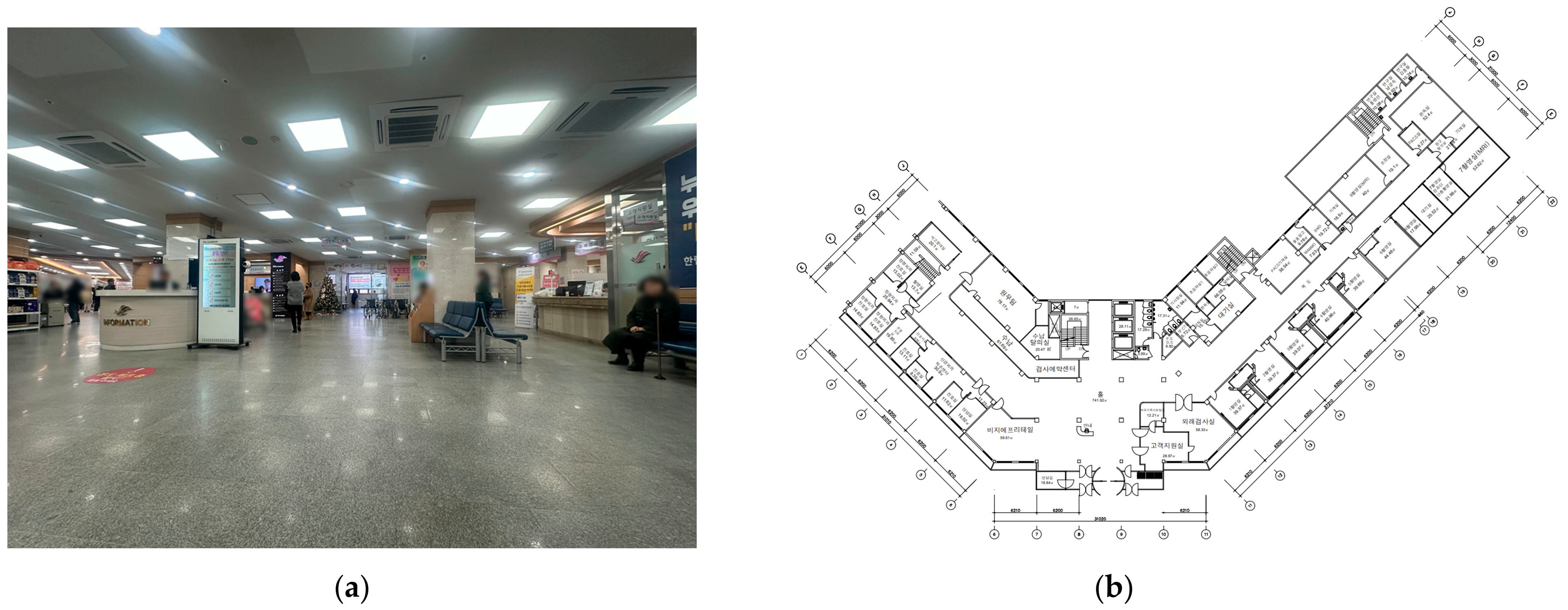
The experiments were conducted on the first floor of Hallym Sacred Heart Hospital, located in Chuncheon, Gangwon Province, Republic of Korea, which represents a typical indoor environment where GPS signals are unavailable. This section sequentially describes the BLE beacon deployment, the radio map construction process, and the test data collection procedure for evaluating localization performance.
To ensure experimental reproducibility, the hardware and software configuration used in this study is described as follows. The data collection experiments were performed using a commercial smartphone (Samsung Galaxy S22 Ultra, Samsung, Suwon, Republic of Korea) equipped with IMU sensors and BLE communication capability, running the Android 16 operating system. Sensor measurements, including tri-axial accelerometer and gyroscope data, were recorded at a sampling rate of 50 Hz using a custom-developed Android application.
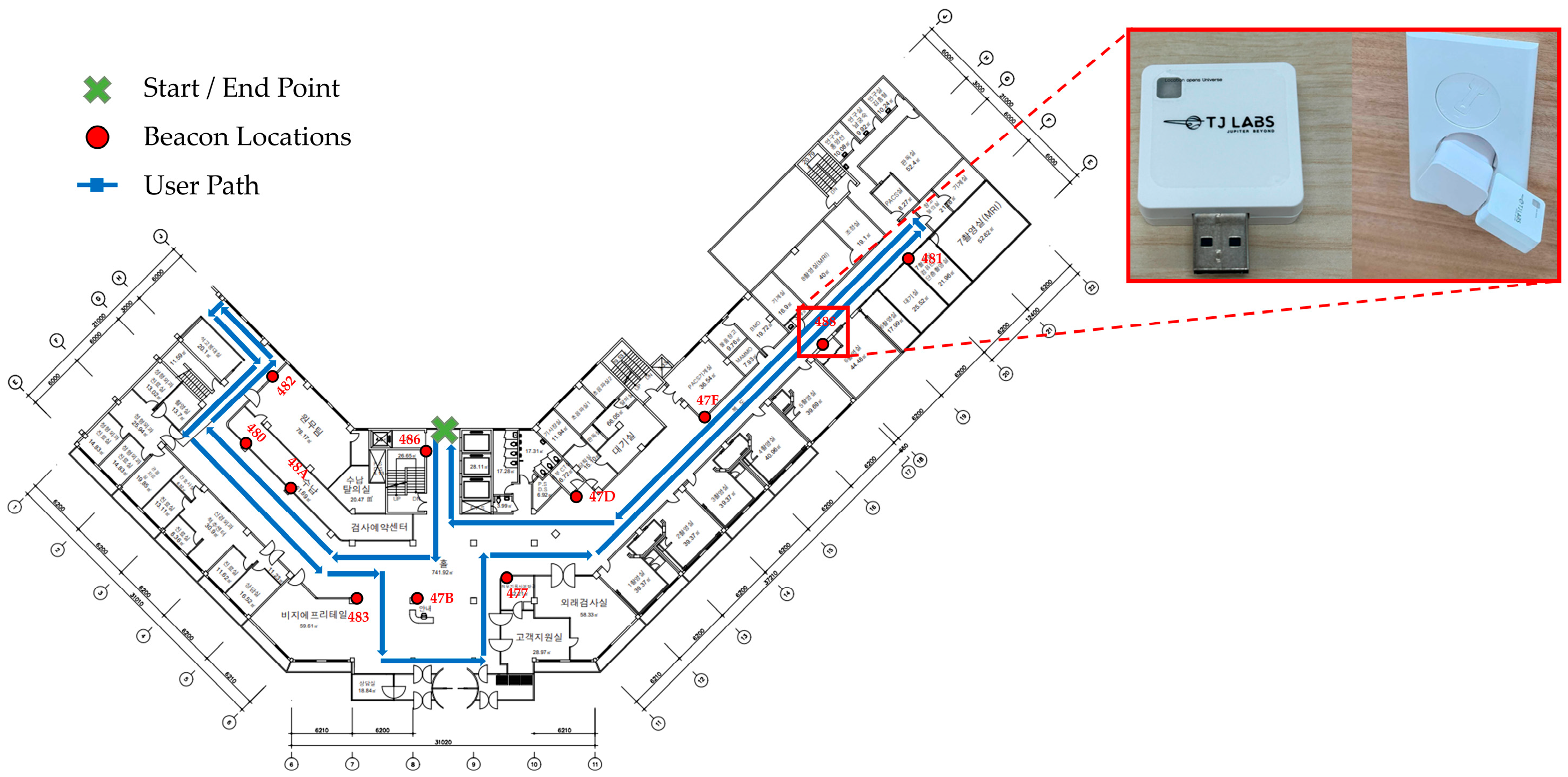
BLE signals were transmitted using custom-developed BLE beacon devices designed and implemented by the authors in compliance with the Korean radio communication standards for low-power wireless equipment. The beacons were configured with a transmission power of −4 dBm and an advertising interval of 100 ms. A total of 11 BLE beacons were deployed along the hospital corridor to provide sufficient spatial coverage for radio map construction.
The collected dataset was processed and used to train the AI-PDR model using Python 3.10 with the TensorFlow deep learning framework and standard scientific computing libraries, including NumPy and SciPy.

4.1.1. Experimental Environment

To construct the radio map within the experimental environment, a total of 11 BLE beacons were deployed. The beacons were evenly installed along the corridors and main pedestrian pathways on the first floor of the hospital. Figure 9a presents the actual photograph of the first floor of Hallym Sacred Heart Hospital, while Figure 9b shows the floor plan of the first floor used for the experiment.

4.1.2. Radio Map Construction

Data collection for radio map construction was conducted by a single participant following the same closed-loop trajectory. BLE RSSI data were collected along a closed-loop path that starts from the elevator area and returns to the initial location, as illustrated in Figure 10.
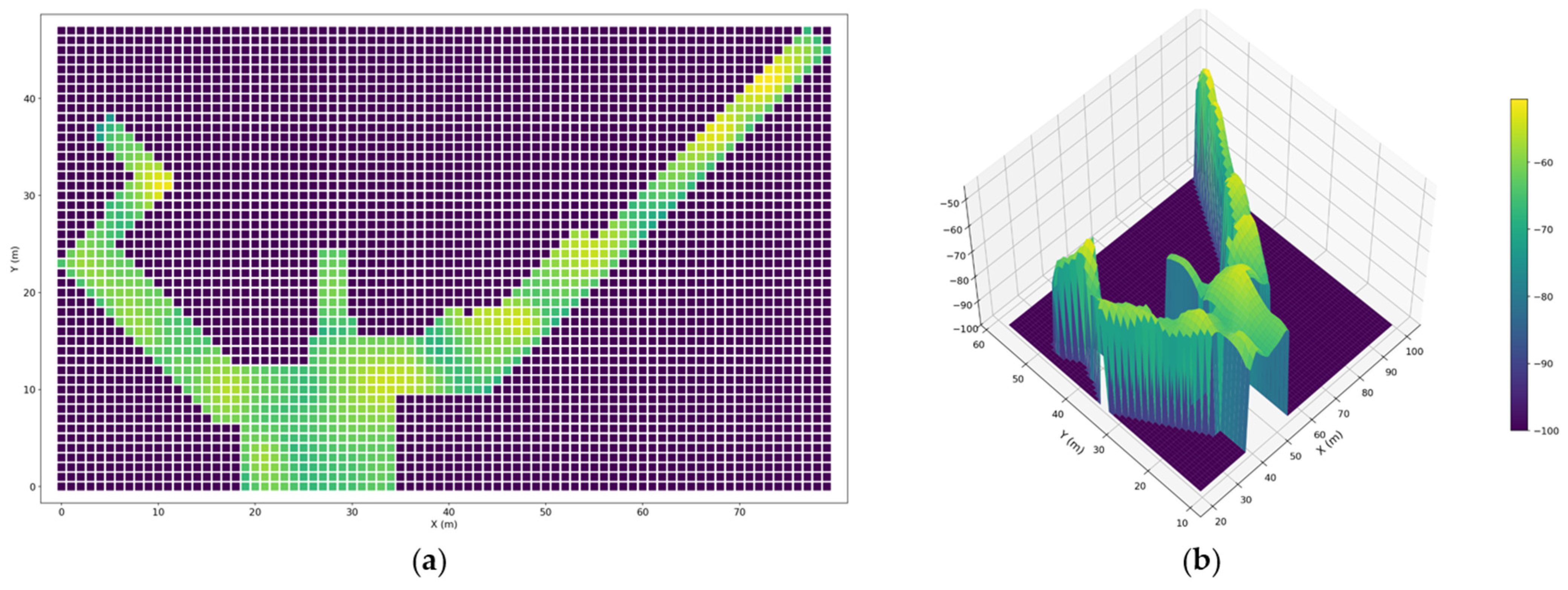
First, reference points were generated at 1 m intervals within the actual walkable area, and the overall spatial extent of the radio map was determined based on the spatial distribution of these reference points. The RSSI measurements collected along the walking trajectory were assigned to the nearest reference points. To enhance spatial robustness, the RSSI value at each reference point was further propagated to its adjacent reference points at 1 m intervals; for reference points where RSSI values remained missing, the RSSI was completed by searching for nearby valid reference points along the ± x and ± y directions and averaging the retrieved values. In addition, for physically inaccessible areas, RSSI values were uniformly set to −100 dBm to explicitly represent the absence of radio signals. Based on the constructed radio map, a two-dimensional Gaussian smoothing was further applied to suppress local noise and irregular fluctuations while preserving the overall spatial distribution characteristics of the radio signals, resulting in a stable and continuous radio map, as illustrated in Figure 11.

4.1.3. Test Data Collection

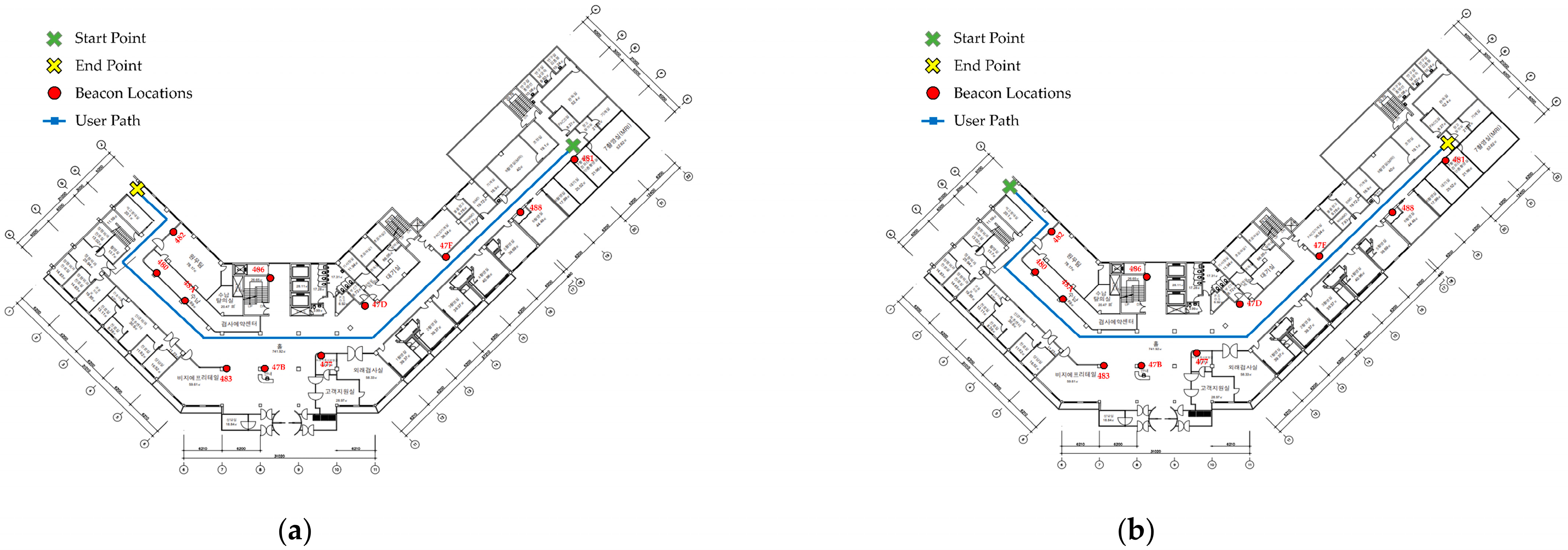
Test data collection for evaluating localization performance was conducted by two different participants in the same experimental environment. Each participant collected data while walking along two predefined user scenarios. The user scenarios employed in the experiments are illustrated in Figure 12. A Samsung Galaxy S22U smartphone was used for test data collection. During the data acquisition process, the smartphone simultaneously recorded IMU sensor data and time-synchronized BLE RSSI measurements. The collected IMU time-series data were used as inputs to the proposed AI-PDR model, which estimates the traveled distance and heading change for each walking segment. These estimates were cumulatively integrated to generate the pedestrian’s movement trajectory. The generated pedestrian trajectories and the BLE RSSI data collected along the walking paths were then combined with the previously constructed radio map and used for localization performance evaluation. In this manner, the test data were collected independently from the radio map construction data, enabling a fair comparison of localization results under identical environmental and path conditions.

4.2. Experimental Analysis

In both scenarios, the localization trajectories obtained using the SC-based method generally followed the ground-truth walking path, indicating good consistency in path estimation. The generated trajectories exhibited high spatial smoothness and continuity, maintaining stable trajectory characteristics even in turning and curved segments.

4.2.1. Estimation Analysis

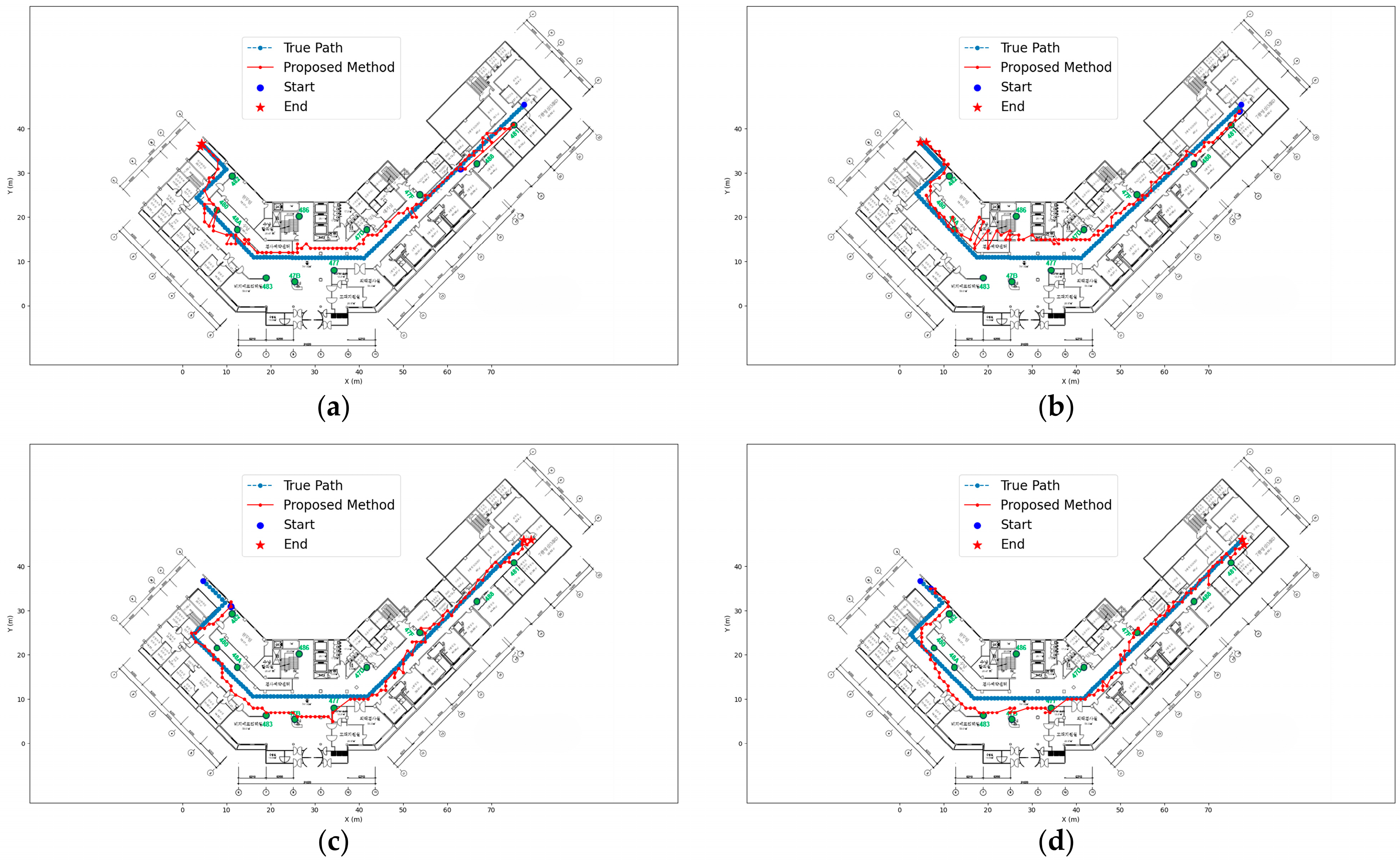
As shown in Figure 13, the localization trajectories for both users generally follow the ground-truth paths in both scenarios. In Scenario 1, User 2 exhibits more noticeable local fluctuations in the left turning region, whereas User 1 shows relatively smoother trajectories; the results for both users become more stable in the straight corridor segments. In Scenario 2, the trajectories of both users show higher overall consistency, particularly along the long straight corridor, where they closely overlap with the ground-truth path. The main deviation appears as a small parallel offset in the bottom corridor section. Overall, the proposed method maintains reasonable trajectory continuity and stability across different users and path conditions.

4.2.2. Quantitative Error Analysis

Table 3 summarizes the statistical results of localization errors for different localization methods, including KNN fingerprinting, particle filter (PF), the standalone AI-PDR approach, and the proposed method. The evaluation metrics include the mean error, root mean square error (RMSE), and maximum error under various scenarios and user conditions.
For the standalone AI-PDR approach, the initial position and initial heading were assumed to be known. Specifically, the starting point of the trajectory was aligned with the ground-truth coordinate, and the initial heading was calibrated using the reference orientation at the beginning of the trajectory. This assumption allows the evaluation to focus on the relative motion estimation capability of the AI-PDR model, independent of initialization errors. In practical deployments, such initialization information can be obtained from infrastructure-based localization methods or user-assisted calibration procedures. In contrast, the proposed method reduces the dependence on accurate initialization by incorporating infrastructure-derived spatial constraints.
Let e i denote the localization error at the i -th estimated position and N denote the total number of samples. The three error metrics are defined as follows:
e i = ( x ^ i x i ) 2 + ( y ^ i y i ) 2
M e a n   E r r o r = 1 N i = 1 N e i
R M S E = 1 N i = 1 N e i 2
M a x   E r r o r = max ( e i ) , i = 1,2 , , N
In Scenario 1 for User 1, the standalone AI-PDR approach achieved the best performance, with a mean error of 1.84 m and an RMSE of 2.21 m, whereas the proposed method showed relatively lower performance, with a mean error of 4.90 m and an RMSE of 6.11 m. However, this result can be attributed to the favorable effect of the initialization assumption for AI-PDR under specific path conditions. The slight increase in the maximum error of the proposed method is also caused by localized deviations in a small number of segments and does not significantly affect the overall performance trend.
In contrast, for Scenario 1 with User 2, the proposed method achieved the best performance across all metrics, with a mean error of 4.01 m, an RMSE of 4.31 m, and a maximum error of 8.08 m, outperforming KNN, PF, and the standalone AI-PDR approach.
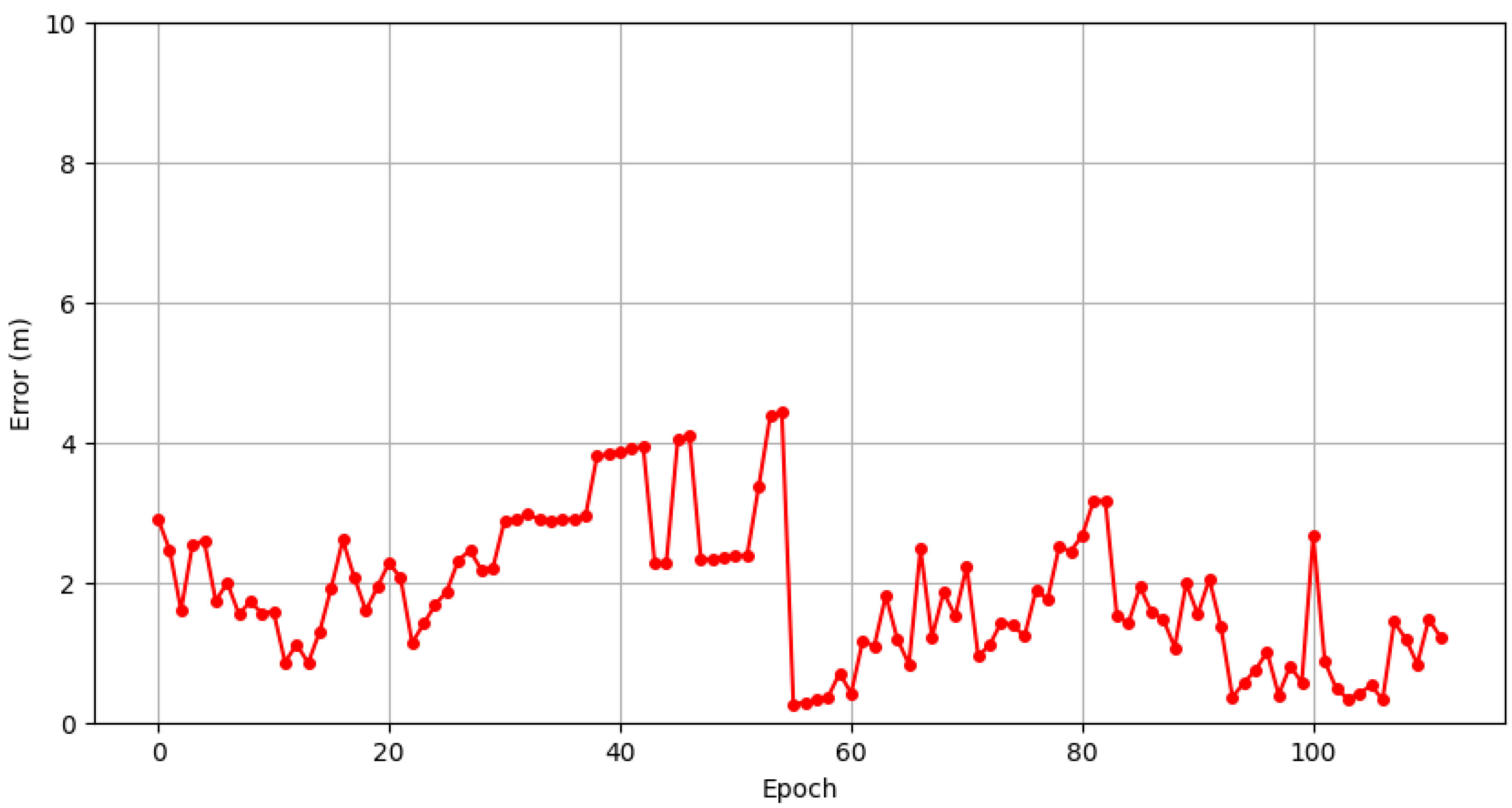
In Scenario 2, the proposed method consistently showed the best performance for both users. For User 1, the mean error and RMSE were reduced to 2.05 m and 2.56 m, respectively, compared with KNN and PF as illustrated in Figure 14. For User 2, the proposed method achieved the most notable improvement, with a mean error of 1.87 m, an RMSE of 2.12 m, and a maximum error of 4.43 m. The significant reduction in maximum error for User 2 indicates that the proposed method maintains strong robustness against variations in trajectory patterns and user characteristics.
The overall results further confirm the superiority of the proposed method, which achieved a mean error of 3.21 m and an RMSE of 4.10 m, outperforming KNN (5.03 m, 5.99 m), PF (3.56 m, 4.22 m), and the standalone AI-PDR approach (7.02 m, 9.30 m).
In summary, the proposed method achieves the best localization accuracy overall and maintains stable performance across different users and path environments, demonstrating strong robustness.

4.2.3. Error Distribution Analysis

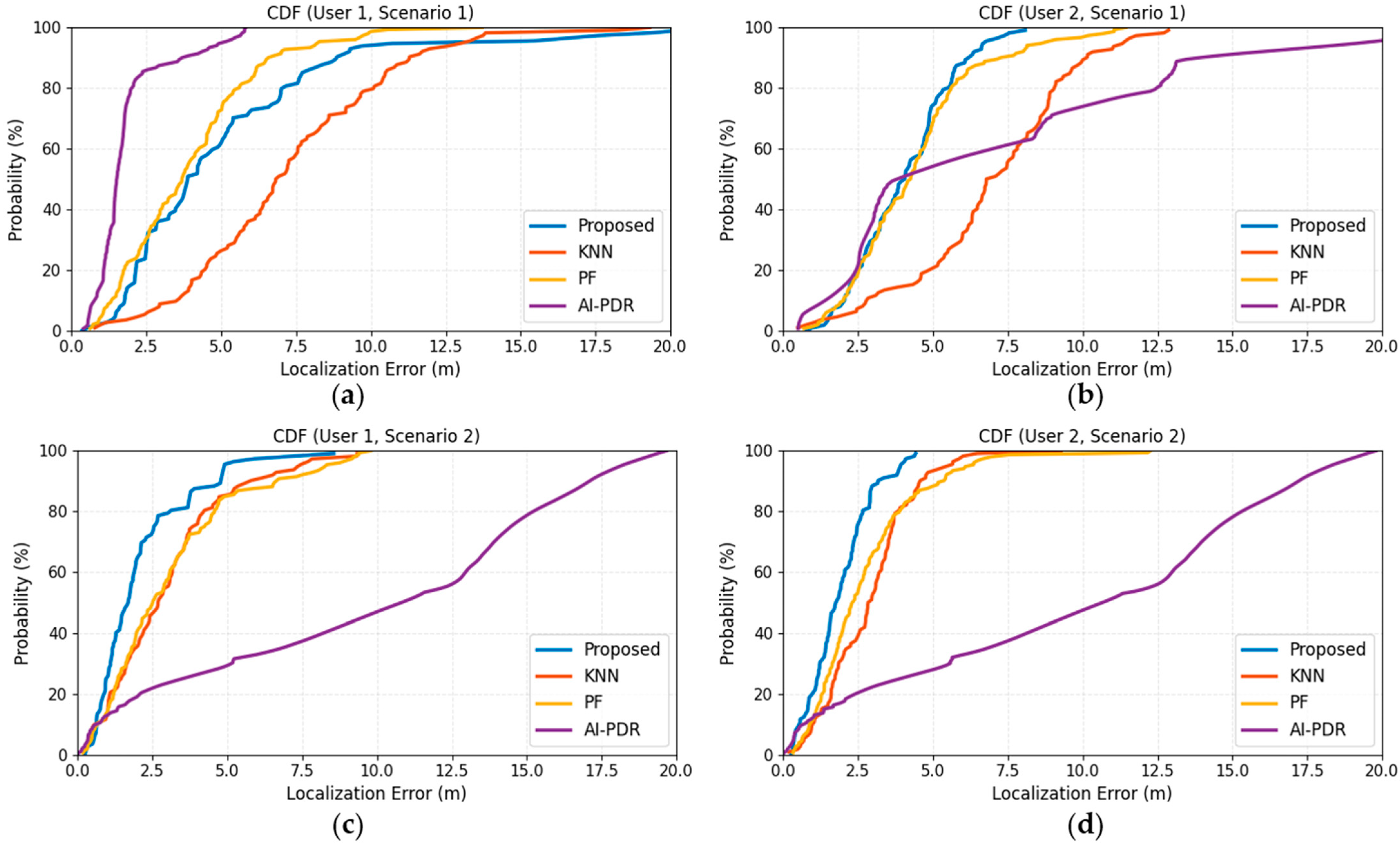
Under identical path conditions, Figure 15 presents the cumulative distribution functions (CDFs) of localization errors for the KNN-based fingerprinting method, particle filter (PF), the standalone AI-PDR approach, and the proposed method across different users and scenarios. This comparison enables an analysis of the error distribution characteristics and the tendency of large-error occurrences for each method.
In Scenario 1, performance differences vary depending on the user; however, the proposed method generally exhibits more stable distribution characteristics in the intermediate and high-error regions. For User 1, the standalone AI-PDR approach shows relatively favorable performance in the low-error range, whereas the error distributions of PF and KNN expand more rapidly as the error increases. In contrast, the proposed method maintains a more gradual increase in the high-error region, effectively suppressing the occurrence of large localization errors. For User 2, the advantage of the proposed method becomes more evident, achieving lower error values than the other methods at the same confidence levels (e.g., the 90th percentile).
In Scenario 2, the proposed method demonstrates the most stable CDF behavior for both users. While the differences among methods are relatively small in the low-error region, the superiority of the proposed method becomes increasingly pronounced in the intermediate-to-high error range. In particular, under the User 2 condition, the proposed method maintains a more constrained distribution compared with the KNN and standalone AI-PDR approaches, which exhibit larger distribution spreads in the high-error region, thereby effectively reducing large localization errors.
Overall, the CDF analysis indicates that the proposed method maintains a more stable error distribution across different users and path conditions and effectively reduces localization errors in high-confidence regions. These results demonstrate that the proposed method provides more consistent localization performance and improved robustness compared to the existing methods.

4.3. Discussion

The results of this study indicate that indoor localization based on accumulated spatial patterns provides a robust alternative to conventional point-wise fingerprint matching. The proposed technology constructs unified spatial patterns that reflect both user motion and radio signal distributions. Operating at the pattern level allows the system to leverage temporally accumulated information, which improves robustness against short-term RSSI fluctuations and reduces sensitivity to instantaneous measurement noise.
Despite these advantages, several challenges must be addressed to achieve more general and widely applicable indoor localization. First, reliable operation under diverse pedestrian motion behaviors remains essential. Real-world users exhibit varying walking speeds, frequent stops, abrupt turns, and irregular motion patterns, all of which can affect trajectory estimation. While the AI-PDR model improves trajectory stability, further evaluation under a broader range of motion conditions is necessary. Second, although BLE-based radio surfaces demonstrated promising performance in the evaluated environment, their robustness under more extreme or complex signal conditions requires further study. Scenarios involving sparse beacon deployment, strong interference, or highly cluttered indoor spaces may introduce additional uncertainty, and understanding the limits of BLE-based spatial patterns is an important direction for future work. A further challenge is related to the intrinsic behavior of surface correlation during the early stage of pattern formation. Because reliable correlation requires a sufficient accumulation of spatial patterns, localization estimates can become unstable before the user-generated pattern fully develops, leading to transient position jumps. This issue is fundamentally associated with insufficient spatial support rather than absolute initialization error. One promising direction to address this limitation is to incorporate additional and complementary measurements—such as short-term inertial constraints, Wi-Fi signals, magnetic field patterns, or map-derived features—to stabilize localization during the early phase before the spatial pattern matures. In addition, the construction of radio maps still relies on site surveys. Integrating simultaneous localization and mapping-based techniques offers a promising approach to reduce deployment effort while maintaining spatial consistency. Furthermore, extending the framework to support heterogeneous users and devices, as well as fusing multiple sensing modalities, could significantly enhance generalization and robustness. These extensions would move the proposed approach closer to a unified indoor localization framework capable of operating reliably across diverse environments and usage conditions.


5. Conclusions

This paper proposed an AI-generated spatial pattern matching framework for indoor localization that integrates AI-PDR with BLE-based radio surface modeling. The proposed approach constructs surface-level representations by fusing user trajectories generated by the AI-PDR model with spatially accumulated radio signal patterns. These representations are then aligned with a pre-built radio map using SC algorithm, while the heading correction method is incorporated to mitigate pedestrian heading drift. By operating on accumulated spatial patterns rather than point-wise measurements, the proposed framework achieves robust localization performance under significant RSSI variability and long walking trajectories. Experimental results obtained in a real indoor environment demonstrated that the proposed method outperforms conventional fingerprinting-based approaches in terms of accuracy and stability. Future work will focus on further improving the AI-PDR model by leveraging more diverse motion and contextual data, as well as extending the framework to multi-floor indoor environments. Overall, this study suggests that surface-level pattern matching combined with drift-aware trajectory modeling provides a scalable and resilient strategy for indoor localization in complex and dynamic spaces.

Author Contributions

Conceptualization, B.K. and S.L.; methodology, B.K. and S.L.; software, B.K.; validation, B.K., S.L., and J.K.; formal analysis, B.K.; investigation, B.K. and S.L.; resources, B.S.; data curation, B.K.; writing—original draft preparation, B.K. and S.L.; writing—review and editing, B.K., S.L., and B.S.; visualization, B.K.; supervision, B.S.; project administration, B.S. All authors have read and agreed to the published version of the manuscript.

Funding

This research was supported by the Regional Innovation System & Education (RISE) Glocal University 30 Project program through the Gangwon RISE Center, funded by the Ministry of Education (MOE) and the Gangwon State (G.S.), Republic of Korea (2025-RISE-10-009).

Institutional Review Board Statement

Not applicable.

Informed Consent Statement

Not applicable.

Data Availability Statement

Derived data supporting the findings of this study are available from the corresponding author on request. The data are not publicly available due to privacy.

Conflicts of Interest

The authors declare no conflicts of interest.

Abbreviations

The following abbreviations are used in this manuscript:
PDRPedestrian Dead Reckoning
IMUInertial Measurement Unit
BLEBluetooth Low Energy
RSSIReceived Signal Strength Indicator

References

  1. Barreras, F.; Watts, D.J. The Exciting Potential and Daunting Challenge of Using GPS Human-Mobility Data for Epidemic Modeling. Nat. Comput. Sci. 2024, 4, 398–411. [Google Scholar] [CrossRef]
  2. Qi, L.; Liu, Y.; Yu, Y.; Chen, L.; Chen, R. Current Status and Future Trends of Meter-Level Indoor Positioning Technology: A Review. Remote Sens. 2024, 16, 398. [Google Scholar] [CrossRef]
  3. Ma, Z.; Shi, K. Few-Shot Learning for WiFi Fingerprinting Indoor Positioning. Sensors 2023, 23, 8458. [Google Scholar] [CrossRef]
  4. Park, J.-H.; Kim, D.; Suh, Y.-J. WKNN-Based Wi-Fi Fingerprinting with Deep Distance Metric Learning via Siamese Triplet Network for Indoor Positioning. Electronics 2024, 13, 4448. [Google Scholar] [CrossRef]
  5. Du, X.; Liao, X.; Liu, M.; Gao, Z. CRCLoc: A Crowdsourcing-Based Radio Map Construction Method for WiFi Fingerprinting Localization. IEEE Internet Things J. 2022, 9, 12364–12377. [Google Scholar] [CrossRef]
  6. Aranda, F.J.; Parralejo, F.; Álvarez, F.J.; Paredes, J.A. Performance Analysis of Fingerprinting Indoor Positioning Methods with BLE. Expert. Syst. Appl. 2022, 202, 117095. [Google Scholar] [CrossRef]
  7. Sun, X.; Ai, H.; Tao, J.; Hu, T.; Cheng, Y. BERT-ADLOC: A Secure Crowdsourced Indoor Localization System Based on BLE Fingerprints. Appl. Soft Comput. 2021, 104, 107237. [Google Scholar] [CrossRef]
  8. Zheng, Z.; Liu, S.; Xue, Y.; Wang, X.; Wen, Z.; Zhang, T.; Li, Y. Multilevel Magnetic Field Fingerprinting Positioning Error Elimination Method. IEEE Internet Things J. 2024, 11, 32838–32853. [Google Scholar] [CrossRef]
  9. Carrillo, D.; Moreno, V.; Úbeda, B.; Skarmeta, A. MagicFinger: 3D Magnetic Fingerprints for Indoor Location. Sensors 2015, 15, 17168–17194. [Google Scholar] [CrossRef]
  10. Yoo, J. Wi-Fi Fingerprint Indoor Localization by Semi-Supervised Generative Adversarial Network. Sensors 2024, 24, 5698. [Google Scholar] [CrossRef]
  11. Huang, C.; Zhuang, Y.; Liu, H.; Li, J.; Wang, W. A Performance Evaluation Framework for Direction Finding Using BLE AoA/AoD Receivers. IEEE Internet Things J. 2021, 8, 3331–3345. [Google Scholar] [CrossRef]
  12. Grasso, P.; Innocente, M.S.; Tai, J.J.; Haas, O.; Dizqah, A.M. Analysis and Accuracy Improvement of UWB-TDoA-Based Indoor Positioning System. Sensors 2022, 22, 9136. [Google Scholar] [CrossRef]
  13. Ma, C.; Wu, B.; Poslad, S.; Selviah, D.R. Wi-Fi RTT Ranging Performance Characterization and Positioning System Design. IEEE Trans. Mob. Comput. 2022, 21, 740–756. [Google Scholar] [CrossRef]
  14. Ferrero-López, A.; Gallego, A.J.; Lozano, M.A. Bluetooth Low Energy Indoor Positioning: A Fingerprinting Neural Network Approach. Internet Things 2025, 31, 101565. [Google Scholar] [CrossRef]
  15. Kakisim, A.G. Multi-Channel Convolutional Neural Network with Attention Mechanism Using Dual-Band WiFi Signals for Indoor Positioning Systems in Smart Buildings. Internet Things 2025, 29, 101435. [Google Scholar] [CrossRef]
  16. Lukman Ayinla, S.; Aziz, A.A.; Drieberg, M.; Susanto, M.; Tumian, A.; Yahya, M. An Enhanced Deep Neural Network Approach for WiFi Fingerprinting-Based Multi-Floor Indoor Localization. IEEE Open J. Commun. Soc. 2025, 6, 560–575. [Google Scholar] [CrossRef]
  17. Kargar-Barzi, A.; Farahmand, E.; Taheri Chatrudi, N.; Mahani, A.; Shafique, M. An Edge-Based WiFi Fingerprinting Indoor Localization Using Convolutional Neural Network and Convolutional Auto-Encoder. IEEE Access 2024, 12, 85050–85060. [Google Scholar] [CrossRef]
  18. Jia, B.; Qiao, W.; Zong, Z.; Liu, S.; Hijji, M.; Del Ser, J.; Muhammad, K. A Fingerprint-Based Localization Algorithm Based on LSTM and Data Expansion Method for Sparse Samples. Future Gener. Comput. Syst. 2022, 137, 380–393. [Google Scholar] [CrossRef]
  19. Asraf, O.; Shama, F.; Klein, I. PDRNet: A Deep-Learning Pedestrian Dead Reckoning Framework. IEEE Sens. J. 2022, 22, 4932–4939. [Google Scholar] [CrossRef]
  20. Geng, J.; Xia, L.; Xia, J.; Li, Q.; Zhu, H.; Cai, Y. Smartphone-Based Pedestrian Dead Reckoning for 3D Indoor Positioning. Sensors 2021, 21, 8180. [Google Scholar] [CrossRef]
  21. Khalili, B.; Ali Abbaspour, R.; Chehreghan, A.; Vesali, N. A Context-Aware Smartphone-Based 3D Indoor Positioning Using Pedestrian Dead Reckoning. Sensors 2022, 22, 9968. [Google Scholar] [CrossRef]
  22. Kim, J.; Kim, B.; Shin, B. Performance Analysis and Compensation Methods According to PDR Drift and Radio Map Resolution. J. Position. Navig. Timing 2025, 14, 195–202. [Google Scholar] [CrossRef]
  23. Lee, J.H.; Shin, B.; Shin, D.; Kim, J.; Park, J.; Lee, T. Precise Indoor Localization: Rapidly-Converging 2D Surface Correlation-Based Fingerprinting Technology Using LTE Signal. IEEE Access 2020, 8, 172829–172838. [Google Scholar] [CrossRef]
  24. Shin, B.; Ho Lee, J.; Lee, T. Novel Indoor Fingerprinting Method Based on RSS Sequence Matching. Measurement 2023, 223, 113719. [Google Scholar] [CrossRef]
  25. Feng, X.; An Nguyen, K.; Luo, Z. A Review of Open Access WiFi Fingerprinting Datasets for Indoor Positioning. IEEE Access 2024, 12, 167970–167989. [Google Scholar] [CrossRef]
  26. Hanna, S.; Karunaratne, S.; Cabric, D. WiSig: A Large-Scale WiFi Signal Dataset for Receiver and Channel Agnostic RF Fingerprinting. IEEE Access 2022, 10, 22808–22818. [Google Scholar] [CrossRef]
  27. Bonavolontà, F.; Liccardo, A.; Schiano Lo Moriello, R.; Caputo, E.; De Alteriis, G.; Palladino, A.; Vitolo, G. An Improved Method Based on Bluetooth Low-Energy Fingerprinting for the Implementation of PEPS System. Sensors 2022, 22, 9615. [Google Scholar] [CrossRef]
  28. He, S.; Gary Chan, S.-H. Wi-Fi Fingerprint-Based Indoor Positioning: Recent Advances and Comparisons. IEEE Commun. Surv. Tutor. 2026, 18, 466–490. [Google Scholar] [CrossRef]
  29. Liu, H.; Darabi, H.; Banerjee, P.; Liu, J. Survey of Wireless Indoor Positioning Techniques and Systems. IEEE Trans. Syst. Man Cybern. Part C (Appl. Rev.) 2007, 37, 1067–1080. [Google Scholar] [CrossRef]
  30. Faragher, R.; Harle, R. Location Fingerprinting With Bluetooth Low Energy Beacons. IEEE J. Sel. Areas Commun. 2015, 33, 2418–2428. [Google Scholar] [CrossRef]
  31. Zafari, F.; Gkelias, A.; Leung, K.K. A Survey of Indoor Localization Systems and Technologies. IEEE Commun. Surv. Tutor. 2019, 21, 2568–2599. [Google Scholar] [CrossRef]
  32. Kang, W.; Han, Y. SmartPDR: Smartphone-Based Pedestrian Dead Reckoning for Indoor Localization. IEEE Sens. J. 2015, 15, 2906–2916. [Google Scholar] [CrossRef]
  33. Yoo, J. Multiple Fingerprinting Localization by an Artificial Neural Network. Sensors 2022, 22, 7505. [Google Scholar] [CrossRef]
  34. Gutierrez Del Arroyo, J.A.; Borghetti, B.J.; Temple, M.A. Fingerprint Extraction Through Distortion Reconstruction (FEDR): A CNN-Based Approach to RF Fingerprinting. IEEE Trans. Inform. Forensic Secur. 2024, 19, 9258–9269. [Google Scholar] [CrossRef]
  35. Gu, H.; Su, L.; Zhang, W.; Ran, C. Attention Is Needed for RF Fingerprinting. IEEE Access 2023, 11, 87316–87329. [Google Scholar] [CrossRef]
  36. Mekruksavanich, S.; Phaphan, W.; Hnoohom, N.; Jitpattanakul, A. Attention-Based Hybrid Deep Learning Network for Human Activity Recognition Using WiFi Channel State Information. Appl. Sci. 2023, 13, 8884. [Google Scholar] [CrossRef]
  37. Kim, K.-S.; Shin, Y. Deep Learning-Based PDR Scheme That Fuses Smartphone Sensors and GPS Location Changes. IEEE Access 2021, 9, 158616–158631. [Google Scholar] [CrossRef]
  38. Groves, P. Principles of GNSS, Inertial, and Multisensor Integrated Navigation Systems, 2nd ed.; Artech: New York City, NY, USA, 2013. [Google Scholar]
  39. Hochreiter, S.; Schmidhuber, J. Long Short-Term Memory. Neural Comput. 1997, 9, 1735–1780. [Google Scholar] [CrossRef]
  40. Shin, B.; Lee, T. Analysis of Localization Technology Performance Based on Accumulated RSSI Signal Using Simulation. J. Position. Navig. Timing 2024, 13, 331–339. [Google Scholar] [CrossRef]
  41. Shin, B.; Kim, T.; Kyung, H.; Yu, C.; Shin, D.; Lee, T. Vehicle Tracking System in Underground Parking Lots Using Smartphone. IEEE Trans. Intell. Transp. Syst. 2024, 25, 16938–16952. [Google Scholar] [CrossRef]
Figure 1. Architecture of surface correlation-based localization.
Applsci 16 02552 g001
Figure 2. Architecture of the proposed AI-PDR model.
Applsci 16 02552 g002
Figure 3. Two-layer LSTM architecture of the proposed AI-PDR model for estimating traveled distance and heading change.
Applsci 16 02552 g003
Figure 4. Comparison of radio map representations for fingerprinting and surface correlation: (a) Fingerprinting Radio Map; (b) Surface correlation Radio Map, per-AP.
Applsci 16 02552 g004
Figure 5. URS generation process, where step-wise RSSI vectors collected along the PDR path are accumulated to form a spatial RSSI pattern.
Applsci 16 02552 g005
Figure 6. Surface correlation process between URS and Radio Map. The SCCM size is determined as ( M J + 1 )   ×   ( N I + 1 ) , corresponding to all valid URS positions over the Radio Map.
Applsci 16 02552 g006
Figure 7. Effect of Heading Drift on URS Generation and SC.
Applsci 16 02552 g007
Figure 8. Surface correlation with rotated PDR path candidates and accumulated rotation update.
Applsci 16 02552 g008
Figure 9. (a) Photograph of the first floor of Hallym Sacred Heart Hospital; (b) Floor plan of the first floor used for the experiment. Korean labels in the floor plan denote room names and facility locations.
Applsci 16 02552 g009
Figure 10. Data collection path and beacon deployment for radio map construction. The green crosses indicate the start and end points of the closed-loop trajectory, red dots represent the installed BLE beacon locations, and the blue line denotes the user walking path used for radio map construction.
Applsci 16 02552 g010
Figure 11. Radio map of the experimental environment: (a) 2D top-view BLE RSS distribution; (b) 3D BLE RSS surface.
Applsci 16 02552 g011
Figure 12. (a) User Scenario 1 used in the experiment; (b) User Scenario 2 used in the experiment.
Applsci 16 02552 g012
Figure 13. Localization results for (a) User 1 in Scenario 1; (b) User 2 in Scenario 1; (c) User 1 in Scenario 2; (d) User 2 in Scenario 2. Green numbers indicate the locations and IDs of the BLE beacons deployed in the experimental area.
Applsci 16 02552 g013
Figure 14. Epoch-wise localization error of the proposed method for User 1 in Scenario 2. Here, each epoch denotes a single SC-based position estimation along the trajectory, and the error is computed as the Euclidean distance the estimated and ground truth position.
Applsci 16 02552 g014
Figure 15. CDF of localization errors for KNN-based fingerprinting, particle filter (PF), the standalone AI-PDR approach, and the proposed method under identical path conditions: (a) User 1, Scenario 1; (b) User 2, Scenario 1; (c) User 1, Scenario 2; (d) User 2, Scenario 2.
Applsci 16 02552 g015
Table 1. Input feature configuration of the proposed AI-PDR model.
FeatureDescriptionEquation
a x ,   a y ,   a z 3-axis acceleration (m/s2)-
g x ,   g y ,   g z 3-axis angular velocity (rad/s)-
a n o r m Magnitude of the acceleration vector(4)
g n o r m Magnitude of the gyroscope vector(5)
Table 2. Hyperparameters used for model training.
CategoryDescription
Loss functionMean Absolute Error (MAE)
OptimizerAdam
Batch size256
Epochs30
Learning rate0.001
Window size200 (4 s)
Table 3. Localization error statistics under different scenarios.
ScenarioUserMethodMean Error (m)RMSE
(m)
Max Error (m)
11KNN7.318.0319.30
PF3.964.5913.70
AI-PDR1.842.215.81
Proposed4.906.1120.42
12KNN6.917.4012.87
PF4.394.9011.43
AI-PDR6.848.9123.28
Proposed4.014.318.08
21KNN2.953.569.34
PF3.113.879.78
AI-PDR9.6511.3919.66
Proposed2.052.568.55
22KNN2.903.269.27
PF2.773.3612.26
AI-PDR9.7311.4519.79
Proposed1.872.124.43
OverallOverallKNN5.035.9919.30
PF3.564.2213.70
AI-PDR7.029.3023.28
Proposed3.214.1020.41
Bold values indicate the lowest error among the compared methods.
Disclaimer/Publisher’s Note: The statements, opinions and data contained in all publications are solely those of the individual author(s) and contributor(s) and not of MDPI and/or the editor(s). MDPI and/or the editor(s) disclaim responsibility for any injury to people or property resulting from any ideas, methods, instructions or products referred to in the content.