1. Introduction
Owing to the enlargement and complexity of construction projects, the participation of experts in various fields creates a vast amount of data in the process of project management [
1]. Building Information Modeling (BIM) technology is actively used to efficiently and systematically manage and utilize large amounts of data [
2]. BIM can efficiently perform various tasks, such as material takeoff, energy simulation, process management, and construction performance review, using information generated from the design to maintenance stages [
3,
4,
5]. Among the data generated in a project, the process and cost data are classified as the most critical information for assessing and effectively managing project performance [
6,
7]. Process and cost management represent the most traditional and fundamental business management tasks, and extensive research and practical applications of these areas using BIM are being actively pursued [
8,
9,
10]. Recent studies have further emphasized the integration of BIM with project management functions to enhance lifecycle performance monitoring and decision-making processes [
11]. Based on the shape information of BIM, information is analyzed in various ways, such as 4D and 5D simulations, by linking the process and cost information. Although BIM adoption has significantly increased in recent years, challenges related to data interoperability, information consistency, and cross-platform integration still limit its full potential in integrated schedule–cost management environments [
12,
13,
14,
15]. Recent systematic reviews and technical investigations have highlighted persistent interoperability challenges, schema complexities, and data structuring issues in IFC-based information exchange environments despite continuous standard evolution [
16,
17]. Despite these advances, most existing studies have either focused on conceptual integration frameworks or software-specific workflow implementations, rather than validating a standardized openBIM-based structure that systematically links Work Breakdown Structure (WBS) and cost data within a single IFC-centered environment. Although IFC has been recognized as an open standard to enhance interoperability [
12], limited research has empirically demonstrated how IFC-based data can be structured to enable consistent Earned Value Management (EVM) calculations while minimizing manual reconciliation between WBS and cost breakdown structures. While recent studies have explored BIM–EVM integration and digital cost estimation approaches, practical validation of an IFC-centered single-model framework for performance-based project control remains insufficient [
18].
Therefore, this study aims to develop and validate an openBIM-based Earned Value Management System (EVMS) that integrates schedule and cost information within a single IFC-based model environment. Specifically, this study investigates whether (1) an IFC-based single-model structure can effectively integrate schedule and cost data without requiring extensive manual restructuring, and (2) the proposed openBIM-based EVMS can reliably identify cost overruns and schedule delays during project execution.
BIM-based EVMS using IFC can minimize project uncertainty by monitoring the progress of the project in real time and proactively detecting budget and schedule overruns to identify and proactively respond to risk factors. Therefore, this study performed the following process to develop a BIM-based EVMS: first, the utilization status was analyzed using prior research related to the integrated process–cost management of domestic and foreign construction works; second, it analyzed the element technology for the development of openBIM-based EVMS; third, an openBIM-based EVMS was developed and verified using a sample project. By implementing and empirically validating the proposed framework through a sample construction project, this study seeks to provide evidence supporting interoperable BIM-based performance management and to demonstrate the practical feasibility of IFC-centered process–cost integration.
The results of this study will increase the transparency and efficiency of project management by enabling information sharing and collaboration among various stakeholders and experts. Furthermore, it enables the efficient management of construction projects and preemptive responses to risks.
2. Literature Review
2.1. Process–Cost Integrated Management Methodology
Teicholz [
19] proposed a model that links information using the concept of ratio allocation to solve the problem of integrated management of processes and costs, which is difficult owing to the discrepancy between the cost breakdown structure (CBS) and work breakdown structure (WBS). However, it does not present a solution to the problem of detail level discrepancy between the CBS and WBS, and it is said that additional costs are required to connect processes and costs, reducing efficiency in information processing. Hendrickson [
20] presented a methodology for management through a matrix between WBS’ activities and CBS’ costs using the concept of work elements. Cost accounts and activities can be linked in a one-to-many relationship, and because they are linked at the same level, problems arising from specific activities can be easily analyzed. However, it still has separate structures for the WBS and CBS, and there is a problem that causes additional computational costs for data management based on different perspectives. Ibbs et al. [
21] presented a methodology to increase the efficiency of information management for the design team by linking design, cost, and schedule information using object-oriented concepts to Hendrickson’s model concept. This methodology can be used for Value Engineering (VE) for future economic or feasibility reviews through the linkage of three concepts; however, there are difficulties in collecting additional data. Work Packaging Mode, jointly proposed by NASA and DOD, is a plan to build a WBS by dividing the manageable scope of work into packages, establishing an appropriate level of management account as a common denominator of process and cost, and integrating management. This methodology can save time and money on information linkage between WBS and CBS, which are different structural systems, by integrating process and cost information from one perspective of WBS. However, there is a limitation in that the amount of data required for the detailed level is vast, causing problems [
22]. Park et al. [
23] proposed a database model to allow WBS and CBS to manage the progress management of existing construction projects operated separately by integrating them. The process management DB was composed of four entities, and the history management DB was composed of three entities so that each DB could be operated independently, and simultaneously, the two databases could be linked. However, there is a limitation in that it is necessary to build a system that can operate linked data. Lee et al. [
13] proposed a BIM-based process–cost information integrated management framework using IFC. This method establishes a DB that integrates and manages the WBS and CBS by setting the space as the minimum unit and using IFC, an international standard data format, to link it with BIM software. However, there is a limitation that it cannot be utilized owing to differences in structural attribute values of IFC’s process and cost information and difficulty in entering information.
As such, the process–cost integrated management plan proposed by domestic and foreign prior studies is presented as a similar methodology, and a methodology is presented through the linkage between WBS and CBS through data collection using BIM. However, existing methodologies still have many problems, such as increased time and cost due to additional work, detailed level discrepancies between the WBS and CBS, and problems arising from different perspectives between process and cost.
Table 1 summarizes the analysis results of the domestic and foreign process–cost integration plans.
As shown in
Table 1, previous methodologies have primarily addressed process–cost integration through ratio allocation models, matrix-based linkages, work packaging strategies, or database-level associations. While these approaches attempted to reduce discrepancies between WBS and CBS, most rely on separate structural systems or require additional data restructuring efforts. Even BIM- or IFC-based approaches did not fully implement a unified single-model framework that embeds classification codes within IFC objects for standardized EVMS analysis. Consequently, interoperability limitations and manual reconciliation between schedule and cost structures remain unresolved in existing studies.
To address these limitations, the present study proposes a unified openBIM-based EVMS framework that integrates schedule and cost information within a single IFC-centered model environment, thereby minimizing structural inconsistencies and enhancing practical applicability in performance management.
2.2. BIM-Based Process–Cost Management
Most prior research on BIM-based construction project management has focused on how to create and manage process and cost information based on objects [
25,
26,
27,
28]. However, recent studies have shown that BIM-based construction management has evolved toward data-driven and interoperable environments, yet significant challenges still remain in achieving practical and data-consistent project management, particularly in terms of integrated information environments, automated data synchronization, and interoperability across heterogeneous digital platforms [
29]. To support reliable project decision-making, recent studies emphasize the necessity of integrated data architectures capable of continuously linking model information with scheduling and cost management systems rather than relying solely on static object-based databases. If project management information is not continuously updated, the generated process–cost information becomes limited, making it difficult to identify and analyze project performance effectively [
30]. In addition, when project participants use different software platforms, information sharing becomes difficult, thereby increasing management complexity within distributed and multi-platform project environments [
31]. Recent reviews have highlighted that current BIM and IFC data structures still struggle to support advanced data preparation and integration, particularly for AI-enabled analysis and time-series information extraction, indicating ongoing challenges in interoperability and database readiness [
32]. Therefore, achieving efficient process–cost management using BIM requires an integrated connection between construction project database structures and BIM-based information environments, with careful consideration of data compatibility and interoperability. Furthermore, studies on digital twin integration with BIM emphasize the need for interoperable and dynamic data environments to support real-time monitoring and advanced performance management [
33].
2.3. EVMS-Based Process–Cost Management
The Earned Value Management System (EVMS) has been applied to many projects in the U.S. Department of Defense since 1967 and has been used as a systematic and efficient project-management tool. By managing the planned and actual cost times for each type of construction, it is possible to measure the performance of the project and respond preemptively to risks [
34]. EVMS management procedures may vary depending on project characteristics; however, they are generally structured into ① Scope, ② Plan, ③ Estimate & Budget, ④ Baseline, ⑤ Monitor, and ⑥ Forecast. Through these management procedures, the EVMS is an effective methodology for integrated schedule and cost control in construction projects, enabling the quantification of project progress and the prediction of future performance [
35]. To integrate BIM and EVMS, BIM objects and WBS must first be mapped. This allows the process to be visualized using the 4D functionality of BIM, and integrating the EVMS analysis results into the BIM model enables intuitive decision support. However, most BIM-based EVMS utilize solutions developed by themselves at the individual project or organizational level, and systematically implemented integrated solutions are lacking. Therefore, this study develops and validates an openBIM-based system that manages integrated process–cost information within a single IFC-centered model environment, enabling interoperable information exchange across heterogeneous software platforms.
The basic elements of EVMS are largely classified into three categories: planning, measurement, and analysis.
Table 2 outlines the key components of EVMS for performance measurement, including the planning baseline, measurement indicators, and analytical indices. The structure is developed based on established EVMS management procedures described in the literature [
34,
35] and adapted to align with the proposed IFC-centered integration framework.
In the planning phase, the Work Breakdown Structure (WBS) and Control Accounts (CA) are defined to establish the Project Management Baseline (PMB). In this study, the PMB is generated by linking schedule information and planned quantities extracted from the IFC model with the unit price database. During the measurement phase, performance data are calculated using three core indicators: Budgeted Cost of Work Scheduled (BCWS), Budgeted Cost of Work Performed (BCWP), and Actual Cost of Work Performed (ACWP). BCWS is derived from the planned schedule and cost baseline, BCWP represents the earned value corresponding to the actual progress, and ACWP reflects the actual input cost recorded on site.
In the analysis phase, performance indicators such as Cost Variance (CV), Schedule Variance (SV), Cost Performance Index (CPI), Schedule Performance Index (SPI), and Estimate at Completion (EAC) are computed to evaluate project status and forecast future performance. In the proposed system, these EVMS indicators are automatically generated through the integration of IFC-derived quantity data, schedule information, and cost database records within a unified WBS-based data structure. This structured linkage ensures consistency between planned and actual performance data and enables systematic process–cost monitoring.
3. Open BIM-Based EVMS Application Methodology
3.1. Process for Application of Open BIM-Based EVMS
IFC model, schedule, and cost information are required for the application of open BIM-based EVMS. In this study, Industry Foundation Classes (IFC) version (2×3) was adopted as the data exchange standard. Although IFC4.3 provides extended support for infrastructure and advanced geometric definitions, the primary objective of this research is to integrate schedule and cost information based on object classification and property-level data rather than to utilize extended geometric entities. The proposed EVMS framework relies on entity classification and Property Set (Pset)-based attribute extraction, both of which are fully supported in IFC 2×3. Furthermore, IFC 2×3 remains the most widely implemented schema across major BIM authoring platforms, ensuring compatibility with commonly used project datasets and industry practices. Therefore, IFC 2×3 was considered sufficient to validate the proposed integration logic and performance analysis methodology.
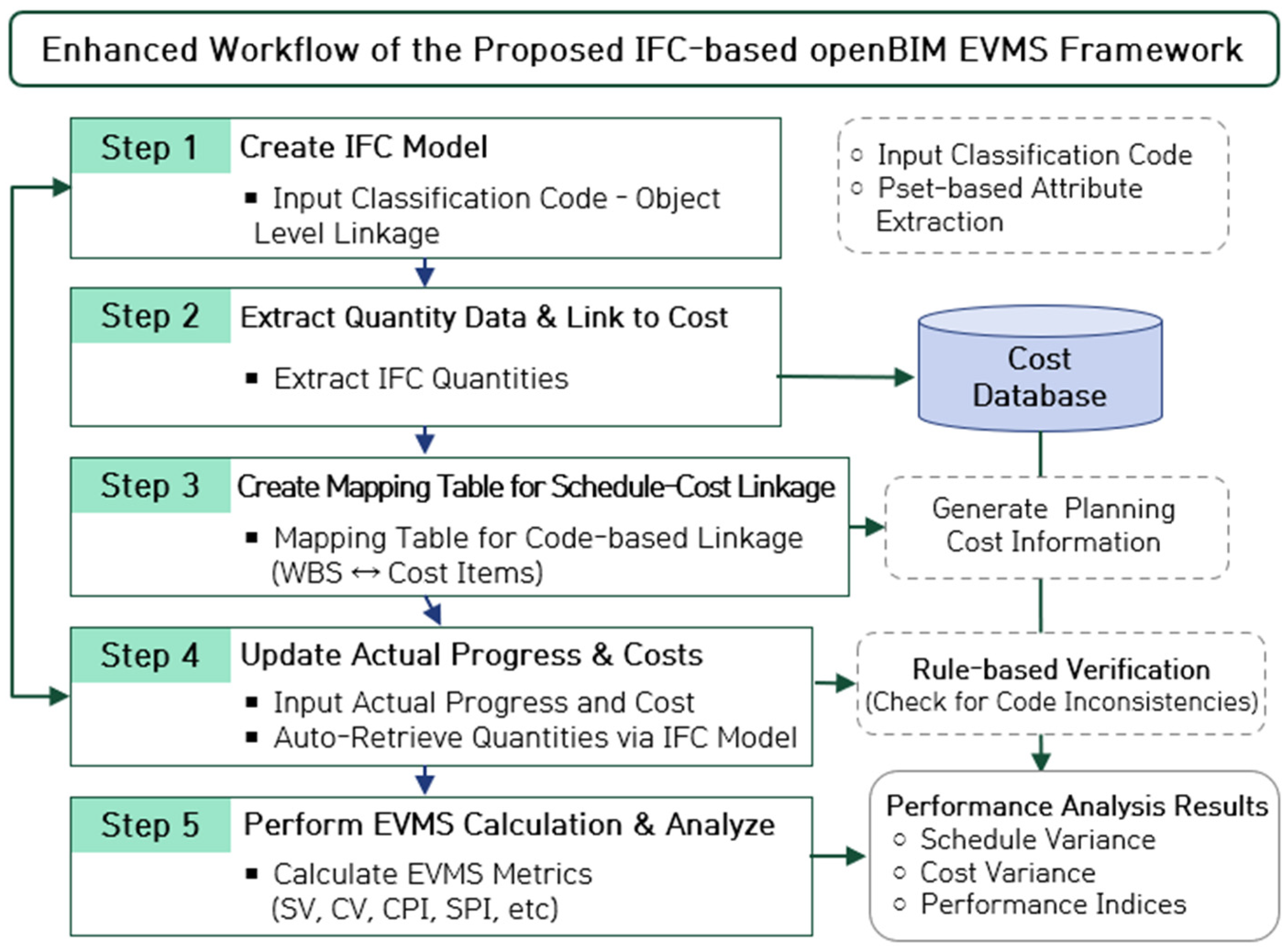
The method proposed in this study is to analyze EVM by performing process–cost integrated management with a single model through the extraction of schedule and quantity information from the IFC model and proceeds with the following process: first, an IFC model is created in the BIM tool by inputting a classification code to link schedule and cost information; second, the extracted quantity information is linked with the performance construction cost database to generate planning cost information and is linked with the classification code created in the model object and the schedule information created in the process creation software; third, a mapping table is created for the code mapping of the extracted process and cost information; fourth, performance information is generated by updating execution schedule and cost data based on actual construction progress, and the updating process is implemented in a semi-automated manner: object-level quantities are automatically retrieved from the IFC model through predefined property sets, while actual progress and incurred cost data are periodically entered and synchronized with the scheduling and cost management systems; fifth, performance versus plan is measured using the EVMS. This approach enables near real-time performance monitoring while maintaining practical applicability in typical construction environments where full automation of field data acquisition is not yet feasible. To ensure data consistency, classification codes embedded in the IFC objects are used as matching keys for linking schedule and cost records, and discrepancies in quantity or code mapping are identified through rule-based verification procedures before EVMS calculations are performed.
3.2. Process–Cost Information Linkage and DB Construction
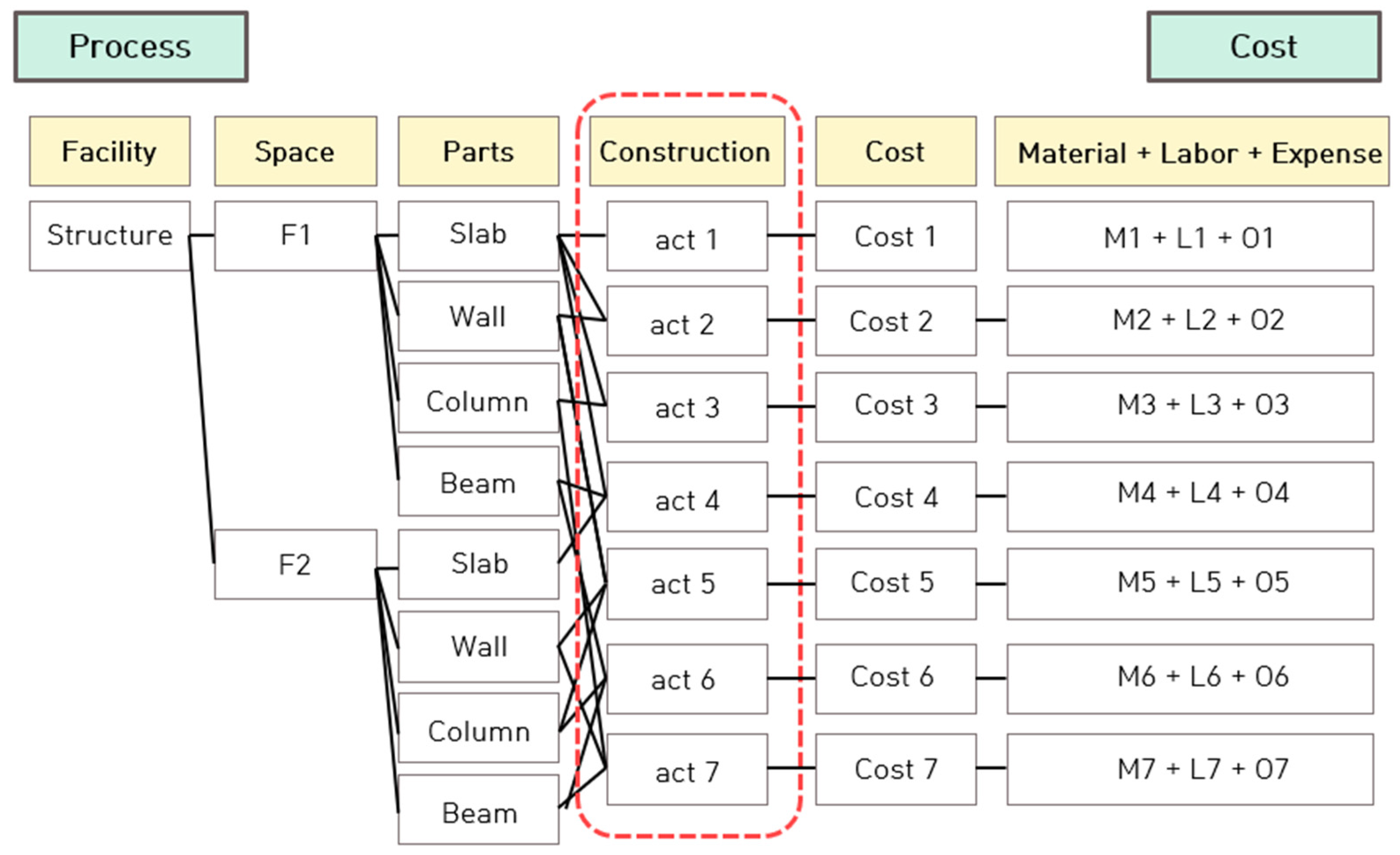
The BIM model is an object-oriented model that includes physical properties such as length, width, and volume, as well as properties necessary for building design, such as structural elements, mechanical, electrical, plumbing (MEP), materials, and quantities. In addition, because each element has not only individual characteristics but also relationships, this study used detailed activities to process–cost integrated management, as shown in
Figure 2, where the Construction section is highlighted in red.
While
Figure 3 illustrates a structured one-to-one correspondence between activities and cost items for clarity of presentation, the proposed framework does not restrict the integration to a strict one-to-one mapping. In practical project environments, one activity may correspond to multiple cost items (e.g., material, labor, equipment components), or multiple activities may share a common cost account. To accommodate such cases, the system employs a code-based mapping table that enables one-to-many and many-to-one relationships between WBS activities and cost items. This flexible mapping structure ensures adaptability to diverse project configurations without compromising data consistency.
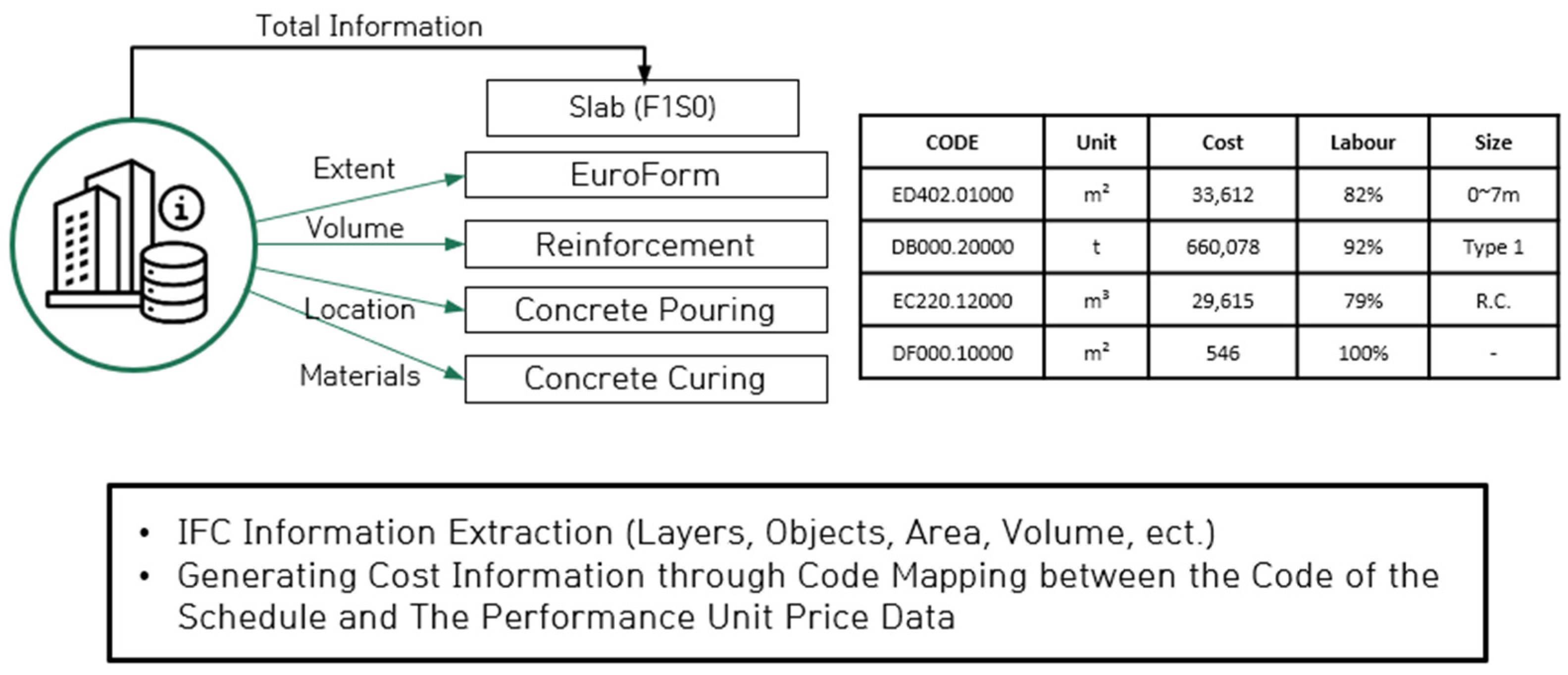
The work for integrated process–cost management using detailed processes includes preparing a schedule for generating schedule information, extracting quantity information for generating cost information, and linking it with unit prices, and updating the execution information for performance analysis. In the preparation of the schedule, the main and detailed processes are prepared based on the components of each layer, based on the objects of each layer. The main process prepares a schedule for each member and inputs a code to link with the quantity of information in the BIM model. In this study, a schedule was created based on the members of each layer for the reinforced concrete work, and a 4-digit code was assigned. The detailed process utilizes the WBS Procurement Service code, and a common type code is used for unit price information and code mapping for each type of construction. The cost information generation plan extracts quantity information for each member from the BIM model and obtains cost information, as shown in
Figure 3, through a linkage with unit price information for each type of construction. The present quantity is linked with the unit price for each construction type to generate cost information.
It should be noted that not all construction activities are explicitly modeled as independent BIM objects. Certain temporary works, such as formwork, may not exist as standalone entities within the IFC model. In the proposed system, these items are not manually estimated; instead, their quantities are automatically derived using embedded calculation formulas based on the geometric properties of structural elements.
For example, formwork quantities are computed using predefined equations that utilize the floor area, width, and side surface area (e.g., IfcQuantityArea—GrossSideArea) of reinforced concrete elements extracted from the IFC model. The system automatically calculates the required formwork surface area based on these geometric parameters, eliminating the need for manual input. This calculation logic is embedded within the cost database and linked to IFC-derived quantity information. Therefore, non-modeled activities are systematically generated through rule-based geometric derivation rather than through approximate ratio adjustments. This ensures consistency, automation, and alignment with practical quantity take-off procedures.
For performance measurement, the field manager updates the actual amount put into the field and the details of material, labor, and other expenses, which are included as part of the unit price for each type of construction activity. In addition, performance analysis is possible compared to the ready-made model by updating the actual start and end dates of the detailed construction work. The information generated through these three methods was linked to each EVMS item for analysis. The final output is Cost Variation (CV), Scheduled Variance (SV), Cost Performance Index (CPI), Schedule Performance Index (SPI), and estimate at completion (EAC). For the analysis, the information generated above was linked to the Budget Cost of Work Schedule (BCWS), Budget Cost of Work Performed (BCWP), and Active Cost of Work Performed (ACWP) items.
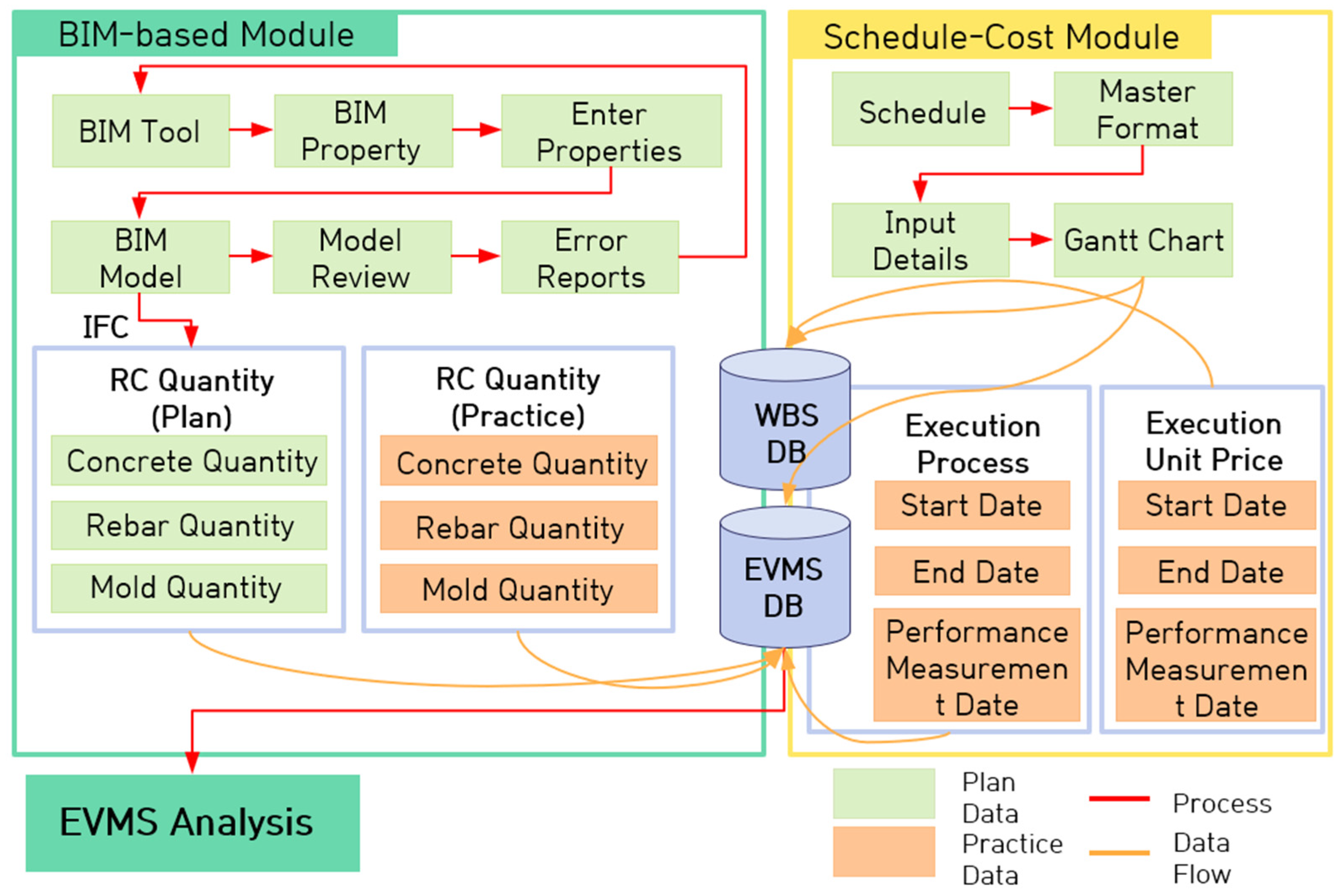
The database for the EVMS implementation is divided into WBS and EVMS databases. The WBS Database is the most important database for integrated process–cost management for each construction type presented in this study. It generates process and cost information by being linked to schedule and quantity information, and there are items such as name, specification, and unit price for a detailed construction type. The planned information storage item is a database that extracts and stores the necessary information from the BIM model and schedule, and creates ready-made management items by linking with the public type and unit price information DB. The database consists of schedule- and volume-information extraction DB. The execution information input item is a database that stores information by updating the execution volume and schedule on the site, and is linked with the public type and unit price information DB to create ready-made management items. The database consists of an execution volume-information DB, execution unit price information DB, and execution schedule information DB.
The EVMS Database creates and stores ready-made items in conjunction with WBS information as data for performance measurement, such as planning and execution information. It consists of a planned construction cost (BCWS) DB, achieved construction cost (BCWP) DB, and actual input cost (ACWP) DB.
Figure 4 shows the flow of data and interconnections.
3.3. BIM Model for EVMS Application
The BIM model for the EVMS application was used for analysis after undergoing two steps: information modification for volume calculation and a quality review for accurate volume calculation. The BIM model was created using Autodesk Revit 2024, and a modeling review was conducted using Autodesk Navisworks 2024 to assess the quality of the model.
First, the layer name was defined in the format B1, F1, F2, and RF in Vit’s modeling tool for volume indication of members by layer and linked with the volume indication code in the process table. The modified model is stored in the form of an IFC file and undergoes a step to increase the accuracy of the quantity calculation in the BIM model through a quality review process. Second, to conduct a quality review of the BIM model, the IFC file is imported, and the model is reviewed using a rule set for quantity calculation. As a review item for accurate quantity calculation in the BIM model, the main items are interference and conflict between members and the omission of members. Based on the error items through the review, the model for quantity calculation is completed by modifying the model in a BIM tool (Revit, ArchiCAD, etc.). Subsequently, after entering the information for the quantity distribution and quality review process for the quantity calculation, the final model for the EVMS was completed. The final model was stored in the IFC format and applied to the developed system.
To link the BIM model and schedule information, a schedule for the EVMS in a BIM environment was prepared. As a schedule corresponding to the construction of reinforced concrete buildings, enter the code for large-scale distribution for volume distribution, detailed common type code for code mapping between volume information and unit price information, type of construction, start date, end date, and period. The schedule proposed in this study can be prepared using MS Project and stored in Excel form or can be prepared directly using MS Excel. Finally, the schedule to be applied to the system is implemented in Excel. The prepared schedule will be loaded from the system in the future and examined together with the BIM model and EVMS analysis values, which will help to confirm the analysis values. In addition, it can be visually checked in the system along with the analysis results, which will help interpret the EVMS analysis results.
3.4. Process–Cost Information Extraction
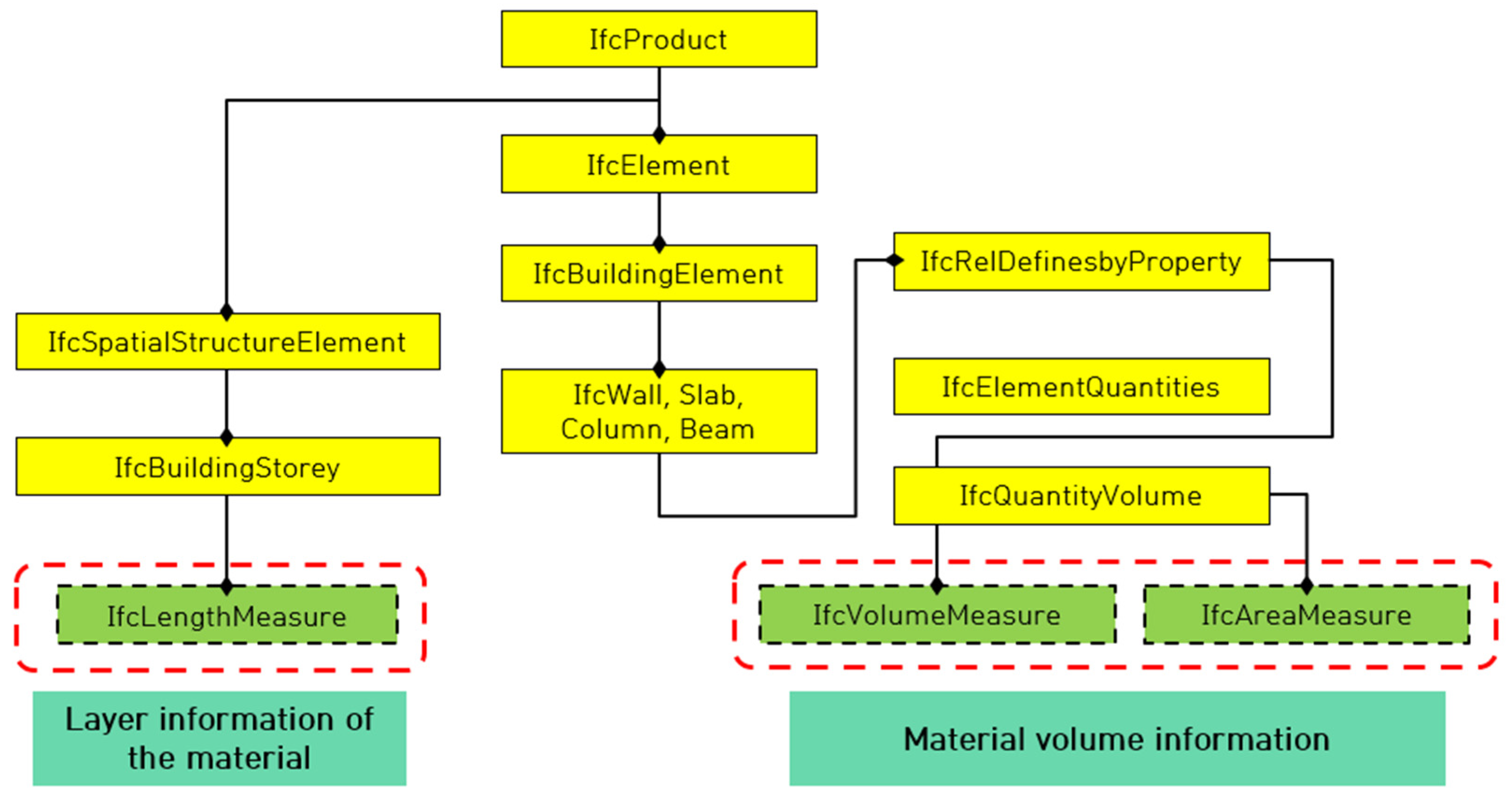
Process–cost integrated management requires the extraction of information for EVMs based on BIM models and timelines. The BIM model requires quantity information for each member and layer information of the members. In the schedule table, the quantity classification code for connection with the BIM model, detailed common type code, and schedule information for each common type are required. For information extraction from the BIM model, the structure of IFC 2×3 was analyzed, and the relevance of each member was analyzed to extract quantity and layer information. The information extraction method within the IFC schema is illustrated in
Figure 5. The hierarchical structure of entities such as
IfcProduct,
IfcElement, and
IfcBuildingElement, as well as quantity definitions including
IfcElementQuantity and
IfcQuantityVolume, follows the official IFC data schema specification provided by buildingSMART [
36]. The figure schematically represents how object-level properties and quantity measures are retrieved for performance analysis within the proposed framework.
Information on the supply distribution code (EVMQ), WBS code, type name, start date, and end date of the schedule was extracted and stored in the EVMS DB of the developed system for analysis.
4. Development of Open BIM-Based EVMS
4.1. EVMS Interface Design
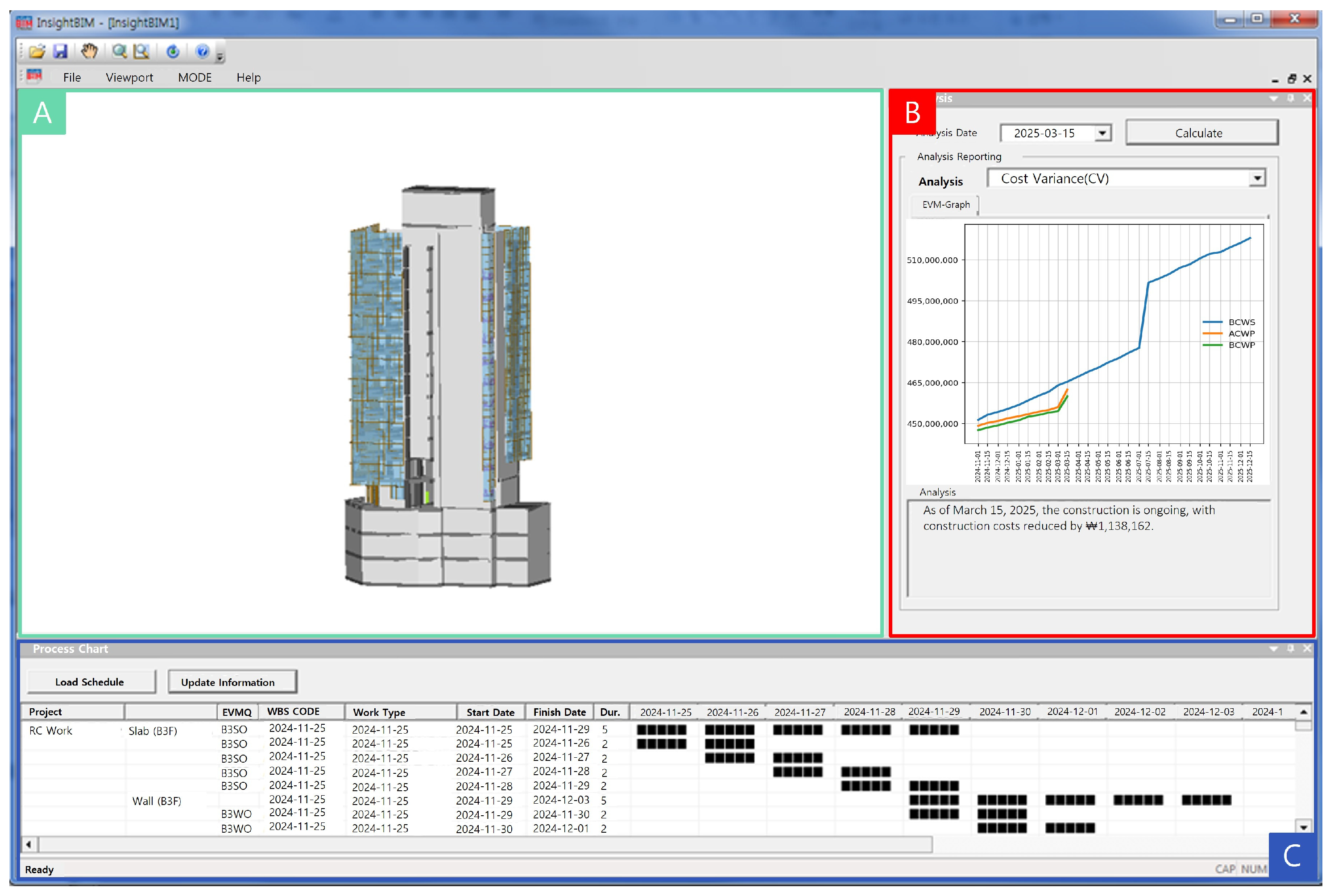
The EVM system interface layout developed in this study consists of a 3D viewer, model properties, schedule, and EVM analysis results window required for BIM-based EVM analysis.
Figure 6 shows a captured screen of the implemented system interface, illustrating the actual layout and the visualization of EVM analysis results generated through the developed framework.
4.2. Implementation of openBIM-Based EVMS
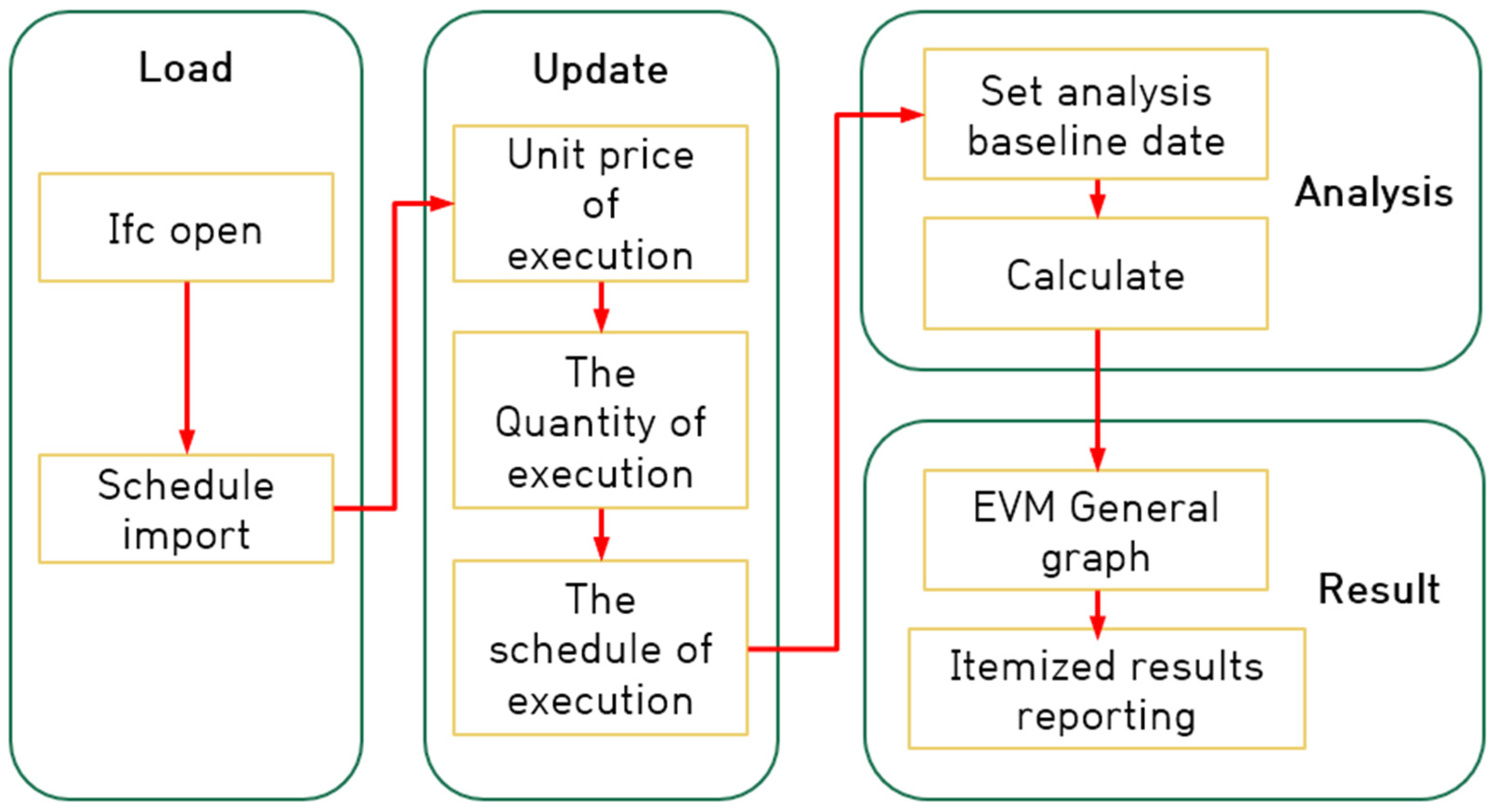
The database for applying the EVMS was connected to the established interface, and an open BM-based EVMS was implemented through functional implementation. The EVMS analysis system is a program based on IFC files and is driven by the process shown in
Figure 7.
The system can be divided into four stages: planning the information load, executing the information input, analysis, and result extraction. In the planning information load step, the prepared IFC file is opened, and the planning information is stored by importing the planning schedules. In the execution information input step, the execution information is stored by updating the execution unit price, quantity, and schedule information in the actual field. The analysis step involves setting and calculating an analysis reference date based on the plan and execution information. The last result extraction step is the step in which the calculated EVMS analysis results report the general graph of the EVMS and the results of each analysis item to perform a performance analysis.
4.3. Validation of Systems with Sample Projects
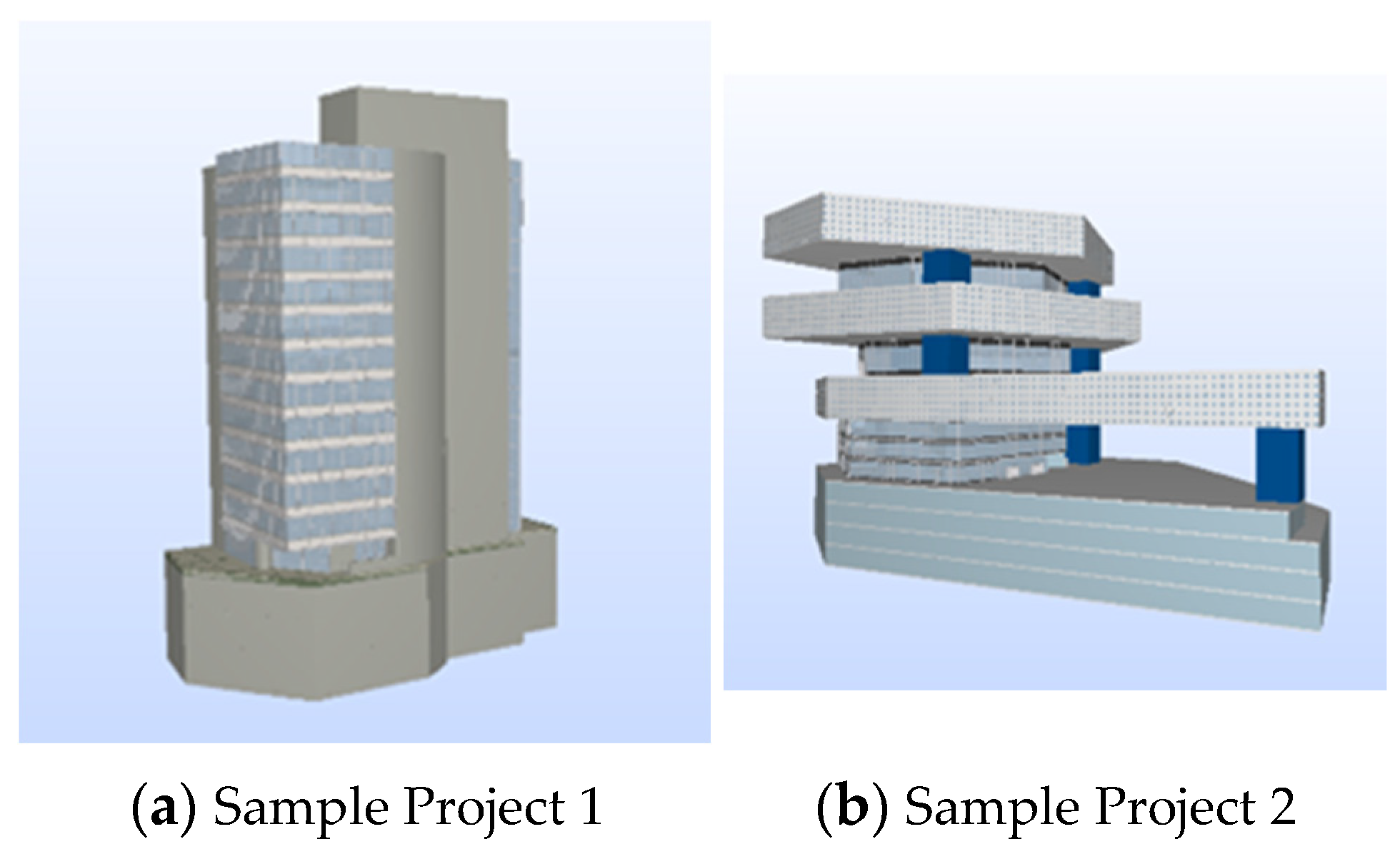
The developed BIM-based EVMS was applied to two reinforced concrete sample projects to verify the integrated schedule–cost analysis capability, as illustrated in
Figure 8.
Sample Project 1 consists of three basement floors and 12 above-ground floors. The reinforced concrete work was scheduled from 25 November 2024 to 23 July 2025. The analysis base date was set to 15 March 2025, corresponding to the midpoint of the reinforced concrete construction period. After importing the IFC model and schedule data, execution quantities and the analysis reference date were entered into the system. Unit prices were automatically calculated using the standard market unit price for construction work and the unit price table provided by the Ministry of Land, Infrastructure and Transport. As of the analysis base date, the planned construction cost was 27,324,323 KRW, whereas the actual construction cost based on executed quantities was 26,669,133 KRW, indicating a cost reduction of 655,190 KRW. If construction continues at the current progress rate, the projected final construction cost is expected to be 2,098,356 KRW lower than the total planned cost.
Sample Project 2 consists of four basement floors and 11 above-ground floors. The reinforced concrete construction period was scheduled from 3 January 2024 to 10 October 2024, and the analysis base date was set to 19 August 2024. Following IFC model import and schedule integration, execution volumes were linked with the unit price database to generate performance analysis results. For Sample Project 2, the planned cost as of the analysis date was 137,760,753 KRW, while the actual construction cost reached 160,851,134 KRW, resulting in a cost overrun of 23,090,381 KRW. The projected final cost overrun was estimated to reach 92,447,283 KRW if the current construction trend continues.
The EVMS outputs for both projects were visualized through graphical dashboards and numerical indicators, including Cost Variance (CV), Cost Performance Index (CPI), Schedule Variance (SV), Schedule Performance Index (SPI), Estimate at Completion (EAC), and Variance at Completion (VAC), as shown in
Table 3.
A comparative interpretation of the two sample projects highlights the analytical capability of the proposed openBIM-based EVMS framework. Sample Project 1 exhibited positive cost performance, where the Cost Variance (CV) indicated cost savings and both CPI and SPI values reflected stable construction progress aligned with the planned schedule. This result demonstrates that the proposed system can accurately identify efficient execution conditions and predict favorable final project performance.
In contrast, Sample Project 2 showed negative cost performance characterized by significant cost overruns and extended execution trends. The negative CV and projected increase in Estimate at Completion (EAC) indicate that deviations between planned and actual execution were detected at an intermediate construction stage. The Schedule Variance (SV) and Schedule Performance Index (SPI) further suggest delays or inefficient resource utilization compared to the baseline plan.
These results confirm that EVMS indicators derived from IFC-based integrated schedule–cost data provide meaningful early warning signals for both cost and schedule risks. By consistently generating BCWS, BCWP, and ACWP values within a unified IFC-centered data structure, the proposed framework enables objective performance evaluation across different project conditions. The validation using two projects with contrasting performance outcomes demonstrates the robustness and practical applicability of the developed system for real-world construction performance management.
5. Discussion
The case study results demonstrate that the proposed IFC-based EVMS framework enables systematic integration of schedule and cost data within a single open-standard model environment. Unlike conventional BIM-based cost control approaches that rely on platform-dependent data exchange or separate reconciliation processes between WBS and cost breakdown structures, the proposed framework utilizes embedded classification codes and property-level data mapping to ensure consistent data linkage. In Sample Project 1, the system successfully identified schedule acceleration and corresponding cost savings at an intermediate stage, illustrating the framework’s capability to support proactive project control. Conversely, in Sample Project 2, the system clearly detected cost overruns caused by process delays and projected significant deviations at completion, demonstrating its effectiveness in risk identification and predictive analysis. The semi-automated updating mechanism proved practically applicable in real construction environments where fully automated field data acquisition remains limited. By combining automated quantity extraction from the IFC model with periodically updated execution data, the system achieves near real-time performance monitoring without requiring additional sensing infrastructure. Moreover, because the integration principle is based on standardized entity classification and property relationships, the framework maintains interoperability within openBIM workflows and avoids dependency on proprietary data formats. This strengthens its applicability for collaborative project management environments involving multiple stakeholders.
Compared with previous BIM–EVMS integration studies, which often relied on project-specific database restructuring or software-dependent workflows, the proposed framework demonstrates that performance measurement can be consistently conducted within an IFC-centered single-model environment. Earlier studies primarily focused on conceptual linkage between WBS and cost structures or required manual reconciliation processes, limiting scalability across heterogeneous project environments. In contrast, the present study operationalizes schedule–cost integration through embedded classification codes and property-level associations, thereby reducing dependency on external data transformation procedures.
From a methodological perspective, the validation results indicate that IFC-based object–property structures can serve not only as geometric information carriers but also as reliable containers for performance management data. This finding suggests a potential shift from document-based project control toward model-centered performance management workflows within openBIM environments. Beyond the validated performance monitoring capability, the proposed IFC-centered EVMS framework presents broader functional potential for digital construction management. By embedding classification codes and cost-related attributes directly within the IFC object structure, the system establishes a scalable foundation for extending performance analysis beyond reinforced concrete works to multi-trade and lifecycle-based project control. This structure enables future integration with automated rule-based risk assessment modules, scenario-based cost forecasting simulations, and real-time digital twin environments. Furthermore, because performance indicators are generated within a standardized openBIM data schema, the framework may support cross-project benchmarking, portfolio-level performance analytics, and organization-wide knowledge accumulation without requiring proprietary data conversion. This suggests that the proposed approach can contribute not only to individual project control but also to data-driven strategic decision-making in construction enterprises.
Nevertheless, several limitations should be acknowledged when interpreting the results. The validation was conducted using reinforced concrete construction activities, which exhibit relatively standardized workflows. Projects involving highly fragmented trades or complex procurement structures may require additional refinement of classification mapping rules. Furthermore, although the semi-automated updating mechanism improves practical applicability, full real-time automation remains dependent on future integration with field data acquisition technologies. Therefore, caution should be exercised when generalizing the findings to fully automated digital construction environments.
6. Conclusions
This study developed and validated an openBIM-based EVMS framework utilizing IFC to enable integrated schedule–cost management within a single BIM-centered environment. Unlike previous studies that primarily relied on conceptual integration approaches or software-dependent workflows, the proposed framework establishes a structured methodology that systematically links WBS information and cost data through classification codes and property-level attributes embedded in the IFC model.
The developed system directly extracts schedule and quantity information from the IFC model and integrates them with a unit price database to generate consistent performance indicators. Through classification-based mapping and standardized object–property relationships, the framework minimizes manual reconciliation between schedule management and cost breakdown structures while maintaining data consistency across heterogeneous software environments. Consequently, key EVM indicators, including CV, CPI, SV, SPI, EAC, and VAC, can be calculated within an integrated and interoperable data structure.
Validation using two reinforced concrete sample projects demonstrated that the proposed framework can quantitatively identify schedule acceleration or delay, detect intermediate cost deviations, and forecast final project performance. The results indicate that the system functions not only as a retrospective monitoring tool but also as a predictive decision-support mechanism capable of enabling proactive project control. Furthermore, the semi-automated updating mechanism—combining automated quantity extraction from IFC models with periodically synchronized execution data—supports practical applicability in construction environments where full real-time automation is not yet feasible. From an academic perspective, this study contributes in three main aspects. First, it provides an implementable methodology for integrating schedule and cost data using IFC-based object–property structures. Second, it proposes an open-standard integration framework that reduces dependency on proprietary software environments and improves interoperability in collaborative project management contexts. Third, it empirically demonstrates the feasibility of directly linking BIM data structures with EVM-based performance analysis, thereby extending the application of digital performance management approaches in construction projects.
Despite these contributions, several limitations remain. The validation scope was limited to reinforced concrete construction activities, and applicability to multi-trade or large-scale project environments requires further investigation. In addition, execution data were periodically entered rather than automatically acquired through IoT-based or real-time sensing technologies. Large-scale empirical validation involving multiple stakeholders and long-term operational data was also beyond the scope of this study.
Future research should expand the framework to broader construction domains across the project lifecycle and investigate integration with digital twin environments and automated field data acquisition systems to enhance real-time performance monitoring. Long-term case studies are required to evaluate scalability, interoperability, and data reliability in complex collaborative environments. Practitioner-oriented validation studies are also necessary to identify implementation barriers and support wider industry adoption.
In summary, this study establishes an interoperable foundation for IFC-based integrated schedule–cost management within an openBIM environment. By demonstrating the practical feasibility of linking standardized BIM data structures with performance analysis methodologies, the proposed framework provides meaningful support for data-driven project management and contributes to the digital transformation of the construction industry.