Article

Investigation on Dynamic Formation, Dissociation, and Phase Transition Mechanisms of Natural Gas Hydrates in Complex Pore Structures


1
State Key Laboratory of Offshore Natural Gas Hydrates, Beijing 100028, China
2
Research Institute of China National Offshore Oil Cooperation, China National Offshore Oil Corporation, Beijing 100028, China
3
School of Energy, China University of Geosciences (Beijing), Beijing 100083, China
4
State Key Laboratory of Heavy Oil Processing, China University of Petroleum (Beijing), Beijing 102249, China
*
Author to whom correspondence should be addressed.
Appl. Sci. 2026, 16(5), 2494; https://doi.org/10.3390/app16052494
Submission received: 26 November 2025 / Revised: 13 February 2026 / Accepted: 2 March 2026 / Published: 5 March 2026

Abstract

Dynamic phase transition of natural gas hydrates confined within complex pore–throat structures is a key factor impacting the safe and efficient development of hydrate-bearing deposits. In this work, hydrate-bearing samples with varying saturation were first reconstructed with the proposed ice-seeding method using actual marine soil in hydrate-bearing sediments from the South China Sea. Dynamic evolution characteristics of hydrate formation in evolving porous media under different temperature and pressure conditions were analyzed in detail. Combined with high-resolution CT scanning, image processing, pore network extraction, and statistical analysis, the typical microscopic pore–throat structures of hydrate-bearing sediments were revealed, and the presence of nanopores was identified. Furthermore, highly controllable heterogeneous pore–throat structures were constructed for microfluidic chips by integrating stochastic modeling, equivalent modeling, and machine learning approaches. On this basis, a novel microfluidic testing method was developed for investigating the dynamic formation, dissociation, and phase transition characteristics of natural gas hydrates in complex pore structures by controlling the temperature. This study provides reliable data support and theoretical guidance for the productivity prediction of marine hydrate-bearing deposits.

1. Introduction

Natural gas hydrates are solid clathrate compounds formed by guest molecules such as methane and water under low temperature and high-pressure conditions [1,2,3]. According to the BP Statistical Review of World Energy, the proven natural gas content in global hydrate resources is approximately 143,480 billion tons, exceeding the total proven reserves of coal, petroleum, and conventional natural gas combined. Owing to the enormous resource potential, natural gas hydrates are regarded as one of the most promising alternative energy sources for the future [4,5,6]. Natural gas hydrates are widely distributed in shallow subsea sediments and permafrost regions, with marine hydrate resources accounting for more than 90% [7,8,9]. It is of great significance to promote the safe and efficient exploitation of natural gas hydrates for ensuring the sustainable development of natural gas and for reducing carbon dioxide.
Compared with conventional oil and gas reservoirs, natural gas hydrates exist in solid form [10,11]. It involves complex phase transition, dynamic dissociation, and secondary formation processes during the development of hydrate-bearing deposits [12,13,14,15,16]. The dynamic evolution of hydrate pore habit and spatial distribution leads to pronounced spatiotemporal variation in the effective flow space in hydrate-bearing sediments [17,18,19], which in turn significantly impacts the production characteristics. Hydrate-bearing sediments in the South China Sea are mainly composed of clayey silt with weak cementation and non-diagenetic characteristics [20,21,22], exhibiting abundant micro–nano pores and diverse storage spaces. Hydrate nucleation, growth, dissociation, and phase transition are jointly controlled by multiple factors, including micro–nano confinements and complex pore structures [23,24,25]. At present, research on hydrate phase transition mechanisms primarily relies on artificially synthesized, coarse-grained, or consolidated hydrate-bearing samples [26,27,28]. The publicly reported microfluidic methods when testing hydrate dynamic formation, dissociation, and phase transition are mainly limited to morphological observation of hydrate formation and dissociation [29,30,31,32], which cannot quantitively obtain hydrate phase equilibrium curves at the same time. Due to the limitations in experimental methods for studying hydrate formation and dissociation within microscopic porous media, recent investigations mainly describe hydrate phase equilibrium at the macroscopic scale, which cannot accurately reflect the inner pore structures [33,34,35]. This limitation undermines the accuracy of predicting hydrate dissociation front and production performance during exploitation [36,37]. Moreover, few studies have focused on hydrate formation, dissociation, and phase transition characteristics in fine-grained, unconsolidated sediments. The results obtained so far lack universality and practical guidance [38,39]. Therefore, it is of great urgency to develop a microscopic experimental approach capable of simultaneously characterizing the pore structure of hydrate-bearing sediments and obtaining hydrate phase equilibrium for elucidating the influence of micro–nano confinements and complex pore structures on hydrate formation, dissociation, and phase transition mechanisms.
In this work, hydrate-bearing samples were reconstructed with marine hydrate-bearing sediments from South China Sea using the developed ice-seeding method. Dynamic hydrate formation regularity under different temperature and pressure conditions was analyzed in detail. High-resolution CT scanning combined with image processing, pore network extraction, and statistical analysis was employed to characterize the microscopic pore structures of hydrate-bearing sediments. Based on the extracted representative parameters, highly controllable and heterogeneous pore structures were developed by integrating stochastic modeling, equivalent modeling, and machine learning approaches, followed by the fabrication of microfluidic chips etched with complex pore structures. Furthermore, a novel microfluidic testing method was proposed to investigate the dynamic formation, dissociation, and phase transition behaviors of natural gas hydrates with temperature controlling. The results provide robust data support and theoretical guidance for the efficient development of natural gas hydrate in marine sediments.

2. Microscopic Pore Structure Analysis of Natural Gas Hydrate-Bearing Sediments

Based on the analyses of physical properties, including water content, mineral composition, and particle size distribution, in marine sediments from the South China Sea, and the evaluation of the advantages and limitations of the commonly used hydrate-bearing sample reconstruction methods, the ice-seeding approach was proposed for artificially synthesizing clayey–silty hydrate-bearing samples in the laboratory. High-resolution CT scanning combined with image analysis and pore network extraction was employed to characterize the microscopic pore structures. The results provide essential data for the design of microfluidic chips used to investigate hydrate dynamic phase transition characteristics in complex pore structures.

2.1. Reconstruction of Clayey–Silty Hydrate-Bearing Samples

Due to the influence of the effective stress and particle size of the sediment, and hydrate formation conditions [40,41], synthesized hydrates in the laboratory may differ from natural hydrates occurring in marine sediments in terms of hydrate morphology, hydrate pore habit, and hydrate spatial distribution to some extent. However, there exist significant technical challenges and high costs associated with obtaining natural gas hydrate-bearing samples under in situ temperature and pressure conditions. As a result, most current studies rely on artificially synthesized hydrate-bearing samples to investigate hydrate pore habit, hydrate formation and growth process, and microscopic pore structure [42,43]. In this section, the ice-seeding approach was proposed to artificially synthesize clayey–silty hydrate-bearing samples in the laboratory for pore structures investigation.
A 3.5 wt% NaCl solution was employed to simulate the seawater for hydrate formation in this work, which can be attributed as follows. The natural seawater in sediments of the South China Sea possesses a complex composition and contains a wide variety of dissolved ions. It is relatively complicated to accurately reproduce the whole chemical composition of in situ seawater in laboratory experiments. Moreover, the concentration of NaCl is far exceeding that of other ions among the numerous components of natural seawater. The influence of minor ions on hydrate thermodynamics and kinetics can be considered negligible compared with the relatively high concentration of NaCl. A survey of the literature indicates that the 3.5 wt.% NaCl aqueous solution is commonly used in the laboratory to simulate the seawater environment [44] and to investigate hydrate dynamic formation and dissociation behavior [45,46,47]. In addition, considering that the primary objective of this study is to explore hydrate formation, dissociation, and phase transition behavior in micro and nano confined pore structures, the effects of pore structure and capillarity on hydrate dynamic phase transition are expected to play a dominant role. Therefore, the 3.5 wt% NaCl solution was employed in this study. Although the NaCl solution differs slightly from real natural seawater, it does not affect the validity of the results, conclusions, and applicability.

2.1.1. Experimental Apparatus

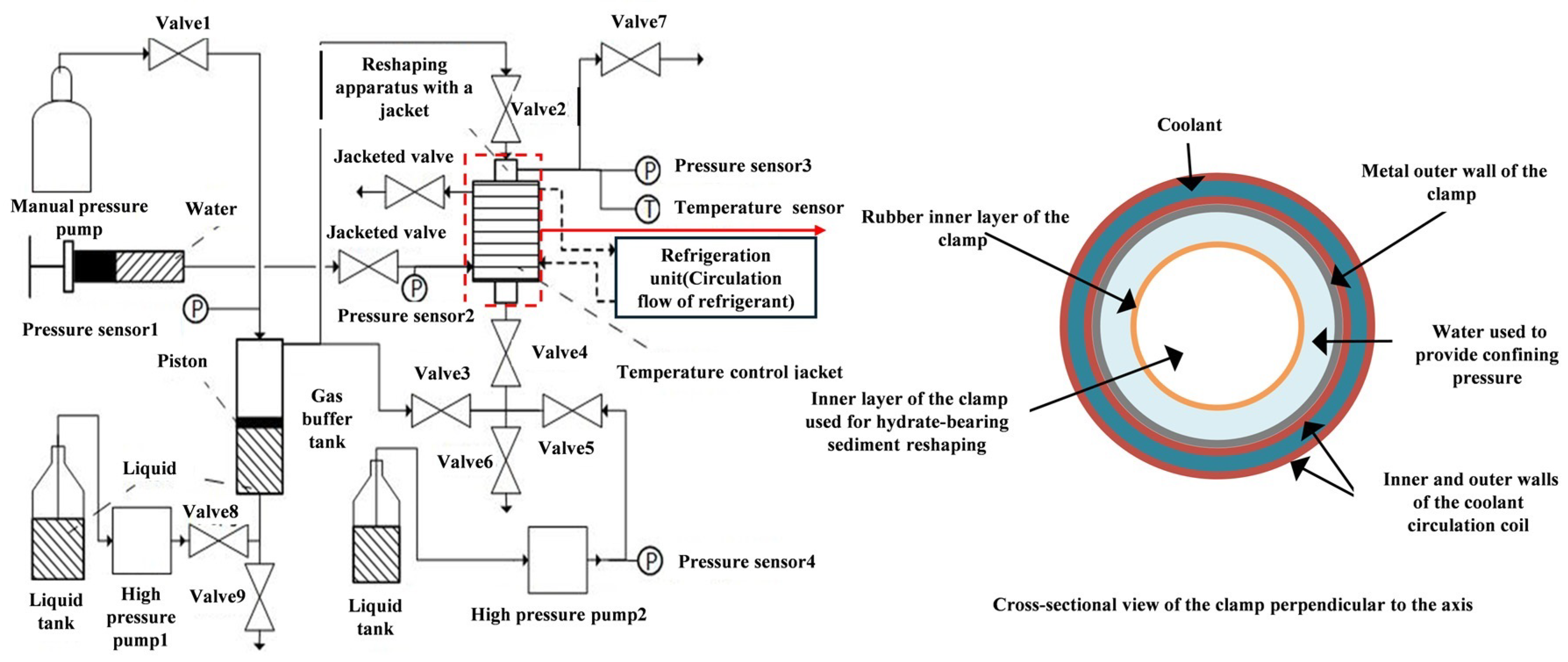
The experimental apparatus for remolding methane hydrate-bearing samples is shown in Figure 1. The core component of the system is the sample holder, which is a coaxial cylindrical structure composed of an inner rubber sleeve and an outer metal shell. The inner rubber layer is employed as the chamber for hydrate-bearing sample remolding, while the interlayer space between the rubber sleeve and the metal wall is filled with water. The inner rubber sleeve can be compressed inward by pressurizing the interlayer water with the manual pressure pump, thereby applying confining pressure to the hydrate-bearing sample. A cooling coil is wound around the external surface of the metal shell, through which a circulating coolant enables the precise temperature control of the holder. All other experimental operations are performed in coordination with the holder. The high-pressure microflow pump in the apparatus possesses a flow range of 0.001 to 30 mL/min, a maximum pressure of 60 MPa, a flow accuracy of 0.001 mL/min, and a pressure accuracy of 0.01 MPa. The gas buffer tank holds a volume of 500 mL and a maximum pressure of 50 MPa. The holder is rated for a maximum confining pressure of 25 MPa. The pressure sensor holds a pressure range of 0 to 25 MPa, with a sensor accuracy of 0.001 MPa, while the temperature sensor possesses a temperature range of −50 to 100 °C, with a sensor accuracy of 0.001 °C. The types of the pressure and temperature sensors are, respectively, model SNS-001 and model OMEGK-001. Both sensors were from Haian Tuoxin Scientific Instruments Co., Ltd., Haian, China. The thermostatic bath provides a temperature range of −5 to 100 °C, with an accuracy of 0.01 °C. Valve 1 controls the supply of methane gas into the experimental system. The gas buffer tank is pressurized continuously with High-Pressure Pump 1 at a constant rate, while the compressed gas volume is recorded. Closing Valve 8 isolates the buffer tank from Pump 1. Valve 9 enables drainage of liquid from the gas buffer tank. High-Pressure Pump 2 allows for the quantitative injection of the working fluid, while Valve 5 isolates the holder from Pump 2 when necessary. Valve 4 controls the connection of the bottom of the holder to the external system, and Valve 6 allows the discharge of excess working fluid from both the holder and system. Valves 2 and 3 control gas injection into the top and bottom of the holder, respectively. The interlayer valve regulates the confining pressure and drainage of the confining fluid in the holder. The refrigeration unit controls the temperature of the circulating coolant in the coil to maintain the temperature of the holder. Finally, Valve 7 is used to release gas from the interior of the holder.

2.1.2. Experimental Procedure

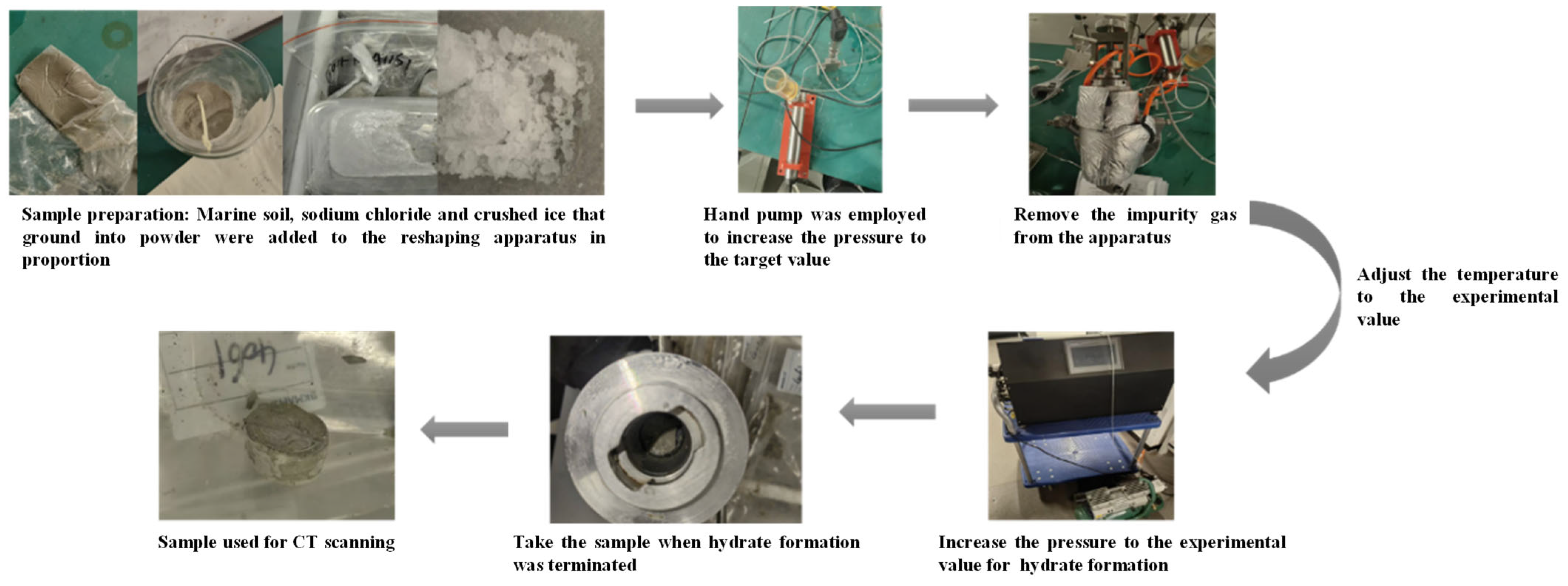
The experimental procedure for reconstructing clayey–silty methane hydrate-bearing samples with the ice-seeding method is illustrated in Figure 2 and described as follows:
  • Cleaning reactor: The experimental system was cleaned with deionized water and subsequently dried using an inert gas.
  • Loading solid samples: The 3.5 wt% NaCl solution was prepared. It was noted that water molecules first crystallized into ice when the saline solution began to freeze. Since the ice lattice did not incorporate salt ions, the dissolved salts were rejected into the remaining liquid phase. This resulted in an increase in the salinity of unfrozen solution and a further reduction of the freezing temperature. Consequently, solidification occurred over a temperature range rather than at a fixed temperature during the freezing process of saline solution. Since the freezing temperature of the NaCl solution typically ranged from −4 to −15 °C, the freezer temperature was set to at least −20 °C, which was below the minimum freezing point, to ensure that the saline solution was completely frozen and existed entirely in the solid phase. Since the freezing rate of saline solution crucially determined the microstructure of the ice, which in turn affected the melting kinetics and hydrate formation, the sample holder and freezer temperature were pre-cooled to the same temperature prior to freezing to ensure experimental consistency. The 3.5 wt% saline solution was placed in the freezer with the same temperature for at least 3 h. The frozen saline was then crushed into ice particles. Based on the porosity and water content of the hydrate-bearing sediment, the ice particles and dried soil were weighed, thoroughly mixed, and loaded into the holder, which ensured the comparable freezing rate and consistent ice microstructures across experiments.
  • Connecting the experimental apparatus: The apparatus was connected according to the configuration shown in Figure 1, with all gas cylinders closed during this process.
  • Adjusting the buffer tank and removing impure gas: Methane was first introduced into the gas buffer tank to achieve a pressure larger than 0.5 MPa. This pressure was used to push the piston downward, displacing all liquid in the buffer tank. Subsequently, any gas in the pipeline between High-Pressure Pump 1 and Valve 9 was fully displaced by liquid. Considering that excessive gas volume in the buffer tank would reduce the observable pressure variation during hydrate formation, it would impede accurate judgment of hydrate formation and saturation. As a result, the gas volume was adjusted to 100–120 mL by continuously pumping liquid into the buffer tank via Pump 1 and closing Valve 7. Remaining gas between the buffer tank and Valves 2 and 3 was then discharged. The buffer tank and connected pipelines were further evacuated to remove residual impure gas. After vacuuming, methane was introduced to replace the gas in the system.
  • Exhausting the inlet liquid line: Air inadvertently introduced into the inlet liquid line from High-Pressure Pump 2 was purged during assembly.
  • Exhausting the holder interlayer: Water was continuously injected into the holder interlayer via the manual pressure pump to expel residual air.
  • Removing impure gas from the remolding apparatus: Vacuum replacement was unsuitable due to the deformation of the rubber inner sleeve. Instead, multiple cycles of gas displacement were employed.
  • Controlling temperature: The internal pressure of the holder was maintained within an appropriate range prior to temperature adjustment, ensuring that the confining pressure remained 1 ± 0.5 MPa higher than the internal holder pressure. The refrigeration unit was then activated until the temperature stabilized at the target value (e.g., 7 °C, 8 °C, 15 °C, and 16 °C in this work).
  • Controlling pressure: Valves 3 to 7 were kept closed, while Valve 2 was opened once the temperature of Sensor 3 was stabilized. The system pressure was adjusted to the target value (e.g., 18 MPa, 19 MPa, and 20 MPa in this study) by manipulating Valve 1 or operating High-Pressure Pump 1. It was noticed that Valve 1 was used for coarse pressure adjustment, whereas Pump 1 provided fine pressure control.
  • Hydrate formation: When pressure and temperature reached the set conditions, hydrate formation commenced. It is considered that the pore water available for hydrate formation in the sediment has been fully converted into hydrate when hydrate saturation becomes essentially invariant with time, at which point High-Pressure Pump 1 is shut down, and continuous monitoring of the temperature and pressure is initiated. If the target temperature and pressure remain stable after 10 h, hydrate formation experiment is deemed to have been fully completed. The selection of the time duration after hydrate formation depends on the sediment type. For coarse-grained sediments where hydrate formation kinetics are relatively rapid, the time duration can be appropriately shortened. In contrast, a longer stabilization period may be required for sediment with particle size smaller than that in this work, where the hydrate formation rate is slower. Hydrate concentration is independent of the duration of maintaining constant temperature and pressure since hydrate formation has already been essentially completed prior to this stage.
  • Sampling and CT scanning: After the experiment, the cold circulation temperature was set to −12 °C, and the returned fluid temperature was maintained below −8 °C for at least 2 h to ensure that the methane hydrate-bearing sample in the reactor was fully frozen. The pressure relief valve was opened under continuous cooling condition. Then, the reactor was quickly disassembled, and the hydrate-bearing sample was retrieved. The sample was sealed with a protective sleeve and stored in a freezer at temperatures below −70 °C for at least 48 h. The low temperature used for preserving hydrate-bearing samples possesses a negligible effect on pore-scale observation of the microscopic pore structure in hydrate-bearing sediments, although it may affect the cage structure and the arrangement among cages and may further some specific physical properties of hydrate to some extent. Subsequently, CT scanning was carried out while remaining encased in the sleeve.

2.1.3. Analysis of Hydrate Formation

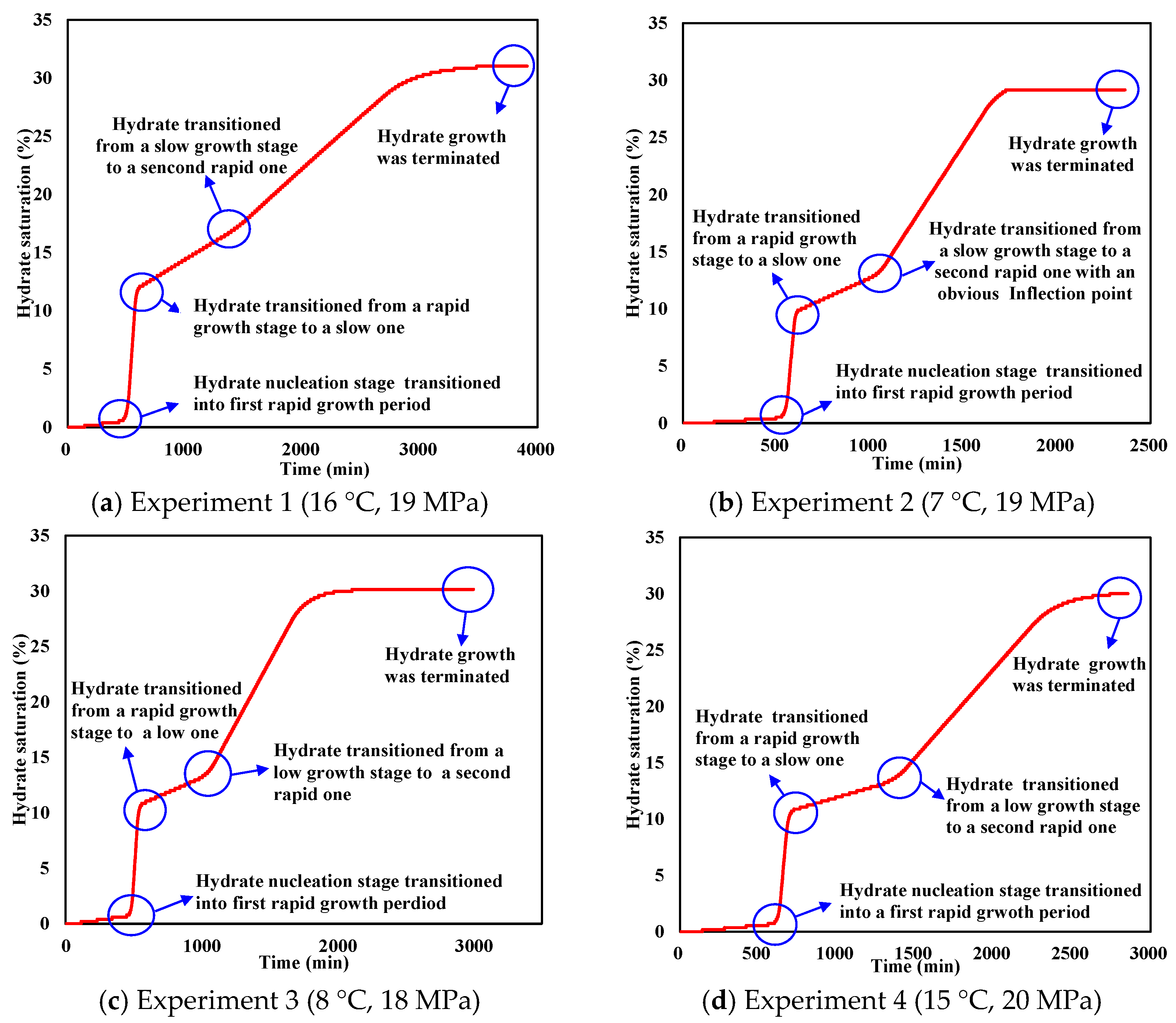
Although hydrate can remain stable at temperatures below 0 °C, the in situ temperatures of shallow hydrate-bearing marine sediments discovered to date are all above 0 °C due to the influence of the geothermal gradient. Based on the analysis of temperature and pressure range in hydrate-bearing sediments in Qiongdongnan Basin in South China Sea, methane hydrate-bearing sample reconstruction experiments were conducted using the procedure above, with the target experimental values of temperature and pressure (16 °C and 19 MPa; 7 °C and 19 MPa; (8 °C and 18 MPa; and 15 °C and 20 MPa). The evolution of hydrate saturation during the experiments is shown in Figure 3a–d. It can be seen that hydrate formation during the reconstruction process was generally consistent across all four samples and can be divided into six stages: hydrate induction, hydrate nucleation, first rapid growth, slow growth, second rapid growth, and growth termination. Hydrate saturation remained zero immediately after reaching the target temperature and pressure, indicating the hydrate induction period. The molecules of methane and water gradually transferred to an ordered arrangement, but clathrate crystal structures were not formed at this stage. Methane and water molecules formed initial nuclei with increasing time, marking the hydrate nucleation period, in which the number of hydrate nuclei increased. Since the amount of gas absorbed at this stage was limited, hydrate saturation increased slowly. As time progressed, the methane absorption rate associated with crystal growth significantly exceeded that of initial nucleation increase since a large number of nuclei formed at the previous stage. Hydrate formation entered the first rapid growth stage, during which hydrate saturation increased rapidly. The free water was quickly consumed with the continuous increase in time, resulting in limited availability for hydrate formation. In addition, rapid hydrate growth increased gas–liquid mass transfer resistance. As a result, the hydrate formation rate slowed down. Following the slow growth period, a second rapid growth stage occurred. This was primarily due to an increase in free water released from the continued dissociation of saline ice during the hydrate slow growth period. The free water fully wetted the sediments and increased the gas–liquid contact area, enhancing mass transfer and accelerating hydrate formation rate. Compared with hydrate saturation evolution regularity with time among the four experiments, it can be found that the second growth stage in Experiment 3 was the steepest. Such behavior can be attributed to the following reasons. The hydrate formation temperature was relatively low in Experiment 3, resulting in a slower melting rate of the saline ice into water. Consequently, a substantial amount of saline ice was still available to melt and continuously supply water for hydrate formation during the second rapid growth stage, leading to a relatively larger increase in the gas–water contact area. In addition, hydrate formation pressure in Experiment 3 was lower than that in the other three experiments. The increase in gas–liquid mass transfer resistance induced by hydrate formation at the early stage was comparatively limited. As a result, the gas–liquid mass transfer rate between the melted water and gas was the largest among the four experiments, ultimately producing the steepest second hydrate growth stage in Experiment 3. However, the hydrate formation rate at the second rapid growth stage was significantly lower than that at the first rapid growth stage. Moreover, the transition from the slow growth to the second rapid growth stage in Experiments 2 to 4 exhibited a more pronounced inflection point compared to Experiment 1 due to the difference in thermodynamic driving force for hydrate formation. The thermodynamic driving force of hydrate refers to the thermodynamic impetus used to characterize hydrate formation, with the magnitude representing the degree to which the system deviates from the critical hydrate formation condition. Once the thermodynamic state of the system reaches the hydrate formation region, the farther it is from critical hydrate formation condition, the larger the thermodynamic driving force for hydrate formation [48,49]. The thermodynamic driving force for hydrate formation can be expressed in various forms, including pressure difference, subcooling, and chemical potential difference [48,49,50,51,52,53]. The larger the thermodynamic driving force, the more distinct the inflection. Ultimately, the gas–liquid isolation effect, referred to as the “armor effect”, caused by hydrate formation, terminated the hydrate growth process. A larger thermodynamic driving force resulted in an earlier completion of hydrate formation.

2.2. Analysis of Typical Pore Structures in Hydrate-Bearing Sediments

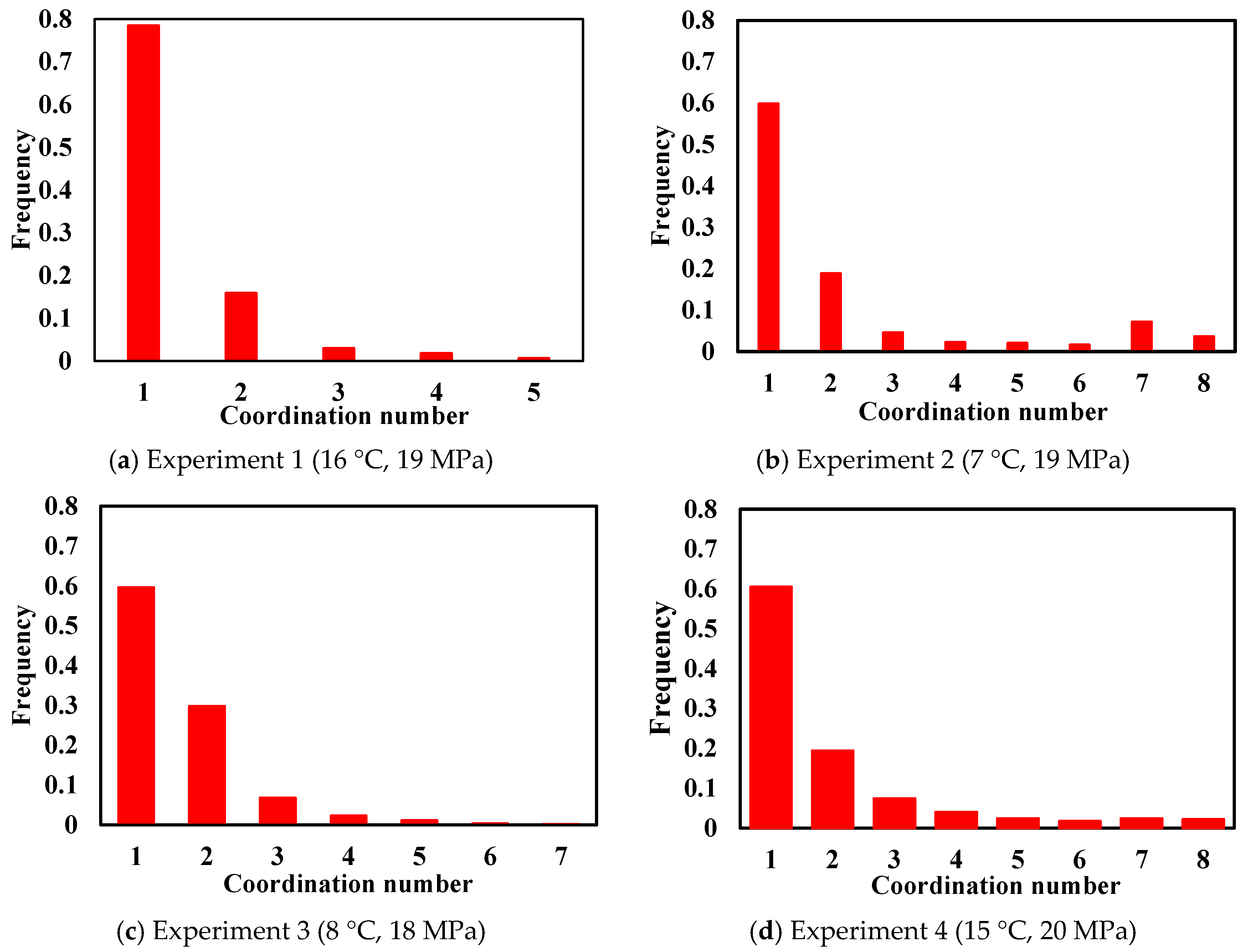
The data obtained from CT scanning were analyzed for typical pore structure parameters through image processing, pore network extraction, and statistical analysis. The results of pore radius, hydrate volume, and coordination number distribution at different temperatures and pressures are presented in Figure 4, Figure 5 and Figure 6, respectively.
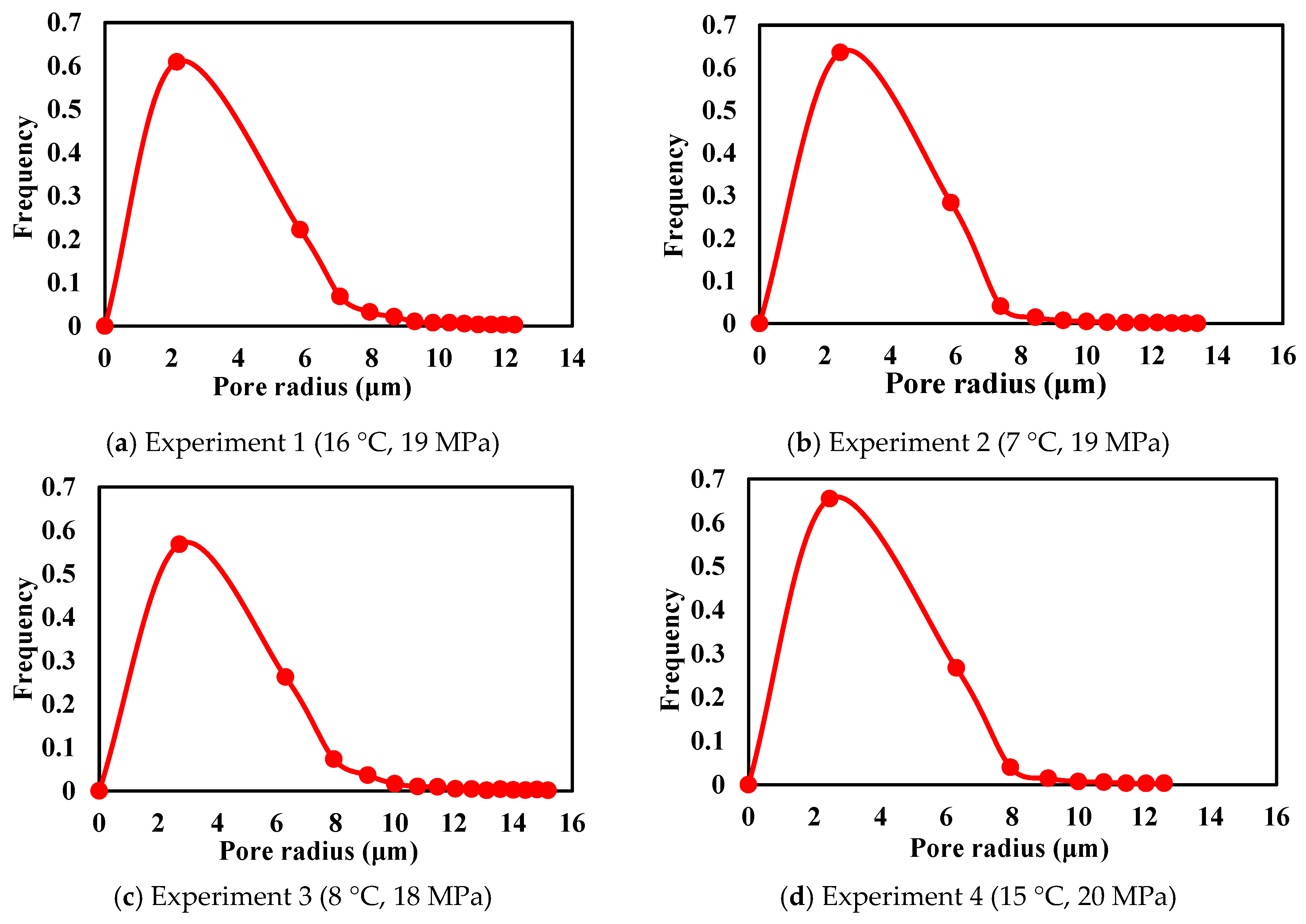
As shown in Figure 4, the pore radius distribution of the reconstructed hydrate-bearing sediments under four temperature and pressure conditions exhibits a unimodal normal distribution, with the peak value occurring at approximately 2 μm. The sample from Experiment 1, which possessed the lowest thermodynamic driving force, displayed a peak pore radius that was slightly lower than those of other samples. Additionally, nano pores were observed with the fractions in the four hydrate-bearing samples, respectively, 5.93%, 5.69%, 4.02%, and 4.76% under the given temperature and pressure conditions. The proportion of nano pores did not exhibit significant variation with changes in temperature and pressure. This phenomenon may be attributed to the fact that the nano pores primarily originated from the collapse of ice-seed-supported pores and compression of the sediment at confining pressure. Since the pressure in the four experiments did not differ substantially, the fraction of nano pores remained relatively constant under the given experimental conditions.
Figure 4. Pore radius distribution of the four remolded hydrate-bearing samples.
Applsci 16 02494 g004
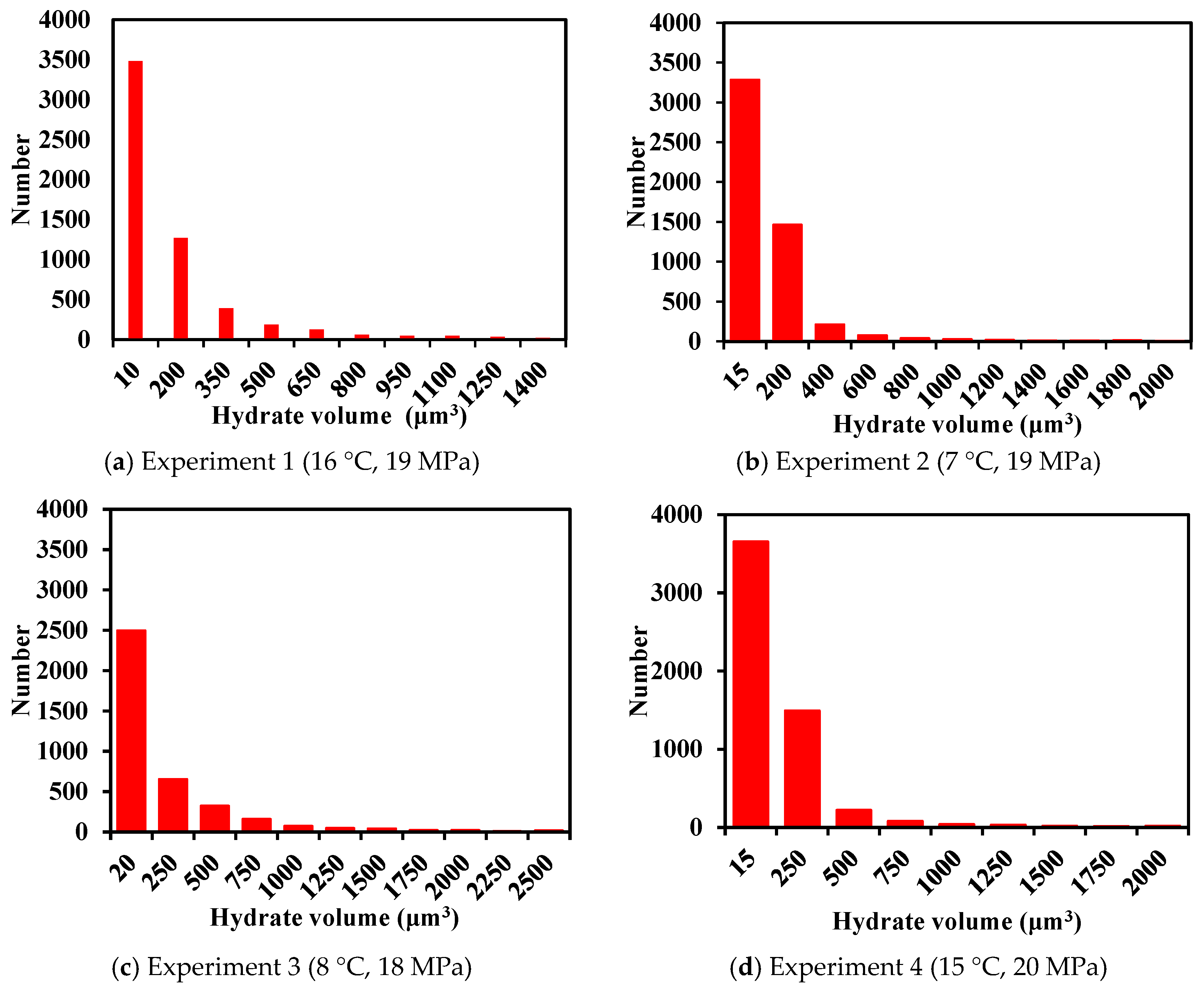
It is indicated from Figure 5 that Sample 1 holds the smallest thermodynamic driving force, resulting in a hydrate formation rate at the early stage that is significantly slower than that of the other three ones. Consequently, insufficient hydrate was generated to support the pore structure prior to the melting of the saline ice. And the melted water provided limited support, leading to the pores in the sediment being collapsed and transferred to smaller ones at the given confining pressure. The gas–liquid mass transfer rate in Sample 1 kept pace with hydrate formation due to the relatively small thermodynamic driving force. As a result, the total volume of hydrate in Sample 1 was the largest among the four ones, although the hydrate formation rate was slow. And hydrate volume was primarily concentrated in the ranges of 0 to 10 μm3 and 10 to 200 μm3. The hydrate formation rate was large enough in Sample 2 to support the pores during ice melting with the largest thermodynamic driving force, resulting in a broader hydrate volume distribution. However, rapid hydrate formation at the periphery of the sediment increased the resistance for subsequent gas penetration into the internal pores, reducing methane mass transfer and causing hydrate formation rate in the interior pores smaller than that of ice melting. Severe compression occurred in the internal pores, reflected in hydrate volume distribution primarily in the ranges of 0 to 15 μm3 and 15 to 200 μm3. Moreover, the excessively large thermodynamic driving force induced the “armor effect,” resulting in the overall hydrate volume in Sample 2 being smaller than that in the other ones. The thermodynamic driving force in Sample 3 was smaller than that in Sample 2, leading to the total hydrate volume intermediate between Samples 1 and 2, while hydrate volume distribution range was broad. The temperature for hydrate formation in Sample 4 was relatively large, causing a smaller hydrate volume distribution range compared to Sample 3.
Figure 5. Hydrate volume distribution of four reconstructed hydrate-bearing samples.
Applsci 16 02494 g005
Coordination number refers to the number of throats connected to each pore body, which is an important parameter used for characterizing the connectivity of the sediment. A higher coordination number indicates better pore–throat connectivity. As is indicated from the coordination number distribution in Figure 6, hydrate formation rate was slower than the saline ice-melting rate in Sample 1, with the smallest thermodynamic driving force. Insufficient hydrate provided effective pore support before pore collapse occurred, resulting in significant compression of the sediments. Therefore, no coordination number larger than 5 appeared, and only 5.4% of pore bodies possessed a coordination number ranging from 3 to 5. Sample 2 exhibited synchronized hydrate formation with saline ice melting due to the largest thermodynamic driving force, allowing newly formed hydrate to replace the ice and maintain pore support. Consequently, 12.4% of pore bodies held a coordination number larger than 5. However, rapid hydrate formation at peripheral sediment induced compression or blockage of the pore throats, increasing the resistance for gas entry into the interior pores and reducing the gas mass transfer rate. Water released from melting in the interior pores could not form hydrate in time to provide effective support, resulting in only 21.3% of pore bodies possessing a coordination number larger than 2. Since Sample 3 held a smaller thermodynamic driving force than Sample 2, peripheral pores were not compressed or blocked prematurely by hydrate formation, allowing more hydrate to form in the interior pores. This led to 40.4% of pore bodies possessing a coordination number larger than 2, while the proportion of pore bodies with a coordination number larger than 5 remained small. In all, 20.1% of pore bodies possessed a coordination number larger than 2 in Sample 4 which was smaller than Sample 3. However, hydrate formed more rapidly at the gas–water interface due to relatively high pressure, providing effective pore support. Therefore, 6.3% of pore bodies held a coordination number larger than 5.
Figure 6. Coordination number distribution of four reconstructed hydrate-bearing samples.
Applsci 16 02494 g006

3. Study on Hydrate Formation, Dissociation, and Phase Transition in Complex Pore Structures

3.1. Microfluidic Chip Design

To investigate the influence of complex pore structures on hydrate phase transition, microfluidic chips were designed based on the analyses of microscopic pore structures in the abovementioned four reconstructed samples. By integrating stochastic modeling, equivalent modeling, and machine learning, the geological formation of pore bodies and throats was inversed, simulating mineral growth and pore dissolution processes. At each stage, the generation process was controlled with the distribution of four parameters, namely porosity, coordination number, pore radius, and throat radius, realizing the construction of highly controllable and heterogeneous pore structures. The details of the stochastic modeling, equivalent modeling, and machine learning were indicated as follows:
  • In stochastic modeling, the model was generated region by region with refined control over pore bodies and throats, and it was further integrated with an improved genetic algorithm, enabling the model to achieve good agreement with various pore structure parameters. Then, the overall pore morphology was regulated through mineral growth inversion and fluid erosion processes.
  • The equivalent modeling was employed to sequentially place the real pore bodies and throats into the model without overlap after the radius of each pore body and throat was determined. An improved genetic algorithm was then integrated to enable the model to show good agreement with each pore structure parameter.
  • The machine learning algorithm StyleGAN was used to learn the morphological characteristics and spatial distribution of pore bodies and throats. By generating a large number of similar sub-images and calculating the pore throat structural parameters of each sub-image, these sub-images were ultimately assembled by regional stitching into a larger model. One major advantage of StyleGAN in model generation lied in its ability to effectively address the problem of feature entanglement, thereby enabling independent control of individual features. This property was particularly critical for the generation and regulation of pore network structures. In addition, StyleGAN can generate multiple sets of gradually varying models through linear interpolation in the latent feature space for different pore structure parameters, including porosity, particle size distribution, pore body radius distribution, throat radius distribution, and coordination number. By progressively adjusting the values of individual parameters, the model enabled diverse and controllable generation outcomes. Moreover, StyleGAN enabled control over the multi-level feature representation of generated images through style mixing. After training was completed, the model allowed for the editing and blending of styles at specific layers, thereby generating images with different structural characteristics. In this manner, researchers can generate different types of chip structure images.
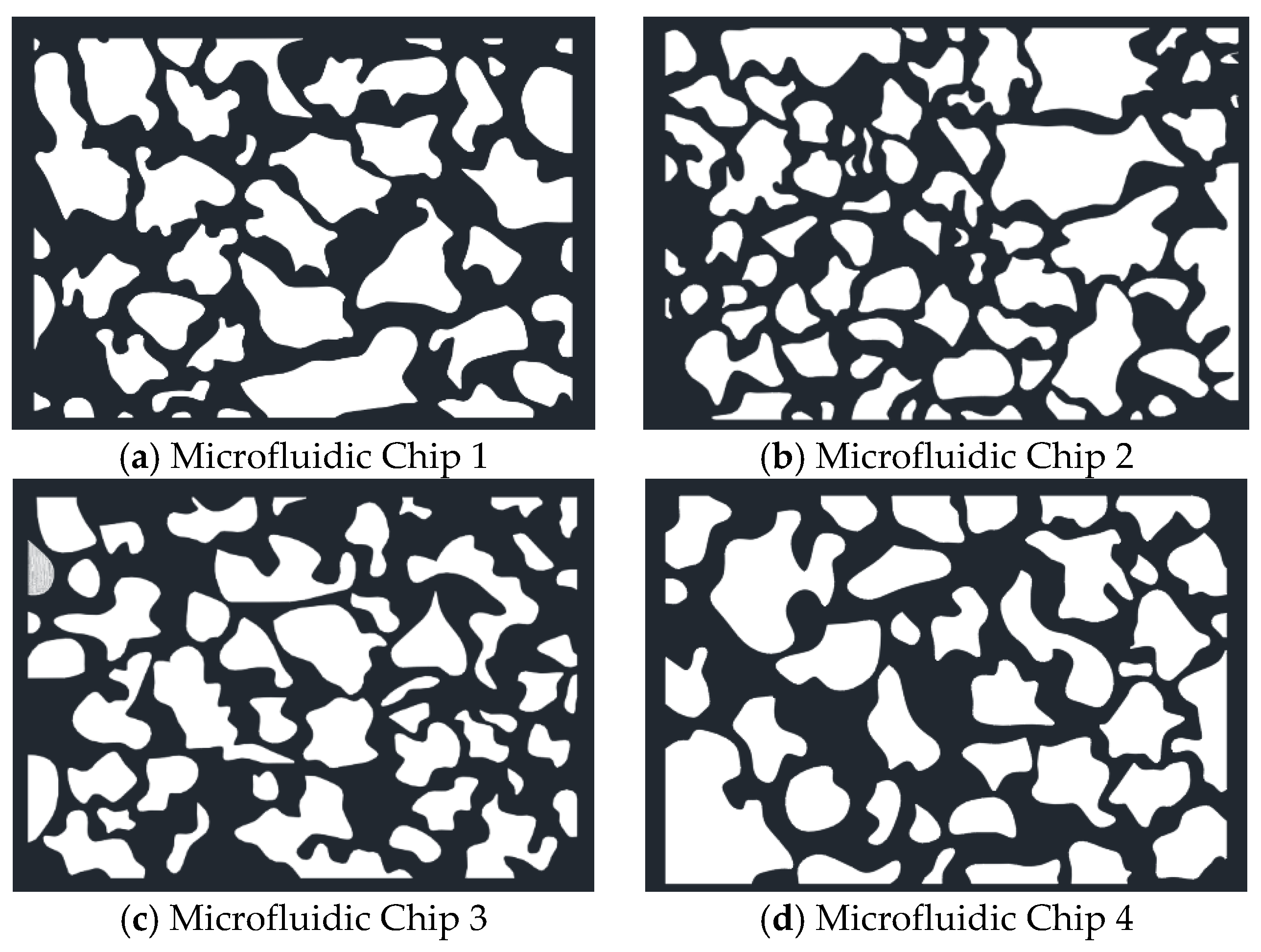
The generated models were finally evaluated in terms of parameter similarity and flow simulation performance, ensuring their consistency with the abovementioned reconstructed samples in both microscopic pore structure and macroscopic physical properties. The structures of the four microfluidic chips derived from the abovementioned generation algorithm are shown in Figure 7. The microfluidic chips were essentially 2D, with a uniform depth of 10 μm.

3.2. Experimental Apparatus and Procedure

3.2.1. Experimental Apparatus

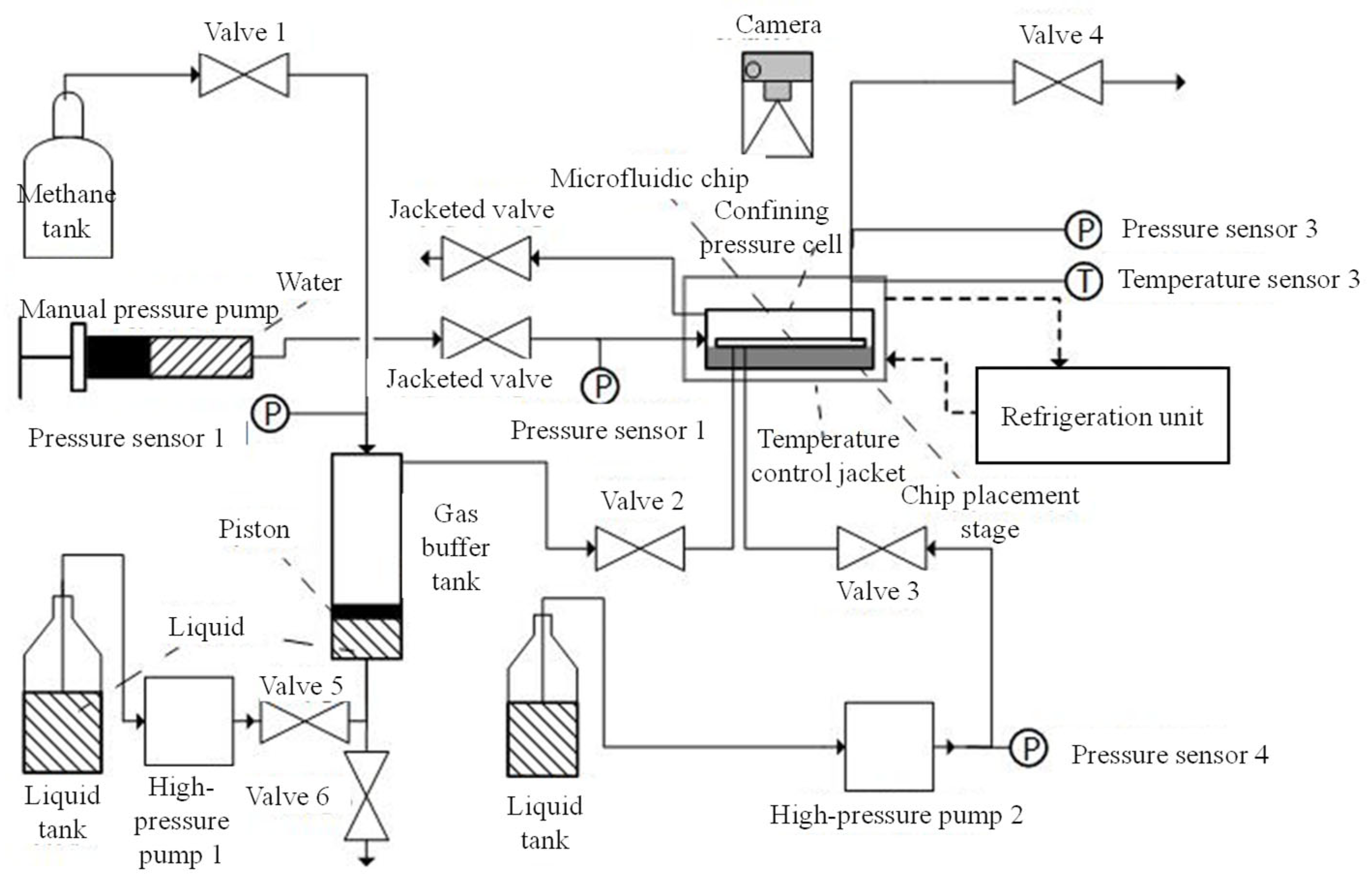
The schematic diagram of the micro-scale visualized microfluidic experimental apparatus is shown in Figure 8.
The apparatus is capable of micro-scale visualized microfluidic experiments with high accuracy and operational flexibility, enabling the investigation of hydrate nucleation, growth, dissociation, and phase transition at the pore scale. The microfluidic chip is fixed on a chip holder, which possesses four inlet and outlet channels. A confining pressure chamber is installed above the chip console, which is filled with ethylene glycol aqueous solution to apply confining pressure. There is a temperature-controlling sleeve surrounding the confining chamber, within which cooling coils circulate coolant to control the temperature. The inlet and outlet of the coolant circulation connect to the temperature controlling sleeve, while the interlayer valve interfaces with the confining pressure chamber. All other inlets and outlets connect to the chip via the chip holder. Valve 1 regulates the supply of methane gas into the system. High-Pressure Pump 1 provides continuous pressurization of the innermost layer of the holder at a constant flow rate. The close of Valve 5 isolates High-Pressure Pump 1 from the gas buffer tank, while Valve 6 allows discharge of the pump liquid in the buffer tank. High-Pressure Pump 2 enables quantitative injection of the working fluid, while Valve 3 can isolate its influence on the holder. Valves 2 and 3 control the injection of methane gas and liquid into the chip, and Valve 4 allows for the venting of gas and liquid in the chip. The interlayer valve enables pressure control and discharge of the confining fluid in the holder interlayer. Temperature control in the holder can be achieved by adjusting the coolant temperature circulating through the coils via the refrigeration unit.

3.2.2. Experimental Procedure

For microfluidic experiments investigating hydrate formation, dissociation, and phase equilibrium in complex pore structures, pressure adjustments can induce rapid fluid movement and significant hydrate displacement within microchannels, interfering imaging process. In contrast, gradual temperature variations do not cause substantial fluid or hydrate displacement. As a result, the approach of regulating the experimental temperature is proposed to control hydrate formation and dissociation in microfluidics, avoiding large displacements of hydrate and gas–water interfaces induced by pressure adjustments, and enabling real-time observation of hydrate formation and dissociation morphologies at the same position with high-resolution. The detailed experimental procedure is shown as follows:
  • Reactor cleaning: The chip and holder were washed with deionized water and dried using nitrogen gas.
  • Device connection: The experimental apparatus was connected according to Figure 8, with the gas cylinder kept closed during connection.
  • Buffer tank adjustment and removal of impure gas: Liquid in the gas buffer tank completely discharged with gas pressure by opening Valves 5 and 6. Gas in the pipelines between High-Pressure Pump 1 and the buffer tank was removed by operating pump 1 until a stable liquid flow was observed through Valve 6. The gas volume of the buffer tank was adjusted to 200–350 mL by closing Valve 6, after which pump 1 was closed. Gas in the buffer tank was replaced by closing Valve 2. Valve 1 was adjusted and closed when the pressure at Sensor 1 reached 0.7 ± 0.2 MPa. Valve 2 was opened to vent gas and closed when the Pressure Sensor 1 reading was 0.3 ± 0.1 MPa. The buffer tank was evacuated and refilled with methane with the vacuum pump and Valves 1 and 2, repeating pressure stabilization cycles to ensure complete replacement of impurities. Finally, the buffer tank was reconnected to the reactor via Valve 2.
  • Confining pressure chamber venting: The interlayer valve was opened, and 3.5 wt% saline solution was injected into the chamber through a manual pump until a stable flow was observed. The interlayer valve was then closed. Pressure was applied with the manual pump until Sensor 2 indicated 0.8–1.0 MPa.
  • Liquid and gas line venting: The buffer tank was pressurized by opening Valve 1 until Sensor 1 indicated 0.7 ± 0.2 MPa. Methane was flushed through all lines from the buffer tank to the chip and gas outlet by opening Valves 2 and 4 until Sensor 1 reached 0.4 ± 0.1 MPa, and then Valves 2 and 4 were closed. Working fluid was flushed from High-Pressure Pump 2 to the chip by opening Valve 3 and High-Pressure Pump 2 until the fluid entered the chip, after which they were closed. Residual liquid in the chip was blown out with gas in the buffer tank via Valves 2 and 4 until Sensor 1 reached 0.2 ± 0.1 MPa, then the valves were closed.
  • Hydrate formation: Methane and saline solution were alternately injected into the chip. A high-pressure pump was employed to pressurize the system until the sensor stabilized at the experimental pressure. A stepwise cooling method of rapidly decreasing 1 °C and then holding for 60 min while the pressure was almost kept constant was applied until hydrate formation started, after which hydrate formation process was recorded.
  • Hydrate dissociation and phase equilibrium: A stepwise heating method of increasing 0.1 °C and then holding for 10 min was applied until hydrate dissociation was observed, at which point heating was stopped and the temperature was held constant to record hydrate dissociation. Hydrate phase equilibrium temperature was determined as the average of the temperature when hydrate dissociation started and the preceding lower one.
Compared with the conventional microfluidics that are limited to morphological observations of hydrate formation and dissociation, the novelty of the above-proposed microfluidic testing method lies in the fact that the microfluidics-based hydrate dynamic phase transition method in this study not only enables real-time observation of the morphological evolution of hydrate formation and dissociation but also allows the hydrate phase equilibrium curve to be determined by quantitatively obtaining the critical temperature for hydrate formation at different pressures.

3.3. Results Analysis and Discussion

3.3.1. Hydrate Formation and Dissociation Characteristics in Complex Pore Structures

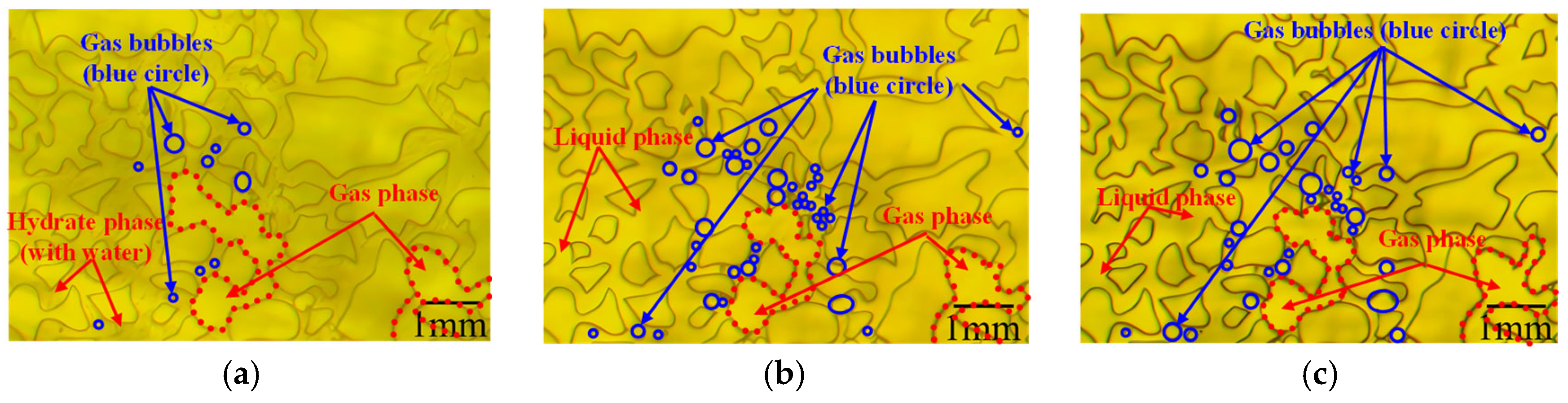
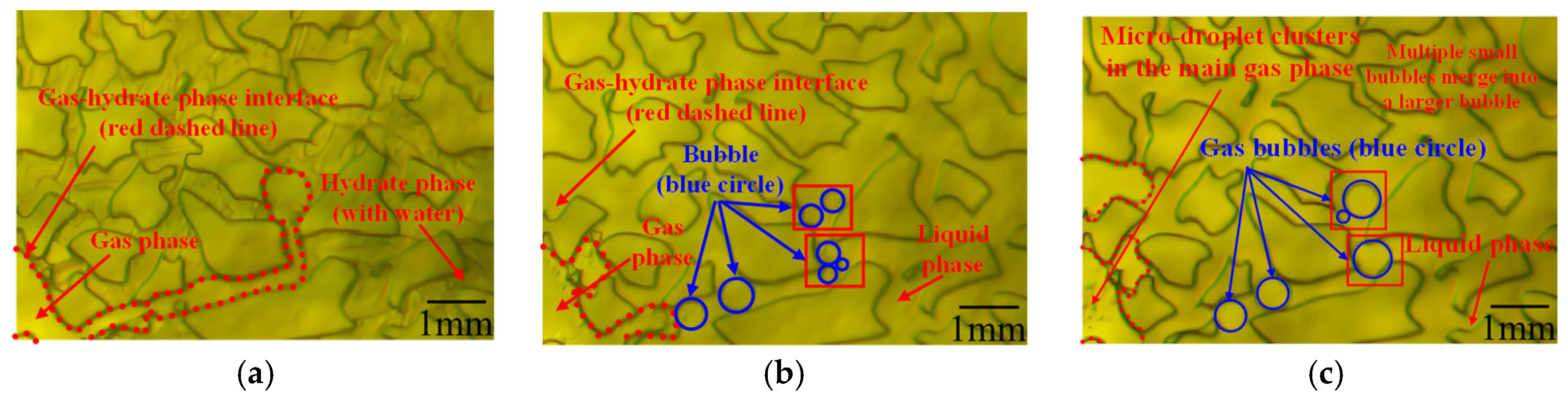
The morphological characteristics of hydrate formation endpoint and dissociation process in Microfluidic Chip 1 are shown in Figure 9a–c. As illustrated in Figure 9a, hydrate appears as darkly wrinkled regions rather than a uniform dark phase at the endpoint of hydrate growth. This is primarily due to the presence of a certain amount of NaCl solution within hydrate in the pore throats. The difference in reflectivity from NaCl solution and hydrate results in the uneven reflectance of the main hydrate phase. Figure 9b,c show that part of hydrate transforms into the liquid phase during dissociation, manifested as the darkly wrinkled regions gradually brightening. Gas released from hydrate dissociation forms small bubbles and progressively coalesces into larger ones. The bulk gas induces movement of the phase boundaries by interfacial tension and evolves according to the principle of minimizing the surface area of the bulk gas.
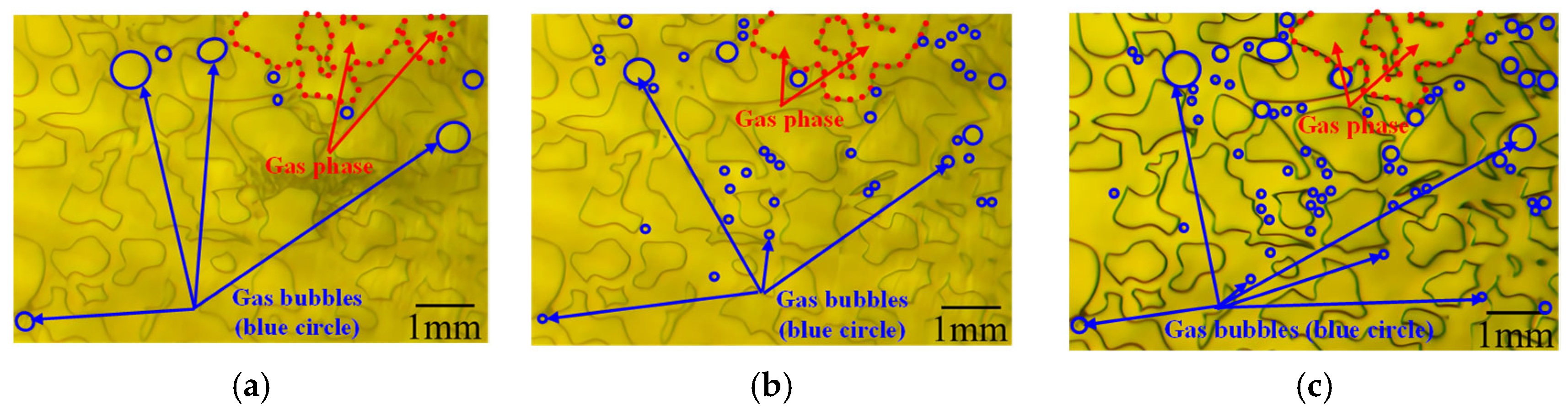
The morphological characteristics of hydrate formation endpoint and dissociation process in Microfluidic Chip 2 are respectively shown in Figure 10a–c. As shown in Figure 10a, the gas isolated from the bulk phase gradually decreases as hydrate grows during hydrate formation. However, some bubbles remain at the endpoint of hydrate formation due to excess gas. Figure 10b,c illustrate that hydrate transforms into the liquid phase and releases a large number of fine gas bubbles during hydrate dissociation. The fine gas bubbles progressively coalesce into larger ones. A considerable proportion of gas remains stably trapped as bubbles within the throats of the microfluidic chip upon complete hydrate dissociation. These gases are produced through hydrate dissociation and do not merge into the bulk gas phase.
The morphological characteristics of hydrate formation endpoint and dissociation process in Microfluidic Chip 3 are indicated in Figure 11a–c. As illustrated in Figure 11a, hydrate formation in Chip 3 is similar to that in Chip 2, with a substantial number of bubbles present within the bulk hydrate phase. The mechanism of bubble formation is the same as in Chip 2. Hydrate transforms into the liquid phase during dissociation (Figure 11b,c), releasing numerous fine gas bubbles. These fine bubbles only absorb the gas released from the surrounding dissociated hydrate and do not coalesce when no neighboring bubbles are present, maintaining small-bubble morphology until the completion of hydrate dissociation.
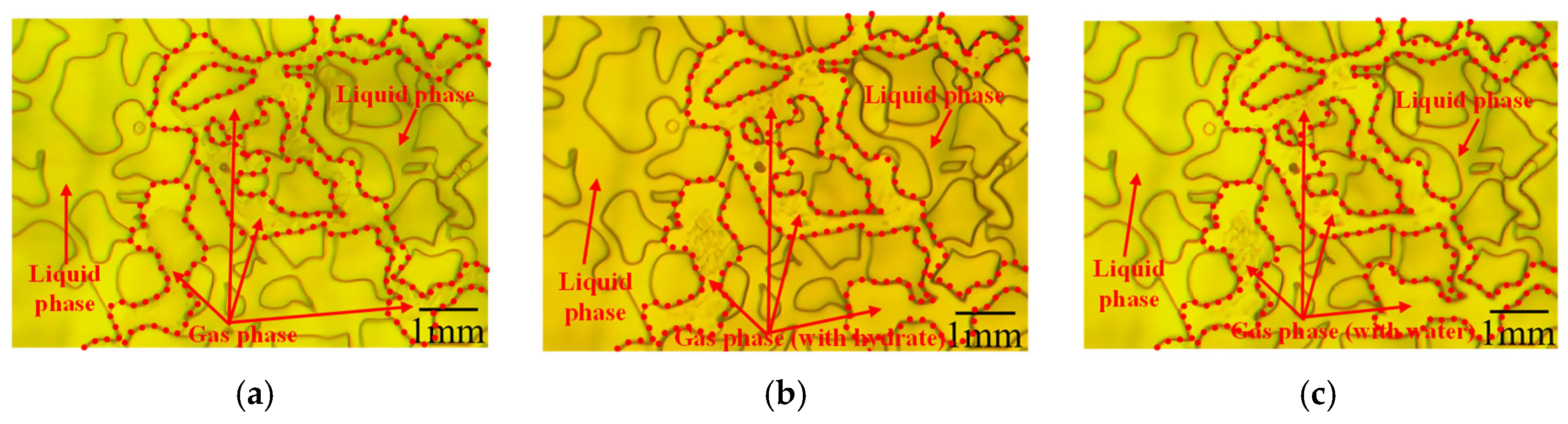
The morphological characteristics of hydrate formation endpoint and dissociation process in Microfluidic Chip 4 are shown in Figure 12a–c. As shown in Figure 12a, hydrate formation in Chip 4 differs from that in the previous three chips. No significant hydrate formation is observed within the bulk liquid phase during the experiments. Instead, hydrate forms primarily within the gas phase. No large quantities of fine bubbles are generated since hydrate is mainly located in the bulk gas phase during hydrate dissociation (Figure 12b,c). The gas released during hydrate dissociation directly enters the bulk gas phase, causing an increase in the volume. This phenomenon was not observed in the previous three chips, where the dissociated gas was primarily trapped as bubbles within the bulk liquid phase, compressing the volume of the bulk gas phase to some extent.

3.3.2. Impact of Pore Structures on Hydrate Phase Equilibrium

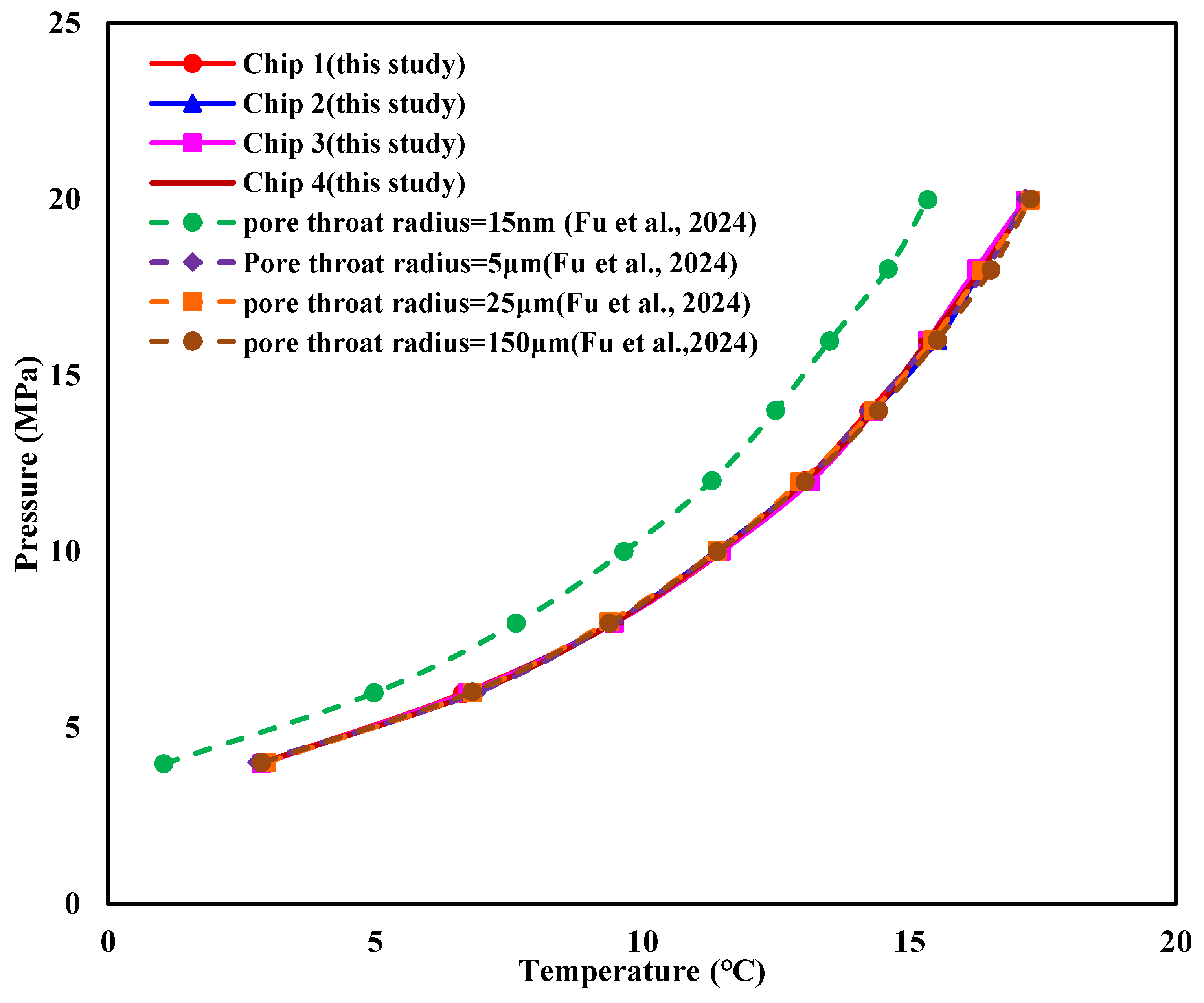
Using the abovementioned experimental procedure in Section 3.2.2, a series of microfluidic experiments were carried out by regulating the temperature through stepwise cooling and heating to obtain the critical hydrate formation temperature at different pressures, from which the methane hydrate phase equilibrium curve were obtained. The phase equilibrium curves of methane hydrate in the abovementioned four microfluidic chips, as well as those obtained in different radial pore throats [54] are presented in Figure 13. It is illustrated that the phase equilibrium pressure of methane hydrate in different pore structures increases exponentially with increasing temperature. There is only a minor difference in hydrate phase equilibrium curves in the four microfluidic chips since the statistically averaged typical pore parameters, such as the distribution of pore throat radius, coordination number, and aspect ratio, are generally consistent. Through comparison to methane hydrate phase equilibrium curves with different pore–throat radii, it can be found that the critical hydrate formation temperature measured in the four microfluidic chips is comparable to that in micro-scale pore throats, including 5 μm, 25 μm, and 150 μm, at a given pressure. However, the methane hydrate phase equilibrium curves differ markedly from those obtained in nano-scale pore throats. Moreover, the discrepancy grows increasingly pronounced with the increase in temperature. The difference is primarily attributed to the pronounced capillary effect in nano pore throats, where the extremely small pore–throat radius significantly reduces water activity. Therefore, the difficulty for methane hydrate formation increases at the same temperature, resulting in larger methane hydrate equilibrium pressure. Since methane hydrate preferentially forms at the gas–water interface in micro-scale pore throats, where methane can more easily invade and the proportion of nanopores in the sediment is low, rendering the influence of nano pore throats on the overall hydrate phase equilibrium curves is small. As a result, the methane hydrate phase equilibrium curves in the abovementioned four microfluidic chips are closer to those observed in micro-scale pore throats. However, it is worth noting that the impact of nano pore throats on hydrate phase equilibrium will grow progressively more significant as the proportion of nanopores increases, resulting in the substantially increased difficulty for methane hydrate formation.
Since the proposed method determines the critical hydrate formation temperature at each pressure through stepwise temperature regulation, the temperature increments must be kept small to ensure measurement accuracy. Moreover, hydrate formation requires a certain degree of subcooling and an induction period, resulting in a relatively long measurement time. In the future, the measurement efficiency can be improved by first estimating the hydrate phase equilibrium temperature at each pressure, followed by fine temperature adjustment near the estimated equilibrium temperature and coarser adjustment far away from it, thereby accelerating the determination of hydrate critical formation temperature. In addition, artificial intelligence-based phase separation and quantitative analysis of microfluidic images are also needed for further investigation.

4. Conclusions

  • Hydrate formation can be divided into six stages, namely induction, nucleation, first rapid growth, slow growth, second rapid growth, and growth termination period, during the reconstruction of clayey–silty hydrate-bearing samples via the ice-seeding method. Differences in thermodynamic driving force result in slight variations in hydrate saturation evolution regularity.
  • The pore structures of the reconstructed hydrate-bearing samples are influenced by multiple factors, such as the properties of marine sediment, confining pressure, intrapore materials, thermodynamic driving force, and so on. The thermodynamic driving force primarily affects the pore structure by altering the relative rates of hydrate formation and ice melting.
  • Hydrate at the end of growth appears as dark wrinkled regions with abundant bubbles present in the hydrate phase rather a than uniform dark area during hydrate formation. Gas released from hydrate dissociation forms small bubbles and coalesces into large ones, while some enters the bulk gas phase directly.
  • Micro-scale pore throats dominate, whereas the fraction of nano-scale ones is small in the microfluidic chips, resulting in the hydrate phase equilibrium curves exhibiting only minor differences and close to those obtained in micro-scale pore throats.
  • The proposed method for obtaining hydrate phase equilibrium curves based on microfluidics is relatively time-consuming. The measurement efficiency can be improved by first estimating hydrate phase equilibrium temperature at each pressure, followed by fine temperature adjustment near the estimated equilibrium temperature and coarser adjustment far away from it. In addition, artificial intelligence-based phase separation and quantitative analysis of microfluidic images are also needed for future research.

Author Contributions

Conceptualization, Q.F. and S.W.; methodology, M.C., X.L. and Y.W.; investigation, M.C. and R.Q.; data curation, H.C.; writing—original draft preparation, M.C.; writing—review and editing, Q.F. and R.Q.; visualization, X.L. and Y.W.; supervision, S.W.; project administration, Q.F., R.Q. and H.C.; funding acquisition, Q.F., R.Q. and H.C. All authors have read and agreed to the published version of the manuscript.

Funding

This research was funded by Director’s fund of State Key Laboratory of Offshore Natural Gas Hydrates (2025), grant number KJQZ-2025-2004; the National Natural Science Funding, grant number 52474076; Beijing Science and Technology Nova Program Project, grant number 20240484721; Distinguished Youth Foundation of the Tianshan Program of Xinjiang Uygur Autonomous Region, grant number 2022TSYCJC0013; Research on Cross-Scale Phase Transition Characteristics and Numerical Simulation Methods for Depressurization Development of Natural Gas Hydrates, grant number KJQZ-2023-2003; and National Key Research and Development Program of China, grant number 2021YFC2800902.

Institutional Review Board Statement

Not applicable.

Informed Consent Statement

Not applicable.

Data Availability Statement

The data presented in this research are available upon request from the authors.

Conflicts of Interest

Authors Mingqiang Chen, Qiang Fu, Rui Qin and Haihong Chen were employed by the company Research Institute of China National Offshore Oil Cooperation, China National Offshore Oil Corporation. The remaining authors declare that the research was conducted in the absence of any commercial or financial relationships that could be construed as a potential conflict of interest.

References

  1. Cox, S.J.; Taylor, D.J.F.; Youngs, T.G.A.; Soper, A.K.; Totton, T.S.; Chapman, R.G.; Arjmandi, M.; Hodges, M.G.; Skipper, N.T.; Michaelides, A. Formation of Methane Hydrate in the Presence of Natural and Synthetic Nanoparticles. J. Am. Chem. Soc. 2018, 140, 3277–3284. [Google Scholar] [CrossRef]
  2. Inkong, K.; Veluswamy, H.P.; Rangsunvigit, P.; Kulprathipanja, S.; Linga, P. Investigation on the kinetics of methane hydrate formation in the presence of methyl ester sulfonate. J. Nat. Gas Sci. Eng. 2019, 71, 102999. [Google Scholar] [CrossRef]
  3. Sloan, E.D. Fundamental principles and applications of natural gas hydrates. Nature 2003, 426, 353–359. [Google Scholar] [CrossRef] [PubMed]
  4. Makogon, Y.F.; Holditch, S.A.; Makogon, T.Y. Natural gas-hydrates—A potential energy source for the 21st Century. J. Pet. Sci. Eng. 2007, 56, 14–31. [Google Scholar] [CrossRef]
  5. Tiong, M.; Peng, W.; Liu, Q.; Wu, S.; Ye, H.; Liu, S.; Xue, M.; Xian, C. Natural gas hydrate exploitation: A comprehensive review of structural properties, technical progress and environmental challenges. Geoenergy Sci. Eng. 2025, 144, 205769. [Google Scholar]
  6. Wang, H.; Zhang, L.; He, J.; Zhou, T. The Development of Natural Gas Hydrate Exploitation Technology from Perspective of Patents. Front. Energy Res. 2022, 10, 860591. [Google Scholar] [CrossRef]
  7. Li, F.; Yuan, Q.; Li, T.; Li, Z.; Sun, C.; Chen, G. A review: Enhanced recovery of natural gas hydrate reservoirs. Chin. J. Chem. Eng. 2019, 27, 2062–2073. [Google Scholar] [CrossRef]
  8. Liu, B.; Yuan, Q.; Su, K.; Yang, X.; Wu, B.; Sun, C.; Chen, G. Experimental Simulation of the Exploitation of Natural Gas Hydrate. Energies 2012, 5, 466–493. [Google Scholar] [CrossRef]
  9. Li, Y.; Liu, L.; Jin, Y.; Wu, N. Characterization and development of marine natural gas hydrate reservoirs in clayey-silt sediments: A review and discussion. Adv. Geo-Energy Res. 2021, 5, 75–86. [Google Scholar] [CrossRef]
  10. Mu, L.; Liu, H.; Zhang, C.; Zhang, Y.; Lu, H. Optimization of production well patterns for natural gas hydrate reservoir: Referring to the results from production tests and numerical simulations. China Geol. 2025, 8, 39–57. [Google Scholar] [CrossRef]
  11. Luo, T.; Song, J.; Sun, X.; Cheng, F.; Bangalore Narasimha Murthy, M.; Chen, Y.; Zhao, Y.; Song, Y. Numerical study on gas production via a horizontal well from hydrate reservoirs with different slope angles in the South China Sea. Deep Undergr. Sci. Eng. 2024, 3, 171–181. [Google Scholar] [CrossRef]
  12. Nie, S.; Chen, C.; Chen, M.; Song, J.; Wang, Y.; Ma, Y. Numerical Evaluation of a Novel Development Mode for Challenging Oceanic Gas Hydrates Considering Methane Leakage. Sustainability 2022, 14, 14460. [Google Scholar] [CrossRef]
  13. Zhou, S.; Li, Q.; Lv, X.; Fu, Q.; Zhu, J. Key issues in development of offshore natural gas hydrate. Front. Energy 2020, 14, 433–442. [Google Scholar] [CrossRef]
  14. Hassanpouryouzband, A.; Joonaki, E.; Vasheghani Farahani, M.; Takeya, S.; Ruppel, C.; Yang, J.; English, N.J.; Schicks, J.M.; Edlmann, K.; Mehrabian, H.; et al. Gas hydrates in sustainable chemistry. Chem. Soc. Rev. 2020, 49, 5225–5309. [Google Scholar] [CrossRef]
  15. Gan, B.; Li, Z.; Huo, W.; Zhang, Y.; Li, Z.; Fan, R.; Zhang, H.; Xu, Y.; He, Y. Phase transitions of CH4 hydrates in mud-bearing sediments with oceanic laminar distribution: Mechanical response and stabilization-type evolution. Fuel 2025, 380, 133185. [Google Scholar] [CrossRef]
  16. Sun, Y.; Cao, B.; Chen, H.; Liu, Y.; Zhong, J.; Ren, L.; Chen, G.; Sun, C.; Chen, D. Influences of pore fluid on gas production from hydrate-bearing reservoir by depressurization. Pet. Sci. 2023, 20, 1238–1246. [Google Scholar] [CrossRef]
  17. Chen, M.; Li, Q.; Zhou, S.; Pang, W.; Lyu, X.; Zhu, J.; Fu, Q.; Lyu, C.; Ge, Y. Dynamic Characterization of Pore Structures in Hydrate-Bearing Sediments During Hydrate Phase Transition. Presented at the SPE Annual Technical Conference and Exhibition, San Antonio, TX, USA, 16–18 October October 2023. [Google Scholar]
  18. Li, Q.; Chen, M.; Lv, X.; Pang, W.; Fu, Q.; Lyu, C.; Ge, Y.; Wen, H. Effect of Hydrate Spatial Distribution on Dynamic Permeability Evolution Using an Unstructured Hydrate-Bearing Network with Complex Pore Morphology and Anisotropy. Energy Fuels 2023, 37, 7788–7797. [Google Scholar] [CrossRef]
  19. Dai, S.; Seol, Y. Water permeability in hydrate-bearing sediments: A pore-scale study. Geophys. Res. Lett. 2014, 41, 4176–4184. [Google Scholar] [CrossRef]
  20. Lyu, X.; Li, Q.; Ge, Y.; Zhu, J.; Zhou, S.; Fu, Q. Fundamental characteristics of gas hydrate-bearing sediments in the Shenhu area, South China Sea. Front Energy 2021, 15, 367–373. [Google Scholar]
  21. Shen, S.; Qin, R.; Chen, H.; Huang, T.; Ge, Y.; Lv, X.; Liang, H. Clayey-Silty Sediments Containing Gas Hydrate in South China Sea: Geophysical and Geomechanical Results. In Proceedings of the 2024 6th International Conference on Civil Engineering, Environment Resources and Energy Materials, Guangzhou, China, 18–20 October 2024. [Google Scholar]
  22. Liu, C.; Meng, Q.; Hu, G.; Li, C.; Sun, J.; He, X.; Wu, N.; Yang, S.; Liang, J. Characterization of Hydrate-Bearing Sediments Recovered from the Shenhu Area of the South China Sea. Interpretation 2017, 5, SM13–SM23. [Google Scholar] [CrossRef]
  23. Das, S.; Mrudula, K.; Roy, S.; Kumar, R. A Review of Clathrate Hydrate Nucleation, Growth and Decomposition Studied using Molecular Dynamics Simulation. J. Mol. Liq. 2021, 348, 118025. [Google Scholar] [CrossRef]
  24. Wan, L.; Zhou, X.; Chen, P.; Zang, X.; Liang, D.; Guan, J. Decomposition Characterizations of Methane Hydrate Confined inside Nanoscale Pores of Silica Gel below 273.15 K. Crystals 2019, 9, 200. [Google Scholar] [CrossRef]
  25. Pandey, J.S.; von Solms, N. Metal–Organic Frameworks and Gas Hydrate Synergy: A Pandora’s Box of Unanswered Questions and Revelations. Energies 2023, 16, 111. [Google Scholar] [CrossRef]
  26. Anderson, R.; Llamedo, M.; Tohidi, B.; Burgass, R.W. Experimental Measurement of Methane and Carbon Dioxide Clathrate Hydrate Equilibria in Mesoporous Silica. J. Phys. Chem. B 2003, 107, 3507–3514. [Google Scholar] [CrossRef]
  27. Seo, Y.; Lee, H.; Uchida, T. Methane and Carbon Dioxide Hydrate Phase Behavior in Small Porous Silica Gels:  Three-Phase Equilibrium Determination and Thermodynamic Modeling. Langmuir 2002, 18, 9164–9170. [Google Scholar] [CrossRef]
  28. Uchida, T.; Ebinuma, T.; Takeya, S.; Nagao, J.; Narita, H. Effects of Pore Sizes on Dissociation Temperatures and Pressures of Methane, Carbon Dioxide, and Propane Hydrates in Porous Media. J. Phys. Chem. B 2002, 106, 820–826. [Google Scholar] [CrossRef]
  29. Chen, Y.; Gao, Y.; Zhang, N.; Chen, L.; Wang, X.; Sun, B. Microfluidics application for monitoring hydrate phase transition in flow throats and evaluation of its saturation measurement. Chem. Eng. J. 2020, 383, 123081. [Google Scholar] [CrossRef]
  30. Yu, W.; Habiburrahman, M.; Sultan, A. Microfluidic study of hydrate propagation during CO2 injection into cold aquifers. Carbon Capt. Sci. Technol. 2025, 15, 100401. [Google Scholar] [CrossRef]
  31. Zhang, J.; Yin, Z.; Khan, S.; Li, S.; Li, Q.; Liu, X.; Linga, P. Path-dependent morphology of CH4 hydrates and their dissociation studied with high-pressure microfluidics. Lab Chip 2024, 24, 1602–1615. [Google Scholar] [CrossRef]
  32. Zhang, J.; Song, Z.; Zhou, K.; Li, Q.; Jiao, H.; Yin, Z. Pore-Scale Analysis of the Permeability and Effective Thermal Conductivity of Hydrate-Bearing Sediments Based on a High-Pressure Microfluidics Approach. Energy Fuel 2024, 38, 22192–22204. [Google Scholar]
  33. Men, W.; Peng, Q.; Gui, X. Hydrate phase equilibrium determination and thermodynamic modeling of CO2 + epoxy heterocycle + water systems. Fluid Phase Equilibria 2022, 556, 113395. [Google Scholar] [CrossRef]
  34. Cai, J.; Tang, H.; Zhang, T.; Xiao, P.; Wu, Y.; Qin, H.; Chen, G.; Sun, C.; Wang, X. Phase equilibria of gas hydrates: A review of experiments, modeling, and potential trends. Renew. Sust. Energy Rev. 2025, 215, 115612. [Google Scholar] [CrossRef]
  35. Liao, Z.; Guo, X.; Li, Q.; Sun, Q.; Li, J.; Yang, L.; Liu, A.; Chen, G.; Zuo, J. Experimental and modeling study on the phase equilibria for hydrates of gas mixtures in TBAB solution. Chem. Eng. Sci. 2015, 137, 656–664. [Google Scholar] [CrossRef]
  36. Zhang, Y.; Li, X.; Wang, Y.; Chen, Z.; Yan, K. Decomposition conditions of methane hydrate in marine sediments from South China Sea. Fluid Phase Equilibria 2016, 413, 110–115. [Google Scholar] [CrossRef]
  37. Qin, X.; Lu, C.; Wang, P.; Liang, Q. Hydrate phase transition and seepage mechanism during natural gas hydrate pro-duction tests in the South China Sea: A review and prospect. China Geol. 2022, 5, 201–217. [Google Scholar]
  38. Uchida, T.; Takeya, S.; Chuvilin, E.M.; Ohmura, R.; Nagao, J.; Yakushev, V.S.; Istomin, V.A.; Minagawa, H.; Ebinuma, T.; Narita, H. Decomposition of methane hydrates in sand, sandstone, clays, and glass beads. Geophys. Res.-Solid Earth 2004, 109, B05206. [Google Scholar] [CrossRef]
  39. Ren, J.; Liu, X.; Niu, M.; Yin, Z. Effect of sodium montmorillonite clay on the kinetics of CH4 hydrate—Implication for energy recovery. Chem. Eng. J. 2022, 437, 135368. [Google Scholar] [CrossRef]
  40. Dai, S.; Santamarina, J.C.; Waite, W.F.; Kneafsey, T.J. Hydrate morphology: Physical properties of sands with patchy hydrate saturation. J. Geophys. Res. Solid Earth 2012, 117, B11205. [Google Scholar] [CrossRef]
  41. Lei, L.; Santamarina, J.C. Laboratory Strategies for Hydrate Formation in Fine-Grained Sediments. J. Geophys. Res. Solid Earth 2018, 123, 2583–2596. [Google Scholar] [CrossRef]
  42. Lei, L.; Liu, Z.; Seol, Y.; Boswell, R.; Dai, S. An Investigation of Hydrate Formation in Unsaturated Sediments Using X-Ray Computed Tomography. J. Geophys. Res. Solid Earth 2019, 124, 3335–3349. [Google Scholar] [CrossRef]
  43. Lei, L.; Seol, Y.; Myshakin, E.M. Methane Hydrate Film Thickening in Porous Media. Geophys. Res. Lett. 2019, 46, 11091–11099. [Google Scholar] [CrossRef]
  44. Meng, X.; Li, X.; Zhang, Q.; Wu, L.; Cao, F. Temperature-dependent structure of 3.5 wt.% NaCl aqueous solution: Theoretical and Raman investigation. J. Mol. Struct. 2022, 1253, 132279. [Google Scholar]
  45. Li, X.; Jia, H.; Wang, Y.; Fan, F.; Wang, B.; Wang, Q.; Wang, Z.; Yuan, S.; Zhao, Y.; Huang, P. Molecular Insights into the Concentration-Dependent Antagonistic Effect between Asparagine and NaCl on CO2 Hydrate Growth. Langmuir 2025, 41, 22558–22570. [Google Scholar]
  46. Kien, P.T.; Trang, H.T.Q.; Son, H.V.; Hieu, N.V.; Duyen, L.Q.; Anh, P.V.; Cameirao, A.; Douzet, J.; Bouillot, B.; Herri, J.M. Kinetic study on cyclopentane hydrates in the presence of sodium chloride. Vietnam J. Catal. Adsorpt. 2024, 13, 85–89. [Google Scholar]
  47. Liu, L.; Yao, Y.; Zhou, X.; Zhang, Y.; Liang, D. Improved Formation Kinetics of Carbon Dioxide Hydrate in Brine Induced by Sodium Dodecyl Sulfate. Energies 2021, 14, 2094. [Google Scholar] [CrossRef]
  48. Wang, Y.; Liu, Z.; Sun, Q.; Liu, A.; Yang, L.; Gong, J.; Guo, X. Thermodynamics and kinetics of structure I hydrate formation in presence of poly(sodium 4-styrenesulfonate). Chem. Ind. Eng. Prog. 2021, 40, 168–181. [Google Scholar]
  49. Di Profio, P.; Canale, V.; D’Alessandro, N.; Germani, R.; Di Crescenzo, A.; Fontana, A. Separation of CO2 and CH4 from Biogas by Formation of Clathrate Hydrates: Importance of the Driving Force and Kinetic Promoters. ACS Sustain. Chem. Eng. 2016, 5, 1990–1997. [Google Scholar]
  50. Yang, L.; Shi, K.; Qu, A.; Liang, H.; Li, Q.; Lv, X.; Leng, S.; Liu, Y.; Zhang, L.; Liu, Y.; et al. The locally varying thermodynamic driving force dominates the gas production efficiency from natural gas hydrate-bearing marine sediments. Energy 2023, 276, 127545. [Google Scholar] [CrossRef]
  51. Liu, Z.; Liu, Z.; Wang, Y.; Liu, A.; Sun, Q.; Yang, L.; Guo, X. Review on hydrate morphology. ACS Sustain. Chem. Eng. 2021, 40, 88–100. [Google Scholar]
  52. Li, Z.; Zhang, Y.; Shen, Y.; Cheng, L.; Liu, B.; Yan, K.; Chen, G.; Li, T. Molecular dynamics simulation to explore the synergistic inhibition effect of kinetic and thermodynamic hydrate inhibitors. Energy 2022, 238, 121697. [Google Scholar] [CrossRef]
  53. Wang, Y.; Yang, B.; Liu, Z.; Liu, Z.; Sun, Q.; Liu, A.; Li, X.; Lan, W.; Yang, L.; Guo, X. The hydrate-based gas separation of hydrogen and ethylene from fluid catalytic cracking dry gas in presence of Poly (sodium 4-styrenesulfonate). Fuel 2020, 275, 117895. [Google Scholar] [CrossRef]
  54. Fu, Q.; Zhou, S.; Li, Z.; Chen, M.; Wang, S.; Xu, J. Dynamic phase transition characteristics and representation of natural gas hydrates in micro/nano confinements. Nat. Gas Oil 2024, 42, 25–34. [Google Scholar]
Figure 1. Schematic diagram of hydrate-bearing sample remolding apparatus (The instrument highlighted in the red dashed box is the reshaping apparatus with a jacket, and the figure on the right indicated by the right-pointing red arrow is an enlarged cross-sectional view of the apparatus).
Applsci 16 02494 g001
Figure 2. Methane hydrate-bearing sample reconstruction procedure.
Applsci 16 02494 g002
Figure 3. Evolution of methane hydrate saturation during the experiments(The red solid line represents the temporal evolution of hydrate saturation; the blue circles indicate the nodes corresponding to transition of different stages of hydrate formation, and the arrows denote the physical meaning of each node).
Applsci 16 02494 g003
Figure 7. Structures of four equivalent microfluidic chips.
Applsci 16 02494 g007
Figure 8. Schematic diagram of microfluidic experimental apparatus(The arrows indicate the direction of fluid flow).
Applsci 16 02494 g008
Figure 9. Hydrate formation and dissociation characteristics in Microfluidic Chip 1 (t1 < t2). (a) Hydrate formation endpoint. (b) Hydrate dissociation process (t1). (c) Hydrate dissociation process (t2).
Applsci 16 02494 g009
Figure 10. Hydrate formation and dissociation characteristics in Microfluidic Chip 2 (t1 < t2). (a) Hydrate formation endpoint. (b) Hydrate dissociation process (t1). (c) Hydrate dissociation process (t2).
Applsci 16 02494 g010
Figure 11. Hydrate formation and dissociation characteristics in Microfluidic Chip 3 (t1 < t2). (a) Hydrate formation endpoint. (b) Hydrate dissociation process (t1). (c) Hydrate dissociation process (t2).
Applsci 16 02494 g011
Figure 12. Hydrate formation and dissociation characteristics in Microfluidic Chip 4 (t1 < t2). (a) Hydrate formation endpoint. (b) Hydrate dissociation process (t1). (c) Hydrate dissociation process (t2).
Applsci 16 02494 g012
Figure 13. Comparison of methane hydrate phase equilibrium curves in four microfluidic chips with those in different radial pore throats [54].
Applsci 16 02494 g013
Disclaimer/Publisher’s Note: The statements, opinions and data contained in all publications are solely those of the individual author(s) and contributor(s) and not of MDPI and/or the editor(s). MDPI and/or the editor(s) disclaim responsibility for any injury to people or property resulting from any ideas, methods, instructions or products referred to in the content.