Identifying Failure Conditions in Li-Ion Batteries Using Distribution of Relaxation Time Method



Abstract
1. Introduction
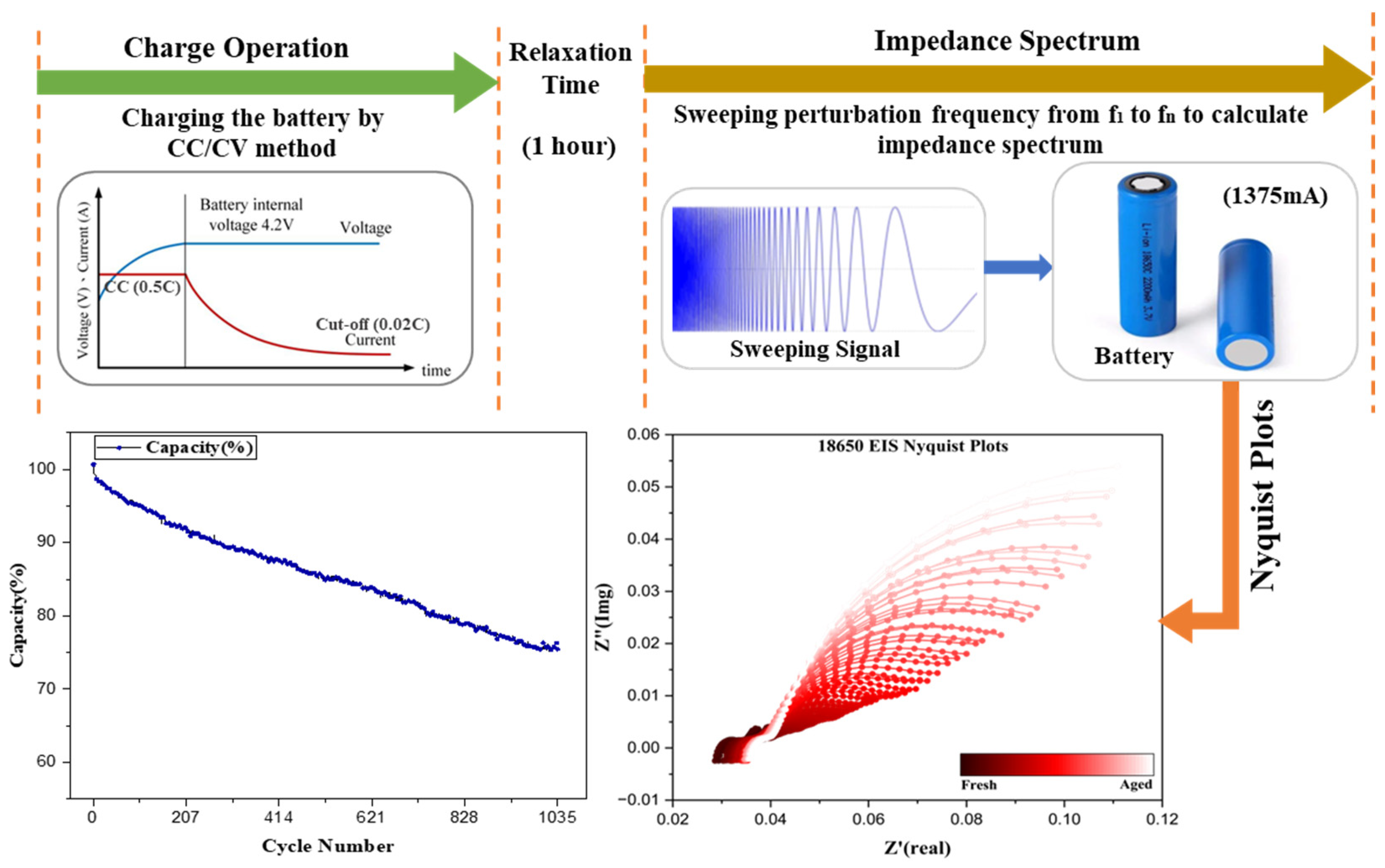
2. Data Acquisition During Battery Aging
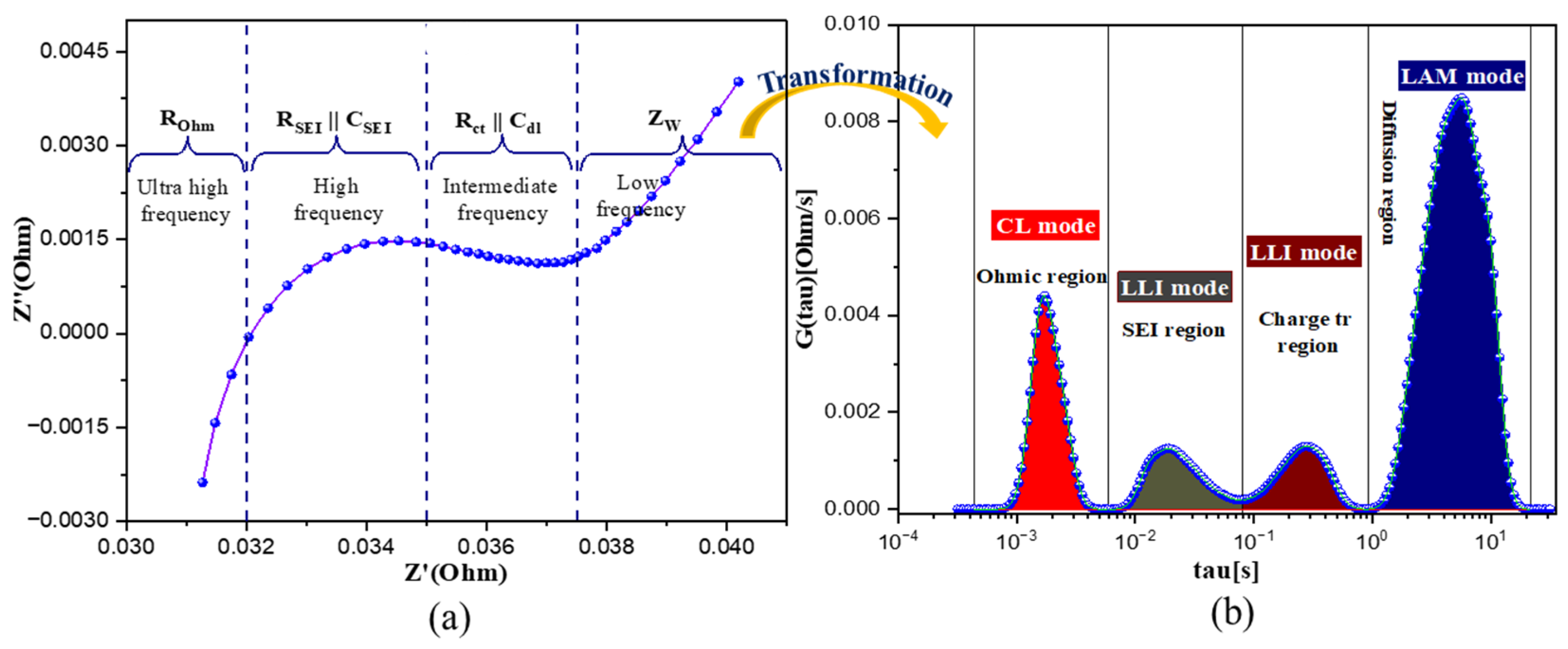
3. Distribution of Relaxation Time
4. Results and Analysis
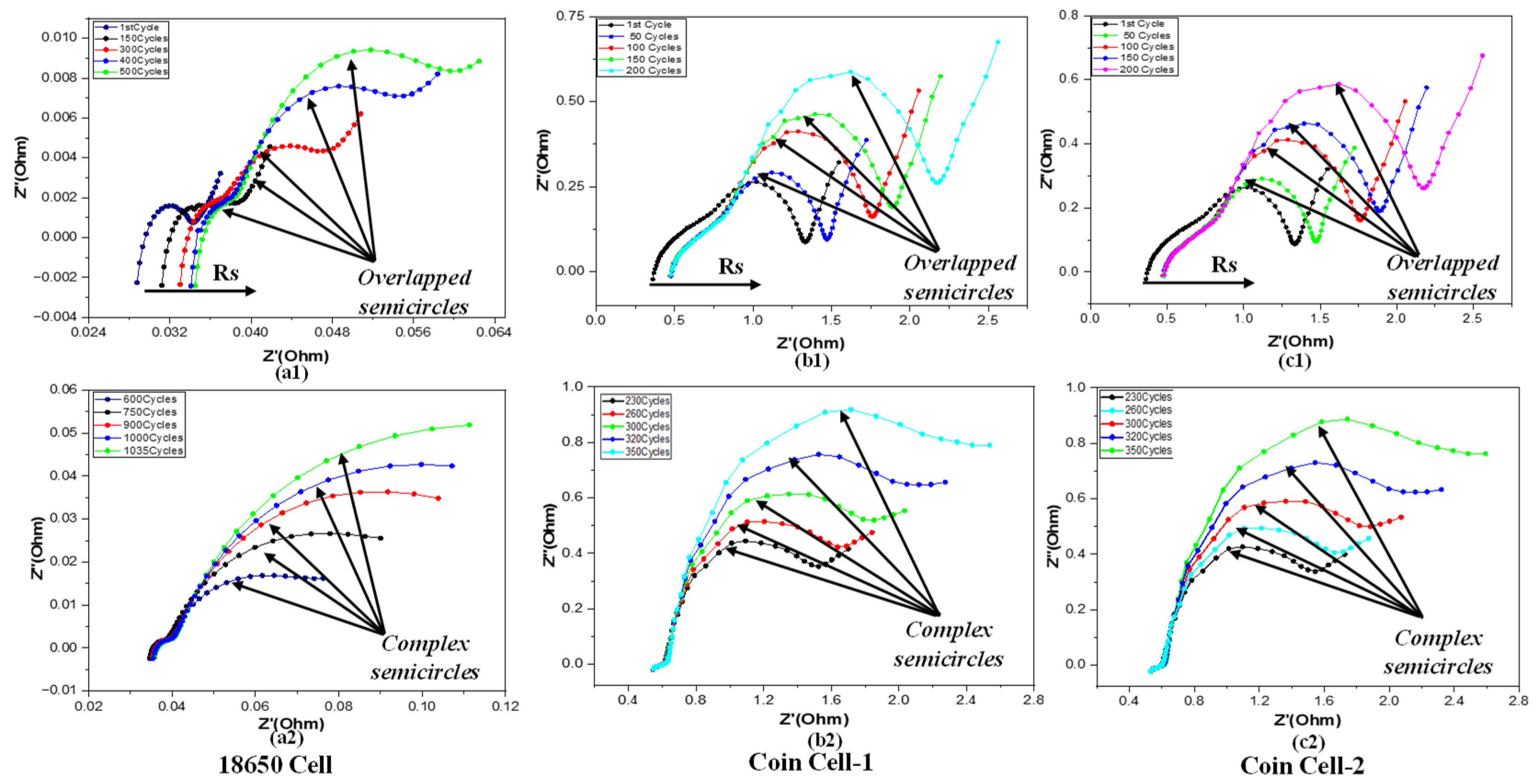
4.1. Evolution of Nyquist Plots over the Battery Life
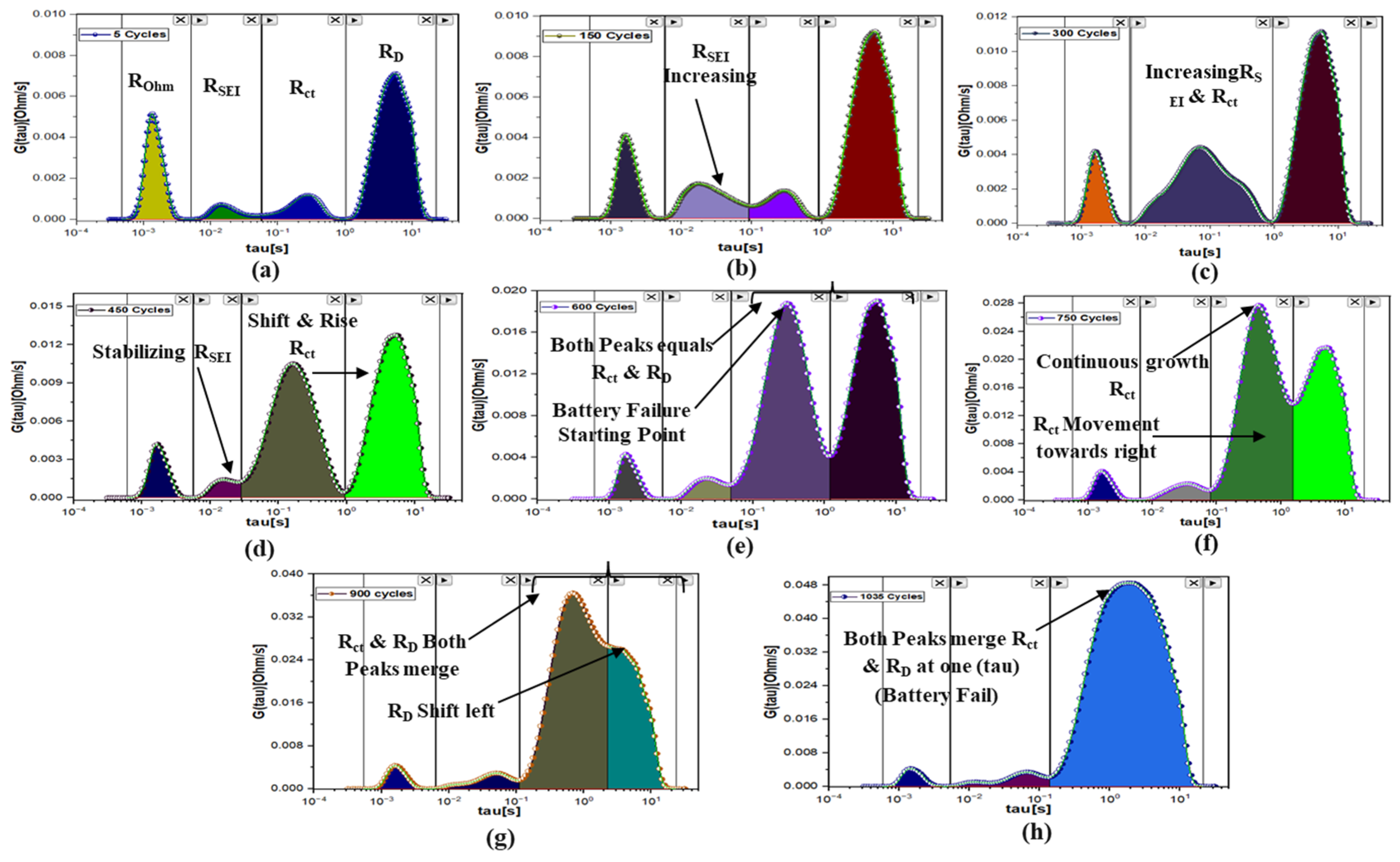
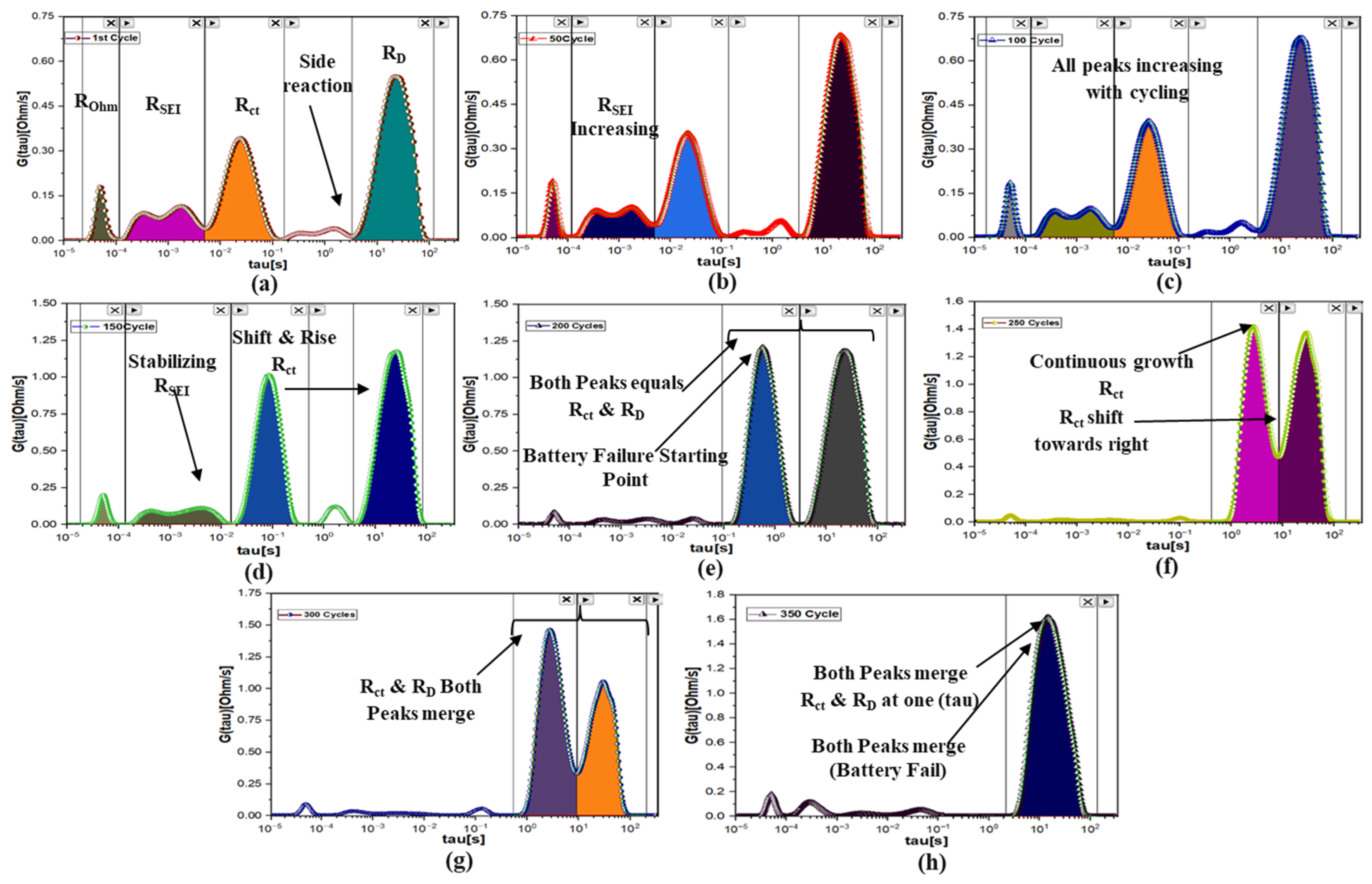
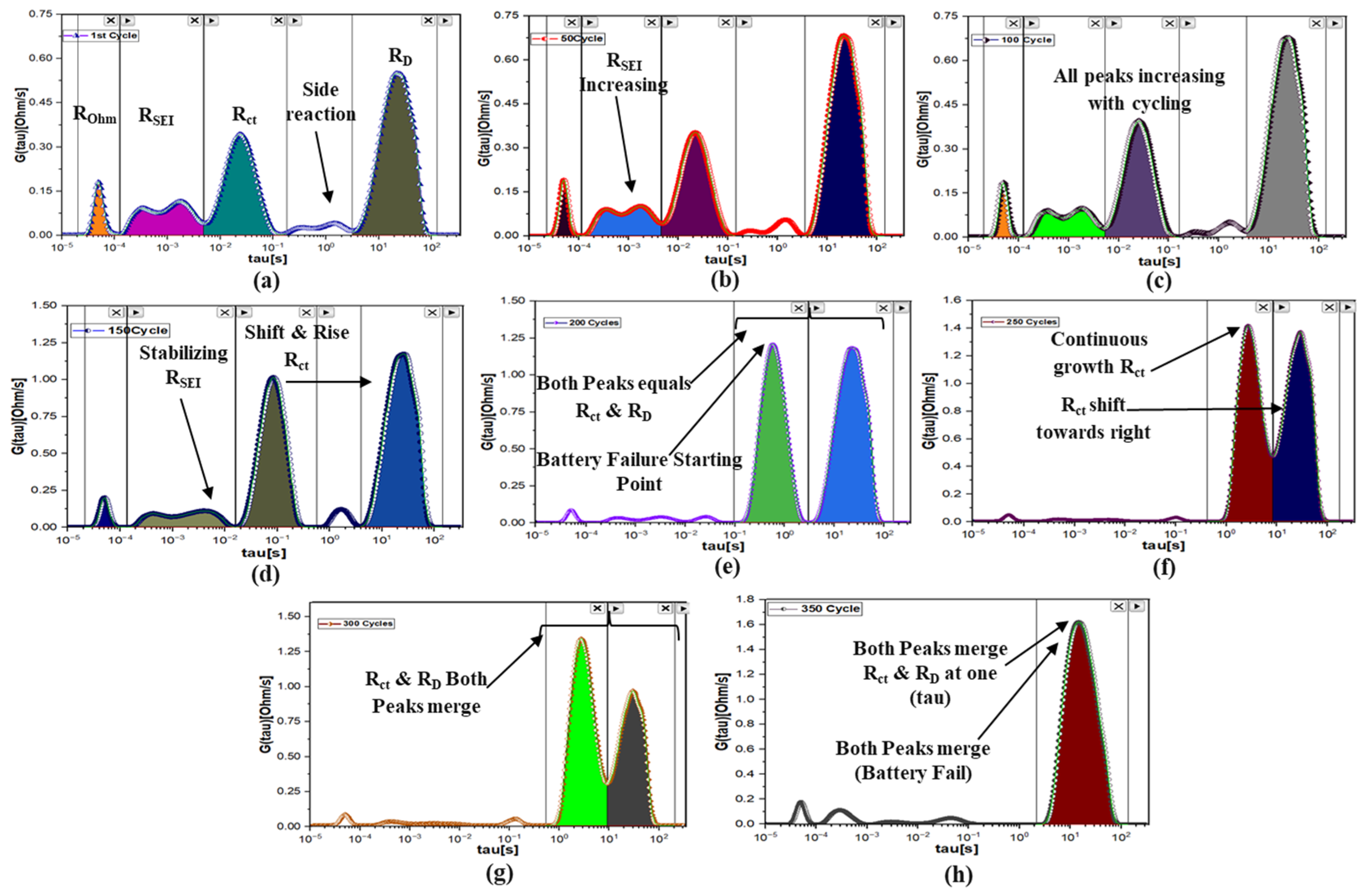
4.2. Evolution of DRT Plots over the Battery Life
5. Conclusions
Author Contributions
Funding
Data Availability Statement
Conflicts of Interest
References
- Bresser, D.; Hosoi, K.; Howell, D.; Li, H.; Zeisel, H.; Amine, K.; Passerini, S. Perspectives of automotive battery R&D in China, Germany, Japan, and the USA. J. Power Sources 2018, 382, 176–178. [Google Scholar] [CrossRef]
- Hu, X.; Liu, W.; Lin, X.; Xie, Y. A comparative study of control-oriented thermal models for cylindrical Li-ion batteries. IEEE Trans. Transp. Electrif. 2019, 5, 1237–1253. [Google Scholar] [CrossRef]
- Palacín, M.R.; de Guibert, A. Why do batteries fail? Science 2016, 351, 1253292. [Google Scholar] [CrossRef] [PubMed]
- Jafari, M.; Brown, L.E.; Gauchia, L. Hierarchical Bayesian model for probabilistic analysis of electric vehicle battery degradation. IEEE Trans. Transp. Electrif. 2019, 5, 1254–1267. [Google Scholar] [CrossRef]
- Guha, A.; Patra, A. State of health estimation of lithium-ion batteries using capacity fade and internal resistance growth models. IEEE Trans. Transp. Electrif. 2018, 4, 135–146. [Google Scholar] [CrossRef]
- Liu, K.; Hu, X.; Wei, Z.; Li, Y.; Jiang, Y. Modified Gaussian process regression models for cyclic capacity prediction of lithium-ion batteries. IEEE Trans. Transp. Electrif. 2019, 5, 1225–1236. [Google Scholar] [CrossRef]
- Sabet, P.S.; Sauer, D.U. Separation of predominant processes in electrochemical impedance spectra of lithium-ion batteries with nickel-manganese-cobalt cathodes. J. Power Sources 2019, 425, 121–129. [Google Scholar] [CrossRef]
- Perez, H.E.; Hu, X.; Dey, S.; Moura, S.J. Optimal charging of Li-ion batteries with coupled electro-thermal-aging dynamics. IEEE Trans. Veh. Technol. 2017, 66, 7761–7770. [Google Scholar] [CrossRef]
- Lin, X.; Perez, H.E.; Siegel, J.B.; Stefanopoulou, A.G.; Li, Y.; Anderson, R.D.; Ding, Y.; Castanier, M.P. Online parameterization of lumped thermal dynamics in cylindrical lithium ion batteries for core temperature estimation and health monitoring. IEEE Trans. Control. Syst. Technol. 2012, 21, 1745–1755. [Google Scholar] [CrossRef]
- Severson, K.A.; Attia, P.M.; Jin, N.; Perkins, N.; Jiang, B.; Yang, Z.; Chen, M.H.; Aykol, M.; Herring, P.K.; Fraggedakis, D.; et al. Data-driven prediction of battery cycle life before capacity degradation. Nat. Energy 2019, 4, 383–391. [Google Scholar] [CrossRef]
- Xiong, R.; Li, L.; Tian, J. Towards a smarter battery management system: A critical review on battery state of health monitoring methods. J. Power Sources 2018, 405, 18–29. [Google Scholar] [CrossRef]
- Wang, X.; Wei, X.; Chen, Q.; Zhu, J.; Dai, H. Lithium-ion battery temperature on-line estimation based on fast impedance calculation. J. Energy Storage 2019, 26, 100952. [Google Scholar] [CrossRef]
- Al Nazer, R.; Cattin, V.; Granjon, P.; Montaru, M.; Ranieri, M. Broadband identification of battery electrical impedance for HEVs. IEEE Trans. Veh. Technol. 2013, 62, 2896–2905. [Google Scholar] [CrossRef]
- Gantenbein, S.; Weiss, M.; Ivers-Tiffée, E. Impedance based time-domain modeling of lithium-ion batteries: Part I. J. Power Sources 2018, 379, 317–327. [Google Scholar] [CrossRef]
- Qahouq, J.A.A.; Xia, Z. Single-perturbation-cycle online battery impedance spectrum measurement method with closed-loop control of power converter. IEEE Trans. Ind. Electron. 2017, 64, 7019–7029. [Google Scholar] [CrossRef]
- Dam, S.K.; John, V. High-resolution converter for battery impedance spectroscopy. IEEE Trans. Ind. Appl. 2018, 54, 1502–1512. [Google Scholar] [CrossRef]
- Gaberšček, M. Understanding Li-based battery materials via electrochemical impedance spectroscopy. Nat. Commun. 2021, 12, 6513. [Google Scholar] [CrossRef] [PubMed]
- Sabet, P.S.; Warnecke, A.J.; Meier, F.; Witzenhausen, H.; Martinez-Laserna, E.; Sauer, D.U. Non-invasive yet separate investigation of anode/cathode degradation of lithium-ion batteries (nickel–cobalt–manganese vs. graphite) due to accelerated aging. J. Power Sources 2020, 449, 227369. [Google Scholar] [CrossRef]
- Liu, K.; Wang, Y.; Lai, X. Data Science-Based Full-Lifespan Management of Lithium-Ion Battery: Manufacturing, Operation and Reutilization; Springer: Berlin/Heidelberg, Germany, 2022; Available online: https://library.oapen.org/handle/20.500.12657/54032 (accessed on 30 November 2024).
- Plank, C.; Rüther, T.; Jahn, L.; Schamel, M.; Schmidt, J.P.; Ciucci, F.; Danzer, M.A. A review on the distribution of relaxation times analysis: A powerful tool for process identification of electrochemical systems. J. Power Sources 2024, 594, 233845. [Google Scholar] [CrossRef]
- Lu, Y.; Zhao, C.Z.; Huang, J.Q.; Zhang, Q. The timescale identification decoupling complicated kinetic processes in lithium batteries. Joule 2022, 6, 1172–1198. [Google Scholar] [CrossRef]
- Sohaib, M.; Choi, W. Investigation of the Aging Phenomena in Lithium-Ion Batteries Using Distribution of Relaxation Time Analysis. In Power Electronics Conference; Korean Institute of Power Electronics: Seoul, Republic of Korea, 2024; pp. 187–189. [Google Scholar]
- Danzer, M.A. Generalized distribution of relaxation times analysis for the characterization of impedance spectra. Batteries 2019, 5, 53. [Google Scholar] [CrossRef]
- Vadhva, P.; Hu, J.; Johnson, M.J.; Stocker, R.; Braglia, M.; Brett, D.J.L.; Rettie, A.J.E. Electrochemical Impedance Spectroscopy for All-Solid-State Batteries: Theory, Methods and Future Outlook. ChemElectroChem 2021, 8, 1930–1947. [Google Scholar] [CrossRef]
- Zhu, J.; Knapp, M.; Liu, X.; Yan, P.; Dai, H.; Wei, X.; Ehrenberg, H. Low-temperature separating lithium-ion battery interfacial polarization based on distribution of relaxation times (DRT) of impedance. IEEE Trans. Transp. Electrif. 2021, 7, 410–421. [Google Scholar] [CrossRef]
- Danzer, M.A.; Plank, C.; Rüther, T. Electrochemical system analysis from impedance data to system identification. Cell Rep. Phys. Sci. 2024, 5, 102091. [Google Scholar] [CrossRef]
- Zhang, Y.; Tang, Q.; Zhang, Y.; Wang, J.; Stimming, U.; Lee, A.A. Identifying degradation patterns of lithium ion batteries from impedance spectroscopy using machine learning. Nat. Commun. 2020, 11, 1706. [Google Scholar] [CrossRef]
- Li, X.; Ahmadi, M.; Collins, L.; Kalinin, S.V. Deconvolving distribution of relaxation times, resistances and inductance from electrochemical impedance spectroscopy via statistical model selection: Exploiting. Electrochim. Acta 2019, 313, 570–583. [Google Scholar] [CrossRef]
- Macdonald, J.; Johnson, W.; Raistrick, I. Impedance Spectroscopy: Theory, Experiment, and Applications; John Wiley & Sons: Hoboken, NJ, USA, 2018; Available online: https://elib.dlr.de/121440/ (accessed on 30 November 2024).
- Bakushinsky, A.; Smirnova, A. A study of frozen iteratively regularized Gauss-Newton algorithm for nonlinear ill-posed problems under generalized normal solvability condition. J. Inverse Ill-Posed Probl. 2020, 28, 275–286. [Google Scholar] [CrossRef]
- Sohaib, M.; Akram, A.S.; Choi, W. Analysis of Aging and Degradation in Lithium Batteries Using Distribution of Relaxation Time. Batteries 2025, 11, 34. [Google Scholar] [CrossRef]
- Maradesa, A.; Py, B.; Huang, J.; Lu, Y.; Iurilli, P.; Mrozinski, A.; Law, H.M.; Wang, Y.; Wang, Z.; Li, J.; et al. Advancing electrochemical impedance analysis through innovations in the distribution of relaxation times method. Joule 2024, 8, 1958–1981. [Google Scholar] [CrossRef]
- Meddings, N.; Heinrich, M.; Overney, F.; Lee, J.-S.; Ruiz, V.; Napolitano, E.; Seitz, S.; Hinds, G.; Raccichini, R.; Gaberšček, M.; et al. Application of electrochemical impedance spectroscopy to commercial Li-ion cells: A review. J. Power Sources 2020, 480, 228742. [Google Scholar] [CrossRef]
- Zhou, X.; Pan, Z.; Han, X.; Lu, L.; Ouyang, M. An easy-to-implement multi-point impedance technique for monitoring aging of lithium ion batteries. J. Power Sources 2019, 417, 188–192. [Google Scholar] [CrossRef]
- Unachukwu, I.D.; Vibhu, V.; Vinke, I.C.; Eichel, R.-A.; de Haart, L. Electrochemical and degradation behaviour of single cells comprising Ni-GDC fuel electrode under high temperature steam- and co-electrolysis conditions. J. Power Sources 2023, 556, 232436. [Google Scholar] [CrossRef]
- Edge, J.S.; O’kAne, S.; Prosser, R.; Kirkaldy, N.D.; Patel, A.N.; Hales, A.; Ghosh, A.; Ai, W.; Chen, J.; Yang, J.; et al. Lithium ion battery degradation: What you need to know. Phys. Chem. Chem. Phys. 2021, 23, 8200–8221. [Google Scholar] [CrossRef] [PubMed]
- Sohaib, M.; Choi, W. Evaluating EV Batteries Status Without Historical Data Using Distribution of Relaxation Time Method. TechRxiv 2025. [Google Scholar] [CrossRef]
- Kabra, V.; Parmananda, M.; Fear, C.; Usseglio-Viretta, F.L.E.; Colclasure, A.; Smith, K.; Mukherjee, P.P. Mechanistic analysis of microstructural attributes to lithium plating in fast charging. ACS Appl. Mater. Interfaces 2020, 12, 55795–55808. [Google Scholar] [CrossRef]
- Vishnugopi, B.S.; Verma, A.; Mukherjee, P.P. Fast charging of lithium-ion batteries via electrode engineering. J. Electrochem. Soc. 2020, 167, 090508. [Google Scholar] [CrossRef]
- Sohaib, M.; Choi, W. A Novel Aging Diagnosis Method Using Distribution of Relaxation Time. In Power Electronics Conference; Korean Institute of Power Electronics: Seoul, Republic of Korea, 2024; pp. 46–48. [Google Scholar]
- Sarkar, A.; Nlebedim, I.C.; Shrotriya, P. Performance degradation due to anodic failure mechanisms in lithium-ion batteries. J. Power Sources 2021, 502, 229145. [Google Scholar] [CrossRef]



| Property | Value |
|---|---|
| Chemistry | Nickel Manganese Cobalt |
| Type | 18650 |
| Maximum Capacity | 2850 mAh |
| Nominal voltage | 3.65 V |
Disclaimer/Publisher’s Note: The statements, opinions and data contained in all publications are solely those of the individual author(s) and contributor(s) and not of MDPI and/or the editor(s). MDPI and/or the editor(s) disclaim responsibility for any injury to people or property resulting from any ideas, methods, instructions or products referred to in the content. |
© 2026 by the authors. Licensee MDPI, Basel, Switzerland. This article is an open access article distributed under the terms and conditions of the Creative Commons Attribution (CC BY) license.
Share and Cite
Sohaib, M.; Akram, A.S.; Choi, W. Identifying Failure Conditions in Li-Ion Batteries Using Distribution of Relaxation Time Method. Appl. Sci. 2026, 16, 2469. https://doi.org/10.3390/app16052469
Sohaib M, Akram AS, Choi W. Identifying Failure Conditions in Li-Ion Batteries Using Distribution of Relaxation Time Method. Applied Sciences. 2026; 16(5):2469. https://doi.org/10.3390/app16052469
Chicago/Turabian StyleSohaib, Muhammad, Abdul Shakoor Akram, and Woojin Choi. 2026. "Identifying Failure Conditions in Li-Ion Batteries Using Distribution of Relaxation Time Method" Applied Sciences 16, no. 5: 2469. https://doi.org/10.3390/app16052469
APA StyleSohaib, M., Akram, A. S., & Choi, W. (2026). Identifying Failure Conditions in Li-Ion Batteries Using Distribution of Relaxation Time Method. Applied Sciences, 16(5), 2469. https://doi.org/10.3390/app16052469