1. Introduction
Offshore wind energy plays a key role in the transition towards sustainable power generation, particularly in deep-water environments where bottom-fixed solutions are not economically viable [
1,
2,
3]. In this context, floating offshore wind turbines (FOWTs) require reliable numerical models capable of accurately capturing their coupled dynamic behaviour [
4,
5,
6].
A major challenge in the hydrodynamic modelling of floating marine structures is achieving an appropriate balance between fidelity and computational efficiency, especially during preliminary design stages [
7,
8,
9,
10,
11]. For this reason, reduced-order time-domain models based on potential flow theory [
12,
13] are widely adopted in engineering practice, while high-fidelity computational fluid dynamics (CFD) approaches [
14,
15,
16,
17] remain computationally demanding. These simplified lumped-parameter models, derived from Cummins’ formulation [
18,
19], incorporate added mass and radiation damping obtained from boundary element method (BEM) solvers. However, potential-flow formulations do not account for viscous effects, which must be introduced through additional linear and nonlinear damping terms. Quantifying dissipative contributions remains particularly challenging due to the coexistence of multiple mechanisms, in addition to linear radiation damping, including viscous boundary layer effects (skin friction), nonlinear drag induced by flow separation and vortex shedding, and mooring line damping. Inaccurate estimation of these coefficients may lead to significant discrepancies in the prediction of resonant responses and global loads.
The critical role of linear and non-linear damping has been a primary focus of the international Offshore Code Comparison Collaboration (OC) projects. Whilst the OC4 initiative [
20] established a robust benchmark for the numerical verification of semi-submersible platforms, it was the subsequent OC5 project [
21] that first quantified systematic discrepancies between numerical predictions and experimental wave basin data, attributing these errors to the inadequate representation of viscous effects at surge and pitch resonant frequencies. To mitigate these uncertainties, the OC6 project [
22] demonstrated that traditional potential-flow models corrected with only diagonal damping terms often fail to predict low-frequency resonant responses. This ongoing effort is currently extended within the OC7 project [
23], which targets the reduction of modelling uncertainties through sea-state-dependent modelling of hydrodynamic viscous drag and damping, but still relies on diagonal damping matrices.
The standard practice for identifying the damping parameters relies on free-decay tests, analysed through established techniques ranging from the classical logarithmic decrement method for linear systems [
24] to the widely adopted PQ method [
25] and its variations [
26,
27,
28,
29] for estimating linear and quadratic damping terms. However, although the PQ method is a widely accepted standard, it exhibits inherent limitations. Primarily, it is formulated for single-degree-of-freedom (1-DoF) systems, operating under the assumption that the motion is uncoupled. As a result, it has traditionally been applied to experimental or numerical tests performed in a decoupled manner, i.e., imposing an initial perturbation along a single DoF, thus failing to capture the effects of motion coupling inherent in floating platforms (e.g., the surge–pitch coupling in semi-submersible platforms). Furthermore, the PQ method may be sensitive to signal processing choices, such as the filtering of the time series and the selection of the specific signal window, which can introduce subjectivity into the results. To overcome the latter limitation, automated optimisation aimed at damping identification through genetic algorithm (GA) [
30,
31,
32], global pattern search algorithm [
33], covariance-driven stochastic subspace identification [
34], and operational modal analysis [
35]. In addition, high-fidelity strategies based on CFD results were proposed for Morison’s damping calibration [
36,
37]. Finally, Srinivas et al. [
38] populated global quadratic drag matrices by processing free-decay signals through both the PQ [
25] and Faltinsen’s [
26] methods to better represent rotational damping.
Despite their methodological differences, all these approaches are formulated within a diagonal damping framework, thus neglecting the influence of cross-coupling terms on energy dissipation. Consequently, they fail to capture the complex coupled dynamics that characterise real-world semi-submersible structures, where viscous forces associated with one degree of freedom may contribute to dissipative forces or moments in another, giving rise to off-diagonal damping coefficients. Nevertheless, these cross-coupling terms are typically neglected in reduced-order models, hence, their influence on the predicted coupled response of floating platforms therefore remains largely unexplored.
To address this gap and capture the coupling effects between degrees of freedom on damping identification, this paper proposes a novel identification procedure capable of estimating, for the first time, the off-diagonal linear and quadratic damping parameters for a multi-degree-of-freedom (multi-DoF) lumped-parameter model, enabling the assessment of their impact on motion prediction. The proposed method combines a genetic algorithm with a gradient-based (GB) solver to formulate the identification as a minimisation problem. The objective is to determine the optimal set of damping parameters that minimises the error between the response of the lumped-parameter model and the reference data. A similar algorithm was adopted in [
31,
32] but for a decoupled 1-DoF model, thus neglecting any coupling effect between motions.
The proposed procedure is applied to a scaled model of a taut-leg moored semi-submersible floating structure designed for offshore wind applications. The experimental dataset, obtained from [
39], reveals inherent static and dynamic coupling between surge and pitch motions; thus, this work focuses on the interaction between these two modes. The results of the identification performed with the new procedure are compared against those obtained via the traditional PQ method, utilising both experimental and CFD free-decay tests as reference data. Besides traditional decoupled free-decay tests, the PQ method and the new procedure have been applied to a coupled decay test, where both surge and pitch motion have been significantly excited.
Furthermore, given the generality of the proposed procedure that can be used to identify any hydrodynamic parameter, this study also considers the possibility of calibrating the added mass matrix concurrently with the identification of damping parameters. This approach aims to compensate for any discrepancy in inertial and stiffness properties between the physical and the simulated model so as to enhance the accuracy of the identification process.
The remainder of this paper is organised as follows:
Section 2 provides an overview of the lumped-parameter modelling used in mid-fidelity models based on potential flow theory, corrected with linear and quadratic damping coefficients to also account for non-linear viscous phenomena. Additionally, the PQ method is presented as the most widespread technique for identifying these damping parameters from experimental tests.
Section 3 details the new damping parameters identification procedure, adapted for a two-degree-of-freedom model.
Section 4 describes the FOWT structure analysed as a case study and outlines the acquisition of the reference free-decay tests, using both experimental and CFD data. Finally,
Section 5 presents and discusses the results of this study, and
Section 6 provides the concluding remarks.
3. Novel Multi-DoF Procedure for Damping Parameters Identification
This section presents the novel damping parameter identification procedure, explicitly accounting for the coupling between motions. Since most floating structures exhibit relevant dynamic coupling only between a limited number of degrees of freedom the proposed identification procedure focuses on coupled dynamic models involving two DoFs. However, the procedure is inherently extensible to systems with more DoFs dimensionality if necessary.
The full six-degree-of-freedom formulation of Equation (3) reduces to the following 2-DoF formulation:
where
is the inertial matrix, including both structural mass
and added mass
:
Solving the non-linear second-order system in Equation (9) requires initial conditions for and , together with the constant coefficients , , , and . The inertia and stiffness matrices can be assembled from the floater geometry and design properties. In particular, the added mass is defined by the body geometry and is obtained through BEM calculations. In contrast, the viscous damping coefficients are not provided by potential-flow models and must be identified from free-decay data.
For this reason, Equation (9) is embedded in an optimisation procedure that estimates the matrices and by minimising the normalised root mean square error (NRMSE) between the simulated responses and , computed by numerical integration of Equation (9) and the corresponding reference signals and obtained from free-decay tests, either experimental or generated with CFD.
The NRMSE for a single test, where the reference signals
and
are recorded over
time steps, is defined as follows:
To enhance the repeatability and accuracy of the identified damping parameters, multiple free-decay tests can be considered simultaneously as reference data. In such cases, the global objective function to be minimised is the average NRMSE across all
tests:
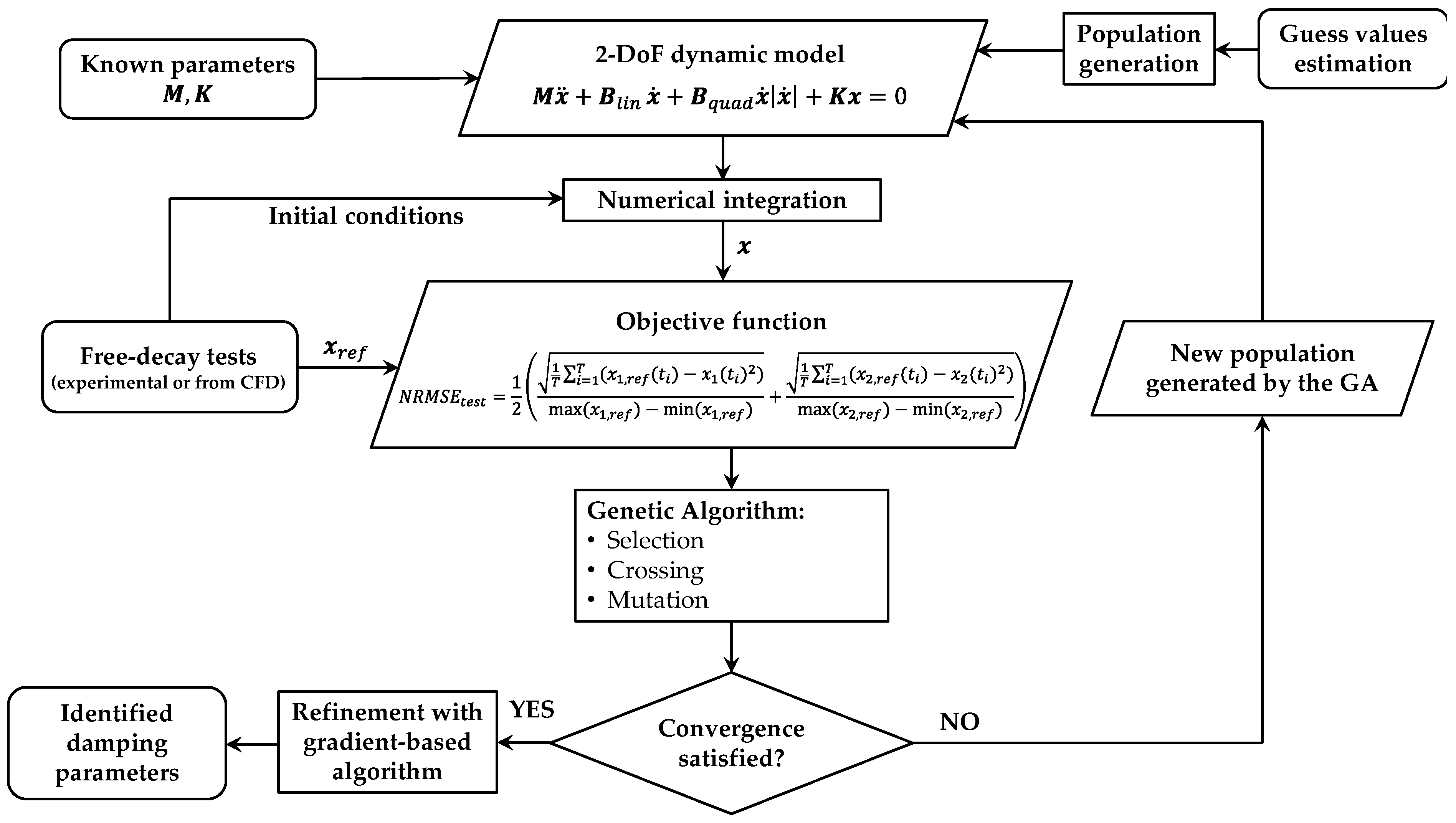
To solve this optimisation problem, a two-stage hybrid process is employed. First, a genetic algorithm [
40] is utilised to perform rapid global exploration of the solution space. The GA is particularly effective for providing a robust initial guess, especially when little prior knowledge of the parameters is available. Upon completion of the evolutionary phase, the best individual is selected. Subsequently, this candidate serves as the starting point for the second stage: a gradient-based local optimisation algorithm implemented using the interior point method. This refinement phase improves the convergence and precision of the parameter estimation. This hybrid combination significantly enhances the robustness of the identification procedure compared to the sole use of a non-linear programming solver, which is often sensitive to the initial guess and prone to stagnation in local minima.
Figure 1 illustrates the flowchart of the proposed identification algorithm.
It is worth noting that the proposed identification procedure provides a flexible framework that can be extended to any hydrodynamic parameter. The proposed methodology is widely applicable to various floating structures—not only FOWTs but to any floating body. Depending on the geometric characteristics and mooring configurations, the procedure can be tailored to identify the specific motions exhibiting the most significant coupling for each individual case.
4. Case Study on a Floating Offshore Wind Turbine
The damping identification procedure proposed in this work is applied to a specific floating structure for an offshore wind turbine, which was the subject of an extensive experimental campaign detailed in Niosi et al. [
39]. The reference platform is the DeepCwind semi-submersible platform [
20], designed to support the NREL 5 MW reference wind turbine [
41].
The platform consists of a steel semi-submersible structure featuring a central column, supporting the tower and the nacelle, and connected to three offset columns by a network of pontoons and cross-braces, which provide the necessary stability.
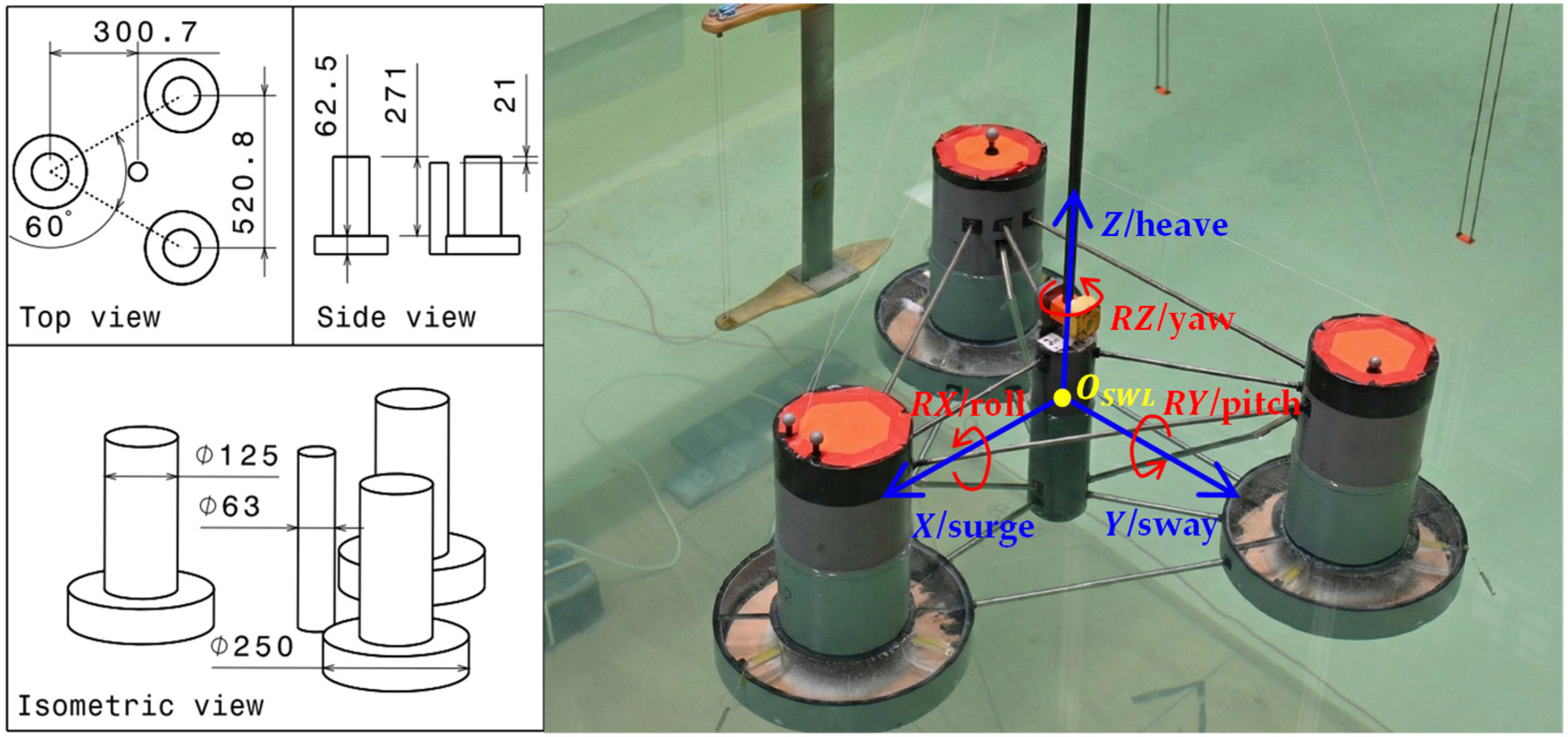
Figure 2 shows the 1:96 Froude-scaled model used in the experimental campaign. The main geometric and inertial properties of the prototype are summarised in
Table 1. Further details can be found in Niosi et al. [
39].
The mooring system comprises three lines arranged symmetrically with a 120° offset and connected to the fairleads located on the top part of the heave plates of the outer columns. The platform considered in this study is anchored via a taut-leg mooring system. This solution was chosen for its potential to reduce costs and seafloor footprint compared to traditional catenary systems. A defining characteristic of this semi-submersible platform, particularly with its taut-leg mooring, is the significant hydrodynamic coupling between different DoFs of motion. In particular, primarily because of the mooring-induced off-diagonal terms in the system’s stiffness matrix, the surge and pitch motions are strongly coupled, as evidenced in [
31,
32,
39].
For the purpose of this study, the multi-DoF damping identification procedure is performed using datasets obtained from both experimental free-decay tests and high-fidelity CFD simulations performed on this specific platform configuration.
4.1. Experimental Free-Decay Test
To perform free-decay tests and the other operative and extreme conditions reported in [
39], the 1:96 Froude-scaled model of the DeepCwind platform shown in
Figure 2 was constructed as a single rigid body that replicates the inertial and geometric properties of the full-scale system. To correctly reproduce the axial stiffness of the synthetic fibre ropes proposed for the taut-leg design at this reduced scale, the physical mooring lines were realised using coil springs connected to rigid polyester lines [
39]. This hybrid setup ensures that the restoring forces are scaled despite the small physical dimensions.
The tests were conducted in a wave basin measuring 85 m in length and 2.76 m in width, with a maximum water depth of 1.25 m. The water level was set to 1.042 m to represent the full-scale site depth of 100 m.
The dataset considered for the identification procedure focuses free-decay tests in calm water. To be consistent with standard identification techniques (such as the PQ method), these tests were designed to be “decoupled” [
39]. Hence, the platform was initially displaced or rotated in a single degree of freedom while ensuring minimal initial perturbation in the other modes and then released to oscillate freely. The 6-DoF motions were recorded using an optical tracking system equipped with reflective markers placed on the model. The recorded motion signals were processed using a low-pass filter with a cutoff frequency of 1.5 Hz. This threshold was selected as it is sufficiently higher than the natural frequencies of all the recorded motions; specifically, the highest natural frequency corresponds to the heave motion at approximately 0.6 Hz, while surge and pitch exhibit natural frequencies of roughly 0.1 Hz and 0.4 Hz, respectively.
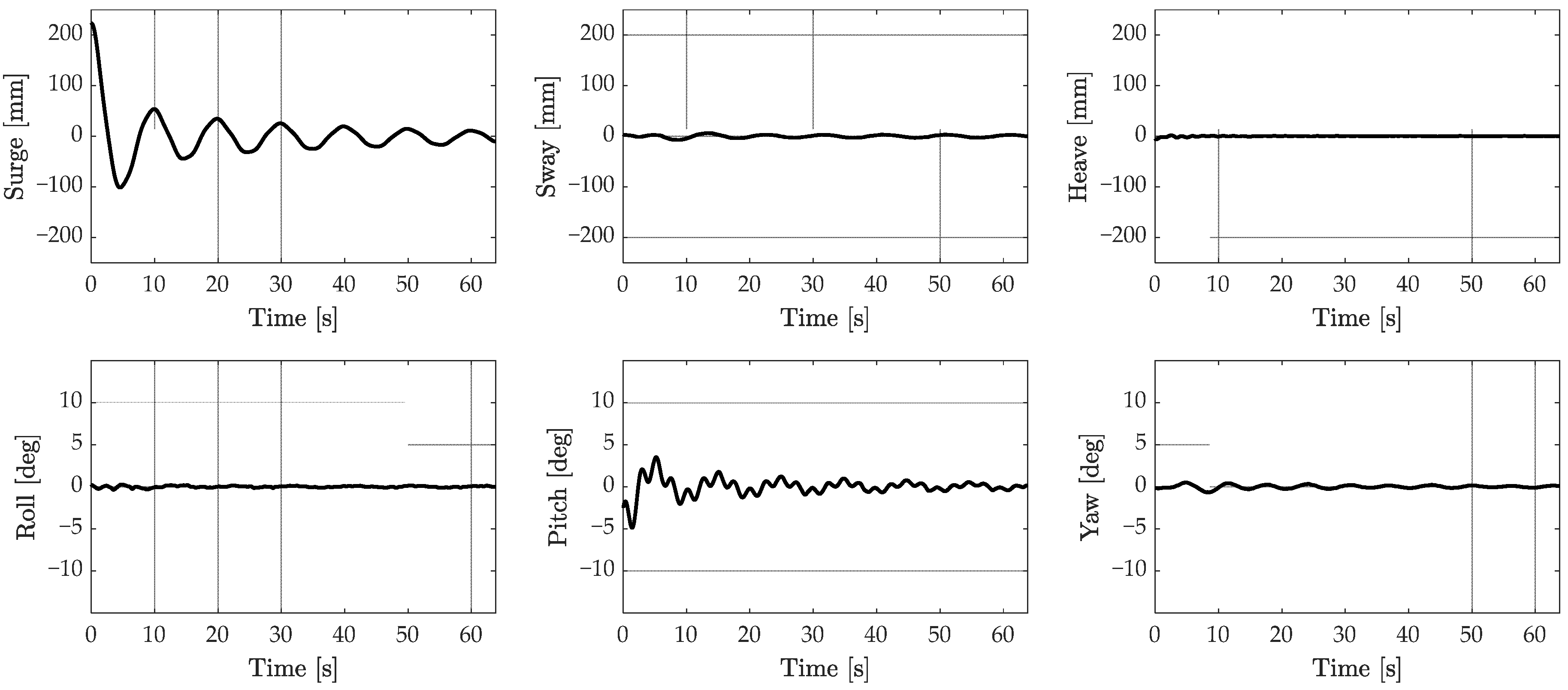
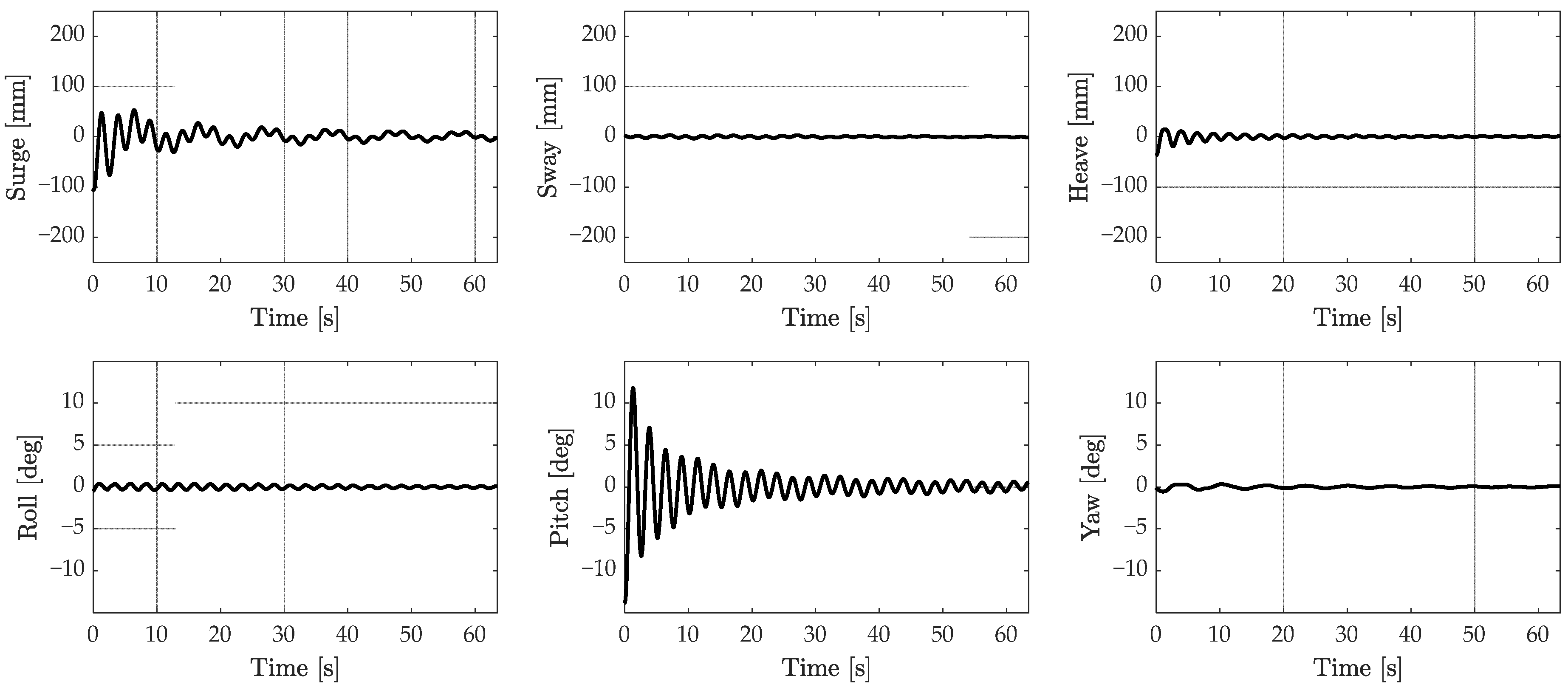
Figure 3 illustrates the recorded time histories for the surge free-decay test, while
Figure 4 presents the corresponding results for the pitch test. All the motions are reported here with respect to the still water level (SWL) system.
From these figures, it is apparent that, due to motion coupling effects, an initial displacement in pure surge unavoidably induced a dynamic response in the pitch motion and vice versa. However, in the described experimental conditions, the directly excited degree of freedom (defined here as the primary motion) exhibits large oscillations, whereas the motion induced solely by coupling (the secondary motion) remains significantly smaller. Consequently, the secondary signal is more susceptible to measurement noise or undesired external alteration of the water state, which could compromise the accurate identification of the cross-coupling damping terms. To overcome this limitation, a dedicated CFD simulation was implemented. In this numerical scenario, significant initial displacements were applied simultaneously to both surge and pitch, ensuring that both signals possessed comparable energy levels. The setup of the CFD numerical model is detailed in
Section 4.2.
4.2. CFD Model
The CFD simulations were performed in Simcenter STAR CCM+ [
42] using the same numerical framework adopted in [
43]. The incompressible Reynolds averaged Navier–Stokes (RANS) equations are solved with a k-ε turbulence closure [
44], and the air–water interface is captured through a volume of fluid model [
45]. The rigid body dynamics are handled through the dynamic fluid body interaction model [
46] in a two-region setup, comprising a background region, called numerical wave tank (NWT), and an overset region enclosing the hull and moving with the body. This approach enables rigid body motion without remeshing. In the present case study, the body is moored and free to move in surge and pitch only, while the remaining DoFs are constrained. The body is located at the NWT centre, with 2.5 m clearance in the
and
directions and 2.5 m in the
direction; a symmetry plane is imposed at
= 0.
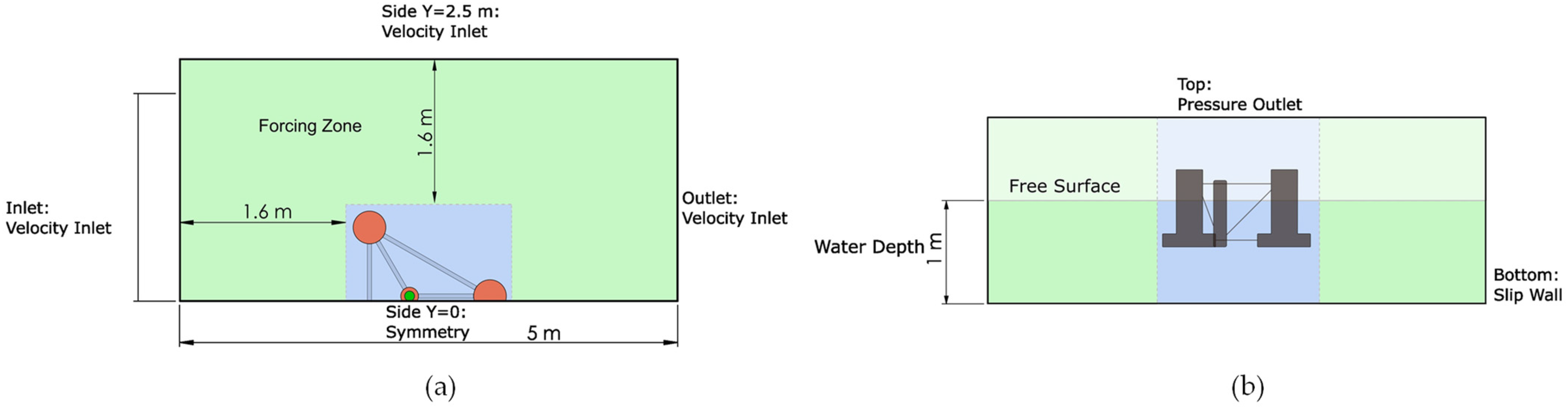
Figure 5 summarises the numerical and physical setup of the numerical wave tank and the adopted boundary conditions. In plan view, the body is placed at the domain centre, and the lateral boundaries are defined as velocity inlets, while the symmetry plane at
= 0 reduces the computational domain. In the vertical plane, the initial still-water level defines a 1 m water depth, with a pressure outlet at the top boundary to allow air phase ventilation and a slip wall condition at the bottom boundary. The forcing zones highlighted in the figure indicate the regions where the solution is progressively relaxed towards the calm-water reference state to minimise boundary-induced reflections during the free decay response.
Since no incident waves are generated, domain dimensions and mesh setup are not tied to a wavelength and are selected to avoid boundary interference with the body response. To limit spurious reflections and dissipate the radiated waves generated during the free decay, the external boundaries are relaxed towards a calm water reference state through a forcing zone acting on both momentum and mass. The forcing region is 1.6 m long and uses a cos
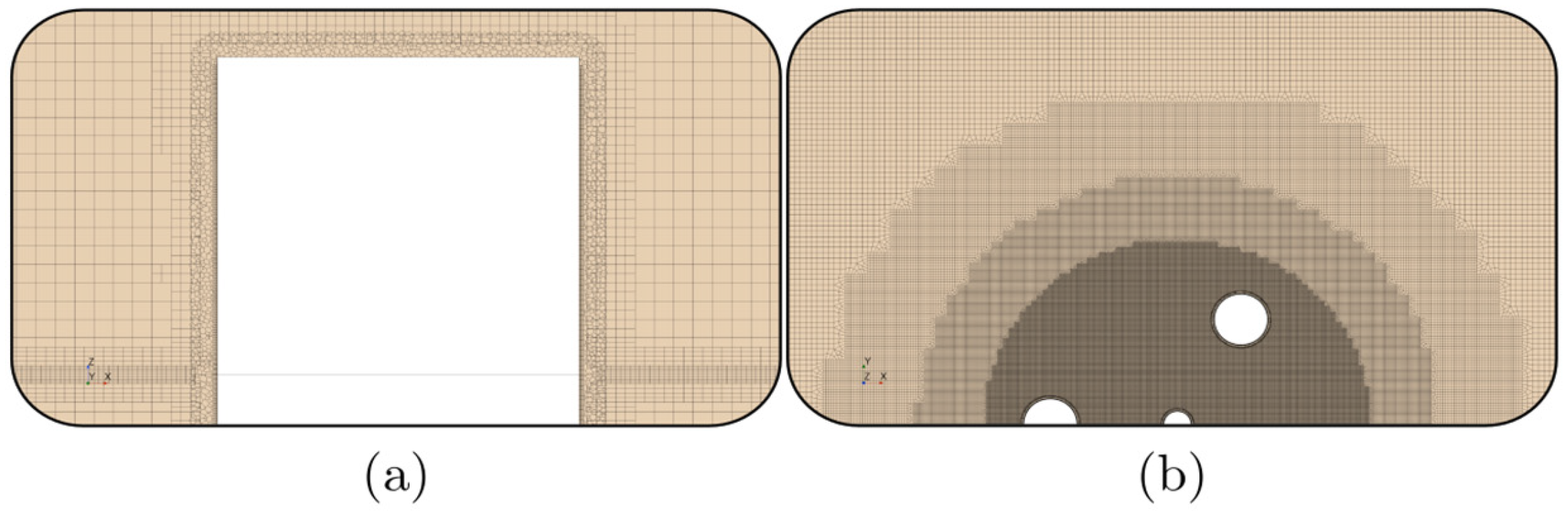
2 blending function, equal to 1 at the boundary and 0 at the end of the forcing zone. Importantly, the NWT region is rigidly translated with the instantaneous surge velocity of the body, keeping the hull close to the domain centre and limiting the portion of the domain that must be refined to ensure a robust overset interface. The mesh consists of a trimmed grid for the NWT and a polyhedral grid for the overset, with near wall refinement provided by the prism layer mesher, as seen in
Figure 6a, to ensure a mean Y+ over the wetted surface of 50. Concentric refinements are introduced in the background region to progressively increase resolution towards the hull and the overset interface (
Figure 6b). Adaptive mesh refinement (AMR) [
47] is employed to locally increase resolution where required: at prescribed intervals, AMR refines the cells in the vicinity of the overset interface and the air water interface by reducing the local cell size while preserving smooth transitions between refinement levels to avoid numerical artifacts.
After AMR, the mesh contains approximately 4M cells in the NWT and 1M cells in the overset region. The smallest trimmed cell is 0.8 mm in
and 1.6 mm in
and
. In the overset region, the characteristic cell size is approximately 1.5 mm, with a near wall target size of 1 mm. Time integration is performed using a second-order scheme with a constant time step
= 0.003 s, resulting in a maximum Courant number of about 0.3 at the beginning of the simulation and decreasing below 0.2 as the motion decays. The overall modelling approach has been previously assessed in [
11], where the same CFD methodology was validated against experimental free-decay tests in 1-DoF configurations.
5. Results and Discussion
This section presents and discusses a comprehensive comparison between the results obtained using the traditional damping identification procedure based on the PQ method (
Section 2.2) and the proposed 2-DoF procedure (
Section 3). The analysis is applied to three distinct free-decay tests performed on the floating platform described in
Section 4: two experimental tests and one CFD simulation. Given the focus on evaluating the coupling between pitch and surge motions, the discussion is limited to these degrees of freedom. Consequently, referring to the formulation in Equation (9), the state vector is defined as
.
Table 2 summarises the known system properties used as input for both procedures, derived from experimental measurements and BEM simulations based on potential flow theory performed in OrcaWave [
48]. All the data and results presented in this section refer to the scaled model rather than the full-scale platform and are expressed with respect to the SWL system. Additionally, the average natural periods were preliminarily calculated from the experimental and CFD data, which resulted in 10.2 s for surge and 2.5 s for pitch.
All the identification procedures yielding the results presented herein were conducted in MATLAB R2022b [
49], employing the built-in
ga function for the genetic algorithm and
fmincon based on the interior-point method for the gradient-based approach. The function
ode45 was used for integrating the differential equations. The genetic algorithm was implemented with a population size of 200 individuals and a maximum of 300 generations. Convergence was assumed when the variation of the objective function fell below 1 × 10
−4, with a maximum of 20 stall generations permitted. An elitism strategy preserving 5% of the best individuals was adopted, with a crossover fraction of 0.66 and a constraint tolerance of 1 × 10
−3. The best candidate solution obtained from the GA was subsequently refined using
fmincon. The local optimisation was terminated when the optimality tolerance reached 1 × 10
−6, with a step tolerance of 1 × 10
−8. Default settings were retained for the remaining solver parameters. The computational performance of the identification procedure was assessed on a notebook equipped with an AMD Ryzen 7 5825U CPU and 16 GB RAM. The genetic algorithm was executed using parallel computing with eight workers. For the 2-DoF identification problem considered in this study, the average wall-clock time required for a single optimisation run was approximately 15–20 min.
To the authors’ knowledge, this study represents the first attempt to explicitly include and analyse motion coupling within the viscous damping matrices of a multi-DoF lumped-parameter model. Consequently, since no prior specific study exists regarding the symmetry of these matrices, both symmetric and asymmetric forms are preliminarily explored for
and
. Particular attention is also given to the added mass matrix
. Initially, the
matrix considered is the one reported in
Table 2, obtained through potential flow simulations. However, as shown in
Section 5.2, the results obtained with this assumption exhibit temporal phase shifts between the simulated and reference signals, suggesting potential mismatches between the inertial and stiffness properties of the BEM model and those of the experimental and CFD models. Such discrepancies could compromise the calculation of the NRMSE to be minimised by the proposed identification algorithm. Therefore, in
Section 5.3, the identification procedure was repeated by including the added mass as a free parameter to be calibrated from both the experimental and CFD datasets. This approach allows us to minimise the shift between numerical and experimental resonant periods estimation.
The remainder of this section is organised as follows:
Section 5.1 presents the identification of linear and quadratic damping parameters using the PQ method;
Section 5.2 compares the results of the PQ method with those obtained from the new procedure, hereafter referred to as GA+GB, while considering the added mass as a known parameter from potential flow theory; and finally,
Section 5.3 presents and discusses the results obtained, considering the added mass as a free parameter to be identified.
5.1. Identification of Damping Parameters via PQ Method
The results reported in this section represent the common standard for damping parameter identification procedures. Specifically, the PQ method was applied to the decoupled free-decay experimental tests for surge and pitch described in
Section 4.1. Since the PQ method is applicable strictly to 1-DoF models, it yields two damping parameters for each degree of freedom (the diagonal terms of
and
), resulting in a total of four parameters.
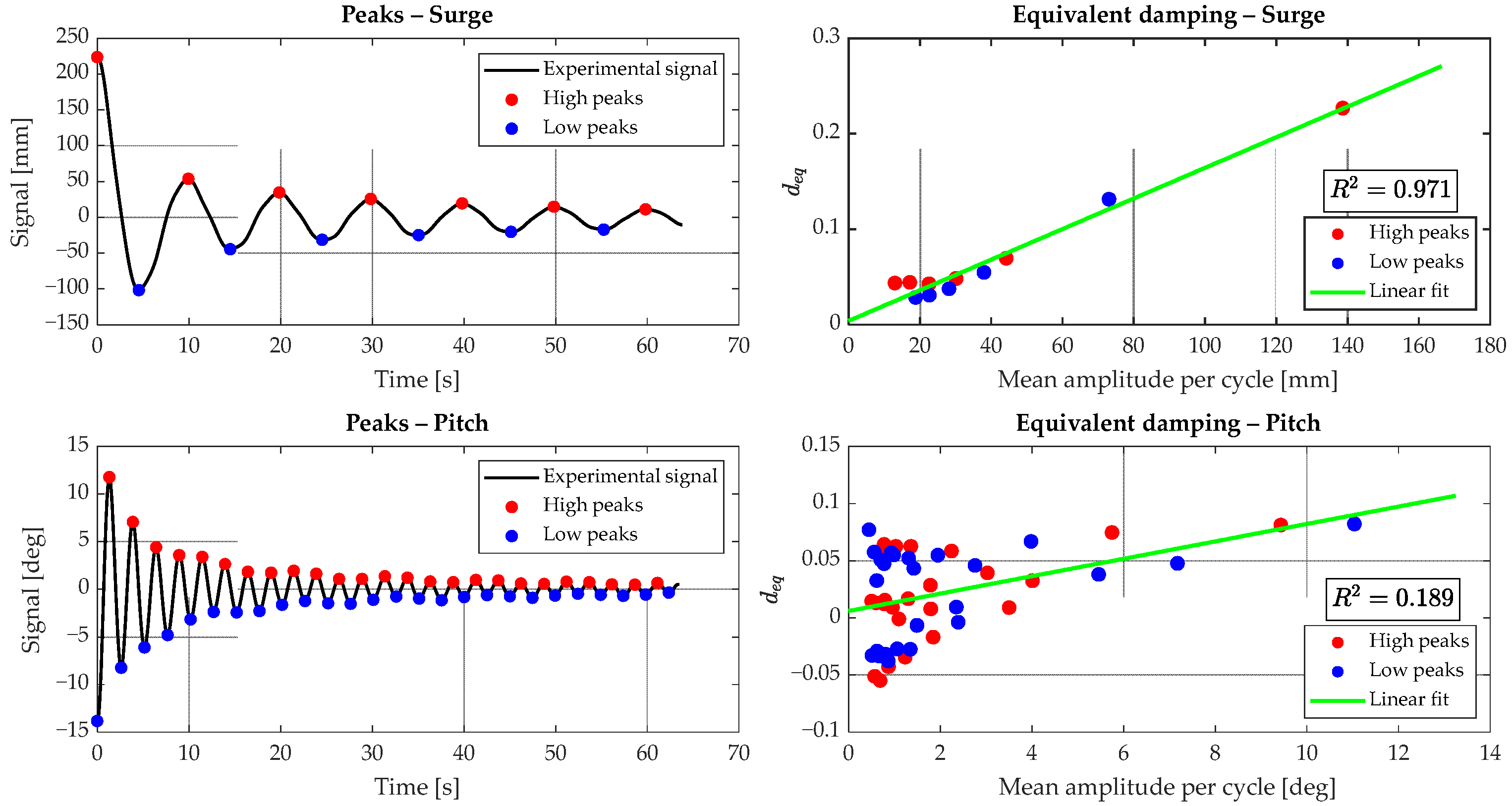
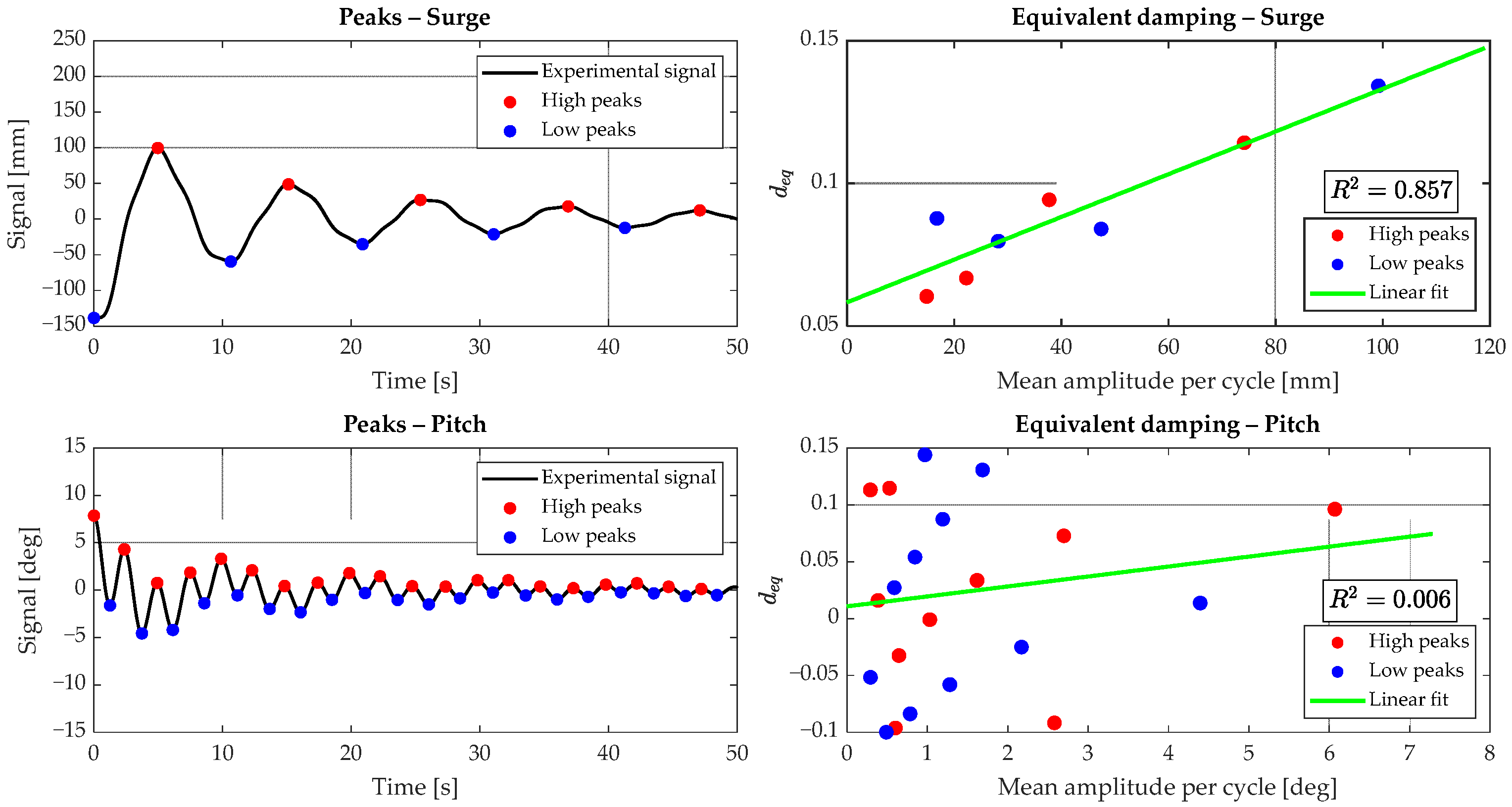
Figure 7 illustrates the peaks and troughs of the primary signals of surge and pitch considered for the regression, alongside the regression line that best approximates Equation (7). The
value reported in
Figure 7 shows that the hypothesis of linearising the quadratic damping term is more accurately verified for the surge test. Furthermore, for the pitch motion, some negative
values are observed; these would not occur in the case of perfect decoupling between pitch and surge. Instead, they are caused by the influence of surge on pitch, which superimposes low-frequency surge harmonics onto the high-frequency natural harmonics of pitch. Consequently, this can result in a peak being higher than the preceding one rather than maintaining a strictly decreasing exponential trend for all peaks. The identified damping parameters are reported in the first row of
Table 3 in
Section 5.2.
Although the PQ method has traditionally been applied to decoupled free-decay tests, given the requirement of this paper to also analyse free-decay tests in which more than one degree of freedom receive a significant initial perturbation, an attempt was made to apply the PQ method to the CFD coupled free-decay test. In this case, it is observed that pitch is significantly affected by surge (see
Figure 8). Indeed, the regression results reflect a greater dispersion of data for pitch, resulting in a very low
. The fact that surge remains almost unaffected by pitch, even in this instance, may be attributed to the difference in the natural frequencies of the two signals: since pitch frequency is approximately four times higher than that of surge, its effect on surge dissipates much earlier due to its lower time constant. The damping parameters identified via the PQ method from the CFD test are reported in the first row of
Table 4 in
Section 5.2.
5.2. Identification via GA+GB Algorithm with Added Mass from Potential Flow Theory
The new algorithm was applied by initially considering the two experimental tests within a single optimisation problem. The added mass matrix is known and fixed from the BEM simulations (
Table 2). The
and
parameters derived via the PQ method from the experimental tests were utilised as initial guess values for the diagonal terms in the new identification procedure. The off-diagonal terms were initialised to zero. The algorithm identifies three linear and three quadratic damping parameters when assuming symmetric matrices (i.e.,
and
) and four of each when assuming asymmetric matrices. Concerning the considered constraints and boundaries, the diagonal terms were constrained to be strictly positive with an upper bound of three times the guess values, whereas the off-diagonal terms were allowed to take either positive or negative values, varying between
3 and
3 times the mean of the initial diagonal terms. This range was selected following preliminary sensitivity analyses: wider bounds did not significantly alter the identified solutions but resulted in longer optimisation times, while narrower bounds risked artificially constraining the parameter search space. The same identification procedure was subsequently repeated for the CFD free-decay test, using the values from the PQ method applied to the CFD data as an initial guess.
The resulting parameters are reported in
Table 3 and
Table 4. Note that the identified linear damping matrix
includes both the potential radiation damping evaluated at the natural frequency and the residual linear viscous contribution, as defined in Equation (3).
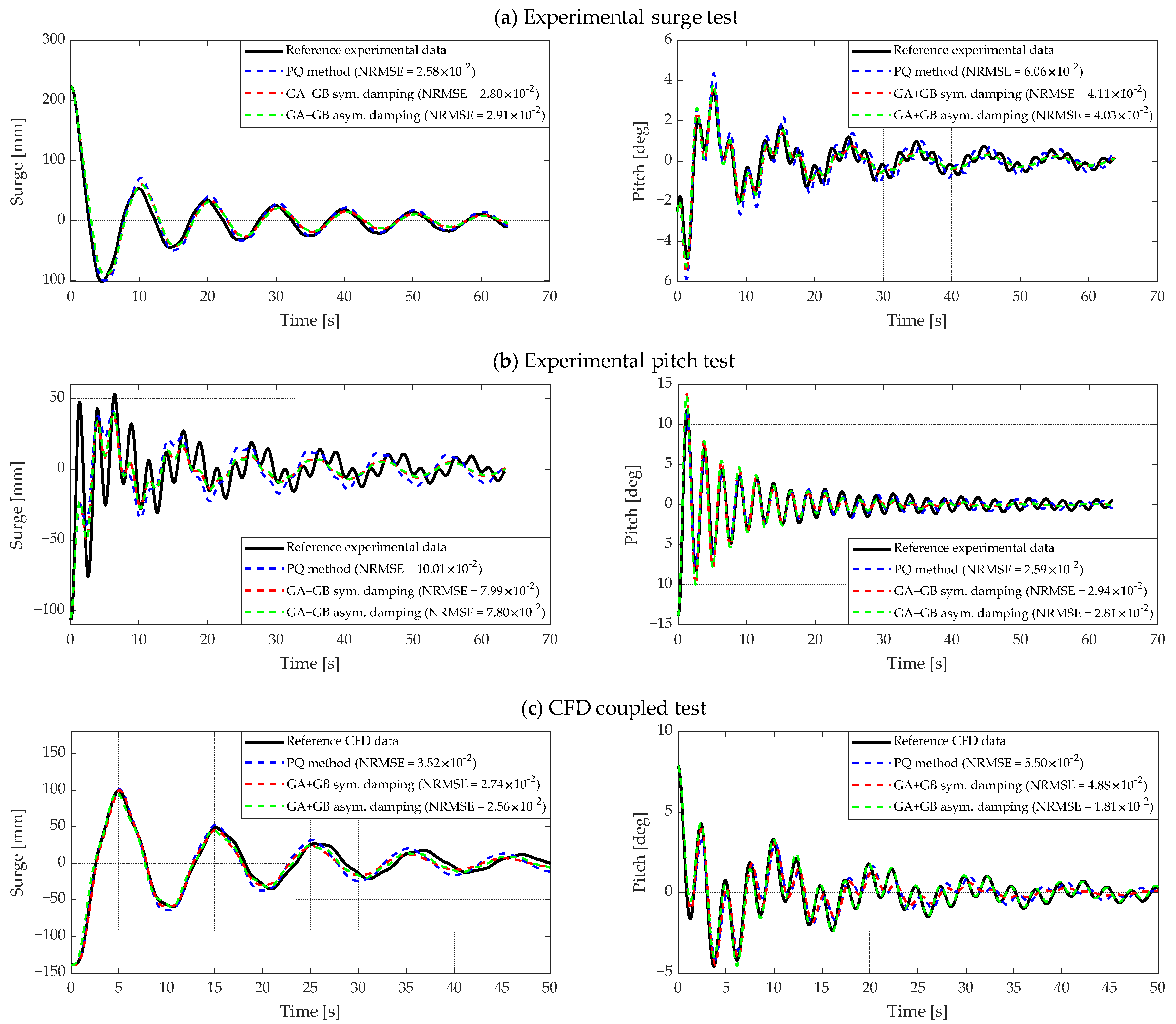
Figure 9 presents a comparison between the parameters identified using the novel GA+GB algorithm (with both symmetric and asymmetric damping matrices) and the PQ method. In the latter case, the diagonal damping matrices identified from the decoupled 1-DoF model were incorporated into a dynamic 2-DoF model that includes the full matrices for
,
, e
in
Table 2.
Table 3.
Linear and quadratic damping coefficients identified from experimental free-decay tests using the PQ method and the GA+GB algorithm.
Table 3.
Linear and quadratic damping coefficients identified from experimental free-decay tests using the PQ method and the GA+GB algorithm.
| From exp. |
[N/(m/s)] | [N/(rad/s)] | m/(m/s)] | m/(rad/s)] | [N/(m/s)2] | [N/(rad/s)2] | m/(m/s)2] | m/(rad/s)2] |
|---|
| PQ method | 0.1259 | n.a. | n.a. | 0.08572 | 95.85 | n.a. | n.a. | 2.911 |
| GA+GB sym. | 1.360 | 0.7702 | 0.7702 | 0.3513 | 103.4 | 2.399 | 2.399 | 0.6159 |
| GA+GB asym. | 0.9067 | 1.265 | 1.372 | 0.4219 | 106.1 | 1.754 | 1.916 | 0.3577 |
Table 4.
Linear and quadratic damping coefficients identified from CFD free-decay test using the PQ method and the GA+GB algorithm.
Table 4.
Linear and quadratic damping coefficients identified from CFD free-decay test using the PQ method and the GA+GB algorithm.
| From CFD | [N/(m/s)] | [N/(rad/s)] | m/(m/s)] | m/(rad/s)] | [N/(m/s)2] | [N/(rad/s)2] | m/(m/s)2] | m/(rad/s)2] |
|---|
| PQ method | 1.786 | n.a. | n.a. | 0.1522 | 44.77 | n.a. | n.a. | 3.344 |
| GA+GB sym. | 2.802 | 0.3657 | 0.3657 | 0.6092 | 22.59 | 3.971 | 3.971 | 0.06109 |
| GA+GB asym. | 2.531 | 3.785 | 3.274 | 0.04782 | 63.93 | 10.10 | 7.396 | 0.1082 |
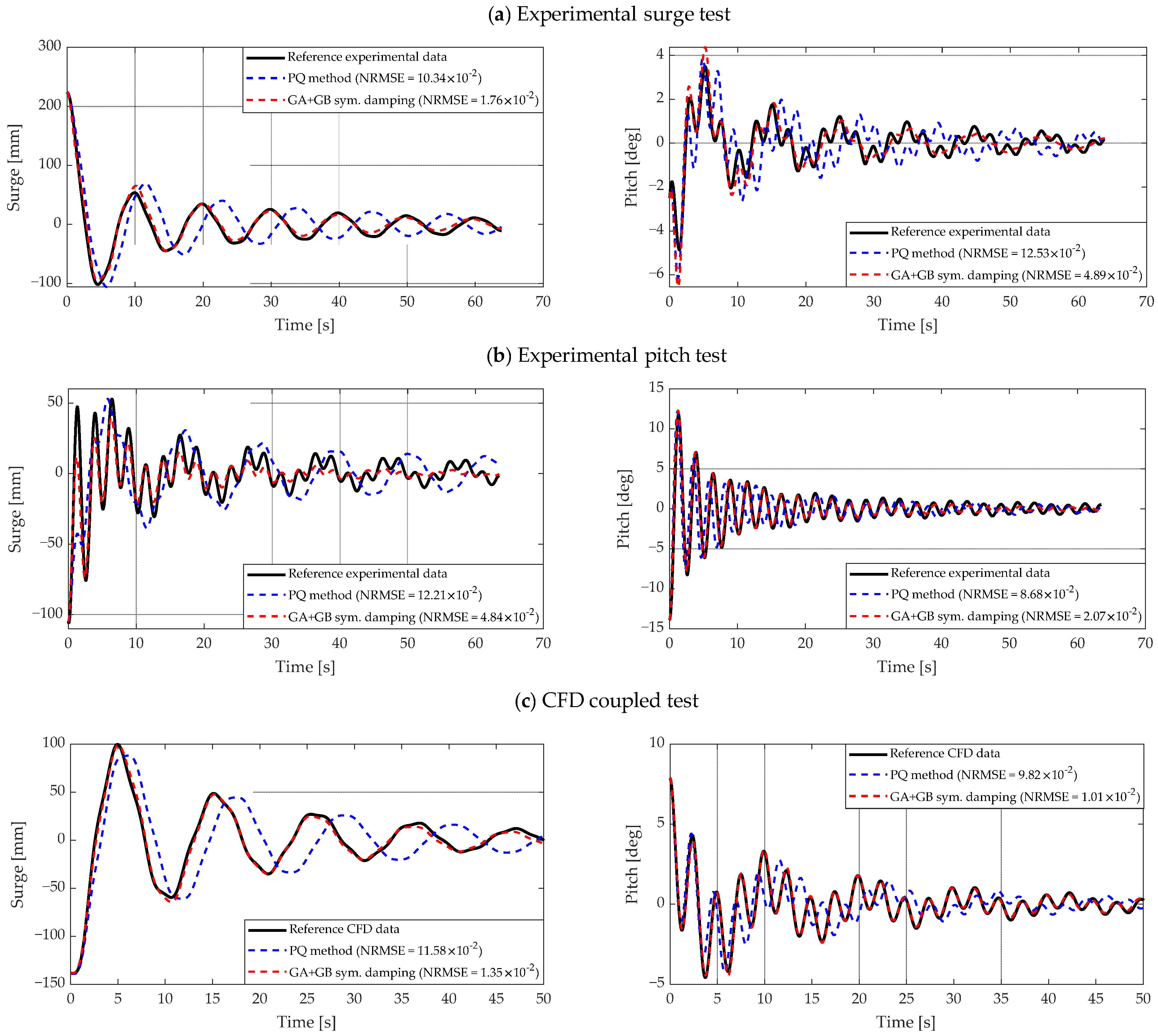
The first notable observation from
Figure 9 is that the mean error associated with the PQ method is slightly higher than the error yielded by the GA+GB algorithm. However, it is worth noting that the PQ method, despite being applied solely to the primary signals of the experimental tests, performs reasonably well in capturing the secondary response. In addition, it accurately reproduces pitch in the coupled CFD test despite the extremely low
value of the linear regression due to the strong surge influence (see
Figure 7 and
Figure 8). Overall, these results indicate that, for free-decay responses, the dominant mechanism governing the coupled time histories is primarily set by the coupled inertia and restoring terms, while viscous coupling plays a secondary role. In other words, reconstructing the full response with a coupled model remains important to reproduce the observed exchange of energy between the DoFs, but in free-decay tests, this exchange is driven mainly by the off-diagonal components of
and
rather than by off-diagonal damping.
This interpretation also explains why no appreciable difference in signal reproduction is observed between symmetric and asymmetric damping matrices. Indeed, the GA+GB errors remain similar for both parametrisations, even though the identified coefficients differ. In particular,
Table 3 and
Table 4 show that the off-diagonal linear damping terms identified from both the experimental and CFD datasets are unstable: although they are of comparable magnitude, their signs flip across cases and parametrisations. This behaviour is consistent with the fact that cross-damping has a weak influence on the measured time histories under the considered free-decay conditions. To further support this consideration,
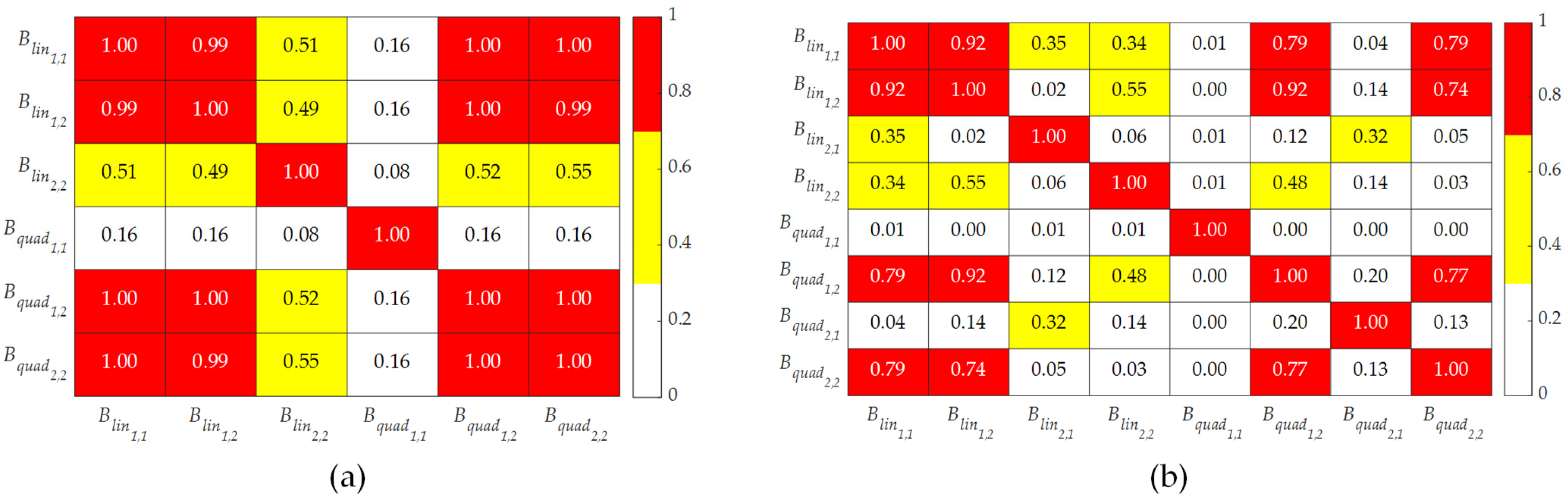
Figure 10 presents the heatmaps of the absolute values of the parameter correlation coefficients derived from the inverse Hessian of the objective function at the converged solution. Results are shown for the CFD case, considering both symmetric and asymmetric damping matrices. In the symmetric case, damping coefficients
,
,
, and
exhibit very high correlation levels, indicating strong interdependence among these parameters. This suggests that multiple combinations of these terms can produce comparable reductions in the objective function, confirming the weak conditioning of the identification problem under free-decay conditions. The asymmetric parametrisation does not significantly reduce these dependencies. Although some parameters, such as
and
, display lower correlations in specific pairings, strong coupling persists between several diagonal and off-diagonal terms. Notably, only
exhibits consistently low correlation with the other coefficients, indicating an independent contribution within the adopted formulation. As a consequence, the optimisation problem is poorly conditioned with respect to the off-diagonal damping coefficients, so small changes in the initial population, bounds, or early search trajectory can lead to markedly different off-diagonal estimates with an essentially unchanged time-domain error.
The same conclusions can also be drawn from
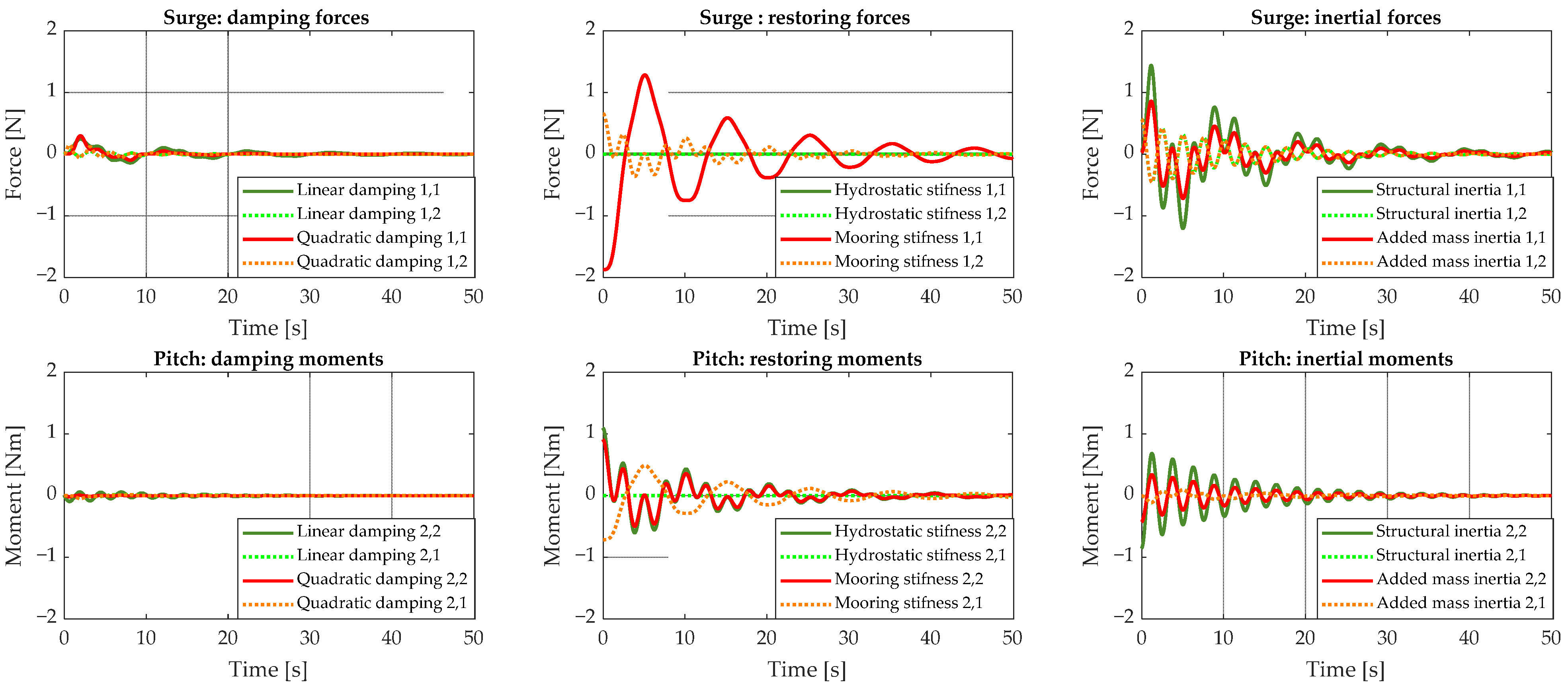
Figure 11, which illustrates the time history of the damping, restoring, and inertial forces simulated from the CFD test along the surge and pitch directions, assuming symmetric damping matrices. It is evident from
Figure 11 that the damping forces are negligible compared to the inertial and restoring forces; consequently, the effects of the cross-coupling damping forces between pitch and surge are negligible, too, thus the off-diagonal damping terms are difficult to identify from these free-decay tests. Conversely, the most significant coupling forces appear to be those attributed to the mooring system. Results similar to those in
Figure 11 were also obtained for the experimental tests with symmetric and asymmetric damping matrices, which are not reported for brevity. However, this does not imply that the off-diagonal damping terms are always negligible; rather, it suggests that their effects are not detectable in free-decay tests, whereas they become significant under operational conditions, as suggested in the recent literature [
22,
23].
Given the limited impact of the cross-coupling damping parameters, the GA+GB algorithm may be susceptible to over-parametrisation, meaning that the identified parameters, being superfluous to capture the energy decay, may lose their physical consistency to perfectly fit the reference data. In fact, the CFD results of
Figure 9c show that the NRMSE in the pitch signal is significantly minimised with asymmetric damping matrices, implying that the GA+GB algorithm found a damping parameters set that eliminates the temporal phase shift against the reference signal. This points to a potential discrepancy in the mass and/or stiffness properties between the CFD and BEM models, likely due to uncertainties in the preliminary estimation of the stiffness and inertial properties. Consequently, since the damping parameters appear redundant for merely capturing energy decay, the algorithm achieves an optimal solution by adjusting the coupling damping terms to correct the discrepancy in the period. Furthermore, this time difference between the natural period of the reference system and that of the simulated model is also evident in the experimental trials, suggesting a mismatch between the experimental and BEM models, too.
5.3. Identification via GA+GB Algorithm with Unknown Added Mass
To avoid that the period mismatch between the BEM, CFD, and experimental models compromises the assessment of the objective function and the resulting identified parameters, the calibration of the added mass matrix can be readily integrated into the proposed algorithm without the need of any BEM simulation. Assuming symmetry for matrix , this simply entails adding three new added mass parameters (i.e., , , and ) to be identified alongside the damping coefficients.
Conversely, the PQ method is not designed to evaluate added mass. Therefore, to bypass preliminary BEM simulations and derive parameters strictly from free-decay signals, the only viable method is to estimate the diagonal added mass terms using the natural periods recorded for pitch and surge. The
-th diagonal term of
can be estimated by determining the mean natural period
from the reference signals of the
-th DoF and applying the following relation:
Given the over-parametrisation issues associated with asymmetric matrices observed in
Section 5.2, this section focuses exclusively on symmetric damping matrices. Furthermore, symmetric matrices could be deemed more physically appropriate for the analysed free-decay motions consistently with the energy principles of hydrodynamic reciprocity for passive systems [
26,
50]. Thus, the identification procedure was repeated using the settings described in
Section 5.2 but including the three added mass coefficients among the parameters to be fitted, in addition to the three linear and three quadratic damping coefficients. As an initial guess, the diagonal added mass terms were initialised according to Equation (13), while the off-diagonal terms were set to zero.
Table 5 presents the added mass parameters evaluated using Equation (13) and the GA+GB algorithm for both experimental and CFD tests.
The higher fidelity of the GA+GB algorithm with added mass calibration results is evident from
Figure 12, which shows that tuning the added mass successfully corrects the period mismatch, leading to an improvement in the NRMSE compared to the identification performed with fixed added mass from BEM (see
Figure 9).
Figure 12 also displays the surge and pitch signals obtained by modelling the damping according to the PQ method (first row of
Table 3 and
Table 4) and the added mass derived from Equation (13). It is apparent that while neglecting off-diagonal damping terms has a negligible impact (as discussed in
Section 5.2), omitting off-diagonal added mass terms leads to a considerable increase in error, primarily due to a significant discrepancy in the system natural frequency.
Table 6 presents the damping values identified with added mass tuning. Generally, these coefficients remain comparable in magnitude to those found in
Section 5.2. Furthermore, a significant trend emerges when analysing the CFD data, where the surge amplitude is lower than in the experimental tests. From both
Table 4 and
Table 6, the linear damping term
increases while the quadratic term
decreases. This confirms that quadratic damping becomes dominant at larger amplitudes and will likely be the governing factor in extreme sea conditions. Conversely, for pitch, the linear diagonal term
and the quadratic term
decrease with a similar trend. This behaviour suggests that the identification process must explicitly account for the amplitude of the motion.
6. Conclusions
This study has presented a multi-degree-of-freedom identification procedure for the estimation of linear and quadratic damping matrices in lumped-parameter models of floating offshore wind turbines. Unlike conventional approaches, the proposed approach explicitly allows for the identification of off-diagonal viscous damping terms, enabling the assessment of cross-coupling effects within a reduced-order formulation. The methodology, which combines a genetic algorithm with a gradient-based optimiser, was applied to a taut-leg moored semi-submersible floating platform, with particular focus on surge–pitch coupling, using both experimental and CFD free-decay datasets as reference data.
The identification campaign highlighted several relevant findings. First, the results confirm that the traditional PQ method is able to identify diagonal linear and quadratic damping coefficients not only from idealised, nominally decoupled free-decay tests but also from coupled free-decay responses in which multiple degrees of freedom are simultaneously subjected to a significant initial perturbation. This outcome suggests that the number of experimental tests required for damping identification may be reduced, since a single coupled free-decay test could potentially replace multiple strictly decoupled tests without a significant loss in accuracy in the estimation of diagonal damping terms.
Moreover, the comparison of the results obtained by the novel procedure with the traditional PQ method shows that diagonal damping coefficients can be robustly identified even under coupled free-decay conditions. However, the inclusion of off-diagonal terms does not significantly improve the reconstruction of free-decay responses, indicating that viscous cross-coupling effects are weakly identifiable from such tests. This conclusion is supported by the correlation analysis, which reveals strong interdependencies between the damping parameters and highlights the limited conditioning of the identification problem with respect to cross terms. On the other hand, the simultaneous calibration of the added mass matrix further improves the agreement between numerical and reference responses, reducing phase discrepancies and enhancing the robustness of the optimisation process.
Although the cross-coupling viscous terms exhibited limited influence under free-decay conditions, the proposed methodology provides a general framework for their systematic estimation. This constitutes, to the authors’ knowledge, the first explicit attempt to identify off-diagonal linear and quadratic viscous damping terms within a multi-DoF lumped-parameter model for FOWTs. Future work will extend the validation of the procedure to wave-driven and operational conditions, where viscous coupling effects may play a more significant role.




 ,
,