Optimization of Gas Production Using Machine Learning Modeling of Geological Core Facies and Monte Carlo Simulation: Application in the Permian, Southwest Kansas
 , , , , and
Abstract
1. Introduction
2. Geological Setting
Stratigraphy of the Study Area
3. Data and Methodology
3.1. Data Description
3.2. Workflow Description
3.3. Unsupervised Facies Classification
K-Means Clustering
3.4. Supervised Facies Classification
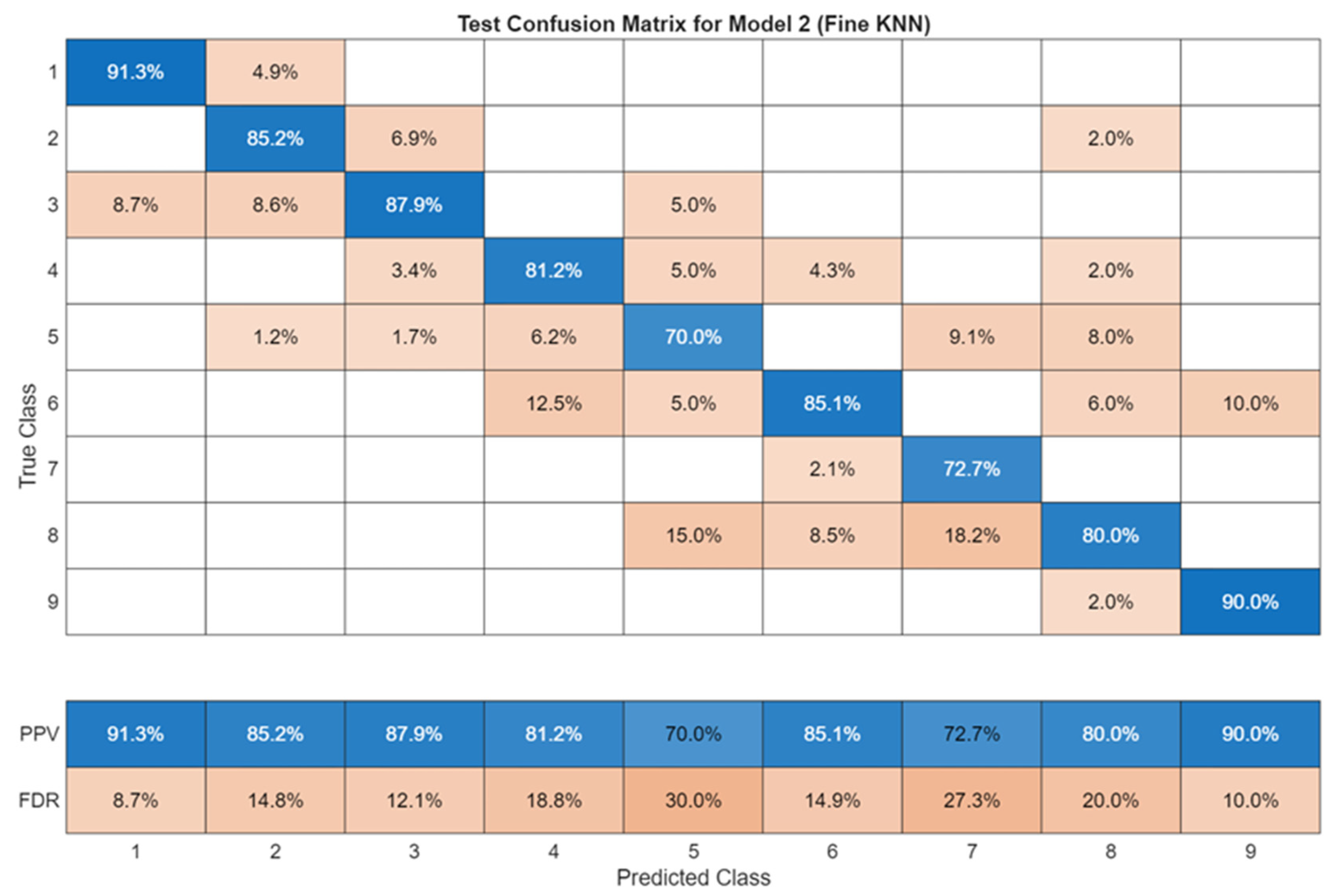
3.4.1. Fine K-Nearest Neighbors (KNN)
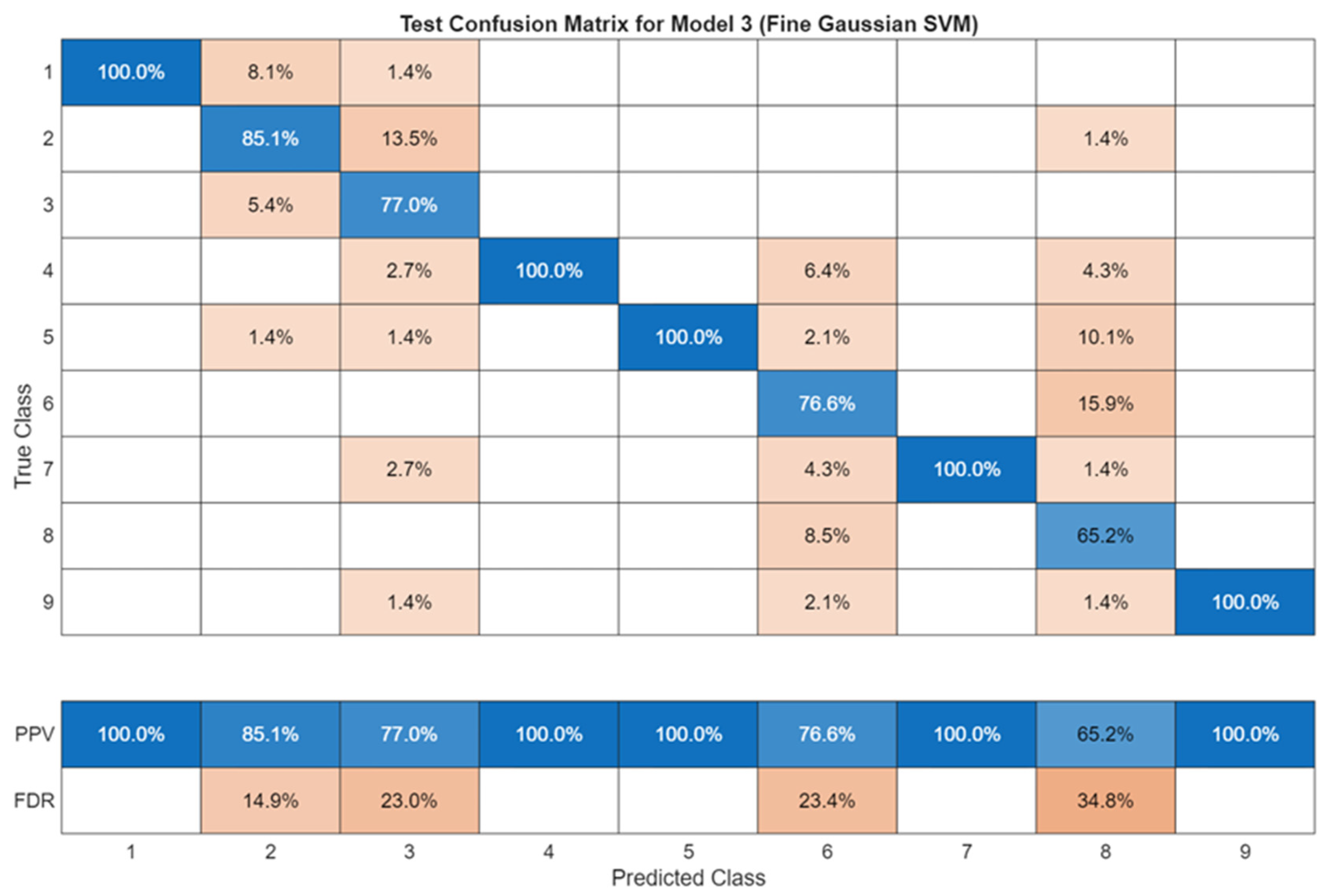
3.4.2. Fine Gaussian SVM (FGS)
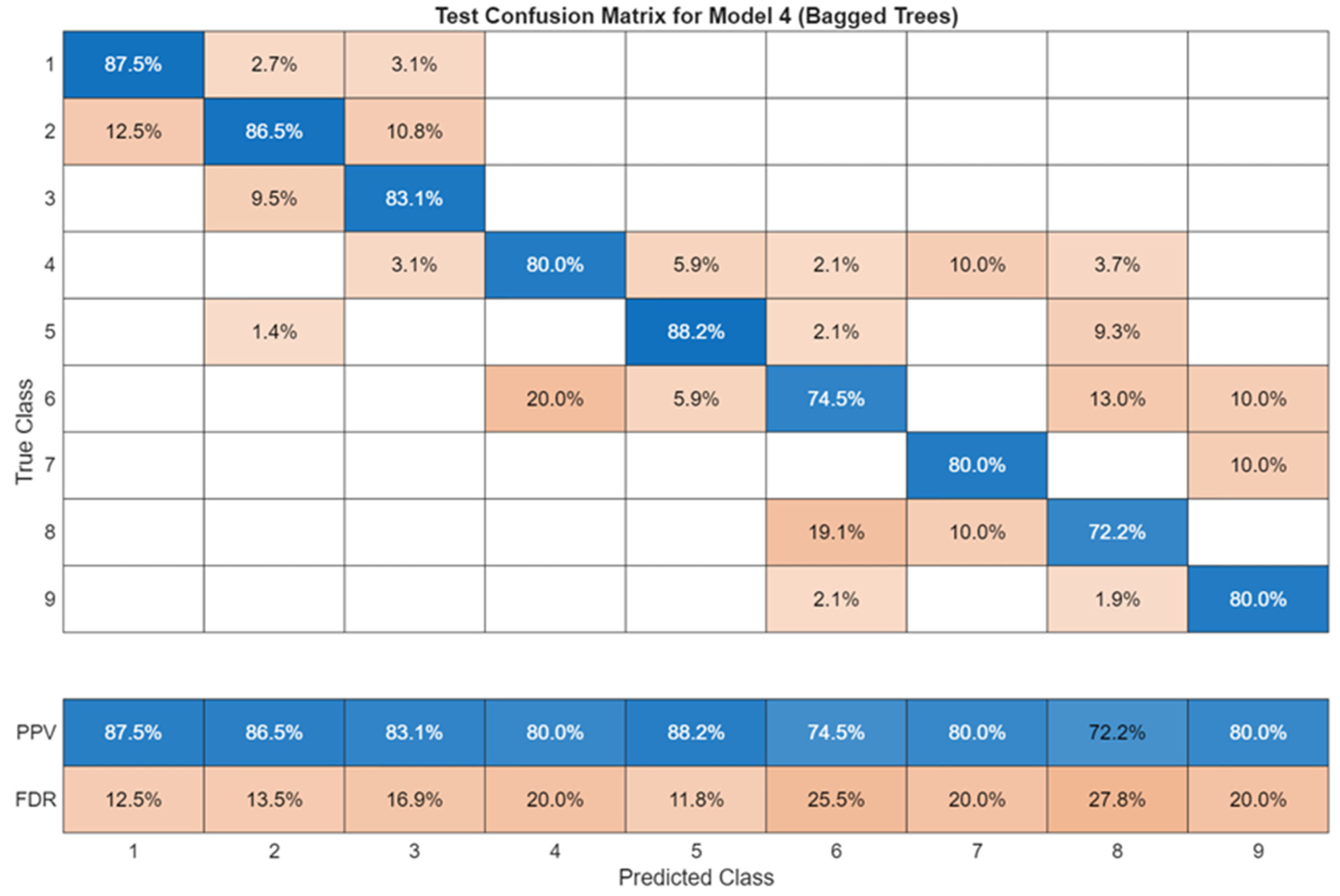
3.4.3. Bagged Tree Ensemble (BTE)
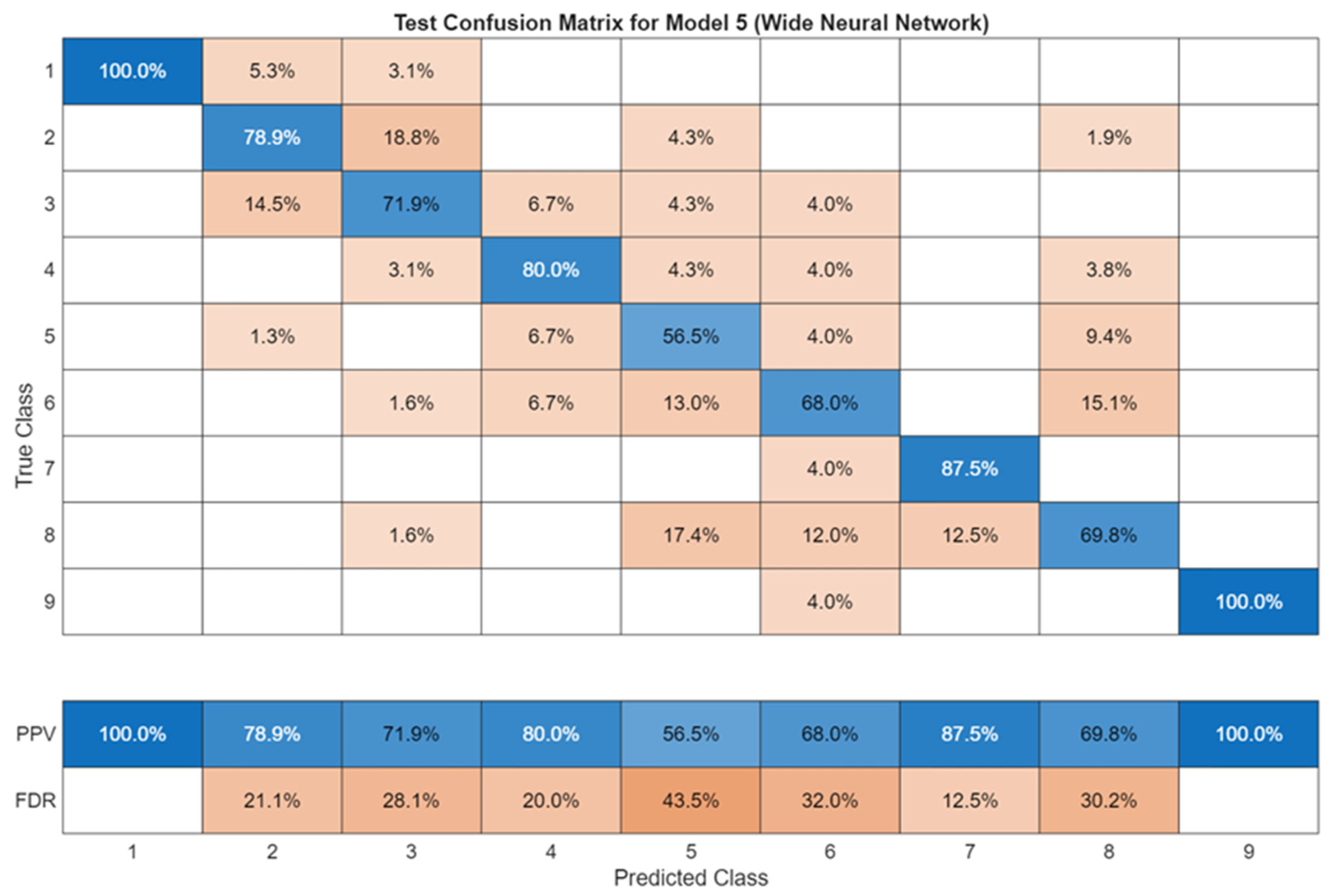
3.4.4. Wide Neural Network (WNN)
4. Results and Discussion
4.1. Supervised Facies Classification Results
4.2. Monte Carlo Markov Switching Dynamic Regression
4.3. Numerical Modeling
4.3.1. Static Model
4.3.2. Simulation and History Matching
5. Conclusions
Author Contributions
Funding
Data Availability Statement
Conflicts of Interest
References
- Skelton, L.H. A Brief History of the Kansas Oil and Gas Industry. Oil-Ind. Hist. 2006, 7. Available online: https://archives.datapages.com/data/phi/v7_2006/skelton.htm (accessed on 9 January 2026).
- Byrnes, A.P.; Dubois, M.K.; Magnuson, M. Western Tight Gas Carbonates: Comparison of Council Grove Group, Panoma Field, Southwest Kansas, and Western Low Permeability Sandstones, American Association of Petroleum Geolology Annual Convention 10:A31. 2001. Available online: https://www.searchanddiscovery.com/abstracts/html/2001/annual/abstracts/0115.htm (accessed on 9 January 2026).
- Bohling, G.C.; Dubois, M.K. An Integrated Application of Neural Network and Markov Chain Techniques to the Prediction of Lithofacies from Well Logs: Kansas Geological Survey Open-File Report 2003-50. 2003. Available online: https://www.researchgate.net/profile/Martin-Dubois/publication/242269985_An_Integrated_Application_of_Neural_Network_and_Markov_Chain_Techniques_to_Prediction_of_Lithofacies_from_Well_Logs_Kansas_Geological_Survey_Open_File_Report_2003-50/links/54ff1fb30cf2672e22427ac3/An-Integrated-Application-of-Neural-Network-and-Markov-Chain-Techniques-to-Prediction-of-Lithofacies-from-Well-Logs-Kansas-Geological-Survey-Open-File-Report-2003-50.pdf (accessed on 9 January 2026).
- Dubois, M.; Bohling, G.; Chakrabarti, S. Comparison of rock facies classification using three statistically based classifiers. Tech. Rep. 2004, 64, 2004. [Google Scholar]
- Dubois, M.K.; Byrnes, A.P.; Bhattacharya, S.; Bohling, G.C.; Doveton, J.H.; Barba, R.E. Hugoton Asset Management Project (HAMP). Hugoton Geomodel Final Report. KGS Open File Report. 2006. Available online: https://www.researchgate.net/profile/Martin-Dubois/publication/241754406_Hugoton_Asset_Management_Project_HAMP/links/54ff1fb60cf2672e22427ae1/Hugoton-Asset-Management-Project-HAMP.pdf (accessed on 9 January 2026).
- Hall, B. Facies classification using machine learning. Lead. Edge 2016, 35, 906–909. [Google Scholar] [CrossRef]
- Xu, C.; Torres-Verdín, C. Pore system characterization and petrophysical rock classification using a bimodal Gaussian density function. Math. Geosci. 2013, 45, 753–771. [Google Scholar] [CrossRef]
- Wei, Z.; Hu, H.; Zhou, H.W.; Lau, A. Characterizing rock facies using machine learning algorithm based on a convolutional neural network and data padding strategy. Pure Appl. Geophys. 2019, 176, 3593–3605. [Google Scholar] [CrossRef]
- Mohamed, I.M.; Mohamed, S.; Mazher, I.; Chester, P. Formation lithology classification: Insights into machine learning methods. In Proceedings of the SPE Annual Technical Conference and Exhibition, Las Vegas, NV, USA, 27–30 October 2019; SPE: Richardson, TX, USA, 2019; p. D021S033R005. [Google Scholar]
- Halotel, J.; Demyanov, V.; Gardiner, A. Value of geologically derived features in machine learning facies classification. Math. Geosci. 2020, 52, 5–29. [Google Scholar] [CrossRef]
- Yale, D.P.; Jamieson, W.H. Static and dynamic rock mechanical properties in the Hugoton and Panoma fields, Kansas. In Proceedings of the SPE Oklahoma City Oil and Gas Symposium/Production and Operations Symposium, Amarillo, TX, USA, 22 May 1994; SPE: Richardson, TX, USA, 1994; p. 27939. [Google Scholar]
- Dubois, M.K.; Byrnes, A.P.; Bohling, G.C.; Doveton, J.H. Multiscale Geologic and Petrophysical Modeling of the Giant Hugoton Gas Field (Permian), Kansas and Oklahoma. 2006. Available online: https://www.kgs.ku.edu/PRS/publication/2006/2006-12/index.html (accessed on 9 January 2026).
- Sorenson, R.P. A dynamic model for the Permian Panhandle and Hugoton fields, western Anadarko basin. AAPG Bull. 2005, 89, 921–938. [Google Scholar] [CrossRef]
- Bergen, K.J.; Johnson, P.A.; de Hoop, M.V.; Beroza, G.C. Machine learning for data-driven discovery in solid Earth geoscience. Science 2019, 363, eaau0323. [Google Scholar] [CrossRef]
- Konoshonkin, D.; Shishaev, G.; Matveev, I.; Volkova, A.; Rukavishnikov, V.; Demyanov, V.; Belozerov, B. Machine learning clustering of reservoir heterogeneity with petrophysical and production data. In Proceedings of the SPE Europec Featured at EAGE Conference and Exhibition, Houston, TX, USA, 8–11 June 2020; SPE: Richardson, TX, USA, 2020; p. D011S007R003. [Google Scholar]
- Amosu, A.; Imsalem, M.; Sun, Y. Effective machine learning identification of TOC-rich zones in the Eagle Ford Shale. J. Appl. Geophys. 2021, 188, 104311. [Google Scholar] [CrossRef]
- Amosu, A.; Sun, Y. Identification of thermally mature total organic carbon-rich layers in shale formations using an effective machine-learning approach. Interpretation 2021, 9, T735–T745. [Google Scholar] [CrossRef]
- Sharma, S.K.; Chin, M.; Basu, T.; Bhargava, R.O.; Henson, R.; Jiang, L.; Shuhaimi, M.A.; Vizzini, L. Core Driven Hierarchical Facies Modeling of Shoreface Environments: A Case Study from Offshore Sabah, Malaysia. 2013. Available online: https://www.searchanddiscovery.com/documents/2013/20204sharma/ndx_sharma.pdf (accessed on 9 January 2026).
- Amosu, A.; Bui, D.; Oke, O.; Koray, A.M.; Appiah Kubi, E.; Sibaweihi, N.; Ampomah, W. Committee Machine Learning for Electrofacies-Guided Well Placement and Oil Recovery Optimization. Appl. Sci. 2025, 15, 3020. [Google Scholar] [CrossRef]
- Bui, D.; Koray, A.M.; Appiah Kubi, E.; Amosu, A.; Ampomah, W. Integrating machine learning workflow into numerical simulation for optimizing oil recovery in sand-shale sequences and highly heterogeneous reservoir. Geotechnics 2024, 4, 1081–1105. [Google Scholar] [CrossRef]
- Ao, Y.; Li, H.; Zhu, L.; Ali, S.; Yang, Z. Identifying channel sand body from multiple seismic attributes with an improved random forest algorithm. J. Pet. Sci. Eng. 2019, 173, 781–792. [Google Scholar] [CrossRef]
- Milad, I.; Farmer, R.; Vaitekaitis, T.; Majed, S.A. Machine Learning to Predict Geological Facies in Complex Carbonate Reservoirs. In Proceedings of the First EAGE Workshop on Advances in Carbonate Reservoirs from Prospects to Development, Kuwait City, Kuwait, 23–25 April 2024; European Association of Geoscientists & Engineers: Bunnik, The Netherlands, 2024; Volume 2024, pp. 1–3. [Google Scholar]
- Zhang, D.; Zhang, H.; Ren, Q.; Zhao, X. Multiple-point geostatistical simulation of nonstationary sedimentary facies models based on fuzzy rough sets and spatial-feature method. SPE J. 2023, 28, 2240–2255. [Google Scholar] [CrossRef]
- Strebelle, S. Conditional simulation of complex geological structures using multiple point statistics. Math. Geol. 2002, 34, 1–21. [Google Scholar] [CrossRef]
- Koray, A.M.; Bui, D.; Kubi, E.A.; Ampomah, W.; Amosu, A. Machine learning based reservoir characterization and numerical modeling from integrated well log and core data. Geoenergy Sci. Eng. 2024, 243, 213296. [Google Scholar] [CrossRef]
- Demyanov, V.; Backhouse, L.; Christie, M. Geological feature selection in reservoir modelling and history matching with Multiple Kernel Learning. Comput. Geosci. 2015, 85, 16–25. [Google Scholar] [CrossRef]
- Zhang, J.D.; Wang, J.; Yao, C.J.; Yang, Y.F.; Sun, H.; Yao, J. Multi source information fused generative adversarial network model and data assimilation based history matching for reservoir with complex geologies. Pet. Sci. 2022, 19, 707–719. [Google Scholar] [CrossRef]
- Canchumuni, S.W.; Emerick, A.A.; Pacheco, M.A. History matching geological facies models based on ensemble smoother and deep generative models. J. Pet. Sci. Eng. 2019, 177, 941–958. [Google Scholar] [CrossRef]
- Park, H.; Scheidt, C.; Fenwick, D.; Boucher, A.; Caers, J. History matching and uncertainty quantification of facies models with multiple geological interpretations. Comput. Geosci. 2013, 17, 609–621. [Google Scholar] [CrossRef]
- Higley, D.K. Thermal Maturation of Petroleum Source Rocks in the Anadarko Basin Province, Colorado, Kansas, Oklahoma, and Texas, chap. 3. In Petroleum Systems and Assessment of Undiscovered Oil and Gas in the Anadarko Basin Province, Colorado, Kansas, Oklahoma, and Texas USGS Province 58: U.S. Geological Survey Digital Data Series DDS 69 EE; USGC: Reston, MV, USA, 2014; 53p. [Google Scholar] [CrossRef]
- Ball, M.M.; Henry, M.E.; Frezon, S.E. Petroleum Geology of the Anadarko Basin Region, Province (115), Kansas, Oklahoma, and Texas: U.S. Geological Survey Open File Report 88-450W. 1991; 36p. Available online: https://pubs.usgs.gov/of/1988/0450w/report.pdf (accessed on 9 January 2026).
- Johnson, K.S. Geologic evolution of the Anadarko Basin. In Anadarko Basin Symposium, 1988: Oklahoma Geological Survey Circular 90; Oklahoma Geological Survey: Norman, OK, USA, 1989; pp. 3–12. Available online: http://www.ogs.ou.edu/pubsscanned/Circulars/Circular90.pdf (accessed on 9 January 2026).
- Dubois, M.K.; Goldstein, R.H.; Hasiotis, S.T. Climate controlled aggradation and cyclicity of continental loessic siliciclastic sediments is Asselian Sakmarian cyclothems, Permian, Hugoton embayment, USA. Sedimentology 2012, 59, 1782–1816. [Google Scholar] [CrossRef]
- Denison, R.E. Evolution of the Anadarko Basin: American Association of Petroleum Geologists Bulletin. GeoScienceWorld 1976, 60, 325. [Google Scholar]
- Perry, W.J. Tectonic evolution of the Anadarko basin region, Oklahoma. U.S. Geol. Surv. Bull. 1989, 1866, A1–A16. [Google Scholar]
- Arthur, D.; Vassilvitskii, S. k-means++: The advantages of careful seeding. In Proceedings of the 18th Annual ACM-SIAM Symposium on Discrete Algorithms, New Orleans, LA, USA, 7–9 January 2007; Association for Computing Machinery, Inc.: New York, NY, USA; pp. 1027–1035.
- Ji, Y.; Liu, Z.; Wang, S.; Sun, Y.; Peng, Z. On simplifying large-scale spatial vectors: Fast, memory-efficient, and cost-predictable k-means. arXiv 2024, arXiv:2412.02244. [Google Scholar]
- Pant, Y.R.; Leigh, L.; Fajardo Rueda, J. Improving k-means clustering: A comparative study of parallelized versions. Algorithms 2025, 18, 532. [Google Scholar] [CrossRef]
- Semoglou, A.; Likas, A.; Pavlopoulos, J. Silhouette-guided instance-weighted k-means. arXiv 2025, arXiv:2506.12878. [Google Scholar]
- Baligodugula, V.V.; Amsaad, F. Unsupervised learning: Comparative analysis of clustering techniques on high-dimensional data. arXiv 2025, arXiv:2503.23215. [Google Scholar] [CrossRef]
- Zhang, J.; He, Y.; Zhang, Y.; Li, W.; Zhang, J. Well-Logging-Based Lithology Classification Using Machine Learning Methods for High-Quality Reservoir Identification: A Case Study of Baikouquan Formation in Mahu Area of Junggar Basin, NW China. Energies 2022, 15, 3675. [Google Scholar] [CrossRef]
- Dudani, S. The distance-weighted k-nearest-neighbor rule. IEEE Trans. Syst. Man Cybern. 1976, 6, 325–327. [Google Scholar] [CrossRef]
- Guido, R.; Groccia, M.C.; Conforti, D. A hyper-parameter tuning approach for cost-sensitive support vector machine classifiers. Soft Comput. 2022, 27, 12863–12881. [Google Scholar] [CrossRef]
- Chang, Y.J.; Lin, Y.L.; Pai, P.F. Support Vector Machines with Hyperparameter Optimization Frameworks for Classifying Mobile Phone Prices in Multi-Class. Electronics 2025, 14, 2173. [Google Scholar] [CrossRef]
- Mastropietro, A.; Feldmann, C.; Bajorath, J. Calculation of exact Shapley values for explaining support vector machine models using the radial basis function kernel. Sci. Rep. 2023, 13, 19561. [Google Scholar] [CrossRef]
- Breiman, L. Bagging predictors. Mach. Learn. 1996, 24, 123–140. [Google Scholar] [CrossRef]
- Goodfellow, I.; Bengio, Y.; Courville, A. Deep Learning; MIT Press: Cambridge, MA, USA, 2016. [Google Scholar]
- Shapley, L.S. Stochastic games. Proc. Natl. Acad. Sci. USA 1953, 39, 1095–1100. [Google Scholar] [CrossRef]
- Bhattacharya, S.; Dubois, M.; Byrnes, A. Multi Well Characterization and Simulation—Council Grove Reservoir System, Kansas Geological Survey, Open File Report 2004-67. 2004. Available online: https://www.kgs.ku.edu/PRS/publication/2004/OFR04_67/index.html (accessed on 9 January 2026).



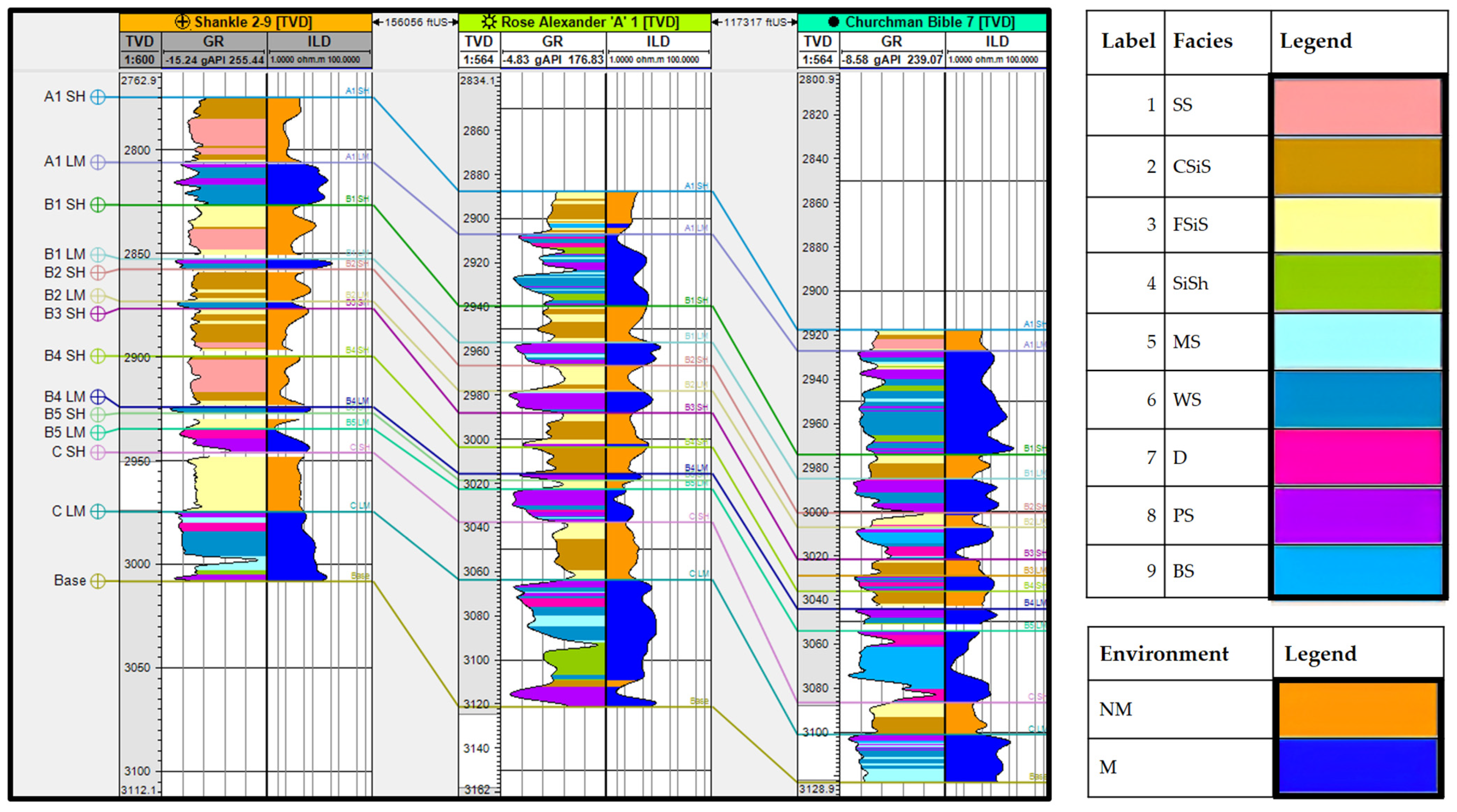
| Facies Class Label | Facies Symbol | Facies Type | Adjacent Facies |
|---|---|---|---|
| 1 | SS | Non-marine sandstone | CsiS |
| 2 | CSiS | Non-marine coarse siltsone | SS, FSiS |
| 3 | FSiS | Non-marine fine siltsone | CSiS |
| 4 | SiSh | Marine siltsone and shale | MS |
| 5 | MS | Mudstone | SiSh, WS |
| 6 | WS | Wackestone | MS, D, PS |
| 7 | D | Dolomite | WS, PS |
| 8 | PS | Packstone-grainstone | WS, D, BS |
| 9 | BS | Phylloid-algal bafflestone | D, PS |
| Model Type | Model Description | Advantages | Limitations | Accuracy % (Validation) | Accuracy % (Test) |
|---|---|---|---|---|---|
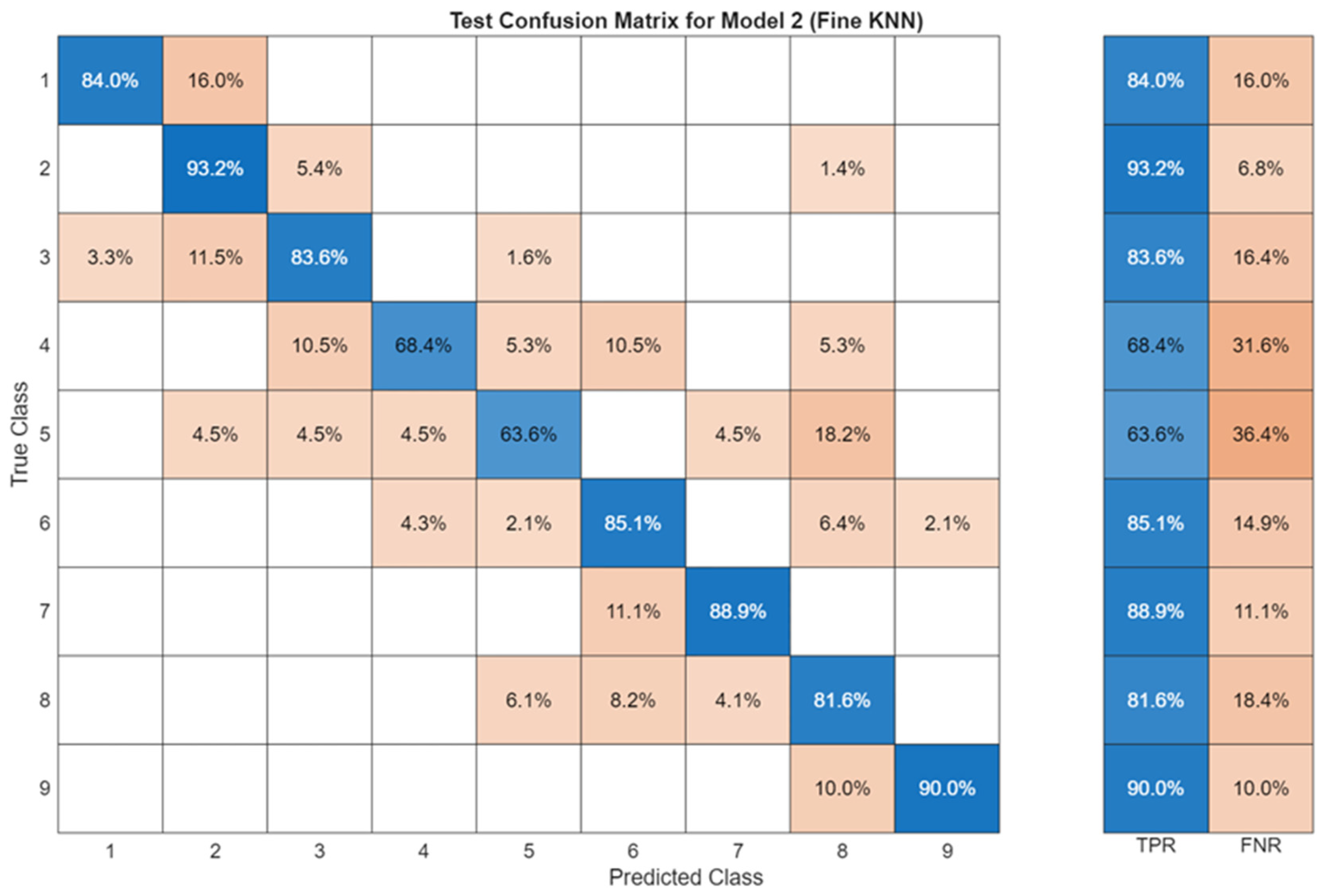
| Fine KNN | Non-parametric and uses distance-based decision rule | Simple, intuitive and often captures fine local patterns. | Highly sensitive to noise and outliers and computationally expensive | 80.31 | 83.86 |
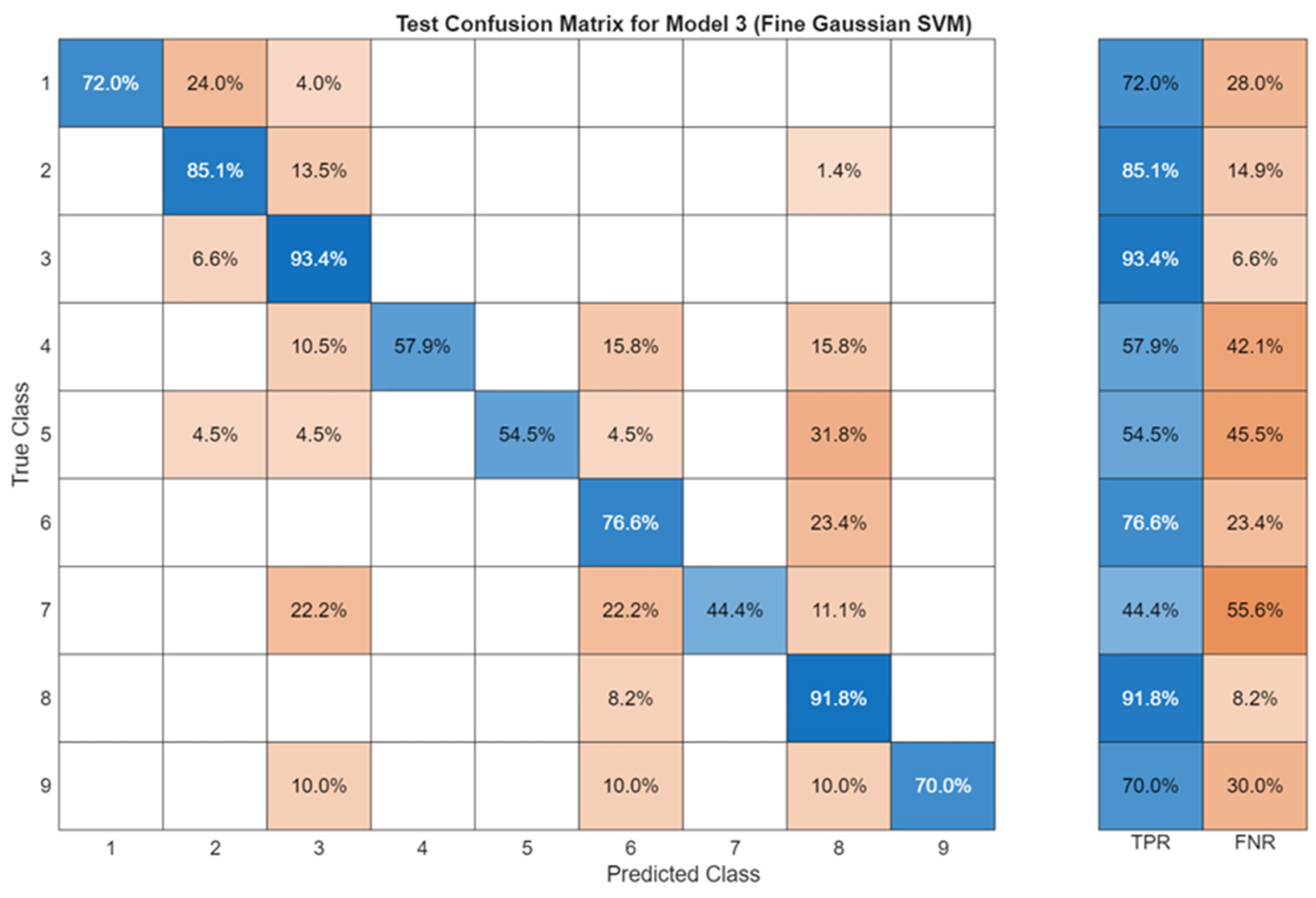
| Fine Gaussian SVM | Kernel based Gaussian SVM with margin-maximizing classifier | Good nonlinear classification performance | Hyperparameter tuning is critical and is computationally expensive for large datasets | 77.43 | 80.06 |
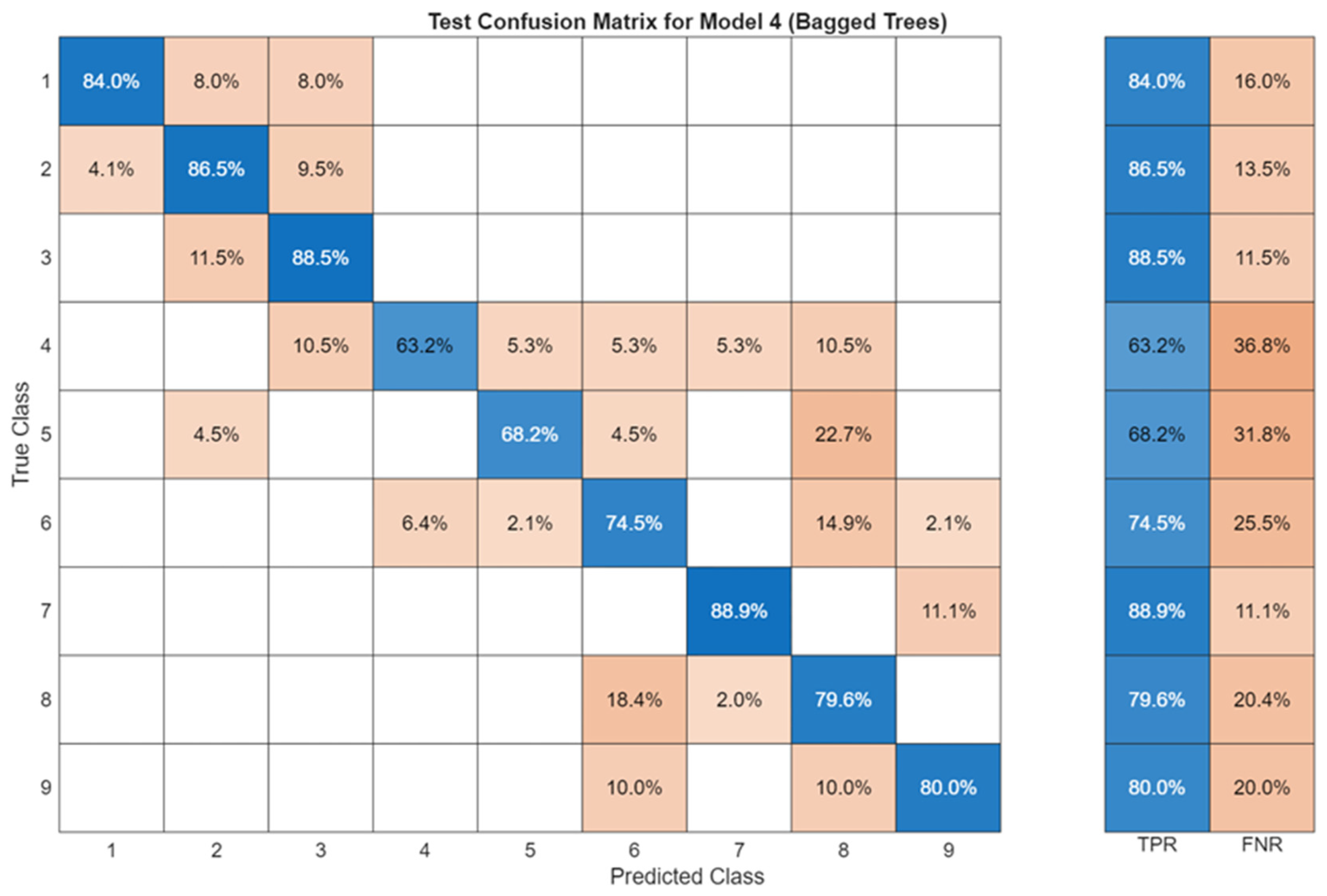
| Bagged Tree Ensemble | Ensemble of decision trees with variance-reduction technique | Robust to overfitting and handles nonlinearities and interactions well | Higher memory usage and bias reduction is limited | 75.42 | 81.01 |
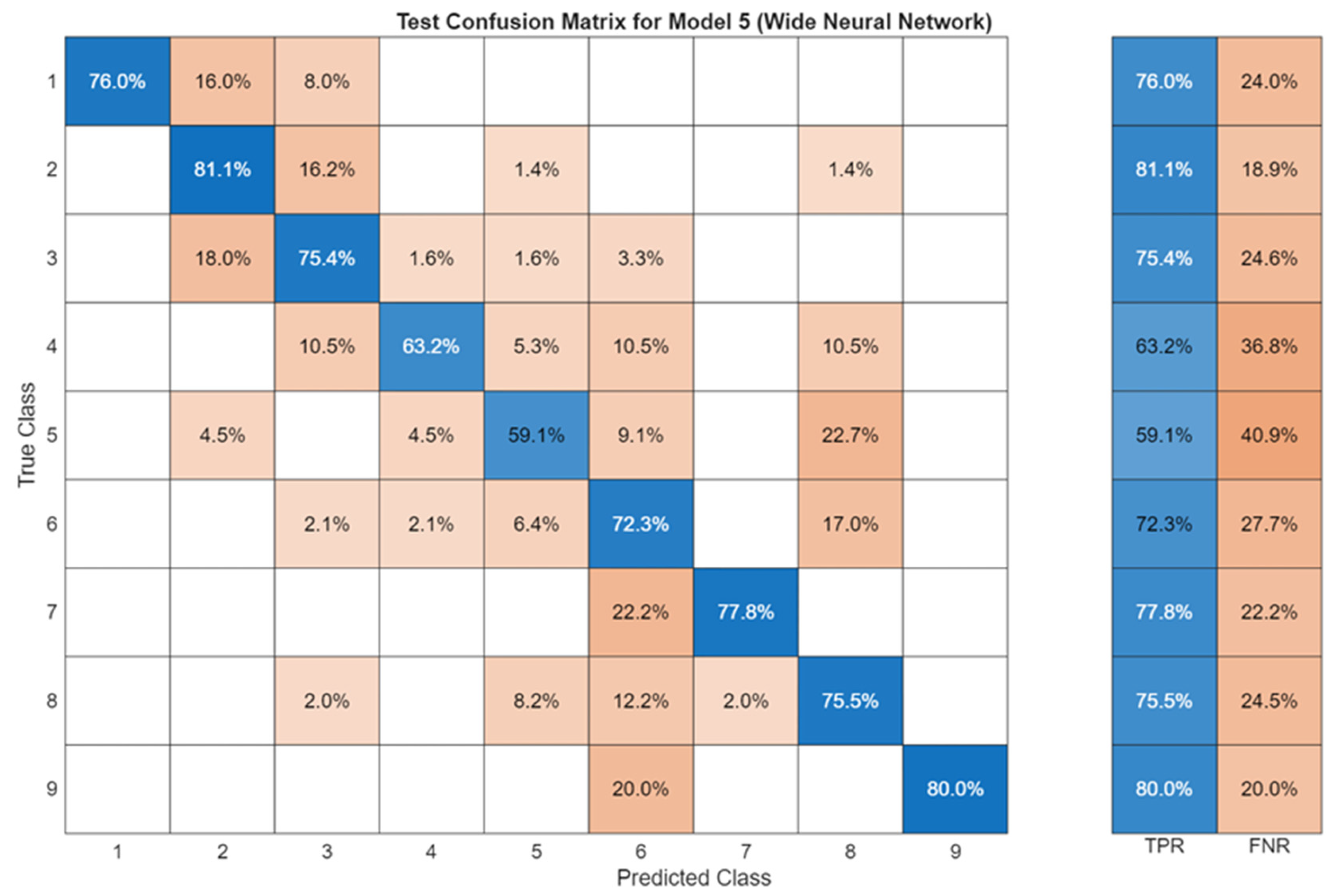
| Wide Neural Network | Shallow neural network with many neurons | Has flexible architecture and learns complex feature interactions faster training than deep networks | Sensitive to architecture and hyperparameters | 75.21 | 74.68 |
Disclaimer/Publisher’s Note: The statements, opinions and data contained in all publications are solely those of the individual author(s) and contributor(s) and not of MDPI and/or the editor(s). MDPI and/or the editor(s) disclaim responsibility for any injury to people or property resulting from any ideas, methods, instructions or products referred to in the content. |
© 2026 by the authors. Licensee MDPI, Basel, Switzerland. This article is an open access article distributed under the terms and conditions of the Creative Commons Attribution (CC BY) license.
Share and Cite
Amosu, A.; Reyes, M.; Sibaweihi, N.; Koray, A.-M.; Appiah Kubi, E.; Gyimah, E.; Agyei, E.; Ampomah, W. Optimization of Gas Production Using Machine Learning Modeling of Geological Core Facies and Monte Carlo Simulation: Application in the Permian, Southwest Kansas. Appl. Sci. 2026, 16, 2436. https://doi.org/10.3390/app16052436
Amosu A, Reyes M, Sibaweihi N, Koray A-M, Appiah Kubi E, Gyimah E, Agyei E, Ampomah W. Optimization of Gas Production Using Machine Learning Modeling of Geological Core Facies and Monte Carlo Simulation: Application in the Permian, Southwest Kansas. Applied Sciences. 2026; 16(5):2436. https://doi.org/10.3390/app16052436
Chicago/Turabian StyleAmosu, Adewale, Martin Reyes, Najmudeen Sibaweihi, Abdul-Muaizz Koray, Emmanuel Appiah Kubi, Emmanuel Gyimah, Emmanuel Agyei, and William Ampomah. 2026. "Optimization of Gas Production Using Machine Learning Modeling of Geological Core Facies and Monte Carlo Simulation: Application in the Permian, Southwest Kansas" Applied Sciences 16, no. 5: 2436. https://doi.org/10.3390/app16052436
APA StyleAmosu, A., Reyes, M., Sibaweihi, N., Koray, A.-M., Appiah Kubi, E., Gyimah, E., Agyei, E., & Ampomah, W. (2026). Optimization of Gas Production Using Machine Learning Modeling of Geological Core Facies and Monte Carlo Simulation: Application in the Permian, Southwest Kansas. Applied Sciences, 16(5), 2436. https://doi.org/10.3390/app16052436