1. Introduction
Distributed acoustic sensing (DAS) based on phase-sensitive optical time-domain reflectometry (Φ-OTDR) has attracted substantial interest for applications such as perimeter intrusion detection, structural health monitoring, and pipeline surveillance, due to its long sensing range, low cost, and fully distributed sensing capability [
1,
2,
3,
4,
5]. Intensity-based Φ-OTDR systems detect vibration events by measuring optical intensity variations, but they suffer from strong nonlinear responses, which distort the reconstructed acoustic signal. Demodulating the phase changes in the Rayleigh backscattering provides a linear response and overcomes this limitation.
Over the years, various phase demodulation methods have been proposed to improve the performance of the Φ-OTDR-based distributed acoustic sensing. Early Φ-OTDR systems employed digital coherent detection to demodulate the signal phase, relying on software for phase computation. However, this approach imposed a significant computational burden and complicated subsequent data analysis [
6]. Later, 3 × 3 fiber couplers and unbalanced interferometers combined with phase-generated carrier (PGC) techniques were introduced into Φ-OTDR systems [
7,
8,
9,
10,
11]. For example, the PGC-Φ-OTDR proposed by Fang et al. achieved significant progress in suppressing phase fading [
10]; however, such interferometric configurations are highly sensitive to environmental disturbances. Wang et al. used a 90° optical hybrid with I/Q demodulation to directly recover the baseband phase signal, enabling dynamic strain measurement with a spatial resolution of 10 m over a 12.6 km fiber [
12,
13]. He et al. further employed a dual-pulse heterodyne architecture, enabling simultaneous recovery of multiple event waveforms and improving the signal-to-noise ratio (SNR) to 49 dB [
14]. More recently, S. Liu et al. accelerated the phase demodulation process for heterodyne Φ-OTDR by generating orthogonal components via spatial phase shifting, thereby reducing the computational burden [
15]. F. Liu et al. further demonstrated a real-time phase-demodulation scheme for heterodyne Φ-OTDR, enabling GPU-based real-time processing [
16]. In addition, Ref. [
17] also presents a phase demodulation method using a direct-detection system. Cheng and Shi further improved the phase demodulation quality in direct-detection Φ-OTDR by introducing a multi-position compensation strategy [
18].
Despite these advances, a significant challenge in coherent Φ-OTDR is the extremely high data rate required for signal acquisition. The optical signal typically occupies the high-frequency range (e.g., 80–200 MHz), and a very high sampling rate is necessary to fully capture its bandwidth. For instance, a sampling rate of 500 MSa/s or higher is commonly required to accurately cover the phase-modulated heterodyne beat signal. Such high data throughput not only increases system cost, but also imposes a heavy burden on real-time processing.
Homodyne detection overcomes the limitations of heterodyne schemes by directly demodulating the signal to the baseband, thereby significantly reducing the required data acquisition rate and receiver bandwidth. However, this enhanced performance comes at the cost of increased system complexity. A fundamental challenge in homodyne detection is the need to maintain a stable phase relationship, specifically phase locking, between the local oscillator and the signal. To actively control and stabilize this critical phase difference, an additional Acousto-Optic Modulator (AOM) is often introduced into the local oscillator path [
12]. This addition makes the optical setup more intricate, requiring sophisticated feedback control loops, and generally demands greater alignment precision and stability compared to simpler heterodyne or direct detection systems.
Undersampling provides an effective solution to alleviate the high sampling rate bottleneck in Φ-OTDR systems by folding the high-frequency beat signal to a lower frequency range. This approach reduces the required sampling rate without losing any information. According to the undersampling theory, when the sampling frequency is carefully matched to the signal’s spectral characteristics, spectral aliasing can be avoided, thereby preserving the complete signal content. Jiang et al. were the first to introduce this concept into the Φ-OTDR field, and demonstrated that a 200 MHz Φ-OTDR heterodyne signal could be accurately demodulated using a sampling rate as low as 71 MSa/s through precise alignment of the sampling frequency with the signal bandwidth [
19]. In practice, successful implementation of undersampling demands rigorous front-end filtering and precise frequency planning to prevent unwanted aliasing [
20,
21].
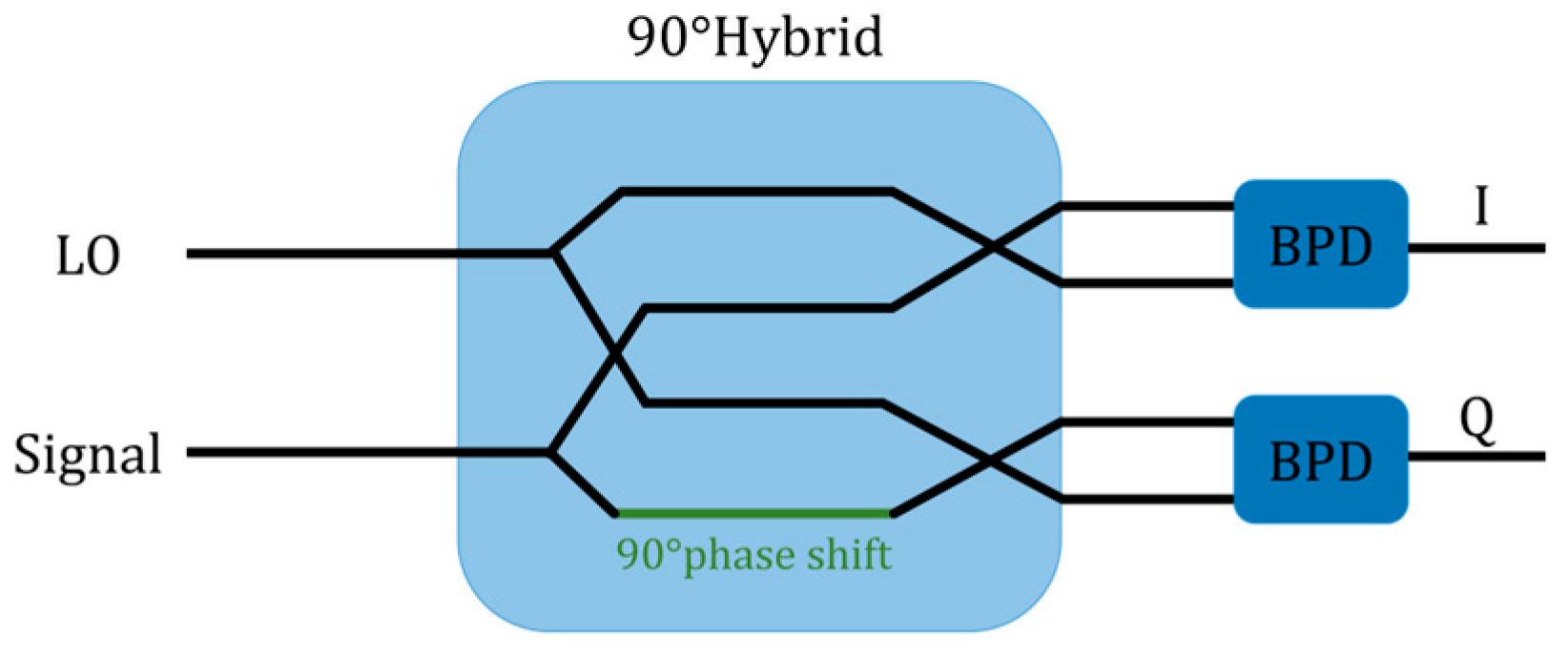
Undersampling-based Φ-OTDR systems typically generate the quadrature component digitally for phase demodulation. In contrast, a 90° optical hybrid provides native I/Q outputs in the optical domain, which simplifies the demodulation chain and reduces sensitivity to digital quadrature-generation imperfections, resulting in more consistent I/Q components.
In this work, we demonstrate a distributed acoustic sensing (DAS) system with a significantly reduced data acquisition rate by combining heterodyne detection with undersampling. The proposed DAS system employs a 90° optical hybrid to obtain in-phase (I) and quadrature (Q) components of the backscattered signal, enabling full complex field recovery. By applying undersampling, the 200 MHz Rayleigh backscatter beat signal is folded to a low frequency, allowing for efficient sampling. In our experiment, a data acquisition card (DAQ) with a sampling rate of only 110 MSa/s is used, yet the vibration signal is accurately recovered without any loss of phase information. We also address the common-phase change that appears when the PZT is placed near the fiber input. A moving-average–moving-difference amplitude analysis is employed to locate vibration events and estimate their effective spatial extent, from which an adaptive differential gauge length is selected to suppress common-phase fluctuations and restrict phase demodulation to a local fiber segment. The system achieves a spatial resolution of 10 m, a signal-to-noise ratio (SNR) of approximately 63.54 dB at a demodulation frequency of 200 Hz, and a background noise level of as low as −52.27 dB·rad2/Hz. The main contributions of this work are threefold: (1) Integrating a 90° hybrid-based heterodyne Φ-OTDR with undersampling, thereby substantially reducing the sampling rate requirement for DAS; (2) experimentally validating phase demodulation at a 200 MHz heterodyne beat frequency with a sampling rate of 110 MSa/s; and (3) introducing an amplitude-assisted adaptive gauge-length strategy to suppress common-phase fluctuations and reduce data throughput.
The remainder of this paper is organized as follows.
Section 2 introduces the operating principle of the coherent Φ-OTDR based on heterodyne detection, I/Q demodulation, and undersampling.
Section 3 describes the experimental setup and key system configurations.
Section 4 presents the experimental results and discusses the performance in terms of signal quality and phase demodulation. Finally,
Section 5 concludes the paper.
3. Experimental Setup
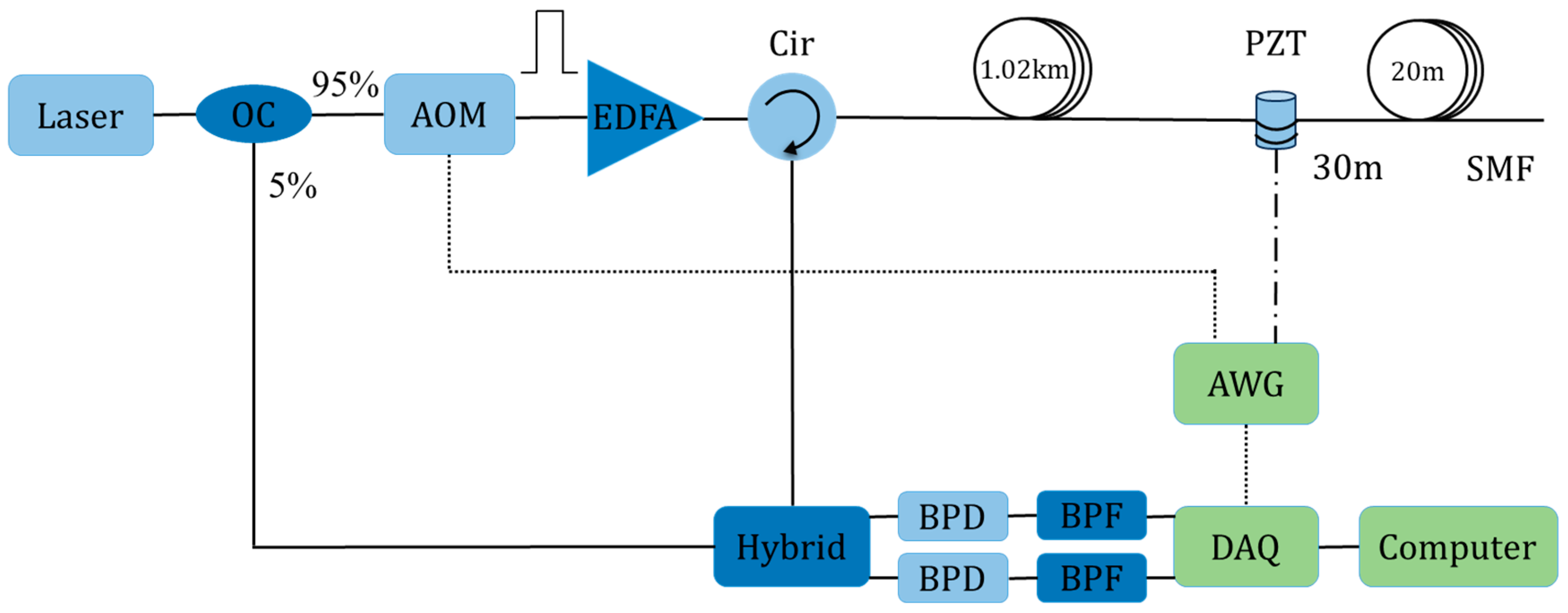
The experimental setup for coherent Φ-OTDR is shown in
Figure 2. A narrow-linewidth laser (HYLM-E-1550.12-2k-10-PA, UnistarCom, Tianjin, China; 1550.124 nm, ~1.4 kHz linewidth), featuring a polarization-maintaining (PM) output fiber, serves as the light source for the system. The laser output was split into two beams by a 95:5 fiber optical coupler, with 95% of the light directed to an acousto-optic modulator (AOM) (SCTF200-1550-1FH, CETC, Chongqing, China; 200 MHz shift, ER > 50 dB). The AOM modulates the light into optical pulses with a repetition frequency of 5 kHz and a pulse width of 100 ns. An arbitrary waveform generator (AWG) provides the RF drive for the AOM, and the same signal is also used as the trigger for the data acquisition card (DAQ). The optical pulse is amplified by an erbium-doped fiber amplifier (EDFA) (AEDFA-NS-200-20-25-M-FA, Amonics, Beijing, China; Psat ≥ +23 dBm, NF ≤ 6 dB), then launched into port 1 of a circulator and coupled into a 1.07 km sensing fiber via port 2. The Rayleigh backscattered light returns through port 2 and exits via port 3, which is connected to the signal input of a 90° optical hybrid (90°-COH28, Kylia, Paris, France). Meanwhile, the remaining 5% of the original laser light is used as the local oscillator (LO) and is fed into the LO port of the 90° optical hybrid. The interference between the LO and backscattered signal generates a 200 MHz beat signal, which is demodulated into in-phase (I) and quadrature (Q) components by the 90° optical hybrid. Balanced photodetectors (BPDs) (BPD465C, Guangyi, Guilin, China; 400 MHz bandwidth) convert these optical signals into electrical signals, which are then filtered by bandpass filters (BPFs).
The pulse repetition rate and pulse width used in this system are 5 kHz and 100 ns, respectively, which means the FWHM of the beat-signal spectrum is approximately 9 MHz. We therefore select a BPF with a center frequency of 200 MHz, a bandwidth (FWHM) of 18 MHz, and a stopband rejection of 50 dB. The Kylia 90°-COH28 optical hybrid provides eight output ports with dual polarization: ports 1–4 correspond to the X-polarization output and ports 5–8 correspond to the Y-polarization output; for simplicity, only the X-polarization output ports are used in this setup. Accordingly, the BPFs are installed only after the two BPD channels that receive Ix and Qx. The data are acquired by the DAQ (QT1144VG4 series, Kunchi, Beijing, China; 16-bit, up to 250 MSa/s) at a rate of 110 MSa/s and sent to the computer for data processing. According to Equations (8)–(11), with f0 = 200 MHz and fs = 110 MSa/s, we choose n = 4, which folds the 200 MHz beat to an effective carrier of 20 MHz after sampling.
In the experiment, a cylindrical piezoelectric ceramic (PZT) is placed at the end of the 1.07 km fiber as a vibration test point, with 30 m of bare fiber wound around the PZT. Another output port of the arbitrary waveform generator (AWG) is used to drive the PZT, generating the vibration signal.
4. Results and Analysis
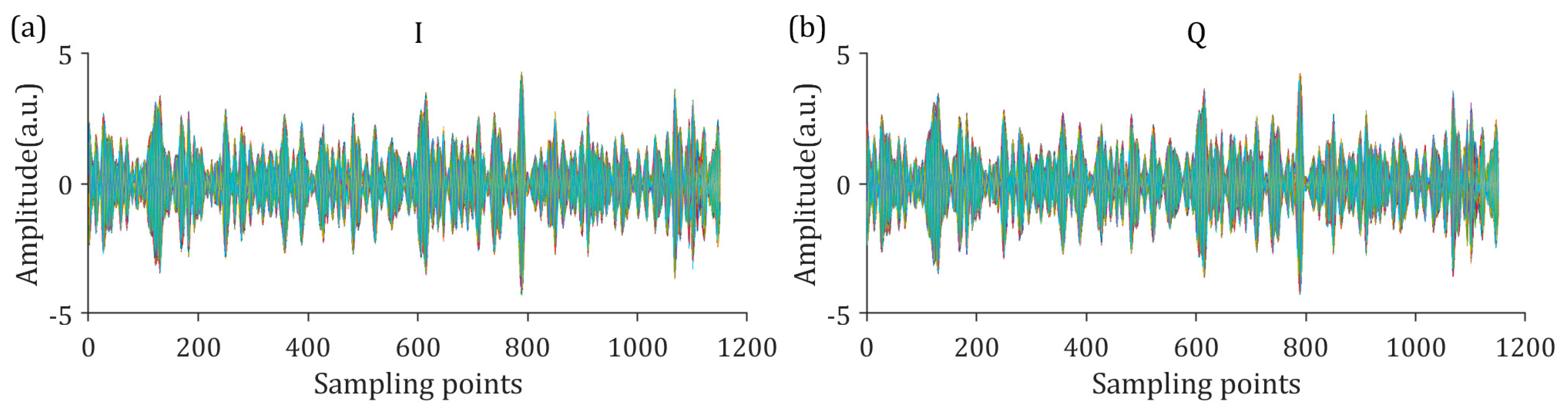
First, signals were collected over several pulse periods and the distribution of the I/Q scattering-light signal amplitude along the fiber was plotted, as shown in
Figure 3. These scattering curves show excellent repeatability and essentially overlap with one another.
To confirm correct phase recovery in phase-demodulated Φ-OTDR, we deliberately chose a single-tone sinusoidal excitation as a standard validation signal. Under the present acquisition and processing settings, a stable sinusoid in the time domain together with a dominant spectral component at the known drive frequency provides a direct validation of correct phase demodulation. In the experiment, a sinusoidal electrical signal with an amplitude of 5 V and a frequency of 200 Hz was applied to the PZT, producing a deformation of 0.25 με.
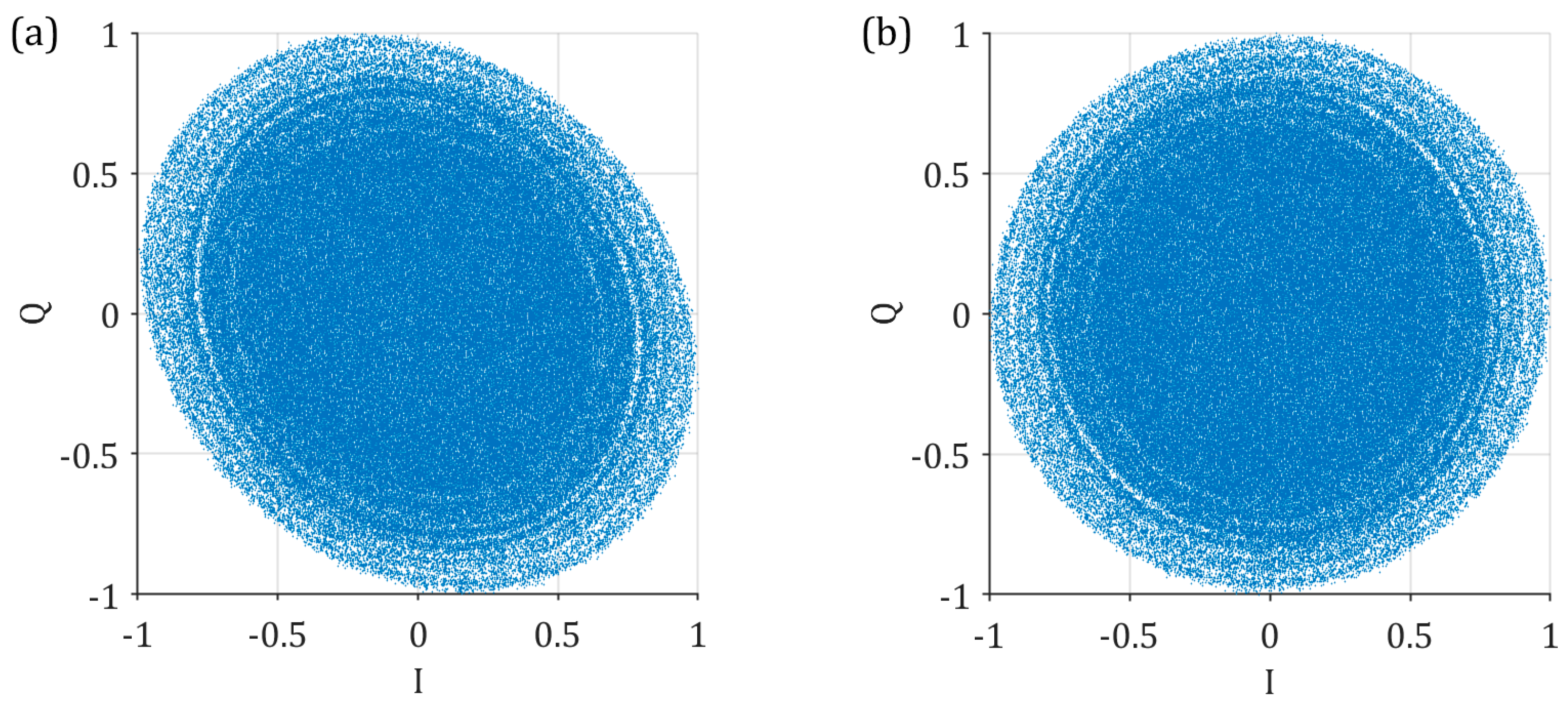
Before phase extraction, the raw I and Q waveforms are digitally calibrated. In our setup, the main nonidealities include residual DC offsets, gain imbalance between the two channels, and quadrature error caused by imperfect 90° hybrid responses and unequal cable delays. We therefore apply a three-step calibration: (i) DC-offset removal for each channel; (ii) gain normalization by matching the RMS amplitudes of I and Q; and (iii) quadrature correction via a linear decorrelation (Gram–Schmidt type) procedure to enforce statistical orthogonality. The phase is then calculated using atan2(Q, I) on the calibrated I/Q pair. As shown in
Figure 4, the I-Q constellation before calibration appears as a tilted ellipse with an offset from the origin, whereas after calibration, it becomes a near-centered, nearly circular distribution. Consistently, the I–Q correlation coefficient decreases from −0.15012 to −2.1851 × 10
−14.
Φ-OTDR scattering traces were continuously collected for phase demodulation.
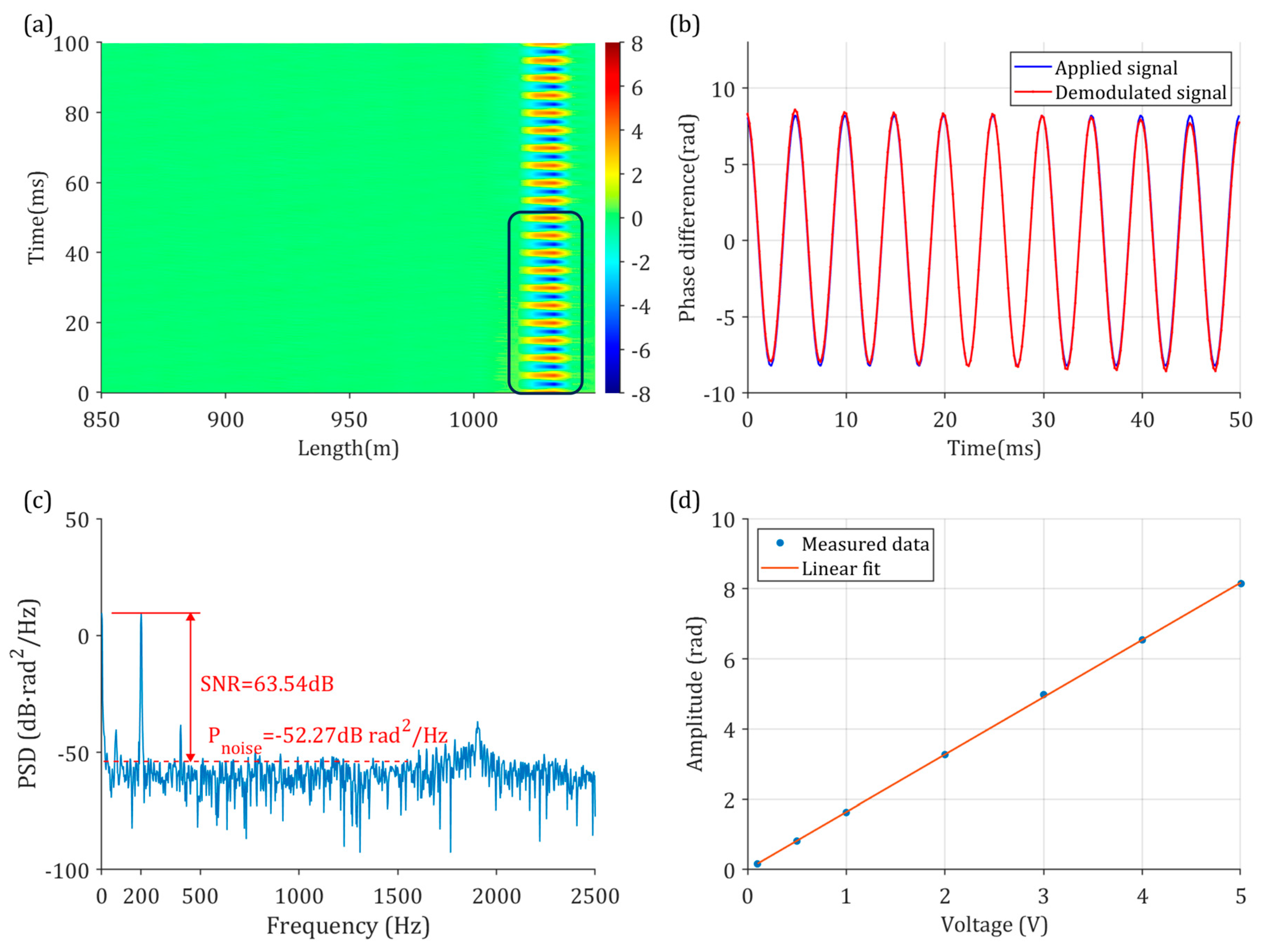
Figure 5a shows the spatio-temporal waterfall plot of the demodulated phase difference, where the horizontal axis represents fiber length and the vertical axis represents time. The sinusoidal vibration trace generated by the PZT at the end of the 1.07 km fiber can be clearly observed. The time-domain demodulated experimental results are shown in
Figure 5b. The red solid curve denotes the demodulated phase difference at the vibration point in the time domain, exhibiting a clear sinusoidal variation over time with an amplitude of approximately 16 rad; the blue solid curve denotes a reference sinusoid at the excitation frequency. The demodulated waveform matches a reference sinusoid at the excitation frequency well, with a Pearson correlation coefficient of r = 0.999 and an RMSE of 0.256 rad over the analyzed time window.
Figure 5c shows the frequency-domain demodulated phase signal, with a clear peak at 200 Hz. The signal-to-noise ratio (SNR) is calculated using the formula 10 log
10 (
Psignal/
Pnoise), where
Psignal is the signal power and
Pnoise is the background noise power. With this definition, our undersampling heterodyne system achieves an SNR of 63.54 dB with a background noise floor of −52.27 dB·rad
2/Hz over a 1.07 km sensing fiber at 10 m spatial resolution. For context, compared with a conventional coherent heterodyne Φ-OTDR that typically digitizes the beat signal at a high sampling rate (e.g., 500 MSa/s), our scheme operates at 110 MSa/s, corresponding to a 78% reduction in DAQ sampling rate. In contrast to a typical homodyne Φ-OTDR scheme [
12], which often introduces an additional AOM in the local oscillator (LO) branch to ensure frequency matching between the signal and the LO, our undersampling heterodyne Φ-OTDR eliminates the need for an extra AOM in the LO branch, thereby simplifying the optical layout and reducing system complexity while maintaining a 10 m spatial resolution and a high SNR.
To evaluate the linear response of the system, the PZT driving frequency was kept fixed at 200 Hz and the amplitude of the sinusoidal voltage applied to the PZT was gradually increased.
Figure 5d shows the relationship between the phase amplitude and the driving voltage, where the blue circles represent the measured sinusoidal phase amplitudes and the blue solid line represents their linear fit. The phase amplitude increases approximately linearly with the driving voltage, and the coefficient of determination is
R2 = 0.9998, indicating an excellent linear response within this voltage range.
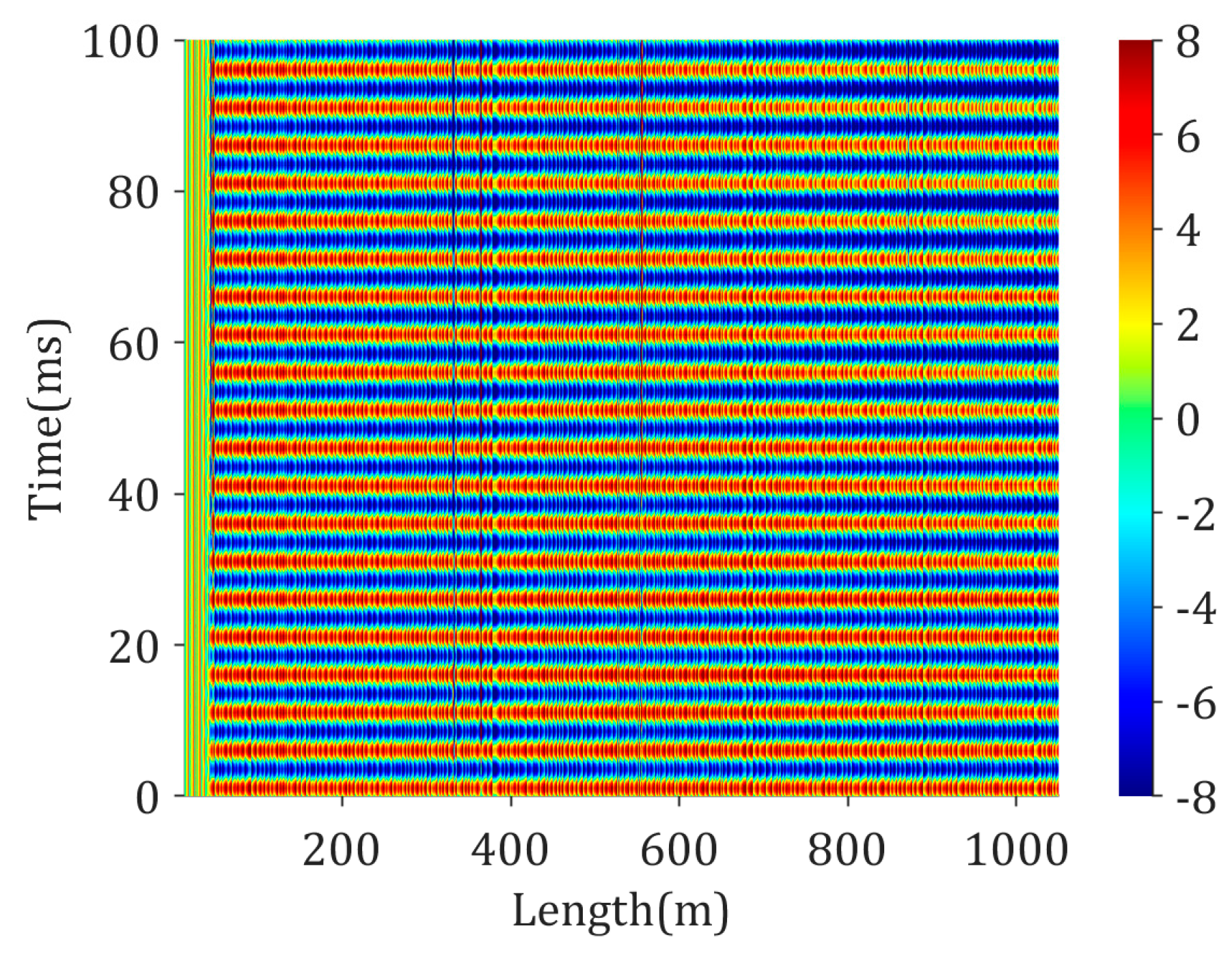
When the vibration source (PZT) is placed at the input end of the sensing fiber and the demodulated phase is differenced trace by trace along the fiber, the resulting spatio-temporal waterfall plot shows an apparent response across the entire fiber. This behavior is the common-phase change discussed in
Section 2 Principle of Operation Section and is illustrated in
Figure 6.
In laboratory experiments, the position of the PZT and the length of fiber wound around it are known a priori; thus, the differential spacing can be selected based on Equations (4)–(7) to satisfy
N ≥
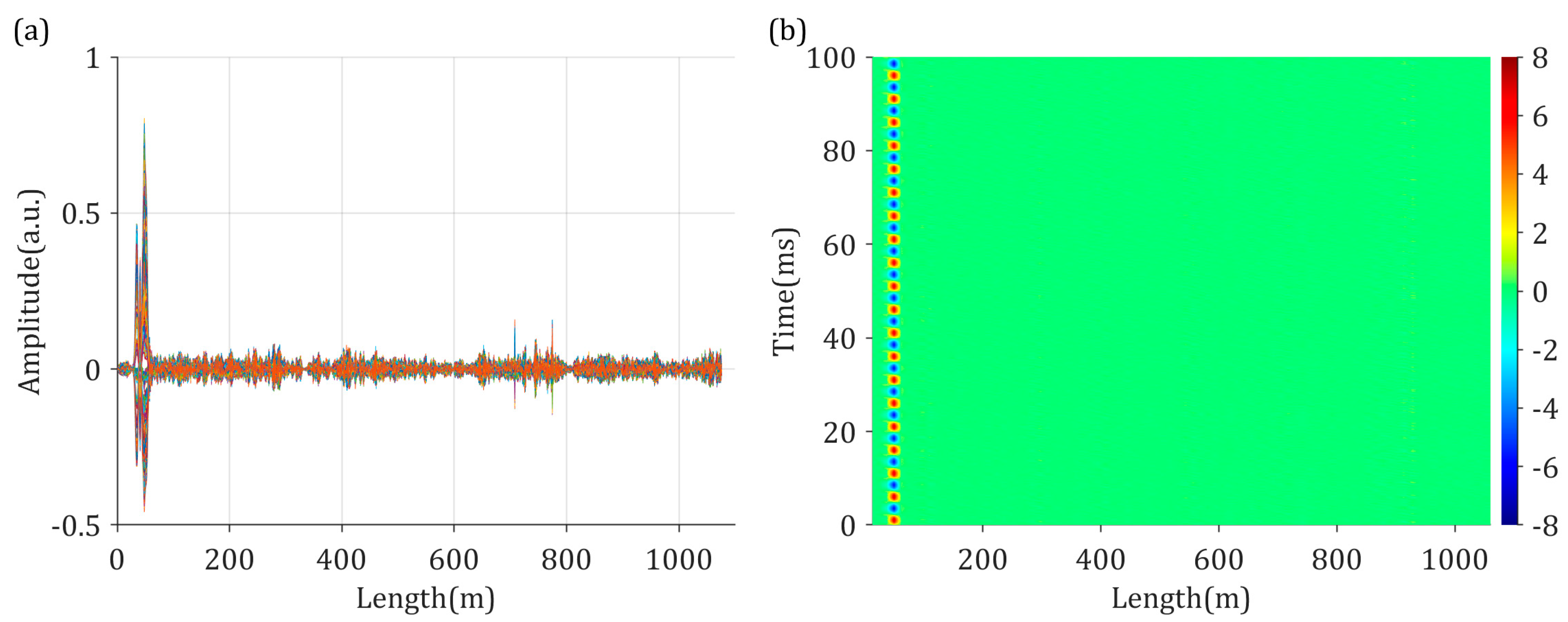
L according to the physical length of the disturbed region. In practical field applications, however, neither the location of external disturbances nor their effective extent along the fiber is generally known, and it is difficult to properly configure the gauge length based solely on prior geometrical information. To address this issue, we first process the I/Q signals using a moving-average–moving-difference (MA–MD) scheme to obtain an amplitude profile [
24], as shown in
Figure 7a. This profile is then used to automatically locate vibration events along the fiber and to estimate the effective length
L of the disturbed region. Based on this estimate, the differential spacing is adaptively selected to satisfy
N ≥
L, so that the phase-differencing window fully covers the actual vibration region. In this way, common-phase perturbations are suppressed while preserving an undistorted reconstruction of the local phase response, as shown in
Figure 7b.
After the vibration event is located along the fiber using the MA–MD amplitude profile, both the center position of the event and its effective spatial extent can be obtained, so that a full phase demodulation over the entire fiber is no longer required. Building on this, we propose a local-region phase demodulation strategy: once the amplitude-based localization is completed, the phase of the I/Q data is computed only over a limited fiber segment in the vicinity of the event. In this way, the complete phase information of the target disturbance is preserved, while redundant computations in non-vibrating regions are significantly reduced.
To quantitatively evaluate the computational efficiency of the proposed local-region demodulation, we implemented both a full-fiber demodulation scheme and a local-region demodulation scheme in a MATLAB R2024b (MathWorks, Natick, MA, USA) environment. The acquired I/Q data form a matrix of size 1160 × 1120, and the full-fiber demodulation directly operates on the entire matrix to obtain a phase matrix Φ ∈ ℝ1160×1120. In contrast, the local-region demodulation performs the same operations only on a 32 × 1120 submatrix corresponding to the interval [zstart, zend] identified by the amplitude-profile localization (which spans approximately 30 m of fiber), while recording the runtime and memory usage of the phase data for both schemes. Experimental results show that, for the data size considered in this work, the runtime of full-fiber demodulation is about 12 ms with a memory usage of approximately 9.91 MB, whereas the local-region demodulation requires only 2 ms and about 0.27 MB of memory. Thus, the computational time and memory consumption are reduced to roughly 16.67% and 2.72% of those of the original full-fiber scheme, respectively. These results demonstrate that the amplitude-profile-guided local phase demodulation substantially reduces computational time and memory usage compared with full-fiber demodulation, while preserving a complete reconstruction of the vibration event.