Trajectory-Based Motion-Plane Modeling in Sports Biomechanics: A Comprehensive Review of Computational and Analytical Approaches


Featured Application
Abstract
1. Introduction
1.1. Background and Sports Applications
1.2. Plane-Related Variables in Different Sports and Research Gaps
2. Method
2.1. Study Design
2.2. Search Strategy
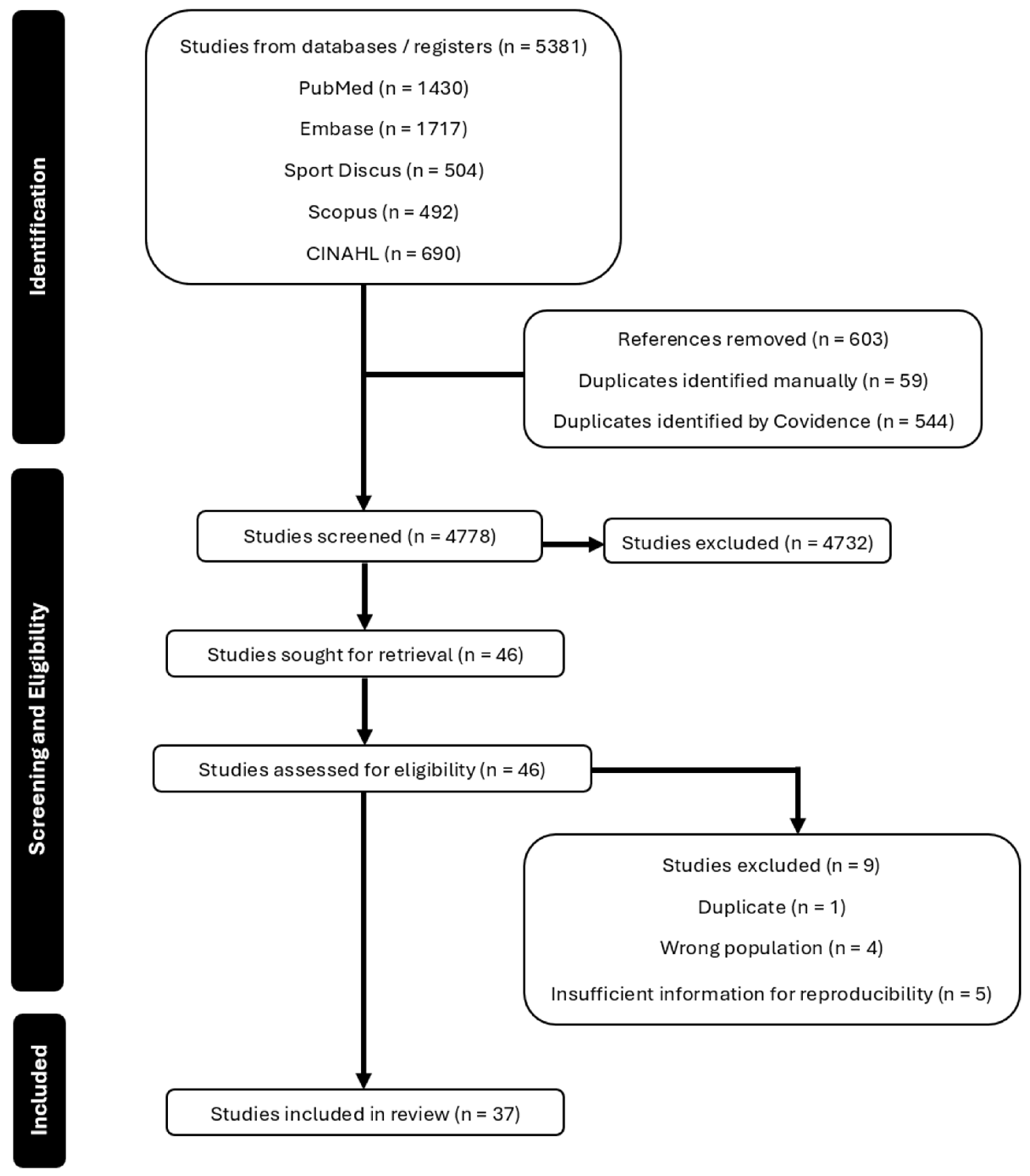
2.3. Study Screening and Selection
2.4. Scope and Task Selection
3. Theoretical Framework of Trajectory-Based Motion Plane Modeling
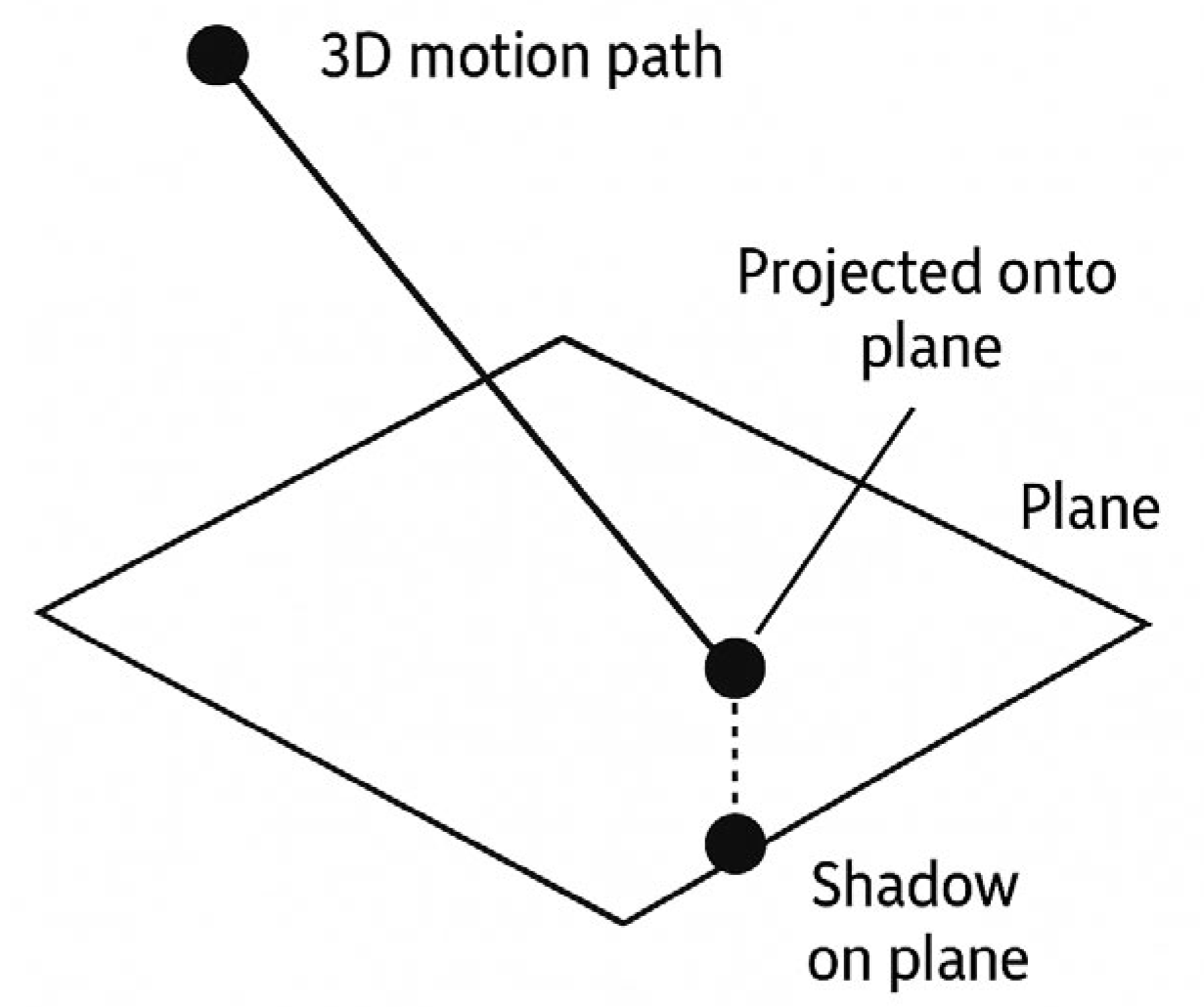
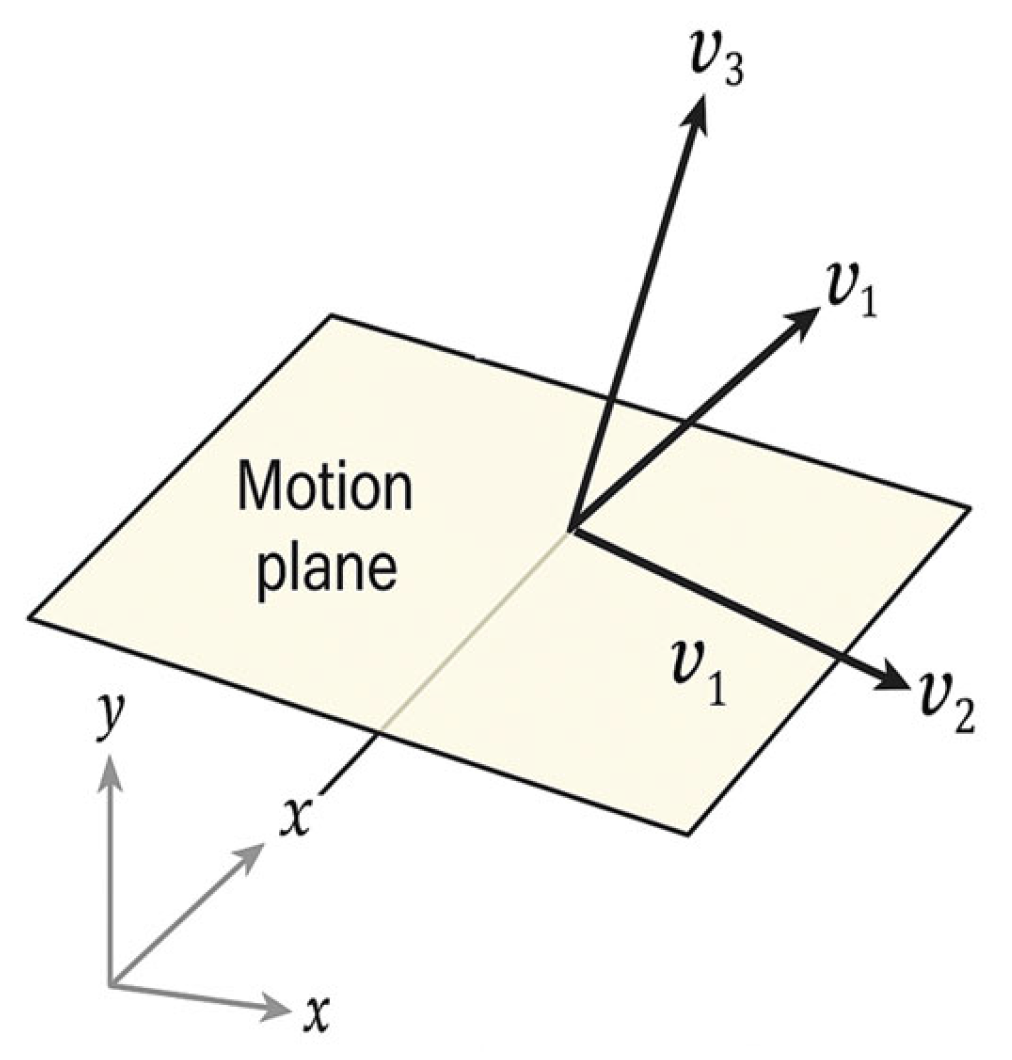
3.1. Conceptual Definition of a Motion Plane
3.2. Conceptual Consideration in Quantifying Planarity
3.2.1. Global vs. Local Measures of Planarity
3.2.2. Effects of Motion Curvature and Noise
3.2.3. Phase Weighting and Mechanical Relevance
3.3. Model of Principal Component Analysis
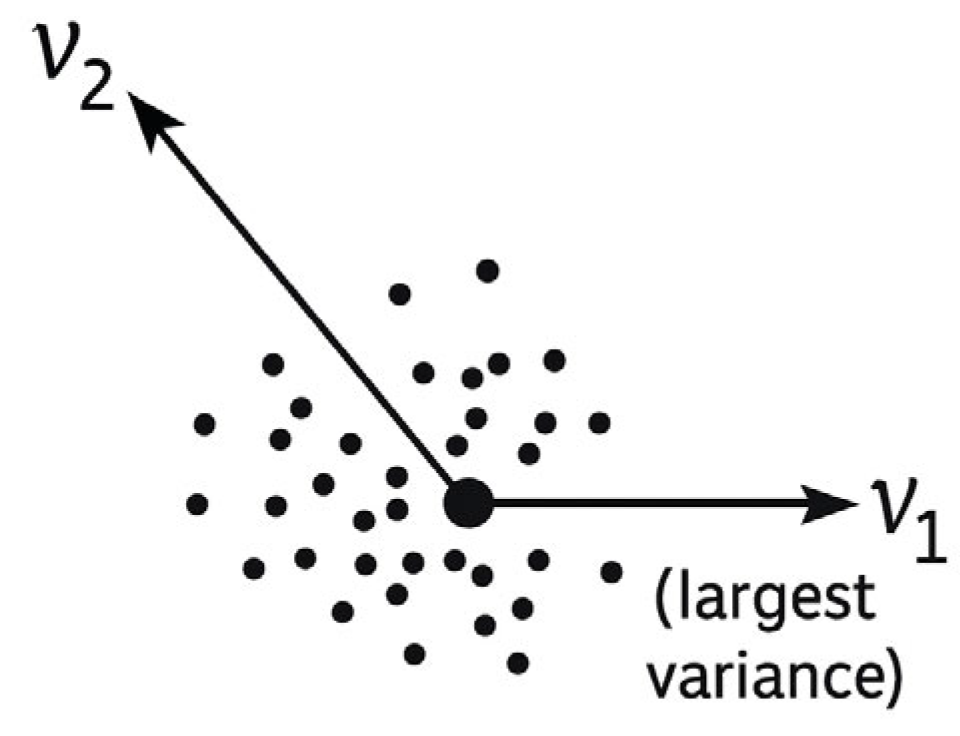
3.3.1. Principal Component Analysis (PCA)
3.3.2. Singular Value Decomposition (SVD)
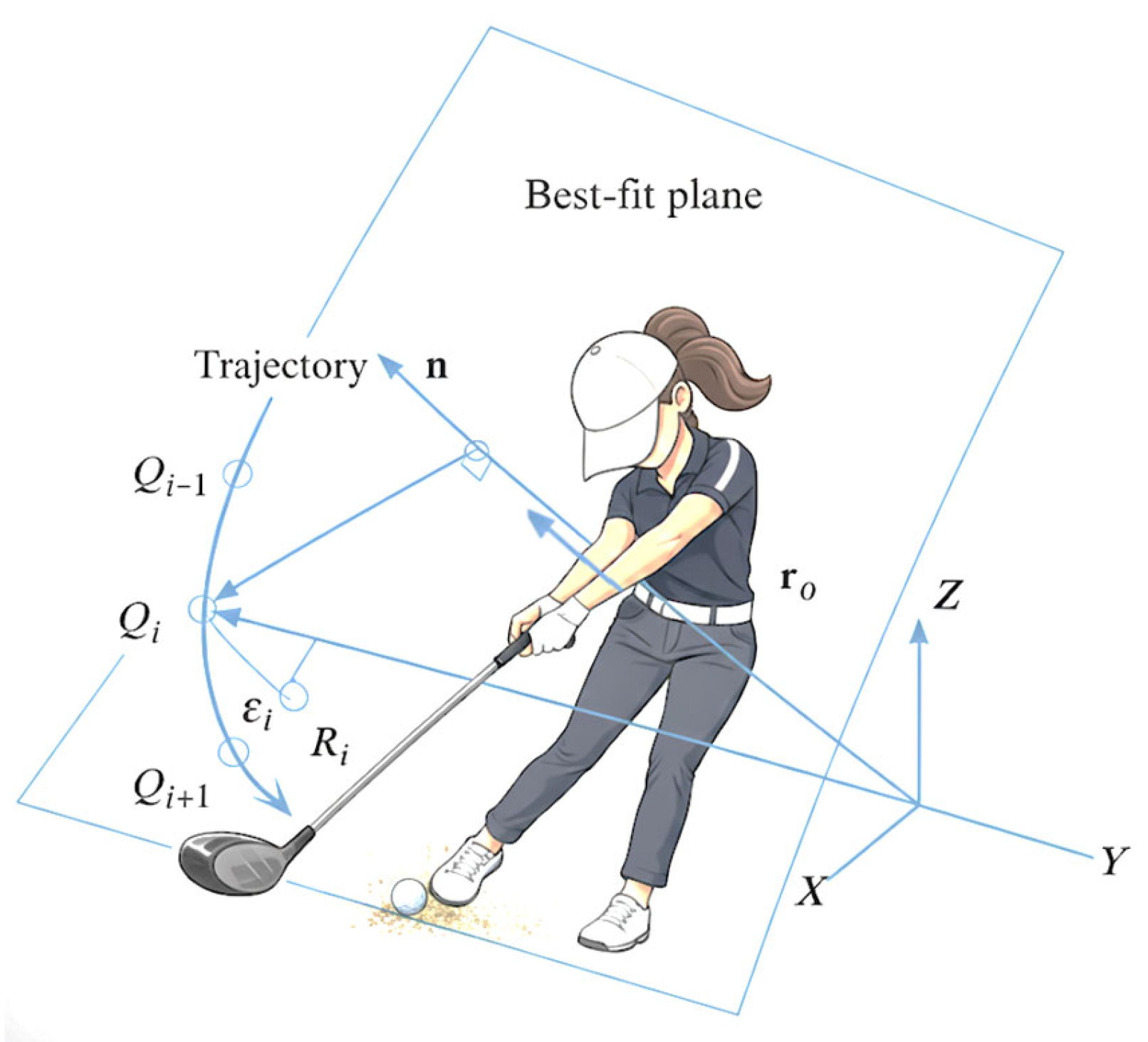
3.3.3. Model of Orthogonal Least-Squares (OLS)
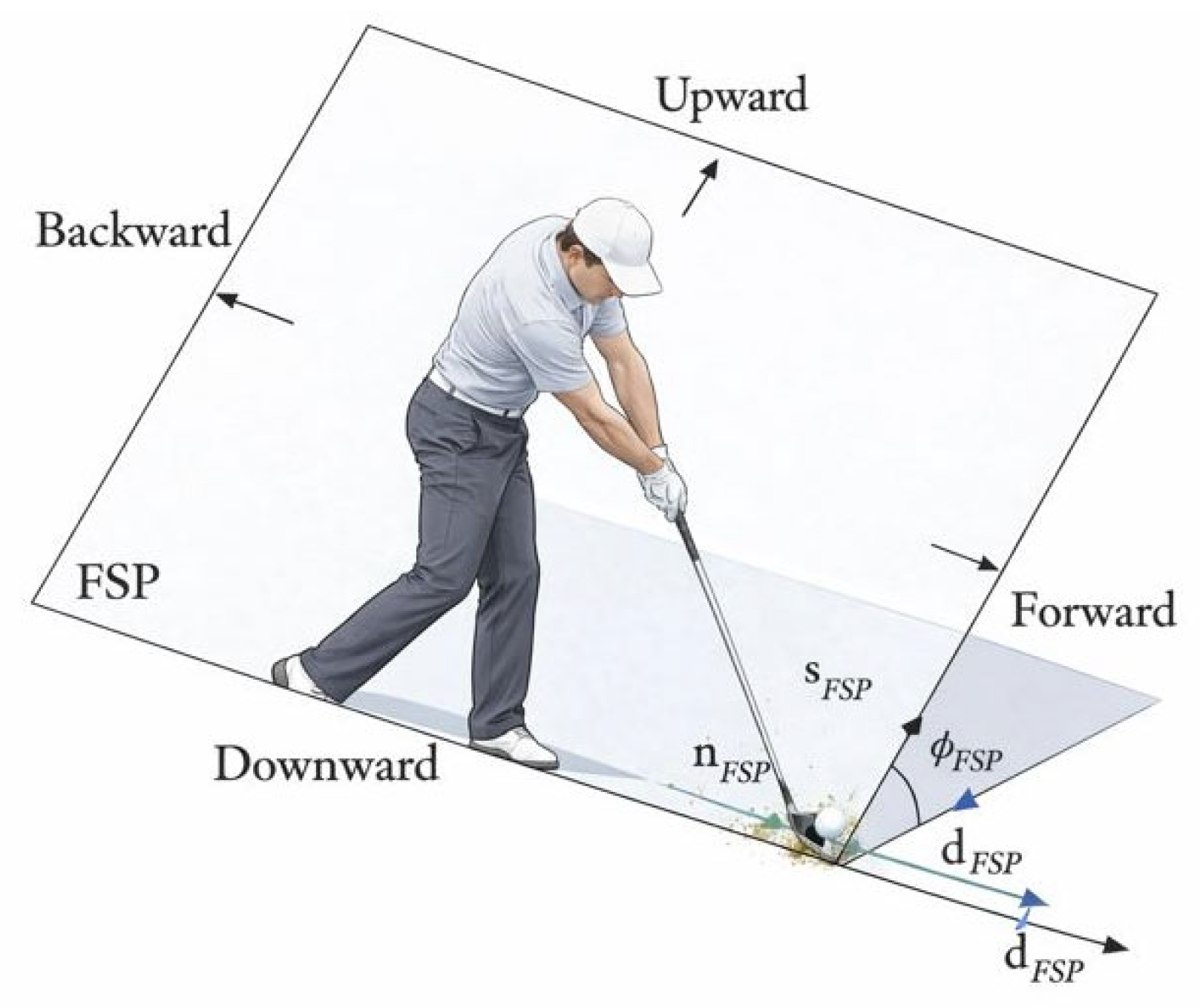
3.3.4. Model of Newton–Raphson Method–Functional Swing Plane (FSP)
3.4. Summary and Comparison of Motion-Plane Models
3.5. Cross-Sport Applications for Motion-Plane Models
3.5.1. Application Motion Plane Across Sports
3.5.2. Performance and Joint Loading
4. Conclusions, Limitations, and Future Directions
4.1. Conclusion
4.2. Future Study
4.2.1. From Plane-like Descriptors to True Trajectory-Based Motion Planes
4.2.2. Linking Plane Features with Performance Outcomes and Mechanical Demands
4.2.3. Integrating Multiple Modeling Approaches to Develop Robust, Task-Relevant Plane Estimates
4.2.4. Empirical Validation and Robustness Benchmarking
Author Contributions
Funding
Institutional Review Board Statement
Informed Consent Statement
Data Availability Statement
Conflicts of Interest
Abbreviations
| FSP | Functional Swing Plane | |
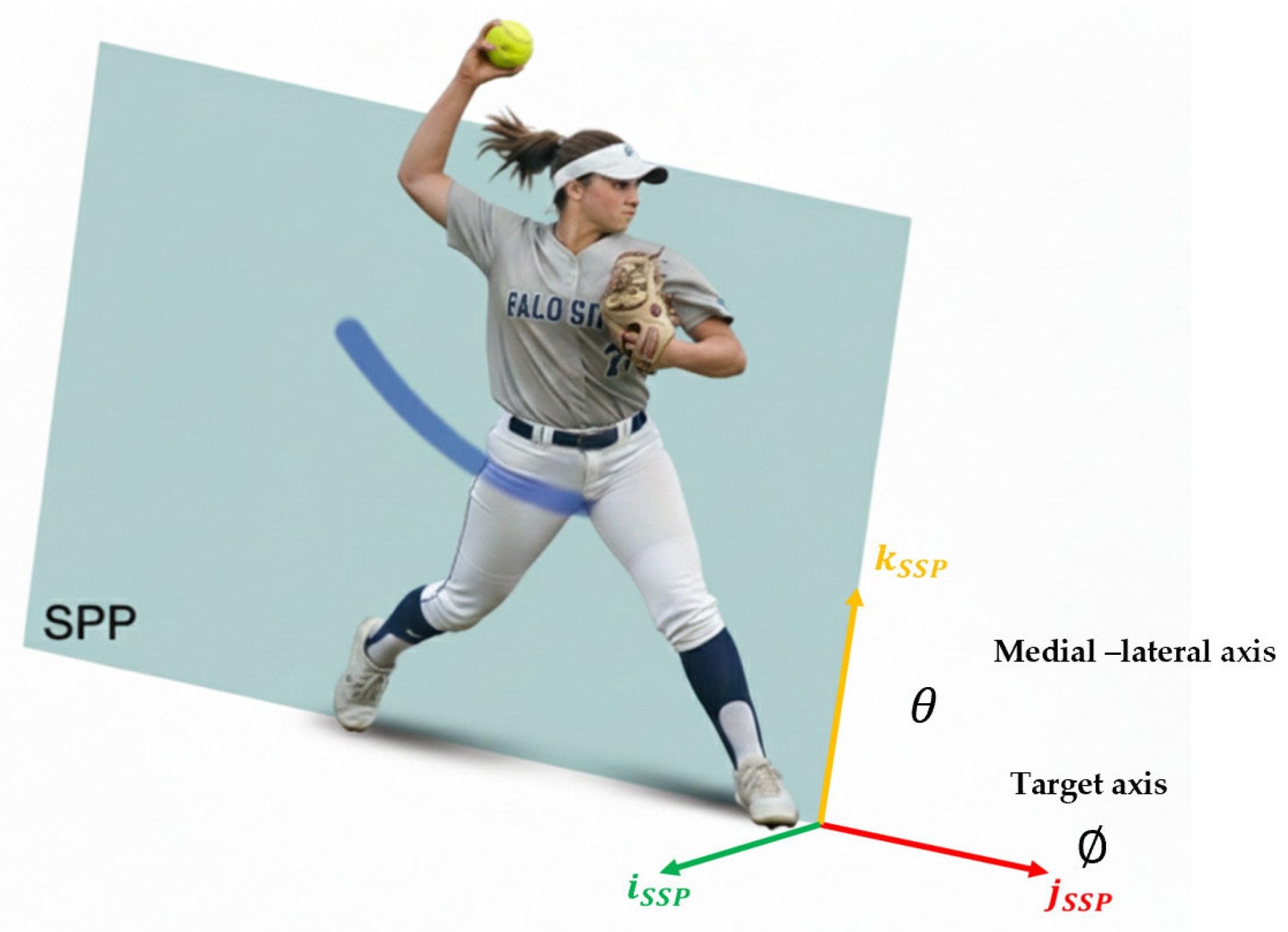
| SPP | Softball Pitching Plane | |
| PCA | Principal Component Analysis | |
| OLS | Orthogonal Least-Squares | |
| SVD | Singular Value Decomposition | |
| 3D | Three Dimensions | |
| RMS | Root Mean Square | |
| PMs | Principal Movements | |
| Notation Box for PCA model | ||
| PCA | Dimension | Description |
| n | Scalar | Total number of sampled frames |
| Three-dimensional position vector of the tracked point of interest at frame i | ||
| X | Data matrix collecting all position vectors, with each row corresponding to one frame | |
| Sample mean position vector across all frames | ||
| Mean-centered position vector at frame i, defined as | ||
| C | Sample covariance matrix of the mean-centered data | |
| Scalar | Eigenvalue associated with the -th principal direction, representing the variance explained | |
| Eigenvector corresponding to , defining the -th principal direction | ||
| V | Matrix formed by the first two principal directions , spanning the dominant motion-plane | |
| Normal vector of the PCA plane, corresponding to the smallest eigenvalue or the cross product of and | ||
| Projection of the mean-centered point onto the PCA plane | ||
| Scalar | Orthogonal (off-plane) distance from to its projection | |
| RMS | Scalar | Root-mean-square of the off-plane distances, quantifying overall planarity |
| Notation Box for SVD model | ||
| symbol | Dimension | Description |
| X | Data matrix of the trajectory, where each row corresponds to the 3D position at one frame | |
| Mean position vector across all frames | ||
| Mean-centered data matrix obtained by subtracting from each row of X | ||
| Matrix of left singular vectors, representing orthonormal temporal coefficients | ||
| Diagonal matrix of singular values , ordered as | ||
| V | Matrix of right-singular vectors defining orthonormal spatial directions | |
| -th right-singular vector (column of ), representing a principal spatial direction | ||
| First two right-singular vectors spanning the dominant motion-plane | ||
| Third right-singular vector corresponding to the smallest singular value; normal vector of the motion plane | ||
| Projection of the original point onto the SVD-based motion plane | ||
| Scalar | Orthogonal (off-plane) distance of frame from the fitted motion-plane | |
| Notation Box for OLS model | ||
| symbol | Dimension | Softball Pitching Plane |
| Original three-dimensional position vector of the marker or joint center at frame i | ||
| Centroid (mean position) of the trajectory across all frames | ||
| scalar | Weight assigned to frame i (e.g., instantaneous segment or hand velocity) | |
| S | Weighted scatter matrix summarizing spatial variance of the centered trajectory | |
| n | Unit normal vector of the best-fit plane estimated by OLS | |
| scalar | Smallest eigenvalue of the scatter matrix S | |
| d | scalar | Plane offset term, defined as |
| Orthogonal projection of point onto the fitted plane | ||
| Scalar | Signed orthogonal distance of frame from the fitted plane | |
| unit vector | In-plane axis defined by the projection of the global target direction onto the plane | |
| unit vector | Orthogonal in-plane axis completing a right-handed coordinate system | |
| scalar (angle) | Slope angle describing plane inclination relative to the global reference frame | |
| scalar (angle) | Direction angle describing the in-plane orientation relative to the target direction | |
| Notation Box for FSP | ||
| symbol | Dimension | Description |
| Three-dimensional position vector of the trajectory point at frame | ||
| Position vector from the global origin to a point on the plane, constrained to be perpendicular to the plane | ||
| n | Unit normal vector of the functional swing plane, defined as | |
| Scalar | Signed deviation of trajectory point from the fitted plane | |
| Scalar | Weight assigned to frame i (e.g., instantaneous segment or end-point velocity) | |
| F | Weighted residual vector composed of | |
| J | Jacobian matrix of partial derivatives of residuals with respect to | |
| scalar | Cartesian components of the plane-defining point | |
| scalar | Weighted root-mean-square deviation of trajectory points from the fitted plane | |
| scalar | Maximum absolute deviation of any trajectory point from the fitted plane | |
| i, j, k | Unit vector | Global reference frame unit vectors along the X, Y, and Z axes, respectively |
| Unit normal vector of the functional swing plane (same as ) | ||
| Unit direction vector defined by the intersection of the plane with the ground | ||
| Scalar (angle) | Slope angle of the plane relative to the global ground | |
| Scalar (angle) | Direction angle of the plane relative to the global target direction | |
References
- Putnam, C.A. A segment interaction analysis of proximal-to-distal sequential segment motion patterns. Med. Sci. Sports Exerc. 1991, 23, 130–144. [Google Scholar] [CrossRef] [PubMed]
- Aguinaldo, A.L.; Escamilla, R.F. Segmental power analysis of sequential body motion and elbow valgus loading during baseball pitching. Orthop. J. Sports Med. 2019, 7, 2325967119827924. [Google Scholar] [CrossRef] [PubMed]
- Scarborough, D.M.; Bassett, A.J.; Mayer, L.W.; Berkson, E.M. Kinematic sequence patterns in the overhead baseball pitch. Sports Biomech. Int. Soc. Biomech. Sports 2020, 19, 569–586. [Google Scholar] [CrossRef] [PubMed]
- Scarborough, D.M.; Linderman, S.E.; Sanchez, J.E.; Berkson, E.M. Baseball pitchers’ kinematic sequences and their relationship to elbow and shoulder torque production. Ortho. J. Sports Med. 2019, 7, 2325967119S2325900429. [Google Scholar] [CrossRef]
- Martin, C.; Bideau, B.; Ropars, M.; Delamarche, P.; Kulpa, R. Upper limb joint kinetic analysis during tennis serve: Assessment of competitive level on efficiency and injury risks. Scand. J. Med. Sci. Sports 2014, 24, 700–707. [Google Scholar] [CrossRef]
- Wagner, H.; Pfusterschmied, J.; Von Duvillard, S.P.; Muller, E. Skill-dependent proximal-to-distal sequence in team-handball throwing. J. Sports Sci. 2012, 30, 21–29. [Google Scholar] [CrossRef]
- Wagner, H.; Pfusterschmied, J.; Von Duvillard, S.P.; Muller, E. Performance and kinematics of various throwing techniques in team handball. J. Sports Sci. Med. 2011, 10, 73–80. [Google Scholar]
- Welch, C.M.; Banks, S.A.; Cook, F.F.; Draovitch, P. Hitting a baseball: A biomechanical description. J. Orthop. Sports Phys. Ther. 1995, 22, 193–201. [Google Scholar] [CrossRef]
- Han, K.H.; Como, C.; Kim, J.; Hung, C.-J.; Hasan, M.; Kwon, Y.-H. Effects of pelvis–shoulders torsional separation style on kinematic sequence in golf driving. Sports Biomech. 2019, 18, 663–685. [Google Scholar] [CrossRef]
- Anderson, B.C.; Wright, I.C.; Stefanyshyn, D.J. Segmental Sequencing of Kinetic Energy in the Golf Swing; Springer: New York, NY, USA, 2006. [Google Scholar]
- Bourgain, M.; Rouch, P.; Rouillon, O.; Thoreux, P.; Sauret, C. Golf Swing Biomechanics: A Systematic Review and Methodological Recommendations for Kinematics. Sports 2022, 10, 91. [Google Scholar] [CrossRef]
- François Tubez, F.; Forthomme, B.; Croisier, J.-L.; Cordonnier, C.; Brüls, O.; Denoël, V.; Berwart, G.; Joris, M.; Grosdent, S.; Schwartz, C. Biomechanical Analysis of Abdominal Injury in Tennis Serves. A Case Report. J. Sports Sci. Med. 2015, 14, 402–412. [Google Scholar]
- Serrien, B.; Goossens, M.; Baeyens, J. Proximal-to-Distal Sequencing and Coordination Variability in the Volleyball Spike of Elite Youth Players: Effects of Gender and Growth. J. Mot. Learn. Dev. 2018, 6, 250–266. [Google Scholar] [CrossRef]
- Bannister, B.S.; Phillips, J.; Jensen, M.R.; Bruneau, M.L.; Waterman, W.; West-Sell, S.A.; Jensen, C.D. Kinematic Sequencing Of A Baseball Swing: Does Segment Order Influence Exit Velocity? Med. Sci. Sports Exerc. 2024, 55, 1012. [Google Scholar] [CrossRef]
- McGuire, T.G.; Picard, C.T.; Ward, R.M.; Smith, D.L.; Kwon, Y.H.; Walsh, M.S. The effects of target distance on kinematic sequence of the short game in male collegiate golfers. Sports Biomech. 2024, 23, 3290–3300. [Google Scholar] [CrossRef]
- Whiting, W.C.; Gregor, R.J.; Halushka, M. Body segment and release parameter contributions to new-rules javelin throwing. J. Appl. Biomech. 1991, 7, 111–124. [Google Scholar] [CrossRef]
- Fleisig, G.S.; Barrentine, S.W.; Zheng, N.; Escamilla, R.F.; Andrews, J.R. Kinematic and kinetic comparison of baseball pitching among various levels of development. J. Biomech. 1999, 32, 1371–1375. [Google Scholar] [CrossRef]
- Fleisig, G.S.; Andrews, J.R.; Dillman, C.J.; Escamilla, R.F. Kinetics of baseball pitching with implications about injury mechanisms. Am. J. Sports Med. 1995, 23, 233–239. [Google Scholar] [CrossRef]
- Seroyer, S.T.; Nho, S.J.; Bach, B.R.; Bush-Joseph, C.A.; Nicholson, G.P.; Romeo, A.A. The Kinetic Chain in Overhand Pitching: Its Potentil Role for Performance Enhancement and Injury Prevention. Sports Health 2010, 2, 135–146. [Google Scholar] [CrossRef]
- Weber, A.; Kontaxis, A.; O’Brien, S.J.; Bendi, A. The biomechanics of throwing: Simplified and cogent. Sports Med. Arthrosc. 2014, 22, 72–79. [Google Scholar] [CrossRef]
- Oyama, S. Baseball pitching kinematics, joint loads, and injury prevention. J. Sport Health Sci. 2012, 1, 80–91. [Google Scholar] [CrossRef]
- Nesbit, S.M.; Serrano, M. Work and power analysis of the golf swing. J. Sports Sci. Med. 2005, 4, 520–533. [Google Scholar] [PubMed]
- Madrid, M.V.; Avalos, M.A.; Levine, N.A.; Tuttle, N.J.; Becker, K.A.; Kwon, Y.-H. Association between the on-plane angular motions of the axle-chain system and clubhead speed in skilled male golfers. Appl. Sci. 2020, 10, 5728. [Google Scholar] [CrossRef]
- Wagner, H.; Finkenzeller, T.; Wurth, S.; von Duvillard, S.P. Individual and team performance in team-handball: A review. J. Sports Sci. Med. 2014, 13, 808–816. [Google Scholar] [PubMed]
- Barfield, W.R.; Kirkendall, D.T.; Yu, B. Kinematic instep kicking differences between elite female and male soccer players. J. Sports Sci. Med. 2002, 1, 72–79. [Google Scholar] [PubMed]
- Wagner, H.; Pfusterschmied, J.; Tilp, M.; Landlinger, J.; von Duvillard, S.P.; Muller, E. Upper body kinematics in team handball throw, tennis serve, and volleyball spike. Scand. J. Med. Sci. Sports 2014, 24, 345–354. [Google Scholar] [CrossRef]
- Liu, J.M.; Knowlton, C.; Gauthier, M.; Tropp, Z.; Verma, N.; Nicholson, G.; Romeo, A.; Zaferiou, A. How maximal whole-body and segmental angular momenta relate to fastball speeds in high school baseball pitchers. J. Biomech. 2025, 112919. [Google Scholar] [CrossRef]
- Kwon, Y.-H.; Como, C.S.; Singhal, K.; Lee, S.; Han, K.H. Assessment of planarity of the golf swing based on the functional swing plane of the clubhead and motion planes of the body points. Sports Biomech 2012, 11, 127–148. [Google Scholar] [CrossRef]
- Cheng, K.-J.; Mori, K.; Lee, B.; Martinez, A.; Baek, S.; Alvis, H.B.; Kwon, Y.-H. Effects of on-plane wrist release style on morphological, temporal, and kinematic swing characteristics in golf drives performed by skilled male golfers. Sports Biomech. 2025, 24, 3637–3654. [Google Scholar] [CrossRef]
- Kwon, Y.-H.; Tuttle, N.J.; Hung, C.-J.; Levine, N.A.; Baek, S. Linear relationships among the hand and clubhead motion characteristics in golf driving in skilled male golfers. J. Appl. Biomech. 2021, 37, 619–628. [Google Scholar] [CrossRef]
- Nesbit, S.M.; McGinnis, R. Kinematic analyses of the golf swing hub path and its role in golfer/club kinetic transfers. J. Sports Sci. Med. 2009, 8, 235–246. [Google Scholar]
- Solomito, M.J.; Garibay, E.J.; Woods, J.R.; Ounpuu, S.; Nissen, C.W. Lateral trunk lean in pitchers affects both ball velocity and upper extremity joint moments. Am. J. Sports Med. 2015, 43, 1235–1240. [Google Scholar] [CrossRef] [PubMed]
- Matsuo, T.; Fleisig, G.S. Influence of shoulder abduction and lateral trunk tilt on peak elbow varus torque for college baseball pitchers during simulated pitching. J. Appl. Biomech. 2006, 22, 93–102. [Google Scholar] [CrossRef] [PubMed]
- Oyama, S.; Yu, B.; Blackburn, J.T.; Padua, D.A.; Li, L.; Myers, J.B. Effect of excessive contralateral trunk tilt on pitching biomechanics and performance in high school baseball pitchers. Am. J. Sports Med. 2013, 41, 2430–2438. [Google Scholar] [CrossRef]
- Manzi, J.E.; Wang, Z.; Wright-Chisem, J.; Nicholson, A.; Dennis, E.; Dines, J.S. Elbow varus torque and ball velocity associations in high school and professional pitchers with increased sagittal-plane trunk tilt. J. Shoulder Elbow Surg. 2022, 31, 151–158. [Google Scholar] [CrossRef] [PubMed]
- Friesen, K.B.; Butler, L.S.; Bordelon, N.B.; Downs Talmage, J.L.; Fleisig, G.; Ulman, S.; Oliver, G.D. Biomechanics of fastpitch softball pitching: A practitioner’s guide. Sports Health 2025, 17, 1200–1213. [Google Scholar] [CrossRef]
- Van den Tillar, R.; Ettema, G. Is there a proximal-to-distal sequence in overarm throwing in team-handball? J. Sports Sci. 2009, 27, 949–955. [Google Scholar] [CrossRef]
- Aguinaldo, A.L.; Chambers, H. Correlation of throwing mechanics with elbow valgus load in adult baseball pitchers. Am. J. Sports Med. 2009, 37, 2043–2048. [Google Scholar] [CrossRef]
- Manzi, J.E.; Dowling, B.; Wang, Z.; Lamb, J.R.; Fry, E.G.; McElheny, K.D.; Fu, M.C.; Dines, J.S. Joint and segment sequencing and its relationship to ball velocity and throwing arm kinetics in professional pitchers. J. Shoulder Elbow Surg. 2022, 31, 1026–1034. [Google Scholar] [CrossRef]
- Luera, M.J.; Dowling, B.; Magrini, M.A.; Muddle, T.W.D.; Colquhoun, R.J.; Jenkins, N.D.M. Role of rotational kinematics in minimizing elbow varus torques for professional versus high school pitchers. Orthop. J. Sports Med. 2018, 6, 2325967118760780. [Google Scholar] [CrossRef]
- Oliver, G.D.; Dwelly, P.M.; Kwon, Y.H. Kinematic motion of the windmill softball pitch in prepubescent and pubescent girls. J. Strength Cond. Res. 2010, 24, 2400–2407. [Google Scholar] [CrossRef]
- Manzi, J.E.; Dowling, B.; Trauger, N.; Fu, M.C.; Hansen, B.R.; Dines, J.S. The influence of shoulder abduction and external rotation on throwing arm kinetics in professional baseball pitchers. Shoulder Elb. 2022, 14, 90–98. [Google Scholar] [CrossRef]
- Fortenbaugh, D.; Fleisig, G.S.; Andrews, J.R. Baseball pitching biomechanics in relation to injury risk and performance. Sports Health 2009, 1, 314–320. [Google Scholar] [CrossRef]
- Manzi, J.E.; Ruzbarsky, J.J.; Krichevsky, S.; Sudah, S.Y.; Estrada, J.; Wang, Z.; Moran, J.; Kunze, K.N.; Ciccotti, M.C.; Chen, F.R.; et al. Kinematic and kinetic comparisons of arm slot position between high school and professional pitchers. Orthop. J. Sports Med. 2023, 11, 23259671221147874. [Google Scholar] [CrossRef]
- Escamilla, R.F.; Slowik, J.S.; Diffendaffer, A.Z.; Fleisig, G.S. Differences among overhand, 3-quarter, and sidearm pitching biomechanics in professional baseball players. J. Appl. Biomech. 2018, 34, 377–385. [Google Scholar] [CrossRef] [PubMed]
- Wagner, H.; Pfusterschmied, J.; Klous, M.; von Duvillard, S.P.; Muller, E. Movement variability and skill level of various throwing techniques. Hum. Mov. Sci. 2012, 31, 78–90. [Google Scholar] [CrossRef] [PubMed]
- Aguinaldo, A.L.; Buttermore, J.; Chambers, H. Effects of upper trunk rotation on shoulder joint torque among baseball pitchers of various levels. J. Appl. Biomech. 2007, 23, 42–51. [Google Scholar] [CrossRef] [PubMed]
- Manzi, J.E.; Dowling, B.; Trauger, N.; Hansen, B.R.; Quan, T.; Dennis, E.; Fu, M.C.; Dines, J.S. The relationship between maximum shoulder horizontal abduction and adduction on peak shoulder kinetics in professional pitchers. Sports Health 2023, 15, 592–598. [Google Scholar] [CrossRef]
- Coleman, S.G.S.; Benham, A.S.; Northcott, S.R. A three-dimensional cinematographical analysis of the volleyball spike. J. Sports Sci. 1993, 11, 295–302. [Google Scholar] [CrossRef]
- Bahamonde, R.E. Changes in angular momentum during the tennis serve. J. Sports Sci. 2000, 18, 579–592. [Google Scholar] [CrossRef]
- Reid, M.; Elliott, B.; Alderson, J. Lower-limb coordination and shoulder joint mechanics in the tennis serve. Med. Sci. Sports Exerc. 2008, 40, 308–315. [Google Scholar] [CrossRef]
- Van den Tillar, R.; Ettema, G. A three-dimensional analysis of overarm throwing in experienced handball players. J. Appl. Biomech. 2007, 23, 12–19. [Google Scholar] [CrossRef]
- Van den Tillar, R.; Ettema, G. Instructions emphasizing velocity, accuracy, or both in performance and kinematics of overarm throwing by experienced team-handball players. Percept. Mot. Ski. 2003, 97, 731–742. [Google Scholar] [CrossRef] [PubMed]
- Wagner, H.; Tilp, M.; von Duvillard, S.P.; Mueller, E. Kinematic analysis of volleyball spike jump. Int. J. Sports Med. 2009, 30, 760–765. [Google Scholar] [CrossRef] [PubMed]
- Guo, R.; Li, Y. Kinematic analysis of spiking in elite volleyball players during competition. In Proceedings of the XVIII International Symposium on Biomechanics in Sports, Hong Kong, China, 25–30 June 2000. [Google Scholar]
- Reeser, J.C.; Fleisig, G.S.; Bolt, B.; Ruan, M. Upper limb biomechanics during the volleyball serve and spike. Sports Health 2010, 2, 368–374. [Google Scholar] [CrossRef] [PubMed]
- Werner, S.L.; Jones, D.G.; Guido, J.A., Jr.; Brunet, M.E. Kinematics and kinetics of elite windmill softball pitching. Am. J. Sports Med. 2006, 34, 597–603. [Google Scholar] [CrossRef]
- Friesen, K.B.; Saper, M.G.; Oliver, G.D. Biomechanics related to increased softball pitcher shoulder stress: Implications for injury prevention. Am. J. Sports Med. 2022, 50, 216–223. [Google Scholar] [CrossRef]
- Nunome, H.; Asai, T.; Ikegami, Y.; Sakurai, S. Three-dimensional kinetic analysis of side-foot and instep soccer kicks. Med. Sci. Sports Exerc. 2002, 34, 2028–2036. [Google Scholar] [CrossRef]
- Kellis, E.; Katis, A. Biomechanical characteristics and determinants of instep soccer kick. J. Sports Sci. Med. 2007, 6, 154–165. [Google Scholar]
- Page, M.J.; McKenzie, J.E.; Bossuyt, P.M.; Boutron, I.; Hoffmann, T.C.; Mulrow, C.D.; Shamseer, L.; Tetzlaff, J.M.; Akl, E.A.; Brenna, S.E.; et al. The PRISMA 2020 statement: An updated guideline for reporting systematic reviews. Br. Med. J. 2021, 372, n71. [Google Scholar] [CrossRef]
- Coleman, S.; Rankin, A. A three-dimensional examination of the planar nature of the golf swing. J. Sports Sci. 2005, 23, 227–234. [Google Scholar] [CrossRef]
- Coleman, S.; Anderson, D. An examination of the planar nature of golf club motion in the swings of experienced players. J. Sports Sci. 2007, 25, 739–748. [Google Scholar] [CrossRef]
- Kwon, Y.H.; Han, K.H.; Como, C.; Lee, S.; Singhal, K. Validity of the X-factor computation methods and relationship between the X-factor parameters and clubhead velocity in skilled golfers. Sports Biomech. 2013, 12, 231–246. [Google Scholar] [CrossRef] [PubMed]
- Cheng, K.-J.; Jump, I.P.; Zappa, R.M.; Fava, A.W.; Klubertanz, M.R.; Caplan, J.H.; Oliver, G.D. The Softball Pitching Plane (SPP): A Reliable Geometric Descriptor of Arm Trajectory and Its Relationship to Ball Velocity in Adolescent Pitchers. Appl. Sci. 2026, 16, 574. [Google Scholar] [CrossRef]
- Willmott, A.P.; Dapena, J. The planarity of the stickface motion in the field hockey hit. J. Sports Sci. 2012, 30, 369–377. [Google Scholar] [CrossRef] [PubMed]
- Bezodis, N.E.; Atack, A.; Willmott, A.P.; Callard, J.E.B.; Trewartha, G. Kicking foot swing planes and support leg kinematics in rugby place kicking: Differences between accurate and inaccurate kickers. Eur. J. Sport Sci. 2018, 19, 451–460. [Google Scholar] [CrossRef]
- Navandar, A.; Kipp, K.; Navarro, E. Principal component analysis of kicking kinematics in male and female soccer players. In Proceedings of the 38th International Society of Biomechanics in Sports Conference, Online, 20–24 July 2020. [Google Scholar]
- Jolliffe, I.T. Principle Component Analysis, 2nd ed.; Springer: New York, NY, USA, 2002. [Google Scholar]
- Golub, G.H.; Van Loan, C.F. Matrix Computations, 4th ed.; John Hopkins University Press: Baltimore, MD, USA, 2013. [Google Scholar]
- Karl Pearson, F.R.S. LIII. On lines and planes of closest fit to systems of points in space. Lond. Edinb. Dublin Philos. Mag. J. Sci. 1901, 2, 559–572. [Google Scholar] [CrossRef]
- Hotelling, H. Analysis of a complex of statistical variables into principal components. J. Educ. Psychol. 1933, 24, 417–441. [Google Scholar] [CrossRef]
- Bishop, C.M. Pattern Recognition and Machine Learning; Information Science and Statistics; Springer: New York, NY, USA, 2006. [Google Scholar]
- Shlens, J. A tutorial on principle component analysis. arXiv 2014, arXiv:1404.1100. [Google Scholar] [CrossRef]
- Eckart, C.; Young, G. The approximation of one matrix by another of lower rank. Psychometrika 1936, 1, 211–218. [Google Scholar] [CrossRef]
- Golub, G.H.; Van Loan, C.F. An analysis of the total least squares problem. SIAM J. Numer. Anal. 1980, 17, 883–893. [Google Scholar] [CrossRef]
- Gašinec, J.; Gašincová, S.; Trembeczká, E. Robust orthogonal fitting of plane. Inżynieria Miner. 2014, 15, 7–13. [Google Scholar]
- Mardia, K.V.; Kent, J.T.; Taylor, C.C. Multivariate Analysis; John Wiley & Sons, 2024. [Google Scholar]
- Press, W.H.; Teukolsky, S.A.; Vetterling, W.T.; Flannery, B.P. Numerical Recipes in C: The Art of Scientific Computing, 2nd ed.; Press Syndicate of the University of Cambridge: New York, NY, USA, 2002. [Google Scholar]
- Matsumoto, K.; Tsujiuchi, N.; Ito, A.; Kobayashi, H.; Ueda, M.; Okazaki, K. Proposal of golf swing analysis method using singular value decomposition. Proceedings 2020, 49, 91. [Google Scholar] [CrossRef]
- Robalino, J.; Vilas-Boas, J.P.; Franchini, E.; Bendillati, A.R.; Gonçalves, M.; Goethel, M.F. Kinetic chain contribution to speed and energy in karate techniques. Appl. Sci. 2025, 15, 9726. [Google Scholar] [CrossRef]
- Milanovich, M.; Nesbit, S.M. A three-dimensional kinematic and kinetic study of the college-level female softball swing. J. Sports Sci. Med. 2014, 13, 180–191. [Google Scholar]
- Peters, S.; Bullock, G.S.; Nicholson, K.F. Association between pitching velocity and elbow varus torque. Braz. J. Phys. Ther. 2025, 29, 101222. [Google Scholar] [CrossRef]
- Diffendaffer, A.Z.; Bagwell, M.S.; Fleisig, G.; Yanagita, Y.; Stewart, M.; Cain, E.L.; Dugas, J.R.; Wilk, K. The clinician’s guide to baseball pitching biomechanics. Sports Health 2023, 15, 274–281. [Google Scholar] [CrossRef]
- McCutcheon, T.W.; Slowik, J.S.; Fleisig, G.S. Kinematic parameters associated with elbow varus torque in elite adult baseball pitchers. Orthop. J. Sports Med. 2025, 13, 23259671241300560. [Google Scholar] [CrossRef]



| Study | Sport | Plane-Related/Concept | Data Type | Key Outcome |
|---|---|---|---|---|
| Coleman & Rankin [62] | Golf | Projected planes | Trajectory point (left arm and clubhead shaft) | Arm and clubhead motion exhibit continuously varying planarity rather than a single fixed plane. |
| Coleman & Anderson [63] | Golf | OLS | Trajectory point (clubhead shaft) | RMS error > 8 cm swing only semi-planar. |
| Kwon et al. [28] | Golf | FSP | Trajectory point (clubhead and mid hand point) | Skilled golfers demonstrated a consistent functional swing plane with semi-planar downswings characterized by a transition phase followed by a stable planar execution phase. |
| Kwon et al. [64] | Golf | FSP | Trajectory point (clubhead and mid hand point) | X-factor parameters show no direct correlation with clubhead velocity. |
| Kwon et al. [30] | Golf | FSP | Trajectory point (clubhead) | Hand motion dictates swing patterns. |
| Han et al. [9] | Golf | FSP | Trajectory point (clubhead) | Downswing sequences are inconsistent among skilled golfers’ separation styles. |
| Cheng et al. [65] | Softball | SPP | Trajectory point (throwing wrist joint center) | Less RMS deviation predicts higher ball velocity. |
| McGuire et al. [15] | Golf | FSP | Trajectory point (club-head) | Short game patterns are unique and lack standard proximal-to-distal sequencing. |
| Madrid et al. [23] | Golf | FSP | Trajectory point (club-head) | Speed correlates with rotation velocity, not X-factor or wrist cock. |
| Willmott & Dapena [66] | Filed Hockey | OLS | Trajectory point (stick face) | High RMS indicated in inaccuracy group. |
| Bezodis et al. [67] | Rugby (kicking) | OLS | Trajectory point (kicking foot COM) | Swing plane and support foot dictate accuracy. |
| Navandar et al. [68] | Soccer | PCA | Trajectory point (kicking hip and knee joint center) | Kicking kinematics differ by sex at hip, not knee. |
| Study | Sport | Plane-Related Descriptor(s) | Kinematic Representation | Key Finding |
|---|---|---|---|---|
| Seroyer et al. [19] | Baseball | Six phases of pitching | Kinetic chain of muscle recruitment | Pitching is a high-speed coordinated effort. |
| Wagner et al. [24] | Handball | Technique-specific movement patterns | Qualitative and quantitative determinants of performance | Handball performance is a holistic combination of physical intensity and tactical interaction. |
| Wagner et al. [26] | Handball, Tennis, and Volleyball | Upper-body joint motion; Acceleration phase angles | Trajectory points; kinematic sequencing | Shared proximal-to-distal sequencing despite sport-specific modifications. |
| Manzi et al. [42] | Baseball | Shoulder abduction; External rotation | Upper extremities kinematics and kinetics | Lowering abduction at release reduces shoulder force without losing velocity. |
| Fortenbaugh et al. [43] | Baseball | Shoulder abduction and trunk tilt | Kinematic and kinetic relationships | Specific joint alignments and timing dictate ball velocity and joint stress. |
| Oliver et al. [41] | Softball | 360° arc motion | Path analysis of upper arm, forearm, and hand kinematics | Full kinetic chain coordination, not just shoulder, drives windmill velocity. |
| Van den Tillar et al. [37] | Handball | Upper-body joint motion | Upper-body kinematics | Sequence exists for movement initiation but not for peak velocities. |
| Manzi et al. [44] | Baseball | Lateral trunks lean and arm slot | Upper-body kinematics and kinematics | Arm slot position dictates joint torque and upper trunk rotation timing. |
| Escamilla et al. [45] | Baseball | Trunk angles and arm slot | Upper-body kinematics and kinetics | Sidearm slots favor transverse motion; overhand slots favor sagittal motion. |
| Wagner et al. [46] | Handball | Upper-body motion and acceleration | Upper-body kinematics | Skilled players compensate for high variability to maintain accuracy and speed. |
| Aguinaldo et al. [47] | Baseball | Trunk rotation | Truk kinematics and shoulder kinetics | Delayed trunk rotation reduces shoulder torque by conserving momentum. |
| Manzi et al. [48] | Baseball | Shoulder horizontal abduction/adduction | Upper-body kinematics and kinetics | Less horizontal adduction increases ball velocity and reduces shoulder force. |
| Van den Tillar et al. [37] | Handball | Upper-body joint motion | Upper-body kinematics | Sequence exists for movement initiation but not for peak velocities. |
| Coleman et al. [49] | Volleyball | Whole-body motion | Whole-body kinematics | Humerus angular velocity is the primary predictor of post-impact ball speed. |
| Bahamonde [50] | Tennis | Whole-body motion | 15-segment angular momentum model | Momentum transfers from trunk to arm about parallel and towards axes. |
| Van den Tillar et al. [52] | Handball | Elbow extension and internal rotation; Pelvis timing | Trajectory points and angular velocity | Ball velocity depends on early pelvis rotation and shoulder/elbow speed. |
| Van den Tillar & Ettema [52] | Handball | Linear velocity of upper body | Whole-body kinematics | Performance goals change velocity and timing but not core technique. |
| Guo & Li [55] | Volleyball | Upper-body motion | Upper-body kinematics | Specific shoulder and elbow angles at impact are critical for spike velocity. |
| Reeser et al. [56] | Volleyball | Upper-body motion | Upper-body kinematics | High shoulder abduction at impact increases joint kinetics during spiking. |
| Werner et al. [57] | Softball | Upper-body motion | Upper-body kinematics and kinetics | Windmill shoulder distraction stress is comparable to professional baseball pitching. |
| Friesen et al. [58] | Softball | Upper-body motion | Upper-body kinematics and kinetics | Trunk position and elbow mechanics are primary drivers of shoulder distraction force. |
| Nunome et al. [59] | Soccer | Lower-body motion | Lower-body kinematics and kinetics | Hip external rotation torque rotates the thigh-shank plane to square the foot for impact. |
| Kellis & Katis [60] | Soccer | Lower-body motion | Lower-body kinematics | Sequential acceleration of thigh, shank, and foot creates multi-planar motion for ball speed. |
| Model | Core Concept | Key Characteristics | Advantages | Limitations | Typical Applications |
|---|---|---|---|---|---|
| PCA | Covariance eigen-decomposition | Variance-based; orthogonal axes | Fast; stable; easy to implement | No weighting; variance-driven | Highly planar motions; large datasets |
| SVD | Matrix factorization | Direct decomposition; scale-dependent | Robust to noise; no covariance step | No weighting; scaling sensitivity | Noisy or near-planar trajectories |
| OLS SPP | Orthogonal error minimization | Geometric best-fit plane; weightable | Physically interpretable; flexible | Sensitive to outliers; planar bias | Motions with a clear functional plane |
| FSP | Nonlinear optimization | Velocity- and phase-weighted plane | Captures curved motion structure | Initialization-dependent; computationally costly | Windmill pitching; striking motions |
| Reporting Item | Description | Rationale |
|---|---|---|
| Trajectory definition | Point, segment, or end-effector used to define the trajectory | Different definitions lead to different plane orientations |
| Coordinate frame | Global or local reference frame and axis definitions | Plane orientation is frame-dependent |
| Phase window | Full motion or task-relevant phase (e.g., acceleration, release) | Mechanical relevance varies across phases |
| Filtering Preprocessing | Filtering method, cutoff frequency, normalization | Affects trajectory smoothness and planarity |
| Plane estimation method | PCA, SVD, OLS, SPP or FSP | Methods emphasize different geometric or statistical properties |
| Weighting strategy | None or task-based weighting (e.g., velocity) | Influences functional relevance of the fitted plane |
| Deviation metric | RMS, maximum deviation, or time-varying deviation | Captures different aspects of planarity |
| Reporting units | Units used for deviation and angles | Ensures interpretability and reproducibility |
| Sport/Task | Trajectory Characteristic/Phase | Method | Modeled Trajectory | Key Outcome | Implication for Plane Modeling |
|---|---|---|---|---|---|
| Golf swing | Multi-phase, non-planar | OLS | Shaft | Large RMS error | Fixed plane insufficient |
| Golf swing | Quasi-planar distal | FSP | Clubhead | Minimal error | Functional plane appropriate |
| Soccer kick | Low-dimensional joint patterns | PCA | Hip and knee | Few PCs explain variance | PCA suitable for structure extraction |
| Softball pitching | Ballistic distal motion | OLS (SPP) | Wrist | Functional plane | Task-specific plane required |
| Model | Trajectory Type | Movement Phase | Example Sports | Rationale |
|---|---|---|---|---|
| PCA/SVD | Moderately curved | Arm cocking Acceleration Downswing | Baseball pitching (arm path), golf swing | Captures dominant variance |
| OLS/FSP | Highly curved | Acceleration | Softball windmill, tennis serves, hockey, Volleyball, Handball | Phase-weighted relevance |
| Hybrid approaches | Multi-planar | Arm cocking Acceleration Transition phases | All open-chain sports | May reduce model-specific bias |
Disclaimer/Publisher’s Note: The statements, opinions and data contained in all publications are solely those of the individual author(s) and contributor(s) and not of MDPI and/or the editor(s). MDPI and/or the editor(s) disclaim responsibility for any injury to people or property resulting from any ideas, methods, instructions or products referred to in the content. |
© 2026 by the authors. Licensee MDPI, Basel, Switzerland. This article is an open access article distributed under the terms and conditions of the Creative Commons Attribution (CC BY) license.
Share and Cite
Cheng, K.-J.; Jump, I.P.; Klubertanz, M.R.; Oliver, G.D. Trajectory-Based Motion-Plane Modeling in Sports Biomechanics: A Comprehensive Review of Computational and Analytical Approaches. Appl. Sci. 2026, 16, 2327. https://doi.org/10.3390/app16052327
Cheng K-J, Jump IP, Klubertanz MR, Oliver GD. Trajectory-Based Motion-Plane Modeling in Sports Biomechanics: A Comprehensive Review of Computational and Analytical Approaches. Applied Sciences. 2026; 16(5):2327. https://doi.org/10.3390/app16052327
Chicago/Turabian StyleCheng, Kai-Jen, Ian P. Jump, Madeline R. Klubertanz, and Gretchen D. Oliver. 2026. "Trajectory-Based Motion-Plane Modeling in Sports Biomechanics: A Comprehensive Review of Computational and Analytical Approaches" Applied Sciences 16, no. 5: 2327. https://doi.org/10.3390/app16052327
APA StyleCheng, K.-J., Jump, I. P., Klubertanz, M. R., & Oliver, G. D. (2026). Trajectory-Based Motion-Plane Modeling in Sports Biomechanics: A Comprehensive Review of Computational and Analytical Approaches. Applied Sciences, 16(5), 2327. https://doi.org/10.3390/app16052327