Managing Operational Uncertainty in Manufacturing with Industry 4.0 and 5.0 Technologies



Abstract
1. Introduction
2. Theory and Proposition
2.1. Complexity and Configurational Theories
2.2. Capability and Barriers to Implementing
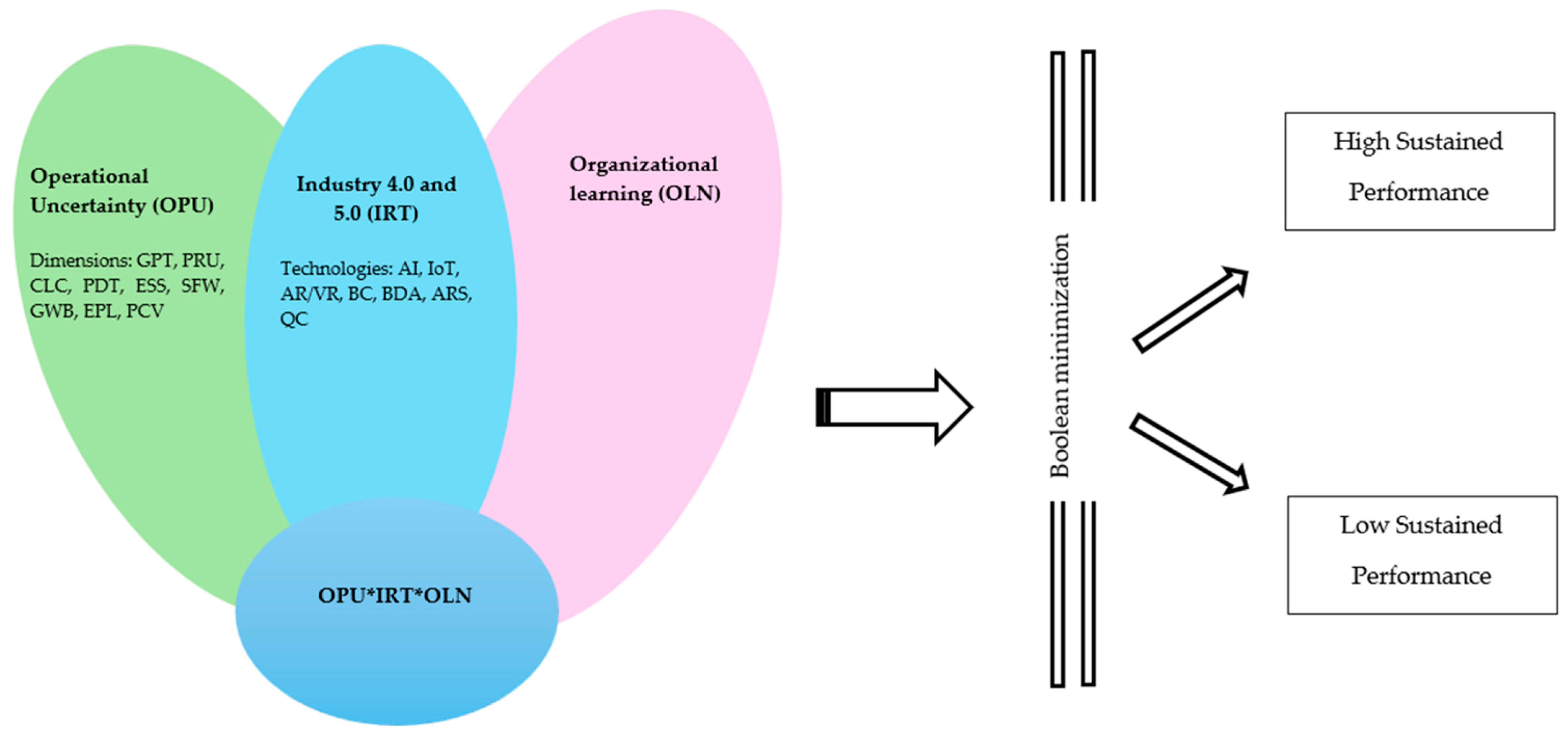
2.3. Configurations Model
3. Methodology
3.1. Research Design
3.2. Sample and Data Collection
3.3. Data Analysis
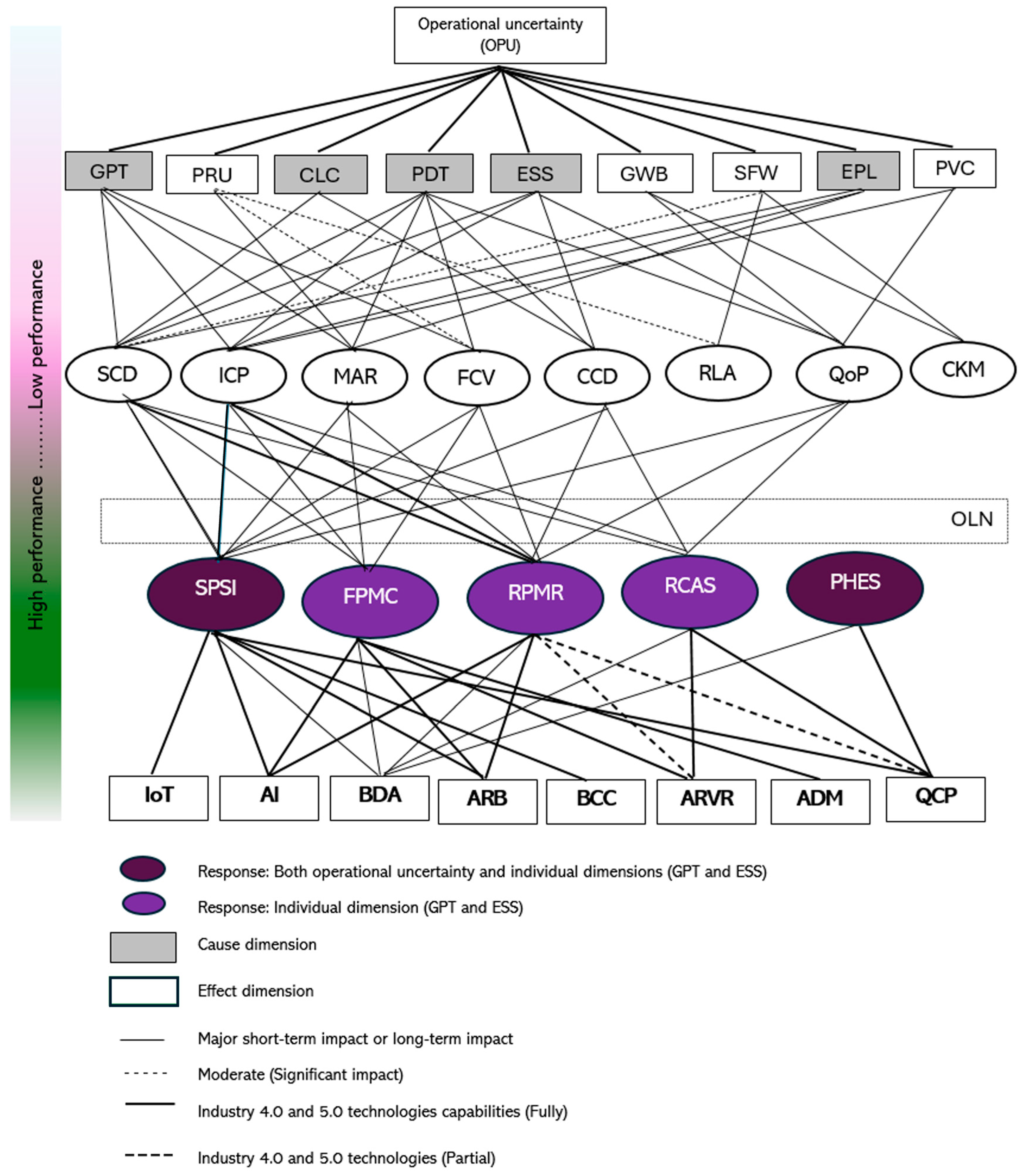
- Step 1: Selection and validation of the causal conditions of operational uncertainty using the fuzzy decision-making trial and evaluation laboratory (DEMATEL);
- Step 2: Build configuration;
- Step 3: Causal Conditions-Based PLS-SEM Measurement and Structural Models;
- Step 4: Develop configurations—solutions (fsQCA).
3.3.1. Step 1: Fuzzy-DEMATEL
- Sub-Step 1: Decision goals, set of criteria, and decision-makers
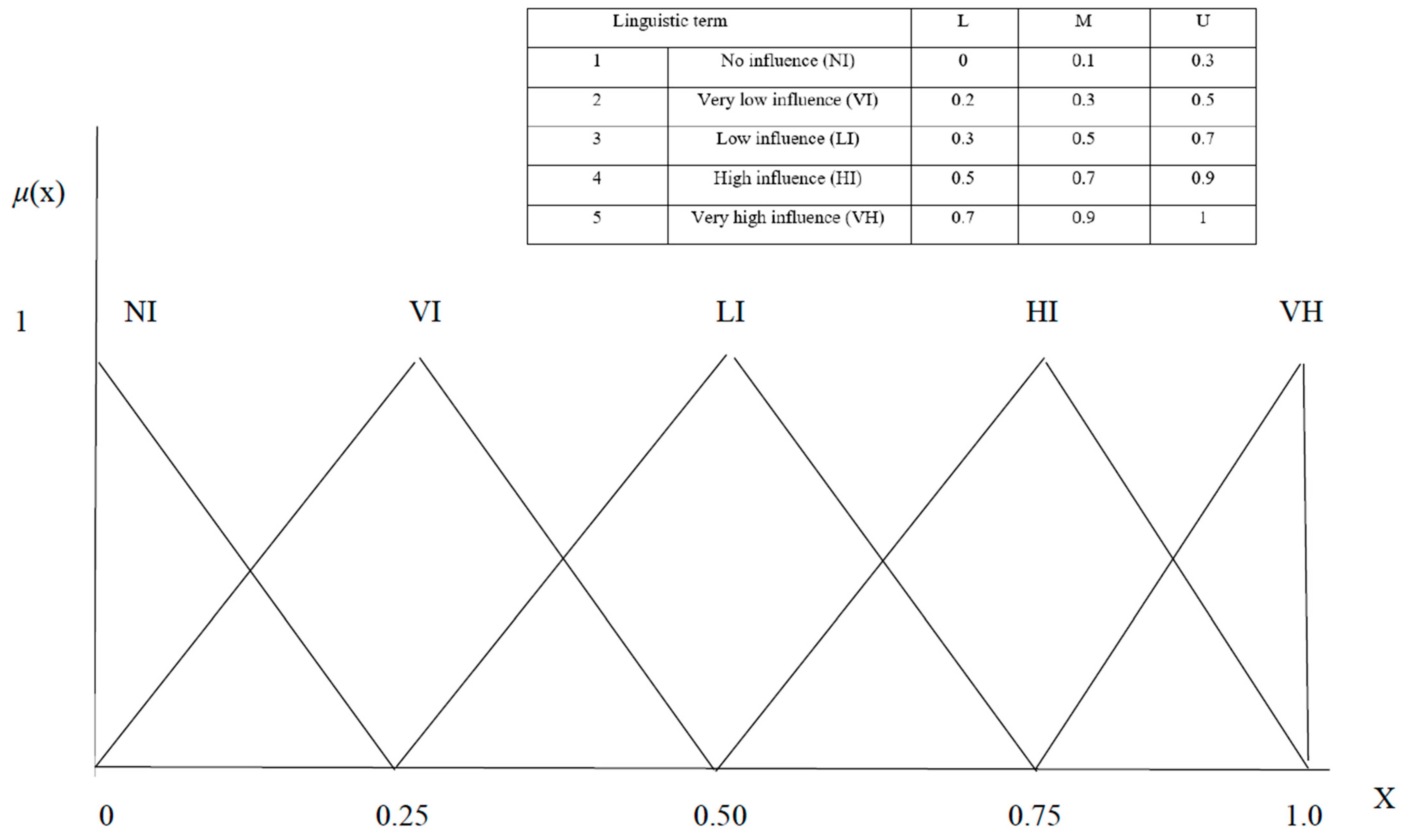
- Sub-Step 2: Design the fuzzy linguistic scale.
- Sub-Step 3a: Generate a fuzzy matrix.
- Sub-Step 3b: Measure the agreement and consistency of decision makers.
- Sub-Step 3c: Generate the mean fuzzy direct-relation matrix.
- Sub-Step 4: Normalise the fuzzy direct relation matrix.
- Sub-Step 5: Determine the fuzzy total-relation matrix.
- Sub-Step 6: Defuzzify matrices of total relationships.
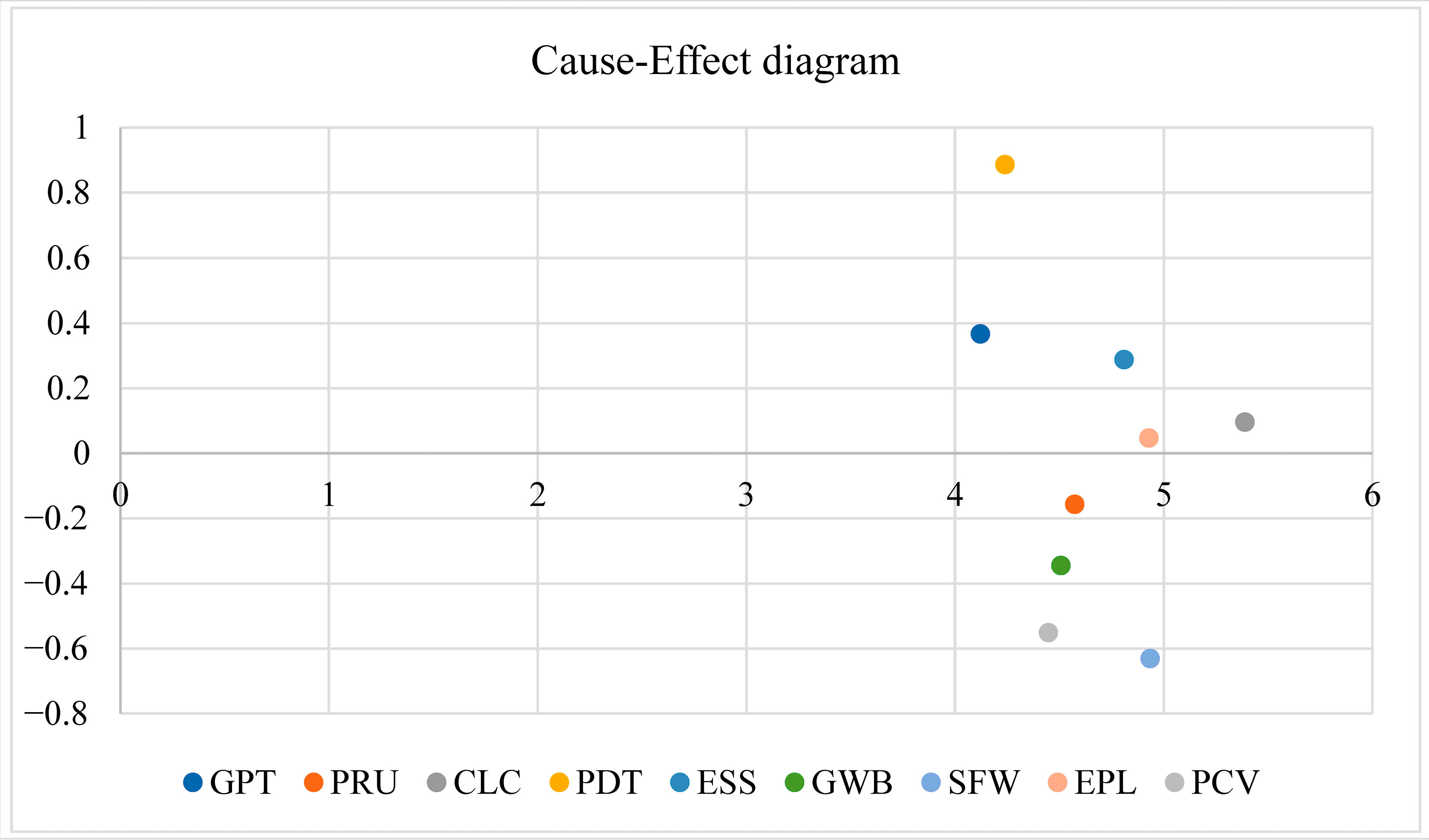
- Sub-Step 7: Causal analysis.
3.3.2. Step 2: Build Configuration
3.3.3. Step 3: PSL-SEM Measurement and Structural Model
3.3.4. Step 4: Develop fsQCA—Solutions
4. Results
4.1. Causal Conditions of Operational Uncertainty with Fuzzy DEMATEL
4.2. Conditions for Building Configurations
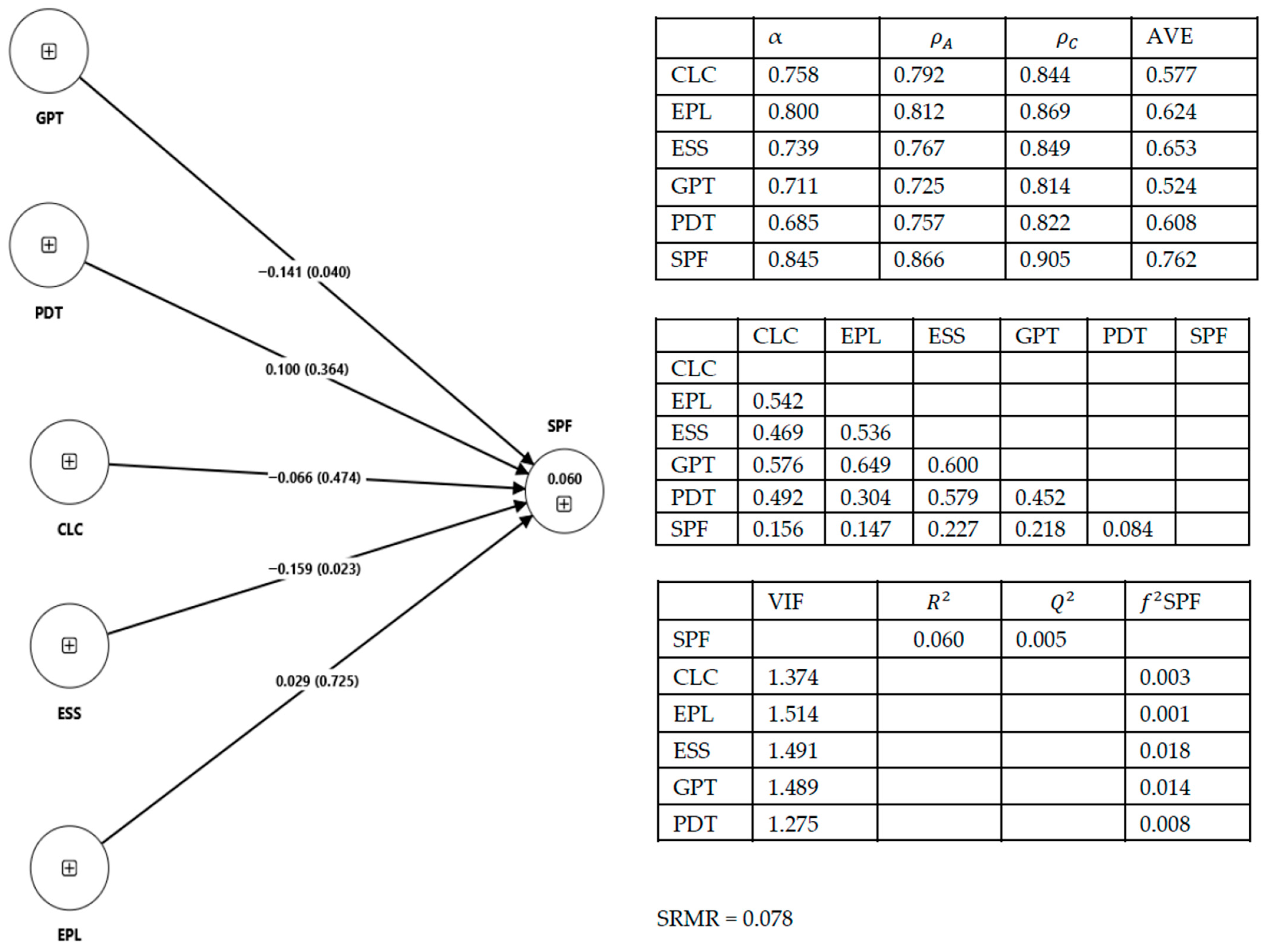
4.3. Structural Models—Direct Effect of Causal Model
4.4. Measurement Models for fsQCA Solutions
4.4.1. Geopolitical Tension-Based Model (Model I)
4.4.2. Energy Stability and Security-Based Model (Model IV)
4.4.3. Operation Uncertainty Causal Multidimension
4.5. fsQCA Solutions
4.5.1. Geopolitical Tensions
4.5.2. Energy Stability and Security
4.5.3. Operational Uncertainty Construct
5. Discussion
6. Managerial Implications
7. Theoretical Implications, Limitations, and Directions for Future Research
8. Conclusions
Author Contributions
Funding
Institutional Review Board Statement
Informed Consent Statement
Data Availability Statement
Conflicts of Interest
Abbreviations
| AI | Artificial intelligence |
| ARS | Advanced robotics and robotic systems |
| AR/VR | Augmented and virtual reality |
| BDA | Big data analytics |
| BC | Blockchain |
| CLC | Change in cost-of-living-driven consumer behaviour change |
| DEMATEL | Decision-making trial and evaluation laboratory |
| EPL | Entrenchment power of large firms |
| ESS | Energy stability and security |
| FIMIX | Finite mixture |
| FPMC | Flexible production and mass customisation |
| fsQCA | Fuzzy set qualitative comparative analysis |
| GDP | Gross domestic product (GDP) |
| GPT | Geopolitical tension |
| GWB | Generational work behaviour and ethics |
| ICC | Intraclass Correlation Coefficient |
| IRT | Industrial revolution technologies |
| OLN | Organisational learning |
| PCV | Process capability and variations |
| PLS-SEM | Structural equation modelling partial least squares |
| PDT | Pandemic turbulence |
| PEHS | Protective ecosystem (human and system) |
| PRU | Policy and regulatory uncertainty |
| QC | Quantum computing |
| RCAS | Root cause analysis and sustainable solutions |
| RPMR | Real-time system and process monitoring and response |
| SPSI | Scenario planning and supply chain integration |
| SFW | Skills for future industrial work |
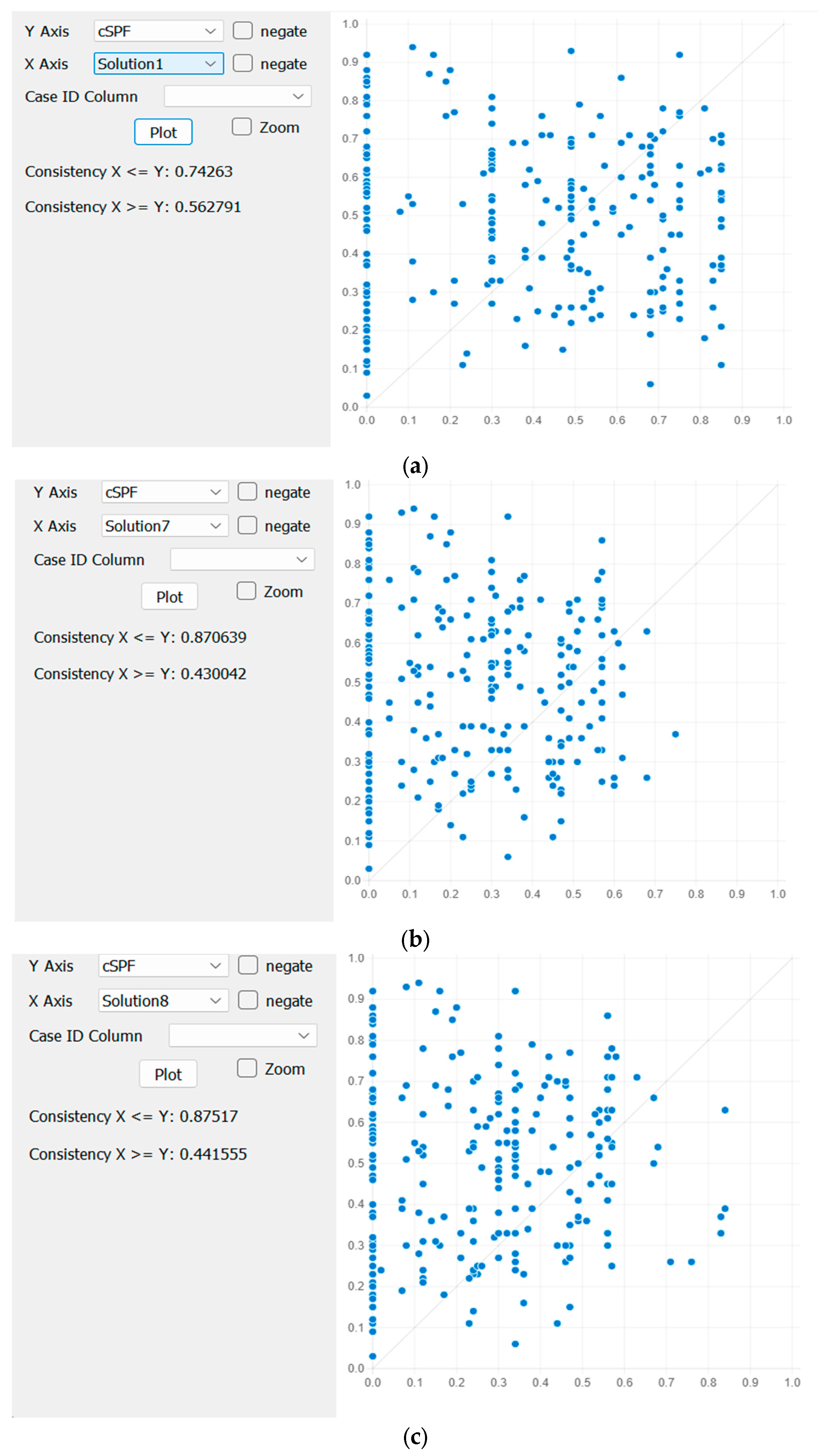
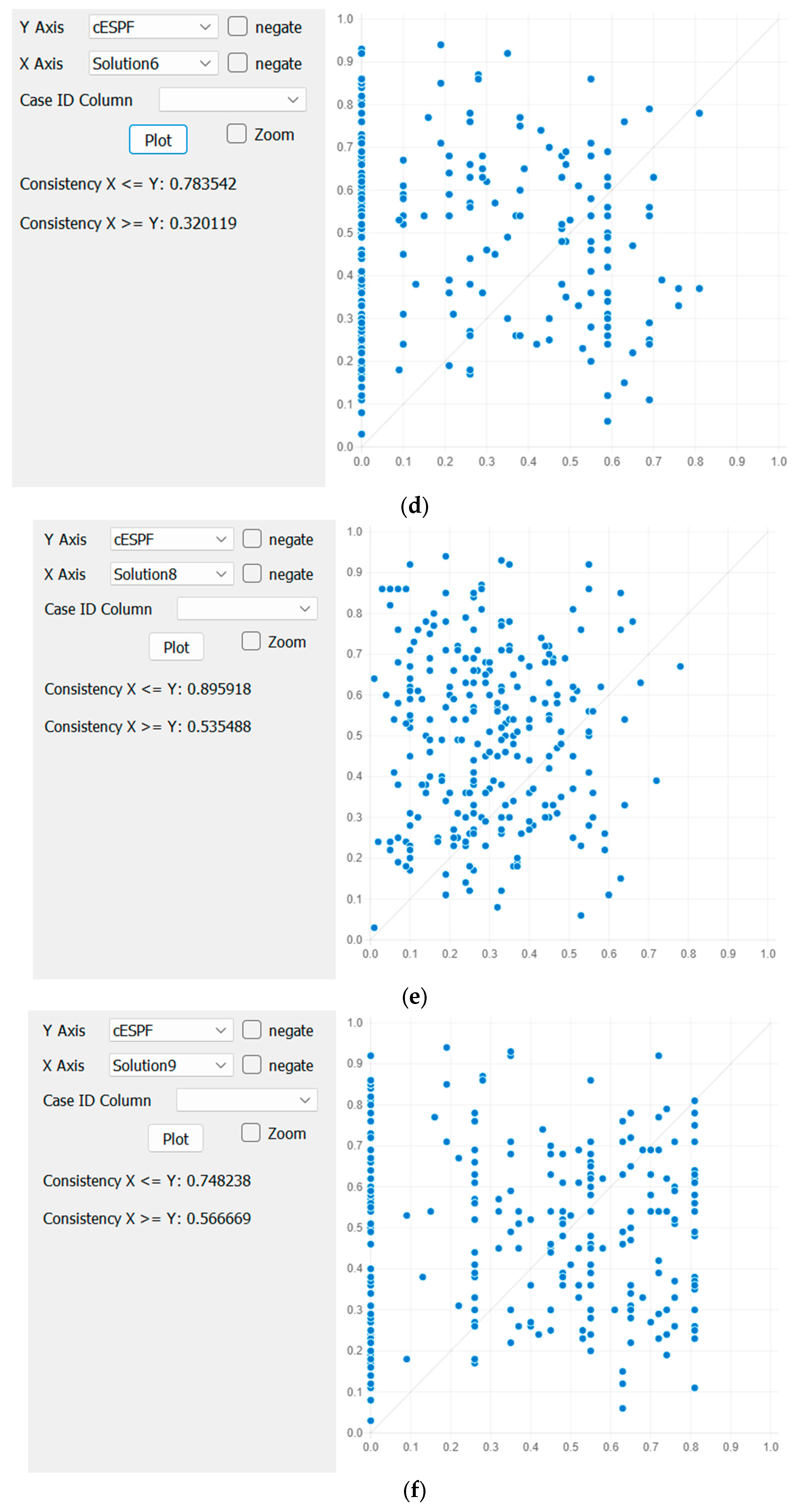
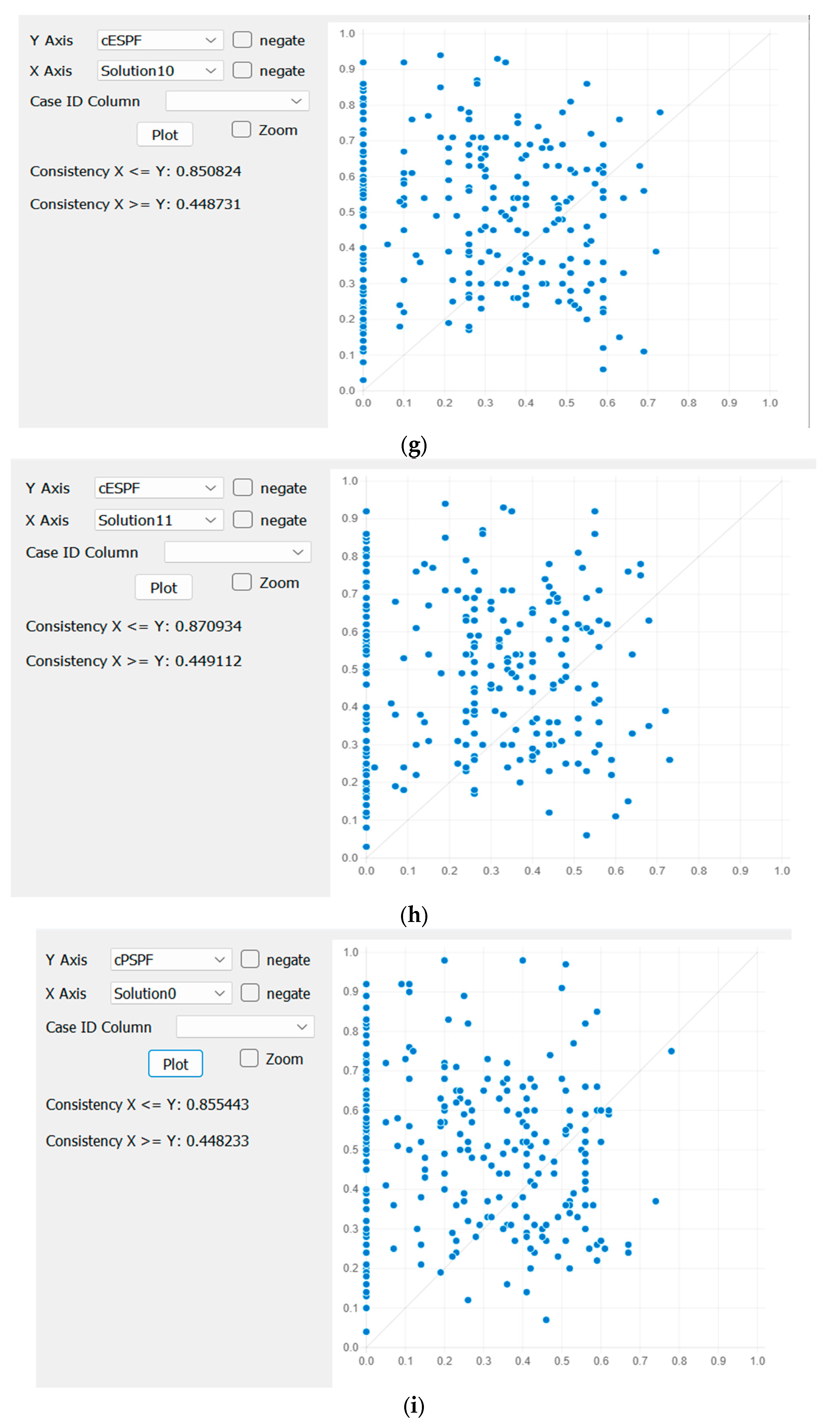
Appendix A. XY Plots of fsQCA for Solutions in the Presence of GPT, ESS, and OPU


References
- Attiah, E. The Role of Manufacturing and Service Sectors in Economic Growth: An Empirical Study of Developing Countries. Eur. Res. Stud. J. 2019, XXII, 112–127. [Google Scholar] [CrossRef]
- Wan, X.; Kazmi, S.A.A.; Wong, C.Y. Manufacturing, Exports, and Sustainable Growth: Evidence from Developing Countries. Sustainability 2022, 14, 1646. [Google Scholar] [CrossRef]
- Szirmai, A. Industrialisation as an engine of growth in developing countries, 1950–2005. Struct. Change Econ. Dyn. 2012, 23, 406–420. [Google Scholar] [CrossRef]
- Cantore, N.; Clara, M.; Lavopa, A.; Soare, C. Manufacturing as an engine of growth: Which is the best fuel? Struct. Change Econ. Dyn. 2017, 42, 56–66. [Google Scholar] [CrossRef]
- South African Reserve Bank. Occasional Bulletin of Economic Notes OBEN/20/01; South African Reserve Bank: Pretoria, South Africa, 2020. [Google Scholar]
- Ndung’u, N.; Shimeles, A.; Ngui, D. The Old Tale of the Manufacturing Sector in Africa: The Story Should Change. J. Afr. Econ. 2022, 31, i3–i9. [Google Scholar] [CrossRef]
- United Nations Industrial Development Organisation. UNIDO: Industrial Development Report 2020: Industrializing in the Digital Age. 2020. Available online: https://www.unido.org/sites/default/files/files/2019-11/UNIDO_IDR2020-MainReport_overview.pdf (accessed on 12 March 2024).
- Hauge, J. Manufacturing-led development in the digital age: How power trumps technology. Third World Q. 2023, 44, 1960–1980. [Google Scholar] [CrossRef]
- United Nations Industrial Development Organisation (UNIDO). South Africa Competitive Industrial Performance Index 2024; United Nations Industrial Development Organisation (UNIDO): Pretoria, South Africa, 2024. [Google Scholar]
- Nnyanzi, J.B.; Kavuma, S.; Sseruyange, J.; Nanyiti, A. The manufacturing output effects of infrastructure development, liberalization and governance: Evidence from Sub-Saharan Africa. J. Ind. Bus. Econ. 2022, 49, 369–400. [Google Scholar] [CrossRef]
- World Bank Group. Manufacturing, Value Added (% of GDP)—South Africa; World Bank Group: Washington, DC, USA, 2024. [Google Scholar]
- Rodrik, D. An African growth miracle? J. Afr. Econ. 2018, 27, 10–27. [Google Scholar] [CrossRef]
- Li, M.; Qu, T.; Yan, M.; Li, M.; He, Z.; Huang, G.Q. Out-of-Order Architecture for Real-Time Data-Driven Resilient Planning and Scheduling of Cyber-Physical Manufacturing Systems. In Proceedings of the 2024 IEEE 20th International Conference on Automation Science and Engineering (CASE); IEEE: Piscataway, NJ, USA, 2024; pp. 3328–3333. [Google Scholar]
- Shi, R.; He, Y.; Cai, Y.; Yang, X.; Feng, T. An Uncertain Operational Risk-Oriented Approach for Manufacturing System Functional Failure Prognosis. In Proceedings of the 2023 Global Reliability and Prognostics and Health Management Conference (PHM-Hangzhou); IEEE: Piscataway, NJ, USA, 2023; pp. 1–6. [Google Scholar] [CrossRef]
- Aryeetey, E.; Baffour, P.T. African competitiveness and the business environment: Does manufacturing still have a role to play? J. Afr. Econ. 2022, 31, i33–i58. [Google Scholar] [CrossRef]
- Signé, L.; Johnson, C. The Potential of Manufacturing and Industrialization in Africa; Africa Growth Initiative: London, UK, 2018. [Google Scholar]
- Alsamhi, M.H.; Al-Ofairi, F.A.; Farhan, N.H.S.; Al-ahdal, W.M.; Siddiqui, A. Impact of COVID-19 on firms’ performance: Empirical evidence from India. Cogent Bus. Manag. 2022, 9, 2044593. [Google Scholar] [CrossRef]
- Mollah, M.A.H. Theory building in management: A review. J. Public Adm. 2019, 1, 18–35. [Google Scholar] [CrossRef]
- Shepherd, D.A.; Suddaby, R. Theory Building: A Review and Integration. J. Manag. 2017, 43, 59–86. [Google Scholar] [CrossRef]
- Sammut-Bonnici, T. Complexity Theory. In Wiley Encyclopedia of Management, 1st ed.; Cooper, C.L., Ed.; Wiley: Hoboken, NJ, USA, 2015; Volume 12. [Google Scholar] [CrossRef]
- Fiss, P.C.; Marx, A.; Cambré, B. Chapter 1 configurational theory and methods in organizational research: Introduction. In Configurational Theory and Methods in Organizational Research; Emerald Group Publishing Limited: Leeds, UK, 2013; pp. 1–22. Available online: https://www.emerald.com/insight/content/doi/10.1108/S0733-558X(2013)0000038005/full/html (accessed on 30 November 2024).
- Pla-Barber, J.; Villar, C.; Benito-Sarriá, G. Configurational Theory in Traditional Manufacturing Industries: A New Model of High-Performing Small and Medium-Sized Enterprises. Sustainability 2020, 12, 6818. [Google Scholar] [CrossRef]
- Malacina, I.; Lintukangas, K. On the edge: A multilevel perspective on innovation complexities and dynamic attractors in the supply network. Int. J. Oper. Prod. Manag. 2024, 45, 925–950. [Google Scholar] [CrossRef]
- Byrne, D. Complexity, Configurations and Cases. Theory Cult. Soc. 2005, 22, 95–111. [Google Scholar] [CrossRef]
- Leydesdorff, L. Configurational Information as Potentially Negative Entropy: The Triple Helix Model. Entropy 2008, 10, 391–410. [Google Scholar] [CrossRef]
- Iannacci, F.; Kraus, S. Configurational Theory: A review. 2022. Available online: https://open.ncl.ac.uk/theories/11/configurational-theory/ (accessed on 8 February 2026).
- Park, Y.; Mithas, S. Organized complexity of digital business strategy: A configurational perspective. MIS Q. 2020, 44, 85–127. [Google Scholar] [CrossRef]
- Ambrosini, V.; Collier, N.; Jenkins, M. A configurational approach to the dynamics of firm level knowledge. J. Strategy Manag. 2009, 2, 4–30. [Google Scholar] [CrossRef]
- Misangyi, V.F.; Greckhamer, T.; Furnari, S.; Fiss, P.C.; Crilly, D.; Aguilera, R. Embracing Causal Complexity: The Emergence of a Neo-Configurational Perspective. J. Manag. 2017, 43, 255–282. [Google Scholar] [CrossRef]
- Pattyn, V.; Álamos-Concha, P.; Cambré, B.; Rihoux, B.; Schalembier, B. Policy Effectiveness through Configurational and Mechanistic Lenses: Lessons for Concept Development. J. Comp. Policy Anal. Res. Pract. 2022, 24, 33–50. [Google Scholar] [CrossRef]
- Ragin, C.C. Measurement Versus Calibration: A Set-Theoretic Approach. In The Oxford Handbook of Political Methodology; Box-Steffensmeier, J.M., Brady, H.E., Collier, D., Eds.; Oxford University Press: Oxford, UK, 2009; pp. 174–198. [Google Scholar] [CrossRef]
- Thiem, A. Standards of good practice and the methodology of necessary conditions in qualitative comparative analysis. Polit. Anal. 2016, 24, 478–484. [Google Scholar] [CrossRef]
- Oana, I.-E.; Schneider, C.Q.; Thomann, E. Qualitative Comparative Analysis Using R: A Beginner’s Guide; Cambridge University Press: Cambridge, UK, 2021. [Google Scholar]
- Pappas, I.O.; Woodside, A.G. Fuzzy-set Qualitative Comparative Analysis (fsQCA): Guidelines for research practice in Information Systems and marketing. Int. J. Inf. Manag. 2021, 58, 102310. [Google Scholar] [CrossRef]
- Cordova-Pozo, K.; Rouwette, E.A.J.A. Types of scenario planning and their effectiveness: A review of reviews. Futures 2023, 149, 103153. [Google Scholar] [CrossRef]
- Krommuang, A.; Suwunnamek, O. Internet of Things (IoT) Application for Management in Automotive Parts Manufacturing. Int. J. Adv. Comput. Sci. Appl. 2022, 13, 639–650. [Google Scholar] [CrossRef]
- Ahmetoglu, S.; Che Cob, Z.; Ali, N. Internet of Things Adoption in the Manufacturing Sector: A Conceptual Model from a Multi-Theoretical Perspective. Appl. Sci. 2023, 13, 3856. [Google Scholar] [CrossRef]
- Noble, S.M.; Mende, M.; Grewal, D.; Parasuraman, A. The Fifth Industrial Revolution: How Harmonious Human–Machine Collaboration is Triggering a Retail and Service Revolution. J. Retail. 2022, 98, 199–208. [Google Scholar] [CrossRef]
- Ajayi, M.O.; Laseinde, O.T. A review of supply chain 4IR management strategy for appraising the manufacturing industry’s potentials and shortfalls in the 21st century. Procedia Comput. Sci. 2023, 217, 513–525. [Google Scholar] [CrossRef]
- Fanoro, M.; Božanić, M.; Sinha, S. A Review of 4IR/5IR Enabling Technologies and Their Linkage to Manufacturing Supply Chain. Technologies 2021, 9, 77. [Google Scholar] [CrossRef]
- Koh, L.; Orzes, G.; Jia, F. The fourth industrial revolution (Industry 4.0): Technologies disruption on operations and supply chain management. Int. J. Oper. Prod. Manag. 2019, 39, 817–828. [Google Scholar] [CrossRef]
- Unhelkar, B.; Joshi, S.; Sharma, M.; Prakash, S.; Mani, A.K.; Prasad, M. Enhancing supply chain performance using RFID technology and decision support systems in the industry 4.0—A systematic literature review. Int. J. Inf. Manag. Data Insights 2022, 2, 100084. [Google Scholar] [CrossRef]
- Plathottam, S.J.; Rzonca, A.; Lakhnori, R.; Iloeje, C.O. A review of artificial intelligence applications in manufacturing operations. J. Adv. Manuf. Process. 2023, 5, e10159. [Google Scholar] [CrossRef]
- Garg, K.; Goswami, C.; Chhatrawat, R.S.; Kumar Dhakar, S.; Kumar, G. Internet of things in manufacturing: A review. Mater. Today Proc. 2022, 51, 286–288. [Google Scholar] [CrossRef]
- Flores-García, E.; Jeong, Y.; Liu, S.; Wiktorsson, M.; Wang, L. Enabling industrial internet of things-based digital servitization in smart production logistics. Int. J. Prod. Res. 2023, 61, 3884–3909. [Google Scholar] [CrossRef]
- Kang, K.-D. A Review of Efficient Real-Time Decision Making in the Internet of Things. Technologies 2022, 10, 12. [Google Scholar] [CrossRef]
- Nouinou, H.; Asadollahi-Yazdi, E.; Baret, I.; Nguyen, N.Q.; Terzi, M.; Ouazene, Y.; Yalaoui, F.; Kelly, R. Decision-making in the context of Industry 4.0: Evidence from the textile and clothing industry. J. Clean. Prod. 2023, 391, 136184. [Google Scholar] [CrossRef]
- Ito, A.; Hagström, M.; Bokrantz, J.; Skoogh, A.; Nawcki, M.; Gandhi, K.; Bergsjö, D.; Bärring, M. Improved root cause analysis supporting resilient production systems. J. Manuf. Syst. 2022, 64, 468–478. [Google Scholar] [CrossRef]
- Laskurain-Iturbe, I.; Arana-Landín, G.; Landeta-Manzano, B.; Uriarte-Gallastegi, N. Exploring the influence of industry 4.0 technologies on the circular economy. J. Clean. Prod. 2021, 321, 128944. [Google Scholar] [CrossRef]
- Oliveira, E.; Miguéis, V.L.; Borges, J.L. Automatic root cause analysis in manufacturing: An overview & conceptualization. J. Intell. Manuf. 2023, 34, 2061–2078. [Google Scholar] [CrossRef]
- Xie, B.; Liu, H.; Alghofaili, R.; Zhang, Y.; Jiang, Y.; Lobo, F.D.; Li, C.; Li, W.; Huang, H.; Akdere, M.; et al. A Review on Virtual Reality Skill Training Applications. Front. Virtual Real. 2021, 2, 645153. [Google Scholar] [CrossRef]
- Begum, M.B. Integrating Cybersecurity in the Design and Implementation of Intelligent and Sustainable Manufacturing Systems. In AI and Emerging Technologies, 1st ed.; Pokhariyal, P., Patel, A., Pandey, S., Eds.; CRC Press: Boca Raton, FL, USA, 2024; pp. 184–200. [Google Scholar] [CrossRef]
- Mohammed, A.; Ashok Kumar, M.; Raj, P.; Sangeetha, M. Fortifying Smart Manufacturing against Cyber Threats. In Artificial Intelligence Solutions for Cyber-Physical Systems, 1st ed.; Dutta, P.K., Raj, P., Sundaravadivazhagan, B., Selvan, C.P., Eds.; Auerbach Publications: Boca Raton, FL, USA, 2024; pp. 180–205. [Google Scholar] [CrossRef]
- Afolabi, T.T.; Siaminwe, L. Industry 4.0 Implementation Challenges in an Unfacilitated Environment: A Case of Manufacturing Industries in Zambia. In Proceedings of the 4th African International Conference on Industrial Engineering and Operations Management, Lusaka, Zambia, 4–6 April 2023. [Google Scholar] [CrossRef]
- Alshahrani, S.T. Industry 4.0 in “Major Emerging Markets”: A Systematic Literature Review of Benefits, Use, Challenges, and Mitigation Strategies in Supply Chain Management. Sustainability 2023, 15, 14811. [Google Scholar] [CrossRef]
- Xu, M.; David, J.M.; Kim, S.H. The Fourth Industrial Revolution: Opportunities and Challenges. Int. J. Financ. Res. 2018, 9, 90. [Google Scholar] [CrossRef]
- Choi, J.Y.; Ahn, S.; Kim, D.; Heo, J.; Yun, W.; Hong, S.; Bae, S.; Ahn, S.-H. Exploring Challenges and Opportunities in Manufacturing and Intelligence for Future Robotics. Int. J. Precis. Eng. Manuf. 2025, 26, 2203–2222. [Google Scholar] [CrossRef]
- Elegbeleye, F.A.; Mbodila, M.; Esan, O.A.; Elegbeleye, I. Cost-effective internet of things privacy-aware data storage and real-time analysis. IAES Int. J. Artif. Intell. (IJ-AI) 2024, 13, 247. [Google Scholar] [CrossRef]
- Greckhamer, T.; Furnari, S.; Fiss, P.C.; Aguilera, R.V. Studying configurations with qualitative comparative analysis: Best practices in strategy and organization research. Strateg. Organ. 2018, 16, 482–495. [Google Scholar] [CrossRef]
- Cooper, B.; Glaesser, J. Exploring the robustness of set theoretic findings from a large n fsQCA: An illustration from the sociology of education. Int. J. Soc. Res. Methodol. 2016, 19, 445–459. [Google Scholar] [CrossRef]
- Huang, S.; Burton-Jones, A.; Xu, D. A configurational theory of digital disruption. Inf. Syst. J. 2024, 34, 1737–1786. [Google Scholar] [CrossRef]
- Mtotywa, M.M. Managing Operational Uncertainty in Manufacturing with Industry 4.0 and 5.0 Technologies: A Modified Neo-Configurational Perspective. Ph.D. Thesis, Rhodes University, Makhanda, South Africa, 2025. [Google Scholar] [CrossRef]
- Akundi, A.; Euresti, D.; Luna, S.; Ankobiah, W.; Lopes, A.; Edinbarough, I. State of Industry 5.0—Analysis and Identification of Current Research Trends. Appl. Syst. Innov. 2022, 5, 27. [Google Scholar] [CrossRef]
- Belhadi, A.; Kamble, S.; Subramanian, N.; Singh, R.K.; Venkatesh, M. Digital capabilities to manage agri-food supply chain uncertainties and build supply chain resilience during compounding geopolitical disruptions. Int. J. Oper. Prod. Manag. 2024, 44, 1914–1950. [Google Scholar] [CrossRef]
- Kumar, S.; Tiwari, P.; Zymbler, M. Internet of Things is a revolutionary approach for future technology enhancement: A review. J. Big Data 2019, 6, 111. [Google Scholar] [CrossRef]
- Nathany, D. Transforming Manufacturing: A Comprehensive Analysis of Industry 4.0 Technologies, Industry 5.0 Perspectives, and Future Research Directions. Int. J. Multidiscip. Res. Growth Eval. 2025, 6, 2143–2147. [Google Scholar] [CrossRef]
- Ivaldi, S.; Scaratti, G.; Fregnan, E. Dwelling within the fourth industrial revolution: Organizational learning for new competences, processes and work cultures. J. Workplace Learn. 2022, 34, 1–26. [Google Scholar] [CrossRef]
- Tan, F.Z.; Olaore, G.O. Effect of organizational learning and effectiveness on the operations, employees productivity and management performance. Vilakshan-XIMB J. Manag. 2021, 19, 110–127. [Google Scholar]
- Basten, D.; Haamann, T. Approaches for Organizational Learning: A Literature Review. Sage Open 2018, 8, 2158244018794224. [Google Scholar] [CrossRef]
- Saunders, M.N.K.; Lewis, P.; Thornhill, A. Research Methods for Business Students, 8th ed.; Pearson Education: London, UK, 2019. [Google Scholar]
- Wellman, N.; Tröster, C.; Grimes, M.; Roberson, Q.; Rink, F.; Gruber, M. Publishing Multimethod Research in AMJ: A Review and Best-Practice Recommendations. Acad. Manag. J. 2023, 66, 1007–1015. [Google Scholar] [CrossRef]
- Choi, T.; Cheng, T.C.E.; Zhao, X. Multi-Methodological Research in Operations Management. Prod. Oper. Manag. 2016, 25, 379–389. [Google Scholar] [CrossRef]
- Brownstein, N.C.; Louis, T.A.; O’Hagan, A.; Pendergast, J. The Role of Expert Judgment in Statistical Inference and Evidence-Based Decision-Making. Am. Stat. 2019, 73, 56–68. [Google Scholar] [CrossRef] [PubMed]
- Ferrazzi, M.; Costa, F.; Frecassetti, S.; Portioli-Staudacher, A. Unlocking synergies in lean manufacturing for enhanced environmental performance: A cross-sector investigation through fuzzy DEMATEL. Clean. Logist. Supply Chain 2025, 15, 100219. [Google Scholar] [CrossRef]
- Chen, C. Using DEMATEL Method for Medical Tourism Development in Taiwan. Am. J. Tour. Res. 2012, 1, 26–32. [Google Scholar]
- Asadi, S.; Nilashi, M.; Abumalloh, R.A.; Samad, S.; Ahani, A.; Ghabban, F.; Yusuf, S.Y.M.; Supriyanto, E. Evaluation of Factors to Respond to the COVID-19 Pandemic Using DEMATEL and Fuzzy Rule-Based Techniques. Int. J. Fuzzy Syst. 2022, 24, 27–43. [Google Scholar] [CrossRef]
- Chen, W.; Li, W.; Shao, L.; Zhang, T.; Wang, X. Large-scale group-hierarchical DEMATEL method for complex systems. PLoS ONE 2023, 18, e0288326. [Google Scholar] [CrossRef]
- Abdullah, F.M.; Al-Ahmari, A.M.; Anwar, S. A Hybrid Fuzzy Multi-Criteria Decision-Making Model for Evaluating the Influence of Industry 4.0 Technologies on Manufacturing Strategies. Machines 2023, 11, 310. [Google Scholar] [CrossRef]
- Cochran, W.G. Sampling Techniques; Johan Wiley & Sons Inc.: Hoboken, NJ, USA, 1977. [Google Scholar]
- Nulty, D.D. The adequacy of response rates to online and paper surveys: What can be done? Assess. Eval. High. Educ. 2008, 33, 301–314. [Google Scholar] [CrossRef]
- Dong, Y.; Peng, C.-Y.J. Principled missing data methods for researchers. SpringerPlus 2013, 2, 222. [Google Scholar] [CrossRef] [PubMed]
- Jordan, P.J.; Troth, A.C. Common method bias in applied settings: The dilemma of researching in organizations. Aust. J. Manag. 2020, 45, 3–14. [Google Scholar] [CrossRef]
- Cangialosi, N. Fuzzy-Set Qualitative Comparative Analysis (fsQCA) in Organizational Psychology: Theoretical Overview, Research Guidelines, and A Step-By-Step Tutorial Using R Software. Span. J. Psychol. 2023, 26, e21. [Google Scholar] [CrossRef] [PubMed]
- Schneider, C.Q.; Wagemann, C. Set-Theoretic Methods for the Social Sciences: A Guide to Qualitative Comparative Analysis; Cambridge University Press: Cambridge, UK, 2012. [Google Scholar]
- López-Ospina, H.; Pardo, D.; Rojas, A.; Barros-Castro, R.; Palacio, K.; Quezada, L. A revisited fuzzy DEMATEL and optimization method for strategy map design under the BSC framework: Selection of objectives and relationships. Soft Comput. 2022, 26, 6619–6644. [Google Scholar] [CrossRef]
- Lin, C.J.; Wu, W.-W. A causal analytical method for group decision-making under fuzzy environment. Expert Syst. Appl. 2008, 34, 205–213. [Google Scholar] [CrossRef]
- Yeh, T.-M.; Huang, Y.-L. Factors in determining wind farm location: Integrating GQM, fuzzy DEMATEL, and ANP. Renew. Energy 2014, 66, 159–169. [Google Scholar] [CrossRef]
- Shieh, J.-I.; Wu, H.-H. Measures of Consistency for DEMATEL Method. Commun. Stat.-Simul. Comput. 2016, 45, 781–790. [Google Scholar] [CrossRef]
- Jassbi, J.; Mohamadnejad, F.; Nasrollahzadeh, H. A Fuzzy DEMATEL framework for modeling cause and effect relationships of strategy map. Expert Syst. Appl. 2011, 38, 5967–5973. [Google Scholar] [CrossRef]
- Teles, J. Concordance coefficients to measure the agreement among several sets of ranks. J. Appl. Stat. 2012, 39, 1749–1764. [Google Scholar] [CrossRef]
- Marcinkiewicz, E. Pension systems similarity assessment: An application of Kendall’s W to statistical multivariate analysis. Contemp. Econ. 2017, 11, 303–314. [Google Scholar]
- Shrout, P.E.; Fleiss, J.L. Intraclass correlations: Uses in assessing rater reliability. Psychol. Bull. 1979, 86, 420–428. [Google Scholar] [CrossRef]
- Fiss, P.C. A set-theoretic approach to organizational configurations. Acad. Manag. Rev. 2007, 32, 1180–1198. [Google Scholar] [CrossRef]
- Woodside, A.G.; Nagy, G.; Megehee, C.M. Applying complexity theory: A primer for identifying and modeling firm anomalies. J. Innov. Knowl. 2018, 3, 9–25. [Google Scholar] [CrossRef]
- Sarstedt, M.; Becker, J.-M.; Ringle, C.M.; Schwaiger, M. Uncovering and Treating Unobserved Heterogeneity with FIMIX-PLS: Which Model Selection Criterion Provides an Appropriate Number of Segments? Schmalenbach Bus. Rev. 2011, 63, 34–62. [Google Scholar] [CrossRef]
- Hair, J.F.; Risher, J.J.; Sarstedt, M.; Ringle, C.M. When to use and how to report the results of PLS-SEM. Eur. Bus. Rev. 2019, 31, 2–24. [Google Scholar] [CrossRef]
- Rasoolimanesh, S.M.; Ringle, C.M.; Sarstedt, M.; Olya, H. The combined use of symmetric and asymmetric approaches: Partial least squares-structural equation modeling and fuzzy-set qualitative comparative analysis. Int. J. Contemp. Hosp. Manag. 2021, 33, 1571–1592. [Google Scholar] [CrossRef]
- Sukhov, A.; Friman, M.; Olsson, L.E. Unlocking potential: An integrated approach using PLS-SEM, NCA, and fsQCA for informed decision making. J. Retail. Consum. Serv. 2023, 74, 103424. [Google Scholar] [CrossRef]
- Salonen, A.; Zimmer, M.; Keränen, J. Theory development in servitization through the application of fsQCA and experiments. Int. J. Oper. Prod. Manag. 2021, 41, 746–769. [Google Scholar] [CrossRef]
- Moslem, S.; Ghorbanzadeh, O.; Blaschke, T.; Duleba, S. Analysing Stakeholder Consensus for a Sustainable Transport Development Decision by the Fuzzy AHP and Interval AHP. Sustainability 2019, 11, 3271. [Google Scholar] [CrossRef]
- Fainshmidt, S.; Witt, M.A.; Aguilera, R.V.; Verbeke, A. The contributions of qualitative comparative analysis (QCA) to international business research. J. Int. Bus. Stud. 2020, 51, 455–466. [Google Scholar] [CrossRef]
- Hu, L.; Bentler, P.M. Fit indices in covariance structure modeling: Sensitivity to underparameterized model misspecification. Psychol. Methods 1998, 3, 424–453. [Google Scholar] [CrossRef]
- Henseler, J.; Dijkstra, T.K.; Sarstedt, M.; Ringle, C.M.; Diamantopoulos, A.; Straub, D.W.; Ketchen, D.J.; Hair, J.F.; Hult, G.T.M.; Calantone, R.J. Common Beliefs and Reality About PLS: Comments on Rönkkö and Evermann (2013). Organ. Res. Methods 2014, 17, 182–209. [Google Scholar] [CrossRef]
- Suhan, S.; Achar, A.P. Assessment of PLS-SEM Path Model for Coefficient of Determination and Predictive Relevance of Consumer Trust on Organic Cosmetics. Ushus-J. Bus. Manag. 2016, 15, 1–19. [Google Scholar] [CrossRef]
- Mejía Trejo, J. Qualitative Comparative Analysis. VOLUME II. FUZZY-SET (fsQCA) Theory and Practice, 1st ed.; Academia Mexicana de Investigación y Docencia en Innovación SC (AMIDI): Los Angeles, CA, USA, 2023. [Google Scholar] [CrossRef]
- Fiss, P.C. Building Better Causal Theories: A Fuzzy Set Approach to Typologies in Organization Research. Acad. Manag. J. 2011, 54, 393–420. [Google Scholar] [CrossRef]
- Rihoux, B.; Ragin, C.C. Configurational Comparative Methods: Qualitative Comparative Analysis (QCA) and Related Techniques; Sage: Thousand Oaks, CA, USA, 2009; Volume 51. [Google Scholar]
- S&P Global. Top Geopolitical Risks of 2025; S&P Global: New York, NY, USA, 2025; Available online: https://www.spglobal.com/en/research-insights/market-insights/geopolitical-risk (accessed on 24 January 2026).
- World Economic Forum. The Global Risks Report 2026, 21st ed.; World Economic Forum: Geneva, Switzerland, 2026; Available online: https://www.weforum.org/publications/global-risks-report-2026/in-full/global-risks-report-2026-key-findings/?gad_source=1&gad_campaignid=22228224717&gbraid=0AAAAAoVy5F6Vz10GX28zAxpAYlsa2Fzx5&gclid=Cj0KCQiAtfXMBhDzARIsAJ0jp3AuXGVVpr8TfTUVsZh44KFCY-gjLCyPreNS9_pdLs2-_r3wKpjTAV8aAglBEALw_wcB (accessed on 8 February 2026).
- Ali, I.; Gligor, D.; Balta, M.; Bozkurt, S.; Papadopoulos, T. From disruption to innovation: The importance of the supply chain leadership style for driving logistics innovation in the face of geopolitical disruptions. Transp. Res. Part E Logist. Transp. Rev. 2024, 187, 103583. [Google Scholar] [CrossRef]
- Charpin, R.; Cousineau, M. Friendshoring: How geopolitical tensions affect foreign sourcing, supply base complexity, and sub-tier supplier sharing. Int. J. Oper. Prod. Manag. 2024, 45, 1006–1031. Available online: https://www.emerald.com/insight/content/doi/10.1108/ijopm-01-2024-0067/full/html (accessed on 8 February 2026). [CrossRef]
- Charoenwong, B.; Han, M.; Wu, J. Trade and Foreign Economic Policy Uncertainty in Supply Chain Networks: Who Comes Home? Manuf. Serv. Oper. Manag. 2023, 25, 126–147. [Google Scholar] [CrossRef]
- Kan, K.; Mativenga, P.; Marnewick, A. Understanding energy use in the South African manufacturing industry. Procedia CIRP 2020, 91, 445–451. [Google Scholar] [CrossRef]
- Dewa, M.; Van Der Merwe, A.; Matope, S. Production scheduling heuristics for frequent load-shedding scenarios: A knowledge engineering approach. S. Afr. J. Ind. Eng. 2020, 31, 110–121. [Google Scholar] [CrossRef]
- Mashapu, L.D.; Mathaba, T.N.D. The Economic Impact of Load Shedding in Industry: A South African Case Study. In Proceedings of the 2024 International Conference on Electrical, Computer and Energy Technologies (ICECET); IEEE: Piscataway, NJ, USA, 2024; pp. 1–6. [Google Scholar] [CrossRef]
- Uçar, E.D. Exploring the Potential of Augmented Reality (AR) and Virtual Reality (VR) in Developing Immersive Experiences for Education, Entertainment, and Training: Innovations, Applications, and Future Prospects. Hum. Comput. Interact. 2024, 8, 47. [Google Scholar] [CrossRef]
- PricewaterhouseCoopers. South Africa Manufacturing Analysis 2024: Resolute. Resilient. Adaptable; PwC South Africa: Midrand, South Africa, 2024; Available online: https://www.pwc.co.za/en/publications/manufacturing-analysis.html (accessed on 8 February 2026).
- Jin, W. An expanded DEMATEL decision-making method by mixing qualitative and quantitative data. In Proceedings of the International Conference on Computer Graphics, Artificial Intelligence, and Data Processing (ICCAID 2021); Wu, F., Liu, J., Chen, Y., Eds.; SPIE: Bellingham, WA, USA, 2022; p. 10. [Google Scholar] [CrossRef]
- Miller, D. Challenging trends in configuration research: Where are the configurations? Strateg. Organ. 2018, 16, 453–469. [Google Scholar] [CrossRef]
- Meuer, J.; Fiss, P.C. Qualitative comparative analysis in business and management research. In Oxford Research Encyclopedia of Business and Management; Oxford University Press: Oxford, UK, 2020; Available online: https://www.peerfiss.com/s/Meuer-Fiss-ORE-2020.pdf (accessed on 8 February 2026).
- Turner, J.R.; Baker, R.M. Complexity Theory: An Overview with Potential Applications for the Social Sciences. Systems 2019, 7, 4. [Google Scholar] [CrossRef]
- Yuan, B.; Jiang, Z.; Lyu, A.; Wu, J.; Wang, Z.; Yang, M.; Liu, K.; Mou, M.; Cui, P. Emergence and Causality in Complex Systems: A Survey on Causal Emergence and Related Quantitative Studies. arXiv 2023. [Google Scholar] [CrossRef]
- Asif, M.; Yang, L.; Hashim, M. The role of digital transformation, corporate culture, and leadership in enhancing corporate sustainable performance in the manufacturing sector of China. Sustainability 2024, 16, 2651. [Google Scholar] [CrossRef]
- Liu, J.; Qian, Y.; Yang, Y.; Yang, Z. Can artificial intelligence improve the energy efficiency of manufacturing companies? Evidence from China. Int. J. Environ. Res. Public Health 2022, 19, 2091. [Google Scholar] [CrossRef]
- Wang, K.-L.; Sun, T.-T.; Xu, R.-Y. The impact of artificial intelligence on total factor productivity: Empirical evidence from China’s manufacturing enterprises. Econ. Change Restruct. 2023, 56, 1113–1146. [Google Scholar] [CrossRef]
- Gupta, H.; Kumar, A.; Wasan, P. Industry 4.0, cleaner production and circular economy: An integrative framework for evaluating ethical and sustainable business performance of manufacturing organizations. J. Clean. Prod. 2021, 295, 126253. [Google Scholar] [CrossRef]



| Dimensions | Kendall’s W | χ2 | Df | p-Value |
|---|---|---|---|---|
| GPT | 0.789 | 138.9 | 8 | <0.001 |
| PRU | 0.722 | 127.1 | 8 | <0.001 |
| CLC | 0.751 | 132.2 | 8 | <0.001 |
| PDT | 0.782 | 137.6 | 8 | <0.001 |
| ESS | 0.688 | 121.1 | 8 | <0.001 |
| GWB | 0.480 | 84.52 | 8 | <0.001 |
| SFW | 0.613 | 108.0 | 8 | <0.001 |
| EPL | 0.629 | 110.6 | 8 | <0.001 |
| PCV | 0.850 | 149.6 | 8 | <0.001 |
| Intraclass Correlation | 95% Confidence Interval | F Test with True Value 0 | |||||
|---|---|---|---|---|---|---|---|
| Lower Bound | Upper Bound | Value | df1 | df2 | p-Value | ||
| PCV | 0.989 | 0.975 | 0.997 | 87.987 | 8 | 168 | <0.001 |
| PRU | 0.986 | 0.969 | 0.996 | 75.853 | 8 | 168 | <0.001 |
| CLC | 0.993 | 0.984 | 0.998 | 150.999 | 8 | 168 | <0.001 |
| PDT | 0.994 | 0.987 | 0.998 | 164.978 | 8 | 168 | <0.001 |
| ESS | 0.989 | 0.974 | 0.997 | 96.168 | 8 | 168 | <0.001 |
| GWB | 0.953 | 0.894 | 0.987 | 25.371 | 8 | 168 | <0.001 |
| SFW | 0.969 | 0.931 | 0.992 | 36.365 | 8 | 168 | <0.001 |
| EPL | 0.985 | 0.966 | 0.996 | 69.840 | 8 | 168 | <0.001 |
| GPT | 0.979 | 0.952 | 0.994 | 55.950 | 8 | 168 | <0.001 |
| R | D | D + R | D − R | |
|---|---|---|---|---|
| GPT | 1.878 | 2.245 | 4.123 | 0.367 |
| PRU | 2.366 | 2.21 | 4.576 | −0.157 |
| CLC | 2.647 | 2.743 | 5.39 | 0.096 |
| PDT | 1.677 | 2.564 | 4.241 | 0.886 |
| ESS | 2.262 | 2.55 | 4.812 | 0.288 |
| GWB | 2.427 | 2.082 | 4.509 | −0.345 |
| SFW | 2.783 | 2.152 | 4.935 | −0.631 |
| EPL | 2.441 | 2.488 | 4.929 | 0.047 |
| PCV | 2.5 | 1.949 | 4.45 | −0.551 |
| Causal Condition Operational Uncertainty (X) | Causal Condition Industry 4.0 and 5.0 Technologies (W) | Causal Condition Organisational Learning (Z) | Outcome (Y) Sustained Performance |
|---|---|---|---|
| Model I: Growing political tensions (GPT) | Scenario planning and supply chain integration (SPSI) ** Flexible production and mass customisation (FPMC) Real-time system and process monitoring and response (RPMR) IoT, AI, ARB, BCC | Organisational learning (OLN) | Sustained performance (SPF) |
| Model II: Cost-of-living-driven consumer behavioural change (CLC) | Scenario planning and supply chain integration (SPSI) Flexible production and mass customisation (FPMC) IoT, AI, BCC, ARB, BDA * | ||
| Model III: Pandemic turbulence (PDT) | Scenario planning and supply chain integration (SPSI) Flexible production and mass customisation (FPMC) Real-time system and process monitoring and response (RPMR) Protective ecosystem (human and system) (PEHS) IoT, AI, BCC, ARB, BDA *, ARVR, QCP | ||
| Model IV: Operational uncertainty of energy stability and security (ESS) | Real-time system and process monitoring and response (RPMR) Scenario planning and supply chain integration (SPSI) Root cause analysis and sustainable solutions (RCAS) IoT, AI, ARB, BDA *, ARVR | ||
| Model V: Entrenchment power of large firms (EPL) | Scenario planning and supply chain integration (SPSI) IoT, AI, BCC, ARB |
| Cronbach’s Alpha | Composite Reliability () | Composite Reliability () | Average Variance Extracted (AVE) | |
|---|---|---|---|---|
| FPMC | 0.621 | 0.958 | 0.819 | 0.698 |
| GPT | 0.711 | 0.718 | 0.807 | 0.514 |
| OLN | 0.763 | 0.771 | 0.838 | 0.508 |
| RPMR | 0.646 | 0.673 | 0.811 | 0.594 |
| SPF | 0.790 | 0.849 | 0.874 | 0.699 |
| SPSI | 0.793 | 0.816 | 0.857 | 0.602 |
| AI | BCC | FPMC | GPT | OLN | RPMR | SPF | SPSI | |
|---|---|---|---|---|---|---|---|---|
| AI | ||||||||
| BCC | 0.055 | |||||||
| FPMC | 0.081 | 0.131 | ||||||
| GPT | 0.286 | 0.079 | 0.139 | |||||
| OLN | 0.169 | 0.096 | 0.283 | 0.115 | ||||
| RPMR | 0.079 | 0.156 | 0.676 | 0.180 | 0.274 | |||
| SPF | 0.064 | 0.089 | 0.107 | 0.181 | 0.185 | 0.143 | ||
| SPSI | 0.041 | 0.082 | 0.649 | 0.090 | 0.326 | 0.522 | 0.242 |
| Cronbach’s Alpha | Composite Reliability () | Composite Reliability () | Average Variance Extracted (AVE) | |
|---|---|---|---|---|
| ESS | 0.739 | 0.761 | 0.851 | 0.656 |
| OLN | 0.800 | 0.894 | 0.849 | 0.532 |
| RCAS | 0.693 | 0.878 | 0.857 | 0.751 |
| RPMR | 0.646 | 0.693 | 0.810 | 0.594 |
| SPF | 0.790 | 0.834 | 0.875 | 0.702 |
| SPSI | 0.793 | 0.814 | 0.857 | 0.601 |
| AI | BDA | ESS | OLN | RCAS | RPMR | SPF | SPSI | |
|---|---|---|---|---|---|---|---|---|
| AI | ||||||||
| BDA | 0.088 | |||||||
| ESS | 0.282 | 0.114 | ||||||
| OLN | 0.130 | 0.096 | 0.112 | |||||
| RCAS | 0.140 | 0.066 | 0.054 | 0.421 | ||||
| RPMR | 0.079 | 0.054 | 0.109 | 0.278 | 0.763 | |||
| SPF | 0.064 | 0.036 | 0.232 | 0.201 | 0.159 | 0.143 | ||
| SPSI | 0.041 | 0.045 | 0.087 | 0.403 | 0.554 | 0.522 | 0.242 |
| Cronbach’s Alpha | Composite Reliability () | Composite Reliability ( ) | Average Variance Extracted (AVE) | |
|---|---|---|---|---|
| OLN | 0.763 | 0.788 | 0.836 | 0.505 |
| OPU2 | 0.765 | 0.794 | 0.832 | 0.504 |
| PEHS | 0.771 | 0.792 | 0.857 | 0.667 |
| SPF | 0.845 | 0.867 | 0.905 | 0.761 |
| SPSI | 0.793 | 0.845 | 0.853 | 0.594 |
| AI | ARVR | BDA | OLN | OPU2 | PEHS | SPF | SPSI | |
|---|---|---|---|---|---|---|---|---|
| AI | ||||||||
| ARVR | 0.151 | |||||||
| BDA | 0.088 | 0.146 | ||||||
| OLN | 0.169 | 0.077 | 0.072 | |||||
| OPU 2 | 0.275 | 0.101 | 0.167 | 0.150 | ||||
| PEHS | 0.099 | 0.093 | 0.045 | 0.398 | 0.089 | |||
| SPF | 0.065 | 0.042 | 0.042 | 0.194 | 0.225 | 0.142 | ||
| SPSI | 0.041 | 0.058 | 0.045 | 0.326 | 0.101 | 0.362 | 0.202 |
| Solution | ||||||||||||
|---|---|---|---|---|---|---|---|---|---|---|---|---|
| Configuration | 1 | 2 | 3 | 4 | 5 | 6 | 7 | 8 | 9 | 10 | 11 | 12 |
| GPT |  |  | | | | | | | | | ||
| OLN | | | | | |  | | | | |||
| SPSI |  | | | | | | | | ||||
| FPMC | | | | | | | | | | |||
| RPMR | | | | | | | | |||||
| AI | | | | | | | | | | | ||
| BCC | | | | | | | | | | | | |
| Raw coverage | 0.388 | 0.499 | 0.377 | 0.371 | 0.381 | 0.519 | 0.383 | 0.393 | 0.453 | 0.355 | 0.376 | 0.327 |
| Unique coverage | 0.011 | 0.008 | 0.004 | 0.003 | 0.002 | 0.010 | 0.007 | 0.008 | 0.027 | 0.005 | 0.056 | 0.004 |
| Consistency | 0.869 | 0.899 | 0.886 | 0.895 | 0.899 | 0.887 | 0.874 | 0.870 | 0.906 | 0.895 | 0.933 | 0.936 |
| Overall solution coverage 0.832 | ||||||||||||
| Solution consistency 0.799 | ||||||||||||
| High SPF: PSPF = f(GPT, OLN, SPSI, FPMC, RPMR, AI, BCC) | ||||||||||||
| Solution | |||||||||||
|---|---|---|---|---|---|---|---|---|---|---|---|
| Configuration | 1 | 2 | 3 | 4 | 5 | 6 | 7 | 8 | 9 | 10 | 11 |
| ESS | | | | | | | | ||||
| OLN | | | | | | | | ||||
| RCAS | | | | | | | | | | ||
| RPMR | | | | | | | | | | | |
| SPSI | | | | | | | | | | ||
| AI | | | | | | | | | |||
| BDA | | | | | | | |||||
| Raw coverage | 0.476 | 0.299 | 0.316 | 0.413 | 0.418 | 0.282 | 0.293 | 0.535 | 0.393 | 0.388 | 0.386 |
| Unique coverage | 0.007 | 0.011 | 0.012 | 0.011 | 0.008 | 0.007 | 0.003 | 0.045 | 0.003 | 0.004 | 0.007 |
| Consistency | 0.850 | 0.883 | 0.901 | 0.921 | 0.901 | 0.867 | 0.885 | 0.896 | 0.912 | 0.932 | 0.943 |
| Overall solution coverage 0.825 | |||||||||||
| Solution consistency 0.810 | |||||||||||
| Outcome | Solution | |||
|---|---|---|---|---|
| Configuration for High SPF | Configuration | 1 | 2 | 3 |
| OPU2 | | | ||
| OLN | | | ||
| PEHS | | | ||
| SPSI | | |||
| AI | | | ||
| ARVR | | |||
| BDA | | |||
| Raw coverage | 0.280 | 0.260 | ||
| Unique coverage | 0.043 | 0.021 | ||
| Consistency | 0.895 | 0.925 | ||
| Overall solution coverage 0.686 | ||||
| Solution consistency 0.864 | ||||
| Configuration for Low SPF | OPU2 | | | |
| OLN | | | ||
| PEHS | | | ||
| SPSI | | | | |
| AI | | | | |
| ARVR | ||||
| BDA | | | | |
| Raw coverage | 0.255 | 0.304 | 0.301 | |
| Unique coverage | 0.011 | 0.001 | 0.001 | |
| Consistency | 0.924 | 0.914 | 0.909 | |
| Overall solution coverage 0.636 | ||||
| Solution consistency 0.849 | ||||
| High SPF | SPF = f(OPU2, OLN, PEHS, SPSI, AI, ARVR, BDA | |||
| Low SPF | ~SPF = f(cOPU2, OLN, PEHS, SPSI, AI, ARVR, BDA | |||
Disclaimer/Publisher’s Note: The statements, opinions and data contained in all publications are solely those of the individual author(s) and contributor(s) and not of MDPI and/or the editor(s). MDPI and/or the editor(s) disclaim responsibility for any injury to people or property resulting from any ideas, methods, instructions or products referred to in the content. |
© 2026 by the authors. Licensee MDPI, Basel, Switzerland. This article is an open access article distributed under the terms and conditions of the Creative Commons Attribution (CC BY) license.
Share and Cite
Mtotywa, M.M.; Mohapeloa, M. Managing Operational Uncertainty in Manufacturing with Industry 4.0 and 5.0 Technologies. Appl. Sci. 2026, 16, 2321. https://doi.org/10.3390/app16052321
Mtotywa MM, Mohapeloa M. Managing Operational Uncertainty in Manufacturing with Industry 4.0 and 5.0 Technologies. Applied Sciences. 2026; 16(5):2321. https://doi.org/10.3390/app16052321
Chicago/Turabian StyleMtotywa, Matolwandile Mzuvukile, and Matshediso Mohapeloa. 2026. "Managing Operational Uncertainty in Manufacturing with Industry 4.0 and 5.0 Technologies" Applied Sciences 16, no. 5: 2321. https://doi.org/10.3390/app16052321
APA StyleMtotywa, M. M., & Mohapeloa, M. (2026). Managing Operational Uncertainty in Manufacturing with Industry 4.0 and 5.0 Technologies. Applied Sciences, 16(5), 2321. https://doi.org/10.3390/app16052321