1. Introduction
Infrared radiation (i.e., electromagnetic radiation with wavelengths between those of visible light and microwaves) is a ubiquitous natural phenomenon. Any object with a temperature above absolute zero continuously emits infrared energy [
1]. This fundamental property makes infrared detection technology a relevant passive sensing modality in fields such as remote sensing [
2], meteorological observation [
3], and resource exploration [
4]. However, obtaining measured infrared characteristic data for maritime ship targets is often difficult or impractical [
5], resulting in insufficient data inputs for subsequent research. Consequently, precise modeling and simulation of infrared radiation characteristics based on readily available target information provide an effective means of acquiring approximate real-world infrared characteristic data. Developing fast, efficient, accurate, and reliable infrared modeling and analysis methods is therefore of significant scientific and engineering value for simulating ship infrared characteristics, optimizing thermal management strategies, and supporting practical infrared detection applications.
Extensive research has been conducted on target infrared characteristic modeling and infrared imaging simulation. Nevertheless, several technical bottlenecks and limitations remain unresolved.
The first limitation arises from the difficulty in obtaining measured data. Some existing methods offer high computational efficiency and can generate high-quality infrared imaging simulations [
6], but they rely on visible-light image inputs, which restricts their applicability to targets for which such images are difficult to acquire. For example, Huang et al. proposed an infrared sequence image generation method that combines real and simulated images to provide high-quality training data for infrared target detection [
7]. Lyu et al. employed a generative adversarial network (GAN) framework, using a U-Net architecture as the generator and replacing the self-attention mechanism with a convolutional attention module, to achieve comparable infrared image quality with fewer parameters [
8]. These approaches, however, require visible-light images as a prerequisite, and their strong dependence on such data limits their application scenarios.
The second limitation concerns infrared radiation modeling and calculation for target surfaces [
9]. In many existing studies, surface radiation reflection is simplified as purely diffuse reflection, neglecting the anisotropic characteristics of real surface reflections [
10]. In addition, some studies adopt fixed atmospheric transmittance values when calculating radiation attenuation, which introduces computational inaccuracies. Xueyi et al. numerically simulated the mid- and long-wave infrared characteristics of an Arleigh Burke-class destroyer in a cruising state [
11], providing a comprehensive analysis of ship infrared characteristics but without considering surface reflective properties. Xiao et al. employed the bidirectional reflectance distribution function (BRDF) to describe infrared reflection characteristics of aircraft surface elements and rendered simulated thermal images in two spectral bands, effectively addressing the modeling and calculation of reflected projected radiation [
12]. Xu et al. investigated the infrared characteristics of geostationary space-based sensors and the effects of afterburning state, observation angle, and plume geometry on infrared signatures and signal-to-noise ratio, thereby providing theoretical support for space-based infrared early warning system design [
13]. However, both studies assume ideal atmospheric conditions and simplify atmospheric attenuation processes, leading to non-negligible errors.
The third limitation is the relative scarcity and insufficient comprehensiveness of research on maritime ship targets, which are characterized by a predominantly ambient-temperature surface interspersed with local high-temperature zones, leading to a complex combined infrared signature; and exhibit infrared characteristics that vary significantly across spectral bands, observation viewpoints, and environmental conditions. Most existing studies focus on aircraft infrared characteristics and are often limited to single viewpoints or single spectral bands, lacking a systematic and comprehensive description of ship infrared characteristics. For instance, Bhatt et al. analyzed aircraft infrared characteristics from a direct bottom view and examined the effects of spectral band, flight speed, and engine operating state [
14]. Liang et al. modeled aircraft plumes as equivalent ellipsoids and improved infrared characteristic calculation methods to obtain aircraft radiation characteristics in the 3–5 μm band [
15]. Zhang et al. proposed an improved SHDOM method coupled with CFD for high-precision simulation of rocket plume infrared radiation characteristics [
16]. Zhang et al. applied a coupled CFD and reverse Monte Carlo method (RMCM) to calculate aircraft target and plume infrared radiation characteristics, investigating plume re-radiation effects on the fuselage and quantifying the contributions of mid- and long-wave infrared radiation [
17]. Li et al. developed an improved Monte Carlo algorithm (IMCM) for radiative heat transfer in semi-transparent media [
18], whereas Wang et al. used a fused Monte Carlo method to analyze the influence of different gas property databases on infrared radiation characteristics of aircraft exhaust systems [
19]. Although these studies provide valuable insights into plume and skin radiation characteristics of aircraft, rockets, and other aerial targets and offer methodological guidance for the present work, research on maritime ship targets remains limited. In particular, studies that focus on single viewpoints or spectral bands are insufficient to fully represent ship infrared characteristics.
In this study, a representative maritime ship is selected as the research object; a simplified three-dimensional model is constructed; and the target temperature field is calculated based on actual ship parameters under typical spring (autumn), summer, and winter climatic conditions. To meet the practical demand for rapid infrared characteristic computation, a simplified calculation method for target infrared radiant intensity is derived from fundamental thermal radiation laws, enabling precomputation of long-wave infrared radiant intensity for the three seasons. Building on existing research, the ray-tracking method within the reverse Monte Carlo framework is improved to reduce computational errors, and the BRDF is incorporated to account for surface reflection effects. Subsequently, the Bidirectional Reflectance and Pseudo-random Vector Enhanced Reverse Monte Carlo Method (BP-ERMCM) is proposed, establishing a multi-view traversal simulation framework for calculating omnidirectional infrared radiant intensity of ship targets. By rendering multi-view infrared images, the spectral infrared characteristics of ships across three seasons and two spectral bands are analyzed, with particular attention to the effects of season, temperature, and observation viewpoint. Thus, by integrating refined reflection models into a high-precision simulation framework, this approach systematically addresses the challenge of simulating infrared characteristics of large maritime ship targets under conditions where measured data are difficult to obtain.
2. Modeling of Target Infrared Characteristics Based on BP-ERMCM
2.1. Precomputation Model of Infrared Characteristics
During daytime navigation, heat exchange on the ship surface occurs primarily through three mechanisms. First, solar radiation causes the ship surface to absorb heat. Second, mechanical operation generates heat, which is transferred through conduction to adjacent structural surfaces. Third, as air flows past the ship during navigation, forced convective heat dissipation takes place. These processes produce temperature variations across different areas of the ship surface, resulting in distinct infrared characteristics under varying environmental conditions [
20].
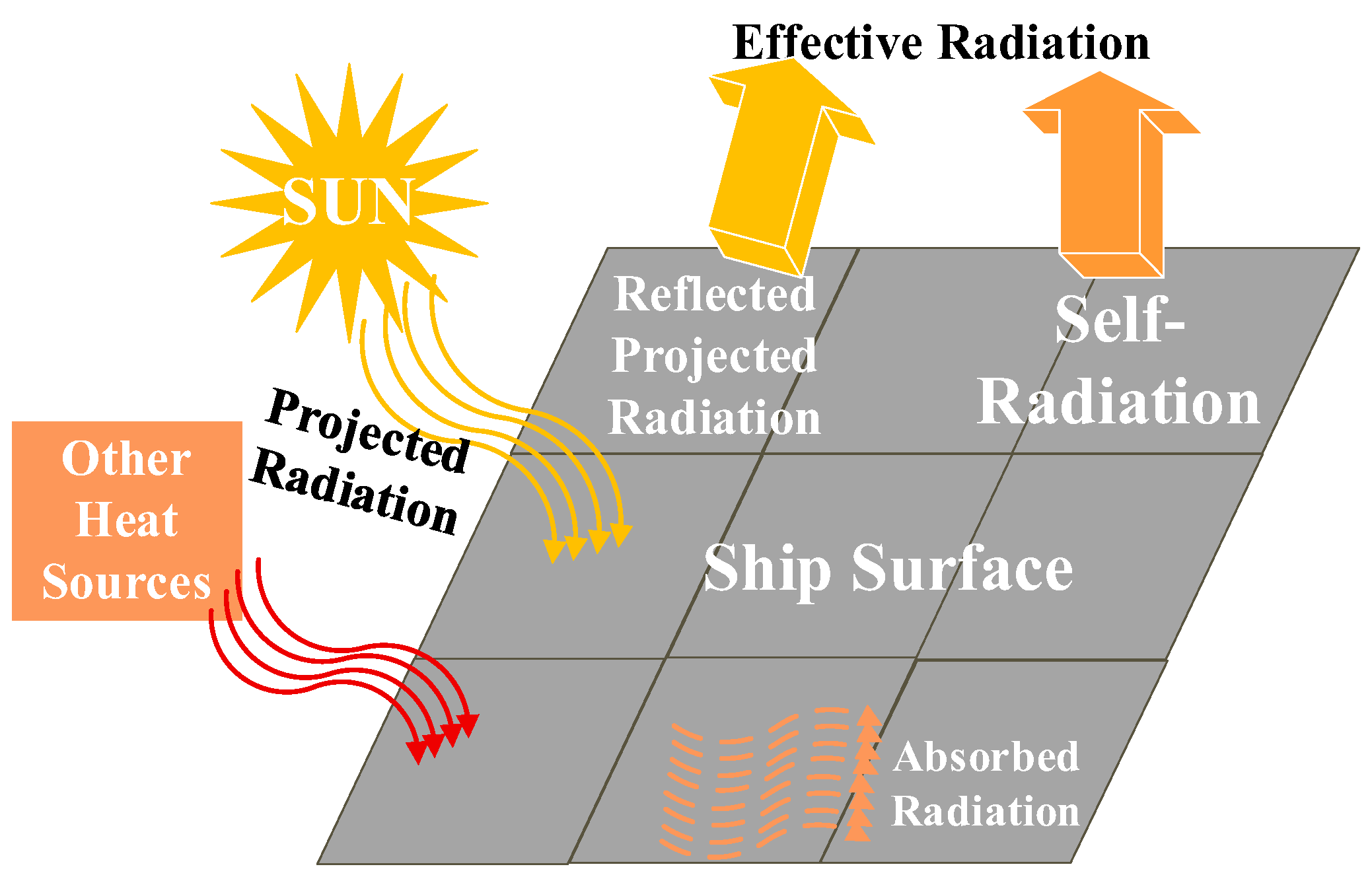
The infrared radiation components of a ship surface consist of self-radiation, reflected projected radiation, and effective radiation. Their relationships are illustrated in
Figure 1. Self-radiation is described by the spectral radiant exitance M of an extended source, which is determined by temperature and wavelength according to Planck’s law:
where
is the spectral radiant exitance of a blackbody;
is the wavelength;
T is the thermodynamic temperature;
c is the speed of light; h is Planck’s constant;
is the Boltzmann constant; and
and
are the first and second radiation constants, respectively.
The projected radiation is expressed by the irradiance E. For an opaque gray body such as a ship, part of the incident radiation is absorbed and the remainder is reflected. If the surface absorptivity is , the reflected projected radiation is .
The effective radiation of the ship surface
J is the sum of self-radiation and reflected projected radiation:
Because the radiance of most ship surfaces is nearly direction-independent, the surface can be approximated as Lambertian during precomputation [
21]. Under this assumption, the spectral radiance is:
As infrared radiation propagates through the atmosphere, it undergoes refraction, absorption, and scattering. Birch and Downs [
22] proposed the classical formula for atmospheric refraction applicable to electromagnetic waves:
where
n is the refractive index of the atmosphere;
N is the refractivity modulus; and
P is the atmospheric pressure.
Because the refractive index of air is close to that of a vacuum
N is commonly used to represent refractive effects. Atmospheric refraction varies with infrared wavelength, but under clear-sky conditions and short-range detection in the mid-wave infrared band, refraction has negligible influence. Therefore, in the interest of computational speed and simplicity, atmospheric refraction is neglected in the precomputation model [
23].
Atmospheric absorption and scattering follow Bouguer’s law, which states that the attenuation of infrared radiation along a ray path is proportional to the incident radiant flux and the thickness of the atmospheric layer:
where
is the medium density;
is the radiant flux at a distance
s from the source as a function of wavenumber
; and
is the extinction coefficient, which depends on wavenumber, medium state, pressure, density, and composition [
24]. Integrating Equation (5) from
to
:
The integral on the left-hand side yields:
The various physical effects of the atmosphere on infrared radiation can be linearly superimposed. Therefore, the extinction coefficient can be expressed as the sum of two components, namely, absorption and scattering:
where
and
are the spectral and scattering coefficients of gases and aerosols, respectively. In a pure gaseous medium with uniform optical properties, the extinction coefficient can be treated as constant, and scattering is typically much weaker than absorption. Under these assumptions, the attenuation model simplifies to:
The corresponding spectral transmittance of the medium is:
Equation (9) indicates that atmospheric attenuation causes the spectral radiant intensity of infrared radiation to decay exponentially along its propagation path. Using the ideal gas law, the medium density becomes:
Replacing radiant flux with radiant intensity and combining Equation (11) with Equation (3), the radiance at the observation point is:
where
A is the imaging area of the ship at the observation point;
R is the gas constant of air;
is the ambient temperature; and
is the average surface emissivity. The spectral radiance
I(
λ) is expressed in units of W·sr
−1·μm
−1.
The pre-computation method preserves the essential physical processes while simplifying the atmospheric radiative transfer model. It is formulated based on clean, standard dry air at sea level with uniform optical properties, and neglects atmospheric refraction. Although the method sacrifices a small degree of accuracy, it significantly improves the computational speed and efficiency of infrared radiant intensity calculations. It is therefore well suited for scenarios requiring real-time construction of infrared characteristics or for precomputation stages that precede large-scale simulation experiments.
2.2. Basic Principle of the RMCM
The radiative transfer process consists of a series of sub-processes, including emission, reflection, and absorption. Based on this principle, the Reverse Monte Carlo Method (RMCM) assumes that radiation is composed of multiple independent rays [
25]. By performing backward ray-tracing and simulating these sub-processes, statistically stable results can be obtained [
26].
To implement RMCM, the projection plane of the target is discretized into grids, and several uniformly distributed random points are generated within each grid. The vector from the detection point to each random point defines the direction of a ray. The coordinates of a target point in the planar coordinate system are given by:
where
and
are random numbers uniformly distributed over a specified interval;
and
are the corner coordinates of the pixel; and
L is the pixel width. Once a ray is defined, all facets of the gas boundaries that intersect the ray must be located to determine the control volume through which the ray enters the computational domain. If no such intersection exists, the ray does not enter the domain and therefore contributes nothing to the radiant intensity at the detector. To determine whether an intersected facet is an incident facet, the following condition is used:
where
is the ray vector and
is the unit normal vector of the facet. If the condition is satisfied, the facet is considered an incident facet; otherwise, it is an emergent facet.
After confirming that the ray enters the computational grids, ray-tracking proceeds sequentially through each control volume. When a ray enters a volume through one facet, all other boundary facets of that volume are searched to identify the emergent facet. Based on the mesh topology, the next control volume is identified, initiating the next tracking cycle. This process continues until the full ray path is obtained [
27].
Given the path length of the ray within a medium and the local thermodynamic parameters, such as temperature, pressure, and the concentration of infrared-active species, the spectral absorptivity
is computed. Using a uniformly distributed random number
, absorption by the medium is modeled as:
Similarly, when a ray encounters an opaque surface, the surface absorptivity
and another random number
determine the wall interaction:
To simplify computation, the ship target is approximated as a Lambertian surface. Under diffuse reflection conditions, the reflected direction in the local coordinate system is expressed as:
where
and
denote the spherical coordinates of the reflection direction in the local coordinate system of the facet, and
and
are uniform random numbers in
. When a ray exits through a gas boundary facet, it is considered to have escaped the computational domain, and ray-tracking terminates [
28].
Assuming that
rays are emitted into space, these statistically significant rays replace the original radiation source for calculating the infrared characteristics. The radiance at the detector is thus expressed as:
where
L(
i) is the infrared radiance of the i-th ray.
2.3. IRTM
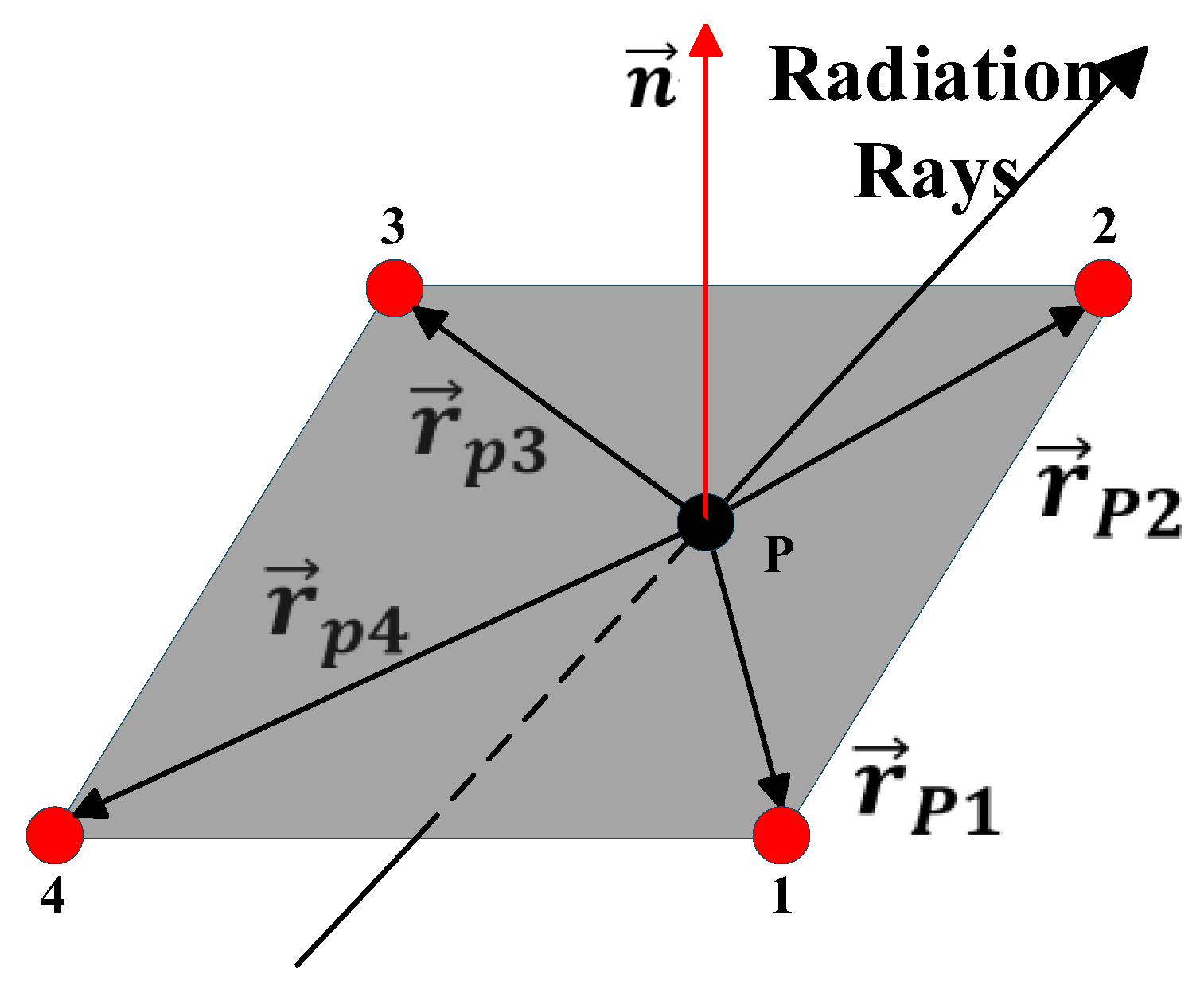
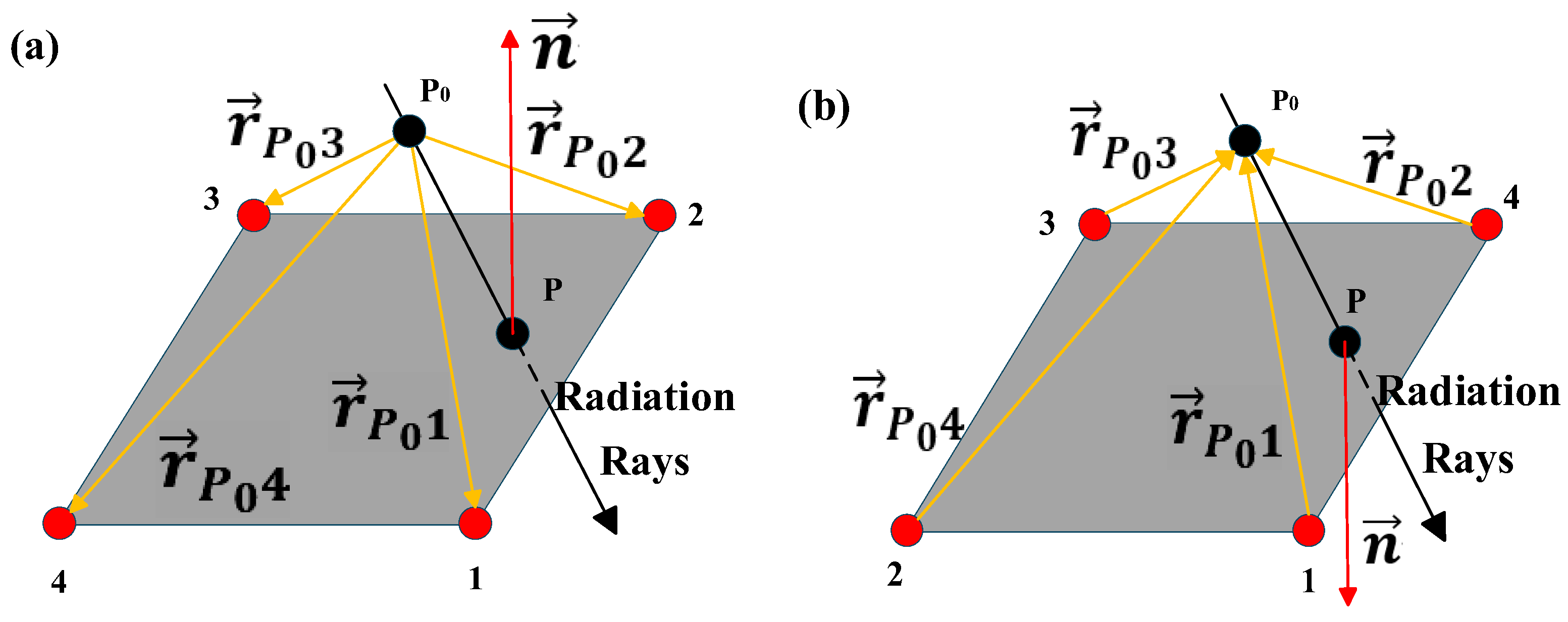
In the traditional Ray-Tracing Method (RTM) within the RMCM framework, the model used for determining ray–facet intersections is illustrated in
Figure 2. Let
denote the unit normal vector of a facet,
the intersection point of the ray with the facet, and
the vectors from point
to the facet’s vertices. The intersection criterion is:
where % denotes the remainder operator. If the inequality holds for all vertices, the ray intersects the facet; otherwise, it does not. A schematic is given in
Figure 2.
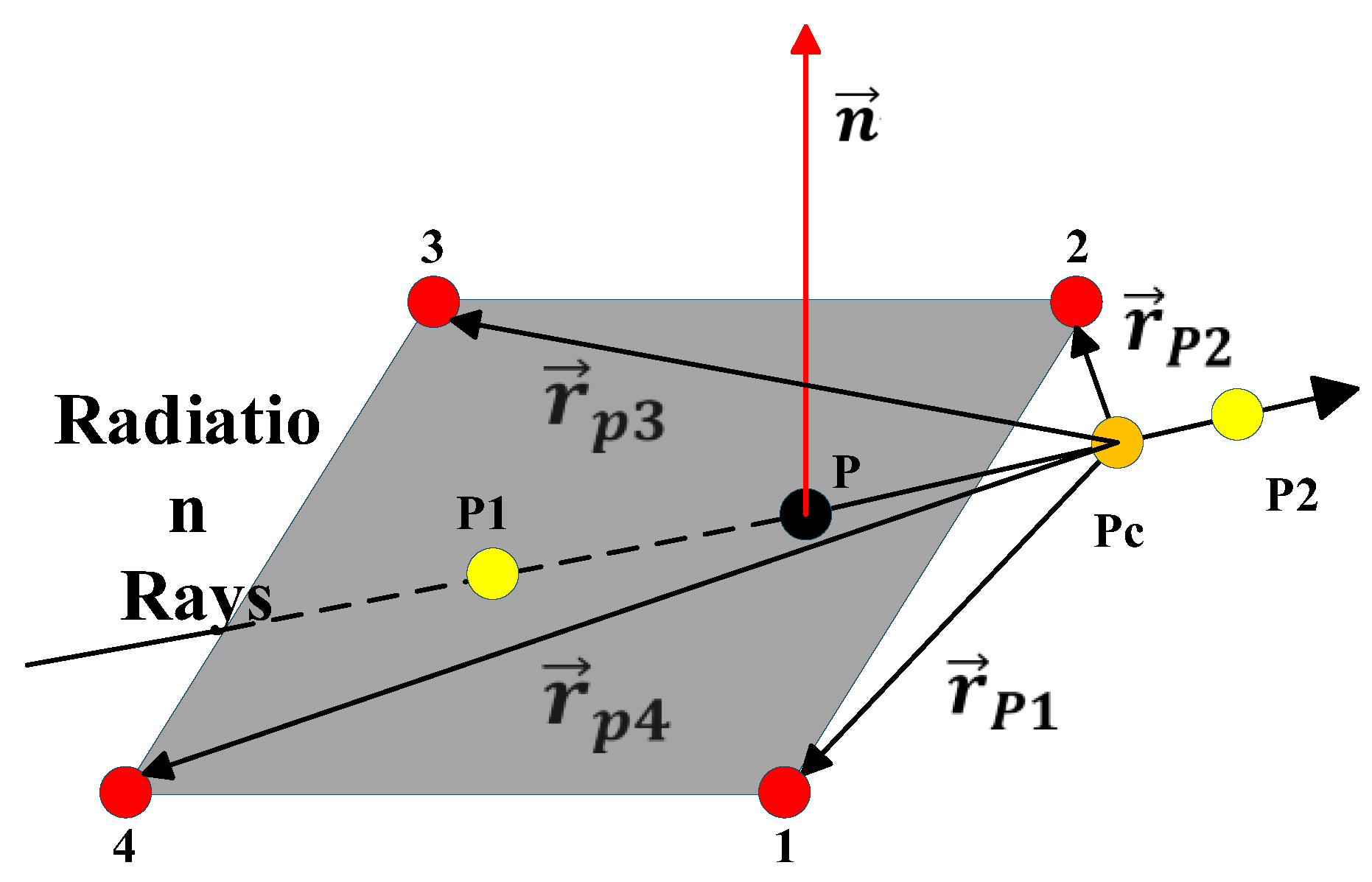
Due to unavoidable numerical truncation errors, determining the true intersection point between a ray and a facet can be difficult. As shown in
Figure 3, if a computational error occurs, the computed intersection point
lies between
and
along the ray. When the true intersection point is at P, but the computed point is near
, its projection on the plane falls outside the facet, yielding:
In such cases, the emergent facet cannot be correctly identified, resulting in ray-tracking failure.
According to Equation (18), a high number of failed rays increases the error in the computed spectral radiance. Because the position of the intersection may shift due to computational error, ray–facet intersection should be determined based not on the intersection point but on the incident ray itself, which is error-free [
29]. This idea leads to the Improved Ray-Tracking Method (IRTM). As illustrated in
Figure 4, IRTM determines the intersection relationship by checking whether the vectors from the ray incident point
of the control volume to the vertices of the facet enclose the ray direction vector. The intersection criterion is:
where
is the vector from
to the i-th vertex, and
is the ray direction vector. If the condition is satisfied for all vertices, the ray intersects the facet; otherwise, it does not.
In the IRTM framework, the computational accuracy of the intersection point
P does not affect the final intersection judgment, thereby improving simulation robustness and accuracy.
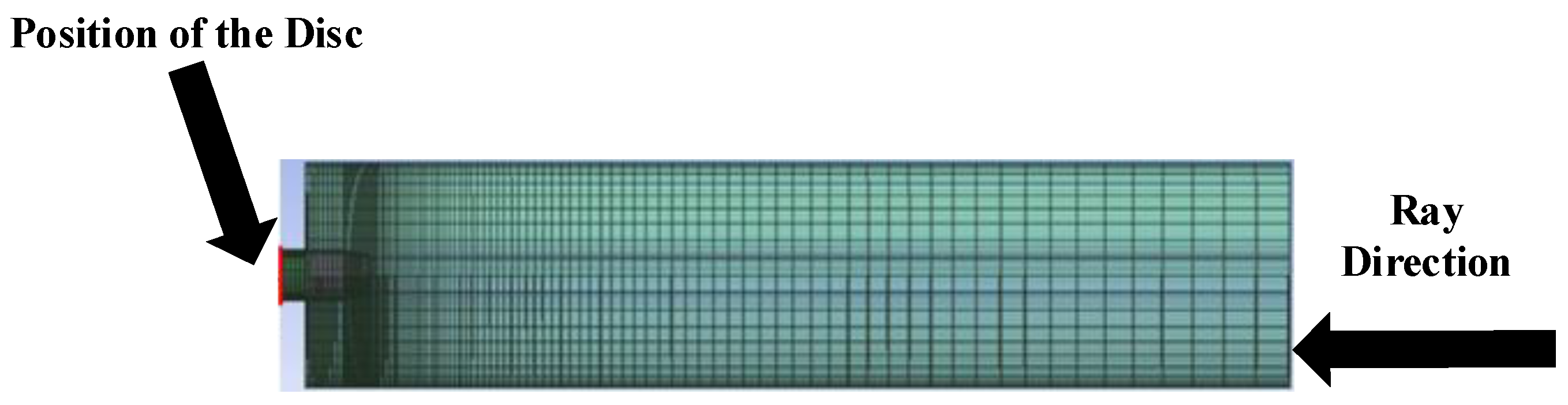
Figure 5 presents the schematic of a verification experiment. A blackbody disk with an area of 0.782024 m
2 and at a temperature of 800 K is placed on one side of the target, and atmospheric attenuation is neglected. The theoretical value of the integral radiant intensity in the 3–5 μm band directly facing the disk is 2013.91 W/sr. In the RMCM simulation, rays do not undergo absorption or reflection when traversing grids; however, ray failures occur, resulting in discrepancies between the simulated and theoretical values.
When RTM is employed, the number of failed rays is 391, and the simulated infrared integral radiant intensity is 1859.62 W/sr, corresponding to a computational error of 7.6%. In contrast, when IRTM is applied, the number of failed rays is reduced to 51, and the simulated infrared integral radiant intensity increases to 1979.63 W/sr, with a computational error of only 1.7%. These results demonstrate that IRTM effectively enhances simulation accuracy.
2.4. BRDF Reflection Theory and Computational Model
In high-precision calculations, idealized specular and diffuse reflection models are insufficient. The distribution of reflected energy depends on the incident direction and follows a complex spatial pattern within the hemisphere formed by all possible reflection directions [
30]. Therefore, it is necessary to introduce the BRDF, defined as:
where
and
are the incident zenith and azimuth angles, respectively;
and
are the reflected zenith and azimuth angles, respectively;
is the spectral radiance reflected in direction
due to incident radiation from
; and
is the spectral irradiance of the incident infrared radiation from
.
This study adopts the classical Cook–Torrance (C-T) model [
31] for BRDF computation. In this model, the target surface is assumed to consist of numerous microfacets whose statistical normal distribution determines the reflective properties of the surface. Among the many microfacets with different normals, only those whose midline directions align with both the line of sight and the incident radiation direction contribute to reflection. This simplification substantially improves computational efficiency, making the model suitable for high-precision real-time simulation [
32].
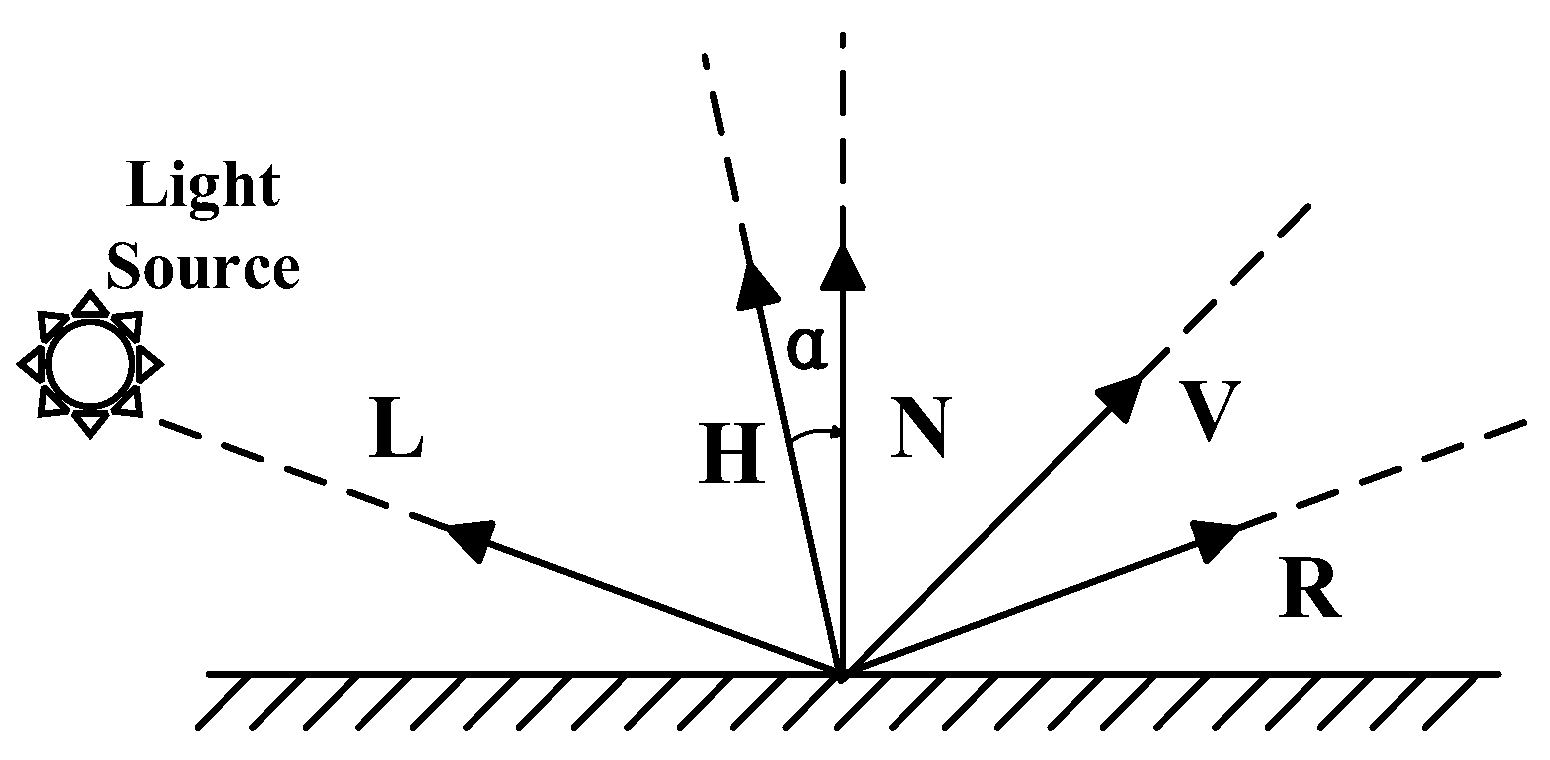
Figure 6 illustrates the geometric relationships in the C–T model, where L is the incident radiation vector, N is the facet normal vector, V is the viewing direction, R is the reflected direction at the facet, and H is the half-angle vector between L and V.
The C-T specular reflection formula is expressed as:
where
F is the Fresnel reflectance, which depends on the target surface material. For rendering, the Schlick approximation [
33] is typically used to simplify the formula and improve computational efficiency:
where
is the Fresnel reflectance when the incident angle is 0°, determined by the refractive indices on either side of the reflective interface. Because this study considers only reflections occurring above the water surface, one side of the interface is set to the refractive index of air, 1, yielding:
Let
D be the normal distribution function describing the area density of microfacet normals oriented along H, determined by the surface roughness, i.e., the Root Mean Square (RMS) slope m. This function is a critical model for representing reflection from rough surfaces [
34].
Let
G be the geometric function that accounts for occlusion between facets, which prevents radiation rays from emerging correctly [
35]:
According to Equation (2), the radiance reflected by the facet can be expressed as:
where
is the spectral irradiance at the facet and
is the angle between the incident ray and the facet normal.
2.5. BRDF Reflection Function Modeling Method Based on the RMCM Framework
The BRDF represents the distribution of radiant energy density within the hemispherical space after reflection. From a probabilistic viewpoint, it can be interpreted as the directional probability distribution of radiation rays after reflection from a solid surface. Within the RMCM framework, a Pseudo-random Vector Method (PVM) is adopted to determine post-reflection ray directions through probabilistic simulation [
36]. The target surface is discretized into multiple facets, and the geometric center of each microfacet is treated as the reflection point. Within the hemisphere centered at this reflection point, a random emergent ray is generated, uniformly distributed in direction. The zenith and azimuth angles of this random vector are given by:
where
and
are uniformly distributed random numbers in [0, 1]. In the C–T model, the reflected energy density reaches its maximum along the specular reflection direction. In this case, the angle
between the facet normal and the half-angle vector (defined by the incident and viewing directions) is zero, resulting in the maximum BRDF value:
where
and
are the reflected zenith and azimuth angles corresponding to specular reflection, respectively. To ensure that the distribution of reflected ray directions matches the BRDF distribution, the following selection criterion is applied:
where
is a uniformly distributed random number in [0, 1]. Cubing the BRDF values on both sides of the distribution improves sampling efficiency. If the random direction
does not satisfy the above condition, the corresponding facet has a weak reflection effect on the radiation ray. Consequently, this ray is considered to make no contribution to the reflected projected radiation intensity received at the observation point. The ray is therefore rejected, and a new random direction and
are reassigned for the next microfacet. This process is repeated until all facets on the target surface have been traversed.
Based on the C–T model, this study proposes an enhanced reverse Monte Carlo approach—the Bidirectional Reflectance and Pseudo-random Vector Enhanced Reverse Monte Carlo Method (BP-ERMCM). In this method, PVM discretizes illumination into groups of random rays, and the stochastic generation of reflection directions transforms the problem into verifying whether a microfacet contributes meaningfully to the radiant intensity observed at the detector. This achieves efficient and accurate modeling of reflected radiation within the RMCM framework [
37].
2.6. Infrared Radiant Intensity Calculation Method Based on BP-ERMCM
The spectral irradiance of a target’s self-radiation received by the sensor is expressed as:
When modeling and computing the target’s self-emitted infrared radiant intensity using the BP-ERMCM framework,
N uniformly distributed random rays are emitted within the solid angle
at the detection point. A probability density function is used to determine each ray’s absorption point, and each ray is treated as an effective radiation source that substitutes for the original emission source. Thus, Equation (32) can be rewritten as:
where
is the spectral radiance of a blackbody at the absorption point of the i-th ray;
is the emissivity of the target surface at the endpoint of the
i-th ray; and
is the angle between the ray direction and the normal vector of the detection plane. When the target is far from the detection point,
, and Equation (33) can be simplified to:
Substituting the relationship between the infrared spectral radiant intensity of the target and the spectral irradiance on the detection plane:
The spectral radiant intensity at the detection point becomes:
where
r is the distance between the target and the detection point. According to the definition of solid angle:
The model for calculating the target’s self-infrared radiant intensity can therefore be simplified as:
where
A is the area of the detection surface. Equation (38) represents the modeling and computational method for target self-radiation under the RMCM framework. To quantify the directional characteristics of surface reflection, the BRDF is introduced. Based on Equation (28), the reflected projected radiation is incorporated into the spectral radiant intensity model. Linear superposition of self-radiation and reflected projected radiation yields the overall radiant intensity expression under the BP-ERMCM framework:
where
M is the number of reflected radiation rays contributing to the radiance at the observation point, and
is the angle between a reflected projected radiation ray and the normal vector of the j-th microfacet. The BP-ERMCM method transforms the radiant intensity computation at the detection point into the determination of absorption points of random rays. This transformation simplifies the computational model and significantly improves efficiency while maintaining high accuracy in infrared radiation simulation.
In simulations employing BP-ERMCM, the total radiance of the target is computed by integrating contributions from all surface elements. Specifically, the target surface is divided into high-temperature and ambient-temperature regions based on surface temperature differentials. The self-emission of each surface element is computed based on fundamental laws of thermal radiation (Planck’s law and the Stefan-Boltzmann law), while its reflected radiance is handled via the Cook-Torrance BRDF model. The total radiance of the target is then obtained as the vector sum of contributions from all surface elements. The core workflow encompasses several key steps, including geometric modeling, temperature field calculation, and radiative transfer solving. It is capable of performing large-data-volume infrared signature simulations for medium-to-large-sized maritime vessel targets. This framework is not reliant on specific target types and imposes no special constraints on the target’s geometric configuration or thermophysical properties. Provided that information such as the target’s geometric features, material properties, and climatic conditions is known, it can be extended to the infrared signature simulation of other target types. Consequently, BP-ERMCM can be conveniently generalized to a wide variety of targets, thus conferring strong generalizability.
3. Simulation and Analysis of Infrared Characteristics of Ship Targets
3.1. Construction of the Ship Temperature Field and Precomputation of Infrared Characteristics
In this section, ships at sea are selected as the research targets. The ambient temperatures of a specific sea area in four seasons are used as initialization temperatures to calculate the spectral infrared radiant intensity of the ship in the 3–5 and 8–12 operating bands of infrared thermal imagers. Virtual infrared images of the ship target are then rendered using dedicated simulation software MTE-IR (Version 6.0).
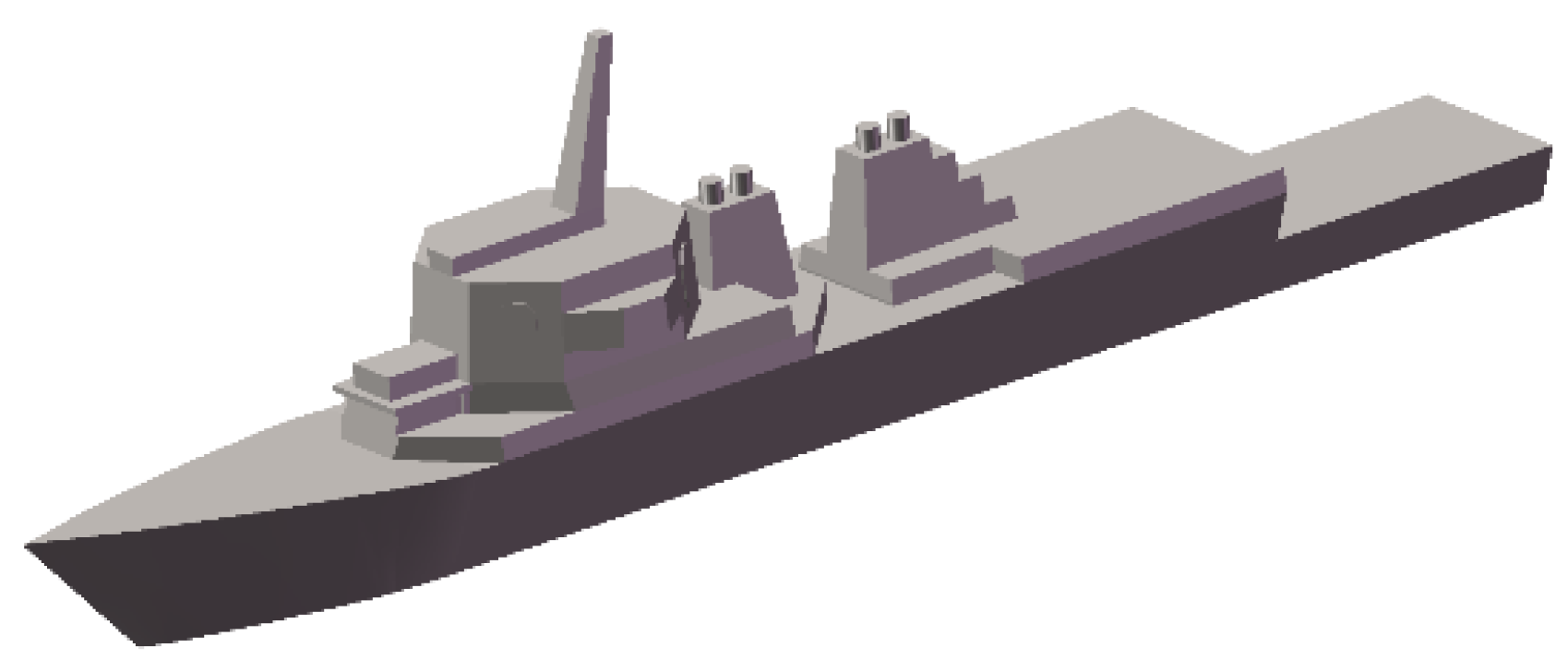
A simplified three-dimensional model of the target is constructed using commercial CAD software Solidworks 2024 (Dassault Systèmes, Version 32.0), and the basic geometric parameters of the ship are listed in
Table 1. In this experiment, ship components such as railings, antennas, and navigation equipment have a negligible impact on the overall infrared signature, while significantly increasing model complexity and simulation computational load. To conserve computational resources and improve efficiency, the 3D ship model was simplified. This simplification was performed with the premise of retaining major heat-emitting structures (e.g., the funnel and engine room) and the vessel’s fundamental geometric profile, as shown in
Figure 7.
The temperature field is computed using CFD software ANSYS Fluent 2024 R1 (ANSYS Inc.). The airflow field is modeled using the standard
turbulence model, and the ship material is specified as steel. For boundary conditions, all ship surfaces are defined as solid walls. The fore far-field boundary is set as a pressure inlet, the aft far-field boundary as a pressure outlet, and the remaining boundaries are configured as pressure far fields. The working pressure is standard atmospheric pressure, and the initialization temperatures for each season are summarized in
Table 2.
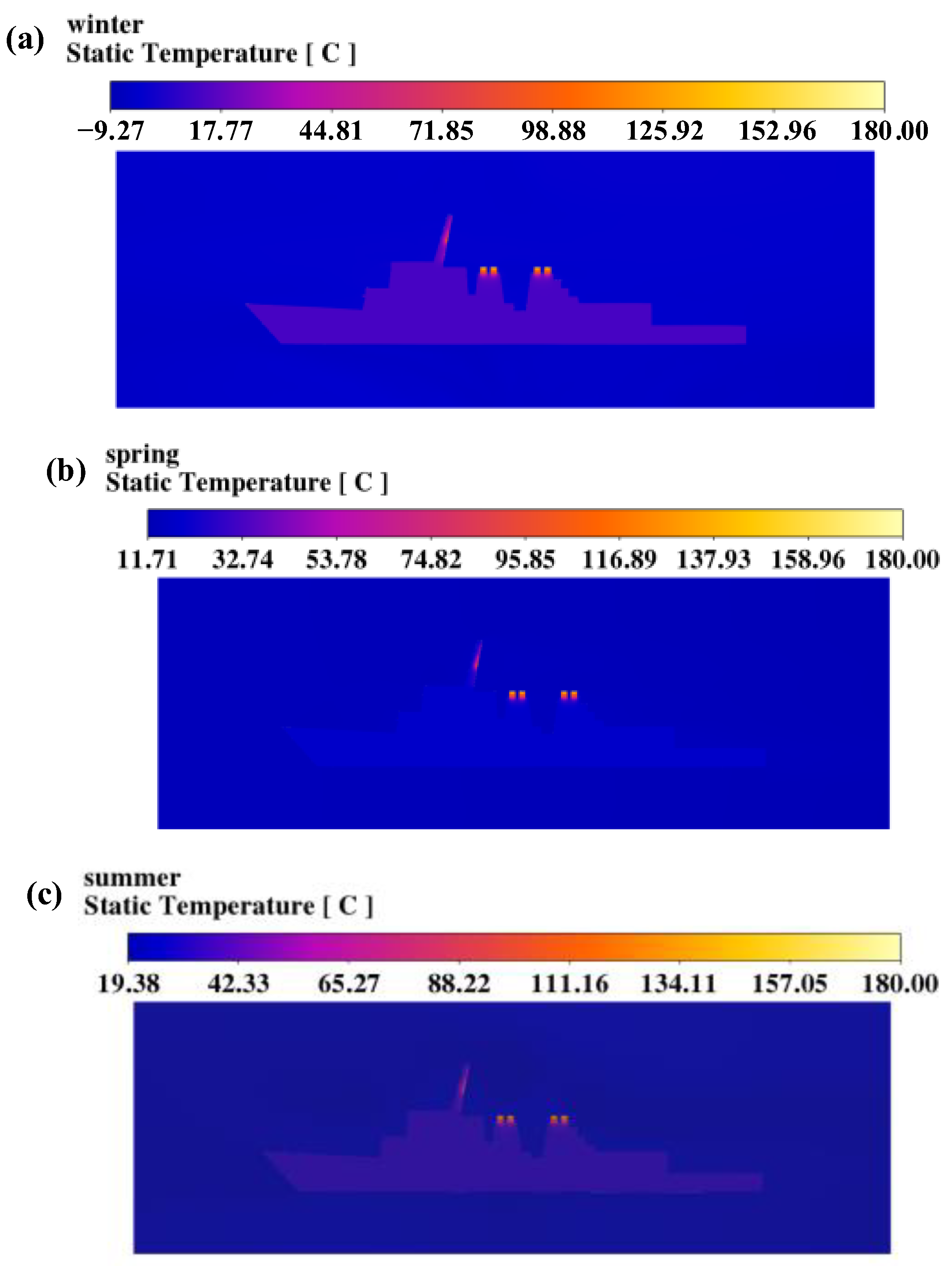
The resulting temperature fields of the ship target and its surrounding far field are shown in
Figure 8. Across seasonal conditions, the temperature distributions of high-temperature regions, such as the chimney and mast, are generally similar, with maximum temperatures reaching 180 °C. Due to differences in ambient temperature, the remaining areas of the ship exhibit slight variations: approximately 20 °C in winter, 27 °C in spring (autumn), and 40 °C in summer.
Taking the LWIR band as an example, the spectral radiant intensity of the target is precomputed using the model derived in the previous section. According to Wien’s displacement law, in the long-wave infrared band, self-radiation dominates, while reflected projected radiation contributes only weakly to the total radiant intensity. To improve computational speed and reduce resource usage during precomputation, only thermal self-radiation from the ship is calculated. The average emissivity of the ship’s surface is assumed constant, independent of wavelength, temperature, or other external conditions. The atmospheric model is defined as clean, homogeneous, standard dry air at sea level with uniform optical properties. The initialized physical quantities required for the precomputation model are listed in
Table 3.
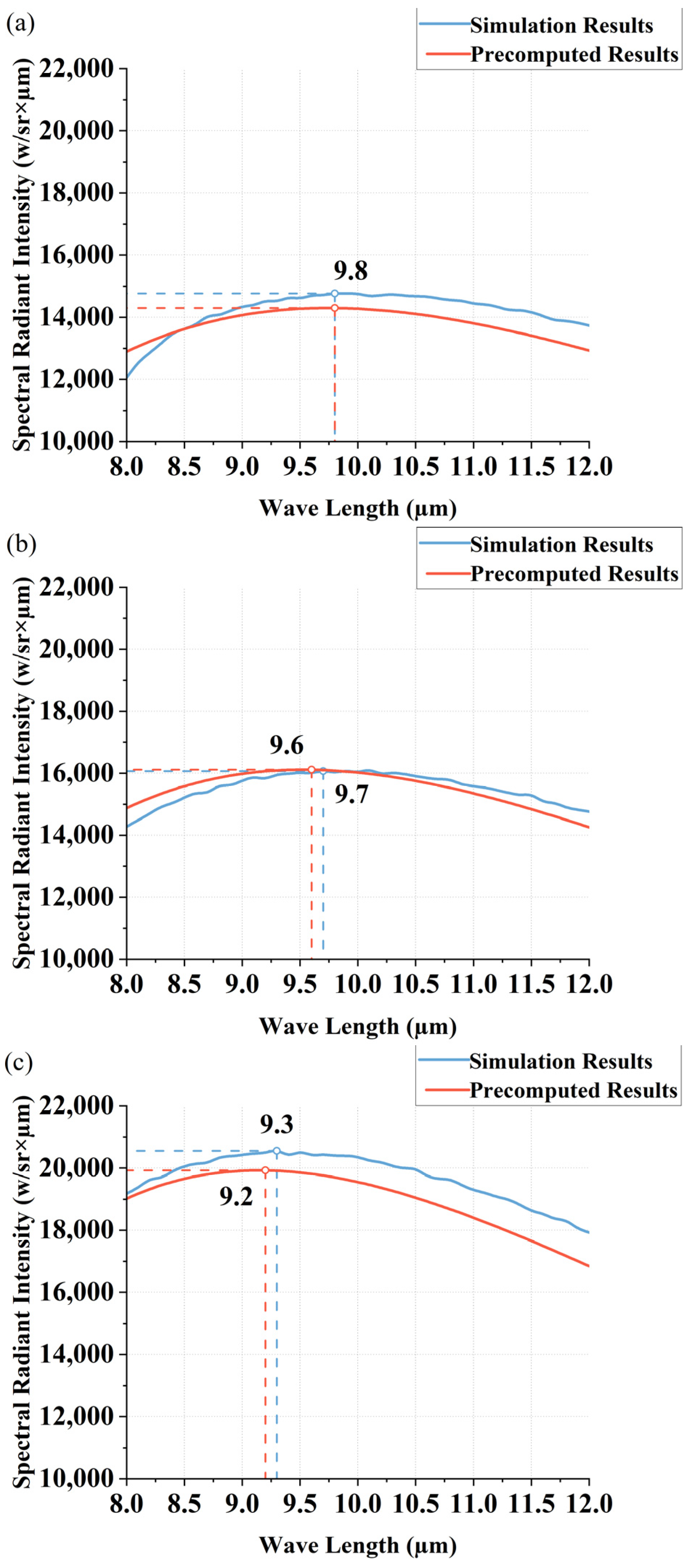
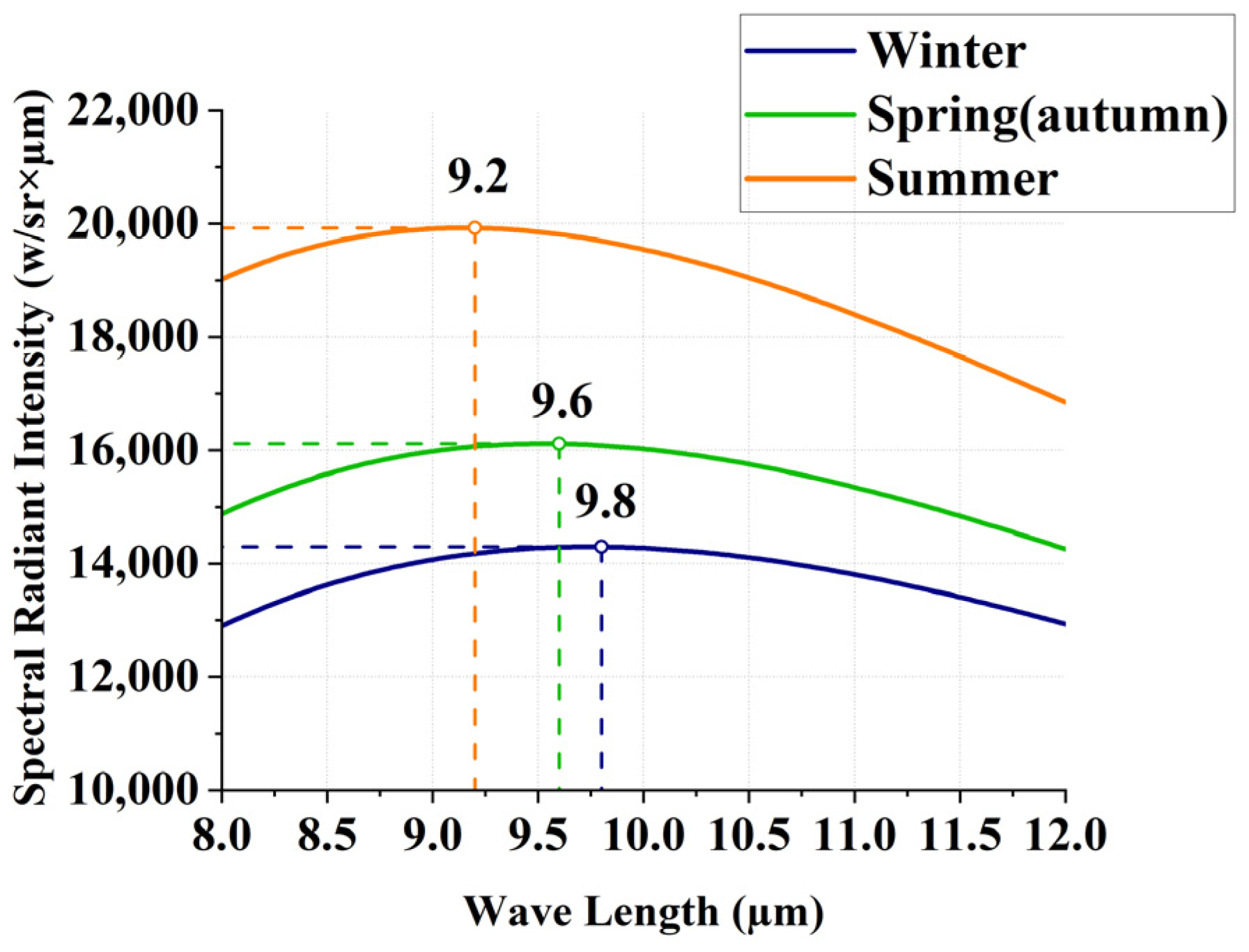
The computational results are shown in
Figure 9. The spectral radiant intensity of the ship target in the long-wave infrared band generally increases initially and then decreases. Since most infrared radiation originates from surfaces near ambient temperature, the peak wavelengths for all seasons occur in the 9–10 μm range. The peak radiant intensity decreases with increasing temperature. These results are consistent with Planck’s law and Wien’s displacement law, indicating that the simplified precomputation effectively captures the governing principles of thermal radiation. Thus, the precomputed results provide meaningful guidance for initialization settings and model selection in subsequent simulation experiments.
3.2. BP-ERMCM Simulation Framework and Parameter Settings
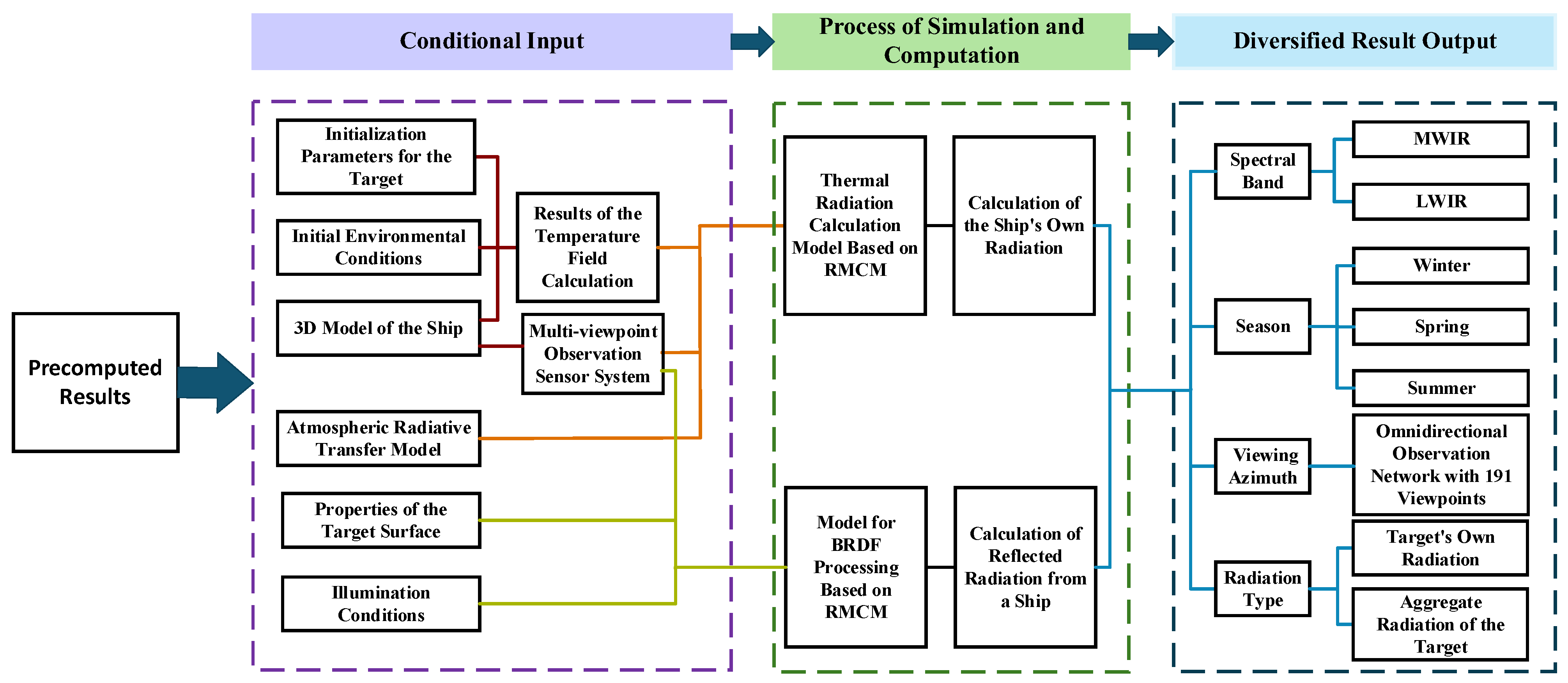
Based on the simplified geometric model of the ship at sea and the associated temperature field data, infrared characteristic simulations were performed using BP-ERMCM. The simulations were conducted for typical climatic conditions corresponding to spring (autumn), summer, and winter, and for two common working wavelength bands of infrared sensors: 3–5 μm and 8–12 μm. The overall simulation framework is shown in
Figure 10.
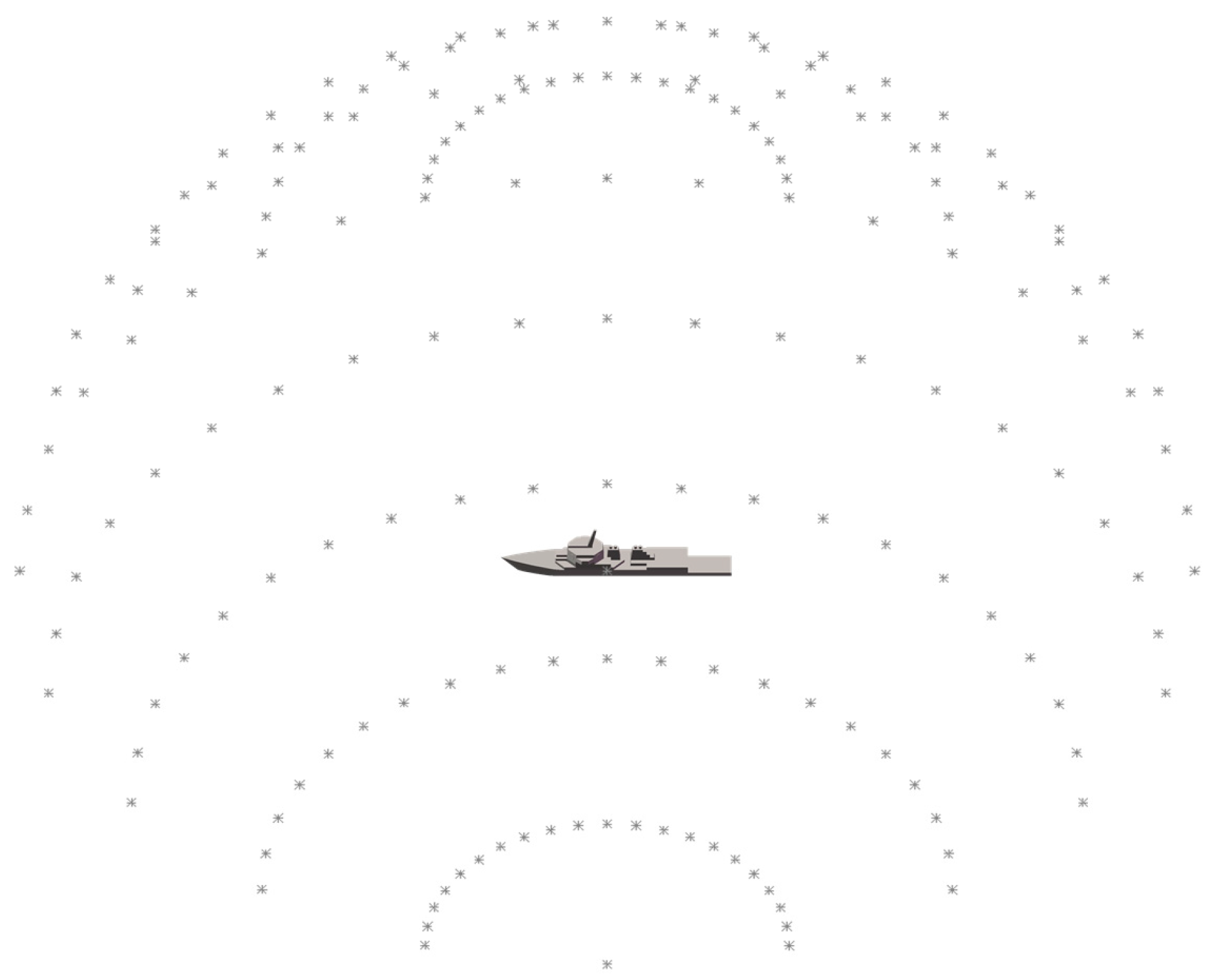
The simulation process begins by importing the ship’s temperature field results. A portion of the far field is selected as the computational domain. Atmospheric parameters and the computation mode are configured using the MODTRAN model, Seasonal simulations employed corresponding standard atmospheric profiles: the mid-latitude winter model was applied for winter, and the mid-latitude summer model for spring and summer, and a parallel set of radiation rays is used to represent solar illumination as projected radiation. A total of 191 virtual infrared detection points are uniformly distributed within a hemispherical space surrounding the ship target to capture infrared characteristics from multiple observation directions. The observation distance is set to 5 km to approximate the medium- to long-range detection capabilities of an infrared sensor. The spatial distribution of detection points is shown in
Figure 11. The simulation parameters are listed in
Table 4. The emissivity parameter was maintained as the fixed value used in the numerical calculations. Owing to the inability to definitively identify the specific material of the hull paint, the real and imaginary parts of the complex refractive index for this study were set based on the material characteristics of oxidized steel and its high infrared emissivity properties [
31]. For large structures such as ships, a roughness value in the range of 0.2–0.5 is commonly adopted to simulate realistic surfaces. To balance simulation efficiency with model applicability, a median value of 0.3 from this range was selected for the model surface roughness in the experiments. In the experiment, the solar illumination was simulated from the starboard side at a zenith angle of 30°. The reference geographical coordinates were set in the Philippine Sea of the Northwest Pacific at 25°N, 130°E. The reference dates were late December, late March, and late June, with the specific local time set at 10:30 AM.
3.3. Comparative Analysis of Infrared Characteristic Simulation Results Across Seasons
The simulated infrared characteristics obtained from an observation point on the starboard side of the ship were compared with the theoretical results presented in
Section 3.1, as shown in
Figure 12.
The infrared characteristics of the target vary markedly across seasons. The peak wavelength decreases as the seasonal temperature increases. Using the theoretical calculation as a reference, the maximum spectral radiant intensity occurs in summer, reaching 19,925.48 W/(sr·μm) at a peak wavelength of 9.2 μm. In spring, the spectral radiant intensity peaks at 16,114.02 W/(sr·μm) at 9.6 μm, while in winter the lowest value of 14,296.29 W/(sr·μm) appears at 9.8 μm. These values represent decreases of 12.7% and 39.3% relative to spring and summer, respectively. Because the computation is carried out in the long-wave infrared band, the contribution of reflected projected radiation is relatively small. Thus, the primary source of the observed variations is the seasonal temperature difference, which leads to distinct surface temperatures on the ship and consequently produces substantial seasonal variations in long-wave infrared radiant intensity.
The BP-ERMCM simulation produced peak wavelengths of 9.8 μm, 9.7 μm, and 9.3 μm for winter, spring, and summer, respectively. These results align closely with those of the simplified theoretical model, with deviations of less than 0.1 μm. The spectral radiant intensity curves also exhibit high consistency with the theoretical predictions, further validating the effectiveness of the precomputation approach. For spring, the theoretical and simulated peak intensities are 16,114.02 W/(sr·μm) and 16,067.8 W/(sr·μm), respectively—a difference of only 46.22 W/(sr·μm). For winter and summer, the differences are 469.4 W/(sr·μm) and 623.5 W/(sr·μm), respectively. These discrepancies arise primarily from the simplified treatment of atmospheric extinction in the precomputation model, in which atmospheric parameters are based mainly on spring conditions. In contrast, the BP-ERMCM simulation uses the more authoritative and physically rigorous MODTRAN atmospheric model. The resulting deviations are therefore predictable and within acceptable limits.
It should be noted that although seasonal variations in atmospheric conditions lead to minor alterations in the atmospheric transmittance curve, their impact on the target’s peak wavelength is secondary. This can be verified by comparing pre-computation results with BP-ERMCM simulation results: the difference in peak wavelength across the three seasons does not exceed 0.1 μm. This indicates that, within this long-wave infrared window, the influence of atmospheric transmittance on radiance is primarily manifested as an attenuation of the full-band radiation intensity, while its effect on altering the spectral distribution shape is relatively weak. Therefore, the peak wavelength shift observed in this study is primarily attributed to changes in the target’s own thermal radiation characteristics.
Overall, the precomputation model yields results that are only slightly deviated from the simulated values while requiring substantially less time and computational resources, which indicates its potential applicability in certain scenarios. It can be used for preliminary analysis of target infrared characteristics and for auxiliary calculations in applications requiring real-time decision-making. The seasonal dependence of ship infrared characteristics identified in this study is generally consistent with previous research on the influence of environmental temperature on radiation characteristics. Notably, this study quantitatively characterizes seasonal differences in spectral radiant intensity and clarifies the corresponding shift behavior of peak wavelengths.
3.4. Analysis of the Spatial Distribution Characteristics of the Target’s Self-Radiation Intensity
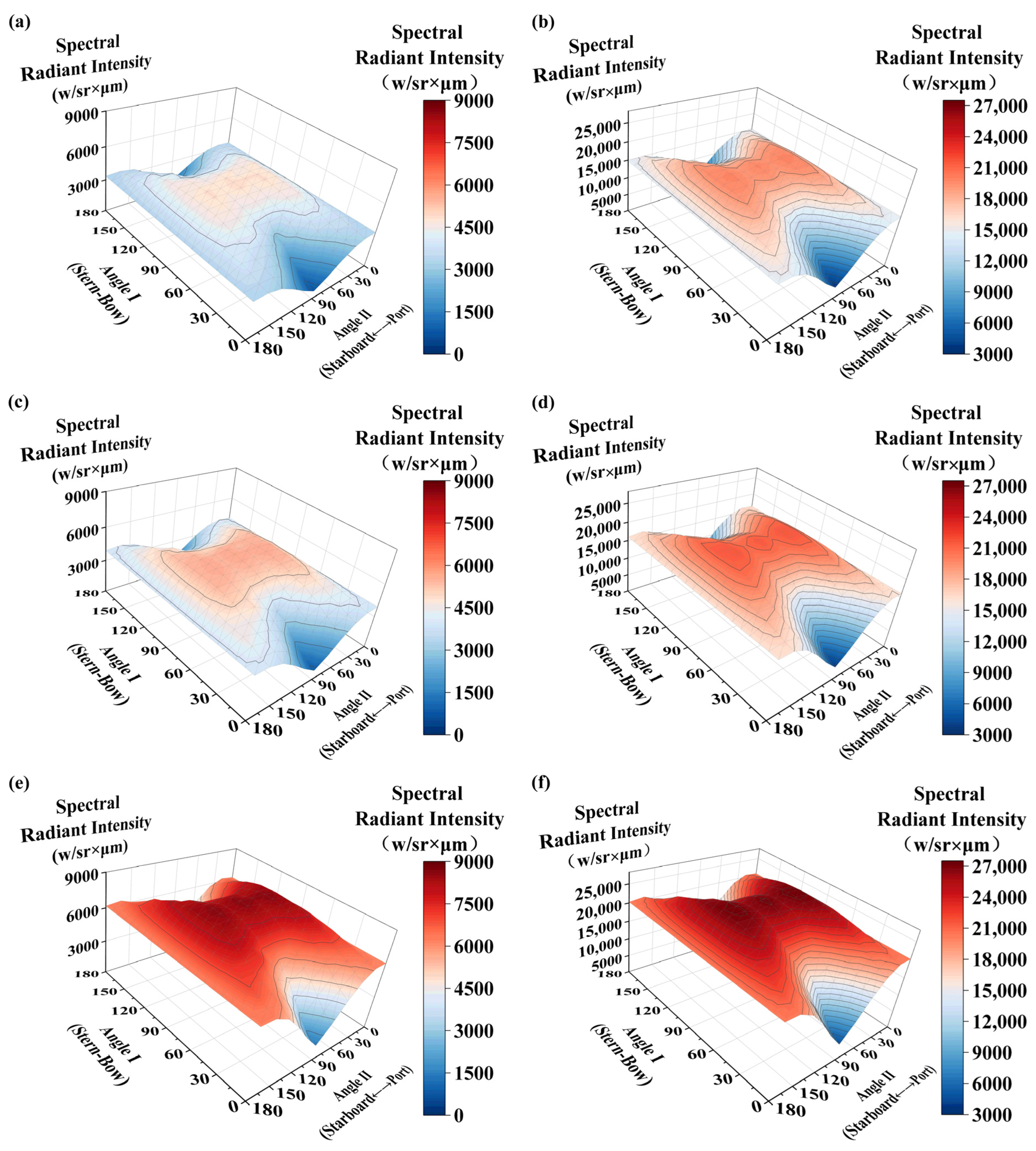
Using all 191 observation points in the omnidirectional observation network, the self-radiation intensity of the target was simulated. Based on these multi-view simulations, the spatial distribution map of the target’s infrared characteristics was constructed using linear interpolation. According to Wien’s displacement law, the peak wavelength of ship surfaces at normal temperature is approximately 10 μm, while high-temperature components exhibit peak wavelengths near 6.4 μm. Therefore, this section examines the target’s infrared characteristics at 10 μm and 5 μm. The variations in spectral radiant intensity with observation angle are shown in
Figure 13.
The infrared characteristics of the ship target depend strongly on the observation viewpoint, and the spectral radiant intensity varies significantly with the observation angle. In regions with densely distributed superstructures (midship), the spectral radiant intensity decreases progressively from the ship’s central axis toward both port and starboard sides. In contrast, at the bow and stern, the intensity increases gradually outward from the central axis. The spectral radiant intensities measured at observation points with the same starboard zenith angle on the port and starboard sides are approximately equal, indicating that the ship’s infrared characteristics are symmetric with respect to the central axis. The intensities at the bow and stern are also approximately equal.
Because the ship presents the smallest imaging area when viewed from the bow or stern, the infrared spectral radiant intensity reaches its minimum in these directions. For the winter case, the radiant intensities at the bow are 713.9 W/(sr·μm) in the 5 μm band and 3325.9 W/(sr·μm) in the 10 μm band. For the spring case, the corresponding values are 845.1 W/(sr·μm) and 3622.3 W/(sr·μm), while for summer they increase to 1361.3 W/(sr·μm) and 4592.9 W/(sr·μm), respectively.
At top-down (nadir) and oblique-overhead viewpoints, the spectral radiant intensity is significantly higher. This is because the ship presents the largest imaging area when viewed from above, and oblique-overhead viewpoints combine a large overall imaging area with the largest projected area of high-temperature regions. For winter, the maximum radiant intensities in the 5 μm and 10 μm bands are 4884.6 W/(sr·μm) and 19,851.5 W/(sr·μm), respectively. For spring, the maximum values increase to 5635.7 W/(sr·μm) and 21,566.1 W/(sr·μm), and for summer they further increase to 8601.5 W/(sr·μm) and 25,922.2 W/(sr·μm), respectively. For example, in the summer case, the radiant intensity at an oblique-overhead viewpoint in the 10 μm band is 5.65 times that at the bow, and the peak 10 μm radiant intensity is 3.01 times that at 5 μm. These results show that side-view angles exhibit comparatively high radiant intensities and therefore provide clear infrared characteristics. In addition, the long-wave infrared band offers more distinct contour recognition.
Therefore, when conducting field searches for such targets using infrared sensors, thermal imagers operating in the long-wave infrared band should be used, and lateral aspects of the target should be prioritized as primary observation directions. Mounting infrared sensors on aerial platforms, such as aircraft, to observe the ship target from oblique-overhead viewpoints enables more accurate identification of both the overall contour and localized high-temperature regions, thereby substantially enhancing observational effectiveness.
This section quantitatively analyzes the variation in spectral radiant intensity with observation angle, revealing the strong angular dependence of ship infrared radiation characteristics by excluding reflected radiation. The results supplement the existing literature by addressing the lack of comprehensive, multi-band, omnidirectional infrared characteristic analyses of ship targets.
3.5. Analysis of the Impact of High-Temperature Regions on the Target’s Radiative Characteristics
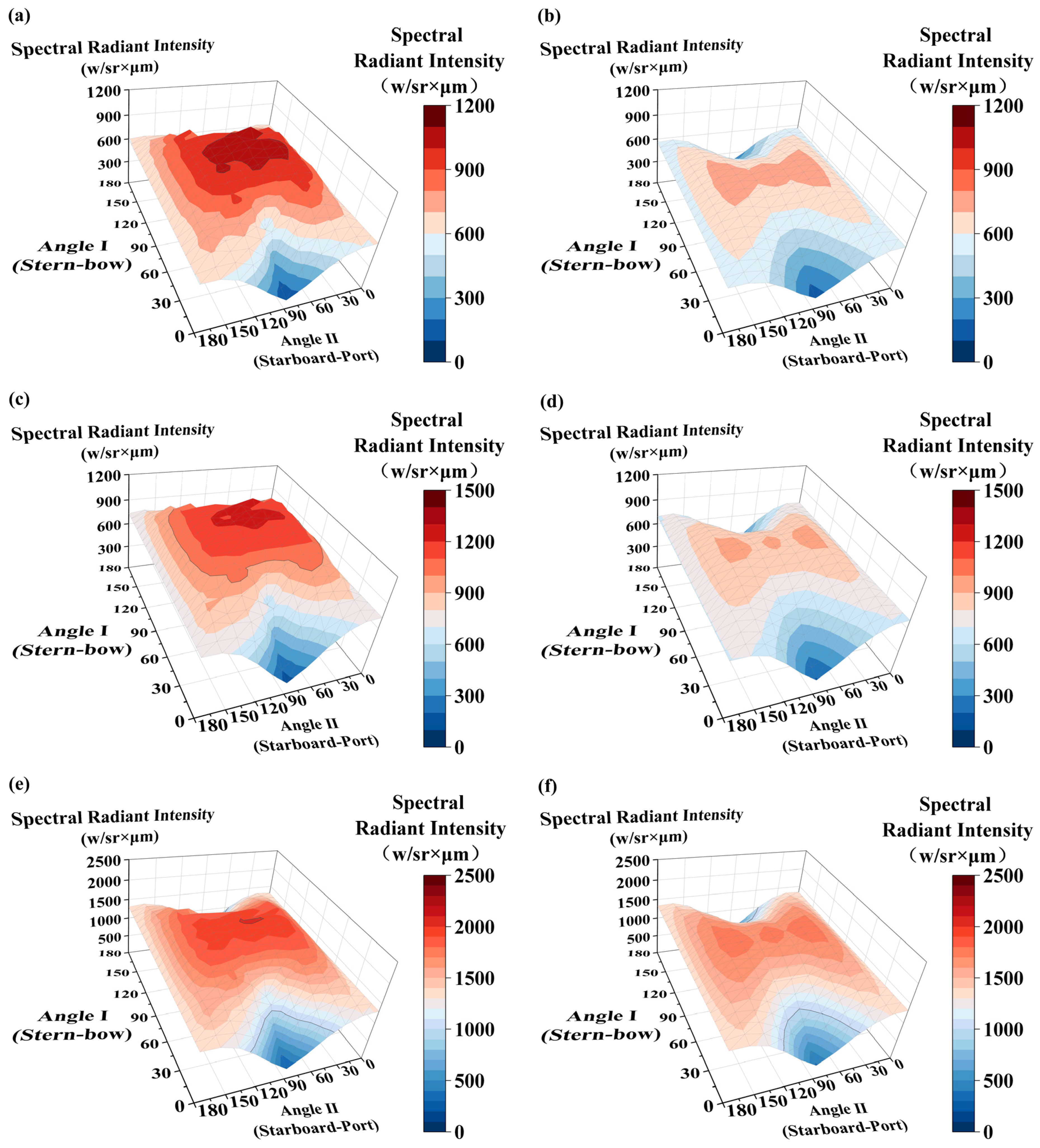
Based on the BP-ERMCM simulation framework, a quantitative study was conducted to investigate the impact of high-temperature regions on the ship’s own infrared radiative characteristics. A comparative ambient-temperature ship model was constructed by deactivating the high-temperature heat sources. The analysis focused on the contribution rate of high-temperature surfaces to the vessel’s total self-emission and their influence on the spatial distribution of radiance under varying seasonal conditions. Taking the 3.8 μm band as an example,
Figure 14 presents an omnidirectional comparison of the spectral radiant intensity with and without high-temperature heat sources across multiple seasons.
It is evident that, within the 3.8 μm band, high-temperature regions significantly enhance the ship’s radiant intensity. This effect is particularly pronounced in directions such as oblique and vertical upper views, where the hot surfaces present a large apparent projected area. Upon deactivating the heat sources, the spectral radiant intensity exhibited a substantial decrease across these observation angles.
Based on data from 191 observation points, the average decrease in spectral radiant intensity after heat-source removal was 22.2% in winter, 17.7% in spring, and 6.4% in summer. A focused analysis using data from 35 points located at oblique and vertical upper directions (117° > angle I > 54°; 126° > angle II > 54°) revealed greater reductions: 31.3% in winter, 26.1% in spring, and 13.1% in summer.
This analysis indicates that the contribution of the heat source to the hull’s total radiance exhibits a seasonal dependency, diminishing as the ambient temperature rises. This is primarily because the ship’s overall background temperature is higher in summer and lower in winter. Consequently, a heat source at a given temperature provides a more pronounced relative enhancement to the total radiance in winter.
Furthermore, the heat source’s contribution also demonstrates a strong viewing-angle dependency. Its effect on spectral radiant intensity is negligible at angles with a small projected area of the heat source, such as head-on views. In contrast, contributions are significantly higher for observations from the side, oblique upper, and vertical upper directions.
3.6. Analysis of the Target’s Infrared Reflection Characteristics
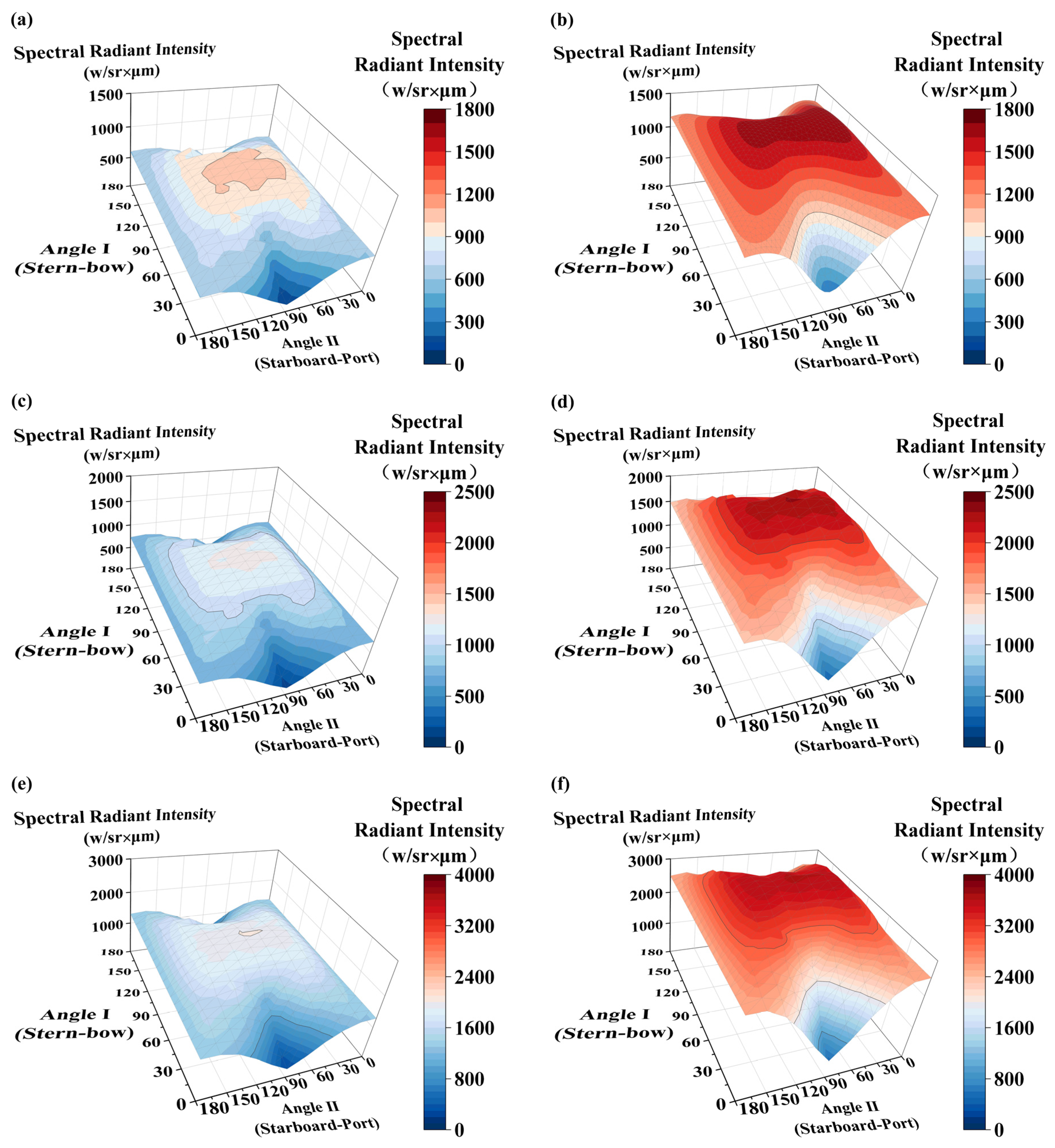
Based on the BRDF within the BD-ERMCM framework, the reflective radiation characteristics of the target were calculated. These results were then combined with the previously obtained self-radiation data to derive the spatial distribution of the target’s overall radiant intensity. As the wavelength increases, the contribution of reflected projected radiation induced by solar reflection gradually decreases, while the proportion of the ship’s self-radiation in the total radiation correspondingly increases. In the 3.5–4.1 μm range, atmospheric infrared absorption is negligible, making this region favorable for infrared detection [
38]. Considering these factors, the reflective radiation characteristics of the ship target are analyzed at 3.8 μm as a representative example, as shown in
Figure 15.
At 3.8 μm, after the reflected radiation component is superimposed, the overall spectral radiant intensity of the ship target increases significantly. In winter, the maximum self-radiation, calculated from the port aft observation point, reaches 1094.9 W/(sr·μm), while the maximum overall radiant intensity increases to 1709.25 W/(sr·μm), representing a 56.1% enhancement. In spring, the maximum self-radiation is 1251.96 W/(sr·μm), and the overall maximum increases to 2324.69 W/(sr·μm), an 85.7% increase. In summer, the maximum self-radiation is 2019.38 W/(sr·μm), and the overall maximum reaches 3641.71 W/(sr·μm), an 80.3% enhancement.
After superimposing the reflected projected radiation from solar illumination, not only does the spectral radiant intensity increase, but the spatial distribution pattern of the target’s radiation also changes to some extent. The simulated radiant intensity at observation points on the starboard oblique-overhead viewpoints is higher than that at corresponding points on the port side with the same zenith angle. This asymmetry arises from the initialization of the illumination angle: in the simulation, solar rays are modeled as parallel beams incident from a starboard zenith angle of 60°. Portions of the port-side hull are shadowed by superstructures, preventing full exposure to sunlight and resulting in weaker overall radiant intensity compared with the starboard side. For instance, at two observation points symmetrically located at midship with a zenith angle of 18°, the radiant intensities are 1624.46 W/(sr·μm) and 1678.22 W/(sr·μm) in winter, 2215.48 W/(sr·μm) and 2222.13 W/(sr·μm) in spring, and 3521.17 W/(sr·μm) and 3538.26 W/(sr·μm) in summer for the port and starboard sides, respectively. The corresponding increases on the starboard side are 3.0%, 0.3%, and 0.4%. This quantitative result is in strong agreement with the configured illumination conditions. The starboard surface receives direct solar radiation, resulting in enhanced reflected radiation, which thereby introduces asymmetry into the spatial distribution of the hull’s radiance.
It is crucial to clarify, however, that the weak left-right asymmetry in radiance features revealed by this study holds its primary significance in verifying the physical correctness of the BRDF and illumination geometry modeling within the BP-ERMCM framework. Nevertheless, in practical detection scenarios, such subtle differences in radiance are likely to be submerged within sensor noise and atmospheric turbulence, posing a challenge for stable identification by current infrared sensors. Consequently, in the mid-wave infrared region, solar illumination has minimal impact on the selection of observation viewpoints for ship infrared detection.
Based on the approach adopted in [
12], this section investigates the reflective radiation characteristics of ship targets, quantitatively evaluating the contribution of reflected-projected radiation to overall radiation in the mid-wave infrared band under specific illumination conditions. These results further supplement the spatial distribution analysis of target radiation characteristics presented above.
3.7. Analysis of Multi-View Infrared Thermal Imaging Characteristics of the Target
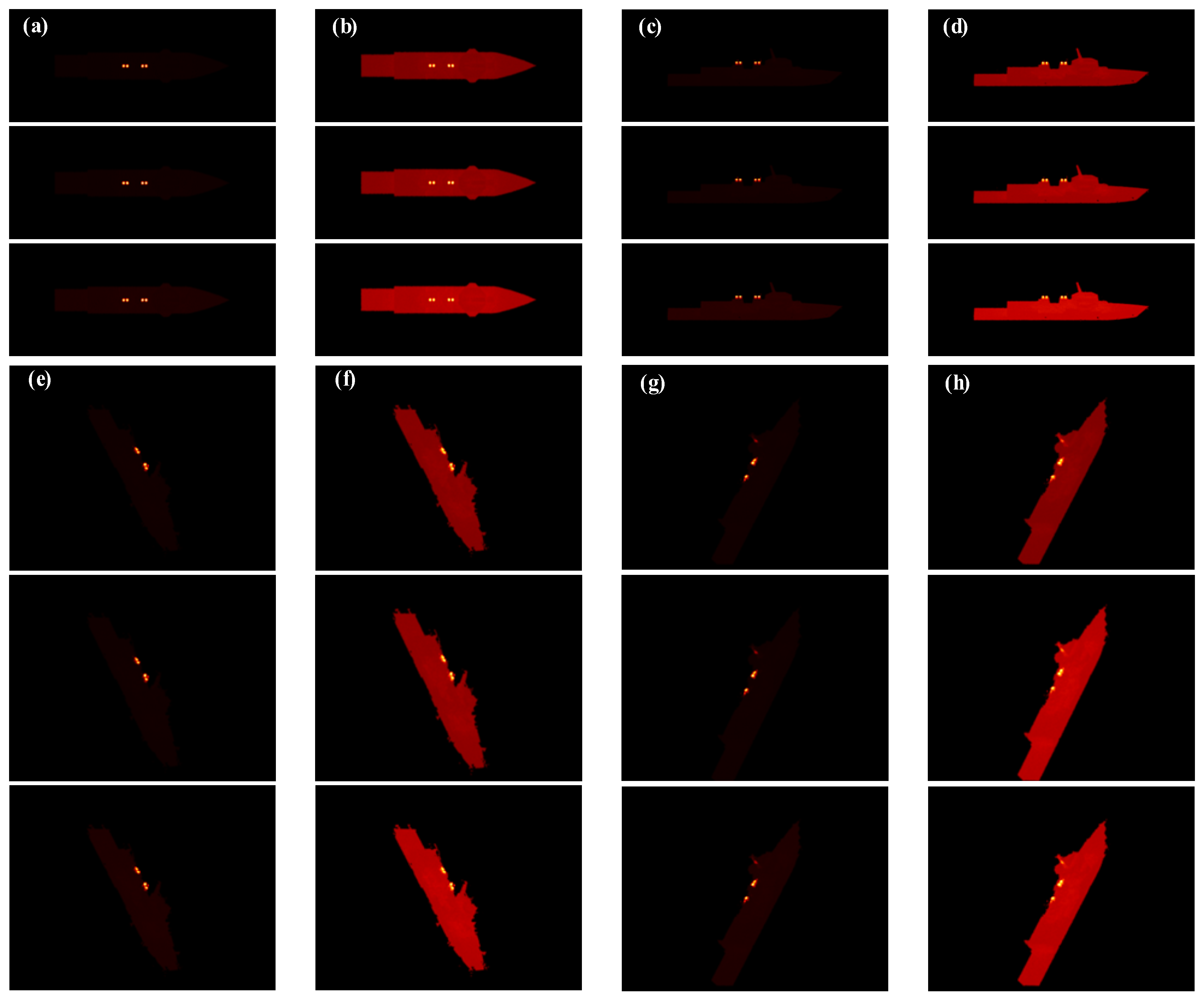
The simulated infrared radiant intensity data of the ship target were imported into MTE-IR to generate simulated infrared thermal images. Using the target’s infrared characteristic data in the mid-wave and long-wave infrared bands across winter, spring, and summer, image rendering was performed to produce corresponding infrared thermal images. Assuming the ship’s heading is oriented due north, four typical observation viewpoints were selected for visualization: azimuth = 0°, zenith = 90° (nadir view); azimuth = 90°, zenith = 30° (side-overhead view); azimuth = 45°, zenith = 60° (oblique-fore-overhead view); and azimuth = 135°, zenith = 60° (oblique-aft-overhead view). For each viewpoint, the rendered infrared images are arranged in the order of winter, spring, and summer from top to bottom, as shown in
Figure 16. Among the 12 mid-wave infrared images shown in
Figure 16a,c,e,g, the surfaces behind the funnels and masts correspond to high-temperature wall areas with peak wavelengths near the mid-wave infrared region and thus exhibit strong radiation characteristics. In contrast, the normal-temperature wall areas have lower temperatures, with peak wavelengths in the long-wave infrared band, resulting in weaker contrast in the images. After superimposing reflected radiation, the infrared characteristics on both sides of the ship’s central axis remain approximately symmetric. The infrared characteristics also become progressively stronger from winter to summer, consistent with the earlier analyses. Among the 12 long-wave infrared images in
Figure 16b,d,f,h, both the normal-temperature and high-temperature wall areas exhibit strong radiant intensities close to their respective emission peaks. Consequently, the infrared characteristics of both regions are clearly visible. Compared with the mid-wave infrared band, the target’s contour and surface details in the long-wave infrared band are more distinct and easier to recognize. As in the mid-wave case, the gradual enhancement of the target’s infrared characteristics from winter through summer is consistently observed. Compared with data charts, the simulated thermal images provide a more intuitive visualization of the simulation results. This approach offers an effective means of analyzing infrared characteristics of targets for which real infrared imagery is difficult to obtain and provides valuable technical support for building infrared characteristic databases.
3.8. Analysis and Evaluation of the Computational Efficiency and Accuracy of BP-ERMCM
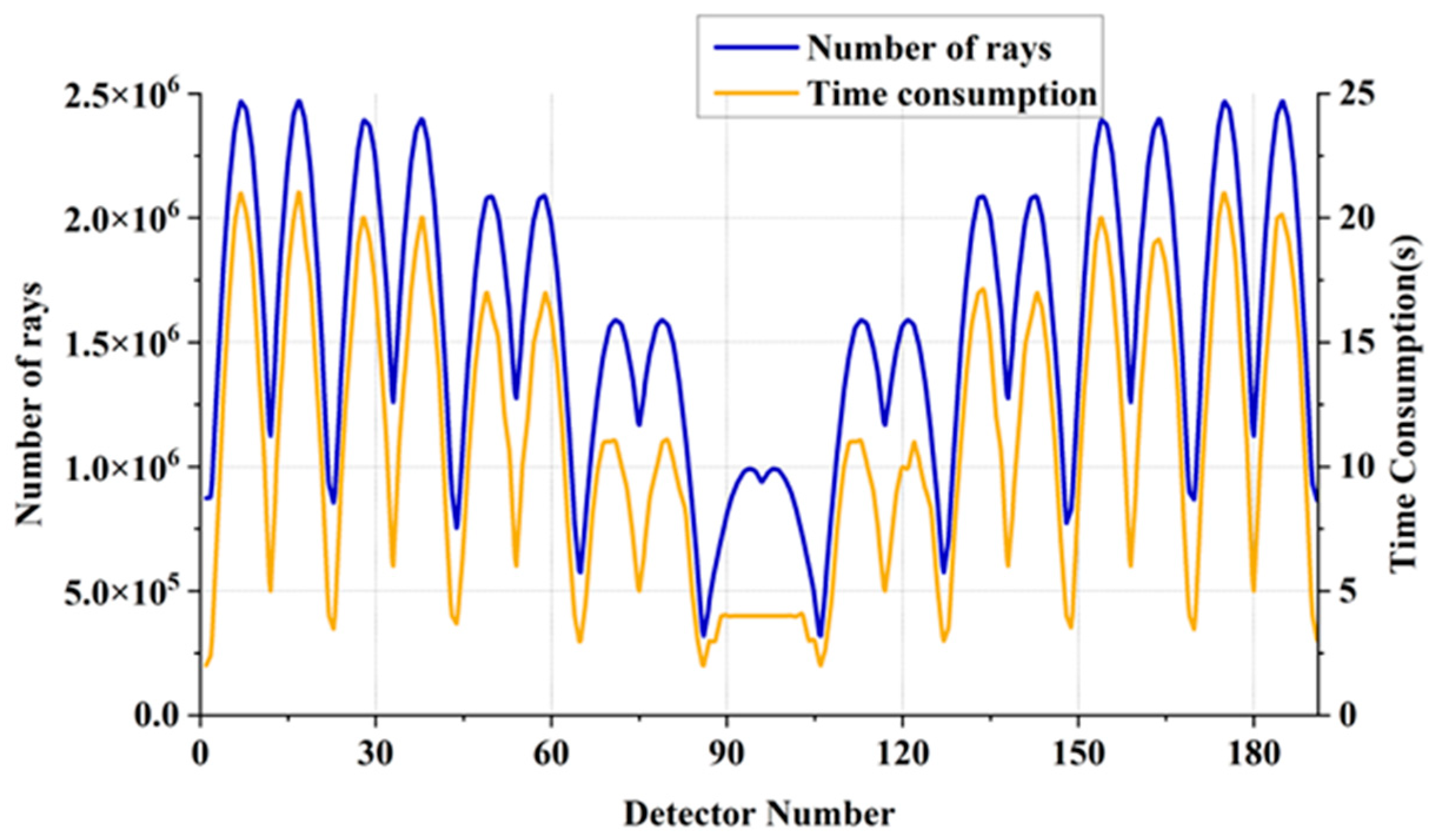
This study focused on conducting ship target infrared signature simulation experiments based on a multi-viewpoint omnidirectional observation network. The experimental hardware consisted of a 12th Gen Intel Core i7-12700 processor @ 2.10 GHz (12 cores, 20 threads) and 32 GB of RAM. The ray density per pixel within the computational domain was set at 20. The total number of rays used for calculation was determined by the number of target pixels in each observation direction. During the actual simulation, the average number of target pixels detected per sensor point was 78,126.4, resulting in an average ray count of 1,562,527.3 and an average computation time of 10.9 s. For processing all 191 sensor points, the BP-ERMCM method required an average total runtime of 2088 s (approximately 0.58 h). A comparison between the number of rays used and the computation time for these 191 sensor points is presented in
Figure 17.
It is evident that the runtime is closely correlated with the number of rays, indicating that ray tracing and BRDF calculations constitute the primary time-consuming modules within the simulation. This also accounts for the significant computational speed difference between BP-ERMCM and pre-computation methods, which possess near-real-time capabilities. However, the model offers flexibility for optimizing simulation efficiency by adjusting the ray density per pixel or increasing the number of CPU cores for parallel computation, based on specific computational requirements and available hardware, thereby enabling a rational trade-off between accuracy and efficiency.
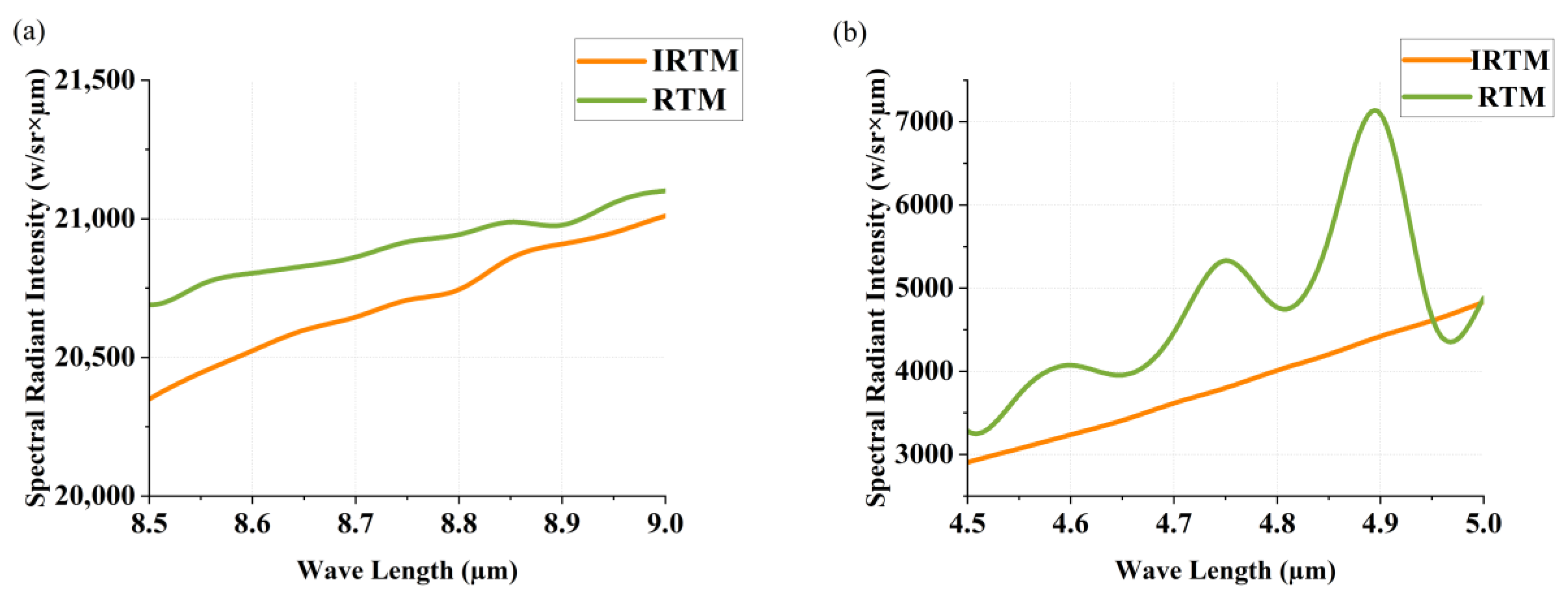
To validate the precision improvement of BP-ERMCM over the classical RMCM, a comparative experiment was conducted. The classical Ray Tracing Method (RTM) was employed instead of the IRTM within the same multi-view simulation framework to compute the infrared radiative characteristics of the same ship target. Simulations were performed for two scenarios: the ship target under long-wave infrared conditions in spring, and under mid-wave infrared conditions in winter. Taking the sensor view from directly above the target as an example, five simulation runs were executed for each ray-tracing method. The average result from each set was used for comparison between the classical RTM and the IRTM. In the control group using RTM, significant data deviations were observed in the spring (8.5–9.0 μm) and winter (4.5–5.0 μm) bands due to severe ray failure, as illustrated in
Figure 18.
In the experiment targeting the spring ship scenario within the 8.5–9.0 μm band, the maximum and average deviations between the RTM and IRTM groups were 9% and 0.7%, respectively. For the winter ship scenario in the 4.5–5.0 μm band, these deviations reached 74% and 16%, respectively. Compared with the validation results from
Section 2.3 (where BP-ERMCM reduced the error rate by 5.9% relative to RMCM), it is evident that employing the traditional RMCM simulation framework for ship target infrared signature calculation can lead to severe ray failure. This is primarily attributed to the complex geometric features of ship models, which include numerous edges, corners, and uneven structures. Rays traversing such complex geometries require intersection tests with a significantly larger number of facets, causing the probability of ray failure to accumulate with each test. Furthermore, the meshing process for ship models is more intricate, especially in key computational areas where smaller element sizes are used, making the impact of truncation errors more pronounced.
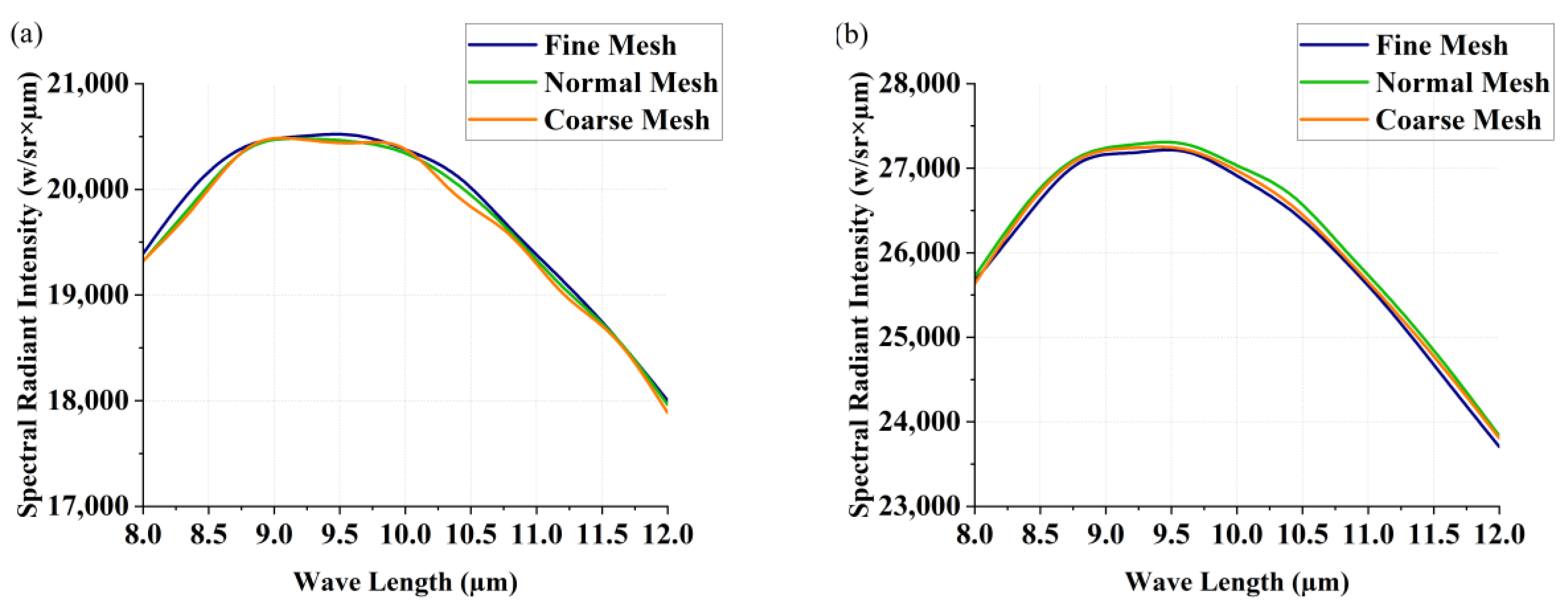
From a theoretical perspective, BP-ERMCM can effectively mitigate such issues. The IRTM avoids direct calculation of intersection points, thereby minimizing ray failure problems caused by high mesh density or complex geometry, and ensuring the precision and reliability of simulation results. To validate IRTM’s sensitivity to mesh density, the ship model was remeshed with parameters detailed in
Table 5. Experiments were conducted under summer long-wave infrared conditions, and the spectral radiance results from the top-down and broadside viewing angles are presented in
Figure 19.
As can be seen, the simulation results from the three mesh groups are in close agreement. Compared to the normal mesh group, the fine mesh group increased the total mesh count by 63.2%, yet yielded maximum deviations of only 0.72% and 0.7% for the broadside and top-down views, respectively. Conversely, the coarse mesh group reduced the total mesh count by 33.6% relative to the normal group, with maximum deviations of only 0.56% and 0.45% for the two viewing angles, respectively. These experiments demonstrate that mesh density has negligible impact on the computational accuracy and reliability of BP-ERMCM, further corroborating the low sensitivity of IRTM to both mesh quantity and complexity.
4. Conclusions
This study addresses the practical need for accurate and efficient modeling and computation of the infrared characteristics of ship targets, for which measured infrared data are often difficult to obtain. A research framework integrating theoretical derivation and numerical simulation is established. Based on Planck’s radiation law and atmospheric infrared radiative transfer theory, a precomputation model for radiant intensity is derived, enabling rapid analytical calculation of radiant intensity under complex thermal boundary conditions. Furthermore, within the RMCM framework, the BP-ERMCM method is proposed by integrating the IRTM, the BRDF, and the MODTRAN atmospheric model. This method provides the capability to efficiently simulate large-volume infrared characteristic data for medium-to-large maritime ships as well as other target types.
The methodological novelty of this research is primarily manifested in three aspects, which systematically address existing technical bottlenecks:
The introduction of an Improved Ray Tracing Method (IRTM) within the RMCM framework. By optimizing the intersection criterion between rays and surface elements, this method fundamentally reduces the probability of ray failure caused by truncation errors in traditional ray tracing. Validation experiments based on a blackbody disk demonstrate that IRTM successfully reduced the number of failed rays from 391 to 51 and decreased the computational error from 7.6% to 1.7%. This provides an effective approach for high-precision infrared signature calculation of complex targets.
The integration of the Cook-Torrance BRDF model into the RMCM framework via a stochastic vector approach. This enables efficient modeling of target reflective properties based on RMCM, overcoming the limitation of simplifying reflection as purely diffuse in conventional methods. It quantitatively reveals the contribution rate of reflected and projected radiation to the total radiance in the mid-wave infrared band.
The construction of a simplified ship model for temperature field calculation and a 191-viewpoint omnidirectional observation network. Simulations were conducted to obtain comprehensive, multi-band, multi-season radiance data and infrared thermal images of the target from all directions. This enabled a quantitative analysis of the seasonal dependency of the target’s radiative characteristics, its spatial distribution, the contribution of high-temperature zones to its own radiation, and the contribution of reflected/projected radiation to the total radiance. These results confirm the reliability of the BP-ERMCM framework and help fill a gap in the relevant data.
Overall, this study addresses the challenge of acquiring measured infrared data for maritime targets and establishes a set of efficient and high-precision methods for infrared characteristic computation, yielding a relatively comprehensive dataset of ship infrared characteristics. The results have important implications for maritime security. The proposed BP-ERMCM method can be extended to other types of maritime ships or diverse target categories, providing a general simulation framework for infrared characteristic evaluation. The constructed multi-view infrared database can support optimization of infrared monitoring systems and detector band selection, as well as guide the formulation of maritime observation strategies.
It should be noted that this study has certain limitations, primarily resulting from necessary simplifications made to balance computational efficiency, accuracy, and feasibility:
Due to the inability to accurately determine the specific types of materials, coating application methods, and area proportions on the hull surface, this study adopts an engineering simplification by setting the ship surface emissivity to a fixed value. In the mid-wave infrared band, the emissivity of conventional marine anti-rust matte coatings ranges between 0.7 and 0.9 [
39], while in the long-wave infrared band, it ranges from 0.8 to 0.95 [
40]. Furthermore, considering the presence of partially oxidized metal layers on the hull—where moderately oxidized steel at ambient temperature has an emissivity of approximately 0.7 [
40]—the selected value of 0.8 in this study is therefore reasonably applicable. This simplification, which does not account for emissivity variations across different materials and wavebands, may introduce minor deviations in the calculated self-emission. Since self-emitted radiance is proportional to emissivity, and reflected/projected radiance is proportional to reflectivity, the error δ in the total radiance calculation resulting from the emissivity initialization can be expressed as:
where
is the true radiance under actual conditions,
is the blackbody radiance at temperature
T, and
is the direct solar irradiation. The terms
and
represent the emissivity value set in this study and the true emissivity in the actual scenario, respectively. It is evident that in summer or other scenarios with strong solar irradiation, the propagation of emissivity error into the overall radiance calculation error is low. Conversely, in scenarios with weak irradiation, an improper emissivity setting would induce a relatively larger calculation error. The value of 0.8 chosen in this study was determined through a comprehensive consideration of multiple factors; therefore, its impact on the accuracy of the results is minimal.
The illumination model employed in this study is relatively simplified, utilizing a single illumination condition at a fixed time and location in the Philippine Sea region as a case study. The primary objective was to investigate the contribution of reflected/projected radiation to the total radiance in the mid-wave infrared (MWIR) band. Although the contribution of reflected/projected radiation to the overall radiative signature has been revealed under this single, representative illumination scenario, this study does not provide a systematic quantitative comparison of the target’s infrared characteristics under comprehensive, multi-angle illumination conditions. The comprehensiveness of the research on target reflective/projective radiation characteristics therefore requires further enhancement. Consequently, the data and patterns regarding the asymmetry of reflected/projected radiation obtained in this study are only applicable to the specific illumination configuration used in the experiments. In future work, we plan to construct a comprehensive reflected/projected radiation simulation model based on the full-daily-cycle solar illumination characteristics of several typical maritime regions, followed by more exhaustive controlled quantitative experimental studies.
This study lacks direct comparative validation with measured data from similar vessels, a limitation that primarily stems from the extreme difficulty in obtaining in situ infrared signature data for maritime targets. Given the scarcity of such measured data, simulation results cannot be calibrated against real-world observations. To ensure the reliability of the findings to the greatest extent possible, we designed a systematic internal validation strategy as an alternative. This was achieved by first demonstrating that the BP-ERMCM simulation results are in strong agreement with fundamental principles of thermal radiation, thereby providing foundational support for the model’s physical correctness. Subsequently, controlled experiments were designed to verify the precision improvement of the core IRTM over the typical RTM. Together, these steps form a relatively complete chain of evidence, indicating that the proposed method is reliable and self-consistent in terms of relative accuracy and its ability to reproduce physical laws.
The temperature field was computed under steady-state conditions and did not account for dynamic heat exchange processes such as wind speed variations, engine throttle adjustments, or diurnal temperature cycles. This simplification may introduce discrepancies between the simulation and real transient scenarios. However, the BP-ERMCM framework is inherently capable of accommodating time-varying inputs: its core radiance calculation module operates on instantaneous temperature values (e.g., Equation 40). Dynamic infrared signatures could therefore be simulated by replacing the steady-state temperature field with time-series data. The steady-state analysis conducted in this study serves to establish a foundational case, providing a basis for future experimental work on integrating dynamic temperature fields into the BP-ERMCM framework.
To address the limitations identified in this study, future research will focus on the following aspects: constructing more realistic simulation conditions by developing a ship model with non-uniform emissivity to further reduce errors in self-emission calculation; incorporating a time- and location-dependent illumination model, based on solar azimuth and elevation angles, into the BRDF framework to calculate target reflectivity in time segments, thereby enhancing the generalizability of the findings; and conducting field experiments to collect publicly available ship infrared data, forming a measured database for the direct validation of various infrared simulation models.