Article

Cascaded Finite State Control for a Five-Phase Induction Machine

by
Manuel R. Arahal
1,†,‡,
Manuel G. Satué
1,*,†,‡ and
Alfredo P. Vega-Leal
2,†
1
Systems Engineering and Automation Department, University of Seville, 41092 Seville, Spain
2
Electronic Engineering Department, University of Seville, 41092 Seville, Spain
*
Author to whom correspondence should be addressed.
Current address: Escuela Técnica Superior de Ingeniería, University of Seville, Camino de los Descubrimientos s/n, 41092 Seville, Spain.
These authors contributed equally to this work.
Appl. Sci. 2026, 16(5), 2313; https://doi.org/10.3390/app16052313
Submission received: 26 January 2026 / Revised: 20 February 2026 / Accepted: 26 February 2026 / Published: 27 February 2026

Abstract

The area of Finite State Model Predictive Control (FSMPC) has seen a rapid development in recent years. In particular, its application to multiphase induction machine drives has received attention due to the specific advantages of such systems. The FSMPC method has been shown to be flexible thanks to the combination of a model and a cost function. However, the selection of the weighting coefficients in the cost function remains an obstacle for practitioners. Existing tuning methods for weighting coefficients require a large dataset obtained by extensive experimentation. In this paper, a cascaded structure providing a means for cost function self tuning is proposed. Tests are conducted with a five-phase induction machine connected to a mechanical load. The results show that, for each speed and load, the cascaded structure yields weighting coefficients with improved results.

1. Introduction

Many predictive techniques for the control of systems supplied by power converters have been proposed in recent years. In particular, Finite-State Model Predictive Control (FSMPC) has received attention in the realm of multiphase drives. In FSMPC, the control signal is the state of the discrete switches at the Voltage Source Inverter (VSI) that supplies the system [1,2]. As a result, no modulation is needed, increasing the bandwidth of the system [3,4]. The best VSI state is selected at each sampling time as the result of an optimization problem. In said problem, a Cost Function (CF) is minimized. The CF is made up of a sum of terms, penalizing deviations of predicted variables from objectives [5].
Multiphase systems provide a larger power density and better reliability compared with conventional three-phase ones [6]. The CF in the case of variable speed multiphase drives must include expected tracking error in the torque-producing plane and in the harmonic plane [7]. In this way, the torque-producing currents follow a sinusoidal pattern, and harmonic injection due to secondary subspaces is kept low. It must be recalled that harmonic subspace currents produce copper losses but not real work. Additional terms can be added, for instance, to reduce the number of switch commutations in the VSI from one sampling period to another. In this way, the FSMPC takes care of stator current quality while maintaining the average switching frequency at the VSI within limits. Now, in order to blend the different terms in the CF a set of weighting factors (WFs) are needed [8]. The WFs provide the necessary scale adjustment to set the relative importance of each term. For the case of multiphase drives, two WFs are needed: λ x y to give importance of harmonic content reduction and λ s c to penalize switching in the VSI. Please note that some researchers advocate for the elimination of WFs, based, mainly, on the complexity of their tuning [9,10,11].
The value given to each WF has an effect several variables during FSMPC control. For the purposes of this paper, it is worth recalling the effect of WFs on (a) the quality of stator currents, (b) copper losses, and (c) the average switching frequency at the VSI. This has been recognized in the literature and has spurred a number of methods for WF tuning [12,13]. A review of works dealing with multiphase drives follows. In [14], the Predictive Torque Control of a six-phase induction machine is performed with WFs selected using a Multi Objective Genetic Algorithm. However, currents in the harmonic subspace are not considered. Similarly, in [15], a Technique for Order of Preference by Similarity to Ideal Solution (TOPSIS) is used. The WFs are made dependent on the load and no-load condition of the motor. A swarm optimization method is presented in [16] considering harmonic subspace content and average switching frequency. However, the method needs an off-line phase. An online method is presented in [17] considering predictive torque control. However, the WFs are changed at every sampling period, although their effect cannot be sensed, so the actual values of the figures of merit are not evaluated and considered in the WF selection. Similar criticism can be applied to other similar approaches [18,19].
The case of three-phase systems has also seen some contributions regarding on-line WF selection. These typically involve complex methods such as reinforcement learning [20] and Multi-Criteria-Decision-Making techniques [21]. The authors did put forward an alternative method based on the idea of model reference adaptive control, which is somehow simpler. This was applied to a multiphase drive in [22]. Other variants can be found reviewed in works such as [23,24].

Novelty and Contributions

The proposal relies on a cascaded structure for the variable speed drive. In addition to the stator current control loop, a new loop is included that takes care of WF setting. In contrast with the reviewed past methods, the proposal is computationally simple not requiring complex swarm/genetic or otherwise distributed optimization. It also operates almost entirely on-line, avoiding the requisite for large datasets and intensive off-line experimentation.
The cascaded structure of the proposal ensures the closed-loop treatment of the figures of merit. Deviations of figures of merit from their references cause the WFs to change, following a feedback loop that has not been proposed before. The proposal is assessed with real experimentation in a five-phase drive IM. However, the proposal can be used with other systems, such as power converters supplying a static electrical load or with other types of motors.
The rest of the paper is organized as follows. The next section presents the basics of FSMPC for a five-phase induction motor. In Section 3, the cascaded structure is presented. Section 4 is devoted to assessing the proposal using experimental results for a laboratory setup. The paper ends with Section 5 and Section 6.

2. Background on Finite State Predictive Control

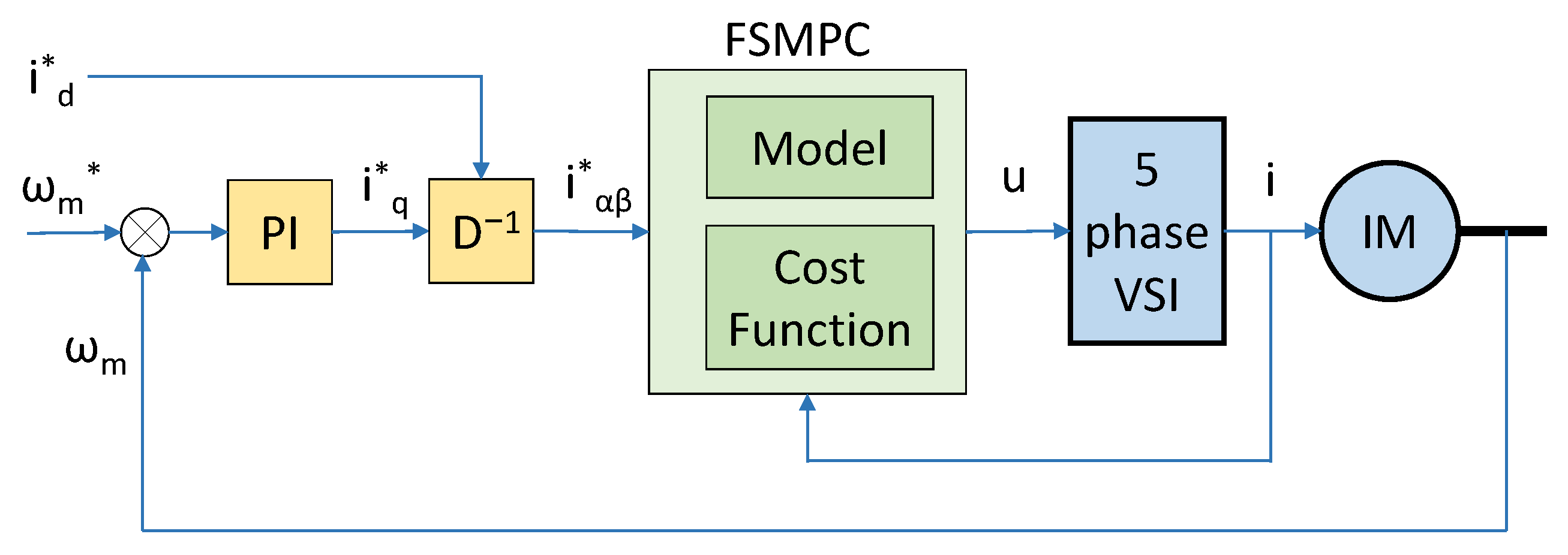
The technique known as Finite State Predictive Control has two important features: (1) it is a model-based method, and (2) it commands directly the states of the VSI. The FSMPC is responsible for stator current tracking. The reference is set by an outer speed loop in which a Proportional Integral method is used to control mechanical speed ω m , as can be seen in the diagram of Figure 1.
The diagram of Figure 1 is, in fact, an adaptation of the indirect field oriented technique. The PI’s output is used to derive the values i s * in d q coordinates. The extension to multiphase drives is simplified using the Park transform; in this way, stator currents are decomposed into various components. Of those, the ones used by FSMPC are the torque-producing ( α β ) and the non-torque-producing or harmonic ( x y ). In the diagram of Figure 1 this is indicated by matrix D whose elements are
D = cos θ a sin θ a sin θ a cos θ a
In (1), the variable θ a is an estimation of the rotor angle. This matrix converts the d q reference values into α β reference values. Note that, in most cases, the x y components are not desired, so its reference is just zero.
Continuing with the diagram of Figure 1, the FSMPC block itself is composed of a model and a cost function. The model allows one to compute the predictions needed by the cost function. The optimization of the cost function provides the control signal u. As indicated above, the control signal is the state of the VSI.
The model is obtained from first principles and can be expressed in state space form as
x ˙ ( t ) = A ( ω r ( t ) ) x ( t ) + B u ( t )
The state x is composed of stator and rotor currents in α β x y coordinates x = ( i α , i β , i x , i y , i r α , i r β ) T . Matrices A and B include coefficients that depend on the electric parameters of the motor. These are c 1 = L s L r M 2 , c 2 = L r / c 1 , c 3 = 1 / L l s , c 4 = M / c 1 , c 5 = L s c 1 , a s 2 = R s c 2 , a s 3 = R s c 3 , a s 4 = R s c 4 , a r 4 = R r c 4 , a r 5 = R r c 5 , a l 4 = L r c 4 ω r , a l 5 = L r c 5 ω r , a m 4 = M c 4 ω r , and a m 5 = M c 5 ω r . The motor parameters can be found in Table 1.
With these coefficients, matrices A and B are found to be
A = a s 2 a m 4 0 0 a r 4 a l 4 a m 4 a s 2 0 0 a l 4 a r 4 0 0 a s 3 0 0 0 0 0 0 a s 3 0 0 a s 4 a m 5 0 0 a r 5 a l 5 a m 5 a s 4 0 0 a l 5 a r 5
B = c 2 0 0 0 0 c 2 0 0 0 0 c 3 0 0 0 0 c 3 c 4 0 0 0 0 c 4 0 0
The continuous-time model of (2) is discretized using the Euler method. The resulting discrete-time model is used to produce the first step prediction as i ^ ( k + 1 | k ) = A d i ( k ) + B d u ( k ) . Matrices A d and B d are the result of the discretization and can be expressed as A d = I + T s · A and B d = T s · B , where T s is the sampling period, and I is the unitary matrix. The computation delay in FSMPC is treated by issuing a second prediction that is used by the cost function. This is found as
i ^ ( k + 2 | k ) = A d 2 i ( k ) + A d B d u ( k ) + B d u ( k + 1 ) + G ^ ( k | k )
where i ^ ( k + 2 | k ) is the two step ahead prediction, u ( k ) and u ( k + 1 ) are control actions, and G ^ ( k | k ) represent a simplified way of treating rotor currents that are not measured in most cases (see [25]).
The cost function also requires a prediction of the number of switch changes Δ U ( k ) produced at the VSI when the previous state u ( k ) is changed to u ( k + 1 ) . For a five-phase VSI, the number of switch changes is
Δ U ( k ) = i = 1 5 u i ( k + 1 ) u i ( k )
where u i is the i-th component of vector u.
The cost function for FSMPC results in the following expression:
J ( k + 2 ) = e ^ α β ( k + 2 ) 2 + λ x y e ^ x y ( k + 2 ) 2 + λ s c Δ U ( k + 2 )
where e ^ α β ( k + 2 ) = i α β * ( k + 2 ) i ^ s α β ( k + 2 ) is the predicted control error in α β subspace. Similarly, e ^ x y ( k + 2 ) = i ^ s x y ( k + 2 ) is the predicted control error in x y subspace.
In the cost function definition of (7), the weighting factors λ x y and λ s c multiply the terms due to x y content and VSI commutations, respectively. Cost function tuning refers to the selection of a value for the WF. The choice affects the quality of stator currents that, in turn, affect the behavior of the drive. To quantify such quality, the following figures of merit are used.
Stator current tracking (in α β and x y planes) and the average switching frequency at the VSI are usually considered as performance indicators for FSMPC in multiphase drives. These quantities are defined over a sample interval ( k 1 , k 2 ) according to
E α β = 1 ( k 2 k 1 + 1 ) k = k 1 k 2 e α β 2 ( k )
E x y = 1 ( k 2 k 1 + 1 ) k = k 1 k 2 e x y 2 ( k )
F s w = 1 / 2 · 1 / 5 T s ( k 2 k 1 + 1 ) k = k 1 k 2 Δ U ( k )
where the temporal indices k 1 , k 2 should cover enough time to make the averages useful.

3. Cascaded Structure

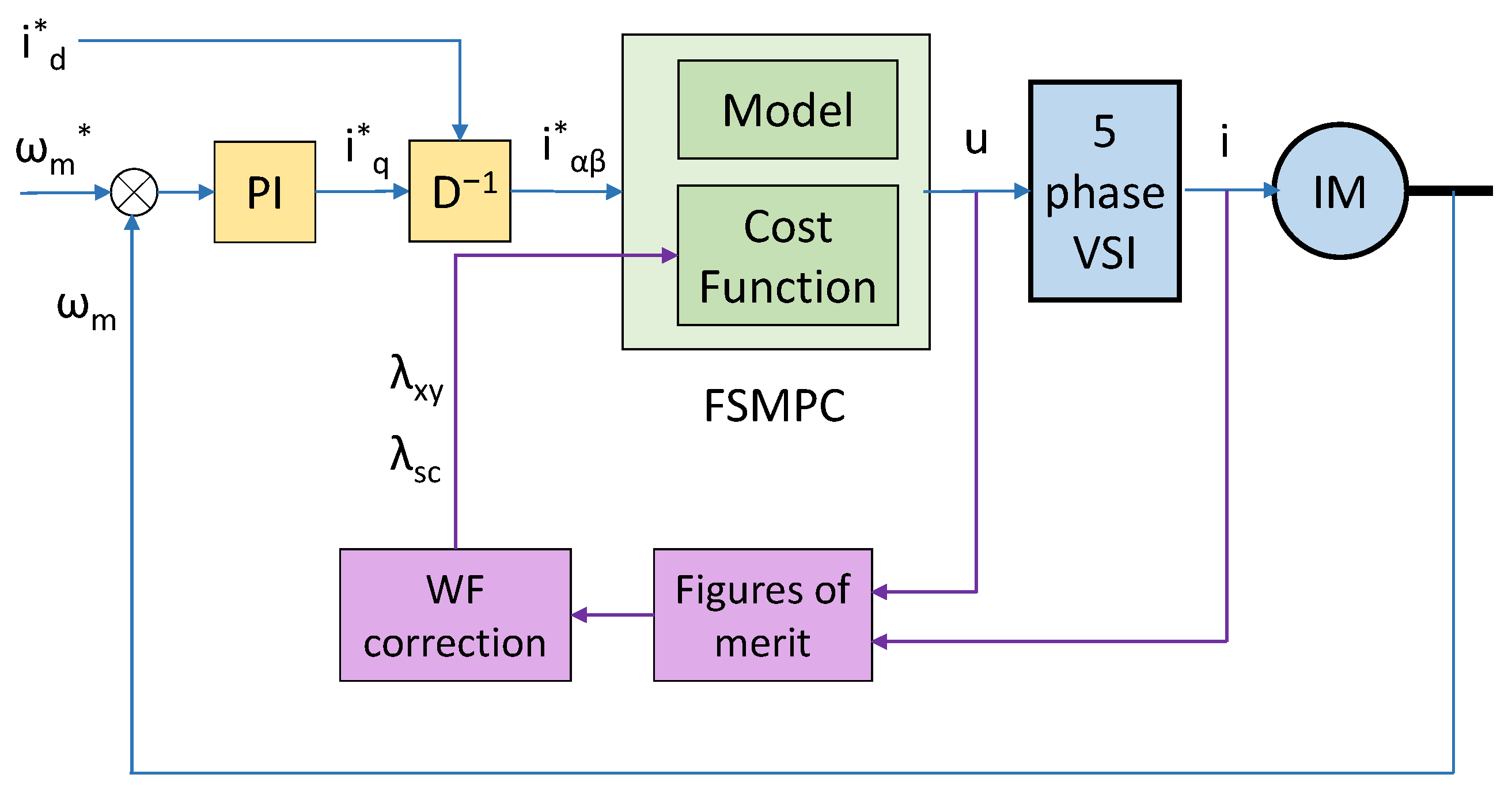
The proposed cascaded structure is exemplified by the diagram shown in Figure 2. It can be seen that, in addition to the predictive loop for stator current control, the diagram features a loop for WF modification. Said loop is based on measurements of the actual on-line values of figures of merit. The loop makes incremental changes in λ x y and λ s c so that the figures of merit are closer to the reference values.
In this structure, the WF λ x y and λ s c are considered as the manipulated variable for the block “WF correction”. This block works in a closed loop, the controlled variables being the figures of merit F 1 = E x y and F 2 = F s w . The instantaneous values for F 1 and F 2 are provided by the block “Figures of merit”. Finally, the resulting λ x y and λ s c are forwarded to the FSMPC controller. The structure of each new block is defined in the following.

3.1. The “Figures of Merit” Block

The “Figures of merit” block of Figure 2 uses Equations (9) and (10) to compute the actual values for F 1 and F 2 . This is a simple task for the DSP that can be performed taking k 2 = k , k being the actual sampling period. Then k 1 is simply k 1 = k N + 1 . In this way, the following expressions are obtained:
F 1 ( k ) = 1 N j = k N k e x y 2 ( j )
F 2 ( k ) = 1 / 2 · 1 / 5 N · T s j = k N k Δ U ( j )

3.2. WF Correction Block

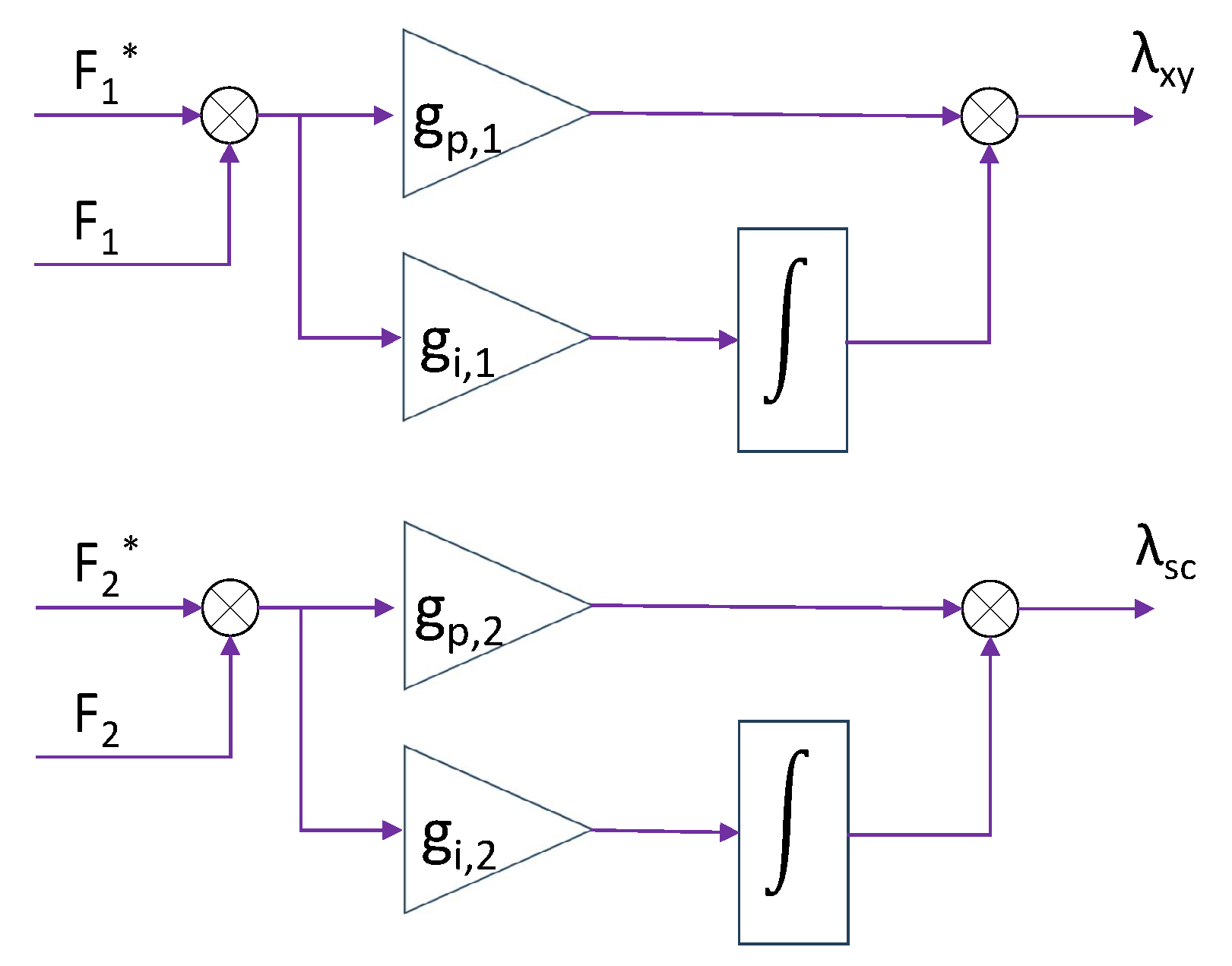
The “WF correction” block can be designed using automatic control theory. In this case, for the sake of simplicity, a decoupled linear PI structure is selected. In this way, a PI (referred to as P I 1 ) is used to manipulate λ x y , so that F 1 follows its reference value F 1 * . Similarly, a second PI (referred to as P I 2 ) is used to manipulate λ s c so that F 2 follows its reference value F 2 * . The associated block diagram is shown in Figure 3.
The mathematical descriptions of P I 1 and P I 2 are provided below.
λ x y ( t ) = g p , 1 · F 1 * F 1 ( t ) + g i , 1 0 t F 1 * F 1 ( τ ) d τ
λ s c ( t ) = g p , 2 · F 2 * F 2 ( t ) + g i , 2 0 t F 2 * F 2 ( τ ) d τ
where coefficients g p , 1 and g p , 2 are the proportional gains for the PIs, and coefficients g i , 1 and g i , 2 are the integral gains.
The two PIs must be tuned selecting gains g p , 1 , g p , 2 , g i , 1 , and g i , 2 . This can be done using simple rules such as those in [26]. The experimental results section will cover this issue.

3.3. Workflow

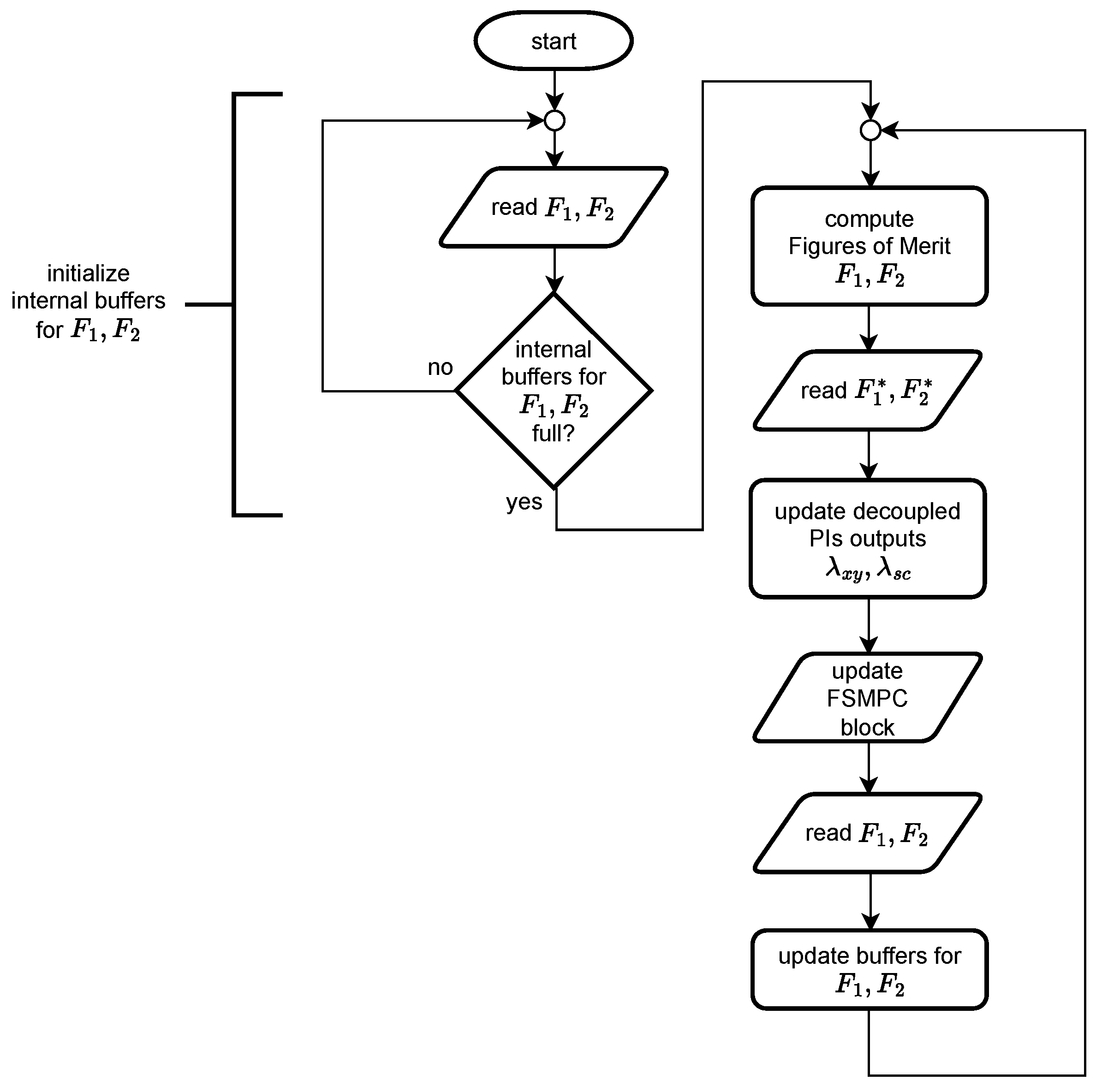
The ideas presented above are combined to produce the workflow for the proposal. This is illustrated in the diagram of Figure 4. Please note that, according to Figure 2, the input variables to be used in the WF adaptation process are the measurements of stator current (i) and the commands issued to the VSI (u). These are available since they are signals used also by standard FSMPC. With this information, the values of the figures of merit F 1 and F 2 are computed using Equations (11) and (12), respectively. These values are used to compare with their references and derive the error that supplies the two PI. Equations (13) and (14) are then used to obtain the outputs of the PIs that are the new WF to be used by the FSMPC.

4. Experimental Results

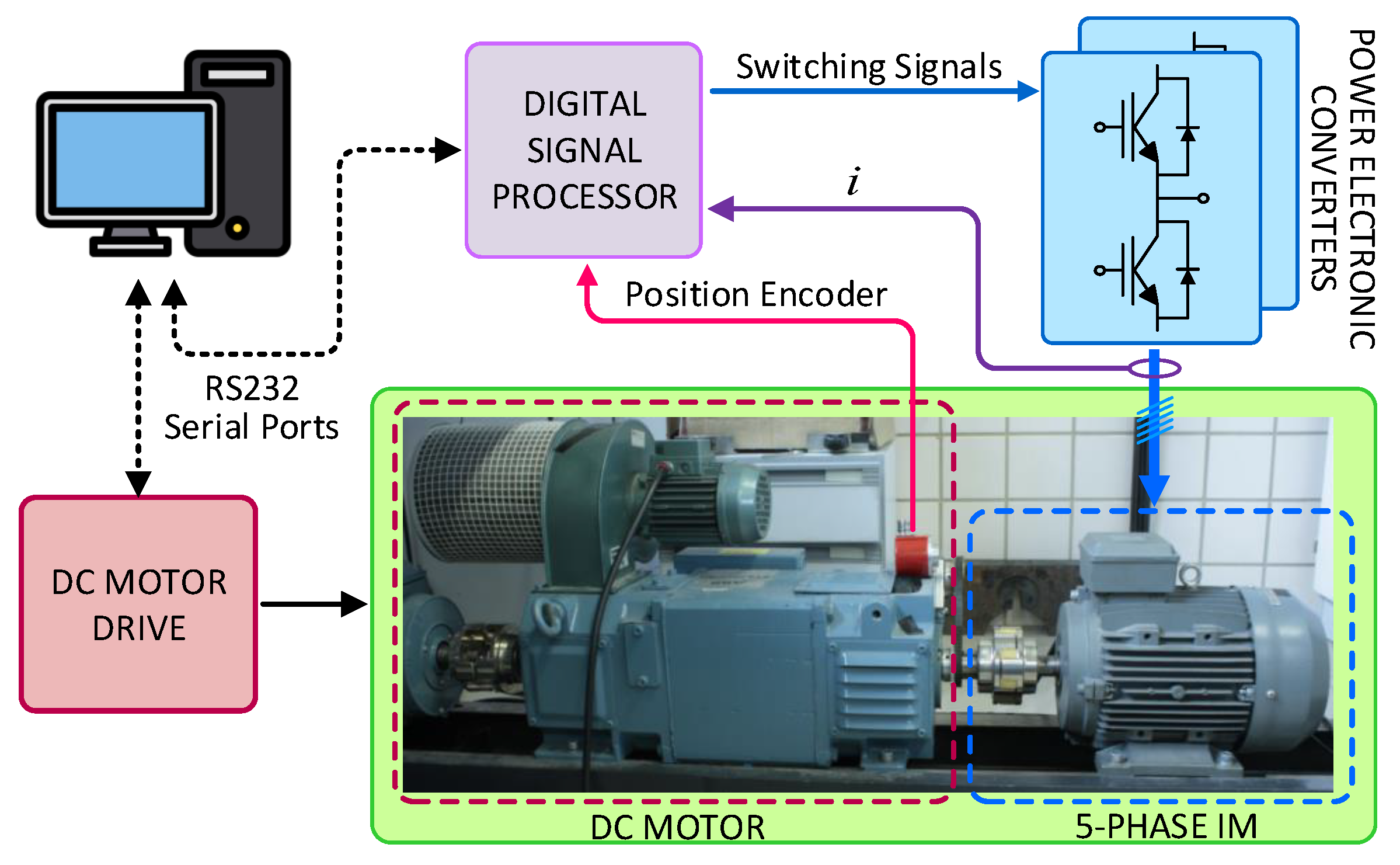
The laboratory arrangement shown in Figure 5 is used to perform experiments to assess the proposal. The setup has a real five-phase induction machine (hand-made retrofitted) whose electrical and mechanical parameters are shown in Table 1. The motor is electrically supplied by a five-phase VSI made up of two three-phase SEMIKRON SKS 22F modules. The DC-link is powered by a 300 V DC power supply. The control algorithm runs on a TMS320F28335 Digital Signal Processor (Texas Instruments (TI), Dallas, TX, USA) capable of providing sampling periods T s in the order of 30 (μs).

4.1. Tuning of WF Correction Block

Before presenting the results of the cascaded controller, a couple of tests are performed in the experimental setup to characterize the dynamics of F 1 and F 2 . These tests will provide enough information to tune the WF correction block.
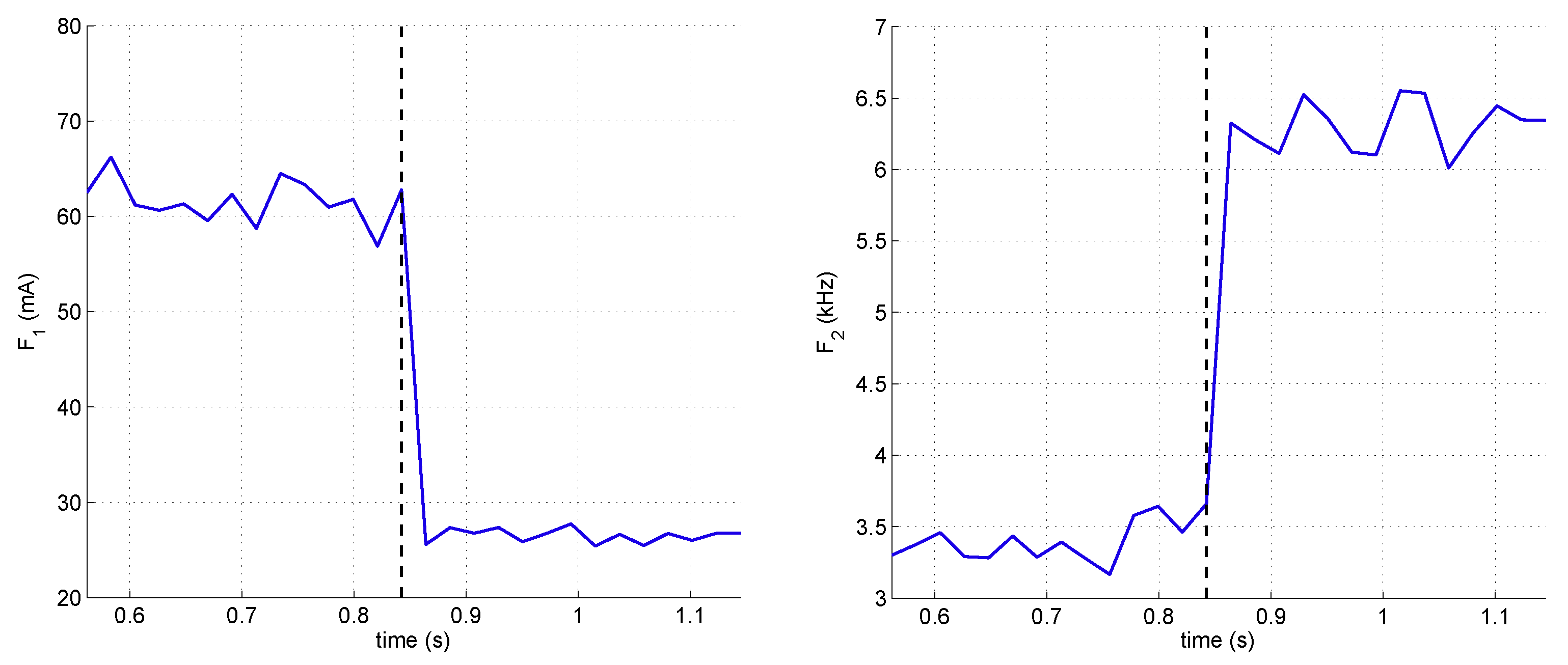
In the first test, a step change is performed on λ x y during operation of the FSMPC. Then the value of F 1 is measured. The resulting reaction curve (shown on the left side of Figure 6) allows for the tuning of P I 1 . In this figure, the WF is changed from λ x y = 0.15 to λ x y = 0.75 . The time of the step change is marked in the temporal plots with a vertical dashed line. The step in λ x y causes a notable change in F 1 as expected. The transient time for F 1 can be estimated as 0.25 (s).
Similarly, the right side of Figure 6 presents the evolution of F 2 due to a step change in λ s c going from an initial value λ s c = 26 · 10 4 to a final value λ s c = 14 · 10 4 . The step in λ s c causes a notable change in F 2 as expected. The transient time for F 2 can be estimated as 0.3 (s).
The results in the step tests allow one to determine values for the PI gains using any of the various procedures from automatic control theory. In this paper, a simple rule consisting in pole placement is used [27]. The pole placement method can be used in this case with little effort due to the plant being represented by a first order model and due to the simplicity of the PI controller.
The pole placement method considers the plant model to be G ( s ) , and the PI controller is represented by C ( s ) . Then the closed loop transfer function is given by
G C L = C G ( s ) 1 + C G ( s )
In the last expression, the plant model is assumed to be a first order transfer function of the form G ( s ) = k / ( 1 + τ s ) , where k is the static gain, and τ the time constant. Both k and τ are obtained from the reaction curve in a step test [28]. Also, the PI controller is defined as C ( s ) = g p + g i / s . By introducing those values in (15), one gets
G C L = k ( g p s + g i ) ( 1 + τ s ) s + k ( g p s + g i )
The PI gains can be set to achieve a first-order closed loop transfer function by setting g p = τ g i . By simplifying the expression, one gets
G C L = 1 ( 1 + s k g i )
In that last expression, the closed loop time constant is found to be 1 / ( k g i ) . The choice of g i affects this time constant. It is possible to set g i to achieve a closed loop dynamics as fast as the open loop one (or faster). For instance, with g i = 2 / ( k τ ) , the closed loop time constant is half that of the open loop.
With this procedure, the PI gains are found to be g p , 1 = 1 , g i , 1 = 2.8 , g p , 2 = 4.5 · 10 8 , g i , 2 = 10 7 . It should be noted that the proportional gain for both PIs is negative, as the reaction curve in both cases is inverse; i.e., an increase in the WF produces a reduction in the associated figure of merit.

4.2. Operating Conditions

The operating conditions of the drive can be used to select the reference values for the figures of merit. Then the proposed WF adaptation method should arrive at such reference values. For the experiments, several conditions are considered. The rationale is explained in what follows. In the first test (T1), a low/medium speed is selected. In this condition, the x y content can be high due to the FSMPC selecting small and medium voltage vectors. This can be alleviated setting F 1 * accordingly.
In the second test (T2), a high speed is selected. In this condition, x y currents are typically low due to the predominance of large voltage vectors. In this operating regime, losses due to switching in the VSI can be high due to the relatively high currents. In this case, it makes sense to set F 2 * a bit lower.

4.3. Results for the Proposed Method

The cascaded structure is now tested. In order to assess the capability of the proposal to adjust the WF on-line, a change is introduced in F 1 * and later on F 2 * . In a practical situation, these changes can be useful to adjust the content in the harmonic plane if it is too large and to decrease the average switching frequency to meet the limit of the VSI.
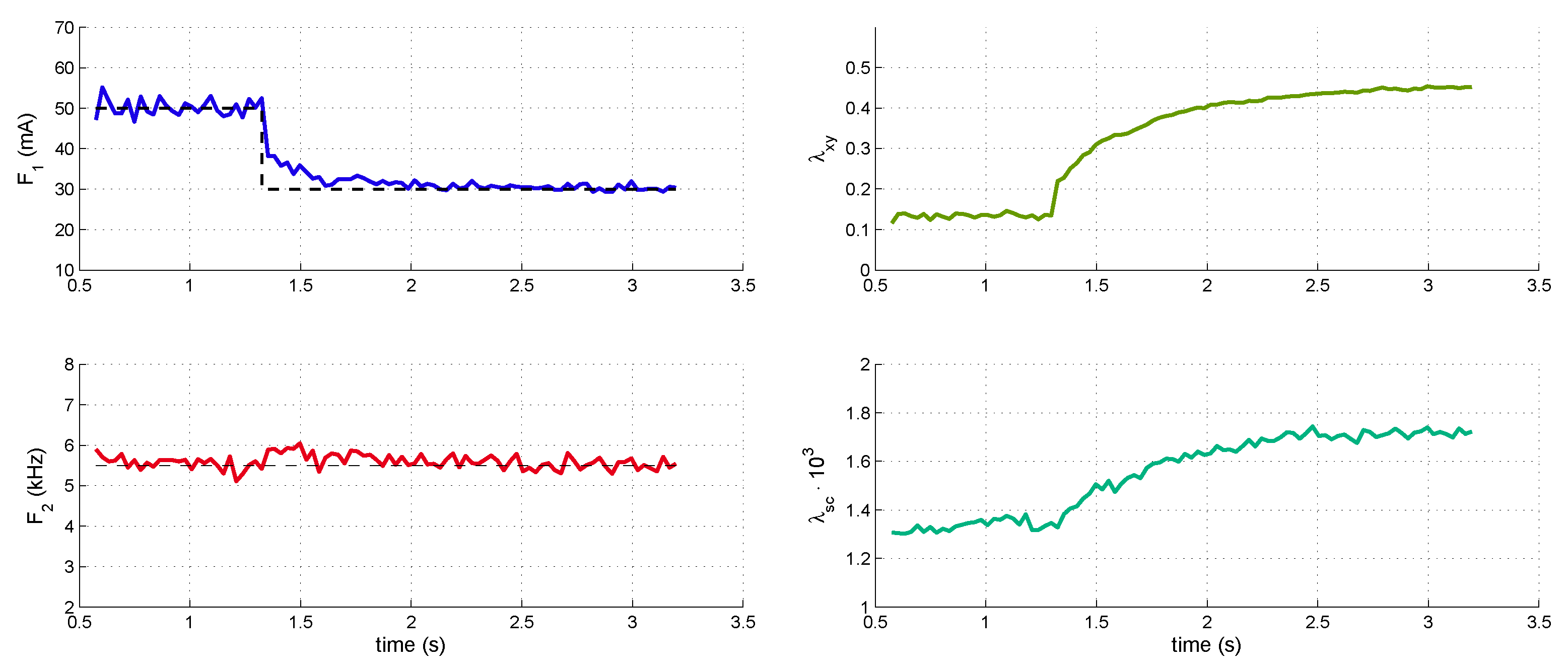
In the first test (T1), F 1 * is changed from F 1 * = 50 (mA) to F 1 * = 30 (mA). The value of λ x y should be automatically changed by the P I 1 so that F 1 follows the reference. The results shown in Figure 7, where the evolution of the figures of merit is shown. The correction of the WF values is also shown. It can be seen that the closed loop response corresponds to an overdamped system which is preferred for many systems. The closed loop characteristic time is less than 1 s, which is fast enough for many applications.
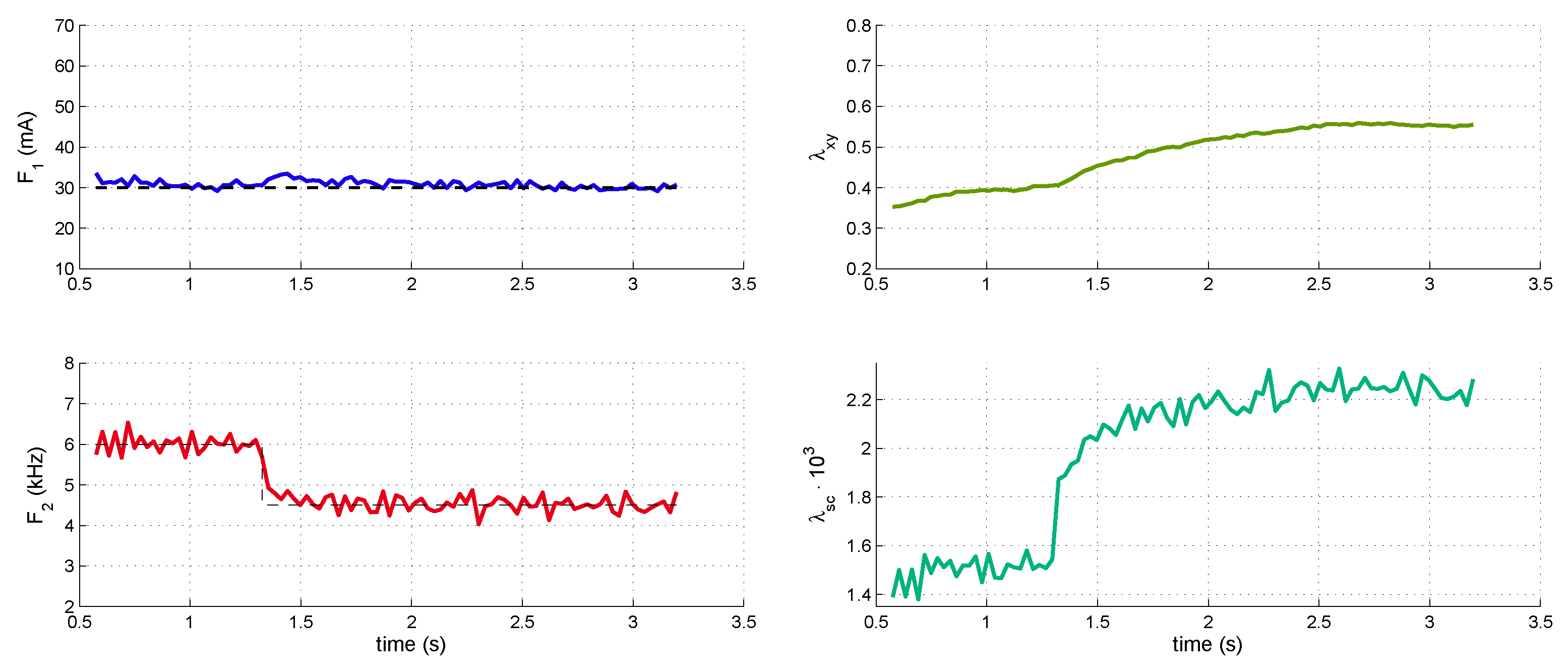
Similarly, in the second test (T2), F 2 * is changed from F 2 * = 6 (kHz) to F 2 * = 4.5 (kHz). In this case, P I 2 should perform an increase in λ s c to reduce the average switching frequency. The results shown in Figure 8, where the evolution of the figures of merit is shown to follow the reference. The correction of the WF values is visible. As in the previous case, the closed loop response corresponds to an overdamped system with a closed loop characteristic time less than 1 s.
It is interesting to compare the results with adaptation with those of FSMPC without adaptation. To this end, Table 2 is included. In this table, the actual figures of merit are presented for the two tests (T1 and T2) and for a FSMPC with and without adaptation.

4.4. Mechanical Transients

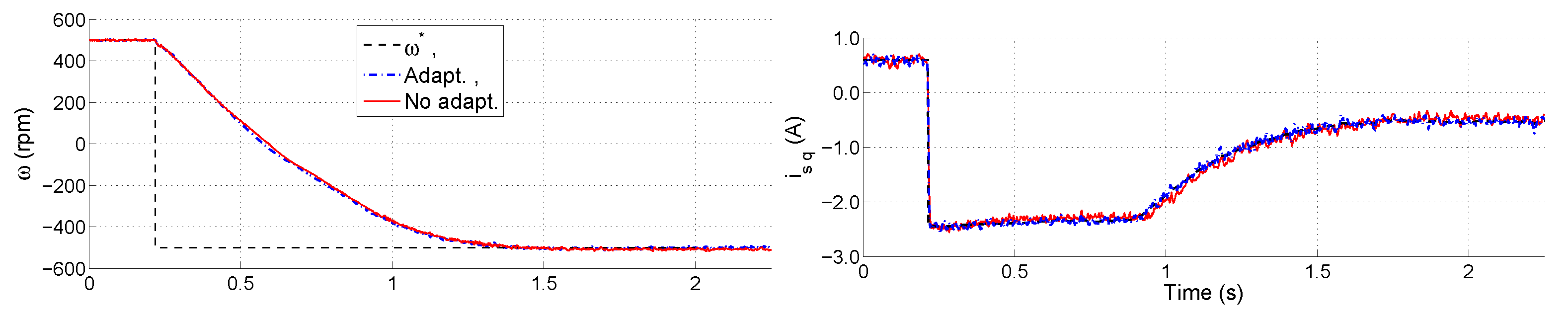
The proposal can be used during mechanical transients. Please not that the performance in terms of mechanical speed is mainly set by the PI in the speed loop. The results of a fixed WF FSMPC and the proposal should be similar. To test this hypothesis, a reversal test is performed on the induction motor. The mechanical side PI is the same in both cases (with and without WF adaptation). The results are shown in Figure 9.

5. Discussion

The tests shown in the previous section support several hypothesis made by the authors in this and in previous works.
First, the response of the figures of merit to changes in WF are quick; however, the measurement of the actual values of the figures of merit takes time because both F 1 and F 2 are based on averages using multiple sampling periods. This is clearly visible in the trajectories of Figure 6, where the changes in F 1 and F 2 take place in the order of 0.2 s, even though the FSMPC runs with a sampling period of 30 microseconds. In this regard, the paper has established the time constant that should be considered in online WF tuning. This result was not previously stated in previous works.
Second, the existence of trade-offs between figures of merit has the effect that a change in one WF must often be offset by a change in the other. This is visible in the results shown in Figure 7 and Figure 8. For each case, just one reference for the figures of merit is changed (either F 1 or F 2 ); however, in both cases, both WFs change. This has probably hindered past efforts to obtain WF maps, causing researchers to resort to nonlinear methods such as genetic algorithms and neural networks.
Third, despite the simplicity of the cascaded structure, the results show that on-line WF selection is possible. It should be noted that the observed transient times for the settling of WFs to new values is adequate for most applications.
Finally, the proposal intentionally uses simple elements to construct the cascaded structure. In particular, the loop for WF correction uses just two PI controllers. Future research could focus on the use of more sophisticated controllers that can take the place of the PIs.

6. Conclusions

The problem of cost function tuning has received attention in the past as a open issue related to the predictive control of power converters. The results obtained with the proposal constitute an indication that simple rules for the tuning of WFs are possible.
Although the paper uses a five-phase induction machine as a test-bench, the method can be used for another number of phases, including the three-phase case.
Also, the terms present in the cost function and the figures of merit used in the paper can be changed for others to best suit other applications.

Author Contributions

Conceptualization, M.R.A.; methodology, M.G.S. and A.P.V.-L.; software, M.G.S. and A.P.V.-L.; validation, M.R.A. and A.P.V.-L.; formal analysis, M.R.A.; investigation, M.G.S., M.R.A. and A.P.V.-L.; resources, M.R.A.; data curation, M.G.S.; writing—original draft preparation, M.G.S., M.R.A. and A.P.V.-L.; writing—review and editing, M.G.S., M.R.A. and A.P.V.-L.; visualization, M.R.A. and M.G.S.; supervision, M.R.A.; project administration, M.R.A.; funding acquisition, M.R.A. All authors have read and agreed to the published version of the manuscript.

Funding

This research received no external funding.

Institutional Review Board Statement

Not applicable.

Informed Consent Statement

Not applicable.

Data Availability Statement

The raw data supporting the conclusions of this article will be made available by the authors on request.

Conflicts of Interest

The authors declare no conflicts of interest. The funders had no role in the design of the study; in the collection, analyses, or interpretation of data; in the writing of the manuscript; or in the decision to publish the results.

Abbreviations

The following abbreviations are used in this manuscript:
CFCost Function
DCDirect Current
FSMPCFinite State Model Predictive Control
IMInduction Machine
MPCModel Predictive Control
MPDMulti-Phase Drive
RMSRoot Mean Squared
VSDVariable Speed Drive
VSIVoltage Source Inverter
VVVoltage Vector
WFWeighting Factor

References

  1. Lin, C.H.; Farooqui, S.A.; Liu, H.D.; Huang, J.J.; Fahad, M. Finite Control Set Model Predictive Control (FCS-MPC) for enhancing the performance of a single-phase inverter in a Renewable Energy System (RES). Mathematics 2023, 11, 4553. [Google Scholar] [CrossRef]
  2. Yang, P.; Zeng, X.; Wu, Q.; Cai, H.; Xia, Y.; Li, J. A modified single-vector based FCS-MPC with delayed and suboptimal switching for VSI. Int. J. Electr. Power Energy Syst. 2025, 171, 111014. [Google Scholar] [CrossRef]
  3. Colodro, F.; Torralba, A. Multirate single-bit Sigma Delta modulators. IEEE Trans. Circuits Syst. II Analog. Digit. Signal Process. 2003, 49, 629–634. [Google Scholar] [CrossRef]
  4. Yang, L.; Li, H.; Zhao, H.; Huang, J.; Zhou, C. Finite Control Set Model Predictive Control with Feedback-Based Flux-Weakening Operation for PMSM Drives. IEEJ Trans. Electr. Electron. Eng. 2025, 20, 956–965. [Google Scholar] [CrossRef]
  5. Yu, Z.; Long, J. Review on advanced model predictive control technologies for high-power converters and industrial drives. Electronics 2024, 13, 4969. [Google Scholar] [CrossRef]
  6. Colodro, F.; Martínez-Heredia, J.M.; Mora, J.L.; Ramirez-Angulo, J.; Torralba, A. Time-Interleaving Sigma–Delta Modulator-Based Digital-to-Analog Converter with Time Multiplexing in the Analog Domain. IEEE Trans. Circuits Syst. II Express Briefs 2022, 70, 441–445. [Google Scholar] [CrossRef]
  7. Hoggui, A.; Benachour, A.; Madaoui, M.C.; Mahmoudi, M.O. Implementation of Finite Control Set Model Predictive Control (FCS-MPC) for Five-Phase Induction Motors. Enp Eng. Sci. J. 2025, 5, 7–12. [Google Scholar] [CrossRef]
  8. Lim, C.S.; Levi, E.; Jones, M.; Rahim, N.A.; Hew, W.P. FCS-MPC-Based Current Control of a Five-Phase Induction Motor and its Comparison with PI-PWM Control. IEEE Trans. Ind. Electron. 2014, 61, 149–163. [Google Scholar] [CrossRef]
  9. Han, J.; Yuan, H.; Li, W.; Zhou, L.; Deng, C.; Yan, M. FCS-MPC Based on Dimension Unification Cost Function. Energies 2024, 17, 2479. [Google Scholar] [CrossRef]
  10. Zhou, H.; Xiang, X.; Li, H.; Yuan, B.; Jiang, P. FCS-MPC for t-type three-level dual three-phase PMSM drives with multi-objective decoupling optimization. IEEE Trans. Transp. Electrif. 2025, 12, 515–528. [Google Scholar] [CrossRef]
  11. Vijayan, A.K.; da Costa Gonçalves, P.F.; Batkhishig, B.; Nahid-Mobarakeh, B.; Emadi, A. Integrated FCS-MPC with Synchronous Optimal Pulse-Width Modulation for Enhanced Dynamic Performance in Two-Level Voltage-Source Inverters. Electronics 2025, 14, 3757. [Google Scholar] [CrossRef]
  12. Satué, M.e.a. Concurrent AI Tuning of a Double-Loop Controller for Multi-Phase Drives. Machines 2024, 12, 899. [Google Scholar] [CrossRef]
  13. Zhang, Y.; Liu, Y.; Luo, B.; Ling, Y. Variable weight coefficient MPC control strategy for qZSI-VSG wind power grid-connected system. IET Renew. Power Gener. 2023, 17, 1952–1965. [Google Scholar] [CrossRef]
  14. Guazzelli, P.R.U.; de Andrade Pereira, W.C.; de Oliveira, C.M.R.; de Castro, A.G.; de Aguiar, M.L. Weighting factors optimization of predictive torque control of induction motor by multiobjective genetic algorithm. IEEE Trans. Power Electron. 2019, 34, 6628–6638. [Google Scholar] [CrossRef]
  15. Arshad, M.H.; Abido, M.A.; Salem, A.; Elsayed, A.H. Weighting factors optimization of model predictive torque control of induction motor using NSGA-II with TOPSIS decision making. IEEE Access 2019, 7, 177595–177606. [Google Scholar] [CrossRef]
  16. Fretes, H.; Rodas, J.; Doval-Gandoy, J.; Gomez, V.; Gomez, N.; Novak, M.; Rodriguez, J.; Dragičević, T. Pareto Optimal Weighting Factor Design of Predictive Current Controller of a Six-Phase Induction Machine based on Particle Swarm Optimization Algorithm. IEEE J. Emerg. Sel. Top. Power Electron. 2021, 10, 207–219. [Google Scholar] [CrossRef]
  17. Muddineni, V.P.; Sandepudi, S.R.; Bonala, A.K. Finite control set predictive torque control for induction motor drive with simplified weighting factor selection using TOPSIS method. IET Electr. Power Appl. 2017, 11, 749–760. [Google Scholar] [CrossRef]
  18. Colodro, F.; Torralba, A. Frequency-to-digital conversion based on sampled phase-locked loop with third-order noise shaping. Electron. Lett. 2011, 47, 1069–1070. [Google Scholar] [CrossRef]
  19. Ravi Eswar, K.M.; Venkata Praveen Kumar, K.; Vinay Kumar, T. Enhanced predictive torque control with auto-tuning feature for induction motor drive. Electr. Power Components Syst. 2018, 46, 825–836. [Google Scholar] [CrossRef]
  20. Deng, A.; Yang, W.; Hu, G.; Huang, W.; Xu, D. Reinforcement Learning based Weight-Tuning Model Predictive Control of Permanent Magnet Synchronous Motor. In Proceedings of the 2024 IEEE 10th International Power Electronics and Motion Control Conference (IPEMC2024-ECCE Asia), Chengdu, China, 17–20 May 2024; IEEE: Piscataway, NJ, USA, 2024; pp. 317–322. [Google Scholar]
  21. Shahid, M.B.; Jin, W.; Abbasi, M.A.; Li, L.; Rasool, A.; Bhatti, A.R.; Hussen, A.S. Optimal weighting factor design based on entropy technique in finite control set model predictive torque control for electric drive applications. Sci. Rep. 2024, 14, 12791. [Google Scholar] [CrossRef] [PubMed]
  22. Arahal, M.R.; Satue, M.G.; Barrero, F.; Martinez-Heredia, J. Model Reference Adaptive Predictive Current Control of Six-Phase Induction Machine. IEEE Trans. Ind. Electron. 2025, 72, 10927–10934. [Google Scholar] [CrossRef]
  23. Zhang, Y.; Zhang, Z.; Babayomi, O.; Li, Z. Weighting factor design techniques for predictive control of power electronics and motor drives. Symmetry 2023, 15, 1219. [Google Scholar] [CrossRef]
  24. Bándy, K.; Stumpf, P. Dynamic weighting factor assignment method for the predictive control of electrical drives. IET Power Electron. 2024, 17, 2083–2094. [Google Scholar] [CrossRef]
  25. Satué, M.G.; Arahal, M.R.; Ramírez, D.R. Rotor Current Estimation in Predictive Control of Multi-phaseDrives. Rev. Iberoam. Autom. Inform. Ind. 2023, 20, 25–31. [Google Scholar]
  26. Skogestad, S. Probably the best simple PID tuning rules in the world. In Proceedings of the AIChE Annual Meeting, Reno, NV, USA, 4–9 November 2001; Volume 77, p. 276h. [Google Scholar]
  27. Bożek, A.; Trybus, L. Tuning PID and PI-PI servo controllers by multiple pole placement. Bull. Pol. Acad. Sci. Tech. Sci. 2022, 70, e139957. [Google Scholar] [CrossRef]
  28. Wu, X.; Qiao, Y. A new identification method of linear system based on the feature of step response curve. In Proceedings of the 2012 International Conference on Modelling, Identification and Control, Wuhan, China, 24–26 June 2012; IEEE: Piscataway, NJ, USA, 2012; pp. 158–163. [Google Scholar]
Figure 1. Diagram of FSMPC for a five-phase variable speed drive.
Applsci 16 02313 g001
Figure 2. Diagram of the cascaded FSMPC controller.
Applsci 16 02313 g002
Figure 3. Block diagram of the PI blocks used for WF correction.
Applsci 16 02313 g003
Figure 4. Workflow for the WF adaptation procedure.
Applsci 16 02313 g004
Figure 5. Photograph and diagram of the experimental setup.
Applsci 16 02313 g005
Figure 6. Evolution of figures of merit for step changes in the WFs.
Applsci 16 02313 g006
Figure 7. Results for T1. Evolution of the figures of merit (left side) and of the WF (right side) in response to a change in F 1 * .
Applsci 16 02313 g007
Figure 8. Results for T2. Evolution of the figures of merit (left side) and of the WF (right side) in response to a change in F 2 * .
Applsci 16 02313 g008
Figure 9. Results obtained in a reversal test with and without adaptation of the WF in terms of mechanical speed (left) and i q (right).
Applsci 16 02313 g009
Table 1. Parameters of the Experimental 5-phase IM.
ParameterValueUnits
Stator resistance, R s 12.85Ω
Rotor resistance, R r 4.80Ω
Stator leakage inductance, L l s 79.93mH
Rotor leakage inductance, L l r 79.93mH
Mutual inductance, L M 681.7mH
Rotational inertia, J m 0.02kg m2
Number of pairs of poles, P3-
Table 2. Comparison of figures of merit with and without WF adaptation.
Case E x y F sw
(mA) (kHz)
T1 no adaptation505.5
T1 proposal305.5
T2 no adaptation306
T2 proposal304.5
Disclaimer/Publisher’s Note: The statements, opinions and data contained in all publications are solely those of the individual author(s) and contributor(s) and not of MDPI and/or the editor(s). MDPI and/or the editor(s) disclaim responsibility for any injury to people or property resulting from any ideas, methods, instructions or products referred to in the content.