Article

Purely Physics-Driven Neural Networks for Tracking the Spatiotemporal Evolution of Time-Dependent Flow


1
School of Physics, Northwest University, Xi’an 710127, China
2
Shaanxi Provincial Basic Science Center (Quantum Physics), Xi’an 710127, China
*
Authors to whom correspondence should be addressed.
Appl. Sci. 2026, 16(5), 2294; https://doi.org/10.3390/app16052294
Submission received: 27 January 2026 / Revised: 20 February 2026 / Accepted: 25 February 2026 / Published: 27 February 2026
(This article belongs to the Section Computing and Artificial Intelligence)

Abstract

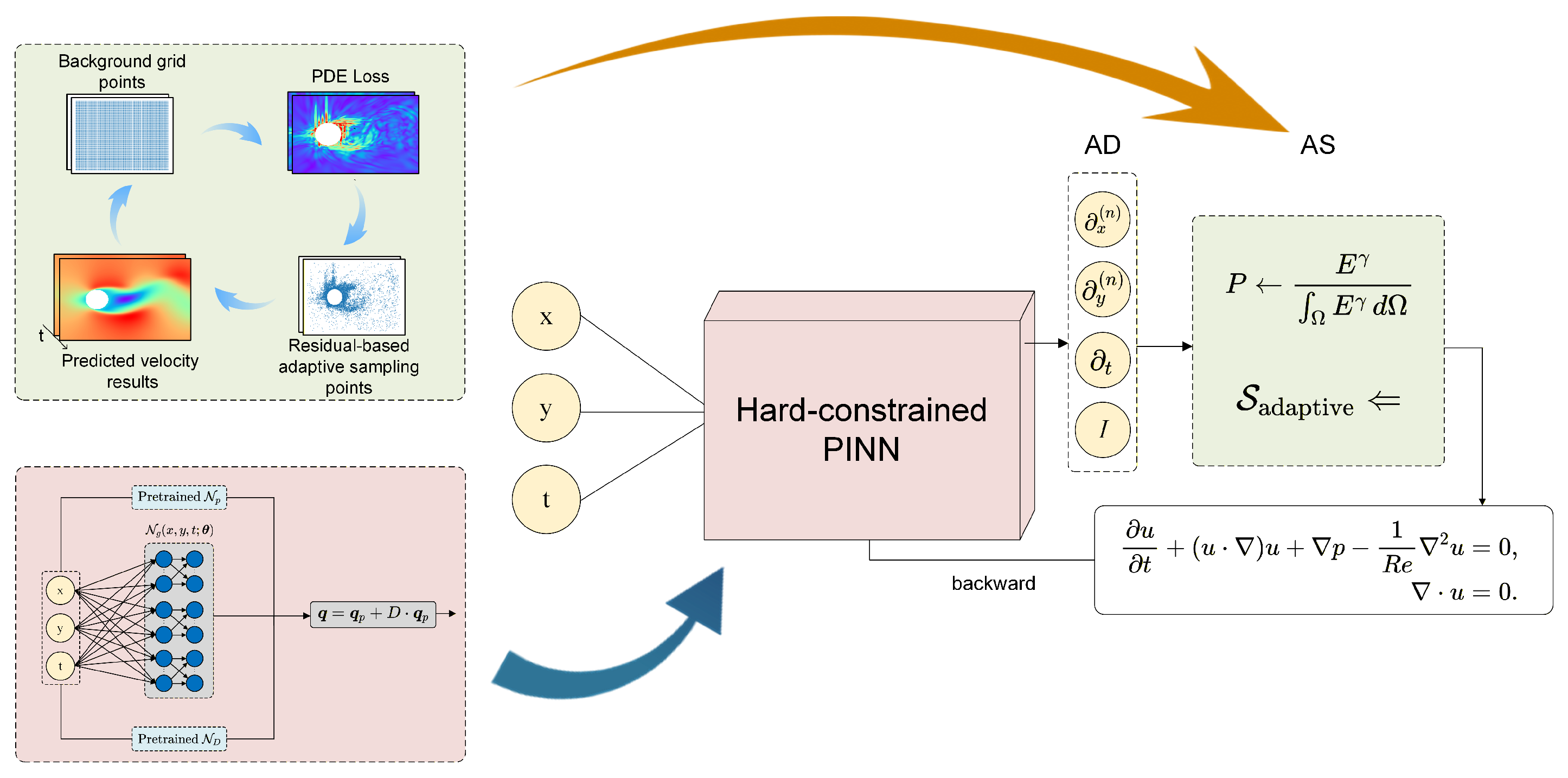
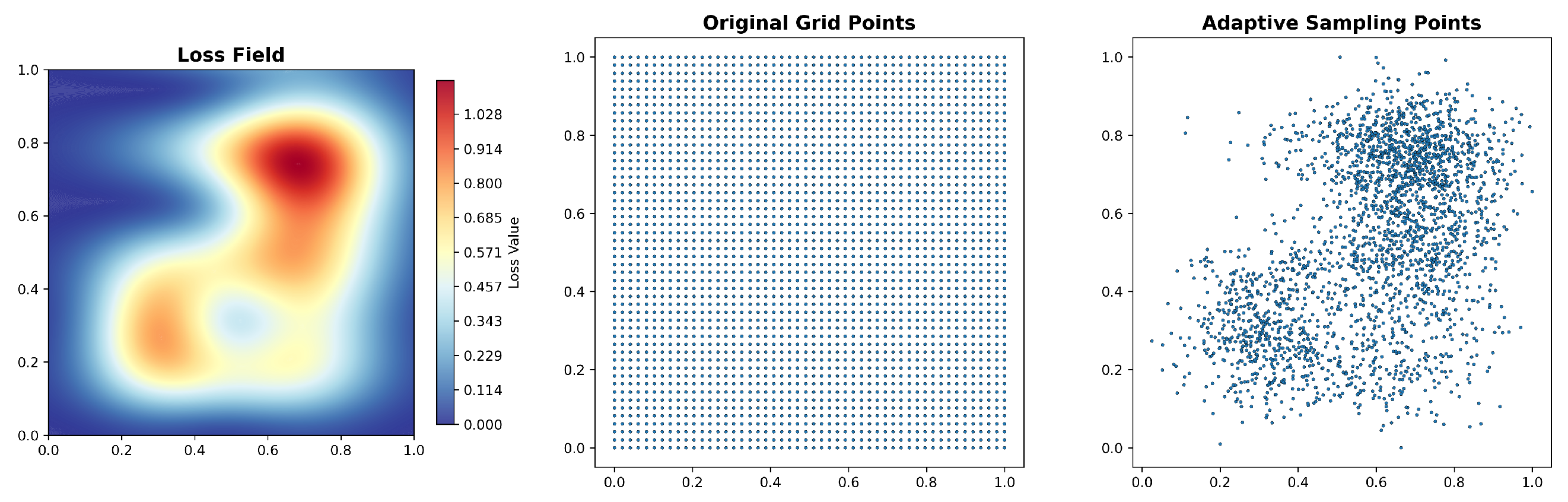
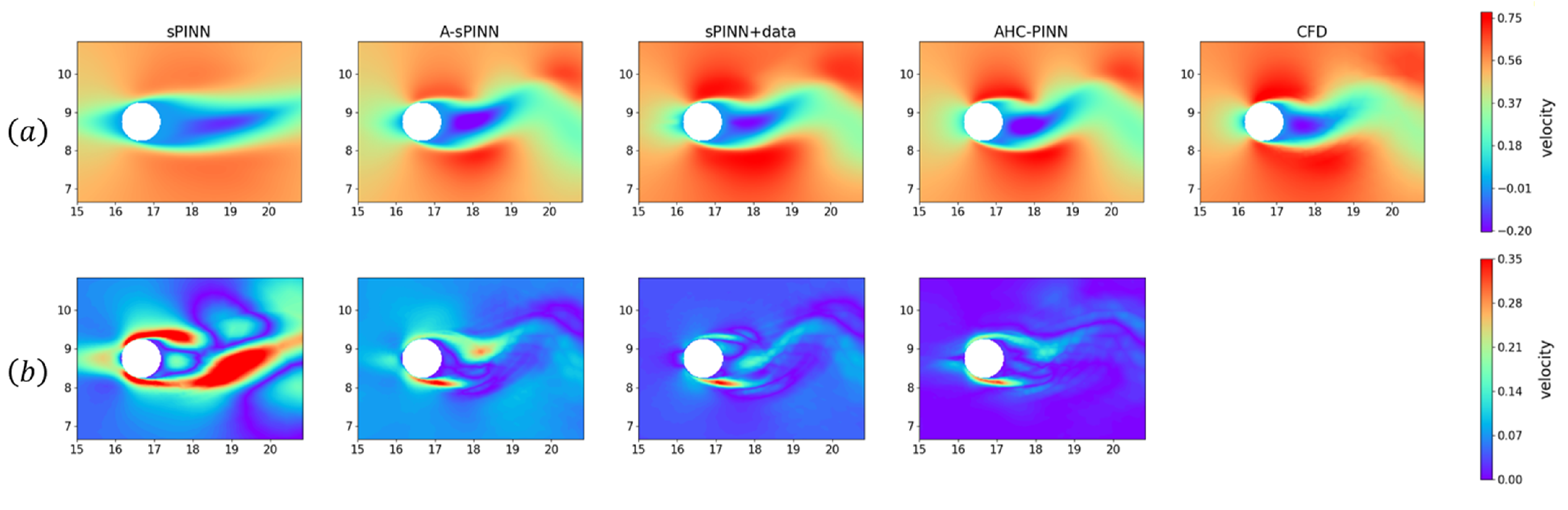
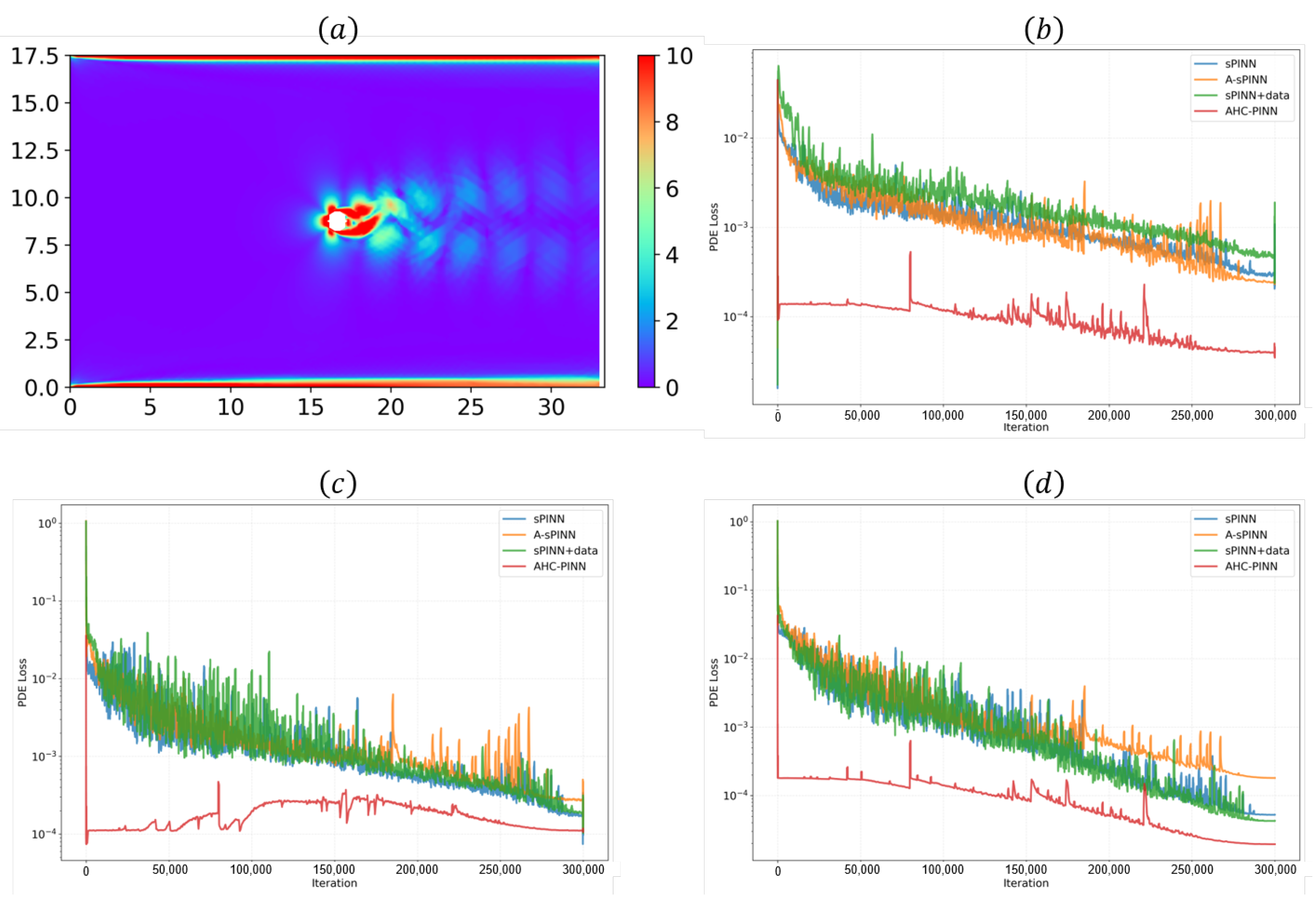
As a mesh-free solving paradigm, Physics-Informed Neural Networks (PINNs) demonstrate potential in both forward and inverse problems by embedding physical equations into the loss function. However, they still face challenges in capturing the spatiotemporal evolution of complex physical processes. When applied to time-dependent complex flows, such as high-Reynolds-number cylinder flow, they often rely on supervised data, which is frequently difficult to obtain accurately in practice. To address these issues, this paper proposes a novel unsupervised solving framework—the Adaptive Hard-Constraint Physics-Informed Neural Network (AHC-PINN). This method integrates an adaptive sampling mechanism based on partial differential equation residuals with a hard-constraint strategy. By dynamically evaluating the contribution of collocation points to the loss and incorporating analytically embedded boundary constraints, it directs the network training entirely toward solving the governing equations. Using two-dimensional unsteady cylinder flow as a validation case, experimental results show that AHC-PINN significantly improves the prediction accuracy of wake evolution under unsupervised conditions. Its performance surpasses that of traditional soft-constraint PINNs by an order of magnitude and is even superior to methods using sparse supervised data. Furthermore, through analysis of the PDE loss and gradient distribution, the study explicitly identifies the impact of large-gradient regions on PINN training stability and prediction accuracy, providing a basis for subsequent optimization.
Keywords: physics-informed neural networks; computational fluid dynamics; unsteady cylinder flow physics-informed neural networks; computational fluid dynamics; unsteady cylinder flow