Article

Evaluation of the Power System’s Connection Capabilities Using Nonlinear Optimisation with Simulated Annealing


Department of Power Engineering, Faculty of Electrical Engineering and Computer Science, Lublin University of Technology, Nadbystrzycka 38D, 20-618 Lublin, Poland
*
Author to whom correspondence should be addressed.
Appl. Sci. 2026, 16(5), 2279; https://doi.org/10.3390/app16052279
Submission received: 23 January 2026 / Revised: 24 February 2026 / Accepted: 25 February 2026 / Published: 26 February 2026

Abstract

This article presents nonlinear optimisation as a tool for determining the maximum power output of renewable energy sources connected to the transmission grid. The goal of the developed model is to maximise the total power generated by these sources while taking into account the technical and operational constraints of the system. These include permissible load on transmission lines and transformers, cross-border exchange balance limits, and the “must run” limits for the operation of conventional power plants. Particular attention was paid to meeting the N-1 safety criterion, which assumes the system’s resilience to infrastructure failures. Appropriate conditions for post-failure states were incorporated into the set of optimisation constraints. A heuristic simulated annealing algorithm was used to solve the problem, enabling the search for globally optimal solutions in a discontinuous and highly nonlinear space. The calculations yielded a generation vector for renewable energy sources connected to individual grid nodes, thus ensuring maximum utilisation of the available renewable energy potential under the given system conditions. The effectiveness and efficiency of the proposed approach are illustrated with the example of a test network.

1. Introduction

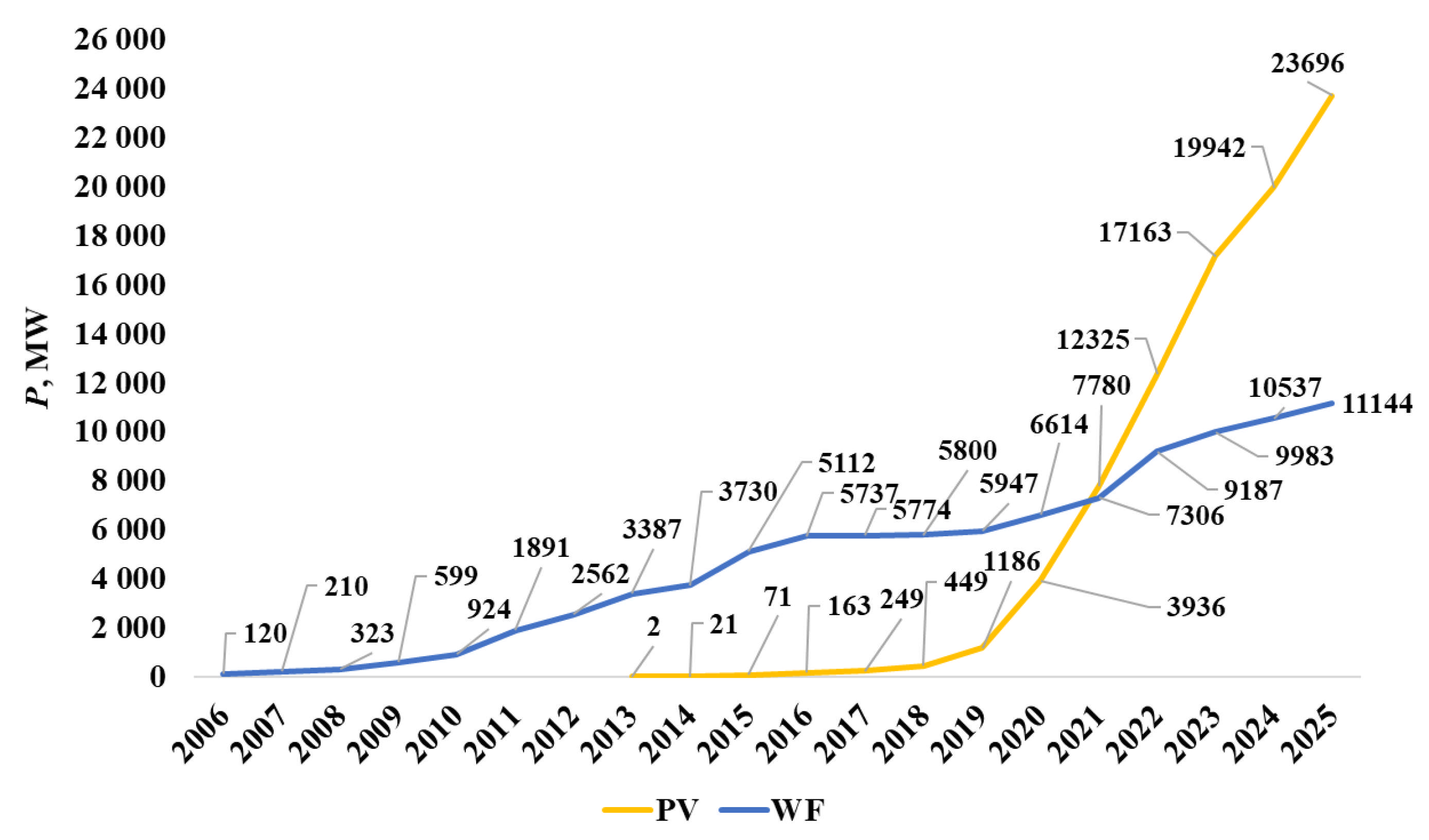
In recent years, due to the need to meet the European Union requirements formulated in the RED III directive [1] and in the package of political initiatives collectively known as the European Green Deal [2], a change in the structure of electricity sources has been noticeable in Poland (as in other countries). As shown in Figure 1 (data for Poland), in 2015, the installed capacity of photovoltaic sources was only 108 MW, and in 2019, it was already 1186 MW. Over the next 5 years, a gigantic jump in the installed capacity of sources using this technology can be observed, as it now exceeds 23.6 GW [3]. This was caused not only by increased investments by prosumers (in low-voltage networks, power up to 50 kW) but also by the connection of high-power sources to the medium voltage network (from 1 to several megawatts), to the 110 kV network (several dozen megawatts) and to the transmission network (over 100 MW.)
Poland is also witnessing dynamic development of wind energy, despite the fact that in absolute terms, the installed capacity of wind farms has only slightly exceeded 10,000 MW. A careful analysis of Figure 1 reveals that between 2006 and 2015, the installed capacity of these sources continued to grow. However, subsequent changes in regulations (the “Distance” Act [4]) significantly limited the development of wind energy. Between 2015 and 2020, the increase in installed wind capacity was only 835 MW. With the liberalisation of the regulatory approach, the increase in installed wind capacity between 2019 and 2024 was another 4 GW. In 2025, the regulations were further liberalised [5], which should further accelerate the development of this type of renewable energy generation.
Figure 1. Poland: structure of installed capacity in wind and photovoltaic sources over the years [6].
Applsci 16 02279 g001
This article attempts to analyse the issue of estimating the connection capacity in the power system, with particular emphasis on transmission grid operating conditions. The need for such analyses stems directly from the provisions of the Energy Law [7], which requires system operators to publish information regarding available connection capacities. The purpose of this requirement is to increase the transparency of the investment process and enable investors to make rational decisions regarding the location of new generating sources, particularly large-scale renewable energy sources with a capacity exceeding 100 MW. Generating units of this scale should be connected directly to the high-voltage transmission grid, i.e., 220 kV and 400 kV. Due to the growing share of renewable energy sources in the national energy mix and the dynamically changing demand for new connection capacities, accurate and objective estimation of available network capacity is becoming crucial for ensuring system stability and the effective development of energy infrastructure.
It is worth noting that Transmission System Operators in Europe routinely assess the network capacity within the ENTSO-E capacity calculation methodology, which specifies procedures for determining cross-zonal capacity, security margins, and corrective actions. While this work focuses on the detailed formulation of AC SCOPF for a single control area, the proposed framework is conceptually consistent with these practices by explicitly considering line load constraints, N-1 security and cross-border exchange constraints. A more direct integration of the developed method into ENTSO-E capacity calculation processes, including flow-based approaches, remains an interesting topic for further work [8,9,10].
Introducing renewable energy into the system changes the operating conditions of the transmission grid, which can result in significant threats: overloading of lines and transformers and reducing generation in thermal power plants below the technical minimum. An objective estimate of allowable generation from renewable energy should result from solving an optimisation problem with constraints. Such a problem can be formulated in many ways. It is crucial that, at full power generation from renewable energy sources, none of the constraints related to the aforementioned threats are violated. Furthermore, these constraints should also be met in the N-1 states. Solving a large-scale optimisation problem is computationally very time-consuming. The Polish 400/220/110 kV grid model includes over 4000 nodes and 5000 branches, which requires solving nearly 8000 equations and checking approximately 5000 current constraints (including those for each of the N-1 states examined). While calculating a single power flow in a given network configuration takes only a few seconds, solving a full nonlinear optimisation problem with constraints can take up to several hours. Nevertheless, we decided to tackle this problem, considering the convergence of the computational process a success. The difficulties that emerged with classical optimisation methods led the authors to use a heuristic approach and the related simulated annealing method [11] as the basis for creating a professional computational tool.
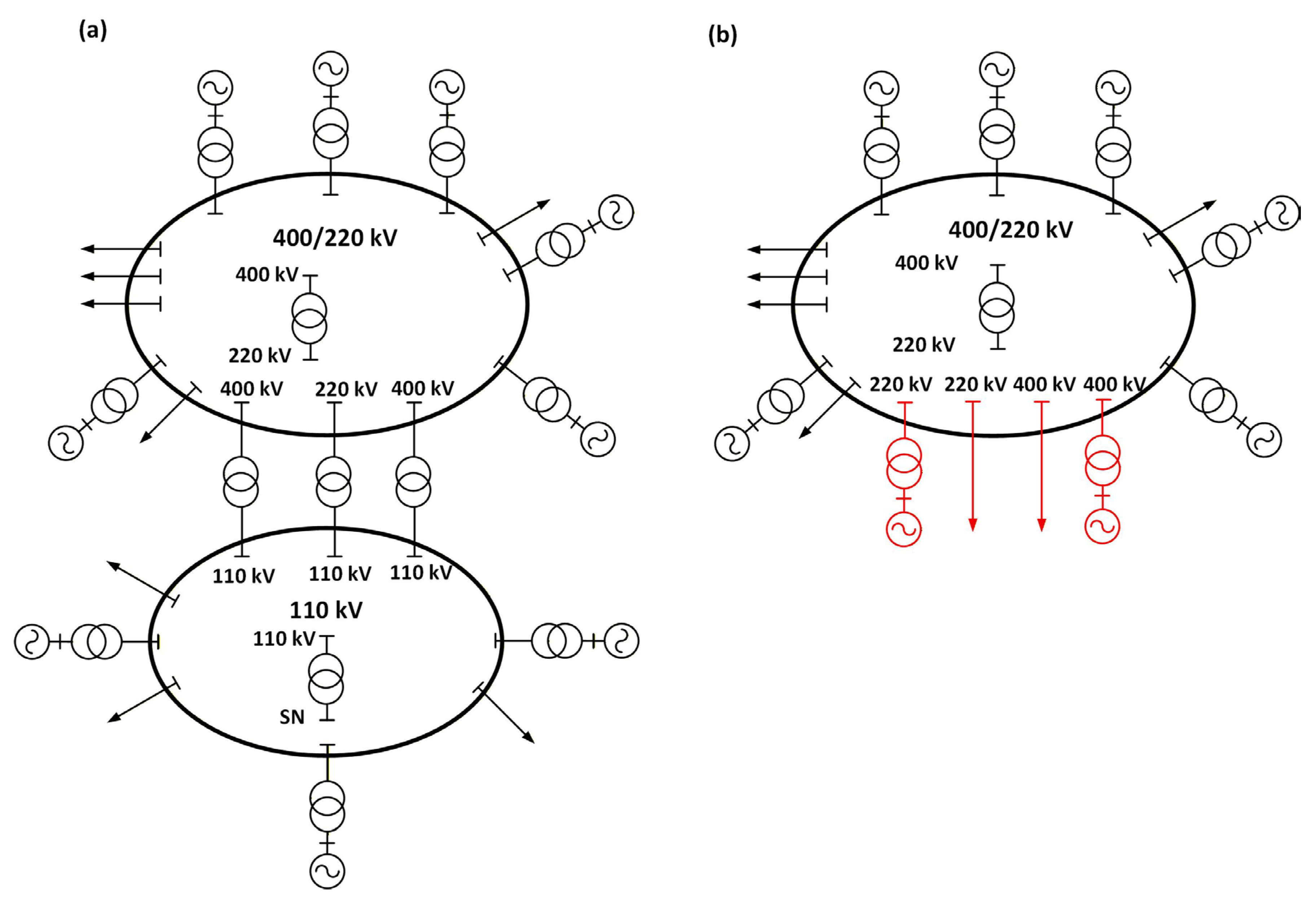
To enable optimisation analyses regarding the integration of renewable energy sources (RESs) into the national power system, a set of simplifying assumptions has been adopted for modelling the network. It is assumed that wind farms can only be connected to 400 kV, 220 kV and 110 kV nodes designated by the Transmission System Operator (TSO). The optimisation covers both the capacity of existing wind farms and those that could potentially be connected in the future. To reduce computational complexity, power consumption from 110 kV busbars may be represented as an equivalent aggregated load. If necessary, a full model of the distribution network can also be used. The complete and simplified versions of the power system are shown in Figure 2. In the proposed approach, networks below the 110 kV level are represented by equivalent active and reactive power injections on the 110 kV busbars. This simplification is common in TSO-level planning studies and significantly reduces the size of the optimisation problem, allowing the analysis to focus on transmission-level constraints, which are typically decisive for connecting large-capacity renewable energy units. At the same time, this means that local voltage and congestion issues in the distribution network are not taken into account. Extending the framework towards a hierarchical or two-level structure, in which a detailed distribution network model is coupled with transmission network optimisation, is therefore an important direction for future work, especially in regions with a high penetration of distributed generation. Power generated by RESs and other distributed generation sources connected to the reduced distribution network is modelled as negative active power values and included in the balance of equivalent loads. In the nonlinear model, generator nodes at medium voltage levels and unit transformers in conventional power plants are retained. The optimisation process aims to maximise the total capacity of RESs that can be connected while maintaining technical and operational system constraints, as well as the power balance in the system. Furthermore, it is necessary to maintain the cross-border power exchange balance at a level as close as possible to the baseline conditions, i.e., before the integration of new wind generation. The connected capacity must not violate the technical minimum load of conventional units, as this could affect frequency regulation stability in the system. Finally, each voltage level specified by the TSO is subject to permissible power capacity ranges for source connection, which have also been included in the formulation of the model constraints.
The following sections of this article present a detailed analysis of the issue of RES power optimisation in the context of transmission grid connection capabilities. The second section provides a comprehensive literature review focusing on optimisation methods used in the power industry, with particular emphasis on applications in system planning, generation resource allocation, and congestion management. Both classical deterministic methods and heuristic and metaheuristic approaches are discussed, with an emphasis on their application in uncertainty modelling and nonlinear optimisation of problems related to the integration of renewable energy sources. The third section of this article is devoted to a detailed description of the mathematical model that forms the basis for the optimisation analyses. It presents the structure of the transmission grid model, along with simplifications introduced to maintain a balance between accuracy and computational feasibility. The adopted technical constraints, such as line load limits, requirements related to the operation of conventional units, the foreign exchange balance and the N-1 security criterion, are also described. Particular emphasis is placed on incorporating renewable energy generation as a decision variable in the nonlinear model. The fourth section presents the applied optimisation method, the simulated annealing algorithm, which belongs to the group of heuristic methods and is particularly useful in solving problems with a large number of variables and nonlinear interdependencies between them. Its adaptation to the problem of maximising connectable power while meeting complex system constraints is described. The same section also presents the results of the RES power optimisation conducted under test system conditions, developed as a representative transmission grid model. This paper concludes with a summary of the obtained results and an indication of the potential practical implementation of the proposed method in TSO planning processes. Limitations of the current approach are also discussed and directions for further research are proposed, including the development of models that take into account a greater level of detail of the distribution network and the variability of meteorological conditions.
In Figure 2a, the upper ellipse represents the 400/220 kV transmission network with cross-border interconnections to adjacent control areas and existing generating units, shown as circular symbols connected to a circuit. The lower ellipse represents the 110 kV network and its connection to the primary medium voltage (MV) network. The vertical connections between the two ellipses correspond to transformers connecting the 400/220 kV and 110 kV levels. The arrows indicate the direction of power injection or withdrawal, while the designations 400 kV, 220 kV and 110 kV indicate the nominal voltage levels of the respective connections. In Variant Figure 2b, on the other hand, the 110 kV network and the medium voltage network have been replaced by collective injections at the 400/220 kV boundary. The highlighted (red) generator symbols and arrows indicate renewable energy-generating units whose connection capacities at selected 220 kV and 110 kV nodes are 400 kV are treated as decision variables in optimisation.

2. Literature Review

Due to their universality and flexibility, optimisation methods are widely used in almost all areas of energy-related research, including:
  • Improvement of power system stability [12,13,14];
  • Elimination of line overloads [15,16,17,18];
  • Forecasting generation levels of solar and wind sources [19,20,21];
  • Optimisation of voltage profiles in nodes [22,23,24];
  • Advanced optimisation and forecasting methods [25,26,27];
  • Various aspects of energy storage [28,29,30,31];
  • Improving power quality [32,33,34];
  • Power system reliability studies [35,36,37,38];
  • Planning network development [39,40,41];
  • Power system control and automation [42,43,44];
  • Optimisation of generation placement [45,46,47];
  • Different aspects of cable polling and hybrid generation [48,49,50].
Paper [51] presents the application of a new metaheuristic method—the Electric Eel Foraging Optimisation Algorithm (EEFOA)—to the problem of controlling and optimising the operation of hybrid wind-farm systems and grid-connected photovoltaic sources. This algorithm was inspired by the biological behaviour of electric eels and demonstrates high efficiency in finding global solutions with a limited number of iterations. The EEFOA not only allows for increased energy efficiency and reduced losses in renewable energy systems but can also be used to optimise the deployment of units and their selection for specific connection locations in the network. Due to its high convergence and low susceptibility to local minima, this method is applicable to multicriteria analyses related to connecting new sources. Wang et al. [52] have proposed an innovative strategy for adaptive switching of acquisition functions within the Bayesian Optimisation process, applied to a wind turbine system. The key element of that work is the application of Bayesian Optimisation (BO) under conditions of high variability and uncertainty of input data, which well reflects actual connection conditions. Although this paper focuses primarily on the farm system, the optimisation methodology used can be effectively extended to cases of source allocation to grid nodes. Variable acquisition functions allow for balancing between exploration and operation, which is crucial for making connection decisions in environments with limited data or strongly nonlinear dependencies. Paper [53] presents an approach to transmission-system planning for offshore wind farms that integrates technical criteria (capacity, voltage stability) with investment cost analysis. In that paper, a machine learning model was used to assess the impact of various topology variants on transmission capacity, followed by a multiobjective optimisation algorithm. The results show that predictive ML models can shorten the planning process and allow for early rejection of configurations that do not meet the connection criteria. Other examples of work using machine learning and artificial intelligence to assess the connection capabilities of transmission network nodes include [54,55,56,57,58,59].
In [60], the authors used a simulated annealing algorithm in combination with hybrid metaheuristics. That proposed method allowed for the simultaneous consideration of multiple connection configuration variants and the assessment of their impact on investment costs and transmission reliability. That analysis showed that hybridising simulated annealing with other techniques significantly increases the ability to search the solution space and improves the efficiency of designing connection nodes under technical and environmental constraints [61] concerning integrated planning of transmission network expansion using modern metaheuristic algorithms, such as the particle swarm optimisation (PSO) algorithm and the bat algorithm (BA). Those authors developed a model that takes into account both technical and economic aspects, including investment costs, line capacity constraints and system stability requirements. The research results indicated that the use of metaheuristics allows for a more effective determination of the connection capacity of transmission network nodes, minimising the risk of overloads and ensuring optimal power distribution in the system. Article [62] focuses on the optimal placement and parameter selection of FACTS devices to increase the available transmission capacity of the network. Metaheuristic optimisation algorithms, such as the genetic algorithm (GA) and ant colony optimisation algorithm (ACO), were used there to precisely match the location and power of devices to the network structure. Simulation results on real transmission system models confirm that the proposed method allowed for a significant increase in the connection capacity of nodes while improving voltage stability and reducing transmission losses. The application of heuristic or metaheuristic methods in assessing the connection capacity of transmission network nodes can also be found in [63,64,65,66].
In practice, during the planning phase of connecting a renewable energy installation, investors seek the best possible grid connection point for their installation. Financial institutions expect reliable expert studies confirming the technical and economic feasibility of the project. In response to these needs, the presented approach suggests methods for identifying optimal RES connection locations from the perspective of minimising the risk of transmission congestion, both under normal conditions and in emergency situations, using optimisation methods.

3. Description of the Proposed Calculation Method

The step preceding the solution of the power flow problem is to develop an appropriate model of the power network, which constitutes a numerical representation of its topological structure and the parameters of its constituent elements. The model consists of transmission lines and transformers, represented in a simplified manner as single-phase two- or four-terminal elements [67,68,69]. The most commonly used mathematical representation of a network system in this type of analysis is the admittance nodal matrix, whose structure reflects the interconnections between the system’s nodes. In this context, a node is interpreted as a power distribution station or a busbar system within it, serving as the connection point for sources, loads and other network elements.
From the perspective of control theory and dynamic state analysis, solving the power flow problem comes down to determining the state vector of the power system. This vector contains the voltage modules at individual nodes, U, and their arguments, δ, whose values must satisfy a nonlinear system of equations resulting from the active and reactive power balances at each node:
x = U δ
which satisfies the network equations taking into account the excitation vector, w (power received at nodes), and
w = P L Q L
and the control vector, s (powers generated in nodes).
s = P G Q G
The network equations have the following general form:
s w f ( x ) = 0
and for each of the i = 1 … N nodes, we can write
P G i P L i f P ( U , δ ) = 0
Q Gi Q L i f Q ( U , δ ) = 0
Taking into account the detailed forms of the functions fP and fQ and distinguishing modules and arguments in the admittances described by complex numbers, we obtained the following relations:
P G i P L i U i j = 1 w i U j Y i j cos δ i δ j γ i j = 0
Q G i Q L i U i j = 1 w i U j Y i j sin δ i δ j γ i j = 0
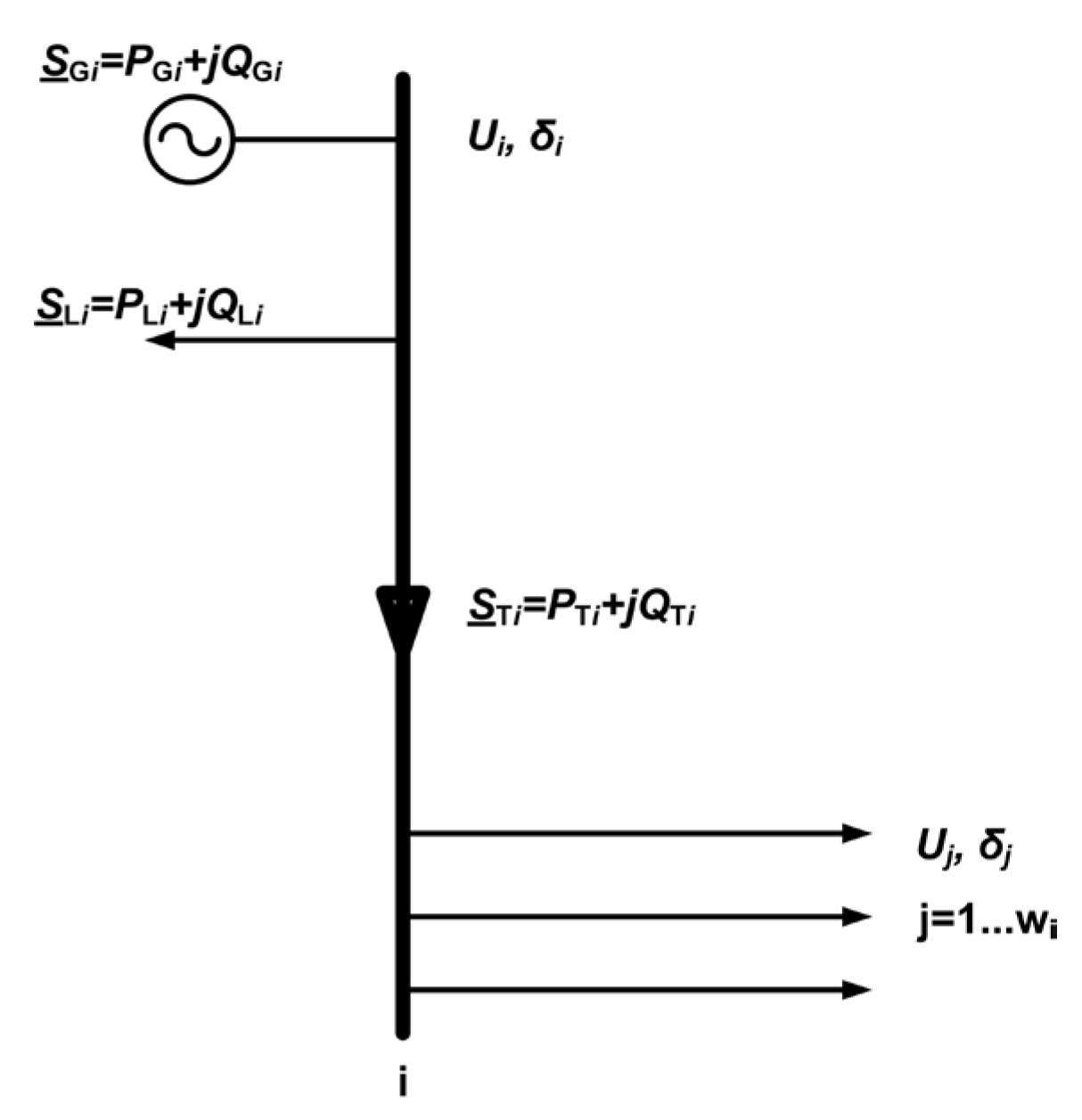
For clarity, in (7) and (8), the following symbols are used: Ui, Uj—voltage magnitudes at nodes i and j; δi and δj—voltage phase angles; Yij—element of the nodal admittance matrix relating nodes i and j, where ∣Yij∣ is its magnitude and γij is its argument; PGi, QGi—generated active/reactive power at node i; and PLi, QLi—load active/reactive power at node i. The summation index, j, runs over all nodes directly connected to node i.
It follows from there that the functions f P ( U , δ ) and f Q ( U , δ ) are nonlinear functions and the system of 2N equations of type (7) and (8) is a system of nonlinear equations for which it is not possible to determine the solution by the analytical method.
Therefore, from the mathematical and numerical point of view, the solution of the flow problem comes down to solving the nonlinear system of Equations (7) and (8), where the number of unknowns may reach several, a dozen or even several tens of thousands (depending on the extent of the analysed network).
In the present research, Newton’s method, currently one of the most commonly used computational techniques in power system analysis, was used to solve the power flow problem. This method originates from the classical theory of a numerical solution of systems of nonlinear equations and is widely used in both academic and industrial applications. Its popularity stems from its high computational efficiency and convergence properties, which, with the appropriate selection of the starting point, allow for obtaining a high-accuracy solution after only a few iterations. In the context of the power flow problem, Newton’s method allows for the iterative solution of a nonlinear system of equations resulting from the active and reactive power balances at each node in the system. These equations express the relationships between the voltages at the nodes, their phase angles and the values of generated and consumed power. In each iteration, the system of equations is linearised using the Jacobi matrix, the correctness and conditions of which positively influence the stability of the computational process. In the research presented in this article, Newton’s method plays a key role as a tool used in each iteration of the optimisation procedure. In the context of applying heuristic algorithms for finding the global optimum (such as simulated annealing), each evaluation of the objective function requires power flow calculations to verify compliance with the system’s technical constraints. In this sense, Newton’s method is not only a fundamental component of system operating-state analysis but also a crucial element in integrating the power flow model with the optimisation model. Due to its deterministic nature and high accuracy, this method allows for the effective identification of line overloads, voltage irregularities and other critical system states, which is crucial when assessing the feasibility of connecting new generation sources, including RES farms. This allows for a reliable representation of actual system operating conditions within the computational model.
The developed optimisation model assumes that conventional (system) power plants occur only in selected nodes of the analysed grid, consistent with the actual distribution of generating units in the national power system. In turn, the location of potential RES farm connections is limited to a set of nodes {NZ} designated by the Transmission System Operator. These nodes represent technically permissible connection points to the transmission grid, meeting voltage criteria (110 kV, 220 kV or 400 kV) and infrastructure availability. However, the operator may define certain grid nodes as “non developmental” and exclude them from the set of nodes with planned generation. In the analysed model, these nodes are automatically excluded from the set of permitted locations for new RESs. In accordance with the European Union directives [70], the developed optimisation algorithm should aim to maximise the connection capacity of RES units while maintaining the maximum generation levels in conventional units and meeting all technical and system constraints ensuring safe and reliable operation of the power system.
In this context, the objective function of power flow optimisation (Fc(s)—the control vector ensuring s , its minimum, is sought) of the OPF (Optimal Power Flow) task is defined as follows:
F C s = j = 1 N z P G j
where PGj—active power generated by the RES connected to node j.
As can be seen, the objective function includes a simple summation of selected elements of the control vector corresponding to the considered network nodes (their number is defined as NZ), for which new sources can be connected. It is obvious that the elements of the control vector remain the powers of all sources operating in it (both new and existing).
In practice, the objective function boils down to summing selected elements of this vector, corresponding to renewable energy sources at permitted nodes, with optimisation conducted with strict consideration of voltage, load, control and structural constraints (including the N-1). This model allows for a quantitative assessment of the connection potential of system nodes, taking into account their full operational characteristics. It should be emphasised that the formulation applied in this manuscript is deterministic in nature and corresponds to a fixed operating point of the power system characterised by a specific load level and an assumed active power produced by renewable energy sources. In practice, both quantities are subject to significant uncertainty resulting from forecast errors and variability in meteorological conditions. Extending the proposed SCOPF model towards stochastic or robust formulations, for example, by considering a set of renewable energy generation and load scenarios with associated probabilities and by enforcing security constraints for all or selected subsets of scenarios would further enhance the practical value of this method. However, such an extension would require a specific procedure for scenario generation and reduction and therefore remains an important avenue for future research but is beyond the scope of this paper. Among the constraints present in the model, the condition resulting from the need to maintain the technical minimum of the power system also plays a significant role. This constraint takes the form of an inequality and applies to the elements of the control vector, particularly the active and reactive powers generated at individual nodes. Their values are limited, both lower and upper, by the rated powers of the generating units connected to a given node and by the operating characteristics of these units relative to their rated powers.
For conventional sources, this means ensuring their operation within an operating range consistent with the system’s stability and frequency regulation requirements. At the same time, these constraints cannot be violated by connecting additional generation, even if there is spare transmission capacity. Considering these conditions in the optimisation model allows for a realistic assessment of whether and to what extent new renewable energy sources can be introduced into the system without disrupting its safe and stable operation. This condition is met by satisfying the following relations, (10) and (11):
P G j max P G j 0 P G j P G j min 0
Q G j max Q G j 0 Q G j Q G j min 0
Considering the physical and operational constraints of a power system is an integral part of any realistic optimisation model. In addition to constraints resulting from the characteristics of generating sources, the transmission constraints of grid infrastructure elements also play a significant role. In particular, they concern permissible branch power, i.e., the power transmitted by lines and transformers. These constraints result directly from maximum current values, exceeding which could lead to negative thermal effects. For transformers, these constraints are strictly defined by their rated power, while for transmission lines, especially overhead lines, their estimates may vary depending on environmental conditions such as ambient temperature, wind speed or solar radiation. For this reason, in operational practice, a seasonal distinction is most often made between summer and winter load capacity:
I k l max I k l 0
The abovementioned current flowing in the network branch from node k to node l is determined from the formula
I k l = U k 2 + U l 2 2 U k U l cos δ k δ l Z k l
Another crucial element of the model is the balance of power exchange with foreign countries. In systems strongly integrated with neighbouring countries, as is the case with the Polish power system, it is necessary to impose constraints on the allowable balance of imported or exported power. Formally, this takes the form of inequality constraints, the parameters of which depend on the number of border nodes and their connections to external systems. When the balance tolerance, ∆PB, takes on a value of zero, this constraint becomes an equality equation, enforcing strict adherence to the specified level of power exchange, PB:
P B + Δ P B k = 1 N g j = 1 l k P k j 0
k = 1 N g j = 1 l k P k j P B + Δ P B 0
where lk—number of foreign nodes connected to the k-th node, NG—number of network nodes defined as border nodes, PB—set level of foreign exchange balance, and ΔPB—tolerance for maintaining the foreign exchange balance.
Another equally significant constraint in the model under consideration is the limits of permissible voltage values at individual network nodes. For each node, these values are set relative to its rated voltage, Unj, and exceeding them could lead to degraded voltage quality or damage to network and receiving equipment. Considering these constraints also takes the form of an inequality, encompassing both the lower and upper limits of permissible voltages:
U j max U j 0 U j U j min 0
In parallel with the inequality constraints, the model also includes equality constraints resulting from the need to maintain a balance of active and reactive power in the network. For each network node (i = 1 … N), balance equations must be satisfied, reflecting the principle of energy conservation in the power system. In particular, for the node shown in Figure 3, Equations (17) and (18) can be written, which links the generated and consumed powers with the power flow to neighbouring nodes (marked s as j = 1 … wi).
P G i P L i = P T i
Q G i Q L i = Q T i
This means that active power and reactive power resulting from the local balance of generation and consumption must be transmitted to adjacent network points.
For a power system, the ability to reliably perform generation and transmission functions, even under emergency conditions, is crucial. In practice, checking whether this capability is maintained in relation to the system network is performed by verifying compliance with the “N-1 criterion.” The number N denotes the number of branches connected to the node in question. The “N-1 criterion” is met when switching off (individually) each of these branches does not exceed the permissible voltage current parameters, both in that node and in the entire network. This principle must be met for all network nodes, excluding radially supplied nodes, for which it cannot be met. Another approach to checking the “N-1 criterion” is to simply designate a set {WF} of network elements to be switched off, and the power flow under emergency conditions will be verified to ensure that the flow parameters are maintained within the required ranges.
As mentioned above, the N-1 criterion is considered in the nonlinear method as constraints resulting from the shutdown of individual network elements. Generally speaking, each new control vector, drawn using the nonlinear optimisation method, is “set” in the normal state and N-1 states, and then the constraints are checked. An OPF problem that considers the N-1 criterion is classified as a SCOPF (security constrain OPF).
The nonlinear optimisation problem to be solved can be written in the general form:
F C x , w , s min
with equality constraints
g x , w , s = 0
and with inequality constraints
h x , w , s 0
described in detail above.

4. Organisation and Course of the Calculation Process

Given the difficulties in quickly obtaining solutions to OPF and SCOPF problems using methods similar to classical ones, identified in the research and confirmed in numerous publications, attention was focused on the possibility of using an alternative method for solving nonlinear optimisation problems based on heuristics. Heuristic methods do not require knowledge of the derivative of the objective function and are resistant to discontinuities of this function and to the computational process “getting stuck” in a local minimum. These are universal methods that can be used for calculations with any objective function [71]. The nature of the problem under consideration (the power flow problem) is such that the determination of the state vector elements is performed through a time-consuming iterative process. Although the objective function is in the form of a sum and therefore easy to optimise, one group of constraints—branch constraints (permissible line current capacity and transformer power rating)—can only be verified based on the state vector, which is difficult to determine. In a sense (during the calculations), these constraints are implicit, and after incorporating them into the objective function (classical method of considering constraints), it is not really possible to say what shape the resulting new objective function will take, and it is subject to minimisation.
Another problem and obstacle to the use of classical optimisation methods is the possibility of a divergent iterative process, i.e., a failure to find a solution in the power flow calculation process. In such a case, heuristics can cope with this problem by loading the power flow data at any point in the calculation process; the best, most recently found solution is not lost, as this vector is remembered at every stage of the calculation. The classical method, however, would have to be interrupted and the calculations restarted. An exception to this is linear optimisation [72,73], based, for example, on the Simplex method.
This article uses the simulated annealing method, which is based on an analogy to the technological process known as annealing. This involves heating a certain amount of steel to a high temperature and then slowly cooling it (transitioning it to an increasingly lower energy state).
Among the various metaheuristic methods, simulated annealing was chosen in this work due to its conceptual simplicity and proven robustness in highly discontinuous search spaces. In particular, this method does not require gradient information and can be easily combined with problem-specific neighbourhood definitions and repair operators that enforce network constraints. A systematic quantitative comparison with other metaheuristic methods, such as genetic algorithms, particle swarm optimisation, or hybrid approaches, would certainly be interesting. However, such a comparative study is beyond the scope of this paper, the main goal of which is to demonstrate the usefulness of the nonlinear SCOPF formulation combined with a heuristic global search method for estimating the transmission capacity of transmission level connections under N-1 constraints.
The implementation of the optimisation process using the simulated annealing method involves randomly selecting points from the starting point’s neighbourhood and then finding the point where the objective function takes on the lowest value. Then, the temperature is lowered and the process begins again. The condition for completing the algorithm is achieving a temperature (a conventional parameter) lower than the target. In the implemented Matlab framework, each optimisation was terminated when (i) the best objective function value did not improve over a specified number of subsequent iterations or (ii) a predefined upper bound on the number of candidate solutions evaluated was reached. For the considered 220/110 kV test system, this typically corresponded to several dozen iterations. The convergence curves showed a rapid decline in the objective function value in the initial search phase, followed by a slow fine-tuning phase in which only small improvements were accepted. This behaviour is characteristic of simulated annealing and indicates that the algorithm is able to effectively approach high-quality solutions for the investigated SCOPF problem. The simulated annealing algorithm is found in the literature in [74,75], among others. In [75], the authors describe the application of the simulated annealing algorithm to multicriteria load scheduling and energy storage in the load side of a modern power system. Those authors demonstrate adaptive control and integration of the dynamic parameters of the charging network, achieving high control accuracy and stability. In [76], a method for optimal reconfiguration of distribution networks is proposed, modelled by an improved simulated annealing algorithm with a hybrid cooling profile (ISA-HC). Those authors demonstrated the effectiveness of the solution on typical systems with 5, 33, 69 and 94 nodes, indicating better convergence and quality of solutions compared with existing methods. In the simulated annealing procedure used, the initial temperature, T0, was chosen so that a large fraction of the candidate solutions generated in the first iteration were accepted, which was empirically verified. The temperature was then lowered according to a geometric cooling schedule. In each iteration, a new candidate solution was generated by randomly selecting one RES connection node and perturbing its active power within predefined bounds while ensuring that all minimum and maximum limits for individual units were met. Candidate solutions violating network constraints (e.g., line current limits or voltage limits) were either rejected or corrected by reducing the corresponding RES output power. The algorithm was terminated when further iterations did not lead to an improvement on the best known solution.
To assess robustness, the optimisation was repeated from different random seeds; the best feasible solution and the variability of the obtained objective values were recorded. While a formal proof of global optimality is not available for this highly nonconvex SCOPF, the combination of multiple independent runs, a strict feasibility enforcement (normal state and N-1), and consistent convergence behaviour provided practical confidence in solution quality for large-scale systems.
For transparency and auditability, the simulated annealing (SA) search loop used in this study is summarised in Algorithm 1. This pseudo-code follows the standard SA structure and formalises the key steps applied in our workflow: initialisation, neighbourhood exploration and the temperature update governed by the cooling function t ⟵ f (t, i). In the proposed application, the rating function, Fc, represents the penalised objective used to evaluate candidate operating points under the AC power-flow model and the considered operational constraints (including contingency conditions, where applicable). The stopping criteria are defined by the adopted termination condition of the inner loop and the overall detention criterion of the SA procedure. This code is presented in Algorithm 1.
Algorithm 1 Simulated annealing algorithm
  Procedure simulated annealing
  Begin
    i ← 0
    initialise t
    select a random current point s0
    rate s0
  repeat
     repeat
        select a new point s in the neighbourhood of point s0
        if Fc(s) < Fc(s0)
           then s0 ← s
      else
           if random   ( 0 , 1 )   < e F C ( S ) F C ( S 0 ) t
               then s0 ← s
  until (termination condition)
  t ← f(t, i)
  i ← I + 1
  until (stopping criterion)
  end
This workflow-level description enables straightforward reproduction of the SA search procedure in other computational environments without relying on tool-specific code. In the algorithm, t denotes the parameter referred to as the “temperature”; in the analysed problem, it has no direct physical meaning, and its value governs the acceptance behaviour and contributes to terminating the computational process via the adopted cooling schedule and stopping criteria. The symbol s0 represents the current solution at a given iteration, whereas s denotes a randomly generated candidate solution (random variable) drawn from the neighbourhood of s0. Finally, Fc(s) is the objective function used to rate candidate solutions.
To effectively utilise this optimisation method, it is necessary to employ a very fast computational module that solves the flow problem. The PowerWorld computational system was used for this purpose in this study. This system includes the SimAuto plug in, which allows it to connect to external applications (MATLAB R2025a, Excel, Delphi RAD Studio 12.3 Athens) primarily for the purpose of performing flow calculations. It therefore serves as a “computational engine.” The optimisation task was implemented using the Matlab environment and the simulated annealing algorithm implemented in it. Therefore, the optimisation process itself is not described in this article.
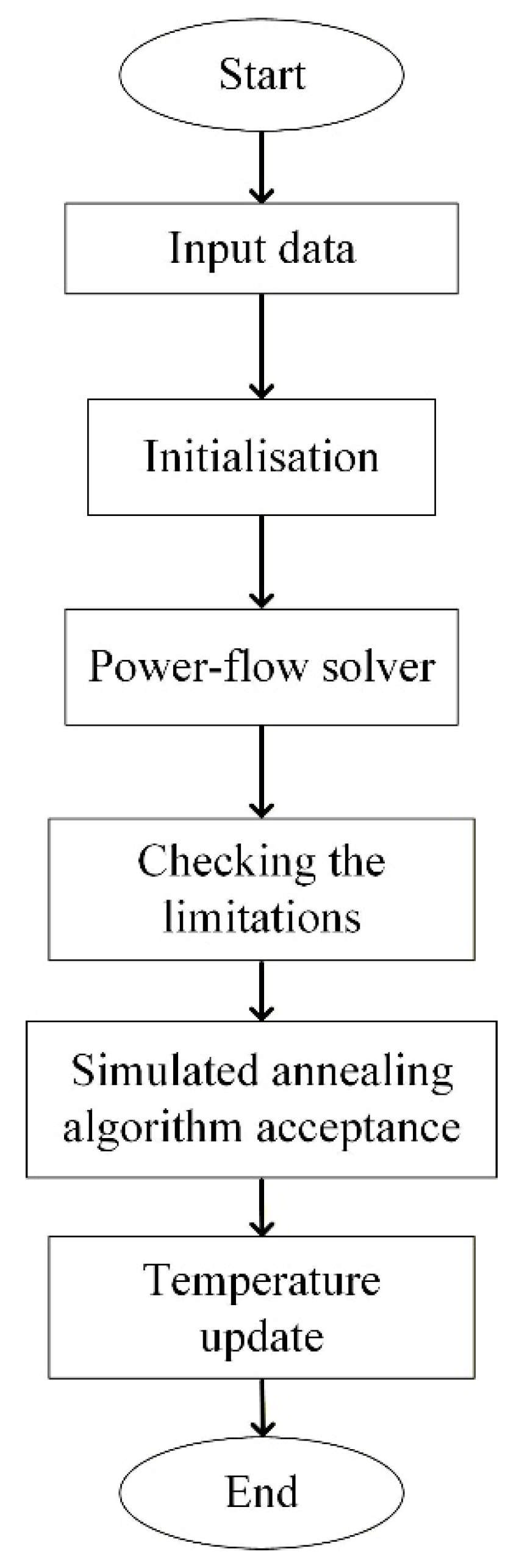
The main steps of the proposed calculation procedure are summarised in the flowchart in Figure 4. Starting from the input network model and operational data (loads, generator constraints, fault list), the algorithm performs the following steps:
  • Initialises the control vector, s, and sets the initial temperature, T0;
  • Solves the AC power flow for the base case and all N-1 considered faults using Newton’s method;
  • Evaluates the objective function and verifies all technical constraints;
  • Generates a new control vector in the neighbourhood of the current solution;
  • Repeats the power flow and constraint checks for the candidate solution;
  • Updates the best known solution;
  • Then updates the temperature according to the cooling schedule and checks the stopping conditions.
These steps are repeated until the stopping criterion of the simulated annealing algorithm is met.
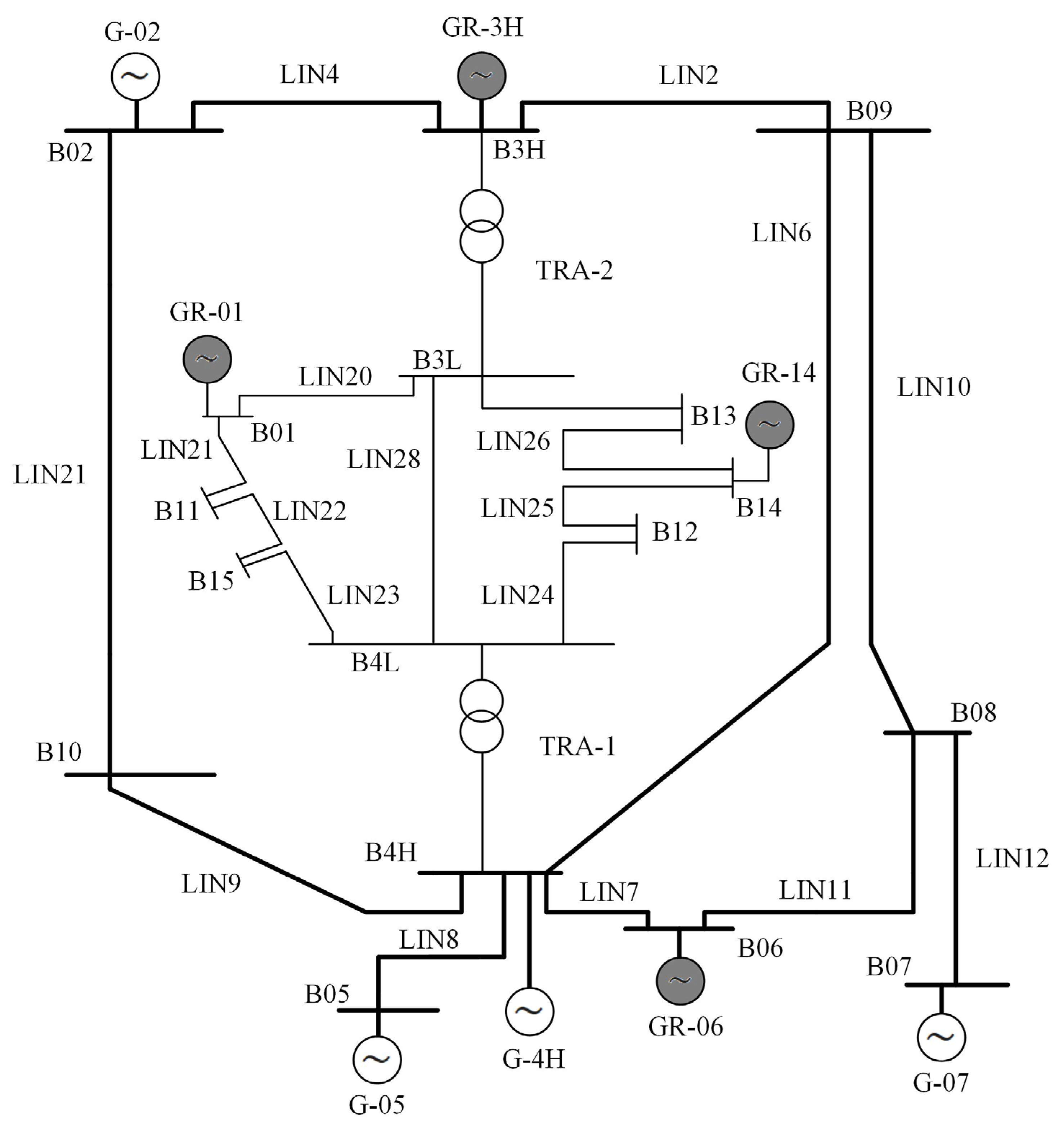
The computations were performed using a modified C7M test network. The test system covers the 220/110 kV network after reducing the medium voltage distribution network. The system diagram is shown in Figure 5. The designation “R” denotes the possibility of connecting an RES to a given node. Nodal data are provided in Table 1, generator data in Table 2 and branch data in Table 3. The balancing node is B02. LIN4 and LIN13 exchange lines connect the 220/110 kV network with the balancing node. An accuracy of ±5 MW was assumed for the exchange balance implementation in solutions ignoring the N-1 criterion. The 220 kV network connects busbars B02, B09, B08, B07, B05 and B10 via lines LIN2, LIN10, LIN12, LIN11, LIN8 and LIN9, with the upper part of the network additionally connected to busbar B3H (line LIN4) and busbar B4H (line LIN7). Busbars B3H and B4H are connected to the 110 kV network via transformers TRA-2 (B3H–B3L) and TRA-1 (B4H–B4L). The 110 kV network is represented by busbars B01 and B11–B15, as well as B3L and B4L, which are interconnected by shorter lines LIN20–LIN28 and LIN21–LIN26–LIN25–LIN24, forming radial power networks fed by 220/110 kV transformers. Circles indicate generating units connected to selected busbars; white symbols (G-02, G-05, G-4H, G-07) represent existing conventional generators.
The N-1 security assessment was performed for a contingency set comprising all branch and transformer outages located within the test system shown in Figure 4. Radial elements were excluded from the outage list, as their disconnection does not represent a credible N-1 security constraint for the analysed operating point of the test system. The selection of the test system and the associated outage set followed the ZIWWE [76] document requirements used in connection capability assessments for the Polish Power System. These authors’ longstanding practical experience in preparing connection studies for generation sources connected to the Polish transmission system was also reflected in the adopted contingency screening principles.
Before the optimisation process, the RES generation in the system was concentrated exclusively in node B01 in the 110 kV network and amounted to 30 MW. After solving the optimisation problem, without taking into account the N-1 criterion, the total RES generation capacity in the system increased to 1152 MW (Table 4). Table 5 shows the load level of network components during energy generation from renewable energy sources after optimization.
The active constraints that influenced the result are the permissible current-carrying capacities of the LIN21 and LIN25 lines and the rated power of the TRA-1 transformer. After taking into account the N-1 criterion, it turned out that several branches were overloaded after single outages, as shown in Table 6. Therefore, the N-1 criterion had to be introduced to the inequality constraints of the optimisation problem.
Optimisation calculations, taking into account emergency and repair conditions, confirmed the need to reduce RES generation to 939 MW. This, of course, involved increasing the power generated by thermal power plants.
Table 7 shows the final distribution of power generated in the test system between RESs and conventional thermal power plants. It meets all constraints—balance, load and control—under normal and emergency conditions.
In addition, the total active power losses were evaluated as the difference between total generation and total demand at the analysed operating point. For the test system, this yielded approximately 33 MW before optimisation (1727 MW generation vs. 1694 MW demand), 23 MW after optimisation without N-1, and 28 MW after optimisation with N-1. These values confirm that the proposed method does not increase system losses while maximising the connectable RES power.
As shown in Table 8, the nonlinear optimisation process effectively maximises the connection capacity of renewable energy sources. At the same time, all constraints of this process are maintained: power balance (demand versus generation) and minimum generation values from conventional sources (must-run generation). Appropriate voltage levels are maintained at network nodes, and the current capacity of any line is not exceeded. As expected, considering network failure states (N-1) in the optimisation process leads to the need for some reduction in generation from renewable energy sources, but their share in the total system generation still exceeds 50%.
The conducted research demonstrated that the maximum connection capacity of the power system for integrating new generation capacity with renewable energy can be effectively determined by solving a complex nonlinear optimisation problem, taking into account numerous technical and operational constraints. In particular, the use of the simulated annealing method allowed for the determination of system operating configurations that maximise the potential for renewable energy generation while maintaining the required quality parameters of energy supply. For the test network considered, the algorithm demonstrated high operational stability, generating repeatable results across multiple independent computational runs. Importantly, the optimisation process was characterised by rapid convergence, enabling practical application of the method in planning and operational analyses. The obtained results confirm that the proposed approach can be an effective tool supporting investment decisions and the connection of renewable energy sources to the national power system.

5. Conclusions

The analyses and calculations conducted in this article confirmed that the maximum connection capacity of a power system for an RES can be effectively determined by solving a complex nonlinear optimisation problem with constraints. The use of the simulated annealing method allowed for stable, repeatable results in a short computational time, demonstrating the potential of this method for practical applications, both in planning and operational analyses. Research conducted on a test model demonstrated that optimising the distribution and size of RES generation can lead to a significant increase in the utilisation of renewable energy potential in the system while maintaining an acceptable level of grid security. An example is the increase in renewable energy generation capacity to 54.5% of total generation (after optimisation), which demonstrates the scale of possible connection reserves hidden within the grid structure.
From the energy sector’s perspective, the present approach provides a tool for more precise planning of power grid development in the context of the growing share of renewable sources. The use of nonlinear optimisation allows for the consideration of technical constraints, such as line capacity limits, permissible voltage drops and transformer load limits, thus achieving results that can be implemented in real world conditions.
The developed method can find particular application in the following processes:
  • Network development planning—enables the identification of areas with the greatest connection potential and the assessment of the effects of infrastructure expansion or modernisation;
  • Evaluation of connection applications—allows for quick and objective determination of the maximum power that can be connected at a given point in the network without violating the technical conditions;
  • Investment analyses—providing data necessary to assess the profitability and risk of projects related to wind farms and other renewable sources.
In future research, the authors plan to expand these analyses to include models that account for parameter variability over time, using forecasts of both energy production and demand. Additionally, consideration will be given to incorporating economic criteria, including energy prices and the costs of redispatching operations. Further research in these areas may enable the development of comprehensive decision support systems capable of automatically and continuously optimising grid operation while simultaneously considering technical and economic aspects. Such solutions will result in increased flexibility of the power system, more efficient use of renewable energy sources, and reduced integration costs.

Author Contributions

Conceptualisation, P.K. and A.B.; methodology, A.B.; software, D.P. and S.A.; validation, P.K. and A.B.; formal analysis, P.K. and A.B.; investigation, S.A.; resources, A.B.; data curation, A.B., S.A., D.P. and P.K.; writing—original draft preparation, A.B.; writing—review and editing, P.K.; visualisation, S.A. and D.P.; supervision, P.K. All authors have read and agreed to the published version of the manuscript.

Funding

This research received no external funding.

Data Availability Statement

The original contributions presented in this study are included in the article. Further inquiries can be directed to the corresponding author.

Conflicts of Interest

The authors declare no conflicts of interest.

Abbreviations

The following abbreviations are used in this manuscript:
TSOTransmission System Operator
MLMachine learning
XGBoosteXtreme Gradient Boosting Over Decision Trees
MLPMulti-Layer Perceptron
CNN-LSTMConvolutional Neural Network Long Short-Term Memory
EMGRLsEnsemble Models based on Graph Neural Network and Reinforcement Learning
GNNGraph Neural Networks
RLReinforcement Learning
EEFOAElectric Eel Foraging Optimisation Algorithm
BOBayesian Optimisation
PSOParticle swarm optimisation
BABat algorithm
GAGenetic algorithm
ACOAnt colony optimisation algorithm
OPFOptimal Power Flow
SCOPFSecurity Constrain Optimal Power Flow

References

  1. European Union. Directive (EU) 2023/2413 of the European Parliament and of the Council of 18 October 2023 Amending Directive (EU) 2018/2001, Regulation (EU) 2018/1999 and Directive 98/70/EC as Regards the Promotion of Energy from Renewable Sources, and Repealing Council Directive (EU) 2015/652; European Union: Brussels, Belgium, 2023. [Google Scholar]
  2. European Commission. The European Green Deal; European Commission: Brussels, Belgium, 2019.
  3. Energy Instrat. Installed Capacity of Electricity Sources in Poland. Available online: https://energy.instrat.pl (accessed on 7 August 2025).
  4. Polish Law of May 20, 2016, on Investments in Wind Power Plants, Dz.U. 2016 poz. 961. 2016. Available online: https://climate-laws.org/document/act-of-20-may-2016-on-investments-in-wind-farms-last-amended-by-act-of-9-march-2023_be7e (accessed on 23 February 2026).
  5. Government Project of an Act Amending the Act on Investments in Wind Power Plants and Certain Other Acts. 2025. Available online: https://www.gov.pl/web/climate/another-draft-bill-on-renewable-energy-sources-included-in-the-council-of-ministers-work-schedule (accessed on 23 February 2026).
  6. Pijarski, P.; Kacejko, P.; Belowski, A. Redysponowanie instalacji OZE w praktyce—Konieczność versus konsekwencje [Redispatching of renewable energy installations in practice—Necessity versus consequences]. Rynek Energii 2025, 177, 3–10. [Google Scholar]
  7. Act of April 10, 1997 Energy Law, Dz. U. 1997 Nr 54 poz. 348: PE/1997. Available online: https://climate-laws.org/document/energy-law-dz-u-1997-nr-54-poz-348_ceee (accessed on 23 February 2026).
  8. European Commission. Commission Regulation (EU) 2015/1222 of 24 July 2015 Establishing a Guideline on Capacity Allocation and Congestion Management (CACM); European Commission: Brussels, Belgium, 2015.
  9. ENTSO-E. Capacity Allocation & Congestion Management (CACM); ENTSO-E: Brussels, Belgium, 2015. [Google Scholar]
  10. ENTSO-E. Coordinated Capacity Calculation—Implementation Guide, v1.0; ENTSO-E: Brussels, Belgium, 2018. [Google Scholar]
  11. Kirkpatrick, S.; Gelatt, C.D.; Vecchi, M.P. Optimization by simulated annealing. Science 1983, 220, 671–680. [Google Scholar] [CrossRef]
  12. Lezhniuk, P.D.; Pijarski, P.; Buslavets, O.A. Smart grid technologies in local electric grids. In Photonics Applications in Astronomy, Communications, Industry, and High Energy Physics Experiments 2017. Photonics Applications in Astronomy, Communications, Industry, and High-Energy Physics Experiments 2017, Wilga, Poland, Saturday 27 May 2017; Romaniuk, R.S., Linczuk, M., Eds.; SPIE: Cergy-Pontoise, France, 2017; p. 1044566. [Google Scholar]
  13. Han, H.; Jiang, X.; Cao, Y.; Luo, X.; Liu, S.; Yang, B. Flexibility Resource Planning and Stability Optimization Methods for Power Systems with High Penetration of Renewable Energy. Energies 2025, 18, 4139. [Google Scholar] [CrossRef]
  14. Wu, X.; Cao, Y.; Wu, H.; Qi, S.; Zhao, M.; Feng, Y.; Yu, Q. Improving Synchronization and Stability in Integrated Electricity, Gas, and Heating Networks via LSTM-Based Optimization. Energies 2025, 18, 749. [Google Scholar] [CrossRef]
  15. Pijarski, P.; Saigustia, C.; Kacejko, P.; Bena, L.; Belowski, A. The impact of renewable energy sources on the overload of high voltage lines—Power flow tracking versus direct current method. Arch. Electr. Eng. 2024, 519–541. [Google Scholar] [CrossRef]
  16. Pijarski, P.; Kacejko, P. Elimination of Line Overloads in a Power System Saturated with Renewable Energy Sources. Energies 2023, 16, 3751. [Google Scholar] [CrossRef]
  17. He, Z.; Chen, Y.; Zang, Y. Wind Speed Forecasting Based on Phase Space Reconstruction and a Novel Optimization Algorithm. Sustainability 2024, 16, 6945. [Google Scholar] [CrossRef]
  18. Baharvandi, A.; Nguyen, D.T. Optimal Network Expansion Planning Considering Uncertain Dynamic Thermal Line Rating. arXiv 2024, arXiv:2410.12508. [Google Scholar] [CrossRef]
  19. Saigustia, C.; Pijarski, P. Time Series Analysis and Forecasting of Solar Generation in Spain Using eXtreme Gradient Boosting: A Machine Learning Approach. Energies 2023, 16, 7618. [Google Scholar] [CrossRef]
  20. Liu, H.; Cai, C.; Li, P.; Tang, C.; Zhao, M.; Zheng, X.; Li, Y.; Zhao, Y.; Liu, C. Hybrid prediction method for solar photovoltaic power generation using normal cloud parrot optimization algorithm integrated with extreme learning machine. Sci. Rep. 2025, 15, 6491. [Google Scholar] [CrossRef]
  21. Mohammed, A.; Sakr, E.K.; Abo-Adma, M.; Elazab, R. A comprehensive review of advancements and challenges in reactive power planning for microgrids. Energy Inform. 2024, 7, 63. [Google Scholar] [CrossRef]
  22. Kacejko, P.; Pijarski, P. Optimal Voltage Control in MV Network with Distributed Generation. Energies 2021, 14, 469. [Google Scholar] [CrossRef]
  23. Bharath, S.; Vasuki, A. Adaptive energy loss optimization in distributed networks using reinforcement learning-enhanced crow search algorithm. Sci. Rep. 2025, 15, 12165. [Google Scholar] [CrossRef] [PubMed]
  24. Lv, L.; Fang, X.; Zhang, S.; Ma, X.; Liu, Y. Optimization of grid-connected voltage support technology and intelligent control strategies for new energy stations based on deep learning. Energy Inform. 2024, 7, 73. [Google Scholar] [CrossRef]
  25. Ukoba, K.; Olatunji, K.O.; Adeoye, E.; Jen, T.-C.; Madyira, D.M. Optimizing renewable energy systems through artificial intelligence: Review and future prospects. Energy Environ. 2024, 35, 3833–3879. [Google Scholar] [CrossRef]
  26. Pavlov-Kagadejev, M.; Jovanovic, L.; Bacanin, N.; Deveci, M.; Zivkovic, M.; Tuba, M.; Strumberger, I.; Pedrycz, W. Optimizing long-short-term memory models via metaheuristics for decomposition aided wind energy generation forecasting. Artif. Intell. Rev. 2024, 57, 143. [Google Scholar] [CrossRef]
  27. Pijarski, P.; Kacejko, P.; Miller, P. Advanced Optimisation and Forecasting Methods in Power Engineering—Introduction to the Special Issue. Energies 2023, 16, 2804. [Google Scholar] [CrossRef]
  28. Manocha, A.; Mantegna, G.; Patankar, N.; Jenkins, J.D. Reducing transmission expansion by co-optimizing sizing of wind, solar, storage and grid connection capacity. Environ. Res. Energy 2025, 2, 15011. [Google Scholar] [CrossRef]
  29. Ye, H.; Wang, Q.; Xian, Y.; Wen, B.; Li, Y.; Hou, S. Optimization planning of new rural multi-energy distribution network based on fuzzy algorithm. Energy Inform. 2025, 8, 32. [Google Scholar] [CrossRef]
  30. Ahsan, S.M.; Musilek, P. Optimizing Multi-Microgrid Operations with Battery Energy Storage and Electric Vehicle Integration: A Comparative Analysis of Strategies. Batteries 2025, 11, 129. [Google Scholar] [CrossRef]
  31. Mroczek, B.; Pijarski, P. Flexible management of power flows in the low-voltage grid using energy storage & artificial intelligence. J. Energy Storage 2025, 139, 118878. [Google Scholar] [CrossRef]
  32. Pijarski, P.; Kacejko, P. Methods of Simulated Annealing and Particle Swarm Applied to the Optimization of Reactive Power Flow in Electric Power Systems. Adv. Electr. Comp. Eng. 2018, 18, 43–48. [Google Scholar] [CrossRef]
  33. Zhang, C.; Chang, X.; Dai, J.; Chen, Z.; Babanezhad, M. Designing of a wide-area power system stabilizer using an exponential distribution optimizer and fuzzy controller considering time delays. Sci. Rep. 2025, 15, 1773. [Google Scholar] [CrossRef] [PubMed]
  34. Vukadinović, D. Recent Advances in Power Quality Analysis and Robust Control of Renewable Energy Sources in Power Grids. Energies 2024, 17, 2193. [Google Scholar] [CrossRef]
  35. Barakat, S.; Ibrahim, H.; Elbaset, A.A. Multi-objective optimization of grid-connected PV-wind hybrid system considering reliability, cost, and environmental aspects. Sustain. Cities Soc. 2020, 60, 102178. [Google Scholar] [CrossRef]
  36. Monir, N.; Sadabadi, M.S.; Soudjani, S. Logic-based Resilience Computation of Power Systems Against Frequency Requirements. In Proceedings of the 2025 European Control Conference (ECC), Thessaloniki, Greece, 24–27 June 2025. [Google Scholar]
  37. Agouzoul, N.; Oukennou, A.; Elmariami, F.; Boukherouaa, J.; Gadal, R.; Tarraq, A. A Comparative Study of Metaheuristics Algorithms Applied for Optimal Reactive Power Dispatch Problem Considering Load Uncertainty. In Advances in Electrical Systems and Innovative Renewable Energy Techniques; Bendaoud, M., El Fathi, A., Bakhsh, F.I., Pierluigi, S., Eds.; Springer Nature Switzerland: Cham, Switzerland, 2024; pp. 207–214. ISBN 978-3-031-49771-1. [Google Scholar]
  38. Pijarski, P.; Belowski, A. Outage Rates and Failure Removal Times for Power Lines and Transformers. Appl. Sci. 2025, 15, 8030. [Google Scholar] [CrossRef]
  39. Kacejko, P.; Pijarski, P. Cost sharing on the network upgrade individual investors applying for connection to a network of wind farms. Przegląd Elektrotechniczny 2012, 88, 27–31. [Google Scholar]
  40. Zhang, R.; Qu, K.; Zhao, C.; Huang, W. Robust Distribution Network Reconfiguration Using Mapping-based Column-and-Constraint Generation. arXiv 2025, arXiv:2505.24677. [Google Scholar]
  41. Li, F.; Liu, D.; Wang, D.; Wang, W.; Liu, Z.; Yu, H.; Su, X.; Zhang, D.; Wu, X. Enhancing System Reliability and Transient Voltage Stability through Optimized Power Sources and Network Planning. Electronics 2023, 12, 3190. [Google Scholar] [CrossRef]
  42. Dahal, S.; Hegglid, G.J.; Kristiansen, J.; Chhetri, B.B.; Mishra, S.; Øyvang, T. Integrating multiple slack bus operations and metaheuristic techniques for power flow optimization. Sci. Rep. 2025, 15, 16821. [Google Scholar] [CrossRef]
  43. Zhang, H.; Zhang, Y.; Zhang, J.; Meng, X.; Sun, J. Resilient dispatching optimization of power system driven by deep reinforcement learning model. Discov. Artif. Intell. 2025, 5, 21. [Google Scholar] [CrossRef]
  44. Ortmann, L.; Rubin, C.; Scozzafava, A.; Lehmann, J.; Bolognani, S.; Dörfler, F. Deployment of an Online Feedback Optimization Controller for Reactive Power Flow Optimization in a Distribution Grid. arXiv 2023, arXiv:2305.06702. [Google Scholar] [CrossRef]
  45. Li, H.; Jin, T.; Xu, X.; Shi, L. A Study of Multi-distributed Resource Equalization Allocation for Virtual Power Plants Based on Genetic-heuristic Algorithm. Int. J. Comput. Intell. Syst. 2025, 18, 94. [Google Scholar] [CrossRef]
  46. Huan, J.; He, Y.; Sun, K.; Lu, H.; Wang, H.; Wu, X. Capacity planning for wind, solar, thermal and energy storage in power generation systems considering coupled electricity-carbon markets. IET Gener. Transm. Distrib. 2024, 18, 4090–4104. [Google Scholar] [CrossRef]
  47. Bhadoria, A.; Marwaha, S. An optimum generation scheduling of electrical power system considering the effect of renewable energy sources by using a hybrid metaheuristic search algorithm. OPSEARCH 2024, 61, 1301–1382. [Google Scholar] [CrossRef]
  48. Alqahtani, M.; Alghamdi, A.S. Optimized Coordination of Distributed Energy Resources in Modern Distribution Networks Using a Hybrid Metaheuristic Approach. Processes 2025, 13, 1350. [Google Scholar] [CrossRef]
  49. Mohamadi, M.J.; Tolou Askari, M.; Samiei Moghaddam, M.; Ghods, V. Optimizing energy flow in advanced microgrids: A prediction-independent two-stage hybrid system approach. Energy Inform. 2025, 8, 41. [Google Scholar] [CrossRef]
  50. Xu, W.; Chu, Z.; Teng, F. LAPSO: A Unified Optimization View for Learning-Augmented Power System Operations. arXiv 2025, arXiv:2505.05203. [Google Scholar] [CrossRef]
  51. Abdelwahab, S.A.M.; El-Rifaie, A.M.; Hegazy, H.Y.; Tolba, M.A.; Mohamed, W.I.; Mohamed, M. Optimal Control and Optimization of Grid-Connected PV and Wind Turbine Hybrid Systems Using Electric Eel Foraging Optimization Algorithms. Sensors 2024, 24, 2354. [Google Scholar] [CrossRef]
  52. Wang, Z.; Tu, Y.; Zhang, K.; Zhou, D.; Bilgen, O. An adaptive switch strategy for acquisition functions in Bayesian optimization of wind farm layout. arXiv 2025, arXiv:2502.10778. [Google Scholar] [CrossRef]
  53. He, F.; Liu, Y.; Feng, Q.; Wei, S. Grid-connection transmission system planning of offshore wind farm cluster consider the project income. Front. Energy Res. 2024, 12, 1416225. [Google Scholar] [CrossRef]
  54. Li, C.; Kies, A.; Zhou, K.; Schlott, M.; Sayed, O.E.; Bilousova, M.; Stöcker, H. Optimal Power Flow in a highly renewable power system based on attention neural networks. Appl. Energy 2024, 359, 122779. [Google Scholar] [CrossRef]
  55. Moradi-Sepahvand, M.; Amraee, T.; Sadeghi Gougheri, S. Deep Learning Based Hurricane Resilient Coplanning of Transmission Lines, Battery Energy Storages, and Wind Farms. IEEE Trans. Ind. Inf. 2022, 18, 2120–2131. [Google Scholar] [CrossRef]
  56. Pineda, S.; Morales, J.M.; Jiménez-Cordero, A. Learning-assisted optimization for transmission switching. TOP 2024, 32, 489–516. [Google Scholar] [CrossRef] [PubMed]
  57. Sun, Y.; Han, W. A review of enhancing wind power with AI: Applications, economic implications, and green innovations. Digit. Econ. Sustain. Dev. 2025, 3, 8. [Google Scholar] [CrossRef]
  58. Zehtabiyan-Rezaie, N.; Iosifidis, A.; Abkar, M. Physics-Guided Machine Learning for Wind-Farm Power Prediction: Toward Interpretability and Generalizability. PRX Energy 2023, 2, 013009. [Google Scholar] [CrossRef]
  59. Bošnjaković, M.; Martinović, M.; Đokić, K. Application of Artificial Intelligence in Wind Power Systems. Appl. Sci. 2025, 15, 2443. [Google Scholar] [CrossRef]
  60. Wang, Y.; Song, D.; Jurić, F.; Duić, N.; Mikulčić, H. Multi-modal optimization of offshore wind farm collection system topology based on nearest better most attractive particle swarm optimization. Renew. Sustain. Energy Rev. 2025, 222, 115978. [Google Scholar] [CrossRef]
  61. Almalaq, A.; Alqunun, K.; Abbassi, R.; Ali, Z.M.; Refaat, M.M.; Abdel Aleem, S.H.E. Integrated transmission expansion planning incorporating fault current limiting devices and thyristor-controlled series compensation using meta-heuristic optimization techniques. Sci. Rep. 2024, 14, 13046. [Google Scholar] [CrossRef]
  62. Gupta, D.; Jain, S.K. Available Transfer Capability Enhancement by FACTS Devices Using Metaheuristic Evolutionary Particle Swarm Optimization (MEEPSO) Technique. Energies 2021, 14, 869. [Google Scholar] [CrossRef]
  63. Gerbex, S.; Cherkaoui, R.; Germond, A.J. Optimal location of multi-type FACTS devices in a power system by means of genetic algorithms. IEEE Trans. Power Syst. 2001, 16, 537–544. [Google Scholar] [CrossRef]
  64. Menniti, D.; Sorrentino, N. A new method for SSSC optimal location to improve power system Available Transfer Capability. In Proceedings of the 2006 IEEE/PES Power Systems Conference and Exposition, Atlanta, GA, USA, 29 October–1 November 2006; IEEE: Piscataway, NJ, USA, 2006; pp. 938–945. ISBN 1-4244-0177-1. [Google Scholar]
  65. Nireekshana, T.; Kesava Rao, G.; Sivanaga Raju, S. Available transfer capability enhancement with FACTS using Cat Swarm Optimization. Ain Shams Eng. J. 2016, 7, 159–167. [Google Scholar] [CrossRef]
  66. Mohammed, O.O.; Mustafa, M.W.; Mohammed, D.S.S.; Otuoze, A.O. Available transfer capability calculation methods: A comprehensive review. Int. Trans. Electr. Energy Syst. 2019, 29, e2846. [Google Scholar] [CrossRef]
  67. IEEE. IEEE Recommended Practice for Industrial and Commercial Power Systems Analysis (Brown Book); IEEE: Piscataway, NJ, USA.
  68. Kremens, Z.; Nowak, S.M. Analiza Systemów Elektroenergetycznych [Analysis of Electrical Power Systems], 1st ed.; WNT: Warszawa, Poland, 1996. [Google Scholar]
  69. Zajczyk, R. Modele Matematyczne Systemu Elektroenergetycznego do Badania Elektromechanicznych Stanów Nieustalonych i Procesów Regulacyjnych [Mathematical Models of the Power System for Studying Electromechanical Transient States and Control Processes], 1st ed.; Wydawnictwo Politechniki Gdańskiej: Gdańsk, Poland, 2003. [Google Scholar]
  70. European Union. Directive 2009/28/EC of the European Parliament and of the Council of 23 April 2009 on the Promotion of the Use of Energy from Renewable Sources, Amending and Subsequently Repealing Directives 2001/77/EC and 2003/30/EC; European Union: Brussels, Belgium, 2009. [Google Scholar]
  71. Dzahini, K.J.; Rinaldi, F.; Royer, C.W.; Zeffiro, D. Direct-search methods in the year 2025: Theoretical guarantees and algorithmic paradigms. EURO J. Comput. Optim. 2025, 13, 100110. [Google Scholar] [CrossRef]
  72. Khanh, P.D.; Mordukhovich, B.S.; Tran, D.B. Globally convergent derivative-free methods in nonconvex optimization with and without noise. Math. Program. 2025. [Google Scholar] [CrossRef]
  73. Mandal, P.K. A review of classical methods and Nature-Inspired Algorithms (NIAs) for optimization problems. Results Control Optim. 2023, 13, 100315. [Google Scholar] [CrossRef]
  74. Simeon Pucuhuayla, F.J.; Castillo Correa, C.; Ñaupari Huatuco, D.Z.; Molina Rodriguez, Y.P. Optimal Reconfiguration of Electrical Distribution Networks Using the Improved Simulated Annealing Algorithm with Hybrid Cooling (ISA-HC). Energies 2024, 17, 4477. [Google Scholar] [CrossRef]
  75. Wang, X.; Liang, H.; Jia, X.; Li, S.; Kang, S.; Gao, Y. Application of simulated annealing algorithm in multi-objective cooperative scheduling of load and storage of source network for load side of new power system. Energy Inform. 2025, 8, 52. [Google Scholar] [CrossRef]
  76. PSE S.A. Scope and Terms and Conditions for Performing Expert Analysis; PSE S.A: Warsaw, Poland, 2026. [Google Scholar]
Figure 2. Power system—full model (a); simplified model—reduced 110 kV network (b).
Applsci 16 02279 g002
Figure 3. Illustration of the principles of determining the power balance in the i-th node.
Applsci 16 02279 g003
Figure 4. Block diagram of the simulated annealing-based computational procedure.
Applsci 16 02279 g004
Figure 5. Schematic diagram of the 220/110 kV test system.
Applsci 16 02279 g005
Table 1. Node data of the test system with nodal powers and voltages before optimisation.
Node CodeUmδUnPgQgPdQd
-pu°kVMWMvarMWMvar
B021.0910220125.2124.8
B051.10523220510151.214255
B061.100−1122000300
B071.10013220585192.415292.5
B081.009−10220--21050
B091.006−25220--440110
B101.051−14220--310134
B3H1.068−17220001710
B4H1.068−8220590208.8276236
B011.046−19110300180
B111.037−19110--5016
B121.012−17110--2512
B131.024−19110--3521
B141.000−19110004010
B151.022−18110--4012
B3L1.035−19110--5016
B4L1.019−16110--11235
Table 2. Source data with permissible power ranges. Type C indicates a thermal power plant; Type R indicates a renewable source.
Node CodeSnTypePgPminPmax
--MVA-MWMWMW
G-05B05720C510100600
GR-06B06500R00500
G-07B07720C585100600
GR-3HB3H100R00500
G-4HB4H720C590100600
GR-01B01100R300200
GR-14B14100R00200
Table 3. Permissible loads in A for lines and MVA for transformers.
Branch CodeStart Node CodeEnd Node CodeRXB/2Imax
---ΩΩµSA/MVA
LIN28B3LB4L2.4828880
LIN10B09B0810.790420875
LIN11B08B063.530.8180875
LIN12B08B07659.5300875
LIN13B10B025.265320875
LIN2B3HB095.758290515
LIN20B3LB012.510.553320
LIN21B01B110.6420320
LIN22B11B151.81265320
LIN23B15B4L0.5420320
LIN24B4LB120.43.517.5320
LIN25B12B141.18.140.5320
LIN26B14B131.18.140.5320
LIN27B13B3L0.43.517.5320
LIN4B3HB027.882.6410875
LIN6B09B4H11.796422875
LIN7B4HB0612.797430875
LIN8B4HB055.460305875
LIN9B4HB105.255290875
TRA-1B4HB4L2.525.40250
TRA-2B3HB3L3.939.60160
Table 4. Generation structure after optimisation (unit commitment) without N-1 criterion.
NumberPgUnNode CodeSource Code
-MWkV--
Generation in RES
164110B01GR-01
2500220B06GR-06
3119110B14GR-14
4469220B3HGR-3H
Total 1152---
Generation in Thermal Power Plant
5200220B05G-05
6186220B07G-07
7186220B4HG-4H
Total572
Table 5. Load level of network elements during generation in RESs after optimisation.
Branch CodeStart Node CodeEnd Node CodeIn/SnI/SI/In
---(A/MVA)-(A/MVA)(S/Sn)
LIN11B08B068756010.7
LIN12B08B078754070.5
LIN10B09B088754970.6
LIN6B09B4H8751470.2
LIN13B10B028752920.3
LIN4B3HB028753020.3
LIN2B3HB095154760.9
LIN8B4HB058754510.5
LIN7B4HB068755230.6
LIN9B4HB108754850.5
LIN21B01B113203201
LIN22B11B15320880.3
LIN25B12B143203201
LIN27B13B3L3202300.7
LIN26B14B133202510.8
LIN23B15B4L3201540.5
LIN20B3LB01320840.3
LIN28B3LB4L8803110.35
LIN24B4LB123202070.65
TRA-2B3HB3L1601601
TRA-1B4HB4L250500.2
Table 6. Branch overloads during outage conditions (N-1 criterion).
Branch CodeStart Node CodeEnd Node CodeIn/SnI/SI/In
---(A/MVA)-(A/MVA)(S/Sn)
LIN2B3HB095156911.3
LIN21B01B113204171.3
LIN25B12B143204511.4
LIN27B13B3L3203751.2
LIN26B14B133205041.6
LIN24B4LB123203371.05
Table 7. Results after optimising power generation in renewable energy sources, taking into account the N-1 criterion.
NumberPgUnNode CodeSource Code
-MWkV--
Generation in RES
179110B01GR-01
2465220B06GR-06
374110B14GR-14
4321220B3HGR-3H
Total939---
Generation in Thermal Power Plants
5274220B05G-05
6259220B07G-07
7259220B4HG-4H
Total792
Table 8. Summary of the power values generated in conventional sources (C) and renewable energy sources (R): states before optimisation; after optimisation, without taking into account failure states; and after full optimisation.
Source CodeNode CodeBefore Optimisation Optimisation Without (N-1)Optimisation with (N-1)
- MWMWMW
G-05B05510200274
G-07B07585186259
G-4HB4H590186259
G-02B021279
Total C 1697 (98.2%)565 (32.9%)783 (45.5%)
GR-01B01306479
GR-06B060500465
GR-14B14011974
GR-3HB3H0469321
Total R 30 (1.8%)1152 (67.1%)939 (54.5)
Total Generation 1727 (100%)1717 (100%)1722 (100%)
Disclaimer/Publisher’s Note: The statements, opinions and data contained in all publications are solely those of the individual author(s) and contributor(s) and not of MDPI and/or the editor(s). MDPI and/or the editor(s) disclaim responsibility for any injury to people or property resulting from any ideas, methods, instructions or products referred to in the content.