1. Introduction
Corrugated pipes are widely employed in HVAC (heating, ventilation, and air conditioning) installations, industrial fluid transport lines, renewable energy systems, and building services due to their flexibility, structural robustness under external loads, and ease of installation [
1,
2,
3]. Corrugated stainless steel components, such as flexible line (FL) compensators and T-junctions, offer practical advantages over rigid metallic pipes by accommodating misalignment, absorbing thermal expansion without additional compensators, and reducing vibration-induced stresses at connection points [
1,
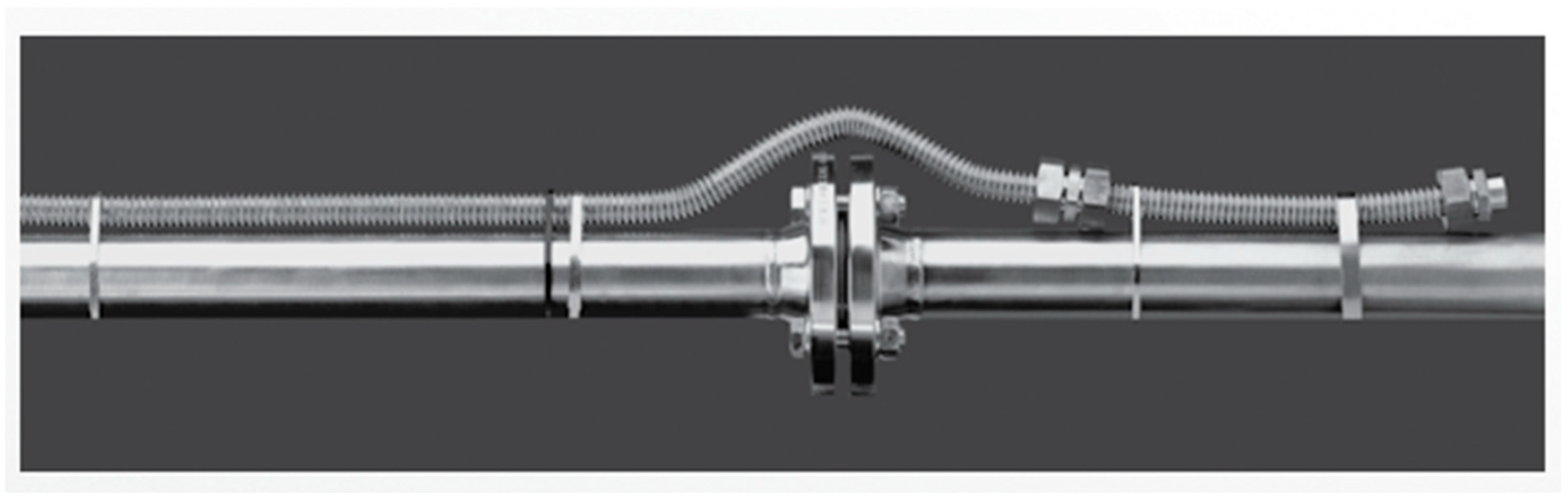
2]. In practical installations, corrugated stainless steel tubes (CSSTs) are commonly connected to rigid piping systems through standard fittings and expansion elements, as illustrated in
Figure 1.
These mechanical advantages, however, are accompanied by a notable hydraulic penalty. The periodically corrugated internal surface induces flow separation, generates recirculation zones within the grooves, and intensifies turbulence production, resulting in pressure losses significantly higher than those observed in smooth pipes under identical flow conditions [
4,
5,
6]. Consequently, the associated increase in pumping power demand may adversely affect overall system energy efficiency, particularly in energy-sensitive engineering applications such as HVAC circulation systems and renewable-energy-driven thermal loops [
7].
Pressure losses in internal flows arise from complex interactions among Reynolds number, surface roughness, boundary-layer development, and geometric irregularities. For smooth pipes, these interactions are well described by classical friction-factor correlations, and at a fixed Reynolds number the influence of pipe diameter becomes negligible, in accordance with dynamic similarity theory [
8,
9,
10,
11]. In corrugated pipes, however, the groove geometry acts as a large-scale roughness element, amplifying the sensitivity of flow behaviour to geometric parameters. Groove pitch, depth, and profile shape directly influence separation length, vortex persistence, and frictional dissipation mechanisms [
12,
13,
14].
Although corrugations may enhance fluid mixing and improve heat transfer under certain conditions, this enhancement is commonly accompanied by a pronounced increase in pressure drop. Experimental and numerical studies consistently report that corrugated pipes exhibit friction factors approximately 1.8–2.5 times higher than those of smooth pipes under turbulent flow conditions, while achieving heat-transfer enhancements typically in the range of 50–300%, depending on corrugation geometry and Reynolds number [
15,
16,
17]. Recent bibliometric analyses of heat transfer enhancement research indicate a prevailing emphasis on thermal performance metrics, with pressure-drop penalties and energy-based indicators often receiving comparatively limited attention. These findings highlight the necessity of evaluating corrugated pipe performance from an energy-based perspective, rather than relying solely on hydrodynamic indicators such as friction factor.
Among the available literature, the most comprehensive experimental datasets on pressure losses in corrugated pipes were reported by Ahn and Popiel [
18,
19]. These studies provided friction-factor data over wide Reynolds number ranges for pipes with different diameters and corrugation profiles. A non-classical behaviour was experimentally observed, whereby the friction factor increases systematically with increasing pipe diameter at a constant Reynolds number [
18,
19,
20]. This diameter-dependent trend contradicts classical smooth-pipe theory and cannot be explained solely by relative roughness arguments [
8,
9,
10,
11]. While experimental uncertainty and scaling effects may partially contribute to this observation, the underlying physical mechanisms governing groove-induced separation, vortex development, and momentum dissipation across different diameters remain insufficiently clarified. Notably, most existing studies report results for fixed pipe diameters or within specific corrugation families, thereby limiting the generalization of diameter-scaling effects under dynamically similar flow conditions.
Computational Fluid Dynamics (CFD) offers a powerful framework for investigating the complex flow structures inherent to corrugated geometries. High-resolution numerical simulations enable detailed examination of near-wall separation, reattachment processes, and vortex dynamics that directly govern frictional losses in corrugated pipes [
21,
22,
23]. While numerous numerical studies have investigated corrugated channels and pipes, a significant portion of this literature relies on two-dimensional channel models, simplified corrugation representations, or equivalent roughness approaches, primarily aimed at identifying parametric trends in friction or heat-transfer enhancement [
24]. As a result, the experimentally observed diameter-dependent friction behavior in realistic corrugated pipes cannot be fully explained or generalized within these modelling frameworks.
In the present study, turbulent flow in corrugated pipes is investigated numerically using a two-stage CFD strategy. First, a two-dimensional axisymmetric numerical framework is employed as a baseline approach to quantify pressure losses in a commercially available corrugated stainless-steel pipe. The numerical procedure is verified by comparison with classical smooth-pipe correlations and with established empirical pressure-drop relations reported in the literature for corrugated pipes [
21,
22,
23], ensuring consistency within accepted uncertainty bounds. While the two-dimensional framework provides a computationally efficient and numerically robust basis for pressure-loss prediction, it inherently suppresses circumferential vortical structures, azimuthal momentum transfer, and secondary flow motions, which are expected to intensify with increasing pipe diameter and to play a decisive role in the observed non-classical friction scaling. Capturing these mechanisms therefore necessitates a fully three-dimensional representation of the corrugated geometry.
Accordingly, building upon the verified two-dimensional baseline, fully three-dimensional CFD simulations are subsequently performed to investigate how groove-induced flow structures evolve with pipe diameter under otherwise identical flow conditions. Although various correlations and performance criteria have been proposed to balance heat-transfer enhancement and pressure-drop penalties [
15,
16,
17], most available results have been obtained for fixed pipe diameters or specific corrugation families. Consequently, the manner in which frictional and energetic penalties scale with pipe diameter, and how this scaling translates into pumping power requirements at the system level, has not yet been systematically clarified.
Moreover, while energy-based performance metrics such as constant pumping power comparisons, Performance Evaluation Criteria (PEC), Performance Enhancement Factors (PEFs), and exergy efficiency analyses are widely employed [
15,
16,
17], many numerical investigations continue to rely on idealized channel models or simplified surface representations [
25]. Although such approaches are useful for parametric investigations, they remain limited in their ability to capture diameter-scaling effects observed in realistic corrugated pipes.
The primary objective of the present study is therefore to elucidate the physical origin of diameter-dependent friction behavior in corrugated pipes and to assess its implications from an engineering energy perspective. By explicitly relating pressure losses to pumping power requirements, the analysis extends conventional hydrodynamic evaluation toward system-level relevance, highlighting how moderate variations in friction factor may result in appreciable energy penalties in practical applications. Within this framework, a generalized Energy Penalty Factor (EPF) is introduced as an engineering-oriented performance metric that directly links hydrodynamic losses to pumping power demand while accounting for Reynolds number and key geometric parameters. In addition, a surrogate correlation is developed to enable CFD-free estimation of pumping power requirements, providing a practical tool for preliminary design and energy-efficient selection of corrugated piping systems.
Accordingly, the present investigation is structured to bridge engineering-oriented pressure-loss assessment with physics-based flow interpretation in a progressive manner. First, a verified two-dimensional numerical framework is employed to quantify pressure losses in a commercially available corrugated stainless-steel pipe under practical operating conditions. Building upon this baseline, three-dimensional numerical analyses are then conducted for experimentally documented corrugated pipe geometries in order to examine the flow mechanisms associated with the observed diameter-dependent friction behavior. This combined strategy allows practical engineering relevance and fundamental physical insight to be addressed within a unified and consistent framework.
2. Materials and Methods
2.1. Numerical Model and Governing Equations
The flow inside corrugated pipes is characterized by strong geometric confinement, periodic cross-sectional variations, and intense near-wall interactions, which promote flow separation, reattachment, and groove-induced vortex formation. These mechanisms govern frictional losses and cannot be adequately described using simplified roughness-based models. Accordingly, the internal flow is modeled as steady, incompressible, and turbulent, consistent with previous numerical and experimental investigations on corrugated pipes [
14,
18,
20].
The governing equations consist of the Reynolds-Averaged Navier–Stokes (RANS) equations, expressing conservation of mass and momentum as
where
denotes the velocity components,
is the pressure,
is the fluid density, and
is the dynamic viscosity. The Reynolds stress tensor
accounts for turbulent velocity fluctuations and requires appropriate closure through turbulence modeling [
21,
22].
The flow regime was characterized using the Reynolds number,
where
denotes the bulk mean velocity and
represents the characteristic internal diameter of the pipe. For corrugated pipes, the hydraulic diameter is defined based on the minimum internal diameter measured at the corrugation crests, consistent with the experimental definitions adopted by Ahn and Uslu [
18] and Popiel et al. [
19]. This crest-to-crest diameter corresponds to the flow-controlling cross-section governing pressure losses and is therefore used in the Reynolds number definition and subsequent friction factor evaluations.
Accurate prediction of wall shear stress, adverse pressure gradients, and separation–reattachment behavior is essential for corrugated pipe flows. Among two-equation eddy-viscosity models, the Shear Stress Transport (SST)
–
turbulence model is selected due to its proven capability in resolving near-wall turbulence while maintaining robustness in the core flow region [
21]. The SST
–
model blends the
–
formulation near solid boundaries with the
–
behavior in the free-stream region, making it particularly suitable for flows involving strong curvature effects, periodic acceleration–deceleration, and flow separation inherent to corrugated pipe geometries [
14,
20]. The detailed transport equations are not repeated here for brevity and can be found in the original formulation by Menter [
21].
Wall functions are intentionally avoided. Instead, the near-wall region is fully resolved using the low-Reynolds-number formulation of the SST k–ω model, with the first grid point placed at y
+ ≈ 1. This approach enables direct resolution of wall shear stresses and avoids the limitations associated with wall-function-based treatments, which are known to be inadequate for accurately capturing strong flow separation and reattachment phenomena commonly observed in corrugated pipe geometries [
26].
Moreover, while energy-based performance metrics such as constant pumping power comparisons, Performance Evaluation Criteria (PEC), Performance Enhancement Factors (PEFs), and exergy-based indicators are widely employed in recent corrugated-pipe studies [
15,
16,
17], many numerical investigations continue to rely on idealized channel representations or equivalent roughness-based surface models. In the present work, this limitation is explicitly addressed by resolving the full corrugation geometry within the computational domain, thereby enabling direct capture of groove-scale separation, reattachment, and vortex dynamics that govern diameter-dependent hydraulic losses.
2.2. Pipe Geometries and Computational Domain
The numerical investigation is conducted on eight corrugated pipe geometries reported in the experimental studies of Ahn and Uslu [
18] and Popiel et al. [
19], which constitute some of the most comprehensive and systematically documented datasets available for friction factor measurements in corrugated pipes. These geometries span a wide range of inner diameters, corrugation pitches, and groove widths, thereby enabling a systematic assessment of diameter-dependent friction behavior under turbulent flow conditions.
The geometric parameters of the investigated pipes—including the inner diameter
, outer diameter
, corrugation pitch
, and groove width
—are summarized in
Table 1, together with their corresponding reference sources. The availability of detailed geometric definitions in combination with experimentally measured pressure-drop data allows direct and quantitative validation of numerical predictions.
In addition to these reference geometries, a commercially available corrugated stainless steel flexible pipe (CSST) commonly used in building-service and industrial piping systems is included in the analysis. This commercial pipe is investigated exclusively using a two-dimensional axisymmetric model, with the objective of quantifying realistic pressure-loss penalties relative to an equivalent smooth pipe under practical operating conditions. No three-dimensional simulations are performed for the CSST geometry, as corresponding experimental reference data are unavailable, which precludes physically meaningful validation and generalization of three-dimensional flow features for this configuration.
In contrast, the eight corrugated geometries documented in the literature are further analyzed using fully three-dimensional CFD simulations. This three-dimensional framework is essential for identifying and generalizing the flow mechanisms responsible for the experimentally observed diameter-dependent friction behavior, including circumferential vortex structures and secondary flows that cannot be represented within a two-dimensional formulation. This deliberate distinction between the CSST case and the literature geometries enables both practical engineering relevance and fundamental physical insight to be addressed within a single unified study.
All corrugated pipes are modeled by explicitly resolving the full corrugation profile within the computational domain. Simplified wall treatments or equivalent roughness approximations are deliberately avoided, because such approaches are unable to capture the localized flow separation, reattachment, and groove-scale vortex dynamics that dominate pressure-loss mechanisms in corrugated geometries. Previous studies have shown that representing corrugations solely through equivalent roughness parameters leads to significant loss of physical fidelity, particularly when separation-driven losses are dominant [
14,
20].
2.3. Mesh Strategy, Boundary Conditions, and Numerical Solution Procedure
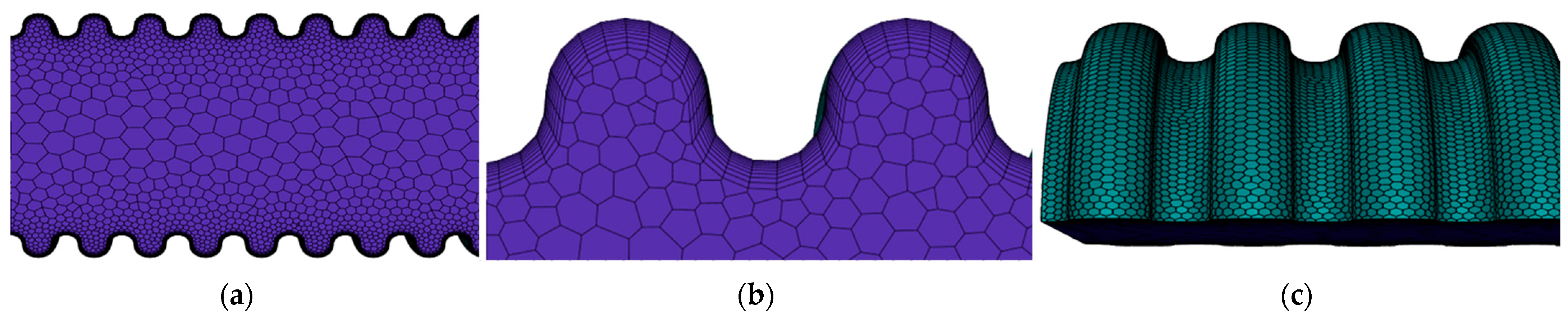
The computational domains are discretized using high-resolution polyhedral meshes to accurately represent the complex corrugated pipe geometries. Local mesh refinement is applied in the corrugation regions to resolve sharp velocity gradients, flow separation, and recirculation occurring near groove crests and valleys. This strategy ensures that groove-scale flow structures governing pressure losses are sufficiently captured.
Particular attention is devoted to the near-wall region, where viscous effects dominate pressure loss mechanisms. Inflation layers are applied along all solid boundaries, and the first cell height is determined based on the dimensionless wall distance
, defined as
where
is the friction velocity and
is the wall-normal distance [
8,
27]. For compatibility with the low-Reynolds-number formulation of the SST
–
model, a target value of
is adopted, such that the near-wall region is fully resolved without the use of wall functions [
21,
27].
The friction velocity is evaluated as
For all simulations, the near-wall mesh was designed to satisfy a target non-dimensional wall distance of
, consistent with the requirements of the SST
turbulence model. The wall shear stress used for estimating the first-layer thickness was initially approximated using classical empirical correlations for turbulent flow in smooth circular pipes solely for pre-processing; during the CFD computations, the wall shear stress distribution was fully resolved by the turbulence model. The resulting first-layer thickness values and near-wall resolution parameters are summarized in
Appendix A.1 (
Table A1).
At the pipe inlet, a velocity inlet boundary condition is imposed, with inlet velocities prescribed to cover the Reynolds number range
which corresponds to fully developed turbulent flow conditions commonly encountered in industrial piping and building-service applications [
3,
18]. For each simulation case, the inlet velocity is calculated using the Reynolds number definition given in Equation (3). Turbulence quantities at the inlet are specified using the empirical turbulence intensity relation
which is valid for fully developed turbulent internal flows and is used here solely for inlet specification. At the outlet, a pressure outlet boundary condition with zero-gauge pressure is applied, allowing the flow to develop naturally while minimizing artificial numerical constraints. All pipe walls are modeled as stationary no-slip boundaries,
The working fluid is defined as water with constant thermophysical properties, consistent with the experimental studies used for validation [
19,
20], as the present investigation focuses exclusively on hydrodynamic pressure losses under isothermal conditions.
The numerical simulations are performed using the finite volume method implemented in ANSYS (Ansys 2024 R1) Fluent under steady-state conditions [
23]. Pressure–velocity coupling is handled using the SIMPLE algorithm, and second-order discretization schemes are employed for the momentum, turbulence transport, and pressure equations to minimize numerical diffusion. Convergence is assumed when all scaled residuals fall below
and when monitored integral quantities, including pressure drop and friction factor, reach steady asymptotic values.
To ensure numerical reliability, the computational meshes were designed with sufficiently fine resolution to accurately capture near-wall gradients and groove-induced flow structures in corrugated pipe geometries. High-resolution polyhedral meshes were employed, with particular emphasis on near-wall refinement to satisfy a target non-dimensional wall distance of along the entire corrugated surface, in accordance with the requirements of the low-Reynolds-number formulation of the SST turbulence model.
The adequacy of the adopted mesh resolution is supported by the stability of the predicted pressure losses and friction factors across the investigated Reynolds number range, as well as by the close agreement obtained with classical smooth-pipe correlations and independent experimental data. In particular, the numerical framework reproduces experimental friction-factor trends reported by Ahn and Uslu and Popiel et al. within acceptable deviation limits, as demonstrated in
Section 2.4 and
Section 3.1. This level of agreement indicates that the adopted mesh resolution is appropriate for capturing the primary hydrodynamic quantities considered herein.
Periodic boundary conditions are intentionally not employed, since the primary objective is the direct evaluation of pressure losses and pumping power requirements in corrugated pipes. Instead, sufficiently long inlet–outlet computational domains are adopted to ensure hydrodynamically fully developed flow conditions. The influence of domain length on the numerical results is assessed through a sub-domain analysis, in which the pressure drop per unit length (
) is evaluated over multiple axial sub-sections of increasing length within the same computational solution, while excluding the inlet development region and the outlet-affected zone. The resulting
values exhibit negligible variation with increasing evaluation length, confirming that the reported results are independent of the computational domain length and representative of fully developed turbulent flow. Representative polyhedral mesh structures and detailed near-wall refinement characteristics are presented in
Appendix A.2 (
Figure A1 and
Figure A2) for completeness.
2.4. Validation of the Numerical Model
The validation strategy was designed to decouple numerical accuracy from geometric complexity by first establishing consistency with canonical smooth-pipe benchmarks before extending the same computational framework to fully resolved corrugated geometries. Turbulent flow in a smooth circular pipe provides a well-established reference case, as its friction-factor behavior is reliably described by classical empirical correlations over a wide range of Reynolds numbers [
8,
11].
The validation configuration consists of a smooth pipe with an inner diameter of mm and a length sufficient to ensure hydrodynamically fully developed turbulent flow. The same governing equations, SST turbulence model, near-wall resolution strategy, mesh topology, boundary conditions, and solver settings employed for the corrugated-pipe simulations are retained to ensure methodological consistency.
The pressure drop
obtained from the numerical simulations is used to calculate the Darcy friction factor according to
where
is the pipe length and
is the bulk mean velocity [
8,
11]. The validation is performed over the Reynolds-number range
which corresponds to fully turbulent flow conditions for smooth circular pipes.
For comparison, the CFD-predicted friction factors are evaluated against widely accepted smooth-pipe correlations. The Blasius correlation,
, is applicable to hydraulically smooth pipes in the range
. The Colebrook equation provides an implicit formulation incorporating relative roughness effects, while the Haaland equation offers an explicit approximation suitable for engineering calculations [
8,
11]. The reference friction-factor values used in the present comparison are provided in
Appendix A.3 (
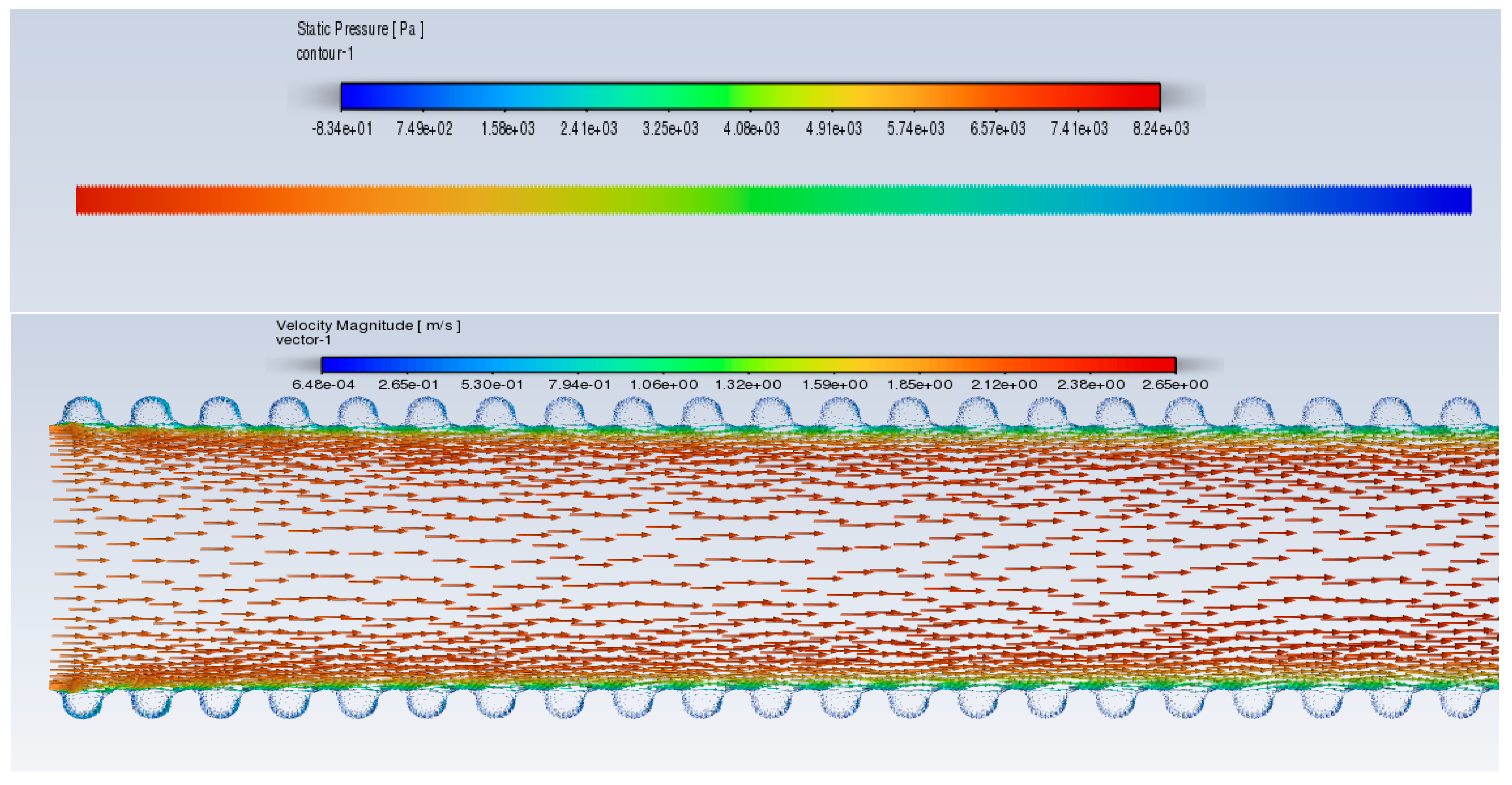
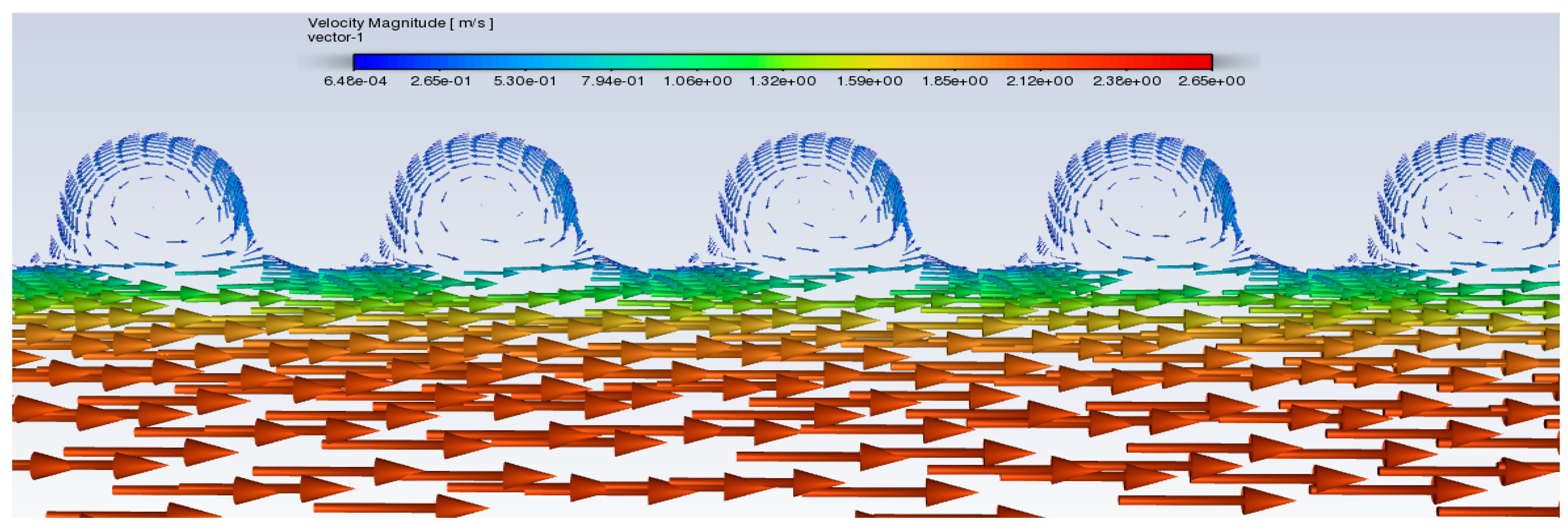
Table A2). The resolved velocity field and groove-scale vortex structures for the Ahn and Uslu configuration at Re = 50,000 are further illustrated in
Appendix A.4 (
Figure A3), confirming the capability of the numerical framework to capture the dominant flow features induced by the corrugation geometry.
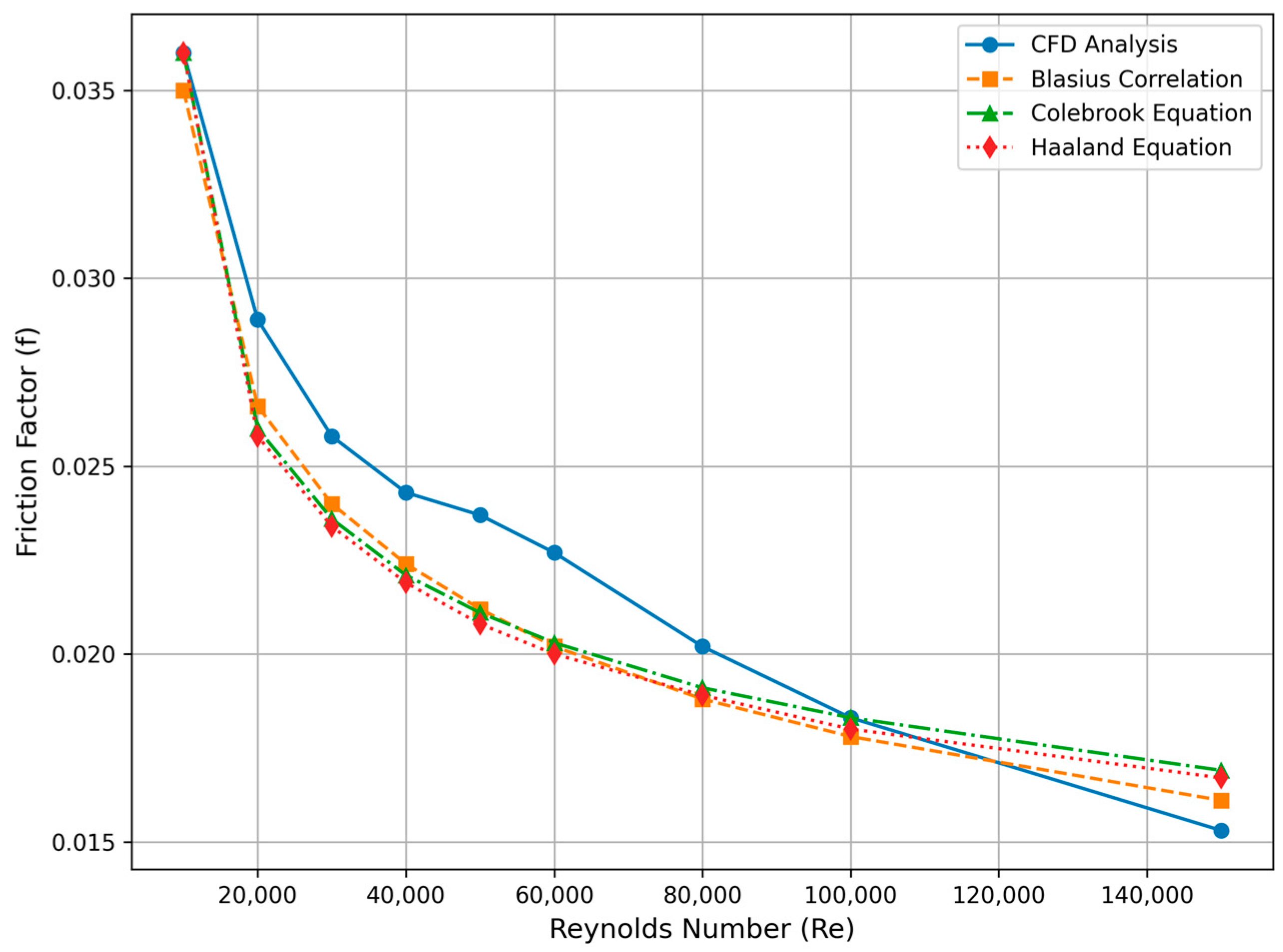
A quantitative comparison between the CFD-predicted friction factors and the Blasius, Colebrook, and Haaland correlations is presented in
Figure 2.
Figure 2 presents the quantitative comparison between the CFD predictions and the classical correlations. Across the investigated Reynolds-number range, the numerical results show good agreement with the reference formulations. The maximum deviation remains within approximately ±5%, with the closest correspondence observed at higher Reynolds numbers where turbulence is more fully developed. Minor deviations at intermediate Reynolds numbers are attributed to numerical discretization effects, finite computational domain length, and the simplifying assumptions inherent in empirical correlations, rather than to numerical instability.
The close correspondence between the CFD-predicted friction factors and the classical smooth-pipe correlations suggests that:
- (i)
the governing equations and turbulence model are consistently implemented,
- (ii)
the near-wall mesh resolution () is sufficient to resolve wall shear stresses without the use of wall functions, and
- (iii)
the discretization schemes and solver settings provide stable and grid-consistent solutions for smooth-pipe turbulent flow.
Within the framework of Reynolds-averaged turbulence modeling, these results provide confidence that the dominant physical characteristics of fully turbulent smooth-pipe flow are adequately captured. The maximum deviation between the CFD predictions and the empirical correlations remains within approximately ±5% across the investigated Reynolds-number range, with the closest agreement observed at higher Reynolds numbers where turbulence is more fully developed. Minor discrepancies at intermediate Reynolds numbers are attributed to numerical discretization effects, finite computational domain length, and the simplifying assumptions embedded in empirical correlations, rather than to numerical instability or insufficient near-wall resolution.
This smooth-pipe validation establishes a reliable numerical baseline before introducing the additional geometric complexity associated with corrugated pipe configurations. In corrugated geometries, analytical solutions are unavailable and experimental results reveal significantly more complex flow behavior governed by groove-induced separation, reattachment dynamics, vortex generation, and geometry-dependent turbulence production [
14,
18,
19]. While the discrepancies observed in corrugated-pipe simulations are therefore primarily driven by these physical mechanisms, it is acknowledged that Reynolds-averaged turbulence modeling inherently represents time-averaged flow behavior and may not fully resolve small-scale unsteady structures within individual corrugation cavities.
3. Results
3.1. Validation Against Experimental Data
The numerical framework was assessed against independent experimental friction-factor datasets to establish its predictive reliability prior to the diameter-dependent analysis presented in the following sections. Validation was conducted using two widely cited experimental studies: Ahn and Uslu [
18] and Popiel et al. [
19]. Together, these datasets cover a broad range of pipe diameters, corrugation geometries, and Reynolds numbers representative of turbulent internal flow in corrugated pipes.
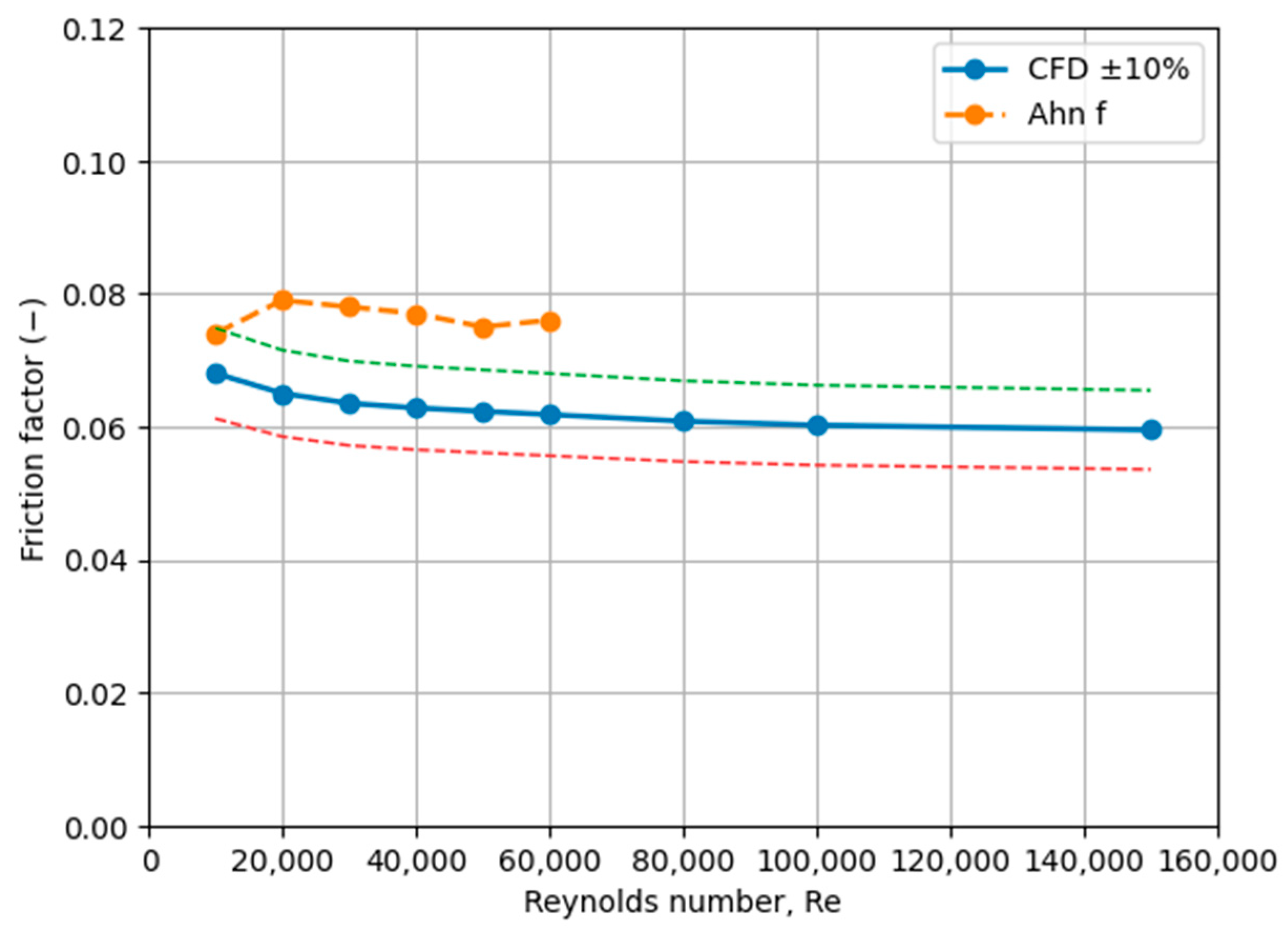
The primary validation was performed using the comprehensive dataset of Ahn and Uslu [
18], which reports friction-factor measurements for corrugated pipes with inner diameters of 20.4, 25.4, 34.5, and 40.5 mm over a Reynolds-number range of 10,000–150,000. In numerical simulations, the original geometric parameters documented in the experiments—including corrugation pitch and groove width—were preserved to ensure geometric consistency. Boundary conditions and flow properties were matched to the experimental conditions.
To quantify the agreement between numerical and experimental results, the relative deviation of the Darcy friction factor was defined as the absolute difference between CFD predictions and experimental values normalized by the corresponding experimental reference value. For each pipe diameter, the mean relative deviation was computed over the investigated Reynolds-number range, while the maximum deviation corresponds to the largest discrepancy observed within that range.
The resulting mean and maximum deviations are summarized in
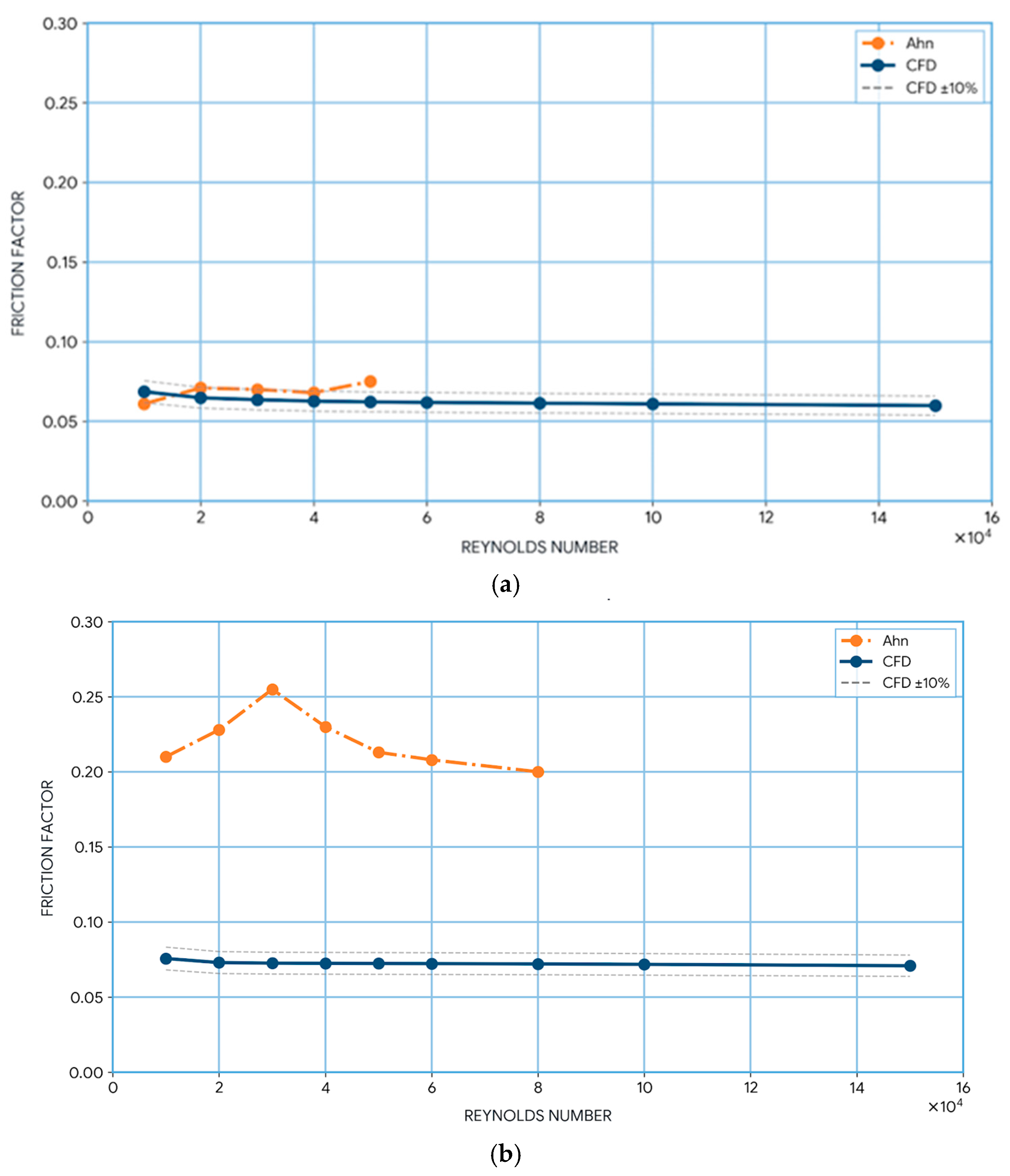
Table 2. As shown, the mean relative deviation remains within approximately 6–7% for all investigated diameters, while the maximum deviation does not exceed about 12% across the examined Reynolds-number range. Deviations are generally more pronounced at lower Reynolds numbers and decrease as the flow approaches fully developed turbulent conditions. Over most operating conditions, the numerical predictions remain within a ±10% deviation band relative to the experimental data. Given the complex separation and reattachment phenomena inherent to corrugated geometries, deviations of this magnitude are consistent with values commonly reported for Reynolds-averaged turbulence simulations of similar configurations.
Representative comparisons for the smallest and largest Ahn geometries (20.4 mm and 40.5 mm) are presented in
Figure 3a and
Figure 3b, respectively. The remaining validation plots and corresponding flow-field visualizations for the intermediate geometries are provided in
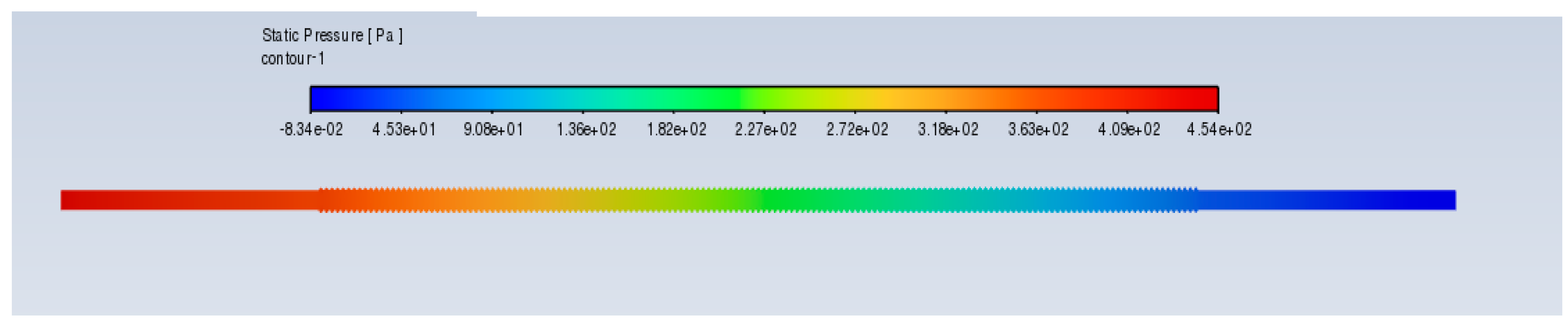
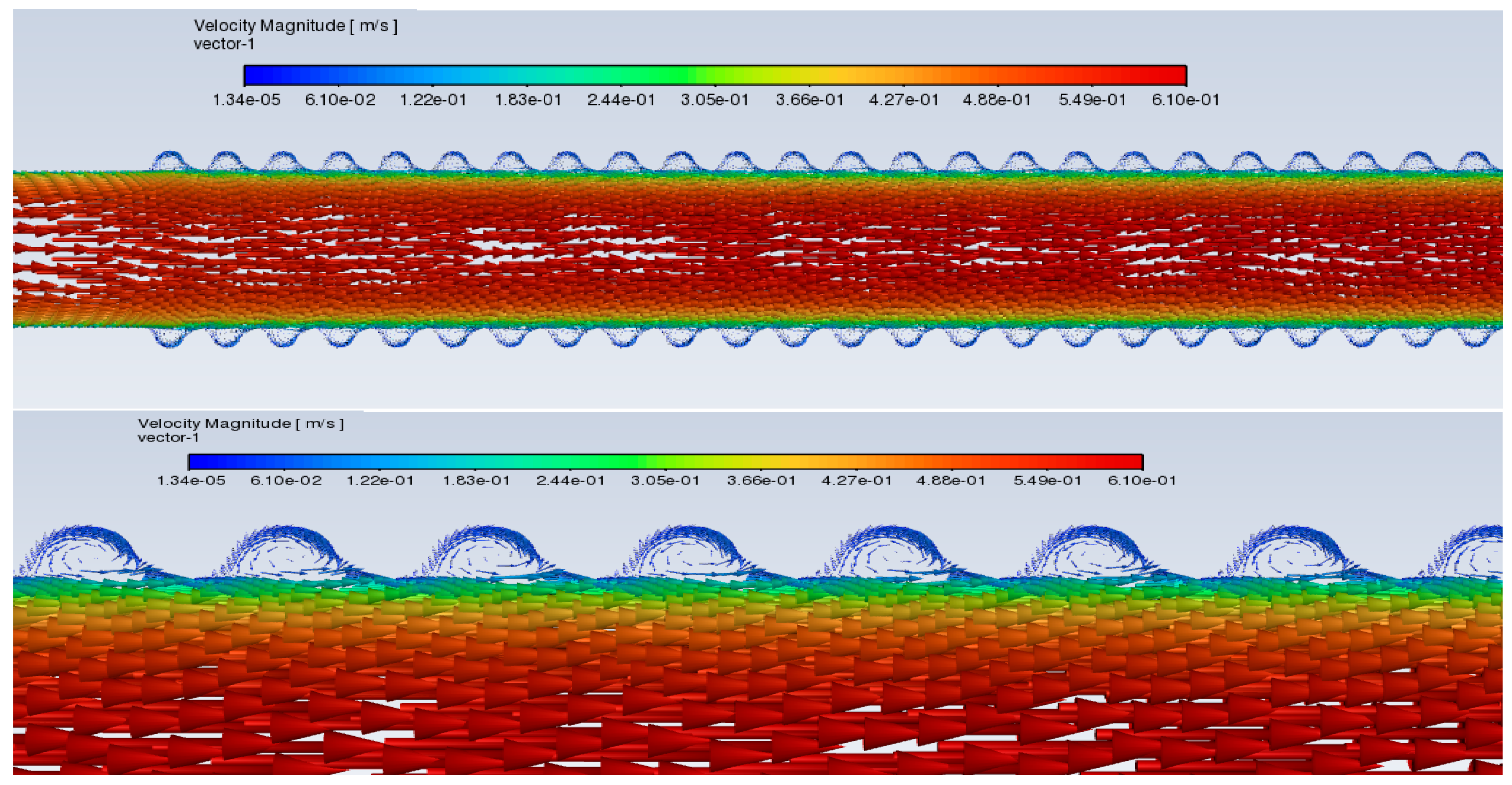
Appendix A.4 (
Figure A3 and
Figure A4).
To further assess the robustness and generality of the numerical framework, additional validation was performed using the dataset reported by Popiel et al. [
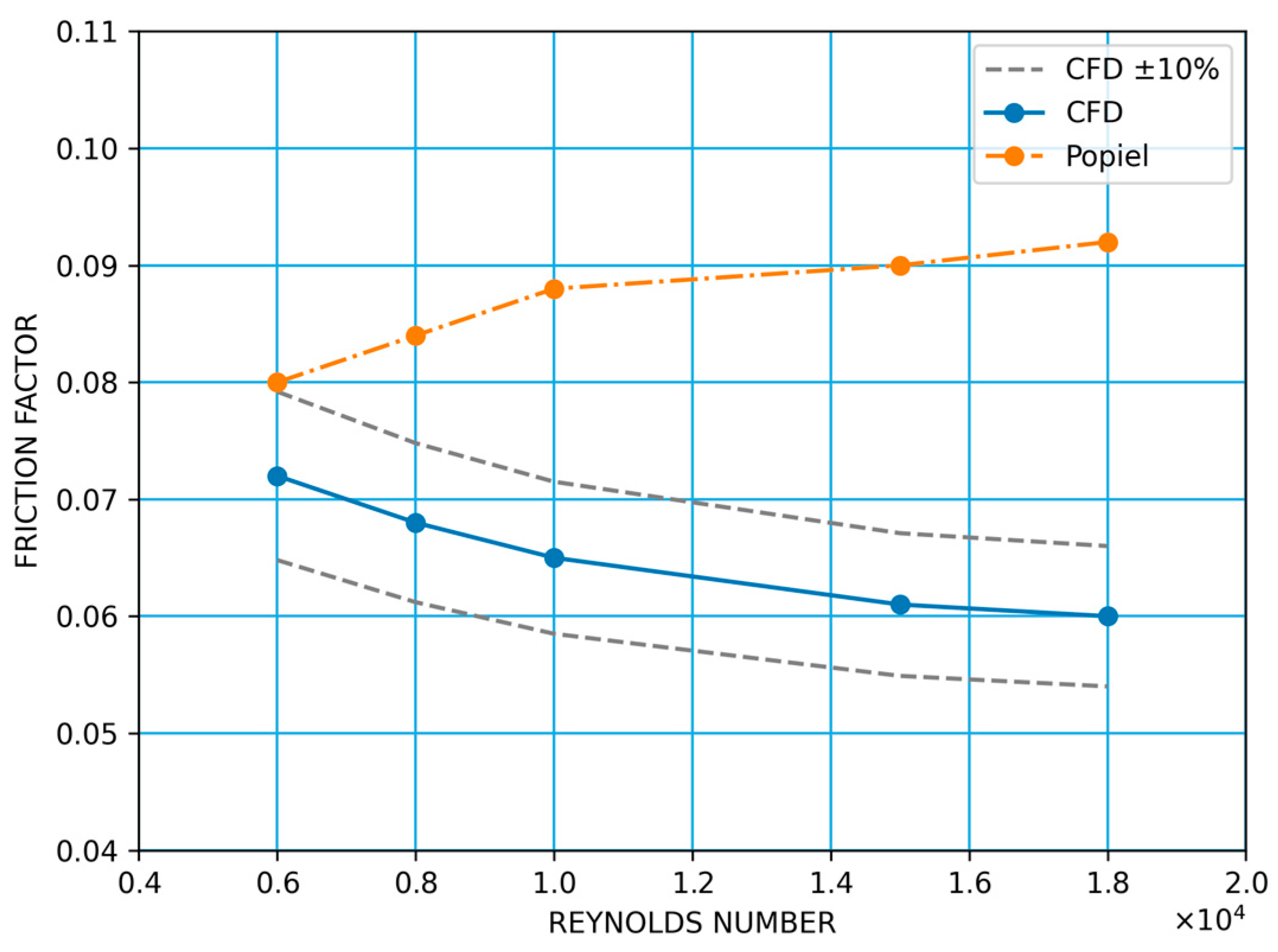
19], which covers smaller nominal diameters (DN10–DN25) and lower Reynolds numbers (approximately 3000–30,000). These cases extend the validation toward different geometric scales and partially transitional flow conditions. A representative comparison for the DN20 geometry is presented in
Figure 4, whereas the corresponding flow-field visualization for completeness is provided in
Appendix A.5 (
Figure A5).
Although the absolute deviation levels for the Popiel dataset are somewhat larger than those obtained for the Ahn and Uslu data, particularly at the lower end of the Reynolds-number range, the numerical model preserves the overall order of magnitude and captures the dominant trend of friction-factor variation within the investigated interval.
Taken together, the validation results based on the datasets of Ahn and Uslu [
18] and Popiel et al. [
19] indicate that the adopted numerical framework provides a consistent and quantitatively reliable representation of frictional behavior in corrugated pipes over a broad range of diameters and Reynolds numbers. This validated basis supports the systematic investigation of diameter-dependent friction trends presented in the following section.
3.2. Diameter-Dependent Friction Behavior
Building upon the validated numerical framework established in
Section 3.1, the variation of the Darcy friction factor with pipe diameter is examined under dynamically similar turbulent flow conditions. The objective is to isolate the influence of diameter scaling on frictional behavior while maintaining Reynolds-number similarity.
For all investigated corrugated geometries, the friction factor decreases with increasing Reynolds number, consistent with classical turbulent pipe-flow behavior. However, a clear and systematic diameter-dependent trend emerges at identical Reynolds numbers, larger-diameter corrugated pipes consistently exhibit higher friction factors than smaller-diameter pipes. This separation persists across the entire Reynolds number range considered and is observed for all simulated geometries.
To interpret this trend within the framework of geometric scaling, the principal geometric parameters and the associated relative corrugation depth ratios (e/D) for the Popiel and Ahn configurations are summarized in
Appendix B.1 and
Appendix B.2 (
Table A3 and
Table A4), respectively. As documented therein, the relative corrugation depth decreases with increasing pipe diameter. Under classical roughness-based scaling arguments, a reduction in relative roughness would be expected to reduce friction factors at larger diameters. The opposite trend observed in both experiments and simulations therefore indicates that equivalent roughness concepts alone are insufficient to explain the diameter-dependent friction behavior in corrugated pipes.
The persistence of this trend under Reynolds-number similarity conditions suggests that diameter scaling modifies the interaction between groove geometry and the bulk flow field. In corrugated pipes, flow separation, reattachment length, and vortex development are governed not only by local roughness amplitude but also by the spatial relationship between groove geometry and the overall pipe cross-section. As diameter increases, the relative spatial development of separated shear layers within the core region changes, altering turbulence production and momentum exchange mechanisms. Consequently, frictional similarity is not ensured solely by matching Reynolds numbers.
These observations demonstrate that pipe diameter acts as an additional governing parameter in corrugated turbulent flow. Reynolds-number similarity alone is therefore insufficient to guarantee frictional similarity, highlighting the importance of geometry–flow coupling effects beyond classical smooth-pipe scaling concepts.
3.3. Pumping Power Requirements and Energy Implications of Diameter-Dependent Friction
The diameter-dependent friction behavior identified in
Section 3.2 directly influences the pumping power requirements of corrugated piping systems. For incompressible internal flows, the pumping power required to overcome frictional losses is expressed as
where
denotes the pressure drop along the pipe and
is the volumetric flow rate.
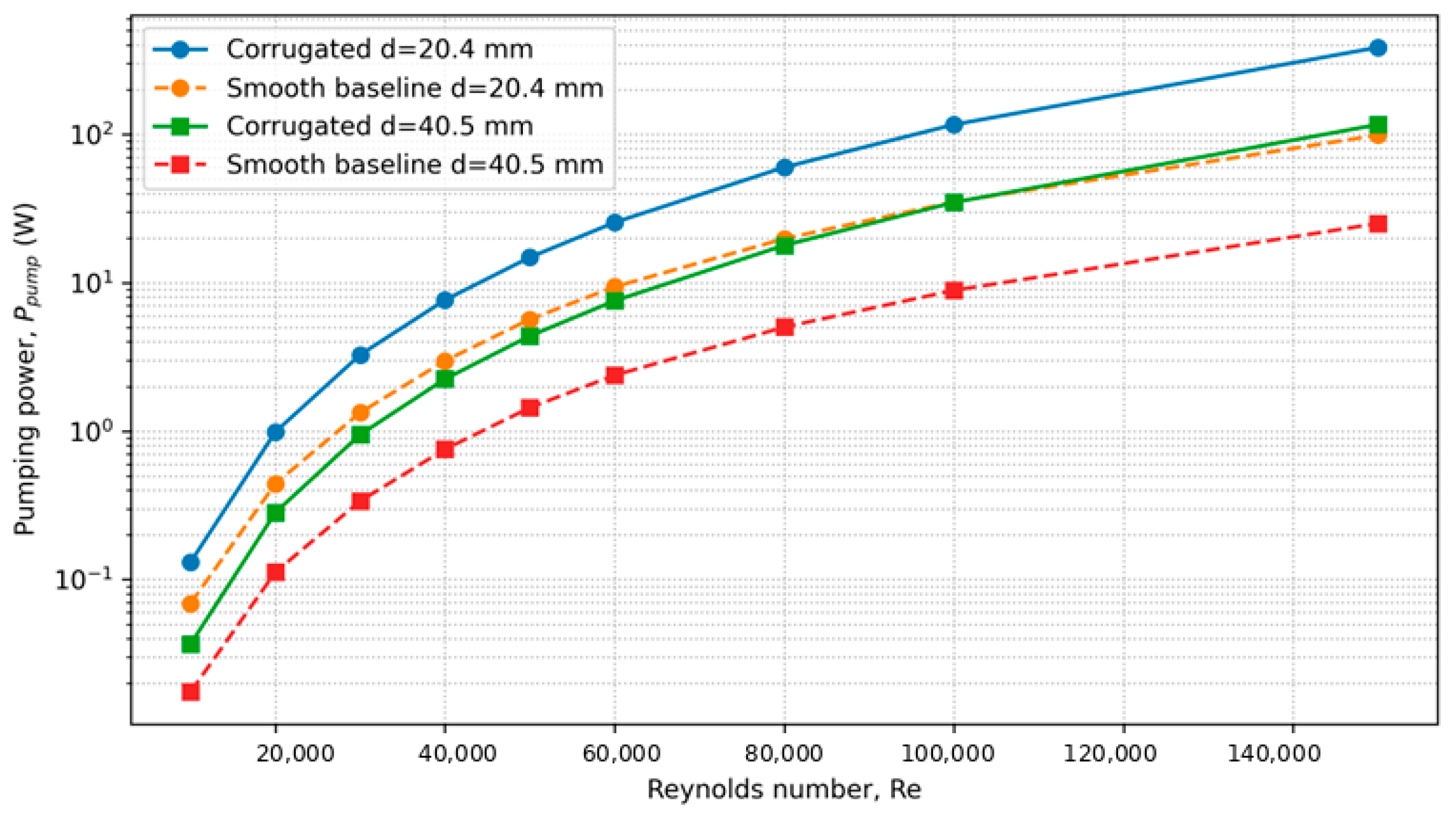
Using the pressure losses obtained from the CFD simulations, the pumping power was evaluated for corrugated pipes of different inner diameters operating under dynamically similar Reynolds-number conditions. The variation of pumping power with Reynolds number is presented in
Figure 5 for representative diameters of 20.4 mm and 40.5 mm, including smooth-pipe baselines.
For all investigated cases, pumping power increases monotonically with Reynolds number. More importantly, at fixed Reynolds numbers, larger-diameter corrugated pipes consistently require higher pumping power than smaller-diameter pipes. This systematic separation mirrors the diameter-dependent friction behavior discussed in
Section 3.2 and confirms that diameter scaling has direct energetic consequences.
Across the investigated parameter range, corrugated pipes exhibit significantly higher pumping power requirements than smooth pipes operating under identical Reynolds-number and diameter conditions. The separation between smooth and corrugated configurations becomes increasingly pronounced at higher Reynolds numbers, indicating that corrugation-induced dissipation intensifies with increasing flow inertia.
These results demonstrate that Reynolds-number similarity does not ensure energetic similarity in corrugated pipes. When the frictional amplification associated with diameter scaling is combined with the volumetric flow rate required to maintain dynamic similarity, the resulting pumping power demand grows disproportionately. This energy-based interpretation reinforces the conclusion that pipe diameter acts as an independent governing parameter in corrugated turbulent flow systems.
Building upon this physically grounded interpretation, a compact predictive formulation is introduced in the following section to represent the diameter-dependent energy penalty within the validated parameter space. While the CFD analysis provides detailed insight into the flow–geometry interaction mechanisms, a surrogate correlation enables practical estimation of pumping penalties without the need for repeated high-resolution simulations.
3.4. Surrogate Correlation for the Energy Penalty Factor
The results of the energy-based analysis provide the foundation for constructing a surrogate correlation for the Energy Penalty Factor (EPF), enabling rapid, CFD-free performance estimation. Consistent with prior CFD-based correlation development for corrugated heat exchanger geometries [
28,
29], a simplified yet physically grounded predictive formulation is proposed.
While detailed CFD simulations offer valuable insight into the underlying flow physics and diameter-dependent friction behavior, their routine use in engineering design and system-level optimization is often impractical due to computational cost, particularly when extensive parametric analyses are required. Therefore, a simplified correlation suitable for preliminary design and performance assessment is introduced.
The EPF is defined as
where the smooth-pipe friction factor is evaluated under identical Reynolds-number and diameter conditions using conventional turbulent-flow correlations. By normalizing pressure losses with respect to a smooth-pipe baseline, the EPF isolates the additional energetic cost associated with corrugation geometry and pipe diameter.
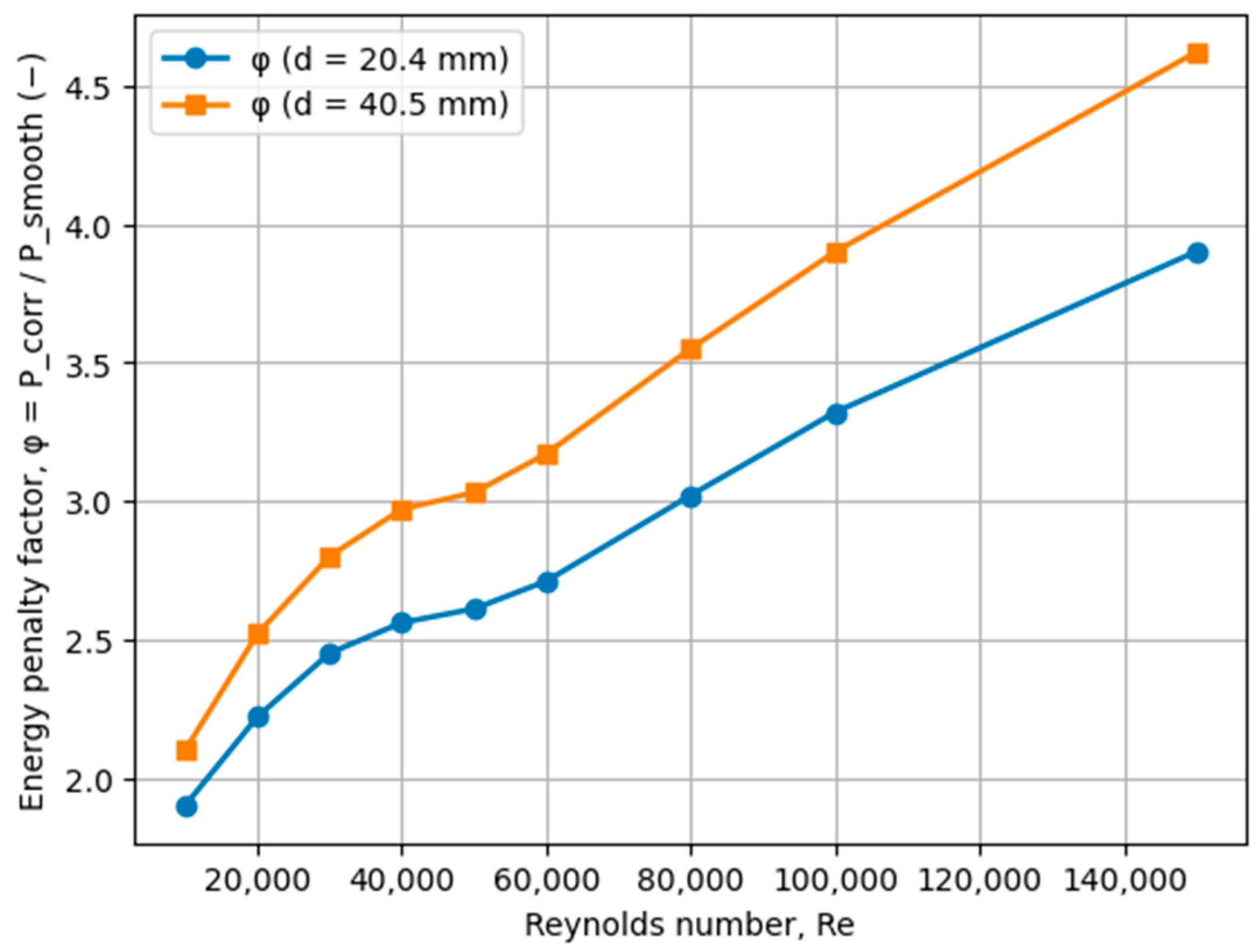
The variation of EPF with Reynolds number for representative pipe diameters is shown in
Figure 6. For all investigated geometries, EPF increases monotonically with Reynolds number. In addition, larger-diameter pipes consistently exhibit higher EPF values at identical Reynolds numbers. This behavior reflects the cumulative influence of diameter scaling on groove-induced separation intensity and associated energy dissipation.
Based on dimensional considerations and the CFD dataset obtained in this study, EPF was correlated as a function of Reynolds number and two dimensionless geometric parameters: the relative corrugation depth
and the pitch-to-depth ratio
. Applying logarithmic least-squares regression to the numerical database, the following correlation was obtained:
where the prefactor (0.1755) and the exponents of
,
, and
were obtained via logarithmic least-squares fitting of the numerical dataset over the Reynolds number range
All regression coefficients were derived directly from the CFD dataset. The fitted exponents exhibit physically consistent trends. The positive Reynolds-number exponent indicates that increasing turbulence intensity enhances the energetic penalty induced by corrugations. The negative exponent of
arises from the normalization inherent in the EPF definition, reflecting the relative scaling between corrugated and smooth-pipe friction behavior. The positive exponent of
suggests that more widely spaced corrugations promote stronger energy penalties by allowing separated shear layers to persist over longer axial distances before reattachment.
The correlation was calibrated using 56 CFD data points corresponding to multiple corrugated pipe geometries and Reynolds numbers. Within this parameter space, the coefficient of determination is . The mean absolute percentage error is approximately 3.6%, while the maximum deviation remains below 11% across the validated range.
Its validated applicability range is:
mm
An additional qualitative consistency check was performed using pressure-drop measurements from a commercially available corrugated stainless steel flexible pipe (CSST) configuration not included in the regression dataset. Although detailed measurement data cannot be disclosed due to industrial confidentiality constraints, the predicted EPF values remained within the experimental uncertainty band of the available measurements, supporting the robustness of the proposed formulation beyond the regression dataset.
Predictions outside the validated parameter ranges may involve increased uncertainty; therefore, caution is advised when extrapolating beyond the tested conditions. Within the investigated ranges, however, the surrogate model provides a practical and computationally efficient alternative to detailed three-dimensional CFD simulations for estimating corrugation-induced pumping penalties, particularly during preliminary design evaluations and comparative engineering assessments.
4. Discussion
The present study provides a combined numerical and energy-based assessment of turbulent flow in corrugated pipes, with particular emphasis on the experimentally reported diameter-dependent friction behavior. In smooth circular pipes, Reynolds-number similarity generally ensures dynamically similar flow structures and diameter-independent friction characteristics. Corrugated geometries, however, introduce strong flow–geometry interactions that modify this classical scaling behavior.
The CFD results are consistent with the experimental observations of Ahn and Uslu and Popiel et al., confirming that the friction factor increases systematically with pipe diameter at identical Reynolds numbers. This trend cannot be explained solely through classical relative roughness arguments, since the corrugation depth-to-diameter ratio decreases with increasing diameter for the geometries considered. Similar limitations of equivalent roughness formulations for grooved and corrugated surfaces have been reported in hydraulic resistance compilations and detailed flow analyses [
14,
30], indicating that roughness amplitude alone is insufficient to describe the scaling behavior of periodically corrugated walls.
From a physical perspective, the present simulations indicate that diameter scaling modifies the development and persistence of groove-induced separation and reattachment processes. In larger-diameter pipes, separated shear layers extend further into the core region and reattach over longer axial distances, promoting sustained turbulence production and enhanced momentum exchange between the near-wall region and the bulk flow. Comparable separation-dominated loss mechanisms have been identified in experimental and numerical studies on corrugated and grooved channels, where deviations from smooth-pipe scaling were observed despite similar Reynolds numbers [
14,
31,
32].
The observation that Reynolds-number similarity alone does not ensure frictional similarity in corrugated pipes is further supported by recent geometry-resolved numerical investigations. Studies by Stel et al. and Alhamid et al. demonstrated that variations in corrugation geometry and channel scale significantly influence turbulence structure and pressure losses even under nominally similar Reynolds-number conditions [
14,
32]. The present results extend these findings by systematically isolating pipe diameter as an independent governing parameter through simulations conducted at fixed Reynolds numbers.
When these hydrodynamic results are interpreted from an energy perspective, the practical implications become more pronounced. Because pumping power is proportional to the product of pressure drop and volumetric flow rate, moderate increases in friction factor can translate into substantially higher energy requirements. At fixed Reynolds numbers, larger-diameter corrugated pipes require higher bulk velocities to maintain dynamic similarity, and when combined with diameter-dependent friction amplification, this results in a compounded increase in pumping power demand. Similar geometry-scaling effects on pressure loss and energy consumption have been reported in experimental studies on corrugated channels and ducts [
33].
The introduction of the Energy Penalty Factor (EPF) provides a normalized and physically interpretable metric to quantify this behavior relative to a smooth-pipe baseline. By normalizing pressure losses under dynamically similar conditions, the EPF isolates the energetic contribution of corrugation geometry and pipe diameter. Recent numerical comparisons of turbulence modeling strategies for corrugated pipes have emphasized the importance of geometry-resolved simulations in predicting such performance metrics [
29]. The present findings are consistent with these observations and suggest that design approaches relying solely on smooth-pipe correlations may underestimate pumping power requirements in corrugated piping systems.
From an engineering design standpoint, the results highlight important limitations of intuition derived from smooth-pipe theory. In corrugated systems, increasing pipe diameter does not necessarily reduce energy consumption, and assumptions based purely on Reynolds-number similarity may lead to non-conservative estimates of operating costs. Instead, geometry-sensitive analysis and energy-based performance metrics are advisable when corrugated pipes are employed in HVAC, building services, and industrial fluid transport applications.
Several limitations should be acknowledged. The simulations are based on Reynolds-averaged turbulence modeling, which captures mean-flow behavior but does not resolve unsteady vortex dynamics within individual grooves. In addition, the investigated geometries are limited to axisymmetric transverse corrugation profiles reported in the literature. Supplementary simulations performed for a commercially available corrugated stainless steel flexible pipe (CSST), summarized in
Appendix B.3, indicate that the identified diameter-dependent friction and energy-penalty trends persist for industrially relevant geometries, although publicly available experimental datasets for these configurations remain limited.
Overall, the present study demonstrates that pipe diameter acts as an independent parameter influencing hydraulic losses and pumping power requirements in corrugated pipes. The integration of CFD-based flow analysis with energy-oriented performance metrics provides a consistent and practically applicable framework for interpreting and evaluating corrugated piping systems within the investigated parameter range.
5. Conclusions
This study presented a CFD-based investigation of turbulent flow and pressure losses in corrugated stainless-steel pipes, with emphasis on the experimentally observed diameter-dependent friction behavior induced by periodic wall corrugations.
The numerical results confirm that Reynolds-number similarity alone does not ensure diameter-independent friction characteristics in corrugated geometries. Within the investigated parameter range, the friction factor increases systematically with pipe diameter at identical Reynolds numbers. This behavior is associated with diameter-dependent modifications in groove-induced separation, reattachment length, and turbulence production mechanisms, which alter the classical smooth-pipe scaling framework.
From an energy perspective, the identified friction trends translate directly into increased pumping power requirements. Because pumping power depends on both pressure drop and volumetric flow rate, the combination of diameter-dependent friction amplification and dynamic similarity constraints leads to a compounded increase in energy demand. Within the examined Reynolds-number and diameter ranges, corrugated pipes require substantially higher pumping power than smooth pipes operating under dynamically similar conditions, and the magnitude of this energy penalty increases consistently with both Reynolds number and pipe diameter.
To support practical engineering applications, an Energy Penalty Factor (EPF) was introduced as a normalized metric to quantify corrugation-induced energetic effects relative to a smooth-pipe baseline. A surrogate correlation derived from the CFD dataset relates EPF to Reynolds number and key dimensionless geometric parameters, providing a statistically consistent representation of the dominant scaling trends within the validated parameter space. Supplementary qualitative consistency checks using industrial CSST configurations indicate that the identified diameter-dependent behavior persists for commercially relevant geometries.
Overall, the findings demonstrate that pipe diameter acts as an independent governing parameter influencing hydraulic losses and pumping power requirements in corrugated turbulent flow systems. The combined CFD-based analysis and surrogate modeling framework provide a coherent and computationally efficient basis for preliminary design evaluation and comparative energy assessment of corrugated piping systems within the investigated ranges.
Future research may extend the analysis to broader corrugation geometries, incorporate targeted experimental validation, and examine coupled heat-transfer or transient operating conditions to further assess the generality of the proposed energy-based framework.