Article

A Study of Sensitive Fault Detection for Lithium-Ion Batteries Being Recharged Using Support Vector Machine Classifier and Receiver Operating Characteristics


by
Seçkin Açıcı
* and
Abdulhakim Karakaya
Department of Energy System Engineering, Faculty of Technology, Kocaeli University, Izmit 41001, Türkiye
*
Author to whom correspondence should be addressed.
Appl. Sci. 2026, 16(4), 2059; https://doi.org/10.3390/app16042059
Submission received: 30 December 2025 / Revised: 4 February 2026 / Accepted: 13 February 2026 / Published: 19 February 2026

Abstract

Several installations equipped with lithium-ion batteries may require additional precautions. While lithium-ion batteries offer good performance relative to other rechargeable batteries, their state of health should be monitored. Faulty lithium-ion batteries may be vulnerable to thermal runaway or explosion. Early detection of those vulnerabilities can be done accurately by using an effective charging-anomaly detection method. In this paper, a binary support vector machine classification method was used to detect faulty lithium-ion batteries that are being recharged with constant voltage. The support vector machine algorithm was trained on battery data acquired after the recharging was finished. The battery data consisted of temperature, voltage, and varying recharging current measured inside the lithium-ion battery. Estimation losses, sensitivity, and receiver operating characteristic curves were computed and presented after training and testing the algorithm. Class labels and classifier’s generalization performance information were also displayed. An estimation loss of 7% was found at the end of this research.

1. Introduction

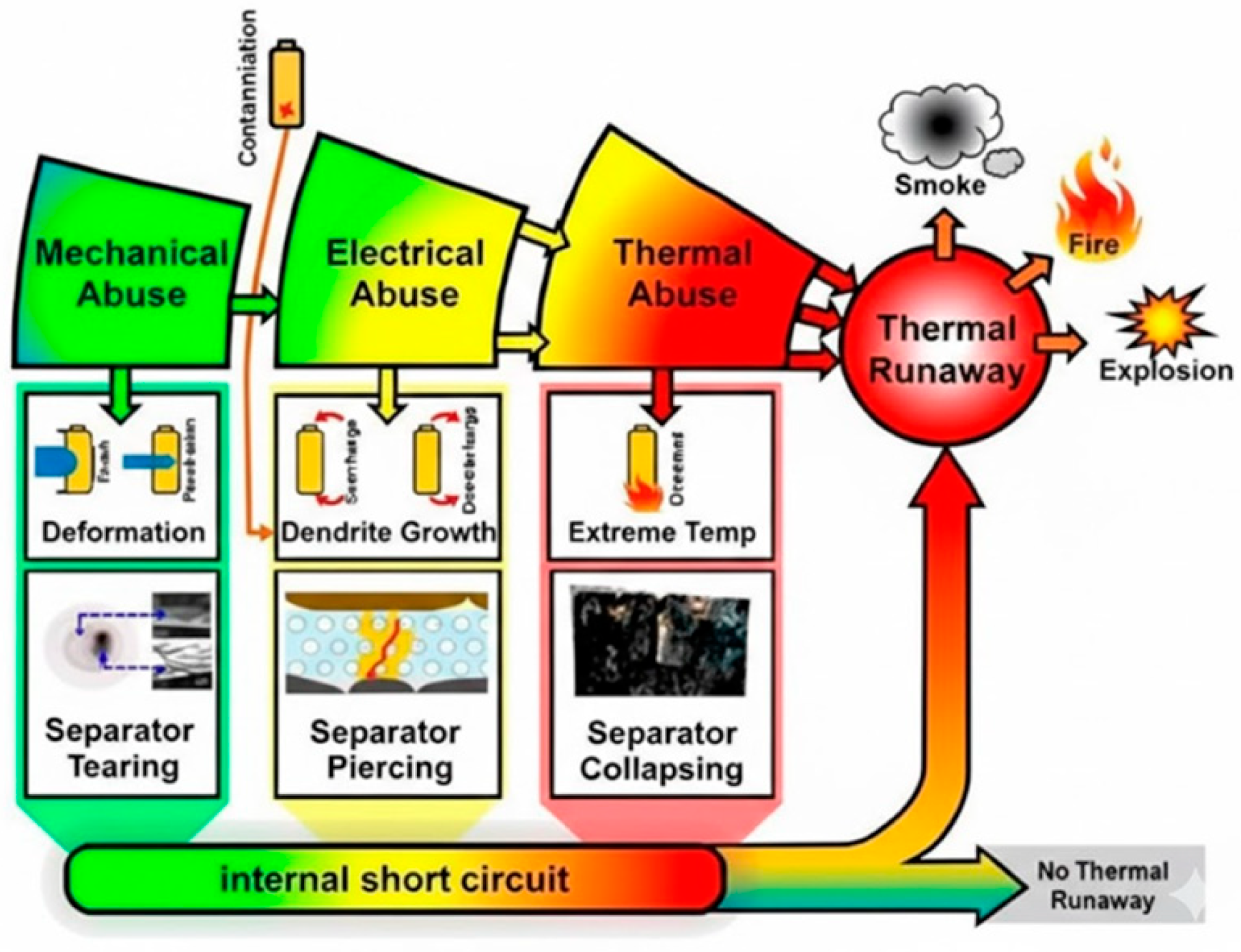
Lithium-ion batteries are well-known for their high power output. For this reason, they are more common in EVs. Most household applications also benefit from lithium-ion batteries today. Their cell voltage gives them an advantage over NiMH batteries, which have a nominal voltage of 1.2 V. Lithium-ion batteries have nominal voltages between 3.2 and 3.8 V, and they usually have higher output than NiMH and lead-acid batteries. Even though other rechargeable batteries and supercapacitors may become common in the near future, lithium-ion batteries are expected to have the largest market share in the 2030s [1]. While lithium-ion batteries offer better performance than NiMH batteries, their resistance to overcharge is lower, and they are more sensitive to extreme temperatures. Overcharging lithium-ion batteries causes faults. Those faults eventually degrade the electrolyte separator. If this damage is not detected, batteries will eventually experience short circuits or flammable gas leaks. Some batteries may become swollen and damage the surrounding parts. Battery faults may lead to inefficient energy storage or thermal runaway if they are not detected [2]. Additionally, if the internal resistance of the battery rises excessively, it should be detected and the battery should be replaced as soon as possible. In the event of a battery explosion resulting from high internal resistance, uncontrolled fires may occur. Lithium-ion battery explosions may be more severe in hybrid cars, because the temperature can rise to 1000 °C [3]. Some EVs have sustained considerable damage from battery fires in recent years. Figure 1 shows the possible causes of external and internal battery faults [4].
Numerous recent studies have investigated the detection of faults in lithium-ion batteries. On the other hand, these papers do not consider varying recharging-current characteristics, which may be needed for battery charging management and early fault detection. Some studies include only one type of lithium-ion battery anomaly. Furthermore, detailed accuracy information, such as classifier sensitivity and confidence measures, is not reported in most papers for assessing the reliability of the results. Sun et al. (2022) detected voltage faults in electric vehicles [5]. Samantha et al. reviewed data-driven methods for detecting lithium-ion battery faults in 2021 [6]. Radial basis neural networks and wavelet analysis were applied to electric-vehicle batteries by Zhao et al. in 2023 [7]. Xiong et al. reviewed short-circuit faults for lithium-ion batteries in 2020 [8]. Djelamda and Bouchareb used a pattern-recognition neural network in 2021 [9]. In this study, the accuracy appears uncertain. Wang et al. used a radial basis function neural network, achieving a detection accuracy of 100% in this study [10]. The parameters consisted of battery pack temperature, discharge current, and minimum voltage. Yang et al. used Bayesian optimization for EV batteries in 2022 [11]. Moebes proposed using logistic regression to detect lithium-ion cell faults in 2011 [12]. Wu et al. reviewed fault mechanisms and diagnostics in lithium-ion batteries; however, this review focused primarily on aging mechanisms [13]. Internal short-circuit detection was studied by Naha et al. in 2020 [14]. Although this study reports an overall accuracy of 97%, detection is limited to short-circuit faults. Schmid and Endisch investigated short-circuit diagnosis for lithium-ion batteries in 2022 [15]. Nevertheless, this diagnosis is valid for series-connected batteries. Extended Kalman filters were also used by Sidhu et al. to detect lithium-ion battery faults in 2015 [16]. This method was successful, but it required accurate nonlinear battery modelling. In 2016, Feng et al. studied short-circuit detection in lithium-ion batteries using electrochemical battery modelling [17]. Zhao et al. reviewed laboratory- and large-scale applications in EV battery fault diagnosis [18]. Liu et al. studied short-circuit, connection, and sensor faults in lithium-ion battery packs through statistical analysis [19]. Mitra and Mukhopadhyay studied lithium-ion battery pack fault diagnosis and isolation of multiple fault types [20]. Nie et al. used multi-feature clustering and unsupervised scoring for early fault detection and a warning system in electric vehicles [21]. Shen et al. researched concurrent battery faults in lithium-ion battery packs in 2024 [22]. Maher et al. reviewed advanced data-driven fault diagnosis methods in 2024. This study also highlighted the role of battery management systems [23]. Chatterjee et al. used a Kalman filter and support vector machines (SVMs) in 2023. This study required complex modelling. In addition to this, accuracy and scoring information seem to be missing [24]. In 2023, Yuan et al. investigated internal short-circuit detection to improve diagnostic speed [25]. A Kalman filter was proposed by [26]. in 2023 to detect internal short circuits (ISCs). However, this study also required accurate thermal modelling, in addition to battery modelling with ISC [26]. In 2023, a study was conducted on early warning systems for lithium-ion batteries by combining two classification algorithms. The sensitivity and precision scores for the classifier were found to be 0.95 and 0.91, respectively [27]. A generative adversarial network was proposed for battery fault detection in 2025. The sensitivity score was found to be 0.97, and the area under receiver operating characteristic (ROC) curve was 0.99 [28]. In a study conducted in 2024, an Extended Kalman Filter was used for fault diagnosis [29]. Gu et al. investigated short-circuit fault detection in ship batteries in 2024. The study used voltage variance analysis [30].
This paper contributes to accurate and reliable detection of recharging faults in lithium-ion batteries with different nominal voltages by using real-world data and charging-current characteristics to train and test support vector machines. Those parameters were included in the training dataset. A support vector machine (SVM) partition model was trained on this dataset using nine predictors. Ten additional observations were reserved to evaluate the classifier’s prediction performance. Finally, receiver operating characteristic (ROC) curves were plotted to assess the accuracy and sensitivity of the SVM classifier. Prediction scores were calculated to determine the confidence degree of the classifier.

2. Materials and Methods

The charging rate of a faultless lithium-ion battery is initially high when recharged with a constant voltage. After some time, the charging current and charging rate decrease, and typically, the terminal voltage reaches 4–4.5 V when the battery is fully charged.
In this paper, the temperature data were also used to improve fault detection. If the resistance of the battery does not increase or decrease dramatically, the temperature change (ΔT) is approximately 1–2 °C. In this study, only a few temperature changes in fault-free batteries exceeded 2 °C.
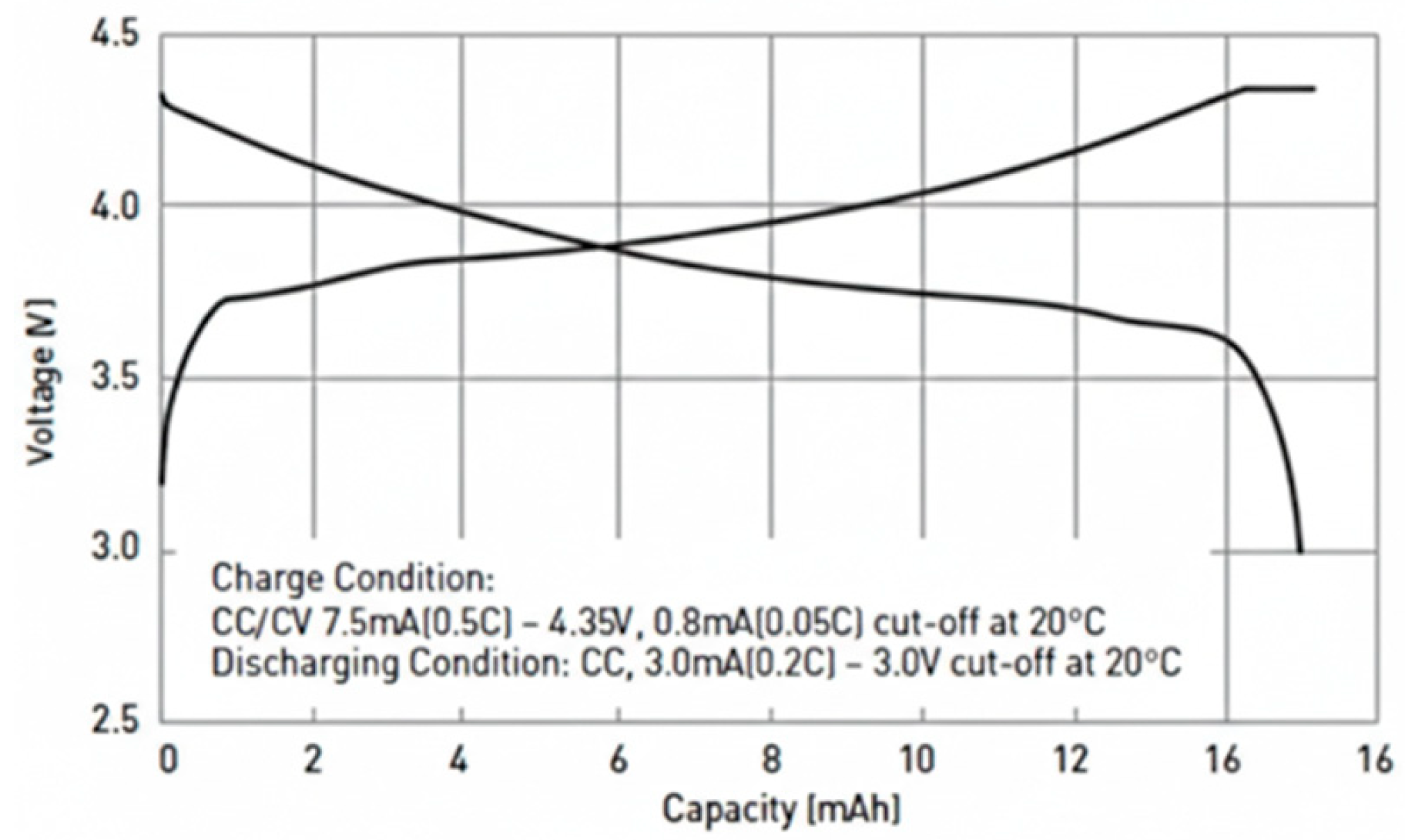
The charging and discharging characteristics of the lithium-ion battery may be provided in the manufacturer’s catalogue. One example is shown in Figure 2 [31].
The charging curve of an example of a fault-free battery shows that the cut-off voltage is approximately 3 V and the maximum terminal voltage is approximately 4.35 V at 20 °C. Cut-off voltages may be lower or higher for some faulty batteries.
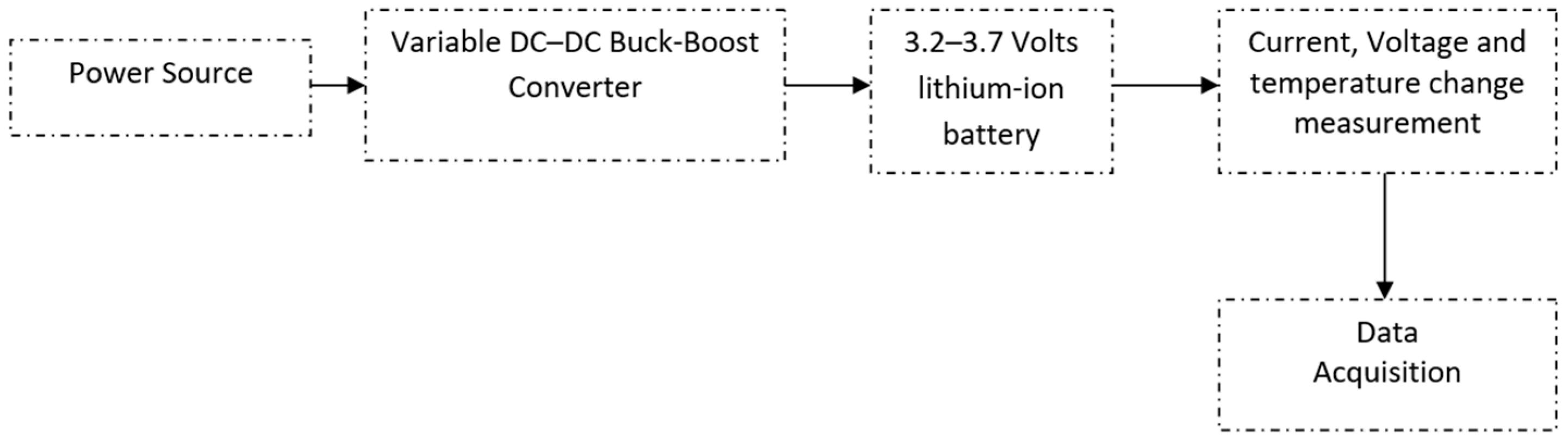
In this paper, fully discharged lithium-ion batteries were recharged for 3 min, and charging currents were measured every 35 s during charging. The first measurement of the charging current was taken at the beginning of recharging. The classifier began running after recharging was completed. The average duration for the detections was 3 to 4 min. Cut-off voltages (Vcut-off) were also measured when the battery was fully discharged. An example of changes in voltage and temperature observed in this study is shown in Table 1. The diagram of the measurement procedure is shown in Figure 3. The initial temperature of all batteries during the observations was 20–27 °C. The initial temperature of the battery was measured at the start of recharging. The nominal voltages of the batteries in our study were 3.6 or 3.7 volts.
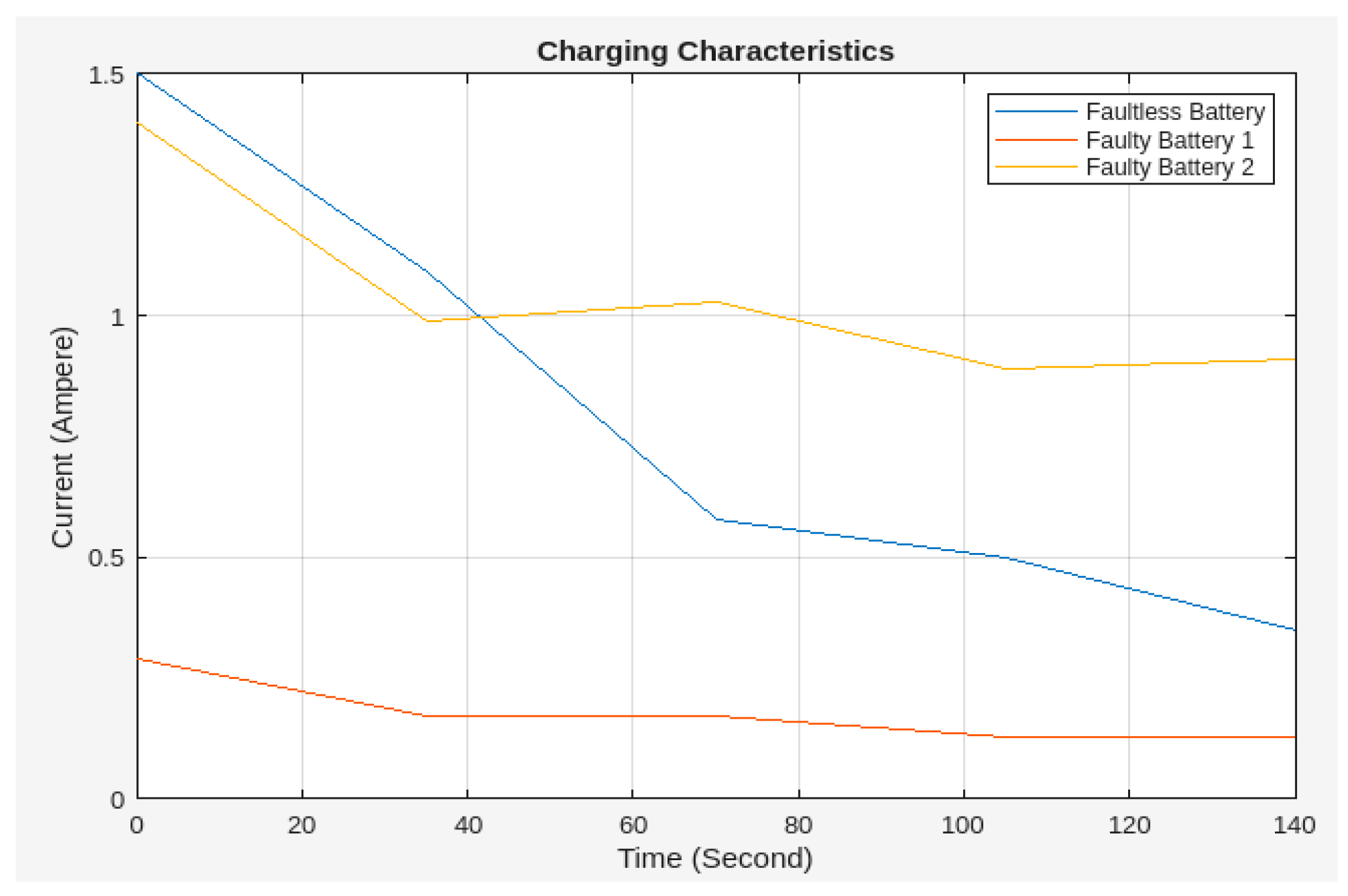
After the DC–DC converter output voltage was set to 4–4.5 V, battery voltages, battery temperature, and charging currents were measured. The power-source voltage remained constant during recharging of the lithium-ion batteries. Three batteries were fault-free, while the other two exhibited different types of faults. A total of 30% of the 100 observations were assigned to the test set and 70% to the training set for the SVM partition model. Five samples of battery charging currents, three battery voltages, and temperature-change measurements (ΔT) were taken in total, and a binary SVM partition model was trained with nine predictors. One example of the change in the faultless battery currents is shown in Figure 4. Figure 4 also presents examples of current changes in the faulty batteries that differ from those in the faultless batteries. Faulty batteries often exhibit atypical charging-current characteristics. All the battery faults occurred under real-world conditions. Finally, it experienced an internal short circuit. One of the batteries was reverse-polarized, and it exhibited separator damage, which also led to a short circuit. The other battery was externally short-circuited by having contact with a conductor under no load. As a result, all of the faulty batteries lost more than 90% of their nominal capacity. The short-circuited battery had a cut-off voltage of approximately 3.5 volts. The cut-off voltage of the other faulty lithium-ion battery changed to approximately 2.0 V after damage.
In this study, 58% of our 100 observations are from faulty batteries. The remaining observations correspond to fault-free batteries. Five batteries were used for training and testing the classifier.
The SVM algorithm was trained to classify batteries as faulty or faultless, and the classification loss was calculated using the function in Equation (1) [32]
L = j = 1 n w j       c y j y j
yj represents the true class and y’j is the observed class. L represents classification loss.
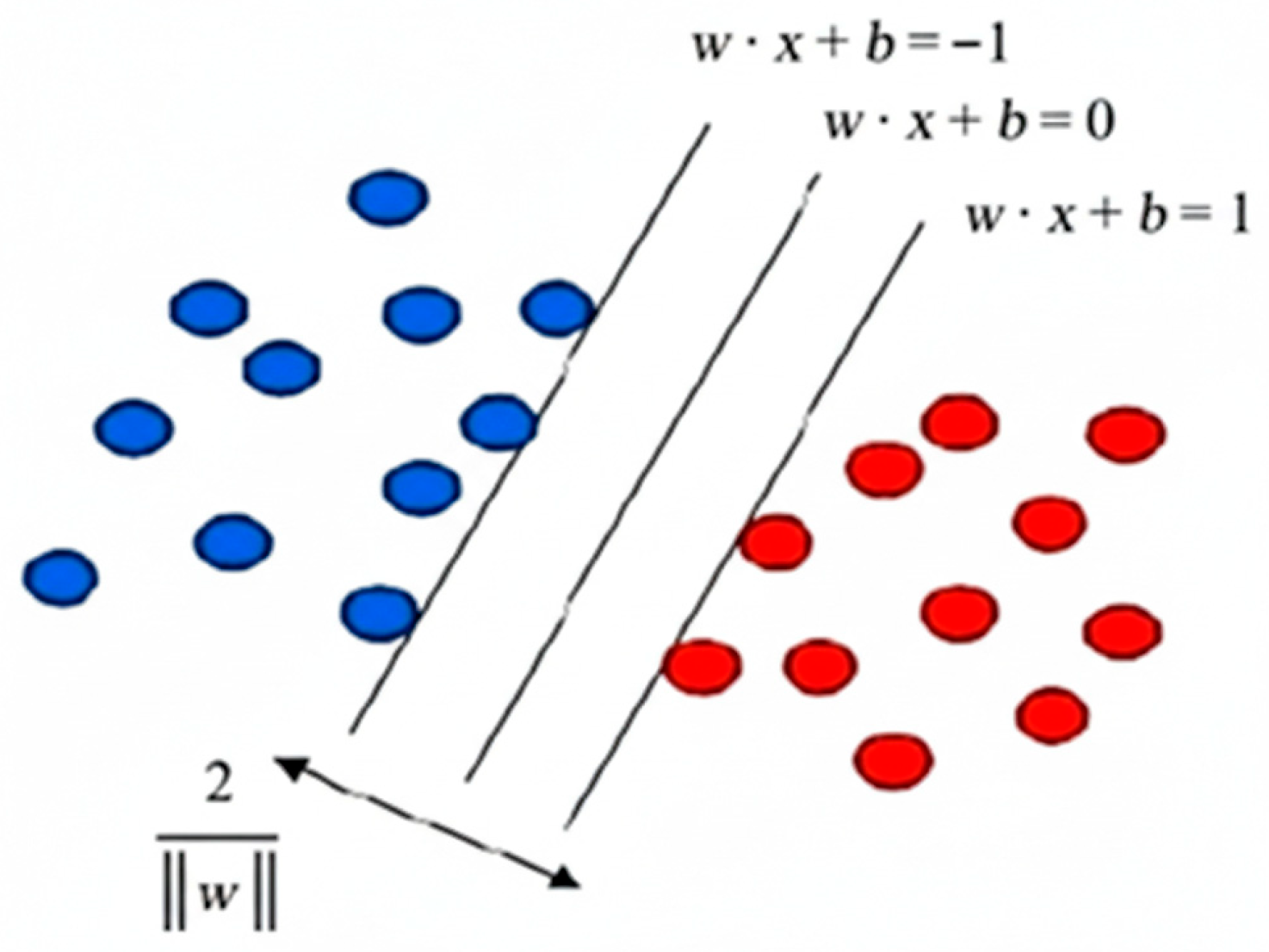
Support vector machines construct hyperplanes that define the decision boundary. Equation (2) provides the expression for hyperplanes. Hyperplanes classify the training data, and the data points closest to the decision boundary are called support vectors. Margin is defined as the distance between the closest support vectors and the boundary. Equation (3) corresponds to the general expression for a margin [33].
d ( x ) = w x i + b
M a r g i n = 2 / | w | + C i = 1 n λ i
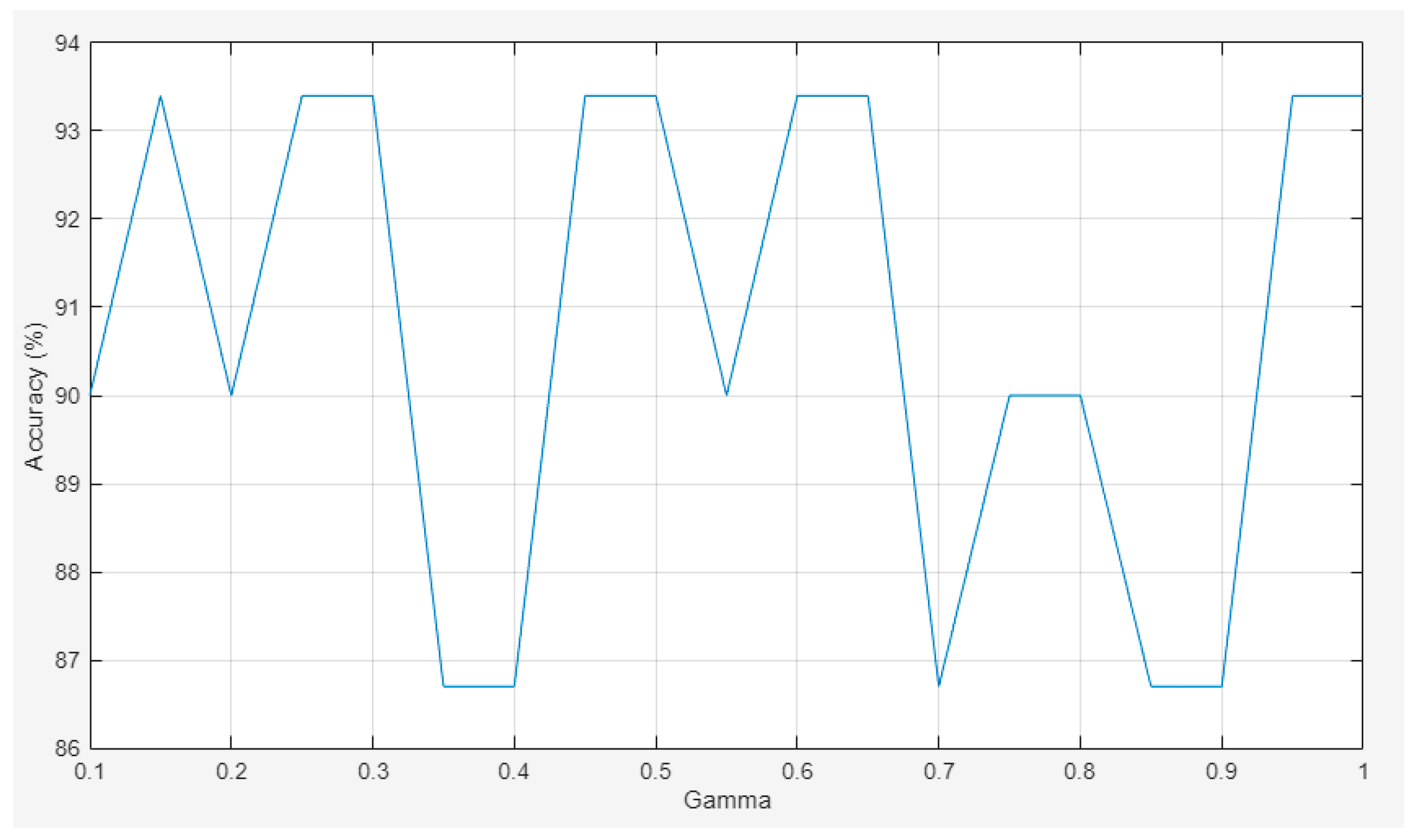
In Equation (2), xi is the input data and b is the bias. Box constraint and kernel scale are known as hyperparameters. Both parameters were randomly sampled to obtain the optimal ones. Box Constraint (C) is the parameter that controls permitted misclassification. This parameter was set to 0.89 in this study, whereas the default coefficient is 1. Overfitting and prolonged training time can be avoided by lowering this coefficient, although the classification loss may increase as the coefficient approaches zero. The parameter w, called the weight factor, is perpendicular to the hyperplane, and λ is the correction parameter for misclassification. Figure 5 illustrates a decision boundary and its margin [34]. The kernel scale (Gamma) parameter was set to 0.34 in this study. A lower Gamma reduces boundary bias and yields more reliable results. This parameter ranges between 0 and 1. Figure 6 shows the change in accuracy rate across different kernel scales when C is set to 1.
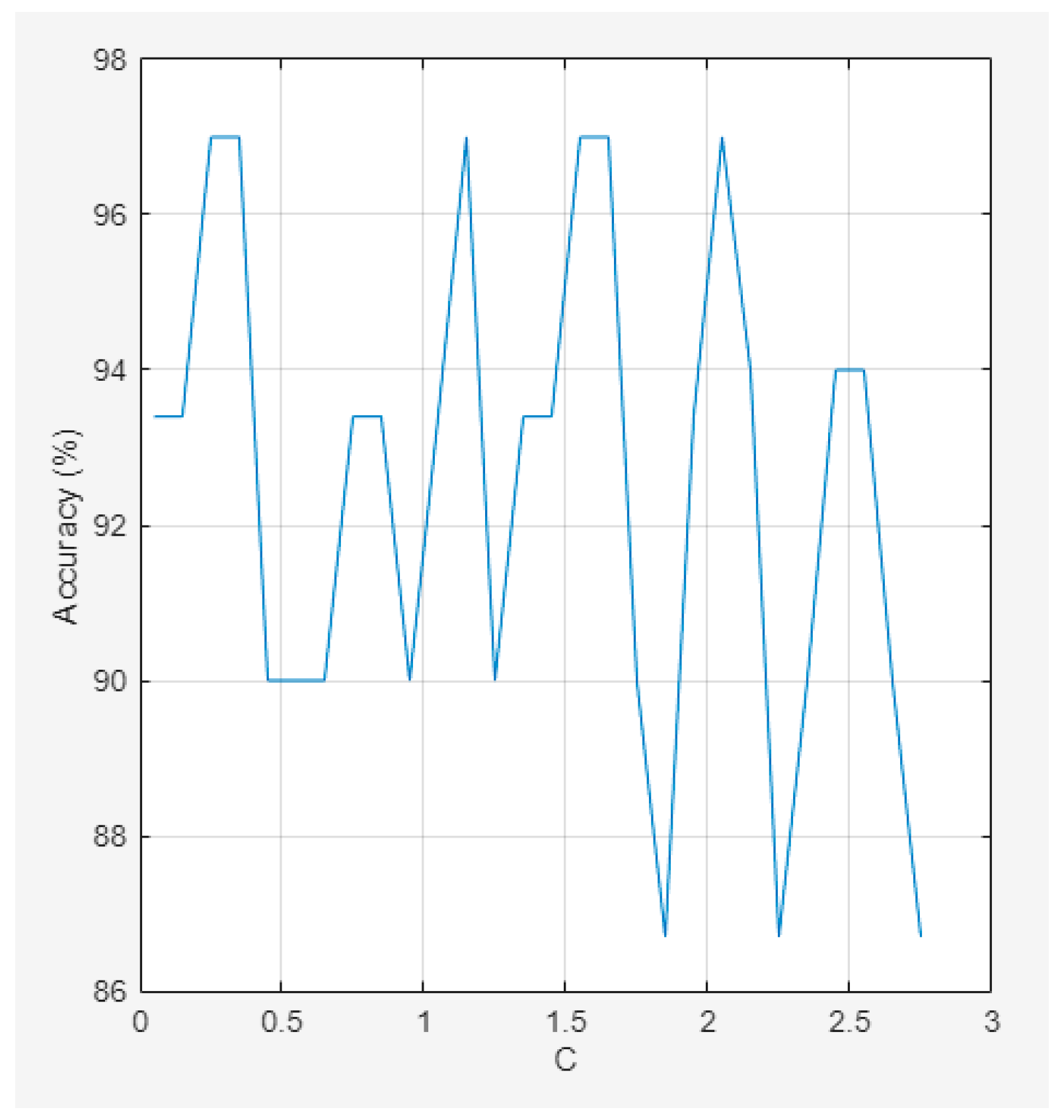
A lower C value allows more support vectors near the boundary by increasing the margin, which helps the SVM avoid overfitting [35]. Support vectors are also required to build the optimal decision boundary. In our study, the number of support vectors is 11. Figure 7 shows accuracy for different values of parameter C when kernel scale is set to 1. According to Figure 7, the accuracy ranges from 86.7% to 97%. The accuracy reaches its lowest rate when the C parameter was chosen above 2.5.
SVM uses support vectors in the decision function and is therefore memory efficient [36].
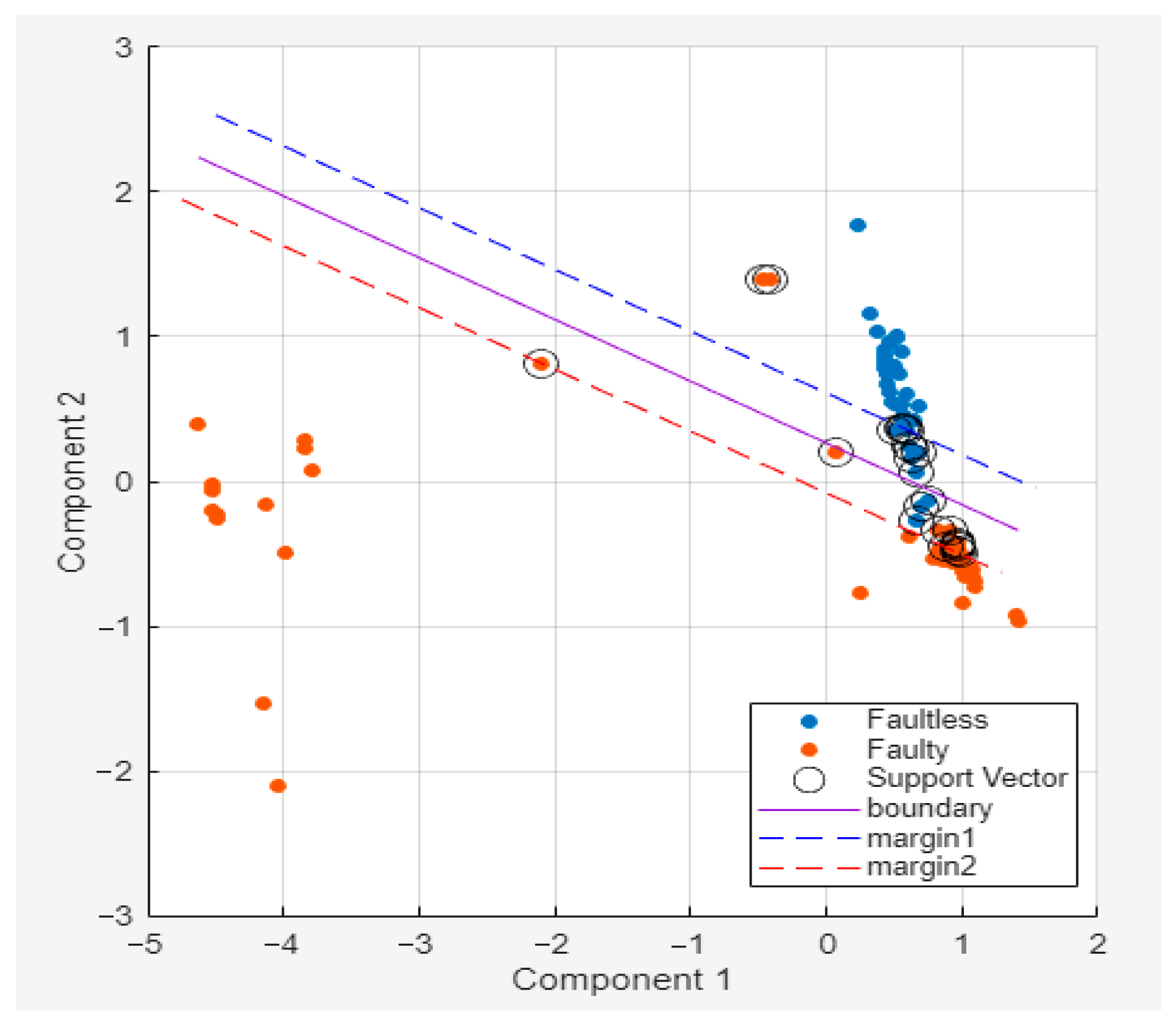
Figure 8 shows a visualization of the hyperplane, decision boundary and margins of our trained SVM. The dimensions of the training data were transformed and reduced to a 100 × 2 array using Principal Component Analysis (PCA), explaining 90% of the variance. Support vectors can also be observed for the transformed data. Margins are represented by dashed lines. The scatter plot shows all the faulty and faultless battery data points. The misclassification rate can be seen as 5% according to Figure 8, when the training data is reduced.
The linear kernel is considered a proper kernel function for binary classification with sparse data, while the polynomial kernel is often used in image processing. The general expression for the linear kernel is given in Equation (4). In this equation, x and u represent data points, and K represents the kernel [35,37].
K ( x , u ) = x T . u
The battery dataset comprised 100 observations; the partitioning model preferred in this study reserved 30 observations for the test set. Sixty percent of test observations correspond to faulty batteries.
The estimation loss (L) was computed according to the test results using Equation (1) and was displayed after running the algorithm. Random grouping was used to estimate the classifier’s generalization ability.

3. Results

The classification loss was calculated as 6.67% using Equation (1). It indicates that nearly 7% of the test data were misclassified by the SVM; therefore, the accuracy was found to be 93%.
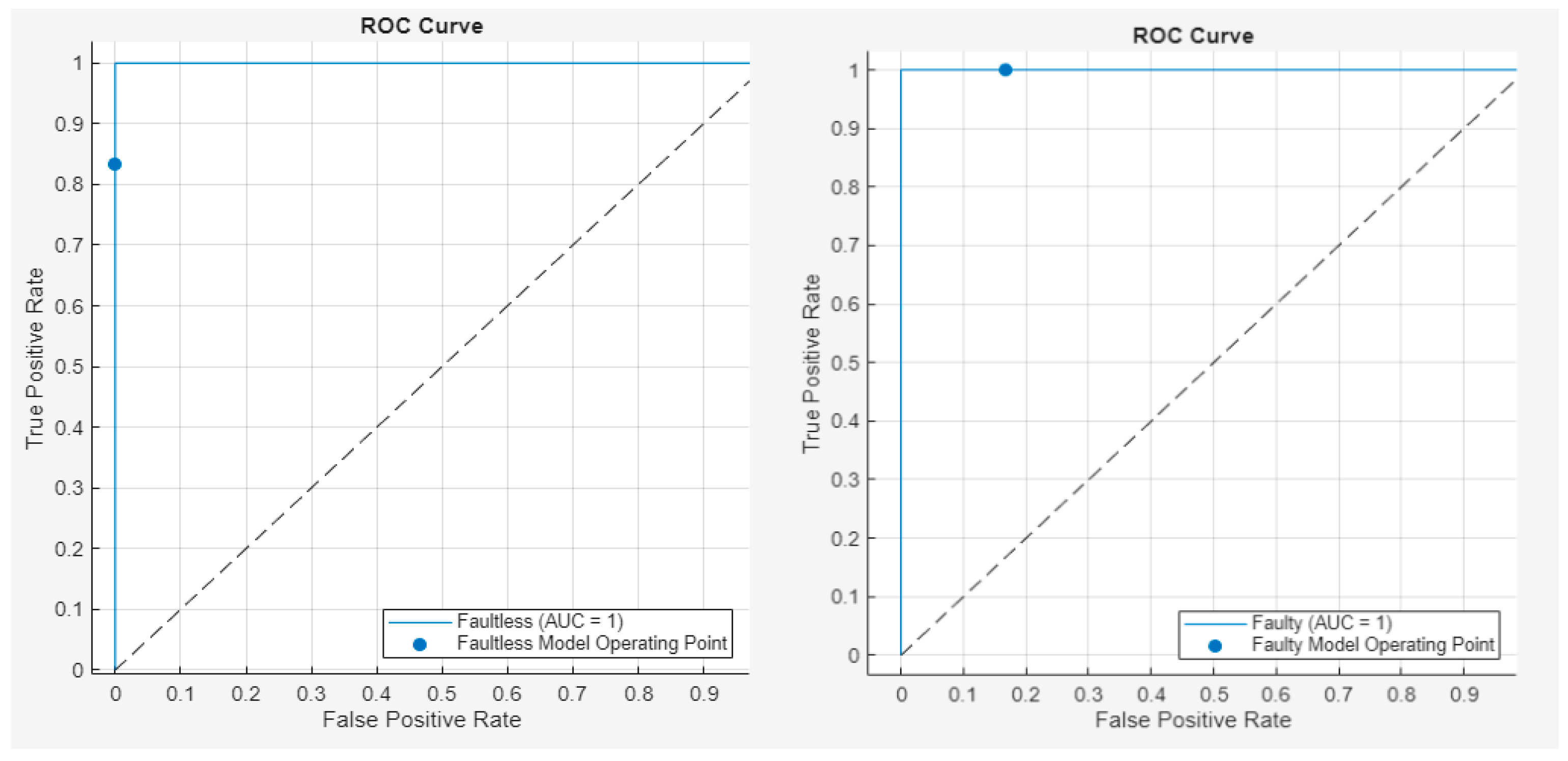
Receiver operating characteristics are shown in Figure 8. Area under the curve (AUC) indicates the performance of the SVM classifier. AUC ranges from 0 to 1 [38]. The performance of the SVM is considered better as the AUC approaches 1, and sensitivity increases as the ROC curve approaches the true positive rate (TPR) axis [39]. If the AUC is below 0.5, the classifier is considered to have a poor performance [39,40,41]. The calculated AUC, which was found to be 100% in this study, can be seen in Figure 9. Both blue curves for the faulty and faultless batteries have the same AUC for the binary classification. The threshold is the operating point on the receiver operating characteristic curve; by default, it is 0.5 for binary classification. It was set to 0.7 in this study. Low thresholds lead to higher true-positive rates; however, false-positive rates may also increase. In this study, we attempted to select the optimal threshold. Changes in the TPR across different thresholds are shown in Table 2.
The false positive rate (FPR) was found to be 0.166, as shown in Figure 9. Therefore, the true negative rate (TNR) is 0.833. This means that the classifier labeled data from two faultless batteries as faulty. Equation (5) pertains to FPR. The positive predictive value is given in Equation (6), which is also known as precision [42,43].
F P R = F P / ( F P + T N )
True positive rate (TPR), also called the sensitivity of the classifier, was found to be 1. These results indicate that all faulty battery data were accurately classified by the SVM. Sensitivity indicates the ability to avoid false negatives. Equation (7) is given for sensitivity metrics [44].
P r e c i s i o n = T P / ( T P + F P )
S e n s i t i v i t y = T P / ( T P + F N )
FN is the false negative value of the classifier, which was found to be “0” at the end of this research. FP stands for false positives while TP represents true positives.
ROC curves are also useful for assessing the performance of the classifier when high sensitivity is needed [42,45]. The operating points of the classifier can be seen (also known as thresholds) in Figure 9.
Table 3 lists the hyperparameters and performance scores for the classifier. The precision score is also included in Table 2.
In this study, 10 additional data points from three different lithium-ion batteries were used to evaluate the prediction performance of the SVM classifier. One of those batteries had a mechanical fault prior to this study. That battery was mechanically damaged by being punctured and exposed to elevated moisture levels. As a result, it lost most of its capacity. The other two batteries were faultless. All data-point labels were predicted correctly, as shown in Table 4, which also reports the prediction scores. Equation (8) corresponds to the prediction score function. The classification scores, which range from −∞ to +∞, also indicate classification confidence. It is defined as the distance from the data point being classified to the decision boundary. The classifying data point is represented by x [46].
f ( x ) = j = 1 n a j       y j     G ( x j ,   x ) + b  
While f(x) denotes the classification scores, G(xj, x) denotes the space between x and the support vectors. The parameters to be estimated are aj and b.
Since a linear kernel was used in this study, the prediction score function can be written as shown in Equation (9) [40].
f ( x ) = ( x G a m m a ) β + b  
Gamma is the kernel scale, and β is the fitted coefficient of the function.
High absolute score values indicate strong confidence in the SVM classifier’s predictions. Negative scores indicate that the prediction result for the particular lithium-ion battery data is ‘faulty’. Positive scores indicate that the algorithm predicts the entry to be “faultless”.

4. Discussion

This study shows that a binary SVM predicts battery faults with 93% accuracy. This accuracy was achieved by tuning the C and Gamma parameters to produce optimal and reliable results. The decision boundary of the classifier and number support vectors were displayed. The sensitivity to faulty battery data was found to be 100% in this research, while the AUC was calculated as 100%.
This study contributes to fault detection in lithium-ion battery cells with different nominal voltages during charging. This paper reports research conducted to detect charging faults in lithium-ion batteries that may facilitate early detection prior to their use. In this study, we used varying battery current characteristics, which improved the sensitivity for charging anomalies and detecting faulty battery data. Moreover, the results were presented in detail by showing the ROC curves and prediction scores for additional data, which helped determine the accuracy, confidence level and optimal threshold for the classifier. This study also shows the classifier can detect faults for batteries with different nominal and cut-off voltages despite using a small dataset. The area under the curve was calculated as 100%, which means the classifier can be considered to perform well.
Constant voltage was chosen for recharging the lithium-ion battery during this study. This charging method was helpful for detecting battery faults in this paper. The voltage and current measurements were taken safely during recharge. This method may be useful for this research; however, constant-current or other fast-charging techniques may become more useful for future studies as they become more relevant for electric vehicles. Deep learning and cross-validation techniques may also be required to detect various types of faults more accurately. Furthermore, similar studies should be conducted for other new battery technologies. Renewable energy applications should also benefit related works.

Author Contributions

Writing, visualization, methodology, investigation, conceptualization: S.A. and A.K. Writing and editing, A.K. All authors have read and agreed to the published version of the manuscript.

Funding

This research received no external funding.

Data Availability Statement

The training data and the script that were used in this study will be available from the corresponding author upon request.

Conflicts of Interest

The authors declare no conflicts of interest.

Abbreviations

The following abbreviations are used in this manuscript:
SVMSupport Vector Machine
ROCReceiver Operating Characteristic
FPRFalse Positive Rate
TNRTrue Negative Rate
TPTrue Positive value
FPFalse Positive value
TNTrue Negative value
FNFalse Negative value
PCAPrincipal Component Analysis

References

  1. Arun, V.; Kannan, R.; Ramesh, S.; Vijayakumar, M.; Raghavendran, P.S.; Ramkumar, M.S.; Anbarasu, P.; Sundramurthy, V.P. Review on Li-Ion Battery vs. Nickel Metal Hydride Battery in EV. Adv. Mater. Sci. Eng. 2022, 2022, 1–7. [Google Scholar] [CrossRef]
  2. Jiang, L.; Diao, X.; Zhang, Y.; Zhang, J.; Li, T. Review of the charging safety and charging safety protection of electric vehicles. World Electr. Veh. J. 2021, 12, 184. [Google Scholar] [CrossRef]
  3. Cui, Y.; Liu, J.; Cong, B.; Han, X.; Yin, S. Characterization and assessment of fire evolution process of electric vehicles placed in parallel. Process Saf. Environ. Prot. 2022, 166, 524–534. [Google Scholar] [CrossRef]
  4. Ghiji, M.; Edmonds, S.; Moinuddin, K. A Review of Experimental and Numerical Studies of Lithium Ion Battery Fires. Appl. Sci. 2021, 11, 1247. [Google Scholar] [CrossRef]
  5. Sun, Z.; Han, Y.; Wang, Z.; Chen, Y.; Liu, P.; Qin, Z.; Zhang, Z.; Wu, Z.; Song, C. Detection of voltage fault in the battery system of electric vehicles using statistical analysis. Appl. Energy 2022, 307, 118172. [Google Scholar] [CrossRef]
  6. Samanta, A.; Chowdhuri, S.; Williamson, S. Machine Learning-based data-driven fault detection/diagnosis of Lithium-Ion battery: A critical review. Electronics 2021, 10, 1309. [Google Scholar] [CrossRef]
  7. Zhao, J.-B.; Wang, Z.; Shen, H.-W.; Liao, P.-H. Research on fault diagnosis method of electric vehicle battery system based on Wavelet-RBF Neural Network. IOP Conf. Ser. Mater. Sci. Eng. 2018, 435, 012023. [Google Scholar] [CrossRef]
  8. Xiong, R.; Ma, S.; Li, H.; Sun, F.; Li, J. Toward a safer battery management system: A critical review on diagnosis and prognosis of battery short circuit. iScience 2020, 23, 101010. [Google Scholar] [CrossRef]
  9. Djelamda, I.; Bouchareb, I. Li-Ion battery fault diagnosis dedicated to electric vehicles by neural network pattern recognition. Math. Model. Eng. Probl. 2022, 9, 144–149. [Google Scholar] [CrossRef]
  10. Wang, J.; Zhang, S.; Hu, X. A fault diagnosis method for Lithium-Ion battery packs using improved RBF neural network. Front. Energy Res. 2021, 9, 702139. [Google Scholar] [CrossRef]
  11. Yang, J.; Cheng, F.; Duodu, M.; Li, M.; Han, C. High-Precision fault detection for electric vehicle battery system based on Bayesian optimization SVDD. Energies 2022, 15, 8331. [Google Scholar] [CrossRef]
  12. Moebes, T.A. Lithium battery analysis: Probability of failure assessment using logistic regression. In Proceedings of the 2011 Annual Reliability and Maintainability Symposium, Lake Buena Vista, FL, USA, 24–27 January 2011; IEEE: New York, NY, USA, 2011. [Google Scholar]
  13. Wu, C.; Zhu, C.; Ge, Y.; Zhao, Y. A review on fault mechanism and diagnosis approach for Li-Ion batteries. J. Nanomater. 2015, 2015, 631263. [Google Scholar] [CrossRef]
  14. Naha, A.; Khandelwal, A.; Agarwal, S.; Tagade, P.; Hariharan, K.S.; Kaushik, A.; Yadu, A.; Kolake, S.M.; Han, S.; Oh, B. Internal short circuit detection in Li-ion batteries using supervised machine learning. Sci. Rep. 2020, 10, 1301. [Google Scholar] [CrossRef] [PubMed]
  15. Schmid, M.; Endisch, C. Online diagnosis of soft internal short circuits in series-connected battery packs using modified kernel principal component analysis. J. Energy Storage 2022, 53, 104815. [Google Scholar] [CrossRef]
  16. Sidhu, A.; Izadian, A.; Anwar, S. Adaptive nonlinear model-based fault diagnosis of Li-Ion batteries. IEEE Trans. Ind. Electron. 2015, 62, 1002–1011. [Google Scholar] [CrossRef]
  17. Feng, X.; Weng, C.; Ouyang, M.; Sun, J. Online internal short circuit detection for a large format lithium ion battery. Appl. Energy 2016, 161, 168–180. [Google Scholar] [CrossRef]
  18. Zhao, J.; Feng, X.; Tran, M.-K.; Fowler, M.; Ouyang, M.; Burke, A.F. Battery safety: Fault diagnosis from laboratory to real world. J. Power Sources 2024, 598, 234111. [Google Scholar] [CrossRef]
  19. Liu, H.; Li, L.; Duan, B.; Kang, Y.; Zhang, C. Multi-fault detection and diagnosis method for battery packs based on statistical analysis. Energy 2024, 293, 130465. [Google Scholar] [CrossRef]
  20. Mitra, D.; Mukhopadhyay, S. Detection and isolation of faults in a lithium-ion battery pack using a switched architecture of equivalent cell diagnosers. J. Energy Storage 2024, 90, 111811. [Google Scholar] [CrossRef]
  21. Nie, W.; Deng, Z.; Li, J.; Zhang, K.; Zhou, J.; Xiang, F. An early fault detection method of series battery packs based on multi-feature clustering and unsupervised scoring. Energy 2025, 323, 135754. [Google Scholar] [CrossRef]
  22. Shen, D.; Lyu, C.; Yang, D.; Hinds, G.; Ma, K.; Xu, S.; Bai, M. Concurrent multi-fault diagnosis of lithium-ion battery packs using random convolution kernel transformation and Gaussian process classifier. Energy 2024, 306, 132467. [Google Scholar] [CrossRef]
  23. Abdolrasol, M.G.; Ayob, A.; Lipu, M.H.; Ansari, S.; Kiong, T.S.; Saad, M.H.M.; Ustun, T.S.; Kalam, A. Advanced data-driven fault diagnosis in lithium-ion battery management systems for electric vehicles: Progress, challenges, and future perspectives. eTransportation 2024, 22, 100374. [Google Scholar] [CrossRef]
  24. Chatterjee, S.; Gatla, R.K.; Sinha, P.; Jena, C.; Kundu, S.; Panda, B.; Nanda, L.; Pradhan, A. Fault detection of a Li-ion battery using SVM based machine learning and unscented Kalman filter. Mater. Today Proc. 2023, 74, 703–707. [Google Scholar] [CrossRef]
  25. Yuan, H.; Cui, N.; Li, C.; Cui, Z.; Chang, L. Early stage internal short circuit fault diagnosis for lithium-ion batteries based on local-outlier detection. J. Energy Storage 2023, 57, 106196. [Google Scholar] [CrossRef]
  26. Jia, Y.; Brancato, L.; Giglio, M.; Cadini, F. Temperature enhanced early detection of internal short circuits in lithium-ion batteries using an extended Kalman filter. J. Power Sources 2024, 591, 233874. [Google Scholar] [CrossRef]
  27. Cheng, X.; Li, X.; Ma, X. A method for battery fault diagnosis and early warning combining isolated forest algorithm and sliding window. Energy Sci. Eng. 2023, 11, 4493–4504. [Google Scholar] [CrossRef]
  28. Liu, S.; Xie, T.; Li, Y.; Liu, S. Fault Detection for Power Batteries Using a Generative Adversarial Network with a Convolutional Long Short-Term Memory (GAN-CNN-LSTM) Hybrid Model. Appl. Sci. 2025, 15, 5795. [Google Scholar] [CrossRef]
  29. Jiang, J.; Qu, B.; Liu, S.; Yan, H.; Zhang, Z.; Chang, C. Fault Diagnosis of Lithium-Ion Batteries Based on the Historical Trajectory of Remaining Discharge Capacity. Appl. Sci. 2024, 14, 10895. [Google Scholar] [CrossRef]
  30. Gu, Y.; Ni, H.; Li, Y. Early-Stage ISC Fault Detection for Ship Lithium Batteries Based on Voltage Variance Analysis. Machines 2024, 12, 303. [Google Scholar] [CrossRef]
  31. Panasonic. Lithium Technical Handbook. Available online: https://energy.panasonic.com/dam/master/pdf/eu/material/old/Panasonic_Batteries_Lithium-Handbook_2025.pdf (accessed on 5 April 2023).
  32. MATLAB. Loss. Available online: https://www.mathworks.com/help/stats/classreg.learning.classif.compactclassificationsvm.loss.html (accessed on 22 September 2025).
  33. Kim, M.-C.; Lee, J.-H.; Wang, D.-H.; Lee, I.-S. Induction motor fault diagnosis using support vector machine, neural networks, and boosting methods. Sensors 2023, 23, 2585. [Google Scholar] [CrossRef]
  34. Madhu, B.; Rahman, M.; Mukherjee, A.; Islam, M.; Roy, R.; Ali, L. A Comparative study of support vector machine and artificial neural network for option price prediction. J. Comput. Commun. 2021, 9, 78–91. [Google Scholar] [CrossRef]
  35. Awad, M.; Khanna, R. Efficient Learning Machines: Theories, Concepts and Applications for Engineers and Systems Designers; Apress: Berkeley, CA, USA, 2015. [Google Scholar] [CrossRef]
  36. Scikit. SVM. Available online: https://scikit-learn.org/stable/modules/svm.html (accessed on 20 July 2024).
  37. Balcan, M.F.; Blum, A.; Vempala, S. Kernels as features: On kernels, margins, and low-dimensional mappings. Mach. Learn. 2006, 5, 79–94. [Google Scholar] [CrossRef]
  38. MATLAB. ROC Curves and Performance Metrics. Available online: https://www.mathworks.com/help/stats/performance-curves.html (accessed on 17 September 2025).
  39. Pooraskarparast, B.; Dang, S.N.; Pakrashi, V.; Matos, J.C. Performance of Fine-Tuning Techniques for Multilabel Classification of Surface Defects in Reinforced Concrete Bridges. Appl. Sci. 2025, 15, 4725. [Google Scholar] [CrossRef]
  40. Atteba, R.G.; Shwe, T.; Mendonça, I.; Aritsugi, M. Credit Evaluation Through Integration of Supervised and Unsupervised Machine Learning: Empirical Improvement and Unsupervised Component Analysis. Appl. Sci. 2025, 15, 13020. [Google Scholar] [CrossRef]
  41. Pendrill, L.R.; Melin, J.; Stavelin, A.; Nordin, G. Modernising Receiver Operating Characteristic (ROC) Curves. Algorithms 2023, 16, 253. [Google Scholar] [CrossRef]
  42. Towards Data Science, Performance Metrics: Confusion Matrix, Precision, Recall, and F1 Score. Available online: https://www.towardsdatascience.com/performance-metrics-confusion-matrix-precision-recall-and-f1-score-a8fe076a2262/ (accessed on 20 September 2025).
  43. Scikit. Precision_Score. Available online: https://www.scikit-learn.org/stable/modules/generated/sklearn.metrics.precision_score.html (accessed on 10 January 2026).
  44. Scikit. Sensitivity_Score. Available online: https://imbalanced-learn.org/stable/references/generated/imblearn.metrics.sensitivity_score.html (accessed on 10 January 2026).
  45. Davis, J.; Goadrich, M. The Relationship Between Precision-Recall and ROC Curves. In Proceedings of the 23rd International Conference on Machine Learning, ACM, Pittsburgh, PA, USA, 25–29 June 2006; Association for Computing Machinery: New York, NY, USA, 2006; pp. 233–240. [Google Scholar]
  46. Mathworks. Loss. Available online: https://www.mathworks.com/help/stats/classreg.learning.classif.compactclassificationsvm.predict.html (accessed on 25 April 2024).
Figure 1. Causes of lithium-ion battery faults [4].
Applsci 16 02059 g001
Figure 2. Example of charging curve of a lithium-ion battery [31].
Applsci 16 02059 g002
Figure 3. Diagram of the lithium-ion battery recharging system.
Applsci 16 02059 g003
Figure 4. Charging current change for the faulty and faultless batteries.
Applsci 16 02059 g004
Figure 5. Support vectors and decision boundary [34].
Applsci 16 02059 g005
Figure 6. Accuracy rate for different kernel scale parameters.
Applsci 16 02059 g006
Figure 7. Accuracy rate for different C parameters.
Applsci 16 02059 g007
Figure 8. Visualization of support vectors and hyperplane for trained SVM.
Applsci 16 02059 g008
Figure 9. ROC curves of the SVM classifier algorithm and operating points for faulty and faultless battery data.
Applsci 16 02059 g009
Table 1. An example of voltage and temperature differences observed when recharging the batteries.
Vn (Volts)3.63.73.73.63.7
Vcut-off (Volts)2.832.13.23
Vsource (Volts)4.5444.54.1
ΔT (°C)11213
Vn represents the nominal voltage of the lithium-ion battery; Vcut-off represents cut-off voltages; Vsource stands for direct current power supply voltage and ΔT represents temperature change.
Table 2. Change in the TPR and FPR for different thresholds.
ThresholdFPRTPR
0.70.0831
200.94
2.500.77
Table 3. Hyperparameters and performance scores of the SVM.
Accuracy0.93
Sensitivity1
Precision0.9
Gamma0.34
Area Under Curve1
C0.89
Threshold0.7
Table 4. Prediction results and the scores of the SVM classifier.
True LabelPredicted LabelScore
FaultlessFaultless+3.885
FaultyFaulty−3.860
FaultyFaulty−0.574
FaultlessFaultless+4.039
FaultyFaulty−4.960
FaultlessFaultless+0.789
FaultyFaulty−3.522
FaultlessFaultless+0.414
FaultlessFaultless+1.235
FaultlessFaultless+0.852
Disclaimer/Publisher’s Note: The statements, opinions and data contained in all publications are solely those of the individual author(s) and contributor(s) and not of MDPI and/or the editor(s). MDPI and/or the editor(s) disclaim responsibility for any injury to people or property resulting from any ideas, methods, instructions or products referred to in the content.