Article

Heat Transfer Characteristics and Correlation of Supercritical Hydrogen Flow in Vertical Tubes: A Numerical Investigation

School of Electrical Engineering and Energy Power Engineering, Yangzhou University, Yangzhou 225127, China
*
Author to whom correspondence should be addressed.
These authors contributed equally to this work.
Appl. Sci. 2026, 16(4), 1972; https://doi.org/10.3390/app16041972
Submission received: 4 January 2026 / Revised: 30 January 2026 / Accepted: 11 February 2026 / Published: 16 February 2026
(This article belongs to the Section Applied Thermal Engineering)

Abstract

Supercritical hydrogen has attracted much attention due to its convenience for storage and transportation. However, its thermophysical properties undergo significant changes within a narrow temperature range under ultra-low temperature and high-pressure conditions, resulting in significant differences in its heat transfer characteristics compared to normal-pressure hydrogen. So, it is urgent to clarify the heat transfer characteristics of supercritical hydrogen under the effects of various factors. For this, numerical simulations were conducted to study the heat transfer characteristics of supercritical hydrogen flow in a vertical upward tube under uniform heat flux conditions. Based on the NIST database, the drastic changes in the thermophysical properties of supercritical hydrogen were accurately considered, and the effects of buoyancy force and flow acceleration were also taken into account. Thereafter, the influences of tube diameter (6–8 mm), heat flux (1500–3000 kW/m2), fluid pressure (5–90 MPa), and mass flow rate (0.062–0.14 kg/s) on the heat transfer coefficient were analyzed. The results showed that increasing the heat flux, tube diameter, and fluid pressure, or reducing the fluid mass flow rate, was beneficial to increasing the wall–fluid heat transfer coefficient. Furthermore, a heat transfer correlation applicable to supercritical hydrogen flow in vertical tubes within the high-pressure range was obtained, with absolute errors below 10% when applied to previous studies. These results clarify the heat transfer characteristics of supercritical hydrogen flow in vertical tubes, providing a theoretical basis for the design of a supercritical hydrogen heat exchanger in practical scenarios.

1. Introduction

Under the carbon neutrality goal, it is an urgent task to develop renewable clean energy. Hydrogen, due to its high mass energy density and pollution-free nature, has received significant attention in recent years. However, hydrogen has a low boiling point, a low volumetric energy density, and exists in gaseous form at room temperature. Therefore, achieving large-scale storage and transportation of hydrogen is an important issue [1,2]. At present, various methods are used for hydrogen storage and transportation, such as gaseous transportation (including high-pressure gaseous transport and blending with natural gas), cryogenic liquid transport, and solid-state storage [3,4]. When hydrogen with ultra-low temperature is continuously pressurized, the pressure will exceed the critical value, making it a supercritical fluid [5]. At this point, supercritical hydrogen has advantages such as high storage density and relatively reasonable cost and thus has been widely applied in the field of hydrogen storage and transportation [6,7]. However, at the end-use stages, such as in hydrogen refueling stations, supercritical hydrogen still needs to be heated to the gaseous hydrogen state for use [8,9]. Therefore, clarifying the heat transfer mechanism of supercritical hydrogen during its temperature rise process is important for the efficient use of hydrogen [10].
At present, extensive experimental work has been carried out on the heat transfer characteristics of water, carbon dioxide, nitrogen, and hydrocarbon fuels under supercritical pressure. The results show that the heat transfer characteristics of fluids in the supercritical state are significantly different from those in the subcritical state [11,12]. Based on a large number of experiments and theoretical analyses, Jackson et al. [13] pointed out that drastic changes in the thermophysical properties of the supercritical fluid are the fundamental cause of the dramatic change in the heat transfer characteristics. Specifically, the sudden change in boundary layer density induces strong buoyancy and flow acceleration effects within the tube, which alters the velocity field, stress field, and turbulent structure, leading to local laminarization of turbulence and a rapid increase in wall temperature and ultimately resulting in heat transfer deterioration. Through an experimental study on the heating process of supercritical CO2 in tubes, Cheng et al. [14] found that the heat transfer characteristics of supercritical fluids are largely affected by factors such as pressure, mass flow rate, tube diameter, and heat flux. Additionally, the flow direction and inlet temperature also have an impact on heat transfer characteristics [15]. Peng et al. [16] reported that under high mass flow rate conditions, the wall temperature will significantly increase with the rise in heat flux for supercritical CO2 flow, resulting in deterioration of the heat transfer process. However, under low mass flow rate conditions, no abnormality was observed in the wall temperature even though the heat flux was increased significantly. Wang [17] reported that when the inlet pressure, temperature, and mass flow rate remained unchanged, there was an optimal heat flux for supercritical CO2 flow, where the heat transfer efficiency was extremely high. Wang et al. [18] developed a finned-tube heat exchanger using supercritical hydrogen as the refrigerant and found that the arrangement where the fluid flows from a higher position to a lower position can achieve better heat transfer performance. These findings indicate that for supercritical fluids, heat transfer characteristics are influenced by multiple factors. However, due to the high risk of high-pressure hydrogen, there are few experimental reports on the heat transfer characteristics of supercritical hydrogen.
Given the scarcity and lack of detail in experimental data, coupled with the difficulty of theoretical analysis, numerical simulation methods have become widely used in studying the heat transfer characteristics of supercritical fluids. Based on a 2D simulation of supercritical CO2 flow, He et al. [19] found that for cases affected by strong buoyancy, most turbulence models could accurately reproduce the recovery phenomenon of turbulence but were unable to effectively simulate the heat transfer enhancement. However, Wen et al. [20] reported that most k-ε models would overestimate the heat transfer deterioration of supercritical fluids. Meanwhile, Wang et al. [21] reported that the k-ω SST model performed better than the low Reynolds k-ε model in predicting the heat transfer characteristics of supercritical CO2. Using the SST k-ω model, Jaromin et al. [22] simulated the heat transfer characteristics of supercritical water and found that it showed excellent accuracy in predicting heat transfer deterioration. Based on the SST k-ω turbulence model, Xi [23] conducted a steady-state simulation of the heat transfer characteristics of supercritical hydrogen in micro-channels and found that an increase in the heat flux led to enhanced heat transfer and a reduction in pressure drop.
Previous studies indicate that within a relatively narrow range, the thermophysical properties of supercritical fluids can change dramatically with variations in temperature and pressure, leading to a nonlinear change in their heat transfer characteristics, thus making the heat transfer process of supercritical fluids extremely complex [24,25]. Meanwhile, the flow behavior of supercritical fluids is also influenced by various factors such as tube size and the flow rate, temperature, and pressure of the supercritical fluids, which in turn affect their heat transfer characteristics [26,27,28,29]. Therefore, the flow and heat transfer characteristics will show significant differences for different supercritical fluids or the same supercritical fluid under different operating conditions. For these reasons, the heat transfer mechanism of supercritical hydrogen flow in tubes has not been fully understood, and thus further exploration is required [30]. Furthermore, the effects of buoyancy and flow acceleration are often neglected in existing heat transfer correlations, and most of them are applicable within a lower pressure range (e.g., below 45 MPa).
To enhance the heat transfer efficiency of supercritical hydrogen in terminal heat exchangers, it is necessary to clarify its heat transfer characteristics under high and ultra-high pressures (even up to 90 MPa). To this end, correlations describing how the thermophysical properties of supercritical hydrogen depend on temperature and pressure were established. Subsequently, a systematic study on the turbulent flow and heat transfer characteristics of supercritical hydrogen in vertical circular tubes was conducted. Based on this, the influence of various key factors was analyzed, and a wall–fluid heat transfer correlation applicable to supercritical hydrogen flow in vertical circular tubes was derived. The research results contribute to a deeper understanding of the heat transfer characteristics and influencing factors of supercritical hydrogen in circular tubes, providing a theoretical basis for the design of heat exchangers in end-use applications.

2. Research Object and Numerical Simulation Methods

2.1. Brief Introduction of the Research Object

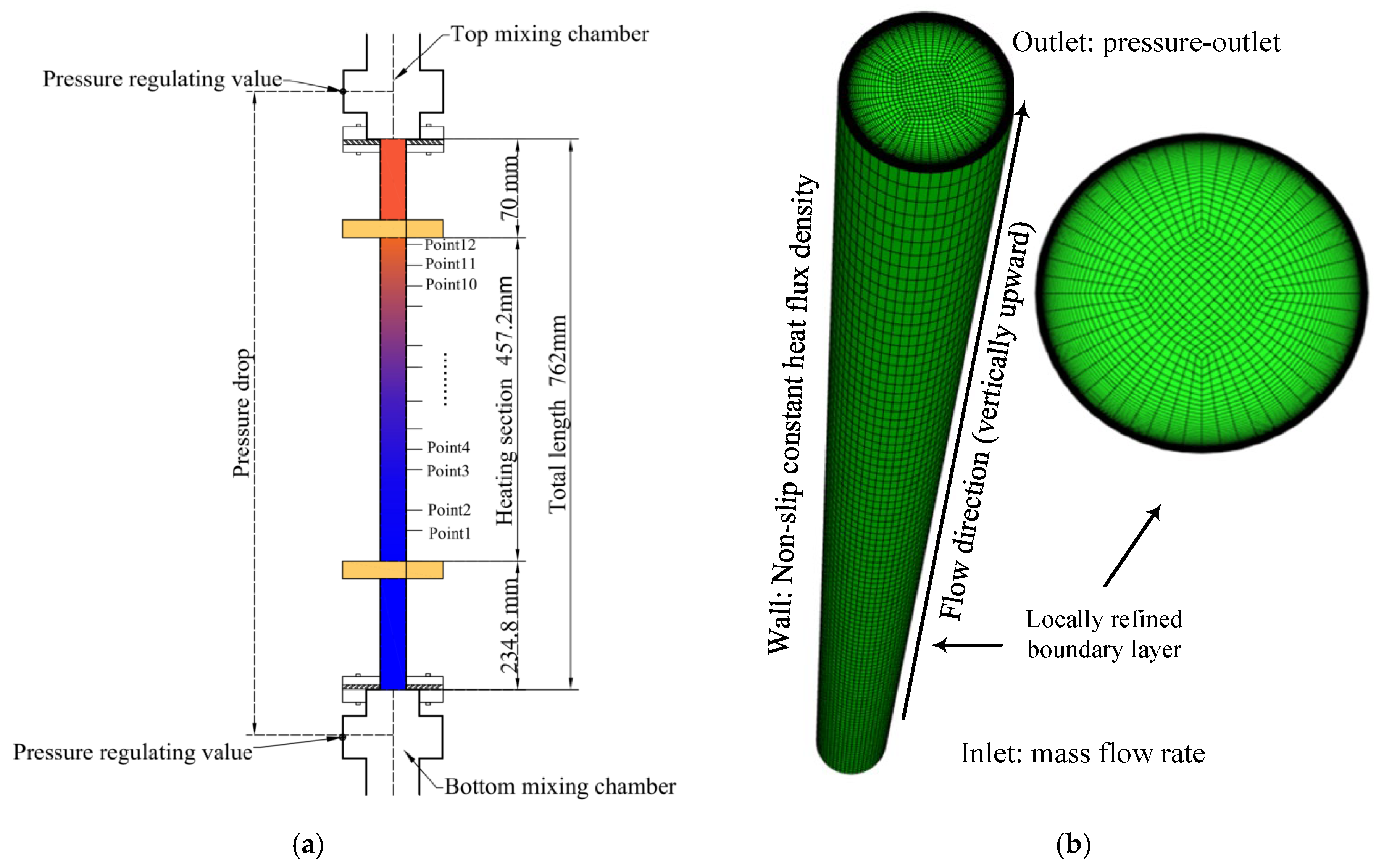
This work aims to investigate the heat transfer characteristics of supercritical hydrogen flow in a vertical tube. Therefore, the experimental setup of Hendricks et al. [31] is selected as a reference, as shown in Figure 1a. In this experiment, the tube was arranged vertically with an inner diameter of 8 mm, and a uniform heat flux was applied around the tube wall. The total length of the test section was 762 mm, of which the heating section was 457.2 mm long, with unheated sections of 234.8 mm and 70 mm at the upper and lower ends of the heating section, respectively. Starting from 38 mm away from the lower end of the heating section, 12 thermocouples were arranged at regular intervals to monitor the fluid temperature along the axis of the heating section.
During the simulation process, the circular tube structure is maintained the same as that of Hendricks et al. [31], and a typical experimental condition is selected as the benchmark working condition. Specifically, the fluid velocity is uniform at the inlet, with a fluid temperature of 32 K, a pressure of 7.54 MPa, and a mass flow rate of 0.09979 kg/s. At the outlet, a pressure outlet boundary condition is applied. A non-slip condition is imposed at the wall surface, where a uniform heat flux (1.67 MW/m2) is set at the heated part, while the unheated parts are adiabatic. Based on this, operating parameters such as tube diameter (6–8 mm), heat flux (1500–3000 kW/m2), fluid pressure (5–90 MPa), and mass flow rate (0.062–0.14 kg/s) are varied to assess the influence of each parameter on the wall–fluid heat transfer characteristics. In all cases, the fluid flow direction is vertically upward.

2.2. Numerical Simulation Method

Numerical simulations were conducted using ANSYS Fluent software (version 2020R2) to investigate the flow and heat transfer characteristics of supercritical hydrogen within the vertical tube. Firstly, a simulation domain was established based on the aforementioned experimental setup, and then the mesh was generated, as shown in Figure 1b. In this work, only the flow and heat transfer behavior within the tube was considered; the upper and lower mixing chambers in Figure 1a were not included in the simulation domain. The hexahedral structured mesh system was created with the O-block method. Meanwhile, the mesh was refined in the near-wall region to fully capture the drastic changes in flow and heat transfer parameters within the boundary layers.
In applications involving the heating of supercritical hydrogen, the flow inside the tube is highly turbulent. Under such conditions, the velocity and temperature exhibit strong fluctuations that alter the buoyancy and flow acceleration effects, thereby complicating the flow and heat transfer behaviors of supercritical hydrogen. To simulate this complex process, the Reynolds-averaged Navier–Stokes (RANS) equations in a 3D Cartesian coordinate system were used, and the steady-state governing equations are as follows:
Mass conservation:
( ρ u j ) ( x j ) = 0
Momentum conservation:
( ρ u i u j ) x j = x j ( μ u i x j ρ u i u j ¯ ) p x i + ρ f i
Energy conservation:
( ρ u j h ) x j = x j ( λ c p h x i ρ u j h ¯ ) + S T
where i and j are the tensor indices (taking values of 1, 2, 3, corresponding to the x, y, and z directions, respectively); u, ρ, cp, h, μ, and λ are the velocity (m/s), density (kg/m3), specific heat capacity (J/kg∙K), specific enthalpy (J/kg), dynamic viscosity (Pa·s), and thermal conductivity (W/m·K) of the fluid, respectively; f is the force per unit mass (with units of m/s2), and ST is the viscous dissipation term (with units of W/m3).
In the momentum conservation equation and the energy conservation equation, there are additional terms ρ u i u j ¯ (Reynolds stress term) and ρ u j h ¯ (turbulent heat flux), which are unknown variables. To close the aforementioned conservation equations, a turbulence model is required to model these terms. The SST k-ω model, proposed by Menter [32], utilizes the stability of the k-ω model near the wall to capture the flow behavior in the viscous sub-layer and modifies the formula of the turbulent viscosity coefficient to account for the transport of turbulent shear stress. These features enable the SST k-ω model to predict heat transfer accurately under supercritical pressure, even in regions where heat transfer deteriorates.
To simulate the flow and heat transfer of supercritical hydrogen within the tube, a steady-state pressure-based solver was employed, and the SIMPLEC algorithm was used to couple pressure and velocity [33,34]. The SST k-ω model was used to consider the turbulent flow behavior, and the fluid temperature change caused by the viscous dissipation effect was considered by activating the ‘Viscous heating’ option. Additionally, the influence of low Reynolds-number effect in the near-wall region was accounted for by enabling ‘Low-Re Corrections’. During the solution process, the momentum and energy equations were solved, and the turbulent-related equations were discretized using the second-order upwind difference scheme. For the iteration process, the relaxation factors are all retained at default values except that the density is set to 0.8. To consider buoyancy force, gravity was enabled with the acceleration direction being vertically downward. Moreover, the operating temperature and pressure were set to the temperature and density of the fluid inlet, thereby taking into account the influence of buoyancy.
During the iterative solution process, the convergence residuals of the continuity, momentum-related parameters, turbulent kinetic energy, and specific dissipation rate were set to 10−4, while the convergence residual of the energy equation was set to 10−6. When the residuals fall below the specified thresholds, further iterations will not significantly improve the solution accuracy. At the same time, the differences in mass flow at the inlet and outlet, as well as the average temperature at the outlet, were monitored. When the residuals met the specified targets and the monitored quantities showed no discernible variation over successive iterations, the calculation is considered to be converged. In this work, convergence was typically achieved within 1000 iterations.

2.3. Properties of Supercritical Hydrogen

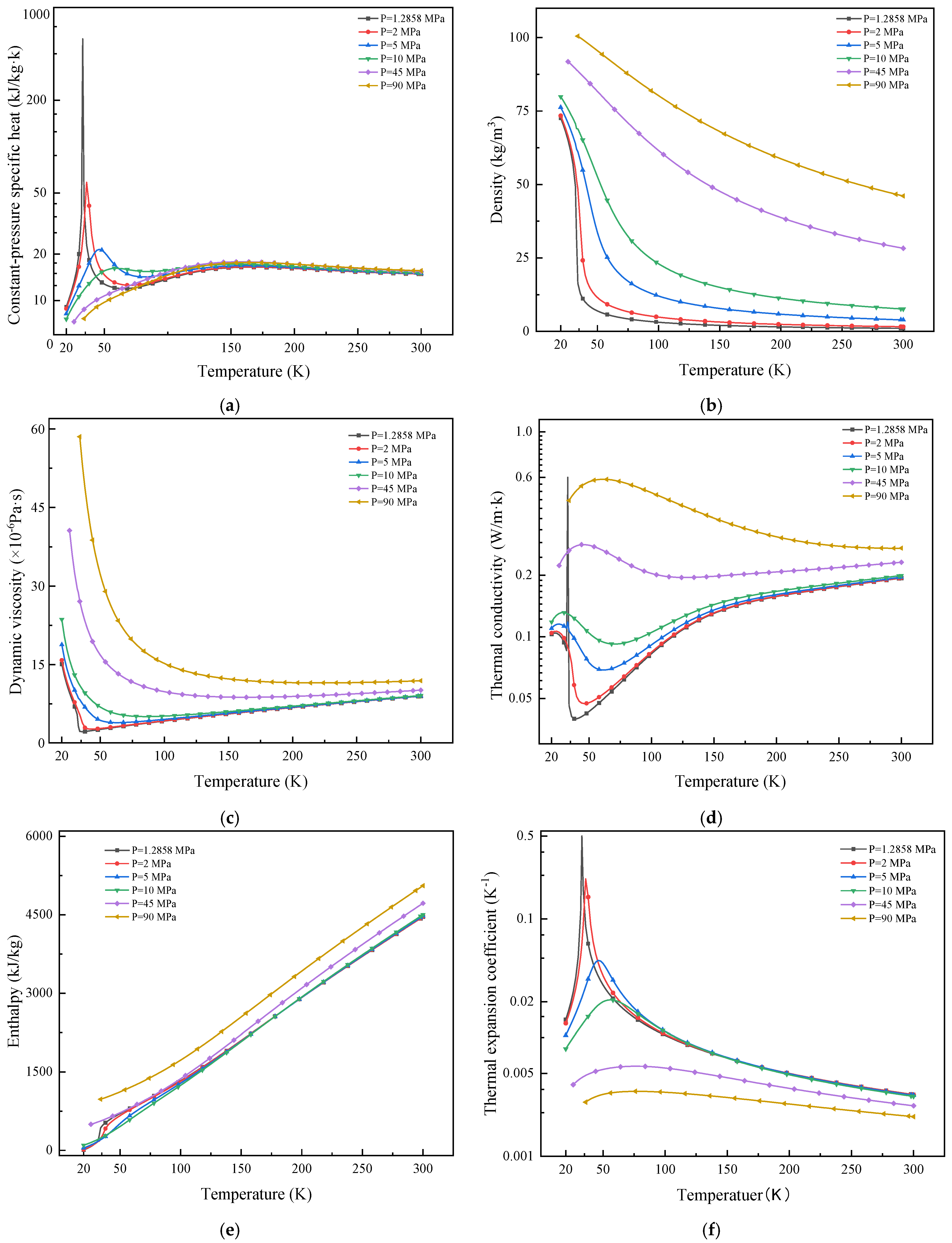
Figure 2 shows the variations of the thermophysical properties with temperature for supercritical hydrogen at ultra-low temperatures. The data are from the United States’ National Institute of Standards and Technology (NIST) [35], which is widely regarded as a primary source for supercritical fluid properties [36]. The thermophysical properties of supercritical fluids are highly sensitive to temperature [15,37]. Near the pseudo-critical point, a temperature change of 1K can cause the specific heat capacity at constant pressure, thermal conductivity, and thermal expansion coefficient to change by an order of magnitude or more. In Figure 2a,f, the specific heat capacity at constant pressure and thermal expansion coefficient first increase and then decrease with increasing temperature, exhibiting peaks at the pseudo-critical temperature. In Figure 2b,c, the density and dynamic viscosity gradually decrease with increasing temperature, showing a sharp drop when the temperature is slightly increased. The thermal conductivity (Figure 2d) exhibits a pattern similar to density and dynamic viscosity but characterized by an initial increase followed by a sharp decrease. In contrast, the specific enthalpy in Figure 2e gradually increases with the temperature rise. For all these thermophysical properties, the variation trends become moderate with increasing pressure. However, they still vary visibly with temperature changes. Therefore, accurately modeling these strong, non-linear variations in thermophysical properties with temperature and pressure is crucial for reliable predictions of heat transfer, especially near deterioration regimes.
A piecewise linear interpolation method available in ANSYS Fluent was used to define the thermophysical properties of fluids, with a limit of 50 interpolation points. First, 50 sets of temperature and corresponding thermophysical property parameter data points were obtained under various pressures. Then, piecewise linear interpolation was utilized to specify the thermophysical properties of supercritical hydrogen for each simulation scenario. It should be noted that in all studied conditions the outlet temperature of supercritical hydrogen was below 150 K (including in the near-wall region). Therefore, the interpolation temperature range was limited to 30–150 K, and most of the data points were within the range of 30–80 K. Meanwhile, the data points were not evenly distributed within this temperature range; instead, they were determined based on the trend of each parameter shown in Figure 2. More data points were selected in regions where parameters changed significantly, and fewer points were used in regions with relatively gentle changes. The thermophysical properties near the pseudo-critical point (with a pressure of 1.2858 MPa) varied extremely rapidly. However, as this work focused on high and ultra-high-pressure conditions, the interpolation did not include this specific pseudo-critical pressure regime.

2.4. Boundary Conditions and Case Setup

For the supercritical hydrogen flow and heat transfer problem within a vertical tube, three types of boundary conditions were specified, namely ‘mass-flow-inlet’, ‘pressure-outlet’, and ‘wall’ boundary conditions. The mass-flow-inlet condition was applied at the tube inlet to specify the temperature and mass flow rate of the supercritical hydrogen entering the tube. Meanwhile, the flow turbulence condition was determined by the turbulence intensity and hydraulic diameter, where the turbulence intensity was calculated as I = 0.16 × Reb−0.125. The pressure-outlet was located at the tube exit to specify the external pressure (back pressure), and the temperature and composition of the backflow fluid, where the turbulence condition was also determined by the turbulence intensity and hydraulic diameter. The inner wall of the tube was specified as a no-slip stationary wall condition, and a constant heat flux was applied only to the heating section to simulate the heating process.
Multiple simulation scenarios were designed to analyze the influence of various operating parameters on the heat transfer characteristics of supercritical hydrogen turbulent flow in a vertical tube. Among them, the benchmark operating conditions were set with an inlet temperature of 32 K, a pressure of 7.54 MPa, a mass flow rate of 0.0998 kg/s, a heat flux of 1668 kW/m2, and a tube diameter of 8 mm. Based on this, one parameter was changed at a time while other parameters were fixed to isolate its impact on the flow and heat transfer characteristics. In this work, the heat flux increased from 1500 kW/m2 to 3300 kW/m2, the mass flow rate increased from 0.062 kg/s to 0.14 kg/s, the tube diameters were 6, 8, and 10 mm, and the pressure increased from 5 MPa to 90 MPa. In all scenarios, the inlet temperature remained constant at 32 K, and the flows were all vertically upward [38].

2.5. Mesh Independence Test and Model Validation

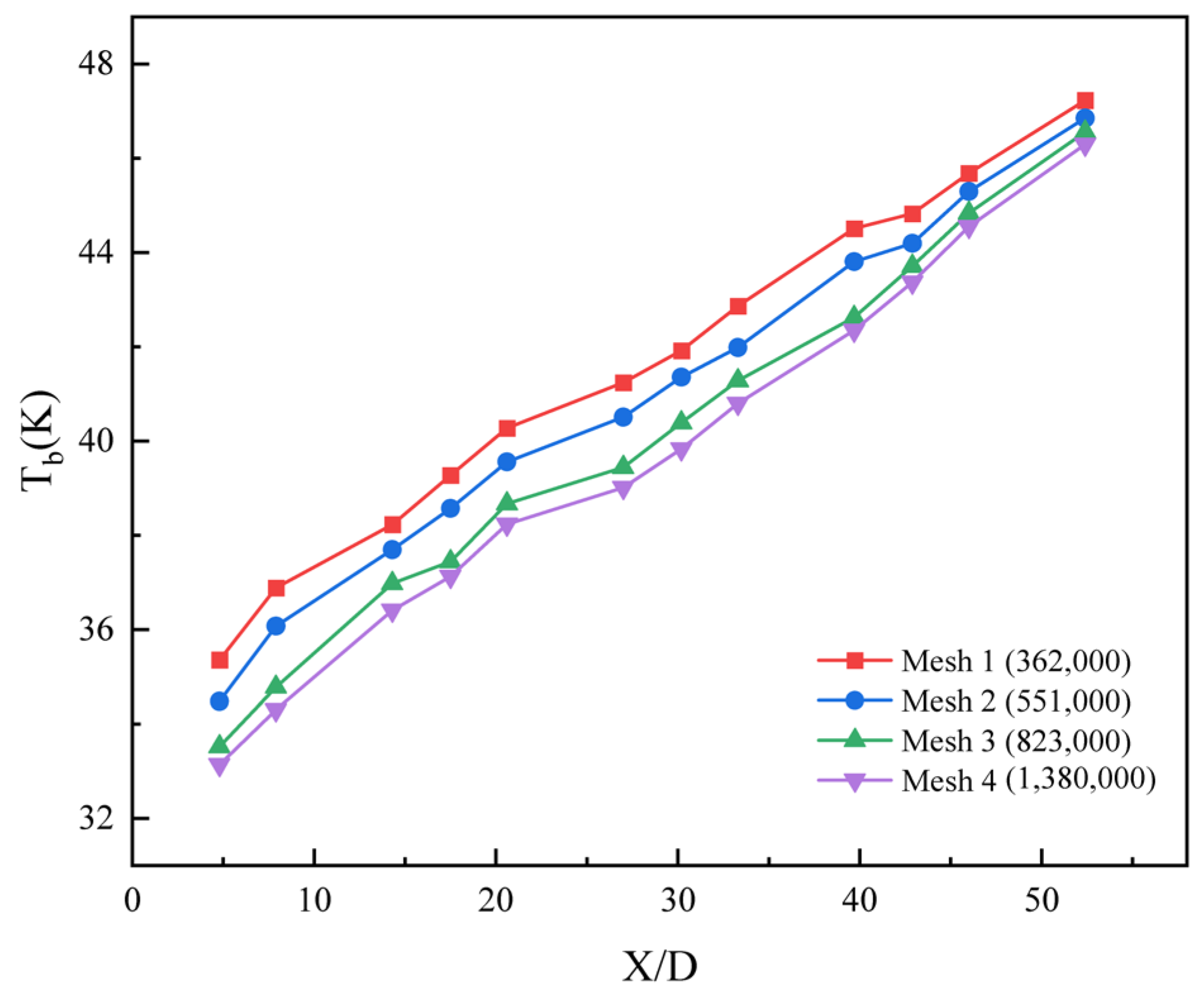
Theoretically, refining the mesh system will yield results closer to reality. However, a denser mesh system incurs a higher computational cost. To achieve a balance between computational accuracy and cost, a mesh independence test was conducted first. The overall meshing strategy is illustrated in Figure 1b. During the meshing process, boundary layer meshes were created in the near-wall region to fully capture the flow and heat transfer behavior in this area. For the investigated tube diameters (6–10 mm), the height of the first boundary layer was initially set to 0.005 mm, with a mesh height growth rate of 1.15 and 10 boundary layers. These parameters were then adjusted, with the first layer and the growth rate being gradually reduced to 0.03 mm and 1.10, respectively, while the number of layers was increased to 18. Finally, four mesh systems with 362,000, 551,000, 823,000, and 1,380,000 hexahedral cells were created.
Thereafter, 12 cross sections were selected along the streamwise direction in the heating tube section, and the average temperature of each cross-section was used as an evaluation index for mesh quality. Figure 3 shows the calculated average fluid temperature for four mesh systems. It should be noted that the symbols in Figure 3 represent the simulated temperatures at the 12 cross sections (corresponding to the measurement points in Ref. [31]). The lines connecting the symbols are interpolated guides for the eye and do not represent actual simulation data. When the mesh cell number was increased from 362,000 to 551,000 and 823,000, there were visible differences in the average temperatures. However, when the mesh cell number continued to increase from 823,000 to 1,380,000, there was no significant difference in temperature distribution. Therefore, the results obtained with the 823,000-cell mesh can be considered mesh-independent. Consequently, the mesh system with 823,000 cells was selected for all subsequent simulations.
Based on the established mesh system, a benchmark scenario from Ref. [31] was simulated with the following parameters: 8 mm tube diameter, 32 K inlet temperature, 7.54 MPa pressure, 0.0998 kg/s mass flow rate and 1668 kW/m2 heat flux. Thereafter, the simulated values of the inner tube wall temperature (Tw) and bulk fluid temperature (Tb) at multiple measurement points were compared with the experimental data presented in Table 1. For Tb, the relative error exceeded 4% at only a few points and was within 4% at all others. For Tw, the relative errors were slightly higher but were all within 7%. The close agreement validated the model’s ability to predict the heat transfer behavior of supercritical hydrogen within the tube. Nonetheless, the relative errors (up to 7% for Tw) were higher than those for conventional fluids without chemical reaction, which highlights the greater challenge in accurately simulating the heat transfer of supercritical fluids.

3. Results and Discussion

3.1. Patterns of Supercritical Hydrogen Flow and Heat Transfer in a Vertical Tube

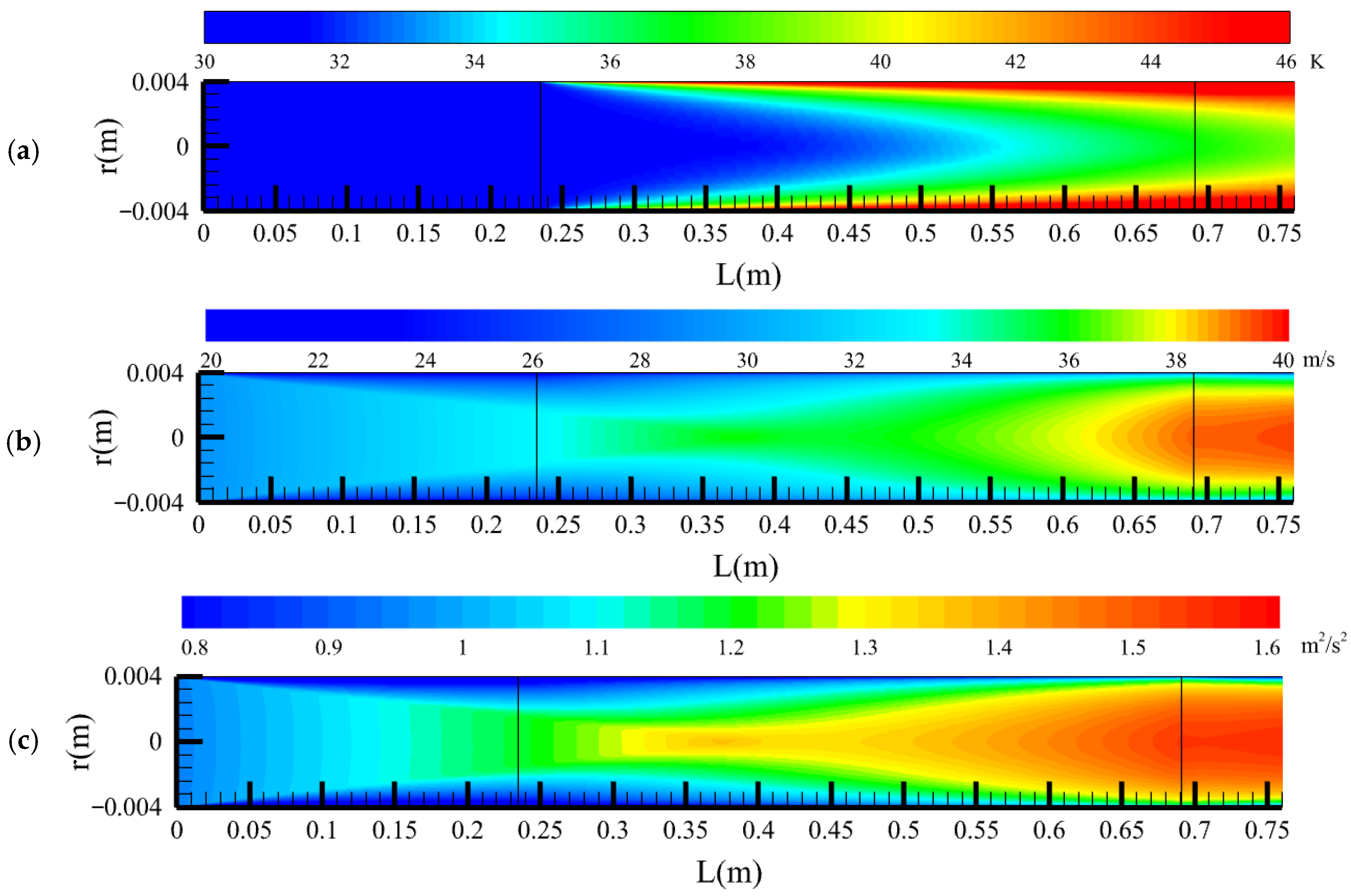
Figure 4 presents the contours of flow parameters and temperature in the tube under the benchmark condition. The left side represents the inlet, and the right side represents the outlet. The two vertical lines adjacent to the inlet and outlet indicate the start and end of the heating section. Due to the presence of the flow and thermal boundary layers, parameters differ significantly between the central and near-wall regions at a given axial position. For example, the thermal boundary layer results in a near-wall temperature of up to 46 K at the outlet, while the central temperature is generally below 40 K. Furthermore, the high axial flow velocity and the absence of sharp flow direction changes to induce low-pressure zones prevented any reverse flow (backflow).
At the inlet section, due to the presence of the wall flow boundary layer, the fluid velocity is high in the central region and low in the near-wall region (Figure 4b), which is consistent with the report of Zhao et al. [39]. As the supercritical hydrogen enters the heating section, it is heated and its density rapidly decreases. At the same mass flow rate, its volume flow rate increases rapidly, resulting in a rapid increase in flow velocity. A comparison of Figure 4a,b shows that the flow velocity increases markedly upon entering the heating section, whereas the temperature shows little change. This is because density decreases sharply with a small temperature increase (Figure 2b). With continued heating, the density decrease leads to a further increase in flow velocity. Meanwhile, the rise in temperature causes the kinematic viscosity of supercritical hydrogen to decrease, leading to an increase in the flow Reynolds number. Consequently, the increasing flow turbulence enhances the turbulent kinetic energy (TKE, Figure 4c), resulting in vigorous fluid mixing. In the non-heating section near the outlet, although the fluid is not continuously heated, heat transfer from the near-wall region to the central region continues. Therefore, the density of the central fluid continues to decrease, with corresponding increases in flow velocity and turbulent kinetic energy. At the same time, as the heat transfer process continues, the high-temperature zone near the wall propagates further into the core flow.

3.2. Effects of Buoyancy Force and Flow Acceleration Effect on the Heat Transfer of Supercritical Hydrogen Flow

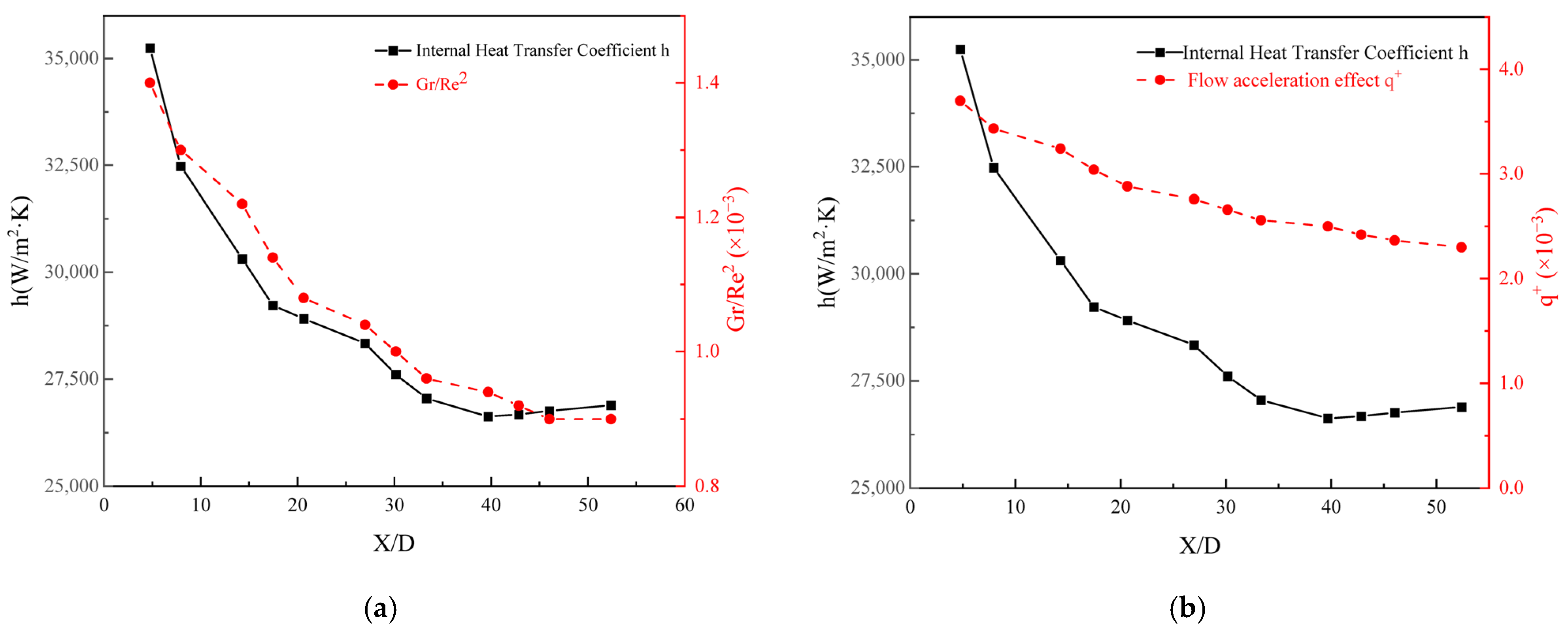
The flow of supercritical hydrogen within a tube belongs to forced convection, where intense turbulence significantly enhances heat transfer. Meanwhile, the temperature gradient induces a density difference in the supercritical hydrogen between the near-wall and central regions, which drives natural convection within the tube. As shown in Figure 2b, substantial density variations occur over the investigated temperature range, thereby making buoyancy-driven natural convective heat transfer significant. To this end, the buoyancy effect index (Gr/Re2) is used to quantify this effect on heat transfer, with Gr* (Gr number under fixed heat flux conditions) being calculated by Equation (4). Additionally, velocity gradients also contribute to fluid mixing and heat transfer. Therefore, the flow acceleration effect is characterized by index q+ (Equation (5)). A higher q+ value indicates a stronger flow acceleration effect and, consequently, a greater impact on turbulent heat transfer.
Gr * = GrNu = g β q d 4 λ v 2
q + = u b x · d u b = 4 q β ρ c p d · d u b = 4 q β ρ u b c p = 4 q β G c p
where G is the mass flux (kg/m2·s), ν is the kinematic viscosity (m2/s), and β is the thermal expansion coefficient (1/K). In this work, the subscript ‘b’ indicates bulk fluid values and the subscript ‘w’ represents near-wall values for most properties; specifically, Tw refers to the tube wall temperature. Meanwhile, due to the drastic variations in fluid density, all bulk values were calculated as mass-weighted averages over each cross section.
Figure 5 illustrates the variations in the buoyancy effect index, flow acceleration effect index, and heat transfer coefficient of supercritical hydrogen flow along the flow direction, where D is the tube diameter and X is the axial distance from the start of the heating section. The plotted heat transfer coefficient (h) value is the local mass-weighted average value at each axial position. Along the flow direction, both the buoyancy and the flow acceleration effect indices decrease, resulting in a reduction in the heat transfer coefficient. As shown in Figure 4, as the flow progresses, it becomes increasingly turbulent, and the flow Reynolds number increases. Simultaneously, the thermal expansion coefficient (β) of the fluid decreases, while the thermal conductivity (λ) increases. Although the dynamic viscosity (μ) decreases, its decrease magnitude is limited. Thus, the Gr number decreases as the flow progresses, which inevitably leads to a reduction in the buoyancy effect. Regarding the flow acceleration effect, as the flow progresses and the supercritical hydrogen is gradually heated, its thermal expansion coefficient (β) decreases, while its specific heat capacity at constant pressure (cp) increases, inevitably leading to a decrease in the flow acceleration effect index. Therefore, with both buoyancy and flow acceleration effects diminished, heat transfer becomes increasingly reliant on turbulent forced convection. However, turbulent mixing is inherently limited in the near-wall region. Consequently, the heat transfer from the wall to the core flow is weakened, leading to a streamwise deterioration in overall heat transfer performance.

3.3. Effects of Operating Conditions on the Heat Transfer Performance of Supercritical Hydrogen Flow in a Vertical Tube

As noted, the flow and heat transfer characteristics of supercritical hydrogen are influenced by various factors, including pressure, mass flow rate, heat flux, and tube structure. Therefore, the following sections analyze in detail how these factors influence the heat transfer. In the following analysis, each factor is changed separately, while other conditions remain unchanged.

3.3.1. Effects of Tube Wall Heat Flux Within the Range from 1500 kW/m2 to 3300 kW/m2

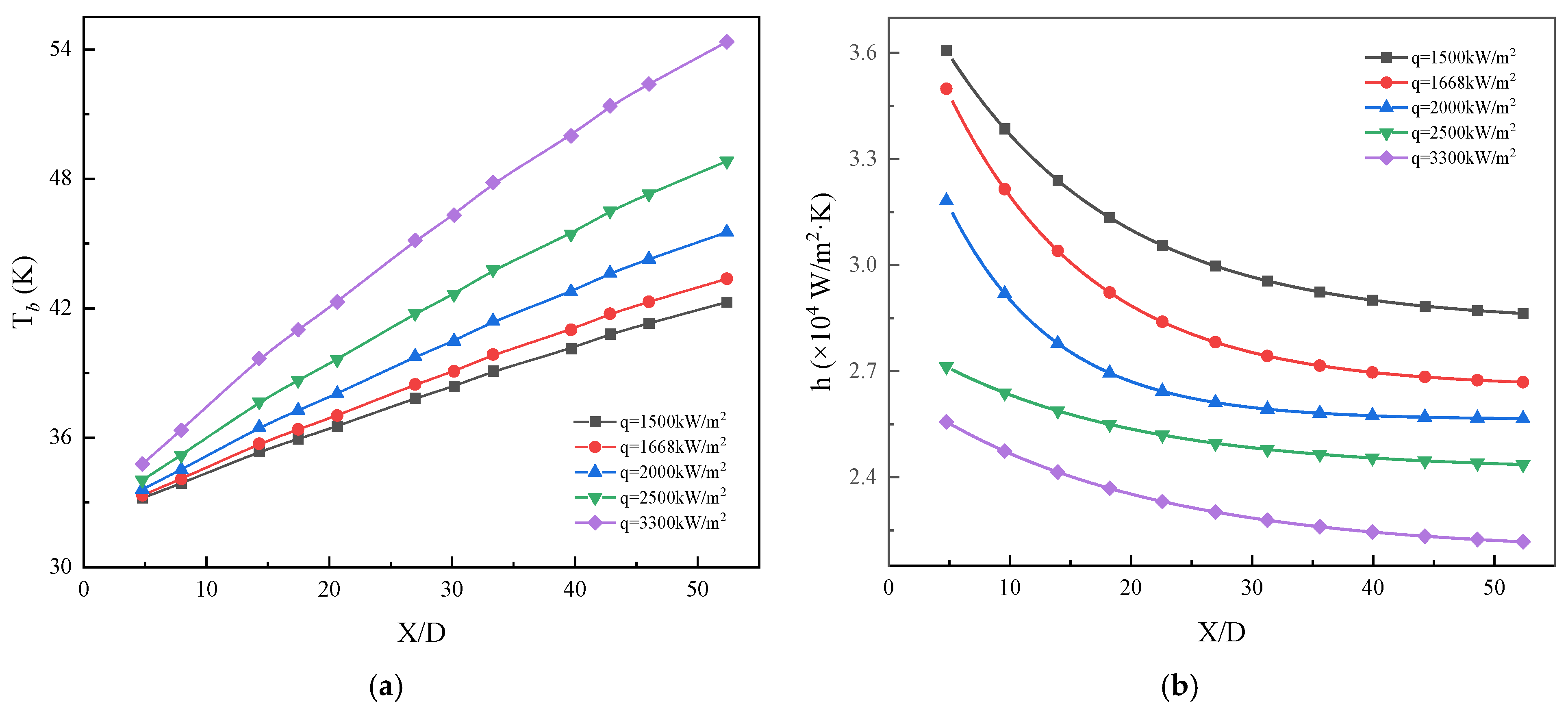
Figure 6 shows the axial distributions of the bulk fluid temperature and the wall–fluid heat transfer coefficient for different heat fluxes. Similar to Figure 4, the bulk temperature gradually increases as the flow progresses. Moreover, a higher wall heat flux leads to a more rapid increase in the bulk temperature. This occurs because a higher heat flux supplies more energy to the fluid, raising its temperature more quickly. In contrast, Figure 6b shows that the wall–fluid convective heat transfer coefficient decreases as the heat flux increases, which can be attributed to the following two interrelated effects.
As the near-wall fluid temperature increases more evidently, its thermal conductivity decreases (Figure 2d), which is not conducive to heat transfer to the central fluid. Meanwhile, the near-wall fluid density decreases and the fluid velocity increases, disrupting the original velocity gradient near the wall and hindering the formation of vortex structures there. Therefore, the diminished turbulent mixing in the near-wall region weakens the heat transfer to the core flow. Thus, a lower heat flux enhances the wall–fluid convective heat transfer coefficient at the cost of a limited fluid temperature rise. For the supercritical hydrogen heating process, an optimal heat flux must be determined to reconcile the requisite heating efficiency with the temperature rise.
Unlike the enhancement phenomenon reported by Xi [23], the present study shows a decrease in the heat transfer coefficient as heat flux increases. This discrepancy may arise because their study involved micro-channels, which have a fundamentally different scale and flow regime compared to the present geometry. Moreover, Wang et al. [17] identified an optimal heat flux for supercritical CO2 that yields the highest heat transfer efficiency. These different results highlight that for supercritical fluids, variations in fluid type or system geometry can markedly alter the heat transfer characteristics. Thus, for the heat transfer of supercritical fluids, targeted research should be conducted based on specific application conditions.

3.3.2. Effects of Mass Flow Rate Within the Range from 0.0626 kg/s to 0.14 kg/s

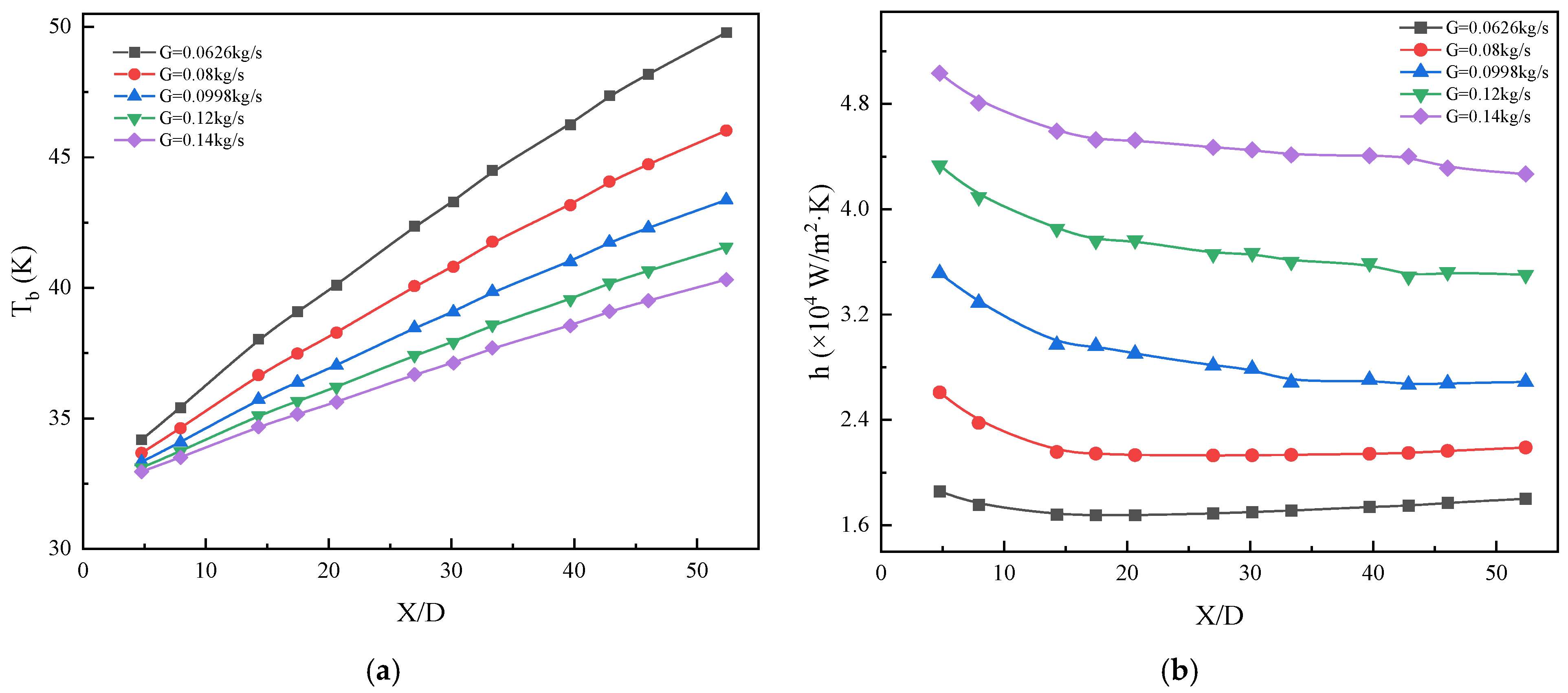
Figure 7 illustrates the axial distributions of the bulk temperature of supercritical hydrogen and the heat transfer coefficient along the streamwise direction under different mass flow rate conditions. As the mass flow rate increases, the bulk fluid temperature decreases, while the wall–fluid heat transfer coefficient increases. This trend aligns with findings for supercritical water, where Shang et al. [40] reported that heat transfer deterioration becomes less evident at higher mass flow rates.
The above phenomenon occurs because, at a fixed heat flux, a higher mass flow rate reduces the heat input per unit mass of fluid, resulting in a smaller temperature rise. This leads to a significant drop in near-wall fluid temperature, thereby reducing the temperature difference between the near-wall and central regions. Consequently, the reduced temperature difference diminishes the density gradient and thus the buoyancy effect in the near-wall region, which allows the preservation of turbulent flow structure. As a result, the enhanced turbulence at higher mass flow rates improves the heat transfer process. However, although heat transfer is enhanced at high mass flow rates, the final fluid temperature rise is constrained.

3.3.3. Effects of Tube Diameter Within the Range from 6 mm to 10 mm

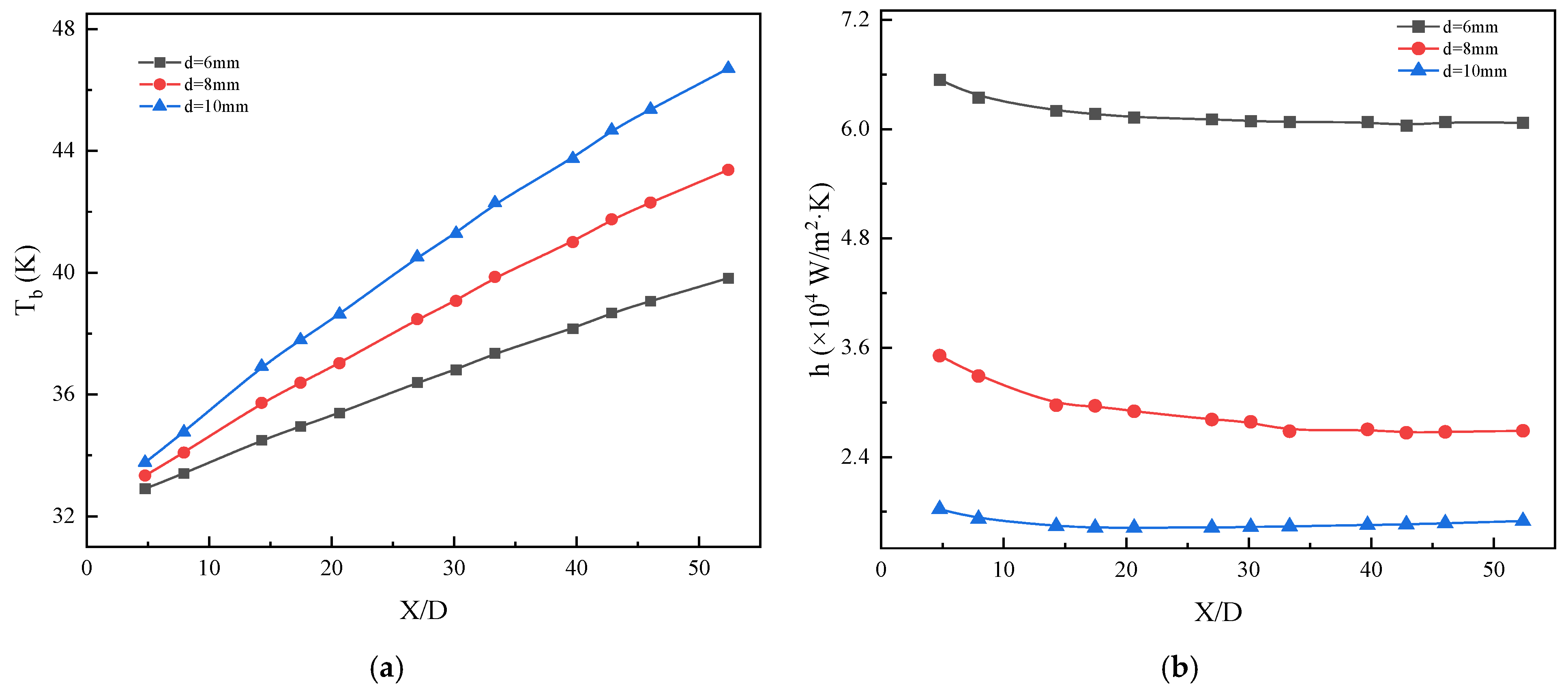
Figure 8 shows the impact of tube diameter on the heat transfer characteristics of supercritical hydrogen. As the tube diameter increases, both the temperature rise rate and the final temperature increase. On one hand, a larger diameter reduces the flow velocity at a fixed mass flow rate, increasing the fluid residence time. On the other hand, it increases the tube wall area available for heat transfer. Therefore, more heat can be transferred to the supercritical hydrogen at large tube diameters and its final temperature is higher.
However, as shown in Figure 8b, the wall–fluid heat transfer coefficient decreases with increasing tube diameter, a trend consistent with the reports of Lee et al. [41] and Song et al. [42]. This is because, at a fixed total mass flow rate, a larger tube diameter reduces the flow velocity, leading to a decrease in the velocity gradient and turbulence intensity near the wall, thereby weakening the heat transfer process [29]. Meanwhile, the rising near-wall temperature reduces the fluid viscosity and thermal conductivity, so the Gr* number near the wall increases significantly with tube diameter (Equation (4)). Consequently, the near-wall buoyancy effect becomes pronounced. Furthermore, the increase in near-wall fluid temperature reduces the local density and increases the velocity, thereby enhancing the flow acceleration effect. Thus, the enhanced buoyancy and flow acceleration effects promote the laminarization of the near-wall turbulent flow. That is, heat transfer deteriorates as the tube diameter increases. However, although a smaller diameter promotes effective heat transfer, the total heating capacity (or throughput) is limited.

3.3.4. Effects of Fluid Pressure Within the Range from 5 MPa to 90 MPa

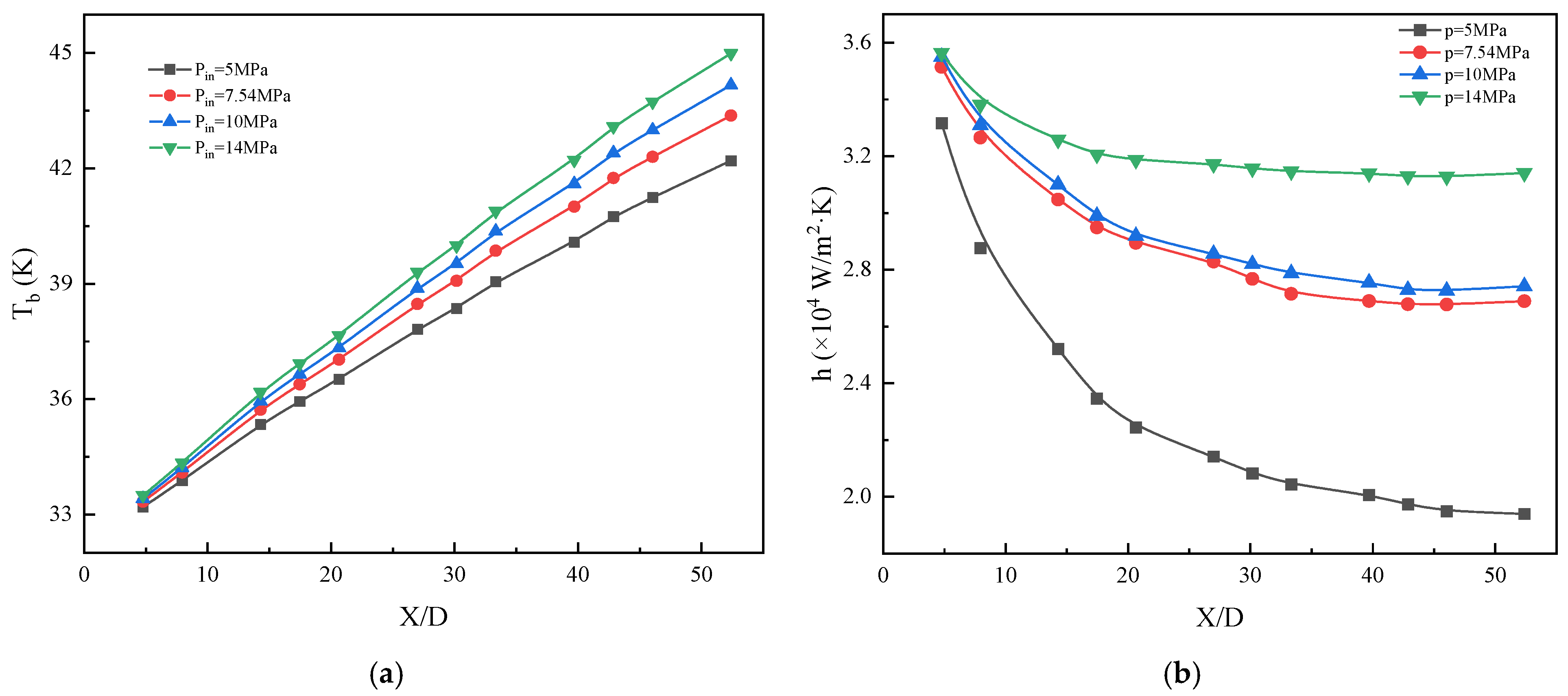
Figure 9 shows the variation of heat transfer characteristics of supercritical hydrogen in vertical tubes under different pressures. As the pressure increases, the supercritical hydrogen temperature increases. This is because increased pressure raises the fluid density (Figure 2b), which reduces the flow velocity at a fixed mass flow rate. The longer residence time allows more time for heat absorption. Meanwhile, Figure 2a shows that the constant-pressure specific heat (cp) of supercritical hydrogen decreases significantly with pressure over the investigated temperature range. A lower cp value implies a greater fluid temperature rise for a given heat input.
As the pressure of supercritical hydrogen increases, the wall–fluid heat transfer coefficient also increases. This phenomenon is consistent with the findings of Wang et al. [29], which can be explained by two mechanisms. As shown in Figure 2d, thermal conductivity increases significantly with pressure, thus promoting heat transfer from the near-wall region to the central area. Meanwhile, as shown in Figure 2b, the density of supercritical hydrogen increases with increasing pressure, and its rate of decrease with temperature is reduced. Consequently, the buoyancy and flow acceleration effects that arise from the density difference between the near-wall and central regions are both attenuated, which helps preserve the near-wall turbulent structure. In conclusion, the enhanced thermal conductivity and the stabilization of near-wall turbulence result in a higher convective heat transfer coefficient at elevated pressures.

3.4. Heat Transfer Correlation for Supercritical Hydrogen Flow in Tubes

3.4.1. General Heat Transfer Correlation Formula for Supercritical Fluids

In the supercritical state, no phase change occurs during the fluid heating process. Thus, most heat transfer correlations for supercritical fluids are adapted from single-phase sub-critical correlations by adding correction terms. Common supercritical heat transfer correlations are mostly based on the Dittus–Boelter correlation, as shown in Equation (6).
Nu x = C Re x m Pr x n F
where the subscript x denotes the choice of reference temperature (e.g., bulk, wall, or film temperature); C, m, and n are empirical constants to be obtained by fitting experimental data; and the correction factor F accounts for supercritical effects and is the product of three terms—f1 (thermophysical property correction term), f2 (buoyancy effect correction term), and f3 (flow acceleration effect correction term)—which are defined as follows.
f 1 = f ( ρ w ρ b , c p ¯ c p , b , λ w λ b , μ w μ b , . . . )
f 2 = f   ( Gr ,   Gr ¯ ,   G r * , Bu ,   B o * ,   E , . . . )
f 3 = f   ( q + ,   π A ,   K v ,   Ac , . . . )
where Nu, Re and Pr represent the Nusselt number, Reynolds number and Prandtl number respectively; μ, ρ, λ and cp denote the dynamic viscosity (Pa·s), density (kg/m3), thermal conductivity (W/m · K) and constant-pressure specific heat capacity (kJ/kg · K); Gr ¯ represents the average Gr number; Bu, Bo*, and E represent the characteristic dimensionless numbers of buoyancy; and πA, Kv, and Ac represent the characteristic dimensionless numbers of flow acceleration.
To account for drastic property variations near the pseudo-critical point, many researchers determine fluid properties and dimensionless numbers with both bulk and wall temperatures, aiming to improve the applicability of heat transfer correlations [43,44]. However, these correlations are typically fitted to specific parameter ranges and, as exemplified in Ref. [45], may perform well only on their original dataset. Consequently, their applicability to conditions outside the original fitting range is often limited. Furthermore, since most experiments are carried out at relatively low pressures (e.g., below 10 MPa), their predictive accuracy for high-pressure hydrogen storage systems (up to 40 MPa or beyond) is often poor.

3.4.2. Heat Transfer Correlation Formula Considering the Buoyancy and the Flow Acceleration Effects

This work aims to develop a heat transfer correlation for supercritical hydrogen in tubes under ultra-high-pressure conditions by combining the experimental database of Ref. [31] with the simulation results obtained in this work. As noted, buoyancy force and flow acceleration effects have a pronounced effect on the wall–fluid heat transfer. Therefore, the heat transfer correlation for supercritical hydrogen flow in tubes is selected in the form of Equation (10), as recommended in Ref. [45].
Nu b = c 0 Re c 1 ( P r w P r b ) c 2 ( c p ¯ c p , b ) c 3 ( v w v b ) c 4 ( Gr * ) c 5 ( q + ) c 6
Furthermore, this correlation can be written in dimensionless form as a product of several numbers as Equation (11).
N u b = c 0 X 1 c 1 X 2 c 2 X 3 c 3 X k c k
where X1, X2, X3, …, Xk are the selected dimensionless numbers, and c0, c1, c2, c3, …, ck are fitting coefficients.
Taking the natural logarithm of both sides of Equation (11) yields Equation (12).
InN u b = In c 0 + c 1 In X 1 + c 2 In X 2 + c k In X k
Let y = lnNub, x1 = lnX1, x2 = lnX2, …, and xk = lnXk, Equation (12) can be reduced to linear form as Equation (13).
y = c 1 x 1 + c 2 x 2 + + c k x k + In c 0
The sum of squared errors between the predicted and experimental values is defined as
F ( c 0 , c 1 , c 2 c k ) = i = 1 n [ c 1 x 1 ( i ) + c 2 x 2 ( i ) + + c k x k ( i ) + I n c 0 y ( i ) ] 2  
Taking the partial derivatives with respect to each unknown coefficient yields the following system of equations:
{ F c 0 = 2 i = 1 n [ c 1 x 1 ( i ) + c 2 x 2 ( i ) + + c k x k ( i ) + In c 0 y ( i ) ] · 1 c 0 F c 1 = 2 i = 1 n [ c 1 x 1 ( i ) + c 2 x 2 ( i ) + + c k x k ( i ) + In c 0 y ( i ) ] · x 1 ( i ) F c 2 = 2 i = 1 n [ c 1 x 1 ( i ) + c 2 x 2 ( i ) + + c k x k ( i ) + In c 0 y ( i ) ] · x 2 ( i ) F c k = 2 i = 1 n [ c 1 x 1 ( i ) + c 2 x 2 ( i ) + + c k x k ( i ) + In c 0 y ( i ) ] · x k ( i )
Let F c 0 = 0 ,   F c 1 = 0 ,   F c 2 = 0 , ,   F c k = 0 , then:
{ c 1 i = 1 n x 1 ( i ) + c 2 i = 1 n x 2 ( i ) + + c k i = 1 n x k ( i ) + n l n c 0 = i = 1 n y ( i ) c 1 i = 1 n x 1 ( i ) x 1 ( i ) + c 2 i = 1 n x 1 ( i ) x 2 ( i ) + + c k i = 1 n x 1 ( i ) x k ( i ) + l n c 0 i = 1 n x 1 ( i ) = i = 1 n x 1 ( i ) y ( i ) c 1 i = 1 n x 2 ( i ) x 1 ( i ) + c 2 i = 1 n x 2 ( i ) x 2 ( i ) + + c k i = 1 n x 2 ( i ) x k ( i ) + l n c 0 i = 1 n x 2 ( i ) = i = 1 n x 2 ( i ) y ( i ) c 1 i = 1 n x k ( i ) x 1 ( i ) + c 2 i = 1 n x k ( i ) x 2 ( i ) + . . . + c k i = 1 n x k ( i ) x k ( i ) + l n c 0 i = 1 n x k ( i ) = i = 1 n x k ( i ) y ( i )
The above equations can be written in matrix form as follows.
  C = ( X T X ) 1 X T Y
where X, Y and C are matrices with definitions as follows.
  X = | 1 In X 1 ( 1 ) In X 2 ( 1 ) In X k ( 1 ) 1 In X 1 ( 2 ) In X 2 ( 2 ) In X k ( 2 )   1 In X 1 ( n ) In X 2 ( n ) In X k ( n ) | n × ( k + l )   Y = [ ln Nu b ( 1 ) ln Nu b ( 2 ) ln Nu b ( n ) ] n × 1 C = [ ln c 0 c 1 c k ] ( k + 1 ) × 1
where k and n denote the numbers of selected dimensionless numbers and data points, respectively. Substituting the experimental data into Equation (18), matrices X and Y can be obtained. Thereafter, the coefficient matrix C is subsequently solved via Equation (16), thereby determining all constants in the correlation, Equation (11).

3.4.3. Heat Transfer Correlation Formula Suitable for Supercritical Hydrogen Flow in Vertical Circular Tubes

In the work of Hendricks et al. [31], experiments were conducted under conditions at an inlet temperature of 32 K and tube diameters of 5.4, 8.0, and 11.1 mm. The other parameter ranges were: pressure from 0.98 to 16.35 MPa, mass flow rate from 0.0227 to 0.1814 kg/s, and heat flux from 0.98 to 16.35 MW/m2. In this work, the simulation conditions are as follows: the inlet temperature is 32 K, the tube diameters are 6–10mm, the pressure is 5–90 MPa, the mass flow rate is 0.0626–0.14 kg/s, and the heat flux is 1.5–3.3 MW/m2. Although all simulation parameters except pressure fall within the experimental range, specific parameter combinations are different from those in the experiment. Therefore, experimental and simulation data are combined to develop the heat transfer correlation, and a combined dataset of 84 experimental and 16 simulation conditions was compiled. In this dataset, each experimental condition contributed 12 data points (wall–fluid heat transfer coefficient, h, and corresponding operating conditions), while each simulation condition contributed 24 such data points.
Based on the method described in Section 3.4.2, an iterative optimization was performed using the least squares method to obtain the heat transfer correlation for supercritical hydrogen flow in vertical tubes, as shown in Equation (19). The heat transfer correlation formula for supercritical hydrogen (Equation (19)) differs markedly from those for supercritical water (Equation (20)) and supercritical CO2 (Equation (21)), justifying the need to develop a correlation specifically for supercritical hydrogen. This correlation formula clearly explains how the drastic changes in the thermophysical parameters of supercritical hydrogen result in heat transfer characteristics that are significantly different from those at normal temperature and pressure. That is, it modulates the heat transfer intensity by affecting key dimensionless groups (Re, Pr, and Gr), as well as the flow acceleration effect (q+). Furthermore, the presence of the ‘Gr*/Gr’ term reflects that the correlation was derived for constant heat flux conditions, and its applicability to variable heat flux conditions has not been validated.
  N u b = 0.4196 R e b 1.122 Pr ( G r * Gr ) 2.49 ( q + ) 1.056
To evaluate the applicability of the correlation, the mean absolute difference (MAD) and mean relative difference (MRD) are used to assess its prediction accuracy against experimental data.
M A D = 1 N i = 1 N | R D ( i ) |
M R D = 1 N i = 1 N R D ( i )
where N is the total number of data points, i represents the i-th data point, and the relative difference (RD) is calculated as follows:
R D ( i ) = a ( i ) p r e d a ( i ) e x p a ( i ) e x p
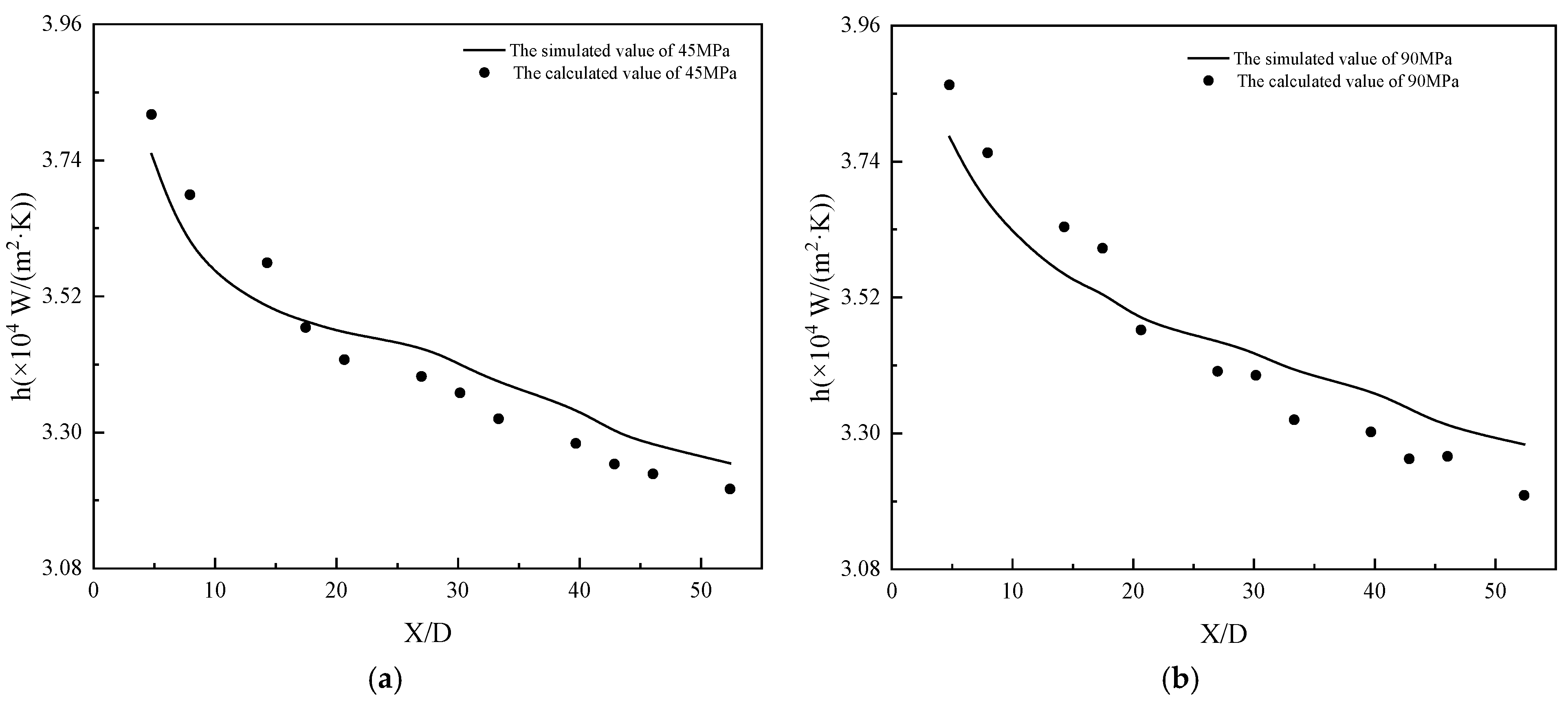
With this method, the fitness of the proposed correlation (Equation (19)) to the dataset was evaluated, and the MAD and MRD are 5.3% and 0.6%, respectively. Thereafter, the correlation was used to predict the wall–fluid heat transfer coefficient for the experimental conditions reported in various studies, and the predictions were compared with the corresponding experimental data. Then, the calculated values were compared with those in the literature, thereby obtaining the overall MAD and MRD values. It should be noted that during the comparison process, the calculated h values are the average value for each specific operating condition. The comparison results are shown in Table 2, where the item Tw/Tb denotes the ratio of tube wall temperature (Tw) to bulk fluid temperature (Tb). The prediction errors for all previous experimental data are within ±10%, indicating that the correlation meets general engineering accuracy requirements. Meanwhile, by comparing the simulation results under ultra-high pressure (45–90 MPa) with the correlation-predicted values, it was found that the relative differences are also within 10% (Figure 10).
The proposed heat transfer correlation demonstrates good predictive accuracy for supercritical hydrogen flow in vertical tubes within the following parameter ranges: fluid temperature is approximately 32–60 K, heat flux is 1500–3300 kW/m2, mass flow rate is 0.062–0.14 kg/s, tube diameter is 6–10 mm, and pressure is 5–90 MPa. However, this work does not cover the parameter range near the pseudo-critical region (at approximately 1.3 MPa). Due to the drastic variation in thermophysical properties near the pseudo-critical point (Figure 2), the heat transfer behavior may differ substantially. Therefore, its applicability under conditions near the pseudo-critical point requires further verification. Meanwhile, as the validation at ultra-high pressures (45–90 MPa) is based solely on numerical simulations, caution is advised when applying this correlation to actual design and adequate safety margins should be incorporated.

4. Conclusions

This work numerically investigated the heat transfer characteristics of supercritical hydrogen in vertical tubes under various influencing factors. Based on the results, a new heat transfer correlation is proposed that extends the applicability to higher pressures and accounts for buoyancy and flow acceleration effects. The main findings of this study are summarized as follows:
(1)
Supercritical hydrogen flow in tubes exhibits significant radial gradients in velocity and temperature due to the existence of flow and thermal boundary layers. Specifically, the temperature is low but the velocity is high in the central region, while the temperature is high and the velocity is low near the wall.
(2)
In the low-temperature range (30–50 K) investigated, the density of supercritical hydrogen decreases sharply with a small temperature increase. This leads to a marked velocity increase immediately upon entering the heating section, while the temperature rise requires a longer heating distance. Furthermore, the wall–fluid heat transfer coefficient decreases along the streamwise direction.
(3)
The fluid temperature increases with higher wall heat flux, larger tube diameter, or higher inlet pressure, but decreases with higher mass flow rate. Meanwhile, the wall–fluid heat transfer coefficient decreases when the heat flux, tube diameter, or pressure is increased, or when the mass flow rate is reduced.
(4)
The wall–fluid heat transfer coefficient is governed by turbulent mixing. Each key parameter modulates the turbulence, buoyancy, and flow acceleration effects by influencing fluid thermophysical properties, and thus alters the heat transfer coefficient.
(5)
A heat transfer correlation for supercritical hydrogen flow in tubes was developed by considering corrections of thermophysical properties, buoyancy force effect, and flow acceleration effect. It shows good agreement (±10% error) with a broad set of experimental data and is applicable for predictions under ultra-high pressures.
This study elucidates the heat transfer characteristics of supercritical hydrogen in tubes and develops a correlation applicable to ultra-high-pressure conditions. The correlation provides theoretical guidance for designing heat exchangers in high-pressure hydrogen storage and utilization systems, contributing to the advancement of hydrogen energy applications. However, two main limitations should be noted. First, due to drastic variations in thermophysical properties near the pseudo-critical point, the correlation’s applicability in this regime requires further verification. Second, as the ultra-high-pressure validation relies solely on simulation results, special caution is warranted in those applications. Furthermore, the individual contributions of thermophysical property variations, buoyancy force effect, and flow acceleration effect to the overall heat transfer characteristics were not isolated. Quantifying these distinct contributions will be a focus of future work.

Author Contributions

Conceptualization, C.X.; methodology, C.X., L.W., T.H. and C.W.; software, M.N.; validation, C.X., L.W., T.H. and C.W.; formal analysis, C.X. and M.N.; investigation, C.X. and M.N.; writing—original draft preparation, C.X., L.W., T.H. and C.W.; writing—review and editing, C.X., M.N. and C.W.; supervision, M.N.; project administration, C.X. and L.W.; funding acquisition, C.X. and L.W. All authors have read and agreed to the published version of the manuscript.

Funding

This research was funded by the Postgraduate Research & Practice Innovation Program of Jiangsu Province (SJCX23_1929, SJCX24_2252), and the APC was also funded by these two programs.

Data Availability Statement

The original contributions presented in this study are included in the article. Further inquiries can be directed to the corresponding author(s).

Conflicts of Interest

The authors declare no conflict of interest.

Nomenclature

Abbreviation
MADmean absolute difference
MRDmean relative difference
RDrelative difference
Symbol
Cconstants
Cpspecific heat capacity (J/kg∙K)
Dinner diameter of tube (m)
Fsupercritical heat transfer correction term
fforce per unit mass (m/s2)
Gmass flux (kg/m2∙s)
hspecific enthalpy (J/kg)
Llength (m)
Ppressure (Pa)
STviscous dissipation term (W/m3)
Ttemperature (K)
uvelocity vector (m/s)
Xdistance from starting point to measured point (m)
μdynamic viscosity (Pa∙s)
xany property
βthermal expansion coefficient (1/K)
ρdensity (kg/m3)
νkinematic viscosity (m2/s)
λthermal conductivity (W/m∙K)
NuNusselt number
ReReynolds number
PrPrandtl number
GrGrashof number
Gr ¯ the average Grashof number
Gr * Grashof number based on fixed heat flux
q + flow acceleration effect index
Subscripts
bbulk values
wnear-wall values
i, jtensor indices in the direction
m, nundetermined coefficients

References

  1. Olabi, A.; Bahri, A.S.; Abdelghafar, A.A.; Baroutaji, A.; Sayed, E.T.; Alami, A.H.; Rezk, H.; Abdelkareem, M.A. Large-scale hydrogen production and storage technologies: Current status and future directions. Int. J. Hydrogen Energy 2021, 46, 23498–23528. [Google Scholar] [CrossRef]
  2. Ryu, M.-R.; Kang, D.; Kim, B.-K.; Kim, J.; Kim, G.; Yun, S. A study on thermal and flow characteristics of liquefied hydrogen heat exchanger for train using computational analysis. J. Mech. Sci. Technol. 2024, 38, 5467–5477. [Google Scholar] [CrossRef]
  3. Kumar, L.; Sleiti, A.K.; Al-Ammari, W.A. Thermo-economic analysis of blending hydrogen into natural gas pipeline with gaseous inhibitors for sustainable hydrogen transportation. Chem. Eng. Sci. 2025, 311, 121619. [Google Scholar] [CrossRef]
  4. Mehr, A.S.; Phillips, A.D.; Brandon, M.P.; Pryce, M.T.; Carton, J.G. Recent challenges and development of technical and technoeconomic aspects for hydrogen storage, insights at different scales; A state of art review. Int. J. Hydrogen Energy 2024, 70, 786–815. [Google Scholar] [CrossRef]
  5. Teymourtash, A.R.; Khonakdar, D.R.; Raveshi, M.R. Natural convection on a vertical plate with variable heat flux in supercritical fluids. J. Supercrit. Fluids 2013, 74, 115–127. [Google Scholar] [CrossRef]
  6. Chen, J.; Du, W.; Cheng, K.; Li, X.; Guo, J.; Lv, P.; Dong, H. Design analysis of a hybrid printed circuit heat exchanger for precooling in hydrogen refueling station. Int. Commun. Heat Mass Transf. 2025, 163, 108765. [Google Scholar] [CrossRef]
  7. Zhao, Y.X.; Gong, M.Q.; Zhou, Y. The storage of hydrogen based on low-temperature and high-pressure method. Chin. Sci. Bull. 2019, 64, 2654–2660. [Google Scholar] [CrossRef]
  8. Tian, Z.; Lv, H.; Zhou, W.; Zhang, C.; He, P. Review on equipment configuration and operation process optimization of hydrogen refueling station. Int. J. Hydrogen Energy 2021, 47, 3033–3053. [Google Scholar] [CrossRef]
  9. Agyekum, E.B.; Odoi-Yorke, F.; Abbey, A.A.; Ayetor, G.K. A review of the trends, evolution, and future research prospects of hydrogen fuel cells—A focus on vehicles. Int. J. Hydrogen Energy 2024, 72, 918–939. [Google Scholar] [CrossRef]
  10. Xiao, R.; Chen, L.; Hou, Y.; Du, C.; Cai, Y. Experimental study on heat transfer behavior and prediction of heat transfer deterioration of supercritical nitrogen in vertical tubes. Int. Commun. Heat Mass Transf. 2024, 155, 107467. [Google Scholar] [CrossRef]
  11. Xie, G.; Xu, X.; Lei, X.; Li, Z.; Li, Y.; Sunden, B. Heat transfer behaviors of some supercritical fluids: A review. Chin. J. Aeronaut. 2021, 35, 290–306. [Google Scholar] [CrossRef]
  12. Mao, S.; Zhang, S.; Wu, X.; Liu, Y.; Zhang, L.; Lv, C.; Zhou, T.; Tang, S. Performance of convective heat transfer of supercritical CO2 in unilaterally heated rectangular channel. J. Supercrit. Fluids 2026, 232, 106895. [Google Scholar] [CrossRef]
  13. Hall, W.B.; Jackson, J.D.; Watson, A. Forced convection heat transfer to fluids at supercritical pressure. Conf. Proc. 1979, 182, 10–22. [Google Scholar] [CrossRef]
  14. Cheng, L.; Xu, J.; Wang, Q.; Dong, X. The influence of tube diameter parameters on the flow resistance and heat transfer characteristics of supercritical CO2 in horizontal tubes. Appl. Therm. Eng. 2024, 241, 122361. [Google Scholar] [CrossRef]
  15. Huang, D.; Wu, Z.; Sunden, B.; Li, W. A brief review on convection heat transfer of fluids at supercritical pressures in tubes and the recent progress. Appl. Energy 2016, 162, 494–505. [Google Scholar] [CrossRef]
  16. Peng, R.; Lei, X.; Guo, Z.; Wang, Y.; Li, H.; Zhou, X. Forced convective heat transfer of supercritical carbon dioxide in mini-channel under low mass fluxes. Int. J. Heat Mass Transf. 2022, 182, 121919. [Google Scholar] [CrossRef]
  17. Wang, L.; Pan, Y.C.; Der Lee, J.; Fu, B.-R.; Pan, C. Convective heat transfer characteristics of supercritical carbon dioxide in vertical miniature tubes of a uniform heating experimental system. Int. J. Heat Mass Transf. 2021, 167, 120833. [Google Scholar] [CrossRef]
  18. Wang, Y.; Lei, R.; Wang, H.; Wang, S.; Bai, J. Thermal performance analysis of fin-and-tube heat exchanger circuit in supercritical hydrogen refrigeration cycle system. Int. J. Hydrogen Energy 2019, 44, 19765–29775. [Google Scholar] [CrossRef]
  19. He, S.; Kim, W.S.; Bae, J.H. Assessment of performance of turbulence models in predicting supercritical pressure heat transfer in a vertical tube. Int. J. Heat Mass Transf. 2008, 51, 4659–4675. [Google Scholar] [CrossRef]
  20. Wen, Q.L.; Gu, H.Y. Numerical simulation of heat transfer deterioration phenomenon in supercritical water through vertical tube. Ann. Nucl. Energy 2010, 37, 1272–1280. [Google Scholar] [CrossRef]
  21. Wang, Y.; Lei, R.; Wang, H.; Wang, S.; Bai, J. Numerical investigation on heat transfer of supercritical CO2 in heated helically coiled tubes. J. Supercrit. Fluids 2015, 99, 112–120. [Google Scholar] [CrossRef]
  22. Jaromin, M.; Anglart, H. A numerical study of heat transfer to supercritical water flowing upward in vertical tubes under normal and deteriorated conditions. Nucl. Eng. Des. 2013, 264, 61–70. [Google Scholar] [CrossRef]
  23. Xi, Z.W. Numerical study on flow and heat transfer characteristics of hydrogen in microchannels. Master’s Thesis, Northeast Electric Power University, Jilin, China, 2025. [Google Scholar]
  24. Xiao, R.; Chen, L.; Hou, Y.; Zhang, Z.; Lv, H. Experimental study and prediction of flow instability of supercritical nitrogen in a vertical upward tube. Int. J. Heat Mass Transf. 2024, 227, 125565. [Google Scholar] [CrossRef]
  25. Liu, S.; Huang, Y.; Liu, G.; Wang, J.; Leung, L.K. Improvement of buoyancy and acceleration parameters for forced and mixed convective heat transfer to supercritical fluids flowing in vertical tubes. Int. J. Heat Mass Transf. 2017, 106, 1144–1156. [Google Scholar] [CrossRef]
  26. Tong, J.; Fu, W.; Yang, W.; Wang, S.; Shen, F.; Zhou, B.; Lin, L.; Yu, C.; Zheng, H.; Yao, C.; et al. Numerical simulation of heat transfer characteristics of supercritical liquid hydrogen through triangular U-tube in moderator. Cryogenics 2023, 132, 103698. [Google Scholar] [CrossRef]
  27. Sadri, S.; Raveshi, M.R.; Amiri, S. Efficiency analysis of straight fin with variable heat transfer coefficient and thermal conductivity. J. Mech. Sci. Technol. 2021, 26, 1283–1290. [Google Scholar] [CrossRef]
  28. Babaelahi, M.; Raveshi, M.R. Analytical efficiency analysis of aerospace radiating fin. J. Mech. Eng. Sci. 2014, 228, 3133–3140. [Google Scholar] [CrossRef]
  29. Wang, L.; Pan, Y.C.; Der Lee, J.; Wang, Y.; Fu, B.-R.; Pan, C. Experimental investigation in the local heat transfer of supercritical carbon dioxide in the uniformly heated horizontal miniature tubes. Int. J. Heat Mass Transf. 2020, 159, 120136. [Google Scholar] [CrossRef]
  30. Gao, Y.; Jiang, W.; Hai, X.; Yang, F.; Wang, L.; Li, P.; Wang, F.; Chen, X. Research on heat transfer characteristics of supercritical hydrogen in rough U-shaped channels. Can. J. Chem. Eng. 2025, 104, 1509–1525. [Google Scholar] [CrossRef]
  31. Friedman, R.; Hendricks, R.C.; Simoneau, R.J. Heat-Transfer Characteristics of Cryogenic Hydrogen from 1000 to 2500 Psia Flowing Upward in Uniformly Heated Straight Tubes; NASA TN D-2977; National Aeronautics and Space Administration (NASA): Washington, DC, USA, 1965. [Google Scholar]
  32. Menter, F.R. Two-equation eddy-viscosity turbulence models for engineering applications. AIAA J. 1994, 32, 1598–1605. [Google Scholar] [CrossRef]
  33. Jiang, P.-X.; Liu, B.; Zhao, C.-R.; Luo, F. Convection heat transfer of supercritical pressure carbon dioxide in a vertical micro tube from transition to turbulent flow regime. Int. J. Heat Mass Transf. 2013, 56, 741–749. [Google Scholar] [CrossRef]
  34. Ebrahimi, A.; Shokri, M. Numerical simulation of conjugate heat transfer in the rectangular cooling channer at supercritical pressures. Sharif University of Technology 2019, 35, 67–77. [Google Scholar] [CrossRef]
  35. NIST Reference Fluid Thermodynamic and Transport Properties Database (REFPROP): Version 10. Available online: https://www.nist.gov/srd/refprop (accessed on 12 March 2025).
  36. Viswanathan, K.; Krishnamoorthy, G. The effects of wall heat fluxes and tube diameters on laminar heat transfer rates to supercritical CO2. Int. Commun. Heat Mass Transf. 2021, 123, 105197. [Google Scholar] [CrossRef]
  37. Khonakdar, D.R.; Raveshi, M.R. Mixed convection on a vertical plate in supercritical fluids by selecting the best equation of state. J. Supercrit. Fluids 2016, 107, 549–559. [Google Scholar] [CrossRef]
  38. Huang, Z.G.; Zeng, X.K.; Li, Y.L.; Yan, X.; Xiao, Z.J.; Huang, Y.P. Summarization and Evaluation of Supercritical Heat Transfer Correlations. Nucl. Power Eng. 2012, 33, 28–31. [Google Scholar] [CrossRef]
  39. Zhao, P.; Wan, T.; Jin, Y.; Chen, Z.; Li, Y.; Peng, C. Direct numerical simulation analysis of heat transfer deterioration of supercritical fluids in a vertical tube at a high ratio of heat flux to mass flowrate. Phys. Fluids 2021, 33, 055114. [Google Scholar] [CrossRef]
  40. Shang, Z.; Chen, S. Numerical investigation of diameter effect on heat transfer of supercritical water flows in horizontal round tubes. Appl. Therm. Eng. 2011, 31, 573–581. [Google Scholar] [CrossRef][Green Version]
  41. Lee, R.A.; Haller, K.H. Supercritical water heat transfer developments and applications. In Proceedings of the International Heat Transfer Conference, Tokyo, Japan, 3–7 September 1974; pp. 335–339. [Google Scholar] [CrossRef]
  42. Song, J.; Kim, H.Y.; Kim, H.; Bae, Y.Y. Heat transfer characteristics of a supercritical fluid flow in a vertical pipe. J. Supercrit. Fluids 2008, 44, 164–171. [Google Scholar] [CrossRef]
  43. Dong, X.; Li, Y.; Li, M.; Liu, L.; Wang, T.; Wang, T. The influence of gravity effect on the flow resistance and heat transfer characteristics of supercritical H2 in vertical tubes. Int. J. Therm. Sci. 2026, 219, 110190. [Google Scholar] [CrossRef]
  44. Yan, C.; Shi, J.; Zhang, S.; Zhang, X.; Chen, Q. Investigation on heat transfer of supercritical CO2/Xe mixture crossing pseudo-critical temperature cooled in a horizontal circular tube. Appl. Therm. Eng. 2024, 250, 124245. [Google Scholar] [CrossRef]
  45. Locke, J.M. Analysis of Heat Transfer Correlations for Supercritical Hydrogen in Regenerative Cooling Channels. Ph.D. Thesis, The University of Alabama in Huntsville, Huntsville, AL, USA, 2005. [Google Scholar]
  46. Mccarthy, J.R. Forced convection heat transfer to gaseous hydrogen at high heat flux and high pressure in a smooth, round, electrically heated tube. Ars J. 1960, 30, 423–425. [Google Scholar] [CrossRef]
  47. Thompson, W.R.; Geery, E.L. Heat Transfer to Cryogenic Hydrogen at Supercritical Pressures. In Advances in Cryogenic Engineering; Springer: Boston, MA, USA, 1962. [Google Scholar] [CrossRef]
  48. Taylor, M.F. Experimental Local Heat-Transfer Data for Precooled Hydrogen and Helium at Surface Temperature up to 5300° R; NASA TN D-2280; National Aeronautics and Space Administration (NASA): Washington, DC, USA, 1965. [Google Scholar]
  49. Hendricks, R.C.; Graham, R.W.; Hsu, Y.Y. Experimental Heat-Transfer Results for Cryogenic Hydrogen Flowing in Tubes at Subcritical and Supercritical Pressures to 800 Pounds per Square Inch Absolute; NASA TN D-3095; National Aeronautics and Space Administration (NASA): Washington, DC, USA, 1966. [Google Scholar]
  50. Aerojet-General Corp. Heat Transfer to Cryogenic Hydrogen Flowing Turbulently in Straight and Curved Tubes at High Heat Fluxes; NASA CR-678; National Aeronautics and Space Administration (NASA): Washington, DC, USA, 1966. [Google Scholar]
Figure 1. Schematic diagram of the experimental setup and mesh generation. (a) Experimental setup; (b) Simulation domain and meshing scheme.
Applsci 16 01972 g001
Figure 2. Variation of thermal-physical parameters of hydrogen w. (a) Constant-pressure specific heat; (b) Density; (c) Dynamic viscosity; (d) Thermal conductivity; (e) Specific enthalpy; (f) Thermal expansion coefficient.
Applsci 16 01972 g002
Figure 3. Average temperature variation along the flow direction under different mesh systems.
Applsci 16 01972 g003
Figure 4. Distribution contours of parameters of supercritical hydrogen in a vertical tube. (a) Temperature; (b) Velocity; (c) TKE.
Applsci 16 01972 g004
Figure 5. Profiles of buoyancy and flow acceleration effect indices and heat transfer coefficient along flow direction. (a) Buoyancy effect index and heat transfer coefficient; (b) Flow acceleration effect index and heat transfer coefficient.
Applsci 16 01972 g005
Figure 6. Profiles of main flow temperature and heat transfer coefficient under different heat flux intensities. (a) Main flow temperature along flow direction; (b) Heat transfer coefficient along flow direction.
Applsci 16 01972 g006
Figure 7. Profiles of main flow temperature and heat transfer coefficient under different mass flow rate conditions. (a) Main flow temperature along flow direction; (b) Heat transfer coefficient along main flow temperature.
Applsci 16 01972 g007
Figure 8. Profiles of main flow temperature and heat transfer coefficient under different tube diameter conditions. (a) Main flow temperature along flow direction; (b) Heat transfer coefficient along main flow temperature.
Applsci 16 01972 g008
Figure 9. Profiles of main flow temperature and heat transfer coefficient under different pressure conditions. (a) Main flow temperature along flow direction; (b) Heat transfer coefficient along main flow temperature.
Applsci 16 01972 g009
Figure 10. Comparison of simulated and calculated heat transfer coefficient under ultra-high-pressure conditions. (a) 45 MPa; (b) 90 MPa.
Applsci 16 01972 g010
Table 1. Comparison of simulation data and experimental data at measurement points.
Measurement Points123456789101112
Simulation results (K)33.5234.7836.9837.2438.6739.4440.3941.2842.6243.7144.8446.56
Measured values (K)32.7833.8935.5636.1137.2238.3339.4440.0041.1142.2242.7843.89
Relative error (%)2.262.633.993.683.902.902.413.203.673.534.826.08
Tw Simulation results (K)92.298.2105.1108.7111.5112.7114.3116.8117.6118.9119.7120.5
Tw Measured values (K)88.893.8100.9103.7105.5106.1107.9111111.7113.3113.6114.4
Relative error (%)3.834.694.164.825.696.225.935.235.284.945.375.33
Table 2. Difference between the experimental data in different works and correlation-predicted values.
ReferencesX/DTw/TbPressure (MPa)Heat Flux
(MW/m2)
Mass Flow Rate
(kg/s)
MADMRD
Hendricks [31]3.4–78.21.5–11.06.9–17.240.98–16.350.0227–0.18148.9%2.5%
McCarthy [46]5.8–50.21.5–11.10.22–9.340.06–24.200.0004–0.05816.7%−1.4%
Thompson [47]0.9–10.31.1–9.44.69–9.270.23–13.080.0041–0.02818.5%0.8%
Taylor [48]11.6–771.4–8.00.26–0.471.37–7.470.0004–0.00097.2%−2.3%
Friedman [49]4.9–1141.1–15.01.52–5.650.33–53.950.0132–0.08846.9%−1.4%
Aerojet [50]6.7–33.96.1–21.44.8–9.4510.46–45.120.0318–0.20056.4%2.2%
Disclaimer/Publisher’s Note: The statements, opinions and data contained in all publications are solely those of the individual author(s) and contributor(s) and not of MDPI and/or the editor(s). MDPI and/or the editor(s) disclaim responsibility for any injury to people or property resulting from any ideas, methods, instructions or products referred to in the content.