Article

The Numerical Model of a PV System Supported by Experimental Validation

Department of Fundamentals of Physics for Engineers, Politehnica University of Timisoara, 300006 Timișoara, Romania
*
Author to whom correspondence should be addressed.
Appl. Sci. 2026, 16(4), 1891; https://doi.org/10.3390/app16041891
Submission received: 5 December 2025 / Revised: 17 January 2026 / Accepted: 10 February 2026 / Published: 13 February 2026

Abstract

Photovoltaic (PV) module manufacturers typically provide electrical parameters at Standard Test Conditions (STCs), while real operation is strongly influenced by irradiance and module temperature. This paper presents a MATLAB-based numerical model that simulates the operation of a real PV string composed of 19 series-connected modules (8.645 kWp). Each module has 72 PV cells arranged as two parallel cell groups, each group consisting of 36 cells connected in series, and a rated maximum power of 455 Wp. The validated string belongs to a PV site comprising 140 modules (63.7 kWp); however, the experimental verification is intentionally performed at the string level to avoid aggregation effects. The model implements the single-diode equivalent circuit and computes the I–V and P–V characteristics at any time step, using 500 points for curve plotting. Measured irradiance and module temperature are used as inputs, while DC voltage, current, and power recorded at the inverter MPPT are used as reference quantities. Model performance is evaluated over two representative operating days, and the verification includes point-by-point comparisons between measured and simulated electrical quantities at 25 operating points, with accuracy quantified through MAE, RMSE, and MRE. The obtained errors are: MAE—power 92.94 W (1.08% of maximum power), voltage 8.33 V (1.07% of maximum voltage), current 0.12 A (1.17% of maximum current); RMSE—power 111.78 W (1.29%), voltage 10.15 V (1.30%), current 0.15 A (1.46%); and MRE—power 2.6%, voltage 1.18%, current 2.57%. These results indicate close agreement between simulated and measured string behavior under the tested conditions, supporting the use of the proposed approach for string-level performance analysis and diagnostic assessment when irradiance and temperature are available from measurements or scenario inputs, without extending conclusions to plant-level generalization beyond the validated subsystem. Photovoltaic panel manufacturers usually provide electrical parameters in a single operating condition, but in reality, PV cells operate under very diverse weather conditions. For this reason, the manufacturer’s information is not sufficient to determine the performance of PV plants.

1. Introduction

The design and optimal operation of photovoltaic (PV) systems require increasingly sophisticated monitoring and control systems. The nonlinearity of PV cells makes the mathematical models used for sizing and analyzing their operation nonlinear, which requires solving systems of nonlinear equations to obtain the voltage and current at the terminals of the PV cells. Analytical solution of nonlinear equations is difficult, which is why they are solved numerically. The MATLAB (v2024) programming environment contains subroutines for solving nonlinear equations, which is why researchers frequently use them. The development of easy-to-use programming environments has allowed researchers to increasingly resort to numerical simulation for the analysis of various physical systems. This trend is also found in the field of photovoltaic systems.
In paper [1], a numerical model developed at Sandia National Laboratory (USA) is presented to predict the energy production in PV systems, but it requires input data that are not normally available. The five-parameter model described in this paper uses the data provided by the beneficiary of the photovoltaic plant, namely solar radiation and the temperature of the PV cells. Semi-empirical equations are also used to predict the current–voltage curve. The disadvantage of the model is that it does not use high-performance programming environments for solving nonlinear equations. In paper [2], a numerical modeling method of PV systems is presented that allows the determination of the parameters of the nonlinear function I(V). For this, three particular operating modes of the PV cell are used, namely the no-load mode (open circuit); the short-circuit mode; and the maximum power point (MPPT). Starting from the three operating modes (the characteristic quantities of the three modes are provided by the manufacturers) through successive adjustments, the I(V) function is determined, imposing the condition that it contains the three operating points. By not using professional subroutines convergence, problems of the numerical method may occur, which is a disadvantage of the numerical model. Paper [3] presents a photovoltaic module model in MATLAB-Simulink. Using the Simulink block related to a PV cell, the numerical model has a reduced flexibility. A numerical model and the electricity production estimation algorithm are implemented with MATLAB functions, while data acquisition and presentation of results are managed by a LabVIEW graphical interface; this is presented in paper [4]. The disadvantage of the model is that it does not take into account the losses that occur in the cables that connect the PV cells to each other. The transcendental nonlinear equations that describe the PV generator, which are coupled with the detailed switching models of the power electronic converters, generally lead to slow and inefficient simulations, especially when long-term analyses are required. Paper [5] presents a simplified model for the PV cell but which ensures that the I(V) characteristics obtained with the model pass through the specific points specified by the manufacturers. The main shortcoming of the model is that, by changing the type of PV cell, it is necessary to recalibrate the parameters that intervene in the equivalent scheme of the PV cells. However, comparing the results obtained using the model with those obtained experimentally, a good agreement was found. In paper [6], a different model is proposed compared to the other models presented in the literature, in that the resistance Rs in the single-diode model of the PV cell is replaced by a third-degree polynomial function to reproduce the nonlinearity of this resistance. Although proceeding in this way reduces the calculation time compared to the more complex models presented in the literature, the polynomial that replaces the resistance Rs depends on the type of PV cell. As a result, it is necessary to establish the appropriate polynomial function for each type of PV cell. Paper [7] presents a numerical model for a PV power plant considering all PV cells of the plant as identical, which constitutes an approximation even in the case of the same type of PV cells. The model was tested using a database obtained experimentally. A comparison between the results obtained for the power output of a PV plant using the TRASYS (v2013) simulation environment, the specialized software for PV systems PVSyst (v2019), and the HOMER Pro (v2019) software package is presented in paper [8]. The conclusion is that, of the three analyzed software packages, the best results were obtained using the TRASYS software package. The main disadvantage of these software packages is that the dependence of the power output of the PV plant is considered as a linear irradiance function. In paper [9], a two-step iterative method is proposed for solving the nonlinear equation related to the single-diode PV cell model, which is more efficient than the methods presented in the literature. In order for the proposed method to become efficient, it is necessary to include it in the MATLAB subroutines. Paper [10] proposes a model for PV generators, which uses the implicit current–voltage relationship of each module to obtain a system of nonlinear equations that describes the electrical behavior of a PV generator. The system of nonlinear equations can be solved with the same numerical methods used by traditional models. The main advantage of the model is the reduction in the computational burden and, consequently, the calculation time. In paper [11], the Newton Raphson method is proposed for calculating the voltage, current and power of a PV cell, which is implemented in MATLAB. The authors state that using this procedure reduces the calculation time for the specified quantities. The paper only analyzes the performance of the proposed method without analyzing what happens in the case of PV panels. The way in which dirt influences the optimal operation of PV power plants is analyzed in paper [12,13]. It is found that, when PV cells are dirty, their electricity production decreases significantly. As a result, in the simulation of PV cells, the effect of dirt on the power produced by them must be taken into account. Paper [14] presents a numerical model of a PV plant implemented in MATLAB/Simulink (v2012) that uses Simulink blocks to create the model. The simulated PV plant supplies electricity to a water pumping system. Using Simulink blocks, the model presents the shortcomings of these blocks.
The MATLAB/Simulink software package offers the possibility of simulating many physical systems, which is why it is frequently used by researchers. For example, in paper [15] a numerical model is presented and is used to analyze the transient regime caused by faults in electrical networks. In the case of PV systems, using Simulink blocks for the numerical model does not achieve the best results, which is why Simulink blocks were not used in this paper.
From what has been presented, it follows that, although various numerical models for PV systems are presented in the literature, the respective models have not been verified under real operating conditions of PV plants. The numerical models have been verified either under laboratory conditions [2,9,10] or by comparing the results obtained using the model with those presented in various databases [4,6].
In this paper, a numerical model in MATLAB is presented that reproduces the operation of a string formed by 19 modules connected in series, each module consisting of two groups connected in parallel. Each group contains 36 cells connected in series, so one module contains 72 PV cells. The mathematical model of the simulated string is implemented in MATLAB and has the ability to take the irradiance and temperature of the cells from the real installation. These quantities can also be entered into the model manually. With the help of the model, the voltage, current and power produced by the string at each time point are calculated. The model also allows the determination of the I–V and P–V characteristics of the string and the following errors: the relative error, the average relative error, the average absolute error, and the mean square error. The validation of the model is done by comparing the voltage, current and power obtained using the model with those determined experimentally. The degree of soiling, or aging, of the PV cells is modeled by a coefficient that reduces the irradiance applied to the PV cells. The paper presents the results obtained with the numerical model considering for Rs the value and 0.05 Ω, respectively, for Rsh the value 185.7 Ω.
The paper is structured as follows: Section 1—Introduction; Section 2—Experimental Determinations, where the characteristics of the PV plant and the numerically simulated string are presented, as well as the results obtained through measurements in the real PV installation; Section 3—Methods and Models, where the numerical model implemented in MATLAB and the results obtained using the model are presented; Section 4—Discussions, where the differences between the experimentally determined quantities and those obtained using the model are presented to validate the model, and the time variation in irradiance, temperature, voltage, current and power determined experimentally and using the numerical model is presented for one day; and Section 5 is dedicated to the conclusions and problems to be solved in the future.

2. Experimental Investigations

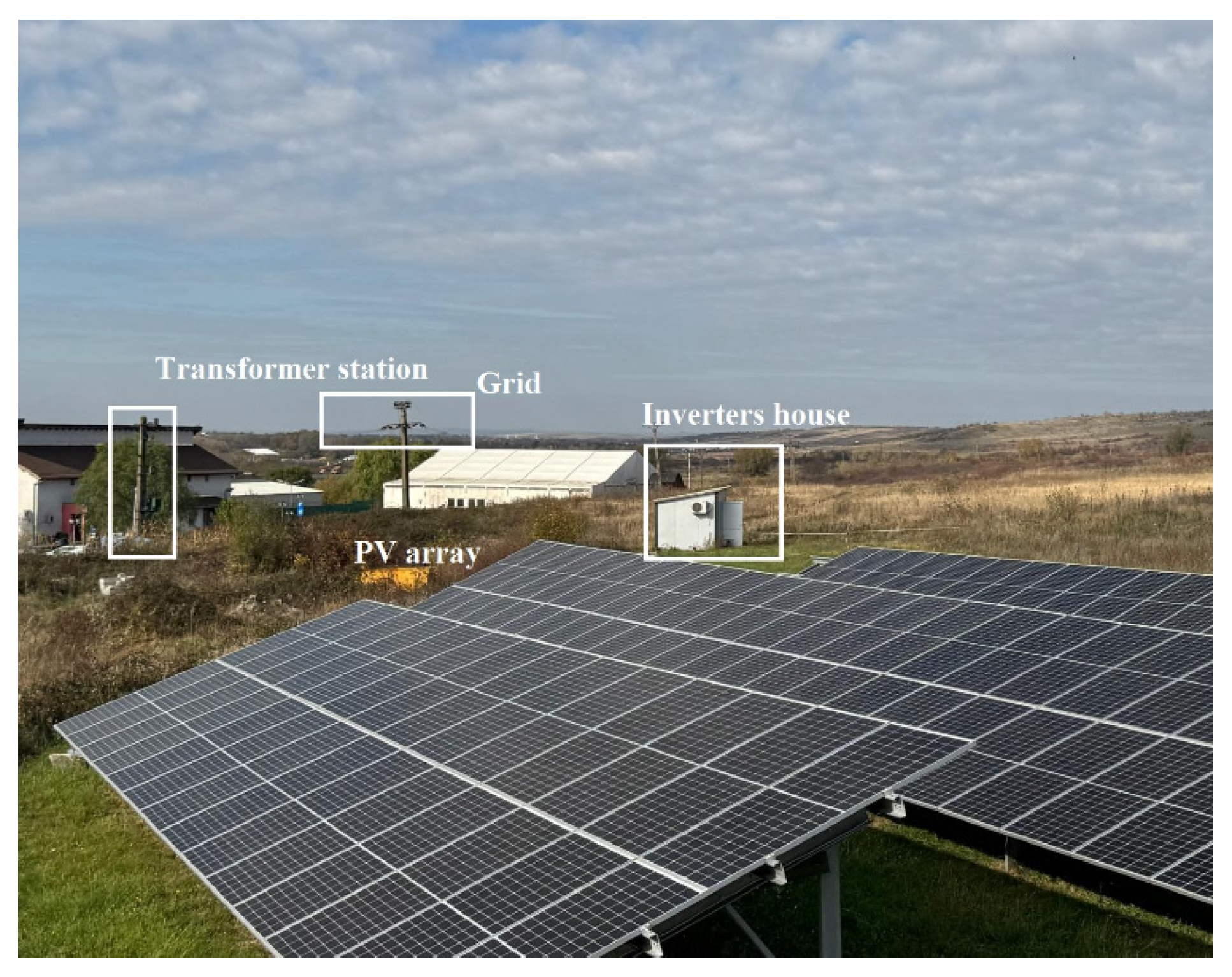
In this study, a real photovoltaic system was considered, for which the configuration and the characteristics of all constituent components are known. To validate the numerical model equivalent to the analyzed photovoltaic system, it is necessary to determine the system parameters experimentally, and the values thus obtained are subsequently compared with those generated by the numerical model of the photovoltaic system. An overview of the system is shown in Figure 1. The location of the PV system has the coordinates Lat 45.706° and Lon 21.921°, altitude 124 m. The PV site has an installed peak power of approximately 63.7 kWp, consisting of 140 modules arranged into multiple strings. However, the experimental validation presented in this paper is intentionally limited to a single PV string connected to the inverter MPPT input, in order to ensure a consistent set of measured electrical variables and to avoid aggregation effects. The analyzed subsystem comprises 19 modules connected in series (8.645 kWp) and corresponds to the inverter MPPT channel used for data logging. All “measured” electrical quantities referenced in this work represent DC input values at the inverter MPPT for the selected string. The photovoltaic system, shown in Figure 1, comprises the following components: the photovoltaic panels (PV array), the inverters (Inverter house), the electrical distribution grid (Grid), and the low-voltage/medium-voltage transformer (Transformer station). The system includes 140 high-efficiency monocrystalline silicon solar modules, Risen Energy RSM144-7-455M, each with a nominal power rating of approximately 455 Wp. The modules have a total surface area of 309.3 m2, are south-oriented at 180°, and are ground-mounted in parallel rows, with a tilt angle (θ) of 24° due to land surface constraints. The 140 modules are physically grouped into two tables of 56 modules each (with an area of 125.9 m2 each) and one table of 28 modules (with an area of 62.9 m2). The distance between the tables is 5.8 m.
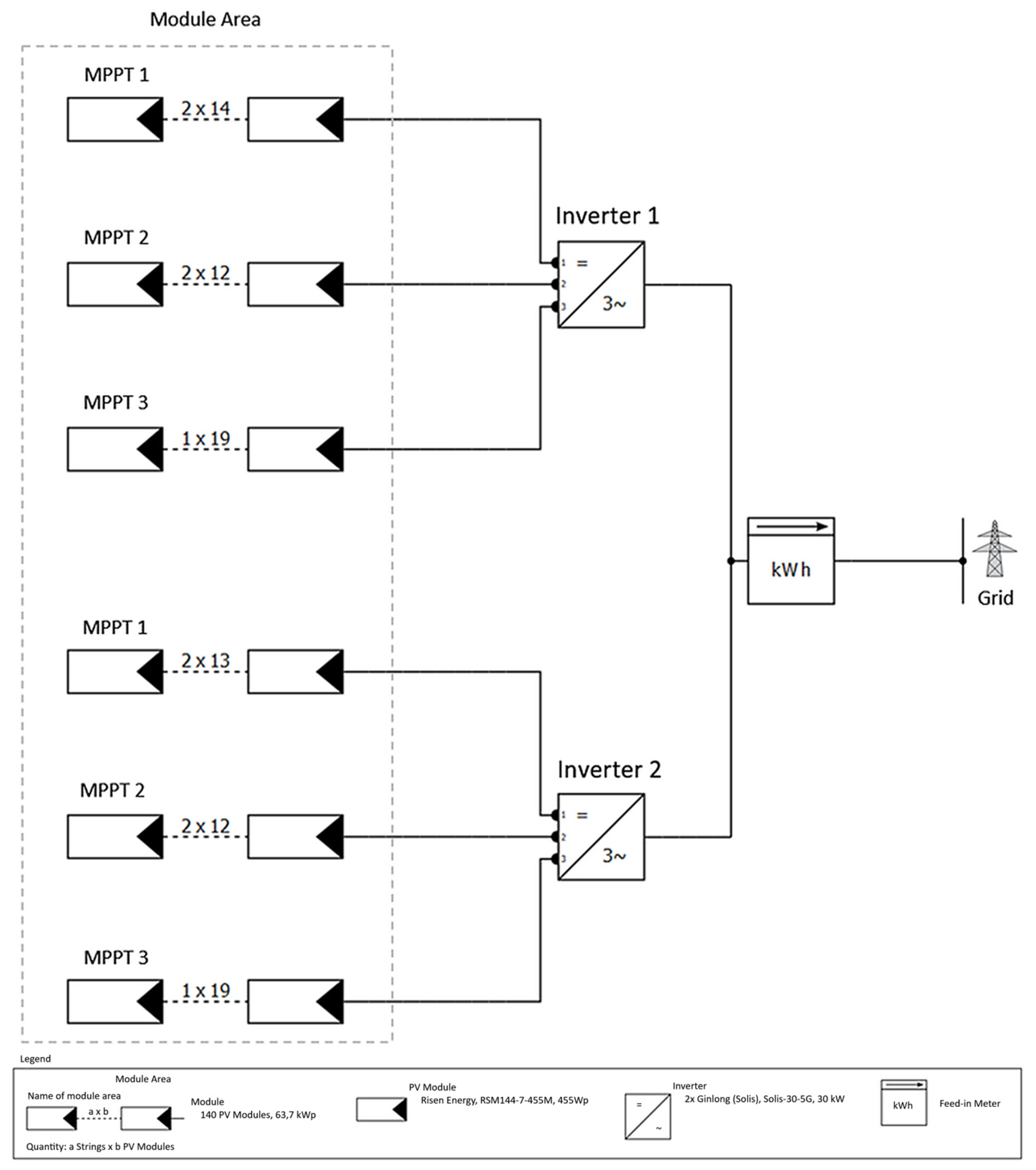
The schematic diagram of the photovoltaic system is presented in Figure 2. From this figure, it can be observed that the first inverter is connected to three groups of photovoltaic modules, each linked to one of the inverter’s three MPPT inputs. The first group consists of two parallel strings, each string comprising 14 photovoltaic modules, resulting in a total of 28 modules. The second group consists of two parallel strings, each string containing 12 modules, thus totaling 24 modules. The third group consists of a single string of 19 photovoltaic modules connected in series. Consequently, the first inverter is connected to 71 photovoltaic modules.
The dimensions of the three tables were established taking into account the available land for the placement of the PV modules. The maximum number of modules connected to an inverter input is established on the condition that the voltage does not exceed the value imposed by the manufacturer. This condition was respected when installing the PV modules, resulting in the connection of the modules according to Figure 2.
The second inverter is also connected to three groups of photovoltaic modules, similarly distributed across its three MPPT inputs; however, the configuration of these groups differs from that of the groups connected to the first inverter. The first group consists of two parallel strings, each string containing 13 photovoltaic modules, totaling 26 modules. The second group consists of two parallel strings, each containing 12 modules, totaling 24 modules. The third group consists of a single string of 19 modules connected in series. As a result, the second inverter is connected to 69 photovoltaic modules.
In total, the photovoltaic system comprises 140 photovoltaic modules. The characteristics of the modules under STCs (irradiance 1000 W/m2, cell temperature 25 °C, air mass AM 1.5, according to EN 60904-3 [16]) are presented in Table 1.
The parameter values of the Solis-30K-5G inverters are presented in Table 2. The parameters of the PV modules connected to the inverter must satisfy the conditions imposed by the EN 60904-3 standard so as not to exceed the values imposed in Table 2.
The experimental measurements were conducted on 11 July 2024, a sunny day, and 17 July 2024, with clouds in the second part of the day, during the time interval 07:00–19:00. The cell temperature (Tcell) was measured using a multimeter equipped with a type-K temperature probe, class 1—in accordance with DIN EN 60584-1 [17]. The K thermocouple junction was fixed on the rear (backsheet) surface of a representative module, approximately at the geometric center, using high-thermal conductivity adhesive tape, and covered with a thin insulating pad to reduce direct convective cooling. This placement is commonly used to approximate cell temperature while minimizing radiative and wind-induced errors. Solar irradiance (G) was measured using a Kipp & Zonen pyranometer, class A—compliant with ISO 9060:2018 [18] and IEC 61724-1 [19] standards. For the verification of the model’s behavior, the irradiance value plays an important role. In the considered interval, the irradiance changes from 66.8 W/m2 to 1029.2 W/m2, i.e., it increases 8.5 times. For this reason, we considered that the chosen interval corresponds to the verification of the model’s correctness.
The experimental data for validation were extracted from the SolisCloud platform associated with the Solis S5-GC30K inverter. According to the official documentation, the platform updates data with a typical periodicity of 5 min (in some configurations, an adjustable interval of 1–15 min is mentioned), and the data exposed through interfaces (including API) have an update frequency of 5 min [20]. The platform used is governed by the international data security standard ISO/IEC 27001 [21] and complies with EU Regulation 2016/679 [22]. In addition, SolisCloud values may be subject to platform-level averaging/filtering and upload latency (e.g., due to communications), which can slightly smooth fast transients. In this work, this effect is mitigated by using 30 min sampling and by aligning each manual measurement with the closest SolisCloud timestamp; nevertheless, higher relative errors can occur at low irradiance, where measurement noise and averaging effects are more pronounced.
The manufacturer, for the internal measurement chain, indicates the accuracy class below 1%, accepted value and for digital signal processing [23].
Given that the objective of this study is the validation of the mathematical model developed for simulating a photovoltaic generator, the data used in the analysis correspond to the MPPT3 input of Inverter 1, where a string of 19 photovoltaic modules connected in series is installed.
The experimental determinations were performed on the same string, which is why, by comparing the model results with the experimental ones, the model is validated. The obtained results are presented in Table 3a,b. Considering the characteristics of the measurement system used and the security measures of the platform used, we can assume that the measurement data are sufficiently reliable for validation purposes, within stated sensor and telemetry uncertainties.
Uncertainty bounds: The temperature probe accuracy (class 1 thermocouple) and its mounting method introduce a temperature uncertainty that propagates mainly to voltage prediction. The plane-of-array irradiance sensor uncertainty and the inverter telemetry accuracy introduce uncertainty in the measured electrical quantities. Overall, the reported MAE/RMSE/MRE values should be interpreted against these measurement uncertainties, and small differences (on the order of a few percent) may fall within combined sensor and telemetry error bounds.
Considering that the variation in irradiance around the maximum value (13:00 in Table 3) for 30 min is below 0.1% and the fact that the energy produced is maximum when the irradiance has the maximum value, we considered that the 30 min interval between 2 consecutive measurements ensures the necessary precision for model validation.

3. Methods and Models

To evaluate the performance of a photovoltaic module string within the analyzed solar park, a MATLAB model [24] was developed that simultaneously performs the numerical modeling of the I–V and P–V characteristics and compares them with the actual measurements. In the numerical model, the single-diode scheme was implemented for the PV modules because the calculation time is lower [5,10,25] than when using two- or three-diode schemes. The single-diode scheme contains five parameters. These parameters are saturation current, series and shunt resistances, ideality factor and photocurrent. In paper [26], the parameters of the one-diode, two-diode, and three-diode schemes are determined. The obtained Rs and Rsh values for a module with 36 PV cells depend more on the method used than on the number of diodes. In paper [27], a single I–V characteristic is used to determine the parameters of the single-diode scheme. Using the Lambert W function, the analytical expression of the I–V curve is determined, from which Rs and Rsh result. In paper [28], the parameters of the single-diode circuit are determined using numerical methods. Saturation current and ideality factor solar cell are an indication of the quality of the cell. In paper [29], a method to determine these parameters by measuring open-circuit, Voc, and short-circuit current, Isc, is presented. The determination of the model parameters was performed using the 3-point method (open circuit, short circuit, maximum power) through successive iterations so that the I(V) characteristic contains the 3 points characteristics of the PV module operation. For the series resistance R s , interval [0, 2] Ω was considered, and for the shunt resistance R s h , the interval [50, 2000] Ω was considered [20].
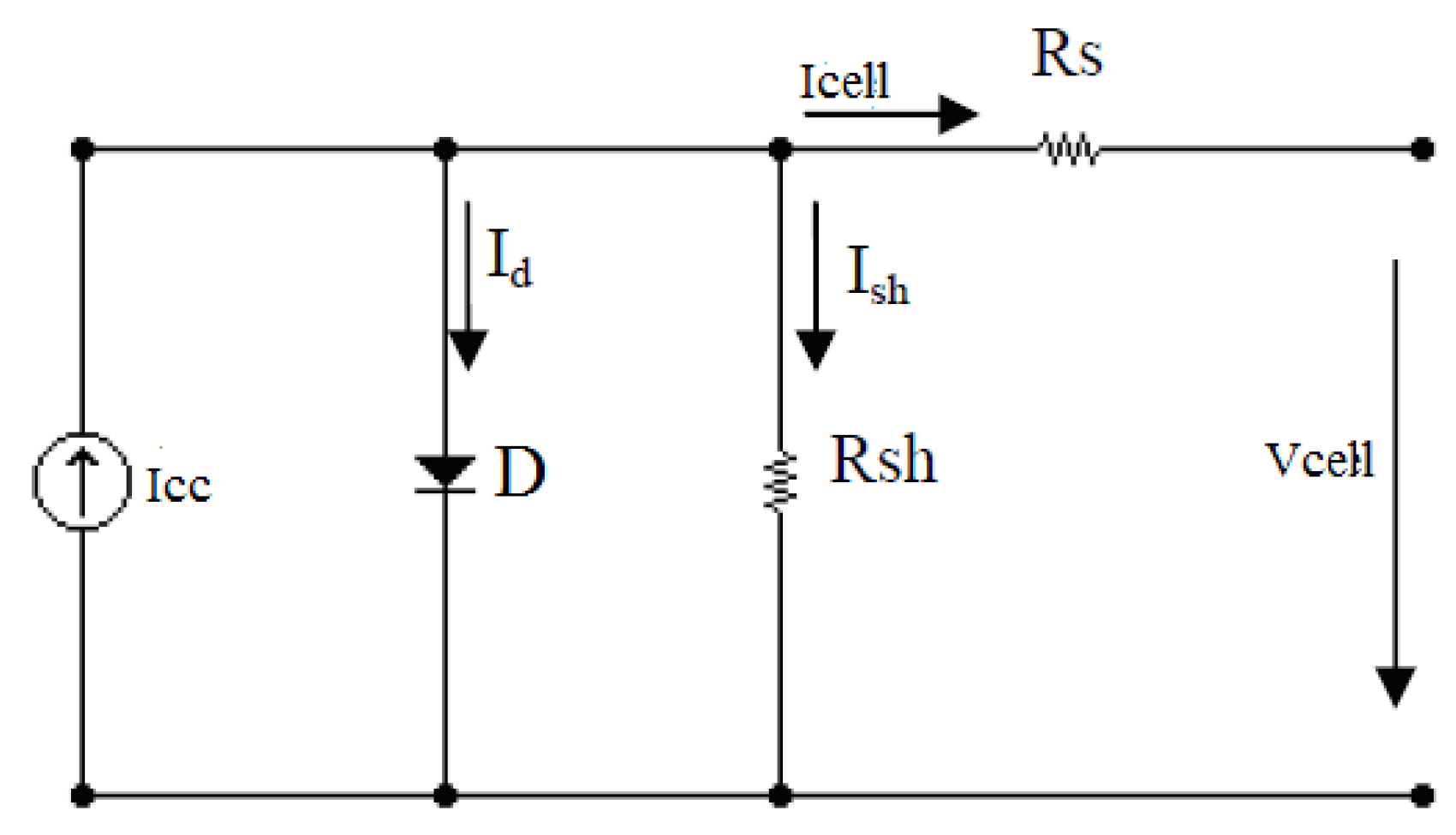
The meaning of the quantities illustrated in Figure 3 is as follows:
Icc—the current generated by the cell (photonic current, “ideal short-circuit current”). It is the current source dependent on irradiance and temperature.
D—the ideal diode modeling the p–n junction behavior of the cell.
Id—the diode current, representing the internal recombination current in the junction; it increases exponentially with the voltage across the cell.
Rsh—the shunt (parallel) resistance, modeling parasitic current paths through the cell (defects, impurities, non-uniformities).
Ish—the current flowing through the shunt resistance Rsh (“shunt-loss current”).
Rs—the series resistance, modeling the resistive contributions of contacts, metallization, and interconnections within the cell and the module.
Icell—the output current of the cell (the current delivered to the load).
Vcell—the output terminal voltage of the cell.
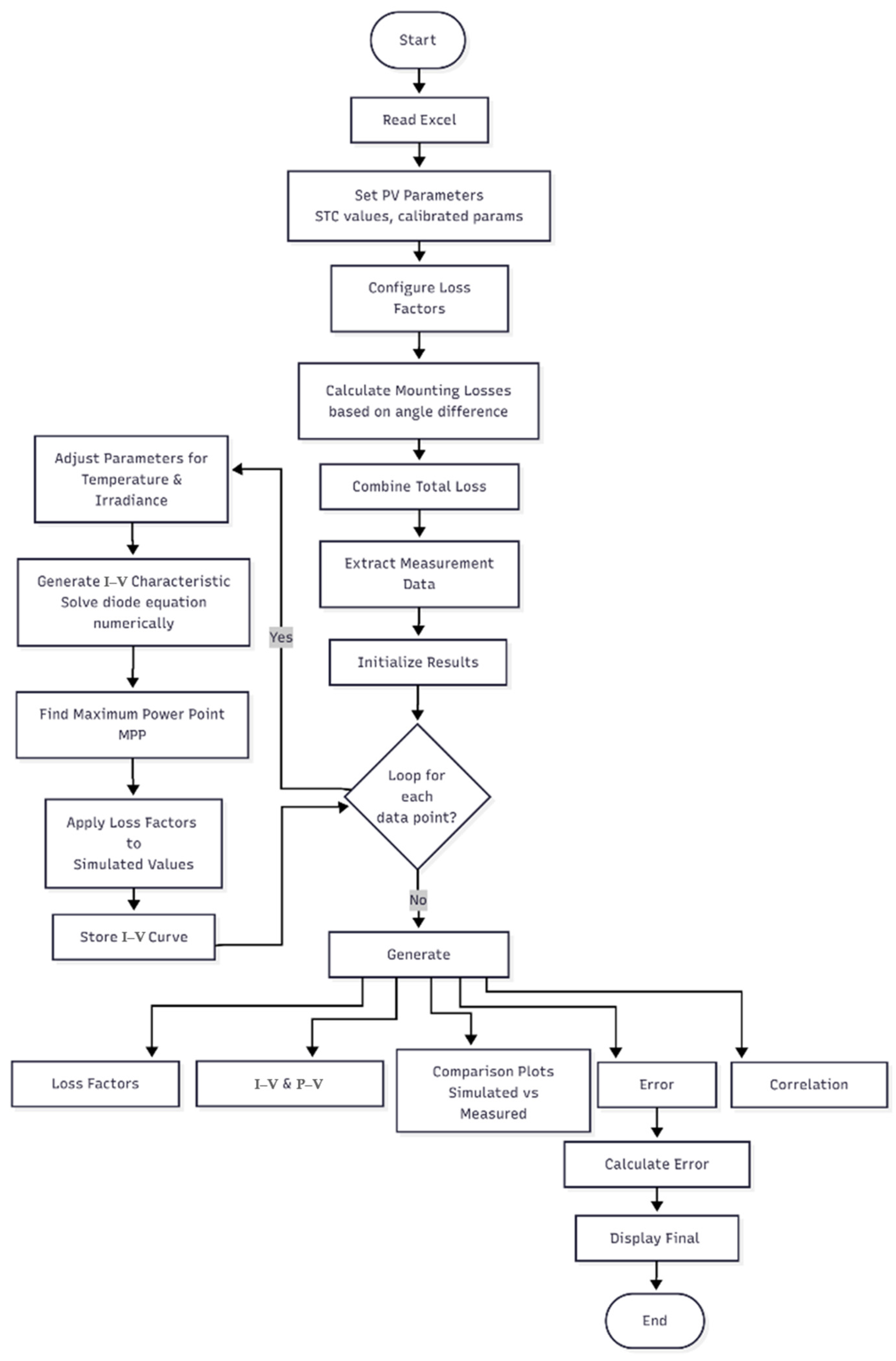
The MATLAB script incorporates the following elements:
  • The effects of temperature and irradiance on the parameters Voc and Isc;
  • Computation of the reverse saturation current I0 under STCs;
  • Numerical generation of the I–V characteristics for each operating point;
  • Determination of the maximum power point (MPP);
  • Explicit inclusion of additional loss factors (inverter, soiling, mounting angle);
  • Error analysis between simulated and measured power.
The general logic diagram of the algorithm is presented in Figure 4.

3.1. Input Data and Model Parameters

The model imports the experimental data from the file “date_pv.xlsx”, which contains, for each time instant   t i , the following quantities:
  • The measurement timestamp (string);
  • The cell or module temperature T c t i   [ ] ;
  • The irradiance in the module plane G t i   [ W / m 2 ] ;
  • The measured string voltage V meas t i   [ V ] ;
  • The measured current I meas t i   [ A ] ;
  • The measured power P meas t i   [ W ] .
The model’s input data are taken from the SolisCloud platform, from the log files generated when measuring temperature and irradiance and manually entered into the Excel file as follows: Timestamps are aligned to the nearest SolisCloud logging instant and at each timestamp the corresponding values of Tc, G, Vmeas, Imeas and Pmeas were added. No additional smoothing or filtering is applied, in order to preserve the measured dynamics for validation.
The photovoltaic generator parameters under STCs are [30]:
  • V o c , S T C = 49.8   V , open-circuit voltage of the module;
  • I s c , S T C = 11.6   A , short-circuit current;
  • N s = 72 , number of cells in series per module;
  • N m s = 19 , number of PV modules connected in series.
The temperature coefficients used in the model are [30]:
  • α V o c = Tcoeff _ Voc = 0.0029   / C ;
  • α I s c = Tcoeff _ Isc = 0.0005   / C .
The parameters of the single-diode model are:
  • R s = 0.05   Ω —series resistance;
  • R s h = 185.7   Ω —shunt (parallel) resistance;
  • n = 1.5 —diode ideality factor;
  • q = 1602 × 10 19   C —electron charge;
  • k = 1381 × 10 23   J / K —Boltzmann constant.
Since the algorithm employs two distinct types of iterations, two indexing conventions are used:
Index i—time index/measurement points
  • i = 1, 2, …, N iterates through the rows of the Excel file.
  • Each i corresponds to an instant time t i : with its associated temperature T c ( t i ) , irradiance G ( t i ) , and measured values V meas ( t i ) , I meas ( t i ) , P meas ( t i ) .
Index j—points on the I–V/P–V curve at a fixed time
  • For a given time t i   , a complete I–V curve is generated, typically consisting of 500 voltage–current sample points.
  • j = 1, 2, …, 500 indexes these points on the I–V curve: V tot ( j ) , I ( j ) ( t i ) , P ( j ) ( t i ) .

3.2. Correction of Parameters for Temperature and Irradiance

In each temporal step t i , the model adjusts the following parameters: V o c and I s c based on measured temperature T c ( t i ) and irradiance G ( t i ) . Linear relations consistent with the module datasheet are employed [24,25]:
Δ T ( t i ) = T c ( t i ) 25   C
V o c ( t i ) = V o c , S T C [ 1 + α V o c Δ T ( t i ) ]
I s c ( t i ) = I s c , S T C [ 1 + α I s c Δ T ( t i ) ] G ( t i ) G S T C
where
G S T C = 1000   W / m 2 –STC reference irradiance;
V o c ( t i ) , I s c ( t i ) —the values adjusted for the actual operating conditions at time t i .
In the implementation, the absolute temperature is computed as follows:
T K ( t i ) = T c ( t i ) + 273,15   [ K ]
and thermal power:
V t ( t i ) = k T K ( t i ) q

3.3. Determination of the Reverse Saturation Current and Photocurrent

The model employs a simplified expression for the reverse saturation current I 0 , obtained from the single-diode equation evaluated at the open-circuit operating point (zero current, voltage V o c ) and neglecting the influence of R s and R s h   at this point. In open circuit (I = 0), the term associated with the series resistance cancels out identically (IRs = 0), so that Rs does not influence Voc. Regarding Rsh, the shunt current Ish = Voc/Rsh represents (1–2) % of Isc, which is why it can be neglected. In these conditions, Rsh becomes infinite. This simplification is accepted in the literature [10,21,23].
I 0 ( t i ) = I s c ( t i ) e x p ( V o c ( t i ) n N s V t ( t i ) ) 1
where
  • I 0 ( t i ) —the reverse saturation current of the diode at time t i [ A ] .
The photocurrent is approximated in the model as follows:
I p h ( t i ) = I s c ( t i )
i.e., the photogenerated current is considered practically equal to the short-circuit current, already corrected for temperature and irradiance using datasheet coefficients [20,22].
In the single-diode model, at the short-circuit condition (V = 0), we obtain Isc = Iph − Id(Vd) − Ish(Vsh), with Vd ≈ Isc Rs and Vsh ≈ Isc Rs. For modules with low Rs and high Rsh, the terms Id and Ish are small relative to Isc, so Iph ≈ Isc is an acceptable approximation for parameter initialization [19,20,22,23]. In non-STC mode, Isc (and implicitly Iph) is adjusted with the irradiance and cell temperature using the coefficients in the data sheet. We note that the approximation may lose its accuracy at low irradiance, in the presence of degradation (decrease in Rsh), increase in Rs, or spectral non-uniformities/effects; these situations constitute model limits.

3.4. Numerical Generation of the I–V Characteristic

V tot [ 0 , N m s V o c ( t i ) ]
For each instant time t i , a voltage grid for the string is generated with 500 equidistant points. For each voltage value V tot ( j ) , the voltage across a single string branch is determined as follows:
V ram ( j ) = V tot ( j ) N m s
The total string current I ( j ) is computed by numerically solving the single-diode equation [21,22]:
I ( j ) = I p h ( t i ) I 0 ( t i ) { e x p [ V ram ( j ) + I ( j ) R s n N s V t ( t i ) ] 1 } V ram ( j ) + I ( j ) R s R s h
where
  • I ( j ) —current through the branch (since the branches are identical in parallel, the total string current is also I ( j ) );
  • R s , R s h , n , N s , V t ( t i ) —parameters defined previously.
This equation is nonlinear in I ( j )   and is solved in MATLAB using the fzero method (root-finding) with an initial guess I s c ( t i ) . In case of non-convergence (rare, typically under very low irradiance), the solution is handled using a fallback strategy (the current is set to zero and the point is excluded from further curve-based processing). This procedure yields the complete I–V curve of the string for the given conditions ( T c ( t i ) , G ( t i ) ) .
The power associated with each point is as follows:
P ( j ) ( t i ) = V tot ( j ) I ( j ) ( t i )
The resulting I–V and P–V curves are stored for further analysis.

3.5. Determination of MPP and Application of Loss Factors

For each instant time t i , the model determines the maximum power point (MPP) as follows:
P m a x ( t i ) = m a x j P ( j ) ( t i )
V M P P ( t i ) = V tot ( j \ * ) , I M P P ( t i ) = I ( j \ * ) ( t i )
where j \ * is the index corresponding to the maximum power.

3.5.1. Modeling Losses Due to Installation Angle

The model introduces an efficiency factor η mont accounting for the difference between the optimal tilt angle θ opt and the actual tilt angle θ act . A cosine-based model is applied [3]:
Δ θ = θ opt θ act
η cos = c o s ( Δ θ )
If the angle difference exceeds 30°, an additional penalty factor is applied:
η pen = { 0.95 , Δ θ > 30 1 , otherwise
The final installation efficiency factor is as follows:
η mont = m a x ( η cos η pen , 0.7 )
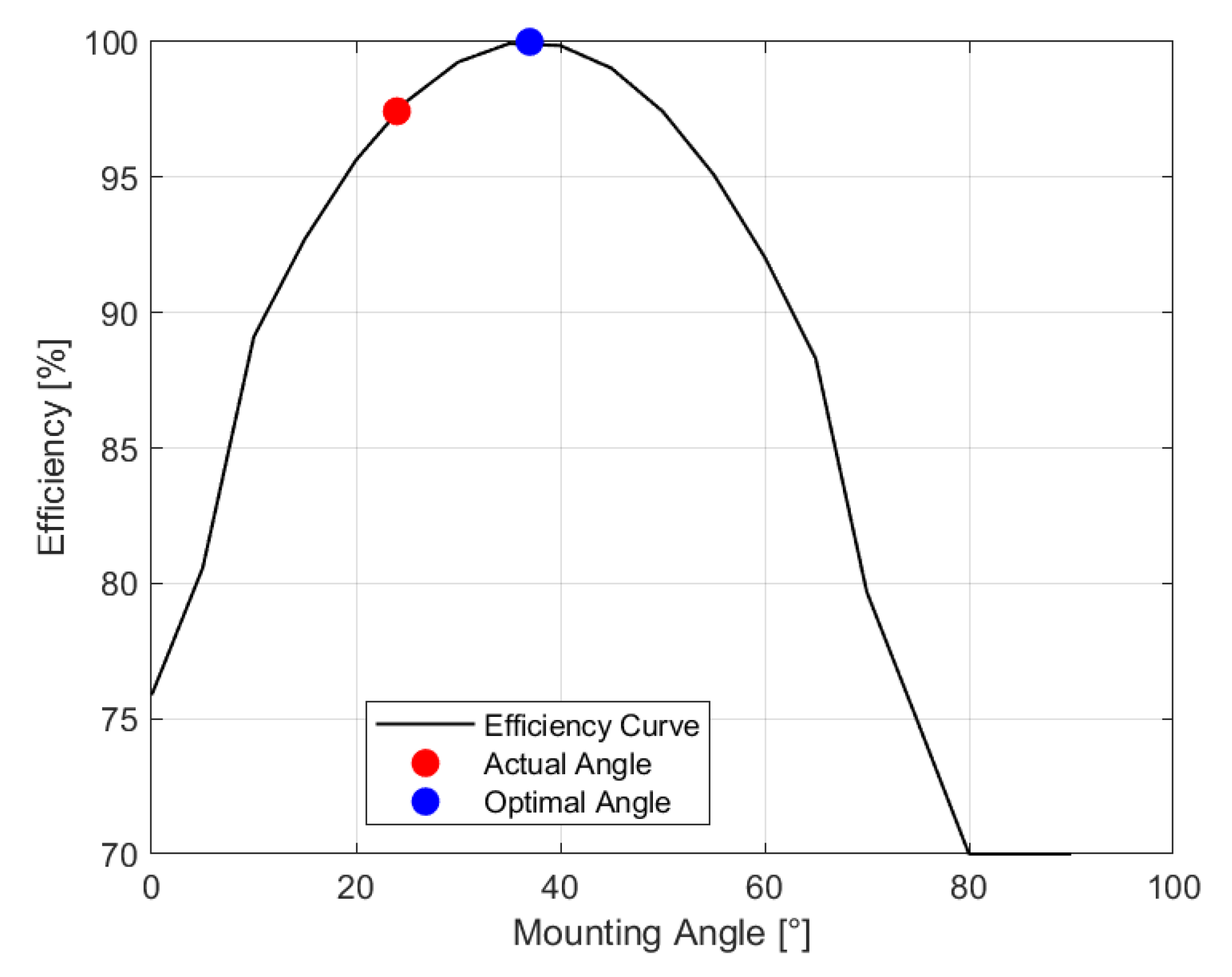
i.e., the efficiency is limited to a minimum of 70%, even for large deviations. An efficiency of 70% is obtained for a mounting angle of 0°, meaning the PV module is parallel to the ground.
The cosine-based tilt-loss model is used as a simple geometric proxy and the 70% minimum efficiency threshold is introduced as a conservative heuristic to avoid unrealistic efficiency collapse for extreme tilt deviations in the absence of long-term measured tilt-response data.
To quantify the effect of the tilt angle, the installation efficiency is defined as the ratio of the energy produced at the actual angle θ act to the energy at the optimal angle θ opt :
η mont ( θ ) = W e ( θ act ) W e ( θ opt ) 100 [ % ]
where W e θ act is the energy produced at the actual tilt angle and W e ( θ opt ) is the energy corresponding to the optimal tilt.

3.5.2. Total Loss Factor

In this study, the comparison between simulation and measurements is performed at the DC input of the inverter (MPPT) for a single string. Therefore, only loss mechanisms that affect the string DC quantities prior to conversion are considered in the aggregated loss factor. Losses associated with DC-to-AC conversion efficiency are not included, because they apply to the inverter AC output and would otherwise introduce a mismatch between modeled and measured quantities. Accordingly, the total loss factor is expressed as follows:
η tot = η inv η mur η mont
where
  • inverter efficiency: η inv = 0.981 ;
  • soiling losses: η mur = 1 (base scenario).
In the model, this factor is considered constant over the entire dataset (calculated once), which constitutes a limitation of the model. This constant-loss assumption may slightly bias results under varying load/irradiance conditions (e.g., inverter efficiency typically varies with input power), but the impact is reduced here because the study focuses on a single clear-sky day.

3.5.3. Simulation of Terminal Quantities

The simulated values, to be compared with measurements, are as follows:
V sim ( t i ) = V M P P ( t i )
I sim ( t i ) = η tot I M P P ( t i )
P sim ( t i ) = η tot P m a x ( t i )
Note that loss factors are applied to current and power, while the MPP voltage is taken directly from the ideal model, which is a reasonable approximation for moderate losses [22]. In practice, irradiance variations mainly affect current, while voltage is influenced more strongly by temperature; losses due to inverter/soiling/tilt angle primarily reduce the available power and current at the inverter input, while their effect on MPP voltage is typically secondary under moderate losses.

3.6. Comparative Analysis and Error Indicators

The model generates an extensive set of plots:
  • Time evolution of temperature, irradiance, voltage, current, and power (simulated vs. measured);
  • I–V and P–V characteristics at representative times (start, middle, end of day, plus intermediate moments);
  • Cumulative effect of losses and sensitivity of efficiency to tilt angle variations;
  • Error dependencies between experimental and simulated values.
To evaluate model performance, the following indicators are calculated:

3.6.1. Pointwise Errors

For each instant time t i , the model determines the following:
  • Relative voltage error
e V ( t i ) = V sim ( t i ) V meas ( t i ) V meas ( t i ) 100   [ % ]
  • Relative current error
e I ( t i ) = I sim ( t i ) I meas ( t i ) I meas ( t i ) 100   [ % ]
  • Relative power error
e P ( t i ) = P sim ( t i ) P meas ( t i ) P meas ( t i ) 100   [ % ]

3.6.2. Global Error Indicators

Finally, the model calculates the following:
  • Power Mean Absolute Error (MAE):
    MAE = 1 N i = 1 N P sim ( t i ) P meas ( t i )   [ W ]
  • Power Root Mean Square Error (RMSE):
    RMSE = 1 N i = 1 N ( P sim ( t i ) P meas ( t i ) ) 2   [ W ]
  • Power Mean Relative Error (MRE):
    MRE = 1 N i = 1 N e P ( t i )   [ % ]
    where
  • N —is the total number of measured points.
To calculate the global voltage errors, relations (26), (27), (28) are used in which the power values are replaced by the voltage values, and for the current, the power values are replaced by the current values.

3.7. Numerical Results Obtained from Simulation

The algorithm described in the previous sections was executed for the same two days, 11 July 2024 and 17 July 2024, using the measured dataset of module temperature and plane-of-array irradiance. At each time instant, the model generated the string I–V and P–V curves, identified the maximum power point (MPP), and applied the aggregated loss factors (inverter efficiency, soiling, and installation angle). These days were selected because the irradiance exhibits the highest variability over the considered time interval. A total of 25 simulations were performed (with a time interval of 0.5 h between consecutive simulations) within the 07:00–19:00 time period, for each day. Using the developed numerical model, the following quantities were calculated:
  • Tcell—photovoltaic cell temperature;
  • G—irradiance at the cell level;
  • Vsim—DC voltage at the inverter input;
  • Isim—current at the inverter input;
  • Psim—power at the inverter input.
The results are summarized in Table 4a,b. The simulations indicate an average string power of 4.57 kW for the clear-sky day (11 July 2024) and 3.61 kW for the cloudy day (17 July 2024).

4. Discussions

In this section, the agreement between the results obtained using the numerical model developed and implemented in the MATLAB environment and the experimentally measured data is evaluated for the string of 19 photovoltaic modules connected in series (Figure 2), corresponding to the MPPT3 input of Inverter 1. The analysis is structured on three levels: (i) static behavior, through the I–V and P–V characteristics; (ii) temporal evolution of voltage, current, and power; and (iii) error indicators and statistical correlation. The analyzed string was selected because the modules are from the same type/batch and show similar operating characteristics, which reduces intra-string mismatch for the purpose of model validation. The analysis is intentionally restricted to one string (19 modules, MPPT3 of Inverter 1) and to a two-day dataset: one clear-sky day (11 July 2024) and one cloudy day (17 July 2024). Therefore, the conclusions are limited to this subset and do not imply plant-level representativeness.
For a proper interpretation of these results, it is first necessary to characterize the operating conditions of the photovoltaic string over the course of the analyzed days.
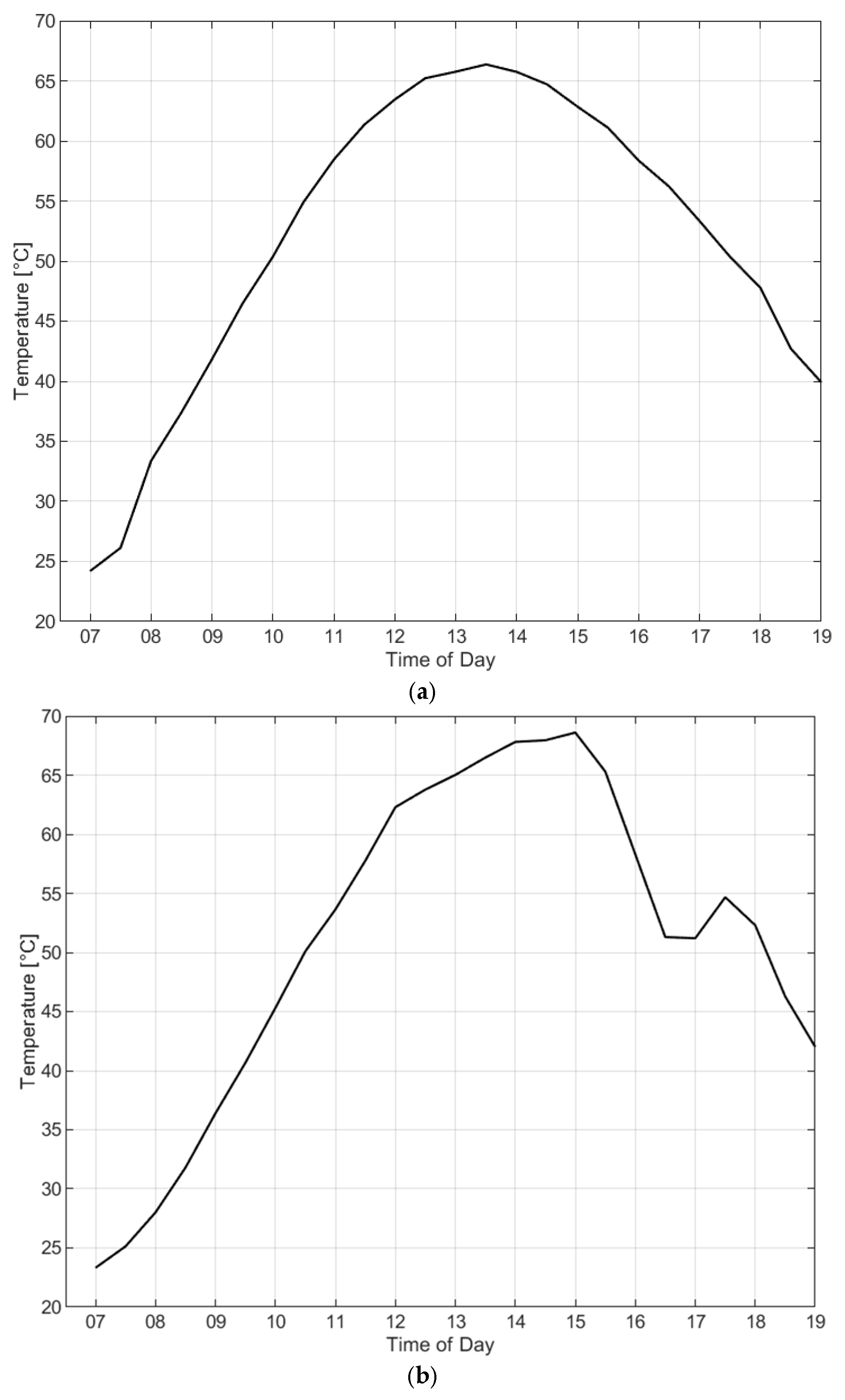
Figure 5a,b present the measured evolution of photovoltaic cell temperature over the 07:00–19:00 time interval. A sharp increase in temperature is observed, from approximately 24–25 °C in the early morning hours to a maximum of around 66–68 °C at approximately 13:00–15:00, followed by a gradual decrease to about 40 °C by the evening. The temperature variation in the hour interval 07:00–19:00 does not show symmetry in relation to the maximum value.
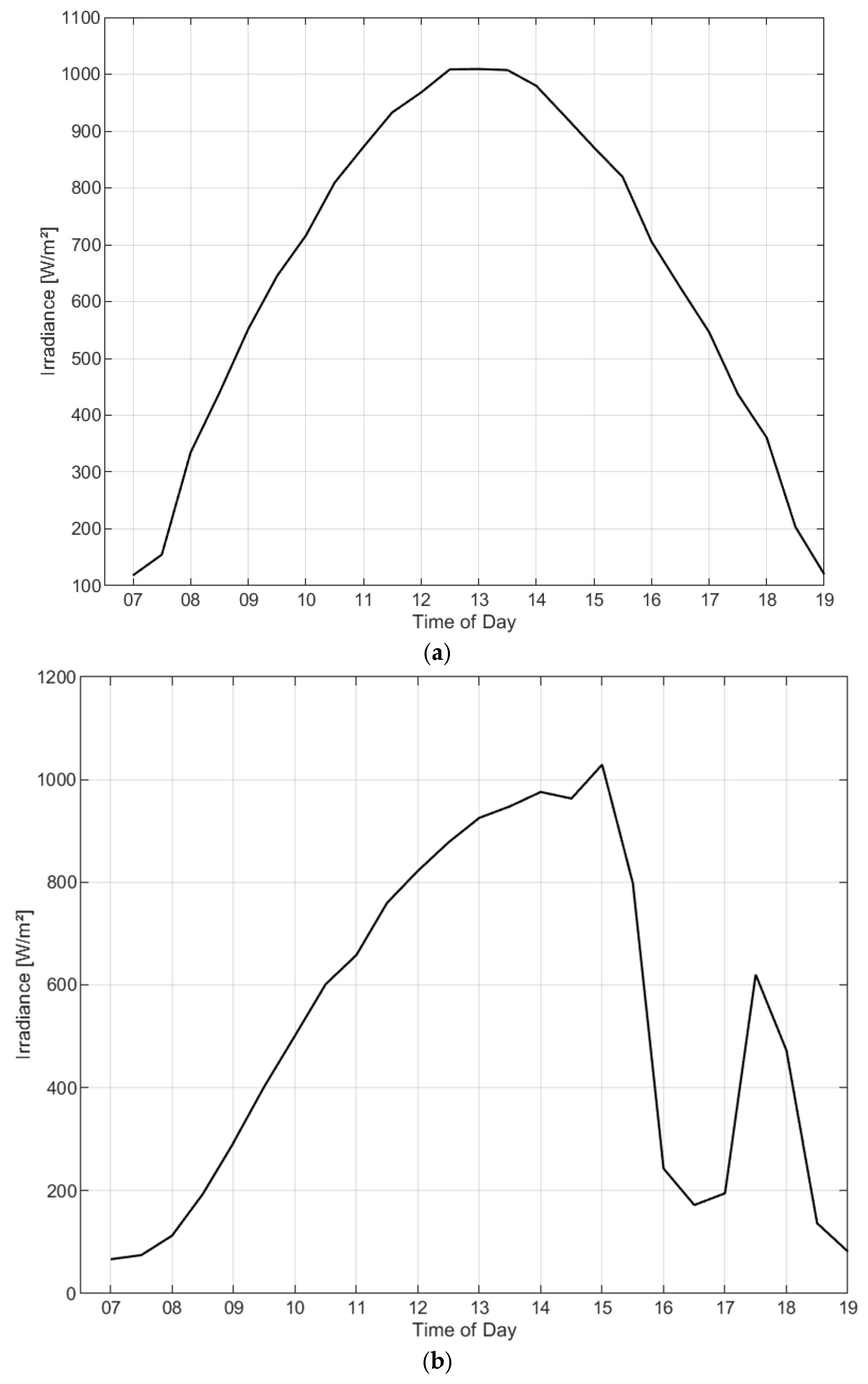
Figure 6a presents the variation in solar irradiance measured over the 07:00–19:00 time interval. The irradiance increases from approximately 120 W/m2 at 07:00 to a peak of around 1000 W/m2 at approximately 12:00–13:00, after which it gradually decreases below 200 W/m2 by the end of the interval. The almost symmetrical shape of the curve, typical of a predominantly clear day, explains the good agreement between simulated and experimentally determined power values during the central part of the day, while also highlighting the effect of reduced irradiance conditions on relative errors in the morning and evening periods.
Figure 6b presents the variation in solar irradiance measured over the same time interval. The irradiance increases from approximately 70 W/m2 at 07:00 to a peak of around 1000 W/m2 at approximately 14:00–15:00, after which it gradually decreases below 100 W/m2 by the end of the interval.
By correlating the two graphs, it can be observed that the evolution of the cell temperature follows, with a certain delay, the variation in irradiance. This confirms that both the voltages and powers obtained experimentally are the combined result of these two environmental factors. This aspect is important for the subsequent interpretation of the I–V and P–V characteristics, as well as the statistical error indicators, since it allows for distinguishing errors due to the model from variations induced by actual operating conditions.

4.1. I–V and P–V Characteristics

To evaluate the performance of the numerical model developed and implemented in the MATLAB environment, the simulation results are compared with the experimentally measured data. Specifically, the voltage–current (I–V) characteristics and the power–voltage (P–V) characteristics obtained through simulation are compared with those measured experimentally.
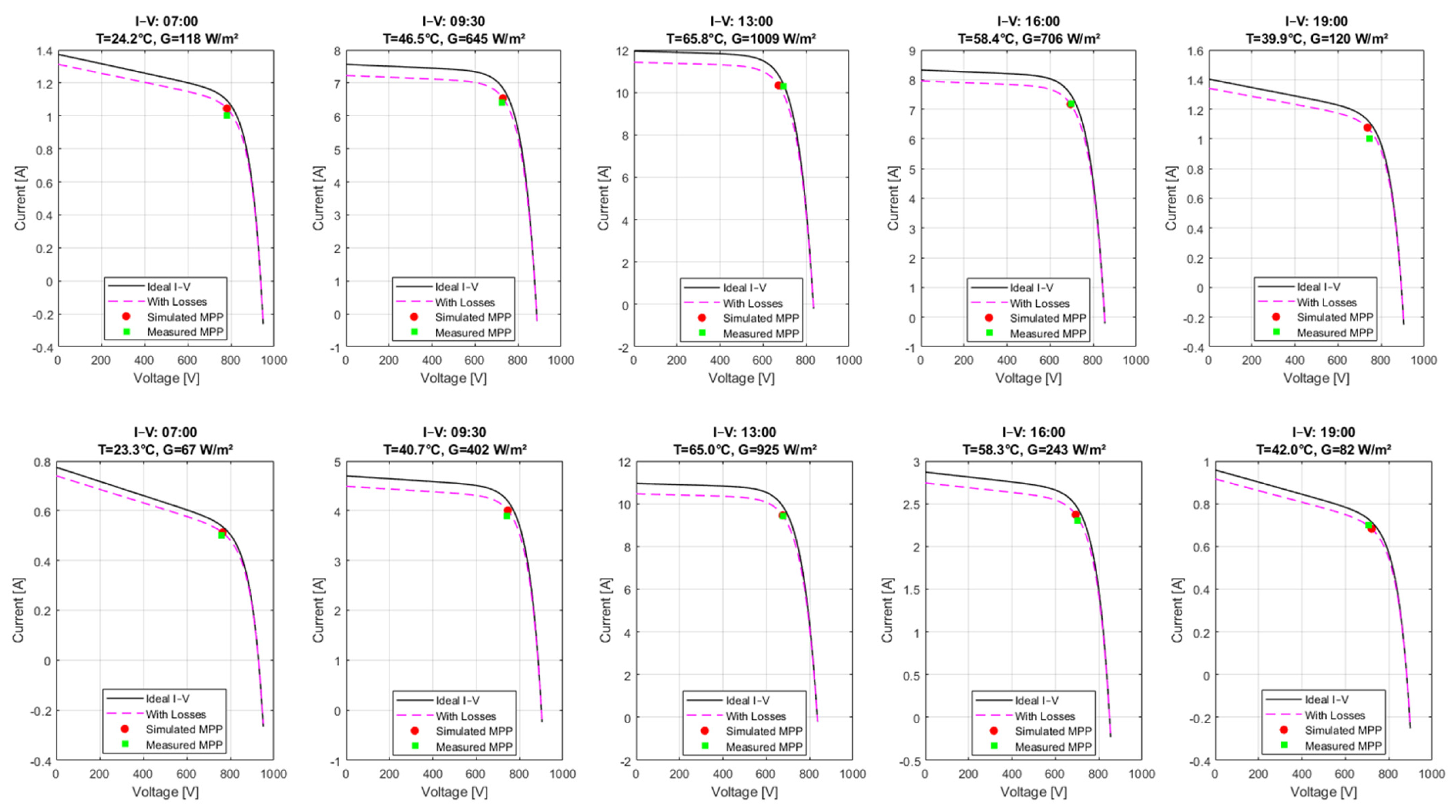
Figure 7 presents the I–V characteristics of the numerically simulated system for the two selected days: 11 July 2024 (top row) and 17 July 2024 (bottom row), at the following time instants: 07:00, 09:30, 13:00, 16:00, and 19:00.
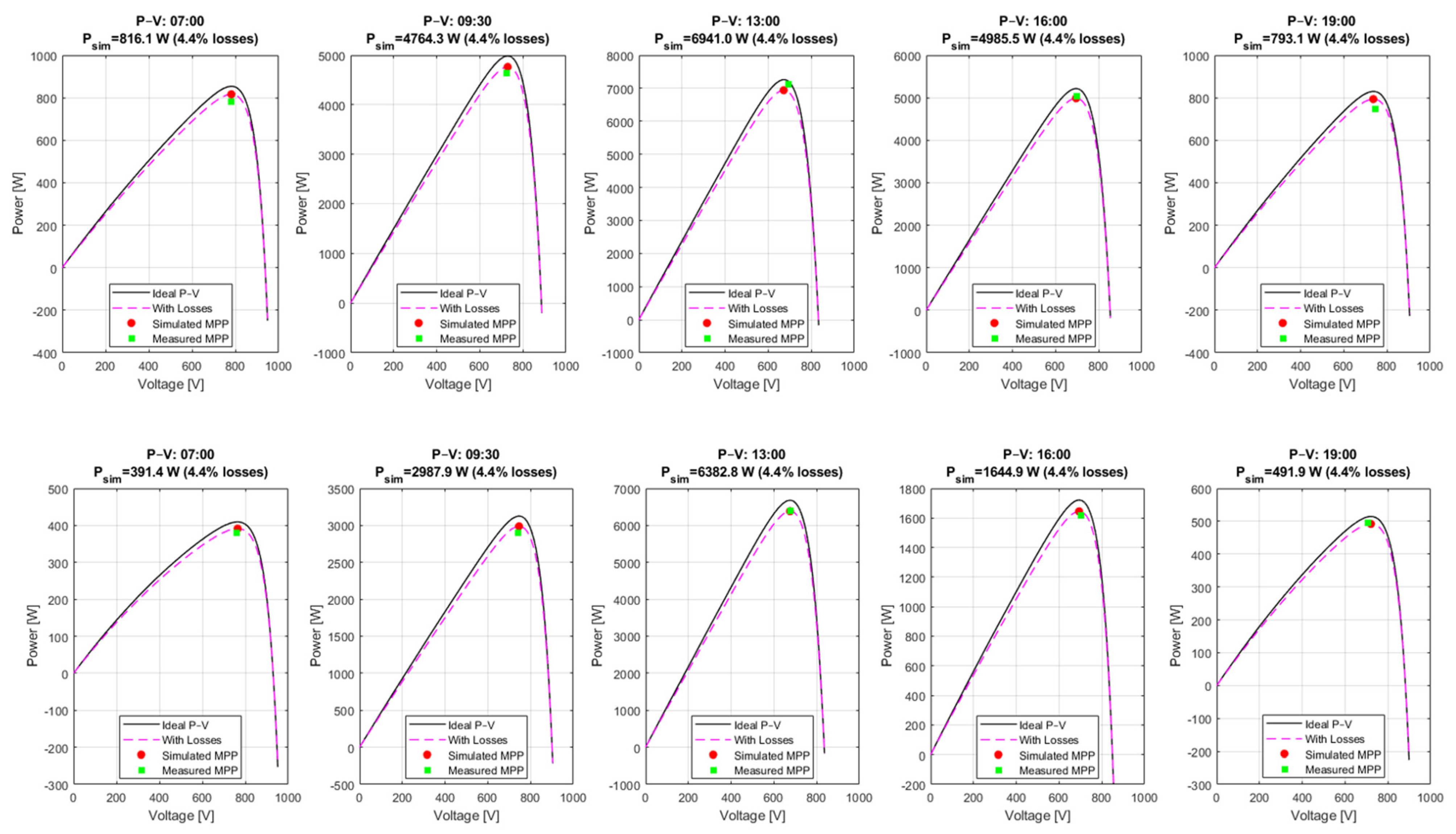
From Figure 7, it can be observed that the I–V characteristics at 07:00 and 19:00 are practically identical, as expected, since the irradiance levels at 07:00 and 19:00 are very similar. At these same times, a significant difference is observed between the coordinates of the maximum power point (MPP) obtained from simulation and those measured experimentally. Figure 8 shows the P–V characteristics of the numerically simulated system for the two selected days: 11 July 2024 (top row) and 17 July 2024 (bottom row), at the following time instants: 07:00, 09:30, 13:00, 16:00, and 19:00.
From Figure 8, it can be observed that the P–V characteristics at 07:00 and 19:00 are practically identical, as expected, since the irradiance at these times has the same value. At these same hours, a significant difference is observed between the coordinates of the maximum power point (MPP) obtained from simulation and those measured experimentally. The smallest difference between the coordinates of the MPP obtained experimentally and via simulation occurs at 13:00. At this time, the differences between experimental and simulated values are 1.96% for voltage and 0.55% for power. It can be noted that, at 13:00, the differences between experimental and simulated values are smaller for voltage and significantly smaller for power. The error obtained by calculating the power using the numerical method is within the error limits presented in the specialized literature [3,6,8].

4.2. Temporal Variation in Voltage, Current and Power

4.2.1. Voltage Variation

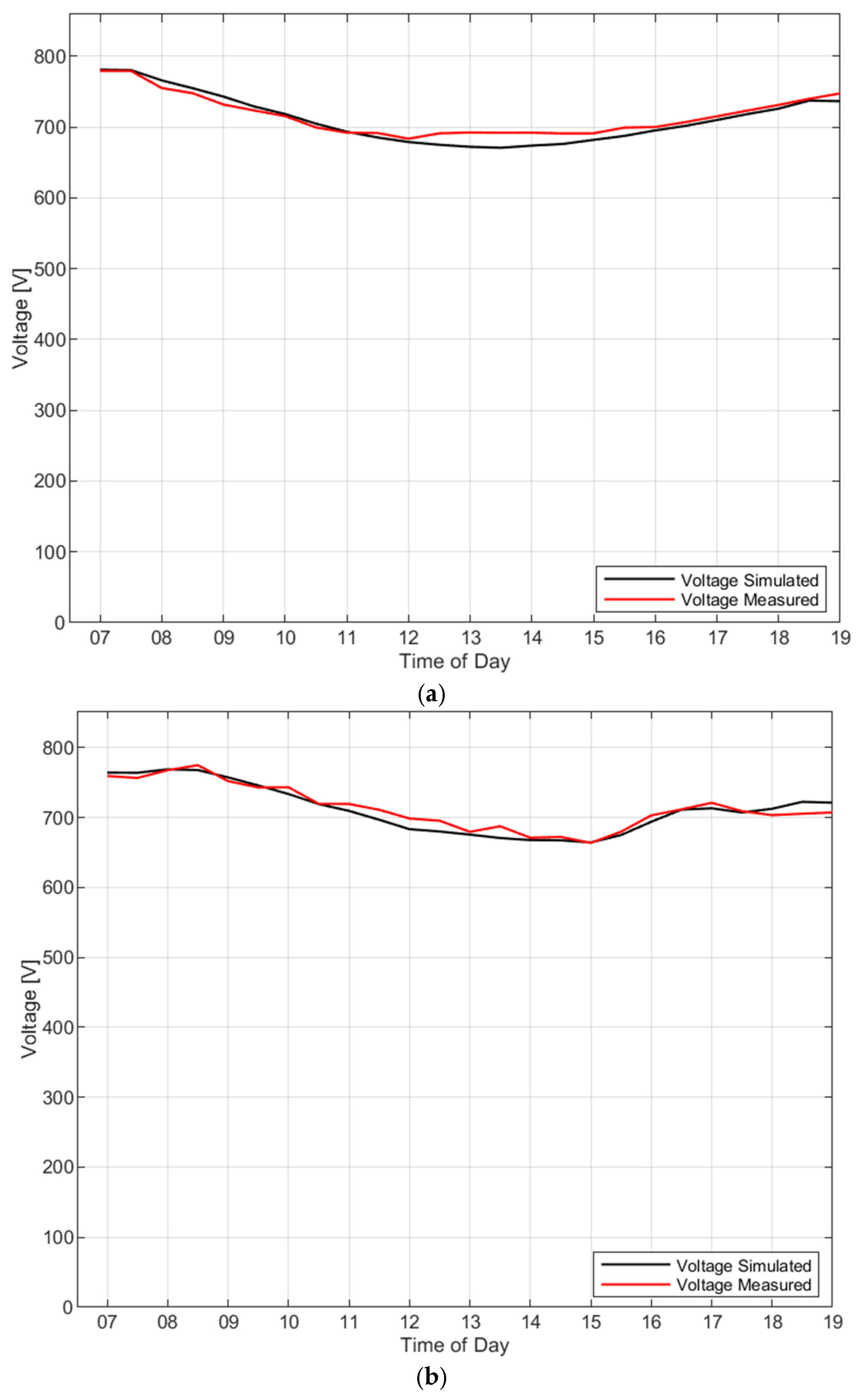
Figure 9a,b illustrate the dependence of the inverter input voltage (V) over the considered time interval (07:00–19:00), taking into account the variations in photovoltaic cell temperature. The values are presented both for experimentally measured data and for the simulated results.
From Figure 9a, it can be observed that the simulated voltage and the experimentally measured voltage follow the same trend: a decrease from the morning hours until approximately 13:00–14:00, followed by a slight increase towards the evening. This variation is consistent with the change in photovoltaic cell parameters as a function of their temperature [31]. As the temperature rises to around 65–66 °C, the voltage decreases for silicon modules [31,32].

4.2.2. Current Variation

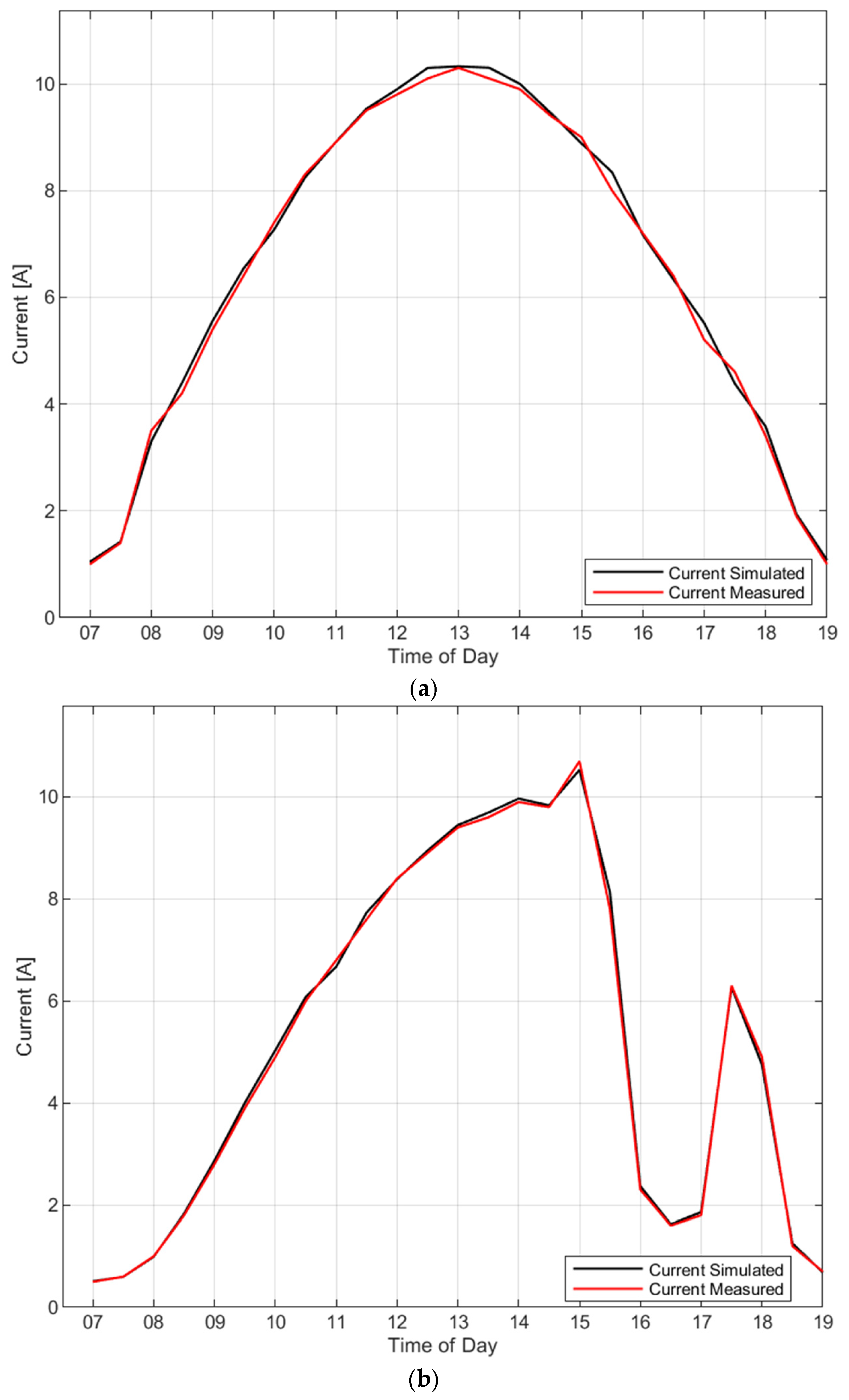
Figure 10a,b illustrate the dependence of the inverter input current (I) over the considered time interval (07:00–19:00), taking into account the variations in irradiance applied to the photovoltaic cells. The values are presented both for experimentally measured data and for the simulated results.
From Figure 10a,b, it can be observed that the current obtained through simulation and the experimentally measured current follow the same variation trend as the irradiance. This behavior is consistent with the changes in photovoltaic cell parameters as a function of temperature [33]. It is noted that, during the 10:00–15:00 interval, the curves are almost overlapping, with negligible error (below 2%).

4.2.3. Power Variation

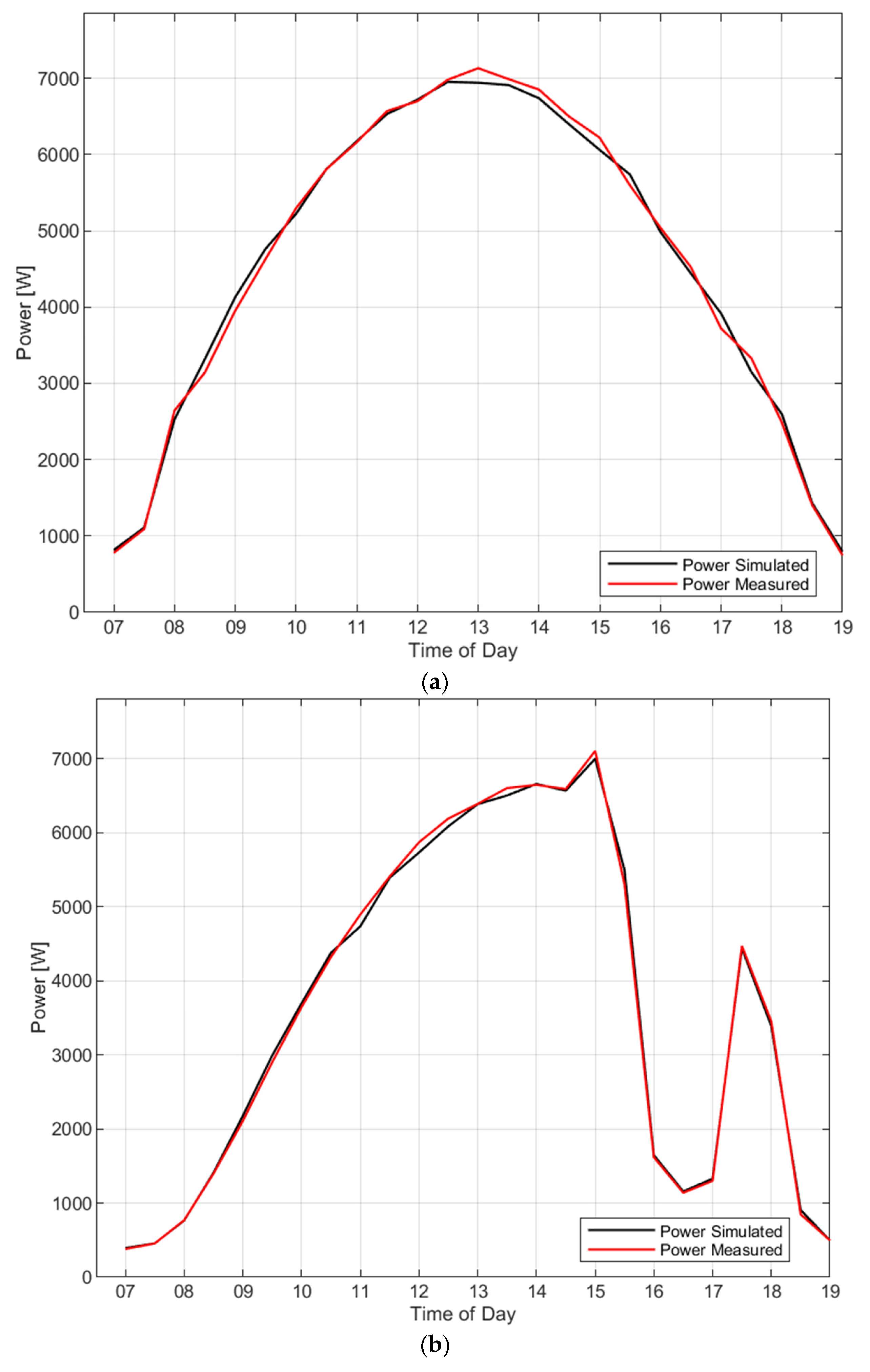
Figure 11a,b illustrate the dependence of the inverter input power (P) over the considered time interval (07:00–19:00), taking into account the variations in irradiance applied to the photovoltaic cells. The values are presented both for experimentally measured data and for the simulated results.
From Figure 11a, it can be observed that the largest differences between the power obtained experimentally and that calculated using the numerical model developed and implemented in MATLAB occur during the 07:00–09:00 (morning) and 17:00–19:00 intervals, when irradiance is below 550 W/m2. The differences decrease significantly during the 09:00–17:00 interval, when irradiance exceeds 550 W/m2.

4.3. Error Analysis

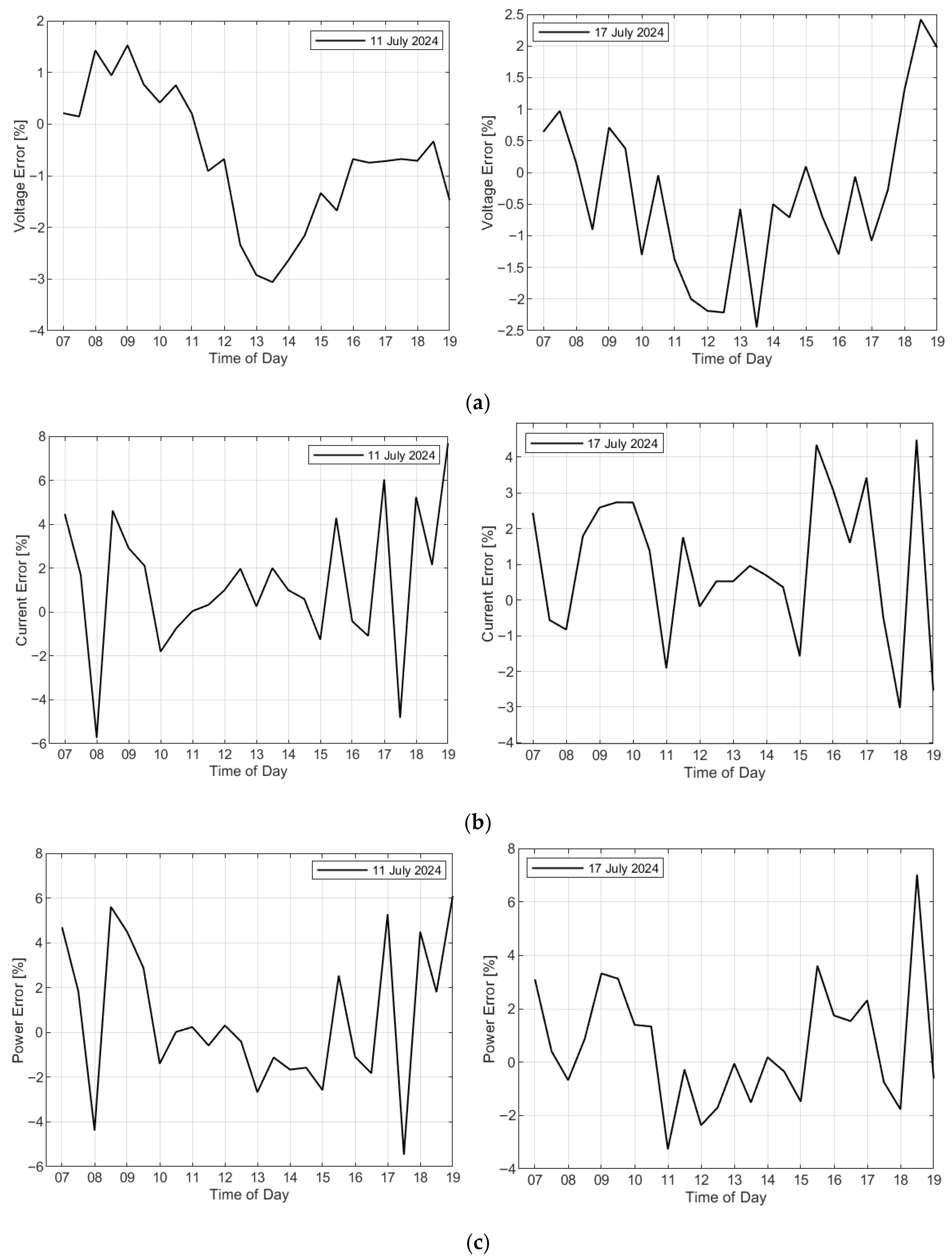
Figure 12a–c present the error dependencies between the experimentally measured and numerically simulated values for voltage (V), current (I), and power (P) at the inverter input over the 07:00–19:00 time interval. The evaluation of relative errors for voltage, current, and power provides a concise overview of the model’s performance.
From Figure 12a, it can be observed that the maximum voltage error occurs at 18:30 for the cloudy sky day (17 July 2024) and has a value of 2.41%. For the remaining time interval, the errors remain below 2% for both analyzed days.
From Figure 12b, it can be observed that the maximum current error occurs at 19:00 for the clear-sky day (11 July 2024) and has a value of 7.67%, while for the cloudy day (17 July 2024), it occurs at 18:30 and has a value of 4.48%.
From Figure 12c, it can be observed that the maximum power error occurs at 18:30 for the cloudy day (17 July 2024) and has a value of 7.01%, while for the clear-sky day (11 July 2024), it occurs at 19:00 with a value of 6.06%. Within the 09:30–16:30 time interval, the errors remain below 4%. In the time interval 07:00–19:00, the electrical energy supplied by the PV string is determined assuming that the power is constant in the 30 min interval between consecutive measurements. For the calculation of the energy, the following relation is used:
W e = i = 1 25 Δ t P i
Substituting in relation (29) ∆t = 0.5 h and the power values from Table 3a, for the experimentally determined electrical energy, the value 57.14 kWh is obtained on 11 July 2024.
Substituting in relation (29) ∆t = 0.5 h and the power values from Table 4a, for the electrical energy determined by simulation, the value 57.10 kWh is obtained on 11 July 2024. The difference between this value and the experimentally determined one is 0.07%.
For the second analyzed day (17 July 2024), by substituting in relation (29) ∆t = 0.5 h and the power values from Table 3b, for the experimentally determined electrical energy, the value 45.11 kWh is obtained. Substituting in relation (29) ∆t = 0.5 h and the power values from Table 4a, for the electrical energy determined by simulation, the value 44.99 kWh is obtained. The difference between this value and the experimentally determined one is 0.26%.
Comparing the obtained values, it results that the energy determined experimentally is higher than that obtained through simulation for both analyzed days (0.07% on 11 July 2024 and 0.26% on 17 July 2024).
Regarding the global indicators used to assess the performance of the numerical model for the first analyzed day (11 July 2024), the following results were obtained:
Mean Absolute Power Error (MAE) = 92.94 W, which represents 1.30% of the maximum power delivered by the analyzed string. For voltage, the Mean Absolute Voltage Error is (MAE) = 8.33 V, which represents 1.07% of the maximum voltage value, and for current, the Mean Absolute Current Error is (MAE) = 0.12 A, which represents 1.17% of the maximum current value.
Root Mean Square Error (RMSE) = 111.78 W, which represents 1.57% of the maximum power delivered by the analyzed string. For voltage, the Root Mean Square Error is (RMSE) = 10.15 V, which represents 1.30% of the maximum voltage value, and for current, the Root Mean Square Error is (RMSE) = 0.15 A, which represents 1.46% of the maximum current value.
Mean Relative Power Error (MRE) = 2.60%, for voltage it is 1.18%, and for current 2.57%.
The global errors obtained with the numerical model, for the second analyzed day (17 July 2024), have the following values:
Mean Absolute Power Error (MAE) = 55.46 W, which represents 0.99% of the maximum power delivered by the analyzed string. For voltage, the Mean Absolute Voltage Error is (MAE) = 7.48 V, which represents 0.99% of the maximum voltage value, and for current, the Mean Absolute Current Error is (MAE) = 0.08 A, which represents 0.99% of the maximum current value.
Root Mean Square Error (RMSE) = 75.94 W, which represents 0.98% of the maximum power delivered by the analyzed string. For voltage, the Root Mean Square Error is (RMSE) = 9.17 V, which represents 0.98% of the maximum voltage value, and for current, the Root Mean Square Error is (RMSE) = 0.10 A, which represents 0.99% of the maximum current value.
Mean Relative Power Error (MRE) = 1.79%, for voltage, it is 1.05%, and for current, 1.86%.
The global indicators indicate that the numerical model behaves consistently across both analyzed days, delivering reproducible accuracy for power, voltage, and current. Specifically, the errors remain low, with MAE and RMSE generally close to 1% of the corresponding maximum measured values, while MRE stays within a narrow range (approximately 1–3%). The slightly lower errors obtained on 17 July 2024 further suggest that model performance is not day-dependent and remains stable under different irradiance and temperature profiles.
Finally, the reported MAE/RMSE/MRE values should be interpreted in the context of the validation input uncertainties (temperature probe mounting and accuracy, irradiance sensor uncertainty, and inverter telemetry accuracy). Consequently, a fraction of the residual mismatch can be attributed to measurement/telemetry uncertainty rather than model inadequacy, especially under low irradiance where relative errors are amplified.

4.4. Effect of Mounting Angle and Aggregate Losses

One of the important parameters affecting the electrical energy production of photovoltaic plants is the angle between the plane of the photovoltaic cells and the ground (θ). The efficiency of a PV module is defined by the relation (18). By changing the value of the mounting angle, the way in which it modifies the efficiency of the PV system is obtained. The results obtained for the analyzed string are presented in Figure 13.
For the analyzed string, the optimal mounting angle is 37°, a value obtained from [34].
For the optimal angle, θopt = 37°, the relative efficiency is used as a local reference scenario (100%) for the tilt-loss model. The inferred efficiency difference between θopt and θact is a theoretical sensitivity analysis based on the geometric/cosine model and the selected day data; it is not claimed as a long-term validated annual energy conclusion without multi-day or seasonal measurements.
For the actual mounting angle, θact = 24°, the efficiency decreases to approximately 97–98%, corresponding to an efficiency loss of about 2.6% due solely to the angular difference. This loss is subsequently reflected in the simulated power results “with losses,” compared to the ideal scenario in which the optimal mounting angle was assumed.
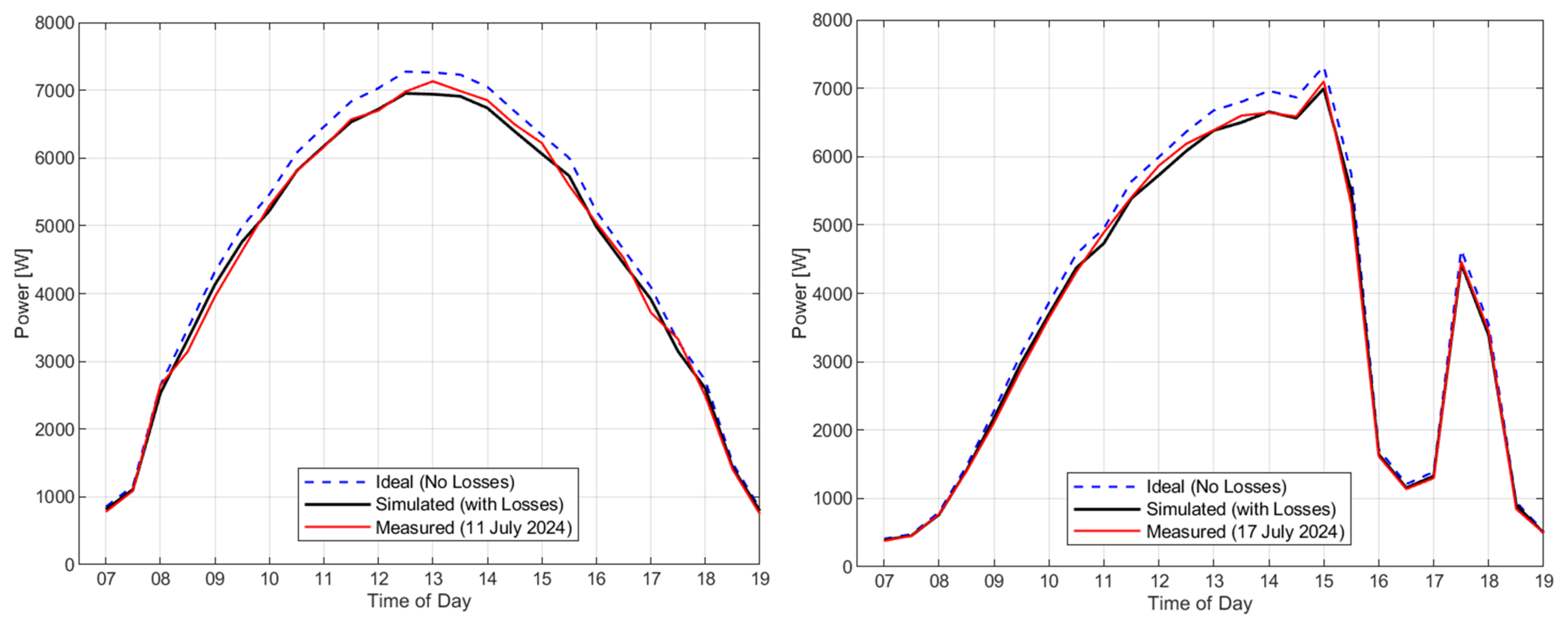
Figure 14 presents both the variation in the power output of the photovoltaic system throughout 11 July 2024 and 17 July 2024 and the impact of losses on the delivered power.
The graph includes three curves:
The green dashed curve—“Ideal (No Losses)”—represents the power calculated using the numerical model under the assumption of an ideal system without losses (global efficiency 100%, neglecting inverter, cabling, mounting angle, and panel soiling losses, etc.).
The solid blue curve—“Simulated (with Losses)”—represents the power resulting from the same numerical model, but including all aggregated losses (inverter, cabling, mounting angle, soiling of photovoltaic cells).
The red curve—“Measured”—represents the experimentally measured power at the system output for the same day and under identical irradiance and temperature conditions.
As expected, the “Ideal (No Losses)” curve consistently overestimates the delivered power—most notably around noon—since conversion and balance-of-system losses are neglected. After including the aggregated losses, the simulated power closely matches the measured profiles on both days, indicating that the selected loss factors capture both the magnitude and the temporal evolution of the real output. For 11 July 2024 (mostly clear-sky), the “Simulated (with Losses)” curve nearly overlaps the measurements across the full diurnal range, while for 17 July 2024, it also reproduces the main dynamics despite short-term fluctuations driven by transient irradiance changes. Overall, Figure 14 confirms that accounting for inverter, mounting angle, and soiling losses is essential to avoid systematic overestimation and ensures stable model performance under different operating regimes.

5. Conclusions

This work validates the proposed model on a single PV string (19 modules, MPPT3 of Inverter 1) using two measurement days: a clear-sky day (11 July 2024) and a day with cloud cover during the second part of the day (17 July 2024). Therefore, the conclusions are limited to this case study and do not imply plant-level generalizations.
Based on the conducted study, the following conclusions can be drawn:
The numerical model implemented in MATLAB allows the determination of the voltage, current and power of the simulated PV system. By introducing the irradiance and temperature of the PV modules into the model, it can be verified that the PV system is functioning correctly.
The I–V characteristic of the PV system being nonlinear, considering Rs and Rsh as constants is an approximation. The numerical model allows us to iteratively determine the values of these resistances so that the difference between the results obtained by simulation and the real ones is below 2%.
The results obtained using the numerical model implemented in MATLAB demonstrate that it can be used in the analysis of the functioning of PV modules. The model also has a high flexibility, being able to modify the values of the parameters in the equivalent scheme of PV modules, the irradiance value, the temperature value and the mounting angle value.
The model, due to its flexibility, can be used by PV system designers and PV system beneficiaries for their monitoring. By implementing the error calculation in the model, we also have its calculation errors as output sizes.
In the future, the model will be improved by replacing the resistances Rs and Rsh, which are considered linear, with nonlinear elements establishing the dependence between them and the solar irradiation. In this way, the model errors will be reduced even for cases when the irradiance has low values. Also, the model will be extended from a string to the entire PV plant. This involves analyzing the string configuration at each of the MPPT inputs of the inverters.

Author Contributions

Conceptualization, A.-E.M., S.I. and D.T.; methodology, S.I. and D.T.; software, A.-E.M.; validation, A.-E.M.; formal analysis, D.T.; investigation, A.-E.M. and S.I.; resources, A.-E.M. and S.I.; data curation, A.-E.M.; writing—original draft preparation, A.-E.M., S.I. and D.T.; writing—review and editing, A.-E.M. and S.I.; visualization, A.-E.M., S.I. and D.T.; supervision, D.T. All authors have read and agreed to the published version of the manuscript.

Funding

This research received no external funding.

Institutional Review Board Statement

Not applicable.

Informed Consent Statement

Not applicable.

Data Availability Statement

The data presented in this study, obtained through both calculations and experimental measurements, have not been published elsewhere and are fully reported within the article. Therefore, no separate data sharing applies. Further inquiries can be directed to the corresponding author.

Acknowledgments

Authors would like to thank Daniel Gabriel Olariu for the support and experimental data for the PV power plant.

Conflicts of Interest

The authors declare no conflicts of interest.

References

  1. De Soto, W.; Klein, S.A.; Beckman, W.A. Improvement and Validation of a Model for Photovoltaic Array Performance. Sol. Energy 2006, 80, 78–88. [Google Scholar] [CrossRef]
  2. Ding, K.; Bian, X.G.; Liu, H.H.; Peng, T. A MATLAB-Simulink-Based PV Module Model and Its Application Under Conditions of Non-uniform Irradiance. IEEE Trans. Energy Conv. 2012, 27, 864–872. [Google Scholar] [CrossRef]
  3. Attivissimo, F.; Di Nisio, A.; Spadavecchia, M. Characterization and Testing of a Tool for Photovoltaic Panel Modeling. IEEE Trans. Instr. Meas. 2011, 60, 1613–1622. [Google Scholar]
  4. Xiao, W.; Edwin, F.F.; Spagnuolo, G.; Jatskevich, J. Efficient Approaches for Modeling and Simulating Photovoltaic Power Systems. IEEE J. Photovolt. 2013, 3, 500–508. [Google Scholar] [CrossRef]
  5. Mahmoud, Y.; El-Saadany, E.F. A Photovoltaic Model With Reduced Computational Time. IEEE Trans. Ind. Electron. 2015, 62, 3534–3544. [Google Scholar] [CrossRef]
  6. Bizzarri, F.; Bongiorno, M.; Brambilla, A.; Gruosso, G.; Gajani, G.S. Model of Photovoltaic Power Plants for Performance Analysis and Production Forecast. IEEE Trans. Sustain. Energy 2013, 4, 278–285. [Google Scholar] [CrossRef]
  7. Tarasenko, A.B.; Kiseleva, S.V.; Popel, O.S.; Semen, F.; Gabderakhmanova, T.; Avezova, N.R.; Simonov, V.M.; Suleimanov, M.Z. Comparative Analysis of Simulation Models for Network Photovoltaic Power Plants. Appl. Sol. Energy 2020, 56, 212–218. [Google Scholar] [CrossRef]
  8. Rasheed, M.; Shihab, S.; Taha Rashid, T.; Maalej, O. Numerical Simulation of Photovoltaic Cell. J. Al-Qadisiyah Comput. Sci. Math. 2021, 13, 79–86. [Google Scholar] [CrossRef]
  9. Bouraiou, A.; Hamouda, M.; Chaker, A.; Sadok, M.; Mostefaui, M.; Lachtar, S. Modeling and Simulation of Photovoltaic Module and Array Based on One and Two Diode Model Using Matlab/Simulink. Energy Procedia 2015, 75, 376–383. [Google Scholar] [CrossRef][Green Version]
  10. Bastidas-Rodriguez, J.D.; Cruz-Duarte, J.M.; Correa, R. Mismatched Series–Parallel Photovoltaic Generator Modeling: An Implicit Current–Voltage Approach. IEEE J. Photovolt. 2019, 9, 768–774. [Google Scholar] [CrossRef]
  11. Benyadry, S.; Halimi, M.; Khouya, A. Soiling impact and cleaning techniques for optimizing photovoltaic and concentrated solar power production: A state-of-the-art review. Energy Environ. 2024, 35, 1637–1669. [Google Scholar] [CrossRef]
  12. Hasan, K.; Yousuf, S.B.; Tushar, M.S.H.K.; Das, B.K.; Das, P.; Islam, M.S. Effects of different environmental and operational factors on the PV performance: A comprehensive review. Energy Sci. Eng. 2021, 10, 656–675. [Google Scholar] [CrossRef]
  13. Alimi, O.A.; Meyer, E.L.; Olayiwola, O.I. Solar photovoltaic modules’ performance reliability and degradation analysis—A review. Energies 2022, 15, 5964. [Google Scholar] [CrossRef]
  14. Boussaibo, A.; Kamta, M.; Kayem, J.; Toader, D.; Haragus, S.; Maghet, A. Characterization of photovoltaic pumping system model without battery storage by MATLAB/Simulink. In Proceedings of the 9th International Symposium on Advanced Topics in Electrical Engineering (ATEE), Bucharest, Romania, 7–9 May 2015. [Google Scholar]
  15. Toader, D.; Solea, C.; Greconici, M.; Vintan, M.; Tatai, I.; Vesa, D. Numerical Mathematical Model for the Analysis of the Transient Regime Caused by a Phase-to-Earth Fault. Appl. Sci. 2025, 15, 9389. [Google Scholar] [CrossRef]
  16. EN IEC 60904-3:2019; Photovoltaic Devices—Part 3: Measurement Principles for Terrestrial Photovoltaic (PV) Solar Devices with Reference Spectral Irradiance Data. CENELEC: Brussels, Belgium, 2019.
  17. DIN EN 60584-1:2014-07; Thermocouples—Part 1: EMF Specifications and Tolerances. DIN Media (Beuth Verlag): Berlin, Germany, 2014.
  18. ISO 9060:2018; Solar Energy—Specification and Classification of Instruments for Measuring Hemispherical Solar and Direct Solar Radiation. ISO: Geneva, Switzerland, 2018.
  19. IEC 61724-1:2021; Photovoltaic System Performance—Part 1: Monitoring. IEC: Geneva, Switzerland, 2021.
  20. Available online: https://oss.soliscloud.com/templet/SolisCloud%20Platform%20API%20Document%20V2.0.2.pdf (accessed on 8 July 2024).
  21. ISO/IEC 27001:2022; Information Security, Cybersecurity and Privacy Protection—Information Security Management Systems—Requirements. ISO: Geneva, Switzerland, 2022.
  22. Regulation (EU) 2016/679; Regulation (EU) 2016/679 of the European Parliament and of the Council of 27 April 2016 (General Data Protection Regulation). Publications Office of the European Union: Luxembourg, Luxembourg, 2016.
  23. Available online: https://www.solisinverters.au/uploads/files/202506/Solis_Manual_S6-EH3P%2829%2C9-50%29K-H-AU_V1%2C2%2820250624%29.pdf (accessed on 8 July 2025).
  24. The MathWorks, Inc. MATLAB, R2024b, The MathWorks, Inc.: Natick, MA, USA, 2024.
  25. Diantoro, M.; Suprayogi, T.; Hidayat, A.; Taufiq, A.; Fuad, A.; Suryana, R. Equation Fit Analyses for Solar Cell Parameters from I-V Curves, Proceedings. In Proceedings of the Fifteen International Conference on Thermal Engineering: Theory and Applications, Tashkent, Uzbekistan, 28 May–1 June 2024. [Google Scholar] [CrossRef]
  26. Shaheen, A.M.; Ginidi, A.R.; El-Sehiemy, R.A.; Ghoneinm, S.M. A Forensic-Based Investigation Algorithm for Parameter Extraction of Solar Cell Models. IEEE Access 2020, 9, 1–20. [Google Scholar] [CrossRef]
  27. Chunfu, Z.; Jincheng, Z.; Yue, H.; Zhenhua, L.; Chunxiang, Z. A simple and efficient solar cell parameter extraction method from a single current-voltage curve. J. Appl. Phys. 2011, 110, 64504. [Google Scholar] [CrossRef]
  28. Sandrolini, L.; Artioli, M.; Reggiani, U. Numerical Method for Extraction of Photovoltaic Modules Double-Diode Model Parameters through Cluster Analysis. Appl. Energy 2010, 87, 442–451. [Google Scholar] [CrossRef]
  29. Meyer, M.L. Extraction of Saturation Current and Ideality Factor from Measuring Voc and Isc of Photovoltaic Modules. Int. J. Photoenergy 2017, 1, 8479487. [Google Scholar] [CrossRef]
  30. Available online: https://en.risen.com/uploads/20240416/Risen_TDS%20for%20P-type%20Single%20Glass%20Modules-20240416.pdf (accessed on 8 July 2024).
  31. Ma, T.; Zhao, J.; Li, Z. Mathematical modelling and sensitivity analysis of solar photovoltaic panel integrated with phase change material. Appl. Energy 2018, 228, 1147–1158. [Google Scholar] [CrossRef]
  32. King, D.L.; Boyson, W.E.; Kratochvil, J.A. Photovoltaic Array Performance Model; Report No. SAND2004-3535; Sandia National Laboratories: Albuquerque, NM, USA, 2004. [Google Scholar]
  33. Cotfas, D.T.; Cotfas, P.A.; Machidon, O.M. Study of Temperature Coefficients for Parameters of Photovoltaic Cells. Int. J. Photoenergy 2018, 2018, 5945602. [Google Scholar] [CrossRef]
  34. Available online: https://re.jrc.ec.europa.eu/pvg_tools/en/tools.html (accessed on 12 July 2024).
Figure 1. Overview of the PV power plant.
Applsci 16 01891 g001
Figure 2. Overview of the photovoltaic system.
Applsci 16 01891 g002
Figure 3. Equivalent diagram of a photovoltaic cell.
Applsci 16 01891 g003
Figure 4. General logic diagram algorithm of the MATLAB model.
Applsci 16 01891 g004
Figure 5. (a) Variation in photovoltaic cell temperature as a function of time of day on 11 July 2024. (b) Variation in photovoltaic cell temperature as a function of time of day on 17 July 2024.
Applsci 16 01891 g005
Figure 6. (a) Variation in solar irradiance measured in the photovoltaic field plane as a function of time of day on 11 July 2024. (b) Variation in solar irradiance measured in the photovoltaic field plane as a function of time of day on 17 July 2024.
Applsci 16 01891 g006
Figure 7. I–V characteristics.
Applsci 16 01891 g007
Figure 8. P–V characteristics.
Applsci 16 01891 g008
Figure 9. (a) Voltage variation obtained experimentally and via simulation on 11 July 2024. (b) Voltage variation obtained experimentally and via simulation on 17 July 2024.
Applsci 16 01891 g009
Figure 10. (a) Current variation obtained experimentally and via simulation on 11 July 2024. (b) Current variation obtained experimentally and via simulation on 17 July 2024.
Applsci 16 01891 g010
Figure 11. (a) Power variation obtained experimentally and via simulation on 11 July 2024. (b) Power variation obtained experimentally and via simulation on 17 July 2024.
Applsci 16 01891 g011
Figure 12. (a) Relative voltage error. (b) Relative current error. (c) Relative power error.
Applsci 16 01891 g012
Figure 13. Effect of the mounting angle (θ) on efficiency.
Applsci 16 01891 g013
Figure 14. Impact of losses on the power output of the photovoltaic system.
Applsci 16 01891 g014
Table 1. Technical characteristic and electrical data (STC and NOCT).
Model NumberRSM144-7-455M
STCNOCT
Rated power in Watts—Pmax (Wp)455342.5
Open-circuit Voltage—Voc (V)49.8046.61
Short-circuit Current—Isc (A)11.609.51
Maximum power Voltage—Vmpp (V)41.4038.10
Maximum power Current—Impp (A)118.99
Module Efficiency (%)20.620.6
Table 2. Parameter values at the input and output of the inverters.
Input DCParameter ValueOutput ACParameter Value
Recommended max PV power45 kWRated output power30 kW
Max input voltage1100 VMax. apparent output power33 kVA
Rated voltage600 VMax. output power33 kW
Start-up voltage180 VRated grid voltage3/N/PE, 220 V/380–400 V
MPPT voltage range200–1000 VRated grid frequency50 Hz–60 Hz
Max. input current32 ARated grid output current50.1 A/47.6 A
Max. short-circuit current40 APower factor>0.99 (0.8 leading–0.8 lagging)
MPPT number/Max. input strings number3/6Max efficiency98.6%
Table 3. (a) Measured parameters on 11 July 2024. (b) Measured parameters on 17 July 2024.
(a)
No.HourTcell (°C)G (W/m2)Vmeas. (V)Imeas. (A)Pmeas. (W)
1724.20118.4779.51779.5
27.3026.14154.8779.41.41091.16
3833.37334.6755.23.52643.2
48.3037.41439.5747.94.23141.18
5941.84551.6731.95.43952.26
69.3046.45644.9723.56.44630.4
71050.37715.93715.57.45294.7
810.3054.89809.2699.68.35806.68
91158.45871.9692.18.96159.69
1011.3061.35932.8691.69.56570.2
111263.44967.8683.69.86699.28
1212.3065.221008.5691.210.16981.12
131365.761009.1692.410.37131.72
1413.3066.371007.369210.16989.2
151465.74979.6692.19.96851.79
1614.3064.70925.8691.19.46496.34
171562.85871.2691.296220.8
1815.3061.09819.2699.385594.4
191658.37705.6700.17.25040.72
2016.3056.20624.9707.26.44526.08
211753.34546.3715.25.23719.04
2217.3050.36437.15723.44.63327.64
231847.77360.6731.33.42486.42
2418.3042.71203.47401.91406
251939.90120.1747.61747.6
(b)
No.HourTcell (°C)G (W/m2)Vmeas. (V)Imeas. (A)Pmeas. (W)
1723.366.8759.200.50379.60
27.3025.174.9756.500.60453.90
3828.0112.9767.601.00767.60
48.3031.8193.8774.701.801394.46
5936.4293.4751.902.802105.32
69.3040.7402.1742.903.902897.31
71045.3501743.104.903641.19
810.3050.1601.3719.406.004316.40
91153.6658.1719.306.804891.24
1011.3057.8759.9710.907.605402.84
111262.3822.1698.508.405867.40
1212.3063.8877.7695.308.906188.17
131365.0925.4679.409.406386.36
1413.3066.5947.9687.409.606599.04
151467.8975.9671.009.906642.90
1614.3067.9963.1672.109.806586.58
171568.61029.2663.6010.707100.52
1815.3065.3798.2679.607.805300.88
191658.3243.3702.902.301616.67
2016.3051.3172.3711.601.601138.56
211751.2195.1720.901.801297.62
2217.3054.7619.9709.006.304466.70
231852.3472.5703.304.903446.17
2418.3046.3136.9705.301.20846.36
251942.081.9707.100.70494.97
Table 4. (a) Simulation results on 11 July 2024; (b) simulation results on 17 July 2024.
(a)
No.HourTcell (°C)G (W/m2)Vsim. (V)Isim. (A)Psim. (W)
1724.20118.4781.141.04816.1
27.3026.14154.8780.541.431112.82
3833.37334.6765.973.302528.83
48.3037.41439.5754.944.403318.78
5941.84551.6743.085.564130.98
69.3046.45644.9729.076.534764.3
71050.37715.93718.487.275222.21
810.3054.89809.2704.868.245809.36
91158.45871.9693.478.916175.82
1011.3061.35932.8685.319.536533.06
111263.44967.8678.979.906721.42
1212.3065.221008.5675.0410.306953.82
131365.761009.1672.1710.336941.0
1413.3066.371007.3670.8310.306912.33
151465.74979.6673.8710.006739.16
1614.3064.70925.8676.199.466395.19
171562.85871.2681.988.896061.72
1815.3061.09819.2687.598.345737.80
191658.37705.6695.357.174985.5
2016.3056.20624.9701.926.334444.70
211753.34546.3710.075.523916.74
2217.3050.36437.15718.504.383147.27
231847.77360.6726.113.582599.47
2418.3042.71203.4737.521.941432.77
251939.90120.1738.401.07793.1
(b)
No.HourTcell (°C)G (W/m2)Vsim. (V)Isim. (A)Psim. (W)
1723.366.8764.080.51391.37
27.3025.174.9763.870.6455.75
3828.0112.9768.780.99762.41
48.3031.8193.8767.691.831406.63
5936.4293.4757.252.872175.27
69.3040.7402.1745.714.012987.9
71045.3501733.435.033692.11
810.3050.1601.3719.076.084373.96
91153.6658.1709.396.674731.52
1011.3057.8759.9696.697.735387.96
111262.3822.1683.228.385728.73
1212.3063.8877.7679.918.956083.01
131365.0925.4675.489.456382.8
1413.3066.5947.9670.569.696499.12
151467.8975.9667.639.976655.01
1614.3067.9963.1667.339.846563.45
171568.61029.2664.2310.536995.39
1815.3065.3798.2674.868.145492.53
191658.3243.3693.82.371644.89
2016.3051.3172.3694.31.631131.88
211751.2195.1696.251.871299.43
2217.3054.7619.9698.636.274381.43
231852.3472.5712.44.753385.14
2418.3046.3136.9713.91.26896.91
251942.081.9712.680.69491.9
Disclaimer/Publisher’s Note: The statements, opinions and data contained in all publications are solely those of the individual author(s) and contributor(s) and not of MDPI and/or the editor(s). MDPI and/or the editor(s) disclaim responsibility for any injury to people or property resulting from any ideas, methods, instructions or products referred to in the content.