Review

Revitalizing the Silent Teacher: Cutting-Edge Techniques for High-Fidelity Cadaveric Anatomy

1
Department of Medicine and Surgery, University of Enna “Kore”, 94100 Enna, Italy
2
Department of Medical, Surgical Sciences and Advanced Technologies “G.F. Ingrassia”, University of Catania, 95123 Catania, Italy
3
Mediterranean Foundation “GB Morgagni”, 95125 Catania, Italy
*
Author to whom correspondence should be addressed.
Appl. Sci. 2026, 16(4), 1782; https://doi.org/10.3390/app16041782
Submission received: 23 January 2026 / Revised: 6 February 2026 / Accepted: 10 February 2026 / Published: 11 February 2026
(This article belongs to the Section Applied Biosciences and Bioengineering)

Abstract

Cadaveric preservation is fundamental to medical education, research, and surgical training, offering unmatched understanding of human anatomy and tissue dynamics. Although formalin fixation facilitates extended specimen preservation, its toxicity, tissue rigidity, and disruption of molecular analysis have prompted the creation of safer, more biologically representative alternatives. This review delineates the progression of cadaveric preservation, spanning from classical formaldehyde-based techniques through transitional low-toxicity chemical approaches to emerging formaldehyde-free methodologies. We assess the composition, benefits, and drawbacks of each technique, emphasizing the integration with machine learning-guided perfusion, nanotechnology-enhanced polymers, and hybrid approaches that combine digital imaging, 3D scaffolds, and automated monitoring. We propose a decision-making framework that integrates preservation decisions with instructional goals, surgical simulation needs, and research priorities, while adhering to ethical and environmental standards. This thorough analysis combines classic and innovative methodologies to provide practical suggestions for institutions aiming to enhance cadaveric resources for future medical professionals.

1. Introduction

Cadaveric training continues to be one of the most direct and comprehensive modalities for anatomical education, allowing students, surgeons, and researchers to cultivate advanced procedural skills and morphological comprehension while reducing risks in clinical settings [1,2]. Cadaver preservation has been in use since ancient Egyptian embalming and has persisted through Renaissance dissections, during which preservation was limited by conservation constraints [3,4]. The late nineteenth century saw the introduction of formalin, which revolutionized long-term storage by cross-linking proteins to prevent microbial growth and decomposition [5,6]. Despite well-documented drawbacks such as respiratory irritation, potential carcinogenicity, and mucosal toxicity, formalin became ubiquitous by the mid-twentieth century due to its effectiveness [5,7]. Research has been focused on alternative fixatives and storage methods that are more akin to living tissues and minimize toxic exposure since the late twentieth century [8,9]. Specialized low-toxicity solutions and techniques have been developed and are still under development in cadaver dissection and preservation to replace traditional formaldehyde-based methods [10,11,12,13]. While these methods differ in terms of cost, complexity, and tissue realism, they all strive to inhibit microbial growth while maintaining color, texture, and elasticity [11,14,15]. For example, in neurosurgery and forensic pathology, where nuanced tissue characteristics are essential, recent studies have underscored the critical need for high-fidelity preservation [16,17]. The integration of cadaveric specimens with imaging data (Magnetic Resonance Imaging, Computed Tomography) now facilitates patient-specific simulations, thereby improving surgical confidence and diagnostic accuracy [18,19,20]. Cadaveric applications in education, training, and research are being expanded by advancements in biomedical engineering and preservation technologies. This comprehensive review examines traditional formalin-based cadaver preservation methods, reduced-formaldehyde soft embalming techniques, and novel protocols guided by technology and machine learning to optimize tissue integrity and educational efficacy in anatomical dissection and surgical training. Preservation strategies are evaluated for efficacy, limitations, cost-effectiveness, infrastructure requirements, environmental impact, and ethical compliance to guide institutional selection based on specific needs and resources.

2. Formaldehyde-Containing and Formaldehyde-Reduced Preservation Methods

Cadavers have traditionally been preserved using formaldehyde as the principal fixative agent; however, modern anatomical procedures are increasingly recognizing the limitations of traditional formaldehyde-based embalming due to occupational health hazards and environmental issues. This section compares the original formaldehyde approach to widely used preservation techniques that use formaldehyde as a primary or additional fixative agent, illustrating the transitional landscape of modern cadaveric conservation (Table 1). Traditional plastination uses formaldehyde during the initial fixing process. However, novel acetone-free plastination techniques have been devised to drastically reduce formaldehyde exposure while retaining the benefits of permanent polymer-based preservation. Therefore, plastination can be classed as either formaldehyde-containing (old protocols) or formaldehyde-reduced (contemporary acetone-free variations), depending on the unique institutional methodology.

2.1. Embalming with Formalin

Formalin fixation is a fundamental method for cadaveric preservation in numerous anatomy departments, attributed to its affordability, simplicity, and established protocols [6,12,21]. Formaldehyde, a small bifunctional electrophile, rapidly penetrates tissues [22] and primarily reacts via nucleophilic addition with primary and secondary amine groups on amino acid side chains—predominantly amino groups of lysine, sulfhydryl groups of cysteine, imidazole rings of histidine, and guanidino groups of arginine—forming methylene bridges and hydroxymethyl adducts [22,23,24]. These covalent modifications induce intra- and intermolecular cross-links within and between proteins, leading to conformational denaturation and steric hindrance of enzymatically active sites [22,23,25]. Additionally, formaldehyde forms adducts with nucleic acids, contributing to DNA-protein cross-links that further inhibit degradative processes [26,27]. Consequently, bacterial and autolytic metabolic activities are irreversibly blocked, ensuring long-term structural stability of histological specimens [28]. Formalin-embalmed cadavers frequently display significant stiffness, modified tissue coloration, and alterations in antigenicity, which may hinder immunohistochemical analyses [29,30]. The physical alterations impede advanced surgical training, as tissue pliability is crucial for realistic suturing, endoscopic techniques, and laparoscopic instrument handling [20,31]. Formaldehyde vapor is classified as a human carcinogen (Group 1) by the International Agency for Research on Cancer (IARC) and is listed as a known human carcinogen by the US National Toxicology Program (NTP) [32,33]. Occupational exposure limits established by regulatory bodies include: the Occupational Safety and Health Administration (OSHA) Permissible Exposure Limit (PEL) of 0.75 ppm (8 h time-weighted average) and 2 ppm (short-term exposure limit, 15 min) [34]; the American Conference of Governmental Industrial Hygienists (ACGIH) Threshold Limit Value (TLV-TWA) of 0.3 ppm and a short-term exposure limit (STEL) of 0.6 ppm [35]; and the National Institute for Occupational Safety and Health (NIOSH) Recommended Exposure Limit (REL) of 0.016 ppm (time-weighted average) with a ceiling of 0.1 ppm (15 min), designating formaldehyde as a potential occupational carcinogen [36]. These standards are based on epidemiological evidence linking chronic exposure to nasopharyngeal cancer and myeloid leukemia [32,33]. These risks are particularly relevant for faculty, students, and technical staff who spend extended periods in dissection facilities [24,25,26]. Stricter exposure limits and institutional regulations have prompted the pursuit of less toxic preservation media.

2.2. Thiel Embalming

Thiel embalming is a distinctive novel technique to preserve cadavers that has completely changed the way surgical education and anatomical training are done [37]. Thiel-embalmed cadavers exhibit exceptional post-preservation flexibility, characterized by sustained joint range of motion (e.g., >90° elbow and knee flexion) and muscle pliability that persists for at least six months [38]. Concurrently, tissue coloration remains remarkably close to that of fresh specimens [17,39,40]. This combination of lifelike flexibility and color fidelity makes Thiel-preserved specimens particularly valuable for minimally invasive surgical training, where realistic tissue handling and visual recognition are critical [40,41]. The Thiel classic method solution consists of a reduced percentage of formalin (Table 1) and a specialized formulation containing salts (potassium nitrate, ammonium nitrate), glycols (ethylene glycol), and boric acid, preserving anatomical detail with remarkable fidelity while simultaneously maintaining realistic joint mobility and tissue planes essential for endoscopic maneuvers, even if over time, multiple authors have proposed modifications to the classical formulation [40,42,43]. The Thiel embalming technique employs a two-phase preservation process: intravascular injection followed by immersion in a conservation solution [40,42,43]. For a standard 80 kg cadaver, the Thiel injection solution consists of Solution A (boric acid, ethylene glycol, formaldehyde) combined with Solution B (ethylene glycol, 4-chloro-3-methylphenol, boric acid) and sodium sulfite, with formaldehyde added immediately prior to arterial perfusion. Cadavers are perfused through the femoral or carotid artery; supplementary perfusion pathways for the lungs, gut, and brain, initially described by Thiel, are typically excluded in surgical training applications. Following injection, cadavers are immersed for approximately six months in a conservation solution containing boric acid, monoethylene glycol, ammonium nitrate, potassium nitrate, sodium sulfite, and formaldehyde at minimal concentration. Notably, institutional modifications to the original formulation frequently result in variable final formaldehyde concentrations ranging in the working solutions, substantially lower than the classical specification, reflecting optimization efforts to minimize occupational exposure while maintaining preservation efficacy (Table 1) [44]. The salts absorb tissue water, while nitrates induce a reddish muscle coloration via nitrosomyoglobin formation. Ethylene glycol maintains haptic properties and tissue plasticity, which are crucial for tactile feedback during surgical procedures, and boric acid offers effective disinfection through bactericidal action that surpasses traditional formalin solutions. Following immersion, cadavers are placed in hermetically sealed polyethylene containers, negating the need for continuous tank storage while averting dehydration. They can be preserved for extended durations—spanning months to years with consistent hydration protocols—thereby offering a robust, reproducible model for extensive surgical training programs, free from the rapid decay typical of fresh cadavers or the rigidity associated with traditional formalin-fixed specimens.
Thiel-embalmed specimens, in marked contrast to traditional formalin-based methods, which characteristically stiffen tissues and significantly alter coloration, maintain tissue color, consistency, plasticity, and joint range of motion that closely resemble in vivo conditions [40,45]. This better preservation of anatomical reality makes it great for training surgical skills, and it is always ranked second to fresh-frozen specimens in terms of operational realism [46,47]. Thiel-embalmed cadavers, on the other hand, have no smell, which protects both teachers and students from being exposed to formaldehyde vapors and the health risks that come with them [48].
The adaptability of Thiel embalming has been thoroughly recorded in various surgical disciplines and educational settings, illustrating its wide-ranging relevance in modern medical education. The modified Thiel technique has shown significant benefits in head and neck surgical anatomy education [49], and its successful implementation in endoscopic neck dissection procedures maintains clearly identifiable and anatomically accurate tissue planes [50]. Thiel cadavers have been effectively employed in neonatal anatomical education, with research indicating particular methodological advantages and increased benefits for medical training in pediatric settings [51]. In anesthesiology and regional pain medicine, randomized trials have confirmed the efficacy of soft-embalmed Thiel cadavers for assessing retrolaminar blocks in conjunction with erector spinae blocks, thereby validating the model’s applicability for procedural training in regional anesthesia techniques [52]. Dental education has also profited from the use of Thiel cadavers, as educational evaluation studies have shown that they are effective teaching models for suturing skills instruction, especially when access to other training resources is limited [53]. Musculoskeletal ultrasound training has developed as a novel application, with Thiel-embalmed cadavers demonstrating efficacy in instructing ultrasound-guided procedures and anatomical correlation for rehabilitation medicine residents [13]. Thiel soft-embalmed cadavers have been used to study specialized ultrasound-guided regional anesthesia blocks, such as serratus posterior superior muscle blocks. These studies have helped to clarify how the blocks work and how far the injection goes in simulated procedures [54]. Thiel cadaver applications have significantly advanced gynecological oncology, as evidenced by studies illustrating their effectiveness in surgical training for extraperitoneal laparoscopic para-aortic lymphadenectomy [47] and in showcasing innovative salvage surgical techniques, such as “sciatic-nerve-preserved beyond-LEER (Laterally Extended Endopelvic Resection)” procedures for recurrent gynecologic malignancies [55]. Urological surgery has thoroughly substantiated the use of Thiel-embalmed cadavers for preserving authentic anatomical structures and facilitating advanced training in laparoscopic radical nephrectomy techniques, with motion analyses validating the biomechanical accuracy of surgical actions [46,56]. A feasibility study has validated Thiel-preserved cadaveric eyes for sub-Tenon’s block training [57]. The procedure demonstrated a 95% success rate in identifying Tenon’s capsule, with a median needle positioning and injection time of 48 s for novices compared to 28 s for experts (p = 0.015). Participants gave high median ratings for anatomical realism (4.8/5) and training utility (4.6/5). Beyond these quantitative metrics, this model significantly enhances regional anesthesia training by providing realistic tactile feedback—such as perceiving the characteristic ‘pop’ of Tenon’s capsule penetration—enabling dynamic observation of injectate spread within compliant tissue, and allowing for the safe rehearsal of complication management. These advantages, which are largely absent in conventional training using rigid formalin-fixed specimens or synthetic models, establish Thiel-preserved tissue as a high-fidelity, low-risk bridge between theoretical knowledge and live-patient procedural performance. Thus, by combining validated performance outcomes with unparalleled psychomotor and procedural training, the Thiel-based approach offers a comprehensive and superior alternative to conventional instructional methods in regional anesthesia [57]. Thoracic anatomy education has utilized simulated thoracentesis with Thiel-preserved cadavers as a novel pedagogical approach for comprehensive learning unit instruction [58]. Research employing Thiel cadavers has proven especially beneficial in biomechanical and imaging investigations. The examination of the correlation between shear elastic modulus and passive muscle force in hamstring musculature utilizing Thiel soft-embalmed specimens has yielded innovative insights into muscular biomechanics [59]. Utilizing Thiel cadavers, researchers have measured the alterations in deep neck muscle length between neutral and forward head postures, yielding clinically pertinent anatomical information [60]. Research investigating screw pull-out from plate fixation in en bloc distal radius resection with ulnar reconstruction has effectively combined finite element analysis with experimental validation utilizing Thiel cadavers [61]. Thiel cadavers have exhibited appropriate attributes for image-based abdominal ultrasound research applications [62].
Thiel embalming offers numerous advantages, yet significant challenges hinder its wider adoption and utilization. The cost per cadaver is considerably higher than that of other preservation methods—exceeding traditional techniques by approximately 450%—making it difficult for many institutions to afford, especially those with limited resources [40,63]. The Thiel embalming method necessitates dedicated tank facilities, distinct from standard preservation infrastructure. This requirement is driven by the extended immersion period (3–6 months) and the specific chemical properties of the solution, which mandate a chemically resistant construction (e.g., high-density polyethylene lining), integrated circulation pumps for homogeneous perfusate distribution, and active fume extraction systems to maintain air quality. These specialized provisions are essential to ensure consistent preservation quality and to prevent solution degradation or contamination, unlike conventional tanks designed for short-term formaldehyde fixation [63]. In addition, the methodology demands careful solution maintenance and continuous microbiological monitoring; if solution quality is not adequately maintained, tissue degradation can reduce visual fidelity and educational value [40]. Recent studies have explored cost-containment strategies through the use of technical-grade reagents and on-site preparation of ammonium nitrate, efforts aimed at lowering expenses while maintaining high preservation quality—an important development for resource-limited settings [64].
Qualitative research investigating student experiences with Thiel embalming has yielded significant insights into its educational effects. Unsolicited student reflections on the dissection of Thiel-embalmed donors versus formalin-embalmed specimens elicited profound responses, with students articulating that “the tactile realness of ‘life’ is hitting me in the face,” signifying a significant increase in perceived anatomical realism and emotional engagement with cadaveric material [65]. This qualitative dimension signifies a vital yet frequently neglected facet of cadaveric education, illustrating that Thiel embalming provides not only superior technical accuracy but also augmented psychological and pedagogical benefits for students across all educational tiers. A thorough systematic review of thirty years of Thiel embalming research has assessed its increasing applicability in medical research settings, affirming its ongoing significance and rising utilization across various medical fields [40]. The progression of Thiel embalming techniques, initial methodologies [66], and continuous enhancements perpetuate its relevance and availability for modern medical education and research.

2.3. Tutsch’s Solution, Modified Larssen Solution, and the Crosado Method

Tutsch’s solution represents a significant progression in cadaveric preservation formulation, achieved through decades of iterative enhancement and optimization. It exemplifies advanced formulation design principles by strategically substituting traditional phenolic components with lysoformin, a non-toxic biocide that preserves antimicrobial effectiveness while markedly diminishing occupational health risks [5,67,68]. Lysoformin is a condensation product containing formaldehyde (6% w/w) and glutaraldehyde (1.8% w/w), however when incorporated into the final embalming solution (70% ethanol, 30% glycerin, 0.3% lysoformin), formaldehyde concentration is reduced to approximately 0.018%, rendering this formulation substantially formaldehyde-reduced compared to traditional methods, rendering this formulation fully devoid of aromatic compounds [69]. This innovative formulation consists of a meticulously balanced composition of 70% ethanol, 30% glycerin, and 0.3% lysoformin, establishing a preservation matrix that generates reusable cadavers with exceptional lifelike consistency, particularly suited for advanced laparoscopic training applications necessitating prolonged tissue plasticity [5,67,70]. The preserved specimens demonstrate remarkable color stability and superior tissue pliability at controlled temperatures of 4 °C, while concurrently emitting significantly lower odor levels compared to conventional formaldehyde-based methods, thus enhancing the working environment for anatomical educators and minimizing occupational exposure to harmful vapors [5,67]. The use of lysoformin for laparoscopic procedures in cadavers has been well-documented, with the ethanol-glycerol-lysoformin fixation method providing cost-effective preservation characteristics similar to Thiel embalming while maintaining simplicity and affordability [69,70].
The Modified Larssen Solution (MLS) represents a practical and cost-effective alternative to more sophisticated preservation techniques [71,72,73]. MLS is a formaldehyde-reduced preservation system utilizing a core composition of sodium chloride, sodium bicarbonate, sodium sulphate, chloral hydrate, reduced-concentration formalin, and glycerin in distilled water [71,72,73]. Multiple institutional variants exist, each formulated to optimize the balance between preservative efficacy, occupational health protection, and resource availability (Table 1). Modified Larssen Solution-embalmed cadavers demonstrate lifelike appearance with excellent color preservation of muscles, fatty tissue, fascia, nerves and vessels, coupled with odorless characteristics and good joint flexibility. Notably, this technique requires no expensive equipment and provides exceptional cost-effectiveness compared to alternative soft-embalming methods. Celik et al. documented the efficacy of MLS for transoral endoscopic thyroidectomy vestibular approach training, reporting that 94.5% of participants perceived MLS-fixed cadavers as demonstrating living tissue appearance, with specimens maintainable for 4.53 years and reusable 6.27 times on average for endoscopic workshops [72].
The Crosado method exemplifies a toxicity-reduction strategy for cadaveric preservation by employing phenoxyethanol as the principal fixative, combined with ethanol, glycerin, and water to yield notably odorless tissues with outstanding flexibility, appropriate for diverse applications such as histological analysis, advanced plastination, and intricate surgical dissection [74]. This formulation philosophy emphasizes the replacement of harmful phenolic chemicals while preserving strong fixative properties by utilizing phenoxyethanol, a mild biocidal agent with recognized biocompatibility and antimicrobial efficacy [74]. The phenoxyethanol-based protocol uses a very carefully balanced injection solution that is 70% ethanol, 15.1% glycerin, 6.8% phenoxyethanol, and, most importantly, 1.9% formalin (37% formaldehyde solution). This means that the tissue concentration is only about 0.4% formaldehyde, which is much lower than traditional formaldehyde-based embalming [74,75]. The conservation fluid is made up of 1.5% phenoxyethanol and optional quaternary ammonium chloride. It can be stored for a long time without adding more formaldehyde. When brain fixation is necessary, a specific solution of 20 mL formalin combined with 100 mL injection solution per hemisphere is used to keep the central nervous system in the best condition. After 18 years of use at the University of Otago, this approach has successfully maintained more than 750 cadavers [75]. The tissue looks the same every time, there is less smell, and the preservation qualities are outstanding. The preservation chemistry keeps the tissue’s consistency and realistic handling properties even after long periods of storage. This gives practitioners real tissue planes, accurate anatomical relationships, and realistic tactile feedback that are all important for advanced surgical training and thorough anatomical exploration. Phenoxyethanol-based embalming also makes tissues that look like they are alive, which is similar to formaldehyde-based methods, but it is more flexible and has less of an odor. The amount of formaldehyde that staff are exposed to is below all occupational safety limits [74,75].

2.4. Genelyn Embalming

Genelyn denotes a patented embalming formulation [63]. The Genelyn embalming solution kit reportedly includes various solutions tailored to the needs of cadavers, featuring formaldehyde concentrations starting at 5% to 10%, with certain formulations exhibiting higher percentages [76]. Formaldehyde is combined with a variable proportion of methanol, 1-methoxy-2-propanol, disodium tetraborate decahydrate, and proprietary antimicrobial agents. This distinctive chemical profile enables the preservation of cadavers with natural tissue coloration, appreciable tissue pliability, minimal odor, and the capacity to simulate realistic surgical procedures—including laparoscopic interventions with pneumoperitoneum, laparotomy, and thoracotomy [76]. Genelyn embalming provides a cost-effective, formalin-reduced alternative, producing cadavers with natural coloration, supple tissues, and absent odor [76,77,78,79,80,81]. The method requires only arterial infusion via the carotid artery and the venous drainage via the jugular vein, with cadavers stored at 4 °C without requiring immersion in preservative solution—substantially reducing infrastructure and labor requirements compared to Thiel’s method, with a related reduction in cost per cadaver [81,82]. Genelyn-embalmed cadavers enable realistic surgical procedures, including laparoscopy with pneumoperitoneum, laparotomy, and thoracotomy, with tissue characteristics and organ coloration closely resembling living patients. A landmark study by Rajasekhar et al. demonstrated that 84% of surgical participants (n = 16/19) perceived tissue appearance and tactile fidelity as equivalent to live patient anatomy, with successful completion of advanced laparoscopic gastrointestinal procedures [82]. Cadavers demonstrated a reliable 6–8 month storage capability with minimal mold susceptibility, permitting reuse for multiple training workshops [82]. Conflicting prior reports attributed inferior tissue quality to methodological factors—delays in cold storage, inadequate thawing protocols, and suboptimal arterial perfusion—rather than inherent Genelyn limitations [82]. For high-throughput laboratories, cumulative solution costs and batch-to-batch variability in preservation quality should be considered, necessitating standardized protocols and institutional pilot testing before large-scale implementation [76,77,78,79,80,81].

2.5. Saturated Sodium Chloride Solution

Saturated salt solution (SSS) embalming is a practical and cost-effective preservation method aimed at overcoming accessibility issues in resource-constrained environments and institutions conducting short-term surgical training programs [83,84]. The SSS formulation consists of a meticulously balanced mixture of high-ionic-strength sodium chloride, formaldehyde, phenol, glycerin, and isopropyl alcohol, establishing a preservation matrix that efficiently inhibits microbial proliferation while emitting minimal harmful vapors and ensuring total odor eradication (Table 1) [84]. Its antimicrobial efficacy arises from the elevated ionic strength of the sodium chloride component, coupled with phenolic agents, which provide sufficient protection against bacterial and fungal growth during the storage period [84]. Comprehensive comparative investigations have shown that SSS-embalmed cadavers offer sufficient antibacterial protection, remarkable joint flexibility, and excellent soft tissue quality for thorough surgical skill training applications [83,84]. Groundbreaking research by Burns and associates demonstrated that cadavers preserved in saturated salt solution displayed flexible joints with an exceptional range of motion and received high ratings across various essential criteria, including visual fidelity, tactile fidelity, odor elimination, and overall appropriateness for surgical skills training, indicating markedly enhanced performance relative to traditional formaldehyde solution and alternative alcohol-glycol solution cadavers [83]. The maintenance of tissue plasticity and joint mobility in SSS-embalmed specimens enhances realistic surgical maneuvers and anatomical manipulation crucial for procedural training. The integration of the latex injection technique with SSS embalming methodology in a non-decapitated cadaver approach allows for the creation of specialized head and neck surgery training models, providing improved vascular visualization and anatomical clarity [85].
The adaptability of SSS embalming has been confirmed across many surgical specialties, broadening its application beyond general surgical training. In oral surgery, SSS-embalmed cadavers have proven to be highly beneficial for surgical skills training, particularly as an excellent model for bone harvesting procedures and advanced oral surgical techniques [86]. Trauma surgery education has effectively introduced cadaver-based seminars using SSS-embalmed specimens, allowing surgeons to develop and enhance advanced trauma management skills in authentic anatomical settings [87]. Plastic and reconstructive surgery has notably gained from SSS embalming applications, with cadavers acting as essential teaching models for flap elevation procedures, including skin flap approaches in hand surgery contexts [88,89]. Comprehensive studies utilizing water-soluble dye staining of flap nutrient arteries and perforator branches have assessed the impact of dye-stained cadavers on trainee skill acquisition during flap elevation training, offering educational insights into effective training strategies [90]. The study of veterinary gross anatomy has effectively adopted SSS methodology, with emerging formaldehyde-free SSS variants being developed as an alternative to address occupational safety concerns while broadening the application of SSS beyond traditional human medical education [91]. A comparative histologic evaluation of fetal cadaveric tissue preserved with modified saturated salt solution formulations has confirmed the methodology’s relevance to pediatric anatomical specimens, hence broadening its application in specialized teaching environments [92].
Although SSS preservation offers considerable benefits, its application is significantly hindered by limitations regarding duration and practicality, especially in prolonged educational settings. The efficacy of SSS preservation is fundamentally restricted by its short storage lifespan and pronounced vulnerability to decomposition and excessive tissue desiccation. This necessitates regular mold inspections and confines its practical use to brief workshop formats, generally requiring completion within 2–4 weeks to ensure adequate tissue pliability for joint exercises and anatomical manipulation [31]. This temporal limitation, although manageable for concentrated intensive workshops, poses significant difficulties for institutions necessitating prolonged specimen storage or extended training programs. Furthermore, SSS storage requires stringent hygiene protocols to avert salt corrosion in metal containers and equipment; stainless steel dissection tables and surgical instruments must be meticulously cleaned with distilled water after each use to prevent irreversible corrosion and material degradation [31].
The significantly lower cost of SSS embalming, in contrast to formaldehyde-based preservation and advanced techniques like Thiel embalming, establishes this method as the most economically viable option for cadaveric preservation in resource-limited settings. This financial benefit is particularly crucial for medical schools and surgical training centers in low-income and lower-middle-income countries, where financial obstacles to surgical education are considerable. The SSS formulation’s inherent simplicity, necessitating minimum specialized apparatus and uncomplicated execution procedures, facilitates decentralized preparation and local adaptation by organizations with constrained technical infrastructure. Nonetheless, the cost-effectiveness benefit must be considered with the temporal constraints intrinsic to this preservation approach, necessitating meticulous institutional preparation about training program design and workshop timing.

2.6. Plastination and Its Technological Advances

Plastination, pioneered by von Hagens, Tiedemann, and Kriz in 1987 [93,94], transformed anatomical education by substituting tissue fluids with polymeric substances—silicone, epoxy, or polyester resins—resulting in permanently dry, odorless, and mechanically resilient specimens [93,94]. Four critical processes guarantee durability: fixation (formaldehyde), dehydration (acetone), vacuum-assisted impregnation, and polymer curing [93,94,95]. Plastinated specimens reduce formaldehyde vapor exposure, eradicate odors, minimize toxicity hazards, and facilitate DNA extraction for molecular study [93,94]. The non-toxic properties ensure safe handling and enhance working conditions [96]. Students value the odorless characteristics and mechanical durability, although they observe a decrease in tactile resemblance to organic tissue and a reduction in color fidelity [97]. Non-refrigerated standard storage renders plastinated specimens economically viable for prolonged sustainability [98]. The S10 silicone plastination technique with Biodur® S10 yields flexible, translucent specimens suitable for dissection and surgical instruction [94]. Extensive vacuum chambers facilitate comprehensive cadaver preservation [94,99]. E12 epoxy resin produces thin, transparent pieces suitable for macro and microscopic examination [11]. P40/P45 polyester outperforms E12 in terms of contrast and transparency; P45 is appropriate for broad body sections [100,101]. Cost-effective alternatives have expanded plastination accessibility in resource-limited settings. The Elnady Technique employs unpatented, ambient-temperature chemicals, maintaining histological integrity for approximately five years in resource-limited settings [102,103]. E48 epoxy resin achieves performance comparable to Biodur® E12 at substantially reduced cost [104]. Domestic silicone polymers with lower viscosity (0.1 Pa·s—a measure of resistance to flow) demonstrate significantly less tissue shrinkage than conventional Biodur® S10 formulations (0.45–0.6 Pa·s), improving polymer penetration and accessibility [105]. P18 polyester offers a cost-effective alternative to P40 polyester [11], expanding implementation feasibility in resource-constrained anatomical facilities. Ultra-thin sectioning attains less than 300 μm; grinding yields less than 100 μm for histology [106]. The tissue tracing technique delineates anatomical features using varied grinding [106]. Micro-plastination produces sections less than 150 μm, enabling visualization of intricate regions such as dentogingival connections through autofluorescence [107]. P45 sectional plastination analyzes trabecular architecture in the proximal femur, contributing to orthopedic implant design [108,109]. Finite element analysis elucidates biomechanical relationships for implant development [110]. Histomorphometric analysis analyzes the distribution of microvasculature, producing reference values for baseline vascular anatomy [110]. Plastinated fetal specimens demonstrate microbiological safety; MALDI-TOF (Matrix-Assisted Laser Desorption/Ionization Time-of-Flight) confirms the absence of fungal and bacterial contamination [111]. Digital reconstruction incorporates virtual reality, volumetric analysis, and morphometric applications [111].Technical challenges encompass consistent polymer infusion across various tissue types, prevention of tissue discolouration, and maintenance of long-term structural stability [102]. The average tissue shrinkage in soft tissues is 3.49%, with a range of 0.80% to 7.90% [100]. Cryo-plastination integrates the precision of cryopreservation with the durability of plastination by employing partial freezing, which preserves near-fresh elasticity followed by permanent desiccation, thus enhancing museum exhibits and surgical training [111]. Multiple polymer plastination with acrylic protective layers facilitates enhanced presentation and preservation [112]. The reinforcing of biopolymers with collagen, chitosan, and botanical resins enhances mechanical characteristics, maintains natural moisture, and complies with occupational safety regulations [102]. Periodic acid-Schiff staining, in conjunction with plastination, delineates collagen-rich fascial tissues [113]. A meta-analysis indicates comparable learning outcomes for plastinated specimens and alternatives, and soft-embalmed cadavers produced enhanced outcomes [114]. Task-oriented learning in head and neck anatomy is particularly efficacious [114]. Students with visual impairments exhibit enhanced tactile sensibility and improved accuracy in knowledge assessments [115]. Veterinary students express high satisfaction with plastinated prosections [116]. Three-dimensional reconstruction enhances precise surgical planning for complex regions—Meckel’s Cave, jugular foramen, hypoglossal canal—reducing intraoperative difficulties [117,118,119]. The commodification and commercialization of plastinated human remains by for-profit plastination firms, public exhibition entities, and commercial specimen sales present substantial ethical dilemmas concerning donor autonomy, dignity, objectification, and the suitable application of human remains in education and public discourse [96]. Ethical plastination practices emphasize respect for deceased body donors, transparent communication about specimen use, compliance with institutional ethical standards, and the recognition of shared humanity among body donors, educators, and learners, rather than the commodification or objectification of the deceased [96]. The evolving philosophy of anatomy education prioritizes humanistic educational principles and methodologies, incorporating ethically sourced human plastinates with explicit donor consent and institutional supervision, thereby establishing professional standards that differentiate academically oriented plastination from commercial ventures [96].

2.7. Cryodehydration

Cryodehydration is a practical solution to the problems of both chemical preservation and continuous cryogenic storage. It does this by quick freezing and thawing cycles with glycerin cryoprotection [120,121]. The cryodehydration method begins with light formaldehyde fixation (approximately 2–4%) to cross-link proteins and preserve tissue architecture [120]. The tissues are quickly frozen at −18 °C for at least 12 h and then thawed at 25 °C for around 7 h [14]. Glycerin acts as a cryoprotectant, which means it stops ice crystals from forming, and as a hygroscopic agent, which means it pulls fluid from tissue once it has thawed [120]. Multiple freeze–thaw cycles (usually 8–12) gradually reduce tissue mass by 30% to 50% while keeping important anatomical and morphological characteristics for instructional use [120,121,122]. Cryodehydrated specimens offer distinct advantages over both chemical and continuous cryogenic preservation methods. These specimens are entirely odorless, substantially improving working environments compared to formalin-preserved tissues, which have long been associated with occupational health concerns. The progressive fluid reduction renders specimens significantly lighter, achieving 50–70% mass reduction, which facilitates transportation and storage in ways that traditional preservation methods cannot match. Extended storage stability occurs without the need for immersion fluids, sealed containers, or chemical media, thereby mitigating occupational dangers and chemical exposure concerns that plague conventional laboratories. This technology proves particularly advantageous for resource-limited institutions that lack specialized refrigeration or vacuum infrastructure, making preservation accessible to a broader range of educational and research facilities. Specimens provide extended utilization across multiple educational cycles without degradation, ensuring that institutional investments in specimens yield long-term value. Additionally, specimens can be rehydrated with aqueous solutions to enhance tissue pliability, providing flexibility unattainable with alternative preservation methods and enabling educators to tailor specimen condition to specific pedagogical needs [120,121].

2.8. Summary and Key Comparisons

Modern cadaveric preservation requires a strategic decision between classic formaldehyde-based fixing, which is prized for its low cost and structural stability but is limited by tissue rigidity and carcinogenic risk, and sophisticated formaldehyde-reduced or alternative procedures. The latter prioritize safety and surgical realism: the Thiel approach excels in tissue flexibility and color fidelity for high-fidelity training, whereas intermediate procedures (e.g., Modified Larssen Solution, Genelyn) strike a practical balance between lifelike qualities and affordability. Cryodehydration is a chemically reduced technique that uses freeze–thaw cycles to produce odorless, lightweight specimens ideal for resource-constrained environments. Plastination yields permanent, odorless specimens for morphological analysis. The method’s selection is determined by four basic factors: the primary instructional purpose, workplace safety standards, available institutional resources, and specimen longevity requirements. The transition to safer, more realistic protocols demonstrates a commitment to ethical practice and increased pedagogical value.

3. Formaldehyde-Free Cadaveric Preservation Methods

The development of completely formaldehyde-free preservation techniques represents a significant advancement in anatomical conservation, eliminating toxic vapor exposure, carcinogenic effects, and environmental contamination. Four major methodologies have demonstrated clinical efficacy: N-vinyl-2-pyrrolidone (NVP) embalming, zinc chloride preservation, ethanol-glycerin-benzalkonium chloride composition, and fresh-frozen cryopreservation. These approaches offer institutional decision-makers evidence-based alternatives that prioritize occupational safety, environmental stewardship, and tissue fidelity.

3.1. N-Vinyl-2-pyrrolidone Embalming

N-vinyl-2-pyrrolidone (NVP) embalming represents a significant advancement in formaldehyde-free cadaveric preservation. NVP is an organic compound with a five-membered lactam ring and a vinyl group that functions as a precursor of water-soluble macromolecular polymers [123,124]. NVP embalming represents a significant advancement in formaldehyde-free cadaveric preservation. Mechanistically, NVP—a five-membered lactam monomer with a reactive vinyl group—undergoes in situ free-radical polymerization upon arterial infusion, forming hydrophilic polyvinylpyrrolidone (PVP) chains within tissues [124]. This polymer network stabilizes tissue architecture primarily through extensive hydrogen bonding with collagen and elastin, providing structural support without the rigid covalent cross-links characteristic of formaldehyde fixation [124,125]. Concurrently, the polymerized PVP exerts a biocidal effect by disrupting microbial membranes, thereby preventing autolysis and enabling long-term preservation [1,3]. Furthermore, the hydrophilic PVP matrix retains substantial tissue hydration, maintaining plasticity and translucency critical for realistic surgical simulation [123,125]. This unique mechanism yields cadavers with translucent connective tissues, flexible joints, and enhanced neurovascular imaging, offering a superior alternative to formalin-fixed specimens for advanced anatomical and surgical training [123,125]. NVP embalming offers a markedly safer occupational profile than formaldehyde methods, as its polymerization into non-volatile polyvinylpyrrolidone (PVP) eliminates hazardous vapor emissions [123,124]. Air monitoring confirms negligible formaldehyde and reduced VOC levels in NVP labs [124,126]. This contrasts with formalin settings, where exposure is linked to mucosal irritation and pulmonary decline [33,127]. Consequently, NVP use correlates with fewer work-related symptoms [123,124]. Toxicologically, formaldehyde is a recognized carcinogen (IARC Group 1) with a strict exposure limit (0.3 ppm TWA), while NVP has no carcinogenic classification and a higher permissible limit (10 ppm TWA), underscoring its lower inhalation risk [33,126,128]. Cadavers treated with this approach exhibit unique histological features, such as translucent connective tissues, decreased subcutaneous opacity, and flexible joints that significantly improve the imaging of neurovascular systems [125]. As a precursor of water-soluble macromolecular polymer, NVP bestows remarkable fixative, disinfectant, and preservative attributes to the conservation process, entirely free from formaldehyde [123]. This chemical composition facilitates prolonged preservation durations [129], signifying a substantial enhancement over traditional methods and ensuring the enduring viability of anatomical specimens for research and educational purposes. In cadaveric surgical simulation and training applications, NVP has exhibited exceptional adaptability across several surgical specialties. In studies of endoscopic transnasal skull base dissection, four out of six cadavers preserved with NVP showed that the soft tissues in the nasal cavity were as elastic as living tissue. This is an important trait that makes it easier for surgeons to use surgical techniques that are similar to real-life situations and helps them develop better tactile sensitivity and a three-dimensional understanding of the complex anatomy of the cranial base. Advanced airway and laparoscopic training simulations have given superior results with NVP preservation, as participants experienced tactile feedback and anatomical vision much more realistic than those supplied by formalin fixation [123,130]. Specific studies have shown that NVP is useful for laryngeal phonation. For example, experiments on excised human larynges from NVP-embalmed cadavers produced voiced sounds through pliable vocal fold vibration [129]. Similarly, kidney models embalmed with NVP have shown better biomaterial quality and more realistic surgical simulations [131]. Despite these benefits, NVP adoption remains limited by specialized infusion techniques, restricted commercial reagent availability, and costs exceeding those of traditional methods. Tissue-specific effects also require optimization: while nasal cavity soft tissues maintain lifelike elasticity suitable for endoscopic skull base training, brain tissue exhibits excessive softening necessitating careful surgical handling to prevent iatrogenic damage [123,125,129]. A 10% NVP concentration optimizes most dissection applications, balancing flexibility and structural integrity. NVP represents a promising methodology for advanced surgical training and medical device development, with the potential to revolutionize current approaches to surgical education and anatomical research. Further standardization of embalming protocols, increased commercial availability, and rationalization of costs could facilitate more widespread adoption of this innovative methodology in academic institutions and international surgical simulation centers.

3.2. Zinc Chloride, Glutaraldehyde, Glyoxal Acid-Free Fixatives, and the Imperial College London Soft-Preservation Solution

Zinc chloride formulations are a new type of preservation method that doesn’t use formaldehyde. They work in a completely different way from standard alcohol-based and phenolic systems. These formulations usually use zinc chloride solutions mixed with glycerin and antibacterial compounds like thymol to preserve tissue through ionic interactions with proteins instead of covalent cross-linking [132,133]. The zinc chloride method works by using electrostatic interactions between zinc ions and carboxyl and phosphate groups on tissue proteins. This allows for long-term preservation while keeping tissue pliable with hygroscopic glycerin components that stop it from drying out [132]. Recent studies have shown that zinc-based fixatives, such as 40% ZnCl2 solutions, achieve optimal tissue penetration within 24 h and produce minimal tissue shrinkage while demonstrating superior histological staining in hematoxylin and eosin-stained preparations [134]. Zinc chloride formulations don’t include any volatile organic compounds, which greatly lowers the risk of workers breathing in vapors. This makes the workplaces of anatomists, histotechnicians, and teachers safer. Zinc ions have antibacterial qualities, and thymol and other substances have natural antimicrobial and aromatic capabilities. Together, these make the atmosphere less contaminated by microbes and better for the senses than approaches that use formaldehyde [134,135].
Glutaraldehyde fixation uses a 2% glutaraldehyde solution mixed with other chemicals like methanol, glycerin, cationic surfactants, and essential oils (like eucalyptus) to make cadaveric specimens that last a long time and keep their color and pliability even after being stored for a long time in an institution [136,137,138,139]. The glutaraldehyde molecule functions as a potent cross-linking fixative, establishing stable structural matrices highly resistant to enzymatic and microbial degradation [136,137,138,139]. This strong fixing system lets glutaraldehyde-embalmed bodies stay useful for learning for a long time, giving schools that need specimens for a long time a way to save money [140]. The dye components, including eosin, make it easier to see tissues and give them a natural hue. The essential oils, on the other hand, have modest antibacterial effects and make the sensory properties better. The glycerin in the product keeps the tissue flexible and stops it from drying out, which is important for advanced surgical training applications [136,137,138]. Strict safety protocols are essential when handling glutaraldehyde solutions, as vapor exposure can induce sensitization in laboratory personnel. Laboratory workers must have good ventilation systems, personal protection gear, and rules for monitoring exposure [141].
Glyoxal acid-free (GAF) fixation represents a significant advancement in preservation chemistry, achieving tissue preservation equivalent to or superior to traditional phosphate-buffered formalin while eliminating carcinogenic, neurotoxic, and allergenic effects inherent to formaldehyde-based fixation [8,142]. GAF uses advanced ion-exchange purification technology to systematically remove acidic impurities and contaminants from commercial glyoxal sources. This makes chemically neutral pH formulations that guarantee the best cellular fixation without adding toxic byproducts [8,142]. Multi-institutional comparative studies have validated GAF non-inferiority across various tissue types, demonstrating that GAF-fixed specimens exhibit increased softness, enhanced pliability, authentic anatomical coloration, and significantly diminished tissue discoloration compared to formalin-fixed specimens [8,142,143,144,145,146]. Multi-institutional comparative studies have validated GAF’s non-inferiority across various tissue types, demonstrating that GAF-fixed specimens exhibit increased softness, enhanced pliability, authentic anatomical coloration, and significantly diminished tissue discoloration compared to formalin-fixed specimens [147]. This positions GAF as particularly beneficial for next-generation sequencing applications that necessitate high-quality nucleic acid templates [8,142]. Because GAF preservatives don’t evaporate, there are no worries about vapor toxicity. This means that all of the allergic reactions, neurotoxic consequences, and cancer risks that come with breathing in formaldehyde vapor during normal lab work are no longer a problem. This makes places where anatomical workers work much safer [8,142]. The main problems with the current implementation are high production costs and limited market availability, which make it hard for people in resource-poor areas to use it widely [8,142]. Nonetheless, ongoing advancements in manufacturing, cost reductions via scaled production, and broader commercial availability suggest that GAF fixatives are poised to become increasingly economically viable and widely adopted, potentially revolutionizing global cadaveric preservation methodologies [8,142].
The Imperial College London soft-preservation solution employs an alcohol-, water-, glycerol-, and phenol-based formulation as an alternative to formalin fixation, enabling cadaver utilization for approximately six months post-embalming [148,149]. Comparative effectiveness studies by Balta et al. demonstrated that joint articulations in cadavers embalmed using this method closely approximated those of living individuals, a property superior to both traditional Thiel and Genelyn solutions [148]. However, the Imperial College London soft-preservation solution method exhibits notable limitations in microbiological preservation; bacterial colonization was documented after two months of storage, in marked contrast to formalin-embalmed specimens, which remained bacteriologically sterile post-fixation [148]. This bacteriological vulnerability renders this method less suitable for applications requiring rigorous disinfection protocols and extended storage periods.

3.3. Cryogenic Preservation and the Future Potential of Electrochemical Preservation

Cryopreservation at −196 °C with liquid nitrogen inhibits enzymatic activity and microbial growth [150]. Fresh-frozen specimens emulate the attributes of living tissue, such as elasticity, mechanical properties, and natural pigmentation, hence offering remarkable anatomical realism for arthroscopic and laparoscopic surgical training purposes [151,152]. Maintained tissue microstructure facilitates molecular and genetic analysis unattainable with chemically fixed specimens, establishing cryopreservation as especially advantageous for research applications requiring nucleic acid and protein integrity [153,154]. Nonetheless, cryopreservation poses significant practical difficulties. Repeated freeze–thaw cycles during specimen retrieval lead to gradual tissue degradation, evidenced by color loss, desiccation, and structural fragility impacting cartilage, vascular endothelium, and neural structures; every time a sample is taken, the quality of the tissue gets worse, which limits the number of training sessions that can be done until the tissue is no longer useful in a clinical setting [153,155,156,157,158]. Extensive applications necessitate sophisticated liquid nitrogen storage systems requiring constant monitoring and backup supply arrangements. Such infrastructure is particularly difficult to maintain and operate in areas with limited resources, unreliable power supply, and constrained nitrogen supply chains, making cryopreservation prohibitively expensive for many medical institutions in resource-limited environments [159]. Recent methodological enhancements significantly mitigate freeze-fracture artifacts. A study conducted in 2025 by researchers at a major cryopreservation facility revealed that employing frozen isopentane at −160 °C, as opposed to the conventional liquid isopentane method, reduced the incidence of freeze-fractures in tissue samples from approximately 56% to nearly 4%. [14]. This improved procedure makes sure that all tissues freeze evenly and at the same rate, no matter their size or makeup. This keeps the tissue intact for histological, immunohistochemical, and molecular studies with a high level of reproducibility [14].
Electrochemical methods represent an emerging frontier in cadaver preservation with demonstrable proof-of-concept in isolated tissue but without validation in full-body preservation systems. Early work by Garzon-De La Mora et al. (1996) successfully applied electrochemical fixation to human brain tissue, achieving preservation within 36 h—substantially faster than conventional formaldehyde immersion [160]. The underlying mechanisms rely on two principal biological effects: first, alternating electric fields (10 kHz–1 MHz) inhibit microbial proliferation through disruption of bacterial metabolism and cell membrane integrity independent of thermal effects; second, bioelectric stimulation through ion channel activation and ion redistribution alters tissue morphology and cellular organization [160,161,162,163,164]. Despite this proof-of-concept, electrochemical preservation of complete human cadavers remains experimentally unvalidated. The central barrier is the biophysical challenge of establishing uniform electric field distribution throughout anatomically heterogeneous tissue with variable electrical properties. Additionally, no published long-term stability studies document preservation efficacy beyond initial application periods, and the field lacks standardized protocols, outcome metrics, or multicenter validation studies necessary for institutional implementation. While conductive polymers (polypyrrole) demonstrate promise in tissue engineering applications for enhancing electrical conductivity, their specific utility for hybrid electrochemical-chemical preservation of complete cadavers has not been experimentally demonstrated [165]. Advancement requires targeted research addressing field homogeneity in complex tissue geometry, long-term efficacy validation in whole-body systems, chemical composition optimization, and multicenter clinical trials before electrochemical preservation can transition from theoretical potential to institutional practice.

4. Customization and Integration with Research and Digital Technologies

Contemporary cadaveric preservation advances beyond singular methodological approaches by incorporating individualized preservation techniques, digital innovations, and evidence-based institutional decision-making frameworks. This comprehensive approach enhances educational value, optimizes resource distribution, and ensures the ethical management of donor specimens (Table 2) [166,167,168].
Customized preservation approaches should consider distinctive anatomical features, pathological attributes, and designated educational uses of each cadaveric specimen. Specimens exhibiting advanced atherosclerotic disease benefit from targeted vascular perfusion to enhance visualization of calcified arterial plaques, supporting endovascular training procedures and preserving arterial luminal patency for repetitive catheterization and stenting exercises [169,170]. Neurological specimens exhibiting significant pathology (such as tumors, aneurysms, or arteriovenous malformations) are best preserved using methods that maintain neoplastic architectural characteristics essential for advanced cranial base surgical research and training. Personalization may entail dynamic modulation of cross-linker concentrations in response to tissue composition, application of hybrid preservation techniques that combine partial cryopreservation of particular organs with traditional embalming for the remaining specimen [16,169,171,172], or the targeted investigation of advanced polymers to improve the mechanical durability of tissues subjected to extended use [173].
Recent studies indicate that automated systems effectively facilitate real-time monitoring of preservation parameters such as pH, temperature, chemical concentrations, and microbial burden during perfusion procedures [169,174]. Preliminary investigations indicate that machine learning algorithms may analyze accumulated monitoring data to dynamically optimize perfusate composition and electrical parameters, thereby improving preservation uniformity and tissue quality, although such applications remain predominantly theoretical [175,176,177,178,179]. Microcontrolled peristaltic pump systems exhibit the ability to deliver solutions consistently and reproducibly, thereby standardizing infusion protocols, minimizing operator-dependent errors, and significantly accelerating preservation workflows—particularly advantageous for high-throughput anatomy laboratories performing multiple concurrent preservation procedures [175,176,177,178,179].
Nanotechnology represents an emerging frontier with significant theoretical potential for enhancing preservation effectiveness via several innovative mechanisms [180]. Importantly, validation in complete human cadaveric preservation systems remains pending [173,181,182,183,184]. Antimicrobial coatings containing silver or graphene nanoparticles demonstrate promise in preliminary studies for improved microbiological inhibition [173,184]. Biodegradable nanopolymers have shown potential in isolated tissue contexts to enhance tissue matrix integrity, preserving the structural resilience of cartilage and blood vessels over prolonged use [181,182,183]. However, translation to intact cadaveric specimens requires rigorous multicenter validation studies before clinical adoption.
Nanobioprinted decellularized scaffolds seeded with stem cells offer promising prospects for tissue-engineered models mimicking biological tissues, though validation in cadaveric preservation settings remains pending [185,186]. Institutional standardization remains a fundamental prerequisite for the broad implementation of advanced preservation techniques in anatomical sciences. Systematic multicenter studies are needed to evaluate outcomes such as specimen durability, microbiological safety, cost-effectiveness, and educational utility across diverse institutional settings. Professional associations should lead efforts to develop evidence-based guidelines through comparative analyses of embalming protocols, promoting uniform quality assurance and reduced variability in practices [168].
The primary objective of integrating digital technologies is not to create a dichotomy with cadaveric methods, but to demonstrate how they synergistically augment and extend the utility of physical specimens. Digital tools preserve dissection outcomes, enable infinite rehearsal of procedures on rare variants, and provide a navigable map that enhances the precision of physical dissection, thereby optimizing the educational lifespan of each donor specimen [166,187,188,189,190,191,192]. Digital anatomy platforms, such as virtual dissection tables (e.g., the Anatomage Table, Sectra Table, or 3D Organon VR Table) and software utilizing detailed data set of cross-sectional photographs of the human body, allow for the integration of high-resolution cross-sectional and volumetric data with physical specimens [166,187,188,189,190,191,192]. This synergy facilitates full-body navigation and direct correlation between dissected structures and their digital counterparts, moving beyond purely graphical simulations to offer realistic, patient-specific exploration [166,187,188,189,190,191]. For example, a Visible Human Project-derived 3D reconstruction of a vascular malformation can be superimposed onto the corresponding dissected area, enabling immediate comparative analysis between the digital representation and the actual pathological morphology [191].
An efficient combination of complementary preservation and digital technologies alleviates the inherent constraints of each method, resulting in enhanced educational and research benefits. Digital instruments—such as augmented reality (AR) overlays, virtual reality (VR) simulations, and three-dimensional printed anatomical models aligned with CT/MRI imaging data—enable thorough procedural rehearsals, anatomical comprehension, and preoperative planning without jeopardizing specimen integrity or hastening tissue deterioration. Augmented reality and virtual reality solutions provide interactive, reusable simulations of intricate surgical procedures, enhancing procedural proficiency, minimizing operating duration, and significantly reducing cadaver usage per learner group. These immersive technologies enable repeated practice of high-risk therapies in safe conditions, improving retention and skill transfer to clinical settings [193,194,195]. Interactive, image-based modules have been validated as effective complements to prosection-based laboratories, supporting flexible and scalable learning [190].
High-fidelity photogrammetric scanning, combined with sophisticated bioprinting technology, offers educators high-fidelity three-dimensional digital repositories of dissections, anatomical variations, and pathological specimens that are permanently available for reference and instruction. These comprehensive scans facilitate the creation of synthetic anatomical models—accurately mirroring rare pathologies, surgical complications, anatomical anomalies, or population-specific variants—through 3D printing, extrusion bioprinting, or inkjet bioprinting methods, enabling infinite instructional iterations without exhausting genuine specimens. The digital storage of morphological data promotes distant collaboration across institutions, allowing educators and researchers worldwide to examine and study intricate anatomical instances [192,196].
The optimal integration ratio between cadaveric and digital modules is not uniform but varies according to clinical field and learning objectives. Surgical and interventional training, particularly in emerging robotic-assisted procedures, often requires a higher weighting towards cadaveric modules to develop essential tactile and haptic feedback, utilizing digital tools primarily for planning and navigation rehearsal [197,198]. In contrast, radiological fields may emphasize digitalized modules (up to 60–70%) for diagnostic imaging training [197,198]. Structured, portfolio-based learning approaches that strategically combine both modalities have demonstrated superior outcomes in anatomical proficiency and clinical application readiness [187,199].
Authentic cadaveric tissue is essential for histological analysis, microbiological investigation, and sophisticated molecular studies—such as genomic analysis, protein expression monitoring, and research into disease mechanisms—that synthetic models cannot reproduce. This supplementary method enhances curricular flexibility, specimen usability, educational effectiveness, and research potential, optimizing resource allocation while preserving scientific rigor and anatomical authenticity in medical education and translational research [200].

5. Ethical and Strategic Decision-Making in Cadaveric Preservation

Successful cadaveric preservation necessitates a balance among educational goals, institutional resources, and ethical responsibilities to donors. An organized decision-making framework must direct the institutional selection of preservation techniques by explicitly delineating core objectives—such as routine dissection, high-fidelity surgical simulation, or morphological-molecular research—and ensuring that technical selections correspond with these outcomes.
In basic gross anatomy training, funding limitations and infrastructure sometimes require the use of formalin-based fixation or economical alternatives like saturated salt solutions. When sufficient funding is available, reduced-formaldehyde or formalin-free formulations significantly enhance occupational safety and educational quality. Modified Thiel solutions, offer enhanced tissue pliability and natural coloration relative to traditional formalin fixation, while also presenting diminished health risks to laboratory personnel [201]. Formalin-free modified Thiel solutions have exhibited preservation quality akin to conventional Thiel solutions, devoid of objectionable odors or formaldehyde exposure issues, rendering them especially appropriate for high-volume educational environments [201]. Minimally invasive surgical simulation needs tissue pliability and authentic coloring to mimic intraoperative environments. Thiel embalming exhibits notable effectiveness for this purpose, as it maintains tissue elasticity and a lifelike look, rendering it the favored preservation technique for endovascular, laparoscopic, and catheterization training [46,65,172]. The tissue plasticity attained via Thiel embalming facilitates realistic manipulation during minimally invasive skill development, especially for urological operations, vascular access techniques, and interventional training [202]. Nevertheless, Thiel-embalmed specimens exhibit constraints for neurosurgical interventions necessitating exact brain tissue elasticity; in such cases, modified techniques utilizing selective intra-cerebral formalin injection have shown enhanced brain tissue consistency essential for intracranial procedure simulation [203].
Open surgical operations, especially vascular and neurosurgery approaches, require superior tissue stability and durability compared to minimally invasive methods. Genelyn and modified formulations offer sustained tissue preservation without undue rigidity, rendering them appropriate for multiple dissections and lengthy procedural practice [76,81]. Cryopreservation is the preferred technique when vascular integrity is critical, especially for vascular surgery simulations that necessitate functional evaluation of vessel contractility and endothelium-dependent responses [204]. Cryopreserved human blood arteries retain approximately 40–60% of their contractile ability and endothelium-dependent relaxation capacity, which are crucial for realistic vascular anastomosis training and bypass operation rehearsal [205]. Hybrid methodologies that integrate partial cryopreservation of vascular structures with modified Thiel embalming of adjacent neural tissue offer a novel solution for neurosurgical microsimulation, ensuring intact cerebral vasculature and optimal surgical field presentation while balancing cost and anatomical fidelity [206].
Morphological research requiring extensive anatomical detail prefers plastination—specifically epoxy resin plastination (S10 method) for thoroughly dissected specimens and polyester resin plastination (P40 method) for delicate tissue slices [99,101]. Plastination meticulously retains pathological architectural characteristics, facilitating accurate documentation of atherosclerotic plaques, neoplastic formations, and inflammatory alterations essential for morphological instruction and research [95,207,208]. In contrast, biomechanical investigations of tissue properties (elasticity, stress–strain correlations, mechanical deterioration patterns) necessitate Thiel embalming or hybrid techniques that maintain tissue viscoelasticity [172,209]. Molecular and genetic analysis necessitates cryopreservation to preserve nucleic acid integrity and avert protein denaturation; preservation at ambient temperature renders specimens unfit for further molecular analysis [210,211]. In research necessitating concurrent morphological imaging and molecular analysis, targeted cryopreservation of particular organs, along with the complementary preservation of other specimen components, offers optimal utility [212,213].
All preservation decisions must recognize donor permission [214,215]. The European Union’s REACH Regulation (Entry 77, Regulation EU 2023/1464, effective 6 August 2026) limits formaldehyde emissions from products to 0.062 mg/m3 for most consumer uses and 0.08 mg/m3 for other categories of products [216]. While institutional anatomical preservation facilities are not explicitly included in REACH compliance, to ensure compliance and minimize regulatory risk, institutions should begin transitioning to formaldehyde-reduced preservation methods.
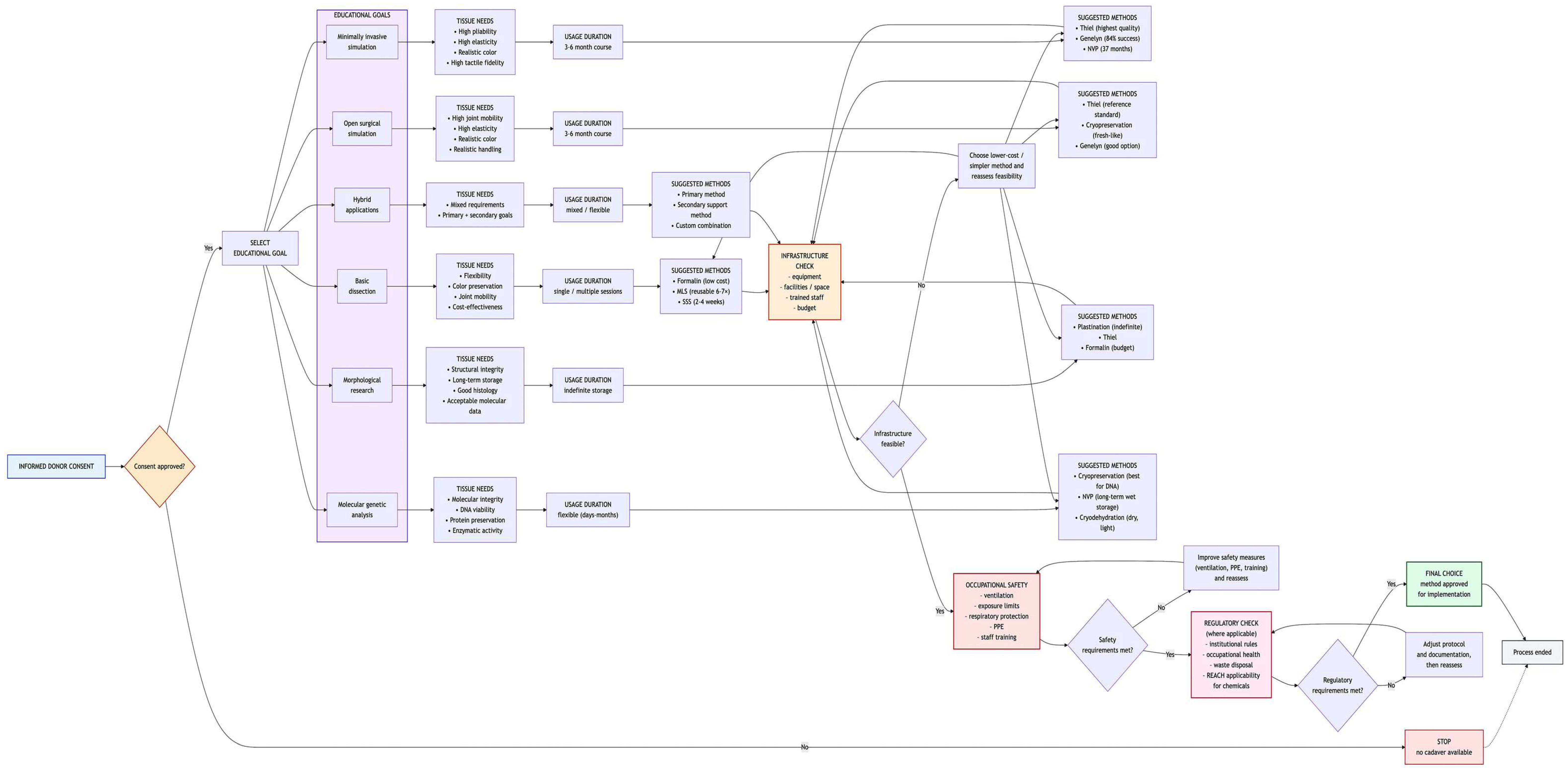
A thorough decision pathway must systematically consider (Figure 1) (a) informed donor consent as the primary step, establishing transparent communication with donors regarding preservation method, storage duration, educational and research purposes, and any molecular analysis, with explicit documentation of donor preferences and institutional practices aligned with stated consent; (b) primary educational goals, encompassing dissection, surgical simulation, morphological research, molecular analysis, or hybrid applications; (c) expected specimen usage frequency and duration, including single-use versus multi-session applications and long-term storage requirements; (d) required tissue characteristics, specifically elasticity, mechanical stability, molecular integrity, and color fidelity; (e) existing infrastructure and funding availability, including capital equipment, specialized facilities, trained personnel, and operational budget constraints; (f) regulatory compliance requirements, if applicable; and (g) occupational health factors for personnel, encompassing worker safety protocols, exposure limits, ventilation requirements, and health surveillance for faculty, students, and technical staff engaged in cadaveric preservation and dissection. Smaller institutions with constrained budgets may prioritize economical formalin-free alternatives or saturated salt solutions for basic dissection, while reserving specialized preservation techniques (Thiel embalming, cryopreservation, plastination) for specific specimens that facilitate advanced training or research. Large academic medical institutes implementing varied programs may strategically utilize hybrid preservation, designating particular organs or tissue sections for cryopreservation or specialist techniques while maintaining the complete specimen by economical foundational approaches. Institutional standardization via systematic documentation of preservation outcomes, specimen durability, microbiological contamination rates, cost metrics, and long-term educational efficacy establishes crucial empirical foundations for evidence-based guideline formulation and ongoing quality enhancement. Professional anatomical sciences associations ought to promote multicenter evaluations of preservation techniques across various institutions, establishing validated performance metrics and reaching consensus on recommendations that reconcile educational fidelity, ethical stewardship, regulatory compliance, and occupational safety.

6. Conclusions

Cadaveric preservation has progressed from formalin fixation to a varied array of methods. Each presents distinct advantages—color fidelity, pliability, molecular integrity, or sustainability—yet none is generally superior. The convergence of nanotechnology, machine learning, and tissue engineering offers innovative, individualized models that connect static specimens with living systems. Achieving widespread adoption requires multicenter validations, standardized outcome metrics (morphological fidelity, microbial safety, cost), and ethical frameworks that honor donor intent. By uniting anatomists, educators, surgeons, and regulators around shared guidelines, the field can sustain the cadaver’s role as the “silent teacher,” advancing anatomical knowledge and surgical proficiency in a safe, responsible, and resource-sensitive manner.

Author Contributions

Conceptualization, S.P. (Salvatore Pezzino); writing—original draft preparation, S.P. (Salvatore Pezzino); writing—review and editing, S.P. (Stefano Puleo), C.C., T.L., G.A., M.C. and S.C.; supervision, S.P. (Salvatore Pezzino). All authors have read and agreed to the published version of the manuscript.

Funding

This research received no external funding.

Data Availability Statement

Not applicable.

Conflicts of Interest

The authors declare no conflicts of interest.

Abbreviations

The following abbreviations are used in this manuscript:
MRIMagnetic Resonance Imaging
CTComputed Tomography
IHCImmunohistochemical
NVPN-vinyl-2-pyrrolidone
ZnCl2Zinc Chloride
EZATEnhanced Zinc-based Anatomical Tissue preservation
GAFGlyoxal Acid-Free
SSSSaturated Salt Solution
PASPeriodic acid-Schiff
MALDI-TOFMatrix-Assisted Laser Desorption/Ionization Time-of-Flight
VRVirtual Reality
ARAugmented Reality
NGSNext-Generation Sequencing
DNADeoxyribonucleic Acid
RNARibonucleic Acid
REACHRegistration, Evaluation, Authorization, and Restriction of Chemicals
EUEuropean Union
H&EHematoxylin and Eosin
ATPAdenosine Triphosphate
pHPotential of Hydrogen
PEDOTPoly(3,4-ethylenedioxythiophene)
3DThree-Dimensional
kHzKilohertz
MHzMegahertz
Pa·sPascal-Second (unit of viscosity)

References

  1. De Caro, R.; Boscolo-Berto, R.; Artico, M.; Bertelli, E.; Cannas, M.; Cappello, F.; Carpino, G.; Castorina, S.; Cataldi, A.; Cavaletti, G.A.; et al. The Italian Law on Body Donation: A Position Paper of the Italian College of Anatomists. Ann. Anat.-Anat. Anz. 2021, 238, 151761. [Google Scholar] [CrossRef] [PubMed]
  2. Gilbody, J.; Prasthofer, A.; Ho, K.; Costa, M. The Use and Effectiveness of Cadaveric Workshops in Higher Surgical Training: A Systematic Review. Ann. R Coll. Surg. Engl. 2011, 93, 347–352. [Google Scholar] [CrossRef] [PubMed]
  3. Brenna, C.T.A. Post-Mortem Pedagogy: A Brief History of the Practice of Anatomical Dissection. Rambam Maimonides Med. J. 2021, 12, e0008. [Google Scholar] [CrossRef] [PubMed]
  4. Ghosh, S.K. Human Cadaveric Dissection: A Historical Account from Ancient Greece to the Modern Era. Anat. Cell Biol. 2015, 48, 153–169. [Google Scholar] [CrossRef]
  5. Brenner, E. Human Body Preservation—Old and New Techniques. J. Anat. 2014, 224, 316–344. [Google Scholar] [CrossRef]
  6. Musiał, A.; Gryglewski, R.W.; Kielczewski, S.; Loukas, M.; Wajda, J. Formalin Use in Anatomical and Histological Science in the 19th and 20th Centuries. Folia Med. Cracov. 2016, 56, 31–40. [Google Scholar]
  7. Swenberg, J.A.; Moeller, B.C.; Lu, K.; Rager, J.E.; Fry, R.; Starr, T.B. Formaldehyde Carcinogenicity Research: 30 Years and Counting for Mode of Action, Epidemiology, and Cancer Risk Assessment. Toxicol. Pathol. 2013, 41, 181–189. [Google Scholar] [CrossRef]
  8. Ryska, A.; Sapino, A.; Landolfi, S.; Valero, I.S.; Cajal, S.R.Y.; Oliveira, P.; Detillo, P.; Lianas, L.; Frexia, F.; Nicolosi, P.A.; et al. Glyoxal Acid-Free (GAF) Histological Fixative Is a Suitable Alternative to Formalin: Results from an Open-Label Comparative Non-Inferiority Study. Virchows Arch. 2024, 485, 213–222. [Google Scholar] [CrossRef]
  9. Thangamani, S.S.; Ravindran, S.; Karuppur Thiagarajan, M.; Mayilvakanam, S.K.; Ravi, A.; Annamalai, S. Rethinking Tissue Preservation: A Review of Non-Toxic and Environmentally Sustainable Fixatives. Ann. Diagn. Pathol. 2025, 78, 152500. [Google Scholar] [CrossRef]
  10. Brenner, E. Human Body Preservation—Old Anatomical Techniques for New Medical Challenges. Clin. Anat. 2014, 27, 331–339. [Google Scholar] [CrossRef]
  11. Monteiro, Y.F.; Patrício, E.A.; Campos, L.E.S.B.; Soares, K.; Nogueira, B.V.; Bittencourt, A.S. A New Epoxy for Plastination: Feasibility and Applicability Analysis of the Conservation of Biological Tissues. Braz. J. Med. Biol. Res. 2025, 58, e14839. [Google Scholar] [CrossRef] [PubMed]
  12. Sam, F.; Shanthi, P.; Francis, D.V. Effectiveness of Different Combinations of Phenoxetol and Formaldehyde on Preservation of Histological Features in Human Cadaveric Tissues. Med. J. Armed Forces India 2025, 81, 25–31. [Google Scholar] [CrossRef] [PubMed]
  13. Constantino, C.S.; Bundoc, R.C.; Tecson, J.V.; Rubio, D.A.T. Evaluation of Modified Thiel Soft-Embalmed Cadavers as a Novel Teaching Model for Musculoskeletal Ultrasound and Anatomy among Rehabilitation Medicine Residents. Acta Medica Philipp. 2023, 57, 45–51. [Google Scholar] [CrossRef] [PubMed]
  14. Ghag, N.; Tam, J.; Anderson, R.R.; Cheema, N. Cryopreservation Method for Preventing Freeze-Fracture of Small Muscle Samples. Bio-Protoc. 2025, 15, e5145. [Google Scholar] [CrossRef]
  15. Taylor, M.J.; Weegman, B.P.; Baicu, S.C.; Giwa, S.E. New Approaches to Cryopreservation of Cells, Tissues, and Organs. Transfus. Med. Hemotherapy 2019, 46, 197–215. [Google Scholar] [CrossRef]
  16. Signorelli, F.; Rastegar, V.; Palermo, M.; Laino, D.; Zeoli, F.; Visocchi, M. Long-Term Preservation of Human Head and Neck Specimens for Neurosurgical Training: A Technical Note. Brain Sci. 2025, 15, 1016. [Google Scholar] [CrossRef]
  17. Yiasemidou, M.; Roberts, D.; Glassman, D.; Tomlinson, J.; Biyani, S.; Miskovic, D. A Multispecialty Evaluation of Thiel Cadavers for Surgical Training. World J. Surg. 2017, 41, 1201–1207. [Google Scholar] [CrossRef]
  18. Fletcher, J.; Heinze, T.; Wedel, T.; Miskovic, D. 43 Digital Human Project: 3D Photogrammetry for Human Cadaveric Pelvic Specimens: An Innovation in Colorectal Anatomical Education. Br. J. Surg. 2021, 108, znab135. [Google Scholar] [CrossRef]
  19. Martín-Noguerol, T.; Paulano-Godino, F.; Riascos, R.F.; Calabia-del-Campo, J.; Márquez-Rivas, J.; Luna, A. Hybrid Computed Tomography and Magnetic Resonance Imaging 3D Printed Models for Neurosurgery Planning. Ann. Transl. Med. 2019, 7, 684. [Google Scholar] [CrossRef]
  20. Pirri, C.; Stecco, C.; Porzionato, A.; Boscolo-Berto, R.; Fortelny, R.H.; Macchi, V.; Konschake, M.; Merigliano, S.; De Caro, R. Forensic Implications of Anatomical Education and Surgical Training With Cadavers. Front. Surg. 2021, 8, 641581. [Google Scholar] [CrossRef]
  21. Berrino, E.; Annaratone, L.; Miglio, U.; Maldi, E.; Piccinelli, C.; Peano, E.; Balmativola, D.; Cassoni, P.; Pisacane, A.; Sarotto, I.; et al. Cold Formalin Fixation Guarantees DNA Integrity in Formalin Fixed Paraffin Embedded Tissues: Premises for a Better Quality of Diagnostic and Experimental Pathology with a Specific Impact on Breast Cancer. Front. Oncol. 2020, 10, 173. [Google Scholar] [CrossRef] [PubMed]
  22. Tayri-Wilk, T.; Slavin, M.; Zamel, J.; Blass, A.; Cohen, S.; Motzik, A.; Sun, X.; Shalev, D.E.; Ram, O.; Kalisman, N. Mass Spectrometry Reveals the Chemistry of Formaldehyde Cross-Linking in Structured Proteins. Nat. Commun. 2020, 11, 3128. [Google Scholar] [CrossRef] [PubMed]
  23. Hoffman, E.A.; Frey, B.L.; Smith, L.M.; Auble, D.T. Formaldehyde Crosslinking: A Tool for the Study of Chromatin Complexes*. J. Biol. Chem. 2015, 290, 26404–26411. [Google Scholar] [CrossRef] [PubMed]
  24. Kamps, J.J.A.G.; Hopkinson, R.J.; Schofield, C.J.; Claridge, T.D.W. How Formaldehyde Reacts with Amino Acids. Commun. Chem. 2019, 2, 126. [Google Scholar] [CrossRef]
  25. Fowler, C.B.; O’Leary, T.J.; Mason, J.T. Modeling Formalin Fixation and Histological Processing with Ribonuclease A: Effects of Ethanol Dehydration on Reversal of Formaldehyde Cross-Links. Lab. Investig. 2008, 88, 785–791. [Google Scholar] [CrossRef]
  26. Benedict, B.; Kristensen, S.M.; Duxin, J.P. What Are the DNA Lesions Underlying Formaldehyde Toxicity? DNA Repair 2024, 138, 103667. [Google Scholar] [CrossRef]
  27. Lu, K.; Ye, W.; Zhou, L.; Collins, L.B.; Chen, X.; Gold, A.; Ball, L.M.; Swenberg, J.A. Structural Characterization of Formaldehyde-Induced Cross-Links Between Amino Acids and Deoxynucleosides and Their Oligomers. J. Am. Chem. Soc. 2010, 132, 3388–3399. [Google Scholar] [CrossRef]
  28. Srinivasan, M.; Sedmak, D.; Jewell, S. Effect of Fixatives and Tissue Processing on the Content and Integrity of Nucleic Acids. Am. J. Pathol. 2002, 161, 1961–1971. [Google Scholar] [CrossRef]
  29. Beger, O.; Karagül, M.İ.; Koç, T.; Kayan, G.; Cengiz, A.; Yılmaz, Ş.N.; Olgunus, Z.K. Effects of Different Cadaver Preservation Methods on Muscles and Tendons: A Morphometric, Biomechanical and Histological Study. Anat. Sci. Int. 2020, 95, 174–189. [Google Scholar] [CrossRef]
  30. Frigon, E.-M.; Dadar, M.; Boire, D.; Maranzano, J. Antigenicity Is Preserved with Fixative Solutions Used in Human Gross Anatomy: A Mice Brain Immunohistochemistry Study. Front. Neuroanat. 2022, 16, 957358. [Google Scholar] [CrossRef]
  31. Hayashi, S.; Homma, H.; Naito, M.; Oda, J.; Nishiyama, T.; Kawamoto, A.; Kawata, S.; Sato, N.; Fukuhara, T.; Taguchi, H.; et al. Saturated Salt Solution Method: A Useful Cadaver Embalming for Surgical Skills Training. Medicine 2014, 93, e196. [Google Scholar] [CrossRef]
  32. National Toxicology Program. 15th Report on Carcinogens. National Institute of Environmental Health Sciences. 2021. Available online: https://ntp.niehs.nih.gov/research/assessments/cancer/roc (accessed on 6 February 2026).
  33. IARC Working Group on the Evaluation of Carcinogenic Risks to Humans. Formaldehyde, 2-Butoxyethanol and 1-Tert-Butoxypropan-2-Ol. IARC Monogr. Eval. Carcinog. Risks Hum. 2006, 88, 1–478. [Google Scholar]
  34. 1910.1048-Formaldehyde; Occupational Safety and Health Administration, U.S. Department of Labor: Washington, DC, USA, 1987. Available online: https://www.osha.gov/laws-regs/regulations/standardnumber/1910/1910.1048 (accessed on 6 February 2026).
  35. American Conference of Governmental Industrial Hygienists. FORMALDEHYDE. Available online: https://www.acgih.org/formaldehyde-2/ (accessed on 6 February 2026).
  36. CDC. NIOSH Pocket Guide to Chemical Hazards. Formaldehyde. Available online: https://www.cdc.gov/niosh/npg/npgd0293.html (accessed on 6 February 2026).
  37. Djembi, Y.R.; Benkhadra, M.; Abiome, R.; Bayonne Manou, L.M.; Trouilloud, P.; Guillier, D.; Cheynel, N. Contributions of the Thiel’s Method in Teaching and Researching Anatomy. Morphologie 2022, 106, 300–306. [Google Scholar] [CrossRef] [PubMed]
  38. Benkhadra, M.; Bouchot, A.; Gérard, J.; Genelot, D.; Trouilloud, P.; Martin, L.; Girard, C.; Danino, A.; Anderhuber, F.; Feigl, G. Flexibility of Thiel’s Embalmed Cadavers: The Explanation Is Probably in the Muscles. Surg. Radiol. Anat. 2011, 33, 365–368. [Google Scholar] [CrossRef] [PubMed]
  39. Mitsugashira, T.; Sasaki, A.; Furukawa, Y.; Yanagawa, Y.; Yoshida, H.; Tsuruta, R.; Kanematsu, Y.; Tajima, E.; Oda, Y.; Naito, M. Clinical Anatomy Applications of Thiel-Embalmed Cadavers in Minimally Invasive Surgical Training. Clin. Anat. 2022, 35, 123–132. [Google Scholar]
  40. Hammer, N. Thirty Years of Thiel Embalming—A Systematic Review on Its Utility in Medical Research. Clin. Anat. 2022, 35, 987–997. [Google Scholar] [CrossRef]
  41. Armit, G.; Ray, S.; Mohapatra, S. Preparation of Soft Embalmed Cadavers by the Modified Thiel Embalming Technique for Surgical Skill Training and Development of a Universal Quantitative Scoring System to Assess the Suitability of Soft Embalmed Cadavers for Such Training Purposes. Cureus 2023, 15, e43991. [Google Scholar] [CrossRef]
  42. Thiel, W. The preservation of the whole corpse with natural color. Ann. Anat. 1992, 174, 185–195. [Google Scholar] [CrossRef]
  43. Thiel, W. Supplement to the conservation of an entire cadaver according to W. Thiel. Ann. Anat. 2002, 184, 267–269. [Google Scholar] [CrossRef]
  44. Eisma, R.; Lamb, C.; Soames, R.W. From Formalin to Thiel Embalming: What Changes? One Anatomy Department’s Experiences. Clin. Anat. 2013, 26, 564–571. [Google Scholar] [CrossRef]
  45. McDougall, S.; Soames, R.; Felts, P. Thiel Embalming: Quantifying Histological Changes in Skeletal Muscle and Tendon and Investigating the Role of Boric Acid. Clin. Anat. 2020, 33, 696–704. [Google Scholar] [CrossRef]
  46. Chytas, D.; Gyftopoulos, K. Use of Thiel-Embalmed Cadavers in Urology Training and Their Ability to Retain Real-Life Anatomy: A Systematic Review. ANZ J. Surg. 2023, 93, 1787–1792. [Google Scholar] [CrossRef] [PubMed]
  47. Nagao, S.; Andou, M.; Irie, K.; Kubo, K.; Ida, N.; Komiyama, T.; Kameoka, T.; Kawaguchi, A.; Masuyama, H. Surgical Training in Extraperitoneal Laparoscopic Para-Aortic Lymphadenectomy for the Treatment of Gynecological Cancer Using a Thiel-Embalmed Cadaver. Oncol. Lett. 2024, 27, 290. [Google Scholar] [CrossRef] [PubMed]
  48. Kennel, L.; Martin, D.M.A.; Shaw, H.; Wilkinson, T. Learning Anatomy through Thiel- vs. Formalin-Embalmed Cadavers: Student Perceptions of Embalming Methods and Effect on Functional Anatomy Knowledge. Anat. Sci. Educ. 2018, 11, 166–174. [Google Scholar] [CrossRef] [PubMed]
  49. Humbert, M.; Micault, E.; Moreau, S.; Patron, V.; Bois, J.; Hitier, M. The Advantages of Modified Thiel Technique in Head and Neck Surgical Anatomy Teaching. Surg. Radiol. Anat. 2022, 44, 345–352. [Google Scholar] [CrossRef]
  50. Maruo, T.; Tomioka, T.; Okano, W.; Mukaigawa, T.; Fukuhara, T.; Nakamura, H.; Takeuchi, T.; Naito, M.; Hatayama, N.; Fujimoto, Y. Evaluation of the Optimal Approach for Endoscopic Neck Dissection Using Thiel Cadavers. Auris Nasus Larynx 2025, 52, 643–650. [Google Scholar] [CrossRef]
  51. Sanchez-Ferrer, F.; Grima-Murcia, M.D.; Sánchez-Del-Campo, F.; Sánchez-Ferrer, M.L.; Fernández-Jover, E. Thiel Embalming in Neonates: Methodology and Benefits in Medical Training. Anat. Sci. Int. 2022, 97, 290–296. [Google Scholar] [CrossRef]
  52. Sartawi, R.Y.; McLeod, G.; Guntur Ramkumar, P.; Lamb, C. Randomized Trial Comparing the Spread of Retrolaminar Block with the Combination of Erector Spinae Block and Retrolaminar Block in Soft Embalmed Thiel Cadavers. Reg. Anesth. Pain. Med. 2022, 47, 424–425. [Google Scholar] [CrossRef]
  53. Macluskey, M.; Anderson, A.S.; Gribben, M.; Shepherd, S.D. An Educational Evaluation of Thiel Cadavers as a Model for Teaching Suturing Skills to Dental Students during the COVID-19 Pandemic. Dent. J. 2022, 10, 125. [Google Scholar] [CrossRef]
  54. Ruiz-Tovar, J.; Prieto-Nieto, I.; García-Olmo, D.; Clascá, F.; Enriquez, P.; Villalonga, R.; Zubiaga, L. Training Courses in Laparoscopic Bariatric Surgery on Cadaver Thiel: Results of a Satisfaction Survey on Students and Professors. Obes. Surg. 2019, 29, 3465–3470. [Google Scholar] [CrossRef]
  55. Kanao, H.; Tamate, M.; Matsuura, M.; Nagao, S.; Nakazawa, M.; Habata, S.; Saito, T. Step-by-Step Demonstration of “Sciatic-Nerve-Preserved beyond-LEER” in a Thiel-Embalmed Cadaver: A Novel Salvage Surgery for Recurrent Gynecologic Malignancies. J. Gynecol. Oncol. 2024, 35, 112. [Google Scholar] [CrossRef] [PubMed]
  56. Yan, L.; Ebina, K.; Abe, T.; Kon, M.; Higuchi, M.; Hotta, K.; Furumido, J.; Iwahara, N.; Komizunai, S.; Tsujita, T.; et al. Validation and Motion Analyses of Laparoscopic Radical Nephrectomy with Thiel-Embalmed Cadavers. Curr. Probl. Surg. 2024, 61, 101559. [Google Scholar] [CrossRef] [PubMed]
  57. Lersch, F.; Schnidrig, D.; Boemke, S.; Djonov, V.; Jaggi, D.; Heussen, F.M. Thiel Cadaver Eye as a Training Model for Sub-Tenon’s Blocks: A Feasibility Study. BMC Ophthalmol. 2024, 24, 391. [Google Scholar] [CrossRef] [PubMed]
  58. Abdulla, A.J.A.; Baticulon, R.E.; Genuino, R.F.; Sotalbo, C.P.J.; Tecson, J.V. Integration of Simulated Thoracentesis Using Thiel-Preserved Cadavers in the Teaching of Thoracic Anatomy for Learning Unit III Medical Students: An Innovative Learning Strategy. Acta Med. Philipp. 2025, 59, 33–39. [Google Scholar] [CrossRef]
  59. Nakao, G.; Kodesho, T.; Kato, T.; Yokoyama, Y.; Saito, Y.; Ohsaki, Y.; Watanabe, K.; Katayose, M.; Taniguchi, K. Relationship between Shear Elastic Modulus and Passive Muscle Force in Human Hamstring Muscles Using a Thiel Soft-Embalmed Cadaver. J. Med. Ultrason. 2023, 50, 275–283. [Google Scholar] [CrossRef]
  60. Lin, G.; Wang, W.; Wilkinson, T. Changes in Deep Neck Muscle Length from the Neutral to Forward Head Posture. A Cadaveric Study Using Thiel Cadavers. Clin. Anat. 2022, 35, 332–339. [Google Scholar] [CrossRef]
  61. Chancharoen, W.; Nwe, T.; Seehanam, S.; Taradolpisut, N.; Berkband, T.; Chobpenthai, T.; Jongwannasiri, C.; Yurasakpong, L. Evaluation of Screw Pull-out from Plate Fixation of En Bloc Distal Radius Resection with Ulnar Reconstruction: Finite Element Analysis and Comparison with Experiments on Thiel Cadavers. APL Bioeng. 2025, 9, 026123. [Google Scholar] [CrossRef]
  62. Lawley, A.; Zin, M.T.; Turbet, C.; Hampson, R.; Dobie, G. Thiel Cadaver Suitability for Image-Based Abdominal Ultrasound Research. Ann. Anat. 2025, 262, 152713. [Google Scholar] [CrossRef]
  63. Rajasekhar, A.; Moyes, R.B.; Nisbet, M.; Sankey, T.L. Cost-Effectiveness Analysis of Thiel Embalming for Surgical Training. Surg. Educ. 2021, 78, 234–241. [Google Scholar]
  64. Taradolpisut, N.; Weerachatyanukul, W.; Suphamungmee, W.; Asuvapongpatana, S.; Luanphaisarnnont, T.; Chaiyamoon, A.; Berkban, T.; Halliwell, T.; Wilkinson, T.; Suwannakhan, A. The Use of Technical Grade Chemicals and On-Site Production of Ammonium Nitrate: A Cost-Effective and Safer Approach to Thiel Embalming. Surg. Radiol. Anat. 2025, 47, 157. [Google Scholar] [CrossRef]
  65. Sanders, K.A.; Quinn, R.J.; Whiteley, L.; Bazira, P.J. The Tactile Realness of “life” Is Hitting Me in the Face”: Unprompted Student Reflections of Dissection Using Formalin- and Thiel-Embalmed Donors. Anat. Sci. Educ. 2025, 18, 912–922. [Google Scholar] [CrossRef] [PubMed]
  66. Hunter, A.; Eisma, R.; Lamb, C. Thiel Embalming Fluid—A New Way to Revive Formalin-Fixed Cadaveric Specimens. Clin. Anat. 2014, 27, 853–855. [Google Scholar] [CrossRef] [PubMed]
  67. Wedel, T.; Ackermann, J.; Hagedorn, H.; Mettler, L.; Maass, N.; Alkatout, I. Educational Training in Laparoscopic Gynecological Surgery Based on Ethanol-Glycerol-Lysoformin-Preserved Body Donors. Ann. Anat. 2019, 221, 157–164. [Google Scholar] [CrossRef] [PubMed]
  68. Tutsch, H. An odorless, well-preserving injectable solution for cadavers used in classes. Anat. Anz. 1975, 138, 126–128. [Google Scholar]
  69. Kaliappan, A.; Motwani, R.; Gupta, T.; Chandrupatla, M. Innovative Cadaver Preservation Techniques: A Systematic Review. Maedica 2023, 18, 127–135. [Google Scholar] [CrossRef]
  70. Ackermann, J.; Wedel, T.; Hagedorn, H.; Maass, N.; Mettler, L.; Heinze, T.; Alkatout, I. Establishment and Evaluation of a Training Course in Advanced Laparoscopic Surgery Based on Human Body Donors Embalmed by Ethanol-Glycerol-Lysoformin Fixation. Surg. Endosc. 2021, 35, 1385–1394. [Google Scholar] [CrossRef]
  71. Pekedis, M.; Yoruk, M.D.; Binboga, E.; Yildiz, H.; Bilge, O.; Celik, S. Characterization of the Mechanical Properties of Human Parietal Bones Preserved in Modified Larssen Solution, Formalin and as Fresh Frozen. Surg. Radiol. Anat. 2021, 43, 1933–1943. [Google Scholar] [CrossRef]
  72. Celik, S.; Bilge, O.; Ozdemir, M.; Dionigi, G.; Anuwong, A.; Makay, O. Modified Larssen Solution (MLS)-Fixed Cadaver Model for Transoral Endoscopic Thyroidectomy Vestibular Approach (TOETVA) Education: A Feasibility Study. Surg. Endosc. 2022, 36, 5518–5530. [Google Scholar] [CrossRef]
  73. Da Silva, R.M.G.; Matera, J.M.; Ribeiro, A.A.C.M. Preservation of Cadavers for Surgical Technique Training. Vet. Surg. 2004, 33, 606–608. [Google Scholar] [CrossRef]
  74. Crosado, B.; Löffler, S.; Ondruschka, B.; Zhang, M.; Zwirner, J.; Hammer, N. Phenoxyethanol-Based Embalming for Anatomy Teaching: An 18 Years’ Experience with Crosado Embalming at the University of Otago in New Zealand. Anat. Sci. Educ. 2020, 13, 778–793. [Google Scholar] [CrossRef]
  75. Tomlinson, J.; Scholze, M.; Ondruschka, B.; Hammer, N.; Zwirner, J. Crosado Embalming Related Alterations in the Morpho-Mechanics of Collagen Rich Tissues. Sci. Rep. 2025, 15, 6587. [Google Scholar] [CrossRef] [PubMed]
  76. Rajasekhar, S.S.S.N.; Kaliyamoorthy, K.; Dinesh Kumar, V.; Sivadasan, N. Critical Appraisal of Genelyn Soft Embalming for Cadaveric Surgical Skill Training: A Systematic Review. Clin. Anat. 2025, 38, 278–295. [Google Scholar] [CrossRef] [PubMed]
  77. Kong, C.Y.; Fogg, Q.A.; Allam, M. A Novel Model for Hands-on Laparoscopic Pelvic Surgery Training on Genelyn-Embalmed Body: An Initial Feasibility Study. Anat. Sci. Int. 2023, 98, 89–98. [Google Scholar] [CrossRef] [PubMed]
  78. Manikumari, B.; Jaggavarapu, S.R.; Subha, K.; Kalpana, T.; Muni, R.K.N.; Kishve, P.; Bheemesh, P. Simulation of Reconstructive Microsurgery in Soft Embalmed Cadavers: A Teaching Module for Plastic Surgery Residents. Indian. J. Plast. Surg. 2022, 55, 262–267. [Google Scholar] [CrossRef]
  79. Pinar, S.A.; Morrow, J.J.; Kong, C.Y. A Systematic Review of the Use of Human Body Donor Models for Postgraduate Laparoscopic Surgical Training. Anat. Sci. Int. 2025. [Google Scholar] [CrossRef]
  80. Rajasekhar, S.S.S.N.; Dinesh Kumar, V.; Senthil, G.; Pottakat, B.; Kalayarasan, R.; Raveendranath, V.; Gurram, R.P. Learning Gains of Liver Resection and Transplantation Workshop on Genelyn® Embalmed Human Cadavers: Surgical Gastroenterologists’ Perceptions. J. Clin. Exp. Hepatol. 2021, 11, 550–556. [Google Scholar] [CrossRef]
  81. Rajasekhar, S.S.S.N.; Kumar, V.D.; Veena, P.; Mourya, D.K.; Chathurvedula, L.; Raveendranath, V. The Usefulness of Genelyn® Embalming Method for Gynaecological Surgical Skill Training: A New Cadaveric Training Model for Laparoscopic Hysterectomy. Indian J. Surg. 2022, 84, 331–333. [Google Scholar] [CrossRef]
  82. Rajasekhar, S.S.S.N.; Kumar, V.D.; Raveendranath, V.; Kalayarasan, R.; Gnanasekaran, S.; Pottakkat, B.; Sivakumar, M. Advanced Training in Laparoscopic Gastrointestinal Surgical Procedures Using Genelyn®-Embalmed Human Cadavers: A Novel Model. J. Minim. Access Surg. 2021, 17, 495–501. [Google Scholar] [CrossRef]
  83. Burns, D.M.; Bell, I.; Katchky, R.; Dwyer, T.; Toor, J.; Whyne, C.M.; Safir, O. Saturated Salt Solution Cadaver-Embalming Method Improves Orthopaedic Surgical Skills Training. JBJS 2018, 100, e104. [Google Scholar] [CrossRef]
  84. Hassan, S.; Eisma, R.; Malhas, A.; Soames, R.; Harry, L. Surgical Simulation Flexor Tendon Repair Using Thiel Cadavers: A Comparison with Formalin Embalmed Cadavers and Porcine Models. J. Hand. Surg. Eur. Vol. 2015, 40, 246–249. [Google Scholar] [CrossRef]
  85. Durongphan, A.; Suksantilap, S.; Panrong, N.; Aungsusiripong, A.; Wiriya, A.; Pisittrakoonporn, S.; Pichaisak, W.; Pamornpol, B.L.-I. Non-Decapitated, Saturated Salt Method-Embalmed Cadaver Technique Development and Application as a Head and Neck Surgery Training Model. PLoS ONE 2022, 17, 0262415. [Google Scholar] [CrossRef] [PubMed]
  86. Watanabe, M.; Yoneyama, Y.; Hamada, H.; Kohno, M.; Hasegawa, O.; Takahashi, H.; Kawase-Koga, Y.; Matsuo, A.; Chikazu, D.; Kawata, S.; et al. The Usefulness of Saturated Salt Solution Embalming Method for Oral Surgical Skills Training: A New Cadaveric Training Model for Bone Harvesting. Anat. Sci. Educ. 2020, 13, 628–635. [Google Scholar] [CrossRef] [PubMed]
  87. Homma, H.; Oda, J.; Sano, H.; Kawai, K.; Koizumi, N.; Uramoto, H.; Sato, N.; Mashiko, K.; Yasumatsu, H.; Ito, M.; et al. Advanced Cadaver-Based Educational Seminar for Trauma Surgery Using Saturated Salt Solution-Embalmed Cadavers. Acute Med. Surg. 2019, 6, 123–130. [Google Scholar] [CrossRef] [PubMed]
  88. Shirai, T.; Hayashi, S.; Itoh, M. Experience of Raising Flaps Using Cadavers Embalmed by Saturated Salt Solution Method. Plast. Reconstr. Surg. Glob. Open 2015, 3, e543. [Google Scholar] [CrossRef]
  89. Shirai, T.; Hayashi, S.; Matsumura, H.; Kawata, S.; Nagahori, K.; Miyawaki, M.; Ida, Y.; Itoh, M. Training on Skin Flap Elevation in Hand Surgery Using Cadavers Embalmed by the Saturated Salt Solution Method: Effectiveness and Usefulness. Anat. Sci. Int. 2022, 97, 283–289. [Google Scholar] [CrossRef]
  90. Araki, Y.; Oda, Y.; Kitagawa, M.; Aoki, K.; Komiya, T.; Kikuchi, M.; Shirai, T.; Kawata, S.; Itoh, M.; Matsumura, H. Water-Soluble Dye Staining of the Flap Nutrient Artery and Its Perforator Branch in Cadavers Embalmed Using Saturated Salt Solution and Urea Methods: Does Demonstration Using a Dye-Stained Cadaver Increase a Trainee’s Level of Skill Acquisition? Anat. Sci. Int. 2025, 100, 347–353. [Google Scholar] [CrossRef]
  91. Lombardero, M.; Yllera, M.M.; Costa-E-Silva, A.; Oliveira, M.J.; Ferreira, P.G. Saturated Salt Solution: A Further Step to a Formaldehyde-Free Embalming Method for Veterinary Gross Anatomy. J. Anat. 2017, 231, 309–317. [Google Scholar] [CrossRef]
  92. Abraham, J.; D’Souza, A.; Bhat, A.K.; Kalthur, S.G.; Pandey, A.K.; Andrade, L.S.; Pillay, M.; Ankolekar, V.H.; Prabhath, S.; Punja, R. Comparative Histologic Assessment of Fetal Cadaveric Tissue Preserved Using the Modified Saturated Salt Solution. Morphologie 2025, 109, 100970. [Google Scholar] [CrossRef]
  93. von Hagens, G.; Tiedemann, K.; Kriz, W. The Current Potential of Plastination. Anat. Embryol. 1987, 175, 411–421. [Google Scholar] [CrossRef]
  94. Henry, R.W.; von Hagens, G.; Seamans, G. Cold Temperature/Biodur®/S10/von Hagens’—Silicone Plastination Technique. Anat. Histol. Embryol. 2019, 48, 532–538. [Google Scholar] [CrossRef]
  95. Shetty, U.A.; Dinakar, C.; D’Cruz, A.M.; Shetty, P.; Prabhu, V. Plastination—A Method for Preservation of Oral Hard and Soft Tissue Biopsy Specimen v/s the Conventional Method of Preservation with Formalin. J. Oral. Maxillofac. Pathol. 2023, 27, 515–519. [Google Scholar] [CrossRef] [PubMed]
  96. Hildebrandt, S.; Champney, T.H.; Cornwall, J. The Public Face of Anatomy? History-Informed Ethical Analysis of Human Plastination and Its Relevance for Today. Anat. Sci. Educ. 2025, 18. [Google Scholar] [CrossRef] [PubMed]
  97. Chandrasekaran, R.; Radzi, S.; Kai, P.Z.; Rajalingam, P.; Rotgans, J.; Mogali, S.R. A Validated Instrument Measuring Students’ Perceptions on Plastinated and Three-Dimensional Printed Anatomy Tools. Anat. Sci. Educ. 2022, 15, 850–862. [Google Scholar] [CrossRef] [PubMed]
  98. Goh, J.S.K.; Chandrasekaran, R.; Sirasanagandla, S.R.; Acharyya, S.; Mogali, S.R. Efficacy of Plastinated Specimens in Anatomy Education: A Systematic Review and Meta-Analysis. Anat. Sci. Educ. 2024, 17, 712–721. [Google Scholar] [CrossRef]
  99. Mahajan, A.; Agarwal, S.; Tiwari, S.; Vasudeva, N. Plastination: An Innovative Method of Preservation of Dead Body for Teaching and Learning Anatomy. MAMC J. Med. Sci. 2016, 2, 38. [Google Scholar] [CrossRef]
  100. Ottone, N.E.; Cirigliano, V.; Bianchi, H.F.; Medan, C.D.; Algieri, R.D.; Borges Brum, G.; Fuentes, R. New Contributions to the Development of a Plastination Technique at Room Temperature with Silicone. Anat. Sci. Int. 2015, 90, 126–135. [Google Scholar] [CrossRef]
  101. Baptista, C.A.C.; DeJong, K.; Latorre, R.; Bittencourt, A.S. P40 Polyester Sheet Plastination Technique for Brain and Body Slices: The Vertical and Horizontal Flat Chamber Methods. Anat. Histol. Embryol. 2019, 48, 572–576. [Google Scholar] [CrossRef]
  102. Ahmed, O.; Gaballa, M.M.S.; Abumandour, M.M.A.; Al-Otaibi, A.M.; Choudhary, P.; El-Shafey, A.A. Morphometric and Histopathological Evaluation of Modified Elnady’s Plastinated Tissue Compared to Non-Plastinated Tissue: Highlighting Its Relevance for Teaching and Research. Anat. Histol. Embryol. 2024, 53, e13046. [Google Scholar] [CrossRef]
  103. Elnady, F.A. The Elnady Technique: An Innovative, New Method for Tissue Preservation. Altex 2016, 33, 237–242. [Google Scholar] [CrossRef][Green Version]
  104. Latorre, R.; de Jong, K.; Sora, M.C.; López-Albors, O.; Baptista, C. E12 Technique: Conventional Epoxy Resin Sheet Plastination. Anat Histol Embryol 2019, 48, 557–563. [Google Scholar] [CrossRef]
  105. Delpupo, F.V.B.; Cassiano, L.G.; Monteiro, Y.F.; Júnior, M.C.; Soares, K.; Bittencourt, A.S. Low Viscosity Silicone with Less Shrinkage for Brain Slices. Morphologie 2024, 108, 100726. [Google Scholar] [CrossRef] [PubMed]
  106. Sora, M.C.; von Horst, C.; López-Albors, O.; Latorre, R. Ultra-Thin Sectioning and Grinding of Epoxy Plastinated Tissue. Anat. Histol. Embryol. 2019, 48, 564–571. [Google Scholar] [CrossRef] [PubMed]
  107. Correa-Aravena, J.; Panes, C.; Ponce, N.; Prado-Sanhueza, A.; Guzmán, D.; Vásquez, B.; Roa, I.; Veuthey, C.; Masuko, T.S.; Ottone, N.E. Visualization of the Dentogingival Junction Using Micro-Plastination Technique. Clin. Anat. 2025, 38, 625–634. [Google Scholar] [CrossRef] [PubMed]
  108. Zhang, J.-F.; Lü, S.-J.; Wang, J.-W.; Tang, W.; Li, C.; Campbell, G.; Sui, H.-J.; Yu, S.-B.; Zhao, D.-W. The Qualitative Analysis of Trabecular Architecture of the Proximal Femur Based on the P45 Sectional Plastination Technique. J. Anat. 2025, 246, 936–947. [Google Scholar] [CrossRef]
  109. Liang, R.; Guo, W.; Qiao, X.; Wen, H.; Yu, M.; Tang, W.; Liu, L.; Wei, Y.; Tian, W. Biomechanical Analysis and Comparison of 12 Dental Implant Systems Using 3D Finite Element Study. Comput. Methods Biomech. Biomed. Eng. 2015, 18, 1340–1348. [Google Scholar] [CrossRef]
  110. Shah, M.A.A.; Lü, S.J.; Zhang, J.F.; Wang, J.W.; Tang, W.; Luo, W.C.; Lai, H.X.; Yu, S.B.; Sui, H.J. Functional Morphology of Trabecular System in Human Proximal Femur: A Perspective from P45 Sectional Plastination and 3D Reconstruction Finite Element Analysis. J. Orthop. Surg. Res. 2025, 20, 370. [Google Scholar] [CrossRef]
  111. Prieto-Gómez, R.; Rojas, M.; Koch, C.; Saint-Pierre, G.; Estrada, J.; Ottone, N.E. Plastination of Archival Human Fetuses: Anatomical Preservation, Microbiological Safety, 3D Reconstruction, Ethical Considerations and Educational Impact in Obstetrics and Childcare Career Students. Clin. Anat. 2025. [Google Scholar] [CrossRef]
  112. von Horst, C. Multiple Polymer Plastination: Combining Different Types of Polymers in Teaching and Exhibition Plastinates. Anat. Histol. Embryol. 2019, 48, 577–583. [Google Scholar] [CrossRef]
  113. Steinke, H.; Wiersbicki, D.; Speckert, M.-L.; Merkwitz, C.; Wolfskämpf, T.; Wolf, B. Periodic Acid-Schiff (PAS) Reaction and Plastination in Whole Body Slices. A Novel Technique to Identify Fascial Tissue Structures. Ann. Anat. 2018, 216, 29–35. [Google Scholar] [CrossRef]
  114. Carrillo, R.J.D.; Dumlao, K.J.P.; Salud, J.E.D.; Yee, E.C.; Tecson, J.V.; Chiong, C.M. Task-Oriented Learning in Head and Neck Anatomy Using Virtual, Formalin-Preserved, Soft-Embalmed, and Plastinated Cadavers. Acta Med. Philipp. 2023, 57, 32–38. [Google Scholar] [CrossRef]
  115. de Lima, P.; Silva, R.S.e.; Guedert, D.G.; Mesquita, É.S.; Ramos, V.S.; Firmiano, B.d.P.X.; Cavalcanti, C.V.N.; Domingos, I.L.d.S.; Silva, P.G.d.B.; Gondim, D.V.; et al. Through the Fingers: Use of Plastinated Anatomical Specimens for Visually Impaired Students. Anat. Sci. Educ. 2024, 17, 139–146. [Google Scholar] [CrossRef] [PubMed]
  116. Godager, L.H.; Sudmann, S.M.; Vinje, H.; Rørtveit, R. Plastinated Prosections and Nomenclature Charts Are Valuable Supplementary Learning Resources for Veterinary Anatomy Students in Dissection Classes and for Self-Study. J. Vet. Med. Educ. 2025, e20240117. [Google Scholar] [CrossRef] [PubMed]
  117. Qiu, M.-G.; Zhang, S.-X.; Liu, Z.-J.; Tan, L.-W.; Wang, Y.-S.; Deng, J.-H.; Tang, Z.-S. Plastination and Computerized 3D Reconstruction of the Temporal Bone. Clin. Anat. 2003, 16, 300–303. [Google Scholar] [CrossRef] [PubMed]
  118. Ni, J.; Pei, Y.; Xu, Z.; Zhang, B.; Sun, Z.; Wu, X.; Liang, L. Three-Dimensional Anatomy of the Hypoglossal Canal: A Plastinated Histologic Study. World Neurosurg. 2023, 178, e362–e370. [Google Scholar] [CrossRef]
  119. Liang, L.; Qu, L.; Chu, X.; Liu, Q.; Lin, G.; Wang, F.; Xu, S. Meningeal Architecture of the Jugular Foramen: An Anatomic Study Using Plastinated Histologic Sections. World Neurosurg. 2019, 127, e809–e817. [Google Scholar] [CrossRef]
  120. Martins, L.L.; Sakalem, M.E. Cryodehydration Protocol to Obtain High-Quality Permanent Anatomical Material. J. Anat. 2022, 241, 545–551. [Google Scholar] [CrossRef]
  121. Sultana, N.; Islam, R. Efficacy of Cryodehydration Technique in Preserving the Gross and Histoarchitectural Details of Goat Visceral and Musculoskeletal Specimens. J. Adv. Vet. Anim. Res. 2023, 10, 720–729. [Google Scholar] [CrossRef]
  122. Filho, A.T.; Schäfer, B.T.; Vives, P.S. Cryodehydration Technique Applied to Anatomical Segments. J. Morphol. Sci. 2019, 36, 219–222. [Google Scholar] [CrossRef]
  123. Nagase, M.; Nagase, T.; Tokumine, J.; Saito, K.; Sunami, E.; Shiokawa, Y.; Matsumura, G. Formalin-Free Soft Embalming of Human Cadavers Using N-Vinyl-2-Pyrrolidone: Perspectives for Cadaver Surgical Training and Medical Device Development. Anat. Sci. Int. 2022, 97, 273–282. [Google Scholar] [CrossRef]
  124. Haizuka, Y.; Nagase, M.; Takashino, S.; Kobayashi, Y.; Fujikura, Y.; Matsumura, G. A New Substitute for Formalin: Application to Embalming Cadavers. Clin. Anat. 2018, 31, 90–98. [Google Scholar] [CrossRef]
  125. Maruyama, K.; Yokoi, H.; Nagase, M.; Yoshida, H.; Noguchi, A.; Matsumura, G.; Saito, K.; Shiokawa, Y. Usefulness of N-Vinyl-2-Pyrrolidone Embalming for Endoscopic Transnasal Skull Base Approach in Cadaver Dissection. Neurol. Med. Chir. 2019, 59, 379–383. [Google Scholar] [CrossRef] [PubMed]
  126. Substance Information. Available online: https://echa.europa.eu/da/substance-information/-/substanceinfo/100.001.637 (accessed on 6 February 2026).
  127. Akbar-Khanzadeh, F.; Vaquerano, M.U.; Akbar-Khanzadeh, M.; Bisesi, M.S. Formaldehyde Exposure, Acute Pulmonary Response, and Exposure Control Options in a Gross Anatomy Laboratory. Am. J. Ind. Med. 1994, 26, 61–75. [Google Scholar] [CrossRef] [PubMed]
  128. American Conference of Governmental Industrial Hygienists. TLVs and BEIs: Threshold Limit Values for Chemical Substances and Physical Agents and Biological Exposure Indices. Available online: https://www.acgih.org/science/tlv-bei-guidelines/ (accessed on 6 February 2026).
  129. Miyamoto, M.; Nagase, M.; Watanabe, I.; Nakagawa, H.; Karita, K.; Tsuji, D.H.; Montagnoli, A.N.; Matsumura, G.; Saito, K. Excised Human Larynx in N-Vinyl-2-Pyrrolidone-Embalmed Cadavers Can Produce Voiced Sound by Pliable Vocal Fold Vibration. Anat. Sci. Int. 2022, 97, 347–357. [Google Scholar] [CrossRef] [PubMed]
  130. Nagase, M.; Kimoto, Y.; Sunami, E.; Matsumura, G. A New Human Cadaver Model for Laparoscopic Training Using N-Vinyl-2-Pyrrolidone: A Feasibility Study. Anat. Sci. Int. 2020, 95, 156–164. [Google Scholar] [CrossRef]
  131. Iwami, D.; Fujimura, T. Novel High-Quality and Reality Biomaterial as a Kidney Surgery Simulation Model. PLoS ONE 2022, 17, e0263179. [Google Scholar] [CrossRef]
  132. Altaey, O.Y.; Hasan, A.A.; Hasso, A.A. Zinc-Based Fixative as a Novel Approach for Histological Preservation: A Comparative Study with Formalin-Based Fixatives. Open Vet. J. 2024, 14, 2599–2608. [Google Scholar] [CrossRef]
  133. Zanini, C.; Gerbaudo, E.; Ercole, E.; Vendramin, A.; Forni, M. Evaluation of Two Commercial and Three Home-Made Fixatives for the Substitution of Formalin: A Formaldehyde-Free Laboratory Is Possible. Environ. Health 2012, 11, 59. [Google Scholar] [CrossRef]
  134. Wester, K.; Asplund, A.; Bäckvall, H.; Micke, P.; Derveniece, A.; Hartmane, I.; Malmström, P.-U.; Pontén, F. Zinc-Based Fixative Improves Preservation of Genomic DNA and Proteins in Histoprocessing of Human Tissues. Lab. Investig. 2003, 83, 889–899. [Google Scholar] [CrossRef]
  135. Van Toor, I.; Verplancke, V.; Van Glabbeek, F.; Van Marck, E.; Bortier, H. Zinc Chloride Embalming Technique and Silicone Plastination. FASEB J. 2006, 20, A885–A886. [Google Scholar] [CrossRef]
  136. Tolhurst, D.E.; Hart, J. Cadaver Preservation and Dissection. Eur. J. Plast. Surg. 1990, 13, 75–78. [Google Scholar] [CrossRef]
  137. Peracchia, C.; Mittler, B.S. New Glutaraldehyde Fixation Procedures. J. Ultrastruct. Res. 1972, 39, 57–64. [Google Scholar] [CrossRef] [PubMed]
  138. Jayakrishnan, A.; Jameela, S.R. Glutaraldehyde as a Fixative in Bioprostheses and Drug Delivery Matrices. Biomaterials 1996, 17, 471–484. [Google Scholar] [CrossRef] [PubMed]
  139. Pasricha, N.; Sthapak, E.; Bhatnagar, R.; Siddiqui, M.S.; Jaiswal, S. Soft-Fixed Embalming: Our Experiences. Natl. J. Clin. Anat. 2020, 9, 43–47. [Google Scholar] [CrossRef]
  140. Wine, Y.; Cohen-Hadar, N.; Freeman, A.; Frolow, F. Elucidation of the Mechanism and End Products of Glutaraldehyde Crosslinking Reaction by X-Ray Structure Analysis. Biotechnol. Bioeng. 2007, 98, 711–718. [Google Scholar] [CrossRef]
  141. Health Effects. In Toxicological Profile for Glutaraldehyde; Agency for Toxic Substances and Disease Registry (US): Atlanta, GA, USA, 2017.
  142. Zappulli, V.; Moccia, V.; Torrigiani, F.; Molinari, A.; Detillo, P.; Gola, C.; Minoli, L.; Morello, E.M.; Ferraris, E.I.; Rigillo, A.; et al. Non-Toxic Acid-Free Glyoxal Fixative for Veterinary Gross Specimen Preservation, Histopathology, Immunohistochemistry, and Molecular Analysis. Vet. Pathol. 2025, 63, 3009858251372572. [Google Scholar] [CrossRef]
  143. Bussolati, G.; Annaratone, L.; Berrino, E.; Miglio, U.; Panero, M.; Cupo, M.; Gugliotta, P.; Venesio, T.; Sapino, A.; Marchiò, C. Acid-Free Glyoxal as a Substitute of Formalin for Structural and Molecular Preservation in Tissue Samples. PLoS ONE 2017, 12, e0182965. [Google Scholar] [CrossRef]
  144. Peeler, C.; Pitzer, C.R.; Paez, H.G.; Criswell, S. Histochemical and Morphological Evaluation of a Glyoxal Acid-Free Fixative. Biotech. Histochem. 2024, 99, 49–58. [Google Scholar] [CrossRef]
  145. Wang, Y.N.; Lee, K.; Pai, S.; Ledoux, W.R. Histomorphometric Comparison after Fixation with Formaldehyde or Glyoxal. Biotech. Histochem. 2011, 86, 359–365. [Google Scholar] [CrossRef]
  146. Criswell, S.L.; Altman, S.; Peeler, C.; Drake, T.; Lazar, C.; Douglas, S.; DeJarnatt, V. Glyoxal Fixation: An Immunohistochemistry Assay Evaluation. J. Histotechnol. 2022, 45, 77–84. [Google Scholar] [CrossRef]
  147. Montisci, M.; Perilli, M.; Gastaldi, M.; Kondo, T.; Cecchi, R. GAF vs. Formalin: A Turning Point in Forensic Tissue Preservation. Forensic Sci. Int. 2025, 377, 112654. [Google Scholar] [CrossRef]
  148. Balta, J.Y.; Cryan, J.F.; O’Mahony, S.M. The Antimicrobial Capacity of Embalming Solutions: A Comparative Study. J. Appl. Microbiol. 2019, 126, 764–770. [Google Scholar] [CrossRef] [PubMed]
  149. Balta, J.Y.; Twomey, M.; Moloney, F.; Duggan, O.; Murphy, K.P.; O’Connor, O.J.; Cronin, M.; Cryan, J.F.; Maher, M.M.; O’Mahony, S.M. A Comparison of Embalming Fluids on the Structures and Properties of Tissue in Human Cadavers. Anat. Histol. Embryol. 2019, 48, 64–73. [Google Scholar] [CrossRef] [PubMed]
  150. Guo, N.; Wei, Q.; Xu, Y. Optimization of Cryopreservation of Pathogenic Microbial Strains. J. Biosaf. Biosecurity 2020, 2, 66–70. [Google Scholar] [CrossRef]
  151. Sharma, M.; Horgan, A. Comparison of Fresh-Frozen Cadaver and High-Fidelity Virtual Reality Simulator as Methods of Laparoscopic Training. World J. Surg. 2012, 36, 1732–1737. [Google Scholar] [CrossRef]
  152. Sharma, M.; Macafee, D.; Pranesh, N.; Horgan, A.F. Construct Validity of Fresh Frozen Human Cadaver as a Training Model in Minimal Access Surgery. JSLS 2012, 16, 345–352. [Google Scholar] [CrossRef][Green Version]
  153. Auer, H.; Mobley, J.A.; Ayers, L.W.; Bowen, J.; Chuaqui, R.F.; Johnson, L.A.; Livolsi, V.A.; Lubensky, I.A.; McGarvey, D.; Monovich, L.C.; et al. The Effects of Frozen Tissue Storage Conditions on the Integrity of RNA and Protein. Biotech. Histochem. 2014, 89, 518–528. [Google Scholar] [CrossRef]
  154. Nagy, Z.T. A Hands-on Overview of Tissue Preservation Methods for Molecular Genetic Analyses. Org. Divers. Evol. 2010, 10, 91–105. [Google Scholar] [CrossRef]
  155. Szarko, M.; Muldrew, K.; Bertram, J.E. Freeze-Thaw Treatment Effects on the Dynamic Mechanical Properties of Articular Cartilage. BMC Musculoskelet. Disord. 2010, 11, 231. [Google Scholar] [CrossRef]
  156. Klop, A.C.; Vester, M.E.M.; Colman, K.L.; Ruijter, J.M.; Van Rijn, R.R.; Oostra, R.-J. The Effect of Repeated Freeze-Thaw Cycles on Human Muscle Tissue Visualized by Postmortem Computed Tomography (PMCT). Clin. Anat. 2017, 30, 799–804. [Google Scholar] [CrossRef]
  157. Yu, K.; Xing, J.; Zhang, J.; Zhao, R.; Zhang, Y.; Zhao, L. Effect of Multiple Cycles of Freeze-Thawing on the RNA Quality of Lung Cancer Tissues. Cell Tissue Bank. 2017, 18, 433–440. [Google Scholar] [CrossRef]
  158. Ji, X.; Wang, M.; Li, L.; Chen, F.; Zhang, Y.; Li, Q.; Zhou, J. The Impact of Repeated Freeze-Thaw Cycles on the Quality of Biomolecules in Four Different Tissues. Biopreserv Biobank 2017, 15, 475–483. [Google Scholar] [CrossRef]
  159. Schiewe, M.C.; Freeman, M.; Whitney, J.B.; VerMilyea, M.D.; Jones, A.; Aguirre, M.; Leisinger, C.; Adaniya, G.; Synder, N.; Chilton, R.; et al. Comprehensive Assessment of Cryogenic Storage Risk and Quality Management Concerns: Best Practice Guidelines for ART Labs. J. Assist. Reprod. Genet. 2019, 36, 5–14. [Google Scholar] [CrossRef]
  160. Garzon-De La Mora, P.; Garcia-Estrada, J.; Ballesteros-Guadarrama, A.; Navarro-Ruiz, A.; De Jesus Macias-Comparan, J.; Murillo-Leaño, M.; Casillas-Ochoa, J.; Peña-Moreno, P. Electrochemical Fixation Techniques. I. Electrochemical Fixation of Human Brain. Arch. Med. Res. 1996, 27, 37–42. [Google Scholar] [PubMed]
  161. Brouki Milan, P.; Pazouki, A.; Joghataei, M.T.; Mozafari, M.; Amini, N.; Kargozar, S.; Amoupour, M.; Latifi, N.; Samadikuchaksaraei, A. Decellularization and Preservation of Human Skin: A Platform for Tissue Engineering and Reconstructive Surgery. Methods 2020, 171, 62–67. [Google Scholar] [CrossRef] [PubMed]
  162. Ertuğrul, M.İ.; Gürbüz, A.; Eskizengin, H.; Odabaş, S. Fast and Versatile Electrochemical Approach for Soft Tissue Decellularization. MethodsX 2023, 10, 102094. [Google Scholar] [CrossRef] [PubMed]
  163. Giladi, M.; Porat, Y.; Blatt, A.; Wasserman, Y.; Kirson, E.D.; Dekel, E.; Palti, Y. Microbial Growth Inhibition by Alternating Electric Fields. Antimicrob. Agents Chemother. 2008, 52, 3517–3522. [Google Scholar] [CrossRef]
  164. Shim, G.; Breinyn, I.B.; Martínez-Calvo, A.; Rao, S.; Cohen, D.J. Bioelectric Stimulation Controls Tissue Shape and Size. Nat. Commun. 2024, 15, 2938. [Google Scholar] [CrossRef]
  165. Liang, Y.; Goh, J.C.-H. Polypyrrole-Incorporated Conducting Constructs for Tissue Engineering Applications: A Review. Bioelectricity 2020, 2, 101–119. [Google Scholar] [CrossRef]
  166. Arráez-Aybar, L.A. Evolving Anatomy Education: Bridging Dissection, Traditional Methods, and Technological Innovation for Clinical Excellence. Anatomia 2025, 4, 9. [Google Scholar] [CrossRef]
  167. Roguin, A.L.; Roguin, A.; Roguin, N. Historical Advancements and Evolution in Understanding Human Anatomy and Pathology: The Contribution of the Middle Ages. Adv. Anat. Pathol. 2021, 28, 171. [Google Scholar] [CrossRef]
  168. Mohebimoushaei, S.; Antipova, V.; Biedermann, U.; Brand-Saberi, B.; Bräuer, L.; Caspers, S.; Doll, S.; Engelhardt, M.; Filler, T.J.; Gericke, M.; et al. Cluster Analyses of Contemporary Embalming Protocols in Central European Anatomy Institutions: A Collaborative Effort to Minimize Chemical Exposure. Ann. Anat.-Anat. Anz. 2025, 260, 152403. [Google Scholar] [CrossRef]
  169. Goyri-O’Neill, J.; Pais, D.; Freire de Andrade, F.; Ribeiro, P.; Belo, A.; O’Neill, A.; Ramos, S.; Neves Marques, C. Improvement of the Embalming Perfusion Method: The Innovation and the Results by Light and Scanning Electron Microscopy. Acta Med. Port. 2013, 26, 188–194. [Google Scholar] [PubMed]
  170. Henriques, J.; Amaro, A.M.; Piedade, A.P. Biomimicking Atherosclerotic Vessels: A Relevant and (Yet) Sub-Explored Topic. Biomimetics 2024, 9, 135. [Google Scholar] [CrossRef] [PubMed]
  171. Isikay, I.; Cekic, E.; Baylarov, B.; Tunc, O.; Hanalioglu, S. Narrative Review of Patient-Specific 3D Visualization and Reality Technologies in Skull Base Neurosurgery: Enhancements in Surgical Training, Planning, and Navigation. Front. Surg. 2024, 11, 1427844. [Google Scholar] [CrossRef] [PubMed]
  172. Wolff, K.-D.; Kesting, M.; Mücke, T.; Rau, A.; Hölzle, F. Thiel Embalming Technique: A Valuable Method for Microvascular Exercise and Teaching of Flap Raising. Microsurgery 2008, 28, 273–278. [Google Scholar] [CrossRef]
  173. Hasan, A.; Morshed, M.; Memic, A.; Hassan, S.; Webster, T.J.; Marei, H.E.-S. Nanoparticles in Tissue Engineering: Applications, Challenges and Prospects. Int. J. Nanomed. 2018, 13, 5637–5655. [Google Scholar] [CrossRef]
  174. Åhlström, A.; Lindström, E.; Maaniittyy, T.; Iida, H.; Kärpijoki, H.; Sörensen, J.; Knuuti, J.; Lubberink, M. Automated Total-Body Perfusion Imaging with 15O-Water PET Using Basis Functions and Organ-Specific Model Selection. J. Nucl. Med. 2025, 66, 1307–1313. [Google Scholar] [CrossRef]
  175. Cai, L.; Zhao, E.; Niu, H.; Liu, Y.; Zhang, T.; Liu, D.; Zhang, Z.; Li, J.; Qiao, P.; Lv, H.; et al. A Machine Learning Approach to Predict Cerebral Perfusion Status Based on Internal Carotid Artery Blood Flow. Comput. Biol. Med. 2023, 164, 107264. [Google Scholar] [CrossRef]
  176. Sage, A.T.; Donahoe, L.L.; Shamandy, A.A.; Mousavi, S.H.; Chao, B.T.; Zhou, X.; Valero, J.; Balachandran, S.; Ali, A.; Martinu, T.; et al. A Machine-Learning Approach to Human Ex Vivo Lung Perfusion Predicts Transplantation Outcomes and Promotes Organ Utilization. Nat. Commun. 2023, 14, 4810. [Google Scholar] [CrossRef]
  177. Cataño, J.A.; Farthing, S.; Mascarenhas, Z.; Lake, N.; Yarlagadda, P.K.D.V.; Li, Z.; Toh, Y.-C. A User-Centric 3D-Printed Modular Peristaltic Pump for Microfluidic Perfusion Applications. Micromachines 2023, 14, 930. [Google Scholar] [CrossRef]
  178. Dias, R.D.; Zenati, M.A.; Rance, G.; Srey, R.; Arney, D.; Chen, L.; Paleja, R.; Kennedy-Metz, L.R.; Gombolay, M. Using Machine Learning to Predict Perfusionists’ Critical Decision-Making during Cardiac Surgery. Comput. Methods Biomech. Biomed. Eng. Imaging Vis. 2022, 10, 308–312. [Google Scholar] [CrossRef] [PubMed]
  179. Sirasanagandla, S.R.; Rajendran, S.S.; Mogali, S.R.; Bouchareb, Y.; Shaffi, N.; Al-Rahbi, A. From Cadavers to Neural Networks: A Narrative Review on Artificial Intelligence Tools in Anatomy Teaching. Educ. Sci. 2025, 15, 283. [Google Scholar] [CrossRef]
  180. Gangadhar, L.; Subburaj, S. Nanotechnology Advances for Biomedical Applications. Front. Nanotechnol. 2025, 7, 1639506. [Google Scholar] [CrossRef]
  181. Ma, Y.; Shih, C.-J.; Bao, Y. Advances in 4D Printing of Biodegradable Photopolymers. Responsive Mater. 2024, 2, e20240008. [Google Scholar] [CrossRef]
  182. Kuperkar, K.; Atanase, L.I.; Bahadur, A.; Crivei, I.C.; Bahadur, P. Degradable Polymeric Bio(Nano)Materials and Their Biomedical Applications: A Comprehensive Overview and Recent Updates. Polymers 2024, 16, 206. [Google Scholar] [CrossRef]
  183. Mohammadi Nasr, S.; Rabiee, N.; Hajebi, S.; Ahmadi, S.; Fatahi, Y.; Hosseini, M.; Bagherzadeh, M.; Ghadiri, A.M.; Rabiee, M.; Jajarmi, V.; et al. Biodegradable Nanopolymers in Cardiac Tissue Engineering: From Concept Towards Nanomedicine. Int. J. Nanomed. 2020, 15, 4205–4224. [Google Scholar] [CrossRef]
  184. Zheng, X.; Zhang, P.; Fu, Z.; Meng, S.; Dai, L.; Yang, H. Applications of Nanomaterials in Tissue Engineering. RSC Adv. 2021, 11, 19041–19058. [Google Scholar] [CrossRef]
  185. Tapias, L.F.; Ott, H.C. Decellularized Scaffolds as a Platform for Bioengineered Organs. Curr. Opin. Organ Transplant. 2014, 19, 145–152. [Google Scholar] [CrossRef]
  186. Baiguera, S.; Del Gaudio, C.; Di Nardo, P.; Manzari, V.; Carotenuto, F.; Teodori, L. 3D Printing Decellularized Extracellular Matrix to Design Biomimetic Scaffolds for Skeletal Muscle Tissue Engineering. BioMed Res. Int. 2020, 2020, 2689701. [Google Scholar] [CrossRef]
  187. Elhassan, Y.H.; Albadawi, E.A.; Almughamsi, A.M.; Rajih, E.; Imam, S.N.; Owaydhah, W.H.; Alqarni, R.S.; Mansour, T.; Albadrani, M.S. Enhancing Anatomical Proficiency and Clinical Application Through Portfolio-Based Learning: A Randomized Controlled Trial Among Medical Students. Clin. Anat. 2026. [Google Scholar] [CrossRef]
  188. Aland, R.C.; Hugo, H.J.; Battle, A.; Donkin, R.; McDonald, A.; McGowan, H.; Nealon, J.R.; Ritchie, H.; Stirling, A.; Tentrisanna, M.; et al. A Plethora of Choices: An Anatomists’ Practical Perspectives for the Selection of Digital Anatomy Resources. Smart Learn. Environ. 2023, 10, 66. [Google Scholar] [CrossRef]
  189. Kavvadia, E.-M.; Katsoula, I.; Angelis, S.; Filippou, D. The Anatomage Table: A Promising Alternative in Anatomy Education. Cureus 2023, 15, e43047. [Google Scholar] [CrossRef] [PubMed]
  190. Sumner, C.; Case, S.L.; Franklin, S.; Platt, K. Interactive, Image-Based Modules as a Complement to Prosection-Based Anatomy Laboratories: Multicohort Evaluation. JMIR Med. Educ. 2026, 12, e85028. [Google Scholar] [CrossRef] [PubMed]
  191. Al-Redouan, A.; Dudin, A.; Urbanek, A.J.; Olsson, E.; Kachlik, D. Visible Human Project Based Applications Can Prompt Integrating Cross-Sectional Anatomy into the Medical School Curriculum When Combined with Radiological Modalities: A Three-Year Cross-Sectional Observational Study. Ann. Anat. 2025, 257, 152357. [Google Scholar] [CrossRef]
  192. Pezzino, S.; Luca, T.; Castorina, M.; Puleo, S.; Castorina, S. Transforming Medical Education Through Intelligent Tools: A Bibliometric Exploration of Digital Anatomy Teaching. Educ. Sci. 2025, 15, 346. [Google Scholar] [CrossRef]
  193. McMenamin, P.G.; Hussey, D.; Chin, D.; Alam, W.; Quayle, M.R.; Coupland, S.E.; Adams, J.W. The Reproduction of Human Pathology Specimens Using Three-Dimensional (3D) Printing Technology for Teaching Purposes. Med. Teach. 2021, 43, 189–197. [Google Scholar] [CrossRef]
  194. Castorina, S.; Puleo, S.; Crescimanno, C.; Pezzino, S. Advanced 3D Modeling and Bioprinting of Human Anatomical Structures: A Novel Approach for Medical Education Enhancement. Appl. Sci. 2026, 16, 5. [Google Scholar] [CrossRef]
  195. Fahrni, S.; Sabatasso, S. 3D Modelling in Anatomy Teaching: State of the Art and Pilot Investigations for Its Application. Transl. Res. Anat. 2025, 41, 100444. [Google Scholar] [CrossRef]
  196. Petriceks, A.H.; Peterson, A.S.; Angeles, M.; Brown, W.P.; Srivastava, S. Photogrammetry of Human Specimens: An Innovation in Anatomy Education. J. Med. Educ. Curric. Dev. 2018, 5, 2382120518799356. [Google Scholar] [CrossRef]
  197. Laga Boul-Atarass, I.; Rubio Manzanares Dorado, M.; Padillo-Eguía, A.; Racero-Moreno, J.; Eguía-Salinas, I.; Pereira-Arenas, S.; Jiménez-Rodríguez, R.M.; Padillo-Ruiz, J. Role of Haptic Feedback Technologies and Novel Engineering Developments for Surgical Training and Robot-Assisted Surgery. Front. Robot. AI 2025, 12, 1567955. [Google Scholar] [CrossRef]
  198. Santhirakumaran, G.; Shahin, G.; Stamenkovic, S. Reprogramming the Surgeon: Robotics and the Future of Training. Eur. J. Cardiothorac. Surg. 2026, 68, ezag054. [Google Scholar] [CrossRef] [PubMed]
  199. Elendu, C.; Amaechi, D.C.; Okatta, A.U.; Amaechi, E.C.; Elendu, T.C.; Ezeh, C.P.; Elendu, I.D. The Impact of Simulation-Based Training in Medical Education: A Review. Medicine 2024, 103, e38813. [Google Scholar] [CrossRef] [PubMed]
  200. Pezzino, S.; Luca, T.; Castorina, M.; Puleo, S.; Castorina, S. Current Trends and Emerging Themes in Utilizing Artificial Intelligence to Enhance Anatomical Diagnostic Accuracy and Efficiency in Radiotherapy. Prog. Biomed. Eng. 2025, 7, 032002. [Google Scholar] [CrossRef] [PubMed]
  201. Jaung, R.; Cook, P.; Blyth, P. A Comparison of Embalming Fluids for Use in Surgical Workshops. Clin. Anat. 2011, 24, 155–161. [Google Scholar] [CrossRef]
  202. Healy, S.E.; Rai, B.P.; Biyani, C.S.; Eisma, R.; Soames, R.W.; Nabi, G. Thiel Embalming Method for Cadaver Preservation: A Review of New Training Model for Urologic Skills Training. Urology 2015, 85, 499–504. [Google Scholar] [CrossRef]
  203. Miyake, S.; Suenaga, J.; Miyazaki, R.; Sasame, J.; Akimoto, T.; Tanaka, T.; Ohtake, M.; Takase, H.; Tateishi, K.; Shimizu, N.; et al. Thiel’s Embalming Method with Additional Intra-Cerebral Ventricular Formalin Injection (TEIF) for Cadaver Training of Head and Brain Surgery. Anat. Sci. Int. 2020, 95, 564–570. [Google Scholar] [CrossRef]
  204. Müller-Schweinitzer, E. Cryopreservation of Vascular Tissues. Organogenesis 2009, 5, 97–104. [Google Scholar] [CrossRef]
  205. Müller-Schweinitzer, E.; Striffeler, H.; Grussenmeyer, T.; Reineke, D.C.; Glusa, E.; Grapow, M.T.R. Impact of Freezing/Thawing Procedures on the Post-Thaw Viability of Cryopreserved Human Saphenous Vein Conduits. Cryobiology 2007, 54, 99–105. [Google Scholar] [CrossRef]
  206. Fletcher, B.; De La Ree, J.; Drougas, J. Development of a Pulsatile, Tissue-Based, Versatile Vascular Surgery Simulation Laboratory for Resident Training. J. Vasc. Surg. Cases Innov. Tech. 2017, 3, 209–213. [Google Scholar] [CrossRef]
  207. Bickley, H.C.; Walker, A.N.; Jackson, R.L.; Donner, R.S. Preservation of Pathology Specimens by Silicone Plastination. An Innovative Adjunct to Pathology Education. Am. J. Clin. Pathol. 1987, 88, 220–223. [Google Scholar] [CrossRef]
  208. Ravi, S.B.; Bhat, V.M. Plastination: A Novel, Innovative Teaching Adjunct in Oral Pathology. J. Oral. Maxillofac. Pathol. 2011, 15, 133–137. [Google Scholar] [CrossRef] [PubMed]
  209. Liao, P.; Wang, Z. Thiel-Embalming Technique: Investigation of Possible Modification in Embalming Tissue as Evaluation Model for Radiofrequency Ablation. J. Biomed. Res. 2019, 33, 280–288. [Google Scholar] [CrossRef] [PubMed]
  210. Camacho-Sanchez, M.; Burraco, P.; Gomez-Mestre, I.; Leonard, J.A. Preservation of RNA and DNA from Mammal Samples under Field Conditions. Mol. Ecol. Resour. 2013, 13, 663–673. [Google Scholar] [CrossRef] [PubMed]
  211. Muller, R.; Betsou, F.; Barnes, M.G.; Harding, K.; Bonnet, J.; Kofanova, O.; Crowe, J.H.; International Society for Biological and Environmental Repositories (ISBER) Biospecimen Science Working Group. Preservation of Biospecimens at Ambient Temperature: Special Focus on Nucleic Acids and Opportunities for the Biobanking Community. Biopreservation Biobanking 2016, 14, 89–98. [Google Scholar] [CrossRef]
  212. Dannhorn, A.; Kazanc, E.; Flint, L.; Guo, F.; Carter, A.; Hall, A.R.; Jones, S.A.; Poulogiannis, G.; Barry, S.T.; Sansom, O.J.; et al. Morphological and Molecular Preservation through Universal Preparation of Fresh-Frozen Tissue Samples for Multimodal Imaging Workflows. Nat. Protoc. 2024, 19, 2685–2711. [Google Scholar] [CrossRef]
  213. Chen, J.; Liu, X.; Hu, Y.; Chen, X.; Tan, S. Cryopreservation of Tissues and Organs: Present, Bottlenecks, and Future. Front. Vet. Sci. 2023, 10, 1201794. [Google Scholar] [CrossRef]
  214. Zealley, J.A.; Howard, D.; Thiele, C.; Balta, J.Y. Human Body Donation: How Informed Are the Donors? Clin. Anat. 2022, 35, 19–25. [Google Scholar] [CrossRef]
  215. Balta, J.Y.; Champney, T.H.; Ferrigno, C.; Johnson, L.E.; Ross, C.F.; Schmitt, B.; Smith, H.F. Human Body Donation Programs Best Practices and Recommended Standards: A Task Force Report from the American Association for Anatomy. Anat. Sci. Educ. 2025, 18, 8–26. [Google Scholar] [CrossRef]
  216. European Union. Commission Regulation (EU) 2023/1464 of 14 July 2023 Amending Annex XVII to Regulation (EC) No 1907/2006 of the European Parliament and of the Council as Regards Formaldehyde and Formaldehyde Releasers (Text with EEA Relevance); European Union: Brussels, Belgium, 2023; Volume 180. [Google Scholar]
Figure 1. Cadaver Preservation Decision Framework. Seven-step decision pathway from Informed Consent through six educational goals to Infrastructure Assessment (convergence hub) → Occupational Safety → Regulatory Compliance → Final Approved Method. Downgrade and enhancement loops ensure feasibility and compliance. MLS: Modified Larssen Solution; NVP: N-vinyl-2-pyrrolidone; PPE: Personal Protective Equipment; SSS: Saturated salt solution. (Created with Mermaid v11, https://mermaid.js.org, accessed on 19 January 2026).
Applsci 16 01782 g001
Table 1. Cadaveric Preservation Methods: Comprehensive Comparative Analysis. IHC: immunohistochemistry; NGS: Next-Generation Sequencing.
Preservation MethodPrimary
Composition
Key
Advantages
Key
Disadvantages
Storage
Duration
Final
Formaldehyde
Content
Primary
Applications
Formalin-
Based
Embalming
Formaldehyde solution (37–40%)Widely established; cost-effective; long-term preservation; extensive historical dataToxic fumes; carcinogenic potential; tissue stiffness; IHC alterations; occupational hazardsLong-term (years)High (10%)Routine dissection; basic anatomical teaching
Thiel
Embalming
Boric acid, ethylene glycol, ammonium/potassium nitrate, sodium sulphite, formaldehyde (depending on phase)Near-living color; exceptional joint mobility; ideal for laparoscopic/endoscopic training; minimal odor; extended storage (6–12 months)High cost; complex protocol; long immersion period (3–6 months minimum); infrastructure-intensive6–12 months (extensible to years with proper hydration)Low; 0.4–0.8% (arterial); 0.15–2% (final immersion); institutional variants as very low as 0.08–0.34%Advanced surgical simulation; laparoscopic/endoscopic/arthroscopic training; neurosurgery; organ resection; microsurgery
Tutsch
Solution (Ethanol–Glycerol–Lysoformin)
70% ethanol, 30% glycerin, 0.3% lysoformin (formaldehyde 6% + glutaraldehyde 1.8% in biocide)Exceptional lifelike tissue consistency; low toxicity; reusable specimens; minimal odor; superior occupational safety; lysoformin eliminates aromatic compounds; formaldehyde reduced to ~0.018% in final solutionLimited commercial availability; requires specialized infusion technique; moderate reagent costs; less established than ThielExtended (~12 months)Very Low (~0.018% in final solution)Advanced laparoscopic training; high-fidelity surgical simulation; occupational health-prioritizing institutions
Modified Larssen SolutionSodium chloride, sodium bicarbonate, sodium sulphate, chloral hydrate, formalin (10%), and glycerin in distilled water; diluted 1:3 or 1:5 depending on variantCost-effective; odorless; lifelike color preservation (muscles, fascia, nerves, vessels); excellent joint flexibility; minimal equipment requirements; cost-effective; reusable 6–7 times (rendering per-use cost lower than Thiel despite lower individual specimen quality)Moderate formaldehyde retention; variable large-scale results; requires protocol standardization; potential bacterial vulnerability with extended storage4–5 years with proper maintenance; reusable 6–7 timesLow-(0.3–0.1%)Transoral endoscopic thyroidectomy; laparoscopic training; microsurgical education; cost-sensitive institutions
Crosado
Method
(Phenoxyethanol)
Phenoxyethanol (7% injection, 1.5% conservation), ethanol, glycerin, formaldehyde, waterMinimal formaldehyde; odorless tissues; outstanding flexibility; versatile applications (histology, plastination, dissection); suitable for multiple usesPartial formaldehyde retention; requires careful protocol adherence for optimal results; batch variability in preparationExtended (years with proper storage)Moderate; 1.9% formalinDissection; plastination; histology; surgical training; versatile applications
Genelyn
Embalming
Proprietary formula containing formaldehyde, methanol, 2-butoxyethanol, glycerol, disodium tetraborateNatural coloration; good joint mobility; low odor; cost-effective (~80% reduction vs. Thiel); no immersion tank requiredBatch-to-batch variability in proprietary formulations; requires institutional pilot testing; limited validation data; less published evidence than Thiel6–8 months (no immersion required)Moderate (from 5%)Laparoscopic surgery; surgical simulation; cost-sensitive institutions
Saturated
Salt Solution
High-concentration NaCl, 20% formaldehyde, phenol, glycerin, isopropyl alcoholMinimal cost; exceptional joint flexibility; no tissue stiffness; ideal for short-term intensive workshops; realistic skin and soft tissueShort shelf life (2–4 weeks); mold vulnerability; tissue desiccation; salt corrosion of equipment; limited to short-term use; occupational hazard contradicts “low-toxicity” marketing2–4 weeks (short-term)Low (variable 0.8%); however, reduced concentration has also been reported specially in animal studies.Surgical skills workshops; short-duration training; resource-limited settings; flap surgery training
Plastination (Silicone S10/Epoxy E12/Polyester P40-P45)Silicone, epoxy, or polyester resins under vacuumDry, odorless, room-temperature stable; indefinite storage; high morphological precision; excellent durability; reduced occupational exposurePoor pliability for surgical simulation; infrastructure-intensive; high initial equipment costs; surface epithelial damage; limited dissectability; not suitable for dynamic surgical trainingIndefinite (room temperature)Moderate; Traditional: ~5% fixation phase; Acetone-free variants: formaldehyde-freeMuseum exhibitions; research; advanced dissection; anatomical specimens; public education
CryodehydrationMild formalin (2–4%) + glycerin + rapid freeze–thaw cyclesOdorless; lightweight (50–70% mass reduction); extended storage without fluids; rehydratable for pliability optimization; resource-accessible; reduced chemical burdenReduced tissue realism vs. fresh-frozen; moderate preservation quality; requires protocol adherence; tissue shrinkage during freeze–thawExtended (months–years)Moderate (2–4%)Educational programs; resource-limited institutions; versatile applications; weight-sensitive storage scenarios
Imperial
College
London
Soft-Preservation Solution
Alcohol, water, glycerol, phenol (formalin-free)Joint articulations closely resemble living individuals; formalin-free formulation; reduced chemical hazardsBacterial colonization after 2 months; limited disinfection efficacy; shorter effective duration; inferior to Thiel and Genelyn for preserving microbiological control6 months (with bacterial vulnerability after 2 months)None (formalin-free)Educational dissection; general anatomical teaching; cost-sensitive programs requiring formalin-free approach
N-vinyl-2-pyrrolidoneWater-soluble macromolecular polymer (10% optimized concentration)Near-normal pliability; exceptional tissue visibility; preservation up to 37 months; formaldehyde-free; optimal for molecular researchCostly reagents; specialized infusion technique; limited commercial suppliers; requires expertiseUp to 37 months (preliminary evidence)None (fully formaldehyde-free)Advanced surgical training; endoscopic procedures; research applications; NGS and molecular studies
Zinc Chloride Fixation40% ZnCl2 with glycerin, thymol, waterRapid penetration; excellent histological staining; low tissue shrinkage; reduced occupational hazards; antimicrobial efficacyRequires specialized protocol; limited long-term data; pH management essential; chemical hazards with improper handlingExtendedNone (chemical-free fixation)Research applications; histological preservation; emerging clinical use
Glutaraldehyde
Fixation
2% glutaraldehyde with methanol, glycerin, essential oilsLong-term preservation; color retention; tissue pliability; extended storage stability; superior microbial controlVapor sensitivity requiring strict safety protocols; potential for tissue hardening; limited accessibility; occupational exposure concernsLong-term (years)None (alternative to formaldehyde)Extended-duration teaching programs; research; specialized applications
Glyoxal
Acid-Free
Fixation
Advanced ion-exchange purified glyoxal with chemically neutral pHSuperior preservation vs. formalin; enhanced softness and pliability; authentic coloration; exceptional DNA recovery; minimal tissue discolorationHigh production costs; limited commercial availability; regulatory approval ongoing; geographic accessibilityLong-term (years)None (formaldehyde-free)Molecular research; NGS applications; institutions prioritizing safety; high-fidelity anatomical teaching
Cryopreservation (Liquid Nitrogen, −196 °C)Rapid freezing with liquid nitrogen ± cryoprotectantsNear-living elasticity; authentic coloration; minimal chemical additives; optimal for molecular research; superior for cutting-edge surgical simulationHigh infrastructure demands; freeze–thaw tissue damage; repeated thawing limits reuse (typically 1–2 uses); expensive maintenance and backup systems; limited accessibilityLimited (weeks post-thaw; single or dual use)None (chemical-free)High-fidelity surgical simulation (arthroscopic/laparoscopic); molecular research; premium institutions
Electrochemical Methods
(Emerging)
Mild electric fields (10 kHz–1 MHz) + minimal chemicals ± biopolymer infusionReduced toxic chemicals; potentially improved color and uniform cross-linking; innovative approach to preservation; sustainable methodologyPilot-scale technology; specialized equipment requirements; limited full-body validation; absence of long-term stability data; standardized protocols lackingUnder investigationMinimal/None (under investigation)Research applications; future surgical simulation potential; next-generation preservation development
Table 2. Integrative Modules for Enhanced Cadaveric-Based Education and Research. AR: augmented reality; VR: virtual reality; CT: computed tomography; MRI: magnetic resonance imaging; 3D: Three-Dimensional.
Technology CategorySpecific
Applications
Educational & Research BenefitsImplementation
Challenges
Machine Learning & Automated MonitoringReal-time monitoring of pH, temperature, chemical concentrations, microbial load; dynamic perfusate optimization; predictive tissue response modelingPotential reduced human error, optimized resource consumption, improved preservation quality and standardized protocolsHigh initial setup costs; specialized expertise required; validation studies limited
Digital
Imaging
Integration
AR/VR overlays on cadavers; CT/MRI correlation; detailed data set of cross-sectional photographs of the human body; interactive virtual dissection tables; photogrammetric 3D scanning; digital documentation.Enhanced learning experience; patient-specific surgical planning; improved anatomical visualization; permanent documentation archivesTechnical complexity; hardware infrastructure requirements; software integration challenges; implementation costs
Bioprinting & Scaffold
Technologies
Additive manufacturing for organ support structures; vascular tree reconstruction; nanobioprinted decellularized scaffolds; tissue engineering applicationsMaintained structural integrity; enhanced reusability; improved surgical simulation fidelity; extended specimen utilityComplex fabrication processes; material compatibility issues; limited long-term stability data; regulatory considerations
Nanotechnology
Applications
Antimicrobial nanoparticles (silver, graphene); biodegradable nanopolymers; smart material integration; nanofiber reinforcementImproved preservation quality; reduced chemical usage; enhanced tissue durability; environmental sustainability potentialHigh development costs; regulatory approval requirements; unknown long-term effects; standardization needed
Real-Time Monitoring SystemsSensor networks for preservation parameter tracking; automated quality control; environmental monitoring; microbiological surveillanceConsistent preservation quality; early problem detection; optimized resource management; reduced variabilityInfrastructure requirements; maintenance demands; specialized staff training; data management complexity
Disclaimer/Publisher’s Note: The statements, opinions and data contained in all publications are solely those of the individual author(s) and contributor(s) and not of MDPI and/or the editor(s). MDPI and/or the editor(s) disclaim responsibility for any injury to people or property resulting from any ideas, methods, instructions or products referred to in the content.