1. Introduction
Dental esthetics is an important part of modern dental treatment. Dental treatment not only restores oral function but also improves patients’ self-esteem and quality of daily life [
1]. However, good appearance alone is not enough; the restoration should also be durable and maintain its properties over time [
2]. The durability and maintenance of dental restorations depend on the fabrication technique, the type of material used, and the long-term conditions to which the material is exposed [
3]. For clinicians, choosing the best material is always challenging. The material should provide good esthetics and function, while also maintaining its esthetic properties over the long term.
This decision is further complicated by the diverse range of contemporary materials, including CAD/CAM feldspathic ceramic, CAD/CAM hybrid ceramics, resin nanoceramic CAD/CAM block and microhybrid resin composites, each possessing distinct properties that influence their susceptibility to intrinsic and extrinsic discoloration and surface degradation under intraoral conditions [
4]. Therefore, evaluating the color stability and surface roughness of these materials after exposure to common staining agents and mechanical challenges, such as toothbrushing, is essential for predicting their clinical performance and long-term esthetic success [
1]. Understanding these material properties, such as surface roughness and color changes, is critical since increased roughness can lead to bacterial plaque accumulation, reduced restoration durability, and diminished brightness [
5]. Moreover, surface roughness is directly correlated with color stability, as rougher surfaces tend to accumulate stains more readily, thereby compromising the esthetic outcome of dental restorations [
6]. Color differences in dental restorative materials are commonly evaluated using the CIE Lab* color system defined by the International Commission on Illumination (CIE), in which color is described by the L*, a*, and b* coordinates. One of the main advantages of this system is that color differences are arranged in approximately equal perceptual distances. Color differences are expressed as ΔE values, and ΔE values greater than 3.5 are generally considered to represent a clinically acceptable color difference [
7].
Despite the growing body of literature on the optical properties of CAD/CAM restorative materials, most previous studies have focused on either color stability or surface roughness as isolated parameters and have often evaluated these properties under simplified aging conditions [
3,
8,
9]. Moreover, comparative data involving different CAD/CAM material classes—such as feldspathic ceramics, hybrid ceramics, resin nanoceramic blocks, and microhybrid resin composites—under combined chemical and mechanical challenges remain limited [
5,
10]. In particular, the synergistic effects of staining beverages and simulated toothbrushing on both color change (ΔE) and surface roughness (Ra) have not been sufficiently clarified [
6,
9,
10]. Since intraoral aging is a multifactorial process, evaluating the combined influence of staining and mechanical wear is essential for a more clinically relevant assessment of material performance [
2,
3].
Currently, esthetic CAD/CAM materials mainly include ceramics, glass ceramics, and resin composites, each exhibiting different behaviors under oral conditions. Resin-based materials are generally more prone to discoloration and surface roughening due to their organic matrix content [
11]. Advances in material science have led to the development of hybrid CAD/CAM blocks that combine ceramic and resin characteristics, such as resin nanoceramic blocks and hybrid ceramics, which aim to improve mechanical and physical performance while better mimicking natural tooth structure [
12]. In addition, prefabricated CAD/CAM blocks are industrially polymerized under controlled conditions to achieve a high degree of conversion and consistent material quality [
13]. Nevertheless, these materials are continuously exposed to staining agents, such as coffee, and mechanical challenges, including toothbrushing, which may affect their color stability and surface roughness over time [
14]. Previous in vitro studies have also demonstrated that simulated toothbrushing can lead to clinically perceptible color changes and alterations in optical properties of CAD/CAM materials, even when surface roughness remains relatively stable [
15]. The null hypotheses tested were that the type of restorative material, storage medium, and simulated toothbrushing would not significantly influence color change or surface roughness.
2. Materials and Methods
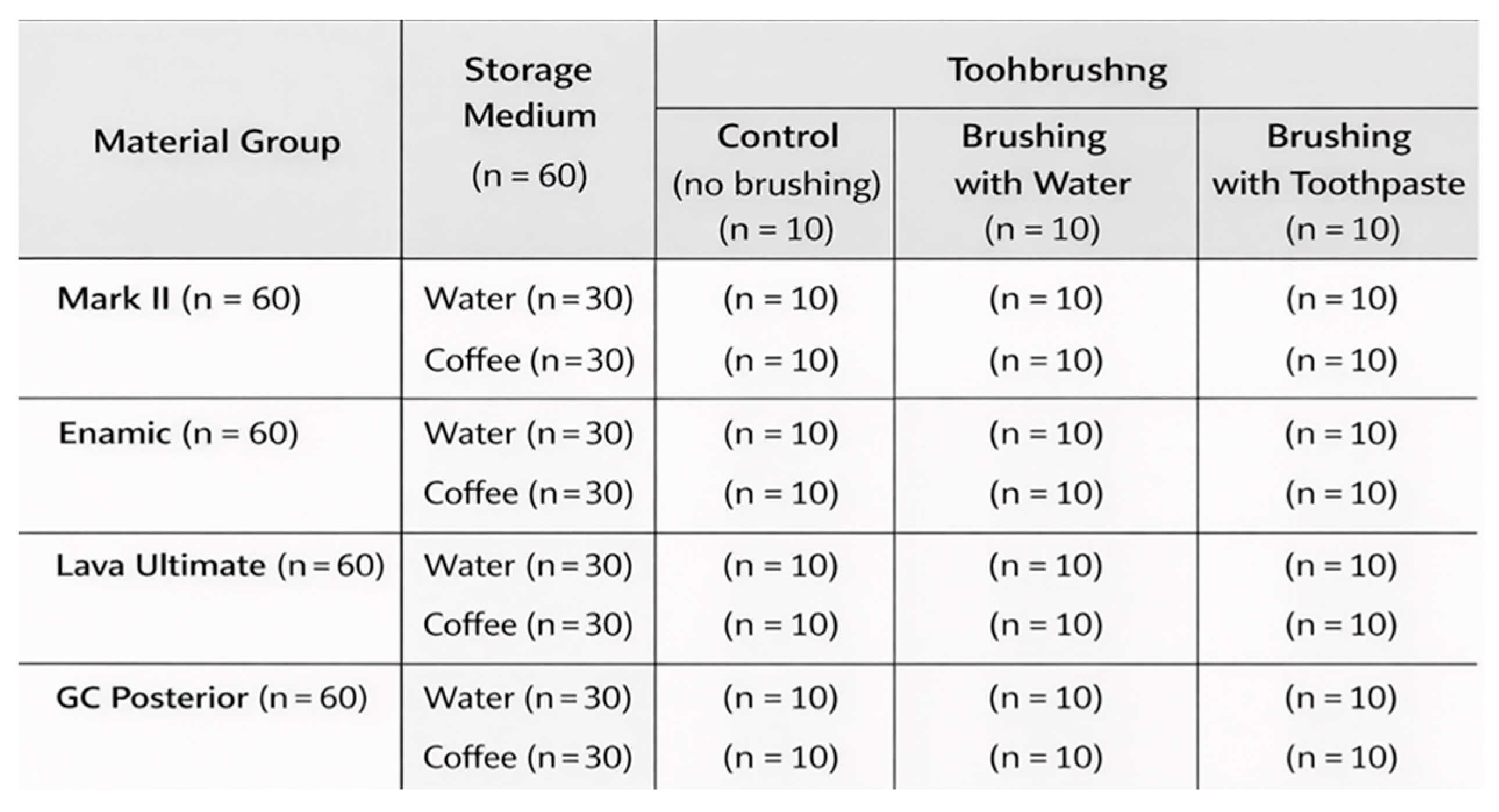
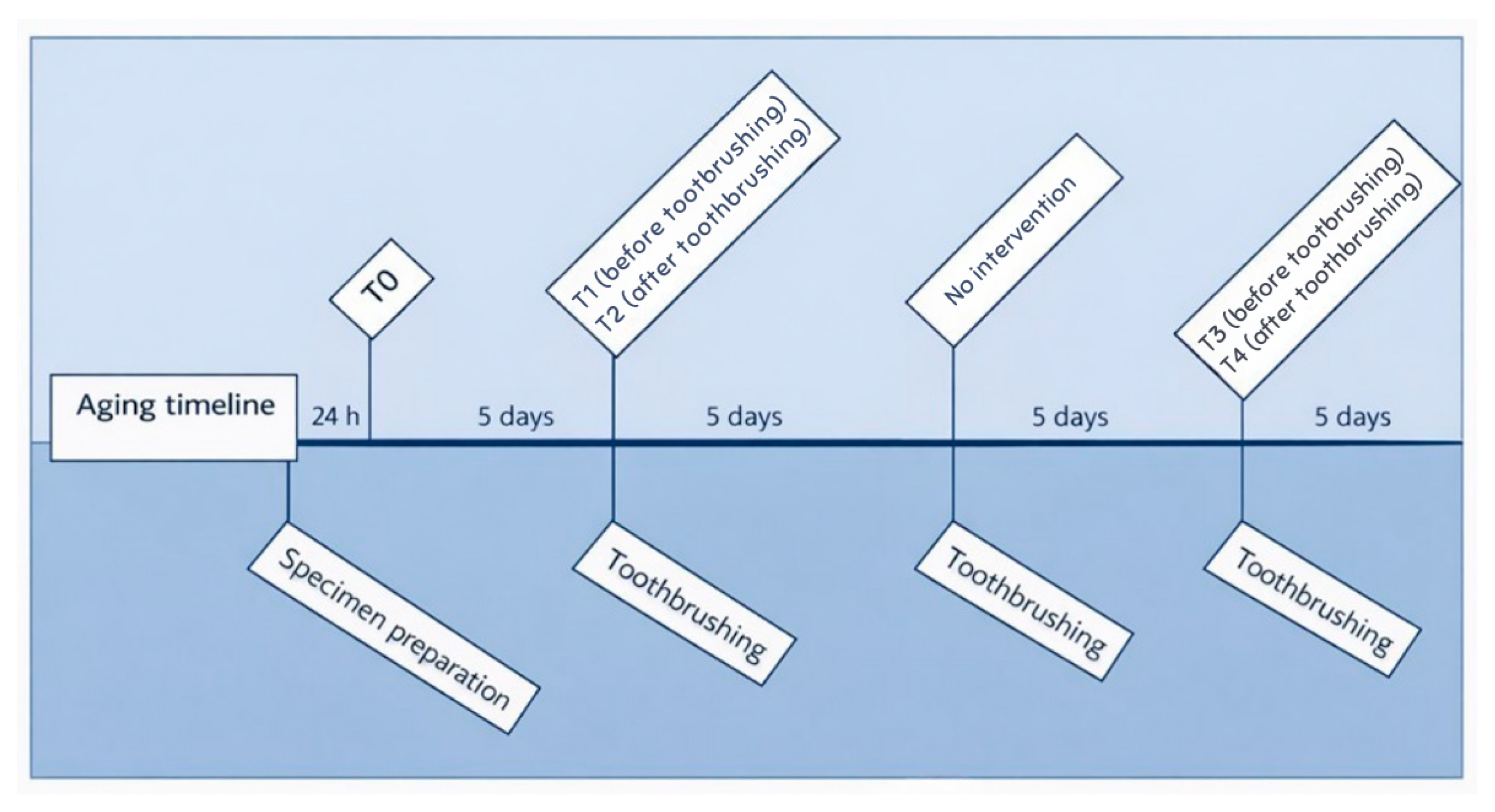
This in vitro study was conducted using a factorial design with four materials, two storage media, three toothbrushing conditions, and repeated measurements over time (
Figure 1 and
Figure 2). The total sample size was 240 specimens (
n = 60 per material). A priori sample size estimation was performed using G*Power software (v3.1.9.7) based on a repeated-measures ANOVA (within–between interaction). Assuming a medium effect size (f = 0.25) derived from previous literature, a significance level of 0.05, a statistical power of 80%, five repeated measurements, and an inter-measurement correlation of 0.5, the minimum required total sample size was calculated as 168 specimens [
16]. To compensate for potential specimen loss or measurement variability commonly encountered in dental materials research, the sample size was increased to 240 specimens, resulting in 10 specimens per group. Bonferroni adjustment was applied for post hoc comparisons to control the family-wise error rate in the context of multiple testing. For each material, specimens were randomly allocated using a computer-generated randomization list to subgroups according to storage medium (deionized water or coffee) and toothbrushing protocol (no brushing, brushing with water, brushing with toothpaste). Color change (ΔE) and surface roughness (Ra) were assessed.
Four restorative materials were evaluated: (1) a feldspathic ceramic CAD/CAM block (Vita Mark II, Vita Zahnfabrik), (2) a hybrid ceramic with a dual-network structure consisting of 84 wt% feldspathic ceramic infiltrated with 14 wt% polymer (Vita Enamic, Vita Zahnfabrik), (3) a resin nanoceramic CAD/CAM block composed of a highly filled polymer matrix reinforced with nanoceramic particles (Lava Ultimate, 3M ESPE), and (4) a microhybrid resin composite intended for posterior restorations (GC Posterior, GC Corp., Tokyo, Japan). These materials were selected to represent different categories of contemporary indirect esthetic materials with varying ceramic and resin contents (
Figure 1).
Disk-shaped specimens were fabricated for each material. For the direct resin composite, the material was placed into a Teflon mold (10 mm diameter, 2 mm thickness) between polyester strips and glass slides. A standardized load of 500 g was applied for 20 s to extrude excess material and improve surface smoothness, after which polymerization was carried out using an LED curing unit (Bluephase G2, Ivoclar Vivadent, Schaan, Liechtenstein; 1200 mW/cm2) according to the manufacturer’s instructions. CAD/CAM blocks were sectioned using a precision microtome saw to obtain slices 2 mm thick. The cut surfaces were finished using a polishing machine with sequential silicon carbide papers of 600-, 800-, and 1200-grit under water cooling to standardize surface texture.
After finishing procedures, specimen thickness was verified at three points using a digital caliper (Digimatic CD-15DCX; Mitutoyo Inc., Tokyo, Japan). Specimens deviating more than ±0.05 mm from the target thickness of 2.00 mm were excluded and replaced. All specimens were stored in 4 mL of deionized water at 37 °C for 24 h before baseline color and roughness measurements to simulate initial water uptake and equilibration (T0).
Aging protocols were designed to simulate intermittent exposure to coffee and toothbrushing as might occur clinically over several months (
Figure 2). Specimens were randomly assigned to two storage media: deionized water (control medium) or a coffee solution. The content of a 3 g coffee was dissolved in 300 mL of boiling distilled water (Nescafe Gold, Nestle, Istanbul, Turkey). Each aging cycle consisted of 5 consecutive days of immersion in the allocated medium at 37 °C, followed by a toothbrushing sequence. Coffee aging was conducted at 37 °C to approximate intraoral temperature and to standardize experimental conditions, as commonly applied in coffee-staining protocols for resin-based CAD/CAM materials [
10]. Three aging cycles were performed, resulting in a total of 15 days of immersion and three brushing phases per specimen.
Within each medium, specimens were further allocated to three toothbrushing protocols: (1) control (no brushing), (2) brushing with water, and (3) brushing with a commercial fluoridated toothpaste. For the toothpaste brushing group, a slurry was prepared according to ISO 11609:2017 standards [
17] by homogeneously mixing a commercial fluoridated toothpaste (Colgate Total, Colgate-Palmolive, Istanbul, Turkey) with distilled water at a ratio of 1:4 by volume (300 mL toothpaste to 1200 mL distilled water). This toothpaste has a relative dentin abrasivity (RDA) value of 70, which is considered low abrasivity [
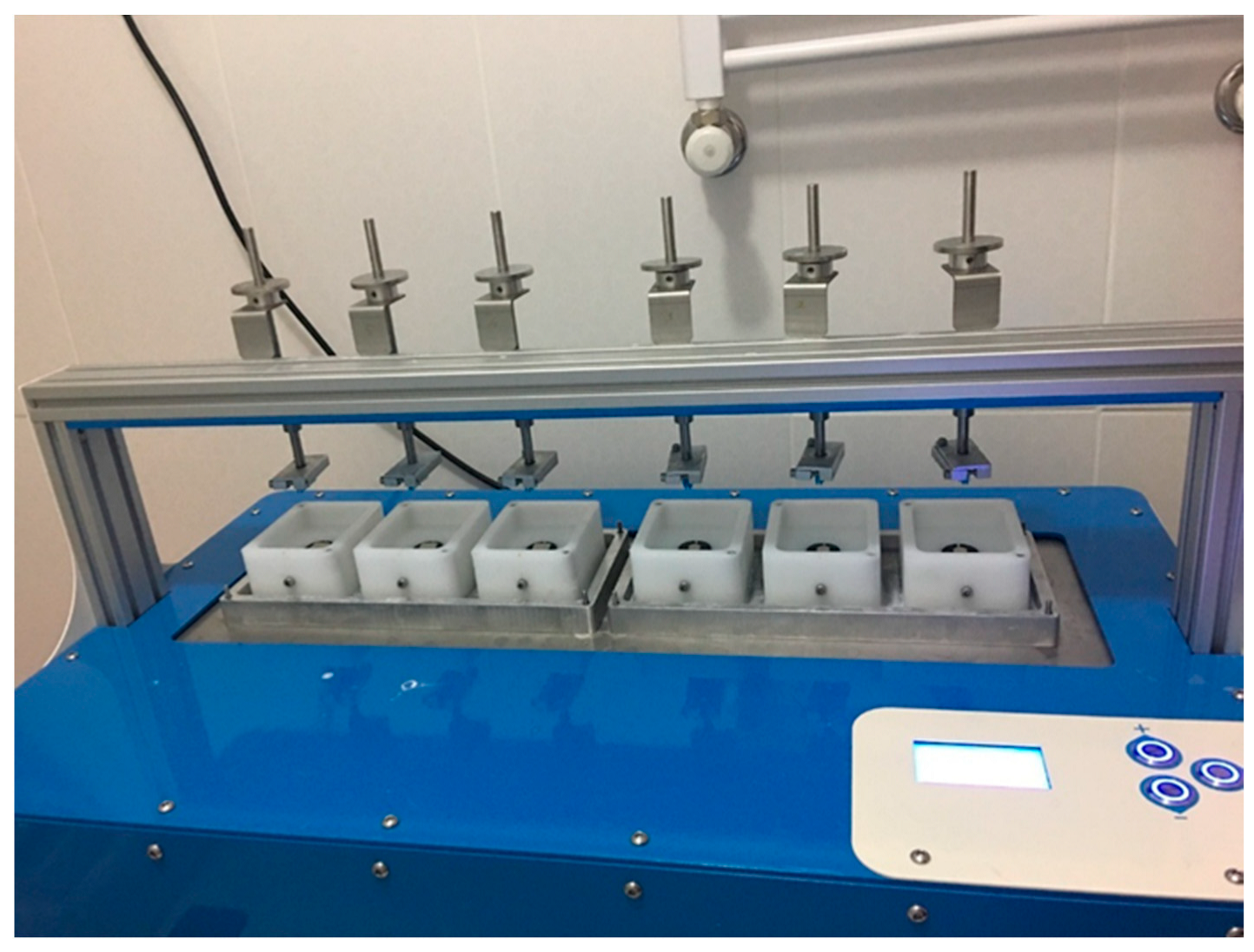
18] and was specifically selected to minimize the confounding effect of dentifrice abrasivity on the primary outcomes (color stability and surface roughness changes induced by coffee immersion). Additionally, Colgate Total is one of the most widely used toothpastes in Turkey, enhancing the clinical relevance of the findings. Simulated toothbrushing was performed in a custom toothbrushing machine using soft-bristled toothbrush heads (Oral-B Complete 40, Oral-B, Redwood City, CA, USA) under a 200 g vertical load (
Figure 3). Each brushing phase comprised 585 linear strokes over the specimen surface at a horizontal stroke length of 3.8 cm and a frequency adjusted to deliver 585 strokes in 150 s. The brushing stroke calculation was based on established in vitro methodology [
16,
18]. Assuming that an individual brushes each tooth surface for approximately 8 s per day at a frequency of 2 strokes per second, this corresponds to 16 strokes per tooth surface per day [
16,
18]. Therefore, 585 strokes per brushing phase represent approximately one month of clinical toothbrushing on a single surface, and three brushing phases corresponded to approximately 3 months (or 1755 total strokes) of accumulated brushing exposure.
Color measurements were obtained at baseline and after each aging interval using a spectrophotometer (VITA Easyshade V, VITA Zahnfabrik, Bad Säckingen, Germany) based on the CIE L*a*b* system against a white background. The device was calibrated before each measurement session. For each specimen, three readings were taken and averaged. Color difference (ΔE) relative to baseline was calculated using the formula:
ΔE value of 3.5 was adopted as the threshold of clinical acceptability for color change, in line with previously published criteria [
7].
Surface roughness (Ra) was measured at the same time points using a contact profilometer. The cut-off length was set at 0.25 mm, with a total evaluation length of 4 mm and a traverse speed of 0.5 mm/s. For each specimen, three measurements were made along the x-axis and three along the y-axis; the mean of these six readings was recorded as the Ra value. Baseline Ra measurements were collected 24 h after initial storage in deionized water, prior to any aging or brushing procedures.
To obtain qualitative information on surface topography, atomic force microscopy (AFM) analysis was carried out after the final aging cycle (T3 or T4) depending on the parameter. One representative specimen from each subgroup was selected at random and scanned in non-contact mode using a silicon nitride tip, with a scan size of 5 × 5 µm and a resolution of 256 × 256 pixels. Height and 3D surface images were recorded to visualize microstructural changes, including groove formation, filler exposure, and microcracking.
Statistical analysis was performed using a four-factor repeated-measures analysis of variance (ANOVA), with storage medium, material, and toothbrushing protocol as between-subject factors and aging time as the within-subject factor. This model was selected because the same specimens were evaluated repeatedly over time, requiring an approach that accounts for within-subject correlations. Assumptions of normality and sphericity were evaluated prior to analysis. Separate analyses were carried out for ΔE and Ra. Where significant main effects or interactions were identified, pairwise comparisons were conducted using Bonferroni-adjusted post hoc tests to control the family-wise error rate. The significance level was set at α = 0.05 for all tests.
3. Results
Descriptive statistics for surface roughness (Ra) and color change (ΔE) at all time points and for all groups are summarized in
Table 1,
Table 2,
Table 3 and
Table 4. In general, Ra values increased slightly over time for all materials, with more pronounced changes in resin-containing materials and in coffee-immersed groups subjected to toothbrushing with toothpaste.
Repeated-measures ANOVA revealed a statistically significant four-way interaction among storage medium, material, toothbrushing protocol, and aging time for surface roughness (p < 0.001). This indicates that changes in Ra over time were material dependent and varied according to both medium and brushing condition. For specimens stored in deionized water, feldspathic ceramic (Vita Mark II) and hybrid ceramic (Vita Enamic) maintained relatively low Ra values with minimal changes throughout aging, even after toothbrushing. Lava Ultimate and GC Posterior, however, showed modest but statistically significant increases in Ra, particularly after brushing with toothpaste.
In the coffee medium, roughness changes were more evident. The greatest increases in Ra were observed for GC Posterior and Lava Ultimate brushed with toothpaste, followed by water-brushed groups. Control specimens (no brushing) stored in coffee also exhibited some increase in roughness, albeit less pronounced, suggesting a contribution from chemical softening and erosion of the resin matrix or leaching at the filler–matrix interface. Ceramic-based materials displayed smaller changes in Ra overall, with Vita Mark II showing the lowest roughness values at all time points.
For color change, the ANOVA likewise demonstrated a significant four-way interaction (p < 0.001), indicating that ΔE values were influenced by the combined effects of material type, medium, brushing, and time. In deionized water, all materials maintained clinically acceptable color stability. Ceramic materials (Vita Mark II: ΔE = 0.38 ± 0.18; Vita Enamic: ΔE = 1.16 ± 0.16) demonstrated imperceptible to barely perceptible changes. Resin-based materials showed statistically significant increases (Lava Ultimate: ΔE = 1.89 ± 0.18, p < 0.001; GC Posterior: ΔE = 2.37 ± 0.18, p < 0.001), yet all values remained below the clinical acceptability threshold (ΔE = 3.5), indicating that water immersion alone does not produce clinically problematic discoloration for any tested material.
Exposure to coffee resulted in substantial increases in ΔE for resin-based materials. GC Posterior and Lava Ultimate exhibited ΔE values of 5.58 ± 0.20 and 4.20 ± 0.20, respectively (both exceeding the clinical acceptability threshold of ΔE = 3.5), indicating clinically unacceptable discoloration that would likely prompt patient complaints or require intervention. Toothbrushing with toothpaste often reduced ΔE compared with unbrushed controls, indicating partial removal of extrinsic stains, but values remained in the perceptible range. Hybrid ceramic (Vita Enamic) and feldspathic ceramic (Vita Mark II) showed significantly smaller color changes in coffee; in many conditions, their ΔE values were at or below the acceptability threshold, demonstrating superior color stability.
In addition to statistical comparisons, the clinical relevance of color changes was evaluated using an acceptability threshold of ΔE = 3.5. Accordingly, only ΔE values exceeding 3.5 were considered clinically perceptible, whereas statistically significant differences that remained below this threshold were interpreted as clinically limited. This distinction allowed clinically meaningful discoloration patterns to be identified more clearly across materials, media, and toothbrushing conditions [
7].
Considering the acceptability threshold (ΔE = 3.5), clinically meaningful discoloration was predominantly observed in coffee storage. GC Posterior frequently exceeded ΔE = 3.5 across multiple aging periods, indicating perceptible color change. Lava Ultimate also showed perceptible discoloration in coffee, particularly at early-to-intermediate periods. In contrast, although some comparisons for Mark II were statistically significant, ΔE values generally remained below 3.5, suggesting limited clinical acceptability. Overall, these findings indicate that statistically significant changes do not always translate into clinically noticeable discoloration.
AFM images supported the quantitative findings. Surfaces of feldspathic ceramic specimens appeared relatively smooth with minor topographical alterations even after coffee exposure and toothbrushing. Hybrid ceramic specimens showed slightly more pronounced surface texture but largely retained an intact ceramic network. In contrast, Lava Ultimate and GC Posterior exhibited clear signs of surface degradation, including micro-grooves, filler particle protrusion, and resin matrix wear. These features were more marked in coffee-brushed groups, consistent with the highest Ra values recorded.
Taken together, the results indicate that ceramic-rich materials (Vita Mark II and Vita Enamic) are more resistant to both surface roughening and discoloration than resin-rich materials (Lava Ultimate and GC Posterior) when subjected to coffee staining and simulated toothbrushing. Toothbrushing with toothpaste provided some reduction in surface staining but at the cost of increased surface roughness, particularly for resin-based materials.
4. Discussion
The present in vitro study evaluated the combined influence of a staining beverage (coffee) and simulated toothbrushing—with and without toothpaste—on both color change (ΔE) and surface roughness (Ra) of four indirect restorative material classes (Vita Mark II, Vita Enamic, Lava Ultimate, and GC Posterior). Accordingly, the null hypotheses were rejected, as material type, storage medium, and toothbrushing protocol exhibited significant and interdependent effects on both ΔE and Ra values over time. The main finding was that aging was multifactorial: repeated-measures analysis demonstrated a significant four-way interaction among storage medium, material type, brushing protocol, and time, indicating that the magnitude and direction of changes in ΔE and Ra depend on the specific material composition and the specific chemical–mechanical challenge. This observation supports the concept that clinically relevant aging cannot be reliably predicted from single-factor protocols and highlights the value of combining staining and brushing procedures to better approximate intraoral wear.
Coffee immersion increased both ΔE and Ra across all materials, with the largest changes observed in resin-containing materials. This is consistent with the widely accepted mechanism that staining beverages can cause extrinsic discoloration through adsorption/absorption of pigments, and that the organic phase of resin-based materials is particularly susceptible to uptake and retention of chromogens [
19]. Experimental work on composite staining has shown that commonly consumed beverages (including coffee) can produce time-dependent discoloration and that external conditions, such as cleaning/brushing, can modulate stain accumulation or removal [
20,
21].
Although coffee is one of the most frequently investigated staining beverages due to its strong chromogenic potential, patients are clinically exposed to a broader range of dietary agents. Previous studies have shown that other commonly consumed beverages, such as carbonated drinks, fruit juices, and energy drinks, may also induce chemical degradation and surface changes in resin-based materials, depending on their acidity and composition [
22].
From a materials standpoint, the stronger response of resin-rich groups in coffee may be explained by water/solvent sorption and plasticization of the polymer network, which can facilitate pigment penetration and contribute to matrix softening [
21]. Foundational polymer studies demonstrate that dental resins may absorb water and other oral chemicals, with downstream effects including plasticization/softening and hydrolytic degradation. Moreover, sorption behavior is strongly influenced by monomer chemistry and network structure; ethanol/water food-simulating solutions and solvent uptake kinetics have been shown to depend on resin composition and crosslink density [
21,
23,
24]. These mechanisms are directionally compatible with the current findings, where coffee exposure—likely acting as a pigment source and an aqueous challenge—amplified discoloration, especially for resin-containing CAD/CAM and composite materials [
25,
26].
The greater susceptibility of resin-containing CAD/CAM materials to discoloration observed in the present study can be attributed to the presence and chemical behavior of the organic resin matrix. According to Ersöz et al. (2021) [
10], discoloration of resin-based CAD/CAM blocks may occur at an early stage and is closely associated with water sorption, which acts as a vehicle for staining agents. The authors further reported that materials containing Bis-GMA tend to exhibit higher water absorption compared with UDMA/TEGDMA-based systems, whereas polymer-infiltrated ceramic network materials, such as Vita Enamic, which do not contain Bis-GMA, demonstrated lower discoloration under coffee immersion conditions. This mechanism-based explanation is in good agreement with the present findings, where resin-rich materials such as Lava Ultimate and GC Posterior exhibited higher ΔE values after coffee exposure, while Vita Enamic showed comparatively improved color stability [
10].
Simulated toothbrushing exerted a dual and material-dependent effect on the esthetic performance of the tested CAD/CAM materials. In the present study, toothbrushing with toothpaste frequently resulted in lower ΔE values compared with unbrushed specimens stored in coffee, indicating partial removal of extrinsic stains from the material surface. This finding is clinically plausible, as mechanical brushing combined with abrasive particles in toothpaste can disrupt and remove superficial pigment deposits accumulated during exposure to chromogenic beverages. Similar stain-reducing effects of toothbrushing have been reported in previous in vitro studies, where brushing procedures were shown to decrease surface discoloration by removing loosely bound extrinsic stains [
27,
28].
However, this apparent benefit was accompanied by an increase in surface roughness, particularly in resin-containing materials. Toothpaste abrasives and repetitive mechanical action can induce microabrasion of the resin matrix, leading to matrix wear, filler particle exposure, and the formation of micro-grooves. Several studies have demonstrated that brushing with dentifrice significantly increases Ra values in resin-based restorative materials, especially when compared with brushing in water or unbrushed controls [
28,
29]. These effects were most pronounced in Lava Ultimate and GC Posterior in the present study, suggesting that resin-rich materials are more vulnerable to brushing-induced surface damage.
The material-dependent response observed in the present study is consistent with recent investigations reporting that CAD/CAM composite and resin-matrix ceramic materials are more susceptible to combined chemical and mechanical aging than ceramic-dominant systems. Papathanasiou et al. showed that coffee immersion and thermocycling caused perceptible color changes and significant surface roughness alterations in CAD/CAM composite resins, including Lava Ultimate [
30]. Similarly, Zhang et al. reported that resin-based CAD/CAM materials exhibited greater color and translucency changes than polymer-infiltrated ceramic network materials when exposed to staining solutions and toothbrushing [
31].
The interaction between chemical and mechanical aging is particularly relevant in this context. Chemical exposure to coffee has been shown to soften the resin matrix and weaken the filler–matrix interface, thereby increasing susceptibility to subsequent abrasive wear during toothbrushing [
10,
21,
32]. This synergistic effect provides a mechanistic explanation for the significant interaction between storage medium and brushing protocol observed in the present statistical analysis. While brushing may temporarily improve color appearance by removing surface stains, the concomitant increase in surface roughness may create new retention sites for pigments and biofilm, potentially accelerating future discoloration cycles [
5,
6].
From a clinical standpoint, these findings highlight a critical trade-off associated with routine oral hygiene procedures. Although toothbrushing with toothpaste is essential for plaque control and stain removal, its abrasive potential may compromise surface integrity, particularly in resin-based CAD/CAM restorations exposed to staining beverages [
33]. Similar concerns have been raised in recent studies evaluating the long-term surface behavior of CAD/CAM materials under combined brushing and staining conditions [
34,
35]. Therefore, both material selection and maintenance strategies—such as the choice of toothpaste abrasivity and professional polishing protocols—should be carefully considered to balance esthetic preservation with surface durability over the long term.
The relationship between surface roughness and color change is complex and material dependent. In general, increased surface roughness has been associated with greater stain retention due to the formation of micro-irregularities that facilitate the adherence of pigments and biofilm. Several studies have reported that roughened restorative surfaces tend to exhibit higher discoloration after exposure to staining solutions, supporting the concept that Ra can indirectly influence ΔE by promoting extrinsic stain accumulation [
28,
32].
However, the findings of the present study indicate that the relationship between Ra and ΔE is not strictly linear. Toothbrushing with toothpaste often reduced ΔE values by removing superficial stains, while simultaneously increasing Ra, particularly in resin-containing materials. This divergence suggests that surface roughness alone cannot fully explain color changes, as discoloration may also occur through intrinsic mechanisms such as pigment diffusion into the resin matrix. Similar observations have been reported in studies where acidic environments induced chemical degradation and microhardness reduction without necessarily producing significant roughness changes, highlighting that surface degradation may occur without a proportional increase in Ra [
36]. El-Wassefy et al. (2023) similarly reported that statistically significant correlations between surface roughness and color change are not always observed, emphasizing that discoloration can develop even on relatively smooth composite surfaces depending on material composition and staining conditions [
6].
From a clinical perspective, the present findings reinforce the importance of material selection based on patients’ dietary habits and oral hygiene practices. While ceramic-rich CAD/CAM materials demonstrated superior resistance to discoloration and surface degradation, resin-based materials showed clinically perceptible changes under combined aging conditions. Previous studies have similarly emphasized that the esthetic longevity of CAD/CAM restorations is closely linked to surface integrity and resistance to staining challenges [
37]. Therefore, clinicians should consider both optical stability and surface durability when selecting CAD/CAM materials for posterior restorations subjected to high functional and esthetic demands.
This study has inherent limitations related to its in vitro design. Although controlled laboratory conditions allow standardized comparisons, they cannot fully reproduce the dynamic oral environment, where salivary pellicle formation, pH fluctuations, thermal changes, and biofilm activity may influence both discoloration and surface degradation of restorative materials. In addition, the coffee aging procedure was performed at a constant temperature (37 °C) and did not simulate hot beverage consumption or thermocycling; therefore, the present findings should be interpreted within the context of controlled-temperature exposure. Therefore, the magnitude of color change and roughness observed in this study may differ from long-term clinical behavior.
A further limitation of this study is the exclusive use of flat, disk-shaped specimens instead of anatomically contoured restorations. Such simplified geometry does not fully replicate clinical reality, where restorations present complex occlusal morphology with grooves, fissures, and curved surfaces. These anatomical features can significantly influence stain retention and brushing-induced wear patterns. Therefore, the interactions between staining agents and toothbrushing observed under flat-surface conditions may not fully represent the behavior of actual prosthetic restorations and may underestimate localized discoloration and site-specific surface degradation.
In addition, toothbrushing was performed using a single standardized protocol and one toothpaste formulation. A low RDA toothpaste (RDA = 70) was deliberately selected to minimize the confounding effect of mechanical abrasion and focus on coffee-induced changes; only one dentifrice abrasivity level was evaluated. Future studies comparing different RDA values would provide additional insights into the interaction between chemical staining and mechanical surface degradation. Patient-related variables such as brushing force, technique, frequency, and toothpaste abrasivity were not simulated, limiting direct clinical extrapolation. Aging was also restricted to a defined number of cycles and a single staining beverage, which may not fully represent cumulative long-term intraoral exposure.
Future research should focus on anatomically shaped CAD/CAM restorations, incorporate artificial saliva and pellicle or biofilm models, and evaluate different toothpaste abrasivity levels and brushing forces. Long-term clinical studies are ultimately required to validate the in vitro findings and to determine the esthetic longevity of CAD/CAM materials under real oral conditions.