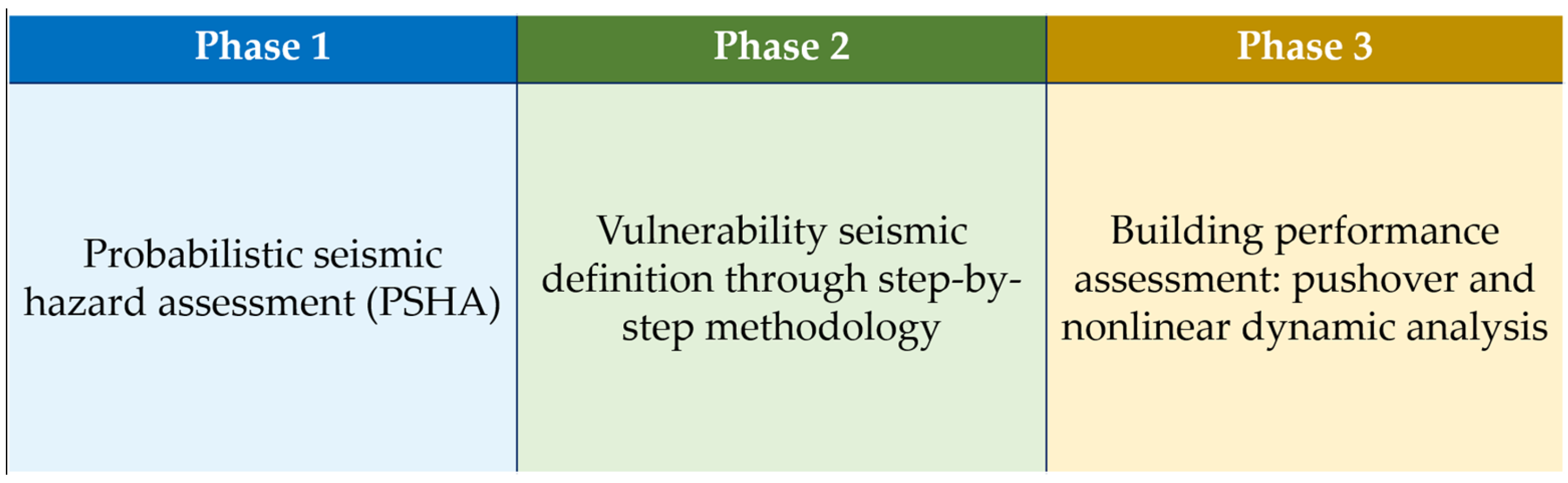
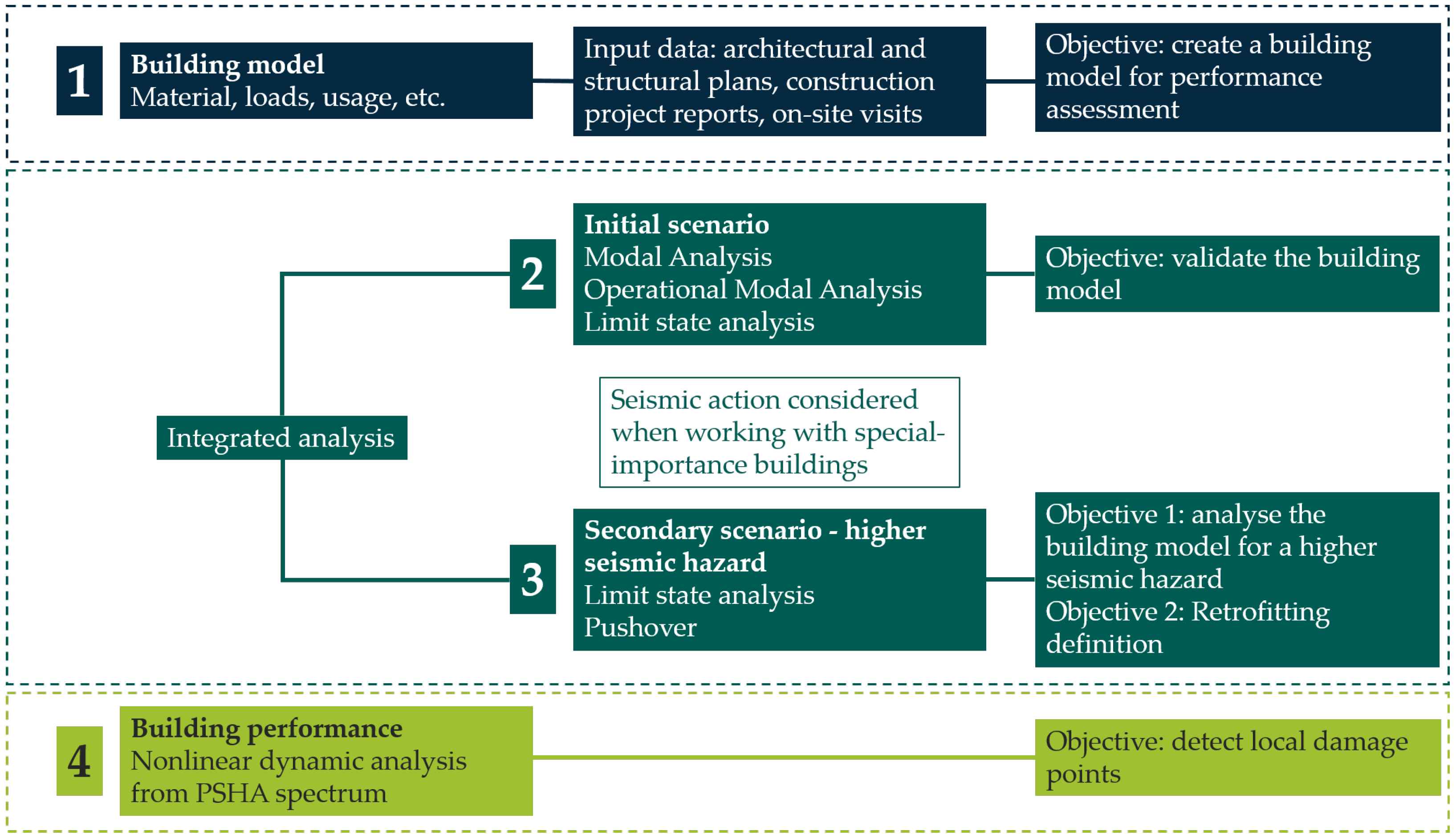
Analytical Seismic Vulnerability and Performance Assessment of a Special-Importance Steel Building: Application Under the NCSE-02 Code

 , ,
, ,  ,
,
Featured Application
Abstract
1. Introduction
- Evaluation of existing seismic capacity through analysis of the strength and stiffness of structural elements and their energy-dissipation capacity.
- Seismic design criteria that ensure compliance with safety and structural performance standards.
- Identification of vulnerable areas within the structure to target reinforcement measures to critical areas.
- Structural documentation and verification to ensure that implemented improvements meet design and seismic performance requirements.
Scope and Limitations of the Study
2. Methodology
2.1. Probabilistic Seismic Hazard Assessment
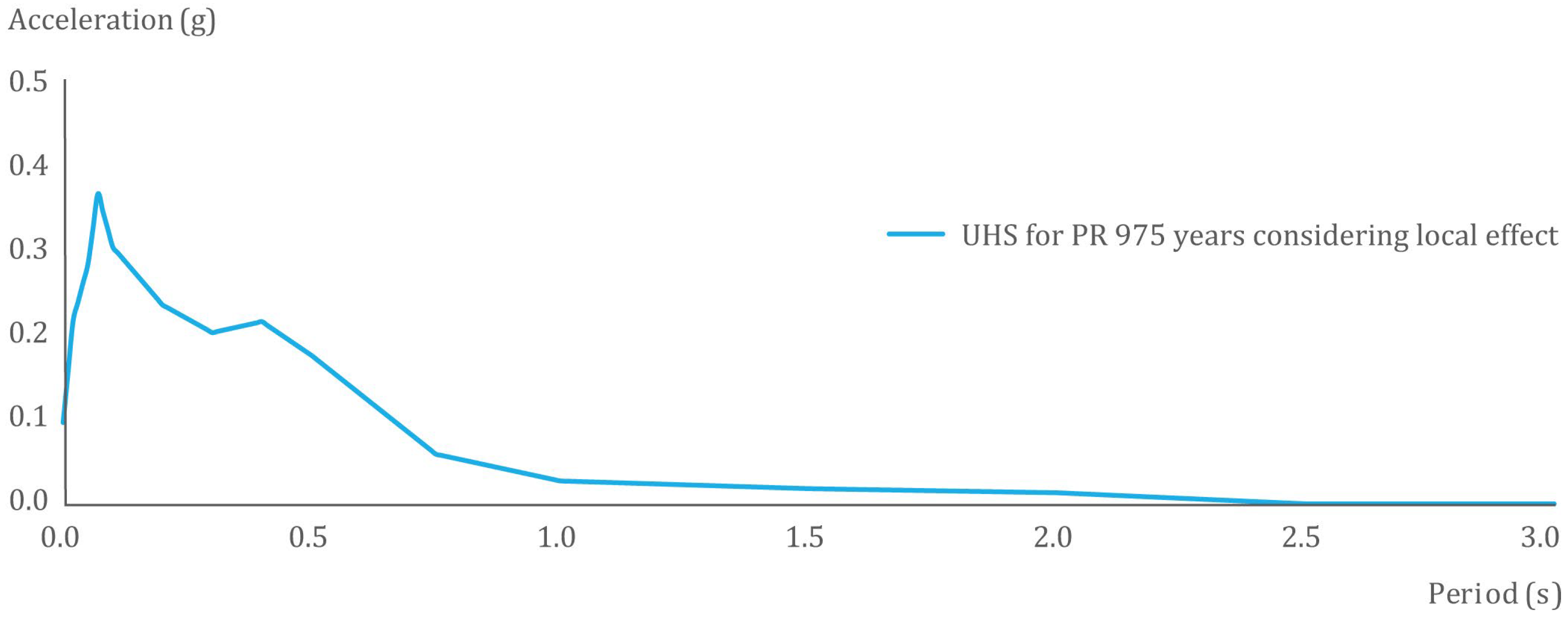
2.1.1. Uniform Hazard Spectra
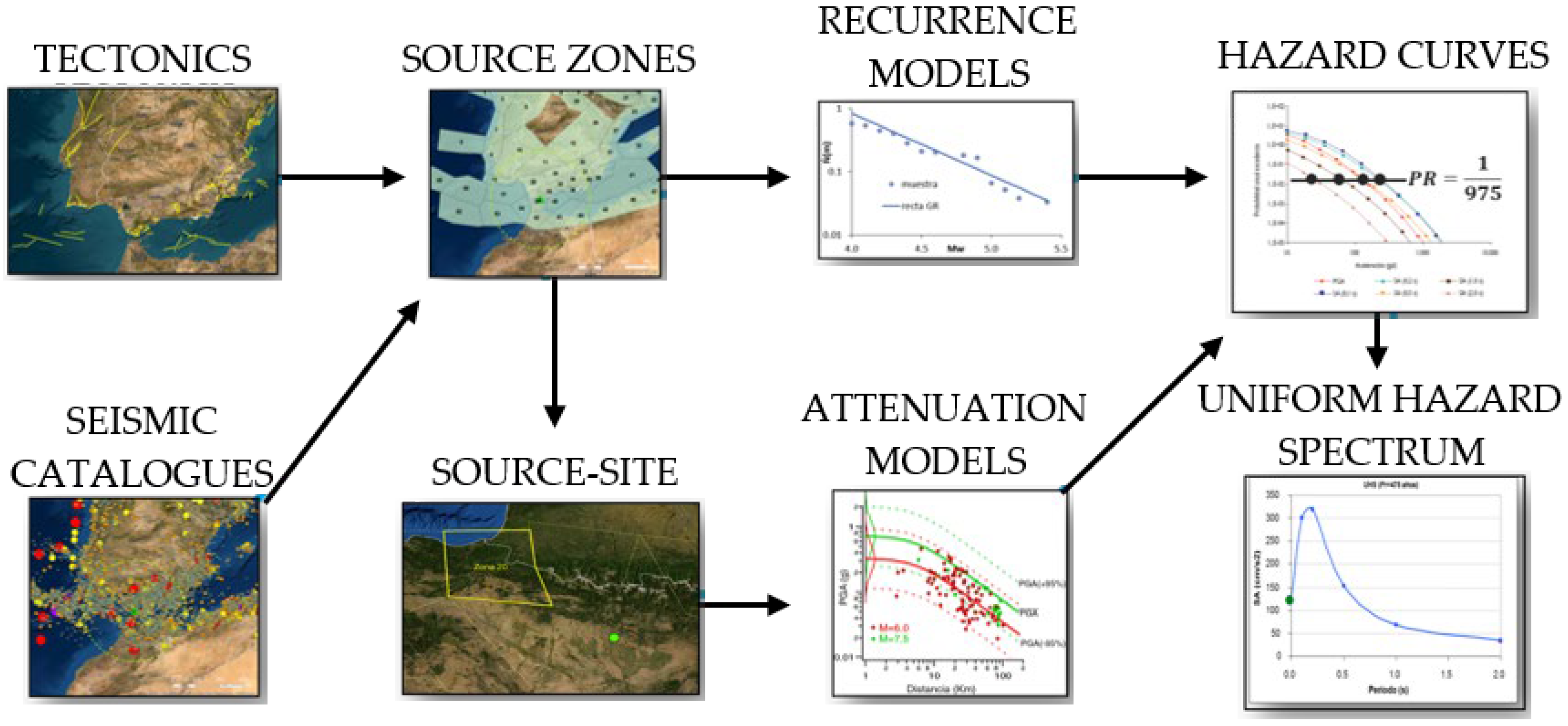
- Probabilistic. A zoned source model was used and recurrence models for seismogenic zones and active faults were considered. This method provides ground-motion values associated with a given exceedance probability by aggregating contributions from all possible earthquakes within the influence area. Consequently, the findings are not aligned with any specific seismic scenario.
- Probabilistic–deterministic. Specific seismic scenarios were identified by disaggregating the probabilistic hazard results. This process yields the control earthquakes, the events that contribute most to the probabilistic hazard for a given spectral frequency. Control earthquakes are characterized by three parameters: magnitude, distance, and epsilon (M, R, and ε).
2.1.2. Hazard Disaggregation and Identification of Control Earthquakes
2.1.3. Hybrid Probabilistic–Deterministic Specific Scenarios
2.2. Seismic Vulnerability Assessment
2.2.1. Building Model
2.2.2. Integrated Analyses for Building Model: Initial Scenario
2.2.3. Integrated Analyses for Building Model: Secondary Scenario
2.2.4. Seismic Building Performance
3. Methodological Application
3.1. Probabilistic Seismic Hazard Assessment
3.1.1. Seismic Catalogue
3.1.2. Seismic Sources Characterization
3.1.3. Ground Motion Prediction Equations and Logic Tree
3.2. Seismic Vulnerability Assessment
3.2.1. Building Model
3.2.2. Integrated Analyses for Building Model: Initial Scenario
3.2.3. Integrated Analyses for Building Model: Secondary Scenario
3.2.4. Seismic Building Performance
4. Results and Discussion
4.1. Probabilistic Seismic Hazard Assessment
4.1.1. Uniform Hazard Spectra
4.1.2. Control Earthquakes and Probabilistic–Deterministic Specific Scenarios
4.1.3. Specific Response Spectra for the Deterministic Specific Scenarios
4.1.4. Discussion
4.2. Seismic Vulnerability Assessment
4.2.1. Integrated Analyses for Building Model: Initial Scenario
4.2.2. Integrated Analyses for Building Model: Secondary Scenario
4.2.3. Seismic Building Performance
5. Conclusions
6. Future Work and Research
Supplementary Materials
Author Contributions
Funding
Institutional Review Board Statement
Informed Consent Statement
Data Availability Statement
Acknowledgments
Conflicts of Interest
Abbreviations
| CEN | European Committee for Standardization |
| CE-21 | Código Estructural—Structural code |
| CRED | Centre for Research on the Epidemiology of Disasters |
| DB SE AE | Documento Básico Seguridad Estructural Acciones en la Edificación—Basic Document on Structural Safety Actions in Building Construction |
| ε | Epsilon |
| EC8 | Eurocode 8 |
| ETSITGC | Escuela Técnica Superior de Ingenieros en Topografía, Geodesia y Cartografía—Higher Technical School of Surveying, Geodesy, and Cartography Engineering |
| GMPE | Ground-Motion Prediction Equations |
| H | Hazard |
| IGME | Instituto Geológico y Minero de España—Spanish Geological and Mining Institute |
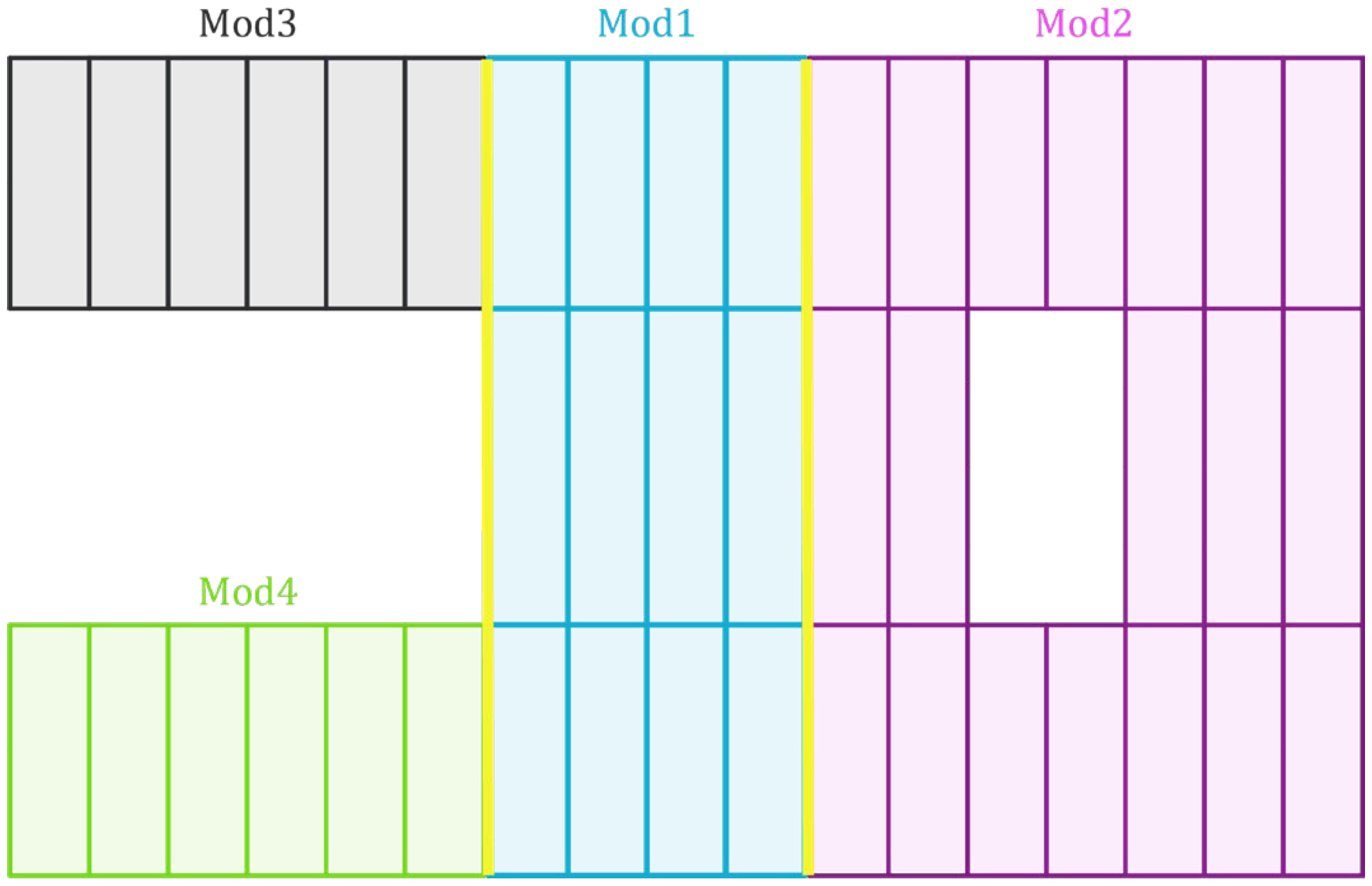
| Mod1 | Module 1 from the ETSITGC building |
| MV 101-1962 | Standard MV 101-1962 on Building Actions |
| MV 103-1972 | Basic Standard MV 103-1972, Calculation Of Rolled Steel Structures In Building Construction |
| Mw | Moment Magnitude |
| NCSE-02 | Norma de construcción sismorresistente—Seismic-Resistant Construction Code |
| NLDA | Nonlinear Dynamic Analysis |
| NLTHA | Nonlinear Time History Analysis |
| OMA | Operational Modal Analysis |
| P | Probability |
| PDS-1 | Norma sismorresistente—Seismic code |
| PGA | Peak Ground Acceleration |
| PSHA | Probabilistic Seismic Hazard Assessment |
| R | Source-Site Distance |
| RMA | Reduced Major Axis |
| SA | Spectral Acceleration |
| SR1 | Scenario 1 (Madrid, 1977) |
| SR2 | Scenario 2 (Los Barrios, 2021) |
| SSR | Standard Spectral Ratio |
| S1 | Specific Response Spectrum For Seismic Scenario 1 |
| S2 | Specific Response Spectrum For Seismic Scenario 2 |
| S3 | Specific Response Spectrum For Seismic Scenario 3 |
| TR | Return Period |
| UHS | Uniform Hazard Spectra |
| ULS | Ultimate Limit State |
| UNDRO | United Nations Disaster Relief Organization |
| UPM | Universidad Politécnica de Madrid—Polytechnic University of Madrid |
| ZESIS | Iberian Peninsula And Surrounding Areas |
References
- Cvetković, V.M.; Renner, R.; Aleksova, B.; Lukić, T. Geospatial and Temporal Patterns of Natural and Man-Made (Technological) Disasters (1900–2024): Insights from Different Socio-Economic and Demographic Perspectives. Appl. Sci. 2024, 14, 8129. [Google Scholar] [CrossRef]
- Özmen, H.B.; Çal, D.Y. The economic impact of earthquakes: A global assessment of direct and indirect losses. Res. Des. 2025, 2, 147–170. [Google Scholar] [CrossRef]
- Jiménez Martínez, M.; Jiménez Martínez, M.; Romero-Jarén, R. How resilient is the labour market against natural disaster? Evaluating the effects from the 2010 earthquake in Chile. Nat. Hazards 2020, 104, 1481–1533. [Google Scholar] [CrossRef]
- Centre for Research on the Epidemiology of Disasters. 2022 Disasters in Numbers. Available online: https://cred.be/sites/default/files/2022_EMDAT_report.pdf (accessed on 14 December 2025).
- Centre for Research on the Epidemiology of Disasters. Economic Losses, Poverty & Disasters (1998–2017). Available online: https://www.cred.be/unisdr-and-cred-report-economic-losses-poverty-disasters-1998-2017 (accessed on 14 December 2025).
- Silva, V.; Aljawhari, K.; Baiguera, M.; Calderón, A.; Caruso, M.; Costa, C.; González, D.; Nafeh, A.M.B.; Rao, A.; Yepes-Estrada, C.; et al. Drivers of Earthquake Damage and Losses: A Global Perspective on Where and Why Seismic Risk Is High. In Proceedings of the EGU General Assembly 2025, Vienna, Austria, 27 April–2 May 2025. [Google Scholar]
- Centre for Research on the Epidemiology of Disasters. Poverty and Death: Disaster Mortality 1996–2015. Available online: https://www.undrr.org/publication/poverty-death-disaster-mortality-1996-2015 (accessed on 14 December 2025).
- Hu, J.; Wen, W.; Zhai, C.; Pei, S.; Ji, D. Seismic Resilience Assessment of Buildings Considering the Effects of Mainshock and Multiple Aftershocks. J. Build. Eng. 2023, 68, 106110. [Google Scholar] [CrossRef]
- Mahin, S. Lessons from Recent Earthquakes: The Need for More Resilient Cities. In Proceedings of the International Symposium on Engineering Lessons Learned from the 2011 Great East Japan Earthquake, Tokyo, Japan, 1–4 March 2012; pp. 31–42. [Google Scholar]
- Kijko, A. Seismic Hazard. In Encyclopedia of Solid Earth Geophysics, 2nd ed.; Gupta, H.K., Ed.; Springer: Dordrecht, The Netherlands, 2019; Available online: https://www.researchgate.net/publication/338281955_Seismic_Hazard_Encyclopedia_of_Solid_Earth_Geophysics_2nd_Edition_Harsh_Gupta (accessed on 29 January 2026).
- United Nations Disaster Relief Organization (UNDRO). Natural Disasters and Vulnerability Analysis; United Nations: Geneva, Switzerland, 1979. [Google Scholar]
- Franchin, P.; Cavalieri, F. Probabilistic Assessment of Civil Infrastructure Resilience to Earthquakes. Comput.-Aided Civ. Infrastruct. Eng. 2015, 30, 583–600. [Google Scholar] [CrossRef]
- Babayev, G.; Ismail-Zadeh, A.; Le Mouël, J.L. Scenario-Based Earthquake Hazard and Risk Assessment for Baku (Azerbaijan). Nat. Hazards Earth Syst. Sci. 2010, 10, 2697–2712. [Google Scholar] [CrossRef]
- Spence, R.; So, E.; Scawthorn, C. Human Casualties in Earthquakes: Progress in Modelling and Mitigation; Springer: Dordrecht, The Netherlands, 2011; Volume 29. [Google Scholar] [CrossRef]
- Li, L. The hazard of earthquake and solution directions. In Advances in Civil Engineering and Environmental Engineering, Volume 1; CRC Press eBooks: London, UK, 2023; pp. 339–344. [Google Scholar] [CrossRef]
- Ma, Z.; Cooper, P.; Daly, D.; Ledo, L. Existing Building Retrofits: Methodology and State-of-the-Art. Energy Build. 2012, 55, 889–902. [Google Scholar] [CrossRef]
- Tartaglia, R.; Milone, A.; Prota, A.; Landolfo, R. Seismic Retrofitting of Existing Industrial Steel Buildings: A Case Study. Materials 2022, 15, 3276. [Google Scholar] [CrossRef]
- Di Sarno, L.; Elnashai, A.S. Bracing Systems for Seismic Retrofitting of Steel Frames. J. Constr. Steel Res. 2009, 65, 452–465. [Google Scholar] [CrossRef]
- Lu, B.; Zhao, B.; Wang, C.; Zhang, P.; Gu, Q. Experimental Study on Seismic Behavior of Replaceable Energy Dissipation Braces with Square Steel Tubes and Rectangular Steel Plates. Structures 2025, 73, 108409. [Google Scholar] [CrossRef]
- Ullah, R.; Vafaei, M.; Alih, S.C.; Waheed, A. A Replaceable sandwiched metallic fuse damper for seismic performance enhancement of braced frames. Eng. Struct. 2024, 298, 117072. [Google Scholar] [CrossRef]
- Andreotti, R.; Giuliani, G.; Tondini, N. Experimental analysis of a full-scale steel frame with replaceable dissipative connections. J. Constr. Steel Res. 2023, 208, 108036. [Google Scholar] [CrossRef]
- EN 1998-1:2004; Eurocode 8: Design of Structures for Earthquake Resistance—Part 1: General Rules, Seismic Actions and Rules for Buildings. CEN: Brussels, Belgium, 2004.
- EN 1998-3:2005; Eurocode 8: Design of Structures for Earthquake Resistance—Part 3: Assessment and Retrofitting of Buildings. CEN: Brussels, Belgium, 2005.
- Ministerio de Fomento. Norma de Construcción Sismorresistente: Parte General y Edificación (NCSE-02); Boletín Oficial del Estado: Madrid, Spain, 2009. Available online: https://www.transportes.gob.es/recursos_mfom/0820200.pdf (accessed on 26 January 2026).
- Mouroux, P.; Le Brun, B. Risk-UE Project: An Advanced Approach to Earthquake Risk Scenarios with Application to Different European Towns. In Assessing and Managing Earthquake Risk; Oliveira, C.S., Roca, A., Goula, X., Eds.; Springer: Dordrecht, The Netherlands, 2008; Volume 2, pp. 203–226. [Google Scholar] [CrossRef]
- Cornell, C.A. Engineering seismic risk analysis. Bull. Seismol. Soc. Am. 1968, 58, 1583–1606. [Google Scholar] [CrossRef]
- Kramer, S.L. Geotechnical Earthquake Engineering; Prentice Hall: Upper Saddle River, NJ, USA, 1996. [Google Scholar]
- Baker, J.W. An Introduction to Probabilistic Seismic Hazard Analysis (PSHA). Available online: http://www.stanford.edu/~bakerjw/Publications/Baker_(2008)_Intro_to_PSHA_v1_3.pdf (accessed on 14 December 2025).
- Bernreuter, D.L.; Lawrence Livermore National Lab. Determining the Controlling Earthquake from Probabilistic Hazards for the Proposed Appendix B. In Proceedings of the Twentieth Water Reactor Safety Information Meeting, Bethesda, MD, USA, 1992; IAEA: Vienna, Austria, 1992. [Google Scholar]
- Bazzurro, P.; Cornell, C.A. Disaggregation of seismic hazard. Bull. Seismol. Soc, Am. 1999, 89, 501–520. [Google Scholar] [CrossRef]
- Navas-Sánchez, L.; Ferretti, F.; Savoia, M.; Gamboa-Canté, C.; Bravo, J.C. NSE Seismic Demand Characterization: The Case of a Spanish RC Residential Building. Procedia Struct. Integr. 2023, 44, 418–425. [Google Scholar] [CrossRef]
- Aras, F.; Karapınar, I.S. Dynamic Properties of Steel Structures under Different Construction Stages, Ambient Temperature and Live Load. J. Constr. 2021, 20, 163–177. [Google Scholar] [CrossRef]
- Barghi, M.; Azadbakht, M. Evaluating the Effect of Masonry Infills on Natural Period of Buildings with Moment-Resisting Frame. Struct. Des. Tall Spec. Build. 2011, 20, 649–660. [Google Scholar] [CrossRef]
- Bertero, S.; Tarazaga, P.A.; Sarlo, R. In Situ Seismic Testing for Experimental Modal Analysis of Civil Structures. Eng. Struct. 2022, 270, 114773. [Google Scholar] [CrossRef]
- Torres, Y.; Arranz, J.J.; Gaspar-Escribano, J.M.; Haghi, A.; Martínez-Cuevas, S.; Benito, B.; Ojeda, J.C. Integration of LiDAR and multispectral images for rapid exposure and earthquake vulnerability estimation: Application in Lorca, Spain. Int. J. Appl. Earth Obs. Geoinf. 2019, 81, 161–175. [Google Scholar] [CrossRef]
- Applied Technology Council. Seismic Performance Assessment of Buildings. Volume 1: Methodology; Applied Technology Council: Redwood City, CA, USA, 2018; p. 340. [Google Scholar]
- Instituto Geográfico Nacional; Universidad Politécnica de Madrid. Actualización de Mapas de Peligrosidad Sísmica de España 2012; Centro Nacional de Información Geográfica: Madrid, Spain, 2013. [Google Scholar]
- Hamdache, M.; Peláez, J.A.; Talbi, A.; López Casado, C. A Unified Catalog of Main Earthquakes for Northern Algeria from A.D. 856 to 2008. Seismol. Res. Lett. 2010, 81, 732–739. [Google Scholar] [CrossRef]
- Martínez Solares, J.M.; Mezcua Rodríguez, J. Catálogo Sísmico de la Península Ibérica (880 a.C.–1990); Instituto Geográfico Nacional: Madrid, Spain, 2002. [Google Scholar]
- Isobe, T.; Feigelson, E.D.; Akritas, M.G.; Babu, G.J. Linear Regression in Astronomy. I. Astrophys. J. 1990, 364, 104–113. [Google Scholar] [CrossRef]
- Cabañas, L.; Rivas-Medina, A.; Martínez-Solares, J.M.; Gaspar-Escribano, J.M.; Benito, B.; Antón, R.; Ruiz-Barajas, S. Relationships between Mw and Other Earthquake Size Parameters in the Spanish IGN Seismic Catalog. Pure Appl. Geophys. 2015, 172, 2397–2410. [Google Scholar] [CrossRef]
- Gardner, J.K.; Knopoff, L. Is the Sequence of Earthquakes in Southern California, with Aftershocks Removed, Poissonian? Bull. Seismol. Soc. Am. 1974, 64, 1363–1367. [Google Scholar] [CrossRef]
- Stepp, J.C. Analysis of Completeness of the Earthquake Sample in the Puget Sound Area and Its Effect on Statistical Estimates of Earthquake Hazard. In Proceedings of the 1st International Conference on Microzonation, Seattle, WA, USA, 30 October–3 November 1972; National Science Foundation: Alexandria, VA, USA, 1972; Volume 2, pp. 897–910. [Google Scholar]
- García-Mayordomo, J. Creación de un Modelo de Zonas Sismogénicas para el Cálculo del Mapa de Peligrosidad Sísmica de España; Instituto Geológico y Minero de España: Madrid, Spain, 2015; Available online: https://web.igme.es/publicaciones/publiFree/Creaci%C3%B3n%20de%20un%20modelo%20de%20zonas%20sismog%C3%A9nicas...%20-%20P.pdf (accessed on 14 December 2025).
- Gutenberg, B.; Richter, C.F. Frequency of Earthquakes in California. Bull. Seismol. Soc. Am. 1944, 34, 185–188. [Google Scholar] [CrossRef]
- Abrahamson, N.A.; Silva, W.J.; Kamai, R. Update of the AS08 Ground-Motion Prediction Equations Based on the NGA-West2 Data Set; Pacific Earthquake Engineering Research Center: Berkeley, CA, USA, 2013. [Google Scholar]
- Campbell, K.W.; Bozorgnia, Y. NGA-West2 Ground Motion Model for the Average Horizontal Components of PGA, PGV, and 5% Damped Linear Acceleration Response Spectra. Earthq. Spectra 2014, 30, 1087–1114. [Google Scholar] [CrossRef]
- Chiou, B.S.J.; Youngs, R.R. Update of the Chiou and Youngs NGA Model for the Average Horizontal Component of Peak Ground Motion and Response Spectra. Earthq. Spectra 2014, 30, 1117–1153. [Google Scholar] [CrossRef]
- Ruíz, S.; Cantero, A.; Rivas-Medina, A.; Gaspar-Escribano, J.M.; Oterino, B. Desarrollo de un Modelo de Movimiento Fuerte Utilizando Datos Acelerométricos Españoles y Contraste de Otros Modelos Mediante Análisis Estadístico de Residuos con Datos Locales. In Proceedings of the 7a Asamblea Hispano-Portuguesa de Geodesia y Geofísica, Donostia/San Sebastián, Spain, 25–29 June 2012; Spanish National Committee of Geodesy and Geophysics: Madrid, Spain, 2012; pp. 1–2. [Google Scholar]
- Akkar, S.; Sandıkkaya, M.A.; Bommer, J.J. Empirical Equations for the Prediction of PGA, PGV, and Spectral Accelerations in Europe, the Mediterranean Region, and the Middle East. Seismol. Res. Lett. 2010, 81, 195–206. [Google Scholar] [CrossRef]
- ASCE/SEI 41-17; Seismic Evaluation and Retrofit of Existing Buildings. American Society of Civil Engineers: Reston, VA, USA, 2017. Available online: https://amplify.asce.org/content/standard/9780784440032 (accessed on 14 December 2025).
- Castellaro, S. Soil and Structure Damping from Single-Station Measurements. Soil Dyn. Earthq. Eng. 2016, 90, 480–493. [Google Scholar] [CrossRef]
- Borcherdt, R.D. Effects of Local Geology on Ground Motion near San Francisco Bay. Bull. Seismol. Soc. Am. 1970, 60, 29–61. Available online: https://www.usgs.gov/publications/effects-local-geology-ground-motion-near-san-francisco-bay (accessed on 29 January 2026).
- Castellaro, S.; Perricone, L.; Bartolomei, M.; Isani, S. Dynamic Characterization of the Eiffel Tower. Procedia Eng. 2017, 199, 3332–3337. [Google Scholar] [CrossRef]
- Prati, D.; Badini, L.; Mochi, G.; Castellaro, S.; Ferrante, A. Passive Single-Station Techniques Applied for Dynamic Characterization of Reinforced Concrete Buildings. Tema Technol. Eng. Mater. Archit. 2020, 6, 18–28. [Google Scholar] [CrossRef]
- Ministerio de Planificación del Desarrollo. Norma Sismorresistente P.D.S.-1; Decreto 3209/1974; Boletín Oficial del Estado: Madrid, Spain, 1974.
- Ministerio de la Vivienda. Norma MV 101-1962 de Acciones en la Edificación; Decreto 195/1963; Boletín Oficial del Estado: Madrid, Spain, 1963.
- Ministerio de la Vivienda. Norma Básica MV 103-1972: Cálculo de las Estructuras de Acero Laminado en Edificación; Boletín Oficial del Estado: Madrid, Spain, 1973.
- Ministerio de Transportes, Movilidad y Agenda Urbana. Código Estructural; Boletín Oficial del Estado: Madrid, Spain, 2021.
- Ministerio de Fomento. Documento Básico SE-AE: Seguridad Estructural. Acciones en la Edificación; Código Técnico de la Edificación: Madrid, Spain, 2009.
- Ministerio de Fomento. Instrucción de Acero Estructural; Boletín Oficial del Estado: Madrid, Spain, 2012. Available online: https://www.transportes.gob.es/recursos_mfom/1903100.pdf (accessed on 21 January 2026).
- Gamboa-Canté, C.; Benito, M.B.; Flores, O.; Pérez-Arias, C. Comprehensive Methodology for Assessing Structural Response to Probable Seismic Motions: Application to Guatemala City. Geosciences 2025, 15, 427. [Google Scholar] [CrossRef]
- Aras, F. Frequency Variation in Construction Stages and Model Validation for Steel Buildings. Steel Compos. Struct. 2016, 22, 647–662. [Google Scholar] [CrossRef]
- Hilber, H.M.; Hughes, T.J.R.; Taylor, R.L. Improved numerical dissipation for time integration algorithms in structural dynamics. Earthq. Eng. Struct. Dyn. 1977, 5, 283–292. [Google Scholar] [CrossRef]



| GMPE | Abbreviated Name | Periods/Magnitudes (Mw) |
|---|---|---|
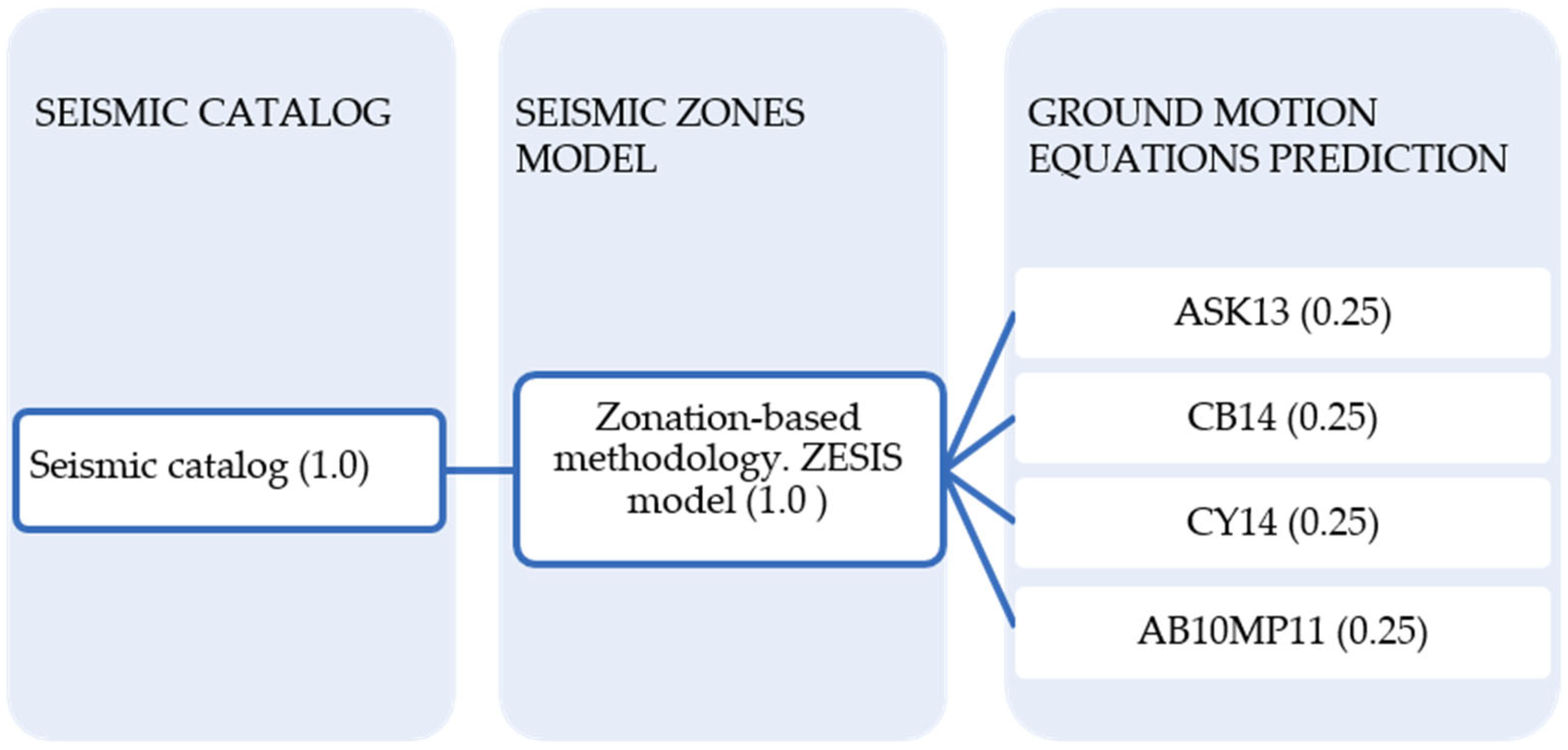
| [46] | ASK13 | Short periods |
| [47] | CB14 | Short periods |
| [48] | CY14 | Long periods |
| [49] | MP11 | Mw < 5.1 |
| [50] | AB10 | Mw > 5.1 |
| Columns | |
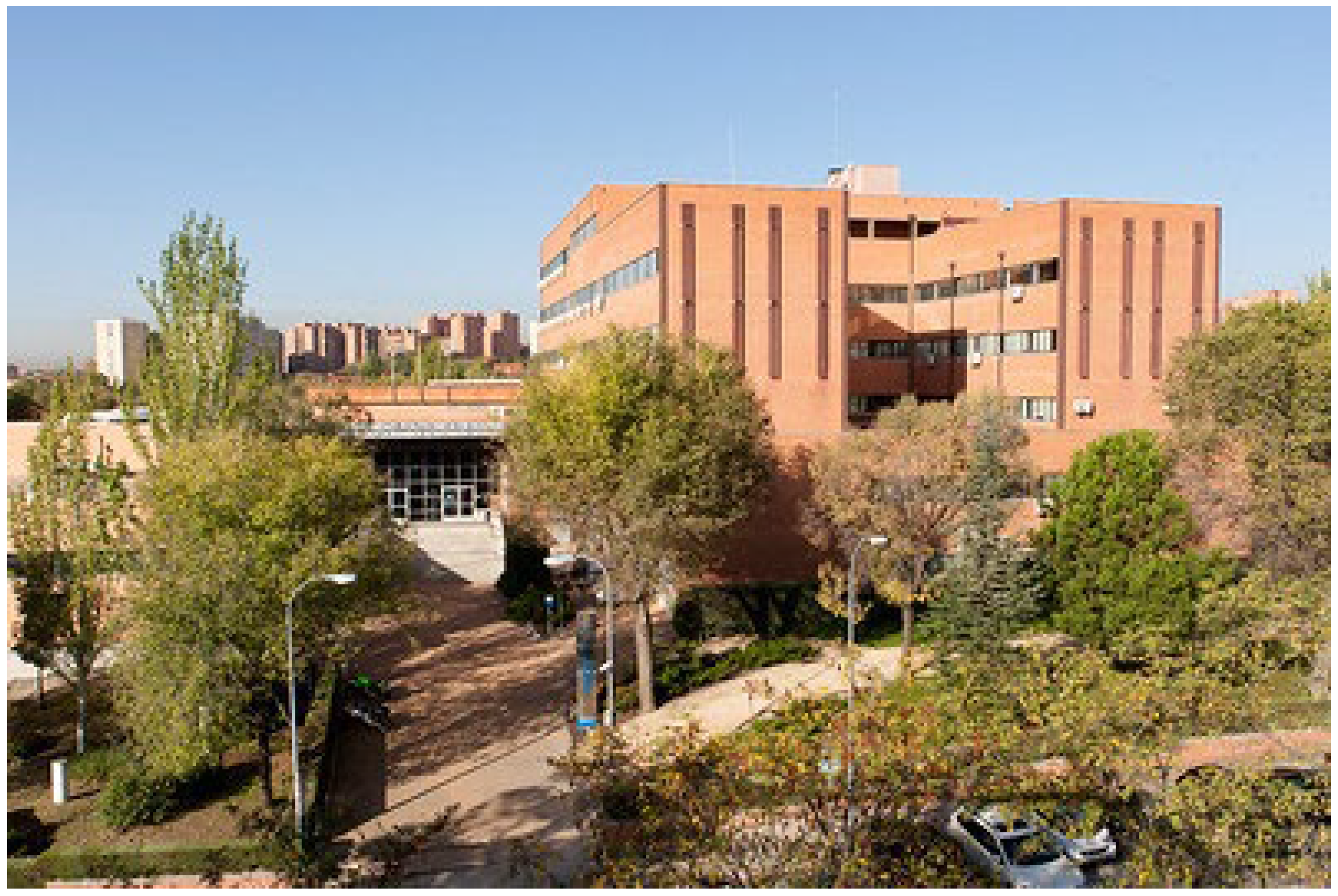
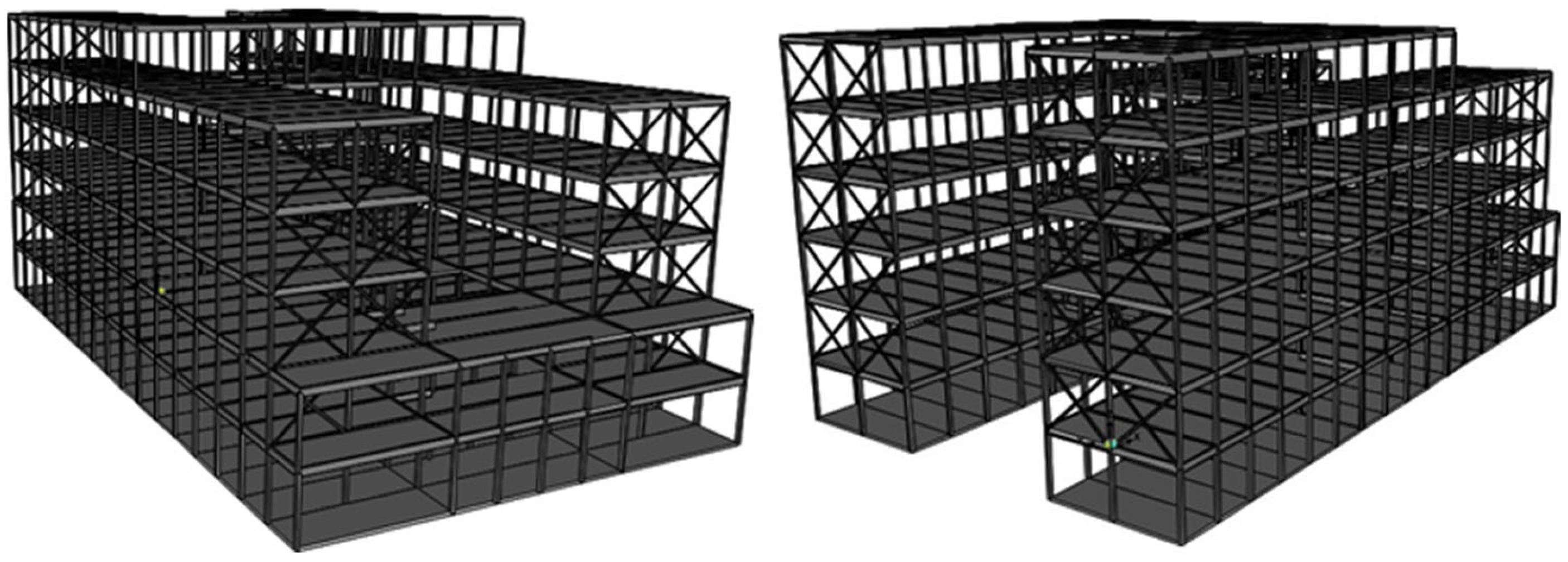
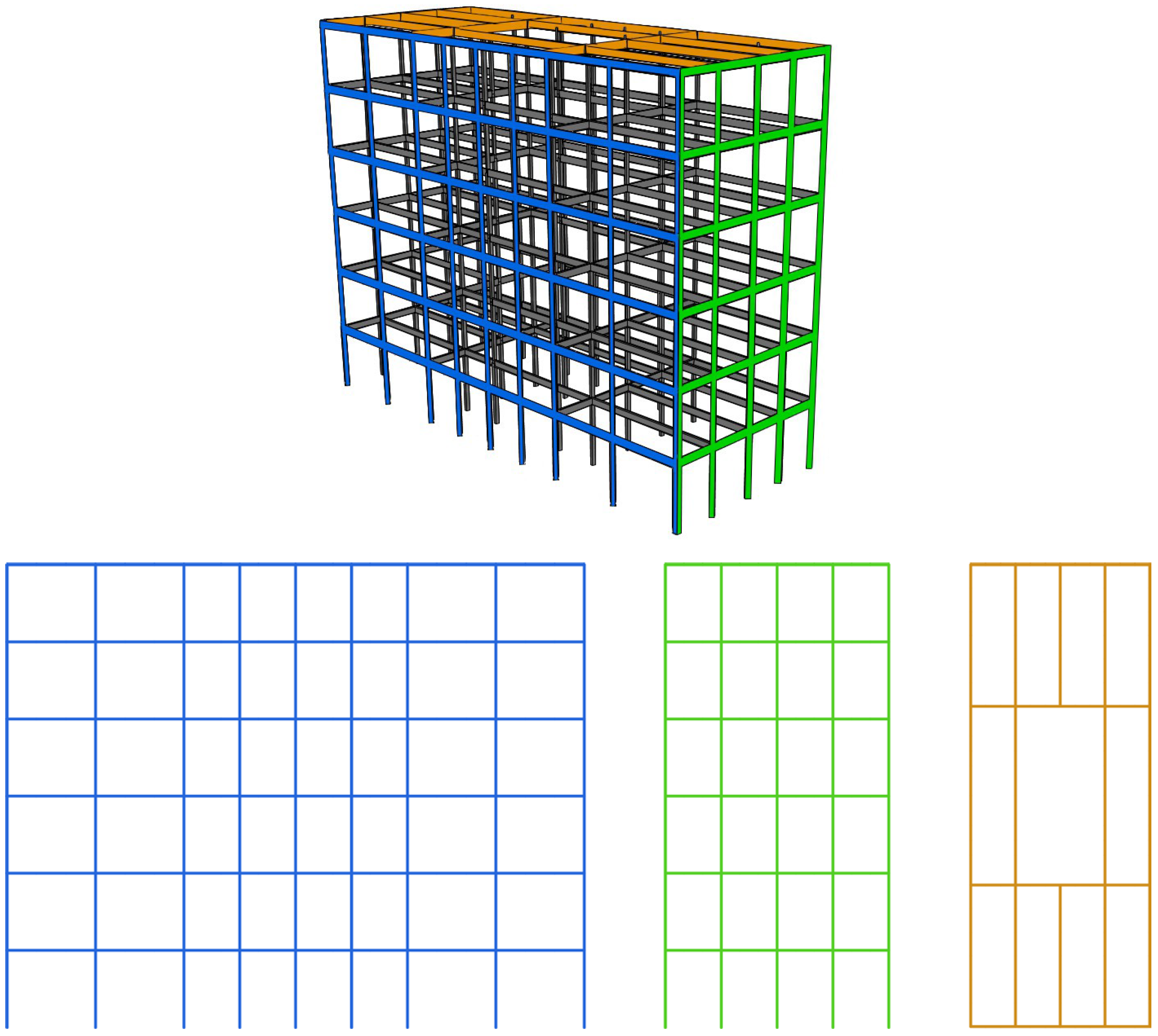
 | Material: rolled steel Profile: double UPN box section Height: 415 cm per level Dimensions per level. Basement: 26 × 18 × 1.4 cm; Ground floor: 24 × 17 × 1.3 cm, First floor: 22 × 16 × 1.25 cm; Second floor: 22 × 16 × 1.25 cm; Third floor: 20 × 15 × 1.5 cm; Fourth floor: 20 × 15 × 1.5 cm |
| Beams | |
 | Material: rolled steel Profile: IPE450 Dimensions: 45 × 17 cm |
| Expansion joints | |
 | Two expansion joints divide the building into four modules. |
| Control Earthquake | Spectral Acceleration | Magnitude (Mw) | Distance R (km) |
|---|---|---|---|
| Control earthquake 1 | 2 s | 6.5–7.0 | 120–140 |
| Control earthquake 2 | PGA | 4.5–5.0 | 0–20 |
| Control earthquake 3 | 2 s | 6.0–6.5 | 80–160 |
| Scenario | Location 1 | Magnitude (Mw) | Distance R (km) |
|---|---|---|---|
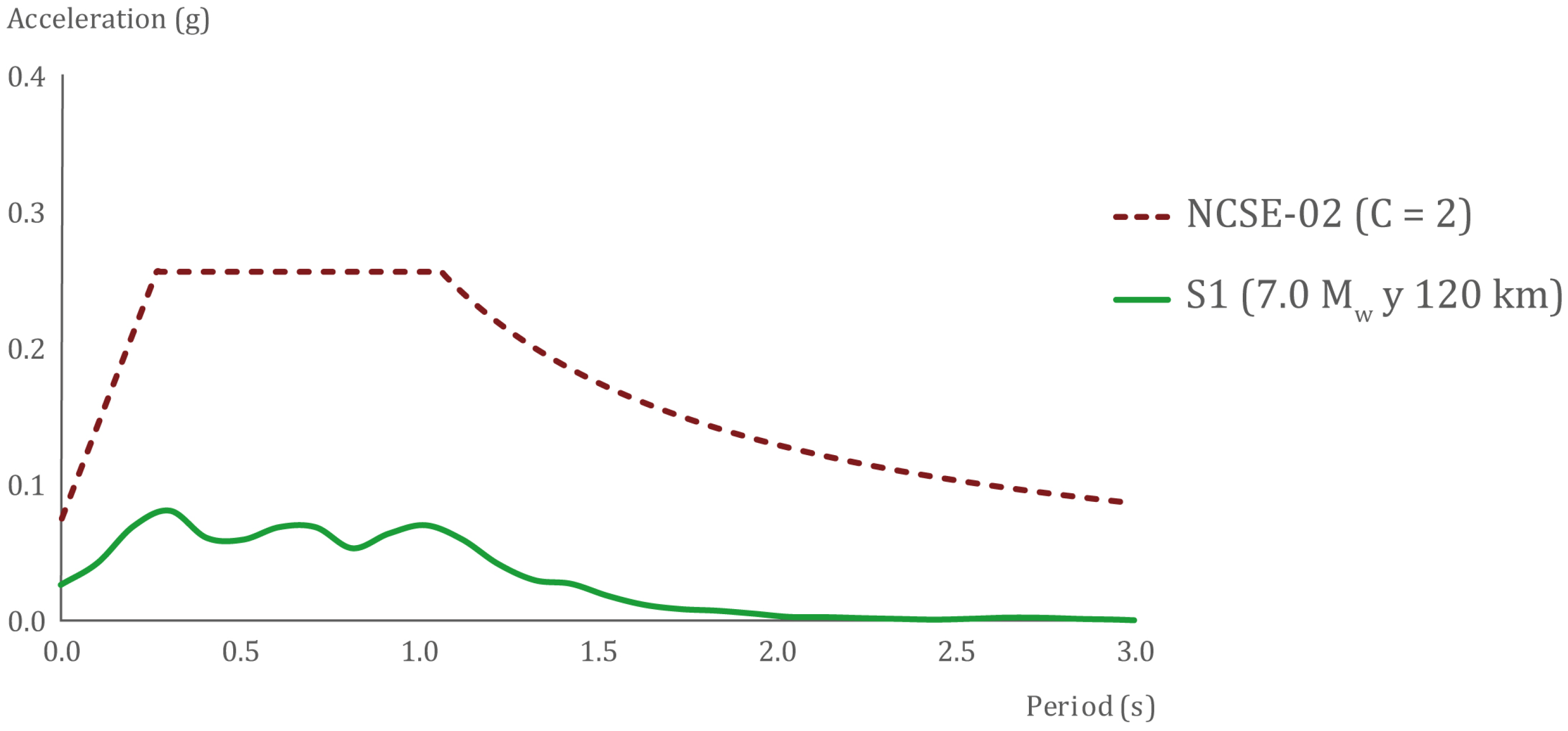
| Scenario 1 | Tofiño bank fault | 7.0 | 120 |
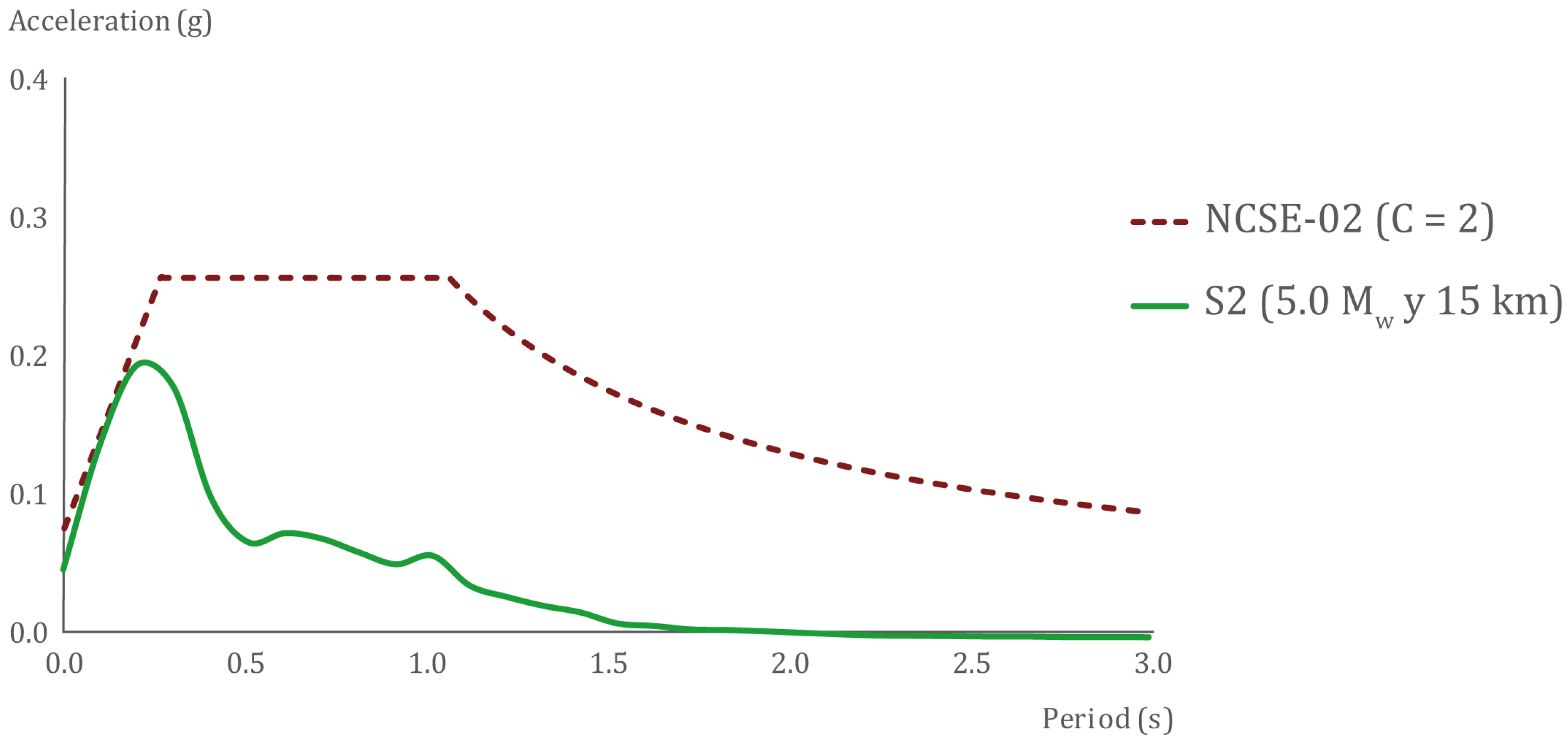
| Scenario 2 | Neotectonics map fault | 5.0 | 15 |
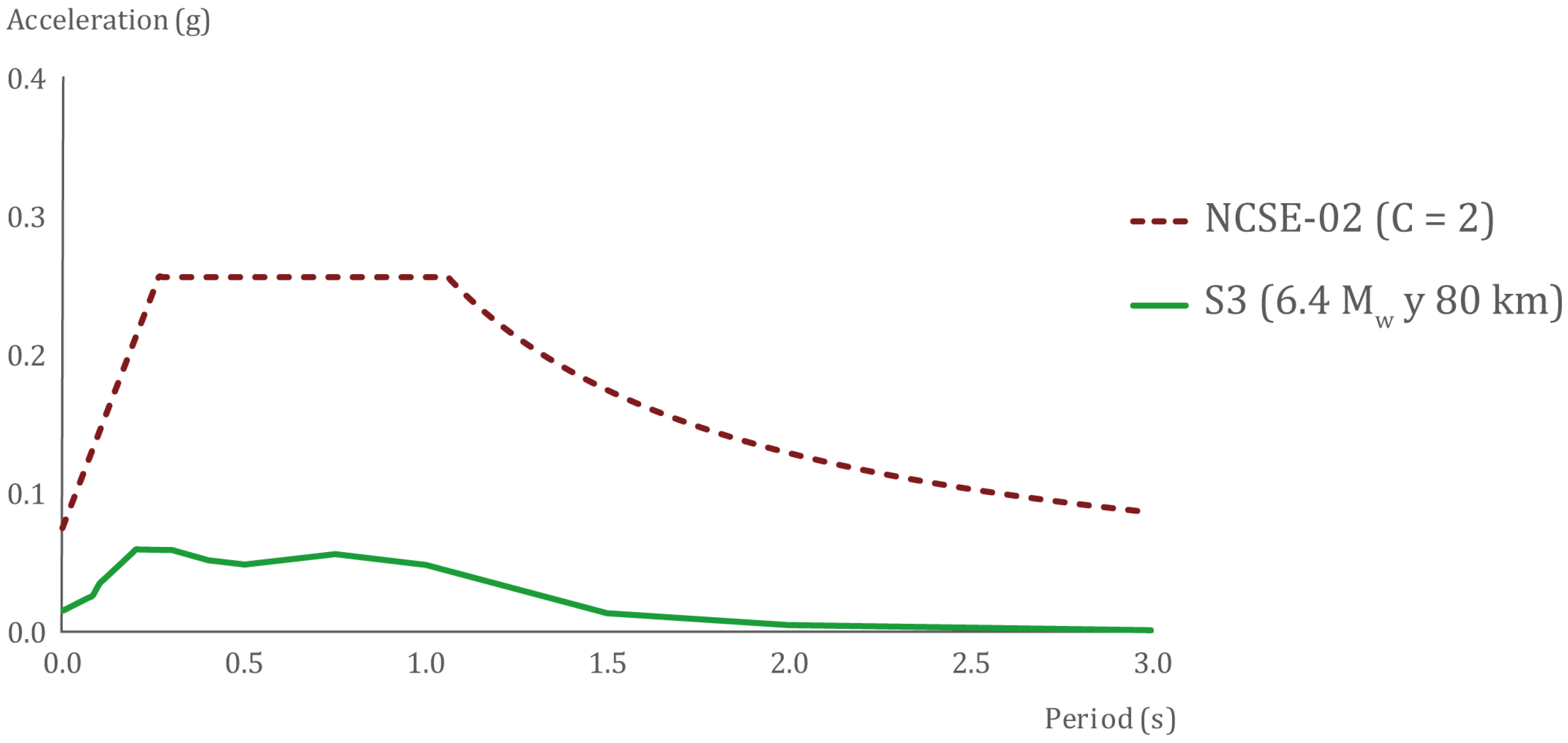
| Scenario 3 | El Acebuchal fault | 6.4 | 80 |
| Module | Record Length (s) | Window Length (s) | Frequency Resolution (Hz) | Point | Period SSR (s) | |
|---|---|---|---|---|---|---|
| UX | UY | |||||
| Mod1 | 600 | 20 | 0.05 | Pont 1 | 0.46 ± 0.05 | 0.41 ± 0.02 |
| 600 | 20 | 0.05 | Point 4 | 0.46 ± 0.07 | 0.41 ± 0.05 | |
| Mod2 | 600 | 20 | 0.05 | Point 3 | 0.41 ± 0.03 | 0.46 ± 0.08 |
| 600 | 20 | 0.05 | Point 5 | 0.41 ± 0.03 | 0.46 ± 0.10 | |
| 600 | 20 | 0.05 | Point 11 | 0.31 ± 0.02 | 0.33 ± 0.03 | |
| 600 | 20 | 0.05 | Point 12 | 0.33 ± 0.03 | 0.33 ± 0.05 | |
| Mod3 | 600 | 20 | 0.05 | Point 6 | 0.46 ± 0.02 | 0.41 ± 0.02 |
| 600 | 20 | 0.05 | Point 7 | 0.33 ± 0.12 | 0.28 ± 0.12 | |
| Mod4 | 600 | 20 | 0.05 | Point 2 | 0.46 ± 0.03 | 0.40 ± 0.03 |
| 600 | 20 | 0.05 | Point 10 | 0.33 ± 0.02 | 0.29 ± 0.06 | |
| Period (s) | |||
|---|---|---|---|
| SSR | Modal analysis | ||
| UX | UY | UX | UY |
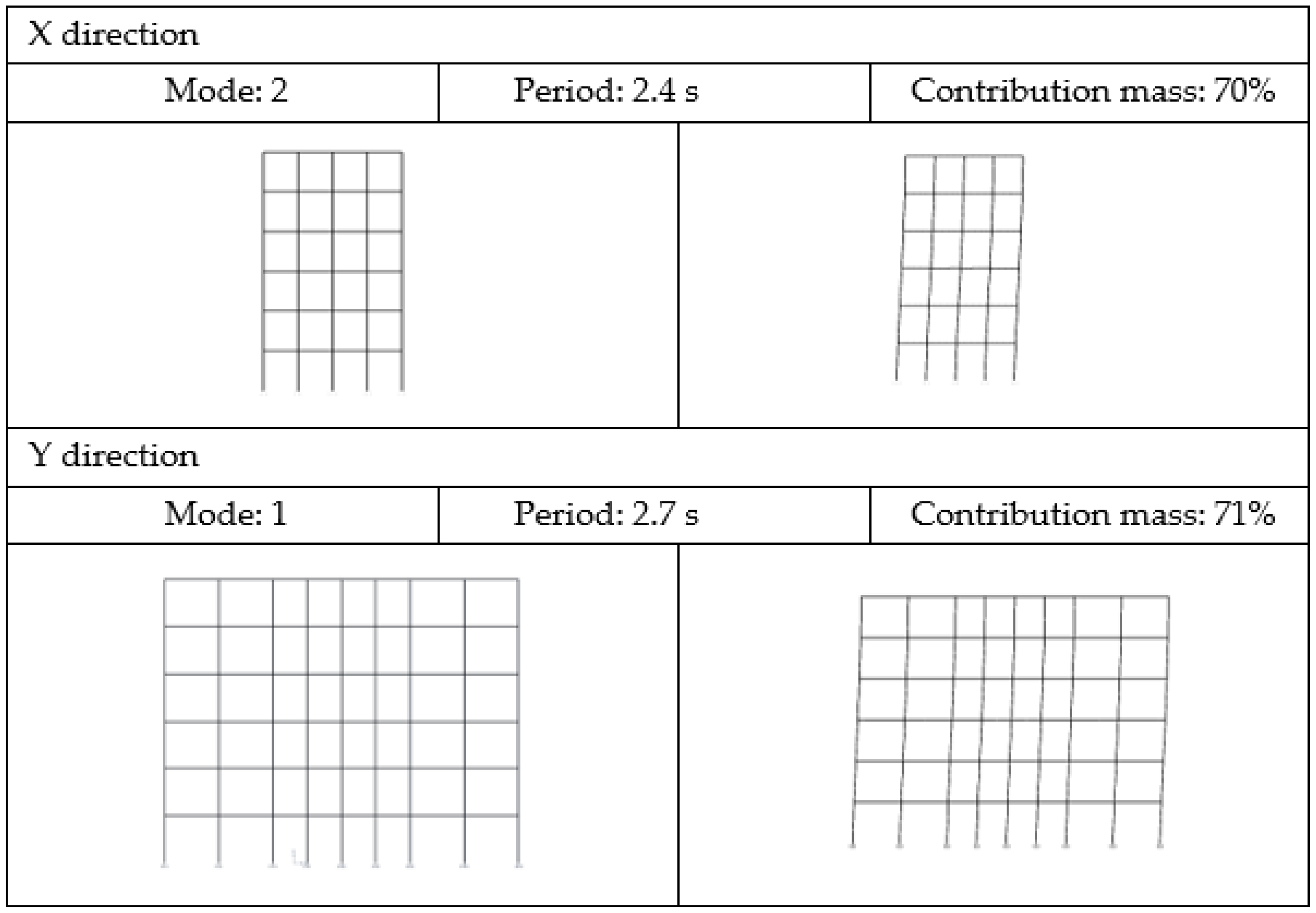
| 0.46 | 0.41 | 2.4 | 2.7 |
Disclaimer/Publisher’s Note: The statements, opinions and data contained in all publications are solely those of the individual author(s) and contributor(s) and not of MDPI and/or the editor(s). MDPI and/or the editor(s) disclaim responsibility for any injury to people or property resulting from any ideas, methods, instructions or products referred to in the content. |
© 2026 by the authors. Licensee MDPI, Basel, Switzerland. This article is an open access article distributed under the terms and conditions of the Creative Commons Attribution (CC BY) license.
Share and Cite
Romero-Jaren, R.; Navas-Sanchez, L.; Gamboa-Canté, C.; Benito, M.B.; Jaren, C. Analytical Seismic Vulnerability and Performance Assessment of a Special-Importance Steel Building: Application Under the NCSE-02 Code. Appl. Sci. 2026, 16, 1515. https://doi.org/10.3390/app16031515
Romero-Jaren R, Navas-Sanchez L, Gamboa-Canté C, Benito MB, Jaren C. Analytical Seismic Vulnerability and Performance Assessment of a Special-Importance Steel Building: Application Under the NCSE-02 Code. Applied Sciences. 2026; 16(3):1515. https://doi.org/10.3390/app16031515
Chicago/Turabian StyleRomero-Jaren, Rocio, Laura Navas-Sanchez, Carlos Gamboa-Canté, Maria Belen Benito, and Carmen Jaren. 2026. "Analytical Seismic Vulnerability and Performance Assessment of a Special-Importance Steel Building: Application Under the NCSE-02 Code" Applied Sciences 16, no. 3: 1515. https://doi.org/10.3390/app16031515
APA StyleRomero-Jaren, R., Navas-Sanchez, L., Gamboa-Canté, C., Benito, M. B., & Jaren, C. (2026). Analytical Seismic Vulnerability and Performance Assessment of a Special-Importance Steel Building: Application Under the NCSE-02 Code. Applied Sciences, 16(3), 1515. https://doi.org/10.3390/app16031515