Article

The Relationship Between Proprioceptive Drift and Body Ownership Varies with the Mediolateral Position of a Virtual Hand


1
Department of Computer Science, Tokyo Metropolitan University, Hino 191-0065, Japan
2
Graduate School of Science and Engineering, Saitama University, Saitama 338-8570, Japan
*
Author to whom correspondence should be addressed.
Appl. Sci. 2026, 16(3), 1492; https://doi.org/10.3390/app16031492
Submission received: 19 December 2025 / Revised: 18 January 2026 / Accepted: 30 January 2026 / Published: 2 February 2026

Abstract

The sense of body ownership refers to the attribution of the body or body parts to oneself. Proprioceptive drift is a phenomenon in which the perceived position of a body part changes during body ownership illusions. These two metrics—the subjective level of body ownership and proprioceptive drift—have been widely used as corresponding subjective and behavioral measures. However, discrepancies between these metrics have been reported, and the conditions under which they align remain unclear. We focused on the relative positioning of a visually presented dummy hand and an unseen actual hand. In an immersive virtual reality environment, we examined the relationship between subjective body ownership toward a virtual hand and proprioceptive drift. Three spatial configurations were compared by varying the mediolateral position of the dummy hand, with a spatially aligned condition serving as a baseline, and with an additional manipulation of temporal delay between the actual and virtual hands. The results showed that when the dummy hand was placed 0.1 m medial to the actual hand, the correlation between body ownership and proprioceptive drift was not statistically significant (correlation coefficient = 0.047). Under this medial condition, subjective ownership decreased with increasing delay, whereas proprioceptive drift persisted despite temporal asynchrony. In contrast, when the dummy hand was placed 0.1 m lateral to the actual hand, a significant positive correlation was observed between body ownership and proprioceptive drift (correlation coefficient = 0.49). Further analysis using a linear mixed-effects model suggested that these differences in correlation were associated with laterality-dependent effects of temporal delay on body ownership and proprioceptive drift. These findings highlight the importance of considering both spatial configuration and temporal factors when interpreting the relationship between body ownership and proprioceptive drift in virtual reality environments.

1. Introduction

The sense of body ownership [1,2] and proprioceptive drift (PD) [3,4] are fundamental to understanding how humans perceive and interact with their bodies in both real-world and virtual reality (VR) environments. Body ownership refers to the feeling that a body part belongs to oneself, while PD describes the perceived positional shift of a body part, often observed during body ownership illusions. Such effects have been widely studied in paradigms such as the rubber hand illusion, in which visual, tactile, and proprioceptive cues are manipulated to induce body ownership illusions [1,2,3,5,6]. The same or similar paragdim has been also tested in VR environemnts [7,8,9,10,11]. Through these studies, the sense of body ownership and PD have been employed to test the bodily illusion in a complementarily manner.
However, more recent research has reported discrepancies, with PD occurring even in the absence of body ownership, or disassociation between the senes of body onwership and PD [9,10,12,13,14,15,16]. Furthermore, there are reports that, depending on the experimental method, PD does not correlate with a sense of body ownership [8,12,17,18,19,20,21]. In these studies, PD was observed even in the absence of a sense of body ownership, and vice versa. For example, in the study by Pyasik et al. [8], when a virtual hand presented via a head-mounted display was positioned 20 cm medial to the participant’s actual hand, comparable levels of PD were observed under both synchronous and asynchronous visuotactile stimulation conditions, despite the fact that subjective reports of the sense of body ownership were significantly reduced in the asynchronous condition. Tosi et al. [13] suggest that the information processes underlying the sense of body ownership and PD overlap to some extent but not perfectly, which may explain the variability in reported associations between these metrics across studies. These inconsistencies have raised questions about the conditions under which body ownership and PD align.
One possible explanation lies in the spatial relationship between the dummy hand and the actual hand. Previous research has primarily focused on the effects of distance or postural mismatches [19,21,22,23,24,25,26,27,28]. However, the influence of mediolateral positioning—whether the dummy hand is placed medial or lateral to the actual hand—remains underexplored. It is worth noting that Pyasik et al. [8] focused exclusively on medial spatial displacement of the virtual hand and did not test lateral shifts. While this choice is reasonable given their emphasis on body-centered spatial representations, the absence of lateral conditions leaves open the question of whether the observed dissociation between body ownership and PD is specific to medial configurations. The present study directly addresses this issue by systematically comparing medial and lateral shifts within the same experimental paradigm. A related study by Kawaguchi et al. [29] examined bodily awareness in a VR environment where two computer-generated (CG) hands were visible. They reported that bodily awareness tended to focus on the hand closest to the body. Furthermore, bodily awareness may be referenced to the body’s midline as a basis [30]. Thus, the mediolateral positioning of a dummy hand may be an important factor in determining the relationship between body ownership and PD. This spatial factor could provide new insights into the variability of body ownership and PD across different experimental setups.
With this hypothesis, the present study investigates the relationship between body ownership and PD in an immersive VR setting. Specifically, we examine how the mediolateral position of a dummy hand relative to the actual hand affects these phenomena—namely, body ownership and PD and their conditional dissociation—under varying time delays. By addressing this point, we aim to contribute to a deeper understanding of bodily awareness in VR environments.
The main contributions of this study can be summarized as follows:
  • We systematically compared the relationship between subjective body ownership and PD under medial and lateral spatial configurations of a virtual hand relative to the actual hand, a distinction that has not been explicitly examined in previous VR embodiment studies.
  • By introducing temporal delay as a controlled manipulation, we demonstrated that apparent differences in the ownership–PD association across mediolateral configurations are closely related to laterality-dependent effects of temporal asynchrony, rather than to a fixed coupling between the two measures.
  • Our results provide empirical evidence that PD can persist under reduced ownership in medial spatial configurations, while being attenuated by delay in lateral configurations, thereby extending prior findings on the dissociation between subjective and behavioral measures of embodiment in immersive VR environments.

2. Methods

2.1. Participants

Fifteen university students (5 females and 10 males; age range: 21–25 years), who were unaware of the purpose of this study, participated in the experiment after providing written informed consent. All participants were right-handed.
As described in Section 2.6, this study primarily investigates the correlation between the subjective body ownership scores reported by participants and the PD they exhibited. An a priori power analysis for correlation tests indicated that a sample size of 10 was required to detect a correlation coefficient of r = 0.50 —the lower boundary of the moderate correlation range (0.5–0.7 [31])—as significantly different from zero with a significance level of α = 0.05 and a statistical power of 1 β = 0.8 (two-tailed). With the actual sample size of 15 participants, the achieved statistical power was approximately 0.95. Power analyses were conducted using G*Power (version 3.1.9.7) [32].

2.2. Ethical Statement

The protocol of this study was approved by the Institutional Review Board at Hino Campus, Tokyo Metropolitan University (Approval number: H23-9, approval data: 28 April 2023).

2.3. Apparatus

A commercialized head-mounted display (Quest 2, Oculus VR, LLC., CA, USA) was used to render virtual experimental scenes. It displays an image with a resolution of 1832 × 1920 pixels per eye at 72 Hz in our settings. The wrist and fingers of the wearer’s actual left hand were tracked by built-in cameras of the device for reflecting synchronized motions in the virtual reality environment, which was implemented with Unity (2020.3.35.f1, Unity Technologies, CA, USA).

2.4. Stimuli: Seen Virtual Hands

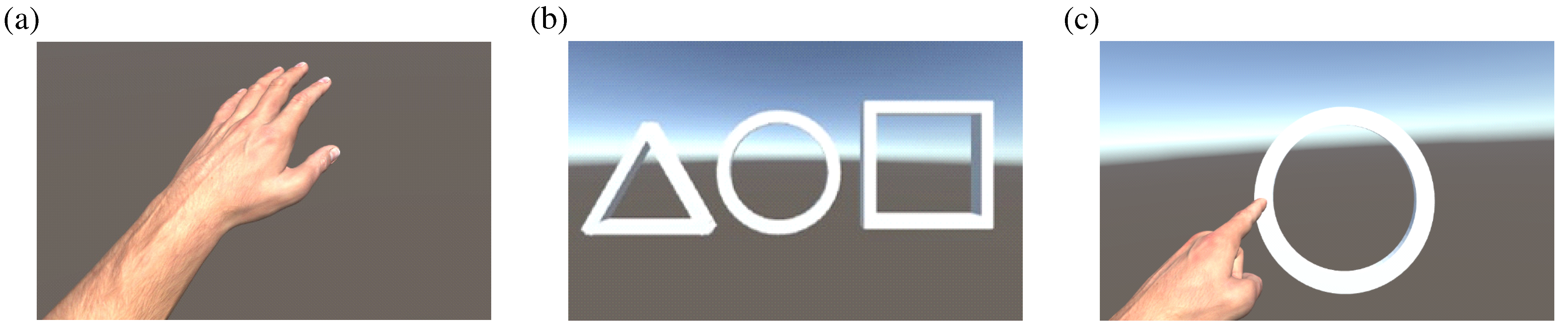
Three conditions were prepared for the positions of the virtual hand displayed in the VR environment. In one condition, the CG representation of the left hand, that is, the distal segment relative to the elbow, as shown in Figure 1a, was displayed at the position of the actual left hand (spatially congruent condition). In the other two conditions, the virtual hand was displayed 0.1 m inward (medial condition) or outward (lateral condition) from the actual left hand position. In all conditions, the virtual left hand moved synchronously with the actual left hand. The spatially congruent condition was included as a baseline condition. Because no systematic PD is expected when visual and proprioceptive hand positions are spatially aligned, this condition served as a reference for evaluating PD in the medial and lateral displacement conditions.
A constant time delay was applied to the movement of the virtual left hand. The delay is one of the typical measures to control for the sense of body ownership [8,11,33,34,35]. The greater the delay, the less the sense of body ownership would be felt, and a delay of 500 ms can be sufficient to vanish the feeling [34]. In this experiment, three delay levels were set: 0 ms (minimum delay), 250 ms and 500 ms. Note even under the minimum delay, at least approximately 20-ms delay exists [36].
Temporal delay was introduced as an experimental manipulation to reduce body ownership and to induce sufficient variability in subjective ownership ratings. Without this manipulation, ownership scores showed limited variance, making it difficult to examine their relationship with PD. The absolute end-to-end system latency and its variability were not independently quantified and were assumed to be constant across conditions.

2.5. Procedures

During the experiment, participants were seated on a chair and instructed to rest their right hand, holding a controller, on their knee while maintaining an upright posture. They were also directed to avoid touching anything with their left hand, except during designated breaks. Notably, touching one’s own body, in particular, may interfere with the experience of illusory bodily awareness [37]. Each participant completed three trials under each of nine different conditions (a combination of three virtual hand positions and three delay conditions) arranged in a randomized block design. Hence, each participant performed a total of 27 trials, with a 3-min break after each.

2.5.1. Habituation Task

At the start of the experiment, the virtual environment, including the CG representation of the left hand (Figure 1a) and an object used for the habituation task, was displayed on the head-mounted display. Figure 1b shows the three CG objects (triangle, circle, and square) used in the habituation task. One of these objects was randomly presented in front of the participant, aligned such that its center line matched the participant’s midline. Each object type was presented once in each of the three repeated trials under every condition. The square had dimensions of 20 × 20 cm, and the triangle and circle were inscribed within the square. As shown in Figure 1c, the participant continuously traced the surface of the object with the virtual left index finger for 1 min.

2.5.2. Measurement of PD

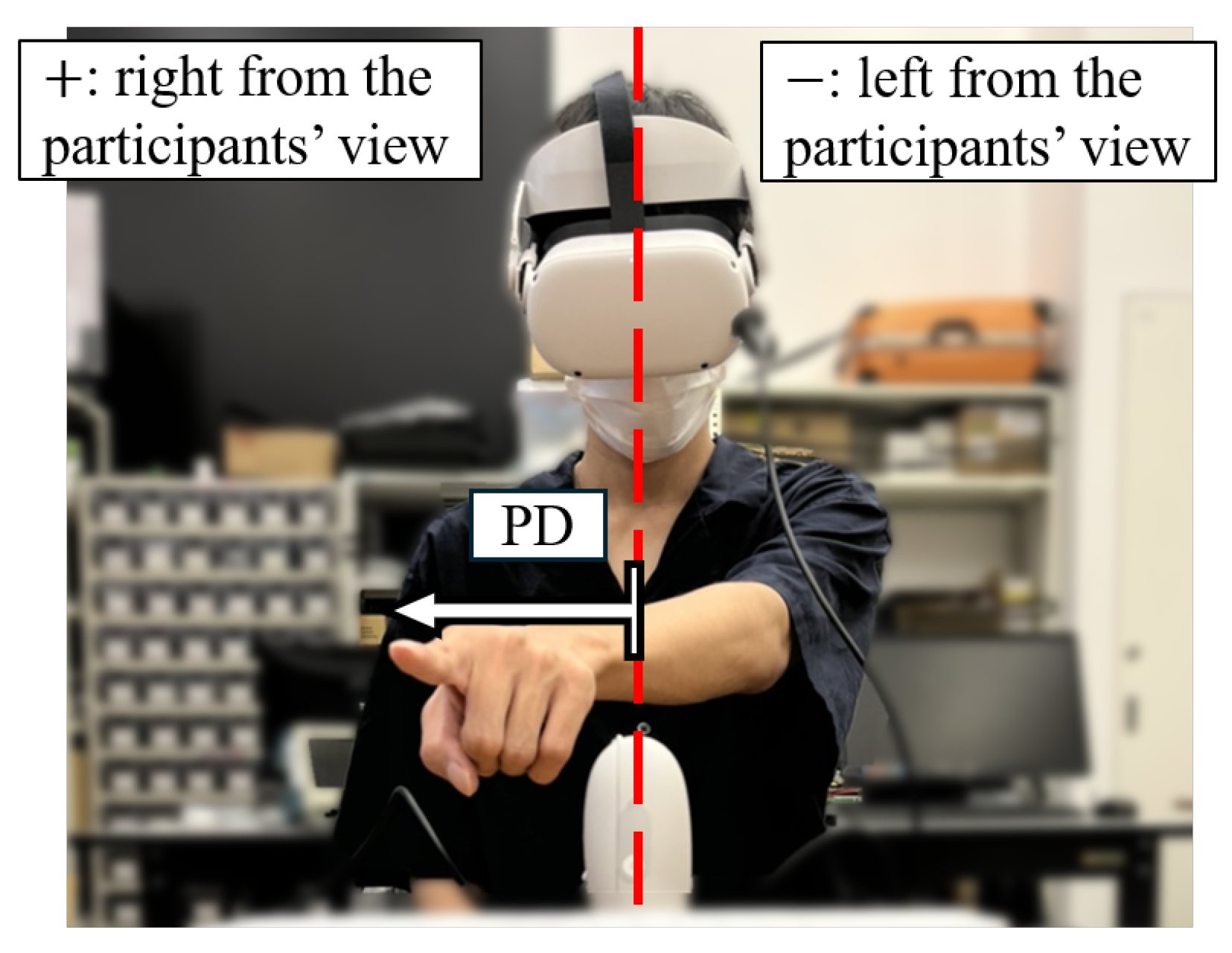
After the habituation task, the participant closed their eyes and extended their left arm forward such that the tip of the extended index finger aligned with the perceived position of the body’s midline, as illustrated in Figure 2. The deviation between the index finger’s tip position tracked by the head-mounted display and the actual midline, defined as the center of the device, was measured as the PD value. If proprioception remained unaffected, this positional deviation would be close to 0 m. Deviations to the right of the body’s midline were recorded as positive values.

2.5.3. Questionnaire

At the end of each trial, participants rated a single questionnaire item—“I felt as if the seen hand was my own left hand”—using a 10-point Likert scale, where 0 indicated “did not feel at all,” 1 indicated “felt a little,” and 9 indicated “felt very strongly.” This score reflects the strength of illusory body ownership over the virtual left hand.
Typically, experimental paradigms involving voluntary hand movements focus on the relationship between the degrees of body ownership and agency (e.g., [22,38,39,40]). In cases of incongruency between the authentic and dummy hands, body ownership and agency toward the dummy hand can be uncorrelated [22,39,40]. It should be noted that these relationships were not the primary focus of this study, and our questionnaire did not include items related to the sense of agency.

2.6. Data Analysis

A two-way repeated measures analysis of variance (ANOVA) was applied to the embodiment scores. Prior to analysis, mean values were calculated across the three repeated trials for each individual and condition. The two factors analyzed were ‘delay’ and ‘position of the virtual left hand.’ For the embodiment scores, an aligned rank transform was applied using ARTool [41], followed by a two-way ANOVA conducted in MATLAB 2023b (MathWorks, Inc., MA, USA).
When a significant main effect of a factor was identified for the embodiment scores, and no interaction between the two factors was found, post-hoc signed rank tests were conducted to examine pairwise differences among the three hand spatial conditions (lateral, congruent, and medial).
For each of the nine conditions (three synchrony conditions × three spatial conditions), the mean PD score was tested against zero using a two-tailed t-test. Additionally, for both the medial and lateral conditions, pairwise comparisons of different synchrony conditions were conducted using two-tailed t-tests with Bonferroni correction of factor three.
Correlation coefficients between PD and ownership scores were calculated separately for the medial and lateral conditions, and an uncorrelated test was performed to assess the statistical significance of these correlations.

3. Results

3.1. Ownership Scores

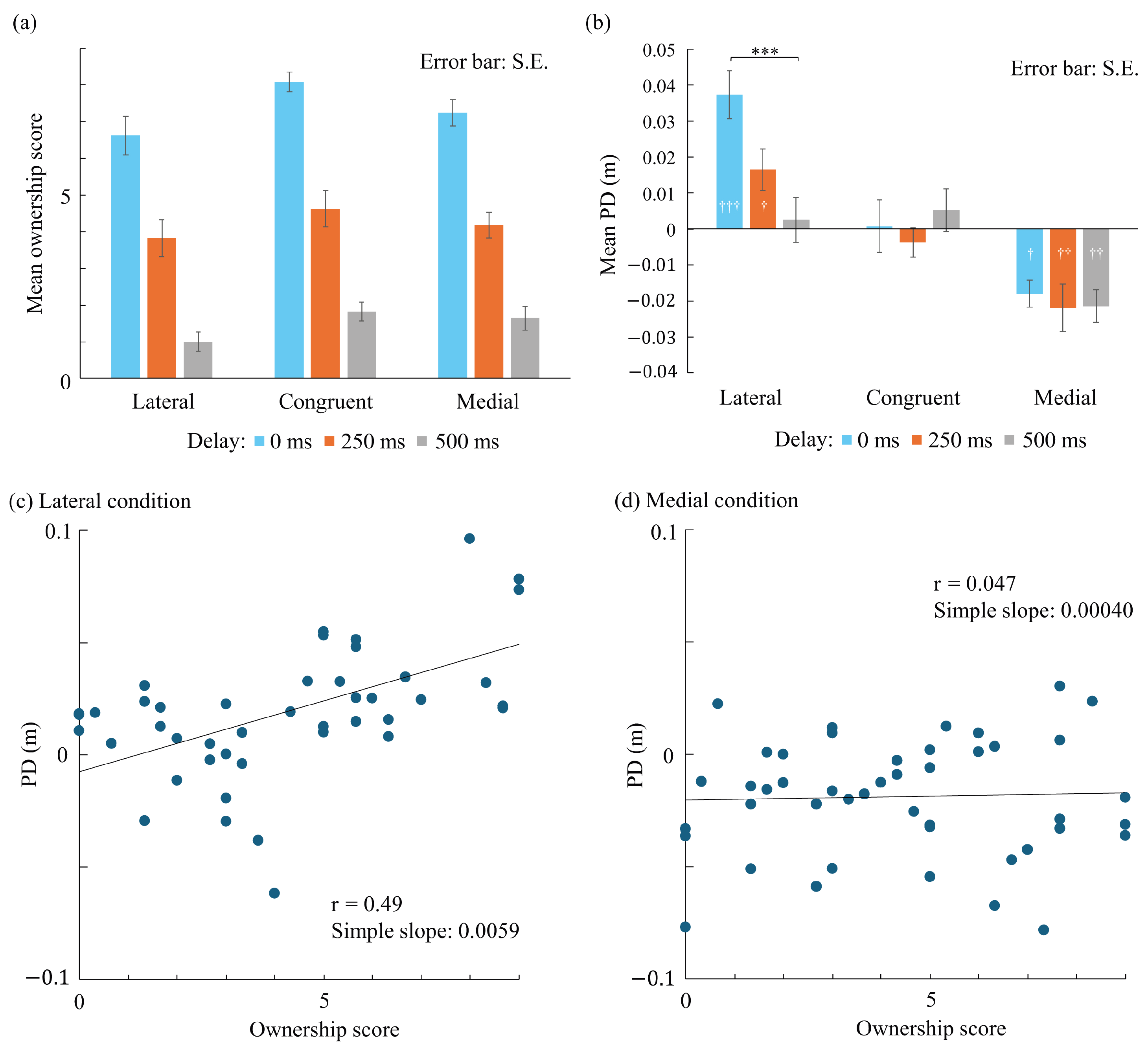
Figure 3a presents the mean ownership scores and standard errors of means for the three hand spatial conditions. Table 1a summarizes the results of the two-way ANOVA for ownership scores. The scores for body ownership significantly decreased with delay ( F ( 2 , 126 ) = 158.87 , p < 0.001 ). Additionally, they were influenced by the position of the virtual hand ( F ( 2 , 126 ) = 4.73 , p = 0.010 ). The interaction between delay and CG position was not significant ( F ( 4 , 126 ) = 0.278 , p = 0.89 ).
Upon receiving the above results, in order to investigate the effects of the virtual hand’s position on the ownership scores, as a post-hoc analysis, we conducted the signed rank test for each pair made by the three levels of the hand position with Bonferroni correction of factor three. Table 1b shows the summary of these tests. The ownership scores for the congruent condition were greater than those for the lateral condition ( p < 0.001 ) and the medial condition ( p < 0.001 ). The medial condition exhibited the greater scores than the lateral condition ( p = 0.0057 ).

3.2. Proprioceptive Drifts (PDs)

Figure 3b shows the means and standard errors of PD values by conditions. We first investigated whether the PDs were biased for the spatially congruent condition. For this purpose, we applied two-tailed t-tests on the PDs of this condition, and they were not significantly different from 0 irrespective to the delay condition (without delay: t ( 14 ) = 0.10 , p = 0.92 , 250 ms: t ( 14 ) = 0.91 , p = 0.39 , 500 ms: t ( 14 ) = 0.76 , p = 0.47 ). For the other conditions, the PD values were significantly different from 0 except for the combination of 500-ms delay and lateral condition.
For the lateral-side condition, there was a significant difference in PD values between the minimum delay and 500 ms delay conditions ( t ( 14 ) = 4.88 , p < 0.001 ). For the other two pairs, no significant differences were observed (minimum delay vs. 250 ms delay: t ( 14 ) = 2.47 , p = 0.081 , 250 ms delay vs. 500 ms delay: t ( 14 ) = 2.03 , p = 0.19 ).
For the medial side condition, no significant differences in PD values were found between different delay conditions (minimum delay vs. 250 ms delay: t ( 14 ) = 0.52 , p = 1.00   ( 0.62 × 3 ) , 250 ms delay vs. 500 ms delay: t ( 14 ) = 0.094 , p = 1.00   ( 0.93 × 3 ) , minimum delay vs. 500 ms delay: t ( 14 ) = 0.65 , p = 1.00   ( 0.53 × 3 ) ).

3.3. Correlation Between the Ownership Score and PD

Figure 3c,d show the relationships between the PDs and ownership scores when the virtual hand was rendered at the lateral and medial sides to the actual hand, respectively. The PDs were moderately correlated with the scores in the lateral condition ( r = 0.49 with the 95% confidence interval of [ 0.030 , 0.80 ] , t = 3.71 , p < 0.001 ), whereas a significant positive correlation was not found in the medial condition ( r = 0.047 [ 0.48 , 0.55 ] , t = 0.31 , p = 0.75 ).
In addition to the planned correlation analyses, linear mixed-effects models were conducted in an exploratory, post-hoc manner to further examine whether the relationship between body ownership and PD varied across experimental conditions. In this model, PD was treated as the dependent variable, while ownership score, hand position (lateral vs. medial), and their interaction were included as fixed effects. The lateral hand position was used as the reference level. Participant was included as a random effect to account for repeated measurements. The model was specified in Wilkinson notation as
PD Ownership × HandPosition + ( 1   |   Participant ) ,
where Ownership denotes the mean-centered ownership score. Statistical analyses were performed using fitlme function of MATLAB (2023b, MathWorks, Inc., MA), and significance of fixed effects was assessed using F tests with Satterthwaite’s approximation for degrees of freedom.
As shown in Table 2, the linear mixed-effects model revealed a significant fixed effect of hand position and a significant fixed effect of ownership on PD. Further, the significant interaction suggests that the association between ownership and PD was modulated by the mediolateral position of the virtual hand. Although the interaction term was significant in the mixed-effects model, this does not directly imply a statistically significant difference between correlation coefficients across conditions, as the model tests differences in regression slopes rather than correlations per se. The AIC and BIC of the model were 417.1 and 402.1 , respectively.
Further, Table 3 shows the results of the linear mixed-effects model analysis, in which temporal delay was additionally included as a fixed effect. The model formula for this analysis was
PD Ownership × HandPosition × Delay + ( 1   |   Participant ) .
When temporal delay was included in the linear mixed-effects model, the main effect of ownership score on PD was no longer significant, whereas temporal delay exhibited a significant fixed effect. No interaction terms reached statistical significance. The AIC and BIC of the model were 417.0 and 382.0 , respectively.

4. Discussion

4.1. Body Ownership

In this study, we investigated the relationship between PD and the sense of body ownership, focusing on the spatial congruency between the real and virtual hands. Delay was introduced as a method to manipulate body ownership, and the results showed that body ownership was less likely to occur with greater delay. This result is consistent with previous studies [6,8,9,11,34,35,42,43,44].
The relative position of the virtual hand and the participant’s actual hand also influenced the sense of body ownership. While previous studies using rubber hands have examined the effects of distance and postural mismatch between the rubber hand and the actual hand [19,21,22,23,24,25,39,40,45,46,47], comparisons of the laterality (medial or lateral) of dummy hand positions have rarely been reported. Body ownership scores were significantly lower when the virtual hand was placed on either the lateral or medial side compared to when it was spatially congruent with the actual hand. Furthermore, scores in the medial condition were higher than those in the lateral condition. Thus, body ownership scores followed the order: congruent > medial > lateral. These results indicate that the mediolateral position of the dummy hand asymmetrically affects bodily awareness. It should be noted that these findings are specific to the experimental settings of this study. In particular, the 0.1 m distance between the CG and actual hands may be a critical factor for replicating the experiments, and it remains unclear whether the observed mediolateral effects generalize to other displacement magnitudes.

4.2. Proprioceptive Drift (PD)

Regarding PD, when the virtual hand was spatially aligned with the actual hand (spatially congruent condition), no substantial PD was observed, regardless of the presence or absence of temporal delay, indicating the absence of systematic biases due to the experimental setup. PD in the medial and lateral conditions was therefore defined relative to this spatially congruent condition, in which PD values were close to zero.
Under conditions without delay, PD was observed in both the medial and lateral configurations. In the lateral condition, PD was reduced when temporal delay was introduced. In contrast, in the medial condition, PD did not differ significantly between the synchronous and delayed conditions, indicating that PD was not attenuated by temporal asynchrony under medial spatial configuration. These findings indicate that the laterality of the virtual hand also influences PD. Thus, for the medial condition, the delayed conditions were interpreted not as causal controls but as a means to assess the robustness of PD under reduced ownership.
The PD observed in the medial condition appears to be relatively easy to replicate. In a study by Pyasik et al. [8] using an immersive virtual reality environment, comparable PDs were reported when a virtual hand was displayed on the medial side of the participant’s actual hand, irrespective of whether visual and tactile stimuli were concordant or discordant. The authors suggested that such effects may reflect characteristics specific to immersive virtual reality environments, in which visual information strongly dominates body-related spatial representations. Hence, when the virtual hand is seen on the medial side of the actual hand, PDs can be robustly observed even in the presence of spatiotemporal inconsistencies between multiple sensory channels. Nonetheless, in the paradigm of the rubber hand illusion, large PDs are typically observed when visual and tactile stimuli are synchronized [45,48].

4.3. Mediolateral Difference in the Relationship Between Body Ownership and Proprioceptive Drift

Descriptive correlation analyses indicated that when the virtual hand was placed on the lateral side, PD was moderately correlated with the subjective body ownership score ( r = 0.49 ), whereas no statistically significant correlation was observed when the virtual hand was placed on the medial side ( r = 0.047 ). Tosi et al. [13] reported that correlations between body ownership and PD are typically modest (around r 0.35 ) and highly variable across studies, suggesting that such associations are not necessarily strong or stable. In this context, the correlation observed in the lateral condition is broadly consistent with previous findings.
However, as shown in Table 3, when temporal delay was explicitly included in a linear mixed-effects model, the apparent difference in the PD–ownership association across mediolateral configurations was no longer statistically robust. This suggests that the observed variation in correlation may not reflect a fixed difference in the intrinsic relationship between body ownership and PD. Rather, it may arise from laterality-dependent effects of temporal delay on these measures.
Importantly, temporal delay was introduced in the present study not as a nuisance variable but as an experimental manipulation required to induce sufficient variability in ownership scores. Without delay, ownership responses showed limited variance, making it difficult to meaningfully assess their relationship with PD. From this perspective, the mediolateral difference observed in the present study may be better characterized as a difference in the persistence of PD under temporal asynchrony, rather than a difference in the strength of the ownership–PD relationship itself. Specifically, PD tended to persist under delay when the virtual hand was positioned medially, whereas it was more strongly attenuated by delay when the virtual hand was positioned laterally.
This interpretation is consistent with previous VR studies reporting the persistence of PD under medial displacement even when subjective ownership ratings are reduced [8]. By additionally examining lateral configurations, the present study suggests that such dissociations between ownership and PD are not universal but depend on spatial context.
Another factor that may have contributed to the observed dissociation between ownership scores and PD is the influence of demand characteristics. Previous studies have pointed out that subjective reports in body illusion paradigms can be affected by participants’ expectations and interpretations of the experimental context [49,50]. Such effects may differentially influence subjective ownership scores and behavioral measures such as PD. This interpretation is consistent with previous studies suggesting that subjective measures of body ownership are particularly sensitive to experimental context.
A spatial perspective may help interpret the mediolateral differences observed in the present study. Specifically, the concepts of the normal and maximum working areas provide a useful framework for considering how spatial configuration modulates bodily awareness. The normal working area refers to the horizontal space that can be reached with the elbow lightly bent, whereas the maximum working area extends to the space reachable with the arm fully extended [51]. When the virtual hand was positioned medially, the actual hand likely remained within the normal working area for most of the task. In such easily reachable spaces, often referred to as peripersonal space, multisensory integration has been shown to be enhanced [15,52,53]. In contrast, when the virtual hand was positioned laterally, the actual left hand was more frequently active in a spatial configuration that may have been physically demanding for participants. Consistent with this interpretation, body ownership scores were generally lower in the lateral condition, suggesting that medially shifted virtual hands were more readily accepted as part of the body representation.
Beyond biomechanical and workspace considerations, another possible interpretation concerns the incorporation of a virtual hand into body-centered spatial representations. Previous studies have suggested that objects or body parts presented near the body midline may be integrated into body-related spatial representations even in the absence of a strong subjective sense of ownership [8,30]. In the present study, a similar dissociation was observed under conditions of visuomotor asynchrony introduced by temporal delay, where ownership ratings decreased while PD persisted in the medial configuration. Although the experimental paradigms differ, the emergence of comparable patterns across studies suggests that PD can remain under medial spatial configurations even when subjective ownership is attenuated.

4.4. Limitations of the Study

Here, the limitations of this study are discussed.
First, the results may have depended on the habituation task. For example, future studies should consider using a task with tactile feedback [8]. Utilizing a haptic interface that provides tactile stimulation to the fingertips [54,55] could be effective in fostering the embodiment of dummy hands [56,57]. In addition, task difficulty is known to modulate embodiment-related responses: both physical and cognitive load have been reported to attenuate subjective ownership and agency, even under synchronous visuo-motor conditions [58,59,60,61]. Further, although experimental conditions were randomized, repeated exposure to similar tasks may have led to unassessed strategy adaptation or expectation effects, which cannot be entirely ruled out in repeated-measures VR experiments.
The generalizability of the present findings should be interpreted with consideration of laterality. In this study, all participants were right-handed, and embodiment was examined for the non-dominant left hand, as the dominant hand was required for controller operation. Embodiment effects may differ when the dominant hand is targeted, because greater dexterity and motor familiarity could facilitate the acceptance of spatially displaced virtual hands. Therefore, the present results are specific to the tested hand and task demands, and caution is warranted when extending them to other spatial configurations, tasks, or populations.
Another limitation concerns the method used to assess PD. In many rubber hand illusion studies, PD is quantified by asking participants to point with the right (or untested) hand to the perceived location of the stationary left (or tested) hand’s fingertip. Such methods are typically employed in paradigms in which the virtual and actual hands remain stationary during the task [56].
In the present experiment, however, the left hand was not fixed on a table but was allowed to move freely during the adaptation task, which motivated us to adopt an alternative PD measurement method. Although it would have been possible to modify the setup so that the left hand remained stationary in mid-air and participants pointed to it with the right hand, preliminary testing revealed that this approach often resulted in unintended physical contact between the two real hands, which is known to disrupt body ownership illusions. Similar pointing-based methods under active movement conditions have been employed in previous studies [10,56], while concerns regarding their validity and interpretation have also been raised [56]. In a related paradigm, Sakurada et al. [7] asked participants to reach for randomly presented target points using the tested hand under blind conditions, further illustrating the diversity of approaches used to assess spatial recalibration.
Taken together, these methodological variations highlight the lack of a standardized procedure for measuring PD in immersive VR environments involving active hand movement. Further, the PD measure employed here cannot distinguish whether the observed shift reflects a change in the perceived position of the hand or a shift in the perceived location of the body center. Future studies employing experimental designs optimized to disentangle hand-centered and body-centered components of PD will be necessary to further clarify the mechanisms underlying these spatial and temporal effects. The extent to which our choice of PD measurement method influenced the experimental results therefore remains unclear and should be addressed in future work.
The temporal delay used in the present study represents a relative manipulation of visuomotor synchrony rather than a precise measurement of absolute system latency, which is technically difficult to quantify in immersive VR environments and was beyond the scope of this work.
Additionally, questionnaire-based measures of agency were not included in the present experiment, as the relationship between body ownership and agency was not within the primary scope of this study. Nevertheless, jointly examining ownership, agency, and PD could provide deeper insight into the mechanisms underlying bodily awareness, and this remains an important direction for future research.
Finally, the present design does not allow a definitive causal decomposition of the respective contributions of temporal delay, spatial laterality, and ownership to PD. Given the modest sample size and the multi-factorial structure of the design (hand position, delay, and ownership), the present results regarding laterality-dependent differences in the ownership–PD relationship should be interpreted with caution. In particular, temporal delay played a dual role in the present study: it was introduced to induce sufficient variability in ownership ratings, but it also exerted a direct influence on PD. As a consequence, the present design does not permit a causal disentanglement of the respective contributions of temporal delay, ownership, and spatial configuration to PD.

5. Conclusions

This study investigated the relationship between the sense of body ownership and PD in a virtual reality environment. Two experimental conditions were primarily compared: one in which the virtual hand was shifted medially relative to the actual hand and another in which it was shifted laterally. To our knowledge, few studies have directly examined how the mediolateral positioning of a virtual hand influences the relationship between body ownership and PD.
Descriptive analyses indicated that when the virtual hand was positioned medially, the correlation between body ownership and PD was not statistically significant, and PD could be observed even when subjective ownership was attenuated. In contrast, when the virtual hand was positioned laterally, a moderate association between body ownership and PD was observed, although PD was reduced under delayed conditions. However, when temporal delay was explicitly considered, these differences in association were not robust, suggesting that the observed patterns may reflect laterality-dependent effects of delay rather than a fixed difference in the intrinsic coupling between body ownership and PD.
Collectively, the present findings suggest that the relationship between body ownership and PD may depend on the mediolateral positioning of the virtual hand. However, given the limited sample size and the exploratory nature of the multi-factorial analyses, these results should be considered preliminary, and further studies with larger samples will be needed to confirm and extend the present observations.
Beyond the specific context of virtual body ownership and PD, the present findings can be situated within a broader research landscape on embodied perception and human–machine interaction. Recent studies and reviews have emphasized that multimodal sensory integration plays a central role in shaping representations of the human body and its actions across interactive systems, including virtual environments and AI-driven sensing frameworks [62,63,64]. Although these works address different application domains, they share a common perspective that coherent multisensory processing is fundamental to bodily awareness. From this viewpoint, the present study complements existing research by providing experimental evidence from a virtual reality paradigm that focuses on the relationship between spatial configuration, temporal consistency, and body-related perceptual measures.

Author Contributions

Conceptualization, A.K. and S.O.; methodology, A.K. and S.O.; software, A.K.; validation, A.K. and S.O.; formal analysis, A.K., S.O. and M.H.; investigation, A.K. and S.O.; resources, A.K. and S.O.; data curation, A.K.; writing—original draft preparation, A.K. and S.O.; writing—review and editing, A.K., S.O. and M.H.; visualization, A.K.; supervision, S.O.; project administration, S.O. All authors have read and agreed to the published version of the manuscript.

Funding

This research received no external funding.

Institutional Review Board Statement

The study was approved by the Institutional Review Board, Hino Campus, Tokyo Metropolitan University (approval number: H23-9, approval date: 28 April 2023).

Informed Consent Statement

Written informed consent was obtained from all subjects involved in the study.

Data Availability Statement

The research data are available from the corresponding author upon direct request, accompanied by a clear explanation of the intended purpose.

Conflicts of Interest

The authors declare no conflicts of interest.

Abbreviations

The following abbreviation is used in this manuscript:
PDProprioceptive drift

References

  1. Botvinick, M.; Cohen, J. Rubber hands ‘feel’ touch that eyes see. Nature 1998, 391, 756. [Google Scholar] [CrossRef] [PubMed]
  2. Ehrsson, H.H.; Spence, C.; Passingham, R.E. That’s my hand! Activity in premotor cortex reflects feeling of ownership of a limb. Science 2004, 305, 875–877. [Google Scholar]
  3. Manos, T.; Patrick, H. The Rubber Hand Illusion Revisited: Visuotactile Integration and Self-Attribution. J. Exp. Psychol. Hum. Percept. Perform. 2005, 31, 80–91. [Google Scholar]
  4. Tsakiris, M.; Hesse, M.D.; Boy, C.; Haggard, P.; Fink, G.R. Neural signatures of body ownership: A sensory network for bodily self-consciousness. Cereb. Cortex 2006, 17, 2235–2244. [Google Scholar] [CrossRef]
  5. Gallagher, M.; Colzi, C.; Sedda, A. Dissociation of proprioceptive drift and feelings of ownership in the somatic rubber hand illusion. Acta Psychol. 2021, 212, 103192. [Google Scholar] [CrossRef] [PubMed]
  6. Hara, M.; Nabae, H.; Yamamoto, A.; Higuchi, T. A novel rubber hand illusion paradigm allowing active self-touch with variable force feedback controlled by a haptic device. IEEE Trans.-Hum.-Mach. Syst. 2016, 46, 78–87. [Google Scholar] [CrossRef]
  7. Sakurada, K.; Kondo, R.; Nakamura, F.; Kitazaki, M.; Sugimoto, M. Investigating the perceptual attribution of a virtual robotic limb synchronizing with hand and foot simultaneously. Front. Virtual Real. 2023, 4, 1210303. [Google Scholar] [CrossRef]
  8. Pyasik, M.; Tieri, G.; Pia, L. Visual appearance of the virtual hand affects embodiment in the virtual hand illusion. Sci. Rep. 2020, 10, 5412. [Google Scholar] [CrossRef]
  9. Perez-Marcos, D.; Sanchez-Vives, M.V.; Slater, M. Is my hand connected to my body? The impact of body continuity and arm alignment on the virtual hand illusion. Cogn. Neurodynamics 2012, 6, 295–305. [Google Scholar] [CrossRef]
  10. Krom, B.N.; Catoire, M.; Toet, A.; van Dijk, R.J.E.; van Erp, J.B. Effects of Likeness and Synchronicity on the Ownership Illusion over a Moving Virtual Robotic Arm and Hand. In Proceedings of the IEEE World Haptics Conference, Tokyo, Japan, 9–12 July 2019; pp. 49–54. [Google Scholar]
  11. Hara, M.; Pozeg, P.; Rognini, G.; Higuchi, T.; Fukuhara, K.; Yamamoto, A.; Higuchi, T.; Blanke, O.; Salomon, R. Voluntary self-touch increases body ownership. Front. Psychol. 2015, 6, 1509. [Google Scholar] [CrossRef]
  12. Rohde, M.; Luca, M.D.; Ernst, M.O. The rubber hand illusion: Feeling of ownership and proprioceptive drift do not go hand in hand. PLoS ONE 2011, 6, e21659. [Google Scholar] [CrossRef]
  13. Tosi, G.; Mentesana, B.; Romano, D. The correlation between proprioceptive drift and subjective embodiment during the rubber hand illusion: A meta-analytic approach. Q. J. Exp. Psychol. 2023, 76, 2197–2207. [Google Scholar] [CrossRef]
  14. Kammers, M.; de Vignemont, F.; Verhagen, L.; Dijkerman, H. The rubber hand illusion in action. Neuropsychologia 2009, 47, 204–211. [Google Scholar] [CrossRef]
  15. Makin, T.R.; Nicholas, P.; Holmes, H.H.E. On the other hand: Dummy hands and peripersonal space. Behav. Brain Res. 2008, 191, 1–10. [Google Scholar] [CrossRef] [PubMed]
  16. Holle, H.; McLatchie, N.; Maurer, S.; Ward, J. Proprioceptive drift without illusions of ownership for rotated hands in the “rubber hand illusion” paradigm. Cogn. Neurosci. 2011, 2, 171–178. [Google Scholar] [CrossRef] [PubMed]
  17. Abdulkarim, Z.; Ehrsson, H. No causal link between changes in hand position sense and feeling of limb ownership in the rubber hand illusion. Atten. Percept. Psychophys 2016, 78, 707–720. [Google Scholar] [CrossRef]
  18. Riemer, M.; Bublatzky, F.; Trojan, J.; Alpers, G.W. Defensive activation during the rubber hand illusion: Ownership versus proprioceptive drift. Biol. Psychol. 2015, 109, 86–92. [Google Scholar] [CrossRef] [PubMed]
  19. Holmes, N.; Snijders, H.; Spence, C. Reaching with alien limbs: Visual exposure to prosthetic hands in a mirror biases proprioception without accompanying illusions of ownership. Percept. Psychophys. 2006, 68, 685–701. [Google Scholar] [CrossRef]
  20. Radziun, D.; Ehrsson, H.H. Auditory Cues Influence the Rubber-Hand Illusion. J. Exp. Psychol. Hum. Percept. Perform. 2018, 44, 1012–1021. [Google Scholar] [CrossRef]
  21. Hasegawa, H.; Okamoto, S.; Itoh, K.; Hara, M.; Kanayama, N.; Yamada, Y. Self-Body Recognition through a Mirror: Easing Spatial-Consistency Requirements for Rubber Hand Illusion. Psych 2020, 2, 114–127. [Google Scholar] [CrossRef]
  22. Kalckert, A.; Ehrsson, H.H. The spatial distance rule in the moving and classical rubber hand illusions. Conscious. Cogn. 2014, 30, 118–132. [Google Scholar] [CrossRef]
  23. Bertamini, M.; Berselli, N.; Bode, C.; Lawson, R.; Wong, L.T. The rubber hand illusion in a mirror. Conscious. Cogn. 2011, 20, 1108–1119. [Google Scholar] [CrossRef]
  24. Kontaris, I.; Downing, P.E. Reflections on the Hand: The Use of a Mirror Highlights the Contributions of Interpreted and Retinotopic Representations in the Rubber-Hand Illusion. Perception 2011, 40, 1320–1334. [Google Scholar] [CrossRef]
  25. Jenkinson, P.M.; Preston, C. New reflections on agency and body ownership: The moving rubber hand illusion in the mirror. Conscious. Cogn. 2015, 33, 432–442. [Google Scholar] [CrossRef]
  26. Costantini, M.; Haggard, P. The rubber hand illusion: Sensitivity and reference frame for body ownership. Conscious. Cogn. 2007, 16, 229–240. [Google Scholar] [CrossRef]
  27. Ide, M. The Effect of Anatomical Plausibility of Hand Angle on the Rubber-Hand Illusion. Perception 2013, 42, 103–111. [Google Scholar] [CrossRef]
  28. Butz, M.V.; Kutter, E.F.; Lorenz, C. Rubber Hand Illusion Affects Joint Angle Perception. PLoS ONE 2014, 9, e102852. [Google Scholar] [CrossRef] [PubMed]
  29. Kawaguchi, A.; Abe, Y.; Okamoto, S.; Goto, Y.; Hara, M.; Kanayama, N. Asura hands: Own and control two left hands in immersive virtual reality environment. In Proceedings of the IEEE International Conference on Robot and Human Interactive Communication, Busan, Republic of Korea, 28–31 August 2023; pp. 1347–1352. [Google Scholar]
  30. Park, H.D.; Blanke, O. Coupling inner and outer body for self-consciousness. Trends Collect. Conscious. 2019, 23, 377–388. [Google Scholar] [CrossRef] [PubMed]
  31. Mukaka, M.M. Statistics corner: A guide to appropriate use of correlation coefficient in medical research. Malawi Med. J. 2012, 24, 69–71. [Google Scholar] [PubMed]
  32. Faul, F.; Erdfelder, E.; Lang, A.G.; Buchner, A. G*Power 3: A flexible statistical power analysis program for the social, behavioral, and biomedical sciences. Behav. Res. Methods 2007, 39, 175–191. [Google Scholar] [CrossRef]
  33. Guy, M.; Jeunet, C.; Moreau, G.; Normand, J.M. Manipulating the Sense of Embodiment in Virtual Reality: A study of the interactions between the senses of agency, self-location and ownership. In Proceedings of the International Conference on Artificial Reality and Telexistence Eurographics Symposium on Virtual Environments, Hiyoshi, Japan, 30 November–3 December 2022; The Eurographics Association: Eindhoven, The Netherlands. [Google Scholar] [CrossRef]
  34. Ismail, M.A.F.; Shimada, S. ‘Robot’ Hand Illusion under Delayed Visual Feedback: Relationship between the Senses of Ownership and Agency. PLoS ONE 2016, 11, e0159619. [Google Scholar] [CrossRef]
  35. Shimada, S.; Fukuda, K.; Hiraki, K. Rubber Hand Illusion under Delayed Visual Feedback. PLoS ONE 2009, 4, e6185. [Google Scholar] [CrossRef] [PubMed]
  36. Tachibana, R.; Matsumiya, K. Accuracy and precision of visual and auditory stimulus presentation in virtual reality in Python 2 and 3 environments for human behavior research. Behav. Res. Methods 2022, 54, 729–751. [Google Scholar] [CrossRef]
  37. Cataldo, A.; Crivelli, D.; Bottini, G.; Gomi, H.; Haggard, P. Active self-touch restores bodily proprioceptive spatial awareness following disruption by ‘rubber hand illusion’. Proc. R. Soc. Biol. Sci. 2024, 291, 20231753. [Google Scholar] [CrossRef]
  38. Tsakiris, M.; Longo, M.R.; Haggard, P. Having a body versus moving your body: Neural signatures of agency and body-ownership. Neuropsychologia 2010, 48, 2740–2749. [Google Scholar] [CrossRef] [PubMed]
  39. Kalckert, A.; Ehrsson, H.H. The moving rubber hand illusion revisited: Comparing movements and visuotactile stimulation to induce illusory ownership. Conscious. Cogn. 2014, 26, 117–132. [Google Scholar] [CrossRef]
  40. Marotta, A.; Bombieri, F.; Zampini, M.; Schena, F.; Dallocchio, C.; Fiorio, M.; Tinazzi, M. The Moving Rubber Hand Illusion Reveals that Explicit Sense of Agency for Tapping Movements Is Preserved in Functional Movement Disorders. Front. Hum. Neurosci. 2017, 11, 291. [Google Scholar] [CrossRef] [PubMed]
  41. Wobbrock, J.O.; Findlater, L.; Gergle, D.; Higgins, J.J. The aligned rank transform for nonparametric factorial analyses using only anova procedures. In Proceedings of the SIGCHI Conference on Human Factors in Computing Systems, Vancouver, BC, Canada, 7–12 May 2011; pp. 143–146. [Google Scholar] [CrossRef]
  42. Waltemate, T.; Senna, I.; Hülsmann, F.; Rohde, M.; Kopp, S.; Ernst, M.; Botsch, M. The impact of latency on perceptual judgments and motor performance in closed-loop interaction in virtual reality. In Proceedings of the ACM Conference on Virtual Reality Software and Technology, ACM, Munich, Germany, 2–4 November 2016; pp. 27–35. [Google Scholar]
  43. Asai, T. Agency elicits body-ownership: Proprioceptive drift toward a synchronously acting external proxy. Exp. Brain Res. 2016, 234, 1163–1174. [Google Scholar] [CrossRef]
  44. Shimada, S.; Suzuki, T.; Yoda, N.; Hayashi, T. Relationship between sensitivity to visuotactile temporal discrepancy and the rubber hand illusion. Neurosci. Res. 2014, 85, 33–38. [Google Scholar] [CrossRef]
  45. Davies, A.M.A.; White, R.C.; Davies, M. Spatial limits on the nonvisual self-touch illusion and the visual rubber hand illusion: Subjective experience of the illusion and proprioceptive drift. Conscious. Cogn. 2013, 22, 613–636. [Google Scholar] [CrossRef]
  46. Bertamini, M.; Spooner, A.; Hecht, H. Naive optics: Predicting and perceiving reflections in mirrors. J. Exp. Psychol. Hum. Percept. Perform. 2003, 29, 982–1002. [Google Scholar] [CrossRef]
  47. Fotopoulou, A.; Jenkinson, P.M.; Tsakiris, M.; Haggard, P.; Rudd, A.; Kopelman, M.D. Mirror-view reverses somatoparaphrenia: Dissociation between first- and third-person perspectives on body ownership. Neuropsychologia 2011, 49, 3946–3955. [Google Scholar] [CrossRef]
  48. Svensson, P.; Malešević, N.; Wijk, U.; Björkman, A.; Antfolk, C. The rubber hand illusion evaluated using different stimulation modalities. Front. Neurosci. 2023, 17, 1237053. [Google Scholar] [CrossRef]
  49. Forster, P.P.; Karimpur, H.; Fiehler, K. Demand characteristics challenge effects in embodiment and presence. Sci. Rep. 2022, 12, 14084. [Google Scholar] [CrossRef]
  50. Forster, P.P.; Karimpur, H.; Fiehler, K. Why we should rethink our approach to embodiment and presence. Front. Virtual Real. 2022, 3, 838369. [Google Scholar] [CrossRef]
  51. Barnes, R.M. Motion and Time Study: Design and Measurement of Work; John Wiley and Sons: Hoboken, NJ, USA, 1991. [Google Scholar]
  52. Makin, T.R.; Holmes, N.P.; Zohary, E. Is That Near My Hand? Multisensory Representation of Peripersonal Space in Human Intraparietal Sulcus. J. Neurosci. 2007, 27, 731–740. [Google Scholar] [CrossRef] [PubMed]
  53. Graziano, M.S.; Cooke, D.F. Parieto-frontal interactions, personal space, and defensive behavior. Neuropsychologia 2006, 44, 845–859. [Google Scholar] [CrossRef]
  54. Asano, S.; Okamoto, S.; Yamada, Y. Vibrotactile stimulation to increase and decrease texture roughness. IEEE Trans.-Hum.-Mach. Syst. 2015, 45, 393–398. [Google Scholar] [CrossRef]
  55. Yem, V.; Vu, K.; Kon, Y.; Kajimoto, H. Softness-Hardness and Stickiness Feedback Using Electrical Stimulation While Touching a Virtual Object. In Proceedings of the IEEE Conference on Virtual Reality and 3D User Interfaces, Tuebingen/Reutlingen, Germany, 18–22 March 2018; pp. 787–788. [Google Scholar] [CrossRef]
  56. Fröhner, J.; Salvietti, G.; Beckerle, P.; Prattichizzo, D. Can wearable haptic devices foster the embodiment of virtual limbs? IEEE Trans. Haptics 2019, 12, 339–349. [Google Scholar] [CrossRef]
  57. Garenfeld, M.A.; Jiménez-Díaz, A.; Navarro-Moreno, V.; Tormo, M.; Štrbac, M.; Hernández, E.; Baños, R.M.; Herrero, R.; Došen, S. Modulating the fidelity and spatial extent of electrotactile stimulation to elicit the embodiment of a virtual hand. IEEE Trans. Haptics 2024, 17, 806–816. [Google Scholar] [CrossRef] [PubMed]
  58. Qu, J.; Ma, K.; Hommel, B. Cognitive load dissociates explicit and implicit measures of body ownership and agency. Psychon. Bull. Rev. 2021, 28, 1567–1578. [Google Scholar] [CrossRef] [PubMed]
  59. Qu, J.; Sun, Y.; Yang, L.; Hommel, B.; Ma, K. Physical load reduces synchrony effects on agency and ownership in the virtual hand illusion. Conscious. Cogn. 2021, 96, 103227. [Google Scholar] [CrossRef]
  60. Tonoyan, Y.; Maludrottu, S.; Boccardo, N.; Berdondini, L.; Laffranchi, M.; Barresi, G. Modulation of a Rubber Hand Illusion by different levels of mental workload: An EEG study. Appl. Sci. 2025, 15, 9682. [Google Scholar] [CrossRef]
  61. Jahanian-Najafabadi, A.; Küster, D.; Putze, F.; Godde, B. Task load affects tool embodiment during virtual tool-use in young and older adults. Front. Virtual Real. 2025, 6, 1637212. [Google Scholar] [CrossRef] [PubMed]
  62. Qi, W.; Xu, X.; Qian, K.; Schuller, B.W.; Fortino, G.; Aliverti, A. A review of AIoT-based human activity recognition: From application to technique. IEEE J. Biomed. Health Inform. 2025, 29, 2425–2438. [Google Scholar] [CrossRef]
  63. Tomás, D.J.; Pais-Vieira, M.; Pais-Vieira, C. Sensorial feedback contribution to the sense of embodiment in brain–machine interfaces: A systematic review. Appl. Sci. 2023, 13, 13011. [Google Scholar] [CrossRef]
  64. Zhou, X.; Qi, W.; Ovur, S.E.; Zhang, L.; Hu, Y.; Su, H.; Ferrigno, G.; De Momi, E. A novel muscle-computer interface for hand gesture recognition using depth vision. J. Ambient. Intell. Humaniz. Comput. 2020, 11, 5569–5580. [Google Scholar] [CrossRef]
Figure 1. Experimental setup. (a) CG of the left hand. (b) CG objects used in the habituation task. One of the three object was displayed at random. (c) Participants traced the object with their left hand for 1 min in a single trial.
Applsci 16 01492 g001
Figure 2. Measurement of PD: The participant indicated the perceived position of the body’s midline using their left index finger. PD is a signed value, with deviations to the right recorded as positive.
Applsci 16 01492 g002
Figure 3. Ownership scores and PDs. (a) Means and standard errors of the subjective scores of body ownership. The left bins represent the condition where the virtual hand was placed on the lateral side. The central bins represent the condition where the virtual and actual hands spatially matched. The right bins represent the condition where the virtual hand was placed on the medial side. (b) Means and standard errors of PDs. Daggers indicate significant differences of PDs from zero: †, , and denote p < 0.05 , p < 0.01 , and p < 0.001 , respectively. *** indicates a significant difference of p < 0.001 . (c) Scatter plot of PD and body ownership scores when the virtual hand was shown on the lateral side. (d) Scatter plot of PD and body ownership scores when the virtual hand was shown on the medial side.
Applsci 16 01492 g003
Table 1. Comparison of the ownership scores. (a) Summary table of aligned-rank ANOVA to compare across three levels of temporal synchrony (0, 250, 500 ms) and spatial congruency (lateral, congruent, medial). (b) Post-hoc pairwise comparisons by signed rank tests with Bonferonni correction of p-values.
(a) Comparison of body ownership scores by ART-ANOVA
Sum. squaresd.f. 1d.f. 2Fp
Delay146,1492126158.9<0.001
Virtual hand position14,21421264.730.010
Interaction178341260.280.89
(b) Pairwise comparison of three hand spatial conditions.
Tzp
Lateral vs. Congruent375.01<0.001
Medial vs. Congruent1024.01<0.001
Lateral vs. Medial125.53.100.0057
Table 2. Summary of the linear mixed-effects model with PD as the dependent variable and virtual hand position and ownership score as fixed effects. (a) Fixed-effect coefficients and associated statistics. (b) ANOVA-style summary of fixed effects.
(a)
EffectCoefficient95% CItd.f.p
Virtual hand position−0.039[−0.049, −0.030]−8.2686<0.001
Ownership score0.013[0.0080, 0.019]4.9686<0.001
Position × ownership−0.013[−0.019, −0.0063]−3.9586<0.001
(b)
EffectFd.f. 1d.f. 2p
Virtual hand position68.2190<0.001
Ownership score24.6190<0.001
Position × ownership15.6190<0.001
Table 3. Summary of the linear mixed-effects model with PD as the dependent variable and virtual hand position, ownership score, and delay as fixed effects. (a) Fixed-effect coefficients and associated statistics. (b) ANOVA-style summary of fixed effects.
(a)
EffectCoefficient95% CItd.f.p
Virtual hand position−0.055[−0.084, −0.025]−3.6778<0.001
Delay (250 ms)−0.012[−0.036, 0.013]−0.96780.34
Delay (500 ms)−0.036[−0.062, −0.0094]−2.70780.0084
Ownership score0.0086[−0.0058, 0.023]1.19780.24
Position × delay (250 ms)0.0076[−0.026, 0.041]0.45780.66
Position × delay (500 ms)0.028[−0.013, 0.069]1.38780.17
Position × ownership−0.0066[−0.026, 0.013]−0.67780.50
Delay (250 ms) × ownership−0.0052[−0.025, 0.015]−0.52780.61
Delay (500 ms) × ownership−0.0082[−0.026, 0.010]−0.90780.37
Position × delay (250 ms) × ownership0.0095[−0.016, 0.035]0.74780.46
Position × delay (500 ms) × ownership0.0016[−0.023, 0.026]0.13780.90
(b)
EffectFd.f. 1d.f. 2p
Virtual hand position13.4190<0.001
Delay4.692900.012
Ownership score1.421900.24
Position × delay1.122900.33
Position × ownership0.451900.50
Delay × ownership0.402900.67
Position × delay × ownership0.362900.70
Disclaimer/Publisher’s Note: The statements, opinions and data contained in all publications are solely those of the individual author(s) and contributor(s) and not of MDPI and/or the editor(s). MDPI and/or the editor(s) disclaim responsibility for any injury to people or property resulting from any ideas, methods, instructions or products referred to in the content.