


Abstract
Fiber-reinforced laminates composed of a thermoset matrix have seen widespread use in industries such as the aerospace, wind power, and automotive industries, due to their strength-to-weight ratios and ease of formability. For optimal performance, the instantaneous cure state must be sufficient such that the component will not deform during or after molding, a state that can vary based on many manufacturing-related factors. Thus, monitoring the cure process non-destructively in situ is key to manufacturing composite laminates to achieve the as-designed properties while balancing the cycle time reduction. The current work presents a pulse-echo ultrasound method to correlate the acoustic waveform to the thermoset resin cure state and the instantaneous structural properties, specifically the resin storage and loss moduli. This latter information provides a fabricator knowledge of when a part can be successfully demolded, allowing for optimizing part cycle times. The present paper provides the results for the neat resin specimen and fiberglass specimen impregnated with the same resin system. The results provide a direct correlation between the acoustic and the viscoelastic properties. Interestingly, it is noted that there is a direct correlation between the peak signal attenuation and the peak gelation of the material, thus providing a means to predictively schedule the demolding time while maintaining proper curing cycles.
1. Introduction
Fiberglass-reinforced polymers (FRPs) are used in many different industries due to their high strength-to-weight ratios, and have found widespread acceptance in the aerospace, wind power, and automotive industries [1]. Because of the complex nature of the material systems involved, non-destructive testing techniques are often used for identifying defects within manufactured FRPs. This testing is often relegated to post-manufacture quality control applications in order to find different types of defects, such as foreign object debris (FOD) [2], delaminations [3], and damaged area [4,5]. Ultrasonic testing (UT), a non-destructive testing technique, is often used as a form of quality control and has been used to ensure the layup directions are correct [6,7] and measure the bond thickness [8]. However, few non-destructive testing methods exist to inspect thermoset FRPs in situ during manufacturing beyond visual methods to monitor the layup orientation. Typically, there are two ways manufacturers manage the cure state of the thermoset polymer: the first is by performing a series of thermal analysis tests, such as rheology and calorimetry, on the polymer resin systems outside of the manufacturing environment, and the second is through demolding products at different manufacturing times through trial and error. The former method does not account for manufacturing variability, such as environmental changes to the manufacturing facility, and the latter method is costly due to the product waste created and time lost. This is an important factor as demolding a component that is not sufficiently cured will lead to internal deformations and stresses of the component, which can result in a deviation from the desired design [9]. The ability to non-invasively monitor the cure state during manufacturing would be advantageous for fabricators to improve the throughput during manufacturing while improving the final part quality.
Thermosets are a type of polymer that harden through a chemical reaction causing cross-linking between polymer chains. These polymer cross-links inhibit movement in the polymer, resulting in solidification [10]. There are often three broad stages to thermoset curing: the A stage, B stage, and C stage. The A stage, often identified by a low viscosity where the polymer flows much like syrup, is when the resin and hardener have been mixed and the polymer chains are beginning to elongate. The B stage is often noted by the full extension of the individual chains within the hardener and is often noted by a gel-like nature of the polymer caused by a light cross-linking between chains. The C stage is often defined when the chemical reaction kinetics are dominated by cross-linking where there is little to no chain growth. Here, the system will appear to be solid. If not allowed to cure properly to full cross-linking, permanent damage can occur to the resin’s structure under moderate loads, such as is often experienced during premature demolding [11]. The thermoset cure rate of reactions is often described by one of the two following models (e.g., [12]):
where α is the degree of cure, is the rate constant, is the reaction order, and is the catalytic reaction of order . Each parameter is a function of the resin type and manufacturing conditions, such as pressure and temperature. The difference between the two equations is that thermosets following Equation (1) achieve the maximum rate of reaction at the beginning of the reaction, whereas thermosets following Equation (2) reach the maximum reaction rate between 20% and 40% of the overall reaction [12]. The key factor is that both reaction models are monotonic as a function of the degree of cure, and, as will be seen by the results for the acoustic testing in the present paper, so is the speed of sound during curing. Of additional interest is that the maximum reaction rate, which often occurs during gelation, aligns with the largest acoustic attenuation, as shown by the results for the resin system studied in the present paper.
Previous literature has shown the use of several techniques for monitoring the cure of adhesives and thermoset resins, including dielectric constant measurements, embedded optical fibers, and differential scanning calorimetry (DSC). DSC is often considered the most reliable means of cure measurements, but cannot be performed in situ during manufacturing, as individual specimens of 5 to 20 mg are placed in a specialized enclosure. Using differential scanning calorimetry (DSC), the degree of cure is determined by the instantaneous heat flow as (e.g., [13]):
where is the degree of cure, , is the heat of reaction at a specific time, and is the heat of reaction over the whole cure process. It has been found, through the DSC testing of epoxy resins, that the degree of cure is an increasing function with time and will asymptotically approach the peak cure state [14].
A variety of authors have presented methods to perform in situ monitoring utilizing embedded or surface sensors. Vacher et al. [15] embedded optical fibers within the laminate and correlated the degree of cure of a thermoset resin to the optical signal and identified that the optical signal followed a sigmoidal shape where the optical signal decreases during resin gelation and increases following the cure. Cusano et al. [16] have also determined through embedded optical sensors that the optical intensity monotonically increases over time. Similarly, Blößl et al. [17] used an embedded Fiber Bragg Grating (FBG) configuration to monitor the degree of cure for a composite manufactured through the resin transfer molding (RTM) process under isothermal conditions and compared their results to rheological experiments of the resin and DSC data. They determined the FBG was able to determine the gelation point shown in the rheological data, and the degree of cure measurements followed the trends observed in DSC testing. Similarly, several researchers have looked at monitoring the degree of cure using dielectric sensors [14,18,19,20]. Yenilmez and Sozer [18] used a grid of dielectric sensors embedded into the mold during the manufacturing of a carbon fiber laminate fabricated using resin transfer molding (RTM) and found that permittivity decreases as the curing increases. Many studies have performed dielectric cure monitoring; however, many of these studies require a grid of embedded sensors, serving as in-service crack initiators, to understand the entire cure pattern and have a limited penetration within the composite [18,21,22]. Alternative techniques use surface-embedded resistance measurements for cure monitoring (e.g., [23]) but are only surface measurements or near-surface measurements and require sensors to be integrated with the part itself. Although these cure-monitoring techniques are quite advantageous in monitoring the instantaneous cure state, they require the sensor being permanently adhered to the part (e.g., [15,16,18,21,23,24,25,26,27]), resulting in a material discontinuity.
Recent research has sought to use ultrasonic methods to identify the cure state as both a non-invasive and non-destructive approach. Several investigators have employed techniques using through-transmission ultrasound which requires access to both sides of the part [25,28]. For example, Lionetto and Maffezolli [25] created a study using a custom immersion transducer placed in through-transmission mode with a resin specimen to monitor the cure state of the resin connected to the parallel plates of a rheometer. From this, they found the acoustic attenuation to be initially low, then increasing during the B stage curing to a maximum state, and then the attenuation again decreases as the resin solidifies during the final stages of curing. Lionetto and Maffezolli found that the speed of sound through the resin changes over time through the curing process. They compared the ultrasound results to the conventional degree of cure monitoring using differential scanning calorimetry [25]. In a related work, again using the same custom immersion cell and through-transmission techniques connected to a rheometer, Lionetto and Maffezolli [29] related the speed of sound of the thermoset to the storage modulus, which they then correlated to the degree of cure of the resin. This work is limited in application as the transducers must be held within the confines of the rheometer and the results require the use of through-transmission within a known environment. Our present work is differentiated as there is no external equipment beyond the ultrasonic digitizer and function generator, and access to only a single side of a structure is required as we utilize pulse-echo ultrasound. As will be shown in the present study, the investigation is performed through the tooling for the composite itself. Specifically, the transducer is attached directly to the tooling containing the curing material and subsequently removed for further use in other applications. Similarly, Schmachtenberg et al. [30] monitored the cure of a carbon fiber laminate manufactured using the resin transfer molding (RTM) method and performed bend testing of the laminated samples. They also found the speed of sound over time through the laminate had a sigmoid shape and qualitatively compared their degree of cure to conventional DSC results. They found that the amplitude of the signal decreased during the B-stage cure and increased as the resin in the laminate became more solidified. Then, when related to the bend testing, the samples with the higher maximum amplitude had higher flexural stress at failure. They used pulse-echo ultrasound during infusion to both monitor the flow front of the resin and the speed of sound, the latter of which was qualitatively compared to the reaction conversion found using digital scanning calorimetry (DSC). Shephard and Smith [28] created a through-transmission ultrasound monitoring system for prepreg CFRPs with a custom mold having specialized ports for the transducers to have access to the part. They compared the data to dielectric data and found agreement between the ultrasonic measurements and the dielectric measurements. Like Lionetto and Maffezolli’s work, this work differs, as the previous studies require access to both sides of the component for ultrasonic measurements. Whitney and Green [31], unlike the previously discussed authors, used a frequency sweep to monitor the cure state for a unidirectional prepreg laminate with all 0-degree plies without contacting the laminate. They determined the peak amplitude followed the temperature profile applied to cure the laminate but did not directly correlate the results to the degree of cure. Zhao et al. [32] investigated using ultrasound inspection for monitoring the cure of an epoxy resin, graphene oxide-carbon nanotube composites. They monitored the longitudinal modulus much like Lionetto et al. isothermally at various temperatures. Their sample was monitored in a through-transmission mode with two ultrasound transducers on the exterior of a metallic test cell where the sample was surrounded by the test cell on three sides and open to air on the side without a transducer monitoring the cure. Seisdedos et al. [33] used through-transmission ultrasound for cure-monitoring an epoxy resin with various amounts of resin and hardener at room temperature and compared it to thermogravimetric analysis (TGA), dynamic mechanical analysis (DMA), and Fourier-transform infrared (FTIR) data. Like the present study, they used ultrasound testing to measure the speed of sound through the resin over the cure cycle. Ghodhbani et al. [34] used pulse/echo ultrasound to monitor curing epoxy resin and measure the time-of-flight to correlate the elastic properties to the degree of cure at 30 °C, 35 °C, and 40 °C. They used these to determine the rate constant for the resin system. They also determined how the ultrasound frequency impacted the degree of cure measurement. Based on this study, they made a model to determine the degree of cure at a given temperature and ultrasound frequency. While similar, our study is unique from the earlier studies as a tracking algorithm is presented for use with the cure-monitoring setup and allows for ultrasound testing to monitor the cure state of a resin at any point within the cure state without prior information or data.
In terms of the signal analysis for cure state quantification, previous investigations have been conducted using a time–frequency analysis approach of a captured acoustic waveform [35,36]. In terms of the signal analysis for the cure state quantification, Zhang et al. [35] monitored epoxy resins using laser ultrasound and analyzed the data using wavelet transforms. They found that the peak frequency intensity increased throughout the cure. Similarly, Pavlopoulou et al. [36] performed cure monitoring through the use of ultrasonic-guided waves, also known as Lamb waves, and analyzed the data using the Hilbert transform. They found that the frequency intensity was the highest at the beginning and at the end of the cure, while the frequency intensity diminished during gelation.
This present paper extends the existing studies by introducing a pulse-echo technique to monitor the instantaneous degree of cure for a thermoset resin with fiberglass reinforcement without direct access to the resin. The acoustic coupling is made through the mold walls. The technique presented differs from previous cure-monitoring systems as it only requires access to a single side of the part and it does not permanently attach the measurement device to the component being monitored. The work further extends earlier works by providing an automated tracking algorithm to correlate the backwall reflection to the instantaneous degree of cure. The results are presented using the captured acoustic waveform to determine the degree of cure for a fiber-reinforced thermoset polymer. This is then extended through our knowledge of the rheological profile to the instantaneous storage and loss modulus of the resin matrix. Using the introduced techniques, a fabricator could, at any time during the manufacturing process, place a transducer onto a part and correlate the results against the degree of cure of the part. Similarly, from the tracking of the acquired waveform, one could project into the future the time required prior to demolding to maintain the desired geometric tolerances and structural performance. The results presented show a one-to-one correlation between the acoustic transmission speed and the storage modulus, whereas the acoustic energy is more closely related to the loss modulus and the relationship is not necessarily one-to-one but more complex.
2. Materials and Methods
This study investigates the use of pulse-echo ultrasound for monitoring the degree of cure of a thermoset resin used in composite laminates in both the neat resin state and a glass fiber composite laminate. Thickness and temperature are the two parameters varied in the present study. Specifically, specimen with a nominal thickness of 6.4 mm and 12.7 mm are selected based on specimen provided to our lab from sectioned components from the marine and the wind industries. Two temperatures for curing are studied, 22 °C corresponding to a typical climate-controlled manufacturing environment, and 40 °C such as may be experienced during open-air manufacturing in the southern United States in the summer. All testing is performed in isothermal conditions.
2.1. Test Configuration and Setup
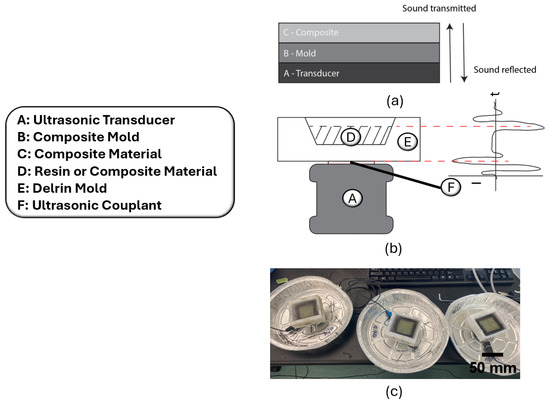
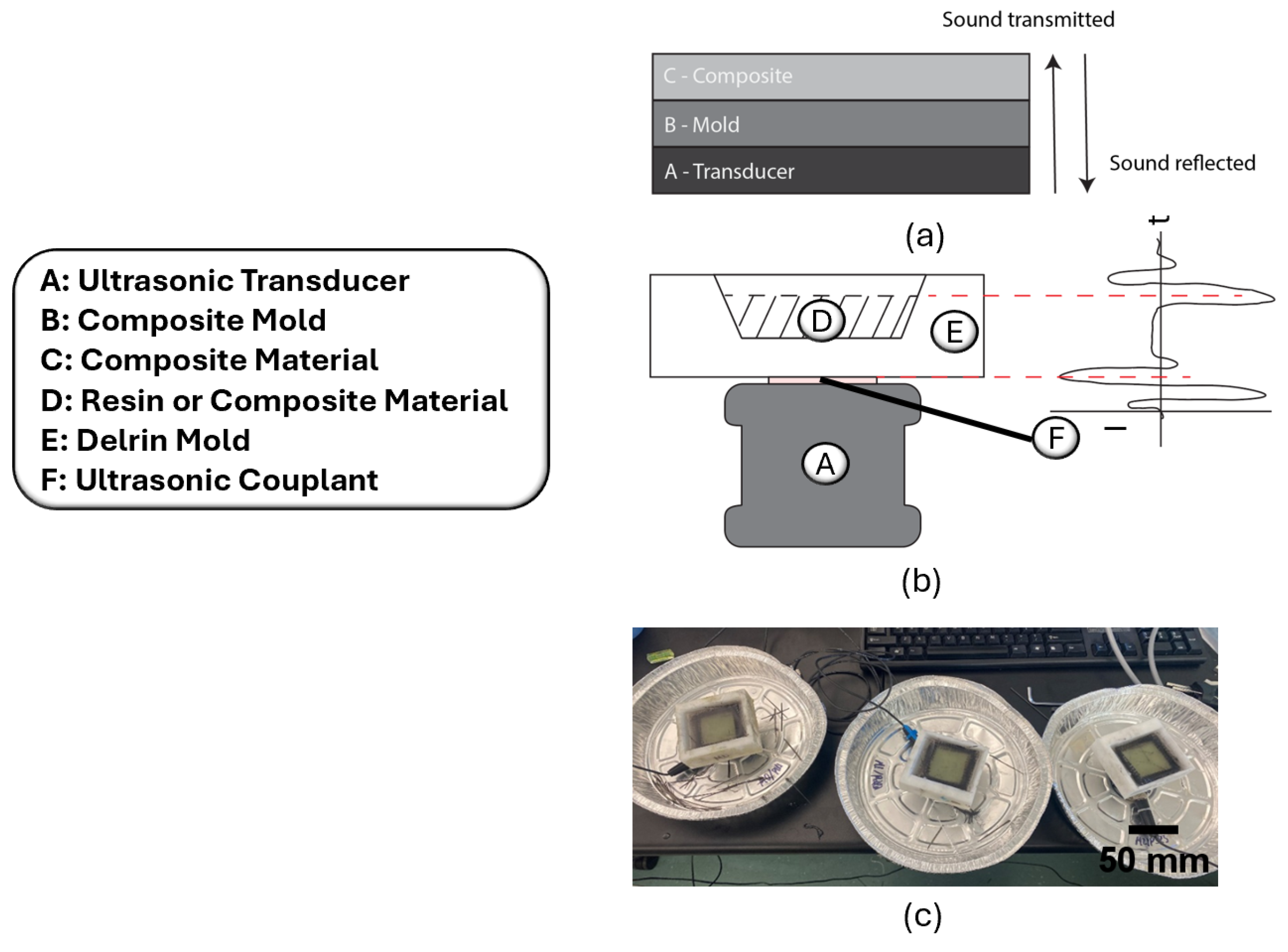
Molds are fabricated from 76.2 mm × 76.2 mm × 25.4 mm Delrin blocks, which are milled out to a 6.4 mm-thick cavity as shown in Figure 1b. The machined mold cavity has a base of 44.5 mm × 44.5 mm with tapered sides to facilitate material removal post curing. The mold, prior to the resin infusion, was sprayed with Frekote 700-NC mold release (Henkel, Dusseldorf, Germany) to facilitate removal post cure. Ultrasonic signals are generated using a 25.4 mm-diameter, 0.5 MHz Videoscan contact transducer (Olympus/Evident, Center Valley, PA, USA) with a thin layer of VersaSonic (Echo Ultrasonics, Bellingham, WA, USA) high-temperature gel couplant with an operating temperature up to 700 °C. The acoustic gel is placed between the transducer and the Delrin mold to ensure continual acoustic coupling throughout the test. Data was collected using an Focus PX (Olympus/Evident, Breiningsville, PA, USA) inspection system. This pulser/receiver can operate multiple transducers at once, and, in the present study, 3 tests were performed in parallel. The resin system studied is exothermic, but has a sufficiently slow rate of reaction over a 24 h period, coupled with the convection cooling from the environment or the convection furnace, that the component was in a near-isothermal state based on surface temperature observations.
Figure 1.
(a) General testing schematic showing the order of components for testing and the sound direction of travel, (b) schematic of the testing setup with an example acoustic wave, and (c) the actual experimental setups showing three fiberglass samples inside a Delrin mold set atop an ultrasonic transducer.
Two types of material systems were studied, each with various thicknesses and environmental conditions, with the full test matrix shown in Table 1. Following curing, each sample was measured in five locations to obtain an average thickness across the sample for use in calculating the speed of sound through the material and the degree of cure.
Table 1.
Material system geometry and environmental condition variations.
The thermoset resin used was a two-part epoxy resin, ProSet INF 114 resin and ProSet INF 211 hardener (ProSet, Bay City, MI, USA). The resin for each set of three tests was mixed in a single container and divided into separate containers by weight for each mold following mixing to achieve the desired nominal thickness. For the neat resin samples, each individual resin container is poured into its respective mold. The resin is mixed under vacuum in a FlackTek (Landrum, SC, USA) mixer at 800 rpm for 0.5 min followed by 1500 rpm for 4.5 min to ensure homogenization of the resin and hardener and to remove entrapped air. The fiberglass reinforcement material was an 85 g plain weave E-glass fabric with a nominal thickness of 0.1 mm purchased from ACP Composites (Livermore, CA, USA). For the fiberglass-filled samples, a thin layer of resin was poured into the mold and spread over the entire base. Then, a nominally 44.5 mm × 44.5 mm square of fiberglass fabric was placed into this mold followed by the placement of a thin film of resin on the fiberglass. This pattern was repeated until 28 layers of fabric had been placed in the mold. Finally, the remaining resin was poured overtop to ensure the fabric was fully encased in resin to the desired thickness. Once each sample was created, the mold with uncured resin was placed on the contact transducer and leveled to ensure constant material thickness throughout the test as shown in Figure 1b and allowed to cure for 24 h following the manufacturer’s recommended cure time, during which time acoustic testing was performed. The pulse repetition frequency (PRF) of the digitizer was set to 1 Hz, the minimum allowed by the system, to record a waveform every second, resulting in 86,400 A scans during the cure cycle. The present study used a pulse voltage of 190 V, a data capture rate of 25 MHz, and a pulse-width of 1000 ns, calculated using , where MHz. Because tests were performed isothermally, no temperature shift for the transducer was considered since both the material being tested and the transducer are held to a constant temperature over the duration of a test. However, if the cure cycle is temperature-varying, a correction factor would need to be applied for any transducer shifting. For example, the present transducer was found to have a 5% reduction in the acoustic amplitude between 22 °C and 40 °C.
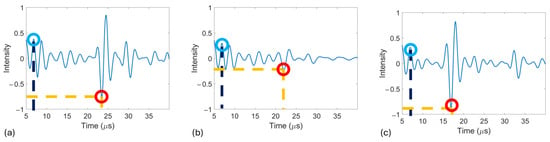
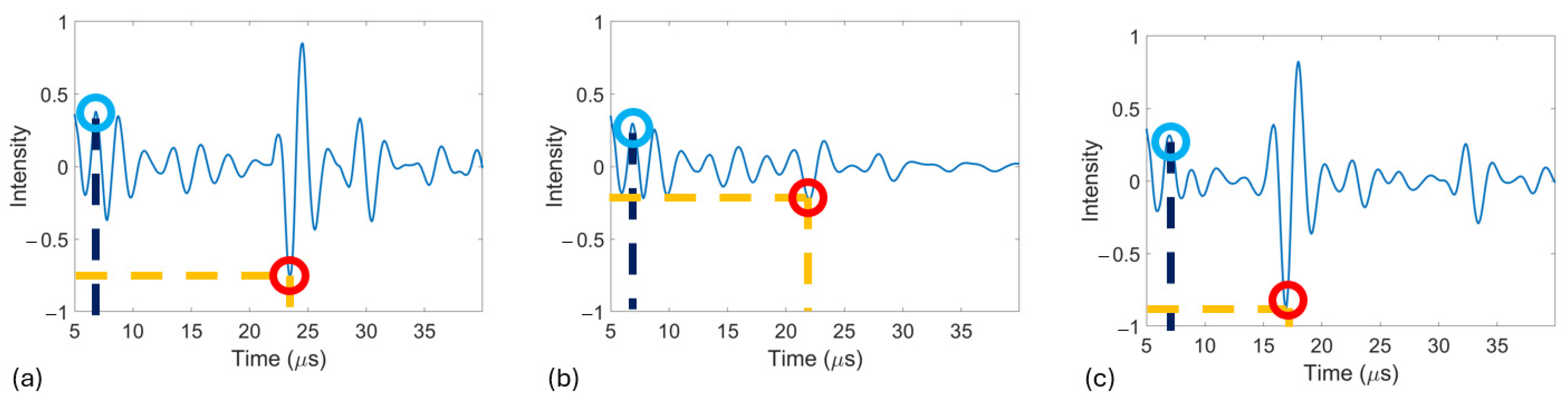
An example A scan at three different times during testing is shown in Figure 2. An A scan is the voltage received by the transducer during a single pulse of the piezoelectric ultrasonic transducer. In the present study, it is the voltage measured over a nominally 50 μs time frame where is the time when the piezoelectric is given the initial excitation. For simplicity, it is often normalized between the range of [−1, 1], whether for an individual A scan or normalized by the maximum over a range of A scans. The voltage of the A scan is considered the signal intensity. The three times shown in Figure 2 are selected from a representative A-stage cure state, B-stage cure state, and C-stage cure state. The A scans exclude data showing the transducer excitation and begin presenting data shortly before the first reflection peak from the interface between the Delrin mold and the resin/composite. Throughout the entire test, the gain is held constant and is set just after mixing while the resin is in the early A-stage. In Figure 2a, the positive Delrin reflection peak occurs at about 5.5 μs, shown by the light blue circle and the vertical dark blue dashed line, and the negative resin/air interface reflection peak occurs at about 23 μs, shown by the red circle and the vertical yellow dashed line. In terms of intensity, the Delrin reflection peak intensity is just below 40% of the allowed intensity at the selected gain while the resin/air interface reflection peak absolute intensity is nominally 70% of the intensity. The respective circles and dashed lines denote the corresponding peaks in the other subplots for Figure 2 for the B- and C-stage cure examples. The positive peak for the Delrin and the negative peak for the resin are chosen due to reflections causing the mode shift when encountering the air interface. Similarly, when looking at Figure 2, the initial Delrin/resin interface reflection peak remains at 5.5 μs throughout testing, but the resin/air interface reflection peak continually shifts in time during curing. Notice that the intensity for the resin/air interface reflection in Figure 2b decreases during the B-stage curing to about 20% of the initial intensity. During the C-stage cure, shown in Figure 2c, the resin/air interface reflection peak has shifted significantly to about 17 μs, whereas the intensity has increased to nominally 80% of the initial intensity. These A scans at the three stages of curing show how the acoustic properties change during the curing for this material system. Because there is a noticeable change in peak properties, the location in time of the backwall reflection peak and its intensity are investigated in the later section of this manuscript.
Figure 2.
Raw A scans at different wall-clock times during testing with (a) A-stage—at the beginning of testing, (b) B-stage—during gelation, and (c) C-stage—near the end of testing and no further change occurs.
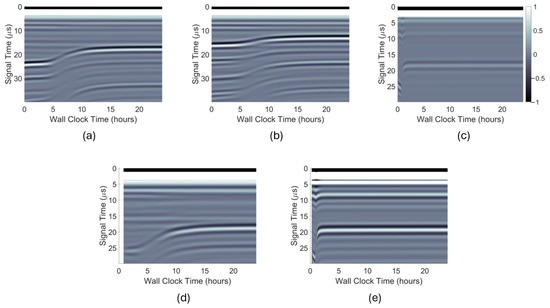
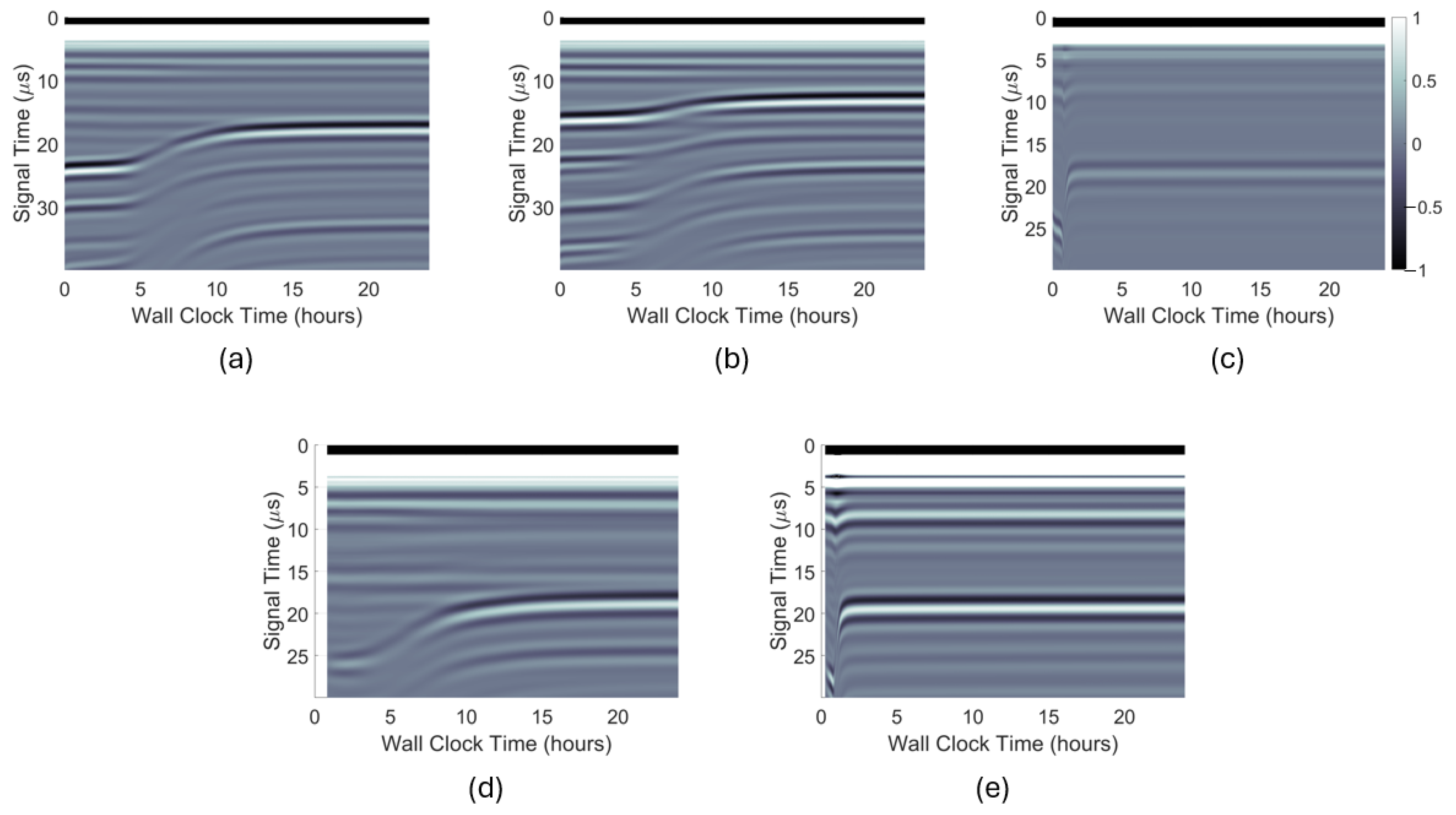
A B scan is a collection of A scans over a given dimension. Typically, this dimension is space, such as a series of A scans taken across a line of points over some component. In the present study, we take the second dimension to be time, where we collect data for nominally 50 microseconds, larger than the duration of a single pulse and corresponding echo, at a given moment in wall-clock time. Then, a few moments later (in the present study, this is 1 s later), we again excite the transducer and collect voltage data for another 50 microseconds. In essence, a B scan is a collection of A scans plots, rotated 90 degrees, and color-coded by signal intensity. In standard raster scanning, a B scan is performed by taking a series of A scans along a single spatial projection and displaying them on what can appear as a waterfall image. A similar representation is provided in the present study where the A scans, taken at discrete moments in time, can be visualized in something akin to a B scan, such as shown that in Figure 3, where the scan axis is wall-clock time. For such B scans, the abscissa (or horizontal) axis is the testing time designated , measured in hours, and the ordinate (or vertical) axis is the signal time designated as recorded by the transducer, measured in μs. The signal intensity is normalized to have a range of using the value of max over all testing time and signal time to remove any issues by the selection of the gain used for signal capture. One representative B scan from each of the five testing conditions listed in Table 1 is shown in Figure 3. For all samples, the resin/air interface reflection peak occurs at a later time (μs) at the onset of the test and shifts earlier in time as curing progresses. This change is gradual and, once the resin is fully cured, this peak does not move and plateaus, indicating no internal changes of the resin system. When looking at the neat resin system at room temperature with a thickness of 12.7 mm and 6.4 mm, respectively shown in Figure 3a and Figure 3b, the gradual transition of the resin/air interface reflection is seen to occur at the same wall-clock times. The only difference for the specimen with the two thicknesses are the ending locations in signal time for the resin/air interface reflection peak, where this peak occurs earlier for the thinner sample shown in Figure 3b. When comparing between the neat resin system at room and elevated temperature (respectively, Figure 3a and Figure 3c), the backwall reflection shifts to an earlier time for the elevated temperature. This corresponds to the earlier gelation time for the elevated temperature cure specimen. This also results in the acoustic steady state occurring earlier in time due to the faster curing of the thermoset.
Figure 3.
B-scan examples for each test type: (a) 12.7 mm-thick resin at 22 °C, (b) 6.4 mm-thick resin at 22 °C, (c) 12.7 mm-thick resin at 40 °C, (d) 12.7 mm-thick composite at 22 °C, and (e) 12.7 mm-thick composite at 40 °C.
2.2. Analysis Methods to Correlate Acoustic Data to Cure State
To monitor the cure, two aspects of the signal are investigated, specifically the speed of sound through the material and the power of the reflection peak throughout the test. As the range when these calculations occur changes in time due to gelation and curing, a custom peak-tracking algorithm is developed.
2.2.1. Tracking Approach
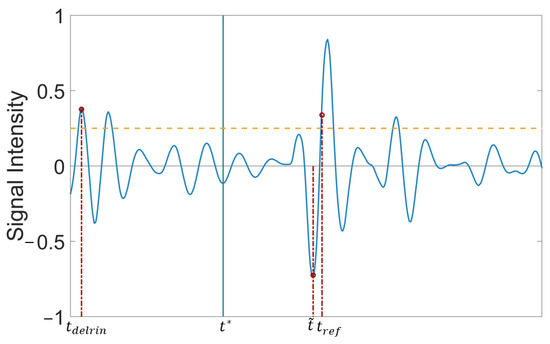
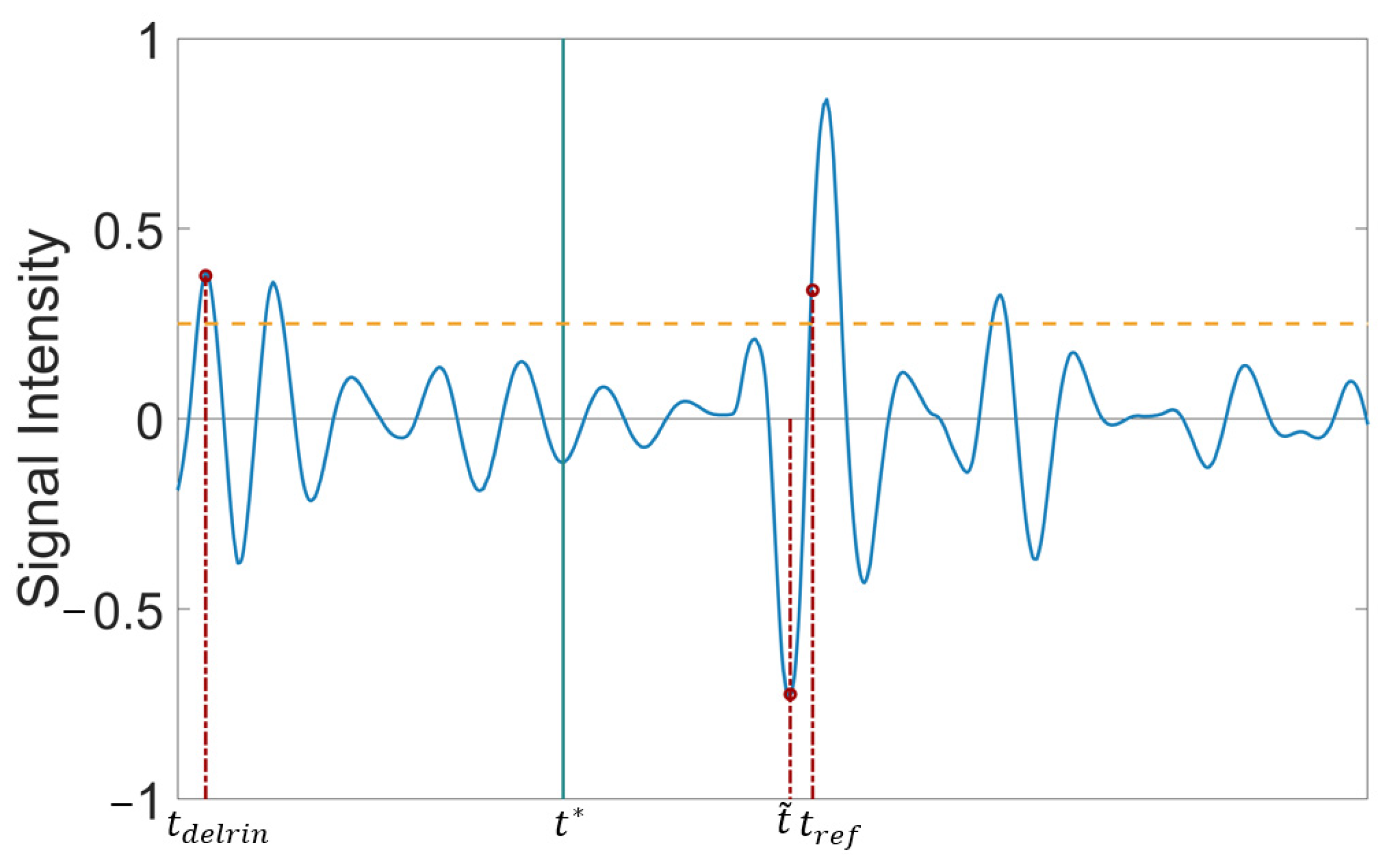
A typical A scan is shown in Figure 4 without units on the signal time axis. The digitizer captures the voltage of the transducer at a sampling rate of 100 MHz, which is directly correlated to the acoustic intensity termed where is the signal time, measured in µs, and is the wall-clock time of the resin system, measured in hours. The pulse repetition frequency (PRF) at which the transducer is excited is 1 Hz such that ; thus, one A scan is recorded every second. The typical acoustic echo response is shown in Figure 4. There are several times of interest to track, specifically, the initial echo between the Delrin and the resin , the first negative peak from the backwall , and the time of the first positive signal value above a prescribed threshold . In the present configuration, the initial Delrin echo time occurs nominally 6 µs after the initial transducer excitation but will vary based on the mold thickness or if the mold was constructed of another material.
Figure 4.
Initial A scan showing times used in the peak-tracking algorithm.
To initiate tracking, a starting point to search for the first negative peak of the backwall time is needed. This is carried out by manually selecting a point in time, after the Delrin/resin interface reflection and before the first positive peak of the reflection of the resin/air interface. There is wide latitude in the choice of , as any point between the last positive Delrin/resin reflection peak and the first positive resin/air reflection peak will be acceptable. In application, the operator would know the part thickness prior to testing, so a reasonable value of can be based on the part thickness for a starting value. This is carried out so that only data points from forward in signal time until the end of the A scan are used for tracking. Then, an intensity threshold, , shown by the horizontal yellow dashed line in Figure 4, is defined. This value will vary based on the gain used for the sample. The approach is to select a value that is less than the peak intensity of the second positive resin/air reflection peak value but greater than the noise level surrounding the reflection. If the threshold value is too low, a noise peak may be incorrectly selected as the reflection peak. In the above A scan, values for of would be acceptable. Essentially, any value greater than the intensity of the first positive peak of the resin/air reflection and less than the second positive peak of the resin/air reflection is an acceptable value for . Similar to , in application, the operator would set the gain to a value such that the front wall reflection is at about 80% of the digitizer range, which would then give the operator an estimate for what the value should be. The B-stage cure example shown in Figure 2b demonstrated the importance of good gain and selection. Had the gain been too low or an selected outside of the correct bounds, the signal would not be identified above the surrounding noise. Next, the value is defined as the first rising wave of the reflection peak when for . This is carried out using MATLAB’s (version R2023a, Mathworks, Natick, MA) inbuilt find function. Once is determined, the gradient at is calculated using
from which the direction to the nearest local minimum is established and the algorithm iteratively searches points surrounding the value to identify such that is a local minimum. As the data can sometimes have electrical noise, once a local minimum is identified, the data points near the minimum are gathered to identify if a lower nearby local minimum is present. It was found that selecting a region nominally 1/4th of the period of the acoustic wave was sufficient to properly identify the local minimum. From that region, the local minimum is then selected, and the corresponding time is labeled . This approach of finding a range of values from which the minimum occurs within is performed for each captured A scan over the 24 h test. By discretely analyzing each individual A scan without using the time value from a previous iteration, self-corrections in the analysis can occur when the calculated value for the local minimum is incorrect due to electrical noise or when the signal becomes highly damped such as during gelation. This allows the approach to also be applicable to check the instantaneous cure state of a component at any point during the cure process.
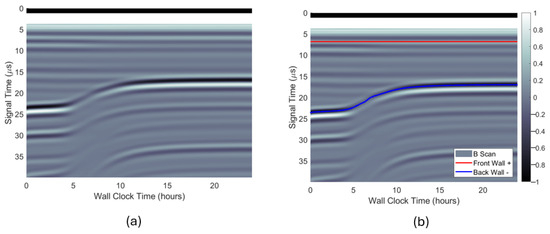
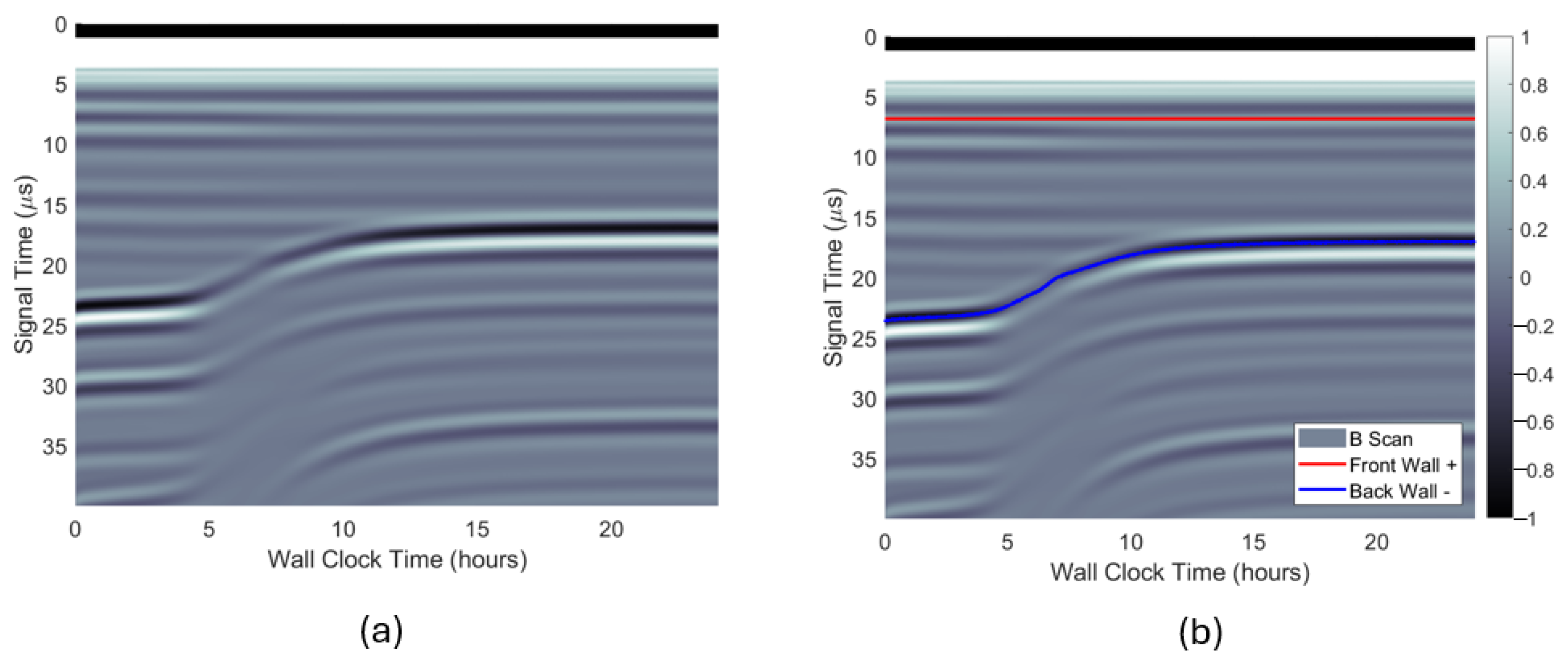
An example B scan is shown in Figure 5a, specifically for one of the 20 °C tests of the nominally 12.7 mm-thick specimen. The location in time for the material back wall reflection begins at about 15 μs for the 6.4 mm samples and about 25 μs for the 12.7 mm samples. This initial back wall reflection begins with a higher intensity, denoted by the lighter color. Then, as the resin enters the gelation stage, or B-stage, the location of the back wall reflection, in terms of the signal time, , decreases and the intensity of the signal decreases. This decrease in the intensity is due to sound attenuating more as the resin begins cross-linking and transitioning from a more liquid-like state to a more solid-like state, termed gelation. After gelation, the back wall reflection time continues to decrease and asymptotically approaches a single value as the cure process finishes. During this transition, the intensity of the signal increases asymptotically as the material reaches full cure. The B scans can be used to verify that the correct peak is being tracked and verify the quality of tracking. Figure 5b shows the same B scan with positive peak of the front wall tracked as shown by the solid red line and the negative peak of the back wall tracked shown by the solid blue line.
Figure 5.
Example B scan for 12.7 mm-thick neat resin at 22 °C where (a) is the raw B scan, and (b) is the B scan where the peak for the Delrin/resin interface and the resin/air interface are tracked.
2.2.2. Speed of Sound for Degree of Cure
Once the time of the backwall echo and the Delrin/resin interface is known, the instantaneous speed of sound is calculated. To obtain the speed of sound, the thickness of the resin or laminate must be known, which can be estimated during processing or known after testing using micrometers. The speed of sound is defined as
where the value of 2 comes from the use of pulse-echo ultrasound. Based on the experimental observations, shown in Section 3, the speed of sound was observed to monotonically increase and follow a similar type of curve to that of the degree of cure. Thus, in the present research, we propose that the degree of cure can be approximated as
where denotes the degree of cure with , is the speed of sound through the material when the resin is in the liquid state at the beginning of curing, and is the speed of sound through the material when the resin is in the solid state at the end of curing. The speed of sound for the solid state, , and the liquid state, , are the average speed of sound values at the end and beginning of curing, respectively, for each respective material and thickness condition. In Section 3, it will be observed that a linear correlation between the instantaneous speed of sound and the degree of cure is acceptable.
2.2.3. Reflected Power
The power for the resin/air interface reflected peak is calculated as
where is a scalar that carries the proper units and scaling to convert the signal intensity to power. The power is then normalized by the peak power as and is now a unitless parameter. The bounds for integration are chosen relative to the first negative peak from the backwall time . In this study, was set as s before , and was set as s after . These values were selected based on the size of the resin/air reflection peak and were made constant since the size did not change during the cure process. However, this is a material parameter and would need to be changed if the material system changed. An aspect of future work could be tracking the peaks surrounding the negative resin/air reflection peak () and using the times for these peaks as the bounds of integration.
2.3. Rheological Testing Methodology
To correlate the ultrasound results to the storage and loss modulus of the thermoset experiencing curing, rheological testing is performed in a MARS40 (ThermoScientific, Waltham, MA, USA) with a 2° cone and plate. The resin is mixed as in Section 2.1, and one test is presented at 22 °C over a 24 h period to compare against the ultrasound results.
3. Results
3.1. Speed of Sound Results
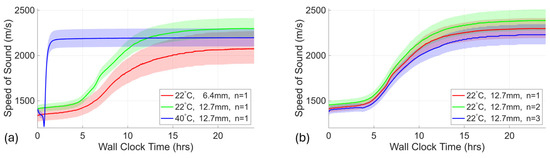
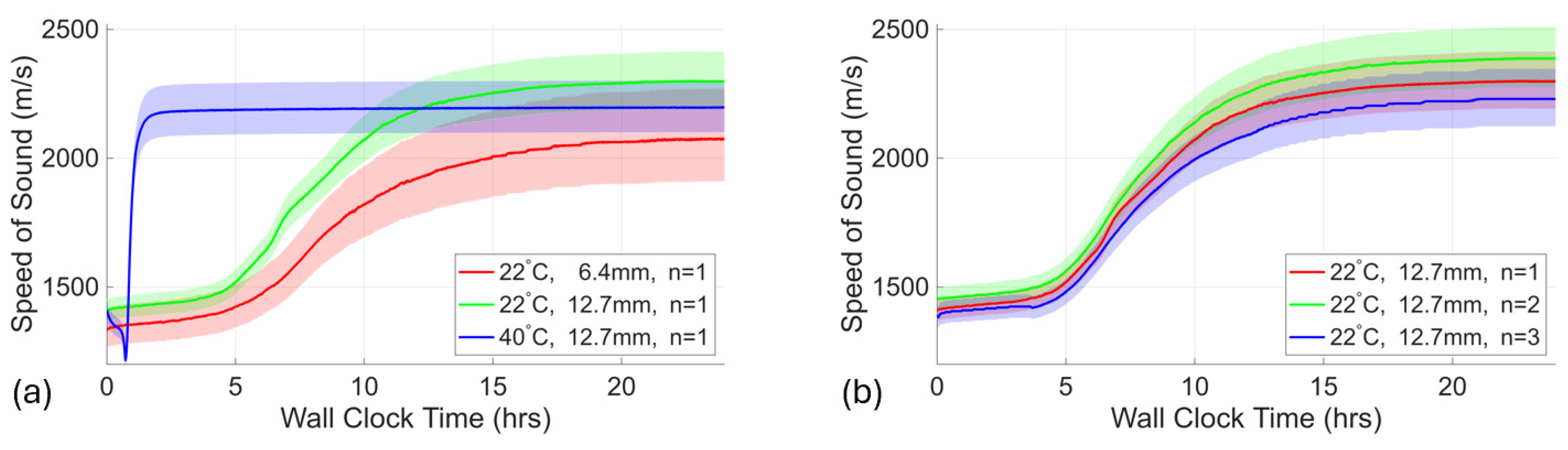
The speed of sound results are plotted in Figure 6a for one sample from each of the resin samples. Figure 6b is the speed of sound from each of the 12.7 mm-thick resin samples at room temperature. In Figure 6, the individual samples from the individual molds are denoted with , where is the first mold in the test, is the second mold in the test, and is the third mold in the test. The speed of sound data was smoothed using Gaussian smoothing, using the nearest s of collected data. The instantaneous speed of sound as a function of time is shown by the solid lines. The translucent shaded region surrounding the solid lines represents the average speed of sound uncertainty due to the temporal resolution limits of the transducer. For the present study, a 0.5 MHz transducer is used, and the resolution in pulse-echo mode is nominally one-quarter of the period, in this case, μs. Thus, the uncertainty in the speed of sound calculation is obtained by recalculating Equation (5) with a shift of μs. This uncertainty is shown in Figure 6 by the shaded region behind the solid lines. Thus, this is the expected error in the speed of sound calculation based on the resolution of the chosen transducer frequency. In general, the thicker the sample, the lower the uncertainty. In addition, an increase in frequency for the transducer would lower the uncertainty. Similarly, the slower the speed of sound, the lower the uncertainty, Unfortunately, this latter point means that, as the sample achieves the fully cured state, that is when the uncertainty will also be the greatest. It is proposed that future studies should work with higher frequencies to reduce the uncertainty.
Figure 6.
Speed of sound for (a) representative example from each of the three neat resin conditions and (b) all three samples for the thick neat resin at 22 °C.
The speed of sound for the 20 °C condition starts lower and monotonically increases throughout the entire cure; it increases faster during gelation in the middle of the cure and increases at a slower rate towards the end of the cure as the speed of sound reaches a plateau point. Similarly, for the elevated 40 °C condition, the speed of sound starts low and decreases slightly near the beginning of the cure to a minimum point, and then monotonically increases. This initial decrease has been seen by other researchers, such as Seisdedos et al. [34], which they argue is caused by the ability for polymer chain mobility at the beginning of curing that is hindered later in the cure. A similar decrease has been observed in the literature by other researchers when investigating thermoset composite materials at elevated temperatures when measuring the storage modulus. A similar decrease has also been observed in the literature by other researchers when investigating thermoset composite materials at elevated temperatures when measuring the storage modulus [33]. Like the 20 °C condition, the speed of sound increases quickly during gelation and increases at a slower rate as a full cure is achieved and the speed of sound plateaus.
3.2. Degree of Cure from Ultrasonic Time of Flight
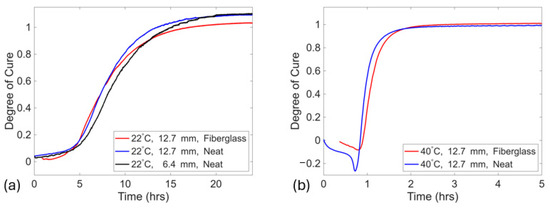
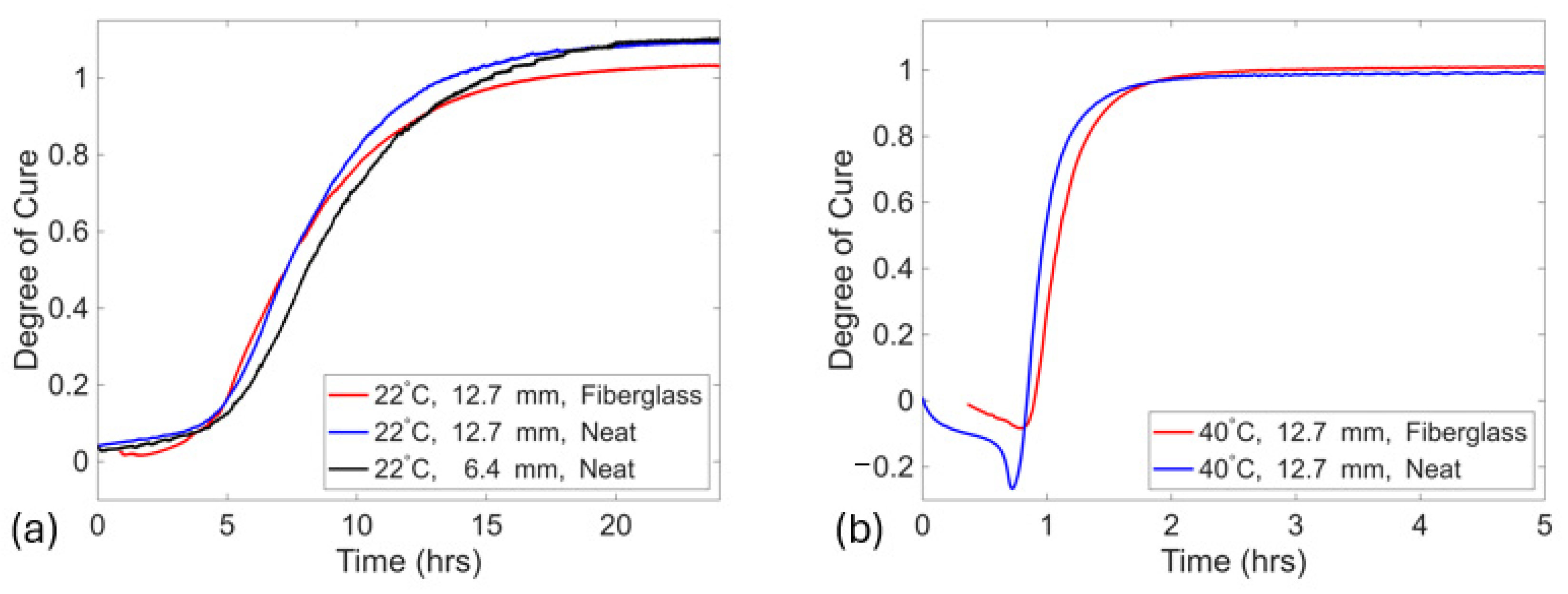
Once the speed of sound is determined, the degree of cure is calculated using Equation (6), the results of which are shown through a representative curve for a single sample in Figure 7 for each test configuration. The degree of cure was normalized based on the average speed of sound at the end of the testing period, , among the like samples, which are the samples of the same thickness, same material system, and same temperature condition. Observe that the degree of cure plots for the resin system at room temperature are quite similar in shape and transition times. Similarly, the same can be said of the neat resin and the fiberglass composite in that they have the same cure profile at the elevated temperature. This is expected as the changes being captured by the acoustic wave would be due to a material change, and it is assumed that all of the reaction is exclusively in the resin system and that change is a function of time and temperature and independent of the suspended fiber reinforcement. Observe that the trends in the degree of cure plot are identical to that of the speed of sound plot, as it is assumed in Equation (6) that they are linearly correlated.
Figure 7.
Degree of cure calculated based on speed of sound using the in situ cure monitoring method for neat resin and fiber glass at (a) 22 °C and (b) 40 °C.
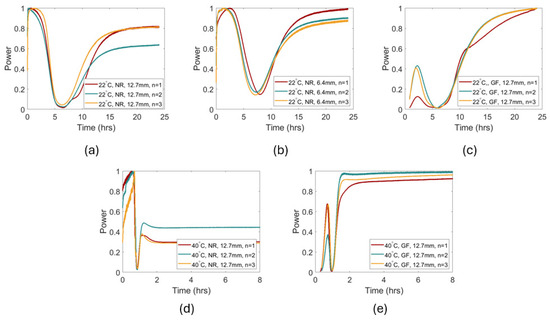
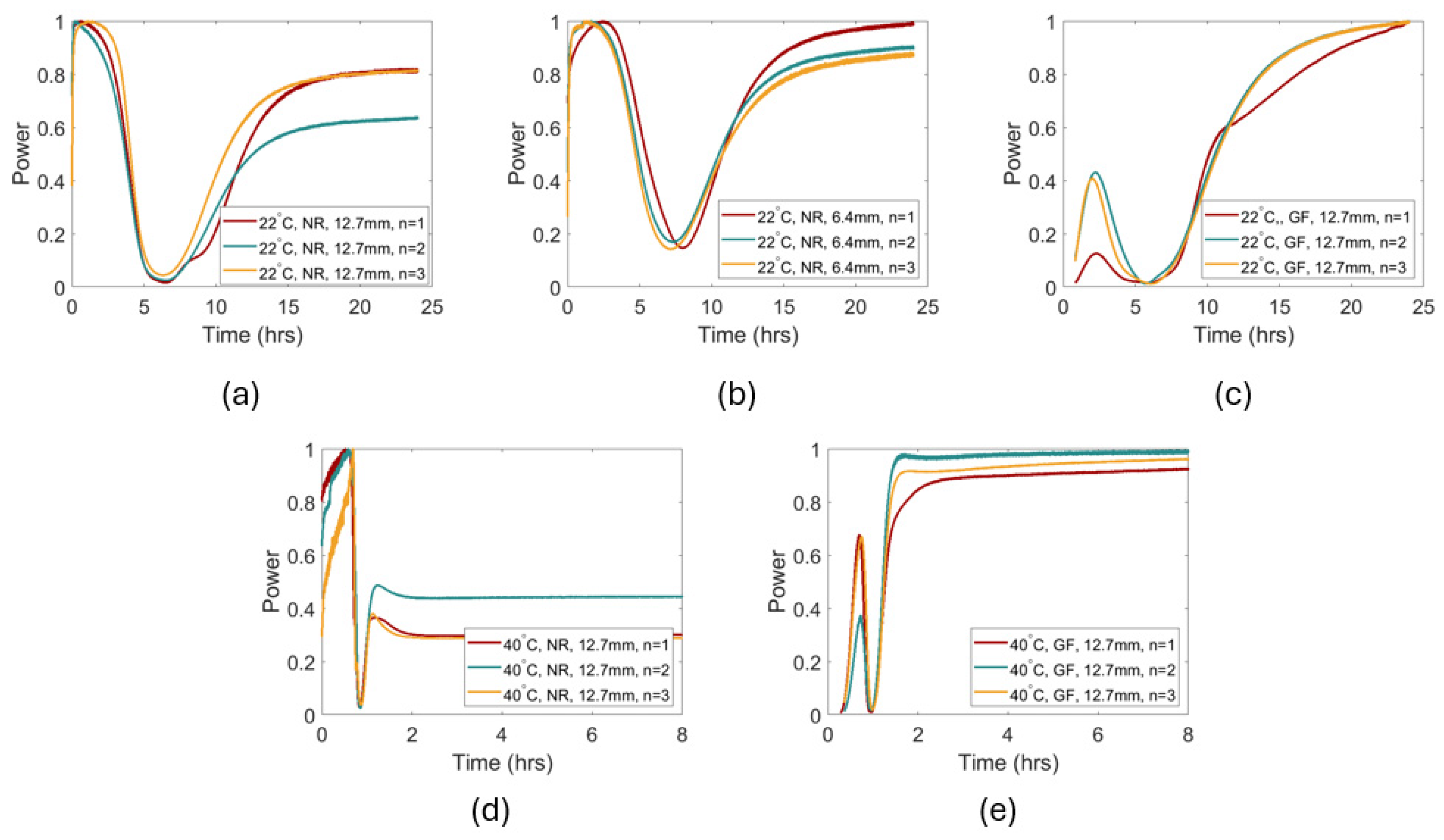
Figure 8 shows the ultrasonic acoustic power, as defined in Equation (7), over the complete cure cycle for the nine neat resin (NR) and the six fiberglass (GF) samples. For all samples, the power initially increases at the beginning of curing during the initial A-stage, then begins a drastic decrease as gelation begins to occur in the B-stage. As the resin transitions from the B-stage to the C-stage of the cure process, the acoustic power increases again until a plateau point. Unlike the speed of sound through the material, the power does not monotonically increase, so an absolute power value cannot be used as an indicator since the same value may occur twice during the cure cycle. But what is interesting is that the minimum of the acoustic power occurs near the peak of gelation. Thus, monitoring the time rate of the acoustic power can be used to identify whether gelation has occurred, providing insight as to whether the part is nearing the C-stage and can be demolded. The curves between the different sample types are not identical. For example, the higher temperature samples have a more significant initial increase before the reduction in the acoustic signal power during gelation. This is hypothesized to be caused by the decrease in the viscosity as the sample is heated from room temperature to the elevated temperature. It is also interesting to note that, for both the fiber-reinforced systems, the initial power is quite low relative to the acoustic power at full cure. This is hypothesized to be caused by the internal reflections and scatter caused by the liquid resin/fiber interfaces, but, as the specimen cures the solid material, the better match in acoustic impedance between the cured resin and the fiberglass allows for better signal propagation through the sample. Interestingly, the power shown in Figure 8c,e, which are the fiberglass samples, comes to a plateau later in time than the neat resin samples at both temperatures. This shows that the addition of the fiberglass elongates the curing time. This could be due to the addition of the fiberglass changing the chemistry of curing in some manner, for instance, with how the resin interacts with the sizing on the fibers; however, to determine what specifically is going on, more testing would be required.
Figure 8.
Normalized power at 22 °C for (a) 12.7 mm neat resin, (b) 6.35 mm neat resin, and (c) 12.7 mm-thick fiberglass filled samples, and normalized power at 40 °C for (d) 12.7 mm neat resin and (e) 12.7 mm-thick fiberglass filled samples.
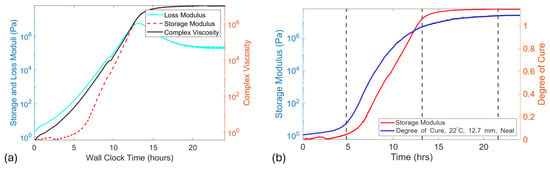
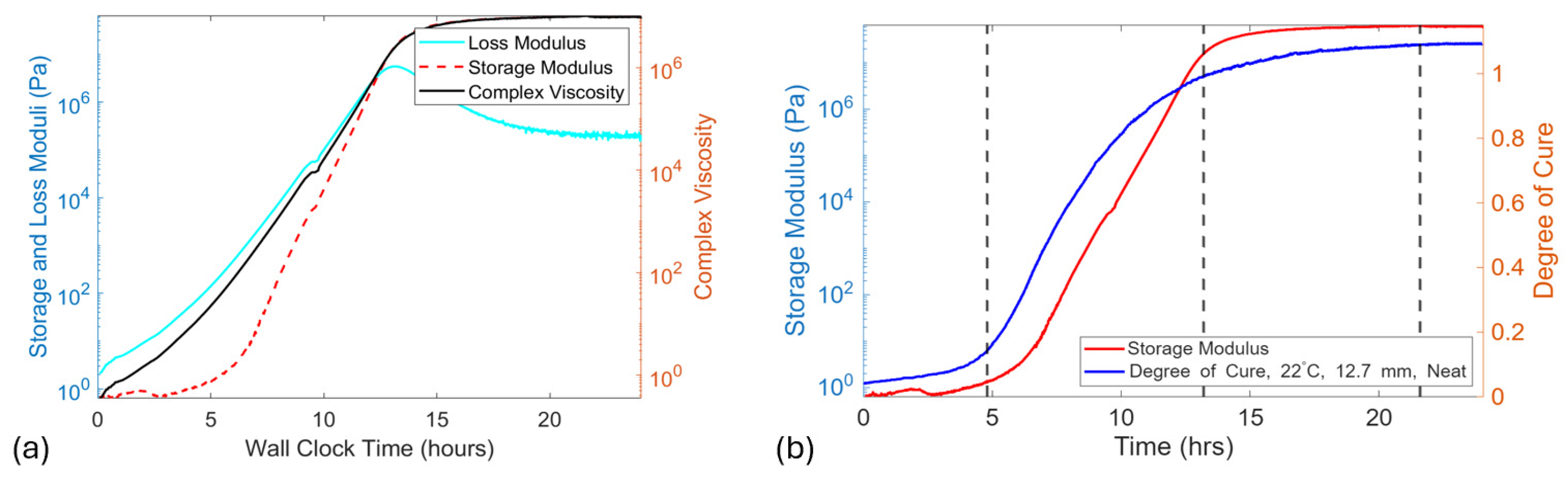
Figure 9 shows the storage modulus, loss modulus, and complex viscosity for the resin at 22 °C and a comparison between the storage modulus and the degree of cure for a single 22 °C, 12.7 mm-thick, neat resin sample from the ultrasound testing. The storage modulus and complex viscosity monotonically increase to a plateau, while the complex viscosity increases to a peak, followed by a decrease to a plateau. These trends for the storage modulus and loss modulus match those of, respectively, the speed of sound and the acoustic power plots of Figure 7 and Figure 8. It is consistent that the peak of the loss modulus, which also corresponds to the peak of gelation, would align with the largest acoustic signal attenuation due to the viscoelastic absorption of the acoustic energy. Thus, the monitoring of the acoustic energy can be used as an indicator of how close the state of cure is and if a material system is before or after gelation. From a rheological perspective, the crossover point between the storage and loss modulus is often used as an indicator that it is nearing the demolding time and the peak of gelation has occurred. This point occurs slightly after that of the minimum of the acoustic power curve. This non-destructive information can be useful as it can be used as an indicator for if gelation is still occurring. For instance, if solidification is increasing, the acoustic power is also increasing, whereas, if the onset of solidification has not occurred but the polymer is no longer in the liquid state, the acoustic energy is greatly reduced. When looking at Figure 9b, three vertical lines are provided, one near 5 h, a second at 13 h, and the third at 22 h. Notice that, at the 5 h mark, both the storage modulus and the ultrasonic estimation of the degree of cure begin to rise, indicating the end of the A stage, or what is commonly referred to as the pot-life for fabricators. Around the 13 h mark, both the storage modulus and the ultrasonic estimation of the degree of cure are beginning to plateau. What is different is that the storage modulus is essentially flat-lined from the 15th hour until the end of the testing, whereas the ultrasonic measure for the degree of cure seems to continue to slowly increase until the 22nd hour. Looking at the loss modulus in Figure 9a, there continues to be a slow change from the 15th hour until the 22nd hour. Thus, the ultrasonic degree of cure tracks the dominant change of the storage modulus, and, as that change comes to an end, the ultrasonic estimation of the degree of cure tracks, inversely, the loss modulus. By the 23rd hour, the rate of change in any of the parameters has plateaued, and testing is stopped at the 24th hour.
Figure 9.
Rheometer data for (a) 22 °C showing the storage modulus, loss modulus, and complex viscosity and (b) a comparison of the storage modulus from the 22 °C rheometer data with the 22 °C, 12.7 mm-thick, neat resin ultrasound degree of cure data.
4. Conclusions
This study developed a method for instantaneously monitoring the degree of cure for a two-part epoxy thermoset resin, both in the neat state and when filled with fiberglass fabric, using a non-invasive, non-destructive approach with indirect-contact ultrasound. An algorithm was presented to follow the reflection peak caused by the resin/air interface over a 24 h testing period. The location of this peak was subsequently used to calculate the speed of sound through the material over time and the power around that peak over time without requiring information from previous data in the cure cycle. It was determined that the speed of sound can be used to monitor the degree of cure as it follows a similar trend to the storage modulus determined using rheological testing. Power is a useful indicator for the cure state as the minimum power correlates to the peak gelation time. Thus, determining if the component is ready for demolding can be identified by observing the time derivative of the acoustic power. The quantification of the instantaneous degree of cure is also presented using the captured ultrasonic waveform. Future improvements in resolution should focus on higher-frequency transducers as this would cause the wavelength to be smaller, and, thus, the resolution would be better. Another limitation is that the resin temperature must be corrected within the speed of sound calculation if testing follows a curing cycle with temperature changes. An aspect of future work would be to also track the positive peaks, before and after, of the resin/air interface for the bounds of integration. It is also recommended that further rheological testing should be done at elevated temperatures to compare the 40 °C ultrasound data to verify the validity of the study. It is speculated that the present work can apply to fiber-reinforced systems other than fiberglass. Early internal studies have investigated carbon fiber reinforcements and there is potential for this method in such an application. The challenges will be in identifying a transducer frequency that does not cause excessive internal reflections as the various interfaces. Another aspect of future work could be to look at a combination of elevated temperatures and pressures as many cure cycles use a combination of elevated temperatures and pressures beyond the current temperatures investigated in this study. Similarly, another aspect of future work would be to perform testing at varying temperatures as many cure cycles are not performed isothermally.
Author Contributions
Conceptualization, D.A.J.; methodology, S.M.R., J.C.W., T.J.F., and D.A.J.; software, S.M.R. and D.A.J.; validation, S.M.R. and D.A.J.; formal analysis, S.M.R.; investigation, S.M.R. and J.C.W.; resources, T.J.F. and D.A.J.; data curation, S.M.R. and J.C.W.; writing—original draft preparation, S.M.R. and D.A.J.; writing—review and editing, S.M.R., J.C.W., T.J.F., and D.A.J.; visualization, S.M.R. and D.A.J.; supervision, T.J.F. and D.A.J.; project administration, D.A.J.; funding acquisition, T.J.F. and D.A.J. All authors have read and agreed to the published version of the manuscript.
Funding
This research was funded internally by Baylor University.
Institutional Review Board Statement
Not applicable.
Data Availability Statement
The models are described in this study and available within this article. The data can be provided to interested researchers upon a reasonable request to the corresponding author.
Conflicts of Interest
The authors declare that they hold several patents related to the technology described in this manuscript. The list of related patents held by the authors are listed as: (1) U.S. Patent No. US 11,650,183, System and Method for Real-Time Degree of Cure Evaluation in a Material, May 2023, D.A. Jack, (2) U.S. Patent No. US 12,066,405, System and Method for Real-Time Degree of Cure Evaluation in a Material, August 2024, D.A. Jack, (3) U.S. Publication No. US 2024/0402134, System and Method for Real-Time Degree of Cure Evaluation in a Material, December 2024, D.A. Jack, (4) U.S. Publication No. US 2024/0426786, Instantaneous In-Situ Resin and Resin Composite Cure Monitoring, December 2024, D.A. Jack, S. Rose, J. Wilkins, and T. Fleck. The funder, Baylor University, had no role in the design of the study; in the collection, analyses, or interpretation of the data; in the writing of the manuscript; or in the decision to publish the results.
References
- Fink, J.K. Reactive Polymers—Fundamentals and Applications—A Concise Guide to Industrial Polymers; Elsevier: Cambridge, MA, USA, 2018. [Google Scholar]
- Blackman, N.J.; Jack, D.A.; Blandford, B.M. Improvement in the Quantification of Foreign Object Defects in Carbon Fiber Laminates Using Immersion Pulse-Echo Ultrasound. Materials 2021, 14, 2919. [Google Scholar] [CrossRef] [Scilit] [PubMed]
- Benammar, A.; Drai, R.; Guessoum, A. Detection of Delamination Defects in CFRP Materials Using Ultrasonic Signal Processing. Ultrasonics 2008, 48, 731–738. [Google Scholar] [CrossRef] [Scilit]
- Rus, J.; Gustschin, A.; Mooshofer, H.; Grager, J.-C.; Bente, K.; Gaal, M.; Pfeiffer, F.; Grosse, C.U. Qualitative Comparison of Non-Destructive Methods for Inspection of Carbon Fiber-Reinforced Polymer Laminates. J. Compos. Mater. 2020, 54, 4325–4337. [Google Scholar] [CrossRef] [Scilit]
- Blandford, B.M.; Jack, D.A. High Resolution Depth and Area Measurements of Low Velocity Impact Damage in Carbon Fiber Laminates via an Ultrasonic Technique. Composites Part B 2020, 188, 107843. [Google Scholar] [CrossRef] [Scilit]
- Hsu, D.K.; Im, K.-H.; Cho, Y.-T.; Park, J.-W.; Sim, J.-K.; Yang, I.-Y. Characterization of CFRP Laminates’ Layups Using Through-Transmitting Ultrasound Waves. KSME Int. 2002, 16, 292–301. [Google Scholar] [CrossRef] [Scilit]
- Stair, S.L.; Moore, D.G.; Jack, D.A.; Nelson, C.L. Non-Destructive Evaluation of the Bondline Interface Between Carbon Fiber Reinforced Laminated Composites and Metal Materials Via Ultrasonic Inspection Methods. 2017. Available online: https://www.osti.gov/biblio/1429656 (accessed on 28 January 2026).
- Pulipati, D.P.; Blandford, B.M.; Ravindranath, P.K.; Jack, D.A. Adhesive Thickness Quantification of CFRP Laminates Using Ultrasound. 2021. Available online: https://www.ndt.net/search/docs.php3?id=26963 (accessed on 28 January 2026).
- Zhang, K.; Gu, Y.; Li, M.; Wang, S.; Zhang, Z. Effects of Curing Time and De-Molding Temperature on the Deformation of Fiber/Epoxy Resin Prepreg Laminates Fabricated by Rapid Hot Press. Polym. Polym. Compos. 2019, 27, 301–313. [Google Scholar] [CrossRef] [Scilit]
- Biron, M. Thermosets and Composites—Material Selection, Applications, Manufacturing, and Cost Analysis; Elsevier: San Diego, CA, USA, 2014. [Google Scholar]
- Dodiuk, H.; Goodman, S.H. Handbook of Thermoset Plastics; Elsevier: Waltham, MA, USA, 2014. [Google Scholar]
- Bilyeu, B.; Witold, B.; Menard, K.P. Epoxy Thermosets and Their Applications III. Kinetic Equations and Models. J. Mater. Educ. 2001, 23, 189–204. [Google Scholar]
- Du, S.; Guo, Z.-S.; Zhang, B.; Wu, Z. Cure Kinetics of Epoxy Resin Used for Advanced Composites. Polym. Int. 2004, 53, 1343–1347. [Google Scholar] [CrossRef] [Scilit]
- Hardis, R.; Jessop, J.L.P.; Peters, F.E.; Kessler, M.R. Cure Kinetics Characterization and Monitoring of an Epoxy Resin Using DSC, Raman Spectroscopy and DEA. Compos. Part A 2013, 49, 100–108. [Google Scholar] [CrossRef] [Scilit]
- Vacher, S.; Molimard, J.; Gagnaire, H.; Vautrin, A. A Fresnel’s Reflection Optical Fiber Sensor for Thermoset Polymer Cure Monitoring. Polym. Polym. Compos. 2004, 12, 269–276. [Google Scholar] [CrossRef] [Scilit]
- Cusano, A.; Breglio, G.; Giordano, M.; Calabro, A.; Cutolo, A.; Nicolais, L. An Optoelectronic Sensor for Cure Monitoring in Thermoset-Based Composites. Sens. Actuators 2000, 84, 270–275. [Google Scholar] [CrossRef] [Scilit]
- Blößl, Y.; Hegedüs, G.; Szebényi, G.; Tábi, T.; Schledjewski, R.; Czigany, T. Applicability of Fiber Bragg Grating Sensors for Cure Monitoring in Resin Transfer Molding Processes. J. Reinf. Plast. Compos. 2020, 40, 701–713. [Google Scholar] [CrossRef] [Scilit]
- Yenilmez, B.; Sozer, E.M. A Grid of Dielectric Sensors to Monitor Mold Filling and Resin Cure in Resin Transfer Molding. Compos. Part A 2009, 40, 476–489. [Google Scholar] [CrossRef] [Scilit]
- Vogelwaid, J.; Hampel, F.; Bayer, M.; Walz, M.; Kutuzova, L.; Lorenz, G.; Kandelbauer, A.; Jacob, T. In Situ Monitoring of the Curing of Highly Filled Epoxy Molding Compounds: The Influence of Reaction Type and Silica Content on Cure Kinetic Models. Polymers 2024, 16, 1056. [Google Scholar] [CrossRef] [Scilit]
- Wu, Z.; Chen, Q.; Liu, D.; Fan, J.; Zhang, Q.; Chen, W. In Situ Monitoring of Epoxy Resin Curing Process: Using Glass Transition as a Bridge. Polym. Test. 2023, 117, 107871. [Google Scholar] [CrossRef] [Scilit]
- Moghaddam, M.K.; Breed, A.; Chaloipka, A.; Bodecker, A.; Habben, C.; Meyer, E.-M.; Brauner, C.; Lang, W. Design, Fabrication and Embedding of Microscale Interdigital Sensors for Real-Time Cure Monitoring during Composite Manufacturing. Sens. Actuators A Phys. 2016, 243, 123–133. [Google Scholar] [CrossRef] [Scilit]
- Vaidya, U.K.; Jadhav, N.C.; Hosur, M.V.; Gillespie, J.W., Jr.; Fink, B.K. Assessment of Flow and Cure Monitoring Using Direct Current and Alternating Current Sensing in Vacuum-Assisted Resin Transfer Molding. Smart Mater. Struct. 2000, 9, 727. [Google Scholar] [CrossRef] [Scilit]
- Pantelelis, N.; Bistekos, E.; Emmerich, R.; Gerard, P.; Zoller, A.; Gallardo, R.R. Compression RTM of Reactive Thermoplastic Composites Using Microwaves and Cure Monitoring. Procedia CIRP 2019, 85, 249–254. [Google Scholar] [CrossRef] [Scilit]
- Kim, W.C.; Jo, H.J.; Park, G. Concrete Cure Monitoring Using Piezoelectric Admittance Measurements. In Proceedings of the 2015 World Congress on Advances in Structural Engineering and Mechanic, Incheon, Republic of Korea, 25–29 August 2015. [Google Scholar]
- Lionetto, F.; Maffezzoli, A. Monitoring the Cure State of Thermosetting Resins by Ultrasound. Materials 2013, 6, 3783–3804. [Google Scholar] [CrossRef] [Scilit]
- Kyriazis, A.; Asali, K.; Sinapius, M.; Rager, K.; Dietzel, A. Adhesion of Multifunctional Substrates for Integrated Cure Monitoring Film Sensors to Carbon Fiber Reinforced Polymers. J. Compos. Sci. 2020, 4, 138. [Google Scholar] [CrossRef] [Scilit]
- Ivanov, O.V.; Bhavsar, K.; Morgan-Clague, O.; Gilbert, J.M. Monitoring of Curing Process of Epoxy Resin by Long-Period Fiber Gratings. Sensors 2024, 24, 3397. [Google Scholar] [CrossRef] [Scilit]
- Shepard, D.D.; Smith, K.R. A New Ultrasonic Measurement System Of The Cure Monitoring of Thermosetting Resins and Composites. J. Therm. Anal. 1997, 49, 95–100. [Google Scholar] [CrossRef] [Scilit]
- Lionetto, F.; Maffezzoli, A. Polymer Characterization by Ultrasonic Wave Propagation. Adv. Polym. Technol. 2009, 27, 63–73. [Google Scholar] [CrossRef] [Scilit]
- Schmachtenberg, E.; Schulte zur Heide, J.; Töpker, J. Application of Ultrasonics for the Process Control of Resin Transfer Moulding (RTM). Polym. Test. 2005, 24, 330–338. [Google Scholar] [CrossRef] [Scilit]
- Whitney, T.M.; Green, R.E., Jr. Cure Monitoring of Carbon Epoxy Composites: An Application of Resonant Ultrasound Spectroscopy. Ultrasonics 1996, 34, 347–353. [Google Scholar] [CrossRef] [Scilit]
- Zhao, J.; He, C.; Ren, L.; Huang, L. Application of Ultrasonic Technique for Cure Monitoring of Epoxy/Graphene Oxide-Carbon Nanotubes Composites. Appl. Compos. Mater. 2024, 31, 61–81. [Google Scholar] [CrossRef] [Scilit]
- Seisdedos, G.; Viamontes, E.; Salazar, E.; Pantea, C.; Davis, E.S.; Rockward, T.; Boesl, B. Real-Time Non-Destructive Characterization of Epoxy Resin Curing Kinetics and Mechanical Response for Enhanced Manufacturing Quality Control. Polym. Test. 2025, 143, 108678. [Google Scholar] [CrossRef] [Scilit]
- Ghodbani, N.; Marechal, P.; Duflo, H. Ultrasound Monitoring of the Cure Kinetics of an Epoxy Resin: Identification, Frequency and Temperature Dependance. Polym. Test. 2016, 56, 156–166. [Google Scholar] [CrossRef] [Scilit]
- Zhang, Y.; Wang, X.; Yang, Q.; Xue, R.; Zhang, J.; Sun, Y.; Xu, D.; Krishnaswamy, S. Research on Epoxy Resin Curing Monitoring Using Laser Ultrasonic. Measurement 2020, 158, 107737. [Google Scholar] [CrossRef] [Scilit]
- Pavlopoulou, S.; Soutis, C.; Staszewski, W.J. Cure Monitoring through Time-Frequency Analysis of Guided Ultrasonic Waves. Plast. Rubber Compos. 2012, 41, 180–186. [Google Scholar] [CrossRef] [Scilit]

Disclaimer/Publisher’s Note: The statements, opinions and data contained in all publications are solely those of the individual author(s) and contributor(s) and not of MDPI and/or the editor(s). MDPI and/or the editor(s) disclaim responsibility for any injury to people or property resulting from any ideas, methods, instructions or products referred to in the content. |
© 2026 by the authors. Licensee MDPI, Basel, Switzerland. This article is an open access article distributed under the terms and conditions of the Creative Commons Attribution (CC BY) license.