Article

Parameter Calculation of Coal Mine Gas Drainage Networks Based on PSO–Newton Iterative Algorithm


School of Mines, China University of Mining and Technology, Xuzhou 221116, China
*
Author to whom correspondence should be addressed.
Appl. Sci. 2026, 16(3), 1443; https://doi.org/10.3390/app16031443
Submission received: 6 January 2026 / Revised: 26 January 2026 / Accepted: 28 January 2026 / Published: 30 January 2026

Abstract

Comprehensive monitoring of gas extraction parameters is crucial for the safe production of coal mines. However, it is a challenge to collect the overall gas drainage network parameters with limited sensors due to technical and econoincorporating mic constraints. To address this issue, a nonlinear model for gas confluence structure is construed for the conservation of mass, energy, and gas state properties. Considering exogenous variables such as frictional loss correction coefficient (α) and air leakage resistance coefficient (β), as well as the iterative structure of drainage networks, a hybrid PSO–Newton algorithm framework is designed. This framework realizes iterative solutions for multi confluence structures by combining global optimization (PSO) and local nonlinear solving (Newton’s method). A case study using historical monitoring data from the 11,306 working face of S Coal Mine was conducted to evaluate the proposed algorithm at both branch and drill field scale. The results show that key parameters such as gas flow velocity, concentration, and density align with actual observation trends, with most deviations within 10%, verifying the accuracy and effectiveness of the algorithm. A deviation comparison between the standalone Newton’s method and the PSO–Newton algorithm further demonstrates the stability of the latter. By enabling the derivation of comprehensive network parameters from limited monitoring data, this study provides strong support for the intelligent management of coal mine gas extraction.

1. Introduction

As the primary energy source in China, coal will continue to dominate the energy supply for a considerable period [1]. With increasing mine depth, disasters prevention and control are becoming more challenging due to the compounding hazards of gas, roof instability and water inrush, etc. Among these, gas, a combustible gas associated with coal, not only causes major accidents like gas explosion and coal–gas outbursts, but also represents a clean energy source with significant development potential. Statistical data show that gas accidents accounted for one-third of all coal mine fatalities in China from 2018 to 2022, severely threatening mine safety [2]. Gas drainage, as the core means to reduce seam gas content and prevent gas over-limit, is not only a key measure to prevent gas accidents, but also an important way to promote the development and utilization of clean energy [3].
Pre-mining gas drainage is a fundamental measure for coal mine gas management. Timely assessment of whether seam gas has been pre-drained to below specified levels requires calculating gas content or residual gas pressure during drainage using fundamental coal mine gas parameters and monitoring data. Drainage compliance is then evaluated via indicators such as desorbable gas volume [4]. Sensors and monitoring technologies are critical in this process for collecting real-time gas drainage data, which can be further used in intelligent regulation of drainage equipment and allocation of drainage capacity to improve gas drainage efficiency and safety production guarantee.
In practical coal mine production, enterprises typically deploy sensors at key nodes of the drainage pipe network for zonal monitoring. By recording and analyzing critical parameters such as gas pressure, concentration, flow velocity, and flow volume of major nodes, network-wide drainage indicators can be calculated, and drainage progress and effectiveness can be evaluated.
While key nodes monitoring is readily implementable, it has inherent limitations. First, experience-based evaluation relying on aggregate data cannot reflect the heterogeneity of gas within the coal mass, which will lead to the coexistence of drainage blind spots and over-drained areas. This risks local gas concentration exceeding safety thresholds and resource waste due to excessive drainage. Second, fundamental gas drainage parameters (e.g., initial gas content and pressure) exhibit significant spatial variation across drainage areas. The sparse sensor deployment makes it difficult to achieve a detailed monitoring at the drill-field scale, which may lead to incomplete drainage assessments. However, a comprehensive drainage network monitoring requires a large number of sensors which is also impractical technically and economically due to high equipment costs and maintenance burdens.
Many studies have been conducted on gas drainage control and utilization, aiming to improve drainage efficiency and guarantee coal mine safe production. However, few studies have focused on the balance calculation of drainage network, especially on drill field scale, which is a complex nonlinear optimization problem. Relevant studies are reviewed from two aspects, i.e., gas drainage problem study and nonlinear algorithm optimization, in the subsequent section. On this basis, the mathematical model for the basic confluence structure is further presented in Section 3, and a hybrid PSO–Newton optimization algorithm is designed to address the parameter search and nonlinear problem optimization in Section 4. Finally, the performance of the proposed algorithm is verified and evaluated through a case study in Section 5, with the main conclusions summarized in Section 6.

2. Literature Review

Extensive research has been conducted in existing literature, both theoretically and practically, on the collection, analysis, and utilization of data related to gas drainage. Lu et al. [5] develops a comprehensive three-dimensional gas extraction system using COMSOL and UDEC simulations to optimize the pre-extraction and mid-mining extraction parameters of boreholes. He et al. [6] developed a control model for the gas flow process from coal seam to borehole, in which data fusion methods were used to process multi-source extraction data, and control schemes were designed based on the Model Predictive Control (MPC) algorithm to optimize the valve control. For the problem of air leakage around drainage boreholes, Liu et al. [7] proposed a mechanism-based model to theoretically describe gas desorption and diffusion and flow through coal. Fracture permeability and the coal matrix parameters (including permeability, sorption constant, and radius of matrix) were analyzed to illuminate a more efficient strategy to minimize air leakage for underground gas extraction. Ma et al. [8] analyzed control tasks of gas drainage systems and the mathematical model of gas drainage optimization was established which takes gas extraction concentration, gas extraction pure quantity, gas extraction negative pressure, and extraction pump efficiency ratio as the controlled quantities and the valve opening of the extraction drilling hole and extraction pump power as the controlled quantities.
Most studies reviewed the above focus on the numerical simulation and intelligent regulation of gas drainage process parameters during construction, while few have conducted optimization from the perspective of the gas drainage network. Nevertheless, several studies have addressed gas drainage network optimization to a certain extent. For example, Zhou et al. [9] proposed a gas drainage pipe network structure model based on graph theory principles. An iterative adjustment method is used to solve the pipe network solution model and the main objective is to improve the control efficiency by adjusting extraction pump and valve parameters. Similarly, Wang et al. [10] built a multi-objective optimization model to achieve the match between the drainage system and drainage objects, such as boreholes and tubes buried in gob, and a derivative-free algorithm was proposed to solve the optimization model. To summarize, very few existing studies have focused on solving the overall network parameters from the perspective of gas drainage network, which is crucial for evaluating both the global and local gas drainage efficiency.
In fact, the gas drainage pipeline network is basically a complex transport system governed by fluid mechanics principles. The gas flow inside follows the laws of mass and energy conservation, and there are clear physical correlations between parameters such as flow rate and pressure at each node [11]. Therefore, using data from limited monitoring points, it is possible to construct a non-linear equation system for drainage balance based on mass and energy conservation. The drill-field scale drainage parameters can be calculated to provide quantitative criteria for drainage assessments and data support for intelligent regulation and disaster early warning, which is of great practical significance for ensuring safe production and gas resources utilization.
Newton’s method is the most widely used classical algorithm for solving nonlinear problems featuring fast local convergence and high precision. However, it is highly sensitive to initial values and tends to fall into local optima. To address these issues, various improvements, optimizations, and combinations of Newton’s method with other algorithms have been proposed. For example, Darvishi and Barati [12] addressed the challenges faced by the Newton iteration method in solving nonlinear systems of equations; the Adomian decomposition method was integrated to develop a novel third-order Newton iteration method to solve the nonlinear equation f ( x ) = 0 , thus reducing computational time and improving solution accuracy.
Meanwhile, to enhance global search ability and avoid local optima, metaheuristic algorithms such as GA (Genetic Algorithms) [13] and PSO (Particle Swarm Optimization) [14] are also widely applied to nonlinear optimization problems. Typically, nonlinear systems of equations are converted into unconstrained or constrained optimization problems [15], and then solved by such algorithms. Inspired by the flocking behavior of birds or fish schooling, PSO is particularly suitable for continuous optimization problems [16]. To overcome its parameter-dependent convergence and vulnerability to local minima, improvement strategies are also continuously developed. For instance, integrating the conjugate direction method into PSO to enhance its performance in high-dimensional optimization problems [17], or combining PSO with the Simplex Method (SM) to address SM’s sensitivity to initial guess and PSO’s inaccuracy caused by easy trapping in local optimal [18].
In addition to direct application of metaheuristic algorithms, hybrid frameworks combining Newton’s method with metaheuristics have also been introduced to improve algorithm performance. For example, the Newton–Harris Hawks Optimization (NHHO) method leverages Newton’s method’s second-order convergence to enhance search efficiency [19]. Also, a better solution can be achieved when PSO serves as a global search technique and Newton’s method is used for the refinement of best solutions [20].
However, the nonlinear problem in this study requires predetermining exogenous variables before solving. Thus, a multi-layer optimization procedure needs to be designed to integrate the solution efficiency of Newton’s method and the global search ability of metaheuristic algorithms.
From the analysis of existing studies, two key gaps that this study aims to solve are identified: first, theoretical and practical research rarely focuses on drill field scale parameter calculation, which is critical to avoiding incomplete drainage assessments; second, the complex nonlinear equation system established based on limited monitoring data and multiple exogenous parameters poses significant solution challenges.
To address these challenges, key innovations are presented in this study as follows. First, nonlinear system equations for each drill site confluence structure are formulated by integrating the mass conservation, energy conservation, and gas state equations. This formulation is then extended to the whole gas drainage network, making it possible to form a more accurate and comprehensive representation of the gas extraction situation. Second, a hybrid PSO–Newton algorithm is proposed for the efficient solution of nonlinear equation systems. Considering exogenous parameters and iterative structures, the PSO algorithm is used to optimize exogenous parameters by leveraging its global optimization capability and Newton’s method is employed to solve the system of equations through its local convergency advantage.

3. Gas Drainage Network and Mathematical Model

3.1. Gas Drainage Network

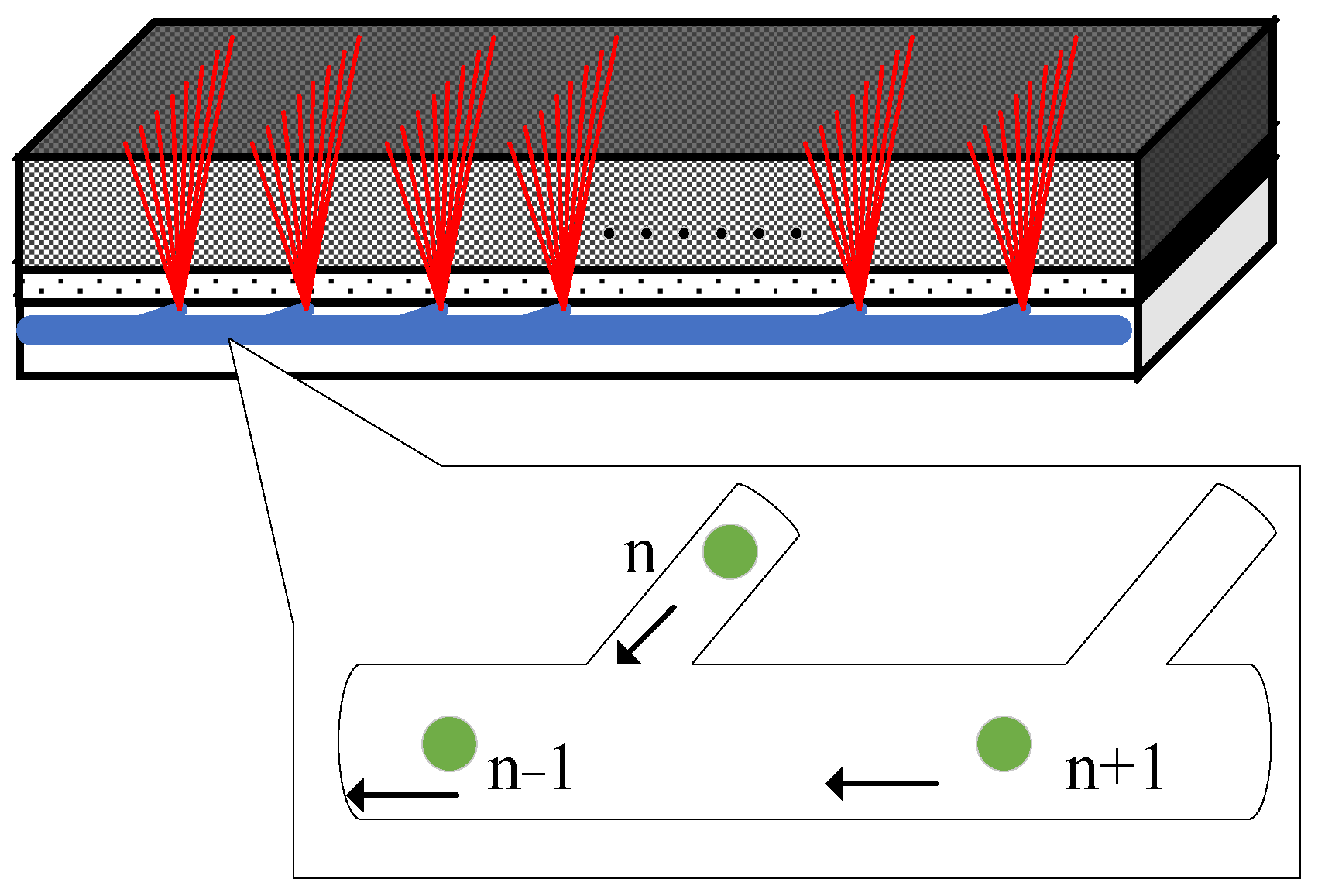
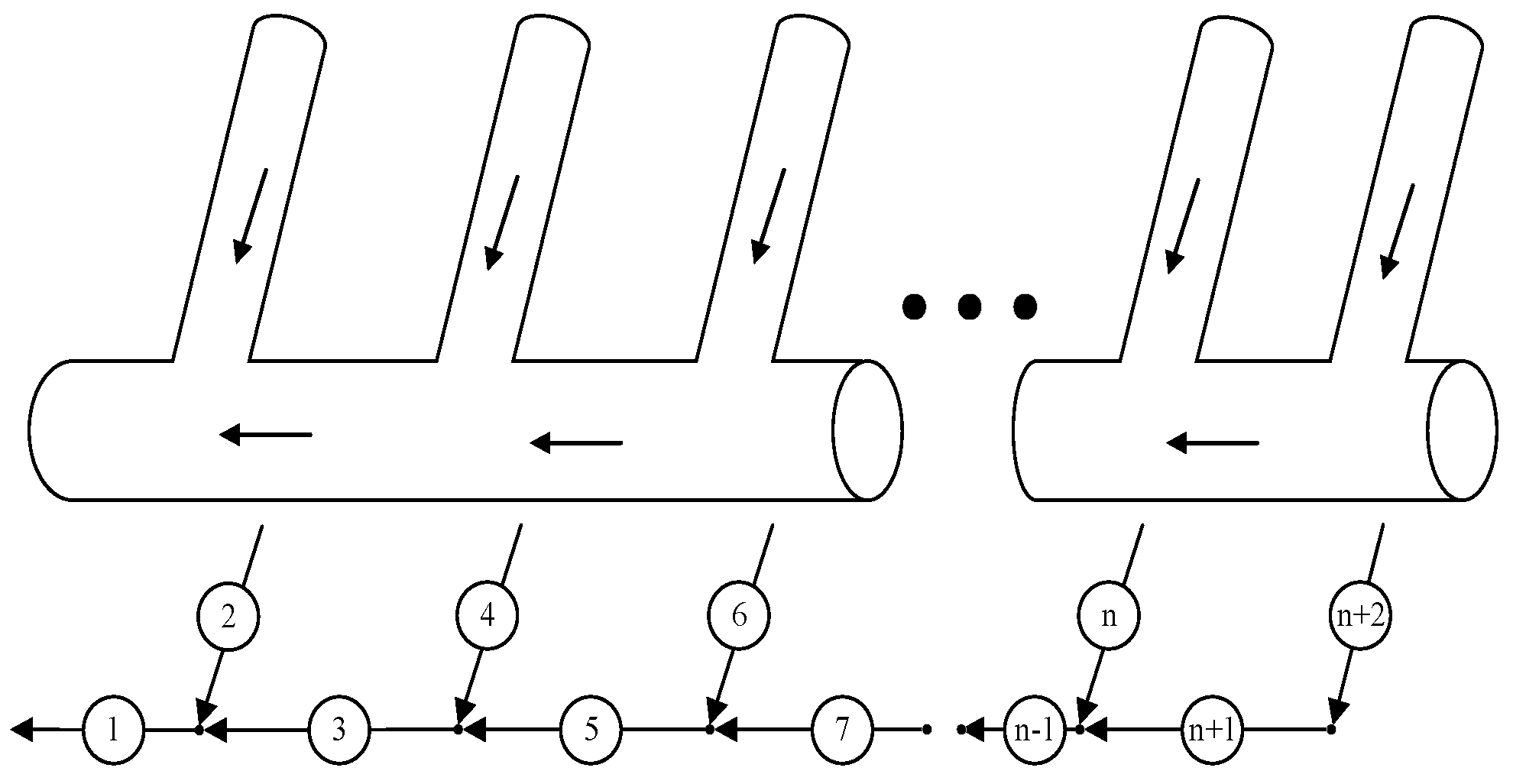
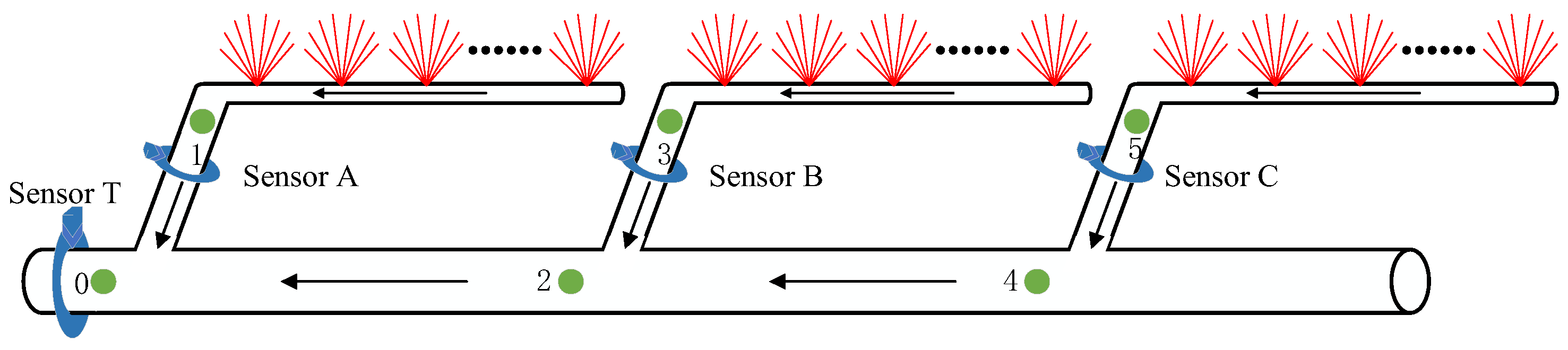
The gas drainage area of the coal seam is typically divided into multiple drainage units according to geological conditions and production capacity [21]. Drill sites of each drainage unit are connected to branch pipes, and the branch pipes are connected to the main pipeline of the drainage area. For each drill site, a confluence structure can be defined as shown in Figure 1. A confluence structure n consists of three nodes n 1 , n and n + 1 , where nodes n 1 and n + 1 are located on branch pipes, and node n is located on the confluence pipe. Gas from node n and n + 1 converges and flows to node n 1 . Based on the drill site confluence structure, a conceptual model of the gas drainage network is illustrated in Figure 2, where number denotes the index of nodes and arrows means the gas flow direction. Once the gas parameters ( v , c , ρ ) of each node in the gas drainage network are solved, then the status of the gas drainage network was determined. Gas parameters related to drainage network are listed in Table 1.

3.2. Mathematical Model of Confluence Structure

In the ideal state, the nodes of the drilling site confluence structure satisfy the conservation of mixed gas mass, gas mass, and total energy [22]. Specifically, the gas flow rate, density, and energy loss along the pipeline at nodes n 1 , n , and n + 1 can be expressed by Formulation (1)–(4).
The gas flow rate Q is related to the pipeline section area and flow velocity:
Q i = 1 4 π v i d i 2 , ( i = n 1 , n , n + 1 )
The gas density ρ and the molar mas of the mixed gas can be expressed as:
ρ i = P i M i R T i , ( i = n 1 , n , n + 1 )
M i = 16 c i + 29 ( 1 c i ) , ( i = n 1 , n , n + 1 )
The energy loss along the pipeline can be given by:
h w , i = 0.11 ( Δ d i + 68 ρ i d i v i μ i ) 0.25 L i d i v i 2 2 g , ( i = n , n + 1 )
Related parameters used in (4) are further explained as follows:
{ h w , i = λ i L i d i v i 2 2 g , ( i = n , n + 1 ) λ i = 0.11 ( Δ d i + 68 R e , i ) 0.25 R e , i = ρ i d i v i μ i
where h w , i denotes the energy loss along the pipeline; λ is the friction factor; R e is the Reynolds number for gas flow in pipelines; Δ is the roughness of the pipeline wall; μ is the dynamic viscosity coefficient of the mixed gas; L i represents the equivalent pipeline length from nodes i to the confluence position; g is the gravitational acceleration.
Based on these formulations, the nonlinear equation system BM (Balance Model) can be constructed for each drill site as follows (6) to (11).
In BM, mixed gas mass conservation and methane gas mass conservation are both satisfied as shown in Equations (6) and (7).
Q n 1 ρ n 1 = Q n ρ n + Q n + 1 ρ n + 1
Q n 1 ρ n 1 c n 1 = Q n ρ n c n + Q n + 1 ρ n + 1 c n + 1
As the mixed gas flows from nodes n and n + 1 to node n 1 , both node pairs ( n , n 1 ) and ( n + 1 , n 1 ) should satisfy the conservation of total potential energy according to the Bernoulli equation, as shown in (8) and (9).
P n = P n 1 + ( Z n 1 Z n ) ρ n g + 1 2 ρ n ( v n 1 2 v n 2 ) + h w , n ρ n g
P n + 1 = P n 1 + ( Z n 1 Z n + 1 ) ρ n + 1 g + 1 2 ρ n + 1 ( v n 1 2 v n + 1 2 ) + h w , n + 1 ρ n + 1 g
For the node  n in the drill site branch, the air leakage quantity Q   n z is equal to air quantity in the mixed gas flow, i.e., Q   n z = Q n ( 1 c n ) . On the other hand, Q   n z can also be calculated using the gas pressure difference with a given exogenous parameter air leakage resistance coefficient β , i.e., Q   n z = ( P 0 P n ) / β . Thus, equation should be satisfied as presented in Equation (10).
P 0 ρ n R T 16 c n + 29 ( 1 c n ) = 1 4 π v n d n 2 ( 1 c n ) β
Finally, the total energy conservation should be satisfied for the confluence structure formed by three nodes n 1 , n , and n + 1 , as shown in Equation (11). α is a exogenous parameter, representing the frictional loss correction coefficient.
Q n 1 ρ n 1 ( v n 1 2 2 g + Z n 1 + P n 1 ρ n 1 g ) + α ( Q n ρ n h w , n + Q n + 1 ρ n + 1 h w , n + 1 ) = Q n ρ n ( v n 2 2 g + Z n + P n ρ n g ) + Q n + 1 ρ n + 1 ( v n + 1 2 2 g + Z n + 1 + P n + 1 ρ n + 1 g )
All these six equations in BM form the nonlinear equation system for the drill site confluence structure. The known parameters include pipeline diameter ( d ), gas constant ( R ), gas temperature ( T ), node elevation ( Z ), gravitational acceleration ( g ), and atmospheric pressure ( P 0 ). Given the monitored gas parameters ( v n 1 ,   c n 1 ,   ρ n 1 ) of node n 1 , the corresponding variables of nodes n and n + 1 can then be solved.

3.3. Gas Drainage Network Solving Process

(1)
Sequential calculation for gas drainage network
The gas drainage network, composed of a series of confluence structures as illustrated in Figure 2, enables the solution process to be extended sequentially from the initial confluence structure to all subsequent ones. For the drill site convergence structure n , once the gas parameters of node n + 1 are solved from parameters of node n 1 using BM, the data of node n + 1 can be treated as the known values. This allows the gas parameters of node n + 2 and n + 3 to be solved by re-applying BM. Through this iterative process, the entire gas drainage network can be solved.
(2)
Exogenous parameters of the model
Two exogenous parameters α and β are considered in BM. First, the friction loss of gas along the path is influenced by factors such as obstructions within the extraction pipe and the roughness of the pipe’s inner wall. For the drill site confluence structure n , this influence is represented by the frictional loss correction coefficient α . Second, due to fracture development around the borehole and sealing quality of the borehole, air leaks into the borehole under the negative pressure of gas extraction, and this influence is represented by the air leakage resistance coefficient β .
(3)
Verification of the model solution
In a gas drainage network, sensors can be deployed at the start of the main pipeline and the branch pipeline. Sensors on branch pipelines collect real-time and cumulative gas data for each drainage unit, while the sensor at the main pipeline aggregates the gas extraction amounts from all drainage units. Real-time monitoring data from the main pipeline sensor can serve as initial parameters for BM. Through iterative solving from one confluence structure to another, monitoring data from corresponding branch pipeline sensors can be used to evaluate the correctness and validity of the model solution. In this way, gas parameters across the entire gas drainage network can be solved based on limited monitoring data.

4. Algorithm Design

BM comprises six nonlinear equations involving six unknown variables, ( v n , c n , ρ n , v n + 1 , c n + 1 , ρ n + 1 ) and two exogenous parameters ( α , β ). Given the gas parameters at node n 1 , the objective is to solve for the corresponding gas parameters at nodes n and n + 1 .
Two exogenous parameters are highly dependent on drainage structure and geological conditions, and usually cannot be predetermined. Given that classical algorithms are unable to directly solve nonlinear models with uncertain parameters, this study employs PSO to iteratively search the solution space of exogenous parameters and uses Newton’s method to solve the system of nonlinear equations. The optimization objective of this algorithm framework is to minimize the discrepancy between the searched values and actual sensor readings, thereby ensuring the attainment of feasible solutions and improving the precision of the model’s solutions.

4.1. Newton’s Algorithm for Solving Confluence Structure

The mathematical model of the confluence structure represented by BM is a system of nonlinear equations, and Newton’s iterative method is a commonly used numerical approach for finding approximate solutions to such systems. Newton’s method employs the Taylor expansion to linearize the equations, transforming nonlinear equations into a series of linear equations by utilizing the objective value and Jacobian matrix at each iteration.
For the gas parameters, x = [ v n , c n , ρ n , v n + 1 , c n + 1 , ρ n + 1 ] T of the n -th confluence structure, BM can be rearranged into a general form as { f 1 ( x ) = 0 , f 2 ( x ) = 0 , f 6 ( x ) = 0 } .
Let F ( x ) = [ f 1 ( x ) , f 2 ( x ) , , f 6 ( x ) ] T , and perform a Taylor expansion of F ( x ) at x ( k ) = [ v n ( k ) , c n ( k ) , ρ n ( k ) , v n + 1 ( k ) , c n + 1 ( k ) , ρ n + 1 ( k ) ] T . Then, the original nonlinear system of equations can be approximated as F ( x ) F ( x ( k ) ) + J ( x ( k ) ) ( x ( k + 1 ) x ( k ) ) = 0 , where J ( x ( k ) ) represents the Jacobian matrix of F ( x ) at x ( k ) . The iterative equation is obtained as Equation (5).
[ f 1 ( x ( k ) ) v n f 1 ( x ( k ) ) ρ n + 1 f 6 ( x ( k ) ) v n f 6 ( x ( k ) ) ρ n + 1 ] · [ v n ( k + 1 ) v n ( k ) ρ n + 1 ( k + 1 ) ρ n + 1 ( k ) ] = [ f 1 ( x ( k ) ) f 6 ( x ( k ) ) ]
Approximate solutions to the nonlinear system can be obtained by iteratively applying Equation (12) until F ( x ) ε , where ε is a predefined accuracy.

4.2. PSO Algorithm Based Exogenous Parameters Search

PSO is a global optimization algorithm based on the simulation of the foraging behavior of bird flocks. Starting from the initial solution, PSO iteratively seeks the global optimal solution through information sharing among particles. The exogenous parameters involved in BM are encoded as the position S = ( s α , s β ) and velocity V = ( v α , v β ) of particles. During iteration, each particle i retains its best position P b e s t i , and P g b e s t denotes the overall best position among all particles.
(1)
Range of exogenous parameters
The computational process of PSO requires defining the value ranges for the position and velocity of particle. The position value range confines the search space for the particles, while the velocity value range confines the step size of the particle movement. Based on the actual meaning of the exogenous parameters and relationship defined in BM, the value ranges for the parameters α and β can be roughly determined.
The frictional loss correction coefficient α is typically affected by the roughness of the pipeline inner wall, as well as the local resistance generated by valves, pipeline shape, and cross-sectional changes, etc. Considering coal mine practical condition, α is generally set to the range of [ 0 , 2 ] in this study.
As described in (10), the air leakage quantity Q   n z is proportional to gas pressure difference. For the coal mine under consideration, the average values are P 0 = 101,325   P a , P n = 45,000   P a , and Q n = 10   m 3 / m i n . When c n = 0 , β m i n = 360,000   Pa s / m 3 is thus obtained. On the other hand, gas pressure difference roughly ranges from 10 4 to 10 5 , the air leakage resistance coefficient β is generally set to the range of [ 5 × 10 5 ,   10 7 ]   Pa s / m 3 in this study.
The velocity of a particle refers to the maximum distance the particle can move in each step. A higher velocity is beneficial for global search, but it results in slower convergence and may easily skip the optimal solution. A lower velocity is advantageous for deep exploration, but it is prone to getting stuck in local optima. The range of particle velocity variation is set to 10% of the range of particle position variation, v α = [ 0.1 , 0.1 ] and v β = [ 5 × 10 5 , 5 × 10 5 ] .
During the initialization of the algorithm, each particle i is initialized as Formula (13).
{ s i α = r a n d o m × ( α m a x α m i n ) + α m i n s i β = r a n d o m × ( β m a x β m i n ) + β m i n v i α = r a n d o m × ( v m a x α v m i n α ) + v m i n α v i β = r a n d o m × ( v m a x β v m i n β ) + v m i n β       i = 1 , 2 N
(2)
Iteration of the algorithm
For each iteration of PSO, the position and velocity of the particles are updated as Formula (14).
{ V i ( k + 1 ) = ω × V i ( k ) + c 1 × r 1 ( P b e s t S i ( k ) ) + c 2 × r 2 ( G b e s t S i ( k ) ) S i ( k + 1 ) = S i ( k ) + V i ( k + 1 )   k = 1 , 2 D
where S i ( k ) and V i ( k ) are the position and velocity of the i -th particle at the k -th iteration, and c 1 and c 2 are the learning factors. The inertia weight ω is adjusted using the linear adjustment strategy as shown in Equation (15). Larger weight value favors global search, while smaller weight value favors local search. In the early stages of iteration, the particle swarm mainly performs a global search, while in the later stages, it primarily focuses on a local search.
ω = ω m a x ( ω m a x ω m i n ) × i t e r i t e r m a x
where ω m a x and ω m i n are the maximum and minimum values of the inertia weight, i t e r is the iteration number and the maximum number of iterations.
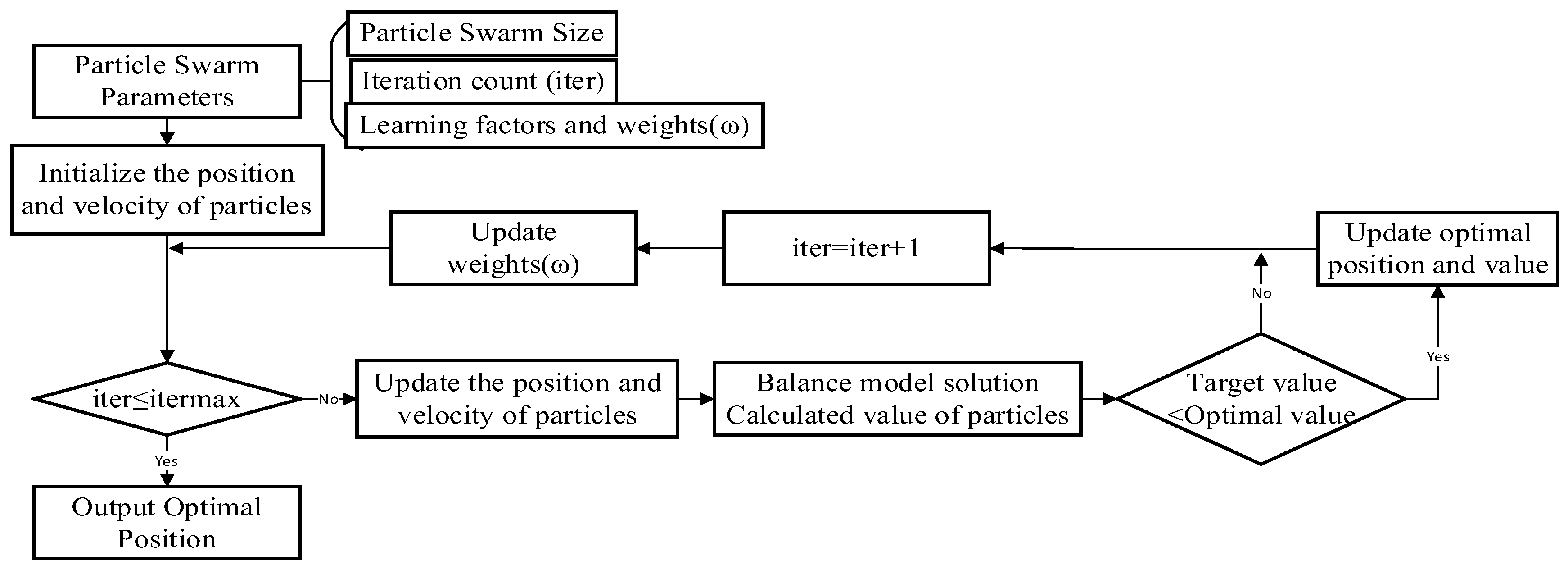
When frictional loss correction coefficient α and air leakage resistance coefficient β are obtained at a new location, they are substituted into the objective function. Local best and global best solution will be updated when a better objective is achieved. The algorithm framework is illustrated in Figure 3.

4.3. PSO–Newton Algorithm Design

In this study, algorithm PSO is employed to search for values of frictional loss correction coefficient α and air leakage resistance coefficient β , while Newton’s method is utilized to solve nonlinear system BM for each convergence structure. In each iteration, parameters founded by PSO are substituted into BM to solve for gas parameters x = [ v n , c n , ρ n , v n + 1 , c n + 1 , ρ n + 1 ] T .
The solution [ v n + 1 , c n + 1 , ρ n + 1 ] T of the nonlinear system is then be used for calculating the next confluence structure. The processes are repeated to solve all the convergence structures within the gas drainage network. Algorithm 1 presents the pseudocode of the PSO–Newton.
Algorithm 1: PSO–Newton algorithm
Input :   total   sensor   data   v 0 , c 0 , ρ 0 ,   the   number   of   drilling   sites   n ,   the   initial   values   of   α and β ,   number   of   iterations   i t e r m a x
Output :   [ v m , c m , ρ m ] for all m n
Step   1 :   Based   on   v 0 , c 0 , ρ 0 ,   Newton’s s   method   solves   BM   with   α and β ,   generating   values   for   each   drilling   site   until   the   values   of   [ v m , c m , ρ m ] for the drilling site n is obtained
Step   2 :   Calculate   the   difference   between   α and β , and judge whether it exceeds the optimal value. Yes, update the optimal value.
Step   3 :   i t e r + 1 i t e r m a x . Yes, go Step 4. No, go Step 5
Step   4 :   Update   α and β using the PSO based on the optimal value. Return Step 1
Step 5: The algorithm terminates
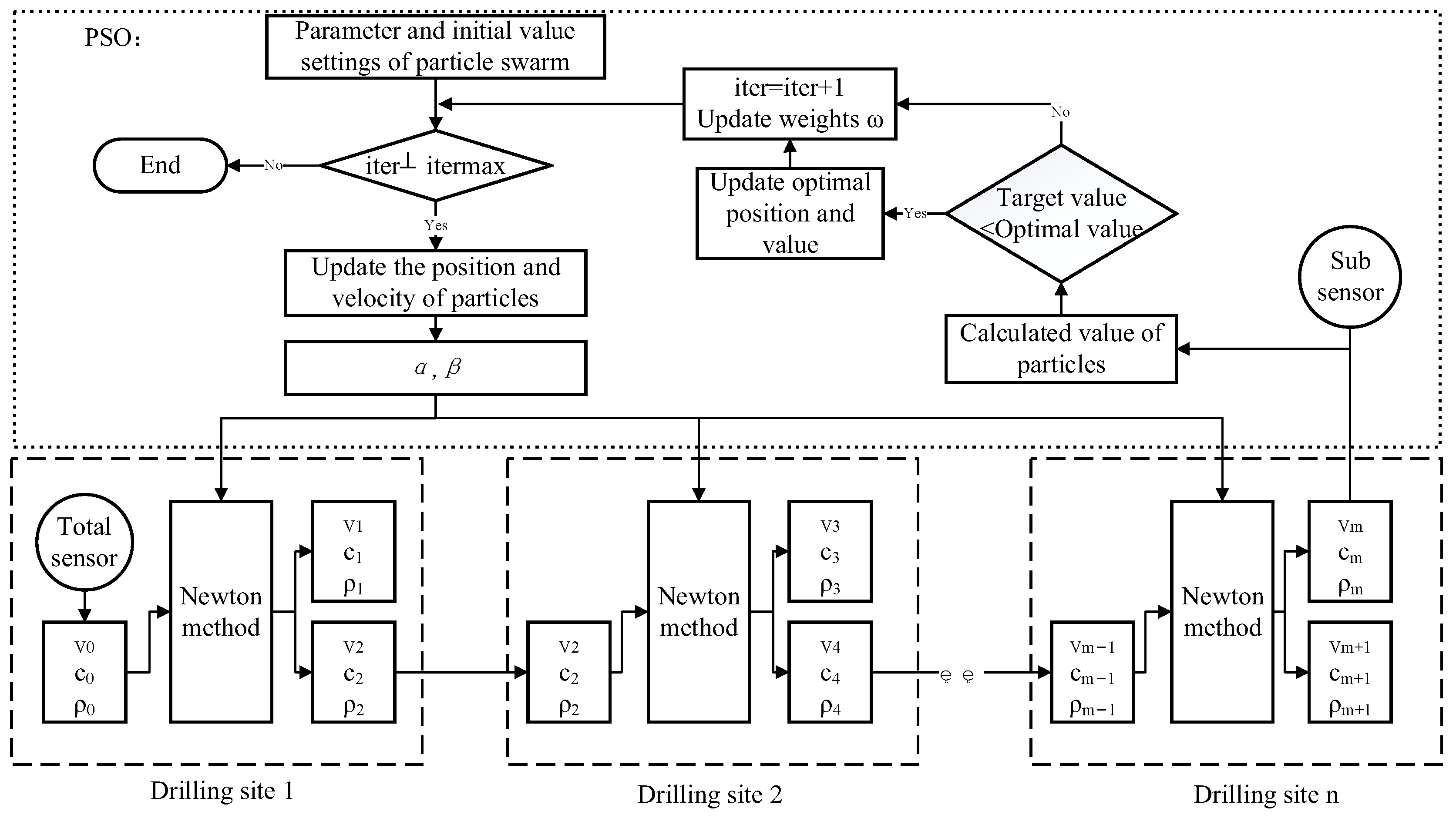
For the nodes equipped with branch sensors, the deviation between the monitored value and algorithm’s solution is used as the objective function to evaluate solution quality. The algorithm terminates once the deviation reaches the threshold or the maximum number of iterations is reached. The overall algorithm framework of solving all convergence structures in the gas drainage network is illustrated in Figure 4.

5. Case Study

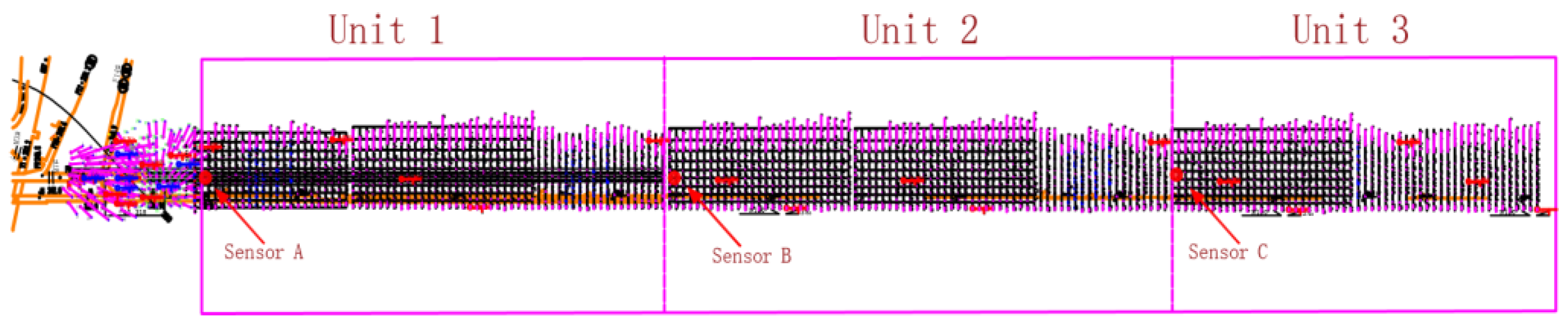
This study conducts a case analysis in 11,306 bottom drainage roadway of S Coal Mine. The 11,306 haulage roadway of S Coal Mine is designed to be located in the middle of the 11th mining region. To excavate this roadway, gas drainage must first be carried out in this coal body area. Currently, a total of three drainage units are set up in the target region, with each unit having a length of more than 200 m, and a drill site is arranged approximately every 40 m. Each unit is equipped with a drainage metering sensor. The overall layout of the gas drainage system considered is shown in Figure 5.

5.1. Branch Scale Calculation

Each gas drainage unit is equipped with a drainage metering sensor. The sensors deployment and evaluation unit layout are illustrated in Figure 6, where sensor T provide gas data from all drainage units, and sensor A, B, C collect real-time data from their corresponding units. For the proposed PSO–Newton algorithm, the optimization objective is to minimize the deviation between the calculated values of the state variables ( v , c , ρ ) and the actual data monitored by sensor C.
The 11,306 working face is located in a nearly horizontal coal seam, so all nodes can be treated as being at the same elevation in calculation. With negligible temperature variations in the same underground environment, the average temperature is adopted for the calculation of each confluence structure. The values of the relevant parameters for the gas drainage network are shown in Table 2.
Sample historical sensor monitoring data collected from the gas drainage network are presented in Table 3.
To evaluate the effectiveness of the proposed algorithm, three branch scale confluence structures (Figure 6) were solved using daily average historical monitoring data.
In this case study, monitoring data from sensor T on the main pipeline served as the starting point for the algorithm, while data from sensor C was used to calculate objective function. Additionally, gas parameters calculated by the algorithm were compared with average real-time data collected from sensors A and B to assess the performances of the proposed algorithm.
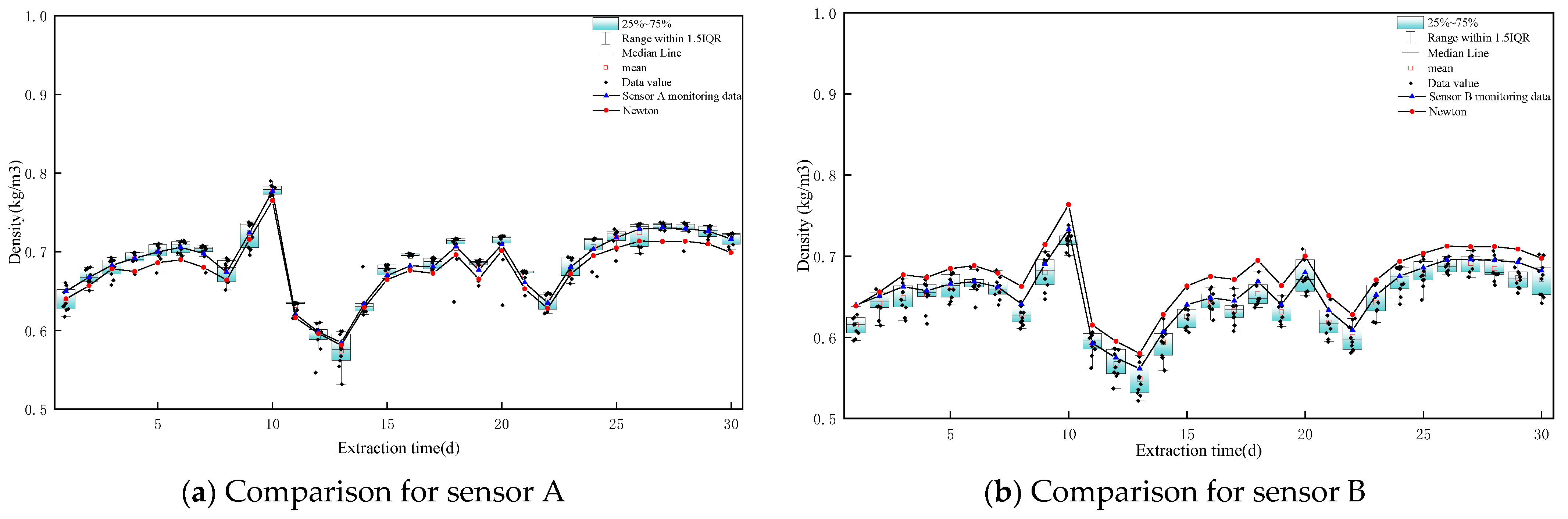
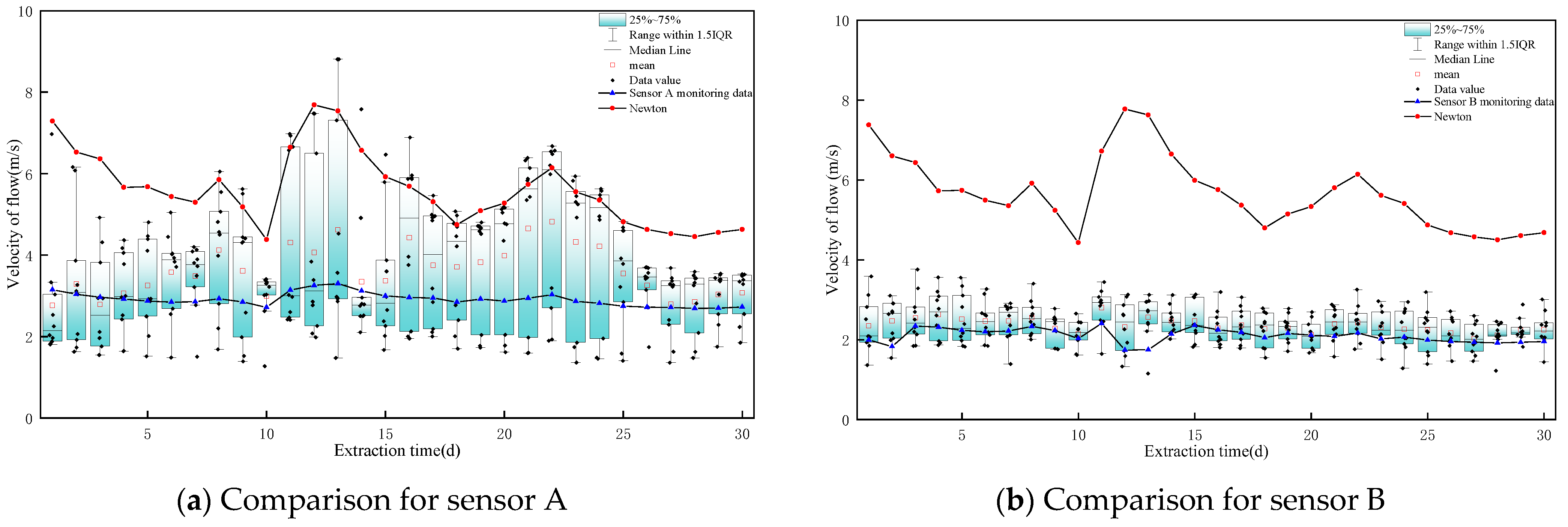
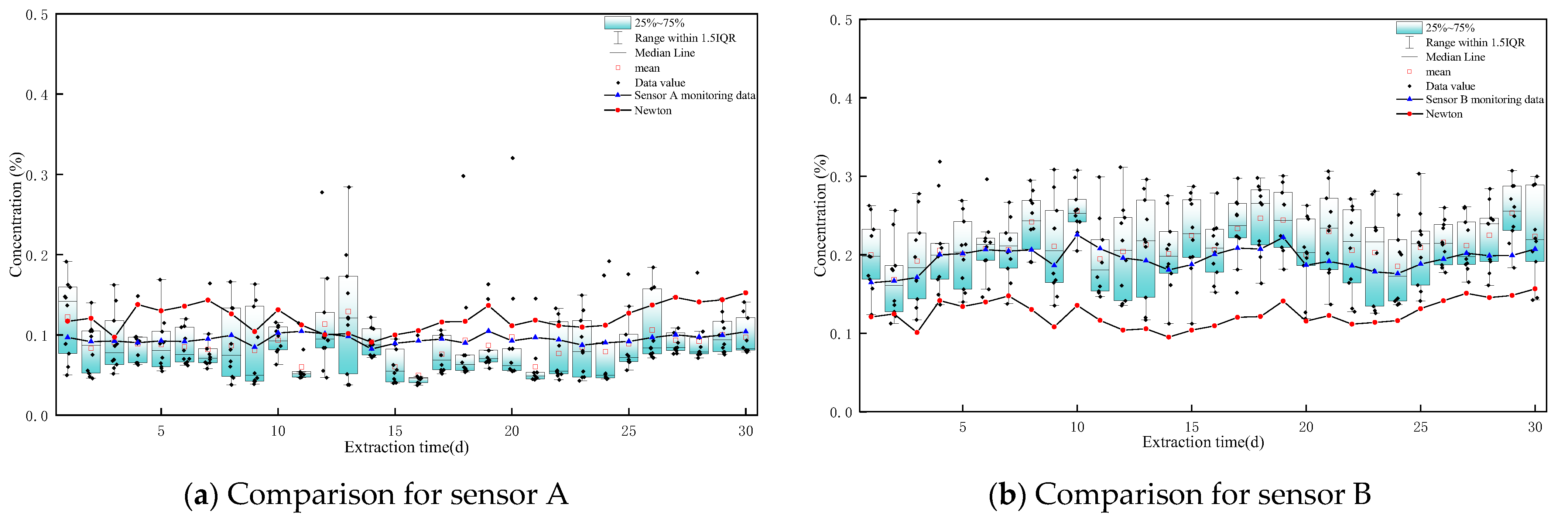
Comparison of gas density, flow velocity, and concentration are presented in Figure 7, Figure 8 and Figure 9 for sensor A and sensor B over a 30-day historical dataset calculation. To enhance solution stability, results from 10 independent runs were averaged for each daily solution.
In the PSO–Newton algorithm, exogenous parameters are searched by the PSO algorithm to provide proper parameters for Newton’s method. To evaluate the performance of this schema, a standalone Newton’s method is applied to solve the problem directly. Gas drainage parameters generated by the standalone Newton’s method are presented in Figure 7, Figure 8 and Figure 9 as well.
The graphical results indicate that the calculated values exhibit a consistent trend with the monitored data, suggesting that the proposed method can accurately derive the gas data. Compared with the Newton method, the solution values derived from the PSO–Newton are more consistent with the sensor monitoring values. Although some individual data points show deviations, the majority of the calculated values differ from the actual monitored values by less than 10%, which verifies the effectiveness and robustness of the calculation method.
From the perspective of gas density, as shown in Figure 7, both the PSO–Newton and standalone Newton methods can follow the variation trend of monitoring data well, but the PSO–Newton method demonstrates a higher degree of consistency.
For flow velocity data, the results calculated by the standalone Newton method are significantly higher than the actual monitoring values. As shown in Figure 8b, the absolute deviation ranges from 2.4 m/s to 6 m/s, whereas the deviation between the mean values of the PSO–Newton method and the actual monitoring values is within 0.8 m/s.
Regarding gas concentration data, the standalone Newton method yields results that are either higher or lower than the actual monitoring values, exhibiting poor stability. In contrast, the average results of the PSO–Newton method are close to the actual monitoring values and more consistent with the variation trend of the actual monitoring data as shown in Figure 9.

5.2. Drill Field Scale Calculation

Drill field scale gas extraction monitoring is crucial for accurately monitoring the gas extracting process in a specific coal seam region. However, as discussed in Introduction, it is a challenge to equipment sensor for each drill field. In Section 5.1, the effectiveness of the algorithm for solving the branch scale network problem has been validated by treating each evaluation unit as a confluence structure. In this section, gas extraction parameters for each drill stie within an evaluation unit can be further calculated by treating each drill stie as a confluence structure.
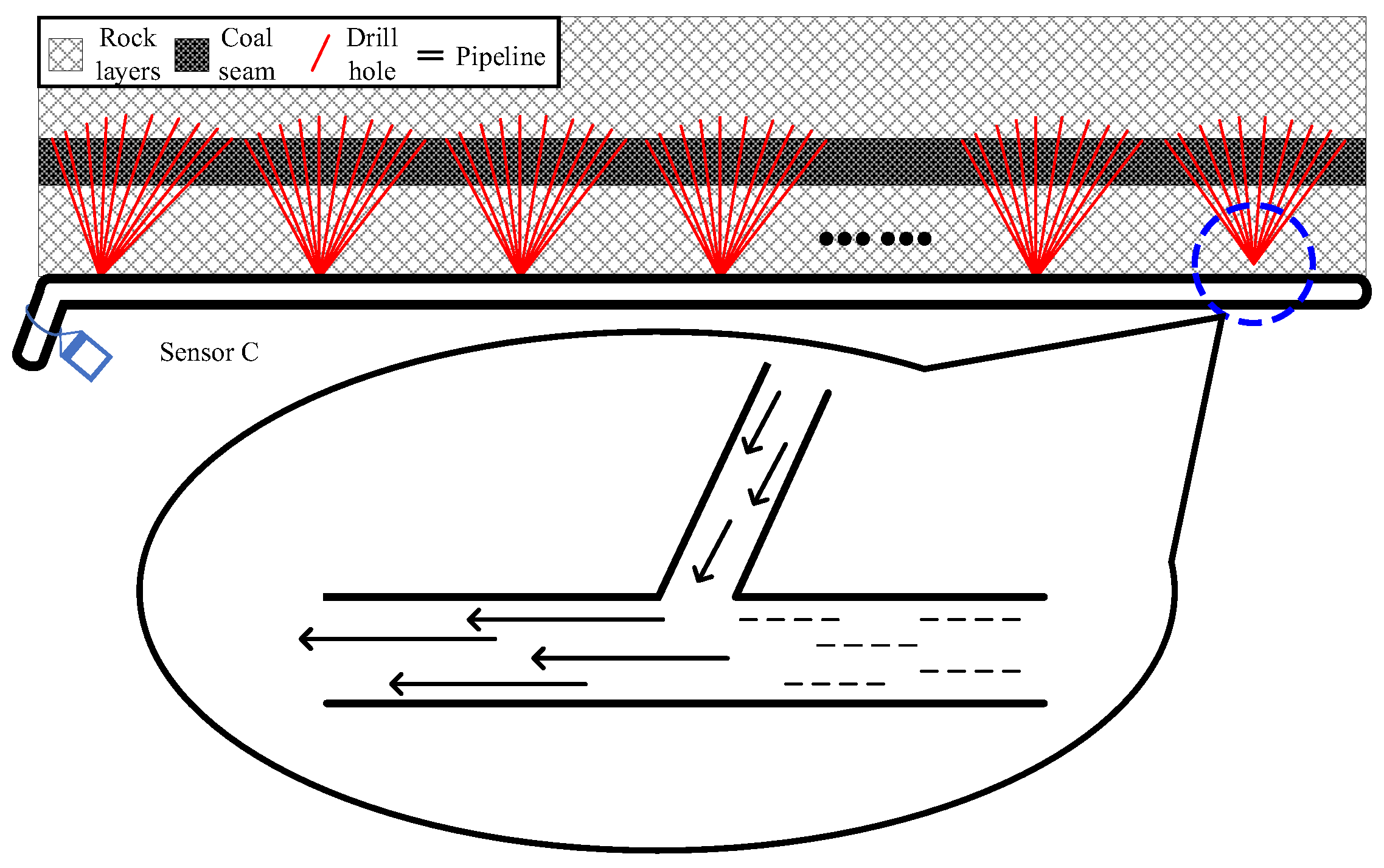
Taking evaluation unit 3 as an example, this unit contains a total of 25 drilling sites, corresponding to 25 convergence structures, as shown in Figure 10.
In the branch drainage system, monitoring data from sensor C serves as the starting point for calculation. Since the n + 1 node of the last drill site confluence structure is a blind end, the gas flow velocity can be assumed to be 0 and used as the target value for algorithm calculation. Parameters for each drill site confluence structure can be calculated using daily sensor data collected from sensor C, as shown in Table 4.
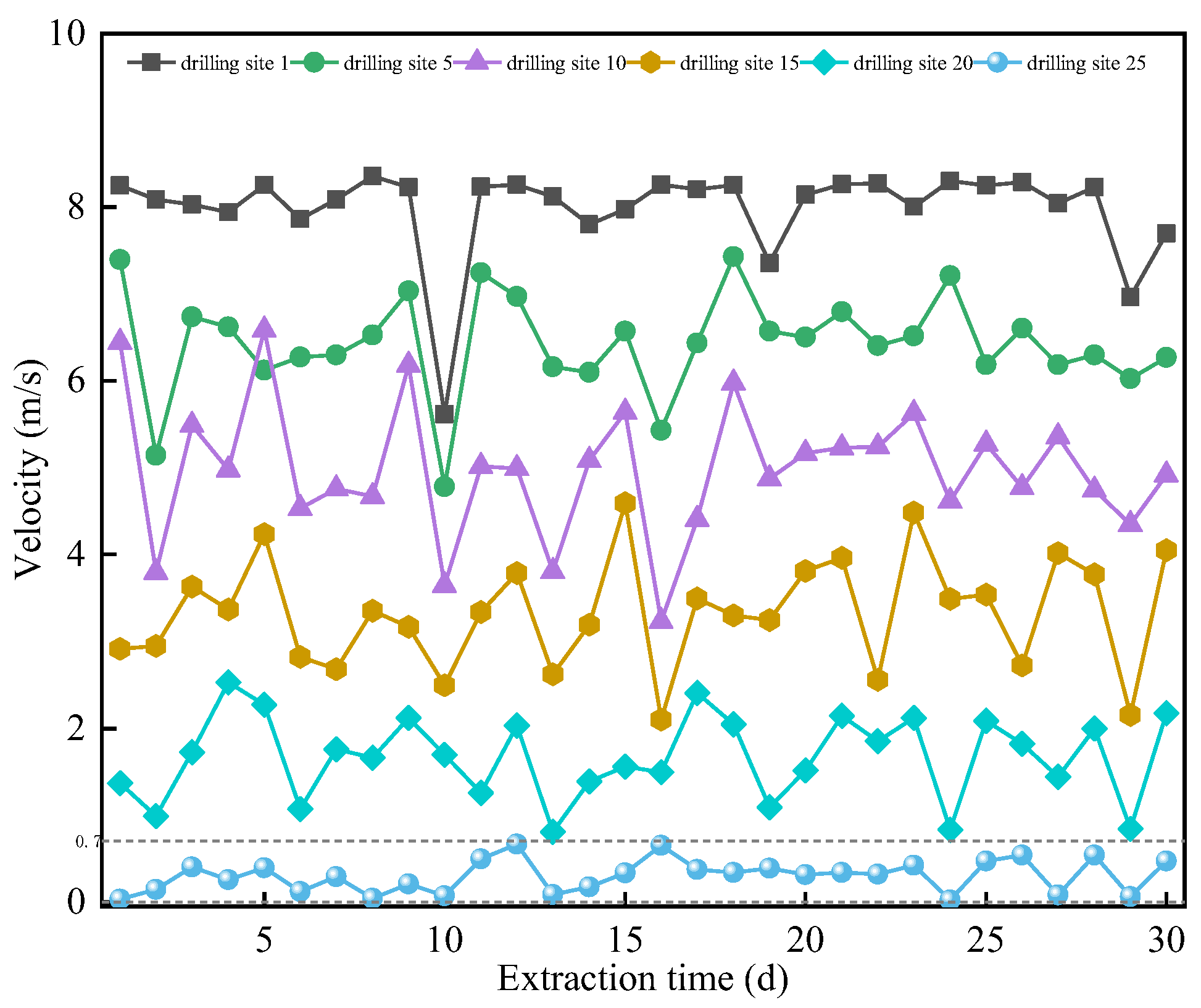
Figure 11 shows the trends of gas flow velocity in branch pipes for typical drill sites, where the flow velocity attenuates with increasing extraction distance. Over the 30-day period, the gas flow velocity at n + 1 node of the last confluence structure approaches 0 m/s, which is consistent with the expected validation value.
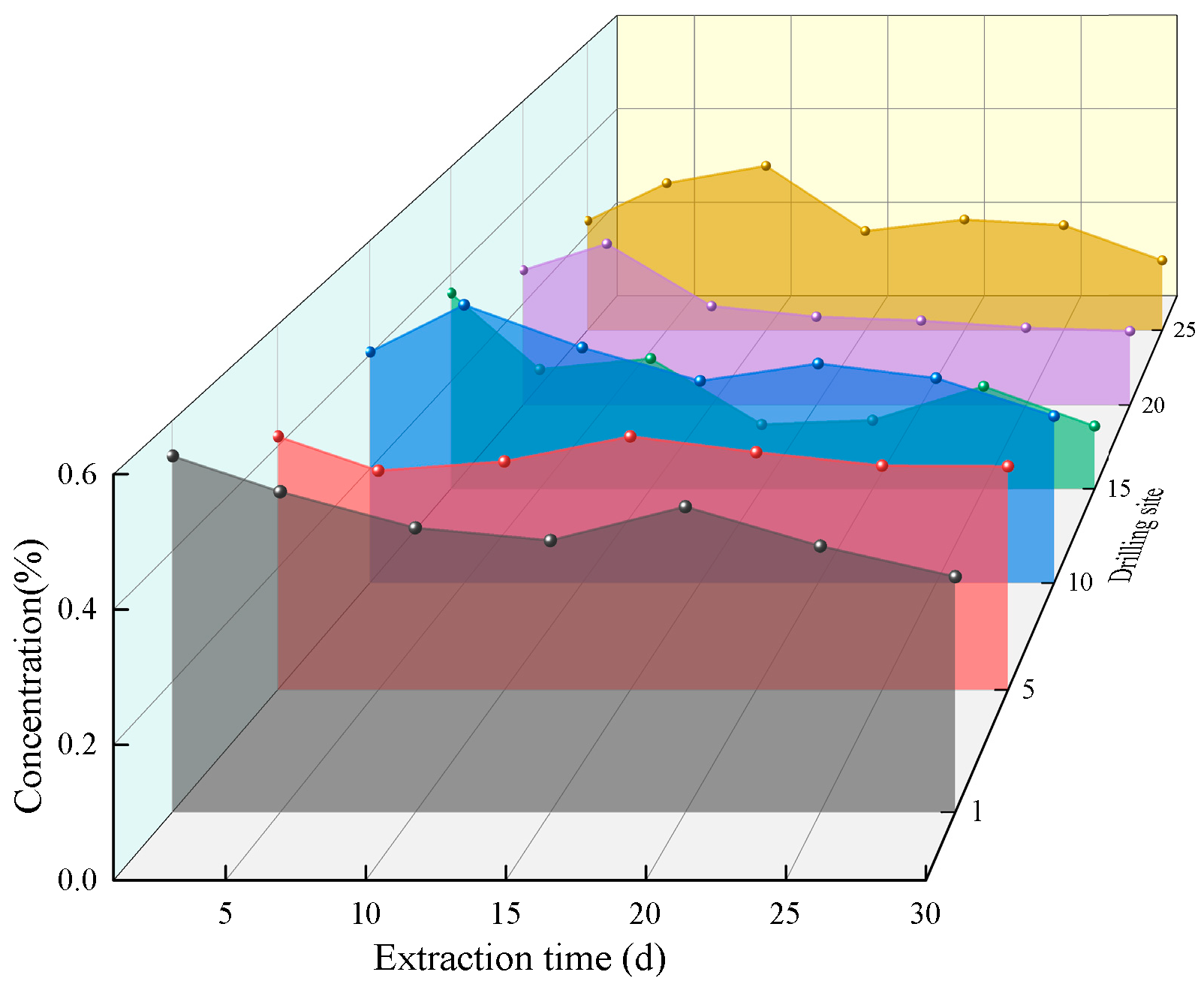
The residual gas concentration in the target coal seam region should decrease as the extraction progresses and this is consistent with the calculation results shown in Figure 12. In general, during the extraction process, the node concentration at nodes on confluence pipelines is higher than that at nodes on branch pipelines. Compared to the concentration trend at nodes on branch pipelines, a more pronounced downward trend can be observed at nodes on confluence pipelines. These findings further confirm the effectiveness of the method proposed in gas drainage network solving.

6. Conclusions and Prospect

This study focuses on the gas drainage network in coal mines and addresses the challenge of efficiently solving gas parameters in complex confluence structures. Based on the pipeline network gas–air flow model, a gas drainage equilibrium model is developed, with nonlinear equations derived from the conservation of mass, energy, and gas state properties. Considering exogenous variables such as frictional loss correction coefficient α and air leakage resistance coefficient β, as well as the iterative structure of the drainage pipeline network, a hybrid PSO–Newton algorithmic framework is further designed to solve the problem under study.
To validate the proposed algorithm, a case study was conducted at both branch and drill field scale using historical monitoring data from the 11,306 working face of S Coal Mine. At the branch scale, gas parameters generated maintained consistent trends with monitored data, with most deviations within 10%. To further evaluate the performance of the PSO–Newton algorithm, the standalone Newton’s method was also applied to solve the same case. Comparative results demonstrate that the PSO–Newton method yields results closer to the actual monitoring values and more consistent with the variation trends of the actual monitoring data.
At the drill field scale, gas parameters of the nodes on confluence pipeline and branch pipeline were calculated, and the results revealed that key parameters such as gas flow velocity, concentration, and density aligned with actual observation trends, which further verified the accuracy of the algorithm.
Overall, this study provides a systematic method for solving gas parameters in coal mine gas drainage network. The proposed PSO–Newton algorithm framework shows an effective way of integrating global optimization and local nonlinear solving. Further work may focus on adapting the model to more complex gas drainage networks, and the algorithm’s computational efficiency can also be improved to meet the requirements of real-time gas parameter solving.

Author Contributions

Conceptualization, X.L., Z.C. and T.X.; methodology, X.L. and Z.C.; formal analysis, X.L. and Z.C.; writing—original draft preparation, X.L. and Z.C.; writing—review and editing, X.L. and Z.C. All authors have read and agreed to the published version of the manuscript.

Funding

This research was funded by the National Natural Science Foundation of China (52074284), and Jiangsu Province International Collaboration Program-Key National Industrial Technology Research and Development Cooperation Project (BZ2024024).

Institutional Review Board Statement

Not applicable.

Informed Consent Statement

Not applicable.

Data Availability Statement

The raw data supporting the conclusions of this article will be made available by the authors on request.

Conflicts of Interest

The authors declare no conflict of interest.

References

  1. Jie, D.; Xu, X.; Guo, F. The Future of Coal Supply in China Based on Non-Fossil Energy Development and Carbon Price Strategies. Energy 2021, 220, 119644. [Google Scholar] [CrossRef]
  2. Tian, S.; Wang, Y.; Li, H.; Ma, T.; Mao, J.; Ma, L. Analysis of the Causes and Safety Countermeasures of Coal Mine Accidents: A Case Study of Coal Mine Accidents in China from 2018 to 2022. Process Saf. Environ. Protect. 2024, 187, 864–875. [Google Scholar] [CrossRef]
  3. Frank, H.; Ting, R.; Naj, A. Evolution and Application of In-Seam Drilling for Gas Drainage. Int. J. Min. Sci. Technol. 2013, 23, 543–553. [Google Scholar] [CrossRef]
  4. Li, Z.; Wang, E.; Ou, J.; Liu, Z. Hazard Evaluation of Coal and Gas Outbursts in a Coal-Mine Roadway Based on Logistic Regression Model. Int. J. Rock Mech. Min. Sci. 2015, 80, 185–195. [Google Scholar] [CrossRef]
  5. Lu, Z.; Wang, L.; Fu, S.; Chu, P.; Zhu, Z.; Wang, H.; Zhao, C.; Wu, S.; Cheng, Y. High-Efficiency and Precision Gas Extraction in Intelligent Mining Faces: Application of a Comprehensive Three-Dimensional Extraction System. Phys. Fluids 2024, 36, 083302. [Google Scholar] [CrossRef]
  6. He, S.; Pan, H.; Song, S.; Zhang, T.; Chen, J.; Liu, G.; Cao, X.; Xue, Y. Digital Twin Based Intelligent Control System on Gas Extraction from Boreholes and Experimental Research. Eng. Appl. Artif. Intell. 2025, 159, 111578. [Google Scholar] [CrossRef]
  7. Liu, P.; Fan, J.; Jiang, D.; Li, J. Evaluation of Underground Coal Gas Drainage Performance: Mine Site Measurements and Parametric Sensitivity Analysis. Process Saf. Environ. Protect. 2021, 148, 711–723. [Google Scholar] [CrossRef]
  8. Ma, L.; Shi, X.; Li, S.; Lin, H.; Song, S. Research on intelligent control model of gas drainage based on model predictive control. Coal Sci. Technol. 2022, 50, 82–90. [Google Scholar]
  9. Zhou, A.; Du, C.; Wang, K.; Fan, X.; Wang, D.; Zhao, W.; Gao, H. Research on Intelligent Control Theory and Strategy of Gas Drainage Pipe Network Based on Graph Theory. Fuel 2024, 357, 129867. [Google Scholar] [CrossRef]
  10. Wang, X.; Zhou, F.; Xia, T.; Xu, M. A Multi-Objective Optimization Model to Enhance the Comprehensive Performance of Underground Gas Drainage System. J. Nat. Gas Sci. Eng. 2016, 36, 852–864. [Google Scholar] [CrossRef]
  11. Liu, T.; Lin, B.; Fu, X.; Zhu, C. Modeling Air Leakage around Gas Extraction Boreholes in Mining-Disturbed Coal Seams. Process Saf. Environ. Protect. 2020, 141, 202–214. [Google Scholar] [CrossRef]
  12. Darvishi, M.T.; Barati, A. A Third-Order Newton-Type Method to Solve Systems of Nonlinear Equations. Appl. Math. Comput. 2007, 187, 630–635. [Google Scholar] [CrossRef]
  13. Tiwari, V.L.; Thapar, A.; Bansal, R. A Genetic Algorithm for Solving Nonlinear Optimization Problem with Max-Archimedean Bipolar Fuzzy Relation Equations. Int. J. Uncertain. Fuzziness Knowl.-Based Syst. 2023, 31, 303–326. [Google Scholar] [CrossRef]
  14. Liu, S.; Hua, X.; Shan, L.; Wang, D.; Liu, Y.; Wang, Q.; Sun, Y.; He, L. An Improved Particle Swarm Optimization Method for Nonlinear Optimization. Int. J. Intell. Syst. 2024, 2024, 6628110. [Google Scholar] [CrossRef]
  15. Pourrajabian, A.; Ebrahimi, R.; Mirzaei, M.; Shams, M. Applying Genetic Algorithms for Solving Nonlinear Algebraic Equations. Appl. Math. Comput. 2013, 219, 11483–11494. [Google Scholar] [CrossRef]
  16. Jaberipour, M.; Khorram, E.; Karimi, B. Particle Swarm Algorithm for Solving Systems of Nonlinear Equations. Comput. Math. Appl. 2011, 62, 566–576. [Google Scholar] [CrossRef]
  17. Mo, Y.; Liu, H.; Wang, Q. Conjugate Direction Particle Swarm Optimization Solving Systems of Nonlinear Equations. Comput. Math. Appl. 2009, 57, 1877–1882. [Google Scholar] [CrossRef]
  18. Ouyang, A.; Zhou, Y.; Luo, Q. Hybrid Particle Swarm Optimization Algorithm for Solving Systems of Nonlinear Equations. In Proceedings of the 2009 IEEE International Conference on Granular Computing (GRC 2009), Nanchang, China, 17–19 August 2009; Lin, T.Y., Hu, X.H., Xia, J.L., Hong, T.P., Shi, Z.Z., Han, J.C., Tsumoto, S., Shen, Z.J., Eds.; IEEE: Nanchang, China, 2009; pp. 460–465. [Google Scholar]
  19. Sihwail, R.; Solaiman, O.S.; Omar, K.; Ariffin, K.A.Z.; Alswaitti, M.; Hashim, I. A Hybrid Approach for Solving Systems of Nonlinear Equations Using Harris Hawks Optimization and Newton’s Method. IEEE Access 2021, 9, 95791–95807. [Google Scholar] [CrossRef]
  20. Memon, M.A.; Mekhilef, S.; Mubin, M. Selective Harmonic Elimination in Multilevel Inverter Using Hybrid APSO Algorithm. IET Power Electron. 2018, 11, 1673–1680. [Google Scholar] [CrossRef]
  21. Xu, C.; Yang, T.; Wang, K.; Fu, Q.; Ma, S. Gas Extraction of Coal Seam Roof Fractured Zone in China: A Review. Fuel 2024, 357, 129930. [Google Scholar] [CrossRef]
  22. Xia, T.; Li, D.; Li, X.; Yan, X.; Wang, J.G. A Novel In-Depth Intelligent Evaluation Approach for the Gas Drainage Effect from Point Monitoring to Surface to Volume. Appl. Energy 2024, 353, 122147. [Google Scholar] [CrossRef]
Figure 1. Confluence structure of a drill site.
Applsci 16 01443 g001
Figure 2. Concept model of gas drainage network.
Applsci 16 01443 g002
Figure 3. PSO algorithm framework.
Applsci 16 01443 g003
Figure 4. Algorithm framework for solving gas drainage network.
Applsci 16 01443 g004
Figure 5. Gas drainage system layout of 11,306 haulage roadway.
Applsci 16 01443 g005
Figure 6. Illustration of gas drainage system layout of 11,306 haulage roadway.
Applsci 16 01443 g006
Figure 7. Comparison of gas density.
Applsci 16 01443 g007
Figure 8. Comparison of flow velocity.
Applsci 16 01443 g008
Figure 9. Comparison of gas concentration.
Applsci 16 01443 g009
Figure 10. Drill site and sensor deployment of the third evaluation unit.
Applsci 16 01443 g010
Figure 11. Flow velocity trends for typical drill sites on branch pipeline.
Applsci 16 01443 g011
Figure 12. Concentration trends comparison for typical drill sites on confluence pipeline.
Applsci 16 01443 g012
Table 1. Parameter description.
DescriptionParameterUnit
Mixed   gas   flow   at   node   i Q i m3/s
Mixed   gas   density   at   node   i ρ i kg/m3
Mixed   gas   velocity   at   node   i v i m/s
Mixed   gas   pressure   at   node   i P i Pa
Pipe   diameter   at   node   i d i m
Pipe   length   at   node   i L i m
Gas   concentration   at   node   i c i %
Gas   molar   mass   at   node   i M i g/mol
Height   at   node   i Z i m
Temperature T K
Table 2. Parameters of drainage network.
ParametersDescriptionUnitNumerical Value
Branch pipe diameter d 1 m0.315
Convergence pipe diameter d 2 m0.108
Node spacing on branch pipes L 1 m5
Node spacing on convergence pipes L 2 m1
Equivalent branch pipes length l 1 m6.3
Equivalent convergence pipes length l 2 m6
Temperature T m290.93
Dynamic viscosity of mixture gas μ i N·s/m20.00001
Pipe roughness Δ i m0.0004
Table 3. Sample historical data of daily average sensor readings.
SensorsExtraction Time (d)Density (kg/m3)Flow Velocity (m/s)Concentration (%)
T10.62231498.1052790.1751
100.74647184.8642370.1822
200.68356625.8566420.1647
300.68308025.1402620.1990
A10.64992233.1503170.0968
100.77710122.7185210.1024
200.70905412.8697990.0926
300.71623922.7272940.1040
B10.63980011.9950800.1644
100.73297802.0263200.2252
200.67990912.1125510.1868
300.68201711.9572070.2073
C10.61994182.8417690.2643
100.74689811.2138660.2006
200.67669581.2166480.2087
300.66589521.2545210.2668
Table 4. Solution results of the third unit (partial).
Extraction Time (d)Drill SiteNode on Confluence PipelineNode on Branch Pipeline
ρ (kg/m3)v (m/s)c (%)ρ (kg/m3)v (m/s)c (%)
110.42749261.8094580.54620.51674368.2506090.1945
50.46091301.7744170.41680.52357147.3936660.1701
100.46443021.2779760.40520.53359256.4458340.1333
150.537883511.1236820.36470.50852852.9168350.2335
200.50045346.9006120.26610.51293781.3706630.2165
250.50996540.9003070.22830.48506130.0313310.3261
510.44143591.7696020.49130.51650228.2529760.1954
50.47521581.7207420.36040.52862156.1240710.1501
100.44323521.5124990.48780.50375486.5848310.2498
150.53522661.3697900.22230.50333284.2345270.2530
200.48686961.7279400.31840.50034432.2692360.2654
250.48988231.1927100.30670.49258310.3924990.2960
1010.41969302.5043600.43600.45481905.6153000.2857
50.49257201.2004400.37550.45742104.7825100.2756
100.42548801.6248900.41300.46311103.6446000.2523
150.47755202.1890700.24290.46325602.4943500.2522
200.47660301.1451600.19550.46870601.6968100.2292
250.44211901.7195600.34280.44768800.0701100.3190
1510.46043824.5444660.41660.51793907.9749310.1898
50.44536771.5027630.41660.51485866.5738720.2041
100.47712622.1143930.35450.51971125.6405130.1870
150.47484161.2024920.11980.52350764.5904100.1735
200.52345772.0247510.17440.51418281.5602860.2108
250.51520501.1072540.20690.51187250.3355420.2200
2010.44727052.8911180.46830.51724298.1414080.1925
50.46754362.2639700.39060.51658766.5054940.1975
100.46940201.3662900.38490.52115545.1693070.1813
150.53787553.0083910.12770.51707203.8128300.1985
200.52555448.9840260.16680.50868061.5175170.2320
250.50912935.9103740.23080.48817750.3157890.3127
2510.46255821.7772670.40810.51607038.2518400.1971
50.47311273.7222670.36850.51610836.1850410.1991
100.47577821.7917370.35950.52083145.2724570.1822
150.40919132.0926770.19120.51749013.5369820.1965
200.52882094.2398080.15280.51512042.0856390.2064
250.51197752.7989250.21900.50375680.4694660.2512
3010.47459147.2840080.36120.51869647.6981720.1868
50.47336162.0899900.36750.52728176.2685510.1552
100.49270971.2508850.29290.53658274.9199380.1203
150.50570431.2169420.11690.53984884.0531980.1086
200.53049831.6075090.14600.54641602.1730530.0834
250.53062591.0271740.14560.53400030.4720860.1323
Disclaimer/Publisher’s Note: The statements, opinions and data contained in all publications are solely those of the individual author(s) and contributor(s) and not of MDPI and/or the editor(s). MDPI and/or the editor(s) disclaim responsibility for any injury to people or property resulting from any ideas, methods, instructions or products referred to in the content.