Article

Combining Machine Learning and MCR Model to Construct Urban Ventilation Corridors

by
Zhiyuan Chen
1,†,
Rongxiang Chen
1,†,
Zixi Chen
2,
Zekun Lu
1,
Wenjuan Wu
1,* and
Shunhe Chen
1,*
1
College of Landscape Architecture and Art, Fujian Agriculture and Forestry University, Fuzhou 350002, China
2
School of Architecture, Tianjin University, Tianjin 300072, China
*
Authors to whom correspondence should be addressed.
These authors contributed equally to this work.
Appl. Sci. 2026, 16(3), 1428; https://doi.org/10.3390/app16031428
Submission received: 25 October 2025 / Revised: 4 January 2026 / Accepted: 24 January 2026 / Published: 30 January 2026
(This article belongs to the Topic Geospatial AI: Systems, Model, Methods, and Applications)

Abstract

The heat island effect and air stagnation issues caused by high-density built-up areas are becoming increasingly severe. Optimising urban ventilation structures and establishing ventilation corridors have become key approaches to improving the urban thermal environment and enhancing liveability. However, traditional methods for constructing ventilation corridors often rely on empirical weighting or linear models, which struggle to accurately reveal the resistance coefficients of resistance indicators and fail to reflect the threshold at which indicators transition between positive and negative impacts. Consequently, this study employs Shanghai, China, as a case study, integrating machine learning models with the minimum cost path (MCR) model. Key variables were screened through multiple linear regression and variance inflation factor (VIF) analysis. Subsequently, machine learning models were compared to select the optimal model, with parameter optimisation conducted using Optuna, followed by computational implementation. The results indicate that built environment factors (such as building height, shape complexity, and road density) exert a significantly greater influence on ventilation potential than natural green space factors. By introducing the SHAP method, the positive and negative effects of each indicator on the ventilation environment and their threshold relationships were revealed. Negative indicators were converted into ventilation resistance factors to construct a resistance surface. Building upon this, cold and heat sources were identified using LST, NPP, and population density data. The MCR model was then employed to calculate the minimum resistance paths from cold to heat sources, forming an urban ventilation corridor network. The results indicate that primary corridors align with prevailing wind directions, following urban rivers and low-density green spaces. This study reveals the nonlinear effects of building and green space elements on ventilation systems, proposing machine learning-based optimisation strategies for ventilation corridors. It provides quantitative decision support for mitigating the urban heat island effect and enhancing city livability.

1. Introduction

With the rapid development of global urbanisation, the urban spatial structure has become increasingly complex [1], the intensity of land use has continued to increase [2], and high-density, high-hardening-rate urban form has gradually become the main feature [3]. A large number of building groups change the thermal and dynamic characteristics of the urban subsurface, leading to an increasingly significant urban heat island (UHI) effect [4], which indirectly poses a serious threat to human health. Relevant studies have shown that the heat island effect not only causes local temperature rises and increased energy consumption, but it also adversely affects air quality, resident health, and ecosystem stability [5,6]. Therefore, mitigating the urban heat island effect has become a key research direction in the field of urban science [7,8,9], and how to improve the urban thermal environment through the optimisation of the urban spatial structure and the reshaping of the ecological pattern [10,11,12] has become a sustainable urban important issue for sustainable development. Urban ventilation corridor (UVC), as a key structure for air circulation, is regarded as an important spatial planning measure to mitigate the heat island effect and improve air quality [13]. Ventilation corridors can effectively promote air circulation and evacuate heat and pollutants, which is important for enhancing urban livability [14,15]. In summary, the construction of urban ventilation corridors has far-reaching practical significance for mitigating the urban heat island effect and enhancing urban resilience.
Chapter 11 of the 2006 Hong Kong Planning Standard and Guideline [16] introduced the concept of ventilation corridors [17]. whose core principle involves connecting expansive open areas within the city to traverse densely built-up urban structures, thereby establishing spatial patterns conducive to airflow. These corridors typically comprise low-resistance zones such as green spaces and open areas within the urban fabric [18]. Research indicates that ventilation corridors function as networks of air passages capable of channelling cool, clean air from suburban areas into urban centres [19]. Beyond facilitating gas and heat exchange, reducing surface temperatures, and dispersing pollutants [20], these corridors enhance urban thermal comfort and air quality [21]. Early studies predominantly relied on meteorological observations and wind tunnel experiments, analysing the impact of building forms on ventilation from a local wind environment perspective [22,23,24]. Subsequently, the introduction of computational fluid dynamics (CFD) simulation technology enabled scholars to model wind speed distributions and airflow paths at the micro-scale [25,26,27], providing guidance for corridor alignment. With advances in remote sensing (RS) and geographic information systems (GIS) technologies, research focus has progressively expanded to regional scales [28,29,30]. Scholars have commenced identifying or constructing urban ventilation corridors based on multi-source spatial data encompassing topography, land use, and urban structure [31]. In recent years, an increasing number of researchers have applied the MCR model to urban ventilation corridor development [32,33,34]. By establishing resistance indicators and calculating resistance surfaces, they derived paths of minimal resistance to define urban ventilation corridors, thereby mitigating the urban heat island effect. For instance, Fang et al. integrated circuit theory with ventilation resistance coefficients to develop the Circuit VRC model for identifying urban ventilation corridors [35]. A crucial aspect of the MCR model involves constructing resistance indicators and determining their resistance coefficients. Specifically, establishing urban ventilation corridors necessitates first clarifying their influencing factors, along with the importance and threshold relationships of these factors. Currently, research on the positive or negative impacts of these influencing factors and their threshold relationships remains insufficient.
Urban ventilation is primarily influenced by both natural and anthropogenic factors. Urban green spaces represent the most significant natural factor [36,37] and play a crucial role in sustainable urban development [38,39]. As vital cooling sources within the urban ventilation system [40,41,42], they not only possess high evapotranspiration cooling capacity [43] but also generate localised temperature gradients [44], thereby promoting air movement [45]. Furthermore, the spatial configuration, morphological complexity, and connectivity of green spaces directly influence urban ventilation processes [46,47]. Anthropogenic factors primarily encompass spatial characteristics such as building density, road network patterns, and variations in building height. Areas with excessively high building density or tall structures tend to impede airflow, intensify heat accumulation, and thus exert a detrimental effect on ventilation conditions [48,49]. Building shape complexity and road density also influence wind guidance and diffusion efficiency. Clusters of buildings with high shape complexity can intensify air turbulence, thus reducing ventilation efficiency [50,51,52]. Having identified these influencing factors, their resistance coefficients must be calculated to construct resistance surfaces [53]. Resistance surfaces quantify the ease of airflow within urban spaces [54], typically representing high resistance in areas with restricted ventilation (e.g., high-density built zones) and low resistance in areas conducive to ventilation (e.g., green spaces and water bodies). In conventional resistance surface construction, existing research predominantly employs empirical methods, as well as the Analytic Hierarchy Process (AHP), entropy weighting, and other weighting approaches to determine resistance indicator weights [55,56] to construct ventilation resistance surfaces. These methods face limitations when addressing complex nonlinear relationships, struggling to accurately reflect the true impact of building and green space factors on ventilation conditions. Consequently, introducing data-driven machine learning methods and leveraging their robust fitting capabilities and feature importance analysis presents a viable new approach.
Machine learning (ML), as a methodology capable of autonomously learning patterns from data and establishing predictive models, has found extensive application across environmental science, urban planning, and climate analysis [57,58]. Requiring no predefined functional forms, machine learning can capture complex nonlinear relationships and higher-order interactions among variables under multidimensional input conditions. This characteristic confers significant advantages in urban ventilation research, particularly when analysing the combined effects of multiple spatial elements—such as the built environment and natural green spaces—on ventilation outcomes [59,60]. Machine learning models can autonomously learn response relationships between various indicators and ventilation environments through training, thereby enabling data-driven, objective identification of multi-factor weights. Unlike traditional expert weighting or linear regression methods, machine learning not only reflects the influence intensity of each indicator but also reveals nonlinear threshold effects and interaction patterns across different variable ranges, thus identifying key regulatory factors in ventilation environments. However, despite machine learning’s superior predictive accuracy, its internal decision mechanisms often remain complex, presenting a black box problem [61,62]. To enhance model interpretability, the recently proposed SHAP (SHapley Additive exPlanations) method offers an effective solution [63]. This method, grounded in the Shapley value principle from game theory, quantifies the positive or negative impact and relative importance of each variable on prediction outcomes by calculating the marginal contribution of every feature across all feature combinations. SHAP not only clarifies the facilitating or hindering effects of individual indicators, but it also identifies critical thresholds and marginal change trends influencing these effects, revealing variable sensitivity under varying spatial conditions [64].
In summary, a considerable body of research indicates that establishing urban wind corridors plays a vital role in mitigating the urban heat island effect and fostering sustainable cities. Although numerous methods exist for constructing such corridors—such as CFD and GI—there remain shortcomings in comprehensively identifying the weighting factors influencing these corridors, as well as the positive or negative impacts and threshold relationships associated with these factors. Consequently, we propose a research framework integrating machine learning with MCR model for identifying and optimising urban ventilation corridor elements. This framework focuses on analysing, constructing, and optimising corridor influencing factors, alongside corridor development based on these factors. Our study addresses the following research questions:
(1)
Whether natural green spaces and built environments exert positive or negative effects on urban ventilation.
(2)
How to leverage the ventilation impacts of natural green spaces and built environments to construct and optimise ventilation corridors.
The research objectives of this study are:
(1)
Using explainable machine learning to reveal the positive and negative impacts of the built environment and natural green space characteristics on ventilation conditions.
(2)
Integrating machine learning with MCR model to establish a framework for identifying ventilation corridors and optimising their pathways.
(3)
Providing quantitative methodologies and decision-making frameworks for thermal environment regulation and ventilation planning in high-density urban settings.

2. Materials and Methods

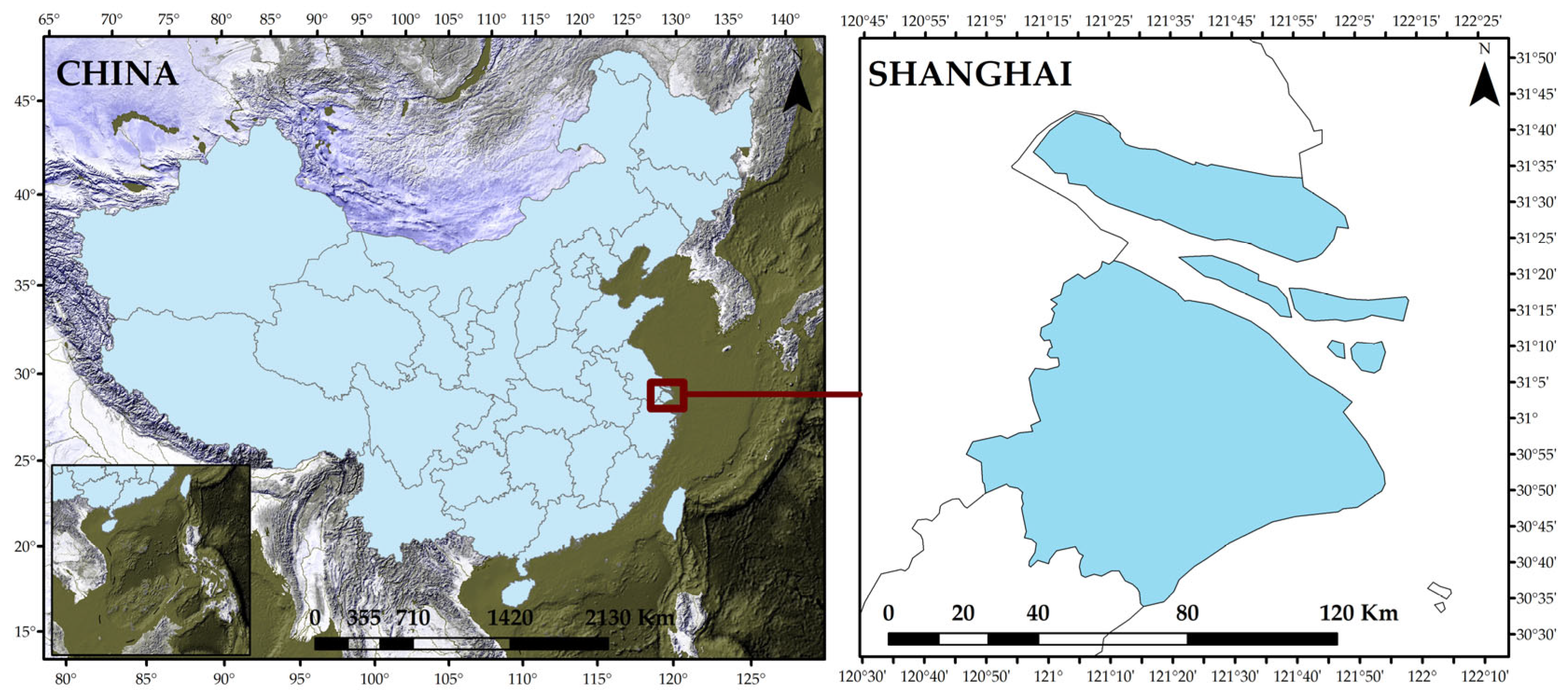
2.1. Study Area

This study takes Shanghai, China, as the study area (Figure 1). Shanghai is located on the eastern coast of China at the mouth of the Yangtze River, between 120°52′–122°12′ E and 30°40′–31°53′ N. The terrain is low and flat, which is a typical estuarine alluvial plain. With the East China Sea to the east, Hangzhou Bay to the south, and Jiangsu and Zhejiang provinces to the west, Shanghai is strategically located and is one of the most important economic centres and international metropolises in China [65,66]. With a total area of about 6340 km2, the city has a subtropical monsoon climate with southeasterly winds in summer and predominantly northwesterly winds in winter, and this wind field pattern provides natural dynamic conditions for the formation of ventilation corridors in Shanghai. Moreover, Shanghai has a high level of urbanisation [67], with dense buildings and limited ventilation in the central city, while the peripheral areas have more natural green areas and water bodies, which provide potential cold source conditions for the formation of ventilation corridors.

2.2. Research Data

In this study, building vector and road data were used to characterise the built environment. Building vector data were extracted by Zhang and other scholars based on the fusion of 0.3–1 m resolution Google Earth imagery with street view images and POI data, and attributes such as roofing, height, structure, etc., were generated for each building through machine learning and large-scale multimodal models [68]; the data can be obtained from the Figshare website (https://figshare.com/articles/dataset/CMAB-The_World_s_First_National-Scale_Multi-Attribute_Building_Dataset/27992417 (accessed on 10 October 2025)), and the road data were obtained from the OpenStreetMap website (https://www.openstreetmap.org/ (accessed on 10 October 2025)). Then, we used 1 m accuracy land use data to calculate the morphological metrics of the natural green space, which was provided by Li et al., and 1 m land use data in China [69], with data from the Zenodo website (V2.4) (accessed on 10 October 2025)). The NDVI, annual precipitation, and annual mean temperature data used to calculate the hot and cold source points and NPP data were obtained from the National Tibetan Plateau Science Data Centre (http://data.tpdc.ac.cn (accessed on 10 October 2025)). The total solar radiation data were obtained from the Earth Resources Data Cloud (www.gis5g.com (acessed on 10 October 2025)), and the LST data were obtained from the China MOD using the Google Earth Engine platform (www.gis5g.com) and the Google Earth Engine platform for China MOD11A1 LST data (https://code.earthengine.google.com (accessed on 10 October 2025)). Wind speed data were obtained from the 1KM dataset of the National Glacier, Frozen Soil, and Desert Scientific Data Center (https://cstr.cn/CSTR:11738.11.NCDC.NIEER.DB6722.2025 (accessed on 10 October 2025)), with units in metres per second (m/s). The data time was unified as 2021–2023.

2.3. Variable Construction

In order to comprehensively reveal the key factors affecting the formation of urban ventilation corridors, this study constructs an influence indicator system from three dimensions, namely, natural green space characteristics, built environment characteristics, and demand for hot and cold source points. It selects and quantifies the variables in combination with spatial pattern characteristics and functional roles.

2.3.1. Natural Green Spaces

As a vital component in regulating urban microclimates and serving as a source of cool air, the spatial structure and connectivity of natural green spaces significantly influence airflow patterns. This study employs the morphological spatial pattern analysis (MSPA) metric for green spaces to quantitatively describe the spatial typology of green patches (Table 1), such as core zones, bridging zones, edge zones, and corridor zones. MSPA metrics reflect green space connectivity, morphological complexity, and potential cold air transport capacity, providing a scientific basis for identifying urban cold sources and optimising ventilation pathways. Concurrently, MSPA analysis assists in quantifying green spaces’ contributions to urban ventilation systems across different spatial scales, thereby distinguishing core green spaces that promote ventilation from peripheral or isolated green spaces.

2.3.2. Built Environment

Due to the obstruction of air flow, the densely built-up areas in the city often form areas with low wind speeds and obvious heat accumulation, which has an important impact on the construction of ventilation corridors. In this paper, four indicators were chosen: building density, road density, average building height, and building shape complexity. The building density and average building height directly affect the local wind speed and ventilation resistance. The building density is expressed as the proportion of the grid force floor area of the cell. The average building height is calculated as the average height of the buildings in the cell grid, in which the height of the buildings affecting the ventilation is the superposition of the three-dimensional heights and two-dimensional planes. We weighted the heights when calculating the average weight of the weights, and the weight is expressed as the proportion of the building in the cell grid. Furthermore, the road density is expressed as the proportion of the buildings in the cell grid. The road density reflects the smoothness of ventilation channels in urban neighbourhoods, and a higher road density can form a smoother wind-oriented network, which is expressed as the ratio of the length of the road to the cell grid. The complexity of building shapes describes the diversity and irregularity of the shape of the building body, and a high complexity of the building cluster will increase the turbulence of the airflow and reduce the efficiency of the ventilation in the local area. The closer to a circle it is, the lower the complexity it will be. These indicators can systematically portray the obstruction effect of building space on air flow, providing a basis for the identification of negative influence indicators and the construction of resistance surfaces.

2.3.3. Determination of Hot and Cold Source Points

Hot and cold source points are important power sources and the demand side of the ventilation corridor formation. In this paper, we identified hot and cold sources based on the surface temperature (LST) and NPP index, as well as population density data, and we classified the above variables into five categories according to the natural breakpoint method: low, lower, medium, higher, and high. Cold source points are defined as the superposition of low LST and high NPP areas, representing green space or water body areas with strong cooling capacity and air transport potential; hot source points are defined as the superposition of high LST and high population density areas, representing urban high temperature zones with the strongest air flow demand and the greatest pressure on the local thermal environment. The spatial distribution of heat and cold sources not only determines the starting and ending points of ventilation corridors, but it also provides a motivational basis for subsequent corridor optimisation based on least-cost pathways.
Among them, the NPP data are calculated using the CASA model, and the input data of the model include NDVI, total solar radiation, average annual temperature, and average annual precipitation. The unit of the NPP data is: gC/m2/yr.
The fundamental calculation formula is as follows:
N P P x , t = A P A R x , t × ε ( x , t )
where
A P A R x , t = S O L x , t × F P A R x , t × 0.5
S O L x , t denotes total solar radiation (MJ/m2),   F P A R x , t represents the proportion of photosynthetically active radiation absorbed by vegetation, estimable via the NDVI:
F P A R = 1.24 × N D V I 0.168
The photosynthetic efficiency ε(x,t) denotes the rate at which absorbed solar energy is converted into biological carbon. It is calculated as:
ε x , t = ε m a x × T ε × W ε
where ε(x,t) represents the maximum photosynthetic efficiency (assumed as 0.55 gC/MJ), T_ε denotes the temperature stress factor, and W_ε denotes the water stress factor. Both factors are calculated based on air temperature and precipitation data, respectively, serving to reflect the environmental constraints on photosynthetic efficiency.

2.3.4. Descriptive Statistics of Variables

We used a 300 m × 300 m grid as the spatial statistical unit for this study, based on previous research results, and aggregated all the indicators into this grid cell—a scale that ensures a certain degree of block completeness without containing too much spatial heterogeneity. It should be noted that different research scales yield varying results. However, there is no unified standard for the grid scale in the construction of ventilation corridors within the academic community. Most studies opt for a grid resolution ranging from 100 m to 500 m [70,71]. Therefore, this study adopts a compromise by selecting a grid resolution of 300 m. Using ArcGIS 10.8.1’s fishing net tool, we finally divided Shanghai into 81,619 grid cells. While ensuring the scientific nature of the study and reducing unnecessary errors, we excluded spatial cells with NA values (as shown in Figure 2). Finally, we obtained 75,923 pieces of data. Table 2 shows descriptive statistics of all variable data.

2.4. Research Methodology

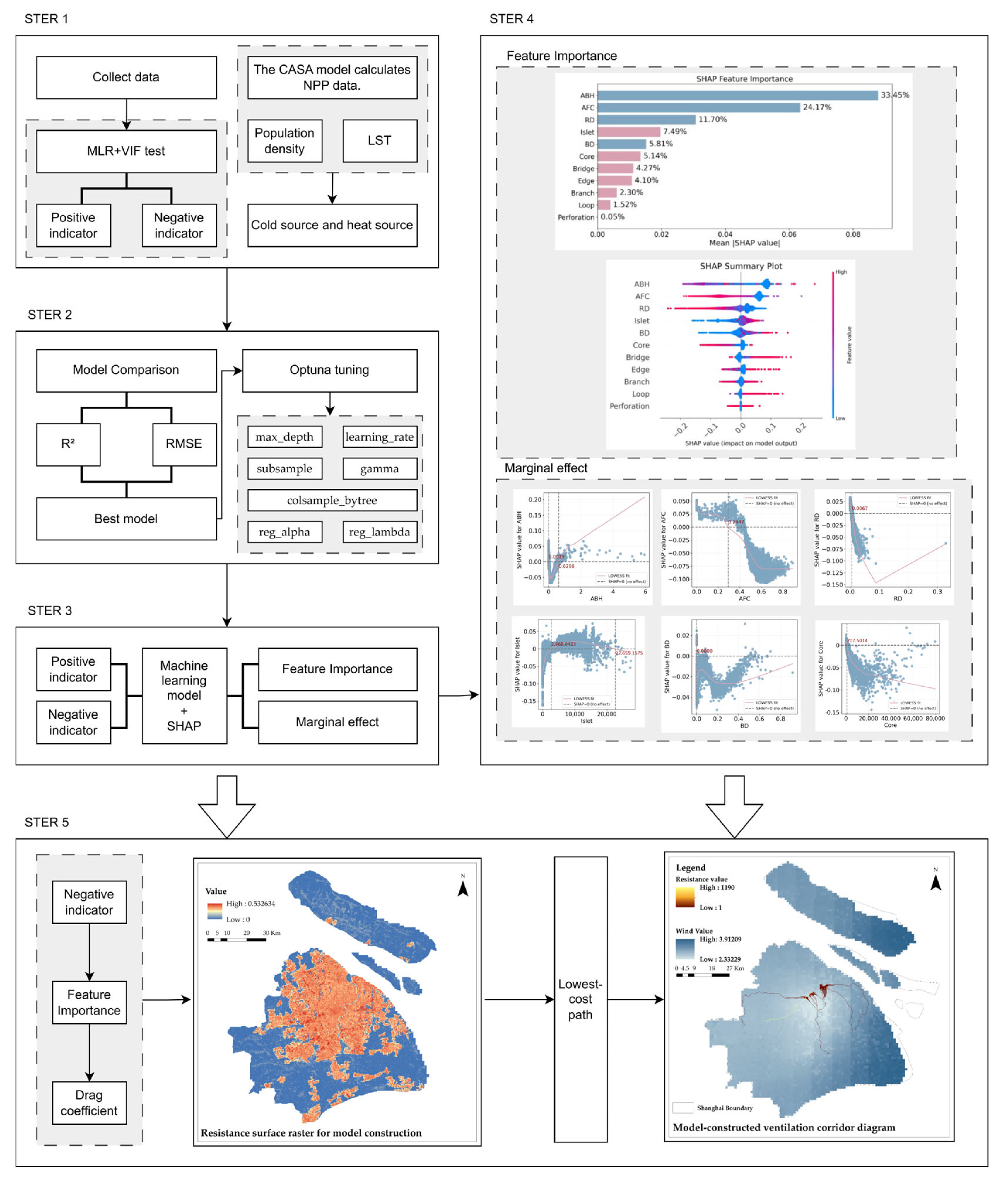
In this study, urban ventilation corridors are constructed using a workflow that combines machine learning with SHAP-based interpretation and resistance surface modelling. The procedure includes the following: (1) variable screening (VIF and MLR) to reduce multicollinearity and retain explanatory indicators; (2) training and tuning multiple machine learning models to predict the ventilation response (wind speed) from built environment and green space variables; (3) applying SHAP to obtain feature contributions (direction and magnitude) at both global and local scales, and to identify potential threshold ranges; (4) converting indicators with negative SHAP contributions into resistance factors and constructing a resistance surface; and (5) using the MCR model to compute least-resistance paths between cold sources and heat demand areas, forming an urban ventilation corridor network.
According to Lundberg’s research [72], SHAP can assign specific importance values to each feature’s predictive contribution. Combined with machine learning’s capacity to interpret nonlinear relationships, this approach effectively explains the resistance coefficients of urban ventilation resistance factors within MCR model construction. For instance, Sun et al. employed XGBoost alongside the MCR model to construct ecological corridors [73]. Consequently, we applied this integrated method of machine learning and MCR modelling to the establishment of ventilation corridors. Compared with existing related ventilation corridor studies, for example, Liu et al. primarily relied on GIS-based indicator systems and rule-based spatial analysis to identify potential ventilation corridors; however, indicator importance was derived from predefined statistical structures rather than directly learned from ventilation responses, limiting the quantitative characterization of variable-specific contribution strength. [74]. Xie et al. employed the Current Model combined with Neighbourhood Normalisation to simulate urban wind flow paths and reveal ventilation connectivity structures; however, the method focuses on spatial connectivity patterns rather than quantitatively disentangling the contribution strength and nonlinear effects of individual morphological indicators. [75]. Lyu et al. constructed a cold source service flow network from a 3D perspective, extending the spatial representation of urban ventilation; however, the analysis primarily characterises spatial flow patterns and structural connectivity, without explicitly quantifying variable-specific contribution strength, nonlinear responses, or threshold effects across different indicator ranges. [76]. In contrast, this study, through the machine learning + SHAP values, identifies the facilitating or hindering effect of each indicator on ventilation, and the critical thresholds and marginal effects of the variables in different intervals can be further analysed. Meanwhile, the SHAP values of the negative influence indicators are normalised to form the resistance weights, which provide a scientific basis for the subsequent construction of resistance surfaces and optimisation of ventilation corridor paths.

2.4.1. Variable Testing (VIF, MLR)

To ensure the explanatory power of the selected indicators for urban ventilation environments, this study first conducted multicollinearity tests and preliminary regression analyses on the indicator system. Specifically, we employed the Variance Inflation Factor (VIF) as the multicollinearity evaluation criterion, explicitly setting VIF > 5 as the threshold for variable exclusion. When an indicator’s VIF exceeded 5, it was deemed to exhibit strong multicollinearity and was removed from the subsequent modelling variable pool. Only variables with VIF < 5 were retained in the machine learning model to ensure good feature independence and avoid model parameter instability.
Following multicollinearity screening, this study further employed multiple linear regression (MLR) to assess significant relationships between variables and ventilation response indicators, identifying core positive and negative factors influencing the ventilation environment. These statistically significant and structurally independent variables ultimately formed the input feature set for the machine learning model, providing a reliable foundation for subsequent modelling, interpretability analysis, and resistance surface construction.

2.4.2. Machine Learning

After the screening of variables, this study used tree models such as Random Forest, XGBoost, and LightGBM to predict the urban ventilation environment. The machine learning models are able to automatically identify the intensity of the influence and interaction between the built environment and natural green space features on ventilation under complex and variable conditions, and achieve accurate predictions of ventilation potential. The input of the model is the filtered indicators of the built environment and natural green space, and the output is the ventilation potential or air flow efficiency indicators. In order to ensure the generalisation ability of the model, the dataset was divided according to the ratio of 8:2 between the training set and the test set to reduce the chance of errors. In the evaluation of model performance, root mean square error (RMSE) and the coefficient of determination (R2) were mainly used as indicators, RMSE was used to measure the deviation of the predicted value from the true value, and R2 was used to evaluate the fit of the explanatory variables to the ventilation response variables. We selected seven types of models commonly used in academic research for comparison (Table 3).

2.4.3. Model Tuning

In order to improve the prediction accuracy and stability of machine learning models, this study adopts the Optuna framework for hyperparameter optimisation. Optuna is an automated hyperparameter search tool that efficiently searches for the optimal parameter combinations by defining the search space and the objective function using Bayesian Optimisation or the TPE (Tree-structured Parzen Estimator) method [77]. In the random forest model, the number of trees, maximum depth, and minimum number of sample splits are mainly optimised, while in XGBoost with LightGBM, the learning rate, maximum depth of the tree, number of leaf nodes, and regularisation parameters are optimised. Cross-validation was used to evaluate the model performance during the tuning process, and the optimisation goal was to minimise the RMSE and maximise the R2 to ensure that the model achieved optimal results in terms of prediction accuracy and generalisation ability. Through Optuna’s efficient search and intelligent sampling, the RMSE of the model on the test set was reduced while the R2 was increased, which provided a reliable basis for subsequent SHAP interpretability analysis and resistance surface construction.

2.4.4. SHAP

To address the black box nature of machine learning models, this study introduces the SHAP (SHapley Additive exPlanations) method to achieve an interpretable analysis of model prediction results. SHAP quantifies the positive and negative effects and relative importance of each variable on the ventilation effect by calculating the marginal contribution of each feature among all possible feature combinations.
Specifically, we first extracted indicators with negative effects on ventilation from the SHAP values—namely, those consistently negative or turning negative after the threshold—as potential ventilation resistance factors. Subsequently, we took the absolute values of these negative SHAP importance scores and normalised them within the 0–1 range, enabling different indicators to participate in resistance surface construction on a unified scale. The normalised SHAP values serve as weight coefficients for each resistance indicator, enabling quantifiable mapping from model interpretation results to the MCR resistance surface. This approach reduces the uncertainty associated with traditional subjective weighting by allowing resistance weights to reflect the model-identified negative contribution strength of each indicator in a consistent, interpretable manner. Furthermore, this study employed machine learning and SHAP to interpret the impact of built environment and green space indicators on urban ventilation. The analysis focuses on their correlation with wind speed, constituting a statistical correlation analysis rather than a causal relationship analysis.

2.4.5. MCR Model

After obtaining the weights of resistance surfaces, this study constructed urban ventilation corridors based on the MCR model. The MCR model is commonly used in ecological corridor calculations, which calculates the cumulative obstruction degree of species from the “source” to other regions by identifying the ecological “source”, dividing the migration resistance of different landscapes, and finally identifying the optimal migration path or region for ecological connectivity. In this study, the theoretical approach was used to construct ventilation corridors. First, the normalised SHAP values of negative indicators were superimposed to form a rasterised resistance surface, with each raster representing the magnitude of resistance to air flow, which integrates the effects of the built environment and surface features on ventilation. Subsequently, the surface temperature (LST), NPP data, and population density data were combined to identify the cold source and heat source points. Cold source areas were identified by the superposition of low LST and high NPP values, representing ecological spaces with strong cooling capacity and air transport potential; heat source areas were identified by the superposition of high LST and high population density areas, representing high temperature areas of the city with the most concentrated ventilation demand. On the basis of resistance surfaces and heat and cold source nodes, the optimal paths for air flow were calculated by the least-cost path algorithm, and multiple paths were integrated to form an urban ventilation corridor network. Finally, the corridor network was optimised and adjusted by combining the marginal effect of positive indicators to achieve the scientific construction and functional enhancement of the ventilation corridor.

2.5. Technical Route

We first analysed the articles in the field related to ventilation corridors and posed the research questions. Then, we constructed the impact indicator system for the ventilation corridors, and then analysed its positive and negative impacts on the ventilation environment by using machine learning + SHAP. Afterwards, we summarised the negative impact indicators into resistance indicators, and then used the positive impacts for the optimisation and enhancement strategies of the ventilation corridors. Before that, we verified the machine learning model’s fitting ability and selected the best model to perform the modelling calculations. Then, we converted the importance of the obtained negative indicators into weights to construct the resistance surface. After that, we used the natural breakpoint method to determine the cooling and heating sources and construct the ventilation corridor through the lowest cost path. Then, the analysis proposed an optimisation strategy for the ventilation corridor based on the marginal effect of the positive indicators (Figure 2).
Figure 2. Technical Roadmap.
Applsci 16 01428 g002

3. Results

3.1. Data Testing and Model Tuning

3.1.1. MLR and VIF Results

To ensure that the selected variables have significant explanatory power for the urban ventilation environment, this study first conducted multiple linear regression (MLR) analyses and calculated the variance inflation factor (VIF) of each indicator to detect multicollinearity (Table 4). The MLR results showed that the coefficients of each variable passed the significance test (p-value less than 0.01), indicating that both indicators of the built environment and the morphology of the natural green space have a statistically significant effect on the ventilation potential have statistically significant effects. The coefficients of building density (BD) and average building height (ABH) are −0.344901 and 0.080003, respectively, indicating that building density has a significant negative effect on ventilation, while building height has a positive effect on ventilation. The coefficients of Road Density (RD) and Architectural Form Complexity (AFC) are −6.091983 and −0.452500, respectively, which also show negative effects, reflecting that high-density and complex forms of urban buildings have impeded effects on ventilation. In terms of natural green space indicators, the coefficients of various types of MSPA patch patterns (Core, Islet, Perforation, Edge, Loop, Bridge, Branch) are all significant, although the values are small—we were surprised to find that Core and Edge had negative effects on ventilation, while Bridge and Islet had positive moderating effects.
The VIF test results show that the VIF values of each variable are less than 5, with a maximum value of 4.546167, indicating that the problem of multicollinearity is not serious, and the model is able to stably reflect the contribution of each indicator to the ventilation potential. This provides a reliable input base for subsequent machine learning modelling, while ensuring the independence and explanatory power of the variables in the model. Overall, the MLR and VIF results validate that the selected built environment and natural green space variables have a significant impact on urban ventilation, which lays the foundation for further quantifying the positive and negative effects and constructing resistance surfaces using machine learning and SHAP methods.

3.1.2. Model Validation and Tuning

After variable screening, this study evaluated multiple machine learning algorithms to model urban ventilation potential, including XGBoost, Gradient Boosting, LightGBM, CatBoost, Random Forest, Decision Tree, and Support Vector Regression (SVR). Model performance was assessed using the coefficient of determination (R2) and root mean square error (RMSE). The results (Table 5) show that XGBoost performs best (R2 = 0.2616, RMSE = 0.2995), slightly outperforming Gradient Boosting (R2 = 0.2605, RMSE = 0.2997) and LightGBM (R2 = 0.2604, RMSE = 0.2997). By contrast, SVR performs worst (R2 = −0.0241, RMSE = 0.3527), indicating limited ability to fit complex nonlinear relationships in the present dataset. Other models, such as CatBoost, Random Forest, and Decision Tree, achieve R2 values of 0.2537, 0.2533, and 0.2356, with corresponding RMSE values of 0.3011, 0.3012, and 0.3047. Overall, ensemble tree-based models show clearer advantages in capturing the nonlinear effects of multidimensional built environment and green space variables on ventilation.
After determining the optimal model, this study employed the Optuna framework to tune hyperparameters for XGBoost to improve predictive performance. During tuning, the training set was used for model fitting and the validation set for performance evaluation, with the objective of minimising RMSE while maximising R2. The tuning results (Table 6) show that R2 increases to 0.4978 with RMSE of 0.1799 on the training set, and to 0.4115 with RMSE of 0.1944 on the validation set. Compared with the untuned model, the tuned XGBoost improves performance on both training and validation sets, indicating better generalisation on held-out data and providing a reliable basis for subsequent SHAP interpretation and resistance surface construction.

3.2. Linear and Nonlinear Features

3.2.1. Feature Importance

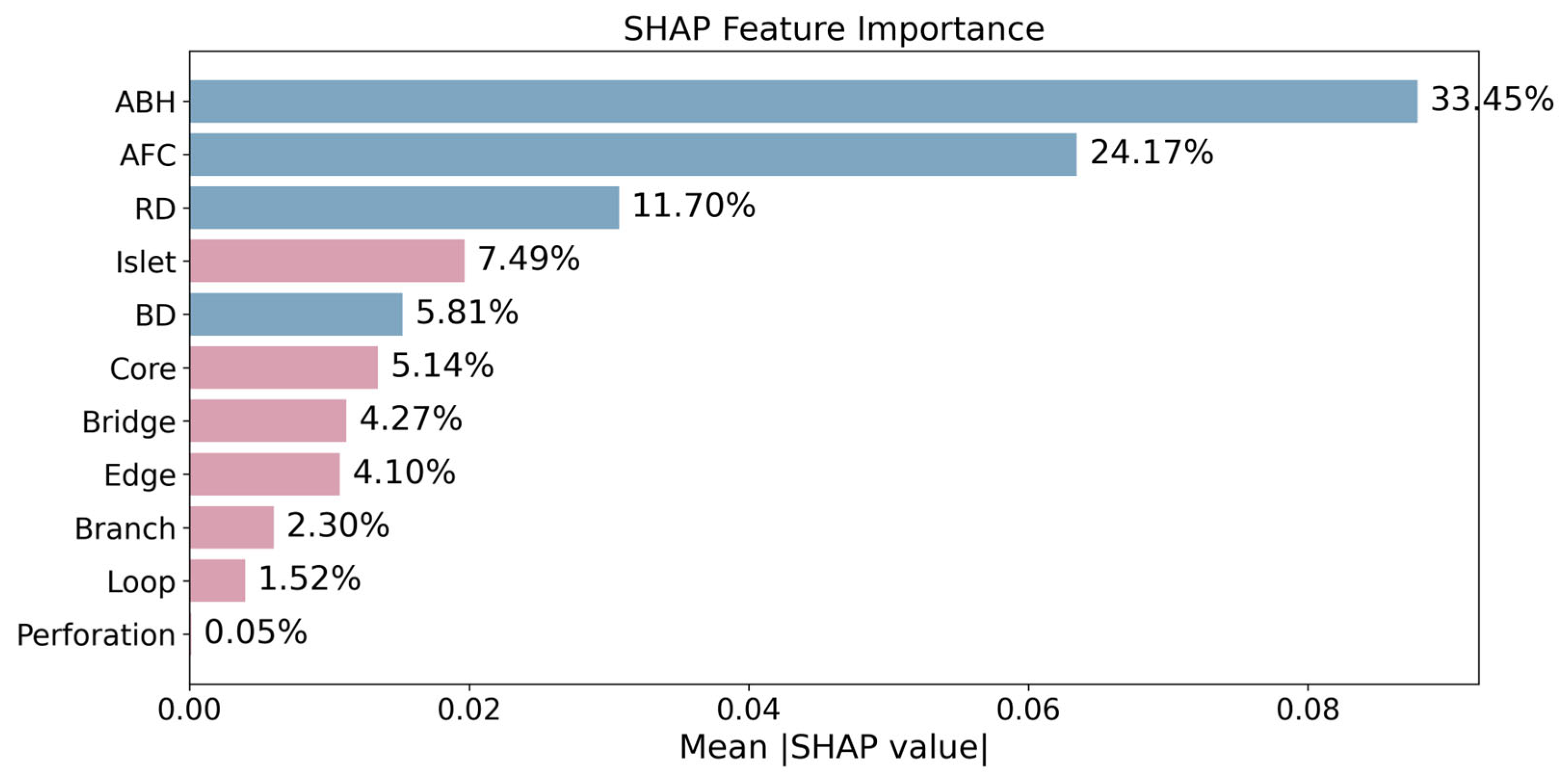
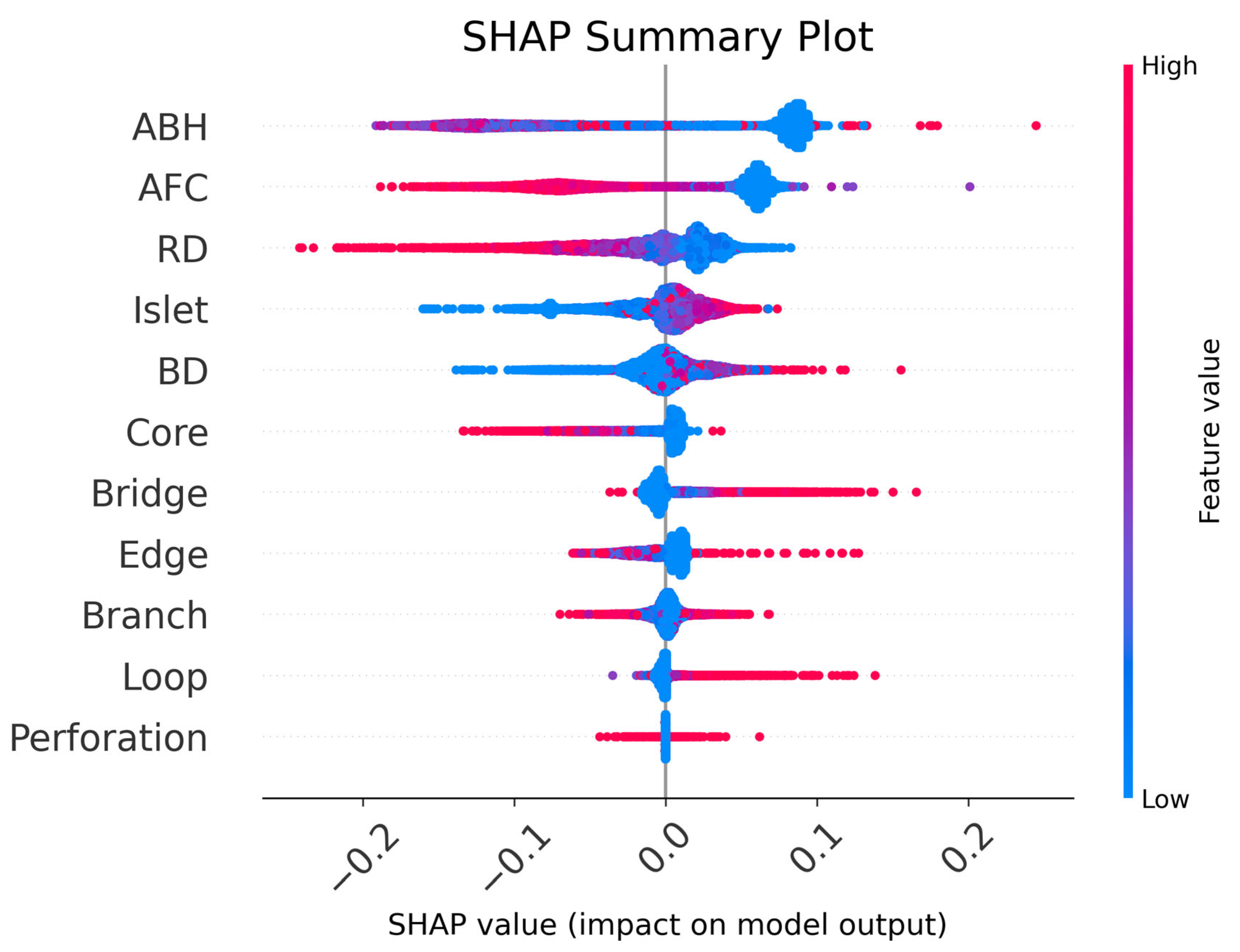
We performed SHAP global 0and local importance analyses for each variable using the tuned model. Figure 3 shows the SHAP global feature importance, which considers all samples and calculates the mean absolute value of each feature, and Figure 4 shows the local feature importance, which plots the SHAP value of each sample for each feature, indicating the range of influence of the dataset for those features. In both plots, the x-axis represents the SHAP values and the y-axis represents the features. Positive values indicate an increase in prediction, and negative values indicate a decrease. Each point represents the SHAP value of the samples in the dataset, and the colour indicates the original feature value, with red indicating high values and blue indicating low values.
The model feature importance ranking reveals that average building height (ABH) is the primary factor influencing ventilation potential, accounting for 33.45% of the importance share. This indicates that building height exerts a significant regulatory effect on the formation of urban wind environments. A moderate building height gradient can generate pressure differentials conducive to airflow circulation, thereby enhancing the efficiency of internal air exchange within the city. Secondly, architectural form complexity (AFC) accounts for 24.71% of importance, revealing that the geometric characteristics of building exteriors exert a strong influence on ventilation flow fields. Highly complex structures often induce turbulence and disorder in airflow, increasing localised resistance and thereby diminishing the connectivity of air pathways. Road density (RD), accounting for 11.70%, partially reflects the openness of urban space and the accessibility of air transport corridors. Higher road density can enhance the connectivity of ventilation corridors, yet an excessively dense road network in areas of high building density may conversely obstruct airflow. Among natural green space variables, isolated patches (Islet) and core areas (Core) contributed 7.49% and 5.14%, respectively, indicating that the morphological distribution of green spaces modulates ventilation systems. Isolated green spaces may form localised cold air convergence zones, exerting cooling and ventilation-enhancing effects on surrounding microclimates, while core green spaces provide stable cold sources, aiding the formation of cold air flows towards urban interiors. Bridge zones and edge zones contributed 4.27% and 4.10%, respectively, demonstrating that the spatial connectivity of green spaces significantly contributes to cold air transmission. Building density (BD) accounted for 5.81%, indicating that high-density built areas generally create ventilation resistance, confirming the inhibitory effect of the built environment on airflow. Other indicators, such as Branch, Loop, and Perforation, exhibited relatively low importance at 2.30%, 1.52%, and 0.05%, respectively, suggesting their limited role within the ventilation system. However, they may exert secondary regulatory effects through spatial coupling with other green space morphologies. Overall, the influence of built environment factors on urban ventilation potential significantly outweighs that of natural green space form indicators. This indicates that the spatial structure of built environments remains the primary controlling factor for optimising urban ventilation, while natural green spaces play a supplementary role in cold source supply and corridor connectivity.
Furthermore, Figure 4 reveals that Core, Edge, Branch, BD, RD, and AFC exhibit a pronounced negative effect, consistent with the MLR results.

3.2.2. Marginal Effects

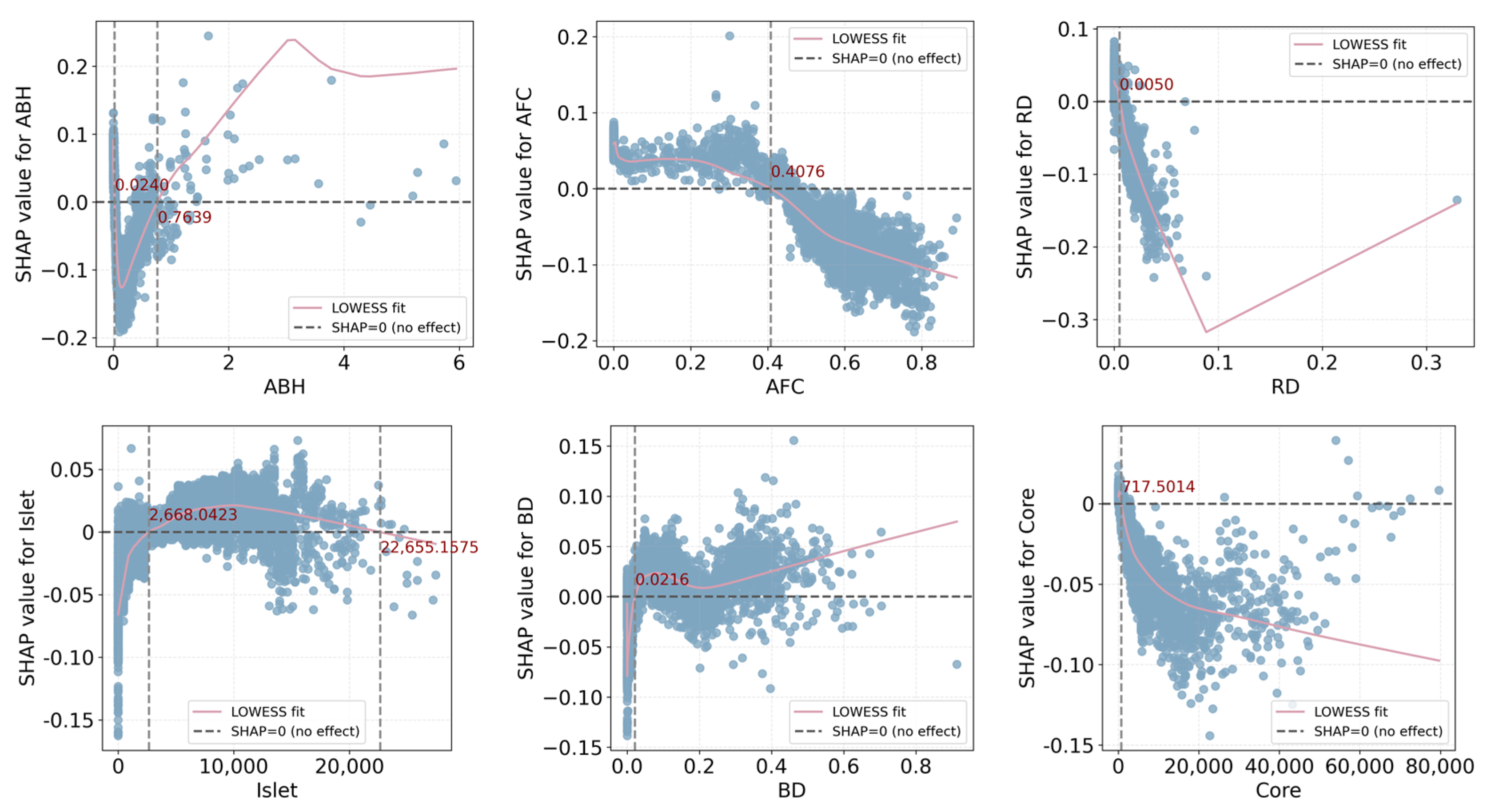
After analysing the significance of the characteristics, this study further selected the key variables with more than a 5% contribution rate to explore the marginal effects in order to reveal the characteristics of the positive and negative impacts on the ventilation potential in the value interval of different variables. The results show (Figure 5) that the average building height (ABH) in the range of 0.024–0.7639 has a negative SHAP value, which shows a significant negative effect, indicating that the building height in the lower range will hinder the airflow and reduce the ventilation potential of the city. As building heights increase further and form a certain height on both sides, the spatial gaps between buildings generate a Venturi effect, accelerating airflow within the local passageway. This results in the ventilation potential shifting from negative to enhanced [78].
The SHAP value of the architectural form complexity (AFC) switches positively and negatively at 0.4076, indicating a critical threshold for changes in the ventilation effect. When the AFC is lower than 0.4076, the building shape is regular, and the external contour is simple, which helps air flow; when the complexity exceeds this threshold, the irregularity of the building shape enhances the air flow disorder, which leads to a significant decrease in the ventilation efficiency. The building’s exterior features numerous concave-convex surfaces, sharp corners, irregular volumes, or irregular joints, causing severe separation of the incoming airflow at the building interface. This generates additional vortex zones, dead air areas, and recirculation vortices, significantly increasing airflow turbulence and reducing ventilation efficiency [79]. For road density (RD), the SHAP value turns negative when it is higher than 0.0050, indicating that excessive road density weakens the coherence of the ventilation channels. When road density becomes excessively high, streets and alleys fragment into a densely packed grid pattern with frequent directional shifts. This causes airflow to repeatedly lose kinetic energy through multiple deflections, resulting in phenomena such as difficulty in maintaining prevailing wind directions, fragmented wind pathways, and significant local wind speed attenuation. Additionally, high road density is often accompanied by dense building clusters and increased hardened surfaces, elevating the urban surface friction coefficient and further reducing overall ventilation efficiency [80].
Islet in the range of 2668.0423–22,655.1575 shows a positive effect, which indicates that the moderate number and scale of Islet can serve as a local cooling source and enhance air flow and microclimate regulation. A positive effect of building density (BD) above 0.0216 indicates that low-density built-up areas contribute to smooth ventilation. When density increases further to a certain level, the enhanced directionality of building alignment may induce a localised Venturi effect, leading to localised wind speed intensification within certain narrow streets. In high-density neighbourhoods where buildings uniformly face the prevailing wind direction, “local acceleration zones” often emerge. Even within areas of overall high density, wind speeds in these zones can significantly exceed those in surrounding areas [81]. On the contrary, the SHAP value of Core is negative at higher than 717.5014. Within large-scale green spaces, low surface resistance and a relatively uniform vegetation height cause wind speeds to significantly diminish, forming low wind zones (calm zones) that dissipate the kinetic energy of air masses entering the green areas. When airflow traverses extensive green spaces before re-entering built-up areas, its kinetic energy becomes insufficient, manifesting as reduced downstream wind speeds, dispersed wind directions, and an inability to form effective wind corridors upon re-entering the urban fabric. Consequently, excessively large central green spaces may actually diminish the overall ventilation connectivity within the urban core.
Overall, the marginal effect analysis reveals the nonlinear mechanism of each key variable on the urban ventilation potential in different intervals. The threshold changes of built environment factors are more sensitive, indicating their dominant influence on the ventilation system, while the marginal effects of natural green space indicators are relatively flat, reflecting their auxiliary characteristics in ventilation regulation and cold source supply. These results provide a quantitative basis for the subsequent construction of the resistance surface of the ventilation corridor and the development of optimisation strategies.

3.3. Ventilation Corridor Construction

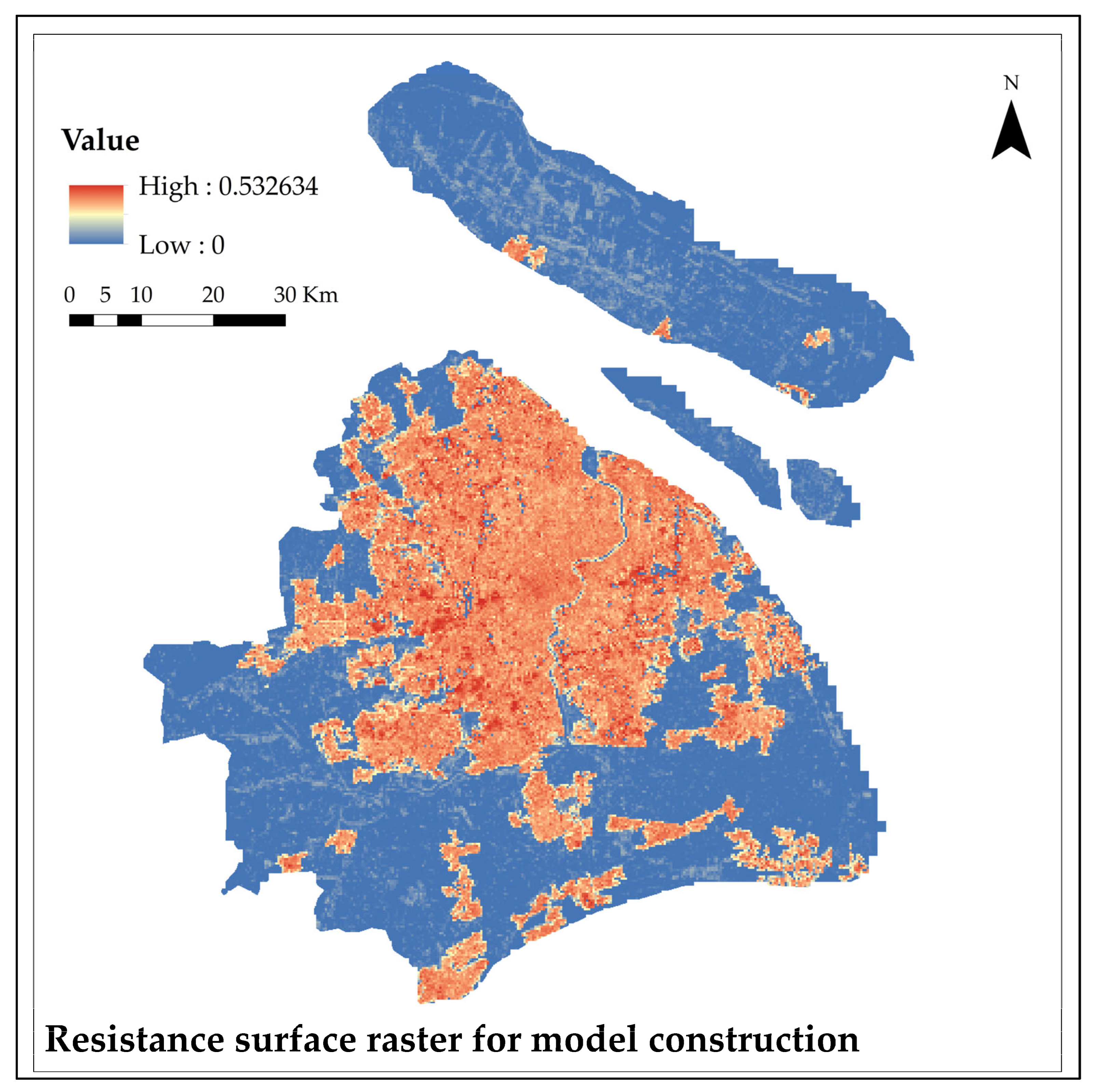
After clarifying the importance and marginal effects of the ventilation influence factors, this study transforms the negative indicators into ventilation resistance factors in order to construct a comprehensive resistance surface that reflects the difficulty of air flow. Through the importance weight output results of the XGBoost-SHAP model indicators, the weight results of all negative indicators are normalised and transformed into resistance factors, and then the resistance surface is calculated and constructed (Figure 6). In the figure, high resistance values are mainly focused on built-up areas, and low-resistance areas are mainly distributed in suburban areas.
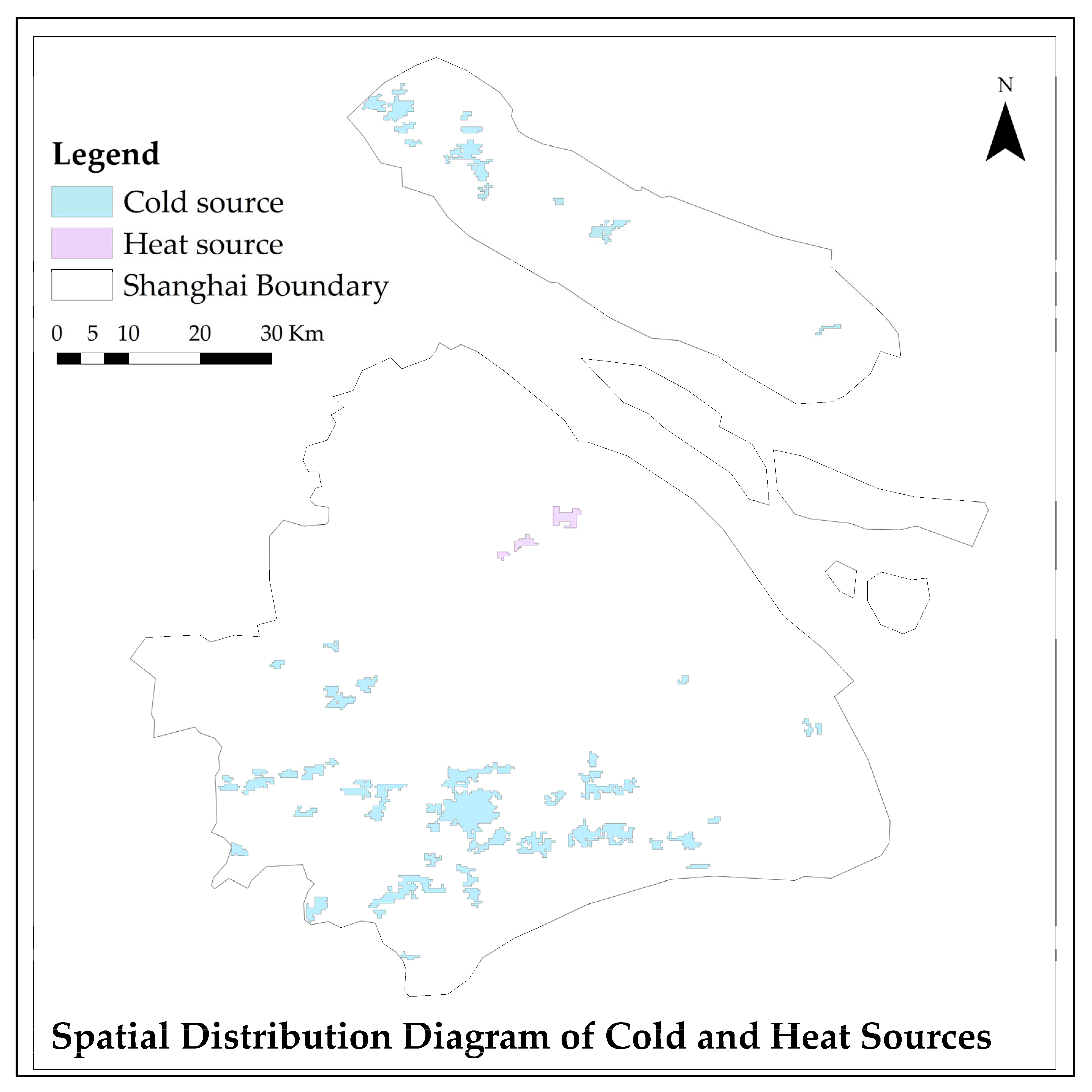
Then, based on the hot and cold source construction method proposed in Section 2.3, we constructed hot and cold source points (Figure 7) to identify the cold and hot source areas within the city. The cold source points are selected from the superposition of low LST and high NPP areas, which represent natural green spaces and ecological spaces with a good thermal environment and potential for cold air generation and transport; the hot source points are determined from the superposition of high LST and high population density areas, which reflect the core of built-up areas with high heat concentration and ventilation demand. The results were optimised, and three heat sources and 46 cold sources were obtained after removing the fragmented points. The spatial pairing of cold and heat sources can provide reasonable starting and stopping conditions for the path planning of ventilation corridors.
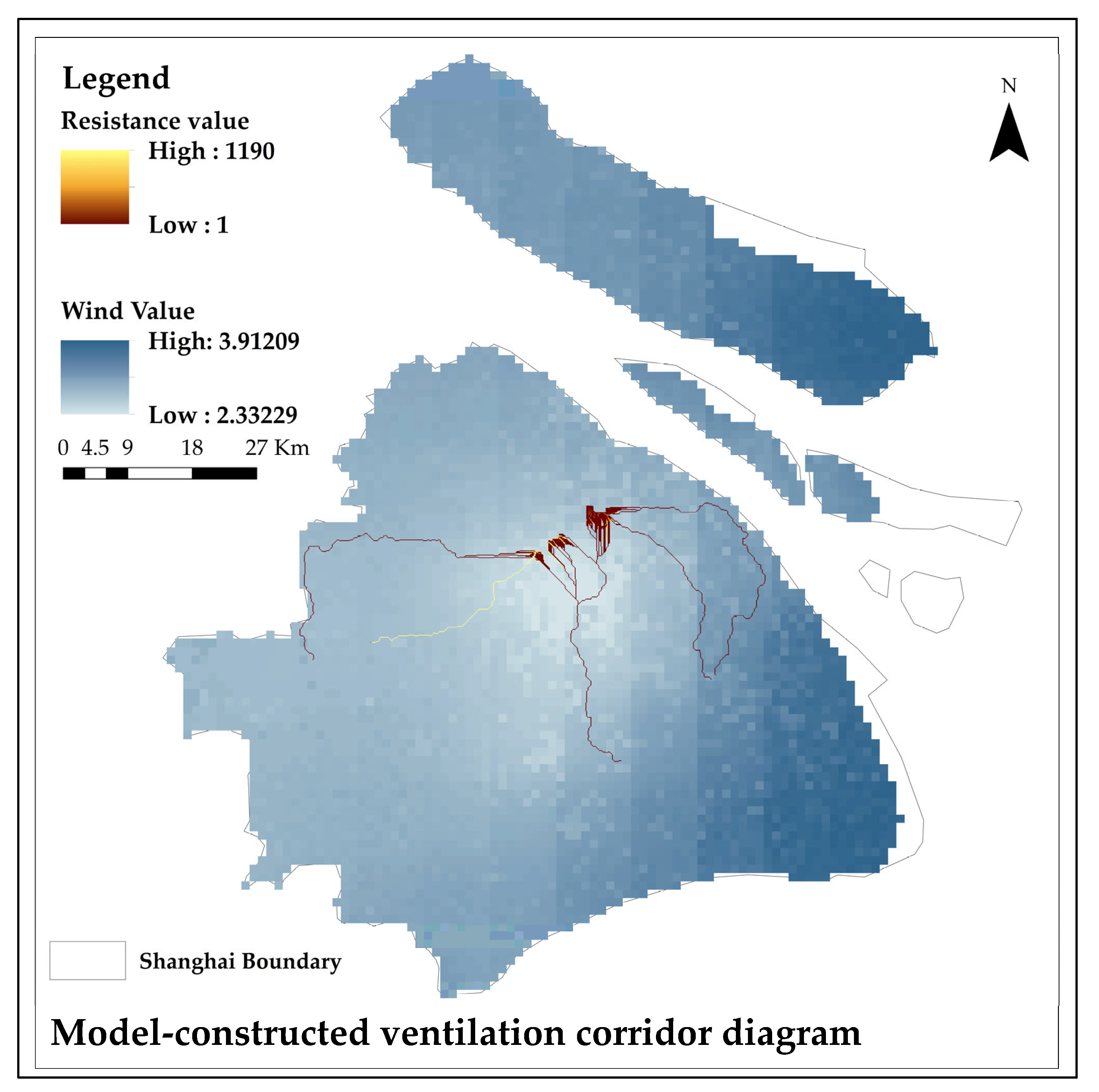
Finally, based on the resistance surface and the distribution of cold and heat source points, this study used the MCR model to construct the urban ventilation corridor network in Shanghai. The method takes the cold source as the starting point and the heat source as the target point, and searches for the path with the lowest resistance to wind flow passage on the resistance surface in order to simulate the optimal channel for the natural wind to be transported from the cold source area in the suburbs to the heat source area in the city centre. During the path calculation process, the resistance value of each grid is determined by the negative index weights, thus reflecting the comprehensive influence of local building morphology, surface structure, and green space pattern on the airflow movement. The results show that there are mainly four ventilation corridors (Figure 8), which transport air to the urban area from different directions. By combining the importance analysis of machine learning and geospatial resistance modelling, the method not only improves the scientific and quantitative identification of ventilation corridors, but it also provides reliable technical support for optimising the building layout, improving the connectivity of green space, and mitigating the heat island effect in urban planning.

4. Discussion

4.1. Discussion of the Positive and Negative Effects of Factors

In this study, the main factors affecting the urban ventilation environment in Shanghai and their positive and negative effects were systematically identified through machine learning models and SHAP analysis methods. Overall, built environment variables and natural green space variables show significant opposing effects in the urban ventilation potential, with the former mostly behaving as resistance factors that inhibit airflow [82,83]. The latter, on the other hand, is commonly a facilitating factor, which can improve the ventilation environment and thermal comfort [84,85].
From the perspective of the built environment, the average building height (ABH) has the most significant effect on ventilation. With the increase in building height, the surface roughness is significantly increased, and the cutting effect of urban underlay on wind speed is enhanced, leading to the obstruction of air exchange at the lower level. When ABH is at elevated levels, the wind flow forms a ventilation corridor effect between buildings, which has a certain promotion effect; however, when the building height exceeds the critical value, the turbulence effect is enhanced and produces a strong leeward zone, and the ventilation capacity decreases significantly [86]. In addition, architectural form complexity (AFC) is also an important structural parameter that affects the ventilation environment [87]. Complex building geometries increase the uncertainty and turbulence intensity of airflow paths, making the wind field structure more fragmented and thus weakening the overall ventilation fluency [88]. Especially when the AFC exceeds the threshold of 0.4076, the negative effect is significantly enhanced, indicating that the regularity of building design is important for optimising the urban wind environment [89].
The impact of road densityexhibits dual characteristics. Low-density roads help preserve larger-scale open spaces, facilitating the free passage of air currents; whereas when the road density exceeds 0.0050, it is often accompanied by high-intensity development and surface hardening, leading to localised heat accumulation and restricted air exchange [90]. This manifests as a pronounced negative effect, indicating that ventilation benefits not solely from the road width, but it also hinges critically on intersection configuration and the distribution of windward sections [91]. Building density (BD) exhibits a nonlinear relationship with ventilation effects. In low-density areas, air can flow freely through gaps between buildings; conversely, in high-density zones, the directionality of building arrangements and wind tunnel effects may temporarily enhance local wind speeds, yet overall, they suppress ventilation potential. This inhibitory effect has been validated by numerous studies [92,93]. For instance, Palusci et al. explicitly demonstrated that urban ventilation deteriorates significantly with increasing building density [94].
In contrast, the natural green space morphological variables mainly reflect positive effects. Isolated green space (Islet) A is a significant contributor in the medium scale range (2668.0423–22,655.1575); this type of dispersed ecological patch creates multiple cold source points in the urban fabric, which helps to drive localised circulation and enhances air transport capacity [95]. Green spaces (Core), although favourable to the formation of cold air in general, may show a negative effect when the scale exceeds a certain threshold, as it may lead to wind flow dissipating within the green space without being effectively transported to the built-up area of the city [96]. Scholars such as Hsieh have pointed out that trees planted without proper planning can reduce wind movement [97]. Overall, natural green space has a positive significance in improving the urban ventilation environment by increasing air humidity, reducing surface temperature, and forming a cold source power gradient; this correlation is affected by elements such as the shape, degree of aggregation, and area of the green space, which is in line with the conclusions of Rui and other scholars [98].
Comprehensive analyses show that built environment factors have a more dominant role in the ventilation system, while natural green spaces play a supporting function in overall climate regulation and cold source formation. The interaction between the two determines the structural characteristics of the urban wind environment: high-density and high-complexity building patterns are prone to form ventilation blocking zones, while multi-scale and well-connected green space systems can significantly alleviate the heat island and air stagnation phenomena. Therefore, in the planning of urban ventilation corridors, attention should be paid to the synergistic optimisation of architectural parameters and ecological patterns so as to improve the ventilation efficiency and thermal environment quality of the city as a whole by controlling the building height gradient, rationally allocating green space patches, and strengthening the connectivity of blue and green spaces.

4.2. Machine Learning–Based Identification and Construction of Urban Ventilation Corridors

In this study, machine learning methods are introduced into the process of identifying and constructing ventilation corridors, providing a simpler path to constructing ventilation corridors for traditional ventilation studies based on empirical weights or linear models. Through the learning and modelling of multidimensional indicators such as the built environment and natural green space, the machine learning model not only realises the nonlinear identification of the ventilation environment’s influencing factors, but it also extracts the complex interaction relationship between variables without a priori assumptions, thus significantly improving the scientificity and accuracy of the construction of ventilation corridors.
First, during the phase of identifying factors influencing ventilation conditions, the machine learning model demonstrates stronger predictive capability than multiple linear regression in capturing nonlinear relationships. The Optuna-tuned XGBoost model, for example, achieves a validation R2 of 0.4115 and RMSE of 0.1944 (Table 6), indicating improved generalisation on held-out data. In contrast, linear models often struggle with multicollinearity and nonlinear relationships among variables such as building height, density, and spatial form. The machine learning model can adaptively reveal complex coupling effects through iterative optimisation and feature weighting, providing a more reliable basis for subsequent resistance surface construction.
Secondly, by introducing the SHAP (SHapley Additive exPlanations) method, this study has achieved the transformation from a “black box” model to an interpretable model in terms of the importance of the features. SHAP not only quantifies the direction and degree of the contribution of each variable to the model output, but it also reveals the changing law of thresholds and marginal effects of different variables. For example, variables such as ABH, AFC, and RD have a negative effect within a certain value range, while variables such as Islet and BD have a ventilation-promoting effect within a moderate range. This SHAP-based interpretation framework enables the output results of the machine learning model to have a clear physical meaning and to logically correspond to the urban wind environment.
In the resistance surface and ventilation corridor construction stage, the machine learning importance weights are further transformed into spatial resistance values, which provide quantitative inputs to the MCR model. The resistance surface constructed using SHAP-derived weights provides a data-driven alternative to expert-assigned weighting by translating the model-identified negative contribution strength of indicators into resistance coefficients, thereby reducing subjectivity in the weighting step. The results show that the spatial distribution of ventilation corridors is basically consistent with the prevailing wind direction, which mainly extends along the urban periphery to the core area and forms the main airflow corridors in green areas, water systems, and low-density building areas. The general orientation of the constructed ventilation corridor largely aligns with that established by Gong [99]. This indicates that the machine learning method can effectively capture the nonlinear correspondence between urban morphological features and airflow paths, thus improving the accuracy and applicability of ventilation corridor identification.
Overall, the introduction of machine learning in the study of ventilation corridors not only enriches the technical means of urban climate analysis, but it also shows significant advantages in the analysis of factors affecting ventilation environments and spatial path optimisation. On the one hand, the high interpretability and flexibility of the model provide data-driven decision support for urban planning; on the other hand, the spatial modelling method combining GIS and MCR model enables the machine learning results to be directly transformed into the basis of spatial planning, thus realising the transition from “data analysis” to “planning application”. The complete closed loop from “data analysis” to “planning application” is achieved. Future research can further explore methods based on deep learning or spatial–temporal dynamic modelling in order to achieve a fine portrayal of seasonal ventilation characteristics and climate change response.

4.3. Limitations

This study has achieved certain results in utilising machine learning to construct urban wind corridors, but several limitations remain. First, discrepancies in the temporal span and spatial resolution of data sources may affect the model’s spatial accuracy. Additionally, the use of static data in this study fails to fully reflect dynamic characteristics, such as seasonal wind direction and climate change. Second, although machine learning and SHAP improved variable interpretability, the model’s fit (R2) remains influenced by input variable representativeness and parameter settings. Certain complex nonlinear effects in wind fields remain difficult to fully capture, introducing uncertainty in the results. Moreover, the minimum cost path method relies on static resistance surface calculations without accounting for dynamic meteorological factors like actual wind speed and direction. This makes the identified results closer to potential ventilation corridors than actual wind fields. Finally, this study focuses on corridor identification and impact analysis without quantitatively assessing its practical effectiveness in mitigating urban heat island effects or improving air quality. Future work could integrate high-spatial–temporal-resolution meteorological observations, multi-scenario simulations, and field verification to further enhance model accuracy and optimise guidance for ventilation corridor design.

5. Conclusions

Taking Shanghai as the study area, this study systematically identifies the key factors affecting urban ventilation based on the urban ventilation mechanism and MCR model, combines machine learning and geographic information technology, constructs a ventilation corridor based on the resistance surface, and proposes a targeted optimisation strategy. This study not only reveals the nonlinear effects of the built environment and natural green space features on the ventilation system, but it also verifies the feasibility and explanatory power of machine learning in urban microclimate analysis. The main conclusions are as follows:
(1)
Positive and negative factors affecting urban ventilation
The results of this study show that the built environment factors show obvious negative effects on the ventilation environment as a whole, of which the average building height (ABH), architectural form complexity (AFC) and road density (RD) are the main factors affecting the ventilation resistance; whereas the natural green space morphology features, such as Islet and Bridge, have a positive effect to a certain extent and can significantly enhance air flow—the promotion effect, which can significantly enhance air flow and heat exchange. Architectural factors and green space systems together determine the conditions for the formation of ventilation corridors in space, with the former constituting the resistance surface and the latter providing cooling sources and ventilation paths.
(2)
Ventilation corridor construction
Based on the importance results of the machine learning model and SHAP analysis, this study transforms the negative influence indicators into weights to construct the ventilation resistance surface and identifies the points of cold sources (low LST, high NPP) and heat sources (high LST, high population density) through the natural breakpoint method. Using the MCR model algorithm, a number of potential ventilation corridors leading from the peripheral cold source area to the core heat source area of the city were identified. The results show that the main ventilation corridors are concentrated along the rivers and low-density green zones, and the overall direction is highly consistent with the direction of the prevailing winds, forming a more continuous “cold source-channel-heat source” air transport system, which provides a new path for the construction of a quantitative ventilation network. This provides a new path for the construction of a quantitative ventilation network.
Overall, this study provides a quantifiable and interpretable new idea for the identification of urban ventilation corridors through the integration of machine learning and ventilation theory, breaks through the limitations of traditional qualitative analyses, and verifies the scientific validity and applicability of data-driven methods in ventilation planning. In the future, this study can further introduce high temporal and spatial resolution meteorological data, combined with dynamic wind field simulation and multi-scenario optimisation, to provide more forward-looking technical support for urban microclimate improvement and spatial planning.

Author Contributions

Conceptualisation, R.C., Z.C. (Zhiyuan Chen), W.W. and S.C.; methodology, R.C., W.W. and Z.C. (Zhiyuan Chen); software, R.C. and Z.C. (Zhiyuan Chen); validation, Z.C. (Zixi Chen), W.W. and S.C.; formal analysis, R.C. and Z.C. (Zhiyuan Chen); investigation, R.C., W.W. and Z.C. (Zixi Chen); resources, R.C., Z.C. (Zhiyuan Chen) and Z.L.; data curation, R.C. and Z.L.; writing—original draft preparation, R.C., Z.C. (Zhiyuan Chen), Z.C. (Zixi Chen) and W.W.; writing—review and editing, R.C., W.W. and S.C.; visualisation, R.C. and Z.C. (Zhiyuan Chen); supervision, W.W. and S.C.; project administration, S.C.; funding acquisition, Z.C. (Zhiyuan Chen), Z.C. (Zixi Chen), S.C. and W.W. All authors have read and agreed to the published version of the manuscript.

Funding

This research was supported by the General Project of Humanities and Social Sciences Research, Ministry of Education of China (Grant No. 23YJA760016).

Institutional Review Board Statement

Not applicable.

Informed Consent Statement

Not applicable.

Data Availability Statement

The raw data supporting the conclusions of this article will be made available by the authors on request.

Acknowledgments

This research was generously supported by national and provincial funding programs, including the Ministry of Education of China and Fujian Agriculture and Forestry University.

Conflicts of Interest

The authors declare no conflicts of interest. The funders had no role in the design of the study; in the collection, analyses, or interpretation of data; in the writing of the manuscript; or in the decision to publish the results.

References

  1. Guastella, G.; Pareglio, S. Urban spatial structure and land use fragmentation: The case of Milan FUA. Aestimum 2016, 69, 153–164. [Google Scholar] [CrossRef]
  2. Chen, W.X.; Zeng, J.; Li, N. Change in land-use structure due to urbanisation in China. J. Clean. Prod. 2021, 321, 128986. [Google Scholar] [CrossRef]
  3. Zhang, P.; Kohli, D.; Sun, Q.Q.; Zhang, Y.X.; Liu, S.X.; Sun, D.F. Remote sensing modeling of urban density dynamics across 36 major cities in China: Fresh insights from hierarchical urbanized space. Landsc. Urban Plan. 2020, 203, 103896. [Google Scholar] [CrossRef]
  4. Ramírez-Aguilar, E.A.; Souza, L.C.L. Urban form and population density: Influences on Urban Heat Island intensities in Bogota, Colombia. Urban Clim. 2019, 29, 100497. [Google Scholar] [CrossRef]
  5. Anderson, G.B.; Bell, M.L. Heat Waves in the United States: Mortality Risk during Heat Waves and Effect Modification by Heat Wave Characteristics in 43 U.S. Communities. Environ. Health Perspect. 2011, 119, 210–218. [Google Scholar] [CrossRef]
  6. Di Napoli, C.; Pappenberger, F.; Cloke, H.L. Assessing heat-related health risk in Europe via the Universal Thermal Climate Index (UTCI). Int. J. Biometeorol. 2018, 62, 1155–1165. [Google Scholar] [CrossRef] [PubMed]
  7. Susca, T.; Pomponi, F. Heat island effects in urban life cycle assessment: Novel insights to include the effects of the urban heat island and UHI-mitigation measures in LCA for effective policy making. J. Ind. Ecol. 2020, 24, 410–423. [Google Scholar] [CrossRef]
  8. Li, Y.Y.; Wang, S.M.; Zhang, S.J.; Wei, M.; Chen, Y.S.; Huang, X.Y.; Zhou, R. The creation of multi-level urban ecological cooling network to alleviate the urban heat island effect. Sustain. Cities Soc. 2024, 114, 105786. [Google Scholar] [CrossRef]
  9. Xu, S.; Ren, Y.H.; Ke, Q.H.; Zong, S.S. Effect and driving mechanisms of urban renewal on urban heat island mitigation in Beijing. J. Environ. Manag. 2025, 393, 126911. [Google Scholar] [CrossRef]
  10. Guindon, S.M.; Nirupama, N. Reducting risk from urban heat island effects in cities. Nat. Hazards 2015, 77, 823–831. [Google Scholar] [CrossRef]
  11. Ma, X.; Zhang, L.; Guo, M.; Zhao, J.Y. The effect of various urban design parameter in alleviating urban heat island and improving thermal health-a case study in a built pedestrianized block of China. Environ. Sci. Pollut. Res. 2021, 28, 38406–38425. [Google Scholar] [CrossRef]
  12. Kaloustian, N.; Diab, Y. Effects of urbanization on the urban heat island in Beirut. Urban Clim. 2015, 14, 154–165. [Google Scholar] [CrossRef]
  13. Du, W.P.; Zhu, R.; Fang, X.Y. Construction of Ventilation Corridors and Smog Control in Beijing. Chin. J. Urban Environ. Stud. 2017, 5, 1750016. [Google Scholar] [CrossRef]
  14. Guo, A.D.; Yue, W.Z.; Yang, J.; Li, M.M.; Xie, P.; He, T.T.; Zhang, M.X.; Yu, H.S. Quantifying the impact of urban ventilation corridors on thermal environment in Chinese megacities. Ecol. Indic. 2023, 156, 111072. [Google Scholar] [CrossRef]
  15. Ekanayaka, N.; Kankanamge, N.; Kangana, N.; Goonetilleke, A. The Impact of Urban Ventilation Corridors on Land Surface Temperature: A Temporal Multisource Spatial Analysis of Colombo, Sri Lanka. Environ. Urban. Asia 2025, 16, 41–69. [Google Scholar] [CrossRef]
  16. Hongkong. 2006. Available online: https://www.pland.gov.hk/pland_en/tech_doc/hkpsg/index.html (accessed on 10 October 2025).
  17. Ng, E. Policies and technical guidelines for urban planning of high-density cities—Air ventilation assessment (AVA) of Hong Kong. Build. Environ. 2009, 44, 1478–1488. [Google Scholar] [CrossRef] [PubMed]
  18. Wang, W.W.; Wang, D.; Chen, H.; Wang, B.Y.; Chen, X. Identifying urban ventilation corridors through quantitative analysis of ventilation potential and wind characteristics. Build. Environ. 2022, 214, 108943. [Google Scholar] [CrossRef]
  19. Li, X.S.; Lin, K.; Cheng, D.; Zou, H.; Shu, Y.L.; Jin, Z.G.; Zhu, J.B. Meteorological effects of ventilation corridor in central urban areas: A case study of Wuhan. Sustain. Cities Soc. 2024, 114, 105752. [Google Scholar] [CrossRef]
  20. Gu, K.K.; Fang, Y.H.; Qian, Z.; Sun, Z.; Wang, A. Spatial planning for urban ventilation corridors by urban climatology. Ecosyst. Health Sustain. 2020, 6, 1747946. [Google Scholar] [CrossRef]
  21. Liu, W.L.; Zhang, G.; Jiang, Y.H.; Wang, J.Y. Effective Range and Driving Factors of the Urban Ventilation Corridor Effect on Urban Thermal Comfort at Unified Scale with Multisource Data. Remote Sens. 2021, 13, 1783. [Google Scholar] [CrossRef]
  22. Tecle, A.; Bitsuamlak, G.T.; Jiru, T.E. Wind-driven natural ventilation in a low-rise building: A Boundary Layer Wind Tunnel study. Build. Environ. 2013, 59, 275–289. [Google Scholar] [CrossRef]
  23. Ayad, S.S. Computational study of natural ventilation. J. Wind Eng. Ind. Aerodyn. 1999, 82, 49–68. [Google Scholar] [CrossRef]
  24. Ginger, J.D.; Holmes, J.D.; Kopp, G.A. Effect of building volume and opening size on fluctuating internal pressures. Wind Struct. 2008, 11, 361–376. [Google Scholar] [CrossRef]
  25. Zhang, W.J.; Qi, J.; Li, X. District Air Environment Evaluation by CFD Simulation. In Proceedings of the 2009 International Conference on Energy and Environment Technology, Guilin, China, 16–18 October 2009; IEEE: Piscataway, NJ, USA, 2009; Proceedings 2009; Volume 3, pp. 36–39. [Google Scholar] [CrossRef]
  26. Antoniou, N.; Montazeri, H.; Wigo, H.; Neophytou, M.K.A.; Blocken, B.; Sandberg, M. CFD and wind-tunnel analysis of outdoor ventilation in a real compact heterogeneous urban area: Evaluation using “air delay”. Build. Environ. 2017, 126, 355–372. [Google Scholar] [CrossRef]
  27. Liu, R.; Wang, Y.X.; Zhang, Y.; Peng, Z.X.; Chen, H.K.; Li, X.; Li, H.; Li, W.Y. Analysis of the city-scale wind environment and detection of ventilation corridors in high-density metropolitan areas based on CFD method. Urban Clim. 2025, 59, 102274. [Google Scholar] [CrossRef]
  28. Osinska-Skotak, K.; Zawalich, J. Analysis of land use changes of urban ventilation corridors in warsaw in 1992–2015. Geogr. Pol. 2016, 89, 345–358. [Google Scholar] [CrossRef]
  29. Chang, S.Z.; Jiang, Q.G.; Zhao, Y. Integrating CFD and GIS into the Development of Urban Ventilation Corridors: A Case Study in Changchun City, China. Sustainability 2018, 10, 1814. [Google Scholar] [CrossRef]
  30. Wu, K.L.; Shan, L. Make Way for the Wind-Promoting Urban Wind Corridor Planning by Integrating RS, GIS, and CFD in Urban Planning and Design to Mitigate the Heat Island Effect. Atmosphere 2024, 15, 257. [Google Scholar] [CrossRef]
  31. Yu, B.; Xie, P. A Machine Learning Framework for Urban Ventilation Corridor Identification Using LBM and Morphological Indices. ISPRS Int. J. Geo-Inf. 2025, 14, 244. [Google Scholar] [CrossRef]
  32. Xie, P.; Yang, J.; Wang, H.Y.; Liu, Y.F.; Liu, Y.L. A New method of simulating urban ventilation corridors using circuit theory. Sustain. Cities Soc. 2020, 59, 102162. [Google Scholar] [CrossRef]
  33. Guo, F.; Zhang, H.C.; Fan, Y.; Zhu, P.S.; Wang, S.Y.; Lu, X.D.; Jin, Y. Detection and evaluation of a ventilation path in a mountainous city for a sea breeze: The case of Dalian. Build. Environ. 2018, 145, 177–195. [Google Scholar] [CrossRef]
  34. Fang, Y.H.; Gu, K.K.; Qian, Z.; Sun, Z.; Wang, Y.Z.; Wang, A.J. Performance evaluation on multi-scenario urban ventilation corridors based on least cost path. Urban Manag. 2021, 10, 3–15. [Google Scholar] [CrossRef]
  35. Fang, Y.H.; Zhao, L.Y.; Dou, B.Y.; Li, Y.; Wang, S.X. Circuit VRC: A circuit theory-based ventilation corridor model for mitigating the urban heat islands. Build. Environ. 2023, 244, 110786. [Google Scholar] [CrossRef]
  36. Bekisoglu, H.U.; Keyis, N. Association of urban green spaces with urban ecological zones. J. Infrastruct. Policy Dev. 2023, 7, 2800. [Google Scholar] [CrossRef]
  37. Verdú-Vázquez, A.; Fernández-Pablos, E.; Lozano-Diez, R.V.; López-Zaldívar, O. Green space networks as natural infrastructures in PERI-URBAN areas. Urban Ecosyst. 2020, 24, 187–204. [Google Scholar] [CrossRef]
  38. Zolobanicová, T.; Stepánková, R.; Tóth, A. Unlocking the Potential of Forgotten Spaces: Integrating Lost Green Spaces and Urban Wetlands into Sustainable Urban Development. Urban Sci. 2025, 9, 349. [Google Scholar] [CrossRef]
  39. Anguluri, R.; Narayanan, P. Role of green space in urban planning: Outlook towards smart cities. Urban For. Urban Green. 2017, 25, 58–65. [Google Scholar] [CrossRef]
  40. Lin, H.Q.; Li, X. The Role of Urban Green Spaces in Mitigating the Urban Heat Island Effect: A Systematic Review from the Perspective of Types and Mechanisms. Sustainability 2025, 17, 6132. [Google Scholar] [CrossRef]
  41. Afshari, A. A new model of urban cooling demand and heat island application to vertical greenery systems (VGS). Energy Build. 2017, 157, 204–217. [Google Scholar] [CrossRef]
  42. Daemei, A.B.; Azmoodeh, M.; Zamani, Z.; Khotbehsara, E.M. Experimental and simulation studies on the thermal behavior of vertical greenery system for temperature mitigation in urban spaces. J. Build. Eng. 2018, 20, 277–284. [Google Scholar] [CrossRef]
  43. An, L.; Hang, J.; Zhao, Y.J.; Zeng, L.Y.; Dong, H.Y.; Zhao, Y.G.; Zhao, N. Cooling effects of tree transpiration: A CFD simulation study on heterogeneous tree canopy configurations (TCCs). Sustain. Cities Soc. 2025, 126, 106374. [Google Scholar] [CrossRef]
  44. Amani-Beni, M.; Zhang, B.; Xie, G.D.; Xu, J. Impact of urban park’s tree, grass and waterbody on microclimate in hot summer days: A case study of Olympic Park in Beijing, China. Urban For. Urban Green. 2018, 32, 1–6. [Google Scholar] [CrossRef]
  45. Zeng, F.H.; Simeja, D.; Ren, X.Y.; Chen, Z.G.; Zhao, H.Y. Influence of Urban Road Green Belts on Pedestrian-Level Wind in Height-Asymmetric Street Canyons. Atmosphere 2022, 13, 1285. [Google Scholar] [CrossRef]
  46. Guo, X.; Gao, Z.; Buccolieri, R.; Zhang, M.J.; Shen, J.L. Effect of greening on pollutant dispersion and ventilation at urban street intersections. Build. Environ. 2021, 203, 108075. [Google Scholar] [CrossRef]
  47. Badach, J.; Szczepanski, J.; Bonenberg, W.; Gebicki, J.; Nyka, L. Developing the Urban Blue-Green Infrastructure as a Tool for Urban Air Quality Management. Sustainability 2022, 14, 9688. [Google Scholar] [CrossRef]
  48. Karimimoshaver, M.; Khalvandi, R.; Khalvandi, M. The effect of urban morphology on heat accumulation in urban street canyons and mitigation approach. Sustain. Cities Soc. 2021, 73, 103127. [Google Scholar] [CrossRef]
  49. Shui, T.T.; Cao, L.L.; Xiao, T.Q.; Zhang, S.J. Influence of Building-Height Variability on Urban Ventilation and Pollutant Dispersion Characteristics. Atmosphere 2025, 16, 614. [Google Scholar] [CrossRef]
  50. Meena, R.K.; Raj, R.; Anbukumar, S.; Khan, M.I.; Khatib, J.M. Fluid Dynamic Assessment of Tall Buildings with a Variety of Complicated Geometries. Buildings 2024, 14, 4081. [Google Scholar] [CrossRef]
  51. Peng, Y.L.; Gao, Z.; Buccolieri, R.; Ding, W.W. An Investigation of the Quantitative Correlation between Urban Morphology Parameters and Outdoor Ventilation Efficiency Indices. Atmosphere 2019, 10, 33. [Google Scholar] [CrossRef]
  52. Azad, M.; Karimimoshaver, M. The impact of building geometry on airflow and thermal comfort in urban open spaces: A case study of kashan in a hot and dry climate. Results Eng. 2025, 27, 106948. [Google Scholar] [CrossRef]
  53. Bian, H.N.; Li, M.R.; Deng, Y.L.; Zhang, Y.; Liu, Y.L.; Wang, Q.; Xie, S.R.; Wang, S.X.; Zhang, Z.Y.; Wang, N.T. Identification of ecological restoration areas based on the ecological safety security assessment of wetland-hydrological ecological corridors: A case study of the Han River Basin in China. Ecol. Indic. 2024, 160, 111780. [Google Scholar] [CrossRef]
  54. Qiao, Z.; Xu, X.L.; Wu, F.; Luo, W.; Wang, F.; Liu, L.; Sun, Z.Y. Urban ventilation network model: A case study of the core zone of capital function in Beijing metropolitan area. J. Clean. Prod. 2017, 168, 526–535. [Google Scholar] [CrossRef]
  55. Avon, C.; Bergès, L. Prioritization of habitat patches for landscape connectivity conservation differs between least-cost and resistance distances. Landsc. Ecol. 2016, 31, 1551–1565. [Google Scholar] [CrossRef]
  56. Huang, G.; Hu, W.J.; Du, J.G.; Jia, Y.F.; Zhou, Z.; Lei, G.C.; Saintilan, N.; Wen, L.; Wang, Y.Y. Identification and scenario-based optimization of ecological corridor networks for waterbirds in typical coastal wetlands. Ecol. Indic. 2025, 171, 113147. [Google Scholar] [CrossRef]
  57. Koc, M.; Acar, A. Investigation of urban climates and built environment relations by using Machine Learning. Urban Clim. 2021, 37, 100820. [Google Scholar] [CrossRef]
  58. Milojevic-Dupont, N.; Creutzig, F. Machine Learning for geographically differentiated climate change mitigation in urban areas. Sustain. Cities Soc. 2021, 64, 102526. [Google Scholar] [CrossRef]
  59. Baitureyeva, A.; Yang, T.; Wang, H.S. Development of Machine Learning-Aided Rapid CFD Prediction for Optimal Urban Wind Environment Design. Sustain. Cities Soc. 2025, 121, 106208. [Google Scholar] [CrossRef]
  60. Zuo, C.; Liang, C.C.; Chen, J.; Xi, R.; Zhang, J.F. Machine Learning-Based Urban Renovation Design for Improving Wind Environment: A Case Study in Xi’an, China. Land 2023, 12, 739. [Google Scholar] [CrossRef]
  61. Rocha, A.; Papa, J.P.; Meira, L.A.A. How far do we get using machine learning black-boxes? Int. J. Pattern Recognit. Artif. Intell. 2012, 26, 1261001. [Google Scholar] [CrossRef]
  62. Fabra-Boluda, R.; Ferri, C.; Hernández-Orallo, J.; Ramírez-Quintana, M.J.; Martínez-Plumed, F. Cracking black-box models: Revealing hidden machine learning techniques behind their predictions. Intell. DATA Anal. 2025, 29, 29–44. [Google Scholar] [CrossRef]
  63. Nohara, Y.; Matsumoto, K.; Soejima, H.; Nakashima, N. Explanation of Machine Learning Models Using Improved Shapley Additive Explanation. In Proceedings of the ACM-BCB’19: Proceedings of the 10th ACM International Conference on Bioinformatics, Computational Biology and Health Informatics, Niagara Falls, NY, USA, 7–10 September 2019; p. 546. [Google Scholar] [CrossRef]
  64. Liu, K.J.; Zhou, D.; Qi, Y.T.; Zhang, M.Z.; Ren, Y.L.; Wei, Y.P.; Wang, J.H. Exploring the Complex Effects and Their Spatial Associations of the Built Environment on the Vitality of Community Life Circles Using an eXtreme Gradient Boosting-SHapley Additive exPlanations Approach: A Case Study of Xi’an. Buildings 2025, 15, 1372. [Google Scholar] [CrossRef]
  65. Wang, Y.Z.; Shibusawa, H.; Leman, E.; Higano, Y.; Mao, G.P. A study of Shanghai’s development strategy to 2020. Reg. Sci. Policy Pract. 2013, 5, 183–200. [Google Scholar] [CrossRef]
  66. Zhao, S.X.B. Information Exchange, Headquarters Economy and Financial Centers Development: Shanghai, Beijing and Hong Kong. J. Contemp. China 2013, 22, 1006–1027. [Google Scholar] [CrossRef]
  67. Li, J.H.; Fang, W.; Wang, T.; Qureshi, S.; Alatalo, J.M.; Bai, Y. Correlations between Socioeconomic Drivers and Indicators of Urban Expansion: Evidence from the Heavily Urbanised Shanghai Metropolitan Area, China. Sustainability 2017, 9, 1199. [Google Scholar] [CrossRef]
  68. Zhang, Y.C.; Zhao, H.M.; Long, Y. CMAB: A Multi-Attribute Building Dataset of China. Sci. Data 2025, 12, 430. [Google Scholar] [CrossRef]
  69. Li, Z.H.; He, W.; Cheng, M.F.; Hu, J.X.; Yang, G.G.; Zhang, H.Y. SinoLC-1: The first 1 m resolution national-scale land-cover map of China created with a deep learning framework and open-access data. Earth Syst. Sci. Data 2023, 15, 4749–4780. [Google Scholar] [CrossRef]
  70. Zhang, X.; Liu, Y.N.; Chen, Y.M.; Liu, J.Z. Identification and integration of ventilation corridors in Shijiazhuang City, China. Sustain. Cities Soc. 2024, 112, 105543. [Google Scholar] [CrossRef]
  71. Wicht, M.; Osinska-Skotak, K. Temporal analysis of urban changes and development in Warsaw’s ventilation corridors. Misc. Geogr. 2016, 20, 11–21. [Google Scholar] [CrossRef]
  72. Lundberg, S.M.; Lee, S.I. A unified approach to interpreting model predictions. Adv. Neural Inf. Process. Syst. 2017, 30, 4765–4774. [Google Scholar] [CrossRef]
  73. Sun, D.; Wu, X.; Wen, H.; Ma, X.; Zhang, F.; Ji, Q.; Zhang, J. Ecological security pattern based on XGBoost–MCR model: A case study of the Three Gorges Reservoir Region. J. Clean. Prod. 2024, 470, 143252. [Google Scholar] [CrossRef]
  74. Liu, X.Q.; Huang, B.; Li, R.R.; Zhang, J.H.; Gou, Q.; Zhou, T.; Huang, Z.H. Wind environment assessment and planning of urban natural ventilation corridors using GIS: Shenzhen as a case study. Urban Clim. 2022, 42, 101091. [Google Scholar] [CrossRef]
  75. Xie, P.; Yang, J.; Sun, W.; Xiao, X.M.; Xia, J.C. Urban scale ventilation analysis based on neighborhood normalized current model. Sustain. Cities Soc. 2022, 80, 103746. [Google Scholar] [CrossRef]
  76. Lyu, R.; Zhou, L.; Guo, Z.C.; Sun, Q.K.; Gao, H.; Wang, X. Optimization of urban cooling network informed by actual flow of cooling service provided by urban green space from a 3D perspective. Urban For. Urban Green. 2025, 113, 129109. [Google Scholar] [CrossRef]
  77. Akiba, T.; Sano, S.; Yanase, T.; Ohta, T.; Koyama, M. Optuna: A Next-generation Hyperparameter Optimization Framework. In Proceedings of the 25th ACM SIGKDD International Conference on Knowledge Discovery & Data Mining (KDD ‘19), Anchorage, AK, USA, 4–8 August 2019; Association for Computing Machinery: New York, NY, USA, 2019; pp. 2623–2631. [Google Scholar] [CrossRef]
  78. Li, J.Y.; You, W.; Peng, Y.L.; Ding, W.W. Exploring the potential of the aspect ratio to predict flow patterns in actual urban spaces for ventilation design by comparing the idealized and actual canyons. Sustain. Cities Soc. 2024, 102, 105214. [Google Scholar] [CrossRef]
  79. Llaguno-Munitxa, M.; Bou-Zeid, E.; Hultmark, M. The influence of building geometry on street canyon air flow: Validation of large eddy simulations against wind tunnel experiments. J. Wind. Eng. Ind. Aerodyn. 2017, 165, 115–130. [Google Scholar] [CrossRef]
  80. Kuo, C.Y.; Wang, R.J.; Lin, Y.P.; Lai, C.M. Urban Design with the Wind: Pedestrian-Level Wind Field in the Street Canyons Downstream of Parallel High-Rise Buildings. Energies 2020, 13, 2827. [Google Scholar] [CrossRef]
  81. Juan, Y.H.; Wen, C.Y.; Li, Z.T.; Yang, A.S. Impacts of urban morphology on improving urban wind energy potential for generic high-rise building arrays. Appl. Energy 2021, 299, 117304. [Google Scholar] [CrossRef]
  82. Li, B.; Jiang, C.Y.; Wang, L.; Cai, W.H.; Liu, J. A parametric study of the effect of building layout on wind flow over an urban area. Build. Environ. 2019, 160, 106160. [Google Scholar] [CrossRef]
  83. Niu, J.M.; Mei, S.J.; Sun, T. Efficient city-scale wind mapping from building morphology: A CFD-based parameterization scheme. Sustain. Cities Soc. 2025, 131, 106688. [Google Scholar] [CrossRef]
  84. Jiang, L.; Tang, M.F. Thermal analysis of extensive green roofs combined with night ventilation for space cooling. Energy Build. 2017, 156, 238–249. [Google Scholar] [CrossRef]
  85. Zhang, D.Y.; Yang, L.; Feng, L.Y.; Liu, J.; Hong, X.C. Optimizing Green Spaces Significantly Improves Wind Environment and Accessibility in County Towns. Land 2025, 14, 730. [Google Scholar] [CrossRef]
  86. Chu, C.R.; Chiang, B.F. Wind-driven cross ventilation in long buildings. Build. Environ. 2014, 80, 150–158. [Google Scholar] [CrossRef]
  87. Gan, W.; Guo, H.; Zhang, H.L.; Zhao, F.Y.; Li, J.Y.; Peng, S.Q.; He, Y. Wind-Driven Dynamics Around Building Clusters: Impact of Convex and Concave Curvilinear Morphologies and Central Angles. Atmosphere 2024, 15, 1454. [Google Scholar] [CrossRef]
  88. Iqbal, Q.M.Z.; Chan, A.L.S. Pedestrian level wind environment assessment around group of high-rise cross-shaped buildings: Effect of building shape, separation and orientation. Build. Environ. 2016, 101, 45–63. [Google Scholar] [CrossRef]
  89. Qin, Y.W.; Wang, B. Coordinated Optimization of Building Morphological Parameters Under Urban Wind Energy Targets: A Review. Energies 2025, 18, 5002. [Google Scholar] [CrossRef]
  90. Usui, H. Optimisation of building and road network densities in terms of variation in plot sizes and shapes. Environ. Plan. B-Urban Anal. City Sci. 2021, 48, 1263–1278. [Google Scholar] [CrossRef]
  91. Li, Z.X.; Han, B.J.; Chu, Y.Q.; Shi, Y.; Huang, N.; Shi, T.M. Evaluating the Impact of Road Layout Patterns on Pedestrian-Level Ventilation Using Computational Fluid Dynamics (CFD). Atmosphere 2025, 16, 123. [Google Scholar] [CrossRef]
  92. Yin, J.; Zhan, Q.M.; Tayyab, M.; Zahra, A. The Ventilation Efficiency of Urban Built Intensity and Ventilation Path Identification: A Case Study of Wuhan. Int. J. Environ. Res. Public Health 2021, 18, 11684. [Google Scholar] [CrossRef]
  93. Yuan, C.; Ng, E. Building porosity for better urban ventilation in high-density cities—A computational parametric study. Build. Environ. 2012, 50, 176–189. [Google Scholar] [CrossRef] [PubMed]
  94. Palusci, O.; Monti, P.; Cecere, C.; Montazeri, H.; Blocken, B. Impact of morphological parameters on urban ventilation in compact cities: The case of the Tuscolano-Don Bosco district in Rome. Sci. Total Environ. 2022, 807, 150490. [Google Scholar] [CrossRef]
  95. Park, J.; Kim, J.H.; Lee, D.K.; Park, C.Y.; Jeong, S.G. The influence of small green space type and structure at the street level on urban heat island mitigation. Urban For. Urban Green. 2017, 21, 203–212. [Google Scholar] [CrossRef]
  96. Zhang, Y.; Hu, X.J.; Liu, Z.; Zhou, C.L.; Liang, H. A Greening Strategy of Mitigation of the Thermal Environment for Coastal Sloping Urban Space. Sustainability 2023, 15, 295. [Google Scholar] [CrossRef]
  97. Hsieh, C.M.; Jan, F.C.; Zhang, L. A simplified assessment of how tree allocation, wind environment, and shading affect human comfort. Urban For. Urban Green. 2016, 18, 126–137. [Google Scholar] [CrossRef]
  98. Rui, L.Y.; Buccolieri, R.; Gao, Z.; Ding, W.W.; Shen, J.L. The Impact of Green Space Layouts on Microclimate and Air Quality in Residential Districts of Nanjing, China. Forests 2018, 9, 224. [Google Scholar] [CrossRef]
  99. Gong, D.M.; Dai, X.Y.; Zhou, L.G. Satellite-Based Optimization and Planning of Urban Ventilation Corridors for a Healthy Microclimate Environment. Sustainability 2023, 15, 15653. [Google Scholar] [CrossRef]
Figure 1. Study area. The geographic location of Shanghai is depicted from the world context, located at the mouth of the Yangtze River in China.
Applsci 16 01428 g001
Figure 3. Global importance of variable characteristics. The blue bars in the figure represent built environment variables, while the red bars denote green space pattern variables.
Applsci 16 01428 g003
Figure 4. Local importance of variable features. The blue bars in the figure represent built environment variables, while the red bars denote green space pattern variables.
Applsci 16 01428 g004
Figure 5. Marginal effects of features plot depicting the marginal effects of features greater than 5%, with the red letters in the plot indicating the eigenvalues at the intersection of the fitted curves with Y = 0. The horizontal dashed line in the figure represents SHAP = 0. The vertical dashed line indicates the intersection point between the Lowess fit and SHAP = 0. The red numbers denote the numerical values at the intersection points.
Applsci 16 01428 g005
Figure 6. The resistance surface raster generated by the model shows high resistance values in red, indicating significant ventilation resistance, while blue represents low-resistance values, signifying minimal ventilation resistance.
Applsci 16 01428 g006
Figure 7. The primary heat sinks and sources identified by the model calculations include green spaces and other areas that can lower surface temperatures as the main cooling points. In contrast, ventilation demand sources serve as the primary heat sources.
Applsci 16 01428 g007
Figure 8. The ventilation corridor map of the model, with the background representing the cost grid constructed by the model. Deep blue indicates high wind speeds, light blue denotes low wind speeds, and deep red signifies the lowest cost path—the optimal ventilation route identified by the model. Yellow represents higher-cost paths, which are lower-cost routes identified by the model and serve as secondary ventilation pathways.
Applsci 16 01428 g008
Table 1. Theoretical descriptions of each landscape pattern indicator.
Morphological IndicatorsDefinition
CoreLarge habitat patches with high connectivity in the foreground pixels
IsletSmall, isolated habitat patches in the foreground pixels
PerforationNon-green space voids within core patches
EdgeBoundary areas between foreground and background pixels
LoopForeground pixel corridors form ring-shaped or closed paths within core areas
BridgeForeground pixel corridors connecting at least two core patches
BranchSmall branch-like foreground pixels extending from Core, Islet, or Bridge, serving as secondary structures of corridors
Table 2. Descriptive statistics for variables.
FormNormAbb.Max. Min.Average
Built EnvironmentBuilding DensityBD0.91297200.055916
Road DensityRD0.32934300.006042
Average Building HeightABH21.020300.060223
Architectural Form ComplexityAFC0.890200.227191
Natural Green SpaceCore/85,05001678.205
Islet/36,90004646.09
Perforation/18,450027.24076
Edge/26,32501864.836
Loop/18,6750383.9192
Bridge/37,3500960.5923
Branch/26,77501567.565
/Wind SpeedWS3.9120862.3322893.090609
Table 3. Individual machine learning models compared in this study.
NameAbb.Description
Categorical BoostingCatboostAn efficient algorithm based on gradient boosted decision trees (GBDT) that automatically handles categorical features, avoids overfitting, and offers rapid computation.
Random ForestRFBy integrating multiple decision trees and employing a random sampling mechanism, it enhances the model’s generalisation capability and stability.
Light Gradient Boosting MachineLightGBMAn efficient algorithm based on the gradient boosting framework, employing histogram optimisation and leaf node growth strategies, suitable for large-scale data.
eXtreme Gradient BoostingXGBoostAn improved gradient boosting algorithm incorporating regularisation terms and parallel computation, offering high predictive accuracy and generalisation capability.
Gradient Boosting MachineGBMAn ensemble learning method based on additive models and forward stepwise algorithms, enhancing predictive performance through iterative loss function optimisation.
Decision TreeDTA fundamental model employing tree structures for feature partitioning and classification/regression, offering excellent interpretability.
Support Vector RegressionSVRA regression algorithm based on Support Vector Machine (SVM) principles, utilising kernel functions to achieve nonlinear mappings, suitable for small-sample regression problems.
Table 4. MLR model and VIF results.
Coef.Std.Err.p > |t|VIF-Value
const3.2453940.0023440.0000004.395524
Core−0.0000020.0000000.0000203.999821
Islet0.0000020.0000000.0000001.069637
Perforation0.0000110.0000040.0043361.521479
Edge−0.0000050.0000010.0000004.546167
Loop0.0000040.0000010.0003681.325003
Bridge0.0000040.0000010.0000001.794439
Branch−0.0000030.0000010.0000001.941596
BD−0.3449010.0185750.0000002.645707
ABH0.0800030.0061650.0000001.396558
RD−6.0919830.1748960.0000001.098538
AFC−0.4525000.0057280.0000002.192976
Table 5. Model comparison results.
ModelR2RMSE
XGBoost0.26160.2995
Gradient Boosting0.26050.2997
LightGBM0.26040.2997
CatBoost0.25370.3011
Random Forest0.25330.3012
Decision Tree0.23560.3047
SVR−0.02410.3527
Table 6. Tuning results.
R2RMSE
training set0.49780.1799
validation set0.41150.1944
Best parameters
max_depth6
learning_rate0.025812266596644526
subsample0.9759777620980529
colsample_bytree0.7605489885725104
gamma0.0035866924011716157
reg_alpha0.7217569026364342
reg_lambda0.7928381668409263
Disclaimer/Publisher’s Note: The statements, opinions and data contained in all publications are solely those of the individual author(s) and contributor(s) and not of MDPI and/or the editor(s). MDPI and/or the editor(s) disclaim responsibility for any injury to people or property resulting from any ideas, methods, instructions or products referred to in the content.