1. Introduction
Urban mobility is a critical factor in the development of modern cities. As urban populations expand, the challenges of ensuring efficient, reliable, and accessible public transportation become increasingly significant. Public transportation plays a critical role in promoting sustainability in urban environments. It aids in reducing traffic congestion, lowering greenhouse gas emissions, and improving air quality, thereby contributing towards the United Nations’ Sustainable Development Goal (SDG) 13: Climate Action [
1,
2].
Moreover, public transportation provides equitable access to mobility, allowing individuals from various socioeconomic backgrounds to commute conveniently [
3]. This access is crucial for fostering inclusive urban development and supporting economic growth by connecting people to jobs, education, and other essential services [
4].
The accurate estimation of passenger boarding patterns in public transportation systems is essential for optimizing service operations, enhancing passenger comfort, reducing operational costs, and improving the daily lives of millions of commuters [
2,
5]. By optimizing routes and schedules based on actual demand, research helps to ensure that everyone, including those with lower income, has reliable access to essential services, reduced time to commute, and to access education, promoting social equity and contributing towards SDG 10: Reduced Inequality.
Highly populated cities exemplify the need for a detailed analysis of passenger boarding demand. As urban populations grow, the complexity of public transport networks increases, requiring careful planning to ensure that operations effectively meet passengers’ mobility needs. Understanding and addressing the unique challenges faced by densely populated cities is therefore crucial for developing data-driven strategies that enhance the efficiency, equity, and sustainability of public transportation systems worldwide.
This study focuses on developing and comparing different predictive methods, including those proposed in the literature, for estimating passenger boarding demand in public bus transportation. The primary goal is to identify the most accurate and efficient modeling approaches to support demand forecasting. Such forecasts can optimize operations by reducing overcrowding, improving passenger comfort, and increasing service efficiency. By developing reliable models for predicting where and when passengers board, transport authorities can improve route planning and allocate resources more effectively. The research is applied to a case study in a medium-sized metropolitan region in Brazil, providing practical insights into the applicability of these methods in real-world contexts.
The contributions and originality of this research lie not only in the application and comparative evaluation of multiple predictive algorithms to estimate passenger boarding demand in public bus transportation, but also by employing two distinct modeling approaches to examine the trade-offs between estimation accuracy and computational efficiency.
The first is a generalistic strategy, where a single predictive model is trained on data from a representative, high-coverage route and then deployed across the entire network for prediction. This approach offers operational simplicity, low computational cost, and ease of maintenance, as it requires developing and updating only one model. However, it may fail to capture the unique flow patterns and operational singularity of individual routes. The second is a specialized strategy, which involves developing and training a dedicated model for each route and travel direction. This approach is designed to capture route-specific characteristics and variability, potentially yielding higher accuracy, but at the cost of increased computational demands for training and maintaining multiple models.
By employing different methodological frameworks alongside with a broad suite of algorithms, from linear regression to Deep Learning, this study seeks to identify the most effective techniques for accurately estimating boarding demand while balancing model performance and resource requirements.
The remainder of the article is structured as follows: the next section explores the state of the art regarding Automated Fare Collection systems and forecasting methods.
Section 3 details the methodological approach followed to conduct this study.
Section 4 presents the results of the study and
Section 5 presents the main conclusions.
3. Methodological Approach
The methodology used in this study was adapted from the Cross-Industry Standard Process for Data Mining (CRISP-DM) methodology, a structured, cyclical approach for planning, organizing, and implementing data mining projects proposed by [
27]. The process ensures a comprehensive and systematic workflow, enhancing the reliability and validity of the research outcomes.
3.1. Data Understanding
The data used here are derived from the AFC system of the bus transport system of a medium-sized metropolitan region in Brazil: Fortaleza. With a population of over 3 million inhabitants, its network structure with six zones supports the rigorous evaluation of the proposed modeling strategies, as the dataset integrates tap-on validations from the metropolitan fare system (“Bilhete Único”) with a General Transit Feed Specification (GTFS) schedule and route geometry which enables the mapping of boarding to fare segments, trips separated by direction, and test models on routes with different footprints (single-zone and multi-zone). These characteristics are particularly important to allow the analysis of specialized approach adopted on this work, as the multi-zone lines test the model’s ability to capture spatial heterogeneity across zones; meanwhile, bidirectional trip data allow the assessment of direction-specific demand dynamics.
The GTFS data of the selected bus lines were composed of four datasets, providing a standardized structure for schedules, routes, trips, and stop and zone distribution used for further estimation of the zone where the boarding took place. The combination of AFC and GTFS data provides both the spatial granularity and temporal volume needed to evaluate whether specialized models materially outperform the generalistic model in contexts with route heterogeneity and strong directional effects.
Initially, the data comprised 15 AFC datasets, each corresponding to one high-demand bus line, totaling 11,141,341 raw validation records (approximately 1.11 GB). Each validation corresponds to a single boarding event recorded when a passenger (or fare collector) validated access to the bus. Each dataset contains transactional and operational variables, including the following: (most relevant) temporal information (transaction timestamp; trip opening and closing times; service date); (ii) operational identifiers (trip direction, route id); (iii) boarding counters (trip initial and final turnstile readings); and (iv) fare and passenger attributes (fare; type of passenger; passenger ID).
From this initial universe, a strategic sample of six bus lines was selected.
Table 2 presents their corresponding summary statistics. The selection criteria were designed to ensure diversity in operational characteristics and robust coverage of the network, based on three key metrics: (1) passenger demand volume, (2) number of scheduled trips, and (3) number of zones covered. This sample represents 21.3% of the entire network’s passenger demand and 17.8% of all bus trips within the metropolitan area, and include lines that collectively cover all zones, ensuring broad representativeness. Out of the six lines, five operates in multiple zones while one operates in a single zone: the center of the metropolitan area.
Since each line operates in two travel directions, and each direction was treated as an independent dataset, resulting in 12 datasets. This representation of lines and directions was treated as “route”. For instance, Route 10 corresponds to line 1 with travel direction 0, while Route 11 corresponds to line 1 with travel direction 1. In contrast, line 1 encompasses both directions of the same line.
After the data preparation, described in the following subsections, the final aggregated datasets comprised 291,460 records, each corresponding to the number of boarding events in a given zone for a specific trip, which constitute an effective sample size used for model training and evaluation.
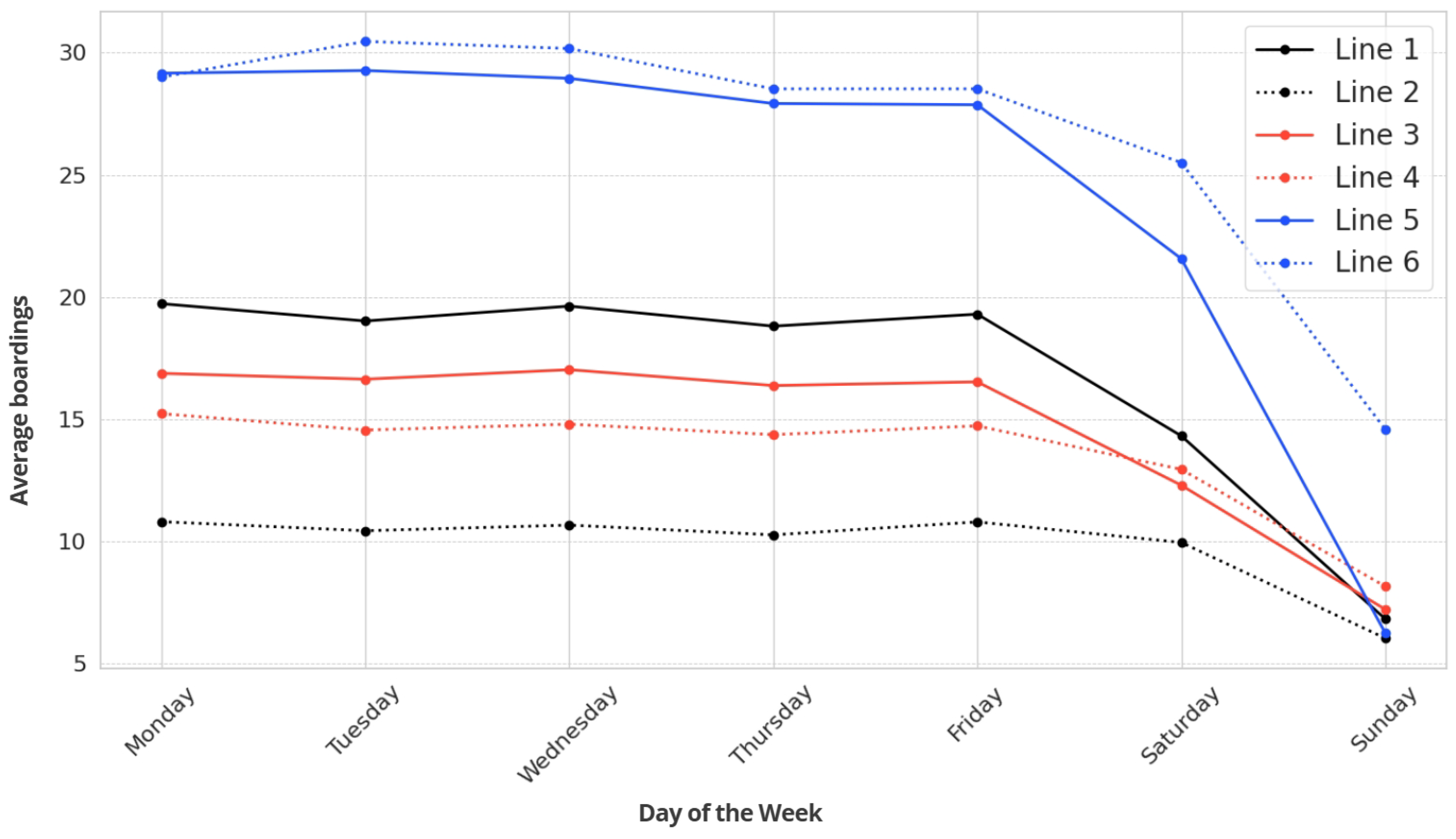
Figure 1 shows, as expected, the busiest days are the regular work days, Monday–Friday, with a noticeable drop during the weekend, especially on Sunday. Lines 5 and 6 exhibit the highest number of boarding instances, peaking around 30; however, it is important to notice that line 5 operates in only three zones and line 6 only on one. In contrast, line 2, that operates in six zones, has the lowest and relatively stable boarding numbers throughout the week. The data highlights passenger trends across different lines, indicating higher demand on weekdays and a substantial decline during weekends. This consistent pattern of fluctuation across all bus lines suggests a seasonality that covers the entire network analyzed, legitimizing the use of a generalistic model.
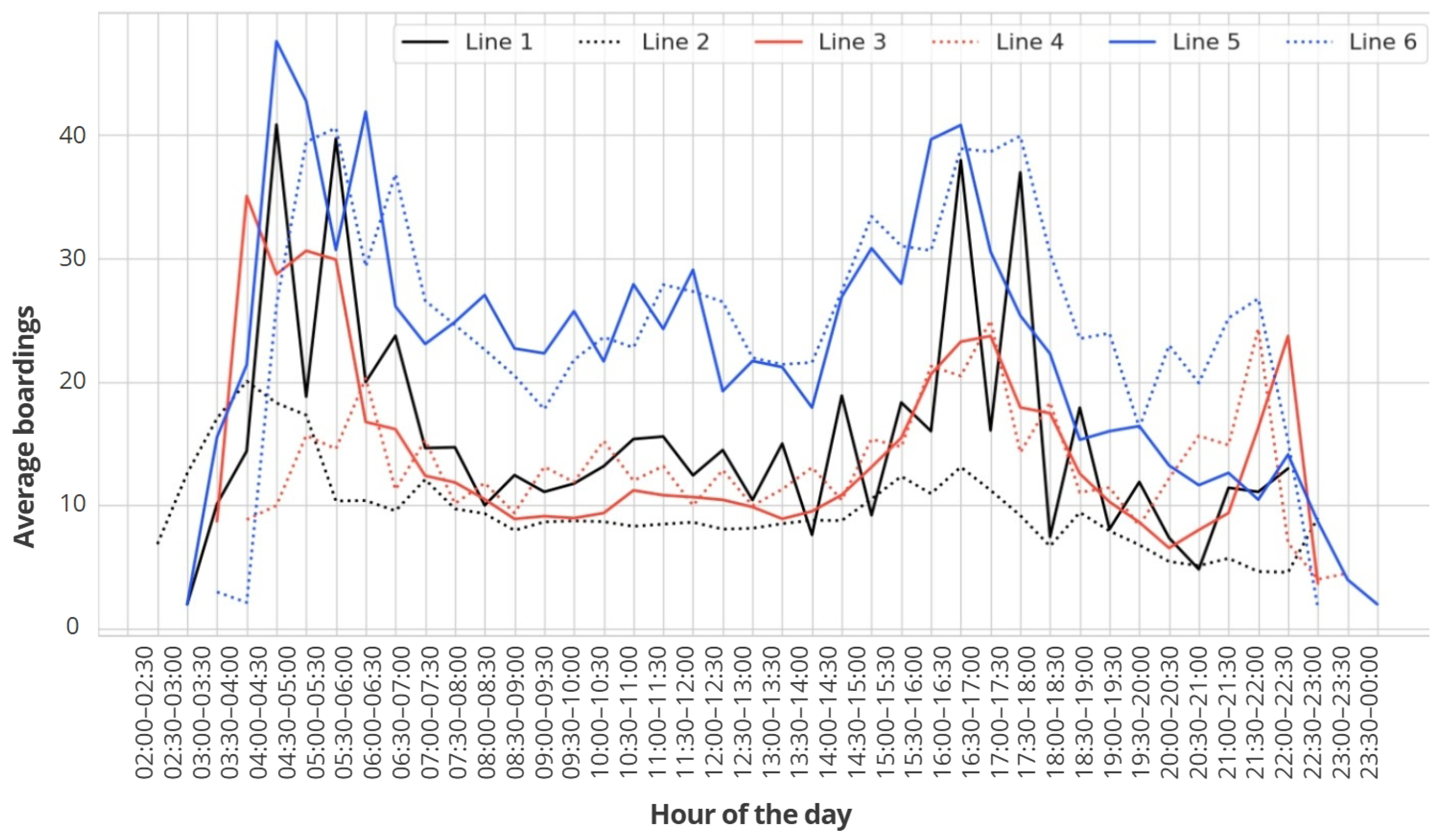
Figure 2 reveals the peak-period of demand across routes. During the morning peak (04:30–07:00), Lines 1, 5 and 6 display the highest boarding levels, with sharp increases relative to off-peak periods, indicating strong commuter-oriented demand. Line 5 shows a particularly morning ramp-up, consistent with inter-zonal work-related travel, while Line 6, despite operating within a single zone, also concentrates substantial demand during this period. In the evening peak (15:00–18:30), Lines 1, 5 and 6 again display an absolute increase in passenger volume, suggesting a return-flow symmetry. Line 2, by contrast, maintain relatively even boarding levels across both peak and non-peak periods, as the only line that covers all zones. Each line has overall unique fluctuations, with different tendencies in the deviations. These distinct patterns justify the use of a specialized approach to capture the unique characteristics of each line.
3.2. Data Preparation
The data preparation phase involved tasks such as data integration, data cleaning, data transformation, and feature engineering, which are detailed in the following subsections.
3.2.1. Data Integration
Since the datasets were missing zone of boarding information, it was required that we estimate it based on the GTFS data, which provide information on the expected time each bus passes through stops within designated zones. The routes data were merged based on common identifiers with the GTFS to construct a robust dataset with the zone of the boarding based on the timestamp.
3.2.2. Data Cleaning
Missing values were detected for each bus route and for each variable individually applying the dropna function, which drops rows with any null values, However, it was only detected for the variable cartao_xml in all datasets. This column refers to the card used to validate the entrance to the bus: some passengers pay for the entrance with money instead of using their card, and, in this case, the fare collector uses their general card to allow the entrance, which does not appear on this column.
Illogical values were identified only on the total_turns variable. This column refers to the total number of boardings in the trip, and negative values were detected as a result of the turnstile system resetting after reaching 99,999. These values were corrected by adding 99,999 to the negative counts, thereby restoring an accurate number of boardings.
To ensure numerical stability during model training and to limit the influence of extreme sparsity and unusually large aggregate values, a heuristic filtering step was applied, retaining rows with values between 0.25 times and 2 times the mean (and, in alternative configurations, between 0.15 times and 2.5 times the mean). These thresholds were not derived from a theoretical distributional model but were adopted as practical bounds to reduce the impact of highly atypical observations that may arise from data noise, reporting irregularities or rare operational conditions. The purpose of this filtering was to improve model robustness rather than to enforce strict statistical assumptions. Consequently, results should be interpreted within the context of these preprocessing choices, and future work should explore data-driven or adaptive thresholding strategies.
Finally, the analysis of outliers focused on the trip_time variable. Extreme values were identified; to address them, to ensure numerical stability during training, and to limit the influence of extreme sparsity, a heuristic filtering step was applied for all the lines. Values with over 0.25 times the mean and under 2 times the mean were maintained, except for line 4, since it refers to a most urbanized line influenced highly by traffic effects: the limits were adjusted to between 0.15 and 2.5 times the mean.
Furthermore, some occasional bus trips that had taken place outside the programmed schedules with a very low number of boardings were detected, suggesting a technical or logistic operation. Thus, a threshold was defined that assumed that trips without the programmed schedule and with less than 50 occurrences—fewer than approximately one trip per week over the year—were excluded from the dataset. In this process, on average, 1.57% of rows were removed from the datasets.
It is important to emphasize that these preprocessing thresholds are heuristic in nature and were selected to support model stability rather than to represent universal or optimal values.
3.2.3. Data Transformation
Techniques to convert data to the correct types, encode categorical variables, and finally encode all integer variables to a int32 format ensuring the datasets are in the optimal format to optimize processing. To streamline the dataset and reduce its dimensionality, redundant variables were eliminated by selecting only the relevant columns. This process involved carefully selecting the most important variables that contribute significantly to the model’s predictive power.
3.2.4. Feature Engineering
The variable target total_boardings was developed by grouping trip, zone, and date–hour of departure to count the number of passengers boarding at each zone. By grouping the data, it was possible to identify the number of passengers by zone for each trip, stating the target variable used for prediction.
Furthermore, period_bus_time was created to simplify the analysis of bus time data. The bus times were categorized into half-hour intervals, instead of continuous-time data. This process involves converting each bus time entry into a categorical variable that represents a specific time interval, such as 00:00–00:30, 00:30–01:00, and so on until 23:30–00:00.
The granular components of the date were extracted: the day of the month, the month, the quarter of the year, the weekday and weekend. These components helped to capture different seasonal patterns for bus demand. To capture other temporal dependencies through intra-month variations, lag features were created for the number of passengers per zone: based on the total_boardings, the number of passengers boarding 7 and 14 days prior to the current date were calculated. This step involved the development of boardings_zone_lag_7 and boardings_zone_lag_14.
Finally, the selection included the variables shown in
Table 3.
3.3. Modeling
For the study, the six predictive models commonly used in the literature, as mentioned in
Section 2, were adopted based on their effectiveness in handling time series data applied for public transportation systems.
The time series cross-validation (TSCV) technique was adopted to avoid overfitting and enhance the model’s ability to handle unseen data. Specifically, an expanding window strategy with five splits (K = 5) was used. Respecting the temporal chronology, TSCV divides the data into K folds, each representing a different time segment. In each iteration, the model is trained on past data and tested on future data.
To ensure the best model configuration and optimal performance, TSCV was combined with hyperparameter tuning. Tuning optimizes the hyperparameters that define the predictive model, and the search for the best configuration was conducted through a predefined distribution of hyperparameters stated in
Table 4 to find the combination that yields the best performance, using the RandomizedSearchCV from the library sklearn with a total of 50 iterations [
28].
Two approaches to developing the models were adopted, one generalistic approach and one specialized. The first uses data from Route 20 (line 2, direction 0), the largest route that operates in all six zones, to create a model that can be deployed to any bus route. This approach simplifies model deployment and maintenance, enhances efficiency, and requires fewer computational resources.
The generalistic was trained using data from Route 20 (line 2, direction 0), which was selected as a representative reference route based on operational considerations. Line 2 is the only one that operates across all six spatial zones of the network, ensuring exposure to the full range of spatial demand patterns present in the area. Furthermore, exploratory data analysis revealed that line 2 exhibits low variability in boardings across time and zones, indicating more stable demand patterns when compared to other routes. This reduced dispersion minimizes the influence of route-specific anomalies. Route 20 was selected due to the higher number of validations present in comparison with Route 21.
On the other hand, the specialized approach involves developing individual models for each route. This allows us to tailor the model to the specific usage patterns of each route, potentially leading to more accurate and context-specific predictions.
The LSTM network architecture comprises a single LSTM layer followed by a fully connected output layer. The LSTM layer uses the ReLU activation function, and includes a tunable number of hidden units and batch size as described on
Table 4. A dense layer with one neuron is applied to produce the final boarding demand prediction. No dropout or additional recurrent layers were employed, limiting model complexity and reducing the risk of overfitting. The model was trained using the MSE loss function with the Adam or RMSprop optimizers during hyperparameter tuning.
The LSTM model was not used on the generalistic approach: due to its ability to capture specific detailed temporal patterns, it can easily fit only to the specific characteristics of the data it is trained on.
The algorithm utilized to train, test, evaluate and deploy the models for each approach followed a structured workflow to ensure the optimal configuration and performance of the predictive models.
3.4. Evaluation
To evaluate the performance of the applied models, four metrics were adopted: Root Mean Squared Error (RMSE), Mean Absolute Error (MAE), R-squared (R2), and Forecast Bias. Each provides distinct insights into the model’s accuracy.
RMSE evaluates the square root of the average squared discrepancies between the predicted and actual values, giving more weight to larger errors. According to [
29], this metric is particularly crucial in contexts where significant errors may lead to severe implications, such as public transportation planning.
where
n is the number of observations,
are the observed values, and
are the predicted values.
MAE estimates the average absolute differences between the predicted and actual values. It is robust and provides a straightforward average magnitude of errors, while being less sensitive to higher deviations.
where
n is the number of observations,
are the observed values, and
are the predicted values.
R
2, or the coefficient of determination, estimates the proportion of variance in the dependent variable, ideally ranging from 0 to 1, where a value closer to 1 indicates that the model explains a high proportion of the variability, suggesting a better model performance. However, values below 0 are possible when the model performs worse than a simple mean model, indicating that the predictive power is very poor.
where
are the observed values,
are the predicted values, and
is the mean of the observed values.
Forecast Bias measures the average difference between predicted and actual values, providing insights into the overall tendency of the model to over-predict or under-predict. A Forecast Bias close to 0 indicates unbiased predictions, meaning the model does not systematically deviate from the true values.
where
represents the predicted values,
the observed values, and
n is the total number of observations.
5. Discussion
ElasticNet had the best overall results for the generalistic approach, indicating that it not only minimizes the error metrics but also maintains a relative bias in its forecasts. However, for all models, R-squared did not perform well, suggesting that the model struggled to explain the variance in the data. The results indicate that predictions vary significantly between different lines and directions, likely due to differences in passenger patterns and demand trends. These performances suggest that, while the model is somehow robust, there may be opportunity for adjustments to further enhance its reliability.
In methodological terms, the relatively strong performance of ElasticNet compared to more complex ensemble methods reinforces the success of this model suggests that linear relationships, when properly regularized, can still yield competitive predictive accuracy [
12]. This finding supports the notion that lightweight, transparent models can serve as effective baselines in transportation analytics as it offers a balance of reasonable accuracy, computational efficiency, and interpretability.
As supported by
Table 8, specialized route-level approaches were able to successfully capture the local trends that might be lost in the generalistic framework, as shown in the results. This improvement is especially relevant for practical implementation in small- and medium-scale transportation systems, where operational heterogeneity across lines can undermine the reliability of a single unified model [
30].
The performance variability across lines highlights the importance of tailoring the modeling approach to the unique characteristics of each route and direction, as the literature suggest that tailoring travel direction provides higher accuracy [
31]. For instance, while Route 10 achieved a R
2 of 0.733, indicating strong explanatory power, other routes such as Routes 41 and 50 presented low or even negative R
2 values, suggesting that additional contextual or temporal features may be required to improve predictive accuracy. Such discrepancies may also stem from route-specific factors such as irregular schedules, inconsistent passenger behaviors, or seasonal anomalies.
Furthermore, the bias values in
Table 7 reveal interesting patterns: while some routes maintain near-zero bias, indicating well-balanced forecasts, others exhibit significant positive bias, reflecting a consistent overestimation of demand. This suggests that, although the specialized models capture general trends effectively, they may still benefit from a bias correction or calibration stage before real-world deployment [
32]. As mentioned in
Section 4.2, a bias-aware model selection would be beneficial to mitigate bias while maintaining prediction accuracy. Alternatively, a quantile-regression-based calibration could be employed to align predicted and observed demand distributions [
33]; while these techniques were not implemented in the present study, they represent promising extensions for improving the robustness of specialized approach.
Error metrics and R2 reveal the superior performance of the specialized approach over the generalistic, with better R2 metrics for eight bus routes, an RMSE reduction of 19.46%, and an MAE reduction of 17.36%. However, this approach exhibited more bias, particularly for Routes 40, 41, and 5. For instance, Route 50 had a Forecast Bias of 6.69, compared to only 0.0015 with the generalistic model, highlighting a tendency to overestimate or underestimate values. Despite the improved accuracy in error metrics and R2, the specialized models showed significant bias issues.
Specialized models are fine-tuned for the specific characteristics of each route, offering more accurate predictions of passenger flow compared to generalized models [
34]. However, it is important to highlight that the development of specialized models requires a significantly longer computation time. In a practical scenario where this specialized approach would need to be applied to numerous bus lines and directions, the cumulative computation time would increase substantially and, therefore, so would costs [
12]. This extended processing period is critical, especially when scaling the model to cover the entire public bus transportation network.
A potential strategic application is a hybrid framework: employing specialized, high-accuracy models for core, high-demand routes where optimization yields the greatest operational benefit, while using the efficient generalistic approach for peripheral or lower-volume services.
The findings from the evaluation of various predictive models for estimating passenger boarding demand in public bus transportation offer several significant implications for operations and strategic planning. Accurate forecasts derived from choosing model that best fits a route enables transport operators to optimize resource allocation and enhance service planning. By accurately estimating the expected number of boardings per route, direction, and time period, operators can adjust service levels to better match demand, reducing overcrowding and minimizing underutilization that currently affects public transport [
35,
36]. This improved alignment between supply and passenger needs enhances the efficiency and responsiveness of the transportation.
Furthermore, precise demand forecasting contributes to cost optimization. With a clearer understanding of boarding patterns, transport managers can make informed decisions on fleet deployment, vehicle scheduling, and resource distribution, reducing operational expenses such as fuel, maintenance, and idle time while improving asset utilization. These efficiencies translate directly into an enhanced passenger experience, including shorter wait times, reduced crowding, and more reliable service, which are key factors in increasing the attractiveness of public transport for daily commuters.
Beyond operational improvements, predictive modeling supports strategic and long-term decision making. Insights into evolving demand patterns enable proactive planning for route expansion, service redesign, or the introduction of new lines. Forecasting also provides a foundation for managing fluctuations in passenger volumes, allowing authorities to implement adaptive measures such as dynamic capacity allocation, special-event scheduling, or variable pricing strategies.
A key advantage of this approach is its adaptability and scalability. Developing tailored, route-specific models significantly enhances prediction accuracy, while maintaining the potential to scale across an entire transport network. This adaptability allows agencies to deploy data-driven solutions that address local variations in demand while contributing to overall network efficiency.
Finally, integrating predictive modeling into public transport operations promotes environmental sustainability [
30,
37]. Optimized service alignment reduces unnecessary trips, fuel consumption, and emissions, supporting broader urban sustainability goals. Additionally, adopting predictive analytics fosters a data-informed organizational culture, driving further innovation in service management, passenger engagement, and operational excellence.
Within this context, the predictive performance obtained in this study is consistent with values reported in the literature. Several studies in the literature report strong predictive performance for passenger demand forecasting tasks. For instance, Ref. [
38] reported forecasting results for Thane and Mumbai, with MAE values between 4.338 and 5.561 and RMSE between 8.752 and 11.267 using LightGBM and XGBoost models on large metropolitan datasets. Similarly, Ref. [
39] achieved MAE and RMSE values of 3.13 and 4.78, respectively, for station-level predictions in Salamanca,. Comparable results have been reported for large Chinese cities, such as Guangzhou and Dalian, where station-level models achieved RMSE values between 3.58 and 4.76 [
40,
41]. Spanos et al. [
42] reported on their study RMSE values ranging from approximately 8.6 to 29.8, depending on network complexity and city size—Tampere, Frankfurt, Carinthia and Trikala. Similarly, a study in the large network of Qingdao reported MAE and RMSE values of 14.91 and 19.80, respectively [
43]. The results obtained with the generalistic approach in this study fall within this range, with average RMSE and MAE values of 13.84 and 9.60 across all routes. More importantly, the specialized approach reduced these errors to average values of 11.15 (RMSE) and 7.93 (MAE), corresponding to reductions of approximately 19.5% and 17.4%, respectively.
However, these results are obtained under substantially different conditions, including different demand volumes, spatial conditions, travel patterns and other characteristics. As the present study focuses on a medium-sized metropolitan region characterized by heterogeneous routes, multi-zone operations, and pronounced variability in passenger behavior, these contextual differences directly affect the scale and distribution of the target variable, making the direct numerical comparisons of MAE and RMSE values across studies with different localities and data inherently problematic.
The main contribution of this work lies in demonstrating—through quantitative evidence under identical data and evaluation conditions—that a specialization approach yields measurable and systematic performance gains over transferable generalistic approach. This controlled comparison demonstrates that specialized models systematically improve explanatory power, with R2 values increasing for eight out of twelve routes, and the reduction in prediction error. Results also reveal that improved accuracy may come at the cost of increased Forecast Bias and computing times for specific routes.
In summary, incorporating data-driven approaches to estimate bus passenger boarding in public transport systems strengthens operational performance, passenger satisfaction, and sustainability. By embedding these models into both day-to-day management and strategic planning, transport authorities can build more efficient, equitable, and resilient mobility systems that better serve the evolving needs of urban populations.
6. Conclusions
This study demonstrates the potential of predictive modeling to enhance the understanding and management of passenger boarding demand in public bus systems. Among the evaluated approaches, specialized models proved especially valuable despite their higher computational cost, as they capture route-specific dynamics more effectively and weigh the most relevant variables for each case. For long-term applications and strategic planning aimed at improving passenger satisfaction, these tailored models offer greater precision and reliability. Their success highlights the importance of adopting context-sensitive approaches in public transportation, where recognizing route-level variability is essential to efficient service delivery.
The comparative analysis of predictive algorithms revealed that ensemble-tree-based methods, particularly XGBoost, consistently outperformed other models across the evaluated routes. Their ability to model nonlinear relationships and complex interactions makes them well suited for routes with highly variable passenger demand.
The implications of these findings extend beyond technical performance. Accurate passenger demand estimation enables transit authorities to adjust service frequency, select appropriate vehicle types, and allocate resources based on actual ridership patterns and seasonal trends. Such precision planning can reduce overcrowding during peak hours, minimize operational costs during off-peak periods, and improve both passenger comfort and overall service efficiency. Ultimately, this contributes to a more adaptive and sustainable public transport system.
The work, while sufficient to demonstrate that specialized approach outperform the generalistic, the feasibility of scaling the specialized to a full network requires careful consideration. Developing and maintaining hundreds of individual route models entails significant computational and administrative overhead, as noted in
Section 5. This challenge highlights the practical value of the generalistic approach as a scalable solution.
Future work should explicitly test on a larger, more representative sample of routes, the performance degradation of a generalistic approach and possibilities to improve computational efficiency gains of the specialized approach. A direct comparison under these scaled conditions would provide clearer, actionable guidance for transit agencies.
Future research should also address the absence of alighting and station-level stop-by-stop boarding data. This lack prevents construction of full Origin–Destination (OD) matrices and prevents direct measurement of in-vehicle occupancy levels. This missing information may overestimate demand in zones that are actually alighting-dominated and underestimate demand where passengers concentrate transfers. Prediction accuracy is reduced, as it prevents modeling of trip chaining effects and induce systematic bias in zones that behave primarily as origins or sink (terminal with high alighting or residential zones with high boardings).
Therefore, future refinement should prioritize the integration of detailed stop-level boarding data and contextual variables, such as weather conditions, traffic states, special events, holidays, and school schedules, to better capture demand drivers and reduce unexplained variability. In addition, could also study and test trip-chaining assumptions and probabilistic OD estimation techniques, supported by auxiliary data sources, would allow partial reconstruction of alighting flows and in-vehicle occupancy patterns, mitigating spatial bias. Finally, extending the proposed framework to multimodal transport networks would enable the analysis of intermodal transfers and network-wide demand propagation, offering a more comprehensive representation of urban mobility dynamics.
In summary, this work highlights the value of data-driven, route-specific modeling for optimizing public transport operations. By leveraging predictive analytics, authorities can move towards more efficient, equitable, and sustainable urban mobility systems.




 ,
,