
Article

Optimal Electrical Dispatch by Time Blocks in Systems with Conventional Generation, Renewable, and Storage Systems Using DC Flows

1
Department of Electrical Engineering, Universidad Politécnica Salesiana, Quito 170517, Ecuador
2
GIPI Group, Department of Electrical Engineering, Universidad Politécnica Salesiana, Guayaquil 090150, Ecuador
*
Author to whom correspondence should be addressed.
Appl. Sci. 2026, 16(3), 1372; https://doi.org/10.3390/app16031372
Submission received: 12 December 2025 / Revised: 9 January 2026 / Accepted: 19 January 2026 / Published: 29 January 2026
(This article belongs to the Special Issue Renewable Energy and Electrical Power System)

Abstract

Sustained demand growth and the increasing share of renewable energy sources pose challenges for the operation of modern electrical systems. The variability in wind and solar photovoltaic generation causes temporary imbalances between supply and demand, requiring the incorporation of energy management and storage strategies to guarantee supply. In this context, the need arises to develop optimization models that allow for efficient energy dispatch, minimizing costs and promoting the appropriate use of both conventional and renewable resources. This study formulated a time block dispatch optimization model implemented in the IEEE 24-node system, integrating thermal, hydroelectric, photovoltaic, wind, and energy storage systems. The methodology was based on DC power flows and was developed in MATLAB R2024b, incorporating nodal balance constraints, transmission and generation capacity limits, as well as the operating conditions of the storage systems. The model allowed for the evaluation of both energy and economic performance, validating its behavior under conditions of peak demand and renewable variability. The results demonstrate that the inclusion of energy storage systems allows for a reduction in high-cost thermal generation, optimizing demand coverage with a greater share of renewable energy. An average storage efficiency of 85.5% was achieved, and total system costs were reduced by USD 40,392.39 per day, equivalent to annual savings of USD 14.75 million. Furthermore, power flows remained below 85% of transmission capacity, confirming the proper operation of the grid. In this sense, the model fulfills the proposed objectives and proves to be a tool for energy planning and the technical-economic integration of storage in electrical networks.

1. Introduction

The transformation of the modern electricity sector is marked by the increasing penetration of new technologies that influence the operation of the electrical system, such as intermittent renewable energy sources, along with the development of energy storage systems. These technologies are introduced together to support the management of these sources, given their inherent instability, and to support the system as a whole [1,2]. This recent shift has revealed inherent limitations in typical planning and operational schemes, which have historically been designed for an energy matrix based on purely conventional generation sources (from fossil fuels, nuclear power, or hydroelectric power), and are characterized by a static nature of analysis [3,4]. Given these conditions, electrical energy storage not only represents a mechanism capable of providing technical support to the system, but also a strategic resource that can give the system greater operational flexibility and counteract its vulnerability to the variable effects of non-conventional renewable energy systems. In this way, it contributes to improving the management of energy distribution and allocation, as well as to the economic optimization and environmental sustainability of the related infrastructure [5].
The introduction of new, variable, and dynamic technologies into the system changes how the economic dispatch problem is solved—a key element that ensures efficiency, operational resilience, and sustainability in the electrical system [6]. Optimal dispatch models by time blocks are firmly established as a structural tool that represents the interaction over time between conventional and non-conventional renewable energy generation plants and storage systems. They differ from static analyses because these models record the hourly dynamics of load and energy supply, fully consider marginal generation costs, and take into account the technical constraints that characterize each unit to achieve optimal operation with the incorporated technologies [7,8]. In effect, this strategy, implemented at precise times, makes it possible to identify when to use conventional technologies, when to maximize the use of renewable energy plants, and determine the optimal moment to efficiently charge or discharge storage systems [9,10]. The representation of the system’s actual behavior is more accurate with the time-based dispatch method, which also allocates energy resources at the lowest operating cost, reducing undelivered energy and mitigating potential additional reserve requirements. This represents a contribution to power system analysis compared to deterministic methodologies focused on a single phase of analysis, which tend to significantly oversimplify the technical, financial, and time-bound complexity inherent in contemporary energy systems [11].
According to current trends, developments have focused on the integration of energy storage systems, most recently in the field of smart grids and energy hubs, highlighting the importance of achieving synergy between renewable energy resources, flexible demand behavior, and storage systems within decision-making processes in order to promote energy management; examples of such research include [12,13,14].
However, the recent specialized literature has explored approaches and methodologies for optimizing the economic dispatch problem in electric power systems. These systems have experienced a high level of integration of renewable energy sources, as well as energy storage systems aimed at managing the energy produced. Studies such as [15,16] focus on stochastic formulations that analyze the uncertainty arising from renewable energy sources, as well as the behavior of electricity demand. However, they do not explicitly integrate power flow models, which limits their application in test models where physical transmission constraints are critical to the overall operation of the network. Similarly, Refs. [17,18] apply metaheuristic techniques, showing operational improvements in hourly dispatch with renewable sources and energy reserves, but due to the use of approximation algorithms, these do not guarantee optimal solutions and present difficulties in efficiently scaling to larger transmission networks. Likewise, the systematic review [19] indicates that several of the currently available methods oversimplify the physical behavior of the system in question or lack comprehensive formulations for direct current (DC) flows. Given the constraints presented, the approach proposed in this study establishes a methodology to achieve optimal dispatch with high-precision numerical performance and high efficency efficiency in response to demand, energy sources, and coordinated storage; it also captures the dynamics of the system characterized by complex generation and transmission constraints, with an integrated proposal in MATLAB R2024b (with DC power flows) that can demonstrate operational resilience to variability in renewable energy sources and the intertemporal effects of energy storage systems.
In this area, the studies highlighted in the literature review emphasize a remarkable literary convergence: electric power systems demand to be shaped by an optimization formulation with the capacity to handle the input of diverse technologies in an integrated way, considering highly fluctuating time horizons.
The execution of this research is particularly relevant in the context of the energy sector’s transformation, due to the significant growth in the integration of renewable generation, which demands the development of more refined and flexible planning and operating methodologies. This study develops an hourly energy dispatch model that coherently integrates the interaction between conventional generation, renewable sources, and storage systems, using direct current power flow and implementing it in MATLAB R2024b. Its value lies not only in the technical advancement represented by the use of DC flows for dispatch optimization, but also in its contribution to the creation of tools that facilitate decision making in electrical systems with a high level of contribution from renewable energy and storage.
The innovative methodology of this work lies in the formulation of a time block dispatch model that integrates, within a single linear, multi-period framework, the interaction of conventional generation, renewable resources, and storage systems, modeled using a DC power flow. Unlike traditional approaches that analyze each component under isolated assumptions, the proposed structure directly links storage load states, thermal unit ramp limits, renewable availability, and transmission capacity, offering a realistic analysis of the system’s operational behavior. The scientific contribution demonstrates how the combined dynamics of storage and renewable variability alter dispatch, achieving thermal displacement, cost reduction, and efficient grid utilization without resorting to nonlinear models. This approach quantifies the operational value of storage within economic dispatch and provides a reproducible framework for planning and operational decisions under conditions of high renewable participation.

2. Renewable Generation and Storage in Modern Electrical Grids

The global energy transition has positioned clean energy sources as responsible for the progressive replacement of fossil fuels as the primary source of electricity, reducing environmental damage and making better use of natural resources. In recent decades, technological advancements and decreasing investment costs have fueled the rapid expansion of the renewable energy sector, especially for photovoltaics, due to its versatility, low operating costs, and minimal maintenance [20]. However, the variability and geographical dependence characteristic of this resource impact the continuity and predictability of supply, posing a challenge to electricity dispatch and forcing a rethinking of operational decisions to balance supply and demand without compromising system security or costs [4,21].
Electrical energy storage systems are characterized by their operational flexibility, a key aspect for mitigating generation variability and optimizing economic efficiency. In other words, they facilitate the storage of surplus energy when demand is low and its release during periods of high demand, striving to achieve energy balance, minimizing costs, and maximizing reliability [22]. The coordination between renewable energy sources and storage systems redefines the traditional concept of dispatch and transforms the operation of modern electrical grids, offering flexible, stable, and resilient operation—the foundation for a more sustainable, decentralized, and efficient energy model.

2.1. Fundamentals of Electrical Dispatch by Time Blocks (DEBH)

Electrical Dispatch (ED) is a decision-making process that optimally allocates the resource level of each energy production unit for periods in which the system operates, defining the technical limitations of the network such as the capacity generated by the units, energy balances, and other operating conditions, mainly to supply the load at the lowest cost [23].
By dividing time into intervals (usually hours), a dispatch by hourly blocks is created, which makes it possible to optimize operational decisions not only at isolated moments but also in a chain, integrating resource dynamics such as the load status of storage systems and transitions between periods, including ramp limits and minimum operating times [24]. With the formulation of blocks, it is possible to represent both the daily variations in load and the foreseeable fluctuations in renewable generation, establishing this as the predominant reference framework in short-term energy markets and intraday operational planning.
The choice of time intervals reflects a balance between the level of detail in the simulation and the computational resources required. The time scale of the blocks can vary (from hourly intervals to 15 min intervals), but it should be noted that the most useful blocks for daily planning and intraday operation are one hour long, as shorter intervals facilitate adaptation to abrupt changes in frequency or generation [25].
Typically, dispatch by time blocks is structured as follows and includes, in detail for this study and in general, the following factors [26]:
Objective function: For the current block-based schedule, the sum of generation costs, storage costs, and penalties for undistributed energy is considered. Other variable costs, ancillary service costs, and backup costs may also be considered.
Balancing limitations at nodes: For each hourly interval, the sum of generation and storage system discharge power must equal demand plus storage load (if applicable) and outgoing node flows. Imports, other generation sources, other consumption, and losses (if applicable) are included, but excluded from this study because the calculation is based on DC flows.
Technological limitations: Power ramps (maximum and minimum) per block, margin, and state of load of the energy storage system are considered, as well as the maximum and minimum power levels of the generating units. In other analysis scenarios, the start-up and shutdown times of the units and the primary and secondary reserves of the system, among other factors, may be considered.
Network limitations: To model these limitations, the characteristics of the links themselves are considered, such as line resistance, reactance, and susceptance, as well as maximum transmission capacities. Once these elements are defined, the model considers their impact on the power flow analysis (AC or DC).
The strategy of dispatching energy in time blocks improves resource coordination, reduces costs and losses, and allows for the utilization of storage. However, its effectiveness depends on the reliability of forecasts and the management of uncertainty, both in demand, prices, and renewable energy. For example, an inaccurate model can lead to decisions that affect the state of the storage system, resulting in degradation and shortening its lifespan [27]. Therefore, the focus of this research is on a robust, multi-period, continuously optimized framework aimed at maximizing operational profitability while ensuring system reliability [28].

2.2. Integration of Conventional, Renewable Generation and Energy Storage Systems in the DEBH

Traditional energy management has evolved with the integration of conventional energy sources, variable renewables, and energy storage systems into a multi-period model with time constraints (such as battery charge levels or the remaining ramp capacity of a thermal unit) and a greater degree of uncertainty. It is important to highlight that conventional generation plants provide stability and allow for adjustment, while renewable plants reflect dependence on weather conditions and, therefore, variability. Furthermore, energy storage emerges as key to harmonizing these two realities due to the flexibility it provides [16,26]. By structuring the problem into time blocks, the specific characteristics of each technology are directly concentrated in the mathematical model: this means that decisions in one interval directly affect operation in subsequent blocks [6,29]. Figure 1 presents a general scheme of how the different technologies are integrated into the centralized electrical system, comprised of conventional and renewable generation, the grid infrastructure, and the various types of consumers.
In this context, and as outlined in Figure 1, storage systems acquire a fundamental role, as their integration requires adapting network operations to avoid technical conflicts and ensure adequate levels of operational reliability. As mentioned, the primary objective of the DEBH is to minimize total system costs. The presence of alternative energy sources and storage systems alters the cost structure: clean energy sources reduce marginal costs by displacing high-cost generation such as thermal power, while storage allows energy to be transferred between blocks, smoothing prices during peak demand periods. Time constraints, such as generation unit ramp-ups and battery charge levels, limit the set of viable solutions, making the optimal solution dependent on the entire operational sequence rather than isolated decisions for each block [14].
Therefore, the block dispatch model that integrates storage and renewable energy reflects the following benefits, according to the literature [31,32]:
A reduction in total operating costs.
Deflation from the forced reduction of renewable energy production.
Less dependence on the costly start-up and shutdown cycles of thermal power plants, thanks to the provision of reserves and ramp attenuation.
System reliability indices are improved (non-distributed energy).
Efficiency gains and cost savings with the multi-period optimization model with storage, compared to approaches without reservations or using a single-stage dispatch.
Despite the benefits of implementing the integrated DEBH model, significant challenges remain. The most notable difficulties are as follows: (i) the difficulty in calibrating the storage life and cost constraints that accurately describe its true economic performance [33]; (ii) the computational challenges; and (iii) the critical reliance on forecasts, which necessitates the development of more accurate real-time operating frameworks to complement short-term planning [14,34].
In conclusion, dispatch scheduling optimally aims to allocate available electricity generation and other technologies to be included over specific periods, considering cost reduction and balancing load and demand according to the respective network constraints and the characteristics of each participating technology [35]. In this sense, the DEBH (Device Energy Saving Hub) requires real-time improvement of its response to changing system conditions through deterministic, robust, and stochastic techniques. DEBH operation is modeled with specialized software such as MATLAB R2024b and GAMS Studio win64 23.3.0, and tested on IEEE systems and real electrical systems. To manage the complexity of storage and the uncertainty of the resource, stochastic models and decomposition techniques are used. Currently, efforts are underway to improve real-time responses, leading to the emergence of machine learning and hybrid methods, although their reliability still needs to be rigorously demonstrated against classical optimization methods [35].
The use of classical optimization models in time-interval energy planning requires that they reflect the temporal relationships and physical constraints of the electrical system [36]. The most common methodologies are linear programming (LP), suitable for systems with parameters that reflect continuity, appropriate for large-scale, multi-period projects; Mixed Integer LP (MILP), which is the preferred option when discrete variables such as generator activation are present; and nonlinear programming (NLP), which is used when modeling energy costs or losses is nonlinear [37,38]. In this context, the DC load flow model has become established due to its high degree of accuracy. For this model, electrical calculations are simplified by linearly correlating the voltage angles of the nodes with the power in the lines. This simplification reduces computational effort without affecting the accuracy of the results, facilitating the modeling of network boundaries and energy balance in each time interval [39].
Consequently, the integration of linear optimization techniques with the DC model has become a fundamental tool for operational analysis and the determination of efficient strategies in systems that include energy storage and renewable generation [40]. This article proposes an approach that seeks to build upon these contributions, developing a proprietary optimization model that integrates conventional and renewable generation, as well as storage systems, within a 24-node IEEE network. The optimization model will be solved in MATLAB R2024b, leveraging its numerical and symbolic modeling capabilities, and using DC flows to simplify the transmission network modeling without sacrificing analytical accuracy. Unlike traditional approaches, this research aims to simultaneously represent the technical, economic, and temporal aspects of the electrical system, providing a tool that can be replicated and adapted to different real-world contexts.

3. Problem Statement

This research proposes a mathematical model that optimizes active power dispatch in a 24-node IEEE network, integrating conventional generation, renewables, and energy storage. A DC power flow approach is proposed to simplify the system’s transmission conditions. The model includes the power generated by each source, the charge and discharge levels of the storage, and the power flows between nodes. It also considers generation capacity constraints and the energy balance for each hour. The objective function seeks to minimize the total dispatch cost, including generation costs, storage costs, and deficit penalties.
The model uses 24 time intervals to capture demand variations and the intermittency of renewable energy sources. Mathematical programming techniques in MATLAB R2024b with the Linprog Solver are used to solve the problem. This approach analyzes the interaction between technologies and the contribution of energy storage systems. The model is a useful tool for planning modern electrical systems, reducing costs and improving the efficiency and reliability of clean energy supply.

3.1. Time-Based Electricity Dispatch Model Using FPDC

Mathematical modeling aims to minimize costs. The total operating cost of the electrical system is determined through an economic analysis that considers each time interval h within the optimization horizon. This calculation incorporates the costs associated with conventional generation, renewable generation, and potential power outages. Its formulation is as follows:
M i n C s i s t = S b ·   h H g   ϵ   G c C g · P g , h + r   ϵ   G r C r · P r , h + i V P C · E N A i , h
The variables P g , h and P r , h these represent, respectively, the active power dispatched in period h by conventional generation units g and those using renewable sources r. The factors   C g   y   C r these are equivalent to the unit production costs for energy generation from conventional and renewable generators. The cost of supply deficit is calculated as the product of the energy not supplied E N A i , h at each node i per hour h and the economic value of load loss VPC, where the latter component acts as a penalty mechanism to prioritize comprehensive demand response.
Mathematical modeling incorporates operational constraints that apply to both generators and the electrical grid, specifically establishing nodal active power balance equations under the DC flow approach. This approach is used to ensure energy conservation at every point in the network, guaranteeing that the power injected into a node always exactly equals the power extracted. This constraint represents the fundamental principle of supply and demand equilibrium at the local level.
g   ϵ   G c P g , h + r   ϵ   G r P r , h + P d i , h P c i , h C a r g a i , h + E N A i , h = j F i , j , h
where P d i , h y P c i , h are the variables representing the charging and discharging of the storage systems located at node i for each hour h, respectively, while F i , j , h is the variable that represents the active power flows from node i to adjacent nodes, and finally C a r g a i , h corresponds to the demand at each node, which varies hourly. The DC power flows between the nodes F i , j , h are modeled as follows:
F i , j , h = 1 x i j δ i , h   δ j , h
where δ i , h and δ j , h represent the nodal phase angles at nodes i y j during period h, respectively, while x i j   corresponds to the series reactance parameter of the transmission line that interconnects both nodes.
The model uses DC power flow to formulate a multi-period linear problem with integrated storage systems, ensuring low computational cost and numerical stability over 24 h. This approach is suitable for optimal active power dispatch studies, as it assumes small angular variations and lines with high X/R ratios, common conditions in power systems. DC flow simplifies the integration of intertemporal constraints by eliminating nonlinearities, without affecting the algorithm’s convergence or increasing the problem’s complexity. This approach is particularly well-suited for studies focused on active power in transmission systems, guaranteeing operational results consistent with the system’s physical reality across time horizons.
Furthermore, the methodology is fully compatible with subsequent refinement phases using AC flow, allowing for the incorporation of variable assessments such as voltage and losses when required by the study, while maintaining a progressive and consistent methodological approach. In this way, DC flow is positioned as a fundamental tool for the initial analysis of optimal dispatch, combining operational precision, analytical clarity, and computational efficiency.
Additionally, inequalities are established that guarantee the safe and stable operation of the network by defining the operational limits of the system variables.
δ m i n δ i , h δ m a x
S i j m a x S b F i , j , h S b S i j m a x S b
Operating constraints ensure that phase angle values are kept within predefined technical ranges, while power flows through transmission links comply with thermal limits set for each circuit; in parallel, the operational aspects of generators are modeled by capacity constraints that delimit the minimum and maximum generation limits for each unit.
P m i n P g , h P m a x       g     G c o n
0 P r , h P m a x · R r , h       g     G R
where P m i n y P m a x represent the minimum and maximum active power limits established for each generation technology. These limits are used to respect the technical and operational capabilities of conventional generators, ensuring that the dispatched power remains within the viable operating range of each unit. Furthermore, R r , h corresponds to the availability of the renewable resource evaluated in each time interval h. In the case of renewables, this constraint models the intermittent and variable nature of renewable resources, limiting the possible generation according to the hourly availability of the primary resource, preventing the model from allocating generation capacity when the resource is unavailable. Additionally, the following inequalities are used to represent the variation in power delivery or withdrawal from conventional generation units:
P g , h + 1   P g , h U p g  
P g , h 1 P g , h D w g  
where U p g y D w g are the technical parameters of conventional generators; these constraints ensure that the resulting dispatch is dynamically feasible, allowing a smooth transition between different levels of generation over the time horizon, which is important to properly follow the demand curve and respond to variations in renewable generation.
S o C i , h = S o C i , h 1 + η c · P c i , h P d i , h η d     i   ϵ   S A
S o C i , 24 = S o C i , 0
S o C i m i n S o C i , h S o C i m a x     i   ϵ   S A
0 P c i , h ζ c , i · S o C i m a x     i   ϵ   S A
0 P d i , h ζ d , i · S o C i m a x     i   ϵ   S A
For its part, the temporal evolution of the load state of the storage systems and the operational limits are modeled by the following constraints.
This constraint allows for modeling the temporal dynamics of energy storage systems, reflecting the energy accumulation and release process. This behavior is evaluated using the state of charge, S o C i , h incorporating charge and discharge efficiencies, η c y η d . Its inclusion is fundamental for optimizing the complete operating cycle of the batteries. Likewise, the maximum charge and discharge limits of each storage system must be considered, represented by the percentages ζ c , i and ζ d , i , respectively.

3.2. Characterization of the System Under Analysis

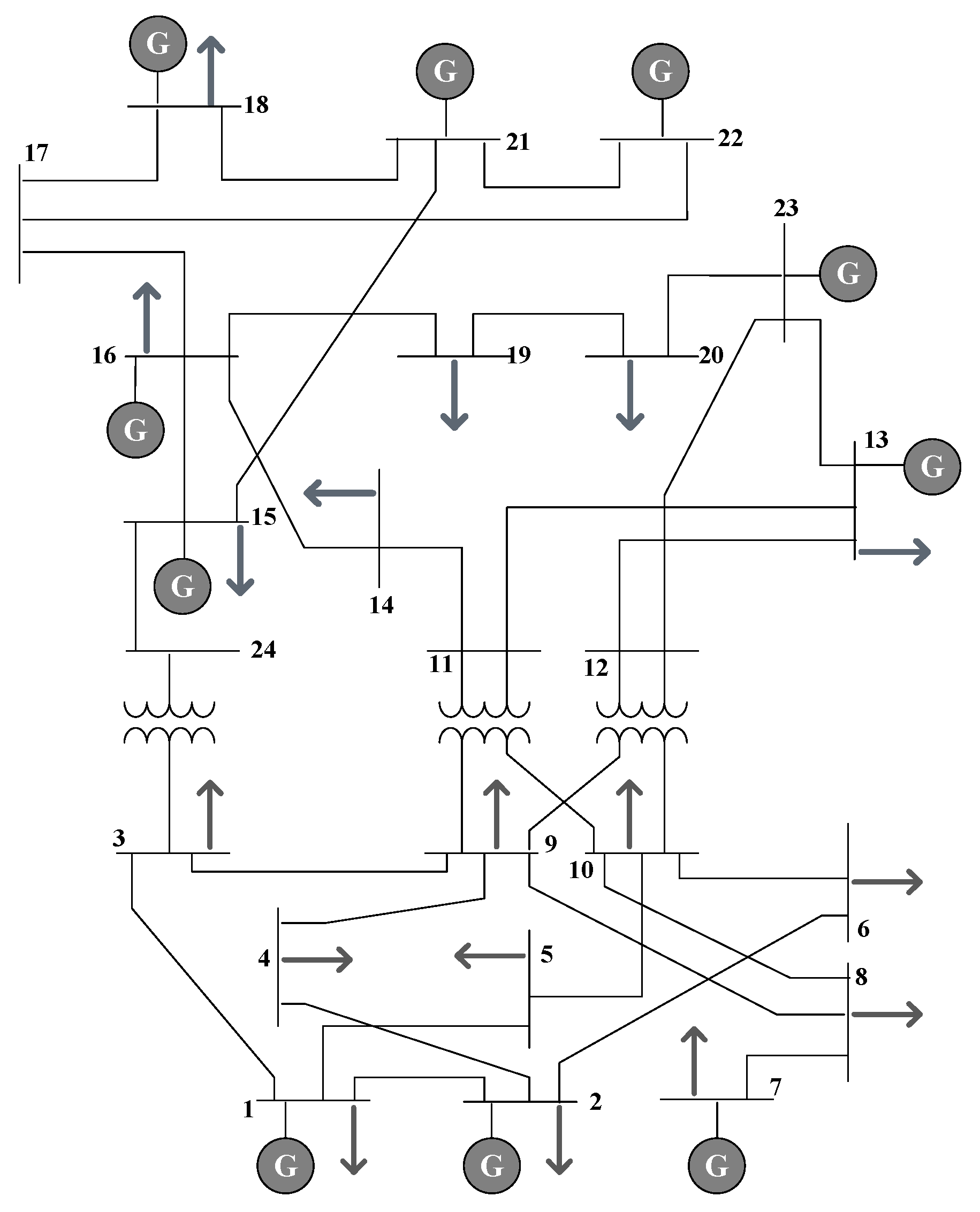
Figure 2, this section describes the technical and operational parameters used in the simulation of the test system, corresponding to the 24-node IEEE system [41]. The data considered includes the electrical characteristics of the network, generators, loads, and storage systems. The single-line diagram of the system is presented below, while the following tables detail the numerical values associated with each component of the model.
The general parameters for the simulation and its economic valuation are described in the following Table 1. This table shows the required parameter, its description, the assigned value, and its unit.
Modeling conventional generation requires technical and economic parameters, which are described below Table 2.
Additionally, the modeling of renewable generation requires the definition of specific technical and economic parameters, which are detailed below Table 3.
Modeling storage systems requires parameters such as load status and technical limits, among others, which are tabulated below in Table 4.
The data of the IEEE 24 node network used are described below in Table 5; in this case, the relevant parameters are reactance and capacity limit.
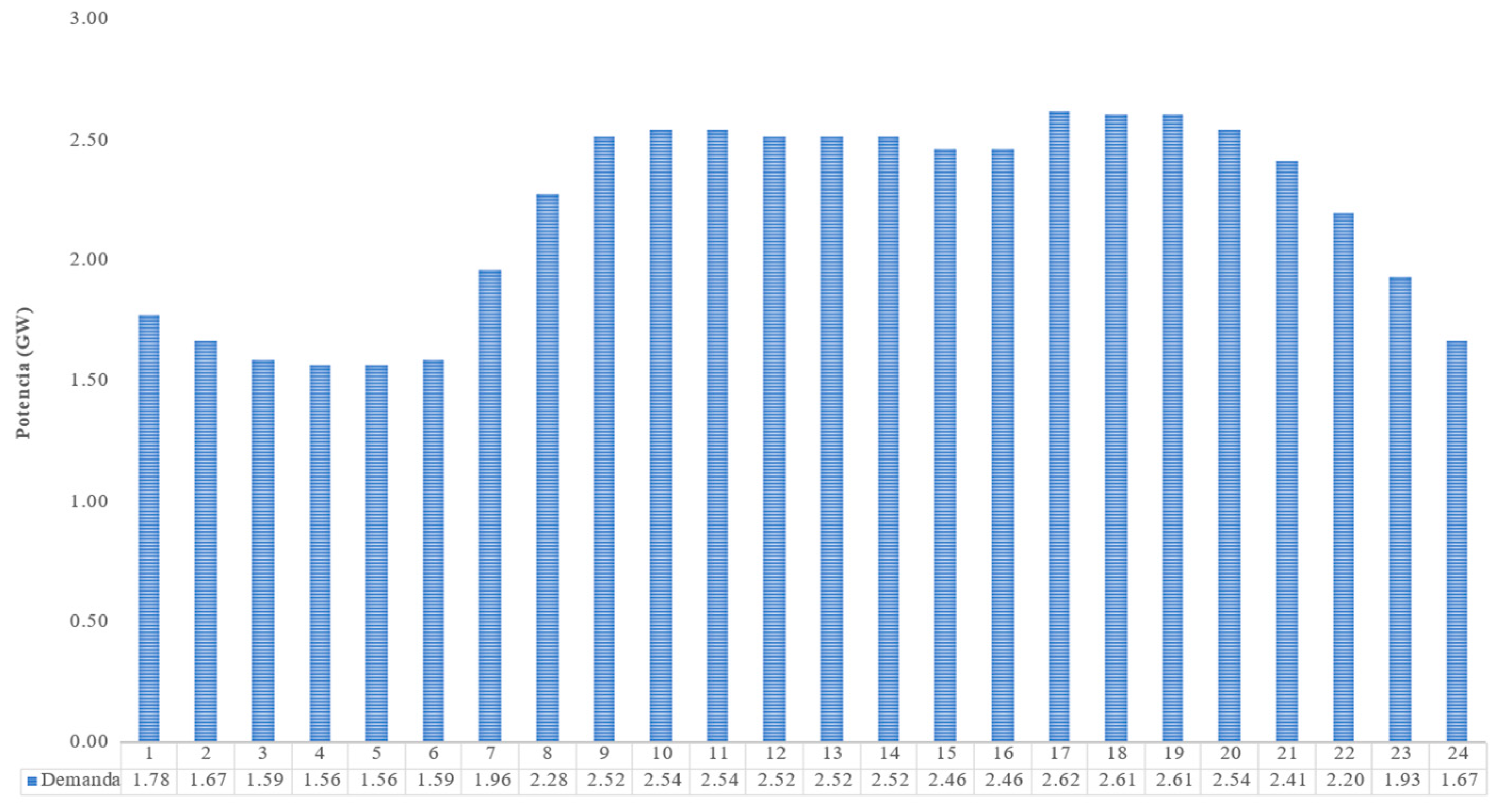
The optimization model supplies the demand on an hourly basis; in that context, the following Figure 3 shows the daily demand curve.
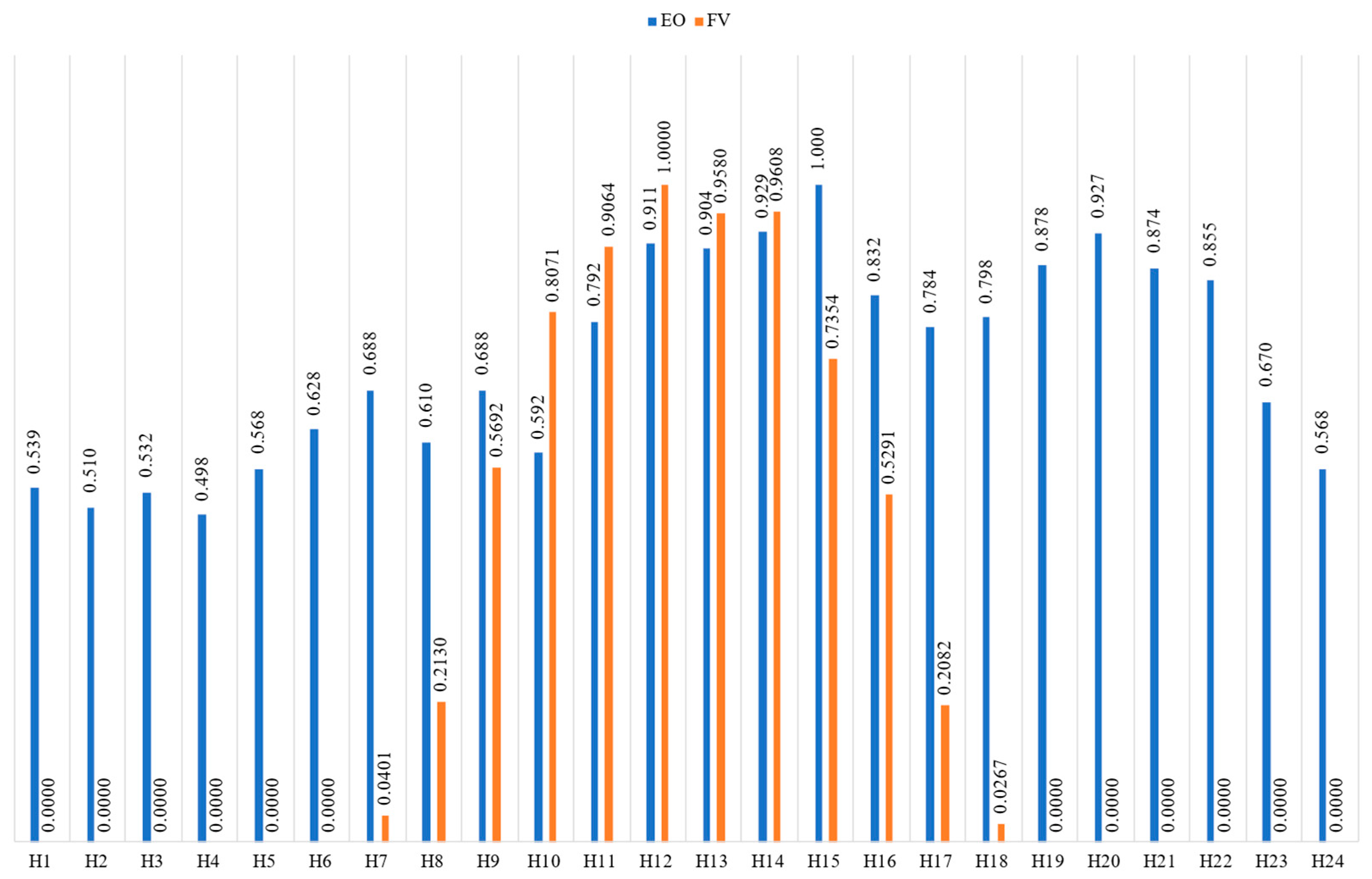
The optimization model requires using the availability of renewable resources; for this purpose and considering the information [44], the data for this parameter are presented in Figure 4.
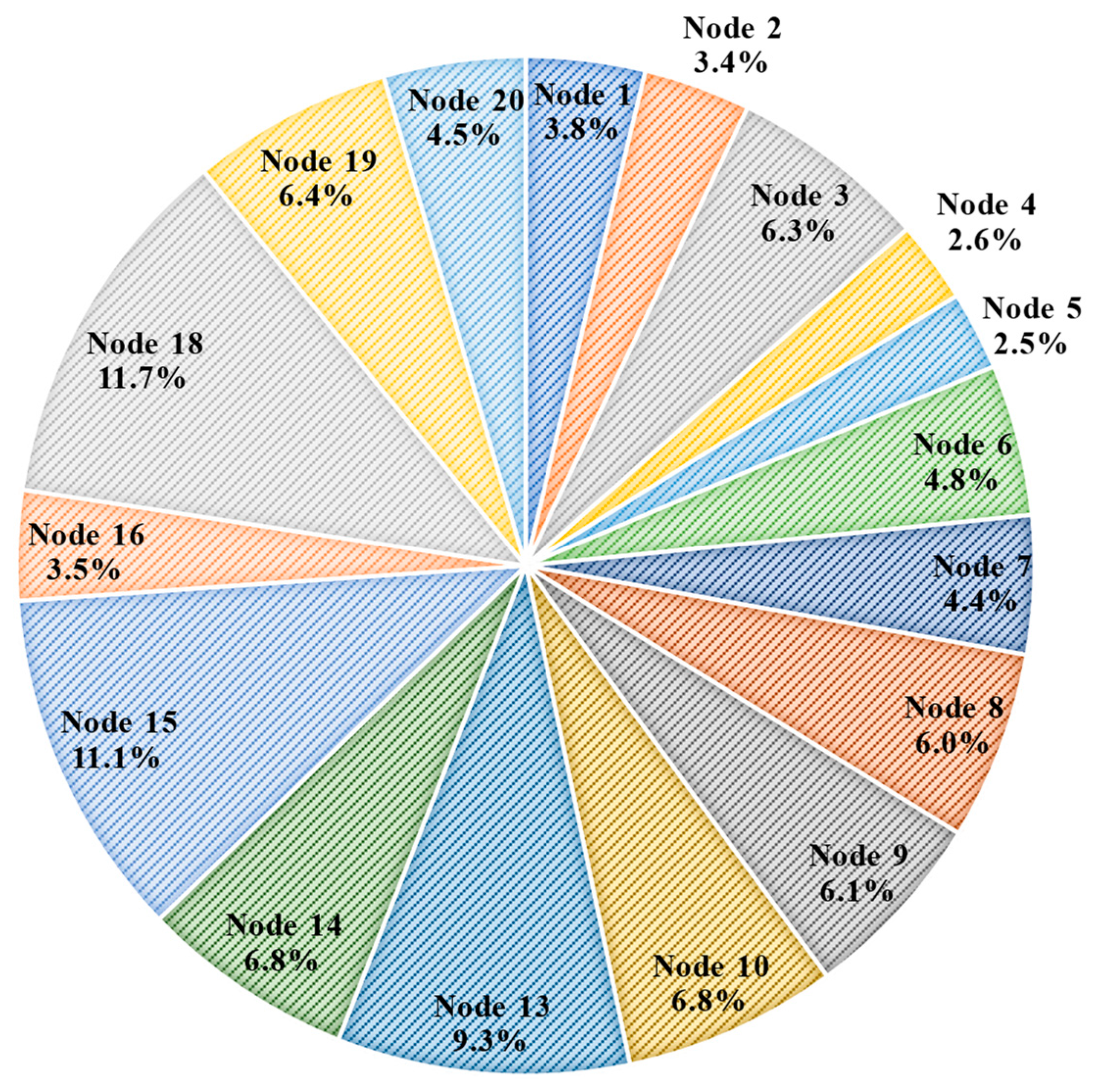
To allocate the hourly demand to each node, percentages are used as indicated in [41]; the values are detailed in the Figure 5:
The pseudocode presented in Table 6 establishes the logical sequence of operations that defines the computational architecture of the optimization model developed, detailing the systematic processing flow from parameter initialization to obtaining results. The MATLAB R2024b linprog solver with the dual-simplex algorithm was used to solve the linear programming model due to its robustness in large-scale problems and its numerical stability in multi-period models.
In order to evaluate the performance of the optimization model, two analysis scenarios have been defined:
Scenario 1: Supplying variable demand on an hourly basis by combining conventional and renewable generation resources, using an optimal direct current power flow (DC-OPF) solved using linear programming techniques.
Scenario 2: Supplying variable demand at time intervals, considering conventional and renewable generation resources, and incorporating the interaction with energy storage systems. The analysis is developed using an optimal direct current power flow (DC-OPF), solved through linear programming techniques.

4. Results and Discussion

The results analysis is carried out in two complementary phases. First, a comprehensive evaluation is performed from energy and economic perspectives, considering the system’s behavior under operating conditions with and without energy storage. Subsequently, a peak demand analysis is conducted to identify the effects of storage on dispatch redistribution and the system’s operational efficiency.

4.1. Energy Analysis

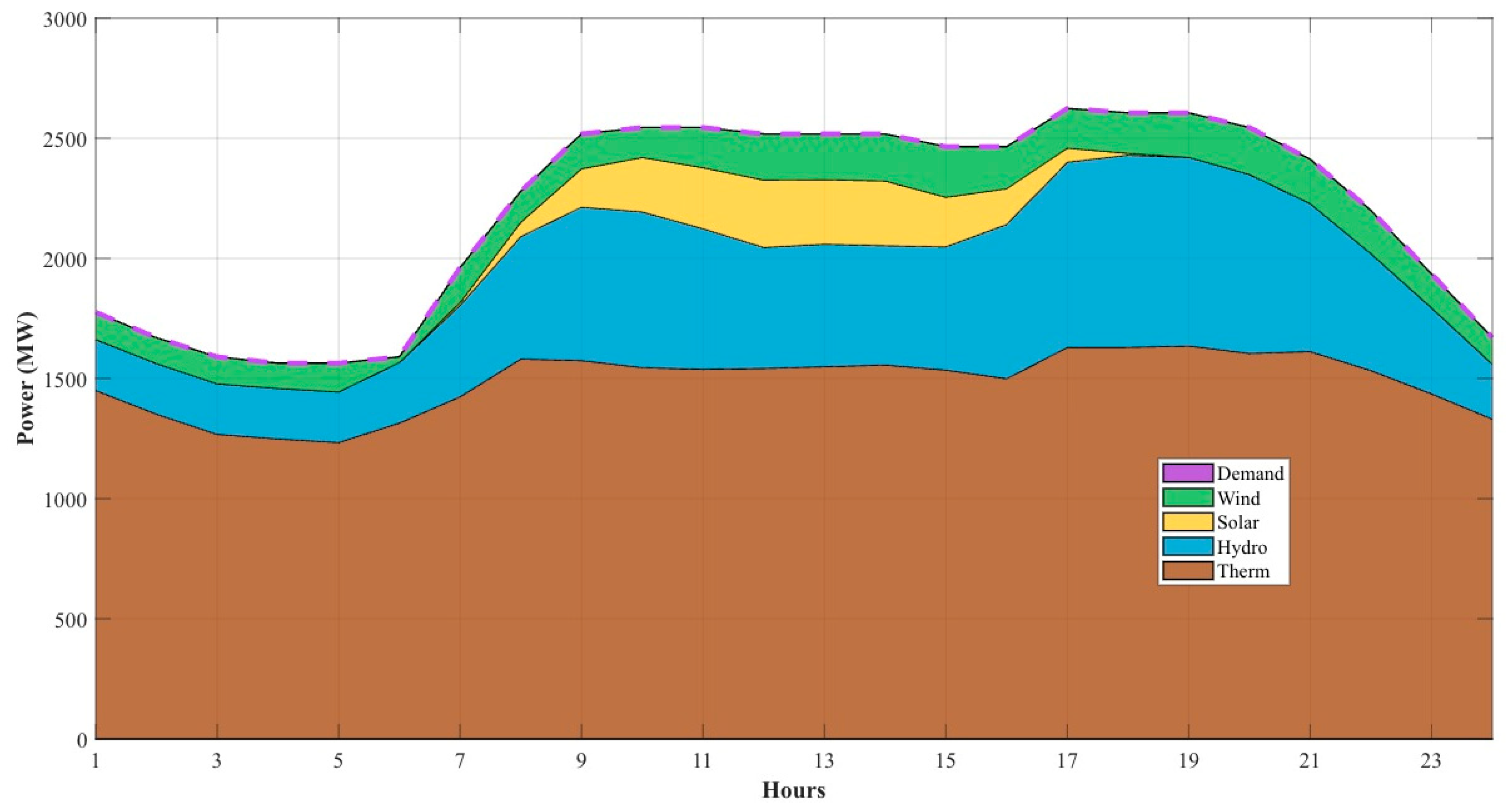
Figure 6 shows the active power dispatch corresponding to the scenario without the incorporation of storage systems (Scenario 1), which represents the conventional operation of the system under optimal hourly dispatch.
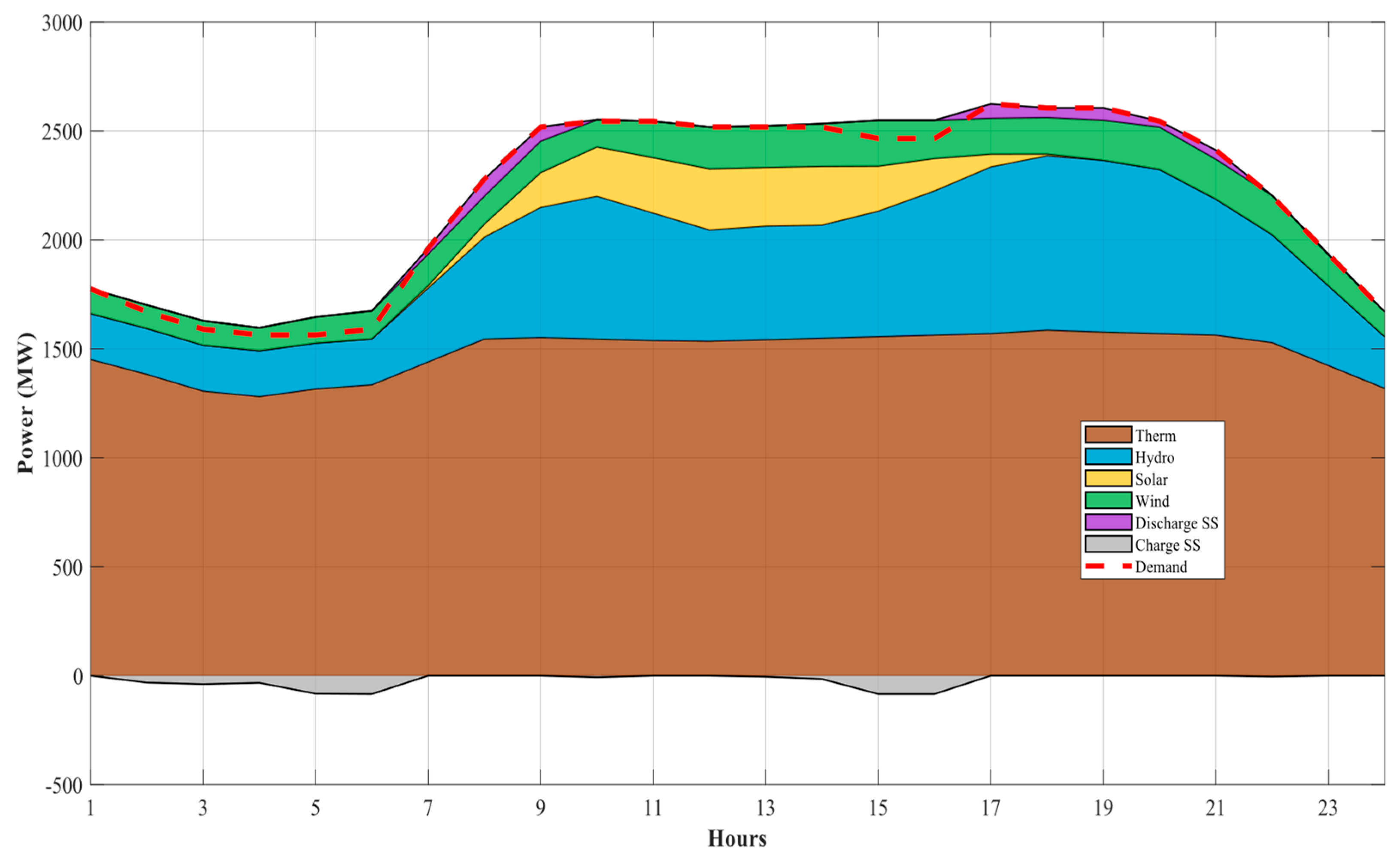
Figure 7 presents the results obtained after the integration of energy storage systems (Scenario 2), where the modification in the generation profile and the dispatch between technologies is evident.
Table 7 below presents the total energy delivered by each type of generation, as well as the energy associated with the charging and discharging processes of the storage systems, expressed in MWh for both scenarios.
In both scenarios, the model guarantees the total supply of demand, which amounts to 52,681.53 MWh during the analyzed daily period. No energy deficits are observed, confirming the sufficiency of the generating fleet to meet the system’s needs under the established conditions.
In Scenario 1, thermal generation covers 35,641.97 MWh, representing approximately 67.6% of the total energy supplied. Hydropower contributes 11,520.00 MWh (21.9%), while solar photovoltaic and wind technologies contribute 1947.12 MWh (3.7%) and 3572.44 MWh (6.8%), respectively. This configuration reflects a strong reliance on thermal generation to meet demand, with non-conventional renewable energy contributing only marginally, primarily due to intermittency limitations and the lack of system flexibility in the absence of energy storage.
In Scenario 2, with the introduction of storage systems, thermal generation is reduced to 35,601.48 MWh, equivalent to a decrease of 40.49 MWh (−0.11%) compared to the baseline scenario. This shift in thermal generation is offset by an increase in wind power production of 108.45 MWh (+3.0%), rising from 3572.44 MWh to 3680.89 MWh, while hydroelectric and photovoltaic production remain constant. This increase in wind power generation reflects an optimal dispatch strategy, which takes advantage of peak renewable energy availability hours to charge the storage systems, which then release energy during periods of higher demand.
The storage system, in its daily operation, absorbs 468.68 MWh during off-peak hours (charging) and releases 400.72 MWh during peak hours (discharging), exhibiting an overall energy efficiency of approximately 85.5%, which is consistent with the typical efficiencies of lithium-ion battery technologies or equivalent. This behavior allows for the partial displacement of thermal generation during peak load periods, reducing the need to operate high-marginal-cost units and increasing the effective share of renewable energy in the generation mix.
The integration of the energy storage system modifies dispatch patterns due to its ability to perform energy arbitrage between periods of low and high demand. During off-peak hours, the storage system absorbs surplus renewable generation, preventing spillage and reducing the operation of thermal units with high fixed costs. Subsequently, during peak demand hours, the system releases this stored energy, reducing the need to activate marginal thermal generators with high variable costs. This intertemporal behavior naturally flattens the dispatch curve and contributes to a more efficient operational structure.
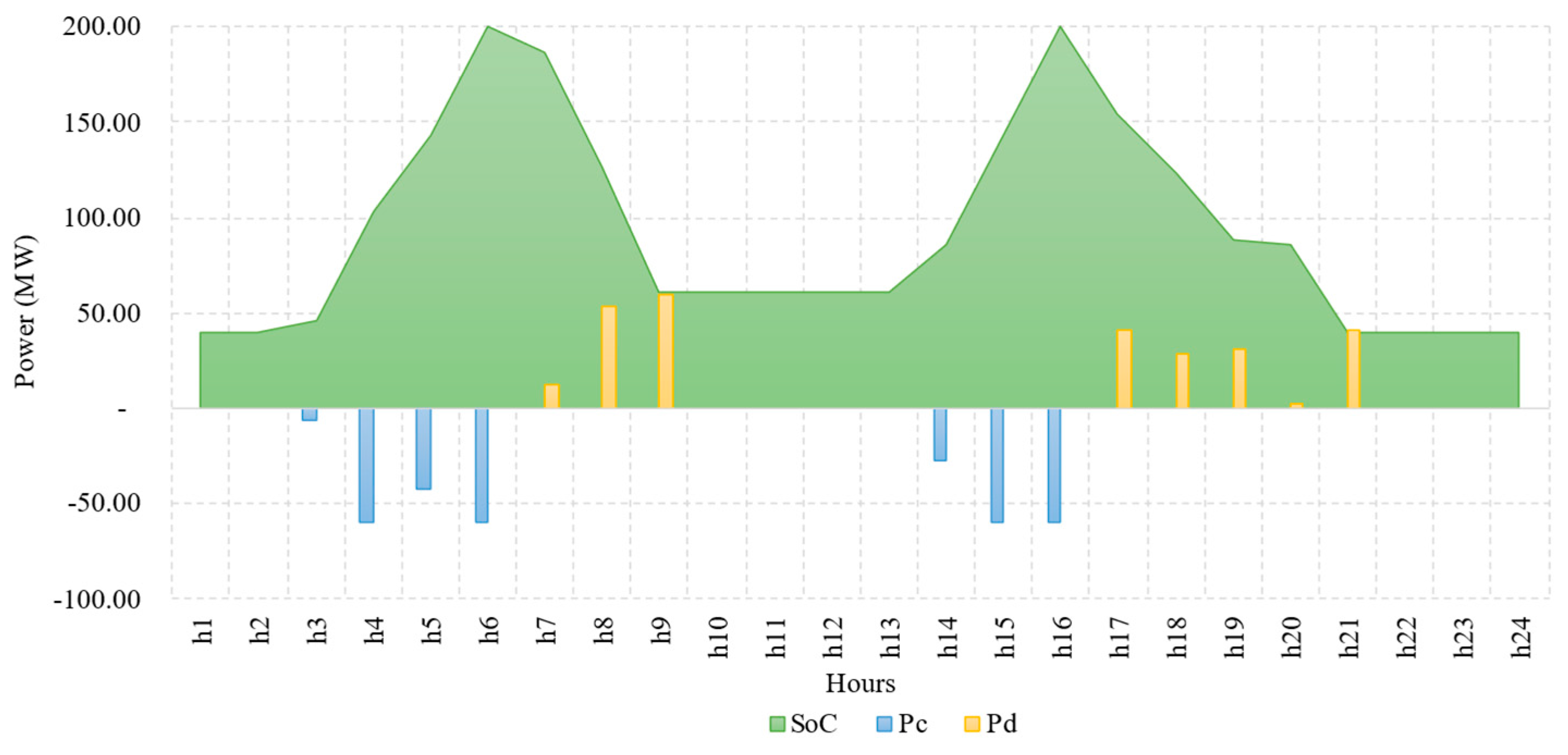
In energy terms, although the absolute reduction in thermal energy may seem marginal, its operational effect is significant, as it enables more efficient dispatch management and a potential reduction in operating costs. Furthermore, the use of storage promotes better utilization of wind resources, preventing spills and contributing to a more stable renewable generation profile throughout the day. The operational dynamics of the storage system located at node 8 are shown in Figure 8.
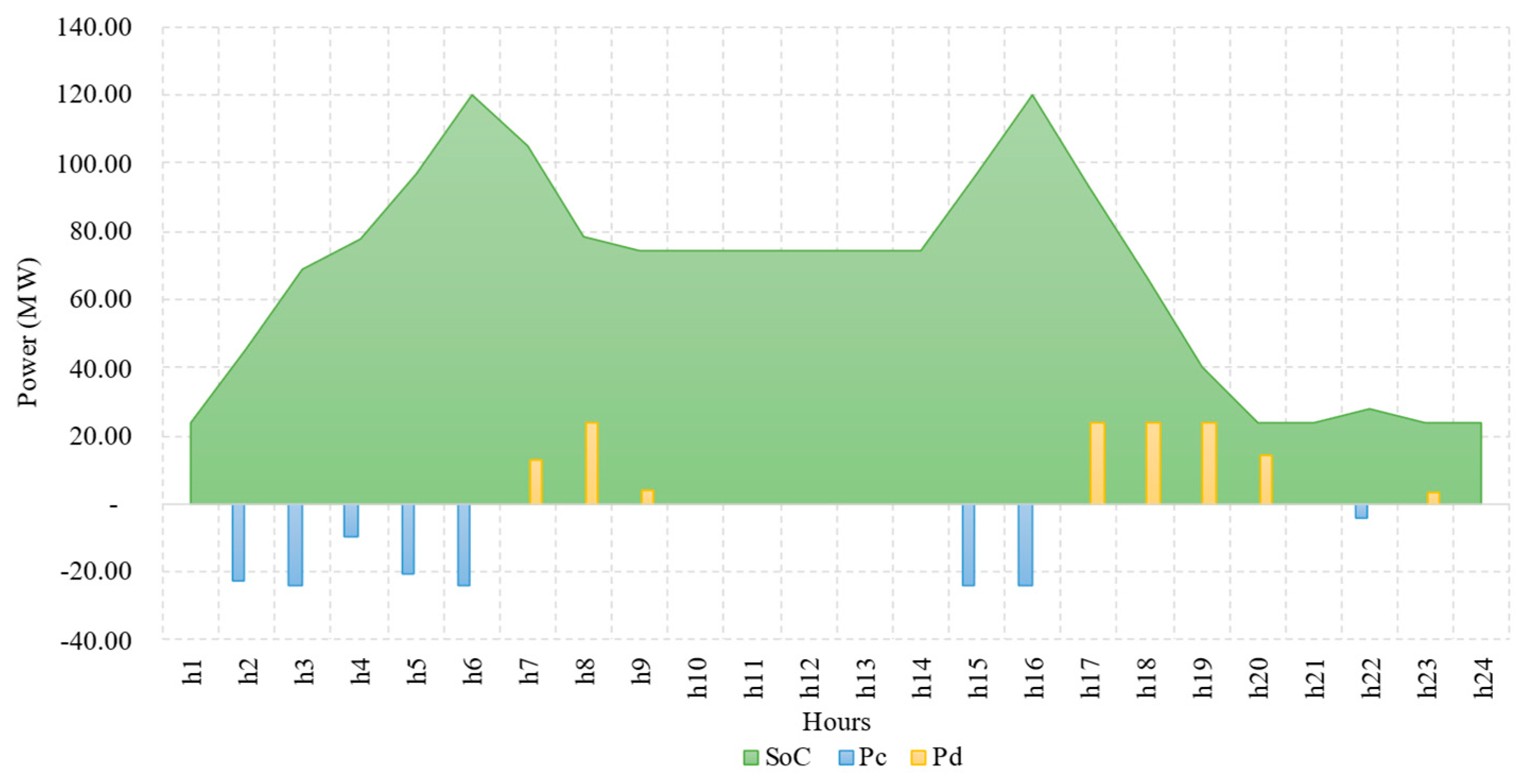
Likewise, the operational dynamics of the storage system located at node 17 with hourly resolution is shown in Figure 9.
The hourly evaluation of the storage systems allows for the identification of their energy behavior and their contribution to the system’s operational stability. Both systems exhibit a cyclical pattern of charging during off-peak hours and discharging during peak energy demand periods, fulfilling their function of managing energy over time. Together, SA1 and SA2 charge approximately 468.68 MWh and discharge 400.72 MWh.
Energy Storage System 1 (AS1) begins operation with a charge of 40 MWh and reaches its maximum capacity of 200 MWh through two main charging stages (hours 3–6 and 14–16), accumulating approximately 315 MWh by taking advantage of off-peak demand and higher wind availability. Subsequently, it discharges during periods 7–9 and 17–21, releasing approximately 400.7 MWh, demonstrating efficient management aimed at covering peak consumption and displacing high-cost thermal generation. The stability of the charge during intermediate intervals (10–13 and 22–24) reflects an optimal control strategy that prevents over-cycling and extends the system’s lifespan, increasing operational flexibility and the sustainability of electricity dispatch.
Energy Storage System 2 (ESS2) has a maximum capacity of 120 MWh, equivalent to 60% of that of ES1, starting with a state of charge of 24 MWh. Its operation maintains a distributed charging and discharging dynamic across time blocks, accumulating approximately 144 MWh—primarily between hours 1–6 and 15–16—taking advantage of wind energy surpluses and off-peak demand. Energy discharge reaches approximately 176 MWh daily, with discharges concentrated between hours 7–9 and 17–20, demonstrating a responsiveness to midday and nighttime consumption peaks. ES2 contributes around 30% of the total energy managed by the storage systems, playing a complementary role to ES1 by reinforcing power regulation and compensating for renewable energy variability.

4.2. Economic Analysis

The cost analysis shows the direct impacts of incorporating energy storage systems (ESS) on the daily operation of the electrical system; the results of the two scenarios are shown in the following Table 8.
The comparison between the scenarios shows a reduction in total operating costs of USD 40,392.39 per day, from USD 4,213,998.84 to USD 4,173,606.45. Projecting this result over an annual horizon, the system would achieve total savings of approximately USD 14.75 million per year, assuming continuous operation 365 days a year. This result demonstrates that, although the daily percentage benefit may seem marginal, its cumulative effect over time is economically significant.
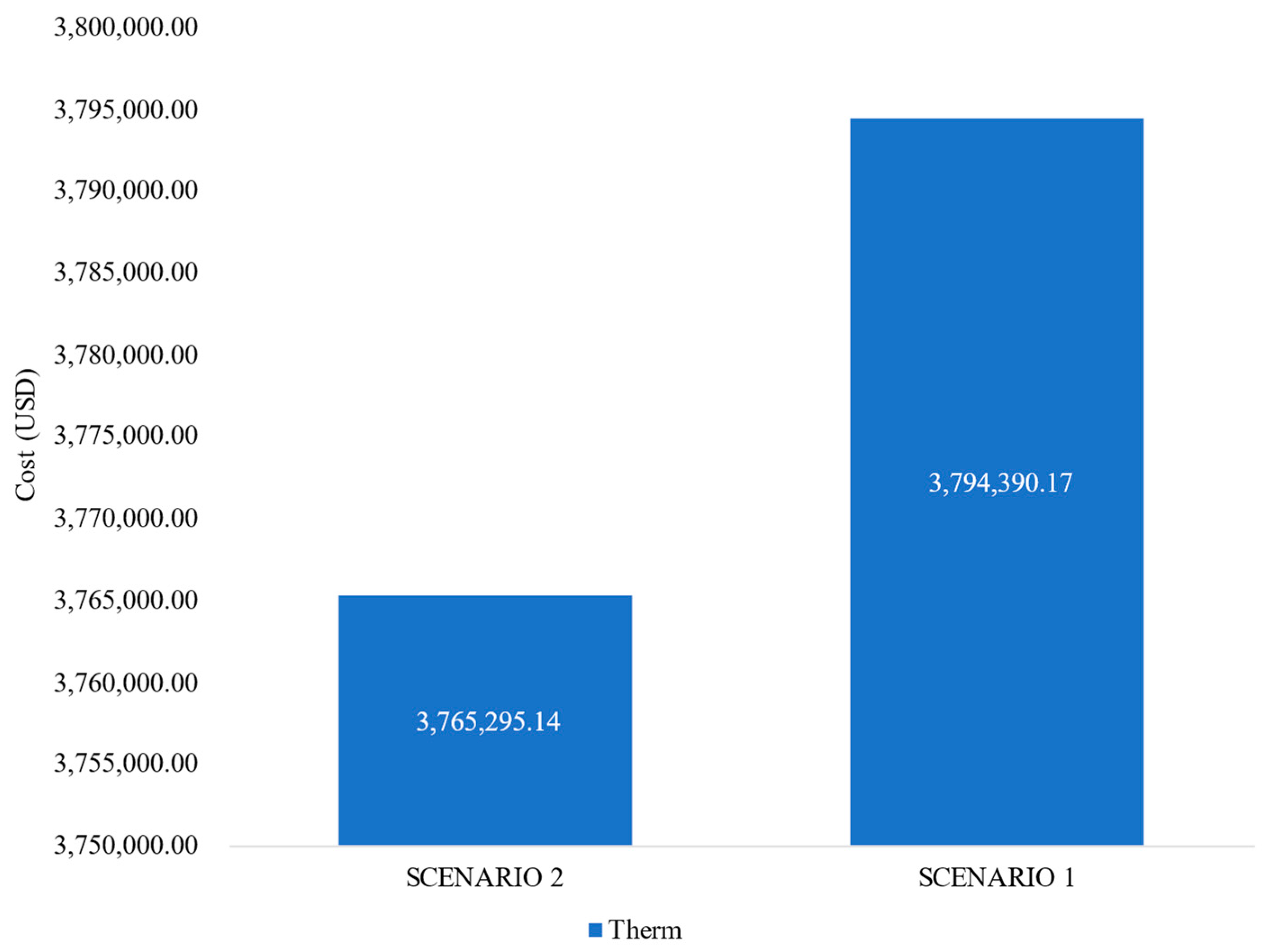
Regarding the cost structure, the thermal component remains predominant; however, there is a reduction of USD 29,095.03/day when comparing scenario 2 with scenario 1, which is directly associated with the lower need to dispatch generation units with high marginal costs, due to the energy contribution from storage systems and the increase in renewable participation.
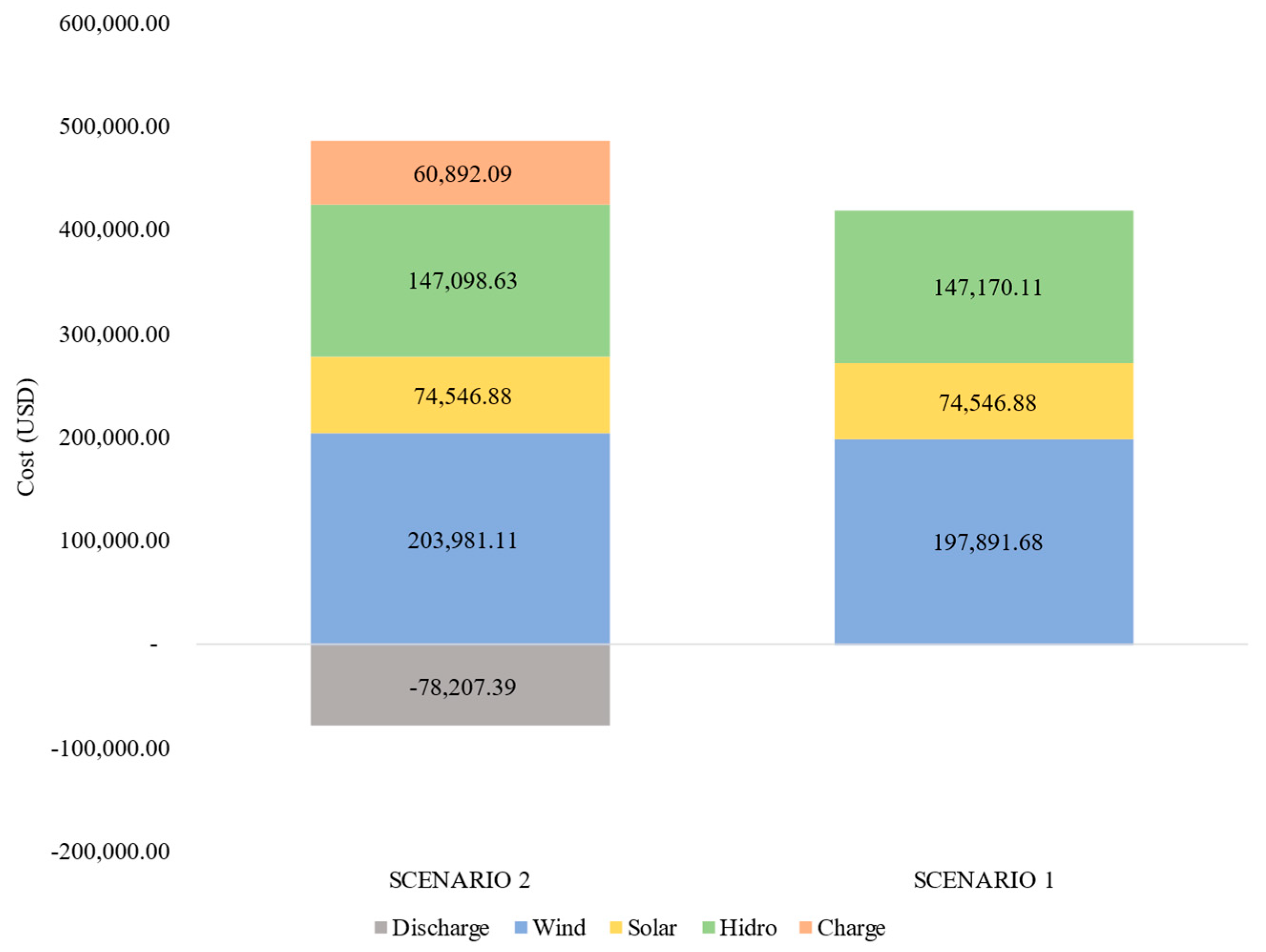
The costs associated with wind power generation increased by USD 6089.43 per day (+3.08%), rising from USD 197,891.68 to USD 203,981.11. This demonstrates greater utilization of the renewable resource to supply both direct demand and the charging requirements of energy storage systems. This behavior is consistent with the optimization strategy, as storage is charged during peak wind production hours, taking advantage of relatively low marginal costs, and subsequently releases energy during peak prices.
Regarding the cost of charging and discharging energy, it should be considered that these values result from the product of the hourly marginal cost (USD/MWh) and the charging or discharging power (MW) in each interval. In this analysis, the charging cost amounts to USD 60,892.09/day, reflecting the energy absorbed by the storage systems during hours of low marginal price, while the discharged energy generates an operating income equivalent to USD −78,207.39/day, since it is injected into the system during hours of higher marginal cost. Thus, the net balance of storage is positive at USD 17,315.30/day, representing a direct economic benefit from energy arbitrage. Figure 10 shows the costs of generation technologies that use renewable resources and the costs associated with charging and discharging storage systems.
Figure 11 shows the costs of thermal generation units, broken down by scenario.
The presence of energy storage directly impacts the system’s cost structure by reducing marginal and total operating costs. The gradual displacement of expensive thermal generation during peak periods and the increased use of renewable resources lower the hourly cost, resulting in a more stable and less volatile cost curve. Additionally, storage increases effective renewable energy penetration by allowing surplus energy to be used instead of wasted. By acting as a dynamic buffer between renewable variability and demand needs, the system promotes more efficient use of installed capacity and reduces dependence on fossil fuels during critical times.

4.3. Peak Demand Analysis

Once the energy and economic validation of the system was completed on a daily basis, an analysis was conducted under peak demand conditions to verify the operational consistency of the generating units, storage systems, and the electrical grid. This scenario represents the point of greatest demand on the system, with a total demand of 2624 MW, allowing for the identification of the utilization rate of each technology and the support that storage systems provide to energy balance and grid stability. The results of generation and demand to be supplied are shown in Table 9.
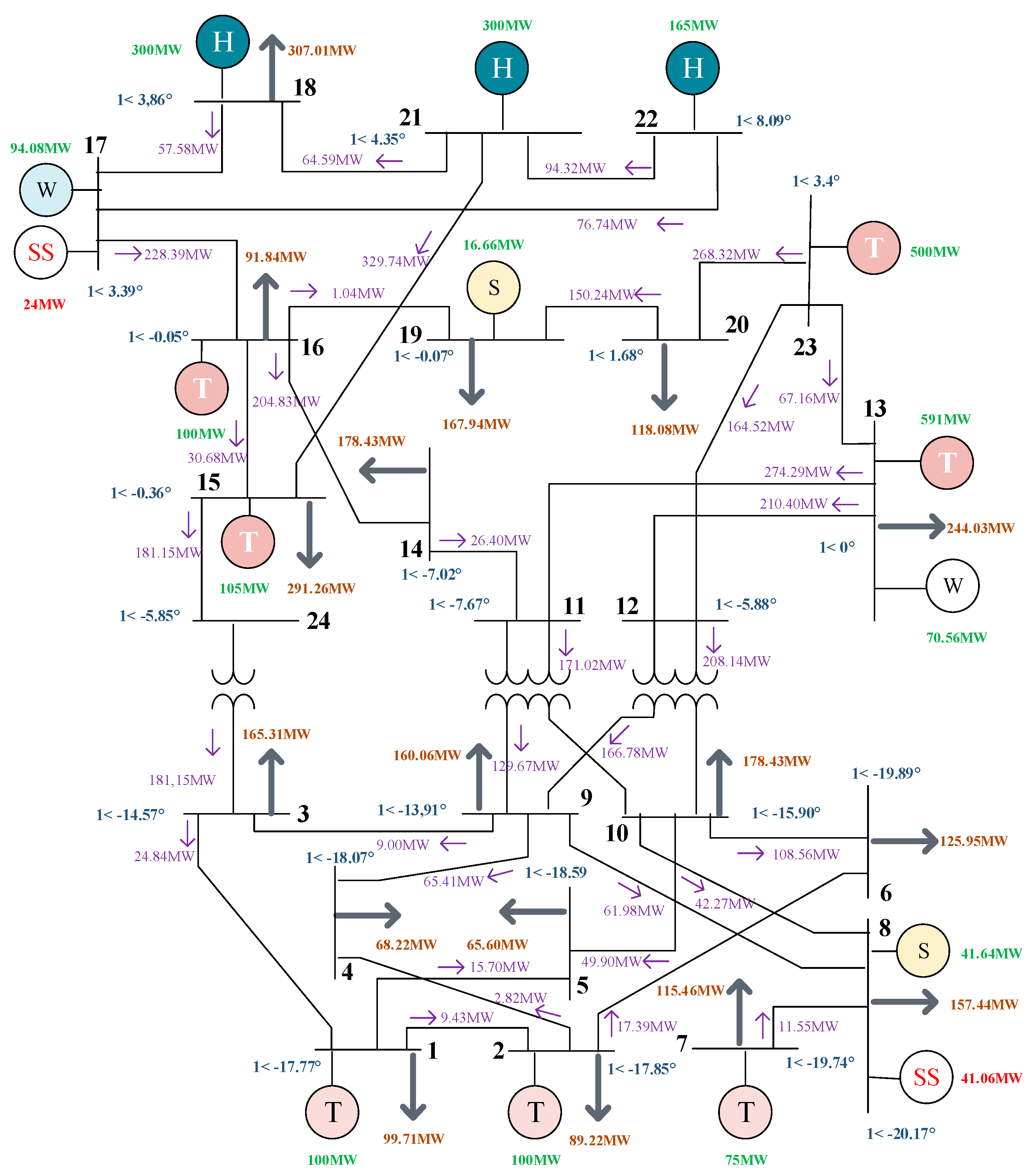
The power flows between nodes for maximum demand are shown in Table 10.
At peak load, thermal generation contributes 1571 MW, becoming the system’s main backup resource, accounting for 59.9% of total generation. This result is consistent with the need to cover base load and peak demand during periods when variable renewable sources are limited. Hydropower generation, at 765 MW, represents 29.2% of the operating mix, reinforcing its role as a regulating renewable source. Photovoltaic and wind power generation together reach 222.94 MW, equivalent to 8.5% of total generation, reflecting their contribution during daylight hours and periods of moderate wind, respectively. The generation contributions for each technology, including the contribution of storage systems, are shown in Table 11.
Energy storage systems (ESS) contribute a discharge capacity of 65.06 MW, equivalent to 2.5% of the total energy supplied. While this is smaller compared to conventional power plants, its function is strategic: the discharge is activated to mitigate peak demand and reduce the need for additional thermal units. This behavior confirms optimal operation of the ESS, geared towards compensating for nodal imbalances and reducing marginal costs during critical hours.
From a power flow perspective, the results show an electrically stable network without any apparent overloads. The most heavily loaded links correspond to sections i16–i14 (213.99 MW), i21–i15 (344.76 MW), i12–i10 (213.06 MW), and i13–i11 (275.78 MW), demonstrating the existence of main energy transfer corridors from nodes with concentrated generation (hydro and thermal) to load centers. Likewise, the flows between i9–i8 (79.22 MW) and i23–i20 (261.07 MW) stand out as important evacuation routes, especially for energy from hydroelectric and wind sources. In all cases, power levels remain within the established technical limits, demonstrating adequate dispatch and distribution planning for active power.
The Table 12 tabulates operational performance indicators, which confirm that the system maintains stable, technically and economically efficient operation. The table shows the indicator, its interpretation, and the corresponding value.
Technically, the system’s behavior at peak demand confirms that dispatch optimization meets nodal balance constraints, transmission limits, and generation capacity. The inclusion of energy storage is crucial for alleviating thermal dispatch, reducing hourly marginal costs, and improving operational flexibility. Furthermore, the coordinated interaction between conventional and renewable resources allows demand to be met without compromising system security, demonstrating that the implemented energy management strategy achieves efficient and stable performance under maximum demand conditions. Figure 12 shows the single-line diagram of the system supplied at peak demand. The numbers represent the number of nodes in the system, the generators and storage systems are represented by circles, and the load is represented by arrows.

5. Conclusions

The formulated multi-period linear programming model coherently integrates the technical and economic constraints of conventional and renewable generation, as well as energy storage systems, into the 24-node IEEE grid. The model incorporates 24 nodal balance equations evaluated for each hourly time, ramp limits, generation capacity constraints, and the time dynamics of the energy storage system’s state of charge. The model was implemented using linear programming (LP) with MATLAB’s linprog function and a dual-simplex algorithm, solving a problem with 288 continuous variables subject to 408 linear constraints. The use of DC power simplified the network equations through linear relationships, reducing solution time without compromising operational accuracy.
The model achieved a 3.0% increase in wind power generation (from 3572.44 MWh to 3680.89 MWh daily) through the strategic loading of storage systems during peak resource availability hours (average capacity factor of 38.4%). The storage systems operated with an energy efficiency of 85.5%, absorbing 468.68 MWh during off-peak periods and discharging 400.72 MWh during peak periods. This allowed for a reduction in thermal generation of 40.49 MWh (−0.11%) and minimized renewable energy curtailment. This time-based optimization validates the model’s operational flexibility.
The integration of storage systems generated a net reduction in daily costs of USD 40,392.39, equivalent to a 0.96% decrease in total system costs. This saving breaks down as follows: a reduction of USD 29,095.03 in thermal generation (due to the displacement of marginal units), an increase of USD 6089.43 in wind generation (greater utilization of the resource), and a net arbitrage benefit of USD 17,315.30 (the difference between the cost of loading: USD 60,892.09 and the revenue from unloading: USD −78,207.39). Projected annually, the savings reach USD 14.75 million, demonstrating the economic efficiency of the model.
In the peak demand scenario (2624 MW), the model kept all power flows below 85% of the thermal capacity of the lines, with the most heavily loaded segment operating at 86.2% of its limit (i21–i15: 344.76 MW/400 MVA). Storage systems contributed 65.06 MW (2.5% of the total dispatched), reducing the thermal share to 59.9% (1571 MW) and increasing the total renewable penetration to 37.7% (including hydropower). The system maintained a 100% nodal balance with zero non-supply energy (NSE) in all intervals, confirming the model’s technical robustness.
Based on the above, the computational implementation of the proposed model demonstrates that its results guarantee efficient and technically feasible solutions, with processing times compatible with operational planning applications. The model provides a reproducible analytical framework that can be adapted to different network configurations and generation mixes, constituting a valuable tool for decision making in the operation and planning of modern electrical systems.

Author Contributions

Conceptualization, methodology, software, resources, validation, and formal analysis, E.P., E.C.; investigation, writing—original draft preparation, E.P., E.C., J.L.-G. All authors have read and agreed to the published version of the manuscript.

Funding

This work was supported by Universidad Politécnica Salesiana.

Institutional Review Board Statement

Not applicable.

Informed Consent Statement

Not applicable.

Data Availability Statement

The original contributions presented in this study are included in the article. Further inquiries can be directed to the corresponding author.

Conflicts of Interest

The authors declare no conflict of interest.

References

  1. Bistline, J.; Blanford, G.; Mai, T.; Merrick, J. Modeling variable renewable energy and storage in the power sector. Energy Policy 2021, 156, 112424. [Google Scholar] [CrossRef]
  2. Thanapalan, K.; Constant, E. Overview of Energy Storage Technologies for Excess Renewable Energy Production. In Proceedings of the 24th World Multi-Conference on Systemics, Cybernetics and Informatics, Virtual, 13–16 September 2020. [Google Scholar]
  3. Laugs, G.A.H.; Benders, R.M.J.; Moll, H.C. Balancing responsibilities: Effects of growth of variable renewable energy, storage, and undue grid interaction. Energy Policy 2020, 139, 111203. [Google Scholar] [CrossRef]
  4. Jafari, M.; Korpås, M.; Botterud, A. Power system decarbonization: Impacts of energy storage duration and interannual renewables variability. Renew. Energy 2020, 156, 1171–1185. [Google Scholar] [CrossRef]
  5. Wang, P.; Du, E.; Zhang, N.; Xu, X.; Gao, Y. Power system planning with high renewable energy penetration considering demand response. Glob. Energy Interconnect. 2021, 4, 69–80. [Google Scholar] [CrossRef]
  6. Wei, W.; Wu, D.; Wang, Z.; Mei, S.; Catalao, J.P.S. Impact of Energy Storage on Economic Dispatch of Distribution Systems: A Multi-Parametric Linear Programming Approach and its Implications. IEEE Open Access J. Power Energy 2020, 7, 243–253. [Google Scholar] [CrossRef]
  7. Sakib, N.; Hoque, M.E.; Rashid, F.; Aziz, M.; Uddin, M.S.; Islam, T. Effects of dispatch algorithms and fuel variation on techno-economic performance of hybrid energy system in remote island. J. Energy Storage 2024, 78, 109919. [Google Scholar] [CrossRef]
  8. Hlalele, T.G.; Naidoo, R.M.; Zhang, J.; Bansal, R.C. Dynamic economic dispatch with maximal renewable penetration under renewable obligation. IEEE Access 2020, 8, 38794–38808. [Google Scholar] [CrossRef]
  9. Mohandes, B.; Wahbah, M.; Moursi, M.S.E.; El-Fouly, T.H.M. Renewable Energy Management System: Optimum Design and Hourly Dispatch. IEEE Trans. Sustain. Energy 2021, 12, 1615–1628. [Google Scholar] [CrossRef]
  10. Amini, M.; Almassalkhi, M. Optimal Corrective Dispatch of Uncertain Virtual Energy Storage Systems. IEEE Trans. Smart Grid 2020, 11, 4155–4166. [Google Scholar] [CrossRef]
  11. Li, X.; Wang, L.; Yan, N.; Function, A.O. Economic Dispatch of Distribution Network with Distributed Energy Storage and PV Power Stations. In Proceedings of the 2020 IEEE International Conference on Applied Superconductivity and Electromagnetic Devices (ASEMD), Tianjin, China, 16–18 October 2020; pp. 2020–2022. [Google Scholar]
  12. Liu, Q.; Li, W.; Zhao, Z.; Jian, G. Optimal operation of coordinated multi-carrier energy hubs for integrated electricity and gas networks. Energy 2024, 288, 129800. [Google Scholar] [CrossRef]
  13. Davoudi, M.; Moeini-Aghtaie, M.; Mehrtash, M. Optimal operation of a residential energy hub participating in electricity and heat markets. Renew. Energy Focus 2024, 51, 100646. [Google Scholar] [CrossRef]
  14. Bahloul, M.; Daoud, M.; Khadem, S.K. Optimal dispatch of battery energy storage for multi-service provision in a collocated PV power plant considering battery ageing. Energy 2024, 293, 130744. [Google Scholar] [CrossRef]
  15. Lamichhane, S.; Dubey, A. Stochastic Economic Dispatch with Battery Energy Storage considering Wind and Load Uncertainty. arXiv 2025, arXiv:2509.18100. [Google Scholar]
  16. Montano, J.; Candelo-Becerra, J.E.; Escudero-Quintero, C.; Guzmán, J.P. Economic and environmental power dispatch for energy management systems applied to microgrids with wind energy resources and battery energy storage systems. Results Eng. 2025, 27, 106430. [Google Scholar] [CrossRef]
  17. Tiwari, V.; Dubey, H.M.; Pandit, M.; Salkuti, S.R. Economic Dispatch in Microgrid with Battery Storage System using Wild Geese Algorithm. Green Energy Intell. Transp. 2025, 4, 100263. [Google Scholar] [CrossRef]
  18. Bhavsar, S.; Pitchumani, R.; Maack, J.; Satkauskas, I.; Reynolds, M.; Jones, W. Stochastic economic dispatch of wind power under uncertainty using clustering-based extreme scenarios. Electr. Power Syst. Res. 2024, 229, 110158. [Google Scholar] [CrossRef]
  19. Barbosa, A.M.; Rotella, P., Jr.; Rocha, L.C.S.; Barbosa, A.d.S.; Bolis, I. Optimization methods of distributed hybrid power systems with battery storage system: A systematic review. J. Energy Storage 2024, 97, 112909. [Google Scholar] [CrossRef]
  20. Cui, X.; Yan, Y. Economic dispatching problem with group and resource considerations. In Proceedings of the 2012 24th Chinese Control and Decision Conference, CCDC 2012, Taiyuan, China, 23–25 May 2012; pp. 4114–4117. [Google Scholar] [CrossRef]
  21. Wang, J.; Chung, S.; AlShelahi, A.; Kontar, R.; Byon, E.; Saigal, R. Look-ahead decision making for renewable energy: A dynamic ‘predict and store’ approach. Appl. Energy 2021, 296, 117068. [Google Scholar] [CrossRef]
  22. Khatami, R.; Oikonomou, K.; Parvania, M. Look-ahead optimal participation of compressed air energy storage in day-ahead and real-time markets. IEEE Trans. Sustain. Energy 2019, 11, 682–692. [Google Scholar] [CrossRef]
  23. Choi, J.; Park, W.-K.; Lee, I.-W. Economic Dispatch of Multiple Energy Storage Systems Under Different Characteristics. Energy Procedia 2017, 141, 216–221. [Google Scholar] [CrossRef]
  24. Huang, Y.; Gordon, D.; Scott, P. Receding horizon dispatch of multi-period look-ahead market for energy storage integration. Appl. Energy 2023, 352, 121856. [Google Scholar] [CrossRef]
  25. Liu, L.; Hu, X.; Chen, C.; Wu, R.; Wu, T.; Huang, H. Research on day-ahead and intraday scheduling strategy of distributed network based on dynamic partitioning. Int. J. Electr. Power Energy Syst. 2024, 160, 110078. [Google Scholar] [CrossRef]
  26. Ma, X.; Zhang, F.; Yao, S.; Yang, Y.; Zhao, Z. Day-ahead and intra-day optimal dispatching considering the observability and controllability of cyber–physical power grid. Energy Rep. 2022, 8, 99–110. [Google Scholar] [CrossRef]
  27. Le, T.S.; Nguyen, T.N.; Bui, D.-K.; Ngo, T.D. Optimal sizing of renewable energy storage: A techno-economic analysis of hydrogen, battery and hybrid systems considering degradation and seasonal storage. Appl. Energy 2023, 336, 120817. [Google Scholar] [CrossRef]
  28. El Barkouki, B.; Laamim, M.; Rochd, A.; Chang, J.-W.; Benazzouz, A.; Ouassaid, M.; Kang, M.; Jeong, H. An economic dispatch for a shared energy storage system using MILP optimization: A case study of a Moroccan microgrid. Energies 2023, 16, 4601. [Google Scholar] [CrossRef]
  29. Dini, A.; Hassankashi, A.; Pirouzi, S.; Lehtonen, M.; Arandian, B.; Baziar, A.A. A flexible-reliable operation optimization model of the networked energy hubs with distributed generations, energy storage systems and demand response. Energy 2022, 239, 121923. [Google Scholar] [CrossRef]
  30. Siddiqui, A.; Asim, M. Advancement, challenges and solutions of PV integrated battery energy storage systems: A review. J. Energy Storage 2025, 132, 117996. [Google Scholar] [CrossRef]
  31. Zhu, Y.; Xu, Y.; Chen, H.; Guo, H.; Zhang, H.; Zhou, X.; Shen, H. Optimal dispatch of a novel integrated energy system combined with multi-output organic Rankine cycle and hybrid energy storage. Appl. Energy 2023, 343, 121113. [Google Scholar] [CrossRef]
  32. Feng, S.; Wei, W. Hybrid energy storage sizing in energy hubs: A continuous spectrum splitting approach. Energy 2024, 300, 131504. [Google Scholar] [CrossRef]
  33. Baggu, M.M.; Nagarajan, A.; Cutler, D.; Olis, D.; Bialek, T.O.; Symko-Davies, M. Coordinated optimization of multiservice dispatch for energy storage systems with degradation model for utility applications. IEEE Trans. Sustain. Energy 2018, 10, 886–894. [Google Scholar] [CrossRef]
  34. Yang, D.; Wang, M.; Yang, R.; Zheng, Y.; Pandzic, H. Optimal dispatching of an energy system with integrated compressed air energy storage and demand response. Energy 2021, 234, 121232. [Google Scholar] [CrossRef]
  35. Zhao, J.; Zheng, T.; Litvinov, E. A multi-period market design for markets with intertemporal constraints. IEEE Trans. Power Syst. 2019, 35, 3015–3025. [Google Scholar] [CrossRef]
  36. Taheri, B.; Molzahn, D.K. Optimizing parameters of the DC power flow. Electr. Power Syst. Res. 2024, 235, 110719. [Google Scholar] [CrossRef]
  37. Luo, Q.; Zhu, J.; Zhang, D.; Zhu, H.; Li, S. Distributed dispatch of non-convex integrated electricity and gas systems considering AC power flow and gas dynamics. Appl. Energy 2025, 392, 126025. [Google Scholar] [CrossRef]
  38. Zaery, M.; Abouzeid, S.I.; Hussain, S.M.S.; Abido, M.A. Consensus-based economic dispatch for DC microgrids incorporating realistic cyber delays. Alex. Eng. J. 2024, 107, 972–984. [Google Scholar] [CrossRef]
  39. Holzer, J.; Cornachione, M.; Li, L.; Schweitzer, E.; Eldridge, B. Modeling distributed energy resource aggregations in security constrained unit commitment and economic dispatch. Int. J. Electr. Power Energy Syst. 2025, 170, 110727. [Google Scholar] [CrossRef]
  40. Xu, Y.; Jiang, Z.; Peng, W.; Lu, P.; Wang, J.; Xu, Y.; Lu, J. Multi-objective optimization and mechanism analysis of integrated hydro-wind-solar-storage system: Based on medium-long-term complementary dispatching model coupled with short-term power balance. Energy 2025, 332, 137246. [Google Scholar] [CrossRef]
  41. Ordoudis, C.; Pinson, P.; González, J.M.M.; Zugno, M. An Updated Version of the IEEE RTS 24-Bus System for Electricity Market and Power System Operation Studies; Technical University of Denmark: Copenhagen, Denmark, 2016. [Google Scholar]
  42. IRENA—International Renewable Energy Agency. Renewable Power Generation Costs in 2024. Abu Dhabi, 2024. Available online: www.irena.org (accessed on 16 September 2025).
  43. Ralon, P.; Taylor, M.; Ilas, A.; Diaz-Bone, H.; Kairies, K. Electricity Storage and Renewables: Costs and Markets to 2030; International Renewable Energy Agency: Abu Dhabi, United Arab Emirates, 2017; Volume 164, p. 154. [Google Scholar]
  44. CENACE. Annual Report—CENACE 2024. 2024. Available online: https://www.cenace.gob.ec/wp-content/uploads/downloads/2025/04/Informe-Anual-CENACE-2024-vf-1-88_c.pdf (accessed on 18 September 2025).
  45. CENACE—National Electricity Operator. Operational Information—CENACE. Available online: https://www.cenace.gob.ec/info-operativa/InformacionOperativa.htm (accessed on 18 September 2025).
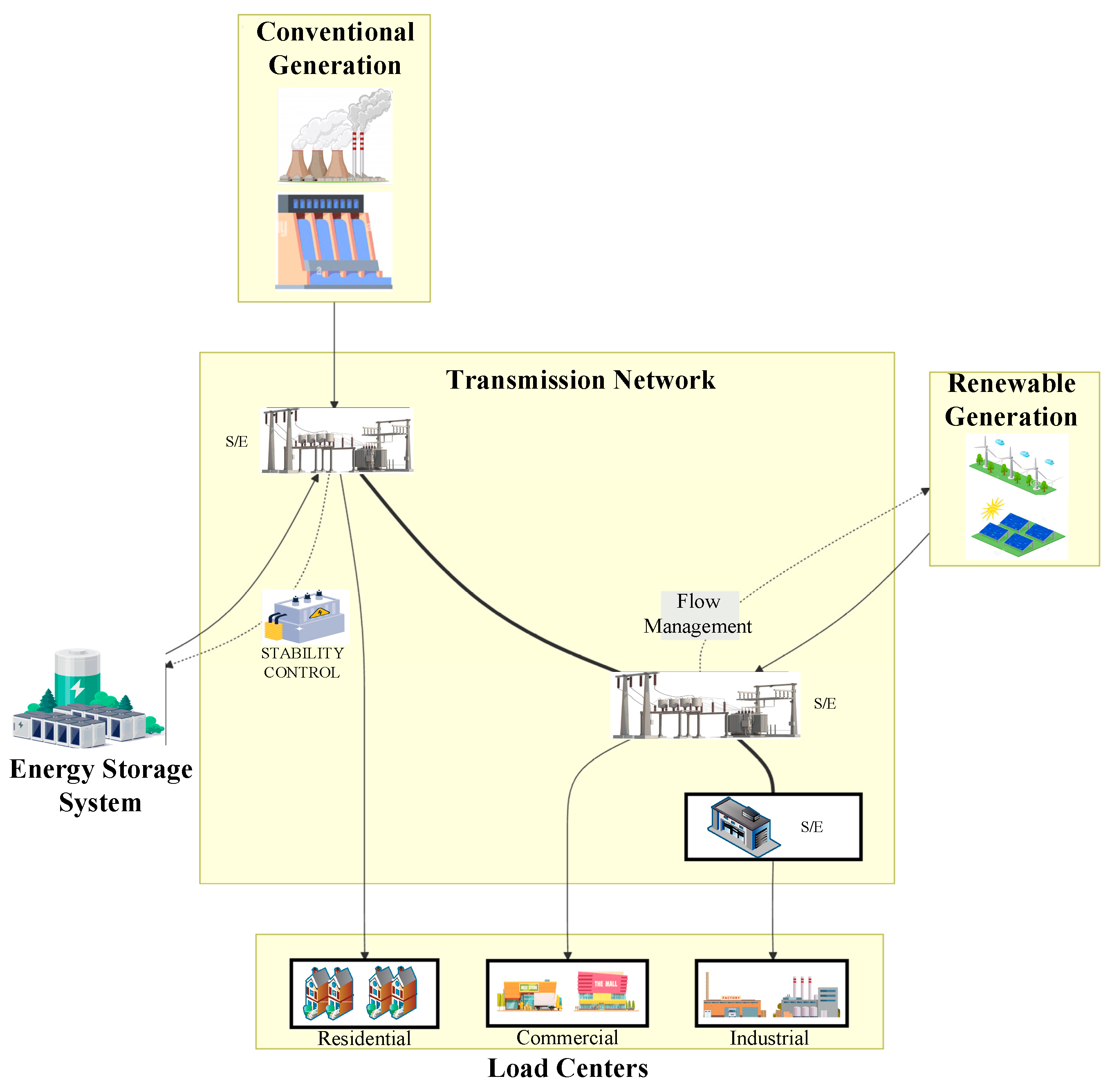
Figure 1. Conventional generation, renewable energy and storage in the centralized grid [30].
Applsci 16 01372 g001
Figure 2. IEEE 24-node one-line diagram [41].
Applsci 16 01372 g002
Figure 3. Hourly system demand [41].
Applsci 16 01372 g003
Figure 4. Availability of the renewable resource [45].
Applsci 16 01372 g004
Figure 5. Percentage of each node for hourly demand allocation [41].
Applsci 16 01372 g005
Figure 6. Generation dispatch without storage systems.
Applsci 16 01372 g006
Figure 7. Generation dispatch with storage systems.
Applsci 16 01372 g007
Figure 8. Storage system dynamics 1.
Applsci 16 01372 g008
Figure 9. Storage system dynamics 2.
Applsci 16 01372 g009
Figure 10. Renewable generation costs.
Applsci 16 01372 g010
Figure 11. Costs of thermal generation.
Applsci 16 01372 g011
Figure 12. Single line diagram—Peak demand .r. .
Applsci 16 01372 g012
Table 1. Global system parameters.
ParameterValueUnitDescription
Sb100MVABase power of the system
VPC1533USD/MWhLoad loss value
H24hoursOptimization horizon
Table 2. Parameters of conventional generation [41].
IDPmax [MW]Pmin [MW]Cost [USD/MWh]Up [MW/h]Dw [MW/h]
Gc1100.0030.40136.641414
Gc2100.0030.40136.641414
Gc3300.0075.00200.704949
Gc4591.00206.8550.932121
Gc560.0012.00278.222121
Gc6100.0054.25167.0477
Gc7100.0054.25127.042121
Gc8300.00100.0012.044747
Gc9300.00100.0010.944747
Gc10200.0010.0020.263535
Gc11250.00108.50131.042121
Gc12250.00140.00129.782828
Table 3. Renewable generation parameters [42].
IDNodePmax [MW]Pmin [MW]Cost [USD/MWh]Guy
Gren1i8200.000.0036.00FV
Gren2i1980.000.0044.00FV
Gren3i17120.000.0052.00EO
Gren4i1390.000.0060.00EO
Table 4. Storage system parameters [43].
IDNodeCap [MW]ηcηd
SA1i82000.950.9
SA2i171200.950.9
IDNodeSoCmin [%]SoC0 [%]Pcmax [%]Pdmax [%]
SA1i820%20%30%30%
SA2i1720%20%20%20%
Table 5. IEEE 24 bus network data [41].
Nodex (pu)Limit (MVA)
i1i20.0146175
i1i30.2253175
i1i50.0907350
i2i40.1356175
i2i60.205175
i3i90.1271175
i3i240.084400
i4i90.111175
i5i100.094350
i6i100.0642175
i7i80.0652350
i8i90.1762175
i8i100.1762175
i9i110.084400
i9i120.084400
i10i110.084400
i10i120.084400
i11i130.0488500
i11i140.0426500
i12i130.0488500
i12i230.0985500
i13i230.0884500
i14i160.0594500
i15i160.0172500
i15i210.02491000
i15i240.0529500
i16i170.0263500
i16i190.0234500
i17i180.0143500
i17i220.1069500
i18i210.01321000
i19i200.02031000
i20i230.01121000
i21i220.0692500
Table 6. Time block electrical dispatch algorithm based on FPDC.
InitializationLoad system configuration (Sb, VPC, nodes, lines)
Set time horizon (24 h)
Define sets of conventional and renewable generators
Define technical values of the network, storage systems and variable load.
Declare decision variables P g , h ,   P r , h ,   P d i , h ,   P c i , h ,   E N S i , h ,   F i , j , h ,   δ i , h ,   S o C i , h
Establish objective function M i n C s i s t = S b ·   h H g   ϵ   G c C g · P g , h + r   ϵ   G r C r · P r , h + i V P C · E N S i , h
Restrictions g   ϵ   G c P g , h + r   ϵ   G r P r , h + P d i , h P c i , h C a r g a i , h + E N S i , h = j F i , j , h
F i , j , h = 1 x i j δ i , h δ j , h
δ m i n δ i , h δ m a x
S i j m a x S b F i , j , h S b S i j m a x S b
P m i n P g , h P m a x       g     G c o n
0 P r , h P m a x · R r , h       g     G R
P g , h + 1 P g , h U p g
P g , h 1 P g , h D w g
S o C i , h = S o C i , h 1 + η c · P c i , h P d i , h η d     i   ϵ   S A
S o C i , 24 = S o C i , 0
S o C i m i n S o C i , h S o C i m a x     i   ϵ   S A
0 P c i , h ζ c , i · S o C i m a x     i   ϵ   S A
0 P d i , h ζ d , i · S o C i m a x     i   ϵ   S A
ResolutionConstruct the Aeq matrix of the nodal balance for each hour.
Build a vector beq with hourly demand and renewable contributions.
Construct matrices A and b for constraints:
-
Thermal limits
-
Generation ramps
-
DC flow limits
-
Storage load/discharge limits

SOLVE LP problem with linprog

Options = optimoptions (‘linprog’,’ Display’,’ iter’, ‘Algorithm’, ‘dual-simplex’,’MaxIterations’,1e6);

[x, fval, exitflag, output] = linprog(f, Aineq, bineq, Aeq, beq, lb, ub, options);
Verify convergence:
If exitflag > 0 then:
Register fval, generation, SoC and DC flows.
But:
Report infeasibility and identify active restrictions
ResultsThey extract results:
    F_res = zeros (N, N, H);
    for e = 1:num_directed_edges
    i = Iidx(e); j = Jidx(e);
    for h = 1:H
    F_res(i,j,h) = x(getF(e,h)) * Sb;
    end
    end
Reports and export
-
Build reports
-
Reports.Reportex = struct();
-
Writetable to Excel Complete_Reports.xlsx’
Table 7. Energy delivered for each scenario.
Energy (MWh)
ItemSc 2Sc 1
PG-Thermal35,601.4835,641.97
PG-Hydro11,520.0011,520.00
PG-FV1947.121947.12
PG-EO3680.893572.44
PCSA−468.68
PdSA400.72
Demand52,681.5352,681.53
Table 8. Operating costs for each scenario.
Costs (USD)
ItemScenario 2Scenario 1
Burden60,892.09
Discharge−78,207.39
Wind203,981.11197,891.68
FV74,546.8874,546.88
Hydro147,098.63147,170.11
Thermal3,765,295.143,794,390.17
Total4,173,606.454,213,998.84
Table 9. Generation and demand at peak demand.
NodeGTGHGFVGEOPDesDem
i1100.00 99.71
i2100.00 89.22
i3 165.31
i4 68.22
i5 65.60
i6 125.95
i775.00 115.46
i8 41.64 41.06157.44
i9 160.06
i10 178.43
i13591.00 70.56 244.03
i14 178.43
i15105.00 291.26
i16100.00 91.84
i17 94.0824.00
i18 300.00 307.01
i19 16.66 167.94
i20 118.08
i21 300.00
i22 165.00
i23500.00
Total1571.00765.0058.30164.6465.062624.00
GT: thermal generation; GH: hydroelectric generation; GFV: photovoltaic generation; GEO: wind power generation; Pdes: SA discharge power
Table 10. Flow between node i and node j.
Node iNode jFlow (MW)
i1i29.43
i1i515.70
i2i42.82
i2i617.39
i3i124.84
i7i811.55
i9i39.00
i9i465.41
i9i861.98
i10i549.90
i10i6108.56
i10i842.27
i11i10171.02
i11i9129.67
i12i10208.14
i12i9166.78
i13i11274.29
i13i12210.40
i14i1126.40
i15i24181.15
i16i14204.83
i16i1530.68
i16i191.04
i17i16228.39
i18i1757.58
i20i19150.24
i21i15329.74
i21i1864.59
i22i1776.74
i22i2194.32
i23i12164.52
i23i1367.16
i23i20268.32
i24i3181.15
Table 11. Participation in dispatch during peak demand.
TechnologyPower (MW)Stake (%)
Thermal generation (GT)157159.9%
Hydropower generation (GH)76529.2%
Photovoltaic generation (PVG)58.32.2%
Wind power generation (GEO)164.66.3%
Download SAE (Pdes)65.12.5%
Generation + total download2624100%
Table 12. Operational performance indicators.
IndicatorValueInterpretation
Thermal utilization factor0.85The thermal units operate close to their nominal power, ensuring reliability
Renewable penetration (GH + GFV + GEO)37.7%High non-conventional energy contribution, with grid stability
SAE participation2.5%A key addition during peak hours
Maximum flow/line capacity0.85 puNo overloads are present
Nodal balance compliance100%Consistency of the optimization model
Disclaimer/Publisher’s Note: The statements, opinions and data contained in all publications are solely those of the individual author(s) and contributor(s) and not of MDPI and/or the editor(s). MDPI and/or the editor(s) disclaim responsibility for any injury to people or property resulting from any ideas, methods, instructions or products referred to in the content.