1. Introduction
Crop production significantly affects various components of the natural environment [
1]. Current concerns extend beyond yield to encompass the environmental impacts of fertilization. The rapidly expanding production of anthropogenic fertilizers has contributed to alleviating global food insecurity [
2,
3,
4]. However, excessive use of mineral fertilizers has environmental costs. Pollution of streams and other water bodies, emissions of nitrogen oxides into the atmosphere (gases responsible for the greenhouse effect), and disruption of ecosystem balance [
5,
6] are among the key phenomena negatively affecting the environment. Improper fertilizer application can also lead to severe soil acidification, salinization, and heavy metal accumulation. Growing public awareness of environmental issues has prompted initiatives aimed at mitigating the negative impacts of agricultural production. Sustainable crop cultivation practices can reduce their severity. Consequently, fertilization should be aligned with the plant nutritional requirements, the availability of soil nutrients, and the characteristics of the species and cultivar [
7]. Appropriate nitrogen management can also help reduce pest pressure, including aphid infestations. In the broader context of mineral inputs, a central consideration is the efficiency of nutrient use [
8]. Although the literature does not provide a single, universally accepted definition of the effective utilization of macronutrients supplied through fertilizers, numerous determinants have been identified. These include water availability, agrotechnical conditions such as soil pH, rational crop rotation, and balanced fertilization [
9]. Collectively, these factors shape the dynamics of nitrogen uptake from the soil, as well as the plant’s capacity to utilize the absorbed nitrogen by incorporating it into cellular structures.
The efficiency of nitrogen utilization from mineral fertilizers is relatively low, typically estimated at approximately 50–60% [
10]. The remainder becomes bound within the soil sorption complex or is lost through leaching and oxidation processes [
11]. Once applied, mineral nitrogen enters the soil nitrogen cycle, where it may be emitted as ammonia, nitrous oxide, or nitrogen oxide, or lost through nitrate leaching into groundwater [
12,
13].
One strategy to limit such losses, thereby mitigating environmental pollution and enhancing nutrient use efficiency by plants, is the deployment of slow-release and controlled-release fertilizers. Slow-release products are composed of chemically or biologically degradable materials with high molecular weight, complex structure, and low solubility. Controlled-release formulations rely on polymer coatings or membranes that regulate nutrient availability by allowing their gradual release into the soil [
14]. The need to reduce cultivation costs and environmental considerations requires the exploration of alternative nitrogen application options in maize cultivation and the determination of its production efficiency and utilization. Therefore, rationalizing the use of nitrogen fertilizers in maize cultivation is an important issue for sustainable agriculture, as it can reduce the negative impact of agriculture on the surrounding environment. The choice of cultivar and type of nitrogen fertilizer is crucial in the context of mineral nitrogen residue in the soil after maize harvest. Some maize cultivars utilize soil nitrogen to a limited extent, while nitrogen fertilizers vary in their nutrient release dynamics, consistent with the maize’s demand for this macronutrient [
1,
7].
This study presents the role of residual nitrogen (Nres) that remained in the soil after maize harvest (pre-harvest crop) on N efficiency indicators in winter and spring wheat cultivation (successive crop).
2. Methodology and Research Conditions
2.1. Maize Research Conditions
The experiment was carried out at the Experimental Variety Evaluation Station in Chrząstów (Nakło nad Notecią). The research lasted three growing seasons (2017–2019). In this study, three maize varieties [ES Bombastic (A1), ES Abakus (A2), ES Metronom (A3)] and seven different nitrogen fertilizers [control (B1), ammonium nitrate (B2), urea (B3), ammonium nitrate + N-Lock (B4), urea + N-Lock (B5), Super N-46 (B6), UltraGran stabilo (B7)]. Only mineral fertilization at the rate of 150 kg N·ha−1, 120 kg P2O5·ha−1, and 130 kg K2O·ha−1 was applied before maize sowing. Fertilizers were broadcast applied to the field surface, before field preparation treatments for maize sowing.
2.2. Research Conditions for Winter and Spring Wheat Cultivated After Maize Harvest
After the maize harvest, the plots assigned to each treatment combination were sown, respectively, in 2018 (winter wheat) and in 2020 (spring wheat). The experimental plot area was: (gross 24 m2, net 12 m2).
Agrotechnical Conditions
On 27 September 2018, winter wheat was sown. It was the bread variety (A) Hondia. The sowing density was 400 pcs/m
2. Due to the monitoring of N
res residues in the soil for nitrogen (N) application rates, mineral fertilization was not applied to the winter wheat crop. The experiment was conducted on 22 July 2019, using a Wintersteiger Delata plot combine. Agronomic practices were limited to the application of growth regulators, fungicides, and insecticides (
Table 1).
On 21 March 2020, spring wheat was sown. It was the bread variety (A) Tybalt. The sowing density was 450 pcs/m
2. Due to the monitoring of N
res residues in the soil for nitrogen (N) application rates, mineral fertilization was not applied to the spring wheat crop. The experiment was conducted on 14 August 2020, using a Wintersteiger Delata field combine. Agrotechnical treatments were limited to the use of growth regulators, fungicides, and insecticides (
Table 1).
For winter wheat, the mineral nitrogen (Nmin) content in the soil after maize harvest was 55 kg Nmin·ha−1, whereas for spring wheat, this value was lower, amounting to 46 kg Nmin·ha−1.
The pH in the aqueous extract for winter wheat was approximately 7.0, while the pH measured in KCl was approximately 0.5 lower (slightly acidic soil). The pH for spring wheat was 6.8, while the pH measured in KCl was approximately 0.4 lower (slightly acidic soil). The organic carbon content in both experimental fields (winter wheat, spring wheat) was 1.7%. The available potassium content for both wheat forms (spring and winter) was 80.5 mg K kg−1 (medium potassium content). The available P and Mg content placed both soils (winter wheat and spring wheat) in a very high potassium state: 168.2 mg P kg−1 and 92.5 mg Mg kg−1, respectively. Among the cations in the sorption complex, Ca dominated, with a share exceeding 75%, while the remaining elements (Mg, K, Na) occurred in much smaller amounts (below 10%).
2.3. Nitrogen Application Efficiency Metrics
2.3.1. Nitrogen Uptake with Grain Yield
Nitrogen uptake was calculated using the following formula:
where:
Uptake—kg·ha−1,
dry matter yield—kg·ha−1,
nitrogen content—%.
2.3.2. Nitrogen Utilization
Nitrogen utilization from the applied mineral fertilizer dose was calculated according to Szczepaniak [
15] using the following formula:
where:
—nitrogen utilization (%),
—nitrogen uptake by plants receiving the nitrogen dose (kg·ha−1),
—nitrogen uptake by plants in the control treatment (without nitrogen application) (kg·ha−1),
—nitrogen dose (kg·ha−1).
2.3.3. Partial Factor Productivity of Applied Nitrogen ()
Calculations of mineral fertilization efficiency indicator were performed according to the formula presented by Szulc et al. [
16]:
where:
—mineral fertilization efficiency indicator (kg grain·kg−1 N),
—wheat grain yield (kg·ha−1),
—nitrogen rate (kg·ha−1).
2.3.4. Agricultural Nitrogen and Phosphorus Efficiency
Agricultural efficiency was calculated according to Fotyma [
17] using the following formula:
where:
—agricultural efficiency (kg dm·kg−1 N of fertilizer applied),
—dry matter yield for the nitrogen dose (dt·ha−1),
—dry matter yield from the control treatment (dt·ha−1).
2.4. Statistical Analysis
Data were analyzed using analysis of variance (ANOVA) based on a split-plot design. Tukey’s post hoc procedure was used to examine pairwise comparisons among main and interaction effects [
18,
19]. All statistical computations were performed using STATISTICA software (version 13.3; TIBCO Software Inc., Palo Alto, CA, USA). Results were considered statistically significant at
p < 0.05.
3. Research Results
3.1. Nitrogen Content in Grain
The highest N content in winter and spring wheat grain was observed after cultivation of maize variety A3, compared to the other varieties (
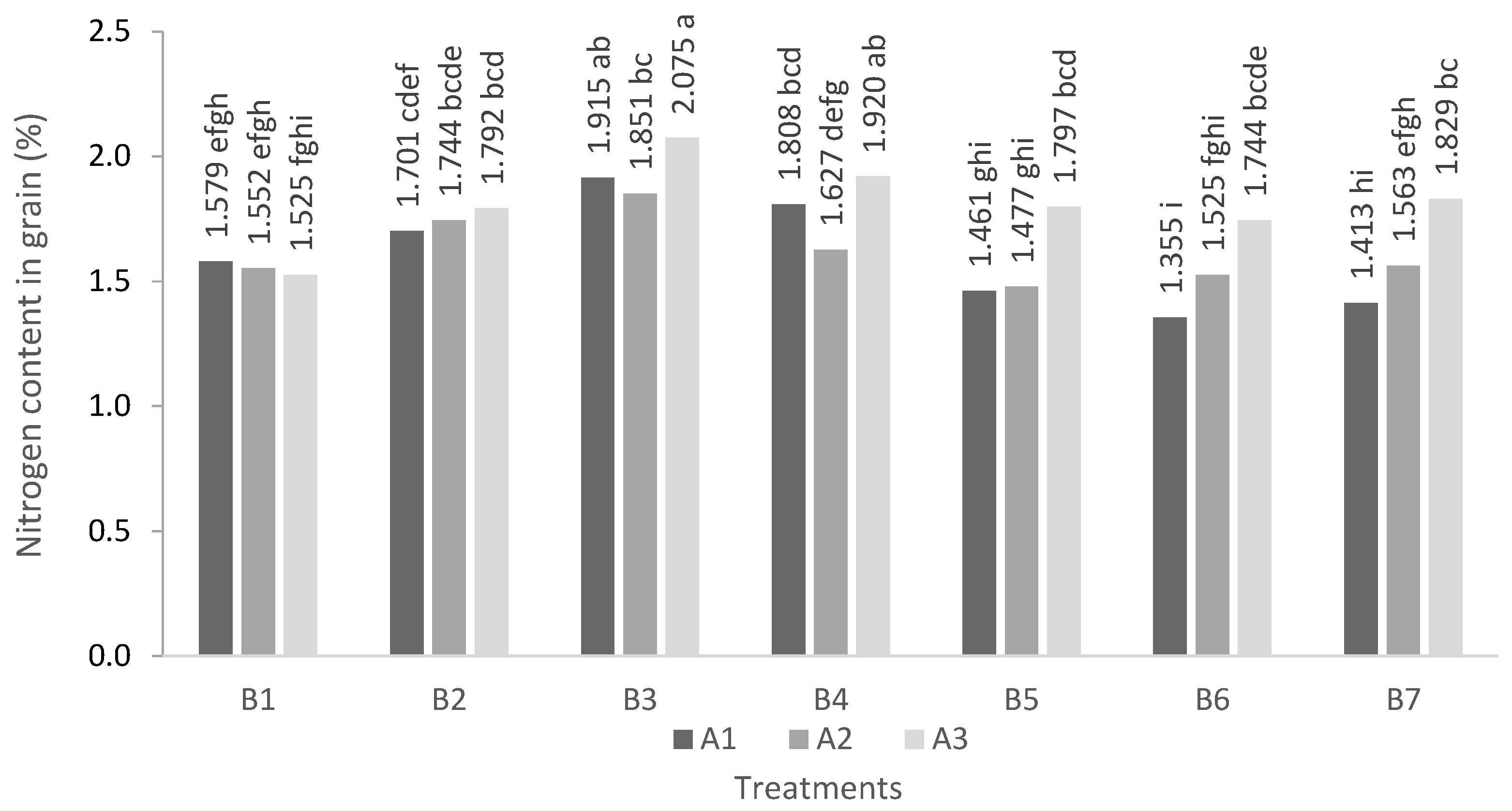
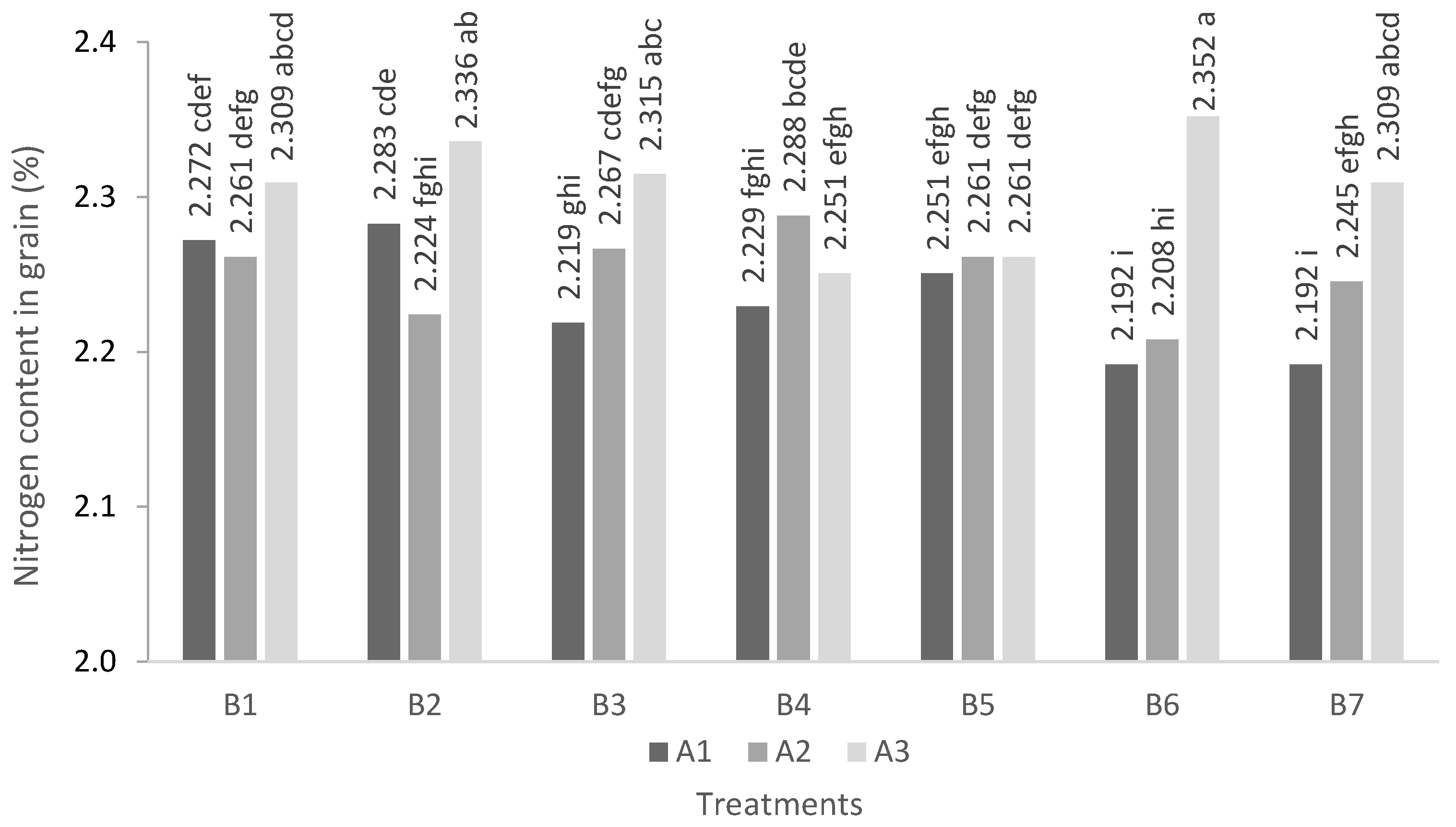
Table 2). In the case of winter wheat, the highest N content in grain was obtained after application of fertilizer B3. In the case of spring wheat, the highest nitrogen content was observed after application of ammonium nitrate (B2) and in the control treatment. A significant interaction was also noted between N fertilizer type and maize hybrid on the nitrogen content in grain of both winter wheat (
Figure 1) and spring wheat (
Figure 2). The greatest differences in N content in winter wheat grain were observed after cultivation of maize variety A3 and application of slow-release fertilizers (B5–B7). Similarly, in the case of spring wheat, the greatest differences in N content were observed after cultivation of maize variety A3 and application of N fertilizers (B6–B7).
3.2. Nitrogen Uptake with Grain Yield
The experiment demonstrated a significant effect of the preceding crop, the type of N fertilizer, and the interaction between these factors on nitrogen uptake with grain yield in winter wheat (
Table 3). In spring wheat, nitrogen uptake with grain yield was significantly influenced by the type of N fertilizer used (
Table 3).
Analysis of the effect of maize variety on nitrogen uptake with grain yield showed that winter wheat sown after the traditional variety A1 accumulated significantly less nitrogen in the grain than wheat following the stay-green (A2) and stay-green + roots power (A3) varieties (
Table 3).
Taking into account the type of N fertilizer on the uptake of this component, the highest uptake was found for fertilizer B3 (115.06 kg·ha
−1), although this value does not differ significantly from that given for fertilizer B4 (108.11 kg·ha
−1) (
Table 3).
For spring wheat, analysis of the nitrogen fertilizer effect revealed that significantly higher nitrogen uptake was achieved with slow-release N fertilizers compared to both the control and fertilizers without inhibitors (
Table 3).
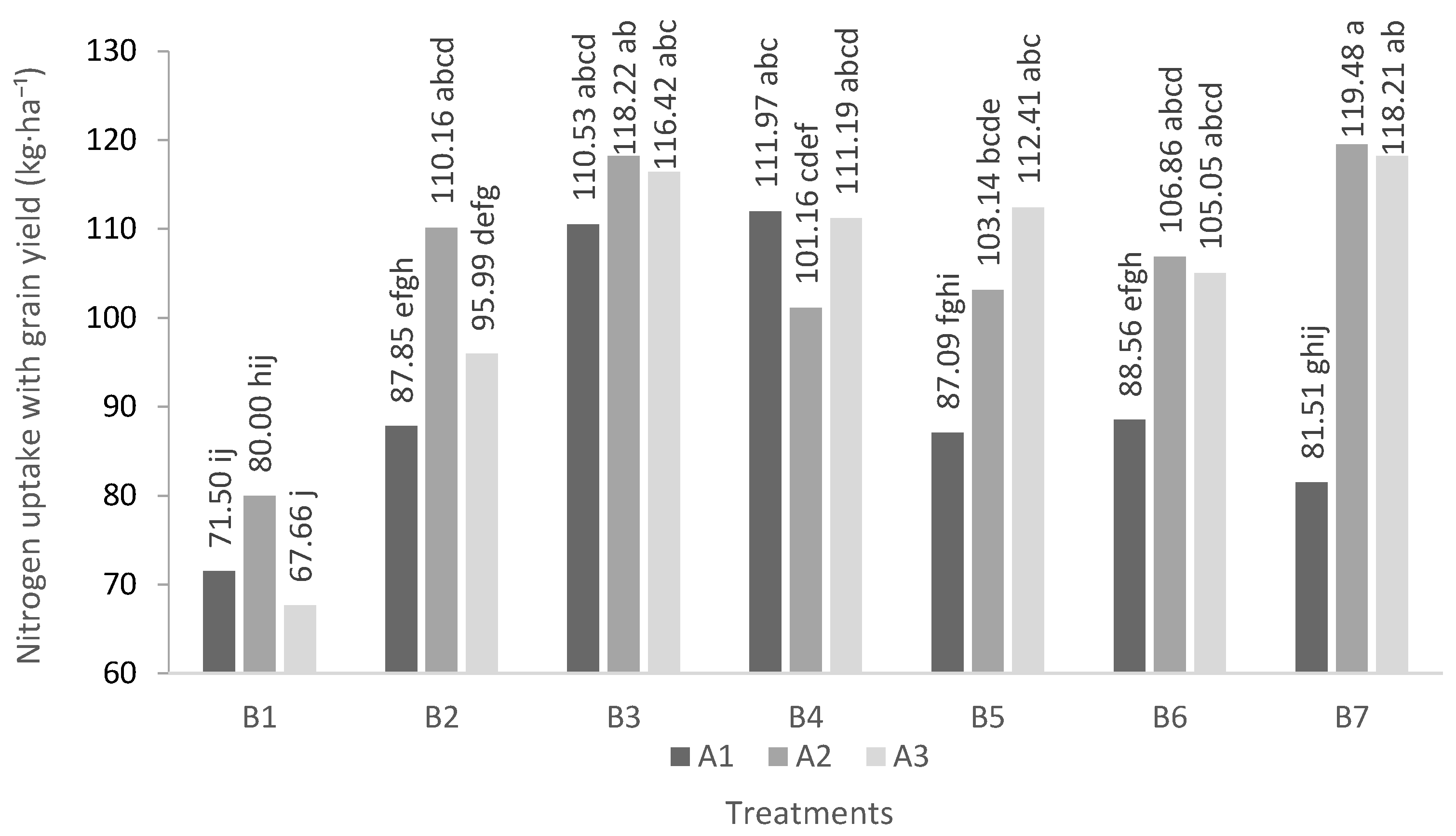
The study showed a significant interaction between the type of N fertilizer and the type of maize hybrid variety in terms of nitrogen uptake and winter wheat grain yield (
Figure 3). In the case of fertilizers B5–B7, winter wheat following the A2 and A3 maize varieties showed significantly higher nitrogen uptake compared with wheat following variety A1. This indicates that after growing the traditional maize variety, the content of N
res in the soil was most likely lower.
3.3. Percentage of Nitrogen Uptake from Fertilizer in the Total Nitrogen Uptake
The study demonstrated a significant effect of maize hybrid variety, nitrogen fertilizer type, and the interaction between these factors on the percentage of nitrogen uptake from fertilizer in the total nitrogen uptake by winter wheat (
Table 4). The type of nitrogen fertilizer also had a significant effect on the percentage of nitrogen uptake from fertilizer in the total nitrogen uptake by spring wheat (
Table 4).
Analysis of the effect of the preceding crop showed that, in winter wheat, the highest percentage of nitrogen uptake from fertilizer was observed after the A3 variety (54.43%), which was 22.31% higher than after the A2 variety and 26.48% higher than after the A1 variety (
Table 4). When examining the effect of nitrogen fertilizer type on nitrogen uptake from fertilizer, the highest uptake of this key macronutrient was observed in winter wheat after the application of fertilizer B3, and in spring wheat after the application of fertilizer B4.
It is noteworthy that spring wheat showed a significantly lower average nitrogen uptake from fertilizer (29.88%) compared with winter wheat (
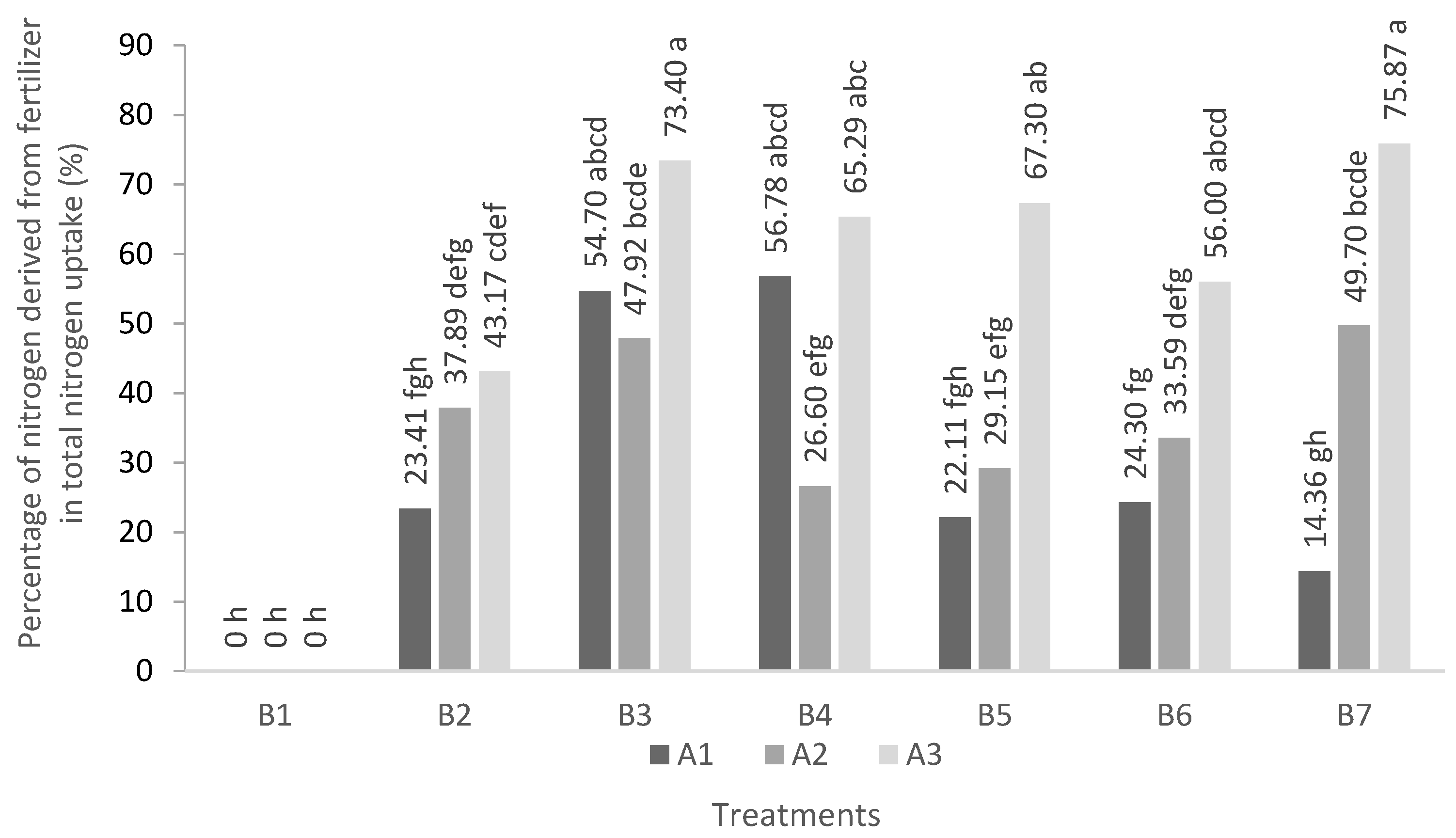
Table 4). Furthermore, the experiment revealed a significant interaction between nitrogen fertilizer type and maize hybrid variety on the percentage of nitrogen uptake from fertilizer relative to the total nitrogen uptake (
Figure 4). Regardless of fertilizer type, the A3 variety exhibited higher nitrogen uptake from fertilizer, which was particularly pronounced with fertilizers B5–B7 compared with the other varieties. The largest significant percentage difference in nitrogen uptake from fertilizer between A1 and A3 occurred following the application of fertilizer B7. The growth dynamics and nutrient accumulation of “stay-green” corn plants therefore imply a nitrogen fertilization system, pointing to slow-release fertilizers as potentially more suited to the rhythm of its vegetation. Compared to the classic variety, the “stay-green” variety utilizes nitrogen from mineral fertilizers more efficiently. Cultivation of such varieties can be considered an element of integrated corn production.
3.4. Percentage of Soil Nitrogen Uptake in Total Nitrogen Uptake
The experiment demonstrated a significant effect of maize hybrid variety, nitrogen fertilizer type, and the interaction of these factors on the percentage of soil nitrogen uptake in total nitrogen uptake for winter wheat (
Table 5). For spring wheat, nitrogen fertilizer type was a significant factor influencing the percentage of soil nitrogen uptake in total nitrogen uptake (
Table 5).
Analysis of the effect of the preceding crop showed that winter wheat achieved the highest soil nitrogen uptake after the A1 variety (
Table 5). Examination of the effect of nitrogen fertilizer type on soil nitrogen uptake for both winter and spring wheat revealed that the highest uptake of this primary macronutrient occurred in the control treatment, reflecting the absence of nitrogen fertilization in the preceding crop.
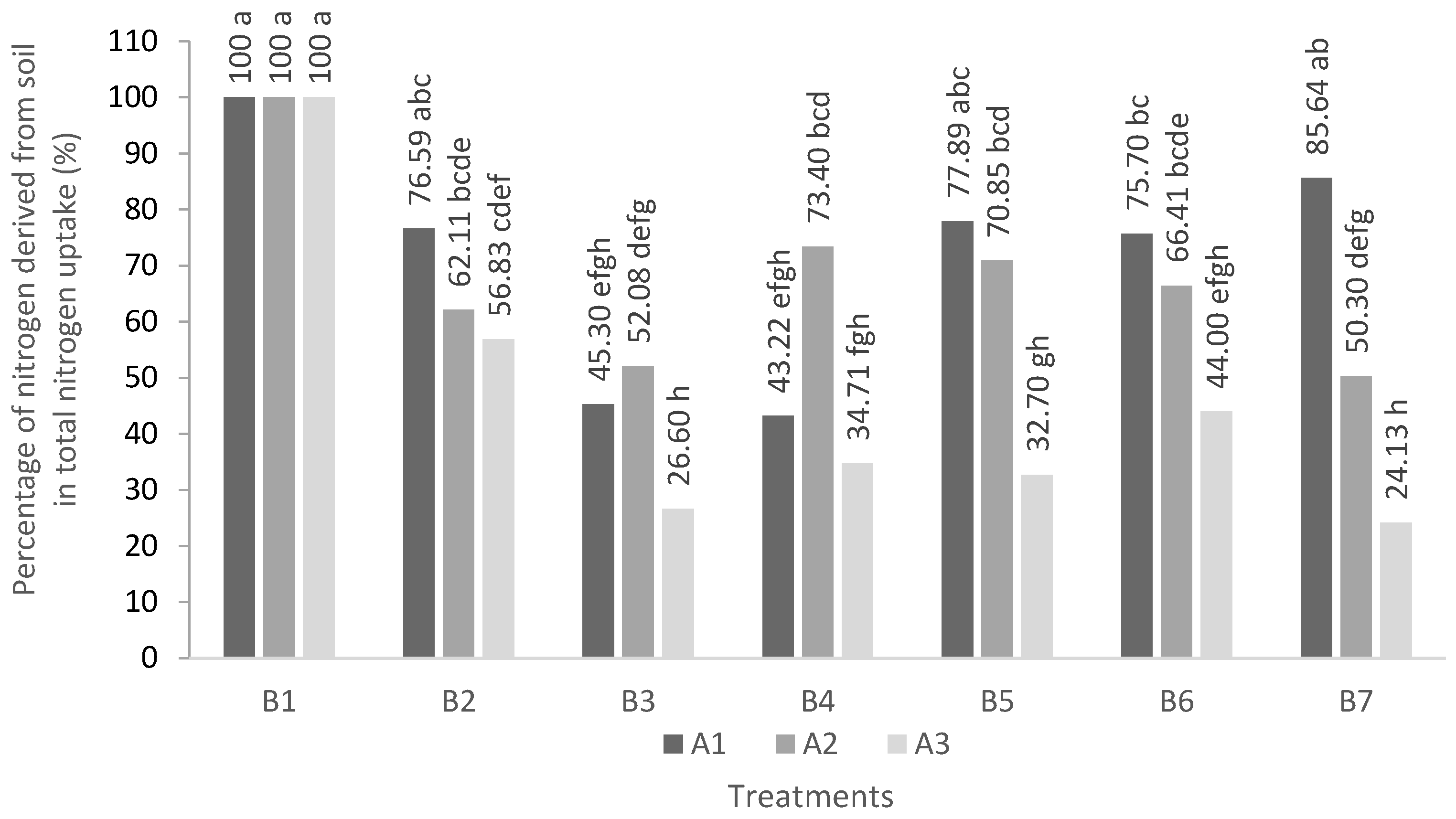
The values presented in
Table 5 are complementary to those in
Table 4, summing to 100%. This also applies to the interaction between the preceding crop and nitrogen fertilizer type for winter wheat, as illustrated in
Figure 5.
3.5. Nitrogen Utilization from Mineral Fertilizer Doses
In spring wheat, N utilization from the mineral fertilizer dose was significantly influenced by the type of N fertilizer (
Table 6).
Analysis of the effect of the preceding crop on nitrogen utilization showed that winter wheat achieved the highest utilization after the A3 variety (28.14%). Considering the nitrogen utilization from the dose by both the preceding crop and winter wheat, the total nitrogen utilization from fertilizer reached 51.24%. Among the maize varieties, the A3 variety combined with winter wheat exhibited the highest nitrogen utilization, while for spring wheat, this combination also showed the highest utilization, although the difference was not statistically significant (
Table 6).
When examining the effect of fertilizer type on nitrogen utilization from mineral fertilization, the highest nitrogen utilization in winter wheat was observed with variant B3 (28.00%). However, when considering the total nitrogen utilization, including the preceding crop, the highest value was observed with the B7 fertilizer (
Table 6). In spring wheat, the highest nitrogen utilization from the mineral fertilizer dose was recorded with B4 (9.81%), while the highest total utilization, including the preceding crop, occurred with B7 (29.18%) (
Table 6).
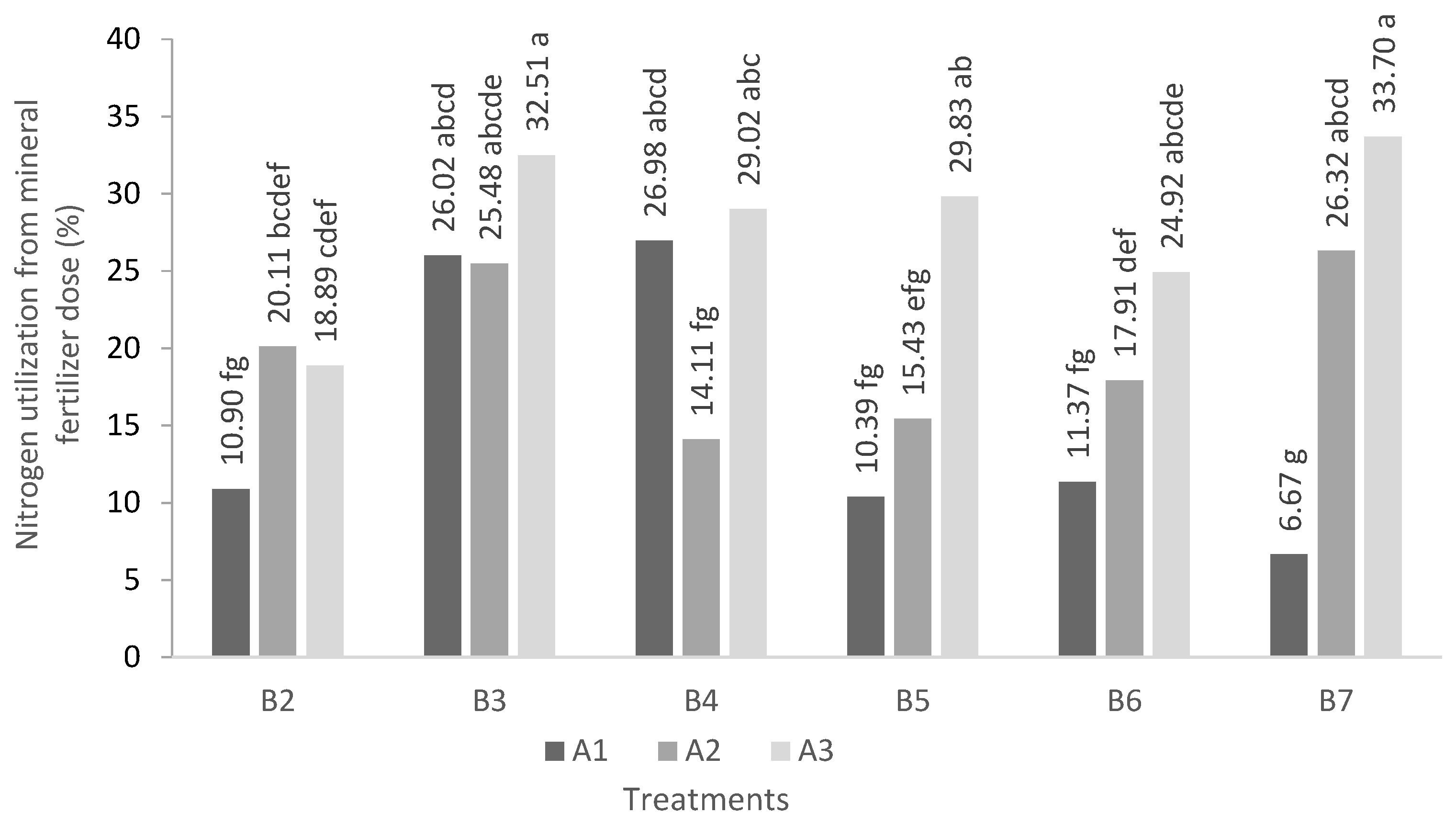
Furthermore, the study revealed a significant interaction between nitrogen fertilizer type and maize hybrid on nitrogen utilization from the mineral nitrogen dose in winter wheat. Regardless of the fertilizer type used (except B2), winter wheat showed the highest nitrogen utilization. The most pronounced effect was observed with variant B7, where the A3 variety reached 33.7% compared to 6.67% for A1 and 26.32% for A2 (
Figure 6).
3.6. Nitrogen Agricultural Efficiency
Analysis of the effect of N fertilizer type on winter wheat showed that the highest efficiency was achieved with slow-release fertilizers (B5–B7), approximately twice as high as that observed with fertilizer B2 (
Table 7). For spring wheat, the average nitrogen agricultural efficiency was lower than that of winter wheat by approximately 6.5 kg of grain per kg of nitrogen absorbed from fertilizer. The highest efficiency in spring wheat was observed after application of fertilizer B4 (4.706 kg grain per kg of N absorbed), although this did not differ significantly from most other fertilizer types, except B2 (
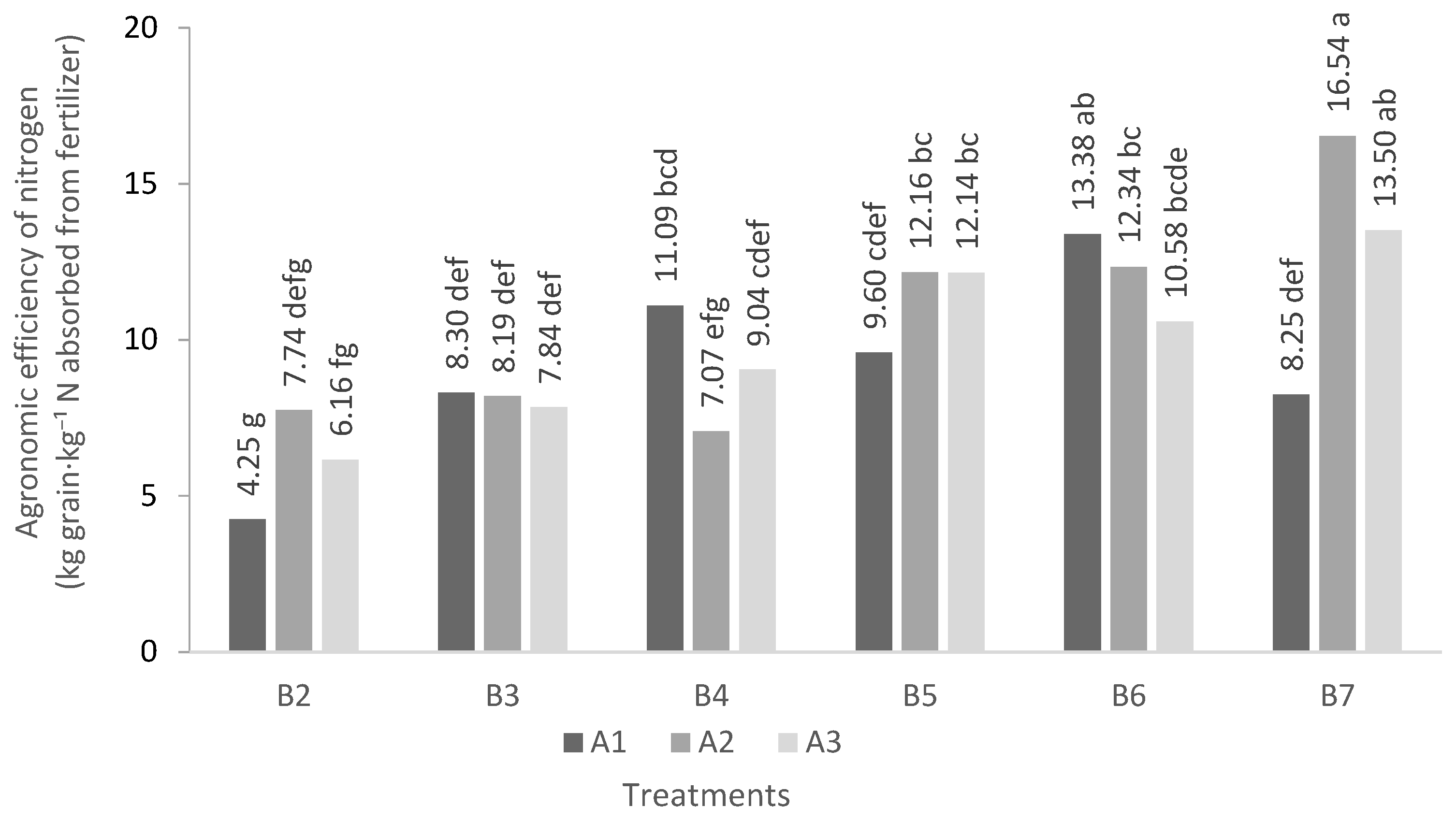
Table 7). Additionally, the interaction between maize hybrid type and nitrogen fertilizer type was lowest for the combinations A1–A3 with fertilizer B2. The greatest difference was observed between hybrids A1 and A2 after application of fertilizer B7 (
Figure 7).
3.7. Unit Nitrogen Accumulation with Grain Yield
Analysis of the effect of the preceding crop on nitrogen accumulation per unit of grain yield showed that the highest, and therefore least favourable, values for both winter and spring wheat were observed after cultivar A3. The lowest values were obtained after cultivar A1, with spring wheat showing a significantly higher value, while for winter wheat the value was at the same significance level as that observed after cultivar A2 (
Table 8).
Examining the effect of nitrogen fertilizer type on unit nitrogen accumulation in winter wheat, the lowest nitrogen accumulation was observed in treatments with slow-release fertilizers (B5–B7) and in the control treatment. For spring wheat, significantly lower values were obtained in treatments with slow-release fertilizers and those containing a urease inhibitor, compared to the control and ammonium nitrate (B2) treatments (
Table 8).
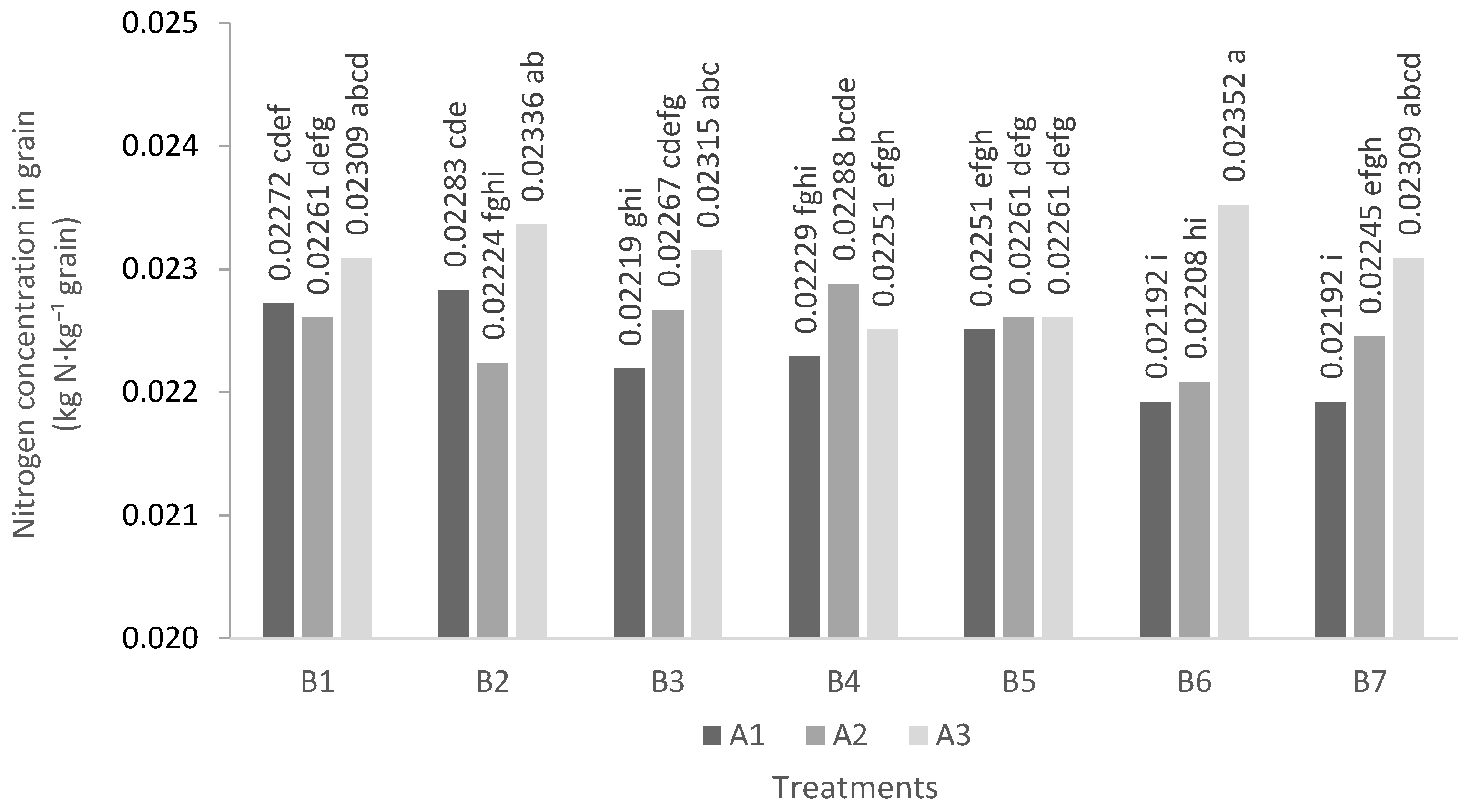
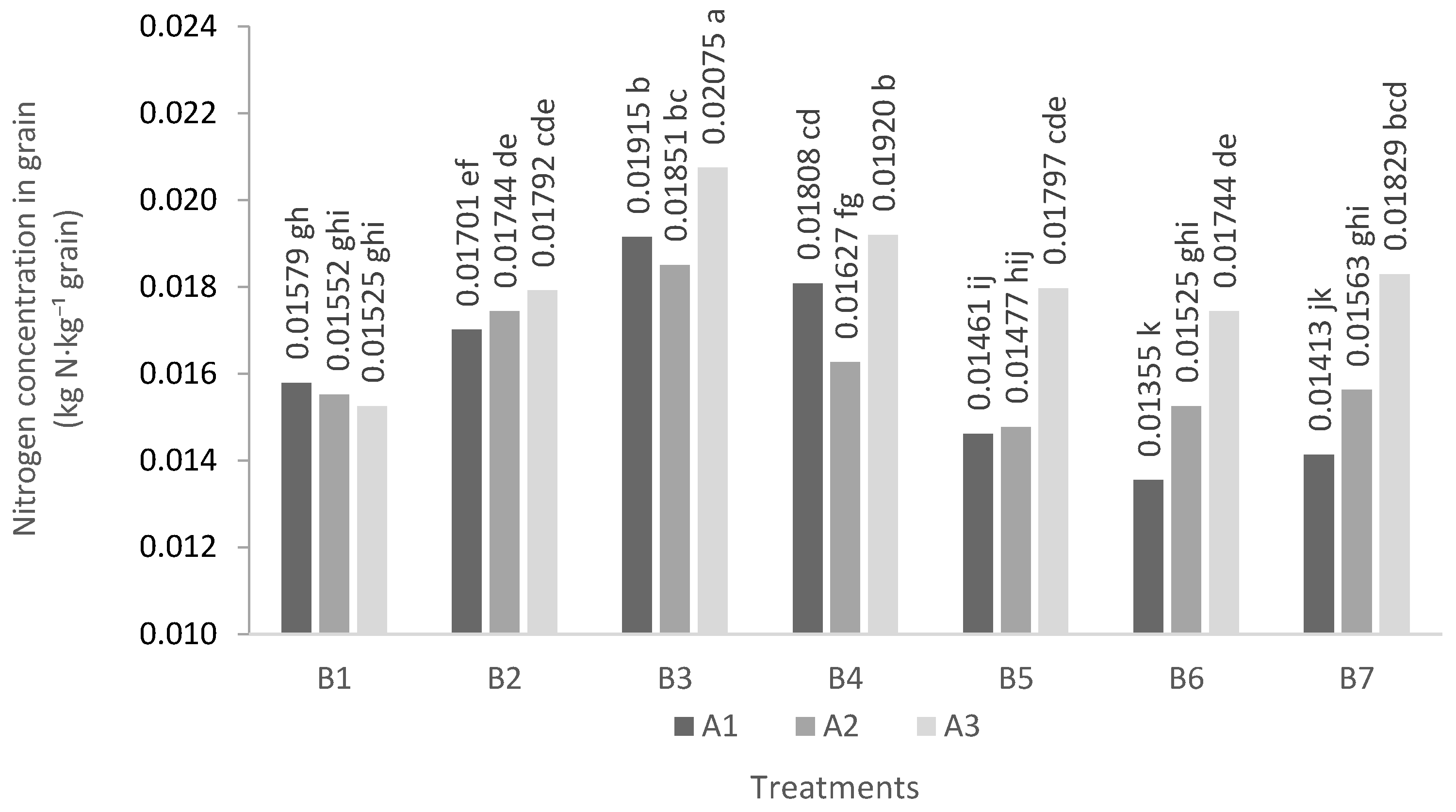
Furthermore, the study revealed a significant interaction between nitrogen fertilizer type and maize hybrid on unit nitrogen accumulation with grain yield for both winter and spring wheat (
Figure 8 and
Figure 9). In treatments with slow-release fertilizers (B3–B7), winter wheat grown after the A3 variety exhibited significantly higher nitrogen accumulation. The highest unit nitrogen accumulation and grain yield were recorded in the B6–A3 combination, which also showed the largest difference among the varieties.
3.8. Unit Nitrogen Productivity
Analyzing the effect of the preceding crop, winter wheat after cultivar A2 exhibited the highest unit nitrogen productivity. When considering both the preceding crop and winter wheat hybrid type, almost identical results were observed for cultivars A2 (86.91 kg) and A3 (86.02 kg) (
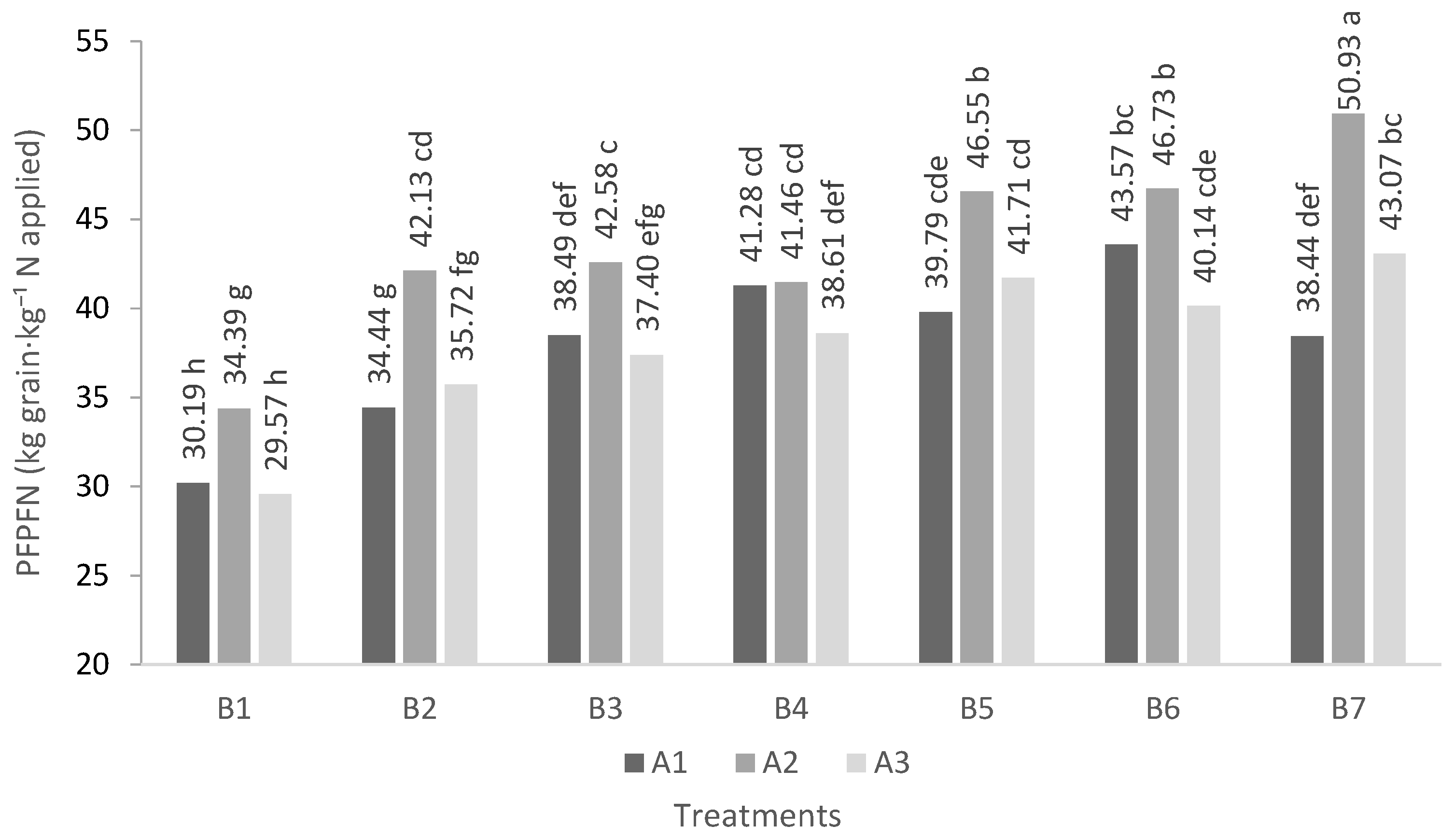
Table 9). Regarding the effect of nitrogen fertilizer type, the highest productivity in winter wheat was obtained with fertilizer B7, while in spring wheat, the highest productivity was achieved with fertilizer B6. For winter wheat, significantly higher productivity was recorded with fertilizers B5–B7, and for spring wheat with fertilizers B4–B7. The cumulative productivity, including the preceding crop, showed a similar pattern (
Table 9). Furthermore, analysis of the interaction between N fertilizer type and maize hybrid type revealed that the A2–B7 combination produced significantly higher unit nitrogen productivity in winter wheat (
Figure 10). Overall, a consistent trend was observed: regardless of the nitrogen fertilizer used, the A2 variety exhibited superior nitrogen productivity.
4. Discussion
In this experiment, the nitrogen use efficiency of mineral fertilizer applied to the preceding crop (maize) was evaluated in winter and spring wheat. Key indicators included nitrogen uptake with grain yield, nitrogen utilization from the mineral fertilizer dose, and unit nitrogen productivity. The highest nitrogen utilization from the mineral fertilizer dose by winter wheat was observed when grown after the A3 maize variety. Similar findings were reported by Szulc et al. [
20], who demonstrated that this maize variety utilized nitrogen most efficiently, a trait associated with its ‘stay-green + roots power’ characteristics. Higher root biomass and prolonged green leaf duration contribute to more efficient nitrogen uptake [
21,
22].
In prior studies, nitrogen utilization from fertilizer by maize was also higher when slow-release fertilizers were applied. In the present study, nitrogen utilization from the dose by winter wheat was highest after urea application. However, when considering cumulative nitrogen utilization by both the preceding maize crop and the subsequent wheat crop, the highest overall utilization was observed after the application of the slow-release fertilizer B7 (
Table 7).
The experiment revealed that nitrogen use efficiency by winter and spring wheat was relatively low, while cumulative nitrogen utilization from the mineral fertilizer dose by maize and winter wheat following B7 fertilizer reached 45.46%. Nitrogen supplied to the soil in the form of fertilizers is not fully utilized by crops. Its mineral forms are absorbed by plants but also leached from the soil into groundwater, causing eutrophication. To reduce the production of excessive mineral nitrogen forms in the soil, it is necessary to correctly determine nitrogen fertilizer doses, taking into account the physicochemical properties of the soil, the type of nitrogen fertilizer, and the plant’s nutritional needs. This is particularly important under conditions of annual fertilization, which can cause excessive accumulation of unused nitrogen in the soil and its infiltration into groundwater. Achieving increased efficiency with mineral nitrogen fertilizers is challenging, as plants absorb nitrogen in the form of nitrate or ammonium ions from the soil solution through their roots. However, ammonium nitrogen, unlike nitrate nitrogen, can be retained in the soil structure, so soil and plants compete for ammonium nitrogen, either already present in the soil (Nres) or applied as fertilizer. This competition for nitrogen, with the exception of nitrate nitrogen, is a major problem when dosing it as a mineral fertilizer for plant nutrition.
Enhancing nitrogen use efficiency in crops such as wheat, one of the world’s most important cereals, is expected to be critical in the coming decades. Currently, global nitrogen use efficiency in wheat is approximately 42%, with a target of 70% efficiency by 2050. Achieving this goal may be facilitated by the use of slow-release fertilizers, genetically efficient varieties, and optimized nitrogen dosing that considers residual soil nitrogen from both applied fertilizers and crop residues within the rotation [
23,
24,
25,
26].
It is important to note that, in addition to agronomic and genetic factors, climate change will play a critical role in nitrogen use efficiency and crop yield in future agricultural systems [
27,
28,
29].
5. Conclusions
The higher nitrogen content in spring wheat grain is attributable to both its lower yield and the genetic predisposition of this wheat type for nitrogen accumulation in the grain. In fertilizer treatments promoting higher grain yield of winter wheat, the proportion of nitrogen derived from fertilizer and its accumulation in the grain increased in the order: SC < TC < SC + roots power. Wheat grown after the SC + roots power maize variety utilized nitrogen from applied fertilizer most efficiently, regardless of the fertilizer type.
On average, spring wheat had significantly higher nitrogen uptake from grain yield than winter wheat. Spring wheat, in turn, had a higher share of nitrogen taken up from fertilizer in the total amount of this nutrient taken up than winter wheat. The primary source of nitrogen for wheat following maize was the soil. Winter wheat, being the first crop after maize, exhibited markedly higher efficiency in the uptake of residual nitrogen. The SC + roots power maize variety demonstrated a notable predisposition for enhancing subsequent wheat grain yield. When urea is used for maize fertilization, its residual effect on the following crop should be considered. Overall, agricultural nitrogen efficiency was generally low, primarily due to high soil productivity. On average, winter wheat had higher nitrogen utilization from mineral fertilizer doses than spring wheat. To increase nitrogen utilization from mineral fertilizer, it is necessary to calculate this indicator for the preceding crop (maize) and the succeeding crop (wheat). Only such an approach can result in nitrogen utilization from fertilizer at a level of approximately 40%. The use of specialized fertilizers presents a viable approach to improving this efficiency.
Author Contributions
Conceptualization, P.S. (Piotr Szulc), R.I. and K.A.-D.; methodology, P.S. (Piotr Szulc) and K.A.-D.; software, R.W. and K.G.; validation, P.S. (Piotr Szulc), P.S. (Przemysław Strażyński) and R.W.; formal analysis, K.A.-D.; investigation, P.S. (Przemysław Strażyński); resources, R.W.; data curation, K.G.; writing—original draft preparation, P.S. (Piotr Szulc); writing—review and editing, K.A.-D.; visualization, P.S. (Przemysław Strażyński); supervision, R.W.; project administration, K.G.; funding acquisition, P.S. (Piotr Szulc). All authors have read and agreed to the published version of the manuscript.
Funding
Financing from the funds of the Department of Agronomy.
Institutional Review Board Statement
Not applicable.
Informed Consent Statement
Not applicable.
Data Availability Statement
The original contributions presented in this study are included in the article. Further inquiries can be directed to the corresponding author.
Conflicts of Interest
The authors declare no conflicts of interest.
References
- Grzebisz, W.; Łukowiak, R. Nitrogen Gap Amelioration Is a Core for Sustainable Intensification of Agriculture−A Concept. Agronomy 2021, 11, 419. [Google Scholar] [CrossRef]
- Yilmaz, H.; Yilmaz, A. Hidden hunger in the age of abundance: The nutritional pitfalls of modern staple crop. Food Sci. Nutr. 2025, 13, e4610. [Google Scholar] [CrossRef] [PubMed]
- Wu, S.H.; Ho, C.; Nah, S.L.; Chau, C.F. Global hunger: A challenge to agricultural, food, and nutritional sciences. Crit. Rev. Food Sci. Nutr. 2014, 54, 151–162. [Google Scholar] [CrossRef] [PubMed]
- Diaz-Ambrona, C.G.H.; Maletta, E. Achieving global food security through sustainable development of agriculture and food systems with regard to nutrients, soil, land and waste management. Curr. Sustain. Renew. Energy Rep. 2014, 1, 57–65. [Google Scholar] [CrossRef]
- Van Veen, J.A. Nitrogen: Recent Developments in Related Microbial Processes. In Biological Resource Management, Connecting Science and Policy; Balázs, E., Galante, E., Lynch, M.J., Schepers, S.J., Toutant, J.-P., Werner, D., Werry, P., Eds.; Springer: Berlin/Heidelberg, Germany, 2000; pp. 71–80. [Google Scholar]
- Herrera, J.M.; Rubio, G.; Häner, L.L.; Delgado, J.A.; Lucho-Constantino, C.A.; Islas-Valdez, S.; Pellet, D. Emerging and Established Technologies to Increase Nitrogen Use Efficiency of Cereals. Agronomy 2016, 6, 25. [Google Scholar] [CrossRef]
- Xing, Y.; Wang, X. Precise application of water and fertilizer to crop: Challenges and opportunities. Front. Plant Sci. 2024, 15, 1444560. [Google Scholar] [CrossRef]
- Grzebisz, W.; Potarzycki, J. A Realistic Approach to Calculating the Nitrogen Use Efficiency Index in Cereals with Winter Wheat (Triticum aestivum L.) as an Example. Agronomy 2025, 15, 161. [Google Scholar] [CrossRef]
- Wiesler, F.; Behrens, T.; Horst, W.J. The Role of Nitrogen-Efficient Cultivars in Sustainable Agriculture. Sci. World J. 2001, 1, 61–69. [Google Scholar] [CrossRef]
- Trenkel, M.E. Controlled-Release and Stabilized Fertilizers in Agriculture; IFA: Paris, France, 2010. [Google Scholar]
- Horst, W.J.; Behrens, T.; Heuberger, H.; Kamh, M.; Reidenbach, G.; Wiesler, F. Genotypic Differences in Nitrogen Use-Efficiency in Crop Plants. In Innovative Soil-Plant Systems for Sustainable Agricultural Practices; Lynch, J.M., Schepers, J.S., Űnver, I., Eds.; OECD: Paris, France, 2003; pp. 75–92. [Google Scholar]
- Keshavarz, M.H.; Abadi, Y.H.; Esmaeilpour, K.; Damiri, S.; Oftadeh, M. A Novel Class of Nitrogen-Rich Explosives Containing High Oxygen Balance to Use as High Performance Oxidizers in Solid Propellants. Propellants Explos. Pyrotech. 2017, 42, 1155–1160. [Google Scholar] [CrossRef]
- Najera, F.; Tapia, Y.; Baginsky, C.; Figueroa, V.; Cabeza, R.; Salazar, O. Evaluation of Soil Fertility and Fertilization Practices for Irrigation Maize (Zea mays L.) under Mediterranean Conditions in Central Chile. J. Soil Sci. Plant Nutr. 2015, 15, 84–97. [Google Scholar]
- Shaviv, A.; Mikkelsen, R.I. Controlled-Release Fertilizers to Increase Efficiency of Nutrient Use and Minimize Environmental Degradation—A Review. Fertil. Res. 1993, 35, 1–12. [Google Scholar] [CrossRef]
- Szczepaniak, W. Evaluating Nitrogen Use Efficiency (NUE) Indices on the Background of Minerals Status of the Seed Crop at Maturity: A Case Study of Maize. Pol. J. Environ. Stud. 2016, 25, 2129–2138. [Google Scholar] [CrossRef]
- Szulc, P.; Ambroży-Deręgowska, K.; Waligóra, H.; Mejza, I.; Grześ, S.; Zielewicz, W.; Wróbel, B. Dry Matter Yield of Maize (Zea mays L.) as an Indicator of Mineral Fertilizer Efficiency. Plants 2021, 10, 535. [Google Scholar] [CrossRef] [PubMed]
- Fotyma, E. Określanie Potrzeb Nawożowych Roślin w Stosunku do Azotu na Przykładzie Jęczmienia Jarego. Fragm. Agron. 1990, 4, 4–78. [Google Scholar]
- Gomez, K.A.; Gomez, A.A. Statistical Procedures for Agricultural Research, 2nd ed.; John Wiley & Sons: New York, NY, USA, 1984; p. 680. [Google Scholar]
- Szulc, P.; Mejza, I.; Ambroży-Deręgowska, K.; Nowosad, K.; Bocianowski, J. The Comparison of Three Models Applied to the Analysis of Three-Factor Trial on Hybrid Maize (Zea mays L.) Cultivars. Biom. Lett. 2016, 53, 47–57. [Google Scholar] [CrossRef]
- Szulc, P.; Krauklis, D.; Ambroży-Deręgowska, K.; Wróbel, B.; Niedbała, G.; Niazian, M.; Selwet, M. Response of Maize Varieties (Zea mays L.) to the Application of Classic and Stabilized Nitrogen Fertilizers—Nitrogen as a Predictor of Generative Yield. Plants 2023, 12, 600. [Google Scholar] [CrossRef]
- Yu, P.; Li, X.; White, P.J.; Li, C. A Large and Deep Root System Underlies High Nitrogen-Use Efficiency in Maize Production. PLoS ONE 2015, 10, e0126293. [Google Scholar] [CrossRef]
- Fu, W.; Wang, Y.; Ye, Y.; Zhen, S.; Zhou, B.; Wang, Y.; Hu, Y.; Zhao, Y.; Huang, Y. Grain Yields and Nitrogen Use Efficiencies in Different Types of Stay-Green Maize in Response to Nitrogen Fertilizer. Plants 2020, 9, 474. [Google Scholar] [CrossRef]
- Matile, P.; Hortensteiner, S.; Thomas, H. Chlorophyll Degradation. Annu. Rev. Plant Biol. 2006, 50, 67–95. [Google Scholar] [CrossRef]
- Dresbøll, D.B.; Thorup-Kristensen, K. Will Breeding for Nitrogen Use Efficient Crops Lead to Nitrogen Use Efficient Cropping Systems: A Simulation Study of G×E×M Interactions. Euphytica 2014, 199, 97–117. [Google Scholar] [CrossRef]
- Zhang, X.; Davidson, E.A.; Mauzerall, D.L.; Searchinger, T.D.; Dumas, P.; Shen, Y. Managing Nitrogen for Sustainable Development. Nature 2015, 528, 51–59. [Google Scholar] [CrossRef]
- Mălinaş, A.; Vidican, R.; Rotar, I.; Mălinaş, C.; Moldovan, C.M.; Proorocu, M. Current Status and Future Prospective for Nitrogen Use Efficiency in Wheat (Triticum aestivum L.). Plants 2022, 11, 217. [Google Scholar] [CrossRef]
- Hawkesford, M.; Riche, A. Impacts of G×E×M on Nitrogen Use Efficiency in Wheat and Future Prospects. Front. Plant Sci. 2020, 11, 1157. [Google Scholar] [CrossRef]
- Navarro, B.B.; Machado, M.J.; Figueira, A. Nitrogen use efficiency in agriculture: Integrating biotechnology, microbiology, and novel delivery systems for sustainable agriculture. Plants 2025, 14, 2974. [Google Scholar] [CrossRef]
- Anas, M.; Liao, F.; Verma, K.K.; Sarwar, M.A.; Mahmood, A.; Chen, Z.L.; Li, Q.; Zeng, X.P.; Li, Y.R. Fate of nitrogen in agriculture and environment: Agronomic, eco-physiological and molecular approaches to improve nitrogen use efficiency. Biol. Res. 2020, 53, 47. [Google Scholar] [CrossRef]
Figure 1.
Interaction effect of nitrogen fertilizer type (B1–B7) and maize hybrid (A1–A3) on nitrogen content in winter wheat grain (%). Mean values followed by the same letter are not significantly different based on the Tukey test (p < 0.05).
Figure 1.
Interaction effect of nitrogen fertilizer type (B1–B7) and maize hybrid (A1–A3) on nitrogen content in winter wheat grain (%). Mean values followed by the same letter are not significantly different based on the Tukey test (p < 0.05).
Figure 2.
Interaction effect of nitrogen fertilizer type (B1–B7) and maize hybrid (A1–A3) on nitrogen content in spring wheat grain (%). Mean values followed by the same letter are not significantly different based on the Tukey test (p < 0.05).
Figure 2.
Interaction effect of nitrogen fertilizer type (B1–B7) and maize hybrid (A1–A3) on nitrogen content in spring wheat grain (%). Mean values followed by the same letter are not significantly different based on the Tukey test (p < 0.05).
Figure 3.
Effect of the interaction between nitrogen fertilizer type (B1–B7) and maize hybrid type (A1–A3) on nitrogen uptake with the grain yield of winter wheat (kg·ha−1). Mean values followed by the same letter are not significantly different based on the Tukey test (p < 0.05).
Figure 3.
Effect of the interaction between nitrogen fertilizer type (B1–B7) and maize hybrid type (A1–A3) on nitrogen uptake with the grain yield of winter wheat (kg·ha−1). Mean values followed by the same letter are not significantly different based on the Tukey test (p < 0.05).
Figure 4.
Interaction effect of nitrogen fertilizer type (B1–B7) and maize hybrid (A1–A3) on the percentage of nitrogen derived from fertilizer in total nitrogen uptake (%). Mean values followed by the same letter are not significantly different based on the Tukey test (p < 0.05).
Figure 4.
Interaction effect of nitrogen fertilizer type (B1–B7) and maize hybrid (A1–A3) on the percentage of nitrogen derived from fertilizer in total nitrogen uptake (%). Mean values followed by the same letter are not significantly different based on the Tukey test (p < 0.05).
Figure 5.
Effect of the interaction between nitrogen fertilizer type (B1–B7) and maize hybrid (A1–A3) on the percentage of nitrogen derived from the soil in the total nitrogen uptake (%). Mean values followed by the same letter are not significantly different based on the Tukey test (p < 0.05).
Figure 5.
Effect of the interaction between nitrogen fertilizer type (B1–B7) and maize hybrid (A1–A3) on the percentage of nitrogen derived from the soil in the total nitrogen uptake (%). Mean values followed by the same letter are not significantly different based on the Tukey test (p < 0.05).
Figure 6.
Effect of the interaction between nitrogen fertilizer type (B1–B7) and maize hybrid (A1–A3) on nitrogen utilization from the mineral fertilizer dose in winter wheat (%). Mean values followed by the same letter are not significantly different based on the Tukey test (p < 0.05).
Figure 6.
Effect of the interaction between nitrogen fertilizer type (B1–B7) and maize hybrid (A1–A3) on nitrogen utilization from the mineral fertilizer dose in winter wheat (%). Mean values followed by the same letter are not significantly different based on the Tukey test (p < 0.05).
Figure 7.
Effect of the interaction between nitrogen fertilizer type (B1–B7) and maize hybrid (A1–A3) on the agronomic efficiency of nitrogen in winter wheat (kg grain·kg−1 N absorbed from fertilizer). Mean values followed by the same letter are not significantly different based on the Tukey test (p < 0.05).
Figure 7.
Effect of the interaction between nitrogen fertilizer type (B1–B7) and maize hybrid (A1–A3) on the agronomic efficiency of nitrogen in winter wheat (kg grain·kg−1 N absorbed from fertilizer). Mean values followed by the same letter are not significantly different based on the Tukey test (p < 0.05).
Figure 8.
Effect of the interaction between nitrogen fertilizer type (B1–B7) and maize hybrid (A1–A3) on nitrogen concentration in winter wheat grain (kg N·kg−1 grain). Mean values followed by the same letter are not significantly different based on the Tukey test (p < 0.05).
Figure 8.
Effect of the interaction between nitrogen fertilizer type (B1–B7) and maize hybrid (A1–A3) on nitrogen concentration in winter wheat grain (kg N·kg−1 grain). Mean values followed by the same letter are not significantly different based on the Tukey test (p < 0.05).
Figure 9.
Effect of the interaction between nitrogen fertilizer type (B1–B7) and maize hybrid (A1–A3) on nitrogen concentration in spring wheat grain (kg N·kg−1 grain). Mean values followed by the same letter are not significantly different based on the Tukey test (p < 0.05).
Figure 9.
Effect of the interaction between nitrogen fertilizer type (B1–B7) and maize hybrid (A1–A3) on nitrogen concentration in spring wheat grain (kg N·kg−1 grain). Mean values followed by the same letter are not significantly different based on the Tukey test (p < 0.05).
Figure 10.
Effect of the interaction between nitrogen fertilizer type (B1–B7) and maize hybrid (A1–A3) on the unit productivity of applied nitrogen (PFPFN) for winter wheat (kg grain·kg−1 N applied). Mean values followed by the same letter are not significantly different based on the Tukey test (p < 0.05).
Figure 10.
Effect of the interaction between nitrogen fertilizer type (B1–B7) and maize hybrid (A1–A3) on the unit productivity of applied nitrogen (PFPFN) for winter wheat (kg grain·kg−1 N applied). Mean values followed by the same letter are not significantly different based on the Tukey test (p < 0.05).
Table 1.
Dates of agrotechnical treatments for winter and spring wheat.
Table 1.
Dates of agrotechnical treatments for winter and spring wheat.
| Treatment Type | Winter Wheat
2018/2019 | Spring Wheat
2020 |
|---|
| 1. Ploughing | 12 September 2018 | 28 November 2019 |
| 2. Tilling | - | 17 March 2020 |
| 3. Sowing | 27 September 2018 | 21 March 2020 |
| 4. Herbicide treatment | Komplet 560 SC—0.5 L,
17 October 2018 | Biathlon 4D—70 g + Dash HC, 18 May 2020 |
| 5. Insecticide treatment | - | Sparviero—0.075 L,
10 June 2020 |
| 6. Fungicide treatment | Amistar 250 SC—0.6 L +
Artea 330 EC—0.4 L,
29 April 2019 | Topsin M 500 SC—1.4 L,
25 May 2020 |
Prosaro 250 EC—1 L,
22 May 2019 | Soligor 425 EC—1 L,
5 June 2020 |
| 7. Growth regulator treatment | Cerone 480 SL—0.75 L,
7 May 2019 | Ephon Top—0.75 L,
4 June 2020 |
| 8. Harvesting and threshing | 22 July 2019 | 14 August 2020 |
Table 2.
Effect of the tested factors on nitrogen content in grain (%).
Table 2.
Effect of the tested factors on nitrogen content in grain (%).
| Specification/Experimental Factor | Factor Levels | Winter Wheat | Spring Wheat |
|---|
| Year | 2018/2019 | 2020 |
|---|
| A | A1 | 1.605 b | 2.234 c |
| A2 | 1.620 b | 2.251 b |
| A3 | 1.812 a | 2.305 a |
| B | B1 | 1.552 c | 2.281 a |
| B2 | 1.746 b | 2.281 a |
| B3 | 1.947 a | 2.267 ab |
| B4 | 1.785 b | 2.256 b |
| B5 | 1.579 c | 2.258 ab |
| B6 | 1.541 c | 2.251 b |
| B7 | 1.602 c | 2.249 b |
| Mean | 1.679 | 2.263 |
Table 3.
Effect of the tested factors on nitrogen uptake with grain yield (kg·ha−1).
Table 3.
Effect of the tested factors on nitrogen uptake with grain yield (kg·ha−1).
| Specification/Experimental Factor | Factor Levels | Winter Wheat | Spring Wheat |
|---|
| Year | 2018/2019 | 2020 |
|---|
| A | A1 | 91.29 b | 117.08 a |
| A2 | 105.57 a | 117.43 a |
| A3 | 103.85 a | 125.12 a |
| B | B1 | 73.05 e | 110.84 c |
| B2 | 98.00 d | 115.70 bc |
| B3 | 115.06 a | 121.39 ab |
| B4 | 108.11 ab | 125.56 a |
| B5 | 100.88 bcd | 123.36 a |
| B6 | 100.16 cd | 122.50 ab |
| B7 | 106.40 bc | 119.77 ab |
| Mean | 100.24 | 119.88 |
Table 4.
Effect of maize hybrid variety and nitrogen fertilizer type on the percentage of nitrogen derived from fertilizer in total nitrogen uptake (%).
Table 4.
Effect of maize hybrid variety and nitrogen fertilizer type on the percentage of nitrogen derived from fertilizer in total nitrogen uptake (%).
| Specification/Experimental Factor | Factor Levels | Winter Wheat | Spring Wheat |
|---|
| Year | 2018/2019 | 2020 |
|---|
| A | A1 | 27.95 b | 4.46 a |
| A2 | 32.12 b | 6.96 a |
| A3 | 54.43 a | 13.44 a |
| B | B1 | 0.00 e | 0.00 c |
| B2 | 34.82 d | 4.46 bc |
| B3 | 58.67 a | 9.69 ab |
| B4 | 49.56 ab | 13.44 a |
| B5 | 39.52 bcd | 11.57 a |
| B6 | 37.96 cd | 10.60 ab |
| B7 | 46.64 bc | 8.23 ab |
| Mean | 38.17 | 8.29 |
Table 5.
Effect of the tested factors on the percentage of nitrogen derived from the soil in the total nitrogen uptake (%).
Table 5.
Effect of the tested factors on the percentage of nitrogen derived from the soil in the total nitrogen uptake (%).
| Specification/Experimental Factor | Factor Levels | Winter Wheat | Spring Wheat |
|---|
| Year | 2018/2019 | 2020 |
|---|
| A | A1 | 72.05 a | 95.54 a |
| A2 | 67.88 a | 93.04 a |
| A3 | 45.57 b | 86.56 a |
| B | B1 | 100.00 a | 100.00 a |
| B2 | 65.18 b | 95.54 ab |
| B3 | 41.33 e | 90.31 bc |
| B4 | 50.44 de | 86.56 c |
| B5 | 60.48 bcd | 88.43 c |
| B6 | 62.04 bc | 89.40 bc |
| B7 | 53.36 cd | 91.77 bc |
| Mean | 61.83 | 91.71 |
Table 6.
Effect of the tested factors on nitrogen utilization from the mineral fertilizer dose (%).
Table 6.
Effect of the tested factors on nitrogen utilization from the mineral fertilizer dose (%).
| Specification/Experimental Factor | Factor Levels | Szulc et al. [20] | Winter Wheat * | Spring Wheat * |
|---|
| Year | Maize * (2017–2019) | 2018/2019 (M + WW) | 2020 (M + SW) |
|---|
| A | A1 | 13.09 b | 15.39 c (28.48) | 3.88 a (16.97) |
| A2 | 12.78 b | 19.89 b (32.67) | 5.94 a (18.72) |
| A3 | 23.10 a | 28.14 a (51.24) | 11.26 a (34.36) |
| B | B1 | – | − | − |
| B2 | 8.93 e | 16.63 d (25.56) | 3.24 b (12.17) |
| B3 | 12.22 de | 28.00 a (40.22) | 7.03 ab (19.25) |
| B4 | 14.88 cd | 23.37 ab (38.25) | 9.81 a (24.69) |
| B5 | 17.90 bc | 18.55 cd (36.45) | 8.35 a (26.25) |
| B6 | 20.79 ab | 18.07 cd (38.86) | 7.77 a (28.56) |
| B7 | 23.23 a | 22.23 bc (45.46) | 5.95 ab (29.18) |
| Mean | 16.32 | 21.14 (37.46) | 7.03 (23.35) |
Table 7.
Effect of the studied factors on the agronomic efficiency of nitrogen (kg grain·kg−1 N absorbed from fertilizer).
Table 7.
Effect of the studied factors on the agronomic efficiency of nitrogen (kg grain·kg−1 N absorbed from fertilizer).
| Specification/Experimental Factor | Factor Levels | Winter Wheat | Spring Wheat |
|---|
| Year | 2018/2019 | 2020 |
|---|
| A | A1 | 9.15 a | 2.402 a |
| A2 | 10.67 a | 2.813 a |
| A3 | 9.88 a | 4.985 a |
| B | B1 | − | − |
| B2 | 6.05 c | 1.425 b |
| B3 | 8.11 b | 3.289 a |
| B4 | 9.07 b | 4.706 a |
| B5 | 11.30 a | 4.021 a |
| B6 | 12.10 a | 3.871 a |
| B7 | 12.76 a | 3.087 ab |
| Mean | 9.90 | 3.400 |
Table 8.
Effect of the tested factors on nitrogen concentration in grain (kg N·kg−1 grain).
Table 8.
Effect of the tested factors on nitrogen concentration in grain (kg N·kg−1 grain).
| Specification/Experimental Factor | Factor Levels | Winter Wheat | Spring Wheat |
|---|
| Year | 2018/2019 | 2020 |
|---|
| A | A1 | 0.01605 b | 0.02234 c |
| A2 | 0.01620 b | 0.02251 b |
| A3 | 0.01812 a | 0.02305 a |
| B | B1 | 0.01552 c | 0.02281 a |
| B2 | 0.01746 b | 0.02281 a |
| B3 | 0.01947 a | 0.02267 ab |
| B4 | 0.01785 b | 0.02256 b |
| B5 | 0.01579 c | 0.02258 ab |
| B6 | 0.01541 c | 0.02251 b |
| B7 | 0.01602 c | 0.02249 b |
| Mean | 0.01679 | 0.02263 |
Table 9.
Effect of the tested factors on partial factor productivity of nitrogen (PFPFN) (kg grain·kg−1 N applied).
Table 9.
Effect of the tested factors on partial factor productivity of nitrogen (PFPFN) (kg grain·kg−1 N applied).
| Specification/Experimental Factor | Factor Levels | Szulc et al. [20] | Winter Wheat * | Spring Wheat * |
|---|
| Year | Maize * (2017–2019) | 2018/2019 (M + WW) | 2020 (M + SW) |
|---|
| A | A1 | 40.23 c | 38.03 b (78.26) | 34.95 a (75.18) |
| A2 | 43.37 b | 43.54 a (86.91) | 34.78 a (78.15) |
| A3 | 47.99 a | 38.03 b (86.02) | 36.21 a (84.20) |
| B | B1 | 39.04 e | 31.38 d (70.42) | 32.40 c (71.44) |
| B2 | 41.78 d | 37.43 c (79.21) | 33.82 bc (75.60) |
| B3 | 42.69 cd | 39.49 b (82.18) | 35.69 ab (78.38) |
| B4 | 44.15 bc | 40.45 b (84.60) | 37.11 a (81.26) |
| B5 | 45.49 ab | 42.68 a (88.17) | 36.42 a (81.91) |
| B6 | 46.65 a | 43.48 a (90.13) | 36.27 a (82.92) |
| B7 | 47.26 a | 44.15 a (91.41) | 35.49 ab (82.75) |
| Mean | 43.87 | 39.87 | 35.31 |
| Disclaimer/Publisher’s Note: The statements, opinions and data contained in all publications are solely those of the individual author(s) and contributor(s) and not of MDPI and/or the editor(s). MDPI and/or the editor(s) disclaim responsibility for any injury to people or property resulting from any ideas, methods, instructions or products referred to in the content. |




 ,
,