Perspective

Reevaluating Yeast Metabolism: Understanding Crabtree–Warburg Effects Differences with the snf1∆ Strain as a New Model of the Warburg Effect


by
Gerardo M. Nava
,
Karla I. Lira-de León
,
David G. García-Gutiérrez
,
Vanessa Sánchez-Quezada
and
Luis Alberto Madrigal-Perez
*
Facultad de Química, Universidad Autónoma de Querétaro, Cerro de las Campanas, Santiago de Querétaro 76010, Querétaro, Mexico
*
Author to whom correspondence should be addressed.
Appl. Sci. 2026, 16(3), 1311; https://doi.org/10.3390/app16031311
Submission received: 7 November 2025 / Revised: 23 January 2026 / Accepted: 26 January 2026 / Published: 28 January 2026
(This article belongs to the Special Issue Advances in Fermentation Science)

Featured Application

The characterization of the snf1∆ strain of Saccharomyces cerevisiae as a model of the Warburg effect offers a powerful experimental platform for studying cancer-associated metabolic reprogramming in a genetically tractable eukaryotic system. This yeast model enables systematic genetic, biochemical, and pharmacological analyses of pathways regulating glycolysis, mitochondrial metabolism, and anabolic processes under controlled conditions. Moreover, it may facilitate high-throughput screening of metabolic modulators or therapeutic compounds targeting Warburg-like metabolism, thereby providing insights into cancer biology and metabolic disorders.

Abstract

The Crabtree and Warburg effects both involve elevated glycolytic flux and fermentation under aerobic conditions, yet their regulatory bases differ fundamentally. In the Crabtree effect, high-glucose concentrations suppress mitochondrial respiration, redirecting carbon flux toward fermentation. In contrast, the Warburg effect, characteristic of many cancer cells, features increased mitochondrial respiration to support biosynthetic and anaplerotic demands. We recently advanced an extended metabolic definition of the Warburg effect that incorporates enhanced amino acid catabolism and elevated lipid biosynthesis, reflecting broad mitochondrial engagement beyond oxidative phosphorylation. Revisiting the metabolic behavior of the snf1∆ strain of Saccharomyces cerevisiae, which lacks the Crabtree effect, reveals a phenotype analogous to this expanded Warburg effect framework. Under glucose-rich conditions that typically elicit the Crabtree effect, snf1∆ cells preserve high mitochondrial respiration while maintaining robust glycolysis and fermentation. These cells also display enhanced amino acid degradation that feeds the Krebs cycle and increased lipid synthesis, recapitulating hallmark features of the Warburg state. Notably, mutation of the AMPK gene, the human ortholog of SNF1, similarly drives Warburg-like reprogramming in mammalian models. Together, these data establish snf1∆ as a valuable eukaryotic model for dissecting the regulatory determinants of the Warburg effect.

1. Introduction

The Crabtree effect is classified into short- and long-term. The short-term Crabtree effect is the immediate appearance of alcoholic fermentation after high-glucose supplementation in glucose-limited or respiratory cultures [1]. The long-term Crabtree effect is the metabolic response to high glucose concentrations (>0.8 mM) that maintains high growth rates and obtains ATP primarily through substrate phosphorylation via alcoholic fermentation [2,3]. The Warburg effect is a cellular adaptation in which cells synthesize ATP via lactic acid fermentation, maintaining high glycolytic and growth rates in the presence of oxygen [4,5]. The Warburg and Crabtree effects are expected to be compared as metabolic analog phenomena because both share phenotypic characteristics, such as a high growth rate accompanied by increased glycolytic flux and fermentation [6]. For these reasons, the Crabtree effect is widely used as a model of the Warburg effect [6,7,8,9,10]. However, comparison of these metabolic adaptations may be oversimplified. The attention that the Warburg effect has received as a central phenomenon in cancer has prompted a broader description, providing a clearer picture of its relationship to mitochondria. Moreover, our research group’s re-interpretation of old evidence regarding the deletant strain in the gene SNF1 of the yeast Saccharomyces cerevisiae (snf1∆) shed light on the fact that this strain did not exert the Crabtree effect under high glucose conditions and displayed a metabolic behavior similar to the Warburg effect, suggesting that both effects are not analogous [11,12]. Interestingly, silencing or mutation of AMP-activated protein kinase (AMPK, the mammalian ortholog of SNF1) also causes the Warburg effect in mammalian models [13], indicating that the Warburg effect is a highly conserved metabolic response in eukaryotic cells linked to the AMK/SNF1 family. This data indicates that the Crabtree effect is not the direct metabolic analog of the Warburg effect, and its utility as a cancer model needs to be reconsidered. Instead, the snf1∆ strain displays a Warburg-like phenotype, suggesting that it is a novel model for cancer studies.
Thus, in this paper, we propose the snf1∆ strain as a new model for the Warburg effect and discuss the first lesson learned from this model about differences between the Warburg and Crabtree effects.

2. SNF1 Deletant Strain and the Crabtree Effect

All the ideas expressed in this article are born from the intention of using the snf1∆ strain to understand the Crabtree effect and thus the Warburg effect, based on the common perception that the Crabtree effect is a model for the Warburg effect [11,14]. But why use the snf1∆ strain to understand the Crabtree effect?
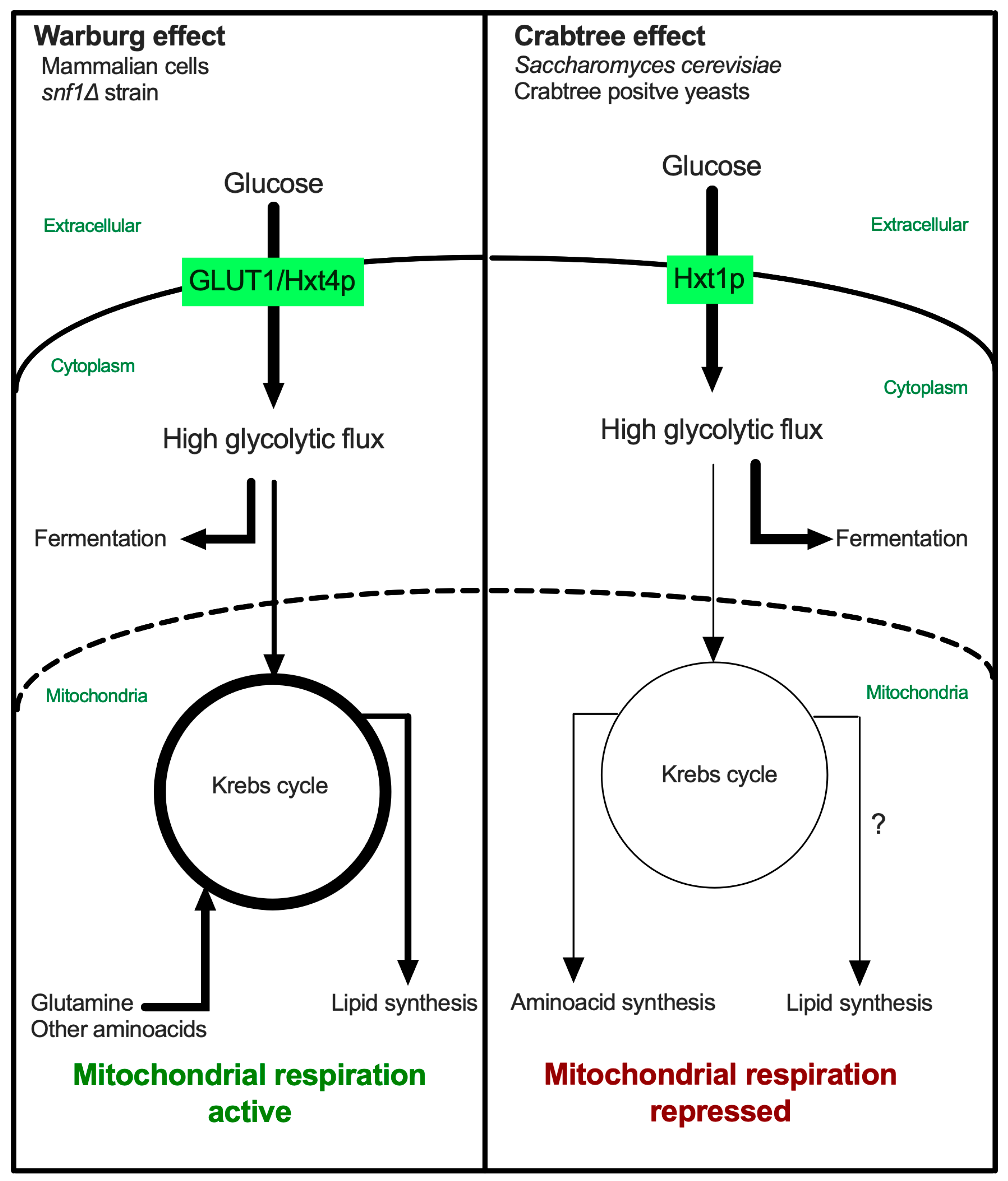
Snf1p is the catalytic analog of the AMPK; both respond to increases in the AMP–ADP/ATP ratio, activating catabolic pathways [15]. SNF1 has been closely associated with mitochondrial respiration, since the deletion of this gene results in an inability to grow on non-fermentable carbon sources or slow growth at low glucose concentrations [16]. Based on this, it has been hypothesized that Snf1p might control the switch between mitochondrial respiration and fermentation, a crucial factor in the Crabtree effect. When this idea was tested, it was found that the snf1∆ strain exhibits a mitochondrial respiration pattern different from that observed under the Crabtree effect, not displaying respiration repression at high glucose concentrations [11]. Indeed, the snf1∆ strain exhibited higher mitochondrial respiration [11,17]. Unexpectedly, the snf1∆ strain also maintains fermentative metabolism at the same time, and produced more fermentative products, i.e., ethanol and acetate, at high glucose concentrations than the WT strain [17] (Figure 1). These data indicate that the snf1∆ strain did not display the Crabtree effect at high glucose concentrations. However, the reason why snf1∆ maintains active fermentation was unclear. Thus, the next step in understanding the role of the SNF1 gene in fermentation metabolism is to examine its role in glucose transport through hexose transporters, a fundamental component of glycolytic flux and fermentation.

3. Hexose Transporters and the snf1∆ Strain

Glucose transport is crucial for maintaining high glycolytic flux and sustaining growth under fermentative conditions. A clear correlation exists between high glycolytic flux and fermentation in the Crabtree effect [18] and Warburg effect [19]. Glycolytic flux is regulated by hexose transporters, which differ in their kinetic properties, including glucose affinity (high and low) and transport velocity [20]. Hexose transporter expression varies according to cellular needs and is essential for understanding potential metabolic differences between the Warburg and Crabtree effects. In this regard, the glucose transporter GLUT1 has emerged as a biomarker in cancer, enabling high glucose transport rates to maintain high glycolytic flux [21]. High glucose transport is a key phenotype in cancer cells that sustains ATP synthesis through fermentation (low ATP synthesis at high rates) [22] and has been used for cancer diagnosis via positron emission tomography with radioactive glucose [23].
The S. cerevisiae analog of GLUT1 is the HXT4 gene (high-affinity hexose transporter). Previous studies in our research group reveal that the snf1∆ strain exhibited increased transcription of the HXT4 gene (GLUT1 analogs) [14], consistent with the Warburg effect. Moreover, according to the main expression of the HXT4 gene, the snf1∆ strain maintains a high glycolytic flux, comparable to that of the WT strain at 10% glucose [11]. An increase in HXT4 transcription occurs due to altered internal glucose sensing caused by loss of SNF1 through Mig1p via the Snf1p/Hxk2p/Mig1p pathway [14]. Importantly, the dependence on the glycolytic rate to sustain growth in the snf1∆ strain is evident in its hypersensitivity to the anti-tumoral molecule 2-deoxyglucose (not a metabolizable analog of glucose) [24]. This hypersensitivity was suppressed with the overexpression of two low-affinity HXT1 and HXT3 hexose transporters [24]. This analogy is important, since 2-deoxyglucose is also a potent inhibitor of cancer proliferation [25].
On the other hand, the low-affinity hexose transporter Hxt1p is the primary regulator of the glycolytic flux under the Crabtree effect [26]. Thus, the differences in hexose transporter kinetic properties, primarily expressed in the Crabtree and Warburg effects, suggested distinct metabolic responses (Figure 1) and confirmed that the snf1∆ strain could maintain highly active mitochondrial respiration and fermentation simultaneously.

4. Fermentation as a Common Denominator for Warburg and Crabtree Effects

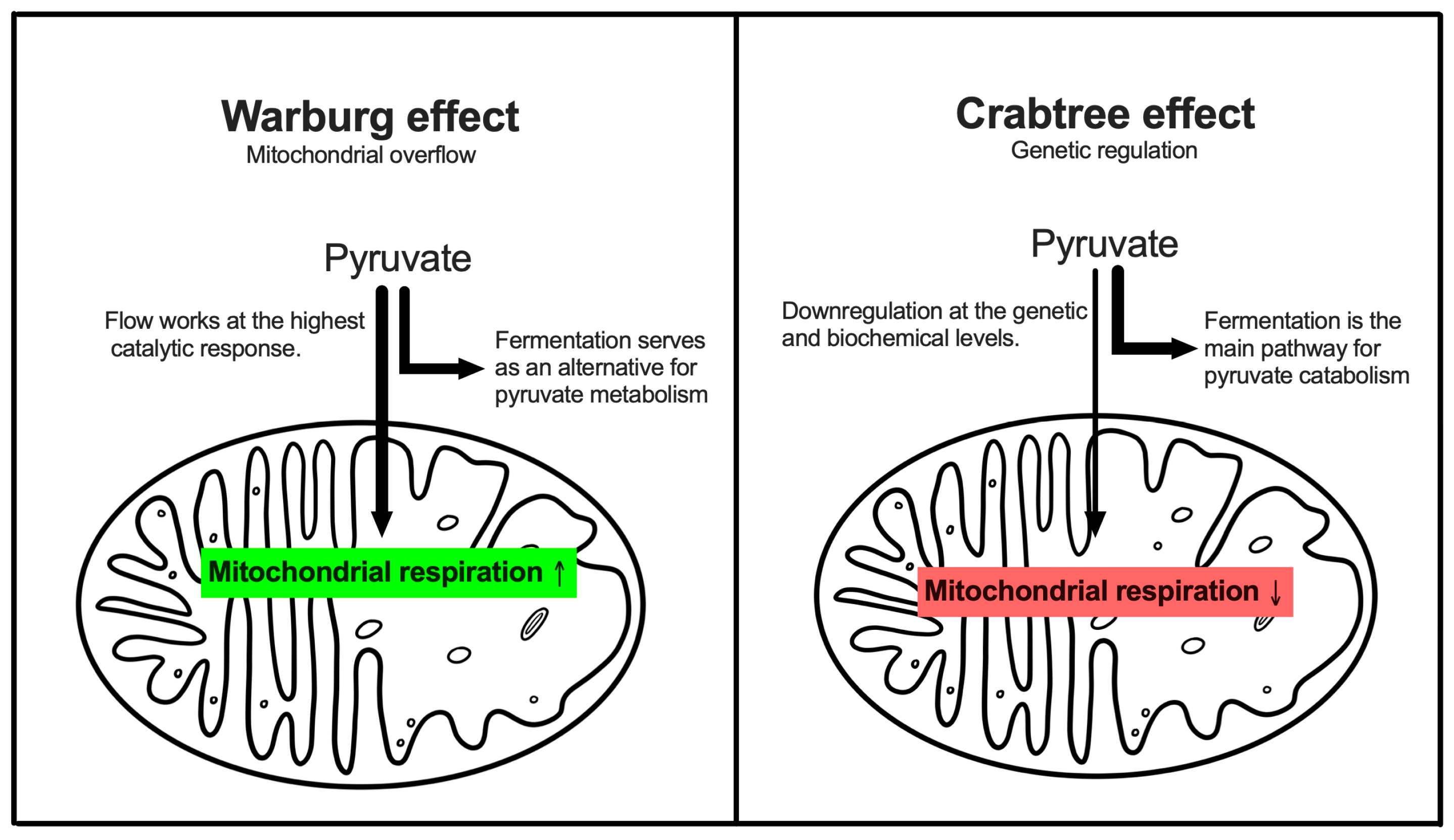
The Crabtree effect occurs in the presence of excess glucose, leading to a reprogramming of cellular metabolism to obtain energy, mainly through alcoholic fermentation [18]. Similarly, in the Warburg effect, the release of larger quantities of lactate indicates a high degree of lactic fermentation [5]. Both alcoholic and lactic fermentations appear to occur through similar mechanisms in yeast and cancer cells. Nonetheless, fermentation under Crabtree and Warburg effects might be mediated by different molecular mechanisms. Alcoholic fermentation in the Crabtree effect is linked to glucose repression with a concomitant diminution in mitochondrial respiration [18]. Various hypotheses explaining why cells exhibit the Crabtree effect have been proposed, including metabolic overflow [18], proteome allocation and economy [27], biological competition [28], and transcriptional regulation [14]. Genetic regulation by signal transduction encompasses the main hypotheses of the molecular mechanism behind the Crabtree effect (Figure 2). On the contrary, lactic fermentation in the Warburg effect might be occasioned by a compensation of diminution in ATP synthesis by oxidative phosphorylation [29] or by metabolic overflow, causing a mitochondrial overload [30] (Figure 2). Importantly, lactic fermentation in the Warburg effect is not accompanied by a diminution of basal mitochondrial respiration [30] and is related partly to glycolysis (90%) and partly to glutaminolysis (10%) [31]. Thus, the Crabtree and Warburg effects exhibit high fermentative activity but differ in their responses to mitochondrial respiration (Figure 2).

5. Mitochondrial Respiration Is Key to Understanding the Warburg and Crabtree Effects

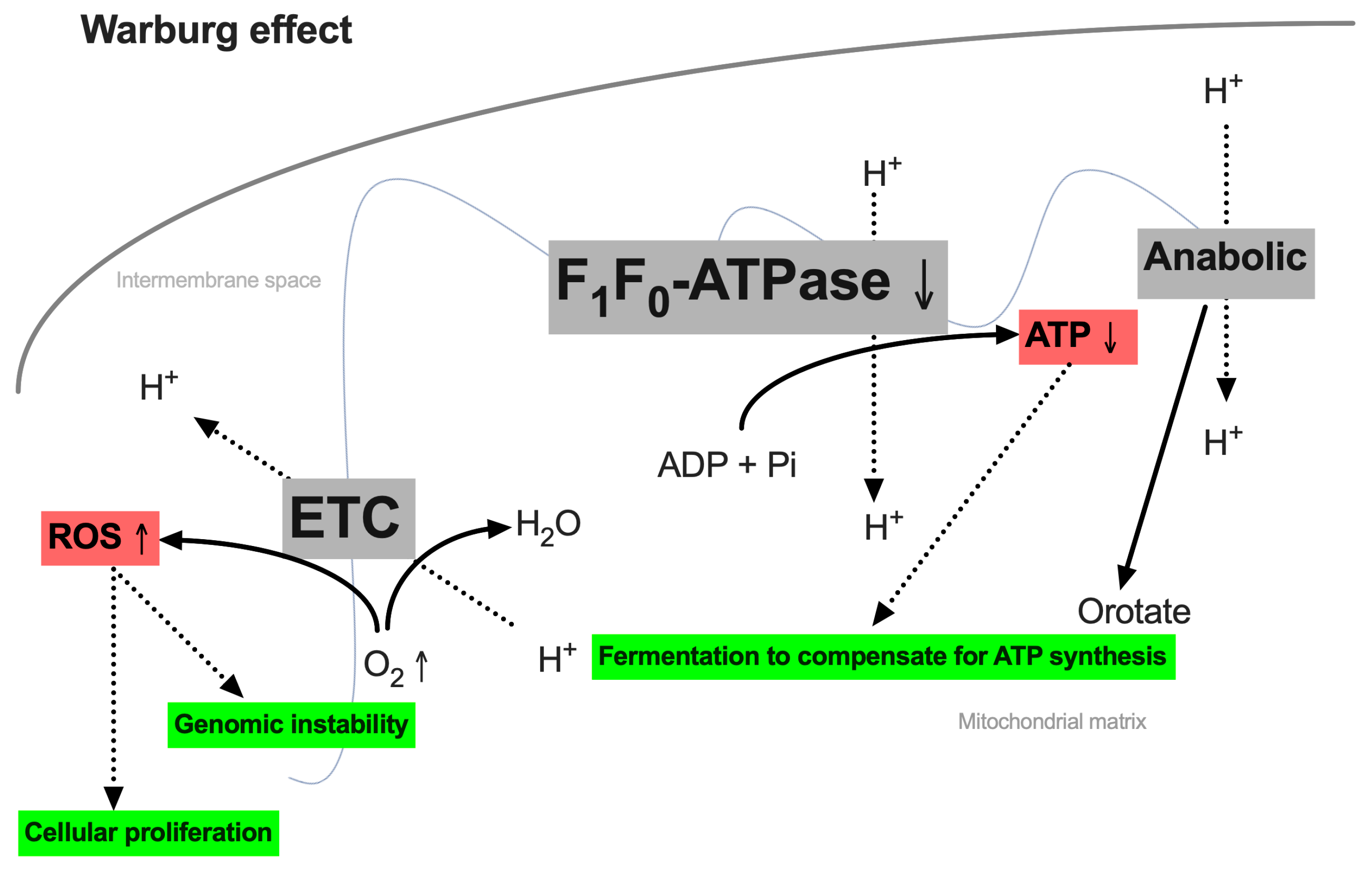
The Warburg effect was initially related to compensation metabolism due to impaired respiration [32]. Under the assumption that Crabtree-effect-positive cells displayed a decrease in mitochondrial respiration, the comparison between the Crabtree and Warburg effects has been cemented. Nonetheless, evidence indicates that cells exhibiting the Warburg effect show normal or increased mitochondrial respiration [33,34]. For example, proliferating fibroblasts showing the Warburg effect increase mitochondrial respiration nearly two-fold relative to quiescent cells [35]. Recombinant cells (3T3-L1) expressing the H-Ras (G12V) mutant, a constitutively active oncogene associated with cancer, showed an approximately 73% increase in basal respiration compared to empty vector control cells [35]. Similarly, the S. cerevisiae strain snf1∆ showed an increase in basal respiration, approximately seven-fold, compared to the wild type under Crabtree-inducing conditions (10% glucose) [11], indicating that SNF1 gene deletion reverts the Crabtree effect induction. However, this raises the question of why Warburg cells maintain high rates of mitochondrial respiration and fermentation. It seems that they could exhibit ATP overproduction. Nonetheless, although Warburg effect cells display higher basal respiration, this is not coupled to ATP synthesis [29,36,37], which explains fermentation as a compensatory pathway to ATP synthesis (Figure 3). Warburg effect cells use mitochondrial respiration for anabolic purposes, such as the synthesis of orotate by dihydroorotate dehydrogenase [EC 1.3.99.11] coupled to ubiquinone electron transfer [38] or CoQ10 synthesis [39] (Figure 3). Also, these cells could use mitochondrial respiration to increase ROS levels [40], as seen with the downregulation of UCPS, which increases oxidative stress in cells with the Warburg effect [41] (Figure 3). Although it is not entirely clear why Warburg effect cells maintain mitochondrial respiration, it is critical to understand the molecular basis of this phenomenon, and a deeper analysis is needed to clarify its role in the Warburg effect (Figure 2). Also, further characterization of mitochondrial respiration in snf1∆ is needed, including assays of flux toward pyrimidine synthesis, uncoupling, coupling to ATP synthesis, and ROS production.

6. The Warburg Effect Beyond Fermentation

The Warburg effect profoundly affects metabolism, and changes in lipid and amino acid metabolism are also observed [21]. Previously, the Warburg metabolic definition did not include alterations in lipid and amino acid metabolism, both of which are hallmarks of cancer. However, both need to be considered to better understand the Warburg effect. Those novel metabolic features of the Warburg effect are required for a model to be considered Warburg-like and are present in the snf1∆ strain.

6.1. Amino Acid Metabolism in the Warburg Effect

Glutamine metabolism in cancer cells is tightly related to the Warburg effect [42]. Increased glutamine consumption fuels the Krebs cycle to maintain redox metabolism, oxalacetate levels, proline synthesis, and fatty acid synthesis via glutaminolysis [31]. Notably, the snf1∆ strain also has a highly active amino acid catabolism [17]. For example, genes involved in glutamine incorporation into the Krebs cycle as an alfa-ketoglutarate (GDH2 and GLT1) were up-regulated in the snf1∆ strain at 2% glucose [17]. On the other hand, in the Crabtree effect in S. cerevisiae, the Krebs cycle fuels amino acid synthesis via alpha-ketoglutarate, producing glutamate and supporting protein synthesis [43]. Thus, in the Warburg effect, glutamine serves as an amphibolic molecule to maintain Krebs cycle activity (Figure 1). Unfortunately, there is no information about how much glutamine (or other equivalent amino acid) is fluxed to the Krebs cycle compared to the glucose-derived carbon in the snf1∆ strain. This data could help to further support snf1∆ as a Warburg effect model.
In contrast, in the Crabtree effect, the Krebs cycle is mainly coupled to protein synthesis (Figure 1).

6.2. Influence of the Warburg Effect and SNF1 Gene Deletion on Lipid Metabolism

Changes in lipid metabolism were also observed under the Warburg effect. Tumor tissues that exerted the Warburg effect showed highly active fatty acid synthesis [44]. Augmented lipid metabolism is related to electron disposal under the Warburg effect, and fatty acid is used for this purpose [45]. Thus, the intracellular lipid droplets that have emerged as a cancer hallmark are explained by the Warburg effect [46]. The snf1∆ strain also shares this metabolic feature, displaying lipid droplet accumulation [47].
Augmenting citrate levels is a prerequisite to synthesizing fatty acids. The snf1∆ strain displayed increased fatty acid synthesis and high citrate levels [17]. Snf1p is also involved in the regulation of acetyl-CoA-carboxylase. Accordingly, snf1∆ showed 8-fold higher levels of cytoplasmic malonyl-CoA with respect to the WT strain [48].
This data suggests that the snf1∆ strain exhibits a lipid metabolic pattern similar to the Warburg effect (Figure 2). For the Crabtree effect, information on lipid synthesis is scarce.

7. AMPK, the Mammalian Analog of SNF1, Is Also Implicated in the Warburg Effect

SNF1 is a member of the highly conserved AMPK family [49] whose function is preserved across species, allowing AMPKα from humans to be phosphorylated by upstream Snf1p kinases from yeast [50]. This raises an important question: Do AMPK mutations also contribute to the Warburg effect and cancer in mammals? The answer is yes. Transgenic mice carrying a mutation in the gene encoding AMPKα1, the sole catalytic subunit expressed in B lymphocytes, showed accelerated tumor onset and a metabolite profile characteristic of the Warburg effect (low glucose and high levels of lactate, proline, leucine, and isoleucine) [13]. AMPK suppresses tumor initiation by activating p53 through phosphorylation, thereby inducing cell cycle arrest [51]. Consequently, AMPK loss promotes Warburg-like metabolic reprogramming via p53, thereby supporting high tumor growth. Importantly, an almost two-fold increase in growth rate was also reported for snf1∆ grown at 0.005% glucose in YPD medium [14].
Additionally, AMPK1-silenced lymphoma cells exhibited increased glycolytic flux, glucose consumption, and lactate production, without changes in oxygen consumption rate [13]. Elevated citrate levels and enhanced lipid biosynthesis were also observed in MEF cells lacking AMPK [13]. Importantly, the autosomal dominant disease Peutz–Jeghers syndrome, associated with the AMPK upstream kinase LKB1, is characterized by a predisposition to gastrointestinal polyps and malignant tumors [52].
Collectively, these findings demonstrate that disruption of AMPK signaling promotes metabolic reprogramming characteristic of the Warburg effect and drives tumorigenesis in mammals. Confirming why AMPK is considered a tumor suppressor protein [53]. Finally, it also indicates that the Warburg effect is a conserved response to AMPK/SNF1 mutation in eukaryotic cells.

8. Why Is It Important to Have a Warburg Effect Model That Does Not Originate from Cancer Cells?

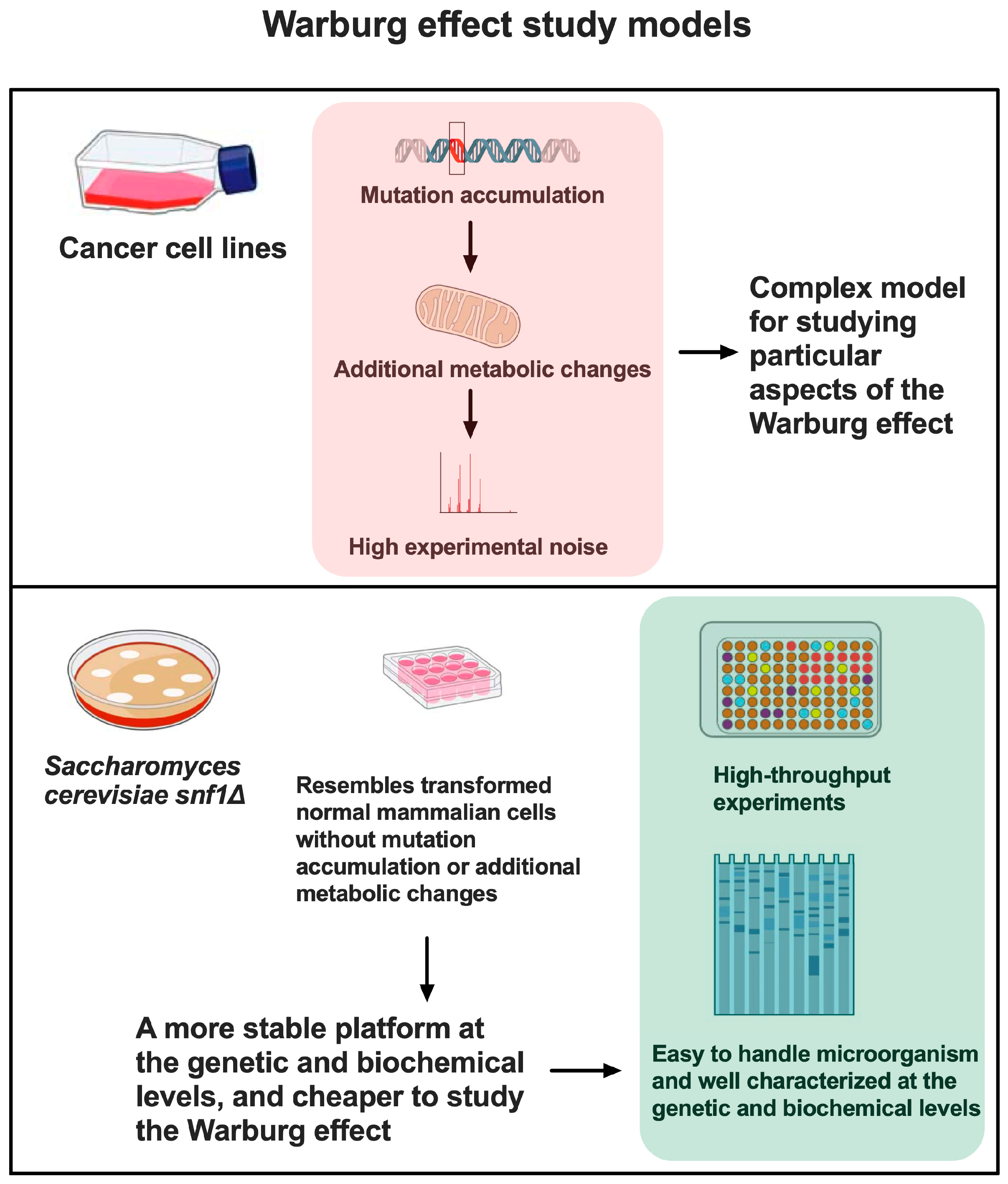
According to the new theories of cancer origin, which propose a metabolic rather than a genetic origin, ROS produced under the Warburg effect cause genomic instability and, in turn, trigger mutations [54]. Then, this driving force of mutations accelerates the evolution of cancer cells, making them more adaptable to environmental changes or stresses than normal cells. In most cases, cancer cell lines have many mutations that drastically alter their metabolism, making them sufficiently noisy to undermine the Warburg effect (Figure 4).
The yeast snf1∆ did not carry these additional mutations, offering a tractable system to uncover the mechanisms behind the Warburg effect (Figure 4). This yeast model also enables systematic genetic, biochemical, and pharmacological analysis of pathways regulating glycolysis, mitochondrial metabolism, and anabolic processes under controlled conditions [55]. Additionally, it can support high-throughput screening of metabolic modulators or therapeutic compounds targeting Warburg-like metabolism, thereby providing valuable insights into cancer biology and metabolic disorders, making snf1∆ an ideal model for studying the Warburg effect. Finally, we propose general metrics for cancer drug screening in the snf1∆ strain, such as cellular viability, mitochondrial respiration, extracellular acidification rate, and lipid droplet accumulation.
An important question is: are there specific types of cancer that exhibit characteristics similar to those found in the Warburg effect and snf1Δ? Some classifications categorize certain cancers as glycolytic, often referred to as Warburg-like [56]. However, other studies suggest that the Warburg effect may be a universal characteristic of all cancer cells [57], and that it is essential for the development of malignant traits and metastasis [58]. The full implications of this effect are still not completely understood. For this reason, it is important to further investigate its metabolic characteristics to gain a clearer understanding, using new cellular models as proposed here.
Studying the Warburg effect using snf1Δ could be valuable at the biochemical and basic biology levels. However, snf1Δ lacks important hallmarks of human cancer: 1. The lack of immune system interaction. 2. Some proliferative signaling (e.g., HIF-1α or PI3K/AKT). 3. Lack of tissue architecture, important in the tumor microenvironment. 4. Metastasis phenotype, like cell–cell interactions. 5. Angiogenesis.
Therefore, the snf1Δ strain will help elucidate the biochemical basis of the Warburg effect, deepening our understanding of its metabolic reprogramming. The model’s simplicity and the lack of mutation accumulation are the main advantages of this novel model over similar models, such as cell lines. However, the snf1Δ strain is not suitable for revealing other important cancer traits, such as those mentioned above.

9. Conclusions

Observations of the Warburg effect in the S. cerevisiae snf1Δ strain require additional experimental validation. Nevertheless, the preliminary analysis highlights three important points: (1) The Crabtree and Warburg effects may drive fermentative metabolism through distinct molecular mechanisms. (2) The snf1Δ strain could serve as a valuable model for investigating the Warburg effect. (3) The Warburg effect is a conserved response to AMPK/SNF1 mutations in eukaryotic cells.

Author Contributions

Conceptualization, G.M.N., K.I.L.-d.L., D.G.G.-G., V.S.-Q. and L.A.M.-P.; writing—original draft preparation, L.A.M.-P.; writing—review and editing, G.M.N.; visualization, V.S.-Q. All authors have read and agreed to the published version of the manuscript.

Funding

This research received no external funding.

Data Availability Statement

Not applicable.

Conflicts of Interest

The authors declare no conflicts of interest.

References

  1. Hagman, A.; Sall, T.; Piskur, J. Analysis of the yeast short-term Crabtree effect and its origin. FEBS J. 2014, 281, 4805–4814. [Google Scholar] [CrossRef]
  2. Kaspar von Meyenburg, H. Energetics of the budding cycle of Saccharomyces cerevisiae during glucose limited aerobic growth. Arch. Mikrobiol. 1969, 66, 289–303. [Google Scholar] [CrossRef]
  3. Verduyn, C.; Zomerdijk, T.P.L.; Van Dijken, J.P.; Scheffers, W.A. Continuous measurement of ethanol production by aerobic yeast suspension with an enzyme electrode. Appl. Microbiol. Biotechnol. 1984, 19, 181–185. [Google Scholar] [CrossRef]
  4. Liberti, M.V.; Locasale, J.W. The Warburg Effect: How Does it Benefit Cancer Cells? Trends Biochem. Sci. 2016, 41, 211–218. [Google Scholar] [CrossRef]
  5. Warburg, O. On the respiratory impairment in cancer cells. Science 1956, 124, 269–270. [Google Scholar] [CrossRef] [PubMed]
  6. de Alteriis, E.; Cartenì, F.; Parascandola, P.; Serpa, J.; Mazzoleni, S. Revisiting the Crabtree/Warburg effect in a dynamic perspective: A fitness advantage against sugar-induced cell death. Cell Cycle 2018, 17, 688–701. [Google Scholar] [CrossRef] [PubMed]
  7. Hamraz, M.; Abolhassani, R.; Andriamihaja, M.; Ransy, C.; Lenoir, V.; Schwartz, L.; Bouillaud, F. Hypertonic external medium represses cellular respiration and promotes Warburg/Crabtree effect. FASEB J. 2020, 34, 222–236. [Google Scholar] [CrossRef] [PubMed]
  8. Diaz-Ruiz, R.; Rigoulet, M.; Devin, A. The Warburg and Crabtree effects: On the origin of cancer cell energy metabolism and of yeast glucose repression. Biochim. Biophys. Acta 2011, 1807, 568–576. [Google Scholar] [CrossRef]
  9. Lee, S.B.; Tremaine, M.; Place, M.; Liu, L.; Pier, A.; Krause, D.J.; Xie, D.; Zhang, Y.; Landick, R.; Gasch, A.P.; et al. Crabtree/Warburg-like aerobic xylose fermentation by engineered Saccharomyces cerevisiae. Metab. Eng. 2021, 68, 119–130. [Google Scholar] [CrossRef]
  10. Hammad, N.; Rosas-Lemus, M.; Uribe-Carvajal, S.; Rigoulet, M.; Devin, A. The Crabtree and Warburg effects: Do metabolite-induced regulations participate in their induction? Biochim. Biophys. Acta 2016, 1857, 1139–1146. [Google Scholar] [CrossRef]
  11. Martinez-Ortiz, C.; Carrillo-Garmendia, A.; Correa-Romero, B.F.; Canizal-Garcia, M.; Gonzalez-Hernandez, J.C.; Regalado-Gonzalez, C.; Olivares-Marin, I.K.; Madrigal-Perez, L.A. SNF1 controls the glycolytic flux and mitochondrial respiration. Yeast 2019, 36, 487–494. [Google Scholar] [CrossRef]
  12. Correa-Romero, B.F.; Olivares-Marin, I.K.; Regalado-Gonzalez, C.; Nava, G.M.; Madrigal-Perez, L.A. The role of the SNF1 signaling pathway in the growth of Saccharomyces cerevisiae in different carbon and nitrogen sources. Braz. J. Microbiol. 2023, 54, 1083–1091. [Google Scholar] [CrossRef]
  13. Faubert, B.; Boily, G.; Izreig, S.; Griss, T.; Samborska, B.; Dong, Z.; Dupuy, F.; Chambers, C.; Fuerth, B.J.; Viollet, B.; et al. AMPK is a negative regulator of the Warburg effect and suppresses tumor growth in vivo. Cell Metab. 2013, 17, 113–124. [Google Scholar] [CrossRef]
  14. Carrillo-Garmendia, A.; Martinez-Ortiz, C.; Martinez-Garfias, J.G.; Suarez-Sandoval, S.E.; González-Hernández, J.C.; Nava, G.M.; Dufoo-Hurtado, M.D.; Madrigal-Perez, L.A. Snf1p/Hxk2p/Mig1p pathway regulates hexose transporters transcript levels, affecting the exponential growth and mitochondrial respiration of Saccharomyces cerevisiae. Fungal Genet. Biol. 2022, 161, 103701. [Google Scholar] [CrossRef] [PubMed]
  15. Wilson, W.A.; Hawley, S.A.; Hardie, D.G. Glucose repression/derepression in budding yeast: SNF1 protein kinase is activated by phosphorylation under derepressing conditions, and this correlates with a high AMP:ATP ratio. Curr. Biol. 1996, 6, 1426–1434. [Google Scholar] [CrossRef] [PubMed]
  16. Celenza, J.L.; Carlson, M. A Yeast GeneThat Is Essental for Release from Glucose Repression Encodes a Protein Kinase. Science 1986, 233, 1175–1180. [Google Scholar] [CrossRef] [PubMed]
  17. Nicastro, R.; Tripodi, F.; Guzzi, C.; Reghellin, V.; Khoomrung, S.; Capusoni, C.; Compagno, C.; Airoldi, C.; Nielsen, J.; Alberghina, L.; et al. Enhanced amino acid utilization sustains growth of cells lacking Snf1/AMPK. Biochim. Biophys. Acta 2015, 1853, 1615–1625. [Google Scholar] [CrossRef]
  18. Huberts, D.H.; Niebel, B.; Heinemann, M. A flux-sensing mechanism could regulate the switch between respiration and fermentation. FEMS Yeast Res. 2012, 12, 118–128. [Google Scholar] [CrossRef]
  19. Singh, T.; Sharma, K.; Jena, L.; Kaur, P.; Singh, S.; Munshi, A. Mitochondrial bioenergetics of breast cancer. Mitochondrion 2024, 79, 101951. [Google Scholar] [CrossRef]
  20. Thorens, B.; Mueckler, M. Glucose transporters in the 21st Century. Am. J. Physiol.-Endocrinol. Metab. 2010, 298, E141–E145. [Google Scholar] [CrossRef]
  21. Nava, G.M.; Madrigal Perez, L.A. Metabolic profile of the Warburg effect as a tool for molecular prognosis and diagnosis of cancer. Expert Rev. Mol. Diagn. 2022, 22, 439–447. [Google Scholar] [CrossRef]
  22. Yu, L.; Chen, X.; Sun, X.; Wang, L.; Chen, S. The Glycolytic Switch in Tumors: How Many Players Are Involved? J. Cancer 2017, 8, 3430–3440. [Google Scholar] [CrossRef]
  23. Vercher-Conejero, J.L.; Pelegrí-Martinez, L.; Lopez-Aznar, D.; Cózar-Santiago Mdel, P. Positron Emission Tomography in Breast Cancer. Diagnostics 2015, 5, 61–83. [Google Scholar] [CrossRef]
  24. O’Donnell, A.F.; McCartney, R.R.; Chandrashekarappa, D.G.; Zhang, B.B.; Thorner, J.; Schmidt, M.C. 2-Deoxyglucose impairs Saccharomyces cerevisiae growth by stimulating Snf1-regulated and alpha-arrestin-mediated trafficking of hexose transporters 1 and 3. Mol. Cell. Biol. 2015, 35, 939–955. [Google Scholar] [CrossRef]
  25. Pajak, B.; Siwiak, E.; Sołtyka, M.; Priebe, A.; Zieliński, R.; Fokt, I.; Ziemniak, M.; Jaśkiewicz, A.; Borowski, R.; Domoradzki, T.; et al. 2-Deoxy-d-Glucose and Its Analogs: From Diagnostic to Therapeutic Agents. Int. J. Mol. Sci. 2019, 21, 234. [Google Scholar] [CrossRef]
  26. Elbing, K.; Larsson, C.; Bill, R.M.; Albers, E.; Snoep, J.L.; Boles, E.; Hohmann, S.; Gustafsson, L. Role of hexose transport in control of glycolytic flux in Saccharomyces cerevisiae. Appl. Environ. Microbiol. 2004, 70, 5323–5330. [Google Scholar] [CrossRef]
  27. Nilsson, A.; Nielsen, J. Metabolic Trade-offs in Yeast are Caused by F1F0-ATP synthase. Sci. Rep. 2016, 6, 22264. [Google Scholar] [CrossRef]
  28. Piskur, J.; Rozpedowska, E.; Polakova, S.; Merico, A.; Compagno, C. How did Saccharomyces evolve to become a good brewer? Trends Genet. 2006, 22, 183–186. [Google Scholar] [CrossRef]
  29. Leznev, E.I.; Popova, I.I.; Lavrovskaja, V.P.; Evtodienko, Y.V. Comparison of oxygen consumption rates in minimally transformed BALB/3T3 and virus-transformed 3T3B-SV40 cells. Biochemistry 2013, 78, 904–908. [Google Scholar] [CrossRef]
  30. Wang, Y.; Patti, G.J. The Warburg effect: A signature of mitochondrial overload. Trends Cell Biol. 2023, 33, 1014–1020. [Google Scholar] [CrossRef]
  31. DeBerardinis, R.J.; Mancuso, A.; Daikhin, E.; Nissim, I.; Yudkoff, M.; Wehrli, S.; Thompson, C.B. Beyond aerobic glycolysis: Transformed cells can engage in glutamine metabolism that exceeds the requirement for protein and nucleotide synthesis. Proc. Natl. Acad. Sci. USA 2007, 104, 19345–19350. [Google Scholar] [CrossRef] [PubMed]
  32. Warburg, O. Versuche an überlebendem Carcinomgewebe. Biochem. Z. 1923, 142, 317–333. [Google Scholar]
  33. DeBerardinis, R.J.; Chandel, N.S. We need to talk about the Warburg effect. Nat. Metab. 2020, 2, 127–129. [Google Scholar] [CrossRef] [PubMed]
  34. Herst, P.M.; Berridge, M.V. Cell surface oxygen consumption: A major contributor to cellular oxygen consumption in glycolytic cancer cell lines. Biochim. Biophys. Acta 2007, 1767, 170–177. [Google Scholar] [CrossRef]
  35. Yao, C.H.; Wang, R.; Wang, Y.; Kung, C.P.; Weber, J.D.; Patti, G.J. Mitochondrial fusion supports increased oxidative phosphorylation during cell proliferation. eLife 2019, 8, e41351. [Google Scholar] [CrossRef]
  36. Ramanathan, A.; Wang, C.; Schreiber, S.L. Perturbational profiling of a cell-line model of tumorigenesis by using metabolic measurements. Proc. Natl. Acad. Sci. USA 2005, 102, 5992–5997. [Google Scholar] [CrossRef]
  37. Hall, A.; Meyle, K.D.; Lange, M.K.; Klima, M.; Sanderhoff, M.; Dahl, C.; Abildgaard, C.; Thorup, K.; Moghimi, S.M.; Jensen, P.B.; et al. Dysfunctional oxidative phosphorylation makes malignant melanoma cells addicted to glycolysis driven by the (V600E)BRAF oncogene. Oncotarget 2013, 4, 584–599. [Google Scholar] [CrossRef]
  38. Löffler, M.; Jöckel, J.; Schuster, G.; Becker, C. Dihydroorotat-ubiquinone oxidoreductase links mitochondria in the biosynthesis of pyrimidine nucleotides. Mol. Cell. Biochem. 1997, 174, 125–129. [Google Scholar] [CrossRef]
  39. Banh, R.S.; Kim, E.S.; Spillier, Q.; Biancur, D.E.; Yamamoto, K.; Sohn, A.S.W.; Shi, G.; Jones, D.R.; Kimmelman, A.C.; Pacold, M.E. The polar oxy-metabolome reveals the 4-hydroxymandelate CoQ10 synthesis pathway. Nature 2021, 597, 420–425. [Google Scholar] [CrossRef]
  40. Reiter, R.J.; Sharma, R.; Bai, Y.; Chuffa, L.G.A.; Loh, D.; Fan, L.; Cardinali, D.P. Function of intramitochondrial melatonin and its association with Warburg metabolism. Cell Signal 2025, 131, 111754. [Google Scholar] [CrossRef]
  41. Joshi, M.; Patel, B.M. Unveiling the Role of the Proton Gateway, Uncoupling Proteins (UCPs), in Cancer Cachexia. Cancers 2023, 15, 1407. [Google Scholar] [CrossRef] [PubMed]
  42. Ewald, J.; He, Z.; Dimitriew, W.; Schuster, S. Including glutamine in a resource allocation model of energy metabolism in cancer and yeast cells. npj Syst. Biol. Appl. 2024, 10, 77. [Google Scholar] [CrossRef] [PubMed]
  43. Xie, T.; Chen, M.; Nielsen, J.; Xia, J. Multi-omics analyses of the transition to the Crabtree effect in S. cerevisiae reveals a key role for the citric acid shuttle. FEMS Yeast Res. 2022, 22, foac030. [Google Scholar] [CrossRef] [PubMed]
  44. Kuhajda, F.P. Fatty-acid synthase and human cancer: New perspectives on its role in tumor biology. Nutrition 2000, 16, 202–208. [Google Scholar] [CrossRef]
  45. Liu, M.; Wang, Y.; Yang, C.; Ruan, Y.; Bai, C.; Chu, Q.; Cui, Y.; Chen, C.; Ying, G.; Li, B. Inhibiting both proline biosynthesis and lipogenesis synergistically suppresses tumor growth. J. Exp. Med. 2020, 217, e20191226. [Google Scholar] [CrossRef]
  46. Koizume, S.; Miyagi, Y. Lipid Droplets: A Key Cellular Organelle Associated with Cancer Cell Survival under Normoxia and Hypoxia. Int. J. Mol. Sci. 2016, 17, 1430. [Google Scholar] [CrossRef]
  47. Arkowitz, R.A.; Bozaquel-Morais, B.L.; Madeira, J.B.; Maya-Monteiro, C.M.; Masuda, C.A.; Montero-Lomeli, M. A New Fluorescence-Based Method Identifies Protein Phosphatases Regulating Lipid Droplet Metabolism. PLoS ONE 2010, 5, e13692. [Google Scholar] [CrossRef]
  48. Zhang, M.; Galdieri, L.; Vancura, A. The yeast AMPK homolog SNF1 regulates acetyl coenzyme A homeostasis and histone acetylation. Mol. Cell. Biol. 2013, 33, 4701–4717. [Google Scholar] [CrossRef]
  49. Ghillebert, R.; Swinnen, E.; Wen, J.; Vandesteene, L.; Ramon, M.; Norga, K.; Rolland, F.; Winderickx, J. The AMPK/SNF1/SnRK1 fuel gauge and energy regulator: Structure, function and regulation. FEBS J. 2011, 278, 3978–3990. [Google Scholar] [CrossRef]
  50. Hong, S.P.; Leiper, F.C.; Woods, A.; Carling, D.; Carlson, M. Activation of yeast Snf1 and mammalian AMP-activated protein kinase by upstream kinases. Proc. Natl. Acad. Sci. USA 2003, 100, 8839–8843. [Google Scholar] [CrossRef]
  51. Jones, R.G.; Plas, D.R.; Kubek, S.; Buzzai, M.; Mu, J.; Xu, Y.; Birnbaum, M.J.; Thompson, C.B. AMP-activated protein kinase induces a p53-dependent metabolic checkpoint. Mol. Cell 2005, 18, 283–293. [Google Scholar] [CrossRef] [PubMed]
  52. Hearle, N.; Schumacher, V.; Menko, F.H.; Olschwang, S.; Boardman, L.A.; Gille, J.J.; Keller, J.J.; Westerman, A.M.; Scott, R.J.; Lim, W.; et al. Frequency and spectrum of cancers in the Peutz-Jeghers syndrome. Clin. Cancer Res. 2006, 12, 3209–3215. [Google Scholar] [CrossRef]
  53. Luo, Z.; Zang, M.; Guo, W. AMPK as a metabolic tumor suppressor: Control of metabolism and cell growth. Future Oncol. 2010, 6, 457–470. [Google Scholar] [CrossRef]
  54. Seyfried, T.N.; Lee, D.C.; Duraj, T.; Ta, N.L.; Mukherjee, P.; Kiebish, M.; Arismendi-Morillo, G.; Chinopoulos, C. The Warburg hypothesis and the emergence of the mitochondrial metabolic theory of cancer. J. Bioenerg. Biomembr. 2025, 57, 57–83. [Google Scholar] [CrossRef]
  55. Matuo, R.; Sousa, F.G.; Soares, D.G.; Bonatto, D.; Saffi, J.; Escargueil, A.E.; Larsen, A.K.; Henriques, J.A. Saccharomyces cerevisiae as a model system to study the response to anticancer agents. Cancer Chemother. Pharmacol. 2012, 70, 491–502. [Google Scholar] [CrossRef]
  56. Wei, J.; Huang, K.; Chen, Z.; Hu, M.; Bai, Y.; Lin, S.; Du, H. Characterization of Glycolysis-Associated Molecules in the Tumor Microenvironment Revealed by Pan-Cancer Tissues and Lung Cancer Single Cell Data. Cancers 2020, 12, 1788. [Google Scholar] [CrossRef]
  57. Vaupel, P.; Schmidberger, H.; Mayer, A. The Warburg effect: Essential part of metabolic reprogramming and central contributor to cancer progression. Int. J. Radiat. Biol. 2019, 95, 912–919. [Google Scholar] [CrossRef] [PubMed]
  58. Schwartz, L.; Supuran, C.T.; Alfarouk, K.O. The Warburg Effect and the Hallmarks of Cancer. Anti-Cancer Agents Med. Chem. 2017, 17, 164–170. [Google Scholar] [CrossRef] [PubMed]
Figure 1. Comparison of phenotypes of the Warburg and Crabtree effects. Hexose transporters are represented in green squares. The thickness of the arrows indicates the intensity of the metabolic fluxes. The question mark in the lipid synthesis arrow in the Crabtree effect section indicates a lack of information about this metabolic pathway. The dashed line represents the mitochondrial membranes.
Applsci 16 01311 g001
Figure 2. Contrast of mitochondrial respiration between the Warburg and Crabtree effects. The Warburg effect is characterized by highly active mitochondrial metabolism, including mitochondrial respiration (represented in green with an upward-pointing arrow), suggesting that the Warburg effect fermentation is due to a metabolite overflow in mitochondria. In the case of the Crabtree effect, the decrease in mitochondrial activity, specifically mitochondrial respiration (represented in red by a downward-pointing arrow), is a response regulated at the genetic and biochemical levels. The thickness of the arrows indicates the intensity of the metabolic fluxes.
Applsci 16 01311 g002
Figure 3. Despite exhibiting elevated basal respiration, Warburg effect cells do not effectively couple this oxygen consumption via the electron transport chain (ETC) to ATP production. Consequently, fermentation serves as a compensatory mechanism to sustain ATP synthesis. Instead of supporting oxidative phosphorylation, mitochondrial respiration in these cells is redirected toward anabolic processes, including orotate synthesis via dihydroorotate dehydrogenase (EC 1.3.99.11), which transfers electrons to ubiquinone. Additionally, mitochondrial respiration may contribute to elevated reactive oxygen species (ROS) levels. In green boxes, important cellular processes in cancer biology associated with oxidative phosphorylation products (red boxes) are indicated, as indicated by dashed arrows.
Applsci 16 01311 g003
Figure 4. Comparative figure summarizing the highlight points of main differences between cancer cell lines and S. cerevisiae snf1∆ as a Warburg effect model.
Applsci 16 01311 g004
Disclaimer/Publisher’s Note: The statements, opinions and data contained in all publications are solely those of the individual author(s) and contributor(s) and not of MDPI and/or the editor(s). MDPI and/or the editor(s) disclaim responsibility for any injury to people or property resulting from any ideas, methods, instructions or products referred to in the content.