Article

Deep Learning-Based Damage Detection on Composite Bridge Using Vibration Signals Under Varying Temperature Conditions


1
Department of Civil Engineering, Kangwon National University, Samcheok 25913, Republic of Korea
2
Department of Civil Engineering, Korea Maritime & Ocean University, Busan 49112, Republic of Korea
3
Department of Civil Engineering, Kyung Hee University, Yongin 17104, Republic of Korea
*
Authors to whom correspondence should be addressed.
Appl. Sci. 2026, 16(3), 1263; https://doi.org/10.3390/app16031263
Submission received: 12 December 2025 / Revised: 13 January 2026 / Accepted: 22 January 2026 / Published: 26 January 2026

Abstract

The dynamic characteristics of bridges are not only influenced by structural damage but also by ambient environmental variations. If environmental factors are not incorporated into the detection algorithm, they may lead to false positives or false negatives. In recent years, vibration-based damage detection methods have gained significant attention in structural health monitoring (SHM), particularly for assessing structural integrity under varying temperature conditions. This study introduces a deep-learning framework for identifying damage in composite bridges by utilizing both time-domain and frequency-domain vibration signals while explicitly accounting for temperature effects. Two deep learning models—Convolutional Neural Network (CNN) and Artificial Neural Network (ANN)—were implemented and compared. The effectiveness of the proposed damage identification approach was evaluated using an experimental dataset obtained from a composite bridge structure. Furthermore, statistical evaluation metrics—including accuracy, precision, recall, F1 score, and the ROC curve—were used to compare the damage detection performance of the two deep learning models. The results reveal that the CNN model consistently outperforms the ANN in terms of classification accuracy. Moreover, frequency-domain analysis was shown to be more effective than time-domain analysis for damage classification, and integrating temperature data with vibration signals improved the performance of all model architectures.

1. Introduction

Vibration-based damage detection has been widely recognized as a reliable and effective approach for assessing the structural condition of bridges [1]. Changes in structural stiffness or mass caused by damage lead to corresponding variations in dynamic characteristics, such as natural frequencies, mode shapes, and damping ratios, making vibration responses valuable indicators for structural health monitoring (SHM) [2,3,4,5]. Accordingly, vibration-based approaches have been widely applied to identify structural damage, including its severity and spatial distribution.
However, vibration-based SHM typically involves the acquisition and analysis of large volumes of complex time-series data collected from multiple sensors over extended monitoring periods. Manual interpretation or traditional feature-based analysis of such high-dimensional datasets is often inefficient and prone to uncertainty. To address this challenge, many researchers have increasingly adopted machine learning (ML) and deep-learning (DL) techniques, which enable automated feature extraction and data-driven pattern recognition from vibration signals. For example, Lin et al. [6] developed a CNN-based model trained on raw vibration signals and demonstrated its effectiveness for damage detection in beam-type structures, while Jiang et al. [7] employed a one-dimensional CNN to achieve highly accurate damage localization in a multi-story steel frame. Kim and Mukhiddinov [8] further demonstrated the applicability of CNN-based approaches to real bridge vibration data by successfully classifying anomaly signals measured from a cable-stayed bridge. These studies highlight the strong potential of DL-based frameworks for handling large-scale vibration datasets and improving damage-detection performance.
Despite these advances, the reliability of vibration-based damage detection remains strongly influenced by environmental and operational conditions. Bridges are continuously exposed to varying environmental factors, including temperature fluctuations, severe weather, and changing traffic loads. Among these factors, temperature variation plays a dominant role, as it influences dynamic characteristics primarily through temperature-dependent material properties. Changes in temperature can modify the elastic moduli of constituent materials and induce differential thermal expansion between concrete, steel girders, and shear connectors, leading to variations in effective stiffness and internal stress states. Although the actual structural mass remains nearly constant, these thermally induced effects alter the system’s effective dynamic behavior, leading to measurable shifts in modal parameters that may be comparable to, or even exceed, those caused by structural damage [4,5,9,10]. Previous studies [11] have reported that modal frequencies of long-span bridges can fluctuate by approximately 5–10% due to temperature effects, which may mask or mimic damage-related signatures. Finite-element investigations have further demonstrated that both uniform-temperature conditions and temperature gradients can significantly influence modal frequencies and mode-shape curvature, with frequency variations of up to approximately 2% observed over a temperature range of −20 to 40 °C [12].
These temperature-induced variations complicate the interpretation of vibration-based indicators and may lead to false-positive or false-negative damage diagnoses if environmental effects are not properly accounted for [13]. As a result, vibration-based SHM systems that neglect temperature effects may produce inconsistent monitoring outcomes when data are collected under different thermal conditions [14,15,16]. Accordingly, mitigating temperature-induced variability in vibration features is essential for achieving reliable damage detection [17].
To address this issue, recent studies have increasingly focused on integrating environmental information—particularly temperature—into data-driven SHM frameworks. Temperature-aware ML- and DL-based approaches have shown improved robustness by enabling models to distinguish between damage-induced and environmentally induced variations in vibration responses. For instance, Gong et al. [18] represented temperature-affected vibration time series using Gramian Angular Field images and applied CNN-based feature learning, while Yessoufou and Zhu [19] proposed a CNN–LSTM framework that explicitly incorporated temperature information to improve bridge damage classification accuracy. However, many existing studies [20,21,22] rely on field data in which temperature effects are coupled with other influential factors, such as traffic loads, boundary-condition variations, and operational uncertainties, or are primarily based on numerical simulations. These factors make it difficult to isolate the pure influence of temperature and limit the interpretability and generalizability of the reported results.
In response to these limitations, this study presents a comprehensive experimental framework for vibration-based damage detection in a composite bridge while explicitly accounting for temperature effects. To exclude environmental influences other than temperature, an indoor laboratory-scale bridge specimen was fabricated, and controlled experiments were conducted under well-defined thermal conditions. Vibration data were systematically collected under both uniform-temperature conditions and temperature gradients, allowing the isolated investigation of temperature-induced effects on structural dynamic responses. Furthermore, two supervised DL models, CNN and ANN, were employed to classify structural conditions using vibration data in both the time-domain and frequency-domain. By integrating temperature information with vibration signals under controlled laboratory conditions, the proposed framework enables a systematic evaluation of model performance in different thermal environments and provides clearer insight into the effectiveness of temperature-integrated DL approaches for vibration-based structural damage detection. It should be emphasized that the objective of this study is not to introduce a novel SHM methodology, but rather to provide an experimental validation and feasibility assessment of temperature-integrated, vibration-based damage classification. While the observed performance trends are consistent with prior studies, the present work contributes by systematically isolating temperature effects through controlled laboratory experiments on a scaled composite bridge specimen. This experimental setting enables a clearer interpretation of temperature-induced variations in vibration features and their influence on deep-learning-based damage classification.

2. Experimental Program and Deep Learning Methodology

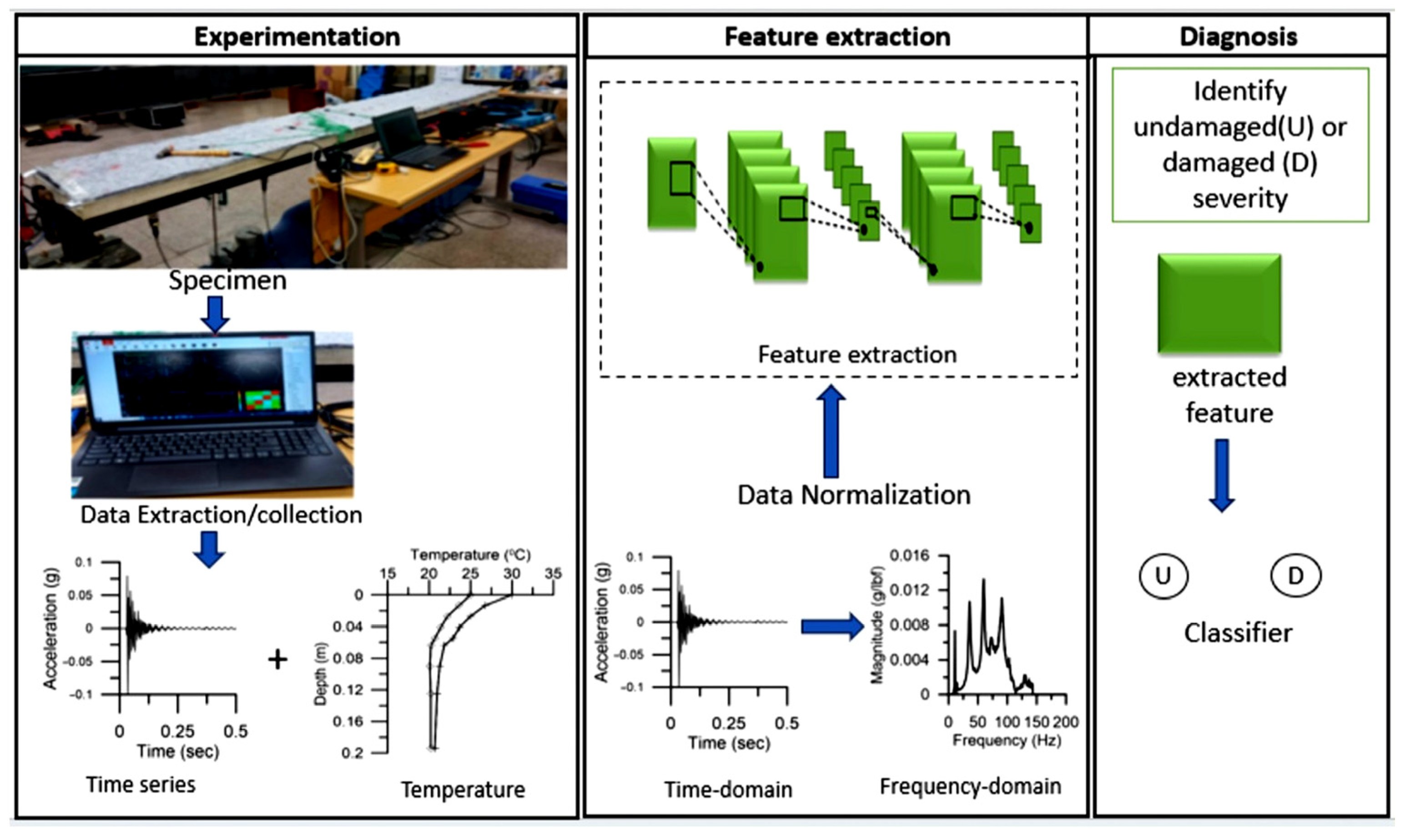
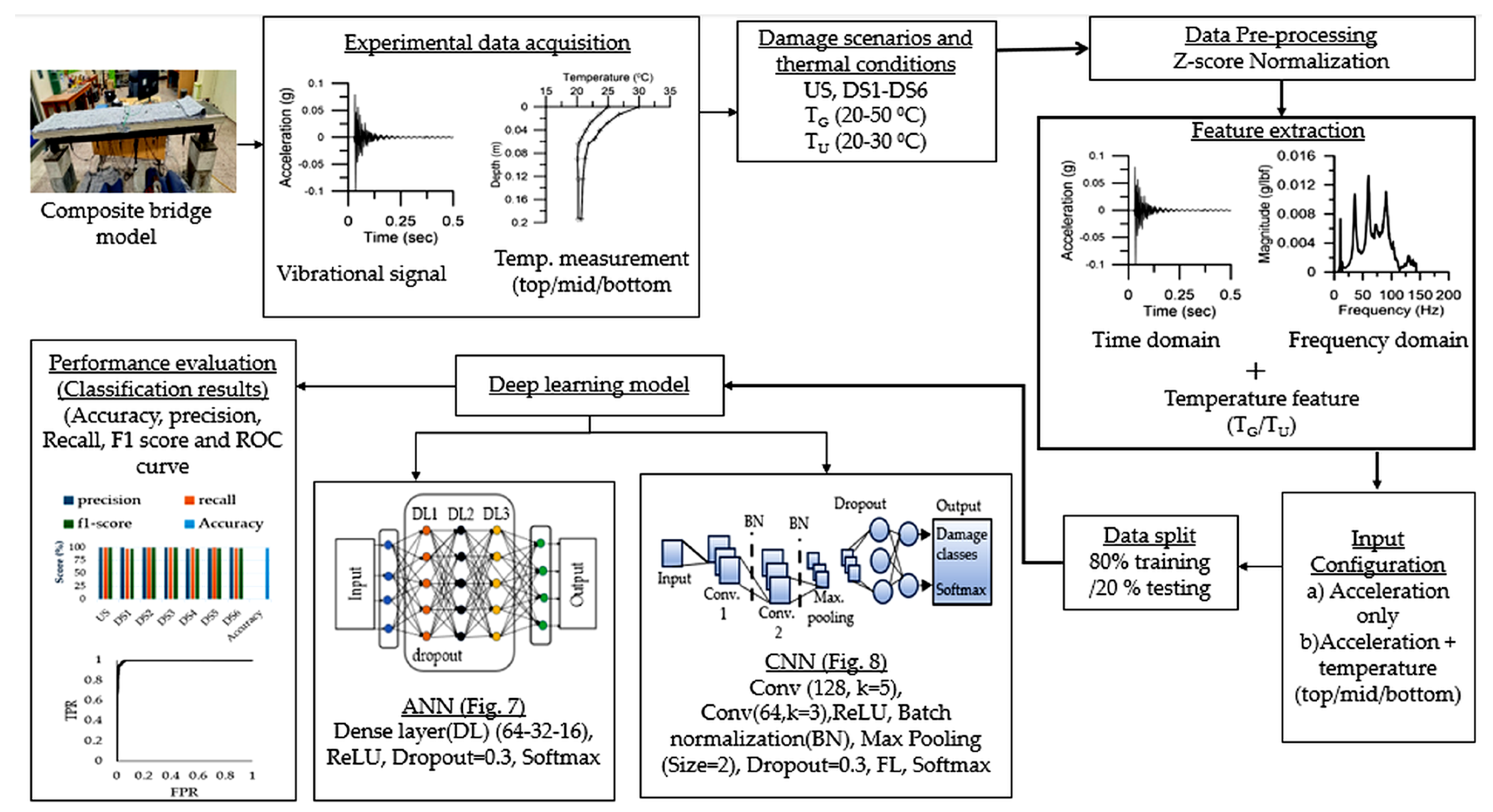
Figure 1 illustrates the proposed framework used in this study for detecting damage in composite bridge structures, which is divided into three main modules: experimentation, feature extraction, and damage diagnosis. In the experimentation module, a composite bridge specimen was fabricated and subjected to controlled excitations under different temperature conditions, namely temperature gradient (TG) and uniform temperature (TU). Structural damage was simulated by applying different load intensities, representing varying severity levels. This test setup enables precise control of key damage parameters and facilitates comprehensive data collection for six damage cases and one undamaged baseline case.
The feature extraction module processes the raw acceleration signals in several pre-processing steps to improve the accuracy of the features. First, a Z-score normalization is performed to ensure statistical consistency between the samples. The normalized time series data are then fed into DL models, specifically CNNs and ANNs, to automatically extract damage-sensitive features. Unlike traditional methods that rely heavily on hand-crafted features and expert knowledge, this data-driven approach provides an end-to-end, scalable solution capable of autonomously learning complex patterns indicative of structural damage. Finally, the damage diagnosis module uses the learned features to detect the presence of damage and assess its severity. A supervised classification is performed to distinguish between the different damage scenarios. The model results are used to assign predictions to the corresponding damage case or undamaged condition. This diagnostic function allows both binary detection of damage and multi-class classification of the severity and location of damage.

2.1. Experimentation

2.1.1. Model Setup

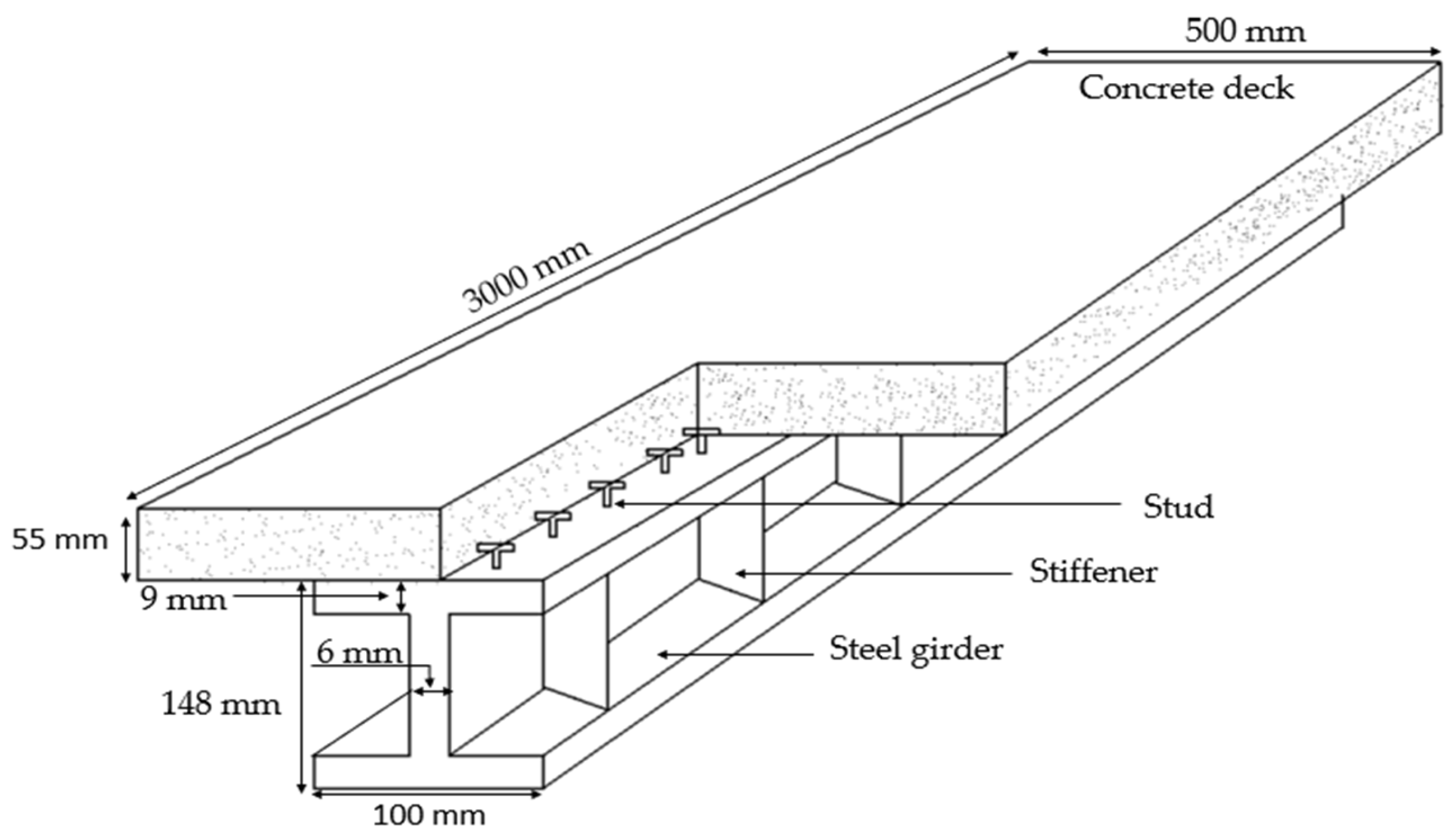
The specimen consisted of a steel–concrete composite beam, comprising an SM355 grade steel I-beam with a rolled section of H150 × 100 × 6 × 9 mm. Steel stiffeners, each 6 mm thick, were welded to the web and flanges of the beam at regular intervals of 375 mm. The total length of the girder was 3000 mm. A concrete deck, 500 mm wide and 55 mm thick, was cast on top of the steel girder. The concrete achieved an average 28-day compressive strength of 27.8 MPa, determined from six cylindrical test specimens. To ensure full composite action between the steel and concrete components, 36 welded shear connectors were installed. A simply supported boundary condition was applied by using a hinge support at one end and a roller support at the other. The detailed configuration and dimensions of the specimen are shown in Figure 2.

2.1.2. Model Testing

Temperature Loading
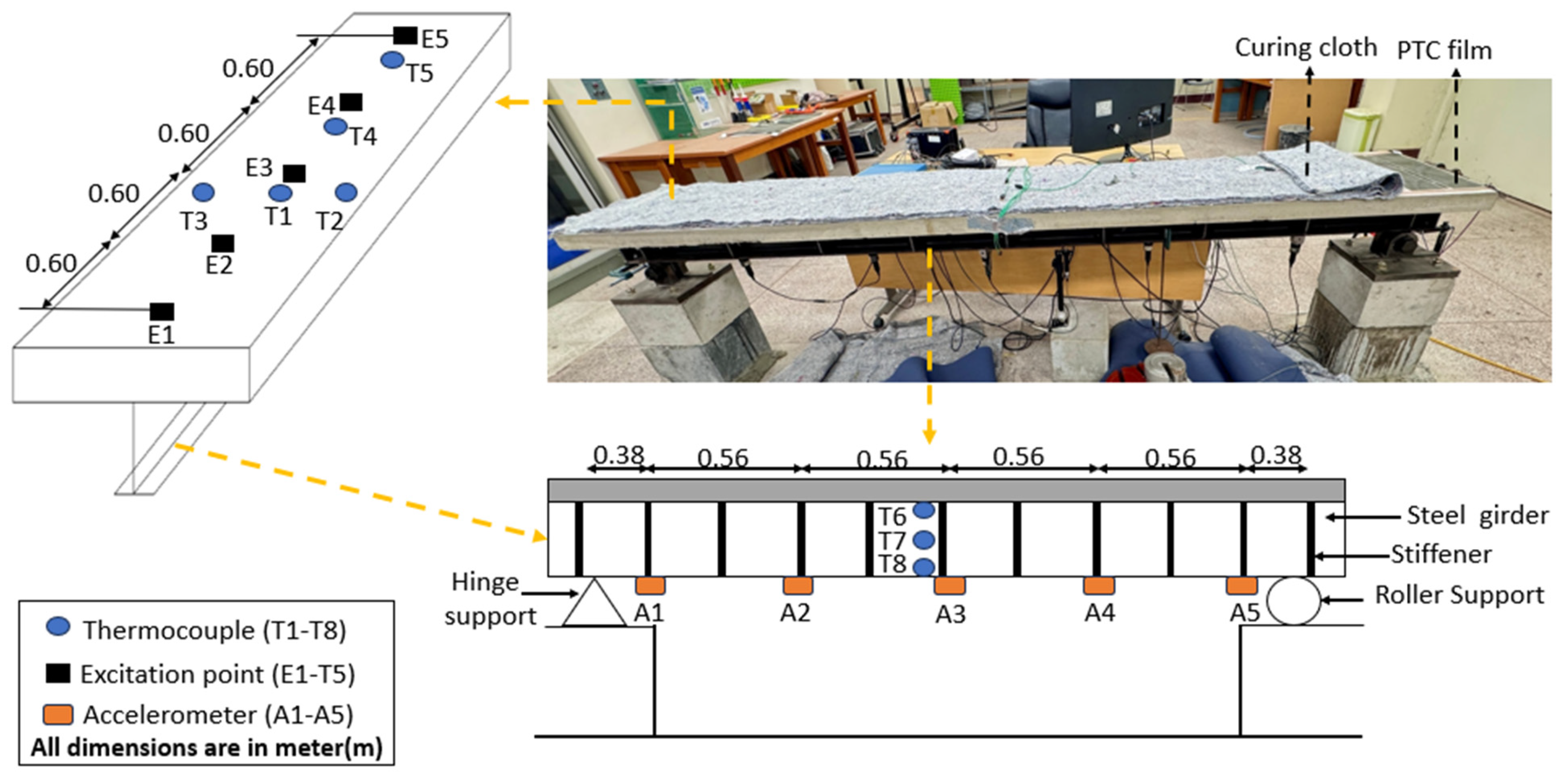
For the model tests, it was assumed that the temperature distribution within the specimen may follow either uniform or non-uniform profiles. Prior to data collection, a positive temperature coefficient (PTC) film was applied to the top surface of the concrete deck and covered with a curing cloth to maintain a uniform thermal environment, as shown in Figure 3. The PTC film, consisting of copper foil electrodes applied to a carbon-coated substrate, generated heat to facilitate the various temperature conditions required for the experiment.
Eight adhesive-type thermocouples (ST-50, RKC instrument Inc., South Bend, IN, USA; labeled T1–T8) were positioned to monitor the thermal gradients from the surface of the deck to the underside of the composite girder. Specifically, three thermocouples were installed at the center of the span. Additional thermocouples were placed at 1/6 and 1/3-span locations on the deck surface. Three thermocouples were placed along the depth of the steel girder: one directly below the top flange, one at mid-web, and one directly above the bottom flange (Figure 3). This configuration enabled detailed measurement of temperature variation along the span and through the depth of the composite specimen. All thermocouples were connected to a data logger (Memory HI Logger LR8331, Hioki, Seoul, Republic of Korea), and an additional thermometer was positioned next to the sample to record the room temperature.
Sensor Placement and Test Procedure
To capture the dynamic response of the composite girder, five high-sensitivity accelerometers (model 393B12, PCB Piezotronics, Depew, NY, USA), designated A1–A5) with a sensitivity of 10,000 mV/g and an operational frequency range of 0.15–1000 Hz were installed along the bottom flange of the steel girder. These sensors were mounted at uniform intervals of 0.56 m using magnetic bases, with A1 and A5 positioned 0.38 m from their respective support, as illustrated in Figure 4. Dynamic testing was conducted by applying perpendicular impacts at five designated locations (E1–E5) on the concrete deck using an impact hammer (model 086C03, PCB Piezotronics, Depew, NY, USA), thereby simulating vibrational excitation. At each impact location, three repeated impacts were applied, and the resulting FRFs were averaged to improve repeatability and reduce measurement noise.
The acceleration signals obtained were amplified using a signal conditioner (model 483C05, PCB Piezotronics, Depew, NY, USA), and recorded with a high-resolution dynamic data logger (IOLITE 6xSTG, Dewesoft, Trbovlje, Slovenia). The signals were processed with Dewesoft X software, where Frequency Response Functions (FRFs) were obtained via Fast Fourier Transform (FFT) over a frequency range of 0–200 Hz. This frequency range captures the global vibration modes of the scaled bridge specimen, which consistently occur below 200 Hz and exhibit the highest sensitivity to both temperature variations and damage effects. Modal frequencies under varying temperature conditions were identified by averaging five FRFs obtained from different excitation points along the span, enabling the characterization of the temperature-dependent dynamic behavior.
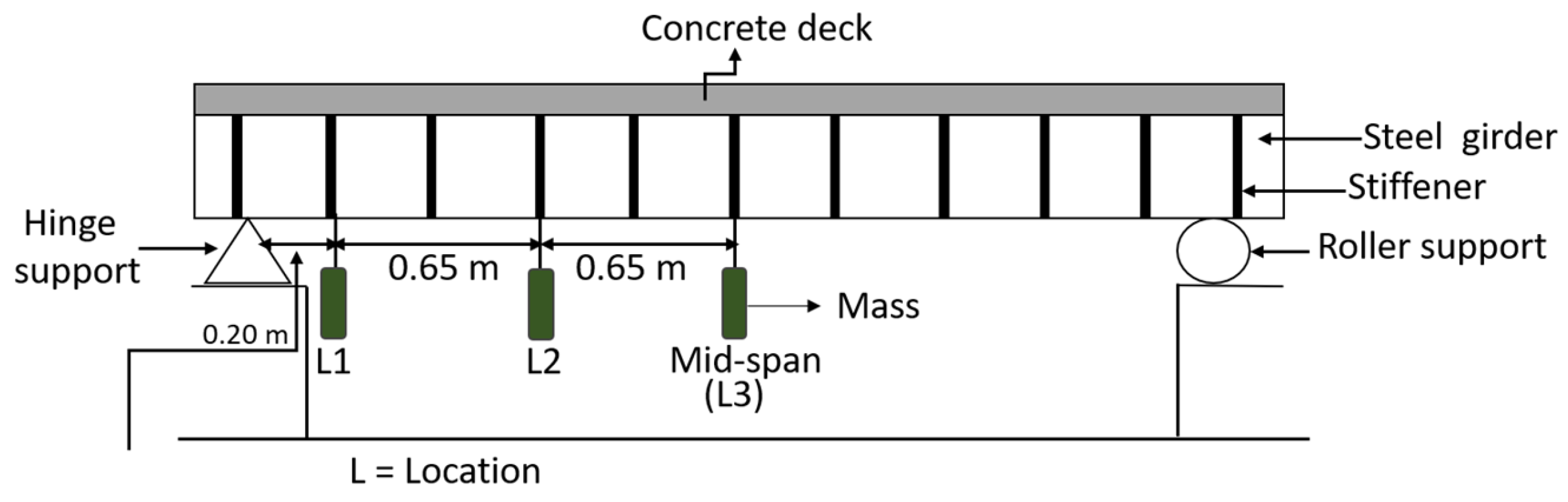
To examine the influence of different damage severity levels on the dynamic behavior of the structure without making permanent alterations to the specimen, artificial damage was introduced using weights. Non-destructive mass perturbations have been employed in prior structural health monitoring (SHM) studies as a pragmatic proxy for damage severity, particularly when destructive testing is not feasible [23,24]. The added mass alters the global inertial properties of the structure, leading to observable changes in vibration characteristics. This non-destructive and repeatable approach is adopted as a controlled damage-like proxy to assess the sensitivity of the proposed models to dynamic variations under varying temperature conditions. Two load levels (278 N (62.5 lb) and 556 N (125 lb)) were applied and attached to the bottom flange of the steel girder at three locations: near the support (L1, 0.20 m from the end), at the quarter-span (L2, 0.85 m from the end), and at mid-span (L3, 1.50 m from the end), as illustrated in Figure 4. These load levels correspond to approximately 11% and 21% of the total structural mass, respectively. Due to the geometric and structural symmetry of the 3.0-m-long composite girder, damage scenarios were applied only to one half of the span to minimize redundancy while maintaining experimental validity. A total of six damage scenarios, as shown in Table 1, were generated by combining the three locations with the two load levels. Table 1 provides a comprehensive summary of the damage scenarios.
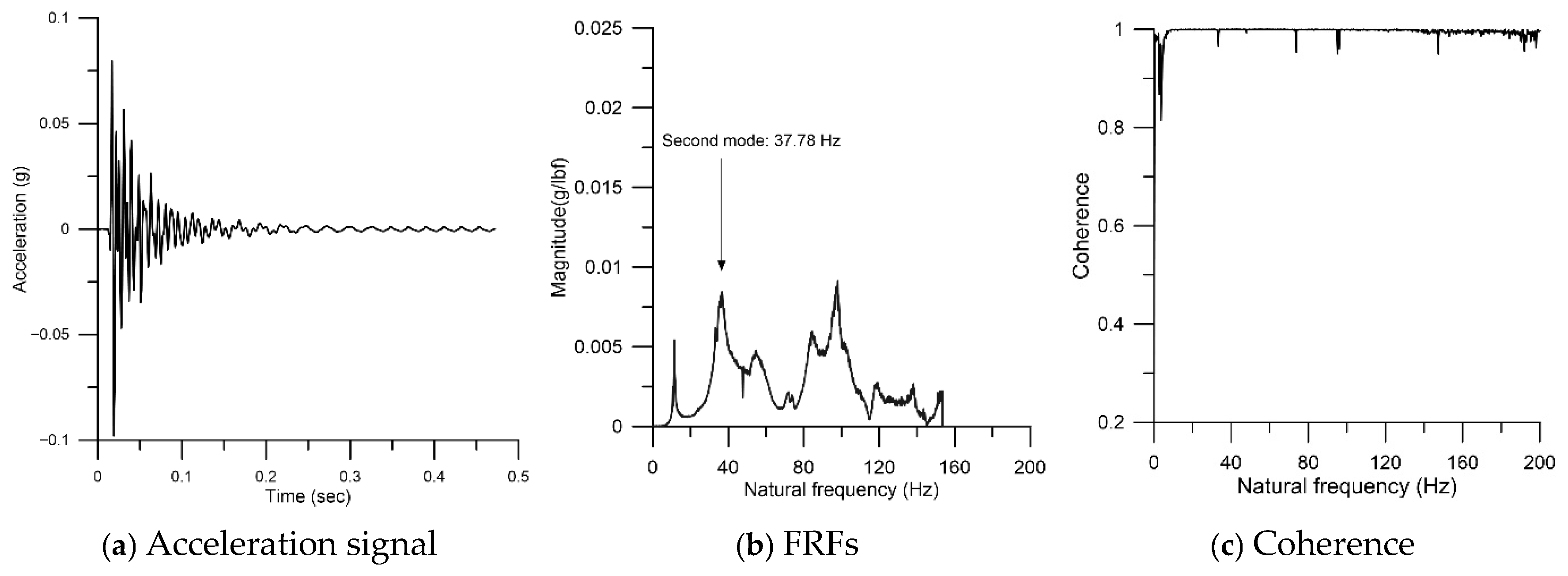
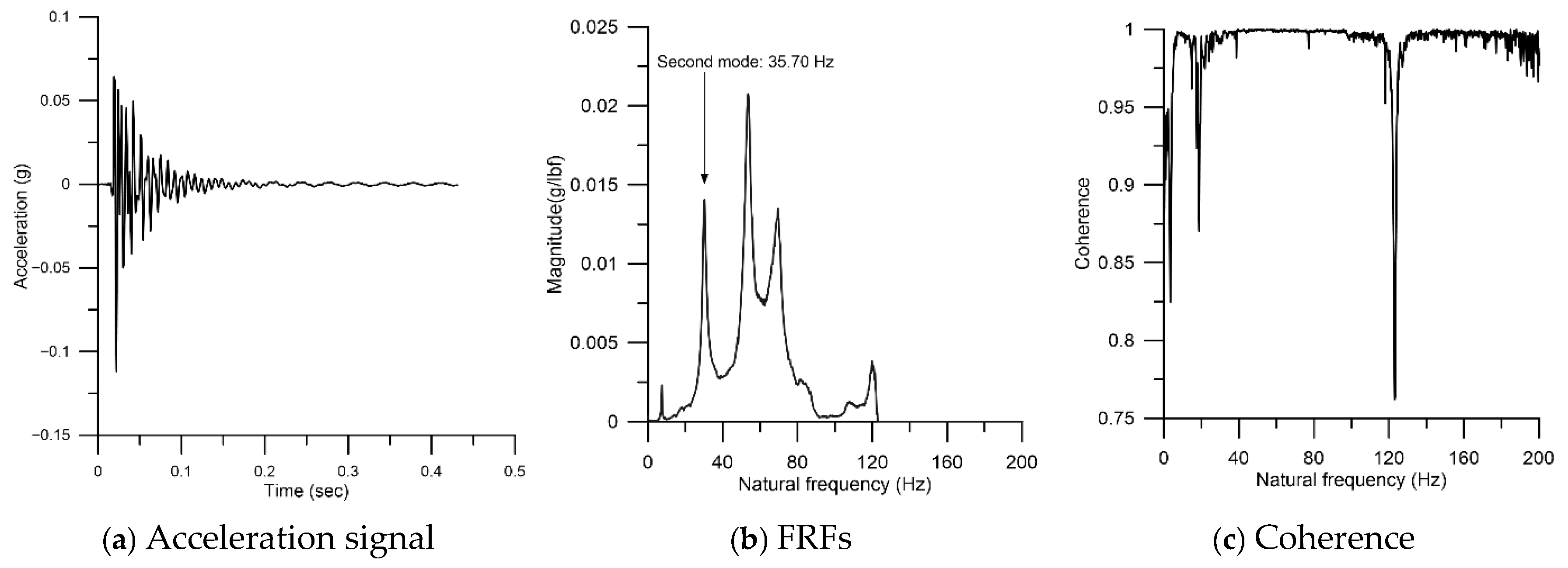
For the temperature gradient condition (TG), which represents a spatial temperature variation across the bridge section, the temperature on the top surface of the concrete deck varied from 20 °C to 50 °C, while the ambient room temperature remained constant at 20 °C. Conversely, in the uniform temperature (TU) scenario, which approximates a uniform thermal state across the section, the room temperature gradually increased from 20 °C to 30 °C to replicate consistent thermal conditions. These temperature ranges were selected to represent realistic thermal scenarios encountered by bridge structures. The TU condition reflects moderate and nearly ambient temperature variation, whereas the TG condition simulated non-uniform thermal distribution caused by environmental exposure such as solar radiation. In addition, temperature range considered is consistent with the limits recommended in the AASHTO LRFD Bridge Design Specifications (−18 to 50 °C for steel and −12 to 27 °C for concrete) [25]. Figure 5 and Figure 6 present representative experimental results, illustrating typical time-domain acceleration signals obtained under the undamaged and damaged states, respectively. The corresponding frequency-domain responses are shown in Figure 5b and Figure 6b. The first mode was a local mode related to transverse bending of the concrete deck. The second mode corresponded to a longitudinal bending mode that appeared in the 35–38 Hz range. These modal peaks were observed consistently across repeated tests. In real-world bridge system, however, the fundamental mode response is typically dominated by longitudinal bending rather than local lateral bending. This discrepancy can be attributable to the single-girder design of the specimen, whereas multi-girder systems are commonly used in real bridges. For this reason, the bending mode, corresponding to the second mode, was adopted in this study to better represent the overall behavior of this type of bridge. The coherence functions within this frequency band demonstrate high reliability, exhibiting values between 0.97 and 1.00, as presented in Figure 5c and Figure 6c.

2.2. Dataset Preparation and Processing

2.2.1. Data Pre-Processing

To prepare the dataset for machine learning analysis, both acceleration signals and temperature measurements were systematically pre-processed to ensure consistency and reliability. Each vertical acceleration signal—recorded under undamaged (Figure 5a) and damaged (Figure 6a) conditions—was uniformly sampled and standardized to a fixed sequence length of 500-time steps (0.5 s), ensuring consistent input dimensions across all samples.
Temperature data were simultaneously acquired from three locations across the specimen’s cross-section: the top surface, mid-depth, and bottom flange. These measurements were collected under two thermal conditions: temperature gradient (TG, 20–50 °C) and uniform temperature (TU, 20–30 °C). The recorded temperature values were treated as supplementary features and combined with the corresponding acceleration signals to form composite input vectors for configurations that included temperature. A feature-level fusion approach was employed, in which features from both acceleration and temperature data were extracted independently and then concatenated into a unified feature vector. This fusion strategy enhances the capability to detect structural damage by leveraging complementary information derived from vibration and temperature data, thereby improving classification accuracy and robustness. Accordingly, two preprocessing strategies were implemented: (a) using acceleration data alone, and (b) using acceleration data combined with three temperature measurements (top, mid-depth, bottom) per sample. These temperature measurement points were strategically positioned at the top, mid-depth, and bottom of the bridge section to capture the spatial temperature gradient across the structural depth. These locations correspond to critical thermal states governing bending behavior, with the top surface predominantly influenced by solar radiation, the bottom surface reflecting near-ambient conditions, and the mid-depth serving as an intermediate thermal reference. These configurations enabled a comprehensive evaluation of the contribution of thermal effects to the damage detection process.
In addition, to obtain spectral information, all time-domain acceleration signals were transformed into the frequency domain using FFT, as shown in Figure 5b and Figure 6b. This transformation enabled the identification of dominant frequency components and amplitude variations associated with structural damage. Following the approach used in the time-domain, two configurations were established for the frequency domain: (a) frequency features alone and (b) frequency features integrated with temperature inputs. This dual-domain approach enabled a comparative evaluation of structural damage sensitivity between time- and frequency-domain features.

2.2.2. Data Normalization

Data normalization is a crucial preprocessing step in the development of DL models, particularly when working with time- and frequency-domain analyses in SHM applications. By scaling feature values to a standardized range, normalization reduces variability and ensures consistency across the dataset. This process stabilizes and accelerates model training by limiting the influence of large-magnitude features, ultimately improving both accuracy and overall model robustness. In this study, all acceleration signals were standardized using Z-score normalization to ensure consistent scaling across samples. This process minimized discrepancies, reduced noise and lowered computational complexity by transforming each data point based on the mean and standard deviation of its corresponding signal.
Z - s c o r e = X μ σ
The Z-score in Equation (1) is computed for every data point within each signal. In this equation, X denotes the acceleration value of the signal at a given time step, μ represents the mean of the full time series (i.e., the average acceleration), and σ indicates its standard deviation. This normalization process ensures that each signal has a mean of zero and a standard deviation of one, enabling consistent comparison across samples.
Following the normalization procedure, the data were stratified into training and testing subsets using an 80/20 partitioning strategy to ensure robust model development and unbiased performance evaluation. Under the TG condition, a total of 28,000 samples were generated across seven cases (US and DS1–DS6), with each case equally represented by 4000 samples. Of 22,400 samples, 80% were allocated for model training, while the remaining 5600 samples (20%) were reserved for testing. Likewise, for the TU condition, 18,900 samples were generated across the same seven cases, with 2700 samples per case. Among 15,120 (80%) samples constituted the training set and 3780 (20%) samples formed the test set. Furthermore, equal numbers of samples were used for all cases to maintain dataset balance and avoid class bias in both model training and evaluation. This systematic division enabled consistent benchmarking of the deep learning models across both operational scenarios and provided a solid foundation for evaluating the models’ ability to accurately identify and classify damage severity in the composite bridge using both time-domain and frequency-domain signals.

2.3. DL Architecture

SHM has advanced significantly with the integration of artificial intelligence (AI), particularly through DL techniques. DL methods have received considerable attention for damage detection and structural condition evaluation due to their ability to autonomously extract damage-sensitive features from complex datasets. This study examines the use of both time-domain and frequency-domain signals in combination with DL to capture critical features relevant to damage identification. Among various DL architectures, CNNs and ANNs have shown strong potential for addressing SHM challenges across a wide range of structural systems [26,27,28,29,30]. Accordingly, this study investigates the performance of these two DL models.

2.3.1. ANN Architecture

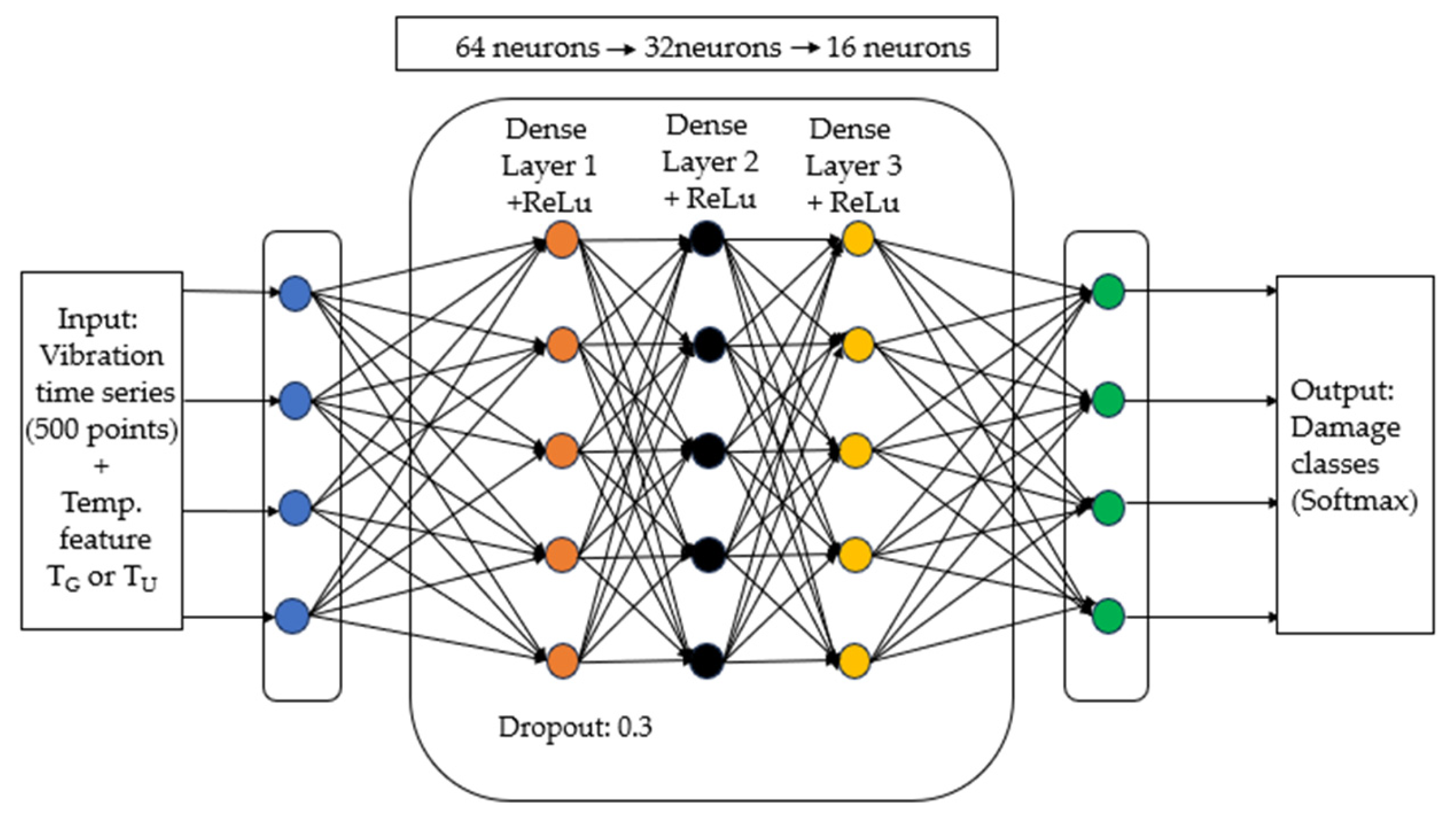
ANNs are computational models inspired by the structure and learning mechanisms of the human brain, enabling them to identify complex patterns and relationships within data [31]. They consist of interconnected artificial neurons arranged in layers, allowing the network to learn nonlinear mappings by adjusting connection weights through iterative training [32]. A standard ANN includes at least one hidden layer positioned between the input and output layers. Figure 7 illustrates the architecture of an ANN with a single hidden layer.
In this study, an ANN model was developed to classify structural damage states using time-series acceleration and frequency-domain data. The network architecture consisted of fully connected (dense) layers designed to capture complex nonlinear relationships among the input features. The network began with a dense layer of 64 neurons with a ReLU activation function, followed by a dropout layer with a rate of 0.3 (typically ranging from 0.1 to 0.5 [33]) to reduce overfitting in the deep network and enhance the model’s generalization capability. By randomly deactivating a subset of neurons during each iteration, dropout strengthens the model’s robustness on unseen data [34,35]. Two additional hidden layers with 32 and 16 neurons, respectively, were also implemented using ReLU activation. The selection of 64, 32, and 16 neurons enables the network to capture nonlinear relationships while progressively compressing features, facilitating hierarchical representation learning. The gradual reduction in the number of neurons across successive layers helps the model simplify the extracted information, enabling it to emphasize the most relevant features at increasingly abstract levels. The depth of the network and the number of neurons per layer directly influence its learning capacity: increasing them can improve feature extraction but also raise computational cost [36] and risk of overfitting, while too few neurons may lead to underfitting [37]. The inclusion of a dropout layer helps maintain an appropriate balance by regulating model complexity. The output layer was a dense Softmax layer that generated probability distributions across six damage scenarios (DS1–DS6). Additional details regarding the activation functions (ReLU and Softmax) are provided in Section 2.3.4. The model was trained using the Adam optimization algorithm [38] with a learning rate of 0.001, batch size of 32 and 100 training epochs. The selected hyperparameters were determined based on prior studies employing similar deep learning architectures, in which they demonstrated stable convergence behavior without inducing overfitting, and were further confirmed through preliminary tests in this study [19,39,40,41]. The categorical cross-entropy loss function [42] was used, which is well suited for multi-class classification tasks involving one-hot encoded labels.

2.3.2. CNN Architecture

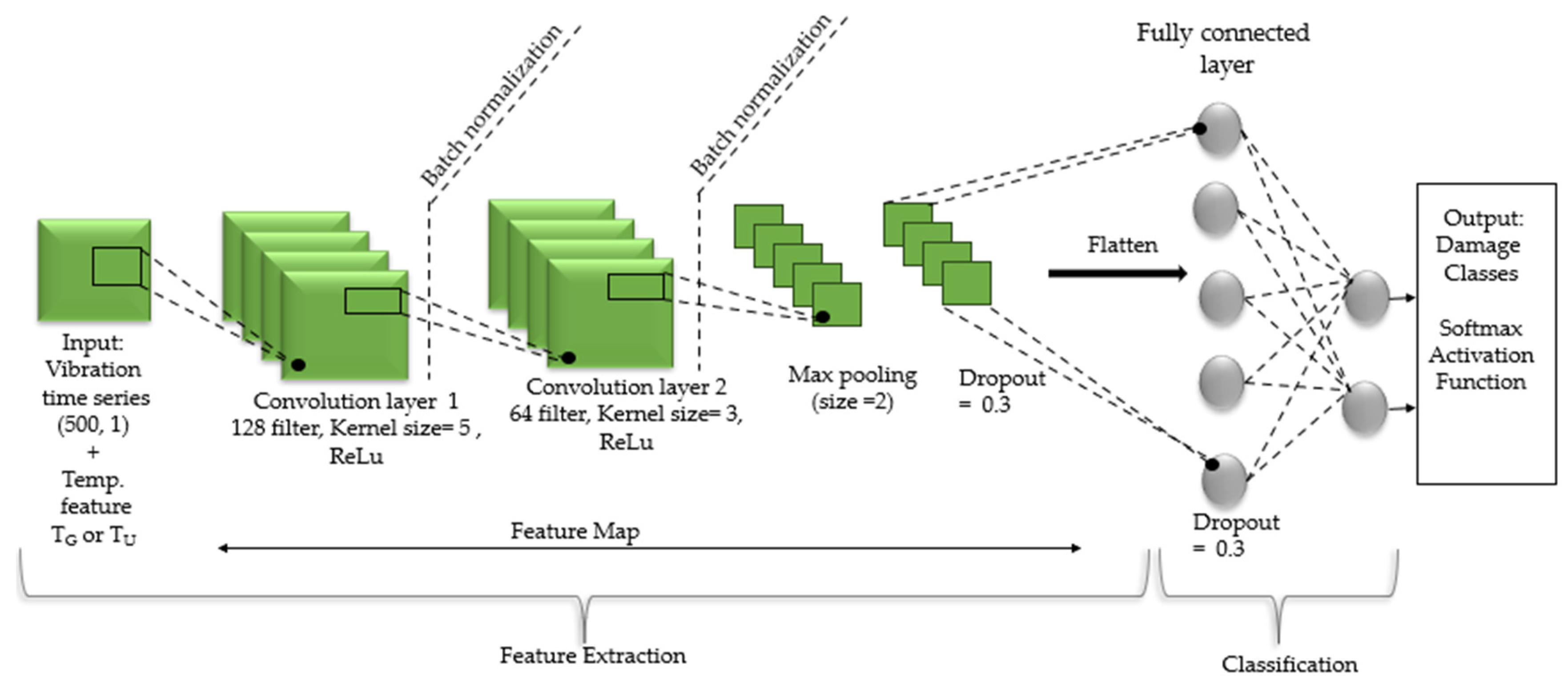
CNNs are widely used for classification and regression tasks due to their ability to automatically learn hierarchical spatial features from input data. Their effectiveness primarily stems from two advantages: (1) they are designed to capture local spatial dependencies efficiently, and (2) they require substantially fewer trainable parameters than fully connected networks, thereby reducing computational complexity. The standard CNN architecture typically consists of an input layer, a series of feature extraction layers (including convolutional and pooling layers), followed by fully connected layers and an output layer. As illustrated in Figure 8, the proposed 1D CNN model is designed to extract spatial features from both time-domain and frequency-domain vibration signals. The network begins with a reshape layer to format the one-dimensional input for convolution. The first convolutional layer applies 128 filters with a kernel size of 5 and a ReLU activation function, followed by batch normalization. A larger number of filters is used in the first convolutional layer to effectively capture informative features from noisy vibration signals with complex temporal patterns. In addition, a wider kernel size (kernel = 5) is employed to extract broader temporal features and to better suppress high-frequency noise compared to smaller kernels. Batch normalization normalizes the intermediate feature distribution during training, thereby improving training stability and reducing issues such as gradient vanishing, while the nonlinear activation function strengthens the network’s capacity to model complex relationships within the data [43]. This is followed by a second convolutional layer with 64 filters and a kernel size of 3 and is also accompanied by ReLU activation and batch normalization. A reduced number of filters combined with a smaller kernel size enables more refined feature representations by emphasizing localized temporal patterns. A max-pooling layer is then used to reduce dimensionality while preserving key features, as applying classification directly after the convolution layer may lead to overfitting. A dropout layer with a rate of 0.3 is subsequently applied to mitigate overfitting by randomly deactivating a subset of feature maps during training, which promotes the CNN’s ability to learn robust and generalized representations of the input data.
The extracted feature maps are flattened and passed to a dense layer using ReLU activation. To further enhance generalization, a second dropout layer with a rate of 0.3 is applied at this stage. The model concludes with a dense output layer using a Softmax activation function to perform multiclass classification. The model was implemented in Python using TensorFlow (version 2.19.0) and Keras (version 3.9.2), developed in PyCharm (version 2024.2.4), and trained using the Adam optimizer [38] with a learning rate of 0.001, a batch size of 32, and 100 training epochs. The selected hyperparameters were informed by prior studies employing similar convolutional neural network architectures, where they demonstrated stable convergence behavior without inducing overfitting [19,39,40,41]. Sparse categorical cross-entropy [42] was adopted as the loss function to accommodate integer-encoded labels. Adam optimizer was employed due to its effectiveness in achieving stable and efficient convergence when training deep neural networks. Collectively, these design choices enable the CNN to effectively integrate acceleration and temperature inputs, extract discriminative features, and accurately classify structural damage states.

2.3.3. Model Configuration: Input Structure and Training Setup

To evaluate the performance of the DL models, supervised multi-class classification was performed considering seven structural states, including one undamaged case (US) and six damage cases (DS1–DS6), corresponding to different damage severities and the locations of the composite bridge specimen. As illustrated in Figure 9, the experimental workflow begins with data acquisition, during which vibration responses and temperature measurements at the top, middle, and bottom of the specimen are collected under both temperature-gradient (TG, 20 °C to 50 °C), and uniform-temperature (TU, 20 °C to 30 °C) conditions. The damaged scenarios were defined based on applied loading levels at three different locations (L1, L2, and L3) as shown in Figure 4. Specifically, DS1–DS3 correspond to damage cases induced by a 278 N load, while DS4-DS6 correspond to damage cases induced by a 576 N load, as summarized in Table 1. This configuration enables assessment of damage severity effects in addition to damage presence. Following data acquisition, preprocessing was performed using Z-score normalization. Feature extraction and analysis were conducted in two distinct data domains: the time domain and the frequency domain. Each domain was evaluated using two input configurations: (i) acceleration only, and (ii) acceleration combined with temperature information. In the time-domain acceleration-only configuration, each input sample consisted of a single acceleration signal represented as a one-dimensional vector with 500 time steps (500 × 1). When temperature data were included, three additional scalar values measured at the top, middle, and bottom of the specimen were appended to the acceleration signal, resulting in an extended input vector of length 503. The dataset was randomly stratified into training and testing subsets using an 80/20 split, ensuring balanced representation of all damage scenarios. A feature-level fusion strategy was employed to integrate vibration and temperature data by appending temperature measurements to the vibration features at the input level. This approach allows the model to directly learn the joint influence of vibration and temperature information while maintaining a simple and interpretable network structure [44]. For frequency-domain analysis, each acceleration signal was transformed into the frequency domain using the Fast Fourier Transform (FFT). Only spectral components within the 0–200 Hz range were retained, as this interval contains the dominant modal frequencies of the structure. Consequently, approximately 400 discrete frequency components (0–200 Hz with a frequency resolution of 0.5 Hz) were used in each case. The magnitudes of these components were then used as input features for the DL models. The resulting features were then provided to the ANN (Figure 7) and CNN (Figure 8) architectures. Model performance was evaluated based on a single training run using accuracy, precision, recall, F1-score and ROC curves. A summary of the training configuration and hyperparameters for the ANN and CNN models is presented in Appendix A.

2.3.4. Activation Function

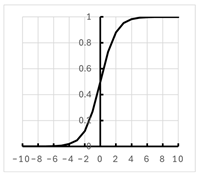
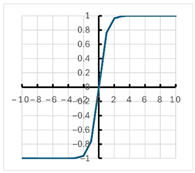
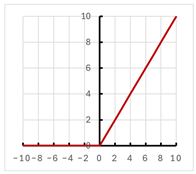
Commonly used activation functions include the sigmoid, hyperbolic tangent (tanh), and rectified linear unit (ReLU). Their mathematical expressions and corresponding graphs are presented in Table 2. As shown, the sigmoid and tanh functions share similar characteristics: both accept input values x ∈ (−∞, +∞), but their output ranges differ. The sigmoid function maps inputs to the interval (0, 1), whereas the tanh function maps them to (−1, 1). Although these functions provide strong nonlinear transformation capability, they suffer from inherent limitations such as gradient saturation and the vanishing-gradient problem [45]. When the magnitude of the input becomes large, the change in output approaches zero, restricting effective learning.
To overcome these drawbacks, the ReLU activation function was introduced. ReLU passes only positive inputs while suppressing negative values, thereby improving sparsity and computational efficiency [46]. This characteristic helps mitigate the vanishing-gradient issue and reduces the likelihood of overfitting. Owing to these advantages, ReLU has become one of the most widely adopted activation functions in deep-learning architectures [47].
Likewise, the selection of the activation function for the output layer is determined by the nature of the task. In classification problems, the Softmax activation function is commonly employed. This function transforms the outputs of the final layer into a set of probabilities, each corresponding to a distinct class in multiclass classification scenarios. The mathematical formulation is provided in Equation (2) [48].
f ( z i ) = e z i k = 1 n e z k
where f(zi) represents the probability of the input belonging to the i-th class, zi and zk denote the current numerical value of the i-th and k-th neurons in the layer, and n is the total number of neurons in the output layer.

2.4. Performance Matrices

Model evaluation constitutes a fundamental component of the experimental process and is indispensable for assessing the efficacy and reliability of the developed model. To evaluate the performance of proposed models and substantiate their effectiveness in structural damage detection, a comprehensive set of standard performance metrics was employed. These metrics encompass indicators derived from the confusion matrix—namely, Precision, Recall, F1 Score, and Accuracy—as well as the Receiver Operating Characteristic (ROC) curve. Collectively, these measures facilitate a robust assessment of classification performance across all damage categories and provide critical insight into the model’s diagnostic capabilities in the context of SHM.
Precision quantifies the proportion of correctly identified positive instances among all samples predicted as positive. Within the domain of bridge damage detection, this metric reflects the extent to which predicted damage events correspond to actual structural damage, indicating how effectively the model avoids false alarms that could lead to unnecessary inspections in SHM applications. Precision is formally defined as:
P r e c i s i o n = T P T P + F P
Recall, also referred to as sensitivity or the True Positive Rate (TPR), represents the fraction of actual damage cases correctly identified by the model. It provides an indication of the model’s capacity to detect damage among all true positive instances and is particularly crucial in SHM, where missed detections (false negatives) can allow structural deterioration to compromise safety. Recall is defined as follows:
R e c a l l = T P T P + F N
F1 Score is defined as the harmonic mean of Precision and Recall, thereby providing a balanced metric that accounts for the trade-off between false positives and false negatives. This measure is particularly pertinent in contexts characterized by class imbalance and is valuable in SHM, where damaged states are typically far less frequent than undamaged states, requiring a metric that reflects practical detection reliability. F1 Score is calculated as follows:
F 1   s c o r e = 2 × P r e c i s i o n × R e c a l l R e c a l l + P r e c i s i o n
Accuracy quantifies the overall correctness of the model by determining the ratio of correctly classified instances—both damaged and undamaged—relative to the total number of samples. This metric offers a global assessment of classification performance and is expressed as:
A c c u r a c y = T P + T N T P + F P + T N + F N
In this study, an analysis of the Receiver Operating Characteristic (ROC) curve was conducted to evaluate the accuracy of damage classification by comparing predicted outcomes against the actual structural condition (damaged or undamaged). The ROC curve serves as a graphical instrument for evaluating the diagnostic performance of a classifier. On the ROC plot, the X-axis corresponds to the FPR, indicating the likelihood of incorrectly classifying a non-damaged sample as damaged, while the Y-axis corresponds to the TPR, representing the probability of correctly identifying an actual damage case. An optimal classifier is characterized by a high TPR and a low FPR; a curve reaching the top-left corner (0, 1) signifies perfect classification with no false positives and all true positives correctly detected [49].
The Area Under the Curve (AUC) provides a scalar measure of a model’s discriminative capability, with higher values indicating superior classification performance. Owing to this property, the AUC serves as a pivotal metric for selecting the optimal classifier. Moreover, when ROC curves for different machine learning models intersect—making direct visual comparison inconclusive—the AUC offers a more objective and quantitative basis for evaluating model efficacy.

3. Damage Detection Performance Under Temperature Variations

The performance of the ANN and CNN models was systematically evaluated under two thermal conditions (TG and TU) using time-domain and frequency-domain data. This comparative analysis was designed to examine how the choice of signal domains and the presence of thermal variation influence classification accuracy and model robustness. For both undamaged and damaged cases, two input configurations were considered: (i) acceleration-only and (ii) acceleration combined with temperature (top, middle, and bottom). By incorporating thermal variation (temperature gradient and uniform temperature), the study provides a comprehensive assessment of how signal representation and environmental temperature affect model performance. The following subsections present domain-specific classification results and highlight the impact of signal type and the temperature inputs on the feature learning capabilities of each DL architecture. It should be noted that the evaluation was conducted on a scaled composite bridge specimen under controlled laboratory conditions, which typically exhibits clearer modal separation than full-scale bridge structures. These characteristics may contribute to enhanced classification performance; therefore, the reported results are intended to demonstrate the feasibility of temperature-integrated vibration-based damage classification under laboratory conditions rather than to imply direct field deployability.

3.1. Time Domain Analysis

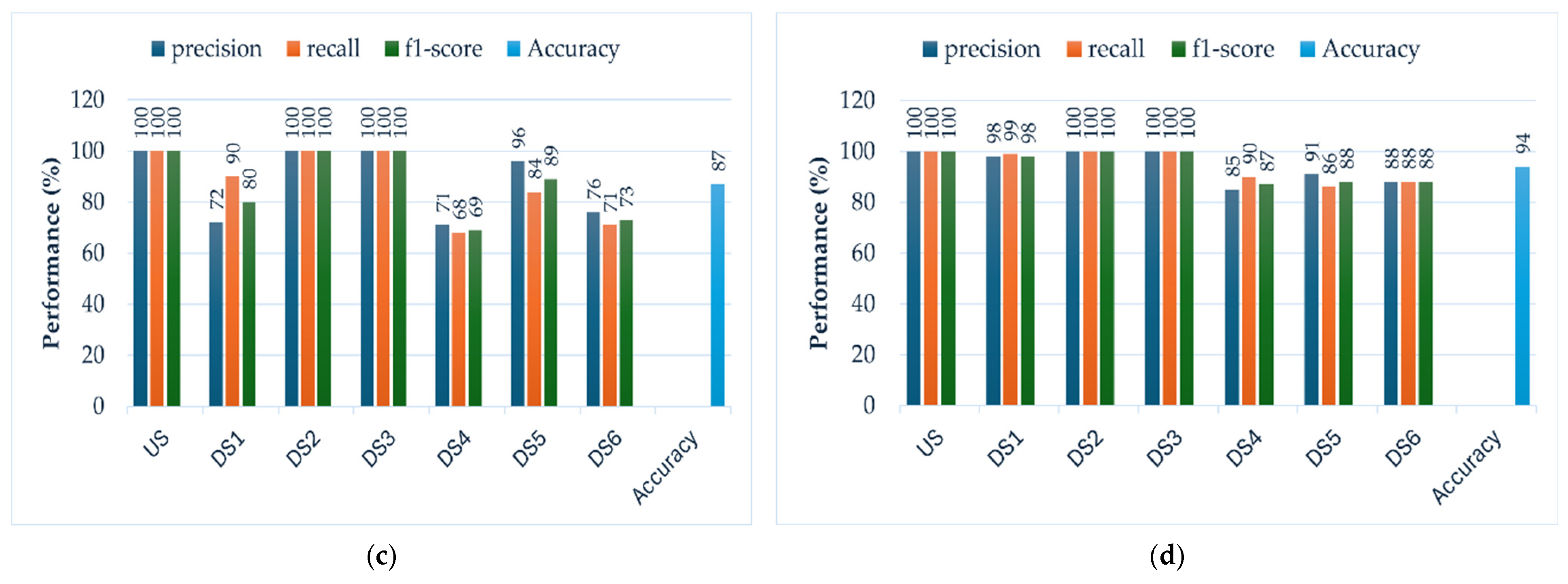
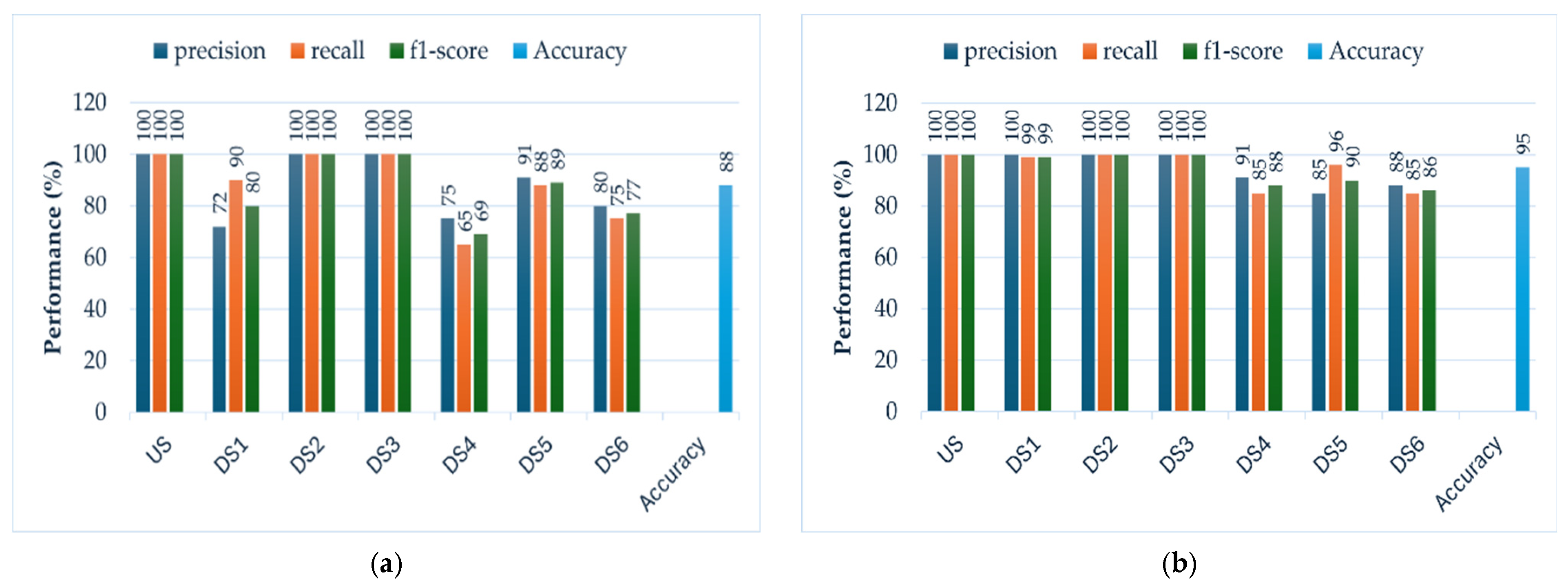
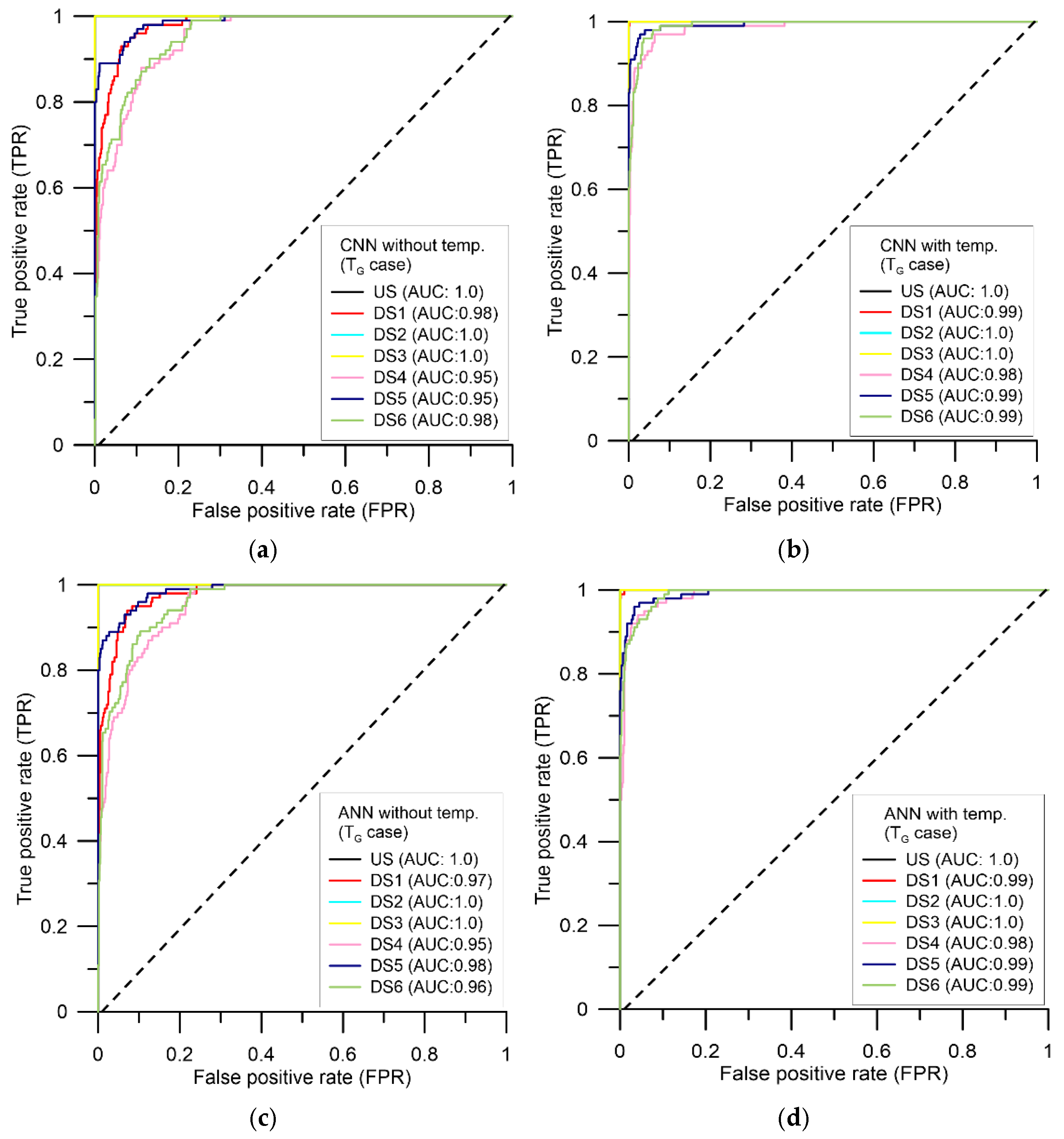
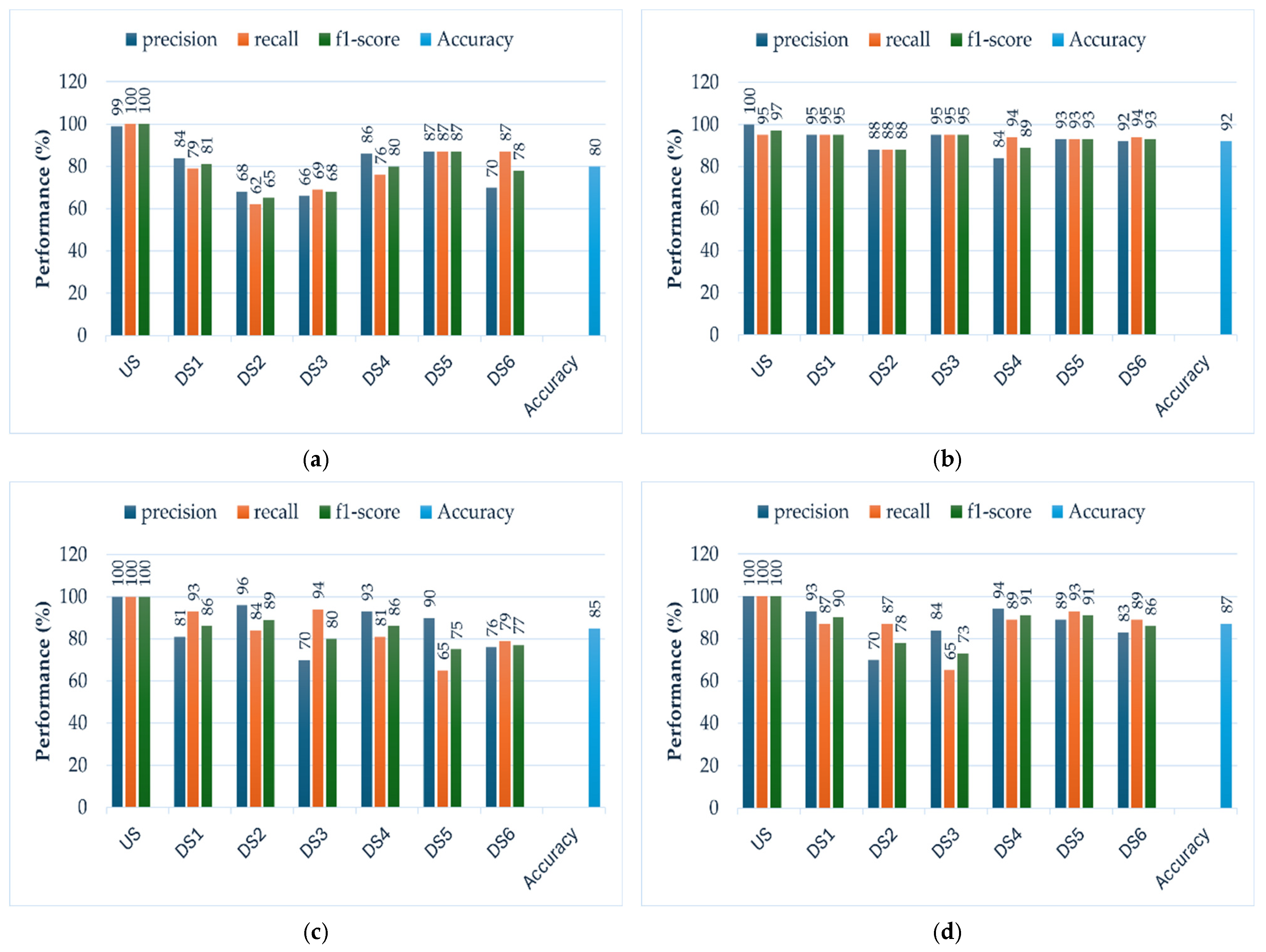
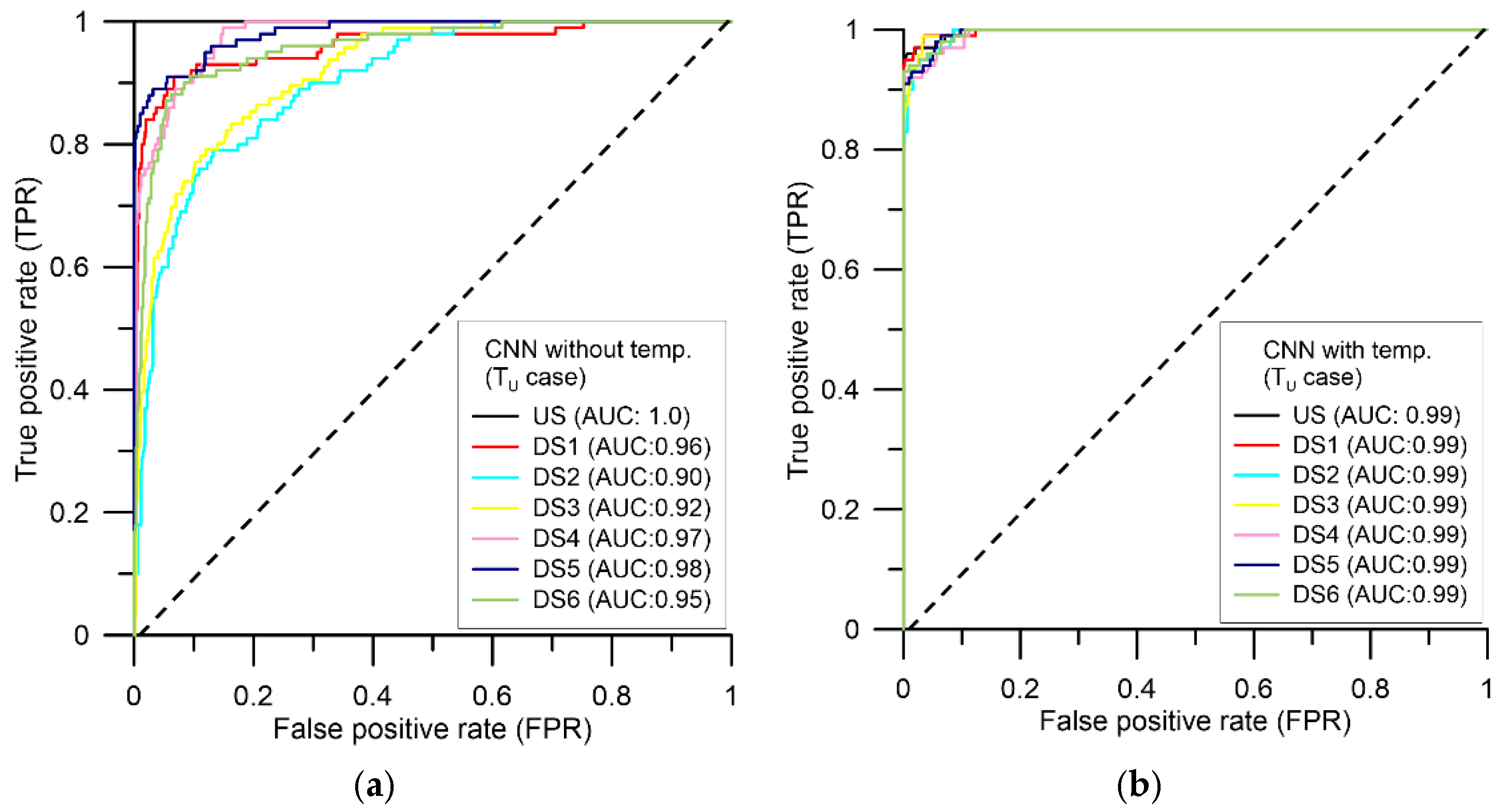
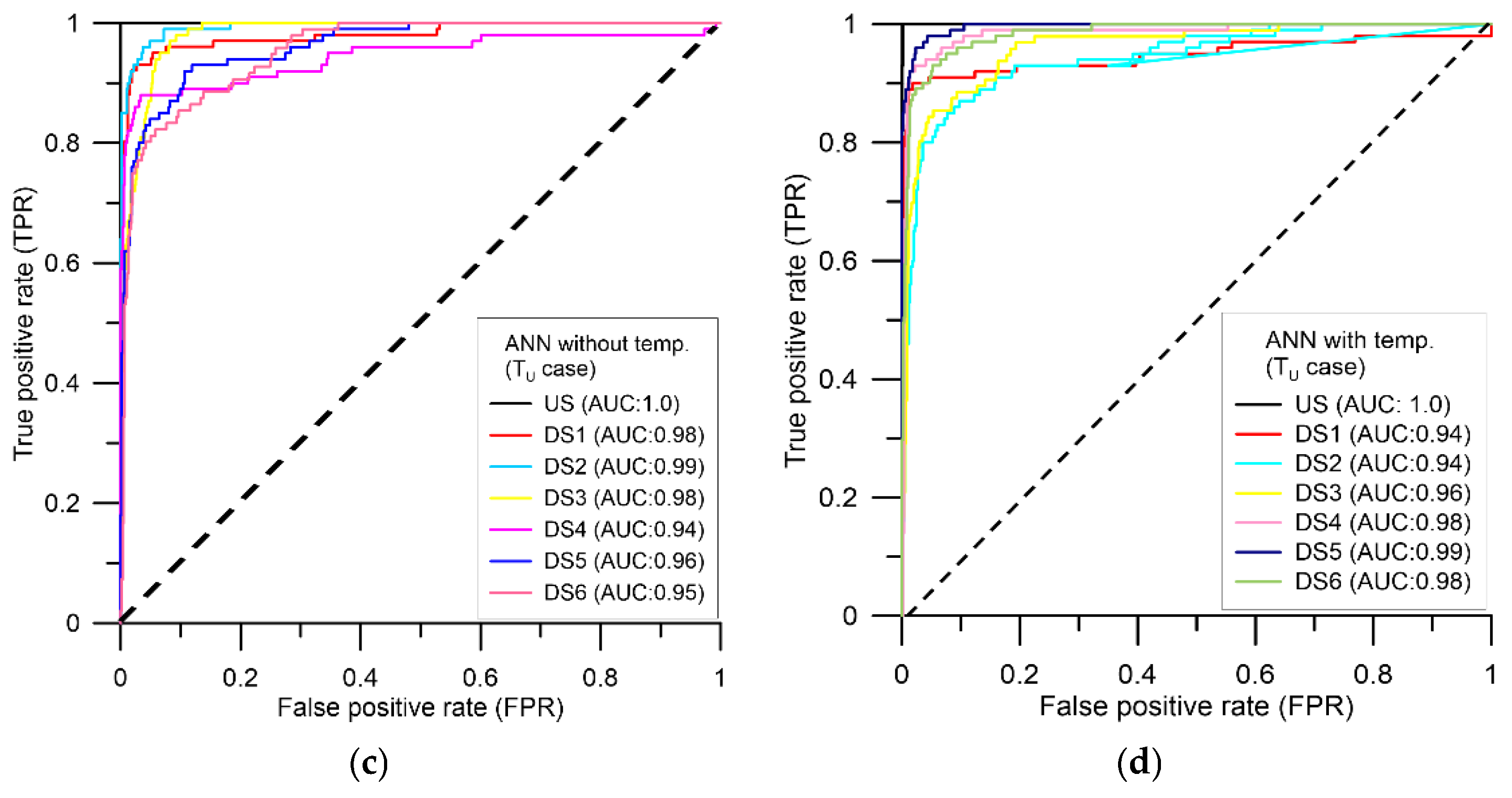
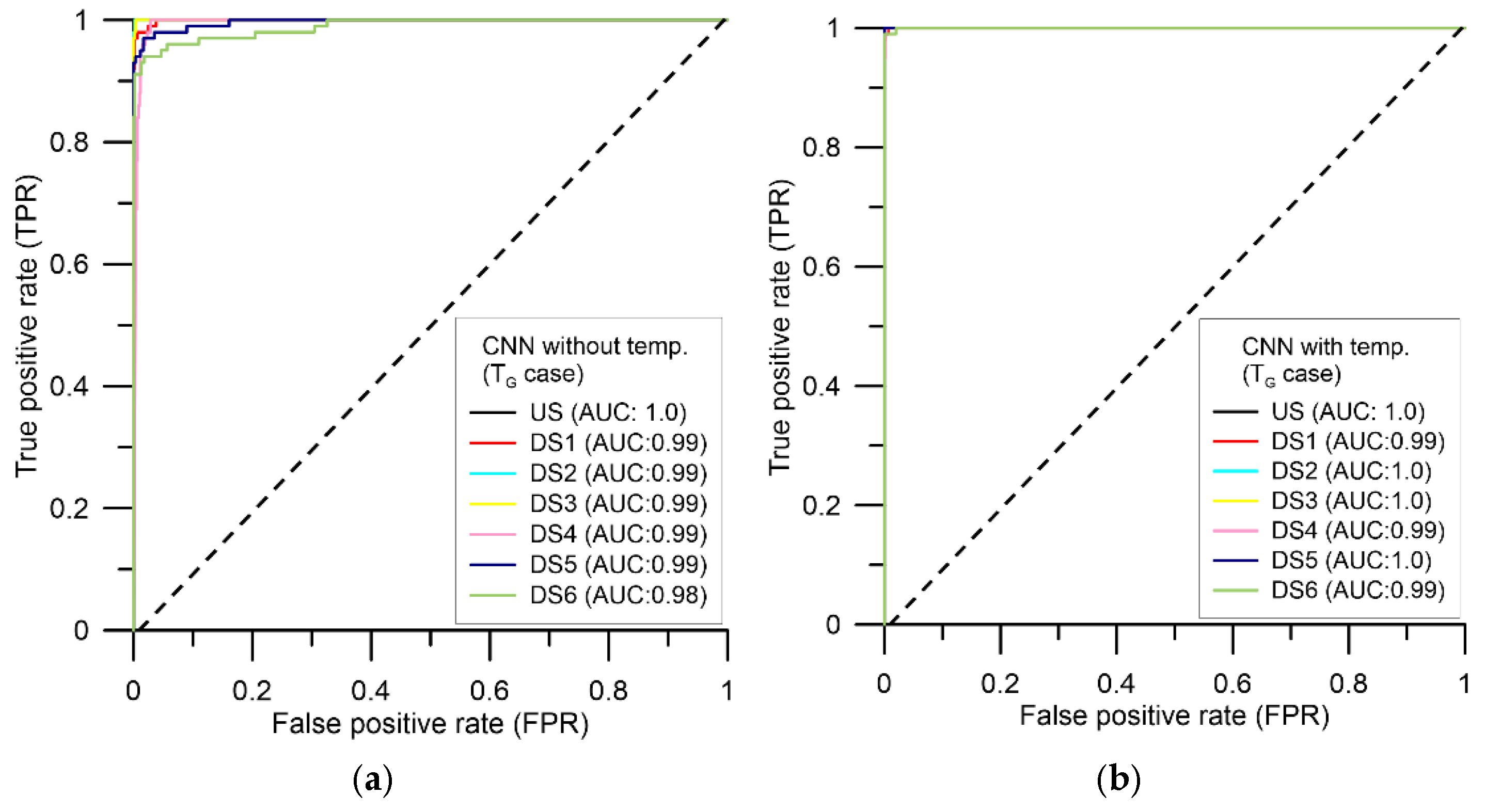
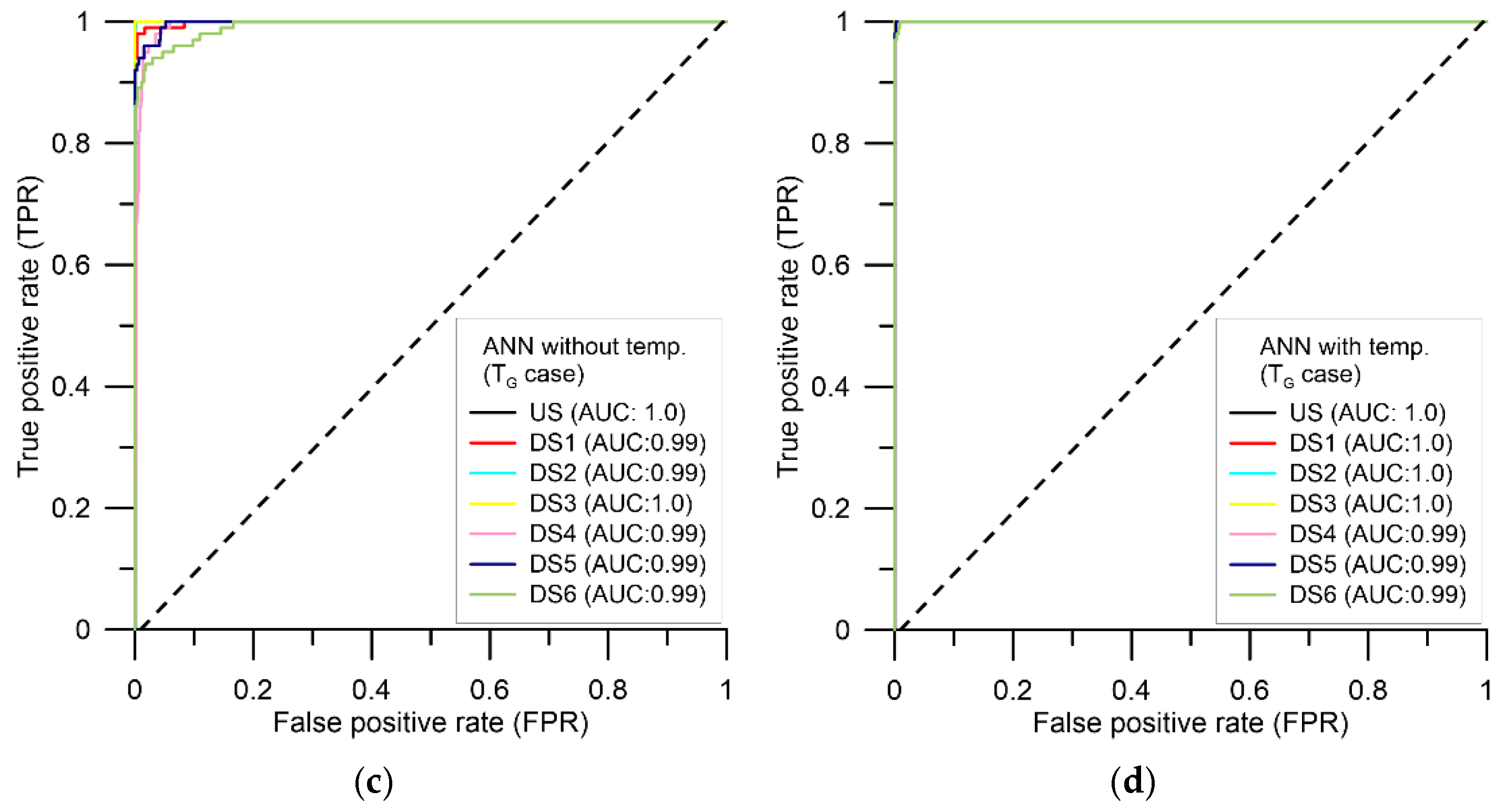
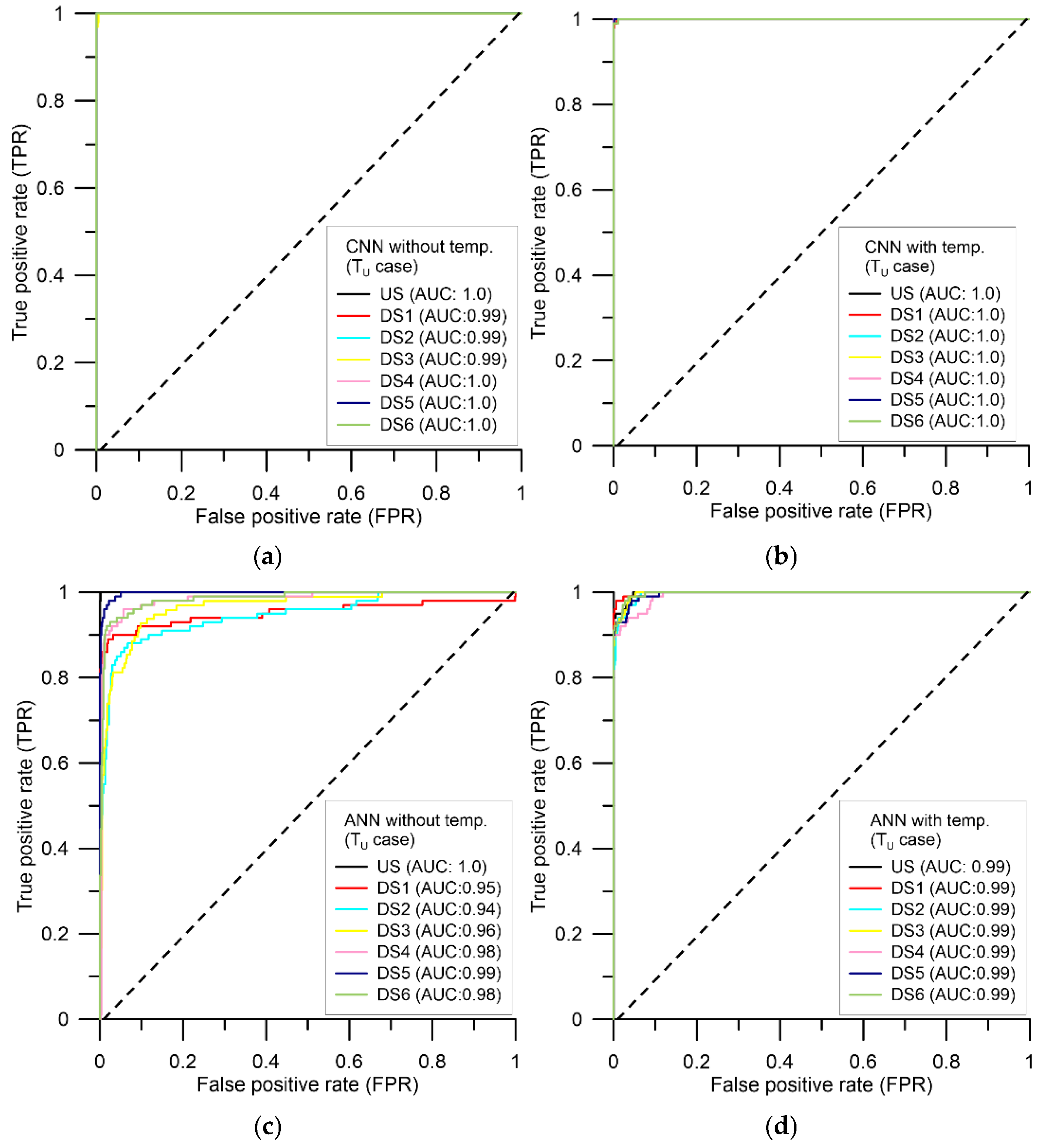
The performance of the two DL models for time-domain damage identification under TG condition is presented in Figure 10, which reports precision, recall, F1 score, and accuracy, while the corresponding ROC curves are presented in Figure 11. The same performance metrics and ROC curves for the TU condition are presented in Figure 12 and Figure 13, respectively. For the TG condition, temperature varied from 20 °C to 50 °C, whereas for the TU condition, it ranged from 20 °C to 30 °C. These figures show the evaluation metrics across undamaged and damaged states (US and DS1–DS6). Overall, the results demonstrate that incorporating temperature information alongside acceleration consistently enhances damage-classification performance for both models. For example, under the TG condition (Figure 10a,b and Figure 11a,b), the proposed CNN model achieved precision, recall, and F1 score exceeding 65%, with an overall accuracy of 88% (avg. AUC = 0.98) when only acceleration was used. When the temperature was integrated, all metrics exceeded 85% and overall accuracy increased to 95% (avg. AUC = 0.99). A similar trend was observed under the TU condition (Figure 12a,b and Figure 13a,b), where overall accuracy improved from 80% (avg. AUC = 0.95) to 92% (avg. AUC = 0.99). In this case, the precision, recall, and F1 Scores remained above 62% without temperature and rose to above 84% once temperature data were incorporated.
Consistent improvements were observed in Precision, Recall, and F1 Score, all of which either increased or remained stable with the addition of temperature. Although a small number of damage cases exhibited localized performance reductions, such as DS5 under the TG condition (Figure 10a), where precision decreased from 91% to 85%, the recall for the same class increased from 88% to 96%. Comparable localized variations appeared across other damage states and model configurations. Such fluctuations are expected, as temperature influences the underlying feature distribution and alters class separability, producing localized trade-offs in sensitivity. Importantly, these variations are limited in scope and do not affect the broader conclusion that overall performance—particularly accuracy—consistently improves when temperature is included.
Temperature fluctuations are known to affect structural stiffness and mass, thereby influencing natural frequencies and mode shapes—key features for vibration-based damage detection. Previous studies support this phenomenon. For instance, Bao et al. [50], using a Dempster–Shafer data fusion approach, demonstrated improved damage identification accuracy in a two-story steel frame under varying thermal conditions. Similarly, Hou and Xia [51] validated their methodology using both a three-story test frame and an operational continuous rigid-frame bridge. Despite only considering ambient temperature variations and measurement noise, their approach achieved high accuracy in detecting damage.
In contrast, the ANN model showed considerably smaller performance changes. Under the TG condition (Figure 10c,d and Figure 11c,d), the ANN achieved an overall accuracy of 87% (avg. AUC = 0.980) using acceleration only, which increased to 94% (avg. AUC = 0.990) after temperature integration. Under the TU condition (Figure 12c,d and Figure 13c,d), accuracy increased marginally, from 85% to 87% (avg. AUC from 0.940 to 0.970). These results indicate that temperature integration substantially enhances CNN-based classification performance, where its effect on ANN performance remains comparatively limited. This limited improvement is likely attributable to the ANN’s lower representational capacity and higher sensitivity to input variability.

3.2. Frequency-Domain Analysis

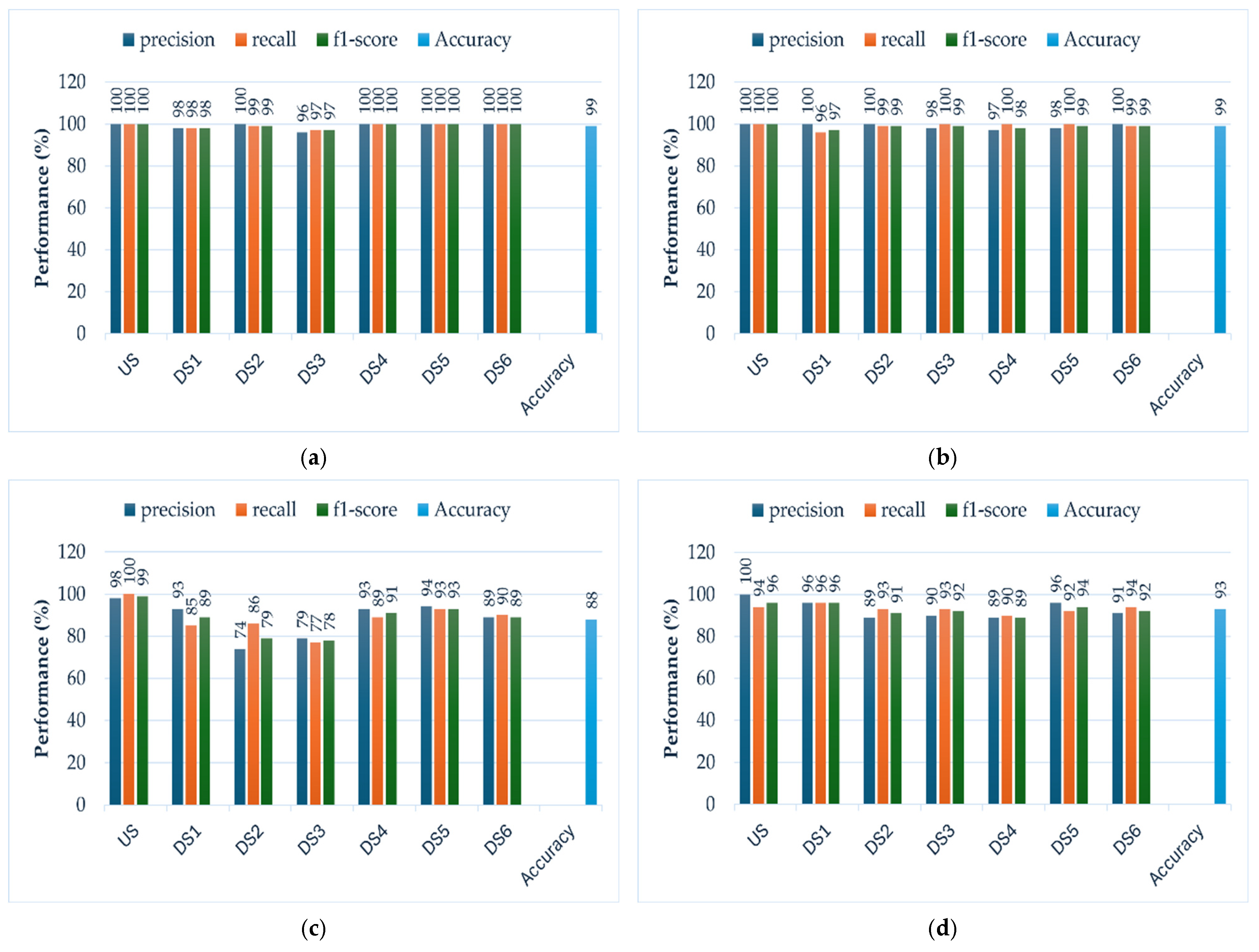
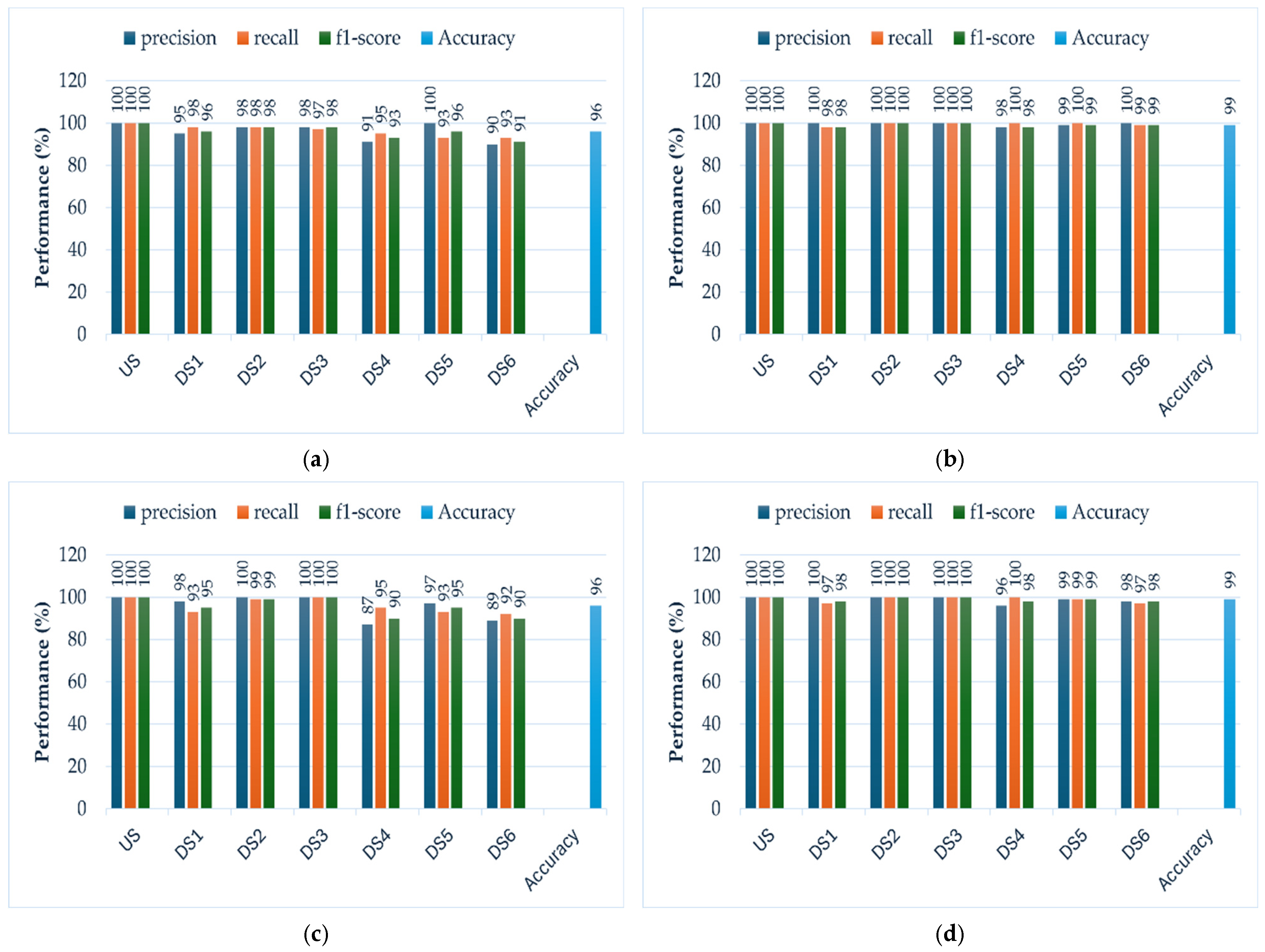
Figure 14 and Figure 15 (TG condition) and Figure 16 and Figure 17 (TU condition) illustrate the performance of DL models for damage identification in the frequency domain. The temperature ranges for the TG and TU conditions were identical to those used in the time-domain analysis. These figures present the changes in the values of evaluation metrics—including Accuracy, Precision, Recall, F1 Score, and AUC—for undamaged and damaged states (US and DS1–DS6). The analysis results indicated that incorporating temperature features alongside acceleration consistently enhanced classification performance across all models. For instance, under the TG condition (Figure 14a,b and Figure 15a,b), the proposed CNN’s configuration achieved Precision, Recall, and F1 Score above 90% across all scenarios, with an overall accuracy of 96% (avg. AUC = 0.99) when using acceleration only. When temperature was included, all performance metrics exceeded 98% and the overall accuracy increased to 99% (avg. AUC = 0.995). Under the TU condition (Figure 16a,b and Figure 17a,b), overall accuracy remained stable at 99% (avg. AUC = 0.990), while Precision, Recall, and F1 Score were above 96% for both configurations (with and without temperature). A similar pattern was observed in the frequency domain, where Precision, Recall, and F1 Score generally increased or remained stable for most scenarios (US and DS1–DS6) when temperature was included. Although a few cases showed slight reductions—for example, DS5, where the precision decreased marginally from 100% to 99%—the same scenario also demonstrated an improvement in Recall, increasing from 93% to 99%. Consistent with the trend observed in the time-domain analysis, these localized fluctuations did not affect the overall outcome, as overall accuracy consistently improved, confirming that the temperature integration was beneficial in the frequency-domain analysis as well. Consistent with the findings in the time-domain analysis, the frequency-domain results demonstrated that integrating temperature data with vibration signals significantly enhanced damage-detection performance for the CNN model.
In contrast, the ANN model exhibited comparatively smaller improvements. Under the TG condition (Figure 14c,d and Figure 15c,d), ANN accuracy increased from 96% to 99%, maintaining an average AUC of 0.99. Under the TU condition (Figure 16c,d and Figure 17c,d), accuracy increased from 88% (avg. AUC = 0.97) to 93% (avg. AUC = 0.99).
Overall, the results obtained from both the time-domain and frequency-domain analyses indicate that the CNN model delivers the best performance across all evaluation metrics. Its higher Accuracy, F1 Score, Precision, and Recall values demonstrate strong damage-detection capability with minimal false positives and false negatives, while its consistently high AUC values indicate excellent class separability and robust generalization across various damage scenarios. Conversely, the lower performance of the ANN suggests limitations in its ability to consistently detect subtle frequency shifts. These limitations may be attributed to overfitting or underfitting, which can lead to increased rates of false-positive or false-negative predictions. Additionally, instances where performance metrics exhibit similar values imply that the numbers of false positives and false negatives are nearly equal for the respective network. It is also noted that when classification performance consistently achieves high accuracy, ROC curves tend to converge toward the upper-left corner of the plot, which limits their effectiveness for fine-grained quantitative comparison. As a result, ROC–AUC values are interpreted as complementary indicators of classification capability rather than as the sole criterion for performance ranking.
Significant differences were observed between the time-domain and frequency-domain results, with frequency-domain analysis consistently yielding superior performance across all conditions and model types. The CNN model, in particular, showed substantial improvements in classification accuracy, precision, recall, F1 Score, and AUC when evaluated in the frequency domain. For instance, under the TG condition using acceleration only, the CNN achieved 96% accuracy in the frequency domain compared to 88% in the time domain. When temperature was included, this disparity widened further, with the CNN attaining 99% accuracy in the frequency domain versus 95% in the time domain. This trend was consistent for all models and temperature conditions.
This superior performance of the frequency-domain approach can be attributed to the transformation of time-series acceleration signals into the frequency domain using the FFT. A key advantage of this approach lies in its ability to attenuate noise by emphasizing periodic signal components while suppressing fluctuations typically associated with measurement noise. By exploiting the inherent periodicity of structural vibrations, frequency-domain analysis increases the signal-to-noise ratio and improves the model’s sensitivity to damage-related spectral variations. Moreover, frequency-domain techniques are inherently more responsive to structural damage than time-domain methods because they emphasize resonant frequencies that reflect changes in stiffness and strength. This trend was also found in the KW51 Bridge study using a Deep-Learning-Based 1D CNN model [52], where frequency-domain characteristics provided clearer and more reliable indicators of damage, particularly within the primary vibration modes.

4. Conclusions

This study developed a deep-learning-based framework for the simultaneous assessment of damage severity in a composite bridge structure using time-domain and frequency-domain datasets with temperature variations (TG and TU). Two deep learning models (ANN and CNN) were evaluated for this purpose. The main conclusions are summarized as follows:
  • Models utilizing frequency-domain inputs consistently outperformed those relying solely on time-domain data. When comparing the two domains, the frequency-domain features yielded higher overall accuracy in both temperature conditions. Without temperature, accuracy improved by approximately 8% (CNN, TG), 9% (ANN, TG), 19% (CNN, TU), and 3% (ANN, TU). When temperature was included, the frequency-domain gains remained evident, with increases of approximately 4% (CNN, TG), 5% (ANN, TG), 7% (CNN, TU), and 6% (ANN, TU). The frequency domain effectively captured modal characteristics—such as shifts in natural frequencies and changes in resonance peaks—that are closely associated with structural integrity. Consequently, both models, particularly CNN, demonstrated higher discriminative capability when operating on frequency-domain features. In addition, frequency-domain representations were inherently less affected by transient noise, providing more reliable input features under varying thermal conditions.
  • The integration of temperature measurements (top, middle, and bottom layers) improved model performance across both network architectures and signal domains. Under time-domain analysis, when comparing acceleration-only inputs to acceleration combined with temperature, the overall accuracy increased by approximately 7% in the TG condition for both the CNN and ANN models. In the TU condition, the improvement was more pronounced for the CNN (approximately 13%), whereas the ANN exhibited a smaller gain of about 2%. In the frequency domain, a similar improvement pattern was observed. With temperature integration, overall accuracy for both models increased by approximately 3% under TG conditions; under Tu conditions, the ANN improved by about 5%, while the CNN showed no change. The incorporation of thermal data enabled the models to better distinguish between changes induced by structural damage and those arising from thermal effects, thereby enhancing classification robustness under TG and TU conditions.
  • The CNN model achieved higher Accuracy, Precision, Recall, F1 Score, and AUC values compared to the ANN. The CNN consistently demonstrated superior classification performance across all experimental conditions, including both time-domain and frequency-domain representations under the two temperature conditions (TG and TU). This outcome is consistent with the hypothesis that CNNs are better suited for identifying structural patterns associated with damage due to their spatial feature-extraction capability and robustness to input variability.
Overall, the study demonstrates that incorporating temperature data alongside vibration signals significantly enhances the performance of data-driven damage detection models in both time and frequency domains, even under global dynamic variations induced by controlled damage scenarios. Among the evaluated models, the CNN consistently outperformed the ANN, which can be attributed to its more effective hierarchical feature-extraction capability. Furthermore, frequency-domain analysis yielded higher classification accuracy than time-domain analysis, with temperature inputs further improving the model’s ability to distinguish between undamaged and damaged states. These findings underscore the importance of integrating thermal effects into vibration-based SHM frameworks.
It should be noted that the damage scenarios considered in this study were implemented using a non-destructive mass-loading scheme to induce controlled variations in the global dynamic response of the composite bridge specimen. This approach primarily introduces inertial perturbations, resulting in measurable shifts in modal frequencies and spectral amplitudes, and does not directly replicate stiffness-driven or localized damage mechanisms typically observed in real composite bridges, such as cracking, shear-connector degradation, or interfacial debonding. Consequently, the deep-learning models evaluated in this work may predominantly learn patterns associated with mass-induced and temperature-induced global dynamic changes. It should also be noted that the scaled laboratory specimen exhibits modal characteristics that differ from those of full-scale bridges, including higher natural frequencies, lower damping, and clearer modal separation. These characteristics can contribute to enhanced classification performance; therefore, the reported results are intended to demonstrate the feasibility of temperature-integrated vibration-based damage classification under well-controlled laboratory conditions rather than to imply direct field deployability. The results should therefore be interpreted as demonstrating the feasibility of temperature-integrated, vibration-based damage classification under well-controlled laboratory conditions, rather than as direct evidence of field-ready identification of physical damage mechanisms. Future extensions of this framework will focus on non-destructive and field-relevant perturbations, such as variations in boundary or support conditions, to further extend the applicability of the proposed methodology and to improve robustness under varying thermal conditions.

Author Contributions

J.K. and B.H.C. conceptualized the test set up and procedures; A.P. performed vibration tests and deep learning analysis; A.P. wrote the draft for the article; J.Y.S. and B.H.C. gave advices on the tests; J.K. supervised this research program and finalized the article. All authors have read and agreed to the published version of the manuscript.

Funding

This research was supported by the Basic Science Research Program of the National Research Foundation of Korea (NRF), funded by the Ministry of Education (RS-2021-NR066037), and by the Regional Innovation System & Education (RISE) program through the Gangwon RISE Center, funded by the Ministry of Education (MOE) and the Gangwon State, Republic of Korea (2025-RISE-10-002).

Institutional Review Board Statement

Not applicable.

Informed Consent Statement

Not applicable.

Data Availability Statement

Data are available from the authors upon reasonable request.

Conflicts of Interest

The authors declare no conflicts of interest.

Appendix A

Table A1. Summary of training configuration and hyperparameters for ANN and CNN.
CategoryParameterANNCNNRemarks/Rationale
Input DataInput typeTime-domain/Frequency-domain acceleration (+temperature)Time-domain/Frequency-domain acceleration (+temperature)Identical input settings used for fair comparison
Temperature inputsTop, middle, bottom (3 channels)Top, middle, bottom (3 channels)Feature-level fusion at input stage
PreprocessingSignal normalizationPer-sample Z-scorePer-sample Z-scoreRemoves scale variability across samples
Frequency range (FFT)0–200 Hz0–200 HzCovers dominant structural modes
Model TrainingOptimizerAdamAdamWidely used; stable convergence
Learning rate0.0010.001Standard choice; verified by preliminary tests
Batch size3232Trade-off between stability and efficiency
Number of epochs100100Ensured convergence without overfitting
RegularizationDropout rate0.30.3Reduces overfitting
Batch normalizationNoYesImproves training stability in CNN
Loss FunctionLossCategorical cross-entropyCategorical cross-entropyMulticlass classification
Class HandlingClass weightingNone (balanced dataset)None (balanced dataset)Equal samples per class
EvaluationData split80% train/20% test80% train/20% testRandom split
Performance metricsAccuracy, precision, recall, F1-score, AUC-ROCAccuracy, precision, recall, F1-score, AUC-ROCStandard classification metrics

References

  1. Kaphle, M.; Tan, A.; Thambiratnam, D.; Chan, T. Structural Health Monitoring of Bridges; KTH: Stockholm, Sweden, 2011. [Google Scholar]
  2. Saidin, S.S.; Kudus, S.A.; Jamadin, A.; Anuar, M.A.; Amin, N.M.; Ya, A.B.Z.; Sugiura, K. Vibration-Based Approach for Structural Health Monitoring of Ultra-High-Performance Concrete Bridge. Case Stud. Constr. Mater. 2023, 18, e01752. [Google Scholar] [CrossRef]
  3. Tarunpreet Singh, S.S.; Prakash, C.; Dixit, S. Real-Time Structural Health Monitoring and Damage Identification Using Frequency Response Functions along with Finite Element Model Updating Technique. Sensors 2022, 22, 4546. [Google Scholar] [CrossRef] [PubMed]
  4. Cai, Y.; Zhang, K.; Ye, Z.; Liu, C.; Lu, K.; Wang, L. Influence of Temperature on the Natural Vibration Characteristics of Simply Supported Reinforced Concrete Beam. Sensors 2021, 21, 4242. [Google Scholar] [CrossRef] [PubMed]
  5. Yang, Y.; Hossen, M.S.; Lacidogna, G.; Xu, W.; Kawsar, I.; Sun, J.; Hossain, S. Effect of Temperature on the Modal Parameters of Continuous Rigid Frame Bridge. Dev. Built Environ. 2025, 21, 100631. [Google Scholar] [CrossRef]
  6. Lin, Y.Z.; Nie, Z.H.; Ma, H.W. Structural Damage Detection with Automatic Feature-Extraction through Deep Learning. Comput. Aided Civ. Infrastruct. Eng. 2017, 32, 1025–1046. [Google Scholar] [CrossRef]
  7. Jiang, C.; Zhou, Q.; Lei, J.; Wang, X. A Two-Stage Structural Damage Detection Method Based on 1D-CNN and SVM. Appl. Sci. 2022, 12, 10394. [Google Scholar] [CrossRef]
  8. Kim, S.; Mukhiddinov, M. Data Anomaly Detection for Structural Health Monitoring Based on a Convolutional Neural Network. Sensors 2023, 23, 8525. [Google Scholar] [CrossRef]
  9. Poudel, A.; Kim, S.; Yeol, J.; Kim, J. Modal Frequency Responses of Composite Bridges under Temperature and Boundary Condition Variations. Dev. Built Environ. 2025, 24, 100786. [Google Scholar] [CrossRef]
  10. Poudel, A.; Kim, S.; Cho, B.H.; Kim, J. Temperature Effects on the Natural Frequencies of Composite Girders. Appl. Sci. 2024, 14, 1175. [Google Scholar] [CrossRef]
  11. Ko, J.M.; Ni, Y.Q. Technology Developments in Structural Health Monitoring of Large-Scale Bridges. Eng. Struct. 2005, 27, 1715–1725. [Google Scholar] [CrossRef]
  12. Xu, Z.D.; Wu, Z. Simulation of the Effect of Temperature Variation on Damage Detection in a Long-Span Cable-Stayed Bridge. Struct. Health Monit. 2007, 6, 177–189. [Google Scholar] [CrossRef]
  13. Zhou, F.H.; Ni, Q.Y.; Ko, M.J. Eliminating Temperature Effect in Vibration-Based Structural Damage Detection. J. Eng. Mech. 2011, 137, 785–796. [Google Scholar] [CrossRef]
  14. Abid, S.R.; Mussa, F.; Tayşi, N.; Özakça, M. Experimental and Finite Element Investigation of Temperature Distributions in Concrete-Encased Steel Girders. Struct. Control Health Monit. 2018, 25, e2042. [Google Scholar] [CrossRef]
  15. Yarnold, M.T.; Moon, F.L. Temperature-Based Structural Health Monitoring Baseline for Long-Span Bridges. Eng. Struct. 2015, 86, 157–167. [Google Scholar] [CrossRef]
  16. Wang, Z.; Huang, M. Temperature Effects on Vibration-Based Damage Detection of a Reinforced Concrete Slab. Appl. Sci. 2020, 10, 2869. [Google Scholar] [CrossRef]
  17. Wang, Z.; Yi, T.-H.; Yang, D.-H.; Li, H.-N.; Liu, H. Eliminating the Bridge Modal Variability Induced by Thermal Effects Using Localized Modeling Method. J. Bridge Eng. 2021, 26, 4021073. [Google Scholar] [CrossRef]
  18. Gong, X.; Song, X.; Li, G.; Xiong, W.; Cai, C.S. Deep Learning Based Anomaly Identification of Temperature Effects in Bridge Structural Health Monitoring Data. Structures 2024, 69, 107478. [Google Scholar] [CrossRef]
  19. Yessoufou, F.; Zhu, J. Classification and Regression-Based Convolutional Neural Network and Long Short-Term Memory Configuration for Bridge Damage Identification Using Long-Term Monitoring Vibration Data. Struct. Health Monit. 2023, 22, 4027–4054. [Google Scholar] [CrossRef]
  20. Zunino, L.; Casas, J.R.; Domaneschi, M. Bridge Damage Assessment under Traffic and Environmental Variability: A Case Study on Yonghe Cable-Stayed Bridge. Eng. Struct. 2025, 343, 120965. [Google Scholar] [CrossRef]
  21. Keshmiry, A.; Hassani, S.; Mousavi, M.; Dackermann, U. Effects of Environmental and Operational Conditions on Structural Health Monitoring and Non-Destructive Testing. Building 2023, 13, 918. [Google Scholar] [CrossRef]
  22. Fernandez-navamuel, A.; Pardo, D.; Magalhães, F. Bridge Damage Identification under Varying Environmental and Operational Conditions Combining Deep Learning and Numerical Simulations. Mech. Syst. Signal Process. 2023, 200, 110471. [Google Scholar] [CrossRef]
  23. Mousavi, Z.; Ettefagh, M.M.; Sadeghi, M.H.; Razavi, S.N. Developing Deep Neural Network for Damage Detection of Beam-like Structures Using Dynamic Response Based on FE Model and Real Healthy State. Appl. Acoust. 2020, 168, 107402. [Google Scholar] [CrossRef]
  24. Hajializadeh, D. Deep Learning-Based Indirect Bridge Damage Identification System. Struct. Health Monit. 2023, 22, 897–912. [Google Scholar] [CrossRef]
  25. American Association of State Highway and Transportation. AASHTO LRFD Bridge, Design Specifications; AASHTO: Washington, DC, USA, 2007. [Google Scholar]
  26. Dang, H.V.; Raza, M.; Nguyen, T.V.; Bui-Tien, T.; Nguyen, H.X. Deep Learning-Based Detection of Structural Damage Using Time-Series Data. Struct. Infrastruct. Eng. 2021, 17, 1474–1493. [Google Scholar] [CrossRef]
  27. Azad, M.M.; Munyaneza, O.; Jung, J.; Sohn, J.W.; Han, J.W.; Kim, H.S. Damage Localization and Severity Assessment in Composite Structures Using Deep Learning Based on Lamb Waves. Sensors 2024, 24, 8057. [Google Scholar] [CrossRef]
  28. Doroudi, R.; Lavassani, S.H.H.; Shahrouzi, M. Optimal Tuning of Three Deep Learning Methods with Signal Processing and Anomaly Detection for Multi-Class Damage Detection of a Large-Scale Bridge. Struct. Health Monit. 2024, 23, 3227–3252. [Google Scholar] [CrossRef]
  29. Ghazimoghadam, S.; Hosseinzadeh, S.A.A. A Novel Unsupervised Deep Learning Approach for Vibration-Based Damage Diagnosis Using a Multi-Head Self-Attention LSTM Autoencoder. Measurement 2024, 229, 114410. [Google Scholar] [CrossRef]
  30. Gu, J.; Gul, M.; Wu, X. Damage Detection under Varying Temperature Using Artificial Neural Networks. Struct. Control Health Monit. 2017, 24, e1998. [Google Scholar] [CrossRef]
  31. Farias, S.V.; Saotome, O.; Campos Velho, H.F.; Shiguemori, E.H. A Damage Detection Method Using Neural Network Optimized by Multiple Particle Collision Algorithm. J. Sens. 2021, 2021, 9998187. [Google Scholar] [CrossRef]
  32. Malekian, A.; Chitsaz, N. Concepts, Procedures, and Applications of Artificial Neural Network Models in Streamflow Forecasting. In Advances in Streamflow Forecasting; Elsevier: Amsterdam, The Netherlands, 2021; pp. 115–147. [Google Scholar] [CrossRef]
  33. Zafar, A.; Saba, N.; Arshad, A.; Alabrah, A.; Riaz, S.; Suleman, M.; Zafar, S.; Nadeem, M. Convolutional Neural Networks: A Comprehensive Evaluation and Benchmarking of Pooling Layer Variants. Symmetry 2024, 16, 1516. [Google Scholar] [CrossRef]
  34. Fard, F. Development and Utilization of Bridge Data of the United States for Predicting Deck Condition Rating Using Random Forest, XGBoost, and Artificial Neural Network. Remote Sens. 2024, 16, 367. [Google Scholar] [CrossRef]
  35. Hinton, G. Dropout: A Simple Way to Prevent Neural Networks from Overfitting. J. Mach. Learn. Res. 2014, 15, 1929–1958. [Google Scholar]
  36. Uzair, M.; Jamil, N. Effects of Hidden Layers on the Efficiency of Neural Networks. In Proceedings of the 2020 IEEE 23rd International Multitopic Conference (INMIC), Bahawalpur, Pakistan, 5–7 November 2020; pp. 1–6. [Google Scholar] [CrossRef]
  37. Liu, C.; Zhao, Z.; Wen, G. Adaptive Neural Network Control with Optimal Number of Hidden Nodes for Trajectory Tracking of Robot Manipulators. Neurocomputing 2019, 350, 136–145. [Google Scholar] [CrossRef]
  38. Sony, S.; Gamage, S.; Sadhu, A.; Samarabandu, J. Vibration-Based Multiclass Damage Detection and Localization Using Long Short-Term Memory Networks. Structures 2022, 35, 436–451. [Google Scholar] [CrossRef]
  39. Lee, Y.; Kim, H.; Min, S.; Yoon, H. Structural Damage Detection Using Deep Learning and FE Model Updating Techniques. Sci. Rep. 2023, 13, 18694. [Google Scholar] [CrossRef]
  40. Chamangard, M.; Amiri, G.G.; Darvishan, E.; Rastin, Z. Transfer Learning for CNN-Based Damage Detection in Civil Structures with Insufficient Data. Shock Vib. 2022, 2022, 3635116. [Google Scholar] [CrossRef]
  41. Lu, N.; Xiao, X.; Cui, J.; Liu, Y.; Luo, Y. A Semisupervised Transfer Learning Method for Structural Damage Identification and Its Application to a Cable- Stayed Bridge. Struct. Control Health Monit. 2025, 2025, 6840921. [Google Scholar] [CrossRef]
  42. Goodfellow, I.; Bengio, Y.; Courville, A.; Bengio, Y. Deep Learning; MIT Press: Cambridge, UK, 2016; Volume 1. [Google Scholar]
  43. Ioffe, S.; Szegedy, C. Batch Normalization: Accelerating Deep Network Training by Reducing Internal Covariate Shift. In Proceedings of the 32nd International Conference on International Conference on Machine Learning, Lille, France, 6–11 July 2015. [Google Scholar]
  44. Wang, Y.; Cai, C.S.; Han, B.; Xie, H.; Bao, F.; Wu, H. A Deep Learning-Based Approach for Assessment of Bridge Condition through Fusion of Multi-Type Inspection Data. Eng. Appl. Artif. Intell. 2024, 128, 107468. [Google Scholar] [CrossRef]
  45. Su, Q.; Carin, L. A Probabilistic Framework for Nonlinearities in Stochastic Neural Networks. Adv. Neural Inf. Process. Syst. 2017, 30. [Google Scholar]
  46. Zhang, W.; Li, C.; Peng, G.; Chen, Y.; Zhang, Z. A Deep Convolutional Neural Network with New Training Methods for Bearing Fault Diagnosis under Noisy Environment and Different Working Load. Mech. Syst. Signal Process. 2018, 100, 439–453. [Google Scholar] [CrossRef]
  47. LeCun, Y.; Bengio, Y.; Hinton, G. Deep Learning. Nature 2015, 521, 436–444. [Google Scholar] [CrossRef]
  48. Sony, S.; Gamage, S.; Sadhu, A.; Samarabandu, J. Multiclass Damage Identification in a Full-Scale Bridge Using Optimally-Tuned One-Dimensional Convolutional Neural Network. J. Comput. Civ. Eng. 2022, 36, 04021035. [Google Scholar] [CrossRef]
  49. Gui, G.; Pan, H.; Lin, Z.; Li, Y.; Yuan, Z. Data-Driven Support Vector Machine with Optimization Techniques for Structural Health Monitoring and Damage Detection. KSCE J. Civ. Eng. 2017, 21, 523–534. [Google Scholar] [CrossRef]
  50. Bao, Y.; Xia, Y.; Li, H.; Xu, Y.L.; Zhang, P. Data Fusion-Based Structural Damage Detection under Varying Temperature Conditions. Int. J. Struct. Stab. Dyn. 2012, 12, 1250052. [Google Scholar] [CrossRef]
  51. Hou, R.; Xia, Y. Review on the New Development of Vibration-Based Damage Identification for Civil Engineering Structures: 2010–2019. J. Sound Vib. 2021, 491, 115741. [Google Scholar] [CrossRef]
  52. Al-ghalib, A.A. Damage Identification of Railway Bridge KW51 Conditions Using Deep—Learning—Based 1D CNN Model. J. Soft Comput. Civ. Eng. 2025, 9, 125–146. [Google Scholar]
Figure 1. Schematic of the proposed composite-bridge damage-detection system.
Applsci 16 01263 g001
Figure 2. Schematic diagram and dimensions of the composite bridge.
Applsci 16 01263 g002
Figure 3. Schematic diagram of measurement plan.
Applsci 16 01263 g003
Figure 4. Overview of damage location.
Applsci 16 01263 g004
Figure 5. Representative test results at the mid-span for the undamaged condition at 20 °C.
Applsci 16 01263 g005
Figure 6. Representative results at the mid-span under DS6 at 20 °C.
Applsci 16 01263 g006
Figure 7. Illustration of a typical ANN architecture.
Applsci 16 01263 g007
Figure 8. Illustration of a typical CNN architecture.
Applsci 16 01263 g008
Figure 9. Workflow of proposed damage detection framework.
Applsci 16 01263 g009
Figure 10. Performance evaluation under the TG condition based on time-domain data: (a) CNN without temperature input; (b) CNN with temperature input; (c) ANN without temperature input; (d) ANN with temperature input.
Applsci 16 01263 g010aApplsci 16 01263 g010b
Figure 11. AUC–ROC curves of the optimized CNN and ANN under the TG condition based on time-domain data: (a) CNN without temperature input; (b) CNN with temperature input; (c) ANN without temperature input; (d) ANN with temperature input.
Applsci 16 01263 g011
Figure 12. Performance evaluation under the TU condition based on time-domain data: (a) CNN without temperature input; (b) CNN with temperature input; (c) ANN without temperature input; (d) ANN with temperature input.
Applsci 16 01263 g012
Figure 13. AUC–ROC curves of the optimized CNN and ANN under the TU condition based on time-domain data: (a) CNN without temperature input; (b) CNN with temperature input; (c) ANN without temperature input; (d) ANN with temperature input.
Applsci 16 01263 g013aApplsci 16 01263 g013b
Figure 14. Performance evaluation under the TG condition based on frequency-domain data: (a) CNN without temperature input; (b) CNN with temperature input; (c) ANN without temperature input; (d) ANN with temperature input.
Applsci 16 01263 g014
Figure 15. AUC–ROC curves of the optimized CNN and ANN under the TG condition based on frequency-domain data: (a) CNN without temperature input; (b) CNN with temperature input; (c) ANN without temperature input; (d) ANN with temperature input.
Applsci 16 01263 g015aApplsci 16 01263 g015b
Figure 16. Performance evaluation under the TU condition based on frequency-domain data: (a) CNN without temperature input; (b) CNN with temperature input; (c) ANN without temperature input; (d) ANN with temperature input.
Applsci 16 01263 g016
Figure 17. AUC–ROC curves of the optimized CNN and ANN under the TU condition based on frequency-domain data: (a) CNN without temperature input; (b) CNN with temperature input; (c) ANN without temperature input; (d) ANN with temperature input.
Applsci 16 01263 g017
Table 1. Classification of damage scenarios.
Damage ScenarioDamage LevelDamage LocationTG VariationTU Variation
US (undamaged)No damage-20–50 °C20–30 °C
DS1278 N (62.5 lb)L1
DS2L2
DS3L3
DS4556 N (125 lb)L1
DS5L2
DS6L3
Table 2. Commonly used activation functions in neural networks.
FunctionSigmoidTanhReLU
GraphApplsci 16 01263 i001Applsci 16 01263 i002Applsci 16 01263 i003
Expression f ( x ) = 1 1 + e x f ( x ) = 1 e 2 x 1 + e 2 x f ( x ) = x , x 0 0 , x < 0
Disclaimer/Publisher’s Note: The statements, opinions and data contained in all publications are solely those of the individual author(s) and contributor(s) and not of MDPI and/or the editor(s). MDPI and/or the editor(s) disclaim responsibility for any injury to people or property resulting from any ideas, methods, instructions or products referred to in the content.