Article

Sedimentary Characteristics and Controls of Reef–Shoal Reservoirs, M Block, Eastern Sichuan Basin


1
Hubei Key Laboratory of Petroleum Geochemisty and Environment, Yangtze University, Wuhan 430100, China
2
State Key Laboratory of Geological Processes and Mineral Resources, China University of Geosciences, Wuhan 430074, China
3
Hubei Key Laboratory of Southern Complex Shale Oil and Gas Geology and Development, Yangtze University, Wuhan 430100, China
4
Research Institute of Petroleum Exploration & Development, Beijing 100083, China
*
Author to whom correspondence should be addressed.
Appl. Sci. 2026, 16(3), 1257; https://doi.org/10.3390/app16031257
Submission received: 29 December 2025 / Revised: 19 January 2026 / Accepted: 23 January 2026 / Published: 26 January 2026
(This article belongs to the Section Earth Sciences)

Abstract

The marine carbonate reef–shoal reservoirs in the gentle slope platform margin of the M block, eastern Sichuan Basin, were well developed during the Changxing Period in late Permian and represent a favorable carbonate reservoir play for petroleum exploration. The lack of effective research methods has hindered the analysis of their unique sedimentary characteristics and controlling factors. Based on cores, thin sections, well logs, testing analyses, and high-resolution 3D seismic data, this study analyzes the lithological associations, microfacies types, reservoir physical properties, and seismic reflection characteristics of reef–shoal reservoirs. On this basis, the reef–shoal sedimentary characteristics and controlling factors were analyzed. The main conclusions are as follows: (1) Two major categories and eight subcategories of petrography were identified in marine carbonate reef–shoals, and five microfacies were identified: reef base, reef core, reef flank, reef-top–shoal, and inter-reef sea. Among these, the reef-top–shoal constitutes the optimal reservoir, while the reef flank develops secondary reservoirs. (2) The reef–shoals exhibit an external mound or wedge-shaped reflection, with internally discontinuous or chaotic reflections. Discontinuous reflections are observed at the top, while onlap terminations are present on its flanks. (3) The vertical accretion of the marine reef–shoals is small, but the platform margin belt is wide in planar, multiple rows reef–shoal bodies are identified, reflecting their small scale, discrete planar distribution, rapid lateral migration, and diverse stacking patterns. (4) The regional gentle slope marine platform margin geological setting, tectonic paleogeomorphology, and high-frequency sea level fluctuation collectively control the sedimentary structure and the formation of high-quality reservoirs of the marine reef–shoal complex. This research provides guidance for petroleum exploration and favorable reservoir prediction in the marine carbonate reservoirs of the Sichuan Basin.

1. Introduction

The marine carbonate reef–shoal reservoirs surrounding the Kaijiang–Liangping Trough in the eastern Sichuan Basin contain cumulative proven reserves exceeding hundreds of billions of cubic meters. These reservoirs not only represent a significant large scale gas accumulation group discovered in the Sichuan Basin, but also demonstrate substantial resource potential and exploration prospects. As a key successor area for natural gas resources within the basin, this region possesses superior hydrocarbon accumulation conditions and extensive distribution, holding strategic importance for ensuring regional energy security and advancing the theory of deep carbonate oil and gas exploration [1,2,3,4,5,6,7]. The M block is located at the southeastern terminus of this Trough; the platform margin slope in this area was broad and gentle, with the slope gradient generally less than 5°. The gentle slope platform margin depositional system is widely developed on a low-angle geomorphic background, forming a representative low-angle and gentle slope platform margin marine reef–shoal reservoir facies belt [8,9,10]. Such facies belts often regionally exhibit belt-shaped distribution along the platform margin, with multi-stage superposition both vertically and laterally, forming substantial marine carbonate reservoir bodies [11,12,13,14].
Generally, gentle slope platform margins are located in high-energy hydrodynamic environments influenced by open marine waves and tidal actions. Abundant nutrients and suitable water conditions provide the foundation for the prosperity of reef-building organisms and shoal-grained sediments. Such facies belts are typically characterized by their extensive distribution, multi-stage vertical and lateral stacking, and relatively good lateral connectivity [15,16,17,18,19,20], making them favorable zones for high-quality carbonate reservoir development.
However, with the continuous exploration and data accumulation along the tectonic belts of the Trough, it has been gradually recognized that even within an overall gentle -slope paleogeomorphic setting, such reservoirs exhibit strong internal heterogeneity [18,19,20,21,22,23,24]. This is specifically manifested in the following aspects: (1). Complex lithological assemblages: There are frequent intercalations or lateral facies changes among skeletal limestone, grainstone, micritic limestone, and dolomitized rocks. (2). Gradual microfacies boundary: The boundaries between reef, shoal, and inter-reef microfacies are often gradational, which makes it difficult to determine. (3). Rapidly changing reservoir properties: Petrophysical parameters (e.g., porosity and permeability) change abruptly, and high-quality reservoir intervals are discontinuously distributed. Significant variations exist in the effective thickness, pore type, and spatial distribution of the reservoirs among different reef–shoal bodies, and even within a single reef–shoal body. The factors mentioned above severely constrain the accurate assessment of gas reserves and the efficient development of these reservoirs.
To address the above geological issues, this study uses integrated data, including core, thin sections, well logs, geochemical test data, and 3D seismic data, to investigate the sedimentary characteristics and controlling factors of marine carbonate reef–shoal reservoirs in the Changxing Formation of the M Block, eastern Sichuan Basin. The specific research objectives are as follows: (1) to analyze the petrography, lithofacies associations, favorable reservoir lithologies, and sedimentary microfacies types of the marine reef–shoal reservoirs on the gentle slope platform margin; (2) to reveal the sedimentary facies characteristics and distribution regularity of marine reef–shoal reservoirs on the gentle slope platform margin by combining drilling and seismic interpretation results; and (3) to discuss the main factors controlling the development of marine reef–shoals in a gentle slope setting.

2. Geological Setting

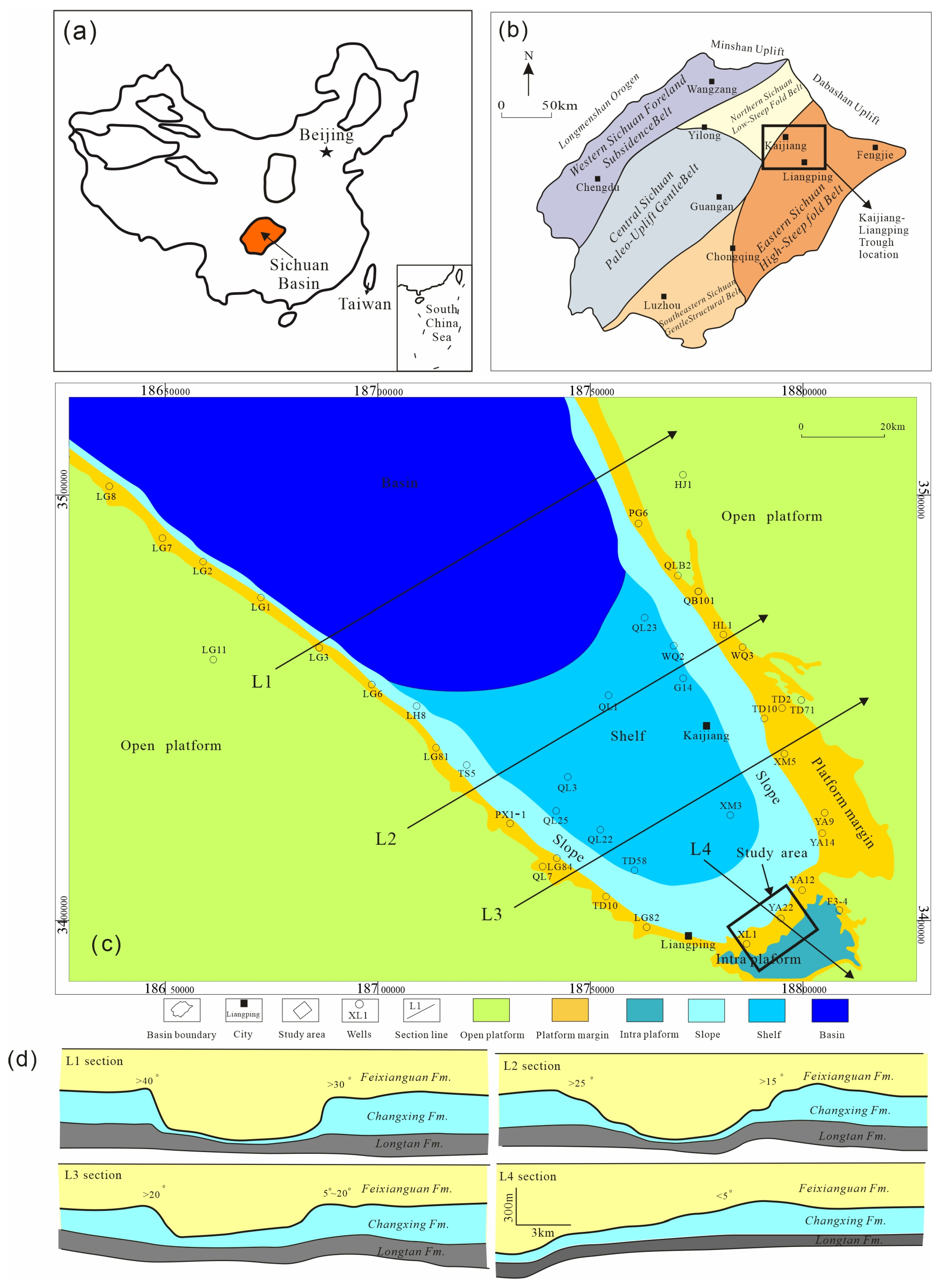
The Sichuan Basin, located in the Yangtze block of southwestern China, is a gas-dominated petroliferous basin developed upon Proterozoic basement [18,19,20,21,22]. It is an approximately NE-SW trending rhombic province, covering an area of more than 180,000 km2 [23,24,25,26]. The Kaijiang–Liangping Trough is tectonically situated within the Eastern Sichuan High-steep fold belt, covering an area of nearly 20,000 km2. This Trough formed during the late Early Permian due to extension associated with the South Qinling rift, and gradually ceased its rift activity by the Early Triassic Feixianguan Stage, evolving into a large-scale asymmetric dustpan-shaped fault depression extending from northwest to southeast [25,26,27,28,29]. During the Changxing stage, seawater invaded the Trough from northwest to southeast. The seawater depth gradually shallowed, and the slope of the platform margin correspondingly decreased in the same direction [30,31,32,33] (Figure 1). Under such a thermal subsidence tectonic setting, the carbonate open-platform, platform-margin, and trough deposits were developed in the Changxing Formation of the Late Permian. The sedimentary facies differentiation between the trough and platform is distinct, forming nearly parallel, NW-trending platform margin reef–shoal facies belts on both sides of the trough. Locally, the reef buildups exhibit significant scale, with large-scale reef and shoal reservoirs developed, making them favorable targets for natural gas exploration.
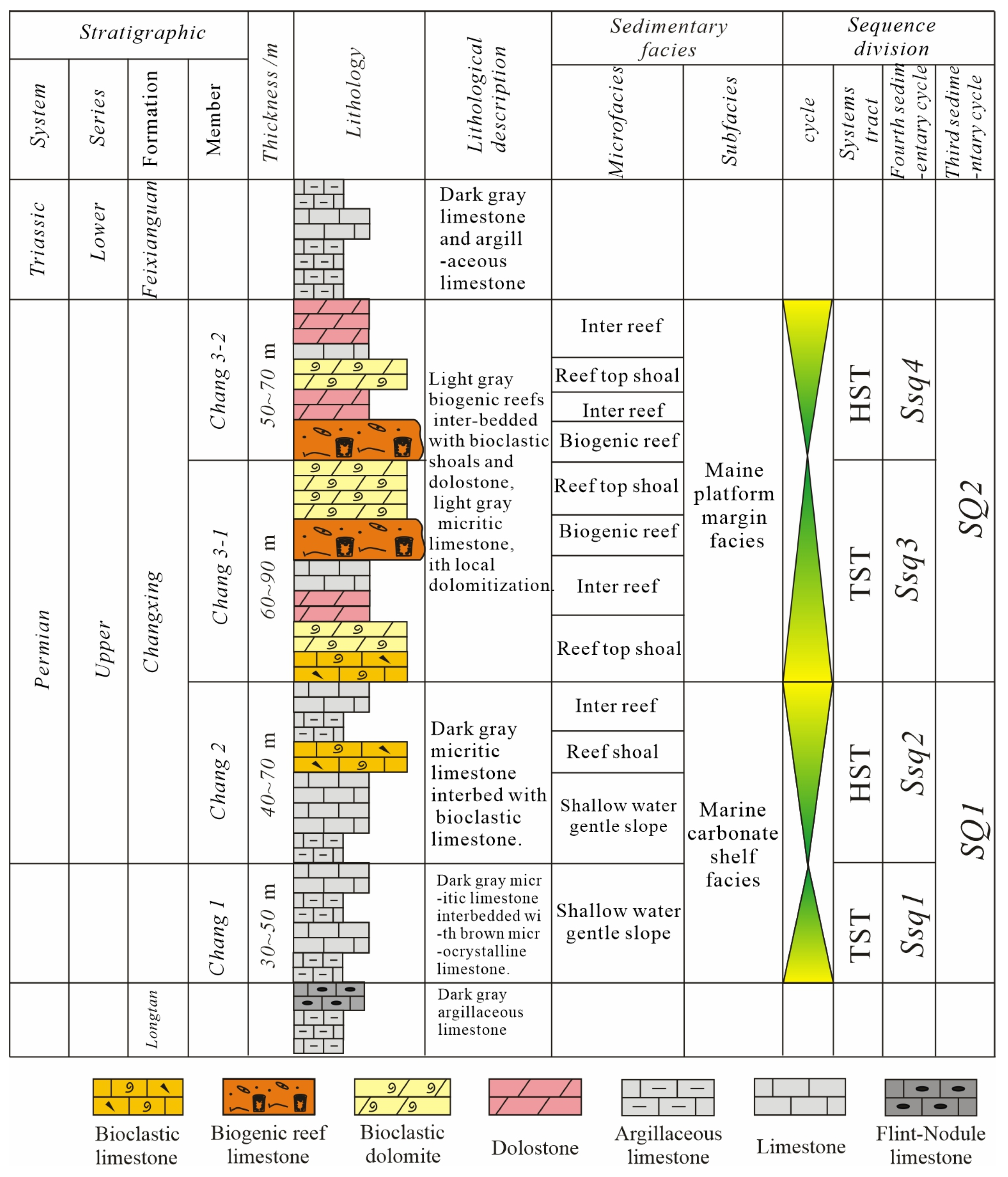
The M block is situated at the southeastern terminus of the Kaijiang–Liangping Trough, with an exploration area of approximately 500 km2. During the Changxing period, the marine reef buildups lack distinct mounded morphology and are generally small in scale. Drilling data reveal that the stratigraphic thickness of the Changxing Formation is relatively small, generally ranging from 150 to 260 m. The lower to middle sections (Chang 1 and Chang 2 members) are composed of limestone, bioclastic limestone, and micritic limestone, intercalated with siliceous limestone and flint-nodule limestone. In contrast, 1–2 phases of marine reef–shoal complexes are developed in the upper section (Chang 3 Member), and the lithology is dominated by biogenic reef limestone, bioclastic limestone, and dolomite, representing the most favorable reservoir interval in the study area (Figure 2). Currently, exploration for marine reef–shoal gas reservoirs in the M block is at an early stage. Nearly 20 wells of various types have been drilled, of which over 10 wells have encountered marine reef–shoal reservoirs, and all of these have yielded industrial gas flows, demonstrating significant natural gas development potential [12,13,14]. Notably, in the gentle slope platform margin setting, reef–shoal deposits are characterized by relatively thin thickness and rapid lithological variations. Therefore, how to effectively and accurately characterize the distribution regularity of reef–shoal reservoirs has become a key geological challenge for gas development evaluation of the M block.

3. Dataset and Methods

This study was based on an integrated dataset comprising core data, thin section observations, geochemical testing, well logging, and high-resolution 3D seismic data. In the study area, a total of 12 wells were drilled into the Changxing Formation, with 52.36 m of core recovered from 6 wells; through core relocation and depth correction, the accuracy of lithology identification and thin-section sampling positions was ensured. Samples from fully cored intervals with clear sedimentary features were prioritized for analysis. Wireline log data used in this study included gamma ray (GR), photoelectric absorption cross section index (PE), sonic travel time (AC), density (DEN), compensated neutron log (CNL), deep and shallow lateral resistivity formation resistivity (RD and RS), as well as data on the mineral content of CaCO3, CaMg(CO3)2, and clay. Additionally, interpreted well-log curves, such as log-derived porosity, permeability, and water saturation, were used for analyses of lithology type, reservoir physical property, and sedimentary microfacies.
More than 100 samples from 6 wells were systematically selected and prepared as thin sections for microscopic petrographic studies. Alizarin Red-S staining was applied to one-third of the thin sections to distinguish calcite and dolomite. Additionally, partial reservoir samples were impregnated with blue resin and thin-sectioned to observe the pores under the microscope. The identification of major carbonate grains and their petrographic characteristics followed the terminology defined by Flügel (2010) [34]. The lithofacies identification was based on the modified Dunham classification by Wright (1992) [35]. Core plug samples were selected from the cored wells penetrating the Changxing Formation in the study area for reservoir property testing, and the workflow is as follows: First, only samples from core intervals that are uncontaminated by drilling fluid and free of fractures are selected. Second, each sample is assigned a microfacies type (e.g., reef core, reef flank, reef-top–shoal) through thin-section examination. Third, invalid data (potentially due to experimental errors) with porosity < 1% or permeability < 0.01 mD are removed. And the evaluation of reservoir properties was conducted in accordance with the industry standard SY/T 6285-2011 [36]. In intervals with low core recovery, limited thin-section coverage may lead to the omission of critical diagenetic information, necessitating supplementation with well-log and seismic data.
The marine reef–shoal facies belt was entirely covered by 3D seismic data (approximately 360 km2) characterized by an effective frequency band between 5 and 70 Hz, a peak frequency of 30 Hz, a vertical seismic resolution of 20–30 m, and two-way travel time between 2 and 3.6 s for the target layers. Seismic interpretation was conducted using the Landmark software. Based on the synthetic seismogram results, three regional strata were interpreted as follows: P2l (the bottom of Longtan Formation in the upper Permian), P2ch (the bottom of Changxing Formation in the upper Permian), T1f (the bottom of Feixianguan Formation in the lower Triassic or the top of Changxing Formation in the upper Permian). Based on an integrated study of core facies, log facies, and seismic facies, combined with seismic attribute analysis and stratigraphic thickness maps, the sedimentary facies characteristics and distribution regularity of the reef–shoal reservoirs were delineated.
Through horizon tracking, correlation, and interpretation, the lateral distribution characteristics of the marine reef–shoal facies were obtained. The sedimentary paleogeomorphologyof the Changxing period was reconstructed using the residual stratigraphic thickness method. In summary, the reef–shoal sedimentary characteristics and their controlling factors were analyzed for the M block, eastern Sichuan Basin.

4. Results

4.1. Petrography

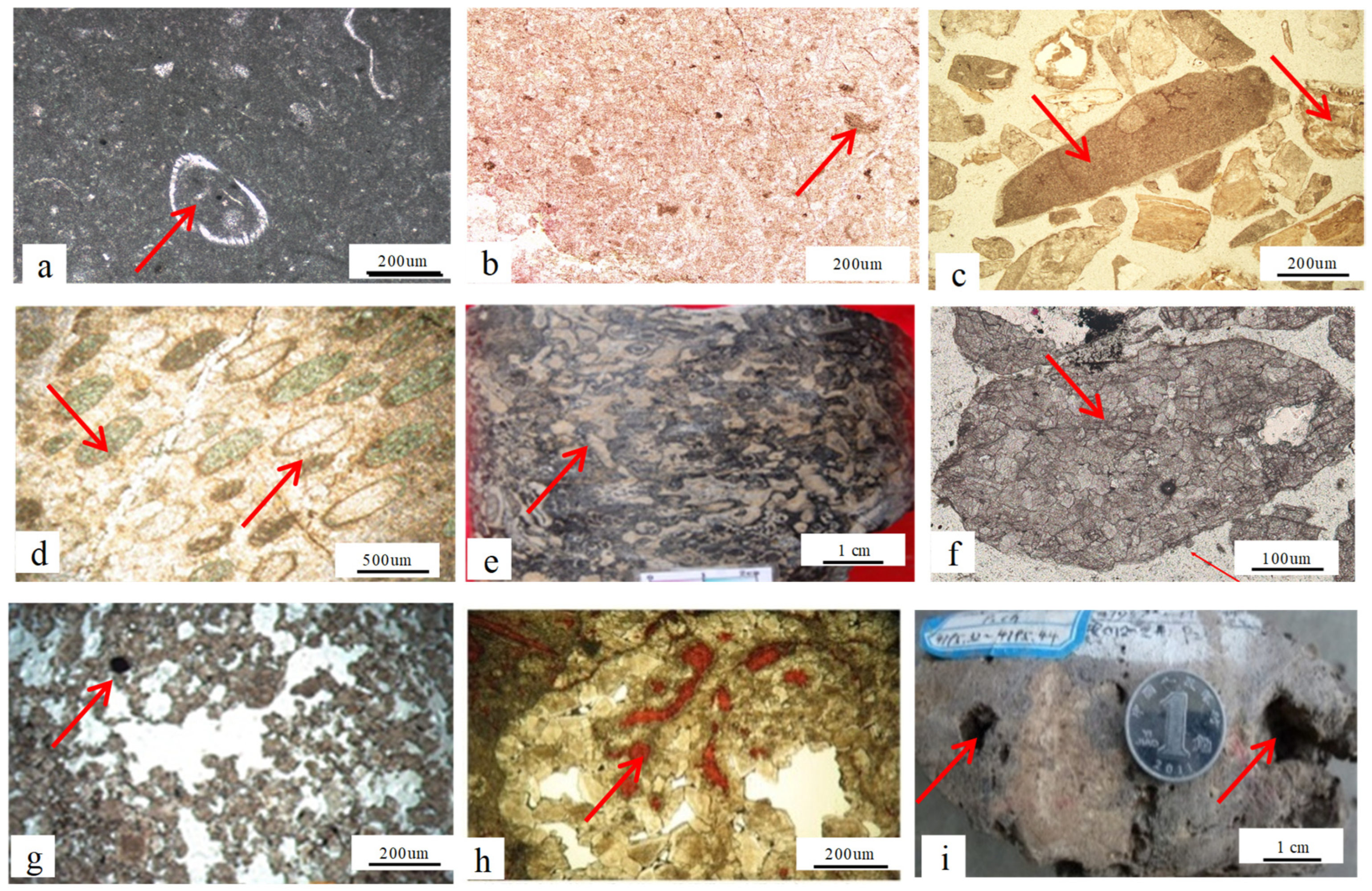
Petrographic characteristics and lithofacies associations serve as key indicators for the subdivision of marine carbonate sedimentary facies [29,30]. Based on core observations and thin-section analyses in the study area, the lithologies of the Changxing Formation are predominantly composed of limestone and dolostone. Limestone can be further subdivided into micritic limestone, micritic–powdery crystalline bioclastic limestone, sparry bioclastic limestone, and biogenic reef limestone. Dolostone includes micritic–powdery crystalline dolomite, powdery–fine crystalline dolomite, bioclastic dolomite, and reef dolomite (Figure 3, Table 1).

4.1.1. Micritic Limestone

It is primarily composed of dark gray to grayish-black micritic calcite, with local silicification of bioclastic or micritic limestone. The clay content is relatively high, generally more than 85%. It contains a small amount of bioclasts, with occasional occurrences of spicules, ostracods, gastropods, and echinoderm fragments. No significant dolomitization or dissolution is observed, and porosity is poorly developed (Figure 3a).

4.1.2. Micritic–Powdery Crystalline Bioclastic Limestone

It is composed of biogenic fossil fragments and argillaceous–micritic calcite. The biota is diverse, including fusulinids, rosary-like foraminifera, ostracods, and prolegs, along with minor fragments of brachiopods, bryophytes, and tubular-shelled organisms. The cement is composed of micritic calcite, and the matrix is predominantly argillaceous–micritic calcite. Dolomitization in such rocks is weak, with dolomite content generally less than 10%. Weak silicification is occasionally observed, but effective porosity is not developed (Figure 3b).

4.1.3. Sparry Bioclastic Limestone

The biota is dominated by shallow water benthic organisms, such as tubiphytes, fusulinids, brachiopods, and echinoderms. The bioclastic grains are relatively large, measuring approximately 50–250 μm in width and 800–2000 μm in size, indicating a depositional environment favorable for reef growth. The intergranular spaces are completely cemented by sparry calcite, resulting in poor development of storage and seepage spaces. This lithology type primarily occurs in platform-margin bioclastic shoals and reef–shoal facies sediments [25,26,27] (Figure 3c).

4.1.4. Biogenic Reef Limestone

The reef-building organisms in the biogenic reef limestone of the study area are mainly chambered sponges, fibrous sponges, and red algae, with minor occurrences of hydrozoans and corals. The reef-associated organisms include binding and baffling organisms such as bryozoans, echinoderm fragments, tubiphytes, and brachiopods. Dolomitization is weak, with dolomite content generally less than 15%. Framework pores and cavities are variably filled with lime mud and bioclasts to different degrees, resulting in poorly developed storage and seepage spaces (Figure 3d,e).

4.1.5. Micritic–Powdery Crystalline Dolomite

It is primarily composed of dolomite crystals measuring 80–100 μm in size. The crystal powder dolomite displays a relatively high degree of idiomorphism, while intercrystalline pores between dolomite grains are poorly developed. This type of dolostone is relatively rare in the study area (Figure 3f).

4.1.6. Powdery–Fine Crystalline Dolomite

The matrix of this lithology type is primarily composed of dolomite crystals measuring 150–250 μm in size, classifying them as powdery to fine crystalline. The dolomite crystals exhibit a relatively high degree of idiomorphism and commonly show a “cloudy core with clear rim” texture. Residual bioclastic structures are occasionally observed. Intercrystalline pores and dissolution pores are well developed, and some are partially filled by bitumen, dolomite, and calcite (Figure 3g).

4.1.7. Bioclastic Dolomite

It exhibits a light gray to grayish-white color and a medium to thick-bedded massive structure in core samples. It contains over 60% bioclasts and primarily results from the dolomitization of micritic or sparry bioclastic limestone. The degree of dolomitization is extremely high, preserving only residual structures of the original bioclasts, with echinoderm skeletons being the most well-preserved. Intercrystalline pores and dissolution pores are developed and are occasionally lined or filled with bitumen. As a favorable reservoir rock [28,29,30], it commonly occurs in reef-top–shoals or the uppermost parts of platform margin shoals (Figure 3h).

4.1.8. Reef Dolomite

It is a product of the dolomitization of light gray reef limestone. The dolomite crystals, measuring 50–200 μm in size, exhibited a powdery-to-fine crystalline structure, with a relatively low degree of idiomorphism. Residual structures of reef-associated organisms are distinct, while reef-building organisms such as fibrous sponges and red algae remain identifiable. Recognizable reef-dwellers include echinoderm fragments. Intracrystalline dissolution pores and intraskeletal pores are highly developed, making this an important reservoir rock type in the study area (Figure 3i).

4.2. Microfacies Types

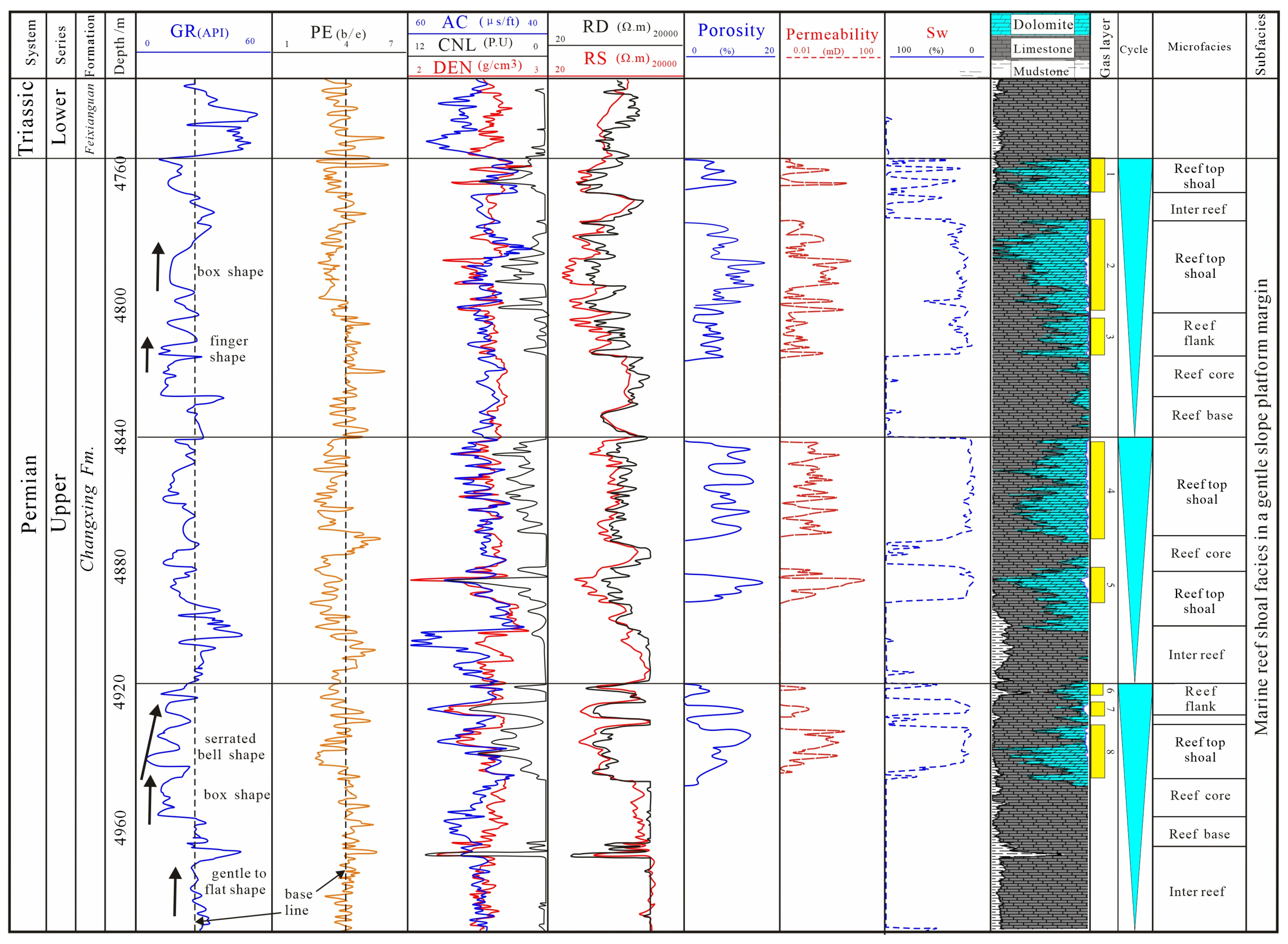
During the Changxing period, the study area was situated in a gentle slope platform margin facies belt characterized by gentle topography and overall weak hydrodynamic energy. However, due to good seawater circulation and abundant nutrients, the marine reef–shoal complexes of considerable scale still developed [29,30,31,32,33,34]. Based on the analysis of lithological associations, well log responses, and reservoir properties, the microfacies can be divided into five types: reef base, reef core, reef flank, reeftop shoal, and inter-reef microfacies (Figure 4, Table 1).

4.2.1. Reef Base

The reef base occurs at the bottom of the reef, characterized by medium-thick bedded, massive deposits, with stratigraphic thicknesses ranging from 3 to 10 m (avg. 6 m). Drilling data indicate that the lithology consists of micritic–powdery crystalline bioclastic limestone, containing siliceous materials and flint nodules, with occasional occurrences of bioclastic micritic limestone. The bioclasts are primarily composed of echinoderms, algal debris, and foraminifera (Figure 3a). The natural gamma ray (GR) log value is medium to high, ranging from 15 to 35 API, with an average of 24 API; the GR curve exhibits a slightly serrated, gently to flat shape. The acoustic travel time (AC) and compensated neutron log (CNL) value are medium to low, while the density (DEN) value is high, and the resistivity (RD) log value is medium to high (Figure 4, Table 1). These responses reflect high argillaceous content, generally more than 85%, dense lithology, and poor reservoir pore development.

4.2.2. Reef Core

The reef core occurs above the reef base, forming the main body or core of the biogenic reef, and is characterized by medium-thick bedded, mound-shaped deposits, with stratigraphic thicknesses ranging from 10 to 25 m (avg. 15 m). The lithology consists of massive sparry bioclastic limestone and bioclastic reef limestone. Under the microscope, organisms such as sclerosponges, fibrous sponges, bryozoans, and other accessory organisms are observed (Figure 3d,e). The GR value is relatively low, ranging from 5 to 20 API, with an average of 12 API; the GR curve exhibits a slightly bell or box shape. AC and CNL values are medium to low, DEN value is medium to high, and RD value is moderate (Figure 4, Table 1).

4.2.3. Reef Flank

The reef flank is distributed along the sides or margins of the reef core and is situated in a moderate energy environment; stratigraphic thickness ranges from 5 to 15 m (avg. 8 m). The lithology is dominated by bioclastic limestone, calcirudite, and micritic–powdery crystalline bioclastic limestone, with partial dolomitization forming powdery to fine crystalline dolomite. A small amount of echinoderm fragments and algal debris are present (Figure 3f,g). Due to the gentle slope, collapse breccias and slump structures are generally not developed. The GR value is moderate, ranging from 10 to 25 API, with an average of 15 API; the GR curve exhibits a slightly finger shape. AC value is moderately high, while CNL, DEN, and RD values are moderate (Figure 4, Table 1).

4.2.4. Reef-Top–Shoal

The reef-top–shoal is a characteristic microfacies formed under a gentle slope setting, and represents the main reservoir type of the currently producing reef–shoal gas reservoir in this block; stratigraphic thickness ranges from 10 to 35 m (avg. 22 m). It develops in the intertidal to supratidal zone [24,25,26,27]; the lithology is predominantly sparry bioclastic limestone, which, after dolomitization, forms residual bioclastic dolomite or residual reef dolomite. Under the microscope, the reef framework is composed of fibrous sponges and sphinctozoan sponges, which are abundant and partially dolomitized. Bioclasts are mainly green algae, foraminifera, and echinoderms (Figure 3h,i).
The GR value is very low, ranging from 5 to 15 API, with an average of 15 API; the GR curve exhibits a smooth bell or box shape. AC value is medium to high, CNL value is high, DEN value is medium to low, and RD value is medium to low. In gas-bearing intervals, the deep (RD) and shallow (RS) lateral resistivity curves separate significantly, showing a positive difference characteristic with a “trumpet-mouth”-shaped bulge. Additionally, the photoelectric absorption cross-section index (PE) in the dolomite section of the Chang 3 member is generally less than 4.2 b/e, significantly lower than that in the limestone section (>5 b/e), which corresponds to the intervals with well-developed intercrystalline pores (Figure 4, Table 1).

4.2.5. Inter-Reef

The inter-reef is deposited in low-energy, relatively quiet water environments, such as low-lying areas between reefs or back reef lagoons, and stratigraphic thickness ranges from 2 to 8 m (avg. 4 m). The lithology is predominantly dark gray to gray-black micritic limestone, locally containing small amounts of bioclasts and calcirudite (Figure 3b). Under the microscope, sparse bioclasts such as brachiopods, bryozoans, and echinoderms are observed, with local occurrences of organic laminae or bioturbation structures, indicating a low-energy, reducing hydrodynamic environment. The GR value is very high, ranging from 25 to 50 API, with an average of 38 API; the GR curve exhibits a slightly serrated flat shape (Figure 4, Table 1). The lithology is dense, with poorly developed pores, and commonly serves as the top or lateral seal of the reef–shoal reservoir.

4.3. Reservoir Physical Property

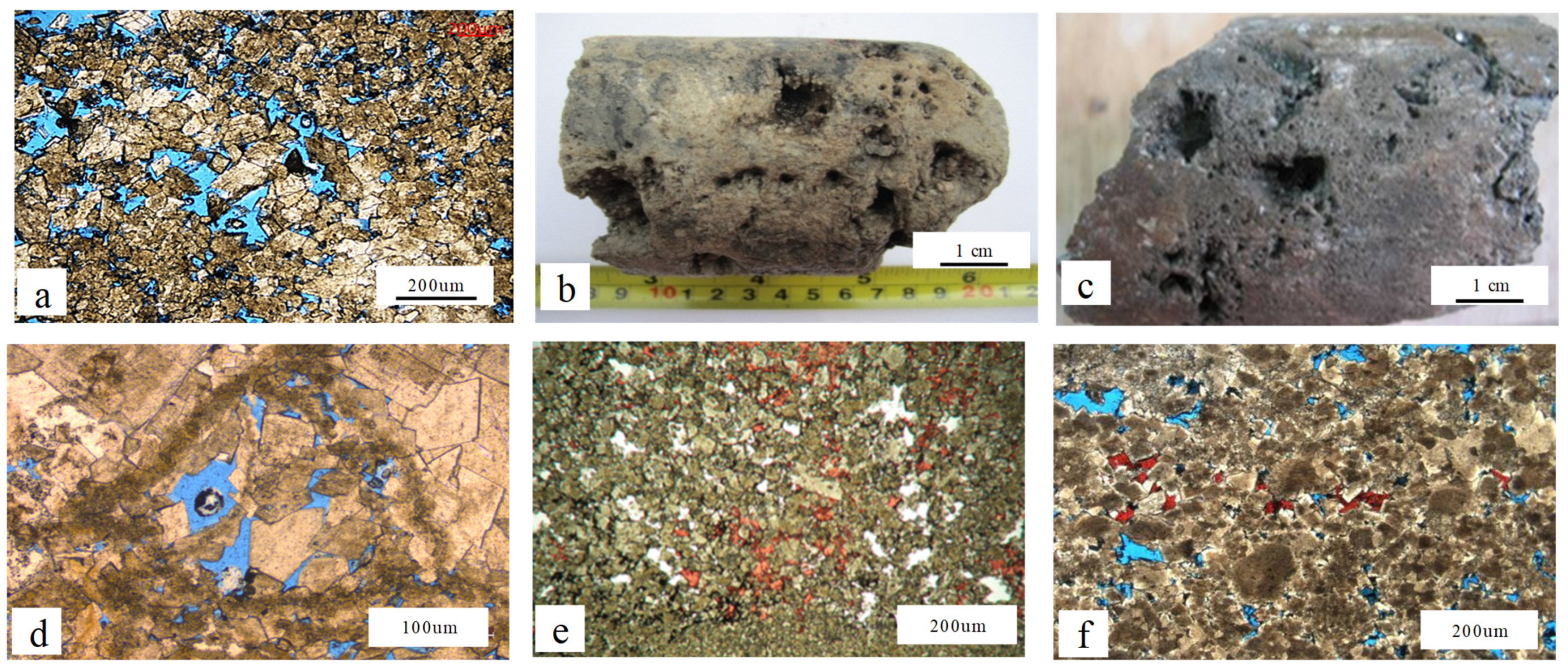
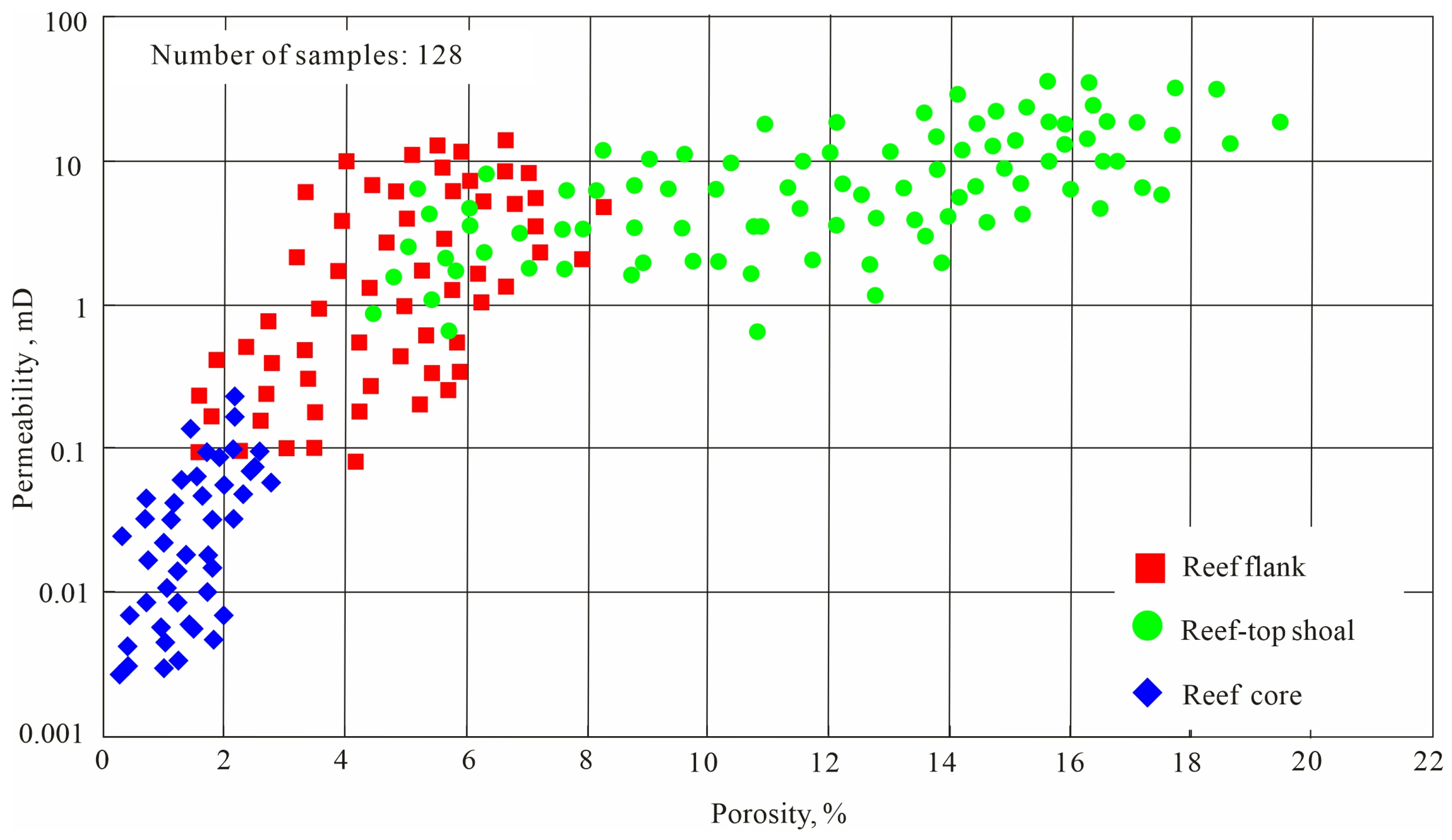
As previously mentioned, three types of favorable reservoir microfacies are developed in the study area: reef-top–shoal, reef flank, and reef core. Testing revealed that the effective reservoir lithologies of the reef-top–shoal microfacies consist of bioclastic dolomite, reef dolomite, and powdery–fine crystalline dolomite. The reservoir space is dominated by intercrystalline dissolution pores, intergranular dissolution pores, and dissolution vugs, with local occurrences of (micro) fractures (Figure 5a–d). Porosity ranges from 4.3% to 18.4% (avg. 8.6%), and permeability ranges from 1 to 50 mD; the evaluation of reservoir properties was conducted in accordance with the industry standard SY/T 6285-2011, so it is classified as a medium-porosity, medium-permeability reservoir, which is a high-quality reservoir in the study area (Figure 6, Table 2).
The effective reservoir lithology of the reef flank microfacies consists of powdery–fine crystalline dolomite, where the intercrystalline pores serve as the main reservoir space, and occasional dissolution fractures or intercrystalline dissolution pores are observed (Figure 5e,f). Porosity ranges from 1.5% to 6.3% (avg. 3.5%), and permeability ranges from 0.1 to 15 mD, so it is classified as a low-porosity and low-permeability reservoir, which is a moderate reservoir in the study area (Figure 6, Table 2).
In contrast, the reef core microfacies contains poor-quality reservoirs, with porosity mostly below 2% and permeability less than 0.1 mD; thus, it is a non-reservoir or poor-quality reservoir (Figure 6, Table 2).

4.4. Seismic Reflection Characteristics

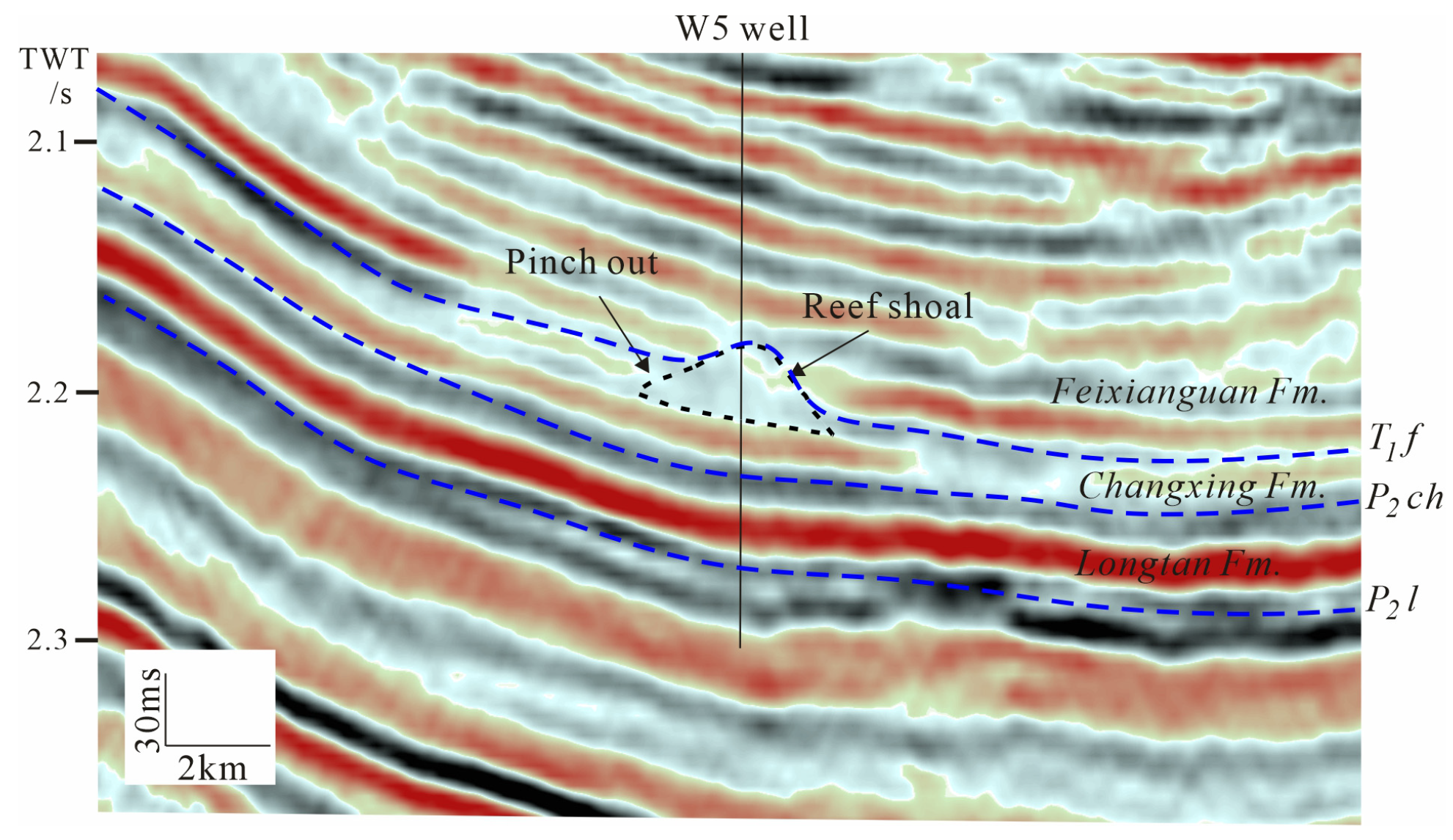
Under the gentle slope platform margin setting, the biogenic reef–shoals are characterized by “small volume, low relief, and highly variable lateral stacking patterns”. Coupled with the relatively low resolution of the seismic data, which results in poor imaging of the reef–shoal bodies, the seismic reflection characteristics constrained by drilling data can only roughly reflect the macroscopic architecture of the marine reef–shoal reservoirs in the gentle slope platform margin [37,38,39]. Through well calibration and seismic profile interpretation (Figure 7), it is observed that the marine reef–shoals exhibits mound shaped or wedge-shaped reflection characteristics. Its internal structure is predominantly characterized by discontinuous, chaotic reflections or reflection blank zones, with significantly weakened amplitude energy, and even the top surface shows discontinuous reflections [35,37,38,39,40]. On the seaward side, where the reef body is relatively thick, the reef flanks exhibit pinchout phenomena, which can be used to delineate the approximate outline of the reef–shoal bodies (e.g., wells W5 and W7).
The argillaceous sediments of the inter-reef microfacies are characterized by medium to low frequency, medium to strong amplitude, and relatively continuous reflections, forming a sharp contrast with the seismic reflection of the marine reef–shoal facies belt.

5. Discussions

5.1. Reef–Shoal Facies Sedimentary Characteristics

5.1.1. Profile Sedimentary Facies Characteristics

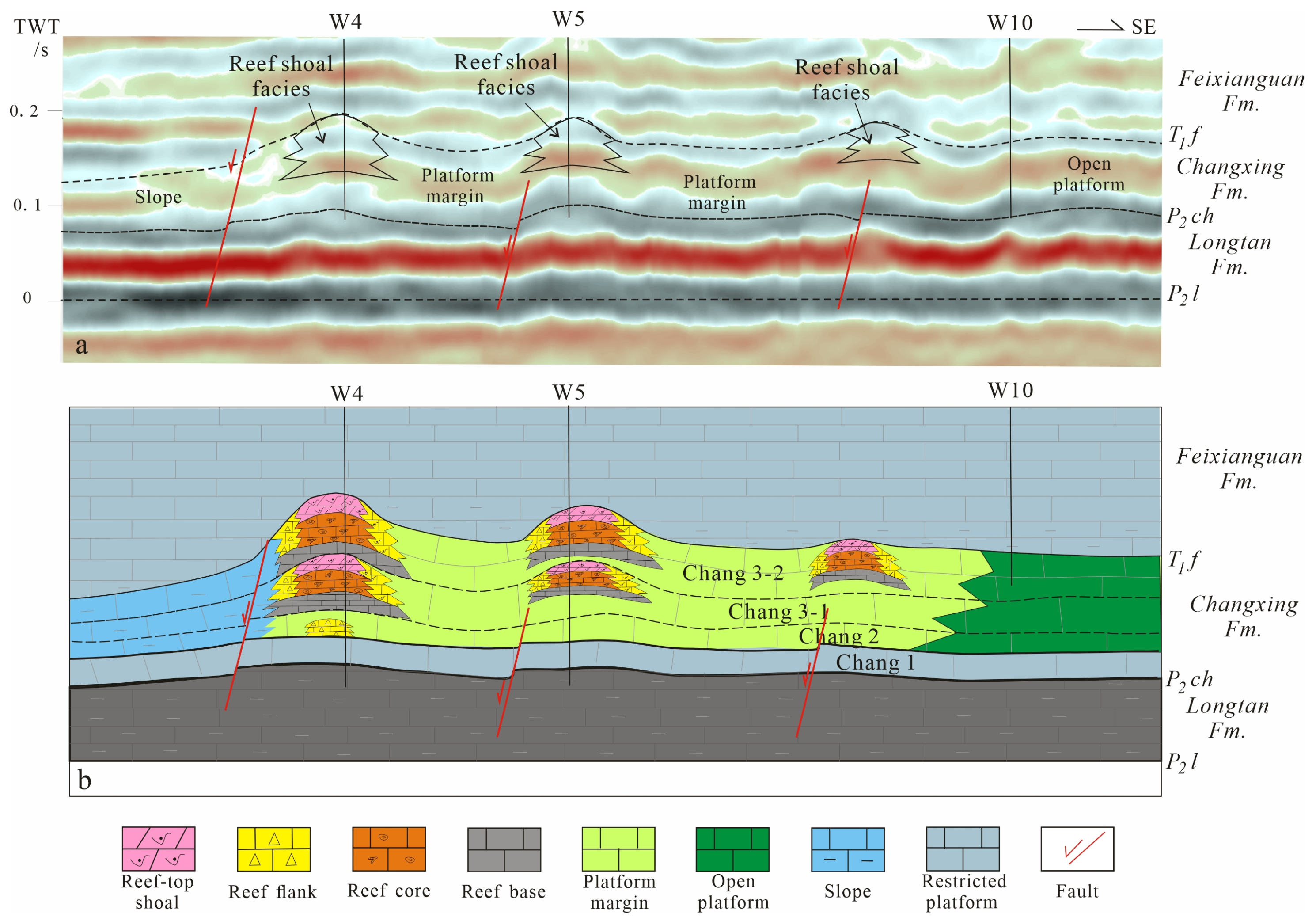
From the seismic and sedimentary facies profile interpretation result, oriented approximately perpendicular to the platform margin facies belt, it is evident that multiple rows of reef–shoal bodies are distributed in the study area (Figure 8). It is worth noting that the 3D seismic data used in this study have a dominant frequency of 30 Hz. Given the burial depth of the Changxing Formation (with two-way travel times of 2.0–3.6 s), the theoretical vertical resolution is approximately 20–30 m. While this resolution allows the identification of sequence-scale boundaries and large reef–shoal complexes, it has limitations in resolving thin interbeds below the tuning thickness (λ/4) or internal architectural details (such as the contact relationship between reef core and reef flank) [37,38]. Consequently, seismic-facies descriptions such as mound-shaped reflections or chaotic reflections inherently include sub-resolution sedimentary noise, introducing ambiguity in the continuity and boundary delineation of the sedimentary facies belts. Therefore, during seismic facies interpretation, it is essential to reduce this ambiguity by constraining and validating interpretations with depositional models of the platform margin belt and through well-to-seismic calibration [39,40]. For interpreting thin reef–shoal interbeds or internal details, integration with high vertical resolution drilling data is particularly necessary to meet the requirements of reef–shoal sedimentary facies research. Well-seismic calibration analysis suggests that W4 and W5 wells penetrated two seaward rows of reef–shoal bodies and obtained high-yield industrial gas flow, confirming their favorable reservoir properties. Core and log data revealed that the marine reef–shoals exhibit a complete vertical sedimentary evolutionary sequence, which is a record of their continuous growth and eventual demise in a suitable environment. From bottom to top, the sequence includes the reef base, reef core, and reef-top–shoal, while the reef flank represents the lateral deposits associated with the growth of the reef core.
Towards the inner side of the platform, another row of smaller-scale reef–shoal bodies has been identified (Figure 8a). Currently, there are no wells deployed in this area, but it also holds certain exploration potential. Laterally, the seismic reflection characteristics of reef–shoals and inter-reef muddy sediments differ distinctly. The inter-reef muddy sediments are distributed between different reef–shoals, exhibiting medium-to-strong amplitude, medium-to-low frequency, and continuous reflection (e.g., W10 well). Based on this understanding, the boundaries of the low-energy inter-reef microfacies belts can be clearly delineated.
The above analysis indicates that the marine reef–shoal complexes are characterized by rapid lateral migration, considerable scale variation, and diverse vertical stacking patterns in the gentle slope platform margin setting. Although situated in the relatively high-energy platform margin facies belt, the marine reef–shoal reservoirs and inter-reef mud are frequently intercalated laterally, forming a complex “reef mud” interlayered characteristics (Figure 8b). This results in rapid lateral changes in reservoir properties and increased heterogeneity, which in turn reduces the internal connectivity of the marine reef–shoal reservoirs [40,41,42,43]. This understanding provides crucial guidance for refining reservoir prediction and optimizing development strategies for marine reef–shoal reservoirs in the gentle slope platform margins.

5.1.2. Planar Sedimentary Facies Characteristics

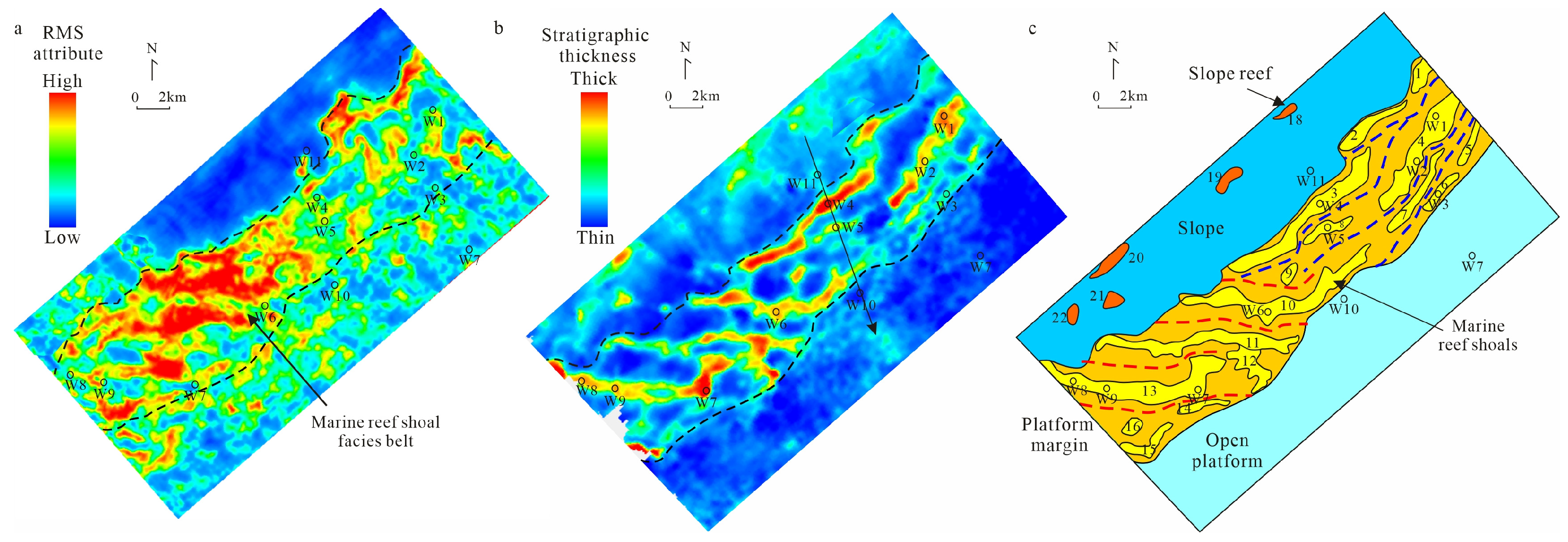
Due to the limited resolution of seismic attributes, they can only broadly delineate the boundaries of sedimentary facies belts in gentle slope zones. However, these attributes struggle to differentiate the internal architecture and lateral stacking relationships of reef–shoal bodies, resulting in ambiguity in the delineation of sedimentary microfacies boundaries. The Root Mean Square (RMS) amplitude attribute was extracted from the seismic data by a 15 ms window below the top boundary of the Changxing Formation, essentially covering the thickness of the reef–shoal stratigraphic interval (Figure 9a). Within the black dashed line on the map, red and yellow warm-toned anomalies (corresponding to high RMS amplitude) exhibit a nearly NE-SW trend, generally consistent with the direction of the paleocoastline, and are geologically interpreted as the favorable platform margin facies belt. Seaward, the slope facies belt is represented by blue cool-toned anomalies (corresponding to low RMS amplitude), with a clear boundary against the platform margin facies belt. The open platform facies is characterized by bluish-green tones. This RMS attribute can roughly delineate the different sedimentary facies belt boundaries in the gentle slope platform margins; however, it has limited resolution for revealing the internal characteristics and lateral stacking relationships of the marine reef–shoal complexes.
The stratigraphic thickness map can more clearly reveal the distribution characteristics of the platform-margin facies belt (Figure 9b). Within the favorable platform margin facies belt, the red and yellow warm-toned areas (indicating relative stratigraphic thickening) are interpreted as marine reef–shoal development zones, while the bluish–green cool-toned areas (indicating relative thinning) are associated with inter-reef mud deposits. The marine reef–shoal bodies exhibit a multi-row, belt-shaped distribution. The contact between the marine reef–shoal complexes and the inter-reef mud is abrupt with clearly defined boundaries. This map effectively reveals the lateral stacking relationships and planar distribution characteristics of the marine reef–shoal bodies within the platform margin facies belt.
Overall, the study area is located at the southeastern terminus of the Kaijiang–Liangping Trough, where the platform margin is characterized by a gentle slope setting, with gradients typically less than 5°. The vertical accretion of the marine reef–shoals is relatively small, but the platform margin belt is wide on the planar distribution, ranging from 3.5 to 5.8 km. Planar interpretation identifies three to four rows, totaling 16 reef–shoal bodies, which trend approximately NE–SW in the northwestern part and nearly E–W in the southeast, exhibiting en echelon or belt-shaped distribution patterns (Figure 9c).
Further statistics analysisindicates that the spacing between different rows of marine reef–shoals is from 0.5 to 1.5 km (average 0.9 km). Individual marine reef–shoal bodies have a long axis ranging from 1.08 to 6.06 km (average 2.65 km) and a short axis ranging from 0.3 to 0.95 km (average 0.45 km). The aspect ratio is generally greater than 3, reflecting their small scale, elongated shape, discrete planar distribution, rapid lateral migration, and diverse stacking patterns. Additionally, subtle paleo-uplift may exist locally within the slope facies belt, where a small number of discontinuous and isolated patch reefs are developed (Figure 9c).
It is evident that the lithologic trap potential of the marine reef–shoal complexes in the Changxing Formation is highly favorable. The variably scaled marine reef–shoal bodies identified in the planar distribution map are relatively independent and entirely enclosed by dense inter-reef muddy sediments, forming natural lithologic seals. The main reservoir, the reef-top–shoal dolomite, exhibits superior physical properties (with porosity up to 18.4%) (Figure 6), and its gas-bearing capacity has been confirmed by industrial gas flows from multiple wells.
Although individual traps are relatively small in scale, they are numerous, distributed in rows and belts, and closely spaced, constituting a commercially viable gas accumulation. Future exploration efforts should focus on precisely delineating the boundaries of these discretely distributed and heterogeneous marine reef–shoal bodies, and identifying the favorable zones of well-developed reef-top–shoal dolomite reservoirs. This approach holds promise for achieving new reserve discoveries.

5.2. Controlling Factors

5.2.1. Regional Gentle Slope Marine Platform Margin Geological Setting

The development of the carbonate marine reef–shoal reservoirs in the Permian of the Changxing Formation was governed by relatively stringent conditions, exhibiting high sensitivity to the paleotopographic foundation, high-frequency sea level fluctuation, and regional paleo-depositional environment. Throughout the geological evolution of the Permian, the M Block remained in a stable tectonic setting dominated by thermal subsidence. During the Changxing period in late Permian in the northeastern Sichuan, the sea level experienced a sustained rise, ultimately reaching a peak during the middle to late Changxing period, which is a highstand second only to that of the early Triassic [44,45,46,47,48]. This highstand persisted until a sea level fall commenced near the end of the Permian. The M Block in the eastern Sichuan Basin was situated in a carbonate open platform depositional environment [39,40,41,42,43], characterized by stable basement subsidence with limited fault development. Under a transgressive background, the marine reef–shoal deposits were developed along the gentle slope platform margins. In the southeastern part of the study area, open platform, semi-restricted-platform, and platform-margin facies sediments were developed, corresponding to relatively high-energy environments such as intra-platform bioclastic shoals and platform margin reef–shoals. In contrast, the northwestern part was dominated by deeper water settings, where slope, shelf, and basin facies sediments were deposited (Figure 1c).

5.2.2. Tectonic Paleogeomorphology

The Kaijiang–Liangping Trough in northeastern Sichuan formed during the late Early Permian. Controlled by NW–SE trending basement faults, it underwent differential subsidence, evolving into an asymmetric, dustpan-shaped fault depression. Within this paleotectonic setting, the paleogeomorphology of the platform margin along the Trough was relatively high, with strong hydrodynamic conditions favorable for the growth of reef-building organisms. These organisms grew in situ, forming wave-resistant frameworks and positive paleogeomorphology, which in turn constructed the platform margin, that is, further modifying the type of carbonate platform on its original foundation. Studies have revealed that the slope gradient along the platform-margin slope zone around the Kaijiang–Liangping Trough varies significantly [44,45,46,49], transitioning from steep in the northwest to gentle in the southeast. The platform-margin facies belts can be divided into three segments: steep slope zone in the northern segment (more than 25°), moderately steep slope zone in the central segment (between 5° and 25°), and gentle slope zone (less than 5°) in the southeastern Trough terminus segment (Figure 1d).
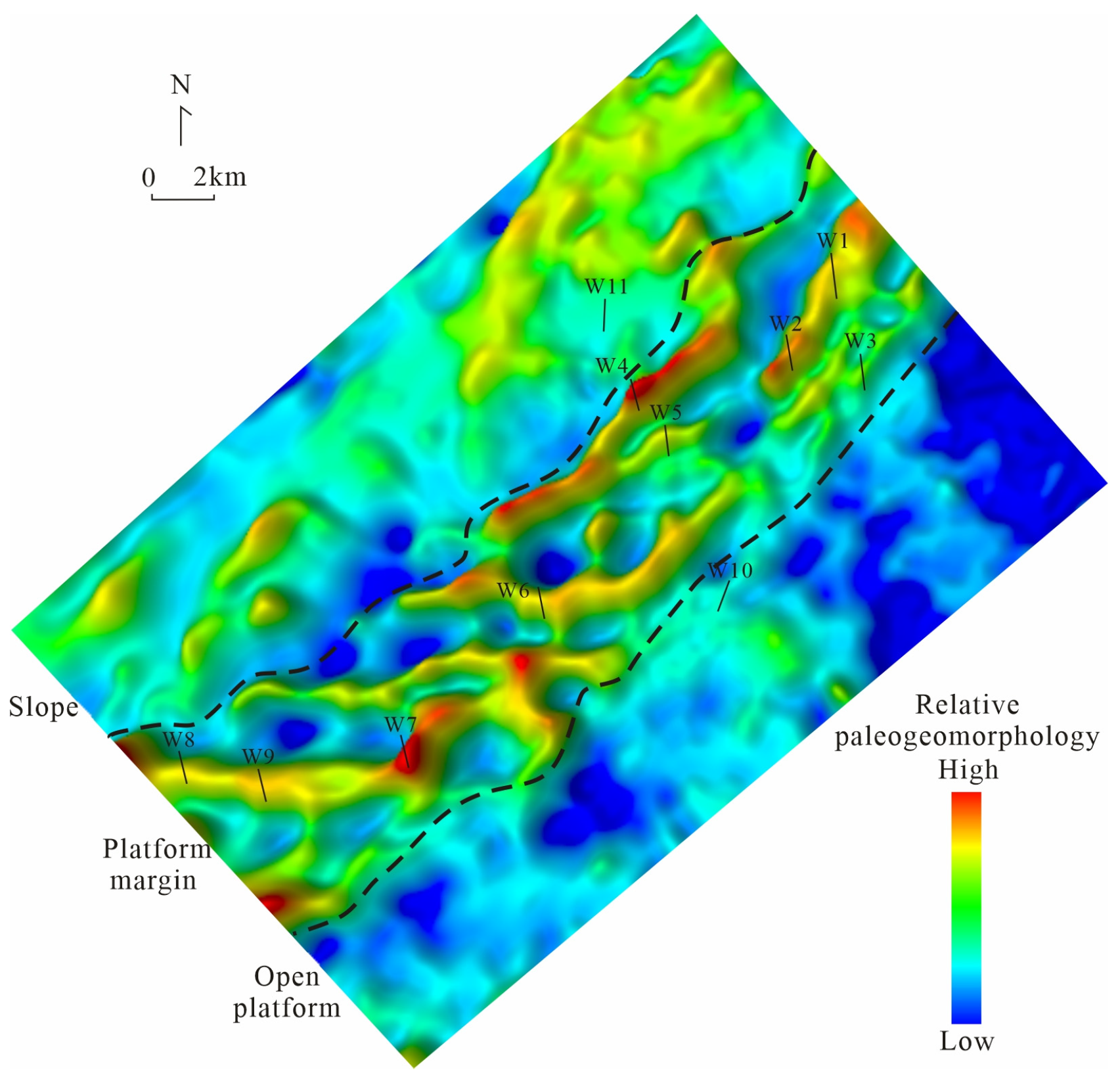
The paleogeomorphology and its evolution in carbonate deposition systems are often a comprehensive reflection of hydrodynamic conditions, platform margin slope gradients, subsidence rates, and variations in accommodation space [41,42,43,49]. The development and evolution of marine reef–shoals are highly sensitive to such paleogeomorphic changes. Therefore, by reconstructing the paleogeomorphology of the Chang 2 member in the study area, the growth and evolutionary characteristics of the marine reef–shoals can be effectively analyzed. Although there are only more than 10 wells that have penetrated the Changxing Formation in the study area, a substantial amount of regional 2D seismic lines and 3D seismic data that fully cover the marine reef–shoal facies belt are available. Through horizon tracking, correlation, and interpretation, it is relatively easy to obtain the lateral distribution characteristics of the marine reef–shoal facies, which provides extensive information for paleotopographic reconstruction.
The sedimentary paleogeomorphology of the Changxing period was reconstructed using the residual stratigraphic thickness method [44,45,49]. First, a marker layer immediately underlying the marine reef–shoal sedimentary was selected as a base level for layer flattening. The mud shale of the Longtan Formation in the study area is widely and stably distributed throughout the Kaijiang–Liangping Trough in the northeastern Sichuan Basin, with a thickness of approximately 150 m. Its lithology is mainly dark gray and deep gray marl or shale, representing shelf facies deposition [46,47,48]. On seismic profiles, this unit exhibits low-frequency, high-amplitude, and high-continuity reflections, making it easy to correlate and track throughout the study area. Therefore, it was defined as a reliable marker layer (Figure 8). Second, the constraints of the marine carbonate depositional environment were considered. The Kaijiang–Liangping Trough experienced stable marine carbonate sedimentary with strong compaction resistance, overall stable subsidence, and weak tectonic activity. The study area was located in an open platform setting, largely lacking significant uplift or erosion. Consequently, the effects of uplift and erosion can be disregarded. Finally, based on detailed seismic structural interpretation, with a focus on stratigraphic contact relationships, internal reflection characteristics, and true stratigraphic thickness variations, the residual stratigraphic thickness from the top of the Changxing Formation down to the selected datum (i.e., the top of the Longtan Formation) was used to represent the pre-Changxing paleogeomorphology. This served as the basis for classifying paleotopographic units and conducting 3D visualization.
The study area is located at the southeastern terminus of the Kaijiang–Liangping Trough, distal from its main subsidence center. During the deposition of the first member of the Changxing Formation, it was part of an open carbonate platform in the gentle slope platform margin setting, the lateral width was greater than 5 km, and the tectonic uplift was weak, resulting in negligible paleogeomorphology and the general absence of reef development. By the time of the second member of the Changxing Formation, as rift subsidence intensified, the geomorphic differentiation along the platform margin in the study area became increasingly pronounced, and reefs began to grow and develop (Figure 10). The marine reef–shoal sedimentary is discontinuously distributed along the structural ridges of subtle paleo uplifts within the gentle slope platform margin belt. Subaqueous subtle paleo uplift caused hydrodynamic differentiation. The upstream (seaward) flanks experienced higher energy and stronger hydrodynamics, favoring the deposition of grain limestone. In contrast, the downstream (leeward) flanks were dominated by muddy sediments of the inter-reef or restricted sea. Notably, the tidal channels were well developed in the inter-reef depression on the flanks of these subtle paleo-uplifts; ocean currents surged up along the slope or through these tidal channels, segmenting individual reef bodies. This process resulted in frequent alternation between marine reef–shoal deposits and inter-reef mud. Consequently, the marine reef–shoal deposits are not large-scale, flat sheet-like bodies, but are strongly constrained by the subtle paleotopographic variations under the gentle slope platform-margin setting. Therefore, the marine reef–shoals in the study area are characterized by their small scale, discrete planar distribution, and rapid lateral migration.

5.2.3. High Frequency Sea Level Fluctuation

As previously discussed, the northeastern Sichuan region was characterized by a stable tectonic setting of thermal subsidence during the Changxing period in the late Permian, in which the paleo-sea level experienced a sustained rise, only beginning to fall near the end of the Permian. The platform margin facies belt in the study area was situated in a gentle slope setting, typically with gradients of less than 5°. As a result, the marine reef–shoal sedimentary in this area was highly sensitive to sea level fluctuations. High frequency sea level cycles exerted a primary control on the sedimentary characteristics, migration patterns, and reservoir evolution of the marine reef–shoal sedimentary.
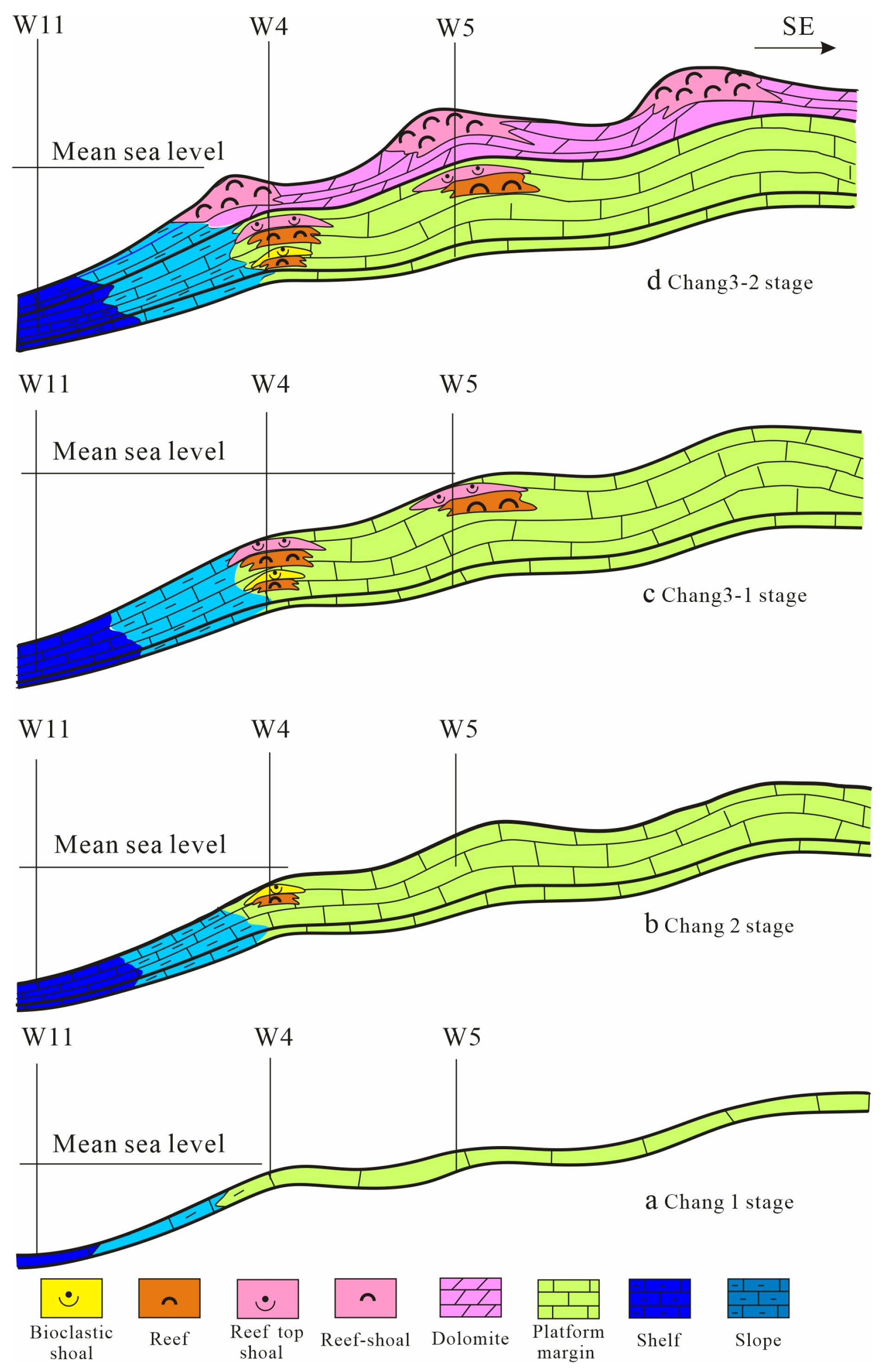
In the early depositional stage of the third member of the Changxing Formation, the paleogeomorphology was minimal; under these conditions, strong ocean currents flowing along the Trough moved up the gentle slope platform-margin belt, transporting nutrients and promoting sustained reef development. The organic reefs exhibited an asymmetric mound shape, with a steeper upstream-facing (seaward) flank and a gentler downstream-facing (landward) flank. As sea level continued to rise, the reefs retrograded towards the platform, forming a multi-row, discrete distribution pattern in the planar. Due to the overall broad, shallow marine conditions, the vertical accretion of the organic reef bodies was limited, and the scale was also relatively small.
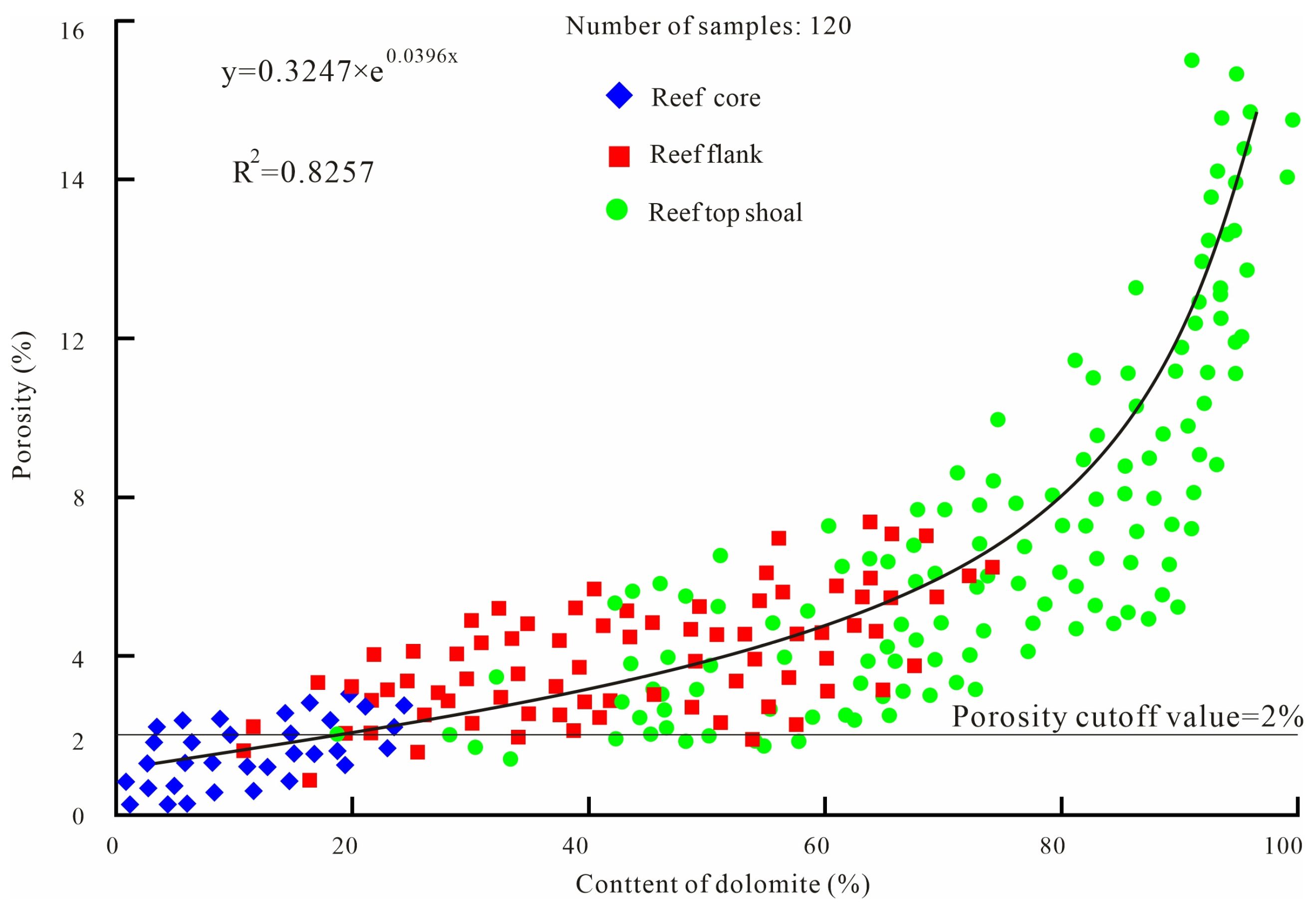
High-frequency sea level fluctuations caused the organic reefs to be frequently exposed, leading to meteoric water leaching, which created secondary pores such as moldic pores and intragranular dissolution pores [50,51,52,53]. Concurrently, following subaerial exposure, a restricted platform environment developed. Evaporation generated dense brines with high magnesium and salinity. These brines then induced dolomitization of the marine reef-top–shoals via the seepage reflux mechanism [53,54,55]. Particularly during the late stage of the third member of the Changxing Formation, regional sea level fall became pronounced, and the platform margin was extensively and frequently exposed above sea level, resulting in widespread dolomitization (Figure 11). In fact, statistical analysis of core test data from the Changxing Formation reveals a strong correlation between reservoir porosity and dolomite content; that is, a higher degree of dolomitization generally corresponds to better reservoir physical properties. This demonstrates that dolomitization significantly enhances reservoir quality, making the reef-top–shoal the most favorable reservoir in the study area (Figure 12).
In summary, the regional gentle slope platform margin setting, tectonic paleo-topography, and high-frequency sea level fluctuations collectively controlled the sedimentary evolution and reservoir distribution of the marine reef–shoal facies. The regional transgressive environment and subtle paleogeomorphology established the tectonic pattern and zonation of the marine reef–shoal deposition, and the reef migration and dolomitization processes are controlled by the high-frequency sea level fluctuations. As a result of the factors mentioned above, the marine reef–shoal bodies in the study area exhibit characteristics of small-scale, discrete distribution, and strong heterogeneity, which thus have facilitated the formation of high-quality hydrocarbon reservoirs.

6. Conclusions

Integrated analysis of core, thin-section, seismic, and borehole data from the M block in the eastern Sichuan Basin can clarify the sedimentary characteristics and controlling factors of reef–shoal deposits in a gentle slope platform margin setting. The main conclusions are as follows:
(1)
Based on the analysis of petrography, microfacies, and reservoir properties, it is concluded that the reef-top–shoal microfacies is the most favorable high-quality reservoir. The main lithologies consist of bioclastic dolomite and reef dolomite. The reservoir spaces consist of intercrystalline dissolution pores and dissolution vugs. The reef flank microfacies is the secondary reservoir, whereas the reef core microfacies becomes dense due to intense late-stage cementation. This differentiation among the reef–shoal microfacies is the primary reason for the heterogeneity in reservoir quality.
(2)
By combining the profile and planar reef–shoal distribution characteristics with interpreted well-log and seismic attributes, we further conclude that the reef–shoal reservoirs exhibit a relatively small vertical accretion but an extensive planar distribution. Multiple rows of reef–shoal bodies are revealed, arranged in en echelon or discrete distribution patterns. In summary, the reef–shoal bodies are characterized by their small scale, elongated geometry, discrete distribution, rapid lateral migration, and diverse stacking patterns. The variably scaled reef–shoal bodies are relatively independent and entirely enclosed by dense inter-reef muddy sediments, forming natural lithologic seals. The reef-top–shoal dolomite reservoir exhibits superior physical properties, indicating favorable potential for lithologic trap exploration in this region.
(3)
The study area was situated in a stable thermal subsidence setting during the Changxing period, differential subsidence created subtle paleo-uplifts, and hydrodynamic differentiation promoted the development of reef–shoal deposits on their upstream-facing flank (seaward). High-frequency sea level fluctuations caused the reef bodies to retrograde toward the platform, forming the multi-row, en echelon distribution pattern. A sea level fall during the late stage of the third member of the Changxing Formation led to subaerial exposure, which triggered dolomitization and significantly improved the reservoir quality of the reef-top–shoal microfacies. The coupling of these three factors is the primary reason for the characteristics of “small scale, discrete distribution, and strong heterogeneity” observed in the marine reef–shoal reservoirs of the study area.

Author Contributions

Conceptualization, X.C.; methodology, X.C. and Y.D.; software, Y.D. and J.W.; validation, Y.D.; formal analysis, Y.D.; investigation, Y.D.; resources, S.W.; data curation, S.W.; writing—original draft preparation, Y.D.; writing—review and editing, X.C.; visualization, Y.D.; supervision, Y.D.; project administration, X.C.; funding acquisition, X.C. All authors have read and agreed to the published version of the manuscript.

Funding

This work was financed by the Hubei Key Laboratory of Complex Shale Oil and Gas Geology and Development in Southern China (SSOG202401), the National Science and Technology Project (2025ZD1402301), and the State Key Laboratory of Geological Processes and Mineral Resources, China University of Geosciences (GPMR202207).

Institutional Review Board Statement

Not applicable.

Informed Consent Statement

Not applicable.

Data Availability Statement

All data generated or analyzed during this study are included in this published article. The datasets used and/or analyzed during the current study are available from the corresponding author upon reasonable request.

Acknowledgments

We are grateful for the editing and suggestions from the editors who greatly improved the manuscript.

Conflicts of Interest

Saijun Wu is employed by the Research Institute of Petroleum Exploration & Development, CNPC, Beijing 100083, China. The remaining authors declare that the research was conducted in the absence of any commercial or financial relationships that could be construed as potential conflicts of interest.

References

  1. Huang, S.; Zhao, Z.; Ai, Y.; Jiang, H.; Tian, X.; Jiang, Q.; Ma, D.; Song, W.; Song, H. Differences in gas sources of the Changxing-Feixianguan formations aroundthe Kaijiang-Liangping trough and favorable exploration directions for coal-formedgas generated by the Upper Permian Longtan Formation, Sichuan Basin. Nat. Gas. Geosci. 2024, 35, 799–809. (In Chinese) [Google Scholar] [CrossRef]
  2. Yang, Y.; Zhong, Y.; Li, L. Distribution and genesis of Permian-Triassicreef-shoal combination around Kaijiang-Liangping trough in Sichuan Basin, China. Technology 2021, 48, 683–690. (In Chinese) [Google Scholar] [CrossRef]
  3. He, W.; Meng, Q.; Bai, X.; Wang, X.; Wang, Y.; Tan, W. Evolution and exploration direction of Permian-Triassic multiphase platform margin in northeast Sichuan Basin. Acta Petro. Sin. 2022, 43, 1201–1212. (In Chinese) [Google Scholar] [CrossRef]
  4. Xu, S.; Hu, X.; Shi, Z.; Zhang, C.; Mao, J.; Wang, B. Prediction of thin shoal reservoirs under reef controlled by Isochronous stratigraphic framework. J. Mar. Sci. Eng. 2024, 12, 1974. [Google Scholar] [CrossRef]
  5. Tang, Y.; Wang, H.; Zhang, L.; Chen, P.; Pan, X.; Zhang, W.; Jiang, L.; Xing, Y.; Wang, C.; Shan, Y. Seismic lithology and geological implications of pre-salt Jurassic carbonate rocks in the Amu Darya Right Bank. Mar. Pet. Geol. 2024, 165, 106865. [Google Scholar] [CrossRef]
  6. Dong, X.; Hampson, G.J.; Lonergan, L.; Wang, Y. Seismic attribute driven analysis of an ultra-deep carbonate reservoir: Middle Cambrian to Middle Ordovician strata, north-central Tarim Basin, northwest China. J. Sediment. Res. 2024, 94, 871–894. [Google Scholar] [CrossRef]
  7. Hu, X.; Liu, H.; Tan, X.; Xiao, C.; Tan, Q.; Li, J.; Yi, C. Shoal-to-Strata Ratio Technique and Its Use in Describing Carbonate Rock Sedimentary Facies in the Eastern Sichuan Basin. J. Mar. Sci. Eng. 2022, 10, 825. [Google Scholar] [CrossRef]
  8. Su, A.; Wang, Z.; Chen, H.; Feng, Y.; Zhao, J.; Jiang, H.; Nguyen, A.D.; Sun, P. Temporal constraints on hydrothermal circulation associated with strike-slip faulting in the Permian Maokou carbonates, central Sichuan Basin (SW China). Mar. Pet. Geol. 2024, 160, 106643. [Google Scholar] [CrossRef]
  9. Grammer, G.; Harris, P.; Eberli, G. Reservoir characteristics of the Permian capitan reef complex, Delaware Basin: Implications for carbonate reservoir modeling. AAPG Bull. 2020, 104, 1847–1875. [Google Scholar]
  10. Yao, X.; Hu, Z.; Wu, S.; Xie, W.; Yang, S.; Yao, M.; Bi, H. Sedimentary Characteristics and Prediction of Favorable Areas of the Changxing Formation on the Eastern Side of the Kaijiang-Liangping Trough in Northeastern Sichuan Basin. Acta Sedimentol. Sin. 2024, 42, 2102–2118. (In Chinese) [Google Scholar] [CrossRef]
  11. Qin, Z.; Miao, Z.; Wei, J.; Di, B. Seismic physical model of the Maokou Formation reservoirs of platform-margin shoal in Yuanba area, Sichuan Basin. Oil Gas Geol. 2021, 42, 652–660. (In Chinese) [Google Scholar] [CrossRef]
  12. Huang, Y.; Chen, X.; Wu, S.; Wei, H.; Wang, J. Sedimentary characteristics and influencing factors of steep slope platform-margin reefs: A case study of Changxing Formation in Kaijiang-Liangping Trough in northeastern Sichuan Basin. Pet. Geol. Recovery Eff. 2025, 32, 68–77. (In Chinese) [Google Scholar] [CrossRef]
  13. Ran, Q.; Tao, X.; Xu, C.; Zhang, L.; Huang, T.; Liu, S.; Ding, K.; Pu, B. “Two bioherms in one well” in high-yield gas wells: A case study of the Changxing Fine description of ramp-type small bioherms and the breakthrough of Formation small bioherm group in the eastern Sichuan Basin. Nat. Gas. Ind. 2021, 41, 10–18. (In Chinese) [Google Scholar] [CrossRef]
  14. Zhou, L.; Zhong, F.; Yan, J.; Zhong, K.; Wu, Y.; Xu, X.; Lu, P.; Zhang, W.; Liu, Y. Prestack inversion identification of organic reef gas reservoirs of Permian Changxing Formation in Damaoping area, Sichuan Basin, SW China. Pet. Explor. Dev. 2020, 47, 86–97. (In Chinese) [Google Scholar] [CrossRef]
  15. Wang, D.; Liu, H.; Tang, S.; Bai, J.; Zhou, G.; Li, Z.; Liang, F.; Tan, X.; Geng, C.; Yang, Y. Sedimentary architecture and distribution of intra-platform shoal in sequence framework of Permian Changxing Formation in central Sichuan Basin, SW China. Pet. Explor. Dev. 2023, 50, 388–403. [Google Scholar] [CrossRef]
  16. Zhou, J.; Xu, Z.; Huang, S.; Li, W.; Duan, J.; Zhu, Y.; Zheng, J.; Wu, D.; Chang, S. Frontiers and future development directions of carbonate sedimentary reservoir research. Oil Gas Geol. 2024, 45, 929–953. (In Chinese) [Google Scholar] [CrossRef]
  17. Bai, J.; Liu, H.; Tang, S.; Hua, X.; Ren, L.; Wang, D.; Yang, Y.; Tan, L. Main controlling factors and evolution models of bioclastic shoal reservoirs of Permian Changxing formation in Zhongjiang-Moxi region. J. Earth Sci. 2025, 41, 2613–2626. [Google Scholar] [CrossRef]
  18. Ma, Y.; Cai, X.; Li, M.; Liu, H.; Zhu, D.; Qiu, N.; Pang, X.; Zheng, D.; Kang, Z.; Ma, A.; et al. Research advances on the mechanisms of reservoir formation and hydrocarbon accumulation, and the oil and gas development methods of deep and ultra-deep marine carbonates. Pet. Explor. Dev. 2024, 51, 795–812. [Google Scholar] [CrossRef]
  19. Gao, D.; Wang, M.; Tao, Y.; Huang, L.; Sun, C.; Huang, X.; Wu, J. Control of sea level changes on high-frequency sequence and sedimentary evolution of Lianglitage Formation in the Tazhong Area. Geol. China 2022, 49, 1936–1950. (In Chinese) [Google Scholar] [CrossRef]
  20. Samanta, P.; Mukhopadhyay, S.; Sen, A.; Ray, M. Responses of non-marine deposits to fluctuating base level and their implications in the Precambrian sequence building: Late Neoproterozoic Girbhakar Sandstone, Rajasthan, India. J. Palaeogeogr. 2025, 14, 66–90. [Google Scholar] [CrossRef]
  21. Stacey, J.; Corlett, H.; Hollis, C.; Hills, D. Reservoir evaluation of dolomitized Devonian strata in the Western Canada Sedimentary Basin: Implications for carbon capture, utilization, and storage. J. Sediment. Res. 2024, 94, 334–353. [Google Scholar] [CrossRef]
  22. Tao, Y.; Gao, D.; He, Y.; Ngia, N.R.; Wang, M.; Sun, C.; Huang, X.; Wu, J. Carbon and oxygen isotopes of the Lianglitage Formation in the Tazhong area, Tarim Basin: Implications for sea-level changes and palaeomarine conditions. Geol. J. 2023, 58, 967–980. [Google Scholar] [CrossRef]
  23. Wu, X.; Lin, C.; Yuan, W.; Li, H.; Yang, X.; Xu, F.; Zhang, M.; Liu, X. Depositional evolution and sedimentary response to sea level changes of the lower Cambrian carbonate platform of the Wusonggeer Formation, Tarim Basin, northwest China. Mar. Pet. Geol. 2025, 173, 10729. [Google Scholar] [CrossRef]
  24. Gu, Q.; Xing, F.; Wen, J.; Liu, Z.; Feng, S. Research Progress on Carbonate Factory. Acta Sedimentol Sin. 2024, 42, 1128–1149. (In Chinese) [Google Scholar] [CrossRef]
  25. Guo, J.; Xiao, D.; Luo, B.; Zhang, B.; Chen, J.; Zhang, X.; Li, M.; Tan, X. Platform-trough differential evolution and recent findings on conventional and unconventional natural gas play fairways in the Middle Permian Maokou Formation, eastern Sichuan Basin. Oil Gas Geol. 2025, 46, 192–210. (In Chinese) [Google Scholar] [CrossRef]
  26. Ma, T.; Tan, X.; Luo, B.; He, Y.; Xu, Q.; Huang, M.; Li, Q.; Long, H.; Hu, A. Control of hierarchic slope-break zone on grain shoal reservoirs and favorable exploration zones: A case study of Cambrian Xixiangchi Formation in thesouth slope of Leshan-Longnüsi paleouplift, Sichuan Basin, SW China. Pet. Explor. Dev. 2024, 51, 1317–1330. (In Chinese) [Google Scholar] [CrossRef]
  27. Wei, G.; Yang, W.; Liu, M.; Wu, S.; Mo, X.; Jin, H.; Shen, Y.; Hao, C. Characteristics and distribution of platform-margin reef-shoal reservoirs in Changxing-Feixianguan Formations to the west of ocean trough, E’xi-Chengkou area. Oil Gas Geol. 2021, 42, 661–672+764. (In Chinese) [Google Scholar] [CrossRef]
  28. Su, N.; Chen, Z.; Zhai, Y.; Pan, Y.; Wang, L.; Ren, S.; Zhang, X.; Xie, W.; Wu, S. Genetic mechanisms of normal faults in the superimposed structural zone in the foreland area of the northern Sichuan Basin. Oil Gas Geol. 2025, 46, 478–490. (In Chinese) [Google Scholar] [CrossRef]
  29. Chen, Y.; Cang, D.; Hu, G.; Feng, X.; Wang, X.; Xiao, D.; Chen, B.; Xu, M.; Liang, H.; Wu, Y.; et al. Tectonic framework and oil-gas geological significance of Late Permian Changxing Period in Sichuan Basin. GSF 2025, 32, 28–37. (In Chinese) [Google Scholar] [CrossRef]
  30. Mu, Y.; Tan, X.; Luo, B.; Li, M.; Xu, F.; Yi, J.; Wu, H.; Yang, W.; Guo, J.; Xiao, D. Sedimentary evolution and hydrocarbon exploration potential of platform-marginzones in the upper sub-member of the 2nd member of the Middle Permian Maokou Formation, eastern Sichuan Basin. Oil Gas Geol. 2025, 46, 211–229. (In Chinese) [Google Scholar] [CrossRef]
  31. Tang, Y.; Zhang, Y.; Hu, L.; Tang, H.; Xu, L.; Chen, S.; Liu, D.; Zhong, P. Characteristics and Differences of the Platform Margin Reservoir, Changxing Formation, Central Eastern Region, West of the Kaijiang-Liangping Trough. Acta Sedimentol. Sin. 2021, 39, 1593–1608. (In Chinese) [Google Scholar] [CrossRef]
  32. Shen, A.; Hu, A.; Tan, X.; Qiao, Z.; Zheng, J.; Pan, L.; She, M. Geneses of dolomites and dolomite reservoirs: Review, advances, and prospects. Oil Gas Geol. 2025, 46, 740–758. (In Chinese) [Google Scholar] [CrossRef]
  33. Wang, W.; Liu, Z.; Wei, F.; Li, F. Characteristics and determinants of shale reservoir development in the Permian Dalong Formation, northeastern Sichuan Basin. Oil Gas Geol. 2024, 45, 1355–1367. (In Chinese) [Google Scholar] [CrossRef]
  34. Flügel, E. Microfacies of Carbonate Rocks: Analysis, Interpretation and Application; Springer: Berlin/Heidelberg, Germany, 2005; Volume 42, pp. 42–3437. [Google Scholar] [CrossRef]
  35. Wright, V.P. A revised classification of limestones. Sediment. Geol. 1992, 76, 177–185. [Google Scholar] [CrossRef]
  36. SY/T 6285-2011; Petroleum and Natural Gas Drilling Well Control Technical Specification. Petroleum Industry Press: Beijing, China, 2011.
  37. Xu, S.; Gao, B.; Ding, W.; Liu, Y.; Zheng, G.; Zhang, X. Sedimentary model and prediction of ultra-deep thin reef beach reservoirs: A case study of reef beach reservoir of Changxing Formation in Yuanba West District. Pet. Geophys. 2025, 64, 442–454. (In Chinese) [Google Scholar] [CrossRef]
  38. He, S.; Yang, R.; Zhu, Z.; Xu, M.; Li, B.; Zhou, Z. Detailed seismic prediction technology of reef of Changxing Formation, south of Kaijiang-Liangping trough, Sichuan Basin. Pet. Geophys. 2023, 62, 327–335. (In Chinese) [Google Scholar] [CrossRef]
  39. Wu, Y.; Tao, X.; Zhao, Z.; Tang, Q.; Huang, T.; Liu, J.; Feng, L.; Wu, G. Discovery and enlightenment of strike-slip faults in Kaijiang-Liangping Trough, Sichuan Basin. Geol. Bull. China 2025, 44, 117–128. (In Chinese) [Google Scholar] [CrossRef]
  40. Bai, Z.; Wei, Y.; Liu, K.; Xie, W.; Ma, S.; Ji, Y.; Li, W.; Wang, Z.; Wu, S.; Li, R.; et al. Lithofacies palaeogeography and development characteristics of reef shoal in Lower Silurian Shiniulan Formation in southeastern Sichuan Basin. Nat. Gas Geosci. 2023, 34, 35–50. (In Chinese) [Google Scholar] [CrossRef]
  41. Zhou, L.; Qian, Y.; Zhang, L.; Lan, X.; Wu, Y.; Wang, Q.; Zhong, G. Seismic prediction of oolitic beach thin-bed reservoir based on favorable facies belt constraints: Taking the second member of Feixianguan Formation in Jiulongshan area, Northwest Sichuan, China. Nat. Gas Geosci. 2021, 6, 329–344. [Google Scholar] [CrossRef]
  42. Chai, X.; Qin, S.; Zhang, H.; Luo, J.; Qi, K.; Hu, S. Prediction technology of reef-shoal fault-karst composite reservoirs by “three-facies control” seismic inversion: A case study of Gucheng area. Oil Geophys. Prosp. 2025, 60, 986–997. (In Chinese) [Google Scholar] [CrossRef]
  43. He, Z.; Zhao, X.; Zhang, W.; Lv, X.; Zhu, D.; Zhao, L.; Hu, S.; Zheng, W.; Liu, Y.; Ding, Q.; et al. Progress and direction of geological modeling for deep and ultra-deep carbonate reservoirs. Oil Gas Geol. 2023, 44, 16–33. (In Chinese) [Google Scholar] [CrossRef]
  44. Shen, A.; Hu, A.; Qiao, Z.; Zheng, J.; She, M.; Pan, L. Development and preservation mechanism of deep-ultradeep carbonate reservoirs. Sci. China Earth Sci. 2024, 54, 3403–3420. (In Chinese) [Google Scholar] [CrossRef]
  45. Moradi-Doreh, F.; Habibi, T.; Ruban, D.A.; Hosseinzadeh, R. A Large cenomanian carbonate ramp at the Transition between two domains of the Zagros sedimentary basin, SW Iran: Cyclic evolution and its eustatic and tectonic controls. J. Mar. Sci. Eng. 2025, 13, 1084. [Google Scholar] [CrossRef]
  46. Li, X.; Zhu, G.; Zhang, Z. Genesis of ultra-deep dolostone and controlling factors of large-scale reservoir: A case study of the Sinian DengyingFormation and the Cambrian Longwangmiao Formation in the Sichuan Basin. Sci. China Earth Sci. 2024, 67, 2352–2382. (In Chinese) [Google Scholar] [CrossRef]
  47. Chen, X.; Hu, M.; Xu, C.; Wang, D. Sedimentary architectures of reef-shoal facies at the platform margin during Changxing times of the Late Permian around Kaijiang-Liangping trough in the Sichuan Basin and their differences. Oil Gas Geol. 2022, 43, 833–844. (In Chinese) [Google Scholar] [CrossRef]
  48. He, J.; Lian, Z.; Luo, W.; Zhou, H.; Xu, H.; He, P.; Yang, Y.; Lan, X. Characteristics and main controlling factors of intra-platform shoal thin-layer dolomite reservoirs: A case study of Middle Permian Qixia Formation in Gaoshiti-Moxi area of Sichuan Basin, SW China. Pet. Explor. Dev. 2024, 51, 69–80. [Google Scholar] [CrossRef]
  49. Hu, A.; She, M.; Shen, A.; Qiao, Z.; Li, W.; Du, Q.; Yuan, C. Visualization simulation experiments and porosity evolutionmechanisms of deep to ultra-deep carbonate reservoirs. Pet. Explor. Dev. 2025, 52, 334–346. (In Chinese) [Google Scholar] [CrossRef]
  50. Mehrabi, H.; Fakhar, S.; Karami, F. Controls of tectonics and paleoclimate on depositional-diagenetic evolution and pore types of Upper Cretaceous successions (Sarvak Formation) in the Abadan plain, Iran. Mar. Pet. Geol. 2024, 170, 107–118. [Google Scholar] [CrossRef]
  51. Ngia, N.; Hu, M.; Gao, D. Tectonic and geothermal controls on dolomitization and dolomitizing fluidflows in the Cambrian-Lower Ordovician carbonate successions in the western and central Tarim Basin, NW China. J. Asian Earth Sci. 2019, 172, 359–382. [Google Scholar] [CrossRef]
  52. Ngong, R.; Hu, M.; Gao, D. The interplay between dolomitizing fluids, tectonically controlled saddle dolomite and calcite cements in lower Cambrian to furongian strata in the Tazhong uplift. Mar. Pet. Geol. 2024, 167, 106960. [Google Scholar] [CrossRef]
  53. Cheng, T.; Tao, W.; Li, D.; Liu, X.; Zhang, C. Depositional differences and main controlling factors of lacustrine carbonate sediments in Lower Cretaceous of Santos Basin, Brazil. Earth Sci. 2025, 50, 4635–4651. [Google Scholar] [CrossRef]
  54. Oumar, I.; Hu, M.; Cai, Q.; Deng, Q.; Tong, Z. Sedimentary facies analysis, palaeogeography, and reservoir quality of the Middle-Upper Cambrian Xixiangchi Formation in southeast Sichuan Basin, southwest China. Mar. Pet. Geol. 2025, 14, 245–276. [Google Scholar] [CrossRef]
  55. Shazia, Q.; Mumtaz, M.S.; Hammad, T.J.; Kontakiotis, G.; Shahzad, A.; Besiou, E. Sedimentological, diagenetic, and sequence stratigraphic Controls on the Shallow to Marginal Marine Carbonates of the Middle Jurassic Samana Suk Formation, North Pakistan. J. Mar. Sci. Eng. 2023, 11, 1230. [Google Scholar] [CrossRef]
Figure 1. Regional location of the Sichuan Basin in southwestern China (a). Tectonic fold belts along basin margins and regional tectonic units (b). Sedimentary facies belt of the Changxing Formation in the Kaijiang–Liangping Trough, well location, and the location of the M block (c). The steep slope zone in the northern segment (L1 section), the moderately steep slope zone in the central segment (L2 and L3 sections), and the gentle slope zone (L4 section) in the southeastern Trough terminus segment (the section locations are shown in (c,d)).
Applsci 16 01257 g001
Figure 2. Stratigraphic column of the Changxing Formation in the M Block, eastern Sichuan Basin.
Applsci 16 01257 g002
Figure 3. Petrography and microfacies types of the reef–shoal facies in the M block, eastern Sichuan Basin. (a). Micritic limestone with bioclastic fragments, reef base, W6 Well, 4870.46 m, core; (b). micritic–powdery crystalline bioclastic limestone, inter-reef, W10 Well, 4321.87 m, thin section; (c). sparry bioclastic limestone, with Tubiphytes, reef flank, W3 Well, 4766.23 m, thin section; (d). micritic reef limestone, with micritic dolomite filling bryozoan chambers, reef core, W2 Well, 5001.47 m, thin section; (e). micritic–microcrystalline sponge framestone reef limestone, reef core, W2 Well, 4983.77 m, core; (f). gray micritic–powdery crystalline dolomite, reef flank, W5 Well, 5690 m, thin section; (g). gray powdery–fine crystalline dolomite, reef flank, W7 Well, 5005.66 m, thin section; (h). powdery crystalline residual sponge dolomitic limestone, reef-top–shoal, W2 Well, 4801.93 m, thin section; and (i). reef dolomite, with developed intraskeletal pores and dissolution pores, reef-top–shoal, W2 Well, 4795.44 m, core.
Applsci 16 01257 g003
Figure 4. Marine carbonate reef–shoal microfacies and reservoir properties analysis of W2 well in M block, eastern Sichuan Basin.
Applsci 16 01257 g004
Figure 5. Reservoir space types of the marine reef–shoal microfacies in the M block, eastern Sichuan Basin (a). Powdery–fine crystalline dolomite, with well-developed intercrystalline pores, reef-top–shoal, high-quality reservoir, W8 Well, 4655.26 m, thin section; (b) brown–gray dolomite, with effectively connected vugs and microfractures, reef-top–shoal, high-quality reservoir, W6 Well, 4922.58 m, core; (c) brown–gray dolomite, with well-developed dissolution vugs, reef-top–shoal, high-quality reservoir, W4 Well, 4901.47 m, core; (d) fine crystalline dolomite, with intercrystalline dissolution pores, reef-top–shoal, moderate reservoir, W7 Well, 5055.36 m, thin section; (e) residual bioclastic dolomicrite, with intercrystalline pores, reef flank, moderate reservoir, W2 Well, 5000.45 m, thin section; and (f) powdery-fine crystalline dolomite, with intergranular dissolution pores, reef flank, poor-quality reservoir, W8 Well, 4658.45 m, thin section.
Applsci 16 01257 g005
Figure 6. Relationship between porosity and permeability of the marine reef–shoal microfacies based on core physical property test data in the M block, eastern Sichuan Basin.
Applsci 16 01257 g006
Figure 7. Seismic reflection characteristics of the marine reef–shoal facies in the M block, eastern Sichuan Basin.
Applsci 16 01257 g007
Figure 8. Seismic and sedimentary facies profiles illustrating the connectivity of marine reef–shoal facies from W4 well to W10 well in the M block, eastern Sichuan Basin. (a) Seismic facies interpretation profile, flattened by the regional marker at the base of the Longtan Formation. (b) The inter-well sedimentary facies interpretation profile (vertically exaggerated). The location of the section is shown in (b).
Applsci 16 01257 g008
Figure 9. Marine reef–shoal sedimentary facies analysis map in the M block, eastern Sichuan Basin. (a) The Root Mean Square (RMS) amplitude map, (b) stratigraphic thickness map, and (c) sedimentary facies map of the Changxing Formation.
Applsci 16 01257 g009
Figure 10. The pre-Changxing paleogeomorphology map in the M block, eastern Sichuan Basin.
Applsci 16 01257 g010
Figure 11. Evolutionary model of the marine reef–shoal facies in the Changxing Formation, M Block, eastern Sichuan Basin. The location of the cross-section is shown in Figure 9b.
Applsci 16 01257 g011
Figure 12. Relationship between reservoir porosity and dolomite content in the Changxing Formation, M Block, eastern Sichuan Basin.
Applsci 16 01257 g012
Table 1. Identification criteria for different marine reef–shoal microfacies in the M block, eastern Sichuan Basin.
Reef BaseReef CoreReef FlankReef-Top–ShoalInter-Reef
Lithology typeMicritic limestone, micritic–powdery crystalline bioclastic limestoneSparry bioclastic limestone, biogenic reef limestoneMicritic–powdery crystalline bioclastic limestone or dolomiteBioclastic dolomite, reef dolomiteMicritic limestone
stratigraphic thickness/m3~10, avg. 610~25, avg. 155~15, avg. 810~35, avg. 222~8, avg. 4
GR/APIMedium to high, 15–35, avg. 24Low, 5–20, avg. 12Medium, 10–25, avg. 15Low, 5–15, avg. 8High, 25–50, avg. 38
GR curve shapeSlightly serrated, gentle to flat shapeSerrated bell or box shapeSerrated, finger-shapedSmooth-bell- or box-shapedSerrated flat shape
AC/(μs/ft)Medium to low, 0.3–0.6, avg. 0.4Medium to low, 47–51, avg. 47Medium to high, 46–54, avg. 49Medium to high, 47–60, avg. 53Medium, 48–58, avg. 52
CNL (%)High, 2.68–2.77, avg. 2.75Low, 0.1–0.2, avg. 0.15Medium, 0.1–1.5, avg. 0.9High, 0.6–5.3, avg. 3.1Medium to low, 0.1–0.5, avg. 0.2
DEN/(g/cm3)high value, 2.68~2.77, avg. 2.75Medium to high, 2.71–2.75, avg. 2.73Medium, 2.77–2.84, avg. 2.81Medium to low, 2.54–2.86, avg. 2.65Medium to high, 2.6–2.73, avg. 2.7
RD/(Ω·m)Medium to high, 2230–18,000Medium, 2230–18,000Medium, 1330–16,000Medium to low, 240–6200High, 12,000–36,000
Table 2. Reservoir property test result for different marine reef–shoal microfacies in the M block, eastern Sichuan Basin.
Sample NumberPorosity RangeMean Porosity ± Standard Deviation (%)Permeability Range (mD)Mean Permeability ± Standard Deviation (mD)Reservoir Type
Reef core380–2.51.53 ± 0.770.001~0.10.03 ± 0.034Non-reservoir or poor-quality reservoir
Reef flank401.5–6.33.57 ± 1.540.1–153.12 ± 2.36Low porosity and low permeability: moderate reservoir
Reef-top–shoal504.3–18.48.6 ± 3.661–5010.27 ± 8.86Medium porosity and medium permeability: high-quality reservoir
Disclaimer/Publisher’s Note: The statements, opinions and data contained in all publications are solely those of the individual author(s) and contributor(s) and not of MDPI and/or the editor(s). MDPI and/or the editor(s) disclaim responsibility for any injury to people or property resulting from any ideas, methods, instructions or products referred to in the content.