Article

Flow Prediction and Simulation Analysis of Thermoplastic Composites PA6 Hot Moulding Resin

1
School of Mechanical Engineering, Shenyang University of Technology, Shenyang 110870, China
2
School of Mechanical Engineering and Automation, Northeastern University, Shenyang 110819, China
*
Authors to whom correspondence should be addressed.
Appl. Sci. 2026, 16(3), 1243; https://doi.org/10.3390/app16031243
Submission received: 15 December 2025 / Revised: 21 January 2026 / Accepted: 22 January 2026 / Published: 26 January 2026

Abstract

This study characterised the hot-press forming process of long carbon fibre PA6 materials using laminates prepared from UD-CA708A prepregs manufactured by Nanjing Special Plastic Composites Materials Co., Ltd. In order to investigate the resin flow behaviour during the hot compression moulding process, a unified model integrating the material forming and resin flow sequences was established by Lagrangian and Eulerian discretization methods. Simultaneous measurements by rotational and torsional rheometers revealed that in-plane fibre flow dominated, and the long carbon fibre PA6 material showed anisotropic behaviour. The anisotropic viscosity tensor principal model was used to characterise this anisotropy, the parameters of which were determined experimentally by the rheometer. Based on these findings, a unified modelling approach for material forming and resin flow was developed and applied to simulation analysis. The validity of the anisotropic viscosity intrinsic model and the unified simulation framework is verified by integrating the rheological analysis, in-mold analysis, and evaluation of the microstructure and mechanical properties of the moulded specimens, which provides a technical framework and a strategy for the application of the model in complex geometries.

1. Introduction

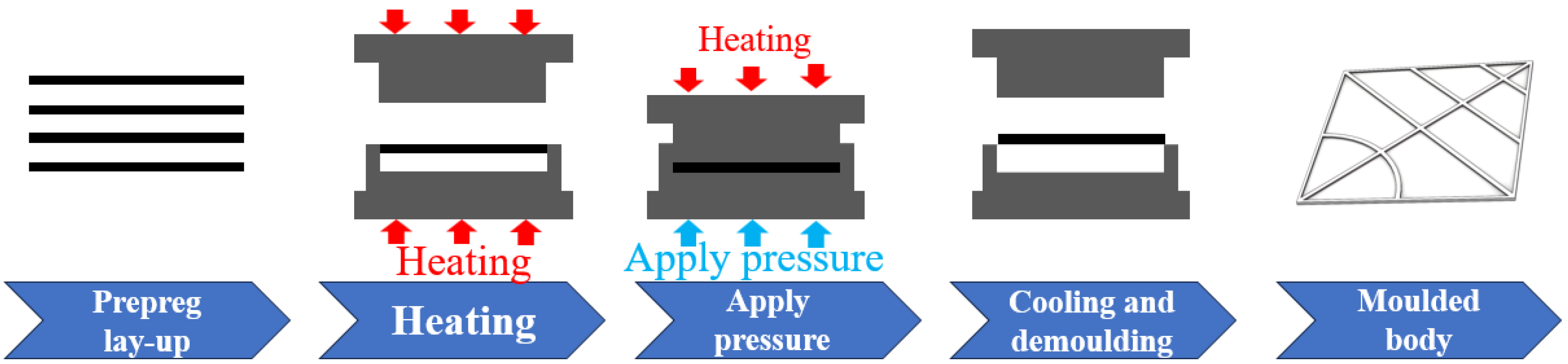
In response to increasingly severe environmental challenges and recyclability demands, the application of thermoplastic matrix materials continues to grow. For semi-structural components, long-fibre-reinforced thermoplastic composites (LFTs) compression moulding enables higher fibre retention rates and efficient mass production of complex parts [1,2,3]. A typical thermoforming process is illustrated in Figure 1.
The mechanical properties of LFTs are significantly influenced by their microstructure [4,5], with the final fibre orientation being particularly critical. This arises from the influence of resin flow during the moulding process, which, in turn, counteracts the fibres. This phenomenon has been confirmed in studies of Sheet Moulding Compound (SMC) thermoplastic composites [6] and Glass-Mat Reinforced Thermoplastic (GMT) [7,8]. Approaches to investigating shear-thinning behaviour vary: some studies disregard shear thinning [9,10]. Researchers omit shear thinning because, in high-fibre-concentration composites, inter-fibre interactions dominate flow behaviour. Their anisotropic effects far outweigh the matrix’s intrinsic shear thinning, and omitting shear thinning allows focused investigation of how orientation evolution influences flow anisotropy. Some studies assume shear thinning is fibre-independent [11], positing that shear thinning represents intrinsic matrix behaviour arising from molecular dynamics, whilst fibres primarily influence stress transfer and orientation. This separation of matrix and fibre effects reduces computational complexity and cost. Other research employs effective material viscosity for characterisation [12,13]. Scholars advocate characterisation via effective material viscosity because rheological parameters of both matrix and composite materials can be obtained using a rotational rheometer, while simplified models reduce computational costs. For flow studies of LFT [14,15], GMT [16,17], and SMC [18,19], plate compression moulding serves as a verification method.
Regarding extrusion flow studies, Dweib et al. [20] derived a power-law model for slip-free extrusion flow to obtain shear and tensile viscosities. Thattaiparthasarthy et al. [21] employed an extrusion flow power-law model to investigate the influence of fibre mass fraction on viscosity, alongside the dependence of tensile and shear viscosities on compression rate for long-fibre thermoplastics (LFTs), under conditions of constant fibre length, die gap, and temperature. Song et al. [22] simulated the compression moulding of thermoplastic composites via Computer-Aided Engineering (CAE). By measuring initial fibre orientation and inputting this into the initial blank of the moulding process, they verified warpage under different specimen conditions. They compared results with simulations, demonstrating high consistency. Sommer et al. [23] analysed the compaction process of chopped thermoplastic prepregs, employing a two-phase viscoelastic finite element model to address the mechanical behaviour of molten prepregs. They proposed discretising interlaminar contacts to model compaction and flow behaviour in the moulded part, and derived estimates of resin cavity volume that showed good agreement with experimental predictions. Poppe et al. [24] investigated the influence of resin penetration on the transverse compression behaviour of fibre fabrics. They developed a fully coupled three-dimensional model of resin flow and fabric deformation, which effectively predicted the average fluid pressure during the compression moulding process. Schreyer et al. [25] employed isothermal extrusion flow tests between parallel plates to investigate the anisotropic rheological properties of moulded long carbon fibre-reinforced PA6 under varying temperatures and compression rates. They characterised fibre reorientation using the Mori–Tanaka fibre orientation equation, while describing shear thinning behaviour and anisotropic flow characteristics. Huang et al. [26] analysed GMT with PA6 as the matrix material using a parallel plate rheometer. Assuming pure shear flow for the model, viscosity was simulated as a function of shear rate. Material data were used to simulate compression tests in Moldex3D, yielding highly consistent results between experiments and simulations.
In the aforementioned studies, researchers analysed the compression-moulding process, focusing on fibre orientation, shear-thinning behaviour, and the influence of shear rate on resin flow. During melt processing, the PA6 matrix exhibits pronounced shear thinning behaviour and temperature-dependent viscosity. The introduction of long fibres induces significant flow anisotropy, leading to incomplete filling and difficulties in predicting resin flow during compression moulding.
To address this issue, this study proposes a novel macroscopic rheological model that explicitly takes into account the anisotropic viscosity behaviour of the melt-processed long carbon fibre-reinforced PA6 phenomenon that is often difficult to model consistently during the forming and flow stages. In contrast to previous studies that treat viscosity as isotropic or ignore in-plane anisotropy, we propose a two-path viscosity parameterization approach. This method combines rotational and torsional rheometers to characterise the viscosity behaviour and accurately capture the difference between thickness direction and in-plane viscosity, thus reflecting the flow anisotropy more accurately. In addition, we designed a coupled sequence modelling framework of ABAQUS/Explicit forming simulation and MOLDFLOW flow simulation to achieve a unified simulation of deformation and resin flow in long-fibre PA6 composites.
The structure of this paper is as follows: Section 2 first characterises the material properties of the long carbon fibre PA6 semi-finished product. Section 3 establishes a fundamental rheological modelling framework by developing a macroscopic Cauchy stress model centred on the anisotropic viscosity tensor, treating the molten long carbon fibre PA6 as a fibre suspension. Section 4 proposes two material characterisation and parameterisation approaches: a rheometer viscosity characterisation scheme and an in-mould viscosity characterisation scheme. The rotational rheometer measures viscosity in the thickness direction of the specimen, while the torsional rheometer measures in-plane viscosity. Results demonstrate distinct in-plane viscosities perpendicular and parallel to the fibre orientation, differing from the thickness-direction viscosity, confirming the anisotropic nature of long carbon fibre PA6. In-mould viscosity analysis is then compared with rheometer results, verifying a strong correlation. Section 5 uses the anisotropic viscosity tensor model to simulate and validate the flat-plate specimens.

2. Materials Characterisation

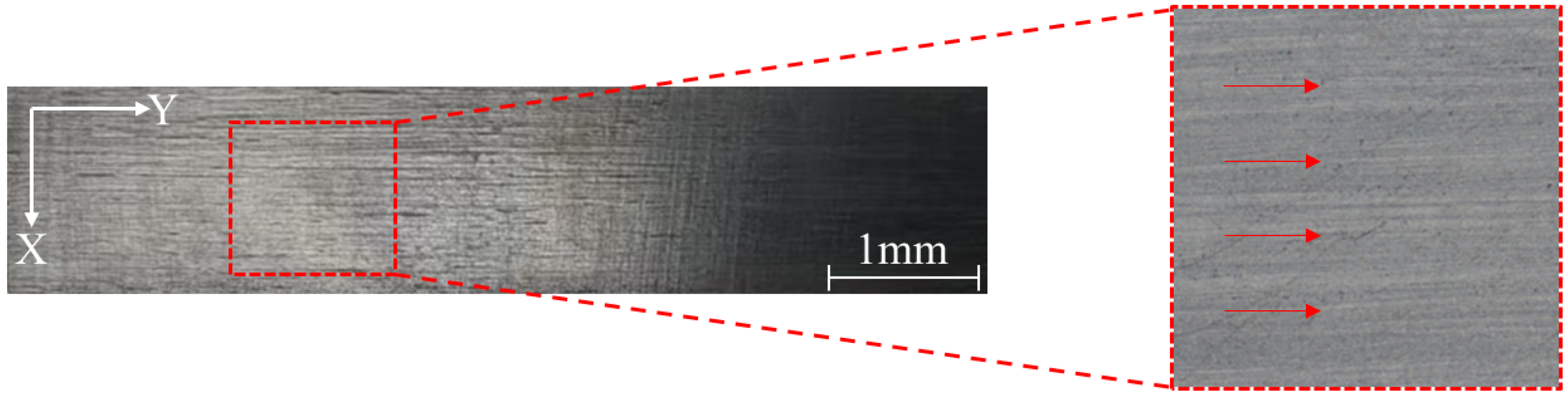
The semi-finished PA6 product utilised in this study features long carbon fibres with a thickness of 2 mm ± 0.1 mm (Pinette, Chalon-sur-Saône, France). Figure 2 illustrates the visible long fibre structure and the orientation of fibres along the y-direction. The fibre mass fraction and volume fraction obtained via thermogravimetric analysis are presented below, with the data summarised in Table 1.
In accordance with ASTM D3171 [27], the fibre mass fraction was determined by thermogravimetric analysis (TGA). Eight 5 cm × 5 cm specimens were cut from four 2 mm thick plates and incinerated in a furnace at 500 °C for 50 min to ensure complete pyrolytic decomposition of the PA6 resin. The remaining carbon fibres were weighed after incineration, yielding a fibre mass fraction of 55%. Based on the densities of the fibre and matrix materials, the corresponding fibre volume fraction was calculated to be 44.6%, as summarised in Table 1.

3. Rheological Modelling

In hot moulding simulation, long carbon fibre PA6 is modelled as a molten suspension in the constitutive model. Consequently, the macroscopic Cauchy stress can be expressed as [13,28]:
σ = p I + σ M + σ FM + σ FF
where p denotes the fluid’s hydrostatic pressure, σ M representing the pure matrix stress. σ FM denotes the shear stress arising from interactions between fibres and the matrix, while σ FF denotes the shear stress arising from interactions between fibres [29,30]. I represents the second-order unit tensor. The matrix stress σ M is expressed as:
σ M = ξ tr E I + 2 η E = 3 ξ 1 + 2 η 2 : E
among these are scalar bulk viscosity ξ , scalar shear viscosity η , strain rate E, isotropic expansion projector 1 = I I / 3 , and anisotropic expansion projector 2 = I S 1 . Here, the symmetric part of the fourth-order unit tensor is represented I S . Since the overall volumetric deformation of the sample is small, and bulk viscosity becomes significant only when the inverse of the volumetric strain rate is comparable to the molecular momentum scale [31], the bulk viscosity ξ is omitted ( ξ = 0). Consequently, the bulk stress can be simplified to:
σ M = 2 η E = 2 η 2 : E
according to Ericksen’s theory [32], the shear stress arising from fibre–matrix interactions can be expressed as:
σ F M = F 0 I + 2 η 0 E + η 1 A + η 2 A : E + 2 η 3 A E + E A
here, A and A denote the second- and fourth-order fibre orientation tensors [33], respectively. F 0 and η 0 describe the additional stresses induced by fibre-induced anisotropy, while η 1 , η 2 , and η 3 represent the internal fibre stress, additional viscosity along the fibre direction, and shear viscosity differences parallel and perpendicular to the fibre direction, respectively [34]. Tucker [35] et al. reformulated Equation (4) and the isotropic matrix stress as:
σ F M + σ M = 2 η _ [ E + N p A : E + N S A I + I A ]
η _ includes isotropic contributions from both the matrix and the molten suspension, and A I ijkl = A ik δ lj satisfies the condition that the equivalent viscosity η _ is equivalent to that η eff in Equation (13). Hereinafter, N p referred to as the effective viscosity, it reflects the additional stress induced by particle stretching within the suspension and N S denotes the shear resistance due to fibre thickness. This study employs slender carbon fibres, thus omitting shear resistance due to fibre thickness ( N S = 0). Consequently, inter-fibre interactions ( σ FF = 0) are also disregarded, aligning with previous compression moulding simulations of anisotropic viscosity models [36]. Following Bertotti’s theory [37] of skew stress and strain rate, the macroscopic Cauchy total stress in the rheological model is expressed as:
σ = p I + 2 η _ 2 + N p A 1 3 I A : E = p I + V : E V = 2 + N p A 1 3 I A
among these V is a fourth-order viscosity tensor; when the particle number N p = 0, the anisotropic viscosity tensor degenerates into its isotropic form.
In the macroscopic intrinsic model adopted in this study, microscopic fibre–fibre interactions are implicitly characterised through the evolution of the fibre orientation tensor. Specifically, the fibre interaction coefficient (CI) in the modified Folgar–Tucker (ARD–RSC) formulation quantifies the degree of orientation randomisation caused by inter-fibre collisions, thereby modulating the anisotropic viscosity response at the macroscopic level. In this study, a constant CI value was employed, calibrated under steady-shear conditions. Although this simplification does not explicitly resolve the dynamic contact network or jamming phenomena that may arise at high fibre volume fractions, the calibration process effectively incorporates the averaged resistance to fibre rotation and local crowding effects typical of concentrated suspensions.
The aforementioned formula provides a well-established mechanical framework for modelling anisotropic fibre suspensions. The principal contribution of this study lies in the comprehensive application of this framework to the moulding and resin flow processes of long carbon fibre-reinforced PA6 materials. Furthermore, through material parameterisation, this framework can predict the moulding behaviour of preforms and resin flow characteristics during hot pressing.
To simulate the entire process chain from prepreg moulding to resin flow (which typically requires different numerical solvers), this study designed a sequential simulation strategy. The modelling strategy comprises the following three aspects: (1) material parameterisation: the anisotropic viscosity η in Equation (6) is determined by fitting specific parameters for LFT-PA6 materials. The particle number Np is established using parameters such as fibre aspect ratio and volume fraction, while the matrix viscosity parameters originate from rheometer testing. (2) Sequential simulation framework: sequential moulding simulations are employed to model material forming and predict resin flow.
During the forming stage, Equation (6) was implemented using the VUMAT code within the ABAQUS/Explicit platform. This equation represents the dual-domain PVT state equation describing hydrostatic pressure p [38], integrated with the ARD-RSC model characterising fibre orientation [39]. Macroscale Cauchy stresses were defined within the Green-Naghdi framework to simulate real material strain. Resin flow prediction utilised MOLDFLOW software, which integrates its built-in fibre orientation and PVT models. However, as the viscosity solver API-SolverUserHb3dViscosity only supports isotropic viscosity models, the information-based anisotropic viscosity constitutive model proposed by Favaloro et al. [40] was employed. This model combines a closed-form approximation based on invariant-based optimal fitting (IBOF) [41] to derive the fourth-order fibre tensor from the second-order fibre tensor. Material forming was performed using ABAQUS software (2021), whilst resin flow was processed synchronously via MOLDFLOW. Table 2 presents key feature comparisons between this study and selected flow modelling approaches for long-fibre-reinforced thermoplastic composites.

4. Rheological Characterisation and Parameterisation

4.1. Rheometer Analysis

Rheometer analysis is used to characterise sample viscosity. Rheometer testing investigates viscosity anisotropy. The following sections shall cover experimental setup, results, theoretical background, and material parameterisation.

4.1.1. Rheometer Experimental Setup

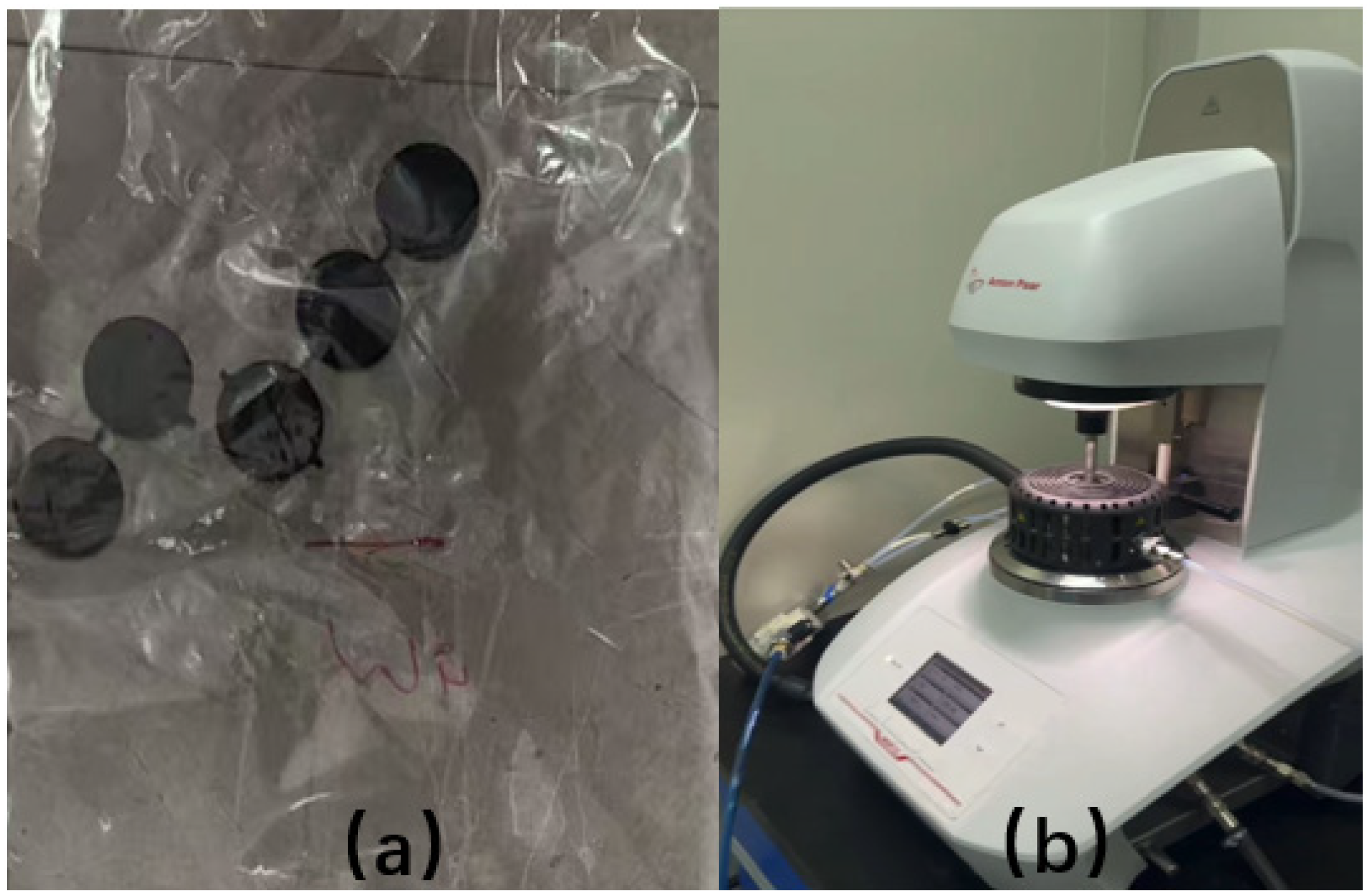
This experiment employs a plate rheometer and a torsional rheometer to characterise the rheological properties of the material under low strain conditions. The plate rheometer measures the viscosity in the thickness direction of the specimen, while the torsional rheometer measures the viscosity within the plane of the specimen. TB 0° denotes measurements along the fibre direction, and TB 90° denotes measurements perpendicular to the fibre direction. The parallel plate rheometer utilised specimens with a diameter of 25 millimetres, cut from 2-millimetre-thick moulded plates, as illustrated in Figure 3 depicting the rheometer and specimen samples. The specimen height was designed to ensure uniform shear force distribution while meeting the minimum test height requirement specified in reference [42,43]. Furthermore, the circular specimen shape minimised the influence of inherent plate orientation on the test apparatus. All samples were dried at 90 °C for at least 24 h prior to testing. This procedure aligns with the practical requirements for drying pre-impregnated materials commonly employed in PA6 processing. During the testing phase, once the temperature stabilises within the target test range, it must be maintained to complete the preheating. Furthermore, a 20 min holding period is required prior to rheometer testing to ensure uniform temperature. All tests comprise three replicate experiments per group, conducted entirely under a nitrogen atmosphere to prevent thermal degradation of the polymer at elevated temperatures.

4.1.2. Experimental Results

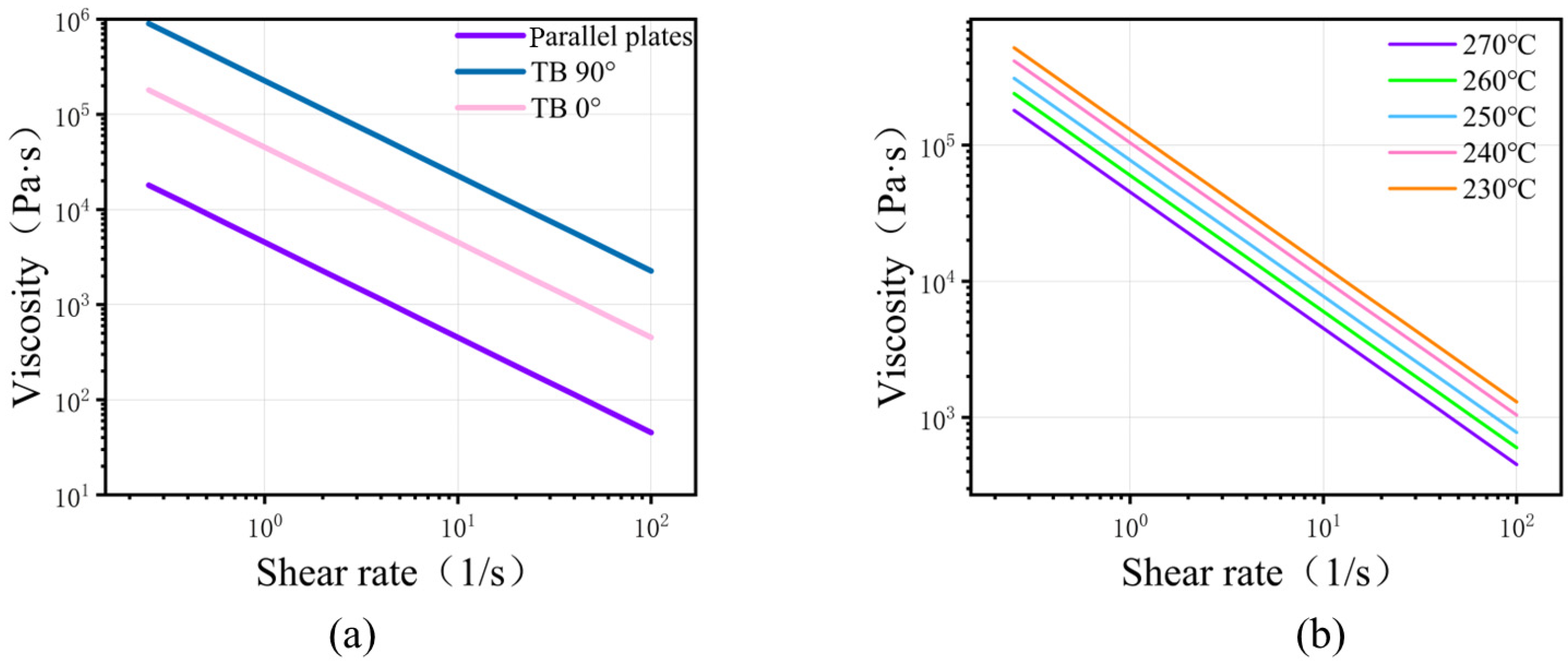
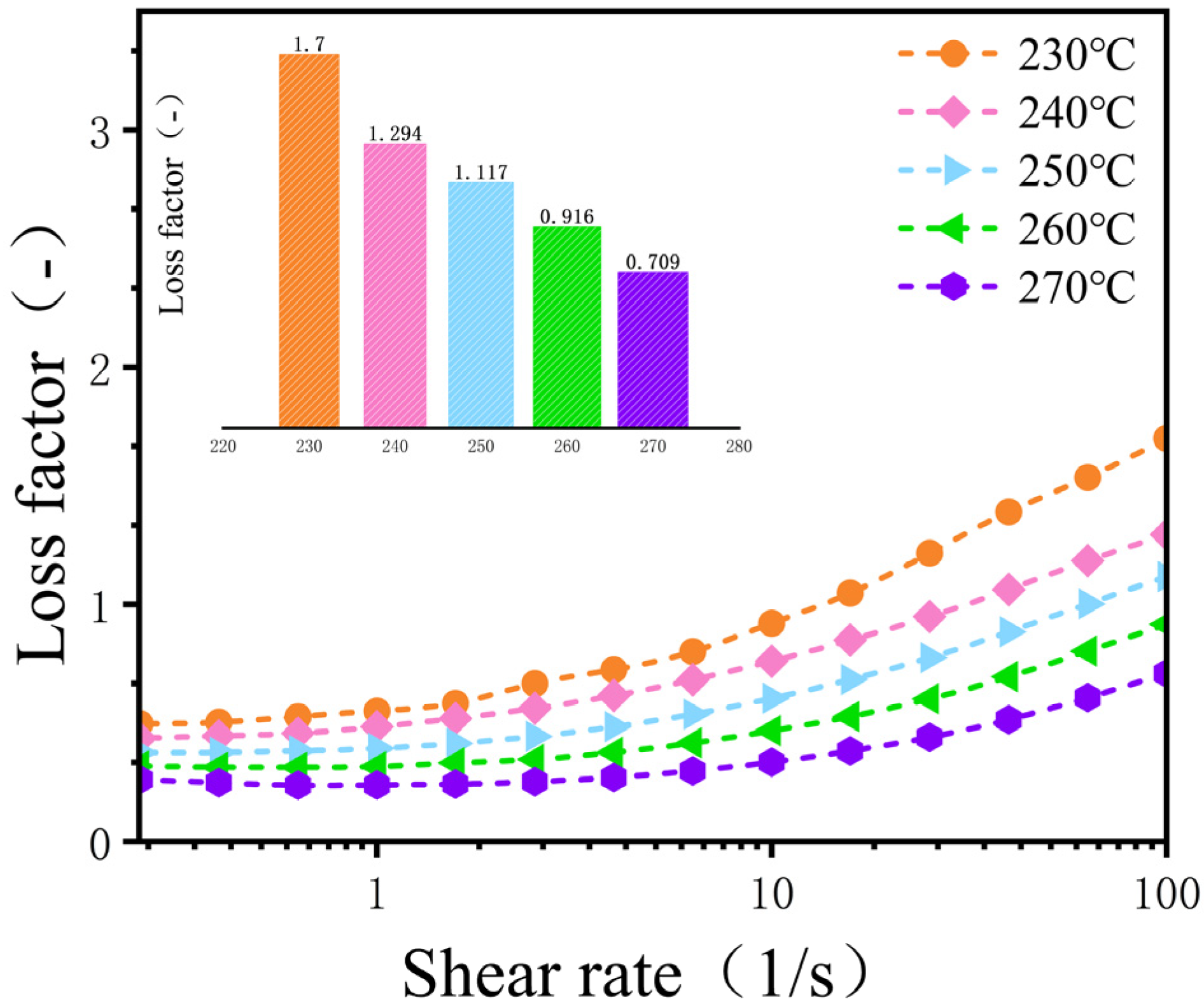
Figure 4a shows the difference in viscosity between TB 0° and TB 90° at 270 °C, which also deviates from the plate rheometer data. This difference reflects the anisotropic nature of the viscosity, with the 0° measurement revealing the fibre orientation more clearly. In the plate rheometer experiments, the temperature gradient ranged from 230 °C to 270 °C, and each test set was repeated three times. The shear rate was determined by the Cox–Merz formula based on the angular frequency of the oscillating load. Figure 4b shows rheometer results across all test temperatures, demonstrating significant shear thinning behaviour. The resin viscosity decreases with increasing temperature, indicating a high temperature sensitivity of the resin flow. Figure 5 further illustrates the material’s significant temperature sensitivity by showing the loss factor (defined as the ratio of the storage modulus to the loss modulus) as a function of shear rate.

4.1.3. Theoretical Background

The test specimens were subjected to isothermal conditions during experimentation. Consequently, the power-law characteristic parameters determined at each temperature can be converted to the Cross-WLF model, thereby describing the relationship between viscosity and both shear rate and temperature:
η γ * , T = η 0 1 + η 0 γ * τ 1 m
the zero-shear viscosity is denoted as η 0 , A1 represents the critical stress at which shear thinning occurs, A2 denotes the viscosity at the reference temperature, while B1 and B2 are the temperature-dependent WLF parameters. This two-step calculation avoids the complexity of directly fitting the Cross-WLF model.
η 0 T = A 1 exp B 1 T A 2 B 2 + T A 2
Effective viscosity η eff is described by a power-law model:
η eff = k γ * m 1
k denotes the consistency coefficient, m represents the power-law exponent, and γ * signifies the shear rate. By integrating experimental data with the effective viscosity η eff power-law model in Equation (14), the material parameters k and m were determined. The parameterised results and data were then transformed into Equations (12) and (13), with A2 set as the glass transition temperature. Due to limitations in instrument sensitivity during testing, the shear rate was set to 0.25 s−1. Owing to the oscillatory loading, the shear rate γ * used to evaluate viscosity during parameterisation was corrected according to the Cox–Merz [44] criterion:
γ * = l φ r γ = l φ y 2 + z 2 γ
where r denotes the radial coordinate of the plate rheometer, and φ denotes the circumferential coordinate.

4.1.4. Parametrisation of Anisotropic Materials

The anisotropic viscosity model, using Equation (9) and rheometer test data, can yield fitted values for the k consistency coefficient and the m power-law exponent. The particle number N p is determined experimentally through observational values. Numerous analytical expressions exist for particle number estimation, including those developed by Armstrong [45], Banaei [46], Lindström [47], and Fredrickson [48]. This study employs Fredrickson’s method to calculate the particle number:
N p = 4 f r p 2 3 log 1 / f + log log 1 / f + C
where f denotes the fibre volume fraction, rp = lp/dp, lp represents the fibre characteristic length, dp denotes the fibre equivalent diameter, and C is the orientation factor for the fibres. According to the prepreg specification and Equation (11), the particle count N p is 3638.
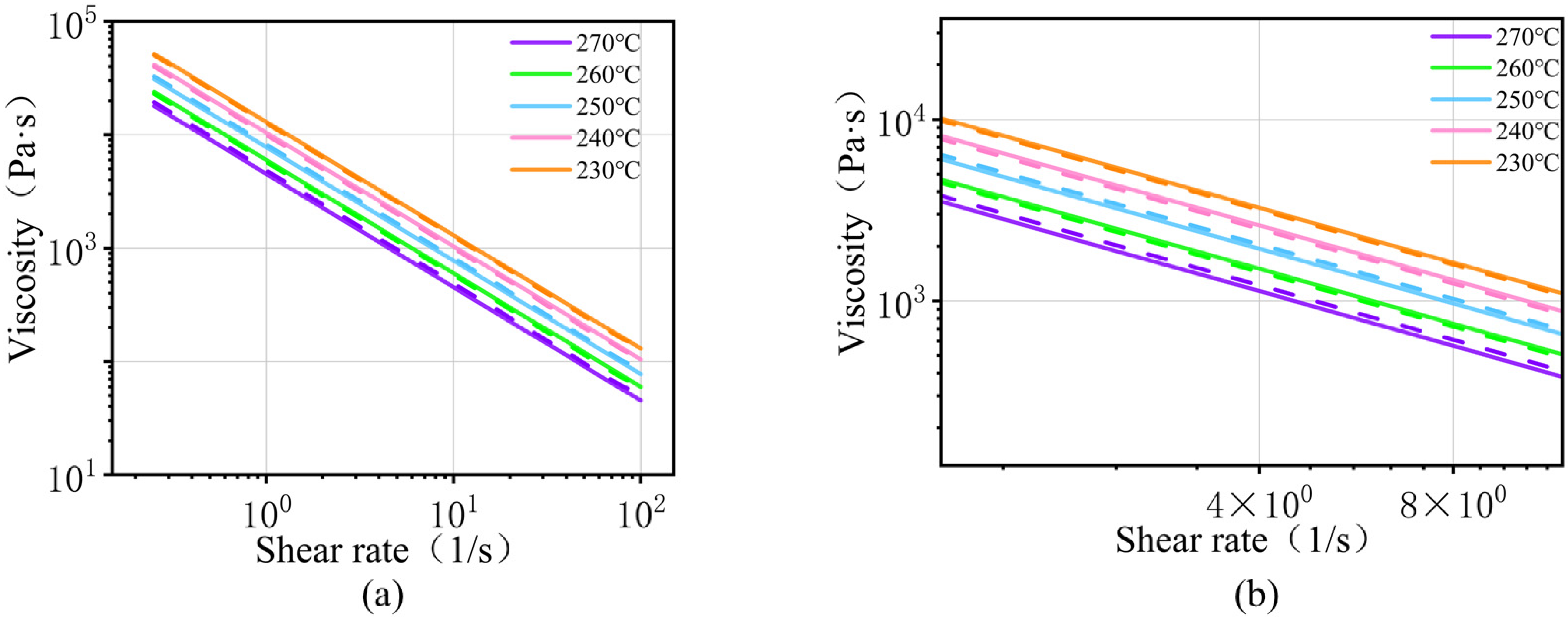
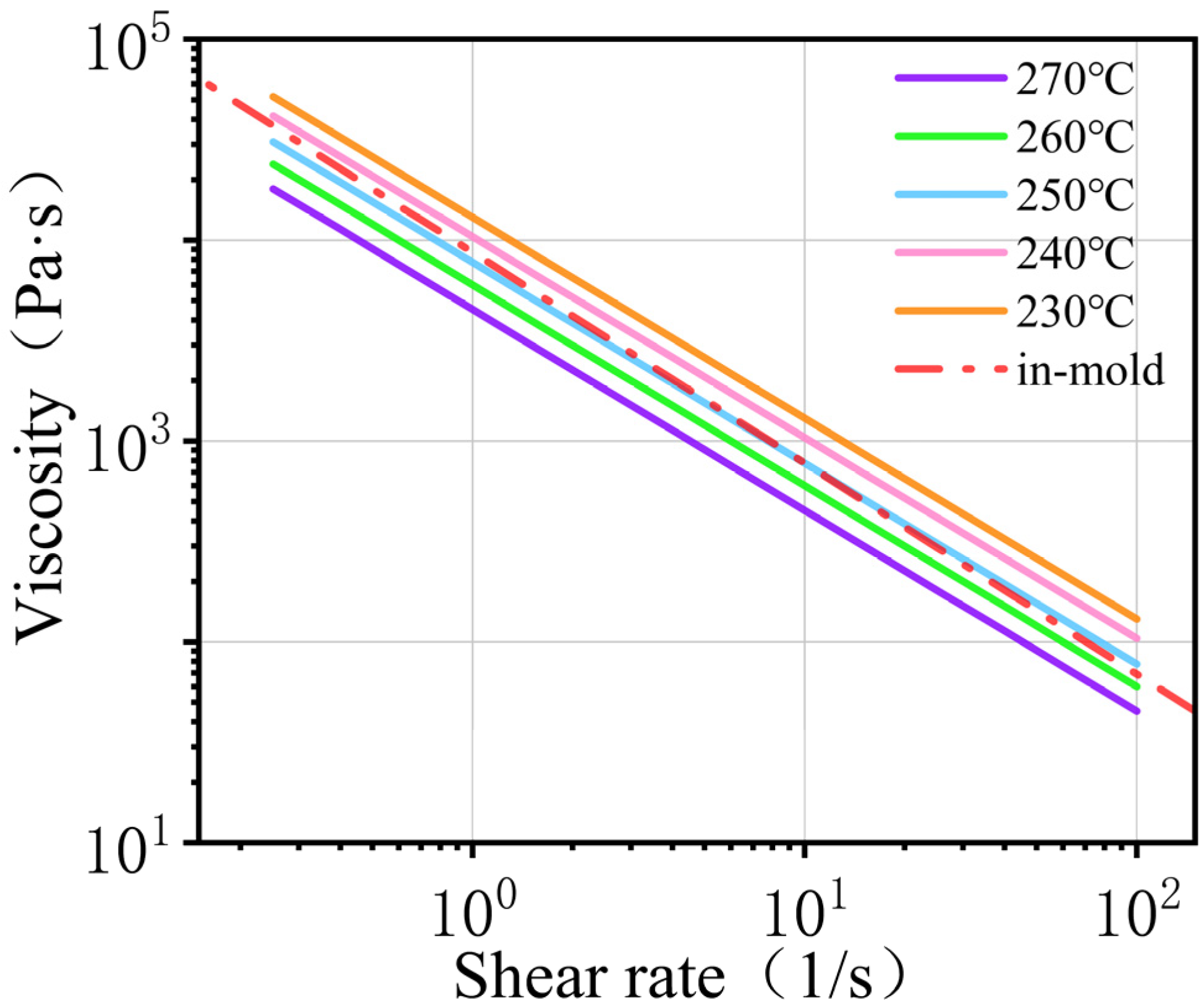
As shown in Figure 6, the five differently coloured curves represent distinct temperature ranges (230–270 °C), exhibiting the following typical shear thinning behaviour: viscosity decreases continuously with increasing shear rate. Overall, viscosity levels decline with rising temperature (the 270 °C curve being the lowest), indicating pronounced temperature sensitivity in the system. Comparatively, the Cross-WLF model (dashed line) and the power-law fit (solid line) are nearly parallel and coincide across the entire shear rate range, indicating extremely high consistency in the overall fitting trend between the two parameterisation methods. This demonstrates that the Cross-WLF transformation preserves the primary characteristics of the power-law model for non-Newtonian shear thinning and can stably predict flow behaviour across multiple temperatures without significant deviation. Figure 6b: local detail shows an enlarged view of the low shear rate range (approximately 3–12 1/s), where viscosity is most sensitive and fitting errors are most likely to occur. It is evident that the Cross-WLF curves remain highly superimposed on the power-law fit at all temperatures; no systematic deviation is observed, and fitting errors are maintained within approximately 5%.
This demonstrates that the Cross-WLF transformation maintains high accuracy within the low shear rate range where temperature effects are pronounced. These test results quantitatively validate that “the two-step parameterisation process of power-law–Cross-WLF effectively preserves rheological precision for anisotropic materials”, circumventing the convergence difficulties and overfitting inherent in direct multi-parameter fitting.

4.1.5. Parametrisation of Isotropic Materials

Data results from the anisotropy parameterisation using a tablet rheometer, Summary Table 2.

4.2. In-Mould Viscosity Analysis

In-mould analysis employs process-parameter-driven viscosity characterisation through hot-moulding tests. The following sections shall outline the experimental apparatus, theoretical foundations, experimental results, and material parameterisation.

4.2.1. Experimental Apparatus

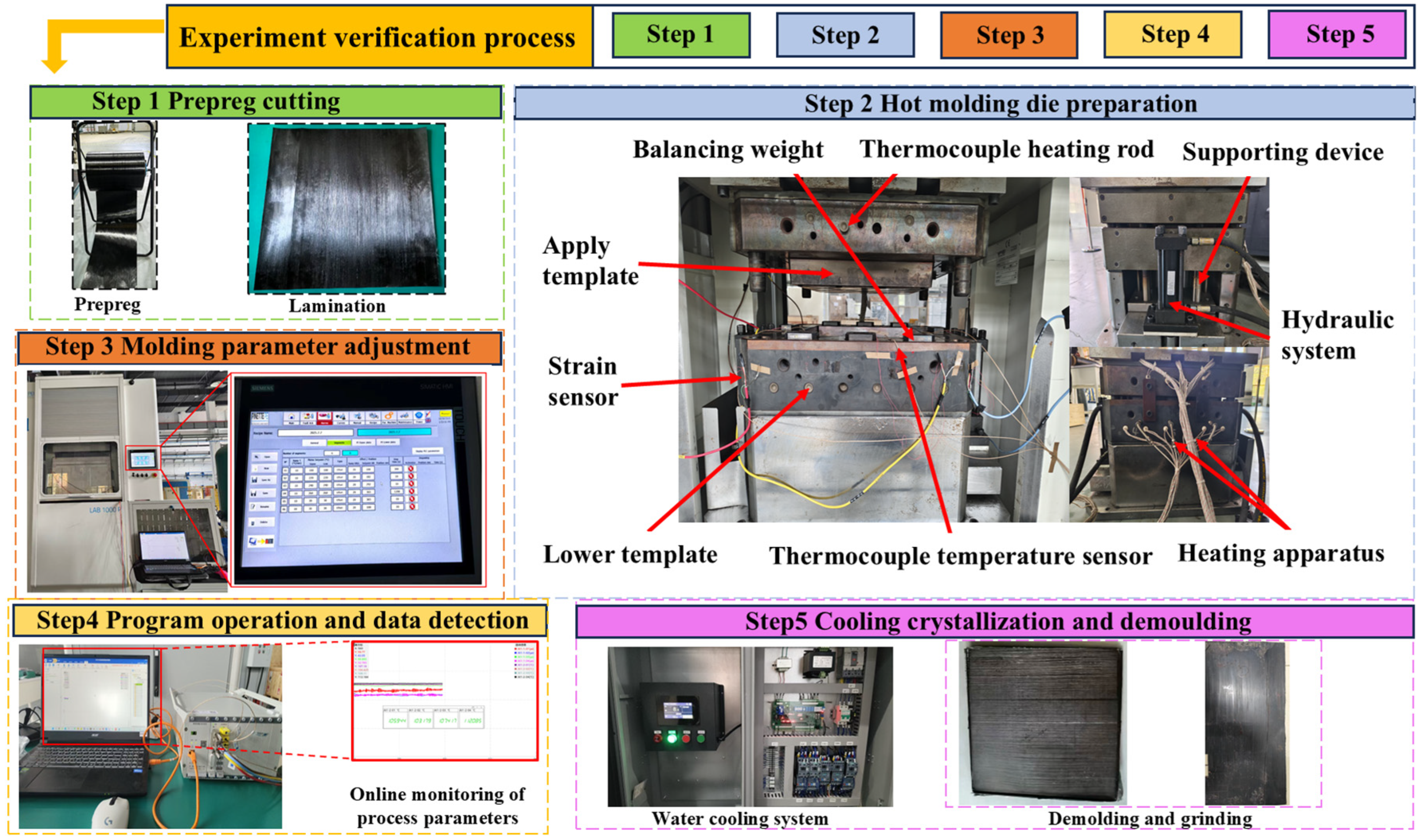
As shown in Figure 7, this is an overall assembly diagram and a general flow chart of the hot press moulding device. The primary component is a 450 mm × 450 mm square mould, which is lifted and moved upwards by a hydraulic system. Both the upper and lower moulds are fabricated from H13 mould steel and are heated by a thermocouple heating system. The thermocouples are evenly distributed throughout the interior of both moulds to enhance temperature uniformity. The entire mould assembly is mounted on the LAB 1000P high-temperature composite testing press from PINETTE PEI (Pinette, Chalon-sur-Saône, France). Stress measurements are taken using strain gauges from AVIC Electro-Measurement Instrument Co., Ltd., while temperature readings are obtained via K-type thermocouples from Capstone.
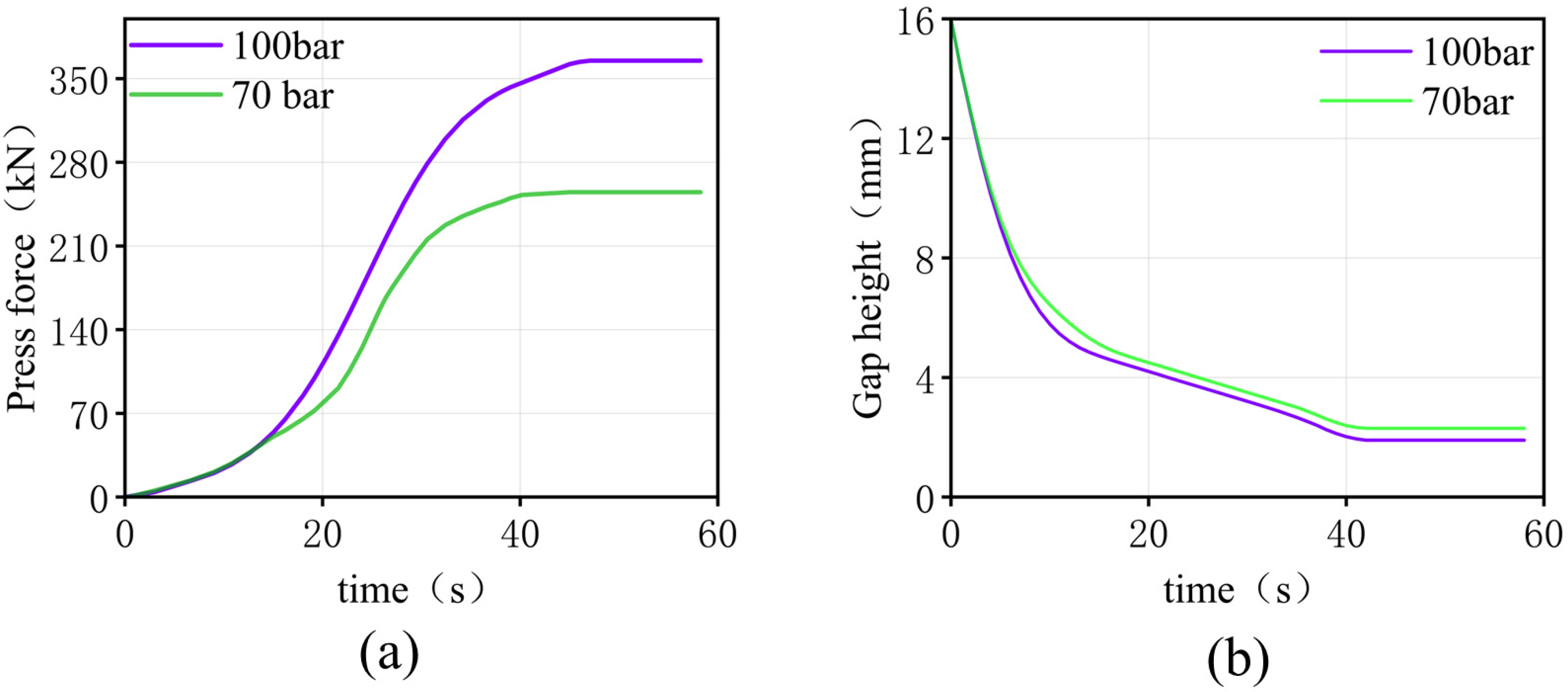
The prepreg was cut into twelve-layer laminates. The assembled prepreg laminate was preheated in the mould, with the temperature raised from ambient to 230 °C at 10 °C per minute under no pressure and held for 10 min to eliminate the effects of water vapour and achieve thermal equilibrium. Compression is performed at a constant closing speed until the final thickness of 2 mm is attained. In the experiment, tests were conducted at specific pressures of 70 bar and 100 bar, defined as the maximum controlled pressure of the press divided by the projected area of the part.

4.2.2. Theoretical Basis

Employing the methodology and theory proposed by Kalaidov et al. [49], viscosity analysis was conducted using press plate spacing, moulding speed, and pressure data. Assuming one-dimensional isothermal flow without wall slip within the mould cavity, the compression process may be analogous to extrusion rheology [50]. Consequently, the wall shear stress can be expressed as:
τ wall = h 2 1 + h b d p d x
Equation (1), τ wall denotes the wall shear stress, h is the distance between the upper and lower mould plates, b is the mould width, p is the pressure, and x is the resin flow direction. Under the condition that the overall mould width is significantly greater than the plate spacing, Equation (12) can be simplified to:
τ wall = F b h 3 2 k V 2
Equation (2), F denotes the press pressure, V represents the prepreg volume, and k is a parameter that simulates the influence of the flow region. Referencing Kalaidov’s research, k is set to 1/3. The velocity distribution at the flow front of Newtonian fluids is approximated as parabolic. However, PA6 polymer is a typical non-Newtonian fluid, whose apparent wall shear rate γ ˙ a w a l l is given by:
γ awall = 6 V h b h 3
where h denotes the compression velocity. The real wall shear rate   γ ˙ r w a l l may be obtained via the Weissenberg–Rabinowitsch correction:
γ rwall = γ awall 3 2 + d ln γ a w a l l d ln τ w a l l
finally, the ultimate in-mould viscosity η inm is derived from Equations (2) and (4):
η inm γ rwall = τ wall γ rwall

4.2.3. Experimental Results

Figure 8 displays the pressure data recording and inter-plate gap height variations over time during the hot moulding process. Data processing employed FFT (Fast Fourier Transform) filtering and curve smoothing techniques, with a sampling frequency of 20 Hz. Throughout the compression phase, both pressure and gap height exhibited low dispersion. Upon material flow initiation (t = 0 s), pressure exhibits a smooth ascending trend until the press transitions from displacement control to pressure control. After reaching maximum pressure, the system enters the pressure-holding phase, ensuring complete resin filling of the mould cavity.

4.2.4. Isotropic Parametrisation

Through repeated moulding experiments, data on variations in in-mould viscosity and true wall shear rate were obtained. Through repeated moulding experiments, data on in-mould viscosity and actual wall shear rate variations were obtained. Figure 9 compares the apparent viscosity derived from in-mould characterisation with viscosity measured by a rheometer under isothermal conditions (230–270 °C). All curves exhibit typical shear thinning behaviour, with viscosity gradually decreasing as shear rate increases. The in-mould data (orange curve) align closely with the rheometer curves. This strong overlap indicates that the in-mould characterisation method effectively captures rheological responses, confirming its ability to reproduce the true flow behaviour of molten resin during compression moulding. Deviations between in-mould and rheometer-based power-law fits fall within acceptable shear rate error margins. This high consistency validates the apparent viscosity derived from process pressure-plate gap-height data. Finally, converting the power-law parameters obtained at various temperatures into the Cross-WLF model demonstrated excellent correlation; specific parameters are detailed in Table 3.

5. Forming Simulation Analysis: Application and Virtual Validation

This simulation employs a two-stage sequential framework, utilising the Lagrangian method for moulding analysis and the Eulerian method for resin flow simulation. This integrated approach not only evaluates the final flow outcome but also reveals how de-formation during the moulding stage influences subsequent flow behaviour. This section employs material parameters characterised in Section 4 to conduct virtual prototyping of the hot-press moulding process based on an anisotropic viscosity constitutive model. It is particularly noteworthy that this study implemented dual validation as follows: firstly, numerical verification of the modelling framework (including the anisotropic viscosity tensor and sequential coupling between ABAQUS and MOLDFLOW) was performed using geometric models flat plates; secondly, experimental validation was conducted through rheological characterisation, tensile testing, and microscopic observation (flat-plate specimens) to confirm the model’s ability to capture the rheological and mechanical behaviour of long carbon fibre PA6 material under typical forming conditions. The anisotropic viscosity simulation framework proposed herein has been validated for planar plate geometries. The simulation workflow and progression are detailed as follows:
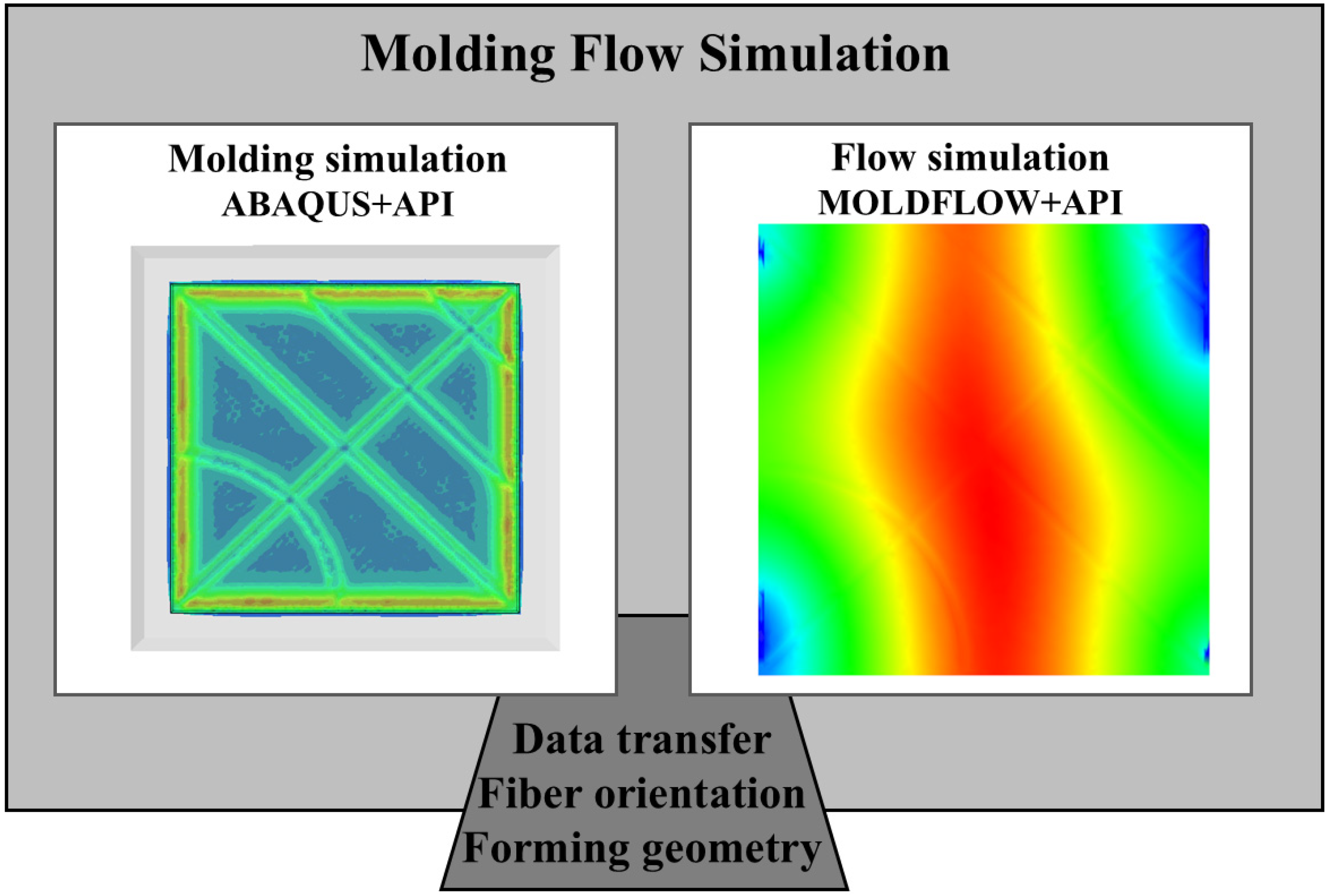
First, the simulation model is established. The material forming process is simulated using the Lagrangian method in ABAQUS, while the material flow process employs the Eulerian method. The upper and lower moulds are defined as rigid bodies. During simulation, only the forming state of the prepreg is investigated, without considering the deformation of the moulds. Both moulds are assigned material properties of H13 mould steel and set as rigid bodies, with R3D4 mesh elements selected. During simulation, the programme automatically halted upon compression to the predetermined gap height, thereby preventing excessive material flow. Subsequently, post-forming parameters—including sheet geometry and fibre orientation—were transferred via MOLDFLOW to the solver API port within the process parameter settings for simulation. Given the minimal strain and compression rate during moulding, stress and strain rate data were not transmitted to this software. Owing to the absence of a corresponding temperature transfer port in MOLDFLOW, localised temperature data during moulding cannot be transmitted. Consequently, a global temperature is set within MOLDFLOW, and the resin flow stage is simulated using the Eulerian method.
The two-stage simulation of the model was achieved through APIs in both solvers. A schematic diagram of the injection moulding simulation method is shown in Figure 10, which includes sequential stage injection moulding simulation and flow simulation. Within ABAQUS/Explicit, the Cross-WLF model, the PVT dual-domain EOS state model describing static pressure p, and the fibre orientation equation were input into VUMAT. The Cauchy macroscopic stress was defined in Green-Naghdi [51] to ensure accurate material deformation, thereby realising the anisotropic rheological model of Equation (6). Within MouldFLOW, the fourth-order fibre tensor is derived from the second-order fibre tensor via the viscosity solver API. This integration of all three equations within MOLD-FLOW enables material parameterisation.
Material parameterisation: For moulding simulations, the dual-domain EOS parameters were determined via material characterisation based on ISO 17744 [52]. Specific heat capacity and thermal conductivity required for hot pressing were characterised as follows: specific heat capacity measured using NETZSCH DSC 214 per ASTM E1269; thermal conductivity measured using LFA 467 per ASTM D 5930.
Initial sheet material: During the lamination moulding process, heating from ambient temperature to 260 °C induces thermal expansion. The volumetric expansion rate is calculated from the measured thermal expansion coefficient. The dual-domain PVT model derives thickness changes from volumetric variations, ensuring material quantity accuracy in simulations while accounting for thermal expansion.
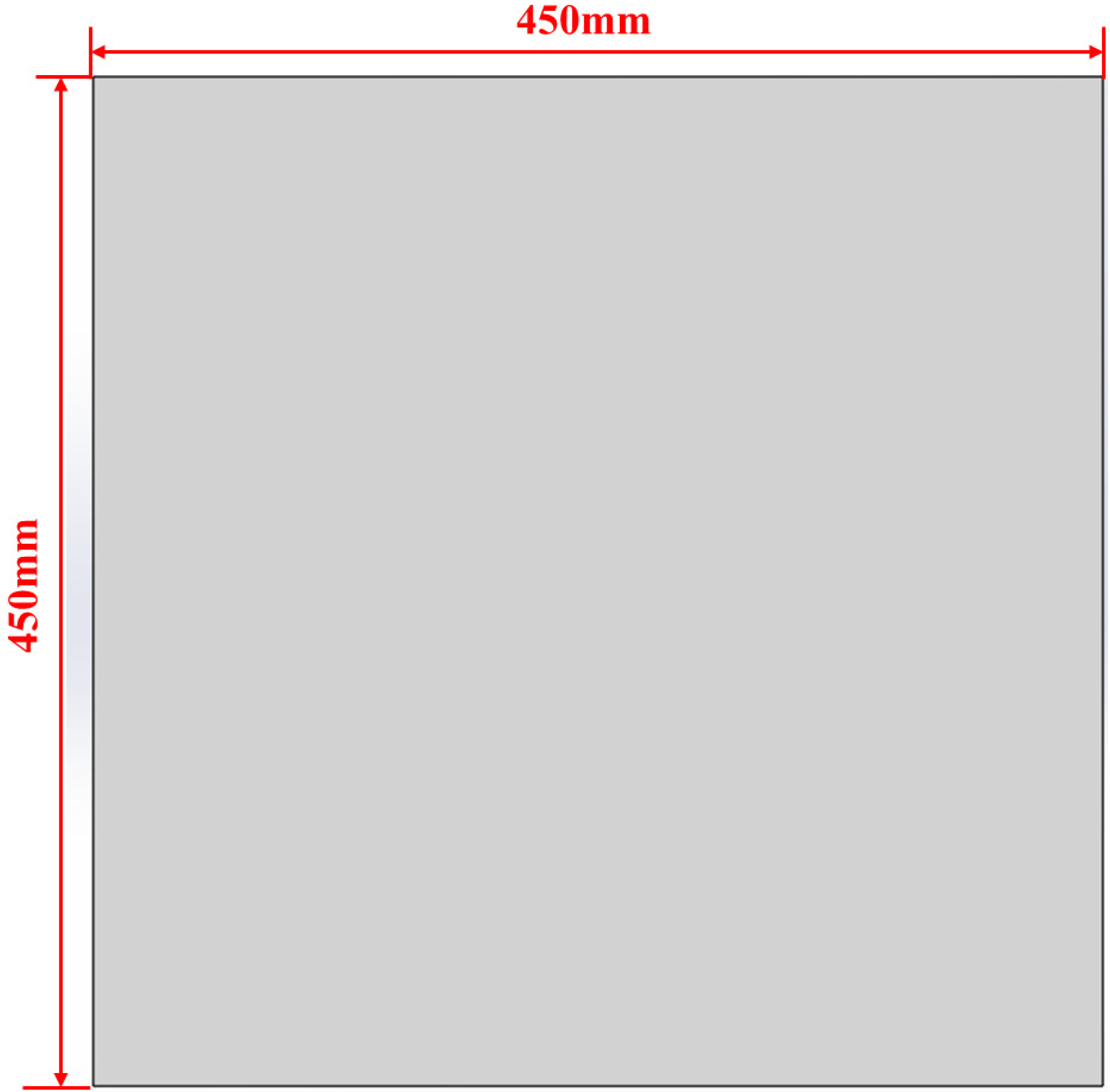
Thermal moulding experiment and geometry: The thermal moulding process for long carbon fibre PA6 comprises pre-preg cutting, layering and stacking of pre-pregs, preheating, thermal moulding, and component ejection. Following pre-preg cutting, materials are left to rest in a drying apparatus for 24 h to eliminate internal moisture and air, thereby reducing the risk of moulding defects. Thermal compression moulding was conducted using the LAB 1000P high-temperature composite press from PINETTE PEI. Components were ejected and demoulded via hydraulic mechanisms, with the mould temperature set at 260 °C. Geometry analysed for forming simulation: a 450 mm × 450 mm flat-plate sheet with the dimensions shown in Figure 11.

5.1. Flat Plate Simulation Analysis

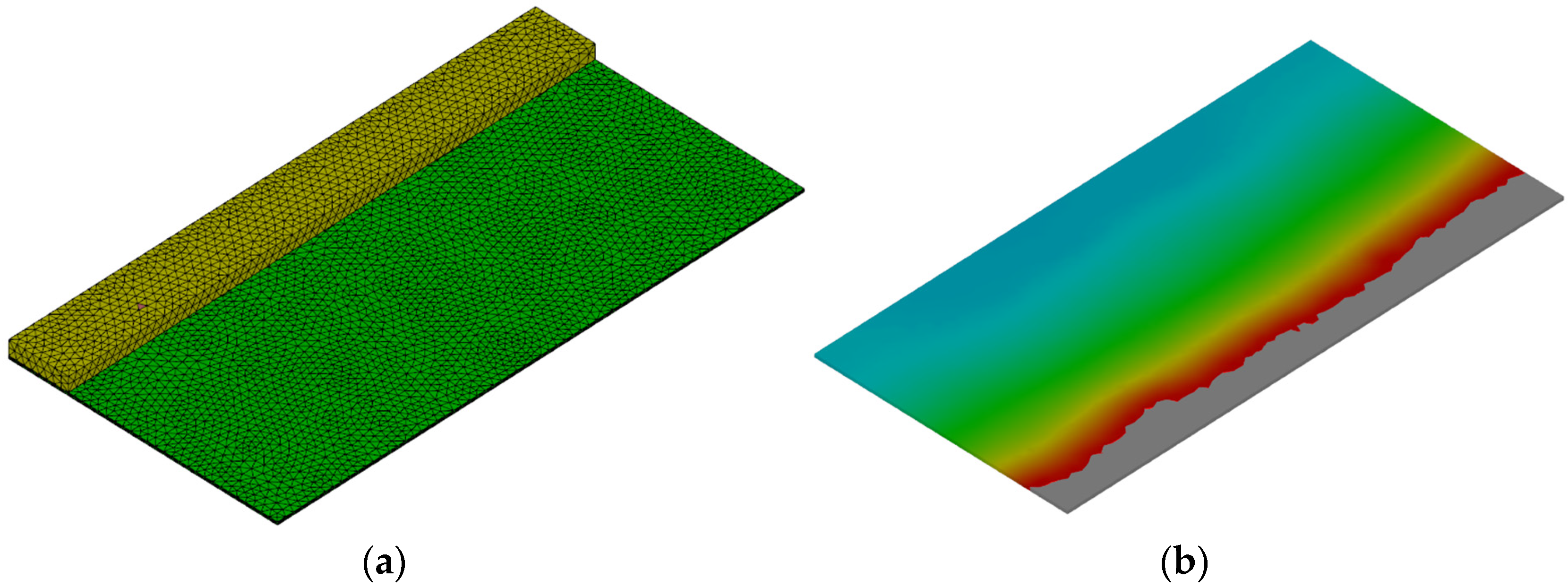
For the 450 mm × 450 mm flat-plate structure, only half of the plate is simulated to reduce computational load. Figure 12a displays the mesh generation settings in MOLDFLOW, where green indicates the final moulded part mesh and yellow represents the initial blank mesh. Figure 12b shows the simulation result indicating incomplete filling of the mould cavity.
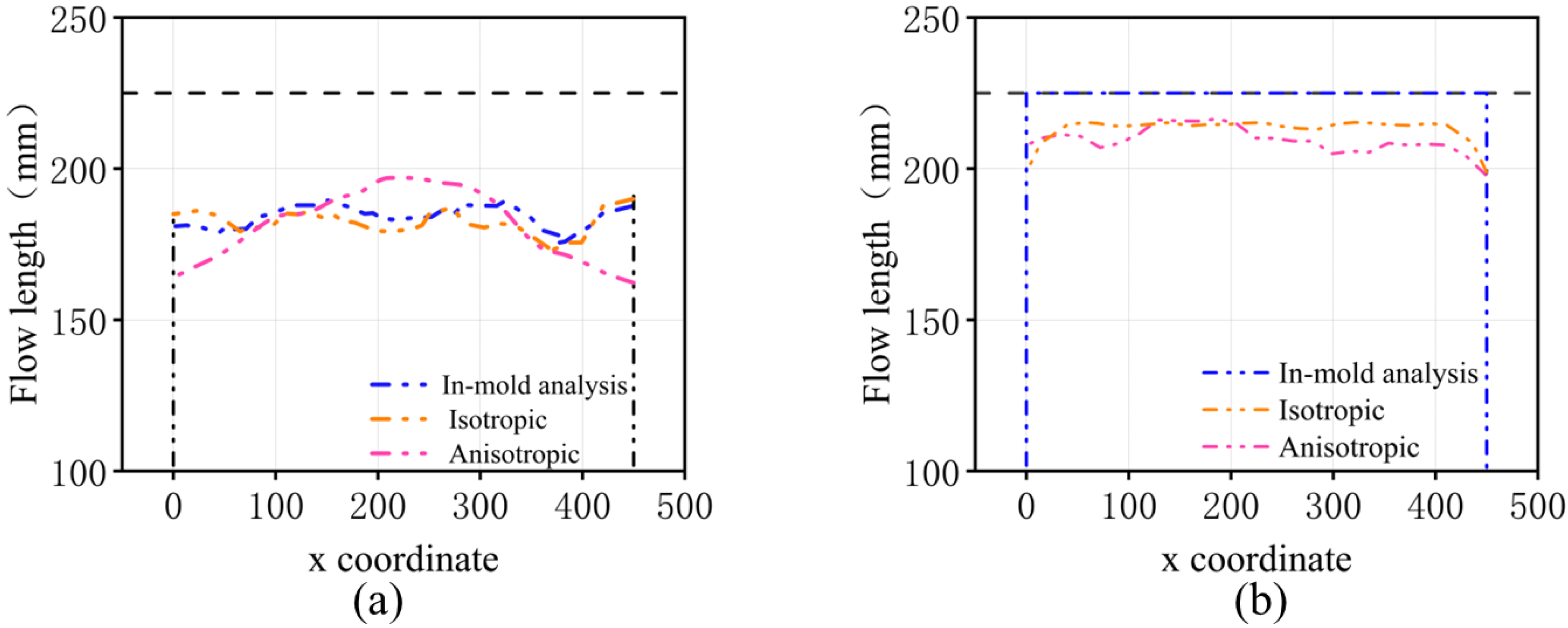
In the flow simulation software, the time-dependent pressure differential increments and gap height were applied as boundary conditions. Figure 13 compares the flow length predicted by viscosity models based on rheometer parameters with in-mould analysis results. At 70 bar pressure, the in-mould analysis aligns closely with predictions from the isotropic model, effectively forecasting the resin flow length (Figure 13a). The prominence of the anisotropic model arises because, in long carbon fibres, resin flows along the fiber orientation under lower pressure conditions due to its rheological state. This indicates that, at relatively low shear rates and driving pressures, fibre orientation within the melt has not yet fully developed, with flow behaviour primarily governed by the shear-thinning characteristics of the matrix resin. At 100 bar pressure, the predicted results show significant divergence (Figure 13b). In-mould analysis predicted near-complete cavity filling, whereas the anisotropic model underestimated the flow length. This discrepancy arises because, under the high pressure and shear rate of 100 bar, long carbon fibres within the melt undergo strong orientation along the flow direction. The anisotropic model captures the reorientation effect induced by fibre alignment, which reduces the equivalent viscosity along the principal flow direction, and consequently predicts a shorter flow distance. In summary, for simple planar flow under low-pressure conditions, the isotropic model provides a viable engineering simplification for prediction. However, at elevated pressures and increased shear rates, while the anisotropic model can predict the flow length, its performance is inferior to that of the isotropic model, exhibiting a systematic underestimation of the flow length.

5.2. Mechanical Properties Testing of Samples

5.2.1. Macro-Microstructure Analysis of Specimens

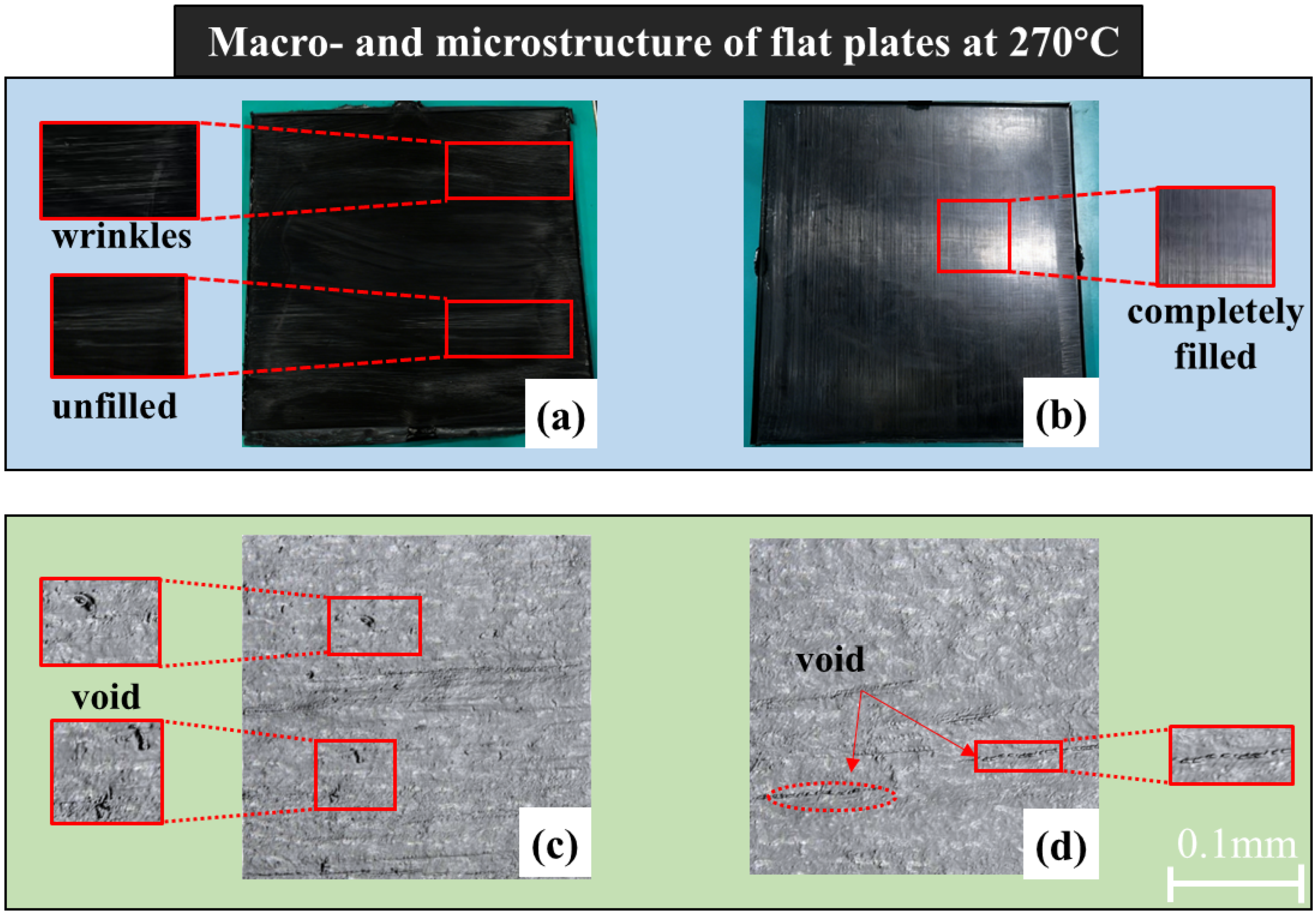
To verify the model’s accuracy, we conducted experimental validation under the same process conditions. The specimens were prepared by layup of unidirectional carbon fibre prepreg (UD-CA708A, Nanjing Special Composite Materials Co., Ltd., Nanjing, China) and hot-press moulding, and their macroscopic morphology is shown in Figure 14. The analysis of the post-moulding geometry revealed significant differences in the moulding results across different pressures. At 70 bar pressure (Figure 14a), there were unfilled areas with folding defects, whereas at 100 bar pressure (Figure 14b), the moulded part’s surface was completely filled, with no obvious folding or underfilling defects. The morphology of the flow front and the extent of the unfilled area at both pressures are in high agreement with the simulation prediction. The experimental results clearly demonstrate that the anisotropic viscosity model and the sequential simulation framework proposed in this paper can not only accurately predict the flow length of long carbon fibre PA6 composites but also capture the macroscopic morphological characteristics of incomplete filling. The subtle differences observed at the flow front boundary can be attributed to factors such as slight deviations in the initial sheet placement, actual heat transfer effects, etc., which have been simplified and treated in the isothermal simulations. Based on the above moulding specimens, more samples were further prepared for testing to analyse their mechanical properties.
To verify the validity of the predictions of the effects of the aforementioned simulated moulding design and the anisotropic viscosity principal model on the material’s flow behaviour and mechanical properties, mechanical experiments were conducted in this study on hot-pressed flat-plate components. The test specimens were selected from 450 mm × 450 mm formed plates corresponding to the previously modelled plate-structural conditions to ensure that the experimental results were consistent with the simulated conditions in terms of process paths and geometric scales. The moulded plates were first cut. Standard tensile specimens were extracted from the formed sheet along the main flow direction according to ASTM D3039 with the following dimensions: 250 mm pitch, 15 mm width, and 2 mm thickness. All specimens were edge-trimmed and surface-inspected prior to testing to avoid processing defects that could interfere with the results.
The moulded parts were then subjected to microscopic analysis. Figure 14c,d demonstrate a comparison of the microstructures of the composites obtained by microscopic observation. The red-marked areas in the figure indicate pores within the resin matrix, reflecting the effect of moulding pressure on resin flow, fibre wetting, and interface densification. Consistent with the results of the previous rheological and simulation analyses, multiple zones of individual pores are observed in the sample at 70 bar pressure (Figure 14c). These pores are aligned with the fibre orientation, indicating that insufficient resin flow under low pressure results in incomplete penetration of the fibre region, leading to localised resin stagnation and gas trapping that ultimately cause defects. Under high-pressure conditions at 100 bar (Figure 14d), the resin exhibits a more pronounced shear-thinning behaviour at high shear rates, with a consequent decrease in its viscosity-consistent with the Cross-WLF model predictions discussed previously. This property allows the resin to overcome capillary resistance at fibre interfaces and effectively fill the fibre volume.
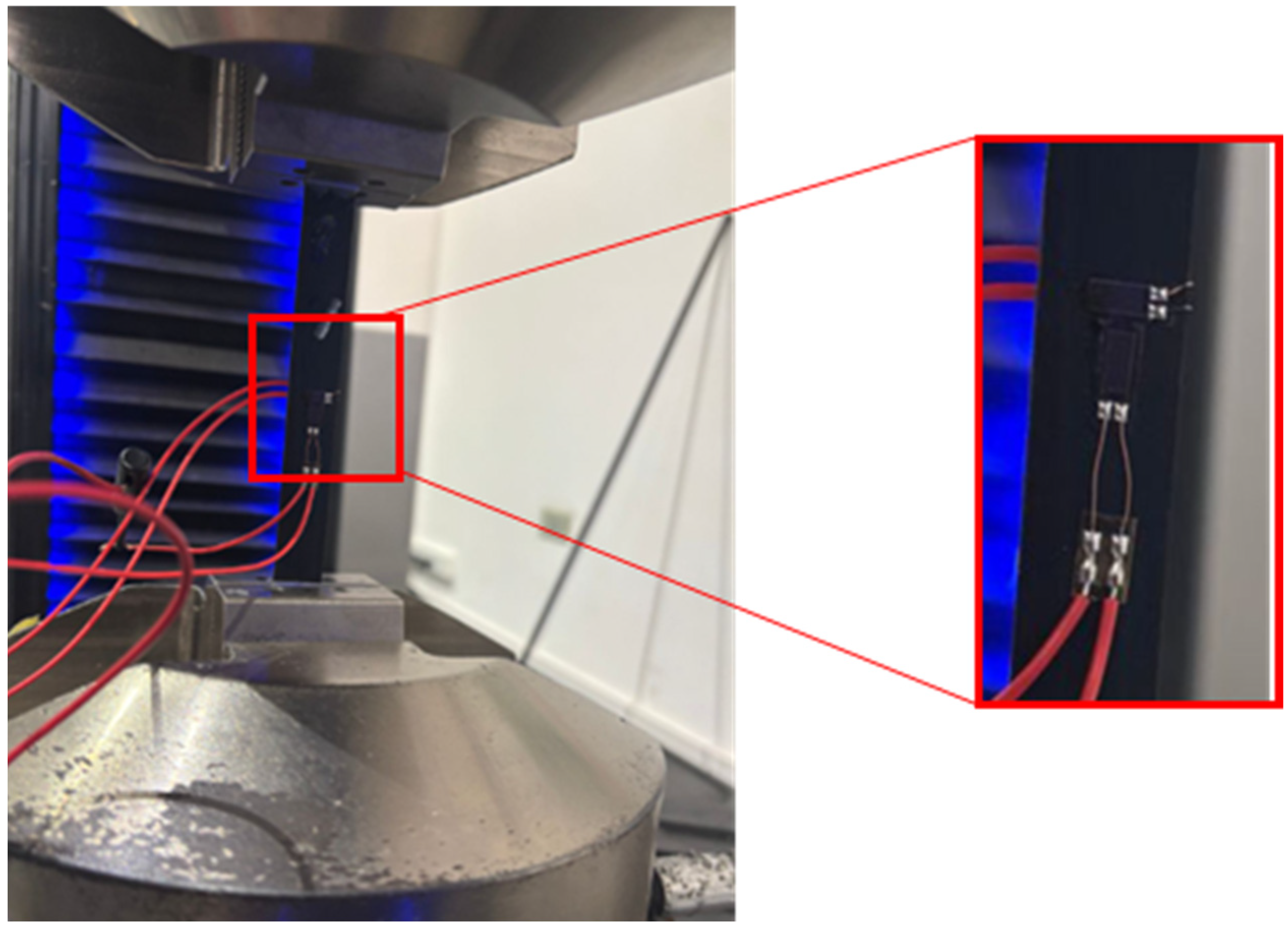
Standard tensile specimens were cut from 450 mm × 450 mm flat plates after moulding according to ASTM D3039. Mechanical property tests were performed on an electronic universal testing machine, and the tensile tests were conducted in displacement-controlled mode, with each set of test conditions repeated at least three times to ensure statistical reliability. The schematic diagram of the experimental setup is shown in Figure 15.

5.2.2. Test Results and Analysis

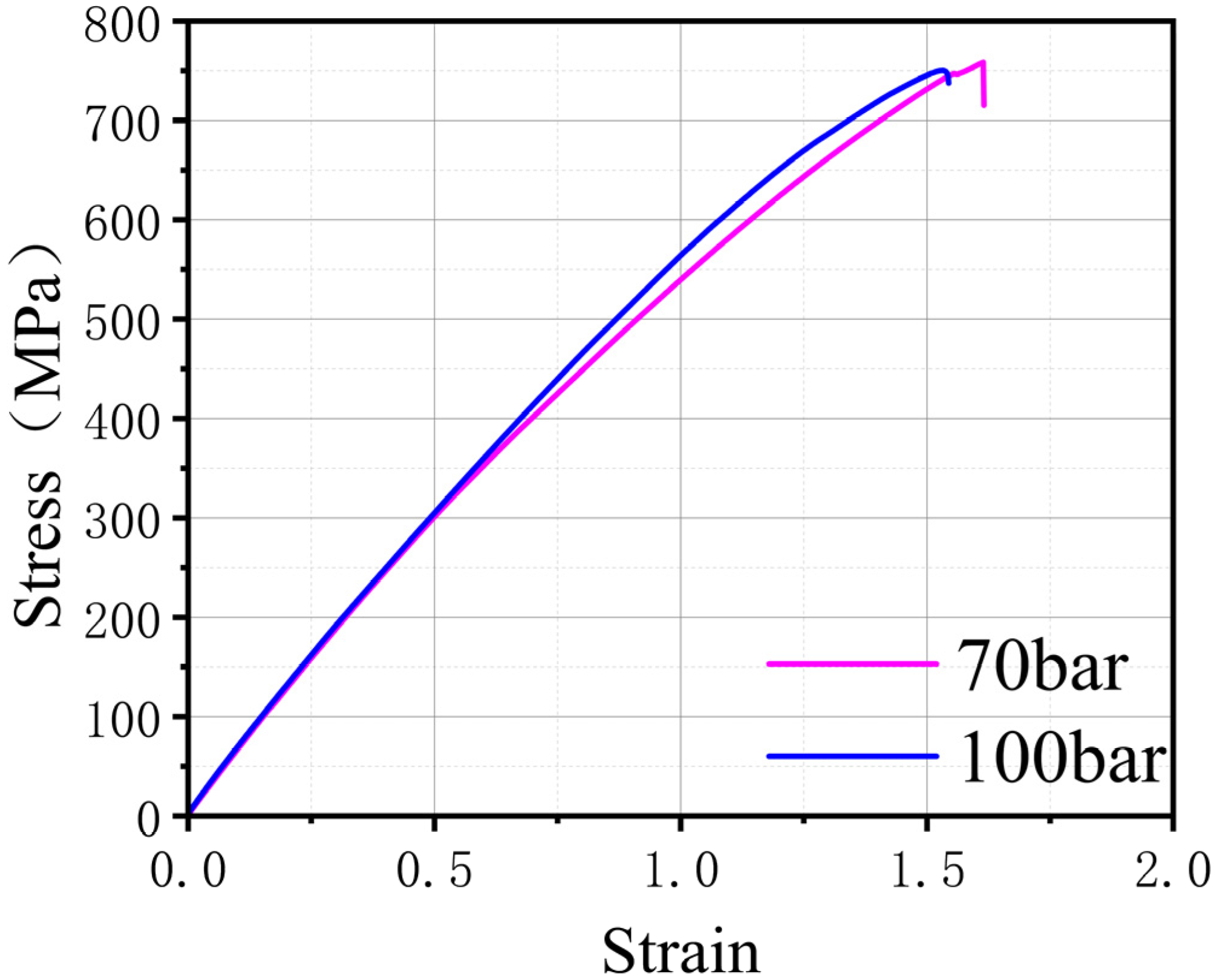
Based on the aforementioned experimental testing, Figure 16 illustrates the tensile properties of specimens under varying pressures. At the low moulding pressure of 70 bar, resin flow is restricted and the apparent viscosity is elevated, as predicted by the Cross-WLF rheological model. Consequently, incomplete resin penetration and inadequate fibre wetting lead to the formation of microvoids, as evidenced by the micrographs (Figure 14). These voids act as defect concentrations, initiating microcracks under tensile loading and resulting in premature failure and reduced strength. In contrast, at 100 bar, the increased pressure markedly enhances resin flow. Through enhanced shear thinning, the resin penetrates the fibre bundles more effectively and fills interstitial voids. This facilitates interfacial adhesion and stress transfer between matrix and fibres. The reduced void density and improved fibre impregnation observed microscopically correlate strongly with the macroscopically more stable stress–strain response. Tensile strength further validates that pressure not only influences resin rheology during forming but also determines the microstructure and mechanical integrity of the final composite.
These findings confirm the close correlation between resin flow and mechanical properties. They demonstrate that higher forming pressures facilitate uniform fibre impregnation, enabling thorough fibre–resin bonding to form a reinforced matrix. This enhances load-bearing capacity and reduces porosity defects within the composite structure.

6. Conclusions

This study proposes a rheological modelling and characterisation approach for long carbon fibre PA6 materials, applying and validating the results in moulding simulation. Material characterisation was first conducted on laminates fabricated from UD-CA708A prepreg produced by Nanjing Specialty Plastics Composite Materials Co., Ltd. In-plane and thickness-direction characterisation of the laminates was performed, with fibre volume fraction and mass fraction measured via thermogravimetric analysis. Subsequently, the long carbon fibre PA6 is modelled as an incompressible fibre suspension using continuum mechanics for macroscopic characterisation. Implementation approaches within ABAQUS/Explicit and MOLDFLOW software are described.
This method forms the basis for sequential moulding simulation techniques, which can simulate hot-press moulding and observe resin flow. Unified material modelling is achieved through API data transfer between simulation software. Whilst temperature prediction is feasible in hot-press moulding, flow simulation is constrained by MOLDFLOW’s functional limitations; consequently, a global temperature estimation approach is employed as an alternative.
Subsequently, material characterisation and parameterisation methods were proposed. Experimental characterisation employed a rheometer, utilising both a plate-and-bar rotary rheometer and a torsional rheometer to investigate anisotropic viscosity. It was found that anisotropy arises from the in-plane fibre arrangement. Under isothermal conditions, the effective viscosity was parameterised by fitting data using power-law parameters. Temperature and other parameters were implemented via the Cross-WLF equation. Figure 5 demonstrates the agreement between predicted and measured results.
The accuracy of the model was further validated through moulding simulation. When applied to flat plate simulations, the Cross-WLF parameterisation accurately predicted resin flow length and pressure variations under 70 bar and 100 bar moulding conditions. The deviation observed at 70 bar primarily stemmed from interlaminar slip and low shear rates, which collectively reduced resin migration and resulted in incomplete fibre impregnation. These findings were corroborated by microstructural and mechanical analyses: microscopy revealed extensive voids formed at low pressure due to insufficient resin penetration, whilst tensile testing demonstrated strength reduction stemming from the concentration of porosity defects. Conversely, at 100 bar, shear thinning promotes complete fibre wetting and void elimination, yielding a denser, well-bonded microstructure with superior tensile properties. The physical robustness of the proposed model is validated through rheological parameterisation, moulded resin flow simulation, and mechanical testing observations, establishing a sound foundation and strategy for subsequent application of this framework to practical processing.
In this study, a systematic and integrated framework for anisotropic viscosity modelling and moulding simulation was established. For long carbon fibre reinforced polyamide 6 (LFT-PA6) composites, multi-scale characterisation, resin flow simulation, and mechanical property validation have been achieved, laying a basic framework and methodology for elucidating the intrinsic correlation mechanism between processing parameters, resin flow, microstructure, and macro-properties. Specific research results include (1) rheological characterisation method: by integrating a rotational rheometer with a torsion rheometer, simultaneous measurement of in-plane and thickness-direction viscosity properties is achieved. This technique can realise the multi-dimensional characterisation of anisotropic rheological behaviour of materials and accurately reflect the flow characteristics of LFT-PA6 under different shear rates and temperatures; (2) establishment of a two-path viscosity parameterization model: a parameterization method is developed based on the Cross-WLF model, which is based on the correlation of the rheometer test data with the in-die viscosity through quantitative correlation; the results show that the model has a high fitting accuracy under different temperatures and shear rates; and the results show that the model has a high fitting accuracy under different temperatures and shear rates. The results show that the model has high fitting accuracy at different temperatures and shear rates, and accurately captures the flow characteristics of anisotropic materials while simplifying the computational complexity; (3) sequential coupling simulation strategy: a logical framework is constructed to realise the exchange of data between ABAQUS/Explicit (Lagrangian moulding simulation) and MOLDFLOW (Eulerian fluid simulation), which facilitates collaborative analyses of the flow, deformation, and stress evolution of the resins in the complex geometrical structures. The data exchange between Lagrangian moulding simulation and MOLDFLOW facilitates collaborative analysis of resin flow, deformation, and stress evolution in complex geometries. This provides an effective way for multi-field coupling simulation in composite moulding process; (4) research on the mechanism of moulding pressure influence on resin flow and mechanical properties: through the comprehensive analysis of experimental, microscopic, and simulation results, the coupling influence mechanism of moulding pressure on resin flow, void evolution, and mechanical properties is revealed. Under low-pressure conditions, the resin viscosity increases and the shear thinning effect is weak, resulting in insufficient penetration of the resin and gas inclusions, and the formation of micropores along the fibre orientation. These micropores act as stress concentration points under tensile loading, thereby reducing the material’s strength. Under high-pressure conditions, the resin exhibits significant shear thinning behaviour at high shear rates, and the viscosity is significantly reduced. This promotes the complete impregnation of fibre bundles by the resin and interfacial densification, which substantially reduces pore defects and improves the interfacial bonding quality, ultimately resulting in higher tensile strength. The reasonableness and reliability of the model were verified through experiments and simulations on flat plates.
In summary, the anisotropic viscosity modelling framework and coupled simulation strategy established in this study not only theoretically elucidate the synergistic mecha-nism of resin flow, fibre impregnation, and interfacial densification under pressure-driven conditions, but also provide reliable technical support and a methodological foundation for simulating the forming process, optimising process parameters, and predicting the performance of long-fibre-reinforced thermoplastic composites in practice.

7. Statement of Limitations

The sequence simulation framework proposed in this paper provides an efficient virtual analysis tool for fluid flow analysis and length prediction of long-fibre flat plate composites. As shown in Section 5.1, the model successfully achieves the analysis and visualisation of resin flow in a flat plate model, showing the state of flat plate resin flow under different pressures. However, it should be noted that the experimental validation of this study has only been carried out on flat plate specimens, and the applicability to complex geometries has not yet been verified, so the predictive ability of the model for complex structures is still to be confirmed, which is the main limitation of this study. The theoretical model has provided a basis for the preliminary optimisation of process parameters. In addition, when the fibre content is high, the fibre interaction coefficient may no longer remain constant due to the emergence of local blocking effects and orientation-dependent obstruction effects. In future model improvement, the introduction of strain rate or orientation-dependent CI formulations will be a key direction to enhance the prediction accuracy at extreme concentrations. However, the simulation results of the flat plate structure are in high agreement with the experimental data (Section 5.1), which initially verifies the intrinsic validity of the model and the feasibility of the parameterization method. However, when applied to steel-reinforced plate structures in the presence of three-dimensional flow, more complex geometrical boundaries, and significant fibre orientation changes, the absolute accuracy of the simulation method still needs to be conclusively verified by dedicated forming experiments. Subsequent work will focus on complex structures (reinforced plate structures) to fully validate the applicability of the model under complex geometries through systematic forming and flow experiments. Despite these limitations, the complete workflow from material characterisation to flow prediction established in this study lays a solid methodological foundation for subsequent process design of complex components.

Author Contributions

Conceptualisation X.S. and Z.D.; Methodology, H.Y. and Q.L.; Software, Q.L.; Validation, D.B. and W.Z.; Formal Analysis, S.M. and Q.L.; Investigation, F.Y. and X.F.; Re-sources, Z.D. and J.Z.; Data Curation, Q.L.; Writing—Original Draft Preparation, Q.L.; Writing—Review and Editing, S.M. and Y.Z.; Visualisation, Y.L. and Q.L.; Supervision, Z.D.; Project Administration, Z.D.; Funding Acquisition, Z.D., S.M., X.S., J.Z., H.Y., and Y.L. All authors have read and agreed to the published version of the manuscript.

Funding

This study was funded by National Key Research and Development Programme of China under Grant 2024YFB3410200, National Natural Science Foundation of China (52575631, 52005346, and 52005347), Liaoning Natural Science Foundation Outstanding Youth Foundation (2025-YQ-03), Liaoning Revitalization Talents Program (XLYC2203190), Project of the Science and Technology Innovation Team of Liaoning Provincial Department of Education (LJ222410142011), Basic Research Projects of Higher Colleges and Universities of Liaoning Provincial Department of Education (LJ212410142040), Liaoning Province Science and Technology Plan Joint Program (2024-BSLH-161, 2024-MSLH-203, 2024-MSLH-367, 2025-BSLH-323 and 202513473).

Institutional Review Board Statement

Not applicable.

Informed Consent Statement

Not applicable.

Data Availability Statement

The original contributions presented in this study are included in the article. Further inquiries can be directed to the corresponding author.

Acknowledgments

The authors extend their most sincere gratitude to the following collaborating institutions: We thank Nanjing Special Plastic Composite Materials Company for generously supplying the experimental materials and core material parameters required for this study, ensuring the precision of the experiments. The author acknowledges the substantial support from Hangzhou Huichuang Materials Technology Co., Ltd. in sharing rheological testing instruments and providing laboratory facilities, which created favourable conditions for the efficient advancement of relevant testing work. The author also thanks Hangzhou Kuice Engineering Technology Co., Ltd. for providing professional technical services in the precision cutting of test specimens, ensuring the quality requirements of the test samples were met. The author once again expresses heartfelt gratitude to all collaborating institutions for their unwavering support and selfless assistance throughout this research endeavour!

Conflicts of Interest

The authors declare that they have no known competing financial interests or personal relationships that could have appeared to influence the work reported in this paper.

References

  1. Schemme, M. LFT–development status and perspectives. Plast. Addit. Compd. 2008, 10, 38–43. [Google Scholar] [CrossRef]
  2. Wan, Y.; Takahashi, J. Development of carbon fiber-reinforced thermoplastics for mass-produced automotive applications in Japan. J. Compos. Sci. 2021, 5, 86. [Google Scholar] [CrossRef]
  3. Wei, H.; Nagatsuka, W.; Lee, H.; Ohsawa, I.; Sumimoto, K.; Wan, Y.; Takahashi, J. Mechanical properties of carbon fiber paper reinforced thermoplastics using mixed discontinuous recycled carbon fibers. Adv. Compos. Mater. 2018, 27, 19–34. [Google Scholar] [CrossRef]
  4. Bondy, M.; Pinter, P.; Altenhof, W. Experimental characterization and modelling of the elastic properties of direct compounded compression molded carbon fibre/polyamide 6 long fibre thermoplastic. Mater. Des. 2017, 122, 184–196. [Google Scholar] [CrossRef]
  5. Scheuring, B.M.; Christ, N.; Blarr, J.; Liebig, W.V.; Hohe, J.; Montesano, J.; Weidenmann, K.A. Experimental and homogenized orientation-dependent properties of hybrid long fiber-reinforced thermoplastics. Int. J. Mech. Sci. 2024, 280, 109470. [Google Scholar] [CrossRef]
  6. Dumont, P.; Vassal, J.P.; Orgéas, L. Processing, characterisation and rheology of transparent concentrated fibre-bundle suspensions. Rheol. Acta 2007, 46, 639–651. [Google Scholar] [CrossRef]
  7. Ericsson, K.A.; Toll, S.; Månson, J.-A.E. The two-way interaction between anisotropic flow and fiber orientation in squeeze flow. J. Rheol. 1997, 41, 491–511. [Google Scholar] [CrossRef]
  8. Dweib, M.A.; ÓBrádaigh, C.M. Extensional and shearing flow of a glass-mat-reinforced thermoplastics (GMT) material as a non-Newtonian viscous fluid. Compos. Sci. Technol. 1999, 59, 1399–1410. [Google Scholar]
  9. Sommer, D.E.; Favaloro, A.J.; Pipes, R.B. Coupling anisotropic viscosity and fiber orientation in applications to squeeze flow. J. Rheol. 2018, 62, 669–679. [Google Scholar] [CrossRef]
  10. Favaloro, A.J.; Sommer, D.E.; Denos, B.R.; Pipes, R.B. Simulation of prepreg platelet compression molding: Method and orientation validation. J. Rheol. 2018, 62, 1443–1455. [Google Scholar] [CrossRef]
  11. Wittemann, F.; Maertens, R.; Kärger, L.; Henning, F. Injection molding simulation of short fiber reinforced thermosets with anisotropic and non-Newtonian flow behavior. Compos. Part A Appl. Sci. Manuf. 2019, 124, 105476. [Google Scholar] [CrossRef]
  12. Görthofer, J.; Meyer, N.; Pallicity, T.D.; Schöttl, L.; Trauth, A.; Schemmann, M.; Hohberg, M.; Pinter, P.; Elsner, P.; Henning, F. Virtual process chain of sheet molding compound: Development, validation and perspectives. Compos. Part B Eng. 2019, 169, 133–147. [Google Scholar] [CrossRef]
  13. Dörr, D.; Singh-Heer, N.; Gergely, R.C.; Schreyer, L.; Henning, F.; Straatman, A.G.; Hrymak, A. Rheological characterization and macroscopic modeling and simulation of the molding process of a PA6 Glass Mat Thermoplastic (GMT). Compos. Part A Appl. Sci. Manuf. 2024, 176, 107780. [Google Scholar] [CrossRef]
  14. Kim, H.-S.; Chang, S.-H. Simulation of compression moulding process for long-fibre reinforced thermoset composites considering fibre bending. Compos. Struct. 2019, 230, 111514. [Google Scholar] [CrossRef]
  15. Bartus, S.; Vaidya, U.; Ulven, C. Design and development of a long fiber thermoplastic bus seat. J. Thermoplast. Compos. Mater. 2006, 19, 131–154. [Google Scholar] [CrossRef]
  16. Dörr, D.; Singh-Heer, N.; Xu, C.; Chang, T.; Clement-Thorne, B.; Gergely, R.C.; Okonski, D.; Henning, F.; Straatman, A.G.; Hrymak, A. Experimental and predictive analysis of the molding behavior of a PA6 glass mat thermoplastic (GMT). Int. J. Adv. Manuf. Technol. 2023, 129, 1159–1173. [Google Scholar] [CrossRef]
  17. Kotsikos, G.; Bland, J.; Gibson, A.; Chandler, H. Squeeze flow testing of glass mat thermoplastic material. Compos. Part A Appl. Sci. Manuf. 1996, 27, 1195–1200. [Google Scholar] [CrossRef]
  18. Le Corre, S.; Orgéas, L.; Favier, D.; Tourabi, A.; Maazouz, A.; Venet, C. Shear and compression behaviour of sheet moulding compounds. Compos. Sci. Technol. 2002, 62, 571–577. [Google Scholar] [CrossRef]
  19. Dumont, P.; Orgéas, L.; Le Corre, S.; Favier, D. Anisotropic viscous behavior of sheet molding compounds (SMC) during compression molding. Int. J. Plast. 2003, 19, 625–646. [Google Scholar] [CrossRef]
  20. Dweib, M.; Brádaigh, C.Ó. Compression molding of glass reinforced thermoplastics: Modeling and experiments. Polym. Compos. 2000, 21, 832–845. [Google Scholar] [CrossRef]
  21. Thattaiparthasarthy, K.B.; Pillay, S.; Vaidya, U.K. Rheological characterization of long fiber thermoplastics–Effect of temperature, fiber length and weight fraction. Compos. Part A Appl. Sci. Manuf. 2009, 40, 1515–1523. [Google Scholar] [CrossRef]
  22. Song, Y.; Gandhi, U.; Sekito, T.; Vaidya, U.K.; Vallury, S.; Yang, A.; Osswald, T. CAE method for compression molding of carbon fiber-reinforced thermoplastic composite using bulk materials. Compos. Part A Appl. Sci. Manuf. 2018, 114, 388–397. [Google Scholar] [CrossRef]
  23. Sommer, D.E.; Kravchenko, S.G.; Pipes, R.B. A numerical study of the meso-structure variability in the compaction process of prepreg platelet molded composites. Compos. Part A Appl. Sci. Manuf. 2020, 138, 106010. [Google Scholar] [CrossRef]
  24. Poppe, C.; Albrecht, F.; Krauß, C.; Kärger, L. A 3D modelling approach for fluid progression during process simulation of wet compression moulding–motivation & approach. Procedia Manuf. 2020, 47, 85–92. [Google Scholar] [CrossRef]
  25. Schreyer, L.; Krauß, C.; Scheuring, B.M.; Hrymak, A.; Kärger, L. Characterization and modeling of the anisotropic flow behavior of long carbon fiber reinforced thermoplastic compression molding. Compos. Part A Appl. Sci. Manuf. 2025, 198, 109053. [Google Scholar] [CrossRef]
  26. Huang, C.-T.; Chen, L.-J.; Chien, T.-Y. Investigation of the viscoelastic behavior variation of glass mat thermoplastics (GMT) in compression molding. Polymers 2019, 11, 335. [Google Scholar] [CrossRef]
  27. ASTM D3171-22; Standard Test Methods for Constituent Content of Composite Materials. ASTM International: West Conshohocken, PA, USA, 2022.
  28. Meyer, N. Mesoscale Simulation of the Mold Filling Process of Sheet Molding Compound; KIT Scientific Publishing: Karlsruhe, Germany, 2022; Available online: https://library.oapen.org/handle/20.500.12657/57535 (accessed on 21 January 2026).
  29. Djalili-Moghaddam, M.; Toll, S. A model for short-range interactions in fibre suspensions. J. Non-Newton. Fluid Mech. 2005, 132, 73–83. [Google Scholar] [CrossRef]
  30. Orgéas, L.; Dumont, P.; Le Corre, S. Rheology of highly concentrated fiber suspensions. In Rheology of Non-Spherical Particle Suspensions; Elsevier: Amsterdam, The Netherlands, 2015; pp. 119–166. [Google Scholar] [CrossRef]
  31. Batchelor, G.K. An Introduction to Fluid Dynamics; Cambridge University Press: Cambridge, UK, 2000. [Google Scholar]
  32. Ericksen, J. Transversely isotropic fluids. Kolloid-Zeitschrift 1960, 173, 117–122. [Google Scholar] [CrossRef]
  33. Lipscomb, G., II; Denn, M.M.; Hur, D.; Boger, D.V. The flow of fiber suspensions in complex geometries. J. Non-Newton. Fluid Mech. 1988, 26, 297–325. [Google Scholar] [CrossRef]
  34. Rogers, T. Squeezing flow of fibre-reinforced viscous fluids. J. Eng. Math. 1989, 23, 81–89. [Google Scholar] [CrossRef]
  35. Tucker, C.L., III. Flow regimes for fiber suspensions in narrow gaps. J. Non-Newton. Fluid Mech. 1991, 39, 239–268. [Google Scholar] [CrossRef]
  36. Dweib, M.A.; Brádaigh, C.M.Ó. Anisotropic modeling of isothermal squeezing flow of Glass-Mat reinforced thermoplastics (GMT). Polym. Compos. 1998, 19, 588–599. [Google Scholar] [CrossRef]
  37. Bertóti, R.; Böhlke, T. Flow-induced anisotropic viscosity in short FRPs. Mech. Adv. Mater. Mod. Process. 2017, 3, 1. [Google Scholar] [CrossRef]
  38. Wang, J.; Hopmann, C.; Schmitz, M.; Hohlweck, T.; Wipperfürth, J. Modeling of pvT behavior of semi-crystalline polymer based on the two-domain Tait equation of state for injection molding. Mater. Des. 2019, 183, 108149. [Google Scholar] [CrossRef]
  39. Phelps, J.H.; Tucker, C.L., III. An anisotropic rotary diffusion model for fiber orientation in short-and long-fiber thermoplastics. J. Non-Newton. Fluid Mech. 2009, 156, 165–176. [Google Scholar] [CrossRef]
  40. Favaloro, A.J.; Tseng, H.-C.; Pipes, R.B. A new anisotropic viscous constitutive model for composites molding simulation. Compos. Part A Appl. Sci. Manuf. 2018, 115, 112–122. [Google Scholar] [CrossRef]
  41. Chung, D.H.; Kwon, T.H. Invariant-based optimal fitting closure approximation for the numerical prediction of flow-induced fiber orientation. J. Rheol. 2002, 46, 169–194. [Google Scholar] [CrossRef]
  42. Cox, W.; Merz, E. Correlation of dynamic and steady flow viscosities. J. Polym. Sci. 1958, 28, 619–622. [Google Scholar] [CrossRef]
  43. Rudolph, N.; Osswald, T.A. Polymer Rheology: Fundamentals and Applications; Carl Hanser Verlag GmbH Co KG: Munich, Germany, 2014. [Google Scholar]
  44. Dinh, S.M.; Armstrong, R.C. A rheological equation of state for semiconcentrated fiber suspensions. J. Rheol. 1984, 28, 207–227. [Google Scholar] [CrossRef]
  45. Banaei, A.A.; Rosti, M.E.; Brandt, L. Numerical study of filament suspensions at finite inertia. J. Fluid Mech. 2020, 882, A5. [Google Scholar] [CrossRef]
  46. Lindström, S.B.; Uesaka, T. A numerical investigation of the rheology of sheared fiber suspensions. Phys. Fluids 2009, 21, 083301. [Google Scholar] [CrossRef]
  47. Shaqfeh, E.S.; Fredrickson, G.H. The hydrodynamic stress in a suspension of rods. Phys. Fluids A Fluid Dyn. 1990, 2, 7–24. [Google Scholar] [CrossRef]
  48. Kalaidov, M.; Meirson, G.; Heer, N.; Fan, Y.; Ivanov, S.; Ugresic, V.; Wood, J.; Hrymak, A. Viscosity measurement technique for long fiber thermoplastic material. In SPE ACCE Proceedings; SPE: Danbury, CT, USA, 2019. [Google Scholar]
  49. Macosko, C.W. Rheology Principles, Measurements and Applications; Wiley: New York, NY, USA, 1994. [Google Scholar]
  50. Saputra, N.; Seo, H.-D. Total Lagrangian smoothed particle hydrodynamics for large deformation problems considering Green–Naghdi stress rate. AIP Adv. 2025, 15, 0253589. [Google Scholar] [CrossRef]
  51. Doerr, D.; Joppich, T.; Kugele, D.; Henning, F.; Kaerger, L. A coupled thermomechanical approach for finite element forming simulation of continuously fiber-reinforced semi-crystalline thermoplastics. Compos. Part A Appl. Sci. Manuf. 2019, 125, 105508. [Google Scholar] [CrossRef]
  52. ISO 17744; Plastics—Determination of Specific Volume as a Function of Temperature and Pressure (pvT Diagram)—Piston Apparatus Method. International Organization for Standardization: Geneva, Switzerland, 2021.
Figure 1. Hot moulding preforming process.
Applsci 16 01243 g001
Figure 2. Photograph of 2 mm thick PA6 long carbon fibre sheet.
Applsci 16 01243 g002
Figure 3. (a) 25 mm diameter circular sample (b) Anton Paar 302 e Rheometer (Anton Paar GmbH, Graz, Austria).
Applsci 16 01243 g003
Figure 4. (a) Rheometer results at 270 °C (b) Rheometer results at all temperature intervals.
Applsci 16 01243 g004
Figure 5. Comparison of loss factor results for all temperatures of the rheometer.
Applsci 16 01243 g005
Figure 6. Correlation between power-law parameterization and Cross-WLF model at each test temperature (a); scope of details (b).
Applsci 16 01243 g006
Figure 7. Experimental process flow for laminates.
Applsci 16 01243 g007
Figure 8. Thermal moulding data record; (a) pressure; (b) plate spacing.
Applsci 16 01243 g008
Figure 9. Comparison of power-law viscosity at 70 bar in the model and results from rheometer parameterization.
Applsci 16 01243 g009
Figure 10. Schematic diagram of the moulding simulation method comprising sequential stage moulding simulation and flow simulation.
Applsci 16 01243 g010
Figure 11. Flat sheet 450 mm × 450 mm.
Applsci 16 01243 g011
Figure 12. MOLDFLOW flat panel simulation design. (a) Schematic diagram of grid division; (b) graph of filling time results.
Applsci 16 01243 g012
Figure 13. Correlation of predicted flow length during moulding at different specific pressures and viscosities (a) 70 bar, (b) 100 bar. (black line: boundaries of the sample part).
Applsci 16 01243 g013
Figure 14. Macro- and microstructure of flat plates at 270 °C (70 bar and 100 bar), (a) shows resin filling at 70 bar. (b) shows resin filling at 100 bar. (c) shows defect distribution at 70 bar. (d) shows defect distribution at 100 bar.
Applsci 16 01243 g014
Figure 15. Tensile properties testing apparatus.
Applsci 16 01243 g015
Figure 16. Tensile strength under different specific pressure conditions.
Applsci 16 01243 g016
Table 1. Prepreg material parameters.
Material ParametersSymbolParameter Value
Prepreg densityρ1500 kg/m3
Fibre densityρf1760 kg/m3
Matrix densityρm1140 kg/m3
Fibre mass fractionwf55 wt.%
Fibre volume fractionφf44.6%
Equivalent thicknesst0.175 mm
Tensile modulusEt93 GPa
Tensile strengthσt1850 MPa
Bending modulusEf91 GPa
Bending strengthσf1015 MPa
Table 2. A comparison of key features in flow modelling for certain long-fibre-reinforced thermoplastic composites.
Comparison DimensionSchreyer [25]Favaloro [40]This Paper
Material SystemLFT-PA6GMT-PPLFT-PA6
Fibre Volume Fraction26%25%~40%44.6%
Core Constitutive ModelAnisotropic viscosity modelInvariant-based anisotropic modelAnisotropic viscosity tensor
Characterisation MethodParallel-plate rheometry-Rheometry and in-mould analysis
Simulation ScopeMaterial characterisationConstitutive model developmentIntegrated sequential simulation (forming and flow)
Table 3. Summary of Cross-WLF parameter sets determined through material parametrisation.
In-Mould FormingRheometer IsotropicRheometer Anisotropy
m0.130.20.18
A1 (MPa·s)1.09 × 1091.25 × 1091.61 × 107
A2 (K)323.15323.15323.15
B1295255
B2 (K)473.15503.25515.15
τ (MPa)0.0120.01250.018
Disclaimer/Publisher’s Note: The statements, opinions and data contained in all publications are solely those of the individual author(s) and contributor(s) and not of MDPI and/or the editor(s). MDPI and/or the editor(s) disclaim responsibility for any injury to people or property resulting from any ideas, methods, instructions or products referred to in the content.