A Robust DEM Registration Method via Physically Consistent Image Rendering



Abstract
1. Introduction
- 1.
- A robust DEM registration algorithm is developed, which performs effectively in varying topography and resolution.
- 2.
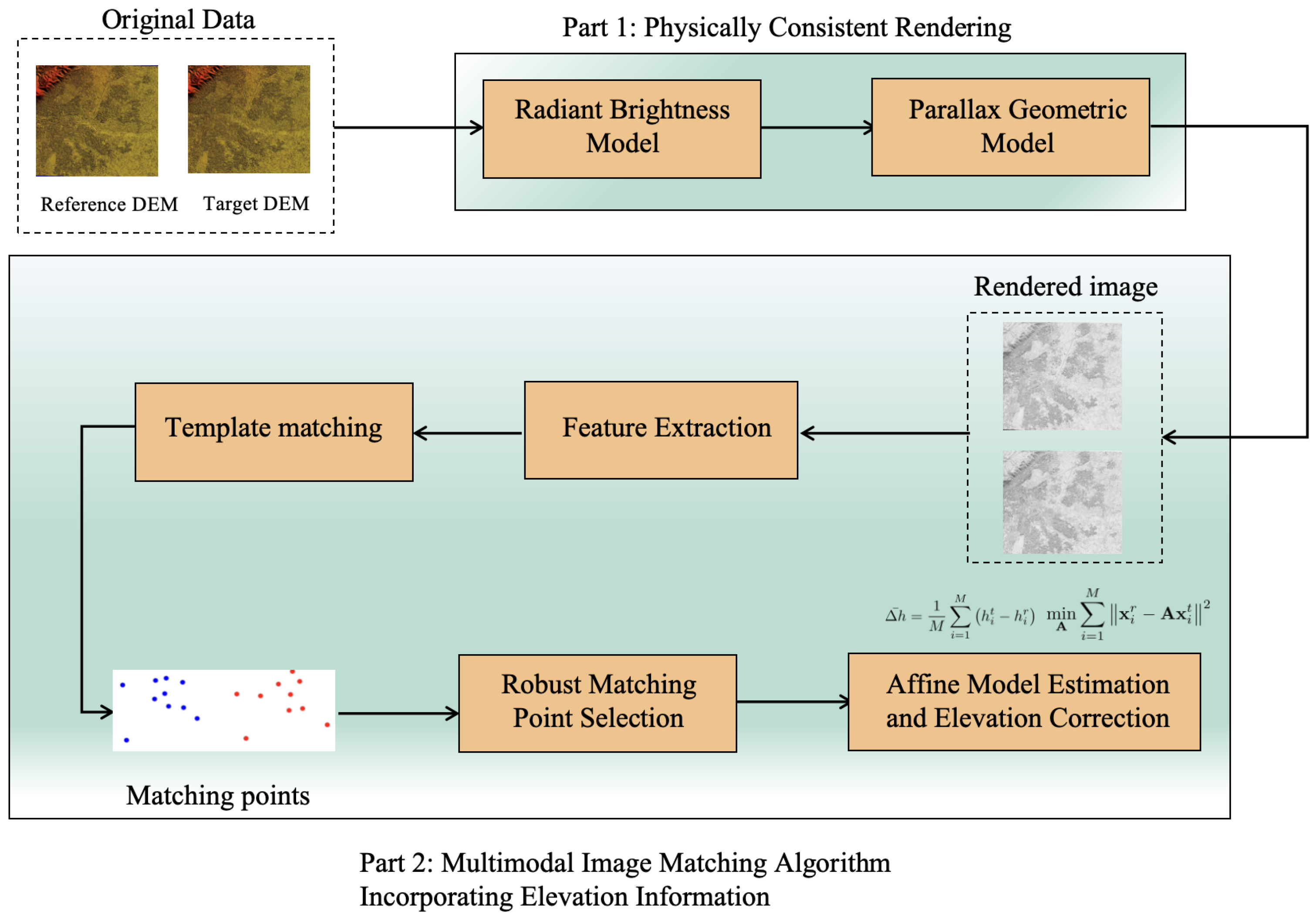
- By employing a physically consistent rendering method based on geometric modeling and radiative simulation, the digital elevation model is rendered as an image representation of illumination and radiative properties. Simultaneously, the elevation information from the DEM is utilized for matching the two-dimensional images. This approach fully leverages both the image information and elevation data of the DEM.
- 3.
- Comparative validation with classical DEM registration algorithms and state-of-the-art remote sensing image registration algorithms demonstrates the proposed algorithm’s adaptability and robustness across diverse terrains, including plains, urban areas, and glaciers.
2. Related Works
2.1. Three-Dimensional Registration Methods
2.2. Two-Dimensional Registration Methods
3. Materials and Methods
3.1. Study Area
3.1.1. Simulation Data
3.1.2. Actual Data
- 1.
- Copernicus GLO-30 DEM (COP-30): A globally available open-access digital elevation model provided by the European Space Agency (ESA) and the European Commission. It features a spatial resolution of 30 m. This dataset offers consistent and seamless global coverage.
- 2.
- ALOS World 3D-30 m (AW3D30): A global open DEM product generated by the Japan Aerospace Exploration Agency (JAXA) based on ALOS satellite PRISM imagery, also featuring a spatial resolution of 30 m.
3.2. Methodology
3.2.1. Physically Consistent Image Rendering
3.2.2. Multimodal Image Matching Algorithm Incorporating Elevation Information
3.3. Experimental Settings
4. Results
4.1. Parameter Setting
- Harris Corner Detection: The corner response is defined as (7). Image gradients and are computed using a Gaussian derivative kernel with standard deviation , where is the gradient scale. The auto-correlation matrix is smoothed with a Gaussian window of standard deviation . A small constant prevents division by zero. No sensitivity parameter k is required in this formulation.
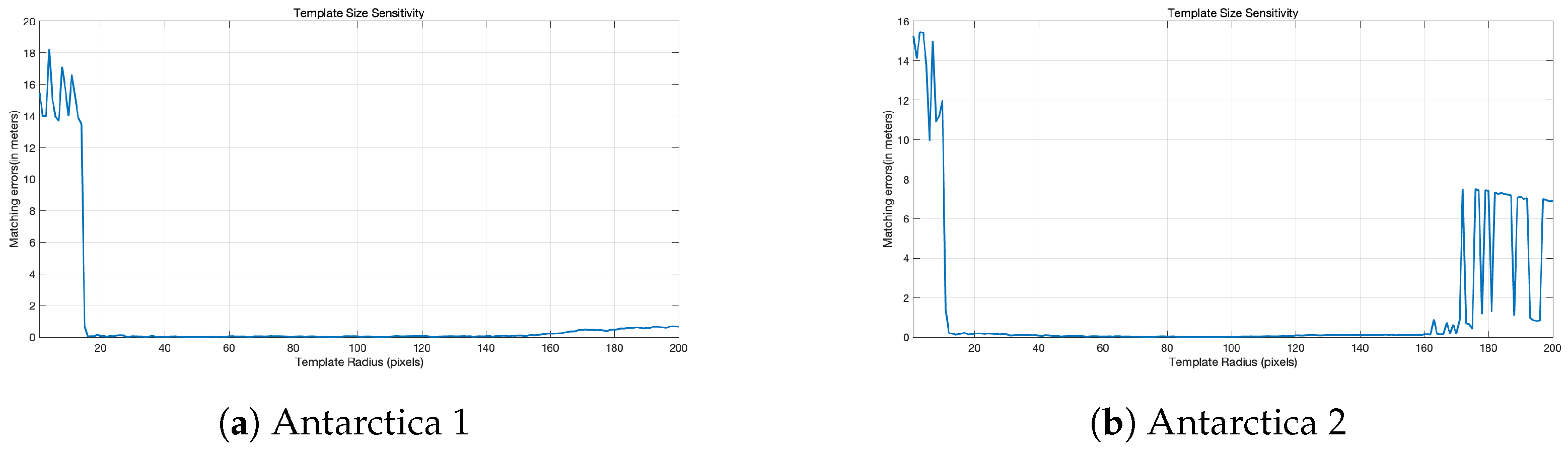
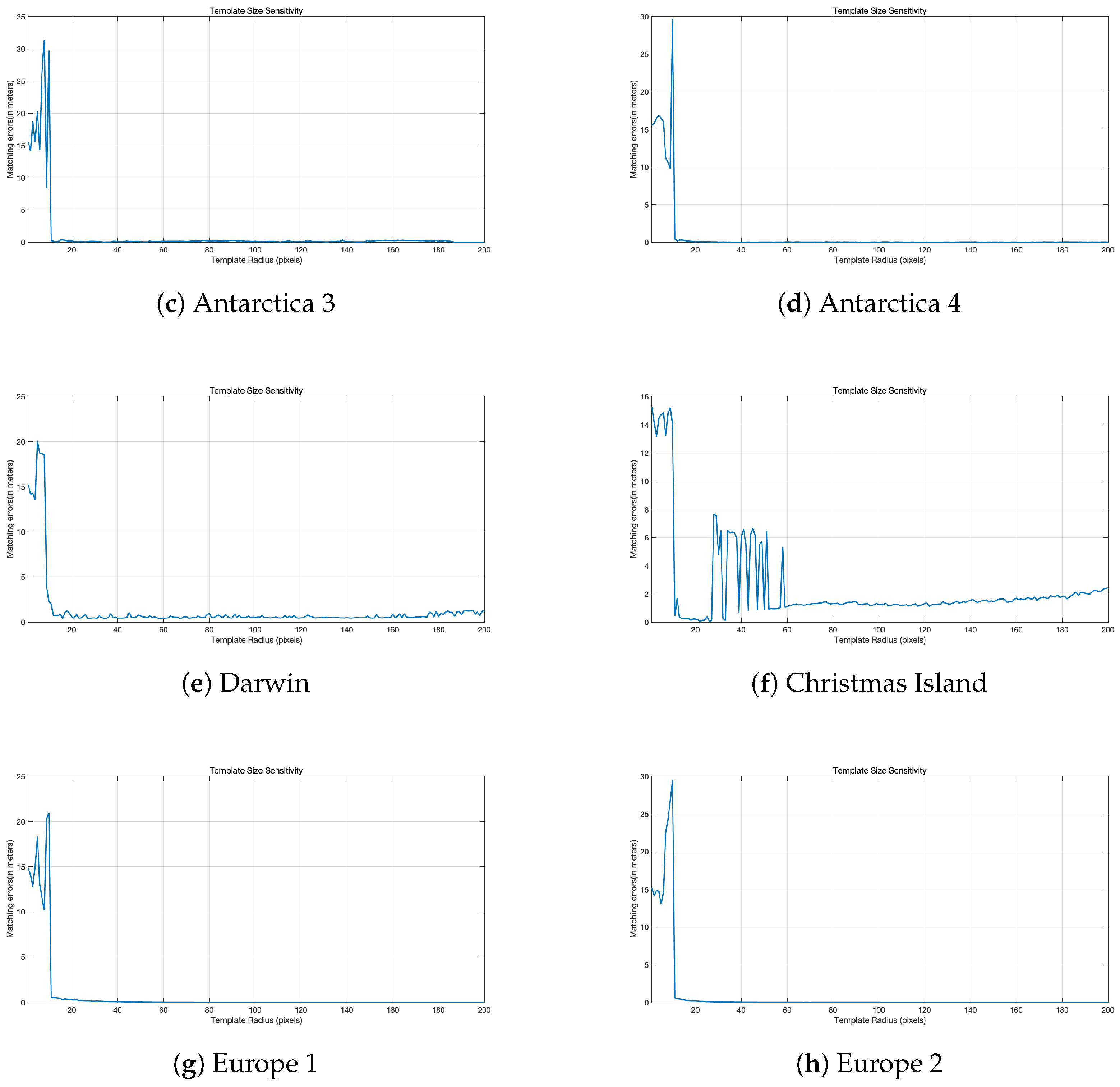
- Template Matching: Templates of size pixels (radius 100) are used. As discussed in many local matching methods [51,52], this parameter choice provides an optimal balance between accuracy and computational efficiency. A Gaussian weighting window with standard deviation pixels emphasizes the central region. Both template and target regions are zero-padded to the next power-of-two for FFT efficiency. Sub-pixel peak location is refined using quadratic interpolation.
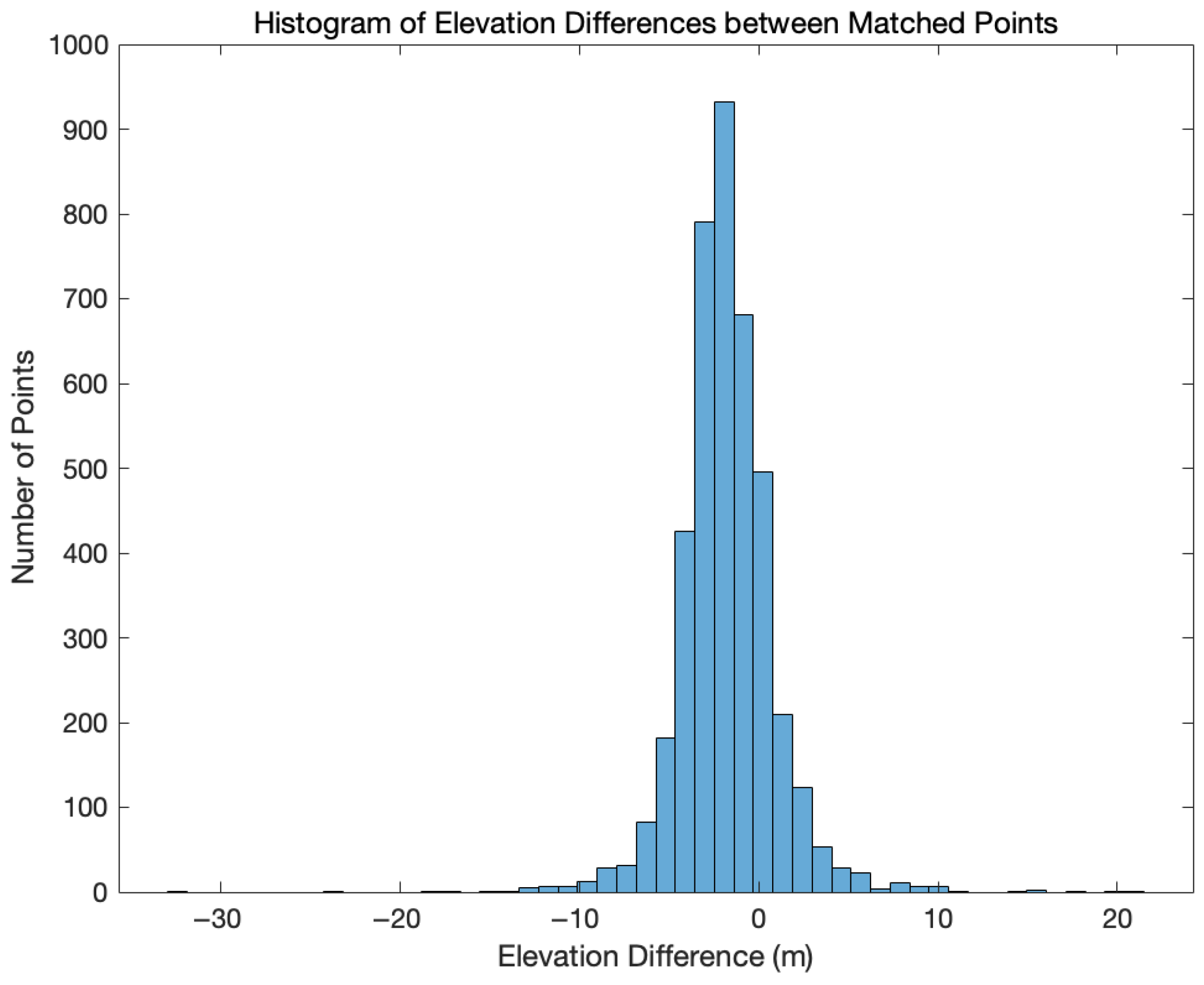
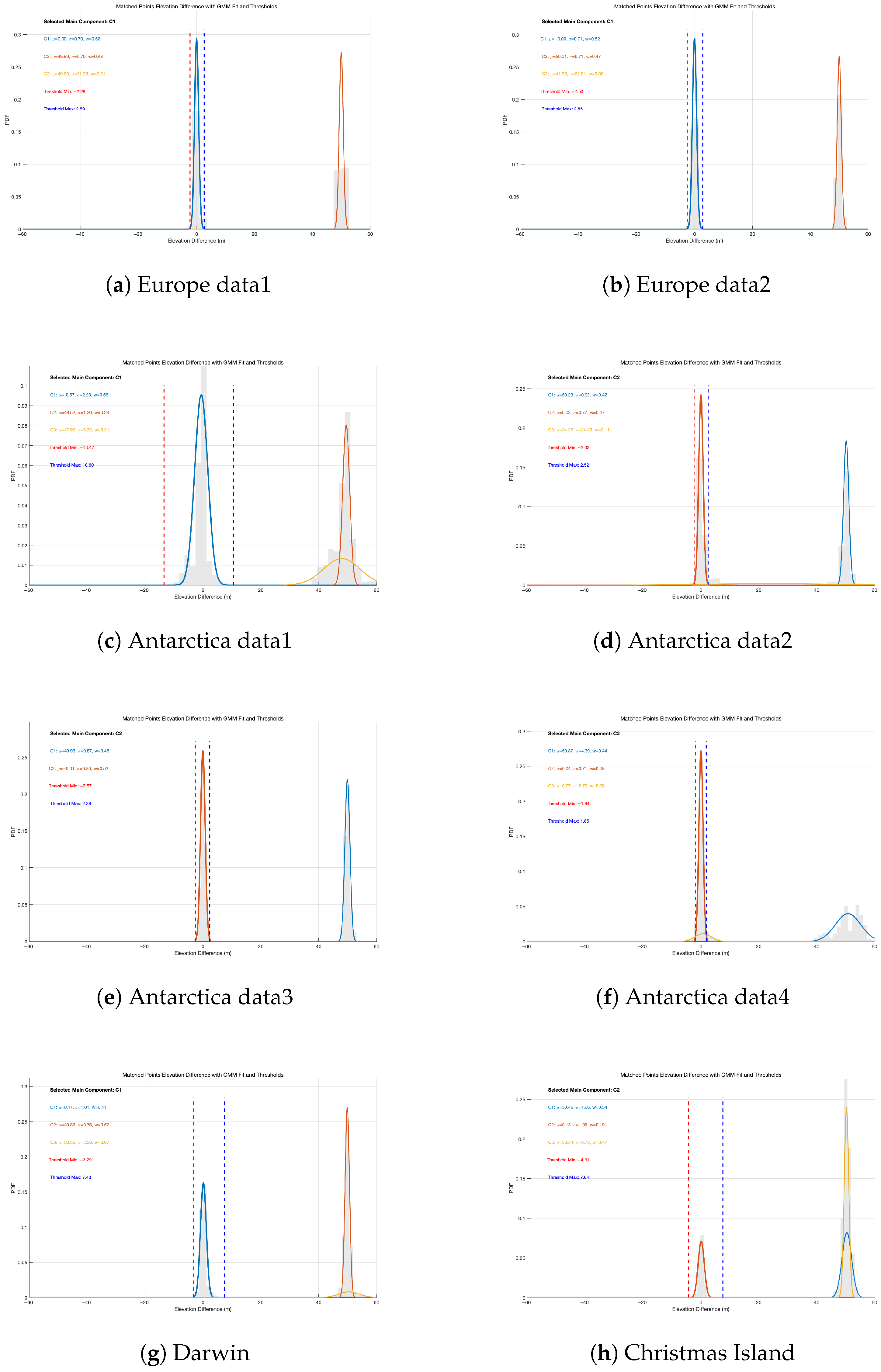
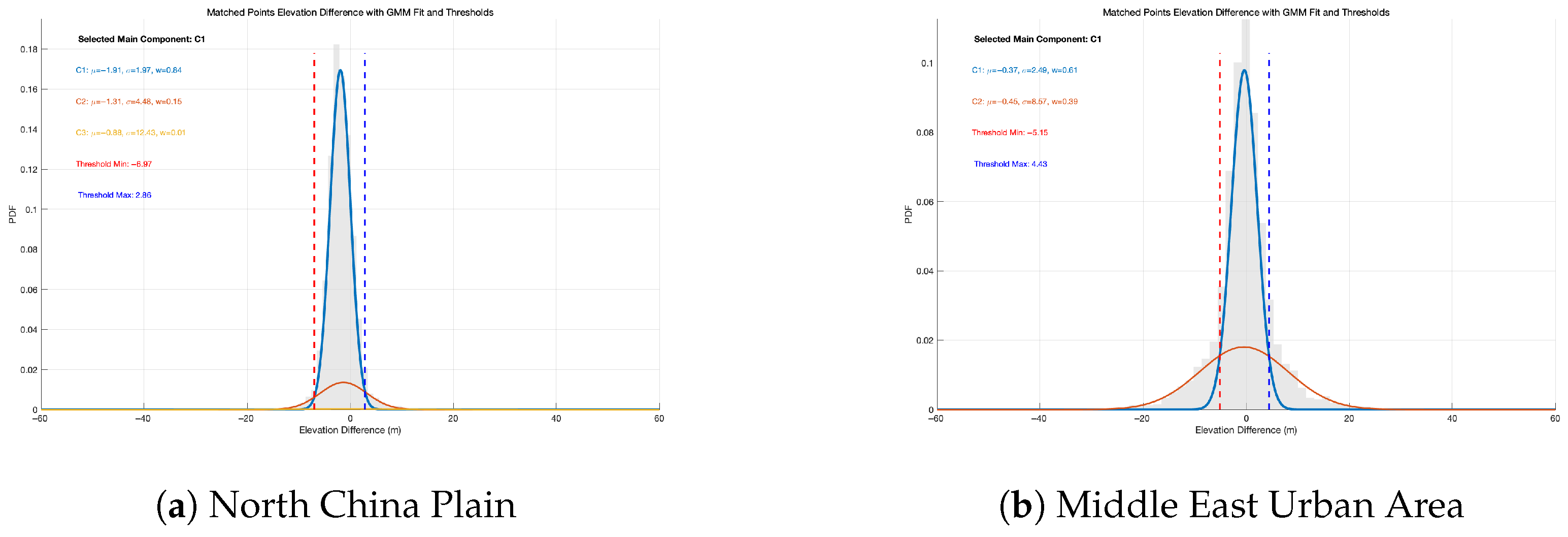
- Outlier Filtering: The number of mixture components is automatically determined by minimizing the Bayesian Information Criterion (BIC), with the candidate component number limited to a maximum of three to ensure model stability. To identify the most reliable component representing consistent elevation correspondences, a scoring function is designed that jointly considers the proximity of the component mean to zero, the variance, and the mixture weight. The component with the highest score is selected as the inlier component. Matched points are then filtered based on their posterior probabilities belonging to this component, yielding a robust set of elevation-consistent correspondences for subsequent DEM registration and evaluation:where denotes the mixture weight of the k-th component, and represent the mean and standard deviation of the corresponding Gaussian distribution, respectively, and is a small positive constant introduced to avoid numerical instability.
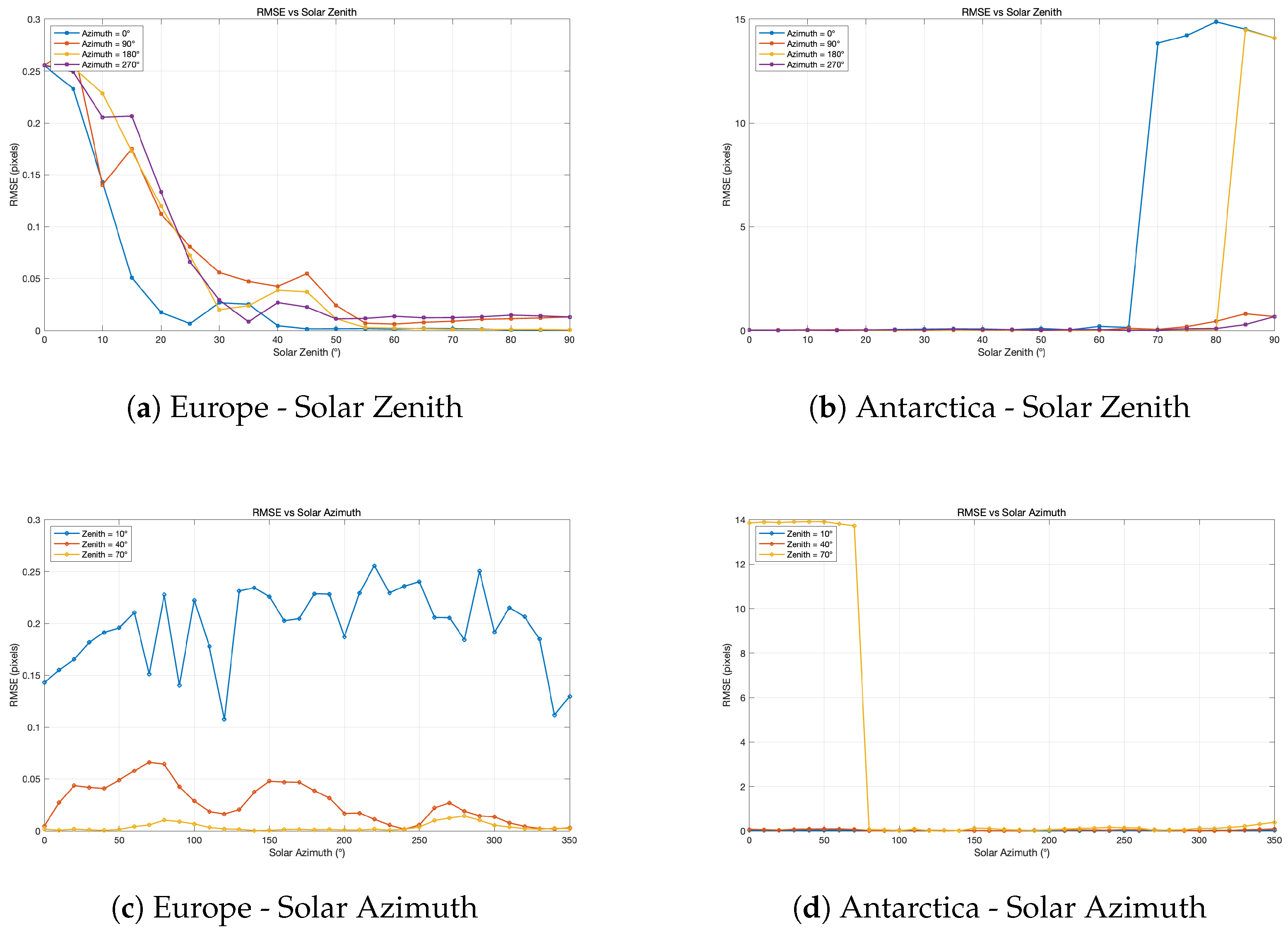
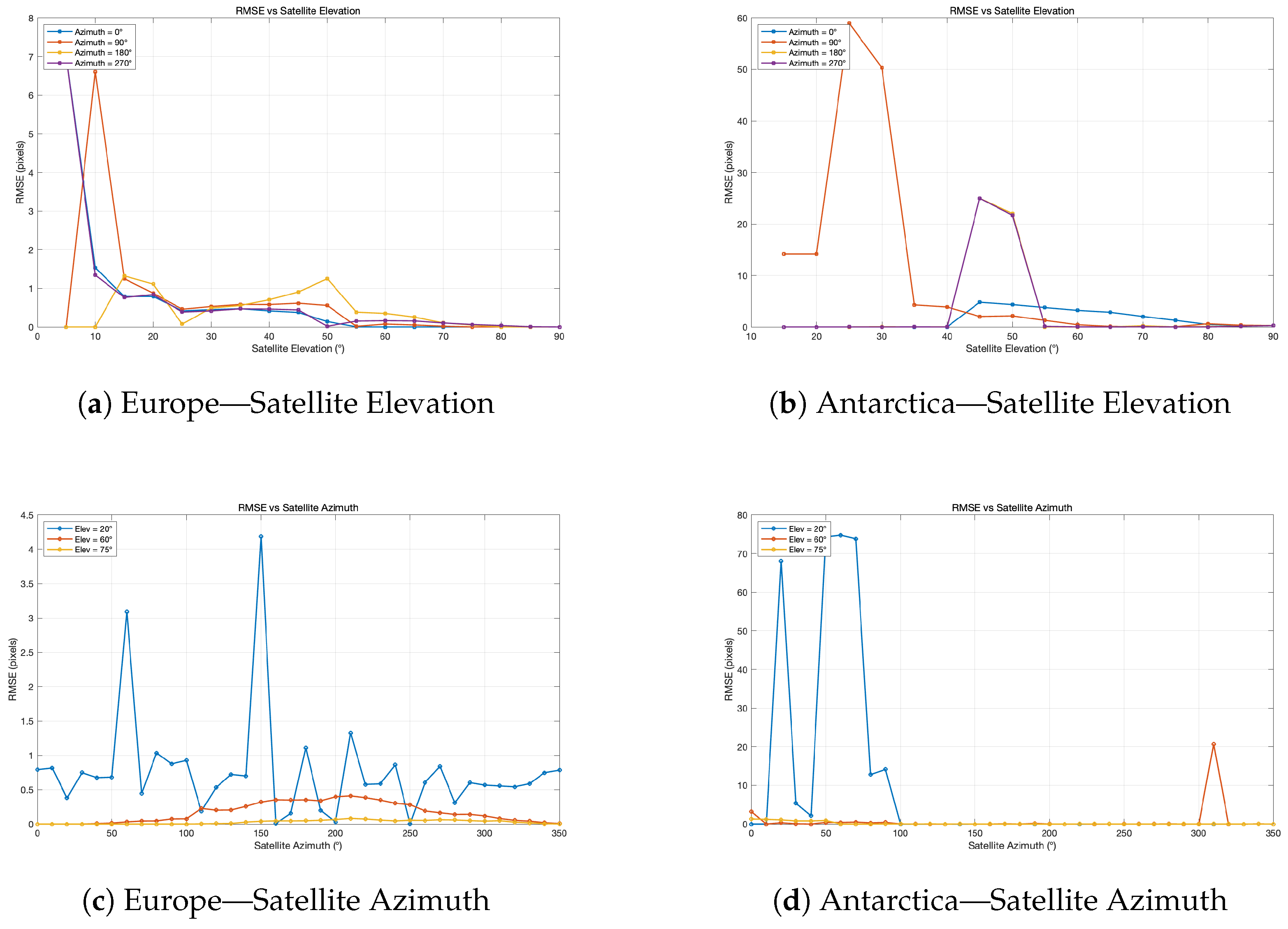
- Rendering Geometry: Solar azimuth and zenith angles are and , respectively. Satellite azimuth and elevation angles are and , and they are kept fixed across all experiments.
- RANSAC parameters: The interior point threshold for the RANSAC stage is set to 1.5.
4.2. Results of Simulation Experiment
4.3. Results of Actual Experiment
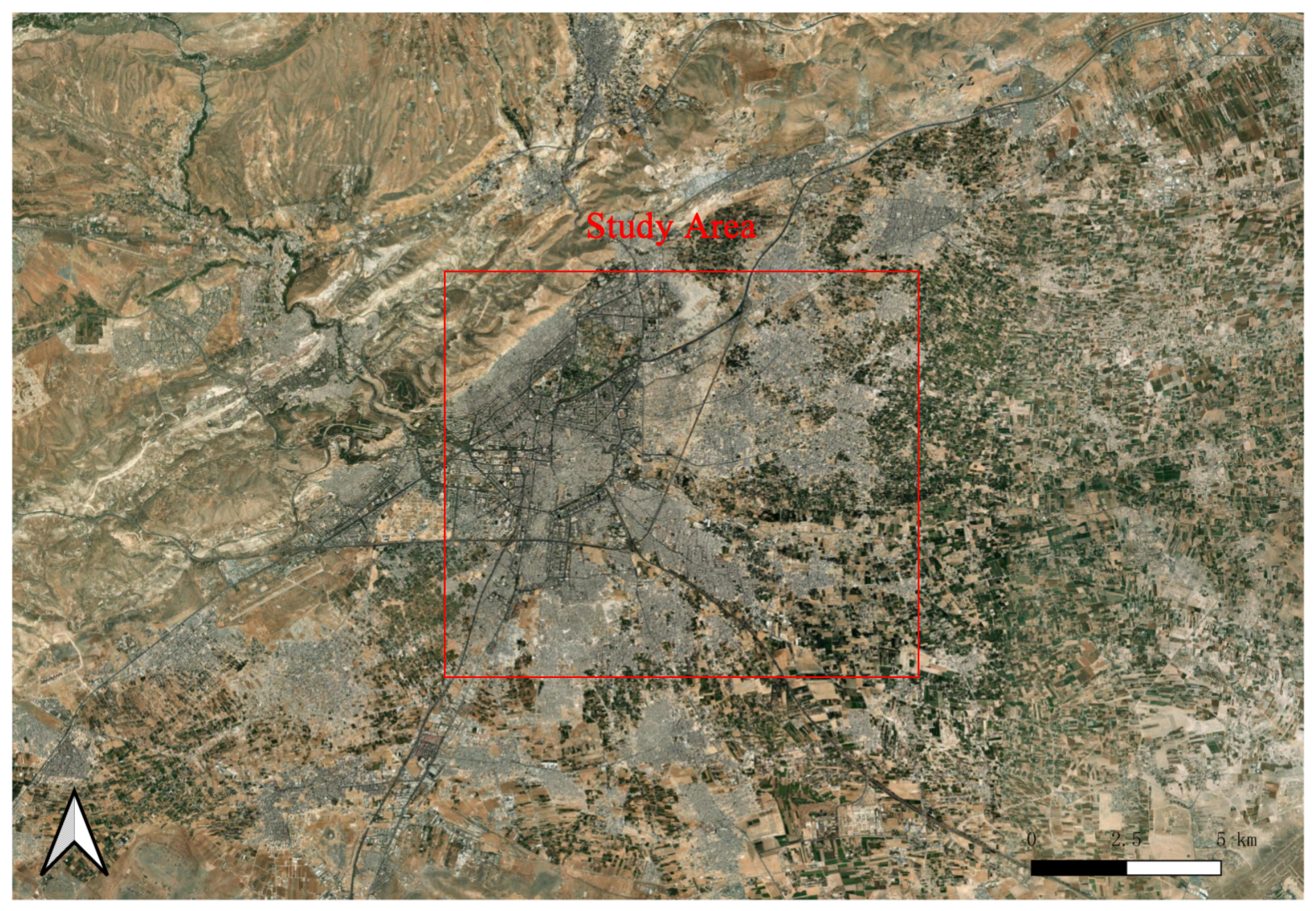
4.3.1. Middle East Urban Experimental Area
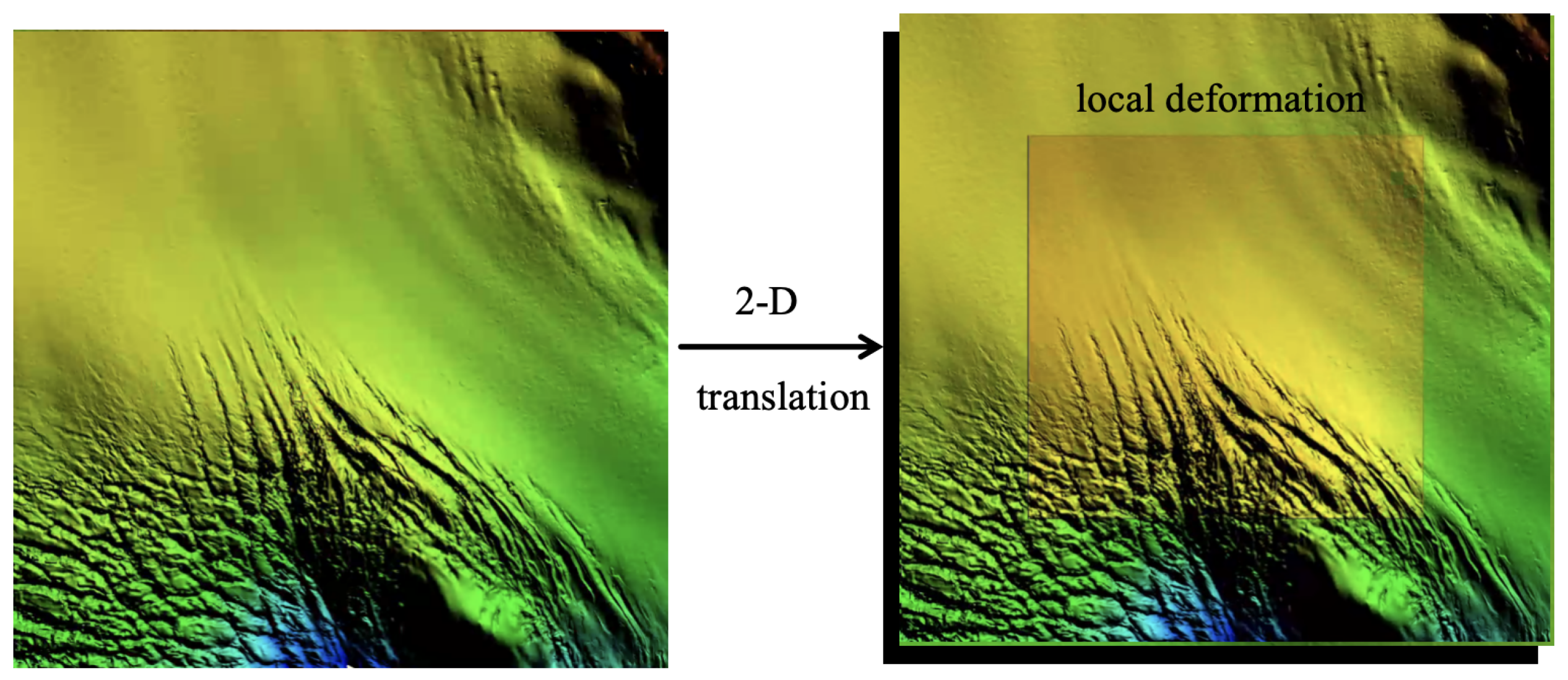
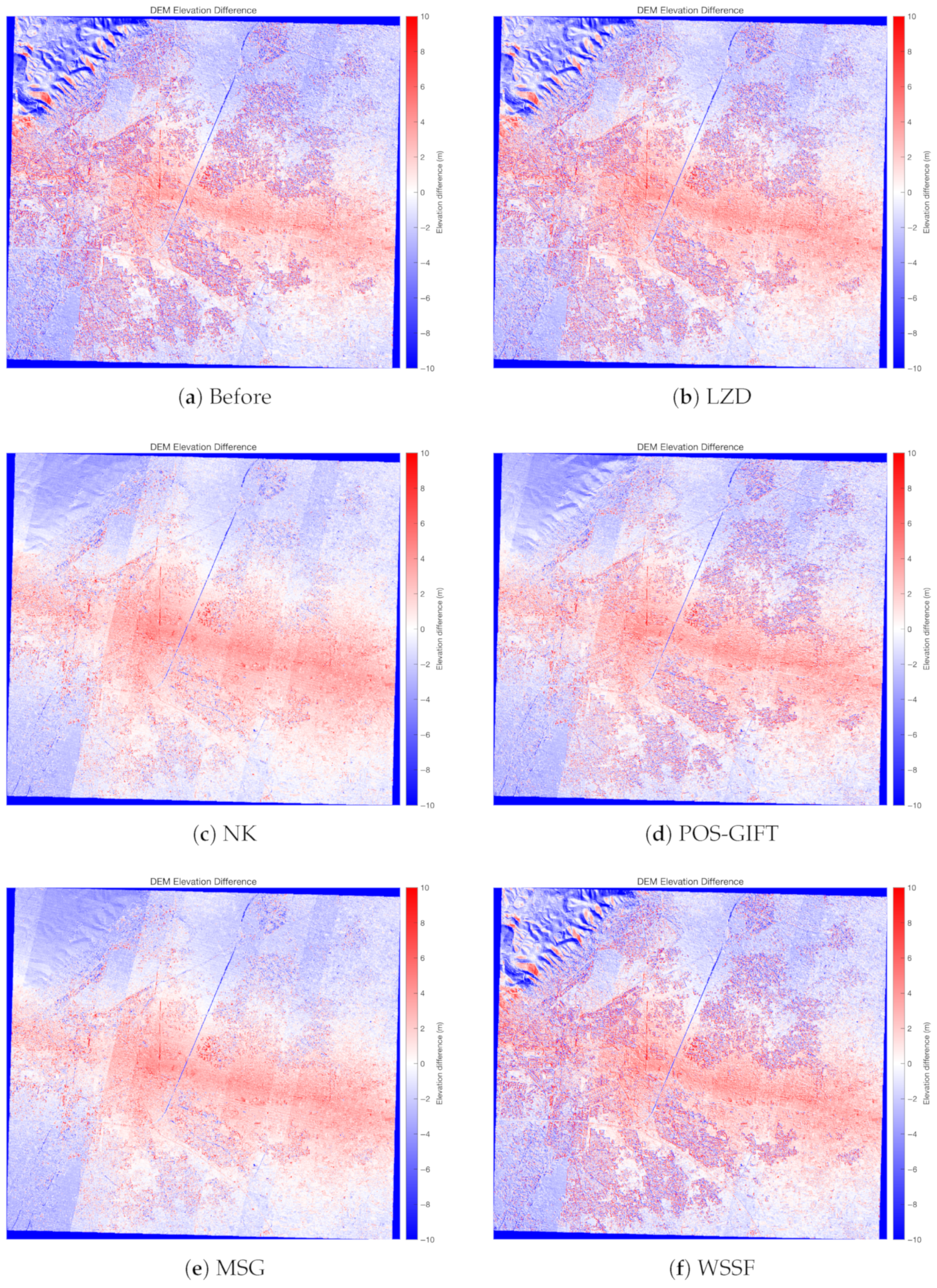
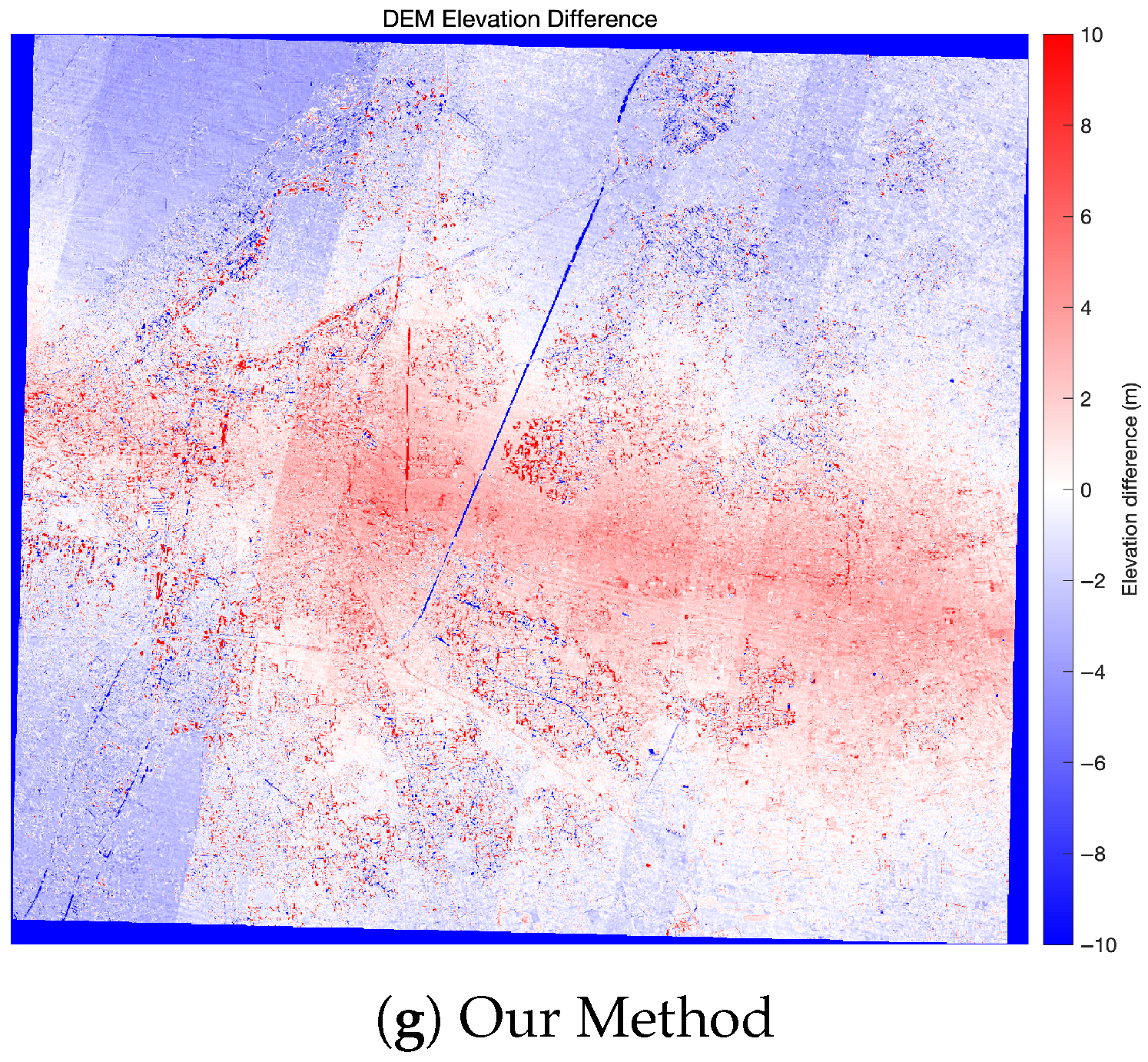
- The registration error for raw data (Before) is substantial, with RMSE and LE95 reaching 4.3880 and 9.3984, respectively, indicating significant translation and local deformation in the initial DEM.
- Traditional Methods Comparison: LZD and WSSF showed limited error reduction, with RMSE still exceeding 4 and LE95 surpassing 8, indicating unstable performance in areas with local elevation disturbances or low texture. POS-GIFT and NK showed more pronounced error reduction, with NK’s RMSE decreasing to 2.7571 and LE95 to 4.8840, demonstrating superior accuracy and stability. MSG also exhibited low overall error, performing similarly to NK.
- The proposed method achieved the best performance across all metrics, with an RMSE of 2.7246 and LE95 of 4.7217, while also maintaining the lowest MAD and LE68 values. This fully demonstrates the proposed method’s superior robustness and matching accuracy in handling both global translation and local deformation. Furthermore, the running time of the proposed method is shorter than that of baseline methods, exhibiting good applicability.
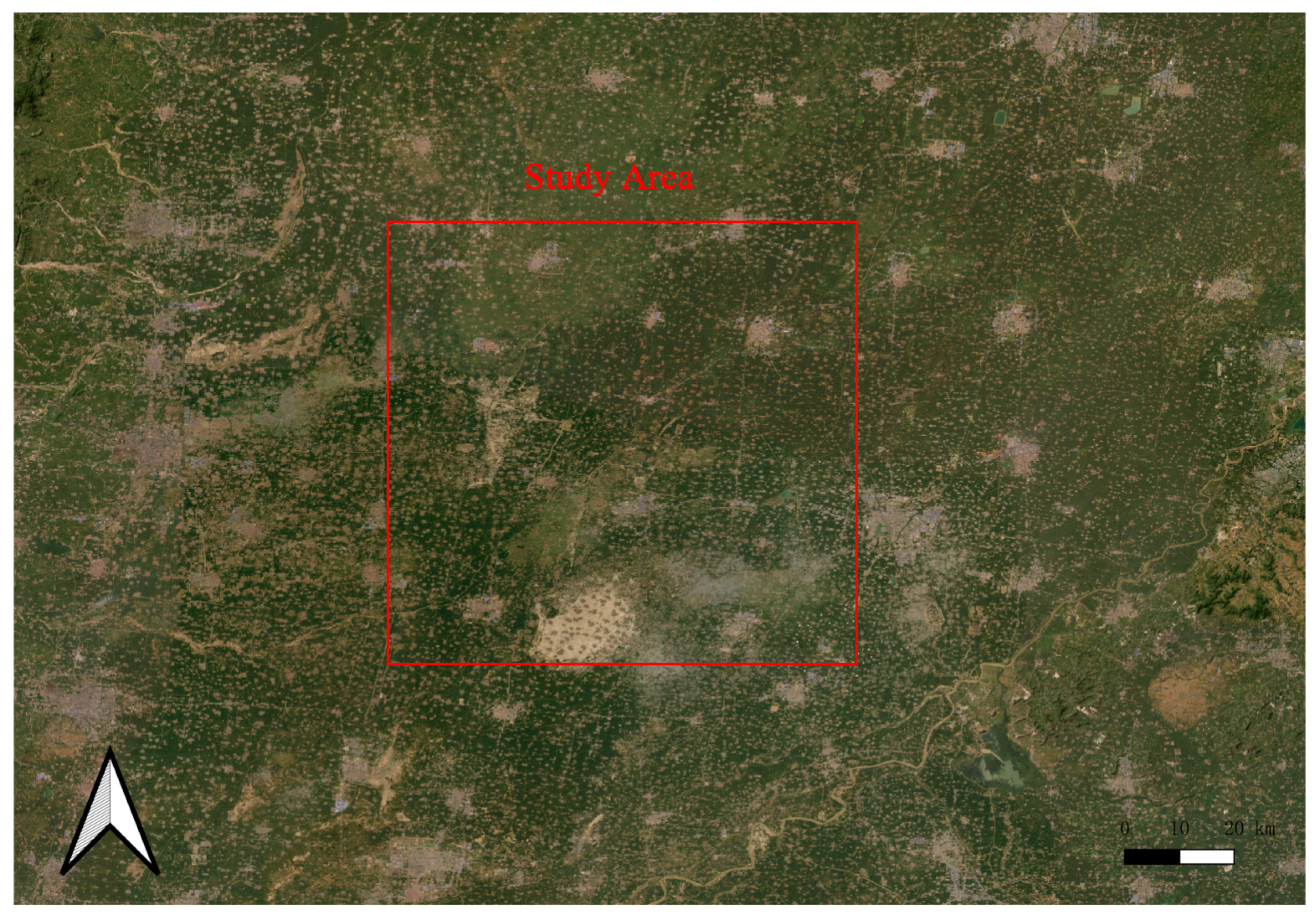
4.3.2. North China Plain Experimental Area
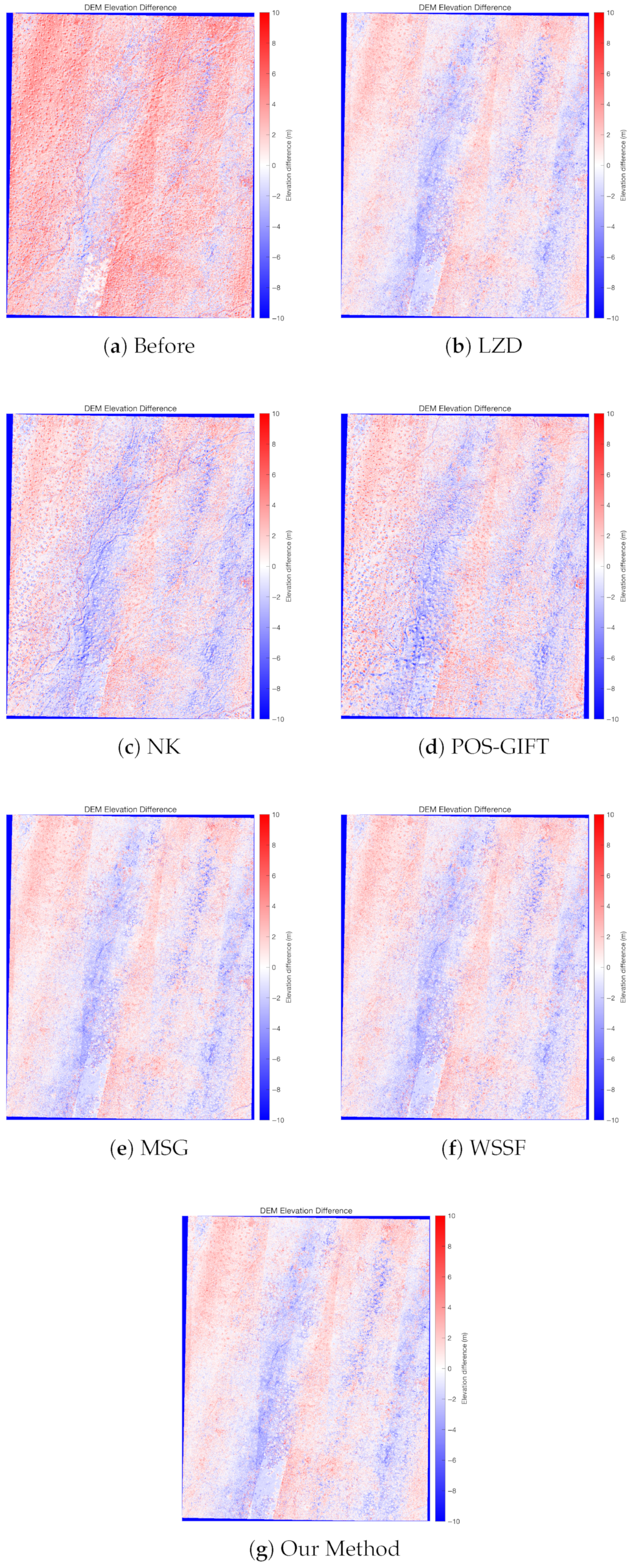
- The registration error for the raw data (Before) is substantial, with an RMSE of 3.4682 and LE95 of 6.5962, indicating significant global shifts and local elevation discrepancies in the data.
- Traditional Methods Comparison: LZD, MSG, and WSSF demonstrate better overall error control, with RMSEs of 2.4193, 2.3816, and 2.4650, respectively. LE95 is also significantly lower than the original data, demonstrating a certain improvement in registration accuracy. NK and POS-GIFT perform relatively moderately, with slightly higher RMSE. In flat areas, NK’s accuracy is somewhat constrained due to the lack of relevant terrain slope information.
- Our method achieved the best performance across all metrics, with an RMSE of 2.3410 and LE95 of 4.3433, while maintaining the lowest MAD and LE68 values. This demonstrates high robustness and accuracy in both global translation correction and local elevation disturbance handling. Furthermore, the proposed method’s runtime is second only to the NK algorithm, while offering a significant improvement in accuracy, showcasing a good balance between runtime and registration accuracy.
5. Discussion
5.1. Effect of Physically Consistent Rendering on DEM Registration
5.2. Parameter Sensitivity Analysis
5.3. Performance Analysis Across Different Terrain Types
5.4. Limitations and Future Work
6. Conclusions
Author Contributions
Funding
Data Availability Statement
Conflicts of Interest
Abbreviations
| DEM | Digital elevation model; |
| LZD | Least-Z difference; |
| NK | Nuth & Kääb; |
| ICP | Iterative closest point; |
| SIFT | Scale-invariant feature transform; |
| FFT | Fast Fourier transform; |
| GMM | Gaussian mixture model; |
| EM | Expectation maximization; |
| RMSE | Root mean square error; |
| SRTM | Shuttle Radar Topography Mission; |
| RANSAC | Random sample consensus. |
References
- Wilson, J.P. Environmental Applications of Digital Terrain Modeling; John Wiley & Sons: Hoboken, NJ, USA, 2018. [Google Scholar] [CrossRef]
- Li, P.; Shi, C.; Li, Z.; Muller, J.P.; Drummond, J.; Li, X.; Li, T.; Li, Y.; Liu, J. Evaluation of ASTER GDEM using GPS benchmarks and SRTM in China. Int. J. Remote Sens. 2013, 34, 1744–1771. [Google Scholar] [CrossRef]
- Dai, X.; Khorram, S. The effects of image misregistration on the accuracy of remotely sensed change detection. IEEE Trans. Geosci. Remote Sens. 1998, 36, 1566–1577. [Google Scholar] [CrossRef]
- Dávila-Cisneros, S.; Castañeda-Miranda, A.G.; Bautista-Capetillo, C.F.; Mattos-Villarroel, E.D.; Rodríguez-Abdalá, V.I.; Robles Rovelo, C.O.; Pinedo-Torres, L.A.; Rodríguez-Trejo, A.; Ibarra-Delgado, S. Monitoring Landform Changes in a Mining Area in Mexico Using Geomatic Techniques. Geomatics 2025, 5, 63. [Google Scholar] [CrossRef]
- Hou, Z.; Qu, Y.; Zhang, L.; Liu, J.; Wang, F.; Yu, Q.; Zeng, A.; Chen, Z.; Zhao, Y.; Tang, H. War city profiles drawn from satellite images. Nat. Cities 2024, 1, 359–369. [Google Scholar] [CrossRef]
- Nuth, C.; Kääb, A. Co-registration and bias corrections of satellite elevation data sets for quantifying glacier thickness change. Cryosphere 2011, 5, 271–290. [Google Scholar] [CrossRef]
- Streutker, D.R.; Glenn, N.F.; Shrestha, R. A slope-based method for matching elevation surfaces. Photogramm. Eng. Remote Sens. 2011, 77, 743–750. [Google Scholar] [CrossRef][Green Version]
- Zhang, J.; Huang, S.; Liu, J.; Zhu, X.; Xu, F. Pyrf-pcr: A robust three-stage 3d point cloud registration for outdoor scene. IEEE Trans. Intell. Veh. 2023, 9, 1270–1281. [Google Scholar] [CrossRef]
- Zhou, R.; Li, X.; Jiang, W. 3D surface matching by a voxel-based buffer-weighted binary descriptor. IEEE Access 2019, 7, 86635–86650. [Google Scholar] [CrossRef]
- Rosenholm, D.; Torlegård, K. Three-dimensional absolute orientation of stereo models using digital elevation models. Photogramm. Eng. Remote Sens. 1988, 54, 1385–1389. [Google Scholar]
- Karras, G.E.; Petsa, E. DEM matching and detection of deformation in close-range photogrammetry without control. Photogramm. Eng. Remote Sens. 1993, 59, 1419–1424. [Google Scholar]
- Pilgrim, L. Robust estimation applied to surface matching. ISPRS J. Photogramm. Remote Sens. 1996, 51, 243–257. [Google Scholar] [CrossRef]
- Zhang, T.; Cen, M. Robust DEM co-registration method for terrain changes assessment using least trimmed squares estimator. Adv. Space Res. 2008, 41, 1827–1835. [Google Scholar] [CrossRef]
- Li, T.; Hu, Y.; Liu, B.; Jiang, L.; Wang, H.; Shen, X. Co-registration and residual correction of digital elevation models: A comparative study. Cryosphere 2022, 17, 5299–5316. [Google Scholar] [CrossRef]
- Besl, P.J.; McKay, N.D. A method for registration of 3-D shapes. IEEE Trans. Pattern Anal. Mach. Intell. 1992, 14, 239–256. [Google Scholar] [CrossRef]
- Chen, Y.; Medioni, G. Object modelling by registration of multiple range images. Image Vis. Comput. 1992, 10, 145–155. [Google Scholar] [CrossRef]
- Li, Z.; Bethel, J. DEM registration, alignment and evaluation for SAR interferometry. Int. Arch. Photogramm. Remote Sens. Spat. Inf. Sci. 2008, 37, 11–116. [Google Scholar]
- Han, Z.; Xie, X.; Tang, G.; Li, P.; Li, S. A K-Dimensional Tree–Iterative Closest Point Algorithm for Overbreak and Underbreak Assessment of Mountain Tunnels. Appl. Sci. 2025, 15, 566. [Google Scholar] [CrossRef]
- Yang, J.; Wang, C.; Luo, W.; Zhang, Y.; Chang, B.; Wu, M. Research on point cloud registering method of tunneling roadway based on 3D NDT-ICP algorithm. Sensors 2021, 21, 4448. [Google Scholar] [CrossRef]
- Ravanbakhsh, M.; Fraser, C. A comparative study of DEM registration approaches. J. Spat. Sci. 2013, 58, 79–89. [Google Scholar] [CrossRef]
- Huang, Y.; Hu, Q. Co-registration of multi-temporal DEM based on SIFT algorithm for change detection of glaciers. Int. Arch. Photogramm. Remote Sens. Spat. Inf. Sci. 2017, 42, 747–752. [Google Scholar] [CrossRef]
- Ravanbakhsh, M.; Fraser, C. DEM registration based on mutual information. ISPRS Ann. Photogramm. Remote Sens. Spat. Inf. Sci. 2012, 1, 187–191. [Google Scholar] [CrossRef]
- Wang, Y.; Li, J.; Duan, P.; Wang, R.; Yu, X. The DEM Registration Method Without Ground Control Points for Landslide Deformation Monitoring. Remote Sens. 2024, 16, 4236. [Google Scholar] [CrossRef]
- Li, H.; Deng, Q.; Wang, L. Automatic co-registration of digital elevation models based on centroids of subwatersheds. IEEE Trans. Geosci. Remote Sens. 2017, 55, 6639–6650. [Google Scholar] [CrossRef]
- Li, J.; Hu, Q.; Ai, M. RIFT: Multi-modal image matching based on radiation-variation insensitive feature transform. IEEE Trans. Image Process. 2019, 29, 3296–3310. [Google Scholar] [CrossRef]
- Jiang, L.; Wang, F.; Zhang, W.; Li, P.; You, H.; Xiang, Y. Rethinking the Key Factors for the Generalization of Remote Sensing Stereo Matching Networks. IEEE J. Sel. Top. Appl. Earth Obs. Remote Sens. 2025, 18, 4936–4948. [Google Scholar] [CrossRef]
- Yao, Y.; Zhang, Y.; Wan, Y.; Liu, X.; Yan, X.; Li, J. Multi-modal remote sensing image matching considering co-occurrence filter. IEEE Trans. Image Process. 2022, 31, 2584–2597. [Google Scholar] [CrossRef]
- Xiang, Y.; Jiang, L.; Wang, F.; You, H.; Qiu, X.; Fu, K. Detector-Free Feature Matching for Optical and SAR Images Based on a Two-Step Strategy. IEEE Trans. Geosci. Remote Sens. 2024, 62, 5214216. [Google Scholar] [CrossRef]
- Zhang, Y.; Yao, Y.; Wan, Y.; Liu, W.; Yang, W.; Zheng, Z.; Xiao, R. Histogram of the orientation of the weighted phase descriptor for multi-modal remote sensing image matching. ISPRS J. Photogramm. Remote Sens. 2023, 196, 1–15. [Google Scholar] [CrossRef]
- Wang, X.; Jiang, L.; Xiang, Y.; Jiao, N.; Yang, W.; Wang, F.; You, H. Enhancing Photogrammetric DSM Based on Multiscale and Domain-Invariant Semantic Feature Learning. IEEE J. Sel. Top. Appl. Earth Obs. Remote Sens. 2025, 18, 28677–28694. [Google Scholar] [CrossRef]
- Ye, Y.; Tang, T.; Zhu, B.; Yang, C.; Li, B.; Hao, S. A multiscale framework with unsupervised learning for remote sensing image registration. IEEE Trans. Geosci. Remote Sens. 2022, 60, 5622215. [Google Scholar] [CrossRef]
- Xiong, X.; Jin, G.; Xu, Q.; Zhang, H. Self-similarity features for multimodal remote sensing image matching. IEEE J. Sel. Top. Appl. Earth Obs. Remote Sens. 2021, 14, 12440–12454. [Google Scholar] [CrossRef]
- Xiang, Y.; Wang, X.; Wang, F.; You, H.; Qiu, X.; Fu, K. A global-to-local algorithm for high-resolution optical and SAR image registration. IEEE Trans. Geosci. Remote Sens. 2023, 61, 5215320. [Google Scholar] [CrossRef]
- Liu, X.; Teng, X.; Bian, Y.; Li, Z.; Yu, Q. Shape-Adaptive Modality Independent Region Descriptor for Multimodal Remote Sensing Image Matching. IEEE J. Sel. Top. Appl. Earth Obs. Remote Sens. 2024, 17, 18139–18155. [Google Scholar] [CrossRef]
- Xiang, Y.; Jiao, N.; Liu, R.; Wang, F.; You, H.; Qiu, X.; Fu, K. A geometry-aware registration algorithm for multiview high-resolution SAR images. IEEE Trans. Geosci. Remote Sens. 2022, 60, 5234818. [Google Scholar] [CrossRef]
- Xiang, Y.; Peng, L.; Wang, F.; Qiu, X. Fast registration of multiview slant-range SAR images. IEEE Geosci. Remote Sens. Lett. 2021, 19, 4007505. [Google Scholar] [CrossRef]
- Lindenberger, P.; Sarlin, P.E.; Pollefeys, M. Lightglue: Local feature matching at light speed. In Proceedings of the IEEE/CVF International Conference on Computer Vision, Paris, France, 1–6 October 2023; pp. 17627–17638. [Google Scholar]
- Quan, D.; Wei, H.; Wang, S.; Li, Y.; Chanussot, J.; Guo, Y.; Hou, B.; Jiao, L. Efficient and robust: A cross-modal registration deep wavelet learning method for remote sensing images. IEEE J. Sel. Top. Appl. Earth Obs. Remote Sens. 2023, 16, 4739–4754. [Google Scholar] [CrossRef]
- Zhao, X.; Wu, Y.; Hu, X.; Li, Z.; Li, M. A novel dual-branch global and local feature extraction network for SAR and optical image registration. IEEE J. Sel. Top. Appl. Earth Obs. Remote Sens. 2024, 17, 17637–17650. [Google Scholar] [CrossRef]
- Jing, W.; Chi, K.; Li, Q.; Wang, Q. ChangeRD: A registration-integrated change detection framework for unaligned remote sensing images. ISPRS J. Photogramm. Remote Sens. 2025, 220, 64–74. [Google Scholar] [CrossRef]
- Kang, Q.; Zhang, J.; Huang, G.; Liu, F. Robust optical and SAR image matching via attention-guided structural encoding and confidence-aware filtering. Remote Sens. 2025, 17, 2501. [Google Scholar] [CrossRef]
- Wan, L.; Xiang, Y.; Kang, W.; Ma, L. A Self-Supervised Learning Pretraining Framework for Remote Sensing Image Change Detection. IEEE Trans. Geosci. Remote Sens. 2025, 63, 5630116. [Google Scholar] [CrossRef]
- Chen, H.W.; Cheng, K.S. A Conceptual model of surface reflectance estimation for satellite remote sensing images using in situ reference data. Remote Sens. 2012, 4, 934–949. [Google Scholar] [CrossRef]
- Yuan, W.; Tong, X.; Xiao, B. SGM-Based Disparity Estimation Under Radiometric Variations. In Image and Graphics Technologies and Applications, Proceedings of the 14th Conference on Image and Graphics Technologies and Applications, IGTA 2019, Beijing, China, 19–20 April 2019; Springer: Berlin/Heidelberg, Germany, 2019; pp. 382–391. [Google Scholar] [CrossRef]
- Harris, C.; Stephens, M. A combined corner and edge detector. In Proceedings of the Alvey Vision Conference, Manchester, UK, 31 August–2 September 1988; Volume 15, pp. 10–5244. [Google Scholar]
- Noble, J.A. Finding corners. Image Vis. Comput. 1988, 6, 121–128. [Google Scholar] [CrossRef]
- Foroosh, H.; Zerubia, J.; Berthod, M. Extension of phase correlation to subpixel registration. IEEE Trans. Image Process. 2002, 11, 188–200. [Google Scholar] [CrossRef] [PubMed]
- Hou, Z.; Liu, Y.; Zhang, L. POS-GIFT: A geometric and intensity-invariant feature transformation for multimodal images. Inf. Fusion 2024, 102, 102027. [Google Scholar] [CrossRef]
- Zheng, C.; Li, S.; Wang, C.; Zhang, B. MSG: Robust Multimodal Remote Sensing Image Matching Using Side Window Gaussian Space. IEEE Trans. Geosci. Remote Sens. 2025, 63, 4706223. [Google Scholar] [CrossRef]
- Wan, G.; Ye, Z.; Xu, Y.; Huang, R.; Zhou, Y.; Xie, H.; Tong, X. Multimodal Remote Sensing Image Matching Based on Weighted Structure Saliency Feature. IEEE Trans. Geosci. Remote Sens. 2024, 62, 4700816. [Google Scholar] [CrossRef]
- Ye, Y.; Bruzzone, L.; Shan, J.; Bovolo, F.; Zhu, Q. Fast and Robust Matching for Multimodal Remote Sensing Image Registration. IEEE Trans. Geosci. Remote Sens. 2019, 57, 9059–9070. [Google Scholar] [CrossRef]
- Xiang, Y.; Jiao, N.; Wang, F.; You, H. A robust two-stage registration algorithm for large optical and SAR images. IEEE Trans. Geosci. Remote Sens. 2021, 60, 5218615. [Google Scholar] [CrossRef]
- Okolie, C.J.; Smit, J.L. A systematic review and meta-analysis of Digital elevation model (DEM) fusion: Pre-processing, methods and applications. ISPRS J. Photogramm. Remote Sens. 2022, 188, 1–29. [Google Scholar] [CrossRef]





| Region | Area | Type | Resolution | Size |
|---|---|---|---|---|
| Australia | Darwin | LiDAR-derived DEM | 5 m | |
| Christmas Island | ||||
| Antarctica | Area 1 | REMA DEM | 2 m | |
| Area 2 | ||||
| Area 3 | ||||
| Area 4 | ||||
| Europe | Area 1 | SRTM DEM | 90 m | |
| Area 2 |
| Parameter | Description | Value |
|---|---|---|
| Gradient Gaussian scale | 1.5 | |
| Gradient kernel std | ||
| Auto-correlation smoothing std | 1.5 | |
| Small constant to prevent division by zero | ||
| Template size | Side length of template window | pixels |
| Gaussian weighting std for template | 50 pixels | |
| Solar azimuth | Sloar azimuth angle for DEM rendering | |
| Solar zenith | Solar zenith angle for DEM rendering | |
| Satellite azimuth | Satellite viewing azimuth | |
| Satellite elevation | Satellite viewing elevation |
| Area | LZD | NK | POS-GIFT | MSG | WSSF | Our Method |
|---|---|---|---|---|---|---|
| Darwin | * | 0.0031 | 14.1481 | – | – | 0.4828 |
| Christmas Island | 8.3340 | 1.0744 | – | 14.1421 | – | 1.2363 |
| Antarctica 1 | 9.9854 | 8.5800 | 0.2770 | 4.2796 | – | 0.0491 |
| Antarctica 2 | * | * | 0.0296 | – | – | 0.0207 |
| Antarctica 3 | * | * | 0.3033 | – | – | 0.1321 |
| Antarctica 4 | 9.1847 | * | 0.2161 | 13.2876 | – | 0.0079 |
| Europe 1 | 0.0219 | 0.0046 | 0.0626 | 0.1604 | 0.2308 | 0.0003 |
| Europe 2 | 0.0798 | 0.0025 | 0.0841 | 0.3672 | 0.4598 | 0.0012 |
| Area | Initial Points | GMM Selected Points | Final Points |
|---|---|---|---|
| Europe data1 | 4898 | 2536 | 2536 |
| Europe data2 | 4558 | 2391 | 2391 |
| Antarctica data1 | 3705 | 2021 | 1225 |
| Antarctica data2 | 3513 | 1651 | 1529 |
| Antarctica data3 | 517 | 268 | 245 |
| Antarctica data4 | 939 | 486 | 414 |
| Darwin | 2338 | 966 | 862 |
| Christmas Island | 1742 | 325 | 325 |
| Method | Median | RMSE | MAD | LE68 | LE95 | Time (s) |
|---|---|---|---|---|---|---|
| Before | −0.4854 | 4.3880 | 2.9652 | 3.0812 | 9.3984 | - |
| LZD | −0.1488 | 4.1393 | 2.8724 | 2.9403 | 8.7381 | 258.30 |
| NK | −0.0030 | 2.7571 | 2.2502 | 2.2311 | 4.8840 | 64.46 |
| POS-GIFT | −0.2285 | 3.4188 | 2.5852 | 2.6105 | 6.8608 | 1356.98 |
| MSG | −0.2098 | 2.8100 | 2.3180 | 2.3112 | 5.0320 | 953.48 |
| WSSF | −0.1432 | 4.3269 | 2.9489 | 3.0337 | 9.2293 | 203.48 |
| Our Method | −0.2126 | 2.7246 | 2.2472 | 2.2442 | 4.7217 | 62.21 |
| Method | Median | RMSE | MAD | LE68 | LE95 | Time (s) |
|---|---|---|---|---|---|---|
| Before | 1.8426 | 3.4682 | 2.4702 | 3.2605 | 6.5962 | - |
| LZD | 0.1430 | 2.4193 | 1.9141 | 1.9353 | 4.5943 | 22.48 |
| NK | 0.0082 | 2.8673 | 2.3153 | 2.3764 | 5.5260 | 6.01 |
| POS-GIFT | 0.1132 | 2.8399 | 2.3260 | 2.3897 | 5.5405 | 295.81 |
| MSG | 0.0991 | 2.3816 | 1.8984 | 1.9120 | 4.5058 | 146.68 |
| WSSF | 0.0891 | 2.4650 | 1.9459 | 1.9647 | 4.6890 | 26.57 |
| Our Method | 0.1109 | 2.3410 | 1.8287 | 1.8396 | 4.3433 | 9.07 |
| Area | Initial Points | GMM Selected Points | Final Points |
|---|---|---|---|
| North China Plain | 4157 | 3900 | 3857 |
| Middle East Urban Area | 4493 | 3326 | 2715 |
| Method | Darwin | Christmas Island | Area 1 | Area 2 | Area 3 | Area 4 |
|---|---|---|---|---|---|---|
| Without Rendering | 14.1489 | 13.9753 | 14.1239 | 14.1243 | 14.1408 | 14.1511 |
| Our Method | 0.4828 | 1.2363 | 0.0491 | 0.0207 | 0.1321 | 0.0079 |
Disclaimer/Publisher’s Note: The statements, opinions and data contained in all publications are solely those of the individual author(s) and contributor(s) and not of MDPI and/or the editor(s). MDPI and/or the editor(s) disclaim responsibility for any injury to people or property resulting from any ideas, methods, instructions or products referred to in the content. |
© 2026 by the authors. Licensee MDPI, Basel, Switzerland. This article is an open access article distributed under the terms and conditions of the Creative Commons Attribution (CC BY) license.
Share and Cite
Li, Y.; Jiao, N.; Wang, F.; You, H. A Robust DEM Registration Method via Physically Consistent Image Rendering. Appl. Sci. 2026, 16, 1238. https://doi.org/10.3390/app16031238
Li Y, Jiao N, Wang F, You H. A Robust DEM Registration Method via Physically Consistent Image Rendering. Applied Sciences. 2026; 16(3):1238. https://doi.org/10.3390/app16031238
Chicago/Turabian StyleLi, Yunchou, Niangang Jiao, Feng Wang, and Hongjian You. 2026. "A Robust DEM Registration Method via Physically Consistent Image Rendering" Applied Sciences 16, no. 3: 1238. https://doi.org/10.3390/app16031238
APA StyleLi, Y., Jiao, N., Wang, F., & You, H. (2026). A Robust DEM Registration Method via Physically Consistent Image Rendering. Applied Sciences, 16(3), 1238. https://doi.org/10.3390/app16031238