Article

Research on the Propagation Path and Characteristics of Wind Turbine Sound Sources in Three-Dimensional Dynamic Wake

1
College of Energy and Power Engineering, Inner Mongolia University of Technology, Hohhot 010051, China
2
Key Laboratory of Wind Energy and Solar Energy Utilization Technology, Ministry of Education, Inner Mongolia University of Technology, Hohhot 010051, China
*
Author to whom correspondence should be addressed.
Appl. Sci. 2026, 16(3), 1185; https://doi.org/10.3390/app16031185
Submission received: 17 December 2025 / Revised: 21 January 2026 / Accepted: 22 January 2026 / Published: 23 January 2026

Abstract

The noise generated by wind turbines is a critical issue that impacts both operational efficiency and public health, necessitating a comprehensive investigation into its sources and propagation. This study investigates the near-wake noise of an S-airfoil horizontal-axis wind turbine using statistically optimized near-field acoustic holography (SONAH) with a 60-channel rotating microphone array in an open-jet wind tunnel. The results show that the noise in the wake is predominantly caused by the rotation of the rotor. The position of the highest sound pressure level concentration is at 0.78R of the blade under different operating conditions within the rotor’s rotation plane. The sound pressure level radiates outward in a spiral pattern across eleven identified sections, progressively decreasing with distance. The most significant attenuation occurs between 0.04 m and 0.06 m from the rotating surface. This study provides foundational insights into the near-field acoustic characteristics of wind turbines, serving as a valuable reference for noise reduction strategies and environmental impact assessments in wind energy projects.

1. Introduction

Wind energy, as a form of renewable energy, has been widely promoted due to its environmental benefits. However, the noise generated by wind turbines during operation can adversely affect the surrounding environment and nearby residents [1]. Consequently, the reduction in wind turbine noise has become an important research topic in recent years [2]. Tonin et al. [3] have shown that the degree of human annoyance increases with rising audible noise levels, particularly when the sound pressure level exceeds approximately 35 dB(A). Identifying the spatial distribution of sound pressure levels in the near-wake region of rotating wind turbine blades is therefore of significant importance, as it can contribute to performance optimization and provide a scientific basis for noise mitigation strategies. Wind turbine noise generally consists of aerodynamic noise and mechanical noise, among which aerodynamic noise is dominant during normal operation. The generation mechanisms of aerodynamic noise are highly complex and remain an important challenge in wind turbine acoustics. Aerodynamic noise arises from the interaction between the rotating blades and the incoming flow and can be classified into inflow turbulence noise, tonal noise, and airfoil self-noise [4]. Turbulence noise generated by the rotor is associated with the interaction between atmospheric turbulence, pressure fluctuations, and blade rotation. To investigate such unsteady flow–acoustic phenomena, advanced numerical simulation methods and experimental measurement techniques are required [5]. Hald et al. [6] proposed the statistically optimal SONAH method, in which the sound field is represented as a linear superposition of propagating and evanescent plane waves. By combining measured sound pressure data with these basis functions, the SONAH method reconstructs the acoustic field using a minimum mean-square-error criterion. Compared with conventional near-field acoustic holography (NAH), SONAH exhibits superior low-frequency performance and enables real-time acoustic field mapping [7]. However, due to the strong directivity of wind turbine blade noise, factors such as acoustic directivity and sound wave refraction caused by gradients in temperature and wind speed must be carefully considered in sound source identification. Lee et al. [8] investigated the influence of atmospheric turbulence and wake effects on wind turbine noise propagation and demonstrated that sound refraction is significantly affected by temperature and wind speed gradients.
Sound waves scattered by atmospheric turbulence can propagate in directions that deviate significantly from the horizontal, particularly in the presence of refractive shadow zones. The scattering of sound into such shadow regions has attracted considerable attention in recent years and still lacks a complete theoretical explanation [9]. In the wake of a wind turbine, the inhomogeneous flow field can be regarded as a complex system of convex and concave acoustic lenses, leading to localized convergence or divergence of sound rays. Since the density of sound rays is directly related to the local acoustic energy, these wake-induced effects can result in pronounced spatial variations in sound pressure level [10]. Complex wake flows are therefore expected to have a significant influence on sound propagation under both local upwind (negative velocity gradient) and downwind (positive velocity gradient) conditions [11]. Previous studies comparing cases with and without wakes have shown that wake effects can increase acoustic propagation losses and enlarge the affected region, with the influence becoming more pronounced at higher frequencies [12,13]. In addition, for a given shear condition, acoustic shadow zones tend to expand with increasing frequency, and the effects of vertical wind speed and temperature gradients on wind turbine noise propagation have been systematically investigated in the literature [14]. In many existing models, atmospheric turbulence is incorporated into the source description through turbulent inflow noise mechanisms, whereas its influence on sound propagation itself is often neglected. Furthermore, vorticity, which characterizes the local rotational motion of the flow, is closely associated with coherent vortex structures. These structures indicate regions of rapid pressure fluctuations that may act as potential acoustic source regions [15]. When sound sources are measured and localized from the far field outside a jet, the influence of the jet shear layer on sound propagation must be considered to avoid significant measurement errors [16]. However, under low-Mach-number conditions, when only convective effects are considered, refraction effects have been shown to be negligible with respect to sound source localization accuracy. Numerical approaches combining Reynolds-averaged Navier–Stokes equations for turbulence modeling [17] with parabolic wave equations for sound propagation [18] have been widely applied to long-range noise propagation problems. Nevertheless, existing studies predominantly focus on far-field propagation, while the characteristics of noise propagation in the region immediately downstream of wind turbines, particularly under rotating blades and wake interaction conditions, remain insufficiently explored.
In this paper, the sound pressure level distribution in the near-wake region of a horizontal-axis wind turbine under operating conditions is experimentally investigated using the SONAH method. The spatial concentration of sound pressure level and the propagation characteristics of narrowband acoustic components in the adjacent downstream region are analyzed in detail. By reconstructing the three-dimensional evolution of the acoustic field, the dominant sound source distribution and its propagation behavior are identified. The results provide experimental evidence for understanding low-frequency aerodynamic noise generation and propagation mechanisms in wind turbines and offer useful guidance for low-noise wind turbine design and noise mitigation strategies. The main contributions of this study can be summarized as follows:
  • An experimental research framework based on the SONAH method is established to investigate low-frequency noise radiation characteristics in the near wake of a horizontal-axis wind turbine.
  • The dominant low-frequency noise source and its three-dimensional propagation characteristics in the near wake are experimentally identified under different operating conditions. By incorporating existing studies, the relationship between the observed acoustic propagation features and the coherent wake vortex structures induced by blade rotation is analyzed and interpreted from a physical mechanism perspective, providing experimental evidence for near-wake noise modeling, noise control strategies, and blade design optimization.
The remainder of this paper is organized as follows: Section 2 introduces the SONAH methodology and its application for sound field reconstruction. Section 3 describes the experimental setup, measurement system, and test configuration. Section 4 presents and discusses the experimental results, including the identification of dominant noise sources and near-wake acoustic propagation characteristics. Finally, Section 5 summarizes the main conclusions and outlines directions for future work.

2. Statistically Optimal Near-Field Acoustic Holography

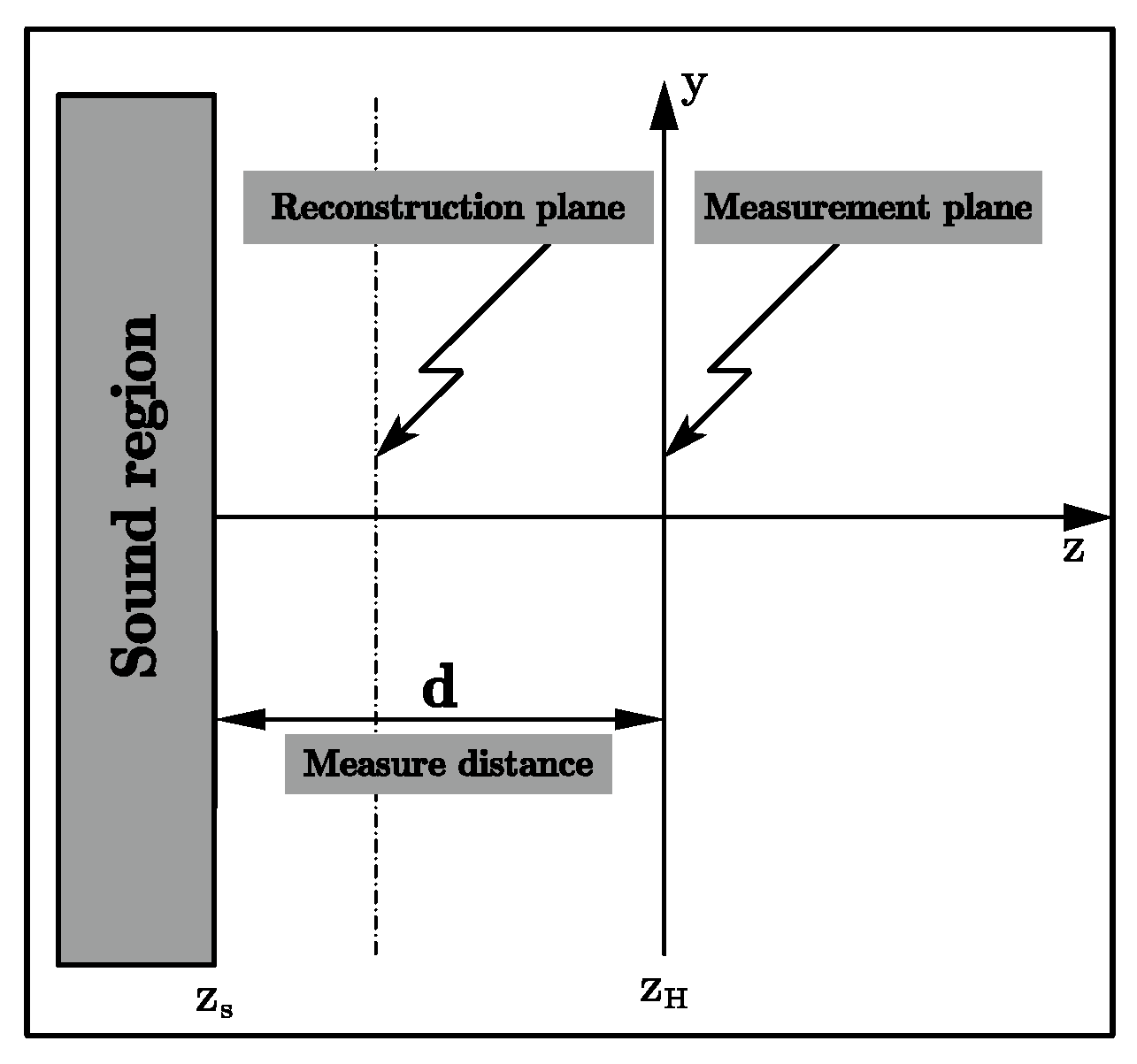
In wind turbine noise experiments, even when the physical aperture of the microphone array is smaller than the actual spatial extent of the acoustic sources, the SONAH method can alleviate the truncation effects caused by the finite array size to a certain extent, thereby enabling an effective reconstruction of the sound field. In the present study, for the selected analysis frequencies, the sound field radiated by the wind turbine can be reasonably approximated as a time-harmonic steady-state acoustic field. Under high tip-speed-ratio (TSR) operating conditions, the low-frequency aerodynamic noise generated by the wind turbine is characterized by relatively long acoustic wavelengths and is mainly associated with large-scale, quasi-stable vortex shedding structures. The contribution of small-scale turbulent fluctuations to the acoustic radiation within the selected frequency range can therefore be neglected. As a result, the spatial distribution of the sound field can be modeled and reconstructed using the complex acoustic pressure in the frequency domain. Furthermore, the dominant aerodynamic noise sources generated during wind turbine blade operation are distributed in the near-wall region of the blades, as illustrated in Figure 1. For a microphone array located on one side of the rotor, it can be assumed that no physical sound sources exist within the half-space z d , which satisfies the fundamental physical assumption of source-free sound propagation required by the SONAH method. Based on these assumptions, the following derivation is conducted under the conditions of a source-free, homogeneous medium and single-frequency steady-state excitation. Accordingly, the complex acoustic pressure in the frequency domain, p ( r , ω ) , at an arbitrary position r within the half-space z d satisfies the standard Helmholtz equation [19]:
2 p ( r , ω ) + k 2 p ( r , ω ) = 0 ,
where 2 is the Laplace operator, r = ( x , y , z ) denotes the spatial position vector, ω = 2 π f is the angular frequency, f is the frequency, k = ω / c is the acoustic wavenumber, and c is the speed of sound in the medium.
According to the theory of NAH [20], the sound field in a source-free region can be represented as a superposition of plane propagating waves and evanescent waves, which admits the following representation:
p ( r , ω ) = 1 4 π 2 P ( k x , k y ; ω ) e j ( k x x + k y y ) e j k z ( z z s ) d k x d k y ,
where
k z = k 2 k x 2 k y 2 k x 2 + k y 2 k 2 , j k x 2 + k y 2 k 2 k x 2 + k y 2 > k 2 ,
P ( k x , k y ; ω ) is the angular spectrum function, representing the amplitude distribution of the sound field in the wavenumber domain. The quantities k x , k y and k z denote the components of the plane-wave wavenumber vector k in the x, y and z directions, respectively. When k x 2 + k y 2 k 2 , the corresponding components represent propagating waves. Otherwise, they correspond to evanescent wave components, whose amplitudes decay exponentially with the propagation distance. Nevertheless, these evanescent components carry high spatial-frequency information of the sound sources, which constitutes the physical basis enabling the SONAH method to achieve high spatial resolution.
Due to the limited number of measurement channels available in practical engineering applications, the continuous angular spectrum in Equation (2) is discretized and approximated using a finite number of plane-wave basis functions. Accordingly, the sound field at position on the prediction plane is expressed as [21]:
p ( r , ω ) m = 1 M a m Φ m ( r ) ,
where M denotes the number of discrete plane-wave components, and a m represents the complex amplitude coefficient of the m plane-wave component. It should be emphasized that the SONAH method does not directly solve for the coefficients a m in Equation (4); instead, they are treated as physical constraints in the solution space of the sound field. The basis function Φ m ( r ) of the m plane wave is given by:
Φ m ( r ) = e j ( k x , m x + k y , m y ) e j k z , m ( z z s ) ,
for each discretized wavenumber sample ( k x , m , k y , m ) the corresponding vertical wavenumber k z , m is determined by:
k z , m = k 2 k x , m 2 k y , m 2 k x , m 2 + k y , m 2 k 2 , j k x , m 2 + k y , m 2 k 2 k x , m 2 + k y , m 2 > k 2 .
When an N-channel microphone array is arranged on the measurement plane shown in Figure 1, the spatial position of the microphone is denoted by r n ( n = 1 , 2 , , N ) The complex acoustic pressure measured at the microphone can therefore be expressed as p ( r n ) . The SONAH method constructs a set of weighting coefficients associated with the prediction position r and forms a linear combination of the measured sound pressures, thereby providing an optimal estimate, in a statistical sense, of the acoustic pressure at the prediction point. Accordingly, the prediction model of the sound pressure can be written as:
p ˜ ( r ) = p H T c ( r ) ,
where p ˜ ( r ) denotes the complex acoustic pressure at the prediction position r , p H T = [ p ( r 1 ) , , p ( r N ) ] represents the vector of complex acoustic pressures measured by the microphones on the measurement plane, and c ( r ) = [ c 1 ( r ) , , c N ( r ) ] T is the weighting coefficient vector. The weighting vector depends only on the prediction position r and the geometric configuration of the microphone array and is independent of the specific amplitude distribution of the sound field. To ensure that the weighting vector yields a consistent representation of any physically realizable sound field within a source-free region, the SONAH method requires that the weighting coefficients satisfy the plane-wave basis functions. Accordingly, for an arbitrary plane-wave basis function, the following condition must be fulfilled [22]:
Φ m ( r ) n = 1 N c n ( r ) Φ m ( r n ) ,
where c n ( r ) denotes the prediction weighting coefficient associated with the microphone n, representing the contribution of the complex acoustic pressure measured at position r n to the reconstruction of the acoustic pressure at the prediction point r . The term Φ m ( r n ) represents the complex acoustic pressure response of the m-th plane-wave basis function evaluated at the microphone n. Accordingly, Equation (8) can be further expressed in the following matrix form:
α ( r ) = A c ( r ) + ε ,
where
α ( r ) = Φ 1 ( r ) Φ 2 ( r ) Φ M ( r ) T ,
A = Φ 1 ( r 1 ) Φ 1 ( r 2 ) Φ 1 ( r N ) Φ 2 ( r 1 ) Φ 2 ( r 2 ) Φ 2 ( r N ) Φ M ( r 1 ) Φ M ( r 2 ) Φ M ( r N ) ,
c ( r ) = c 1 ( r ) c 2 ( r ) c N ( r ) ,
α ( r ) M denotes the plane-wave coefficient vector at the reconstruction position r , A M * N is the propagation matrix, and ε represents the error and residual vector arising from the measurement and numerical computation processes.
Due to the presence of evanescent wave components, the propagation matrix A is often ill-conditioned, and a direct least-squares solution for c ( r ) may lead to a significant amplification of measurement noise. Therefore, the SONAH method employs standard Tikhonov regularization to obtain a stable solution to Equation (8), which can be written as:
c ( r ) = arg min c α ( r ) A c 2 2 + θ 2 c 2 2 ,
where 2 denotes the L 2 norm and θ is the regularization parameter. The closed-form solution of Equation (13) can be written as:
c ( r ) = ( A H A + θ 2 I ) 1 A H α ( r ) ,
where A H denotes the conjugate transpose of the matrix A , and I is the identity matrix. The term A H α ( r ) can be interpreted as a correlation-based projection between the unit plane wave at the reconstruction point and the plane-wave responses at the measurement locations. By applying regularization weighting based on this correlation, the unstable components induced by evanescent waves and measurement noise can be effectively suppressed. The regularization parameter θ is adaptively selected using the generalized cross-validation (GCV) method [23]. Substituting Equation (14) into Equation (7) yields the expression for the complex acoustic pressure at the prediction position r :
p ˜ ( r ) = p H T ( A H A + λ 2 I ) 1 A H α ( r ) .

3. Experimental Arrangement and Measurement Setup

The experiments were conducted in the open-jet test section of a B1/K2 wind tunnel. The total length of the wind tunnel is 24.6 m, and it consists of a drive section, settling chamber, contraction section, closed test section, diffuser, and open-jet test section. The diameter of the open-jet section is 2.04 m, providing a stable inflow velocity ranging from 0 to 20 m/s. The turbulence intensity of the incoming flow is approximately 0.4%. The inflow velocity is primarily controlled by a frequency inverter and remains stable under all tested operating conditions. The structural parameters of the wind turbine blades used in the experiments are listed in Table 1.
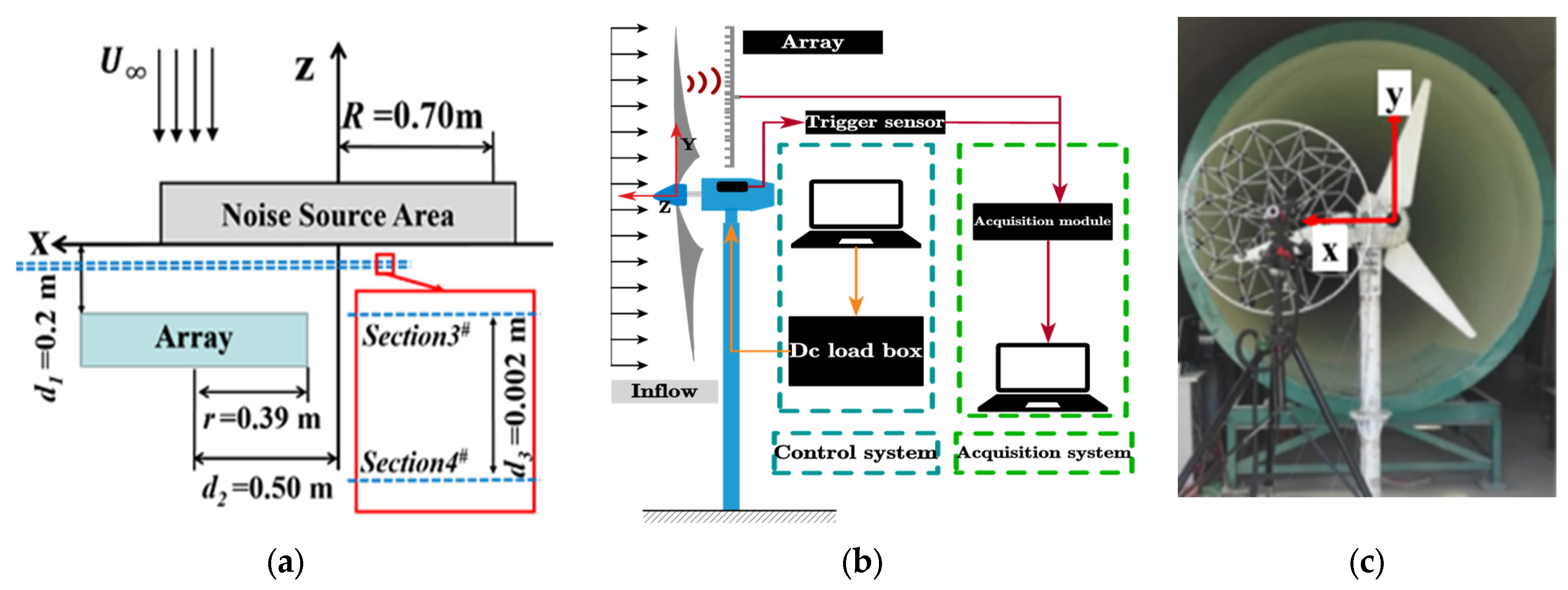
As illustrated in Figure 2a, the assumed source plane is formed by the spatial trajectory of the blade trailing edges rotating about the rotor axis and can be approximated as a circular plane. The intersection points between this plane and the rotor axis are defined as point O, corresponding to the rotational center of the rotor at a height of 1.70 m. The actual center of the microphone array is located at (0.5, 0, −0.20). Along the z-axis passing through point O, a series of parallel reconstruction surfaces are defined at intervals of 0.02 m, resulting in a total of 11 calculation surfaces. In the array-based measurement system, the first reconstruction surface corresponds to the xy plane at z = −0.20 m (the negative sign indicates the downstream direction), which coincides with the assumed sound source plane associated with rotor rotation. The reconstruction region is allowed to be larger than the physical aperture of the microphone array. Therefore, a square reconstruction area fully covering the source region was adopted for sound source identification. The experimental analysis is based on the following assumptions: (1) All aerodynamic sound sources are assumed to be located within the region z d 1 , while the half-space z < d 1 is regarded as a source-free and homogeneous medium, satisfying the fundamental requirements of the SONAH method; (2) The sound pressure level distribution is assumed to be approximately symmetric with respect to the coordinate origin in a statistical sense.
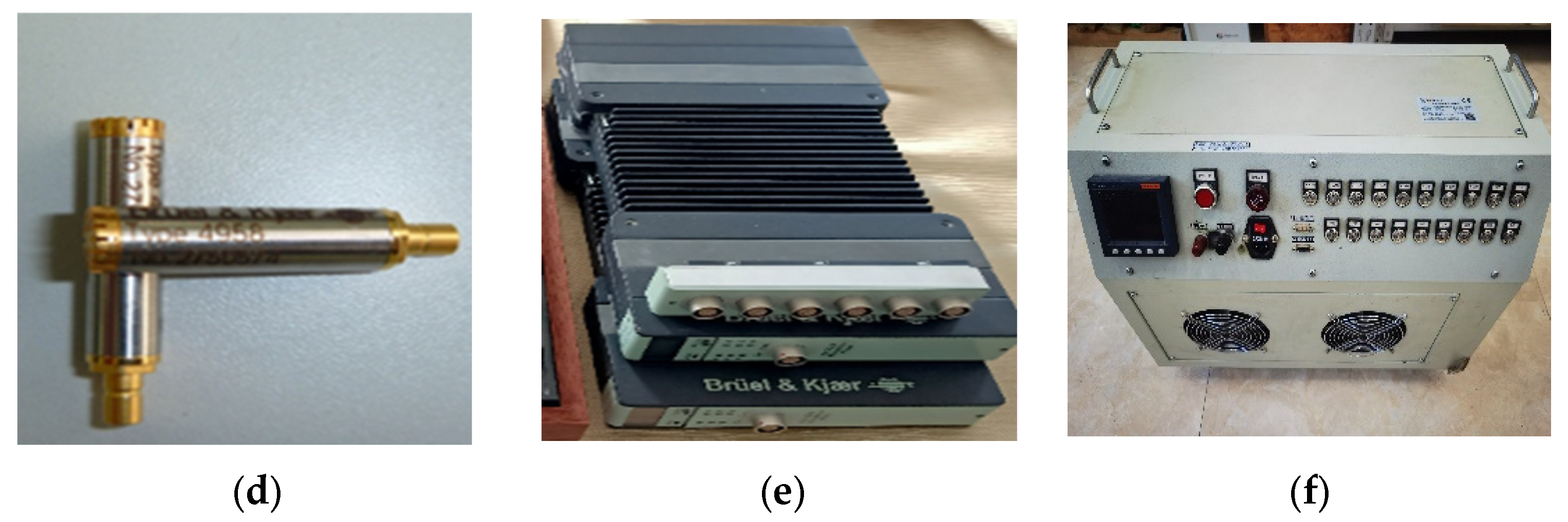
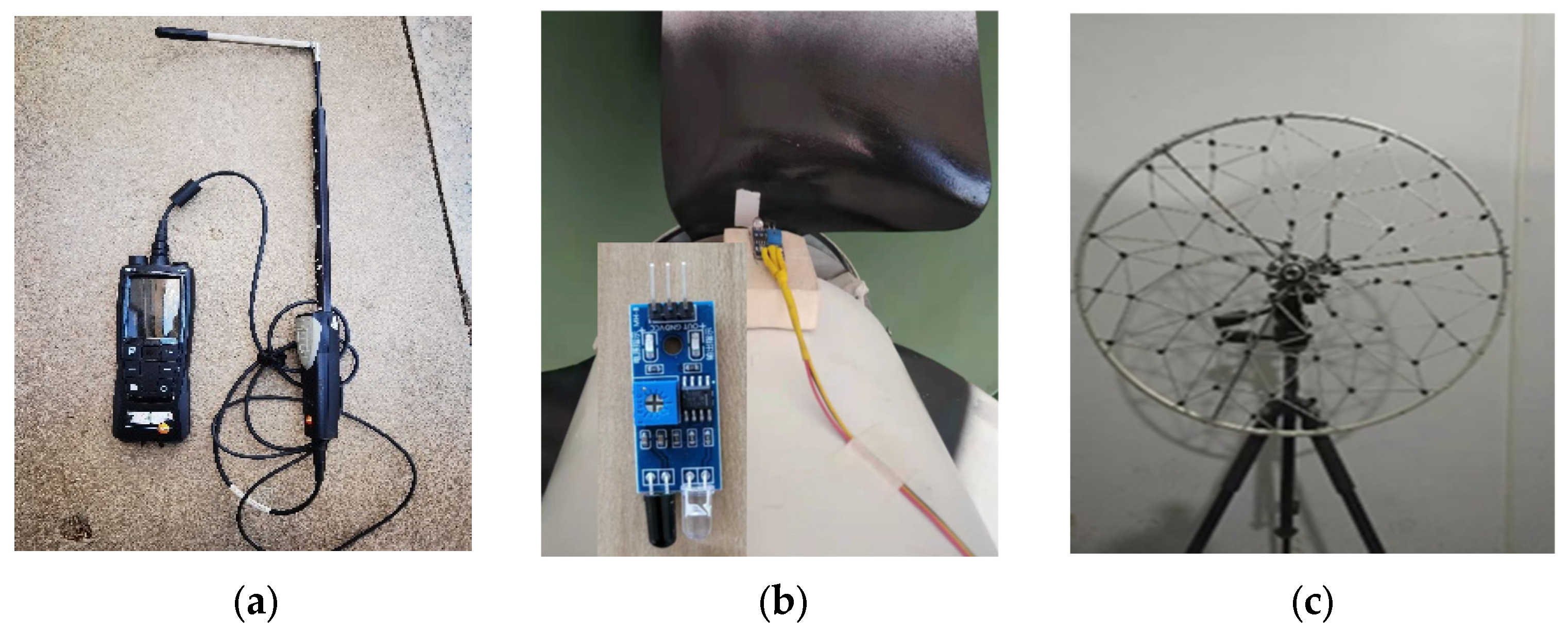
The experimental operating conditions are summarized in Table 2. Experiments were performed at inflow velocities of 6 m/s, 8 m/s, and 10 m/s, corresponding to tip-speed ratios (TSRs) of λ = 5.0, 5.5, and 6.0, respectively. For each operating condition, noise signals were measured on different reconstruction planes to investigate the axial distribution of the sound sources. Apart from the wind turbine and the wind tunnel, the remaining experimental equipment is shown in Figure 3, with their specifications and functions summarized in Table 3. The sampling frequency of the microphone array was set to 16 kHz. After adjusting the frequency inverter to reach the target inflow velocity, the wind tunnel was allowed to operate stably for 10 min. The inflow velocity was then monitored for an additional 10 min using a thermal anemometer to ensure that the averaged wind speed satisfied the target operating condition. Subsequently, the data acquisition system was activated to record the background noise under the corresponding condition. For each operating point, the background noise was measured three times, with a duration of 10 s for each measurement. After completing all background noise measurements, the wind turbine was installed at the open-jet outlet. The rotor axis was aligned with the wind tunnel axis, and the rotor plane was adjusted to be parallel to the wind tunnel outlet plane. The DC electronic load and the phase reference sensor were then connected. The microphone array plane was adjusted to be parallel to the rotor plane, with a downstream distance of 0.2 m from the rotor plane, and a radial distance of 0.5 m between the array center and the rotor center. The measurement procedure for wind turbine noise was generally identical to that for background noise, except that the DC load was adjusted after the inflow velocity stabilized to achieve the target rotational speed before data acquisition.

4. Results and Discussion

4.1. Sound Source Identification and Spatial Distribution

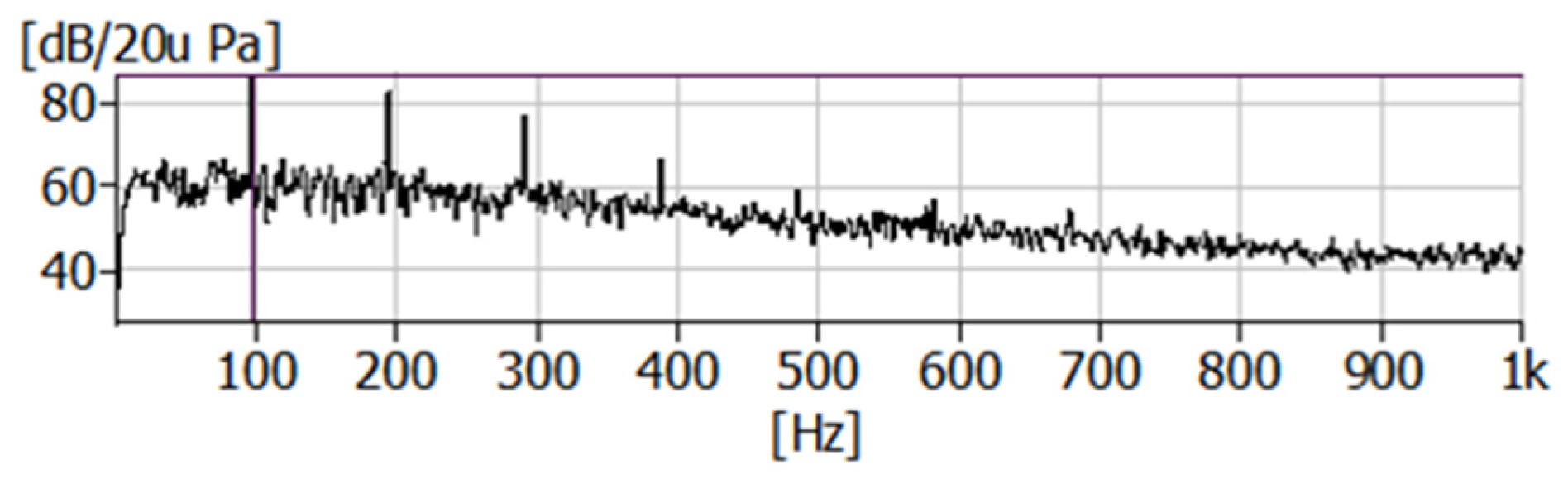
To reduce the influence of background noise on the subsequent analysis, the wind tunnel background noise was measured and examined independently. Background noise and wind turbine noise were separated in the frequency domain. For each operating condition, the frequency corresponding to the maximum acoustic energy was first identified from the measurements acquired while the wind turbine was operating. Subsequently, background noise was measured under identical inflow conditions with the rotor stopped, and the spectral component at the same frequency was examined for comparison. If the sound pressure level at this frequency under turbine-operating conditions exceeds that of the background noise by more than 10 dB, the contribution of background noise at this frequency is considered negligible. Only those frequency components for which the acoustic energy is dominated by wind turbine noise are retained for subsequent sound source identification and analysis. As an example, the background noise spectrum corresponding to an incoming flow velocity of 10 m/s is shown in Figure 4. The dominant background noise components of the wind tunnel at this operating condition are mainly concentrated below 1 kHz and are characterized by a prominent tonal component associated with the rotational frequency of the wind tunnel system (97 Hz) and its higher-order harmonics. For incoming flow velocities of 6 m/s, 8 m/s, and 10 m/s, the frequencies corresponding to the maximum acoustic energy of the wind tunnel background noise are observed at approximately 34 Hz, 77 Hz, and 97 Hz, respectively. These characteristic background noise frequencies are identified to provide a reference for subsequent frequency selection and acoustic source analysis.
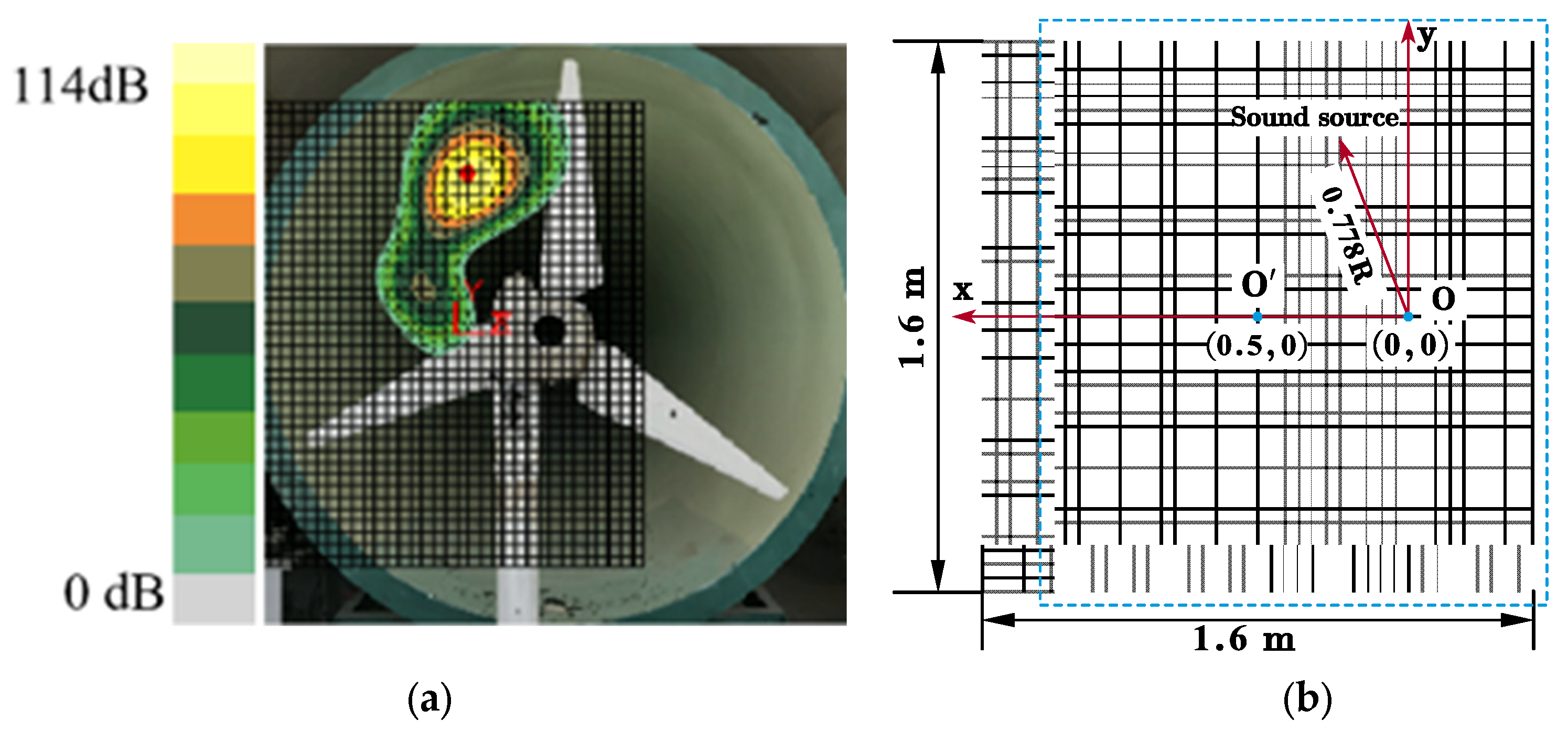
To isolate the effects of wind speed and TSR, experiments are conducted under different operating conditions. After post-processing of the measured data, the sound pressure level distribution and the corresponding schematic representation of the sound source location are obtained, as shown in Figure 5. The reconstructed acoustic field is superimposed onto a static image of the wind turbine based on the actual measurement configuration to facilitate physical interpretation. In Figure 5, the black rectangular region represents the calculation area defined in the microphone array post-processing software. Point O denotes the rotation center of the rotor, while point O′ indicates the center of the calculation region. The center of the rectangular calculation area coincides with the projected center of the rotor on the reconstruction plane. The coordinates of point O′ are (0.5, 0, 0). An effective rectangular calculation area of 1.6 m × 1.6 m is adopted to fully cover the dominant sound source region associated with blade rotation. The spatial resolution of the reconstruction grid is set to 0.04 m in both directions, resulting in a uniform grid that balances spatial resolution and computational efficiency.
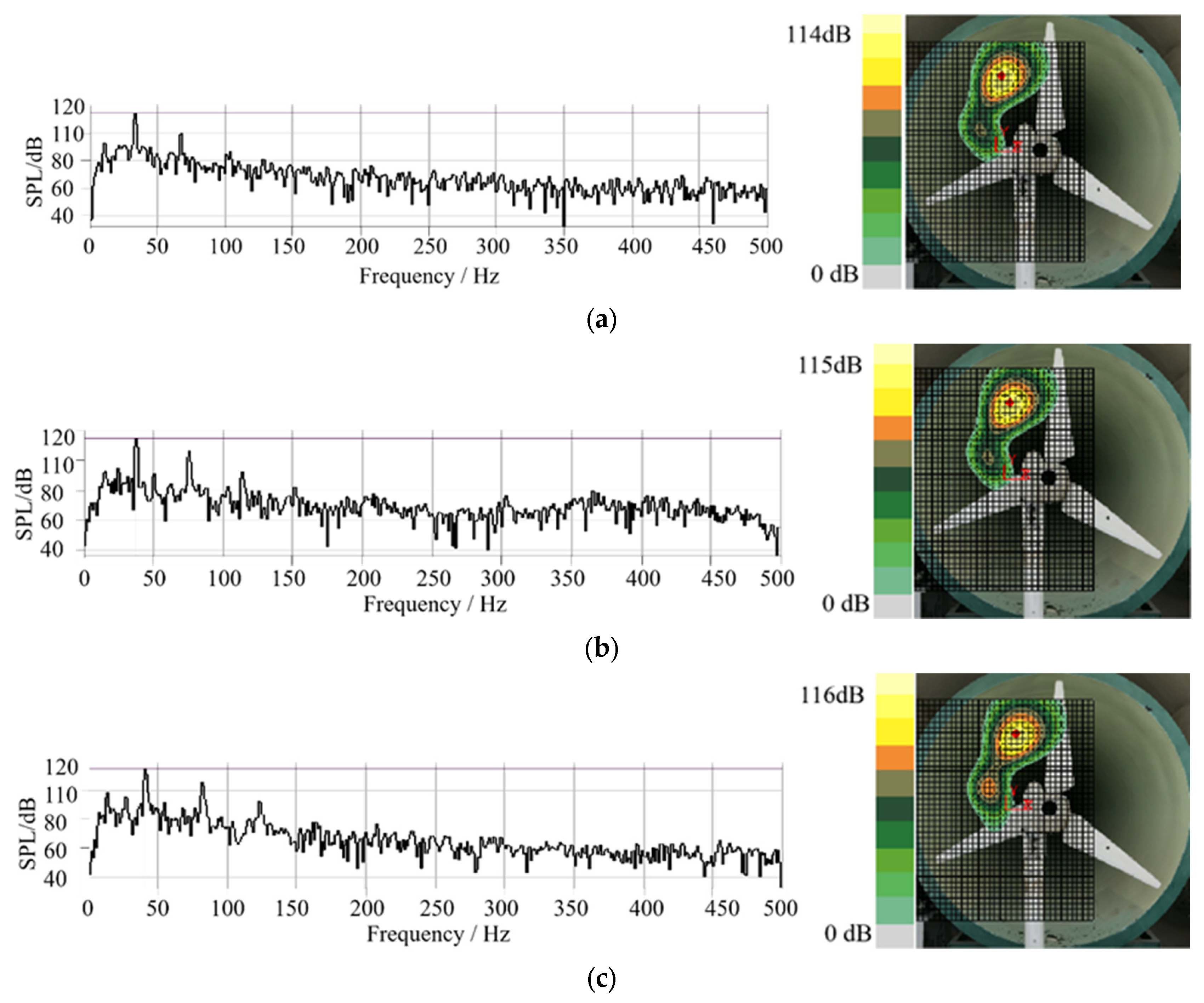
Figure 6 presents the sound pressure level spectra and the corresponding reconstructed sound source distributions under different TSR at a wind speed of 10 m/s (Section #1). Spectral analysis shows that the acoustic energy is primarily concentrated below 500 Hz, with a pronounced dominant peak at the fundamental rotational frequency. As the TSR increases, the dominant frequency shifts from 34.0 Hz to 38.0 Hz and further to 41.0 Hz, accompanied by a moderate increase in the maximum sound pressure level from 114.41 dB to 115.22 dB. Despite this increase in acoustic intensity, the spatial location of the dominant sound source remains nearly unchanged for all operating conditions, suggesting that variations in operating conditions mainly influence the acoustic intensity rather than the source position. The centroid of the sound pressure level distribution consistently appears at approximately 0.78R along the blade span, indicating that changes in TSR mainly affect the sound pressure level rather than the source position. This stable source location suggests that the low-frequency noise generation is closely associated with persistent flow separation and unsteady vortex shedding in the outer blade region.
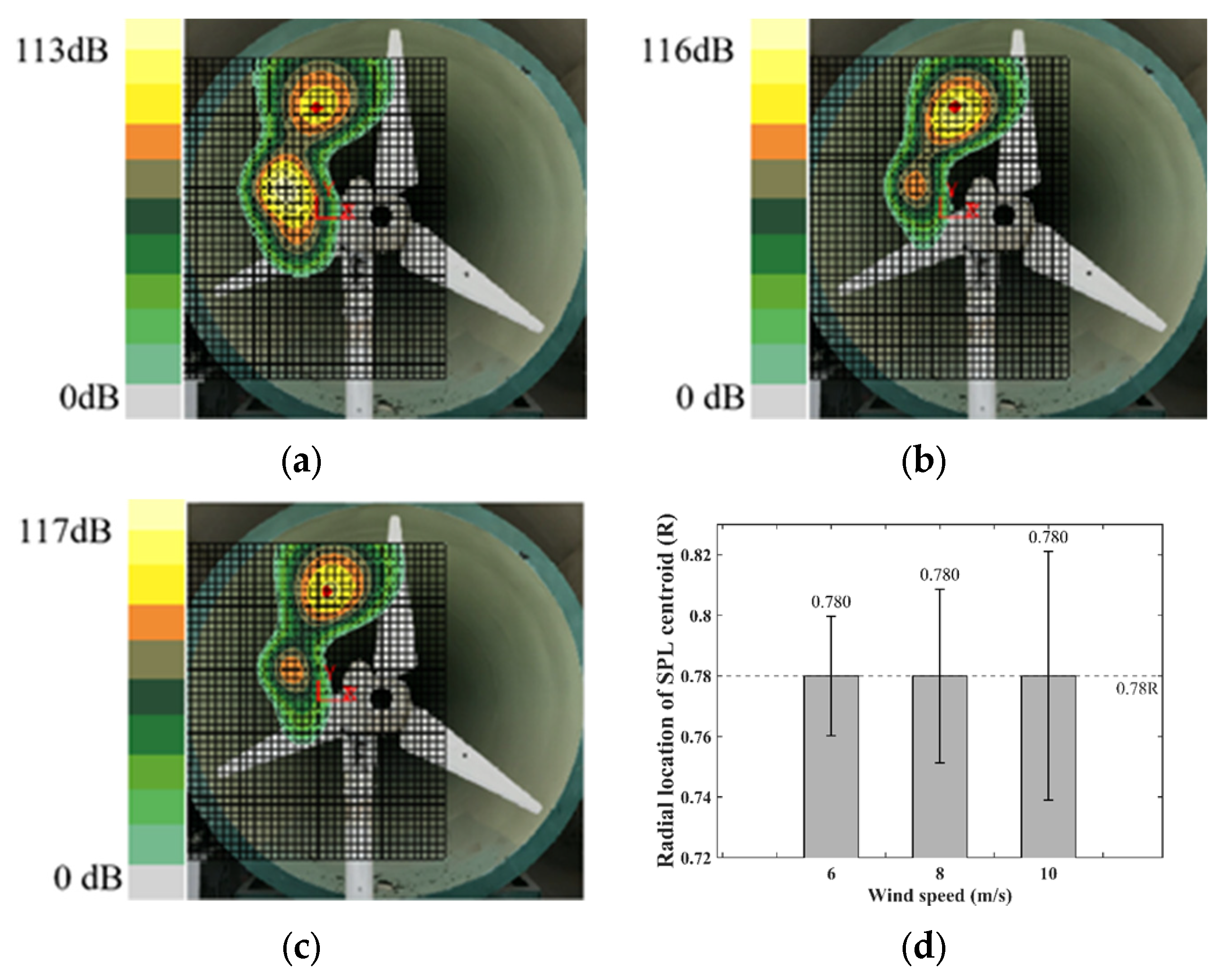
Figure 7a–c presents the reconstructed sound source distributions at incoming flow velocities of 6 m/s, 8 m/s, and 10 m/s, respectively. As the wind speed increases, the overall sound pressure level of the dominant noise component increases monotonically. However, the spatial location of the dominant sound source remains nearly unchanged for all three operating conditions. For all wind speeds considered, the concentrated sound source region is consistently located at approximately 0.78R along the blade span, indicating that variations in incoming flow velocity have a negligible influence on the source position.
To further demonstrate that this observation represents a statistically stable trend rather than an incidental result, Figure 7d provides a statistical analysis of the locations corresponding to the maximum acoustic energy under different operating conditions. Owing to the limited sample size, a t distribution was employed to estimate the confidence intervals. The statistical analysis is based on a total of nine measurements for each wind speed, obtained from three different tip-speed ratios, with three repeated measurements conducted for each TSR. The results clearly indicate that the location around 0.78R is statistically robust and not an accidental outcome. As shown by the 95% confidence intervals, the centroid position of the maximum sound energy remains stable across different wind speeds, with variations that are significantly smaller than the spatial resolution of the reconstruction grid. This confirms that the identified dominant sound source location exhibits strong statistical robustness under the tested operating conditions.
Like the observations in Figure 6, the sound pressure level reaches its maximum at the rotational fundamental frequency. The corresponding amplitude increases with increasing wind speed, while the centroid coordinates of the sound pressure level distribution exhibit only minor variations. These results suggest that changes in wind speed primarily affect the acoustic intensity of the dominant low-frequency noise component rather than its spatial origin. When the wind speed decreases, the radial linear velocity and aerodynamic loading acting on the rotor are reduced, leading to a lower sound pressure level at the rotational fundamental frequency [24].

4.2. Reconstruction of Sound Source Distribution on Multiple Sections

According to sound propagation theory, when a specific frequency component is considered, the acoustic energy attenuates during propagation while the frequency itself remains unchanged. In the present analysis, the distance between the sound source plane and the microphone array plane is 0.2 m, and reconstruction planes are defined at intervals of 0.02 m, resulting in a total of 11 calculation surfaces. The spatial position of the sound source at a fixed frequency of 41.0 Hz is identified on each reconstruction plane, and the corresponding positions are connected to form the propagation path.
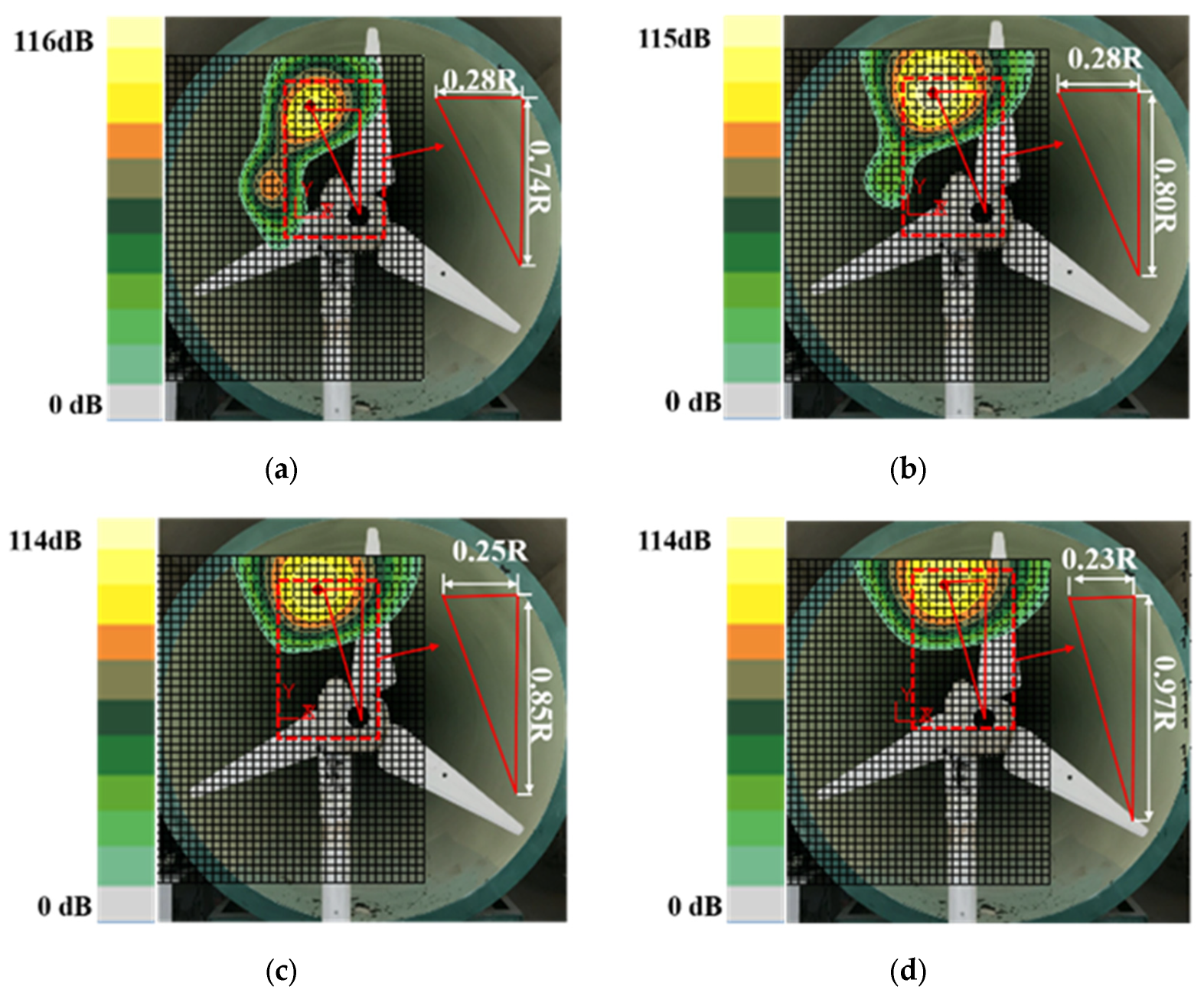
As shown in Figure 8, four representative reconstruction sections are selected for illustration. These correspond to reconstruction planes progressively farther from the source plane along the negative z-direction. As the reconstruction plane moves downstream (toward smaller z values), the dominant acoustic signal at this frequency gradually migrates within the computational domain, exhibiting a clear displacement along the positive y-direction and radially toward the blade root. The reconstructed sound pressure distributions in Figure 8 reveal a systematic evolution of the spatial extent of the dominant acoustic energy as the reconstruction planes move downstream from the source plane. The primary radiation region exhibits pronounced anisotropic behavior. Specifically, the lateral extent decreases from approximately 0.28R to 0.23R, whereas the longitudinal extent increases from about 0.74R to 0.97R with increasing reconstruction distance. These observations indicate that the dominant propagation direction of the 41.0 Hz component is inclined relative to the array normal rather than strictly perpendicular to the reconstruction plane.
Consequently, the intersection between the propagating wavefront and the reconstruction planes varies with reconstruction depth, leading to a progressive compression of the energy distribution in one direction and a corresponding elongation in the orthogonal direction. The directional characteristics of the array point spread function and the applied regularization may influence this behavior. However, the consistent trend observed across all reconstruction sections indicates that the reconstructed low-frequency sound field follows a stable dominant propagation direction rather than random spatial fluctuations.

4.3. Three-Dimensional Propagation Path of Dominant Sound Source

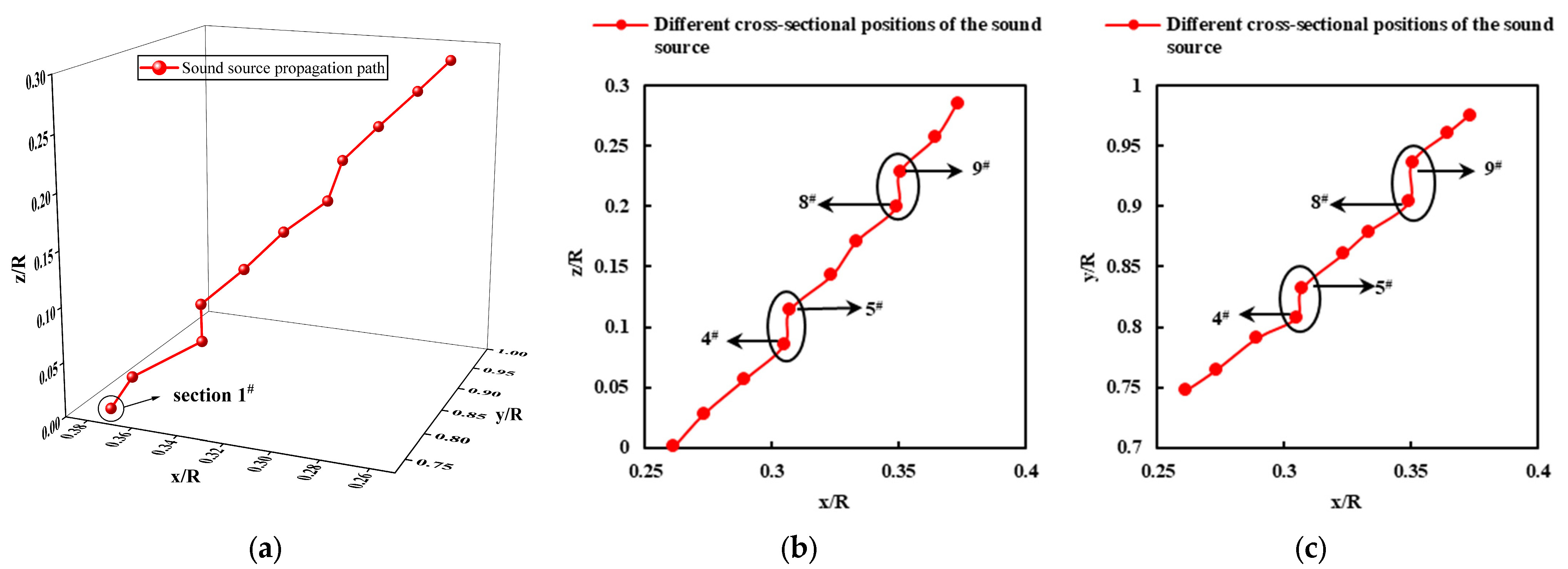
The propagation path of the sound source at the selected frequency is obtained by connecting the identified sound source locations across the 11 reconstruction sections. The resulting propagation process does not follow a straight line but forms a curved trajectory with varying curvature, as illustrated in Figure 9a. To further examine the characteristics of the propagation path, the reconstructed three-dimensional trajectory is projected onto the xy and xz planes, as shown in Figure 9b and Figure 9c, respectively, where the negative z-direction corresponds to the incoming flow direction. The overall displacement of the propagation path from the first to the last reconstruction section along the negative z-direction accounts for approximately 11.2% of the blade radius. This behavior is attributed to the influence of the rotor wake on the downstream sound pressure field [25], as well as to the velocity deficit induced by turbulence interacting with the surrounding relatively uniform flow, which leads to spatial velocity gradients [26].
As shown in Figure 9b, the projected trajectory on the xy plane exhibits distinct inflection features around Sections 5# and 9#. In particular, the propagation path between Sections 4# and 5# varies predominantly along the y-direction, with negligible displacement along the x-direction; a similar pattern is observed between Sections 8# and 9#. Consistently, the projection onto the xz plane shown in Figure 9c indicates that, at a frequency of 41 Hz, the apparent propagation path remains approximately linear in the x-direction and propagates mainly along the positive y-direction. The total displacement along the y-direction reaches approximately 0.16 m, corresponding to 22.8% of the blade radius, which is significantly larger than the displacement along the x-direction.
Based on the Frenet–Serret framework [27], the curvature characteristics of the propagation path shown in Figure 9a were evaluated. Due to the asymmetry introduced by numerical differentiation at the endpoints of the trajectory (# 1 and 11), only the results obtained from # 2–10 were considered in the analysis to avoid endpoint effects. The main analysis parameters include the curvature κ i , the equivalent radius of curvature R ˜ i , and the tangential vector components T i in the x, y, and z directions, which are defined by Equations (16)–(18):
κ i = r i × r i r i 3 ,
R ˜ i = 1 κ i ,
T i = r i r i ,
where
r i r i + 1 r i 1 s i + 1 s i 1 ,
r i 2 s i + 1 s i 1 r i + 1 r i s i + 1 s i r i r i 1 s i s i 1 ,
s i = r i + 1 r i ,
r i denotes the three-dimensional position of the reconstructed SPL centroid at the location along the propagation path. r i is the first derivative of r i with respect to the arc length and describes the local propagation direction of the centroid trajectory. r i is the second derivative with respect to the arc length and characterizes how the local direction changes along the path (i.e., the local bending tendency). s i represents the Arc length along the reconstructed propagation path.
The calculation results are shown in Table 4, the Frenet–Serret–based analysis shows that the unit tangent vector T i maintains a consistent downstream orientation with a clear lateral component, indicating a systematic deflection of acoustic energy rather than random directional variations. The local curvature κ remains finite along the propagation path and exhibits spatial variation, confirming a clear deviation from straight-line propagation. The corresponding equivalent curvature radius R ˜ i lies in the range of 0.1–0.7 m, providing a characteristic length scale for the bending of the propagation path that is comparable to the near-wake dimensions. Together, these results demonstrate that the reconstructed propagation path is geometrically coherent and gradually deflected under wake influence, rather than being dominated by numerical artifacts or incoherent scattering.
Moreover, clear inflection points are observed in Sections 4# and 8# in both projections, suggesting systematic changes in the apparent acoustic propagation direction. The consistent occurrence of these features in the xy and xz projections indicates that they are unlikely to be dominated by random spatial fluctuations or reconstruction noise. Non-uniform flow conditions inherent to the open-jet wind tunnel may introduce a background refraction effect on sound propagation. However, Zhang et al. [16] have shown that under low-Mach-number conditions, refraction effects are generally negligible when only convective effects are considered, particularly with respect to sound source localization accuracy. Moreover, these studies typically focus on configurations in which both the acoustic sources and the microphone array are located outside the jet. In the present experiment, both the sound sources and the microphone array are situated inside the jet core, where the mean flow is comparatively uniform. As a result, refraction effects induced by the jet boundary are expected to be further reduced. Therefore, while the open-jet flow may provide a weak background non-uniformity, it is unlikely to be the dominant factor responsible for the observed inflection points.
Instead, these directional changes are more plausibly attributed to wake-induced flow structures associated with the rotating rotor. In the near-wake region, coherent vortical structures, velocity deficits, and strong spatial gradients can locally modify acoustic convection and refraction, leading to systematic bending of the apparent propagation path across successive reconstruction planes. In this sense, the rotor wake plays a dominant role in shaping the observed acoustic propagation characteristics, whereas the influence of the open-jet wind tunnel remains secondary.
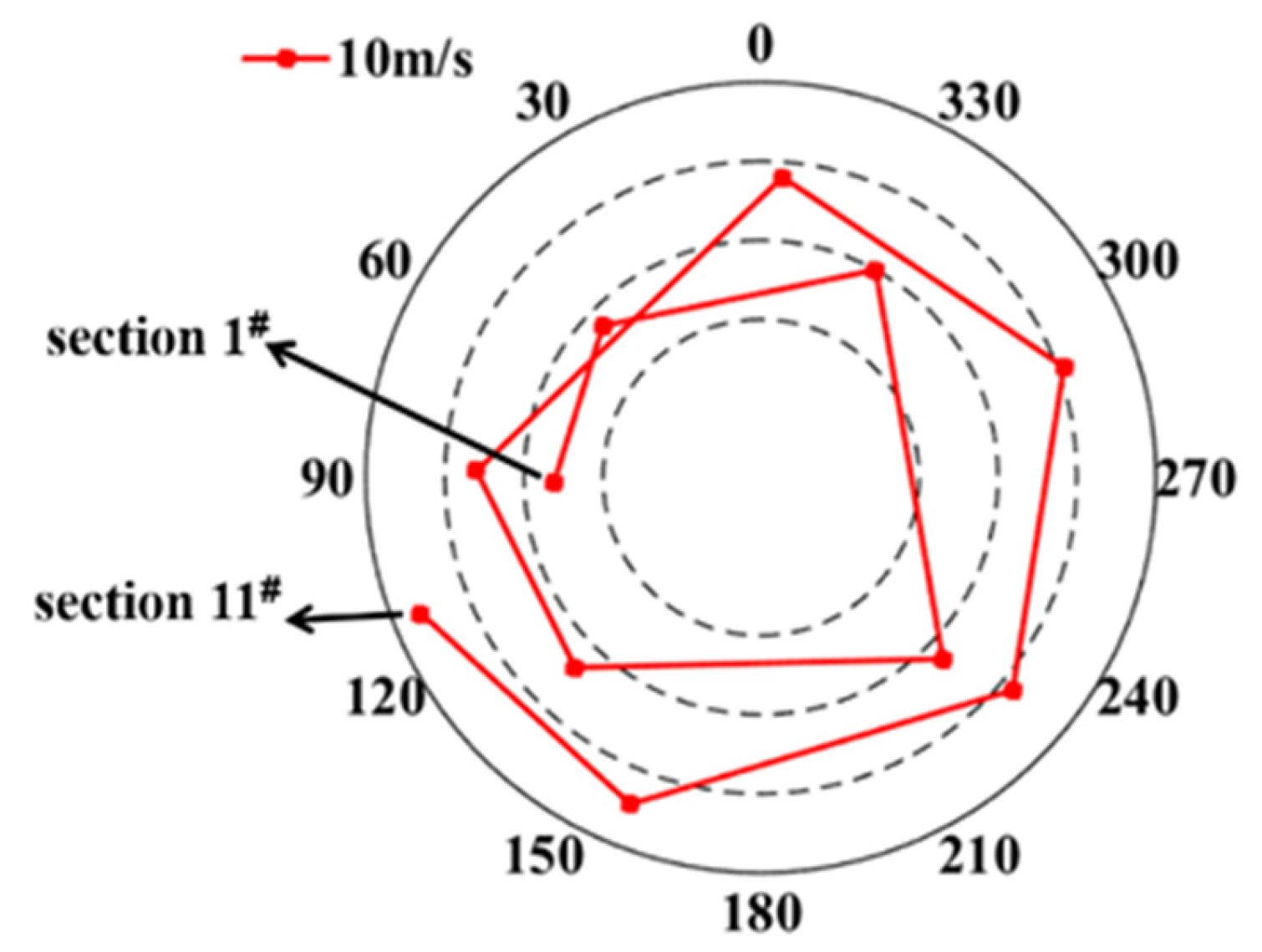
The propagation trajectories obtained in the Cartesian coordinate system are further projected into the polar coordinate system, as shown in Figure 10. In this representation, the red arrow indicates the apparent propagation direction of the dominant sound source. The projected trajectories exhibit a spiral-like pattern, with a rotational sense opposite to that of the rotor.
A combined analysis of Figure 9 and Figure 10 reveals that the propagation path of the 41.0 Hz sound source follows an outward-expanding conical spiral within the rotor wake, rotating in a direction opposite to the blade rotation. Along the incoming flow direction, the spiral trajectory gradually shifts toward the blade tip region, indicating a coupled radial and downstream propagation behavior. This observation is consistent with the helical trajectories of blade tip vortices reported by Grant et al. [28] in wake visualization experiments, as well as with the spatial proximity between the dominant acoustic sources and the blade tip region identified in [29]. The approximately spiral outward propagation pattern of the sound pressure level may originate from the interaction between the rotating flow field and coherent vortical structures, including blade tip vortices and vortices shed near the blade trailing edge. The convection and superposition of these vortical structures developing along the wake direction can enhance local mixing and introduce pronounced velocity gradients, causing acoustic energy to bend within the non-uniform flow field and form a progressively expanding propagation path. Recent large-eddy simulation (LES) studies [30] provide further supporting evidence, reporting enhanced acoustic radiation and refraction effects in regions characterized by strong vortex interaction and coherent structure development. In these regions, the dominant aeroacoustic source terms are concentrated near the blade tip and exhibit spiral distributions in the near wake. While LES-based approaches offer detailed insight into the underlying flow–acoustic coupling mechanisms, the experimental measurements presented in this study provide direct, spatially resolved acoustic evidence of sound propagation characteristics in the near-wake region, thereby complementing existing numerical findings at the experimental level.
From Figure 10, the spiral trajectory indicates a non-axisymmetric propagation pattern. In addition, the sound pressure level gradually decreases with increasing distance from the measurement surface, which is consistent with acoustic attenuation during downstream propagation. This decay behavior may be associated with the downstream convection of separated vortices shed from the blade trailing edge in the radial direction, while vortex bundles generated near the leading edge tend to migrate upstream relative to the rotor rotation. The two-dimensional polar representation in the xy plane provides a clearer visualization of the near-wake acoustic field and further demonstrates that the concentration and diffusion of sound pressure level do not follow a simple linear transfer. Instead, the observed spiral-like spreading pattern confirms that the dominant low-frequency acoustic energy disperses outward toward the blade tip along a curved trajectory governed by the underlying vortex dynamics.

4.4. Attenuation Characteristics Along the Propagation Path

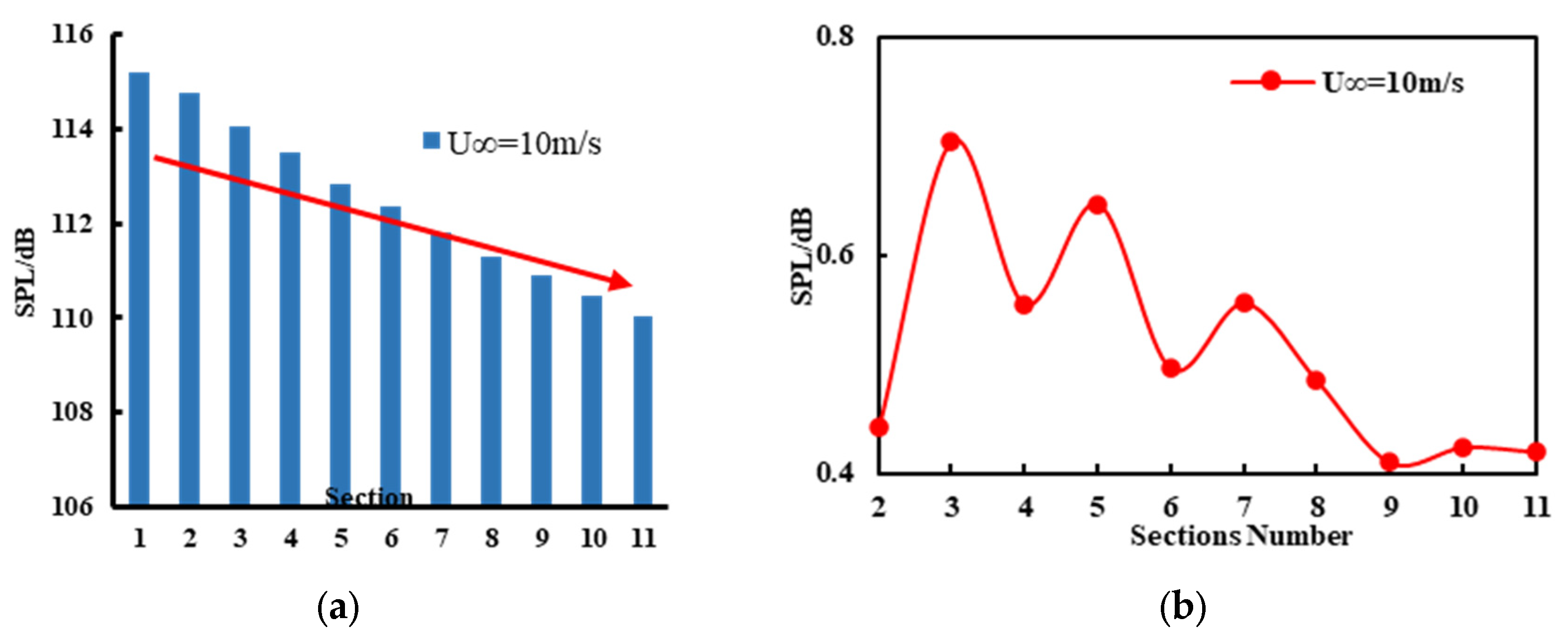
Figure 11a illustrates the variation in sound pressure level of the 41.0 Hz frequency component across calculation surfaces #1 to #11. The sound pressure level decreases from 115.22 dB at surface #1 to 110.05 dB at surface #11, corresponding to an overall reduction of approximately 5.17 dB along the propagation direction. This trend indicates a gradual attenuation of the low-frequency acoustic energy as the sound propagates downstream. To further examine the local attenuation characteristics, Figure 11b presents the sound pressure level differences between adjacent calculation surfaces. The largest decrease is observed between surfaces #2 and #3, which are located at distances of 0.04 m and 0.06 m, respectively, from the rotor rotation plane. Zhang et al. [31] have reported that the lift-up region of hairpin vortices is located near 0.02 m downstream of the rotor plane. As these vortical structures undergo lifting and subsequent ejection, the surrounding flow field may exhibit pronounced velocity gradients and enhanced turbulence intensity in the region approximately 0.04–0.06 m away from the rotation plane. Such flow conditions can enhance acoustic scattering and energy redistribution, leading to stronger attenuation of the propagating sound compared with neighboring regions. The pronounced sound pressure level drop observed between surfaces #2 and #3 is therefore likely associated with the interaction between the propagating acoustic field and vortex-dominated flow structures in this region.
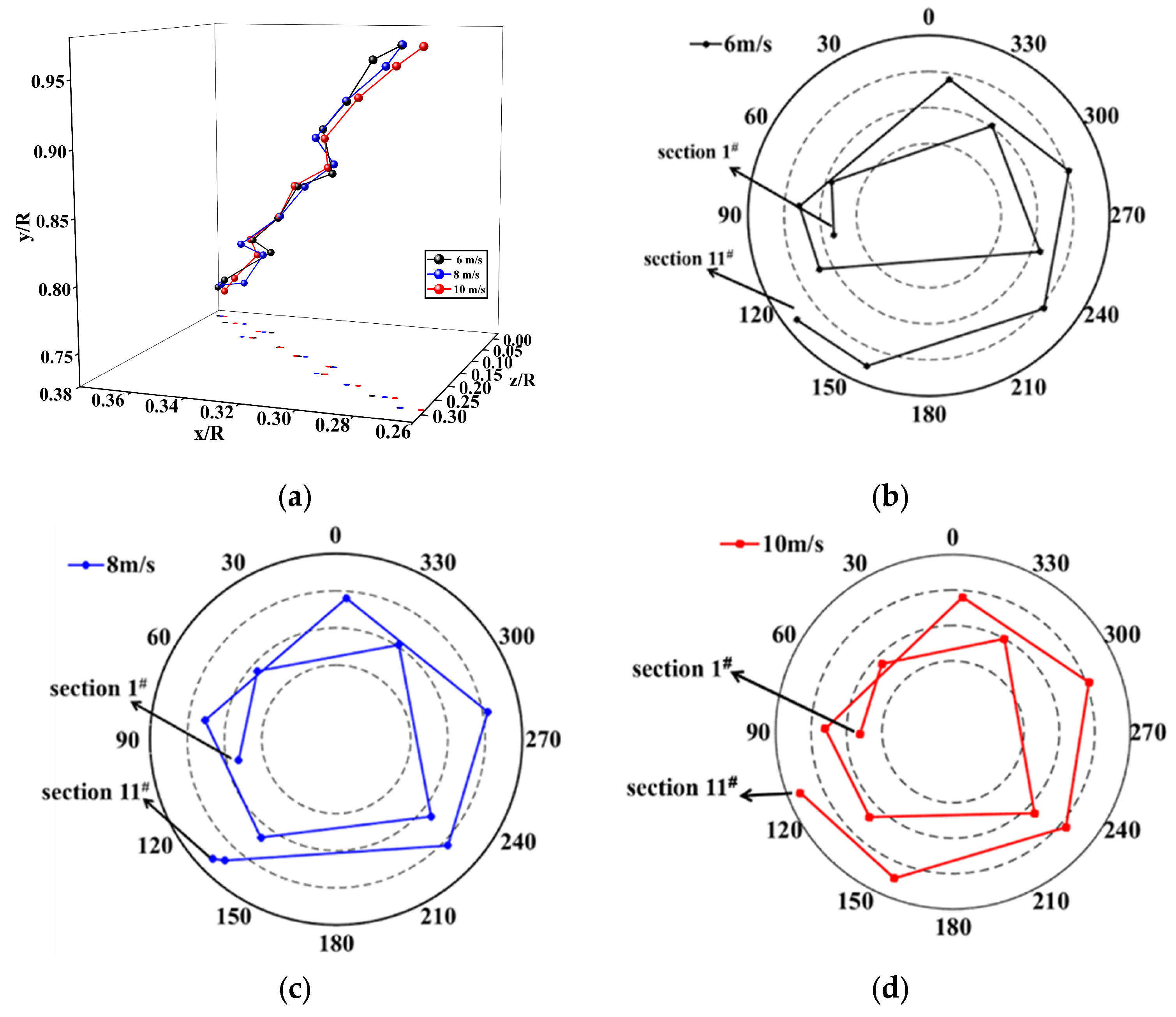
Figure 12 compares the three-dimensional propagation paths of the dominant sound pressure level at a fixed (TSR = 6.0) under different incoming flow velocities. As shown in the figure, the reconstructed propagation paths corresponding to wind speeds of 6 m/s, 8 m/s, and 10 m/s exhibit highly similar spatial trajectories. This observation indicates that variations in wind speed have a limited influence on the overall geometry of the sound propagation path when the TSR is held constant. For all three wind speed conditions, the sound pressure level propagates outward along the incoming flow direction following a curved, spiral-like trajectory. The consistency of the propagation paths suggests that the dominant low-frequency acoustic energy is guided by a stable propagation mechanism governed primarily by the rotor-induced flow structures rather than by changes in inflow velocity. Although the sound pressure level magnitude increases with wind speed, the directionality and spatial evolution of the propagation path remain essentially unchanged.
This robustness of the propagation geometry further supports the conclusion that wind speed mainly modulates the acoustic intensity, while the propagation pattern itself is controlled by the wake dynamics and coherent vortex structures associated with blade rotation. Such stability in the propagation path implies that the low-frequency noise radiation in the near wake of the wind turbine exhibits a predictable spatial behavior across a range of operating wind speeds.
This mechanism-based interpretation is of particular importance for extrapolating the present findings to more complex and realistic wind turbines. Although utility-scale turbines typically involve additional factors such as blade flexibility, spanwise-varying aerodynamic loading, and more complex boundary conditions, existing studies indicate that these factors do not fundamentally alter the dominant organizational mechanisms of the near wake. Rismondo et al. [30] show that blade flexibility can modify aerodynamic load distributions and time-averaged wake statistics and may influence the stability characteristics or breakdown location of tip vortices. However, the helical tip-vortex system is not eliminated by blade flexibility and continues to dominate the overall organization of the near wake over a wide range of operating conditions. Consequently, flexibility-related effects are more likely to affect the persistence length, strength, or stability of coherent vortical structures, rather than altering the fundamental wake-organizing mechanisms associated with blade rotation.
On the other hand, Cillis et al. [32] indicate that higher incoming turbulence intensity, significant yaw misalignment, or operation at excessively high tip-speed ratios can promote earlier destabilization and breakdown of coherent vortex structures, thereby accelerating the decay of wake coherence. Under such operating conditions, the spiral-like acoustic propagation features identified in the present study may weaken or gradually transition into more diffused acoustic radiation patterns.
In summary, under conditions characterized by low incoming turbulence intensity, largely aligned inflow, and moderate blade deformations, the dominant near-wake dynamics remain primarily governed by coherent vortex structures associated with blade rotation. Therefore, although the absolute sound pressure levels and the detailed spatial extents may differ in practical wind turbines, the mechanism-based interpretation of near-wake acoustic propagation proposed in this study is expected to remain qualitatively valid for complex wind turbine configurations, provided that similar wake-organizing mechanisms persist.

5. Conclusions

In this study, the near-wake noise radiation and propagation characteristics of an operating horizontal-axis wind turbine were experimentally investigated using the SONAH method. Sound pressure fields were reconstructed under incoming wind speeds of 6, 8, and 10 m/s and tip-speed ratios of TSR = 5.0, 5.5, and 6.0, enabling the identification of the dominant low-frequency acoustic source and its three-dimensional propagation behavior.
The experimental results show that the dominant rotating acoustic source is consistently located at approximately 0.78R along the blade span, with negligible variation across all tested operating conditions. Variations in wind speed and TSR mainly affect the sound pressure level amplitude, while their influence on the spatial location of the noise source is minimal. The sound pressure level reaches its maximum at the fundamental rotor rotational frequency, which increases from approximately 34 Hz to 41 Hz with increasing TSR, accompanied by an increase of about 1 dB in the peak sound pressure level. These results indicate a strong coupling between rotor dynamics and low-frequency aerodynamic noise generation.
For a given frequency component, the reconstructed acoustic field exhibits a three-dimensional spiral-like propagation pattern extending downstream, with a rotational sense opposite to that of the rotor. Along this propagation path, the sound pressure level shows an overall attenuation trend with downstream distance, with a pronounced reduction consistently observed in the region approximately 0.04–0.06 m downstream of the rotor plane. This behavior suggests that flow structures dominated by coherent vortices in this region play a key role in the attenuation of low-frequency acoustic energy. The persistence of these propagation and attenuation features across different wind speeds indicates that they are intrinsic characteristics of the near-wake low-frequency noise field rather than being induced by specific inflow conditions. Overall, low-frequency noise radiation in the near wake of the wind turbine is primarily governed by stable, rotation-induced coherent vortex structures, while operating conditions mainly modulate the acoustic intensity without altering the spatial organization of the source and propagation geometry.
From an engineering perspective, the spatial stability of the dominant low-frequency noise source and the identified spiral-like propagation behavior provide direct guidance for wind turbine noise control and design optimization. The stable localization of the dominant noise source near 0.78R offers a clear spatial reference for targeted blade geometry optimization and passive or active noise reduction strategies. Moreover, the experimentally observed attenuation of low-frequency acoustic energy along a well-defined propagation path provides valuable input for acoustic propagation modeling and site-specific environmental noise assessment. The mechanism-based interpretation of sound propagation associated with coherent wake structures further supports the development of physically interpretable and engineering-oriented acoustic prediction models, facilitating more rational consideration of near-field noise effects in wind turbine layout optimization and environmental impact evaluation.
The present experiments were conducted under controlled conditions characterized by low incoming turbulence intensity and nearly aligned inflow, under which the near-wake acoustic propagation exhibits high stability and consistency. Under more complex operating conditions, such as higher turbulence levels or larger yaw misalignment, the evolution of coherent wake structures may be altered, potentially affecting the acoustic propagation behavior. Future work will therefore focus on investigating the evolution of spiral-like near-wake acoustic propagation patterns under higher incoming turbulence intensity and larger yaw angles, to systematically assess the applicability and validity limits of the sound source propagation mechanisms proposed in this study for realistic wind turbine operating conditions.

Author Contributions

P.W.: Writing—original draft, Formal analysis. Z.G.: Conceptualization, Methodology, Writing—original draft. R.S.: Writing—review and editing. Y.C.: Formal analysis, Data curation. J.W.: Project administration, Supervision. All authors have read and agreed to the published version of the manuscript.

Funding

This work was funded by the Natural Science Foundation of Inner Mongolia Autonomous Region (Grant No. 2024MS05063), the Special Project for First-Class Discipline Research (Grant No. YLXKZX-NGD-008), and the Research Start-up Fund Project of Inner Mongolia University of Technology (Grant No. BS2024022).

Data Availability Statement

Dataset available on request from the authors.

Conflicts of Interest

The authors declare no conflicts of interest.

Nomenclature

A Propagation matrix r i First derivative of position with respect to arc length
a m Complex expansion coefficient r i Second derivative of position with respect to arc length
c Speed of sound in the medium, m/s R ˜ Equivalent curvature radius, m
c ( r ) Prediction weight vector s i Arc length along the reconstructed propagation path, m
c n ( r ) Prediction weight corresponding to the n-th microphone T i Unit tangent vector of the propagation path
f Frequency, Hz κ Local curvature of the propagation path
k Acoustic wavenumber, rad/m ε the error and residual vector arising from the measurement and numerical computation processes
k x , k y Wavenumber components in the x and y directions, rad/m ω Angular frequency, rad/s
k z Wavenumber components in the z direction, rad/m Φ m ( r ) Plane-wave basis function
M Number of plane-wave basis functions θ Tikhonov regularization parameter
N Number of microphones on the hologram surface 2 Laplace operator, m−2
p ( r ) Complex acoustic pressure at position r , Pa α ( r ) Vector of plane-wave basis functions evaluated at the reconstruction point r
p ˜ ( r ) Predicted complex acoustic pressure at position r obtained by SONAH, Pa
P H Vector of complex acoustic pressures measured at the microphone positions on the hologram surface, Pa
P ( k x , k y ) Angular spectrum function of the sound field, Pa·m2
r Spatial position vector of an arbitrary field point in the reconstruction domain, m
r n Spatial position vector of the microphone on the hologram surface, m
r i Three-dimensional position vector of the reconstructed SPL centroid at the downstream plane, m

Abbreviations

SONAHStatistically Optimized Near-field Acoustic Holography
NAHNear-field Acoustic Holography
TSRTip-Speed-Ratio
GCVGeneralized Cross-Validation
LESLarge-Eddy Simulation

References

  1. Bommidala, H.; Colas, J.; Emmanuelli, A.; Dragna, D.; Khodr, C.; Cotté, B.; Stevens, R.J. Three-dimensional effects of the wake on wind turbine sound propagation using parabolic equation. J. Sound Vibr. 2025, 608, 119036. [Google Scholar] [CrossRef]
  2. Samareh-Mousavi, S.S.; Chen, X.; McGugan, M.; Semenov, S.; Berring, P.; Branner, K.; Ludwig, N. Monitoring fatigue delamination growth in a wind turbine blade using passive thermography and acoustic emission. Struct. Health Monit. 2024, 23, 2906–2921. [Google Scholar] [CrossRef]
  3. Tonin, R. A review of wind turbine-generated infrasound: Source, measurement and effect on health. Acoust. Aust. 2018, 46, 69–86. [Google Scholar] [CrossRef]
  4. Ghasemian, M.; Nejat, A. Aerodynamic noise prediction of a horizontal axis wind turbine using improved delayed detached eddy simulation and acoustic analogy. Energy Conv. Manag. 2015, 99, 210–220. [Google Scholar] [CrossRef]
  5. Ahmed, N.A.; Cameron, M. The challenges and possible solutions of horizontal axis wind turbines as a clean energy solution for the future. Renew. Sust. Energ. Rev. 2014, 38, 439–460. [Google Scholar] [CrossRef]
  6. Hald, J. Basic theory and properties of statistically optimized near-field acoustical holography. J. Acoust. Soc. Am. 2009, 125, 2105–2120. [Google Scholar] [CrossRef] [PubMed]
  7. Pasqual, A.M. A patch near-field acoustical holography procedure based on a generalized discrete fourier series. Mech. Syst. Signal Proc. 2017, 90, 285–297. [Google Scholar] [CrossRef]
  8. Lee, S.; Lee, D.; Honhoff, S. Prediction of far-field wind turbine noise propagation with parabolic equation. J. Acoust. Soc. Am. 2016, 140, 767–778. [Google Scholar] [CrossRef]
  9. Ostashev, V.E.; Juvé, D.; Blanc-Benon, P. Derivation of a wide-angle parabolic equation for sound waves in inhomogeneous moving media. Acustica 1997, 83, 455–460. [Google Scholar]
  10. Heimann, D.; Käsler, Y.; Gross, G. The wake of a wind turbine and its influence on sound propagation. Meteorol. Z. 2011, 20, 449–460. [Google Scholar] [CrossRef]
  11. Kelly, M.; Barlas, E.; Sogachev, A. Statistical prediction of far-field wind—Turbine noise, with probabilistic characterization of atmospheric stability. J. Renew. Sustain. Energy 2018, 10, 013302. [Google Scholar] [CrossRef]
  12. Heimann, D.; Englberger, A.; Schady, A. Sound propagation through the wake flow of a hilltop wind turbinea numerical study. Wind Energy 2018, 21, 650–662. [Google Scholar] [CrossRef]
  13. Barlas, E.; Zhu, W.J.; Shen, W.Z.; Kelly, M.; Andersen, S.J. Effects of wind turbine wake on atmospheric sound propagation. Appl. Acoust. 2017, 122, 51–61. [Google Scholar] [CrossRef]
  14. Barlas, E.; Zhu, W.J.; Shen, W.Z.; Dag, K.O.; Moriarty, P. Consistent modelling of wind turbine noise propagation from source to receiver. J. Acoust. Soc. Am. 2017, 142, 3297–3310. [Google Scholar] [CrossRef]
  15. Aihara, A.; Bolin, K.; Goude, A.; Bernhoff, H. Aeroacoustic noise prediction of a vertical axis wind turbine using large eddy simulation. Int. J. Aeroacoust. 2021, 20, 959–978. [Google Scholar] [CrossRef]
  16. Zhang, J.; Wang, X.; Zhang, J.; Doolan, C.J.; Fischer, J.R.; Moreau, D.; Camier, C.; Provencher, J.; Padois, T.; Gauthier, P.-A.; et al. A study of shear—Layer corrections and a tensioned fabric wall for the localization of sound sources in wind tunnel. In Proceedings of the 25th AIAA/CEAS Aeroacoustics Conference, Delft, The Netherlands, 20–23 May 2019; p. 2717. [Google Scholar]
  17. Shen, W.Z.; Sessarego, M.; Cao, J.; Nyborg, C.M.; Hansen, K.S.; Bertagnolio, F.; Madsen, H.A.; Hansen, P.; Vignaroli, A.; Sørensen, T. Validation of noise propagation models against detailed flow and acoustic measurements. J. Phys. Conf. Ser. 2020, 1618, 052023. [Google Scholar] [CrossRef]
  18. Erik, M.S. Computational Atmospheric Acoustics; Springer: Dordrecht, The Netherlands, 2001. [Google Scholar]
  19. Yu, L.; Li, Z.; Chu, N.; Mohammad-Djafari, A.; Guo, Q.; Wang, R. Achieving the sparse acoustical holography via the sparse bayesian learning. Appl. Acoust. 2022, 191, 108690. [Google Scholar] [CrossRef]
  20. Maynard, J.D.; Williams, E.G.; Lee, Y. Nearfield acoustic holography: I. Theory of generalized holography and the development of nah. J. Acoust. Soc. Am. 1985, 78, 1395–1413. [Google Scholar] [CrossRef]
  21. Zhang, Y.; Wang, H.; Zhang, G.; Liao, H.; Li, S. Research on sonah calculation accuracy optimization based on sparse matrix. Appl. Acoust. 2025, 240, 110948. [Google Scholar] [CrossRef]
  22. Hu, B.; Yang, D.; Li, S.; Sun, Y.; Mo, S.; Shi, S. Underwater patch near-field acoustical holography based on particle velocity and vector hydrophone array. Sci. China Phys. Mech. Astron. 2012, 55, 2010–2017. [Google Scholar] [CrossRef]
  23. Chen, Y.; Zhang, Z.; Chen, H.; Xu, Z.; He, Y. Spatial projection regularization based on double generalized cross-validation in acoustic calculation. Mech. Syst. Signal Proc. 2025, 237, 113065. [Google Scholar] [CrossRef]
  24. Zhang, C.; Gao, Z.; Chen, Y.; Dai, Y.; Wang, J.; Hou, Y. Experiment on sound source identification of rotating rotor based on sonah. Acta Energiae Sol. Sin. 2021, 42, 302–307. [Google Scholar] [CrossRef]
  25. Zhu, W.J.; Shen, W.Z.; Barlas, E.; Bertagnolio, F.; Sorensen, J.N. Wind turbine noise generation and propagation modeling at dtu wind energy: A review. Renew. Sust. Energ. Rev. 2018, 88, 133–150. [Google Scholar] [CrossRef]
  26. O’Brien, J.M.; Young, T.M.; O’Mahoney, D.C.; Griffin, P.C. Horizontal axis wind turbine research: A review of commercial cfd, fe codes and experimental practices. Prog. Aeosp. Sci. 2017, 92, 1–24. [Google Scholar] [CrossRef]
  27. Ravani, R.; Meghdari, A. Spatial rational motions based on rational frenet-serret curves. In Proceedings of the 2004 IEEE International Conference on Systems, Man and Cybernetics, IEEE Cat. No.04CH37583, The Hague, The Netherlands, 10–13 October 2004; pp. 4456–4461. [Google Scholar] [CrossRef]
  28. Grant, I.; Mo, M.; Pan, X.; Parkin, P.; Powell, J.; Reinecke, H.; Shuang, K.; Coton, F.; Lee, D. An experimental and numerical study of the vortex filaments in the wake of an operational, horizontal-axis, wind turbine. J. Wind Eng. Ind. Aerodyn. 2000, 85, 177–189. [Google Scholar] [CrossRef]
  29. Vermeer, L.J.; Sorensen, J.N.; Crespo, A. Wind turbine wake aerodynamics. Prog. Aeosp. Sci. 2003, 39, 467–510. [Google Scholar] [CrossRef]
  30. Rismondo, G.; Petris, G.; Cianferra, M.; Armenio, V. Wind turbine noise generation and propagation through large eddy simulation and acoustic analogy. J. Fluid Mech. 2025, 1024, A33. [Google Scholar] [CrossRef]
  31. Zhang, C.Q.; Gao, Z.Y.; Chen, Y.Y.; Dai, Y.J.; Wang, J.W.; Zhang, P.W. Experimental determination of the dominant noise mechanism of rotating rotors using hot-wire anemometer. Appl. Acoust. 2021, 173, 107703. [Google Scholar] [CrossRef]
  32. de Cillis, G.; Cherubini, S.; Semeraro, O.; Leonardi, S.; de Palma, P. The influence of incoming turbulence on the dynamic modes of an nrel-5mw wind turbine wake. Renew. Energy 2022, 183, 601–616. [Google Scholar] [CrossRef]
Figure 1. Schematic illustration of the source-free half-space assumption required by the SONAH method. The acoustic sources are assumed to be confined to the region z z s , and the space between the source region and the measurement plane at z H , with a distance d, is considered source-free. Within this source-free region, the sound field on an arbitrary reconstruction plane can be reconstructed from the complex acoustic pressure measured on the measurement plane using the SONAH technique.
Applsci 16 01185 g001
Figure 2. Experimental setup and schematic configuration of the measurement system: (a) Schematic diagram of the relative arrangement between the microphone array and the noise source region, the rotor radius is R = 0.70 m, and the array is located 0.20 m downstream from the source plane and 0.50 m from the rotor center along the horizontal direction, the reconstruction area is highlighted, and multiple reconstruction sections are defined along the downstream direction with a spacing of 0.02 m; (b) Block diagram showing the relationship among the main experimental components, including the microphone array, trigger sensor, acquisition modules, control system, and DC load box used to regulate the rotational speed of the wind turbine; (c) Photograph of the wind turbine model and microphone array installed in the wind tunnel. The experimental coordinate system is illustrated, where the x and y-axes lie in the rotor plane, and the z-axis denotes the downstream direction.
Applsci 16 01185 g002
Figure 3. Control and acquisition equipment: (a) Thermal anemometer; (b) Trigger sensor; (c) Array; (d) Microphone; (e) Acquisition module; (f) Dc load box.
Applsci 16 01185 g003aApplsci 16 01185 g003b
Figure 4. Background noise spectrum measured in the wind tunnel at an inflow velocity of 10 m/s with the wind turbine stopped. The spectrum is presented as the SPL (ref = 2 × 10⁻⁵ Pa) as a function of frequency. The background noise is dominated by low-frequency components and exhibits several narrowband peaks, which mainly originate from the wind tunnel and auxiliary equipment. This spectrum is used as a reference for subsequent frequency selection and background noise rejection in the wind turbine noise analysis.
Applsci 16 01185 g004
Figure 5. Reconstructed SPL distribution and schematic definition of the calculation region: (a) SPL distribution reconstructed using the SONAH method at the selected dominant frequency under inflow velocity of 10 m/s and TSR is 5.5, superimposed on a static image of the wind turbine to illustrate the spatial relationship between the dominant sound source and the rotor plane, the reconstructed result shows that the main sound source is concentrated at a radial position of approximately 0.78R; (b) Schematic diagram of the calculation region and coordinate definition. O denotes the rotor center, and O′ represents the center of the calculation region located at (0.5, 0). The rectangular reconstruction area has dimensions of 1.6 m × 1.6 m and is discretized with a grid resolution of 0.04 m for sound field reconstruction and subsequent analysis.
Applsci 16 01185 g005
Figure 6. SPL spectra and SONAH-reconstructed sound source distributions under different TSR at a wind speed of 10 m/s: (a) SPL spectrum and corresponding reconstructed sound source distribution for λ = 5.0, showing a dominant frequency of 34.0 Hz; (b) SPL spectrum and corresponding reconstructed sound source distribution for λ = 5.5, with a dominant frequency of 38.0 Hz; (c) SPL spectrum and corresponding reconstructed sound source distribution for λ = 6.0, exhibiting a dominant frequency of 41.0 Hz. Despite the variation in dominant frequency with TSR, the radial position of the dominant sound source remains approximately unchanged at around 0.78 R.
Applsci 16 01185 g006
Figure 7. SONAH-reconstructed sound source distributions and statistical analysis of the radial source location under different incoming flow velocities: (a) Reconstructed sound source distribution at inflow velocity of 6 m/s; (b) Reconstructed sound source distribution at an inflow velocity of 8 m/s; (c) Reconstructed sound source distribution at inflow velocity of 10 m/s; (d) Statistical analysis of the radial locations of the SPL centroid corresponding to the maximum acoustic energy under different operating conditions, the bars represent mean values, and the error bars denote the 95% confidence intervals estimated using a t-distribution based on repeated measurements at different TSR. The results indicate that the radial position of the dominant sound source remains concentrated around approximately 0.78R and exhibits no significant dependence on the incoming flow velocity.
Applsci 16 01185 g007
Figure 8. SONAH-reconstructed SPL distributions at the dominant frequency of 41.0 Hz under an inflow velocity of 10 m/s and TSR of 6, shown on different reconstruction planes along the downstream direction: (a) reconstructed SPL distribution on Section 1#, corresponding to the reconstruction plane closest to the sound source region; (b) Reconstructed SPL distribution on Section 2#; (c) reconstructed SPL distribution on Section 3#; (d) reconstructed SPL distribution on Section 4#. The annotated values (e.g., 0.28R and 0.74R/0.80R) represent the projections of the maximum-SPL location onto the x and y-axes, respectively, normalized by the rotor radius R.
Applsci 16 01185 g008
Figure 9. Propagation path of the dominant sound source at 41.0 Hz under an inflow velocity of 10 m/s and a TSR of 6, reconstructed from multiple downstream sections: (a) Three-dimensional propagation trajectory obtained by connecting the locations corresponding to the maximum SPL across 11 reconstruction planes; (b) Projection of the propagation path onto the xy plane; (c) Projection of the propagation path onto the xz plane.
Applsci 16 01185 g009
Figure 10. Polar-coordinate representation of the reconstructed sound source propagation path at 41.0 Hz under an inflow velocity of 10 m/s and TSR of 6. The propagation path is obtained by tracking the locations corresponding to the maximum SPL across successive downstream reconstruction sections. In the polar coordinate system, the radial coordinate represents the normalized radial distance from the rotor center, while the angular coordinate denotes the azimuthal direction with respect to the rotor reference frame.
Applsci 16 01185 g010
Figure 11. Attenuation characteristics of the 41.0 Hz acoustic component during downstream propagation under an incoming flow velocity of 10 m/s and a TSR of 6: (a) SPL corresponding to the maximum-SPL location on successive reconstruction sections (#1–#11), showing a gradual decrease along the downstream direction; (b) Differences in SPL between adjacent reconstruction sections, highlighting localized regions with enhanced attenuation during propagation.
Applsci 16 01185 g011
Figure 12. Propagation paths of the dominant low-frequency sound source at 41.0 Hz under different incoming flow velocities with a fixed TSR of 6.0: (a) Three-dimensional comparison of the sound source propagation paths reconstructed at incoming flow velocities of 6, 8, and 10 m/s; (b) Polar-coordinate representation of the propagation path at an inflow velocity of 6 m/s; (c) Polar-coordinate representation of the propagation path at an inflow velocity of 8 m/s; (d) Polar-coordinate representation of the propagation path at an inflow velocity of 10 m/s.
Applsci 16 01185 g012
Table 1. Parameters of wind turbine.
ParametersValue
Number of blades3
Rotor diameter (m)1.4
Rated wind speed (m/s)10
Rated rotation speed (rpm)750.3
Table 2. The experimental operating conditions.
Wind Speed (m/s)TSRLinear Velocity at the Blade Tip (m/s)Rotation Speed (r/min)
6530409.3
5.533450.2
636491.1
8540545.7
5.544600.2
648654.8
10550682.1
5.555750.3
660818.5
Table 3. Experimental equipment parameters and functions.
DeviceSpecificationsFunction
Array60-channel circular array with a diameter of 0.78 mAcquisition of time-domain acoustic field data on the measurement plane
Microphone1/4-inch Type 4958 microphones, sensitivity of 12.5 mV/Pa, dynamic range of 28–140 dB, measurable frequency range of 0.01–20 kHzConversion of acoustic pressure fluctuations into voltage signals
Acquisition moduleEleven Type 3050 data acquisition modules, sampling frequency range of 0–51.2 kHzSignal filtering, analog-to-digital conversion, and synchronized multi-channel sampling
Thermal anemometerMeasurement range of 0–20 m/s, accuracy of ±(0.03 m/s + 5% of reading), resolution of 0.01 m/sWind speed measurement
Dc load boxCurrent adjustment range of 0.01–27 A with a minimum step of 0.01 ARegulation of wind turbine rotational speed
Trigger sensorMeasurement distance of 20–300 mm, rotational speed measurement range of 0–20,000 r/minRecording of TTL trigger signals
PLUSEWorkstation with Intel i7-8850H CPU and 16 GB RAMConfiguration of data acquisition parameters, post-processing, and result visualization
Table 4. Based on the calculation results of Frenet–Serret.
i κ i R ˜ i T x T y T z
24.990.20−0.340.49−0.79
33.770.26−0.130.55−0.82
43.720.26−0.100.52−0.84
55.310.18−0.320.64−0.69
61.690.58−0.380.54−0.74
75.060.19−0.270.59−0.75
81.480.67−0.170.69−0.70
94.420.22−0.290.65−0.69
107.170.13−0.340.51−0.78
Disclaimer/Publisher’s Note: The statements, opinions and data contained in all publications are solely those of the individual author(s) and contributor(s) and not of MDPI and/or the editor(s). MDPI and/or the editor(s) disclaim responsibility for any injury to people or property resulting from any ideas, methods, instructions or products referred to in the content.