Machine Learning, Neural Networks, and Computer Vision in Addressing Railroad Accidents, Railroad Tracks, and Railway Safety: An Artificial Intelligence Review


Abstract
1. Introduction
- Accident prevention (risk prediction, obstacle perception, intrusion detection),
- Diagnostics and maintenance of track infrastructure (rail defects, fasteners, ballast condition, track geometry),
- Rolling stock and traction equipment (wheelset bearings, wheels, pantograph–catenary interaction, wayside systems including HBD/HABD).
- A consistent taxonomy of learning tasks (detection, segmentation, classification, prediction) linked to data modalities (video, LiDAR, ultrasound, acoustics, DAS, operational data),
- A review of implementation requirements (edge vs. cloud, real-time operation, computational constraints) and evaluation practices (metrics, reference datasets, validation protocols, reproducibility),
- Synthesis of results in comparative tables and identification of research gaps.
2. Materials and Methods
2.1. Research Design and Data Sources
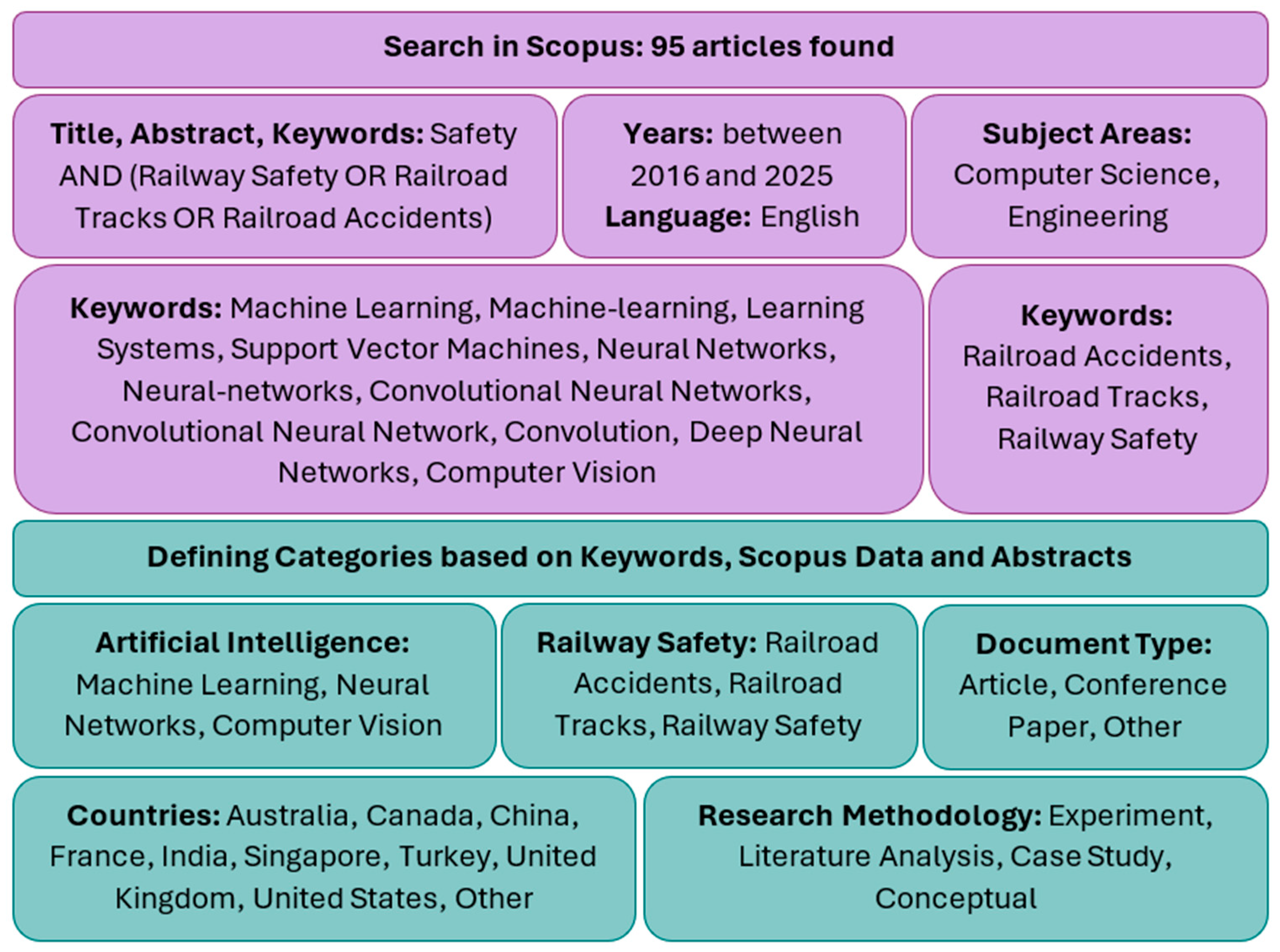
2.2. Search Strategy
“TITLE-ABS-KEY (“Safety” AND (“Railway Safety” OR “Railroad Tracks” OR “Railroad Accidents”)) AND PUBYEAR > 2015 AND PUBYEAR < 2026 AND (XCLUDE (SUBJAREA,”AGRI”) OR EXCLUDE (SUBJAREA,”ECON”) OR EXCLUDE (SUBJAREA,”NEUR”) OR EXCLUDE (SUBJAREA,”PHAR”) OR EXCLUDE (SUBJAREA,”PSYC”) OR EXCLUDE (SUBJAREA,”MULT”) OR EXCLUDE (SUBJAREA,”EART”) OR EXCLUDE (SUBJAREA,”CENG”) OR EXCLUDE (SUBJAREA,”BIOC”) OR EXCLUDE (SUBJAREA,”BUSI”) OR EXCLUDE (SUBJAREA,”CHEM”) OR EXCLUDE (SUBJAREA,”ENVI”) OR EXCLUDE (SUBJAREA,”MEDI”) OR EXCLUDE (SUBJAREA,”ENER”) OR EXCLUDE (SUBJAREA,”MATE”) OR EXCLUDE (SUBJAREA,”SOCI”) OR EXCLUDE (SUBJAREA,”DECI”) OR EXCLUDE (SUBJAREA,”PHYS”) OR EXCLUDE (SUBJAREA,”MATH”) OR EXCLUDE (SUBJAREA,”HEAL”) OR EXCLUDE (SUBJAREA,”ARTS”)) AND (EXCLUDE (DOCTYPE,”tb”)) AND (LIMIT-TO (LANGUAGE,”English”)) AND (LIMIT-TO (EXACTKEYWORD,”Machine Learning”) OR LIMIT-TO (EXACTKEYWORD,”Machine-learning”) OR LIMIT-TO (EXACTKEYWORD,”Learning Systems”) OR LIMIT-TO (EXACTKEYWORD,”Support Vector Machines”) OR LIMIT-TO (EXACTKEYWORD,”Neural Networks”) OR LIMIT-TO (EXACTKEYWORD,”Neural-networks”) OR LIMIT-TO (EXACTKEYWORD,”Convolutional Neural Networks”) OR LIMIT-TO (EXACTKEYWORD,”Convolutional Neural Network”) OR LIMIT-TO (EXACTKEYWORD,”Convolution”) OR LIMIT-TO (EXACTKEYWORD,”Deep Neural Networks”) OR LIMIT-TO (EXACTKEYWORD,”Computer Vision”))”.
“AND (LIMIT-TO (EXACTKEYWORD,”Railroad Accidents”) OR LIMIT-TO (EXACTKEYWORD,”Railroad Tracks”) OR LIMIT-TO (EXACTKEYWORD,”Railway Safety”))”,
2.3. Rationale for the Review, Purpose of the Study and Problems of the Study
- Which classes of problems and tasks dominate the literature at the intersection of AI and railway safety, and which thematic gaps remain open?
- Which data types and sensor configurations are most frequently used in the reviewed works, and which combinations demonstrate the highest effectiveness under operational conditions?
- To what extent do the studies account for real-time requirements, uncertainty quantification, and integration with maintenance decision-making, and what conclusions follow for practice?
- Is there a significant trend in the years 2016–2025 of increasing publication volume in the three thematic categories, namely, railroad accidents, railroad tracks, and railway safety, and what is the cumulative growth rate?
- Does the structure of methods change over time, that is, is there an increasing share of works employing machine learning, neural networks, and computer vision, and are the observed changes statistically significant?
- Is there a growing popularity of specific issues at the level of keywords and document types, namely, the share of thematic terms in titles and abstracts and the share of journal articles relative to conference papers, and are these trends statistically significant?
2.4. Eligibility Criteria
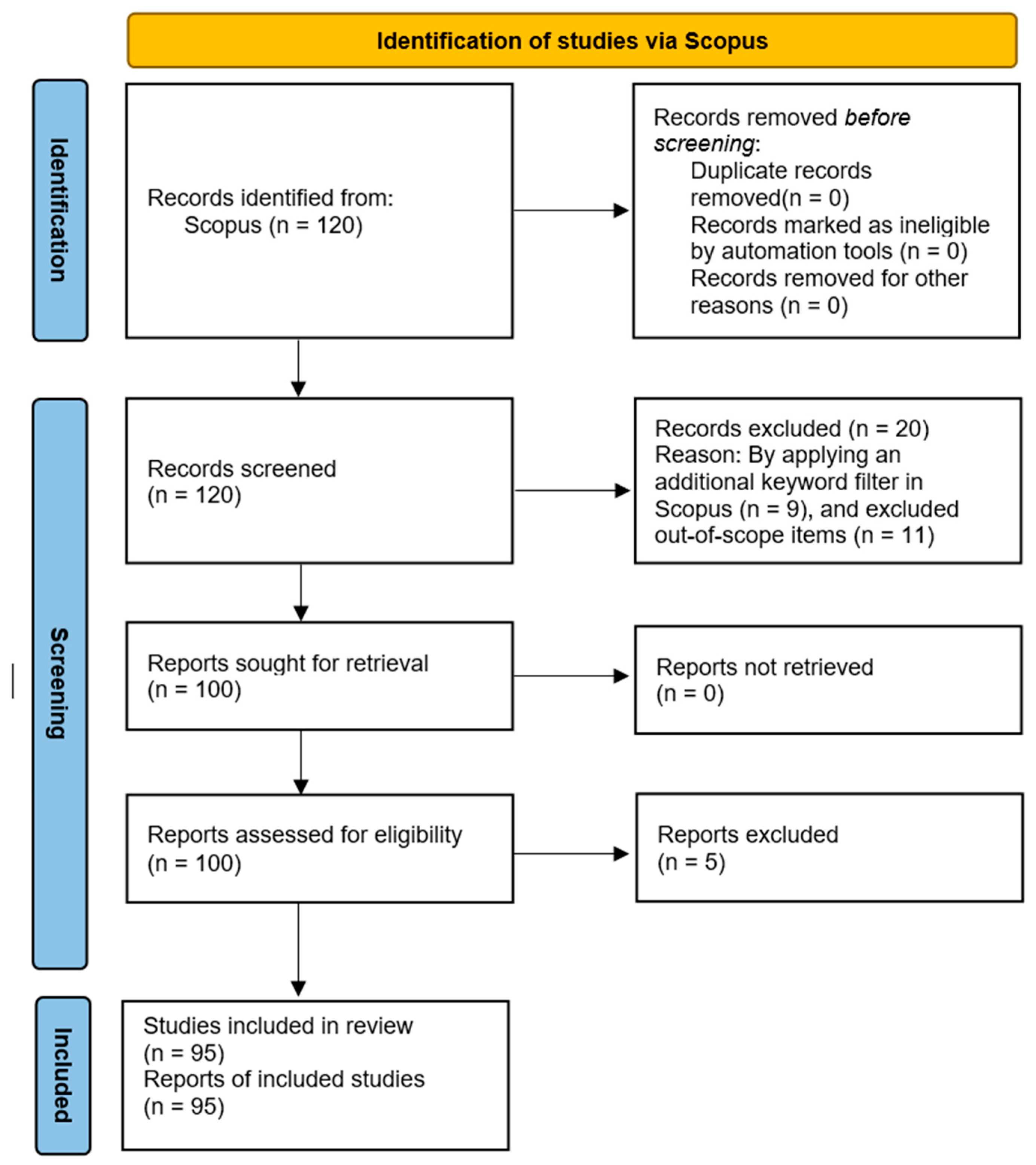
2.5. Selection Procedure and Screening
2.6. Classification Scheme
2.7. Data Extraction and Benchmarks
2.8. Limitations
3. State of the Art
3.1. Artificial Intelligence
3.2. Railway Safety
3.3. Prospects for Further Development
3.4. Summary
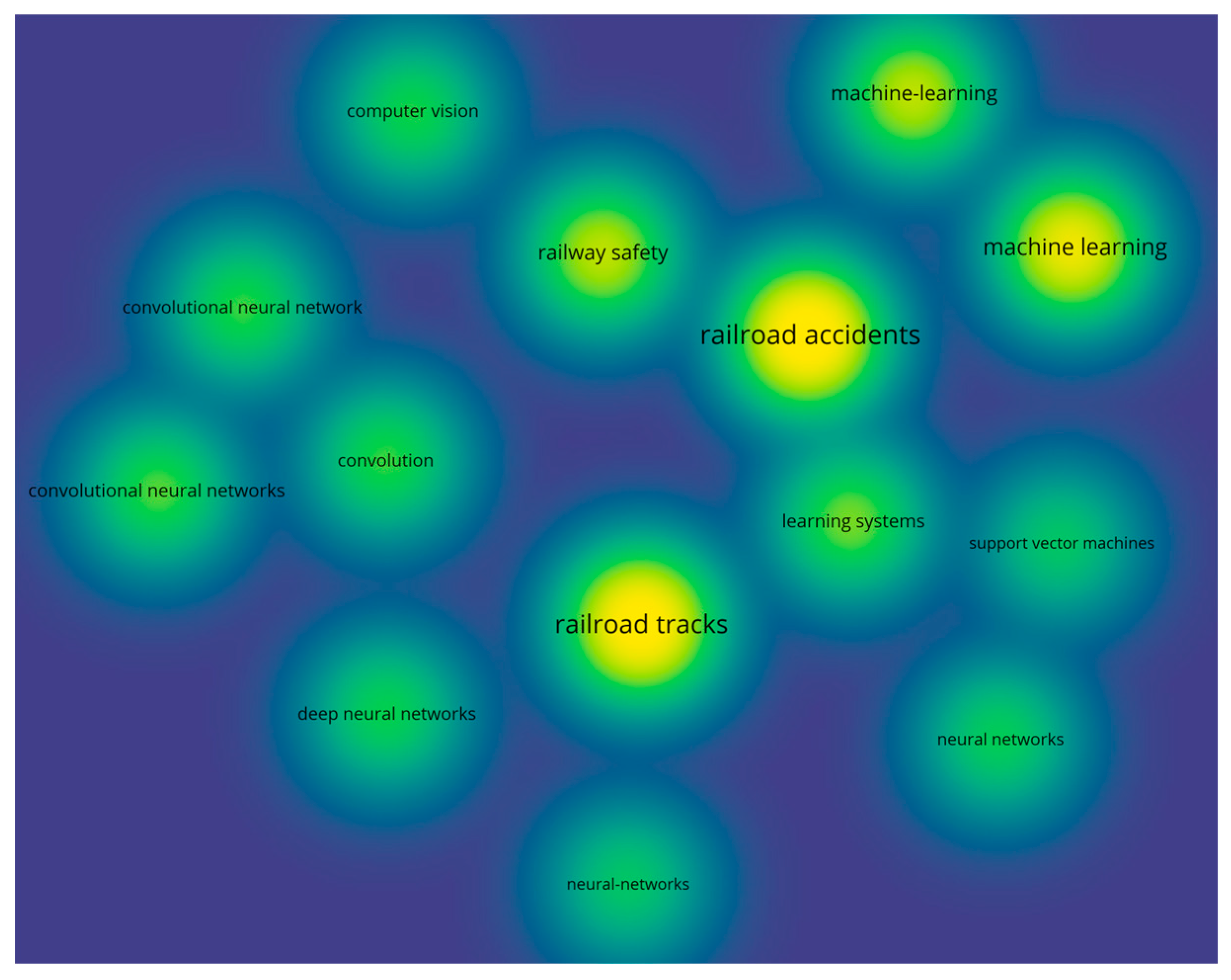
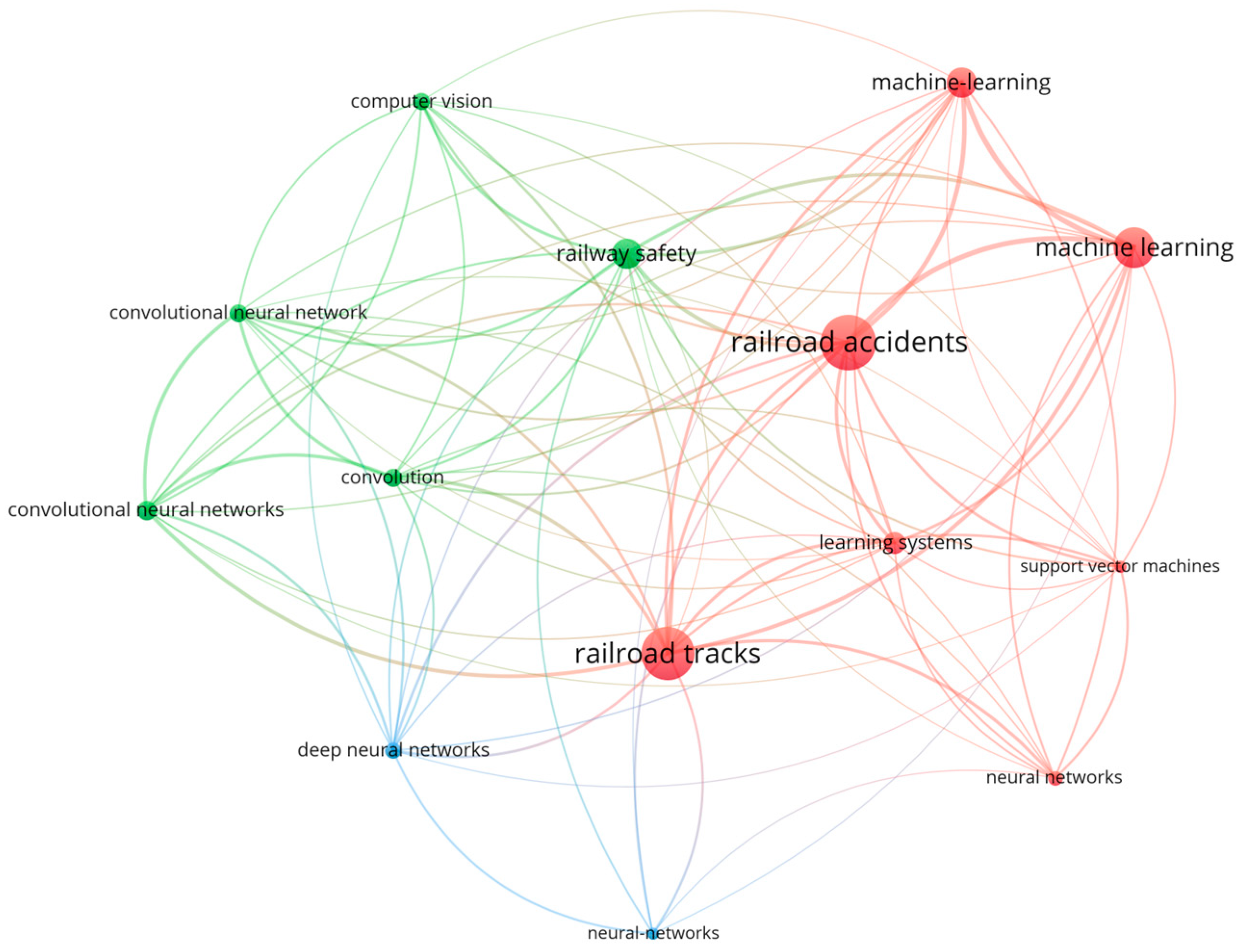
4. Statistical Overview
5. Discussion
6. Conclusions
Author Contributions
Funding
Institutional Review Board Statement
Informed Consent Statement
Data Availability Statement
Conflicts of Interest
References
- Tang, R.; De Donato, L.; Bešinović, N.; Flammini, F.; Goverde, R.M.P.; Lin, Z.; Liu, R.; Tang, T.; Vittorini, V.; Wang, Z. A Literature Review of Artificial Intelligence Applications in Railway Systems. Transp. Res. Part C Emerg. Technol. 2022, 140, 103679. [Google Scholar] [CrossRef]
- Olivier, B.; Guo, F.; Qian, Y.; Connolly, D.P. A Review of Computer Vision for Railways. IEEE Trans. Intell. Transp. Syst. 2025, 26, 11034–11065. [Google Scholar] [CrossRef]
- Helmi, W.; Bridgelall, R.; Askarzadeh, T. Remote Sensing and Machine Learning for Safer Railways: A Review. Appl. Sci. 2024, 14, 3573. [Google Scholar] [CrossRef]
- Liao, Y.; Han, L.; Wang, H.; Zhang, H. Prediction Models for Railway Track Geometry Degradation Using Machine Learning Methods: A Review. Sensors 2022, 22, 7275. [Google Scholar] [CrossRef]
- Zheng, Z.; Qi, H.; Zhuang, L.; Zhang, Z. Automated Rail Surface Crack Analytics Using Deep Data-Driven Models and Transfer Learning. Sustain. Cities Soc. 2021, 70, 102898. [Google Scholar] [CrossRef]
- Choi, J.-Y.; Han, J.-M. Deep Learning (Fast R-CNN)-Based Evaluation of Rail Surface Defects. Appl. Sci. 2024, 14, 1874. [Google Scholar] [CrossRef]
- Bai, T.; Gao, J.; Yang, J.; Yao, D. A Study on Railway Surface Defects Detection Based on Machine Vision. Entropy 2021, 23, 1437. [Google Scholar] [CrossRef] [PubMed]
- Li, X.; Wang, Q.; Yang, X.; Wang, K.; Zhang, H. Track Fastener Defect Detection Model Based on Improved YOLOv5s. Sensors 2023, 23, 6457. [Google Scholar] [CrossRef] [PubMed]
- Hu, J.; Qiao, P.; Lv, H.; Yang, L.; Ouyang, A.; He, Y.; Liu, Y. High Speed Railway Fastener Defect Detection by Using Improved YoLoX-Nano Model. Sensors 2022, 22, 8399. [Google Scholar] [CrossRef]
- Ding, K.; Luo, J.; Huang, H.; Hart, J.M.; Qamhia, I.I.A.; Tutumluer, E. Augmented Dataset for Vision-Based Analysis of Railroad Ballast via Multi-Dimensional Data Synthesis. Algorithms 2024, 17, 367. [Google Scholar] [CrossRef]
- Dias, S.; Sousa, P.; Afonso, F.; Viriato, N.; Tavares, P.; Moreira, P. A LiDAR Based Obstacle Detection Framework for Railway. EPJ Web Conf. 2024, 305, 00027. [Google Scholar] [CrossRef]
- Nycz, D. Influence of Selected Design Parameters of the Composite-Foam Cover Rail on the Course of the TB11 Crash Test of a Road Safety Barrier Forming a Horizontal Concave Arc. Arch. Automot. Eng. Arch. Motoryz. 2017, 76, 2. [Google Scholar] [CrossRef]
- Łodygowski, K. Fuelling Compression Ignition Engine by Mineral Diesel Fuel Mixture with Synthetic Hydrocarbons. Arch. Automot. Eng. Arch. Motoryz. 2017, 75. [Google Scholar] [CrossRef]
- Marciniak, K.; Majewski, P.; Reiner, J. Inspection of Railway Catenary Systems Using Machine Learning with Domain Knowledge Integration. Sci. Rep. 2025, 15, 29426. [Google Scholar] [CrossRef] [PubMed]
- Tan, P.; Cui, Z.; Lv, W.; Li, X.; Ding, J.; Huang, C.; Ma, J.; Fang, Y. Pantograph Detection Algorithm with Complex Background and External Disturbances. Sensors 2022, 22, 8425. [Google Scholar] [CrossRef]
- Meng, H.; Tong, X.; Zheng, Y.; Xie, G.; Ji, W.; Hei, X. Railway Accident Prediction Strategy Based on Ensemble Learning. Accid. Anal. Prev. 2022, 176, 106817. [Google Scholar] [CrossRef]
- Bridgelall, R.; Tolliver, D.D. Railroad Accident Analysis by Machine Learning and Natural Language Processing. J. Rail Transp. Plan. Manag. 2024, 29, 100429. [Google Scholar] [CrossRef]
- Yürekli, Y.; Özarpa, C.; Avcı, İ. Real-Time Railway Hazard Detection Using Distributed Acoustic Sensing and Hybrid Ensemble Learning. Sensors 2025, 25, 3992. [Google Scholar] [CrossRef]
- Min, Y.; Wang, Z.; Liu, Y.; Wang, Z. FS-RSDD: Few-Shot Rail Surface Defect Detection with Prototype Learning. Sensors 2023, 23, 7894. [Google Scholar] [CrossRef]
- Hu, Q.; Fang, X.; Bian, L. Natural Disaster Warning System for Safe Operation of a High-Speed Railway. Transp. Saf. Environ. 2021, 3, tdab019. [Google Scholar] [CrossRef]
- Li, Z.-W.; Liu, X.-Z.; Chen, S.-X. A Reliability Assessment Approach for Slab Track Structure Based on Vehicle-Track Dynamics and Surrogate Model. Proc. Inst. Mech. Eng. Part O J. Risk Reliab. 2022, 236, 79–89. [Google Scholar] [CrossRef]
- Kang, D.; Dai, J.; Liu, X.; Bian, Z.; Zaman, A.; Wang, X. Estimating the Occurrence of Broken Rails in Commuter Railroads with Machine Learning Algorithms. Proc. Inst. Mech. Eng. Part F J. Rail Rapid Transit 2024, 238, 1338–1350. [Google Scholar] [CrossRef]
- Kocbek, S.; Gabrys, B. Automated Machine Learning Techniques in Prognostics of Railway Track Defects. In Proceedings of the IEEE International Conference on Data Mining Workshops (ICDMW); Papapetrou, P., Cheng, X., He, Q., Eds.; IEEE Computer Society: Washington, DC, USA, 2019; Volume 2019-November, pp. 777–784. [Google Scholar]
- Kumari, P.; Sabri, M.S.; Samui, P.; Verma, A.K. Application of Intelligence System: ANN and ANFIS for Enhanced Slope Stability Analysis. In Proceedings of the Lecture Notes in Civil Engineering; Verma, A.K., Singh, T.N., Mohamad, E.T., Mishra, A.K., Gamage, R.P., Bhatawdekar, R., Wilkinson, S., Eds.; Springer Science and Business Media Deutschland GmbH: Heidelberg, Germany, 2025; Volume 475 LNCE, pp. 229–242. [Google Scholar]
- Belghiti, Z.; Ladj, A.; Elmenzhi, L. Machine Learning-Based Approach for Railway Switch and Crossing System Diagnosis. In Proceedings of the Lecture Notes in Networks and Systems; Farhaoui, Y., Herawan, T., Lucky Imoize, A., Allaoui, A.E., Eds.; Springer Science and Business Media Deutschland GmbH: Heidelberg, Germany, 2025; Volume 1397 LNNS, pp. 370–375. [Google Scholar]
- Yılmaz, Y.; Demir, S.; Sannah, N.; Demir, A.D. Development of a Machine Learning Based Automated Model to Predict the Load-Bearing Capacity of Circular Hollow Section Brace Members Having Accidental Joint Eccentricity. Structures 2024, 70, 107882. [Google Scholar] [CrossRef]
- Gao, H.; Hu, X.; Rong, C.; Gou, H.; Meng, X.; Bao, Y. Real-Time Assessment for Running Safety of High-Speed Railway Based on Physical Models and Deep Neural Networks. Structures 2025, 74, 108466. [Google Scholar] [CrossRef]
- Wu, C.; Lu, X.; Wang, Y.; Pang, T. Prediction of Railway Track Irregularity Based on TCN-BiLSTMs-Attention Model. In Proceedings of the 3rd International Conference on Signal Processing, Computer Networks and Communications, SPCNC; Association for Computing Machinery, Inc.: New York, NY, USA, 2025; pp. 464–472. [Google Scholar]
- Li, C.; He, Q.; Wang, P. Estimation of Railway Track Longitudinal Irregularity Using Vehicle Response with Information Compression and Bayesian Deep Learning. Comput.-Aided Civ. Infrastruct. Eng. 2022, 37, 1260–1276. [Google Scholar] [CrossRef]
- Peng, K.; Zhang, Y.; Zhou, W.; Jiang, L. A Multimodal TransTCN Fusion Network Embedding Prior Knowledge for Predicting Seismic Responses in High-Speed Railways Considering Pier Height. Eng. Struct. 2025, 334, 120225. [Google Scholar] [CrossRef]
- De Bruin, T.; Verbert, K.; Babuska, R. Railway Track Circuit Fault Diagnosis Using Recurrent Neural Networks. IEEE Trans. Neural Netw. Learn. Syst. 2017, 28, 523–533. [Google Scholar] [CrossRef]
- Alsahli, A.; Zarembski, A.M.; Attoh-Okine, N. Predicting Track Geometry Defect Probability Based on Tie Condition Using Pattern Recognition Technique. In Proceedings of the ASME International Mechanical Engineering Congress and Exposition; American Society of Mechanical Engineers (ASME): New York, NY, USA, 2020; Volume 14. [Google Scholar]
- Popov, K.; DeBold, R.; Chai, H.-K.; Forde, M.C.; Ho, C.L.; Hyslip, J.P.; Long, P.; Hsu, S.S. Rail Track Monitoring Using AI and Machine Learning. In Proceedings of the Lecture Notes in Civil Engineering; Gomes Correia, A., Azenha, M., Cruz, P.J.S., Novais, P., Pereira, P., Eds.; Springer Science and Business Media Deutschland GmbH: Heidelberg, Germany, 2023; Volume 306 LNCE, pp. 513–523. [Google Scholar]
- Dong, Y.; Yang, Y.; Han, C.; Zhao, C.; Madan, A.; Mohanty, L.; Fu, Y. Heterogeneous Graph Attention Network for Rail Fastener Looseness Detection Using Distributed Acoustic Sensing and Accelerometer Data Fusion. Autom. Constr. 2025, 172, 106051. [Google Scholar] [CrossRef]
- Han, C.; Wang, S.; Madan, A.; Zhao, C.; Mohanty, L.; Fu, Y.; Shen, W.; Liang, R.; Huang, E.S.; Zheng, T.; et al. Intelligent Detection of Loose Fasteners in Railway Tracks Using Distributed Acoustic Sensing and Machine Learning. Eng. Appl. Artif. Intell. 2024, 134, 108684. [Google Scholar] [CrossRef]
- Liang, R.; Cui, Y.; Tang, Y.; Liu, F. A Method for Train Tracking Based on Distributed Acoustic Sensing. In Proceedings of the Frontiers in Artificial Intelligence and Applications; Tallon-Ballesteros, A.J., Ed.; IOS Press BV: Amsterdam, The Netherlands, 2024; Volume 396, pp. 565–570. [Google Scholar]
- Pham, K.; Kim, D.; Ma, Y.; Hwang, C.; Choi, H. An AIoT System for Real-Time Monitoring and Forecasting of Railway Temperature. J. Civ. Struct. Health Monit. 2025, 15, 915–925. [Google Scholar] [CrossRef]
- Abdurahman, B.; Hubbard, P.; Harrison, T.; Ward, C.; Fletcher, D.; Lewis, R.; Chandrasekhar, K.; Vincent, D. Estimation of Wheel-Rail Friction Coefficient Using Deep CNN on Axlebox Accelerations. Mech. Syst. Signal Process. 2025, 232, 112756. [Google Scholar] [CrossRef]
- Ji, A.; Quek, Y.T.; Wong, E.; Woo, W.L. Identification of Rail Surface Defects Based on One-Shot Learning. In Proceedings of the Lecture Notes in Electrical Engineering; Zhang, Z., Ed.; Springer Science and Business Media Deutschland GmbH: Heidelberg, Germany, 2022; Volume 901 LNEE, pp. 823–832. [Google Scholar]
- Liu, R.; Liu, W.; Duan, M.; Xie, W.; Dai, Y.; Liao, X. MemFormer: A Memory Based Unified Model for Anomaly Detection on Metro Railway Tracks. Expert Syst. Appl. 2024, 237, 121509. [Google Scholar] [CrossRef]
- Wang, Z.; Dong, H.; Man, J.; Jia, L.; Qin, Y. Research on Fault Prediction of High-Speed Train Auxiliary Power Supply System Based on LSTM. In Proceedings of the Lecture Notes in Electrical Engineering; Qin, Y., Jia, L., Liang, J., Liu, Z., Diao, L., An, M., Eds.; Springer Science and Business Media Deutschland GmbH: Heidelberg, Germany, 2022; Volume 868 LNEE, pp. 507–515. [Google Scholar]
- Garrido Martínez-Llop, P.; Sanz Bobi, J.D.D.; Huera Plaza, A. Application of Neural Networks for the Prediction of Railway Bearing Failures. Proc. Inst. Mech. Eng. Part F J. Rail Rapid Transit 2022, 236, 1147–1153. [Google Scholar] [CrossRef]
- Jin, Z.; Zhang, W.; Yin, Z.; Zhang, N.; Geng, X. Estimating Track Geometry Irregularities from In-Service Train Accelerations Using Deep Learning. Autom. Constr. 2025, 173, 106114. [Google Scholar] [CrossRef]
- Bulavin, Y.P.; Ignatieva, O.V. Leveraging Deep Reinforcement Learning for Reducing Longitudinal Train Forces in Railway Systems. In Proceedings of the Lecture Notes in Electrical Engineering; Kovalev, S., Sukhanov, A., Kotenko, I., Li, Y., Li, Y., Eds.; Springer Science and Business Media Deutschland GmbH: Heidelberg, Germany, 2024; Volume 1209 LNNS, pp. 118–130. [Google Scholar]
- Kim, J.-M.; Adhikari, M.D.; Yum, S.-G. Development of a Deep Neural Network-Based Life Accident Evaluation Model for Weather-Related Railway Accidents. KSCE J. Civ. Eng. 2024, 28, 4624–4638. [Google Scholar] [CrossRef]
- Yang, T.; Liu, X.; Li, G.; Dai, M.; Tian, L.; Xie, Y. Exploring Multi-Layer Convolutional Neural Networks for Railway Safety Text Classification. In Proceedings of the IEEE International Conference on Progress in Informatics and Computing, PIC; Wang, Y., Zhang, Z., Eds.; Institute of Electrical and Electronics Engineers Inc.: New York, NY, USA, 2021; pp. 206–211. [Google Scholar]
- Liu, C.; Yang, S. Using Text Mining to Establish Knowledge Graph from Accident/Incident Reports in Risk Assessment. Expert Syst. Appl. 2022, 207, 117991. [Google Scholar] [CrossRef]
- Shabbir, M.N.S.K.; Wang, C.; Liang, X.; Adajar, E. A Novel Regression Model-Based Toolbox for Induced Voltage Prediction on Rail Tracks Due to AC Electromagnetic Interference of Adjacent Power Lines. In Proceedings of the IEEE Industry Applications Society Annual Meeting (IAS); Institute of Electrical and Electronics Engineers Inc.: New York, NY, USA, 2022; Volume 2022-October. [Google Scholar]
- Karaman, S.; Kocaarslan, I.; Tiryaki, H.; Bal, E. The Modelling Recorded Faults in Railways and Prediction. Istanb. Univ.-J. Electr. Electron. Eng. 2017, 17, 3417–3423. [Google Scholar]
- Rath, S.; Upadhyay, H.; Prakash, S.; Raja, H. Cloud-Based Anomaly Detection for Broken Rail Track Using LSTM Autoencoders and Cross-Modal Audio Analysis. In Proceedings of the Lecture Notes in Networks and Systems; Nanda, U., Tripathy, A.K., Sahoo, J.P., Sarkar, M., Li, K.-C., Eds.; Springer Science and Business Media Deutschland GmbH: Heidelberg, Germany, 2024; Volume 955 LNNS, pp. 69–84. [Google Scholar]
- Falamarzi, A.; Moridpour, S.; Nazem, M.; Cheraghi, S. Prediction of Tram Track Gauge Deviation Using Artificial Neural Network and Support Vector Regression. Aust. J. Civ. Eng. 2019, 17, 63–71. [Google Scholar] [CrossRef]
- Peinado Gonzalo, A.; Horridge, R.; Steele, H.; Stewart, E.; Entezami, M. Review of Data Analytics for Condition Monitoring of Railway Track Geometry. IEEE Trans. Intell. Transp. Syst. 2022, 23, 22737–22754. [Google Scholar] [CrossRef]
- Hosain, M.; Kapoor, R. Detection of Rail Line Track and Human Beings Near the Track to Avoid Accidents. In Proceedings of the Lecture Notes in Electrical Engineering; Santosh, K.C., Sood, S.K., Pandey, H.M., Virmani, C., Eds.; Springer Science and Business Media Deutschland GmbH: Heidelberg, Germany, 2024; Volume 1191 LNEE, pp. 763–779. [Google Scholar]
- Yanwei, J.; Yu, D. Research on Railway Obstacle Detection Method Based on Radar. In Proceedings of the International Symposium on Mechatronics and Industrial Informatics, ISMII; Institute of Electrical and Electronics Engineers Inc.: New York, NY, USA, 2021; pp. 222–226. [Google Scholar]
- Fayyaz, M.A.B.; Johnson, C. Object Detection at Level Crossing Using Deep Learning. Micromachines 2020, 11, 1055. [Google Scholar] [CrossRef]
- Ho, R.K.C.; Wang, Z.; Tang, S.S.C.; Zhang, Q. Real-Time Object Detection Technology in Railway Operations. HKIE Trans. Hong Kong Inst. Eng. 2021, 28, 154–162. [Google Scholar] [CrossRef]
- Zhang, T.; Chen, Y.; Qu, J.; Bai, R. Research on Obstacle Detection Method for Rail Transportation Under Low-Light Condition Based on Infrared Image. In Proceedings of the 2024 4th International Conference on Artificial Intelligence, Automation and High Performance Computing; Association for Computing Machinery: New York, NY, USA, 2024; pp. 15–20. [Google Scholar]
- Wang, Z.; Lee, T.; Leung, M.; Tang, S.; Zhang, Q.; Yang, Z.; Cheung, V. A Forward Train Detection Method Based on Convolutional Neural Network. In Proceedings of the Advances in Intelligent Systems and Computing; Ahram, T., Karwowski, W., Vergnano, A., Leali, F., Taiar, R., Eds.; Springer: Berlin/Heidelberg, Germany, 2020; Volume 1131 AISC, pp. 129–135. [Google Scholar]
- Mukojima, H.; Deguchi, D.; Kawanishi, Y.; Ide, I.; Murase, H.; Ukai, M.; Nagamine, N.; Nakasone, R. Moving Camera Background-Subtraction for Obstacle Detection on Railway Tracks. In Proceedings of the 2016 IEEE International Conference on Image Processing, ICIP; IEEE Computer Society: Los Alamitos, CA, USA, 2016; Volume 2016-August, pp. 3967–3971. [Google Scholar]
- Cao, Z.; Qin, Y.; Jia, L.; Xie, Z.; Gao, Y.; Wang, Y.; Li, P.; Yu, Z. Railway Intrusion Detection Based on Machine Vision: A Survey, Challenges, and Perspectives. IEEE Trans. Intell. Transp. Syst. 2024, 25, 6427–6448. [Google Scholar] [CrossRef]
- Malagali, S.G.; Srujana, C.H.; Pavithra, G.; Sindhu Sree, M.; Manjunath, T.C. A Novel Prevention Conceptual Development of Implementing the Safety Mechanisms in Indian Railways to Prevent Accidents. In Proceedings of the 15th International Conference on Advances in Computing, Control, and Telecommunication Technologies, ACT; Stephen, J., Sharma, P., Chaba, Y., Abraham, K.U., Anooj, P.K., Mohammad, N., Thomas, G., Srikiran, S., Eds.; Grenze Scientific Society: Thiruvananthapuram, India, 2024; Volume 2, pp. 1547–1554. [Google Scholar]
- Cao, Z.; Gao, Y.; Bai, J.; Qin, Y.; Zheng, Y.; Jia, L. Efficient Dual-Stream Fusion Network for Real-Time Railway Scene Understanding. IEEE Trans. Intell. Transp. Syst. 2024, 25, 9442–9452. [Google Scholar] [CrossRef]
- Chen, Z.; Yang, J.; Chen, L.; Feng, Z.; Jia, L. Efficient Railway Track Region Segmentation Algorithm Based on Lightweight Neural Network and Cross-Fusion Decoder. Autom. Constr. 2023, 155, 105069. [Google Scholar] [CrossRef]
- Khrueakhrai, S.; Srinonchat, J. Railway Track Detection Based on SegNet Deep Learning. In Proceedings of the IEEE Region 10 Annual International Conference, Proceedings TENCON; Institute of Electrical and Electronics Engineers Inc.: New York, NY, USA, 2023; pp. 409–413. [Google Scholar]
- Gibert, X.; Patel, V.M.; Chellappa, R. Deep Multitask Learning for Railway Track Inspection. IEEE Trans. Intell. Transp. Syst. 2017, 18, 153–164. [Google Scholar] [CrossRef]
- Ji, A.; Thee, Q.Y.; Woo, W.L.; Wong, E. Experimental Investigations of a Convolutional Neural Network Model for Detecting Railway Track Anomalies. In Proceedings of the IECON Proceedings; IEEE Computer Society: Washington, DC, USA, 2023. [Google Scholar]
- Ye, T.; Zhao, Z.; Wang, S.; Zhou, F.; Gao, X. A Stable Lightweight and Adaptive Feature Enhanced Convolution Neural Network for Efficient Railway Transit Object Detection. IEEE Trans. Intell. Transp. Syst. 2022, 23, 17952–17965. [Google Scholar] [CrossRef]
- Wang, Y.; Wang, T.; Yang, Z.; Ren, S.; Gouliu, X.; Gao, J. Deep Convolutional Neural Networks for Rail Surface Defect Perception. In Proceedings of the International Conference on Image Processing, Computer Vision and Machine Learning, ICICML; Institute of Electrical and Electronics Engineers Inc.: New York, NY, USA, 2023; pp. 1211–1215. [Google Scholar]
- Germoglio Barbosa, I.; Lima, A.D.O.; Edwards, J.R.; Dersch, M.S. Development of Track Component Health Indices Using Image-Based Railway Track Inspection Data. Proc. Inst. Mech. Eng. Part F J. Rail Rapid Transit 2024, 238, 706–716. [Google Scholar] [CrossRef]
- Harrington, R.M.; Lima, A.D.O.; Fox-Ivey, R.; Nguyen, T.; Laurent, J.; Dersch, M.S.; Edwards, J.R. Use of Deep Convolutional Neural Networks and Change Detection Technology for Railway Track Inspections. Proc. Inst. Mech. Eng. Part F J. Rail Rapid Transit 2023, 237, 137–145. [Google Scholar] [CrossRef]
- Aydin, I.; Sevi, M.; Salur, M.U.; Akin, E. Defect Classification of Railway Fasteners Using Image Preprocessing and a Lightweight Convolutional Neural Network. Turk. J. Electr. Eng. Comput. Sci. 2022, 30, 891–907. [Google Scholar] [CrossRef]
- Wang, L.; Zang, Q.; Zhang, K.; Wu, L. A Rail Fastener Defect Detection Algorithm Based on Improved YOLOv5. Proc. Inst. Mech. Eng. Part F J. Rail Rapid Transit 2024, 238, 851–862. [Google Scholar] [CrossRef]
- Liu, L.; Zhou, F.; He, Y. Automated Status Inspection of Fastening Bolts on Freight Trains Using a Machine Vision Approach. Proc. Inst. Mech. Eng. Part F J. Rail Rapid Transit 2016, 230, 1629–1641. [Google Scholar] [CrossRef]
- Krummenacher, G.; Ong, C.S.; Koller, S.; Kobayashi, S.; Buhmann, J.M. Wheel Defect Detection with Machine Learning. IEEE Trans. Intell. Transp. Syst. 2018, 19, 1176–1187. [Google Scholar] [CrossRef]
- Kim, I.; Jeon, Y.; Kang, J.W.; Gwak, J. RAG-PaDiM: Residual Attention Guided PaDiM for Defects Segmentation in Railway Tracks. J. Electr. Eng. Technol. 2023, 18, 1429–1438. [Google Scholar] [CrossRef]
- Yan, Y.; Ma, S.; Song, K.; Wang, Y.; Tian, H.; Guo, J. Uncertainty Inspired Domain Adaptation Network for Rail Surface Defect Segmentation. Eng. Appl. Artif. Intell. 2024, 135, 108860. [Google Scholar] [CrossRef]
- Ren, Y.; Ai, C.; Lu, P. Advanced Deep Learning-Based Hybrid Rail Extraction Algorithm Leveraging LiDAR Technology. J. Infrastruct. Syst. 2025, 31, 04024030. [Google Scholar] [CrossRef]
- Luo, H.; Cai, L.; Li, C. Rail Surface Defect Detection Based on An Improved YOLOv5s. Appl. Sci. 2023, 13, 7330. [Google Scholar] [CrossRef]
- Kang, Z.; Li, R. Rail Surface Defect Detection Based on MobileViTv2 and Eddy Current. In Proceedings of the 6th International Conference on Electrical Engineering and Information Technologies for Rail Transportation (EITRT) 2023; Yang, J., Yao, D., Jia, L., Qin, Y., Liu, Z., Diao, L., Eds.; Lecture Notes in Electrical Engineering; Springer Nature: Singapore, 2024; Volume 1136, pp. 636–643. ISBN 978-981-99-9314-7. [Google Scholar]
- Guo, F.; Qian, Y.; Shi, Y. Real-Time Railroad Track Components Inspection Based on the Improved YOLOv4 Framework. Autom. Constr. 2021, 125, 103596. [Google Scholar] [CrossRef]
- Raza, A.; Sehar, R.; Moiz, A.; Alluhaidan, A.S.; El-Rahman, S.A.; AbdElminaam, D.S. Novel Conditional Tabular Generative Adversarial Network Based Image Augmentation for Railway Track Fault Detection. PeerJ Comput. Sci. 2025, 11, e2898. [Google Scholar] [CrossRef]
- Jiang, X. Adaptive Fault Diagnosis Model for High-Speed Railway Turnout Using Deep Convolutional Neural Networks. Int. J. Secur. Netw. 2023, 18, 165–174. [Google Scholar] [CrossRef]
- Serna, A.A.; Yu, X.; Saniie, J. AI-Based Security Surveillance and Hazard Detection for Train Platform Safety. In Proceedings of the IEEE International Conference on Electro Information Technology; IEEE Computer Society: Los Alamitos, CA, USA, 2024; pp. 185–190. [Google Scholar]
- Kilian, K.; Kilian, M.; Mazur, V.; Phelan, J. Rethinking Reliability Engineering Using Machine Vision Systems. Proc. Inst. Mech. Eng. Part F J. Rail Rapid Transit 2016, 230, 1006–1014. [Google Scholar] [CrossRef]
- Wang, Y.; Yang, Z.; Ren, S.; Gouliu, X.; Gao, J.; Wang, T. DDRSNet-Rail Surface Defects Classification Based on Depthwise-Dilated Convolution. In Proceedings of the International Conference on Image Processing, Computer Vision and Machine Learning, ICICML; Institute of Electrical and Electronics Engineers Inc.: New York, NY, USA, 2023; pp. 721–724. [Google Scholar]
- Wang, M.; Zhou, Y. Autonomous Rail Surface Defect Identification Based on an Improved One-Stage Object Detection Algorithm. J. Perform. Constr. Facil. 2024, 38, 04024041. [Google Scholar] [CrossRef]
- Kuzmin, E.V.; Gorbunov, O.E.; Plotnikov, P.O.; Tyukin, V.A.; Bashkin, V.A. Application of Neural Networks for Recognizing Rail Structural Elements in Magnetic and Eddy Current Defectograms. Autom. Control Comput. Sci. 2019, 53, 628–637. [Google Scholar] [CrossRef]
- Shabbir, M.N.S.K.; Wang, C.; Liang, X.; Adajar, E. A Novel Toolbox for Induced Voltage Prediction on Rail Tracks Due to AC Electromagnetic Interference Between Railway and Nearby Power Lines. In Proceedings of the IEEE Transactions on Industry Applications; Institute of Electrical and Electronics Engineers Inc.: New York, NY, USA, 2023; Volume 59, pp. 2772–2784. [Google Scholar]
- Cai, X.; Chang, W.; Gao, L.; Zhou, C. Design and Application of Real-Time Monitoring System for Service Status of Continuously Welded Turnout on the High-Speed Railway Bridge. J. Transp. Saf. Secur. 2021, 13, 735–758. [Google Scholar] [CrossRef]
- Acikgoz, H.; Korkmaz, D. MSRConvNet: Classification of Railway Track Defects Using Multi-Scale Residual Convolutional Neural Network. Eng. Appl. Artif. Intell. 2023, 121, 105965. [Google Scholar] [CrossRef]
- Sansiñena, A.; Rodríguez-Arana, B.; Arrizabalaga, S. A Systematic Review of Acceleration-Based Estimation of Railway Track Quality. Veh. Syst. Dyn. 2025, 1–28. [Google Scholar] [CrossRef]
- Yang, T.; Liu, Y.; Huang, Y.; Liu, J.; Wang, S. Symmetry-Driven Unsupervised Abnormal Object Detection for Railway Inspection. IEEE Trans. Ind. Inform. 2023, 19, 11487–11498. [Google Scholar] [CrossRef]
- Wei, Q.; Zhao, N. Enhancing Railway Transportation Safety with Proactive Maintenance Strategies Incorporating Machine Learning. Int. J. Sens. Netw. 2024, 45, 241–253. [Google Scholar] [CrossRef]
- Hadj-Mabrouk, H. Contribution of Artificial Intelligence to the Assessment of Rail Safety. In Proceedings of the Institution of Mechanical Engineers-Stephenson Conference: Research for Railways; Institution of Mechanical Engineers: Maharashtra, India, 2017; pp. 149–160. [Google Scholar]
- Hadj Mabrouk, H. Contribution of Learning CHARADE System of Rules for the Prevention of Rail Accidents. Intell. Decis. Technol. 2017, 11, 477–485. [Google Scholar] [CrossRef]
- Parkinson, H.J.; Bamford, G.; Kandola, B. The Development of an Enhanced Bowtie Railway Safety Assessment Tool Using a Big Data Analytics Approach. In Proceedings of the International Conference on Railway Engineering; Institution of Engineering and Technology: Stevenage, UK, 2016; Volume 2016. [Google Scholar]
- Lloyd-Roberts, B.; James, P.; Edwards, M.; Robinson, S.; Werner, T. Improving Railway Safety: Human-in-the-Loop Invariant Finding. In Proceedings of the Conference on Human Factors in Computing Systems; Association for Computing Machinery: New York, NY, USA, 2023. [Google Scholar]
- Hughes, P.; Figueres-Esteban, M.; El Rashidy, R.A.H.; van Gulijk, C.; Slovak, R. A Computer Leaning Approach to Obtain Safety Information from Multi-Lingual Accident Reports. In Proceedings of the Safety and Reliability–Safe Societies in a Changing World; van Gulijk, C., Haugen, S., Barros, A., Vinnem, J.E., Kongsvik, T., Eds.; CRC Press/Balkema: Leiden, The Netherlands, 2018; pp. 3107–3114. [Google Scholar]
- Afzalan, M.; Jazizadeh, F.; Ahmadian, M. A Machine Learning Approach for Track Condition Assessment through Repeated Historical Data Analytics. In Proceedings of the Joint Rail Conference, JRC; American Society of Mechanical Engineers (ASME): New York, NY, USA, 2019. [Google Scholar]
- Bai, L.; Liu, R.; Sun, Q.; Wang, F.; Wang, F. Classification-Learning-Based Framework for Predicting Railway Track Irregularities. Proc. Inst. Mech. Eng. Part F J. Rail Rapid Transit 2016, 230, 598–610. [Google Scholar] [CrossRef]
- Cheng, F.; Liu, H. An Adaptive Hybrid Deep Learning-Based Reliability Assessment Framework for Damping Track System Considering Multi-Random Variables. Mech. Syst. Signal Process. 2024, 208, 110981. [Google Scholar] [CrossRef]
- He, J.; Xu, P.; Xing, J.; Yao, S.; Wang, B.; Zheng, X. Optimization of Energy-Absorbing Parameters for Train Crash Energy Management Using a Variable-Fidelity Neural Network Surrogate Model. Eng. Struct. 2025, 334, 120242. [Google Scholar] [CrossRef]
- Wen, Y.; Xu, P.; Jiang, M.; Xu, W.; Yang, C. Gradient-Guided Joint Representation Loss With Adaptive Neck for Train Crash Detection. IEEE Trans. Intell. Transp. Syst. 2025, 26, 6514–6529. [Google Scholar] [CrossRef]
- Gorobetz, M.; Beinarovica, A.; Levchenkov, A. Convolutional Neural Networks of Active Railway Safety System with Braking Dynamics Prediction. In Proceedings of the Dynamics of Vehicles on Roads and Tracks; Spiryagin, M., Cole, C., McSweeney, T., Gordon, T., Eds.; CRC Press/Balkema: Leiden, The Netherlands, 2018; Volume 2, pp. 953–958. [Google Scholar]
- Ding, X.; Cai, X.; Zhang, Z.; Liu, W.; Song, W. Railway Foreign Object Intrusion Detection Based on Deep Learning. In Proceedings of the International Conference on Computer Engineering and Artificial Intelligence, ICCEAI; Lin, P., Yang, Y., Eds.; Institute of Electrical and Electronics Engineers Inc.: New York, NY, USA, 2022; pp. 735–739. [Google Scholar]
- De Donato, L.; Marrone, S.; Flammini, F.; Sansone, C.; Vittorini, V.; Nardone, R.; Mazzariello, C.; Bernaudin, F. Intelligent Detection of Warning Bells at Level Crossings through Deep Transfer Learning for Smarter Railway Maintenance. Eng. Appl. Artif. Intell. 2023, 123, 106405. [Google Scholar] [CrossRef]
- Yang, C.; Trudel, E.; Liu, Y. Machine Learning-Based Methods for Analyzing Grade Crossing Safety. Clust. Comput. 2017, 20, 1625–1635. [Google Scholar] [CrossRef]
- Jiao, Y.; Chen, X.; Sun, Z.; Fu, L.; Jiang, C.; Wen, C.; Zhang, X. Data-Driven Detection and Assessment for Urban Railway Transit Driver Fatigue in Real Work Conditions. Transp. Res. Rec. 2023, 2677, 1367–1375. [Google Scholar] [CrossRef]
- Mathew, J.; Benekohal, R.F. Quantifying the Extent to Which Connected and Autonomous Vehicles Reduce Accidents at Railroad Grade Crossings: A Machine Learning Approach. Transp. Res. Rec. 2022, 2676, 731–742. [Google Scholar] [CrossRef]
- Hadj-Mabrouk, H. A Hybrid Approach for the Prevention of Railway Accidents Based on Artificial Intelligence. In Proceedings of the Advances in Intelligent Systems and Computing; Vasant, P., Weber, G., Zelinka, I., Eds.; Springer: Berlin, Germany, 2019; Volume 866, pp. 383–394. [Google Scholar]
- Yang, J.; Stewart, E.; Entezami, M. Decomposition Methods for Impact-Based Fault Detection Algorithms in Railway Inspection Applications. IET Signal Process. 2022, 16, 935–944. [Google Scholar] [CrossRef]
- Zuo, H.; Deng, J.; Liu, Z.; Tian, G.; Xiao, S. Lightweight Safety Activity Recognition Algorithm for Railway Field Personnel Based on Portable Cards. Int. J. Pattern Recognit. Artif. Intell. 2025, 39, 2450024. [Google Scholar] [CrossRef]
- Zhou, J.-L.; Guo, Z.-M. A Hybrid SNN-STLSTM Method for Human Error Assessment in the High-Speed Railway System. Adv. Eng. Inform. 2024, 60, 102408. [Google Scholar] [CrossRef]
- Zayandehroodi, M.; Mojaradi, B.; Bagheri, M. Improving Reliability of Safety Countermeasure Evaluation at Highway-Rail Grade Crossings through Aleatoric Uncertainty Modeling with Machine Learning Techniques. Reliab. Eng. Syst. Saf. 2025, 261, 111082. [Google Scholar] [CrossRef]






| Subcategory | Thematic Focus | Data Types and Sensors | Research Task | Models and Techniques | Metrics and Requirements | Examples/Representative Items |
|---|---|---|---|---|---|---|
| Machine Learning | Early warning and climate risk in high-speed rail | Weather, hydrology, topography | Event risk prediction and speed restriction policy | LSSVM, regression DNNs | Forecast accuracy, operational readiness | [20,37,45] |
| Predictive maintenance of rolling stock | Locomotive telemetry, operational logs | Failure prediction and downtime planning | MLT RPM, ensemble classifiers | Reduced downtime and energy use | [93] | |
| Safety assessment and knowledge acquisition | Incident reports, technical documentation | Concept extraction, risk models, certification support | NER, Random Forest, ACASYA, CHARADE, CBR | Scenario completeness, auditability | [47,94,95,96,97,98] | |
| Track geometry and condition indices from vehicle response | Onboard accelerations, telemetry | TGI estimation, change detection, degradation forecasting | Bayesian autoencoders, TAN TQI, Matrix Profile, AutoML | MAPE and uncertainty bounds, classification accuracy | [23,29,43,52,91,99,100] | |
| Reliability and surrogate modeling | Design parameters, simulation data | Fast reliability and resilience evaluation | SVM surrogate, PDEM, surrogate models | Computation speedup, accuracy agreement | [21,101,102] | |
| Neural Networks | Forecasting track irregularities and dynamics | Inertial signals, onboard sensors | TG forecasting, derailment coefficient | TCN, BiLSTM, N-BEATS | Higher effectiveness than baselines | [27,28] |
| Seismic response and HSRTBS analysis | Simulations, structural measurements | Prediction of structural response | PDK TransTCN, Transformer TCN | High R2 with small samples | [30] | |
| Safety critical subsystems diagnostics | Track circuits, APS signals | Fault detection and classification | LSTM, DCNN AFDM | High sensitivity, low false alarms | [31,41,82] | |
| Wheel rail contact and adhesion conditions | Axlebox accelerations, STFT spectra | Friction coefficient estimation | MC DCNN | Accurate estimates during normal service | [38] | |
| Multimodal fusion and distributed sensing | DAS, accelerometers | Loose fastener detection, train tracking | GNN FusionHGAT, CNN on DAS | Near 100 percent accuracy, correct localization | [34,35,36] | |
| Anomaly detection with memory | Metro video, event sequences | Real time anomaly detection | MemFormer, DOE for CNN configurations | High recall at 47.6 FPS | [40,85] | |
| Collision events and active safety | Video, simulation data | Crash detection and crash energy management | GJADet, surrogate models, CNN for braking | AP improvement and prediction agreement | [102,103,104] | |
| Subsystem maintenance | Bearing vibrations, operational telemetry | Early fault detection | Deep NN, LSTM | High accuracy with time advance | [41,42] | |
| Low data regimes and 1D signals | Defect images, eddy current signals | Defect identification | One shot, MobileViTv2 | Effective classification with few samples | [39,78,79] | |
| Train handling and longitudinal force control | Train telemetry | Reduction of longitudinal forces | A2C DRL | Improved safety and comfort | [44] | |
| Text and report analytics | Safety reports | Document classification | Multi-layer CNN | Automated categorization | [46] | |
| Computer Vision | Scene understanding and track area segmentation | Onboard and fixed cameras | Semantic segmentation of rail scenes | EDFNet, ERTNet, SegNet | High mIoU with few parameters | [62,63,64] |
| Obstacle and intrusion detection, including night and fog | RGB camera, IR, radar | Object detection and tracking | YOLOv5, IR with decoder, CenterNet | High mAP and FPS, low FAR | [53,54,57,58,67,105] | |
| Platform safety and operational deployments | Platform CCTV | Hazard detection on platforms | YOLOv8, ByteTrack, SAM | Field proven deployments | [56,83] | |
| Track component inspection | 2D images, 3D laser, LiDAR | Detection of looseness, missing parts, change detection | DCNN, change detection, YOLOv5 CGBD, light CNN | Over 98 percent accuracy in many tasks | [35,69,70,71,72,73,77] | |
| Rail surface defects and material classification | RSDD images, ECT signals, defectograms | Segmentation and classification of defects | RAG PaDiM, DDRSNet, one stage YOLO, MobileViTv2, NN | High AUC and mAP, solid generalization | [39,68,75,76,79,85,86,87] | |
| Generalization and unknown object handling | Onboard video | Detection of unknown obstacle classes | Background subtraction, unsupervised methods, light CNN | Good effectiveness with limited labels | [59,67,92] | |
| Reviews and standardization | Multiple datasets and sensors | Critical assessment of methods and data gaps | Systematic reviews | Gaps and future directions | [60,68] |
| Subcategory | Thematic Focus | Data Types and Sensors | Research Task | Models and Techniques | Metrics and Requirements | Examples/Representative Items [n] |
|---|---|---|---|---|---|---|
| Railroad Accidents | Early warning and weather impact | Weather, rail temperature monitoring | Risk and consequence prediction, speed policy | LSSVM, BLSTM, DNN | Better accuracy than classical methods | [20,45,75] |
| Level crossings, perception and treatment effects | CCTV, radar, incident databases | Object detection, CMF estimation with uncertainty | YOLO, redundant radar channel, NB LSTM | High mAP and low FAR, credible CMFs | [55,56,83,114] | |
| Collision events and crashworthiness | Video, simulation models | Crash detection and CEM optimization | GJADet, surrogate models, CNN controllers | AP gains, agreement with simulations | [102,103,104] | |
| Human factors and impact of CAV | PPG HRV, level crossing crash data | Fatigue detection, CAV penetration impact | RF, SNN STLSTM, Bayesian models | High detection, risk reduction with CAV | [108,109,113] | |
| Safety processes and auditability | Reports, documentation, event databases | Knowledge acquisition and formal verification | ACASYA, CHARADE, CBR, knowledge graphs, formal verification | Completeness, consistency, fewer false violations | [47,94,95,96,97,98] | |
| Railroad Tracks | Track geometry and condition indices | Onboard accelerations, telemetry | TGI estimation and degradation forecasting | Bayesian AE, TAN TQI, CNN MLP, Matrix Profile | MAPE and confidence bounds, change localization | [29,43,52,99,100] |
| Rail surface defects | RSDD images, ECT, defectograms | Defect detection and segmentation | RAG PaDiM, DDRSNet, YOLO one stage, MobileViTv2 | High AUC and mAP, domain transfer | [39,45,75,79,85,87] | |
| Fasteners, bolts and change detection | 2D images, 3D laser, DAS, accelerometers | Loose or missing fasteners, visual change detection | Light CNN, YOLOv5 CGBD, DCNN, DSAD and DSAD VAE | Near 100 percent in field tests | [35,70,71,72,73] | |
| Safety critical systems and turnouts | Track circuit signals, HPSS data | Fault classification | LSTM, SVM | High sensitivity and precision | [31,82,108] | |
| Wheel rail contact conditions | Axlebox accelerations, STFT | Friction coefficient estimation | MC DCNN | Estimates during normal service | [38] | |
| Inventory and spatial perception | Low density LiDAR | Track extraction from point clouds | Sensor agnostic algorithms | 97.1 percent completeness, 99.7 percent correctness | [77] | |
| Line side objects and intrusions | Camera, IR, radar | Object detection and tracking | YOLOv4, YOLOv5, CenterNet, light CNN | High mAP and FPS, low FAR | [53,57,58,59,67,80,105] | |
| Rolling stock, wheels and bearings | Wayside and vibration signals | Detection of wheel and bearing defects | SVM, custom CNN, deep NN | Early warning and accurate classification | [42,74] | |
| Trackbed reliability | Design parameters, simulation data | Reliability and risk assessment | SVM surrogate, PDEM | Ten to thousand times speedup | [21,101] | |
| Impact analysis and signal decompositions | Impact signals | Damage type identification | VMD plus classifiers | Effective separation of damage types | [111] | |
| Track gauge and geometric dependencies | Geometry measurements, operation history | Gauge forecasting and sleeper dependencies | ANN, SVR, CNN plus regressions | Different models on tangents and curves | [32,51] | |
| Unsupervised anomaly detection | Video, signals | Rare event detection | Symmetry based methods, memory-based anomaly models | Competitive with SOTA | [40,92] | |
| Railway Safety | Scene understanding, platforms and maintenance transformation | CCTV, onboard video | Scene segmentation and event detection | EDFNet, ERTNet, operational systems | Deployment evidence and culture shift | [56,62,63,64,73,83,84] |
| Methodological frameworks and assessment | Reports, event databases, documentation | Standardization and audit | ACASYA, CHARADE, ELBowTie, formal verification | Consistency and traceability | [94,96,97] | |
| AutoML and data augmentation | Image and tabular datasets | Robust and stable model building | AutoML, CTGAN plus RF | High accuracy with limited data | [23,81] |
| Name | 2016–2020 | 2021–2025 | All Years | Share [%] |
|---|---|---|---|---|
| Total | 24 | 71 | 95 | 100.0 |
| Document Type | ||||
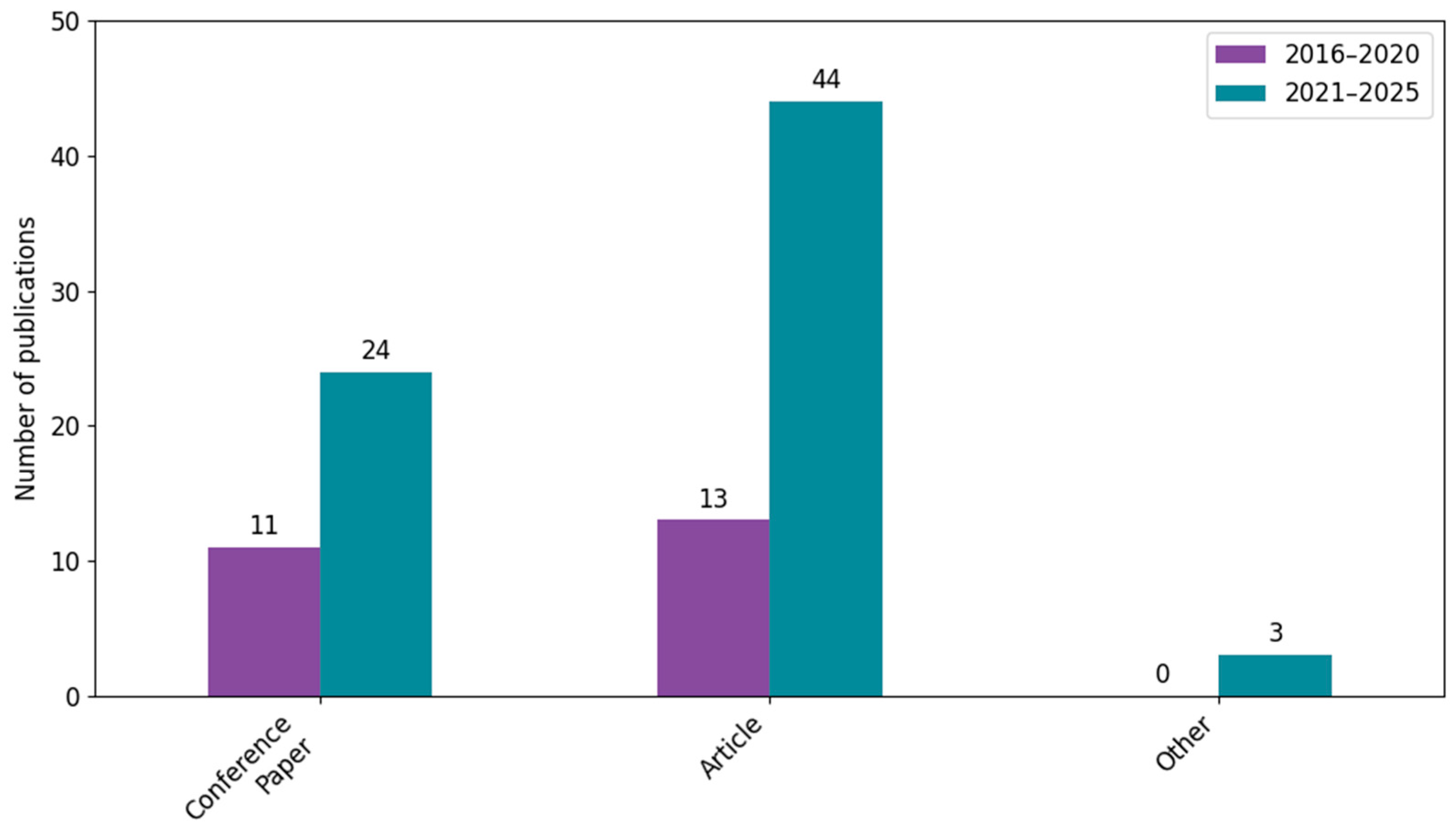
| Conference Paper | 11 | 24 | 35 | 36.84 |
| Article | 13 | 44 | 57 | 60.0 |
| Other | 0 | 3 | 3 | 3.16 |
| Artificial Intelligence | ||||
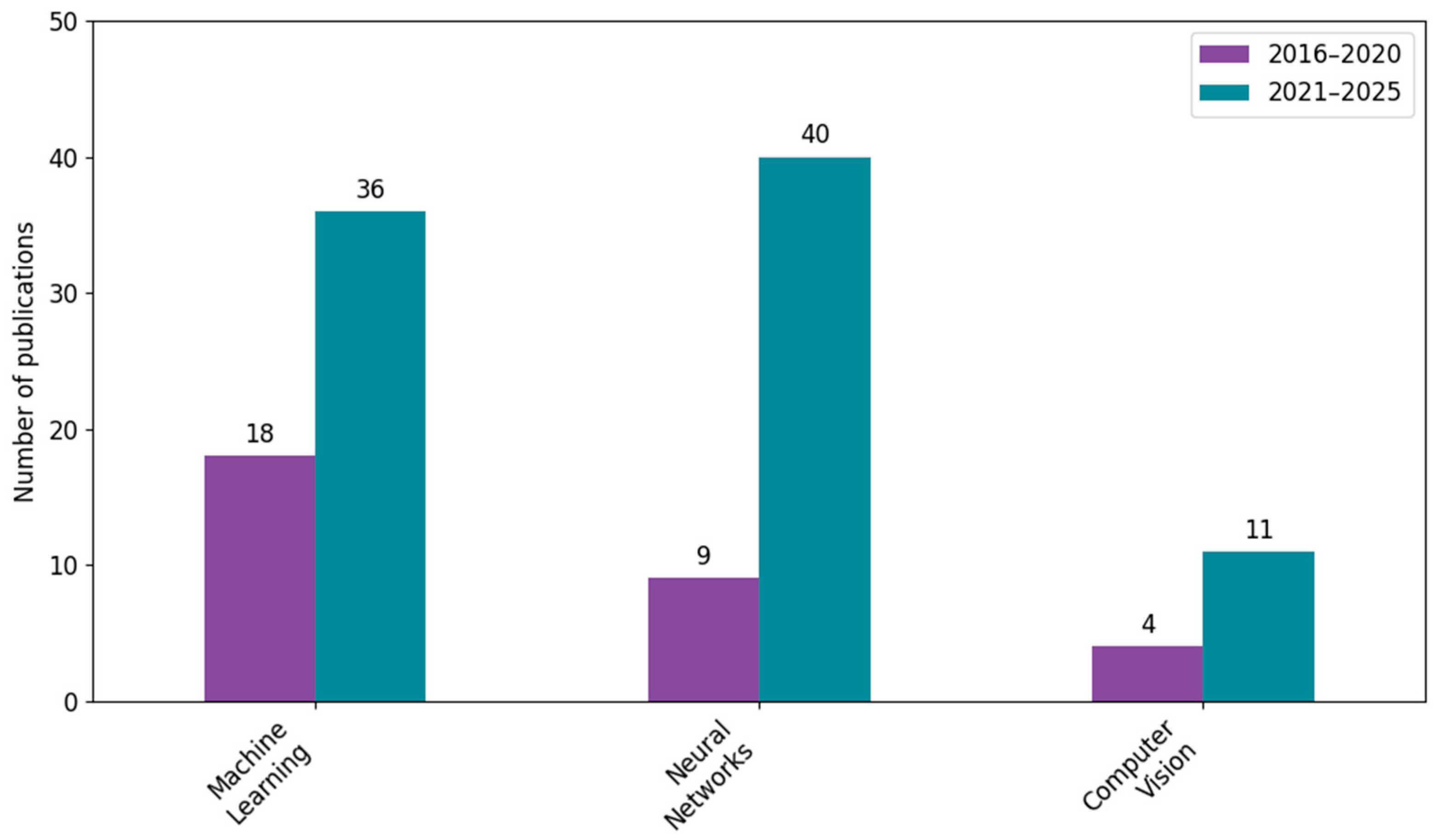
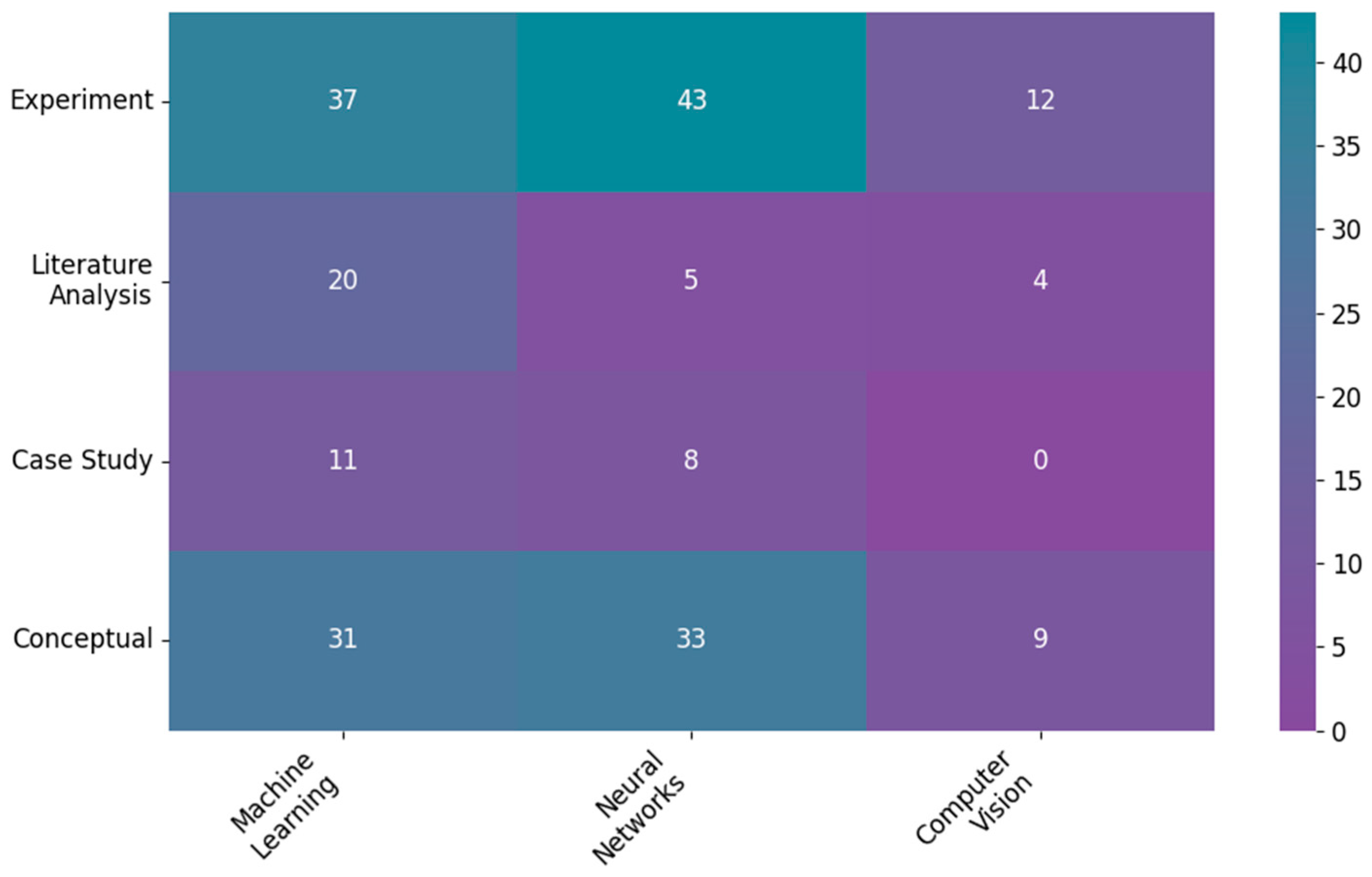
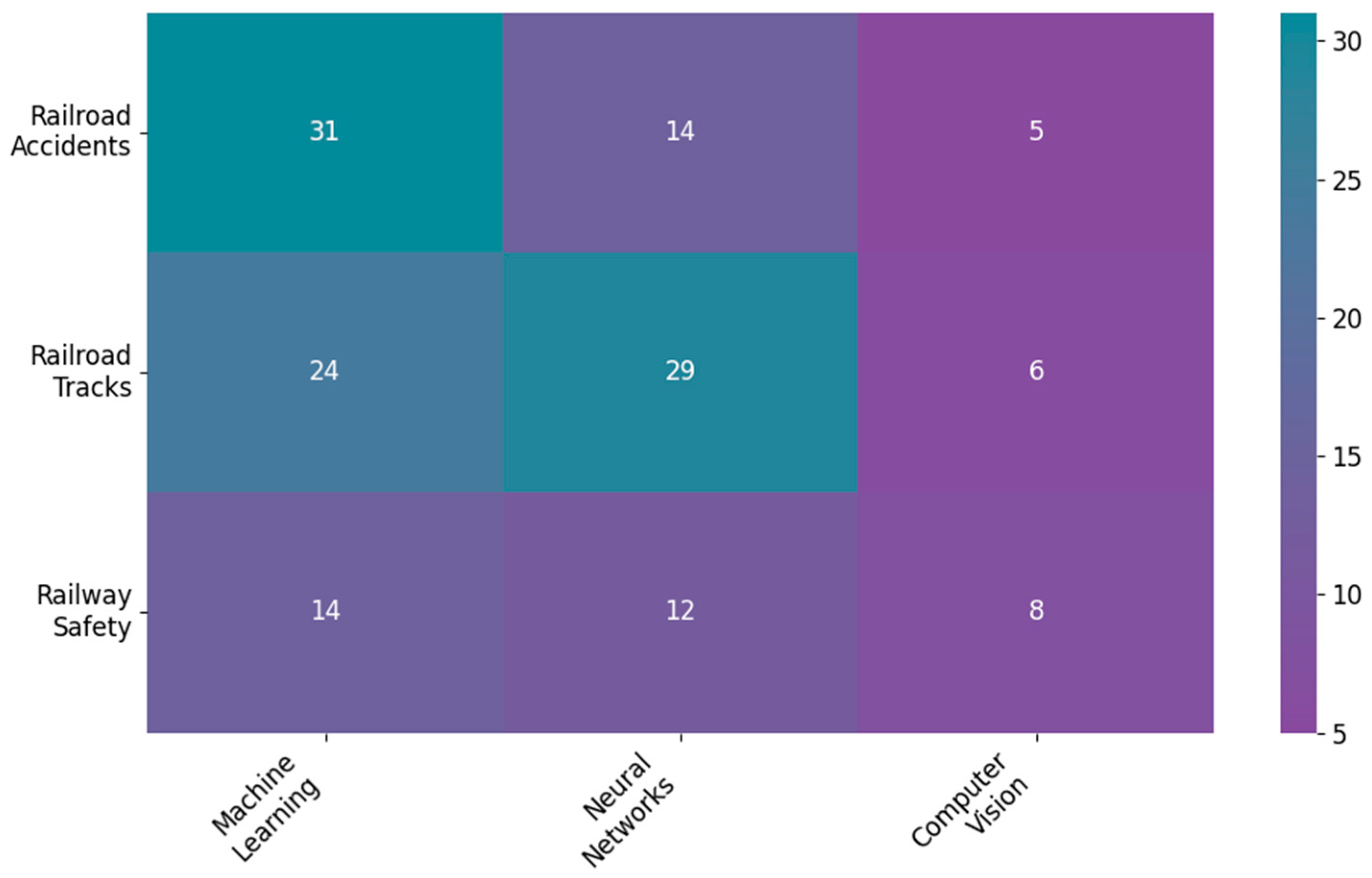
| Machine Learning | 18 | 36 | 54 | 56.84 |
| Neural Networks | 9 | 40 | 49 | 51.58 |
| Computer Vision | 4 | 11 | 15 | 15.79 |
| Railway Safety | ||||
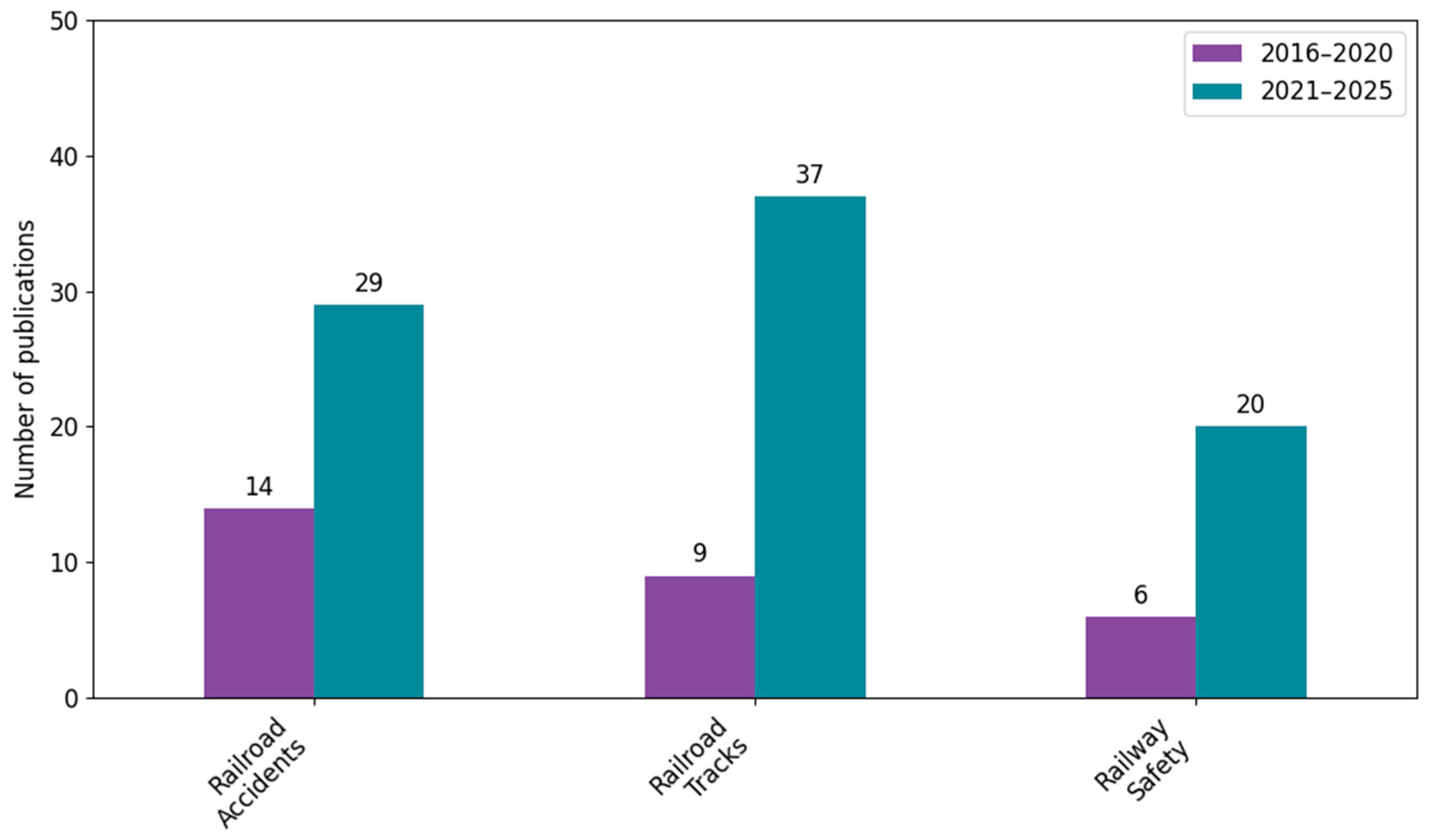
| Railroad Accidents | 14 | 29 | 43 | 45.26 |
| Railroad Tracks | 9 | 37 | 46 | 48.42 |
| Railway Safety | 6 | 20 | 26 | 27.37 |
| Research Methodology | ||||
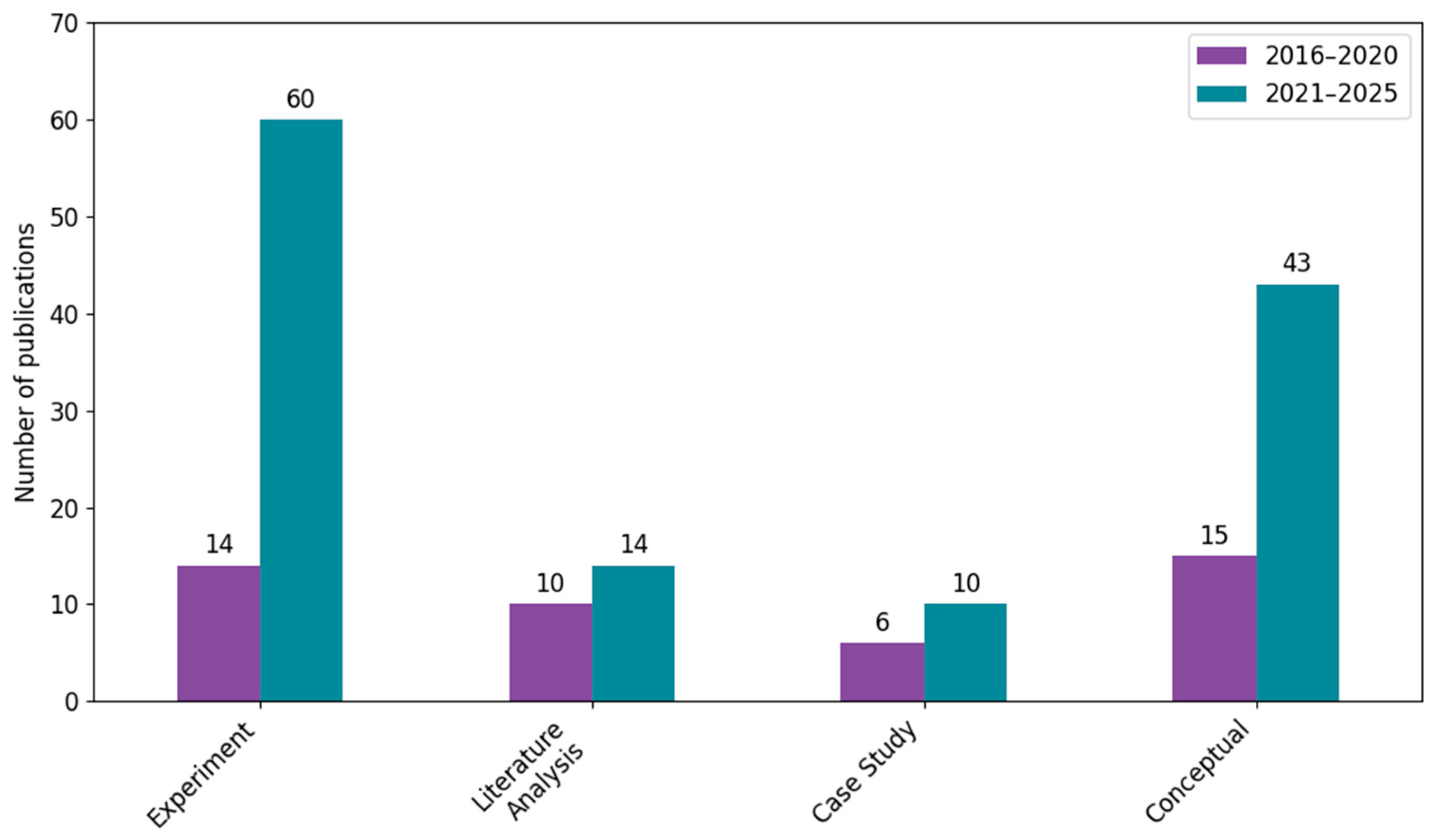
| Experiment | 14 | 60 | 74 | 77.89 |
| Literature Analysis | 10 | 14 | 24 | 25.26 |
| Case Study | 6 | 10 | 16 | 16.84 |
| Conceptual | 15 | 43 | 58 | 61.05 |
| Country | 2016–2020 | 2021–2025 | All Years | Share [%] |
|---|---|---|---|---|
| All countries | 24 | 71 | 95 | 100.0 |
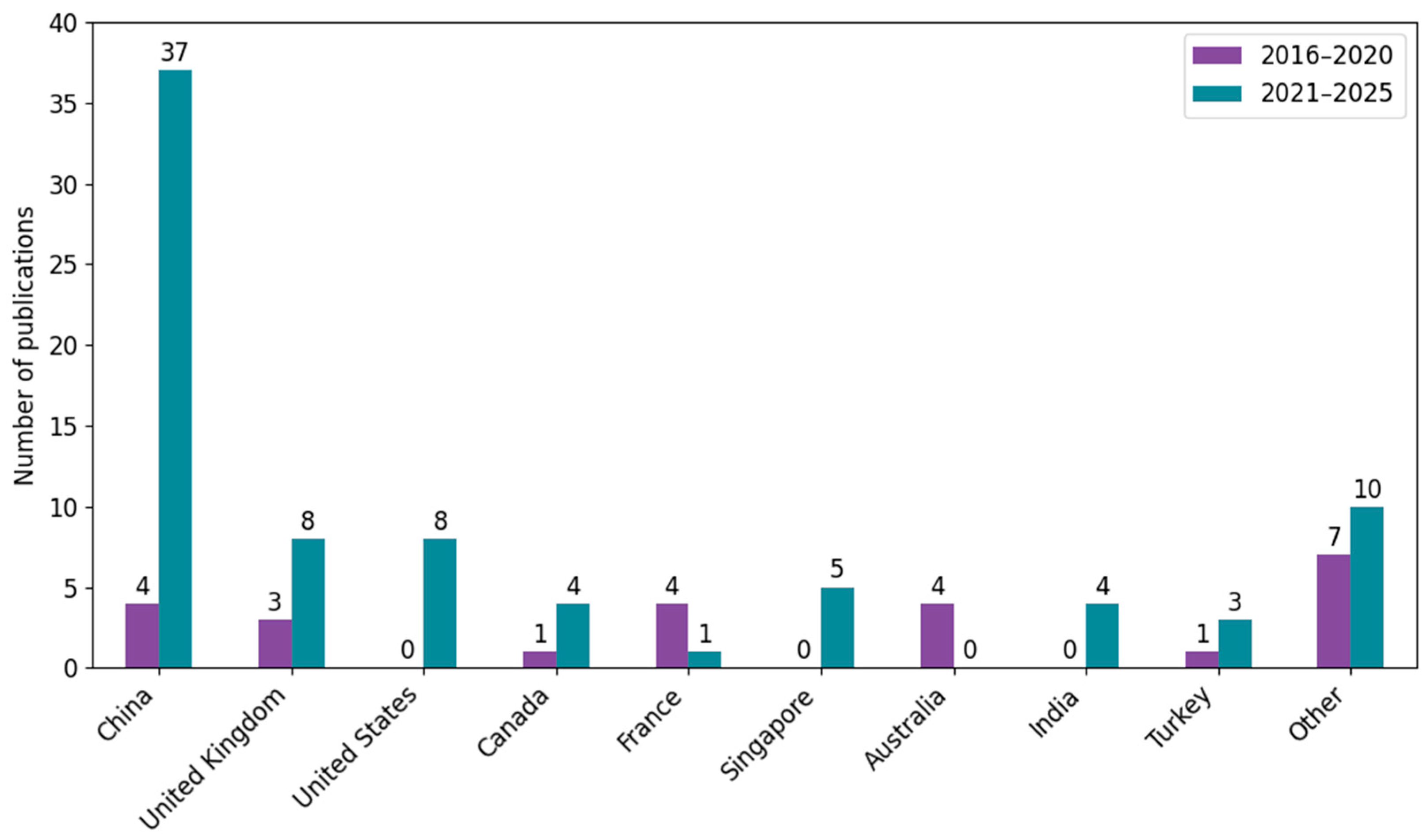
| China | 4 | 37 | 41 | 43.16 |
| United Kingdom | 3 | 8 | 11 | 11.58 |
| United States | 0 | 8 | 8 | 8.42 |
| Canada | 1 | 4 | 5 | 5.26 |
| France | 4 | 1 | 5 | 5.26 |
| Singapore | 0 | 5 | 5 | 5.26 |
| Australia | 4 | 0 | 4 | 4.21 |
| India | 0 | 4 | 4 | 4.21 |
| Turkey | 1 | 3 | 4 | 4.21 |
| Other | 7 | 10 | 17 | 17.89 |
| Indicator | Value | Explanation |
|---|---|---|
| HHI (0–1) | 0.2524 | Sum of squares of countries’ shares in the corpus; a measure of geographical concentration. |
| HHI (0–10,000) | 2524 | Conversion of HHI to a scale of 0–10,000 used in cross-disciplinary analyses. |
| Share of the three largest countries (%) | 63.16 | Cumulative participation of three major research centers. |
| Number of publications (n) | 95 | The total sample size during the analyzed period. |
Disclaimer/Publisher’s Note: The statements, opinions and data contained in all publications are solely those of the individual author(s) and contributor(s) and not of MDPI and/or the editor(s). MDPI and/or the editor(s) disclaim responsibility for any injury to people or property resulting from any ideas, methods, instructions or products referred to in the content. |
© 2026 by the authors. Licensee MDPI, Basel, Switzerland. This article is an open access article distributed under the terms and conditions of the Creative Commons Attribution (CC BY) license.
Share and Cite
Frej, D.; Pawlik, L.; Wilk-Jakubowski, J.L. Machine Learning, Neural Networks, and Computer Vision in Addressing Railroad Accidents, Railroad Tracks, and Railway Safety: An Artificial Intelligence Review. Appl. Sci. 2026, 16, 1184. https://doi.org/10.3390/app16031184
Frej D, Pawlik L, Wilk-Jakubowski JL. Machine Learning, Neural Networks, and Computer Vision in Addressing Railroad Accidents, Railroad Tracks, and Railway Safety: An Artificial Intelligence Review. Applied Sciences. 2026; 16(3):1184. https://doi.org/10.3390/app16031184
Chicago/Turabian StyleFrej, Damian, Lukasz Pawlik, and Jacek Lukasz Wilk-Jakubowski. 2026. "Machine Learning, Neural Networks, and Computer Vision in Addressing Railroad Accidents, Railroad Tracks, and Railway Safety: An Artificial Intelligence Review" Applied Sciences 16, no. 3: 1184. https://doi.org/10.3390/app16031184
APA StyleFrej, D., Pawlik, L., & Wilk-Jakubowski, J. L. (2026). Machine Learning, Neural Networks, and Computer Vision in Addressing Railroad Accidents, Railroad Tracks, and Railway Safety: An Artificial Intelligence Review. Applied Sciences, 16(3), 1184. https://doi.org/10.3390/app16031184