Featured Application
The developed temperature-dependent non-linear behavior model for a PVC geomembrane can be directly implemented in numerical modeling software, such as FLAC2D, to predict the mechanical performance and stability of geomembrane-lined slopes in dams and reservoirs. The model enables engineers to evaluate the impact of thermal variations and cyclic heating on geomembrane tensile response and slope stability, improving the design reliability of geosynthetic lining systems in warm or arid climates.
Abstract
The mechanical response of geomembranes in hydraulic structures is strongly influenced by temperature variations, which alter both material stiffness and interface shear strength behavior. This study develops a non-linear, temperature-dependent tensile behavior constitutive model for a polyvinyl chloride (PVC) geomembrane and evaluates its implications for the stability of geomembrane-lined reservoir slopes. The empirical relationship was calibrated using tensile tests reported in literature for temperatures between 10 °C and 60 °C, reproducing the observed non-linear softening and modulus reduction with increasing temperature. A classical thermal dilation formulation was incorporated to simulate cyclic thermal expansion and contraction. The constitutive and thermal formulations were implemented in FLAC2D and applied to a 2H:1V covered geomembrane slope representative of dam lining systems. The results show that temperature-induced softening significantly increases tensile strain within the geomembrane. The model also shows that the lower surface interface friction angle of the geomembrane plays a significant role in the slope stability. Thermal cycle analysis demonstrates the accumulation of efforts resulting from the fatigue of the geomembrane. The proposed model provides a practical framework for incorporating thermo-mechanical coupling in design analyses and highlights the necessity of accounting for realistic thermal conditions in assessing the long-term stability of geomembrane-lined reservoirs.
1. Introduction
Geomembranes (GMBs) are widely used in hydraulic works such as dams and reservoirs, primarily as impermeable barriers to control seepage [1,2]. Among the various polymeric geomembranes, polyvinyl chloride (PVC) is widely used for its flexibility, ease of installation, and good mechanical adaptability to surface irregularities [1]. However, the mechanical properties of PVC geomembranes are strongly influenced by environmental factors such as temperature, ultraviolet (UV) exposure, and long-term aging [1,3,4,5,6,7,8]. When installed on reservoir slopes, geomembranes may experience a wide range of surface temperatures depending upon their level of exposure to the environment [2], conditions under which their tensile behavior, interface shear strength, and stability can change significantly [1,9,10,11].
Temperature has been shown to alter the tensile response of PVC geomembranes in both stiffness and strength. An exposed geomembrane heated by direct solar radiation can experience temperature variations of up to 50 °C based on its color and the season, according to laboratory studies with small sample areas and small-to-medium-scale field studies [12,13,14,15]. Zhang et al. [1] conducted axial tensile tests at temperatures from −40 °C to 60 °C and reported a marked decrease in the Young’s modulus and tensile strength, accompanied by an increase in elongation at break as temperature increased. Amorim et al. [16] found similar trends for unplasticized PVC, noting a 67.6% reduction in maximum tensile strength and a 56.9% reduction in modulus between −20 °C and 60 °C. Lodi and Bueno [17] observed that 30 months of exposure to higher temperatures resulted in a slight increase in stiffness and tensile resistance and some reduction in deformability for PVC geomembranes (especially in the smallest thicknesses). Such temperature sensitivity suggests that constitutive models for PVC GMB should explicitly incorporate thermal effects.
Efforts to numerically model the mechanical behavior of geomembranes have advanced significantly in recent years. Eldesouky & Brachman [18] developed a visco-plastic constitutive model for high-density polyethylene (HDPE) geomembranes that incorporated temperature effects, strain-rate dependency, and non-linear hardening, demonstrating its capability to capture tensile creep and relaxation under variable thermal conditions. Although most numerical formulations have been applied to HDPE, their modeling approaches are relevant to PVC and highlight the need for temperature-dependent, non-linear material models.
The sensitivity of polymer properties to temperature is well-established. The coefficient of friction increase [19,20], modulus decrease [21,22], and relaxation time decrease [23] with a rise in temperature. The interface between a geomembrane and a geotextile plays a critical role in performance linked with temperature, particularly for slope stability. Karademir and Frost [10] reported that for smooth PVC geomembranes against nonwoven geotextiles, a rise in temperature from the typical laboratory test temperature of 21 °C to an equivalent in situ temperature of 50 °C results in a minimum of a 14% increase in the peak and post-peak contact friction values. For specific material combinations, the magnitude of the increase can exceed 20% and reach up to 22%. Their work [10], which specifically examined high temperatures, has reached a broad conclusion that throughout the range of normal stress and material evaluated, the shear behavior of the interface measured at room temperature produces conservative estimates for interface friction at higher temperatures. Akpinar and Benson [9] found that an increase in temperature leads to an increase in both the peak and post-peak friction angles. Typically, the friction angle at the tested interfaces varies by 0.06–0.08° per °C. At each normal stress, the strength of the contact increases with increasing temperature. Under all shear rates, raising the temperature leads to a rise in interfacial strength. The observed temperature sensitivity is in line with the phenomenon of polymer softening, characterized by a decrease in stiffness as the temperature rises [21,22]. This phenomenon leads to enhanced flow of the polymer for a given stress and an increase in the contact area [23]. Lin et al. [11] observed that shear strength peaked between 30 °C and 40 °C before decreasing at higher temperatures, indicating a non-monotonic temperature effect. Such trends must be integrated into stability assessments to avoid misestimating safety factors.
In addition to short-term thermal effects, the long-term durability of PVC geomembranes is also affected by thermal effects. Luciani et al. [8] identified plasticizer loss as the main degradation mechanism, leading to increased stiffness, reduced elongation, and shrinkage. Koerner et al. [6] and Blanco et al. [3] reported that reinforced PVC-P geomembranes could remain watertight despite losing up to 70% of their plasticizer, but with significant changes in mechanical properties. UV exposure accelerates degradation processes, including dehydrochlorination and oxidation [5], further impacting service life.
Slope stability analyses have shown the importance of accurately modeling geomembrane mechanical behavior and interface properties. Poulain et al. [2], in a survey of 71 high-altitude reservoirs in France, reported that nearly half of PVC-P and HDPE-lined reservoirs experienced major watertightness issues, often linked to mechanical damage from ice, coarse support layers, and partial protective covers. Pasten and Santamarina [24] investigated the ratcheting displacement of exposed geomembranes on slopes subjected to thermal cycles using experimental and numerical methods. They found that the thermal expansion is constrained by friction against the underlying soil. Low flexural stiffness, high thermal expansion, and frictional restraint lead to the formation of wrinkles, especially at imperfections such as creases, seams, and overlaps [15,25,26], and may induce gradual slippage when geomembranes are placed on slopes.
Despite the extensive amount of research on geomembrane materials and geosynthetic lining systems, existing studies have generally addressed either the thermo-mechanical behavior of geomembranes at the material scale or the stability of geomembrane-lined slopes at the structural scale, often assuming temperature-independent mechanical properties. Furthermore, most of the numerical studies are limited to landfill systems. In addition, the design of geosynthetic lining systems is usually carried out through simple mathematical design protocols, such as force equilibrium, etc. Experimental investigations have demonstrated that PVC geomembranes exhibit pronounced non-linear and temperature-dependent tensile behavior, while numerical and design-oriented studies commonly adopt simplified linear elastic models that do not explicitly account for thermal softening or thermally induced strain. Moreover, the combined influence of temperature-dependent material non-linearity and interface-controlled load transfer on the stability of reservoir slopes remains insufficiently explored. Consequently, the central research questions addressed in this study are as follows. (i) How can a non-linear constitutive law for PVC geomembranes be formulated to explicitly incorporate temperature effects within a practical modeling framework? (ii) To what extent do temperature-induced changes in geomembrane stiffness and strain response influence the mechanical behavior and qualitative stability of geomembrane-lined dam slopes under elevated temperatures and thermal cycles? By addressing these questions, the present work aims to bridge the gap between laboratory-scale thermo-mechanical characterization and engineering-scale stability assessment of geomembrane lining systems.
The present study addresses the need for a realistic constitutive framework for PVC geomembranes by developing a non-linear behavior model that incorporates temperature effects observed in experimental testing. This study leveraged the experimental data obtained by Zhang et al. [1] in their study on the tensile behavior response of a PVC GMB to ambient temperature. The developed model is applied to the stability analysis of geomembrane-lined reservoir slopes subjected to temperatures between 20 °C and 60 °C, a range representative of field conditions in most hydraulic structures. The aim is to provide both an accurate description of PVC mechanical response and a practical tool for assessing the safety of geomembrane-lined slopes under thermal loading.
2. Materials and Methods
The material addressed in this research is PVC GMB. This material was selected because it is the most common type of GMB used on hydraulic structures in the US and Europe [27]. In a study on the geomembrane lining systems of mountain reservoirs in France, Poulain et al. [2] showed that most of the reservoirs are very often made watertight artificially by a PVC geomembrane.
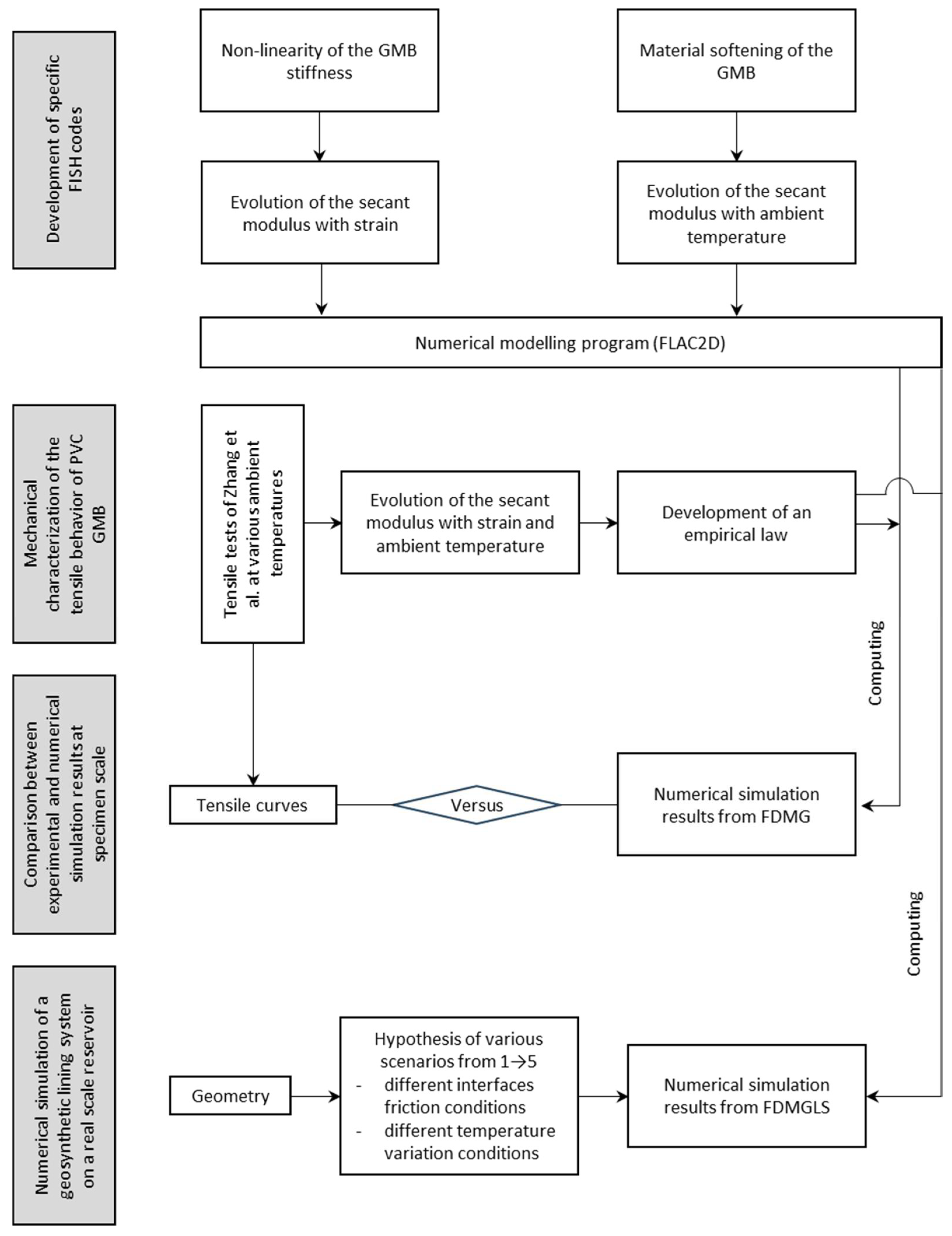
To achieve the aims of the research, the methodology is divided into several steps. For the ease of readers, the methodology is explained through an easy-to-read workflow chart, as shown in Figure 1.
Figure 1.
Workflow chart explaining the employed methodology.
2.1. Zhang’s Experiments Related to PVC GMB’s Tensile Behavior
Zhang et al. [1] tested a PVC geomembrane in uniaxial tension at different ambient temperatures ranging from −40 °C to 60 °C. The findings indicated that as the temperature decreases, the Young’s modulus increases, and the linear interval of stress and strain decreases. Conversely, when the temperature increases, the opposite effect is observed. The study findings also indicated that the temperature is the main governing variable influencing the mechanical characteristics of polymer material. The authors specifically note that “the Boltzmann function may precisely represent the change in Young’s modulus of PVC GMB with temperature” and recommend using several representative temperatures for design and numerical simulation, but the function gives a unique value for the Young’s modulus at a specific temperature which does not vary with strain. Hence, the calibration of an empirical relationship based on the experimental data seems to be a more accurate choice.
Zhang et al. [1] also showed that the profile of Young’s modulus variation changes with temperature. There is an abrupt increase in the Young’s modulus as soon as the temperature reaches sub-zero, and hence a very steep profile is observed for lower temperatures. For higher temperatures, the change in Young’s modulus is not very profound [1]. Hence, as the tensile strength increases with the decrease in temperature, and it specifically and profoundly increases for temperatures reaching 0 °C or lower, resulting in more conservative tensile resistance, we will focus on the calibration of an empirical relationship for temperatures ranging from 10 °C to 60 °C. This is also a more reasonable choice, since most of the reservoirs around the globe will be realistically exposed to this range of ambient temperatures. Furthermore, as described earlier that the interface shear strength between a geomembrane (GMB) and a geotextile (GTX) increases with an increase in temperature, temperatures lower than sub-zero are thus maybe more interesting to simulate, but unfortunately, all relevant studies only focus on temperatures greater than 0 °C [9,10,11]. As a consequence, the selected temperature range makes more sense. To ensure maximum security (conservative results), we will use the lowest tested angle of friction observed in this temperature range.
2.2. FLAC2D Modelisation
FLAC2D (Fast Lagrangian Analysis of Continua in 2 Dimensions) is an explicit finite difference program for the geotechnical analysis of soil, rock, and structural support systems [28]. It is particularly suited for modeling the non-linear behavior of geomaterials under static or dynamic loading, and can incorporate user-defined constitutive models. FLAC2D employs a Lagrangian mesh that can deform with the material, enabling the simulation of large strains and complex contact interactions, such as those occurring at geomembrane–soil or geomembrane–geotextile interfaces. Its flexibility allows for the integration of temperature-dependent material properties and interface models, making it a suitable platform for assessing the stability of geomembrane-lined slopes under thermal loading conditions.
The experimental data used for the calibration of the empirical relationship comes from the true-stress-true-strain graphs produced by Zhang et al. [1] in their study. The mathematical equation to obtain true strain can be expressed as:
where
- = engineering strain.
And:
where
- = gauged length of the specimen at that instant of the test;
- = initial gauged length of the specimen.
The cross-sectional area of the specimen at any instant of the uniaxial tensile experiment can be calculated as:
where
- = width of the specimen at any instant;
- = thickness of the specimen at any instant.
And:
where
- = initial width and thickness, respectively, at zero strain;
- = Poisson’s ratio in respective direction of width and thickness.
Finally, the equation for true stress can be written as:
Supposing the material to be isotropic, which is an appropriate assumption for a PVC geomembrane, as can be confirmed from the study of Zhang et al. [1] and Nesrin et al. [29]:
where
Also, considering the true-stress-true-strain relationship under uniaxial traction:
Since the temperature during an experiment carried out by Zhang et al. [1] remains constant, the empirical relationship calibrated based on these experiments does not take into account the thermal dilation of the PVC geomembrane when the geomembrane is subjected to thermal cycles.
To include the thermal efforts in the model, thermal strains in the PVC geomembrane can be calculated using the linear coefficient of thermal expansion relation:
where
- = thermal strain;
- = coefficient of linear thermal expansion;
- = reference temperature.
This approach is the standard formulation for small, uniform thermal strains in isotropic polymers, as formalized in ASTM D696 [30] and widely adopted in thermo-mechanical analyses of geomembranes [12,15,24,28]. It should be noted that this formulation comes into play only if thermal cycles are imposed, and has no role if the temperature during the test is constant. For PVC-P geomembranes, the values can range from 5 × 10⁻⁵ to 20 × 10−5 K−1, though exact values vary by formulation and plasticizer content [31,32,33,34,35]. In the present work, a value of = 7.0 × 10⁻⁵ K−1 is adopted, based on our experience and by consulting the online libraries for commonly used values (estimated from general PVC properties) [36,37,38]. This choice ensures that the modeled thermal strain effects are realistic for most of the PVC products, acknowledging that actual values may be lower or higher for the tested geomembrane. However, it is important to mention that the coefficient of thermal expansion depends on temperature [39,40] and that we are assuming that this coefficient remains constant within the studied temperature range (20 °C to 60 °C).
The total strain hence observed at any instant is a combination of the mechanical and thermal strain at any time step. The general approach of imposing a thermal elongation and resolving the constrained membrane response against interface friction and anchorage, follows the experimental/numerical protocol used in Pasten and Santamarina [24], who demonstrated that cyclic thermal elongation constrained by interface friction causes ratcheting displacements on slopes, and identified normalized parameters that control accumulation rate. In the numerical simulation in FLAC2D, the thermal load is applied as a sinusoidal wave between 20 °C and 60 °C. The higher frequency was selected to accelerate the impacts of thermal cycles on the physical behavior of the GMB.
Two models were developed in FLAC2D based on the empirical relationship calibrated on the experimental data of Zhang et al. [1]:
- A 2D Finite Difference Model at Geomembrane Scale (FDMG) to replicate the results of the tensile tests of Zhang et al. [1];
- A 2D Finite Difference Model at GLS Scale (FDMGLS) to study the slope stability of a geosynthetic lining system on a dam slope.
For the FDMG, the GMB was modeled as a 2D beam element having its length equal to the gauge length used in the experiments by Zhang et al. [1]. The GMB was fixed at the bottom end, while a tensile test speed was imposed at the top end. The properties and parameters of the GMB were adapted from the experiments of Zhang et al. [1]. The details of the FDMGLS are presented in Section 2.3.
2.3. Presentation of the Practical Application for Studying the Stability of PVC Geomembranes on Dam Slopes
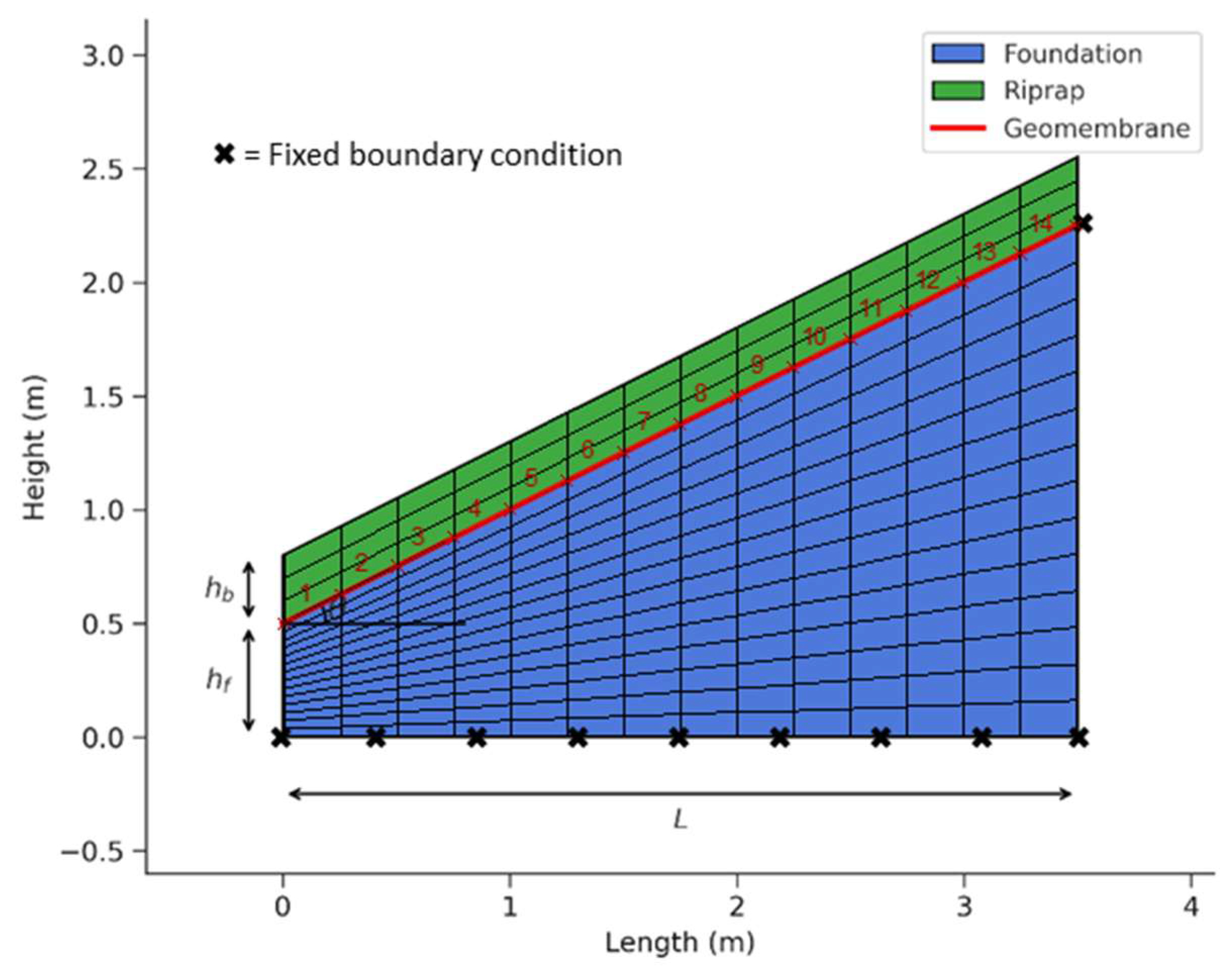
To provide the analysis of slope stability, a simple dam geometry with a 2H:1V slope was used, for conservative results, although in the field, a slope of 2.5H:1V to 3H:1V is mostly used [2]. The modeled geometry is shown in Figure 2.
Figure 2.
FDMGLS geometry. The numbers correspond to the corresponding number of the geomembrane element. The angle ‘θ’ correspond to the inclination of the slope.
The numerical model (FDMGLS) was developed using FLAC2D under plane-strain conditions. The geometry consists of three main components: a foundation layer, a riprap layer, and a geomembrane located at their interface.
Both the foundation and riprap layers were discretized using a structured mesh composed of quadrilateral finite-difference zones. Due to the inclined upper boundary of the foundation, the zones are geometrically distorted and non-rectangular. The foundation extends horizontally over a length of 3.5 m, with its upper boundary inclined at an angle of 26.6° relative to the horizontal. The foundation is defined as a rigid solid block that does not deform. The riprap layer has a constant thickness of 0.3 m.
A uniform mesh size of approximately 0.25 m was adopted in the horizontal direction, resulting in a consistent horizontal mesh across the model, while the vertical mesh size is non-uniform and varies with elevation. The same number of mesh elements in both the horizontal and vertical direction for the foundation was used. Hence, the foundation has a closer (more refined) mesh at the toe as compared to the crest (mesh elements change their shape along the foundation, in view of the model’s geometry). Furthermore, since the riprap was only 0.3 m thick, a finer mesh size of 0.1 m in the vertical direction was hence used for the riprap.
The geomembrane was modeled as a beam element in between the foundation and riprap. This is a common approach for analyzing geosynthetic lining elements in a 2D finite element or finite difference modeling [41,42,43,44]. The geomembrane has been discretized into fourteen elements (the same horizontal mesh size as the foundation and riprap) to improve the accuracy of the calculations. Its nodes coincide with the grid points of the adjacent continuum zones to ensure displacement compatibility. Interface elements were introduced on both sides of the geomembrane to simulate contact behavior between the geomembrane and the surrounding geotextiles.
Concerning the boundary conditions, the geomembrane was fixed at the top end (crest), and the foundation was fixed at the bottom end, while the riprap was not restrained and hence free to deform under loading (see Figure 2). Gravitational loading was applied progressively to reach equilibrium.
The geomembrane deforms due to the load of the riprap and its own weight (no other external loads are applied). Furthermore, all the materials defined in the model are homogenous. It can be seen from Figure 2 that although the overall model is a 2D model, the deformation of the geomembrane is essentially 1D (uniaxial forces), and hence the mechanical efforts developed in the geomembrane are per unit length in the out of plane direction.
For simplicity, the geotextile on both sides of the geomembrane has been modeled as an interface element. Hence, the geomembrane has an upper and lower interface that replicates its interaction with a geotextile by considering the interface friction angle between the two elements as a behavior-defining property. Implicitly representing the geotextile layers as interface elements, with a defined frictional behavior, provides an efficient means to capture the principal tensile interactions without over-specifying the material properties of the geotextiles, aligning with the objective of predicting tensile forces in the geomembrane while retaining computational efficiency and robustness in the presence of interface slip or micro-slippage between the geomembrane (GMB) and geotextiles (GTX). Figure 3 shows the relevant simplifications made in our FDMGLS compared to the actual field condition.
Figure 3.
Comparison of the different material layers of an actual geosynthetic reservoir lining system to its definition in our FDMGLS.
Laboratory studies show that interface shear behavior is sensitive to temperature: Karademir & Frost [10] measured increases in peak and post-peak interface friction with temperature (21 °C to 50 °C) for PVC-geotextile interfaces, and Lin et al. [11] reported that GMB-GTX peak shear strength can increase up to an optimum around 30 °C to 40 °C, then decrease at higher temperatures depending on texture. For a conservative approach, a commonly measured constant value of the friction angle at room temperature for a PVC GMB was used in the numerical modeling (FDMGLS).
In the case of the structure in question (basin or water reservoir), welds are generally made every 2 m (1 roll of PVC geomembrane is 2 m wide), and the weld line follows the slope of the structure. Since a welded area of the geomembrane corresponds to an area where the geomembrane is practically twice as thick as the nominal thickness of the geomembrane, the tensile strength characteristics of a weld are greater than those of the geomembrane alone. Furthermore, as the welds are located at specific points across the entire surface of the geomembrane, it is reasonable not to take them into account in the modeling used in the study.
To be able to truly test the slope stability of a PVC GMB, various scenarios were tested, including the worst-case scenario where the angle of friction at the lower interface of the GMB is considered to be a few degrees less than that of the upper interface. This assumption of a worst-case scenario is realistic as it can occur at actual installation sites due to improper selection of materials, inefficient design, and/or installation errors.
The details of the properties used for the different materials can been seen in Table 1. The different scenarios are presented in Table 2.
Table 1.
FDMGLS parameters.
Table 2.
Description of the different tested scenarios.
The key assumptions adopted in the numerical analyses (FDMGLS) are summarized as follows. (i) All the materials are homogenous and isotropic. (ii) The geotextiles are accounted for through the contact properties of the foundation–GMB and riprap–GMB interfaces. (iii) Temperature-independent interface friction angles, Poisson ratio, and coefficients of thermal expansion are used. (iv) Rate-dependent or viscous effects are neglected. (v) The geomembrane is modeled as beam elements and fixed at the crest. (vi) The foundation is modeled as a non-deformable, solid element, and is fixed at the bottom. (vii) The riprap is 0.3 m thick and not restrained. (viii) A uniform mesh size of approximately 0.25 m was adopted in the horizontal direction, while the vertical mesh size is non-uniform and varies with elevation. (ix) The temperature range considered is from 20 °C to 60 °C.
3. Results and Discussion
3.1. Results at Specimen Scale
3.1.1. Calibration of an Empirical Relationship on Zhang’s Experiments
The experimental data from the true-stress–true-strain graphs of the research of Zhang et al. [1] was extracted to calculate the variation in secant modulus [] with strain. The calculation of this secant modulus from true-stress–true-strain graphs help to account for large deformations. It has been called the ‘secant modulus’ instead of the ‘Young’s modulus’ because it is calculated over the entire stress–strain curve, not just the initial slope. Therefore, purely from a mechanics perspective, this quantity cannot be called the Young’s modulus.
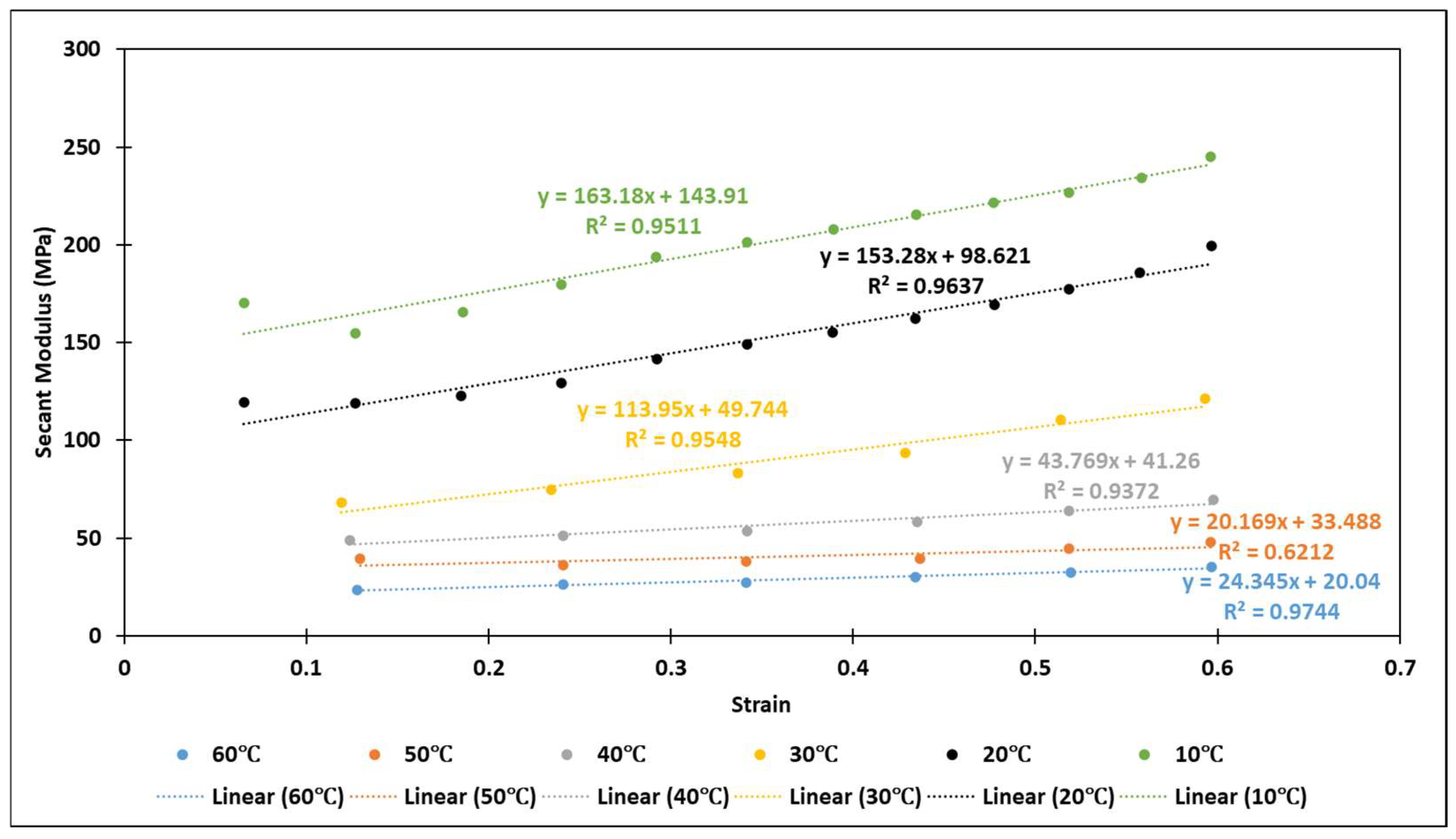
Linear fittings were made to the datasets to obtain the variation in secant modulus at each individual tested temperature, as can be seen from Figure 4. The variation in the secant modulus (Es) with strain, at a unique temperature, can be expressed as:
where
Es (ε) = αε + E0
- E0 = Equivalent secant modulus at no/zero strain;
- α = constant;
- ε = strain.
Figure 4.
Linear fittings (unique for one temperature) to the variation in secant modulus as a function of strain for a PVC GMB.
Figure 4.
Linear fittings (unique for one temperature) to the variation in secant modulus as a function of strain for a PVC GMB.

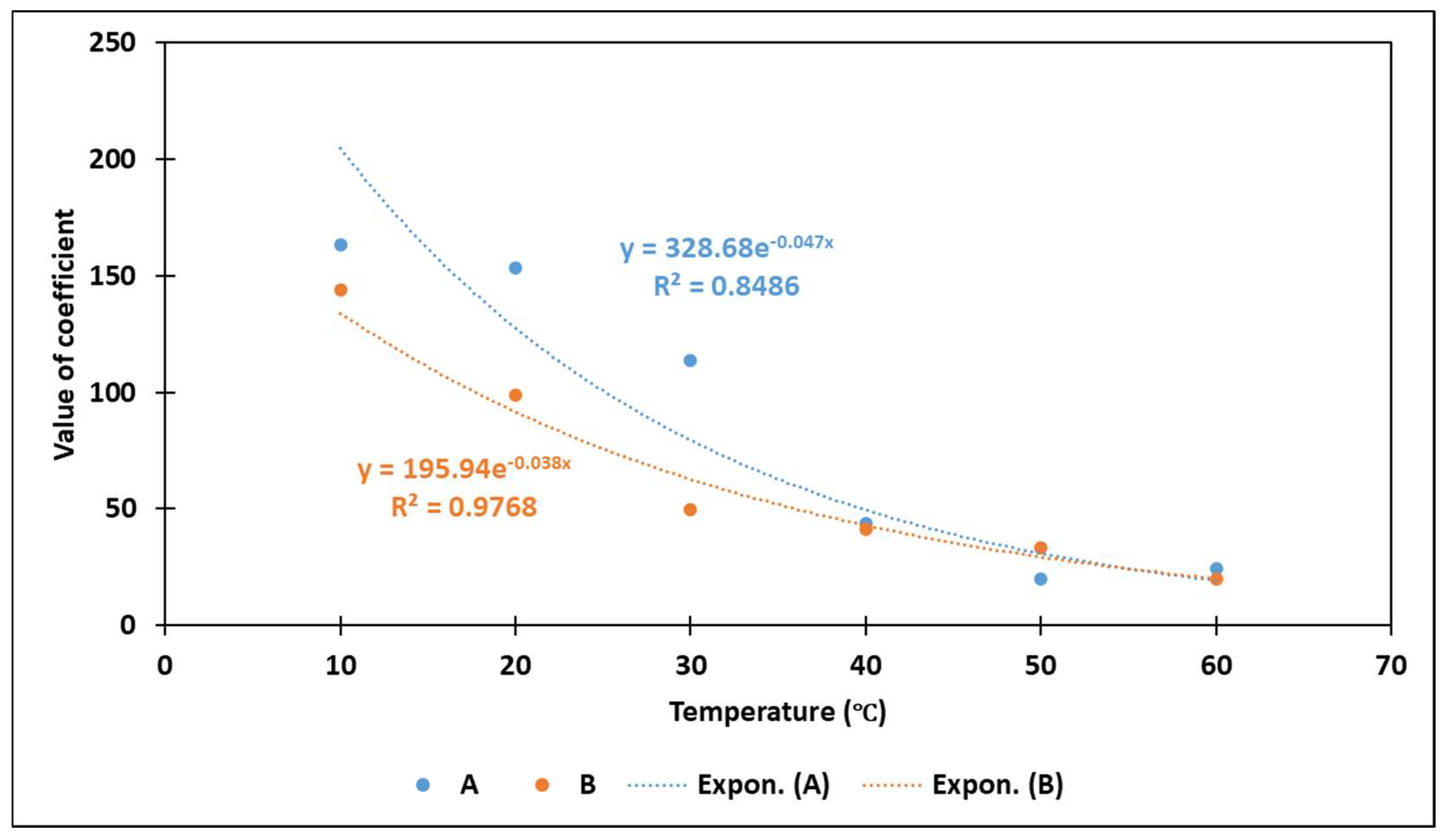
To obtain an empirical relationship that can model the variation in the secant modulus with both temperature and strain, an exponential fitting was made (see Figure 5) to the coefficients of the linear fittings shown in Figure 4. The variation in the secant modulus with strain and temperature can be expressed as:
where
Es (ε, T) = A(T) × ε + B(T)
- Es = the secant modulus;
- A and B = constants depending on temperature;
- ε = strain.
Figure 5.
Exponential fitting to the coefficients of linear fittings made to the secant modulus as a function of temperature for a PVC GMB.
Figure 5.
Exponential fitting to the coefficients of linear fittings made to the secant modulus as a function of temperature for a PVC GMB.

From the exponential fitting, we see that:
A(T) = 328.68e−0.047×T
And,
where
B(T) = 195.94e−0.038×T
The exponential function, e(x), calculates the value of ‘e’ to the power of x (‘e’ being the base of the natural logarithm).
The units of ‘A(T)’ and ‘B(T)’ are ‘MPa’, while the unit of ‘T’ is ‘°C’.
Thus, the final equation can be written as:
Es (ε, T) = 328.68e−0.047×T × ε + 195.94e−0.038×T
The above equation gives the value of secant modulus ‘Es’ in ‘MPa’.
In the empirical relationship proposed in Equation (17), the parameters A(T) and B(T) are expressed as an exponential decay with temperature. This expression is proposed because it provides the best fit to the experimental data used in the study by Zhang et al. [1]. Since this expression is not based on a physical model, other types of empirical or non-empirical relationships may exist to express the variation in the modulus as a function of strain and temperature.
It is important to mention that since FLAC considers area as a constant property during the calculation by default, the effect of area reduction can be included into the calculation of secant modulus (script writing) before the calculation of force. Hence, the empirical relationship implemented in FLAC becomes as follows:
Es (ε, T) = (328.68e−0.047×T × ε + 195.94e−0.038×T) × (1 − v × ε)2
In FLAC2D, this empirical relationship was implemented as a user-defined constitutive relation using FISH language script. FLAC2D’s support for custom constitutive models and large-deformation Lagrangian kinematics makes it suitable for this task [28].
It should be noted that Equation (19) is developed based on the experimental results of Zhang et al. [1], who used a specific PVC GMB. As the properties of a PVC GMB are strongly dependent on its composition (especially plasticizer content) and thickness, the parameters A(T) and B(T) of Equation (19) should be calibrated for each type of PVC GMB.
In addition, it is important to mention that Equation (19) assumes the Poisson ratio of the PVC GMB to be constant at any temperature. This is an assumption, since no data on the variation in the Poisson ratio of this PVC GMB is available from the research of Zhang et al. [1]. Since they used a specific value of the Poisson ratio for the calculation of their true stress, the same value was adopted in the article.
It is also important to mention that the proposed empirical relationship does not include explicit plasticity features such as a yield surface, flow rule, or irreversible strain variables. However, by relying on true stress–true strain data, the empirical relationship implicitly incorporates the effects of non-linear deformation observed experimentally, including large strains and cross-sectional reduction. The model therefore represents a phenomenological non-linear tensile response, rather than an elastic or elastoplastic constitutive model in the classical sense.
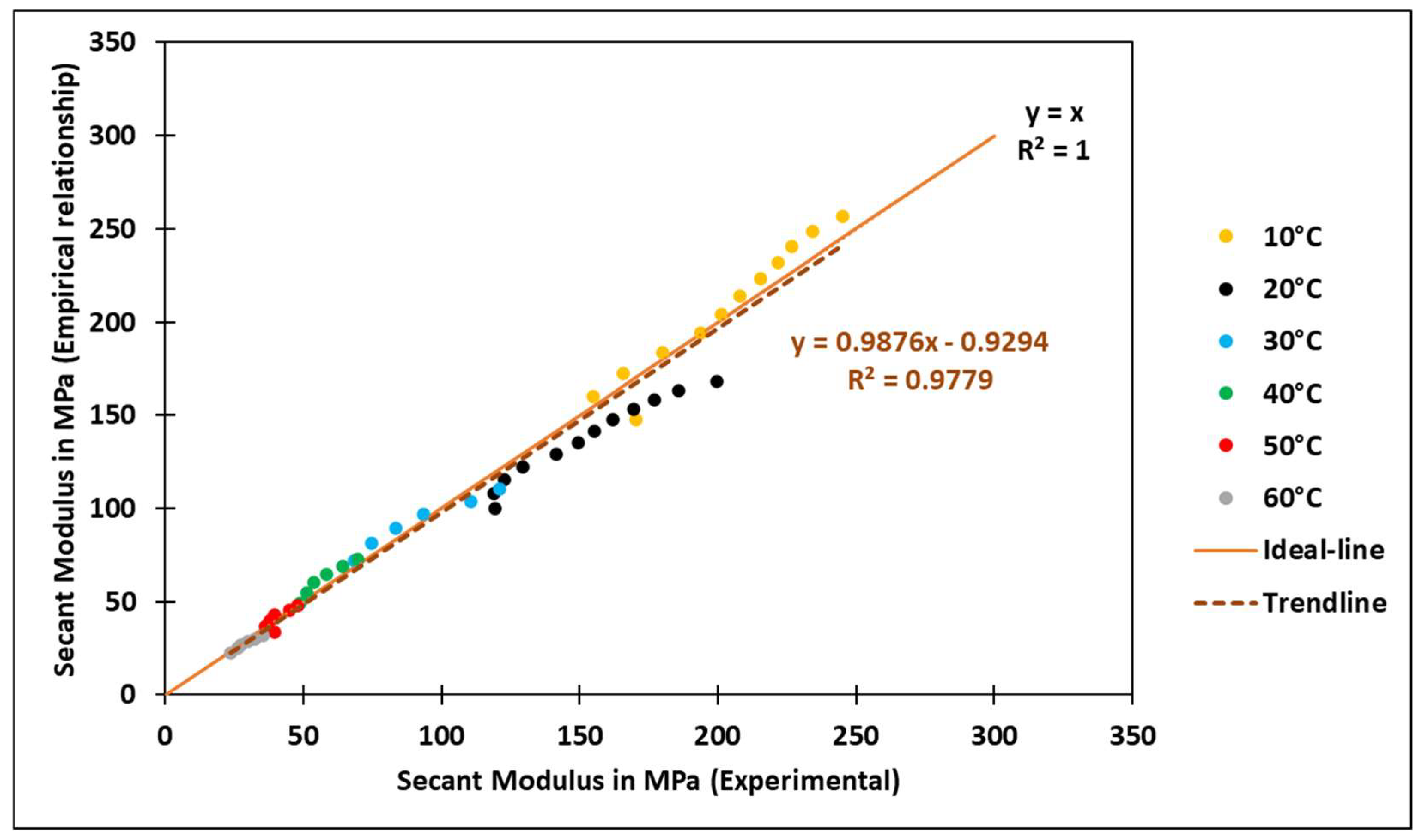
The empirical relationship was tested on the same range of temperatures and strains that were used for the calibration of the relationship initially. It produced pertinent results when compared to the original experimentation, as can be observed from Figure 6.
Figure 6.
Comparison of the secant modulus obtained from the calibrated empirical relationship to that of the actual experimentation.
3.1.2. Comparison of FDMG and Empirical Relationship Based on Zhang’s Experiments
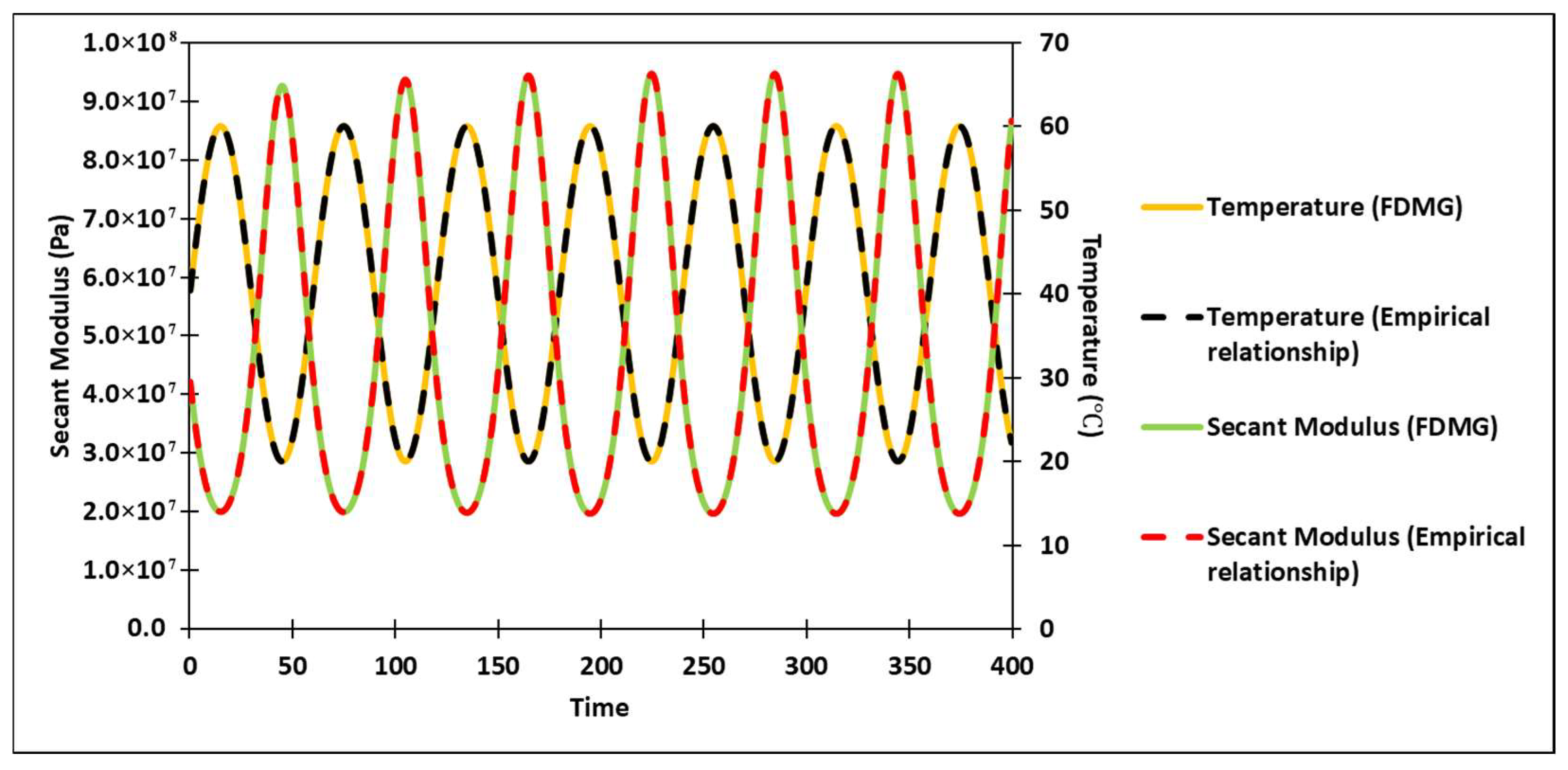
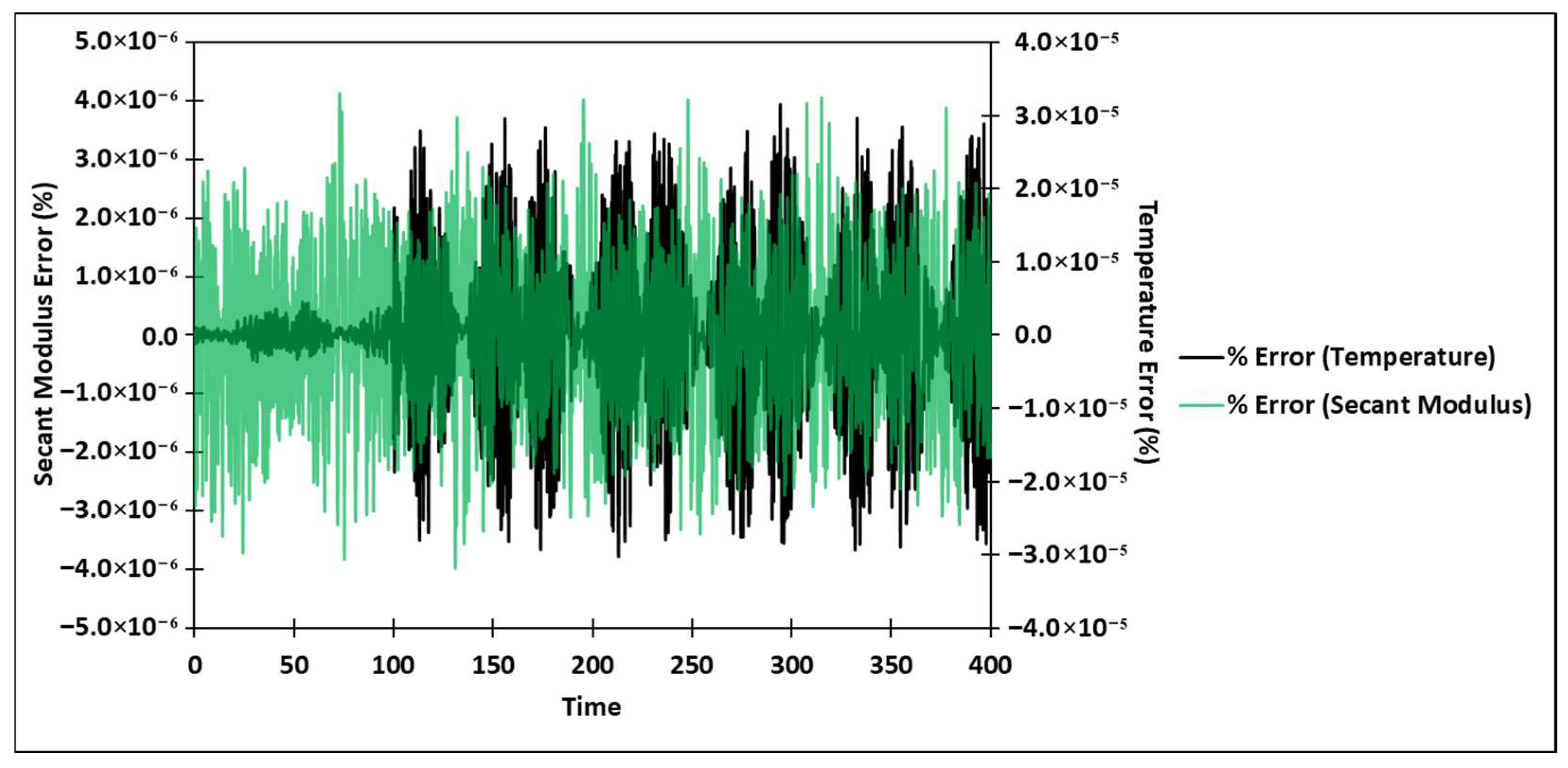
To ensure that the FDMG takes the scripted temperature change and hence the accompanied change in secant modulus into account, both the quantities were calculated for a calibration case (sinusoidal thermal load) from the empirical relationship and the FDMG, and the comparison is made in Figure 7. Furthermore, the percentage error between the empirical relationship and the FDMG is shown in Figure 8. It can be concluded that the FDMG replicates the results of the empirical relationship with great accuracy.
Figure 7.
Comparison of the variation in secant modulus and temperature with time between the empirical relationship and the FDMG.
Figure 8.
Percentage error between the empirical relationship and FDMG in the calculation of secant modulus and temperature with time.
3.1.3. Comparison of FDMG and Zhang’s Uniaxial Tensile Experiments
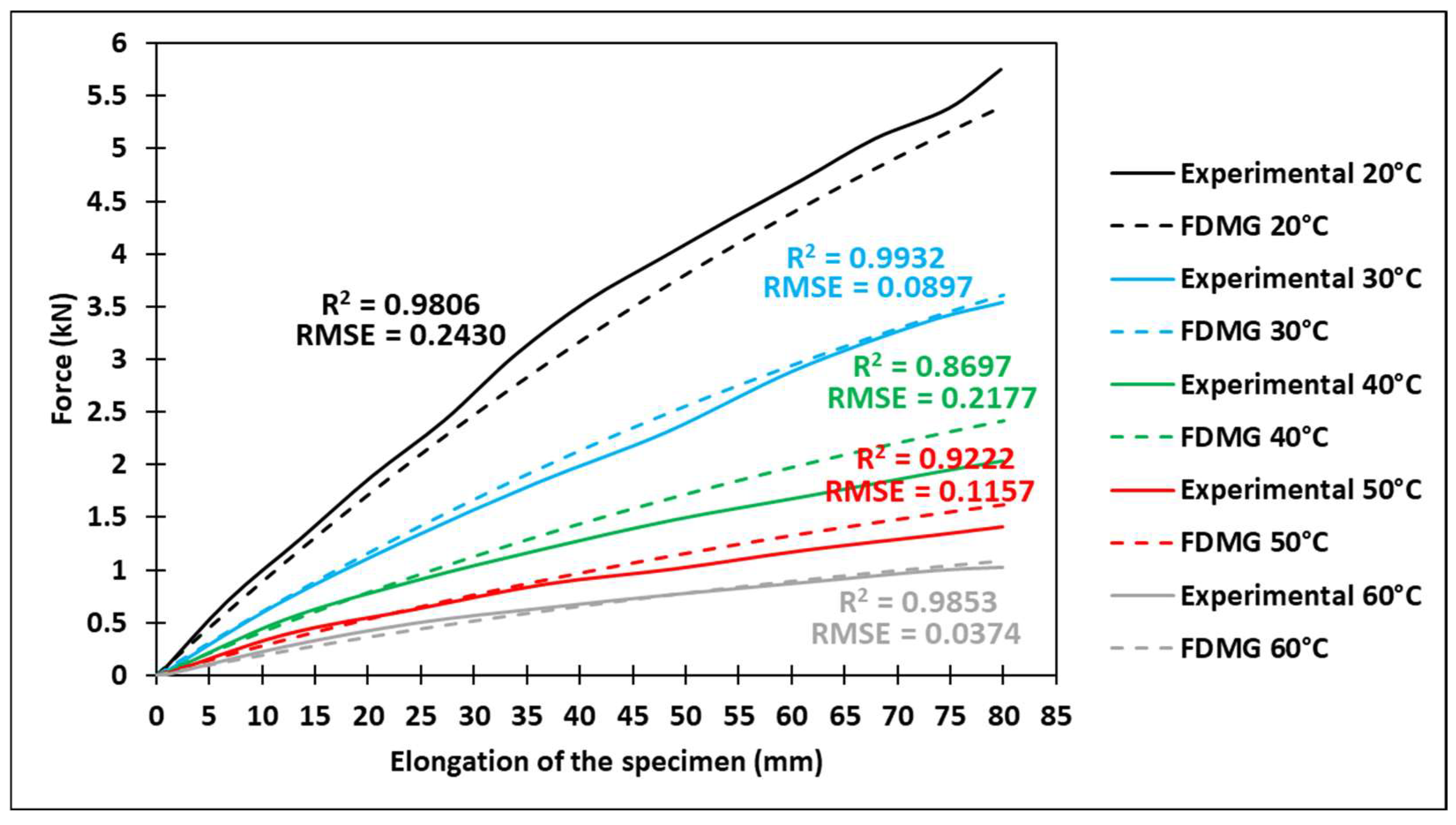
Figure 9 shows the comparison of the results obtained from the FLAC’s uniaxial tensile test model (FDMG) along with the experimental results. It can be seen that the numerical model replicates the experimental results very well, with a coefficient of correlation ‘R2’ greater than 0.85, a Root Mean Square Error (RMSE) of less than 0.25 kN when the force reaches about 6 kN (for tensile curves corresponding to the temperature of 20 °C), and a root mean square error of less than 0.05 kN when the force reaches about 1 kN (for tensile curves corresponding to the temperature of 60 °C). The R2 was calculated as:
where
R2 = 1 − (RSS/TSS)
- RSS = Residual Sum of Squares;
- TSS = Total Sum of Squares.
Figure 9.
Comparison of the secant modulus obtained from the FDMG to that of the actual experimentation. The FDMG replicates the experimental results well.
Figure 9.
Comparison of the secant modulus obtained from the FDMG to that of the actual experimentation. The FDMG replicates the experimental results well.

3.2. Results at Structural Scale (FDMGLS)
3.2.1. Comparison of the Results from the Different Scenarios
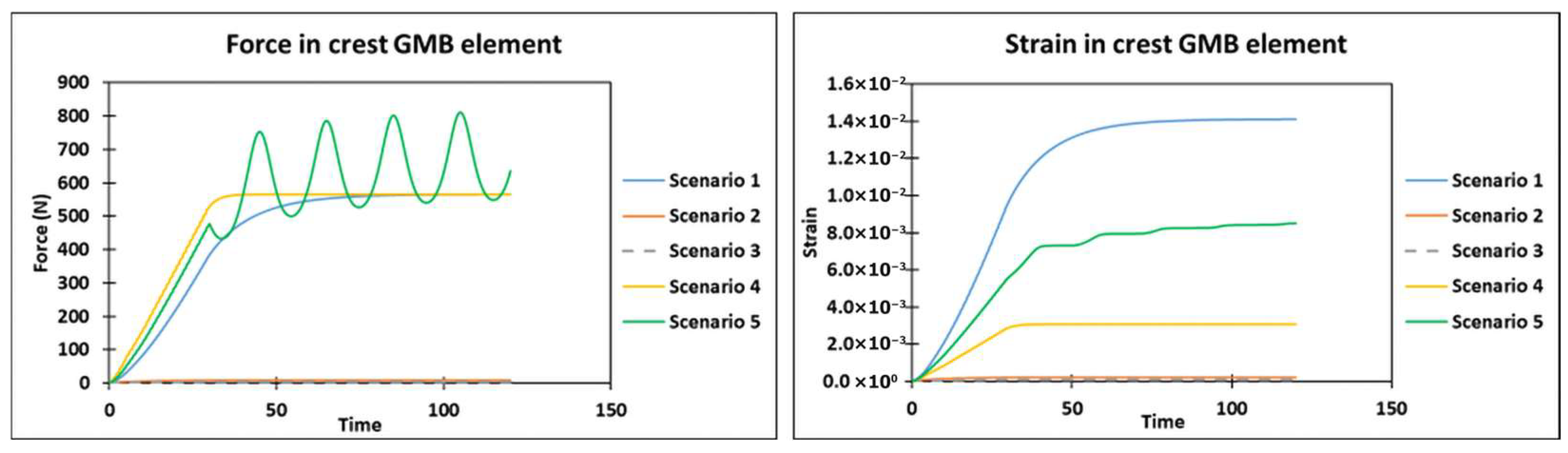
The results obtained from the numerical model (FDMGLS) for the difference scenarios presented in Table 2 can be seen from Figure 10. It is important to mention that the time is dimensionless, since no influence of viscosity is currently considered in the numerical model. Furthermore, for good convergence of the problem, the gravity load has been applied in steps (full gravity load achieved at time = 30).
Figure 10.
Force and strain as a function of time in the crest GMB element for the different scenarios obtained from FDMGLS. The results demonstrate that the ambient temperature and angle of friction of the lower interface of the GMB play a major role in the behavior of the GMB.
It can be clearly seen from Figure 10 that the angle of interface friction and the ambient temperature play a major role in the behavior of the GMB. If all the other properties are kept constant and the only variable is the ambient temperature, the strain in the GMB increases with the increase in temperature. For example, at the end of the simulation (time = 120), an increase of 358% in the strain is observed when the temperature is increased from 20 °C (Scenario 4) to 60 °C (Scenario 1). It is important to mention that the final force does not change between the two scenarios, since the load of the structure is constant and the interface friction angles remain the same, although the form of the force curve adapts well to the reality. Since the load to be supported by the GMB is the same while the increase in temperature results in the softening of the GMB, the resulting deformation in the GMB increases. On the contrary, if all the other properties are kept constant and the only variable is the interface friction angle, we observe that if the lower interface friction angle is smaller than the upper interface friction angle, the tensile force and strain resulting in the GMB are considerably larger. If the lower interface friction angle is equal to or greater than the upper interface friction angle, the force and deformation in the GMB is almost non-existent. For example, for a constant temperature of 60 °C and an upper interface angle of 27°, if the lower interface angle is increased from 25° (Scenario 1) to 29° (Scenario 3), the force and strain in the GMB at the end of simulation (time = 120) are reduced by 13,155% and 13,202%, respectively. The force in this case changes, contrary to the previous case of variation in temperature only, where only the deformation changes and not the force. The reason for this is that the GMB elongates by sliding over the GTX, and varying the interface friction angle modifies the shear strength of the interface, hence affecting the deformation. Thus, an increase in the interface friction angle in this scenario restricts the deformation of the GMB, and hence we observe a reduction in both the force and deformation. Furthermore, when imposing thermal cycles (Scenario 5), it can be observed that the tensile force in this case is greater than if the GMB is exposed to a constant higher temperature of 60 °C (Scenario 1), but the strain is lesser. This resulted from the dilation and contraction of the GMB when imposed to thermal loading, and the fact that this phenomenon is not very evident on the strain can be attributed to the restriction of this phenomenon by the interface friction, as suggested by Pasten and Santamarina [24]. In addition, a slight accumulation of the force and strain with the increasing number of thermal cycles is also observed.
3.2.2. Behavior Comparison of Different GMB Elements for Scenario 1
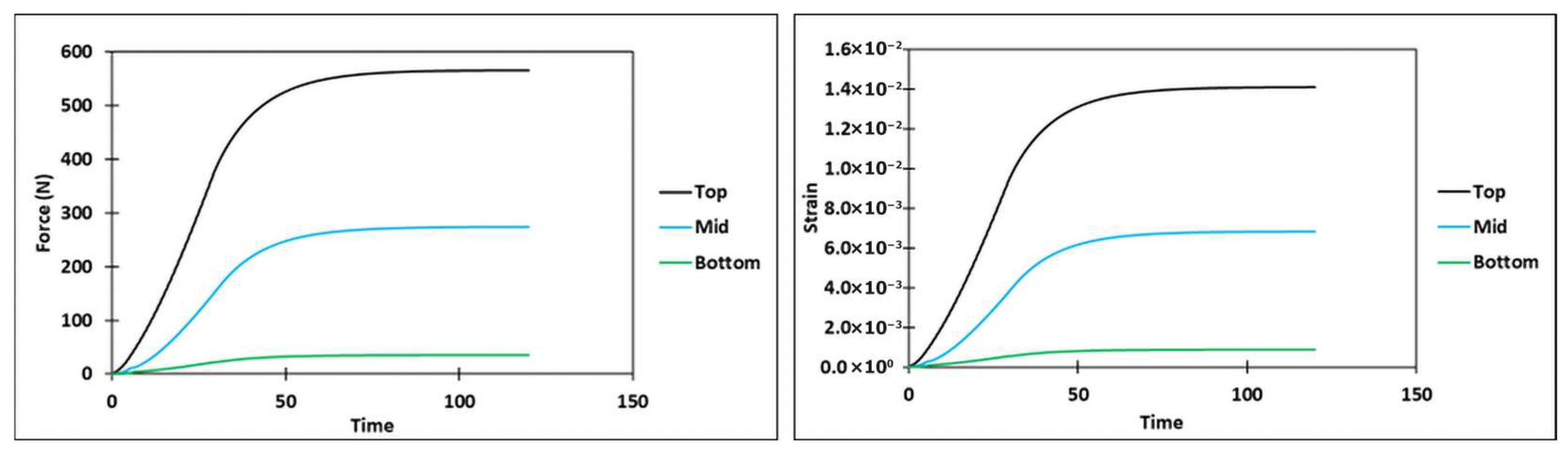
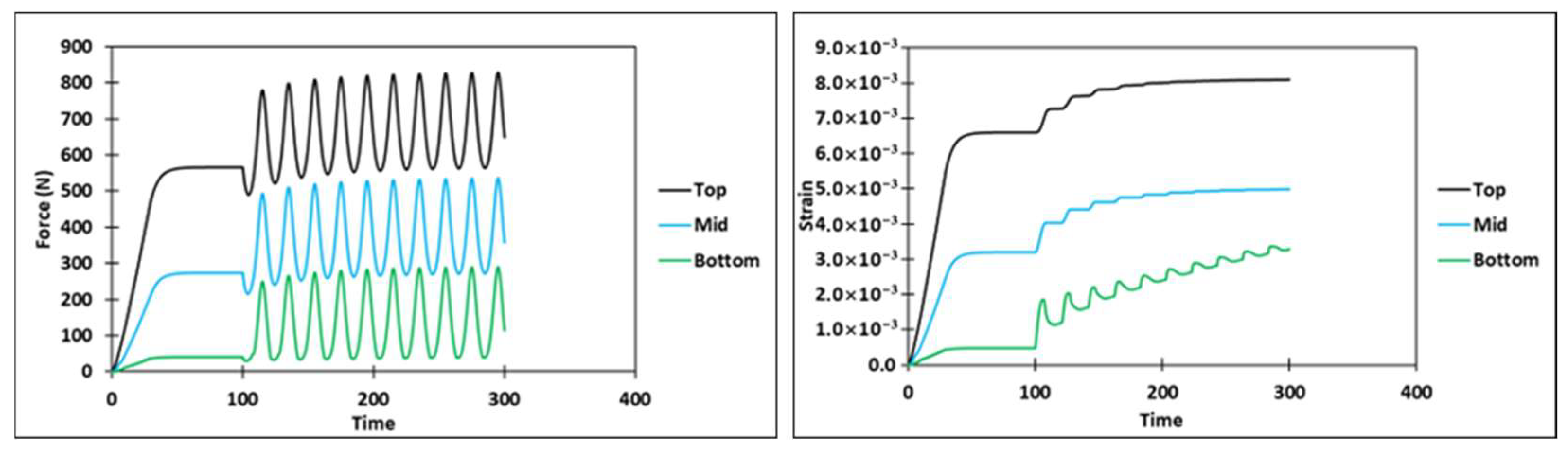
Figure 11 shows the variation in force and strain with time for the top, mid, and bottom GMB elements for Scenario 1. It can be clearly seen from the figure that the force and strain in the GMB elements increase as we move from the toe to the crest element of the GMB. The difference in tensile force at the end of simulation between the top (crest) and mid GMB element is 106%, 676% between the mid and bottom (toe) element, and 1501% between the top and bottom element. The difference in the strain is also approximately the same.
Figure 11.
Force and strain as a function of time in different GMB elements for Scenario 1. The results demonstrate that the maximum force and strain are observed at the anchorage of the GMB.
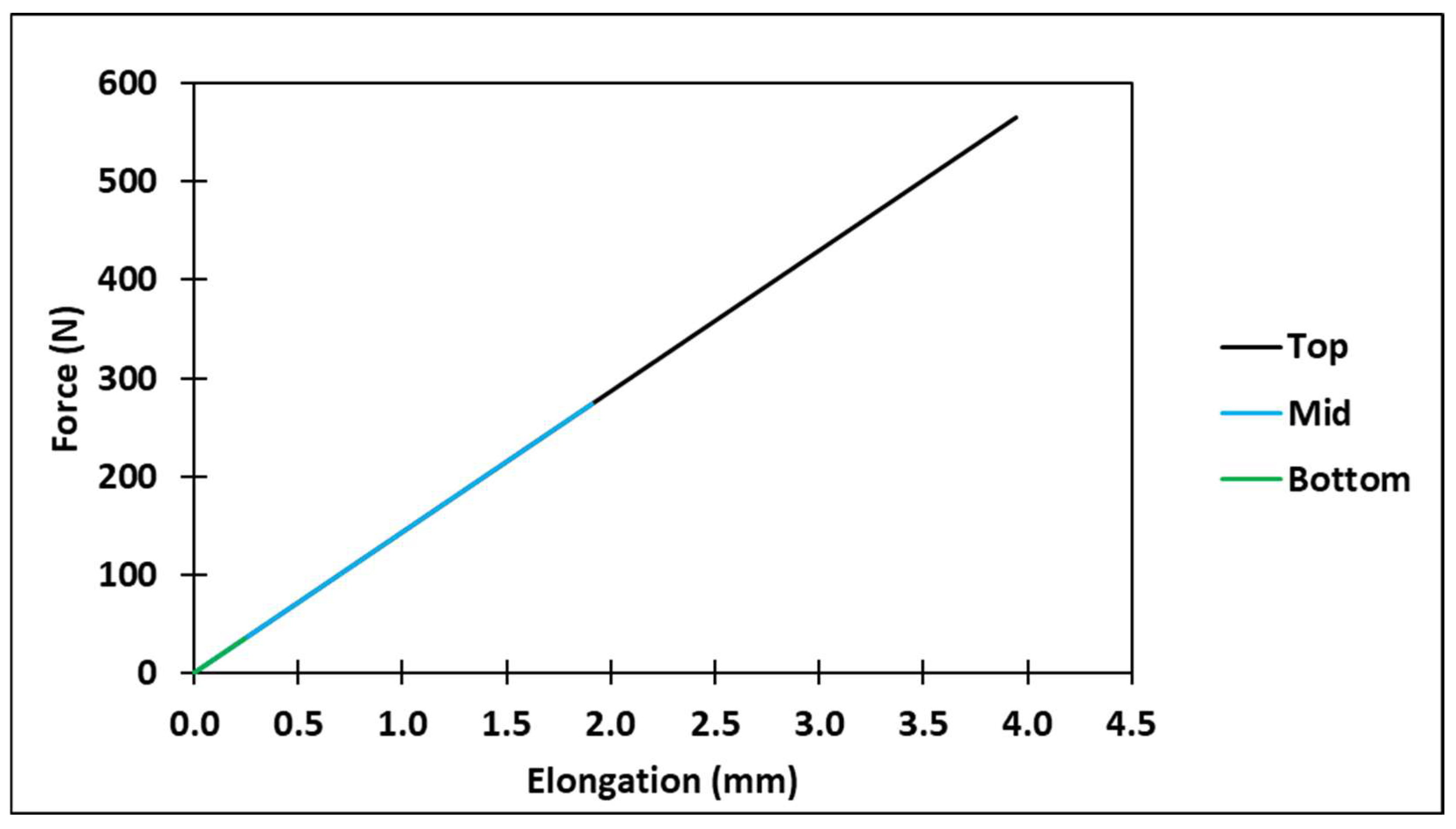
Figure 12 shows the variation in force with elongation for the top, mid, and bottom GMB elements for Scenario 1. It can be clearly observed that there is a linear relationship between the force and elongation, which shows that the GMB is deforming elastically. It is realistic, since the deformations in the GMB elements are quite small. Also, all the elements deform in a similar way, since the GMB and site conditions are considered to be homogenous in properties.
Figure 12.
Force as a function of elongation in different GMB elements for Scenario 1.
3.2.3. Impact of Thermal Cycles of the Behavior of Different GMB Elements
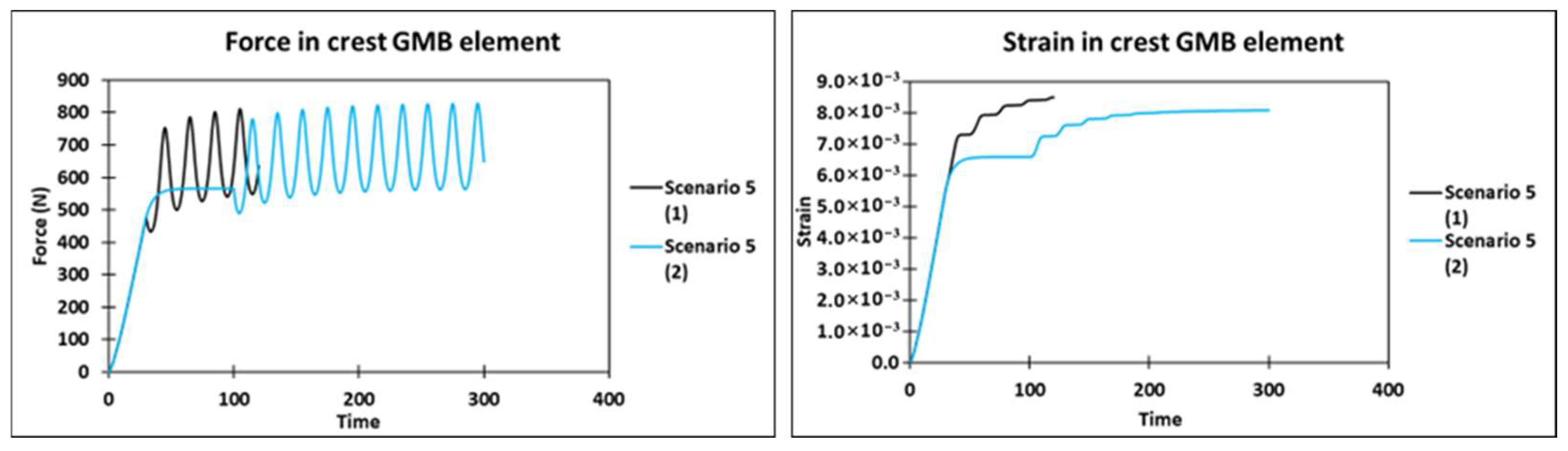
In Scenario 5 (see Table 2), the thermal cycles were imposed as soon as the full gravity load was attained (time = 30). The results, as shown in Figure 10, demonstrate that the force in the GMB is not yet stable when the first thermal cycle is imposed. Thus, in order to test the effect of the time of application of the thermal cycles on the overall behavior of the GMB, Scenario 5 can be modified such that the thermal cycles are applied once the force in the GMB is stabilized. This new scenario is named as ‘Scenario 5 (2)’ while the actual Scenario 5 is marked as ‘Scenario 5 (1)’, as detailed in Table 3, and the obtained results are shown in Figure 13.
Table 3.
Description of the two forms of Scenario 5.
Figure 13.
Force and strain as a function of time in the crest GMB element for the two forms of Scenario 5.
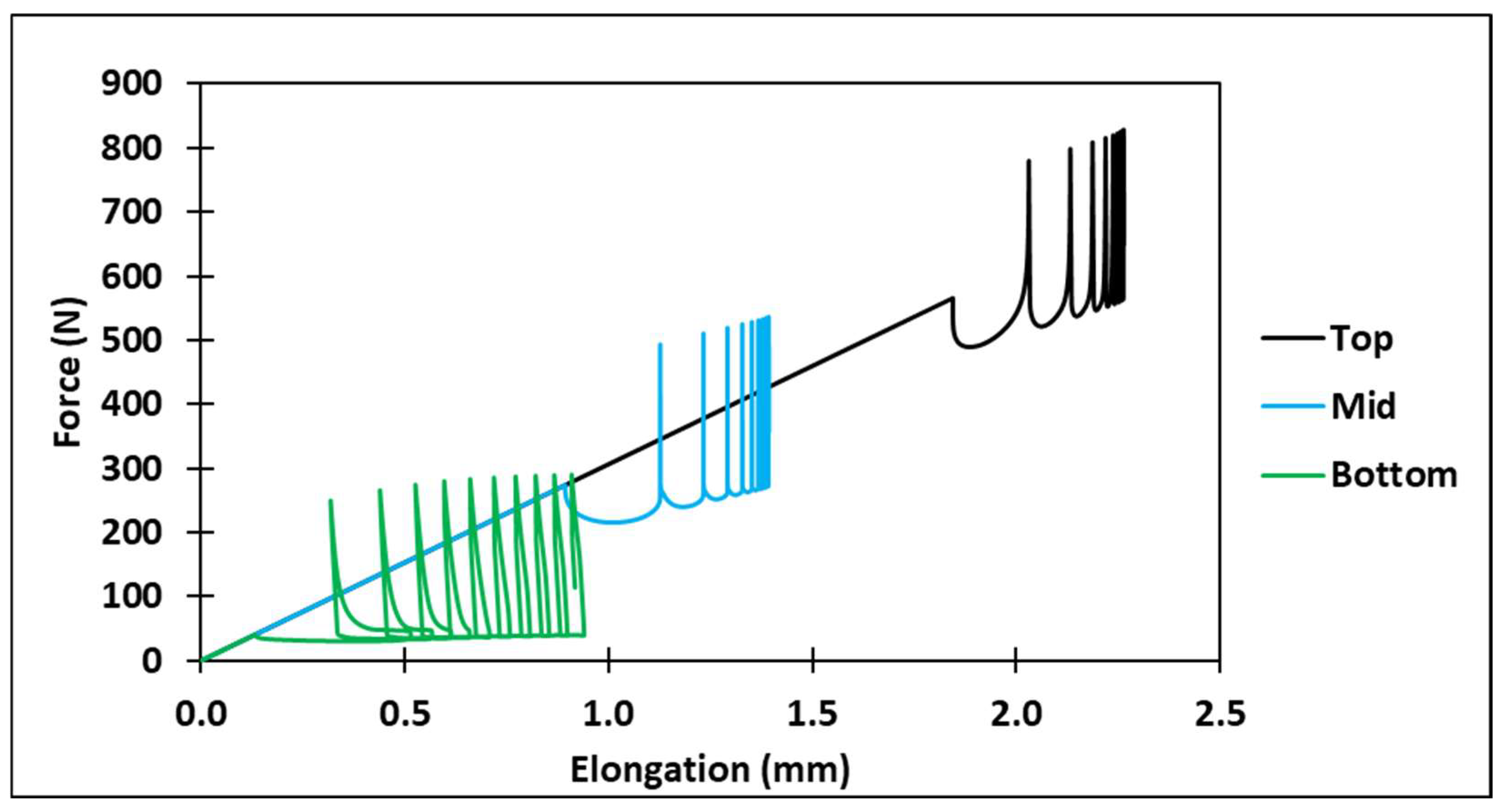
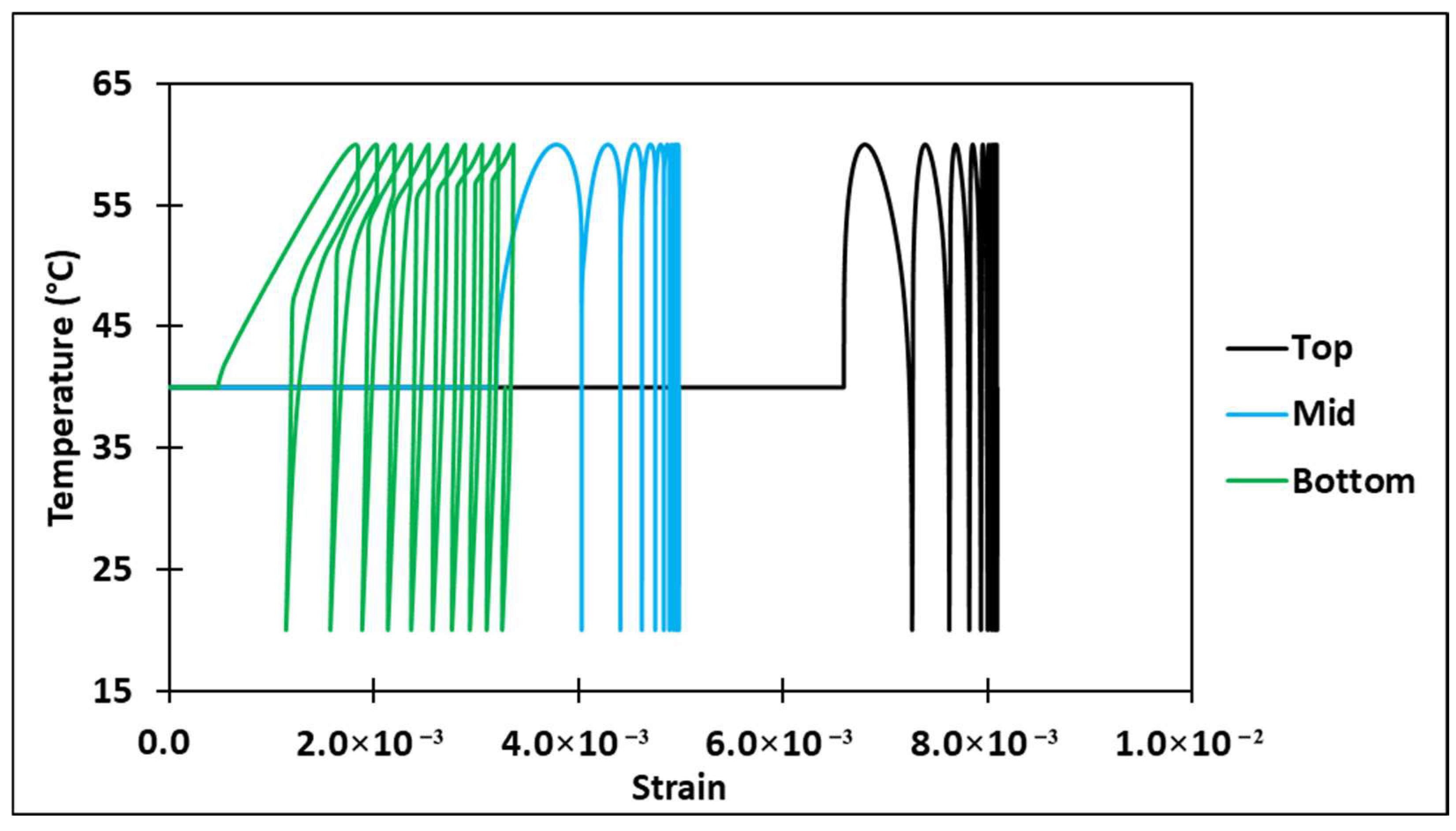
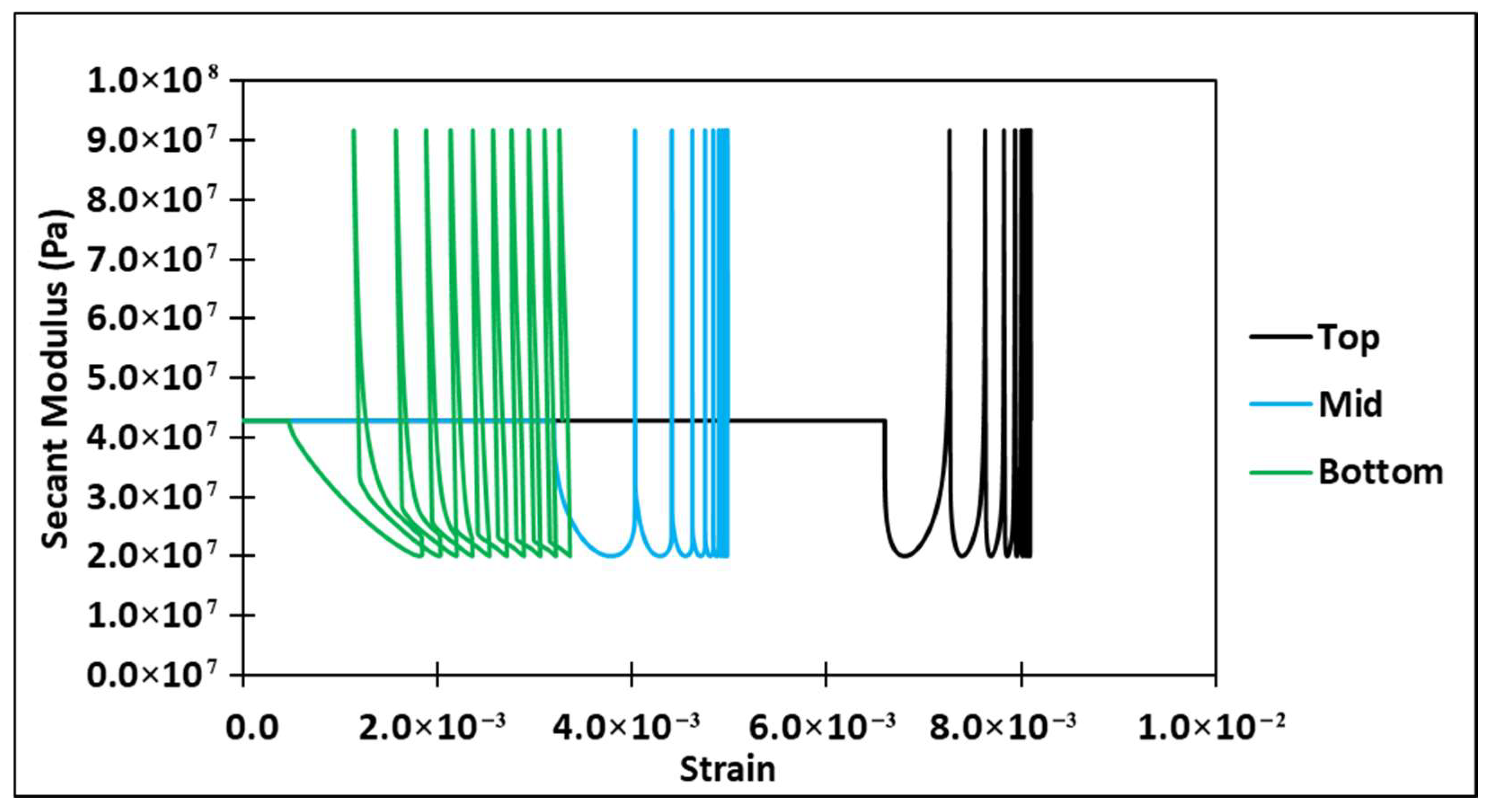
It can be seen from Figure 13 that the force and strain slightly reduce if the thermal cycles are imposed after the force in the GMB has stabilized. Furthermore, the accumulation of force and strain is still observed with the increasing number of cycles, which tends to stabilize as the number of cycles increase. To further investigate the evolution of secant modulus with strain, the relationship between force and displacement/elongation, the link between temperature and strain, and the variation in force and strain with time for the top, middle, and lower GMB element are shown in Figure 14, Figure 15, Figure 16 and Figure 17 for Scenario 5 (2).
Figure 14.
Force and strain as a function of time in different GMB elements for Scenario 5 (2). The results demonstrate that thermal cycles can cause the accumulation of mechanical efforts and a temperature decrease can cause a contraction in the toe elements only.
Figure 15.
Force as a function of elongation in different GMB elements for Scenario 5 (2).
Figure 16.
Temperature as a function of strain in different GMB elements for Scenario 5 (2).
Figure 17.
Secant modulus as a function of strain in different GMB elements for Scenario 5 (2).
It can be observed from Figure 14 that the force and strain in the GMB elements increase as we move from the toe to the crest of the slope. It is the correct behavior, since the load on the upper elements is more due to the accumulation of self-weight of the structure, resulting from the increasing number of lower elements. For example, for the fifth cycle of temperature (roughly at time = 187), the difference in tensile force for the peak between the top and mid GMB element is 56%, 90% between the mid and bottom element, and 197% between the top and bottom element. As far as why the force variation looks similar in all the elements, it can be attributed to the fact that the geometry and material properties in the FDMGLS are homogenous (no local asperities or variation in friction angle). Furthermore, it can be clearly observed that the force varies significantly with the thermal cycles; for example, the variation in the force at the fifth thermal cycle is 42%, 85%, and 438% for the top, mid, and bottom GMB elements, respectively, as we move from 60 °C to 20 °C. The force decreases as the temperature increases due to the material softening. Another observation that can be made is that there is a sharp increase in the strain as soon as the first thermal cycle is applied, and then this variation decreases as the number of thermal cycles increases.
It can also be observed from Figure 14 that there is an accumulation of strain in all the GMB elements with the increasing number of thermal cycles, which seems to stabilize after a certain number of cycles. This accumulation seems to be stronger in the bottom GMB element. Also, the strain in the bottom GMB element increases with the increasing temperature and vice versa, while for the other elements, the strain increases with the increasing temperature but remains almost constant when the temperature is decreasing. Again, this can be attributed to the load on the individual GMB element. Since the load on the upper GMB elements is more due to the contributing self-weight of the lower GMB elements, it is almost impossible to displace upward (contract) when the temperature is decreasing. As far as why the impact of thermal cycles is less evident on the strains as compared to the forces, it can be attributed to the complex interaction of the GMB with the sliding surface (interface friction angle) along with the contribution of load in individual beam elements (contributing to the increase in the normal stresses). The interface friction restricts the GMB from sliding and may result in the formation of wrinkles, as suggested by Pasten and Santamarina [24]. Unfortunately, the observation of the formation of wrinkles is not possible in a finite difference model.
It can be observed from Figure 15 that the tensile force in the GMB elements increases as we move from the toe of the slope to the crest of the slope. Similarly to our previous observations, this increase in force can be attributed to the fact that the load on the upper GMB elements is more than on the lower elements due to the accumulation of the self-weight of the structure. The force increases linearly with the elongation as long as no thermal cycles are applied. This linear variation is similar in all the elements, since the GMB is homogenous and the temperature is the same throughout the length of the GMB. The force starts to vary differently in the different elements once the thermal cycles are imposed. Similarly to Figure 14, it can also be clearly seen that the elongation in the bottom beam element increases as the temperature increases, and conversely, for the other elements, the elongation always increases. This can be further studied in detail, as shown in Figure 16.
It can be observed from Figure 16 that the strain in the bottom GMB element reduces with the decrease in temperature, and vice versa. When the temperature starts to reduce from the peak, the elongation continues to increase for a few degrees Celsius, and then the GMB element starts to contract and the strain reduces. After reaching a certain temperature (roughly below 37 °C) for the bottom GMB element, this variation in strain becomes almost negligible. However, it is important to note that when the temperature increase restarts, the variation in strain follows a different path than the one followed while the temperature was decreasing. Also, the threshold temperature for the increase in strain (elongation) with the rise in temperature increases with the greater number of thermal cycles applied. For the mid and top GMB element, no contraction of the GMB is observed, even though the temperature is decreasing. This can result due to the greater load needed to be supported by these elements, and hence the contraction thermal force is not enough to cause a contraction (upward movement along the slope) of the GMB. Furthermore, for all the GMB elements, the amplitude of variation in strain resulting from the variation in temperature reduces with the increasing number of thermal cycles.
Figure 17 shows the variation in the secant modulus with strain for different GMB elements. First of all, it is important to mention that the variation in the secant modulus seems consistent with the variation in force with elongation (see Figure 15) and the relationship between ambient temperature and strain in the elements (see Figure 16). Secondly, since the secant modulus is a function of ambient temperature and strain (see Equation (19)), the amplitude of the secant modulus is controlled by the temperature, since it plays a much more important role than the strain. However, the difference in the form of the variation in the modulus resulted from the difference in the strain in the different GMB elements.
It is important to mention that there are international “technical recommendations” (ISO/TR 18228-9) that provide general principles on the design of geomembranes [45]. However, this “TR” does not specify stability calculations as we do in this study. Thus, our study could contribute to improving this type of technical recommendation when it is revised.
3.2.4. Limitation of the FDMGLS Model
The FLAC model (FDMGLS) is limited because it is calibrated only to Zhang et al.’s tests at a standardized speed of 10 mm/min [1], meaning strain-rate effects, viscosity, and creep are not represented, even though several studies [29,46,47,48,49,50] show that geomembrane tensile strength decreases at lower test speeds. As a result, the model likely under-estimates deformation under realistic field conditions. To overcome this limitation, future work should include tensile tests conducted across a wide range of strain-rates (tensile test speeds) and incorporate a viscosity term so that time-dependent behavior can be captured.
The model (FDMGLS) assumes a constant GMB-GTX interface friction angle for all temperatures, although studies [9,10,11] show that friction increases with temperature (up to a threshold) and likely decreases at sub-zero temperatures, with likely implications for slope stability. At the same time, lower temperatures increase GMB tensile strength and stiffness [1], potentially restricting deformation despite higher sliding susceptibility. The model also limits the friction angle difference between the upper and lower GMB surfaces to only 2°, whereas larger differences can occur in field conditions. To address these limitations, future work should incorporate temperature-dependent interface friction angles, experimentally determine friction angle contrasts under varied conditions, and test these scenarios numerically for their impact on slope stability.
3.2.5. Future Perspectives
Currently, the FDMGLS model only focuses on the mechanical efforts developed in the GMB due to the variation in ambient temperature or interface friction angles. It is mentioned in detail in Section 3.2.4 that the addition of viscous efforts in the model (in the empirical relationship) and temperature-dependent interface friction angles will improve the overall accuracy of the model (realistic behavior). This will also help to extend the model’s ability to study the overall stability of the structure (GMB and riprap) due to the variation in ambient temperature, which will vary both the tensile resistance of the GMB and interface friction angles. Furthermore, the empirical relationship (secant modulus) can be modified so that it varies with the aging of the GMB, and hence the model can consider the degradation of the GMB due to aging in the study of the overall stability of the system.
In addition to the detailed numerical analyses presented in this study, pseudo-static and limit-equilibrium-based graphical methods, such as recent stability chart methods [51,52,53], could be used as complementary tools for preliminary design (slope stability) alongside this study. It is also important to mention that several hundred numerical simulations can be carried out varying different parameters, as presented in these studies [51,52,53], to develop stability charts that can be quite useful to engineers for quick implementation. This will enable rapid estimation of the factor of safety or qualitative slope stability based on simple parameters such as cohesion, friction angle, temperature, loading, deformation rate of the GMB, age of the GMB, geometry, etc.
4. Conclusions
This study developed a non-linear, temperature-dependent constitutive law for PVC geomembranes in uniaxial traction, and demonstrated its relevance for assessing the stability of geomembrane-lined reservoir slopes subjected to elevated temperatures and thermal cycles. Calibration against experimental tensile data from 10 °C to 60 °C enabled the formulation of an empirical relationship to define the PVC mechanical behavior, capturing the marked reduction in stiffness and strength with increasing temperature. The incorporation of a thermal dilation response using a linear expansion law provided a realistic representation of thermally induced strain accumulation under thermal cycles.
The mechanical and thermal laws were successfully implemented in FLAC2D, enabling the simulation of coupled thermo-mechanical behavior in a covered geomembrane lining system. Application to a representative 2H:1V dam slope demonstrated that ambient temperature and interface friction angle (especially between the lower surface of GMB and the GTX beneath it) have a substantial influence on geomembrane stress and strain development, and may consequently affect the overall slope stability. A higher ambient temperature (when there are no thermal cycles) led to higher strains in the GMB due to material softening but did not affect the force, since the load transferred to the GMB is mainly controlled by the interface friction angle below the geomembrane (which does not depend on temperature in the FDMGLS model). Furthermore, an increase in the interface friction angle below the geomembrane resulted in a decrease in the stress and strain in the GMB, since it restricted the GMB to elongate under tensile loading. These findings highlight the importance of explicitly considering thermally induced change in both material stiffness and interface shear resistance when evaluating the performance and safety of geomembrane lining systems.
The FDMGLS model currently relies on standardized tensile test data and simplified interface properties, which means that certain rate-dependent tensile behaviors and temperature-induced variations in GMB–GTX interface friction may not yet be fully represented. Although these assumptions allow for a practical modeling framework, existing research indicates that both strain rate and temperature can influence geomembrane stiffness, friction, and the resulting stability response [9,10,11,29,46,47,48,49,50]. To overcome these limitations, future work should incorporate the viscous behavior of the geomembrane and the temperature-dependent interface friction angles.
The innovative contribution of this research lies in the development and structural-scale application of a temperature-dependent non-linear constitutive framework for PVC geomembranes that explicitly couples material softening and thermal dilation within a unified numerical model. Unlike conventional approaches that assume linear, temperature-independent behavior, the proposed formulation captures the experimentally observed degradation of stiffness with both strain and temperature, and embeds this response into a finite-difference modeling environment suitable for large-scale engineering analyses. By integrating the calibrated constitutive law (experimentally calibrated empirical relationship) with interface-controlled load transfer mechanisms, the study bridges the gap between laboratory tensile testing and the assessment of geomembrane-lined slope performance under realistic thermal conditions. The results demonstrate that elevated temperatures can significantly alter strain development and stability trends even in the absence of changes in external loading, thereby highlighting thermal effects as a critical but often overlooked factor in the design and evaluation of geomembrane lining systems for hydraulic structures.
Therefore, even though the results of this study do not show complete destabilization of the riprap layer due to tensile rupture of the geomembrane, the study demonstrates that a temperature increase near the geomembrane will lead to its deformation, resulting in the opening of a crack at the top of the riprap layer as it slips, even slightly. This phenomenon is detrimental to the durability of the GLS installed on a reservoir or a basin slope and should be avoided. Dam operators are therefore advised to monitor any deformation, even on the surface, of the visible riprap layer, as any slight deformation could originate from a deformation of the GLS materials, particularly the geomembrane.
Author Contributions
Conceptualization, H.T., G.V., G.S., and L.P.; methodology, H.T., G.V., G.S., and L.P.; software, H.T. and G.V.; validation, G.V., G.S., and L.P.; formal analysis, H.T.; investigation, H.T.; resources, H.T., G.V., and G.S.; data curation, H.T. and G.V.; writing—original draft preparation, H.T.; writing—review and editing, G.V., G.S., and L.P.; visualization, H.T.; supervision, G.V., G.S., and L.P.; project administration, G.S. and L.P.; and funding acquisition, G.S. and L.P. All authors have read and agreed to the published version of the manuscript.
Funding
This work is part of a PhD thesis carried out at the geosynthetics lab in the National Research Institute for Agriculture, Food and the Environment (INRAE), Aix-en-Provence, France. This thesis is carried out in the context of the project ‘BECCA’, financed by the European Union under the INTERREG ALCOTRA program. Thus, the writers are extremely grateful to them for the opportunity to conduct this thesis and for providing the necessary funding.
Data Availability Statement
The authors do not have permission to share data.
Acknowledgments
The authors are extremely thankful to Antoine Wautier for providing his valuable help in improving the quality of the article.
Conflicts of Interest
The authors declare no conflict of interest.
Abbreviations
The following abbreviations are used in this manuscript:
| PVC | Polyvinyl Chloride |
| HDPE | High-density Polyethylene |
| GMB | Geomembrane |
| GTX | Geotextile |
| GLS | Geosynthetic Lining System |
| FLAC2D | Fast Lagrangian Analysis of Continua in Two Dimensions |
| FDMG | Two-dimensional Finite Difference Model at the Geomembrane Scale |
| FDMGLS | Two-dimensional Finite Difference Model at the GLS Scale |
References
- Zhang, X.; Ma, Z.; Wu, Y.; Liu, J. Response of Mechanical Properties of Polyvinyl Chloride Geomembrane to Ambient Temperature in Axial Tension. Appl. Sci. 2021, 11, 10864. [Google Scholar] [CrossRef]
- Poulain, D.; Peyras, L.; Meriaux, P. Feedback and Guidelines for Geomembrane Lining Systems of Mountain Reservoirs in France. Geotext. Geomembr. 2011, 29, 415–424. [Google Scholar] [CrossRef]
- Blanco, M.; Touze-Foltz, N.; Pérez Sánchez, M.; Redon-Santafe, M.; Sánchez Romero, F.J.; Torregrosa Soler, J.B.; Zapata Raboso, F.A. Durability of Reinforced PVC-P Geomembranes Installed in Reservoirs in Eastern Spain. Geosynth. Int. 2018, 25, 85–97. [Google Scholar] [CrossRef]
- Carreira, T. Durability of PVC-P Geomembranes in Hydraulic Structures. In Proceedings of the EuroGeo4, Edinburgh, UK, 7–10 September 2008; p. 15. [Google Scholar]
- Hsuan, Y.G.; Schroeder, H.F.; Rowe, K.; Müller, W.; Greenwood, J.; Cazzuffi, D.; Koerner, R.M. Long-Term Performance and Lifetime Prediction of Geosynthetics. In Proceedings of the EuroGeo4, Edinburgh, UK, 7–10 September 2008. [Google Scholar]
- Koerner, R.M.; Hsuan, Y.G.; Koerner, G.R. Lifetime Predictions of Exposed Geotextiles and Geomembranes. Geosynth. Int. 2017, 24, 198–212. [Google Scholar] [CrossRef]
- Lodi, P.C.; Bueno, B.D.S.; Vilar, O.M. Mechanical and Thermal Properties of HDPE and PVC Geomembranes After UV Exposure. In Proceedings of the EuroGeo4, Edinburgh, UK, 7–10 September 2008; p. 198. [Google Scholar]
- Luciani, A.; Todaro, C.; Martinelli, D.; Peila, D. Long-Term Durability Assessment of PVC-P Waterproofing Geomembranes through Laboratory Tests. Tunn. Undergr. Space Technol. 2020, 103, 103499. [Google Scholar] [CrossRef]
- Akpinar, M.V.; Benson, C.H. Effect of Temperature on Shear Strength of Two Geomembrane–Geotextile Interfaces. Geotext. Geomembr. 2005, 23, 443–453. [Google Scholar] [CrossRef]
- Karademir, T.; Frost, J.D. Elevated Temperature Effects on Geotextile–Geomembrane Interface Shear Behavior. J. Geotech. Geoenviron. Eng. 2021, 147, 04021148. [Google Scholar] [CrossRef]
- Lin, H.; Gong, X.; Zeng, Y.; Zhou, C. Experimental Study on the Effect of Temperature on HDPE Geomembrane/Geotextile Interface Shear Characteristics. Geotext. Geomembr. 2024, 52, 396–407. [Google Scholar] [CrossRef]
- Pelte, T.; Pierson, P.; Gourc, J.P. Thermal Analysis of Geomembrane Exposed to Solar Radiation. Geosynth. Int. 1994, 1, 21–44. [Google Scholar] [CrossRef]
- Bouazza, A.; Zhang, L. Temperature variations of a geomembrane liner in a municipal solid waste landfill from construction to closure. J. Indian Inst. Sci. 2021, 101, 725–743. [Google Scholar] [CrossRef]
- Rowe, R.K. Long-Term Performance of Contaminant Barrier Systems. Géotechnique 2005, 55, 631–678. [Google Scholar] [CrossRef]
- Take, W.A.; Watson, E.; Brachman, R.W.I.; Rowe, R.K. Thermal Expansion and Contraction of Geomembrane Liners Subjected to Solar Exposure and Backfilling. J. Geotech. Geoenviron. Eng. 2012, 138, 1387–1397. [Google Scholar] [CrossRef]
- Amorim, F.C.; Souza, J.F.B.; Da Costa Mattos, H.S.; Reis, J.M.L. Temperature Effect on the Tensile Properties of Unplasticized Polyvinyl Chloride. SPE Polym. 2022, 3, 99–104. [Google Scholar] [CrossRef]
- Lodi, P.C.; Bueno, B.S. Degradation of HDPE and PVC Geomembranes Exposed to Heat. In Proceedings of the Geosynthetics; Millpress Science Publishers: Rotterdam, The Netherlands, 2006; Volume 1–4, pp. 391–394. [Google Scholar]
- Eldesouky, H.M.G.; Brachman, R.W.I. Viscoplastic Modelling of HDPE Geomembrane Local Stresses and Strains. Geotext. Geomembr. 2020, 48, 41–51. [Google Scholar] [CrossRef]
- Belyĭ, V.A.; Sviridenok, A.; Petrokovets, M.; Savkin, V. Friction and Wear in Polymer-Based Materials, 1st ed.; Pergamon Press: Oxford, UK; New York, NY, USA, 1982; ISBN 978-0-08-025444-9. [Google Scholar]
- Daniels, C.A. Polymers: Structure and Properties; Technomic Publishing: Lancaster, PA, USA, 1989. [Google Scholar]
- Budiman, J. Effects of Temperature on Physical Behavior of Geomembranes. In Proceedings of the 5th International Conference on Geotextiles Geomembranes and Related Products, SEAC-IGS Publication. Singapore, 5–9 September 1994; pp. 1093–1100. [Google Scholar]
- Lord, A.E., Jr.; Soong, T.Y.; Koerner, R.M. Relaxation Behavior of Thermally-Induced Stress in HDPE Geomembranes. Geosynth. Int. 1995, 2, 626–634. [Google Scholar] [CrossRef]
- Osswald, T.A.; Menges, G. Materials Science of Polymers for Engineers; Carl Hanser Verlag GmbH & Company KG: Munich, Germany, 2012; ISBN 978-1-56990-524-1. [Google Scholar]
- Pasten, C.; Santamarina, J.C. Experimental and Numerical Modeling of Thermally-Induced Ratcheting Displacement of Geomembranes on Slopes. Geosynth. Int. 2014, 21, 334–341. [Google Scholar] [CrossRef]
- Giroud, J.P.; Morel, N. Analysis of Geomembrane Wrinkles. Geotext. Geomembr. 1992, 11, 255–276. [Google Scholar] [CrossRef]
- Rowe, R.K. Short- and Long-Term Leakage through Composite Liners. Can. Geotech. J. 2011, 49, 141–169. [Google Scholar] [CrossRef]
- Cazzuffi, D.; Giroud, J.; Scuero, A.; Vaschetti, G. Geosynthetic Barriers Systems for Dams. In Proceedings of the 9th International Conference on Geosynthetics-Geosynthetics: Advanced Solutions for a Challenging World, ICG, Guaruja, Brazil, 23–27 May 2010; pp. 115–164. [Google Scholar]
- Itasca Consulting Group, Inc. FLAC—Fast Lagrangian Analysis of Continua, Version 7.0: User’s Guide; Itasca Consulting Group, Inc.: Minneapolis, MN, USA, 2011. [Google Scholar]
- Akel, N.; Stoltz, G.; Wautier, A.; Nicot, F.; Touze, N. Rate-Dependent Tensile Response of Polyvinyl Chloride Geomembranes. Geotext. Geomembr. 2025, 53, 445–456. [Google Scholar] [CrossRef]
- ASTM D696-16; Standard Test Method for Coefficient of Linear Thermal Expansion of Plastics Between −30 °C and 30 °C with a Vitreous Silica Dilatometer. ASTM International: West Conshohocken, PA, USA, 2016. [CrossRef]
- CLTE Coefficient of Linear Thermal Expansion on Polymers. Available online: https://passive-components.eu/coefficient-of-linear-thermal-expansion-on-polymers-explained/ (accessed on 2 December 2025).
- Coefficient of Linear Thermal Expansion (CLTE): Formula & Values. Available online: https://www.specialchem.com/plastics/guide/coefficient-of-linear-thermal-expansion (accessed on 2 December 2025).
- NETZSCH—Analyzing and Testing. Leading in Thermal Analysis, Rheology and Fire Testing. Available online: https://analyzing-testing.netzsch.com/en/polymers-netzsch-com/commodity-thermoplastics/pvc-p-polyvinylchloride-with-plasticizer (accessed on 2 December 2025).
- Koerner, R.M.; Koerner, G.R. The Intimate Contact Issue of Field Placed Geomembranes with Respect to Wave (or Wrinkle) Management; Geosynthetic Institute: Folsom, CA, USA, 2013. [Google Scholar]
- Haynes, W.M. (Ed.) CRC Handbook of Chemistry and Physics, 95th ed.; CRC Press: Boca Raton, FL, USA, 2014; ISBN 978-0-429-17019-5. [Google Scholar]
- Vinidex Pty Ltd. PVC Properties. Available online: https://www.vinidex.com.au/resources/technical-resources/material-properties/pvc-properties/ (accessed on 2 December 2025).
- PVC Pipes at Low Operating Temperatures. Available online: https://pipa.com.au/wp-content/uploads/2021/05/TN012-PVC-Pipes-at-Low-Operating-Temperatures-February-2010.pdf (accessed on 2 December 2025).
- Matmake—Properties of Polyvinyl Chloride (PVC). Available online: https://matmake.com/materials-data/polyvinyl-chloride-properties.html (accessed on 2 December 2025).
- C-Therm. What Is Coefficient of Thermal Expansion (CTE)? How Do I Measure It? Available online: https://ctherm.com/resources/newsroom/blog/coefficient-of-thermal-expansion/ (accessed on 3 December 2025).
- Materion. In Our Element: What Is Thermal Expansion and Contraction? Available online: https://www.materion.com/en/insights/blog/in-our-element-thermal-expansion-and-contraction-of-materials (accessed on 3 December 2025).
- Fowmes, G.J.; Dixon, N.; Jone, D.R.V.; Cowland, J.W. Modelling of Lining System Integrity Failure in a Steep Sided Landfill. In Proceedings of the 8th International Conference on Geosynthetics (8 ICG), Yokohama, Japan, 18–22 September 2006. [Google Scholar]
- Zamara, K.A.; Dixon, N.; Fowmes, G.; Jones, D.R.V.; Zhang, B. Landfill Side Slope Lining System Performance: A Comparison of Field Measurements and Numerical Modelling Analyses. Geotext. Geomembr. 2014, 42, 224–235. [Google Scholar] [CrossRef]
- Tano, B.F.G.; Dias, D.; Fowmes, G.J.; Olivier, F.; Stoltz, G.; Touze-Foltz, N. Numerical Modeling of the Nonlinear Mechanical Behavior of Multilayer Geosynthetic System for Piggyback Landfill Expansions. Geotext. Geomembr. 2016, 44, 782–798. [Google Scholar] [CrossRef]
- Tano, B.F.G.; Dias, D.; Stoltz, G.; Touze-Foltz, N.; Olivier, F. Numerical Modelling to Identify Key Factors Controlling Interface Behaviour of Geosynthetic Lining Systems. Geosynth. Int. 2017, 24, 167–183. [Google Scholar] [CrossRef]
- ISO/TR 18228-9:2022; Design Using Geosynthetics—Part 9: Barriers. ISO: Geneva, Switzerland, 2022.
- Merry, S.M.; Bray, J.D. Time-Dependent Mechanical Response of HDPE Geomembranes. J. Geotech. Geoenviron. Eng. 1997, 123, 57–65. [Google Scholar] [CrossRef]
- Tahir, H.; Stoltz, G.; Veylon, G.; Peyras, L. Impact of Test Speed on the Thermo-Mechanical Behavior of Various Types of Geomembranes. Geotext. Geomembr. 2025, 53, 1588–1599. [Google Scholar] [CrossRef]
- Wesseloo, J.; Visser, A.T.; Rust, E. A Mathematical Model for the Strain-Rate Dependent Stress–Strain Response of HDPE Geomembranes. Geotext. Geomembr. 2004, 22, 273–295. [Google Scholar] [CrossRef]
- Lamri, A.; Shirinbayan, M.; Pereira, M.; Truffault, L.; Fitoussi, J.; Lamouri, S.; Bakir, F.; Tcharkhtchi, A. Effects of Strain Rate and Temperature on the Mechanical Behavior of High-density Polyethylene. J. Appl. Polym. Sci. 2020, 137, 48778. [Google Scholar] [CrossRef]
- Zanzinger, H.; Engelsing, K.; Gerets, B. Strain Hardening Behavior of HDPE Geomembranes. E3S Web Conf. 2023, 368, 02009. [Google Scholar] [CrossRef]
- Xu, S.; Wang, B.; Wang, D.; Zhang, J. A Practical Stability/Instability Chart Analysis for Slope Large Deformations Using the Material Point Method. Eng. Geol. 2024, 338, 107611. [Google Scholar] [CrossRef]
- Waris, K.A.; Fayaz, S.J.; Reddy, A.H.; Basha, B.M. Pseudo-Static Slope Stability Analysis Using Explainable Machine Learning Techniques. Nat. Hazards 2025, 121, 485–517. [Google Scholar] [CrossRef]
- Cui, H.; Ji, J.; Song, J.; Huang, W. Limit State Line-Based Seismic Stability Charts for Homogeneous Earth Slopes. Comput. Geotech. 2022, 146, 104749. [Google Scholar] [CrossRef]
Disclaimer/Publisher’s Note: The statements, opinions and data contained in all publications are solely those of the individual author(s) and contributor(s) and not of MDPI and/or the editor(s). MDPI and/or the editor(s) disclaim responsibility for any injury to people or property resulting from any ideas, methods, instructions or products referred to in the content. |
© 2026 by the authors. Licensee MDPI, Basel, Switzerland. This article is an open access article distributed under the terms and conditions of the Creative Commons Attribution (CC BY) license.