


Abstract
Methane emissions from underground coal mines are a significant source of greenhouse gases (GHGs) and a major safety concern. In highly methane-prone operations, a large proportion of emissions comes from low-content abandoned mine methane (LCAMM) accumulated in post-mining goafs, where concentrations usually stay below 30% CH4. Building on the Research Fund for Coal and Steel (RFCS) REM project, this paper presents a cost–benefit analysis of a comprehensive scheme for capturing, transporting, and utilising LCAMM from post-mining goafs for electricity generation. The concept involves long-reach directional boreholes drilled behind isolation dams, a dedicated methane-reduced drainage system connected to a surface methane drainage station, and four 2 MWe gas engines designed to run on a 20–40% CH4 mixture. Greenhouse gas performance is evaluated by comparing a “business-as-usual” scenario in which post-mining methane is combusted in gas engines to produce electricity without further GHG cost–benefit consideration. The results indicate that the project can achieve a positive net present value, highlighting the role of LCAMM utilisation for methane-intensive coal mines. The paper also explores the monetisation of non-emitted methane using the European Union Emissions Trading System (EU ETS), as well as social cost benchmarks and penalty levels consistent with the emerging EU Methane Emissions Regulation (EU MER).
1. Introduction
Methane emissions from underground coal mining remain a significant technical, environmental, and regulatory challenge. Methane released during coal extraction and from post-mining strata contributes materially to climate forcing, given its global warming potential, which is 29.8 times that of carbon dioxide over a 100-year time horizon [1]. At the same time, in-seam and post-mining methane constitute a valuable energy resource which, when effectively captured and utilised, can enhance mine safety, reduce dependence on externally purchased electricity, and contribute to a more orderly and economically efficient transition away from coal [2].
In the EU, underground hard coal mines in Poland’s Upper Silesian Coal Basin (USCB) are among the most significant point sources of coal mine methane (CMM). Mines such as Pniówek and Budryk are consistently identified as highly methane-prone, with complex geological structures and multi-seam exploitation leading to elevated emissions and persistent post-mining gas release. Historically, mitigation efforts have focused on drainage of high-concentration methane from active workings and its utilisation in combined heat and power (CHP) or trigeneration systems, as exemplified by the firedamp drainage and methane-fuelled power and cooling installation already operating at Pniówek [3].
A substantial proportion of coal mine methane emissions originates from abandoned mine methane (AMM), particularly low-content abandoned mine methane (LCAMM), which can continue to be released for many years after mining activities have ceased, typically at methane concentrations below 30% by volume. Following longwall extraction, LCAMM accumulates in post-mining goafs—caved zones located behind the panels—that become progressively, though not completely, isolated from the active ventilation network. Previous studies indicate that methane emissions from goaf areas persist after mine closure but decrease gradually over time. In the early post-closure period, residual emissions migrating into the ventilation system are commonly estimated at approximately 20% of the average peak methane emission rate recorded during active mining. Thereafter, emission rates decline continuously and are generally considered negligible within around 15 years, depending on site-specific geological conditions, permeability evolution, and the effectiveness of sealing measures. During this period, methane entering the ventilation air contributes to ventilation air methane (VAM) emissions, which remain technically difficult and economically unattractive to mitigate. As a result, LCAMM has often been regarded as a diffuse and largely unavoidable emission rather than a controllable energy resource [4,5,6,7].
Recent work in the REM project has demonstrated that this assumption can be revisited. Building on advanced forecasting of post-mining methane inflows and three-dimensional geological modelling of goaf zones at Pniówek, long-reach directional drilling (LRDD) has been used to identify and access post-mining areas with the highest expected methane release, allowing targeted drainage of LCAMM from behind isolation dams [8]. These studies indicate that post-mining goafs can provide sufficiently stable flows to support methane-to-power utilisation, provided that dedicated infrastructure is developed and the captured gas is conditioned and transported to the surface in a controlled manner.
In parallel, the EU policy framework has evolved rapidly. The EU Methane Emissions Regulation (EU MER) [9], which entered into force in August 2024, introduces binding measurement, reporting and mitigation requirements for methane emissions from the energy sector, including coal mines. Among other provisions, the Regulation mandates continuous monitoring of methane emissions from ventilation shafts, progressive tightening of emission intensity thresholds for operating mines, and a prohibition on uncontrolled releases and low-efficiency combustion from methane drainage systems. It also enables the Member States to introduce fee- and penalty-based schemes to reduce methane emissions. Although the EU ETS does not currently cover methane from coal mines [10], emerging penalty concepts may be closely linked to allowance prices and estimates of the social cost of methane [11].
These regulatory developments transform the economics of methane management in highly emitting mines. Whereas the earlier business case for CMM projects was often driven purely by energy revenues, the REM project takes place in a context where the cost of inaction—through potential penalties or the monetised social damages of emissions—must also be considered. Against this backdrop, a comprehensive cost–benefit analysis of LCAMM management is needed to inform investment decisions and to ensure that mitigation strategies are developed in methane-intensive coal mines.
The Pniówek mine provides an ideal test bed. Located in the USCB and operated by Jastrzębska Spółka Węglowa (JSW), Pniówek is a high-methane underground coking coal mine where post-mining goafs have been systematically characterised within the REM project. Long-term forecasts of methane release into goafs for different parts of the “Krzyżowice III” and “Pawłowice 1” mining areas, covering the period 2024–2045, have been developed based on production schedules and a model of emission decline over a 15-year post-mining period. These forecasts show that, in aggregate, Stage I goaf areas exhibit approximately twice the projected methane release of Stage II areas, exhibiting that selected panels can individually deliver several to tens of cubic metres of CH4 per minute over extended periods [8].
In response, REM proposes a dedicated LCAMM management chain that includes (i) drilling of LRDD boreholes to capture methane from behind isolation dams in selected goafs, with a total drilled length of more than 3 km; (ii) a methane-reduced drainage system with approximately 14 km of new underground pipelines connected to a surface methane drainage station at Shaft V; and (iii) installation of low-calorific gas engines able to operate on a 20–40% CH4 mixture. The design target is a constant inflow of around 30 Nm3/min of pure methane (equivalent to approximately 100 Nm3/min of a 30% CH4 mixture), which can be used to generate electricity for on-site consumption by JSW.
Previous analyses at Pniówek have already demonstrated that utilisation of higher-concentration methane from firedamp drainage can reduce GHG emissions by over 90% compared to direct methane release, when expressed in CO2-equivalent terms, while supplying several thousand megawatt-hours of electricity per month. The REM concept extends this logic to lower concentrations and to post-mining sources, requiring new investment in drainage, compression, and power generation tailored to LCAMM.
This paper seeks to quantify, for the REM demonstration at Pniówek, the net climate and economic benefits arising from implementing the LCAMM management chain, compared with a counterfactual scenario in which post-mining methane is released directly into the ventilation air. To this end, we develop a comprehensive greenhouse gas balance that accounts for methane captured from goafs, residual emissions, and carbon dioxide generated through combustion. In parallel, we undertake a discounted cash flow analysis of the associated investment and operating costs, applying a real, after-tax, weighted-average cost of capital consistent with JSW’s financial parameters. The project’s economic performance is then assessed using net present value, internal rate of return, and payback period, while accounting for the current electricity price cap and alternative pricing assumptions. Finally, we explore the potential to monetise the methane not emitted by applying social cost estimates and the emerging EU methane penalty framework, thereby capturing the broader societal benefits of this mitigation strategy.
By doing so, the study provides an integrated assessment of LCAMM management as a greenhouse gas mitigation and energy recovery strategy for methane-intensive coal mines.
2. Materials and Methods
2.1. Pniówek Mine and the REM Project
The analysis is framed within the RFCS-funded REM project (“Reduction of methane emissions from post-mining goafs to minimise their inflow into VAM”), which aims to demonstrate comprehensive management of low-content methane from post-mining areas at the Pniówek coal mine in Poland. Pniówek is a multi-seam underground coking coal mine located in the USCB, classified as a high-methane mine with documented gas contents exceeding 6 m3 CH4/t in deeper seams and a history of intensive longwall extraction.
REM focuses on comprehensive management of post-mining methane emissions, including identification of methane accumulation zones in goafs; drilling LRDD boreholes; sealing selected goaf zones; construction of a methane drainage installation adapted to LCAMM; and electricity generation using specially designed gas engines. The project also addresses risk assessment, eco-efficiency, and cost–benefit analysis, including the GHG-focused economic assessment presented in this paper.
Our study concentrates on the Pniówek installation at Shaft V, where a new methane-reduced drainage system and surface methane drainage station will be constructed, and on the associated LCAMM sources in post-mining goafs of the “Krzyżowice III” and “Pawłowice 1” mining areas.
2.2. Technical Concept: Capture and Utilisation of Low-Content Methane from Post-Mining Goafs
The LCAMM management chain analysed here comprises three main subsystems, consistent with the engineering design used for the REM cost–benefit calculations.
2.2.1. Methane Capture from Behind Isolation Dams (Post-Mining Goafs)
Forecasts of methane release into post-mining goafs were developed for two stages, covering the period 2024–2045 and addressing goaf areas associated with exhausted longwalls in the Pniówek and Pawłowice mining districts. These forecasts served as the basis for designing a series of long-reach directional drilling (LRDD) boreholes to access the zones with the highest projected methane inflows.
The planned drilling programme comprises approximately 3200 m across 23 drainage boreholes distributed across several seams, including 362/1, 361, and 404/1, each connected to an isolation dam separating the goafs from ventilated workings. The resulting methane capture scheme is expected to provide an intake of 30 Nm3/min of pure methane, with directional boreholes and intakes behind isolation dams contributing equally to this total.
The required investment to execute the directional drilling programme using JSW’s own operational resources has been estimated at approximately 0.77 million EUR. This value is derived from the detailed technical–economic assessment completed within the RFCS DD-MET project, which examined the whole cost structure of deploying long-reach directional drilling (LRDD) technology in gassy coal mines [12].
2.2.2. Methane-Reduced Drainage System and Surface Methane Drainage Station
To transport LCAMM to the surface, a dedicated drainage network has been designed that includes methane pipelines installed at the 705 m and 830 m levels as well as within Shaft V, providing a total length of approximately 14 km. This network conveys the methane–air mixture from multiple underground intake points to a newly constructed surface methane drainage station located adjacent to Shaft V. The station is equipped with compressors, gas-conditioning units, and advanced control systems connected with methane intake points, which together ensure that the gas mixture attains an average 30% CH4 concentration which is required for gas engines, while also stabilising flow and pressure conditions before delivery to the gas engines.
The overall capital cost of the drainage infrastructure—including pipelines, installation works, the methane drainage station, and associated surface facilities—has been estimated at roughly 9.42 million EUR, reflecting tender outcomes that reduced the original station cost estimate by approximately 16%.
Regarding the operating costs for the methane drainage station, average maintenance and operation costs at the Budryk station (Shaft VI) in 2023 are scaled to Pniówek, yielding an annual OPEX of roughly 0.65 million EUR.
2.2.3. Gas Engines Powered by LCAMM
At the outlet of the methane drainage station, the LCAMM mixture is expected to exhibit a methane concentration of 20–40%, with an average of roughly 30%, and a total mixture flow of up to 100 Nm3/min. This corresponds to approximately 30 Nm3/min of pure methane and provides an estimated calorific value of 6750 kJ/Nm3.
The utilisation system is designed around four generation modules of 2 MWe each, giving a total electrical capacity of 8 MWe; their combined thermal input remains below the 20 MWth threshold of the EU ETS, meaning that the installation falls outside the scheme’s regulatory scope. Operating at 95% load and for a minimum of 8000 h per year, the engines are expected to consume 30.4 Nm3/min of methane and to produce approximately 60,800 MWh of electricity annually for JSW’s internal use. The investment required for the four 2 MWe generation units is estimated at 8.64 million EUR.
Operating cost estimates were initially derived by analogy with existing installations at the Budryk and Knurów mines, with adjustments to reflect differences in installed capacity and to apply a 20-year depreciation horizon consistent with the REM financial model. Under these assumptions, the annual operating expenditure was estimated at approximately 0.69 million EUR. However, the tender results led to an upward revision of these estimates by approximately 16%, increasing annual operating costs to approximately 0.80 million EUR, corresponding to an average cost of 13.22 EUR per megawatt-hour.
2.3. Greenhouse Gas Accounting Framework
The GHG assessment compares the following two scenarios over a 20-year project lifetime:
- Reference scenario (business-as-usual)—methane is captured via LRDD boreholes and isolation-dam intakes, transported through the methane-reduced drainage system, pressurised and conditioned in the methane drainage station, and combusted in gas engines to produce electricity, without further GHGs’ cost–benefit considerations;
- Project scenario (assessing GHG performance)—in this case, the GHG balance accounts for the methane avoided through capture in the LCAMM drainage system, while also incorporating the residual emissions associated with its utilisation. In principle, the following two residual components may be relevant: first, methane slip and safety flaring at the methane drainage station, which is often assumed to be on the order of 3–5 Nm3/min based on operating experience from existing drainage systems; however, in the present design, the gas engines are intended to utilise the fully captured stream, so routine venting or flaring is not required. Second, combustion of the captured methane generates carbon dioxide and must be included in the balance. From stoichiometry, the complete oxidation of methane produces approximately 2.75 kg CO2 per kilogram of CH4 combusted; therefore, this CO2 increment must be deducted from the avoided methane emissions when expressing mitigation in CO2-equivalent terms. Using a 100-year global warming potential for methane of 29.8 tCO2e per tonne of CH4, the net climate benefit of methane destruction is 29.8 − 2.75 = 27.05 tCO2e avoided per tonne of CH4 captured, and this net conversion factor is applied throughout the REM scenario to quantify the effective emission reductions delivered by the LCAMM management chain.
2.4. Economic Assessment: Cost–Benefit and Financial Indicators
The economic analysis is based on discounted cash flow modelling over a 20-year operational period, consistent with the expected technical lifetimes of the methane drainage and power generation equipment. The following elements are included:
- Capital expenditures (CAPEXs): LRDD to access post-mining areas with the highest expected methane release: 0.77 million EUR; LCAMM drainage system (pipelines, installation, methane drainage station, and infrastructure): 9.42 million EUR; gas engine installation (4 × 2 MWe modules plus auxiliary systems and low-pressure gas pipeline): 8.64 million EUR.
- Operating expenditures (OPEXs): Methane drainage station operation and maintenance, scaled from Budryk costs and adjusted for Pniówek configuration: approximately 0.65 million EUR/year; gas engine OPEX, including maintenance, consumables, and auxiliary electricity: approximately 0.80 million EUR.
- Revenues and benefits: avoided electricity purchases: all electricity generated (60,800 MWh/year at 95% load) is assumed to be consumed internally by JSW, displacing purchases from the grid. The initial unit value of avoided electricity is taken from the regulated price cap in Poland of 500 PLN/MWh (120 EUR/MWh at 1 PLN = 0.24 EUR) for households in Q4 2025 (the regulated price cap is a temporary, policy-driven intervention and therefore should not be interpreted as a long-run wholesale-market forecast; it provides a pragmatic proxy for valuing avoided electricity purchases in a transition context where regulatory interventions have materially influenced end-user prices in Poland). Monetised value of non-emitted methane: considered based on either (i) an implicit social cost of methane derived from average EU ETS carbon prices and United States Environmental Protection Agency (US EPA) social cost estimates [13] or (ii) hypothetical penalty levels proposed for the EU methane penalty regime.
- Discounting and financial indicators: the real after-tax weighted average cost of capital (WACC) is taken as 7.96%, derived from JSW’s reported nominal WACC of 11.85% [14] and inflation projections for Poland using the Fisher equation (the central bank kept its benchmark interest rate steady at 5.75% for 2024); financial performance is evaluated using net present value (NPV), internal rate of return (IRR), and payback period (PP), calculated both with and without monetisation of non-emitted methane.
All monetary values in the analysis, including penalty benchmarks, are expressed in constant 2025 euros, with Polish zloty figures converted at 1 PLN = 0.24 EUR (as of 18 July 2025) for consistency with the REM project’s economic assumptions.
2.5. Sensitivity and Uncertainty Analysis
After calculating financial indicators such as net present value, internal rate of return, and payback period, it is vital to perform a sensitivity and uncertainty analysis to evaluate the robustness of the results. Financial projections for methane capture and utilisation systems rely on inherently variable parameters, including electricity prices, methane inflow rates, investment costs, operational expenses, and discount rates. Slight variations in these inputs can cause disproportionately large changes in project profitability.
Therefore, sensitivity analysis enables the identification of the most influential parameters, while uncertainty analysis provides a structured understanding of the range of possible financial outcomes. Together, these analyses enhance the credibility of the economic evaluation by showing how the project performs under alternative and potentially adverse scenarios, ensuring that conclusions are not based on a single deterministic set of assumptions but instead reflect realistic variability in external and project-specific factors.
3. Results
3.1. Reference Scenario (Business as Usual)
When a real after-tax weighted average cost of capital (WACC) is used to discount the project’s cash flows, the cash flow projections must be expressed in real terms—that is, without incorporating inflation. Therefore, using real cash flows and a real WACC provides a coherent analytical framework. It avoids the need to forecast future inflation for each cost and revenue component, which can be highly uncertain and prone to error over long project horizons.
This approach is especially appropriate in industrial and infrastructural projects—such as LCAMM management—where the primary objective is to assess the underlying economic performance of the installation independent of macroeconomic price trends. As a result, by discounting real (non-inflated) cash flows with a real WACC, the financial analysis remains transparent, methodologically robust, and less sensitive to uncertainties in long-term inflation trajectories.
Table 1 presents the cash flow calculations for this scenario.
Table 1.
Cash flow calculations for the reference scenario (business as usual) in EUR.
The net present value (NPV) will be:
the internal rate of return (IRR):
and the payback period:
The financial indicators derived for the reference scenario demonstrate a highly favourable economic outlook for the LCAMM installation. The project generates a substantial positive net present value of 38.66 million EUR, even after accounting for all capital expenditures associated with drilling, the methane drainage system, and the gas engine installation. The internal rate of return is 29.63%, significantly above the assumed real after-tax WACC of 7.96%, indicating a strong capacity to generate returns well in excess of the project’s cost of capital. The payback period is correspondingly short, with the initial investment recovered within 4 years, reflecting the steady, robust revenue stream from avoided electricity purchases.
Taken together, these results indicate that the project is not only financially viable but also resilient under the reference assumptions, providing compelling evidence that the LCAMM management system constitutes a sound and economically attractive investment for JSW.
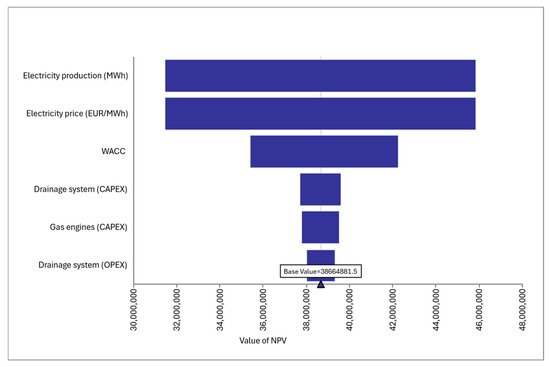
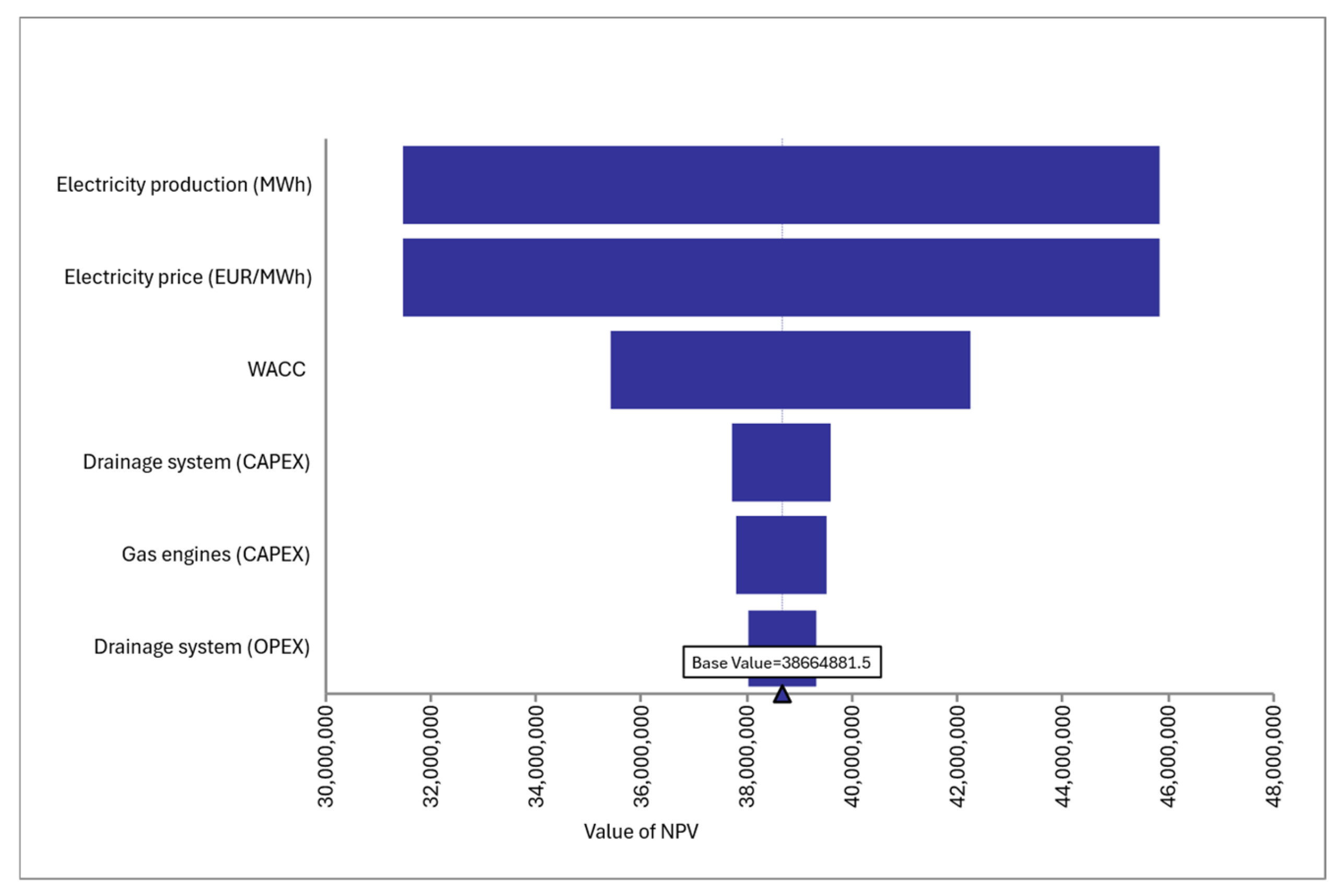
The next step is to assess the robustness of these results through a detailed sensitivity analysis of the financial parameters. Figure 1 presents the results of the NPV sensitivity analysis conducted with TopRank 7.5 [15].
Figure 1.
Sensitivity analysis of the NPV.
According to the NPV sensitivity analysis, the variables with the most significant potential to drive large swings in project profitability are electricity production, the electricity price, and the WACC. All other input parameters exert a markedly smaller influence on NPV than these three dominant factors. We will therefore subject these three variables to a more rigorous examination to assess their impact under a range of plausible conditions.
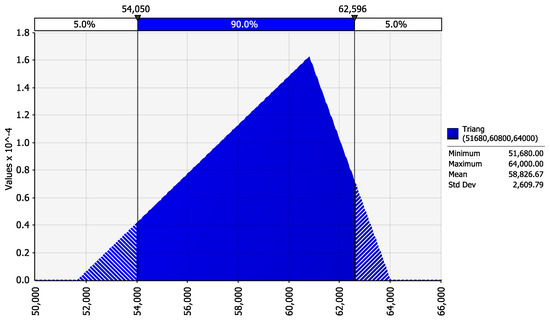
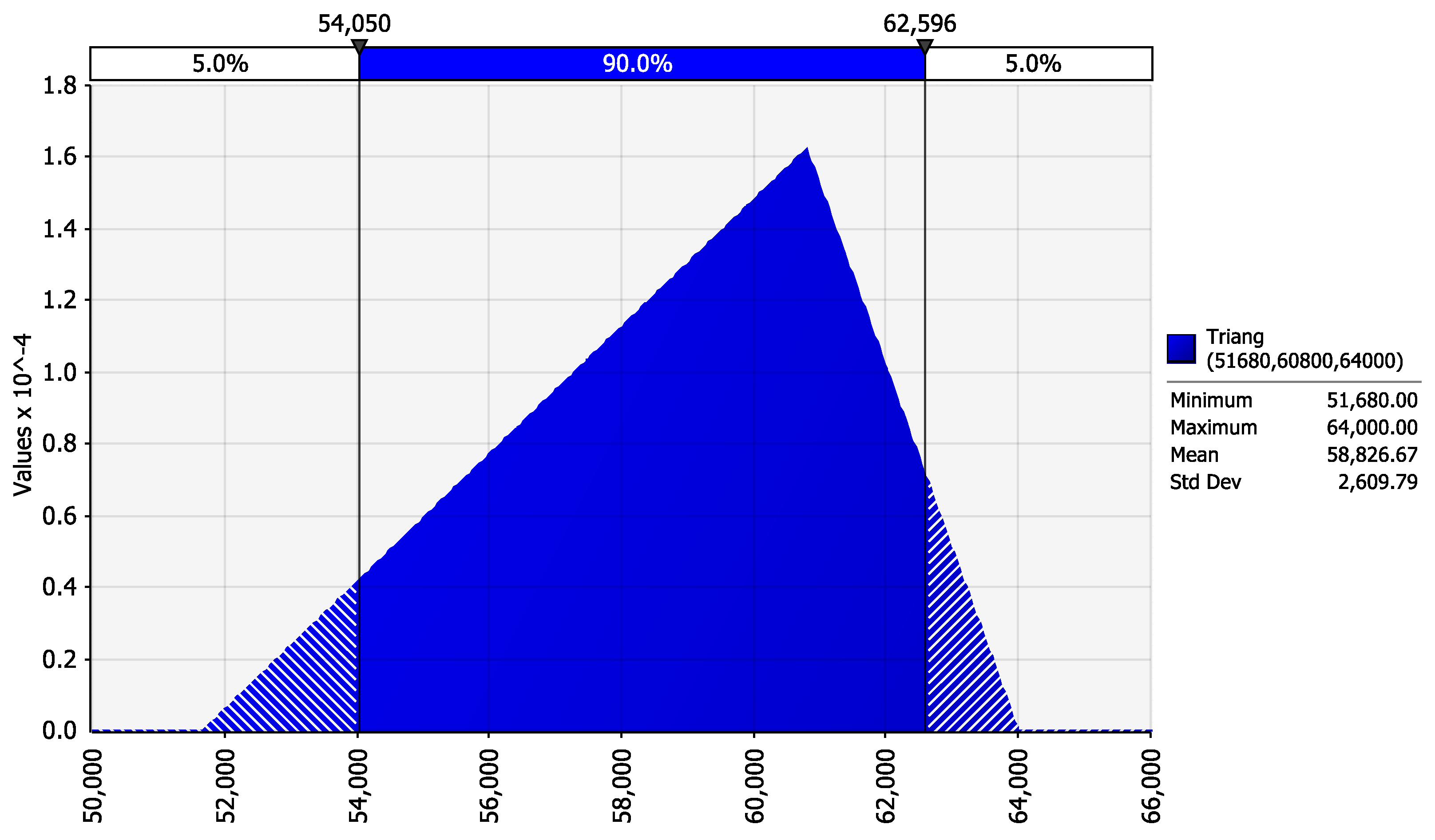
First, annual electricity production from the LCAMM gas engines will be modelled using a triangular distribution, defined by minimum, most likely, and maximum generation levels derived from technical design parameters and expected availability. This choice reflects the bounded nature of electricity output and the asymmetric uncertainty around the most plausible production level. The minimum value will be set at 51,680 MWh/year, corresponding to 85% of the design output; the most likely value will remain 60,800 MWh/year, reflecting operation at 95% load for approximately 8000 h/year; and the maximum value will be defined as 64,000 MWh/year, representing full-load operation (100%) over the same annual operating time. This range captures the realistic variability in electricity generation arising from fluctuations in LCAMM inflow and engine performance, while operational availability was considered to be stable. Figure 2 presents the resulting triangular distribution of the annual electricity production.
Figure 2.
Triangular distribution of the annual electricity production.
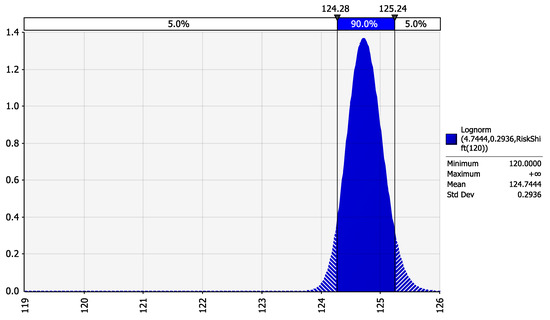
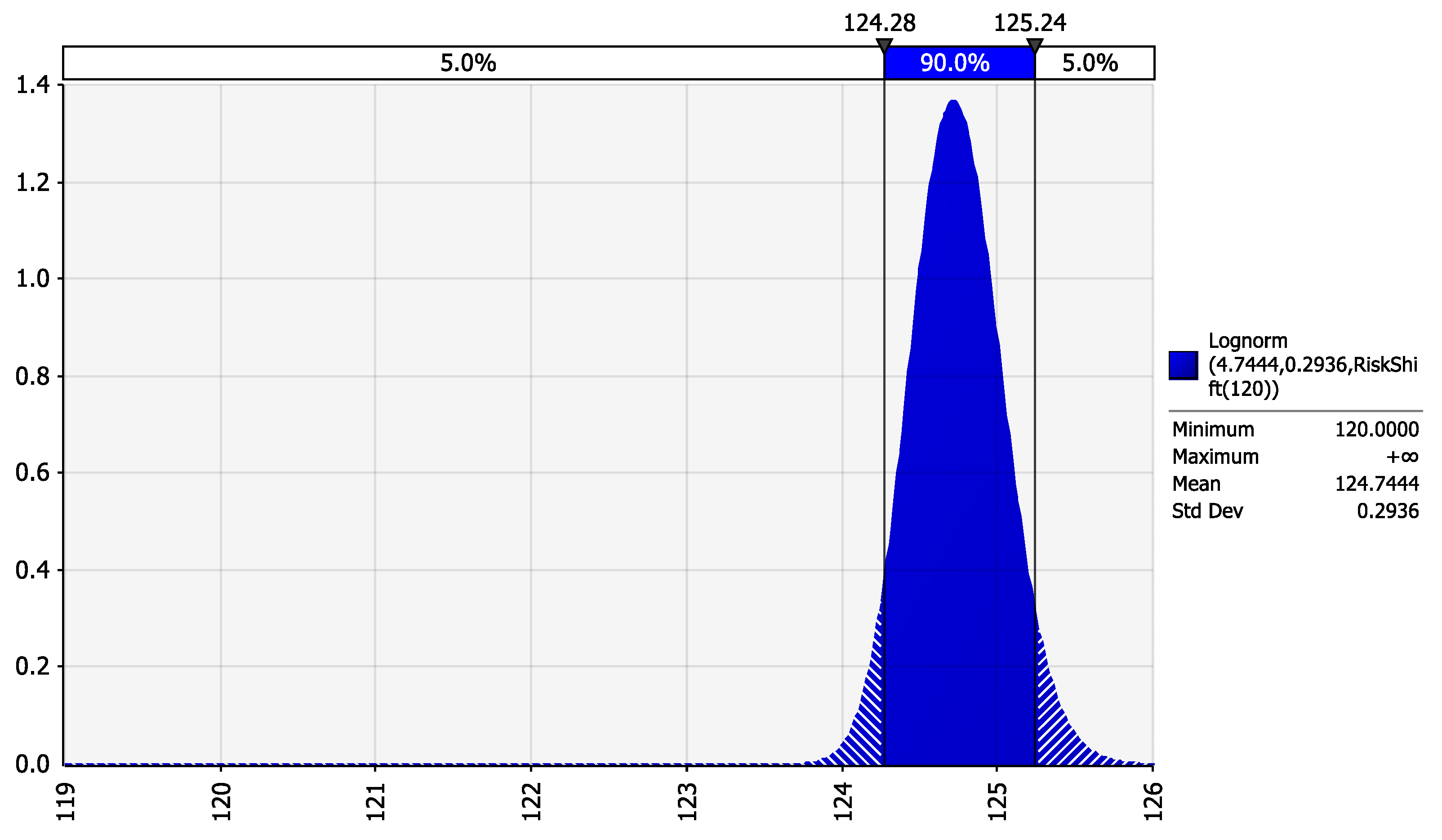
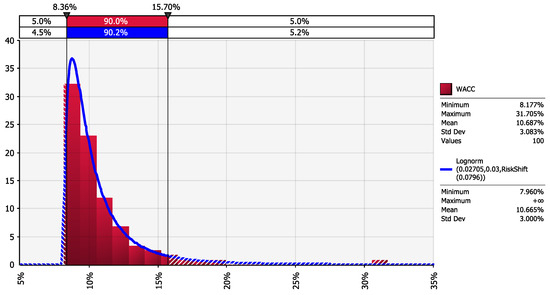
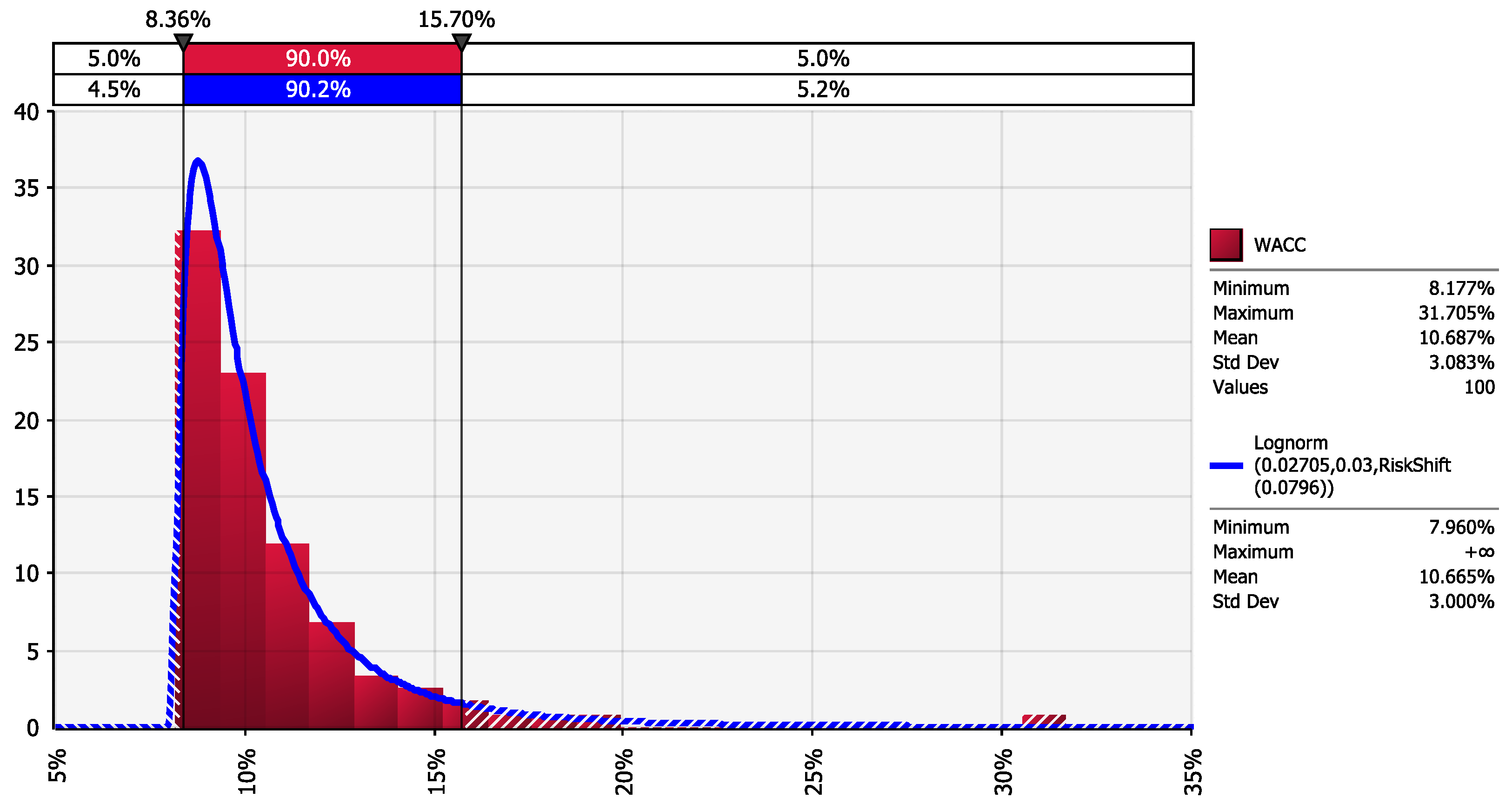
Second, lognormal distributions are adopted to model uncertainty in both electricity prices and the real after-tax WACC, as these variables are inherently strictly positive and cannot be meaningfully described by distributions that allow negative values. In addition, the main drivers of variability for both quantities tend to act multiplicatively rather than additively as follows: electricity prices are shaped by interacting effects such as fuel and carbon costs, demand–supply imbalances, regulatory interventions, and occasional system constraints, which can generate a right-skewed pattern with infrequent but material price spikes; similarly, WACC reflects compounding influences from the cost of debt, expected equity returns, fiscal conditions, and project- and market-specific risk premia, which can likewise produce an asymmetric distribution with a heavier upper tail. For these reasons, the lognormal model provides a pragmatic and internally consistent way to capture realistic downside bounds alongside plausible upside risk within the Monte Carlo framework, following established practice in financial parameter modelling for capital-intensive investments [16]. The resulting modelled distributions are shown in Figure 3 and Figure 4.
Figure 3.
Lognormal distribution of electricity prices.
Figure 4.
Lognormal distribution of the WACC.
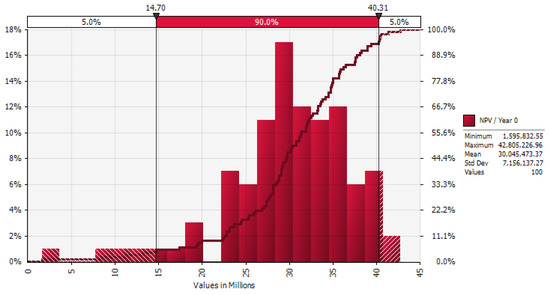
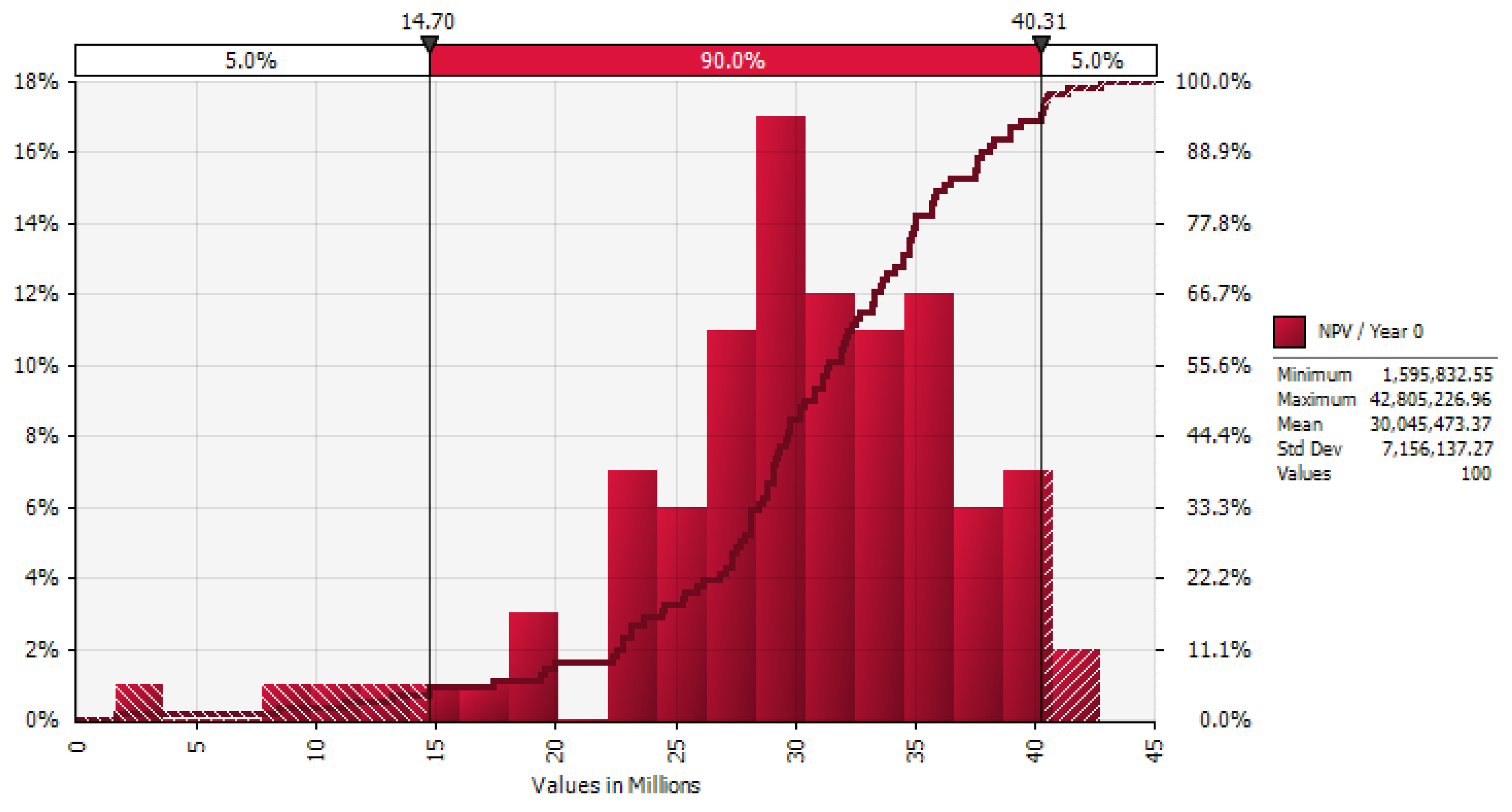
Following detailed modelling of the variables identified as most influential in the sensitivity analysis, a probabilistic evaluation of the project’s financial performance was conducted using a Monte Carlo simulation in @RISK 7.5 [17]. This approach captures the combined effects of uncertainty in electricity production, electricity prices, and the WACC more realistically than deterministic scenarios do. The simulation was run using 10,000 iterations, producing a full probability distribution for the net present value (NPV). The results, summarised in Figure 5, which also includes a cumulative overlay plot, indicate that when uncertainties in the key parameters are jointly considered, the NPV distribution shifts modestly downward relative to the deterministic case. The stochastic model yields a mean NPV of 30.0 million EUR and a standard deviation of 7.2 million EUR, reflecting the inherent volatility of the underlying economic drivers. This probabilistic perspective provides a more robust understanding of the project’s financial resilience and highlights the range of outcomes that may materialise under realistic operating and market conditions.
Figure 5.
NPV distribution after the Monte Carlo simulation.
3.2. Project Scenario (Assessing GHG Performance)
The second scenario assesses the greenhouse gas (GHG) performance of the LCAMM management system. The system is designed to provide a continuous supply of around 30.4 Nm3/min of pure methane to the surface methane drainage station, where the gas is conditioned and fed to the gas engines for electricity generation. Over an annual operating period of 8000 h, the total methane volume processed reaches 16.8 million Nm3/year. Using the density of methane at standard conditions (0.717 kg/m3), this corresponds to approximately 12,046 tonnes of CH4 captured per year.
Although the precise rate at which methane would otherwise migrate from behind the isolation dams into the ventilation system cannot be directly quantified, it is reasonable—based on established post-mining goaf behaviour—to assume that the captured methane represents emissions that would eventually reach the atmosphere in the absence of the LCAMM management system. Therefore, the REM scenario represents a credible counterfactual of avoided emissions.
To calculate the net climatic benefit, methane destruction must account for the CO2 produced during combustion. Stoichiometrically, the complete oxidation of 1 kg of CH4 yields approximately 2.75 kg of CO2. With the 100-year global warming potential (GWP100) of methane set at 29.8 tCO2e per tonne CH4, the net benefit becomes 29.8 − 2.75 = 27.05 tCO2e avoided per tonne of CH4 oxidised. Applied to the annual capture of 12,046 tonnes of methane, the LCAMM management system achieves an estimated net mitigation effect of approximately 326,500 tCO2e/year.
Although the LCAMM management system yields a clearly quantifiable net climate benefit, monetising this benefit is not as straightforward as multiplying the avoided CO2-equivalent emissions by the EU ETS allowance price, as applying the ETS carbon price to methane emissions would constitute an artificial construct with no regulatory foundation. A more meaningful approach is to estimate, as a scenario analysis, the penalty costs that coal mine operators may avoid under a plausible methane-emission fee regime.
Recent analytical work by the Ecologic Institute [18] proposes a reference penalty level of 6000 EUR per tonne of CH4, derived by converting CH4 to CO2-equivalent emissions using its 100-year global warming potential (GWP100) and applying the prevailing EU ETS carbon price, which, in our opinion, is an entelechy. Moreover, this scenario analysis value also includes the ETS “excess emissions penalty”, even though coal mines do not operate within the EU ETS and therefore cannot surrender allowances. Applying such a penalty to methane emissions from coal mines would place them at a structural disadvantage compared with ETS-regulated entities—an issue the EU has already avoided in other sectors by creating a separate emissions trading scheme (ETS2) for buildings, road transport, and small industries.
In the absence of an ETS-like market for methane from the energy sector and given the lack of critical mass to justify such a scheme, a more realistic scenario analysis for a penalty baseline should rely solely on the average ETS carbon price—without adding excess-emission penalties that are irrelevant for non-ETS operators. Using the mean EU ETS price of 67 EUR/t CO2 between January and October 2024—the first stable period following the 2019 introduction of the Market Stability Reserve (MSR)—yields a methane penalty baseline of approximately 2000 EUR/t CH4. This value aligns with the upper range of the U.S. EPA’s 2023 social cost of methane estimates for 2020 (1300–2300 USD/t CH4) and the lower range of projections for 2030 (1900–3200 USD/t CH4), which incorporate the latest climate science and recommendations from the U.S. National Academies [13].
The social cost of methane provides the monetary estimate of the societal damages caused by emitting one tonne of CH4 in a given year, and equivalently, the societal benefit of abating one tonne. As such, it represents an appropriate metric for assessing climate-related benefits in a cost–benefit analysis. However, the volatility and structural evolution of the EU ETS must be acknowledged. During the first three phases of the EU ETS (2005–2020), the system underwent a prolonged 16-year adjustment period. Phase 1 (2005–2007) functioned as a pilot with over-allocated allowances that collapsed to zero value; Phase 2 (2008–2012) benefited from verified emissions data but remained vulnerable to exogenous shocks such as the 2008 financial crisis; and Phase 3 (2013–2020) introduced substantial reforms to improve market functioning and prevent surplus accumulation. A decisive turning point occurred in 2019 with the activation of the MSR (designed to address the structural market surplus and improve the system’s resilience to supply–demand imbalances), which began withdrawing excess allowances from the market, tightening supply, and driving a structural increase in carbon prices. This reduction in allowance supply and record emissions reductions in 2019 created upward pressure on carbon prices. This upward trend continued as the market anticipated and reacted to the MSR’s tightening supply conditions. Finally, Phase 4 of the EU ETS (2021–2030) marks the maturity of the EU ETS market.
To provide an explicit benchmark for pricing methane emissions during the coal mining industry’s adjustment period, the years 2013–2018 represent a verifiable, policy-neutral “shadow price” of carbon from a period in which the EU ETS framework was already mature (Phase 3); however, carbon prices were still largely shaped by a persistent allowance surplus rather than by the post-2019 structural tightening. In other words, 2013–2018 captures a market environment in which abatement incentives were present but modest, reflecting an “adjustment” setting more analogous to the coal sector’s early transition under emerging methane rules than to the later MSR-driven regime. By contrast, prices from 2019 onwards increasingly embed scarcity rents and expectations linked to structural reforms and tighter caps, which would inflate a methane penalty in ways that are not directly attributable to methane’s marginal damages or to coal mines’ near-term capacity to respond. A multi-year average over 2013–2018 is therefore transparent and reproducible (based on publicly reported annual/period averages) and smooths short-term shocks. It provides a conservative, implementable baseline for a phased methane charge that can subsequently be escalated in accordance with an explicit rule (e.g., a scheduled ramp-up or a rolling EU ETS reference). On this basis, converting 7.66 EUR/t CO2 using methane’s GWP yields a baseline of ≈228 EUR/t CH4, which can be introduced gradually to preserve investment predictability while the sector adapts and deploys mitigation technologies.
Applying this 228 EUR/t CH4 baseline to the annual LCAMM capture of 12,046 tonnes of CH4 results in an avoided penalty of 2.75 million EUR per year. From this amount, the CO2 generated through methane combustion must be subtracted. Complete oxidation of methane produces 2.75 kg CO2 per kg CH4, corresponding to 33,127 kg CO2 for the annual captured methane stream. When monetised at the December 2024–December 2025 average ETS price of 73.5 EUR/t CO2, the associated CO2 cost equals 2.43 million EUR, leaving a net annual climate-related benefit of approximately 0.31 million EUR attributable to avoided methane emissions. This figure represents the climate-related economic value delivered by the LCAMM system under a realistic penalty-based monetisation framework.
Thus, using this net annual climate-related benefit, the revised economic indicators yield a net present value (NPV) of 41.7 million EUR and an internal rate of return (IRR) of 31.43%. At the same time, the payback period (PP) remains unchanged at 4 years. These results indicate that monetising avoided methane emissions—when based on a realistic penalty-oriented valuation framework—does not substantially alter the project’s financial attractiveness. In other words, the core economic viability of the LCAMM management system is primarily driven by the energy utilisation pathway, with the climate benefit monetisation providing only a marginal incremental improvement.
4. Discussion
This study provides one of the first integrated assessments of low-content abandoned mine methane (LCAMM) management in a European hard coal mine, jointly considering technical feasibility, greenhouse gas (GHG) performance, and project economics over a 20-year horizon. Building on the REM pilot at Pniówek, the analysis demonstrates that a dedicated LCAMM management chain—combining long-reach directional drilling, a methane-reduced drainage system, and 8 MWe of gas engines—can simultaneously deliver substantial climate benefits and a robust financial performance when evaluated under realistic assumptions for electricity prices and capital costs.
From a GHG perspective, the LCAMM management system configuration targets a category of emissions that has historically been difficult to manage: methane released slowly from post-mining goafs at concentrations below 30% CH4. The REM concept extends the logic of cutting GHG emissions relative to direct release, lower concentrations, and post-mining sources, by sealing selected goaf zones and routing the resulting LCAMM to the surface for utilisation. The resulting annual capture of approximately 12,046 t CH4 and the net mitigation effect of about 326,500 tCO2e/year, once CO2 from combustion is accounted for, confirm that post-mining goafs can represent a sizeable and technically accessible mitigation opportunity in methane-intensive basins such as the USCB. This finding is consistent with, and complementary to, earlier analyses that identify coal mine methane (CMM) and abandoned mine methane (AMM) as high-leverage levers for near-term climate action.
At the same time, the results underline that climate-driven monetisation of LCAMM is more complex than simply applying the EU ETS allowance price to avoided emissions. Coal mines are not ETS installations and cannot surrender allowances; treating them as if they were would therefore create a purely notional value stream. The paper shows that a more conceptually robust scenario analysis is to adopt a penalty-based framing aligned with the emerging EU Methane Emissions Regulation (EU MER), in which avoided payments under a methane emissions fee or penalty regime represent a realistic economic benefit for mine operators. Under this framing, a phased penalty path converging to 228 EUR/t CH4—derived from historical ETS prices and methane’s 100-year global warming potential—yields an annual avoided penalty of 2.75 million EUR for the REM LCAMM system. After subtracting the monetised cost of CO2 formed during combustion (2.43 million EUR/year, using an average ETS price of 73.5 EUR/t CO2), the residual climate-related benefit amounts to around 0.31 million EUR/year.
An important implication is that, even under relatively ambitious penalty assumptions, the direct climate-related cash flow remains modest compared to the energy-related benefit from avoided electricity purchases. In the reference (business-as-usual) scenario, which already includes the LCAMM management system but ignores explicit GHG valuation, the project generates a net present value (NPV) of 38.66 million EUR, an internal rate of return (IRR) of 29.63%, and a payback period of four years, assuming a real after-tax weighted average cost of capital (WACC) of 7.96%. These figures indicate that the economic rationale for LCAMM management at Pniówek is driven primarily by energy system considerations as follows: using “waste” methane to displace retail electricity purchases under Poland’s price-cap regime. The monetised climate component, while positive and potentially crucial for future regulatory compliance, plays a secondary role in the overall business case. This has two policy interpretations. First, where electricity prices and grid tariffs remain high, LCAMM projects may be financially viable even in the absence of explicit carbon pricing. Second, if the EU MER is implemented with effective methane penalty regimes, the incremental climate-related benefit can strengthen project resilience under less favourable energy market conditions.
The financial risk analysis reinforces this picture of robustness. Sensitivity analysis shows that electricity production, electricity prices, and the WACC are the dominant drivers of NPV variation, with other parameters playing a comparatively minor role. The Monte Carlo simulation, which jointly varies these three parameters using empirically grounded distributions, yields a mean NPV of 30.0 million EUR with a standard deviation of 7.2 million EUR. Although the probabilistic NPV is somewhat lower than the deterministic value, the distribution remains firmly positive, suggesting that the project is financially resilient across a wide range of plausible conditions. This is particularly relevant in a context where public and private decision-makers must balance decarbonisation objectives with the need to safeguard employment and regional economic stability.
Several limitations of the present study should be acknowledged. First, the methane release forecasts and LCAMM capture volumes are specific to the geological and operational conditions of Pniówek, including the configuration of post-mining goafs in the “Krzyżowice III” and “Pawłowice 1” mining areas. While the methodology is transferable, absolute results may differ substantially in mines with lower gas content, different seam geometries, or less favourable infrastructure. Second, while the capital and operating cost estimates are grounded in data from existing JSW installations and the DD-MET project, there remains uncertainty about future equipment prices, labour costs, and maintenance regimes, especially if supply chains tighten as more mines deploy similar systems. Finally, the penalty-based monetisation framework hinges on regulatory choices that are yet to be fully defined under the EU MER; both the level and temporal profile of methane penalties may diverge from the illustrative trajectory adopted here.
Despite these caveats, the analysis has clear implications for both policy and practice. For mine operators, the results suggest that investing in LCAMM capture and utilisation can be justified on purely economic grounds where electricity prices are high and reliable drainage infrastructure already exists or can be deployed at reasonable cost. For regulators, the work highlights that a well-designed methane penalty regime, calibrated to realistic ETS price levels and social cost estimates, can provide additional incentives without imposing disproportionate burdens on mines undergoing transition. Concluding, LCAMM management offers a pathway to reduce GHG emissions from legacy assets while extracting additional value from existing infrastructure and maintaining skilled employment in mining regions.
Future research should focus on two main directions. First, extending the economic analysis to multi-project portfolios, including both LCAMM and VAM technologies such as RTOs, could inform optimal investment sequencing at the company or basin scale. Second, coupling the type of Monte Carlo-based financial risk analysis used here with explicit policy scenarios for methane penalties and electricity market reform would provide a richer understanding of how regulatory pathways interact with project-level economics.
Author Contributions
Conceptualisation, A.K., P.R.F. and A.B.; methodology, A.K.; software, F.J.I.R.; validation, F.J.I.R. and G.F.V.; formal analysis, F.J.I.R. and G.F.V.; investigation, A.K. and P.R.F.; resources, A.B.; data curation, F.J.I.R. and G.F.V.; writing—original draft preparation, A.K.; writing—review and editing, F.J.I.R. and G.F.V.; visualisation, P.R.F.; supervision, A.B.; project administration, A.K. and A.B.; funding acquisition, A.K. and A.B. All authors have read and agreed to the published version of the manuscript.
Funding
This paper was developed within the REM project entitled “Reduction of methane emissions from post mining goafs to minimise their inflow into VAM”, which was funded by the EU’s Research Fund for Coal and Steel (RFCS) with grant agreement number 101099061, and by the Polish Ministry of Science and Higher Education with contract no. 5404/FBWiS/2023/2.
Institutional Review Board Statement
Not applicable.
Informed Consent Statement
Not applicable.
Data Availability Statement
The original contributions presented in this study are included in the article. Further inquiries can be directed to the corresponding author.
Acknowledgments
The authors would like to acknowledge the support given in the preparation of this paper by Eugeniusz Krause and Jacek Skiba, from the Department of Mining Aerology at the Central Mining Institute—National Research Institute (Poland).
Conflicts of Interest
Artur Badylak was employed by Jastrzębska Spółka Węglowa SA. The remaining authors declare that the research was conducted in the absence of any commercial or financial relationships that could be construed as a potential conflict of interest.
Abbreviations
The following abbreviations are used in this manuscript:
| GHGs | Greenhouse gases |
| LCAMM | Low-content abandoned mine methane |
| RFCS | Research Fund for Coal and Steel |
| EU | European Union |
| EU ETS | EU Emissions Trading System |
| EU MER | EU Methane Emissions Regulation |
| AMM | Abandoned mine methane |
| USCB | Upper Silesian Coal Basin |
| CMM | Coal mine methane |
| CHP | Combined heat and power |
| VAM | Ventilation air methane |
| LRDD | Long-reach directional drilling |
| GWP | Global warming potential |
| JSW | Jastrzębska Spółka Węglowa |
| WACC | Weighted average cost of capital |
| US EPA | United States Environmental Protection Agency |
| NPV | Net present value |
| IRR | Internal rate of return |
| PP | Payback period |
| RTO | Regenerative thermal oxidiser |
| GWP100 | 100-year global warming potential |
| MSR | Market stability reserve |
References
- IPCC. Climate Change 2021: The Physical Science Basis; Contribution of Working Group I to the Sixth Assessment Report of the Intergovernmental Panel on Climate Change; Masson-Delmotte, V., Zhai, P., Pirani, A., Connors, S.L., Péan, C., Chen, Y., Goldfarb, L., Gomis, M.I., Matthews, J.B.R., Berger, S., Eds.; Cambridge University Press: Cambridge, UK; New York, NY, USA, 2021; pp. 1331–1394. [Google Scholar]
- Borowski, M.; Zwolińska-Glądys, K.; Cheng, J. Methane Emissions from Coal Mines: Quantification, Capture, and Utilization Strategies for Atmospheric Impact Mitigation—A Case Study from Poland. Atmosphere 2025, 16, 174. [Google Scholar] [CrossRef] [Scilit]
- Borowski, M.; Życzkowski, P.; Cheng, J.; Łuczak, R.; Zwolińska, K. The Combustion of Methane from Hard Coal Seams in Gas Engines as a Technology Leading to Reducing Greenhouse Gas Emissions—Electricity Prediction Using ANN. Energies 2020, 13, 4429. [Google Scholar] [CrossRef] [Scilit]
- Karacan, C.Ö.; Ruiz, F.A.; Cotè, M.; Phipps, S. Coal mine methane: A review of capture and utilization practices with benefits to mining safety and to greenhouse gas reduction. Int. J. Coal Geol. 2011, 86, 121–156. [Google Scholar] [CrossRef] [Scilit]
- Duda, A. The Impact of Atmospheric Pressure Changes on Methane Emission from Goafs to Coal Mine Workings. Energies 2024, 17, 173. [Google Scholar] [CrossRef] [Scilit]
- Duda, A.; Krzemień, A. Forecast of Methane Emission from Closed Underground Coal Mines Exploited by Longwall Mining—A Case Study of Anna Coal Mine. J. Sustain. Min. 2018, 17, 184–194. [Google Scholar] [CrossRef] [Scilit]
- Krause, E.; Pokryszka, Z. Investigations on methane emission from flooded workings of closed coal mines. J. Sustain. Min. 2013, 12, 40–45. [Google Scholar] [CrossRef] [Scilit]
- Kaczmarczyk-Kuszpit, W.; Słota-Valim, M.; Wrana, A.; Surma, R.; Badylak, A.; Cicha-Szot, R.; Wojnicki, M.; Krzemień, A.; Lubosik, Z.; Leśniak, G. An Integrated Approach to Design Methane Drainage Boreholes in Post-Mining Areas of an Active Coal Mine: A Case Study from the Pniówek Coal Mine. Appl. Sci. 2025, 15, 11548. [Google Scholar] [CrossRef] [Scilit]
- European Union. Regulation (EU) 2024/1787 of the European Parliament and of the Council of 13 June 2024 on the Reduction of Methane Emissions in the Energy Sector and Amending Regulation (EU) 2019/942. Off. J. Eur. Union 2024, L202, 1–63. [Google Scholar]
- European Parliament and Council. Directive 2003/87/EC of 13 October 2003 establishing a scheme for greenhouse gas emission allowance trading within the Union and amending Directive 96/61/EC. Off. J. Eur. Union 2003, L275, 32–46. [Google Scholar]
- Errickson, F.C.; Keller, K.; Collins, W.D.; Srikrishnan, V.; Anthoff, D. Equity is more important for the social cost of methane than climate uncertainty. Nature 2021, 592, 564–570. [Google Scholar] [CrossRef] [Scilit] [PubMed]
- DD-MET Consortium. Advanced Methane Drainage Strategy-Technology Employing Underground Directional Drilling Technology for Major Risk Prevention and Greenhouse Gases Emission Mitigation (DD-MET); Research Fund for Coal and Steel (RFCS) 2018, Project No. 847338; DD-MET Consortium: Katowice, Poland, 2023. [Google Scholar]
- U.S. Environmental Protection Agency (EPA). Report on the Social Cost of Greenhouse Gases: Estimates Incorporating the Latest Science; U.S. EPA: Washington, DC, USA, 2023.
- Jastrzębska Spółka Węglowa S.A. Consolidated Financial Statements of the Jastrzębska Spółka Węglowa S.A. Group for the Financial Year Ended 31 December 2023; Jastrzębska Spółka Węglowa S.A.: Jastrzębie-Zdrój, Poland, 2024. [Google Scholar]
- Lumivero. TopRank, Version 7.5; Lumivero (Formerly Palisade Corporation): Denver, CO, USA, 2016.
- U.S. Environmental Protection Agency (EPA). Air Pollution Control Cost Estimation Spreadsheet for Thermal and Catalytic Oxidisers; Office of Air Quality Planning and Standards: EPA: Research Triangle Park, NC, USA, 2022.
- Lumivero. @Risk, Version 7.5; Lumivero (Formerly Palisade Corporation): Denver, CO, USA, 2016.
- Ecologic Institute. Establishing a Penalty Regime Under the EU Methane Emissions Regulation: Legal and Economic Considerations; Working Paper No. 3; Ecologic Institute: Berlin, Germany, 2024. [Google Scholar]

Disclaimer/Publisher’s Note: The statements, opinions and data contained in all publications are solely those of the individual author(s) and contributor(s) and not of MDPI and/or the editor(s). MDPI and/or the editor(s) disclaim responsibility for any injury to people or property resulting from any ideas, methods, instructions or products referred to in the content. |
© 2026 by the authors. Licensee MDPI, Basel, Switzerland. This article is an open access article distributed under the terms and conditions of the Creative Commons Attribution (CC BY) license.