Article

Study on the Soil-Water Characteristic Curve and Hydraulic Conductivity Prediction of Unsaturated Undisturbed and Compacted Loess


1
College of Civil Engineering, Taiyuan University of Technology, Taiyuan 030024, China
2
Lvliang North Expressway Management Co., Ltd., Lvliang 033199, China
*
Author to whom correspondence should be addressed.
Appl. Sci. 2026, 16(2), 932; https://doi.org/10.3390/app16020932
Submission received: 3 October 2025 / Revised: 3 November 2025 / Accepted: 14 November 2025 / Published: 16 January 2026
(This article belongs to the Section Civil Engineering)

Abstract

In the loess region, the hydraulic properties of the loess, used as either surrounding rock, backfilling or geoplomer material, are significant for engineering construction and agriculture development projects. This work investigated the soil-water characteristic curves (SWCC) of the undisturbed and remolded loess during the drying process using the tensiometer and psychrometer method. Based on the test results, SWCC was fitted using the Van Genuchten, and Fredlund and Xing models. Moreover, the permeability was comparatively calculated by the Childs and Collis-George, Van Genuchten, and Fredlund models, respectively. Results revealed that the SWCC of both the undisturbed and remolded loess exhibited three-stage characteristics in the relationship between the logarithmic matric suction and moisture, including the boundary effect zone, transition zone, and residual zone. The corrected Fredlund and Xing model provided an optimal calculation for the SWCC of the loess, while the Van Genuchten model showed suction deviations of about 103 kPa. Meanwhile, the undisturbed loess had a low water retention at the low (<103 kPa) suction range, which was attributed to the large pore structure of the undisturbed loess that reduces the air-entry value. This research clarified the differences in the water retention and permeability properties of the loess, providing a theoretical foundation for evaluating the hydraulic properties of the loess.

1. Introduction

In the loess region, the hydraulic properties of the loess, used as either surrounding rock, backfilling or geoplomer material, are significant for engineering construction and agriculture development projects. The hydraulic properties can be described by the soil-water characteristic curve (SWCC) of the soil, expressing the relationship between matric suction and moisture content (or degree of saturation) [1]. Physically, the SWCC quantifies the water retention capacity of the soil, which can be obtained by measuring matric suction and moisture content during wetting or drying processes. As a critical curve, This SWCC is significant in geotechnical engineering, particularly for estimating the permeability characteristics of the unsaturated soils [2].
Research has been conducted about the SWCC of unsaturated loess, analyzing its influencing factors and underlying mechanisms. Lan et al. [3] examined the difference in soil water retention curves of natural loess during mechanical and hydraulic wetting, demonstrating that the degree of saturation increased with the decrease in the void ratio under the constant suction condition. The SWRC was not only affected by the void ratio but also by the way of wetting. Ma et al. [4] systematically explored the SWCC measurements and saturated permeability of the Yangling loess under different initial compaction degrees and water contents, finding that with the increase in initial compactness and water content, the higher the air entry value (AEV) of soil, the stronger the water retention capacity. Correspondingly, the residual water content was also high. Gao et al. [5] measured the SWCC after various wet-dry cycles, demonstrating that the AEV and volumetric water content evidently decreased with increasing cycle numbers, leading to a weaker water retention capacity of the soil. Wang et al. [6] conducted SWCC tests on remolded loess with varying dry densities during drying-wetting cycles, observing that high dry densities decreased saturated volumetric moisture content, reduced SWCC slope and increased AEV. Zheng et al. [7] experimentally studied the SWCC of loess with different particle size distributions, revealing that dominant particle size peaks significantly influenced the AEV. Hou et al. [8] integrated tensiometer with optical microscopy tests to analyze the relationship between SWCC and microstructure in the undisturbed loess, observing that pore distribution differences caused SWCC variations. Their studies focus on either undisturbed or remolded states without a systematic comparison of their hydraulic behaviors. Furthermore, Although models, such as Van Genuchten, and Fredlund and Xing, are commonly used for calculating the SWCC, a thorough comparison of their performance for both soil is rare. Moreover, the permeability functions derived from these SWCC parameters are seldom validated or compared against each other.
Developing precise and universally applicable SWCC models to characterize soil water retention behavior remains a critical challenge in unsaturated soil research. Some well-established models [9,10,11] have been proposed. Cai et al. [12] compared the applicability of various SWCC models for different soils and found that the Fredlund and Xing model with modification factors demonstrated superior performance in describing SWCC across the complete suction ranges. Furthermore, researchers continue to advance model precision and optimize parameter determination methods. Zhai and Rahardjo [13] developed confidence limit equations to quantify uncertainties of the SWCC and determine parameters. The application of confidence limits in evaluating model performance was also demonstrated by experimental measurements. This probabilistic approach provided a significant advancement in assessing SWCC calculation reliability, offering critical uncertainty analysis capabilities for soil hydraulic characterization. Different best-fit equations using either volumetric moisture content or normalized volumetric moisture content were established. When establishing SWCC using saturation, parameters related to residual suction must be defined. When using volumetric moisture content, residual volumetric moisture content must be determined. Zhai et al. [14] investigated the impacts of residual suction (Cr) and residual moisture content (θr) on model performance and hydraulic conductivity function estimation with diverse soils, revealing that model accuracy remains unaffected by Cr but significantly influenced by θr which also had an impact on the hydraulic conductivity predictions. Zhao et al. [15] proposed a hierarchical Bayesian approach to derive site-specific SWCC by integrating sparse site measurements with existing data from similar geological deposits. Bayesian frameworks and Markov Chain Monte Carlo simulations for parameter estimation were used and this method achieved precise SWCC characterization and quantifies associated uncertainties.
Given that SWCC measurements require specialized equipment and prolonged testing periods, some alternative predictive models have been developed based on physical/statistical frameworks, empirical correlations, particle size distributions (PSD), or pore size distributions (POSD). Li et al. [16] investigated three groups of remolded loess with varying dry densities to measure unsaturated permeability curves and POSDs via mercury intrusion porosimetry, revealing two distinct regimes, including a low-suction stage (capillary water dominance) and a high-suction stage (adsorbed water dominance). While the PSD-based model accurately predicted low-suction behavior, it systematically underestimated high-suction permeability, highlighting its limitation for adsorption-dominated conditions. Zhang et al. [17] established a predictive SWCC model for loess by considering void ratio effects through capillary models and statistical assumptions. Tang et al. [18] developed a SWCC prediction model based on PSD characteristics, identifying a linear “stepwise” relationship between particle size and pore diameter in double-logarithmic coordinates. Larger particles produced more pronounced stepwise features, while smaller particles attenuated this trend toward linear distributions. This observation led to a predictive model incorporating PSD functions and void ratios to account for particle gradation and deformation effects. Zhang et al. [19] proposed a method to predict SWCC after multiple wetting–drying cycles by introducing a cycle-dependent function. This approach requires only the initial wetting/drying curves and the soil’s plasticity index. However, despite the diversity of these predictive models, a critical limitation exists. Many approaches primarily calibrated and validated for remolded or undisturbed soils under specific initial conditions. Their applicability to undisturbed loess remains largely unassessed because hydraulic behavior is governed by its natural structure and cementation rather than just compaction-induced density. Furthermore, there is a scarcity of models capable of seamlessly predicting the evolution of both the SWCC and the hydraulic conductivity for both undisturbed and remolded states.
Overall, this research is to establish a comparative framework for characterizing the hydraulic properties of both the undisturbed and remolded loess, thereby providing critical parameters for predicting the hydraulic properties of the loess mass in engineering construction and agriculture development projects. In this regard, the SWCC and saturated hydraulic conductivity of the undisturbed and remolded loess under identical dry density conditions was experimentally determined and compared. Moreover, the Van Genuchten and Fredlund and Xing models were used to calculate the SWCC data and obtain the parameters. Finally, the efficacy of the Childs and Collis-George, Van Genuchten, and Fredlund models was evaluated to predict the permeability of the soil.

2. Specimen Preparation and Methodology

2.1. Soil Samples Extraction and Material

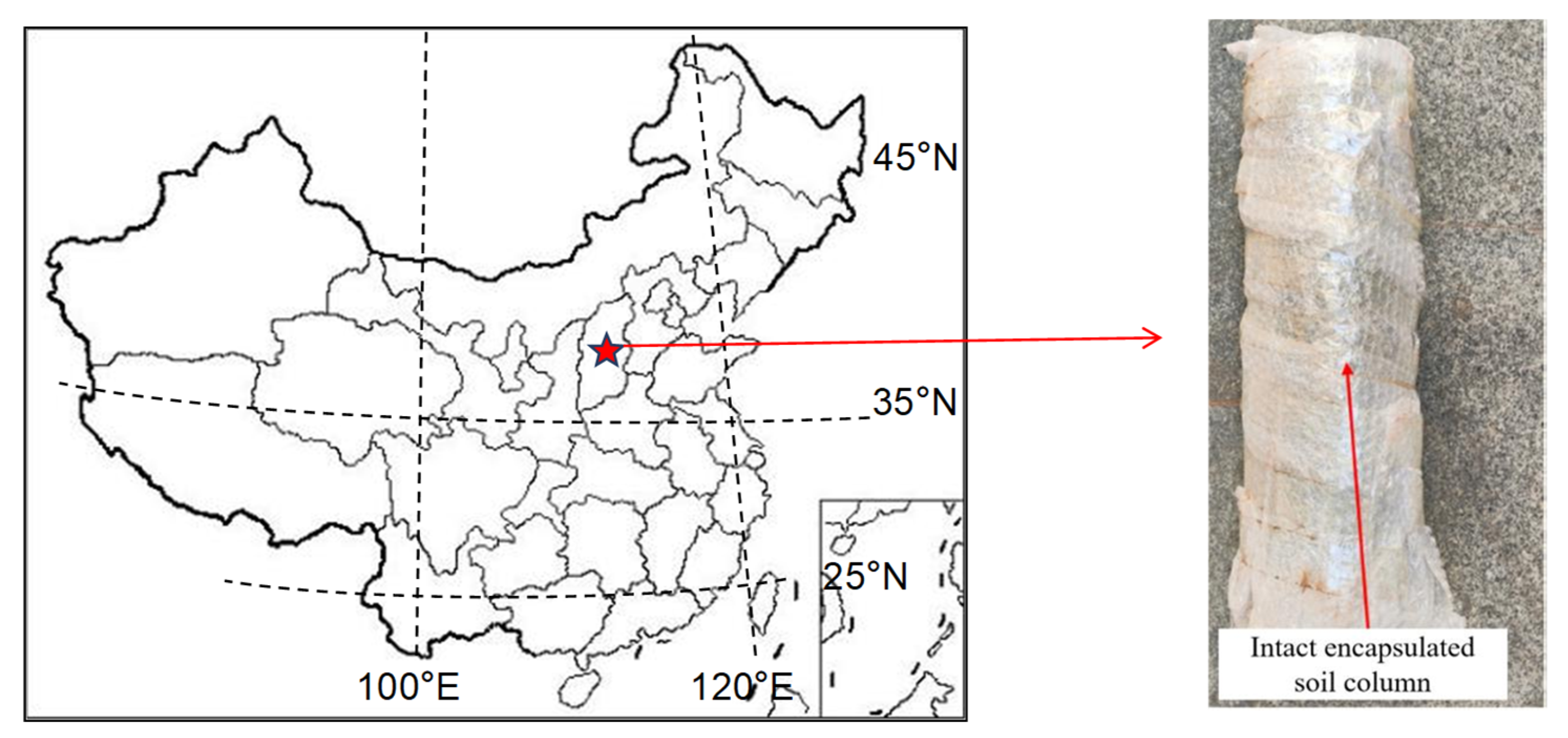
The soil samples were collected from Q4 loess deposits at a slope in Taiyuan City, Shanxi Province as shown in Figure 1, specifically ensuring representative in situ conditions.
After sampling, the samples were immediately wrapped in plastic film to prevent moisture evaporation, then secured in split UPVC molds for protection, with plastic foam wrapping externally to maintain the soil integrity during transportation. The undisturbed samples were transported to the laboratory and tested promptly to minimize moisture loss effects. Laboratory tests determined its natural dry density (1.44–1.47 g/cm3) and natural moisture content (9–12%).
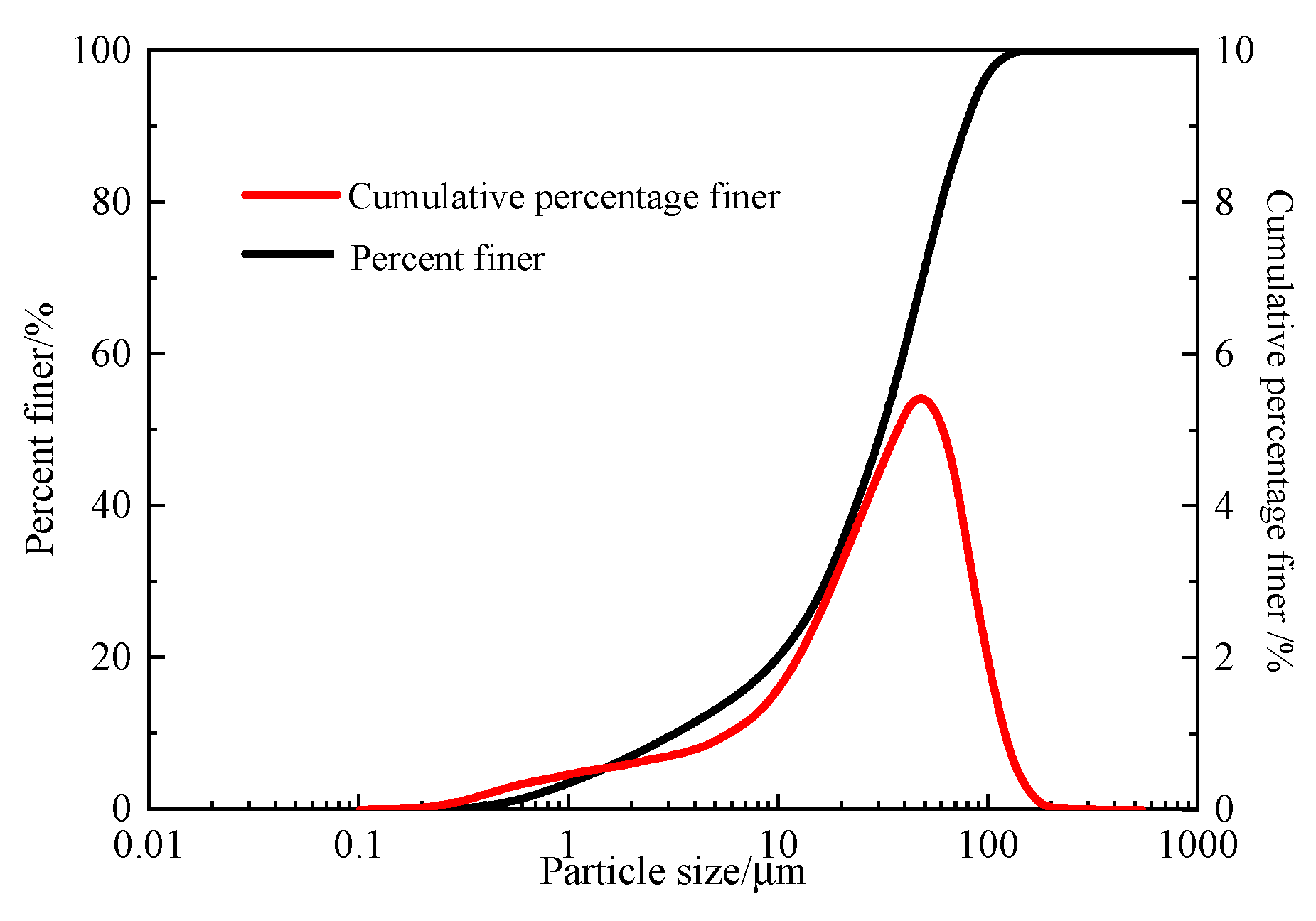
The remolded loess used in this study was derived from the same location as the undisturbed loess samples. The soil exhibited uniform texture and a typical yellowish color. Standard compaction tests were conducted to determine key physical parameters, including maximum dry density and optimum moisture content as listed in Table 1. Using the BT-9300S laser particle size analyzer (Dandong Bettersize Instruments Ltd., Liaoning, China), the soil pore size distribution was tested. Referring to the soil particle size grading standards, the collected sample consisted of 7.13% clay particles, 69.58% silt particles and 23.29% sand particles. The particle size distribution characteristics of the test soil samples are presented in Figure 2. According to the Standard for Engineering Classification of Soil (GB/T 50145-2007) [20], the tested loess contains >50% fine-grained particles (particle size < 75 μm) with a plasticity index (Ip) < 10, classifying it as silt loam.

2.2. Specimen Preparation

A total of four cylindrical soil specimens were prepared for this experimental program. This included an undisturbed loess specimen and a remolded loess specimen for the SWCC tests, along with an additional undisturbed specimen and a remolded specimen for the saturated hydraulic conductivity tests.

2.2.1. Specimen Preparation for SWCC

Undisturbed loess specimens were prepared using the cutting method. Field-collected samples were initially trimmed into small blocks with planar top and bottom surfaces. Subsequently, soil knives were employed to meticulously trim the undisturbed loess, ensuring smooth sidewalls and creating a precisely leveled face for FDR moisture sensor installation, guaranteeing full probe insertion into the soil matrix. To control moisture evaporation pathways, specimens with a dimeter of 140 mm and a height of 80 mm were encapsulated with heat-shrink film using a hot air gun, restricting vapor loss exclusively through the upper surface. This approach maintained uniform hydraulic conditions across the horizontal cross-section during desiccation.
A remolded loess specimen was prepared using the static compaction method. Initially, air-dried undisturbed loess was pulverized to fine powder, mixed with distilled water at a targeted moisture content of 20%, followed by thorough stirring to achieve uniform water distribution. The prepared soil mixture was sealed in airtight plastic bags and stored in a humidity-controlled chamber for 48 h to ensure complete moisture equilibration throughout the specimen. Subsequently, the homogenized soil was statically remolded into the specimen mold using a hydraulic press, with the dry density precisely controlled at 1.45 g/cm3. The selection of the high water content ensured the specimen was near-saturation at the start of the SWCC drying test, which is a fundamental requirement. The dry density of 1.45 g/cm3 represents the maximum achievable density at this high water content (on the wet side of optimum). Crucially, it matches the in situ dry density of the natural undisturbed loess density. This approach allows for a direct and meaningful comparison of the hydraulic properties between the remolded and undisturbed states under identical density and dimension conditions, isolating the effect of soil structure.
After specimens preparation, the specimens were wrapped in filter paper and transferred into a vacuum desiccator. Distilled water was added to fully submerge the specimens, followed by sealing the desiccator lid. Vacuum pumping was then initiated until the negative pressure stabilized at approximately −85 kPa. Upon reaching the target pressure, the exhaust valve was closed first, followed by immediate shutdown of the motor switch. The specimens were maintained under this stable negative pressure for 24 h. For determination of the specimen saturation, the vacuum gauge remained stable with no significant fluctuations and no visible air bubbles were observed in the distilled water. The saturated specimens were covered with a layer of plastic wrap on their upper surfaces to prevent moisture loss.

2.2.2. Specimen Preparation for Saturated Hydraulic Conductivity Tests

For preparation of the undisturbed soil specimen, a cutting ring with a diameter of 61.8 mm and a height is 40 mm was used to trim the undisturbed specimen.
The soil specimen for the saturated permeability test were prepared using the same loess material as previously described. The required dry soil mass for achieving a target dry density of 1.45 g/cm3 was calculated. The precisely weighed dry soil was then uniformly moistened using a spray bottle, followed by thorough mixing to ensure homogenous water distribution. The soil was remolded in the cutting ring in layers corresponding to the target height, with each layer scarified before applying the subsequent layer to enhance interlayer bonding.

2.3. Test Apparatus

2.3.1. Test Apparatus for SWCC

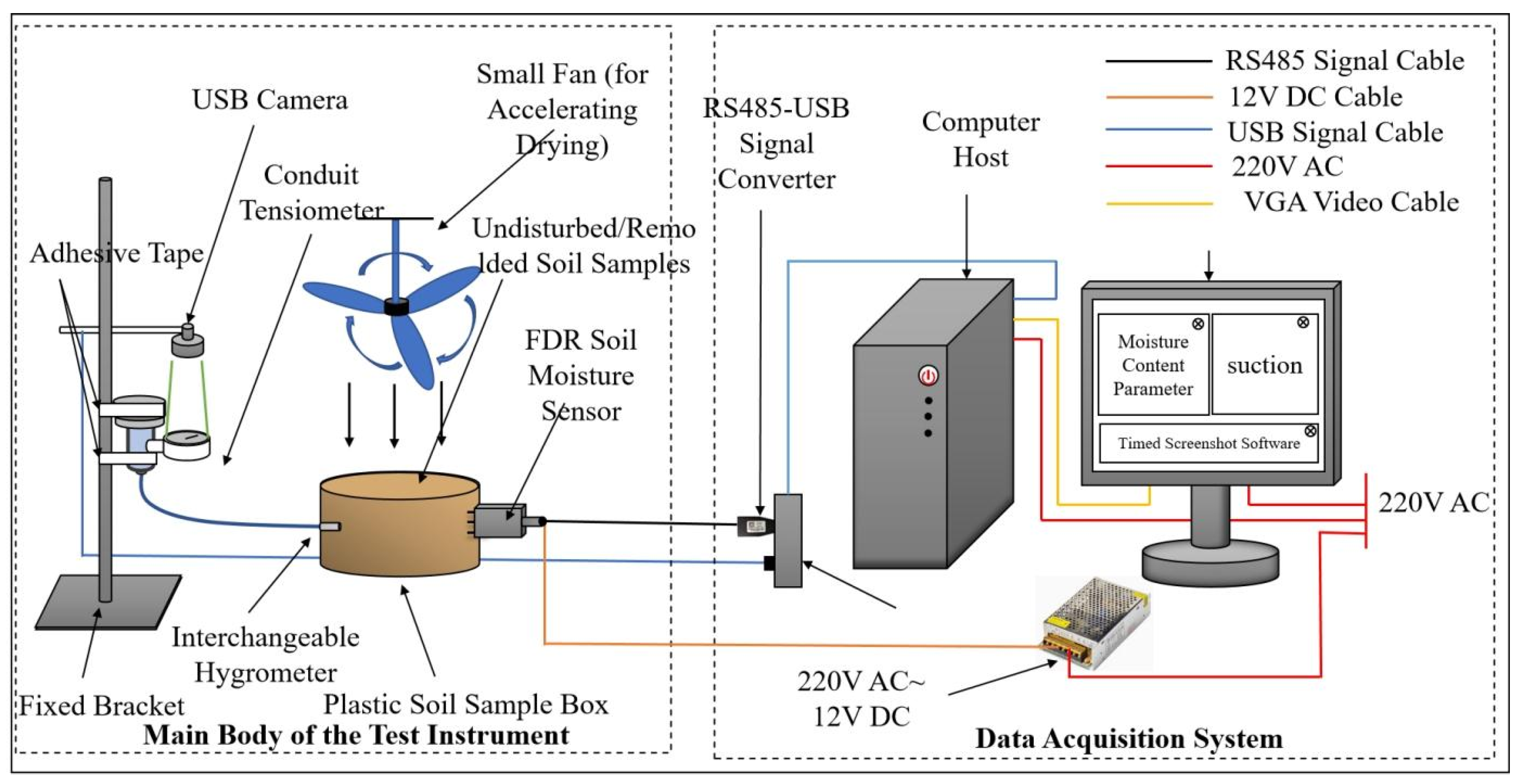
The SWCC tests in this study were performed using a self-developed instrument system as shown in Figure 3. The system primarily consists of a data acquisition system and the main testing apparatus. The main testing apparatus mainly consists of a soil specimen chamber, a tube tensiometer (or a humidity sensor) and a frequency domain reflectometry (FDR) moisture sensor. The data acquisition system comprised a PC, software and a USB camera. Compared to conventional SWCC testing methods, this integrated system can achieve synchronized real-time acquisition of multi-parameter data, including matric suction, water content, and relative humidity, from a single specimen, providing a more coherent dataset than sequential traditional tests. Moreover, the apparatus can control the drying speed of the specimen and enable continuous tracking across a wider suction range within a unified setup, thereby minimizing specimen disturbance.
To ensure the accuracy and reliability of the self-developed system, a rigorous calibration and internal validation procedure was implemented. Prior to testing, each sensor was calibrated against a traceable standard. The tube tensiometer was calibrated against a certified digital vacuum gauge. The FDR moisture sensor was calibrated using specimens with precisely measured gravimetric water content via the oven-drying method. The humidity sensor was calibrated in a controlled environment with known relative humidity.
The FDR moisture sensor transmits measurement data in real-time to the computer for immediate display. Simultaneously, the analog dial readings of the tube tensiometer are captured via the USB camera and displayed on the computer interface. Both datasets are recorded in real time. When the tensiometer exceeds the measurement range, it is replaced with the humidity sensor. Subsequently, data acquisition continues until completing the tests.

2.3.2. Test Apparatus for Saturated Hydraulic Conductivity

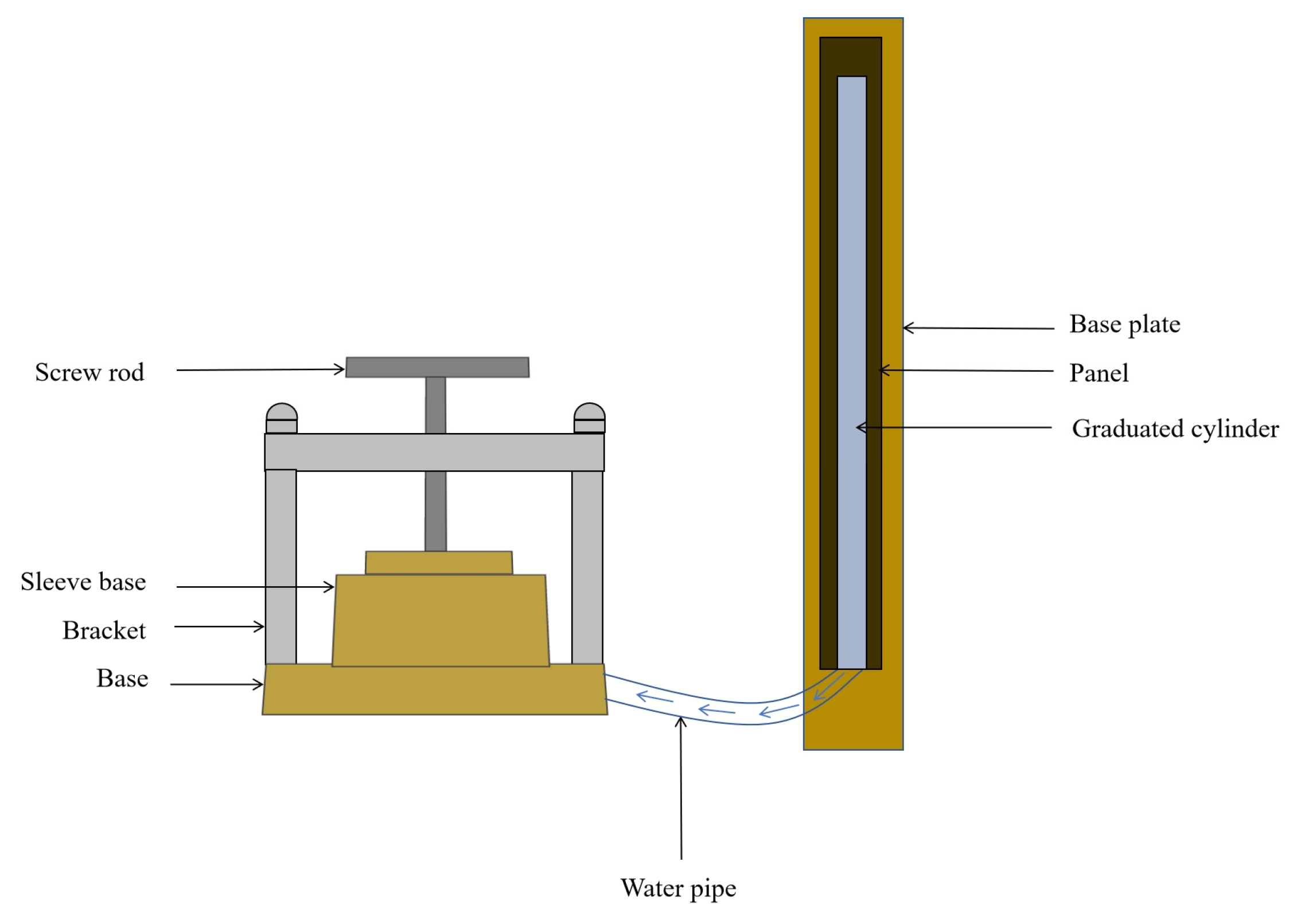
The constant-head permeability test is carried out using the TST-55 permeameter produced by Nanjing Soil Company. As shown in Figure 4, the diameter of the cutting ring was 61.8 mm and the height was 40 mm.

2.4. Methodology

2.4.1. SWCC Tests

After specimen preparation, the apparatus was installed as shown in Figure 4. Then, the sealing film was carefully removed to avoid disturbing the soil structure, and the specimen was left for natural evaporation in the laboratory. To monitor the process, a surveillance camera with built-in lighting was positioned to clearly capture the tensiometer dial. For automated data collection, a humidity sensor was utilized for real-time monitoring the humidity (matric suction) of the specimen with a high matric suction, while the tensiometer was utilized for real-time monitoring the matric suction of the specimen with a low matric suction. A rigorous data management protocol was followed, involving regular exporting and backing up of all recorded images and sensor readings to prevent data loss. Furthermore, the computer clock was calibrated at the outset to ensure temporal synchronization for all subsequent data processing. After acquiring the data, the matric suction could be calculated in terms of the humidity of the specimen, while the volumetric water content could be measured by the FDR sensor. The SWCC could be obtained to correlate the matric suction with the volumetric water content. The SWCC could be fitted by the Fredlund and Xing model and Van Genuchten model as listed in Table 2.

2.4.2. Saturated Hydraulic Conductivity Tests

To calculate the unsaturated hydraulic conductivity, the saturated hydraulic conductivity is required. When using SWCC to predict the hydraulic conductivity characteristics (HCC) through empirical models, the saturated permeability of loess needs to be obtained. Meanwhile, the saturated permeability of soil specimens also has certain research significance for the analysis of unsaturated permeability.
For instrument installation, first place the base of the TST-55 permeameter firmly in position. Next, sequentially place the water-permeable stone and the sealing ring into the base. Insert the cutting ring containing the soil specimen into the sleeve and fix the cutting ring on the base. After that, place the sealing ring, water-permeable stone, and upper cover in order, and tighten the screws to ensure the instrument is securely installed without any water or air leakage.
The subsequent step involved saturating the soil specimen. Water was allowed to slowly permeate the specimen from the bottom under a constant water head. The specimen was left still until a steady, continuous flow was observed from the outlet pipe, indicating that free air within the major interconnected pores had been largely displaced and a stable hydraulic connection was established. This condition was considered to represent an adequately saturated state for the purpose of the variable-head permeability test.
During the permeability test, the piezometric tubes were first filled with water to a height of 100 cm. Then, the tube clamps were opened simultaneously, and the stopwatch was started to accurately record the initial water head. After a certain period, the final water head was measured and recorded. This set of operations of measuring the initial and final water heads was continuously carried out 3 times. Subsequently, the water level in the water-head tube was raised back to the required height, and another set of several continuous measurements was taken. In total, more than 5 sets of the measurements were required for a specimen. Throughout the entire test process, it was essential to ensure that the piezometric tubes remained perpendicular to the ground, avoiding inaccuracies in the water head position caused by the inclination of the piezometric tubes. Meanwhile, the time and water head height of each measurement needed to be accurately recorded. Finally, data processing and analysis were conducted. Based on the principle of the variable-head permeability test, the saturated permeability coefficient can be expressed as,
k = 2 . 3 a L A ( t 1 t 2 ) lg h 1 h 2
where the numerical coefficient 2.3 is ln(10), a constant derived from the conversion from the natural logarithm; a is the cross-sectional area of the piezometric tube (m2); L is the height of the ring cutter specimen (m); A is the cross-sectional area of the ring cutter specimen (m2); t1 is the initial test time (s); t2 is the final test time (s); h1 is the initial height of water in the piezometric tube (m); h2 is the final height of water in the piezometric tube (m).

3. Test Results and Analysis

3.1. SWCC

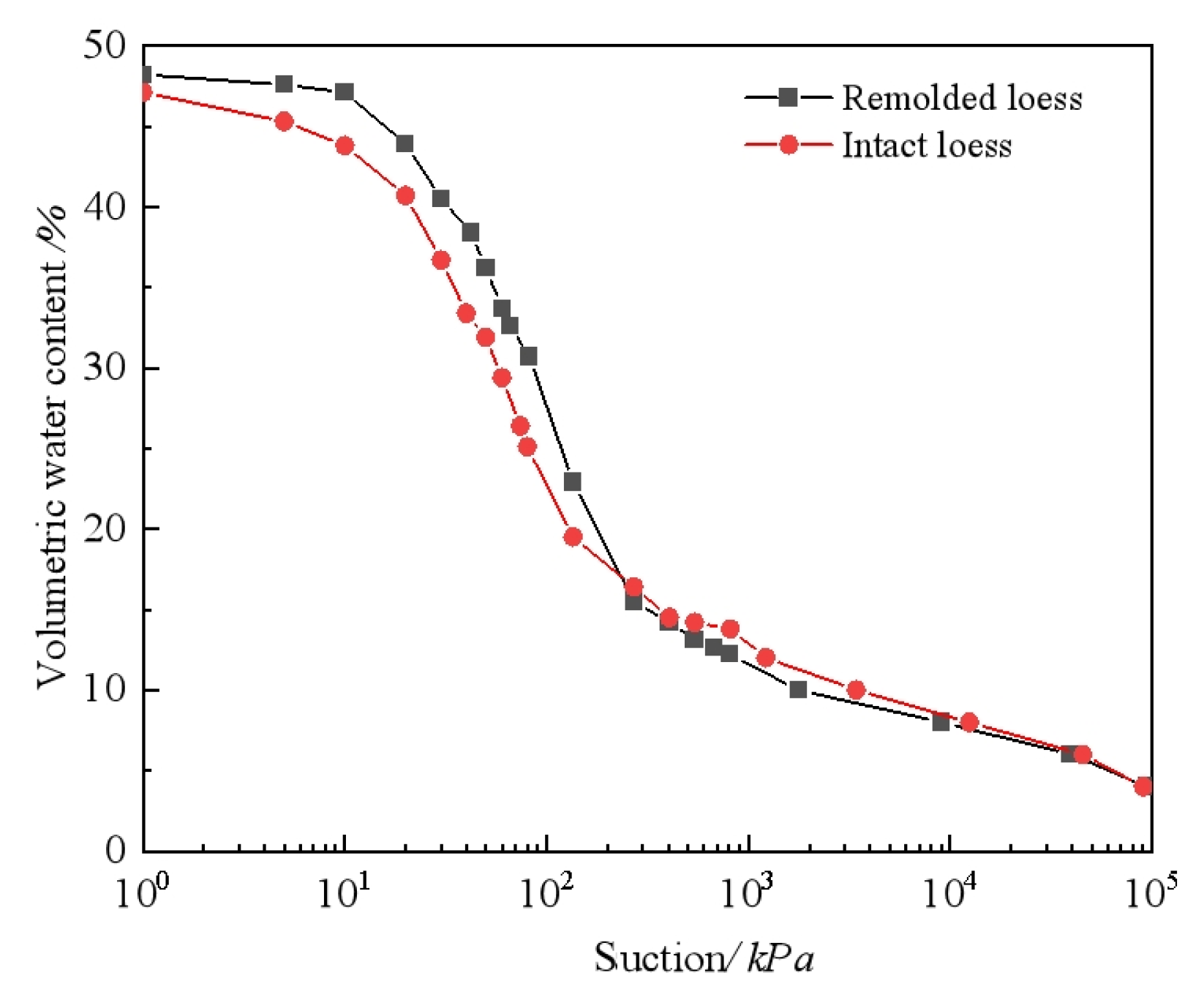
Upon completion of the tests, the measured matric suction and volumetric moisture content data were used to plot the curves shown in Figure 5. Within the entire suction range, the matric suction data in the low suction stage exhibited excellent continuity, indicating high reliability of the test data in this range. Both the undisturbed and remolded soils displayed typical S-shaped attenuation characteristics within the matric suction range of 0–105 kPa. The volumetric moisture content of both soil types showed a monotonically decreasing trend with increasing matric suction, consistent with the soil dehydration pattern described by the Fredlund and Xing model.
When the suction reached approximately 200 kPa, the curves entered the residual moisture content stage, where the moisture content gradually declined to below 5%, indicating that the soil had approached its maximum dehydration condition.
The comparison between undisturbed and remolded loess revealed that in the low suction stage (100−101 kPa), the moisture content difference was less than 3%. During this stage, water retention was predominantly governed by macropores, and undisturbed loess demonstrated a lower water retention capacity due to its larger internal pores [19]. When suction increased to 102−103 kPa, a 2% discrepancy in volumetric moisture content appeared between them, yet their declining rates remained largely consistent, indicating similar proportions of mesopores. In the high suction range (>103 kPa), the undisturbed loess exhibited a higher water retention than the remolded loess. This can be attributed to its cemented structure, which enhanced the adsorption capacity of clay mineral surfaces for bound water. Despite both specimens having identical dry densities, this significant difference highlights the dominant role of innate microstructure over compaction-induced density in controlling water retention at high suctions [18].
Overall, the SWCC curve of the undisturbed loess is influenced by its naturally formed macropore distribution, leading to reduced water retention at low suction ranges. Meanwhile, its natural cementation and clay particle attachment enhanced water retention capacity at high suction stages relative to remolded loess. These results align with the research reports [12,21,22], thereby validating the applicability of using FDR moisture sensors, tensiometers and thermocouple hygrometers to obtain the SWCC of the loess.
The SWCC obtained in this study for both the undisturbed and remolded loess align well with the characteristic patterns reported in the literature for silty soils. For instance, the AEV of the remolded loess (18 kPa) falls within the range of 10–25 kPa reported by Xiao et al. [23] for compacted loess with comparable density and plasticity. Similarly, the more gradual transition zone of the undisturbed loess SWCC was consistent with the findings of Tan et al. [24], who attributed this shape to the broader pore size distribution of natural deposits. However, a key difference observed in our results was the higher water retention capacity of undisturbed loess at high suction (>103 kPa) compared to the remolded samples, a phenomenon that underscores the significant role of natural cementation, which is often destroyed during remolding. This contrast highlights the importance of distinguishment between soil states when predicting hydraulic behavior, a factor not always emphasized in previous studies focusing solely on remolded materials.
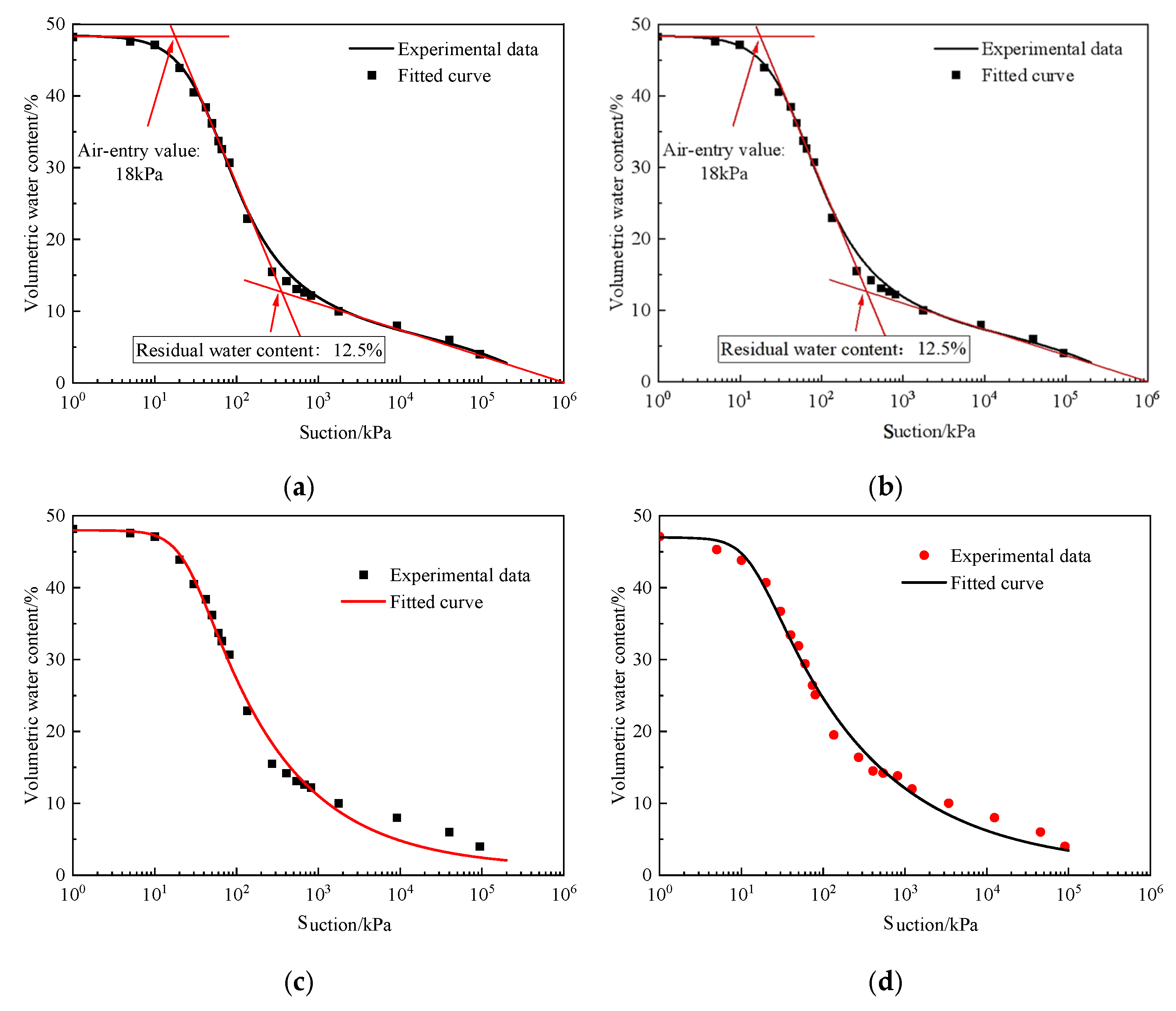
This study selected the 4-parameter Fredlund and Xing model and Van Genuchten model for fitting analysis of the SWCC of the undisturbed and remolded loess. Following the findings of Zhang et al. [22], the maximum residual suction of loess was set at 20,000 kPa as the upper limit for data fitting. The experimental data were imported into Matlab (R2021a) software for fitting analysis, with the fitting results presented in Table 3. Based on these results, the images were plotted in Figure 6.
As shown in Figure 6, both the Van Genuchten model and Fredlund and Xing model demonstrate satisfactory fitting performance for unsaturated loess. In the low suction range (0–100 kPa), both models exhibited excellent fitting accuracy with minimal deviation between data points and fitted curves. However, in the high suction range (>100 kPa), the Van Genuchten model exhibited noticeable discrepancies while the Fredlund and Xing model maintained smaller deviations. The Fredlund and Xing model was primarily selected for its superior performance in capturing the entire suction range, particularly the high-suction region where soil behavior is dominated by adsorption effects. The Van Genuchten model may show deviations at high suctions [25,26], while the Fredlund and Xing model incorporates a correction factor that provides greater flexibility and accuracy across the entire spectrum—from saturation to complete dryness. Consequently, the AEV and residual moisture content were determined through graphical methods based on the Fredlund and Xing model fitting results.
The AEV was 12 kPa for undisturbed loess and 18 kPa for remolded loess. Additionally, the residual moisture content was 14.5% for the undisturbed loess compared to 12.5% for the remolded loess. These results indicate that the remolded loess exhibited better water retention capacity and that its residual water retention performance was inferior.
Based on the Fredlund and Xing model principles, parameter a exhibited a strong correlation with AEV [27,28], which explains the difference between undisturbed and remolded loess. The parameter a for the remolded loess is significantly larger than that of the undisturbed loess. Parameter b reflects the rate of moisture content decrease in the transition zone, where undisturbed loess demonstrates slightly small b values (with only an 8% difference), with larger b values indicating more uniform pore size distribution [27,29]. Parameter c is directly related to residual moisture content, the undisturbed loess has a small value, which is consistent with its high residual moisture content [25,27].
The SWCC differences revealed the influence of soil structure on water retention characteristics. Since the loess belongs to Q4 loess with low dry density, the pore distributions of the undisturbed and remolded loess are similar, resulting in comparable AEVs. However, the cementation between particles in undisturbed loess significantly reduces pore connectivity, making water drainage more difficult under high suction conditions, thereby leading to a slightly higher residual moisture content in undisturbed loess [29].

3.2. Saturated Hydraulic Conductivity

The test results of the measured variable-head permeability coefficient are presented in Table 4.
The measured saturated hydraulic conductivity (Ks) of the remolded loess had an average value of 1.1 × 10⁻⁵ m/s, while the undisturbed loess showed a lower average Ks of 8.3 × 10⁻⁶ m/s. These values fall within the typical range reported for silty soils and are consistent with the values found in previous studies on loess [30,31]. The lower conductivity of the undisturbed loess was attributed to its natural cementation and more complex pore structure, which aligns with observations by Haeri et al. [32], deeming that undisturbed loess typically exhibits lower permeability than its remolded counterpart due to the destruction of the natural fabric during remolding.
Based on the variable-head permeability test data, the saturated hydraulic conductivity of the remolded loess was 1.1 × 10⁻⁵ m/s, while that of undisturbed loess was 8.3 × 10⁻⁶ m/s, indicating that the permeability of the remolded specimen was approximately 33% larger than that of the undisturbed specimen. This difference arises from the more uniform pore structure of remolded loess, which facilitates the formation of continuous flow pathways through its pore network.

3.3. Prediction of Hydraulic Conductivity Curve (HCC)

This study selected the Childs and Collis-George model, Fredlund permeability model and Van Genuchten permeability model for HCC prediction.
Based on the Childs and Collis-George model and incorporating the Fredlund and Xing model for the SWCC, the SWCC was divided into 20 equal intervals based on volumetric moisture content. The matric suction values corresponding to the midpoint of each interval were substituted into the Childs and Collis-George model equation to calculate the unsaturated hydraulic conductivity.
The prediction of HCC using Van Genuchten and Fredlund permeability models requires computationally intensive calculations. To streamline this process, GeoStudio SEEP/W (2022) numerical simulation software was utilized, with the calculated HCC showing consistency with results in [33]. The built-in unsaturated soil editor was used by selecting the corresponding Fredlund and Xing and Van Genuchten permeability models. After importing the fitted parameters, permeability coefficients for both the undisturbed and remolded loess were computed within the −106 kPa range. The results were exported to tables and plotted to obtain visual representations.
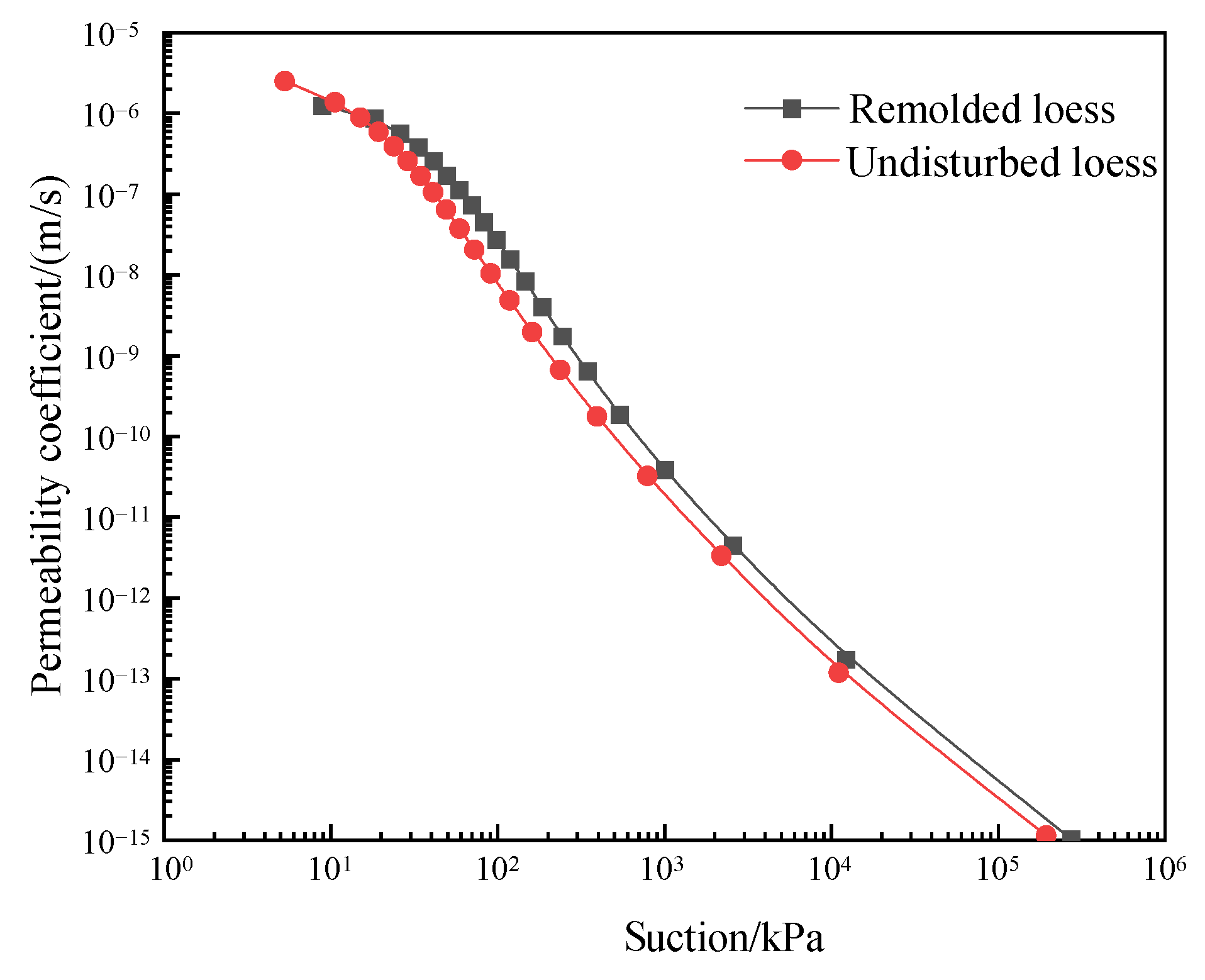
Based on the permeability variations with matric suction for the undisturbed and remolded loess, the data was plotted in Figure 7. While the hydraulic conductivity values presented here are derived from predictive models rather than direct experimental measurement, confidence in their reasonableness is bolstered by their consistency with results from the validated GeoStudio SEEP/W software and their conformity to the expected physical behavior of unsaturated soils.
The permeability of both the undisturbed and remolded loess exhibit approximately linear decreasing trends when plotted on a double logarithmic coordinate system, indicating a power-law relationship between permeability and matric suction. This observation aligns with the theoretical assumptions of the Childs and Collis-George model, where increasing suction causes water to gradually migrate from larger pores to smaller ones, thereby causing an exponential decrease in permeability as pore connectivity diminishes. Notably, the overall trends of both the curves exhibit significantly similar, indicating that the model effectively describes the permeability mechanisms of loess, though its sensitivity to structural differences, such as pore reconstruction from remolding, appears to be limited.
It should be noted that the Childs and Collis-George model, based on statistical pore distribution theory, may oversimplify certain internal structural influences of soil specimens. When suction exceeds 103 kPa that approaches residual moisture content, the model’s predicted permeability may deviate from actual values. Under such extreme suction conditions, it is recommended to complement the model predictions with complementary experimental techniques to ensure data accuracy and reliability.
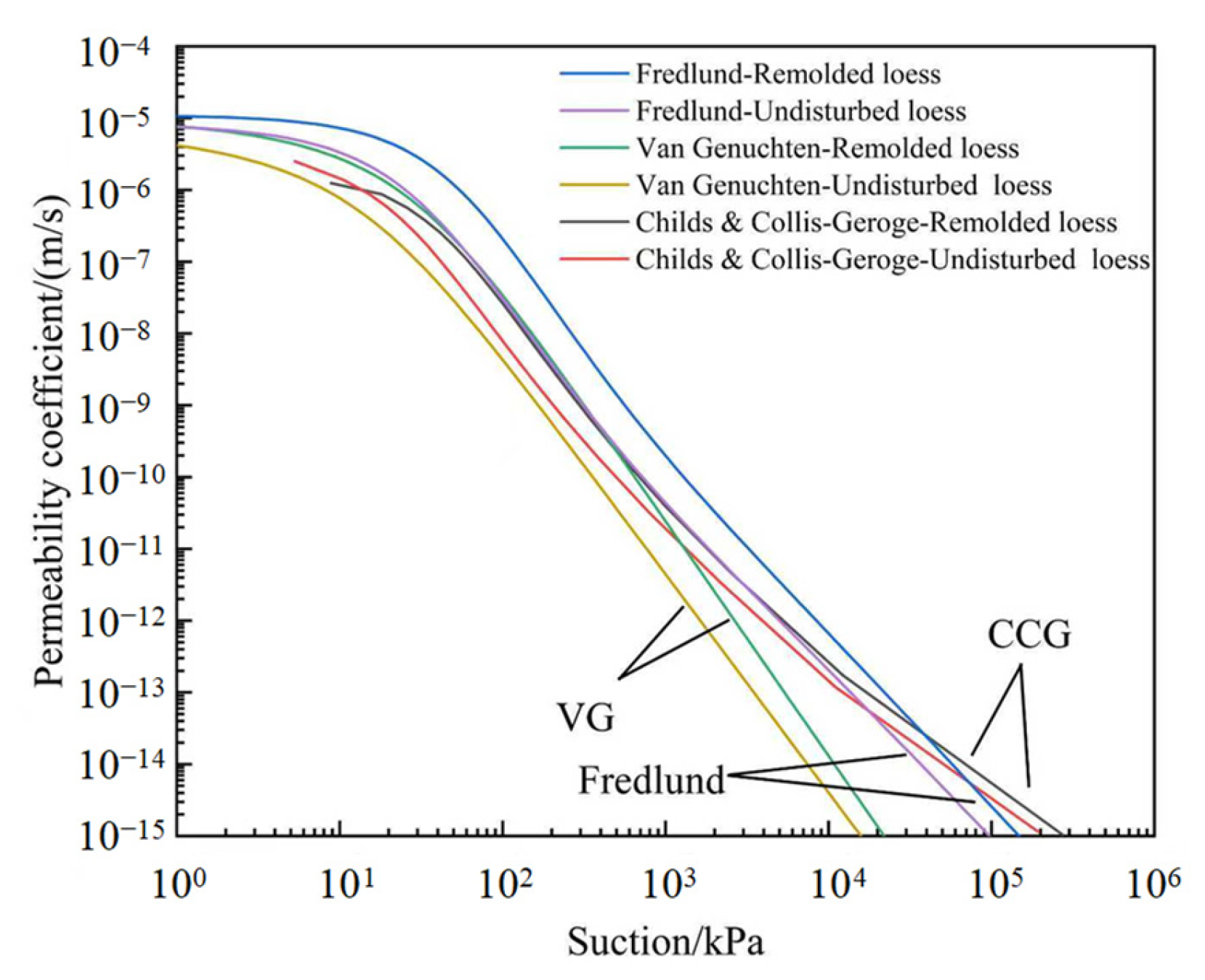
The HCC predictions from the Childs and Collis-George model, Van Genuchten permeability model, and Fredlund permeability model are presented in Figure 8. Across the entire suction range, these models exhibit discrepancies in permeability predictions. All three models demonstrate consistent variation patterns that align with conventional HCC behavior. In the double logarithmic coordinate system, the curves exhibit a gradual linear decline in the 0−100 kPa range, transitioning to a linear decreasing trend exceeding 100 kPa.
The Childs and Collis-George model predicts a gradual decrease in permeability with increasing matric suction, followed by a rapid decline after reaching 50 kPa. However, the rate of decrease gradually slows with gradual suction increase. The Fredlund permeability model exhibits similar behavior but presents more pronounced differences between the undisturbed and remolded loess compared to the Childs and Collis-George model. When matric suction reaches 104 kPa, the permeability difference between the undisturbed and remolded loess further diminishes, converging toward traditional HCC behavior, showing linear permeability reduction beyond 100 kPa, with both soil types exhibiting progressively decreasing permeability with increasing compaction suction. Notably, within the primary research range of the Childs and Collis-George model, the remolded loess exhibits lower permeability than the undisturbed loess, in contrast to both the Fredlund and Van Genuchten models. These differences between the Childs and Collis-George model and the other two models stem from their respective constitutive relationships. All three models provide valuable references and foundations for subsequent permeability analysis.

4. Discussions

The microstructure of the undisturbed loess, characterized by a natural particle arrangement and cementation, forms a complex pore system. At high suction ranges, this stable fabric restrains water conductivity, thus demonstrating the well-established principle that the undisturbed soils with well-developed structures resist water infiltration under high suction conditions [9,10,34]. This is in line with the common knowledge that the undisturbed soils can hold water in their micropores under higher suction conditions. The undisturbed loess holds water at a much higher suction, mainly because it has some small-size pores [35,36].
In stark contrast, the remolded loess exhibits fundamentally different hydro-mechanical behaviors due to the destruction of its natural fabric and cementation. The process of remolding, which involves mechanical disturbance and re-compaction, collapses the meta-stable structure, disrupts the interparticle bonds, and homogenizes the complex pore system. This destruction leads to a significant reduction in the volume of larger, well-connected pores and a more uniform, finer pore size distribution.
Consequently, at high suction ranges, the remolded loess lacks the structural restraint provided by natural cementation, allowing for a relatively higher water conductivity immediately upon wetting compared to its undisturbed counterpart at the same suction.

5. Conclusions

This study systematically tested the water retention curves of intact and remolded loess during drying processes through tensiometer and hygrometer methods. Based on the obtained SWCC, three prediction models were applied to estimate the permeability coefficients for both intact and remolded loess, leading to the following conclusions:
(1)
Through tensiometer and hygrometer measurements, the SWCC of intact and remolded loess exhibited the classic three-stage characteristic when matric suction was plotted on a logarithmic scale. In the boundary effect zone (matric suction below the air-entry value), the volumetric moisture content decreased gradually with increasing matric suction. In the transition zone, the volumetric moisture content decreased rapidly until reaching the residual moisture content. Beyond this point, the SWCC entered the residual zone, where the volumetric moisture content decreased gradually with further increases in matric suction. This trend aligns with classical SWCC behavior. Both the Van Genuchten and Fredlund and Xing models demonstrated good fitting performance, but the Van Genuchten model exhibited reduced accuracy when matric suction exceeded 103 kPa. The modified Fredlund and Xing model remains the most suitable SWCC fitting model for loess.
(2)
For intact and remolded loess with identical dry densities, their SWCC exhibited notable differences. Specifically, when matric suction was below 103 kPa, intact loess showed lower matric suction at equivalent moisture content compared to remolded loess. However, this trend reversed when matric suction exceeded 103 kPa. These contrasting behaviors primarily stem from inherent differences in pore structure, despite identical dry density conditions. The intact loess exhibits a more developed pore structure characterized by larger inter-aggregate voids, which collectively lower its air-entry value. Simultaneously, its naturally cemented silt-clay structure enhances water retention capacity under high suction levels.
(3)
The Childs and Collis-George, Van Genuchten, and Fredlund permeability models produced varying predictions for permeability but demonstrated consistent trends that aligned with conventional HCC behavior.
(4)
These findings offer valuable insights into the water retention and permeability characteristics of loess, with significant implications for geotechnical engineering applications involving unsaturated loess soils. The modified Fredlund and Xing model is recommended for SWCC fitting, and the Childs and Collis-George model demonstrates superior capability in permeability prediction for loess materials. The contributions of this study are two-fold. Theoretically, it establishes a comparative framework that delineates the fundamental differences in hydraulic behavior between intact and remolded loess, attributing these differences to inherent pore structure rather than dry density alone, thus providing a mechanistic understanding essential for advancing constitutive models of unsaturated loess. Practically, the findings directly inform geotechnical design and analysis. By recommending the use of the modified Fredlund and Xing model for the SWCC and the Childs and Collis-George model for permeability, engineers are provided with reliable tools for predicting the behavior of natural loess slopes and compacted loess fills under varying moisture conditions, thereby enhancing the safety and sustainability of infrastructure in loess regions.

Author Contributions

Conceptualization, P.L., P.Q. and X.Z.; methodology, P.Q., Y.R. and X.W.; investigation, G.C., F.G., Y.R. and X.W.; writing—original draft preparation, P.L., G.C., F.G. and P.Q.; writing—review and editing, P.Q., X.Z., Y.R. and X.W.; visualization, G.C., F.G., Y.R. and X.W. All authors have read and agreed to the published version of the manuscript.

Funding

The research presented in this paper was financially supported by the National Natural Science Foundation of China (Grant Nos. 42177138 and 41907239) and the Central Guidance Funds for Local Science and Technology Development (Grant No. YDZJSX2025D031).

Institutional Review Board Statement

Not applicable.

Informed Consent Statement

Not applicable.

Data Availability Statement

The data presented in this study are available on request from the corresponding author due to technical or time limitations.

Conflicts of Interest

Authors Peng Li, Yue Ren and Xiaoliang Wu were employed by the company Lvliang North Expressway Management Co., Ltd. The remaining authors declare that the research was conducted in the absence of any commercial or financial relationships that could be construed as a potential conflict of interest.

References

  1. Fredlund, D.G.; Rahardjo, H. Soil Mechanics for Unsaturated Soils; John Wiley & Sons: Hoboken, NJ, USA, 1993. [Google Scholar]
  2. Gao, Y.; Li, Z.; Sun, D.A.; Yu, H.H. A simple method for predicting the hydraulic properties of unsaturated soils with different void ratios. Soil Tillage Res. 2021, 209, 104913. [Google Scholar] [CrossRef]
  3. Lan, T.; Xu, L.; Lu, S. Experimental study on the water retention behavior of intact loess under mechanical wetting and hydraulic wetting. Acta Geotech. 2023, 18, 1125–1134. [Google Scholar] [CrossRef]
  4. Ma, Y.L.; Shen, J.S.; Wang, J.L.; Luo, Y.S.; Li, M.; Tian, Y.X.; Zheng, K.H.; Yin, Z.M.; Wang, P.D.; Pu, X.T. Study on Influence of Initial Compaction Degree and Water Content on Water-Holding and Permeability Characteristics of Loess. Appl. Sci. 2025, 15, 11039. [Google Scholar] [CrossRef]
  5. Gao, Q.F.; Yu, H.C.; Zeng, L.; Huang, Y.X. Characterization of water retention behavior of cracked compacted lateritic soil exposed to wet-dry cycles. Bull. Eng. Geol. Environ. 2023, 82, 61. [Google Scholar] [CrossRef]
  6. Wang, H.; Ni, W.; Yuan, K.; Yuan, K.Z.; Nie, Y.P.; Li, L. Study on SWCC and PSD evolution of compacted loess before and after drying-wetting cycles. Bull. Eng. Geol. Environ. 2023, 82, 180. [Google Scholar] [CrossRef]
  7. Zheng, H.; Li, P.; Bao, J.; Li, T.L. Research on the effect of grain size composition and structure on the matric suction of unsaturated loess. J. Eng. Geol. 2016, 24, 1028–1033. [Google Scholar]
  8. Hou, X.; Zhai, Z.; Chao, J.; Zhang, C.; Li, P.; Li, T.L. A model for predicting the unsaturated collapse deformation of loess. Hydrogeol. Eng. Geol. 2016, 43, 94–100. [Google Scholar] [CrossRef]
  9. Gardner, W.R. Some steady-state solutions of the unsaturated moisture flow equation with application to evaporation from a water table. Soil Sci. 1958, 85, 228–232. [Google Scholar] [CrossRef]
  10. Van Genuchten, M.T. A closed-form equation for predicting the hydraulic conductivity of unsaturated soils. Soil Sci. Soc. Am. J. 1980, 44, 892–898. [Google Scholar] [CrossRef]
  11. Fredlund, D.G.; Xing, A. Equations for the soil-water characteristic curve. Can. Geotech. J. 1994, 31, 533–546. [Google Scholar] [CrossRef]
  12. Cai, G.Q.; Zhang, C.; Li, J.; Zhao, C.G. Prediction method for SWCC considering initial dry density. Chin. J. Geotech. 2018, 40, 27–31. [Google Scholar] [CrossRef]
  13. Zhai, Q.; Rahardjo, H. Quantification of uncertainties in soil-water characteristic curve associated with fitting parameters. Eng. Geol. 2013, 163, 144–152. [Google Scholar] [CrossRef]
  14. Zhai, Q.; Rahardjo, H.; Satyanaga, A. Effects of residual suction and residual water content on the estimation of permeability function. Geoderma 2017, 303, 165–177. [Google Scholar] [CrossRef]
  15. Zhao, T.Y.; Yang, Y.B.; Xu, L.; Lu, S.F. Derivation of site-specific soil-water characteristic curve (SWCC) from extremely sparse experimental data by hierarchical Bayesian method with consideration of geotechnical sites similarity. Eng. Geol. 2024, 342, 107752. [Google Scholar] [CrossRef]
  16. Li, Y.; Li, T.L.; Hou, X.K.; Li, H.; Zhang, J. Prediction of unsaturated permeability curve of compaction loess with pore-size distribution curve and its application scope. Rock Soil Mech. 2021, 42, 2395–2404. [Google Scholar] [CrossRef]
  17. Zhang, X.D.; Zhao, C.G.; Cai, G.Q.; Liu, Y. Research on influence of soil density on soil-water characteristic curve. Rock Soil Mech. 2010, 31, 1463–1468. Available online: http://ytlx.whrsm.ac.cn/EN/Y2010/V31/I5/1463 (accessed on 13 November 2025).
  18. Tang, X.L.; Tong, L.H.; Xu, C.J.; Ding, Z.; Ding, H.B.; Liu, W. Soil-water characteristic curve model considering grain size gradation and deformation of soil. Chin. J. Geotech. 2025, 47, 1629–1640. [Google Scholar] [CrossRef]
  19. Zhang, J.; Xu, Q.; Sun, D. Simulation of soil-water characteristic curves during drying and wetting cycles. Rock Soil Mech. 2014, 35, 689–695. [Google Scholar] [CrossRef]
  20. GB/T 50145-2007; Standard for Engineering Classification of Soil. China Planning Press: Beijing, China, 2007.
  21. Sun, D.; Gao, Y. Water retention behaviour of soils with different preparations. Chin. J. Geotech. 2015, 37, 91–97. [Google Scholar] [CrossRef]
  22. Zhang, J.R.; Song, C.Y.; Jiang, T.; Wang, L.J.; Zhao, J.D.; Xiong, T.Q. Hydromechanical characteristics and microstructure of unsaturated loess under high suction. Rock Soil Mech. 2023, 44, 2229–2237. [Google Scholar] [CrossRef]
  23. Xiao, T.; Li, P.; Pan, Z.H.; Hou, Y.F.; Wang, J.D. Relationship between water retention capacity and pore-size distribution of compacted loess. J. Soils Sediments 2022, 22, 3151–3165. [Google Scholar] [CrossRef]
  24. Tan, Y.; Dai, F.C.; Zhao, Z.Q.; Zhou, J.; Cheng, W. Analysis of soil–water characteristic curve and microstructure of undisturbed loess. Appl. Sci. 2024, 14, 3329. [Google Scholar] [CrossRef]
  25. Pham, H.Q.; Fredlund, D.G. Volume–mass unsaturated soil constitutive model for drying–wetting under isotropic loading–unloading conditions. Can. Geotech. J. 2011, 48, 280–313. [Google Scholar] [CrossRef]
  26. Gui, M.W.; Wu, Y.M. Failure of soil under water infiltration condition. Eng. Geol. 2014, 181, 124–141. [Google Scholar] [CrossRef]
  27. Fredlund, D.G.; Xing, A.; Fredlund, M.D.; Barbour, S.L. The relationship of the unsaturated soil shear strength to the soil-water characteristic curve. Can. Geotech. J. 1996, 33, 440–448. [Google Scholar] [CrossRef]
  28. Zhang, F.; Fredlund, D.G. Examination of the estimation of relative permeability for unsaturated soils. Can. Geotech. J. 2015, 52, 2077–2087. [Google Scholar] [CrossRef]
  29. Fredlund, M.D.; Fredlund, D.G.; Wilson, G.W. An equation to represent grain-size distribution. Can. Geotech. J. 2000, 37, 817–827. [Google Scholar] [CrossRef]
  30. Xu, P.P.; Qian, H.; Zhang, Q.Y.; Li, W.Q.; Ren, W.H. Investigating saturated hydraulic conductivity of remolded loess subjected to CaCl2 solution of varying concentrations. J. Hydrol. 2022, 612, 128135. [Google Scholar] [CrossRef]
  31. Hou, X.K.; Qi, S.W.; Li, Y.; Liu, F.C.; Li, T.L.; Li, H. Hydraulic conductivity over a wide suction range of loess with different dry densities. J. Rock Mech. Geotech. Eng. 2025, 17, 481–492. [Google Scholar] [CrossRef]
  32. Haeri, S.M.; Zamani, A.; Garakani, A.A. Collapse Potential and Permeability of Undisturbed and Remolded Loessial Soil Samples. Unsaturated Soils Res. Appl. 2012, 1, 301–308. [Google Scholar] [CrossRef]
  33. Li, H. Water Water Retention and Permeability Characteristics of Different Types of Unsaturated Loess. Ph.D. Thesis, Chang’an University, Xi’an, China, 2020. Available online: https://d.wanfangdata.com.cn/thesis/D02276930 (accessed on 13 November 2025).
  34. Fredlund, D.G.; Sheng, D.; Zhao, J. Estimation of soil suction from the soil-water characteristic curve. Can. Geotech. J. 2011, 48, 186–198. [Google Scholar] [CrossRef]
  35. Hou, X.K.; Qi, S.W.; Li, T.L.; Guo, S.F.; Wang, Y.; Li, Y.L.; Zhang, L.X. Microstructure and soil-water retention behavior of compacted and intact silt loess. Eng. Geol. 2020, 277, 105814. [Google Scholar] [CrossRef]
  36. Li, X.M.; Di, S.J.; Shi, L.; Zhang, Y.; Huang, P.; Mu, Q.Y. Effects of In-Situ Drying–Wetting Cycles on the Stress-Dependent Water Retention Behavior of Intact Loess. Adv. Civ. Eng. 2023, 2023, 2994986. [Google Scholar] [CrossRef]
Figure 1. Schematic diagram of loess sampling.
Applsci 16 00932 g001
Figure 2. Cumulative grain size distribution curve of loess.
Applsci 16 00932 g002
Figure 3. Schematic diagram of the SWCC testing apparatus.
Applsci 16 00932 g003
Figure 4. Schematic diagram of the permeameter and piezometric tubes.
Applsci 16 00932 g004
Figure 5. Measured values of SWCC for loess specimens.
Applsci 16 00932 g005
Figure 6. SWCC fitting images. (a) Remolded loess—Fredlund and Xing; (b) Undisturbed loess—Fredlund and Xing; (c) Remolded loess—Van Genuchten; (d) Undisturbed loess—Van Genuchten.
Applsci 16 00932 g006
Figure 7. Childs and Collis-George model prediction of unsaturated loess permeability.
Applsci 16 00932 g007
Figure 8. HCC prediction by permeability model.
Applsci 16 00932 g008
Table 1. The basic physical properties of loess.
Specific Gravity of Soil Solids GsMaximum Dry Density ρmax/(g/cm3)Optimum Moisture Content/%Liquid Limit/%Plastic Limit/%Plasticity Index
2.71.7716.723.315.18.2
Table 2. SWCC Fitting Equations.
ModelEquationParameters
Van Genuchten [10]
θ w = θ r + θ s θ r 1 + a ψ b c
a, b, c are fitting parameters.
Fredlund and Xing [11]
θ w = θ s × 1 ln 1 + ψ / ψ r e / ln 1 + 10 6 / ψ r e ln e + ψ / a b c
ψre denotes the residual suction;
Other parameters remain identical to those previously defined.
Table 3. Fitted parameters of SWCC.
Model TypeabcR2
Undisturbed loess—Fredlund and Xing23.621.5150.78280.99
Remolded loess—Fredlund and Xing40.511.6340.84140.99
Undisturbed loess—Van Genuchten0.07642.640.12410.99
Remolded loess—Van Genuchten0.039532.5070.16710.99
Table 4. Saturated permeability test data.
SpecimenRemolded LoessMean
Ks (m/s)1.3 × 10−51.3 × 10−51.0 × 10−59.9 × 10−61.0 × 10−51.1 × 10−5
SpecimenUndisturbed LoessMean
Ks (m/s)7.6 × 10−67.6 × 10−68.3 × 10−68.8 × 10−69.4 × 10−68.3 × 10−6
Disclaimer/Publisher’s Note: The statements, opinions and data contained in all publications are solely those of the individual author(s) and contributor(s) and not of MDPI and/or the editor(s). MDPI and/or the editor(s) disclaim responsibility for any injury to people or property resulting from any ideas, methods, instructions or products referred to in the content.