Article

Structural Design and Multi-Objective Optimization of High-Pressure Jet Cleaning Nozzle for the Clay-Filled Strata

1
Changjiang Institute of Survey, Planning, Design and Research Corporation, Wuhan 430010, China
2
Changjiang Geotechnical Engineering Corporation, Wuhan 430010, China
3
State Key Laboratory of Water Resources Engineering and Management, Wuhan 430010, China
4
China National Petroleum Corporation, Beijing 100007, China
5
School of Automation, Wuhan University of Technology, Wuhan 430070, China
*
Author to whom correspondence should be addressed.
Appl. Sci. 2026, 16(2), 836; https://doi.org/10.3390/app16020836
Submission received: 27 November 2025 / Revised: 5 January 2026 / Accepted: 8 January 2026 / Published: 14 January 2026
(This article belongs to the Section Computing and Artificial Intelligence)

Abstract

In the construction of grouting holes in high-mud-content layers, high-pressure jet cleaning technology effectively cuts and removes soil and sediments from the strata. This research designs the structure of a high-pressure jet cleaning device and establishes a numerical simulation model for the high-pressure jet cleaning nozzle, conducting orthogonal simulation tests. Based on the data from these tests, a Backpropagation (BP) Neural Network-based numerical prediction model for the high-pressure jet cleaning flow field is developed, enabling the prediction of cleaning flow rates and pressures for different nozzle channel structure parameters. Targeting jet fluid velocity and cleaning pressure, parametric shape optimization is performed on the nozzle channel structure: key parameters are identified via Analysis of Variance (ANOVA) and sensitivity analysis; an improved Non-dominated Sorting Genetic Algorithm II (NSGA-II) is adopted to establish a multi-objective optimization model, which exhibits superior convergence speed and solution diversity compared to the traditional algorithm. The optimal jet fluid velocity, cleaning pressure, and fluid structure parameter solution space for the high-pressure jet cleaning nozzle are obtained. Through simulation and experimental verification, it is found that with the same number of nozzles, the optimized design significantly enhances both the average cleaning flow rate and the cleaning pressure. Finally, a high-pressure jet cleaning nozzle and device are prototyped based on the simulation and optimization results and tested in the grouting test area A2W-2-III-6 of the South-to-North Water Diversion Project Xiong’an Storage Reservoir Project. This study provides a scientific basis and technical support for the application of high-pressure jet cleaning technology in complex geological formations.

1. Introduction

In national key water conservancy and hydropower projects, the application of curtain grouting for anti-seepage construction has become increasingly widespread [1,2,3]. However, in clay-filled strata sections, the high mud content often leads to the formation of grout curtains with low shear strength and poor anti-seepage performance, failing to effectively serve their intended waterproofing function [4,5]. When conducting anti-seepage treatment in clay-filled strata sections, higher requirements are imposed on the construction technology of curtain grouting. High-pressure jet cleaning technology, utilizing the powerful impact force and cutting action of high-pressure water flow, can effectively break up and remove soil and sediment from the strata [6,7,8]. This not only enhances the efficiency of soil and sediment removal but also improves the shear strength and anti-seepage performance of the grout curtain, thereby playing a significant role in water conservancy and hydropower engineering.
In the field of high-pressure water jet for rock-breaking, Bi et al. [9] established a numerical simulation model of single-nozzle jet rock breaking based on LS-Dyna explicit dynamics, analyzing the influence of different nozzle parameters on rock breaking effectiveness. Li et al. [10] conducted abrasive water jet rock breaking experiments using straight conical nozzles, fan-shaped nozzles, swirl inducer nozzles, and straight-swirl hybrid nozzles. By measuring the morphology, diameter, depth and volume of jet-drilled holes, the rock-breaking performance of each nozzle type was evaluated. The self-rotating multi-orifice nozzle is a key hole-forming component. Li et al. [11] introduced and tested this nozzle, experimentally investigating its sandstone breaking characteristics. The influences of working conditions, rock properties, shaft length, jet pressure, and standoff distance on the rock breaking efficiency were analyzed, and subsequently the optimal operational parameters for continuous drilling were proposed. Cao et al. [12] established hydraulic pressure drop and cuttings cleaning models for jet mill bits. For these models, pressure ratio and efficiency were selected to evaluate the bit’s pressure reduction capability, while jet hydraulic power and impact force were selected for its cuttings cleaning capacity. Based on the established models, the influence of parameters such as target inclination and rate of penetration on the bit’s hydraulic performance was investigated. To improve radial jet drilling nozzles’ hole enlargement capability, roundness and rock-breaking efficiency, Liu et al. [13] proposed an optimal design method for high-efficiency rock-breaking nozzles under deep well high confining pressure. This method integrates theoretical analysis, numerical simulation and laboratory experiments. Taking conical-straight nozzles as the research object, the jet performance of different specifications under atmospheric and high confining pressures was analyzed. The optimal structure of conical-straight nozzles under high confining pressure was determined, and their rock-breaking performance was verified via comparative experiments. Heng et al. [14] proposed a post-mixed abrasive air jet technology for coal breaking and pressure relief. Its core design is that abrasives and air are transported to the well bottom through two independent channels, with a post-mixed nozzle structure coupling an injection pump and a Laval nozzle. Abrasive injection, mixing and acceleration are completed at the well bottom, endowing abrasives with high impact kinetic energy for efficient coal breaking.
In the field of high-pressure water jet cleaning, Zhang et al. [15] proposed a set of rotating jet cleaning tools to address insoluble particle deposition at the bottom of salt cavern gas storage facilities. Particle migration trajectories and particle escape from the annulus under rotating jets for different planes and particle sizes were studied, and the influence of hydraulic parameters (e.g., cavity diameter, flow rate, rotational speed) on cleaning efficiency was analyzed. Jin et al. [16] addressed the issue of poor descaling efficiency resulting from the mismatch of coiled tubing, nozzle, and pump truck parameters. They investigated the effects of jet velocity, nozzle diameter, quantity, traversal speed, and descaling agents on cleaning effectiveness via simulation and lab experiments, and designed a novel multi-orifice jet descaling tool, optimizing its parameters. In the field of jet model establishment and algorithm application, Toczek et al. [17] proposed a design algorithm for rotary drilling heads to maximize hydraulic energy utilization from new drilling tools’ working surface fluid. This algorithm allows adjusting both the relative positions of channels on the working face cross-section and their angle relative to the hydraulic rotary nozzle’s longitudinal axis, simplifying the design process. Zhang et al. [18] designed a casing windowing jet radial horizontal drilling simulation system. Using a finite element model, sensitivity analysis was conducted to explore the influence of inlet flow rate, flow ratio, and the angular ratio of the nozzle’s forward and reverse orifices on the jet nozzle’s maximum drillable length and self-propelling force. Khan et al. [19] designed nozzles with different dimensional parameters for coiled tubing jet tools. Numerical simulation technology was used to analyze the fluid flow characteristics inside the nozzle, simulate different combinations of channel diameter and taper angle, and predict and analyze the effects of these parameters on outlet pressure, mass flow rate, and flow velocity. He et al. [20] established an asymmetric water jet rock-breaking model, revealing the instability of rock failure induced by asymmetric water jet impact. An optimized asymmetric nozzle arrangement scheme was designed, and the optimal nozzle combination for rock fragmentation was determined via Fluent numerical simulation. Non-symmetric water jet rotational flow field experiments were conducted, and the flow field variation with rotational speed was verified using MATLAB R2023a (MathWorks, Natick, MA, USA) -based numerical processing methods. Milojević et al. [21] applied the Taguchi method combined with an artificial neural network (ANN) model to determine the tribological properties of aluminum cylinders, verifying that the hybrid framework can effectively identify optimal parameter combinations while improving the reliability of prediction results. Current research primarily focuses on jet rock breaking, while studies on high-pressure jet cleaning for soft, easily-disturbed clay-filled strata with high mud content in water conservancy and hydropower engineering remain insufficient. Existing nozzle structures mostly follow designs for rock-breaking scenarios, which poorly match the characteristics of clay-filled strata that exhibit high fluidity and cohesion. This mismatch often leads to issues such as excessive energy dissipation during cleaning and incomplete soil removal. Furthermore, current jet-related optimizations predominantly emphasize single objectives (e.g., rock breaking depth or velocity), whereas high-pressure jet cleaning in clay-filled strata requires the simultaneous consideration of multiple objectives, including “efficient soil removal,” “reduced energy consumption,” and “ensuring the anti-seepage and shear resistance performance of the subsequent grout curtain.”
To address the technical bottlenecks of poor adaptability of existing nozzles to high-fluidity and cohesive clay-filled strata, insufficient integration of multi-objective requirements in optimization, and lack of systematic research on the coupling relationship between nozzle structural parameters and cleaning performance, this study focuses on the cleaning of curtain grouting holes in high-mud-content clay-filled strata, taking the design, numerical simulation, and multi-objective optimization of high-pressure jet cleaning devices and their nozzle structures as the core research subject. The core contributions of this work are as follows: (1) proposing a targeted nozzle structure integrated with cemented carbide cutting teeth and a uniformly perforated spacer plate to achieve synergistic cutting and cleaning of clay; (2) establishing a BP neural network-based flow field prediction model with high fitting accuracy to reliably forecast cleaning flow rate and pressure; (3) identifying structural parameters with significant impacts on cleaning performance via orthogonal experimental data, combined with Analysis of Variance (ANOVA) and the normalized sensitivity coefficient method; (4)developing an improved NSGA-II algorithm (outperforming the standard version in terms of convergence and solution distribution uniformity) to obtain the Pareto optimal solution set of nozzle structural parameters balancing jet flow rate and pressure; (5) verifying the effectiveness and engineering applicability of the optimized design through field tests in the Xiong’an Regulation Reservoir Project. This study aims to improve the cleaning efficiency and quality of grouting holes in clay-filled strata, reduce construction time and costs, and provide scientific basis and technical support for the treatment of similar complex geological formations in water conservancy and hydropower engineering.

2. Structural Design of High-Pressure Jet Cleaning Nozzle for Curtain Grouting in Clay-Filled Strata

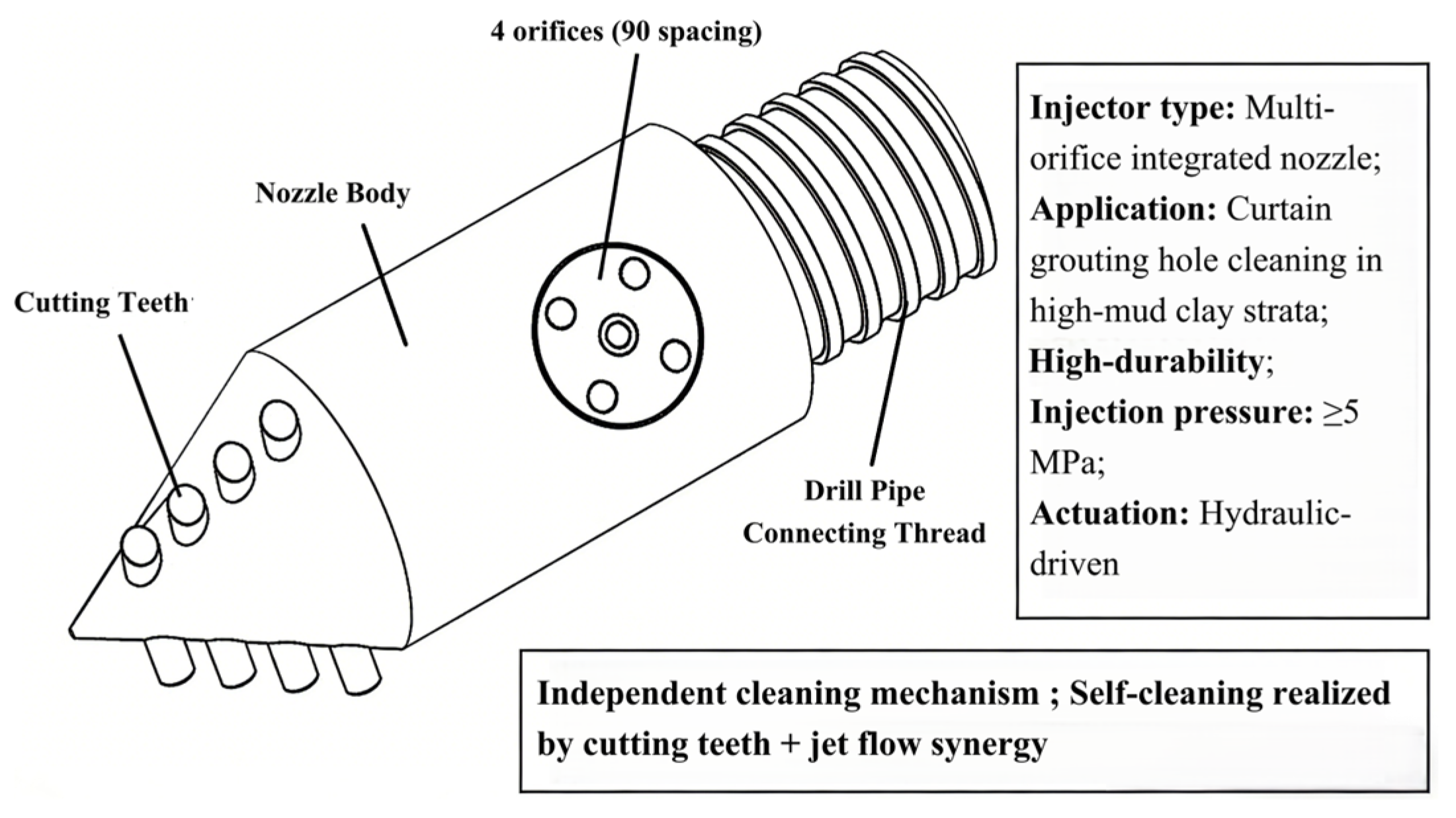
The structure of the high-pressure jet cleaning nozzle is shown in Figure 1. This device is specifically designed for treating clay-filled strata with high mud content, aiming to improve the efficiency and quality of curtain grouting construction. It consists of two main components: the nozzle body and the jet orifice spacer plate, which collectively enable efficient cutting, breaking, and cleaning functions. The nozzle body serves as the core component of the device, featuring four cemented carbide cutting teeth welded onto it. These cutting teeth are perpendicular to the nozzle body surface and symmetrically distributed, allowing them to effectively cut and break up the soil and sediment within the clay-filled strata. The jet orifice spacer plate is secured to the nozzle body via studs and nuts. Each spacer plate contains multiple jet orifices and one central connection hole. The jet orifices are uniformly distributed across the spacer plate, ensuring even ejection of high-pressure cleaning fluid for comprehensive cleaning. The centrally located connection hole facilitates attachment to the grouting drill pipe, ensuring overall coordination and stability of the device.

3. Methodology

To achieve the optimization objective for nozzles in clay-filled strata, this study adopts a technical process of “simulation modeling → experimental design → model prediction → parameter screening”, with specific methods as follows:

3.1. Numerical Simulation Model of High-Pressure Jet Cleaning Nozzle

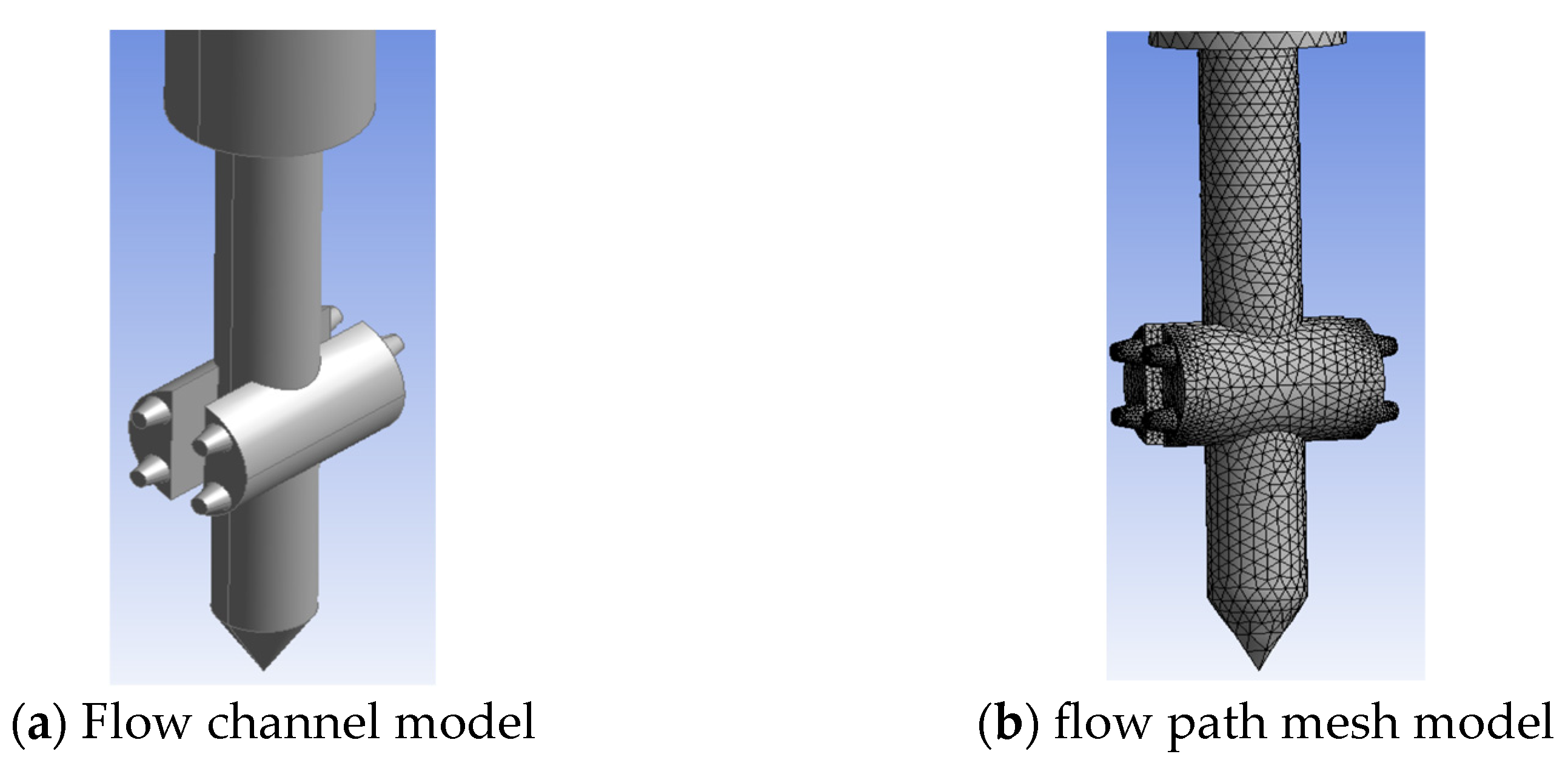
The high-pressure jet cleaning nozzle is connected to the grouting drill rod via threaded coupling. A high-pressure pump delivers high-pressure cleaning fluid into the device interior, which is then ejected at high pressure through the jet orifices. During ejection, the cleaning fluid performs cutting, breaking, and cleaning actions on the formation. During high-pressure cleaning, the cleaning pressure should not be less than 5 MPa, and the flow rate should not be less than 40 L/min [22]. High-pressure water cleaning requires both high flow rate and high pressure to prevent fine stones and other large particles within the hole from being carried away. If these particles collapse and settle at the bottom of the hole, it necessitates repeated drill rod changes and hole cleaning, thereby reducing cleaning efficiency. Consequently, the design of the high-pressure jet cleaning nozzle is crucial, requiring sufficient cleaning water flow rate and pressure within reasonable structural parameters and specific process parameter ranges. ANSYS Fluent 2023 R2 (Ansys, Inc., Canonsburg, USA) was employed to optimize the flow channel structure of the high-pressure jet cleaning nozzle. This software offers extensive models and powerful processing capabilities, enabling accurate simulation of flow phenomena such as laminar flow, turbulent flow, and multiphase flow [23,24,25]. The established fluid simulation model for the high-pressure jet cleaning nozzle is shown in Figure 2.
The extracted flow channel was meshed using the FLUENT Meshing pre-processing tool. In numerical simulation, the mesh serves not only as the carrier for the finite volume method but also as the geometric representation for analyzing computational fluid dynamics models [26,27,28,29]. Since the internal flow field of the channel exhibits chaotic flow patterns dominated by turbulent flow, unstructured grids were primarily adopted in this simulation. In finite element calculations, mesh quality significantly impacts both the accuracy of computational results and computational efficiency. Triangular surface meshes were employed to discretize the flow channel, with boundary layer inflation (5 layers) applied to complete the meshing of the flow channel model. A steady-state solver was selected, and the k-epsilon two-equation model was chosen as the turbulence model [30,31,32].
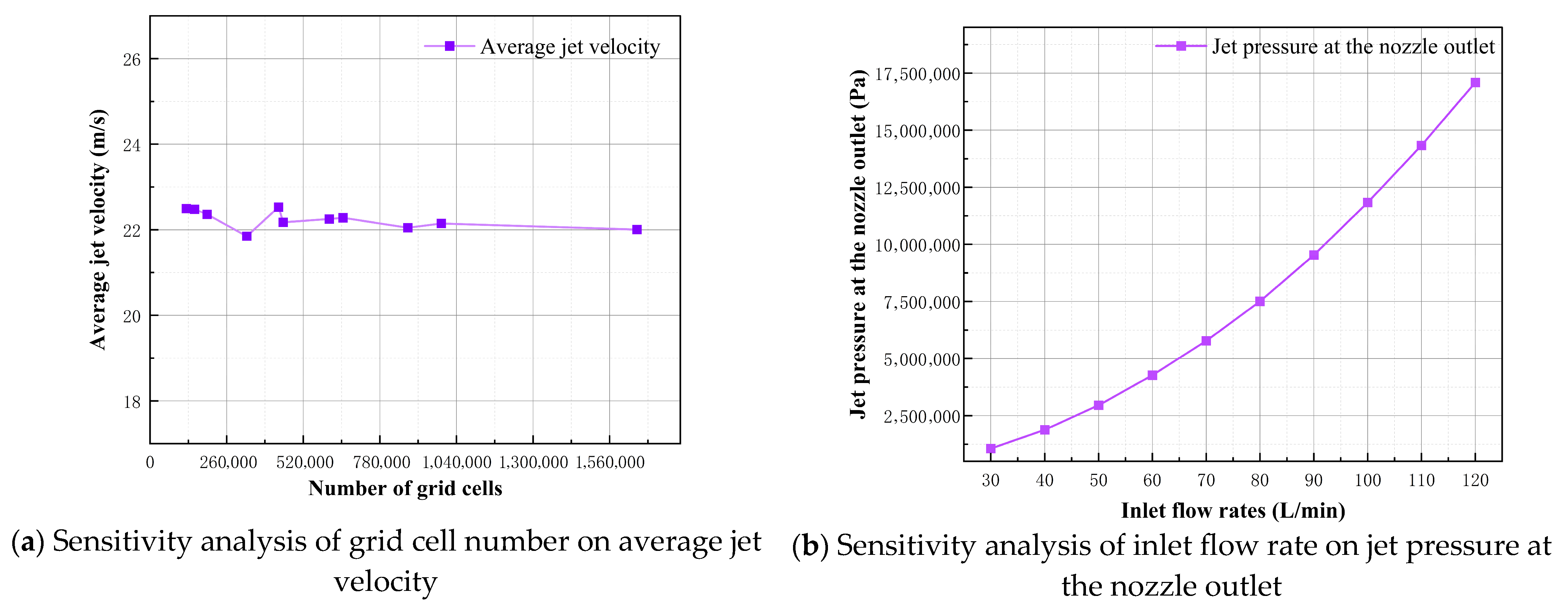
The flow channel model was meshed using ANSYS Fluent Meshing with un-structured triangular elements (total quantity: 451,648 elements). To verify the stability of simulation results, sensitivity tests were conducted on two key parameters: Mesh density: The number of grids increases step by step from 123,019 to 1,652,643, monitoring the changes in the average ejection velocity at the outlet. Results showed that when the element quantity exceeded 451,648, the variation in average jet velocity was less than 3%, indicating mesh convergence. Inlet flow rate: Tests with inlet flow rates of 30 to 120 L/min (consistent with field pump parameters) showed that the jet pressure at the nozzle outlet increased linearly with flow rate, consistent with theoretical fluid mechanics laws, confirming the model’s stability. The sensitivity analysis results are shown in Appendix A verifying that the simulation results are insensitive to rea-sonable parameter variations.

3.2. Orthogonal Experimental Design

Through orthogonal experiments, the primary and secondary factors affecting the average cleaning flow rate and outlet pressure under the influence of various parameters—inlet diameter A, spacer plate hole diameter B, nozzle hole diameter C, nozzle hole distance from center D, nozzle taper E, and nozzle quantity F—were analyzed. The optimal combination of structural parameters A–F was determined for the high-pressure jet cleaning nozzle structure. A prediction model was established to forecast the average cleaning flow rate and outlet pressure under different structural parameters. Multi-objective optimization was subsequently performed to optimize the average cleaning flow rate Y1 and outlet pressure Y2, ensuring the highest values for both within reasonable parameter ranges. By comprehensively considering factors such as the overall dimensions, assembly position, and implementation difficulty of the high-pressure jet cleaning nozzle, the factors and their levels for this orthogonal experiment were determined, as shown in Table 1.
The input parameters for the orthogonal experiment were determined based on two complementary sources to ensure engineering relevance and parameter rationality: (1) Geological survey data of the Xiong’an Regulation Reservoir Project: The range of nozzle taper (0–20°) and nozzle quantity (1–6) was derived from the physical properties (high cohesion and fluidity) of clay-filled strata, which were characterized through borehole core testing and geophysical exploration. These properties directly dictate the required cutting and flushing capacity of the nozzle to effectively remove cohesive clay deposits. (2) Engineering design specifications: The inlet diameter (10–34 mm) and spacer plate hole diameter (30–40 mm) were selected to match the operating parameters of high-pressure grouting pumps widely used in practical engineering, ensuring compatibility with existing construction equipment. According to the orthogonal experimental design table, there are six structural parameters to be analyzed. Among these, one parameter has 3 and 6 levels, two parameters have 5 levels each, and two parameters have 7 levels each. Consequently, a total of 81 simulation experiments is required. Based on the predetermined number of factors and their respective levels, SPSS 26.0 (IBM Corp., Armonk, NY, USA) software was employed to generate a mixed-level orthogonal experimental table. Following this experimental table, simulation tests were conducted using ANSYS Fluent 2023 R2 (Ansys, Inc., Canonsburg, USA) fluid simulation software. The testing program and its results are provided in Appendix B

3.3. Numerical Prediction Model for High-Pressure Jet Cleaning Flow Field Based on BP Neural Network

Through numerical prediction models, the flow field during high-pressure jet cleaning can be accurately predicted and optimized, thereby enhancing the efficiency and quality of jet cleaning and ensuring effective cutting and removal of sediment and deposits. A numerical prediction model for the high-pressure jet cleaning flow field was established based on a Backpropagation (BP) Neural Network. Leveraging the powerful learning and generalization capabilities of the BP neural network [33,34], this model enables precise prediction of the flow field during high-pressure jet cleaning. Furthermore, this optimized design contributes to extending the nozzle’s service life and improving its operational performance.
The Backpropagation Neural Network (BPNN) is a common type of artificial neural network known for its excellent nonlinear mapping capability [35,36]. It typically consists of an input layer, one or more hidden layers, and an output layer. The neural network learns patterns in the data by adjusting its weights, with the specific process as follows: First, Forward Propagation: Input data passes through the input layer and is transmitted layer by layer to the hidden layers and output layer, resulting in a predicted output. Second, Error Calculation: The error between the predicted output and the actual output is computed. Then, Backward Propagation: The error is propagated backward from the output layer to previous layers, and the gradient is calculated to adjust the weights of each layer. Finally, Weight Update: The weights are updated based on the gradient of the error to minimize the error. The weight update formula is shown in Equation (1). The entire process is repeated iteratively until the network error is reduced to an acceptable range or the preset number of training iterations is reached.
w i j ( t + 1 ) = w i j ( t ) η E w i j
where w i j ( t + 1 ) is the updated weight, w i j ( t ) is the current weight, η is the learning rate, and E w i j is the partial derivative of the error relative to the weight.
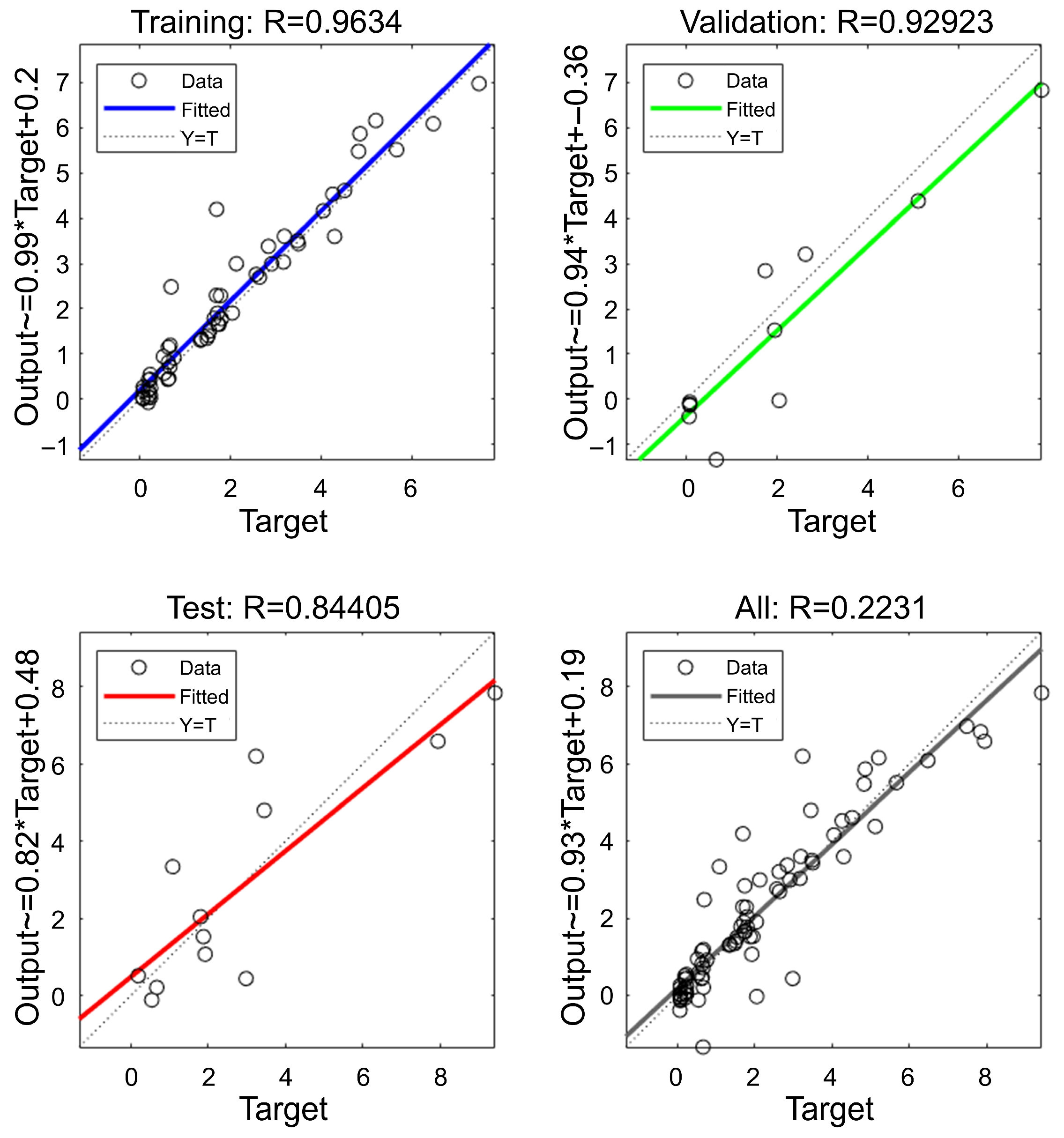
During the training of the BP neural network, 70% of the data was used as training data for network training, while the remaining 30% served as testing data to evaluate the network’s fitting performance. Based on the nonlinear functional relationship between the structural parameters and optimization objectives, the network architecture was configured with 6 nodes in the input layer, 10 nodes in the hidden layer, and 2 nodes in the output layer. The BP neural network was randomly initialized with the following parameter settings: iteration count = 1000, error threshold = 1 × 10⁻⁶, and learning rate = 0.01. Figure 3 illustrates the functional fitting relationship between the dependent variable (average cleaning flow rate) and the independent variables (nozzle flow channel structural parameters including inlet diameter, spacer plate hole diameter, nozzle hole diameter, nozzle hole distance from center, nozzle taper, and nozzle quantity). This is designated as Model 1, with a correlation coefficient R = 0.92. Here, R represents the correlation coefficient, where a higher value indicates better fitting accuracy.
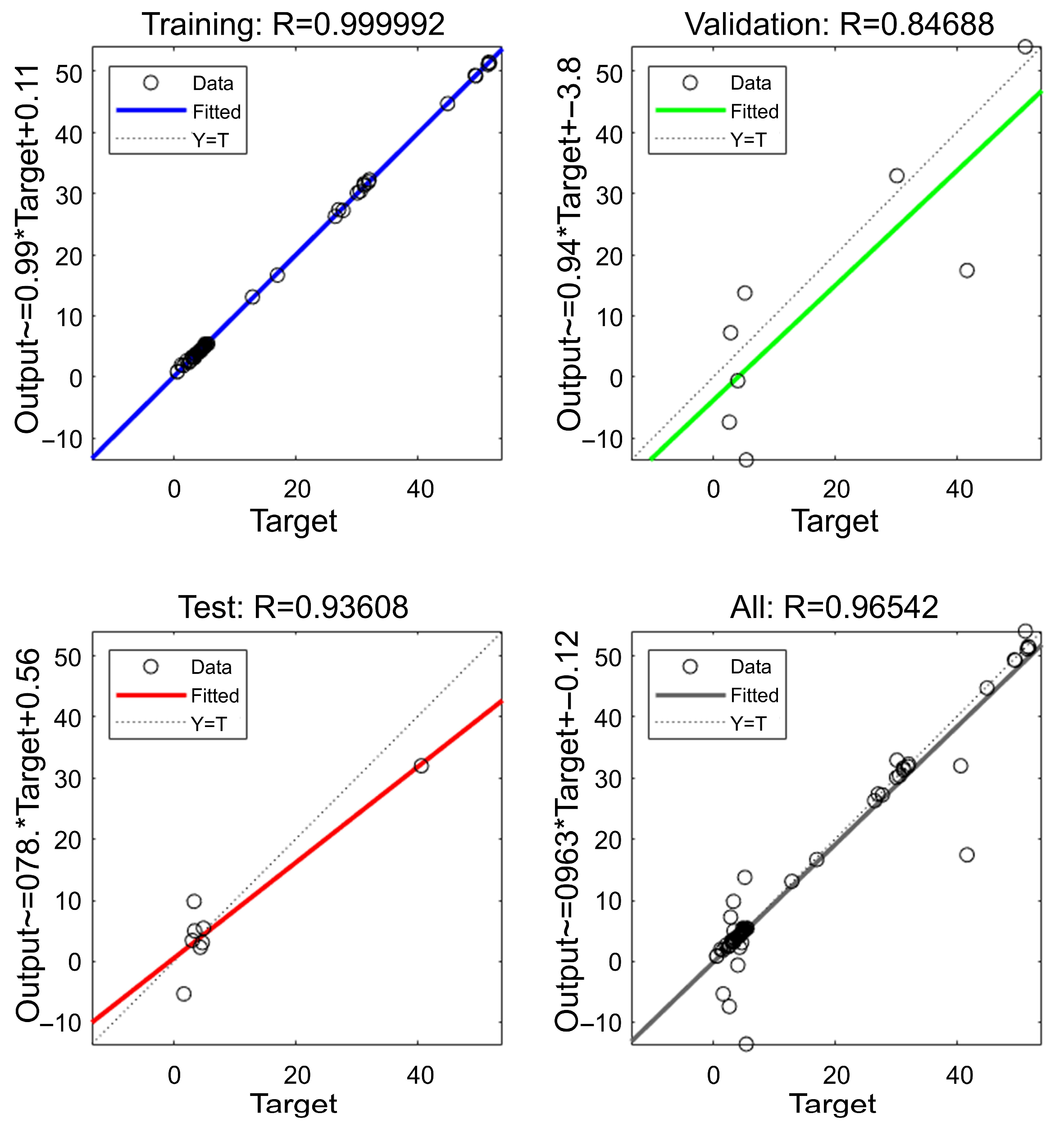
Figure 4 illustrates the functional fitting relationship between the dependent variable (cleaning water pressure) and the independent variables (nozzle structural parameters), designated as Model 2, with a correlation coefficient R = 0.96. Based on the established numerical prediction model for the high-pressure jet cleaning flow field, the cleaning water pressure and flow rate under different high-pressure jet cleaning nozzle fluid structures can be determined. This provides a reference for the structural design of high-pressure jet cleaning nozzles for various formation cleaning applications. Furthermore, this prediction model serves as the input for multi-objective optimization to obtain the optimal high-pressure jet cleaning nozzle structural parameters under the defined objectives.

3.4. Analysis of Factor Importance and Influence Mechanism

To clarify how each structural parameter affects jet performance and identify key influencing factors, Analysis of Variance (ANOVA)—a statistical algorithm that quantifies factor contribution rates by decomposing the total variance of experimental results—and the normalized sensitivity coefficient method (a method to measure the degree of parameter influence on target indicators) are applied based on orthogonal experiment data [37,38]. Average cleaning flow rate (Y1) and maximum outlet pressure (Y2) are selected for analysis. Table 2 presents the results of ANOVA (factor contribution rates) and sensitivity coefficients for the six structural parameters (inlet diameter, spacer plate hole diameter, nozzle hole diameter, nozzle hole distance from center, nozzle taper, nozzle quantity):
Based on the ANOVA and sensitivity coefficient results in Table 2, combined with the physical mechanism of parameter influence, the action rules of each parameter on the average cleaning flow rate (Y1) and maximum outlet pressure (Y2) can be summarized: The nozzle hole diameter (C) is the core parameter, with contribution rates of 38.7% (to Y1) and 42.3% (to Y2) (sensitivity coefficient > 1); as the core flow channel of the jet, a smaller diameter increases flow velocity (per the continuity equation) to enhance Y2, but an excessively small diameter reduces Y1 due to energy loss from flow restriction. The nozzle taper (E) is the secondary key parameter (contribution rate ≈ 20%, sensitivity coefficient ≈ 1); a reasonable taper (15–20°) reduces flow separation and eddy current loss at the flow channel corner to improve energy efficiency, while an abnormal taper weakens jet performance. The inlet diameter (A) and nozzle quantity (F) are moderately influential parameters (contribution rate 12–22%, sensitivity coefficient 0.6–0.9); a larger A reduces inlet flow velocity and friction loss to increase Y1, but has limited effect on Y2, while an increased F splits the total flow to reduce Y2 of a single jet but expand Y1 coverage. The spacer plate hole diameter (B) and nozzle hole distance from center (D) have the weakest influence (contribution rate < 6%, sensitivity coefficient < 0.2); B only stabilizes flow at a distance from the nozzle outlet, and D only changes the jet’s impact position—neither affects the core energy or flow state of the jet.

4. Multi-Objective Optimization of High-Pressure Jet Cleaning Nozzle Flow Channel Structure Dimensions Based on Improved NSGA-II Algorithm

4.1. Principles of the Improved NSGA-II Algorithm

The Non-dominated Sorting Genetic Algorithm II (NSGA-II) is an evolutionary algorithm widely used for multi-objective optimization. The four key principles of NSGA-II include non-dominated sorting, elitist preservation strategy, crowding distance calculation, and tournament selection, with its core lying in fast non-dominated sorting and crowding distance comparison [39,40,41]. Multi-objective optimization involves finding decision variable vectors that satisfy constraints while assigning appropriate values to all objective functions. Such problems yield a set of optimal solutions, known as the Pareto optimal solution set, rather than a single solution. A multi-objective optimization problem can be formulated as:
max F ( x ) = f 1 ( x ) , f 2 ( x ) , f 3 ( x ) , , f n ( x ) T x S
where F ( x ) is the objective function value and S is the set of equality constraints and inequality constraints. If all other vectors have higher values for at least one objective function f i ( x ) , then vector x satisfying all constraints is a Pareto optimal solution. In this study, for a desired set of jet fluid flow rate and cleaning pressure, the decision variables include the inlet diameter, spacer plate hole diameter, nozzle hole diameter, nozzle hole distance from the center, nozzle taper, and nozzle quantity. The objective functions are the output values of the BP neural network. The improved NSGA-II algorithm incorporates enhancements in fitness assignment, environmental selection mechanism, and crossover and mutation operations. The execution steps are as follows:
Step 1: Population initialization and fitness calculation. Randomly generate an initial population and compute the objective function value for each individual. Then perform fitness calculation, which is based on each individual’s position in its non-dominated front. An individual’s fitness is related to its dominance level (Pareto rank) and crowding distance. The fitness calculation formula is as follows:
Q = r i + 1 d i + 2
where r i means Pareto grade, and low grade means that the number of individuals dominated by individuals is small; d i stands for crowding distance, which is the crowding distance between individuals in the same frontier, and is used to keep the diversity of solution sets.
Step 2: Fast non-dominated sorting. The population is sorted and assigned Pareto ranks. The following steps are used to calculate the dominance relationships and Pareto ranks of individuals.
Step 3: Crowding distance calculation. Within the same Pareto front, the crowding distance between individuals is calculated to maintain population diversity. The improved crowding distance calculation considers not only the objective space but also the similarity in the decision space, thereby enhancing the algorithm’s efficiency when handling highly correlated variables. The calculation formula for the improved crowding distance d i is as follows:
d i = m = 1 M ( f m ( i + 1 ) f m ( i 1 ) ) + λ n = 1 N ( x n ( i + 1 ) x n ( i 1 ) )
where M is the number of objective functions, f m is the m-th objective function, λ is the balance parameter between decision variables and objective functions, x n is decision variables, and N is the number of decision variables.
Step 4: Selection operation: binary tournament. Parent individuals are selected based on Pareto rank and crowding distance. Two randomly selected individuals are compared, with priority given to the individual with the lower Pareto rank; if the ranks are the same, the individual with the larger crowding distance is selected.
Step 5: Crossover and mutation operations. Simulated binary crossover and polynomial mutation are widely used in genetic algorithms. The crossover and mutation parameters η c and η m control the distribution of offspring [42,43,44]. The improved crossover parameter η c can be dynamically adjusted based on population diversity to balance exploration and exploitation.
η c ( t ) = η c , max ( η c , max η c , min ) t T
where t represents the current iteration number and t represents the maximum iteration number of the algorithm.

4.2. Multi-Objective Optimization of Nozzle Flow Channel Structure

To validate the effectiveness of the improvement strategy proposed in this paper for the NSGA-II algorithm, a multi-objective test function ZDT3 [45,46,47] was used for algorithm performance testing experiments. By comparing with the standard NSGA-II algorithm, the convergence and diversity of the improved NSGA-II algorithm were evaluated. This test function is a two-objective optimization problem, and since its true optimal solution set is known, it is suitable for performance testing and comparison of multi-objective optimization algorithms.
Simultaneously, the Inverted Generational Distance (IGD) [48,49] was employed to evaluate the convergence and diversity of the obtained Pareto approximate solution set. The Inverted Generational Distance (IGD) is a comprehensive performance metric that measures the average minimum distance from the true Pareto Front (PF) to the approximate solution set obtained by the algorithm. Therefore, calculating IGD requires pre-obtaining a set of solutions uniformly sampled from the true PF. A smaller IGD value indicates better convergence and diversity of the algorithm’s approximate solution set, showing closer approximation to the true PF. The defining formula is as follows:
I G D ( S , P ) = x P d i s t ( x , S ) P
where P is the real PF sampling solution set, S is the approximate PF solution set obtained by the algorithm, and d i s t ( x , S ) represents the Euclidean distance between individual x P and the nearest individual on S.
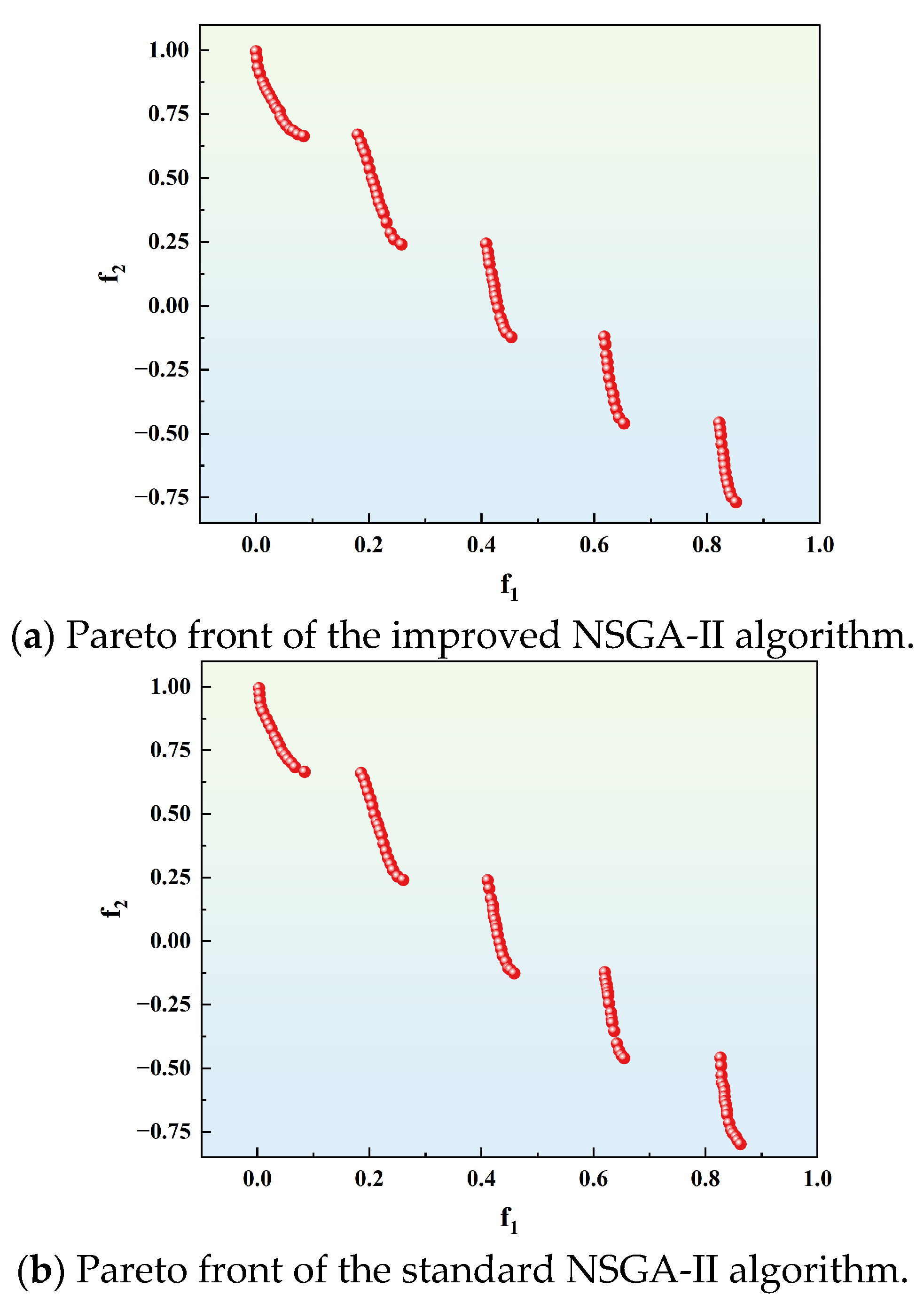
Using the aforementioned ZDT3 test function, experiments were conducted to test both the improved NSGA-II algorithm and the standard NSGA-II algorithm. The obtained Pareto fronts are shown in Figure 5a,b, respectively, where f1 and f2 represent the two objective functions of the ZDT3 test function. From the comparison of the Pareto fronts, it can be observed that the improved NSGA-II algorithm exhibits a more uniform and broader distribution overall, whereas the standard NSGA-II algorithm shows issues such as individual clustering and overlap in some regions and discontinuities in others. Visually, the improved NSGA-II algorithm demonstrates significantly better diversity in solution distribution compared to the standard NSGA-II algorithm.
To obtain more precise experimental results, this section employs the evaluation metric IGD for quantitative analysis of the algorithms. Each algorithm was independently run 20 times on each test problem, recording the IGD metric value obtained from each run, and calculating the mean and standard deviation. The results are shown in Table 3. The experimental results demonstrate that the improved NSGA-II algorithm outperforms the standard NSGA-II algorithm in both convergence and solution distribution diversity.
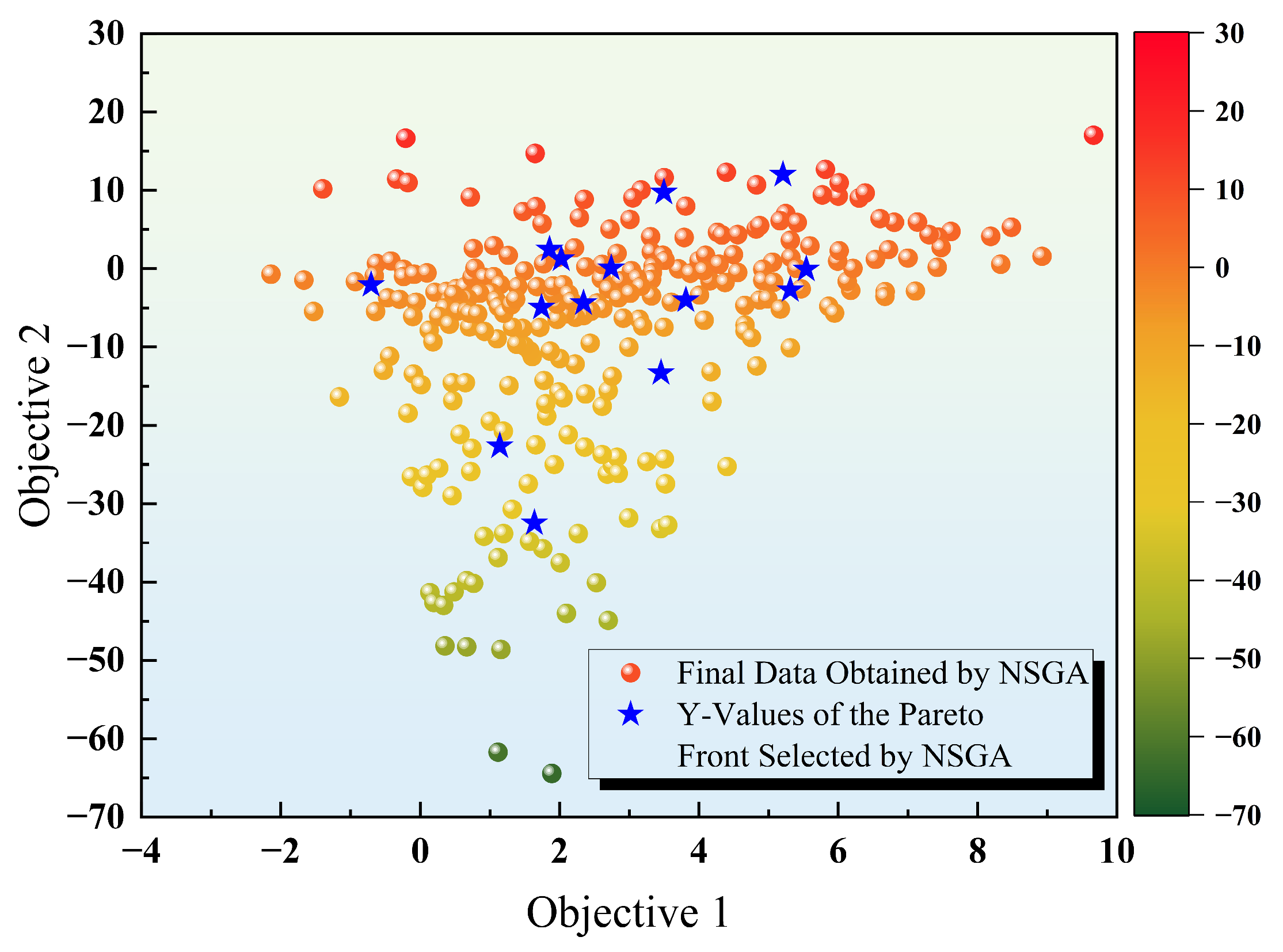
Using the improved NSGA-II algorithm program with 500 generations of iterative runs, the Pareto optimal solution set for the six structural parameters of the high-pressure jet cleaning nozzle concerning average cleaning flow rate and jet pressure within the parameter ranges was obtained, i.e., the Pareto front, as shown in Figure 6. According to the concept of the Pareto solution set, any blue point in this figure satisfies the optimal solution of the objective functions. The difference lies in the varying weights of the two response objectives determined by the position of each point. By denormalizing the obtained points, the corresponding six structural parameters of the high-pressure jet cleaning nozzle for the optimal solution set can be derived.

4.3. Numerical Simulation Verification of Optimized Nozzle Flow Channel Structure

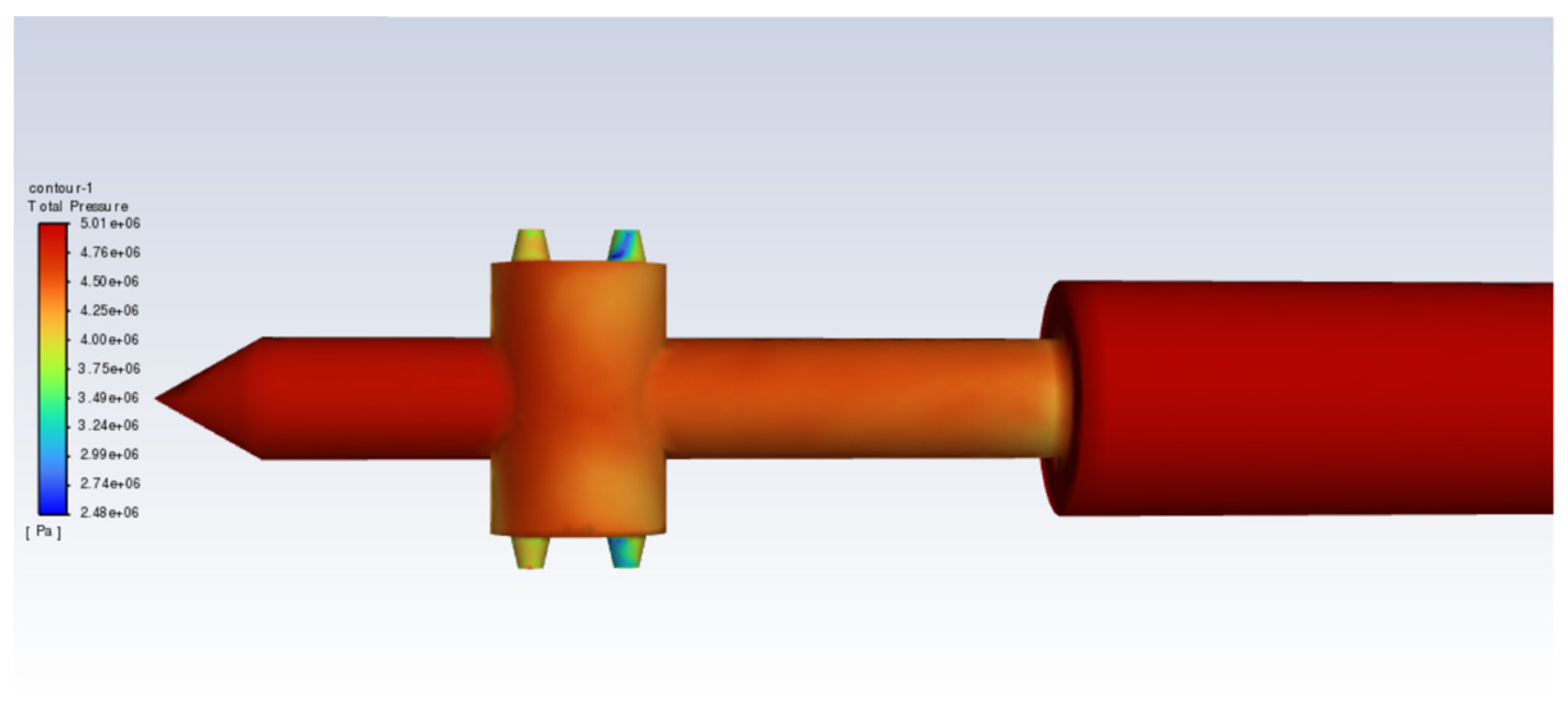
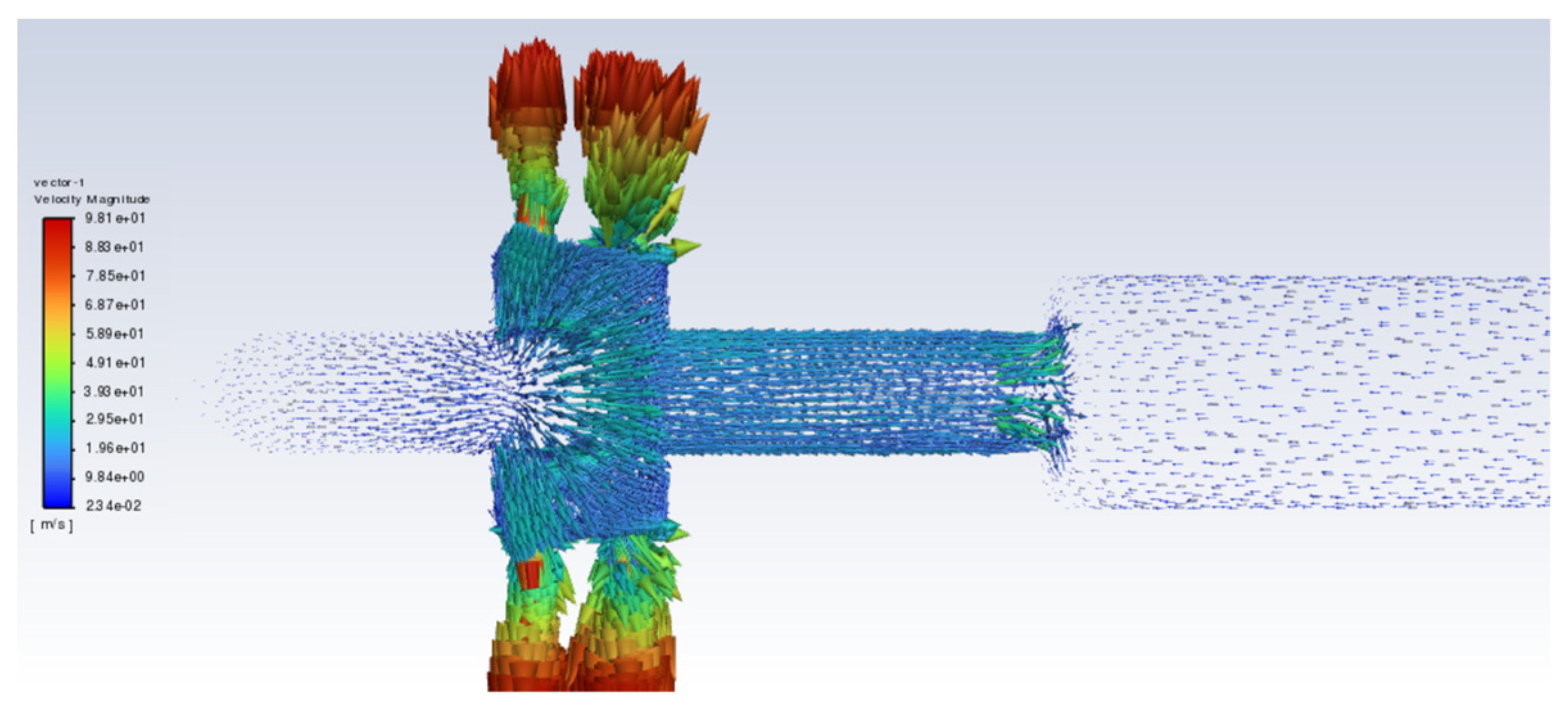
A set of optimized structural parameters suitable for clay-filled strata in grouting holes was selected and configured in the numerical model of the high-pressure jet cleaning nozzle. The simulation results are shown in Figure 7 and Figure 8, respectively. The selected optimized parameters corresponding to the optimization objectives are as follows: nozzle inlet diameter of 22.8 mm, spacer plate hole diameter of 33.9 mm, nozzle hole diameter of 4.6 mm, nozzle hole distance from center of 12.4 mm, nozzle taper of 13.2°, and nozzle quantity of 4. The resulting average outlet flow rate was 1.438 kg/s, and the outlet jet pressure was 4.35 MPa. Under the same number of nozzles, it can be concluded that the optimized nozzle achieves an average flow rate 1.7 times higher and an outlet pressure 28.3% higher compared to the pre-optimized nozzle.

5. Field Experimental Study

The grouting test Area A of the South-to-North Water Diversion Middle Route Xiong’an Regulation Reservoir Project is located at the 7# and 8# dam blocks of the auxiliary dam axis. The presence of dissolved clay-filled layers in this area prevents grouting holes from achieving normal pressure buildup. High-pressure water jet cleaning was considered for the clay-filled sections to flush out the clay from the holes. After cleaning, grouting was performed with thick slurry followed by setting, thereby creating a “concrete plug” effect in the clay-filled layers. This “concrete plug” forms rigid contact with the intact bedrock, replacing the soft contact between clay and intact bedrock, thus significantly enhancing the grouting pressure-bearing capacity of these sections.
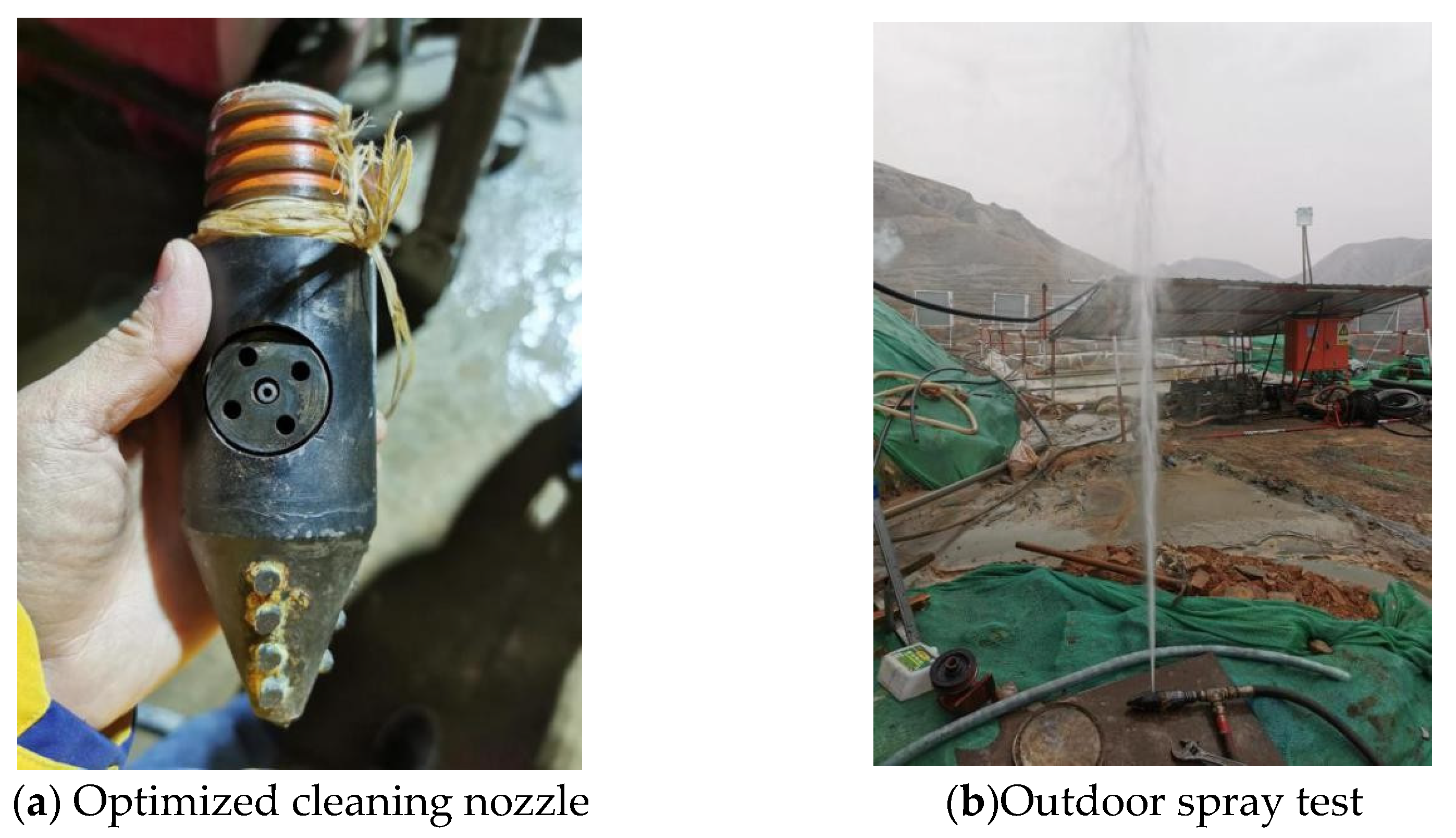
The test system consists of a high-pressure grouting pump, a custom jet nozzle prototype, and pressure monitoring equipment, with specific configurations as follows: High-pressure grouting pump: Model ZLJ-1200, manufactured by Hebei Jiangkan Machinery Equipment Sales Co., Ltd. (Xingtai City, Hebei Province, China), a specialized equipment supplier for water conservancy grouting projects. It has a rated working pressure of 60 MPa, meeting the pressure requirements for curtain grouting hole cleaning in the project. Figure 9a,b show the optimized high-pressure jet cleaning nozzle and outdoor water jet test images, respectively.
Methods for Precise Localization of Clay-Rich Zones:
Step One: Geological Pre-Assessment
Based on geological survey data and records from previous grouting hole construction, potential locations of clay-rich interlayers are pre-identified to enable further evaluation before drilling corresponding hole segments. In Test Area A, clay-rich layers are mainly distributed within the depth range of 20–30 m.
Step Two: Preliminary Assessment via Drilling Fluid Returns
The presence of clay-rich zones is initially judged by observing the color of the drilling fluid returns. If the returning fluid appears reddish or yellowish and muddy, the corresponding depths at which the muddy returns begin and end are recorded in detail on site.
Step Three: Precise Positioning via Borehole Televiewer Logging
Depending on field conditions, if borehole televiewer logging is feasible, it is used to further accurately locate the clay-rich zones.
Step Four: Verification During Washing
During the first round of high-pressure washing, the nozzle is slowly lifted from the bottom of the segment upward. The position of the clay-rich layer is verified during the lifting process based on the color of the returning washing fluid. The washing interval generally covers the exposed dissolved clay-rich layer and extends 30 cm above and below it. During washing, the drill rod rotates at approximately 6 revolutions per minute, with a lifting speed of about 2 cm/min.
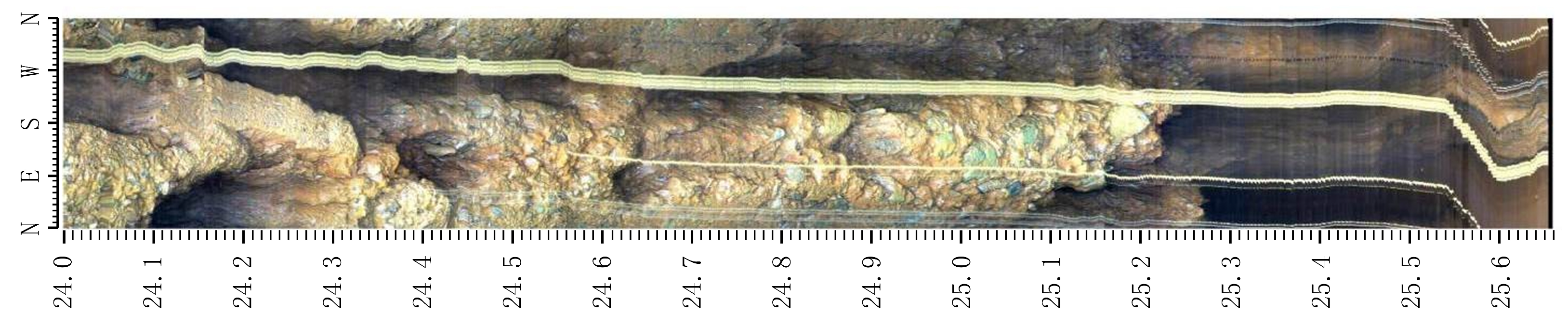
Figure 10 shows the borehole televiewer image of Segment 6 (breccia with clay) in Hole A2W-2-III-6 after high-pressure jet washing. It can be observed that after high-pressure jet washing, the loose clay-rich layer within the hole has been completely removed, exposing the original surface of the breccia.
The high-pressure jet cleaning device was field-tested in silty clay strata (cleaning pressure ≥ 5 MPa), and its adaptability can be extended to common clay-filled strata in water conservancy projects: silty clay is consistent with the test stratum, and the device can effectively remove loose clay (verified by borehole televiewer logs); in clayey sand, the cemented carbide cutting teeth can break the clay-sand bonding, and the uniform jet flow can flush debris; partial cleaning is achievable for high-plasticity clay, and the effect can be further improved by adjusting nozzle parameters. The device has clear application limitations. It is not suitable for strata with high gravel content because gravel can easily block the nozzles. In addition, the device is designed for boreholes with diameters of 150–200 mm and provides insufficient coverage for larger boreholes.

6. Conclusions and Prospects

To address inefficient cleaning in clay-filled strata, this study conducts systematic research on high-pressure jet cleaning nozzles, yielding key scientific achievements:
(1)
An innovative device integrated with cemented carbide cutting teeth and a uniformly perforated spacer plate is developed, realizing synergistic clay cutting-flushing. Field tests at the Xiong’an Regulation Reservoir Project confirm cleaned boreholes are free of residual mud, meeting grouting requirements.
(2)
A BP neural network prediction model is established with orthogonal experimental data, achieving reliable prediction of flow rate and pressure (average R = 0.94) for rapid parameter matching.
(3)
Via ANOVA and normalized sensitivity analysis, nozzle hole diameter (contribution rate 38.7–42.3%, sensitivity coefficient > 1) is identified as the core parameter, followed by nozzle taper, providing a basis for targeted optimization.
(4)
An improved NSGA-II algorithm is proposed, reducing IGD mean and standard deviation by 46.4% and 83.2% compared to the standard version. The optimized nozzle achieves a 1.7-fold higher flow rate and 28.3% higher pressure than the pre-optimized design.
Future research will optimize high-pressure air-water combined flushing to enhance large particle removal efficiency, expanding the technology’s application scope.

Author Contributions

Conceptualization, F.H. and Y.D.; Data curation, Z.C.; Formal analysis, F.H.; Methodology, Y.D. and Y.Y.; Project administration, F.H.; Software, Z.C.; Writing—original draft, F.H. and Y.Y. All authors have read and agreed to the published version of the manuscript.

Funding

This research was funded by the “Intergovernmental Special Project on International Science, Technology and Innovation Cooperation” under the National Key R&D Program (2022YFE0117500).

Data Availability Statement

The original contributions presented in this study are included in the in the article. Further inquiries can be directed to the corresponding author.

Conflicts of Interest

Authors Fan Huang, Ye Ding, and Zhi Cao were employed by the company, Planning, Design and Research Corporation, Changjiang Geotechnical Engineering Corporation and China National Petroleum Corporation. The remaining authors declare that the research was conducted in the absence of any commercial or financial relationships that could be construed as a potential conflict of interest.

Nomenclature

A Inlet diameter
B Spacer plate hole diameter
C Nozzle hole diameter
D Nozzle hole distance from center
E Nozzle taper
F Nozzle quantity
Y 1 Average cleaning flow rate
Y 2 Outlet pressure
d i Improved crowding distance
f 1 f 2 Two objective functions of the ZDT3 test function
R Correlation coefficient
I G D Inverted Generational Distance
P F Pareto Front
η c Crossover parameter
η m Mutation parameter
NSGA-IINon-dominated Sorting Genetic Algorithm II
B P Backpropagation Neural Network

Appendix A

Figure A1. The sensitivity analysis results of Grid parameters and flow rate.
Applsci 16 00836 g0a1

Appendix B

Table A1. Orthogonal test table and simulation results.
Serial NumberEntrance Diameter
(mm)
Diameter of the Central Circular Hole
(mm)
Nozzle Orifice Diameter
(mm)
Distance from Nozzle Hole to Center of Circle (mm)Nozzle Taper Number of NozzlesAverage Export Flow
(kg/s)
Outlet Pressure
(Pa)
1103017010.1873,019,490
2103017020.18731,267,871
3103017030.18530,143,054
4103017040.18430,610,518
51030181010.23749,498,237
6103519020.18931,953,823
7103519530.22849,639,710
810351111050.2351,898,874
910351121060.22951,615,568
101035392012.0551,293,448
111035510030.7561,232,580
121035911021.364555,752
1310405111030.692,493,083
141630381032.0444,992,815
151630311011.7131,248,330
161630510024.327,090,578
17163537011.7232,109,370
1816353121051.92340,668,997
1916359121032.131,585,446
2016401111530.235751,748,185
211640313061.5426,528,151
221640313531.9541,710,606
231640710017.4927,804,572
2416407121036.4817,014,081
251640913521.6933,520,990
2622301121040.07285,241,831
272230113060.05913,266,534
282230113540.0724,993,062
292230371530.665,123,136
3022351111020.07265,242,233
3122351111050.07325,202,518
3222357122023.244,343,384
3322359121015.213,984,281
3422403111520.675,228,233
352830311560.624,385,340
362830591011.84,866,739
3728307111033.174,012,431
382830712022.642,971,056
3928309101024.523,267,025
402835392010.675,432,394
41283559531.644,061,649
422840110520.0724,964,693
43284039010.543,327,079
442840313530.634,508,362
4528405131541.754,741,490
46284059521.694,182,391
472840713552.572,766,976
4828407131013.454,678,153
4934303122040.665,380,300
503430312510.644,615,271
51343059041.483,353,618
5234309101015.674,643,346
5334307101013.54,805,595
54343518520.0724,976,136
553435113060.0593,253,356
5634351131020.0735,266,035
5734355112031.805,126,763
583435711042.632,864,065
5934401122030.0735,583,152
60344039040.543,392,288
6134401112517.954,042,602
62103059040.5212,925,940
631030911021.34612,457
641040710521.0821,638,239
6516307101513.194,157,165
6616301110014.262,144,556
6716301110521.8772,647,567
681640591011.744,505,258
6922355111011.784,789,849
702830711532.913,597,131
712840312550.634,467,481
722840911014.833,368,379
732840913014.863,387,694
7428401313019.433,030,947
753430512061.513,344,046
7634307111523.484,888,639
773435913044.052,587,564
7834351112517.8484,127,105
79343579012.983,401,366
803440713032.843,264,916
8134409131025.124,088,320

References

  1. Zhaoxing, L.; Shuning, D.; Shitian, Z.; Zhiyuan, S. Research on advanced grouting curtain technology for water interception and control at the source of aquifer in coal seam roof. Sci. Rep. 2025, 15, 20354. [Google Scholar] [CrossRef] [PubMed]
  2. Gao, X.; Li, Z.; Zhou, Z.; Wu, F.; Huang, H.; Chen, J. Long-term erosion resistance of grouting curtain in coastal karst fracture area. J. Build. Eng. 2024, 85, 108721. [Google Scholar] [CrossRef]
  3. Li, L.; Zhang, Z.; Nie, C.; Hu, X.; Li, Z.; Cheng, L.; Zhang, W. Research on the influence of curtain grouting parameters on the stability of tunnel surrounding rock and lining structure under the action of local high water pressure. AIP Adv. 2025, 15, 015314. [Google Scholar] [CrossRef]
  4. Lou, Q.; Shi, B.; Han, H.; Zhu, H.; Wei, G.; Zhang, K. Research on mine curtain strain curve features for its grouting defects identification with ultra-weak fiber Bragg grating. Measurement 2025, 244, 116507. [Google Scholar] [CrossRef]
  5. Tong, F.; Bai, D.; Ma, X.; Cheng, L.; Yang, J.; Cao, X. A Hybrid ICEEMDAN-BO-GRU Model for Real-Time Grouting Parameter Prediction. Appl. Soft Comput. 2025, 185, 113912. [Google Scholar] [CrossRef]
  6. Zhu, T.; Huang, F.; Li, S.; Ouyang, T.; Ying, J.; Zhao, H. Optimization of pre-grouting construction and evaluation of grouting effect in a deeply buried silt-filled shield tunnel. Tunn. Undergr. Space Technol. 2024, 152, 105902. [Google Scholar] [CrossRef]
  7. Kang, H.; Wang, B.; Gao, F.; Zhang, Y.; Fan, Z.; Li, S.; Xu, X.; Chen, P. Current status and prospects of coal mining science and technology in China. Geoenergy Commun. 2025, 1, 3. [Google Scholar] [CrossRef]
  8. Sandene, T.; Langford, J.; Kahlström, M.; Long, M.; Ritter, S. Database for Deep Excavations in Soft Clay with Focus on Groundwater Drainage and Installation Effects. J. Geotech. Geoenviron. Eng. 2024, 150, 04024108. [Google Scholar] [CrossRef]
  9. Bi, G.; Wang, X.; Han, F.; Wu, J.; Yuan, P.; Fu, S.; Ma, Y. Study on the Mechanism of High-Efficiency Rock Breaking by Hydraulic Jet Based on Explicit Dynamics. Processes 2023, 11, 2165. [Google Scholar] [CrossRef]
  10. Li, H.; Huang, Z.; Li, J.; Cheng, K.; Hu, J.; Li, W. Effect of Nozzle Structure on Rock Drilling Performances of Abrasive Waterjet. In Proceedings of the 57th U.S. Rock Mechanics/Geomechanics Symposium, Atlanta, GA, USA, 25–28 June 2023. [Google Scholar]
  11. Li, J.; Dai, J.; Huang, Z.; Zhang, G.; Liu, X.; Li, H. Rock breaking characteristics of the self-rotating multi-orifice nozzle for sandstone radial jet drilling. Rock Mech. Rock Eng. 2021, 54, 5603–5615. [Google Scholar] [CrossRef]
  12. Cao, T.; Chen, X.; Yu, K.; Tang, L. Hydraulic modeling and optimization of jet mill bit considering the characteristics of depressurization and cuttings cleaning. Pet. Sci. 2023, 20, 3085–3099. [Google Scholar] [CrossRef]
  13. Liu, J.; Shi, H.; Zhu, Y.; Wu, H.; Gai, Z.; Gu, Z. Study on optimal design method of efficient rock-breaking nozzles under high confining pressure in deep wells. In Proceedings of the ARMA US Rock Mechanics/Geomechanics Symposium, Santa Fe, NM, USA, 8–11 June 2025; ARMA: Alexandria, VA, USA, 2025; p. D022S022R021. [Google Scholar]
  14. Heng, Y.; Jianping, W.; Yubo, C.; Lulu, Z.; Yong, L. Structure optimization and coal breaking effect of air jet nozzle for post-mixed abrasive. Coal Geol. Explor. 2023, 51, 8. [Google Scholar]
  15. Zhang, Y.; Tian, T.; Song, X.; Xu, F.; Wang, W. Numerical simulation of the rotating water jet flushing the insoluble particles in the salt cavern underground gas storage based on DPM model. In Proceedings of the 55th US Rock Mechanics/Geomechanics Symposium, Online, 18–25 June 2021; ARMA: Alexandria, VA, USA, 2021. [Google Scholar]
  16. Jin, Z.; Xing, Z.; Peng, C.; Qi, P.; Jiaqi, R. Development of Coiled Tubing Jet Tools with Multi-Hole Nozzles and Cleaning Parameter Optimization. Pet. Drill. Tech. 2023, 51, 83–89. [Google Scholar]
  17. Toczek, P.; Wiśniowski, R.; Złotkowski, A.; Teper, W. Hydraulic drilling nozzle design and research. Inventions 2024, 9, 51. [Google Scholar] [CrossRef]
  18. Zhang, T.; Li, Y.; Lu, H.; Jiang, J. Simulation and experimental study on characteristics of multiorifice nozzle in radial jet drilling. Geofluids 2022, 2022, 2531181. [Google Scholar] [CrossRef]
  19. Khan, J.A.; Irawan, S.; Padmanabhan, E.; Al-Kayiem, H.H.; Rai, S. Optimization of coiled tubing nozzle for sand removal from wellbore. J. Pet. Explor. Prod. Technol. 2020, 10, 53–66. [Google Scholar] [CrossRef]
  20. He, L.; Liu, Y.; Ba, Q.; Weng, P.; Lin, M. Research on rock-breaking instability characteristics and spin deflection effects of asymmetric water jet impact. Geoenergy Sci. Eng. 2025, 250, 213842. [Google Scholar] [CrossRef]
  21. Milojević, S.; Stojanović, B. Determination of tribological properties of aluminum cylinder by application of Taguchi method and ANN-based model. J. Braz. Soc. Mech. Sci. 2018, 40, 571. [Google Scholar] [CrossRef]
  22. SL/T 62-2014; Technical Specification for Grouting Construction of Water Conservancy and Hydropower Projects. China Water & Power Press: Beijing, China, 2014.
  23. Li, S.; Zhu, L.; Zhang, X.; Luo, Z. Recent advances in CFD simulations of multiphase flow processes with phase change. Ind. Eng. Chem. Res. 2023, 62, 10729–10786. [Google Scholar] [CrossRef]
  24. Viyyuri, S. Computational Fluid Dynamics (CFD) Modeling of Flow Boiling Heat Transfer in Microchannels: Modeling Approaches Using ANSYS Fluent and Validation Studies. In Proceedings of the ASME International Mechanical Engineering Congress and Exposition, Portland, OR, USA, 17–21 November 2024; American Society of Mechanical Engineers: New York, NY, USA, 2024; p. V009T11A042. [Google Scholar]
  25. You, Y.; Wang, S.; Lv, W.; Chen, Y.; Gross, U. A CFD model of frost formation based on dynamic meshes technique via secondary development of ANSYS fluent. Int. J. Heat Fluid. Flow 2021, 89, 108807. [Google Scholar] [CrossRef]
  26. Wong, J.C.; Pareek, V.K.; Sun, B. CFD analysis of phase change behaviour and frost growth under various conditions using mass transfer theory. Int. J. Heat Mass Transf. 2022, 198, 123396. [Google Scholar] [CrossRef]
  27. Mirzaei, M.; Clausen, S.; Wu, H.; Zakrzewski, S.; Nakhaei, M.; Zhou, H.; Jønck, K.M.; Jensen, P.A.; Lin, W. CFD simulation and experimental validation of multiphase flow in industrial cyclone preheaters. Chem. Eng. J. 2023, 465, 142757. [Google Scholar] [CrossRef]
  28. Mondal, P.; Lahiri, S.K.; Ghanta, K.C. Assessment of ansys-fluent Code for Computation of Two-Phase Flow Characteristics: A Comparative Study of Water–Air and Silicone Oil–Air in a Vertical Pipe. J. Fluids Eng. 2024, 146, 121403. [Google Scholar] [CrossRef]
  29. Bargal, M.H.; Ben-Mansour, R.; Al-Sarkhi, A.; Alhems, L.M. CFD modeling of two-phase flow (oil/air) with and without rotary mixer inside a vertical pipe for upstream of multiphase pump. Arab. J. Sci. Eng. 2025, 50, 9611–9630. [Google Scholar] [CrossRef]
  30. Jiang, T.; Huang, Z.; Li, J.; Zhou, Y.; Xiong, C. Effect of nozzle geometry on the flow dynamics and resistance inside and outside the cone-straight nozzle. ACS Omega 2022, 7, 9652–9665. [Google Scholar] [CrossRef]
  31. Jiang, T.; Huang, Z.; Li, J.; Zhou, Y. Internal flow mechanism of cone-straight nozzle. Pet. Sci. 2021, 18, 1507–1519. [Google Scholar] [CrossRef]
  32. Li, S.; Guo, Q.; Han, M.; Jin, H.; Luo, Y.; Lin, Y.; Gui, C.; Yuan, L.; Zhou, F. Effect of double-layer filter cartridge with an inner cone on the pulse-jet cleaning performance of cartridge dust collectors. Sep. Purif. Technol. 2024, 328, 125058. [Google Scholar] [CrossRef]
  33. Song, L.; Xie, J.; Jiang, Q.; Wang, G.; Zhong, S.; Han, G.; Wu, J. A back-propagation neural network optimized by genetic algorithm for rock joint roughness evaluation. J. Rock Mech. Geotech. 2025, 17, 3054–3072. [Google Scholar] [CrossRef]
  34. Ye, L.; Li, C.; Wang, C.; Zheng, J.; Zhong, K.; Wu, T. A multi-objective optimization approach for battery thermal management system based on the combination of BP neural network prediction and NSGA-II algorithm. J. Energy Storage 2024, 99, 113212. [Google Scholar] [CrossRef]
  35. Wu, W.; Jiang, W.; Falchetto, A.C.; Yuan, D.; Xiao, J.; Wang, D. Prediction of rheological properties of high polymer-modified asphalt binders based on BAS-BP neural network and functional groups. Fuel 2025, 379, 132989. [Google Scholar] [CrossRef]
  36. Yang, J.; Wang, L.; Zhang, B.; Zhang, H.; Wu, X.; Xu, X.; Deng, P.; Peng, Y. Remaining useful life prediction of vehicle-oriented PEMFC systems based on IGWO-BP neural network under real-world traffic conditions. Energy 2024, 291, 130334. [Google Scholar] [CrossRef]
  37. Chen, W.; Uribe, M.C.; Kwon, E.E.; Lin, K.A.; Park, Y.; Ding, L.; Saw, L.H. A comprehensive review of thermoelectric generation optimization by statistical approach: Taguchi method, analysis of variance (ANOVA), and response surface methodology (RSM). Renew. Sustain. Energy Rev. 2022, 169, 112917. [Google Scholar] [CrossRef]
  38. Thango, B.A. Application of the analysis of variance (ANOVA) in the interpretation of power transformer faults. Energies 2022, 15, 7224. [Google Scholar] [CrossRef]
  39. Wang, Q.; Xu, X.; Ding, X.; Chen, T.; Deng, R.; Li, J.; Jiang, J. Multi objective optimization and evaluation approach of prefabricated component combination solutions using NSGA-II and simulated annealing optimized projection pursuit method. Sci. Rep. 2024, 14, 16688. [Google Scholar] [CrossRef]
  40. Li, M.; Ma, H.; Lv, S.; Wang, L.; Deng, S. Enhanced NSGA-II-based feature selection method for high-dimensional classification. Inf. Sci. 2024, 663, 120269. [Google Scholar] [CrossRef]
  41. Cui, H.; Cao, F.; Liu, R. A multi-objective partitioning algorithm for large-scale graph based on NSGA-II. Expert Syst. Appl. 2025, 263, 125756. [Google Scholar] [CrossRef]
  42. Rashid, T.A.; Majidpour, J.; Thinakaran, R.; Batumalay, M.; Dewi, D.A.; Hassan, B.A.; Dadgar, H.; Arabi, H. NSGA-II-DL: Metaheuristic optimal feature selection with deep learning framework for HER2 classification in breast cancer. IEEE Access 2024, 12, 38885–38898. [Google Scholar] [CrossRef]
  43. Liu, Y.; Chu, M.; Ye, Q.; Li, J.; Han, D. Multi-objective optimization of FCC separation system based on NSGA-II. Chem. Eng. Sci. 2025, 302, 120829. [Google Scholar] [CrossRef]
  44. Zuo, W.; Li, F.; Li, Q.; Chen, Z.; Huang, Y.; Chu, H. Multi-objective optimization of micro planar combustor with tube outlet by RSM and NSGA-II for thermophotovoltaic applications. Energy 2024, 291, 130396. [Google Scholar] [CrossRef]
  45. Sato, Y.; Sato, M.; Yamada, H. Initial Population of NSGA-II for Solving Similar Multi-Objective Optimization Problems. In Proceedings of the Genetic and Evolutionary Computation Conference Companion, Melbourne, Australia, 14–18 July 2025; pp. 109–110. [Google Scholar]
  46. Zhang, Z.; Wu, F.; Wu, A. Research on multi-objective process parameter optimization method in hard turning based on an improved NSGA-II algorithm. Processes 2024, 12, 950. [Google Scholar] [CrossRef]
  47. Zhang, F. Constructing a multi-objective optimization model for engineering projects based on NSGA-II algorithm under the background of green construction. Decis. Mak. Appl. Manag. Eng. 2024, 7, 37–53. [Google Scholar] [CrossRef]
  48. Xue, T.; Zhang, Z.; Gao, T.; Han, F. Topsis-Based Genetic Algorithm for Non-Dominated Sorting of Local Search Im-NSGA-II. In Proceedings of the 2024 IEEE 6th International Conference on Power, Intelligent Computing and Systems (ICPICS), Shenyang, China, 26–28 July 2024; IEEE: New York, NY, USA, 2024; pp. 92–97. [Google Scholar]
  49. Yue, X.; Xiong, T.; Zhu, W. Solving bank debt problems based on parallel NSGA-II algorithm. Int. J. Bio-Inspired Comput. 2025, 25, 88–103. [Google Scholar] [CrossRef]
Figure 1. Structure diagram of high-pressure jet cleaning nozzle.
Applsci 16 00836 g001
Figure 2. High-pressure jet cleaning nozzle fluid simulation model.
Applsci 16 00836 g002
Figure 3. Training results of model 1.
Applsci 16 00836 g003
Figure 4. Training results of model 2.
Applsci 16 00836 g004
Figure 5. Algorithm comparison for the ZDT3 test function.
Applsci 16 00836 g005
Figure 6. Pareto front of the two optimization objectives.
Applsci 16 00836 g006
Figure 7. Pressure contour plot of the optimization results.
Applsci 16 00836 g007
Figure 8. Velocity vector plot of the optimization results.
Applsci 16 00836 g008
Figure 9. Optimized high-pressure jet cleaning nozzle and outdoor spray test scene.
Applsci 16 00836 g009
Figure 10. Borehole TV inspection of borehole A2W-2-III-6 after high-pressure cleaning.
Applsci 16 00836 g010
Table 1. Factors and levels of the orthogonal experiment.
1234567
A1016222834
B303540
C135791113
D78910111213
E05101520
F123456
Table 2. Results of ANOVA and sensitivity coefficients.
Parameter NameContribution Rate
to Y1
Contribution Rate
to Y2 (%)
Sensitivity Coefficient
(Y1)
Sensitivity Coefficient
(Y2)
A21.515.20.850.72
B3.84.10.120.08
C38.742.31.251.58
D4.25.70.070.06
E18.620.50.921.15
F13.212.20.630.88
Table 3. Mean and standard deviation of IGD metric for the two algorithms.
Test FunctionIndexImproved NSGA-IIOrdinary NSGA-II
ZDT3Mean (IGD)3.13 × 10−35.84 × 10−3
Std (IGD)1.79 × 10−41.07 × 10−3
Disclaimer/Publisher’s Note: The statements, opinions and data contained in all publications are solely those of the individual author(s) and contributor(s) and not of MDPI and/or the editor(s). MDPI and/or the editor(s) disclaim responsibility for any injury to people or property resulting from any ideas, methods, instructions or products referred to in the content.