Numerical Investigation of Micromechanical Failure Evolution in Rocky High Slopes Under Multistage Excavation

 and
and
Abstract
1. Introduction
2. Model and Boundary Conditions
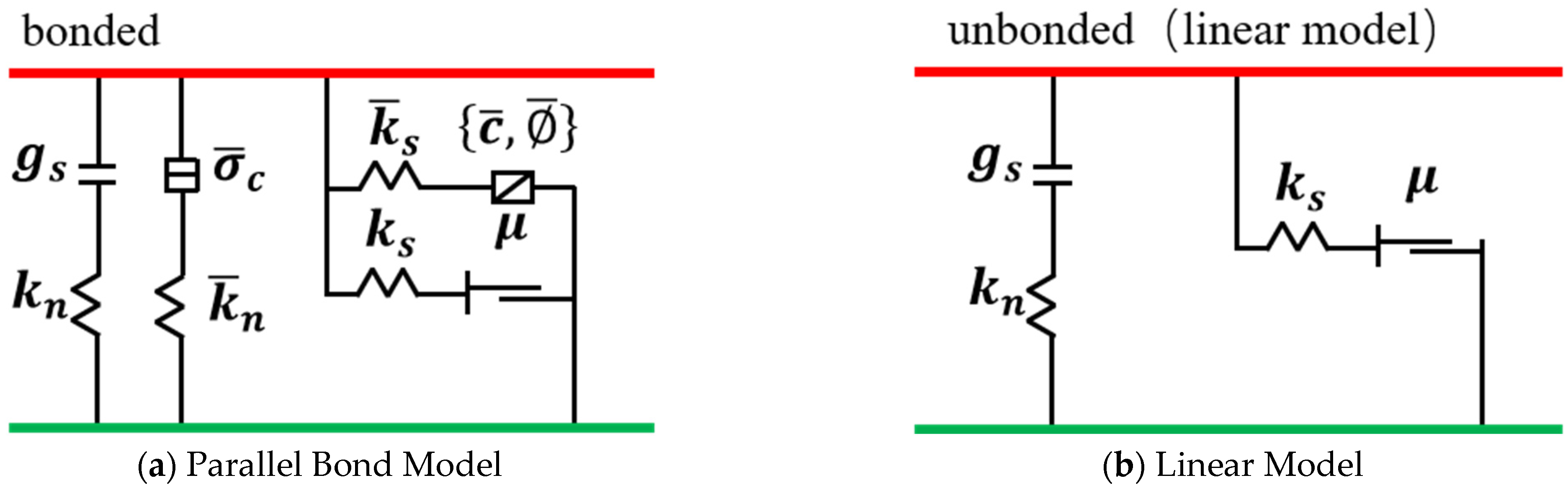
2.1. PFC Mechanical Constitutive Model
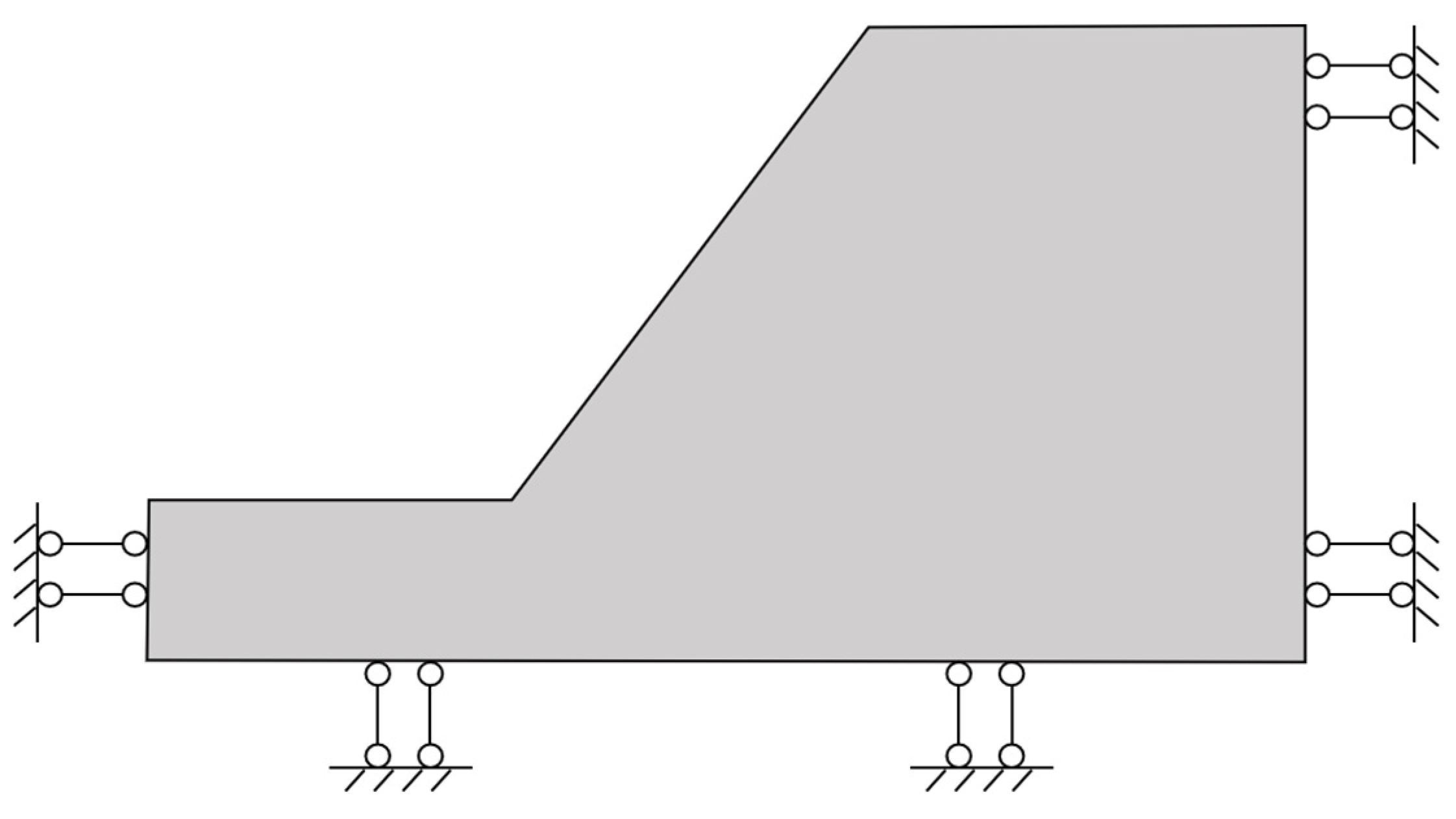
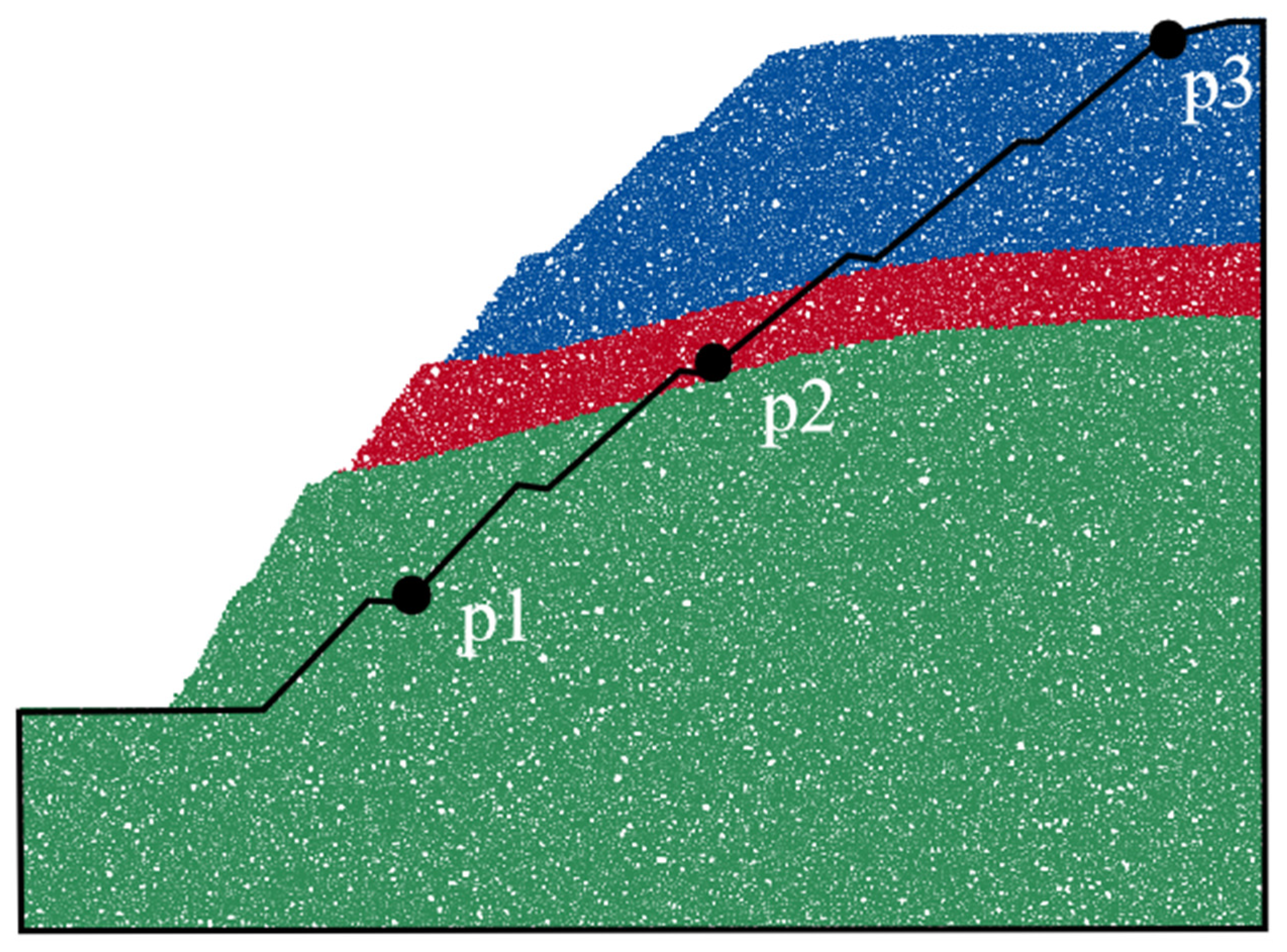
2.2. Model Geometry and Boundary Conditions
2.3. Parameter Calibration
3. Response Analysis During the Excavation Process
3.1. Response Analysis Methodology
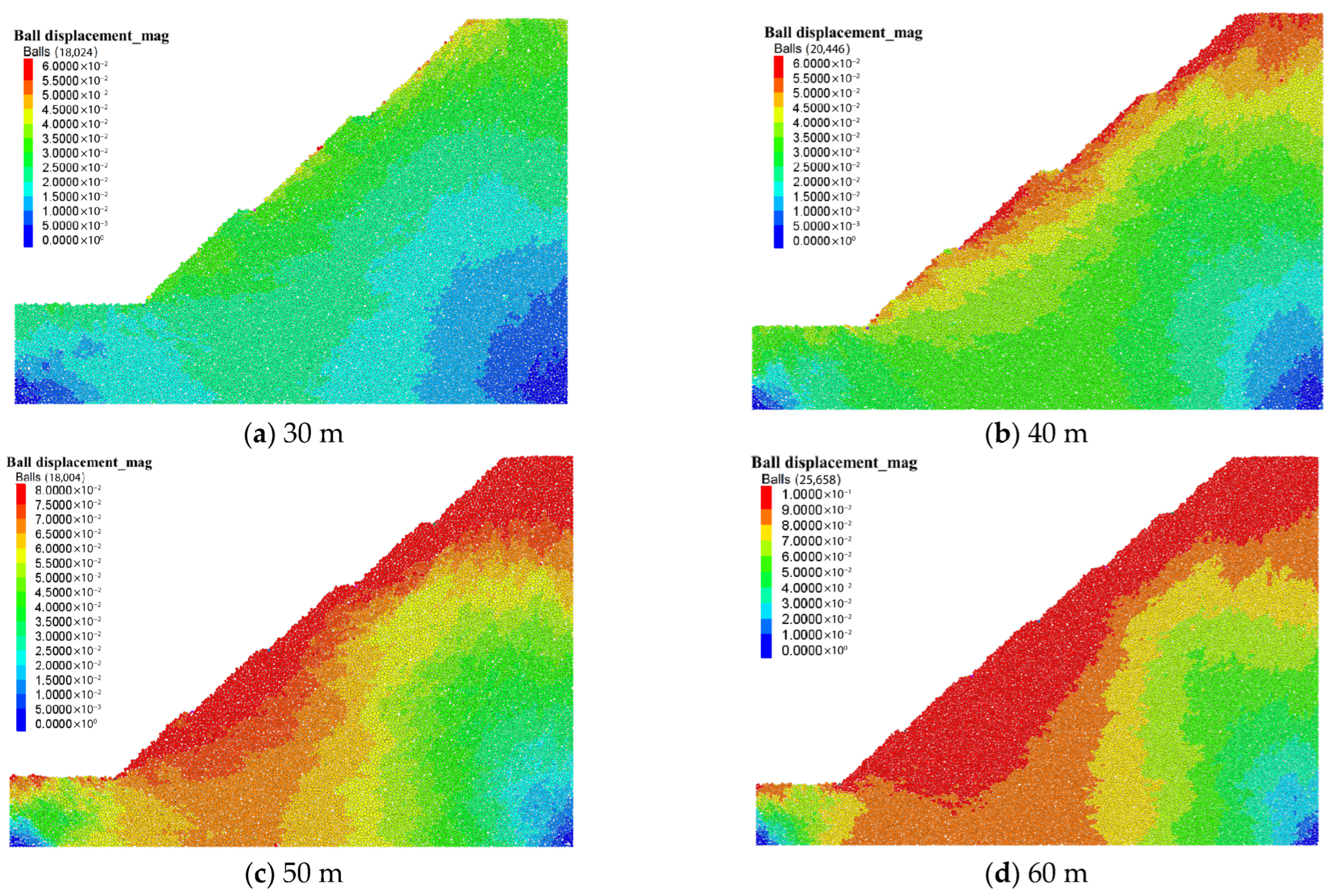
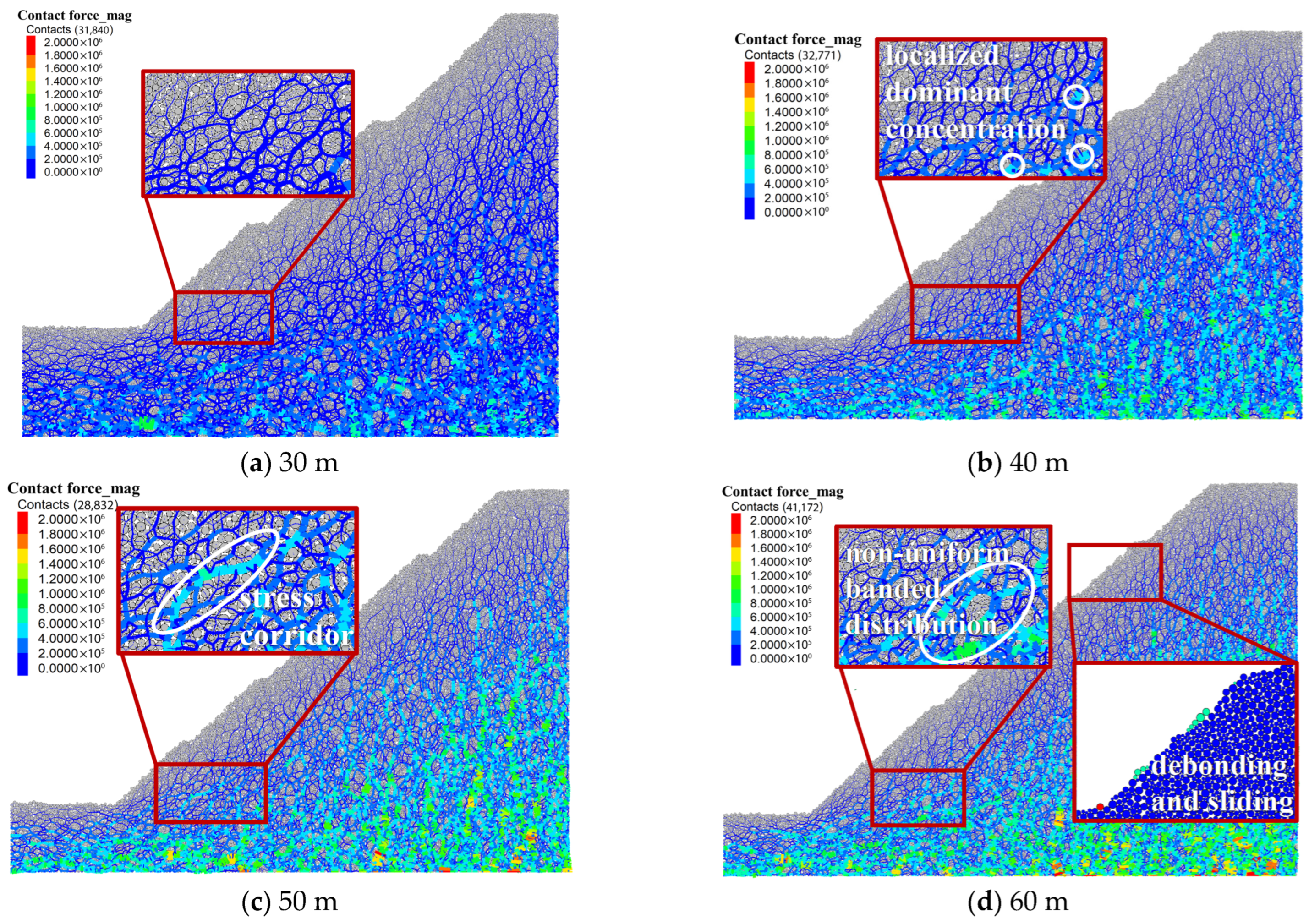
3.2. Analysis of Physical Response Characteristics Under Variations in Slope Height
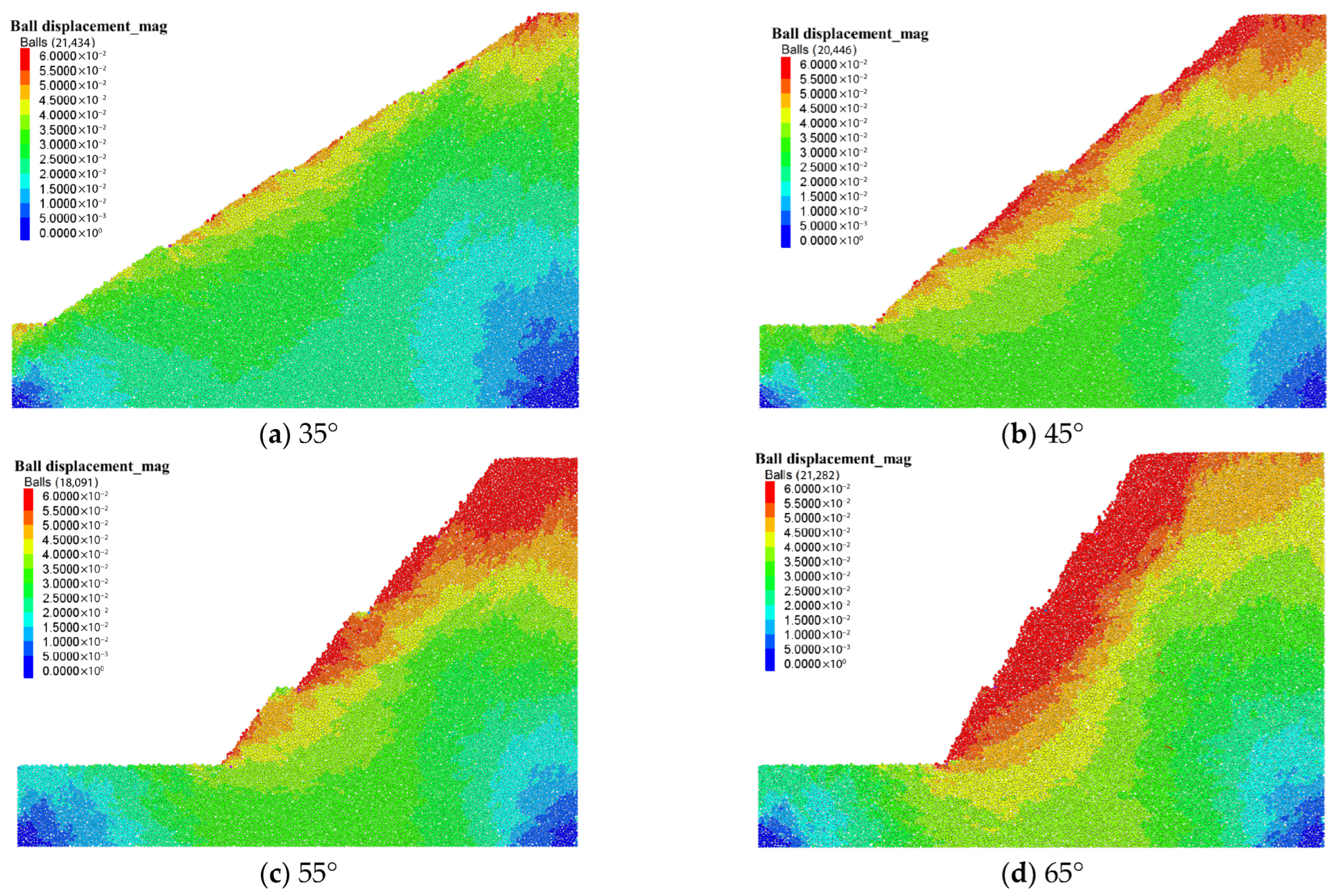
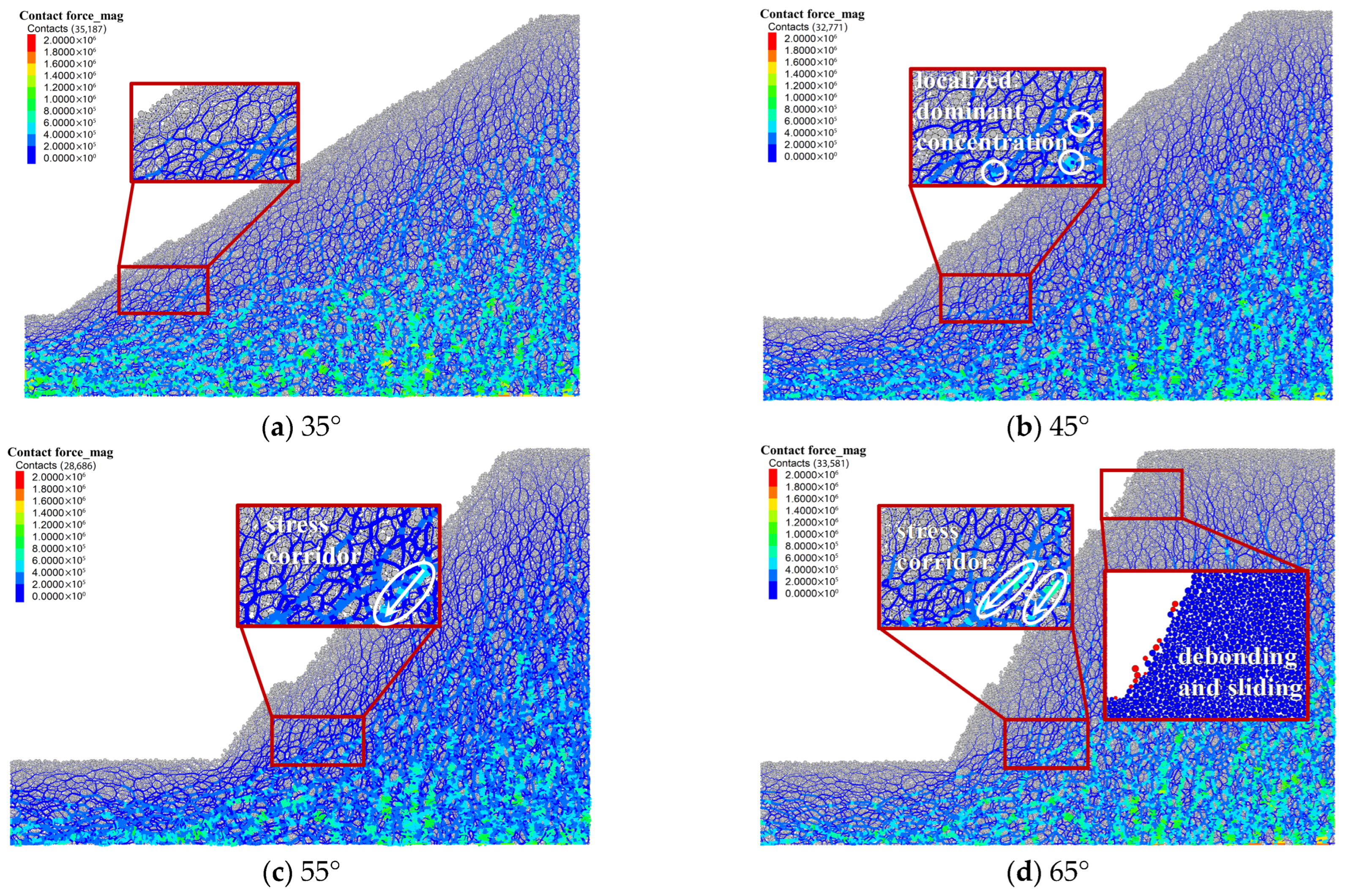
3.3. Analysis of Physical Response Characteristics Under the Effect of Variations in Slope Angle
4. Engineering Case Study
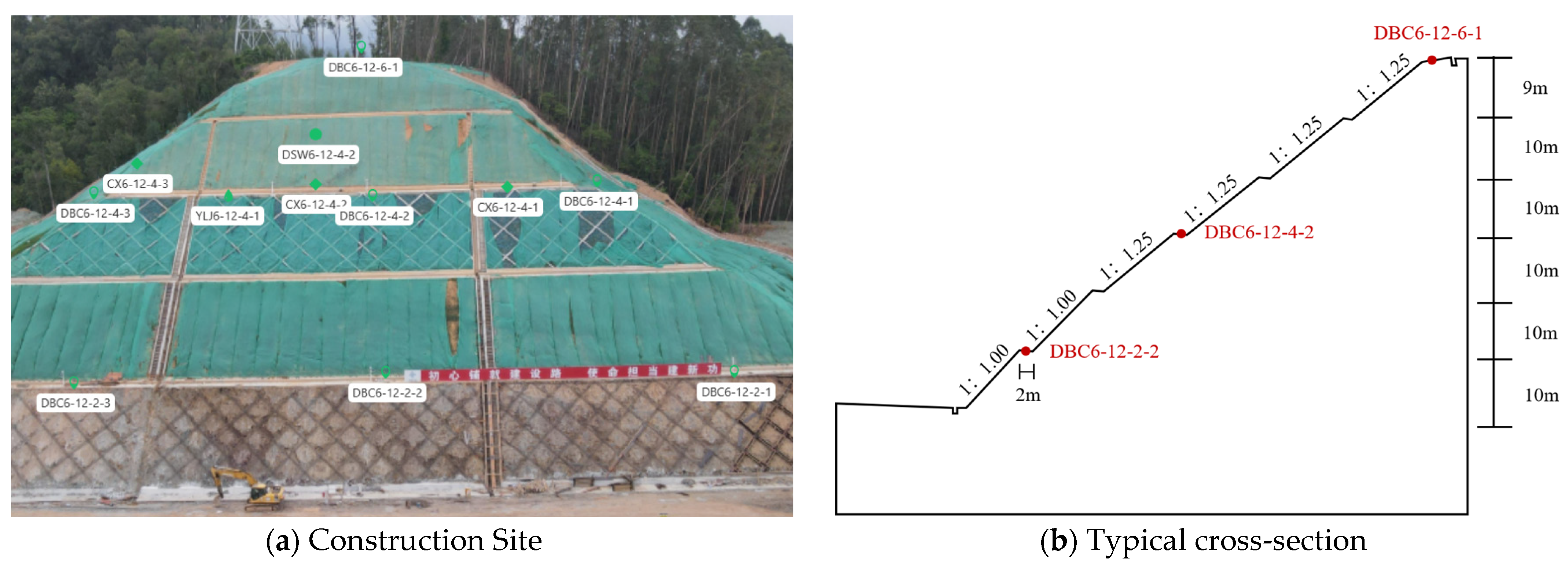
4.1. Engineering Overview
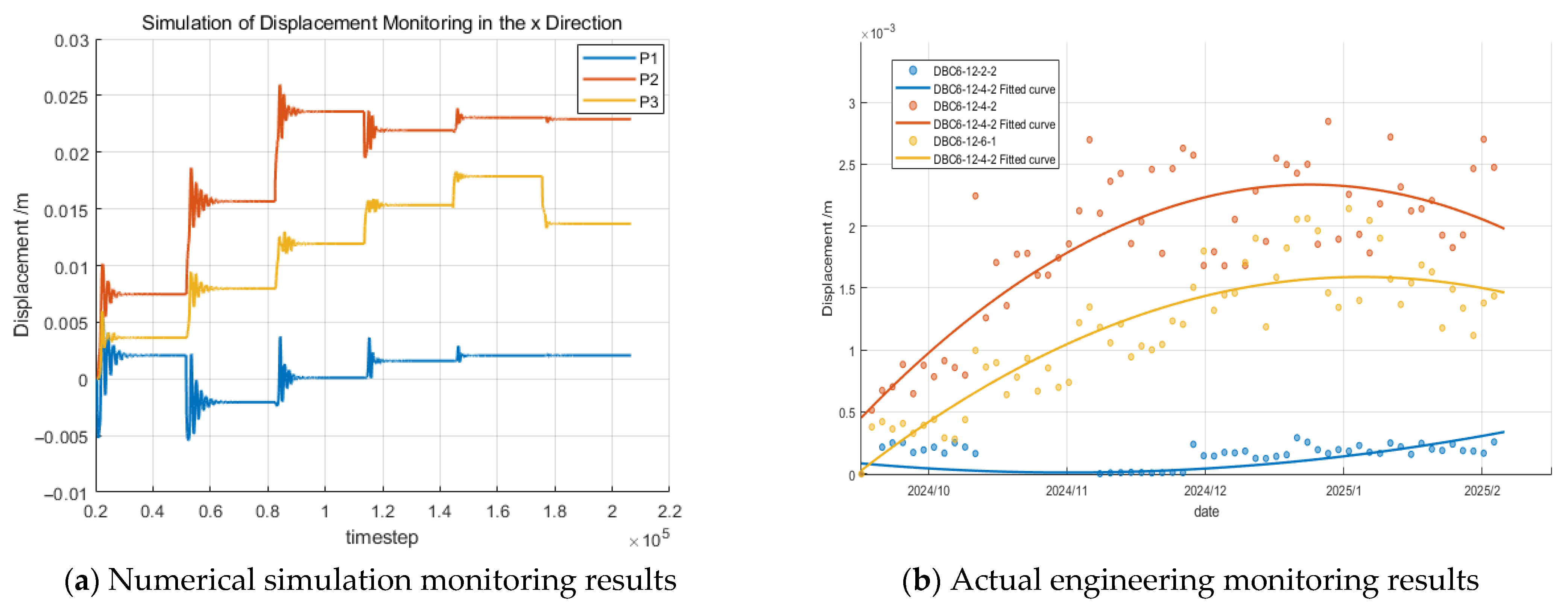
4.2. Model Validation
5. Conclusions
Author Contributions
Funding
Institutional Review Board Statement
Informed Consent Statement
Data Availability Statement
Conflicts of Interest
References
- Huang, W.; Ding, M.; Li, Z.; Yu, J.; Ge, D.; Liu, Q.; Yang, J. Landslide susceptibility mapping and dynamic response along the Sichuan–Tibet transportation corridor using deep learning. Catena 2023, 219, 106866. [Google Scholar] [CrossRef]
- Tang, H.; Wasowski, J.; Juang, C.H. Geohazards in the Three Gorges Reservoir Area, China–Lessons learned from decades of research. Eng. Geol. 2019, 261, 105267. [Google Scholar] [CrossRef]
- Stead, D.; Wolter, A. A critical review of rock slope failure mechanisms: The importance of structural geology. J. Struct. Geol. 2015, 74, 1–23. [Google Scholar] [CrossRef]
- Azarafza, M.; Asgari, M.R. Discontinuous rock slope stability analysis by limit equilibrium methods: A review. Int. J. Digit. Earth 2021, 15, 310–335. [Google Scholar] [CrossRef]
- Dyson, A.P.; Griffiths, D.V. An efficient strength reduction method for finite element slope stability analysis. Comput. Geotech. 2024, 174, 106593. [Google Scholar] [CrossRef]
- Deng, H.; Yu, M. Analysis of long-term creep response characteristics of high rock slopes considering cumulative effects of earthquakes. Front. Earth Sci. 2024, 12, 1517953. [Google Scholar] [CrossRef]
- Ahmad, M.; Brinkgreve, R.B.J.; Jonkman, S.N. Effects of Displacement Piles for Dike Reinforcement on Adjacent Buildings. Geotech. Geol. Eng. 2025, 43, 446. [Google Scholar] [CrossRef] [PubMed]
- Thapa, I.; Ghani, S.; Paramasivam, P.; Tufa, M.A. Development of an optimized deep learning model for predicting slope stability in nano silica stabilized soils. Sci. Rep. 2025, 15, 26213. [Google Scholar] [CrossRef]
- Dawson, E.M.; Roth, W.H.; Drescher, A. Slope stability analysis by strength reduction. Géotechnique 1999, 49, 835–840. [Google Scholar] [CrossRef]
- Naeij, M.; Ghasemi, H.; Ghafarian, D.; Javanmardi, Y. Explicit finite element analysis of slope stability by strength reduction. Geomech. Eng. 2021, 26, 133–146. [Google Scholar] [CrossRef]
- Wang, J.; Liu, P.; Si, P.; Li, H.; Wu, F.; Su, Y.; Long, Y.; Cao, A.; Sun, Y.; Zhang, Q. Three-dimensional stability analysis of ridge slope using strength reduction method based on unified strength criterion. Appl. Sci. 2023, 13, 1580. [Google Scholar] [CrossRef]
- Hu, J.; He, M.; Tao, Z.; Zhang, H. Anchoring effect of NPR cables under dynamic conditions and its engineering applications. Sci. Rep. 2025, 15, 16276. [Google Scholar] [CrossRef]
- Yu, C.; Zhao, W.; Liu, K.; Duan, X.; Gao, X.; Wang, L.; Liu, J.; Xu, J.; Zeng, J.; Chen, G.; et al. Stability characteristics of medial meniscus tear in mild varus knee: A finite element analysis. BMC Musculoskelet. Disord. 2025, 26, 944. [Google Scholar] [CrossRef]
- Liu, X.; Wang, Q.; Wang, Y.; Dong, Q. Review of calibration strategies for discrete element model in quasi-static elastic deformation. Sci. Rep. 2023, 13, 13264. [Google Scholar] [CrossRef]
- Potyondy, D.O.; Cundall, P.A. A bonded-particle model for rock. Int. J. Rock Mech. Min. Sci. 2004, 41, 1329–1364. [Google Scholar] [CrossRef]
- Li, M.; Yue, Z.; Ji, H.; Xiu, Z.; Han, J.; Meng, F. Numerical analysis of interbedded anti-dip rock slopes based on discrete element modeling: A case study. Appl. Sci. 2023, 13, 12583. [Google Scholar] [CrossRef]
- Yang, T.; Rao, Y.; Chen, H.; Yang, B.; Hou, J.; Zhou, Z.; Ding, H. Failure characteristics and mechanism of multiface slopes under earthquake: Shaking table tests and PFC2D simulation. Shock. Vib. 2021, 2021, 9329734. [Google Scholar] [CrossRef]
- Wang, H.; Zhang, B.; Mei, G.; Xu, N. A statistics-based discrete element modeling method for analyzing the stability of jointed rock slopes. Eng. Geol. 2020, 264, 105247. [Google Scholar] [CrossRef]
- Scholtès, L.; Donzé, F.V. Modelling progressive failure in fractured rock masses using a 3D discrete element method. Int. J. Rock Mech. Min. Sci. 2012, 52, 18–30. [Google Scholar] [CrossRef]
- Xu, J.; Wang, Y.; Li, C. Stability analysis of rock slope and calculation of rock lateral pressure in foundation pit with structural plane and cave development. Sci. Rep. 2022, 12, 8710. [Google Scholar] [CrossRef]
- Lisjak, A.; Grasselli, G. A review of discrete modeling techniques for fracturing processes in discontinuous rock masses. J. Rock Mech. Geotech. Eng. 2014, 6, 301–314. [Google Scholar] [CrossRef]
- Teng, L.; He, Y.; Wang, Y.; Sun, C.; Yan, J. Numerical stability assessment of a mining slope using the synthetic rock mass modeling approach and strength reduction technique. Front. Earth Sci. 2024, 12, 1438277. [Google Scholar] [CrossRef]
- Cundall, P.A.; Strack, O.D.L. A discrete numerical model for granular assemblies. Géotechnique 1979, 29, 47–65. [Google Scholar] [CrossRef]
- Jing, L. A review of techniques, advances and outstanding issues in numerical modelling for rock mechanics and rock engineering. Int. J. Rock Mech. Min. Sci. 2003, 40, 283–353. [Google Scholar] [CrossRef]
- GB 50330-2013; Technical Code for Building Slope Engineering. China Architecture Building Press: Beijing, China, 2013.
- Chen, P.; Kong, Y.; Yu, H. Research on the calibration method of microparameters of a uniaxial compression PFC2D model for rock. Chin. J. Undergr. Space Eng. 2018, 14, 1240–1249. [Google Scholar]
- Hao, B.; Zhang, C.; Wang, C.; Ren, C. Study on determination micro-parameters of rock PFC2D model. Coal Sci. Technol. 2022, 50, 132–141. [Google Scholar]
- Wu, H.; Dai, B.; Zhao, G.; Chen, Y.; Tian, Y. A novel method of calibrating micro-scale parameters of PFC model and experimental validation. Appl. Sci. 2020, 10, 3221. [Google Scholar] [CrossRef]
- Sun, L.; Jiang, Z.; Long, Y.; He, Q.; Zhang, H. Investigating the mechanism of continuous–discrete coupled destabilization of roadway-surrounding rocks in weakly cemented strata under varying levels of moisture content. Processes 2023, 11, 2556. [Google Scholar] [CrossRef]
- Lu, Y.; Tan, Y.; Li, X. Stability analyses on slopes of clay-rock mixtures using discrete element method. Eng. Geol. 2018, 244, 116–124. [Google Scholar] [CrossRef]
- Lin, C.-H.; Li, H.-H.; Weng, M.-C. Discrete element simulation of the dynamic response of a dip slope under shaking table tests. Eng. Geol. 2018, 235, 168–180. [Google Scholar] [CrossRef]
- Zheng, Z.; Li, S.; Zhang, Q.; Tang, H.; Liu, G.; Pei, S.; Lu, G. True triaxial test and DEM simulation of rock mechanical behaviors and micro-cracking under excavation disturbance. Eng. Geol. 2024, 314, 106726. [Google Scholar] [CrossRef]
- Qin, S.; Jiao, J.J.; Wang, S.; Long, H. A nonlinear catastrophe model of instability of planar-slip slope and chaotic dynamical mechanisms of its evolutionary process. Int. J. Solids Struct. 2001, 38, 8093–8109. [Google Scholar] [CrossRef]
- Hoek, E.; Bray, J.D. Rock Slope Engineering; CRC Press: Boca Raton, FL, USA, 1981. [Google Scholar]



| Parameter | Value |
|---|---|
| Particle modulus (GPa) | 2.4 |
| Stiffness ratio | 1.0 |
| Particle tensile strength (MPa) | 0.8 |
| Particle cohesion (MPa) | 1.0 |
| Particle density (kg·m−3) | 2350 |
| Particle friction coefficient | 0.5 |
| Slope Height (m) | Crest Displacement (m) | Slope Toe Displacement (m) | Maximum Displacement (m) |
|---|---|---|---|
| 30 | 0.047 | 0.022 | 0.058 |
| 40 | 0.059 | 0.043 | 0.064 |
| 50 | 0.078 | 0.076 | 0.083 |
| 60 | 0.094 | 0.091 | 0.102 |
| Slope Angles (°) | Crest Displacement (m) | Slope Toe Displacement (m) | Maximum Displacement (m) |
|---|---|---|---|
| 35 | 0.049 | 0.031 | 0.060 |
| 45 | 0.053 | 0.035 | 0.062 |
| 55 | 0.059 | 0.048 | 0.218 |
| 65 | 0.063 | 0.064 | 0.425 |
Disclaimer/Publisher’s Note: The statements, opinions and data contained in all publications are solely those of the individual author(s) and contributor(s) and not of MDPI and/or the editor(s). MDPI and/or the editor(s) disclaim responsibility for any injury to people or property resulting from any ideas, methods, instructions or products referred to in the content. |
© 2026 by the authors. Licensee MDPI, Basel, Switzerland. This article is an open access article distributed under the terms and conditions of the Creative Commons Attribution (CC BY) license.
Share and Cite
Zhang, T.; Xu, Z.; Zhu, C.; Li, W.; Nie, Y.; Gao, Y.; Zhang, X. Numerical Investigation of Micromechanical Failure Evolution in Rocky High Slopes Under Multistage Excavation. Appl. Sci. 2026, 16, 739. https://doi.org/10.3390/app16020739
Zhang T, Xu Z, Zhu C, Li W, Nie Y, Gao Y, Zhang X. Numerical Investigation of Micromechanical Failure Evolution in Rocky High Slopes Under Multistage Excavation. Applied Sciences. 2026; 16(2):739. https://doi.org/10.3390/app16020739
Chicago/Turabian StyleZhang, Tao, Zhaoyong Xu, Cheng Zhu, Wei Li, Yu Nie, Yingli Gao, and Xiangmao Zhang. 2026. "Numerical Investigation of Micromechanical Failure Evolution in Rocky High Slopes Under Multistage Excavation" Applied Sciences 16, no. 2: 739. https://doi.org/10.3390/app16020739
APA StyleZhang, T., Xu, Z., Zhu, C., Li, W., Nie, Y., Gao, Y., & Zhang, X. (2026). Numerical Investigation of Micromechanical Failure Evolution in Rocky High Slopes Under Multistage Excavation. Applied Sciences, 16(2), 739. https://doi.org/10.3390/app16020739