


Abstract
The present study investigates the potential of poplar (Populus spp.) biomass from phytoremediation plantations as a feedstock for downdraft fixed bed gasification. The biomass was characterized in terms of moisture, ash content, elemental composition (C, H, N, O), and calorific values (HHV and LHV), confirming its suitability for thermochemical conversion. Gasification tests yielded a volumetric syngas production of 1.79 Nm3 kg−1 biomass with an average composition of H2 14.58 vol%, CO 16.68 vol%, and CH4 4.74 vol%, demonstrating energy content appropriate for both thermal and chemical applications. Alkali and alkaline earth metals (AAEM), particularly Ca (273 mg kg−1) and Mg (731 mg kg−1), naturally present enhanced tar reforming and promoted reactive gas formation, whereas heavy metals such as Cd (0.27 mg kg−1), Pb (0.02 mg kg−1), and Bi (0.01 mg kg−1) were detected only in trace amounts, posing minimal environmental risk. The results indicate that poplar pruning residues from phytoremediation sites can be a renewable and sustainable energy resource, transforming a waste stream into a process input. In this perspective, the integration of soil remediation with syngas production constitutes a tangible model of circular economy, based on the efficient use of resources through the synergy between environmental remediation and the valorization and sustainable management of marginal biomass—i.e., pruning residues—generating environmental, energetic, and economic benefits along the entire value chain.
1. Introduction
In the context of the global energy transition, the valorization of lignocellulosic biomass as a renewable energy source is assuming an increasingly strategic role. Biomass gasification enables the production of syngas, which can be utilized both for energy generation and for the synthesis of chemicals, providing an efficient and flexible approach to exploiting residual organic materials or dedicated energy crops [1]. In the current era, the reliance on fossil fuels represents one of the major environmental challenges, due to their significant contribution to greenhouse gas emissions and the resulting acceleration of profound climate change processes [2,3]. Beyond its environmental implications, this issue also plays a critical economic role. It has been reported that global energy demand is expected to increase by approximately 47% over the next 30 years, with a particular emphasis on liquid fuel consumption. Forecasts indicate a rise of nearly 64% compared with 2020 levels. This trend underscores the need to identify more sustainable approaches for fuel production [4,5]. Within this context, a wide range of lignocellulosic biomass feedstocks has been investigated for syngas production [6,7,8]. Among the various plant species available, poplar (Populus spp.) represents a particularly promising biomass source for syngas production from multiple perspectives. Specifically, due to its rapid growth rate, high biomass yield, and deep root system, poplar is considered an ideal candidate both for energy applications [9] and for the remediation (phytoremediation) of contaminated soils [10,11]. Among fast-growing bioenergy crops, poplar stands out for its high content of structural carbohydrates, such as cellulose and hemicellulose, which make it a particularly valuable resource to produce biofuels and renewable biobased products. Owing to its ability to adapt to diverse soil conditions and its potential to reduce dependence on fossil fuels, poplar represents a sustainable and versatile option for the development of low-environmental-impact energy and industrial value chains, offering a promising alternative to fossil-derived materials. Compared to other bioenergy crops, poplar requires relatively low annual energy inputs and limited financial investment, including soil preparation, planting operations, fertilizers, herbicides, and pesticides [12]. Despite the still limited number of studies available on the performance of poplar as a biomass feedstock for syngas production, recent investigations suggest that poplar pruning residues originating from phytoremediation sites can be regarded as clean and safe for gasification [13]. Gasification, integrated with local, renewable, and low-cost energy sources—such as the poplar pruning used in this study—is an efficient energy conversion process capable of addressing global challenges related to climate change, waste management, and access to electricity [14]. It has also been hypothesized that the presence of calcium and magnesium within the biomass may promote spontaneous catalytic reactions, thereby enhancing the overall syngas production. The total gas output has been reported to increase by up to 30% when a catalyst is employed (4.6 vs. 5.1 MJ Nm−3), resulting in a more efficient conversion process [10].
A relevant aspect is the phytoremediation activity of poplars, which can influence the characteristics of the resulting biomass. Experimental evidence indicates that poplar trees are capable of accumulating heavy metals (HMs), functioning as phytoremediating organisms and contributing to the remediation of contaminated soils [11]. At the same time, the extent of metal uptake and their resulting concentration in the biomass can affect gasification performance, syngas quality, and the manageability of solid residues [15]. In particular, alkali and alkaline-earth metals (AAEM), such as calcium and magnesium, may act as natural catalysts during gasification, improving gas yield and promoting tar reforming, whereas heavy metals may volatilize or remain in the solid residues, with potential environmental and technological implications [16].
In this context, the present study aims to analyze poplar biomass derived from phytoremediation plantations, evaluating its chemical and mineral composition as well as its behaviour during gasification in a fixed-bed reactor. Specifically, pruning residues of poplar were characterised in terms of moisture content, ash fraction, elemental composition (C, H, N, O), and both higher and lower heating values. Furthermore, gasification tests were performed in a real scale fixed-bed plant (50 kW, Mod. CHP50) built by Reset spa (Rieti, Italy) to determine syngas yield and composition, as well as mass and energy balances. The mobilization and distribution of metals—including heavy metals—were also assessed by analyzing both gaseous emissions and solid residues, enabling the evaluation of technological and environmental implications associated with the process. The novelty of the work lies in the application of full-scale downdraft fixed bed gasification, a little-investigated approach for biomass from phytoremediation plants. This approach allows for a representative assessment of process performance under real operating conditions, compensating for the lack of experimental data on biomass from operational phytoremediation sites, compared to the prevalence of laboratory studies or theoretical assessments in the literature.
2. Materials and Methods
This section details the materials, experimental setups, and analytical methods used in this study, focusing on the characterization and gasification of poplar biomass from phytoremediation plantations. The procedures are described with sufficient detail to enable replication and facilitate comparison with related studies.
2.1. Biomass Characterization
The biomass used in this study was obtained from two treated poplar areas within the survey site, where pruning residues were collected and subsequently air-dried. For the biomass chemical preliminary characterization, the sample was comminuted using a Retsch SM 100 knife mill (RETSCH GmbH, Haan, Germany) and then further processed with a Retsch ZM 200 centrifugal mill (RETSCH GmbH, Haan, Germany) to obtain a finer particle size (~5 mm). A subsample of 1 g was placed in a Lenton EF11/8B muffle furnace and heated at 250 °C for 1 h. The temperature was then increased to 550 °C for an additional 2 h to quantify the ash fraction, following the UNI EN ISO 18122:2016 standard. Subsequently, 1 g of sample was used for the determination of the Higher Heating Value (HHV) and the Lower Heating Value (LHV) by means of an Anton Paar 6400 isoperibol calorimeter (Parr Instrument Company, Moline, IL, USA), after an appropriate calibration using benzoic acid. The analysis was performed three times as suggested by UNI EN ISO 18125:2018 standard methodology. Elemental composition was analyzed using a Costech ECS 4010 CHNS-O instrument in accordance with UNI EN ISO 16948:2015, following [9]. Approximately 5 mg of sample were weighed into tin capsules and loaded into the reactor. The limit of quantification (LOQ) was 0.01% w/w for all measurements. Oxygen content was estimated by difference on a dry basis, following the UNI EN ISO 16948:2015 whereas the metal concentrations in the biomass were determined using inductively coupled plasma mass spectrometry (ICP-MS), Agilent 7700 Series.
The analyses were conducted in triplicate.
2.2. Gasification of the Biomass
Gasification tests were carried out using phytoremediation poplar briquettes biomass. The gasification experiments were performed in a downdraft fixed-bed gasifier. The feedstock consisted of briquettes made from poplar biomass obtained from phytoremediation plantations. The briquettes were mechanically comminuted and subsequently sieved to remove particles smaller than 0.8 mm before feeding. Apart from grinding and briquetting, the biomass did not undergo any further treatment, and its moisture content was suitable for analytical purposes.
Gasifier Operating Conditions
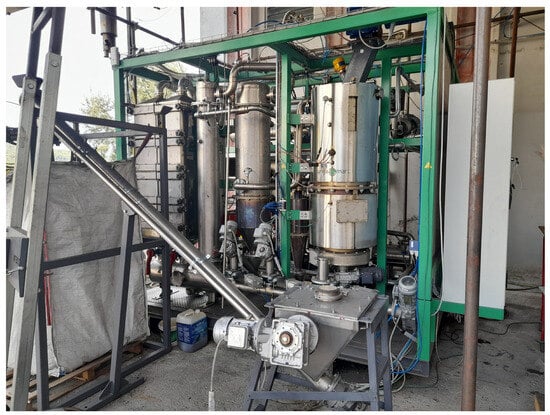
The CHP 50 cogeneration plant developed by RESET is based on a fixed-bed downdraft gasification system integrated with an energy conversion unit for the combined production of electrical and thermal energy (Figure 1). The biomass is fed into a loading hopper and conveyed to the reactor through an automatic rotary valve, ensuring continuous operation and system sealing.
Figure 1.
Image of the apparatus employed for the experiments described.
Plant start-up is supported by an automatically ignited flare. The core of the process consists of a gasifier model RESET Evo-5, in which the biomass is converted into synthesis gas. During operation, the gasifier operates according to a defined thermal profile: in the combustion zone, the biomass reaches temperatures between 800 and 900 °C, necessary to provide the heat required to sustain the gasification process, followed by the reduction zone, characterized by a temperature of 700 °C. In the gasifier, the equivalence ratio is set to 0.31, a value that ensures operational stability of the system, efficient biomass conversion, and the production of a high-quality syngas. The produced syngas undergoes a complete conditioning line composed of a cyclone for the removal of coarse solid particles, a high-temperature syngas–air heat exchanger, a shell-and-tube syngas–water heat exchanger, two drawer-type woodchip filters for the abatement of fine particulates, and a wet film scrubber for final gas cleaning. The treated gas is then supplied to a four-stroke spark-ignition internal combustion engine, specifically modified for syngas operation and equipped with an electronic control system with lambda sensor. The engine is coupled to a three-phase four-pole synchronous generator for electrical power production. Thermal energy recovery takes place both from the engine cooling circuit and from the exhaust gases through a water-based heat recovery system with antifreeze, allowing the recovered heat to be utilized for civil or industrial applications. The biochar produced during the gasification process is continuously extracted and conveyed to an automatic external big-bag packaging system, enabling safe and fully automated handling of the solid residue.
Heavy metals in the syngas were sampled according to UNI EN 14385:2004. Syngas was bubbled through three 250 mL glass impingers containing an aqueous solution of equal volumes of HNO3 (~65% w/w) and H2O2 (~30% w/w), diluted with nine parts of deionized water, to dissolve and retain the metals. The solutions were then subsequently analyzed in ICP-MS. Heavy metal concentrations in the syngas were expressed in mg/Nm3 after normalization to standard conditions (0 °C, 1 atm, dry gas basis).
3. Results
Results obtained from the investigation are reported below.
3.1. Experimental Biomass Characterization
The poplar briquette biomass used in this study was first analyzed to evaluate its suitability for thermochemical conversion. Laboratory-scale analyses were performed on representative samples, and the main properties are summarized in Table 1.
Table 1.
Laboratory characterization of poplar briquette biomass (dry basis).
The moisture content was relatively low (6.6%), indicating that the drying process was effective, and that the biomass can be stored and handled with minimal risk of degradation. The ash fraction measured 3.53%, typical for lignocellulosic feedstocks, suggesting a limited presence of inorganic material.
Elemental analysis showed a high carbon content (36.7%) and moderate hydrogen (3.96%) levels, while nitrogen and sulfur were relatively low (0.82% and 0.66%, respectively). These values indicate a favorable C/N ratio (>40), which is advantageous for thermochemical processes and suggests good gasification performance.
Calorimetric analysis revealed a HHV of 15.16 MJ kg−1 and a LHV of 14.34 MJ kg−1, confirming that the biomass possesses sufficient energy content for efficient conversion.
Overall, the data reported in Table 1 demonstrate that the poplar briquette biomass from phytoremediation plantations combines low moisture, moderate ash content, and high carbon content, making it a suitable and energetically promising feedstock for gasification processes.
3.2. Initial Feedstock and Operational Parameters
Before the gasification tests, the total biomass prepared and fed to the reactor was characterized. These initial operational parameters are reported in Table 2.
Table 2.
Initial feedstock and operation parameters.
The total biomass amounted to 190 kg over a planned test duration of 4 h, resulting in a biomass feed rate of 47.5 kg h−1. Moisture was measured at 6.8%, close to laboratory values, while the ash content was higher (8.6%) due to residual soil and handling-related contamination. Furthermore, a higher ash concentration compared to laboratory values (3.53%) will certainly result in a worse energy performance and a higher amount of residues. However, the bricking process greatly reduces the loading time of the biomass into the reactor and facilitates transport.
3.3. Gasification Test Results
The main results of the gasification test are reported in Table 3. Solid and liquid residues, syngas composition, and calculated process parameters are included.
Table 3.
Solid residues and average syngas composition during the gasification test.
The solid and liquid residues collected after gasification included 13.88 kg of ash/char and 2.68 kg of condensates, reflecting the partial conversion of the biomass into gaseous products.
Syngas composition was measured during the last hour of operation to avoid interference from the upstream heavy metal and tar collection system. The syngas exhibited the following average composition (vol%): CH4 4.74, CO 16.68, CO2 10.79, H2 14.58, O2 4.26, and N2 48.95, at an average temperature of 40.8 °C. These values are consistent with a typical output from lignocellulosic biomass in a fixed bed gasifier.
Syngas density was calculated both at the measured average temperature (0.991 kg m−3) and normalized to standard conditions (1.1394 kg Nm−3). Using a material balance approach (syngas = air + biomass − ash/char − condensates), the average mass and volumetric flow rates of syngas were determined as 97.56 kg h−1 and 85.62 Nm3 h−1, respectively.
The specific syngas yield, expressed per unit biomass, was 1.796 Nm3 kg−1. The biochar yield was calculated as 73.05 g biochar per kg of biomass fed. The theoretical power output of the syngas, estimated using the conversion factor of 0.37 kWh kg−1 from H&MB, was 31.56 kW, while the average real power achieved during the test was 30.17 kW, corresponding to a 4.6% deviation. From these data, the specific energy production was 0.681 kWh kg−1, and the specific biomass consumption was 1.468 kg kWh−1. Furthermore, the presence of a residual oxygen fraction in the syngas (4.26 vol%) is consistent with literature reports. Experimental studies have observed comparable residual O2 concentrations (up to ~4–7 vol%) in syngas from gasification under non-ideal operating conditions and limited mixing between oxidants and biomass. This can be attributed to competitive reactions, non-uniform oxygen distribution in the reactor, and the complex chemistry involved, leading to incomplete oxidant conversion. Such effects are also highlighted in studies discussing non-stoichiometric models for syngas composition prediction [17,18].
3.4. Heavy Metals and Mineral Content
The concentration of metals and mineral elements in the poplar briquette biomass and in the produced syngas was determined to assess the potential release of contaminants during gasification. Laboratory measurements on the raw biomass and syngas samples are reported below.
3.4.1. Metals Concentrations in Biomass
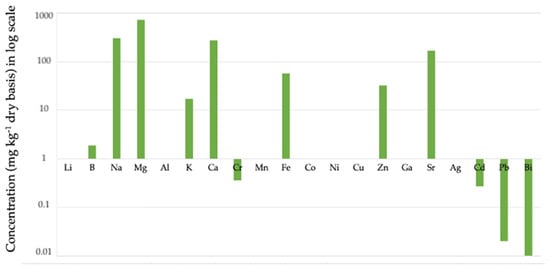
The analysis of the biomass prior to gasification showed that most elements were present at moderate levels, with some metals below the limit of quantification (LOQ). Notable concentrations included sodium (Na, 303.7 mg kg−1), magnesium (Mg, 731.8 mg kg−1), calcium (Ca, 273.7 mg kg−1), iron (Fe, 57.7 mg kg−1), potassium (K, 16.9 mg kg−1) and strontium (Sr, 169.1 mg kg−1). Trace amounts of potentially toxic metals such as cadmium (Cd, 0.27 mg kg−1), lead (Pb, 0.02 mg kg−1), and bismuth (Bi, 0.01 mg kg−1) were detected, while elements like lithium (Li), aluminium (Al), cobalt (Co), nickel (Ni), copper (Cu), zinc (Zn), silver (Ag), and gallium (Ga) were below the LOQ. Mineral and heavy metal content in raw biomass (mg kg−1, dry basis) are reported in Figure 2.
Figure 2.
Mineral and heavy metal content in raw biomass (mg kg−1, dry basis), shown on a logarithmic scale. Values not displayed in the chart represent concentrations below the limit of quantification (LOQ, ≈0.01 mg kg−1).
3.4.2. Metals Concentrations in Syngas
The concentration of metals in the syngas was measured in two separate sampling streams, labelled A+B I and C I, to capture potential variations in metal distribution along the gasifier outlet and to account for differences caused by the sampling system. The A+B I stream represents the combined flow from two collection points, while C I corresponds to a separate sampling point, allowing verification of consistency and reliability in the measurements.
Metal concentrations in the syngas are expressed in mg/Nm3, which corresponds to milligrams of metal per cubic meter of gas normalized to standard conditions (0 °C, 1 atm). This normalization ensures that values are comparable across experiments, independently of variations in temperature or pressure in the reactor.
The results (Table 4) show that only a small fraction of the metals present in the biomass is mobilized into the gas phase. Na, Mg, K, Ca, and Fe were the most abundant elements in the syngas, whereas potentially toxic metals such as Cd, Pb, and Bi were present at extremely low levels. These findings confirm that most heavy metals remain in the solid residues, and the release into the syngas is minimal under the tested gasification conditions.
Table 4.
Metal concentrations in syngas during gasification (mg Nm−3). “-” means < LOQ (≈0.001 mg Nm−3).
The transfer of metals from the feedstock biomass to the syngas was assessed through a comparison between theoretical and experimentally measured concentrations, as detailed in Table 5.
Table 5.
Metal concentrations in the feedstock biomass (mg/kg) and corresponding theoretical concentrations in the syngas (mg/m3), compared with experimental values (A+B+C). The absolute difference (Δ) and the percentage of metals transferred to the syngas are also reported.
Based on the syngas yield reported in Table 3 (1.79 m3 kg−1), a theoretical maximum concentration (mg m−3) was calculated for each metal assuming complete transfer from the feedstock biomass to the syngas. These theoretical values were then compared with the experimentally measured metal concentrations in the syngas. The resulting difference (Δ) represents the amount of each metal retained in the solid residues (biochar and ash) per cubic meter of syngas produced.
The results clearly indicate that only a very small fraction of the metals—often below 1% of the theoretical value—is transferred to the syngas, while the vast majority remains confined in the solid residues removed by the gas cleaning systems. Among the analyzed elements, Pb and K are the only metals exhibiting a volatile fraction exceeding 1% of the theoretical content, accounting for approximately 10% and 2%, respectively. This behavior suggests that, due to their higher volatility and their tendency to be transported with entrained fine ash, these elements require particular attention and may necessitate dedicated removal systems when the syngas is intended for energy applications.
For some elements, negative Δ values were observed. This apparent inconsistency can be attributed to differences in sampling methodologies and analyzed material quantities. In particular, the standard procedure for biomass metal analysis involves approximately 1 g of solid sample, whereas syngas sampling was performed over several liters of gas subsequently concentrated into a small volume of solution for analysis. This discrepancy likely enhanced the detection capability for trace metals in the syngas compared to the biomass. Nevertheless, considering the physicochemical properties of these elements, it is unlikely that they exhibit a fundamentally different partitioning behavior; therefore, they are also expected to be predominantly retained in the solid residual products.
4. Discussion
Gasification of lignocellulosic materials represents a competitive approach to producing clean, hydrogen-rich gas for both energy generation and chemical production, while also offering promising opportunities for integration into conventional petrochemical markets. Moreover, gasification processes can be effectively applied to heavy petroleum residues, highlighting their broader industrial potential [19]. In this scenario, gasification emerges as a particularly advantageous technology for biomass conversion.
The characterization of poplar briquette biomass highlights the potential of this feedstock for thermochemical applications. Its relatively low moisture content (6.6–6.8%) and moderate ash content (3.53–8.6%) suggest that the biomass can be stored and handled with minimal risk of degradation, consistent with observations reported for other lignocellulosic biomasses in the literature. For instance, various lignocellulosic biomass sources employed in biogas production, including wheat straw, corn stover, and rice straw [20], are characterized by high total solids (TS) content (≈85–92%) and volatile solids (VS) exceeding 75%, with C/N ratios ranging from 43 to 116 [20,21]. While the chemical composition naturally varies with plant species and treatment methods, the relatively high carbon content of poplar briquette (36.7%) and its C/N ratio above 40 suggest an energy potential comparable to that of other lignocellulosic biomasses. The higher heating value (HHV) of the poplar briquette (15.16 MJ kg−1) is lower than that of certain other lignocellulosic biomasses, such as wheat straw (17.5 MJ kg−1) or empty fruit bunch (EFB) (18 MJ kg−1), and also lower than that of olive kernel (OK) and CG–OK blends [21,22], which report HHV values between 19.5 and 20.5 MJ kg−1. This discrepancy reflects the richer carbon and hydrogen content in OK and the blends, whereas the poplar briquette contains a relatively higher proportion of oxygen and residual moisture [23,24,25]. However, the composition of the poplar briquette, with carbon at 36.7%, hydrogen at 3.96%, and a low nitrogen content (0.82%), is favorable for thermochemical processes such as gasification. This is confirmed by experimental tests: the syngas yield of 1.796 Nm3 kg−1 and the average composition (CH4 4.74%, CO 16.68%, H2 14.58%) are consistent with the performance expected from high-quality lignocellulosic feedstocks [26,27,28,29]. Moreover, the produced biochar (73.05 g kg−1) and the specific energetic output of the gasification (0.681 kWh kg−1) indicate an efficient conversion of the biomass into gaseous and solid products, consistent with gasification data reported for other lignocellulosic biomasses. In particular, the low fraction of methane compared to some anaerobic biomass sources (e.g., rice straw producing 436 mL CH4 g−1) is typical of thermochemical processes rather than anaerobic digestion [8,30,31].
An additional critical factor in the assessment of poplar briquettes as a feedstock for gasification is the content of metals and minerals present in both the biomass and the resulting gaseous products. The occurrence of inorganic elements, particularly heavy metals (HMs) and alkali and alkaline earth metals (AAEMs), can significantly influence both the efficiency of the thermochemical process and the properties of the syngas and solid residues. Numerous studies have shown that the presence of AAEMs, such as Ca and Mg, can significantly enhance gasification reactions compared to systems lacking these elements. Specifically, the intrinsic Ca and Mg content slightly increased tar cracking and syngas production, with total gas volume rising by about 30% and higher concentrations of H2 and CO. These results indicate that AAEM naturally present in the biomass can support gasification efficiency, even in the absence of an external catalyst [10]. It should be noted that no quantitative measurements of tar concentration or composition were performed in this study; therefore, while the observed increase in syngas yield suggests a potential catalytic effect of intrinsic AAEMs on tar reforming, this interpretation remains qualitative and should be considered a limitation of the current work. Furthermore, non-biodegradable heavy metals pose an environmental and health risk and must be taken into account when treating and utilizing biomass as a feedstock [32].
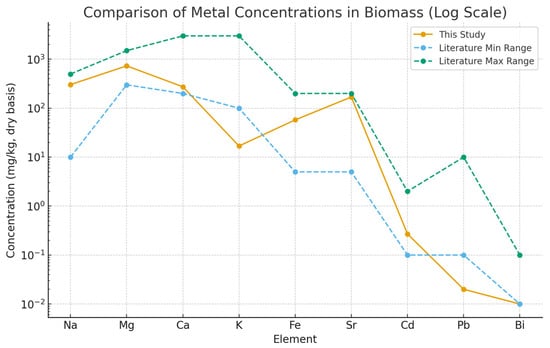
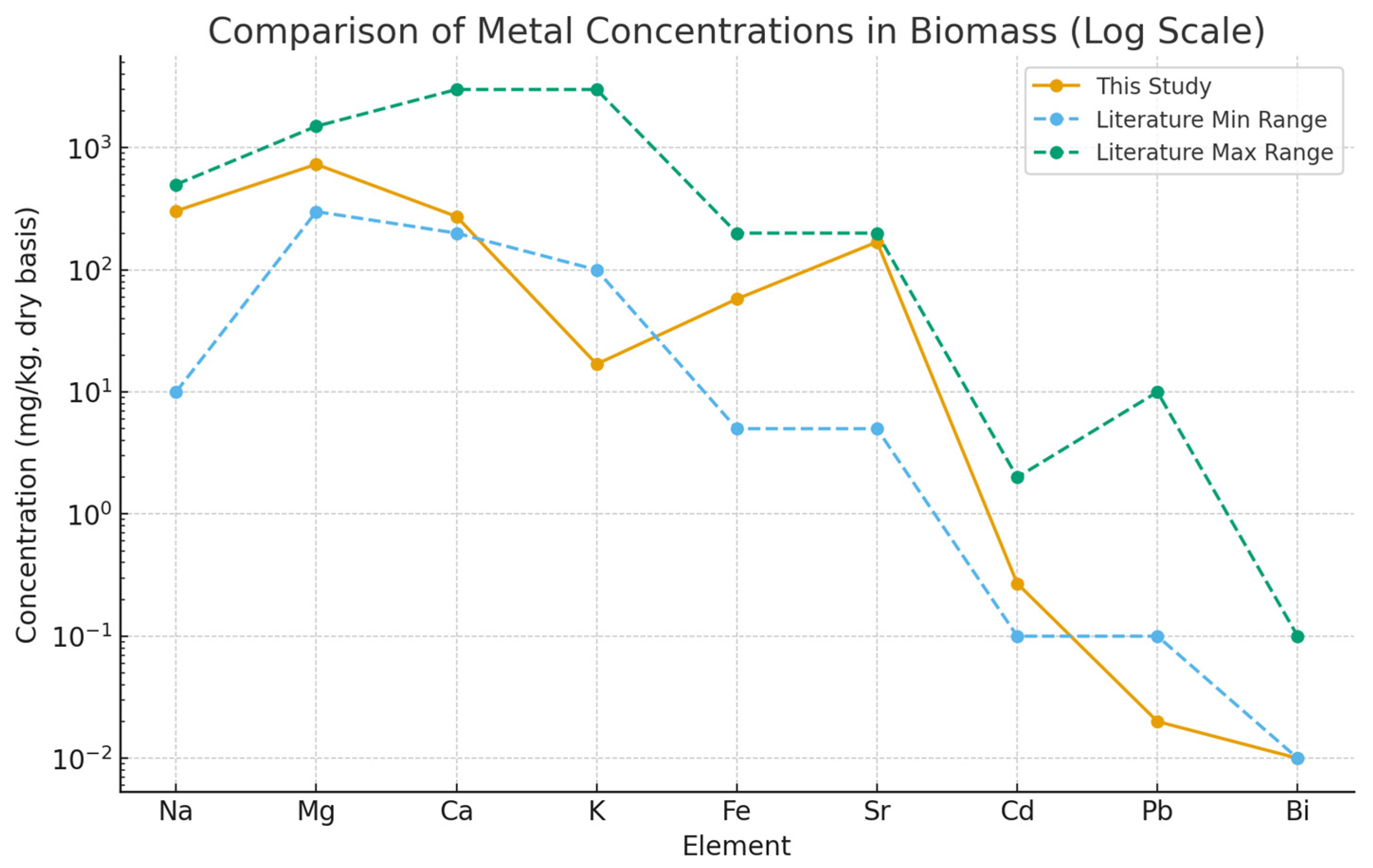
The analysis of trace metals and mineral elements in the poplar briquette biomass provides important insights into the potential behavior of inorganic species during gasification and their implications for syngas quality, ash composition, and environmental impact. Overall, the measured concentrations indicate that the biomass feedstock contains relatively low levels of heavy metals, while essential macro-elements such as Mg, Na, and Ca are present at typical values for lignocellulosic biomass (Figure 3).
Figure 3.
Comparison of metal concentrations measured in the poplar briquette biomass with literature ranges reported for woody biomass. Values are expressed on a dry basis and plotted on a logarithmic scale [33].
Figure 3 compares the concentrations of metals detected in the poplar briquette with literature ranges typically reported for woody lignocellulosic biomass. The results confirm that most elements fall well within expected variability, although Na and Sr appear on the upper boundary of reported values, which may be linked to soil composition or storage contamination. Conversely, K shows a concentration significantly lower than the average literature range, a condition that may reduce slagging and fouling tendencies during gasification. Trace metals of environmental concern, including Cd, Pb, and Bi, remain far below published typical values, demonstrating low contamination, and confirming the suitability of the feedstock for thermochemical conversion from both technological and environmental perspectives [33]. Precisely, the most abundant elements detected poplar briquette biomass were Mg (731 mg kg−1), Ca (273 mg kg−1) and Sr (169 mg kg−1), but in levels that confirming that the feedstock does not exhibit anomalous accumulation of mineral species [33]. The presence of the Sr is relevant (i.e., 169 mg kg−1). It can be assumed that the relatively high presence of strontium (Sr) in poplar biomass can be attributed to the species’ natural ability to accumulate elements from the soil, facilitated by Sr’s chemical similarity to calcium, the tree’s rapid growth, and extensive root system; this accumulation is likely linked to site-specific soil characteristics rather than anthropogenic contamination and does not pose concerns for the thermochemical conversion of the biomass [34,35].
Their presence play an important role during gasification, as they are known to influence system performance during thermochemical conversion by affecting char reactivity, ash melting behavior, and tar formation [36,37,38]. Fe (57.7 mg kg−1) and K (16.9 mg kg−1) were also detected at moderate levels. The presence of Fe may contribute to catalytic effects during the thermochemical process, although its concentration is not expected to significantly impact ash management or reactor integrity. Conversely, the comparatively low concentration of K—often present at higher levels in agricultural residues—suggests a reduced risk of volatilization and subsequent condensation on reactor components, which is favorable for long-term stable operation [39,40].
Toxic heavy metals such as Cd (0.27 mg kg−1), Pb (0.02 mg kg−1), and Bi (0.01 mg kg−1) were detected only in trace amounts, while several metals of environmental concern (Ni, Cu, Zn, Co, and Ag) remained below the quantification limit. This is an encouraging result, as it indicates a low contamination potential of the feedstock and reduces the likelihood of hazardous emissions or their accumulation in system residues. Given that heavy metals can partition between the solid, liquid, and gas phases depending on operating temperature, this low initial concentration suggests minimal contribution to syngas impurities and aligns with sustainability criteria for biomass energy systems [41].
The experimental data show that, although the poplar briquette feedstock contained measurable concentrations of metals and mineral elements (e.g., Na, Mg, Ca, Sr, Fe, K), the fraction mobilized into the syngas stream was very limited (e.g., Na ~1.1 mg Nm−3 in stream A+B I, Mg ~0.5 mg Nm−3, K ~0.5 mg Nm−3, Ca ~0.4 mg Nm−3, Fe ~0.1 mg Nm−3; toxic metals such as Cd, Pb and Bi were not present). The partitioning of heavy metals during gasification indicates that the majority of HMs, including Cd, Pb, and Bi, remain in the solid char fraction, while only a minor fraction volatilizes into condensates or the syngas stream (e.g., Na ~1.1 mg Nm−3, Mg ~0.5 mg Nm−3, K ~0.5 mg Nm−3, Ca ~0.4 mg Nm−3, Fe ~0.1 mg Nm−3), consistent with previous studies [38]. This distribution indicates that most heavy metals is retained in the solid residue, providing a clear picture of their partitioning between gas and solid phases.
The observed behavior indicates that heavy metals show very limited volatilization into syngas, remaining mostly in the solid residue, consistent with [42]. Alkali and alkaline earth metals (Na, Mg, K, Ca) appear in low but measurable concentrations, reflecting their higher mobility via volatile salts as described by [37], yet their levels suggest minimal operational issues such as slagging or corrosion. Low heavy-metal content in syngas is desirable for turbines, engines, or chemical synthesis since trace metals can poison catalysts or cause deposits. Metal mobilization strongly depends on process conditions such as temperature, residence time, atmosphere, feedstock form, and speciation, as shown by [43], and the low mobilization observed likely reflects favorable conditions, though further work on ash/char and condensate partitioning is recommended.
Another relevant aspect concerns the role of biomass composition in determining syngas production efficiency. The experimental results confirm that the chemical composition—particularly the presence of AAEM and HMs—plays a key role in modulating both syngas yield and gas quality, as previously discussed. The poplar biomass used in this study exhibited a substantial content of Ca (≈273.7 mg/kg) and Mg (≈731.8 mg/kg), elements widely recognized for their intrinsic catalytic behaviour during thermochemical conversion. This catalytic effect is reflected in the enhanced formation of reactive gas species, such as hydrogen and carbon monoxide, and in the promotion of tar reforming. These findings are consistent with previous literature, in which calcium and magnesium cations have been identified as active promoters of water–gas shift reactions and cracking pathways of complex organic compounds [10]. The stability and catalytic activity of AAEM are further supported by studies on gasifiers, which indicate that Ca-rich ashes remain catalytically active and enhance char conversion without significant volatilization [44]. The observed reduction in tar in processes using biomass containing AAEM confirms that these elements can act similarly to external catalysts, improving syngas quality and overall process efficiency. Previous studies have shown that the addition of CaO promotes the reforming of tar into hydrogen, carbon monoxide, and methane, thereby increasing the overall gas yield [45]. The HMs present in the biomass, such as Cd, Pb, and Bi, were detected only in trace amounts and did not significantly affect either syngas yield or process stability. This observation is consistent with the behaviour of poplars used for phytoremediation, which accumulate heavy metals primarily in the roots, with limited translocation to the aerial parts used for biomass, thereby reducing the risk of contamination during gasification [11]. Consequently, the management of solid and liquid residues is environmentally safe, and poplar biomass can be considered a sustainable energy feedstock because although the heavy metal content in the post-gasification solids was not analysed in this study, literature reports suggest that poplar biomass retains most HMs in the roots, and residual metals in biochar are typically low, indicating a low environmental risk [10,11,46]. The volumetric syngas yield obtained (1.79 Nm3 kg−1 biomass) and the gas composition (H2 14.58 vol%, CO 16.68 vol%, CH4 4.74 vol%) confirm that the produced gas has suitable energetic properties for both thermal and chemical applications. The higher heating value (HHV 4.6–5.1 MJ Nm−3) and operational stability, with a power deviation of 4.6%, indicate that the presence of metals in the biomass does not compromise process efficiency and may even contribute to optimizing energy conversion [6,36].
Finally, while the valorization of poplar pruning residues as an energy resource supports circular economy integration and reduces residue management costs [15], it is important to acknowledge potential drawbacks associated with gasification of biomass from contaminated sites. Elevated ash contents and inorganic contaminants can exacerbate operational issues such as slagging, fouling, and corrosion in gasifier reactors, increasing maintenance requirements and costs if not properly managed, as highlighted in biomass ash studies [16]. Moreover, techno-economic assessments underline the need for comprehensive cost–benefit analyses that balance phytoremediation investments with energy revenues and operational expenditures to ensure overall process viability and competitiveness with other energy pathways.
While the integration of poplar biomass gasification into a circular economy framework demonstrates clear environmental and energetic benefits, potential drawbacks such as increased ash content from contaminated sites could affect reactor maintenance and operational costs. A preliminary economic assessment suggests that, although the use of phytoremediation residues adds value by generating energy and reducing waste disposal costs, the balance between phytoremediation investment and energy revenue should be carefully evaluated to ensure overall process feasibility.
5. Conclusions
Poplar biomass derived from phytoremediation plantations exhibits favorable chemical and mineral properties for gasification, including low moisture, moderate ash content, and high carbon content. gasification tests demonstrated efficient conversion into syngas, with high H2 and CO fractions and minimal tar formation, enhanced by the catalytic effect of naturally occurring Ca and Mg. Heavy metals in the biomass were mostly retained in solid residues, with negligible mobilization into the syngas, confirming environmental safety. The energy yield and operational stability indicate that the presence of metals does not compromise process efficiency and may improve gasification performance.
Despite the short duration of the test—due to a reduced quantity of contaminated biomass—these results support the valorization of pruning residues as a sustainable energy raw material. In fact, they offer the dual advantage of contributing to soil remediation while generating high-quality synthesis gas, thus promoting circular economy practices in biomass management.
Author Contributions
Conceptualization, E.P. and D.B.; methodology, E.P. and F.G.; software, E.P. and M.C.; validation, F.G., M.C. and D.B.; formal analysis, D.B.; investigation, E.P. and D.M.; resources, L.I.; data curation, E.P., D.M. and M.C.; writing—original draft preparation, D.M.; writing—review and editing, D.M., E.P. and C.D.F.; visualization, F.G. and P.A.; supervision, F.G., D.B. and L.I. All authors have read and agreed to the published version of the manuscript.
Funding
This research received no external funding.
Institutional Review Board Statement
Not applicable.
Informed Consent Statement
Not applicable.
Data Availability Statement
Data is contained within the article.
Acknowledgments
The authors would like to thank Paolo Ceci for the support during the study.
Conflicts of Interest
Author Luigi Iannitti was employed by the company RESET S.p.A. The remaining authors declare that the research was conducted in the absence of any commercial or financial relationships that could be construed as a potential conflict of interest.
References
- Ciliberti, C.; Biundo, A.; Albergo, R.; Agrimi, G.; Braccio, G.; De Bari, I.; Pisano, I. Syngas Derived from Lignocellulosic Biomass Gasification as an Alternative Resource for Innovative Bioprocesses. Processes 2020, 8, 1567. [Google Scholar] [CrossRef] [Scilit]
- Mignogna, D.; Ceci, P.; Cafaro, C.; Corazzi, G.; Avino, P. Production of Biogas and Biomethane as Renewable Energy Sources: A Review. Appl. Sci. 2023, 13, 10219. [Google Scholar] [CrossRef] [Scilit]
- Khlifi, S.; Pozzobon, V.; Lajili, M. A Comprehensive Review of Syngas Production, Fuel Properties, and Operational Parameters for Biomass Conversion. Energies 2024, 17, 3646. [Google Scholar] [CrossRef] [Scilit]
- Mignogna, D.; Szabó, M.; Ceci, P.; Avino, P. Biomass Energy and Biofuels: Perspective, Potentials, and Challenges in the Energy Transition. Sustainability 2024, 16, 7036. [Google Scholar] [CrossRef] [Scilit]
- Khalid, H.; Amin, F.R.; Gao, L.; Chen, L.; Chen, W.; Javed, S.; Li, D. Syngas Conversion to Biofuels and Biochemicals: A Review of Process Engineering and Mechanisms. Sustain. Energy Fuels 2024, 8, 9–28. [Google Scholar] [CrossRef] [Scilit]
- Schmid, J.C.; Benedikt, F.; Fuchs, J.; Mauerhofer, A.M.; Müller, S.; Hofbauer, H. Syngas for Biorefineries from Thermochemical Gasification of Lignocellulosic Fuels and Residues—5 Years’ Experience with an Advanced Dual Fluidized Bed Gasifier Design. Biomass Convers. Biorefin. 2021, 11, 2405–2442. [Google Scholar] [CrossRef] [Scilit]
- Wang, L.; Zhou, T.; Hou, B.; Yang, H.; Hu, N.; Zhang, M. A Comprehensive Review of Biomass Gasification Characteristics in Fluidized Bed Reactors: Progress, Challenges, and Future Directions. Fluids 2025, 10, 147. [Google Scholar] [CrossRef] [Scilit]
- Safarian, S. Performance Analysis of Sustainable Technologies for Biochar Production: A Comprehensive Review. Energy Rep. 2023, 9, 4574–4593. [Google Scholar] [CrossRef] [Scilit]
- Gallucci, F.; Paris, E.; Palma, A.; Vincenti, B.; Carnevale, M.; Ancona, V.; Borello, D. Fluidized Bed Gasification of Biomass from Plant-Assisted Bioremediation: Fate of Contaminants. Sustain. Energy Technol. Assess. 2022, 53, 102458. [Google Scholar] [CrossRef] [Scilit]
- Ancona, V.; Barra Caracciolo, A.; Campanale, C.; De Caprariis, B.; Grenni, P.; Uricchio, V.F.; Borello, D. Gasification Treatment of Poplar Biomass Produced in a Contaminated Area Restored Using Plant Assisted Bioremediation. J. Environ. Manag. 2019, 239, 137–141. [Google Scholar] [CrossRef] [Scilit]
- Tőzsér, D.; Horváth, R.; Simon, E.; Magura, T. Heavy Metal Uptake by Plant Parts of Populus Species: A Meta-Analysis. Environ. Sci. Pollut. Res. 2023, 30, 69416–69430. [Google Scholar] [CrossRef] [Scilit]
- Littlewood, J.; Guo, M.; Boerjan, W.; Murphy, R.J. Bioethanol from Poplar: A Commercially Viable Alternative to Fossil Fuel in the European Union. Biotechnol. Biofuels 2014, 7, 113. [Google Scholar] [CrossRef] [Scilit]
- Gallucci, F.; Palma, A.; Vincenti, B.; Carnevale, M.; Paris, E.; Ancona, V.; Migliarese Caputi, M.V.; Borello, D. Fluidized Bed Gasification of Biomass from Plant Assisted Bioremediation (PABR): Lab-Scale Assessment of the Effect of Different Catalytic Bed Material on Emissions. Fuel 2022, 322, 124214. [Google Scholar] [CrossRef] [Scilit]
- Vonk, G.; Piriou, B.; Felipe Dos Santos, P.; Wolbert, D.; Vaïtilingom, G. Comparative Analysis of Wood and Solid Recovered Fuels Gasification in a Downdraft Fixed Bed Reactor. Waste Manag. 2019, 85, 106–120. [Google Scholar] [CrossRef] [Scilit] [PubMed]
- Di Lonardo, S.; Capuana, M.; Arnetoli, M.; Gabbrielli, R.; Gonnelli, C. Exploring the Metal Phytoremediation Potential of Three Populus alba L. clones using an in vitro screening. Iron. Sci. Pollut. Res. 2011, 18, 82–90. [Google Scholar] [CrossRef] [Scilit] [PubMed]
- Edgar, V.-N.; Fabián, F.-L.; Mario, P.-C.J.; Ileana, V.-R. Coupling Plant Biomass Derived from Phytoremediation of Potential Toxic-Metal-Polluted Soils to Bioenergy Production and High-Value by-Products—A Review. Appl. Sci. 2021, 11, 2982. [Google Scholar] [CrossRef] [Scilit]
- Gao, Y.; Wang, M.; Raheem, A.; Wang, F.; Wei, J.; Xu, D.; Song, X.; Bao, W.; Huang, A.; Zhang, S.; et al. Syngas Production from Biomass Gasification: Influences of Feedstock Properties, Reactor Type, and Reaction Parameters. ACS Omega 2023, 8, 31620–31631. [Google Scholar] [CrossRef] [Scilit]
- Schuetzle, D.; Schuetzle, R.; Kent Hoekman, S.; Zielinska, B. The Effect of Oxygen on Formation of Syngas Contaminants during the Thermochemical Conversion of Biomass. Int. J. Energy Environ. Eng. 2015, 6, 405–417. [Google Scholar] [CrossRef] [Scilit]
- Rapagná, S.; Provendier, H.; Petit, C.; Kiennemann, A.; Foscolo, P.U. Development of Catalysts Suitable for Hydrogen or Syn-Gas Production from Biomass Gasification. Biomass Bioenergy 2002, 22, 377–388. [Google Scholar] [CrossRef] [Scilit]
- Solarte-Toro, J.C.; Chacón-Pérez, Y.; Cardona-Alzate, C.A. Evaluation of Biogas and Syngas as Energy Vectors for Heat and Power Generation Using Lignocellulosic Biomass as Raw Material. Electron. J. Biotechnol. 2018, 33, 52–62. [Google Scholar] [CrossRef] [Scilit]
- Skoulou, V.K.; Zabaniotou, A.A. Co-Gasification of Crude Glycerol with Lignocellulosic Biomass for Enhanced Syngas Production. J. Anal. Appl. Pyrolysis 2013, 99, 110–116. [Google Scholar] [CrossRef] [Scilit]
- Esteves, B.; Sen, U.; Pereira, H. Influence of Chemical Composition on Heating Value of Biomass: A Review and Bibliometric Analysis. Energies 2023, 16, 4226. [Google Scholar] [CrossRef] [Scilit]
- García Martín, J.F.; Cuevas, M.; Feng, C.-H.; Álvarez Mateos, P.; Torres García, M.; Sánchez, S. Energetic Valorisation of Olive Biomass: Olive-Tree Pruning, Olive Stones and Pomaces. Processes 2020, 8, 511. [Google Scholar] [CrossRef] [Scilit]
- Al-Farraji, A.; Marsh, R.; Steer, J. A Comparison of the Pyrolysis of Olive Kernel Biomass in Fluidised and Fixed Bed Conditions. Waste Biomass Valorization 2017, 8, 1273–1284. [Google Scholar] [CrossRef] [Scilit]
- Stolarski, M.J.; Warmiński, K.; Krzyżaniak, M. Energy Value of Yield and Biomass Quality of Poplar Grown in Two Consecutive 4-Year Harvest Rotations in the North-East of Poland. Energies 2020, 13, 1495. [Google Scholar] [CrossRef] [Scilit]
- Sandeep, K.; Dasappa, S. Oxy-Steam Gasification of Biomass for Hydrogen Rich Syngas Production Using Downdraft Reactor Configuration: Oxy-Steam Gasification of Biomass for Hydrogen Rich Syngas Production. Int. J. Energy Res. 2014, 38, 174–188. [Google Scholar] [CrossRef] [Scilit]
- Iribarren, D.; Susmozas, A.; Petrakopoulou, F.; Dufour, J. Environmental and Exergetic Evaluation of Hydrogen Production via Lignocellulosic Biomass Gasification. J. Clean. Prod. 2014, 69, 165–175. [Google Scholar] [CrossRef] [Scilit]
- Tarifa, P.; Ramirez Reina, T.; González-Castaño, M.; Arellano-García, H. Catalytic Upgrading of Biomass-Gasification Mixtures Using Ni-Fe/MgAl2O4 as a Bifunctional Catalyst. Energy Fuels 2022, 36, 8267–8273. [Google Scholar] [CrossRef] [Scilit]
- Ayodele, B.V.; Mustapa, S.I.; Tuan Abdullah, T.A.R.B.; Salleh, S.F. A Mini-Review on Hydrogen-Rich Syngas Production by Thermo-Catalytic and Bioconversion of Biomass and Its Environmental Implications. Front. Energy Res. 2019, 7, 118. [Google Scholar] [CrossRef] [Scilit]
- Elsaddik, M.; Nzihou, A.; Delmas, G.-H.; Delmas, M. Renewable and High-Purity Hydrogen from Lignocellulosic Biomass in a Biorefinery Approach. Sci. Rep. 2024, 14, 150. [Google Scholar] [CrossRef] [Scilit] [PubMed]
- Santana, H.E.P.; Jesus, M.; Santos, J.; Rodrigues, A.C.; Pires, P.; Ruzene, D.S.; Silva, I.P.; Silva, D.P. Lignocellulosic Biomass Gasification: Perspectives, Challenges, and Methods for Tar Elimination. Sustainability 2025, 17, 1888. [Google Scholar] [CrossRef] [Scilit]
- Raheem, A.; He, Q.; Mangi, F.H.; Areeprasert, C.; Ding, L.; Yu, G. Roles of Heavy Metals during Pyrolysis and Gasification of Metal-Contaminated Waste Biomass: A Review. Energy Fuels 2022, 36, 2351–2368. [Google Scholar] [CrossRef] [Scilit]
- Giudicianni, P.; Gargiulo, V.; Grottola, C.M.; Alfè, M.; Ferreiro, A.I.; Mendes, M.A.A.; Fagnano, M.; Ragucci, R. Inherent Metal Elements in Biomass Pyrolysis: A Review. Energy Fuels 2021, 35, 5407–5478. [Google Scholar] [CrossRef] [Scilit]
- Kabata-Pendias, A. Trace Elements in Soils and Plants, 3rd ed.; CRC Press: Boca Raton, FL, USA, 2000; ISBN 978-0-429-19112-1. [Google Scholar]
- Liang, Z.; Zeng, H.; Kong, J. Contrasting Responses and Phytoremediation Potential of Two Poplar Species to Combined Strontium and Diesel Oil Stress. Plants 2023, 12, 2145. [Google Scholar] [CrossRef] [Scilit]
- Wang, W.; Lemaire, R.; Bensakhria, A.; Luart, D. Review on the Catalytic Effects of Alkali and Alkaline Earth Metals (AAEMs) Including Sodium, Potassium, Calcium and Magnesium on the Pyrolysis of Lignocellulosic Biomass and on the Co-Pyrolysis of Coal with Biomass. J. Anal. Appl. Pyrolysis 2022, 163, 105479. [Google Scholar] [CrossRef] [Scilit]
- Yu, J.; Guo, Q.; Gong, Y.; Ding, L.; Wang, J.; Yu, G. A Review of the Effects of Alkali and Alkaline Earth Metal Species on Biomass Gasification. Fuel Process. Technol. 2021, 214, 106723. [Google Scholar] [CrossRef] [Scilit]
- Trubetskaya, A. Reactivity Effects of Inorganic Content in Biomass Gasification: A Review. Energies 2022, 15, 3137. [Google Scholar] [CrossRef] [Scilit]
- Ding, L.; Cheng, M.-H.; Lin, Y.; Lin, K.-T.; Sale, K.L.; Sun, N.; Donohoe, B.S.; Ray, A.E.; Li, C. Understanding the Impacts of Inorganic Species in Woody Biomass for Preprocessing and Pyrolysis–A Review. Energy 2025, 322, 135697. [Google Scholar] [CrossRef] [Scilit]
- Krutul, D.; Szadkowski, J.; Antczak, A.; Drożdżek, M.; Radomski, A.; Karpiński, S. The Concentration of Selected Heavy Metals in Poplar Wood Biomass and Liquid Fraction Obtained after High Temperature Pretreatment. Wood Res. 2021, 66, 39–48. [Google Scholar] [CrossRef] [Scilit]
- Laureysens, I.; Blust, R.; De Temmerman, L.; Lemmens, C.; Ceulemans, R. Clonal Variation in Heavy Metal Accumulation and Biomass Production in a Poplar Coppice Culture: I. Seasonal Variation in Leaf, Wood and Bark Concentrations. Environ. Pollut. 2004, 131, 485–494. [Google Scholar] [CrossRef] [Scilit]
- Pudasainee, D.; Paur, H.-R.; Fleck, S.; Seifert, H. Trace Metals Emission in Syngas from Biomass Gasification. Fuel Process. Technol. 2014, 120, 54–60. [Google Scholar] [CrossRef] [Scilit]
- Yan, M.; Liu, S.; Zhang, H.; Zheng, R.; Cui, J.; Wang, D.; Rahim, D.A.; Kanchanatip, E. Syngas Production and Heavy Metal Dynamics during Supercritical Water Gasification of Sewage Sludge. Front. Environ. Sci. Eng. 2024, 18, 149. [Google Scholar] [CrossRef] [Scilit]
- Duan, L.; Li, L. Oxygen-Carrier-Aided Combustion Technology for Solid-Fuel Conversion in Fluidized Bed; Springer Nature Singapore: Singapore, 2023; ISBN 978-981-19-9126-4. [Google Scholar]
- Aghaalikhani, A.; Savuto, E.; Di Carlo, A.; Borello, D. Poplar from Phytoremediation as a Renewable Energy Source: Gasification Properties and Pollution Analysis. Energy Procedia 2017, 142, 924–931. [Google Scholar] [CrossRef] [Scilit]
- Wang, Q.; Wang, B.; Ma, Y.; Zhang, X.; Lyu, W.; Chen, M. Stabilization of Heavy Metals in Biochar Derived from Plants in Antimony Mining Area and Its Environmental Implications. Environ. Pollut. 2022, 300, 118902. [Google Scholar] [CrossRef] [Scilit] [PubMed]

Disclaimer/Publisher’s Note: The statements, opinions and data contained in all publications are solely those of the individual author(s) and contributor(s) and not of MDPI and/or the editor(s). MDPI and/or the editor(s) disclaim responsibility for any injury to people or property resulting from any ideas, methods, instructions or products referred to in the content. |
© 2026 by the authors. Licensee MDPI, Basel, Switzerland. This article is an open access article distributed under the terms and conditions of the Creative Commons Attribution (CC BY) license.