Article

Geochemistry and U-Pb Geochronology of Late Paleozoic Magmatism in a Part of the Western Balkan Zone, NW Bulgaria


1
Department of Geology, Paleontology and Fossil Fuels, Sofia University St. Kliment Ohridski, 15 Tzar Osvoboditel Bd., 1504 Sofia, Bulgaria
2
Bulgarian Academy of Sciences, 1 November 15 Str., 1040 Sofia, Bulgaria
3
Department of Geochemistry and Petrology, Geological Institute of the Bulgarian Academy of Sciences, 24 Acad. G. Boncev Str., 1113 Sofia, Bulgaria
4
Department of Mineralogy, Petrology and Economic Geology, Sofia University St. Kliment Ohridski, 15 Tzar Osvoboditel Bd., 1504 Sofia, Bulgaria
*
Author to whom correspondence should be addressed.
Appl. Sci. 2026, 16(2), 637; https://doi.org/10.3390/app16020637
Submission received: 1 December 2025 / Revised: 2 January 2026 / Accepted: 3 January 2026 / Published: 7 January 2026
(This article belongs to the Section Earth Sciences)

Featured Application

Because of the nearby baryte deposit located at the village of Eliseyna, the presented here geochemical and geochronological results have potential applications for targeting and exploration of additional base metals and other types of mineralization in the area studied.

Abstract

The Rzhanski granitoid pluton and Ignatitsa diorite porphyry bodies are considered Late Paleozoic in age, belonging to the Western Balkan Zone (WBZ) in Northwestern Bulgaria. Here, we provide U-Pb zircon geochronology of these magmatic bodies, together with their geochemistry complemented by the geochemistry of the overlying volcanic rocks. Geochemical data indicate that the intermediate to acid magmatic rocks are mostly peraluminous, calc-alkaline diorite/andesite to granite, that have an origin in a continental magmatic arc tectonic environment. All plutonic, subvolcanic and volcanic rocks exhibit uniform LILE- and LREE-enriched characteristics of an arc-related igneous suite. Zircons in the Ignatitsa diorite porphyry yield a magmatic crystallization age of 315 Ma, while the zircons in the Rzhanski aplitic metagranite pluton crystallize at 294 Ma. The record of the Variscan intrusive magmatism encompasses a region-wide, well-defined time interval 332–294 Ma in the WBZ, which coincides with those of the Central Balkan Zone and the adjacent Sredna Gora Zone. The age of the Variscan greenschist facies metamorphism using the metagranite and host greenschists relationships is limited between 294 Ma and the unpublished depositional age of 268 Ma for the overlying clastic formation in the studied part of the WBZ.

1. Introduction

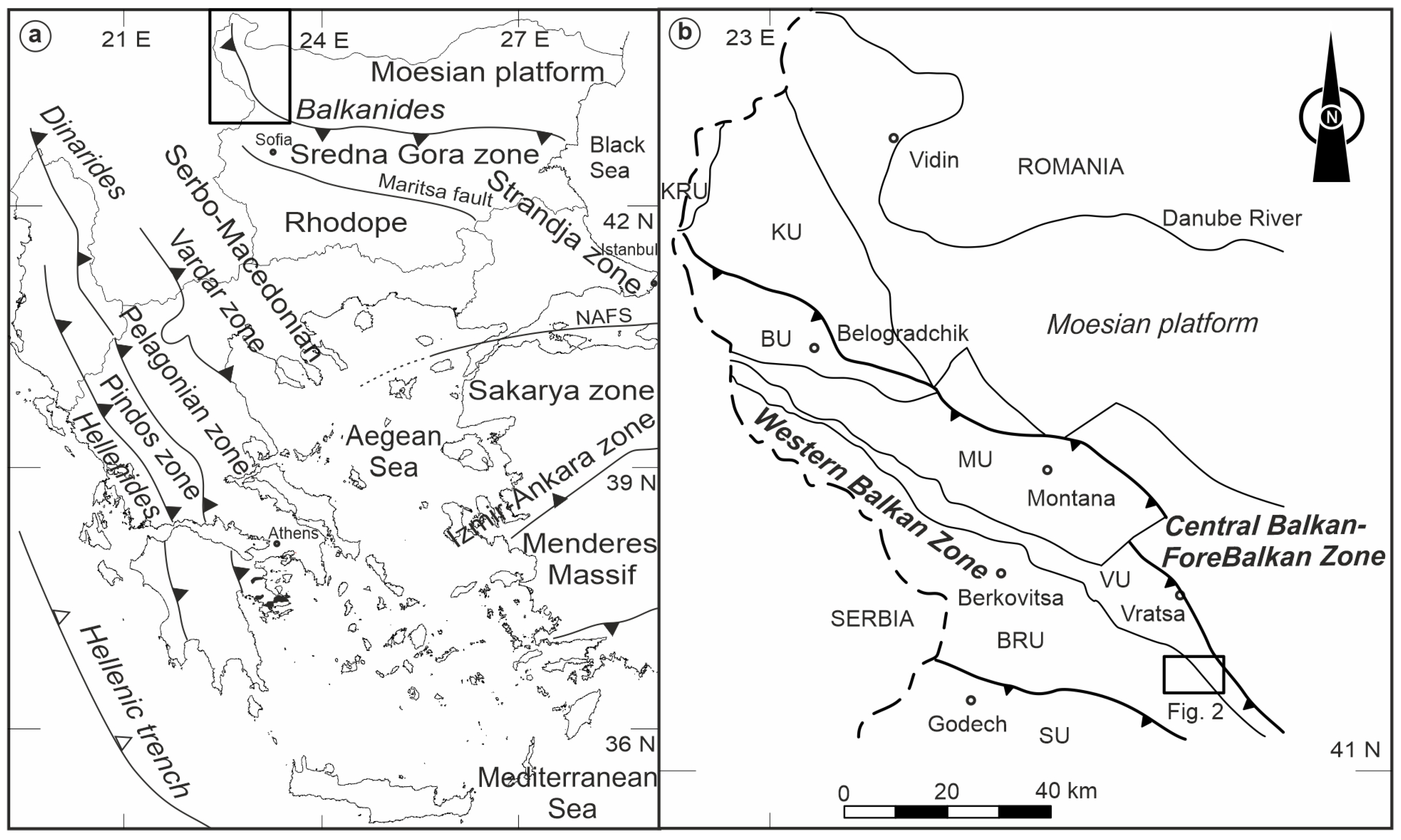
The Balkan Zone (BZ) constitutes an important part of the Alpine fold-and-thrust belt located in the Stara Planina Mountain (Balkan) of Northwestern Bulgaria (Figure 1a). This zone is included in the Balkan terrane, which together with other terranes in the territories of Bulgaria, Romania, Serbia and Greece, has an origin commonly connected to the geodynamic evolution of Gondwana [1]. This geodynamic history encompasses the formation of the oceanic lithosphere, island arc and subsequent collision of Gondwana-derived crustal blocks with the Laurasia continental margin from the Late Neoproterozoic to the Early Paleozoic times ca. 570–470 Ma [1,2]. Tectono-magmatic elements that belong to the Avalonian–Cadomian orogeny [2] and the Variscan orogeny [3] are recognised in the BZ. The Variscan magmatism in the BZ is relatively well-known by crystallization ages that span the late Early–Late Carboniferous to Late Permian ca. 332–260 Ma, e.g., [3,4,5,6]. Hovewer, for some parts of the BZ, age constraints for the Variscan magmatism are still lacking.
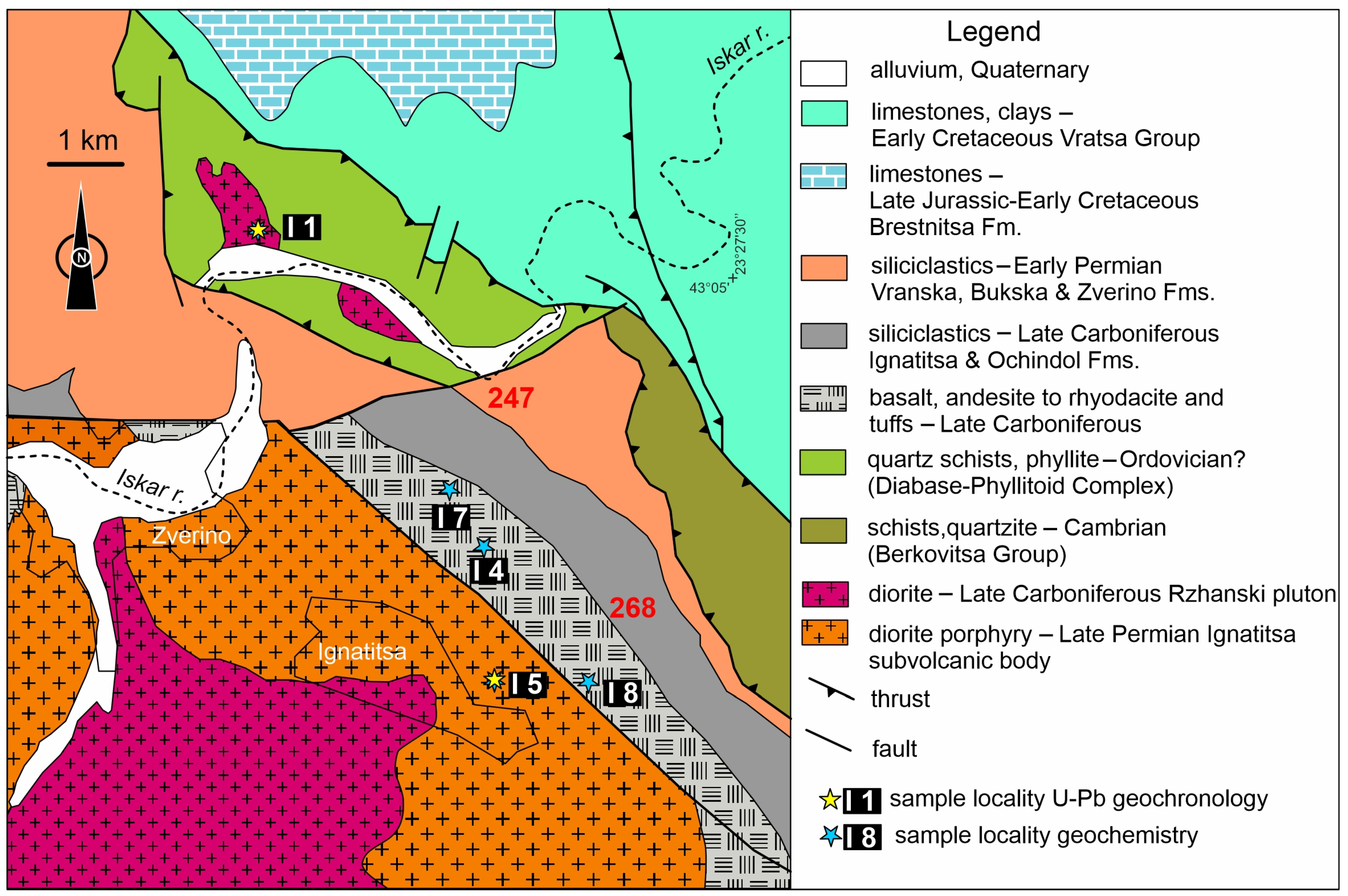
In this article, we document whole-rock geochemistry and U-Pb zircon geochronology for the plutonic, subvolcanic and volcanic bodies located between the villages of Zverino and Ignatitsa along the Iskar River Valley from the WBZ (Figure 1b and Figure 2), with the aim to provide age constraints on crystallization timing and compositions for the magmatic bodies. Therefore, new cystallization age constraints will shed additional light on the record of Variscan magmatism in the Balkan sector of the Alpine orogen.

2. Geological Setting

In Northwestern Bulgaria, the BZ (i.e., the Balkanides, Figure 1a) is subdivided into the Central Balkan–ForeBalkan and Western Balkan zones, which were both involved in the Alpine fold-and-thrust belt [8,9] (Figure 1b). The WBZ is subdivided into the Alpine thrust-imbricated Berkovitsa, Vratsa, Montana and Belogradchik units [9].
The WBZ is built of Neoproterozoic–Cambrian crystalline basement and Late Paleozoic–Mesozoic cover rocks [2,3,9]. The low-grade crystalline basement of the WBZ has been reffered to as the Diabase–Phyllitoid Complex (DPhC) [10].
Three lithostratigraphic groups have been subdivided within the DPhC, namely Cherni Vrah, Berkovitsa and Dalgi Djal groups [11], which differ among each other in their lithology and tectono-stratigraphic relationships.
The ophiolitic Cherni Vrah Group is traditionally regarded as representing an element of the Balkan–Carpathian ophiolite [11]. Neoproterozoic and Devonian U-Pb crystallization ages at 563 ± 5 Ma [12] and at 391.2 ± 1.3 Ma [13], respectively, have been reported for a gabbro of the Cherni Vrah Group.
The Berkovitsa Group is island-arc-related, and consists of calc-alkaline volcanic and plutonic rocks and associated sedimentary rocks of an intra-oceanic arc system. This group is regarded as pre-Ordovician (latest Neoproterozoic–Cambrian), based on reported acritarchs in the DPhC [14]. The Berkovitsa Group unconformably overlies the Cherni Vrah Group [11].
The Dalgi Djal Group is olistostromic, and mainly consists of metasedimentary successions that host magmatic olistoliths from both the Cherni Vrah and the Berkovitsa groups [11]. The inferred early Ordovician age of this group is based on acritarchs found in similar rock types to this group from other exposed areas of the DPhC in the WBZ [11]. The Dalgi Djal Group unconformably overlies the Berkovitsa Group and is interpreted as a sedimentary assemblage formed during the destruction and obduction of the Balkan-Carpathian ophiolite. Recently, in the low-grade Sredogriv metamorphics, considered a counterpart of the Dalgi Djal Group in the Montana unit of the WBZ, an Early Cambrian sedimentation at 523 Ma of a conglomerate and a Late Carboniferous crystallization of (meta)albite-rich granophyre at 308 Ma [15] have been identified.
In the study area, the older rocks of the Cambrian Berkovitsa Group and Ordovician DPhC occur in an Alpine thrust that contacts the Carboniferous–Permian clastic successions and the Late Jurassic–Early Cretaceous carbonate successions (Brestnitsa Formation and Vratsa Group). All these mentioned units belong to the Vratsa unit of the WBZ (Figure 1b and Figure 2). However, the Mesozoic formations are beyond the scope of this paper.
The magmatic rocks subject of this study have been included in the so-called Stara Planina granodiorite–granite complex of Paleozoic age [16]. This magmatic complex includes post-collisional I-type metaaluminous granitoids with a relatively high Na/K ratio that have been intruded into the Berkovitsa Group and the DPhC [11]. The crystallization ages of some granitic bodies adjacent to the study area, such as the biggest Petrohan pluton, were determined by U-Pb zircon geochronology as Late Carboniferous at 304 Ma [6] and 307 Ma [17]. Recently, in the same area, a new geochronology that spans 308 Ma to 282 Ma in plutonic, subvolcanic and volcanic bodies [6] has been added by the same method.
The plutonic and volcanic rocks along the Iskar River Valley at the vicinity of the villages Zverino and Ignatitsa belong to the Berkovitsa unit of the WBZ [9]. The main intrusive body in this area is represented by the Rzhanski pluton that is emplaced into the, presumably Ordovician, DPhC in which it forms the contact zone [18,19]. The magmatic crystallization age of the Rzhanski pluton is constrained at 307 Ma [6]. This pluton consists of diorite, granodiorite and granite that contains gabbro-diorite mafic enclaves [19]. The subvolcanic rocks are represented by an Ignatitsa diorite porphyry dome-like body, which is considered younger than the Rzhanski pluton, having concordant or discordant contacts with the latter [7]. The magmatic crystallization age of the Ignatitsa body is unknown. An additional subvolcanic body, similar to the Ignatitsa body, called the Eliseyna diorite porphyry body occurs ca. 3 km to the west of the village of Zverino. The Rzhanski pluton separate both the Ignatitsa and Eliseyna subvolcanic bodies (Figure 2). Altogether, the Rzhanski pluton and the Ignatitsa and Eliseyna bodies are overlain by volcanic rocks that have compositons of basalt–trachybasalt, andesite–trachyandesite to rhyodacite of assumed Late Carboniferous age. These volcanic rocks have been unified into the Zverino volcanic center [20]. It is noteworthy that the volcanic rocks such as dykes as well as subvolcanic bodies span 308 Ma to 260 Ma [6,21] along the Iskar River Valley.
Siliciclastic rocks unconformably overlie the volcanic rocks or occur in fault contacts. They have been subdivided into Zlotitsa and Ochindol formations of Late Carboniferous age, as indicated by fossil flora [22,23], which both are unified in Figure 2 because of limited exposure of the Zlotitsa Formation and thickness up to 90 m. The latter mostly consists of conglomerate and minor sandstone, whereas the up to 340 m-thick Ochindol Formation, in addition to conglomerate and sandstone, also contains gravel, aleurolite and coal argillite. Our unpublished detrital zircon maximum depositional age of 268 Ma from the Ochindol Formation conglomerate supports a Middle Permian (Guadalupian) sedimentary deposition (Figure 2). Furthermore, the Early Permian siliciclastic rocks are subdivided into Bukska and Vranska formations, which both are unified in Figure 2. According to Tencov [22], the Bukska Formation consists of conglomerate, sandstone, aleurolite and minor argillite of Early Permian biostratigraphic age, which were deposited in alluvial–fluvial environments. The litologically overlying Vranska Formation mainly consists of breccia-conglomerate and breccia and subordinate sandstone that deposited in proluvial fans, with inferred Early Permian age based on the regional geology and stratigraphy [22]. However, our unpublished detrital zircon maximum depositional age of 247 Ma from the Vranska Formation breccia-conglomerate supports an Early Triassic (Olenekian) sedimentary deposition (Figure 2).
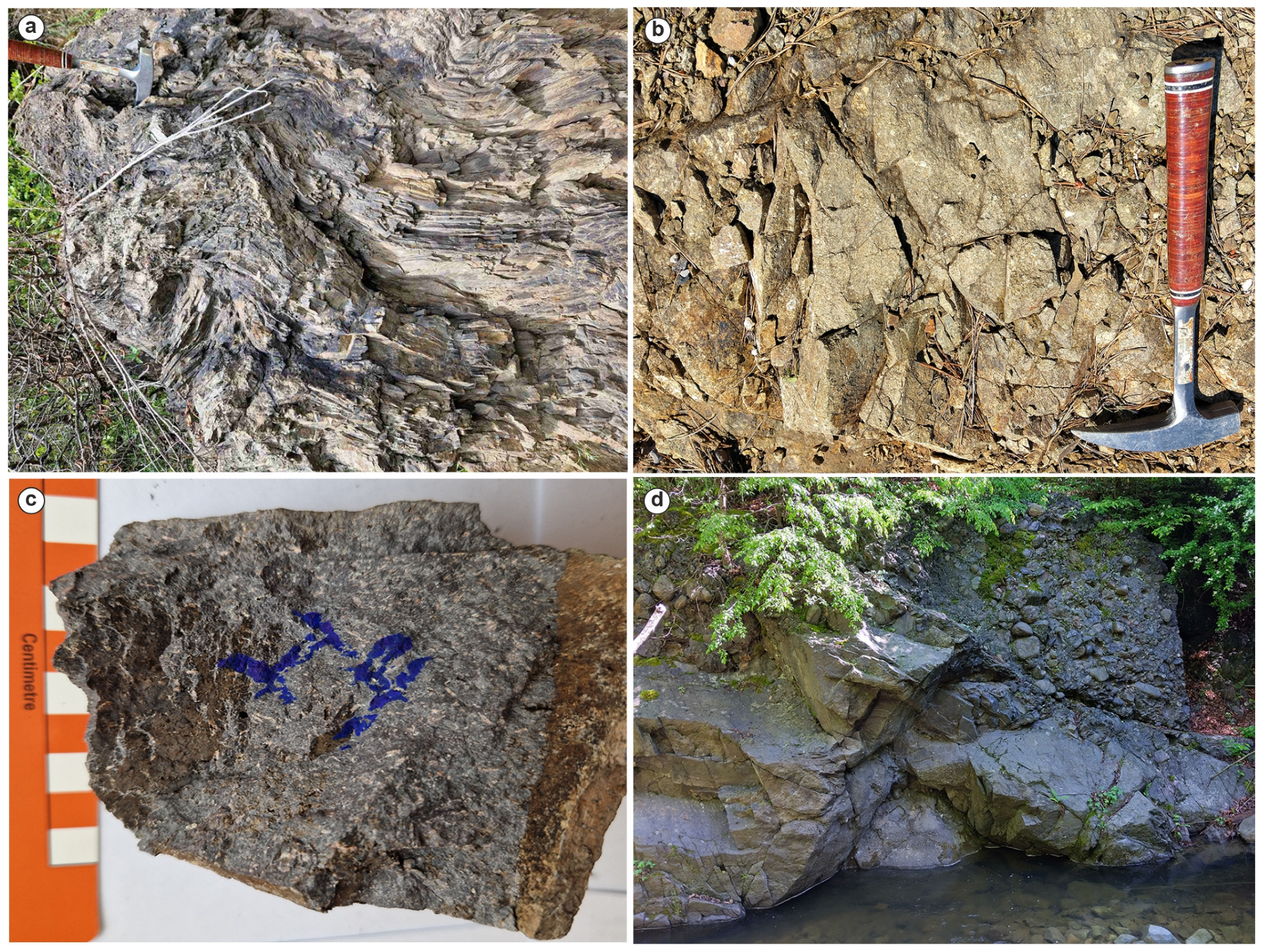
Field observations confirmed previous data that showed that the small felsic stock-like body from the Rzhanski pluton located north of the village Zverino intrudes into the DPhC rocks (Figure 3a), being, in turn, slightly foliated along the contacts. The subvolcanic character of the Ignatitsa body that represents diorite porphyry was also confirmed (Figure 3b), together with the occurrence of the overlying lava flow (Figure 3c). The latter is unconformably covered by the conglomerate of the Ochindol Formation (Figure 3d).

3. Materials and Methods

3.1. Sampling and Materials

The study focuses on the magmatic bodies of the Rzhanski pluton, Ignatitsa body and the volcanic rocks along the Iskar River Valley at the vicinity of the villages of Zverino and Ignatitsa. The sample numbers and locations are shown in Figure 2, and their coordinates are given in Table S1.
A single sample, I5, was collected from the Ignatitsa diorite porphyry body in the suburbs of the village Ignatitsa. The I5 sample was used for whole-rock geochemistry and U-Pb geochronology. Another sample, I1, came from a felsic foliation-parallel metaigneous body that was intercalated within the greenschist-facies metamorphic succession assigned to the Ordovician DPhC north of the village of Zverino (Figure 2). This small, stock-like aplitic granite body is considered part the of the Rzhanski pluton emplaced close to its main body [7]. The I1 sample was used for whole-rock geochemistry and U-Pb geochronology. Samples I4, I7 and I8 were collected from a volcanic lava flow that overlies the Ignatitsa diorite porphyry body. The I4, I7 and I8 samples were used only for whole-rock geochemistry. Two additional samples, I10 and I11, were collected from the Eliseyna diorite porphyry body and the overlying volcanic lava flow, respectively. These samples have similar field context to the Ignatitsa diorite porphyry body and the overlying lava flow, as depicted in Figure 3. The I10 and I11 samples were used only for whole-rock geochemisty and comparison purposes.

3.2. Analytical Methods

Whole-rock major element analyses were performed by X-ray fluorescence, and the trace elements and the rare-earth elements (REE) analyses were measured by laser-ablation inductively coupled mass spectrometry (LA-ICP-MS). U-Pb zircon geochronology was conducted by using LA-ICP-MS method. Analytical procedures of the whole-rock geochemistry and U-Pb zircon geochronology are described in detail in Bonev et al. [15]. Analytical data derived from whole-rock geochmistry and U-Pb zircon geochronology are provided in Tables S1 and S2.

4. Results

4.1. Petrographic Description

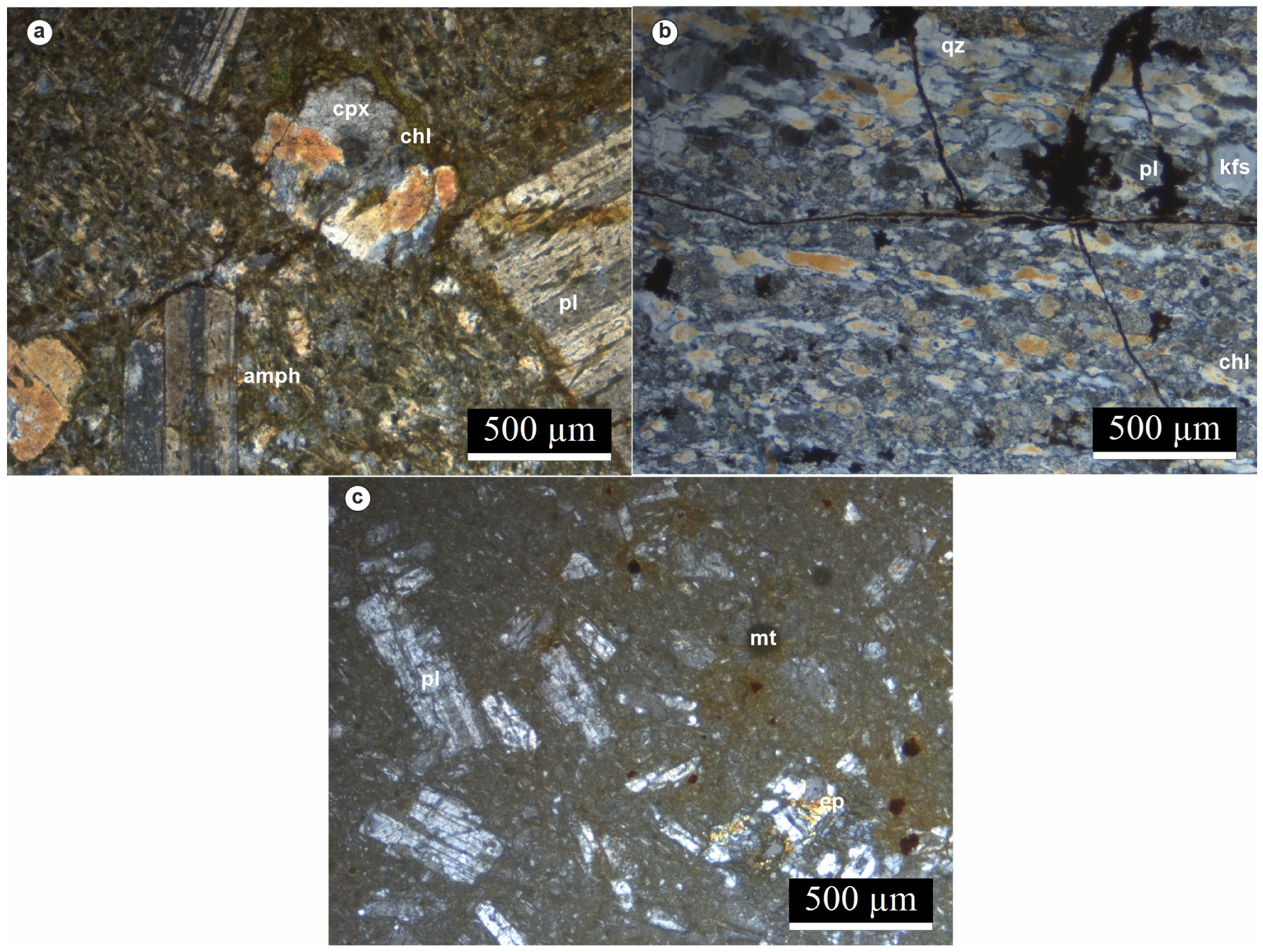
Sample I5 represents massive, medium-grained diorite consisting of modally decreasing lamellar plagioclase, amphibole and clinopyroxene porphyres, that are set in a subophitic fine-crystalline groundmass comprising microlites of the porphyritic mineral phases (Figure 4a). The plagioclase is substituted by fine-crystalline muscovite and epidote, whereas the rare clinopyroxene is altered to chlorite. Less abundant amphibole is also substituted by chlorite. Accessory mineral phases include apatite, ilmenite, titanite and zircon.
The aplitic granite body (sample I1) is unevenly foliated, becoming a granitic gneiss, particularly at the contact with the host greenschists. In thin sections, this aplitic body represents a metagranite consisting of quartz, plagioclase, alkali feldspar and biotite (Figure 4b). Due to the slight deformation, the alkali feldspar is altered to sericite and biotite to muscovite and chlorite that both latter delineate the weak foliation, together with the recrystallized quartz. Accessory minerals are apatite and zircon.
The ca. 400 m thick lava flow (samples I4, I7 and I8) consists of violet rhyodacite and tuffs that are overlain by green basaltic andesite and andesite, with both rock varieties alternating in the upper part of the section. These massive, volcanic rocks consist mostly of lamellar and non-lamellar plagioclase, amphibole and quartz phenocrysts, and disseminated magnetite set in a fine-crystalline groundmass comprising microlites of the porphyritic mineral phases (Figure 4c). Epidote and chlorite are common alteration products on the amphibole and plagioclase phenocrysts and within the groundmass.

4.2. Whole-Rock Geochemistry

The seven samples used for whole-rock geochemistry represent different types of igneous and metaigneous rocks that include Ignatitsa and Eliseyna diorite porphyry bodies and the overlying volcanic rocks, and Rzhanski pluton-related aplitic metagranite stock bodies.
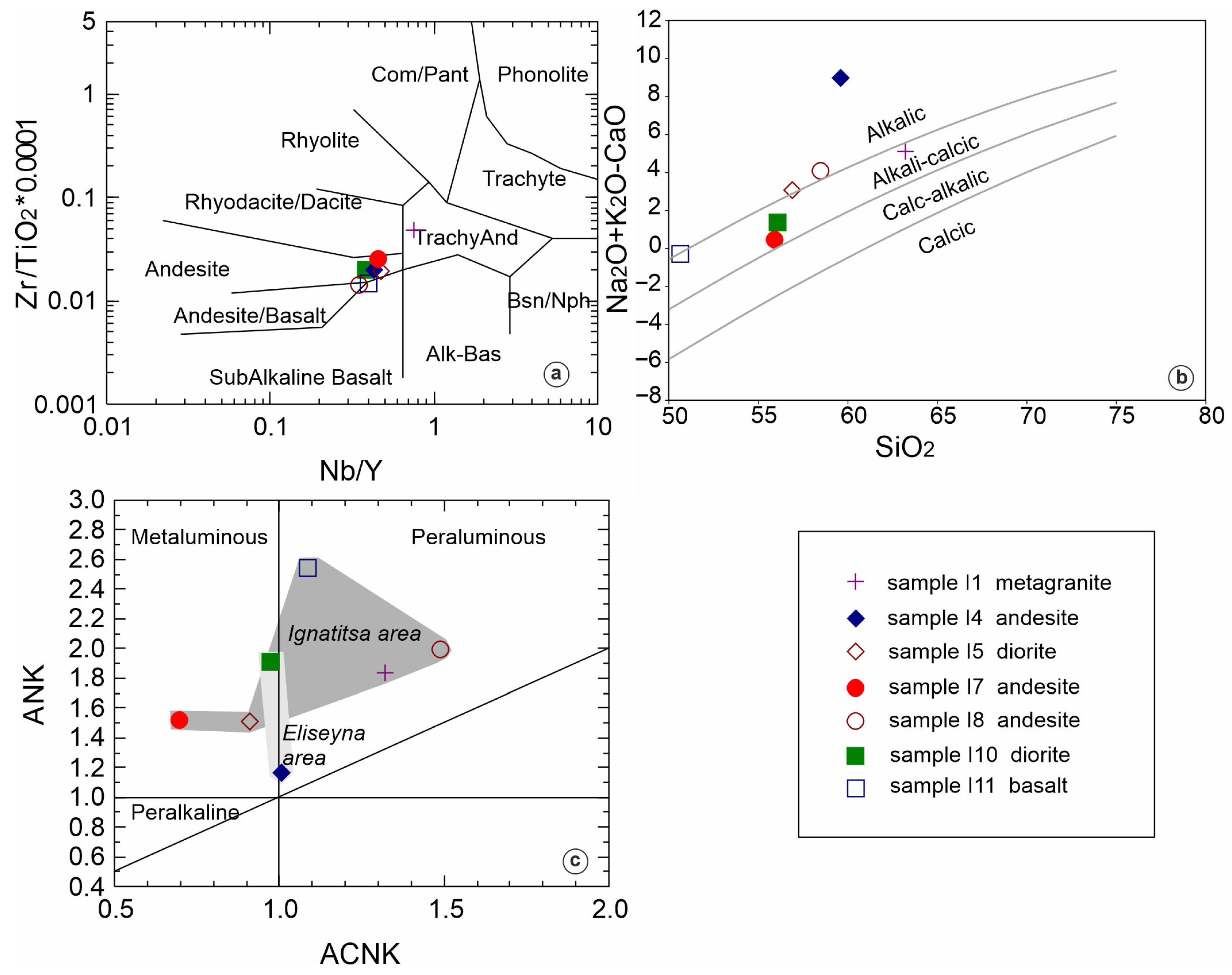
The SiO2 content ranges from 50.66 wt.% to 60.10 wt.% in diorite porphyres and volcanic rock samples, attaining maximal abundance of 64.81 wt.% in the Rzhanski aplitic metagranite. On the Zr/TiO2 vs. Nb/Y diagram, the samples cover the intermediate to acid andesite to trachyandesite compositions (Figure 5a). They are characterized by low TiO2, MgO2 and Fe2O3 concentrations and demonstrate mostly alkali-calcic affinity (Table S1, Figure 5b). Alkali contents are variable between 5.84 and 10.39 wt.%, with high Na/K ratios. The Rzhanski aplitic metagranite and the overlying lavas are peraluminous (A/CNK > 1, molecular Al2O3/CaO + Na2O + K2O), while the Ignatitsa and Eliseyna diorite porphyries are metaluminous (Figure 5c). In terms of the trace elements, the studied rocks have relatively high abundances of some high-field strength elements (HFSEs) (e.g., Nb and Zr), low abundances of other HFSEs (e.g., Y, Ta and Ti) and low concentrations of some compatible elements (e.g., Cr 40–146 ppm, Ni 14–59 ppm and V 115–205 ppm), which are all typical for relatively evolved igneous rocks (see Table S1). Major and trace element geochemistry classifies the studied rocks as calc-alkaline intermediate to acid plutonic, subvolcanic and volcanic igneous rocks (Figure 5, Table S1). They have preserved their initial composition, largely unaffected by low-grade metamorphism except sample I1.
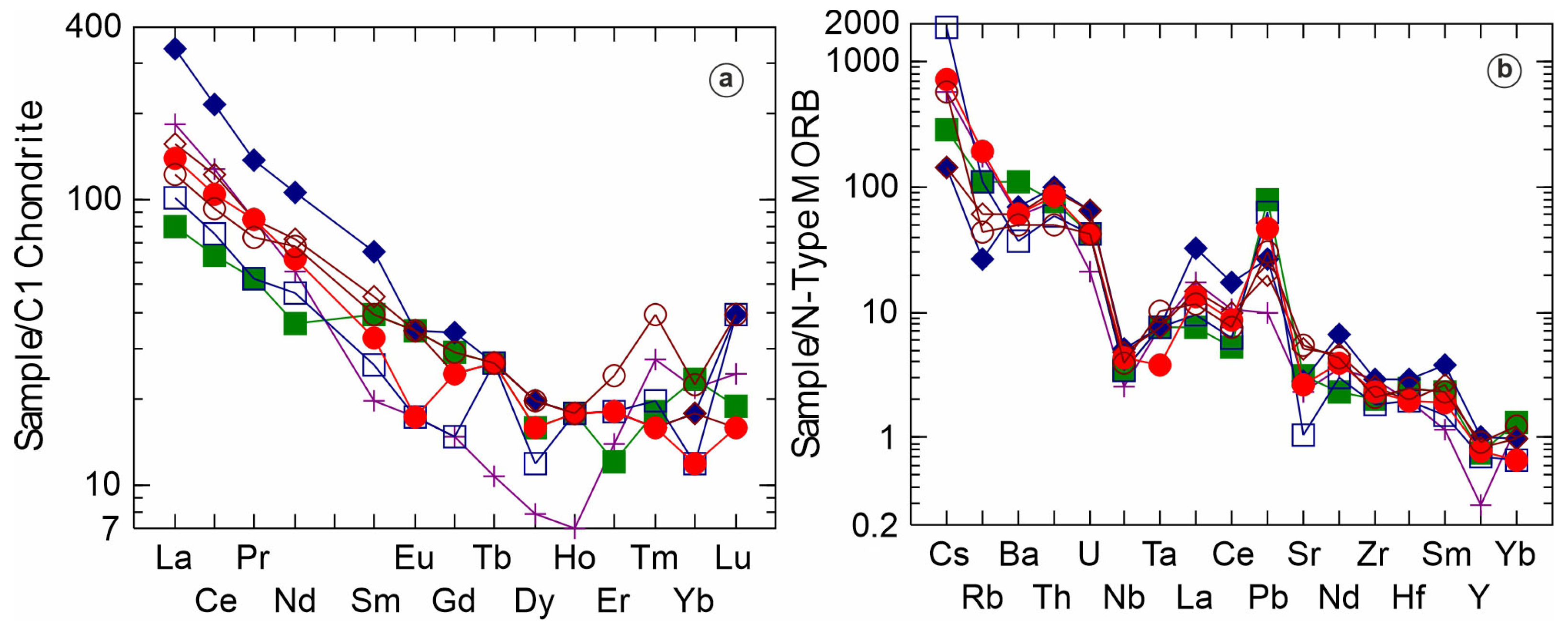
Chondrite-normalized REE profiles of the plutonic, subvolcanic and volcanic rocks are characterized by light rare earth element (LREE) enrichment relative to the heavy rare-earth elements (HREE), with a moderate negative Eu anomaly only in one sample (Figure 6a). In the spider diagram, all studied samples display fractionated patterns, with a negative Nb anomaly and a positive Pb anomaly (Figure 6b). Overall, the LREE- and large-ion lithophile elements (LILE)-enriched, and HFSE-depleted geochemical pattern characterizes the studied plutonic, subvolcanic and volcanic rocks (Figure 6), which altogether demonstrate a uniform composition by subparallel trace elements and LREE profiles of the samples.
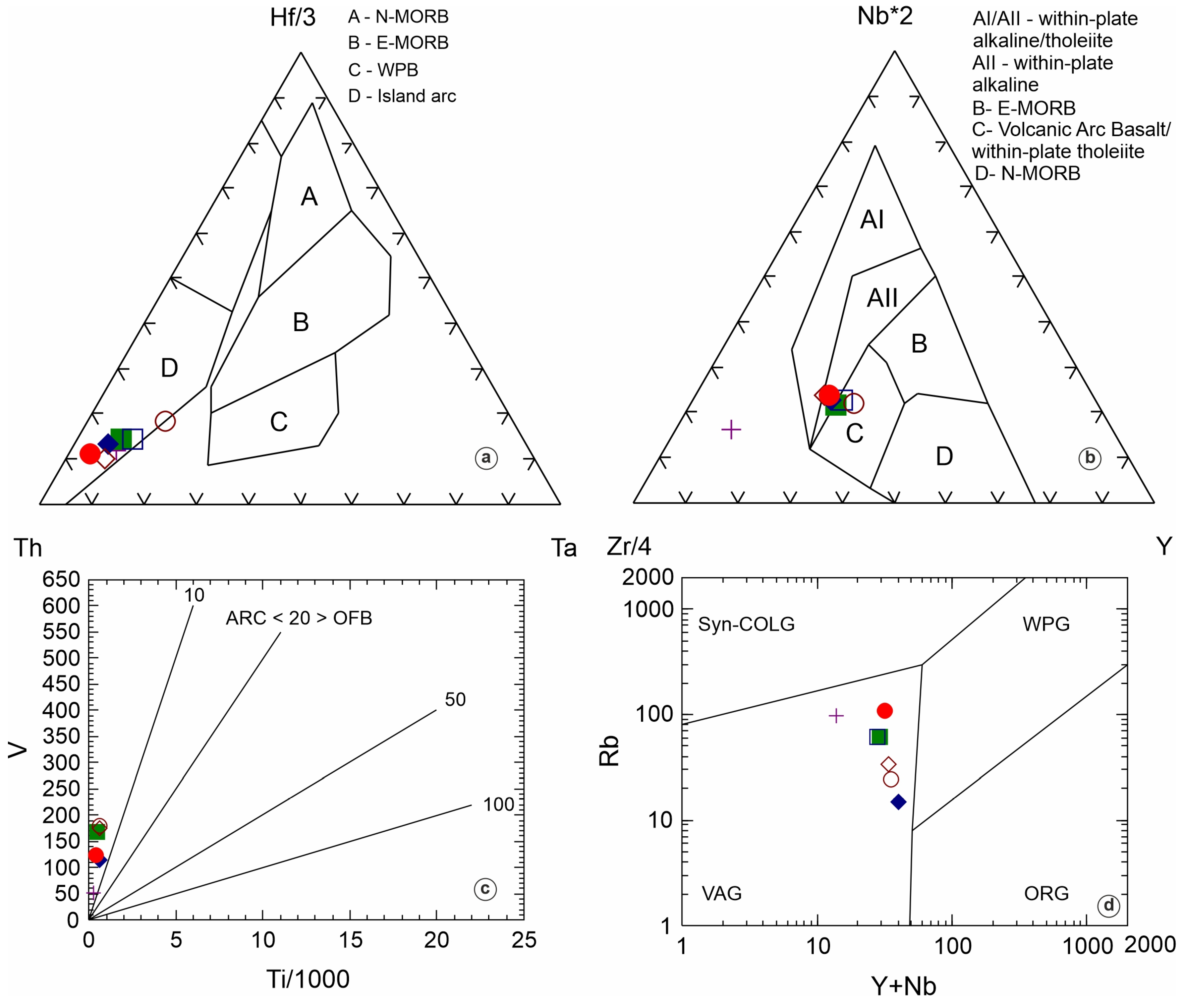
Based on relatively immobile trace elements, the tectonic setting of the studied plutonic, subvolcanic and volcanic rocks has been constrained using different discriminative diagrams (Figure 7). In the tectono-magmatic setting diagrams for basic–intermediate rocks modeled after Wood [28], Meschede [29] and Shervais [30], the samples plot in the arc-related fields (Figure 7a–c). In the tectono-magmatic setting diagram for granitoids modeled after Pearce et al. [31], the samples plot in the field of volcanic arc granites (VAG) (Figure 7d).

4.3. U-Pb Geochronology

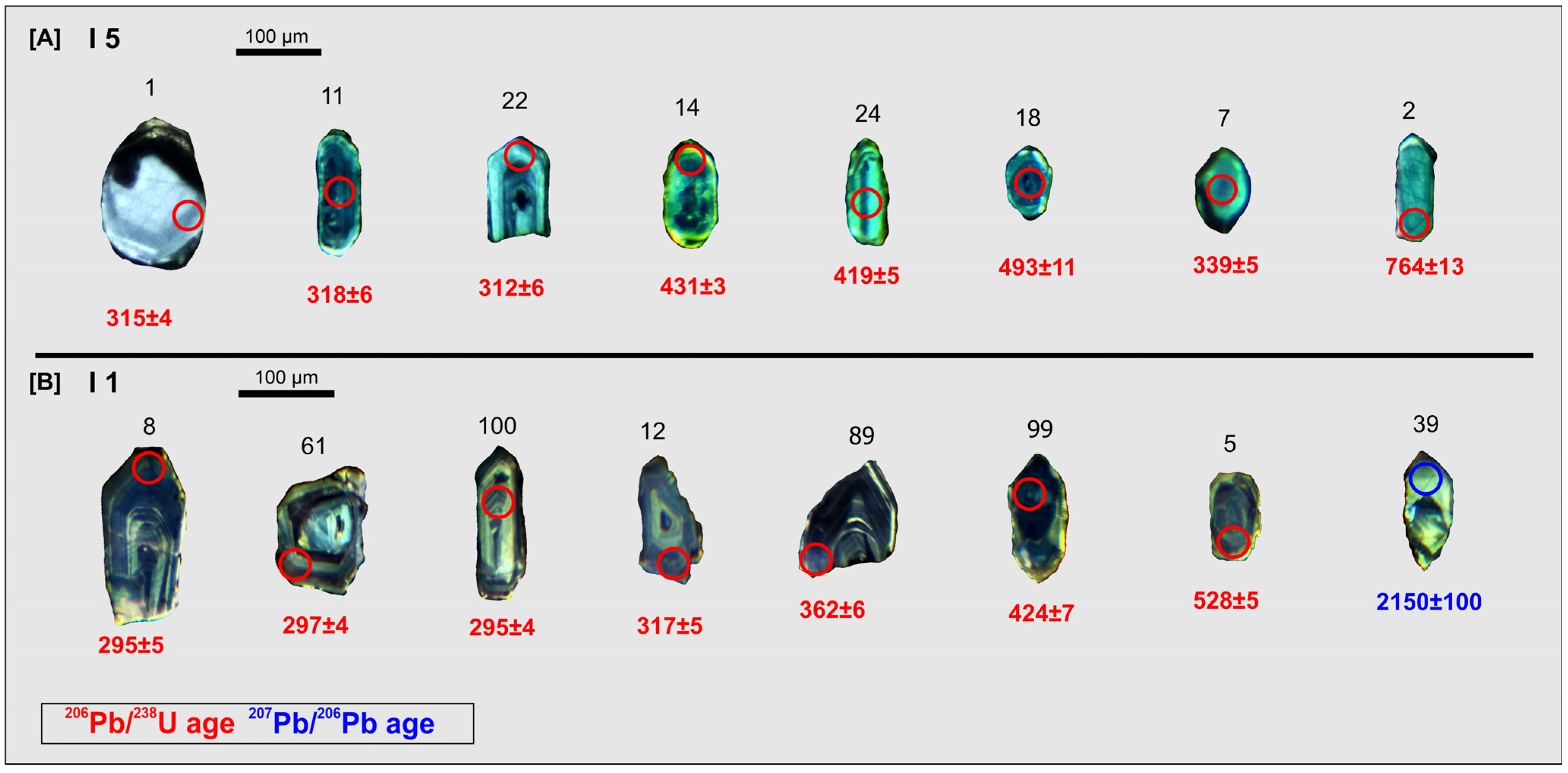
The dated zircons in the Ignatitsa diorite porphyry sample I5 are mostly prismatic in shape and vary in size from 100 µm to 250 µm. They display oscillatory and sector zoning patterns that both are characteristic of a magmatic origin, e.g., [32] (Figure 8A). The Th/U ratios of the dated zircons in this sample range from 0.004 (single zircon) to 0.71, which is also typical for magmatic zircons, e.g., [33,34].
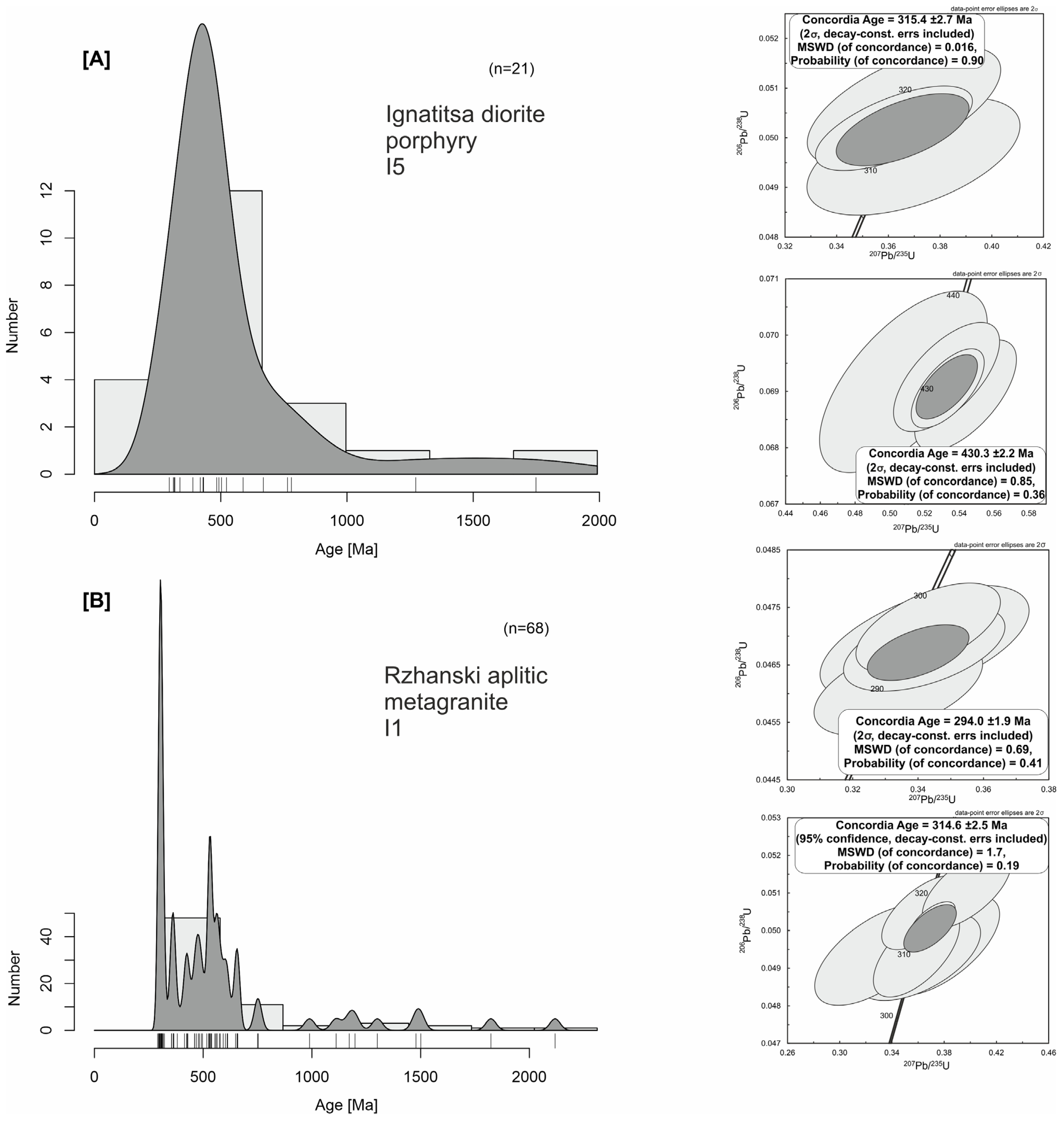
In sample I5, the 206Pb/238U ages obtained from 21 analyses range from 1685 Ma to 294 Ma (Figure 8A, Table S1). The three youngest concordant zircons provided an age of 315.4 ± 2.7 Ma, which is interpreted to date a Late Carboniferous magmatic crystallization age of the diorite porphyry (Figure 9A). Four zircons are concordant at 430.3 ± 2.2 Ma (Figure 9A) and other three concordant zircons yielded an age of 500.3 ± 6.9 Ma. These latter two age clusters of inherited zircons are joined by other zircon clusters and single zircons that span down to the Paleoproterozoic in sample I5.
Zircons from the Rzhanski aplitic metagranite sample I1 show mainly prismatic and rarely pyramidal crystals varying in size from 80 µm to 250 µm, which have magmatic oscillatory and sector zoning patterns (Figure 8B). In sample I1, the 206Pb/238U ages obtained from sixty-eight zircon analyses range from 2114 Ma to 290 Ma (Figure 9B, Table S1). Four youngest zircons yielded a concordia age of 294.0 ± 1.9 Ma (Figure 9B), which is interpreted to date the magmatic crystallization of the aplitic metagranite. Concordia ages from two to nine zircon clusters were also obtained between 2.1 Ga and 750 Ma, and at 650.9 ± 4.8 Ma, 611.7 ± 6.0 Ma, 578.8 ± 4.2 Ma, 559.8 ± 3.8 Ma, 527.3 ± 5.5 Ma, 482.3 ± 7.9 Ma, 423.7 ± 4.1 Ma, 362.1 ± 3.4 Ma, 314.6 ± 2.5 Ma, 303.7 ± 1.7 Ma and 298.9 ± 1.9 Ma (Figure 9B). The Th/U ratios of the dated concordant zircons of sample I1 range from 0.06 to 1.31 (see Table S1), which is typical for magmatic zircons.

5. Regional Frame of the Late Paleozoic Magmatism and Metamorphism in the Western Balkan Zone—A Discussion

5.1. Late Paleozoic Magmatism

Our geochemical and geochronological results along the Iskar River Valley in the WBZ demonstrate a Late Carboniferous (315 Ma) and Early Permian (294 Ma) magmatic crystallization of calc-alkaline subvolcanic and intrusive bodies that originated in a continental magmatic arc environment. Thus, they expand the available record of Late Paleozoic magmatism in this zone, highlighting the need to consider it within a regional-scale context.
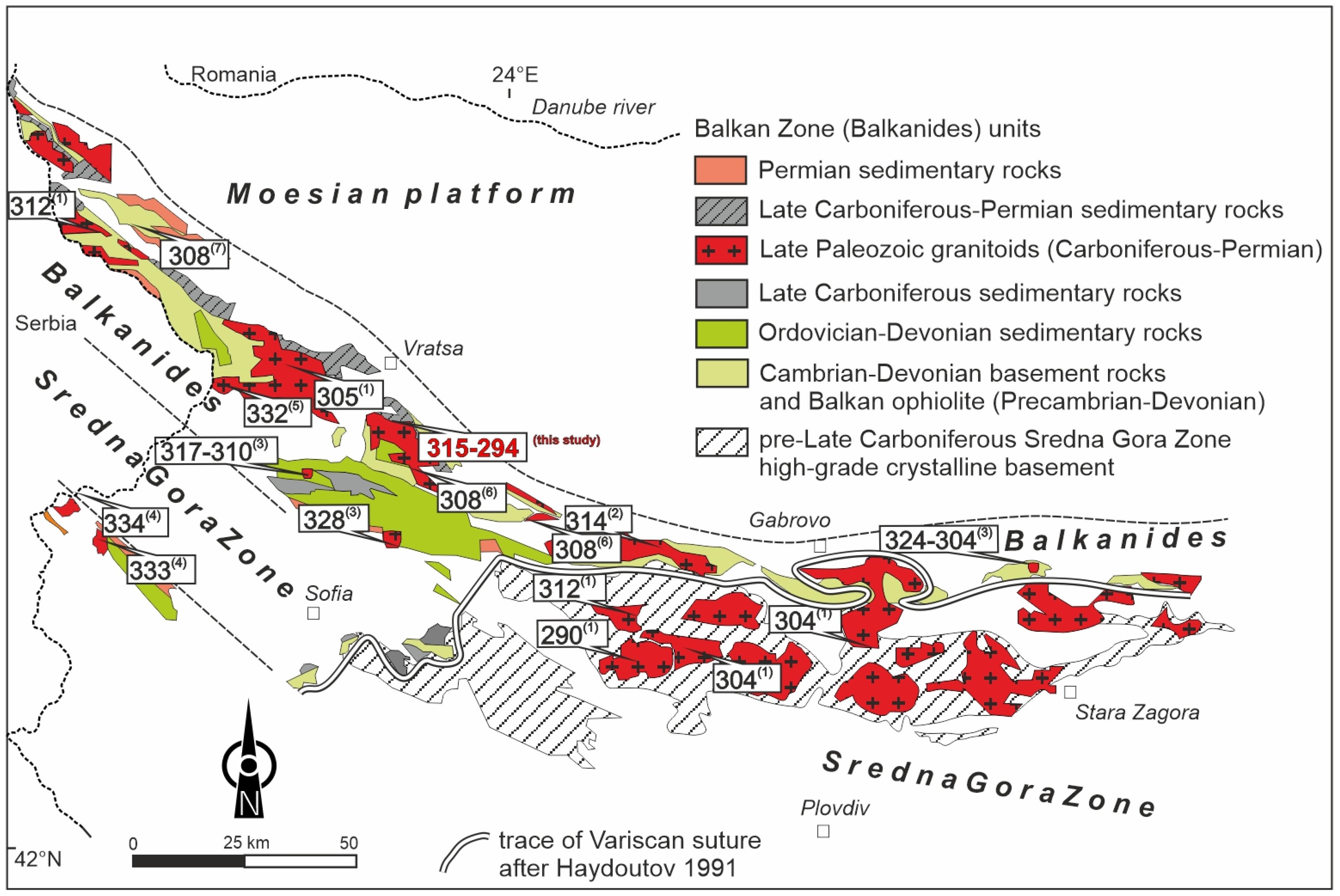
Late Carboniferous igneous activity in the western and central parts of the BZ has been traditionally interpreted in terms of Variscan tectono-magmatic and metamorphic evolution [1,3,4,5,6,8] that is comparable to those known in the Variscan orogenic belt of Western–Central Europe, e.g., [35,36]. Based on previous radiometric studies and the present study summarized in Figure 10, we can document temporally continuous intermediate-to-acid intrusive Variscan magmatism that encompasses Early Carboniferous and mostly Late Carboniferous to Early Permian times (332–294 Ma) in the WBZ. Such widespread intrusive magmatism that spans the same time interval characterizes the Sredna Gora Zone to the south (Figure 10), wherein the crystalline basement has been documented to be associated with high-grade metamorphism around 337 Ma [6].

5.2. Age Constraints for the Greenschist Facies Metamorphism

Based on U-Pb zircon dating, Bonev et al. [15] have discussed that to the north in the WBZ, the Sredogriv metamorphic rocks record greenschist facies metamorphism that occurs after the intrusion of (meta)albite-rich granophyre at 308 Ma and prior to the unconformable deposition of clastic rocks at 263 Ma. Our age result of the Rzhanski aplitic metagranite from the Iskar River Valley allows us to lower the upper age limit of the greenschist facies metamorphism after 294 Ma for that part of the WBZ, and thus, it is bracketed between 294 Ma and 263 Ma. This time interval of Early–Middle Permian greenschist facies metamorphism is also consistent with the depositional timing (ca. 268 Ma) of the clastic sedimentary rocks overlying the Late Carboniferous–Early Permian magmatic rocks along the Iskar River Valley (Figure 2).

5.3. Zircon Inheritance

In addition, the presence of Paleoproterozoic to Early Carboniferous xenocrystic zircons with high Th/U ratios (Table S2), reflecting a magmatic parentage within the studied diorite porphyry and aplitic metagranite (Figure 9), indicate that the magmas sampled the host rocks en route to the surface. These inherited zircons support the existence of pre-Paleozoic and lower Paleozoic igneous and metamorphic basements in a similar way to further north in the WBZ, where prominent zircon peaks range between 670 Ma and 520 Ma [15]. The recorded single zircons or minor clusters of Late Carboniferous and Early Permian zircons in the studied magmatic rocks might well represent antecrysts entrained in closest-to-age magmatic chambers in the studied area and on a regional scale (Figure 10).

6. Conclusions

1. Geochemical data indicate that the studied intermediate-to-acid magmatic rocks retained their initial composition of mostly peraluminous, calc-alkaline diorite/andesite to granite, that originated in a continental magmatic arc tectonic setting. All plutonic, subvolcanic and volcanic rocks exhibited uniform LILE- and LREE-enriched characteristics of an arc-related igneous suite.
2. U-Pb zircon geochronological data obtained for the Ignatitsa diorite porphyry and Rzhanski aplitic metagranite support a Late Carboniferous–Early Permian crystallization stage of the igneous bodies at 315 and 294 Ma, respectively. This Variscan Late Carboniferous-Early Permian magmatic stage was initiated earlier in Early–Late Carboniferous bodies, around 330 Ma based on few zircon antecrysts entrained in magma chambers of closest age. The inherited Paleoproterozoic to Carboniferous in age zircons discovered in the magmatic bodies indicate the presence of underlying pre-Paleozoic and lower Paleozoic crystalline basement.
3. As the 294 Ma-old Rzhanski aplitic granite is metamorphosed in greenschist facies, this implies that the Permain metamorphic event postdates the crystallization of the granite and predates the late Middle Permian (268 Ma) deposition of clastic rocks in the area, which is temporarily consistent with other analogous age constraints on a regional scale.
4. The record of the Variscan intrusive magmatism encompasses a region-wide, well-documented 332–294 Ma time interval in the WBZ, which temporarily overlaps the span of this magmatism in the adjacent Sredna Gora Zone.

Supplementary Materials

The following supporting information can be downloaded at https://www.mdpi.com/article/10.3390/app16020637/s1: Table S1: Whole-rock geochemistry; Table S2: U-Pb zircon geochronology analytical data.

Author Contributions

Investigation, conceptualization, visualization, writing—original draft preparation, validation, N.B.; methodology, software, writing—review and editing, funding acquisition, project administration, P.F.; investigation, formal analysis, validation, T.V., T.S. and H.G. All authors have read and agreed to the published version of the manuscript.

Funding

This research was funded by NATIONAL SCIENCE FUND BULGARIA, grant number KP-06-N-74/4.

Institutional Review Board Statement

Not applicable.

Informed Consent Statement

Not applicable.

Data Availability Statement

Research data are available from the corresponding author upon request.

Conflicts of Interest

The authors declare no conflicts of interest.

References

  1. Haydoutov, I.; Yanev, S. The Protomoesian microcontinent of the Balkan Peninsula—A peri-Gondwanaland piece. Tectonophysics 1997, 272, 303–313. [Google Scholar] [CrossRef]
  2. Carrigan, C.; Mukasa, S.B.; Haydoutov, I.; Kolcheva, K. Neoproterozoic magmatism and Carboniferous high-grade metamorphism in the Sredna Gora Zone, Bulgaria: An extension of Gondwana-derived Avalonian-Cadomian belt? Prec. Res. 2006, 147, 404–416. [Google Scholar] [CrossRef]
  3. Carrigan, C.; Mukasa, S.; Haydoutov, I.; Kolcheva, K. Age of Variscan magmatism from the Balkan sector of the orogen, central Bulgaria. Lithos 2005, 82, 125–147. [Google Scholar] [CrossRef]
  4. Cortesogno, L.; Gaggero, L.; Ronchi, A.; Yanev, S. Late orogenic magmatism and sedimentation within Late Carboniferous to early Permian basins in the Balkan terrane (Bulgaria): Geodynamic implications. Int. J. Earth Sci. 2004, 93, 500–520. [Google Scholar] [CrossRef]
  5. Dyulgerov, M.; Ovtcharova-Schaltegger, M.; Ulianov, A.; Schaltegger, U. Timing of high-K alkaline magmatism in the Balkan segment of southeast European Variscan edifice: ID-TIMS and LA-ICP-MS study. Int. J. Earth Sci. 2018, 107, 1175–1192. [Google Scholar] [CrossRef]
  6. Georgiev, S.; Lazarova, A.; Balkanska, E.; Naydenov, K.; Broska, I.; Kurylo, S. Time constraints on the Variscan magmatism along Iskar River Gorge and Botevgrad basin, Bulgaria. Rev. Bulg. Geol. Soc. 2024, 85, 159–162. [Google Scholar] [CrossRef]
  7. Angelov, V.; Antonov, M.; Gerdjikov, S.; Petrov, P.; Aydanliyski, G.; Kiselinov, H.; Valev, V. Explanatory Note of Geological Map of Bulgaria, Scale 1:50 000, Sheet Mezdra; Angelov, V., Chrischev, C., Eds.; Ministry of Environment and Water. Bulgarian Geological Survey: Sofia, Bulgaria, 2008; 101p, (In Bulgarian with English Abstract). [Google Scholar]
  8. Dabovski, C.; Zagorchev, I. Chapter 5.1. Introduction: Mesozoic evolution and alpine structure. In Geology of Bulgaria; Volume 5 part 2. Mesozoic geology; Zagorchev, I., Dabovski, C., Nikolov, T., Eds.; Academic Publishing House “Marin Drinov”: Sofia, Bulgaria, 2009; pp. 13–37, (In Bulgarian with English Abstract). [Google Scholar]
  9. Ivanov, Z. Tectonics of Bulgaria; Sofia University Press: Sofia, Bulgaria, 2017; p. 331, (In Bulgarian with English Abstract). [Google Scholar]
  10. Boyadjiev, S. On the diabase-phyllitoid complex in Bulgaria. Rev. Bulg. Geol. Soc. 1970, 31, 63–74, (In Bulgarian with English Abstract). [Google Scholar]
  11. Haydoutov, I. Origin and Evolution of the Precambrian Balkan-Carpathian Ophiolitic Segment; Publishing House of the Bulgarian Academy of Sciences: Sofia, Bulgaria, 1991; 176p, (In Bulgarian with English Abstract). [Google Scholar]
  12. Von Quadt, A.; Peytcheva, I.; Haydoutov, I. U-Pb dating of Tcherni Vrah metagabbro, West Balkan, Bulgaria. C. R. Acad. Bulg. Sci. 1998, 51, 81–84. [Google Scholar]
  13. Kiselinov, H.; Georgiev, S.; Vangelov, D.; Gerdjikov, I.; Peytcheva, I. Early Devonian Carpathian-Balkan ophiolite formation: U–Pb zircon dating of Cherni Vrah gabbro, Western Balkan, Bulgaria. In Proceedings of the National Conference with International Participation “GEOSCIENCES 2017”, Sofia, Bulgaria, 7–8 December 2017; Bulgarian Geological Society: Sofia, Bulgaria, 2017; pp. 59–60. [Google Scholar]
  14. Kalvacheva, R. Palynology and stratigraphy of the Diabse-Phyllitoid complex in the West Balkan Mountains. Rev. Bulg. Geol. Soc. 1982, 33, 8–24, (In Russian with English Abstract). [Google Scholar]
  15. Bonev, N.; Filipov, P.; Vladinova, T.; Stoylkova, T.; Georgieva, H.; Georgiev, S.; Kiselinov, H.; Macheva, L. U-Pb zircon age constraints on the Paleozoic sedimentation, magmatism and metamorphism of the Sredogriv metamorphics, Western Balkan Zone, NW Bulgaria. Geosciences 2025, 15, 148. [Google Scholar] [CrossRef]
  16. Haydoutov, I. On the structural facies of some plutons from the Western Stara Planina. Bull. Geol. Inst. Ser. Geotect. 1971, 20, 75–94, (In Bulgarian with English Abstract). [Google Scholar]
  17. Peytcheva, I.; Von Quadt, A.; Malinov, O.; Tacheva, I.; Nedyalkov, R. Petrochan and Klissura plutons in Western Balkan: Reationships, in situ and single grain U-Pb zircon/monazite dating and isotopic tracing. In Proceedings of the National Conference with International Participation “GEOSCIENCES 2006”, Sofia, Bulgaria, 7–8 December 2006; Bulgarian Geological Society: Sofia, Bulgaria, 2006; pp. 221–224. [Google Scholar]
  18. Dimitrov, S. The eruptive rocks of the Balkan between the Petrochan Pass and the Rzhana Mountain. J. Bulg. Acad. Sci. 1927, 36, 93–167. [Google Scholar]
  19. Vutov, I. Petrochemical study of the intrusive rocks from the Western Stara Planina between the Petrochan Pass and the Rzhana Mountain. Ann. High Inst. Min. Geol. 1969, 14, 153–174. [Google Scholar]
  20. Bachneva, D.; Maschteryakova, V.; Stefanov, N.; Velichkov, D.; Djelepov, T.; Ilieva, D.; Yankov, V. Characteristic features of orogenic Paleozoic volcanism in the Western Balkan. Jubil. Ann. 30 Years High Inst. Min. Geol. 1983, 26, 221–235. [Google Scholar]
  21. Tanasiev, S.; Ichev, M.; Pristavova, S. U-Pb zircon dating of acid volcanic rocks from the Sofia Stara Planina (Balkan) Mountains, West Bulgaria. In Proceedings of the National Conference with International Participation “GEOSCIENCES 2012”, Sofia, Bulgaria, 7–8 December 2012; Bulgarian Geological Society: Sofia, Bulgaria, 2012; pp. 69–70. [Google Scholar]
  22. Tenchov, Y. Stratigraphy of Stephanian-Permian fossiliferous sedimentary rocks in the North-Western Bulgaria. Bull. Geol. Inst. ser. Strat. Lithol. 1973, 22, 55–72. [Google Scholar]
  23. Yanev, S.; Tenchov, Y. Stephanian-Permian rocks at vicinity of the villages Zgorigrad, Zverino and Ignatitsa, North-Western Bulgaria. Paleontol. Stratigr. Lithol. 1978, 9, 3–26. [Google Scholar]
  24. Winchester, J.A.; Floyd, P.A. Geochemical discrimination of different magma series and their differentiation products using immobile elements. Chem. Geol. 1977, 20, 325–343. [Google Scholar] [CrossRef]
  25. Frost, B.R.; Barnes, C.G.; Collins, W.J.; Arculus, R.J.; Ellis, D.J.; Frost, C.D. A geochemical classification for granitic rocks. J. Petrol. 2001, 42, 2033–2048. [Google Scholar] [CrossRef]
  26. Maniar, P.D.; Piccoli, P.M. Tectonic discrimination of granitoids. Bull. Geol. Soc. Am. 1989, 101, 635–643. [Google Scholar] [CrossRef]
  27. Sun, S.S.; McDonough, W.F. Chemical and isotopic systematics of ocean basalts: Implications for mantle composition and processes. In Magmatism in Ocean Basins; Saunders, A.D., Norry, M.J., Eds.; Geological Society: London, UK; Special Publication: London, UK, 1989; Volume 42, pp. 313–345. [Google Scholar]
  28. Wood, D.A. The application of a Th-Hf-Ta diagram to problems of tectono-magmatic classification and to establishing the nature of crustal contamination of basaltic lavas of the British Tertiary volcanic province. Earth Planet. Sci. Lett. 1980, 50, 11–30. [Google Scholar] [CrossRef]
  29. Meschede, M. A method of discriminating between different types of mid-ocean ridge basalts and continental tholeiites with the Nb-Z-Y diagram. Chem. Geol. 1986, 56, 207–218. [Google Scholar] [CrossRef]
  30. Shervais, J.W. Ti-V plots and the petrogenesis of modern ophiolitic lavas. Earth Planet. Sci. Lett. 1982, 57, 101–118. [Google Scholar] [CrossRef]
  31. Pearce, J.A.; Harris, N.B.W.; Tindle, A.G. Trace element discrimination diagrams for the tectonic interpretation of granitic rocks. J. Petrol. 1984, 25, 956–983. [Google Scholar] [CrossRef]
  32. Hoskin, P.W.O.; Schaltegger, U. The composition of zircon in igneous and metamorphic petrogenesis. Rev. Mineral. Geochem. 2003, 53, 27–62. [Google Scholar] [CrossRef]
  33. Rubatto, D. Zircon trace element geochemistry: Partitioning with garnet and the link between U-Pb ages and metamorphism. Chem. Geol. 2002, 184, 123–138. [Google Scholar] [CrossRef]
  34. Tiepel, U.; Eichhorn, R.; Loth, G.; Rohrmülle, J.; Höll, R.; Kennedy, A. U-Pb SHRIMP and Nd isotopic data from the western Bohemian Massif (Bayerischer Wald, Germany): Implications for Upper Vendian and Lower Ordovician magmatism. Int. J. Earth Sci. 2004, 93, 782–801. [Google Scholar] [CrossRef]
  35. Finger, F.; Roberts, M.P.; Haunschmid, B.; Schermaier, A.; Steyrer, H.P. Variscan granitoids of central Europe: Their typology, potential sources and tectonothermal relations. Mineral. Petrol. 1997, 61, 67–96. [Google Scholar] [CrossRef]
  36. Kroner, U.; Romer, R.L. Two plates—Many subduction zones: The Variscan orogeny reconsidered. Gond. Res. 2013, 24, 298–329. [Google Scholar] [CrossRef]
  37. Bonev, N.; Filipov, P.; Raicheva, R.; Moritz, R. Timing and tectonic significance of Paleozoic magmatism in the Sakar unit of the Sakar-Strandzha zone, SE Bulgaria. Int. Geol. Rew. 2019, 61, 1957–1979. [Google Scholar] [CrossRef]
  38. Kamenov, B.; von Quadt, A.; Peytcheva, I. New insight into petrology, geochemistry, and dating of the Vejen pluton, Bulgaria. Geochem. Mineral. Petrol. 2002, 39, 3–26. [Google Scholar]
  39. Peytcheva, I.; von Quadt, A.; Dyulgerov, M.; Nedyalkov, R. Age and source heterogeneities in the rocks of Luzkan and Ruy plutons, Bulgaria: Some thoughts about their relations to the Au mineralization at “Zlata” deposit. Geol. Balc. 2010, 39, 306–307. [Google Scholar]
Figure 1. (a) The Alpine belt in the Aegean region of the Eastern Mediterranean. Box depicts area of the schema in (b). (b) Tectonic schema of the WBZ in Northwestern Bulgaria. Abbreviations: BU—Belogradchik unit; BRU—Berkovitsa unit; KU—Kula unit; KRU—Krajna unit; MU—Montana unit; SU—Svoge unit; VU—Vratsa unit.
Applsci 16 00637 g001
Figure 2. Simplified geological map of the study area after [7] showing the location and numbers of the studied samples. Other red colored numbers refer to the locations of samples of unpublished U-Pb detrital zircon ages in some clastic formations, whose timing of deposition visibly differ from that previously assumed.
Applsci 16 00637 g002
Figure 3. (a) Quartz-chlorite schist of DPhC. (b) Macroscopic aspect of Ignatitsa diorite porphyry. (c) Hand specimen of andesite lava sample I4 (location in Figure 2). (d) Lava flow unconformably overlain by Ochindol Formation conglomerate that contains reworked volcanic clasts.
Applsci 16 00637 g003
Figure 4. (a) Microphotograph of Ignatitsa diorite porphyry (sample I5). (b) Microphotograph of leucocratic granite (sample I1). (c) Microphotograph of andesite (sample I8). Abbreviations: qz, quartz; pl, plagioclase; kfs, K-feldspar; cpx, clinopyroxene; amph, amphibole; ep, epidote; chl, chlorite; mt, magnetite. All microphotographs were taken under cross-polarized light (XPL).
Applsci 16 00637 g004
Figure 5. (a) Zr/TiO2 vs. Nb/Y diagram (after [24]). (b) Na2 O + K2O vs. SiO2 diagram [25]. (c) ANK-ACNK diagram (after [26]).
Applsci 16 00637 g005
Figure 6. (a) Chondrite-normalized REE diagram; (b) N-MORB-normalized multielement diagram. Normalization values after [27].
Applsci 16 00637 g006
Figure 7. Tectono-magmatic discrimination diagrams (trace elements in ppm). (a) Th-Ta-Hf/3 diagram (after [28]); (b) Zr/4-Y-Nb*2 diagram (after [29]); (c) V-Ti/1000 diagram (after [30]); (d) Rb-Y + Nb diagram (after [31]). Abbreviations: N-MORB, normal mid-ocean ridge basalt; E-MORB, enriched mid-ocean ridge basalt; WPB, within-plate basalt; OFB, ocean-floor basalt; Syn-COLG, syn-collisional granite; WPG, within-plate granite; VAG, volcanic arc granite; ORG, ocean-ridge granite.
Applsci 16 00637 g007
Figure 8. Selected cathodoluminescence images of dated zircons in the studied samples: (A) sample I5; (B) sample I1. The numbers refer to crystal ID numbers in Table S1.
Applsci 16 00637 g008
Figure 9. Kernel Density Estimation (KDE) and concordia diagrams of zircons from the dated samples: (A) sample I5; (B) sample I1.
Applsci 16 00637 g009
Figure 10. Synthetic tectonic map of the Western–Central Balkan Zone and Sredna Gora Zone (adapted after [37]), showing Carboniferous–Permian crystallization ages of granitoids. The Mesozoic and Cenozoic units are omitted for clarity. U-Pb zircon geochronology: 1, Carrigan et al. [3]; 2, Kamenov et al. [38]; 3, Dyulgerov et al. [5]; 4, Peytcheva et al. [17]; 5, Peytcheva et al. [39]; 6, Georgiev et al. [6]; 7, Bonev et al. [15]. Trace of Variscan suture after Haydoutov 1991 [11].
Applsci 16 00637 g010
Disclaimer/Publisher’s Note: The statements, opinions and data contained in all publications are solely those of the individual author(s) and contributor(s) and not of MDPI and/or the editor(s). MDPI and/or the editor(s) disclaim responsibility for any injury to people or property resulting from any ideas, methods, instructions or products referred to in the content.