1. Introduction
Railway transportation is widely used worldwide due to its advantages in safety, reliability, and low-carbon performance [
1,
2,
3]. By the end of 2024, the operational length of China’s railway network had reached 162,000 km. With the rapid expansion of the railway network and the continuous increase in freight demand, mixed passenger–freight operations have emerged as an effective organizational model for enhancing transportation efficiency and optimizing resource allocation [
4,
5]. In this context, the track structure must simultaneously satisfy the ride-comfort requirements of high-speed passenger trains and the load-bearing demands of heavy freight trains. However, the substantial differences in operating speed and axle load between passenger and freight rolling stock increase the complexity of the track’s mechanical environment, consequently influencing its functional performance and service life [
6,
7].
Under mixed passenger–freight operation, the vehicle–track dynamic interaction exhibits pronounced differences and high complexity. Numerous studies have investigated the vehicle–track interaction characteristics of mixed passenger–freight railways [
8,
9,
10,
11]. Early mixed lines primarily adopted ballasted track owing to its low cost and ease of maintenance. Lei et al. [
12] developed a vehicle–track vertical coupling model and examined the track’s dynamic response under vertical random irregularities. Zboinski et al. [
13] studied the influence of curve parameters on train dynamics simulation and the nonlinear lateral stability problem of trains passing through curved sections. Lei et al. [
14] applied the Fourier transform method to analyze the effects of passenger and freight vehicles on track vibration at different speeds, revealing that freight vehicle loading conditions were more unfavorable; they recommended implementing passenger–freight separation when conditions allow. As mixed passenger–freight railways age, severe foundation damage and substantial geometric degradation further complicate maintenance and repair. Ballastless track systems have also been widely studied in international contexts. Various structural forms such as Rheda, Zublin, and Borg slab systems have been deployed in Germany, and slab ballastless structures are commonly used in Japanese high-speed railways. With the advancement of ballastless track technology, researchers have increasingly focused on its applicability to mixed passenger–freight systems. Zhu [
15] conducted field tests on CRTS I double-block ballastless track and analyzed the dynamic responses of passenger and freight vehicles at different speeds. Peng [
16] developed a vehicle–CRTS I slab track coupling model, investigated the dynamic characteristics of both vehicle types, and proposed reasonable parameter ranges for components such as CA mortar and base plates. At present, CRTS III ballastless track has become the predominant structure for newly built high-speed and conventional railways in China; however, research on vehicle–track dynamic interaction under mixed passenger–freight conditions remains limited.
In order to regulate the dynamic response of the vehicle–track system, multi-layer elastic elements are usually incorporated into ballastless track structures. In the CRTS III ballastless track, the fastener system and the isolation layer act as key elastic components, and their stiffness plays a decisive role in the vibration isolation performance of the track. Tong [
17] systematically summarized the range, measurement methods, and engineering significance of vertical track stiffness, and indicated that unreasonable stiffness can cause an imbalance in wheel–rail dynamic interaction, thereby affecting structural durability and ride smoothness. Based on an elastic support block model for mixed passenger and freight lines, Qi et al. [
18] revealed that freight trains are a dominant factor contributing to fastener fatigue damage and proposed recommended stiffness values for fasteners. He [
19] discussed how track bed slab thickness, rubber cushion stiffness, and fastener stiffness influence the static and dynamic performance and fatigue behavior of long-sleeper embedded ballastless tracks, and proposed appropriate parameter ranges. Christian et al. [
20] quantified the stiffness characteristics of different fastener systems through experimental testing and analyzed how stiffness variations affect fastener force distribution. Xu et al. [
21] examined the effect of nonlinear stiffness characteristics of WJ-series fasteners on wheel–rail contact forces and system dynamic response. Zhang et al. [
22] analyzed the influence of base plate flexibility and cushion stiffness on the vibration characteristics of slab tracks. Previous studies have examined the effects of fastener stiffness and elastic layers on track vibration and load transmission, providing important insights into parameter selection and structural optimization. Moreover, stiffness parameters are often analyzed independently, without considering their coupled effects across multiple structural layers. The distinct dynamic characteristics induced by passenger and freight operating conditions—arising from significant differences in axle load and operating speed—are rarely addressed within a unified analytical framework, which restricts the applicability of existing findings to mixed-traffic railway systems.
Therefore, this study aims to investigate the multi-layer stiffness matching of ballast-less track systems for mixed passenger–freight railways. A coupled vehicle–CRTS III ballastless track dynamic model is established to represent both passenger and freight operating conditions. A systematic parametric analysis is conducted to evaluate the effects of fastener stiffness and cushion layer stiffness, both individually and in combination, on track dynamic response, interlayer force transmission, and vehicle operation safety. Based on multiple dynamic performance indicators, a multi-dimensional stiffness matching method is proposed to determine optimal and acceptable stiffness ranges that balance passenger comfort, freight operation safety, and track structural durability. The working hypothesis of this study is that appropriate coordination of multi-layer stiffness parame-ters enables the simultaneous satisfaction of these performance requirements under mixed passenger–freight traffic conditions. Although the analysis is conducted using typical Chinese ballastless track structures, the proposed methodology and findings are applicable to mixed-traffic railway systems with similar structural configurations.
2. Materials and Methods
Firstly, based on vehicle–track dynamics theory, the method for constructing a coupled vehicle–ballastless track coupled dynamic model for mixed passenger–freight railways is described in detail. A stiffness matching method for ballastless tracks based on multi-parameter fusion is also proposed.
2.1. Research Methodology
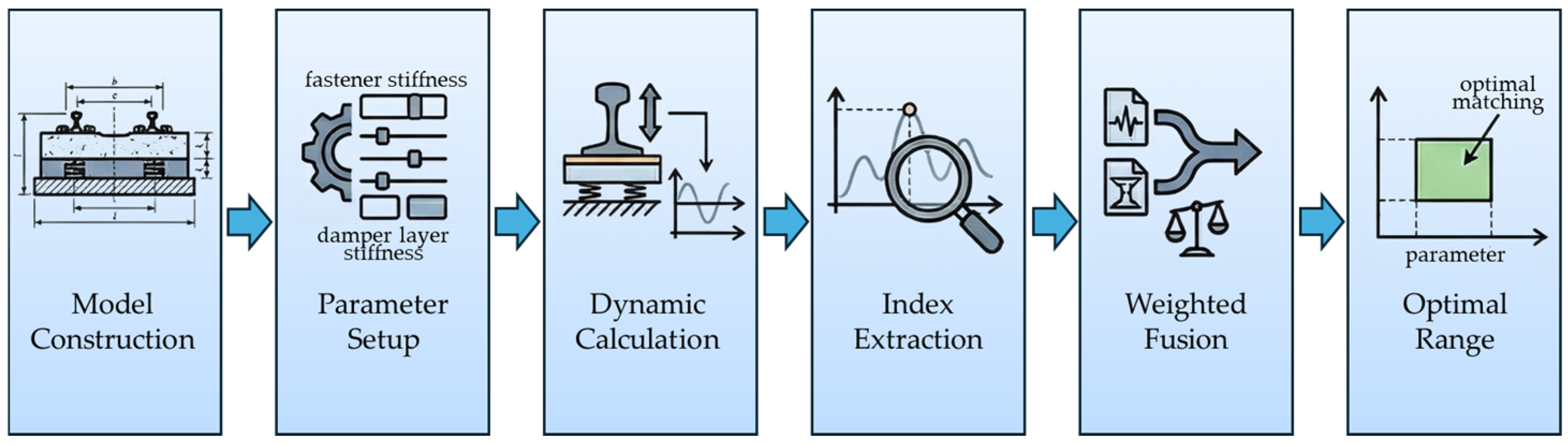
The research framework adopted in this study is illustrated in
Figure 1. The process begins with the construction of a coupled “vehicle–track” dynamics model. Subsequently, a parametric study is conducted by varying the stiffness of fasteners and damping pads (simulating different material moduli). Based on the simulation results, a decision matrix is formed using indicators of comfort, safety, and durability. Finally, a multi-dimensional fusion algorithm is applied to determine the optimal stiffness range.
2.2. Vehicle–Ballastless Track Coupled Dynamic Model of Mixed Passenger and Freight Railway
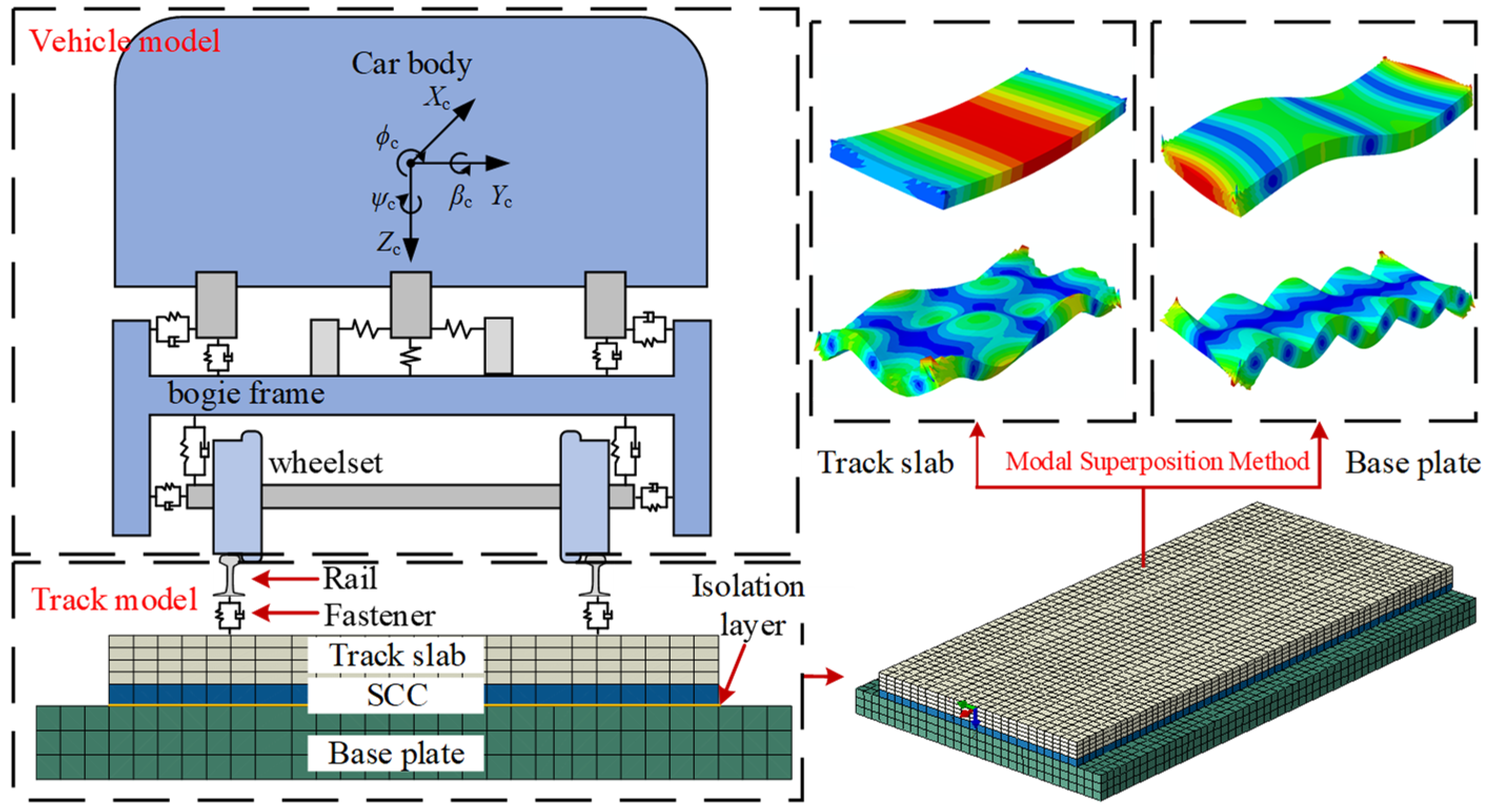
The vehicle–ballastless track coupled dynamic model is implemented using the multibody dynamics software Universal Mechanism 9.0. This model comprises the vehicle subsystem, ballastless track subsystem, and wheel–rail contact, as illustrated in
Figure 2. The vehicle subsystem models passenger cars and freight trains, achieving coupling through wheel–rail dynamic interaction.
2.2.1. Vehicle Model
Based on multibody dynamics theory, passenger train and freight train models are established respectively. The passenger train model contains 7 rigid bodies, including a car body, two bogies and four wheelsets, with a total of 35 degrees of freedom [
23]. Due to the different structural forms and vibration characteristics, the freight train model contains 11 rigid bodies, including a car body, side frame, bolster and wheelset, with a total of 55 degrees of freedom. The dynamic equation of the vehicle subsystem is:
where
,
and
are the mass, damping and stiffness matrices of the vehicle subsystem, respectively;
are the displacement vector of the vehicle subsystem;
is self-weight load vector of the vehicle,
is wheel–rail force.
The main parameters of the vehicle are listed in
Table 1. The CRH2 EMU is selected as the passenger train, and the typical C80 train is selected as the freight train.
2.2.2. Ballastless Track Model
The ballastless track is a complex structural system comprising the rail, fastener system, and a multi-layer track bed. A refined ballastless track model is developed based on the mechanical properties of each component, with detailed consideration of the vibration-reduction effects of the fasteners and Isolation layers [
24]. A Timoshenko beam with periodically spaced discrete supports is employed to simulate the vertical, lateral, and torsional characteristics of the rail. Using the finite element method, the dynamic equation of the rail is expressed as:
with
where
,
and
are the mass, stiffness and damping matrices of the rail, respectively;
and
are wheel–rail force and fastener force respectively;
and
represent the displacement vectors of rail and fastener respectively;
and
are the stiffness and damping matrix of rail and fastener respectively;
is the Boolean connection matrix.
The CRTS III ballastless track consists of a track slab, self-compacting concrete (SCC), an isolation layer, and a base plate. The track slab and SCC are poured integrally to form a composite slab. In the dynamic model, the vibrations of both the composite slab and the base plate are explicitly considered, while the isolation layer is simplified as a linear spring–damper element. The composite slab is solved using the modal superposition method, which significantly reduces the computational degrees of freedom within the same analysis frequency range. First, the free-vibration modal parameters of the composite slab are obtained from the finite element model. The dynamic governing equation in modal space is then formulated as:
with
where
,
and
are the generalized mass, damping and stiffness matrices of the composite plate, respectively;
is the
s-th free mode retained by the composite plate;
and
are the Rayleigh damping coefficients of the track slab;
is the modal frequency of the track slab;
and
are the displacement vectors of track slab in physical and modal space, respectively.
and
are the generalized loads of the track slab from the upper fastener and the lower isolation layer, respectively.
Similarly, the base plate is solved in modal coordinates based on constrained modal parameters under elastic subgrade support. To accurately simulate the elastic supporting effect of the subgrade while ensuring computational efficiency, the boundary condition at the bottom of the base plate is modeled using discrete grounding spring-damper elements. These elements are arranged at the finite element nodes of the base plate’s bottom surface to represent the equivalent vertical stiffness and damping of the foundation [
25,
26]. The dynamic governing equation is given by:
where
,
and
are the generalized mass, damping and stiffness matrices of the base plate, respectively.
is the retained constrained modal set of the base plate. The specific parameters of CRTS III ballastless track model structure are shown in
Table 2.
2.2.3. Wheel–Rail Interaction
Wheel–rail interaction forms the coupling interface between the vehicle and the ballastless track. It primarily involves the determination of wheel–rail spatial contact geometry and the computation of wheel–rail contact forces [
27,
28]. The displacement of the wheel–rail spatial contact point is obtained using the trace method, in which the contact position is identified by searching for the minimum distance between the wheel tread trace and the rail head profile. The normal wheel–rail force is calculated through a non-Hertzian contact algorithm based on virtual penetration, while the tangential creep force is determined using Kalker’s Fastsim algorithm. The governing expressions are:
where
is the virtual penetration coefficient;
and
are the elastic modulus and Poisson ratio, respectively;
is the correction coefficient;
is the rolling radius of the wheel.
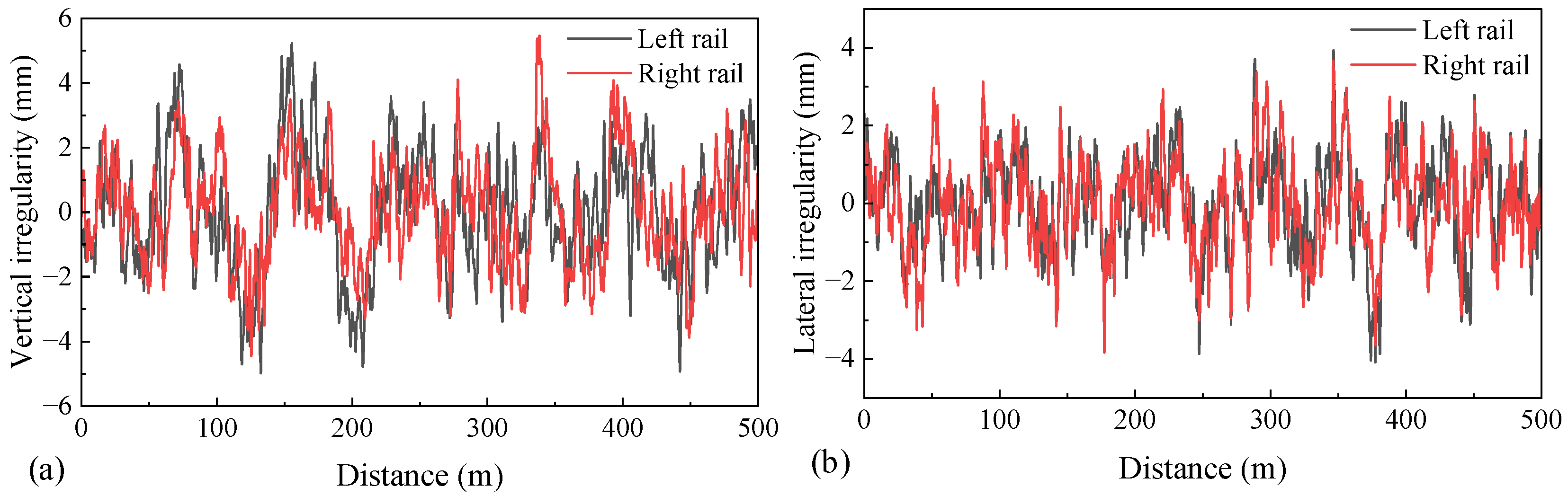
Track irregularities constitute the dominant excitation source of vehicle–track coupled vibration. To obtain dynamic responses that better reflect practical operating conditions, the track irregularity adopted in this study is composed of the measured long-wave irregularity recorded by a track inspection vehicle and the Sato roughness spectrum. Time domain samples are generated using an inverse Fourier transform, as shown in
Figure 3.
2.2.4. Model Verification
To evaluate the accuracy of the proposed vehicle–track coupled dynamics model, typical dynamic indices of the vehicle and track were selected and compared with existing literature [
29] and field measured data.
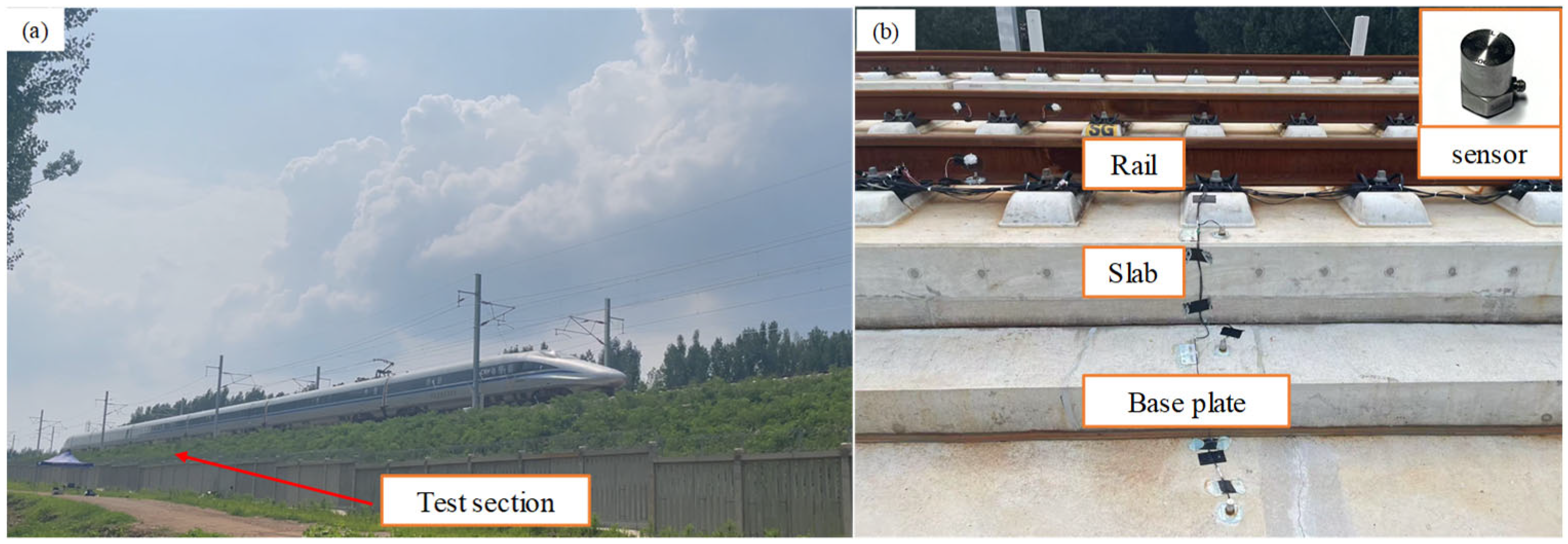
Figure 4 shows the field test section and sensor layout. The comparison results are shown in
Table 3. The calculated values show good agreement with the measured results, and the deviations remain within acceptable engineering limits. These findings demonstrate that the model provides reliable predictions of the vehicle–track dynamic response.
2.3. Stiffness Matching Method of Ballastless Track Based on Multi-Dimensional Parameter Fusion

In complex engineering systems, the collaborative analysis of multi-source heterogeneous high-dimensional parameters is crucial to the accuracy of decision-making. A single parameter is difficult to fully characterize the system state, and simple superposition will lead to dimension disaster, noise amplification and redundant information. Therefore, a stiffness matching method of ballastless track based on multi-dimensional parameter fusion is proposed in this study, and the optimal matching is realized by structural fusion and constraint optimization. The realization of reasonable stiffness matching depends on the constraint optimization mechanism in the fusion space. The algorithm formalizes the matching problem as a constrained optimization goal.
Firstly, it is necessary to select the evaluation index from the vehicle–track coupled dynamics model, construct the index set G = {G1, G2, …, Gm} (m is the number of selected indexes), and define the reasonable matching initial decision matrix X = (xij)n×m(i = 1, 2, …, n; j = 1, 2, …, m). xij represents the original parameter value of the i stiffness combination under the j-th evaluation index, which provides the data basis for the subsequent fusion analysis.
2.3.1. Standardization of Evaluation Indices
Owing to the differences in dimensions, magnitudes, and physical meanings among the evaluation indices, direct fusion may lead to weight imbalance and compromise the objectivity of the decision results. Therefore, dimensionless processing is required to eliminate the effects of dimension and map all indices to a unified range. Based on their influence direction, the evaluation indices are classified as positive or negative indices. The standardized forms for the two categories are expressed as:
where
is the normalized parameter value of the
i stiffness combination under the
j-th index. After standardization, all values fall within the interval [0,1], forming the dimensionless decision matrix
.
2.3.2. Objective Weighting of Evaluation Indices
The rationality of index weighting directly affects the reliability of the fusion results. To avoid subjective bias, the entropy weight method is adopted to obtain objective weights. This method quantifies weights according to the information entropy associated with each index. Lower entropy reflects greater data dispersion and thus a higher contribution to the decision, resulting in a larger corresponding weight. The computational steps are:
- 2.
Calculate the information entropy of the first index:
- 3.
Calculate the difference coefficient of the first index:
- 4.
Calculate the normalized weight of the index:
- 5.
The weight of each index is calculated by using the formula, and the weight vector of each parameter index is:
This approach fully utilizes the statistical characteristics of the original data, ensuring objective and scientifically valid weight assignment.
2.3.3. Multi-Dimensional Parameter Fusion
Based on the normalized decision matrix
and the weight vector
, the weighted summation method is applied to obtain the fused evaluation value
corresponding to each stiffness combination:
A larger fused value indicates better stiffness matching performance, and the stiffness combinations can thus be ranked accordingly.
3. Results and Discussion
This section first examines the spectral vibration characteristics of key components of the vehicle–track system under passenger and freight train operating conditions. Then, it investigates the vibration characteristics of a single stiffness variation in the coupled systems of passenger trains, freight trains, and ballastless track. Several combined stiffness configurations are further constructed to explore the system response under different operating conditions. Finally, based on the proposed multi-dimensional parameter fusion method, and considering evaluation indicators such as passenger train ride comfort, freight train operation safety, and ballastless track structural durability, a multi-layer stiffness matching scheme suitable for mixed passenger and freight railways is determined.
3.1. Frequency-Domain Characteristics of the Coupled System
The design speeds for passenger trains and freight trains are 200 km/h and 120 km/h, respectively, with fastener and vibration damping pad stiffness set at 40 kN/mm and 200 MPa/m, respectively.
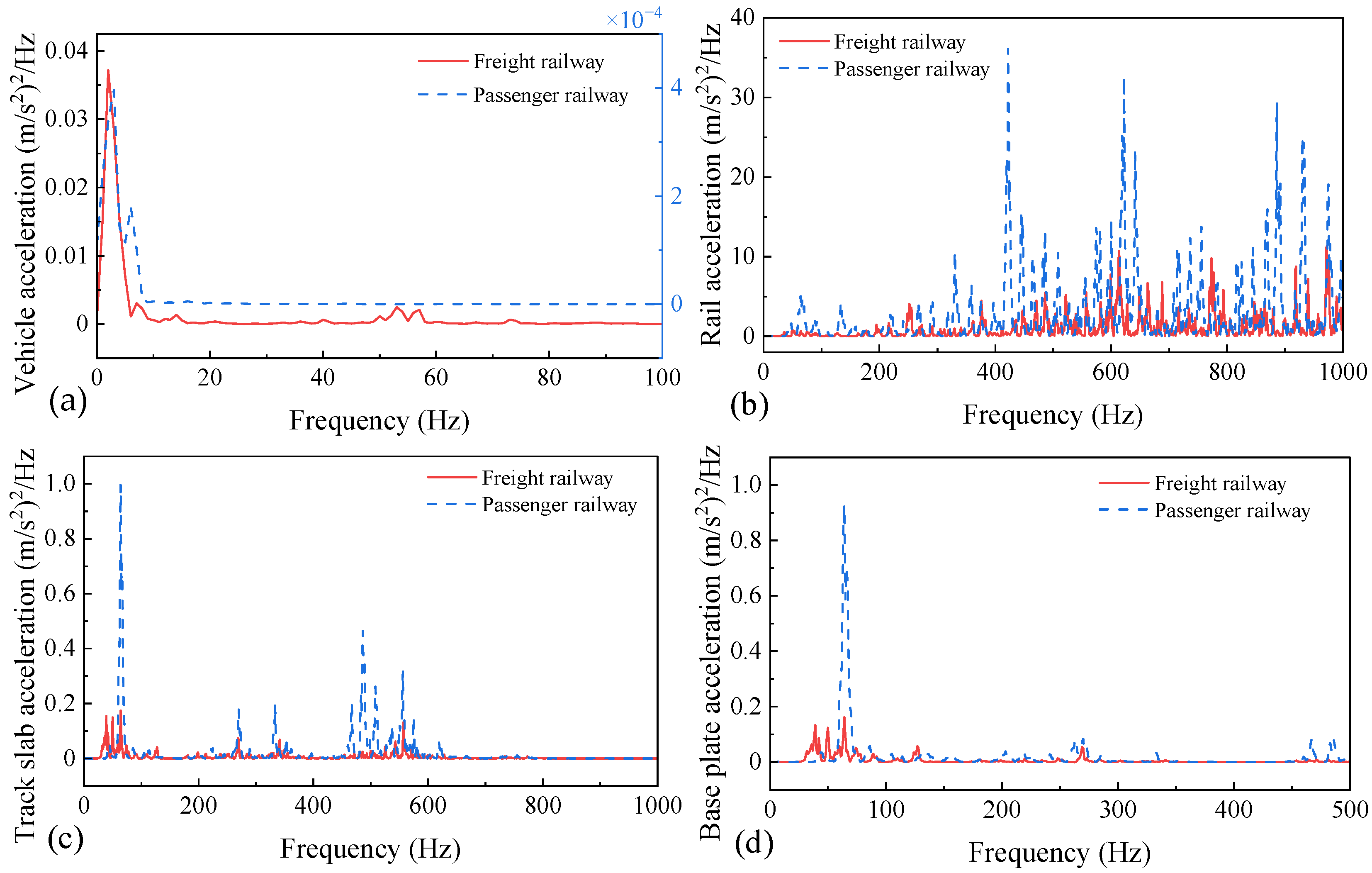
Figure 5 illustrates the acceleration spectra of key components in the vehicle–track coupled system under passenger and freight operating conditions, including the vehicle, rail, track slab, and base plate. Overall, vibration energy exhibits a clear attenuation trend along the transmission path from the rail to the track slab and further to the base plate, indicating effective vibration dissipation through the multi-layer track structure. Compared with freight operation, passenger trains induce more pronounced mid- and high-frequency vibrations, which are mainly concentrated in the rail and track slab. For both passenger and freight conditions, vehicle acceleration responses are dominated by low-frequency components below 10 Hz, and the spectral amplitude decreases rapidly with increasing frequency. Compared with freight trains, passenger trains exhibit lower vehicle acceleration amplitudes, primarily due to the superior performance of the secondary suspension system, which effectively attenuates vibration transmission to the vehicle body. The rail acceleration spectra exhibit distinct peaks in the mid- and high-frequency ranges, particularly around 620 Hz and 970 Hz for both operating conditions. These peaks are likely associated with the bending vibration characteristics of the rail. Notably, the spectral amplitudes under passenger operation are significantly higher than those under freight operation, reflecting the stronger dynamic interaction induced by higher speeds. For the track slab and base plate, a pronounced resonance peak is observed around 64 Hz under passenger operation, which may be related to wheel–rail coupled P2 resonance. In contrast, freight operation produces multiple spectral peaks near 39 Hz, 50 Hz, and 64 Hz, indicating a broader frequency excitation range due to heavier axle loads. These differences in spectral characteristics provide important insights for vibration control strategies and stiffness parameter optimization of ballastless track structures under mixed passenger–freight traffic conditions.
3.2. Influence of Fastener Stiffness on Coupled Vibration
3.2.1. Track Vibration Characteristics
The vertical displacement and vertical acceleration of the track structure are key indicators that characterize the magnitude of the dynamic response. Vertical displacement reflects the degree of structural deformation under train loading, and excessive displacement can deteriorate track alignment and degrade wheel–rail contact conditions. Because passenger trains and freight trains differ significantly in axle load and operating speed, the dynamic response of the track becomes more complex on mixed passenger–freight lines. Freight trains with large axle loads tend to induce larger displacement, whereas high-speed passenger trains intensify vibration acceleration.
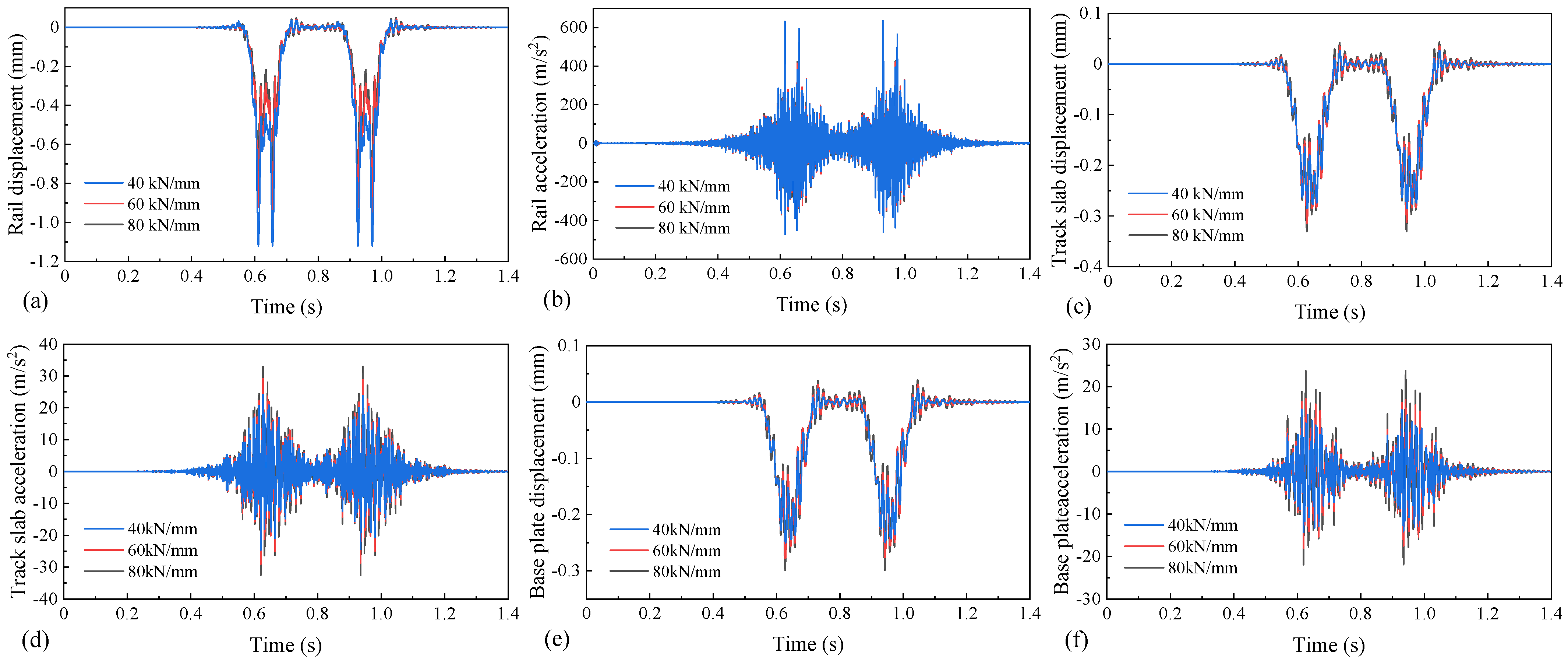
Figure 6 presents the track responses under different fastener stiffnesses when a passenger train passes. When the damping pad stiffness is held constant, an increase in fastener stiffness leads to a monotonic reduction in rail peak displacement for both passenger and freight trains, while the displacement of the track slab and base plate remains largely unchanged. This indicates that fastener stiffness primarily regulates the local vibration of the rail, exerting limited influence on the substructure. As fastener stiffness increases, both rail displacement and acceleration decrease significantly. When fastener stiffness increases from 40 kN/mm to 80 kN/mm, rail displacement decreases from 1.12 mm to 0.82 mm (a reduction of 26.78%), and rail acceleration decreases from 635.54 m/s
2 to 592.45 m/s
2 (a reduction of 6.78%). This indicates that an appropriate increase in fastener stiffness helps suppress rail vibration. However, higher stiffness concentrates more load into the substructure, leading to a pronounced increase in the acceleration of the track slab and the base plate. When fastener stiffness is doubled, the acceleration of the track slab and base plate increases by 36.22% and 66.68%, respectively. Therefore, from the perspective of substructure vibration control, excessively high fastener stiffness is not desirable.
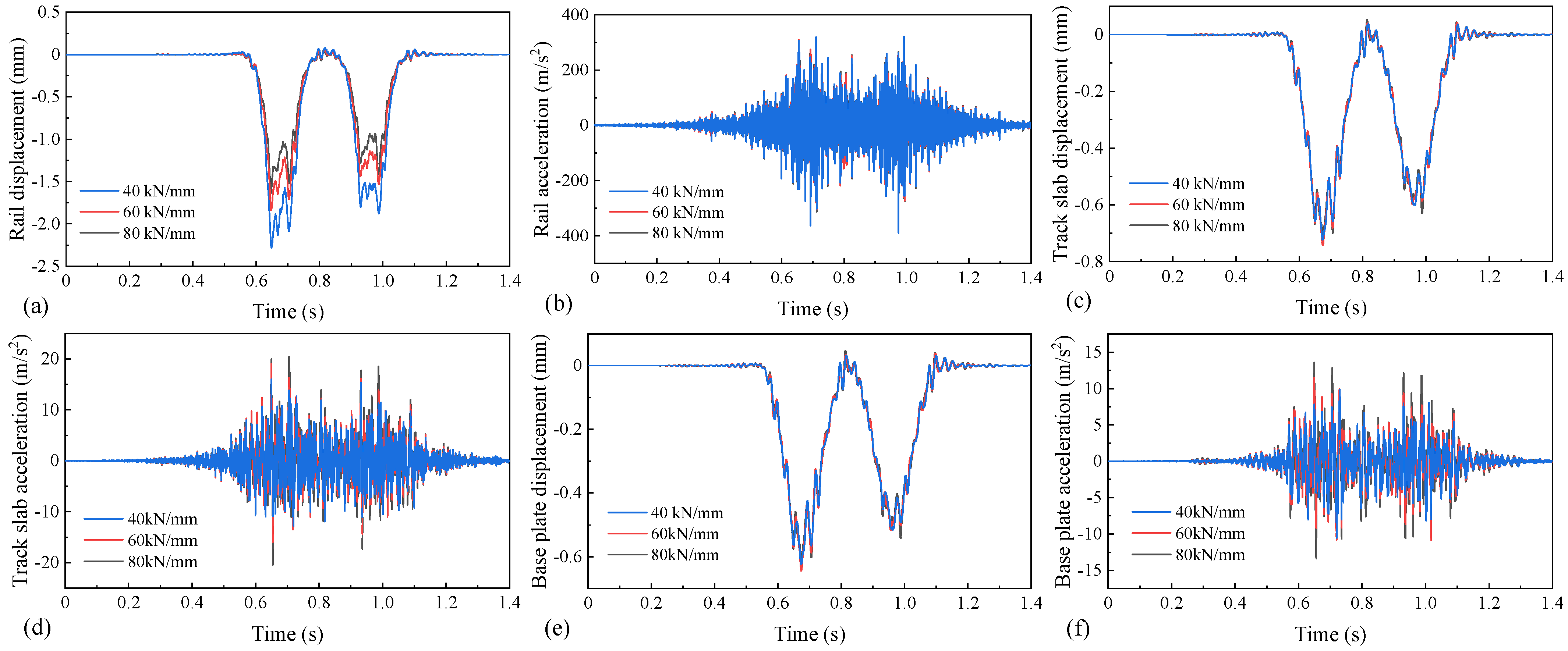
Figure 7 shows the ballastless track vibration response when a freight train passes under different fastener stiffnesses. Compared with passenger trains, rail displacement increases significantly, whereas acceleration decreases due to the combined effect of the high axle load and low running speed of freight trains. As fastener stiffness increases, both rail displacement and acceleration decrease continuously. When stiffness increases from 40 kN/mm to 80 kN/mm, rail displacement decreases from 2.28 mm to 1.64 mm (a reduction of 28.07%), and rail acceleration decreases from 389.84 m/s
2 to 322.37 m/s
2 (a reduction of 20.92%). Similar to the passenger case, the acceleration of the track slab and base plate increases with stiffness, showing a consistent trend.
3.2.2. Vehicle Dynamic Characteristics
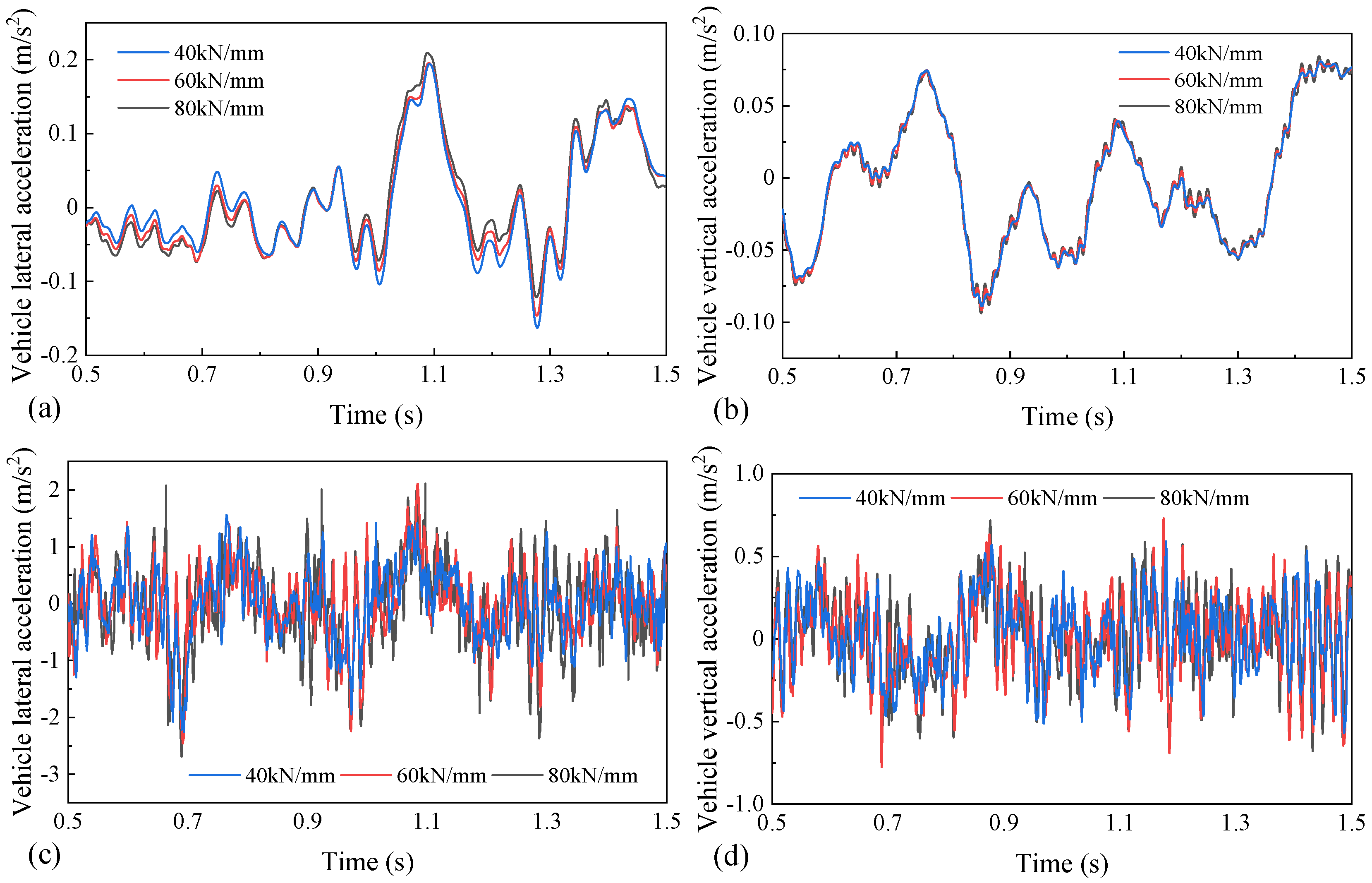
The dynamic responses of passenger trains and freight trains under different fastener stiffnesses are presented in
Figure 8. The vibration levels of the two vehicle types are significantly different: passenger train body acceleration is much smaller than that of freight trains. The vertical body acceleration of the passenger train fluctuates within −0.1 to 0.1 m/s
2, while freight train acceleration fluctuates within −0.6 to 0.6 m/s
2. This difference results from the more advanced secondary suspension system adopted in passenger trains to ensure ride comfort. The influence of fastener stiffness also varies with vehicle type. Passenger train body vibration is relatively insensitive to stiffness changes because the secondary suspension effectively filters high-frequency excitation transmitted from the track. In contrast, increasing fastener stiffness significantly amplifies the vibration of freight trains. When fastener stiffness increases from 40 kN/mm to 80 kN/mm, the peak lateral acceleration of the freight train increases from 1.56 m/s
2 to 2.11 m/s
2 (an increase of 35.56%).
3.2.3. Interlayer Interaction Force
Interlayer forces directly characterize the transmission and distribution of train loads from the rail to the track slab and base plate through the fastener–damping pad system.
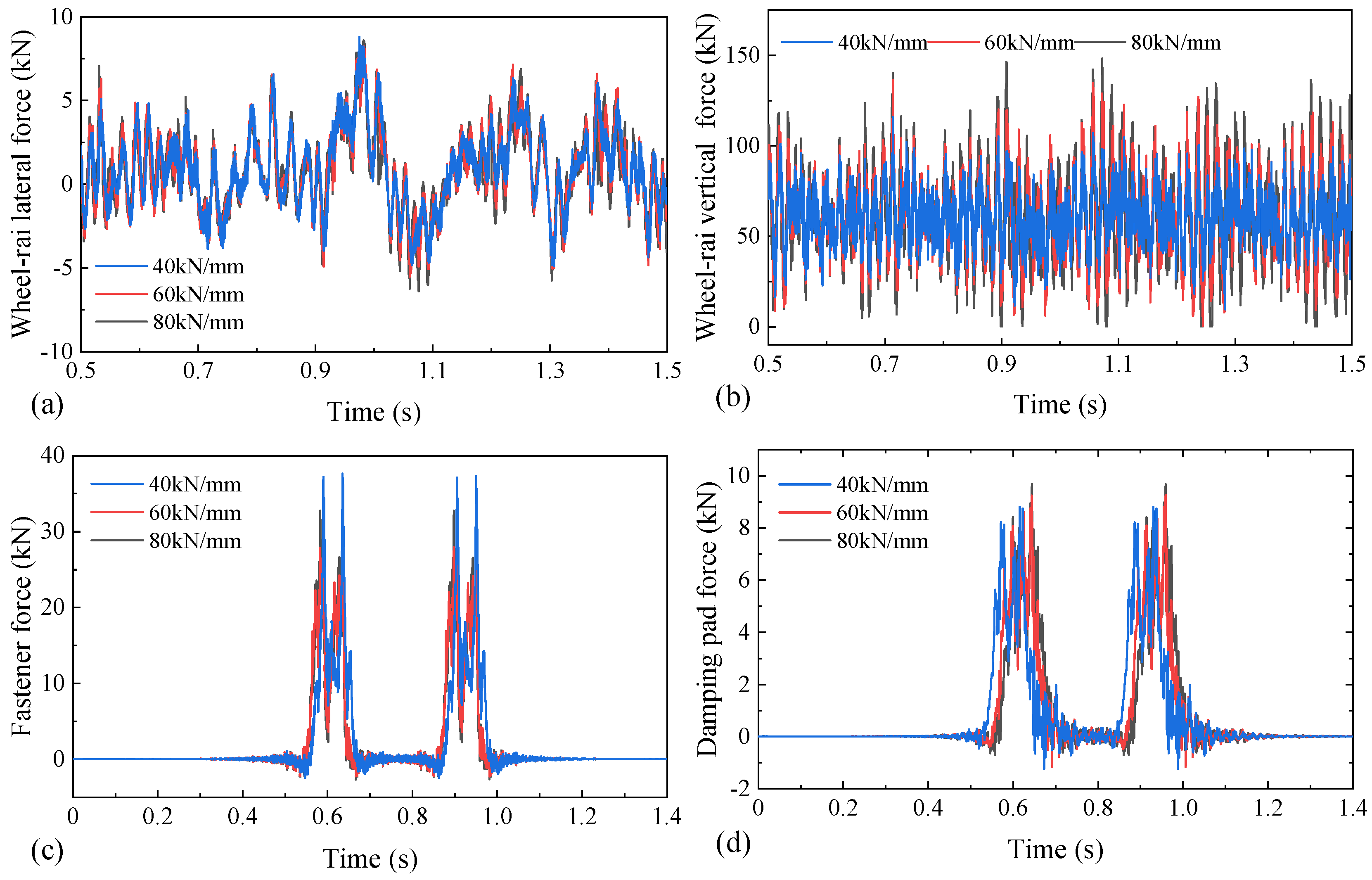
Figure 9 shows the interlayer forces under different fastener stiffnesses when a passenger train passes. The wheel–rail vertical force increases significantly with stiffness. When the fastener stiffness is 40 kN/mm, the maximum wheel–rail vertical force is 115.80 kN. When the fastener stiffness increases to 80 kN/mm, the maximum wheel–rail vertical force is 148.20 kN, an increase of 27.98%. With the increase in fastener stiffness, the fastener force decreases significantly, while the damping pad force increases significantly. This is the result of more energy transferring downward after the orbital integrity is enhanced.
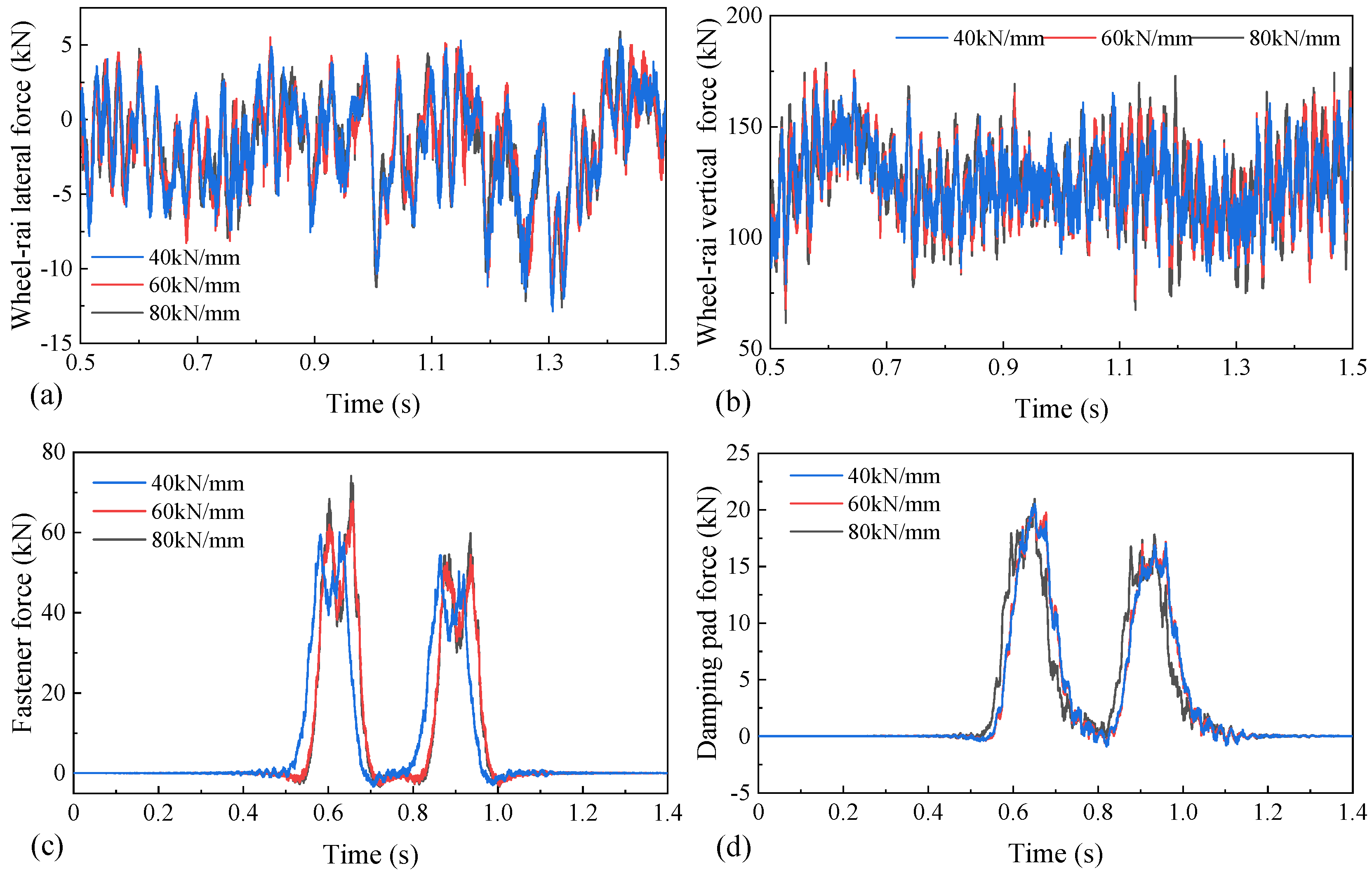
Figure 10 is the interlayer force of the track structure when the freight train passes under different fastener stiffness. Compared with passenger trains, all interlayer forces increase significantly. The wheel–rail vertical force increases slightly with the increase in fastener stiffness. When the fastener stiffness is 40 kN/mm, the maximum wheel–rail vertical force is 171.67 kN. When the fastener stiffness increases to 80 kN/mm, the maximum wheel–rail vertical force is 178.79 kN, an increase of 4.15%. Unlike passenger trains, both fastener force and damping pad force increase continuously with stiffness when freight trains pass. When stiffness is doubled, fastener force and damping pad force increase by 23.28% and 2.14%, respectively.
3.3. Influence of Damping Pad Stiffness on Coupled Vibration
3.3.1. Track Vibration Characteristics
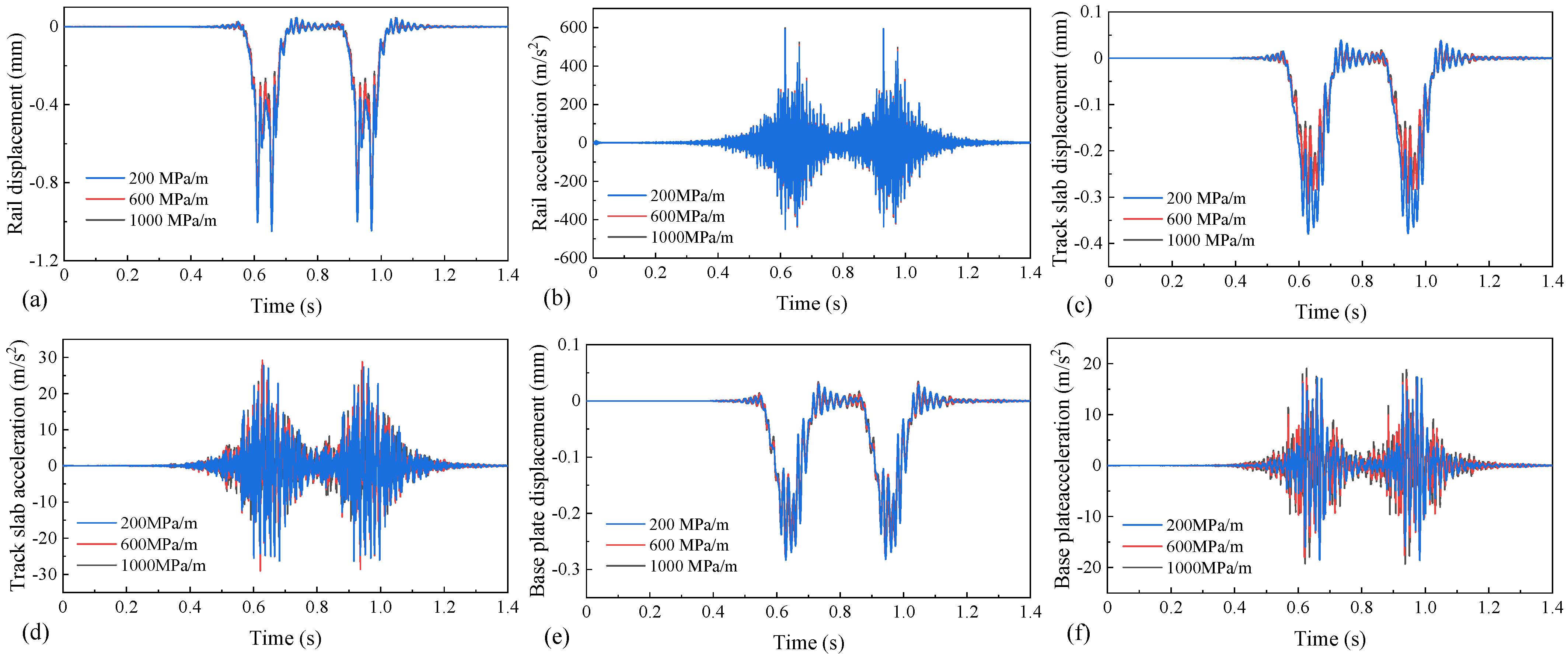
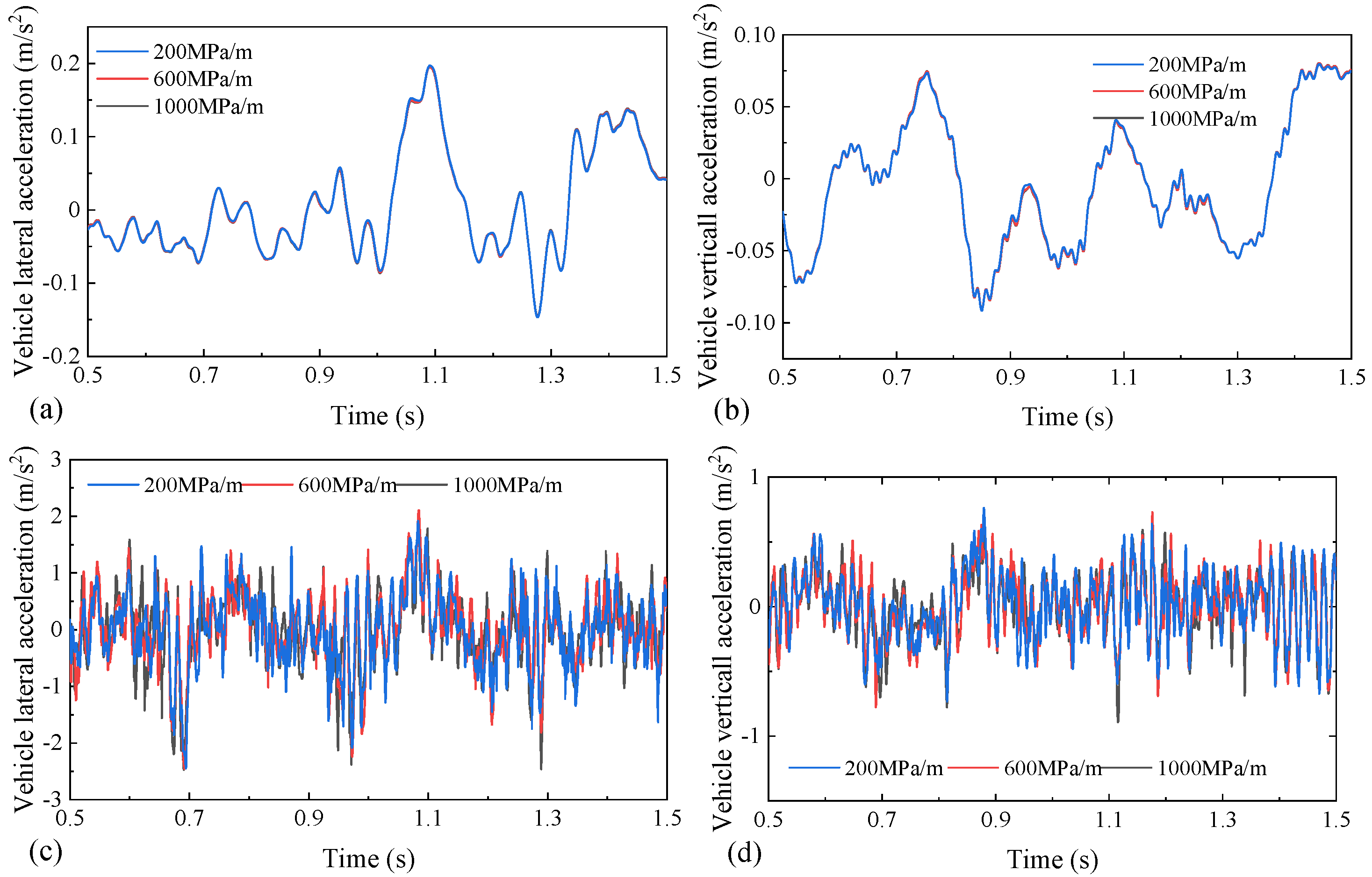
Figure 11 illustrates the track vibration response of passenger railway under different damping pad stiffness. As the stiffness increases, the vertical displacements of the rail, track slab, and base plate all decrease. Among them, the displacement of the track slab exhibits the most pronounced reduction, followed by the rail, while the base plate shows the smallest change. When the damping pad stiffness is 200 MPa/m, the peak displacements of the rail, track slab, and base plate are 1.04 mm, 0.38 mm, and 0.28 mm, respectively. When the stiffness increases to 1000 MPa/m, these peak values decrease to 0.96 mm, 0.29 mm, and 0.27 mm. In terms of acceleration, the vibration response exhibits a nonlinear pattern. With increasing damping pad stiffness, the acceleration of the track slab first increases and then decreases, whereas the base plate acceleration shows the opposite trend, decreasing first and then increasing. This phenomenon indicates that the interlayer dynamic coupling is non-monotonic, and the vibration characteristics are highly dependent on the matching of structural parameters.
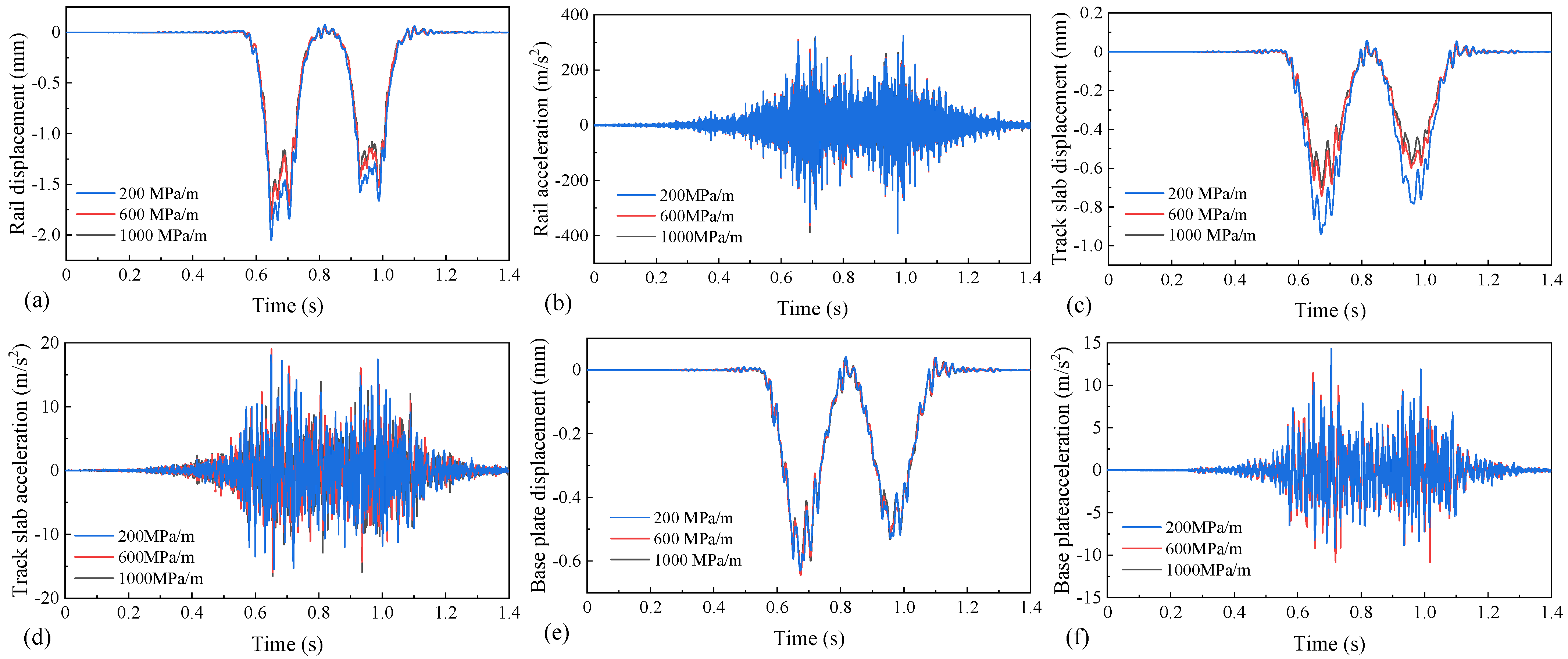
Figure 12 presents the vibration response of the freight railway under different damping pad stiffness levels. Similar to the passenger railway, the vertical displacements of the rail and track slab decrease as stiffness increases, with the slab displacement showing a more significant reduction. When the stiffness increases from 200 MPa/m to 1000 MPa/m, the rail displacement decreases from 2.05 mm to 1.79 mm (a reduction of 12.68%), and the track slab displacement decreases from 0.93 mm to 0.69 mm (a reduction of 25.80%). As in the passenger railway, the accelerations of the freight train–track system also exhibit nonlinear behavior: the track slab acceleration increases initially and then decreases, while the base plate acceleration decreases first and then rises. This further confirms the complex dynamic coupling between layers, highlighting the importance of proper parameter matching.
3.3.2. Vehicle Dynamic Characteristics
Figure 13 shows the vibration response of the vehicle systems under different damping pad stiffness levels. Significant differences are observed between passenger trains and freight trains. Benefiting from the high-performance secondary suspension, the passenger train maintains a vertical acceleration within ±0.1 m/s
2 and is largely insensitive to damping pad stiffness, demonstrating that high-frequency excitations are effectively attenuated by the suspension system. In contrast, the freight train exhibits vertical accelerations within ±1 m/s
2, substantially higher than those of the passenger train. As the damping pad stiffness increases, the acceleration of the freight train increases noticeably. When the stiffness is 200 MPa/m, the peak lateral acceleration is 2.21 m/s
2, and it rises to 2.47 m/s
2 when the stiffness increases to 1000 MPa/m. This suggests that excessive damping pad stiffness may transmit more vibration energy to the freight vehicles.
3.3.3. Interlayer Interaction Force
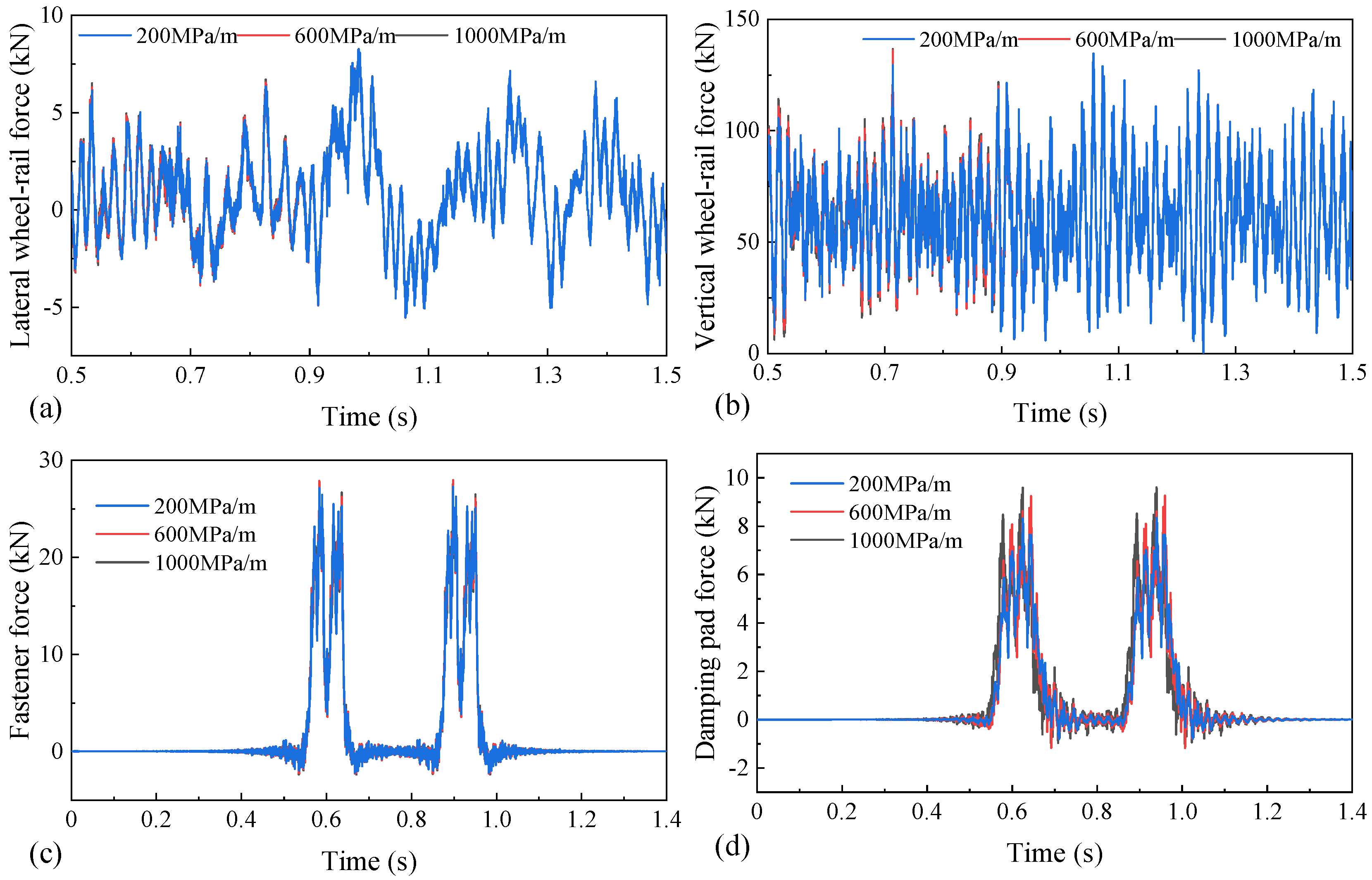
Figure 14 illustrates the interlayer interaction force of the passenger railway under different damping pad stiffness levels. The wheel–rail force exhibits limited sensitivity to changes in stiffness, whereas the damping pad force increases notably with higher stiffness. With the increase in damping pad stiffness, the damping pad force increases continuously. When the stiffness of the damping pad is 200 MPa/m, the maximum damping pad force is 8.34 kN. When the damping pad stiffness increases to 1000 MPa/mm, the maximum damping pad force is 9.61 kN, an increase of 15.2%. The increase in damping cushion force means that more train load is transmitted to the substructure, and if it exceeds the design threshold, surface fatigue or inter-story damage may be induced.
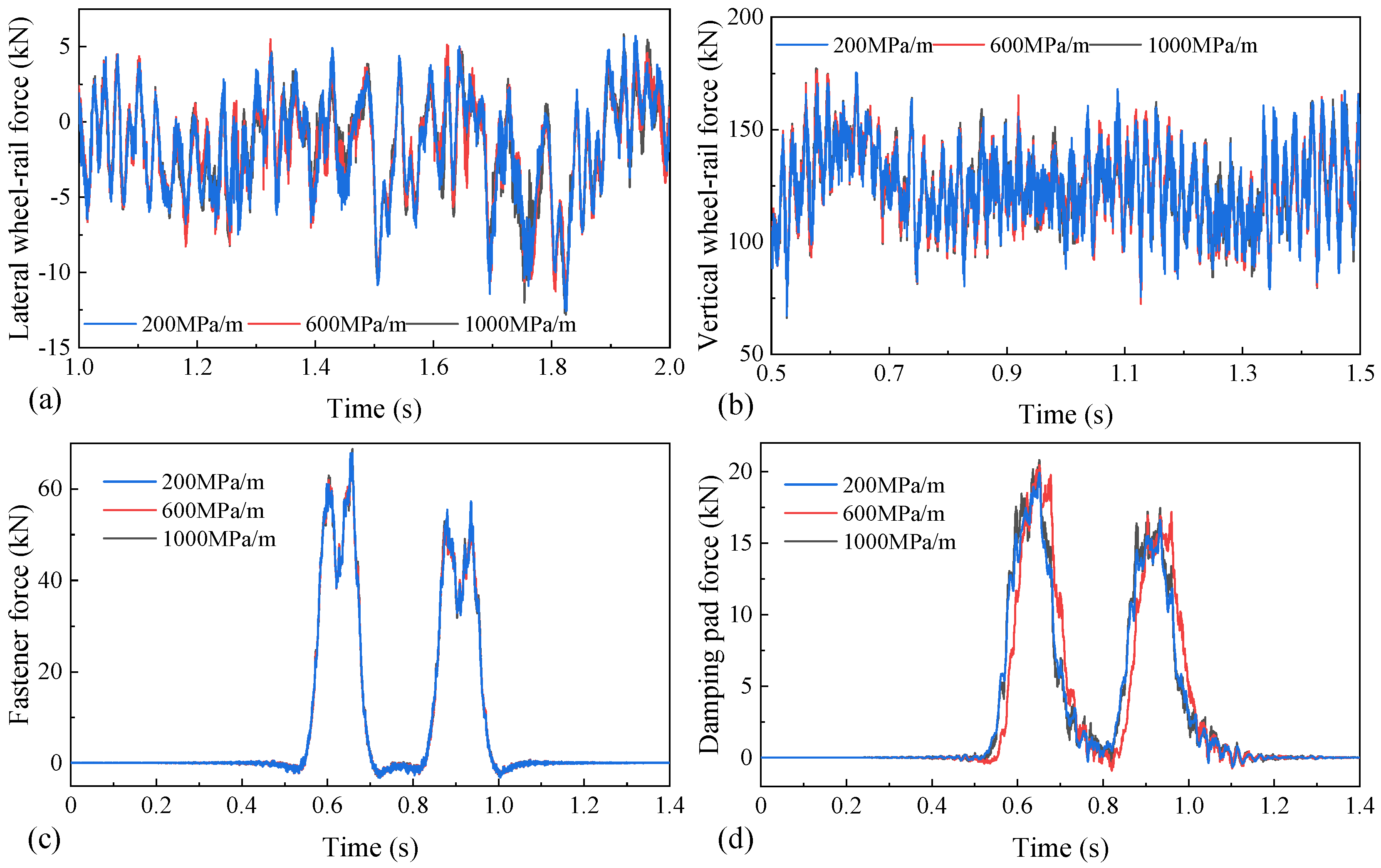
Figure 15 presents the interlayer interaction force of the freight railway under different damping pad stiffness levels. Unlike the passenger railway, the wheel–rail force is more sensitive to stiffness variation. The damping pad force first increases and then decreases with stiffness, reaching a maximum at 600 MPa/m. Both the fastener force and damping pad force increase steadily with stiffness. When the stiffness increases from 200 MPa/m to 1000 MPa/m, the maximum fastener force increases from 67.81 kN to 68.75 kN, and the damping pad force increases from 19.92 kN to 20.82 kN. Overall, due to the higher axle load of freight trains, the interlayer force is more sensitive to variations in structural parameters.
3.4. Dynamic Characteristics of the System Under Multi-Layer Stiffness Conditions
The preceding analysis focuses on the influence of a single-layer stiffness parameter on system vibration, which is insufficient for revealing the dynamic behavior of the coupled vehicle–track system under coordinated changes of multiple structural parameters. To address this, five levels of fastener stiffness and five levels of damping pad stiffness were combined to form a two-dimensional 5 × 5 stiffness matrix, as summarized in
Table 4.
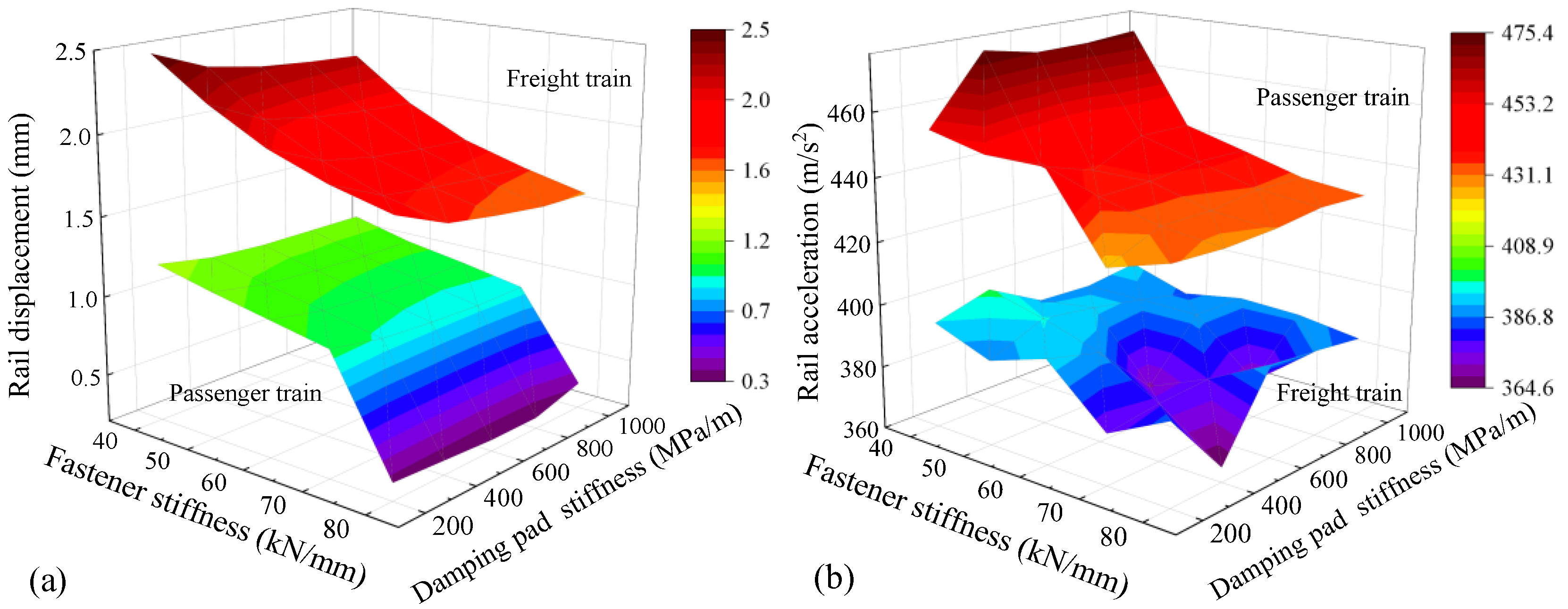
Figure 16 presents the rail displacement and acceleration responses under varying fastener and damping pad stiffness for passenger and freight trains. For displacement, the freight train exhibits a high-amplitude continuous distribution (1.0–2.5 mm), while the passenger train shows a low-amplitude gradient distribution (0.3–1.5 mm), with no surface intersection, indicating consistently higher displacement under freight conditions. Displacement decreases with increasing fastener and damping pad stiffness, with the damping pad having slightly greater influence. The difference between freight and passenger trains is largest in the low-stiffness region and reduces below 0.5 mm at high stiffness, reflecting stiffness-dependent mitigation of operational differences.
For acceleration, the passenger train shows high-amplitude concentrated responses (maximum 475.4 m/s2) in low-stiffness regions, whereas the freight train shows low-amplitude, dispersed responses (maximum 398.1 m/s2). Partial surface intersection occurs at medium stiffness, but passenger train acceleration remains generally higher. Acceleration decreases with stiffness for both trains, with passenger trains exhibiting greater sensitivity. At high stiffness (fastener ≥70 kN/mm, damping pad ≥800 MPa/m), responses converge below 430 m/s2, demonstrating a unifying suppression effect. Overall, stiffness parameters consistently reduce rail displacement and acceleration, while train type governs the dominant response mode, providing guidance for stiffness optimization under different operational conditions.
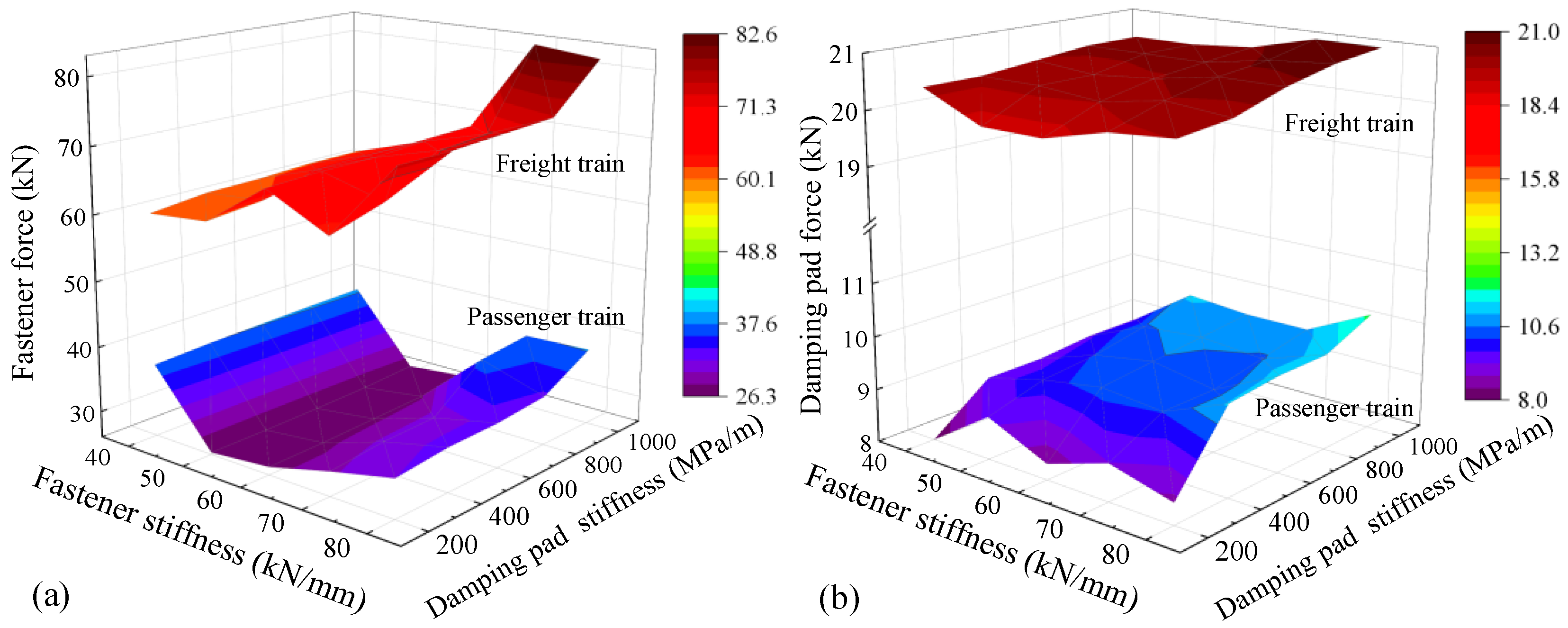
Figure 17 illustrates the maximum interlayer interaction force under different stiffness combinations. Owing to the differences in axle load and running speed between passenger and freight trains, the excitation transmitted to the fastener–pad system differs correspondingly. When the damping pad stiffness is constant, both the fastener force and damping pad force first increase and subsequently decrease with increasing fastener stiffness, indicating a pronounced nonlinear coupling effect between the two layers. When the fastener stiffness is fixed, the damping pad force increases monotonically with growing pad stiffness, with the effect being more pronounced for freight trains. Notably, when the pad stiffness exceeds 600 MPa/m, the fastener force increases sharply, suggesting that excessive pad stiffness may accelerate damage accumulation in the track components.
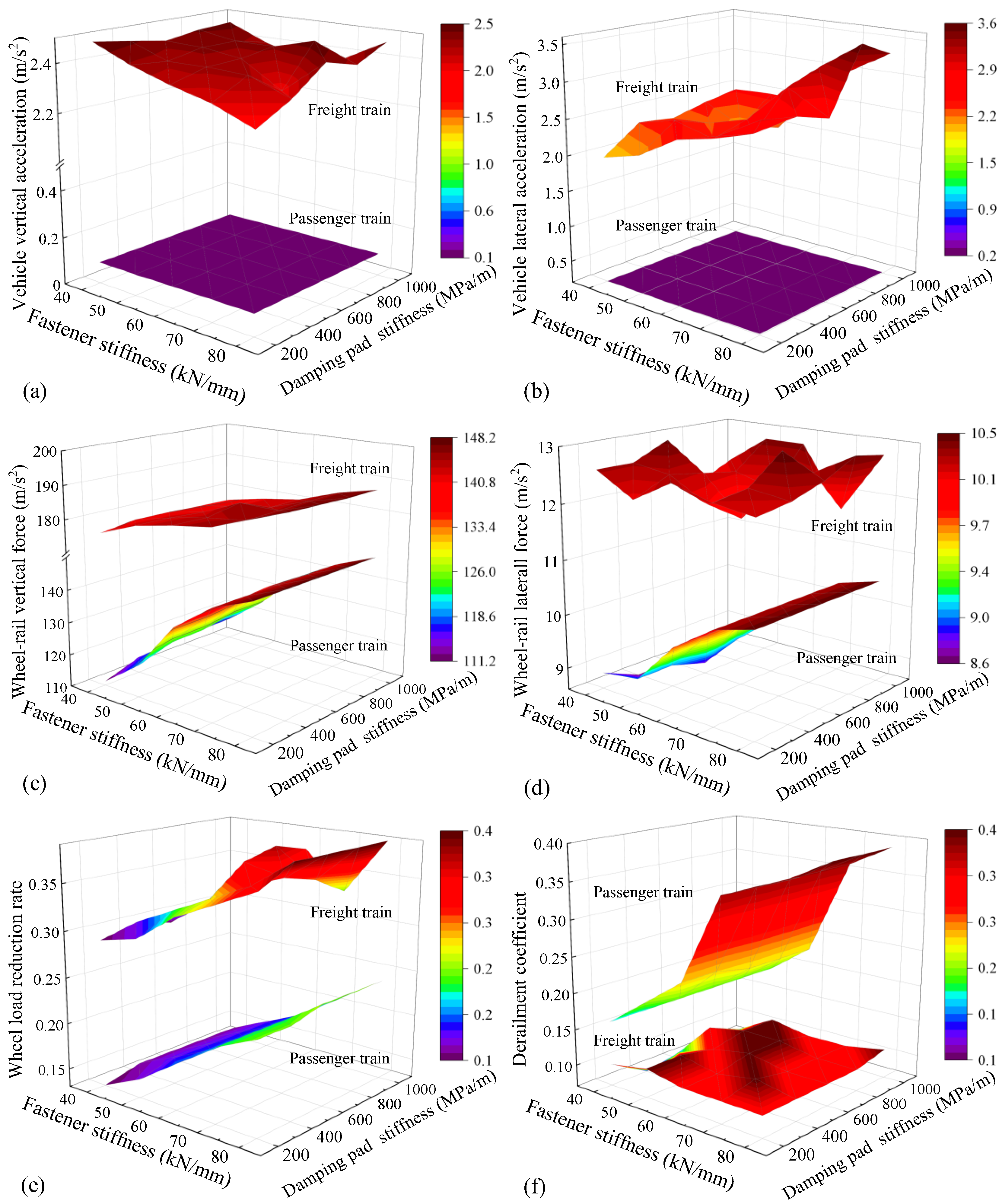
Figure 18 shows the variation in vehicle dynamics index with stiffness combination, including vehicle lateral acceleration, vertical acceleration, wheel–rail vertical force, wheel–rail lateral force, derailment coefficient and wheel load reduction rate. The results show that the lateral acceleration of the car body and the lateral force of the wheel–rail are particularly sensitive to the change in stiffness, showing obvious nonlinear response. In contrast, the variation in the vertical acceleration of the car body and the vertical force of the wheel and rail is small, and the sensitivity to the optimization of the track parameters is weak. When the damping pad stiffness is constant, the derailment coefficient of passenger trains increases significantly with increasing fastener stiffness, implying that excessively stiff fasteners may adversely affect running safety. Freight trains are comparatively less sensitive to fastener stiffness. Regarding wheel load reduction, both passenger and freight trains show slight increases with greater fastener stiffness. When the fastener stiffness is fixed, wheel load reduction increases only marginally with growing damping pad stiffness, and the overall variation remains limited.
3.5. Reasonable Stiffness Matching Based on Multi-Dimensional Parameter Fusion

This section develops a stiffness matching methodology based on multi-dimensional parameter fusion. Through index normalization, weight assignment, and weighted fusion calculation, a multi-index decision-making model is constructed to quantitatively determine the optimal stiffness matching range for the fastener–pad system. Eight evaluation parameters are selected, including rail vertical displacement, rail acceleration, fastener vertical force, damping pad vertical force, lateral acceleration of the car body, wheel–rail lateral force, derailment coefficient, and wheel load reduction ratio. These indicators collectively capture the impact of stiffness combinations on the structural dynamic response and operational safety.
Based on five levels of fastener stiffness and five levels of damping pad stiffness, 25 stiffness combinations (A1–A25) are formulated. Dynamic simulations under passenger-train and freight-train loading yield the decision matrix for evaluation. The normalized weights of each index for the two train types are listed in
Table 5.
Using the decision matrix and the weight vector defined in
Section 2.2, the multi-dimensional parameter fusion value of each stiffness combination is computed, and the results are presented in
Table 6.
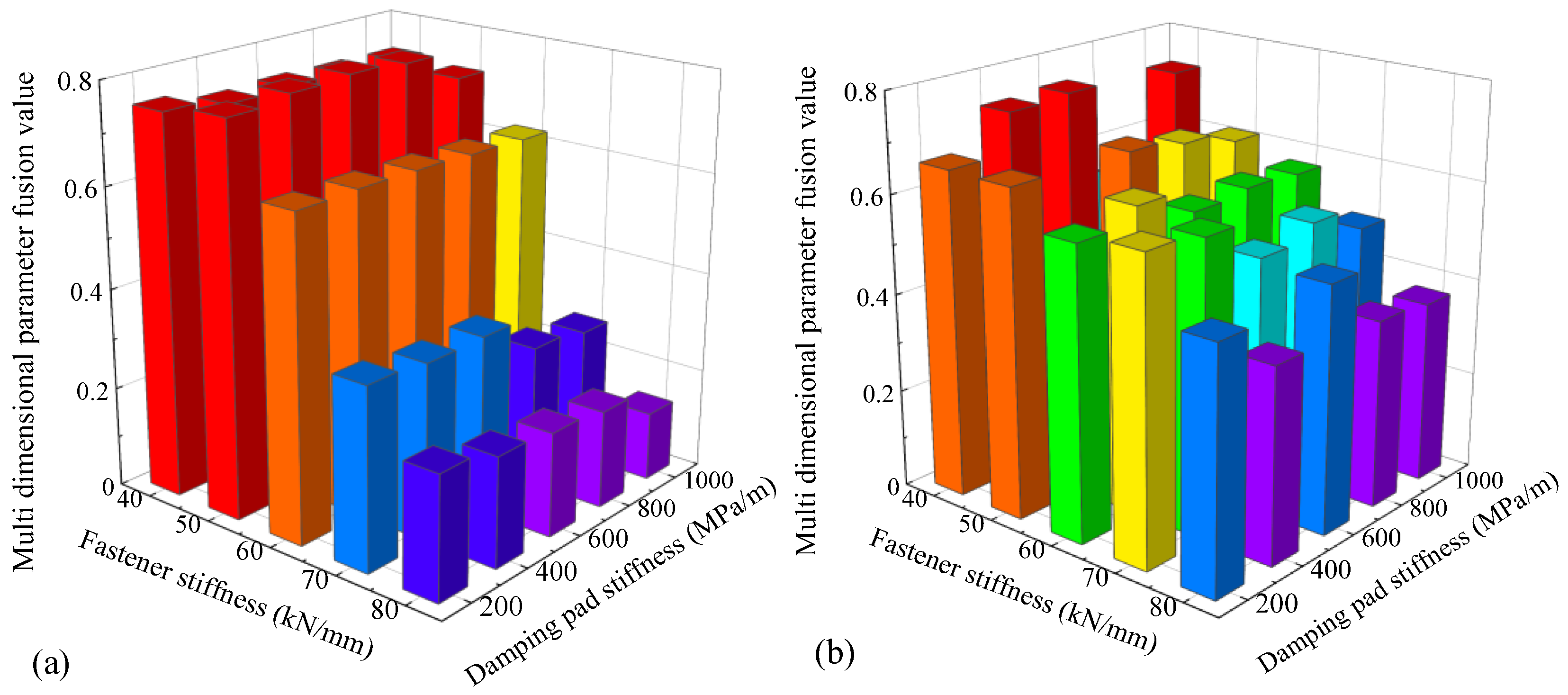
Figure 19 illustrates the multi-dimensional parameter fusion results, where a higher fusion value indicates a more favorable stiffness matching effect. For the ballastless track structure under passenger-train operation, the optimal matching combination is a fastener stiffness of 50 kN/mm and a damping pad stiffness of 600 MPa/m. Under freight-train operation, the optimal combination is a fastener stiffness of 40 kN/mm and a damping pad stiffness of 600 MPa/m. Overall, a recommended stiffness range of 40–50 kN/mm for fasteners and 600 MPa/m for damping pads is obtained. Considering manufacturing tolerances and construction deviations, the recommended engineering range for the damping pad stiffness is 550–650 MPa/m.