Segmentation and Classification of Lung Cancer Images Using Deep Learning

Abstract
1. Introduction
- Holistic methodological taxonomy: We systematically categorize and compare segmentation and classification techniques across three evolutionary stages: CNN-based foundations, U-shaped network (U-Net) and its attention-enhanced variants, and Transformer-integrated architectures. This dual-task perspective enables a clearer understanding of model progression and task-specific adaptations.
- Dataset and metric-centered analysis: Unlike reviews that treat datasets merely as data sources, we provide a detailed discussion of widely used public datasets and private collections, highlighting their scale, modality, annotation quality, and impact on model generalizability. Additionally, we link evaluation metrics to clinical and technical requirements, providing guidance for metric selection in different experimental settings.
- Comparative tabular synthesis: Through consolidated tables, we offer a comparison of datasets, methods, and performance metrics across cited studies, enabling rapid insights into trends, dataset dependencies, and advanced results.
- Integrated challenges and future directions: We identify cross-cutting challenges, such as annotation scarcity, multimodal fusion, model interpretability, and computational efficiency, and propose cohesive future research pathways that span both segmentation and classification tasks.
Review Methodology
- Studies focusing on the application of deep learning techniques to lung cancer CT image analysis.
- Publications presenting original research, including methodological innovations, comparative evaluations, or clinical validations.
- Articles published in English in peer-reviewed journals or conferences.
- Review articles, editorials, and commentaries.
- Works that did not provide sufficient technical or evaluative details.
2. Dataset Discussion
- LIDC-IDRI: The Lung Image Database Consortium and Image Database Resource Initiative (LIDC-IDRI) has become a standard benchmark dataset in lung cancer research, offering annotated CT scans for the detection and classification of pulmonary nodules.
- National Lung Screening Trial (NLST): NLST is a lung screening program using low-dose CT (LDCT) and chest X-ray (CXR), based on outcomes from a large high-risk cohort, collecting a significant volume of lung screening images. The dataset consists of CT and chest X-ray images from over 53,000 participants aged 55 to 74, primarily used to assess the effectiveness of low-dose CT in detecting lung cancer at an early stage.
- The Alibaba Cloud TianChi Medical Competition dataset: The Tianchi dataset has served as a key resource in several studies aimed at developing and evaluating deep learning models for lung cancer detection [15].
- Lung-PET-CT-Dx Dataset: Sourced from The Cancer Imaging Archive (TCIA), this dataset comprises 251,135 CT and Positron emission tomography and computed tomography (PET/CT) images from 355 patients. The cancer images were sourced from patients with biopsy-confirmed diagnoses across four major histopathological subtypes, including adenocarcinoma (ADC), Large Cell Carcinoma (LCC), Squamous Cell Carcinoma (SQC) and small cell carcinoma (SCC), providing a foundational resource for multidimensional lung cancer research. This dataset is frequently used in studies developing and evaluating DL models for lung cancer diagnosis [16].
- Private Datasets: Several investigations have relied on private datasets for evaluating DL technologies, whose origins remain undisclosed in the public domain [17].
Overview of Preprocessing Pipelines
- Resampling: CT scans are resampled to a uniform voxel spacing to mitigate variations in resolution across different scanners and acquisition protocols.
- Hounsfield Unit (HU) Windowing: Voxel intensities are clipped and normalized to a specific window to enhance the contrast between pulmonary tissues and lesions.
- Lung Masking: The lung parenchyma is segmented from the thoracic cavity using automated or semi-automated methods to exclude extraneous structures such as the chest wall, mediastinum, and airways.
- Patching/Tiling: For memory efficiency and to handle large volumetric data, three-dimensional (3D) CT volumes are often divided into smaller 3D patches or 2D slices, especially when using 2.5D or multi-view approaches.
- Intensity Normalization: Voxel values are further normalized to stabilize training and improve convergence.
3. Model Evaluation Metrics
Clinical Benchmarks and Model Reliability Considerations
4. Segmentation Methods
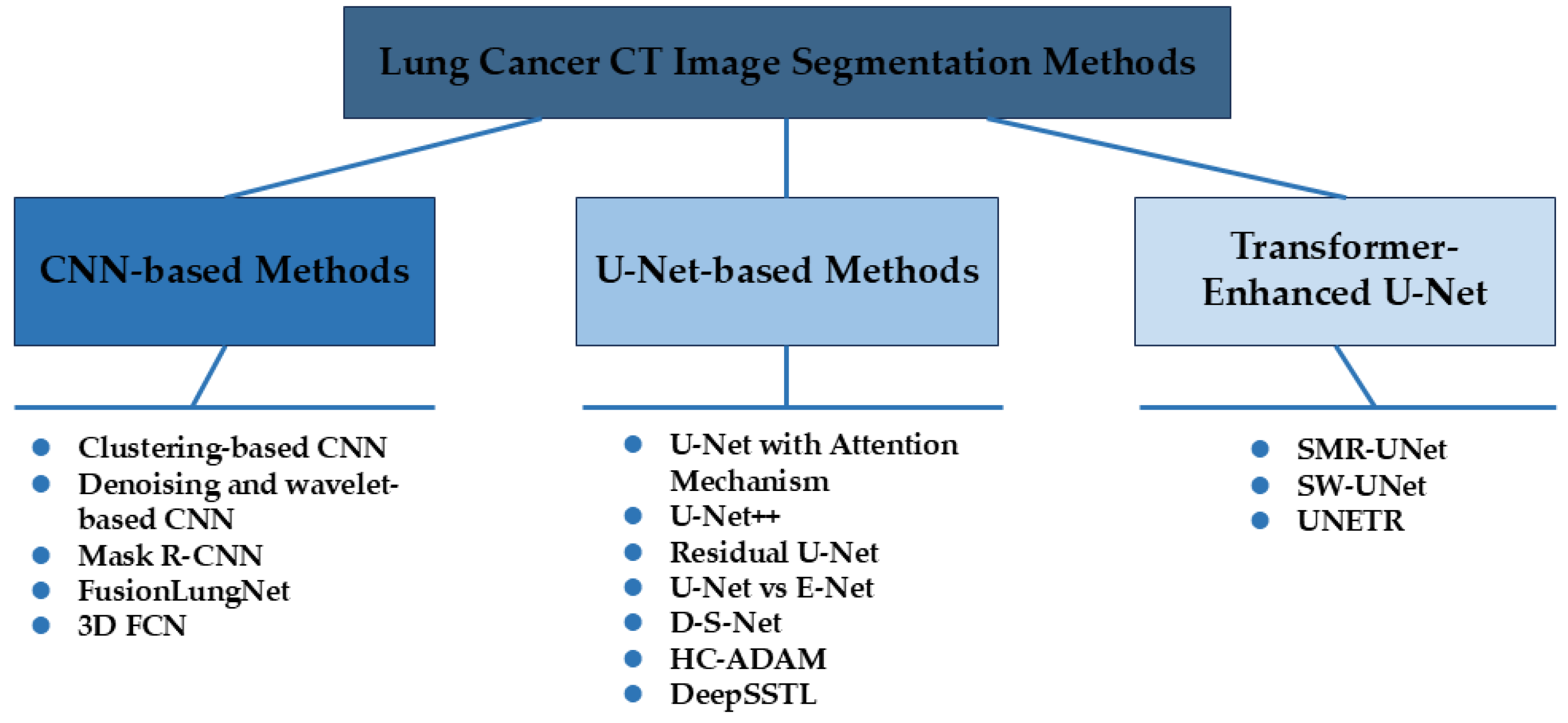
4.1. CNN-Based Segmentation Methods
4.2. Segmentation Methods Using the U-Net Network
4.3. Transformer-Enhanced U-Net Network for Segmentation
4.4. Comprehensive Analysis of Segmentation Methods
5. Classification Methods
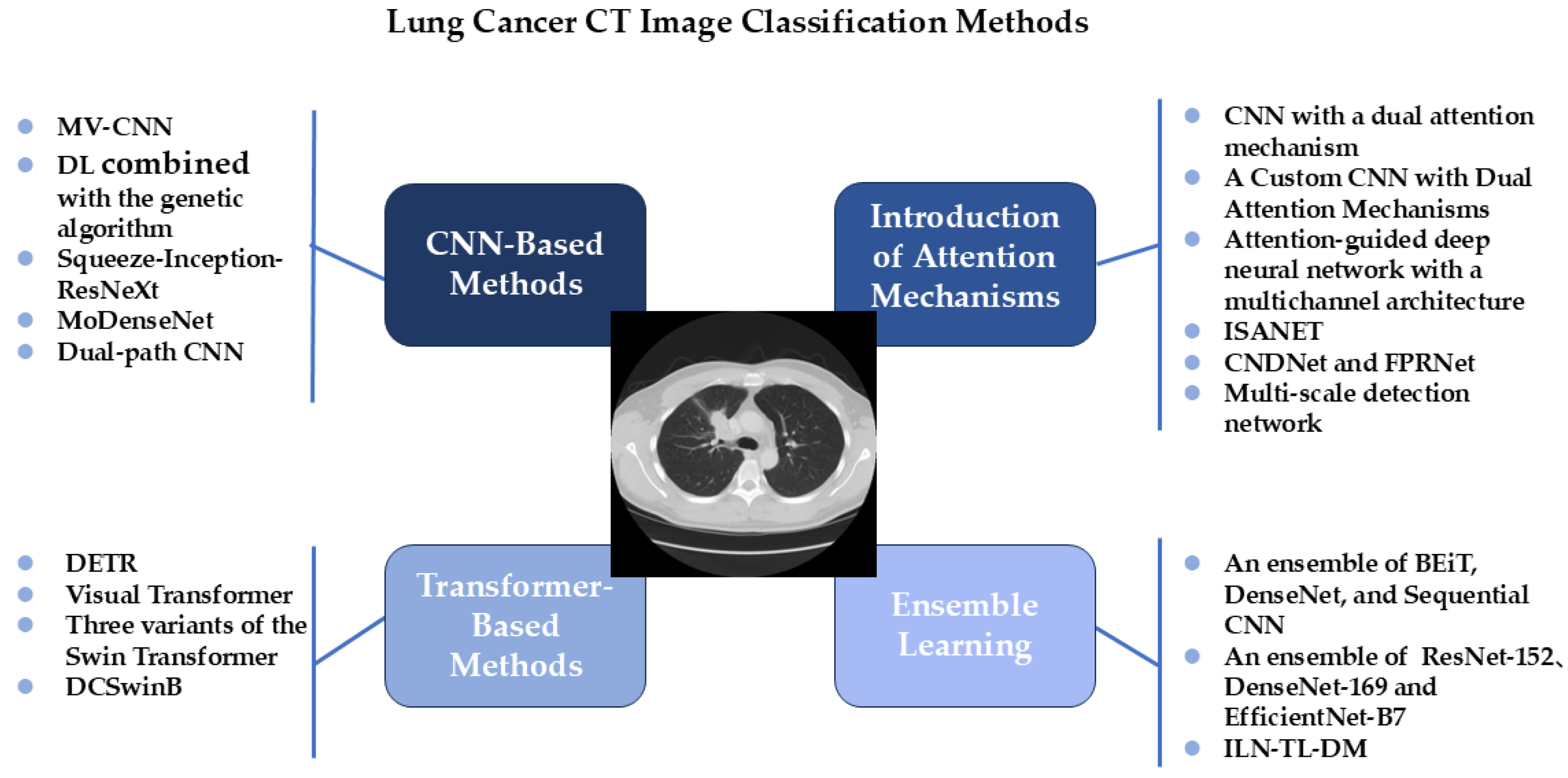
5.1. CNN-Based Classification Methods
5.2. Introduction of Attention Mechanisms
5.3. Transformer-Based Classification
5.4. Ensemble Learning
5.5. Comprehensive Analysis of Classification Methods
5.6. Comparative Analysis Between 2D/3D and Single/Multi-Modal Methods
- Data availability: For limited CT data, start with 2D/2.5D models and use transfer learning. For complete 3D CT volumes with sufficient resources, consider 3D CNNs or Transformers. With well-aligned multi-modal data, explore attention-based fusion networks.
- Hardware constraints: 2D models are preferable under limited memory; 3D/multi-modal models require high-performance GPUs and optimized training strategies.
- Task requirements: 3D models excel in volumetric segmentation; 2D/2.5D methods can be effective for slice-based classification; multi-modal fusion is recommended for challenging diagnoses requiring metabolic information.
6. Challenges Toward Clinical Translation
6.1. Clinical Adaptation and Integration
6.2. Clinical Validation Paradigm
6.3. Interpretability and Trustworthiness
6.4. FEM–AI Synergistic Integration
7. Summary and Outlook
7.1. Summary
- Data serves as the cornerstone of performance, yet its quality and diversity constitute a major bottleneck: Public datasets provide standardized benchmarks for research, promoting algorithm comparability and reproducibility. These approaches effectively utilize large-scale datasets to enhance model performance, allowing for more accurate and efficient analysis of lung cancer [11]. However, these datasets often originate from specific acquisition protocols, leading to domain shift issues that limit model generalizability in real and complex contexts, diverse clinical environments. While private datasets offer greater clinical representativeness, their small scale, difficulty of acquisition, and high annotation costs hinder broader research. For the future, constructing large-scale, multi-center, multimodal benchmark datasets with unified annotation quality is a primary task for advancing the field.
- Methodological evolution follows a clear trajectory from “local to global” and “single to fusion”:
- Segmentation Task: Methods have evolved from CNN-based architectures relying on local receptive fields, to U-Net and its variants that achieve multi-scale feature fusion through encoder–decoder structures and skip connections, and further to Transformer-enhanced networks that establish global contextual modeling using self-attention mechanisms. This path reflects the progressive and deeper resolution of inherent challenges such as irregular nodule morphology, blurred boundaries, and variable sizes.
- Classification Task: Evolution has progressed from robust feature extraction using CNNs, to the introduction of attention mechanisms for dynamic focus on key lesion regions and noise suppression, to leveraging Transformers for capturing complex long-range dependencies between lesions and surrounding tissues, and finally to ensemble learning strategies that combine the complementary strengths of heterogeneous models to maximize performance. This progression aims to enhance model discriminative power for visually similar subtypes. These DL-based methods, mainly relying on CNNs, have made significant advancements in lung nodule diagnosis [60,61].
- The evaluation system requires deeper alignment with clinical objectives: Although metrics such as Dice coefficient, IoU, accuracy, and AUC are widely adopted, they have limitations in reflecting the clinical utility of models. Future evaluation should place greater emphasis on:
- Robustness under extreme class imbalance.
- Strict control of false negatives, given their higher clinical risk.
- The introduction of uncertainty estimation and model calibration to provide clinicians with decision confidence references.
- Conducting rigorous external validation and human–machine comparison experiments, moving beyond internal performance reporting on single datasets.
- The performance of models in controlled lab settings often does not translate well to in real and complex contexts clinical practice: While most current studies report excellent performance on controlled datasets, issues such as poor model interpretability, high computational resource demands, difficulties in integration with existing hospital workflows, and a lack of cross-institutional generalization validation severely hinder clinical deployment. Successful clinical translation requires not only high-performance algorithms but also a comprehensive solution encompassing system integration, real-time requirements, human–computer interaction design, continuous learning, and ethical considerations.
7.2. Outlook
- Advancing automation and standardization in data annotation: Addressing the challenges of high cost, lengthy cycles, and subjective variability in high-quality medical image annotation requires a focus on developing automated techniques based on semi-supervised and self-supervised learning. These methods utilize pre-trained high-performance models for preliminary annotation. For example, Xu et al. [24] utilized clustering-generated datasets to train CNNs for lung segmentation, demonstrating the potential of leveraging unlabeled data for annotation generation. In future research, automated annotation technologies have the potential to address issues related to poor annotation quality and limited annotation resources [62].
- Deepening multimodal data fusion and federated learning applications: Accurate lung cancer diagnosis depends on integrating multi-source information. Studies such as Leung et al. [36] employed semi-supervised transfer learning on PET/CT data, showcasing the value of multi-modal integration for tumor segmentation. Future efforts should focus on creating unified multimodal datasets that include CT, PET/CT, pathological images, and clinical texts, while also developing network architectures capable of deeply integrating these heterogeneous data. A For both protecting patient privacy and leveraging multicenter data, it is imperative to actively explore federated learning frameworks. Such frameworks facilitate collaborative model training without sharing raw data, thereby significantly enhancing the generalization capability of algorithms.
- Exploring lightweight models and multi-model fusion approaches: To meet the clinical demands for computational efficiency, lightweight architectures such as E-Net [30] have shown competitive performance with reduced complexity. Meanwhile, ensemble methods like those proposed by Quasar et al. [55] illustrate how multi-model fusion can boost classification accuracy. The advancement of lightweight models is a key driver for enabling real-time algorithm deployment on edge devices. For challenging lung cancer lesion segmentation tasks, future research may explore integrating multi-model fusion technologies, such as Generative Adversarial Networks (GANs), CNNs, Transformer models, and large visual models [63], to further enhance lung cancer segmentation performance.
- Enhanced Model Interpretability: Generally, DL models lack a comprehensive theoretical framework to explain the relationship between inputs and outputs through the hidden layers. Model interpretability helps clinicians understand the basis of the model’s decisions, thereby increasing trust in its predictive outcomes. Attention-based models such as ISANET [48] and dual-attention CNNs [46] have begun to provide visual cues for model decisions, offering a step toward interpretability. Future research may focus on developing interactive interfaces for medical diagnostic systems, enabling human–machine interaction to help healthcare professionals better understand the model’s decision-making process. This would improve physicians’ responsiveness to varying inputs, while enhancing the transparency and clarity of diagnostic systems [58].
- Enhancing Model Generalization and Cross-Scenario Adaptability: Future research should focus on improving model generalization across different imaging devices, protocols, and patient groups. Methods from other fields, such as industrial inspection, can be referenced to enhance model robustness. For instance, the hybrid FEM–AI approach proposed by Prattico et al., which integrates finite element modeling with infrared thermography, combines physical simulations with real data to improve the understanding of thermal anomaly patterns under varying conditions, offering valuable insights for addressing domain shifts in medical image analysis [64]. Further work by the same team demonstrated how FEM simulations can generate diverse thermal datasets, and when combined with U-Net and MLP, achieve high-accuracy segmentation and classification of thermal anomalies, validating the potential of hybrid modeling in improving model adaptability [65].
Author Contributions
Funding
Institutional Review Board Statement
Informed Consent Statement
Data Availability Statement
Conflicts of Interest
References
- Leiter, A.; Veluswamy, R.R.; Wisnivesky, J.P. The global burden of lung cancer: Current status and future trends. Nat. Rev. Clin. Oncol. 2023, 20, 624–639. [Google Scholar] [CrossRef] [PubMed]
- Jiang, H.; Ma, H.; Qian, W.; Gao, M.; Li, Y. An Automatic Detection System of Lung Nodule Based on Multigroup Patch-Based Deep Learning Network. IEEE J. Biomed. Health Inform. 2018, 22, 1227–1237. [Google Scholar] [CrossRef] [PubMed]
- Ait Skourt, B.; El Hassani, A.; Majda, A. Lung CT Image Segmentation Using Deep Neural Networks. Procedia Comput. Sci. 2018, 127, 109–113. [Google Scholar] [CrossRef]
- Sung, H.; Ferlay, J.; Siegel, R.L.; Laversanne, M.; Soerjomataram, I.; Jemal, A.; Bray, F. Global Cancer Statistics 2020: GLOBOCAN Estimates of Incidence and Mortality Worldwide for 36 Cancers in 185 Countries. CA Cancer J. Clin. 2021, 71, 209–249. [Google Scholar] [CrossRef]
- Song, Q.; Zhao, L.; Luo, X.; Dou, X. Using Deep Learning for Classification of Lung Nodules on Computed Tomography Images. J. Healthc. Eng. 2017, 2017, 8314740. [Google Scholar] [CrossRef]
- Ettinger, D.S.; Wood, D.E.; Aisner, D.L.; Akerley, W.; Bauman, J.; Chirieac, L.R.; D’Amico, T.A.; DeCamp, M.M.; Dilling, T.J.; Dobelbower, M.; et al. Non–Small Cell Lung Cancer, Version 5.2017, NCCN Clinical Practice Guidelines in Oncology. J. Natl. Compr. Cancer Netw. 2017, 15, 504–535. [Google Scholar] [CrossRef]
- Sun, W.; Zheng, B.; Qian, W. Computer aided lung cancer diagnosis with deep learning algorithms. In Proceedings of the SPIE Medical Imaging, San Diego, CA, USA, 27 February–3 March 2016; p. 97850Z. [Google Scholar]
- Gordienko, Y.; Gang, P.; Hui, J.; Zeng, W.; Kochura, Y.; Alienin, O.; Rokovyi, O.; Stirenko, S. Deep Learning with Lung Segmentation and Bone Shadow Exclusion Techniques for Chest X-Ray Analysis of Lung Cancer. In Proceedings of the ICCSEEA 2018, Sydney, NSW, Australia, 22–23 December 2018; pp. 638–647. [Google Scholar]
- NarİN, D.; Onur, T.Ö. The Effect of Hyper Parameters on the Classification of Lung Cancer Images Using Deep Learning Methods. Erzincan Üniv. Fen Bilim. Enst. Derg. 2022, 15, 258–268. [Google Scholar] [CrossRef]
- Lyu, L. Lung Cancer Diagnosis Based on Convolutional Neural Networks Ensemble Model. In Proceedings of the 2021 2nd International Seminar on Artificial Intelligence, Networking and Information Technology (AINIT), Shanghai, China, 15–17 October 2021; pp. 360–367. [Google Scholar]
- Ciompi, F.; Chung, K.; van Riel, S.J.; Setio, A.A.A.; Gerke, P.K.; Jacobs, C.; Scholten, E.T.; Schaefer-Prokop, C.; Wille, M.M.W.; Marchianò, A.; et al. Towards automatic pulmonary nodule management in lung cancer screening with deep learning. Sci. Rep. 2017, 7, 46479. [Google Scholar] [CrossRef]
- Begum, S.; Sarkar, R.; Chakraborty, D.; Maulik, U. Identification of Biomarker on Biological and Gene Expression data using Fuzzy Preference Based Rough Set. J. Intell. Syst. 2021, 30, 130–141. [Google Scholar] [CrossRef]
- Razzak, M.I.; Naz, S.; Zaib, A. Deep Learning for Medical Image Processing: Overview, Challenges and the Future. In Classification in BioApps: Automation of Decision Making; Dey, N., Ashour, A.S., Borra, S., Eds.; Springer International Publishing: Cham, Switzerland, 2018; pp. 323–350. [Google Scholar]
- Naik, A.; Edla, D.R. Lung Nodule Classification on Computed Tomography Images Using Deep Learning. Wirel. Pers. Commun. 2021, 116, 655–690. [Google Scholar] [CrossRef]
- Tang, H.; Kim, D.R.; Xie, X. Automated pulmonary nodule detection using 3D deep convolutional neural networks. In Proceedings of the 2018 IEEE 15th International Symposium on Biomedical Imaging (ISBI 2018), Washington, DC, USA, 4–7 April 2018; pp. 523–526. [Google Scholar]
- Prior, F.; Smith, K.; Sharma, A.; Kirby, J.; Tarbox, L.; Clark, K.; Bennett, W.; Nolan, T.; Freymann, J. The public cancer radiology imaging collections of The Cancer Imaging Archive. Sci. Data 2017, 4, 170124. [Google Scholar] [CrossRef] [PubMed]
- Zhang, G.; Yang, Z.; Jiang, S. Automatic lung tumor segmentation from CT images using improved 3D densely connected UNet. Med. Biol. Eng. Comput. 2022, 60, 3311–3323. [Google Scholar] [CrossRef] [PubMed]
- Rezvani, S.; Fateh, M.; Jalali, Y.; Fateh, A. FusionLungNet: Multi-scale fusion convolution with refinement network for lung CT image segmentation. Biomed. Signal Process. Control. 2025, 107, 107858. [Google Scholar] [CrossRef]
- Dey, R.; Lu, Z.; Hong, Y. Diagnostic classification of lung nodules using 3D neural networks. In Proceedings of the 2018 IEEE 15th International Symposium on Biomedical Imaging (ISBI 2018), Washington, DC, USA, 4–7 April 2018; pp. 774–778. [Google Scholar]
- Abdani, S.R.; Zulkifley, M.A.; Shahrimin, M.I.; Zulkifley, N.H. Computer-Assisted Pterygium Screening System: A Review. Diagnostics 2022, 12, 639. [Google Scholar] [CrossRef]
- Zulkifley, M.A.; Moubark, A.M.; Saputro, A.H.; Abdani, S.R. Automated Apple Recognition System Using Semantic Segmentation Networks with Group and Shuffle Operators. Agriculture 2022, 12, 756. [Google Scholar] [CrossRef]
- Stofa, M.M.; Zulkifley, M.A.; Zainuri, M.A.A.M. Skin Lesions Classification and Segmentation: A Review. Int. J. Adv. Comput. Sci. Appl. 2021, 12, 532–540. [Google Scholar] [CrossRef]
- Stofa, M.M.; Zulkifley, M.A.; Zainuri, M.A.A.M.; Ibrahim, A.A. U-Net with Atrous Spatial Pyramid Pooling for Skin Lesion Segmentation. In Proceedings of the 6th International Conference on Electrical, Control and Computer Engineering, Kuantan, Malaysia, 23 August 2021; pp. 1025–1033. [Google Scholar]
- Xu, M.; Qi, S.; Yue, Y.; Teng, Y.; Xu, L.; Yao, Y.; Qian, W. Segmentation of lung parenchyma in CT images using CNN trained with the clustering algorithm generated dataset. Biomed. Eng. OnLine 2019, 18, 2. [Google Scholar] [CrossRef]
- Liu, C.; Pang, M. Automatic lung segmentation based on image decomposition and wavelet transform. Biomed. Signal Process. Control. 2020, 61, 102032. [Google Scholar] [CrossRef]
- Hu, Q.; Souza, L.F.d.F.; Holanda, G.B.; Alves, S.S.A.; dos S. Silva, F.H.; Han, T.; Rebouças Filho, P.P. An effective approach for CT lung segmentation using mask region-based convolutional neural networks. Artif. Intell. Med. 2020, 103, 101792. [Google Scholar] [CrossRef]
- Mohammadreza, N.; David, B.; Tanveer, S.-M. Automated volumetric lung segmentation of thoracic CT images using fully convolutional neural network. In Proceedings of the Medical Imaging 2018: Computer-Aided Diagnosis, Houston, TX, USA, 10–15 February 2018; p. 105751J. [Google Scholar]
- Ronneberger, O.; Fischer, P.; Brox, T. U-Net: Convolutional Networks for Biomedical Image Segmentation. In Proceedings of the Medical Image Computing and Computer-Assisted Intervention—MICCAI 2015, Munich, Germany, 5–9 October 2015; pp. 234–241. [Google Scholar]
- Balachandran, S.; Ranganathan, V. Semantic context-aware attention UNET for lung cancer segmentation and classification. Int. J. Imaging Syst. Technol. 2022, 33, 822–836. [Google Scholar] [CrossRef]
- Albalawi, E.; Neal Joshua, E.S.; Joys, N.M.; Bhatia Khan, S.; Shaiba, H.; Ahmad, S.; Nazeer, J. Hybrid healthcare unit recommendation system using computational techniques with lung cancer segmentation. Front. Med. 2024, 11, 1429291. [Google Scholar] [CrossRef] [PubMed]
- Khanna, A.; Londhe, N.D.; Gupta, S.; Semwal, A. A deep Residual U-Net convolutional neural network for automated lung segmentation in computed tomography images. Biocybern. Biomed. Eng. 2020, 40, 1314–1327. [Google Scholar] [CrossRef]
- Comelli, A.; Coronnello, C.; Dahiya, N.; Benfante, V.; Palmucci, S.; Basile, A.; Vancheri, C.; Russo, G.; Yezzi, A.; Stefano, A. Lung Segmentation on High-Resolution Computerized Tomography Images Using Deep Learning: A Preliminary Step for Radiomics Studies. J. Imaging 2020, 6, 125. [Google Scholar] [CrossRef] [PubMed]
- Gite, S.; Mishra, A.; Kotecha, K. Enhanced lung image segmentation using deep learning. Neural Comput. Appl. 2022, 35, 22839–22853. [Google Scholar] [CrossRef]
- Yi, C.; Jiang, S.; Xiong, L.; Yang, J.; Shi, H.; Xiong, Q.; Hu, B.; Zhang, H. D-S-Net: An efficient dual-stage strategy for high-precision segmentation of gross tumor volumes in lung cancer CT images. BMC Cancer 2025, 25, 1387. [Google Scholar] [CrossRef]
- Deepa, J.; Badhu Sasikala, L.; Indumathy, P.; Jerrin Simla, A. A novel lung cancer diagnosis model using hybrid convolution (2D/3D)-based adaptive DenseUnet with attention mechanism. Netw. Comput. Neural Syst. 2025, 1–58. [Google Scholar] [CrossRef]
- Leung, K.H.; Rowe, S.P.; Sadaghiani, M.S.; Leal, J.P.; Mena, E.; Choyke, P.L.; Du, Y.; Pomper, M.G. Deep Semisupervised Transfer Learning for Fully Automated Whole-Body Tumor Quantification and Prognosis of Cancer on PET/CT. J. Nucl. Med. 2024, 65, 643. [Google Scholar] [CrossRef]
- Vaswani, A.; Shazeer, N.; Parmar, N.; Uszkoreit, J.; Jones, L.; Gomez, A.N.; Kaiser, Ł.; Polosukhin, I. Attention Is All You Need. In Proceedings of the Neural Information Processing Systems 2017, Long Beach, CA, USA, 4–9 December 2017. [Google Scholar]
- Hou, J.; Yan, C.; Li, R.; Huang, Q.; Fan, X.; Lin, F. Lung Nodule Segmentation Algorithm With SMR-UNet. IEEE Access 2023, 11, 34319–34331. [Google Scholar] [CrossRef]
- Ma, J.; Yuan, G.; Guo, C.; Gang, X.; Zheng, M. SW-UNet: A U-Net fusing sliding window transformer block with CNN for segmentation of lung nodules. Front. Med. 2023, 10, 1273441. [Google Scholar] [CrossRef]
- Lei, L.; Li, W. Transformer-based multi-task model for lung tumor segmentation and classification in CT images. J. Radiat. Res. Appl. Sci. 2025, 18, 101657. [Google Scholar] [CrossRef]
- Shakeel, P.M.; Burhanuddin, M.A.; Desa, M.I. Lung cancer detection from CT image using improved profuse clustering and deep learning instantaneously trained neural networks. Measurement 2019, 145, 702–712. [Google Scholar] [CrossRef]
- Liu, K.; Kang, G. Multiview convolutional neural networks for lung nodule classification. Int. J. Imaging Syst. Technol. 2017, 27, 12–22. [Google Scholar] [CrossRef]
- da Silva, G.L.F.; da Silva Neto, O.P.; Silva, A.C.; de Paiva, A.C.; Gattass, M. Lung nodules diagnosis based on evolutionary convolutional neural network. Multimed. Tools Appl. 2017, 76, 19039–19055. [Google Scholar] [CrossRef]
- Lakshmi G, G.; Nagaraj, P. Lung cancer detection and classification using optimized CNN features and Squeeze-Inception-ResNeXt model. Comput. Biol. Chem. 2025, 117, 108437. [Google Scholar] [CrossRef]
- Kirienko, M.; Sollini, M.; Silvestri, G.; Mognetti, S.; Voulaz, E.; Antunovic, L.; Rossi, A.; Antiga, L.; Chiti, A. Convolutional Neural Networks Promising in Lung Cancer T-Parameter Assessment on Baseline FDG-PET/CT. Contrast Media Mol. Imaging 2018, 2018, 1382309. [Google Scholar] [CrossRef]
- UrRehman, Z.; Qiang, Y.; Wang, L.; Shi, Y.; Yang, Q.; Khattak, S.U.; Aftab, R.; Zhao, J. Effective lung nodule detection using deep CNN with dual attention mechanisms. Sci. Rep. 2024, 14, 3934. [Google Scholar] [CrossRef]
- Zheng, R.; Wen, H.; Zhu, F.; Lan, W. Attention-guided deep neural network with a multichannel architecture for lung nodule classification. Heliyon 2024, 10, e23508. [Google Scholar] [CrossRef]
- Xu, Z.; Ren, H.; Zhou, W.; Liu, Z. ISANET: Non-small cell lung cancer classification and detection based on CNN and attention mechanism. Biomed. Signal Process. Control. 2022, 77, 103773. [Google Scholar] [CrossRef]
- Li, Y.; Hui, L.; Wang, X.; Zou, L.; Chua, S. Lung nodule detection using a multi-scale convolutional neural network and global channel spatial attention mechanisms. Sci. Rep. 2025, 15, 12313. [Google Scholar] [CrossRef]
- Cao, Z.; Li, R.; Yang, X.; Fang, L.; Li, Z.; Li, J. Multi-scale detection of pulmonary nodules by integrating attention mechanism. Sci. Rep. 2023, 13, 5517. [Google Scholar] [CrossRef]
- Barbouchi, K.; El Hamdi, D.; Elouedi, I.; Aïcha, T.B.; Echi, A.K.; Slim, I. A transformer-based deep neural network for detection and classification of lung cancer via PET/CT images. Int. J. Imaging Syst. Technol. 2023, 33, 1383–1395. [Google Scholar] [CrossRef]
- Nishigaki, D.; Suzuki, Y.; Watabe, T.; Katayama, D.; Kato, H.; Wataya, T.; Kita, K.; Sato, J.; Tomiyama, N.; Kido, S. Vision transformer to differentiate between benign and malignant slices in 18F-FDG PET/CT. Sci. Rep. 2024, 14, 8334. [Google Scholar] [CrossRef] [PubMed]
- Sun, R.; Pang, Y.; Li, W. Efficient Lung Cancer Image Classification and Segmentation Algorithm Based on an Improved Swin Transformer. Electronics 2023, 12, 1024. [Google Scholar] [CrossRef]
- Faizi, M.K.; Qiang, Y.; Wei, Y.; Qiao, Y.; Zhao, J.; Aftab, R.; Urrehman, Z. Deep learning-based lung cancer classification of CT images. BMC Cancer 2025, 25, 1056. [Google Scholar] [CrossRef]
- Quasar, S.R.; Sharma, R.; Mittal, A.; Sharma, M.; Agarwal, D.; de La Torre Díez, I. Ensemble methods for computed tomography scan images to improve lung cancer detection and classification. Multimed. Tools Appl. 2024, 83, 52867–52897. [Google Scholar] [CrossRef]
- Gautam, N.; Basu, A.; Sarkar, R. Lung cancer detection from thoracic CT scans using an ensemble of deep learning models. Neural Comput. Appl. 2024, 36, 2459–2477. [Google Scholar] [CrossRef]
- R, N.; C.M, V. Transfer learning based deep architecture for lung cancer classification using CT image with pattern and entropy based feature set. Sci. Rep. 2025, 15, 28283. [Google Scholar] [CrossRef]
- Awudan, G.; Junxiang, Y.; Abudoukelimu, M.; Mengfei, W.; Abudoukelimu, H.; Abulizi, A. A Review of Deep Learning-Based Segmentation and Classification of Pulmonary Nodules in CT Images. Comput. Eng. Appl. 2025, 61, 14–35. [Google Scholar]
- Cui, S.; Ming, S.; Lin, Y.; Chen, F.; Shen, Q.; Li, H.; Chen, G.; Gong, X.; Wang, H. Development and clinical application of deep learning model for lung nodules screening on CT images. Sci. Rep. 2020, 10, 13657. [Google Scholar] [CrossRef]
- Wang, S.; Zhou, M.; Liu, Z.; Liu, Z.; Gu, D.; Zang, Y.; Dong, D.; Gevaert, O.; Tian, J. Central focused convolutional neural networks: Developing a data-driven model for lung nodule segmentation. Med. Image Anal. 2017, 40, 172–183. [Google Scholar] [CrossRef]
- Shen, W.; Zhou, M.; Yang, F.; Yu, D.; Dong, D.; Yang, C.; Zang, Y.; Tian, J. Multi-crop Convolutional Neural Networks for lung nodule malignancy suspiciousness classification. Pattern Recognit. 2017, 61, 663–673. [Google Scholar] [CrossRef]
- Qiangqiang, B.; Siyuan, T.; Yu, G. A Review of Challenging Issues in Deep Learning-Based Pulmonary Nodule Detection. Comput. Eng. Appl. 2024, 60, 18–31. [Google Scholar]
- Yin, J.; Su, D. Research Progress on the Role of Deep Learning Technology in Breast and Breast Cancer Image Segmentation. China J. Cancer Prev. Treat. 2023, 15, 587–592. [Google Scholar]
- Pratticò, D.; Laganà, F. Infrared Thermographic Signal Analysis of Bioactive Edible Oils Using CNNs for Quality Assessment. Signals 2025, 6, 38. [Google Scholar] [CrossRef]
- Pratticò, D.; Carlo, D.D.; Silipo, G.; Laganà, F. Hybrid FEM-AI Approach for Thermographic Monitoring of Biomedical Electronic Devices. Computers 2025, 14, 344. [Google Scholar] [CrossRef]



| Reference | Year | Imaging | Datasets | Sample Number | |
|---|---|---|---|---|---|
| [24] | 2019 | CT | Shengjing Hospital of China Medical University | 19,967 CT scans from 201 patients | |
| [25] | 2020 | CT | The multimedia database of interstitial lung diseases (ILDs) | 128 patients | |
| [26] | 2020 | CT | Private | 13,000 CT images | |
| [18] | 2025 | CT | LIDC-IDRI and Chest CT Cancer Images from Kaggle datasets | 1800 CT images from LIDC-IDRI and 700 CT images from the Chest CT Cancer Images | |
| [27] | 2018 | CT | Evaluation of Methods for Pulmonary Image REgistration 2010 (EMPIRE10) and VESsel SEgmentation in the Lung 2012 (VESSEL12) | 83 3D CT scans | |
| [29] | 2022 | CT | Lung Nodule Analysis 2016(LUNA16) and LIDC-IDRI | 5000 CT images | |
| [30] | 2024 | CT | LUNA16 | 5000 CT slices from LIDC-IDRI dataset | |
| [31] | 2020 | CT | LUNA16, VESSEL12 and Hôpitaux Universitaires de Genève-Interstitial Lung Diseases database (HUG-ILD) | 50 CT images from LIDC-IDRI dataset, 8050 CT images from VESSEL12 and 3000 CT images from HUG-ILD | |
| [32] | 2020 | CT | Policlinico-Vittorio Emanuele Hospital | 42 patients | |
| [33] | 2022 | X-ray | Montgomery County X-ray Set and Shenzhen Hospital X-ray Set | 138 X-ray from Montgomery County X-rays Set and 662 X-rays from Shenzhen Hospital X-ray Set | |
| [34] | 2025 | CT | - | 122 patients | |
| [35] | 2025 | CT | LIDC-IDRI, Iraqi National Center for Cancer Diseases/Oncology Teaching Hospital (IQ-OTH/NCCD) and University of Torino Chest CT Dataset (UniToChest) | - | |
| [36] | 2024 | PET/CT | TCIA and Private | 168 patients | |
| [38] | 2023 | CT | LIDC-IDRI | 1018 CT images from LIDC-IDRI | |
| [39] | 2023 | CT | LUNA16 | 888 CT images from LIDC-IDRI dataset | |
| [40] | 2025 | CT | Private | 678 CT images | |
| Reference | Method | Datasets | IoU | DSC | Sensitivity | Specificity |
|---|---|---|---|---|---|---|
| [24] | Clustering-based CNN | Private | - | 96.80% | 90.75% | 99.90% |
| [25] | Denoising and wavelet-based CNN | ILDs | 98.68% | 98.04% | - | - |
| [26] | Mask R-CNN with the K-means kernel | Private | - | 97.33% ± 3.24 | 96.58% ± 8.58 | 97.11% ± 3.65 |
| [18] | FusionLungNet | LIDC-IDRI | 98.04% | 99.02% | 99.41% | - |
| Chest CT Cancer Images | 98.12% | 99.01% | 99.20% | - | ||
| [27] | FCN | EMPIRE10 | - | 98.30% | - | - |
| VESSEL12 | 99.00% | |||||
| [29] | U-Net with Attention Mechanism | LUNA16 | 92.47% | 97.18% | 95.42% | 98.81% |
| LIDC-IDRI | 93.47% | 99.88% | 95.42% | 98.81% | ||
| [30] | U-Net++ | LUNA16 | 87.90% | 91.76% ± 26.67 | 89.54% ± 3.65 | 85.98% ± 25.98 |
| [31] | Residual U-Net | LUNA16 | 97.32% ± 0.10 | 98.63% | - | - |
| VESSEL12 | 99.24% | 99.62% | ||||
| HUG-ILD | 97.39% ± 0.06 | 98.68% | ||||
| [32] | U-Net E-Net | Private | - | 95.61% ± 1.82 | 92.40% ± 4.20 | - |
| 95.90% ± 1.56 | 93.56% ± 3.41 | |||||
| [33] | U-Net++ | Montgomery County X-ray Set and Shenzhen Hospital X-ray Set | 95.98% | 97.96% | 98.38% | 99.32% |
| [34] | D-S-Net | - | 68.48% | 78.52% | 79.78% | 99.98% |
| [35] | HC-ADAM | LIDC-IDRI | - | - | 96.34% | 96.39% |
| IQ-OTH/NCCD | - | - | 95.97% | 95.85% | ||
| [36] | DeepSSTL | TCIA and Private | - | 81.00% | - | - |
| [38] | SMR-UNet | LUNA16 | 86.88% | 91.87% | 92.78% | - |
| [39] | SW-UNet | LUNA16 | - | 84.00% | 82.00% | 99.00% |
| Reference | Year | Imaging | Datasets | Sample Number |
|---|---|---|---|---|
| [42] | 2017 | CT | LIDC-IDRI | 96 patients |
| [43] | 2017 | CT | LIDC-IDRI | 3243 nodules from 833 patients |
| [44] | 2025 | CT | Chest CT-Scan Images Dataset | 967 CT images |
| [19] | 2018 | CT | LIDC-IDRI and Private Dataset | 1010 CT images from LIDC-IDRI and 147 lung nodule samples from Private Dataset |
| [45] | 2018 | PET/CT | Humanitas Clinical and Research Center | 472 patients |
| [46] | 2024 | CT | LUNA16 | 888 CT images from LIDC-IDRI dataset |
| [47] | 2024 | CT | LIDC-IDRI | 1018 patients |
| [48] | 2022 | CT | Private, Kaggle datasets and TCIA | 619 CT images from private 737 CT images from Kaggle 674 CT images from TCIA |
| [49] | 2025 | CT | LUNA16 | 888 CT images from LIDC-IDRI dataset |
| [50] | 2023 | CT | LUNA16 | 888 CT images from LIDC-IDRI dataset |
| [51] | 2023 | PET/CT | Lung-PET-CT-Dx | 25 patients |
| [52] | 2024 | PET/CT | PET/CT | 18,301 PET/CT images from 207 patients |
| [53] | 2023 | CT | LUNA16 | 888 CT images from LIDC-IDRI dataset |
| [54] | 2025 | CT | LIDC-IDRI | 1004 nodules |
| [55] | 2024 | CT | Chest CT-Scan Images Dataset from Kaggle datasets | - |
| [56] | 2024 | CT | LIDC-IDRI | 8106 CT images |
| [57] | 2025 | CT | LUNA16 | 888 CT images from LIDC-IDRI dataset |
| Reference | Method | Datasets | Class | Accuracy | Sensitivity | Specificity | AUC |
|---|---|---|---|---|---|---|---|
| [42] | MV-CNN | LIDC-IDRI | Benign vs. Malignant | 94.59% | 89.13% | 99.91% | 0.98 |
| [43] | DL combined with the genetic algorithm | LIDC-IDRI | Benign vs. Malignant | 94.50% | 98.00% | 91.00% | 0.95 |
| [44] | Squeeze-Inception-ResNeXt | Chest CT-Scan Images Dataset | ADC vs. LCC vs. SQC | 97.70% | 98.10% | 97.40% | - |
| [19] | MoDenseNet | LIDC-IDRI | Benign vs. Malignant | 90.40% | 90.47% | 90.33% | 0.95 |
| Private | 86.84% | - | - | 0.90 | |||
| [45] | Dual-path CNN | Private | T1-T2 vs. T3-T4 | 69.10% | 70.00% | 66.70% | 0.68 |
| [46] | CNN with a dual attention mechanism | LUNA16 | Benign vs. Malignant | 94.40% | 94.69% | 93.17% | 0.98 |
| [47] | Attention-guided deep neural network with a multichannel architecture | LIDC-IDRI | Benign vs. Malignant | 90.11% ± 0.24 | - | - | 0.96 |
| [48] | ISANET | Private | SQC vs. ADC vs. normal | 99.60% | ADC: 92.48% SQC: 91.35% Normal: 98.47% | - | - |
| Kaggle | 95.24% | ADC: 82.41% SQC: 88.20% Normal: 94.21% | - | - | |||
| TCIA | 98.14% | - | - | - | |||
| [49] | CNDNet and FPRNet | LUNA16 | True Nodule vs. False Positive Nodule | - | 97.70% | - | - |
| [50] | Multi-scale detection network | LUNA16 | Pulmonary Nodule vs. Non-nodule | - | 45.65% | - | - |
| [51] | DETR | Lung-PET-CT-Dx | ADC vs. SCC vs. LCC | 96.00% | ADC: 100.00% | - | 0.98 |
| Lung-PET-CT-Dx | SCC: 99.00% | ||||||
| Lung-PET-CT-Dx | SQC: 88.00% | ||||||
| [52] | ViT | - | Benign vs. Malignant | 90.00% | - | - | 0.90 |
| [53] | Swin-B | LUNA16 | Pulmonary Nodule vs. Non-nodule | 82.26% | - | - | - |
| Swin-T | 82.26% | - | - | - | |||
| Swin-S | 19.76% | ||||||
| [54] | DCSwinB | LUNA16 | Benign vs. Malignant | 87.94% | 85.56% | 85.65 | 0.94 |
| [55] | An ensemble of BEiT, DenseNet, and Sequential CNN | Chest CT-Scan Images Dataset | ADC vs. SCC vs. LCC vs. normal | 98.00% | 98.70% | 97.30% | - |
| [56] | An ensemble of ResNet-152, DenseNet-169 and EfficientNet-B7 | LIDC-IDRI | Benign vs. Malignant | 97.23% | 98.07% | - | 0.95 |
| [57] | ILN-TL-DM | LUNA16 | cancer vs. non-cancer | 96.20% | 96.70% | 95.50% | 0.99 |
Disclaimer/Publisher’s Note: The statements, opinions and data contained in all publications are solely those of the individual author(s) and contributor(s) and not of MDPI and/or the editor(s). MDPI and/or the editor(s) disclaim responsibility for any injury to people or property resulting from any ideas, methods, instructions or products referred to in the content. |
© 2026 by the authors. Licensee MDPI, Basel, Switzerland. This article is an open access article distributed under the terms and conditions of the Creative Commons Attribution (CC BY) license.
Share and Cite
Yang, X.; Duan, A.; Jiang, Z.; Li, X.; Wang, C.; Wang, J.; Zhou, J. Segmentation and Classification of Lung Cancer Images Using Deep Learning. Appl. Sci. 2026, 16, 628. https://doi.org/10.3390/app16020628
Yang X, Duan A, Jiang Z, Li X, Wang C, Wang J, Zhou J. Segmentation and Classification of Lung Cancer Images Using Deep Learning. Applied Sciences. 2026; 16(2):628. https://doi.org/10.3390/app16020628
Chicago/Turabian StyleYang, Xiaoli, Angchao Duan, Ziyan Jiang, Xiao Li, Chenchen Wang, Jiawen Wang, and Jiayi Zhou. 2026. "Segmentation and Classification of Lung Cancer Images Using Deep Learning" Applied Sciences 16, no. 2: 628. https://doi.org/10.3390/app16020628
APA StyleYang, X., Duan, A., Jiang, Z., Li, X., Wang, C., Wang, J., & Zhou, J. (2026). Segmentation and Classification of Lung Cancer Images Using Deep Learning. Applied Sciences, 16(2), 628. https://doi.org/10.3390/app16020628