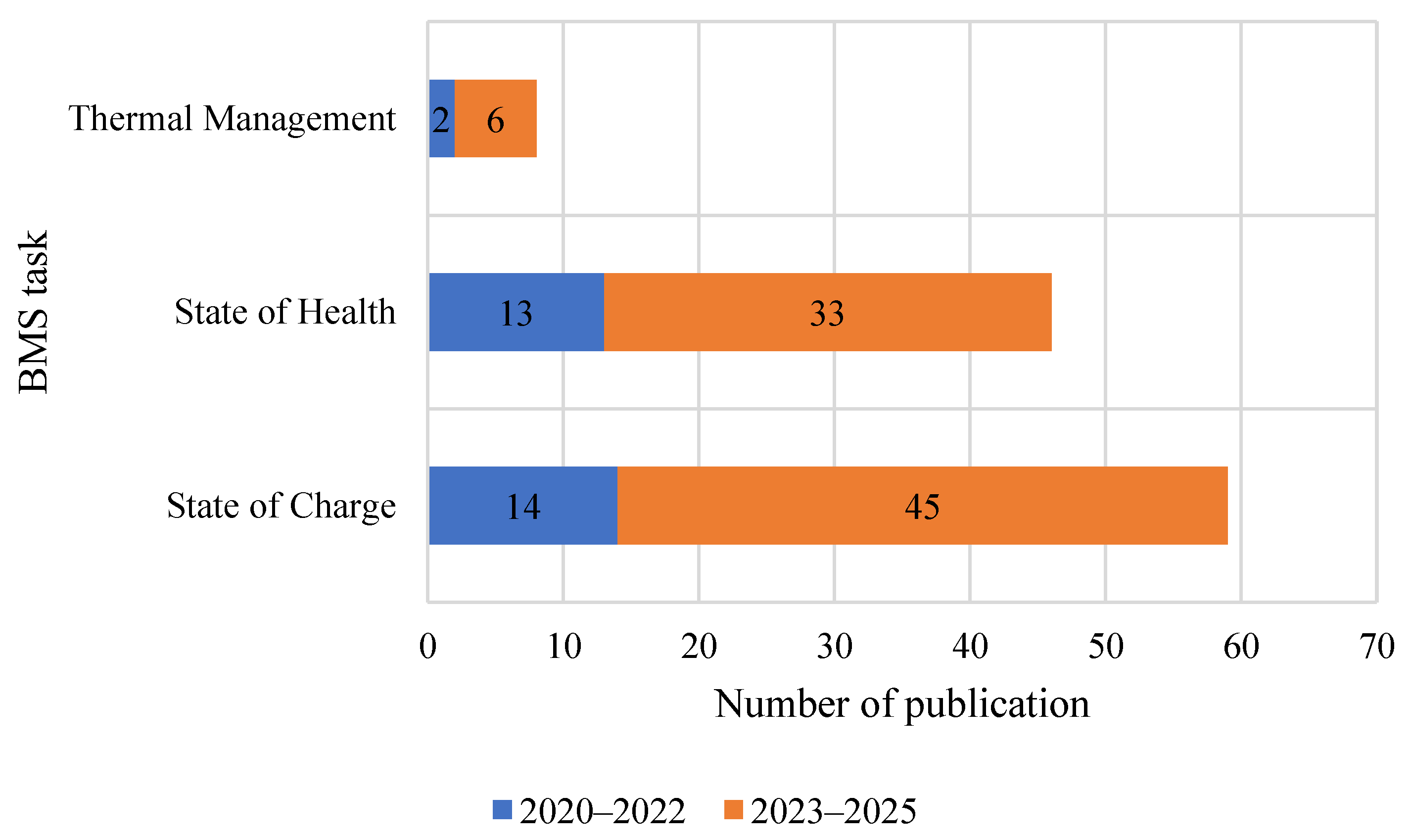
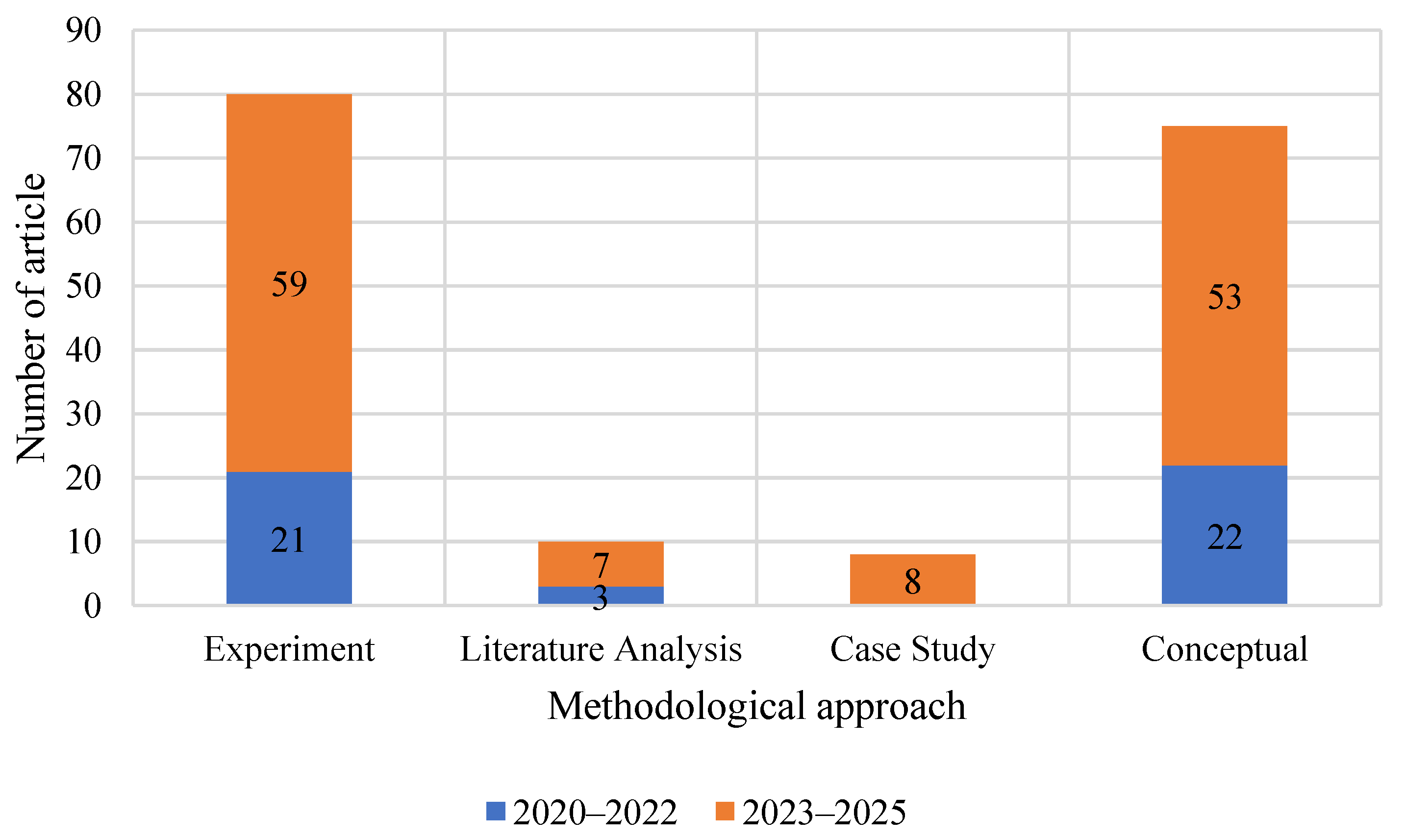
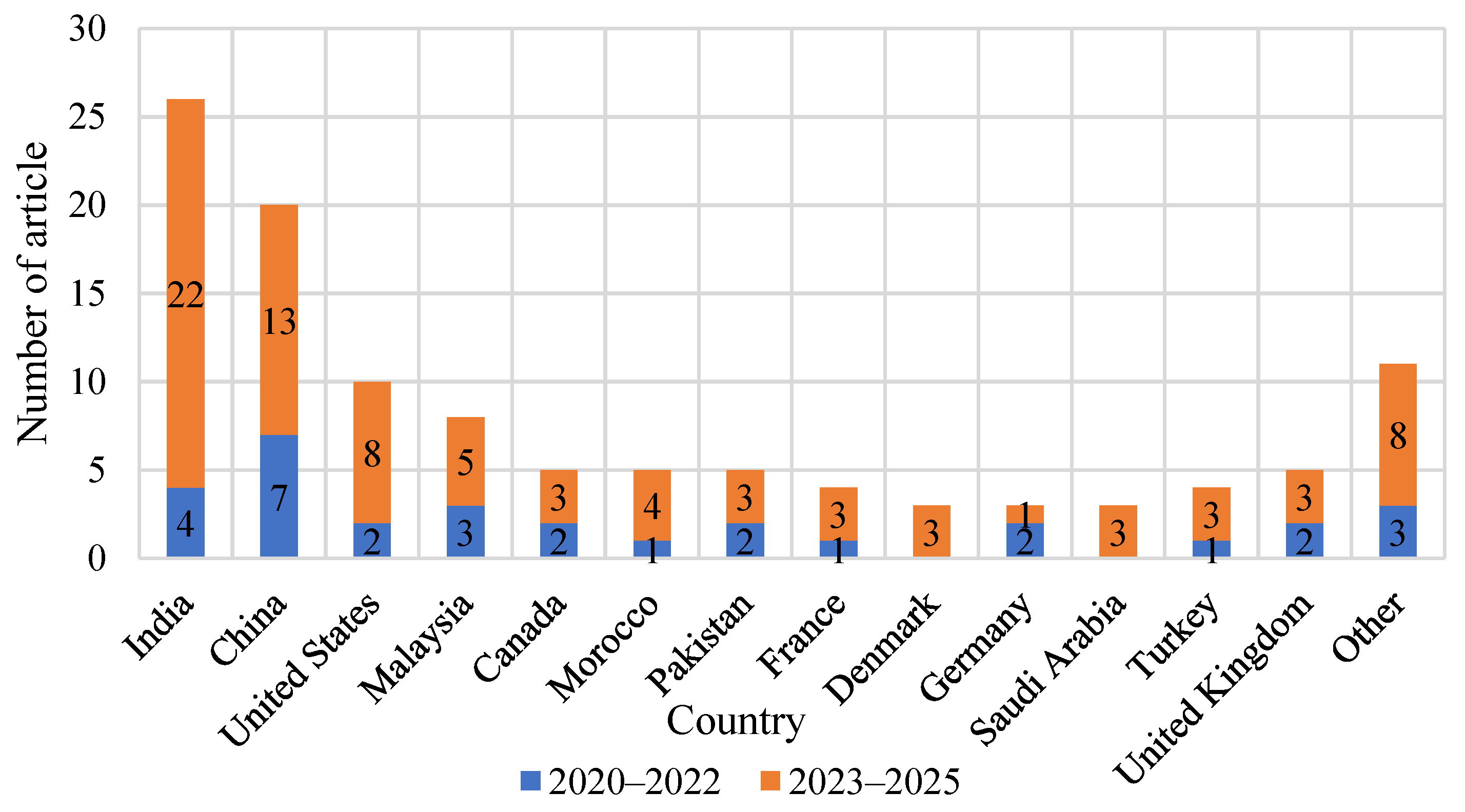
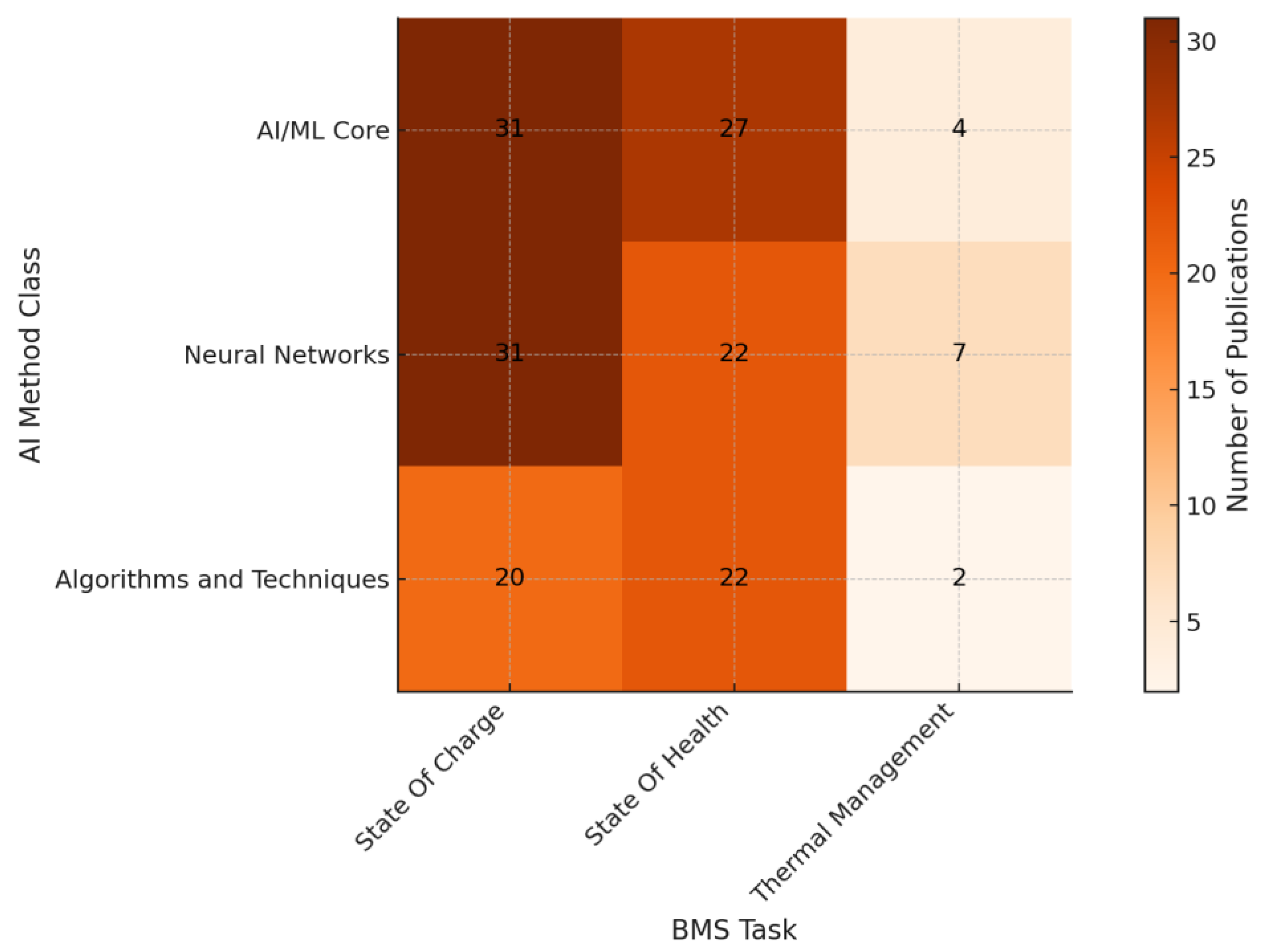
This chapter contains only the analysis of the literature review divided into categories of Battery Management System tasks, namely State of Charge estimation, State of Health estimation, and thermal management. The aim of this chapter is to present the categorical results in an organized manner, without trend analyses or bibliometric visualizations, so that the reader can easily follow the dominant approaches, data types, and the most frequently used evaluation metrics within each category.
In the section devoted to State of Charge estimation, the methods and model configurations are summarized, along with typical input data streams, signal preparation and normalization procedures, and the reported quality metrics and limitations. An analogous structure is used for State of Health estimation, where differential features and degradation indicators are additionally emphasized, and for thermal management, where models and algorithms used for temperature prediction and cooling system control are discussed. Each subsection presents a concise description of the group of studies assigned to the given category, then discusses representative families of methods with typical data and metrics, and finally identifies gaps and limitations that are of practical relevance. This chapter concludes with a summary section that integrates the observations from the subsections and formulates answers to the research questions, maintaining a categorical character of analysis without extending beyond the scope of the review.
3.1. Battery Management Systems
Below are selected studies from recent years concerning the estimation of the State of Charge (SOC) and State of Health (SOH) of batteries, covering both machine learning models and hybrid, hardware, and review solutions.
In study [
10], a residual convolutional neural network with a bidirectional GRU unit optimized using the orangutan algorithm was proposed. This model achieved very low RMSE and MAE errors for SOC and SOH. Study [
11] combines the CatBoost algorithm with metaheuristics (BMO, PSO, GA, WOA) and, based on data from 72 BMW i3 trips, reports the best results for the BMO–CatBoost combination. Review [
12] describes an IoT-Fog-Cloud architecture, emphasizing the selection of ML algorithms to improve SOC and SOH prediction. Article [
13] employs the TimesNet model with DBSCAN clustering and a Savitzky–Golay filter. Although the main focus was on SOH, the analysis also includes SOC estimation, achieving a MAPE error of 0.39%.
The authors of [
14] integrated IoT sensors with ML techniques, which increased battery efficiency by 18.6% and reduced fire risk by 72%. Review [
15] classifies SOC estimation methods as simple, mathematically advanced, and data-driven, discussing their advantages and limitations. Study [
16] introduced synthetic data generation using TimeGAN and the BERT model to account for variables omitted in previous research. The lightweight network with an attention mechanism described in [
17] contains only 1713 parameters and achieved an RMSE of 1.23%. AI-assisted fast charging in [
18] reduced charging time from 4.5 h to 1.5 h using a PID controller and artificial intelligence algorithms.
The digital twin developed in [
19] combines various algorithms (RBF, RF, CNN, LSTM, SVR, XGBoost) for SOC and SOH prediction and ensures model explainability. In [
20], a BP neural network estimated SOC at three temperatures (0, 25, and 45 °C) and achieved good agreement between predicted and actual results. Study [
21] shows that the second peak of the differential capacity curve correlates better with SOH, with a neural network achieving an RMSE of 0.00330, and introduces a State of Functioning (SoF) indicator. In [
22], linear regression, SVM, Random Forest, and neural networks were compared, with neural networks achieving the best results. The hybrid XGBoost–RF model in [
23] improved accuracy to 97.6%, reducing both MSE and MAE. The dynamic Kalman model with a genetic algorithm and SVM (DGKNN) in [
24] achieved an error of 0.1529%. A modification of RNN that used SOC from the previous step in [
25] doubled estimation accuracy. An ensemble of homogeneous LSTM models in [
26] shortened training time by 2.6–3.5 times while maintaining MAE ≈ 1.4%.
The DCRNN model with SVM-RFE feature selection in [
27] achieved extremely low errors (RMSE ≈ 0.02%). Review [
28] characterizes ML methods and their applications to SOC, SOH, and RUL, highlighting the need for comprehensive data analysis. The feedforward network in [
29], tested on BMW i3 driving data, achieved a lower RMSE than the extreme learning machine. The digital twin with gradient boosting and adaptive EKF in [
30] improved energy extraction and SOC monitoring. The enhanced CRC-SHEKF Kalman filter in [
31] reached an MAE of 0.392%. The FPGA accelerator with LSTM in [
32] demonstrated that SOC estimation can be performed efficiently directly on hardware. Comparison of gradient boosting and Random Forest in [
33] showed the superiority of Random Forest (MAE < 0.3%). The MHDTCN-GRU model in [
34], enriched with SHAP-based interpretability, achieved a MAPE of 0.54%.
The algorithm proposed in [
35] combines linear regression and LSTM, reaching R
2 = 99%, while [
36] discusses a battery health system based on LSTM and optimization. The critical review in [
37] analyzes trends in the application of AI to BMS. The LSTMNNGA model in [
38], optimized genetically, achieved an RMSE of 0.0795. In [
39], a NARX network estimated SOC and SOH with RMSE of 0.5% and 0.018%, respectively. Gaussian Kalman filters in [
40] reduced estimation error by 35–60%. The combination of Kalman filters and a deep network in [
41] reduced RMSE to 0.04%, while parallel BiLSTM networks in [
42] improved accuracy by 1.5–3 times. Study [
43] developed a digital twin with incremental learning (MSE ≈ 0.022). The ML model in [
44] predicted SOC and vehicle range for a rural EV with 95% accuracy, and the deep learning strategy in [
45] reduced SOC error to 0.835%. In [
46], deep deterministic policy gradient (DDPG) reinforcement learning achieved 98.8% accuracy. Comparison of DNN, ANN, and GRU-RNN in [
47] showed the superiority of DNN. The telematics system in [
48] predicted SOC and detected faults with accuracy above 97%. The hybrid VAR-LSTM model in [
49] outperformed simple LSTM models. Study [
50] showed that accounting for hysteresis reduced voltage error to 0.002 V, while the improved NARX training algorithm in [
51] lowered MSE. Article [
52] introduces the Cloud-BMS concept with anomaly detection. Reviews [
53,
54] discuss deep learning and ANN/SVM approaches, highlighting the need for model integration and data quality improvement. Study [
55] presents a fractional-order model with MIUKF, achieving errors below 1.21% for SOC.
An important research direction is implementation under resource-constrained conditions. In [
56], a one-dimensional CNN and GRU were implemented on STM32 microcontrollers; quantization reduced model size while maintaining an RMSE of 2.33%. The deep LSTM network in [
57] achieved RMSE values between 0.024 and 0.045 for two Nissan Leaf datasets. Study [
58] showed that a cascaded feedforward network was more effective than classical backpropagation in SOC and SOH estimation. In [
59], an LSTM-SAE model optimized by the Black Widow algorithm achieved lower SOC errors at 25 °C. Energy management in a microgrid with PV forecasts in [
60] increased the total SOC of vehicles by 9.49%. Article [
61] combined three open-circuit voltage models optimized by the MOGA algorithm, improving SOC estimation and generating financial benefits in V2G services. In [
62], a web application (Streamlit) was proposed that allows users to predict SOC based on input data. Review [
63] discusses key SOC technologies for battery packs. The optimized Random Forest in [
64], using a differential search algorithm, eliminated the need for preprocessing filters. In [
65], an artificial neural network achieved a mean error of 2.65%. The support vector data descriptor technique in [
66] allowed SOC estimation without temperature and capacity data. Review [
67], devoted to equivalent circuit models, emphasizes their simplicity and the potential for future AI integration. The latest study [
68] combines SVR regression, RC circuits, DFFRLS, and ASRUKF filtering, achieving RMSE and MAE below 1.95% even with a large initial error.
The collected results indicate that combining methods, such as hybrid models, digital twins, and integration with IoT and explainable AI techniques, systematically improves SOC and SOH estimation accuracy and robustness. At the same time, increasing attention is given to computationally efficient implementations suitable for deployment on embedded platforms. The overview of key methodological categories in State of Charge estimation for EV batteries is presented in
Table 2.
Digital twins and cloud architectures open a new chapter in battery diagnostics because they enable continuous model updates based on operational data and scalable computation. In study [
43], a digital twin of a Battery Management System was constructed. Measurement data from the vehicle were transmitted to the cloud, SoH was estimated using an incremental neural network, and SoC was determined using a Kalman filter, resulting in a mean square error of 0.022 and reduced hardware requirements. This concept was expanded in [
52], where a battery cloud was developed in which SoC was calculated using a neural network and SoH was estimated using differential DVA and incremental ICA analyses. Anomaly detection was also introduced through monitoring of aggregate event statistics. The concept of explainable digital twins integrating diverse algorithms was presented in [
19], emphasizing the importance of combining models with interpretability mechanisms.
In parallel, semi-analytical and hybrid approaches combining physical knowledge with statistical estimation and optimization are being developed. In [
69], a two-stage health-aware energy management system was proposed, where relationships between capacity and internal resistance were first linearized and weights for control were then optimized, reducing operating costs without compromising stability. Study [
70] combined a particle filter, quantum genetic algorithm, and GRNN network, achieving a mean SoC error of less than 1 percent and a SoH error below 2 percent. In [
55], a fractional dynamic model coupled with a multi-innovation Kalman filter enabled simultaneous estimation of SoC and SoH with errors between 2 and 2.5 percent. The perspective of battery model parameter identification using optimization techniques capable of feeding voltage, current, SoC, and SoH computations was presented in [
36]. The consideration of degradation in the electric vehicle routing problem and the adaptation of the algorithm to vehicle dynamics constraints were discussed in [
71].
A complementary physically inspired direction within signal-based health diagnosis is polarization-oriented analysis, where degradation is interpreted through changes in overpotential-related signatures rather than treated purely as a black-box mapping. In practical BMS implementations, polarization growth can be tracked indirectly via online identification of equivalent-circuit parameters (e.g., ohmic resistance and RC time constants) and their evolution under controlled excitation, providing compact, interpretable indicators that can be fused with learning layers or filtering frameworks. This perspective is consistent with approaches combining fractional or circuit-based dynamics with Kalman-family estimators and with reviews emphasizing the role of equivalent-circuit modeling as a physically grounded backbone for AI integration [
36,
55,
67]. In this sense, polarization-aware features can be treated analogously to differential and incremental curve descriptors, i.e., as physics-linked inputs that improve robustness and interpretability when coupled with machine learning predictors and cloud/digital-twin pipelines already discussed in this section [
19,
43,
52].
Signal analysis provides another source of information on degradation, as it makes it possible to extract sensitive indicators without building full physical models. In [
72], incremental capacity analysis was used, which employs derivatives of voltage and capacity curves, allowing SoH estimation with an error of about 2 percent on BMW i3 cells. The authors of [
73] extended this concept through feature selection based on mutual information, reducing signal redundancy and improving SoH prediction accuracy by 9 to 52 percent compared with the baseline set. The integration of ICA and DVA methods with cloud infrastructure was described in [
52]. The use of differential features to build indicators of functional state, including the correlation of the second peak of the differential curve with SoH, was presented in [
21].
Machine learning-based solutions include both classical and deep models, as well as privacy preserving and federated learning approaches. In [
74], an additive regression model was developed using fleet data, and the PSO ELM algorithm predicted capacity with an error below 0.4 percent over a two-month horizon. Reviews [
53,
54] emphasize the potential of convolutional and recurrent architectures but also point to the need for high data quality, large datasets, and careful hyperparameter tuning. A systematic review of privacy protection techniques in battery health prediction for electric vehicles was presented in [
75]. A federated state estimation system with an autoencoder and attention mechanism that accounts for participant contribution was introduced in [
76], and the combination of federated and self-supervised learning for first life batteries was described in [
77]. A feature selection method based on constrained quantum Boltzmann machines, more effective than classical approaches, was presented in [
77]. Operational applications of predictive ML for battery performance optimization were reported in [
28], and the second part of a comprehensive review of state estimation methods for electric vehicles was presented in [
78].
Deep models have brought further improvements in estimation accuracy and model robustness. In [
10], a residual convolutional BiGRU network optimized by the orangutan algorithm achieved very low errors for SoC and SoH, including RMSE of 0.0873 and MAE of 0.0866 for SoC, and accuracy of 90.48 percent, RMSE of 0.1089, and MAE of 0.0952 for SoH. Study [
79] employed generative adversarial networks with a triple attention mechanism, where a CNN LSTM generator extracted spatial and temporal features and a modified echo state network discriminator processed spatial, temporal, and contextual attention, reducing MAE, MSE, RMSE, and MAPE and improving R squared relative to comparison methods. Study [
80] combined physics-informed neural networks with an equivalent circuit model and LSTM, showing that the serial configuration was more accurate and robust than the parallel version and the standard LSTM. In [
81], a regularized box particle filter for SoH estimation reduced errors and computation time compared with SIR PF and box filters. The conceptual IoT Fog Cloud system aimed at selecting ML algorithms for battery data was presented in [
12]. The framework using TimesNet with DBSCAN, the Savitzky–Golay filter, and correlation analysis, achieving MAPE of 0.39 percent and MSE of 0.20 percent, was described in [
13]. The multiscale feature extraction network MMFEN, combining a representation block and a multi-head convolutional attention mechanism, was presented in [
82], achieving RMSE of about 1.21 percent and MAPE of 0.99 percent on NASA data, with 2.78 percent and 2.71 percent on CALCE data and 2.39 percent and 2.08 percent on real EV data, respectively. The DCRNN model with SVM RFE feature selection in [
27] achieved very low estimation errors, including RMSE of about 0.02 percent and MAPE of about 0.41 percent. The hybrid one-dimensional CNN and bidirectional GRU with Bayesian optimization was introduced in [
83], while the combination of wavelet transform, CNN, and LSTM with an attention mechanism was described in [
84]. The hardware implementation perspective with an FPGA accelerator for an LSTM model was presented in [
32], achieving RMSE of 0.3438 in training and 0.3681 in validation. Estimation during charging using a NARX network was presented in [
39], achieving RMSE of 0.5 percent for SoC and 0.018 percent for SoH.
Comparisons of classical methods show varying accuracy depending on data and operating conditions. In [
85], KNN, SVM, decision tree, and Random Forest were evaluated, revealing MAPE of 2.791 × 10
−2 for SVR and 9.957 × 10
−4 for KNN, and MAE of 2.429 × 10
−3 for KNN. The critical review in [
37] presents trends and a roadmap for the development of artificial intelligence in Battery Management Systems. Among deep learning methods, the combination of morphological filtering with a neural network in [
86] achieved an R squared close to one and MSE of 0.03. The cascaded feedforward network in [
58] outperformed the classical network in SoH estimation. Comparative analysis in [
87] demonstrated greater robustness of logistic regression to changes in discharge rate than Random Forest or KNN. The two-layer Gaussian process regression model in [
88] reduced the SoH prediction error to 1.3 percent and allowed lifetime prediction with an error of less than two cycles. Classification of studies in the “State Of Health” section by subcategory is presented in
Table 3.
Battery Thermal Management requires a close connection between modeling and experimental data in order to predict cell temperature and actively limit overheating in real operating scenarios. In study [
95], CFD simulations were combined with a neural network trained using the Levenberg–Marquardt algorithm to analyze the influence of ambient temperature, convective coefficient, and discharge rate on the maximum surface temperature of a single cell in a battery pack. The obtained mean square error was 0.00552 and the coefficient of determination was 0.99, while the spread of maximum temperature predictions was small, with a standard deviation below 0.237 degrees Celsius.
Subsequent research focuses on integrating cooling system design with machine learning to improve control and reduce operating costs. The authors of study [
96] proposed a hybrid liquid cooling method that combines a seahorse optimizer with an extended residual convolutional neural network, providing a reliable BTMS capable of maintaining the pack temperature at a safe level. Comparisons with existing techniques indicated error reduction, although no numerical values were provided in the abstract. Complementarily, study [
97] combined fast charging with thermal management using reinforcement learning. The agent operated in an electrothermal environment that considered aging, controlling both charging current and coolant flow. For a pack composed of twenty cells, it found strategies in less than one second, while model predictive control required over eighty minutes. As a result, the maximum core temperature was maintained below thirty-three degrees Celsius, compared with about forty degrees Celsius under predictive control, and the expected lifetime after one thousand fast charging cycles was extended by up to two years.
Temperature forecasting also benefits from probabilistic models, which allow uncertainty estimation and improved control safety. In study [
98], enhanced quantile convolutional and recurrent neural networks were developed, trained on both fleet and simulated data, with parameter tuning performed using a Bayesian approach. The best model achieved an RMSE of 0.66 degrees Celsius and an R
2 value of 0.84 for median predictions, while the ninety-ninth quantile covered 98.87 percent of the actual values. From a hardware design perspective, rapid exploration of the design space for heat exchangers is particularly important. Study [
99] focused on optimizing liquid cooled plates with pin-fin structures. A dataset was created using coupled three-dimensional models and Latin Hypercube sampling, and deep encoder–decoder models were then trained as surrogate models. In multi-objective optimization using the NSGA-II algorithm, a plate geometry was obtained that reduced the maximum temperature by 4.87 kelvins, the temperature gradient by 5.1 kelvins, representing 22.2 percent, and hydraulic losses by 7.93 pascals, representing 9.0 percent.
In parallel, sequential models capable of learning thermal dynamics directly from onboard data are being developed. In study [
100], a two-layer BiLSTM model was built to forecast the average pack temperature under real driving conditions using 2.3 million samples collected by an Internet of Things device. The model achieved a mean absolute error of 2.92 degrees Celsius on the test set and 1.7 degrees Celsius in cross-validation for a ten-minute forecasting horizon. In the area of real-time control, study [
101] proposed a thermal management strategy based on a double Q network and a GRU unit. Compared with classical fuzzy control and two reinforcement learning strategies, the new method reduced energy consumption by more than 6.7 percent during aggressive driving.
Cross-domain generalization remains critical, as data distributions differ between simulation, fleet, and environmental conditions. In study [
102], quantile convolutional networks were trained on data from multiple domains, including simulations, vehicle fleet data, and weather station measurements. Out of 150 variants, the selected model achieved a median prediction error with MAE equal to 0.27 degrees Celsius, and 47 percent of observations were below the median, indicating correct calibration and practical usefulness in thermal control applications. Regarding thermal management, a summary by thematic subcategories is presented in
Table 4.
3.2. Computational Intelligence
Progress in battery state estimation increasingly relies on models that combine signal representation, physical knowledge, and attention mechanisms. In study [
79], a generative model for health state prediction with a triple attention mechanism was presented, in which the generator combines convolutional neural networks and LSTM to extract features, while the echo state network discriminator uses spatial, temporal, and contextual attention. Across three datasets, this approach outperformed classical methods in terms of MAE, MSE, RMSE, MAPE, and the coefficient of determination. Complementarily, researchers in [
80] compared two configurations of a physics-informed neural network that combines an equivalent circuit model with LSTM. The serial configuration, which introduces physical model parameters directly into the LSTM, captured degradation patterns more effectively and proved more accurate and robust than the parallel configuration and the baseline LSTM.
Thermal modeling also plays an important role as it supports control strategy design and operational safety. In study [
95], CFD calculations were combined with a neural network trained using the Levenberg–Marquardt algorithm to predict the maximum surface temperature of a cell based on operating conditions. The model achieved a mean square error of approximately 0.00552 and an R
2 value of 0.99, and the deviation from experimental results did not exceed 0.237 degrees Celsius. A purely data-driven approach to State of Charge estimation was presented in [
81], where CatBoost was combined with metaheuristics such as Barnacles Mating Optimizer, PSO, GA, and WOA, tested on data from 72 BMW i3 trips. The BMO–CatBoost configuration achieved an RMSE of 6.1031, an MAE of 4.1303, and an R
2 of 0.8211. The conceptual IoT–Fog–Cloud system in [
11] emphasizes the integration of data sources and algorithm selection frameworks for evaluation. Conversely, study [
13] shows that combining IoT sensors with learning algorithms allows simultaneous prediction of performance and reduction in fire risk through analysis of voltage, current, temperature, and State of Charge, achieving 99.4 percent accuracy, a 72 percent reduction in fire risk, and an 18.6 percent increase in efficiency.
To enhance scalability and privacy, study [
94] applied feature selection using a quantum restricted Boltzmann machine on a D-Wave computer, yielding feature sets that were more unique and compactly reduced than those obtained with PSO or Pearson correlation. Study [
77] combined federated and self-supervised learning, which, in simulations for first-life batteries, reduced the mean square error of SoH estimation by 31 percent compared with baseline models while maintaining data protection. For BMS implementation, a lightweight model with an attention mechanism was developed in [
17], achieving an RMSE of approximately 1.23 percent with only 1713 parameters, and [
18] described dynamic fast charging with a data-driven PID controller, reducing theoretical charging time from 4.5 h to 1.5 h and decreasing cell damage by at least 50 percent. The framework of an explainable digital twin integrating RBF, RF, FNN, CNN, LSTM, DNN, SVR, SVM, and XGBoost was presented in [
19], emphasizing the interpretability of models. Study [
21] demonstrated that partial charge data can be used to accurately estimate battery health and functionality, with a neural network achieving an RMSE of 0.00330. The review in [
78] synthesizes trends in health state estimation methods that combine data-driven and physics-based approaches.
The digital twin concept was extended to renewable energy applications in [
30], where collaborative gradient boosting was combined with an adaptive Kalman filter to estimate SoC and resistance in a wind-powered charging system. Field verification confirmed improved accuracy and adaptability. Hardware feasibility was demonstrated in [
32] by implementing a BMS accelerator on an FPGA, where an LSTM model trained in Python was synthesized in Xilinx HLS, achieving an RMSE of 0.3438 in training and 0.3681 in validation. Additionally, the design of heat exchangers was optimized in [
99], where DeepEDH CNN models acted as surrogates for costly simulations, and the NSGA-II algorithm optimized the geometry of pin-fin plates, reducing the maximum temperature by 4.87 kelvins, the temperature gradient by 5.1 kelvins, and the cooling energy demand by 9 percent.
Comparisons of classical algorithms show varying sensitivity to data and operating conditions. In study [
33], Random Forest achieved an MAE below 0.3 percent and an R
2 of 0.999, outperforming gradient boosting, which obtained an MAE of approximately 1 percent and an R
2 of 0.997. In study [
35], linear regression was combined with LSTM in a web application, achieving an R
2 of approximately 0.99 for real-time State of Charge estimation. In study [
36], conducted on the Sandia dataset, KNN, SVR, decision trees, and Random Forests were compared. At 15 degrees Celsius, MAPE values were 2.791 × 10
−2 for SVR, 1.607 × 10
−3 for trees, 9.957 × 10
−4 for KNN, and 4.323 × 10
−3 for forests, while at 25 degrees Celsius, MAE values were 5.593 × 10
−2, 2.379 × 10
−3, 2.429 × 10
−3, and 5.073 × 10
−3, respectively, indicating the advantage of KNN and decision trees. The hybrid one-dimensional CNN and bidirectional GRU with Bayesian optimization described in [
83] achieved, on the NASA dataset, MAE of 2.080 percent, RMSE of 2.516 percent, and a zero end-of-life prediction error, with MSE after 19 iterations equal to 1.2 × 10
−5. A critical review of artificial intelligence in BMS was conducted in [
37], summarizing the strengths and limitations of methods and outlining future development paths.
Integrating probabilistic approaches with Kalman filtering improves not only accuracy but also the reliability of confidence intervals. Study [
40] proposed GP-UKF and GP-PF for State of Charge estimation, which, through covariance matrix adaptation and sample optimization, improved accuracy and reduced uncertainty in UDDS and HWFET simulations compared with classical counterparts. The concept of a digital twin with incremental learning was demonstrated in [
43], where SoH was estimated in the cloud and SoC in the vehicle using a Kalman filter, achieving an MSE of 0.022. Application-oriented operational scenarios were expanded in [
44], which combined State of Charge estimation with range prediction for rural electric vehicles, achieving an average SoC accuracy of 95 percent and a range error below 2 percent.
The energy and degradation management perspective was addressed in [
69], where two-stage linearization of semi-empirical relationships and mapping of degradation features to lost lifetime reduced aging costs in V2G and PHEV scenarios. The rationale for constructing data-driven frameworks based on fleet data was confirmed in [
74], where after identifying aging features using the GAM method and analyzing correlations, the ELM weights were optimized with PSO, and the estimation error for a real battery pack dropped below 0.4 percent. A comparison of architectures for State of Charge estimation was presented in [
47], where the DNN achieved an average error below 0.5 percent and a maximum error below 2.4 percent on experimental data, and an average below 0.4 percent and maximum below 2.5 percent on simulated data, outperforming GRU RNN. The specific characteristics of aviation eVTOL applications were discussed in [
103], which highlighted the dominant role of discharge features and the superiority of Random Forest and XGBoost, while [
90] showed that a modified SVM achieved the lowest degradation prediction error compared with neural networks and linear regression.
Telematics data and temporal feature sequencing are gaining importance. In study [
61], CAN and GPS data were used for predictive battery maintenance in shared fleets, identifying potential faults with an accuracy above 97 percent and improving State of Charge estimation when temperature was added as a feature. In [
48], LSTM, BiLSTM, VAR, and a hybrid VAR-LSTM model were compared, with the combined model yielding higher accuracy than the individual architectures. Study [
73] proposed a preprocessing and feature selection pipeline for predicting cyclic capacity loss, improving accuracy by at least 9 percent for LASSO and by 44, 48, and 52 percent when combined with Random Forest, GPR, and XGBoost, respectively. Study [
51] compared NARX training using the Levenberg–Marquardt and scaled conjugate gradient algorithms on CALCE data, with the former achieving a lower MSE of 4.61306 × 10
−6. The concept of a cloud-based BMS was further developed in [
52], integrating neural networks for SoC estimation with DVA and ICA analyses for SoH estimation and anomaly detection.
Thermal management and real-time control benefit from sequential learning and uncertainty models. In study [
100], more than 2.3 million samples from field tests were collected to train a two-layer BiLSTM model that predicted the average pack temperature with an MAE of 2.92 degrees Celsius on the test set and 1.7 degrees Celsius in cross-validation for a ten-minute forecasting horizon. Review [
53] organizes deep learning applications for estimating State of Charge, State of Health, and remaining useful life, highlighting challenges related to feature selection, preprocessing, and hyperparameter tuning. A synthetic overview of neural network, gradient boosting, and SVM methods was presented in [
70], emphasizing feature selection and implementation limitations. Study [
55] proposed a real-time thermal management strategy based on a double Q network with GRU, which, compared with fuzzy control and two reinforcement learning strategies, reduced energy consumption by more than 6.7 percent during aggressive driving. Miniature networks for microcontroller deployment, including one-dimensional CNN and GRU RNN, were presented in [
56], where quantization to eight-bit precision in STM32Cube AI and TFLite Micro reduced flash memory from 10.82 to 2.89 kilobytes and RAM to 1.04 kilobytes while maintaining an RMSE of 2.33 percent and MAE of 1.62 percent.
Scaling to production data and integration with digital infrastructure require robust models and tools. In study [
86], a health state prediction model based on machine learning, big data, and IoT was proposed, achieving an R
2 of 0.9999 in training and 0.9995 in testing, with an MSE of 0.03. Study [
58] compared a backpropagation network and a cascaded feedforward neural network (CFNN), with the CFNN providing better mapping of State of Charge and State of Health values on NASA and Panasonic 18650 PF datasets. Study [
59] applied an autoencoder-based LSTM optimized using the Black Widow algorithm for State of Charge estimation in hybrid vehicles, achieving an error range from minus 3.5 percent to plus 4.3 percent at 25 degrees Celsius and smaller deviations compared with reference methods. Study [
87] compared KNN, logistic regression, and Random Forest for lifetime prediction, indicating advantages of KNN, although no detailed metrics were reported. In study [
102], quantile convolutional networks were developed and trained on multi-domain data, including simulated, fleet, and environmental datasets. The best model achieved an MAE of 0.27 degrees Celsius for the median and 47 percent of observations below that median. The second-life battery perspective was presented in [
91], where a temporal convolutional network maintained MSE below 1 percent even under dynamic load profiles. A user-oriented tool perspective was demonstrated in [
62] in the form of a Streamlit web application for State of Charge prediction based on input parameters. Study [
64] optimized a Random Forest using differential search, which improved State of Charge estimation accuracy and eliminated the need for preprocessing filters. A real-time method based on a support vector data descriptor was presented in [
66], where State of Charge estimation did not require knowledge of temperature or battery capacity and was successfully validated using simulated data. A thematic summary for AI/ML Core is presented in
Table 5.
Research on battery state estimation increasingly combines signal representation, physical knowledge, and attention mechanisms. In study [
79], a generative adversarial model for State of Health prediction was proposed, in which the generator combines convolutional neural networks and LSTM for feature extraction, while the discriminator uses a modified echo state network with a triple attention mechanism. Tests on three datasets showed lower MAE, MSE, RMSE, and MAPE values and higher R
2 compared with competing solutions. Complementarily, study [
80] presented two configurations of a physics-informed neural network for health-state forecasting, a parallel and a serial one, both combining an equivalent circuit model with LSTM. The serial configuration, which feeds physical model parameters directly into the LSTM, proved more accurate and more robust than the parallel setup and the standard LSTM.
Thermal modeling also plays an important role as it supports control strategy design and operational safety. In study [
95], the maximum temperature of lithium-ion cells was analyzed by combining CFD simulations with a neural network trained using the Levenberg–Marquardt algorithm. The network predicted the maximum surface temperature based on nominal capacity, ambient conditions, and discharge rate, achieving an MSE of 0.00552, an R
2 of 0.99, and a forecast standard deviation below 0.237 °C. The IoT–Fog–Cloud conceptual system described in study [
12] emphasizes the need for integration of heterogeneous sensors, algorithm selection, and evaluation metrics, although no numerical results were reported. A comprehensive review of State of Charge estimation methods, from lookup tables and ampere-hour counting through electrochemical models with observers to data-driven approaches, was presented in study [
15], discussing their advantages and limitations in the context of electric vehicles.
The development of feature and representation methods includes both new architectures and data generation. In study [
82], the MMFEN network was proposed for State of Health estimation, combining an enhanced representation block and a multi-head convolutional attention module. It achieved RMSE of 1.21 percent and MAPE of 0.99 percent on the NASA dataset, 2.78 percent and 2.71 percent on CALCE data, respectively, and 2.39 percent and 2.08 percent on real EV data. Study [
16] introduced the TimeGAN data synthesis system combined with a BERT model for State of Charge prediction, indicating that the inclusion of operational variables and dataset diversification can improve accuracy, which was presented as a conceptual framework. Scalability and privacy were advanced in study [
76], which designed a federated learning framework with a contribution-aware attention mechanism that combines an autoencoder and attention module, improving average State of Health estimation accuracy by 20.18 percent. Study [
77] combined self-supervised and federated learning, reducing the SoH prediction MSE by 31 percent under simulation conditions. For practical BMS implementations, a lightweight attention-based SoC estimator was proposed in study [
17], which, with only 1713 parameters, achieved an RMSE of 1.23 percent on the LG 18650HG2 cell.
The concept of digital twins and control algorithms is being further developed in subsequent studies. Study [
19] described explainable digital twins using RBF, RF, FNN, CNN, LSTM, SVR, SVM, and XGBoost for SoC and SoH prediction, emphasizing interpretability without reporting numerical metrics. In study [
20], a BP neural network was built to estimate SoC during charging based on feature engineering and historical data, achieving low errors over a wide temperature range. Study [
96] combined a seahorse optimizer with an extended residual convolutional neural network in a hybrid liquid cooling system intended to improve BTMS reliability, although no numerical results were reported. In study [
22], ML models were compared using data from Europe and Africa, and neural networks achieved the lowest MSE and highest R
2. Study [
25] introduced an autoregressive modification of RNN for State of Charge estimation, feeding the predicted value from the previous step as input, which doubled accuracy compared with baseline models with only a slight increase in training time. Study [
26] used a homogeneous ensemble of LSTM models with meta-learning, reducing training time by 2.6 to 3.5 times and achieving MAE of about 1.4 percent. Study [
27] applied a diffusion convolutional recurrent neural network with SVM-RFE feature selection for SoH forecasting, obtaining RMSE of about 0.02 percent, MAE of about 0.015 percent, MSE of about 0.026, and MAPE of about 0.32 percent. The operational framework for applying learning methods to optimize battery performance was presented in study [
28], and a comprehensive review of State of Health estimation methods for electric vehicles was provided in study [
78]. In the context of operational data, a feedforward neural network for SoC estimation based on 70 BMW i3 driving sessions was presented in study [
29], achieving an RMSE 2.87 percent lower than that of the next best ELM model.
Energy, thermal, and hardware management are supported by learning methods and uncertainty models. In study [
97], reinforcement learning was applied to simultaneously optimize fast charging and cooling, which reduced computation time from more than 80 min to less than one second for a 20-cell pack, maintained the core temperature below 33 °C compared with about 40 °C for predictive control, and extended battery life by up to two years after 1000 fast charging cycles. In study [
98], improved quantile convolutional and recurrent neural networks were developed for temperature forecasting, achieving RMSE of 0.66 °C and R
2 of approximately 0.84 for the median, with the 0.99 quantile covering 98.87 percent of observations. Study [
32] designed a BMS accelerator on FPGA using an LSTM network, achieving RMSE of 0.3438 in training and 0.3681 in validation. In study [
33], Random Forest and gradient boosting were compared for State of Charge estimation. Random Forest achieved MAE below 0.3 percent and R
2 of 0.999, outperforming gradient boosting, which yielded MAE of about 1 percent and R
2 of 0.997. Study [
34] developed an interpretable MHDTCN-GRU model with SHAP analysis, obtaining MAPE of 0.54 percent and RMSPE of 0.84 percent with 374,433 parameters. Study [
35] combined linear regression and LSTM in a web application for real-time State of Charge prediction, achieving R
2 of 99 percent. Study [
36] described a conceptual battery monitoring system in which parameter optimization and LSTM are used for simultaneous estimation of State of Charge, State of Health, and remaining useful life, without reporting numerical metrics. Study [
83] presented a CNN-BiGRU model for State of Health estimation, where Bayesian optimization with Gaussian process reduced MSE to 1.2 × 10
−5. On the NASA dataset, it achieved MAE of 2.080 percent, RMSE of 2.516 percent, and a zero end-of-life prediction error. Study [
38] presented a probabilistic LSTMNN model optimized by a genetic algorithm, which achieved an RMSE of 0.0795, MAE of 0.0664, and MAPE of 45.31 percent, outperforming classical LSTMNN and ANN. Study [
84] combined wavelet transform, CNN, LSTM, and an attention mechanism, with the addition of wavelets significantly improving State of Health diagnostic accuracy.
Scaling to the level of cells and packs and ensuring robustness under different operating conditions broadens the spectrum of sequential and hybrid models. Study [
42] designed a parallel architecture with multiple BiLSTM layers for estimating the State of Charge of individual cells and packs, achieving accuracy improvements of up to 1.5 to 3 times compared with conventional RNNs, particularly near operating extremes. Study [
45] presented an optimized deep learning strategy for State of Charge estimation across different temperatures and C-rates, with an error of 0.835 percent. Study [
46] applied deterministic policy gradient reinforcement learning for State of Charge estimation and management, achieving 98.8 percent accuracy and shorter convergence times, which improved lifespan and thermal safety. Study [
90] analyzed battery aging under dynamic conditions using neural networks, a modified SVM, and linear regression, with the modified SVM achieving the lowest prediction errors. Study [
49] compared LSTM, BiLSTM, VAR, and a hybrid VAR-LSTM model, with the combined model producing the most accurate State of Charge forecasts. Study [
50] examined the effect of voltage hysteresis, where the LSTM model incorporating hysteresis reduced voltage error to 0.002 V and improved predictions under variable conditions. Study [
51] evaluated NARX training algorithms for State of Charge estimation, with the Levenberg–Marquardt algorithm achieving MSE of 4.61306 × 10
−6 and outperforming the scaled conjugate gradient algorithm.
Cross-domain generalization and real-time operation require rich data streams and efficient implementations. In study [
100], more than 2.3 million samples collected by an Internet of Things device were used to predict the battery pack temperature in a BEV using a BiLSTM network. The model achieved an MAE of 2.92 °C on the test set and 1.7 °C in cross-validation for a ten-minute prediction horizon. Study [
53] presented a review of deep learning applications for estimating State of Charge, State of Health, and remaining useful life, discussing architectures, feature selection challenges, tuning strategies, and development prospects. Study [
101] proposed a real-time thermal management algorithm based on reinforcement learning with a GRU module and a double DQN network, which reduced energy consumption by more than 6.7 percent during aggressive driving compared with fuzzy control and other RL methods. Study [
56] described State of Charge estimation on microcontrollers using a one-dimensional CNN and GRU network after quantization in STM32Cube AI and TFLite Micro, achieving RMSE of 2.33 percent and MAE of 1.62 percent while reducing flash memory to 2.89 kilobytes and RAM to 1.04 kilobytes. In study [
57], a deep LSTM network was applied to predict State of Charge using data from Nissan Leaf, achieving an RMSE of 0.0239 and MAE of 0.0202 on the first dataset and an RMSE of 0.0449 and MAE of 0.0412 on the second. Study [
59] presented an IoTAI-SOC model combining LSTM-SAE with the Black Widow Optimization algorithm, achieving an error range from minus 3.5 percent to plus 4.3 percent at 25 °C. Study [
60] described a predictive energy management system for a charging station that integrates LSTM-based photovoltaic power forecasting with a rule-based power flow algorithm, increasing the total state of charge of vehicles by 9.49 percent within a 60 min horizon. Study [
102] developed quantile convolutional networks trained on multi-domain data for battery temperature forecasting. The best model achieved an MAE of 0.27 °C for the median, with 47 percent of observations below the median. Study [
93] applied an LSTM network to predict remaining useful life using two years of data. After cleaning and approximating the health trajectory with a fifth-degree polynomial, an MSE of about 1 percent was achieved. Study [
104] presented LSTM-based prediction of State of Health and degradation in the context of recycling, enabling early decisions on reuse, regeneration or disposal. Study [
92] developed a unidirectional network based on equivalent circuit parameters optimized by the Gauss method, achieving MSE of about 1.729 percent with a deviation of 0.147 percent and reducing measurement time to 30 s. Study [
63] conducted a review of key State of Charge estimation technologies for fully electric vehicles, discussing factors influencing accuracy and research directions. Study [
89] described the BaHeS system for State of Health estimation with aging propagation, in which voltage entropy identifies faulty cells and cell-interaction modeling improves prediction. The LSTM network achieved 93 percent accuracy and an 18 percent improvement compared with baseline methods. Study [
65] presented a five-step method for State of Charge estimation based on artificial neural networks, in which the maximum error was 18 percent, the mean error was 2.65 percent, and the overall accuracy was 97.35 percent. For Neural Networks, an overview by thematic subcategories is presented in
Table 6.
Progress in State of Charge and State of Health estimation increasingly relies on combining deep learning with domain knowledge and on deliberate feature representation design. Study [
10] presented a ResDCBiGRU model optimized with the orangutan algorithm that simultaneously estimates SOC and SOH, achieving for SOC an RMSE of 0.0873 and an MAE of 0.0866 and for SOH an accuracy of 90.48 percent with an RMSE of 0.1089 and an MAE of 0.0952. The generative approach was extended in study [
79], where SOH prediction was performed using a generative adversarial network with a CNN LSTM generator and an echo state discriminator with a triple attention mechanism, yielding lower MAE, MSE, RMSE, and MAPE and higher R
2 than comparative methods across three datasets. Study [
13] employed TimesNet with DBSCAN clustering, a Savitzky–Golay filter, and Spearman rank correlation, obtaining a MAPE of 0.39 percent and an MSE of 0.20 percent on four datasets. The precision of further designs is illustrated by the CNN BiGRU model with Bayesian optimization in study [
83], which on NASA data achieved an MSE of 1.2 × 10
−5, an MAE of 2.08 percent, and an RMSE of 2.516 percent, with a zero end-of-life error. Very low errors were also obtained in study [
27], where DCRNN with SVM RFE feature selection achieved an RMSE of about 0.02 percent and a MAPE of about 0.41 percent. Interpretability and feature importance weighting are provided by the MHDTCN GRU model with SHAP analysis in study [
34], which reported a MAPE of 0.54 percent and an RMSPE of 0.84 percent.
Classical and hybrid methods remain strong reference points and a basis for fusion. Study [
23] combined XGBoost and Random Forest to estimate SOC with an accuracy of 97.6 percent and an MSE between 1.3 and 1.5 percent. Study [
33] compared Random Forest and gradient boosting, with Random Forest achieving an MAE below 0.3 percent and R
2 of 0.999. Study [
78] used a feedforward network to estimate SOC from 70 BMW i3 trips, achieving an RMSE that was 2.87 percent lower than that of an ELM model. Study [
35] combined linear regression and LSTM in a web application, achieving R
2 of 99 percent in real time. Study [
22] compared linear regression, SVM, Random Forest, and neural networks on European and African datasets, with neural networks obtaining the best results. A review of SOH estimation methods was identified in study [
78], while a review focused on neural networks, gradient boosting, and SVM, along with feature selection issues, was presented in study [
54].
A strong group of approaches is formed by semi analytical and filtering methods that link physical models with learning. Study [
41] coupled a nonlinear Kalman filter based on a two RC model with a deep feedforward network, achieving an SOC error below 0.5 percent and an RMSE of 0.04 percent. Study [
81] proposed a regularized box particle filter for SOH estimation in packs that, by incorporating internal resistance and linear regression, reduced sample degeneracy and computation time compared with SIR PF and box filters. Study [
24] presented a dynamic Kalman network with genetic optimization integrated with SVM, achieving a minimum SOC error of 0.1529 percent and an MSE of 0.0604. Study [
55] used a fractional-order dynamic model with a multi-innovation Kalman filter for simultaneous SOC and SOH estimation, achieving at 25 degrees Celsius an SOC RMSE below 0.38 percent and an SOH RMSE below 0.002 percent, and below 1.21 percent and 0.007 percent, respectively, for different aging states. Study [
49] showed that a VAR LSTM hybrid outperforms single models, and study [
51] demonstrated that training NARX with the Levenberg–Marquardt algorithm yields an MSE of 4.61306 × 10
−6 and outperforms the scaled conjugate gradient method. Study [
90] found that a modified SVM outperforms neural networks and linear regression in degradation prediction under dynamic conditions. The probabilistic perspective is completed by study [
88], where a dual Gaussian process regression achieves maximum SOH errors below 1.3 percent and RUL errors below two cycles with training and testing times up to five seconds. In the broader context, ECM methods and their integration with ML are discussed in review [
67].
Thermal modeling and control directly affect battery safety and lifetime. In study [
95], CFD was combined with a neural network trained using the Levenberg–Marquardt method to predict the maximum surface temperature of a cell, achieving an MSE of 0.00552, an R
2 of approximately 0.99, and a standard deviation below 0.237 degrees Celsius. Study [
98] improved quantile CNN and RNN models for temperature prediction, achieving an RMSE of 0.66 degrees Celsius and an R
2 of about 0.84 for the median, while the 99th quantile covered 98.87 percent of the observations. Study [
31] introduced the CRC-SHEKF filter for SOC estimation with covariance matrix adaptation and a tuning factor, which at 15 degrees Celsius resulted in an MAE of 0.392 percent, RMSE of 0.716 percent, and a maximum error of 0.945 percent, with a computation time of 4.839 s. Study [
71] combined a realistic SOC model with a degradation model in the vehicle routing problem, considering energy use during driving and charging and employing a genetic algorithm. Study [
32] presented a BMS accelerator implemented on FPGA with an LSTM network, achieving an RMSE of 0.3438 in training and 0.3681 in validation. Study [
97] combined fast charging and thermal management using reinforcement learning, obtaining optimal strategies in less than one second and maintaining a core temperature below 33 degrees Celsius compared with about 40 degrees Celsius for predictive control, while lifetime after 1000 fast-charging cycles increased by up to two years. Study [
85] compared KNN, SVM, decision tree, and Random Forest algorithms, with KNN and decision tree achieving the lowest errors.
The concept of a digital twin and implementations under resource-constrained conditions bring solutions closer to practical application. Study [
43] proposed a digital twin with incremental learning, in which SOC is estimated in the vehicle using a Kalman filter and SOH in the cloud, achieving an MSE of 0.022 for SOH. Study [
56] showed that a quantized one-dimensional CNN implemented on STM32 microcontrollers achieved an RMSE of 2.33 percent and MAE of 1.62 percent while reducing flash memory usage to 2.89 kilobytes. Study [
57] developed an LSTM model for the Nissan Leaf, achieving an RMSE of 0.0239 and MAE of 0.0202 on the first dataset and an RMSE of 0.0449 and MAE of 0.0412 on the second. Study [
61] developed a hybrid OCV model optimized by a genetic algorithm for vehicle-to-grid services, improving SOC estimation by 10 percent and increasing aggregator profit by 445 USD in voltage regulation and by 45 USD in frequency regulation while maintaining grid stability in the range of 0.9 to 1.0 p.u. Study [
92] presented a fast SOH estimator based on a single-layer network using parameters from the Randle model, achieving an MSE of 1.729 percent with a deviation of 0.147 percent and a measurement time of about 30 s. Study [
64] introduced a differentially tuned random forest for SOC estimation, which reduced error across the entire range without the need for preprocessing filters. Study [
20] built a BP neural network for SOC estimation during charging, maintaining low errors across a wide temperature range through feature engineering and historical data. Study [
96] combined a seahorse optimizer with an extended residual convolutional neural network in a hybrid liquid cooling system to improve BTMS reliability. Study [
72] used incremental capacity analysis for SOH prediction on BMW i3 data and achieved an RMSE of approximately 2 percent, supporting early degradation detection. Study [
73] proposed a feature selection strategy for predicting cyclic capacity loss, improving accuracy by at least 9 percent for LASSO and by 44 to 52 percent for RF, GPR, and XGBoost. Study [
70] combined a particle filter, a quantum genetic algorithm, and a GRNN network, demonstrating high accuracy with low computational requirements in SOC estimation. Study [
102] applied an LSTM network to predict remaining useful life using two years of data, achieving an MSE of approximately 1 percent. Study [
36] described a conceptual monitoring system in which parameter optimization and LSTM are used for simultaneous estimation of SOC, SOH, and RUL. For Algorithms and Techniques, a summary by subcategory is presented in
Table 7.
3.3. Achievements and Development Prospects of EV Battery Management Systems
In recent years, researchers have significantly improved the accuracy and efficiency of algorithms for managing the batteries of electric vehicles. Many studies have focused on State of Charge (SOC) and State of Health (SOH) estimation using advanced machine learning models. In study [
10], a residual deep convolutional network combined with a bidirectional GRU unit and optimized with the orangutan algorithm achieved very low RMSE and MAE errors for both SOC and SOH. Another model employing generative adversarial networks with a triple attention mechanism significantly reduced SOH prediction errors across multiple datasets [
79]. A hybrid approach combining distributed recurrent neural networks with SVM-based feature elimination achieved errors of only a few hundredths of a percent [
27], while a quantile CNN/RNN network enabled precise temperature prediction with RMSE of approximately 0.66 °C [
98].
Advances in physically informed models have also contributed to progress in this field. Parallel and serial configurations of PINNs capture battery dynamics more effectively than classical LSTM models [
80], while combining CFD with a neural network enabled accurate prediction of maximum cell temperatures with MSE around 0.0055 and a coefficient of determination of 0.99 [
95]. Other studies reported that a regularized box particle filter provided more stable real-time SOH estimation than classical particle filters [
5], and that a TimesNet network combined with data filtering techniques achieved MAPE of 0.39 percent and MSE of 0.20 percent in SOH prediction [
13].
Researchers have also enhanced the learning algorithms themselves. The combination of self-supervised and federated learning reduced MSE by 31 percent [
77], while a fusion of XGBoost and Random Forest models achieved SOC prediction accuracy of 97.6 percent with MSE between 1.3 and 1.5 percent [
23]. Further developments include a dynamic Kalman network optimized genetically and a NARX model trained using the Levenberg–Marquardt algorithm, which achieved MSE of 4.6 × 10
−6 [
51]. Cascaded and feedback-connected networks have also proven highly valuable, reducing convergence time and improving SOC prediction under variable load conditions [
58,
86].
Particular attention has been paid to hardware implementations and energy-efficient solutions. An FPGA accelerator with an LSTM implementation achieved an RMSE of about 0.34 during training and 0.37 during validation [
32], while a compact one-dimensional CNN model running on a microcontroller achieved an RMSE of 2.33 percent with flash memory reduced to 2.89 kilobytes [
56]. Deep LSTM networks for SOC prediction in Nissan Leaf vehicles reduced RMSE to 0.024 and MAE to 0.020 [
57], while the IoTAI SOC solution combining an autoencoder and Black Widow Optimizer maintained an error range between −3.5 and +4.3 percent at 25 °C [
59]. A predictive energy management system based on LSTM increased the total vehicle State of Charge by 9.49 percent within a 60 min forecast horizon [
60], while quantile networks used for temperature forecasting in different vehicles achieved low MAE (approximately 0.27 °C) and covered almost half of the actual values below the median [
102].
Other important achievements include advances in filtering and calibration methods. A hybrid model combining an unscented Kalman filter with a deep network achieved an SOC error below 0.5 percent and RMSE of 0.04 percent [
41], while a fractional-order dynamic model coupled with a multi-innovation UKF enabled simultaneous SOC and SOH estimation with respective errors below 0.38 percent and 0.002 percent [
55]. In addition, studies on battery aging and second-life applications have used TCN networks, fast-converging single-layer networks, and LSTM-based RUL models, which achieved MSE values around 1–2 percent and enabled early degradation detection [
91,
92,
93].
In the area of optimization algorithms, significant progress has been made using genetic and heuristic approaches. A dynamic Kalman model with genetic optimization calculated SOC with an error of approximately 0.15 percent [
24], while a genetically optimized OCV model improved SOC estimation accuracy by 10 percent and increased V2G service operator profits [
61]. The application of a quantum genetic algorithm combined with a particle filter and GRNN network demonstrated high accuracy at low computational cost [
70]. Moreover, the development of lightweight architectures such as quantized one-dimensional CNNs enabled the deployment of SOC algorithms on microcontrollers with flash memory reduced to just a few kilobytes while maintaining RMSE around 2.3 percent [
56].
Another major achievement is the use of digital twin and battery-cloud concepts for remote diagnostics and management. Digital twin models combined with incremental learning allow SOC estimation in the vehicle and SOH estimation in the cloud with MSE of only 0.022 [
43], while telematics and IoT-based systems enable predictive maintenance with accuracy exceeding 97 percent [
48] and remote detection of thermal anomalies [
52]. These advances are complemented by modern thermal management techniques: deep reinforcement learning models maintain cell core temperatures below 33 °C and shorten charging times, while optimized cooling plate designs reduce maximum temperature by more than 4 K [
97,
99,
101].
In recent years, methods for predicting remaining useful life and analyzing battery aging have advanced rapidly. LSTM models are capable of estimating battery lifetime with errors of around 1 percent [
93], while Gaussian process regression models achieve absolute errors below 1.3 percent for SOH and less than two cycles for RUL, with training times under five seconds [
88]. Aging analyses have also shown that modified Support Vector Machines outperform classical neural networks and linear regression in degradation prediction [
90].
The analysis of the reviewed studies indicates several key directions for future research. First, the integration of telematics data and cloud technologies with digital twins is becoming increasingly important. Such platforms enable continuous collection of operational data, edge preprocessing, and cloud sharing, which allows rapid diagnostics and personalized charging strategies [
48,
52]. Future developments should therefore focus on standardized data exchange protocols and privacy-preserving methods such as federated and self-supervised learning, which have reduced MSE by more than 30 percent in tests.
Second, further research on hybrid physics–data models is needed. Combining equivalent circuit models with neural networks improves model generalization and interpretability [
54,
78], while the inclusion of attention mechanisms and fractional filters has reduced SOC and SOH estimation errors to fractional percentages [
55]. Such approaches can also better handle incomplete or noisy data through embedded physical constraints.
Optimization algorithms inspired by nature and quantum computing methods are also promising, as they are already being used to optimize model parameters, for example, the orangutan algorithm [
10], GA [
24], and QGA [
70]. With the advancement of quantum computers, even faster tuning of complex architectures can be expected, facilitating the adaptation of models to new battery chemistries and operating conditions. At the same time, compact deep network architectures and their implementation in embedded systems will continue to develop, enabling real-time SOC and SOH prediction on board vehicles or in portable devices.
From a data quality perspective, intelligent methods for feature selection and automated feature engineering will play a major role. Results indicate that the use of quantum methods and preliminary signal transformations can improve prediction accuracy by several tens of percent [
72,
73]. Future research should also focus on combining heterogeneous datasets that include information from temperature, voltage, current, and environmental sensors, as well as on the use of transfer learning to adapt models across different battery types.
Another important research direction is the integration of intelligent energy and thermal management strategies with prognostic algorithms. Control models based on deep reinforcement learning already reduce charging time, lower energy consumption, and extend cell lifetime [
97,
101]. Future systems may integrate these algorithms with degradation prediction, allowing the charging profile to be dynamically adjusted to the current battery condition.
A further perspective concerns the circular economy and battery reuse. More accurate RUL and SOH models will make it possible to determine when a cell should be retired from primary use and repurposed for second-life applications [
88,
93]. Systems such as BaHeS, which combine anomaly detection with recommendations for secondary deployment of cells, already achieve high effectiveness [
89,
92]. The development of certification standards and automated cell classification systems will be crucial for the sustainable growth of the battery market.
In summary, future solutions for EV battery management will require the synergy of advanced machine learning algorithms, distributed computing architectures, high-quality data, and the integration of sustainability principles. Leveraging these research directions will enable the creation of safer, more efficient, and more environmentally friendly energy storage systems. For Battery Management Systems, an overview of categories and key achievements is presented in
Table 8. For Computational Intelligence, an overview of categories and key achievements is presented in
Table 9.
The Tables above show that the development of modern Battery Management Systems for electric vehicles is based on three interrelated areas: State of Charge estimation, State of Health monitoring, and thermal management. In the first area, the application of deep networks, hybrid models, and optimization algorithms allows the prediction error of SOC to be reduced to hundredths of a percent. In the second area, through the use of generative and recurrent networks as well as feature selection techniques, high accuracy of SOH estimation is achieved, which is essential for both diagnostics and second-life battery planning. In the third area, the integration of CFD simulations, reinforcement algorithms, and cooling system design optimization effectively limits cell temperature rise and reduces energy consumption.
At the same time, it is clear that these advances would not have been possible without the use of advanced intelligent computing tools. Federated learning, cloud-based telematics, and digital twin concepts enable the secure integration of data from multiple vehicles and provide up-to-date real-time forecasts. Deep neural networks, including CNN–LSTM hybrids, lightweight microcontroller-based architectures, and various LSTM configurations, deliver high performance in both battery parameter prediction and energy management. These are complemented by algorithms and techniques such as genetic optimization, regression methods, Support Vector Machines, and Kalman filters, which provide the mathematical foundation for the above solutions.
In summary, the effectiveness of modern BMS results from the harmonious combination of three elements: precise SOC and SOH estimation algorithms, efficient thermal management, and advanced computational infrastructure. Such an integrated approach not only enhances the safety and performance of electric vehicles but also lays the groundwork for future applications such as autonomous charging strategies, intelligent load balancing and the circular economy of batteries.
3.7. Conclusions of the Review
The synthesis of findings from the preceding sections indicates that solutions combining physical knowledge with machine- and deep learning achieve the highest effectiveness in battery state estimation and thermal management. For SOC estimation, hybrid configurations that pair Kalman observers with lightweight LSTM or feedforward networks are superior because they stabilize estimation in the presence of noise and drift and transfer well across driving profiles and load regimes. For SOH estimation, sequential models with attention mechanisms and feature selection perform best, especially when inputs include differential and incremental features from charging cycles together with hysteresis indicators and equivalent circuit parameters. In thermal topics, the combination of CNN- and RNN-based quantile prediction with reinforcement learning control policies is advantageous, enabling maintenance of core temperatures below safety thresholds with short decision times. The highest-quality results are obtained when data streams combine electrical and thermal signals with telematics and environmental parameters and when data preparation includes consistent windowing, channel synchronization, filtering, and normalization. Quality assessment still relies mainly on RMSE and MAE, less often on uncertainty and energy consistency measures, and reporting of computational cost and hardware requirements remains inconsistent.
The first research question concerned model families and hybrid configurations and the conditions under which they maintain an advantage. In SOC estimation, systems that combine Kalman observers with LSTM or feedforward networks are most effective, and their advantage holds in typical operating ranges, with C-rates of about 0.5 to 2 and cell and ambient temperatures of about 15 to 45 degrees Celsius, provided that input signals are consistently normalized and filtered. In SOH estimation, sequential architectures with attention and feature selection dominate, particularly in combination with differential and incremental features from charging cycles and with equivalent circuit parameters. In thermal management, the mix of CNN- and RNN-based quantile regression with reinforcement learning control policies simultaneously limits temperature exceedance risk and computational cost. In resource-constrained environments, compact models, including quantized one-dimensional CNNs and reduced LSTMs, retain an advantage by providing a reasonable tradeoff between error, memory footprint, and latency.
The second research question was related to data types and to preparation and normalization procedures, as well as to feature sets associated with the best results. Dominant solutions combine voltage, current, and temperature with telematics and environmental parameters such as speed, elevation profile, and ambient temperature. In fleet data, window lengths of 30 to 120 s with sampling at 1 to 10 hertz are most common, whereas laboratory frequencies are higher. Preparation procedures include channel alignment and synchronization, denoising with bandpass filtering or a Savitzky–Golay filter, resampling to a uniform grid, and normalization, most often min–max or z-score. For SOC, key features include temporal derivatives and aggregates of voltage and current, charge counters, dV/dt derivatives, and relaxation features after load removal. For SOH, ICA, and DVA features, positions and amplitudes of differential peaks, hysteresis indicators, degradation rates, and equivalent circuit parameters provide an advantage. In thermal tasks, geometry and boundary condition representations, sensor placement, and coolant flow descriptors are important, as are features linking load history with local temperature extremes. The best configurations combine these sets with attention mechanisms and with physics embedded in the loss function, strengthening transferability across vehicles and climates.
The third research question addressed the reporting of uncertainty, verification and validation, and computational costs and hardware requirements, as well as the metrics regarded as standard. The share of studies reporting uncertainty is growing, particularly with probabilistic models and quantile regression, yet point estimates still dominate. Validation most often relies on train, validation and test splits, or on cross-validation, while transfer validation across fleets, vehicles, and climates is less common. Information on computational cost and hardware requirements is reported with varying detail, with more complete descriptions appearing in publications that include implementations on programmable devices and microcontrollers, where the number of parameters, memory footprint, and training and inference times are documented. In practice, RMSE and MAE remain the standard for SOC and SOH, with MAPE and the coefficient of determination used as complements, while in the thermal area RMSE and maximum error in degrees Celsius are most frequently reported; for surrogate models, the acceleration relative to baseline methods and run times are emphasized. There is a need for further standardization of reporting to include task-appropriate error metrics, verification and validation elements, computing platform characteristics, and at least one uncertainty or coverage measure.
Taken together, the conclusions point to a set of practices that are both effective and feasible. For SOC and SOH estimation, hybrid solutions with a physical prior and a learning layer should be preferred, built on carefully prepared data streams. In thermal tasks, a tandem of quantile prediction and reinforcement-learning-based control is particularly valuable. Across all tasks, it is necessary to maintain consistent data preparation procedures, window choices and normalization, and to extract features tied to the underlying physics, differential features for SOH, and relaxation features for SOC, with geometry and boundary conditions accounted for in the thermal component. For comparability and engineering usefulness, unified reporting of uncertainty, validation procedures, platform parameters, and computational costs is essential, as it will enable more reliable comparisons and support deployment planning.
The energy-systems framing adopted in this review (V2G and PV-coupled charging) can be strengthened by explicitly clarifying how AI-enabled BMS functions translate into measurable energy indicators. In grid-interactive operation, the BMS does not modify system-level metrics directly; instead, it enables controllable flexibility by providing reliable state awareness (SOC, SOH, and temperature constraints) and by supporting higher-level charging/discharging decisions that must remain safe and lifetime-aware under dynamic duty cycles [
19,
30,
52]. Consequently, the causal pathway from algorithms to energy outcomes should be interpreted as a multi-stage coupling: state estimation and constraint inference enable feasible dispatch decisions, which in turn affect net-load profiles and renewable energy utilization at the system level [
1,
4,
5].
A representative mechanism for reducing the peak–valley difference emerges in V2G-enabled scheduling. Accurate SOC/SOH estimation provides bounded flexibility and reduces uncertainty in available capacity, which is essential for bidirectional operation and for avoiding constraint violations during dispatch [
19,
30,
52]. On this basis, an energy management layer can select charging and discharging setpoints that shift demand away from peak hours and optionally inject power during high-load periods, while incorporating degradation-aware weighting to prevent short-term grid services from causing disproportionate lifetime cost [
61,
69]. This sequence of actions yields a flatter net-load profile at the point of common coupling, which corresponds to the reported mechanism of peak–valley reduction through controlled V2G participation rather than through estimation accuracy alone [
1].
A second case-level mechanism concerns increasing photovoltaic self-consumption through alignment of charging demand with PV generation. Studies on PV–EV matching and sizing indicate that self-consumption improves when charging is scheduled to coincide with PV surplus rather than being driven solely by user arrival times or tariff signals [
4,
5]. In this setting, BMS-supported prediction and constraint handling provide the feasibility layer for such alignment by maintaining mobility-related SOC requirements and by avoiding excessive cycling that would undermine lifetime objectives [
2]. Microgrid-oriented energy management that incorporates PV-related information has been shown to improve operational battery-state outcomes (e.g., increasing aggregate SOC), which is consistent with shifting charging toward locally generated energy and reducing grid import during non-PV periods [
60]. Importantly, the energy indicator improvement arises from the coupling of prediction, constraints, and scheduling, not from any single algorithmic component in isolation [
4,
60].
These evidence chains clarify how BMS algorithms contribute to energy-system indicators through constraint-aware flexibility provision and dispatch enablement. Making this linkage explicit supports the review’s energy-systems perspective and demonstrates why reporting only estimation error is insufficient when the intended application includes V2G services and PV-integrated charging strategies [
1,
19,
52].
While many studies emphasize accuracy metrics (e.g., MAE/RMSE/MAPE), practical deployment of AI-based BMS solutions also depends on the accuracy–computational cost balance, including model footprint, training effort, inference latency, and hardware feasibility. Representative examples in the reviewed corpus illustrate several recurring engineering trade-offs. First, some works explicitly minimize model size to enable embedded inference; for instance, a lightweight network with an attention mechanism is reported to contain only 1713 parameters while achieving an RMSE of 1.23%, indicating a clear pathway toward microcontroller/ECU-oriented deployment through footprint reduction [
17]. Second, training efficiency improvements are addressed by ensemble-type strategies; an ensemble of homogeneous LSTM models is reported to maintain an MAE of approximately 1.4% while shortening training time by about 2.6–3.5 times, suggesting that practical maintainability and retraining cost can be improved without sacrificing accuracy [
26]. Third, hardware-aware implementations demonstrate that sequence models can be accelerated on dedicated platforms; an FPGA accelerator for an LSTM-based estimator is reported, with RMSE values of 0.3438 in training and 0.3681 in validation, providing evidence that real-time inference constraints can be addressed through specialized computation rather than purely architectural simplification [
32].
A parallel line of work addresses computational feasibility at the system-architecture level. Digital twin and cloud-connected BMS concepts aim to shift computational load off-board and enable model updates based on operational data. For example, a digital-twin-oriented BMS is described where measurement data are transmitted to the cloud, SOH is estimated using incremental learning, and SOC is determined using a Kalman filter-based component; the study reports an MSE of approximately 0.022 and emphasizes reduced local hardware requirements, which illustrates an explicit accuracy–infrastructure trade-off (edge constraints vs. connectivity and off-board processing) [
43]. Related cloud-BMS concepts combine SOC/SOH analytics with additional functions such as anomaly detection and signal-based health analyses, further motivating the view that deployment feasibility is not only model-specific but also architecture-dependent [
52]. These approaches also align with broader digital twin frameworks discussed in the corpus, where interpretability and continuous updating are treated as part of the engineering value proposition [
19].
Embedded feasibility is also demonstrated directly through implementation-oriented studies. A practical example is the deployment of a one-dimensional CNN and GRU on STM32 microcontrollers, where quantization is applied to reduce model size while maintaining an RMSE of 2.33%, explicitly illustrating the performance–compression trade-off required for resource-constrained BMS hardware [
56]. In the thermal-management and charging domain, computational cost considerations become even more visible in runtime comparisons: reinforcement-learning-based joint fast-charging and thermal-control strategies are reported to be found in less than one second, whereas model predictive control requires over eighty minutes under the compared setup; the same study reports maintaining a maximum core temperature below 33 °C, thereby linking computational feasibility with safety-relevant thermal constraints in online control [
97]. Finally, thermal management research also uses surrogate modeling to reduce computational burden in design-space exploration; deep encoder–decoder surrogate models are employed to support multi-objective optimization of liquid-cooled plate structures, reporting reductions such as a 4.87 K decrease in maximum temperature, a 5.1 K decrease in temperature gradient (22.2%), and a 7.93 Pa decrease in hydraulic losses (9.0%), demonstrating how computational methods can substitute expensive high-fidelity simulations in engineering design workflows [
99].
Overall, these examples show that accuracy alone is insufficient for engineering selection of SOC/SOH/thermal solutions. The reviewed literature indicates three practical routes to achieve deployable performance: (i) footprint minimization for embedded inference, (ii) hardware acceleration for real-time computation, and (iii) system-level architectures (digital twins/cloud BMS) that redistribute computational effort. At the same time, cost reporting remains inconsistent across publications, and future work would benefit from more standardized disclosure of platform specifications and runtime indicators to enable fair cross-model comparisons.