Preparation and Solar-Energy Applications of PbS Quantum Dots via In Situ Methods



Abstract
1. Introduction
2. In Situ Preparation of PbS Quantum Dots
2.1. Successive Ionic Layer Adsorption and Reaction (SILAR)
2.2. Voltage-Assisted SILAR (V-SILAR)
2.3. Chemical Bath Deposition (CBD)
3. Applications in Solar-Energy Conversion
3.1. Quantum-Dot-Sensitized Solar Cells (QDSSCs)
3.2. Photoelectrochemical Hydrogen Production
4. Recent Advances and Strategies
4.1. Hybrid and Heterostructure Engineering
4.2. Surface Passivation and Protection Layers
4.3. Doping and Ligand Engineering Strategies
5. Summary and Outlook
Author Contributions
Funding
Data Availability Statement
Conflicts of Interest
References
- Zhang, C.; Han, D.; Zhang, X. PbS Colloidal Quantum Dots: Ligand Exchange in Solution. Coatings 2024, 14, 761. [Google Scholar] [CrossRef]
- Meng, L.; Xu, Q.; Zhang, J.; Wang, X. Colloidal Quantum Dot Materials for Next-Generation near-Infrared Optoelectronics. Chem. Commun. 2024, 60, 1072–1088. [Google Scholar] [CrossRef] [PubMed]
- Sun, P.; Xing, Z.; Li, Z.; Zhou, W. Recent Advances in Quantum Dots Photocatalysts. Chem. Eng. J. 2023, 458, 141399. [Google Scholar] [CrossRef]
- Ji, Y.; Jia, D.; Xu, F.; Li, Z.; Zhang, L.; Li, L.; Qiu, H. Rise of Colloidal Silver Bismuth Sulfide Nanocrystals Solar Cells. Chin. Chem. Lett. 2026, 37, 112054. [Google Scholar] [CrossRef]
- Billah, Md.M.; Kawamura, G. Layered Double Hydroxide Modified Bismuth Vanadate as an Efficient Photoanode for Enhancing Photoelectrochemical Water Splitting. Mater. Horiz. 2025, 12, 2089–2118. [Google Scholar] [CrossRef]
- Liu, G.; Liccardo, L.; Moretti, E.; Zhao, H.; Vomiero, A. Quantum Dots in Photoelectrochemical Hydrogen Production. In Photoelectrochemical Engineering for Solar Harvesting; Elsevier: Amsterdam, The Netherlands, 2024; pp. 415–463. ISBN 9780323954945. [Google Scholar]
- Seo, J.-W.; Ha, S.-B.; Song, I.-C.; Kim, J.-Y. PbS Quantum Dots-Decorated BiVO4 Photoanodes for Highly Efficient Photoelectrochemical Hydrogen Production. Nanomaterials 2023, 13, 799. [Google Scholar] [CrossRef]
- Baskaran, S.; Sree Rathna Lakshmi, N.V.S.; Lakshmi Narayana, A.; Arul Murugan, C. Quantum Dots Solar Cells: Materials Innovation, Device Engineering, and Emerging Applications. Mater. Sci. Semicond. Process. 2025, 196, 109676. [Google Scholar] [CrossRef]
- Nguyen, B.D.; Choi, I.-H.; Kim, J.-Y. Strategies for Enhancing BiVO4 Photoanodes for PEC Water Splitting: A State-of-the-Art Review. Nanomaterials 2025, 15, 1494. [Google Scholar] [CrossRef] [PubMed]
- Jin, B.B.; Kong, S.Y.; Zhang, G.Q.; Chen, X.Q.; Ni, H.S.; Zhang, F.; Wang, D.J.; Zeng, J.H. Voltage-Assisted SILAR Deposition of CdSe Quantum Dots to Construct a High Performance of ZnS/CdSe/ZnS Quantum Dot-Sensitized Solar Cells. J. Colloid Interface Sci. 2021, 586, 640–646. [Google Scholar] [CrossRef]
- Jin, B.B.; Wang, D.J.; Kong, S.Y.; Zhang, G.Q.; Huang, H.S.; Liu, Y.; Liu, H.Q.; Wu, J.; Zhao, L.H.; He, D. Voltage-Assisted SILAR Deposition of CdSe Quantum Dots into Mesoporous TiO2 Film for Quantum Dot-Sensitized Solar Cells. Chem. Phys. Lett. 2019, 735, 136764. [Google Scholar] [CrossRef]
- Jin, B.B.; Liu, X.J.; Dong, L.C.; Zhong, X.X.; Liang, M.Y.; Gan, J.; Chen, M.; Guo, F. Improving Loading of CdS/CdSe Co-Sensitized Quantum Dots to Enhance the Performance of Solar Cells by Voltage-Assisted SILAR Deposition. Sol. Energy Mater. Sol. Cells 2023, 255, 112293. [Google Scholar] [CrossRef]
- Kharboot, L.H.; Altaf, A.A. Quantum Dot-Sensitized Solar Cells: Broader Implications for Renewable Energy Solutions from (2020–2025). Inorganica Chim. Acta 2025, 588, 122882. [Google Scholar] [CrossRef]
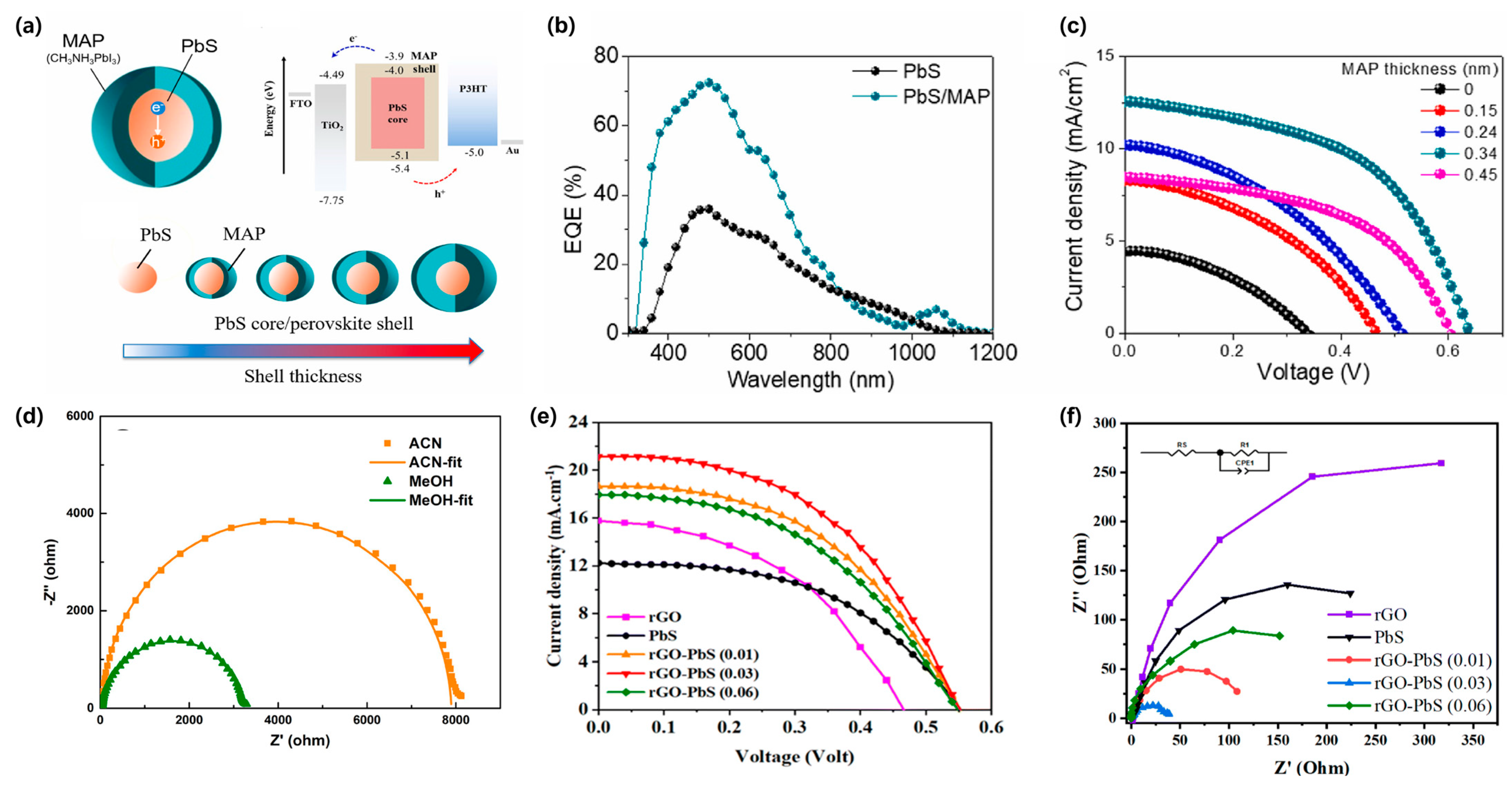
- Dang, H.P.; Tung, H.T.; Hanh, N.T.M.; Duyen, N.T.K.; Thuy, V.T.N.; Anh, N.T.H.; Hieu, L.V. Efficient Counter Electrode for Quantum Dot Sensitized Solar Cells Using P-Type PbS@reduced Graphene Oxide Composite. Nanoscale Adv. 2025, 7, 700–710. [Google Scholar] [CrossRef]
- Pandey, S.; Pandey, B.K.; Mishra, K.P.; Gupta, J.; Jaiswal, R.L. Performance Optimization of the PbS-Quantum Dot Solar Cell by the Selection of Suitable ETL through Numerical Simulation. Opt. Quantum Electron. 2025, 57, 241. [Google Scholar] [CrossRef]
- Li, Z.; Liang, H.; Zhang, J.; Yin, S. Investigating Wide Spectrum Photoelectric Response Characteristics of PbS Quantum Dots/Silicon Nanowires Array Core-Shell Structure. J. Alloys Compd. 2023, 945, 169276. [Google Scholar] [CrossRef]
- Basit, M.A.; Aanish Ali, M.; Masroor, Z.; Tariq, Z.; Bang, J.H. Quantum Dot-Sensitized Solar Cells: A Review on Interfacial Engineering Strategies for Boosting Efficiency. J. Ind. Eng. Chem. 2023, 120, 1–26. [Google Scholar] [CrossRef]
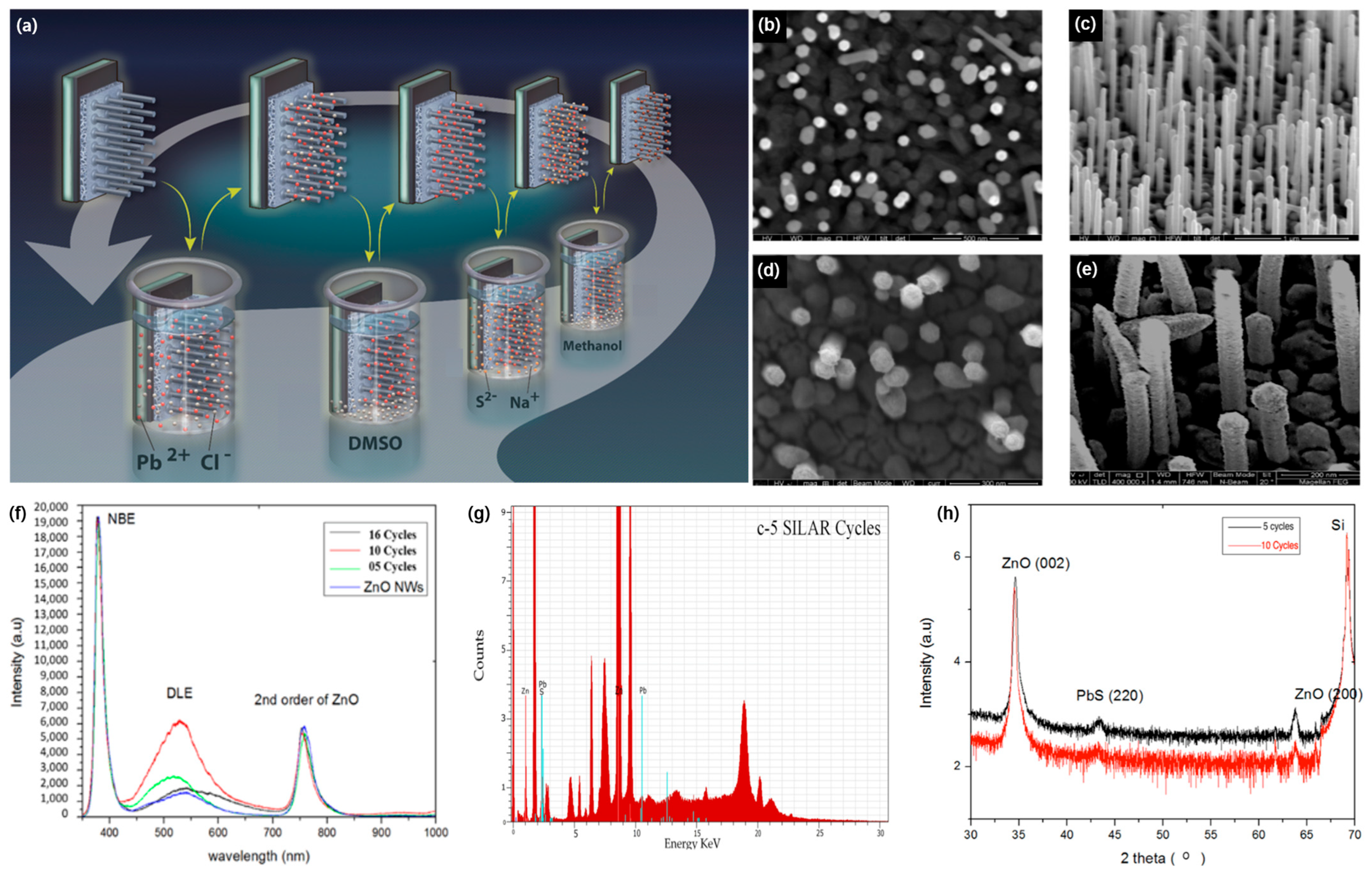
- ElZein, B.; Abulikemu, M.; Barham, A.S.; Al-Kilani, A.; Alkhatab, M.I.; Hamdan, S.M.; Dogheche, E.; Jabbour, G.E. In Situ Growth of PbS Nanoparticles without Organic Linker on ZnO Nanostructures via Successive Ionic Layer Adsorption and Reaction (SILAR). Coatings 2022, 12, 1486. [Google Scholar] [CrossRef]
- Basit, M.A.; Mughal, F.; Muhyuddin, M.; Khan, T.F.; Ahsan, M.T.; Ali, N. Superior ZnS Deposition for Augmenting the Photostability and Photovoltaic Performance of PbS Quantum-Dot Sensitized Solar Cells. Chem. Phys. Lett. 2019, 731, 136572. [Google Scholar] [CrossRef]
- Mao, X.; Yu, J.; Xu, J.; Zhou, J.; Luo, C.; Wang, L.; Niu, H.; Xu, J.; Zhou, R. Enhanced Performance of All Solid-State Quantum Dot-Sensitized Solar Cells via Synchronous Deposition of PbS and CdS Quantum Dots. New J. Chem. 2020, 44, 505–512. [Google Scholar] [CrossRef]
- Sung, S.D.; Lim, I.; Kang, P.; Lee, C.; Lee, W.I. Design and Development of Highly Efficient PbS Quantum Dot-Sensitized Solar Cells Working in an Aqueous Polysulfide Electrolyte. Chem. Commun. 2013, 49, 6054. [Google Scholar] [CrossRef]
- Lee, J.-W.; Hong, J.-D.; Park, N.-G. Sixfold Enhancement of Photocurrent by Surface Charge Controlled High Density Quantum Dot Coating. Chem. Commun. 2013, 49, 6448. [Google Scholar] [CrossRef]
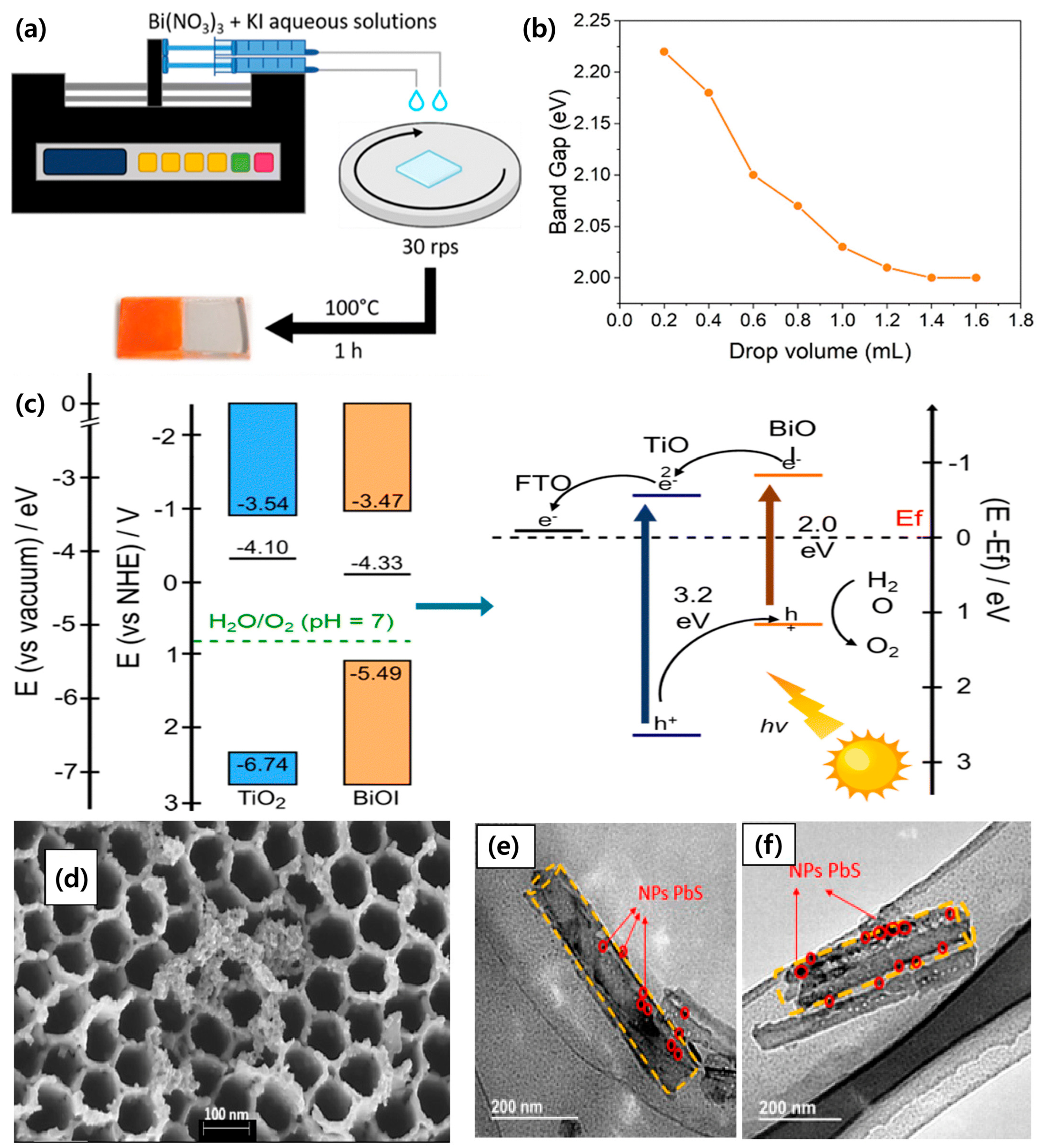
- Altieri, R.; Schmitz, F.; Schenker, M.; Boll, F.; Rebecchi, L.; Schweitzer, P.; Crisci, M.; Kriegel, I.; Smarsly, B.; Schlettwein, D.; et al. Development of an Automated SILAR Method for the Sustainable Fabrication of BiOI/TiO2 Photoanodes. Energy Adv. 2024, 3, 2564–2574. [Google Scholar] [CrossRef]
- Jemai, S.; Choubani, K.; Hajjaji, A.; Sassi, S.; Ben Rabha, M.; Almeshaal, M.A.; Soucase, B.M.; Bessais, B. Photoactive TiO2 Nanotubes and SILAR-Synthesized PbS/TiO2 Heterojunctions for Tetracycline Antibiotic Photodegradation. Inorganics 2025, 13, 320. [Google Scholar] [CrossRef]
- Erdem, E.; Güllü, Ö.; Okumuş, M. Study of Structural and Electro-Optical Properties of Al/PbO/p-Si Thin Films Produced by CBD and SILAR Methods. Appl. Phys. A 2025, 131, 287. [Google Scholar] [CrossRef]
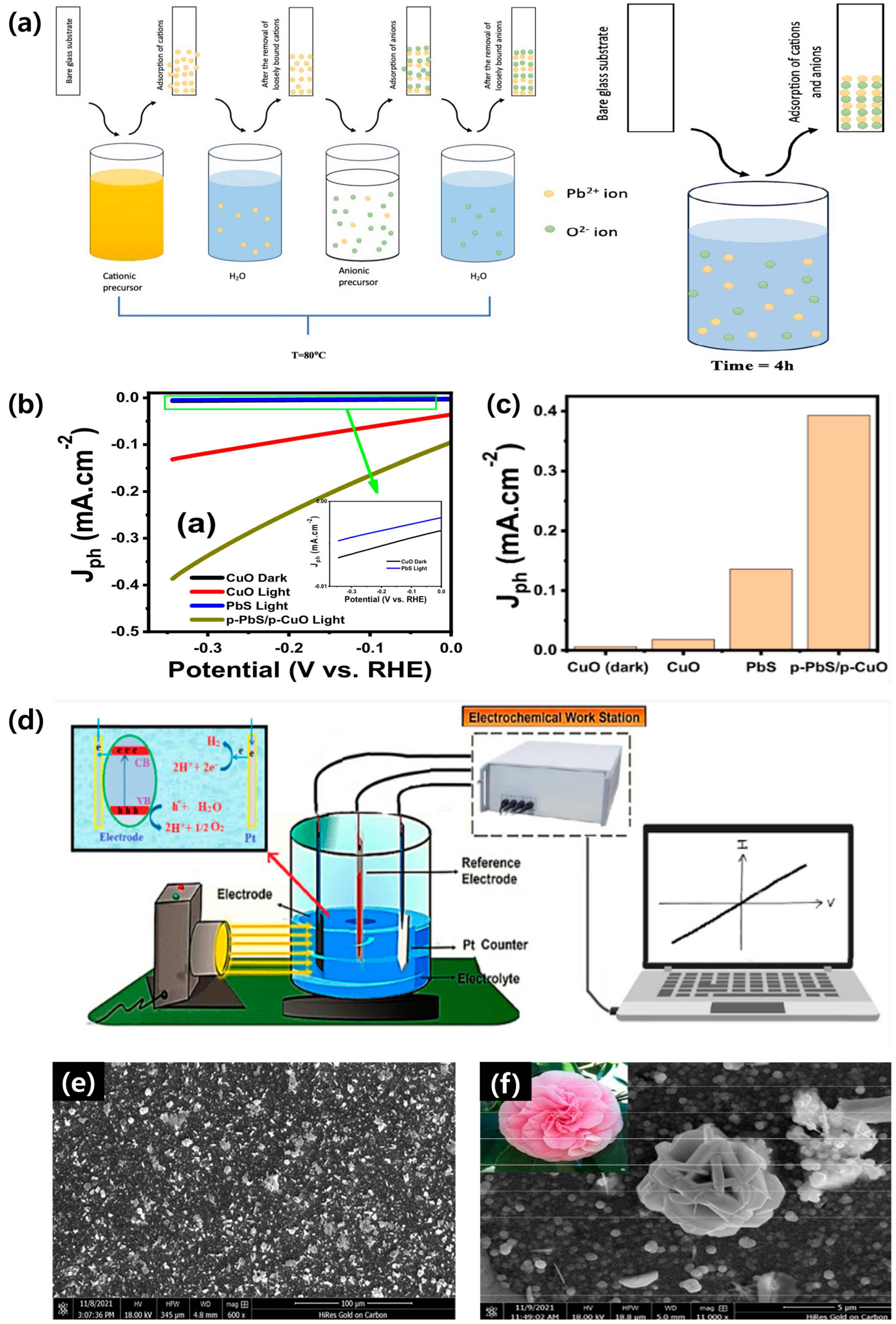
- Zayed, M.; Aljaafreh, M.J.; Shaban, M.; Hezam, M.; Mohamed, S.H.; Rabia, M.; Marashdeh, M.; Al-Hmoud, M.; Ahmed, A.M. Nanostructured P-PbS/p-CuO Sulfide/Oxide Bilayer Heterojunction as a Promising Photoelectrode for Hydrogen Gas Generation. Open Chem. 2023, 21, 20230177. [Google Scholar] [CrossRef]
- Joshi, R.; Gosavi, N.; Sali, K.; Gosavi, S. Study of Synthesis Dependent Physicochemical and Optoelectronic Properties of Nanocrystalline Lead Sulfide PbS) Thin Films Deposited Using Chemical Bath Deposition Method. Prog. Phys. Appl. Mater. 2025, 5, 47–60. [Google Scholar]
- Aggarwal, R.; Jain, V.K.; Sengupta, S. PbS/Si NW Heterojunction on Silicon Chip Based Self-Powered Photo Detector Device for IR Radiations by Chemical Bath Deposition. Silicon 2024, 16, 4361–4369. [Google Scholar] [CrossRef]
- Mu, X.; Su, J.; Zhou, W.; Chang, P.; Deng, J.; Liu, Y.; Ma, Z.; Xie, Y. Broadband Graphene-PbS Heterostructure Photodetector with High Responsivity. Nanomaterials 2025, 15, 207. [Google Scholar] [CrossRef]
- Zhang, G.; Guan, D.; Qiu, J.; Huang, D.; Shi, H.; Leng, C. One-Step High-Performance CBD-PbS Film Deposition Technology for Room Temperature near Infrared Detectors. Appl. Surf. Sci. 2025, 710, 163752. [Google Scholar] [CrossRef]
- Lv, Q.; Li, R.; Fan, L.; Huang, Z.; Huan, Z.; Yu, M.; Li, H.; Liu, G.; Qiao, G.; Liu, J. High Detectivity of PbS Films Deposited on Quartz Substrates: The Role of Enhanced Photogenerated Carrier Separation. Sensors 2023, 23, 8413. [Google Scholar] [CrossRef]
- Encinas-Terán, A.; Pineda-León, H.A.; Gómez-Colín, M.R.; Márquez-Alvarez, L.R.; Ochoa-Landín, R.; Apolinar-Iribe, A.; Gastélum-Acuña, S.L.; Mendívil-Reynoso, T.; Castillo, S.J. Synthesis and Characterization of a Semiconductor Diodic Bilayer PbS/CdS Made by the Chemical Bath Deposition Technique. ACS Omega 2024, 9, 24321–24332. [Google Scholar] [CrossRef]
- Seo, G.; Kim, S.; Choi, H.; Kim, M. Enhanced Performance of Lead Sulfide Quantum Dot-Sensitized Solar Cells by Controlling the Thickness of Metal Halide Perovskite Shells. Heliyon 2023, 9, e20276. [Google Scholar] [CrossRef]
- Xiao, G.; Liang, T.; Wang, X.; Ying, C.; Lv, K.; Shi, C. Reduced Surface Trap States of PbS Quantum Dots by Acetonitrile Treatment for Efficient SnO2 -Based PbS Quantum Dot Solar Cells. ACS Omega 2024, 9, 12211–12218. [Google Scholar] [CrossRef]
- Yu, L.; Li, Z.; Qiao, W.; Wang, J.; Zhao, C. CdS/CdSe/PbS Quantum Dots Sensitized TiO2 Eggshell Hollow Microspheres Photoanode to Boost Photocurrent and Power Conversion Efficiency of QDSSC. J. Photochem. Photobiol. A Chem. 2024, 452, 115607. [Google Scholar] [CrossRef]
- Xiao, G.; Wang, X.; Liang, T.; Ying, C. Improved Charge Separation by Anatase TiO2 Nanorod Arrays for Efficient Solid-State PbS Quantum-Dot-Sensitized Solar Cells. Sol. Energy Mater. Sol. Cells 2024, 269, 112769. [Google Scholar] [CrossRef]
- Agoro, M.A.; Meyer, E.L.; Olayiwola, O.I. Fabrication of Heterostructure Multilayer Devices through the Optimization of Bi-Metal Sulfides for High-Performance Quantum Dot-Sensitized Solar Cells. RSC Adv. 2024, 14, 33751–33763. [Google Scholar] [CrossRef] [PubMed]
- Yan, Y.; Crisp, R.W.; Gu, J.; Chernomordik, B.D.; Pach, G.F.; Marshall, A.R.; Turner, J.A.; Beard, M.C. Multiple Exciton Generation for Photoelectrochemical Hydrogen Evolution Reactions with Quantum Yields Exceeding 100%. Nat. Energy 2017, 2, 17052. [Google Scholar] [CrossRef]
- Lee, H.C.; Kim, H.; Kim, K.; Lee, K.; Chung, W.; Ha, S.B.; Kim, M.; Ahn, E.; Li, S.; Ji, S.; et al. Unveiling Formation Pathways of Ternary I–III–VI CuInS2 Quantum Dots and Their Effect on Photoelectrochemical Hydrogen Generation. Adv. Sci. 2025, 12, e00829. [Google Scholar] [CrossRef] [PubMed]
- Kim, Y.; Seo, J.-W.; Lee, I.-H.; Kim, J.-Y. Investigating the Influence of PbS Quantum Dot-Decorated TiO2 Photoanode Thickness on Photoelectrochemical Hydrogen Production Performance. Materials 2023, 17, 225. [Google Scholar] [CrossRef] [PubMed]
- Raja, A.; Lee, Y.-A.; Kang, M.; Selvakumar, K.; Swaminathan, M. Single Metal Atom Oxides as Photocatalysts: Synthesis, Characterization, and Their Role in Degradation and Hydrogen Evolution—A Mini-Review. Adv. Ind. Eng. Chem. 2025, 1, 6. [Google Scholar] [CrossRef]
- Kim, T.-Y.; Kim, B.S.; Oh, J.G.; Park, S.C.; Jang, J.; Hamann, T.W.; Kang, Y.S.; Bang, J.H.; Giménez, S.; Kang, Y.S. Interfacial Engineering at Quantum Dot-Sensitized TiO2 Photoelectrodes for Ultrahigh Photocurrent Generation. ACS Appl. Mater. Interfaces 2021, 13, 6208–6218. [Google Scholar] [CrossRef] [PubMed]
- Ranga, M.; Sinha, S. Photoelectrochemical Integrated Treatment of Textile Wastewater by Prepared Optimized Ni-Doped PbS Quantum Dots on WO3/BiVO4 along with BIC Production. Sep. Purif. Technol. 2025, 352, 127928. [Google Scholar] [CrossRef]
- Ikram, A.; Dass, S.; Shrivastav, R.; Satsangi, V.R. Integrating PbS Quantum Dots with Hematite for Efficient Photoelectrochemical Hydrogen Production. Phys. Status Solidi (a) 2019, 216, 1800839. [Google Scholar] [CrossRef]
- Neelakanta Reddy, I.; Chidambara Kumar, K.N.; Kiran Kumar, K.; Shim, J.; Bai, C. ZnFe2O4 Nanoparticles Decorated on Rectangular ZnO Nanosheets for Enhanced Photo-Induced Current Generation via Photoelectrochemical Process. J. Electroanal. Chem. 2023, 928, 117075. [Google Scholar] [CrossRef]
- Mandari, K.K.; Kang, M. G-C3N4/MXene-Based Heterostructures: Advanced Catalysts for Efficient and Sustainable Renewable Energy Production. Adv. Ind. Eng. Chem. 2025, 1, 14. [Google Scholar] [CrossRef]
- Jellouli, E.; Zeiri, N.; Baser, P.; Yahyaoui, N.; Ed-Dahmouny, A.; Murshed, M.N.; Said, M. Theoretical Investigation of Optoelectronic Properties in PbS/CdS Core/Shell Spherical Quantum Dots under the Effect of the Electric Field Intensity, Hydrogenic Impurity and Geometric Parameters. Discov. Appl. Sci. 2024, 6, 427. [Google Scholar] [CrossRef]
- Kim, B.-S.; Neo, D.C.J.; Hou, B.; Park, J.B.; Cho, Y.; Zhang, N.; Hong, J.; Pak, S.; Lee, S.; Sohn, J.I.; et al. High Performance PbS Quantum Dot/Graphene Hybrid Solar Cell with Efficient Charge Extraction. ACS Appl. Mater. Interfaces 2016, 8, 13902–13908. [Google Scholar] [CrossRef]
- Liu, B.; Si, J.; Yan, L.; Shen, Y.; Hou, X. Photoinduced Carrier Transfer Dynamics in a Monolayer MoS2 /PbS Quantum Dots Heterostructure. Opt. Express 2024, 32, 19458. [Google Scholar] [CrossRef]
- Ding, X.; Wen, X.; Kawata, Y.; Liu, Y.; Shi, G.; Ghazi, R.B.; Sun, X.; Zhu, Y.; Wu, H.; Gao, H.; et al. In Situ Synergistic Halogen Passivation of Semiconducting PbS Quantum Dot Inks for Efficient Photovoltaics. Nanoscale 2024, 16, 5115–5122. [Google Scholar] [CrossRef]
- Pinna, J.; Pili, E.; Mehrabi Koushki, R.; Gavhane, D.S.; Carlà, F.; Kooi, B.J.; Portale, G.; Loi, M.A. PbI2 Passivation of Three Dimensional PbS Quantum Dot Superlattices Toward Optoelectronic Metamaterials. ACS Nano 2024, 18, 19124–19136. [Google Scholar] [CrossRef]
- Nisa, Q.A.K.; Kim, J.H. Emerging Trends in Interface Processing: A Comparative Review of Conventional and Inverted Perovskite Solar Cells. Adv. Ind. Eng. Chem. 2025, 1, 13. [Google Scholar] [CrossRef]
- Liu, J.; Zhang, H.; Navarro-Pardo, F.; Selopal, G.S.; Sun, S.; Wang, Z.M.; Zhao, H.; Rosei, F. Hybrid Surface Passivation of PbS/CdS Quantum Dots for Efficient Photoelectrochemical Hydrogen Generation. Appl. Surf. Sci. 2020, 530, 147252. [Google Scholar] [CrossRef]
- Cao, Y.; Stavrinadis, A.; Lasanta, T.; So, D.; Konstantatos, G. The Role of Surface Passivation for Efficient and Photostable PbS Quantum Dot Solar Cells. Nat. Energy 2016, 1, 16035. [Google Scholar] [CrossRef]
- Rahman, S.U.; Song, Y.-H.; Ma, Z.-Y.; Tai, X.-L.; Zhu, B.-S.; Yin, Y.-C.; Feng, L.-Z.; Hao, J.-M.; Ding, G.-J.; Song, K.-H.; et al. CsPbI2Br Epitaxial Shell for Efficient PbS Quantum Dot Solar Cells. Nano Res. 2024, 17, 10302–10308. [Google Scholar] [CrossRef]
- Zhan, S.; Li, B.; Chen, T.; Tu, Y.; Ji, H.; Othman, D.M.; Xiao, M.; Liu, R.; Zhang, Z.; Tang, Y.; et al. High Responsivity Colloidal Quantum Dots Phototransistors for Low-Dose near-Infrared Photodetection and Image Communication. Light. Sci. Appl. 2025, 14, 201. [Google Scholar] [CrossRef] [PubMed]
- Liao, K.; Dong, B.; Yan, Y.; Zhang, X.; Li, K.; Chu, D.; Hu, L.; Liang, Z. In Situ 2D-Perovskite-like Ligands Offer Versatile Passivation of Large and Small Sized PbS Quantum Dots for Infrared Photovoltaics. EES Sol. 2025, 1, 1148–1159. [Google Scholar] [CrossRef]
- Hu, L.; Zhang, Z.; Patterson, R.J.; Hu, Y.; Chen, W.; Chen, C.; Li, D.; Hu, C.; Ge, C.; Chen, Z.; et al. Achieving High-Performance PbS Quantum Dot Solar Cells by Improving Hole Extraction through Ag Doping. Nano Energy 2018, 46, 212–219. [Google Scholar] [CrossRef]
- Bederak, D.; Balazs, D.M.; Sukharevska, N.V.; Shulga, A.G.; Abdu-Aguye, M.; Dirin, D.N.; Kovalenko, M.V.; Loi, M.A. Comparing Halide Ligands in PbS Colloidal Quantum Dots for Field-Effect Transistors and Solar Cells. ACS Appl. Nano Mater. 2018, 1, 6882–6889. [Google Scholar] [CrossRef]



| Substrate | Bath and Key Conditions | Post-Treatment | Application | Performance Highlight | Ref. |
|---|---|---|---|---|---|
| Glass; PbS (CBD) | Pb(NO3)2/thiourea; inhibitor Na2S2O3 3.2–12.7 mM; 25–40 °C; 30–120 min | — | Process/structure | Inhibitor and mild heating tune grain size/coverage; alkaline mechanism clarified. | [25] |
| Glass; p-PbS (CBD)/p-CuO (SILAR) | Alkaline CBD; RT; ~1 h | — | PEC H2 | Jph ≈ –0.390 mA·cm−2 (bilayer); band gap ~1.28 eV. | [26] |
| Glass; PbS (CBD) | 20–50 min deposition series | — | Materials tuning/sensing | E9 ~ 1.48 eV; NH3 optical sensitivity up to ~80%. | [27] |
| Si-nanowire chip; PbS (CBD) | Trisodium-citrate complexant | — | Self-powered detector | R ≈ 0.21 A·W−1, D* ≈ 6 × 10⁹ Jones @1064 nm, 0 V. | [28] |
| Graphene; PbS (CBD) | ~30 °C bath; ~500 nm film | 400 °C N2/O2 anneal | Broadband detector | R ≈ 72 A·W−1 (792 nm), 5.8 A·W−1 (1550 nm); <20 ms; 265–2200 nm. | [29] |
| Planar; PbS (CBD, monolayer) | Sensitization-free CBD with oxidant | None (no I/O2/thermal) | Uncooled NIR detector | D* ≈ 1.55 × 10¹¹ Jones (RT); commercial-grade. | [30] |
| Quartz; PbS (CBD) | Standard CBD | O2 sensitization 400–700 °C | NIR photodetector | R ≈ 1.67 A·W−1; D* ≈ 1.22 × 10¹⁰ Jones (650 °C). | [31] |
| PbS/CdS bilayer (CBD) | Two CBD baths (CdS, PbS) | — | Junction/device physics | Diodic I–V; CBD scalability for sulfide bilayers. | [32] |
| Method | Growth Principle | Interfacial Coupling | Control Over QD Size/Loading | Typical Device Impact | Scalability and Processing | Ref. |
|---|---|---|---|---|---|---|
| SILAR | Sequential adsorption of Pb2+ and S2− ions with rinsing steps | Strong chemical bonding at the QD/oxide interface | High (cycle-number-dependent) | Enhanced photocurrent and moderate PCE improvement with optimized passivation | Low-temperature, solution-based; compatible with large-area substrates | [18,19,20,21,22] |
| V-SILAR | SILAR assisted by an external electric field to enhance ion transport | Very strong and uniform interfacial coupling | Very high; improved nucleation density and depth infiltration | Higher photocurrent and PCE compared with conventional SILAR | Scalable; particularly suitable for thick or structured electrodes | [10,11,12] |
| CBD | Heterogeneous nucleation and growth from a supersaturated chemical bath | Moderate to strong, depending on surface chemistry | Moderate; governed by bath composition and deposition time | Stable photocurrent generation; moderate efficiencies without advanced passivation | Excellent scalability; industrially compatible bath processing | [25,26,27,28,29,30,31,32] |
| Interface | In Situ Modifications | Key Result(s) | Ref. |
|---|---|---|---|
| TiO2 | PbS@rGO CE | PCE = 5.358%, JSC = 21.157 mA cm−2, VOC = 0.540 V, FF = 0.516; Rct ↓. | [14] |
| TiO2 | PbS (in-situ) → ultrathin MAP shell | PCE ~4.1% vs. ~0.7% bare; optimal shell ≈0.34 nm; trap suppression validated by PL/XPS. | [33] |
| TiO2 EHMS | CdS/CdSe/PbS co-sensitization (SILAR) | Broader IPCE and higher JSC than CdS/CdSe alone. | [35] |
| TiO2 NR/PbS | PbS (SILAR)/TiO2 | PCE = 5.47%; JSC = 13.71 mA cm−2; VOC = 0.62 V; FF = 0.643 | [36] |
| TiO2/PbS–SnS | PbS/SnS (SILAR) | PCE = 9.95%; JSC = 19 mA cm−2; VOC = 0.77 V; FF = 0.68 | [37] |
| Photoanode | In Situ or Deposition | Photocurrent Density (Jph) | Applied Potential (VRHE) | Key Enhancement Strategy | Ref. |
|---|---|---|---|---|---|
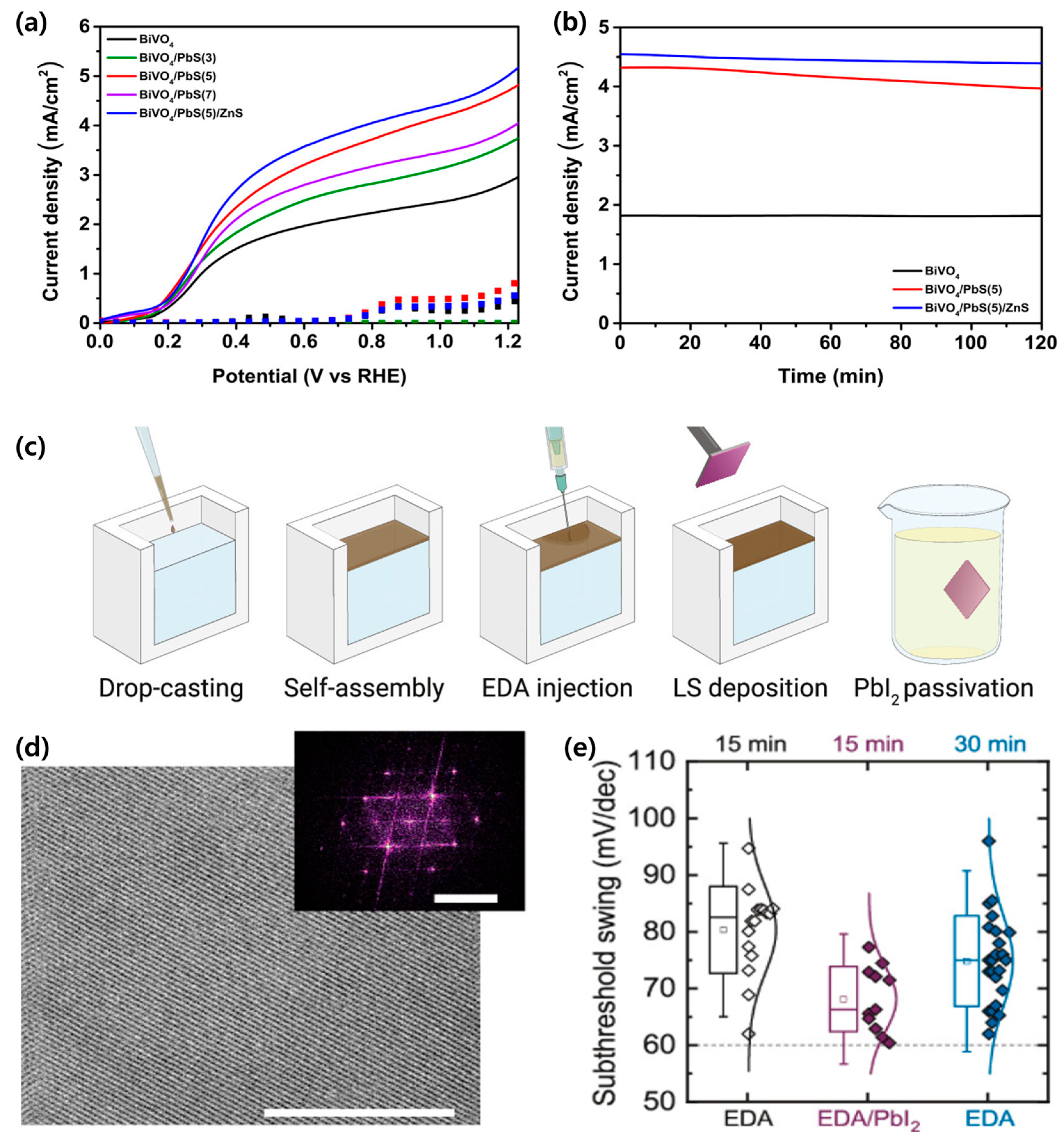
| BiVO4/PbS/ZnS | SILAR + ZnS capping | 5.19 mA cm−2 | 1.23 V | In situ PbS; ZnS surface passivation lowers Rct | [7] |
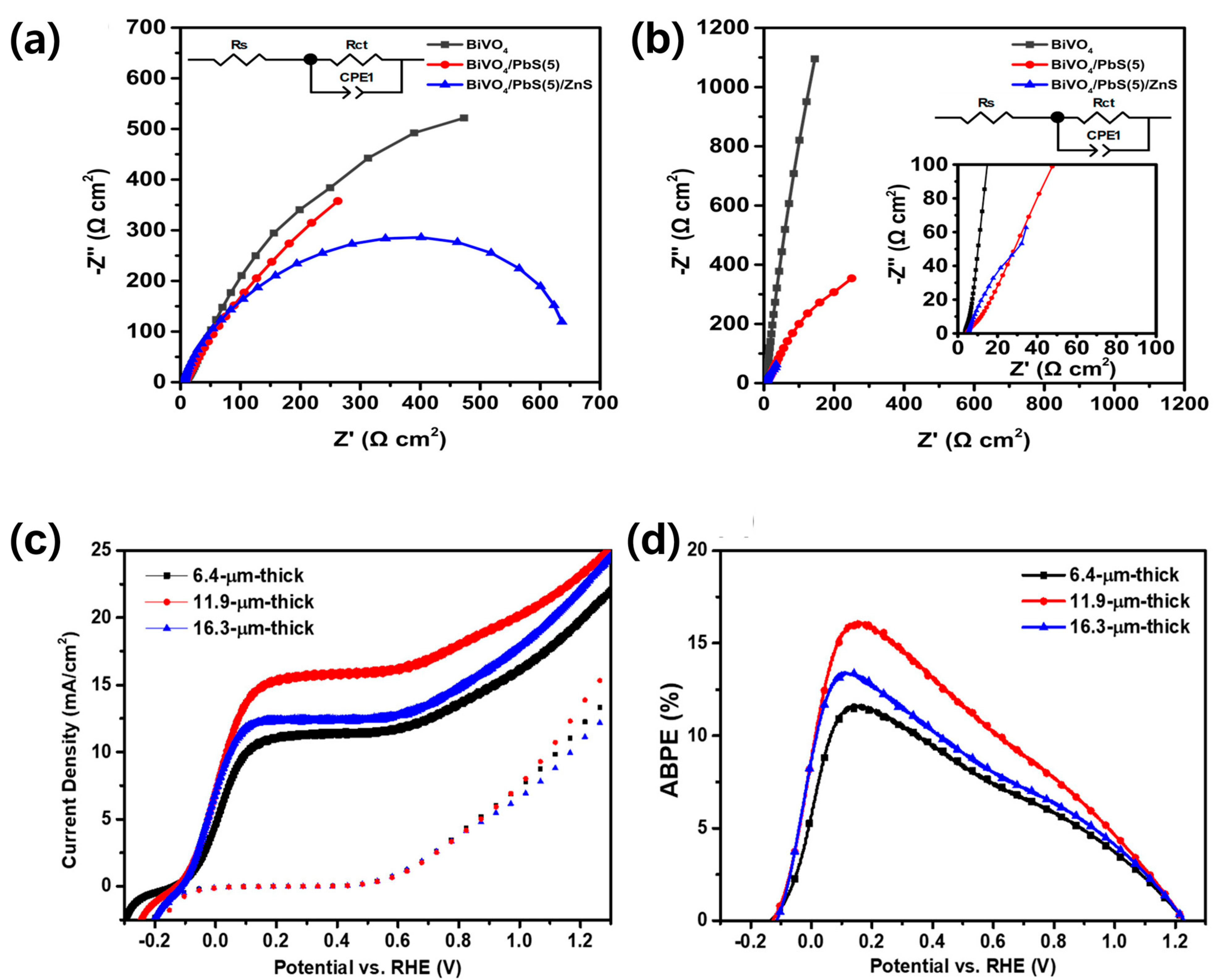
| TiO2/PbS | SILAR | 15.19 mA cm−2 | 0.60 V | Optimize mesoporous TiO2 thickness (11.9 µm) to balance loading vs. transport; ZnS interlayer | [40] |
| TiO2/PbS-CdS with TiO2(B) SPL | SILAR on TiO2 + SPL | 14.43 mA cm−2 | 0.82 V | TiO2(B) surface passivation layer suppresses recombination | [42] |
| WO3/BiVO4/Ni-PbS QDs | Deposited QDs (solution) | 5.56 mA cm−2 | 1.23 V | Ni-doped PbS QDs on tandem WO3/BiVO4; synergistic catalysis | [43] |
| α-Fe2O3 (hematite)/PbS | SILAR | 1.04 mA cm−2 | 1.79 V | PbS sensitization boosts α-Fe2O3 absorption/IPCE | [44] |
| ZnO/ZnFe2O4/PbS | SILAR (PbS on ternary) | 0.577 mA cm−2 | — | Ternary heterojunction (ZnO/ZnFe2O4) with PbS sensitizer | [45] |
Disclaimer/Publisher’s Note: The statements, opinions and data contained in all publications are solely those of the individual author(s) and contributor(s) and not of MDPI and/or the editor(s). MDPI and/or the editor(s) disclaim responsibility for any injury to people or property resulting from any ideas, methods, instructions or products referred to in the content. |
© 2026 by the authors. Licensee MDPI, Basel, Switzerland. This article is an open access article distributed under the terms and conditions of the Creative Commons Attribution (CC BY) license.
Share and Cite
Nguyen, B.D.; Lee, H.K.; Kim, J.-Y. Preparation and Solar-Energy Applications of PbS Quantum Dots via In Situ Methods. Appl. Sci. 2026, 16, 589. https://doi.org/10.3390/app16020589
Nguyen BD, Lee HK, Kim J-Y. Preparation and Solar-Energy Applications of PbS Quantum Dots via In Situ Methods. Applied Sciences. 2026; 16(2):589. https://doi.org/10.3390/app16020589
Chicago/Turabian StyleNguyen, Binh Duc, Hyun Kuk Lee, and Jae-Yup Kim. 2026. "Preparation and Solar-Energy Applications of PbS Quantum Dots via In Situ Methods" Applied Sciences 16, no. 2: 589. https://doi.org/10.3390/app16020589
APA StyleNguyen, B. D., Lee, H. K., & Kim, J.-Y. (2026). Preparation and Solar-Energy Applications of PbS Quantum Dots via In Situ Methods. Applied Sciences, 16(2), 589. https://doi.org/10.3390/app16020589