A Review of Spacecraft Aeroassisted Orbit Transfer Approaches


Abstract
1. Introduction
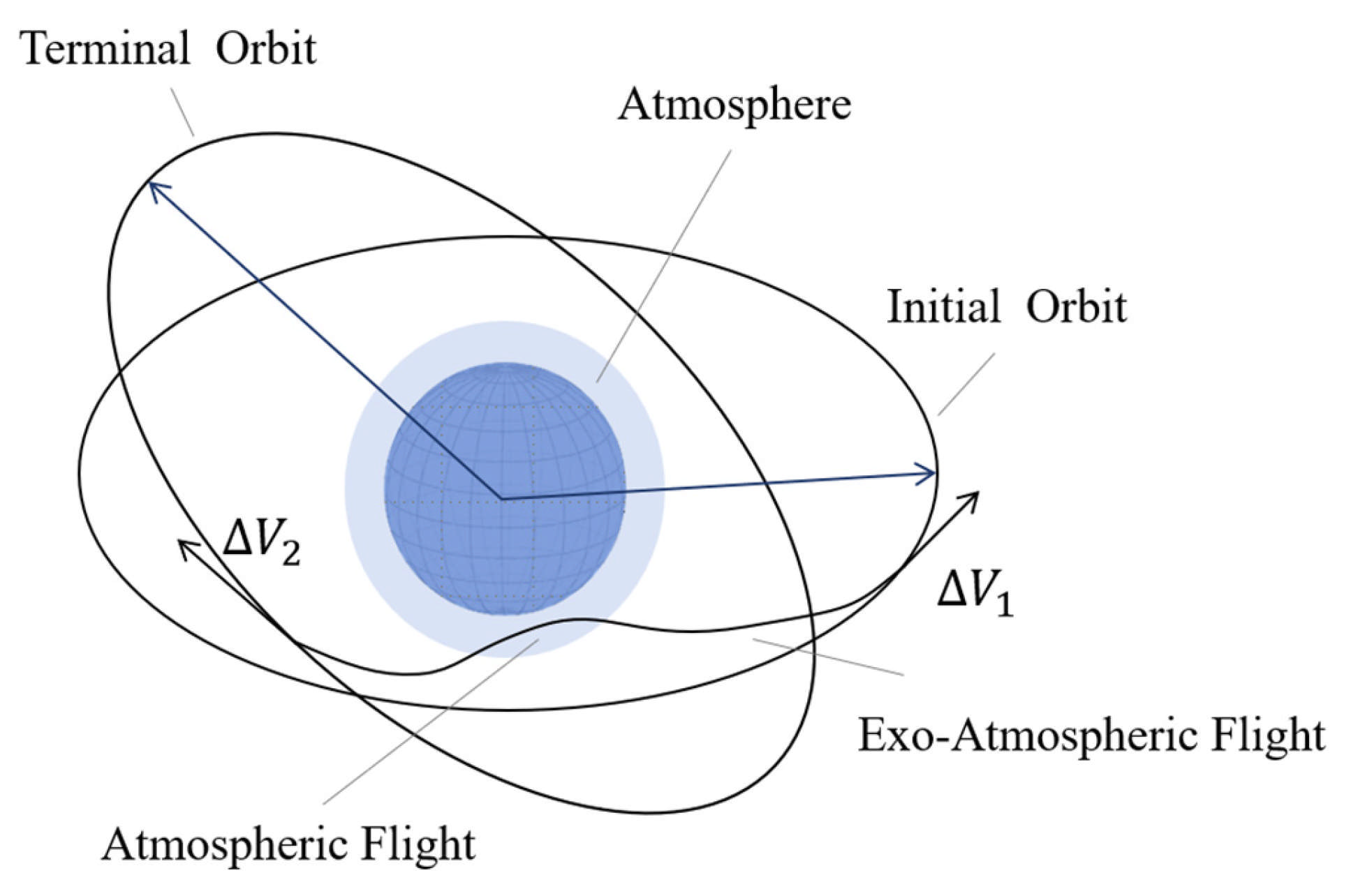
2. Current Status of Aeroassisted Orbit Change Research for Spacecraft
2.1. Aeroglide Mode
2.2. Aerocruise Mode and Aerobang Mode
2.3. Aerogravity Assist Mode
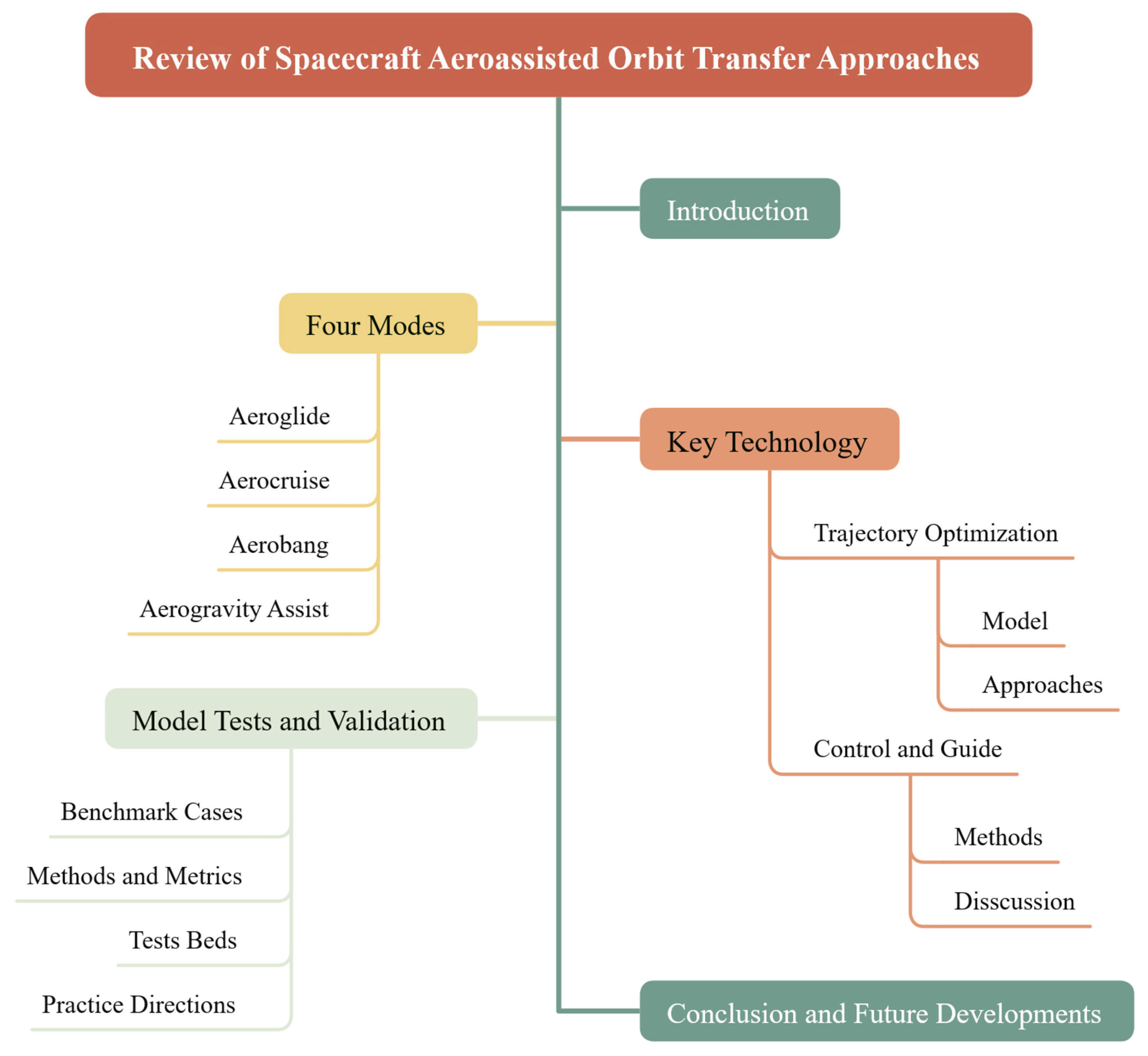
3. Key Approaches for Aeroassisted Orbit Manoeuvring
3.1. Trajectory Optimization
3.1.1. Optimization Problem Modelling
- 1.
- Equations of motions
- 2.
- Aerodynamic model
- 3.
- Atmospheric Density Model
- 4.
- Standing Point Heat Flow Model
3.1.2. Optimization Methods
Optimization Problem Transformation Methods
- Pseudospectral Methods (PSMs)
- Sequential Convex Optimization (SCP)
- Other Optimization Methods
Parameter Solution Algorithms
3.2. Control Guidance
3.2.1. Control Strategy
3.2.2. Guidance Strategy
3.2.3. Discussion
4. Hardware and Software Platform Model Tests and Validation
4.1. Typical Benchmark Cases
4.1.1. GTO-GEO Aeroassisted Transfer Mission
4.1.2. Mars Aerocapture Deceleration Mission
4.2. Mainstream Validation Methods and Metrics
4.2.1. Numerical Simulation Verification
4.2.2. Monte Carlo Simulation Analysis
4.2.3. Real Experiments and Verification
4.3. Aerospace Verification and Validation Tests Beds
- ESA ESTEC Digital Twin Platform:
- NASA AMES Hardware-in-the-Loop (HIL) platform:
- Zero-G Lab Multi-Purpose Space Operations Simulation Facility:
- DLR Multidisciplinary HIL Facility:
4.4. Main Practice Directions for the Industries
5. Conclusions and Future Developments
- During modelling, simplified models are often used, while high-fidelity models do not quantify uncertainties well. They also struggle to accurately model or respond to extreme disturbances, such as changes in atmospheric density over time and space, or solar storms. In the future, we can construct high-fidelity atmospheric models that are fused with multi-source data, and research cutting-edge technologies related to the quantification of uncertainty and robust modeling.
- Real-time performance and computational efficiency struggle to meet the demands of complex, multi-channel, multi-constraint missions for onboard applications. We can then research lightweight hybrid optimization algorithms and develop adaptive model downscaling techniques for the future.
- Global coordination for multi-objective optimization (e.g., fuel usage, mission timelines, and heat flux limits) across all mission phases (e.g., deorbiting, atmospheric flight, and re-entry insertion) is not yet mature, particularly in integrating coupling effects between phases. Thus, we can establish a multi-stage and multi-objective synergistic optimization model in the future and research layered and decoupled optimization methods.
- Integrating AI methods with scenarios can enhance their interpretability while satisfying multiple constraints. In the future, AI models embedded with physics-informed information can be developed, and hybrid architectures combining AI with traditional control or convex optimization can be constructed to leverage the strengths of both.
- The integrated design framework needs to be optimized, and the co-optimization of aerodynamic shape, thermal protection, and guidance, navigation, and control (GNC) systems is insufficient, so it is necessary to build a systematic design with multi-disciplinary analysis methods and a multi-disciplinary unified modelling and co-optimization platform and develop an integrated design tool chain.
Author Contributions
Funding
Institutional Review Board Statement
Informed Consent Statement
Data Availability Statement
Conflicts of Interest
Abbreviations
| VLEO | Very Low Earth Orbit |
| SM | Synergetic Maneuver |
| JPL | Jet Propulsion Laboratory |
| MGS | Mars Global Surveyor |
| MRO | Mars Reconnaissance Orbiter |
| CAV | Common Aero Vehicle |
| ORS | Operationally Responsiveness Space |
| DOF | Degree of Freedom |
| EMOs | Equations of Motion |
| FPA | Flight Path Angle |
| AOA | Angle of Attack |
| NLP | Non-Linear Programming |
| AOT | Aero-Assisted Orbit Transfer |
| TPBVP | Two-Point Boundary Value Problem |
| PSM | Pseudospectral Methods |
| GPM | Gaussian pseudospectral method |
| SCP | Sequential Convex Optimization |
| NKKC | Nonlinearity-Kept Convexification |
| UKF | Unscented Kalman Filter |
| SQP | Sequential Quadratic Programming |
| SNOPT | Sparse Nonlinear Optimizer |
| NSGA-II | Improved Non-Dominated Sorting Genetic Algorithm |
| LQR | Linear Quadratic Regulator |
| MPC | Model Predictive Control |
| AOTV | Aero-Assisted Orbit Transfer Vehicle |
| LQG | Linear Quadratic Gaussian |
| MAE | Matched Asymptotic Expansion |
| SMC | Sliding Mode Control |
| VSC | Variable Structure Control |
| PINN | Physical Information Neural Network |
| RL | Reinforcement Learning |
| GTO | Geostationary Transfer Orbit |
| GEO | Geostationary Orbit |
| EDL | Entry, Descent, and Landing |
| CFD | Computational Fluid Dynamics |
| STK | Satellite Tool Kit |
| GPOPS | Gauss Pseudospectral Optimization Software |
| PaGMO | Parallel Global Multiobjective Optimizer |
| MCS | Monte Carlo Simulation |
| NET | Numerical-Engineering Transformation |
| LSS | Large Space Simulator |
| SIL/HIL | Software and Hardware in the Loop |
| SnT | Security, Reliability, and Trust |
| NASA | National Aeronautics and Space Administration |
| ESA | European Space Agency |
| DLR | The German Center |
| TsAGI | The Central Aerohydrodynamic Institute Named After N.E. Zhukovsky |
| GNC | Guidance, Navigation, and Control |
References
- Lin, Y.; Jia, Y.; Fan, S. Research on Agile Reentry Method for Maneuvering Vehicle. J. Syst. Simul. 2021, 33, 1600–1608. [Google Scholar] [CrossRef]
- Zeyad, M. Boeing-Built X-37B Begins Advanced Space Maneuvering. Indian Aviation News, 10 October 2024; p. 1. [Google Scholar]
- Li, H.; Tian, P.; Zhang, X.; Xu, X.; Zhang, Q.; Han, H. Research on Orbital Maneuver of VLEO Satellite Based on Aerodynamic Assistance. In Proceedings of the 2024 12th China Conference on Command and Control (C2 2024), Beijing, China, 17–18 May 2024; Lecture Notes in Electrical Engineering. Springer: Singapore, 2024; Volume 1266, pp. 168–182. [Google Scholar]
- Repic, E.M.; Boobar, M.G.; Chapel, F.G. Aerobraking as a Potential Planetary Capture Mode. J. Spacecr. Rocket. 1968, 5, 921–926. [Google Scholar] [CrossRef]
- Wei, H.; Sun, Z.; Li, Q.; Xiao, Z.; Li, Z.; Ma, B. An Overview of Aeroassist Technologies for Mars Sample Return Mission. J. Deep Space Explor. 2025, 12, 229–240. [Google Scholar] [CrossRef]
- Hintz, G.R. Spacecraft Rendezvous. In Orbital Mechanics and Astrodynamics; Springer: Berlin/Heidelberg, Germany, 2023; pp. 251–269. [Google Scholar]
- Stoll, E.; Letschnik, J.; Walter, U.; Artigas, J.; Kremer, P.; Preusche, C.; Hirzinger, G. On-orbit Servicing. IEEE Robot. Autom. Mag. 2009, 16, 29–33. [Google Scholar] [CrossRef]
- London, H.S. Change of Satellite Orbit Plane by Aerodynamic Maneuvering. J. Aerosp. Sci. 1962, 29, 323–332. [Google Scholar] [CrossRef]
- Stone, R. Space Rescue. Science 1995, 269, 291. [Google Scholar] [CrossRef]
- Vinh, N.X.; Lu, P. Necessary Conditions for Maximax Problems with Application to Aeroglide of Hypervelocity Vehicles. Acta Astronaut. 1987, 15, 413–420. [Google Scholar] [CrossRef][Green Version]
- Casalino, L. Singular Arcs during Aerocruise. J. Guid. Control Dyn. 2000, 23, 118–123. [Google Scholar] [CrossRef]
- Ross, I.M. Aerobang: A New Synergetic Plane-Change Manoeuvre. In Proceedings of the AAS/AIAA Astrodynamics Specialist Conference, Durango, CO, USA, 19–22 August 1991. AAS 91-418. [Google Scholar]
- Lohar, F.A.; Mateescu, D.; Misra, A.K. Optimal atmospheric trajectory for aerogravity assist. Acta Astronaut. 1994, 32, 89–96. [Google Scholar] [CrossRef]
- Weng, Z.M. Research on Trajectory Optimization and Parameter Influences of Aerogravity-Assisted Orbital Transfer. Ph.D. Thesis, Harbin Institute of Technology, Harbin, China, 2017. [Google Scholar]
- Vinh, N.X. General Theory of Optimal Trajectory for Rocket Flight in a Resisting Medium. J. Optim. Theory Appl. 1973, 11, 189–202. [Google Scholar] [CrossRef][Green Version]
- Mease, K.D.; Vinh, N.X. Minimum-fuel aeroassisted coplanar orbital transfer using lift modulation. In Proceedings of the AIAA Atmospheric Flight Mechanics Conference, Gatlinburg, TN, USA, 15–17 August 1983. [Google Scholar] [CrossRef]
- Naidu, D.S. Fuel-optimal trajectories of aerodynamically assisted orbital transfer with plane change. IEEE Trans. Aerosp. Electron. Syst. 1991, 27, 361–369. [Google Scholar] [CrossRef]
- Nan, Y.; Xiao, L.; Chen, S. Approximate solutions of the optimal aerodynamically assisted coplanar transfer of space vehicles. J. Beihang Univ. Aeronaut. Astronaut. 1998, 24, 120–123. [Google Scholar]
- Walberg, G.D. A review of aeroassisted orbit transfer. In Proceedings of the 9th Atmospheric Flight Mechanics Conference, Gatlinburg, TN, USA, 15–17 August 1983; p. 1378. [Google Scholar]
- Walberg, G.D. A survey of aeroassisted orbit transfer. J. Spacecr. Rocket. 1985, 22, 3–18. [Google Scholar] [CrossRef]
- Parsons, W.D. Analytic solution of the synergetic turn. J. Spacecr. Rocket. 1966, 3, 1645–1678. [Google Scholar] [CrossRef]
- Huang, Y.Y.; Yang, L.P. Aeroassisted orbital plane change from highly elliptic orbit. Aerosp. Shanghai 2008, 3, 19–22. [Google Scholar] [CrossRef]
- Gogu, C.; Matsumura, T.; Haftka, R.T.; Rao, A.V. Aeroassisted orbital transfer trajectory optimization considering thermal protection system mass. J. Guid. Control Dyn. 2009, 32, 927–938. [Google Scholar] [CrossRef]
- Andiarti, R.; Moog, C.H.; Szymanowski, J. Controllability and optimization in aeroassisted orbital transfer. J. Guid. Control Dyn. 1995, 4, 911–913. [Google Scholar] [CrossRef]
- Miele, A.; Basapur, V.K.; Lee, W.Y. Optimal trajectories for aeroassisted, coplanar orbital transfer. J. Optim. Theory Appl. 1987, 52, 1–24. [Google Scholar] [CrossRef]
- Miele, A.; Wang, T.; Deaton, A.W. Properties of the optimal trajectories for coplanar, aerodynamically assisted orbital transfer. J. Optim. Theory Appl. 1991, 69, 1–30. [Google Scholar] [CrossRef]
- Vinh, N.X.; Hanson, J.M. Optimal aeroassisted return from high Earth orbit with plane change. Acta Astronaut. 1985, 12, 11–25. [Google Scholar] [CrossRef]
- Hull, D.G.; McClendon, J.R.; Speyer, J.L. Aeroassisted orbital plane change using an elliptic drag polar. J. Astronaut. Sci. 1988, 36, 73–87. [Google Scholar] [CrossRef]
- Butcher, E.A. Tri-elliptic aeroassisted orbit transfers between coplanar orbits. J. Guid. Control Dyn. 2025, 48, 1646–1651. [Google Scholar] [CrossRef]
- Zuo, G.; He, Y.S.; Shi, Y. Study on aeroassisted orbital plane transfer of an X-37B-like vehicle. Space Return Remote Sens. 2017, 38, 36–46. [Google Scholar] [CrossRef]
- Zimmermann, F.; Calise, A.J. Numerical optimization study of aeroassisted orbital transfer. J. Guid. Control Dyn. 1998, 21, 127–133. [Google Scholar] [CrossRef]
- Zimmermann, F.; Calise, A.J. Aeroassisted orbital transfer trajectory optimization using direct methods. In Proceedings of the AIAA Atmospheric Flight Mechanics Conference, Washington, DC, USA, 13–16 February 1995; pp. 458–468, AIAA-95-3478. [Google Scholar] [CrossRef]
- Baumann, H.; Oberle, H.J. Numerical computation of optimal trajectories for coplanar, aeroassisted orbital transfer. J. Optim. Theory Appl. 2000, 107, 457–479. [Google Scholar] [CrossRef]
- Ma, D.M. Multiple Pass Aeroassisted Plane Change. Ph.D. Thesis, University of Michigan, Ann Arbor, MI, USA, 1988. [Google Scholar]
- Li, X.L.; Chen, S.L.; Yang, X. Optimal trajectory in atmosphere for aeroassisted orbital transfer with plane change. In Proceedings of the AAS/AIAA Astrodynamics Conference, Victoria, BC, Canada, 16–19 August 1993. [Google Scholar]
- Fu, J.; Cai, H.; Zhang, S. Optimal aeroassisted symmetric transfer between coplanar elliptical orbits. J. Syst. Eng. Electron. 2013, 24, 261–271. [Google Scholar] [CrossRef]
- Yang, X. Research on Aero-Assisted Orbit Transfer Technology for HEO-LEO Coplanar and Noncoplanar Transfers. Ph.D. Thesis, Harbin Institute of Technology, Harbin, China, 2015. [Google Scholar]
- Zhang, W.L.; Wang, C.H.; Xia, H.W.; Xie, W.N. Trajectory optimization of spacecraft aero-assisted orbital transfer problem. Aerosp. Control Appl. 2010, 36, 26–32. [Google Scholar] [CrossRef]
- Cai, H.; Fu, J.; Zhang, S.F. Research on aero-assisted orbital transfer between elliptical orbits. Chin. Space Sci. Technol. 2012, 32, 64–71. [Google Scholar] [CrossRef]
- Divitiis, N.D. Inverse simulation of aeroassisted orbit plane change of a spacecraft. J. Spacecr. Rockets 1999, 36, 882–889. [Google Scholar] [CrossRef]
- Nicholson, J.C. Numerical Optimization of Synergistic Manoeuvres. Ph.D. Thesis, Naval Postgraduate School, Monterey, CA, USA, 2018. [Google Scholar]
- Abd El-Salam, F.A. Optimization of out-of-orbit plane changes using aeroassisted manoeuvres. Appl. Math. Comput. 2005, 170, 1303–1313. [Google Scholar] [CrossRef]
- Nyland, F.S. The Synergetic Plane Change for Orbiting Spacecraft; Rand Corp.: Santa Monica, CA, USA, 1962. [Google Scholar]
- Medepalli, S.; Vinh, N.X. Optimal plane change of an elliptic orbit during aerocruise. J. Astronaut. Sci. 1992, 40, 503–525. [Google Scholar]
- Mease, K.D.; Lee, J.Y.; Vinh, N.X. Orbital changes during hypersonic aerocruise. J. Astronaut. Sci. 1988, 36, 103–137. [Google Scholar] [CrossRef][Green Version]
- Ross, I.M. Thrust programming in aeroassisted manoeuvers. Adv. Astronaut. Sci. 2000, 103, 1607–1626. [Google Scholar]
- Bruce, R.W. Combined aerodynamic propulsive orbital plane change manoeuver. AIAA J. 1965, 3, 10–14. [Google Scholar] [CrossRef]
- McDanell, J.P.; Powers, N.F. Necessary conditions for joining optimal singular and nonsingular subarcs. SIAM J. Control 1971, 9, 161–173. [Google Scholar] [CrossRef]
- Park, S. Analysis of junction conditions in optimal aero-assisted orbital plane change. J. Guid. Control Dyn. 2000, 23, 124–129. [Google Scholar] [CrossRef]
- Clauss, J., Jr.; Yeatman, R. Effect of heating restraints on aeroglide and aerocruise synergetic manoeuvre performance. In Proceedings of the 5th Aerospace Sciences Meeting, New York, NY, USA, 23–26 January 1967. [Google Scholar] [CrossRef]
- Spriesterbach, T.; Ross, I. Effect of heating rate on the fuel efficiency of aerocruise and aerobang manoeuvres. In Proceedings of the Astrodynamics Conference, Hilton Head Island, SC, USA, 10–12 August 1992. [Google Scholar]
- Zhang, Q.Z.; Gao, C.; Guo, F.; Ren, Z. Reentry trajectory planning optimization based on sequential quadratic programming. In Proceedings of the 2nd International Symposium on Systems and Control in Aeronautics and Astronautics, Honolulu, HA, USA, 18–21 August 2008. [Google Scholar] [CrossRef]
- Shi, X.N.; Rong, S.Y.; Bai, Y.L. Research on the optimization problem of coplanar aerobang orbit transfer trajectories. Aerosp. Shanghai 2016, 33, 28. [Google Scholar] [CrossRef]
- Ross, I.M.; Nicholson, J.C. Optimality of the heating-rate-constrained aerocruise maneuver. J. Spacecr. Rocket. 1998, 35, 361–364. [Google Scholar] [CrossRef]
- Falcone, G.; Putnam, Z.R. Design and Development of an Aerobraking Trajectory Simulation Tool. In Proceedings of the AIAA SciTech Forum 2021, Virtual Event, 19–21 January 2021. [Google Scholar] [CrossRef]
- Gochenaur, D.C.; Jones, M.; Norheim, J.; Jones, M.P.; de Weck, O.L. Orbit Plane Rotation Using Aerocapture. In Proceedings of the AIAA SciTech Forum and Exposition, Orlando, FL, USA, 6–10 January 2025. [Google Scholar] [CrossRef]
- Carpenter, A.S. The Magellan aerobraking experiment attitude control simulation and preliminary flight results. In Proceedings of the AIAA Guidance, Navigation and Control Conference, Monterey, CA, USA, 9–11 August 1993. [Google Scholar]
- Beerer, J.; Brooks, R.; Esposito, P.; Lyons, D.; Sidney, W.; Curtis, H.; Willcockson, W. Aerobraking at Mars: The MGS mission. In Proceedings of the AIAA 34th Aerospace Sciences Meeting and Exhibit, Reno, NV, USA, 15–18 January 1996. [Google Scholar]
- Tartabini, P.V.; Munk, M.M.; Powell, R.W. Development and evaluation of an operational aerobraking strategy for Mars Odyssey. J. Spacecr. Rocket. 2005, 42, 423–434. [Google Scholar] [CrossRef]
- Gladden, R.E. Mars reconnaissance orbiter: Aerobraking sequencing operations and lessons learnt. In Proceedings of the SpaceOps 2008 Conference, Heidelberg, Germany, 12–16 May 2008. [Google Scholar]
- Bonfiglio, E.P.; Longuski, J.M.; Vinh, N.X. Automated design of aerogravity assist trajectories. J. Spacecr. Rocket. 2003, 37, 768–775. [Google Scholar] [CrossRef]
- Qiao, D.; Cui, P.Y.; Cui, H.T. Design of aerogravity assist transfer trajectory for Ivar asteroid rendezvous mission. In Proceedings of the 56th International Astronautical Congress 2005, Fukuoka, Japan, 17–21 October 2005; Volume 2. [Google Scholar]
- Han, H.W.; Li, X.Y.; Qiao, D. Aerogravity-assist capture into the three-body system: A preliminary design. Acta Astronaut. 2022, 198, 26–35. [Google Scholar] [CrossRef]
- Vinh, N.X. Optimal Trajectories in Atmospheric Flight; Elsevier Science Publishing Company: Amsterdam, The Netherlands, 2012. [Google Scholar]
- Mease, K.D. Optimization of aeroassisted orbital transfer-Current status. J. Astronaut. Sci. 1988, 36, 7–37. [Google Scholar]
- Miele, A. Recent advances in the optimization and guidance of aeroassisted orbital transfer. Acta Astronaut. 1996, 38, 747–768. [Google Scholar] [CrossRef]
- Naidu, D.S. Optimal Control Systems. Appl. Mech. Rev. 2004, 57, B3–B4. [Google Scholar] [CrossRef]
- Yu, W.; Zhao, P.; Chen, W. Analytical Solutions to Aeroassisted Orbital Transfer Problem. IEEE Trans. Aerosp. Electron. Syst. 2020, 56, 3502–3515. [Google Scholar] [CrossRef]
- Chai, R.; Tsourdos, A.; Savvaris, A.; Chai, S.C.; Xia, Y.Q. High-fidelity Trajectory Optimization for Aeroassisted Vehicles Using Variable Order Pseudospectral Method. Chin. J. Aeronaut. 2021, 34, 237–251. [Google Scholar] [CrossRef]
- Gao, C.; Chen, E.; Jing, W.X. Maneuver Evasion Trajectory Optimization for Hypersonic Vehicles. J. Harbin Inst. Technol. 2017, 49, 16–21. [Google Scholar] [CrossRef]
- Zhang, J.Y.; Wang, Y.; Jiao, H.C.; Wang, T. Aeroassisted Orbit Control of Very Low Earth Orbit Satellites. Astronaut. Syst. Eng. Technol. 2022, 6, 1–9. [Google Scholar]
- Mooij, E. Aero-assisted Manoeuvres. In Re-Entry Systems; Springer Aerospace Technology; Springer: Cham, Switzerland, 2024; pp. 211–234. [Google Scholar] [CrossRef]
- Darby, C.L.; Rao, A.V. Minimum-fuel Low-Earth Orbit Aeroassisted Orbital Transfer of Small Spacecraft. J. Spacecr. Rocket. 2011, 48, 618–628. [Google Scholar] [CrossRef]
- Han, H.; Qiao, D.; Chen, H. Optimization of Aeroassisted Rendezvous and Interception Trajectories Between Non-coplanar Elliptical Orbits. Acta Astronaut. 2019, 163, 190–200. [Google Scholar] [CrossRef]
- Fuhr, R.; Rao, A.V. Minimum-fuel low-Earth-orbit Aeroglide and Aerothrust Aeroassisted Orbital Transfer Subject to Heating Constraints. J. Spacecr. Rocket. 2018, 55, 723–748. [Google Scholar] [CrossRef]
- Chai, R.; Savvaris, A.; Tsourdos, A.; Chai, S.C.; Xia, Y.Q. Optimal Fuel Consumption Finite-thrust Orbital Hopping of Aeroassisted Spacecraft. Aerosp. Sci. Technol. 2018, 75, 172–182. [Google Scholar] [CrossRef]
- Ji, C.Y.; Nan, Y.; Wu, H.Y.; An, B. The Optimal Design of Aeroassisted Orbital Transfer for Small Satellite. Aerosp. Control. 2017, 35, 77–81. [Google Scholar] [CrossRef]
- Xi, Z.; Yu, Y.; Huang, F.H. A Study on Reachable Domain for Aeroassisted Orbit Transfer Vehicle. In Proceedings of the 2021 China Automation Congress (CAC), Beijing, China, 22–24 October 2021; pp. 7990–7994. [Google Scholar]
- Feng, X.D.; Han, H.; Chen, J.L. Trajectory Optimization of Multi-pass Aeroassisted Orbital Transfer by Sequential Convex Programming. Stud. Appl. Electromagn. Mech. 2024, 47, 49–58. [Google Scholar] [CrossRef]
- Chen, H.B. Non-coplanar LEO-LEO Aerocruise Orbital Transfer Trajectory Optimization. In Proceedings of the International Astronautical Congress (IAC), Cape Town, South Africa, 3–7 October 2011. [Google Scholar]
- Betts, J.T. Survey of Numerical Methods for Trajectory Optimization. J. Guid. Control Dyn. 1998, 21, 193–207. [Google Scholar] [CrossRef]
- Rao, A.V.; Cox, S. A Concept for Operationally Responsive Space Mission Planning Using Aeroassisted Orbital Transfer. In Proceedings of the AIAA 6th Responsive Space Conference, Los Angeles, CA, USA, 28 April–1 May 2008. [Google Scholar]
- Rao, A.V.; Tang, S.; Hallman, W.P. Numerical Optimization Study of Multiple-pass Aeroassisted Orbital Transfer. Opt. Control Appl. Methods 2002, 23, 215–238. [Google Scholar] [CrossRef]
- Cai, H.; Fu, J.; Li, A.L. Study of Spacecraft Aeroassisted Coplanar Orbital Transfer Based on Gauss Pseudospectral Method. J. Natl. Univ. Def. Technol. 2011, 33, 95. [Google Scholar]
- Zhang, H.H. The Re-Entry Orbit Design Algorithm Based on an Adaptive Radau Pseudo-Spectral Method. Trans. Beijing Inst. Technol. 2018, 38, 1037–1045. [Google Scholar] [CrossRef]
- Chen, L.; Tang, G.; Yong, E. A survey of numerical methods for trajectory optimization of spacecraft. J. Astronaut. 2008, 29, 397–406. [Google Scholar]
- Ben, L.Y.; Wang, Z. Application of Sequential Convex Optimization in the Spacecraft Aero-assisted Orbital Transfer Problem. In Proceedings of the 2025 8th International Conference on Advanced Algorithms and Control Engineering (ICAACE), Shanghai, China, 21–23 March 2025. [Google Scholar]
- Feng, X.; Qiao, D.; Han, H.; Chen, J.L. Unified Trajectory Optimization Method for Multipass Aeroassisted Manoeuvres via Convex Optimization. J. Guid. Control Dyn. 2025, 48, 1840–1860. [Google Scholar] [CrossRef]
- Teng, R.; Han, H.W.; Chen, J.L.; Pang, B. Trajectory Optimization Approach for Adaptive Multiple-pass Aeroassisted Orbital manoeuvre. Space Sci. Technol. 2025, 5, 0240. [Google Scholar] [CrossRef]
- Lu, P.; Liu, X.F.; Yang, R.Q.; Zhang, Z.G. Ascent Trajectory Optimization with Nonlinearity-Kept Convexification. IEEE Trans. Aerosp. Electron. Syst. 2023, 59, 3236–3250. [Google Scholar] [CrossRef]
- Malyuta, D.; Reynolds, T.P.; Szmuk, M.; Acikmese, B.; Mesbahi, M. Fast Trajectory Optimization via Successive Convexification for Spacecraft Rendezvous with Integer Constraints. In Proceedings of the AIAA SciTech Forum and Exposition, Orlando, FL, USA, 6–10 January 2020. [Google Scholar]
- Bonalli, R.; Cauligi, A.; Bylard, A.; Pavone, M. GuSTO: Guaranteed Sequential Trajectory Optimization via Sequential Convex Programming. In Proceedings of the 2019 International Conference on Robotics and Automation (ICRA), Montreal, QC, Canada, 20–24 May 2019; pp. 6744–6750. [Google Scholar]
- Szmuk, M.; Reynolds, T.P.; Açıkmeşe, B. Successive Convexification for Real-Time Six-Degree-of-Freedom Powered Descent Guidance with State-Triggered Constraints. J. Guid. Control Dyn. 2020, 43, 1399–1413. [Google Scholar] [CrossRef]
- Miele, A.; Lee, W.Y.; Mease, K.D. Optimal Trajectories for LEO-to-LEO Aeroassisted Orbital Transfer. Acta Astronaut. 1988, 18, 99–122. [Google Scholar] [CrossRef]
- Ben, L.Y.; Xie, X.H.; Zhang, R. Application of UKF Parameter Estimation in Spacecraft Aeroassisted Orbital Transfer Problem. J. Astronaut. 2019, 40, 1044–1050. [Google Scholar] [CrossRef]
- Gill, P.E.; Murray, W.; Saunders, M.A. SNOPT: An SQP Algorithm for Large-Scale Constrained Optimization. SIAM J. Optim. 2002, 12, 979–1006. [Google Scholar] [CrossRef]
- Gill, P.E.; Murray, W.; Shi, Y.; Nelson, R.; Young, D.; Saunders, M. The Application of Nonlinear Programming and Collocation to Optimal Aeroassisted Orbital Transfers. In Proceedings of the 30th Aerospace Sciences Meeting and Exhibit, Reno, NV, USA, 6–9 January 1992. [Google Scholar]
- Ross, I.M.; Fahroo, F. Legendre Pseudospectral Approximations of Optimal Control Problems. In New Trends in Nonlinear Dynamics and Control, and their Applications; Lecture Notes in Control and Information Sciences; Springer: Berlin/Heidelberg, Germany, 2003; Volume 295, pp. 327–342. [Google Scholar]
- Benson, D.A. A Gauss Pseudospectral Transcription for Optimal Control. Ph.D. Thesis, Massachusetts Institute of Technology, Cambridge, MA, USA, 2005; pp. 49–55. [Google Scholar]
- Celestini, D.; Gammelli, D.; Guffanti, T.; D’Amic, S.; Capello, E.; Pavone, M. Transformer-Based Model Predictive Control: Trajectory Optimization via Sequence Modeling. IEEE Robot. Autom. Lett. 2024, 9, 9820–9827. [Google Scholar] [CrossRef]
- Celestini, D.; Afsharrad, A.; Gammelli, D.; Guffanti, T.; Zardini, G.; Lall, S.; Capello, E.; D’Amico, S. Generalizable Spacecraft Trajectory Generation via Multimodal Learning with Transformers. In Proceedings of the 2025 American Control Conference (ACC), Denver, CO, USA, 8–10 July 2025; IEEE: New York, NY, USA; pp. 3558–3565. [Google Scholar] [CrossRef]
- Takubo, Y.; Guffanti, T.; Gammelli, D.; Pavone, M.; D’Amico, S. Towards Robust Spacecraft Trajectory Optimization via Transformers. In Proceedings of the 2025 IEEE Aerospace Conference, Big Sky, MT, USA, 4–10 March 2025; pp. 1–13. [Google Scholar] [CrossRef]
- Guffanti, T.; Gammelli, D.; D’Amico, S.; Pavone, M. Transformers for Trajectory Optimization with Application to Spacecraft Rendezvous. In Proceedings of the 2024 IEEE Aerospace Conference, Big Sky, MT, USA, 2–9 March 2024; pp. 1–13. [Google Scholar] [CrossRef]
- Rizvi, S.; He, L.; Xu, D. Optimal Trajectory and Heat Load Analysis of Different Shape Lifting Reentry Vehicles for Medium Range Application. In Proceedings of the 20th AIAA International Space Planes and Hypersonic Systems and Technologies Conference, Glasgow, UK, 6–9 July 2015. [Google Scholar]
- Seywald, H. Variational Solutions for the Heat-Rate-Limited Aeroassisted Orbital Transfer Problem. J. Guid. Control Dyn. 1996, 19, 686–692. [Google Scholar] [CrossRef]
- Bao, C.; Zhu, G.; Zhao, T. Research on Backstepping Linear Active Disturbance Rejection Control of Hypersonic Vehicle. Appl. Sci. 2024, 14, 5367. [Google Scholar] [CrossRef]
- Fu, Q.J.; Yang, X.; Cui, H.T.; Yang, D. Approximate Optimal Guidance Law for Aeroassisted Plane Change Problem. J. Harbin Inst. Technol. 2001, 33, 183–185. [Google Scholar]
- Yan, X. Research on Aeroassisted Orbital Transfer of Spacecraft. Ph.D. Thesis, Harbin Institute of Technology, Harbin, China, 2010. [Google Scholar]
- Li, Y. Studies on Strategy Optimization and Control of Aeroassist Orbital Transfer Spacecraft. Ph.D. Thesis, Chinese Academy of Sciences, Beijing, China, 2018. [Google Scholar]
- Yao, Q.J.; Li, Q.; Han, H.W.; Chen, J.L. Adaptive Tracking Guidance for Powered Aeroassisted Orbital Maneuver under System Uncertainties and Input Constraints. Adv. Space Res. 2024, 73, 4040–4051. [Google Scholar] [CrossRef]
- Xi, Y.G.; Li, D.W. Fundamental Philosophy and Status of Qualitative Synthesis of Model Predictive Control. Acta Autom. Sin. 2008, 34, 1225–1234. [Google Scholar] [CrossRef]
- Caverly, R.J.; Hayes, A.D. Atmospheric Density-Compensating Model Predictive Control for Targeted Reentry of Drag-Modulated Spacecraft. arXiv 2024, arXiv:2407.18762. [Google Scholar]
- Ji, C.Y. The Study on Trajectory Optimization, Guidance and Control for Space Vehicle. Ph.D. Thesis, Nanjing University of Aeronautics and Astronautics, Nanjing, China, 2017. [Google Scholar]
- Ramezani, M.; Alandihallaj, M.A.; Yalçın, B.C.; Mendez, M.A.O.; Hein, A.M. Fuel-Aware Autonomous Docking Using RL-Augmented MPC Rewards for On-Orbit Refueling. Acta Astronaut. 2025, 238, 690–705. [Google Scholar] [CrossRef]
- Lang, X.; Liu, X.; Qin, Y.; Chen, Z. Adaptive Iterative Learning Control for Spacecraft Close-Proximity Operations with Uncertainties. IEEE Trans. Aerosp. Electron. Syst. 2024, 61, 2762–2768. [Google Scholar] [CrossRef]
- Naidu, D.S.; Hiber, J.L. Neighboring Optimal Guidance for Aeroassisted Orbital Transfer. IEEE Trans. Aerosp. Electron. Syst. 1993, 29, 656–665. [Google Scholar] [CrossRef]
- Kuo, Z.S.; Liu, K.C. Explicit Guidance of Aeroassisted Orbital Transfer Using Matched Asymptotic Expansions. J. Guid. Control Dyn. 2002, 25, 80–87. [Google Scholar] [CrossRef]
- Zhang, W.L.; Wang, C.H.; Feng, B.M. Trajectory Optimization and Closed-Loop Guidance Law Design of Aero-assisted Orbital Transfer Problem. In Proceedings of the 2010 3rd International Symposium on Systems and Control in Aeronautics and Astronautics, Harbin, China, 8–10 June 2010; pp. 1–6. [Google Scholar]
- Luo, B.; Sun, J.; Tang, R.; Xu, X. Reinforcement Learning-Based 3D Trajectory Tracking Control of Hypersonic Gliding Vehicles with Time-Varying Uncertainties. IEEE Trans. Autom. Sci. Eng. 2024, 22, 8187–8199. [Google Scholar] [CrossRef]
- Rozanov, M.; Guelman, M. Aeroassisted Orbital Maneuvering with Variable Structure Control. Acta Astronaut. 2008, 62, 9–17. [Google Scholar] [CrossRef]
- Zhang, X.G.; Zhu, Z.C.; Chen, H.Y. Aeroassisted Orbital Transfer Robust Guidance Method Considering Atmosphere Effect Uncertainty. Control Decis. 2020, 35, 2773–2779. [Google Scholar] [CrossRef]
- Zhou, Y.; Yan, Y.; Huang, X. Multi-Objective Robust Controller Design for Spacecraft Hovering Around Elliptical Orbital Target. Proc. Inst. Mech. Eng. Part I J. Syst. Control Eng. 2015, 229, 356–371. [Google Scholar] [CrossRef]
- Guadagnini, J.; Ghignoni, P.; Spada, F.; De Zaiacomo, G.; Botelho, A. End-to-End GNC Solution for Reusable Launch Vehicles. Aerospace 2025, 12, 339. [Google Scholar] [CrossRef]
- Miele, A.; Wang, T. Gamma Guidance of Trajectories for Coplanar, Aeroassist Orbital Transfer. J. Guid. Control Dyn. 1992, 15, 255–262. [Google Scholar] [CrossRef][Green Version]
- Miele, A.; Wang, T. Robust Predictor-Corrector Guidance for Aeroassisted Orbital Transfer. J. Guid. Control Dyn. 1996, 19, 1134–1141. [Google Scholar] [CrossRef]
- Zhang, T. Trajectory Optimization and Guidance Law Design of Pneumatic Aided Trajectory. Ph.D. Thesis, Harbin Institute of Technology, Harbin, China, 2018. [Google Scholar]
- Wu, D.L.; Wang, X.J. Dynamics and Optimal Control of Spacecraft Aeroassisted Orbital Transfer; China Aerospace Press: Beijing, China, 2006. [Google Scholar]
- Liu, D.; Yang, J.; Hu, X.; Xiao, C.; Cheng, X. Simulation on the Impact of the Sudden Process of Solar Activity on the Near Space Atmosphere. Chin. J. Space Sci. 2023, 43, 101–111. [Google Scholar] [CrossRef]
- Zeng, D.D.; Wan, T.; Li, S.H. Study of the Temporal-Spatial Fluctuations and Empirical Model of Near Space Atmospheric Density. Chin. J. Theor. Appl. Mech. 2022, 54, 2984–2993. [Google Scholar] [CrossRef]
- Peng, C.; Wang, X.M.; Xie, R.; Mu, L. Fault-Tolerant Control of Hypersonic Vehicle Considering System Uncertainties. J. Beihang Univ. 2016, 42, 1414–1421. [Google Scholar]
- Sun, H.; Luo, J.J.; Ma, W.H. Uncertainty Analysis and H∞ Mixed Sensitivity Control for Hypersonic Gliding Vehicles. Syst. Eng. Electron. 2014, 36, 2466–2472. [Google Scholar]
- Margolis, B.W.; Ayoubi, M.A. Comparative Study of Tracking Controllers Applied to Martian Aerocapture. In Proceedings of the AAS/AIAA Astrodynamics Specialist Conference, Stevenson, WA, USA, 20–24 August 2017. [Google Scholar]
- Cao, L.; Qiao, D.; Xu, J. Suboptimal Artificial Potential Function Sliding Mode Control for Spacecraft Rendezvous with Obstacle Avoidance. Acta Astronaut. 2018, 143, 133–146. [Google Scholar] [CrossRef]
- Hayes, A.D.; Caverly, R.J. Atmospheric-Density-Compensating Model Predictive Control for Targeted Reentry of Drag-Modulated Spacecraft. J. Guid. Control Dyn. 2025, 48, 2541–2556. [Google Scholar] [CrossRef]
- Sagliano, M.; Hernández, J.A.M.; Farì, S.; Heidecker, A.; Schlotterer, M.; Woicke, S.; Dumont, E. Unified-Loop Structured H-infinity Control for Aerodynamic Steering of Reusable Rockets. J. Guid. Control Dyn. 2023, 46, 815–837. [Google Scholar] [CrossRef]
- Qiao, J.Z.; Li, X.F.; Xu, J.W. A Composite Disturbance Observer and H∞ Control Scheme for Flexible Spacecraft with Measurement Delay and Input Delay. Chin. J. Aeronaut. 2019, 32, 1472–1480. [Google Scholar] [CrossRef]
- Chen, J.; Liu, J.; Shan, J.; Wang, J.; Meng, X. Identification of Aerodynamic Parameters Using Improved Physics-Informed Neural Network Framework. In Proceedings of the 2024 32nd Mediterranean Conference on Control and Automation (MED), Chania, Greece, 11–14 June 2024; IEEE: Piscataway, NJ, USA, 2024; pp. 424–429. [Google Scholar] [CrossRef]
- Feng, X.; Han, H.; Lv, R. Minimum-Time Trajectory Planning for Aeroassisted Maneuver Under Path Constraints. In Advances in Guidance, Navigation and Control; Lecture Notes in Electrical Engineering; Springer: Singapore, 2025; pp. 1–15. [Google Scholar] [CrossRef]
- Yu, W.; Qiao, D.; Han, H. Sensitivity Analysis for Aeroassisted Maneuvers Trajectory under Uncertainties. In Proceedings of the 2025 International Conference on Applied Physics and Engineering (ICAPE 2025), Singapore, 10–12 December 2025. [Google Scholar] [CrossRef]
- Tang, Z.G.; Yuan, X.X.; Qian, W.Q.; Xiao, H.S.; Bi, L.; Wang, W.Z. Research Progress on Data Fusion of Three Major Methods in High-Speed Aerodynamics. Acta Aerodyn. Sin. 2023, 41, 44–58. [Google Scholar]
- Pan, Q.; Han, H.; Qiao, D. Rapid Identification of Time-Varying Aerodynamic Parameters for Aeroassisted Vehicle via Asynchronous Iterative Filtering. Adv. Space Res. 2025, 76, 2207–2220. [Google Scholar] [CrossRef]
- Deshmukh, R.G.; Spencer, D.A.; Dutta, S. Flight Control Methodologies for Neptune Aerocapture Trajectories. Acta Astronaut. 2022, 193, 255–268. [Google Scholar] [CrossRef]
- Chen, L.; Qin, T.; Huangfu, Z.; Li, L.; Wei, W. Optimization of Flip-Landing Trajectories for Starship Based on a Deep Learned Simulator. arXiv 2025, arXiv:2508.06520. [Google Scholar]
- Urata, R.A.; Bertrand, T.; Kahre, M.A.; Wilson, R.J.; Kling, A.M.; Wolff, M.J. Impact of a Bimodal Dust Distribution on the 2018 Martian Global Dust Storm with the NASA Ames Mars Global Climate Model. Icarus 2025, 429, 116446. [Google Scholar] [CrossRef]
- Kornfeld, R.P.; Prakash, R.; Devereaux, A.S.; Greco, M.E.; Harmon, C.C.; Kipp, D.M. Verification and Validation of the Mars Science Laboratory/Curiosity Rover Entry, Descent, and Landing System. J. Spacecr. Rocket. 2014, 51, 1251–1269. [Google Scholar] [CrossRef]
- Brinza, I.O. Space Rider-Descent and Landing Test Model: Mission, Design and Testing Activities. In Proceedings of the AIAA SciTech 2025 Forum, Orlando, FL, USA, 6–10 January 2025. [Google Scholar]
- Olivares-Mendez, M.; Yalçın, B.C.; Makhdoomi, M.R.; Bokal, Ž.; del Castillo, M.O.; Muralidharan, V.; Gaudilliere, V.; Pauly, L.; Borgue, O.; Alandihallaj, M.A.; et al. Zero-G Lab: A Multi-Purpose Facility for Emulating Space Operations. J. Space Saf. Eng. 2023, 10, 509–521. [Google Scholar] [CrossRef]
- Arora, A.; El Hariry, M.M.; Marsal I Castan, R.; Orsula, A.; Kremer, G.M.; Makhdoomi, M.R.; Olivares Mendez, M.A. Development, Verification & Validation of AI-based GNC for Space Operations. In Proceedings of the SnT Partnership Day 2025, Vienna, Austria, 12 May 2025. [Google Scholar]
- Sippel, M.; Wilken, J.; Bergmann, K.; Bussler, L. Launcher Options for Europe in a World of Starship. In Proceedings of the 15th European Conference for Aeronautics and Space Sciences (EUCASS), Lille, France, 1–5 July 2024; pp. 247–258. [Google Scholar] [CrossRef]
- Labbe, S.G.; Perez, L.F.; Fitzgerald, S.; Longo, J.M.; Molina, R.; Rapuc, M. X-38 Integrated Aero- and Aerothermodynamic Activities. Aerosp. Sci. Technol. 1999, 3, 485–493. [Google Scholar] [CrossRef]
- Franze, M.; Barz, F. Comparison of Models for Aerothermal Load Prediction Using Coupled Trajectory Simulations of a High Lift Reentry Vehicle. CEAS Space J. 2025, 17, 473–489. [Google Scholar] [CrossRef]
- Chernyshev, S.L. A Review of Russian Computer Modeling and Validation in Aerospace Applications. Prog. Aerosp. Sci. 2022, 128, 100766. [Google Scholar] [CrossRef]
- Glazkov, S.A.; Gorbushin, A.R.; Semenov, A.V.; Ledovsky, A.V.; Trashkov, G.A. Influence of T-128 Wind Tunnel Perforated Walls on Aerodynamic Characteristics of Reentry Vehicles at Transonic Speed. CEAS Space J. 2020, 12, 235–246. [Google Scholar] [CrossRef]
- Jin, X.H.; Huang, F.; Zhang, J.; Wang, X.D.; Cheng, X.; Shen, Q. Spacecraft in Upper Atmosphere: Research Development and Aerodynamic Challenges. Acta Aeronaut. Astronaut. Sin. 2024, 45, 030254. [Google Scholar] [CrossRef]
- Chen, Z.; Huang, F.; Jin, X.; Cheng, X.; Wang, B. A Novel Lightweight Aerodynamic Design for the Wings of Hypersonic Vehicles Cruising in the Upper Atmosphere. Aerosp. Sci. Technol. 2021, 109, 106418. [Google Scholar] [CrossRef]
- Xiao, J.L.; Xiao, T.H.; Deng, S.H.; Han, D. Configuration Optimization and Multidisciplinary Design Analysis of Aero-Assisted Orbital Transfer Vehicle. In Proceedings of the SPIE, First Aerospace Frontiers Conference (AFC 2024), Xi’an, China, 16 August 2024; Volume 13218, p. 1321802. [Google Scholar] [CrossRef]



| Mode Type | Characteristics | Control Variable | Advantages | Disadvantages | Application |
|---|---|---|---|---|---|
| Aeroglide | No thrust | Angle of attack, sideslip angle | Simple structure, significant fuel savings | Limited manoeuvrability, high heat flux | CAV 1, X-37B |
| Aerocruise | Sustained low thrust + aerodynamic synergy | Angle of attack, sideslip angle + thrust throttling | Strong pitch change capability, controllable heat flux | Control complexity, presence of singular arcs | X-37B |
| Aerobang | Short-duration high thrust + aerodynamic force synergy | Angle of attack, sideslip angle + maximum thrust | Rapid heterogenous manoeuvres, suitable for interception missions | High thermal flux and peak g-force | Rapid Response Space Mission (ORS 2) |
| Aerogravity Assist | Aerodynamic force + planetary gravity | Lift direction + perigee altitude | Substantial Fuel Savings | Highly demanding orbital window requirements | Magellan, MRO, Mars Odyssey |
| Performance Metric | Implication | References |
|---|---|---|
| Minimum fuel consumption | Reduction in propellant consumption through aerodynamic optimization | [19,35,65,73] |
| Minimum flight duration | Minimizing flight duration for certain emergency or time-sensitive missions | [74] |
| Minimum heat flux/thermal load | Spacecraft re-entering the atmosphere undergoes intense aerothermal heating; limiting maximum heat flux density or total thermal load ensures structural integrity of the spacecraft. | [64,65,73,76] |
| Minimum overload | Limiting the maximum overload experienced by spacecraft to protect the spacecraft structure and internal equipment. | [53,76] |
| Terminal state constraints | Ensuring that the spacecraft ultimately reaches its target orbit while satisfying specific orbital parameters (such as perigee, apogee, inclination, phase, etc.) and arrival time requirements | [73,78] |
| Category | Content | References |
|---|---|---|
| Dynamic pressure constraint | Limits the maximum dynamic pressure experienced by spacecraft during atmospheric flight to prevent structural damage | [18,79] |
| Heat flux density constraint | Limiting the maximum heat flux density on the spacecraft surface to prevent ablation | [16] |
| G-force constraint | Limits the maximum acceleration a spacecraft can endure, safeguarding equipment and crew | [53,80] |
| Control variable constraints | Physical limitations on control variables such as angle of attack, roll angle, and thrust | [25,26] |
| Methods | Computational Complexity | Convergence Reliability | Path Constraint Handling Capability | Sensitivity to Initial Values | Typical Application Scenarios |
|---|---|---|---|---|---|
| PSM | High | Strong | Medium | Low | Fuel-optimal and multi-stage coupled trajectory planning |
| SCP | Low | Medium | Medium | Low | Spacecraft atmospheric flight phase path adjustment and fast multi-constraint optimization |
| SQP | Medium | Strong | Strong | Medium | Multi-objective and multidisciplinary collaborative optimization, thermal protection–aerodynamic shape coupled design |
| AI | High (training); low (inference) | Medium | Medium | / | Fast trajectory generation and multi-constraint approximate optimization |
| Methods | Uncertainty Adaptability | Core Reliability Advantages | Reliability Shortcomings | References |
|---|---|---|---|---|
| LQR/LQG | Small disturbances and linear scenarios | High computational efficiency, mature engineering application | Prone to divergence under nonlinear/ large-amplitude disturbances | [132] |
| SMC | Large disturbances and nonlinear scenarios | Intrinsically robust, outstanding anti-interference capability | Chattering leads to increased fuel consumption | [133] |
| MPC | Multi-constraints and dynamic disturbances | Online compensation, good constraint compatibility | High computational complexity, real-time performance limited | [120,134] |
| H∞ | Bounded disturbances and worst-case scenarios | Optimal robustness, guaranteed stability | High conservatism, high fuel consumption | [135,136] |
| AI | Complex nonlinear disturbances | Adapts to spatiotemporal non-stationary uncertainties | Data-dependent, insufficient out-of-distribution reliability | [115,137] |
| Research Institutions | Primary Research Objectives and Application Scenarios | Typical Methods/Technical Features | References |
|---|---|---|---|
| NASA 1 | Deep space exploration (Mars) | The aerobraking technology has been successfully applied in missions such as Mars Global Surveyor and Mars Odyssey. The probe repeatedly passes through the upper Martian atmosphere to gradually reduce orbital energy. | [57,58,59,60] |
| ESA 2/DLR 3 | Reusable aerospace vehicles (e.g., SpaceLiner) | Experimental vehicles verify key technologies during re-entry, including aerodynamics and thermal protection (e.g., active cooling technology), laying the foundation for commercial operation. | [150,151,152] |
| TsAGI 4 | New-generation aerospace systems, heavy-lift capacity, and hypersonic spaceplanes (e.g., MRKN program) | Focus on overall aerodynamic layout design; conduct wind tunnel tests to investigate full-envelope aerodynamic characteristics and thermal management issues covering subsonic and hypersonic regimes. | [153,154] |
| Chinese Space Agencies | Deep space exploration and space transportation | Systematically research engineering-oriented practical technologies including orbital strategy design, aerothermal environment analysis, and capture corridor optimization. | [155,156] |
Disclaimer/Publisher’s Note: The statements, opinions and data contained in all publications are solely those of the individual author(s) and contributor(s) and not of MDPI and/or the editor(s). MDPI and/or the editor(s) disclaim responsibility for any injury to people or property resulting from any ideas, methods, instructions or products referred to in the content. |
© 2026 by the authors. Licensee MDPI, Basel, Switzerland. This article is an open access article distributed under the terms and conditions of the Creative Commons Attribution (CC BY) license.
Share and Cite
Yang, L.; Jiang, Y.; Cheng, W.; Xue, J.; Zhang, Y.; Zhao, S. A Review of Spacecraft Aeroassisted Orbit Transfer Approaches. Appl. Sci. 2026, 16, 573. https://doi.org/10.3390/app16020573
Yang L, Jiang Y, Cheng W, Xue J, Zhang Y, Zhao S. A Review of Spacecraft Aeroassisted Orbit Transfer Approaches. Applied Sciences. 2026; 16(2):573. https://doi.org/10.3390/app16020573
Chicago/Turabian StyleYang, Lu, Yawen Jiang, Wenhua Cheng, Jinyan Xue, Yasheng Zhang, and Shuailong Zhao. 2026. "A Review of Spacecraft Aeroassisted Orbit Transfer Approaches" Applied Sciences 16, no. 2: 573. https://doi.org/10.3390/app16020573
APA StyleYang, L., Jiang, Y., Cheng, W., Xue, J., Zhang, Y., & Zhao, S. (2026). A Review of Spacecraft Aeroassisted Orbit Transfer Approaches. Applied Sciences, 16(2), 573. https://doi.org/10.3390/app16020573