Article

Coupled Effects of Dry Density and Initial Water Content on the Swelling Characteristics of Expansive Soils in Southern Shaanxi, China

1
Digital Intelligence City College, Shaanxi Polytechnic University, Xianyang 712000, China
2
School of Civil Engineering and Architecture, Xi’an University of Technology, Xi’an 710048, China
3
School of Civil Engineering, Xi’an Technological University, Xi’an 710021, China
*
Author to whom correspondence should be addressed.
Appl. Sci. 2026, 16(19), 9679; https://doi.org/10.3390/app16199679
Submission received: 16 August 2026 / Revised: 18 September 2026 / Accepted: 21 September 2026 / Published: 29 September 2026
(This article belongs to the Section Civil Engineering)

Abstract

Expansive soils pose a severe geotechnical hazard to infrastructure construction in the southern Shaanxi region of China. However, the combined effects of initial water content and dry density on the swelling characteristics of this regional soil, and particularly the temporal evolution of swelling, remain insufficiently quantified. The primary objective of this study is to quantify the effects of initial water content and dry density on swelling characteristics, and to characterize the temporal evolution of swelling in expansive soils from southern Shaanxi. In this work, a series of laboratory swelling tests were carried out using a WZ-2 swelling apparatus and a WG type triplex low-to-medium-pressure consolidometer to systematically investigate the swelling characteristics of expansive soils under initial water contents of 15–24% for the free swelling ratio tests and 14–22% for the swelling pressure tests, and dry densities of 1.50–1.65 g/cm3. The temporal evolution of the free swelling ratio and the variation characteristics of swelling pressure were analyzed, and the coupled influencing mechanisms of dry density and initial water content on the swelling properties were discussed. The results indicate that the free swelling ratio exhibits a distinct three-stage temporal evolution: rapid increase (0–10 min), decelerating increase (10–40 min), and onset of stabilization (after 40 min), with stable state reached after 100 min, with the rapid swelling phase contributing 65–75% of the total swelling. At a constant dry density, the free swelling ratio decreases with increasing initial water content, while the swelling pressure also decreases monotonically with increasing initial water content. At a constant water content, the free swelling ratio increases with increasing dry density, whereas the swelling pressure increases linearly (R2 ≥ 0.87). The sensitivity analysis indicates that, within the investigated ranges, swelling pressure shows greater relative sensitivity to dry density than to initial water content, with sensitivity coefficients of 5.47 and 1.48, respectively. These findings demonstrate that dry density governs the swelling behavior of the tested expansive soil, while initial water content modulates the response within the investigated range.

1. Introduction

Expansive soils have long been a persistent challenge in geotechnical engineering and infrastructure sectors due to their pronounced swell–shrink characteristics. Under the action of wetting–drying cycles induced by natural rainfall and evaporation, expansive soil subgrades frequently experience continuous heave or settlement deformation, leading to pavement cracking, unevenness, and even loss of structural functionality. Expansive soil slopes are prone to shallow sliding during rainy seasons, while light structures such as building foundations and retaining walls often suffer from tensile cracking or toppling failure caused by differential swelling and shrinkage of the foundation soils [1,2,3]. Expansive soil hazards cause substantial economic losses in China, particularly in regions such as southern Shaanxi, Guangxi, and Yunnan where expansive soils are widely distributed [4]. As transportation infrastructure continues to expand into the central and western regions of China, the long-term stability of expansive soil subgrades and slopes is facing increasingly severe challenges.
Considerable research efforts have been devoted to the core parameters characterizing the swelling behavior of expansive soils—namely, the free swelling ratio and swelling pressure. In terms of influencing factors, existing studies have generally confirmed that dry density and initial water content are the two most direct and practically controllable factors governing swelling characteristics. Previous studies have consistently confirmed that dry density and initial water content are the two most direct and practically controllable factors governing the swelling characteristics of expansive soils. It is well established that increasing dry density enhances swelling potential [5,6], and that lower initial water content generally leads to greater final swelling ratios [6,7]. However, the relative contribution of these two factors and their potential interaction remain debated. For instance, Liu et al. [7] established an exponential relationship between dry density and swelling magnitude for Ankang expansive soils, while Shi et al. [8] and Li et al. [9] identified three distinct stages in the time-dependent evolution of swelling pressure. In contrast, the combined effects of dry density and water content—particularly whether they interact statistically—have not been systematically quantified. In addition, soil improvement has been explored as an alternative approach, including polyether amine treatment [10] and low-frequency electrical methods for in situ evaluation [11], although these methods address different aspects of the problem and do not replace the need for understanding the fundamental swelling behavior.
Despite the contributions of the aforementioned studies to the body of knowledge on expansive soil characteristics, three notable deficiencies remain. First, systematic data on the swelling characteristics of expansive soils in southern Shaanxi remain scarce [12,13]. While extensive studies have been conducted on expansive soils from other regions of China [5,6,7,11], the geological and mineralogical differences between these regions and southern Shaanxi limit the direct transferability of their empirical parameters. Situated in the transitional zone of the Qinling–Daba mountainous area, the expansive soils in southern Shaanxi differ considerably in their genesis, mineral composition, and swell–shrink behavior from those in southwestern China. While the regional geological context provides the motivation for this study, the scientific contribution lies not merely in the geographical origin of the soil, but in the systematic quantification of the combined effects of dry density and initial water content—a relationship that has not been adequately resolved for expansive soils in general, and particularly not for those from southern Shaanxi. Directly applying empirical parameters derived from other regions may lead to either under-conservative or overly conservative designs, although this has not been systematically documented for southern Shaanxi soils. Second, existing studies have generally evaluated the effects of dry density and initial water content separately rather than testing their statistical interaction [14]. In practice, dry density and water content are simultaneously controlled during subgrade compaction and foundation treatment, and their interactive influence on swelling potential is directly relevant to the rational establishment of compaction standards. To address this gap, the present study employs a full factorial experimental design (16 conditions) and performs a multiple linear regression analysis with an interaction term, thereby quantifying the statistical interaction between the two factors and determining their relative sensitivities. Third, insufficient attention has been paid to the time-dependent evolution of swelling characteristics, particularly the quantitative correspondence between the rapid swelling phase and the critical time window for engineering hazard prevention. This limits the precise deployment of disaster mitigation measures during construction in expansive soil areas.
In view of this, the primary objective of this study is to quantify the effects of initial water content (15–24% for the free swelling ratio tests and 14–22% for the swelling pressure tests) and dry density (1.50–1.65 g/cm3) on two response variables—the free swelling ratio and swelling pressure—and to characterize the temporal evolution of swelling in expansive soils from Mian County, Hanzhong, southern Shaanxi. The specific objectives are: (1) to quantify the individual and combined effects of initial water content and dry density on the two response variables; (2) to characterize the three-stage temporal evolution of swelling and identify the duration of the rapid swelling phase; and (3) to determine the relative sensitivity of the two response variables to the two explanatory variables. This soil is considered representative of the region based on its geological origin (Quaternary Middle Pleistocene alluvial-diluvial deposits of the Hanjiang River terrace), engineering classification (medium-low expansive soil, free swelling ratio = 65%), and mineral composition (illite-dominated with mixed-layer illite–smectite), as detailed in Section 2.1. Through a series of laboratory free swelling ratio and swelling pressure tests, the swelling characteristics of the tested soil are systematically investigated. This study contributes new experimental data on the swelling characteristics of expansive soils from southern Shaanxi, a region where systematic data remain scarce. Unlike previous studies that treated dry density and water content as independent factors, this study quantifies their combined effects through a full factorial experimental design (16 conditions) and sensitivity analysis. The findings of this study are expected to provide experimental evidence and quantitative references for the establishment of subgrade compaction standards and foundation treatment in expansive soil regions of southern Shaanxi.

2. Laboratory Tests

2.1. Test Soil

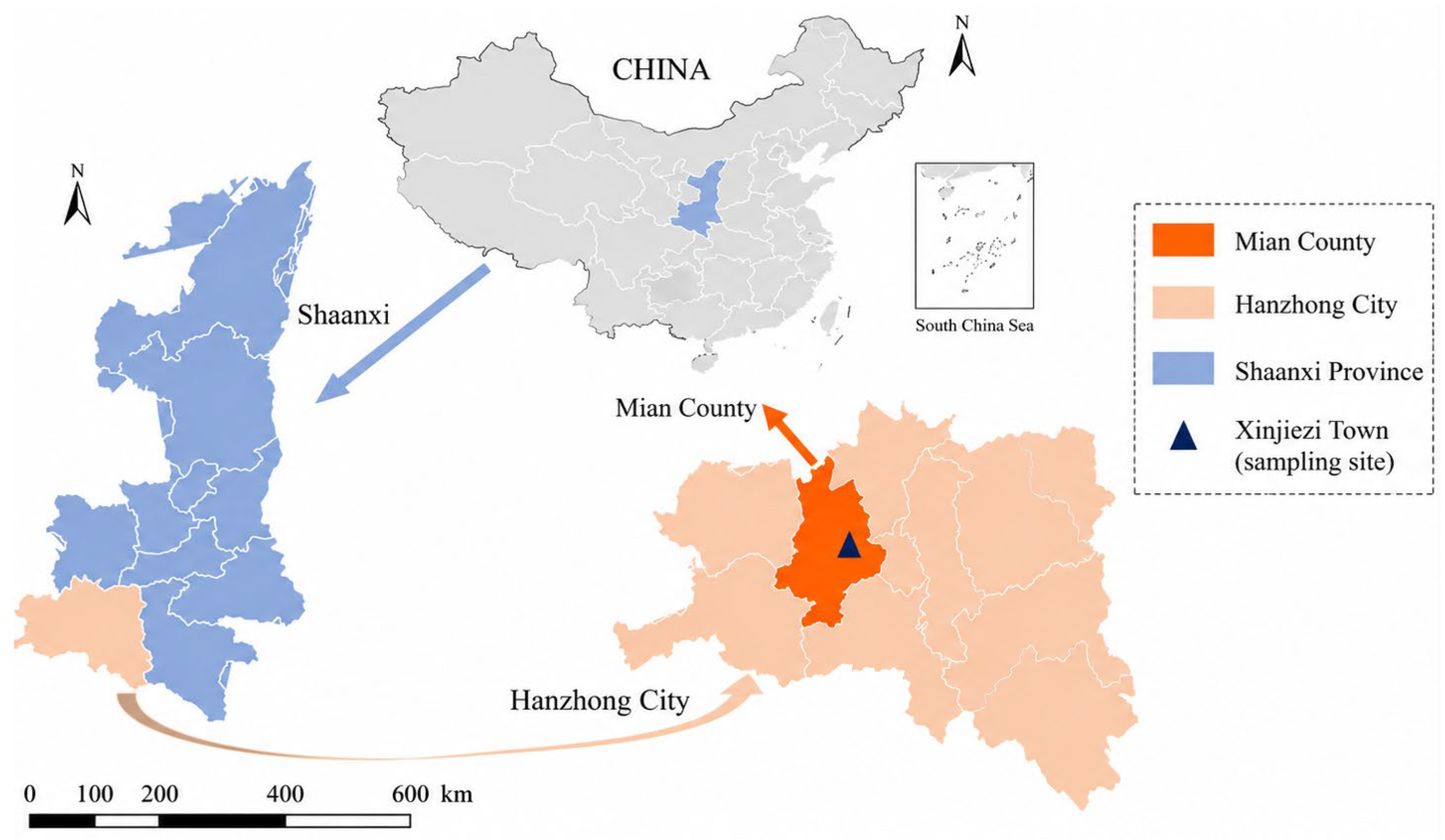
The test soil was sampled from Xinjiezi Town, Mian County, Hanzhong, southern Shaanxi (Figure 1). The sampling site is located at approximately 33°09′ N, 106°40′ E, with an elevation of about 520 m above sea level. Sampling was conducted in October 2024. Samples were collected from a single sampling profile at depths of 0.8, 1.5, 2.2, and 3.0 m using a manual auger. Approximately 5 kg of soil was collected from each depth, and the material from all four depths was combined into a single representative bulk sample following the quartering method. The sampling location was selected based on the presence of well-developed fissures and slickensides, which are typical morphological features of expansive soils, as well as the geological setting of the Hanjiang River terrace where expansive soils are widely distributed. This area belongs to the second terrace of the Hanjiang River and consists of Quaternary Middle Pleistocene alluvial-diluvial deposits. The sampling depth ranged from 0.8 m to 3.0 m below the ground surface. The soil appears reddish-brown to yellowish-brown in color, with a dense structure. Small amounts of ferromanganese concretions and calcareous films are observable. The soil exhibits well-developed fissures and obvious slickensides, displaying typical morphological features of expansive soils.
Figure 1. Location map of the study area and sampling site. The grey areas indicate other regions of China outside the highlighted study area.The basic physical properties of the soil were determined in accordance with the Standard for Geotechnical Testing Method (GB/T 50123-2019) [15], and the results are presented in Table 1. The liquid limit is 43%, the plastic limit is 28%, and the plasticity index is 15. According to the Technical Code for Buildings in Expansive Soil Regions (GB 50112-2013) [16], this soil is classified as a medium-low expansive soil. The specific gravity of soil particles is 2.71. Particle-size distribution analysis indicates that the fraction finer than 0.075 mm accounts for 72.3% of the total soil mass, among which the clay fraction (<0.005 mm) constitutes 31.5%, the silt fraction (0.005–0.075 mm) constitutes 40.8%, and the sand fraction (>0.075 mm) constitutes 27.7%, classifying it as a fine-grained soil. The free swelling ratio is 65%, further confirming its medium-low swelling potential.
Applsci 16 09679 g001
The XRD analysis was performed using a diffractometer with Cu Kα radiation (λ = 1.5406 Å) at 40 kV and 40 mA, scanning from 3° to 70° (2θ) with a step size of 0.02° and a scanning speed of 2°/min, The clay fraction (<2 μm) was separated by sedimentation, and oriented specimens were prepared by air-drying, ethylene glycol solvation, and heating at 550 °C for 2 h. The mineral phases were identified using the PDF-2 database with Jade 6.5 software. The reported mineral percentages are semi-quantitative estimates based on the relative intensity of the characteristic peaks. The dominance of illite (32.98%) and the presence of mixed-layer illite–smectite (6.61%) are consistent with previous studies on expansive soils from the Hanzhong region [12,13]. The dominance of illite and the presence of mixed-layer illite–smectite are consistent with the medium-low swelling potential of the tested soil. However, the specific contribution of illite surface hydration and mixed-layer interlayer expansion to the observed swelling kinetics cannot be directly quantified from the XRD data alone. These mechanisms are proposed as plausible interpretations, and further microstructural or physicochemical investigations would be required to confirm them.
Table 1. Basic physical properties of the test soil.
Natural Water Content (%)Natural Density (g/cm3)Liquid Limit (%)Plastic Limit (%)Plasticity IndexFree Swelling Ratio (%)
16.81.7643281565

2.2. Specimen Preparation

All specimen preparation procedures were strictly conducted in accordance with the Standard for Geotechnical Testing Method (GB/T 50123-2019). The detailed steps are as follows:
1. Soil pretreatment: The collected undisturbed soil samples were air-dried indoors at ambient temperature, with periodic turning to accelerate uniform drying. After air-drying, the soil was crushed and passed through a 2 mm standard sieve to remove gravel and impurities larger than 2 mm. The sieved soil was thoroughly mixed, and its air-dried water content was determined by the oven-drying method (105 ± 5 °C for 24 h). Two parallel measurements were performed, and the average value was taken as the final air-dried water content (ω0) when the difference between the two measurements was less than 0.5%. The measured value was 3.8%. The prepared soil was then sealed in triple-layer ziplock bags to prevent moisture absorption.
2. Preparation of soil samples with target water content: Based on the required soil quantity and the target water content (ω), the amount of distilled water to be added was calculated using Equation (1):
  m w = m 0 1 + 0.01 ω 0 × 0.01 ω − ω 0  
where m w is the mass of distilled water to be added (g); m 0 is the mass of the air-dried soil sample (g); ω 0 is the water content of the air-dried soil sample (%); and ω is the target initial water content (%).
Sufficient quantities of the air-dried soil were weighed and evenly spread in an enamel tray. The calculated amount of distilled water was then slowly and uniformly sprayed onto the soil surface using a spray bottle, while the soil was continuously stirred with a stainless-steel spoon to achieve preliminary uniform moisture distribution. The moistened soil was subsequently placed into ziplock bags, with the air inside expelled before sealing, and was allowed to cure for 24 h at room temperature (20 ± 2 °C) and a relative humidity of 95% ± 5% in a moisturizing chamber to enable thorough moisture migration and uniform distribution. The maximum duration between specimen preparation and testing was 48 h. After curing, two soil samples were taken from different locations within each bag to determine the actual water content; when the difference between the two measurements was less than 1%, the soil was considered to have reached uniform moisture and was deemed ready for subsequent specimen preparation. The measured water contents after curing were within ±1% of the target values for all specimens, as verified by the homogeneity criterion. The reported water contents throughout this paper refer to the target values.
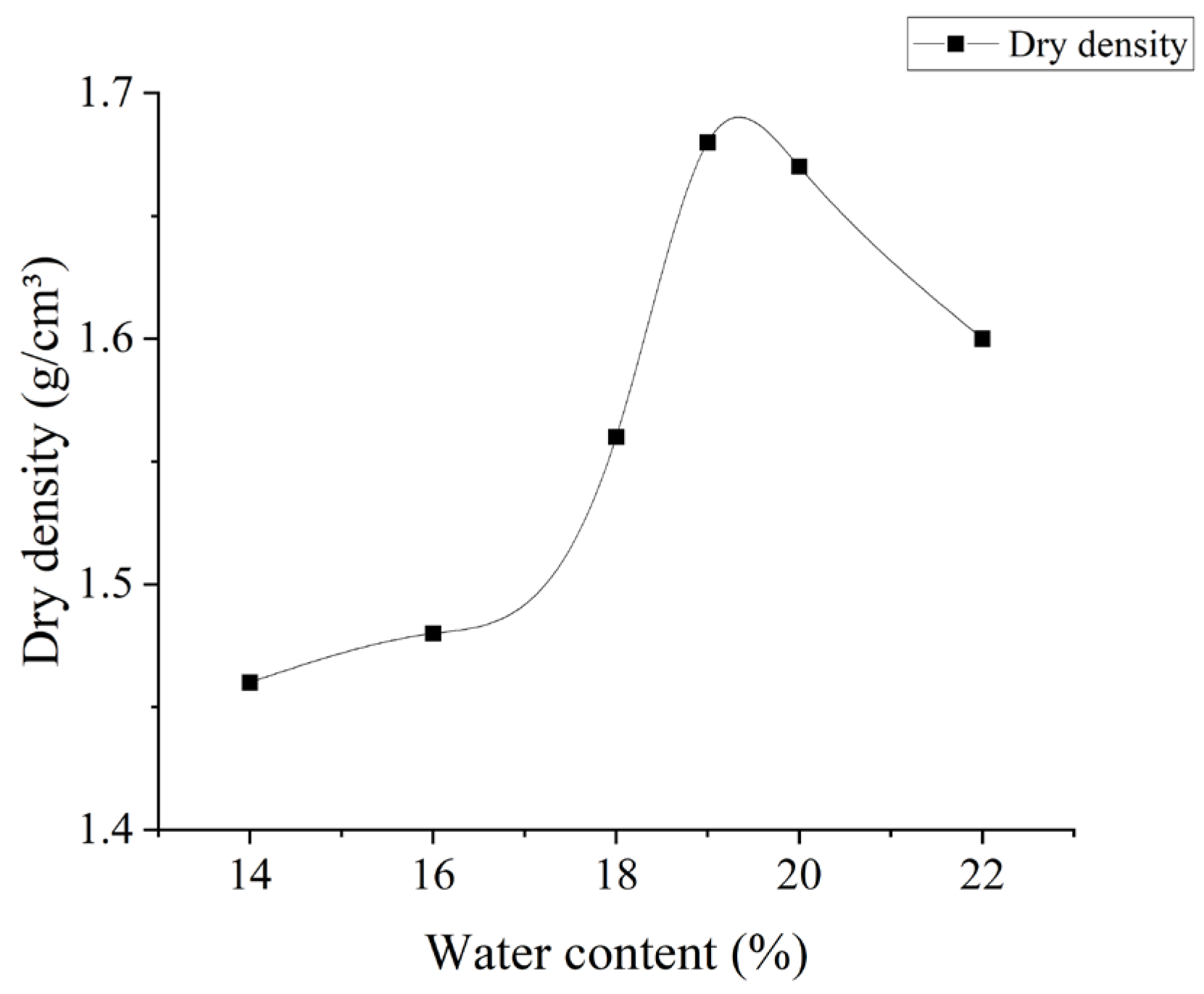
3. Compaction and specimen preparation: Standard compaction tests were performed to determine the optimum water content and maximum dry density of the soil, in accordance with the light compaction method specified in the Standard for Geotechnical Testing Method (GB/T 50123-2019). The compaction hammer had a mass of 2.5 kg and a drop height of 305 mm. The mold had an inner diameter of 102 mm and a height of 116 mm (volume = 947 cm3). Soil samples with different water contents were placed into the compaction cylinder in three layers, with each layer compacted by 25 blows. The resulting compaction energy was approximately 592 kJ/m3. The dry density corresponding to each water content was measured, and the water content–dry density relationship curve was plotted (Figure 2). The optimum water content was determined to be 19%, and the maximum dry density was 1.68 g/cm3.
To systematically investigate the effects of dry density and initial water content on swelling characteristics, four levels of initial water content (15%, 18%, 21%, and 24%, at intervals of 3%) and four levels of dry density (1.50, 1.55, 1.60, and 1.65 g/cm3, at intervals of 0.05 g/cm3) were designed, resulting in a total of 16 test condition combinations. Each of the 16 combinations was independently prepared and tested under otherwise identical conditions. The two factors (initial water content and dry density) were controlled independently during specimen preparation: the target water content was achieved by adding the calculated amount of distilled water, and the target dry density was achieved by compacting the calculated wet soil mass to the specified volume. The actual dry density of each specimen was verified by weighing, and the deviation was controlled within ±1%. The four water content levels (15%, 18%, 21%, and 24%) were selected to span both sides of the optimum water content (19%), with intervals of 3%. The four dry density levels (1.50, 1.55, 1.60, and 1.65 g/cm3) were selected to cover the range from 89% to 98% of the maximum dry density (1.68 g/cm3), with intervals of 0.05 g/cm3. This design allows the swelling behavior near the optimum water content to be captured while maintaining a manageable number of test conditions.
Based on the ring cutter volume ( V = 100 cm3, inner diameter = 61.8 mm, height = 20 mm) and the target dry density ( ρ d ), the required wet soil mass for each specimen was calculated using Equation (2):
m w e t = ( 1   +   0.01 ω ) × ρ d × V
where m w e t   is the required mass of wet soil (g); ρ d   is the target dry density (g/cm3); V   is the ring-cutter volume (100 cm3); and ω is the target initial water content (%).
Specimens were prepared using the compaction method: the calculated wet soil mass was weighed and evenly divided into four equal portions, which were sequentially placed into the compactor and compacted layer by layer with a compaction hammer to the specified height, so that the final specimen reached the target dry density. The inner walls of the compactor and the ring cutter were pre-coated with a thin layer of petroleum jelly to reduce frictional disturbance during demolding. After compaction, a push rod was used to slowly and evenly extrude the ring cutter, and excess soil at both ends of the ring cutter was trimmed to make the specimen surfaces flush with the ring cutter end faces, ensuring smooth and flat surfaces. One specimen was prepared and tested for each condition. The dry density deviation was controlled within ±1% of the target value; otherwise, the specimen was re-prepared.

2.3. Test Instruments and Equipment

1. Free swelling ratio test: A WZ-2 type swelling apparatus was used, which mainly consists of a water bath, guide ring, porous stones, retaining ring, light loading plate, and a dial gauge (range 10 mm, graduation 0.01 mm). This apparatus is used to measure the swelling deformation of soil specimens upon water absorption under laterally confined conditions without vertical loading.
2. Swelling pressure test: A WG type triplex low-to-medium-pressure consolidometer was adopted, equipped with dial gauges (range 10 mm, graduation 0.01 mm) and a weight loading system, enabling stepwise application of vertical loads and precise measurement of specimen deformation.

2.4. Test Scheme and Procedures

The moisture ranges for the two tests were selected based on the compaction characteristics of the soil. For the free swelling ratio tests, a range centered around the optimum water content (15%, 18%, 21%, 24%) was chosen to systematically investigate the effect of initial water content on swelling behavior. For the swelling pressure tests, the range was extended to 14% to investigate the more pronounced swelling pressure response at lower water contents, while 22% was selected as the upper bound to observe the attenuation of swelling pressure at higher moisture levels.

2.4.1. Free Swelling Ratio Test

The free swelling ratio test measures vertical deformation under zero vertical load. This test characterizes the unconstrained expansion potential of the soil. The free swelling ratio test was conducted in accordance with the “Swelling Ratio Test” section of GB/T 50123-2019. The detailed test scheme is presented in Table 2.
A total of 16 specimens were tested under 16 conditions.
1. The prepared ring-cutter specimen was placed into the cleaned water bath, with the guide ring and porous stone sequentially placed at the bottom, and the upper surface of the specimen kept flush with the end face of the ring cutter.
2. The retaining ring (with the notch facing downward) was placed on top of the ring cutter, followed by the filter paper and the upper porous stone. The light loading plate was then placed on the top of the specimen, ensuring close contact with the specimen surface.
3. The dial gauge holder was installed, and the dial gauge was adjusted so that its measuring tip was aligned with the center of the loading plate. After pre-compression of 1 mm, the gauge was zeroed, and the initial reading z0 was recorded.
4. Distilled water was slowly introduced into the water bath from the bottom upward, maintaining the water level 5 mm above the top surface of the specimen. The time of water injection was recorded as the starting point of the test.
5. Dial gauge readings were recorded at the following time intervals: 5, 10, 20, 30, 40, 50, 60, 90, 120, 180, 240, 300, 360, and 420 min. When the increase in dial gauge reading over 2 consecutive hours was less than 0.01 mm, the swelling was considered to have stabilized, and the test was terminated.
6. After termination, the dial gauge and loading plate were removed, the water in the bath was aspirated, and the ring cutter was carefully taken out. The specimen was extruded, and its water content after swelling stabilization was immediately determined.
The free swelling ratio was calculated using Equation (3):
δ ep = z p + λ − z 0 h 0 × 100
where δ e p   is the free swelling ratio (%); z p   is the dial gauge reading at time t (mm); z 0 is the initial dial gauge reading (mm); h 0   is the initial height of the specimen (20 mm); and λ   is the instrument deformation correction (mm), which accounts for the compression of the filter paper and porous stones under the loading plate. The value of λ was determined by a calibration test using a rigid specimen of known dimensions and was found to be negligible (<0.01 mm) in this study.

2.4.2. Swelling Pressure Test

The swelling pressure test (load-balancing method) applies incremental loads to maintain constant volume during water absorption. This test quantifies the internal stress generated under confined conditions. The swelling pressure was measured using the load-balancing method (also known as the zero-swell method). This method suppresses the swelling deformation of the specimen by applying loads incrementally, so that the specimen volume remains essentially unchanged during water absorption, thereby preserving the original soil structure to the greatest extent possible. The swelling pressure measured by this approach is considered to be the closest to the true swelling potential of the soil.
The test scheme is presented in Table 3. One specimen was prepared for each condition, giving a total of 12 specimens across 12 conditions.
The test procedures were as follows:
1. Ring-cutter specimens with the target water content and dry density were prepared following the method described in Section 2.2.
2. The loading frame of the triplex consolidometer was adjusted to a horizontal position. The water bath and porous stone were installed, and the ring-cutter specimen was placed into the consolidation cell, followed by sequential installation of the upper porous stone and the loading transfer plate.
3. The dial gauge was mounted, and its measuring tip was adjusted to contact the center of the loading transfer plate. After a pre-compression of 1 mm, the gauge was zeroed, and the initial reading was recorded.
4. Distilled water was injected into the water bath until the water level rose to 5 mm above the top surface of the specimen, and timing was started. After water injection, the rotation direction of the dial gauge needle was closely monitored: counterclockwise rotation indicated compression of the specimen, while clockwise rotation indicated the onset of swelling.
5. When the dial gauge needle deflected clockwise (indicating that the specimen had started to swell), a load was immediately applied through weights to return the needle to the initial zero position, and the applied mass was recorded. The load application was required to be completed within 3 min to minimize swelling deformation of the specimen under unconstrained conditions.
6. The dial gauge readings were continuously observed, and additional load was applied whenever the needle deflected clockwise to bring it back to zero. The time of each loading and the cumulative applied mass were recorded. When the deformation of the specimen under a given load was less than 0.01 mm over 2 consecutive hours, the swelling was considered to have stabilized, and the corresponding applied load at this point was used to calculate the swelling pressure of the specimen. The applied vertical force was calculated as F = m g , and the swelling pressure was determined as P = F / A = m g / A , where F is the applied vertical force (N); P is the swelling pressure (kPa); m is the total applied mass (kg); g is the gravitational acceleration (9.8 m/s2); and A is the cross-sectional area of the specimen (3.0 × 10⁻³ m2), corresponding to a ring-cutter diameter of 61.8 mm.
7. After the test was completed, all loads were removed, the dial gauge was taken off, the water in the bath was aspirated, and the specimen was carefully extruded from the ring cutter to determine its final water content.

2.5. Data Processing Method

Each test condition was tested with a single specimen due to time and material constraints during the experimental campaign. The complete dataset of individual measurements is provided in Tables S1 and S2 of the Supplementary Materials. The sensitivity coefficient (SC) was calculated to quantify and compare the relative influence of dry density and initial water content on the swelling characteristics. The SC is defined as the ratio of the relative change in the target parameter to the relative change in the input variable:
SC = (ΔY/Ȳ)/(ΔX/X̄)
where Y is the target parameter (free swelling ratio or swelling pressure), X is the input variable (dry density or initial water content), ΔY and ΔX are the changes in Y and X, and Ȳ and X̄ are the mean values of Y and X, respectively. This dimensionless coefficient allows direct comparison of the relative influence of variables with different units and scales. The perturbation interval was set at ±5% of the mean value of each input variable. Multiple linear regression analysis with an interaction term was performed to quantify the main effects and interaction of dry density and water content, with a significance level of α = 0.05. The full regression output is provided in Table S3 of the Supplementary Materials.
Remarks on experimental limitations: It should be noted that the free swelling ratio tests conducted in this study did not involve the application of vertical loads, whereas in actual engineering practice, soils are generally subjected to certain overburden pressures. Previous studies have demonstrated that overburden pressure exerts a notable inhibiting effect on swelling deformation [17]; the higher the applied load, the smaller the final swelling ratio. Therefore, the free swelling ratio results obtained in this study reflect the maximum swelling potential of the soil under unconstrained conditions and can serve as a basis for expansive soil classification and preliminary engineering evaluation. However, for refined settlement calculations or subgrade deformation predictions, it is advisable to conduct swelling ratio tests under applied loads that correspond to actual field stress conditions, in order to obtain more reliable design parameters.

3. Results and Discussion

3.1. Temporal Evolution of the Free Swelling Ratio

3.1.1. Three-Stage Characteristics of the Time-Dependent Curves

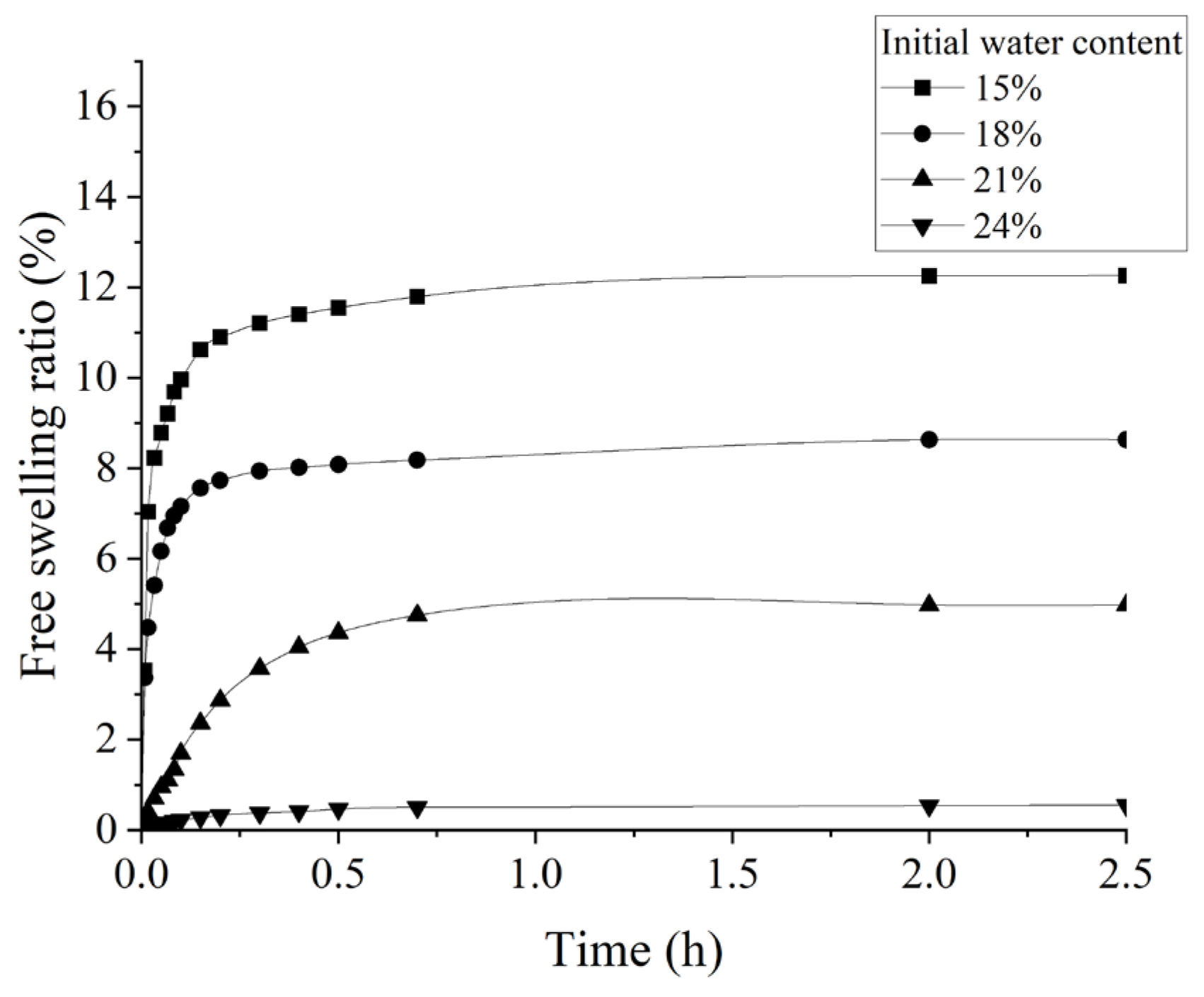
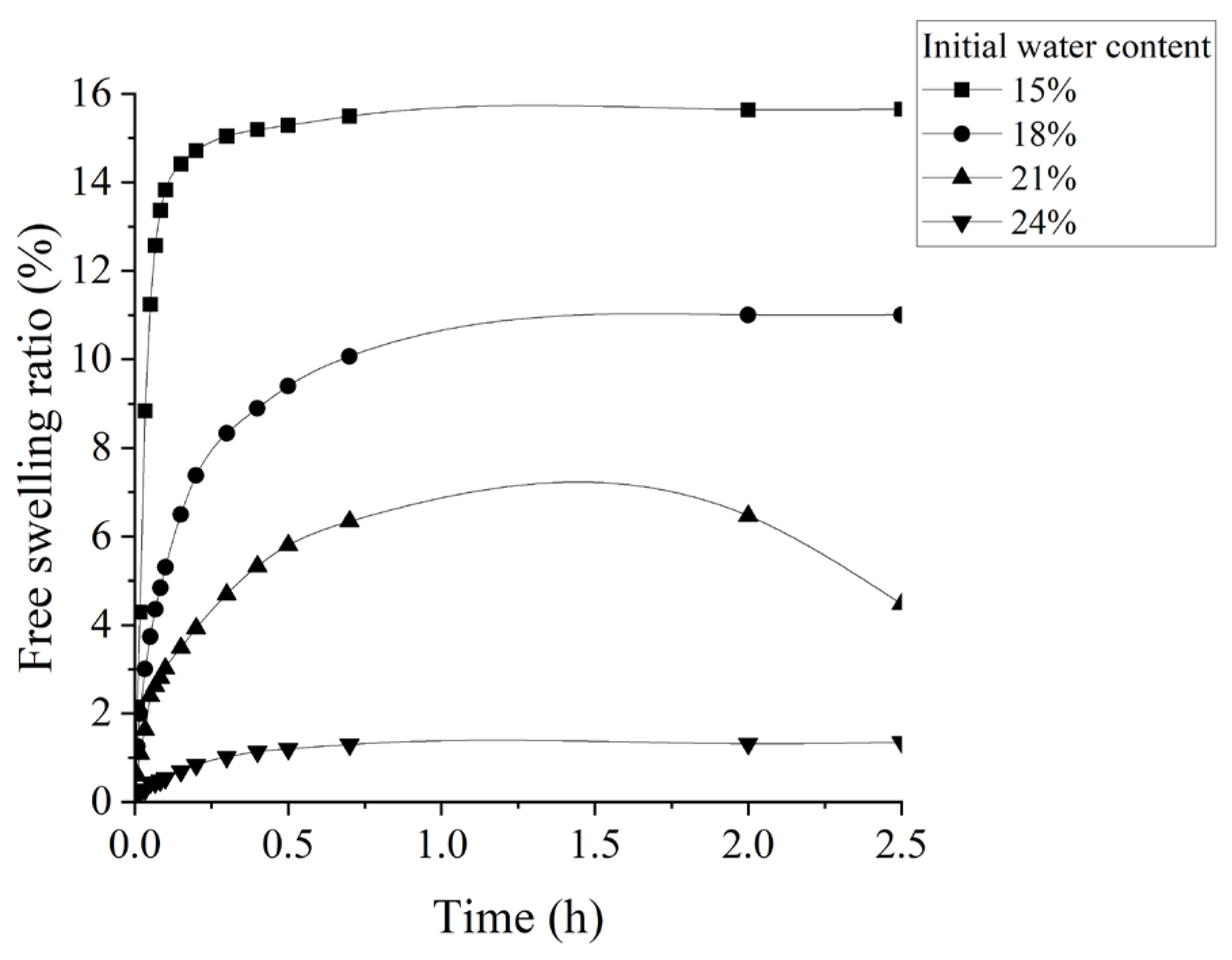
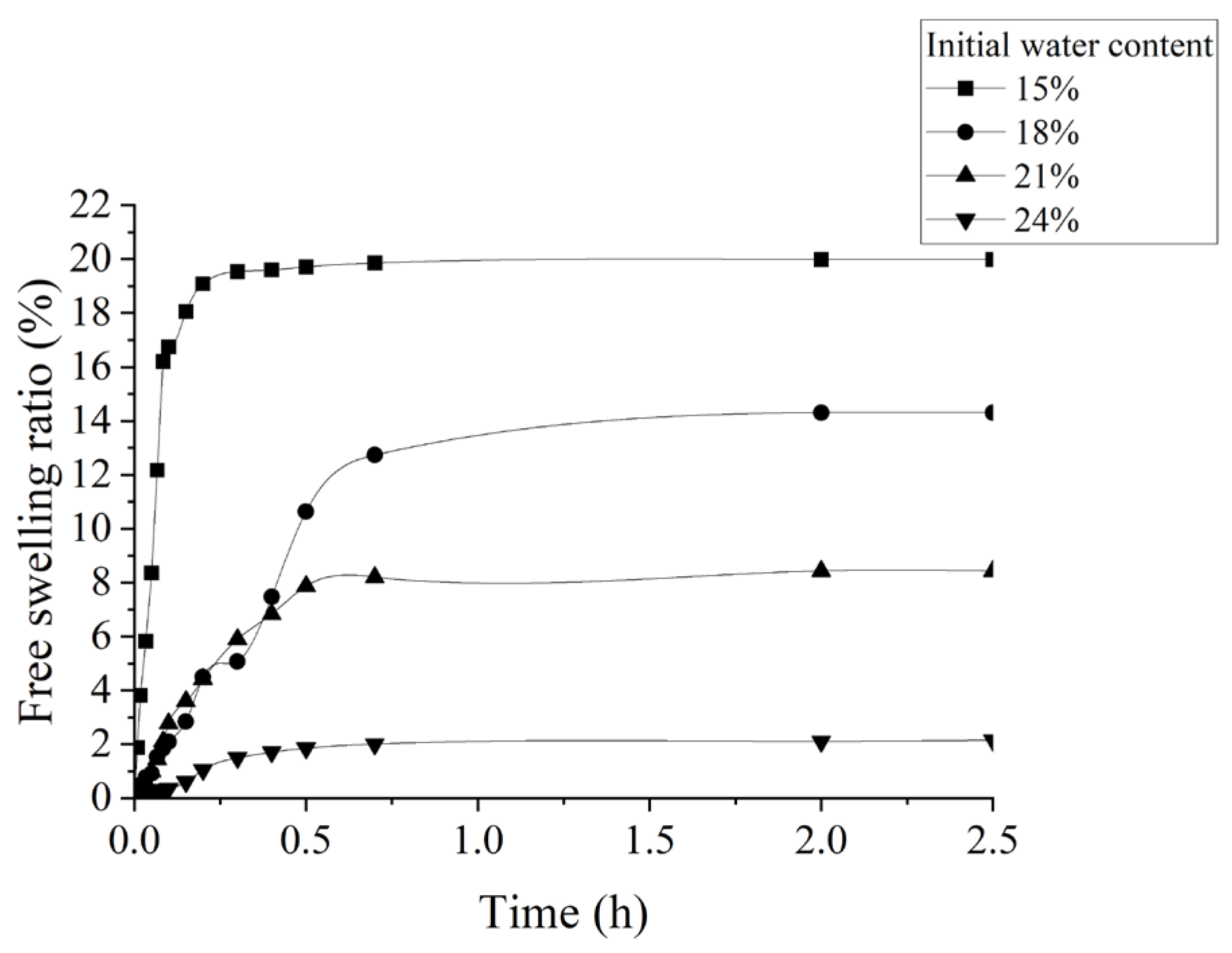
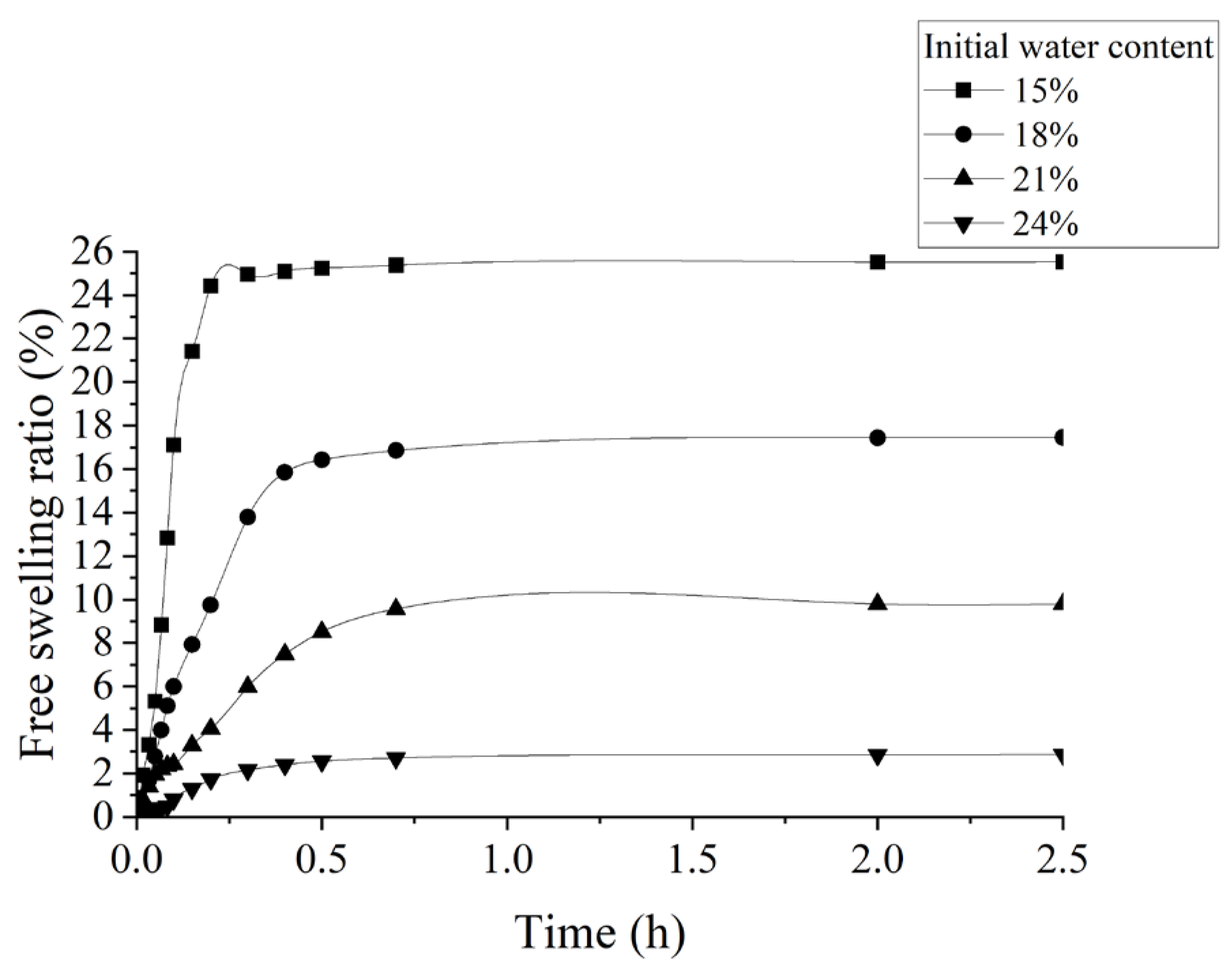
This section first presents the temporal evolution of swelling to establish the framework for interpreting the swelling behavior, followed by the principal quantitative findings on the effects of dry density and initial water content. Figure 3, Figure 4, Figure 5 and Figure 6 present the free swelling ratio–time relationship curves for specimens with dry densities of 1.50, 1.55, 1.60, and 1.65 g/cm3, respectively, under various initial water contents. The time-dependent curves under all four dry density conditions exhibit a distinctly three-stage evolutionary pattern; however, the rates, durations, and final stabilized values at each stage are jointly regulated by the dry density and initial water content.
Rapid swelling stage (0–10 min): This stage exhibits the maximum slope of the curve, with the swelling ratio increasing in an approximately linear and steep manner. The cumulative swelling during this stage accounts for 65% to 75% of the total swelling. Taking the specimen with a dry density of 1.50 g/cm3 and an initial water content of 18% as an example, the average swelling rate during this stage is 0.082%/min, and the swelling ratio at 10 min has already reached 71.8% of the final value. The swelling rate was calculated as the ratio of the change in swelling ratio to the time interval over the specified stage (e.g., 0–10 min for the rapid swelling stage), based on the dial gauge readings at the beginning and end of the interval. Under the same dry density, the initial water content exerts a notable influence on the swelling rate during this stage: the slope of the rapid swelling period for the 18% water content specimen is 0.082%/min, which is 26.2% higher than that of the 15% specimen (0.065%/min) and 20.6% higher than that of the 24% specimen (0.068%/min). This phenomenon indicates that although the soil near the optimum water content already contains a certain amount of moisture, its internal pore structure is more uniform, and the water infiltration paths after wetting are more open, which actually facilitates rapid initial swelling. When the water content is too low (15%), the hydration film on particle surfaces is extremely thin, but the soil also contains numerous closed pores that hinder rapid water intrusion. When the water content is too high (24%), the soil is close to saturation, and part of the swelling potential has already been released during specimen preparation, thereby reducing the swelling rate.
Decelerating swelling stage (10–40 min): The slopes of all curves gradually decrease, and the growth rate of the swelling ratio progressively slows down, with the cumulative swelling during this stage accounting for 15% to 25% of the total swelling. This is attributed to the gradual dissipation of pore water pressure, the saturation of hydration on mineral particle surfaces, and a notably weakened increase rate of inter-particle repulsive forces. Notably, specimens with higher dry densities (1.60 and 1.65 g/cm3) exhibit a brief slope recovery phenomenon during this stage (a small convexity appears in the 18% water content curves in Figure 4 and Figure 5 within the 15–25 min interval), which is not observed in the low dry density specimens (1.50 and 1.55 g/cm3). It is inferred that under high dry density conditions, the soil particles are extremely densely packed. After water intrusion, a portion of the water fills the remaining micropores as free water, while the other portion continuously thickens the bound water films on the surfaces of hydrophilic mineral particles. When the thickening of the bound water films reaches a certain extent, the repulsive forces between adjacent particles once again become dominant, leading to a secondary increase in particle spacing and local reorganization of the internal soil structure, which macroscopically manifests as a transient acceleration of the swelling rate.
Stabilization stage (after 40 min): The onset of stabilization occurs after approximately 40 min, marked by a sharp deceleration in the swelling rate. All curves then gradually flatten out and fully attain a steady state after approximately 100 min, at which point the swelling increment over 2 consecutive hours is less than 0.01 mm. Specimens with higher dry densities require less time to reach stabilization: the 1.65 g/cm3 specimen enters the stable stage at approximately 80 min, while the 1.50 g/cm3 specimen requires about 100 min, representing a 20% reduction in stabilization time for the former compared to the latter. This indicates that although water infiltration and diffusion processes are slower in denser soils, they also reach apparent swelling stabilization earlier. Whether this corresponds to true hydration equilibrium cannot be confirmed without direct measurement of the hydration state. It should be noted that some curves (e.g., the 21% water content curve in Figure 4 and the 18% water content curve in Figure 5) exhibit a slight decrease in the swelling ratio during the later stages of the test. This decrease may be attributed to minor water evaporation from the specimen surface during the prolonged test period, as the water bath was open to the atmosphere, or to local specimen disturbance. For the 21% water content curve in Figure 4, the decrease is more pronounced (approximately 2%), which may indicate partial structural reorganization or collapse of the specimen. Since the swelling ratio had already essentially stabilized before the decrease, this does not affect the main conclusions of this study, but it is acknowledged as an experimental limitation.

3.1.2. Effect of Dry Density on the Free Swelling Ratio

When the initial water content was held constant, the final free swelling ratio increased with increasing dry density across all water content conditions. Taking the initial water content of 18% as an example, the final free swelling ratio increased from 8.63% at a dry density of 1.50 g/cm3 to 17.44% at 1.65 g/cm3. Considering that only four dry-density levels were investigated at each initial water content, the present data are insufficient to establish a specific functional form for this relationship. Therefore, the relationship is described here in terms of the experimentally observed trend rather than an exponential model.
The observed increase in free swelling ratio with dry density may be related to the greater amount of swell-active soil solids per unit volume in denser specimens. Upon wetting, the larger quantity of hydrophilic mineral particles may contribute to greater overall swelling deformation. Because no direct microstructural measurements were performed in this study, this interpretation is inferred from the macroscopic test results.

3.1.3. Effect of Initial Water Content on Swelling Ratio and Engineering Implications

When the dry density was held constant, the free swelling ratio decreased with increasing initial water content over the tested range. This trend is consistent with the monotonic relationship reported in previous studies, which suggested that “the lower the initial water content, the greater the swelling ratio” [6,18]. It is considered in this study that this discrepancy arises from the combined effects of the initial structural state of the soil.
As the initial water content increases, the soil has a higher degree of initial hydration before wetting, which reduces the additional water-absorption and swelling potential during the test. Consequently, the free swelling ratio generally decreases with increasing initial water content over the tested range. This trend may be associated with the progressive development of hydration films on particle surfaces and the partial consumption of swelling potential before the test. Because no direct microstructural measurements were performed in this study, these mechanisms are inferred from the observed macroscopic swelling behavior.
Engineering implications: The above findings have important implications for the compaction of expansive soil subgrades. In engineering practice, there is generally a tendency to compact near the optimum water content to achieve the maximum dry density. However, the results of this study indicate that the free swelling ratio generally decreases with increasing initial water content under the tested conditions. This observation should be evaluated alongside other engineering properties, including shear strength, compressibility, permeability, and overall embankment stability. Therefore, the present results should be interpreted within the range of water contents and dry densities investigated in this study, rather than as defining a general optimum compaction water content or water-content regulation interval. It should be noted that the free swelling ratio serves as a guiding indicator for preliminary classification and engineering evaluation, rather than a direct design parameter. For refined engineering design, swelling pressure and shear strength parameters should be considered.

3.2. Analysis of Swelling Pressure Characteristics

3.2.1. Quantitative Effects of Dry Density and Water Content on Swelling Pressure

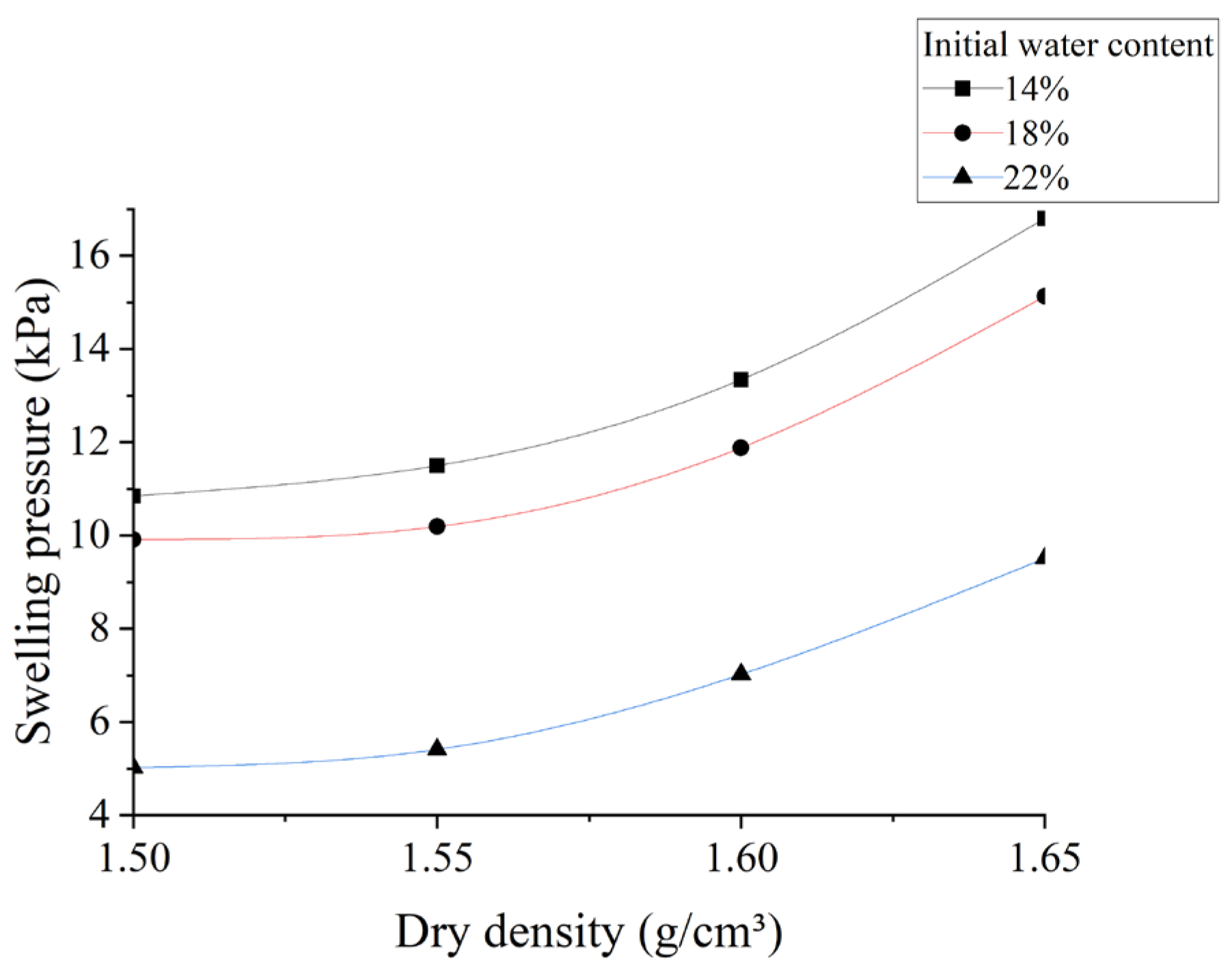
Figure 7 presents the relationship curves between dry density and swelling pressure under different initial water contents. At a constant water content, the swelling pressure increases approximately linearly with dry density, with the coefficient of determination R2 ranging from 0.87 to 0.94. As the dry density increased from 1.50 to 1.65 g/cm3, the swelling pressure under the 14% water content condition rose from 10.85 kPa to 16.8 kPa, representing an increase of 54.8%; while under the 22% water content condition, it rose from 5.02 kPa to 9.51 kPa, representing an increase of 89.4%. Although the absolute increase diminished with rising water content, the relative increase remained largely unchanged, indicating that the linear enhancing effect of dry density on swelling pressure is consistently pronounced across different water content conditions.
It is noteworthy that the lower the water content, the greater the slope of the curve: the slope under the 14% water content condition is 39.67 kPa·cm3/g, which is 14% higher than that under the 18% condition (34.8 kPa·cm3/g) and 32.5% higher than that under the 22% condition (29.93 kPa·cm3/g). This indicates that when the soil is in a relatively dry state, changes in dry density induce more pronounced swelling pressure responses. From a microscopic perspective, under low water content conditions, the water films between particles are extremely thin, and particles are predominantly in face-to-face or edge-to-face contact, with relatively large effective stresses at the contact points. Increasing the dry density under such conditions is equivalent to adding more high-energy contact surfaces on the basis of existing contacts. Upon wetting, the superposition effect of swelling pressures generated by these newly added contact surfaces becomes more concentrated, thus leading to higher sensitivity of swelling pressure to dry density.
Under the same dry density, the swelling pressure decreases monotonically with increasing water content. Taking the dry density of 1.60 g/cm3 as an example, when the water content increased from 14% to 18%, the swelling pressure decreased from 13.34 kPa to 11.88 kPa, a reduction of 10.9%; when it increased from 18% to 22%, the swelling pressure decreased to 7.02 kPa, a reduction of 40.9%. To further quantify the combined effects of dry density and water content on swelling pressure, a multiple linear regression analysis including an interaction term was performed:
P   =   β 0   +   β 1 ρ d +   β 2   ω +   β 3 ( ρ d ×   ω )
where P is the swelling pressure (kPa); ρ d   is the dry density (g/cm3); ω   is the initial water content (%); and β 0 , β 1 , β 2 , and β 3 are the regression coefficients. The fitted model yields β0 = 8.8753, β1 = −4.8923, β2 = −0.0387, and β3 = 0.6024, with an overall R2 of 0.9992 (adjusted R2 = 0.9989, F = 3235.41, p < 0.001). The interaction term (β3) is highly statistically significant (p = 1.03 × 10⁻⁹), confirming that the effect of dry density on swelling pressure is significantly modulated by the initial water content—specifically, the enhancing effect of dry density on swelling pressure becomes more pronounced at lower water contents. The full regression output, including standard errors and confidence intervals, is provided in Table S3 of the Supplementary Materials.
It should be noted that the regression analysis is based on single measurements at each test condition rather than replicate specimens, which limits the statistical power of the analysis. This limitation is acknowledged in Section 3.3.
The regression equations for the relationships between dry density and swelling pressure at different water contents are presented in Table 4. These equations were obtained by linear regression of the swelling pressure data against dry density for each water content level.

3.2.2. Sensitivity Analysis and Identification of Dominant Factors

To quantitatively compare the influence of dry density and initial water content on the swelling characteristics, a dimensionless sensitivity coefficient method was adopted in this study. The calculated results are presented in Table 5.
The sensitivity coefficient of dry density is 8.93 for the free swelling ratio and 5.47 for swelling pressure, both notably higher than the corresponding values of 3.78 and 1.48 for initial water content. This indicates that, within the range of variables investigated in this study, the swelling characteristics show greater relative sensitivity to dry density than to initial water content. From an engineering perspective, this implies that in the treatment of expansive soil subgrades and foundations, compaction control (i.e., dry density) exerts a greater “leverage effect” than water content regulation—adjusting the dry density brings about a much larger change in swelling behavior compared to adjusting the water content. Therefore, dry density should receive particular attention in compaction quality control within the tested conditions.
Further analysis of the variation in sensitivity coefficients reveals that as water content increases, the sensitivity coefficient of dry density ranges from 4.65 to 7.00, with the highest value occurring at the 22% water content condition. This indicates that the influence of dry density on swelling pressure is more pronounced at higher water contents, contrary to the trend observed for the free swelling ratio. Meanwhile, as dry density increases, the sensitivity coefficient of water content decreases from 1.65 (at 1.50 g/cm3) to 1.25 (at 1.65 g/cm3), suggesting that the influence of water content on swelling pressure is somewhat attenuated in highly compacted states. Despite this variation, the sensitivity coefficients of dry density remain consistently higher than those of water content across all conditions, confirming that dry density is the dominant controlling factor. This dynamic feature has practical implications for engineering: for fills with high water content, the influence of dry density on swelling pressure is more pronounced, so strict compaction control is particularly important; whereas for fills with low water content, although the sensitivity to dry density is somewhat lower, compaction control should still be maintained in conjunction with appropriate water content regulation.

3.2.3. Comparison with Previously Published Results and Analysis of Discrepancies

Comparing the results of this study with those reported in the literature, both consistencies and discrepancies can be observed. Regarding the positive correlation between dry density and swelling pressure, the findings of this study are generally consistent with those of Ye et al. [6] on expansive soils from Anhui and Huang et al. [14] on expansive soils from Hubei—in all cases, an increase in dry density leads to a notable increase in swelling pressure, with a good linear relationship. The negative correlation between initial water content and swelling pressure is also consistent with the conclusions of Liu et al. [7] on expansive soils from Ankang. More broadly, international studies have shown that the swelling behavior of expansive soils is strongly influenced by the hydraulic state, compaction condition, soil fabric, and wetting path. For example, suction-controlled tests have demonstrated that swelling pressure evolves with changes in suction during wetting, while experimental observations on compacted swelling soils have shown that soil fabric varies with compaction state and hydraulic path [19,20].

3.2.4. Microscopic Mechanism of Swelling Behavior

Based on the comprehensive results presented above, a microscopic mechanism framework for the macroscopic swelling behavior of expansive soils in southern Shaanxi is proposed as follows. The swelling process is hypothesized to involve coupled water infiltration, mineral hydration, and structural reorganization. This interpretation is inferred from macroscopic behavior and is not directly supported by microstructural measurements in this study. Dry density and initial water content influence the final swelling behavior through the regulation of the following three aspects:
1. Infiltration pathway: Dry density is considered to determine the void ratio and pore connectivity of the soil, although these parameters were not directly measured. Soils with low dry density (1.50 g/cm3) possess larger average pore sizes and higher pore connectivity, allowing water to rapidly infiltrate into the specimen interior, which results in a fast rapid-swelling rate but a higher final stabilized value. Soils with high dry density (1.65 g/cm3) have fine and tortuous pores, which impede water infiltration; however, once infiltration is completed, the dense particle contacts generate greater swelling stress.
2. Hydration driving force: Initial water content is considered to determine the initial hydration state of the soil before wetting. This interpretation is based on established clay mineral behavior rather than direct measurement. As the initial water content increases, the degree of initial hydration increases, thereby reducing the additional hydration driving force upon subsequent wetting. At higher initial water contents, partial hydration may already occur during specimen preparation, resulting in a lower additional water-absorption and swelling potential during the test. Therefore, the observed decrease in swelling with increasing initial water content may be associated with the progressive reduction in additional hydration potential.
3. Swelling constraint: The degree of soil densification is considered to impose physical constraints on external swelling. The inter-particle contact forces were not directly measured. In high dry density soils, the dense particle skeleton exerts considerable contact restraint forces on hydration-induced swelling from the initial state—this also explains why higher dry density leads to greater swelling pressure (with constraints being converted into stress), while the macroscopic swelling deformation is smaller (with deformation being suppressed).
The synergistic effects of the above three aspects govern the macroscopic swelling behavior of expansive soils in southern Shaanxi. It should be noted that this mechanism framework is established based on laboratory reconstituted soil tests. Compared with undisturbed soils, the remolding process destroys the primary structural planes (such as fissures and bedding planes) and cementation strength of the soil, which may result in slightly higher swelling ratios and slightly lower swelling pressures for reconstituted soils than for undisturbed soils [21]. She et al. [22] found that swelling behavior varied considerably among soil layers at different depths under unidirectional seepage conditions, indicating that field swelling behavior may be more complex than that of reconstituted soils, which is consistent with the limitations described in Section 3.3 of this study. Therefore, the applicability of the present laboratory results to field engineering should be validated using field observations or independent laboratory tests under representative conditions.

3.3. Research Limitations and Prospects

This study was conducted based on laboratory reconstituted soil specimens. Although this approach effectively controls the independence among variables and facilitates the identification of the influencing patterns of dry density and water content, it inevitably has the following limitations. The quantitative findings of this study are based on a single soil from Mian County, southern Shaanxi, tested under reconstituted conditions. The results are primarily applicable to similar fine-grained soils in this region and should be extrapolated to other soil types or field conditions with caution.
First, the specimens used in this study were compacted reconstituted soils, whose soil structure differs essentially from that of undisturbed expansive soils. Undisturbed expansive soils may exhibit structural characteristics developed during their geological history. Therefore, their swelling behavior may depend not only on the initial water content and dry density but also on the inherent soil structure and mineralogical composition [23]. Therefore, the quantitative findings of this study are primarily applicable to reconstituted soil conditions such as filled subgrades and artificial foundations, and caution should be exercised when applying them directly to natural expansive soil slopes.
Second, the free swelling ratio tests were conducted without applying vertical loads, which differs from the actual engineering condition where soils are generally subjected to certain overburden pressures. Overburden pressure exerts a notable inhibiting effect on swelling deformation—the higher the load, the smaller the final swelling ratio. Consequently, the free swelling ratio results of this study reflect the maximum swelling potential of the soil under unconstrained conditions and can serve as a basis for expansive soil classification and preliminary evaluation, but should not be directly used for refined settlement calculations.
Third, this study only conducted single wetting tests under indoor ambient temperature conditions and did not consider the deteriorating effects of wetting–drying cycles on swelling characteristics in actual engineering practice. Previous studies have demonstrated [4,24] that repeated wetting–drying cycles lead to progressive structural damage and fissure development in expansive soils, and the swell–shrink characteristics undergo irreversible changes with increasing cycle numbers. In addition to compaction parameter control, chemical treatment methods such as waste material stabilization [25] may also be combined to suppress the swelling potential of expansive soils through multiple approaches.
Fourth, each test condition was tested with a single specimen due to time and material constraints. This limits the statistical evaluation of data dispersion and the application of formal outlier tests. The reported values represent individual measurements, and the observed trends should be interpreted with this limitation in mind. Future studies should include replicate specimens to enable a more robust statistical analysis.
Fifth, the free swelling ratio tests in this study only measured vertical swelling. Expansive soils exhibit inherent anisotropic characteristics, and the vertical swelling strain can reach up to 1.71 times that in the horizontal direction [26]. Therefore, the results of this study should be applied with this limitation in mind, and the lateral pressure induced by horizontal swelling against retaining structures should not be overlooked in practical engineering.
In view of the above limitations, the following directions are recommended for future research: (1) conduct comparative tests between undisturbed and reconstituted soils to quantify the contribution of soil structure to swelling characteristics; (2) carry out swelling ratio tests under applied loads to establish a three-dimensional relationship diagram of swelling ratio versus overburden pressure and water content; (3) conduct evolution tests of swelling characteristics under wetting–drying cycles to establish prediction models for the degradation of swelling parameters with increasing cycle numbers, providing a basis for full life-cycle design in expansive soil regions; and (4) explore combined treatment strategies that integrate physical compaction control with sustainable stabilization techniques [25].

4. Conclusions

Through laboratory free swelling ratio and swelling pressure tests, this study systematically investigated the coupled effects of initial water content and dry density on the swelling characteristics of expansive soil from Mian County, southern Shaanxi. The following main conclusions are drawn:
1. The free swelling ratio of expansive soils in southern Shaanxi exhibits a three-stage temporal evolution pattern of “rapid swelling—decelerating swelling—stabilization.” The onset of stabilization occurs after approximately 40 min, while a steady state is fully attained after approximately 100 min. During the rapid swelling stage (0–10 min), the swelling amount accounts for 65% to 75% of the total swelling.
2. Dry density and initial water content exhibit a pronounced coupled effect on the swelling characteristics. At a constant dry density, the free swelling ratio decreases with increasing initial water content, while the swelling pressure also decreases monotonically with increasing initial water content. At a constant water content, the free swelling ratio increases with increasing dry density, whereas the swelling pressure increases linearly with increasing dry density (R2 ≥ 0.87).
3. Sensitivity analysis indicates that, within the investigated ranges, the swelling characteristics show greater relative sensitivity to dry density than to initial water content. The sensitivity coefficients of dry density for the free swelling ratio and swelling pressure are 8.93 and 5.47, respectively, compared with 3.78 and 1.48 for initial water content. The macroscopic evolution of swelling behavior is governed by the synergistic control of soil structure and hydration: dry density regulates the pore structure and the denseness of particle arrangement, while initial water content determines the initial hydration state of the soil before wetting.
4. Engineering practice implications: The laboratory results indicate that initial water content and dry density both influence the swelling behavior of the tested expansive soil. However, the appropriate compaction conditions for engineering applications should be determined by considering other engineering properties, including shear strength, compressibility, permeability, and overall embankment stability. Therefore, the present findings should be interpreted within the ranges of water content and dry density investigated in this study.
5. This study was conducted based on laboratory reconstituted soils and did not account for the effects of undisturbed soil structure, overburden pressure, or wetting–drying cycles. Each test condition was tested with a single specimen due to time and material constraints, which limits the statistical evaluation of data dispersion. The quantitative findings obtained are primarily applicable to fill engineering involving similar fine-grained soils in this region. Future studies should conduct comparative tests on undisturbed and reconstituted soils, swelling ratio tests under applied loads, and evolution tests of swelling characteristics under wetting–drying cycles, in order to establish a more comprehensive evaluation system for expansive soil engineering.

Supplementary Materials

The following supporting information can be downloaded at: https://www.mdpi.com/article/10.3390/app16199679/s1, Table S1. Summary of free swelling ratio test results; Table S2. Summary of swelling pressure test results; Table S3. Multiple linear regression analysis output.

Author Contributions

Conceptualization, Y.H. and F.D.; writing—original draft preparation, Y.H. and H.H.; validation, Y.H., F.D. and H.H.; formal analysis, Q.Y. and N.W.; funding acquisition Y.H., F.D. and H.H. All authors have read and agreed to the published version of the manuscript.

Funding

This research was supported by the Doctoral Start-up Fund of Shaanxi Polytechnic University (BSJ-2025-15).

Institutional Review Board Statement

Not applicable.

Informed Consent Statement

Not applicable.

Data Availability Statement

The data presented in this study are available on request from the corresponding author.

Conflicts of Interest

The authors declare no conflicts of interest.

References

  1. Wang, S.; Yang, W.; Wang, C.; Wang, M.; Ma, C.; Zhang, Z.; Zhang, E.; Jin, L. Volume change and mechanical behavior of weakly expansive soils under wetting-drying cycles with different hydraulic coupling paths. J. Rock Mech. Geotech. Eng. 2025, 17, 351. [Google Scholar]
  2. Liu, W.; Sun, X.R.; He, N.W. Mechanical property analysis of expansive soil slope instability caused by swell-shrink deterioration effects in strong earthquake areas. J. Eng. Geol. 2025, 33, 1058–1070. (In Chinese) [Google Scholar]
  3. Che, Y.P.; Li, K.; Jia, J.; Zhang, J.; Zhang, K.; Wang, L. Analysis of engineering characteristics and control strategies of expansive soil subgrade under wetting-drying cycles. Inn. Mong. Sci. Technol. Econ. 2022, 16, 100–104. (In Chinese) [Google Scholar]
  4. Li, Z.Q.; Yu, W.L.; Fu, L.; Hu, R.L.; Wang, Y.P. Swell-shrink deformation laws and disaster mechanisms of expansive soils. Rock Soil Mech. 2010, 31, 270–275. (In Chinese) [Google Scholar]
  5. Han, H.Q.; Chen, Z. Strength and deformation characteristics of expansive soils. Chin. J. Geotech. Eng. 2004, 26, 422–424. (In Chinese) [Google Scholar]
  6. Ye, Y.X.; Zou, W.; Han, Z.; Xie, P.; Zhang, J. One-dimensional swelling characteristics of expansive soils considering the influence of initial state. Chin. J. Geotech. Eng. 2021, 43, 1518–1525. (In Chinese) [Google Scholar]
  7. Liu, H.T.; Zhao, J.M.; Guo, M.X.; Zhang, A. Swelling deformation and calculation model of expansive soils in Ankang area. J. Water Resour. Water Eng. 2020, 31, 201–207. (In Chinese) [Google Scholar]
  8. Shi, Y.X.; Zhang, L.Q.; Zhang, C.; Wang, Y.C.; Wu, L. Time-dependent characteristics of swelling pressure of expansive soils under micro-deformation conditions. J. Hebei Inst. Archit. Civ. Eng. 2025, 43, 14–23. (In Chinese) [Google Scholar]
  9. Li, T.; Huang, X.J.; Liu, B.; Zhang, R.H.; Li, H. Mesoscopic mechanism of time-dependent swelling pressure of expansive soils based on particle flow method. J. Guangxi Univ. (Nat. Sci. Ed.) 2023, 48, 1091–1103. (In Chinese) [Google Scholar]
  10. Qiu, Y.; Lu, Z.; Yan, T.Z.; Li, J.; Ding, X.S.; Hu, H.X.; Yao, H.L. Swelling-compression-shrinkage tests of expansive soil treated with polyether amine-230. China J. Highw. Transp. 2024, 37, 111–121. (In Chinese) [Google Scholar]
  11. Chen, Y.K.; Chu, Y.; Cai, G.; Yan, C.; Liu, S. In-situ evaluation of expansibility of expansive soils based on low-frequency electrical method. Rock Soil Mech. 2025, 46, 147–155. (In Chinese) [Google Scholar]
  12. Zhang, K.Q.; Xue, L.J.; Lin, Y.J.; Chen, L.H. Characteristics and improvement tests of expansive soils in Hanzhong area. J. Shaanxi Univ. Technol. (Nat. Sci. Ed.) 2006, 22, 3. (In Chinese) [Google Scholar]
  13. Liu, H.J. Experimental Study on Swelling Characteristics and Mechanical Properties of Expansive Soils in Southern Shaanxi Under Different Salt Solution Conditions. Master’s Thesis, Xi’an Technological University, Xi’an, China, 2021. (In Chinese) [Google Scholar]
  14. Huang, B.; Rao, X.B.; Wang, Z.Q. Experimental study on swelling model of expansive soils considering water content and density. Rock Soil Mech. 2011, 32, 6. (In Chinese) [Google Scholar]
  15. GB/T 50123-2019; Standard for Geotechnical Testing Method. China Planning Press: Beijing, China, 2019. (In Chinese)
  16. GB 50112-2013; Technical Code for Buildings in Expansive Soil Regions. China Architecture & Building Press: Beijing, China, 2013. (In Chinese)
  17. Wang, N.; Zhang, W.; Gu, X.; Zeng, Y. Model Test on Inundation Swelling Deformation of Expansive Soil Foundation. J. Highw. Transp. Res. Dev. Engl. Ed. 2008, 3, 72–76. [Google Scholar] [CrossRef] [Scilit]
  18. Chen, Y.K.; Chu, Y.; Cai, G.; Yan, C.; Liu, Y.; Han, A. Influencing factors and experimental mechanism of free swelling ratio of expansive soils. Chin. J. Geotech. Eng. 2025, 47, 2195–2203. (In Chinese) [Google Scholar]
  19. Liang, W.Y.; Yan, R.T.; Xu, Y.F.; Zhang, Q.; Tian, H.H.; Wei, C.F. Swelling pressure of compacted expansive soil over a wide suction range. Appl. Clay Sci. 2021, 203, 106018. [Google Scholar] [CrossRef] [Scilit]
  20. Nowamooz, H.; Masrouri, F. Suction variations and soil fabric of swelling compacted soils. J. Rock Mech. Geotech. Eng. 2010, 2, 129–134. [Google Scholar] [CrossRef] [Scilit]
  21. Guo, Y.C.; Liu, J.; You, A.; Zhao, F.; Yan, S. Structural swelling mechanism of expansive soils based on particle packing model. J. Eng. Geol. 2025, 33, 58–65. (In Chinese) [Google Scholar]
  22. She, J.; Lu, Z.; Yao, H.; Fang, R.; Xian, S. Experimental study on the swelling behavior of expansive soil at different depths under unidirectional seepage. Appl. Sci. 2019, 9, 1233. [Google Scholar] [CrossRef] [Scilit]
  23. Du, J.; Zhou, A.; Lin, X.; Robert, D.J.; Giustozzi, F. A multi-component model for expansive soils with different mineral compositions. Can. Geotech. J. 2023, 60, 1249–1263. [Google Scholar] [CrossRef] [Scilit]
  24. Li, B.; Pai, L.; Zhu, J.; Li, S.; Zhu, J.; Sun, J. Empirical Model for Predicting Shear Strength of Chengdu Expansive Soil Under Dry–Wet Cycles Considering Water Content and Dry Density. Appl. Sci. 2026, 16, 565. [Google Scholar] [CrossRef] [Scilit]
  25. Adajar, M.A.; Tan, J.; Ang, A.B.; Lim, M.L.; Seng, K.R.; Sy, V.P. Shear strength and durability of expansive soil treated with recycled gypsum and rice husk ash. Appl. Sci. 2024, 14, 3540. [Google Scholar] [CrossRef] [Scilit]
  26. Liu, Z.; Zhang, R.; Lan, T.; Zhou, Y.; Huang, C. Laboratory Test and Constitutive Model for Quantifying the Anisotropic Swelling Behavior of Expansive Soils. Appl. Sci. 2024, 14, 2255. [Google Scholar] [CrossRef] [Scilit]
Figure 2. Water content–dry density relationship of the compacted expansive soil.
Applsci 16 09679 g002
Figure 3. Time-dependent evolution of free swelling ratio under different initial water contents (dry density = 1.50 g/cm3).
Applsci 16 09679 g003
Figure 4. Time-dependent evolution of free swelling ratio under different initial water contents (dry density = 1.55 g/cm3).
Applsci 16 09679 g004
Figure 5. Time-dependent evolution of free swelling ratio under different initial water contents (dry density = 1.60 g/cm3).
Applsci 16 09679 g005
Figure 6. Time-dependent evolution of free swelling ratio under different initial water contents (dry density = 1.65 g/cm3).
Applsci 16 09679 g006
Figure 7. Relationship between dry density and swelling pressure under different initial water contents.
Applsci 16 09679 g007
Table 2. Scheme of free swelling ratio tests.
Test Group No.Initial Water Content (%)Dry Density (g/cm3)Number of Parallel Specimens
1–4151.50, 1.55, 1.60, 1.651
5–8181.50, 1.55, 1.60, 1.651
9–12211.50, 1.55, 1.60, 1.651
13–16241.50, 1.55, 1.60, 1.651
Table 3. Scheme of swelling pressure tests.
Test Group No.Initial Water Content (%)Dry Density (g/cm3)Number of Specimens
1–4141.50, 1.55, 1.60, 1.651
5–8181.50, 1.55, 1.60, 1.651
9–12221.50, 1.55, 1.60, 1.651
Table 4. Regression equations for swelling pressure versus dry density at different water contents.
Water Content (%)Regression EquationR2Validity Range (g/cm3)
14P = 39.38 · ρd − 48.900.911.50–1.65
18P = 34.70 · ρd − 42.880.871.50–1.65
22P = 30.16 · ρd − 40.760.941.50–1.65
Note: P is the swelling pressure (kPa); ρ d is the dry density (g/cm3). The validity range refers to the dry density range tested in this study.
Table 5. Sensitivity coefficients of dry density and initial water content on swelling characteristics.
Influencing FactorSensitivity Coefficient for Free Swelling RatioSensitivity Coefficient for Swelling Pressure
Dry density8.935.47
Initial water content3.781.48
Disclaimer/Publisher’s Note: The statements, opinions and data contained in all publications are solely those of the individual author(s) and contributor(s) and not of MDPI and/or the editor(s). MDPI and/or the editor(s) disclaim responsibility for any injury to people or property resulting from any ideas, methods, instructions or products referred to in the content.