Multiscale Heat-Generation and Heat-Transfer Mechanisms and Coupling Effects in IGBT Modules

Featured Application
Abstract
1. Introduction
2. Physical Hierarchy of the Multiscale Thermal Problem
3. From First-Principles-Informed Parameters to Carrier Heat Generation
3.1. Atomic-Scale Material Parameters
3.2. Carrier Transport and Spatial Heat Sources
4. Chip Structure, Package Heat Transfer, and System Cooling
4.1. Non-Quasi-Static Thermal Diffusion Within the Chip
4.2. Layered Packaging and the Heat-Spreading Angle
4.3. Cold Plate and System Boundary Conditions
5. Closed-Loop Cross-Scale Multiphysics Architecture
6. Numerical Implementation and Model Verification
6.1. Model Construction and Mesh Independence
6.2. Coupling Implementation and Convergence Criteria
7. Results and Discussion
7.1. Equivalent-Field Reconstruction and Cross-Scale Interpretation
7.2. Multichip Thermal Coupling and Interphase Propagation
7.3. Finite-Element and Cauer Models
7.4. Dynamic Temperature-Loss Feedback
7.5. Thermomechanical Fields and Reliability Implications
8. Conclusions
- (1)
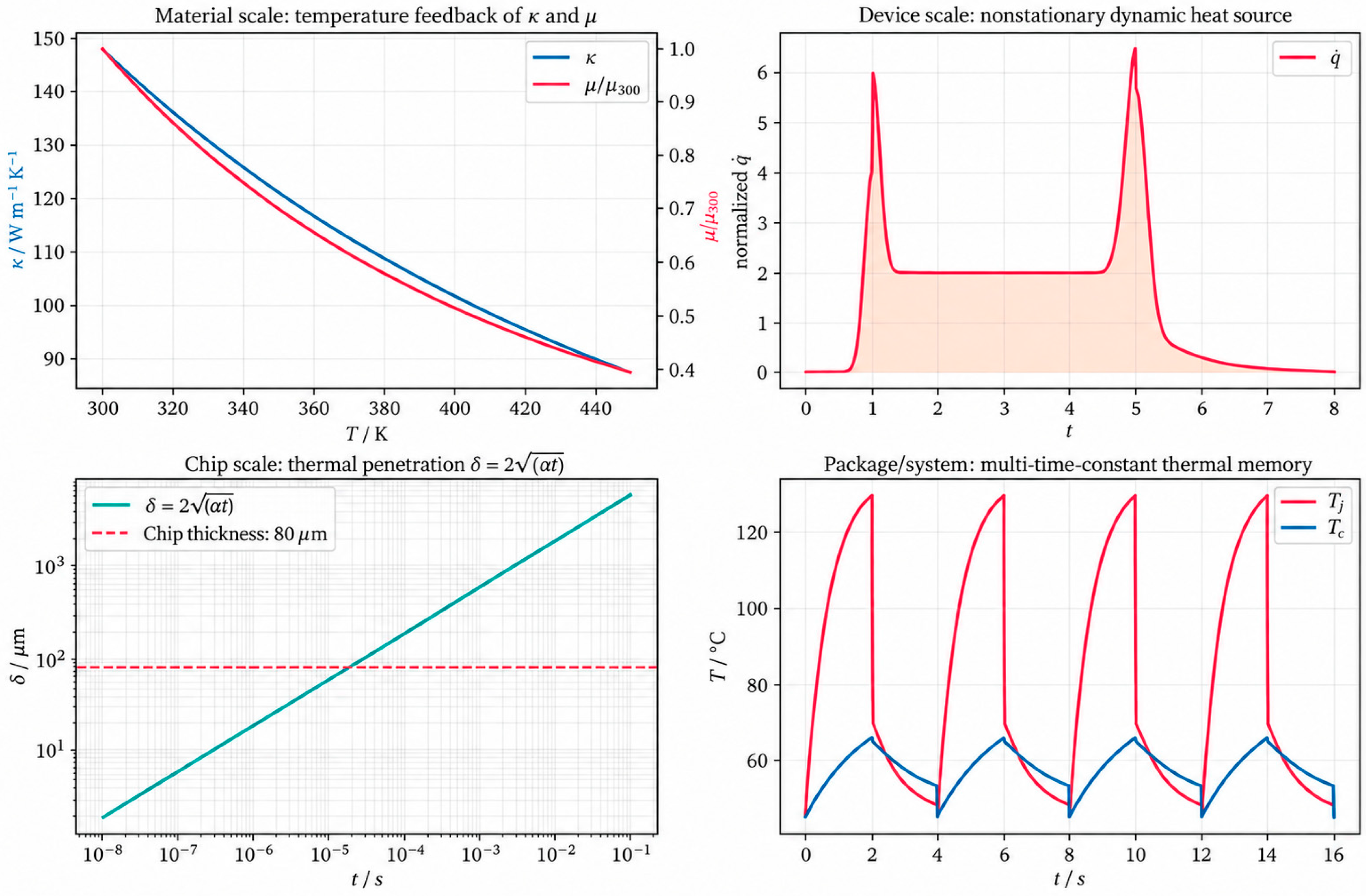
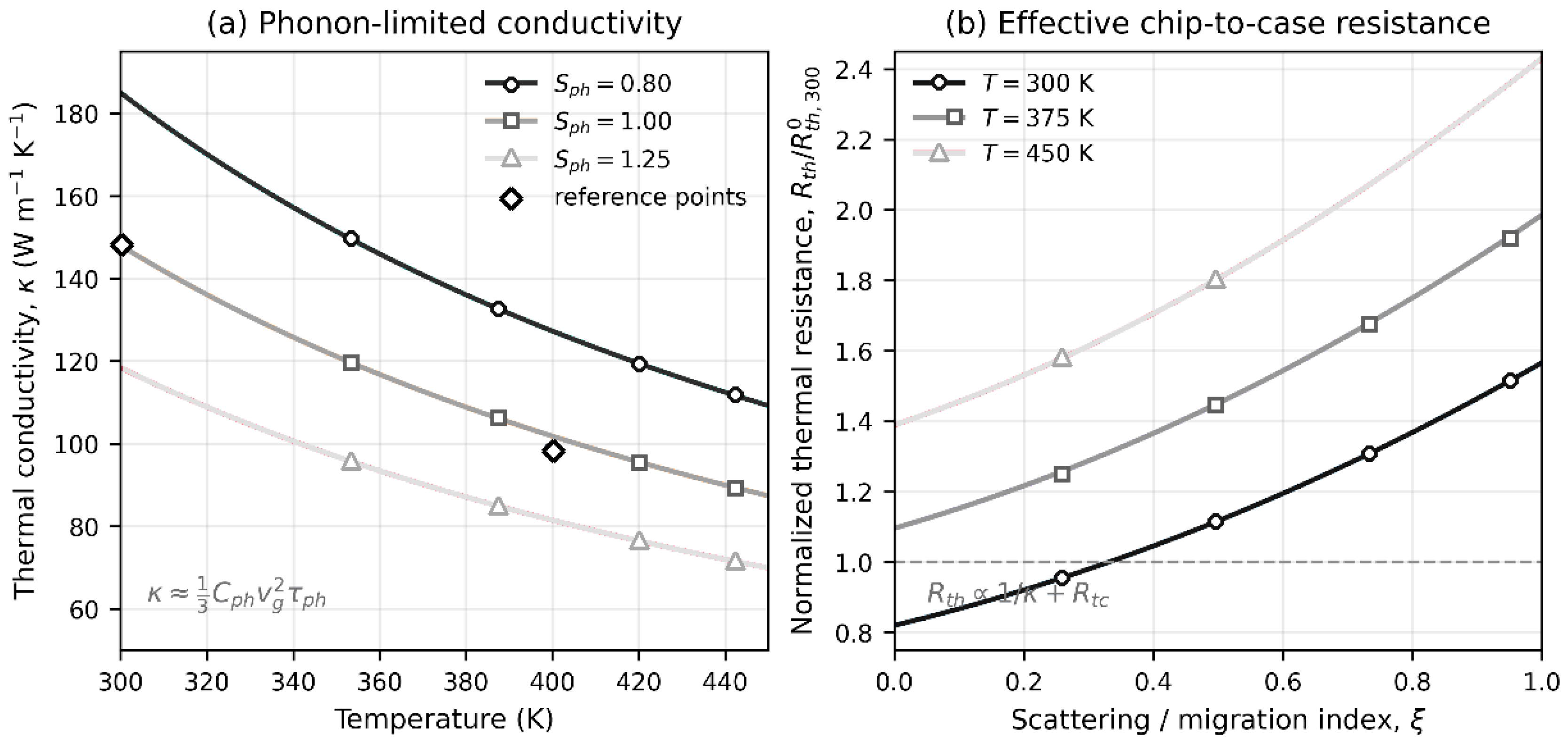
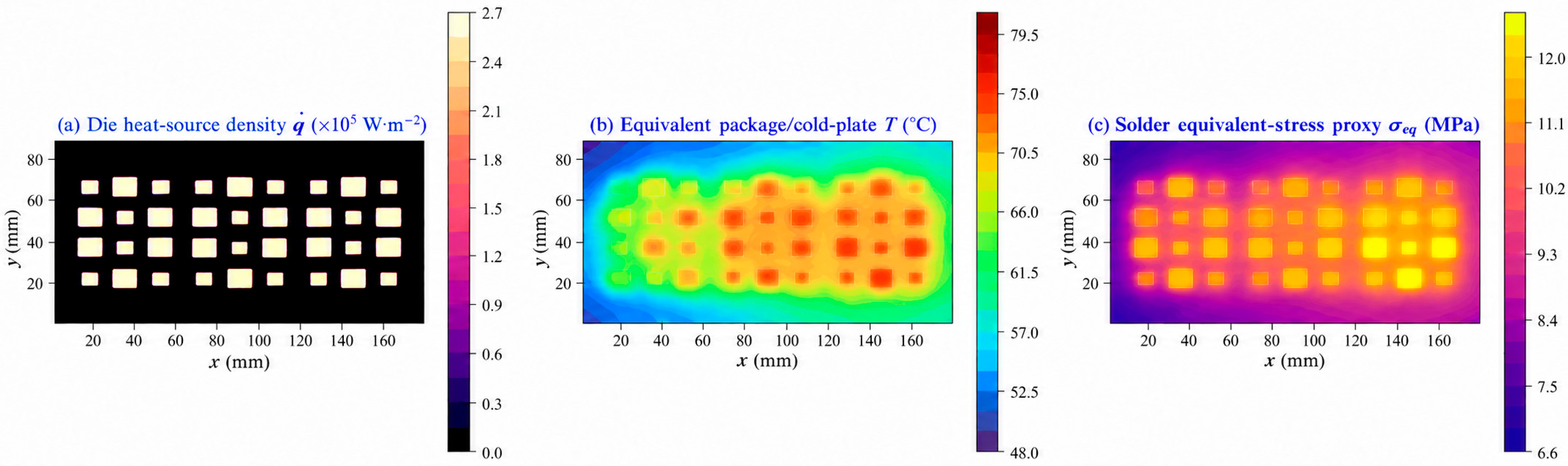
- For an 80 μm silicon chip at 400 K, the Fourier time τd = L2/α is 0.12 ms, while the characteristic penetration length δT = 2√(αt) reaches the chip thickness at 0.030 ms. These criteria are mathematically consistent and describe order-one Fourier equilibration and penetration of the selected diffusion envelope, respectively. Lateral diffusion remains much slower, so the early Tj,max depends strongly on the prescribed spatial source and cannot be inferred from Tj,avg or TNTC.
- (2)
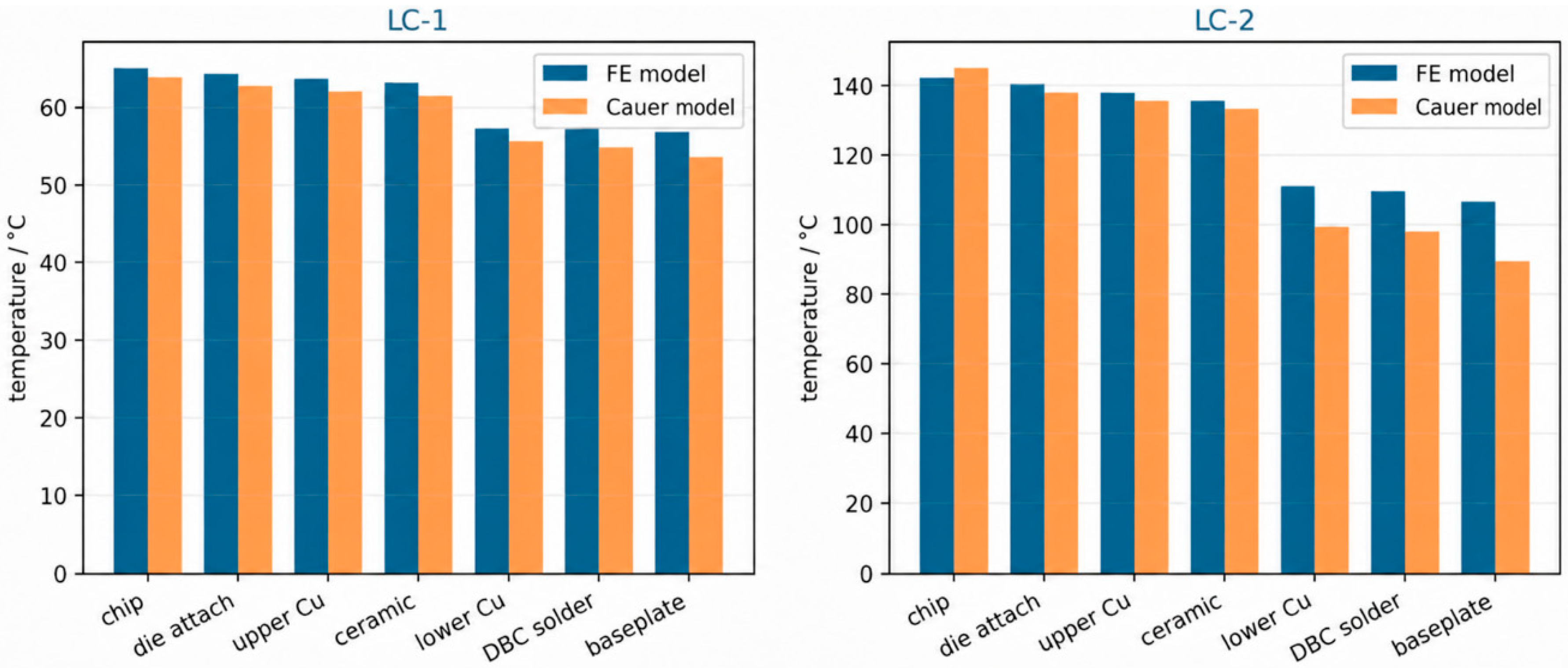
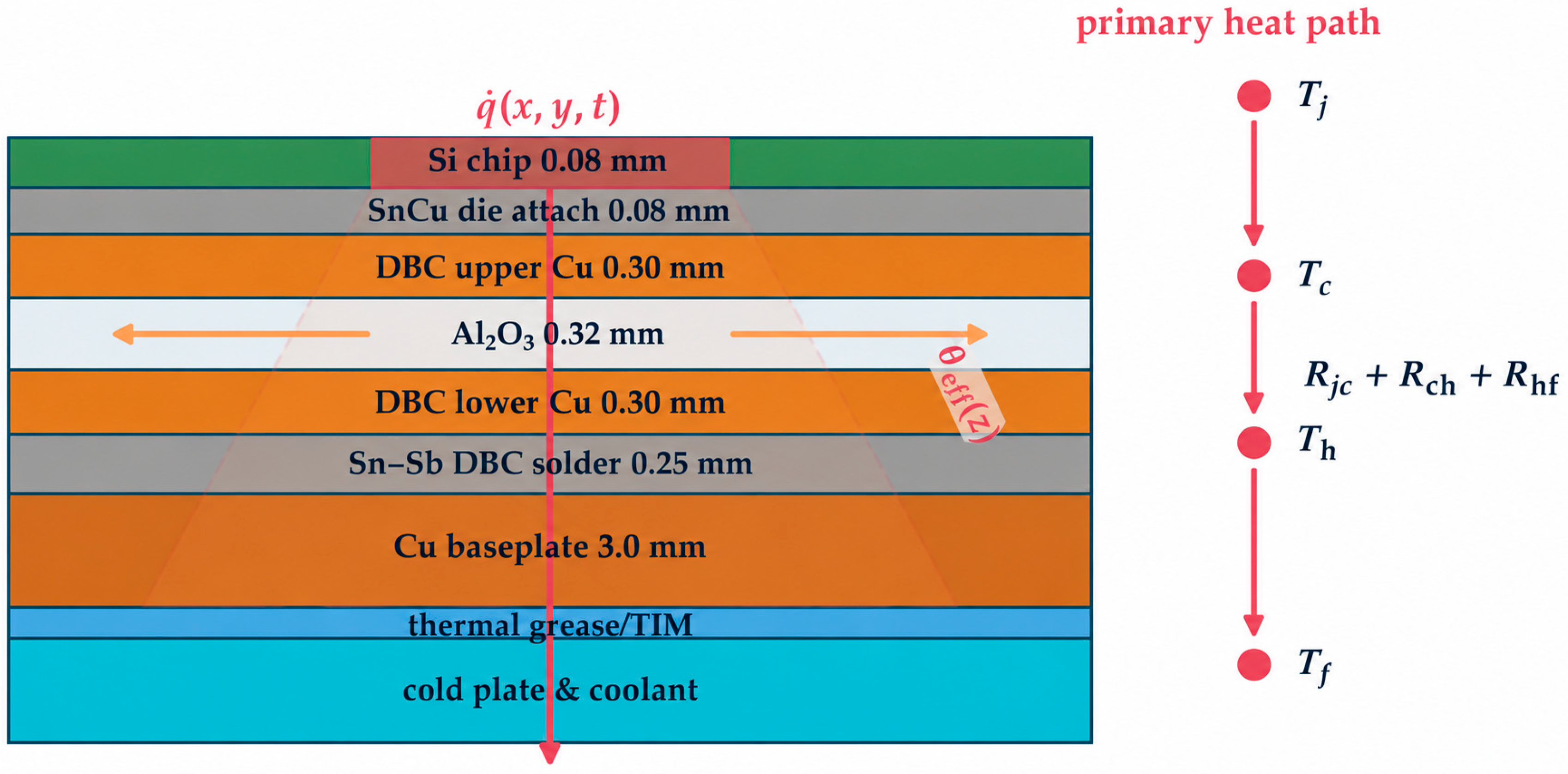
- At package scale, a heat-flux-defined effective spreading angle represents finite boundaries and overlap between neighboring chip heat flows. In the layerwise finite-element/Cauer comparison, the mean relative cross-model difference is 1.28–2.98% across the four chip-side layers and 9.54–12.56% across the three cold-side layers when the two models use different terminal boundary types. These values quantify consistency between computations, not accuracy against measured temperatures.
- (3)
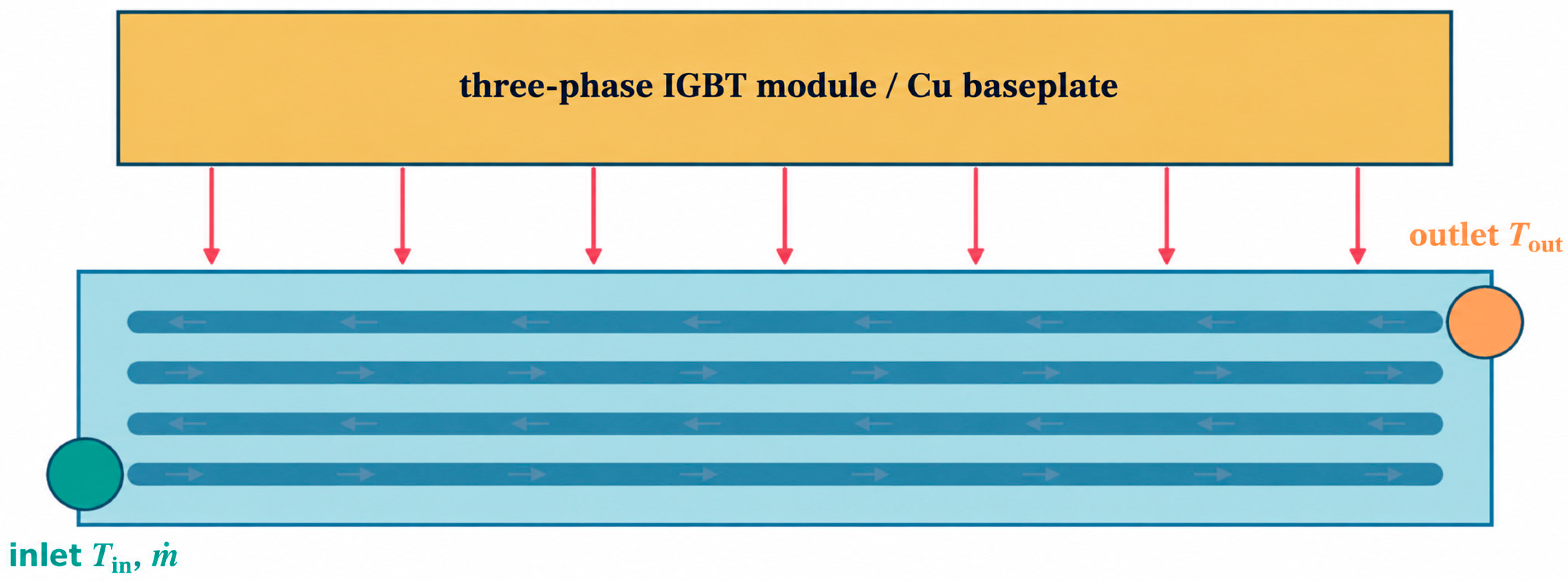
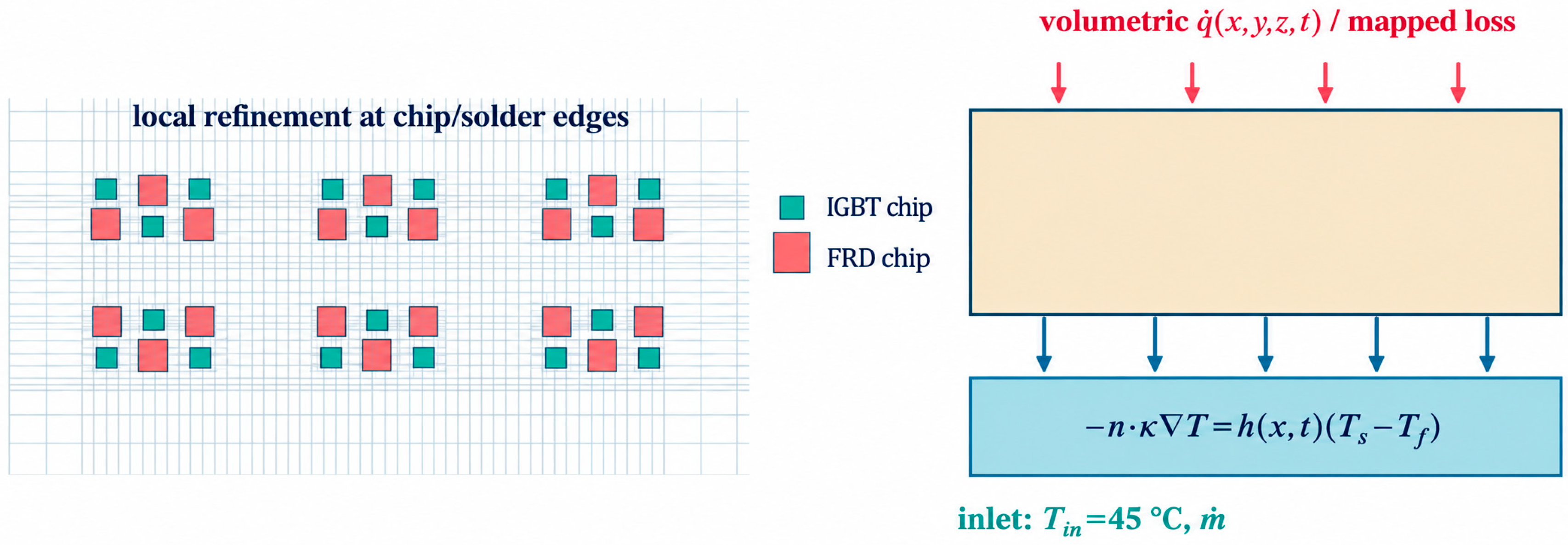
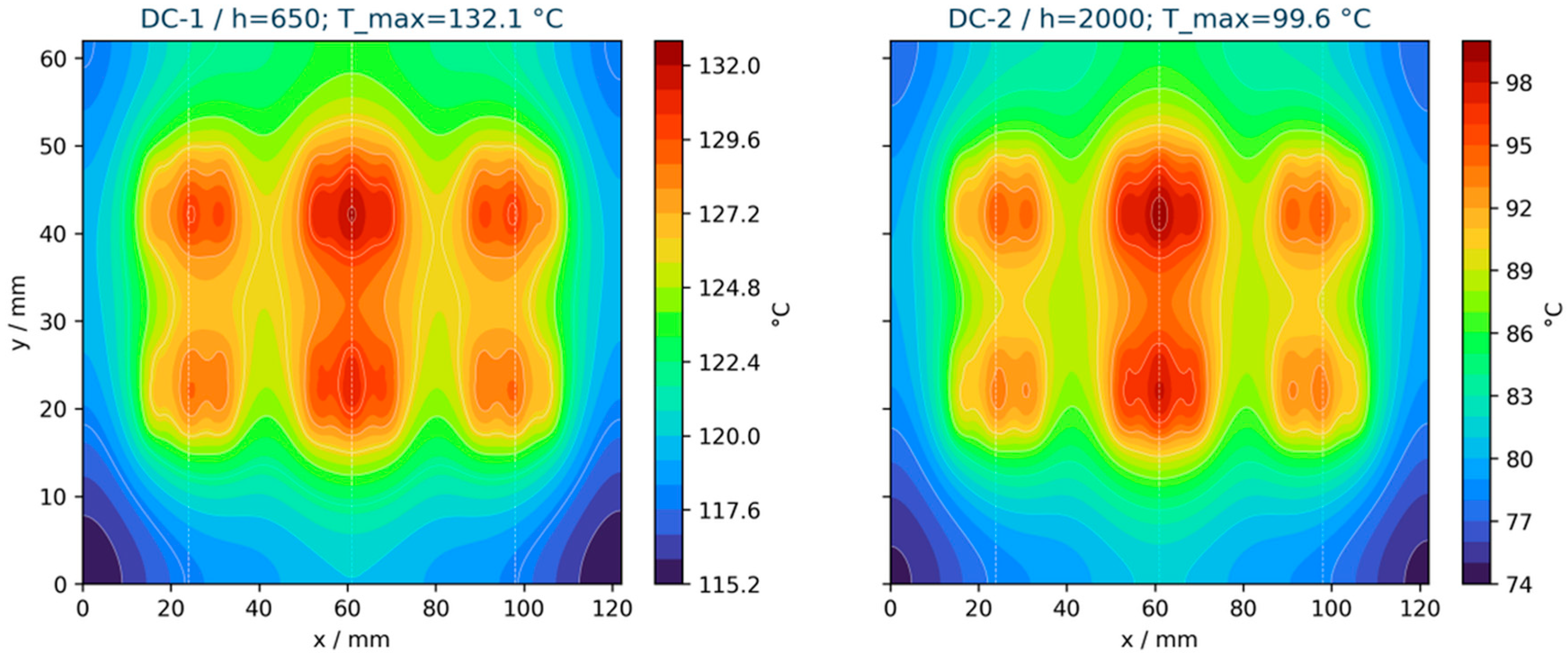
- In the illustrative three-phase boundary-sensitivity calculation, increasing h from 650 to 2000 W m−2 K−1 lowers the modeled maximum from 132.1 to 99.6 °C. The result demonstrates the direction and magnitude of sensitivity for the specified parameter set; it is not a measured cold-plate performance claim. The central maximum persists because of the source layout and lateral multichip coupling.
- (4)
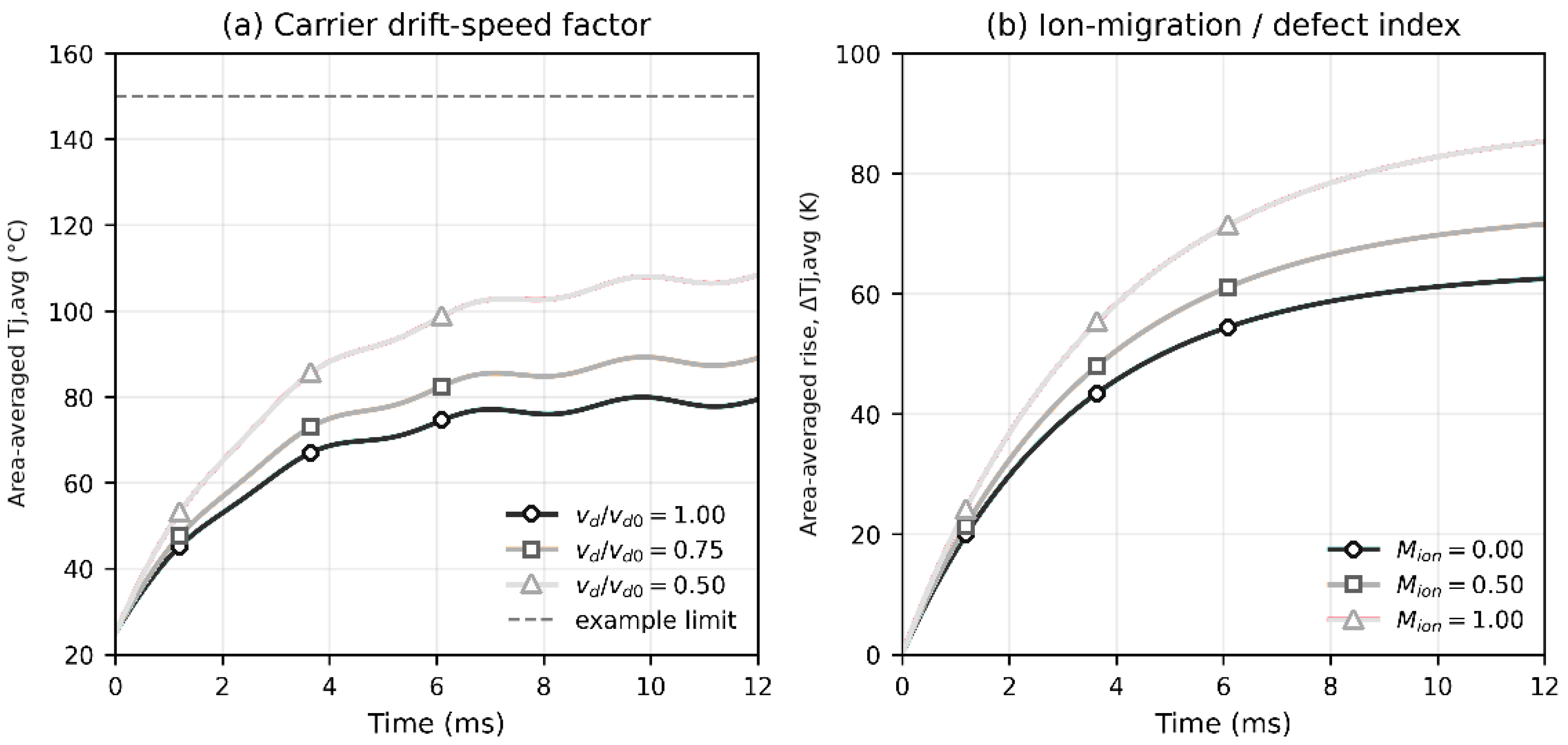
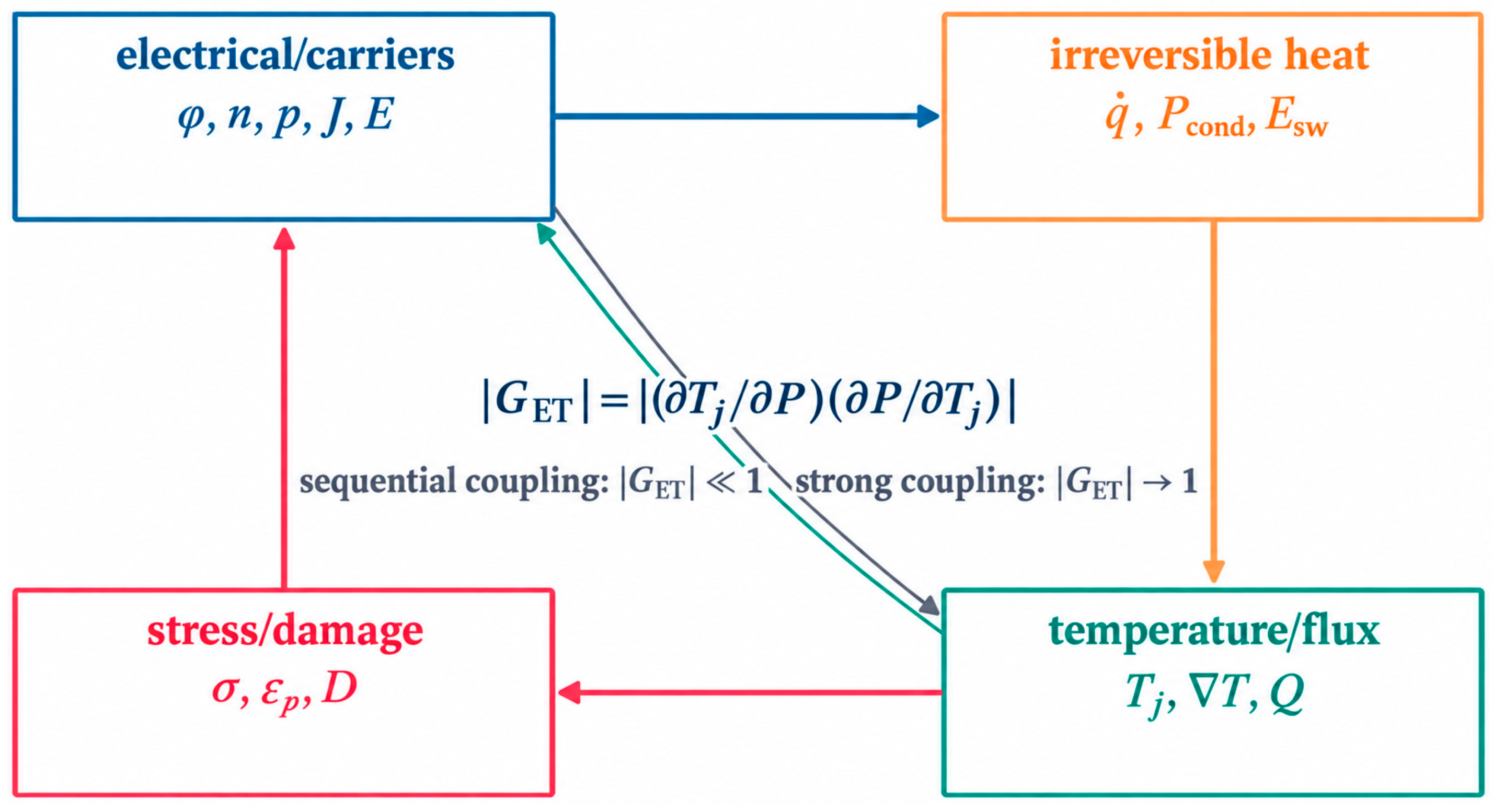
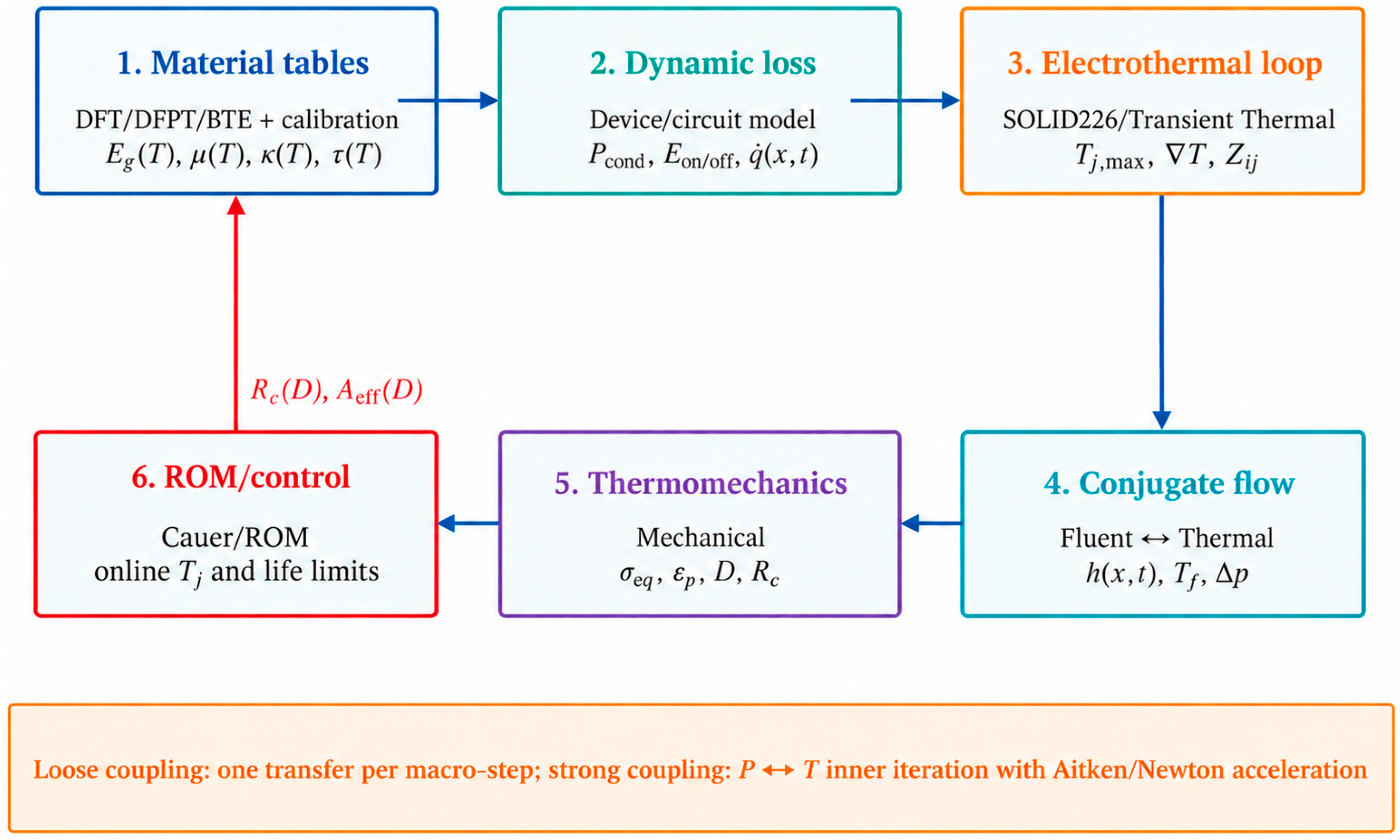
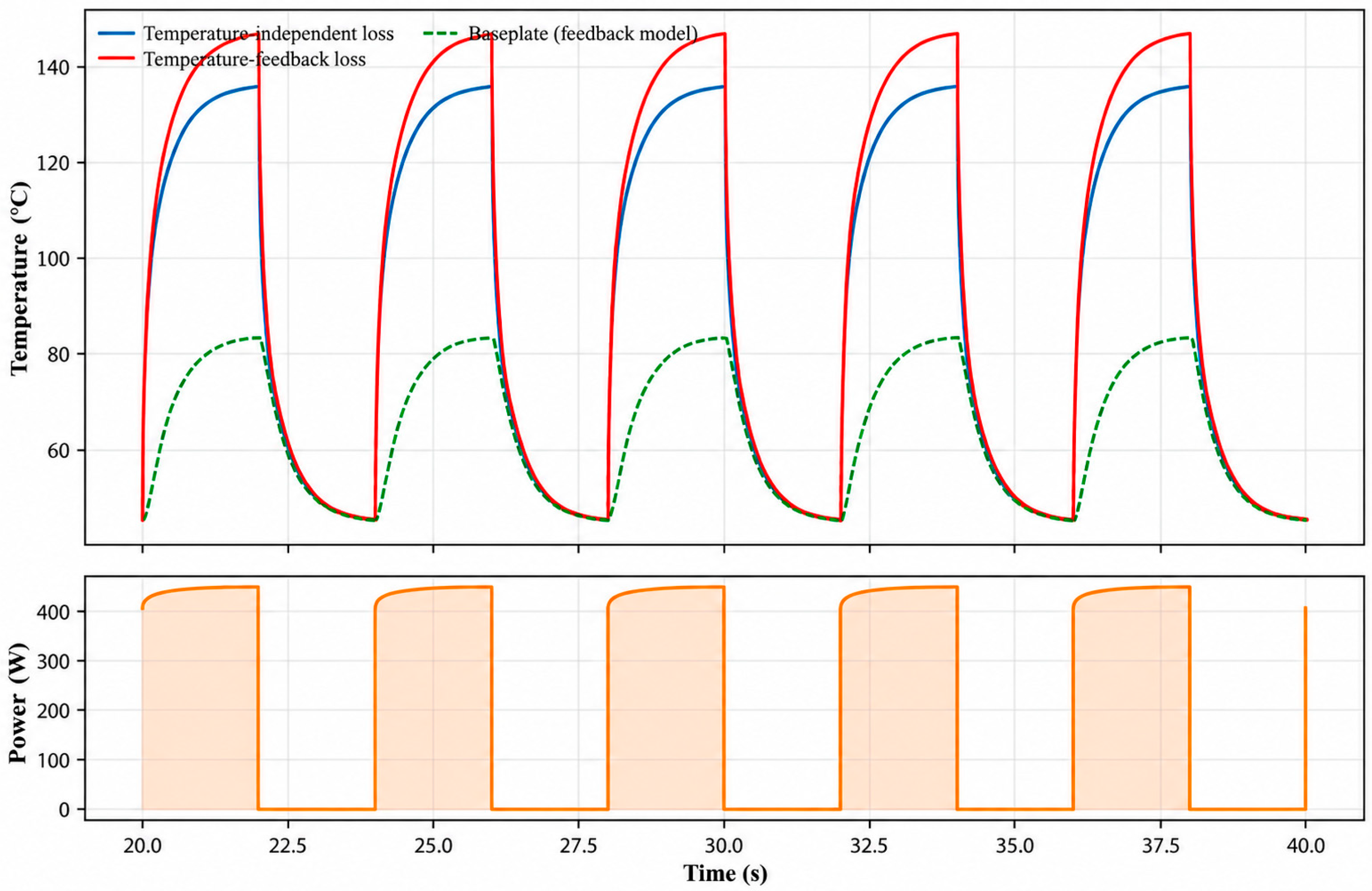
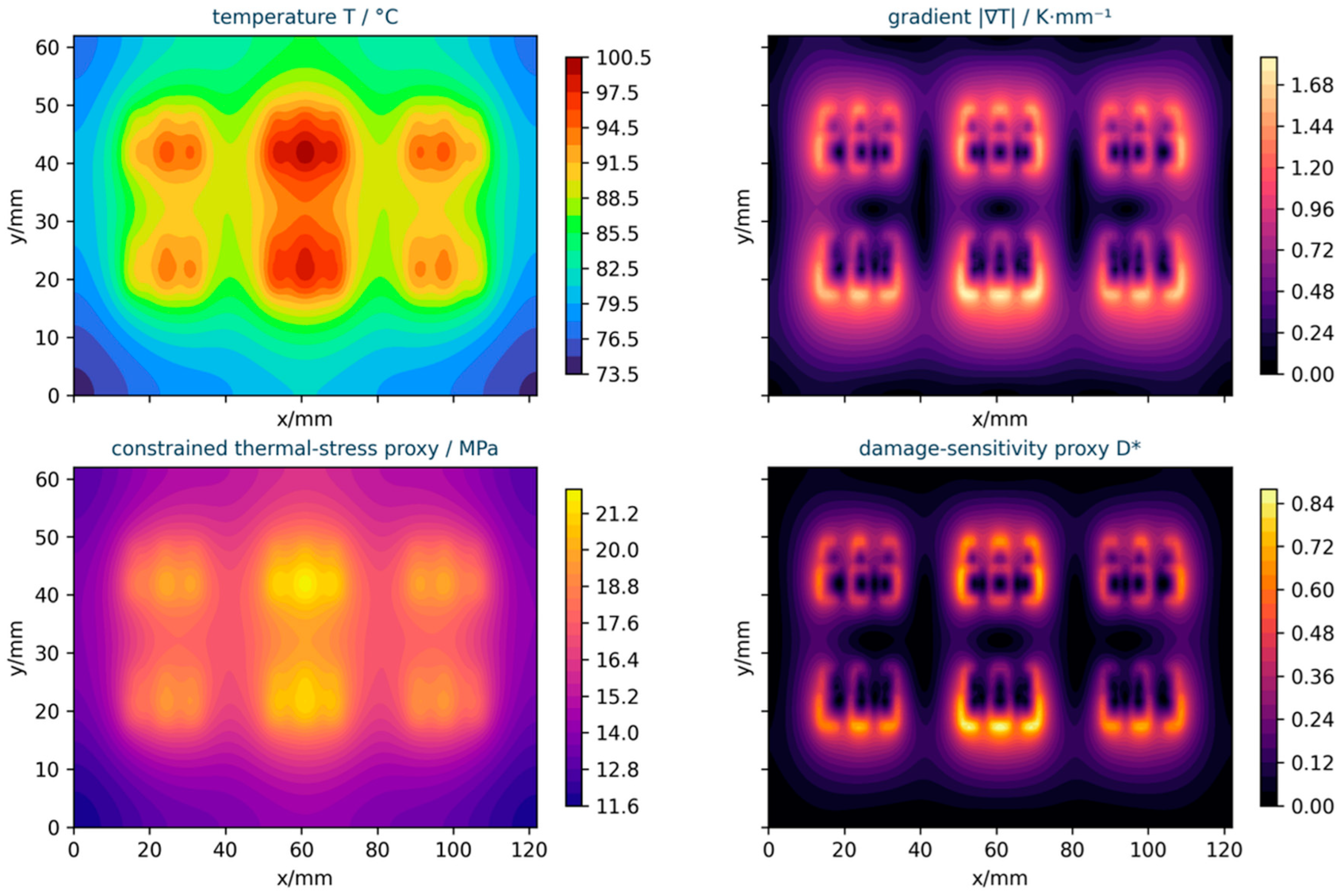
- Electrothermal feedback is quantitatively important: in the representative periodic case, incorporating temperature-dependent loss raises the predicted peak junction temperature by approximately 11 K. Sequential coupling remains efficient when the loop gain is small, whereas rapid boundary changes, high-field events, or damage-induced current redistribution require inner iteration and explicit energy-residual checks. The thermomechanical stress and D* fields, however, are qualitative proxies only and must not be interpreted as calibrated fatigue, creep, delamination, or lifetime predictions.
Author Contributions
Funding
Institutional Review Board Statement
Informed Consent Statement
Data Availability Statement
Acknowledgments
Conflicts of Interest
Nomenclature
| Symbol | Definition | Unit |
| A | Heat-transfer or cross-sectional area | m2 |
| Aeff | Effective electrically or thermally conducting area | m2 |
| Cph | Phonon heat capacity | J m−3 K−1 |
| cp | Specific heat capacity | J kg−1 K−1 |
| D | Damage-state variable | – |
| D* | Normalized thermomechanical-risk screening index | – |
| Da | Ambipolar carrier-diffusion coefficient | m2 s−1 |
| E | Electric-field magnitude | V m−1 |
| Eg | Semiconductor bandgap | eV |
| Eon, Eoff, Err | Turn-on, turn-off, and reverse-recovery energy | J |
| Fo | Fourier number | – |
| GET | Electrothermal coupling gain | – |
| h | Convective heat-transfer coefficient | W m−2 K−1 |
| IC | Collector current | A |
| J | Current density | A m−2 |
| Lc | Thermal diffusion length | m |
| Mion | Normalized ion-migration/defect index | – |
| N | Carrier or dopant concentration | m−3 |
| Pcond | Conduction power loss | W |
| Ploss | Total device power loss | W |
| q | Elementary charge | C |
| Volumetric heat-generation rate | W m−3 | |
| QB | Stored bipolar charge | C |
| R | Net carrier recombination rate | m−3 s−1 |
| Rtc | Interfacial thermal contact resistance | K W−1 |
| Rth | Thermal resistance | K W−1 |
| Sph | Normalized phonon-scattering multiplier | – |
| t | Time | s |
| Ta | Ambient temperature | K |
| Tc | Case temperature | K |
| Tf | Coolant bulk temperature | K |
| Tin | Coolant inlet temperature | K |
| Tj | Junction temperature | K |
| Tj,max | Maximum junction temperature | K |
| Tj,avg | Average junction temperature | K |
| Tj,J | Current-density-weighted junction temperature | K |
| Tj,sens | Sensor-reported temperature after spatial and temporal weighting | K |
| TNTC | Baseplate NTC thermistor temperature | K |
| VCE | Collector–emitter voltage | V |
| vd | Carrier drift velocity | m s−1 |
| vg | Phonon group velocity | m s−1 |
| α | Thermal diffusivity | m2 s−1 |
| δT | Characteristic thermal penetration length | m |
| ΔT | Temperature rise | K |
| ε | Mechanical strain | – |
| θeff | Effective heat-spreading angle | rad |
| κ | Thermal conductivity | W m−1 K−1 |
| μ | Carrier mobility | m2 V−1 s−1 |
| ρ | Mass density | kg m−3 |
| σ | Mechanical stress | Pa |
| τ | Carrier lifetime or relaxation time | s |
| τd | Fourier diffusion time | s |
| τph | Phonon relaxation time | s |
| ξ | Normalized scattering/migration state index | – |
References
- Tian, W.; Chen, N. Multiphysics coupling in IGBT modules: A review. J. Electron. Packag. 2024, 146, 040801. [Google Scholar] [CrossRef] [Scilit]
- Morel, C.; Morel, J.-Y. Power semiconductor junction temperature and lifetime estimations: A review. Energies 2024, 17, 4589. [Google Scholar] [CrossRef] [Scilit]
- Rehman, T.-U.; Park, C.W. Progress in insulated gate bipolar transistor thermal management: From fundamentals to advanced strategies. Renew. Sustain. Energy Rev. 2025, 210, 115219. [Google Scholar] [CrossRef] [Scilit]
- Tan, S.; Wei, B.; Vasquez, J.C.; Guerrero, J.M. Junction temperature estimation technologies of IGBT modules in converter-based applications. In Proceedings of the IECON 2023-49th Annual Conference of the IEEE Industrial Electronics Society, Singapore, 16–19 October 2023; pp. 1–6. [Google Scholar] [CrossRef] [Scilit]
- Zhang, W.; Qi, L.; Tan, K.; Ji, B.; Zhang, X.; Chai, W.; Cui, X. IGBT junction temperature estimation using a dynamic TSEP independent of wire bonding faults. IEEE Trans. Power Electron. 2023, 38, 5323–5334. [Google Scholar] [CrossRef] [Scilit]
- Xu, G.; Shao, L.; Feng, W.; Zhu, W.; Pan, Z.; Li, C.; Zhang, Y.; Xia, L. A novel IGBT junction temperature detection based on high-frequency model of inductor element. IEEE Trans. Instrum. Meas. 2023, 72, 1500810. [Google Scholar] [CrossRef] [Scilit]
- Okilly, A.H.; Harmony, P.N.; Kim, C.; Kim, D.-W.; Baek, J. Estimation of peak junction hotspot temperature in three-level TNPC-IGBT modules for traction inverters through chip-level modeling and experimental validation. Energies 2025, 18, 3829. [Google Scholar] [CrossRef] [Scilit]
- Chen, M.; Lei, G.; Li, M.; Chang, S.; Wu, S.; Bao, H. A multi-condition-based junction temperature estimation technology for double-sided cooled insulated-gate bipolar transistor modules. Energies 2025, 18, 1785. [Google Scholar] [CrossRef] [Scilit]
- Okilly, A.H.; Choi, S.; Kwak, S.; Kim, N.; Lee, J.; Moon, H.; Baek, J. Estimation technique for IGBT module junction temperature in a high-power density inverter. Machines 2023, 11, 990. [Google Scholar] [CrossRef] [Scilit]
- Guo, W.; Ma, M.; Wang, H.; Xiang, N.; Wang, H.; Chen, Z.; Chen, W. Real-time average junction temperature estimation for multichip IGBT modules with low computational cost. IEEE Trans. Ind. Electron. 2023, 70, 4175–4185. [Google Scholar] [CrossRef] [Scilit]
- An, T.; Zhou, R.; Qin, F.; Dai, Y.; Gong, Y.; Chen, P. Comparative study of the parameter acquisition methods for the Cauer thermal network model of an IGBT module. Electronics 2023, 12, 1650. [Google Scholar] [CrossRef] [Scilit]
- Wang, Y.; Liang, Z.; Jin, B.; Pang, J. A thermal impedance model for IGBT modules considering the nonlinear thermal characteristics of chips and ceramic materials. Electronics 2024, 13, 4465. [Google Scholar] [CrossRef] [Scilit]
- Li, L.; Liu, J.; Tseng, M.-L.; Lim, M.K. Accuracy of IGBT junction temperature prediction: An improved sailfish algorithm to optimize support vector machine. IEEE Trans. Power Electron. 2024, 39, 6864–6876. [Google Scholar] [CrossRef] [Scilit]
- Wang, F.; Song, Y.; Dou, W.; Zheng, Z.; Li, Z.; Li, B.; Liu, J. High power density IGBT loss calculation model and analysis. Energies 2025, 18, 997. [Google Scholar] [CrossRef] [Scilit]
- Liu, X.; Cui, H.; Yang, C.; Xue, L.; Li, D. A new aging-aware multi-objective thermal management strategy for IGBT modules in wind power converters. Electronics 2025, 14, 836. [Google Scholar] [CrossRef] [Scilit]
- Alavi, O.; De Ceuninck, W.; Daenen, M. Optimizing insulated-gate bipolar transistors’ lifetime estimation: A critical evaluation of lifetime model adjustments based on power cycling tests. Energies 2024, 17, 2616. [Google Scholar] [CrossRef] [Scilit]
- Zhao, S.; Yang, X.; Wu, X.; Zhang, Y.; Liu, G. Investigation on fatigue mechanism of solder layers in IGBT modules under high temperature gradients. Microelectron. Reliab. 2023, 141, 114901. [Google Scholar] [CrossRef] [Scilit]
- Chen, J.; Liu, B.; Hu, M.; Huang, S.; Yu, S.; Wu, Y.; Yang, J. Study of the solder characteristics of IGBT modules based on thermal-mechanical coupling simulation. Materials 2023, 16, 3504. [Google Scholar] [CrossRef] [Scilit] [PubMed]
- Chen, J.; Liu, Y.; Liu, B.; Wu, Y. Structure and temperature dependence of solder layer and electric parameters in IGBT modules. Micromachines 2025, 16, 1023. [Google Scholar] [CrossRef] [Scilit] [PubMed]
- Wang, Y.; Rong, X.; Yang, C.; Shi, H.; Zheng, J. Multi-physics coupling analysis of high-power IGBT module bonding-wires fault considering stray inductance of main circuit. Microelectron. Reliab. 2023, 149, 115200. [Google Scholar] [CrossRef] [Scilit]
- Feng, S.Z.; Guo, Y.C.; Krolczyk, G.; Han, X.; Incecik, A.; Li, Z. An engineered solution to multi-physics of insulated gate bipolar transistor module considering electrical-thermal-mechanical coupling effect. Adv. Eng. Softw. 2023, 175, 103365. [Google Scholar] [CrossRef] [Scilit]
- Roisin, N.; Brunin, G.; Rignanese, G.-M.; Flandre, D.; Raskin, J.-P.; Poncé, S. Phonon-limited mobility for electrons and holes in highly-strained silicon. npj Comput. Mater. 2024, 10, 242, Correction in npj Comput. Mater. 2025, 11, 47. [Google Scholar] [CrossRef] [Scilit]
- Guo, Z.; Han, Z.; Feng, D.; Lin, G.; Ruan, X. Sampling-accelerated prediction of phonon scattering rates for converged thermal conductivity and radiative properties. npj Comput. Mater. 2024, 10, 31. [Google Scholar] [CrossRef] [Scilit]
- Pfeifer, T.W.; Tomko, J.A.; Hoglund, E.; Scott, E.A.; Hattar, K.; Huynh, K.; Liao, M.; Goorsky, M.; Hopkins, P.E. Measuring sub-surface spatially varying thermal conductivity of silicon implanted with krypton. J. Appl. Phys. 2022, 132, 075112. [Google Scholar] [CrossRef] [Scilit]
- Wang, H.; Zhou, Z.; Xu, Z.; Ge, X.; Yang, Y.; Zhang, Y.; Yao, B.; Xie, D. A thermal network model for multichip power modules enabling to characterize the thermal coupling effects. IEEE Trans. Power Electron. 2024, 39, 6225–6245. [Google Scholar] [CrossRef] [Scilit]
- Liu, G.; Li, X.; Wang, Y.; Huang, X.; Chang, G.; Luo, H. A method to derive the coupling thermal resistances at junction-to-case level in multichip power modules. IEEE Trans. Power Electron. 2023, 38, 1747–1756. [Google Scholar] [CrossRef] [Scilit]
- Li, Q.; Zhang, F.; Chen, Y.; Fu, T.; Zheng, Z. A junction temperature model based on heat flow distribution in an IGBT module with solder layer voids. Heliyon 2024, 10, e33625. [Google Scholar] [CrossRef] [Scilit] [PubMed]
- Shahjalal, M.; Shams, T.; Hossain, S.B.; Ahmed, R.; Ahsan, M.; Haider, J.; Goswami, R.; Alam, S.B.; Iqbal, A. Thermal analysis of Si-IGBT based power electronic modules in 50 kW traction inverter application. e-Prime-Adv. Electr. Eng. Electron. Energy 2023, 3, 100112. [Google Scholar] [CrossRef] [Scilit]
- Tan, L.; Liu, P.; She, C.; Xu, P.; Yan, L.; Quan, H. Heat dissipation characteristics of IGBT module based on flow-solid coupling. Micromachines 2022, 13, 554. [Google Scholar] [CrossRef] [Scilit] [PubMed]
- Wu, C.; Wang, F.; Song, Y. Modeling and analysis for estimation of junction temperature under various operating conditions and optimization of pin-fin heat sink for automotive IGBT modules. Appl. Sci. 2025, 15, 9817. [Google Scholar] [CrossRef] [Scilit]
- Zhai, G.; Yang, H.; Gong, W.; Wu, F.; Zeng, J.; Fu, X.; Gao, T. Numerical analysis on thermal and flow performance of honeycomb-structured microchannel cooling plate for IGBT. Energies 2025, 18, 4455. [Google Scholar] [CrossRef] [Scilit]
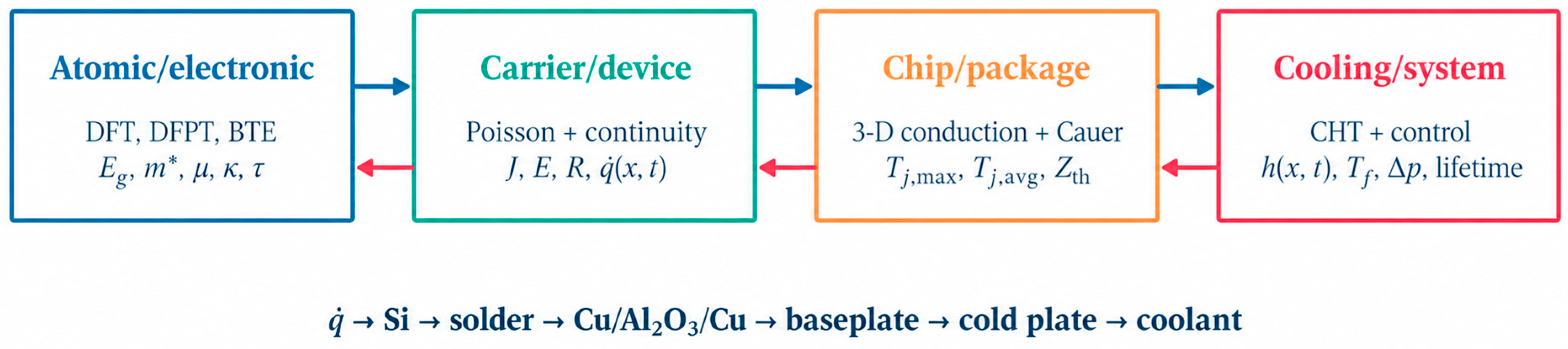







| Transfer to the Next Scale | Heat-Generation/ Transfer Characteristics | Governing Equations | Length/Time | Scale |
|---|---|---|---|---|
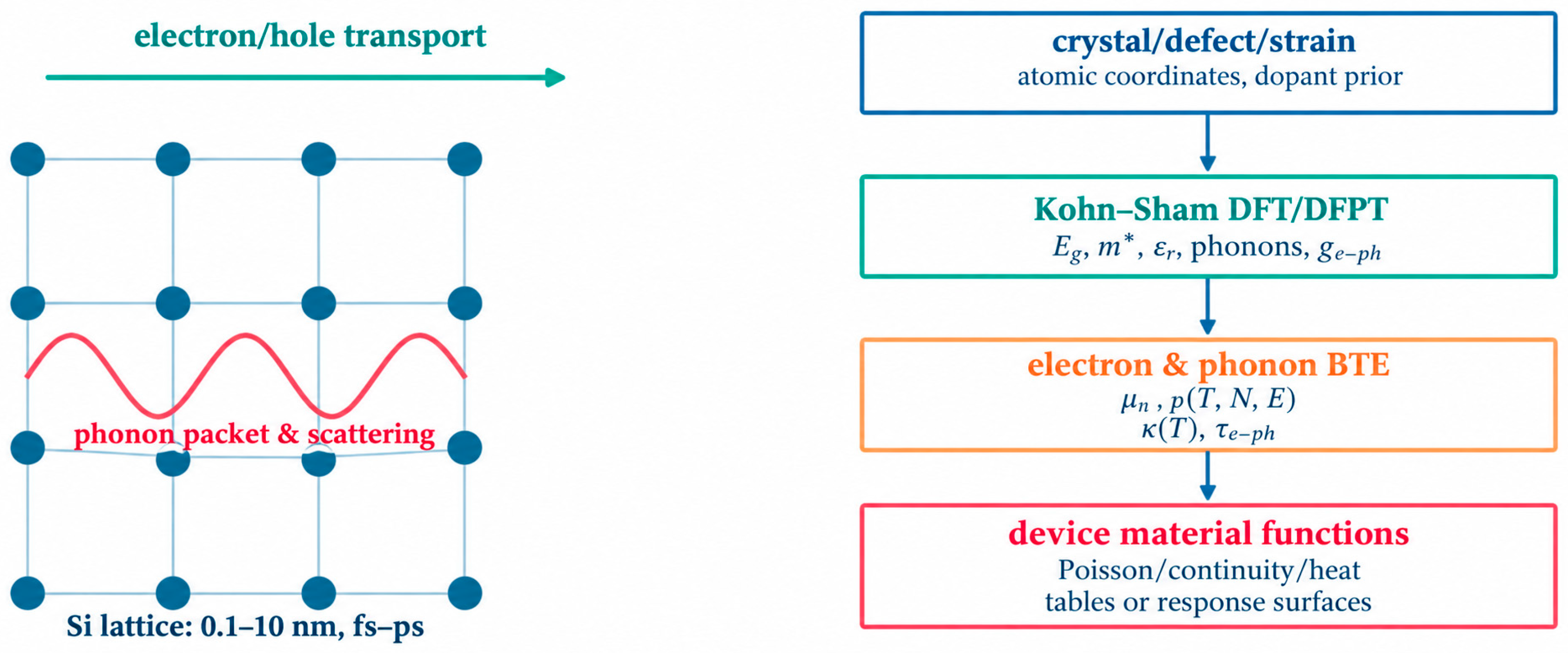
| Eg, m*, μ, τ, κ, defect levels | Electron–phonon and defect scattering; no macroscopic temperature field | Kohn–Sham, DFPT, electron/phonon BTE | 0.1–10 nm; fs–ps | Atomic/electronic |
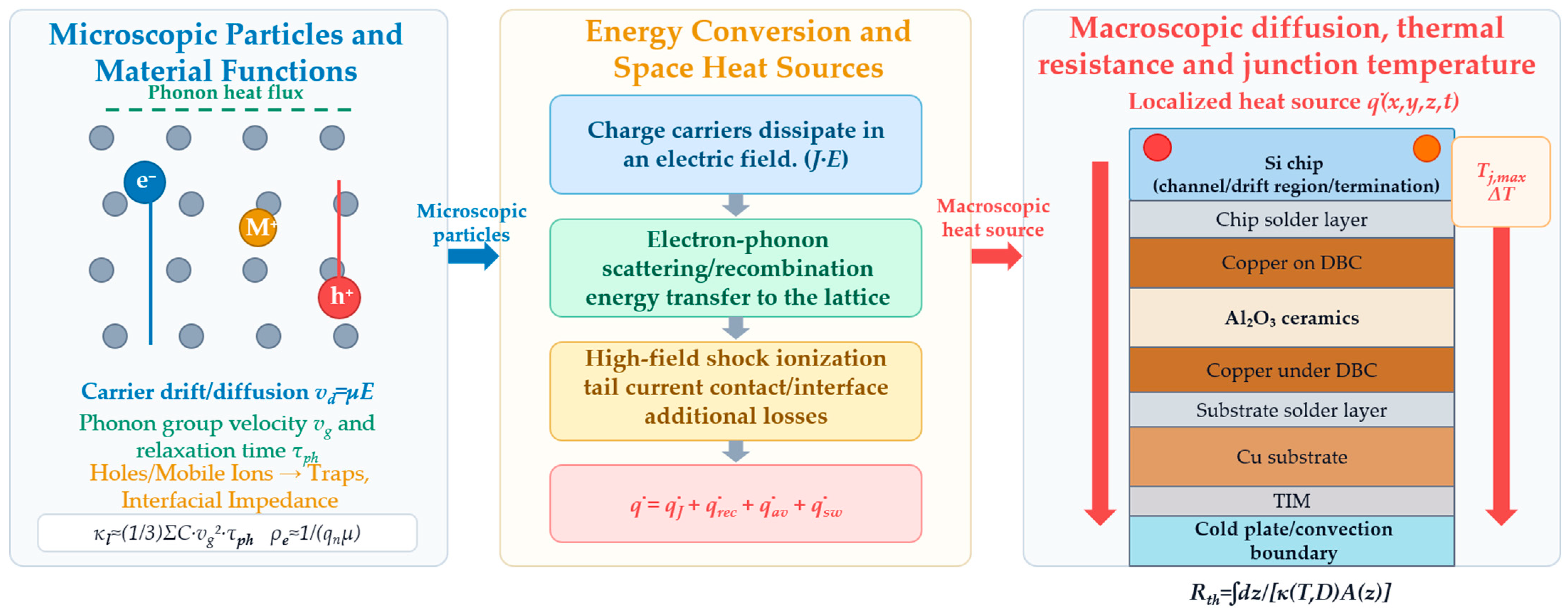
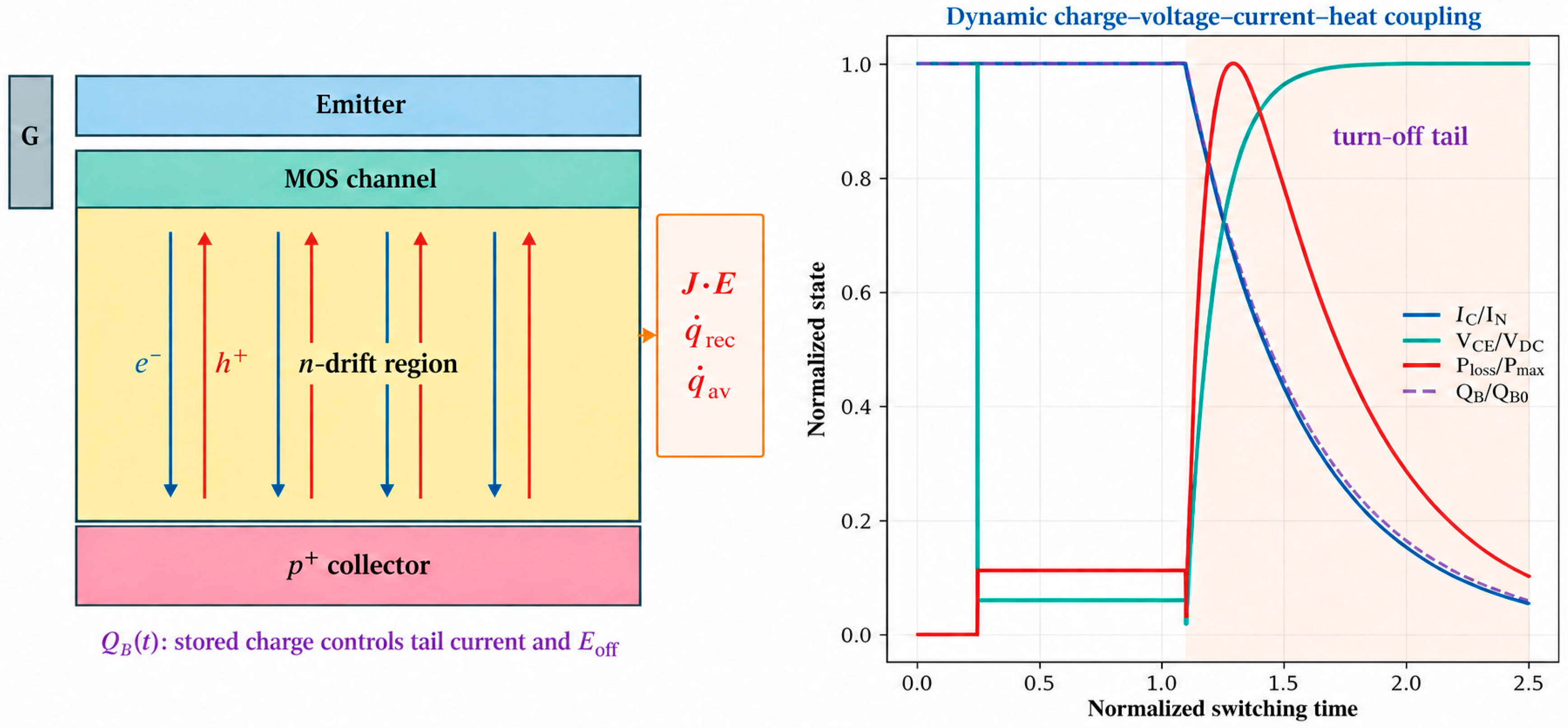
| q(x,y,z,t), Pcond, Eon/off/rr | J·E, recombination, avalanche, tail current, and reverse recovery | Poisson, continuity, drift-diffusion/bipolar transport | 0.1 micrometer-cm; ns–ms | Carrier/device |
| Tj,max, Tj,avg, Tj,J, Tj,sens, ∇T, Zth,ij | Early local diffusion, interlayer storage, lateral spreading, and multichip coupling | Nonlinear heat conduction, contact resistance, 3-D FE/Cauer | 0.1 mm–0.1 m; microseconds–10 s | Chip/package |
| h(x,t), Tf, σ, D, life consumption | Conjugate heat transfer, flow distribution, coolant heating, and thermal fatigue | Navier–Stokes, energy, thermoelastoplasticity, and damage | cm–m; 0.1 s–h | Cooling/system |
| Upscaling Role and Limitation | Representative Value/Temperature Range | Parameter |
|---|---|---|
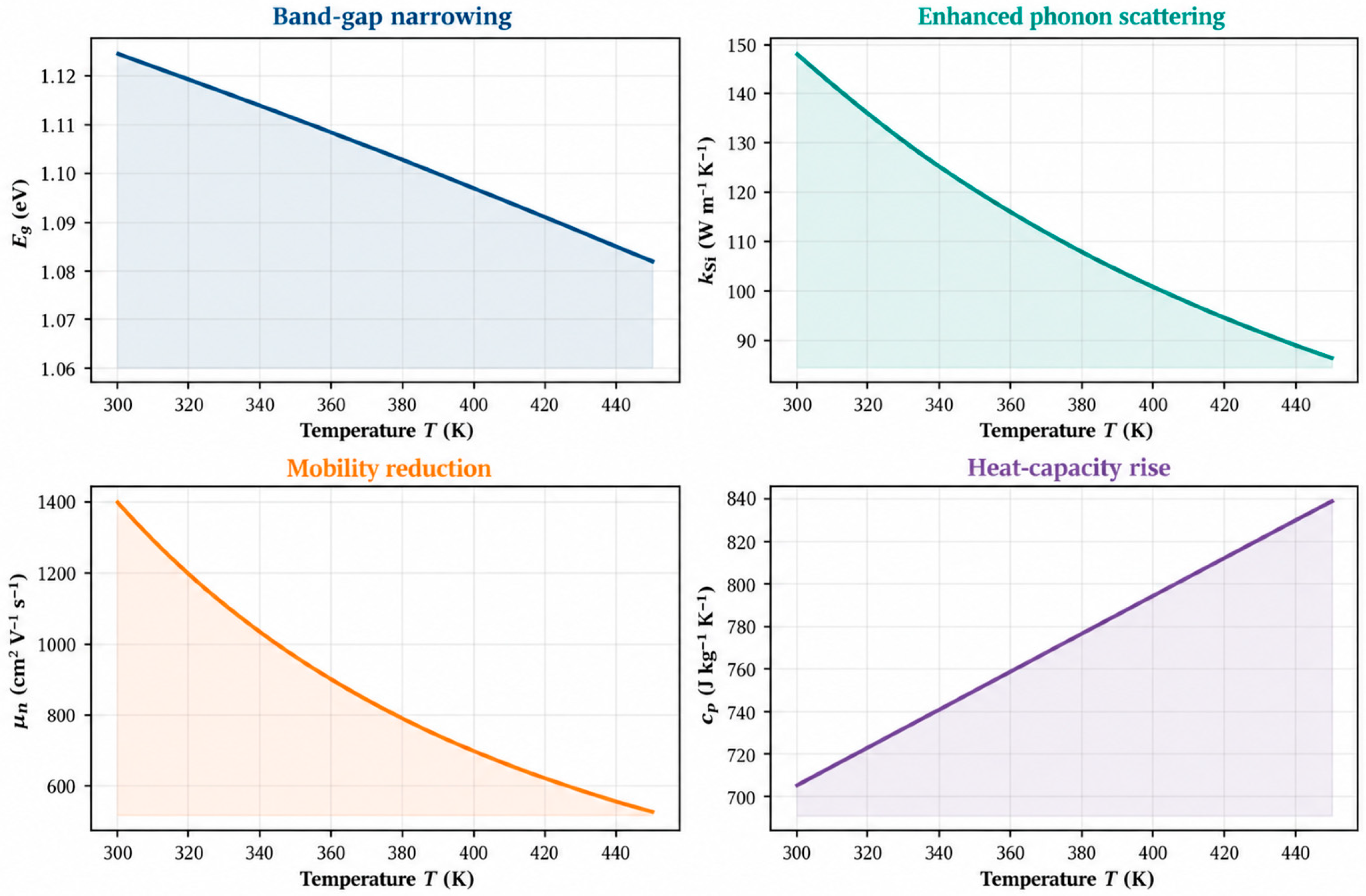
| Intrinsic concentration, leakage, and junction potential; Varshni relation or HSE/GW correction | 1.124 eV at 300 K; approximately 1.097 eV at 400 K | Bandgap Eg |
| Poisson equation and junction capacitance; calibrate high-field/frequency dependence as needed | 11.7 (Si, near room temperature) | Relative permittivity εr |
| Mobility, density of states, and diffusivity; distinguish conductivity and DOS masses | mc approximately 0.26 m0; DOS mass approximately 1.08 m0 | Electron effective mass |
| Valence-band transport; recalibrate under heavy doping and strain | Heavy/light holes approximately 0.49/0.16 m0 | Hole effective mass |
| Prior for lightly doped bulk Si only; device regions require doping-, field-, and temperature-dependent corrections | μn approximately 1350, μp approximately 480 cm2/(V s) at 300 K | Low-field mobility |
| Transient chip diffusion; interpolate the supplied material-property data | 148 at 300 K; 98.9 W/(m K) at 400 K | Lattice thermal conductivity κsi |
| Thermal diffusivity α = κ/(ρcp); determines penetration length | ρ = 2330 kg/m3; cp = 705–794 J/(kg K) | Density/specific heat |
| Cannot be obtained from an ideal cell alone; calibrate using double-pulse, lifetime, or defect measurements | τHL, SRH level, and capture cross-section | Lifetime/defect parameters |
| ρ (kg m−3) | cp: 300–400 K | κ: 300–400 K | Thickness (mm) | Material | Component |
|---|---|---|---|---|---|
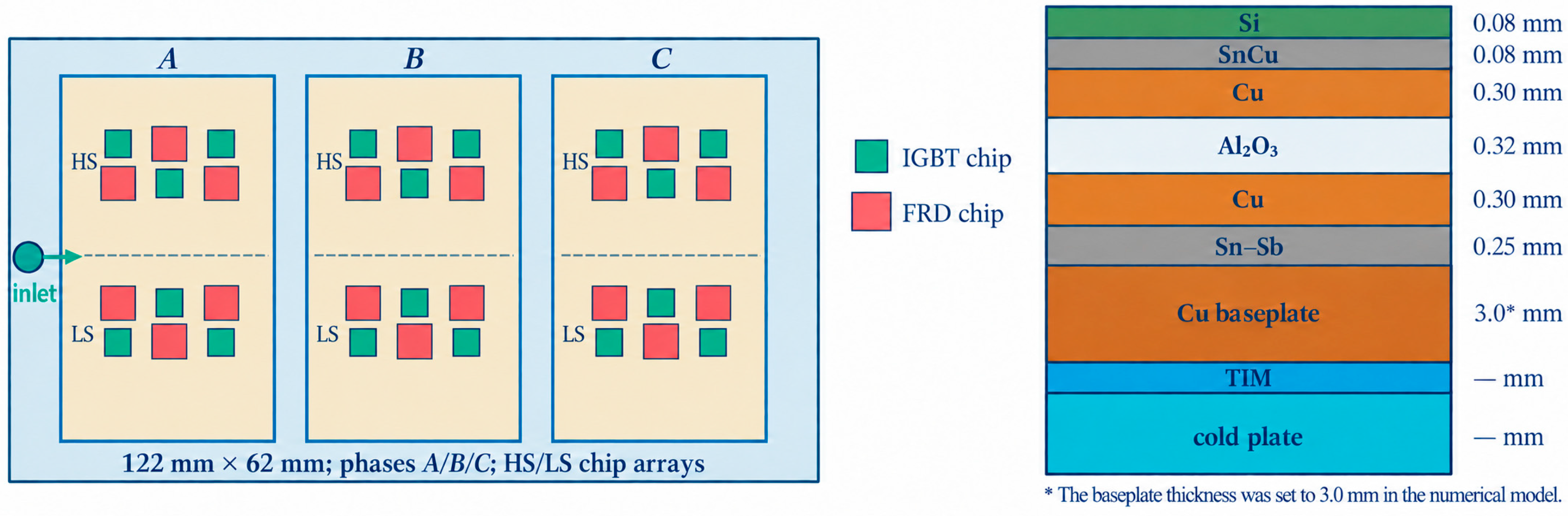
| 2330 | 705–794 | 148–98.9 | 0.08 | Si | IGBT/FRD chip |
| 7310 | 235 | 54.8 | 0.08 | SnCu | Die attach |
| 8933 | 384–397 | 401–393 | 0.30 | Cu | Upper DBC copper |
| 3750 | 800 | 24–20 | 0.32 | Al2O3 | DBC ceramic |
| 8933 | 384–397 | 401–393 | 0.30 | Cu | Lower DBC copper |
| 7220 | 235 | 52.7 | 0.25 | Sn–Sb | DBC solder |
| 8933 | 384–397 | 401–393 | 3.0 * | Cu | Baseplate |
| 2640 | 880 | 96.2 | As modeled | ADC12 | Heatsink/cold plate |
| Synchronization Strategy | Output | Input | Module |
|---|---|---|---|
| Offline synthesis and interpolation of published data | Reference-calibrated Eg, m*, μ, κ, and τ functions | Crystal, defects, T, and strain | Published DFT/DFPT + BTE data (framework input; not independently solved) |
| ns-microseconds; period averaging | Pcond, Eon/off, (x,t) | VGE, IC, Vdc, Tj, D | Device/circuit |
| microseconds-0.1 s; inner iterations when required | Tj,max, Tj,avg, Tj,J, ∇T, | Geometry, κ(T), ρcp, , h/Tf | Electrothermal FE |
| Thermal-cycle peaks/valleys or cycle jumping | σproxy and D* screening fields | T(x,t), CTE, and viscoplastic parameters | Equivalent-stress proxy (present study); calibrated Mechanical damage model (future) |
| 0.01–1 s; two-way exchange | Prescribed h(x,t), Tf, and Δp ranges | Mass flow rate, Tin, and wall heat flux | Parameterized cold-side boundary (present study); two-way Fluent CHT (future) |
| 0.1–10 ms | Online T_j, pump speed, and life consumption | Mission profile, sensors, and constraints | Reduced order/control |
| Mean Relative Difference, Three Cold-Side Layers | Mean Relative Difference, Four Chip-Side Layers | Seven-Layer RMS Difference | Seven-Layer Mean Absolute Difference | Case |
|---|---|---|---|---|
| 9.54% | 2.98% | 4.12 K | 3.61 K | LC-1 |
| 12.56% | 1.28% | 9.27 K | 6.92 K | LC-2 |
Disclaimer/Publisher’s Note: The statements, opinions and data contained in all publications are solely those of the individual author(s) and contributor(s) and not of MDPI and/or the editor(s). MDPI and/or the editor(s) disclaim responsibility for any injury to people or property resulting from any ideas, methods, instructions or products referred to in the content. |
© 2026 by the authors. Licensee MDPI, Basel, Switzerland. This article is an open access article distributed under the terms and conditions of the Creative Commons Attribution (CC BY) license.
Share and Cite
Li, Z.; Zheng, Z. Multiscale Heat-Generation and Heat-Transfer Mechanisms and Coupling Effects in IGBT Modules. Appl. Sci. 2026, 16, 9348. https://doi.org/10.3390/app16189348
Li Z, Zheng Z. Multiscale Heat-Generation and Heat-Transfer Mechanisms and Coupling Effects in IGBT Modules. Applied Sciences. 2026; 16(18):9348. https://doi.org/10.3390/app16189348
Chicago/Turabian StyleLi, Zhuangzhuang, and Zhaolei Zheng. 2026. "Multiscale Heat-Generation and Heat-Transfer Mechanisms and Coupling Effects in IGBT Modules" Applied Sciences 16, no. 18: 9348. https://doi.org/10.3390/app16189348
APA StyleLi, Z., & Zheng, Z. (2026). Multiscale Heat-Generation and Heat-Transfer Mechanisms and Coupling Effects in IGBT Modules. Applied Sciences, 16(18), 9348. https://doi.org/10.3390/app16189348