Article

Securing IoT Networks Against Wireless DoS Attacks via Energy Harvesting Relays

by
Mohammad Alkhawatrah
1 and
Saleh Almahmoud
2,*
1
Department of Communications and Computer Engineering, Al-Ahliyya Amman University, Amman 19111, Jordan
2
Department of Electrical Engineering, Imam Mohammad Ibn Saud Islamic University (IMSIU), Riyadh 11432, Saudi Arabia
*
Author to whom correspondence should be addressed.
Appl. Sci. 2026, 16(18), 9315; https://doi.org/10.3390/app16189315 (registering DOI)
Submission received: 18 August 2026 / Revised: 3 September 2026 / Accepted: 17 September 2026 / Published: 20 September 2026
(This article belongs to the Special Issue 5G and Beyond: Technologies and Communications, 2nd Edition)

Abstract

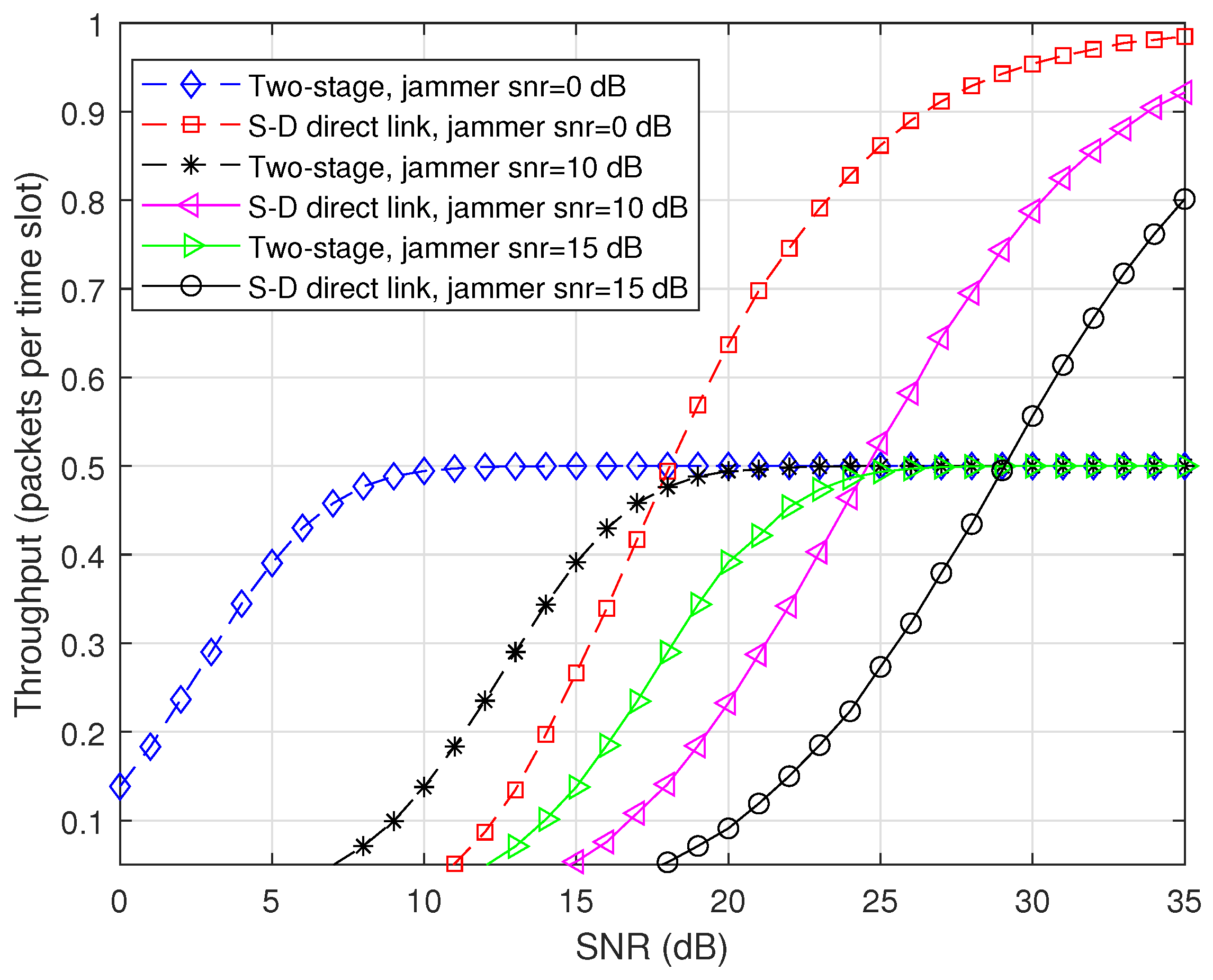
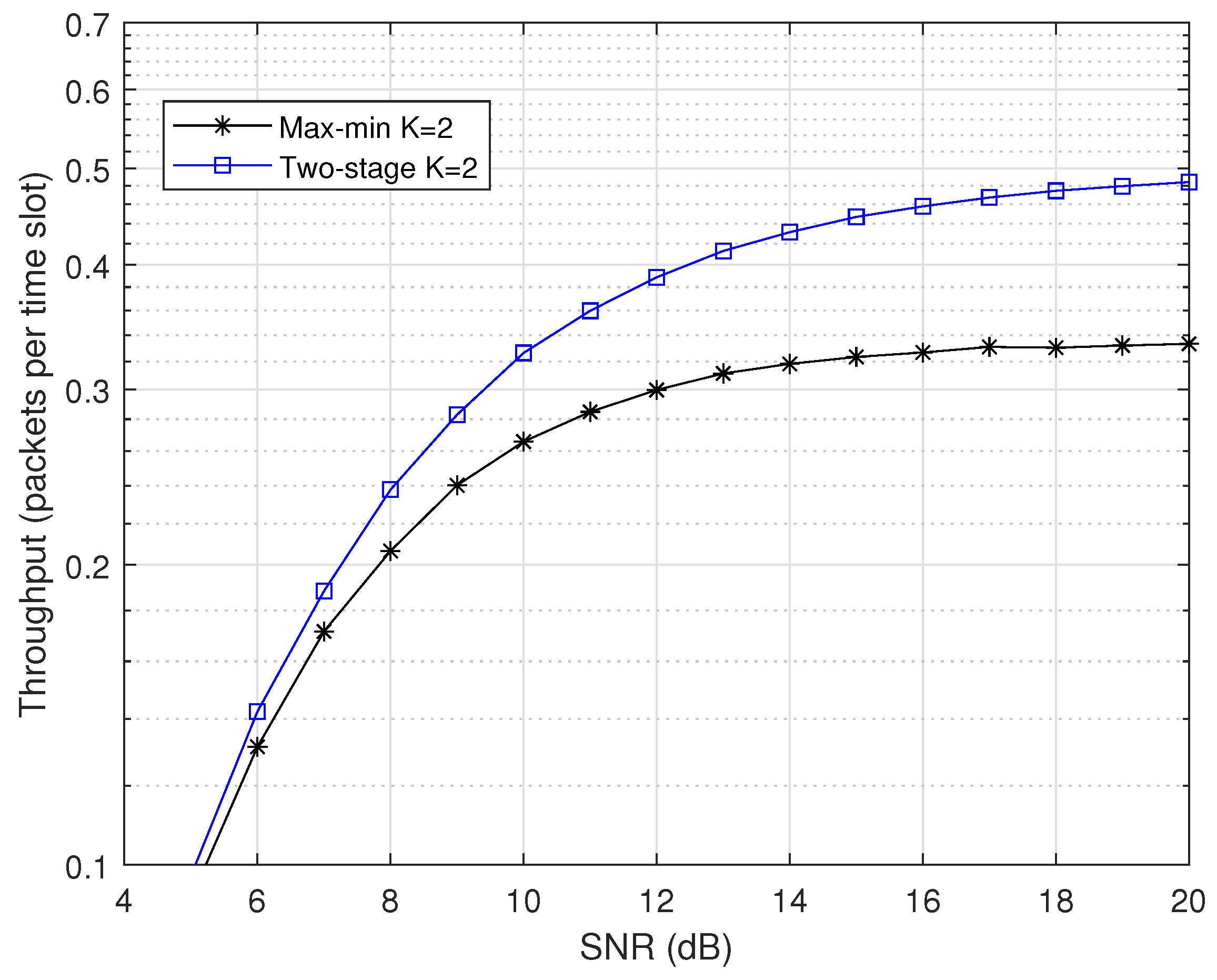
This paper addresses the critical challenge of securing next-generation green wireless Internet of Things (IoT) networks against malicious physical-layer jamming attacks. Traditional opportunistic relay selection schemes, such as the conventional max-min, optimize routing paths based strictly on instantaneous channel conditions. However, this channel-only focus disregards the underlying energy states of candidate nodes, introducing an energy-starvation vulnerability, and severely degrades the network’s overall secrecy and reliability. To counter this threat, we propose a robust two-stage selection mechanism engineered to provide resilient physical-layer security. In the first stage, the proposed protocol dynamically isolates energy-depleted relays, restricting the selection domain exclusively to a subset of verified, energy-sufficient candidates. In the second stage, the mechanism optimizes the final path selection by identifying the relay that maximizes the channel quality while explicitly accounting for the interference injected by the jammer. Analytical derivations and simulation results demonstrate that while traditional max-min schemes suffer from catastrophic outage floors and early throughput saturation in jamming environments, the proposed framework successfully eliminates these performance ceilings. The results confirm that the two-stage mechanism fully preserves the network’s spatial diversity order, allowing the system to leverage the available relays to effectively neutralize aggressive jamming interference. Furthermore, the performance of the relay-assisted architecture is verified to be superior to that of the non-cooperative direct transmission across jamming environments.
Keywords: IoT security; jamming; physical layer security; relay selection; energy harvesting IoT security; jamming; physical layer security; relay selection; energy harvesting